Review

Electron Transfer-Mediated Heavy Metal(loid) Bioavailability, Rice Accumulation, and Mitigation in Paddy Ecosystems: A Critical Review
1
Co-Innovation Center for the Sustainable Forestry in Southern China, College of Ecology and Environment, Nanjing Forestry University, Nanjing 210037, China
2
Zhejiang Collaborative Innovation Center for Full-Process Monitoring and Green Governance of Emerging Contaminants, Interdisciplinary Research Academy, Zhejiang Shuren University, Hangzhou 310015, China
3
College of Life Sciences, Nanjing Forestry University, Nanjing 210037, China
*
Authors to whom correspondence should be addressed.
These authors contributed equally to this work.
Agriculture 2026, 16(2), 202; https://doi.org/10.3390/agriculture16020202
Submission received: 2 December 2025 / Revised: 7 January 2026 / Accepted: 12 January 2026 / Published: 13 January 2026

Abstract

Electron transfer (ET) is a foundational biogeochemical process in paddy soils, distinctively molded by alternating anaerobic-aerobic conditions from flooding-drainage cycles. Despite extensive research on heavy metal(loid) (denoted as “HM”, e.g., As, Cd, Cr, Hg) dynamics in paddies, ET has not been systematically synthesized as a unifying regulatory mechanism, and the trade-offs of ET-based mitigation strategies remain unclear. These critical gaps have drastically controlled HMs’ mobility, which further modulates bioavailability and subsequent accumulation in rice (Oryza sativa L., a staple sustaining half the global population), posing substantial food safety risks. Alongside progress in electroactive microorganism (EAM) research, extracellular electron transfer (EET) mechanism delineation, and soil electrochemical monitoring, ET’s role in orchestrating paddy soil HM dynamics has garnered unparalleled attention. This review explicitly focuses on the linkage between ET processes and HM biogeochemistry in paddy ecosystems: (1) elucidates core ET mechanisms in paddy soils (microbial EET, Fe/Mn/S redox cycling, organic matter-mediated electron shuttling, rice root-associated electron exchange) and their acclimation to flooded conditions; (2) systematically unravels how ET drives HM valence transformation (e.g., As(V) to As(III), Cr(VI) to Cr(III)), speciation shifts (e.g., exchangeable Cd to oxide-bound Cd), and mobility changes; (3) expounds on ET-regulated HM bioavailability by modulating soil retention capacity and iron plaque formation; (4) synopsizes ET-modulated HM accumulation pathways in rice (root uptake, xylem/phloem translocation, grain sequestration); (5) evaluates key factors (water management, fertilization, straw return) impacting ET efficiency and associated HM risks. Ultimately, we put forward future avenues for ET-based mitigation strategies to uphold rice safety and paddy soil sustainability.

1. Introduction

Paddy soils are critical agricultural ecosystems sustaining global rice production and food security for over 3.5 billion people [1]. However, rapid industrialization, wastewater irrigation, and excessive agrochemical use have caused widespread heavy metal(loid) (denoted as “HM”, e.g., As, Cd, Cr, Hg) contamination, with As and Cd being the most recalcitrant due to high bioaccumulation in rice grains [2,3]. These contaminants not only impede rice growth (e.g., diminishing photosynthetic efficiency and nutrient uptake) but also bioaccumulate in grains, posing hazards of chronic toxicity (e.g., As-induced skin lesions, Cd-associated kidney damage) to humans through the food chain [4]. Unlike upland soils, paddy soils undergo flooding-drainage cycles, creating dynamic redox potential (Eh, ranging from −200 mV to >300 mV) that drive intense electron transfer (ET) processes [5,6]. While redox-HM links are well established, key gaps persist: (1) fragmented molecular mechanisms of ET-driven HM valence transformation; (2) unresolved ET effects on multi-metal (e.g., As + Cd) co-contamination; (3) inadequate synthesis of root-associated ET heterogeneity and mineral/microbe interactions; (4) inconsistent field performance of ET-based mitigation strategies. These issues highlight the need for a targeted review to consolidate ET-HM interactions.
Rice’s acclimation to anaerobic conditions renders it vulnerable to HM accumulation. For example, ET-driven As(V) (as H2AsO4) → As(III) (as H3AsO3) reduction increases bioavailability by 2–3 times [7], while ET-mediated Fe(III) oxide reduction liberates Cd [8]. Alarmingly, 10–20% of Asian paddy soils exceed HM safety thresholds, with grain Cd/As breaching WHO standards, presenting substantial risks to dietary Cd/As intake and human blood accumulation [9,10]. Conventional research focuses on chemical extraction or microbial communities, overlooking ET as the core unifying driver. Recent breakthroughs, such as the delineation of electroactive microorganisms (EAMs, a group of microbes capable of mediating extracellular electron transfer (EET) between intracellular metabolism and extracellular electron acceptors/donors) (e.g., Geobacter, Shewanella) in paddy rhizospheres, the quantitation of Fe/Mn/S redox cycling rates, and the advancement of in situ ET sensors, have uncovered that ET processes underlie nearly all key HM transformations in paddy soils. These breakthroughs confirm ET underlies 60–80% of Cr(VI) (as HCrO4) reduction and 70% of As valence changes in flooded paddies [11,12,13], underscoring its centrality.
To address these gaps, this review focuses on paddy-specific ET-HM interactions with four core objectives: (1) integrate core ET mechanisms and their acclimation to flooding; (2) unravel ET-regulated HM valence transformation, speciation shifts, and mobility-bioavailability cascades; (3) synthesize ET-modulated HM accumulation in rice and key regulatory factors; (4) propose evidence-based ET-driven mitigation strategies. This work provides a cohesive framework resolving controversies, highlighting understudied areas, and guiding sustainable HM mitigation in paddy agriculture.

2. Methods

2.1. Literature Search and Selection

Literature was retrieved from Web of Science, Scopus, and PubMed databases using the following keywords: (“electron transfer” OR “redox cycling” OR “electroactive microorganism”) AND (“paddy soil” OR “rice”) AND (“heavy metal” OR “metalloid” OR “arsenic” OR “cadmium” OR “chromium” OR “mercury” OR “lead”). The search period was limited to 2010–2025, with priority given to peer-reviewed articles, reviews, and research papers in English.

2.2. Selection Criteria

Included studies met the following criteria: (1) Focus on ET processes in paddy ecosystems; (2) Address metal(loid) mobility, bioavailability, or rice accumulation; (3) Provide mechanistic insights or empirical data on ET-HM interactions. Excluded studies were those focusing on upland soils, non-ET-driven HM processes, or laboratory-scale experiments without paddy relevance.

2.3. Structure and Analysis

The selected 129 literatures were thematically organized into sections: ET mechanisms, HM mobility/bioavailability, rice accumulation, regulatory factors, and mitigation strategies. Critical analysis was conducted to contrast conflicting findings, identify research gaps, and synthesize evidence-based conclusions.

3. Core Electron Transfer Mechanisms in Paddy Soils

Paddy soils demonstrate distinctive ET mechanisms compared to upland soils, acclimated to their distinctive redox dynamics. The classification of core ET mechanisms in this review is based on the primary drivers (biotic vs. abiotic) and key carriers (microorganisms, Fe/Mn/S, organic matter, roots), which is consistent with the majority of paddy soil research [14,15,16]. Alternative classification approaches include dividing ET into “biotic” (microbial/root-mediated) and “abiotic” (Fe/Mn/S/OM-mediated) processes [17], but this overlooks the synergistic interactions between biotic and abiotic components (e.g., EAMs driving Fe redox cycling) [12,18]. Controversial aspects include the relative importance of direct vs. indirect EET and the role of Fe-S coupling cycling in ET, which are critically discussed in subsequent subsections.
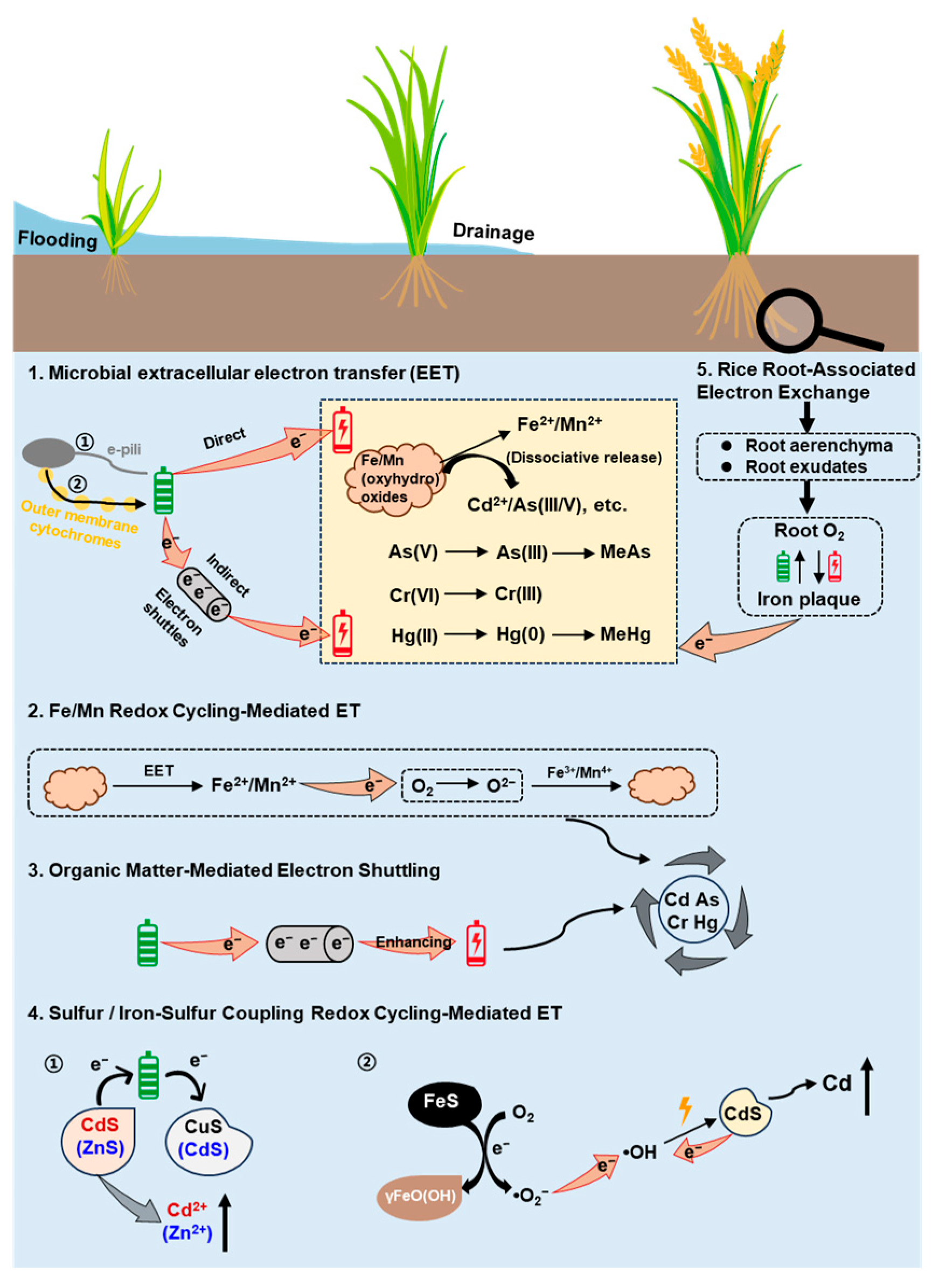
Figure 1 provides a conceptual framework for the core ET mechanisms discussed in this section, including direct/indirect EET (Section 3.1 and Section 3.2), Fe/Mn redox cycling (Section 3.4), organic matter-mediated shuttling (Section 3.5), S redox cycling (Section 3.6), Fe-S coupling cycling (Section 3.7), and root-associated electron exchange (Section 3.8). Each subsection elaborates on the mechanism, ET pathways, and regulatory effects on HMs.

3.1. Direct Microbial Extracellular Electron Transfer

Microorganisms are the principal drivers of ET in flooded paddy soils, with EAMs (capable of EET) constituting ~20% of the total microbial community [12]. EET empowers EAMs to transmit electrons from intracellular metabolism to extracellular acceptors (e.g., Fe(III) oxides, Cr(VI)), facilitating HM reduction/oxidation [21,22]. The Key EAMs in paddy soils and their roles in HM transformation are summarized in Table 1.
Direct EET takes place through physical contact between EAMs and electron acceptors, facilitated by conductive pili (e-pili) and outer membrane cytochromes (OMCs) [20]. Geobacter sulfurreducens prolific in paddy rhizospheres generates e-pili (composed of PilA proteins) with conductivity on par with synthetic polymers, transmitting electrons to Fe(III) oxides and Cr(VI) over distances up to 100 μm [20,23]. Metagenomic analyses reveal that PilA-like genes are 2–3 times more prevalent in flooded vs. drained paddies, validating enhanced direct EET under anaerobic conditions [24,25,26]. Additionally, OMCs (e.g., MtrC, OmcA in Shewanella oneidensis) assemble redox-active complexes on cellular surfaces, establishing electron channels between EAMs and HMs [12,22]. In Cd-contaminated paddies, Shewanella-mediated OMC electron transfer diminishes Cd2+ adsorption on Fe oxides by 40% via Fe(III) reduction, increasing Cd mobility [27]. Direct EET also facilitates Hg methylation: sulfate reducing bacteria (SRB) (e.g., Desulfovibrio vulgaris) utilize OMCs to transfer electrons to Hg(II), driving its methylation to highly toxic MeHg; MeHg is highly neurotoxic, and its accumulation in rice grains can impair cognitive development in children and cause neurological disorders in adults [28,29,30].
Table 1. Summary of electroactive microorganisms (EAMs) in paddy soils, their electron transfer mechanisms, and associated heavy metal(loid).
EAM SpeciesElectron Transfer MechanismAssociated Metal(loid)References
Geobacter sulfurreducensDirect EET (e-pili, OMCs); Fe(III) reductionAs, Cr, Cd[18,20,23]
Shewanella oneidensisDirect EET (OMCs); Indirect EET (flavins)Cr, Cd, As[12,27,31]
Desulfovibrio vulgarisIndirect EET (sulfide production); Hg methylationHg, Cd[28,32,33]
Iron-reducing bacteria Fe(III) reduction; Direct EETAs, Cd[18,34,35]
Manganese-oxidizing bacteriaMn(II) oxidation; ET-mediated As(III) oxidationAs[36,37,38]

3.2. Indirect Microbial Extracellular Electron Transfer

Indirect EET relies upon soluble electron shuttles to transfer electrons without physical contact, a process amplified in paddies due to straw decomposition and root exudation [39,40,41]. Natural shuttles (e.g., flavins, quinones, humic acids) are prevalent in paddies: Shewanella secretes riboflavin, boosting Fe(III) reduction and subsequent As release from Fe oxides [31]. Straw-derived humic acids rich in quinone groups (3–5% C content) facilitate electron transfer between EAMs and As(V), converting H2AsO4 to highly bioavailable H3AsO3 under flooding [42,43]. Synthetic shuttles (e.g., anthraquinone-2,6-disulfonate, AQDS) have been evaluated for paddy remediation: the addition of 1 mmol L−1 AQDS enhances Cr(VI) (as HCrO4) reduction by >50% via indirect EET, lowering rice Cr accumulation by >30% [44,45]. However, the environmental fate of synthetic shuttles demands additional assessment.

3.3. Electron Donors and Substrates for Electroactive Microorganisms in Paddy Ecosystems

Electroactive microorganisms in paddy ecosystems depend on diverse electron donors and substrates, predominantly modulated by root exudates and organic matter decomposition. Labile carbon compounds derived from root exudates (e.g., sugars, phenolics) and rice straw humification (e.g., short-chain fatty acids, xylan-derived carbon) function as core electron donors [46,47]. Specifically, iron-reducing bacteria (FRB) such as Geobacter favor acetate and xylan metabolites, while SRB utilize lactate and acetate for sulfate reduction [48,49]. Notably, emerging interspecies electron transfer systems have been documented: Methanomassiliicoccus collaborates with Geobacter to employ methanol and dimethylarsenic as substrates for methane production via direct interspecies electron transfer [50]. Furthermore, redox-active quinone structures formed during rice straw humification act as endogenous electron shuttles, facilitating EET [8,51]. These substrates and electron donors concertedly modulate EAM-mediated processes (e.g., Fe(III) reduction, Hg methylation), linking carbon-sulfur-nitrogen cycles and HM transformation in paddy rhizosphere and bulk soil microenvironments.

3.4. Fe/Mn Redox Cycling-Mediated ET

Paddy soils abound in Fe oxides (50–150 g kg−1) and Mn oxides (1–10 g kg−1), with them as the most prevalent abiotic ET facilitators [52,53]. The Fe(III)/Fe(II) cycle, fueled by flooding-drainage cycles, is especially pivotal for HM regulation. Under flooding (anaerobic, Eh < 0 mV), EAMs and abiotic reducers (e.g., dissolved sulfide (S2−/HS) from SRB-mediated sulfate reduction) transmit electrons to Fe(III) oxides (goethite, hematite), converting them to soluble Fe(II) [17]. This ET process liberates electrons stored in Fe oxides, enabling the reduction of Cr(VI) to immobile Cr(III) and As(V) to mobile As(III) [54]. Fe(II) also generates secondary minerals (e.g., vivianite, FeS) that co-precipitate Hg, diminishing the mobility by >50% [55]. During drainage (aerobic, Eh > 300 mV), Fe(II) undergoes rapid oxidation to Fe(III) oxides via ET, with O2 serving as the terminal acceptor [17]. This re-oxidation produces reactive oxygen species (ROS) and new Fe(III) oxide surfaces, which adsorb As(V) and Cd2+, lowering their bioavailability [56,57]. Mn oxides possessing higher Eh than Fe oxides facilitate ET-driven As(III) oxidation to As(V) at a rate 2–3 times quicker than Fe oxides, which is a key process in drained paddies [38,58].

3.5. Organic Matter-Mediated Electron Shuttling

Soil organic matter (SOM) in paddies, originating from straw, root residues, and organic fertilizers, functions as both an electron donor and shuttle [59,60,61]. Paddy SOM possesses a greater electron transfer capacity (0.3–0.6 mmol e g−1 C) than upland SOM, attributed to lignin-rich rice straw decomposition yielding quinone-rich humic acids [62]. These humic acids orchestrate ET between EAMs and HMs, for instance, they transmit electrons to HCrO4 under flooding, reducing it to Cr3+ without microbial involvement [63]. Rice root exudates (e.g., cinnamic acid, ferulic acid) harbor redox-active phenols that boost ET in the rhizosphere [64]. For example, root-exuded phenols elevate Geobacter’s EET efficiency significantly, facilitating Fe(III) reduction and Cd release from Fe oxides [18,65]. SOM also assembles organo-mineral complexes with Fe/Mn oxides, preserving their redox activity and upholding long-term ET-driven HM transformation [66].

3.6. Sulfur Redox Cycling-Mediated ET

Paddies experience periodic flooding and drainage, creating alternate redox fluctuations and thus altering the transformation and bioavailability of metal ions. During soil flooding, SRB mediate the reduction of SO42− by metabolism-mediated ET to S2−/HS, with the latter reacting with free chalcophile metal ions (e.g., Cd2+, Pb2+, Cu2+, Zn2+) to generate poorly dissolved metal sulfides, including CdS, PbS, CuS, ZnS, respectively [32,67,68]. These metal sulfides significantly reduce the solubility (a ratio of soluble to total metal concentration) and mobility of metal ions. Upon soil drainage, these metal sulfides can form a series of voltaic cells between each pair due to the differences of electrochemical potentials (ECPs) as follow (pH 5.5): CuS (426 mV) > CdS (361 mV) ≈ PbS (344 mV) > ZnS (243 mV) [19]. These interactions can potently modulate the bioavailability of metal ions by ET processes with different directions. Metal sulfides with low ECPs tend to preferentially oxidize and dissolve, releasing electrons that are then transferred to those with higher ECPs. This process inhibits the oxidative dissolution of the latter metal sulfides, thereby significantly reducing the release concentration of metal ions in the latter while increasing the release of metal ions from the former (denoted as “voltaic effect”) [19]. For example, in the CdS-ZnS voltaic cell, ZnS with the lower ECP tends to preferentially oxidize and dissolve, releasing electrons that are then transferred to CdS with a relatively higher ECP. Thus, CdS is shielded from oxidative dissolution: Cd bioavailability decreases markedly, whereas Zn bioavailability rises (denoted as “suppressive voltaic effect” for Cd) [19,69]. Conversely, CuS exhibits a higher ECP in the CdS-CuS voltaic cell, inducing preferential oxidative dissolution of CdS via ET, thereby promoting the release of bioavailable Cd while CuS remains protected. From this, it can be inferred that the suppressive voltaic effect can be used to mitigate the accumulation of Cd in rice grain. For example, applying ZnSO4 addition (75–150 kg ha−1 Zn) prior to flooding can effectively facilitate the formation of ZnS, thus obviously reducing CaCl2-extractable Cd and grain Cd by 32–64% and 74–87%, respectively [19,70].

3.7. Iron-Sulfur Coupling Redox Cycling-Mediated ET

Paddy flooding and drainage processes provoke the Fe-S cycling, exerting a dual effect on the modulation of HM (e.g., Cd) bioavailability by abiotic ET. Soil flooding triggers the generation of S2−/HS, which can react with free Fe2+/Mn2+ as well as Cd2+, thus producing precipitates as FeS/MnS and CdS [71]. In the subsequent drainage phase, FeS/MnS is exposed to O2, triggering Fenton-like reactions and thus mediating the production of ROS, including hydroxyl radical (•OH), superoxide radical (•O2) and hydrogen peroxide (H2O2), both on the horizonal and vertical scales in paddy soils [57,71,72,73]. Among all ROS, •OH stands as the most reactive oxidant, derived from •O2 (Fe(II)-stimulated one-electron transfer) or H2O2 (Fe(II)-stimulated two-electron transfer) [57,74,75]. Soil ROS, particularly •OH, exert crucial functions in directly oxidizing CdS by extracting electrons from S2−, potently boosting Cd release and elevating Cd bioavailability during paddy drainage (denoted as “free radical effect”) [71]. Similarly, •OH extracts electrons from As(III), catalyzing oxidation to As(V) and indirectly fostering As adsorption by Fe oxides; consequently, both the mobility and bioavailability of As diminished markedly [73].
Furthermore, both FeS and MnS have low ECPs (49 and 87 mV, respectively, pH 5.5) compared to CdS, preferentially oxidizing to dissolution and suppressing the oxidative dissolution of CdS referring to the voltaic effect principle; consequently, the release of Cd is suppressed, and the bioavailability of Cd is significantly reduced [19]. Nevertheless, the two sulfides (FeS and MnS) exhibit different response times and intensities to the ET process between them and CdS. The voltaic effect-ET only occurs within the initial oxidation stage of FeS, with the subsequent radical effect-ET dominantly enhancing the oxidative dissolution of CdS and increasing the bioavailability of Cd [71,76]. By contrast, the ET between MnS and CdS (decreasing the release of Cd), as well as the electron abstraction process by •OH generated via MnS oxidation (increasing the release of Cd), synergistically control the dissolution of CdS [19,70,77], and the relative contributions of these two processes require further investigation.

3.8. Rice Root-Associated Electron Exchange

Rice roots notably regulate rhizosphere ET through three concerted, spatiotemporally coordinated mechanisms: radial oxygen loss (ROL) via aerenchyma, selective secretion of redox-active exudates, and mycorrhizal symbiosis; these processes are localized within specialized rhizosphere micro-niches rather than uniformly dispersed along the root axis [78].
Mechanism 1: ROL-mediated aerobic microzone formation. Rice roots form aerenchyma as gas channels, transporting atmospheric O2 from shoots to root tips and lateral root primordia. This O2 diffusion generates distinct aerobic microzones (Eh > 300 mV) in the surrounding anaerobic bulk soil (Eh < −100 mV), establishing steep redox gradients that propel directional ET [79]. Within these microzones, O2 serves as a terminal electron acceptor for ET-mediated oxidation of Fe(II) to amorphous Fe(III) oxides, which deposit on the root surface to form iron plaque—thicker in the root hair zone and sparse in mature regions due to varying aerenchyma activity [36]. Iron plaque serves as a “redox filter” for HMs, adsorbing or immobilizing As and Cd to diminish root uptake, while the redox gradient promotes interzonal ET and indirect HM valence shifts [80,81].
Mechanism 2: redox-active exudates as electron shuttles and EAM substrates. Root exudates (sugars, amino acids, redox-active phenolics) are primarily excreted from the root hair zone and lateral root apices, fostering nutrient-rich micro-niches for EAMs. They regulate ET dually: sugars and amino acids supply labile organic carbon to augment EAM abundance (e.g., FRB) and improve microbial EET [34,82,83,84]; phenolic exudates serve as electron shuttles through quinone-hydroquinone couples, facilitating ET between root cells and HMs (e.g., As(V) reduction) and enhancing EET efficiency [85]. Phenolic secretion is stringently controlled, with higher concentrations in the root hair zone generating ET hotspots [84,85].
Mechanism 3: mycorrhizal symbiosis-augmented ET capacity. Arbuscular mycorrhizal fungi (AMF) establish symbiosis with rice roots, colonizing mature root cortical cells and extending hyphae into the rhizosphere [86]. This symbiosis bolsters ET capacity through two pathways: hyphae harbor redox-active proteins facilitating ET between root cells and Fe(III) oxides, promoting Fe(III) reduction and alleviating Cd uptake [87,88]; AMF hyphae secrete proteins that serve as carbon sources for EAMs, forming a hyphae-EAM complex to elevate local ET efficiency and facilitate HM immobilization.
Collectively, these mechanisms function within spatially distinct rhizosphere micro-niches, with ROL establishing redox gradients, exudates sustaining EAM activity, and mycorrhizal symbiosis expanding ET range; they concertedly regulate HM mobility and bioavailability in paddy ecosystems.

4. Electron Transfer-Driven Heavy Metal Mobility and Bioavailability in Paddy Soils

ET processes directly dictate HM mobility (ability to move in soil solution) and bioavailability (fraction bioaccessible to rice), with distinct patterns for each metal. Iron and manganese (Fe/Mn) are core mediators of electron transfer in paddy soils, undergoing redox-driven transformations during flooding-drainage cycles. Under anaerobic flooding, electron donors (e.g., organic carbon) drive microbial reduction of Fe3+ to soluble Fe2+ and Mn4+ to Mn2+, altering soil Eh and generating reactive Fe/Mn species. Upon drainage, aerobic conditions trigger Fe2+/Mn2+ oxidation and precipitation of Fe/Mn oxides, which act as electron acceptors and adsorption carriers [17,32,68]. These Fe/Mn-coupled electron transfer processes modulate soil Eh, pH, and reactive mineral surfaces, directly regulating the valence state, mobility, and bioavailability of HMs (As, Cd, Cr, Hg, Pb). The ET-driven mobility and/or bioavailability patterns of major HMs are summarized in Table 2, with distinct responses to flooding-drainage cycles. These dynamic redox conditions in paddies induce reversible ET-mediated transformations, establishing “bioavailability hotspots” during flooding-drainage cycles.

4.1. Arsenic (As, a Metalloid)

Arsenic mobility and bioavailability in paddies are closely linked to ET-driven Fe/Mn redox cycling [13]. Under flooding, FRB (e.g., Geobacter) orchestrate EET to reduce Fe(III) oxides to Fe(II), liberating adsorbed As(V) into soil solution [18]. Simultaneously, EAMs and SOM shuttles transmit electrons to As(V), converting it to As(III), which is a form with 10–100 times lower adsorption affinity for Fe oxides [89,90]. This dual ET-driven effect effectively elevates dissolved As concentrations by at least 2 folds and DTPA-extractable As (bioavailable fraction) by up to 50% [35]. Drainage reverses this dynamic: Mn oxides (high Eh) facilitate ET-driven As(III) oxidation to As(V) [38]. Newly formed Fe(III) oxides (from Fe(II) oxidation) adsorb As(V) via inner-sphere complexation, diminishing mobility by ~60% averagely and bioavailability by 40–60% [56]. Iron plaque that formed via root ET further sequesters As(V) (as H2AsO4), reducing its translocation to shoots by ~30–50% [80].

4.2. Cadmium (Cd)

Cadmium predominantly exists as Cd(II) in paddies, with ET governing its mobility through Fe oxide transformation and sulfur cycle [57]. Under flooding, ET-driven Fe(III) reduction to Fe(II) diminishes Fe oxide surface charge density, lowering Cd2+ adsorption [8]. This alters Cd speciation from oxide-bound (immobile) to exchangeable (mobile), increasing Cd bioavailability by ~35% [8]. SOM-mediated ET also influences Cd: reduced SOM (hydroquinone groups) complexes Cd2+, counteracting 10–20% of the mobility enhancement [18]. Furthermore, microbial reduction of SO42− generates aqueous S2−/HS, promoting the precipitation of CdS that predominantly diminishes Cd bioavailability by up to >80% [33,91].
Following soil drainage, the oxidative dissolution of CdS regulates the release of Cd and its accumulation risk in rice grain. For soils featuring high Zn/Cd ratios (>20), the preferential oxidative dissolution of ZnS markedly inhibits the oxidation of CdS via the voltaic effect, thereby efficiently diminishing Cd bioavailability [19,69,70]. Additionally, in soils containing high-reactivity Fe(II) fractions, Fe(II) oxidation induces the conversion of O2 to •O2 (one electron transfer) or H2O2 (two electron transfer), generating •OH through the Fenton reaction. This free radical effect notably accelerates the oxidative dissolution of CdS and facilitates Cd release [71,76]. However, the relative contribution of the voltaic effect and the free radical effect in regulating Cd bioavailability remains ambiguous. Furthermore, soil drainage restores the adsorption capacity of Fe oxides: ET-driven Fe(II) oxidation forms new Fe(III) oxides, which adsorb Cd2+ via electrostatic interactions and ligand exchange [17]; this reduces exchangeable Cd by up to 50% and bioavailability by up to 40%. Iron plaque plays a critical role in Cd retention: its high surface area adsorbs 20–30% of rhizosphere Cd, constraining root uptake [37].

4.3. Chromium (Cr)

Paddy Cr dynamics are governed by ET-driven valence changes: Cr(VI) (highly toxic, mobile) vs. Cr(III) (low toxicity, immobile). Under flooding, EAMs (Geobacter, Shewanella) orchestrate direct EET to reduce Cr(VI) to Cr(III), with Fe(II) (from Fe(III) reduction) serving as an indirect electron donor [92]. Humic acids boost this process by 30%, reducing Cr(VI) (as HCrO4) mobility by 60–80% via Cr(OH)3 precipitation; consequently, DTPA-extractable Cr decreases by 65% averagely, minimizing rice uptake [63,93]. Drainage poses a risk: Mn oxides (Eh > 1.2 V) mediate ET-driven Cr(III) oxidation to Cr(VI), effectively increasing mobility [94]. However, SOM in paddies sequesters Cr(VI) through quinone reduction, limiting this effect to ~15% of total Cr [63]. Long-term straw return enhances SOM content, further inhibiting Cr(VI) formation [95].

4.4. Mercury (Hg)

ET processes govern Hg transformation through two competing pathways: reduction to volatile Hg(0) and methylation to MeHg. Under flooding, SRB and FRB transfer electrons to Hg(II), converting it to Hg(0), which volatilizes out of the soil, decreasing total Hg by 10–20% [96]. However, SRB also use ET to methylate Hg(II) to MeHg, which is a form that accumulates in rice grains 10–20 times more efficiently than inorganic Hg [28]. SOM augments MeHg production through ET: humic acids act as electron shuttles and methyl donors, increasing MeHg concentrations by 2–3 folds [97]. Drainage reduces MeHg via ET-driven oxidation: Mn oxides oxidize MeHg to Hg(II), decreasing grain MeHg by at least 20% [98]. However, intermittent flooding (e.g., alternate wetting and drying (AWD)) equilibrates these processes, reducing both Hg(0) volatilization and MeHg production [99,100].

4.5. Lead (Pb)

Lead mobility in paddies is governed by ET-driven co-precipitation and adsorption. Under flooding, ET-driven Fe(III) reduction to Fe(II) and sulfate reduction to sulfide (by SRB) generate Pb-Fe sulfides (PbFe2O4, PbS) and Pb-carbonates, which are highly insoluble minerals that diminish Pb mobility over 70% [19,101]. This can result in the decrease of DTPA-extractable Pb over 80%, as Pb is sequestered within the soil matrix. SOM-mediated ET further augments Pb immobilization: reduced SOM (hydroquinone groups) forms stable complexes with Pb(II), and SOM-Fe oxide complexes provide additional adsorption sites [102]. Drainage has minimal effect on Pb, as Pb sulfides/carbonates maintain stability under aerobic conditions [103].

5. Electron Transfer-Modulated Heavy Metal Accumulation in Rice

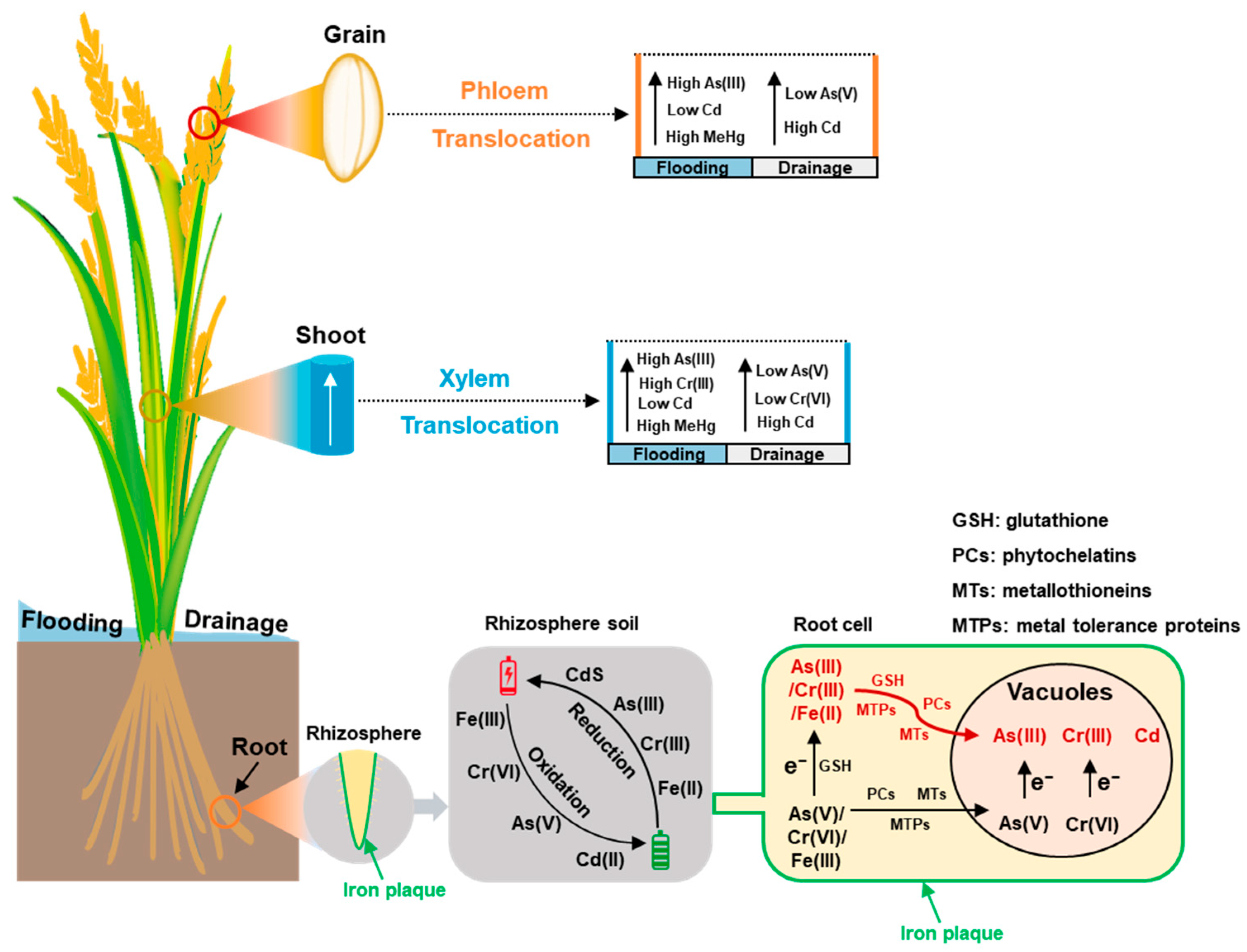
Rice bioaccumulates HMs through a sequential process encompassing root adsorption, succeeded by apoplastic/symplastic transport, ensuing xylem translocation to shoots, and final phloem translocation to grains (Figure 2) [104]. As the primary barrier and pathway for HMs, rice roots exert retention via physical interception, chemical adsorption, and intracellular compartmentalization during these processes, while regulating transport via transporter-dependent mechanisms [105]. Notably, ET is a central driver governing each stage: it supplies energy for transmembrane transport of HMs, regulates redox-dependent HM speciation, and shapes rice physiological traits (e.g., transporter activity, iron plaque formation), thereby directly dictating retention efficiency and transport direction [105].

5.1. Root Adsorption and Uptake

Root adsorption represents the first and foremost step for HM accumulation, governed by rhizosphere ET efficiency and root intrinsic retention mechanisms. Root cell walls, rich in carboxyl and hydroxyl groups, adsorb HMs through ion exchange and complexation, whereas root mucilage sequesters HMs via chelation; these two processes concertedly are modulated by ET-dependent root metabolism [105]. ET-driven As(V) → As(III) transformation under flooding augments As(III) (as H3AsO3) concentrations, which are absorbed through aquaporins (OsNIP2;1) exhibiting 2–3-fold higher affinity compared to As(V) (as H2AsO4, taken up via phosphate transporters (OsPT1/2)) [24,104]. This yields a ~55% average increase in root As uptake under flooding in contrast to drainage. ET-driven Fe(III) reduction under flooding enhances exchangeable Cd, which is absorbed through Ca2+ transporters (OsCCa2), Zn2+ transporters (OsZIP5), and NRAMP family transporters [6]. By contrast, drainage attenuates Cd uptake by more than 40% via Fe(III) oxide adsorption and iron plaque retention [81]. Additionally, ET-driven Cr(VI) → Cr(III) conversion under flooding alleviates root uptake, as Cr(III) is weakly translocated across root membranes [106].
Furthermore, rhizosphere microorganisms (e.g., SRB, arsenic reducing bacteria (ARB)) contribute to this process through ET-mediated redox transformations: SRB utilize ET to transform sulfate to dissolved sulfide, yielding insoluble HM sulfides, while ARB employ ET to convert As(V) to As(III) or methylated species, thereby altering HM bioavailability [105]. Iron plaque, as an ET-derived product, performs a crucial filtering role: it immobilizes As(V) via bidentate complexation and Cd2+ via cation exchange, diminishing their root uptake by at least 30% and 20%, respectively [37,80]. The thickness and redox activity of iron plaque are positively correlated with ET efficiency: elevated Fe(II) oxidation rates (driven by root O2 secretion) produce thicker plaque [36].

5.2. Root-to-Shoot Translocation

Xylem translocation of HMs from roots to shoots is governed by ET-regulated speciation, plant metabolism, and transporter activity. Inside root cells, HMs are sequestered in vacuoles by transporters (e.g., ATP-binding cassette transporter (ABC), heavy metal tolerance protein (HMT)) following complexation with glutathione (GSH) and phytochelatins (PCs), which is a process powered by ET-derived energy [105]. For instance, ET-driven As(III) formation under flooding promotes As complexation with GSH and PCs in roots, sequestering As within vacuoles and reducing xylem translocation. Drainage enhances As(V) (as H2AsO4) uptake, which is less efficiently complexed, resulting in ~30–50% higher shoot As content [104,107]. Additionally, ET-driven organic acid (citric acid) secretion under flooding enhances Cd complexation, and Cd is subsequently loaded into the xylem by P1B-type ATPases (e.g., OsHMA2), increasing xylem translocation by up to 40% [108].
Arbuscular mycorrhizal fungal (AMF) symbionts also regulate this stage via ET-dependent mechanisms: AMF extend the root absorption scope but sequester HMs in hyphae, and ET regulates the expression of key transporters (e.g., downregulating OsHMA2 to reduce Cd translocation) [105]. Iron plaque restricts translocation by retaining Cd in roots: plants with thicker plaque exhibit up to 50% lower shoot Cd content [37,81,109]. In contrast, ET-fueled methylation under flooding, which is catalyzed by hgcA-containing anaerobic rhizosphere microbes (e.g., SRB), augments xylem mobility. ET fuels intermolecular electron transfer to convert Hg(II) to reactive intermediate species, which are subsequently methylated via microbial hgcA-encoded methyltransferase enzymes; ET also sustains the synthesis of methyl donors for MeHg formation. This transforms inorganic Hg to lipophilic MeHg exhibiting greater membrane permeability, resulting in a ~5–10-fold higher translocation efficiency compared to inorganic Hg [110].

5.3. Grain Accumulation

Grain accumulation represents the culminating step governing food safety, governed by phloem translocation of HMs from shoots [104]. Grain As accumulation is dictated by As(III), with concentrations displaying a positive association with rhizosphere ET-driven As(III) [7,107]. Flooding during grain filling augments As(III) by 2–3-fold via ET-driven As(V) reduction, leading to grain As exceeding safety thresholds [111]. Grain Cd accumulation is driven by phloem translocation of Cd-organic acid complexes, a process governed by phloem-specific transporters (e.g., Oryza sativa low-affinity cation transporter 1 (OsLCT1)) [108]. Flooding during grain filling attenuates Cd accumulation by up to 60% via ET-driven Fe(III) oxide adsorption and PC sequestration [104,111].
Furthermore, ET-driven methylation under flooding enhances phloem translocation, with grain MeHg concentrations 10–20-fold higher than those in shoots [110,112]. Root-associated bacteria additionally regulate this step through ET-dependent metabolism: they excrete siderophores and extracellular polysaccharides (EPS) to sequester HMs, and their ET-driven metabolic activities modulate root growth and stress tolerance, indirectly regulating phloem translocation efficiency [105]. Rice genotypes exhibit variability in ET-related traits that impact accumulation: low-As genotypes possess more stringent regulation of OsNIP2;1 expression [104]; while low-Cd genotypes produce thicker iron plaque via enhanced root O2 secretion and exhibit more efficient ET-driven PC biosynthesis, during which ET provides energy for phytochelatin synthase (PCS)-catalyzed conversion of GSH to PCs that strongly chelate Cd2+ into vacuoles [113]. Selective breeding for ET-optimized traits (e.g., high plaque formation, low As(III) transporter activity, efficient microbial-ET synergy) constitutes a promising approach to mitigating grain HMs.

6. Factors Influencing Electron Transfer Efficiency and Heavy Metal Dynamics in Paddies

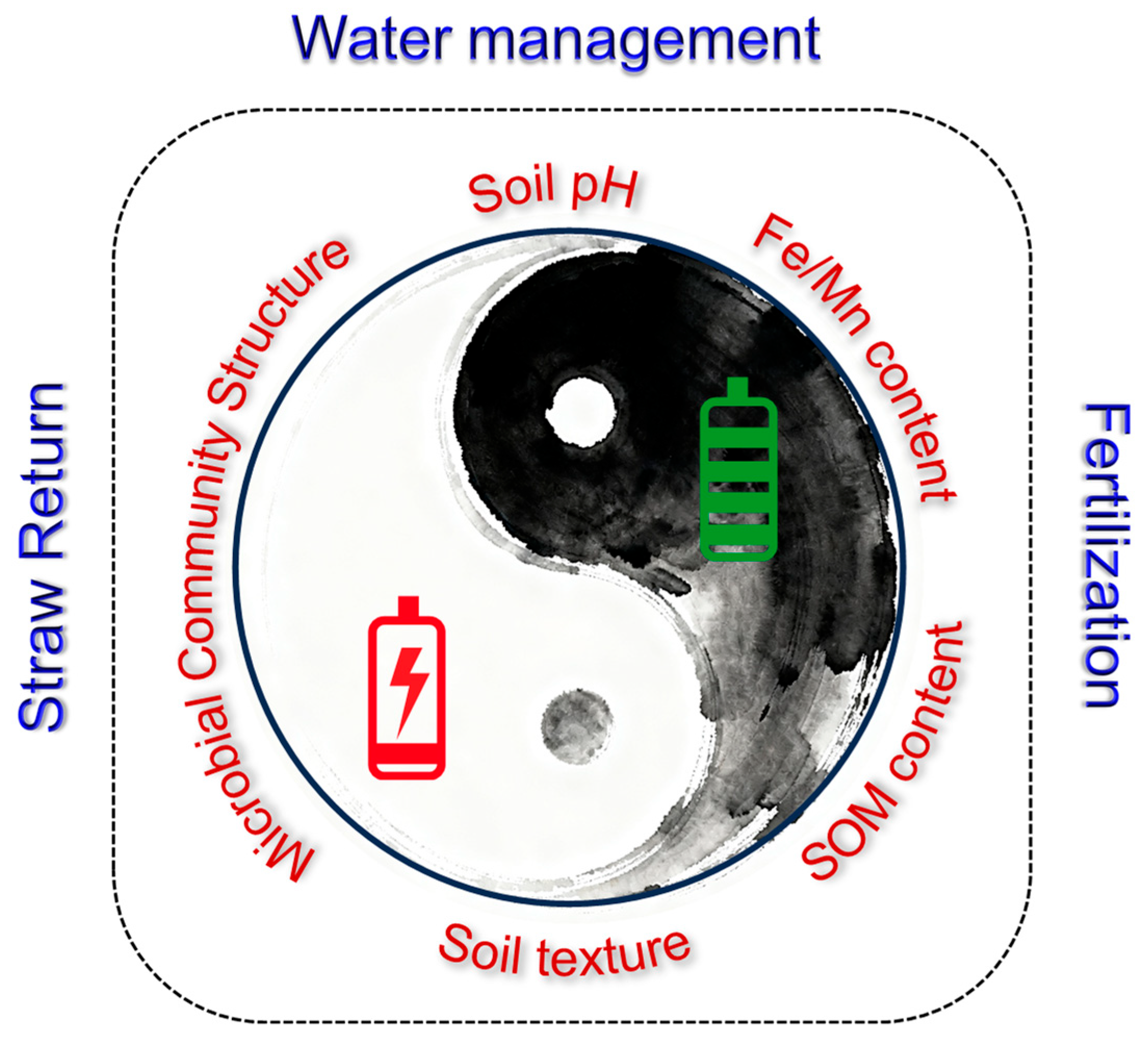
ET efficiency in paddies is modulated by a spectrum of paddy-specific factors, including water management, fertilization, straw return, soil properties, and microbial communities, that indirectly alter HM mobility, bioavailability, and rice accumulation (Figure 3) [23,43,111,114]. Excessive HM accumulation also disrupts soil microbial diversity, inhibits enzyme activity, and degrades soil fertility, threatening long-term paddy ecosystem sustainability. Understanding these factors is paramount for formulating ET-based mitigation strategies.

6.1. Water Management

Water management is the most influential factor, directly governing Eh and ET pathway selection. Continuous flooding sustains anaerobic conditions (Eh < −100 mV), facilitating microbial EET and Fe(III) reduction. This elevates As(III) (as H3AsO3) bioavailability by up to 80% but diminishes both Cr(VI) (as HCrO4) and Pb bioavailability over 70% [13,54,115]. Early-season flooding boosts Cd mobility by 30–50% via Fe(III) reduction while the long-term flooding generally transforms Cd as poorly dissolved CdS, thus decreasing Cd bioavailability [8,19]. By contrast, mid-season drainage (MSD) elevates Eh to >200 mV, redirecting ET to aerobic processes (Fe(II) oxidation, As(III) oxidation). MSD reduces As bioavailability by up to 60% but can augment Cr(VI) formation by 20–30% [116]. AWD, e.g., flooding for 5–7 days followed by drainage, equilibrates ET effects: it lowers grain As accumulation over 30% (via As(III) oxidation) and Cd by up to 30% (via Fe(III) oxide adsorption), rendering it the most extensively adopted water management strategy [111].

6.2. Fertilization

Fertilization modulates ET efficiency by altering electron donor/acceptor availability and soil properties. Organic fertilization (e.g., manure, compost, biochar) increases SOM content, providing electron shuttles (quinones) and carbon sources for EAMs [117]. Applying 20–40 t ha−1 biochar enhances ET efficiency by at least 20%, reducing grain Cd accumulation by up to 60% via complexation and Fe oxide stabilization [118].
Chemical nitrogen (N) fertilization increases NH4+ (electron donor) for EAMs, but excessive N (≥200 kg N ha−1) causes soil acidification (pH < 5.5), inhibiting FRB activity and reducing ET efficiency by 15–25% [13,119]. Phosphorus (P) fertilization increases phosphate, which competes with As(V) for Fe oxide adsorption, indirectly increasing As bioavailability by up to 30% [120]. Fe fertilization (e.g., FeSO4, 50–100 kg ha−1) enhances iron plaque formation via ET-driven Fe(II) oxidation, reducing grain As/Cd accumulation by 40% averagely [121].

6.3. Straw Return

Straw return is a prevalent agronomic practice that augments ET efficiency through two pathways: it supplies labile carbon (electron donor) for EAMs and liberates quinone-rich humic acids (electron shuttles). Applying 6–8 t ha−1 rice straw boosts FRB abundance by 2–3 times, facilitating Fe(III) reduction and As(V) → As(III); this elevates As bioavailability but diminishes Cd bioavailability via SOM complexation [43,122,123]. To mitigate As risks, straw can be preprocessed (e.g., composting) to lower quinone content; consequently, composted straw diminishes As bioavailability by 15–25% compared to fresh straw [122]. Co-applying straw return with biochar (at a weight ratio of 2:1) synergistically augments ET efficiency, lowering both grain As and Cd accumulation by at least 30% [124].

6.4. Soil Physicochemical Properties

Soil pH, Fe/Mn content, and SOM content directly modulate ET efficiency. Neutral pH (6.5–7.5) maximizes EAM activity; acidic soils (pH < 5.5) constrain Fe(III) reduction, elevating Cr(VI) bioavailability; alkaline soils (pH > 8.5) diminish Fe/Mn oxide solubility, restricting ET-driven As oxidation [92]. High Fe content (>100 g kg−1) augments ET efficiency by supplying additional electron acceptors, lowering As bioavailability via Fe oxide adsorption [56]. SOM content (>20 g kg−1) furnishes electron shuttles, diminishing Cd/Pb bioavailability via complexation [66]. Soil texture impacts ET through aeration: clayey soils (superior water retention) sustain anaerobic conditions, facilitating EET and As(III) formation [125].

6.5. Microbial Community Structure: Spatial Distribution and Functional Specialization

Electroactive microorganisms, encompassing FRB (e.g., Geobacter sulfurreducens), SRB (e.g., Desulfovibrio vulgaris), and denitrifying bacteria (e.g., Pseudomonas stutzeri), demonstrate distinct spatial stratification regulating ET efficiency. Fueled by root exudate gradients (e.g., sugars, phenolics) and heterogeneous redox microenvironments, the “rhizosphere effect” enriches EAMs by 2–5-fold relative to bulk soil [18,65]. Within the rhizosphere, EAM density reaches its apex in the root hair zone (106–107 copies g−1 soil) and decreases exponentially with increasing distance (to <105 copies g−1 soil at 2 cm) [18]. Bulk soil exhibits lower EAM diversity and abundance owing to constrained carbon availability and stable redox conditions, whereas rhizospheric Geobacter (>106 copies g−1 soil) enhances Fe(III) reduction by 20–30% and SRB (>105 copies g−1 soil) promotes Hg methylation [20,23,29].
EAMs exhibit functional specialization intimately coupled with ET processes and HMs’ dynamics. FRBs facilitate direct ET through conductive pili and outer membrane cytochromes, reducing Fe(III) oxides to Fe(II), releasing As(V), and enhancing Cd mobilization [18,20,65]. SRBs catalyze sulfate reduction to generate insoluble CdS (diminishing Cd bioavailability) and methylate Hg(II) to MeHg (resulting in 2–3-fold higher concentrations) [29,32]. Denitrifying bacteria employ nitrate as an electron acceptor, regulating Eh and mediating redox-sensitive HM transformations (e.g., As(III) oxidation) [12]. Inoculating specific EAMs (e.g., Geobacter sulfurreducens) boosts ET efficiency by over 30%, promoting Cr(VI) reduction to immobile Cr(III) and decreasing grain Cr3+ accumulation by more than 60% [20]; these processes underscore the potential of EAM manipulation for HM attenuation.

7. Paddy Heavy Metal Mitigation Strategies, Challenges and Future Directions

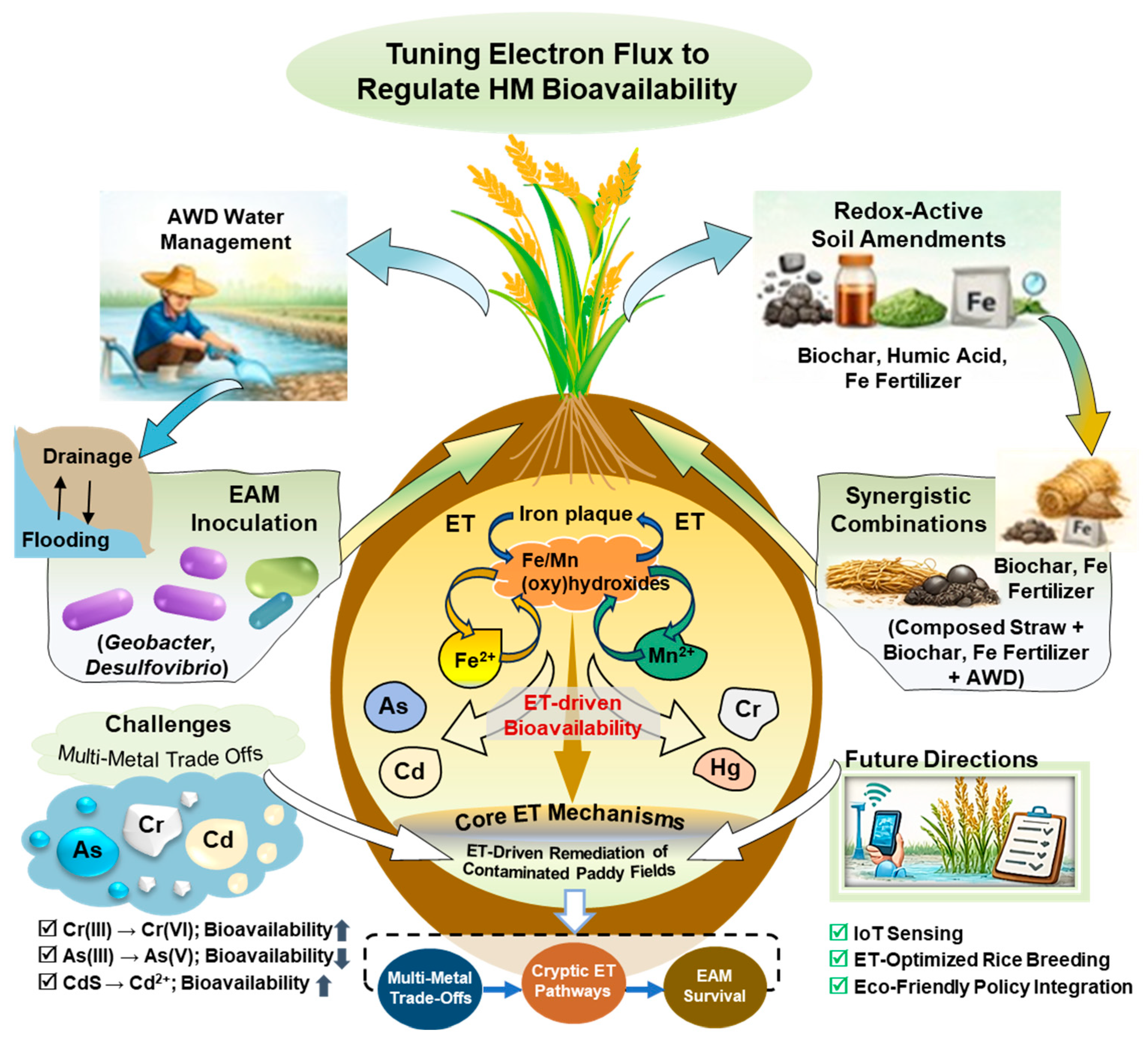
ET-driven mitigation strategies, grounded in core mechanisms synthesized herein (e.g., microbial EET, Fe/Mn/S redox cycling, root-associated electron exchange), provide targeted, sustainable remedies for paddy HM contamination by tuning electron flux to regulate HM bioavailability and rice accumulation (Figure 4). These strategies advance existing HM risk management by integrating mechanistic insights, with multi-dimensional environmental, agricultural, social and economic implications.

7.1. Multi-Dimensional ET-Driven Mitigation Strategies

  • Optimization of Water Management Practices (e.g., AWD, stage-specific flooding): Leveraging ET-driven redox shift mechanisms, AWD achieves a trade-off between As and Cd mitigation (reducing grain As by ~30% and Cd by ~35% [111]) while mitigating environmental trade-offs (e.g., adjusting flooding duration to curb N2O emissions [126]). Agriculturally, it is adaptable to temperate and tropical rice-growing regions; socially, it is low-cost and user-friendly for smallholder farmers, requiring no specialized equipment; economically, it cuts irrigation water consumption by 20–30%, lowering production costs [111].
  • Redox-Active Soil Amendments (biochar, humic acid, FeSO4): Biochar boosts ET efficiency through quinone-mediated electron shuttling and stabilization of Fe oxides, reducing grain Cd by up to 60% [118] and delivering co-benefits of carbon sequestration (sequestering 10–15 t C ha−1 yr−1 [127]); economically, its long-term efficacy (3–5 years) offsets initial application costs. Fe fertilization promotes iron plaque formation via ET-driven Fe(II) oxidation, a strategy agronomically compatible with existing fertilization regimes and socially acceptable given its low environmental footprint. Potential risks (e.g., PAH contamination in biochar) can be alleviated by selecting appropriate biomass feedstocks and optimizing pyrolysis conditions [128].
  • EAM Inoculation (e.g., Geobacter, Desulfovibrio): Targeting microbial EET pathways, this strategy enhances Cr(VI) reduction by 60% [20] and complements indigenous microbial communities. Agriculturally, it can be tailored to HM-specific pollution scenarios (e.g., Geobacter for As/Cr co-contamination); socially, it aligns with eco-friendly agricultural practices; economically, future large-scale production of encapsulated EAM formulations has the potential to reduce costs by 40–50%.
  • Synergistic Mitigation Combinations (composted straw + biochar, Fe fertilization + AWD): Integrating ET-driven carbon provision (straw) and electron shuttling (biochar) pathways, these combinations tackle multi-metal co-contamination (e.g., As + Cd) which single strategies are unable to address [124]. Agriculturally, they are adaptable to diverse soil types; environmentally, they recycle agricultural residues (straw) to mitigate greenhouse gas emissions; economically, they reduce amendment application rates by 25–30% relative to single-amendment applications.

7.2. Systemic Challenges in Translation and Sustainability

Despite advances in ET-driven strategies, three interconnected challenges hinder large-scale deployment: firstly, paddy ET involves cryptic pathways (e.g., nanowire-mediated EET) and synergistic biotic-abiotic interactions (e.g., Fe-S coupling [71]), with HM transformation mechanisms under multi-metal co-contamination (As + Cd + Cr) poorly resolved, impairing precise strategy design as ET may simultaneously enhance As mobility and reduce Cd bioavailability; secondly, inoculated EAMs have <50% survival after 3 months due to indigenous microbial competition and environmental stress [12], and smallholders lack access to ET monitoring tools (e.g., redox sensors), leading to inconsistent AWD or amendment implementation; finally, unintended consequences include biochar-induced reduced Zn/Cu bioavailability [127] and straw return-driven N2O emissions [129], requiring >10-year monitoring to balance HM mitigation and soil fertility.

7.3. Future Research Priorities and Stakeholder-Specific Implementation Frameworks

To address these challenges, coordinated future research directions integrated with stakeholder needs are proposed to bridge mechanistic research and practical application: core research priorities grounded in critical knowledge gaps include (1) elucidating molecular-scale ET-HM crosstalk via multi-omics and microscale imaging (cryo-EM, synchrotron X-ray) to decipher key genes/proteins (e.g., PilA in Geobacter, MtrC in Shewanella) for targeted rice breeding and EAM engineering, (2) developing Internet of Things (IoT)-integrated in situ ET sensors to refine water management and guide farmer decisions, (3) breeding ET-optimized rice cultivars with enhanced iron plaque, regulated OsNIP2;1 and high phytochelatin biosynthesis, and (4) integrating ET-driven strategies (AWD, Fe fertilization, biochar) into national soil pollution control policies to standardize protocols and scale remediation. Stakeholder-specific implementation pathways involve (i) researchers resolving mechanistic uncertainties and developing sensing technologies focusing on multi-metal trade-offs, (ii) agricultural practitioners adopting low-cost synergistic strategies and IoT sensors, (iii) policy makers establishing amendment subsidy mechanisms and soil-specific protocols, and (iv) industry scaling up encapsulated EAM formulations and low-cost IoT sensors to reduce smallholder implementation costs.

8. Concluding Remarks

Electron transfer (ET) serves as the central regulatory nexus orchestrating the mobility, bioavailability, and rice accumulation of HMs in paddy soils, a process tightly modulated by flooding-drainage driven redox fluctuations. This review achieves its objectives of synthesizing ET-associated mechanisms, regulatory pathways, and practical applications, while proposing evidence-based mitigation strategies, by constructing a unifying conceptual framework: core ET mechanisms (including EET, Fe/Mn/S redox cycling, OM-mediated electron shuttling, and root-associated electron exchange) form the mechanistic underpinnings; key regulatory factors (water management, fertilization, straw retention) fine-tune ET efficiency to govern HM valence state and speciation dynamics; and these integrated insights collectively underpin actionable mitigation regimens. Synthesized data validate that effective ET-based strategies encompass AWD for trade-off mitigation of As and Cd, biochar and Fe amendments for HM stabilization via enhanced ET processes, and synergistic combinations (e.g., composted straw coupled with biochar) for addressing multi-metal co-contamination. To bridge remaining knowledge gaps, future research should decipher the molecular crosstalk between ET processes and HM transformations, refine EAM inoculation protocols, and optimize synergistic mitigation regimens. Translating this ET-centric framework into practical paddy management practices will safeguard rice safety, preserve soil health, and sustain global food security.

Author Contributions

Conceptualization, H.H.; investigation, Z.-X.C., Z.-Q.T., H.G. and Y.-W.L.; resources, S.-N.Z., T.S. and G.-Y.W.; writing—original draft preparation, Z.-X.C. and Z.-Q.T.; writing—review and editing, F.-Y.Z., S.-N.Z. and H.H.; funding acquisition, H.H. All authors have read and agreed to the published version of the manuscript.

Funding

This review was supported by the National Natural Science Foundation of China (grant no. 42307025), the Jiangsu Provincial Natural Science Foundation (BK20220433), and the China Postdoctoral Science Foundation (grant no. 2022M711647).

Institutional Review Board Statement

Not applicable.

Data Availability Statement

No new data were created or analyzed in this study. Data sharing is not applicable to this article.

Conflicts of Interest

The authors declare no conflicts of interest.

References

  1. Liu, Y.-L.; Ge, T.-D.; van Groenigen, K.J.; Yang, Y.-H.; Wang, P.; Cheng, K.; Zhu, Z.-K.; Wang, J.-K.; Li, Y.; Guggenberger, G.; et al. Rice paddy soils are a quantitatively important carbon store according to a global synthesis. Commun. Earth Environ. 2021, 2, 154. [Google Scholar] [CrossRef]
  2. Li, Q.-G.; Liu, G.-H.; Qi, L.; Wang, H.-C.; Ye, Z.-F.; Zhao, Q.-L. Heavy metal-contained wastewater in China: Discharge, management and treatment. Sci. Total Environ. 2022, 808, 152091. [Google Scholar] [CrossRef]
  3. Zhao, F.-J.; Ma, Y.-B.; Zhu, Y.-G.; Tang, Z.; McGrath, S.-P. Soil contamination in China: Current status and mitigation strategies. Environ. Sci. Technol. 2015, 49, 750–759. [Google Scholar] [CrossRef]
  4. Zhao, D.; Wang, P.; Zhao, F.-J. Dietary cadmium exposure, risks to human health and mitigation strategies. Crit. Rev. Environ. Sci. Technol. 2022, 53, 939–963. [Google Scholar] [CrossRef]
  5. Qin, L.-Y.; Wang, L.-F.; Zhao, S.-W.; Sun, X.-Y.; Yu, L.; Wang, M.; Chen, S.-B. A new insight into Cd reduction by flooding in paddy soil: The different dominant roles of Fe and S on Cd immobilization under fluctuant pe + pH conditions. Sci. Total Environ. 2022, 847, 157604. [Google Scholar] [CrossRef] [PubMed]
  6. Wang, P.; Chen, H.-P.; Kopittke, P.-M.; Zhao, F.-J. Cadmium contamination in agricultural soils of China and the impact on food safety. Environ. Pollut. 2019, 249, 1038–1048. [Google Scholar] [CrossRef] [PubMed]
  7. Dai, J.; Chen, C.; Zhai, Z.-Q.; Gao, A.-X.; Johnson, D.-R.; Kopittke, P.-M.; Zhao, F.-J.; Wang, P. The balance between microbial arsenic methylation and demethylation in paddy soils underpins global arsenic risk and straighthead disease in rice. Proc. Natl. Acad. Sci. USA 2025, 122, e2508311122. [Google Scholar] [CrossRef]
  8. de Livera, J.; McLaughlin, M.-J.; Hettiarachchi, G.-M.; Kirby, J.-K.; Beak, D.-G. Cadmium solubility in paddy soils: Effects of soil oxidation, metal sulfides and competitive ions. Sci. Total Environ. 2011, 409, 1489–1497. [Google Scholar] [CrossRef]
  9. Zou, M.-M.; Zhou, S.-L.; Zhou, Y.-J.; Jia, Z.-Y.; Guo, T.-W.; Wang, J.-X. Cadmium pollution of soil-rice ecosystems in rice cultivation dominated regions in China: A review. Environ. Pollut. 2021, 280, 116965. [Google Scholar] [CrossRef]
  10. MEP; MLR. Ministry of Environmental Protection (MEP) and Ministry of Land and Resources (MLP) of China. The Report on National General Survey on Soil Contamination. 2014. Available online: https://www.ndrc.gov.cn/fzggw/jgsj/njs/sjdt/201404/t20140418_1194725_ext.html (accessed on 17 April 2014).
  11. Liang, J.; Li, X.-Y.; Zheng, Y.-J.; Pang, Y.-N.; Zhao, Y.-X.; Wang, Y.; Zhang, J.-J.; Zhang, J.-F. A novel advanced reduction process for the reduction of Cr(VI): Assistance of microbial metabolites. J. Hazard. Mater. 2024, 480, 136121. [Google Scholar] [CrossRef]
  12. Zhao, J.-T.; Li, F.; Cao, Y.-X.; Zhang, X.-B.; Chen, T.; Song, H.; Wang, Z.-W. Microbial extracellular electron transfer and strategies for engineering electroactive microorganisms. Biotechnol. Adv. 2021, 53, 107682. [Google Scholar] [CrossRef]
  13. Wu, Y.-F.; Huang, H.; Zhang, J.; Hu, G.; Wang, J.-J.; Peng, C.; Kappler, A.; Zhao, F.-J. Sulfate-mediated Fe(III) mineral reduction accelerates arsenic mobilization by a Desulfovibrio strain isolated from paddy soil. Sci. Total Environ. 2024, 954, 176529. [Google Scholar]
  14. Jiang, Y.; Zou, L.; Cai, C.-S.; Xing, Y.-H.; Liu, S.; Ma, F.; Tan, S.-X.; Luo, X.-S.; Huang, Q.-Y.; Chen, W.-L. Microbial synergistic interactions shape the heavy metal speciation preferences between paddy and upland soils. J. Hazard. Mater. 2025, 497, 139511. [Google Scholar] [CrossRef]
  15. Liu, Q.; Liu, S.-Y.; Zhou, X.-Q.; Liu, Y.-R. Assessing microbial degradation potential of methylmercury in different types of paddy soil through short-term incubation. Environ. Pollut. 2023, 337, 122603. [Google Scholar] [CrossRef]
  16. Ding, L.-J.; Li, X.-M.; Wang, Y.-F.; Luo, C.-Y.; Wang, X.-D.; Duan, G.-L.; Zhu, Y.-G. Influences of arsenate and/or phosphate adsorption to ferrihydrite on iron-reducing and arsenic-reducing microbial communities in paddy soil revealed by rRNA-13C-acetate probing. Soil Biol. Biochem. 2022, 169, 108679. [Google Scholar]
  17. Wang, J.; Wang, P.-M.; Gu, Y.; Kopittke, P.-M.; Zhao, F.-J.; Wang, P. Iron–manganese (oxyhydro) oxides, rather than oxidation of sulfides, determine mobilization of Cd during soil drainage in paddy soil systems. Environ. Sci. Technol. 2019, 53, 2500–2508. [Google Scholar] [CrossRef] [PubMed]
  18. Muehe, E.-M.; Obst, M.; Hitchcock, A.; Tyliszczak, T.; Behrens, S.; Schröder, C.; Byrne, J.-M.; Michel, F.-M.; Krämer, U.; Kappler, A. Fate of Cd during Microbial Fe(III) Mineral Reduction by a Novel and Cd-Tolerant Geobacter Species. Environ. Sci. Technol. 2013, 47, 14099–14109. [Google Scholar]
  19. Huang, H.; Chen, H.-P.; Kopittke, P.-M.; Kretzschmar, R.; Zhao, F.-J.; Wang, P. The Voltaic Effect as a Novel Mechanism Controlling the Remobilization of Cadmium in Paddy Soils during Drainage. Environ. Sci. Technol. 2021, 55, 1750–1758. [Google Scholar] [CrossRef] [PubMed]
  20. Toshiyuki, U. Cytochromes in Extracellular Electron Transfer in Geobacter. Appl. Environ. Microbiol. 2021, 87, e03109–e03120. [Google Scholar] [CrossRef]
  21. Li, F.-H.; Min, D.; Cheng, Z.-H.; Li, J.; Wu, J.-H.; Tang, Q.; Yu, H.-Q. Systematically assessing genetic strategies for engineering electroactive bacterium to promote bioelectrochemical performances and pollutant removal. Sustain. Energy Technol. Assess. 2021, 47, 101506. [Google Scholar] [CrossRef]
  22. Araújo Soares, K.; Schembek Silva, J.-A.; Wang, X.; Valente Bueno, A.; Leite Lobo, F. Tools for Enhancing Extracellular Electron Transfer in Bioelectrochemical Systems: A Review. Fermentation 2025, 11, 381. [Google Scholar] [CrossRef]
  23. Liu, X.-Y.; Walker, D.-J.-F.; Nonnenmann, S.-S.; Sun, D.-Z.; Lovley, D.-R. Direct Observation of Electrically Conductive Pili Emanating from Geobacter sulfurreducens. mBio 2021, 12, e0220921. [Google Scholar] [CrossRef] [PubMed]
  24. Chen, C.; Li, L.-Y.; Huang, K.; Zhang, J.; Xie, W.-Y.; Lu, Y.-H.; Dong, X.-Z.; Zhao, F.-J. Sulfate-reducing bacteria and methanogens are involved in arsenic methylation and demethylation in paddy soils. ISME J. 2019, 13, 2523–2535. [Google Scholar] [CrossRef] [PubMed]
  25. Kato, S.; Hashimoto, K.; Watanabe, K. Microbial interspecies electron transfer via electric currents through conductive minerals. Proc. Natl. Acad. Sci. USA 2012, 109, 10042–10046. [Google Scholar] [CrossRef]
  26. Wegener, G.; Krukenberg, V.; Riedel, D.; Tegetmeyer, H.-E.; Boetius, A. Intercellular wiring enables electron transfer between methanotrophic archaea and bacteria. Nature 2015, 526, 587–590. [Google Scholar] [CrossRef]
  27. Saffarini, D.; Brockman, K.; Beliaev, A.; Bouhenni, R.; Shirodkar, S. Shewanella oneidensis and Extracellular Electron Transfer to Metal Oxides. In Bacteria-Metal Interactions; Saffarini, D., Ed.; Springer International Publishing: Cham, Switzerland, 2015; pp. 21–40. [Google Scholar]
  28. Peterson, B.-D.; Janssen, S.-E.; Poulin, B.-A.; Ogorek, J.-M.; White, A.-M.; McDaniel, E.-A.; Marick, R.-A.; Armstrong, G.-J.; Scheel, N.-D.; Tate, M.-T.; et al. Sulfate Reduction Drives Elevated Methylmercury Formation in the Water Column of a Eutrophic Freshwater Lake. Environ. Sci. Technol. 2025, 59, 6799–6811. [Google Scholar] [CrossRef] [PubMed]
  29. Zhou, X.-Q.; Chen, K.-H.; Yu, R.-Q.; Yang, M.; Liu, Q.; Hao, Y.-Y.; Li, J.-B.; Liu, H.-W.; Feng, J.; Tan, W.-F.; et al. Microbial potential to mitigate neurotoxic methylmercury accumulation in farmlands and rice. Nat. Commun. 2025, 16, 5102. [Google Scholar] [CrossRef]
  30. Liu, J.; Chen, J.; Poulain, A.-J.; Pu, Q.; Hao, Z.-D.; Meng, B.; Feng, X.-B. Mercury and Sulfur Redox Cycling Affect Methylmercury Levels in Rice Paddy Soils across a Contamination Gradient. Environ. Sci. Technol. 2023, 57, 8149–8160. [Google Scholar] [CrossRef]
  31. Marsili, E.; Baron, D.-B.; Shikhare, I.-D.; Coursolle, D.; Gralnick, J.-A.; Bond, D.-R. Shewanella secretes flavins that mediate extracellular electron transfer. Proc. Natl. Acad. Sci. USA 2008, 105, 3968–3973. [Google Scholar] [CrossRef]
  32. Fulda, B.; Voegelin, A.; Kretzschmar, R. Redox-controlled changes in cadmium solubility and solid-phase speciation in a paddy soil as affected by reducible sulfate and copper. Environ. Sci. Technol. 2013, 47, 12775–12783. [Google Scholar] [CrossRef]
  33. Hashimoto, Y.; Yamaguchi, N. Chemical speciation of cadmium and sulfur K-edge XANES spectroscopy in flooded paddy soils amended with zerovalent iron. Soil Sci. Soc. Am. J. 2013, 77, 1189–1198. [Google Scholar] [CrossRef]
  34. Chen, L.; Liu, Y.-P. The Function of Root Exudates in the Root Colonization by Beneficial Soil Rhizobacteria. Biology 2024, 13, 95. [Google Scholar] [CrossRef]
  35. Wang, J.; Xie, Z.-M.; Wang, Y.-X.; Yang, Y.; Chen, M.-N. Synergy between indigenous bacteria and extracellular electron shuttles enhances transformation and mobilization of Fe(III)/As(V). Sci. Total Environ. 2021, 783, 147002. [Google Scholar] [CrossRef]
  36. Meng, F.-L.; Zhang, X.; Hu, Y.; Sheng, G.-P. New Barrier Role of Iron Plaque: Producing Interfacial Hydroxyl Radicals to Degrade Rhizosphere Pollutants. Environ. Sci. Technol. 2024, 58, 795–804. [Google Scholar] [CrossRef] [PubMed]
  37. Wei, T.; Liu, X.; Dong, M.-F.; Lv, X.; Hua, L.; Jia, H.-L.; Ren, X.-H.; Yu, S.-H.; Guo, J.-K.; Li, Y.-T. Rhizosphere iron and manganese-oxidizing bacteria stimulate root iron plaque formation and regulate Cd uptake of rice plants (Oryza sativa L.). J. Environ. Manag. 2021, 278, 111533. [Google Scholar] [CrossRef] [PubMed]
  38. Wu, Y.; Li, W.; Sparks, D.-L. The effects of iron(II) on the kinetics of arsenic oxidation and sorption on manganese oxides. J. Colloid Interface Sci. 2015, 457, 319–328. [Google Scholar] [CrossRef] [PubMed]
  39. Verma, M.; Singh, V.; Mishra, V. Moving towards the enhancement of extracellular electron transfer in electrogens. World J. Microbiol. Biotechnol. 2023, 39, 130. [Google Scholar] [CrossRef]
  40. Song, K.; Xiao, Y.-L.; Wang, Y.-R.; Deng, M.; Zhou, S.-N.; Huang, Y.-X.; Yeerken, S.; Li, L.; Wu, F.-C. Electron shuttling promotes denitrification and mitigates nitrous oxide emissions in lakes. Nat. Commun. 2025, 16, 8564. [Google Scholar] [CrossRef]
  41. Li, C.; Sheng, H.; Tan, M.-X.; Dai, H.-Y.; Wang, X.-L.; Xu, H.-C.; Ding, S.-M.; Zhao, G.-Q. Rhythmic radial oxygen loss enhances soil phosphorus bioavailability. Nat. Commun. 2025, 16, 4413. [Google Scholar] [CrossRef]
  42. Liu, Z.; Zhu, P.; Han, W.-Q.; Su, W.-J.; Ye, X.-X.; Zhang, Y.-Q.; Xiong, Q.-Z.; Jing, J.-Y. Unraveling the mechanism of straw-derived humic acid in mitigating urea nitrogen volatilization loss in four Chinese soils. Ind. Crops Prod. 2025, 223, 120188. [Google Scholar] [CrossRef]
  43. Liu, S.-C.; Tan, M.-X.; Ge, L.-Q.; Zhu, F.-X.; Wu, S.; Chen, N.; Zhu, C.-Y.; Zhou, D.-M. Photooxidation mechanism of As(III) by straw-derived dissolved organic matter. Sci. Total Environ. 2020, 757, 144049. [Google Scholar] [CrossRef]
  44. Bai, Y.-G.; Mellage, A.; Cirpka, O.-A.; Sun, T.-R.; Angenent, L.-T.; Haderlein, S.-B.; Kappler, A. AQDS and Redox-Active NOM Enables Microbial Fe(III)-Mineral Reduction at cm-Scales. Environ. Sci. Technol. 2020, 54, 4131–4139. [Google Scholar] [CrossRef]
  45. Chen, H.; Li, X.-J.; Xu, Z.-W. Cr(VI) remediation by enriched sediment with anthraquinone-2,6-disulfonate as electron shuttles. Physics Chem. Earth Parts A/B/C 2011, 36, 451–454. [Google Scholar] [CrossRef]
  46. Fan, C.-F.; Cui, Y.-S.; Zhang, Q.-R.; Yin, N.-Y.; Cai, X.-L.; Yuan, X.-Z.; Senadheera, S.; Cho, Y.; Ok, Y.S. A critical review of the interactions between rhizosphere and biochar during the remediation of metal(loid) contaminated soils. Biochar 2023, 5, 87. [Google Scholar] [CrossRef]
  47. Hu, T.-T.; Pham, D.-M.; Kasai, T.; Katayama, A. The Emergence of Extracellular Electron Mediating Functionality in Rice Straw-Artificial Soil Mixture During Humification. Int. J. Environ. Res. Public Health 2022, 19, 15173. [Google Scholar] [CrossRef]
  48. Mahadevan, R.; Bond, D.-R.; Butler, J.-E.; Esteve-Nuñez, A.; Coppi, M.-V.; Palsson, B.-O.; Schilling, C.-H.; Lovley, D.-R. Characterization of Metabolism in the Fe(III)-Reducing Organism Geobacter sulfurreducens by Constraint-Based Modeling. Appl. Environ. Microbiol. 2006, 72, 1558–1568. [Google Scholar] [CrossRef]
  49. Plugge, C.-M.; Zhang, W.-W.; Scholten, J.-C.; Stams, A.-J. Metabolic Flexibility of Sulfate-Reducing Bacteria. Front. Microbiol. 2011, 2, 81. [Google Scholar] [CrossRef] [PubMed]
  50. Li, L.-Y.; Tian, X.-P.; Wang, X.-M.; Chen, C.; Zhou, Q.; Qi, L.; Li, J.; Xue, K.; Zhao, F.-J.; Wang, Y.-F.; et al. Extracellular electron transfer based methylotrophic methanogenesis in paddy soil and the prevalent Methanomassiliicoccus. Commun. Earth Environ. 2025, 6, 297. [Google Scholar] [CrossRef]
  51. Hernández-Montoya, V.; Alvarez, L.-H.; Montes-Morán, M.-A.; Cervantes, F.-J. Reduction of quinone and non-quinone redox functional groups in different humic acid samples by Geobacter sulfurreducens. Geoderma 2012, 183–184, 25–31. [Google Scholar] [CrossRef]
  52. Maguffin, S.-C.; Abu-Ali, L.; Tappero, R.-V.; Pena, J.; Rohila, J.-S.; McClung, A.-M.; Reid, M.-C. Influence of manganese abundances on iron and arsenic solubility in rice paddy soils. Geochim. Cosmochim. Acta 2020, 276, 50–69. [Google Scholar] [CrossRef]
  53. Gao, Y.-N.; Tong, H.; Zhao, Z.-P.; Cheng, N.; Wu, P. Effects of Fe oxides and their redox cycling on Cd activity in paddy soils: A review. J. Hazard. Mater. 2023, 456, 131665. [Google Scholar] [CrossRef]
  54. Ng, K.-H.; Hsu, L.-C.; Liu, Y.-T.; Hsiao, C.-Y.; Chiang, P.-N.; Teah, H.-Y.; Hung, J.-T.; Tzou, Y.-M. Cross-redox and simultaneous removal of Cr(VI) and As(III): Influences of Fe(II), Fe(III), oxalic acid, and dissolved organic carbon. Ecotoxicol. Environ. Saf. 2022, 245, 114084. [Google Scholar] [CrossRef]
  55. Bone, S.-E.; Bargar, J.-R.; Sposito, G. Mackinawite (FeS) Reduces Mercury(II) under Sulfidic Conditions. Environ. Sci. Technol. 2014, 48, 10681–10689. [Google Scholar] [CrossRef] [PubMed]
  56. Han, R.-X.; Wang, Z.; Lv, J.-T.; He, K.-W.; Liu, S.-Y.; Zhu, Z.; Nriagu, J.; Teng, H.H.; Zhu, Y.-G.; Li, G. Properties and Reactivity of Iron-Organic Matter-Arsenic Composites and their Influence on Arsenic Behavior in Microbial Reduction and Oxidation Processes. Environ. Sci. Technol. 2025, 59, 6600–6609. [Google Scholar] [CrossRef]
  57. Zhang, X.-W.; Huang, H.; Zhu, Y.-P.; Chen, M.-M.; Lu, H.-Y.; Zhu, C.-Y.; Han, J.-G.; Zhao, F.-J.; Wang, P. Near-Surface Hydroxyl Radical Hotspots Mobilize Cadmium and Immobilize Arsenic During Paddy Soil Drainage. Environ. Sci. Technol. 2025, 59, 24035–24043. [Google Scholar] [CrossRef] [PubMed]
  58. Li, H.; Santos, F.; Butler, K.; Herndon, E. A Critical Review on the Multiple Roles of Manganese in Stabilizing and Destabilizing Soil Organic Matter. Environ. Sci. Technol. 2021, 55, 12136–12152. [Google Scholar] [CrossRef] [PubMed]
  59. Yi, L.-C.; Sheng, R.; Wei, W.-X.; Zhu, B.-L.; Zhang, W.-Z. Differential contributions of electron donors to denitrification in the flooding-drying process of a paddy soil. Appl. Soil Ecol. 2022, 177, 104527. [Google Scholar] [CrossRef]
  60. Xiao, Y.-Q.; Peng, W.; Fu, J.-H.; Ning, Y.-Q.; Cui, H.-J.; Cheng, D.; Zhang, N.; Zhou, W.-J.; Liao, W.-J. Effect of long-term straw return on organic matter transformation by hydroxyl radical during paddy soil oxygenation. Chem. Eng. J. 2024, 482, 148974. [Google Scholar] [CrossRef]
  61. Tanji, K.-K.; Gao, S.; Scardaci, S.-C.; Chow, A.-T. Characterizing redox status of paddy soils with incorporated rice straw. Geoderma 2003, 114, 333–353. [Google Scholar] [CrossRef]
  62. Bi, R.; Lu, Q.; Yu, W.-M.; Yuan, Y.; Zhou, S.-G. Electron transfer capacity of soil dissolved organic matter and its potential impact on soil respiration. J. Soils Sediments 2013, 13, 1553–1560. [Google Scholar] [CrossRef]
  63. Gu, B.-H.; Chen, J. Enhanced microbial reduction of Cr(VI) and U(VI) by different natural organic matter fractions. Geochim. Cosmochim. Acta 2003, 67, 3575–3582. [Google Scholar] [CrossRef]
  64. Wang, Y.-X.; Huang, D.-Y.; Ge, C.-H.; Wang, X.-L.; Zhu, C.-Y.; Chen, N.; Fang, G.-D.; Zhou, D.-M. Amendment of organic acids significantly enhanced hydroxyl radical production during oxygenation of paddy soils. J. Hazard. Mater. 2023, 457, 131799. [Google Scholar] [CrossRef]
  65. Zwetsloot, M.-J.; Kessler, A.; Bauerle, T.-L. Phenolic root exudate and tissue compounds vary widely among temperate forest tree species and have contrasting effects on soil microbial respiration. New Phytol. 2018, 218, 530–541. [Google Scholar] [CrossRef]
  66. Laloo, A.-E.; Gupta, A.; Verrone, V.; Dubey, R.-K. Role of Fe and Mn in organo–mineral–microbe interactions: Evidence of carbon stabilization and transformation of organic matter leading to carbon greenhouse gas emissions. Lett. Appl. Microbiol. 2025, 78, ovaf044. [Google Scholar] [CrossRef]
  67. Weber, F.-A.; Voegelin, A.; Kaegi, R.; Kretzschmar, R. Contaminant mobilization by metallic copper and metal sulphide colloids in flooded soil. Nat. Geosci. 2009, 2, 267–271. [Google Scholar] [CrossRef]
  68. Weber, F.-A.; Voegelin, A.; Kretzschmar, R. Multi-metal contaminant dynamics in temporarily flooded soil under sulfate limitation. Geochim. Cosmochim. Acta 2009, 73, 5513–5527. [Google Scholar] [CrossRef]
  69. Barrett, K.-A.; McBride, M.-B. Dissolution of zinc-cadmium sulfide solid solutions in aerated aqueous suspension. Soil Sci. Soc. Am. J. 2007, 71, 322–328. [Google Scholar] [CrossRef]
  70. Huang, H.; Tang, Z.-X.; Qi, H.-Y.; Ren, X.-T.; Zhao, F.-J.; Wang, P. Soil amendments with ZnSO4 or MnSO4 are effective at reducing Cd accumulation in rice grain: An application of the voltaic cell principle. Environ. Pollut. 2022, 294, 118650. [Google Scholar] [CrossRef] [PubMed]
  71. Huang, H.; Ji, X.-B.; Cheng, L.-Y.; Zhao, F.-J.; Wang, P. Free radicals produced from the oxidation of ferrous sulfides promote the remobilization of cadmium in paddy soils during drainage. Environ. Sci. Technol. 2021, 55, 9845–9853. [Google Scholar]
  72. Huang, D.-Y.; Chen, N.; Zhu, C.-Y.; Sun, H.-T.; Fang, G.-D.; Zhou, D.-M. Dynamic Production of Hydroxyl Radicals During the Flooding–Drainage Process of Paddy Soil: An In Situ Column Study. Environ. Sci. Technol. 2023, 57, 16340–16347. [Google Scholar] [CrossRef]
  73. Cheng, D.; Yuan, S.-H.; Liao, P.; Zhang, P. Oxidizing impact induced by mackinawite (FeS) nanoparticles at oxic conditions due to production of hydroxyl radicals. Environ. Sci. Technol. 2016, 50, 11646–11653. [Google Scholar] [CrossRef] [PubMed]
  74. Han, R.-X.; Wang, Z.; Lv, J.-T.; Zhu, Z.; Yu, G.-H.; Li, G.; Zhu, Y.-G. Multiple Effects of Humic Components on Microbially Mediated Iron Redox Processes and Production of Hydroxyl Radicals. Environ. Sci. Technol. 2022, 56, 16419–16427. [Google Scholar] [CrossRef]
  75. Zhao, G.-Q.; Li, C.; Wang, J.-Y.; Liu, Q.-Q.; Duan, C.-S.; You, J.-K.; Liu, F.; Xu, H.-C. Hydrodynamically Controlled Abiotic Recycling of Organic Phosphorus in Riparian Sediments. Environ. Sci. Technol. 2025, 59, 19826–19834. [Google Scholar] [CrossRef]
  76. Li, T.-G.; Li, W.-J.; Yu, S.; Zhao, C.-H.; Liu, L.-F.; Li, Y.-C.-C.; Gao, B.; Chen, H.; Wang, B.; Wang, X.-Z.; et al. Biochar inhibited hydrogen radical-induced Cd bioavailability in a paddy soil. Sci. Total Environ. 2023, 892, 164521. [Google Scholar] [CrossRef]
  77. Liao, X.-P.; Cao, J.-R.; Lei, M.; Zhang, C.-X.; Hu, L.-S. Impact of manganese sulfide (MnS) oxygenation-induced oxidization on aqueous organic contaminants: Insight into the role of the hydroxyl radical (HO·). Sci. Total Environ. 2022, 840, 156702. [Google Scholar] [CrossRef]
  78. Ding, L.-J.; Cui, H.-L.; Nie, S.-A.; Long, X.-E.; Duan, G.-L.; Zhu, Y.-G. Microbiomes inhabiting rice roots and rhizosphere. FEMS Microbiol. Ecol. 2019, 95, fiz040. [Google Scholar] [CrossRef]
  79. Peralta Ogorek, L.-L.; Takahashi, H.; Nakazono, M.; Pedersen, O. The barrier to radial oxygen loss protects roots against hydrogen sulphide intrusion and its toxic effect. New Phytol. 2023, 238, 1825–1837. [Google Scholar] [CrossRef] [PubMed]
  80. Huang, H.; Zhu, Y.-G.; Chen, Z.; Yin, X.-X.; Sun, G.-X. Arsenic mobilization and speciation during iron plaque decomposition in a paddy soil. J. Soils Sediments 2012, 12, 402–410. [Google Scholar] [CrossRef]
  81. Liu, H.-J.; Zhang, J.-L.; Christie, P.; Zhang, F.-S. Influence of iron plaque on uptake and accumulation of Cd by rice (Oryza sativa L.) seedlings grown in soil. Sci. Total Environ. 2008, 394, 361–368. [Google Scholar] [CrossRef] [PubMed]
  82. Liu, X.-H.; Li, P.; Bao, K.-M.; Wang, Y.-Q.; Wang, H.-L.; Wang, Y.-H.; Jiang, Z.; Yang, Y.; Yuan, S.-H.; Kappler, A.; et al. Synergistic interaction between microbial nitrogen fixation and iron reduction in the environment. ISME J. 2025, 19, wraf212. [Google Scholar] [CrossRef]
  83. Wei, L.; Rong, X.-C.; Yuan, H.-Z.; Li, Y.-F.; Fan, X.-R.; Ling, N.; Zhu, Z.-K.; Razavi, B.-S.; Kuzyakov, Y.; Kim, P.-J.; et al. Carbon stabilization by iron plaque on rice roots: The role of oxygen loss. Soil Biol. Biochem. 2025, 210, 109947. [Google Scholar] [CrossRef]
  84. Xiao, S.-Y.; Luo, M.; Liu, Y.-X.; Bai, J.; Yang, Y.; Zhai, Z.-F.; Huang, J.-F. Rhizosphere effect and its associated soil-microbe interactions drive iron fraction dynamics in tidal wetland soils. Sci. Total Environ. 2021, 756, 144056. [Google Scholar] [CrossRef]
  85. Jiang, O.-Y.; Li, L.-Y.; Duan, G.-L.; Gustave, W.; Zhai, W.-W.; Zou, L.-N.; An, X.; Tang, X.-J.; Xu, J.-M. Root exudates increased arsenic mobility and altered microbial community in paddy soils. J. Environ. Sci. 2023, 127, 410–420. [Google Scholar] [CrossRef]
  86. Mbodj, D.; Effa-Effa, B.; Kane, A.; Manneh, B.; Gantet, P.; Laplaze, L.; Diedhiou, A.-G.; Grondin, A. Arbuscular mycorrhizal symbiosis in rice: Establishment, environmental control and impact on plant growth and resistance to abiotic stresses. Rhizosphere 2018, 8, 12–26. [Google Scholar] [CrossRef]
  87. Li, H.; Chen, X.-W.; Wu, L.; Luo, N.; Huang, W.-X.; Mo, C.H.; Li, Y.-W.; Xiang, L.; Zhao, H.-M.; Cai, Q.-Y.; et al. Effects of arbuscular mycorrhizal fungi on redox homeostasis of rice under Cd stress. Plant Soil 2020, 455, 121–138. [Google Scholar] [CrossRef]
  88. Zhang, S.-R.; Ding, X.-D. The competitive vs. complementary bacteria-fungi interactions promote microbial release of Fe(III)-fixed phosphorus: The roles of exogenous C application. J. Plant Nutr. Soil Sci. 2018, 181, 566–574. [Google Scholar] [CrossRef]
  89. Dixit, S.; Hering, J.-G. Comparison of Arsenic(V) and Arsenic(III) Sorption onto Iron Oxide Minerals:  Implications for Arsenic Mobility. Environ. Sci. Technol. 2003, 37, 4182–4189. [Google Scholar] [CrossRef]
  90. Lovley, D.-R.; Fraga, J.-L.; Coates, J.-D.; Blunt-Harris, E.-L. Humics as an electron donor for anaerobic respiration. Environ. Microbiol. 1999, 1, 89–98. [Google Scholar] [CrossRef] [PubMed]
  91. Furuya, M.; Hashimoto, Y.; Yamaguchi, N. Time-course changes in speciation and solubility of cadmium in reduced and oxidized paddy soils. Soil Sci. Soc. Am. J. 2016, 80, 870–877. [Google Scholar] [CrossRef]
  92. Hou, Y.; Li, Y.-H.; Wang, Y.-R.; Zhu, Z.-Q.; Tang, S.; Zhang, J.; Pan, Q.-D.; Hu, T. Goethite Enhances Cr(VI) Reduction by S. oneidensis MR-1 under Different Conditions: Mechanistic Insights. Microorganisms 2024, 12, 754. [Google Scholar] [CrossRef] [PubMed]
  93. Mohamed, A.; Yu, L.; Fang, Y.; Ashry, N.; Riahi, Y.; Uddin, I.; Dai, K.; Huang, Q.-Y. Iron mineral-humic acid complex enhanced Cr(VI) reduction by Shewanella oneidensis MR-1. Chemosphere 2020, 247, 125902. [Google Scholar] [CrossRef] [PubMed]
  94. Ao, M.; Sun, S.-S.; Deng, T.-H.-B.; Zhang, F.; Liu, T.; Tang, Y.-T.; Li, J.-J.; Wang, S.-Z.; Qiu, R.-L. Natural source of Cr(VI) in soil: The anoxic oxidation of Cr(III) by Mn oxides. J. Hazard. Mater. 2022, 433, 128805. [Google Scholar] [CrossRef] [PubMed]
  95. Xia, X.; Zhang, X.-B.; Liu, P.; Zhang, Y.-Y.; Hou, T.-T.; Zhang, R.-R.; He, J.-H.; Fang, G.-D.; Yang, J.-J.; Wu, X.-W. Effect of straw decomposition on hexavalent chromium removal by straw: Significant roles of surface potential and dissolved organic matter. J. Colloid Interface Sci. 2025, 678, 946–954. [Google Scholar] [CrossRef]
  96. Wang, Y.-Q.; Kang, Y.; Dong, J.-H.; Ma, H.-Q.; Guo, Z.-Z.; Wu, H.-M.; Hu, Z.; Xie, H.-J.; Zhang, J. Synergetic effect of pyrrhotite and zero-valent iron on Hg(Ⅱ) removal in constructed wetland: Mechanisms of electron transfer and microbial reaction. J. Hazard. Mater. 2024, 480, 136041. [Google Scholar] [CrossRef]
  97. Zhang, Y.; Yang, Y.-W.; Yu, X.; Yang, S.-D.; Sun, J.-L.; Sun, T.; Zhang, X.-L.; Ye, H.-K.; Sun, Y.-B.; Li, X.-J. Biocurrent regulates the mercury transformation in paddy soil. J. Clean. Prod. 2025, 489, 144657. [Google Scholar] [CrossRef]
  98. Vlassopoulos, D.; Kanematsu, M.; Henry, E.-A.; Goin, J.; Leven, A.; Glaser, D.; Brown, S.-S.; O’Day, P.-A. Manganese(iv) oxide amendments reduce methylmercury concentrations in sediment porewater. Environ. Sci. Process. Impacts 2018, 20, 1746–1760. [Google Scholar] [CrossRef] [PubMed]
  99. Huang, Y.; Huang, Y.-M.; Reinfelder, J.-R.; Zhong, H.; Fang, L.-P.; Liu, C.-P.; Li, F.-B. Phenol–Quinone Redox Couples of Natural Organic Matter Promote Mercury Methylation in Paddy Soil. Environ. Sci. Technol. 2025, 59, 1179–1188. [Google Scholar] [CrossRef]
  100. Yin, H.-Q.; Yao, H.; Meng, B.; Lin, C.-J.; Yuan, W.; Yin, R.-S.; Li, P.; Chen, C.-Y.; Pu, Q.; Zhang, K.; et al. Sources and Transformation of Methylmercury in Paddy Water: Insights from Mercury Isotopes Collected by Diffusive Gradients in Thin Films. Anal. Chem. 2025, 97, 9183–9191. [Google Scholar] [CrossRef] [PubMed]
  101. Dong, Y.-R.; Gao, Z.-Q.; Di, J.-Z.; Wang, D.; Yang, Z.-H.; Guo, X.-Y.; Zhu, X.-T. Study on the effectiveness of sulfate-reducing bacteria to remove Pb(II) and Zn(II) in tailings and acid mine drainage. Front. Microbiol. 2024, 15, 1352430. [Google Scholar] [CrossRef]
  102. Hu, X.-P.; Qu, C.-C.; Shi, H.-Z.; Cai, P.; Chen, W.-L.; Huang, Q.-Y. Mineral-organic interactions drive the aging and stabilization of exogenous Pb in soils. Geoderma 2023, 437, 116588. [Google Scholar] [CrossRef]
  103. Wan, Y.-N.; Huang, Q.-Q.; Camara, A.-Y.; Wang, Q.; Li, H.-F. Water management impacts on the solubility of Cd, Pb, As, and Cr and their uptake by rice in two contaminated paddy soils. Chemosphere 2019, 228, 360–369. [Google Scholar] [CrossRef]
  104. Zhao, F.-J.; Wang, P. Arsenic and cadmium accumulation in rice and mitigation strategies. Plant Soil 2020, 446, 1–21. [Google Scholar] [CrossRef]
  105. Wang, Q.; Chen, M.-J.; Hao, Q.-Y.; Zeng, H.-L.; He, Y. Research and Progress on the Mechanism of Iron Transfer and Accumulation in Rice Grains. Plants 2021, 10, 2610. [Google Scholar] [CrossRef]
  106. Riaz, A.; Qin, Y.; Zheng, Q.-F.; Chen, X.; Jiang, W.; Riaz, B.; Xiao, N.-Y.; Wu, X.-J.; Qiu, X.-J.; Xu, J.-L.; et al. Cr(VI) behaves differently than Cr(III) in the uptake, translocation and detoxification in rice roots. Sci. Total Environ. 2024, 948, 174736. [Google Scholar] [CrossRef]
  107. Dong, Z.-K.; Han, B.-L.; Chen, C.; Gao, A.X.; Tang, Z.; Zhao, F.-J. Microbial drivers controlling arsenic mobilization in paddy soils and arsenic accumulation in rice grains. Environ. Pollut. 2025, 387, 127339. [Google Scholar] [CrossRef] [PubMed]
  108. Chang, J.-D.; Huang, S.; Konishi, N.; Wang, P.; Chen, J.; Huang, X.-Y.; Ma, J.-F.; Zhao, F.-J. Overexpression of the manganese/cadmium transporter OsNRAMP5 reduces cadmium accumulation in rice grain. J. Exp. Bot. 2020, 71, 5705–5715. [Google Scholar] [CrossRef]
  109. Li, H.-B.; Zheng, X.-W.; Tao, L.-X.; Yang, Y.-J.; Gao, L.; Xiong, J. Aeration Increases Cadmium (Cd) Retention by Enhancing Iron Plaque Formation and Regulating Pectin Synthesis in the Roots of Rice (Oryza sativa) Seedlings. Rice 2019, 12, 28. [Google Scholar] [CrossRef]
  110. Man, Y.; Wang, B.; Wang, J.-X.; Cai, K.; Rinklebe, J.; Zhang, L.-M.; Feng, X.-B. New Insights into MeHg Accumulation in Rice (Oryza sativa L.): Evidence from Cysteine. Environ. Sci. Technol. 2024, 58, 5942–5951. [Google Scholar] [CrossRef]
  111. Arao, T.; Kawasaki, A.; Baba, K.; Mori, S.; Matsumoto, S. Effects of water management on cadmium and arsenic accumulation and dimethylarsinic acid concentrations in Japanese rice. Environ. Sci. Technol. 2009, 43, 9361–9367. [Google Scholar] [CrossRef] [PubMed]
  112. Tanner, K.-C.; Windham-Myers, L.; Marvin-DiPasquale, M.; Fleck, J.-A.; Linquist, B.-A. Alternate Wetting and Drying Decreases Methylmercury in Flooded Rice (Oryza sativa) Systems. Soil Sci. Soc. Am. J. 2018, 82, 115–125. [Google Scholar] [CrossRef]
  113. Qi, X.-L.; Tam, N.-F.-Y.; Li, W.-C.; Ye, Z.-H. The role of root apoplastic barriers in cadmium translocation and accumulation in cultivars of rice (Oryza sativa L.) with different Cd-accumulating characteristics. Environ. Pollut. 2020, 264, 114736. [Google Scholar] [CrossRef]
  114. Sun, P.; Qu, C.-C.; Xiong, Z.-Q.; Han, Y.-F.; Ma, F.-H.; Cai, P.; Chen, W.-L.; Huang, Q.-Y. Organic fertilization integrated with water management to remediate As and Cd contamination in a paddy soil. Sci. Total Environ. 2023, 886, 163992. [Google Scholar] [CrossRef]
  115. de Livera, J.; McLaughlin, M.-J.; Beak, D.; Hettiarachchi, G.-M.; Kirby, J. Release of dissolved cadmium and sulfur nanoparticles from oxidizing sulfide minerals. Soil Sci. Soc. Am. J. 2011, 75, 842–854. [Google Scholar] [CrossRef]
  116. Nakamura, K.; Katou, H. Arsenic and Cadmium Solubilization and Immobilization in Paddy Soils in Response to Alternate Submergence and Drainage. In Competitive Sorption and Transport of Heavy Metals in Soils and Geological Media; Selim, H.M., Ed.; CRC Press: Boca Raton, FL, USA, 2012; pp. 379–405. [Google Scholar]
  117. Yang, P.-J.; Wang, S.; Sun, T.-R.; Jiang, T.; Cui, Y.-F.; Liu, G.-L.; Guo, Y.-Y.; Liu, Y.-W.; Hu, L.-G.; Shi, J.-B.; et al. Fire-Induced Multiple Changes in Electron Transfer Properties of Peat Soil Organic Matter: The Role of Functional Groups, Graphitic Carbon, and Iron. Environ. Sci. Technol. 2024, 58, 20457–20467. [Google Scholar] [CrossRef] [PubMed]
  118. Fang, X.; Wang, J.; Chen, H.-P.; Christl, I.; Wang, P.; Kretzschmar, R.; Zhao, F.-J. Two-year and multi-site field trials to evaluate soil amendments for controlling cadmium accumulation in rice grain. Environ. Pollut. 2021, 289, 117918. [Google Scholar] [CrossRef]
  119. Zhang, Y.-J.; Ye, C.; Su, Y.-W.; Peng, W.-C.; Lu, R.; Liu, Y.-X.; Huang, H.-C.; He, X.-H.; Yang, M.; Zhu, S.-S. Soil Acidification caused by excessive application of nitrogen fertilizer aggravates soil-borne diseases: Evidence from literature review and field trials. Agric. Ecosyst. Environ. 2022, 340, 108176. [Google Scholar] [CrossRef]
  120. Deng, Y.-X.; Weng, L.-P.; Li, Y.-T.; Chen, Y.-L.; Ma, J. Redox-dependent effects of phosphate on arsenic speciation in paddy soils. Environ. Pollut. 2020, 264, 114783. [Google Scholar] [CrossRef] [PubMed]
  121. Sebastian, A.; Prasad, M.-N.-V. Iron plaque decreases cadmium accumulation in Oryza sativa L. and serves as a source of iron. Plant Biol. 2016, 18, 1008–1015. [Google Scholar] [CrossRef]
  122. Ninkuu, V.; Liu, Z.-X.; Qin, A.-Z.; Xie, Y.-J.; Song, X.; Sun, X.-W. Impact of straw returning on soil ecology and crop yield: A review. Heliyon 2025, 11, e41651. [Google Scholar] [CrossRef] [PubMed]
  123. Huang, H.; Tian, Z.-Q.; Guo, D.; Tang, Z.-X.; Li, R.-H.; Ali, A.; Cao, Z.-X.; Lu, H.-Y.; Shen, Y.; Zhu, Y.-L.; et al. Rice straw returning enhances cadmium activation by accelerating iron cycling thus hydroxyl radical production in paddy soils during drainage. Sci. Total Environ. 2024, 923, 171543. [Google Scholar] [CrossRef]
  124. Nguyen, T.N.-D.; Vu, K.-T.; Nguyen, T.-H.-N.; Nguyen, T.-P.; Pham, N.-K.; Nguyen, T.-G.; Rumanzi, M.-S.; Nguyen, L.-V. Effects of biochar and rice straw application on rice (Oryza sativa L.) growth, yield, and cadmium accumulation in contaminated soil. Vegetos 2024, 37, 404–411. [Google Scholar] [CrossRef]
  125. Tan, W.-B.; Yuan, Y.; Zhao, X.-Y.; Dang, Q.-L.; Yuan, Y.; Li, R.-F.; Cui, D.-Y.; Xi, B.-D. Soil solid-phase organic matter-mediated microbial reduction of iron minerals increases with land use change sequence from fallow to paddy fields. Sci. Total Environ. 2019, 676, 378–386. [Google Scholar] [CrossRef] [PubMed]
  126. Zhao, C.-X.; Qiu, R.-J.; Zhang, T.; Luo, Y.-F.; Agathokleous, E. Effects of Alternate Wetting and Drying Irrigation on Methane and Nitrous Oxide Emissions From Rice Fields: A Meta-Analysis. Glob. Change Biol. 2024, 30, e17581. [Google Scholar] [CrossRef] [PubMed]
  127. Luo, P.-Y.; Zhang, W.-K.; Xiao, D.; Hu, J.-J.; Li, N.; Yang, J.-F. Biochar-Based Fertilizers: Advancements, Applications, and Future Directions in Sustainable Agriculture—A Review. Agronomy 2025, 15, 1104. [Google Scholar] [CrossRef]
  128. Zhang, J.; Wang, Y.-H.; Shi, Y.-M.; Yang, B.-W.; Zhang, A.-P.; Du, Z.-L.; Zhong, G.-C.; Luo, C.-L.; Zhang, G.; Wang, J.-J. Dosage- and site-dependent retention of black carbon and polycyclic aromatic hydrocarbons in farmland soils via long-term biochar addition. Carbon Res. 2024, 3, 14. [Google Scholar] [CrossRef]
  129. Tang, Q.; Dai, W.-X.; Niu, J.-C.; Wang, J.; Yin, W.-Q.; Yan, X.-Y.; Jiang, Y.-J.; Cheng, Y.; Wang, S.-S.; Wang, X.-Z. Straw and Biochar Amendments Over a Decade Differently Modulates Denitrification Gas Products. Water Air Soil Pollut. 2024, 235, 773. [Google Scholar] [CrossRef]
Figure 1. Schematic diagram of core electron transfer (ET) mechanisms in paddy soils, which collectively regulate electron flux and heavy metal(loid) (HM) behaviors. Circled numbers denote distinct pathways. Black arrows by individual elements indicate element content increase (vertical upward direction) or decrease (vertical downward direction); transparent orange arrows show electron migration direction; other arrows represent transformation processes or pathway directions. Green battery icons mean sufficient power (electron source), and red ones indicate insufficient power (post-electron-release state). This diagram is a comprehensive generalization by the authors, integrating key ET processes reported in existing literature [14,15,16,17,19,20] and highlighting their synergistic interactions. The construction is based on the classification of ET drivers (microbial, Fe/Mn/S, organic matter, roots) and their roles in HM transformation.
Agriculture 16 00202 g001
Figure 2. Schematic diagram of sequential HM accumulation processes in rice (root uptake, apoplastic/symplastic transport, xylem translocation to shoots, phloem translocation to grains) and regulatory ET processes that collectively regulate HM bioavailability and rice physiological traits (e.g., transporter activity, iron plaque formation, microbial redox transformations, root cell wall/mucilage adsorption). Black arrows by individual element concentration levels (labeled as high or low) indicate element content increase (vertical upward direction); other arrows represent transformation processes or pathway directions. Green battery icons mean sufficient power (electron source), and red ones indicate insufficient power (post-electron-release state).
Agriculture 16 00202 g002
Figure 3. Conceptual diagram of paddy-specific factors modulating ET efficiency, which collectively alter HM mobility, bioavailability, and rice accumulation and underpin ET-based mitigation strategy formulation.
Agriculture 16 00202 g003
Figure 4. Schematic diagram of ET-driven HM mitigation in paddy ecosystems. Arrows adjacent to chemical element symbols within the mechanism circle denote transformation processes or pathway orientations; arrows positioned at the external bottom of the circle, signifying bioavailability, indicate an increase (vertical upward direction) or decrease (vertical downward direction) in bioavailability; additional arrows along the circle’s periphery designate the thematic orientation of the research content. The diagram integrates core ET mechanisms, targeted strategies (AWD, redox-active amendments, EAM inoculation, synergistic combinations), HM-specific regulatory effects, key challenges (multi-metal trade-offs, EAM survival), and future directions (IoT sensing, ET-optimized breeding, policy integration), visualizing the logical chain of “ET mechanisms−mitigation−HM control−practical application”.
Agriculture 16 00202 g004
Table 2. Summary of electron transfer (ET)-driven heavy metal(loid) bioavailability in paddy soils.
Heavy Metal(loid)Flooded Condition (Reducing, Eh < 0 mV)Drained Condition (Oxidizing, Eh > 300 mV)Key ET Mechanisms
CdModerate mobility (Fe(III) reduction: Cd release); Low bioavailability (CdS precipitation)Variable mobility (voltaic vs. free radical effect); Fe(III) oxide adsorptionFe/S redox cycling, voltaic effect, free radical effect
AsHigh mobility/bioavailability (As(V) to As(III); Fe(III) reduction)Low mobility/bioavailability (As(III) to As(V); Fe(III) oxide adsorption)Fe/Mn redox cycling, microbial EET
CrLow mobility (Cr(VI) to Cr(III) precipitation)High mobility (Cr(III) to Cr(VI) oxidation)Microbial EET, Mn oxide-mediated ET
HgHigh MeHg bioavailability (Hg methylation)Low MeHg bioavailability (MeHg oxidation)SRB-mediated ET, Mn oxide oxidation
PbLow mobility (Pb sulfide/carbonate precipitation)Low mobility (Fe/Mn oxide complexation)Fe/S redox cycling, SOM-mediated ET
Disclaimer/Publisher’s Note: The statements, opinions and data contained in all publications are solely those of the individual author(s) and contributor(s) and not of MDPI and/or the editor(s). MDPI and/or the editor(s) disclaim responsibility for any injury to people or property resulting from any ideas, methods, instructions or products referred to in the content.