Article

Synergistic Interactions and Short-Term Impact of Tillage Systems on Soil Physico-Chemical Properties and Organic Carbon Sequestration in North-Eastern Romania


1
Research Institute for Agriculture and Environment, “Ion Ionescu de la Brad” Iasi University of Life Sciences, 700490 Iasi, Romania
2
Department of Pedotechnics, Faculty of Agriculture, “Ion Ionescu de la Brad” Iasi University of Life Sciences, 700490 Iasi, Romania
3
Department of Geotechnical and Foundation Engineering, Technical University of Civil Engineering Bucharest, 020396 Bucharest, Romania
*
Author to whom correspondence should be addressed.
Agriculture 2026, 16(2), 179; https://doi.org/10.3390/agriculture16020179
Submission received: 3 December 2025 / Revised: 5 January 2026 / Accepted: 7 January 2026 / Published: 10 January 2026

Abstract

Tillage practices regulate soil health by influencing soil’s physico-chemical qualities and its capacity to sequester organic carbon. Maintaining soil health contributes to ecosystem stability and fluidity in the soil–plant–atmosphere relationship. This study aimed to evaluate soil porosity (SP), aeration limit (SAL), soil capillary capacity (SCC), soil total capacity (STC), soil temperature (Ts), air temperature (Ta), nutrient availability, soil organic carbon (SOC), and soil organic matter (SOM) under three different tillage systems: no-tillage (NT), minimum tillage (MT), and conventional tillage (CT), based on a short-term field experiment. This research was conducted on Cambic Chernozem soil using a randomized complete block design with three replications. The results revealed a significant effect of tillage systems on all evaluated properties. SP reached a higher value under MT (60.01%), NT (56.74%) and CT (53.58%), respectively. This observation is similar with regard to SAL, SCC, and STC. It might be due to the reduced soil disturbance characteristics of conservation systems, thereby maintaining the soil’s natural state. There is a positive regression between these two properties across all three systems, with the highest R2 = 0.8308 observed under MT. The highest carbon stocks were recorded in NT (2.82%) and MT (2.91%) compared to 2.01% in CT at surface depths of 0–5 and 5–10 cm. This can be explained by the accumulation of organic residues and a reduction in their oxidation. Nutrient availability (TN, P, and K) increased at depths of 0–5 cm and 5–10 cm, with the highest values in conservation systems. Furthermore, the results demonstrate a significant relationship and positive synergy between soil depth, tillage practices, and key physical and chemical soil properties, especially carbon stock, across the two cropping seasons.

1. Introduction

Soil health worldwide goes beyond its ability to produce food in addressing the challenges posed by population growth, it also involves enhancing its resilience to climate change, extreme weather, and various environmental occurrences, which are crucial issues nowadays. It involves the soil’s potential to preserve chemical, biological, and physical characteristics that enhance the ecosystem and ensure the healthy development of biodiversity [1]. Soil is the surface layer that covers most of the land. It contains inorganic particles and organic matter and provides basic support for all plants, for which it is a source of nutrients and water [2]. Carbon sequestration, nutrient supply, water cycle regulation, and the dynamics of the aeration and respiration system are just a few of the many other services provided by the soil that are susceptible to being influenced by the tillage system.
Tillage practices are a key anthropogenic factor that influences not only the soil pore structure but also each of its physical, chemical, and biological properties. Diverse tillage systems, including mechanical disturbance, fertilization, mulching, and root activity of crops, considerably modify the structure and function of the soil [3]. Conservation tillage is an agricultural system that achieves both soil productivity and ecological sustainability. Its main idea is to minimize mechanical disturbance to preserve the soil’s natural structure [4]. By reducing mechanical disturbance and raising organic cover, conservation tillage systems such as no-tillage (NT) or minimum tillage (MT) preserve the quality of soil pores and improve soil health [5]. The practice of NT restores the physical and chemical properties of soil, particularly bulk density, soil aggregation, and pore-size distribution [6]. The advanced structure of NT soils promotes the formation of a highly interconnected pore structure, improving water infiltration and retention [7,8]. On the other hand, intensive tillage or conventional tillage (CT) alters soil structure, which reduces pore connectivity and compromises gas exchange [9]. High yields during dry conditions depend on more effective water transport, which is made possible by the vertically structured pore networks in NT system [10]. However, it is also important to recognize the potential disadvantages of conservation tillage practices. Soil compaction can occur, leading to lower crop yields and reduced soil aeration. These changes can increase the risk of denitrification and, as a result, increase greenhouse gas emissions, presenting challenges for the sustainability goals of conservation tillage systems.
A key metric for evaluating soil health and quality is its pore structure. It directly affects the transport and distribution of heat, gases, water, and nutrients in the soil and is essential for microbial activity, plant development, and ecosystem processes [11]. In addition to determining the hydro-aero physical characteristics of soil, such as permeability and water retention, soil aeration limit (SAL), soil capillary capacity (SCC), and soil total capacity (STC), the size, shape, distribution, and connectivity of soil pores also significantly impact soil’s chemical and biological activities. As a result, understanding soil pore structure and its dynamic evolution provides a scientific foundation for improving soil quality and increasing land productivity, while also highlighting the mechanisms driving major changes in soil quality.
One of the physical properties influencing agricultural yield and sustainability is soil temperature (Ts). It has a significant influence on many physical, chemical, and biological processes as well as crop growth and development. According to Jackson et al. it is also a significant environmental attribute that controls the flow of heat energy between the atmosphere and the ground surface [12]. In contrast to bare-soil systems, cover crops and residue retention in conservation tillage (NT or MT) systems allow for regulating and stabilizing variations in Ts during the crop growth stage [13]. The top layer of the soil shows a higher rate of management-induced change in Ts, whereas the lower layers show lower variance [14]. Conservation tillage practices effectively reduced the depth-dependent variations in Ts [15]. By affecting the soil microtopography, tillage practices can also change Ts, as Carceles et al. found that inclined ridge surfaces absorb around 10% more solar radiation than level surfaces [2]. Bond Lamberty and Thomson found that soil respiration is sensitive to variations in Ts and significantly impacts the atmospheric carbon cycle [16]. Studies of Ts are essential for understanding climate change and specific ecological conditions.
In Europe, soil health is considerably compromised by factors such as soil erosion, nutrient insufficiency, pollution, compaction, and the decline in soil organic matter (SOM), carbon sequestration, and biodiversity [1]. In Romania, the Podu Iloaie Research Institute gathered and published information on areas adopting conservative methods from 1980 to 1993. These approaches were adopted to mitigate soil erosion and preserve the ecosystem. NT and MT have been established as prominent soil conservation practices [17,18].
Soil chemical parameters, although used to assess their ability to provide a favorable environment for plant growth, are also influenced by NT, MT, or CT. Among these, pH, soil organic carbon (SOC), phosphorus (P), nitrogen (N), and potassium (K) content are often used because of their important role in soil processes and plant nutrition [19]. SOC is a useful indicator that supports agricultural production, soil fertility, and soil sustainability, and also provides environmental services. It also contributes to mitigating climate change and providing food security. In the long term, conservation agriculture has established itself as a strong alternative to CT for SOC sequestration and sustainable crop production. With the loss of SOC and nutrient availability under CT system, NT or MT reduce soil disturbance and carbon oxidation [20,21]. According to Jat et al., crop residues remain as an interface between the soil and the environment, which could be very important for reducing soil erosion and improving soil quality indicators [22]. Sustainability in production requires maintaining good physical, chemical, and biological qualities, especially those associated with soil carbon sequestration [23]. All these soil characteristics are completely interconnected and affected by the tillage system.
In the global context of climate change, it is therefore imperative to adopt sustainable practices. The main objective of this study was to assess soil-quality-based management practices and analyze the characteristics sensitive to them. The specific objectives were to study the effects of short-term tillage systems on aero-physical parameters, nutrient availability, and SOC sequestration. We hypothesized that conservation tillage enhances the aero-physical parameters of the soil and organic carbon pools.

2. Materials and Methods

2.1. Research Site Description

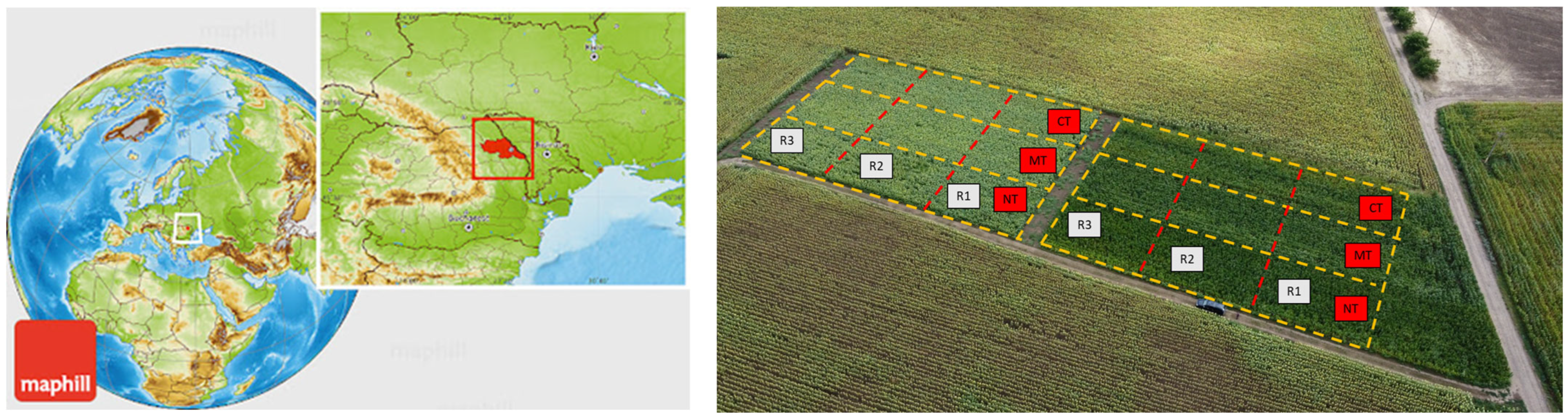
The research was carried out at the Ezareni Student Research and Practice Station of the Iasi University of Life Sciences (47°12′ N, 27°51′ E). The study was conducted on a soil type classified as Chernozem (WRB Classification) and clay loam in texture with 35% clay, 25% silt, and 36.9% sand [24]. The humus content ranges from 2.7% to 3.4% and has a slightly acidic pH, according to the Romanian Soil Taxonomy System (SRTS 2012). The experimental research was conducted from April 2024 to September 2025 on the sunflower crop (Helianthus annuus L.). Initially, since the start of the study, the soil physico-chemical parameters in the 0–10 cm layer were moderate in C (2.36%) and accessible K (334 ppm), with a total nitrogen (TN) concentration of 0.203%, a low accessible P level of 96.21 ppm, and acidic pH (6.3).
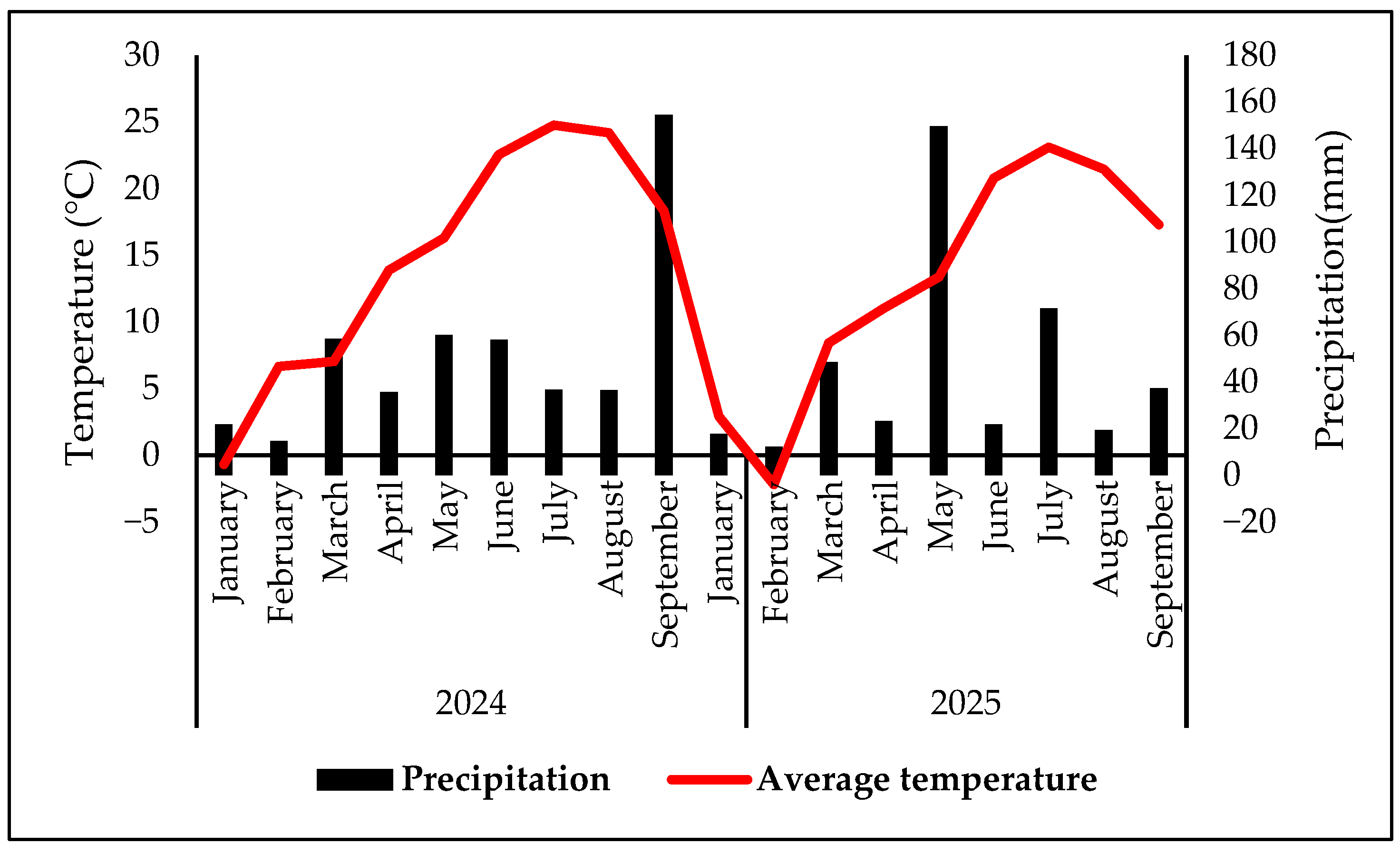
Figure 1 shows the meteorological data collected during the two-year research period (2024 and 2025), indicating diverse weather conditions and seasonal fluctuations. Average temperatures fluctuate significantly, with a notable increase during the summer months, peaking June and July, which correspond to the usual climatic conditions. In contrast, the winter months show significantly lower average temperatures, with February recording the lowest values for both years. Precipitation regimes show significant between-year variability, particularly in September, where there is a pronounced increase in 2024 (154.4 mm) compared to 2025 (37.4 mm). These differences may highlight the influence of irregular climatic conditions or changes in weather dynamics. These results highlight the importance of a comprehensive temporal analysis to understand climate variability. The pronounced differences between the two years in terms of temperature and precipitation highlight the potential impacts on ecosystems in the study area, hydric cycles, and agricultural practices, emphasizing the need to establish adaptation strategies to respond to changing climate conditions.

2.2. Tillage Systems and Experimental Design

The research was conducted within the context of a long-term field experiment initiated in 2009. This study, which was organized using a randomized block design, included three treatments: direct seeding, known as no-tillage (NT); chisel plow, known as minimum tillage (MT); and conventional tillage (CT) with plowing at 30 cm, followed by two disk harrow passes (Figure 2). The experimental area was 0.66 ha. Each tillage system covered an area of 0.22 ha. The sunflower hybrid HTS SUMIKO, from Syngenta, was sown on 30 April in 2024 and on 4 May in 2025, in all three treatments at the same time. The sunflower hybrid was sown with a classical seed drill in CT and with FABIMAG FG-01 (Fabimag, Ucacha, Argentina) in NT and MT. The crop was harvested on 29 September 2024 and 25 September 2025, using the New Holland TC5050 combine (New Holland Agriculture, Zedelgem, Belgium).

2.3. Soil Sampling and Analysis

2.3.1. Soil Chemical Analysis

Soil samples were collected in three replicates at depths of 0 to 5, 5 to 10, 10 to 20, 20 to 30, and 30–40 cm, respectively, in each plot after the sunflower harvest. The pH was measured potentiometrically in a 2.5:1 water-to-soil suspension using a glass electrode pH meter (WTW Multi 3320, Weilheim, Germany). The modified Walkley–Black titrimetric method was used to determine soil organic carbon (SOC) and soil organic matter (SOM) [25]. Total nitrogen (TN) was measured using the Kjeldahl method, a widely used technique for nitrogen quantification. Available phosphorus (P) and potassium (K) were extracted with 1N NH4OAc. Phosphorus concentrations were determined using the colorimetric molybdenum blue method, while potassium levels were measured with the ContrA-700 device (Analytikjena, Jena, Germany).

2.3.2. Soil Physical Analysis

Regarding the physical properties of the soil, samples were taken in three repetitions at depths of 0 to 10 cm, 10 to 20 cm, and 20 to 30 cm and 30–40 cm, respectively, in each plot and at different phenological phase (sowing, vegetative growth phase and crop harvest).
Thus, the soil total porosity (SP) during this study was determined by calculation based on the relationship:
SP (%) = [1 − BD/D] 100
where
SP = Soil total porosity (%); BD = Soil bulk density (g/cm3); D = Soil density (g/cm3)
Soil aeration limit (SAL) was also determined by the equation:
SAL (%) = (SP − 10)/BD
where
SAL = Soil aeration limit (%); BD = Soil bulk density (g/cm3); SP = Soil total porosity (%).
Soil capillary capacity (SCC) and soil total capacity (STC) were determined by the saturation method. The samples were collected in their natural state using 5 cm in diameter/5.1 cm in height stainless steel cylinders. In the laboratory, the cylinder caps were removed, and a cap fitted with a filter paper-covered sieve was placed at the lower end. After weighing, the cylinder is placed in a bath with water level of 1.5–2 cm on a platform covered with blotting paper, the ends of which are in contact with the water in the bath. It is left in the water bath for at least 24 h so that the soil inside the cores becomes saturated by capillary action. Once the soil is saturated by capillary action, the cylinder is weighed again. The water bath is then filled until the water level reaches approximately 1 cm bellow the top edge of the cylinders. It is left to stand for at least 24 h so that the soil inside is completely saturated. The cylinder is then weighed again. The data is recorded and determined in an analysis table.
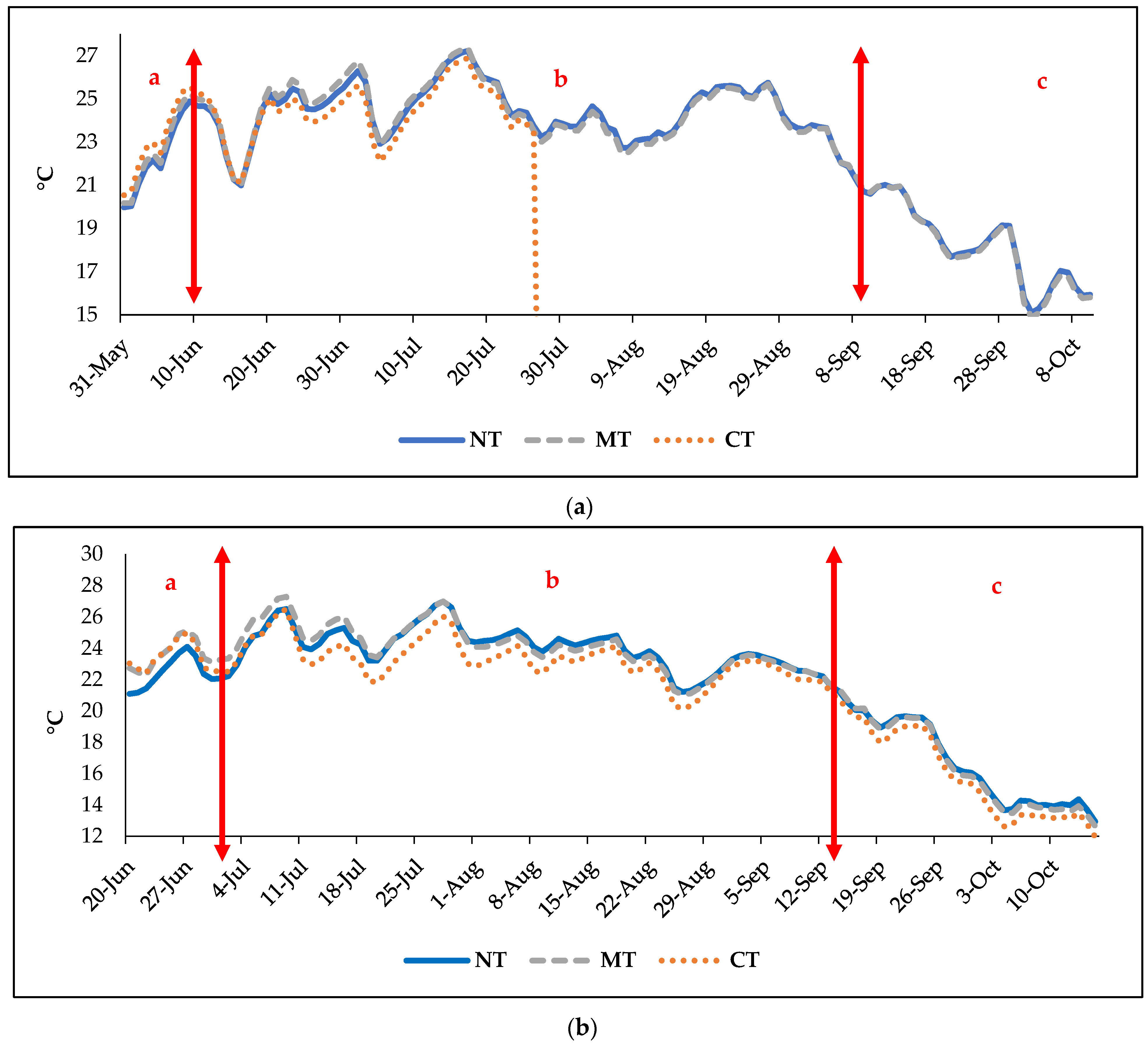
For soil and air temperature we used Spectrum Technologies Water Scout SM300 and air temperature sensors (Spectrum Technologies, Aurora, IL, USA). Soil temperature (Ts) was recorded at 1-h intervals, at a depth of 30 cm, between 31 May and 8 October 2024, and between 6 June and 15 October 2025, being connected to a WatchDog 1000 series microstation that stores approximately 11,000 readings. The SM300 sensor measures temperatures between 0.5 and 80 °C with an accuracy of ±0.6 °C. The air temperature (Ta) was measured with an external sensor, installed at a distance of 1 m from the ground, at the same time with the SM300 sensor and recorded at 1-h intervals with an accuracy of ±0.5 °C.

2.4. Statistical Analysis

The statistical method used to analyze the data from our research was one-way analysis of variance (ANOVA), which is appropriate for a randomized complete block design. The fixed variables studied were tillage practices: NT, MT, and CT. Tukey’s test were applied to assess significant differences among the treatments. Regression statistical tests were used to determine the relationship between Ta and Ts by tillage system, considering one variable as the dependent and the other as the independent variable, and then estimating the significance of the effect. SPSS 26.0 for Windows was used to perform statistical analyses (SPSS Inc., Chicago, IL, USA, 2007).

3. Results and Discussion

3.1. Influence of Tillage System on Soil Porosity (SP)

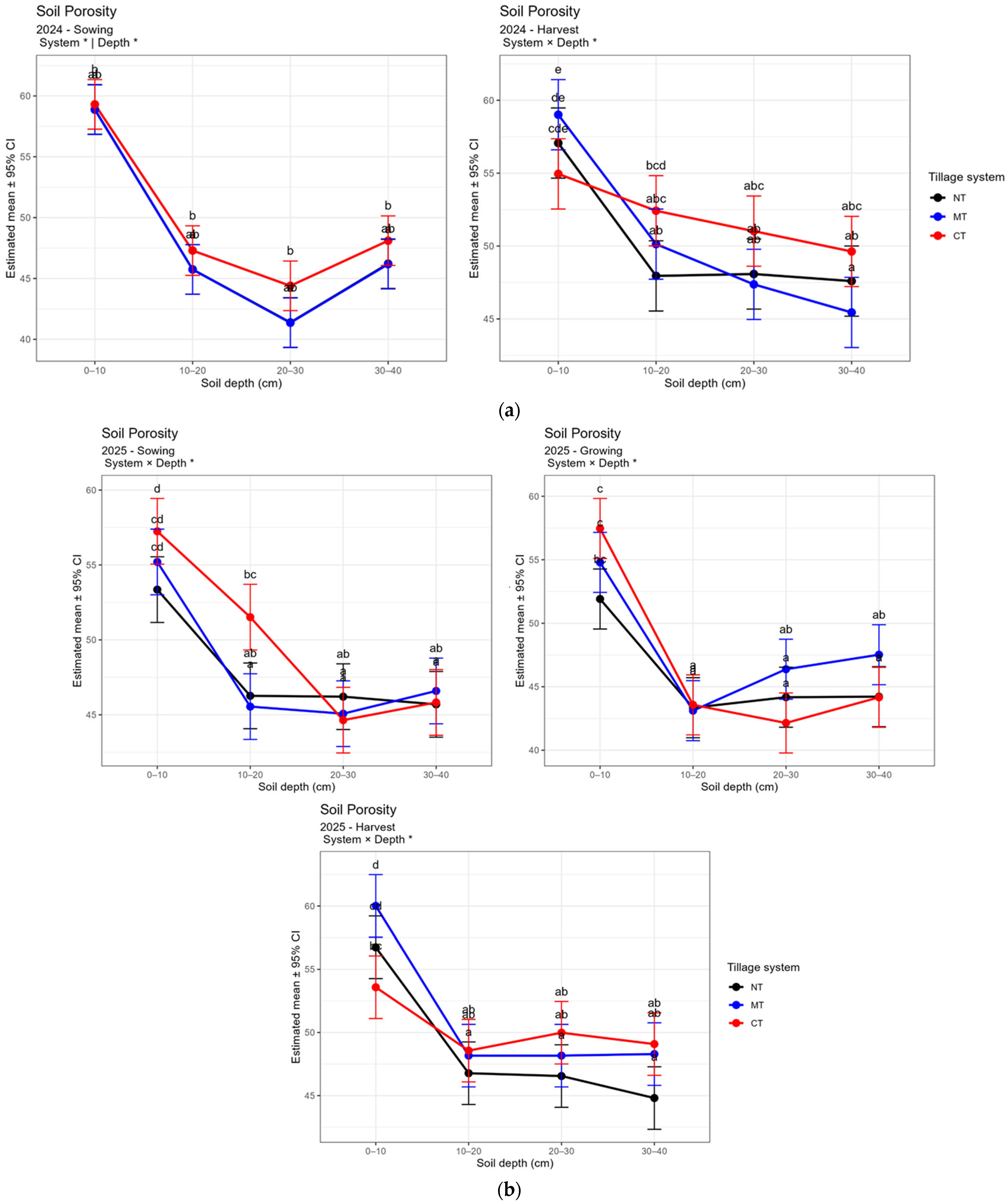
Soil tillage systems and their intensities (NT, MT, and CT) are affected by direct or indirect effects of SP. It serves as a critical indicator of soil structure and aeration, which are frequently influenced by tillage practices that modify pore space and connectivity, thereby affecting soil health and crop growth [5]. The results presented in Figure 3a,b show the effects of different tillage practices on SP across various depths and growth stages in 2024 and 2025. In all tillage systems, SP shows a clear depth gradient, with the highest values in the topsoil (0–10 cm) and decreasing with depth. Under NT, at sowing, porosity is highest in the top 10 cm (59.30%) and then decreases to approximately 57.06%. This trend is consistent with established physical principles of soil, according to which surface layers tend to retain higher porosity due to minimal disturbance, accumulation of organic matter, and biological activity that promotes pore formation. Statistical analysis indicates that NT consistently results in the highest SP in the topsoil at both sowing and harvest, with average values of 59.30% and 57.06%, respectively. Similar to 2024, NT consistently showed the highest SP at all depths and growth stages in 2025, with the topsoil layer (0–10 cm) recording SP values from 53.35% at sowing to 51.91% at harvest. MT showed high SP at all depths, especially during harvest, with the highest recorded at 0–10 cm (60.01%). NT maintained an average SP of approximately 53.35%, compared to 55.20% during the growth phase and 57.24% at harvest in 2025, indicating a slight reduction potentially associated with crop root activity and soil compaction during the season. These averages are significantly higher than those observed in the CT, indicated by different letters (b, c), which mean statistically significant differences at p < 0.05. SP under CT remained lower especially at 10–20 and 20–30 cm depths, suggesting the adverse effects of soil disturbance on soil pore connectivity. Slight increases in SP at harvest suggest root activity and crop residue decomposition contributed to pore structure. Furthermore, the unexpectedly higher porosity observed at depths of 10–20 cm and 20–30 cm in CT in 2024 can be attributed to the physical effects of tillage practices. Tillage operations generally disrupt soil aggregates and temporarily increase pore spaces, especially if the soil structure is altered or partially degraded. The formation of a plow pan, a compacted layer often observed beneath the tilled zone, may have been mitigated or disrupted during tillage, resulting in localized zone of increased porosity. Climatic factors, such as increased rainfall during the season, may have further enhanced soil aggregation thereby influencing pore development. These combined factors suggest that, under certain conditions, CT can induce complex physical responses in the soil, including increased SP at specific depths, contrary to the typical expectation of compaction. The NT system in 2025 indicates intermediate porosity levels, with values generally higher than those of the CT but still lower than those of the MT. It should be noted that the highest porosity under MT occurred during the harvest stage, suggesting an accumulation of pore space, likely due to crop residues. It should be mentioned that the MT and NT systems maintain higher porosity even at greater depths, indicating the cumulative benefits of reduced soil disturbance on pore structure. The results also show that the MT and NT system improves SP throughout the sampling stages, which is indicative of its ability to maintain the pore structure essential for aeration, water infiltration, microbial activity, and nutrient cycling throughout the growing season. Although the values demonstrate relatively stable porosity between seeding and harvest in each tillage system, there is a slight increase in porosity at harvest in all systems, probably due to crop root activity. The significance of the variation is more pronounced in CT, highlighting its impact on pore integrity during the crop cycle. Over the two years, SP shows a clear depth gradient: the topsoil layer maintains the highest SP, which gradually decreases with depth. This trend is consistent with physical principles and the influence of tillage practices, which tend to preserve pore structures near the surface, particularly in MT and NT systems that minimize soil disturbance. During the 2025 crop cycle, porosity decreased slightly at harvest across all tillage systems, likely due to root growth and soil compaction. In NT at 0–10 cm, porosity decreased from 56.74% during sowing to 53.35% at harvest, indicating that active biological and physical processes influence pore space. The results for 2025 confirm and expand on the trends observed in 2024, highlighting the impact of tillage systems on SP at different depths and growth stages. Over these two years, the results confirmed that MT and NT provide better preservation of the soil’s pore structure, with MT often recording the highest porosity, particularly in the critical topsoil layer. It indicates that minimal disturbance effectively promotes organic matter accumulation, biological activity, and pore connectivity, which are essential for aeration and water retention. On the other hand, CT had a clear impact on pore disturbance, as evidenced by consistently lower SP, especially in deeper layers, which could negatively affect soil health. The interaction between tillage systems, soil depth, and crop stage (notably evident in 2025) reveals that NT and MT systems sustain higher pore connectivity throughout the crop cycle, with significant differences at sowing and harvest. Graphical data illustrate that porosity tends to decline slightly at harvest across all systems, more markedly under CT, likely due to root growth and soil compaction. For example, in 2025, SP at 0–10 cm under NT decreased from 56.74% at sowing to 53.35% at harvest, reflecting biological activity and physical soil adjustments. Deeper layers (10–30 cm) show that MT and NT better preserve pore space compared to CT, especially during critical growth stages, indicating their effectiveness in maintaining soil physical integrity over time. These interaction effects underscore that conservation tillage practices not only improve initial SP but also sustain it during crop development, thereby supporting aeration, water movement, and microbial functions.
These results show that the tillage system and its intensity significantly influence SP at different depths and crop growth stages. It should be noted that MT maintained the highest porosity in the topsoil at harvest, with average values of 60.01%. These results confirm those of previous studies, indicating that MT maintains SP by minimizing soil disturbance, thereby promoting the accumulation of organic matter and biological activity that improve pore connectivity [26,27,28]. Similarly, Fernandes reported that NT systems tend to maintain higher porosity levels at different depths compared to CT, essentially due to reduced soil compaction and less disruption of natural pore systems [29]. Their studies also showed that the advantage of NT persisted throughout the crop cycle, as confirmed by our findings that porosity increased only slightly between sowing and harvest under NT and MT. In contrast, CT showed significantly lower SP, particularly at depths of 10 to 20 and 20 to 30 cm, which can be attributed to soil compaction and pore disruption caused by machinery disturbance [30]. This reduction in pore space negatively impacts soil aeration, water infiltration, and microbial activity. The slight increase in porosity observed at harvest in all systems could be related to root growth and crop residue decomposition, as noted by Liu et al., who observed that crop roots can potentially fill pore spaces, especially in disturbed soils [31]. Furthermore, the combined effects of reducing disturbance in MT and NT systems not only increase porosity but also improve soil resilience and structure over time [27]. Although the average SP values in 2025 are slightly lower than those in 2024, the relative differences between tillage systems remain constant. MT and NT consistently perform significantly better than CT by maintaining higher porosity levels, emphasizing their role in sustaining soil aeration and structure over several years. The slight decline in porosity over time observed in both years highlights the importance of tillage management in maintaining soil health. The more pronounced decline under the CT system highlights the adverse effects of intensive soil disturbance, which can lead to compaction and reduced pore connectivity. These benefits underline the importance of adopting conservation tillage practices to maintain soil health and productivity.

3.2. Influence of Tillage System on Soil Aeration Limit (SAL)

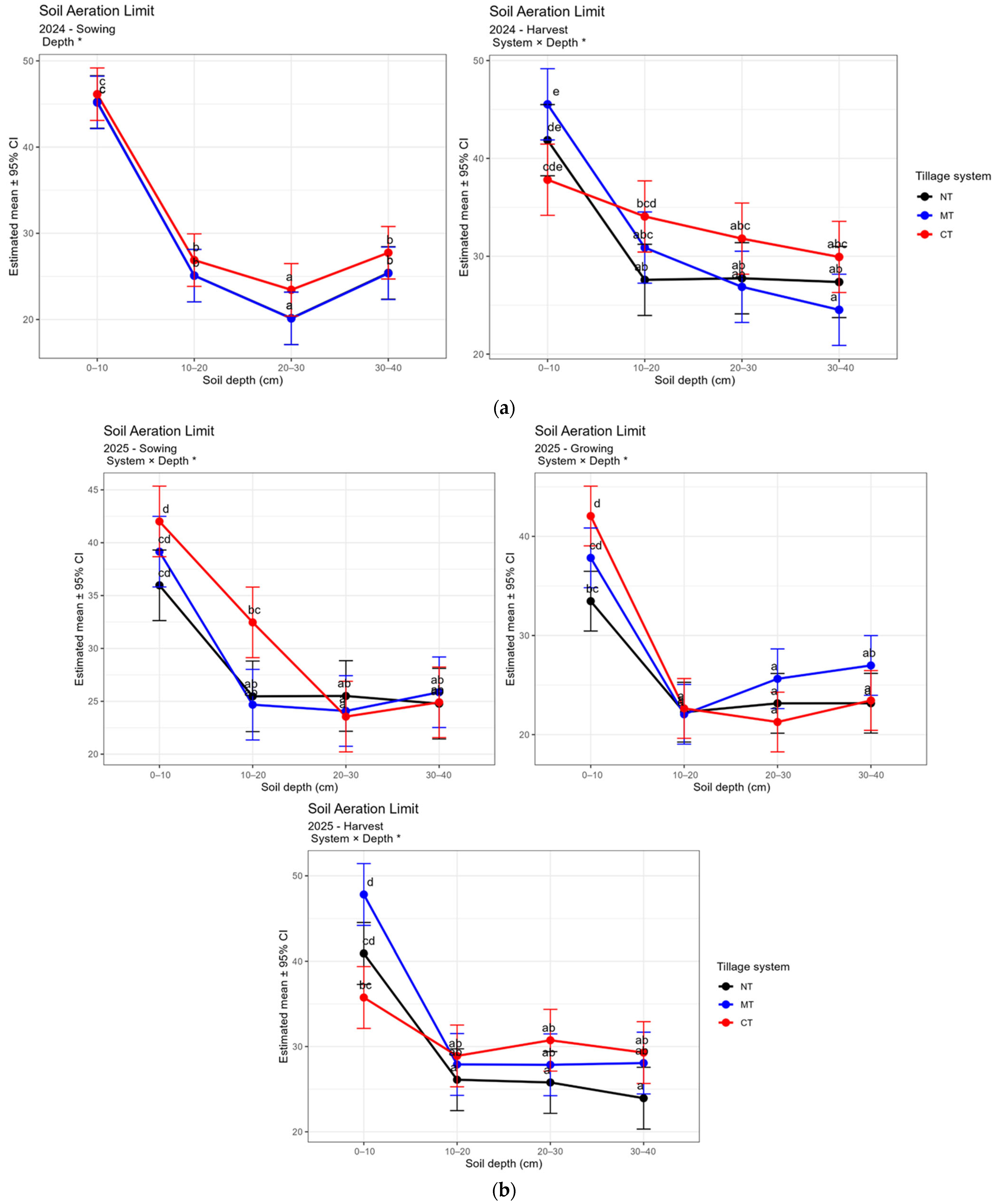
SAL is a fundamental indication of SP and gas exchange capacity, frequently reflecting the level of soil disturbance and compaction resulting from different tillage systems [32]. It is essential for sustaining microbial activity and root respiration, both of which have a fundamental impact on soil health and productivity. Our results demonstrate that tillage practices significantly influence SAL across soil depths, crop stages, and years, with notable interaction effects that provide deeper insights into soil physical dynamics under various management systems. At the topsoil level (0–10 cm), the MT system has the highest SAL during sowing and harvesting, with average values of 46.13% and 45.52%, respectively. These high values suggest that MT effectively preserves the soil’s porous structure, facilitating optimal gas exchange and improved soil respiration. These results are in accordance with those obtained by Ketena et al. and Srivastava et al. in their studies, indicating that minimal disturbance under NT or MT leads to the development and maintenance of stable pore spaces, thereby improving soil aeration and respiration capacity [33,34]. Similarly, in 2025, MT recorded an average SAL of 39.15% during sowing and 47.81% during harvesting, which, despite some variations, remained higher than that of the NT and CT systems. Notably, the interaction effects reveal that while SAL decreases with increasing soil depth across all systems, the magnitude of decline varies: the reduction is more pronounced under CT, especially in deeper layers (10–20 cm and below), where SAL during sowing drops to approximately 25.46% (NT), 26.10% (MT), and 32.46% (CT). This pattern indicates that intensive soil disturbance under CT accelerates pore degradation and compaction, thereby diminishing gas diffusion capacity at depth. The diminishing differences among tillage systems with increasing depth underscore that tillage effects are primarily surface-oriented, with limited influence extending beyond the upper soil layers. In comparison, CT has significantly lower SAL at the surface during sowing (average of 46.13%), but shows a notable decrease at harvest time (37.80%). For instance, in 2025, CT decreased to 35.75% at harvest. This decrease can be attributed to mechanical degradation of pore spaces and compaction resulting from intensive soil disturbance, which reduces pore connectivity and inhibits gas diffusion [35]. NT shows moderate aeration limitations, with values between those of MT and CT, indicating its relative influence on maintaining pore integrity space. As soil depth increases (10–20, 20–30, 30–40 cm), SAL decrease in all tillage systems, reflecting the natural pore connectivity and soil compaction with depth. Notably, differences between tillage systems become less pronounced at different depths, perhaps due to the limited penetration of tillage effects beyond the direct surface layer. During the growing stage, a constant trend is observed: SALs tend to decrease from sowing to harvest across tillage systems, with the most pronounced reductions in the CT system. This observation may be related to root growth and biological activity during the growing stage, which can lead to pore-space filling or compaction, particularly in disturbed tillage systems. The higher SALs observed under MT highlight its suitability for maintaining healthy physical conditions throughout the growing stage. Better aeration not only enhances microbial diversity and activity but also improves water infiltration and reduces soil compaction, which are essential parameters for optimizing crop yields and resilience [34]. The significant interaction effects between tillage system, soil depth, and crop stage underscore that the impact of tillage practices on soil aeration varies depending on these factors. Specifically, the decline in SAL during the growing season was more pronounced under CT, reinforcing the notion that intensive tillage adversely affects soil physical properties over time. Conversely, the decrease in aeration during the growing stage under CT highlights the potential limitations of intensive tillage practices, underlining the need to adopt conservative approaches to preserve soil functionality and health. Over the two years, SAL decreased with increasing soil depth, indicating a natural reduction in pore connectivity and increased compaction at higher depths. At a depth of 10–20 cm in 2025, SAL during sowing were approximately 25.46% for NT, 26.10% for MT, and 32.46% for CT, suggesting a more pronounced decline in the case of tillage disturbance. During the growth phases, a consistent trend is observed: SALs tend to decrease between sowing and harvest in each tillage system. This reduction is particularly significant in CT, where biological activity, root growth, and soil compaction during crop growth led to pore filling and reduced gas exchange capacity. In 2024, NT at a depth of 0–10 cm decreased from 46.13% at sowing to 41.86% at harvest, reflecting progressive changes in soil conditions during plant growth (Figure 4a,b).
This study demonstrates that SALs are significantly influenced by tillage systems, with MT consistently showing the highest soil aeration values throughout the crop cycle, particularly in the surface layer. These results are in agreement with recent research indicating that MT practices enhance the development and preservation of soil pore space, thus improving gas exchange and soil microbial activity [32,33], who reported that MT systems maintain higher SP and aeration capacity than CT, particularly in the upper soil layers, which is consistent with our observations of high SAL at a depth of 0 to 10 cm. On the other hand, the significant reduction in soil aeration under CT during crop growth confirms the results achieved by Tan et al. [36]. Furthermore, Li et al., who demonstrated that intensive soil disturbance leads to pore degradation, compaction, and reduced gas exchange, showed that CT disturbs soil structure, leading to decreased aeration and increased soil compaction, which can affect root growth and microbial functions [37]. Other, recent studies conducted by Srivastava et al. have observed that CT practices tend to decrease soil pore connectivity over time, particularly during the growing stage, highlighting potential negative impacts on soil health [34]. The moderate response of NT observed in our study is similar to the results from Martinez et al., who reported that NT can partially preserve soil structure and porosity, thus sustaining better aeration than CT, but not reaching the levels observed with MT [38]. Our in-depth analysis reveals a steady decrease in soil aeration with increasing soil depth in all tillage systems, a trend confirmed by Armin et al., who reported that surface disturbance affects mainly the upper soil layers, with decreasing effects at higher depths [39]. This depth scale highlights the importance of surface management practices in maintaining overall soil physical health. In addition, the decrease in soil aeration observed between sowing and harvest in each tillage system, particularly under CT, corresponds to the results obtained by Srivastava et al., who demonstrated in their studies that biological activity, root development, and soil compaction during the growing stage can fill pore spaces, thereby reducing aeration capacity. The higher average MT required to maintain higher aeration limits throughout the crop cycle highlights its key contribution in enhancing a resilient soil environment conducive to microbial activity and root development, which are essential for achieving optimal yields [34]. Although SAL varies between 2024 and 2025, potentially due to variations in climatic conditions and tillage practices, the relative performance of tillage systems remains consistent. MT systematically maintains higher SAL throughout the crop cycle, highlighting its role in protecting soil physical integrity and enabling microbial and root respiration. The decline in SAL during the crop cycle, particularly under CT, highlights the importance of adopting conservation tillage practices. During this two-year research period, despite slight variations in SAL, likely due to climatic factors, the relative performance of tillage systems remained consistent. The observed interaction effects reinforce that soil management practices exert nuanced impacts depending on depth, crop stage, and time. MT performed significantly better than NT and CT by maintaining higher SAL values, highlighting its role in promoting a resilient soil system conducive to microbial activity and root growth. The observed decline in SAL during the crop cycle, which was more pronounced under CT, highlights the importance of adopting conservation tillage practices to maintain soil aeration, reduce compaction, and promote healthy ecosystems.

3.3. Influence of Tillage System on Soil Capillary Capacity (SCC)

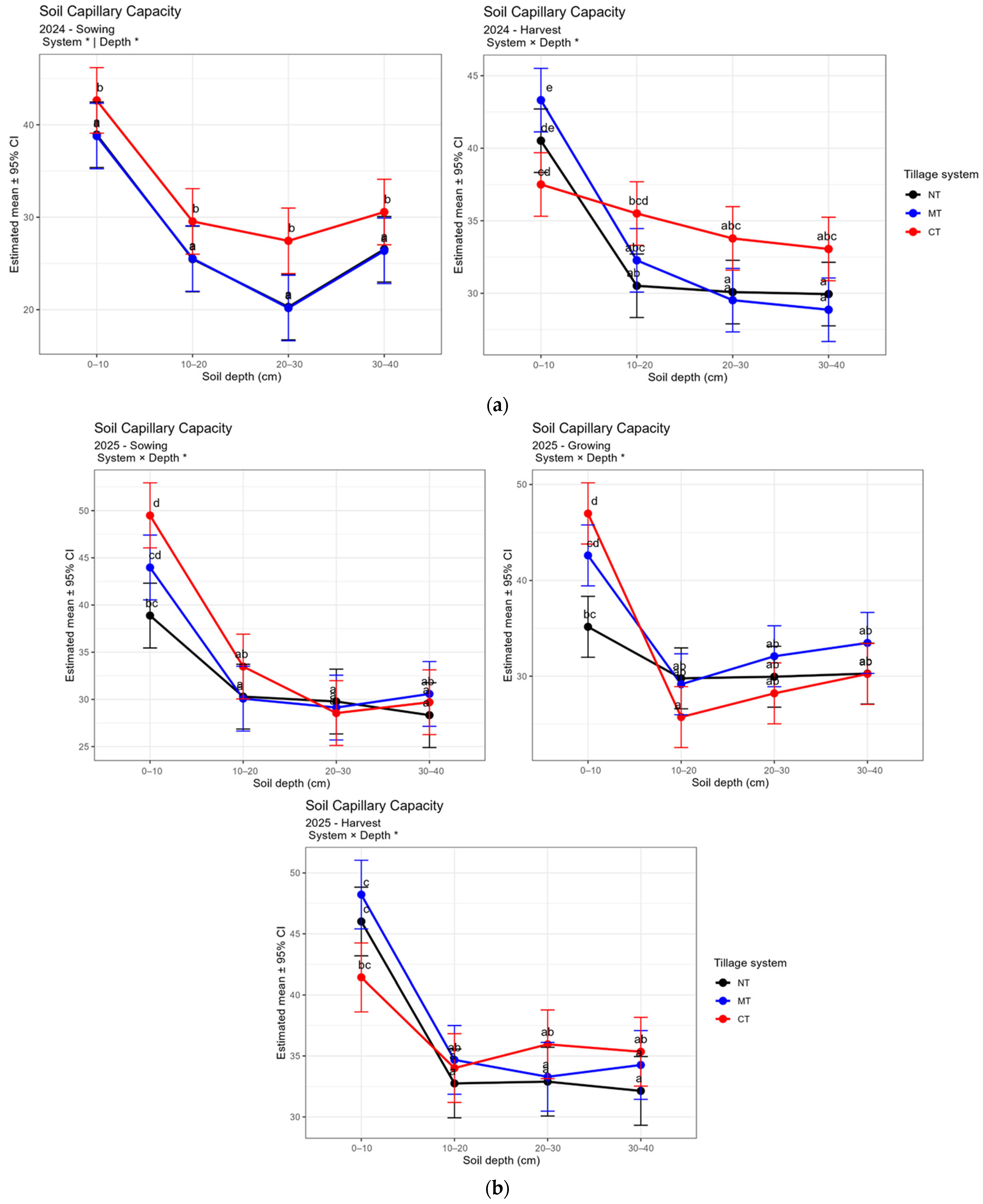
SCC is an essential indicator of water retention and movement in the soil. It directly influences soil water content availability and nutrient transport for plants [40]. This indicator of water movement, represented by SCC, is often affected by soil structure, management practices, and climatic conditions. The table shows that across all tillage systems and at all stages, a consistent trend emerges: SCC decreases with increasing soil depth. The highest values are observed in the 0–10 cm layer, with average values reaching from approximately 40.51% to 43.31%, indicating high moisture retention potential in the surface layers. In 2025, the surface layer (0–10 cm) continues to show the highest capillary capacity among all tillage systems and stages. In the case of NT at the sowing stage, the average capacity is approximately 38.88%, which, despite some variability, remains higher than MT and CT systems. This trend indicates that NT practices consistently promote better water retention in the upper soil layers, likely due to reduced soil disturbance and improved aggregation, thereby enabling pore connectivity and greater soil water retention. Conversely, the 20–30 and 30–40 cm layers have lower values, often below 30% suggesting a decrease in capillary rise with increases depth. This finding highlights the essential role of soil surface layers in the availability of soil water to plants, especially during the early stages of growth. It is important to note that the SCC varies across stages. In the 0–10 cm layer, values remain relatively stable or decrease slightly from sowing to harvest, regardless of treatment. Under NT, capillary capacity decreases slightly from 42.63% to 40.51%. In 2025, at 20–30 cm during sowing, NT shows approximately 29.77%, while CT records approximately 28.54%, indicating similar water retention potentials at this depth in all systems. In addition, deeper layers show more significant variations; in the 10–20 cm layer under NT, capacity increases from 29.54% at sowing to 30.51% at harvest. It should be said that at 30–40 cm, capacity values tend to decrease further but still increase during harvest compared to sowing, possibly due to water distribution and soil water content dynamics influenced by crop absorption, root activity, and precipitation. Analysis of the different treatments indicates differential impacts on SCC. The NT treatment consistently shows higher values in the upper layers, particularly during sowing, suggesting better soil water retention or a soil structure conducive to water movement. In contrast, the CT system has lower SCC, especially during harvest, where values drop from 41.43% to 0–10 cm in 2025, indicating possible soil structure degradation and reduced pore connectivity due to mechanical disturbance. The MT and CT show greater variability and, in some cases, significant differences (Figure 5a,b). The interaction effects observed emphasize that conservation tillage practices (NT and MT) better preserve soil physical properties and maintain higher SCC across depths and crop stages, despite inter-annual climatic variations. The surface layer remains the primary reservoir of plant-available water, with SCC decreasing with depth, underscoring the importance of surface management practices in water conservation strategies.
The results indicate a decrease in SCC with increasing soil depth across all tillage systems and growth stages. It is consistent with the established understanding of soil physics, which holds that the upper soil layers generally have a higher water retention capacity due to their higher SOM content, SP, and finer particle-size distribution. Similar results have been reported by Huang et al., who observed greater water retention in the surface horizons of different soil types [41]. The highest SCC values recorded in the 0–10 cm layer (reaching from approximately 40.51 to 43.31%) highlight the essential role of topsoil in maintaining adequate soil water content for plant development. This observation is in agreement with the research of Rocco et al., who demonstrated that surface layers generally have greater soil water retention capacity due to their higher SOM content and finer texture [42]. On the other hand, the lower capacity in deeper layers (20–30 and 30–40 cm), often below 30%, indicates that these horizons have reduced capacity to retain water, underscoring the importance of surface management practices that improve water conservation. Temporal variations during growth stages reveal slight to moderate changes in soil water dynamics. The slight decrease in SCC in the surface layer in NT cultivation between sowing and harvest (42.63% to 40.51%) suggests a relatively stable water regime. These results are similar to those from Liebhard et al., who reported that conservation tillage maintains more stable soil water content profiles by maintaining soil structure [43]. In contrast, the increase observed in the 10–20 cm layer under NT (from 29.54% to 30.51%) indicates a potential redistribution of water, which is consistent with the observations of Pohlitz et al., who noted that minimal disturbance allows for more efficient water movement in soil profiles [44]. The impacts of tillage systems are significant. MT system shows higher SCC values in the surface layers, particularly during sowing, which can be attributed to improved soil aggregate stability, increased SP, and better organic matter retention. These results confirm the conclusions of Moreira et al. and Wazzan et al. who demonstrated that MT practices improve soil water properties over time [45,46]. In contrast, CT shows greater variability and reduced SCC, potentially due to disturbance and compaction of soil structure, as researched by Smith [47]. These structural alterations can affect water movement and retention, highlighting the benefits of conservation practices. Although average SCC values vary from one year to the next, potentially indicating differences in climatic conditions or soil management, relative trends remain consistent. MT consistently maintains higher water retention capacities in the topsoil than NT and CT, highlighting its importance in preserving soil physical properties conducive to soil water retention. The slight decreases observed during the crop cycle, particularly at the surface, highlight the dynamic nature of soil water content and the influence of plant absorption and climatic factors. It should be noted that deeper layers exhibit lower fluctuations, indicating that the main reservoir of water available to plants is in the topsoil, and that conservation tillage practices help preserve this critical zone.

3.4. Influence of Tillage System on Soil Total Capacity (STC)

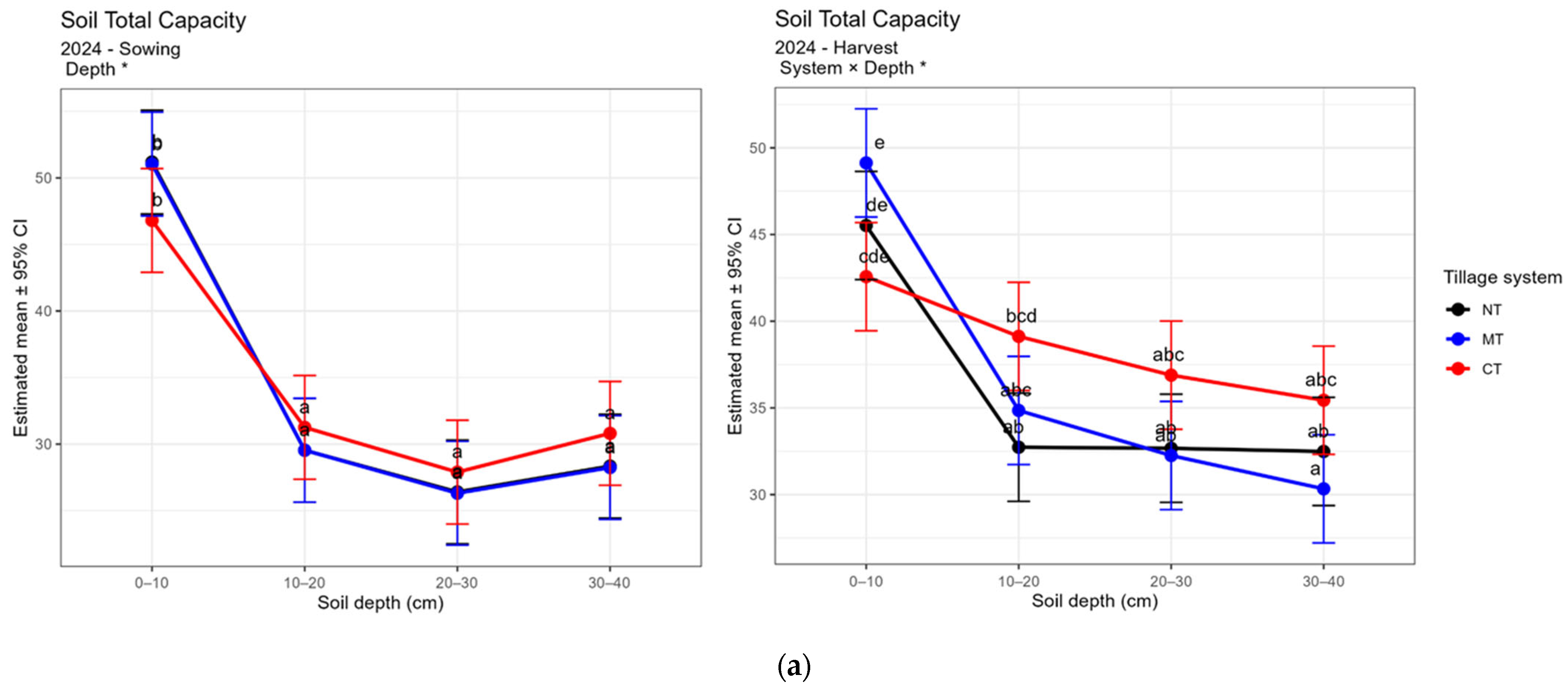
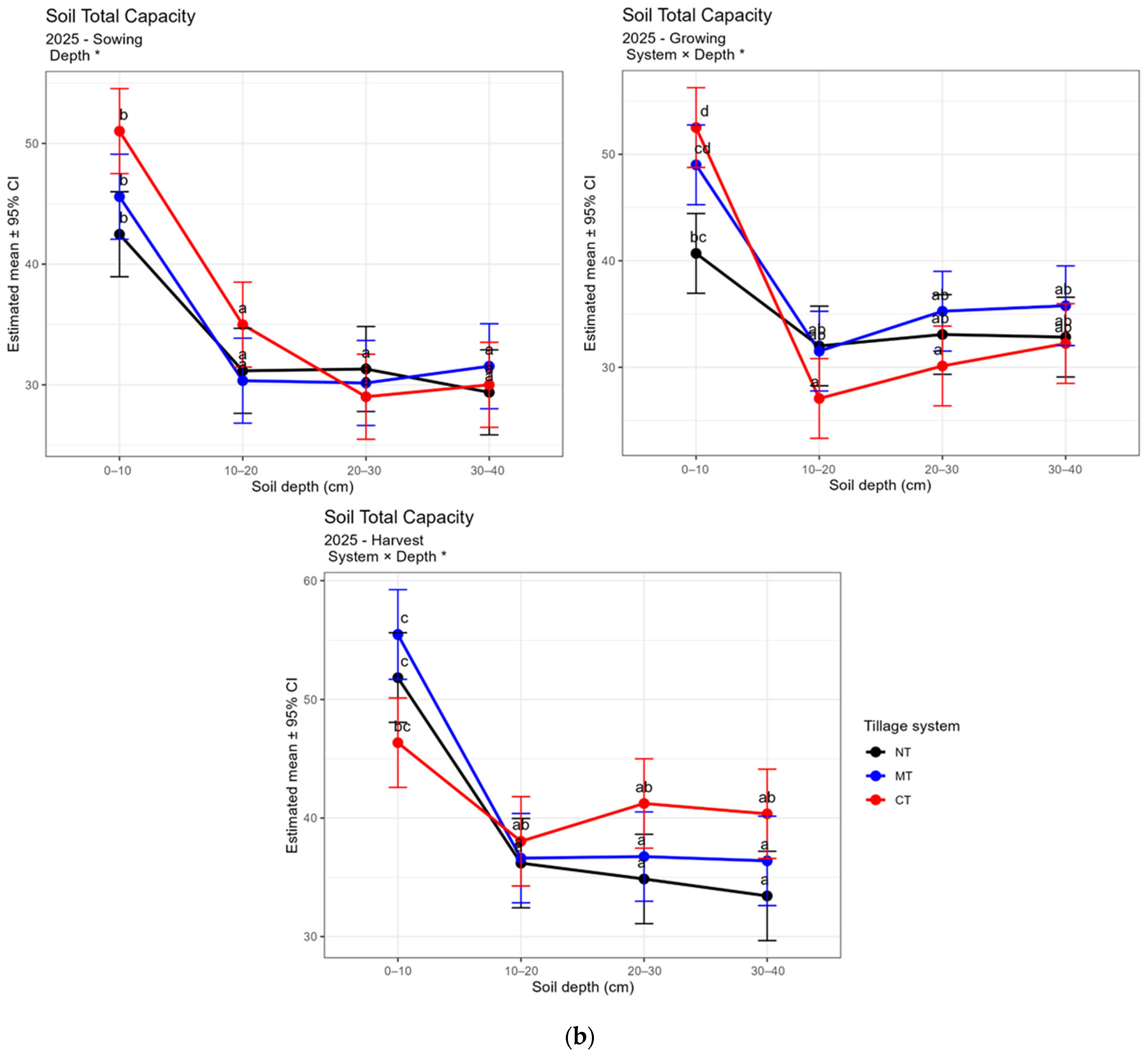
The analysis of Soil Total Capacity (STC) across different depths, growth stages, and tillage systems reveals both consistent patterns and significant interaction effects, emphasizing the dynamic influence of tillage practices on soil water retention properties throughout the crop cycle. At the surface layer (0–10 cm), the soil total capacity remained relatively constant across treatments and growth stages, averaging approximately 49.12% under MT. It is notable that the values recorded during sowing and harvesting did not differ significantly between treatments, indicating that the surface soil maintains a relatively stable water retention capacity regardless of tillage practice. This stability can be attributed to the higher organic matter content of the topsoil and its proximity to the soil surface, both of which influence pore structure and water retention (Figure 6a,b). In the 10–20 cm layer, values increased from 31.25% to 39.12% during the growing season under CT. This trend suggests an accumulation or conservation of soil water content at these depths as the crop develops, potentially due to reduced evaporation or improved water infiltration over time. The 20–30 cm layer has similar characteristics, with initial values of approximately 27.89% at the sowing stage, increasing to 32.25–36.88% at harvest. The increase in soil water retention capacity of this layer during the growing season may be influenced by modifications in soil structure resulting from tillage practices, root development, or changes in soil water distribution. At a depth of 30 to 40 cm, there is a considerable increase in the total soil capacity between sowing and harvesting, with values rising from approximately 30.80% to 35.44%. In 2025, the surface layer (0–10 cm) had the highest total soil capacity across all tillage systems and growth stages. During sowing under MT, the capacity reaches approximately 51.83%, and at harvest, it increases further to approximately 55.47%. Similarly, in the NT system, the values are approximately 42.47% at sowing and decrease slightly to 40.69% at harvest. The statistical analysis confirms that the interaction between tillage system and growth stage at the surface is not significant (p > 0.05), reflecting the stability of surface water retention properties across treatments. These values indicate that, despite some fluctuations, the topsoil maintains a relatively high and stable water retention capacity, probably due to a higher organic matter content and better pore stability associated with minimal disturbance. The deeper soil layers (10–20, 20–30, 30–40 cm) show a significant increase in total capacity throughout the growing cycle with significant interaction effects observed (p < 0.05), particularly at harvest. At a depth of 20–30 cm, under CT, the capacity increases from approximately 29.01% at sowing to 41.22% at harvest. This increasing trend indicates a potential deepening of soil water retention horizons or an increase in water infiltration, which could result from tillage-induced soil loosening or from crop root growth that enhances water movement. However, with regard to the tillage system, MT and CT tend to promote higher STC at certain depths during harvest compared to NT, particularly in the 20–30 and 30–40 cm layers. It means that tillage intensity can influence the soil’s capacity to retain water in subsoil layers, thereby affecting the availability of water to crops during critical growth stages. The increase in STC between sowing and harvesting at different depths highlights the dynamic nature of soil water content during the growing cycle. These modifications could be attributed to a combination of factors, including soil physical effects, crop uptake, root growth, and distribution of soil water content. The data demonstrate that tillage systems interact significantly with soil depth and growth stages, influencing the temporal and vertical distribution of soil water capacity.
The observed stability of STC in the surface layer (0–10 cm) across different tillage systems and growth stages is consistent with previous studies that highlight the relative resistance of surface soil water retention properties. The average value of approximately 46.80% suggests a well-maintained pore structure in the topsoil, likely due to the SOM content and minimal disturbance, which improves consistent water retention. Similar trends have been observed under MT in soils with high SOM content, where surface stability is attributed to organic matter’s role in maintaining soil aggregate stability and pore spaces [38,48]. In the subsoil layers (10–20 cm and 20–30 cm), the gradual increase in STC during the growing stage indicates the dynamic distribution of soil water content and the modifications in soil structure induced by crop roots and tillage practices. The interaction effect indicates that the increase is more significant under MT and CT than under NT, where STC remained relatively stable from 31.25% to approximately 34.85% in the 10–20 cm layer and from 27.89% to over 36.88% in the 20–30 cm layer is in agreement with previous research showing that crop root systems and tillage influence soil porosity and water retention capacity at these depths. The significant interaction effect confirms that the influence of tillage on water retention is stage and depth dependent [49,50]. Studies have shown that tillage can improve pore connectivity, reduce soil compaction, and enhance the water content retention during critical growth stages [51]. The significant increase observed at 30–40 cm, from 30.80% to 35.44%, suggests that deeper soil horizons also contribute to water dynamics throughout the crop cycle. This trend could be associated with tillage-induced soil loosening, which enhances water infiltration and permeability at depth, as demonstrated by Pöhlitz et al. [44]. In addition, deep-rooted crops can influence subsoil structure, further improving water retention at these depths [52]. Regarding tillage systems, the tendency of MT and CT to promote higher STC at certain depths during harvest highlights the influence of tillage intensity on soil physical properties. The results obtained are consistent with the literature, indicating that CT improves SAL and SP, thereby enhancing water content retention in subsoil layers [53]. Conversely, NT practices, while providing advantages for soil conservation and SOM accumulation, can initially lead to reduced pore development, which could explain the slightly lower water retention observed in the NT during this stage [54]. The temporal increase in soil water capacity highlights the dynamic interactions between soil physical properties and crop development. These modifications can be achieved through a combination of physical soil alteration, plant water absorption, root growth, and water content distribution, factors well established in the soil physics literature [55]. The interaction effects suggest that conservation tillage practices (NT) favor surface stability but may lead to slightly reduced subsoil water retention during later stages, whereas more intensive tillage (MT and CT) promote deeper water retention, especially during critical growth period. Understanding these processes is essential for optimizing tillage systems to improve water availability, particularly in regions with irregular precipitation.

3.5. Influence of Tillage System on Soil Temperature (Ts)

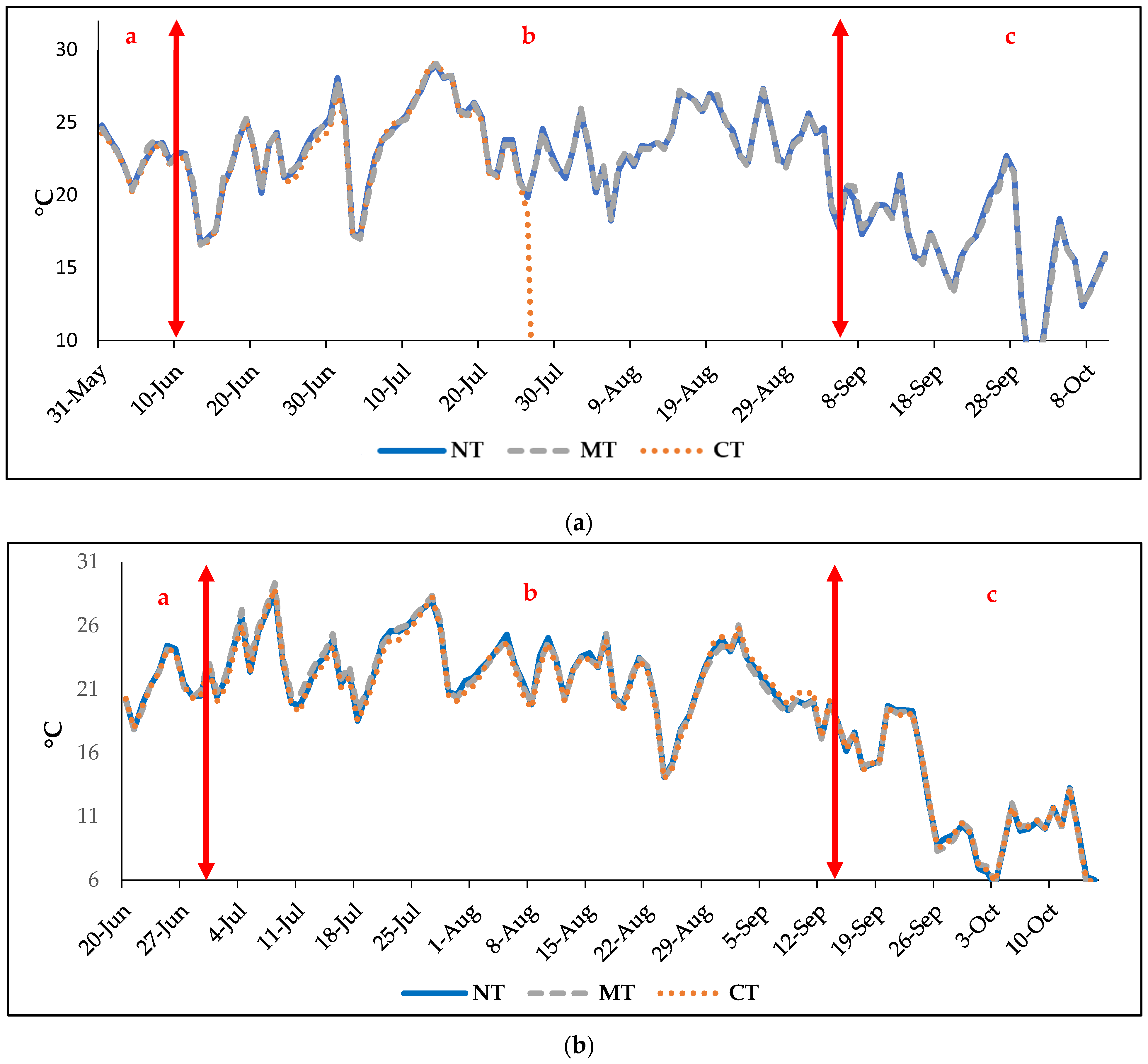
SM300 sensors were installed at a depth of 30 cm in each tillage system to measure soil temperature (Ts). The results (Figure 7a,b) indicate that there were no statistically significant differences between tillage practices in terms of Ts during the periods studied. During the sowing and emergence stage (Figure 7a), Ts generally varied between 15 °C and 22 °C in 2024 and 2025. It should be noted that CT tends to have a slightly higher Ts than MT and NT. Throughout the growing season (Figure 7b), Ts increased significantly, reaching their maximum in July, with temperatures ranging between approximately 25 °C and 30 °C during both years. During this period, the NT and MT systems maintained higher Ts than the CT system, particularly during the warmest months. This increase in Ts in the NT and MT systems could be attributed to crop residues on the surface, which provide a protective and conserving layer. Conversely, the CT system tends to have slightly lower soil temperatures, probably due to increased soil disturbance and exposition. It is important to mention that under the CT, the measurement system malfunctioned before 30 July, which explains why the curve cuts down at the end of July under this system and we cannot rely on the accuracy of the data. Although Figure 7a,b show only minor differences in Ts at a depth of 30 cm, differences that are not statistically significant, a consistent trend towards slightly higher temperatures in the NT and MT systems was observed during key stages of crop development. These subtle differences, particularly during the warmer months, are biologically relevant because Ts influences microbial activity and enzymatic processes responsible for nutrient mineralization. Previous studies have demonstrated that even small fluctuations in surface Ts can significantly affect nutrient cycling in the upper soil layers (0–10 cm), where microbial activity is most intense, thereby impacting nutrient availability for crops [56,57,58,59]. While the differences at 30 cm depth were minimal, the surface layers more directly affected by crop residues and tillage practices are likely to experience more pronounced temperature variations, which could modulate nutrient mineralization rates. These observed trends are consistent over both years, suggesting that tillage practices have an influence on Ts dynamics during different growth stages, and may affect nutrient processes in ways that may not be fully captured at the measured depth but are still biologically meaningful for crop nutrition and growth.

3.6. Correlation Between Air Temperature (Ta) and Soil Temperature (Ts)

During sowing, Ta ranged from approximately 12 °C to 27 °C. The trends were very similar across the different tillage systems, so there were no significant differences between NT, MT, and CT. These temperature variations are typical and mainly due to natural climatic conditions rather than tillage practices. This observation is identical to trends recorded in the growing and maturity stages (Figure 8a,b).
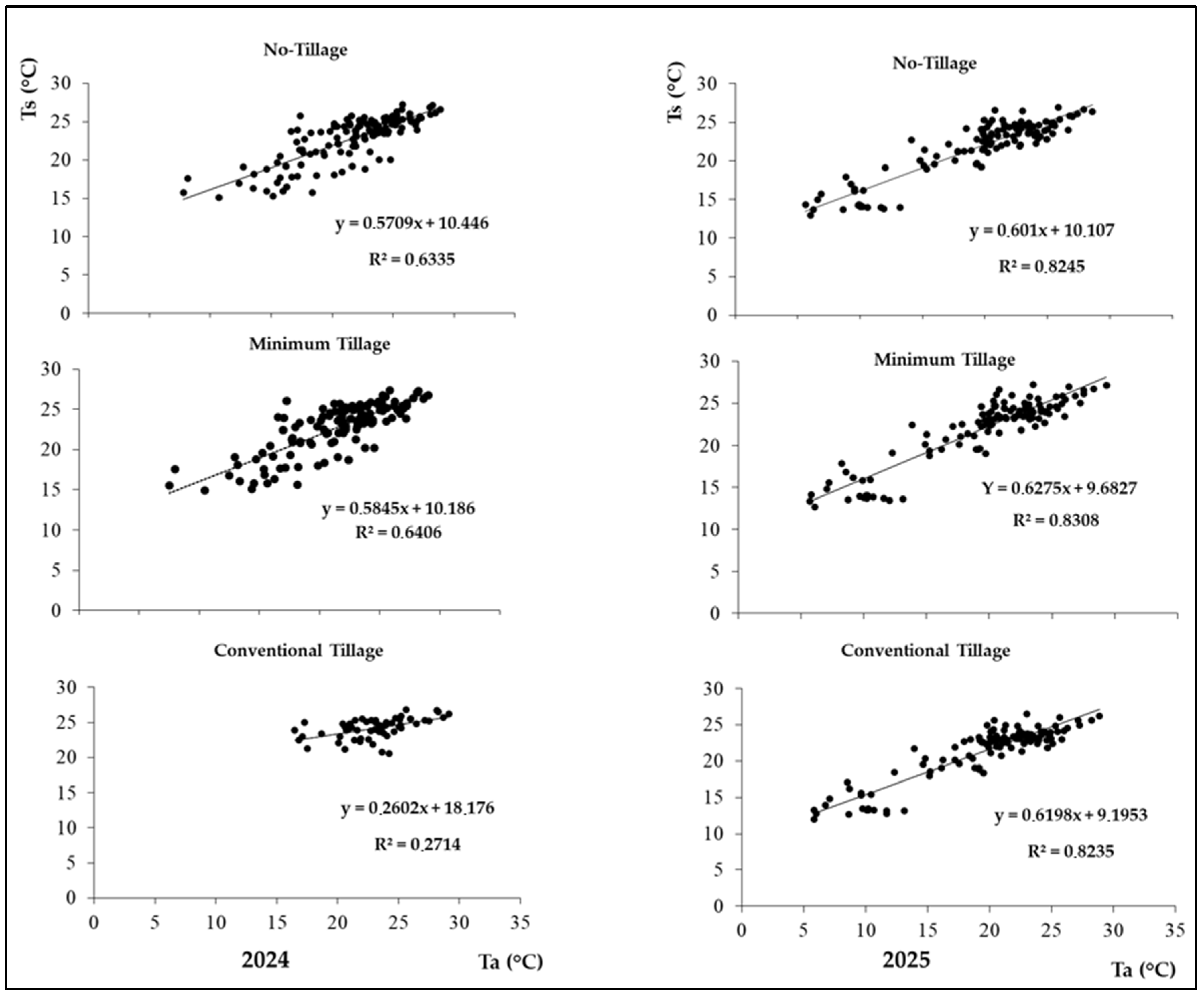
Figure 9 and the corresponding regression analyses indicate positive relationships between Ta and Ts across NT, MT, and CT in 2024 and 2025. In 2024, the regression equation y = 0.5709x + 10.446, obtained under the NT system, indicates that a 1 °C increase in air temperature corresponds to approximately a 0.57 °C increase in Ts. The coefficient of determination (R2 = 0.6335) indicates that approximately 63.35% of the variability in Ts can be explained by variations in Ta. Under MT, the results are similar to those observed with NT, with the regression equation y = 0.5845x + 10.186 indicating that for each unit increase in air temperature, Ts increases by approximately 0.58 °C. The coefficient of determination (R2 = 0.6406) suggests that approximately 64.06% of the variability in Ts can be explained by changes in Ta in this tillage system. Regarding CT, the analysis shows that the relationship between Ta and soil temperature follows the regression equation y = 0.2602x + 18.176, with an R2 = 0.2714. The positive trendline indicates that Ts tends to increase with rising Ta. However, the relatively low R2 value suggests that Ta explains only about 27% of the variability in Ts under CT. In the context of soil management, it is important to consider that CT tends to disturb soil structure, which can influence soil’s hydro-aerophysical properties and temperature dynamics. Considering factors related to NT and MT when analyzing results shows that different tillage practices have a significant impact on Ts responses, with NT and MT systems often maintaining higher soil water content, greater pore structure, and higher SOM content, which can mitigate temperature fluctuations. However, in 2025, under CT with equation regression y = 0.6198x + 9.1953 and R2 = 0.8235, there is a strong positive correlation, 82.35% of Ts variation explained by Ta. The slope (0.6198) indicates that for every 1 °C increase in Ta, Ts increases by approximately 0.62 °C. The relatively high R2 suggests that soil subjected to CT closely follows fluctuations in Ta, likely due to minimal disturbance of the soil structure, which allows for optimal transfer of atmospheric heat into the soil. Similar to the CT system, the NT (y = 0.601x + 10.107) system shows a strong positive correlation with an R2 of approximately 82.45%. The slope (0.601) indicates a comparable soil response, with a 0.60 °C increase in Ts for every 1 °C increase in Ta. The higher intercept (10.107) suggests slightly higher reference Ts in the case of NT, possibly due to greater SOM retention and higher soil water content, which can attenuate temperature changes. Regarding MT, the results show the strongest correlation and the highest R2 (83.08%), indicating that Ts is more closely influenced predictably by Ta in this system. The slope (0.6275) exceeds that of the other two systems, indicating a slightly more sensitive Ts response to atmospheric changes. The higher R2 suggests that soil disturbance under MT could preserve soil properties that enable more direct heat transfer from the atmosphere. The slight differences in slopes and intercepts suggest that tillage practices affect Ts dynamics. Overall, these results highlight that tillage practices significantly influence Ts dynamics. Higher Ts and stronger correlations in NT and MT systems can be associated with their ability to retain SOM and water and to preserve soil structure, thereby mitigating temperature fluctuations. In contrast, the association observed under CT suggests that soil disturbance impairs heat transfer, resulting in lower Ts responsiveness. These results contribute to understanding how tillage systems regulate Ts under changing climatic conditions.
The results obtained over the two years of research show that tillage practices significantly influence the relationship between Ta and Ts, with notable differences observed between NT, MT, and CT systems in 2024 and 2025. During these two years, NT and MT systems showed stronger correlations with Ta, with higher slopes and R2 values, suggesting more direct and predictable responses of Ts to atmospheric variations. In contrast, the CT system showed slight associations, suggesting that soil disturbance reduces its ability to reflect Ta fluctuations. These results, obtained in our study conditions, are in agreement with those reported by Doran and Parkin, Chen et al., and Liu et al., who indicate in their studies that conservation tillage practices promote higher SOM content, better soil water retention, and improved soil structure [60,61,62]. Such conditions promote efficient heat transfer from the atmosphere to the soil, resulting in higher Ts and more sensitive responses. On the other hand, soil disturbance associated with CT disturbs soil physical properties, reduces SOM, and promotes heterogeneity, thereby mitigating Ts responses [63]. The observed increase in the strength of these relationships between 2024 and 2025 may be due to seasonal or climatic variations from one year to the next or to the cumulative effects of tillage practices over time. This observation is similar to that made by Munoz-Romero et al., who also reported similar findings in their study [64]. The higher interception rates in NT systems suggest intrinsically warmer Ts, which can be explained by higher pore connectivity, better aeration, and soil water retention induced by SOM. The increased slopes recorded in MT and NT systems in 2025 indicate increased sensitivity, which could be attributable to changes in soil water content distribution or surface cover conditions. The higher relationships between Ta and Ts in conservation tillage systems highlight their potential to stabilize Ts systems, which can influence crop growth, microbial activity, and nutrient cycling. Conversely, the mitigated response in CT systems could lead to less predictable Ts, potentially impacting crop development and soil health.

3.7. Influence of Tillage Systems on Soil Organic Carbon (SOC) and Soil Organic Matter (SOM)

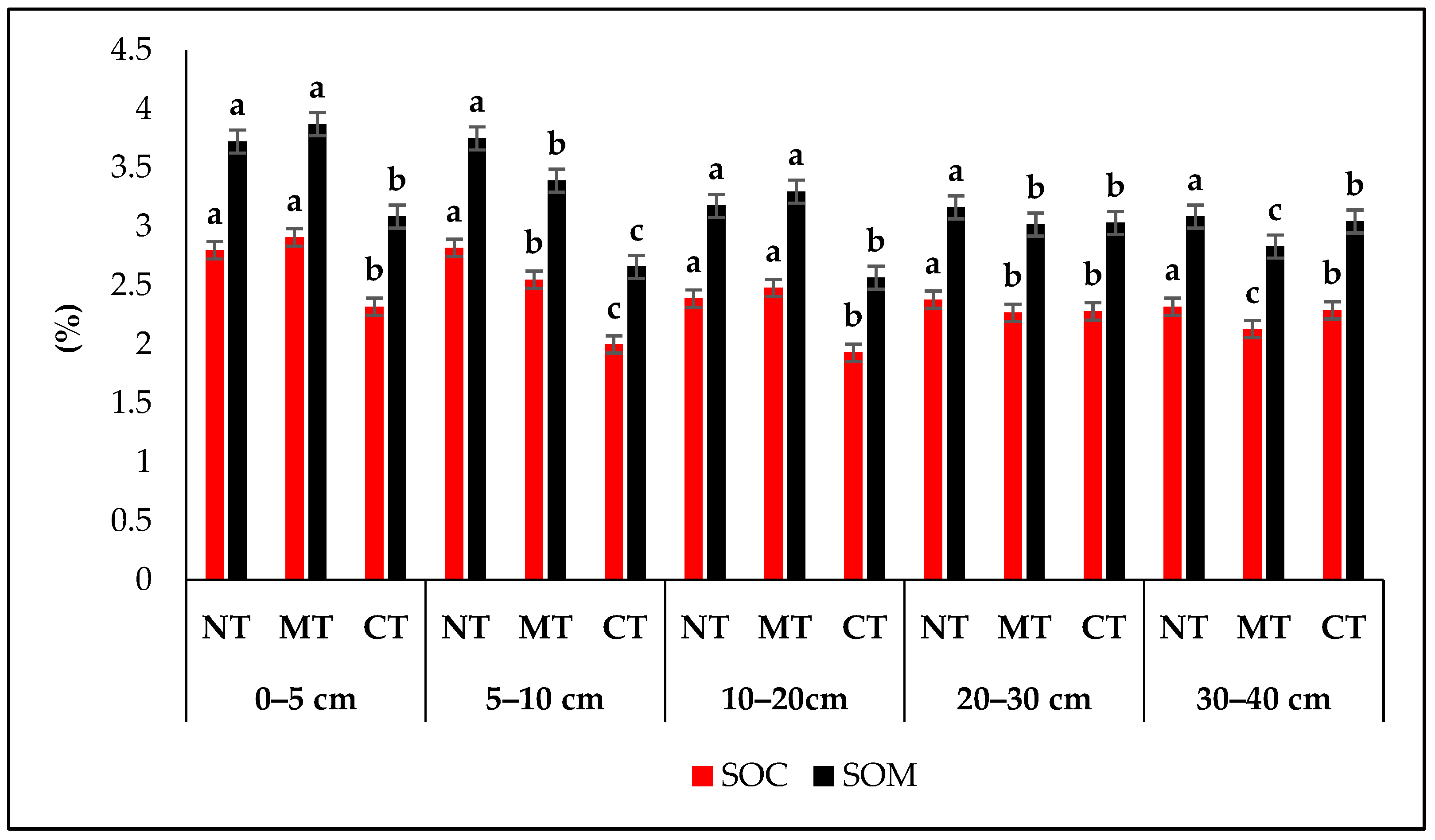
Figure 10 shows the variations in soil SOC and SOM in NT, MT, and CT at different soil depths (0–5, 5–10, 10–20, 20–30, and 30–40 cm). The analysis indicates significant differences in carbon content across tillage practices and soil depths. The NT and MT consistently show higher SOC and SOM levels at all depths than the CT, suggesting that soil conservation practices promote greater carbon sequestration in the soil surface layers. SOC and SOM tend to decrease with increasing soil depth across all tillage systems, a pattern typical of the accumulation of SOM mainly at the surface. The most significant differences between tillage practices are observed at the depth of 0 to 5 cm, where tillage systems most influence surface residue retention. Furthermore, SOM containing all organic carbon fractions increased by 25.64%. This relationship suggests that most of the SOC present in these soils is active. The results show that NT practices are the most effective at increasing SOC, especially at the surface, with positive impacts on both soil health and carbon sequestration. The decrease in carbon content with depth highlights the importance of surface conservation management for optimizing organic carbon storage. The significant differences between tillage practices highlight the potential of agricultural management to influence soil carbon dynamics and mitigate the effects of climate change.
The higher levels of SOC and SOM observed in NT and MT compared to CT are in accordance with established findings that conservation tillage practices improve soil carbon sequestration [21,65,66,67]. These practices reduce soil disturbance, thereby minimizing the oxidation of organic matter and promoting the accumulation of residues on the soil surface, which explains the high concentrations of SOC and SOM in the topsoil layers, especially between 0–5 and 5–10 cm. The differences mentioned at the depth of 0 to 5 cm highlight the essential role of surface residue retention and minimal soil disturbance in carbon sequestration. Furthermore, at depths of 30–40 cm, higher SOC was observed in both the CT and NT. This result confirms those obtained by Wen et al. and Ding et al., who demonstrated in their studies that the surface layers are the most sensitive to tillage management due to the concentration of organic inputs and biological processes [68,69]. The decrease in SOC and SOM with increasing soil depth is in agreement with the results of [70,71], indicating that organic input and root biomass accumulate mainly at the soil surface. This vertical distribution highlights the importance of surface management strategies to optimize soil carbon stock. The significant differences observed at the lower depth confirm the results of Lal and Huang et al., who emphasized that surface residues are essential for SOM formation under conservation practices [72,73]. The close relationship between SOC and SOM indicates that SOM encompasses all organic carbon fractions, including active pools and passive pools [21,74], thereby representing a large carbon pool. The predominance of active carbon fractions in these soils suggests a dynamic pool that responds to management changes, which has implications for soil fertility. Several recent studies emphasize the importance of the active carbon pool for soil microbial activity and nutrient cycling, which NT and MT practices efficiently conserve by maintaining residue cover and reducing organic matter oxidation through soil disturbance [73]. According to Corsi, NT systems can increase SOC stocks by 10 to 20% compared to CT within a few years, mainly through residue retention and reduced oxidation [75]. The differences observed between tillage practices suggest that adopting conservation tillage could be a practical strategy for farmers, and in particular for those in Romania who wish to improve soil carbon sequestration and mitigate the effects of climate change.

3.8. Influence of Tillage Systems on Soil Chemical Properties and Available Nutrients

Table 1 presents the impact of different tillage systems, NT, MT, and CT, on key soil chemical properties and nutrient availability at different depths, highlighting soil fertility status. Soil pH remained relatively stable in all tillage systems and at all depths. However, slightly higher pH values were recorded under CT at the deeper layers (30–40 cm). The more acidic pH observed under NT in the 5–10 cm layer (pH = 5.9) may be attributed to the accumulation of organic matter near the soil surface, which promotes acidification through organic acid production and nutrient cycling processes. This slight variation indicates that tillage-induced disturbances have a limited influence on soil acidity or alkalinity in the profile studied. This observation confirms the results obtained by Lal, demonstrating pH stability under different tillage systems [76]. The values obtained for total nitrogen TN (%) show a relatively uniform distribution at all depths in each tillage system, with some variations. TN values are low (<0.3%) at all depths. However, slight increases in TN are observed at a depth of 10 to 20 cm below the MT and CT compared to the more superficial layers. TN is distributed relatively uniformly at all depths in each tillage system, with some variations. TN values are generally low (<0.3%) at all depths. However, slight increases in TN are observed at a depth of 10 to 20 cm under MT and CT compared to the more superficial layers. Furthermore, under NT, TN decreases from the surface layer to the deeper layer. This result is in agreement with that of Jenkinson et al. [77], who noted no differences in deeper soil TN content after 100 years of NT practice. TN is an essential component of organic SOM, and its storage and dynamics are often associated with those of carbon/organic matter [78]. Similarly, TN was higher in the NT and MT systems, particularly in the surface layers, confirming the positive relationship between SOM and TN retention [76]. This suggests that conservation tillage practices provide favorable conditions and an environment for microbial activity and organic nitrogen stabilization. These results are consistent with those of other studies [24,79], which have shown that conservation tillage increases soil TN content.
Regarding the availability of nutrients such as P and K, the available concentrations of each element showed marked differences across the different tillage systems. NT maintained significantly higher P levels at the surface (90.57 ppm) than MT and CT, which recorded significantly lower levels. P accumulation in NT could result from reduced soil erosion, leaching and mineralization rates, enhancing nutrient retention [80]. Similarly, surface K was maximized under NT, reaching 298.10 ppm, indicating that minimal disturbance and surface organic matter accumulation preserve exchangeable cations essential for crop nutrition. The reduction in nutrient levels with depth across all systems underscores the importance of surface management strategies to optimize nutrient availability. All of our results show that conservation tillage practices improve soil fertility parameters and enhance soil chemical health, particularly in terms TN, P, and K, primarily at the surface. Short-term NT has reduced the TN content of the subsoil, but increased that of the topsoil from 0 to 5 cm. These practices help to improve nutrient retention, soil health, and potentially increase agricultural yields [81]. The stability of soil pH in all systems also confirms the sustainability of conservation tillage in maintaining soil chemical balance.
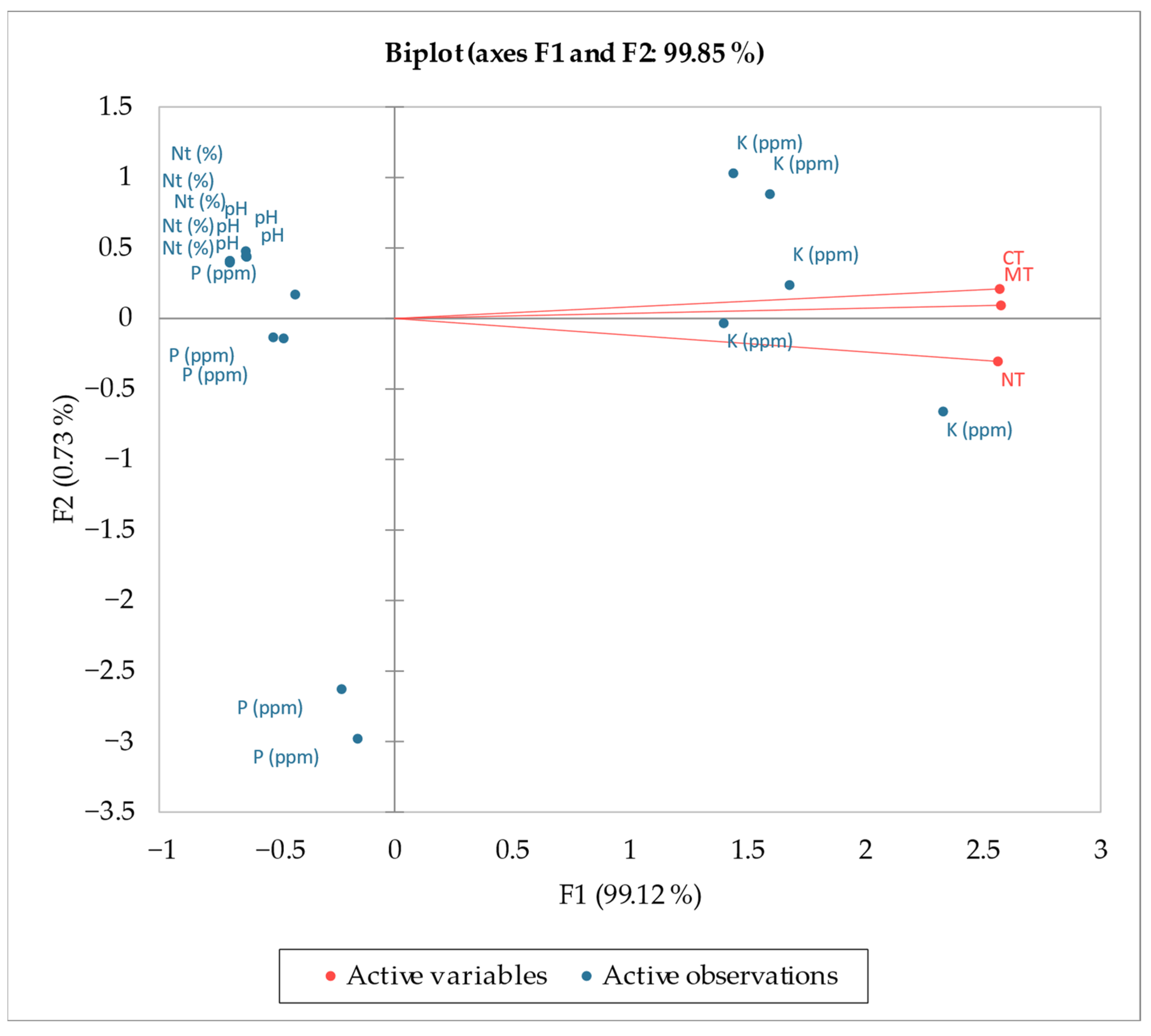
The PCA biplot from Figure 11 demonstrated that potassium (K) is the most influential element affecting soil chemical characteristics across the different tillage systems. The first principal component (F1) explaining 99.12% of the total variance and is strongly positively correlated with K levels, indicating that K availability is the primary factor driving differences among treatments. The PCA analysis shows that conventional tillage (CT) and minimum tillage (MT) cluster closely together, reflecting similar nutrient profiles characterized by higher K concentrations, which underscores the significance of K in differentiating these systems from no-tillage (NT).
In contrast, no-tillage (NT) revealed a distinct nutrient pattern, with notably lower K availability and unique phosphorus (P) dynamics—specifically, P accumulation in the surface layer under NT. Despite P’s tendency to concentrate at the surface, its overall contribution to treatment variability is less significant than that of K. Soil pH and total nitrogen (TN) contributed minimally to the variance, indicating their relative stability across tillage practices. These results highlight that tillage practices significantly influence soil nutrient profiles, with K playing a central role in distinguishing the chemical characteristics of each system.

4. Synergy Between Soil Porosity, Aeration Limits, Soil Capillarity, and Soil Organic Carbon

The results of our research demonstrate a significant relationship and synergy among soil depth, tillage practices, and key physical and chemical properties, especially SOC and SOM, across the two cropping seasons. It should be mentioned that the topsoil layer (0–10 cm) has the highest values for SP, SAL, SCC, SOC, SOM, and nutrient content in NT and MT systems, highlighting the essential role of minimal soil disturbance in promoting soil health. These surface benefits decrease with increasing depth, but NT consistently maintains a higher pore structure and organic carbon sequestration than CT, which can be explained by reduced soil disturbance and increased accumulation of SOM. The depth gradient in SP and SOC content corresponds to the physical principles of soil layer formation, in which surface layers accumulate SOM, promoting microbial activity and nutrient retention. Based on these results, we can deduce that SP plays a crucial role in promoting effective carbon sequestration in NT system through several interdependent mechanisms guided by the principles of conservation agriculture. Reduced tillage minimizes soil disturbance, which helps preserve and improve the natural soil pore structure. Higher porosity allows for better aeration, enabling the microbial communities responsible for decomposing and stabilizing SOM to develop. This microbial activity is essential for transforming organic residues into stable SOC and SOM. In addition, increased pore space improves water infiltration and retention, providing an environment conducive to microbial processes and protecting SOM from rapid mineralization. Improved pore connectivity also promotes root growth and the incorporation of organic residues, further contributing to carbon storage. On the other hand, higher SP reduces compaction and erosion, which affect SOM accumulation. The synergy between these physical improvements and biological activity results in higher carbon sequestration in the soil profile, especially in the surface layers where SOM inputs are the highest. While reduced tillage is a key factor, the benefits extend to other soil properties, such as increased nutrient retention (TN, P, K), improved soil chemical stability (pH, SOM), and improved physical attributes (SCC, SAL), which together promote a resilient soil ecosystem conducive to long-term carbon storage. In addition, soil chemical parameters, including pH, SOM, TN, P, and K, show a similar trend, with higher concentrations near the surface in conservation tillage systems. It is important to emphasize that the stability and slight decrease in these properties during crop development stages highlight the dynamic interactions between biological activity, soil structure, and tillage practices. Essentially, this synergy results from high SP maintained through minimal disturbance, which establishes optimal physical and biological conditions that enhance SOM accumulation, stabilize carbon compounds, and improve overall soil health. This integrated effect underscores that soil porosity is not merely a physical characteristic but a crucial factor that facilitates sustainable carbon sequestration in NT system. It should also be noted that Ts measurements showed that conservation practices helped maintain more stable, moderate surface and subsurface temperatures, thereby reducing temperature fluctuations that can affect microbial activity and the decomposition of organic matter. These results suggest that optimizing SP not only promotes carbon sequestration but also creates a more favorable temperature condition, contributing to sustainable soil management.
These results indicate that conservation tillage practices, particularly NT and MT, optimize soil physical health and enhance organic carbon stocks, thereby strengthening their potential for sustainable soil management and climate change mitigation through improved carbon sequestration and nutrient retention in critical surface horizons. Our study, conducted in northeastern Romania, provides insights for farmers who could gain many benefits from adopting NT and MT systems in the short, medium, and long term.

5. Conclusions

The results obtained after two years of study have deepened our understanding of the influence of conservation systems (NT, MT) and conventional systems (CT) on specific physical and chemical properties, particularly organic carbon sequestration in soil. This study highlights the essential role of soil physical and chemical properties in promoting sustainable soil health and carbon sequestration across different tillage systems and depths. The results indicate that minimal soil disturbance through NT and MT practices significantly improves soil porosity (SP), aeration limit (SAL), capillarity, and organic carbon content (SOC), particularly in the upper layers. These physical improvements facilitate microbial activity, enhance nutrient retention, and promote organic matter accumulation, creating an ecosystem conducive to long-term carbon sequestration. The depth gradients observed highlight the importance of the topsoil layers as critical zones for organic matter input and storage, which are better preserved under conservation tillage systems. Synergistic interactions between physical characteristics, such as porosity, and biological processes underscore that sustainable soil management practices can optimize soil functions and contribute to climate change mitigation by increasing soil organic carbon sequestration. The adoption of conservation tillage practices not only improves the physical and chemical health of soils but also plays a significant role in establishing a resilient and sustainable soil ecosystem. These observations confirm the need to integrate the management of soil physical properties into agricultural strategies aimed at environmental sustainability and carbon emission reduction.

Author Contributions

Conceptualization, S.S.C.; methodology, S.S.C., M.R. and D.Ț.; software, S.S.C. and G.D.M.; validation, D.Ț.; formal analysis, S.S.C., G.D.M. and M.R.; investigation, C.G. and T.G.A.; resources, D.Ț. and G.J.; data curation, T.G.A., C.G. and I.B.; writing—original draft preparation, S.S.C.; writing—review and editing, G.D.M., M.R. and I.B.; visualization., D.Ț.; supervision, G.J. and D.Ț.; project administration, D.Ț.; funding acquisition, G.J. and D.Ț. All authors have read and agreed to the published version of the manuscript.

Funding

This research received no external funding.

Institutional Review Board Statement

Not applicable.

Data Availability Statement

The data presented in this study are available on request from the corresponding author.

Conflicts of Interest

The authors declare no conflicts of interest.

References

  1. Țopa, D.C.; Căpșună, S.; Calistru, A.E.; Ailincăi, C. Sustainable Practices for Enhancing Soil Health and Crop Quality in Modern Agriculture: A Review. Agriculture 2025, 15, 998. [Google Scholar] [CrossRef]
  2. Rodríguez, B.C.; Durán-Zuazo, V.H.; Soriano Rodríguez, M.; García-Tejero, I.F.; Gálvez Ruiz, B.; Cuadros Tavira, S. Conservation agriculture as a sustainable system for soil health: A review. Soil Syst. 2022, 6, 87. [Google Scholar] [CrossRef]
  3. Xu, S.Q.; Zhang, R.Z.; Dong, B.; Zhang, M. Effect of tillage practices on structural properties and content of organic carbon in tilth soil. Chin. J. Eco-Agric. 2009, 17, 203–208. [Google Scholar] [CrossRef]
  4. An, L.; Li, Z. The effects of different tillage and crop rotation patterns on soil organic carbon accumulation and distribution characteristics in arid regions: A case study of field experiments in northwest China. Geogr. Res. Bull. 2025, 4, 135–157. [Google Scholar]
  5. Liu, Y.; Zhu, L.; Chen, C. The mechanisms and optimization strategies of tillage practices affecting soil pore structure. Geogr. Res. Bull. 2025, 4, 507–529. [Google Scholar] [CrossRef]
  6. Mihu, G.D.; Aostăcioaei, T.G.; Ghelbere, C.; Calistru, A.E.; Țopa, D.C.; Jităreanu, G. Exploring Soil Hydro-Physical Improvements Under No-Tillage: A Sustainable Approach for Soil Health. Agriculture 2025, 15, 981. [Google Scholar] [CrossRef]
  7. Steponavičienė, V.; Bogužas, V.; Sinkevičienė, A.; Skinulienė, L.; Vaisvalavičius, R.; Sinkevičius, A. Soil water capacity, pore size distribution, and CO2 emission in different soil tillage systems and straw retention. Plants 2022, 11, 614. [Google Scholar] [CrossRef] [PubMed]
  8. Farahani, E.; Emami, H.; Forouhar, M. Effects of tillage systems on soil organic carbon and some soil physical properties. Land Degrad. Dev. 2022, 33, 1307–1320. [Google Scholar] [CrossRef]
  9. Chen, X.W.; Shi, X.H.; Liang, A.Z.; Zhang, X.P.; Jia, S.X.; Fan, R.Q.; Wei, S.C. Least limiting water range and soil pore-size distribution related to soil organic carbon dynamics following zero and conventional tillage of a black soil in Northeast China. J. Agric. Sci. 2015, 153, 270–281. [Google Scholar] [CrossRef]
  10. Franchini, J.C.; Debiasi, H.; Junior, A.A.B.; Tonon, B.C.; Farias, J.R.B.; de Oliveira, M.C.N.; Torres, E. Evolution of crop yields in different tillage and cropping systems over two decades in southern Brazil. Field Crops Res. 2012, 137, 178–185. [Google Scholar] [CrossRef]
  11. Zhang, W.; Li, S.; Xu, Y.; Liu, X.; An, T.; Zhu, P.; Peng, C.; Wang, J. Advances in research on relationships between soil pore structure and soil miocroenvironment and organic carbon turnover. J. Soil Water Conserv. 2019, 33, 1–9. [Google Scholar]
  12. Jackson, T.; Mansfield, K.; Saafi, M.; Colman, T.; Romine, P. Measuring soil temperature and moisture using wireless MEMS sensors. Measurement 2008, 41, 381–390. [Google Scholar] [CrossRef]
  13. Indoria, A.K.; Rao, C.S.; Sharma, K.L.; Reddy, K.S. Conservation agriculture–A panacea to improve soil physical health. Curr. Sci. 2017, 112, 52–61. [Google Scholar] [CrossRef]
  14. Sarkar, S.; Paramanick, M.; Goswami, S.B. Soil temperature, water use and yield of yellow sarson (Brassica napus L. var. glauca) in relation to tillage intensity and mulch management under rainfed lowland ecosystem in eastern India. Soil Tillage Res. 2007, 93, 94–101. [Google Scholar] [CrossRef]
  15. Rai, V.; Pramanik, P.; Das, T.K.; Aggarwal, P.; Bhattacharyya, R.; Krishnan, P.; Sehgal, V.K. Modelling soil hydrothermal regimes in pigeon pea under conservation agriculture using Hydrus-2D. Soil Tillage Res. 2019, 190, 92–108. [Google Scholar] [CrossRef]
  16. Bond-Lamberty, B.; Thomson, A. Temperature-associated increases in the global soil respiration record. Nature 2010, 464, 579–582. [Google Scholar] [CrossRef]
  17. Moraru, P.I.; Rusu, T. Effect of tillage systems on soil moisture, soil temperature, soil respiration and production of wheat, maize and soybean crops. J. Food Agric. Environ. 2012, 10, 445–448. [Google Scholar]
  18. Cakpo, S.S.; Aostăcioaei, T.G.; Mihu, G.-D.; Molocea, C.-C.; Ghelbere, C.; Ursu, A.; Țopa, D.C. Long-Term Effect of Tillage Practices on Soil Physical Properties and Winter Wheat Yield in North-East Romania. Agriculture 2025, 15, 989. [Google Scholar] [CrossRef]
  19. Ursu, A.; Cara, I.G.; Bireescu, G.; Rusu, M.; Mihu, G.D.; Cakpo, S.S.; Țopa, D.; Jităreanu, G. Effects of Tillage Systems and Bacterial Inoculation on Enzyme Activities and Selected Soil Chemical Properties. Agriculture 2025, 15, 1285. [Google Scholar] [CrossRef]
  20. Kan, Z.R.; Ma, S.T.; Liu, Q.Y.; Liu, B.Y.; Virk, A.L.; Qi, J.Y.; Zhao, X.; Lal, R.; Zhang, H.L. Carbon sequestration and mineralization in soil aggregates under long-term conservation tillage in the North China Plain. Catena 2020, 188, 104428. [Google Scholar] [CrossRef]
  21. Topa, D.; Cara, I.G.; Jităreanu, G. Long term impact of different tillage systems on carbon pools and stocks, soil bulk density, aggregation and nutrients: A field meta-analysis. Catena 2021, 199, 105102. [Google Scholar] [CrossRef]
  22. Jat, S.L.; Parihara, C.M.; Singha, A.K.; Nayak, H.S.; Meena, B.R.; Kumara, B.; Pariharc, M.D.; Jat, M.L. Differential response from nitrogen sources with and without residue management under conservation agriculture on crop yields, water-use and economics in maize-based rotations. Field Crop Res. 2019, 236, 96–110. [Google Scholar] [CrossRef]
  23. Rusu, M.; Filip, M.; Cara, I.-G.; Topa, D.; Jităreanu, G. Soil Nutrient dynamics and Farming Sustainability Under Different Plum Orchard Management Practices in the Pedoclimatical Conditions of Moldavian Plateau. Agric./Agric. Soils 2025, 15, 509. [Google Scholar] [CrossRef]
  24. Calistru, A.E.; Filipov, F.; Cara, I.G.; Cioboată, M.; Țopa, D.; Jităreanu, G. Tillage and straw management practices influences soil nutrient distribution: A case study from north-eastern Romania. Land 2024, 13, 625. [Google Scholar] [CrossRef]
  25. Rusu, M.; Cara, I.-G.; Stoica, F.; Topa, D.; Jităreanu, G. Quality Parameters of Plum Orchard Subjected to Conventional and Ecological Management Systems in Temperate Production Area. Horticulturae 2024, 10, 907. [Google Scholar] [CrossRef]
  26. Calistru, A.E.; Coroi Cara, I.G.; Țopa, D.C.; Jităreanu, G. Analyzing soil porosity under different tillage systems using X-ray microtomography. Lucr. Ştiinţifice USAMV Iaşi Ser. Agron. 2016, 59, 201–204. [Google Scholar]
  27. Mihu, G.D.; Țopa, D.C.; Calistru, A.E.; Jităreanu, G. The influence of tillage systems on soil compaction in the corn crop. J. Appl. Life Sci. Environ. 2023, 55, 391–405. [Google Scholar] [CrossRef]
  28. Sadiq, M.; Rahim, N.; Tahir, M.M.; Alasmari, A.; Alqahtani, M.M.; Albogami, A.; Ghanem, K.Z.; Abdein, M.A.; Ali, M.; Mehmood, N.; et al. Conservation tillage: A way to improve yield and soil properties and decrease global warming potential in spring wheat agroecosystems. Front. Microbiol. 2024, 15, 1356426. [Google Scholar] [CrossRef] [PubMed]
  29. Fernandes, M.M.H. Soil structure under tillage systems with and without crop residues: Effects on soil porosity. Soil Tillage Res. 2023, 215, 105120. [Google Scholar]
  30. Mateo-Marín, N.; Bosch‐Serra, À.D.; Molina, M.G.; Poch, R.M. Impacts of tillage and nutrient management on soil porosity trends in dryland agriculture. Eur. J. Soil Sci. 2022, 73, e13139. [Google Scholar] [CrossRef]
  31. Liu, S.; Hu, H.; Wen, L. Three-dimensional dynamic modeling of soil aggregate structure and root interaction based on artificial intelligence and its application in nitrogen uptake. Adv. Resour. Res. 2025, 5, 895–918. [Google Scholar]
  32. Tan, S.; Kumar, A.; Li, J. Soil aeration limit and its response to tillage practices. J. Soil Sci. 2025, 203, 135–148. [Google Scholar]
  33. Ketena, S.; Gebresenbet, G.; Kolhe, K.; Dananto, M.; Seifu, Y.; Mathwos, M. Impacts of soil physical and mechanical behaviors under different tillage depths for agrotechnical operation in Bukito, Sidama, Ethiopia. Sci. Rep. 2025, 15. [Google Scholar] [CrossRef]
  34. Srivastava, R.K. Conservation tillage practices on GHG emissions, soil health and overall agricultural sustainability. Soil Use Manag. 2025, 41, e70096. [Google Scholar] [CrossRef]
  35. Li, J.; Chen, L.; Zhang, C.; Ma, D.; Zhou, G.; Ning, Q.; Zhang, J. Combining rotary and deep tillage increases crop yields by improving the soil physical structure and accumulating organic carbon of subsoil. Soil Tillage Res. 2024, 244, 106252. [Google Scholar] [CrossRef]
  36. Tan, J.; Si, B.; Zhao, Y.; Lu, Y.; Chen, Y.; An, N.; Li, S.; Wang, W.; Fu, H.; Han, W.; et al. Short-term no-tillage improves soil water retention and maintains soil aeration at high moisture conditions despite reduced macroporosity. Soil Tillage Res. 2025, 253, 106677. [Google Scholar] [CrossRef]
  37. Li, H.; Jin, X.; Shan, W.; Han, B.; Zhou, Y.; Tittonell, P. Optimizing agricultural management in China for soil greenhouse gas emissions and yield balance: A regional heterogeneity perspective. J. Clean. Prod. 2024, 452, 142255. [Google Scholar] [CrossRef]
  38. Martínez, P.; López, R.; García, M. Impact of no-tillage on soil structure and aeration in agricultural systems. Soil Tillage Res. 2022, 218, 105345. [Google Scholar]
  39. Amin, M.; Khan, M.J.; Jan, M.T.; Rehman, M.U.; Tariq, J.A.; Hanif, M.; Shah, Z. Effect of different tillage practices on soil physical properties under wheat in semi-arid environment. Soil Environ. 2014, 33, 33–37. [Google Scholar]
  40. Bondarovich, A.; Illiger, P.; Schmidt, G.; Schmidt, G.; Ponkina, E.; Nugumanova, A.; Maulit, A.; Maulit, A.; Sutula, M. Effects of agricultural cropping systems on soil water capacity: The case in cross-border Altai. Span. J. Soil Sci. 2023, 13, 11493. [Google Scholar] [CrossRef]
  41. Huang, X.; Li, F.; Chen, Y. Soil water retention dynamics in a mollisol during a maize growing season under different tillage practices. Geoderma 2021, 387, 114876. [Google Scholar]
  42. Rocco, S.; Prudent, G.; Silva-Olaya, A. Long-term soil quality and carbon stock effects of tillage and cover crop management. Soil Tillage Res. 2024, 214, 105344. [Google Scholar]
  43. Liebhard, G.; Klik, A.; Neugschwandtner, R.W.; Nolz, R. Effects of tillage systems on soil water distribution, crop development, and evaporation and transpiration rates of soybean. Agric. Water Manag. 2022, 269, 107719. [Google Scholar] [CrossRef]
  44. Pöhlitz, J.; Schlüter, S.; Rücknagel, J. Short-term effects of double-layer ploughing reduced tillage on soil structure and crop yield. Soil Use Manag. 2024, 40, e13043. [Google Scholar] [CrossRef]
  45. Moreira, R.; da Silva, F.; Oliveira, A. Effects of tillage on soil water infiltration and retention in subtropical croplands. Soil Sci. Soc. Am. J. 2023, 87, 45–59. [Google Scholar]
  46. Wazzan, F.A.; Muhammad, S.A. Effects of Conservation and Conventional Tillage on some Soil Hydraulic Properties. IOP Conf. Ser. Earth Environ. Sci. 2022, 1060, 012002. [Google Scholar] [CrossRef]
  47. Smith, C. Effects on Soil Water Holding Capacity and Soil Water Retention Resulting from Soil Health Management Practices Implementation; United States Department of Agriculture: Washington, DC, USA, 2018; pp. 1–30.
  48. Pečan, U.; Pintar, M.; Mihelič, R.; Kastelec, D. Variability of In Situ Soil Water Retention Curves under Different Tillage Systems and Growing Seasons. Soi Tillage Res. 2023, 233, 105779. [Google Scholar] [CrossRef]
  49. Martinez, P.; Lopez, R.; Sánchez, L. Impact of tillage and residue management on soil water retention and pore structure in Mediterranean cropland. J. Soil Sci. 2023, 74, 1224–1235. [Google Scholar]
  50. Kim, J.; Park, H. Influence of tillage practices on root distribution and soil water retention in temperate agricultural systems. Agric. Ecosyst. Environ. 2024, 341, 108093. [Google Scholar]
  51. Wang, L.; Zhao, Y.; Chen, Q. The role of tillage on improving soil water dynamics and crop productivity under climate change scenarios. Agric. Water Manag. 2023, 280, 108112. [Google Scholar]
  52. Garcia, M.; Hernandez, L. Deep rooting and subsoil water retention enhancement through tillage practices in semi-arid regions. Field Crops Res. 2023, 295, 108543. [Google Scholar]
  53. Ahmed, A.; Mahmood, K.; Qureshi, M. Conventional tillage improves soil physical properties and water retention in loam soils. Soil Tillage Res. 2023, 220, 105411. [Google Scholar] [CrossRef]
  54. Zhao, Y.; Wang, L. Initial effects of no-till on soil pore development and water retention under continuous cropping. Soil Sci. 2024, 189, 137–148. [Google Scholar]
  55. Davis, J.; Thompson, M. Dynamic interactions between soil physical properties and crop growth: Implications for water management. Agric. Sci. 2022, 13, 456–468. [Google Scholar]
  56. Koch, O.; Tscherko, D.; Kandeler, E. Temperature sensitivity of microbial respiration, nitrogen mineralization, and potential soil enzyme activities in organic alpine soils. Glob. Biogeochem. Cycles 2007, 21. [Google Scholar] [CrossRef]
  57. Naher, U.A.; Sarker, I.U.; Jahan, A.; Maniruzzaman, M.D.; Choudhury, A.K.; Kalra, N.; Biswas, J.C. Nutrient mineralization and soil biology as influenced by temperature and fertilizer management practices. Sains Malays. 2019, 48, 735–744. [Google Scholar] [CrossRef]
  58. Dai, Z.; Yu, M.; Chen, H.; Zhao, H.; Huang, Y.; Su, W.; Xia, F.; Chang, S.X.; Brookes, P.C.; Dahlgren, R.A.; et al. Elevated temperature shifts soil N cycling from microbial immobilization to enhanced mineralization, nitrification and denitrification across global terrestrial ecosystems. Glob. Change Biol. 2020, 26, 5267–5276. [Google Scholar]
  59. Sanford, R.A.; Chee-Sanford, J.C.; Yang, W.H. Diurnal temperature variation in surface soils: An underappreciated control on microbial processes. Front. Microbiol. 2024, 15, 1423984. [Google Scholar] [CrossRef]
  60. Doran, J.W.; Parkin, T.B. Defining and assessing soil quality. Soil Sci. Soc. Am. Spec. Publ. 1994, 35, 3–21. [Google Scholar]
  61. Chen, Y.; Liu, S.; Li, H.; Song, X.F.; Li, C.Y.; Cruse, R.M.; Zhang, X.Y. Effects of conservation tillage on corn and soybean yield in the humid continental climate region of Northeast China. Soil Till. Res. 2011, 115–116, 56–61. [Google Scholar] [CrossRef]
  62. Liu, X.; Liu, J.; Xing, B.; Herbert, S.J.; Meng, K.; Han, X.; Zhang, X. Effects of long-term continuous cropping, tillage, and fertilization on soil organic carbon and nitrogen of black soils in China. Commun. Soil Sci. Plant Anal. 2005, 36, 1229–1239. [Google Scholar] [CrossRef]
  63. Shukla, S.K.; Singh, R.; Kumar, A. Influence of tillage systems on soil thermal regime and crop yield. J. Agric. Sci. 2012, 4, 123–130. [Google Scholar]
  64. Muñoz-Romero, V.; Lopez-Bellido, L.; Lopez-Bellido, R.J. Effect of tillage system on soil temperature in a rainfed Mediterranean Vertisol. Int. Agrophysics 2015, 29, 467–473. [Google Scholar] [CrossRef]
  65. Six, J.; Feller, C.; Denef, K.; Ogle, S.M.; Moraes, J.C.S.A.; Albrecht, A. Soil organic matter, biota and aggregation in temperate and tropical soils—Effects of no-tillage. Agronomie 2002, 22, 755–775. [Google Scholar] [CrossRef]
  66. Lal, R. Restoring soil quality to mitigate soil degradation. Sustainability 2015, 7, 5875–5895. [Google Scholar] [CrossRef]
  67. Manzeke-Kangara, M.G.; Ligowe, I.S.; Tibu, A.; Gondwe, T.N.; Greathead, H.M.; Galdos, M.V. Soil organic carbon and related properties under conservation agriculture and contrasting conventional fields in Northern Malawi. Front. Soil Sci. 2025, 4, 1481275. [Google Scholar] [CrossRef]
  68. Wen, L.; Peng, Y.; Zhou, Y.; Cai, G.; Lin, Y.; Li, B. Effects of conservation tillage on soil enzyme activities of global cultivated land: A meta-analysis. J. Environ. Manag. 2023, 345, 118904. [Google Scholar] [CrossRef] [PubMed]
  69. Ding, W.; Chang, N.; Zhang, G.; Kang, J.; Yi, X.; Zhang, J.; Zhang, J.; Wang, L.; Li, H. Soil organic carbon changes in China’s croplands: A newly estimation based on DNDC model. Sci. Total Environ. 2023, 905, 167107. [Google Scholar] [CrossRef]
  70. Govaerts, B.; Sayre, K.D.; Goudeseune, B.; De Corte, P.; Lichter, K.; Dendooven, L.; Deckers, L. Conservation agriculture and soil carbon sequestration: A review. Agric. Ecosyst. Environ. 2009, 103, 222–230. [Google Scholar]
  71. Franzluebbers, A.J. Soil organic carbon, labile organic carbon fractions, and microbial biomass in response to tillage and crop rotation. Soil Sci. Soc. Am. J. 2002, 66, 887–898. [Google Scholar]
  72. Lal, R. Soil carbon sequestration to mitigate climate change. Geoderma 2016, 262, 101–111. [Google Scholar] [CrossRef]
  73. Huang, B.; Gao, J.; Zhang, W.; Gan, C.; Bao, X.; Xu, M.; Wu, L. Impacts of conservation tillage on soil organic carbon and crop yield in black soil region of Northeast China: Integrated regulation by climate, management and soil properties. J. Agric. Food Res. 2025, 24, 102388. [Google Scholar] [CrossRef]
  74. Huang, Y.; Fu, B.; Lü, Y.; Wang, S.; Liu, Y. Active soil organic carbon fractions and their relationships with soil properties. Soil Biol. Biochem. 2019, 136, 107540. [Google Scholar]
  75. Corsi, S.; Friedrich, T.; Kassam, A.; Pisante, M.; de Moraes Sà, J.C. Soil carbon sequestration in conservation tillage systems. Agric. Ecosyst. Environ. 2020, 291, 106816. [Google Scholar]
  76. Lal, R. Soil carbon sequestration impacts on global climate change and food security. Science 2004, 304, 1623–1627. [Google Scholar] [CrossRef]
  77. Jenkinson, D.S.; Coleman, K. The turnover of organic carbon in subsoils. Part 2. Modelling carbon turnover. Eur. J. Soil Sci. 2008, 59, 400–413. [Google Scholar] [CrossRef]
  78. Ladha, J.K.; Jat, M.L.; Stirling, C.M.; Chakraborty, D.; Pradhan, P.; Krupnik, T.J.; Sapkota, T.B.; Pathak, H.; Rana, D.S.; Tesfaye, K.; et al. Achieving the sustainable development goals in agriculture: The crucial role of nitrogen in cereal-based systems. Adv. Agron. 2020, 163, 39–116. [Google Scholar]
  79. Fiorini, A.; Boselli, R.; Maris, S.C.; Santelli, S.; Ardenti, F.; Capra, F.; Tabaglio, V. May conservation tillage enhance soil C and N accumulation without decreasing yield in intensive irrigated croplands? Results from an eight-year maize monoculture. Agric. Ecosyst. Environ. 2020, 296, 106926. [Google Scholar] [CrossRef]
  80. Huang, Y.; Zhang, J.; Chen, Y.; Li, H. Effects of tillage and residue management on soil nutrients and crop yield in wheat-maize rotation systems. Soil Tillage Res. 2019, 193, 104–113. [Google Scholar]
  81. Filip, C.D.; Coman, M.A. Regarding transfer factor of soil pollution with heavy metals in soil-plant system. Sci. Pap. Ser. A Agron. 2025, 68, 90–99. [Google Scholar]
Figure 1. Precipitations and temperatures data of the research site from 2024–2025 (www.fieldclimate.com, accessed on 2 October 2025).
Agriculture 16 00179 g001
Figure 2. The geographic location of research plot in the map of Europe and the experimental design. NT = No-tillage, MT = Minimum tillage, CT = Conventional tillage, R1, 2, 3 = Replicate.
Agriculture 16 00179 g002
Figure 3. (a) Soil porosity (%) in 2024. NT: No-tillage, MT: Minimum tillage, CT: Conventional tillage. a, b, c, d, e: For each stage, means with different letters are significantly different at the 5% threshold: p < 0.05. The largest means are marked with the letter “a”. (b) Soil porosity (%) in 2025. NT: No-tillage, MT: Minimum tillage, CT: Conventional tillage. a, b, c, d: For each stage, means with different letters are significantly different at the 5% threshold: p < 0.05. The largest means are marked with the letter “a”. *: Degree of significance.
Agriculture 16 00179 g003
Figure 4. (a) Soil aeration limit (%) in 2024. NT: No-tillage, MT: Minimum tillage, CT: Conventional tillage. a, b, c, d, e: For each stage, means with different letters are significantly different at the 5% threshold: p < 0.05. The largest means are marked with the letter “a”. (b) Soil aeration limit (%) in 2025. NT: No-tillage, MT: Minimum tillage, CT: Conventional tillage. a, b, c, d: For each stage, means with different letters are significantly different at the 5% threshold: p < 0.05. The largest means are marked with the letter “a”. *: Degree of significance.
Agriculture 16 00179 g004
Figure 5. (a) Soil capillary capacity (%) in 2024. NT: No-tillage, MT: Minimum tillage, CT: Conventional tillage. a, b, c, d, e: For each stage, means with different letters are significantly different at the 5% threshold: p < 0.05. The largest means are marked with the letter “a”. (b) Soil capillary capacity (%) in 2025. NT: No-tillage, MT: Minimum tillage, CT: Conventional tillage. a, b, c, d: For each stage, means with different letters are significantly different at the 5% threshold: p < 0.05. The largest means are marked with the letter “a”. *: Degree of significance.
Agriculture 16 00179 g005
Figure 6. (a) Soil total capacity (%) in 2024. NT: No-tillage, MT: Minimum tillage, CT: Conventional tillage. a, b, c, d, e: For each stage, means with different letters are significantly different at the 5% threshold: p < 0.05. The largest means are marked with the letter “a”. (b) Soil total capacity (%) in 2025. NT: No-tillage, MT: Minimum tillage, CT: Conventional tillage. a, b, c, d: For each stage, means with different letters are significantly different at the 5% threshold: p < 0.05. The largest means are marked with the letter “a”. *: Degree of significance.
Agriculture 16 00179 g006aAgriculture 16 00179 g006b
Figure 7. (a) Effect of tillage systems on the soil temperature 2024. (b) Effect of tillage systems on the soil temperature 2025. a = Sowing and emergence; b = Growing season; c = Maturity.
Agriculture 16 00179 g007
Figure 8. (a) Daily air temperature 2024. (b) Daily air temperature 2025. a = Sowing and emergence; b = Growing season; c = Maturity.
Agriculture 16 00179 g008
Figure 9. Relationship between air temperature (Ta) and soil temperature (Ts) according to the tillage systems.
Agriculture 16 00179 g009
Figure 10. Variations and dynamics of soil organic carbon and total organic carbon depths under tillage systems. NT: No-tillage; MT: Minimum tillage; CT: Conventional tillage. Error bars represent the corresponding standard error of mean values. Different letters indicate significant differences between treatments during this period at the 0.05 level.
Agriculture 16 00179 g010
Figure 11. Principal Component Analysis (PCA).
Agriculture 16 00179 g011
Table 1. Soil chemical properties and available nutrients.
ParametersSoil Depth (cm)NTMTCT
pH0–56.68 ± 0.26 a6.86 ± 0.17 a6.72 ± 0.23 a
5–105.90 ± 0.14 c6.46 ± 0.24 b6.77 ± 0.30 a
10–206.33 ± 0.22 b6.53 ± 0.15 b6.51 ± 0.22 a
20–306.50 ± 0.16 ab6.56 ± 0.21 b6.66 ± 0.25 a
30–406.65 ± 0.25 a6.72 ± 0.25 ab6.76 ± 0.10 a
TN (%)0–50.253 ± 0.22 a0.202 ± 0.15 c0.074 ± 0.22 d
5–100.161 ± 0.11 c0.241 ± 0.21 b0.177 ± 0.15 c
10–200.242 ± 0.17 ab0.292 ± 0.30 a0.294 ± 0.28 a
20–300.244 ± 0.24 ab0.119 ± 0.12 d0.271 ± 0.22 b
30–400.205 ± 0.20 b0.247 ± 0.14 b0.075 ± 1.77 d
P (ppm)0–590.57 ± 0.11 a36.51 ± 0.21 a25.29 ± 0.27 b
5–1080.89 ± 0.20 b28.20 ± 0.23 b24.17 ± 0.16 b
10–2031.33 ± 0.24 c16.51 ± 0.14 c28.81 ± 0.05 a
20–3029.82 ± 0.20 d12.07 ± 0.18 d21.46 ± 0.15 c
30–4024.67 ± 0.12 e11.94 ± 0.22 d14.97 ± 0.22 d
K (ppm)0–5298.10 ± 0.11 a286.94 ± 0.22 a247.94 ± 0.21 a
5–10226.01 ± 0.12 b229.07 ± 0.17 b198.04 ± 0.13 c
10–20214.93 ± 0.28 c205.98 ± 0.18 c207.92 ± 0.26 b
20–30205.07 ± 0.16 d191.04 ± 0.21 d179.95 ± 0.15 d
30–40199.01 ± 0.11 e190.00 ±0.17 d197.06 ± 0.23 c
NT: No-tillage; CT: Conventional tillage; MT: Minimum tillage; TN: Total Nitrogen; P: Available Phosphorus; K: Available Potassium; pH: Potential hydrogen. a, b, c, d, e: For each year, means with different letters are significantly different at the 5% threshold: p < 0.05 for the same column. The largest means are marked with the letter “a”.
Disclaimer/Publisher’s Note: The statements, opinions and data contained in all publications are solely those of the individual author(s) and contributor(s) and not of MDPI and/or the editor(s). MDPI and/or the editor(s) disclaim responsibility for any injury to people or property resulting from any ideas, methods, instructions or products referred to in the content.