
Article

Tannin Tolerance in Lactic Acid Bacteria Modulates Whole-Plant Sorghum Silage Quality and In Vitro Methane Mitigation

1
College of Resources and Environment, Anhui Agricultural University, Hefei 230036, China
2
Elanco (Shanghai) Enterprise Management Co., Ltd., Shanghai 200131, China
3
College of Animal Science and Technology, Anhui Agricultural University, Hefei 230036, China
*
Author to whom correspondence should be addressed.
These authors contributed equally to this work.
Agriculture 2026, 16(2), 158; https://doi.org/10.3390/agriculture16020158
Submission received: 14 November 2025 / Revised: 24 December 2025 / Accepted: 30 December 2025 / Published: 8 January 2026

Abstract

Although tannins generally inhibit the growth of lactic acid bacteria, different strains vary significantly in their tolerance to this inhibitory effect. However, it remains unclear whether the differences in tannin tolerance among various lactic acid bacteria (LAB) lead to variations in the fermentation outcomes during the silage process and in vitro fermentation. Therefore, this study investigated the correlation between the fermentation effects of LAB with varying tannin tolerances and the tannin content of sorghum. Four LAB strains (Lactococcus garvieae, LG; Lactococcus lactis, LL; Lactiplantibacillus plantarum, LP; Pediococcus pentosaceus, PP) were selected and identified from whole sorghum and mulberry leaves, and their tannin tolerance was assessed. The results demonstrated that LG exhibited the highest tolerance to sorghum tannins, followed by LL and LP, while PP displayed the lowest tolerance. Upon addition of LAB to whole sorghum for silage, LG showed the most effective ability to lower pH, reduce ammonia nitrogen content, decrease neutral detergent fiber content, diminish microbial diversity, and enhance the abundance of firmicutes. Concurrently, during in vitro fermentation, they significantly reduced rumen fluid pH and suppressed gas emissions (CH4, CO2). Conversely, PP performed poorly across all parameters. These findings suggest that the fermentation effects of LAB on sorghum silage are closely related to their tannin tolerance.

1. Introduction

Silage is a fermentation process in which lactic acid bacteria (LAB) convert water-soluble carbohydrates (WSCs) into organic acids under anaerobic conditions, providing an effective method for preserving animal feed [1]. The world’s top five cereal crops are wheat, rice, maize, barley, and sorghum [2], with sorghum considered an excellent animal feed with high nutritional value [3]. As an annual grass belonging to the Poaceae family, sorghum is highly resilient to drought, flooding, soil salinity, acidity, and poor soil fertility, and is widely grown across tropical, subtropical, and temperate regions [4]. However, the grain accounts for only a small proportion (12~15%) of the whole sorghum plant, resulting in a significant amount of sorghum straw often being underutilized during production [2]. With its high carbohydrate content and low buffering capacity, sorghum is well-suited for use as silage feed [1]. Additionally, sorghum thrives in semi-arid and high-salinity soils, making it an ideal crop for increasing silage feed production in drought-prone areas worldwide, thereby supporting the demands of animal production [5].
However, sorghum contains high levels of condensed tannins, which are traditionally considered antinutritional factors in animal feed [6]. These polyphenolic compounds, concentrated in the seed coat, act as a plant defense mechanism but also impart strong antioxidant properties. Recent research, however, has demonstrated that the polyphenolic hydroxyl structure of plant tannins imparts strong antibacterial and antiviral properties, and may exhibit synergistic effects with LAB [7]. In fact, some researchers have used tannins as additives in silage, as they inhibit the growth of harmful bacteria, reduce protein degradation and reduce greenhouse gas production, particularly methane [8,9,10]. Yet, the potent antibacterial properties of tannins can also affect LAB, potentially hindering their survival in high-tannin environments. Therefore, the selection of LAB strains with enhanced tannin tolerance is essential to improve fermentation quality in silage production. In light of these considerations, understanding the balance between the inhibitory effects of tannins and their potential benefits in silage preservation is crucial. By selecting LAB strains capable of thriving in tannin-rich environments, it is possible to harness the advantages of tannins while mitigating their negative impacts on fermentation and suppressing enteric methane emissions. Moreover, such tannin-adapted LAB can contribute to suppressing enteric methane emissions—an important goal for sustainable livestock production, given methane’s significant role as a potent greenhouse gas. This study, therefore, aims to bridge this gap by examining the specific interactions between LAB and tannins in sorghum silage.

2. Materials and Methods

2.1. Isolation, Screening, Characterization, and Identification of LAB

Bacterial cells were enriched from fresh whole sorghum and mulberry leaves separately. Specifically, 10 g of each sample was weighed and added to a conical flask containing 90 mL of sterile physiological saline [11]. After incubation, typical LAB colonies were selected and purified through 2–3 subcultures until only a single colony morphology remained on the MRS agar plate [12]. Subsequently, their morphological characteristics, growth ability, and acid-producing capacity were evaluated. The physiological and biochemical characteristics of four selected LAB strains were determined, and their species were identified by 16S rRNA gene sequencing [13].

2.2. Antimicrobial Activity Assay

The activated LAB were cultured at 37 °C and adjusted to a concentration of 106 CFU/mL. For fungal spore preparation, spores from slant cultures were suspended in sterile water containing glass beads, vortexed, filtered, and adjusted to 106 CFU/mL [14]. Subsequently, 100 μL of bacterial or fungal suspension was spread evenly on MRS (for LAB) or PDA (for fungi) agar plates using a sterile spreader. Four equidistant wells (8 mm diameter) were aseptically punched in each quadrant using a sterilized stainless-steel cork borer. Wells were loaded with 75 μL sterile water (negative control) or tannic acid solutions (1%, 5%, 10%, 15%, 20% w/v). Plates were incubated upright at 37 °C (LAB, 24 h) or 28 °C (fungi, 48 h). Inhibition zones were measured with a digital vernier caliper (0.01 mm accuracy) by averaging two perpendicular diameters per well [15]. Experiments included three biological replicates, with triplicate measurements per group.

2.3. Extraction of Condensed Tannins

Fifty grams (50 g) of whole-plant fresh sorghum sample was weighed and placed into 1 L of extraction solution. The mixture was kept in a light-protected area and extracted by magnetic stirring for 1 h. Following extraction, the extract was centrifuged at 1000× g and 4 °C for 15 min. The supernatant was decanted, and the pellet was subjected to a second extraction using the same procedure. The supernatants from both extractions were combined. An equal volume of diethyl ether (approximately 1500 mL) was added to the combined supernatant, and the mixture was thoroughly homogenized. It was then allowed to stand undisturbed at room temperature (20 °C to 25 °C) for 5 min to facilitate phase separation. After phase separation, the upper organic layer was discarded, and the lower aqueous phase was retained. The aqueous phase was concentrated by rotary evaporation under reduced pressure at 40 °C and 120 rpm. If acetone was not completely removed during rotary evaporation, residual acetone was eliminated using a nitrogen evaporator at 40 °C to purge the liquid phase. The resulting concentrate was then lyophilized. The lyophilized powder, representing a crude extract of condensed tannins from whole-plant sorghum, exhibited a pale tan color. This extract was stored in an amber glass bottle at −20 °C [16].

2.4. Tolerance Assay of Bacterial Isolates

The four strains of lactic acid bacteria (LAB) were cultured to mid-logarithmic growth phase and then inoculated into MRS broth containing 0.1% and 0.2% (w/v) sorghum tannic acid, respectively. The initial bacterial concentration was uniformly adjusted to approximately 1 × 10⁶ CFU/mL. After incubation at 37 °C under anaerobic conditions for 4 h, the cultures were serially diluted with phosphate-buffered saline (PBS, pH 7.2) to terminate the effect of tannic acid. Subsequently, 100 μL of diluted bacterial suspensions (105 to 107 dilutions) were spread onto solid MRS agar plates. Three replicates were prepared for each dilution. After incubation for 24 h of incubation at 37 °C under anaerobic conditions, plates containing 30–300 colonies were selected for colony counting. The survival rate (%) was calculated as the ratio of CFU/mL in the treatment groups to that in the untreated control group (0% tannic acid) [17].

2.5. Characteristics of Feed Ingredients

The chemical composition of the whole-plant sorghum is presented in Table 1. The fresh matter (FM) and dry matter (DM) contents were 67.06% and 35.48%, respectively. On a DM basis, the contents of crude protein (CP), neutral detergent fiber (NDF), acid detergent fiber (ADF), water-soluble carbohydrates (WSC), and tannins were 10.21%, 40.60%, 28.27%, 11.47%, and 2.29%, respectively.

2.6. Preparation of Ensiled Forage

All the required strains were cultured to the logarithmic stage, the bacterial solution was centrifuged at 4 °C for 5 min, the bacterial body was washed with sterile PBS and precipitated for 3 times, and then the bacterial concentration was adjusted to 1.0 × 10⁶ CFU/mL with sterile normal saline, which was used as the bacterial solution for silage inoculation [18].
After harvesting whole-plant sorghum (National High tech Agricultural Park of Anhui Agricultural University, 31°58′ N, 117°24′ E), the material was chopped into 2–3 cm lengths and thoroughly mixed before being randomly sampled for ensiling. The experiment included one control group and four treatment groups: CK group (1% saline added); LG-inoculated silage, with the addition of 1% Lactococcus garvieae at a concentration of 1.0 × 10⁶ cfu g−1; LL-inoculated silage, with the addition of 1% Lactococcus lactis at a concentration of 1.0 × 10⁶ cfu g−1, LP-inoculated silage, with the addition of 1% Lactiplantibacillus plantarum; PP- inoculated silage, with the addition of 1% Pediococcus pentosaceus. Each group had 3 replicates. Silage was carried out using silage bags (250 × 300 mm, Hefei Xi Yue Biological Co., Ltd., Hefei, China), with 400 g (1% bacterial solution for silage inoculation) of material per bag. The bags were stored at room temperature in darkness. Samples were collected for analysis on days 1, 3, 7, 15, 30 and 60 of ensiling.

2.7. Chemical Composition Analysis

10 g of ensiled sample were mixed with 90 mL of distilled water and extracted at 4 °C for 12 h. The pH of the filtrate was measured using a pH meter (Mettler Toledo, Greifensee, Switzerland). Approximately 10 mL of the filtrate was centrifuged (4500× g, 15 min, 4 °C), and the supernatant was analyzed for LA, acetic acid (AA), propionic acid (PA), and butyric acid (BA) content using high-performance liquid chromatography (HPLC). An Agilent TC-C18 column (250 nm × 4.6 nm, 5 μm) was used, with acetonitrile as mobile phase A and 0.01 mol/L potassium dihydrogen phosphate (pH 2.70) as mobile phase B, in a ratio of 3:97. The flow rate was set at 0.6 mL/min, and UV detection was performed at a wavelength of 210 nm. The column temperature was maintained at room temperature [19]. Ammonia nitrogen was determined following the method of Broderick [20].
The content of dry matter (DM) was analyzed following the AOAC method. Water soluble carbohydrates (WSC) were measured using the anthrone-sulfuric acid colorimetric method to determine soluble sugars, as per AOAC [21]. Crude protein (CP) was determined using the Kjeldahl method with an automated nitrogen analyzer. Neutral detergent fiber (NDF) and acid detergent fiber (ADF) were determined using a fiber analyzer based on the analysis system outlined by PJ Van Soest, JB Robertson and BA Lewis [22]. The tannin content was detected with the tannin content determination kit (Abbkine, Wuhan, China).

2.8. Bacterial Community Analysis

The bacterial community diversity of whole-plant sorghum silage at 1, 3, 7, 15, 30, and 60 days was determined using 16S rRNA high-throughput sequencing. For each time point, 10 g of silage sample was weighed into a 150 mL triangular flask, mixed with 90 mL of sterile saline, sealed, and shaken at 120 r/min for 2 h. After filtration with double gauze, the bacteria were collected by centrifugation at 12,000 r for 15 min. The total DNA of the bacteria in the silage samples was extracted using the E.Z.N.A.®Stool DNA Kit (D4015, Omega, Bio-tek, Norcross, GA, USA), and 3 DNA samples were extracted from each sample. Primers in the V3~V4 region of bacterial 16S rRNA gene were used for sequence amplification of the obtained DNA templates [23]. The primer sequence was the front-end primer 341F (5′-CCTACGGGNGGCWGCAG-3′) and back-end primer 805R (5′-GACTACHVGGGTATCTAATCC-3′). The 5′ end of the primer labels each sample with specific barcodes and sequencing universal primers. PCR was performed in a 25 μL reaction mixture containing approximately 25 ng of template DNA, 12.5 μL of PCR premix, 2.5 μL of each primer (10 μM), and PCR-grade water. The amplification protocol consisted of initial denaturation at 98 °C for 30 s; followed by 32 cycles of denaturation at 98 °C for 10 s, annealing at 54 °C for 30 s, and extension at 72 °C for 45 s; with a final extension at 72 °C for 10 min. The PCR products were confirmed by 2% agarose gel electrophoresis. Ultrapure water rather than sample solution was used as a negative control throughout the DNA extraction process to rule out the possibility of false positives in PCR results. PCR products were purified by AMPure XT beads (Beckman Coulter Genomics, Danvers, MA, USA) and quantified by Qubit (Invitrogen, Carlsbad, CA, USA). The amplicon banks were prepared for sequencing, and the size and number of the amplicon banks were evaluated at Agilent 2100 Bioanalyzer (Agilent, Technologies, Santa Clara, CA, USA) and the library quantification kit Illumina (Kapa Biosciences, Woburn, MA, USA), respectively. The libraries were sequenced on the NovaSeq PE250 platform (Illumina, San Diego, CA, USA).
The samples were sequenced on the Illumina NovaSeq platform. Pairs of end reads were assigned based on the unique barcode of the sample and truncated by cutting the barcode and primer sequence. Reads were merged using FLASH. Raw reads were quality-filtered under specific conditions using fqtrim (v0.94) to obtain high-quality clean tags. Chimeric sequences were filtered using Vsearch software (v2.3.4). After repeated processing by DADA2, the feature list and feature sequence were obtained. α diversity and β diversity were calculated by QIIME2, the same number of sequences were randomly extracted by minimizing the number of sequences in part of the sample, and the bacteria were classified using relative abundance (X number of bacteria/total number). Figures were generated using R software (v3.5.2), and species-annotated sequence comparison was performed by BLAST+ software (v2.11.0+). The comparison databases were SILVA and NT-16S. Heatmaps were also generated using R (v3.5.2).

2.9. In Vitro Fermentation

Silage ensiled for 60 days was used for in vitro rumen fermentation in triplicate. Rumen fluid was collected 4 h after morning feeding via rumen fistula from two mature Suffolk wethers, filtered through four layers of gauze, mixed with McDougall ‘s buffer (1:2 v/v), and maintained at 39 °C under continuous CO2 flushing. Ground samples (500 mg DM) were placed in 50-mL bottles, mixed with 30 mL rumen fluid-buffer mixture, flushed with CO2 for 10 s, and sealed with rubber stoppers and aluminum caps. Bottles were incubated at 39 °C for 24 h. After incubation, total gas production was measured by pressure transducer and converted to volume (mL). Subsequently, 1 mL headspace gas was sampled via syringe into evacuated tubes for analysis of CH4 and CO2 concentrations. pH was measured immediately after uncapping, while for NH3-N analysis, 1.0 mL fluid was mixed with 0.2 mL metaphosphoric acid and stored at −20 °C [24].

2.10. Statistical Analyses

Data regarding microbial populations, chemical composition, and fermentation quality were analyzed as a 5 × 6 factorial designs using the General Linear Model (GLM) procedure of IBM SPSS Statistics 26.0 (SPSS, Inc., Chicago, IL, USA). The statistical model included the fixed effects of treatment (control and four LAB inoculant groups) and ensiling time (1, 3, 7, 15, 30, and 60 days), as well as the interaction between treatment and ensiling time (Treatment × Time). When the interaction effect was significant, Duncan’s multiple range test was employed for post hoc multiple comparisons to separate the means. Statistical significance was declared at p < 0.05.

3. Results

3.1. Identification and Characteristics of Isolated Strains

A total of 4 LAB strains were isolated from sorghum and mulberry leaves through Gram staining, colony morphology assessment, and catalase activity detection. These strains were identified via 16S rDNA sequencing as L. garvieae, L. lactis, Lb. plantarum, and P. pentosaceus. Specifically, L. garvieae and L. lactis were isolated from sorghum, while Lb. plantarum and P. pentosaceus were isolated from mulberry leaves. The 4 LAB strains demonstrated normal growth at temperatures ranging from 5 to 45 °C but exhibited poor tolerance at 50 °C (Table 2). They thrived in neutral to weakly acidic environments but struggled to grow at a pH below 3.5, with LP displaying reduced growth capacity at pH 4. All 4 strains exhibited strong acid production, with pH levels dropping below 4 after 24 h of culture. Notably, these strains demonstrated broad carbohydrate utilization, fermenting monosaccharides (D-ribose, arabinose), disaccharides (lactose, cellobiose, maltose, melibiose), and the fructan inulin, underscoring their metabolic versatility. The selected strains exhibited considerable temperature and pH tolerance, strong acid production potential, and the ability to utilize diverse fermentation substrates, highlighting their potential as effective inoculants.

3.2. Assessment of Tannic Acid Antimicrobial Activity

Prior to LAB-inoculated sorghum silage preparation, we evaluated the antimicrobial effects of sorghum-derived tannic acid on both general bacteria and LAB. As shown in Table 3, tannic acid exhibited dose-dependent inhibitory activity against multiple bacterial strains, including Serratia marcescens, Salmonella spp., and Staphylococcus aureus, with the strongest suppression observed against S. aureus. In contrast, tannic acid demonstrated no inhibitory effect on LAB growth, as evidenced by the absence of inhibition zones even at a 20% tannic acid concentration.

3.3. Tannic Acid Tolerance of LAB

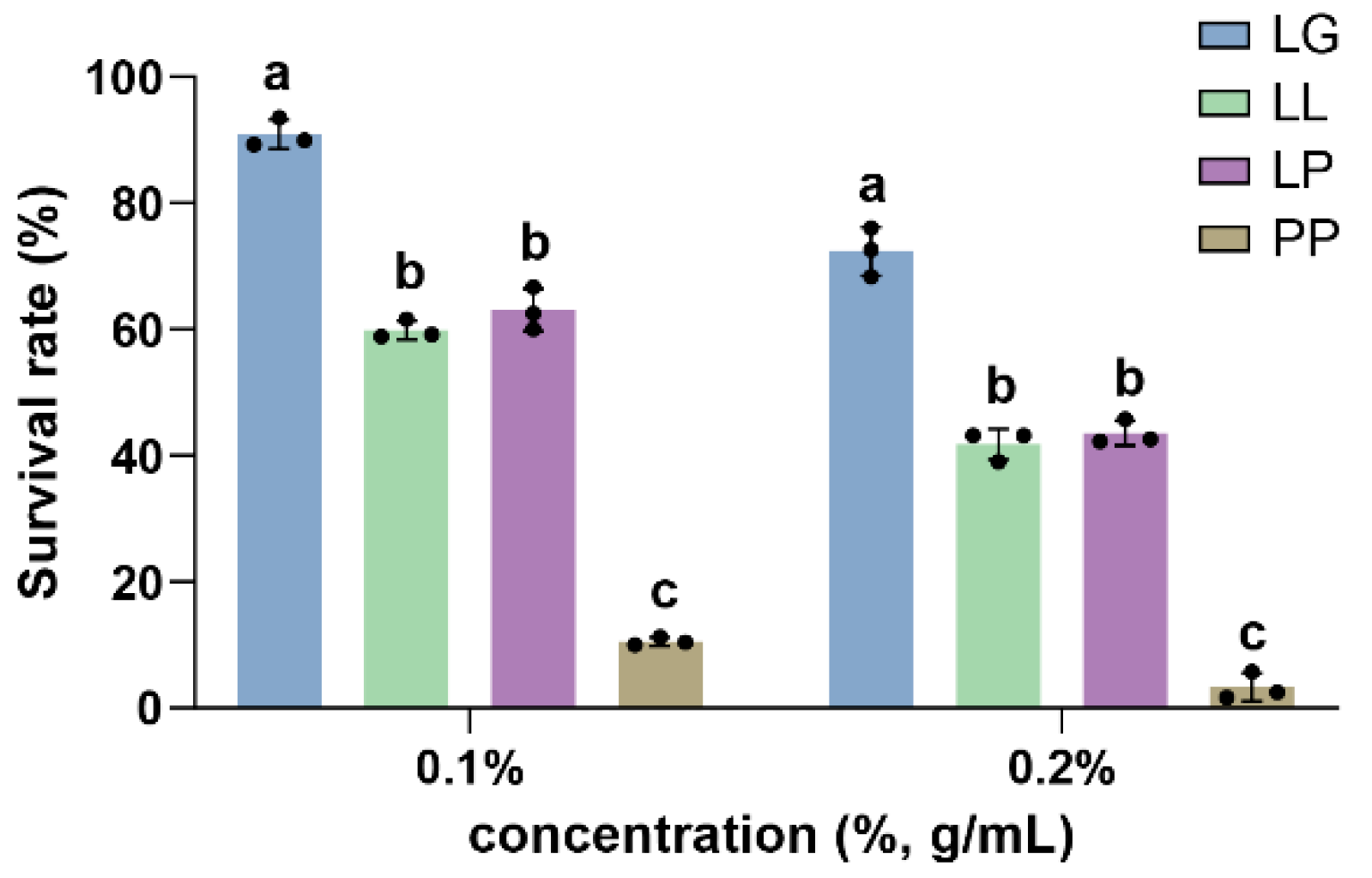
To further elucidate the interaction between LAB and tannic acid, we established a pure tannic acid environment to systematically evaluate the tolerance of LAB to tannic acid. Figure 1 illustrates the varying tolerance levels of the 4 LAB strains to tannin. LG exhibited the highest tolerance to tannic acid, significantly surpassing the other groups at both tested concentrations. LP and LL followed, with LP showing a significantly greater tolerance than LL at the 0.1% tannic acid concentration (p < 0.05); however, no significant difference was observed between the two groups at the 0.2% concentration (p > 0.05). The PP group demonstrated poor tannic acid tolerance, which was significantly lower than that of the other groups (p < 0.05).

3.4. Fermentation Quality of the Ensiled Forage

As shown in Table 4, the pH levels of all groups exhibited a significant decreasing trend over the silage period (p < 0.05), reaching a state of equilibrium between days 15 and 30 of ensilage. The addition of LAB significantly reduced both pH and NH3-N content in silage (p < 0.05), with LG demonstrating the most effective reduction in pH and NH3-N during the late stages of ensilage, while PP showed the least efficacy. Throughout the ensilage process, the concentrations of LA, AA, and PA in all groups increased significantly (p < 0.05). LAB treatment notably enhanced LA production, with LL exhibiting the highest LA production capability, resulting in significantly greater LA content in late silage compared to the other groups (p < 0.05). LG and LP also showed elevated LA levels, significantly higher than those in the PP group (p < 0.05). Furthermore, the PA content in the LG and LL groups was significantly lower than that in the control and PP groups by day 60 of silage after inoculation with LAB (p < 0.05). Table 5 indicates that the addition of LAB did not significantly affect the DM and CP contents in silage (p > 0.05), as evidenced by the absence of different superscript letters among treatments within each time point in the table. However, the DM and CP contents in all groups displayed a decreasing trend over time (p < 0.05). The NDF content of whole sorghum silage also declined with prolonged silage time (p < 0.05), particularly in the LG group. Throughout the ensiling process, which involves carbohydrate consumption, the carbohydrate content in each group showed a decreasing trend (p < 0.05). Notably, the carbohydrate content in the lactobacillus groups was higher compared to the CK group.

3.5. Microbial Diversity of the Ensiled Forage

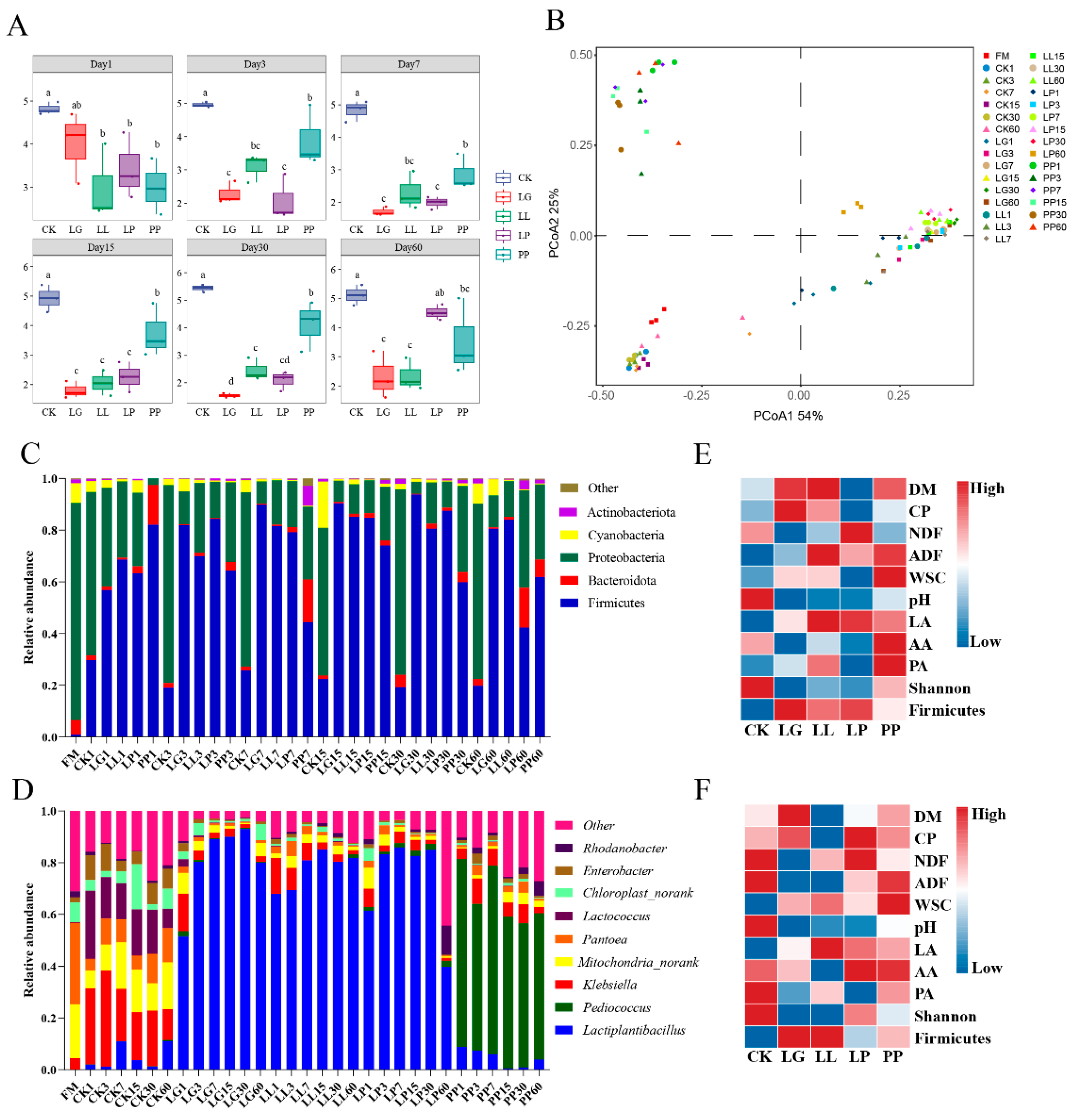
Bacterial diversity, community composition, and differences are presented in Figure 2. Throughout the entire silage period, the alpha diversity of each LAB group was higher than that of the control group. However, the LG group exhibited the lowest alpha diversity between days 7 and 60 of silage, which was significantly lower than both the control and PP groups (p < 0.05). The Shannon index for the LL group remained stable and was significantly lower than that of the control group throughout the ensiling period (p < 0.05). In contrast, the Shannon index for the LP group was stable during the early stages of silage but significantly increased by day 60, surpassing that of the LG and LL groups (p < 0.05). At day 3 of silage, the Shannon index for the PP group was higher than that of the other experimental groups, and it remained significantly elevated compared to the other groups at days 15 and 30. Additionally, the PP group’s Shannon index was significantly higher than that of the LG and LP groups at days 3 and 7, and higher than that of the LG and LL groups by day 60 (p < 0.05).
According to β diversity analysis using principal coordinate analysis (PCoA), the bacterial communities exhibited significant differences and consistent changes at various fermentation stages. The LAB groups were distinctly separated from the CK group, with the PP group showing significant separation from the other LAB groups, while no significant separation was observed among the remaining three groups. The dynamic changes in the bacterial community of whole sorghum silage were analyzed at both the phylum and genus levels, as illustrated in Figure 2C,D. At the phylum level, Firmicutes and Proteobacteria were dominant across all groups. Notably, the abundance of Proteobacteria in the CK group was significantly higher than that of Firmicutes (p < 0.05), while the test groups displayed a higher proportion of Firmicutes. Throughout the silage period, the abundance of Firmicutes in the test groups was significantly greater than that in the CK group (p < 0.05), with the LG group exhibiting the highest abundance, significantly surpassing that of the other test groups from days 7 to 60 (p < 0.05). From days 7 to 30 of silage, the abundance of Firmicutes in the LL and LP groups was higher than in the PP group. At the genus level, Lactiplantibacillus was most abundant in the LG, LL, and LP groups, while Pediococcus was predominant in the PP group. Various degenerate bacteria showed the highest abundance in the CK group. The abundance of Lactiplantibacillus in the LP group was higher than in the LG and LL groups on the 3rd day of silage, whereas the abundance in the LG group was greater than in the LL and LP groups from days 7 to 60. The abundance of Lactobacillus in the LP group decreased significantly on day 60 of silage, falling below that of the LG and LL groups (p < 0.05). The abundance of Pediococcus in the PP group was unstable and decreased during the late stages of ensilage. To investigate the relationship between the action of LAB on the fermentation quality of silage and tannin tolerance, heat maps for each parameter associated with the different LAB silages were generated (Figure 2E,F). On the 30th day of silage, pH, AA, Shannon index, and Firmicutes abundance were correlated with tannin tolerance across the groups. By the 60th day of silage, NDF, ADF, pH, PA, Shannon index, and Firmicutes abundance in the LG, LL, and PP groups were also correlated with tannin tolerance.

3.6. In Vitro Rumen Fermentation Parameters

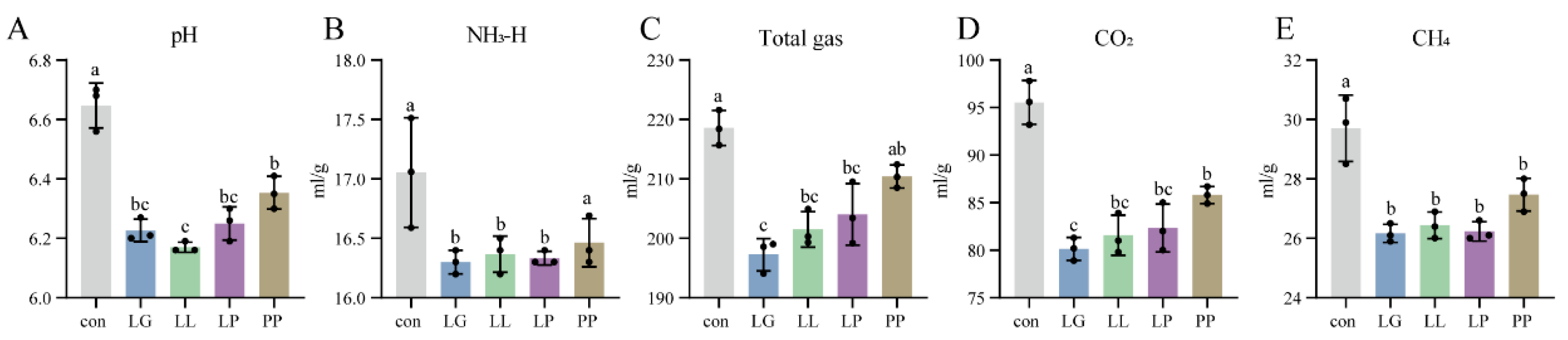
Since silage is primarily used as feed for ruminants, in vitro fermentation was employed to preliminarily assess the digestibility of this silage in the rumen and its potential to mitigate ruminal methane emissions. Results showed that LAB supplementation significantly reduced the pH in rumen fluid and markedly improved gas emission profiles (p < 0.05), including reductions in CO2 and CH4 concentrations (Figure 3A–E). Overall, the LG strain demonstrated the highest efficacy in reducing pH and gas emissions, followed by LL and LP, while PP exhibited the lowest efficacy. These findings are consistent with the silage fermentation performance observed in the previous section.

4. Discussion

There are fewer LAB attached to forage prior to silage, while the numbers of Escherichia coli and aerobic bacteria are high, which increases the risk of unsatisfactory silage outcomes [25,26]. The addition of LAB to silage raw materials can rapidly enhance the population of LAB in the silage, thereby increasing LA content, reducing the pH in the silage system, and competitively inhibiting harmful bacteria. The growth and acid-producing capabilities of LAB are crucial for identifying effective strains. In this study, four strains of LAB demonstrated strong growth and acid production, with LP and LG achieving notably low pH values of 3.82 and 3.90, respectively. However, Costa [27] reported that some LAB additives with strong growth and acid production did not effectively reduce the pH or improve the fermentation quality of silage in practical applications, potentially due to their inability to efficiently utilize carbon sources and carbohydrates in the silage. An ideal LAB inoculant should possess the ability to utilize a variety of carbon sources and soluble sugars [28]. In this study, all four strains of LAB successfully utilized various soluble sugars, indicating their potential to serve as ideal inoculants.
Plant secondary metabolites, such as tannins, anthocyanins, and lignin, can significantly influence [29]. Bossi [30] noted that tannins inhibit LAB growth by affecting metabolic enzymes through tannin-protein interactions. Due to the high tannin content in sorghum, selecting tannin-tolerant LAB for silage fermentation is particularly advantageous. However, in the present study, the agar diffusion assay confirmed the inhibitory effects of tannic acid on multiple bacterial strains (Serratia marcescens, Salmonella spp., and Staphylococcus aureus). However, no inhibition zones were observed against LAB. This phenomenon is likely attributed to LAB-specific adaptations, such as the expression of tannin-binding proteins (e.g., surface-anchored adhesins), which may sequester tannic acid molecules to form a protective shield at the cell surface. Furthermore, competition from medium-derived proteins (e.g., casein peptones in MRS agar) could amplify this shielding effect by reducing the bioavailability of tannic acid, thus limiting its penetration into LAB cells [30,31,32]. To eliminate medium-derived interference, we established a pure tannic acid environment, we found four strains of LAB exhibited varying levels of tolerance to tannins, which was consistent with subsequent findings. The silage produced by the LG strain demonstrated the best fermentation effects, while that produced by the PP strain exhibited the poorest performance. The pH value is a crucial factor for assessing the fermentation quality of silage.
Silage with good fermentation quality typically exhibits a low pH value. When the pH of silage reaches 4.2 or lower, it indicates good silage quality [29]. An increase in pH is often associated with aerobic deterioration of silage and is a primary factor influencing the concentrations of Listeria monocytogenes, Escherichia coli STEC, and mold in silage. Chemical and biological additives can facilitate the preservation of silage by promoting a rapid decrease in pH and preventing aerobic spoilage. In this experiment, the pH values of silage in the LAB-treated groups were significantly lower than those in the control group, all remaining below 4.20 in the late stages of silage. The pH value of the LG group was particularly low (3.90), while the PP group exhibited higher pH levels than the other experimental groups. The fermentation quality of silage was notably enhanced by LG and LL, whereas PP showed inferior performance. This disparity may be attributed to the superior tannin tolerance of LG and LL, compared to the lower tolerance exhibited by PP, resulting in a reduced survival rate for the latter due to its inability to tolerate the high tannin concentrations in sorghum. During silage fermentation, LA is typically the predominant acid produced, significantly contributing to the reduction of silage pH. Inoculating LAB accelerates LA production, thereby improving silage quality [29]. This study found that LA concentrations in the experimental groups were significantly higher than in the control group after three days of fermentation. Bai [18] demonstrated that using Lactobacillus plantarum, Pediococcus pentosaceus, and Enterococcus faecalis for silage led to reduced pH levels, increased LA concentrations, and altered microbial composition. Li’s study [33] reported that both Lactobacillus plantarum and Lactobacillus brucei inoculated with LAB resulted in elevated LA concentrations and decreased pH compared to the control group. Additionally, the AA content in the experimental group was lower than in the control group, likely due to the use of homofermentative LAB, which primarily produce LA from carbohydrates. PA is produced through fermentation by propionibacteria and clostridia; its concentration in high-quality silage is typically very low [34]. In this study, PA was not detected in any group during the early silage phase, with only trace amounts appearing after 15 days, particularly in the LG and LP groups. BA is generally absent in well-fermented silage, as it is a metabolic waste product. BA concentration exceeding 5 g kg−1 dry matter is an indicator of clostridial activity, which can reduce feed intake and lead to health issues [35]. In this study, no BA was detected in any of the groups. The NH3-N content in silage reflects the degree of protein degradation and affects the nutritional value [35]. In this experiment, NH3-N levels were lower in all experimental groups compared to the control group, with significantly reduced NH3-N levels in the LG, LL, and LP groups compared to PP, indicating that the LAB in these groups effectively inhibited putrefactive microorganisms, likely due to the lower pH levels.
DM is a crucial indicator for assessing the fermentation quality of silage, with the optimal DM content ranging between 28% and 40% [36]. In this experiment, the DM content of each group remained within the range of 30% to 34% throughout the fermentation period, aligning with the optimal range. This suggests that the fermentation quality of whole sorghum silage was satisfactory, further supporting the suitability of whole sorghum as a material for silage. Arabinose, a key component of lignin and arabinoxylan crosslinking in NDF, is easily hydrolyzed by acid, leading to cell wall degradation and a reduction in NDF content. The lower pH achieved during silage fermentation, particularly with the addition of LAB, intensifies the acid hydrolysis of arabinose, resulting in a corresponding decrease in NDF content [37]. In this study, a consistent reduction in NDF was observed across all groups during the fermentation process, with the LG and LL groups exhibiting the lowest NDF content. Similar findings have been reported in other studies. For example, Li [38] investigated the effects of various enzymes and bacteria on silage of Pennsylvania grass and found that both pH and NDF content decreased with silage fermentation, with the experimental groups showing lower pH and NDF levels. Similarly, Wang [39] silaged whole corn stalks using Bacillus velezensis and Lactobacillus plantarum, and observed that both additives reduced the pH of silage, with the trend in NDF content mirroring that of pH.
Alpha diversity refers to the diversity within a specific environment or ecosystem, primarily reflecting species richness, evenness, and sequencing depth. In general, silages with higher fermentation quality tend to exhibit lower alpha diversity [39]. In this experiment, the Shannon index of the experimental groups was lower than that of the control group. This may be attributed to the addition of LAB, which increased their abundance throughout the fermentation process, thereby competitively inhibiting the growth of aerobic microorganisms. Beta diversity, alongside alpha diversity, constitutes the overall diversity or biological heterogeneity within an environmental community. In this study, principal component analysis revealed significant separation between each experimental group and the control group, with the PP group showing distinct separation from the other experimental groups. This divergence may be attributed to the ability of LG, LL, and LP to promote a similar development in bacterial community structure, whereas PP influenced the bacterial community in a different direction. In the LG, LL, and LP groups, the relative abundance of Lactobacillus gradually increased throughout the silage process. LAB plays a key role in LA fermentation, which is critical for successful silage. Keshri [40] highlighted that substantial changes in bacterial diversity occur in the early stages of fermentation, and LAB often remains dominant in the later stages due to its stronger acid tolerance. Moreover, lactic acid-producing bacteria, such as Pediococcus and Lactococcus, initiate LA fermentation early in the silage process, while Lactobacillus is essential [40,41] for the pH decline during the later stages of silage fermentation. In this study, Lactococcus was not found as the dominant strain in the LG and LL groups, likely due to its limited ability to thrive in highly acidic environments. However, Lactococcus can initiate fermentation during the early silage stages, promoting the proliferation of LAB, making its use a feasible approach [29,35] to improve silage characteristics. In contrast, Pediococcus became the dominant bacterium in the PP group, likely due to its ability to tolerate acidic conditions. However, Pediococcus may not promote the proliferation of Lactobacillus, which explains why the PP group had a weaker ability to reduce the pH compared to the other experimental groups. Similar results were observed in Shu [36], where Pediococcus became the dominant bacterium, resulting in a slight pH increase during the later stages of the experiment due to its inability to effectively lower the pH.
In vitro fermentation trials revealed that LAB possess the ability to tolerate tannins. Simultaneously, they can influence the pH value of rumen fluid and the gas production within rumen fluid. This influence also includes CO2 and CH4, two well-known greenhouse gases. This indicates that the LAB we added can improve the quality of silage feed while also having an effect of improving greenhouse gas emissions from ruminants. This effect may also be related to its tannin tolerance. Hydrogenotrophic methanogenic archaea common in the rumen of ruminants, such as Methanobrevibacter spp., typically utilize H2 and CO2 produced by microbial fermentation as substrates to generate CH4. This indicates that rumen methane production is highly dependent on the effective supply of hydrogen gas. LAB can all prevent methanogens for hydrogen utilization through reduction reactions, thereby blocking methane production [42,43]. Furthermore, the LA produced by LAB will be converted to VFA. This process consumes H+, which will influence the dynamic balance and stability of rumen fluid pH [44,45]. Tannins inhibit many rumen microorganisms, including methanogens. However, tannin-tolerant LAB can grow and metabolize better in this environment, thereby obtaining a unique ecological niche advantage [42].
After analyzing the correlation between tannin tolerance and silage quality, a potential link was identified between the effectiveness of LAB in silage and their tannin tolerance. Additionally, studying these strains under field conditions and over longer durations could confirm their practical value for livestock nutrition. Furthermore, our in vitro fermentation trials demonstrated that these tannin-tolerant LAB strains significantly reduced methane (CH4) production, likely through competitive hydrogen utilization. In contrast, LAB strains with poor tannin tolerance (PP) demonstrated a weaker ability to improve the silage fermentation effect and exhibited less pronounced methane mitigation.
In summary, while this study presents useful insights into the role of tannin tolerance in silage fermentation, the precise biological interactions and their specific impacts on the animal organism require further exploration to unlock the full potential of tannin-tolerant bacteria in agricultural applications.

5. Conclusions

Based on the study, four strains of LAB were isolated from whole sorghum (Lactococcus garvieae, Lactococcus lactis) and mulberry leaves (Lactiplantibacillus plantarum, Pediococcus pentosaceus), demonstrating varying levels of tannin tolerance and distinct impacts on silage quality. Among these, L. garvieae exhibited the highest tannin tolerance and was the most effective in improving silage quality, while concurrently enhancing methane mitigation. In contrast, P. pentosaceus displayed the lowest tannin tolerance and the weakest performance across all parameters. These findings highlight a clear correlation between tannin tolerance and silage performance, offering valuable insights for selecting LAB strains in tannin-rich silage formulations. Future research should further investigate the specific mechanisms by which tannins affect the metabolic pathways of LAB, in order to better guide strain selection and fermentation optimization.

Author Contributions

Data curation, Writing, Z.Z., S.W. and Y.W.; Resources, Project administration, Supervision, Y.Z. All authors have read and agreed to the published version of the manuscript.

Funding

This work was supported by grants from the National Natural Science Foundation of China (32172769).

Data Availability Statement

The data presented in this study are available on request from the corresponding author.

Conflicts of Interest

Zhenpeng Zhu was employed by the Elanco (Shanghai) Enterprise Management Co., Ltd. The remaining authors declare that the research was conducted in the absence of any commercial or financial relationships that could be construed as a potential con-flict of interest.

Abbreviations

The following abbreviations are used in this manuscript:
LGLactococcus garvieae
LLLactococcus lactis
LPLactiplantibacillus plantarum
PPPediococcus pentosaceus
LABlactic acid bacteria
WSCswater-soluble carbohydrates
LAlactic acid
AAacetic acid
PApropionic acid
BAbutyric acid
HPLChigh-performance liquid chromatography
DMdry matter
CPcrude protein
NDFneutral detergent fiber
ADFacid detergent fiber

References

  1. Xie, Y.; Guo, J.; Li, W.; Wu, Z.; Yu, Z. Effects of Ferulic Acid Esterase-Producing Lactic Acid Bacteria and Storage Temperature on the Fermentation Quality, In Vitro Digestibility and Phenolic Acid Extraction Yields of Sorghum (Sorghum bicolor L.) Silage. Microorganisms 2021, 9, 114. [Google Scholar] [CrossRef]
  2. Zhang, Y.; Tao, X.; Liu, Q.; Zhang, Y.J.; Xu, J.; Zhang, W.; Wang, J.; Zhang, D.; Li, B.; Wang, L.; et al. Succession changes of fermentation parameters, nutrient components and bacterial community of sorghum stalk silage. Front. Microbiol. 2022, 13, 982489. [Google Scholar] [CrossRef]
  3. Ejaz, I.; He, S.; Li, W.; Hu, N.; Tang, C.; Li, S.; Li, M.; Diallo, B.; Xie, G.; Yu, K. Sorghum Grains Grading for Food, Feed, and Fuel Using NIR Spectroscopy. Front. Plant Sci. 2021, 12, 720022. [Google Scholar] [CrossRef]
  4. Joy, S.P.; Kumar, A.A.; Gorthy, S.; Jaganathan, J.; Kunappareddy, A.; Gaddameedi, A.; Krishnan, C. Variations in structure and saccharification efficiency of biomass of different sorghum varieties subjected to aqueous ammonia and glycerol pretreatments. Ind. Crops Prod. 2021, 159, 113072. [Google Scholar] [CrossRef]
  5. McCary, C.L.; Vyas, D.; Faciola, A.P.; Ferraretto, L.F. Graduate Student Literature Review: Current perspectives on whole-plant sorghum silage production and utilization by lactating dairy cows. J. Dairy Sci. 2020, 103, 5783–5790. [Google Scholar] [CrossRef]
  6. Delimont, N.M.; Haub, M.D.; Lindshield, B.L. The Impact of Tannin Consumption on Iron Bioavailability and Status: A Narrative Review. Curr. Dev. Nutr. 2017, 1, 1–12. [Google Scholar] [CrossRef] [PubMed]
  7. Dong, W.C.; Lin, Y.F.; Zhu, H.F.; Zhang, G.J. Research Progress on the Regulation of Lactic Acid Bacteria Characteristics by Plant Tannins and Its Application in Production. Chin. J. Anim. Nutr. 2019, 31, 2063–2068. [Google Scholar]
  8. Gao, L.; Guo, X.; Wu, S.; Chen, D.; Ge, L.; Zhou, W.; Zhang, Q.; Pian, R. Tannin tolerance lactic acid bacteria screening and their effects on fermentation quality of stylo and soybean silages. Front. Microbiol. 2022, 13, 991387. [Google Scholar] [CrossRef]
  9. Ferraretto, L.F.; Fredin, S.M.; Shaver, R.D. Influence of ensiling, exogenous protease addition, and bacterial inoculation on fermentation profile, nitrogen fractions, and ruminal in vitro starch digestibility in rehydrated and high-moisture corn. J. Dairy Sci. 2015, 98, 7318–7327. [Google Scholar] [CrossRef] [PubMed]
  10. Williams, S.R.O.; Hannah, M.C.; Eckard, R.J.; Wales, W.J.; Moate, P.J. Supplementing the diet of dairy cows with fat or tannin reduces methane yield, and additively when fed in combination. Animal 2020, 14, s464–s472. [Google Scholar] [CrossRef]
  11. Ruiz Rodríguez, L.G.; Mohamed, F.; Bleckwedel, J.; Medina, R.; De Vuyst, L.; Hebert, E.M.; Mozzi, F. Diversity and Functional Properties of Lactic Acid Bacteria Isolated from Wild Fruits and Flowers Present in Northern Argentina. Front. Microbiol. 2019, 10, 1091. [Google Scholar] [CrossRef]
  12. Meruvu, H.; Harsa, S.T. Lactic acid bacteria: Isolation-characterization approaches and industrial applications. Crit. Rev. Food Sci. Nutr. 2023, 63, 8337–8356. [Google Scholar] [CrossRef] [PubMed]
  13. Khushboo; Karnwal, A.; Malik, T. Characterization and selection of probiotic lactic acid bacteria from different dietary sources for development of functional foods. Front. Microbiol. 2023, 14, 1170725. [Google Scholar] [CrossRef]
  14. Vanitha, P.R.; Somashekaraiah, R.; Divyashree, S.; Pan, I.; Sreenivasa, M.Y. Antifungal activity of probiotic strain Lactiplantibacillus plantarum MYSN7 against Trichophyton tonsurans. Front. Microbiol. 2023, 14, 1192449. [Google Scholar] [CrossRef]
  15. Cizeikiene, D.; Juodeikiene, G.; Paskevicius, A.; Bartkiene, E. Antimicrobial activity of lactic acid bacteria against pathogenic and spoilage microorganism isolated from food and their control in wheat bread. Food Control 2013, 31, 539–545. [Google Scholar] [CrossRef]
  16. Terrill, T.H.; Rowan, A.M.; Douglas, G.B.; Barry, T.N. Determination of extractable and bound condensed tannin concentrations in forage plants, protein concentrate meals and cereal grains. J. Sci. Food Agric. 1992, 58, 321–329. [Google Scholar] [CrossRef]
  17. Alameri, F.; Tarique, M.; Osaili, T.; Obaid, R.; Abdalla, A.; Masad, R.; Al-Sbiei, A.; Fernandez-Cabezudo, M.; Liu, S.Q.; Al-Ramadi, B.; et al. Lactic Acid Bacteria Isolated from Fresh Vegetable Products: Potential Probiotic and Postbiotic Characteristics Including Immunomodulatory Effects. Microorganisms 2022, 10, 389. [Google Scholar] [CrossRef]
  18. Bai, J.; Ding, Z.; Ke, W.; Xu, D.; Wang, M.; Huang, W.; Zhang, Y.; Liu, F.; Guo, X. Different lactic acid bacteria and their combinations regulated the fermentation process of ensiled alfalfa: Ensiling characteristics, dynamics of bacterial community and their functional shifts. Microb. Biotechnol. 2021, 14, 1171–1182. [Google Scholar] [CrossRef] [PubMed]
  19. Wang, C.; He, L.; Xing, Y.; Zhou, W.; Yang, F.; Chen, X.; Zhang, Q. Fermentation quality and microbial community of alfalfa and stylo silage mixed with Moringa oleifera leaves. Bioresour. Technol. 2019, 284, 240–247. [Google Scholar] [CrossRef]
  20. Broderick, G.A.; Kang, J.H. Automated simultaneous determination of ammonia and total amino acids in ruminal fluid and in vitro media. J. Dairy Sci. 1980, 63, 64–75. [Google Scholar] [CrossRef] [PubMed]
  21. Hasan, M.T.; AOAC. Official Methods of Analysis, 15th ed.; Association of Official Analytical Chemists: Artington, VA, USA, 2015. [Google Scholar]
  22. Van Soest, P.J.; Robertson, J.B.; Lewis, B.A. Methods for dietary fiber, neutral detergent fiber, and nonstarch polysaccharides in relation to animal nutrition. J. Dairy Sci. 1991, 74, 3583–3597. [Google Scholar] [CrossRef]
  23. Xue, Z.; Marco, M.L. Improved assessments of bulk milk microbiota composition via sample preparation and DNA extraction methods. PLoS ONE 2022, 17, e0267992. [Google Scholar] [CrossRef] [PubMed]
  24. Dhakal, R.; Copani, G.; Cappellozza, B.I.; Milora, N.; Hansen, H.H. The effect of direct-fed microbials on in-vitro rumen fermentation of grass or maize silage. Fermentation 2023, 9, 347. [Google Scholar] [CrossRef]
  25. Pholsen, S.; Khota, W.; Pang, H.; Higgs, D.; Cai, Y. Characterization and application of lactic acid bacteria for tropical silage preparation. Anim. Sci. J. 2016, 87, 1202–1211. [Google Scholar] [CrossRef]
  26. Peng, C.; Sun, W.; Dong, X.; Zhao, L.; Hao, J. Isolation, identification and utilization of lactic acid bacteria from silage in a warm and humid climate area. Sci. Rep. 2021, 11, 12586. [Google Scholar] [CrossRef]
  27. Costa, D.M.; Carvalho, B.F.; Bernardes, T.F.; Schwan, R.F.; Ávila, C.L.d.S. New epiphytic strains of lactic acid bacteria improve the conservation of corn silage harvested at late maturity. Anim. Feed Sci. Technol. 2021, 274, 114852. [Google Scholar] [CrossRef]
  28. Woolford, M.K. The detrimental effects of air on silage. J. Appl. Bacteriol. 1990, 68, 101–116. [Google Scholar] [CrossRef] [PubMed]
  29. Chen, L.; Wang, Y.; Li, X.; MacAdam, J.W.; Zhang, Y. Interaction between plants and epiphytic lactic acid bacteria that affect plant silage fermentation. Front. Microbiol. 2023, 14, 1164904. [Google Scholar] [CrossRef]
  30. Bossi, A.; Rinalducci, S.; Zolla, L.; Antonioli, P.; Righetti, P.G.; Zapparoli, G. Effect of tannic acid on Lactobacillus hilgardii analysed by a proteomic approach. J. Appl. Microbiol. 2007, 102, 787–795. [Google Scholar] [CrossRef]
  31. Henis, Y.; Tagari, H.; Volcani, R. Effect of water extracts of carob pods, tannic acid, and their derivatives on the morphology and growth of microorganisms. Appl. Microbiol. 1964, 12, 204–209. [Google Scholar] [CrossRef] [PubMed]
  32. Wang, Y.; Lee, S.M.; Dykes, G.A. Potential mechanisms for the effects of tea extracts on the attachment, biofilm formation and cell size of Streptococcus mutans. Biofouling 2013, 29, 307–318. [Google Scholar] [CrossRef]
  33. Li, Y.; Du, S.; Sun, L.; Cheng, Q.; Hao, J.; Lu, Q.; Ge, G.; Wang, Z.; Jia, Y. Effects of Lactic Acid Bacteria and Molasses Additives on Dynamic Fermentation Quality and Microbial Community of Native Grass Silage. Front. Microbiol. 2022, 13, 830121. [Google Scholar] [CrossRef]
  34. Kung, L., Jr.; Shaver, R.D.; Grant, R.J.; Schmidt, R.J. Silage review: Interpretation of chemical, microbial, and organoleptic components of silages. J. Dairy Sci. 2018, 101, 4020–4033. [Google Scholar] [CrossRef]
  35. Wang, S.; Li, J.; Zhao, J.; Dong, Z.; Dong, D.; Shao, T. Effect of epiphytic microbiota from napiergrass and Sudan grass on fermentation characteristics and bacterial community in oat silage. J. Appl. Microbiol. 2022, 132, 919–932. [Google Scholar] [CrossRef]
  36. Shu, G.Q. Effects of Epiphytic Lactic Acid Bacteria from Mulberry Leaves on Its Silage Fermentation. Master’s Thesis, Anhui Agriculture University, Hefei, China, 2023. [Google Scholar]
  37. Jones, B.A.; Hatfield, R.D.; Muck, R.E. Effect of fermentation and bacterial inoculation on lucerne cell walls. J. Sci. Food Agric. 1992, 60, 147–153. [Google Scholar] [CrossRef]
  38. Li, J.; Yuan, X.; Dong, Z.; Mugabe, W.; Shao, T. The effects of fibrolytic enzymes, cellulolytic fungi and bacteria on the fermentation characteristics, structural carbohydrates degradation, and enzymatic conversion yields of Pennisetum sinese silage. Bioresour. Technol. 2018, 264, 123–130. [Google Scholar] [CrossRef] [PubMed]
  39. Wang, Y.; Ying, G.; Zhang, Z.; Tang, Y.; Zhang, Y.; Chen, L. Bacillus velezensis promotes the proliferation of lactic acid bacteria and influences the fermentation quality of whole-plant corn silage. Front. Plant Sci. 2024, 15, 1285582. [Google Scholar] [CrossRef] [PubMed]
  40. Keshri, J.; Chen, Y.; Pinto, R.; Kroupitski, Y.; Weinberg, Z.G.; Sela Saldinger, S. Microbiome dynamics during ensiling of corn with and without Lactobacillus plantarum inoculant. Appl. Microbiol. Biotechnol. 2018, 102, 4025–4037. [Google Scholar] [CrossRef]
  41. Nazar, M.; Wang, S.; Zhao, J.; Dong, Z.; Li, J.; Kaka, N.A.; Shao, T. The feasibility and effects of exogenous epiphytic microbiota on the fermentation quality and microbial community dynamics of whole crop corn. Bioresour. Technol. 2020, 306, 123106. [Google Scholar] [CrossRef]
  42. Sun, J.; Zhao, G.; Li, M.M. Using nutritional strategies to mitigate ruminal methane emissions from ruminants. Front. Agric. Sci. Eng. 2023, 10, 390–402. [Google Scholar] [CrossRef]
  43. Wang, W.; Wei, Z.; Li, Z.; Ren, J.; Song, Y.; Xu, J.; Liu, A.; Li, X.; Li, M.; Fan, H.; et al. Integrating genome-and transcriptome-wide association studies to uncover the host–microbiome interactions in bovine rumen methanogenesis. iMeta 2024, 3, e234. [Google Scholar] [CrossRef] [PubMed]
  44. Xue, M.-Y.; Wu, J.-J.; Xie, Y.-Y.; Zhu, S.-L.; Zhong, Y.-F.; Liu, J.-X.; Sun, H.-Z. Investigation of fiber utilization in the rumen of dairy cows based on metagenome-assembled genomes and single-cell RNA sequencing. Microbiome 2022, 10, 11. [Google Scholar] [CrossRef] [PubMed]
  45. Jia, M.; Zhu, S.; Xue, M.Y.; Chen, H.; Xu, J.; Song, M.; Tang, Y.; Liu, X.; Tao, Y.; Zhang, T.; et al. Single-cell transcriptomics across 2,534 microbial species reveals functional heterogeneity in the rumen microbiome. Nat. Microbiol. 2024, 9, 1884–1898. [Google Scholar] [CrossRef] [PubMed]
Figure 1. The tolerance of LAB to tannin. Differences indicated by different lowercase letters in the figure are statistically significant (p < 0.05).
Agriculture 16 00158 g001
Figure 2. Bacterial community diversities and compositions in whole-plant sorghum silage during ensiling. Differences within the same figure denoted by different lowercase letters are statistically significant (p < 0.05). CK; Control (samples without inoculants); LG; samples inoculated with Lactococcus garvieae; LL; samples inoculated with Lactococcus lactis; LP; Lactiplantibacillus plantarum; PP; Pediococcus pentosaceus. Arabic number indicating days of ensiling. (A) The variations in community alpha-diversities (Shannon index). (B) The community dissimilarities in different groups and fermentation times, calculated using Principal Coordinates Analysis (PCoA). (C) Relative abundances of whole-plant sorghum silage bacterial genera across different groups and fermentation times. (D) Relative abundances of whole-plant sorghum silage bacterial species across different groups and fermentation times. (E) Ensilage 30-day heat map. (F) Ensilage 60-day heat map.
Agriculture 16 00158 g002
Figure 3. Effects of different LAB on in vitro ruminal fermentation of sorghum silage. Differences within the same figure denoted by different lowercase letters are statistically significant (p < 0.05). (A) Effect of silages inoculated with different LAB on pH in in vitro ruminal fermentation fluid. (B) Effect of silages inoculated with different LAB on NH3-H concentration in in vitro ruminal fermentation fluid (mg/L). (C) Effect of silages inoculated with different LAB on Total gas in vitro ruminal fermentation fluid (mg/L). (D) Effect of silages inoculated with different LAB on CO2 production (mg/L) in in vitro ruminal fermentation fluid. (E) Effect of silages inoculated with different LAB on CH4 production (mg/L) in in vitro ruminal fermentation fluid.
Agriculture 16 00158 g003
Table 1. Nutrient composition of whole-plant sorghum before silage.
ItemsContent
FM (%)67.06
DM (% FM)35.48
CP (% DM)10.21
NDF (% DM)40.60
ADF (% DM)28.27
WSC (% DM)11.47
Tannin (% DM)2.29
FM: fresh matter, DM: dry matter, CP: crude protein, NDF: neutral detergent fiber, ADF: acid detergent fiber, WSC: water-soluble carbohydrates.
Table 2. Morphological, physiological, and biochemical properties of lactic acid bacteria isolates.
ItemsStrains
LGLLLPPP
SourcesSorghumSorghumMulberryMulberry
SpeciesL. garvieaeL. lactisLb. plantarumP. pentosaceus
Fermentation typeHoHoHoHo
Gram strain++++
Catalase activity
Gas for glucose
Growth at temperature (°C)
5++++
10++++
35++++
40++++
45++++
50wwww
Growth at pH
3
3.5wwww
4++w+
4.5++++
5++++
6++++
7++++
8++++
Carbohydrate fermentation
lactose++++
D-Ribose++++
Inulin++++
Arabinose++++
Cellobiose++++
Maltose++++
Melibiose++++
Acid production (pH value)
24 h3.883.983.823.96
Ho, homofermentative; w, weak; +, positive; -, negative. Lactococcus garvieae, LG; Lactococcus lactis, LL; Lactiplantibacillus plantarum, LP; Pediococcus pentosaceus, PP.
Table 3. Antibacterial activity of tannic acid.
SpeciesTannic Acid Concentration
1%5%10%15%20%
Lactococcus garvieae
Lactococcus lactis
Lactiplantibacillus plantarum
Pediococcus pentosaceus
Saccharomyces
Serratia marcescens 1.58 ± 0.21 c4.24 ± 0.37 b4.26 ± 0.31 b7.64 ± 0.62 a
Salmonella 3.68 ± 0.20 d4.53 ± 0.36 c5.08 ± 0.09 b6.58 ± 0.12 a
Staphylococcus aureus8.31 ± 0.27 d11.58 ± 0.08 c13.48 ± 0.23 b13.72 ± 0.03 b16.87 ± 0.15 a
Differences marked with different lowercase letters in the same row are significant (p < 0.05).
Table 4. Fermentation characteristics of the whole-plant sorghum silage during ensiling.
ItemTreatmentDaySEMp Value
137153060DTD × T
pH
(% DM)
CK5.19 aA4.71 bA4.58 cA4.52 cA4.49 dA4.46 dA0.316<0.001<0.0010.176
LG4.18 aD4.16 aC3.99 bC3.9 bC3.89 cD3.84 cD
LL4.21 aD4.13 bC3.87 dE3.90 cdE3.94 cC3.93 cC
LP4.37 aB4.18 bC3.90 dD3.95 cD3.94 cdC3.91 cdC
PP4.32 aC4.31 aB4.20 bB4.19 bB4.14 cB4.15 cB
NH3-H (% DM)CK0.62 dA0.77 bcA0.65 cdA0.85 bA1.23 aA1.31 aA0.033<0.001<0.001<0.001
LG0.32 bC0.34 bBC0.19 cBC0.31 bB0.57 aC0.60 aC
LL0.24 cD0.29 cC0.22 cB0.26 cB0.50 bC0.61 aC
LP0.29 cC0.40 bB0.13 dC0.26 cB0.46 bC0.95 aB
PP0.39 dB0.54 cA0.62 cA0.78 bA1.01 aB1.06 aB
LA
(% DM)
CK2.16 Bd2.67 Cc3.35 Cb3.57 Da3.42 Cab3.62 Da0.191<0.001<0.001<0.05
LG2.05 Bf3.72 Be4.82 Bc4.35 Cd6.86 Ba6.61 Bb
LL1.89 Bd3.77 Bc5.55 Ab7.09 Aa7.78 Aa7.44 Aa
LP2.67 Ad4.19 Ac4.71 Bc6.66 ABb7.56 ABa6.79 Bb
PP2.71 Ae3.42 Bd5.30 ABc6.31 Bb6.88 Ba6.32 Cb
AA
(% DM)
CK0.72 dAB0.94 cdBC1.14 cAB1.54 bC2.25 aA2.54 aB0.052<0.0010.1160.431
LG0.84 dA1.05 cdAB1.15 cAB1.77 bB2.40 aAB2.33 aB
LL0.78 eAB0.93 deBC1.03 dB1.54 cC1.64 abC1.74 aC
LP0.67 eB0.88 dC1.22 cAB1.28 cD1.46 bC1.61 aC
PP0.74 eAB1.16 dA1.29 dA2.00 cA1.51 bBC3.09 aA
PA
(% DM)
CKNDNDND0.06 b0.09 bBC0.22 aA0.008<0.001<0.001<0.001
LGNDNDND0.07 b0.11 abAC0.12 aB
LLNDNDND0.05 b0.07 abC0.09 aB
LPNDNDND0.05 b0.16 aAB0.17 aAB
PPNDNDND0.07 b0.17 aA0.19 aA
Differences marked with different uppercase letters in the same column are significant (p < 0.05), and differences marked with different lowercase letters in the same row are significant (p < 0.05). DM: dry matter, LA: lactic acid, AA: acetic acid, PA: propionic acid; CK: control group; Lactococcus garvieae, LG; Lactococcus lactis, LL; Lactiplantibacillus plantarum, LP; Pediococcus pentosaceus, PP. SEM = pooled standard error of the mean; D = treatment effect; T = time effect; D × T = treatment × time interaction.
Table 5. Chemical compositions of the whole-plant sorghum silage during ensiling.
ItemTreatmentDaySEMp Value
137153060DTD × T
DM
(% DM)
CK33.83 a33.46 ab33.14 abc32.35 c32.46 bc31.42 c<0.001<0.0010.2930.561
LG34.02 a33.46 ab32.97 ab32.98 b32.76 b31.90 b
LL34.02 a33.03 ab32.95 ab32.95 b32.79 b30.83 c
LP33.85 a32.98 b32.89 b32.60 b32.23 b31.35 c
PP33.41 a33.33 a33.31 a33.25 a32.72 b31.59 c
CP
(% DM)
CK11.23 a9.96 bc10.21 ab9.39 bc9.11 bc8.86 c<0.001<0.0010.7240.626
LG10.83 a10.59 ab10.08 abc9.62 abc9.49 bc8.97 c
LL11.07 a10.76 a10.64 a10.14 ab9.35 bc8.50 c
LP10.95 a10.46 a10.42 ab10.00 abc9.03 bc8.97 c
PP10.40 ab10.63 a10.12 ab9.73 bc9.19 c8.90 c
NDF
(% DM)
CK42.43 Aa41.95 Aa39.37 BCb39.20 ABb39.60 ABb39.40 b0.001<0.0010.1210.788
LG40.45 Ba39.60 Bb39.22 BCb38.43 Bc37.88 Cc37.44 c
LL40.17 B39.81 B39.64 B39.06 B38.62 BC38.75
LP42.35 Aa40.70 Ab40.52 Ab40.36 Abc40.19 Abc39.39 c
PP40.98 Ba40.86 ABa38.85 Cb38.76 Bb38.49 Cb38.52 b
WSC
(% DM)
CK9.66 aB7.60 bB5.70 cB3.83 dC3.69 dBC2.71 eB0.003<0.0010.3070.969
LG11.84 aA8.69 bA6.52 cA4.60 dA4.15 deAB3.38 eAB
LL11.39 aA8.01 bAB6.46 cA4.61 dA4.15 deAB3.51 eAB
LP9.70 aB7.45 bB6.21 cA4.37 dB3.49 eC3.27 eAB
PP11.60 aA8.55 bA6.46 cA4.59 dA4.59 dA3.69 dA
Tannin
(% DM)
CK2.64 abB2.77 aAB2.30 abcB2.12 bcB1.80 cAB1.85 c0.06<0.001<0.0010.223
LG2.65 aB2.60 aAB1.92 aB1.95 abB1.84 bAB1.51 b
LL2.73 aB2.33 abB2.15 bcB1.98 cdB1.77 cdB1.63 d
LP3.34 aA3.06 abA3.06 abA2.89 bA2.07 cA1.74 c
PP2.89 aAB2.91 aAB2.28 abB2.21 bB1.67 bAB1.85 b
Differences marked with different uppercase letters in the same column are significant (p < 0.05), and differences marked with different lowercase letters in the same row are significant (p < 0.05). DM: dry matter. control group, CK; Lactococcus garvieae, LG; Lactococcus lactis, LL; Lactiplantibacillus plantarum, LP; Pediococcus pentosaceus, PP. SEM = pooled standard error of the mean; D = treatment effect; T = time effect; D × T = treatment × time interaction.
Disclaimer/Publisher’s Note: The statements, opinions and data contained in all publications are solely those of the individual author(s) and contributor(s) and not of MDPI and/or the editor(s). MDPI and/or the editor(s) disclaim responsibility for any injury to people or property resulting from any ideas, methods, instructions or products referred to in the content.