Next Article in Journal
A Lightweight Facial Landmark Recognition Model for Individual Sheep Based on SAMS-KLA-YOLO11
Previous Article in Journal
ACDNet: Adaptive Citrus Detection Network Based on Improved YOLOv8 for Robotic Harvesting
error_outline You can access the new MDPI.com website here. Explore and share your feedback with us.
 
 
Article

Genome-Wide Association Analysis Reveals Genetic Loci and Candidate Genes Related to Soybean Leaf Shape


Key Laboratory of Soybean Biology in Chinese Ministry of Education (Key Laboratory of Soybean Biology and Breeding/Genetics of Chinese Agriculture Ministry), Northeast Agricultural University, Harbin 150030, China
*
Authors to whom correspondence should be addressed.
Agriculture 2026, 16(2), 150; https://doi.org/10.3390/agriculture16020150
Submission received: 12 December 2025 / Revised: 25 December 2025 / Accepted: 6 January 2026 / Published: 7 January 2026
(This article belongs to the Section Crop Genetics, Genomics and Breeding)

Abstract

Soybean is the world’s foremost oilseed crop, and leaf morphology significantly influences yield potential by affecting light interception, canopy structure, and photosynthetic efficiency. In this study, leaf length, leaf width, maximum leaf width, leaf apex opening angle, and leaf area were measured in 216 soybean accessions, and genome-wide association studies (GWAS) were conducted using genomic resequencing data to identify genetic variants associated with leaf morphological traits. A total of 824 SNP loci were found to be significantly associated with leaf shape, and 130 candidate genes were identified in the genomic regions flanking these significant loci. KEGG enrichment analysis revealed that the above candidate genes were significantly enriched in arginine biosynthesis (ko00220), nitrogen metabolism (ko00910), carbon metabolism (ko01200), pyruvate metabolism (ko00620), glycolysis/glycogenolysis (ko00010), starch and sucrose metabolism (ko00500), plant–pathogen interaction (ko04626), and amino acid biosynthesis (ko01230). By combining KEGG and GO enrichment analysis as well as expression level analysis, four candidate genes related to leaf shape (Glyma.10G141600, Glyma.13G062700, Glyma.16G041200 and Glyma.20G115500) were identified. Further, through candidate gene association analysis, it was found that the Glyma.10G141600 gene was divided into two major haplotypes. The leaf area of haplotype 1 was significantly smaller than that of haplotype 2. Subsequently, the cutting amplification polymorphism sequence (CAPS) molecular marker was developed. The marker Chr.10:37502955 can effectively distinguish the differences in leaf size through enzymatic digestion technology, and has excellent typing ability and application potential. The above results can provide a theoretical basis for molecular-assisted selection (MAS) of soybean leaf morphology.

1. Introduction

Soybeans, recognized as a globally significant source of plant protein and oil, exhibit variations in their leaves, such as size, shape and thickness, that directly influence the photosynthetic performance in soybeans [1]. Leaf morphology represents a significant agronomic trait in soybeans cultivation. The size, texture and color of leaves play a significant role in the yield of soybeans [2]. The morphological variation in leaf structures represents a complex adaptive mechanism in plants, enabling them to respond effectively to environmental factors [3]. Therefore, breeding high-quality and high-yielding soybean varieties is an important goal for soybean breeders.
The leaf length and leaf width of a leaf are two critical dimensions of leaf morphology, which together determine the overall shape (leaf shape) and surface area of the leaf [4]. The significance of leaf length and width extends beyond reflected in the growth and development of individual plants, it also reflects the adaptive strategies of plants to their survival environment (such as light, water, temperature, wind, etc.) [5]. Previous studies have shown that mutations in the NAL1 gene of rice lead to a narrow-leaf phenotype, which in turn affects the photosynthetic efficiency of rice and ultimately influences the yield of rice [6]. In rice, OsHSP40 regulates the formation of leaf vein as well as cell size and quantity, leading to alterations in leaf size. Compared to the WT of rice, the leaves of OsHSP40 mutant are significantly smaller [7]. The overexpression of the OsWOX3A gene leads to pronounced dwarfism, accompanied by an increase in leaf width compared to that of the wild type [8]. The research has demonstrated that the MINUTE-LIKE1 (RML1) gene influences leaf morphology and plant architecture in rice by modulating auxin-related responses [9]. Transcription factors (ARF) and the WOX5 (WUSCHEL-RELATED HOMEOBOX 5) gene also play crucial roles in the process of leaf development in Arabidopsis [10]. In soybeans, researchers have identified that the transcription factor E1 can inhibit the expression of TCP14 and TCP29, resulting in the appearance of small and curled single leaves on the soybean plants [11]. The overexpression of GmFILa will affect the axial growth of the proximal epidermis of the leaf, and it plays a crucial role in the growth and development of the leaf [12]. In molecular breeding, genome-wide association analysis (GWAS) is a reliable method used to link genotypes with phenotypic characteristics [13,14]. Over the past two decades, through genome-wide association studies (GWAS), a large number of excellent genes related to agronomic traits have been discovered. The study found that through the fine mapping of QTLs in two soybean (Glycine max L.) RIL populations for leaf-related traits, four candidate genes related to leaf shape were identified [15]. The researchers conducted QTL mapping on the soybean RIL population, identifying a total of 78 QTLs associated with chlorophyll content in soybeans. Additionally, they identified six candidate genes linked to soybean chlorophyll content [16]. In rapeseed (Brassica napus L.), a genome-wide association study (GWAS) was conducted to analyze leaf shape traits, leading to the identification of eight candidate genes associated with leaf area [17]. The researchers utilized three recombinant inbred line populations of soybean to map quantitative trait loci (QTL) associated with leaf-related traits and chlorophyll content. A total of six QTL linked to leaf morphology were identified [18]. The CAPS (Cleaved Amplified Polymorphic Sequences) molecular markers derived from the entire genome SNPs have become the main genetic markers. It is a molecular marker technology that utilizes polymerase chain reaction (PCR) in conjunction with restriction endonuclease digestion [19]. The CAPS molecular marker, owing to its stability and simplicity, holds considerable value in genetic analysis, breeding practices, and evolutionary research [20,21]. The CAPS marker is widely used in plant genetics and breeding research, especially in the field of soybean studies. For example, soybean mosaic virus [22], soybean drought tolerance [23], soybean salt tolerance [24], soybean Rhizoctonia root rot resistance [25], and soybean cyst nematode [26].
In this study, a total of 216 soybean germplasm resources were measured for leaf length, leaf width, leaf widest distance, leaf apex opening angle and leaf area. Combined with genome resequencing data, GWAS analysis was conducted to obtain QTL loci and candidate genes significantly associated with leaf shape, this research provides valuable QTL loci and gene resources for the advancement of soybean biotechnology breeding.

2. Materials and Methods

2.1. Plant Materials and Field Experiments

The study utilized 216 soybean germplasm samples collected from six countries (China, the United States, Japan, Australia, Germany, and Russia). All materials were cultivated during the 2019–2021 seasons at the Xiangyang Farm Experimental Base (45.80° N, 126.53° E). Single-row planting (3 m long, row spacing 0.8 m, 50 seeds per row), repeated 3 times. Field management adheres to the established conventional practices for soybean cultivation in this region.

2.2. Leaf Morphology Measurement

During the reproductive growth stage of soybeans (R6), the leaf shape characteristics of the middle leaf of the fourth compound leaf from the bottom to the top of the plant were studied. A standardized protocol was followed to quantify leaf morphology. Linear measurements (leaf length, width, and distance to maximum width) were taken with a precision ruler (1 mm). The leaf tip angle was determined using a precision protractor (1°). Each sample was taken from three independent individual plants, and three leaves were selected from each plant for measurement.

2.3. DNA Extraction and SNP Genotyping Data Acquisition

The DNA in the soybean samples was extracted using the CTAB method. Perform 30× resequencing on the extracted DNA. Each sample was digested using the restriction endonucleases MseI and HaeIII. Each test sample produced at least 50,000 sequencing tags, with a length range of approximately 300 bp to 500 bp. The sequencing tags obtained by uniformly distributing them across different genomic regions of the 20 soybean chromosomes. The sequencing libraries for each test sample were all based on the sequencing tags. The Illumina Genome Analyzer II system (Illumina Inc., San Diego, CA, USA) was combined with the barcode method. The libraries were sequenced in both directions on the Illumina Genome Analyzer II (with 45 bp reads), and the reads were aligned to the soybean reference genome (Glycine max Wm82.a2. v1) using SOAP2.SAMtools converts the results into BAM format, which helps to effectively filter out unmapped and non-unique reads. The genotype data were quality-controlled using the PLINK 1.9 software. A 30x depth of coverage paired-end resequencing was performed on the Illumina HiSeq 2000 platform. The reads were aligned to the reference genome (Glycine max Wm82.a2. v1) using BWA. Use the SAM tools 48 software to convert the mapping results into BAM format, and filter out the unmapped and non-unique reads. By using the Picard software package [v2.23.3] to eliminate duplicates. The BED tools coverage Bed program was used to calculate the sequence coverage (presence is indicated when the coverage is ≥90%, and absence when the coverage is <90%). Perform SNP detection using the genomic analysis toolkit and SAM tools. SNP annotations were performed based on the soybean genome using the ANNOVAR software package (build 2020-06-08).

2.4. Population Structure Assessment and Genome-Wide Association Study (GWAS)

The signals related to the leaf length, leaf width, leaf widest distance, the leaf apex opening angle and leaf area of soybean leaves are based on 1,355,930 SNPs from 216 soybean germplasm resources. To control the population structure and kinship to reduce false positives, we employed a mixed linear model (MLM) for association analysis. The kinship matrix calculated based on genome-wide SNPs was incorporated as the variance structure (K matrix) of the random effect into the model to correct for genetic similarities among samples. The above analysis was completed using the R package GAPIT [v4.2.3]. The first three PCs were included as covariates to correct for population structure. SNPs were deemed significant at a threshold of −log10(p) > 4 [27].

2.5. Identification of Candidate Genes Controlling Leaf Morphology

Select the genes in the 100 kb genomic regions upstream and downstream of each significant locus as candidate genes. The candidate genes were predicted and annotated using the SoyBase database (http://www.soybase.org/). Functional enrichment analysis was conducted using the Gene Ontology (GO) (http://www.geneontology.org/) resource via SoyBase. Subsequently, pathway enrichment analysis was performed using the KEGG database (https://www.kegg.jp/).

2.6. Analysis of Candidate Gene Expression Levels

Samples were taken during the reproductive growth stage (R6) of the DN50 variety. The leaves were quickly frozen in liquid nitrogen and then stored at −80 °C. Total RNA was extracted using Trizol reagent (Takara, Beijing, China). GmACTIN4 (GenBank accession number: AF049106) is used as the internal control. Quantitative real-time qRT-PCR was performed using the CFX Connect TM real-time system (Bio-RAD, Hercules, CA, USA) and SYBR Select Master Mix qRT-PCR (SYBR Green, Toyobo, Osaka, Japan). The expression levels of Glyma.10G141600, Glyma.13G062700, Glyma.16G041200 and Glyma.20G115500 were calculated using the 2−ΔΔct method.

2.7. Analysis of Candidate Gene Haplotypes

Based on the re-sequencing data of 216 soybean varieties and their phenotypic traits related to leaf shape, the sequence variations in four candidate genes were analyzed using the generalized linear model (GLM) of the TASSEL 5.0 software. Set the threshold as −log10(p) ≥ 2. The single-nucleotide polymorphisms of the promoters, 5′UTR, exons and 3′UTR of the Glyma.10G141600, Glyma.13G062700, Glyma.16G041200 and Glyma.20G115500 genes were investigated.

2.8. Development of CAPS Molecular Markers

The 500 bp sequences flanking the candidate gene variant sites were retrieved from the Soybase database. The restriction enzyme cutting sites at these variant locations were identified using SnapGene software [v7.2.1]. Genomic DNA was extracted from soybean materials using the CTAB method. Following PCR purification, the DNA fragments were digested with the AcsI restriction endonuclease. The resulting products were subsequently separated on a 2% agarose gel to detect polymorphisms.

3. Results

3.1. Soybean Leaf Shape Phenotype

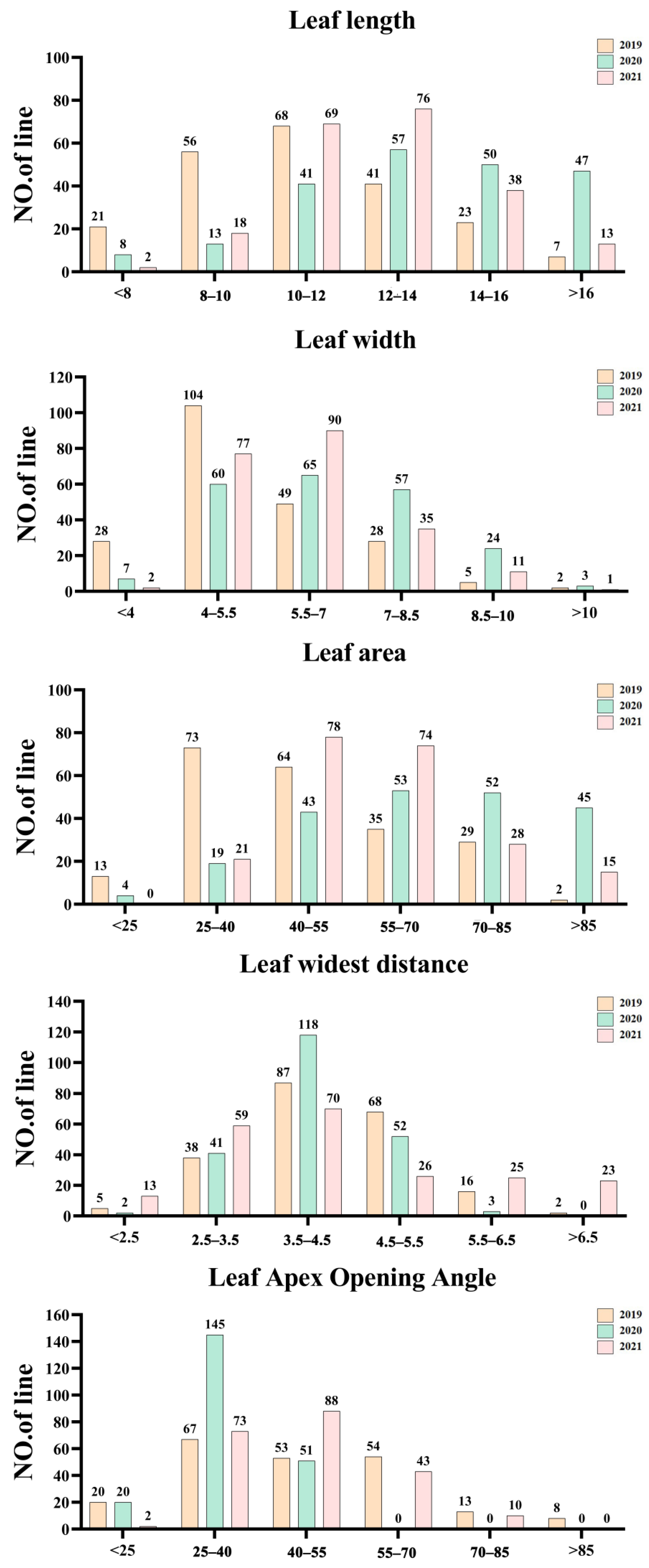
This study conducted a three-year statistical analysis of change in leaf shape among 216 soybean germplasm resources (Table S1). It was found that in 2019, the leaf length ranged from 5.74 to 16.93 cm, the leaf width from 2.86 to 11.45 cm, and the leaf area from 13.12 to 132.24 cm2. In 2020, the leaf length ranged from 6.13 cm to 20.65 cm, the leaf width from 2.65 cm to 12.81 cm, and the leaf area from 16.24 cm2 to 133.44 cm2. In 2021, the leaf length ranged from 7.9 to 18.15 cm, the leaf width ranged from 3.5 to 10.45 cm, and the leaf area ranged from 26.4 to 109.64 cm2. In 2019, the leaf apex opening angle ranged from 16° to 94.5°. In 2020, the leaf apex opening angle was between 18° and 51.5°. In 2021, the leaf apex opening angle was from 23° to 78.5°. In 2019, the leaf widest distance was from 2 cm to 6.95 cm. In 2020, the leaf widest distance was between 1.95 cm and 6.25 cm. In 2021, the leaf widest distance was from 1.95 cm to 7.05 cm. The above results indicate that there are significant differences in leaf shape among the tested germplasm resources. The genetic diversity of the germplasm resources is extensive and exhibits a normal distribution, providing a foundation for subsequent screening of specific germplasm (Figure 1).

3.2. Population Structure and GWAS Analysis

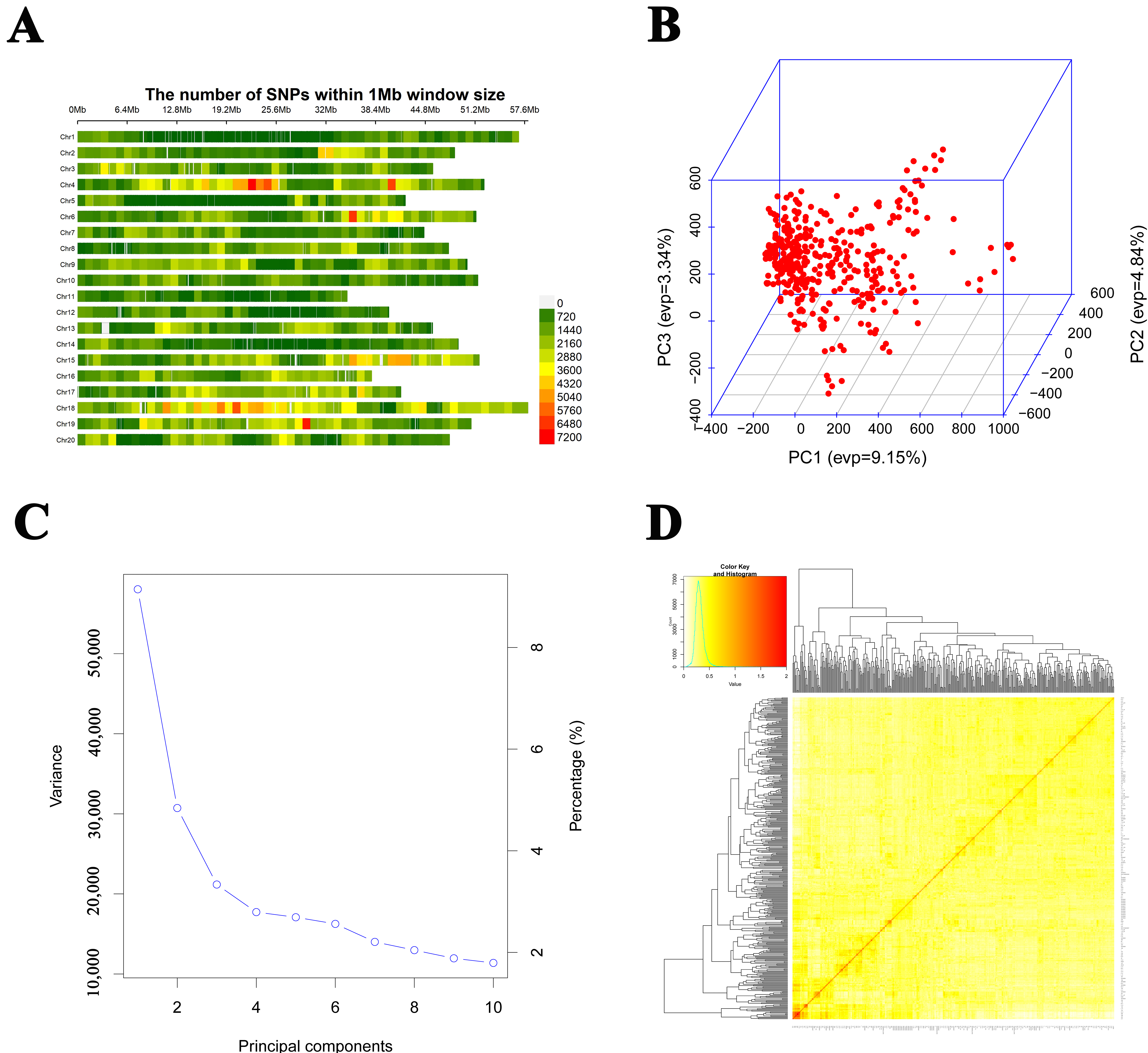
In this study, a total of 216 soybean germplasm resources were subjected to whole-genome resequencing. The high-quality SNP loci obtained were distributed across 20 chromosomes. The above high-quality SNPs were subjected to principal component analysis, and it was found that a turning point occurred at PC3. In the correlation mapping, the population structure was primarily influenced by the first three phylogenetic relationships. Based on the analysis of the correlation panel, it was observed that the genetic correlation among 216 soybean germplasms was relatively low (Figure 2).

3.3. GWAS Identified Important SNPs Related to Leaf Shape

Genome-wide association study (GWAS) was performed using the mixed linear model (MLM) method. A total of 824 SNP loci were identified as significantly associated with leaf shape (Table S3). Genome-wide analysis identified that the primary QTN loci reside on multiple chromosomes, including 1, 2, 3, 4, 6, 7, 10, and 13 through 20. (Figures S1–S5).

3.4. Functional Enrichment Analysis for Candidate Genes

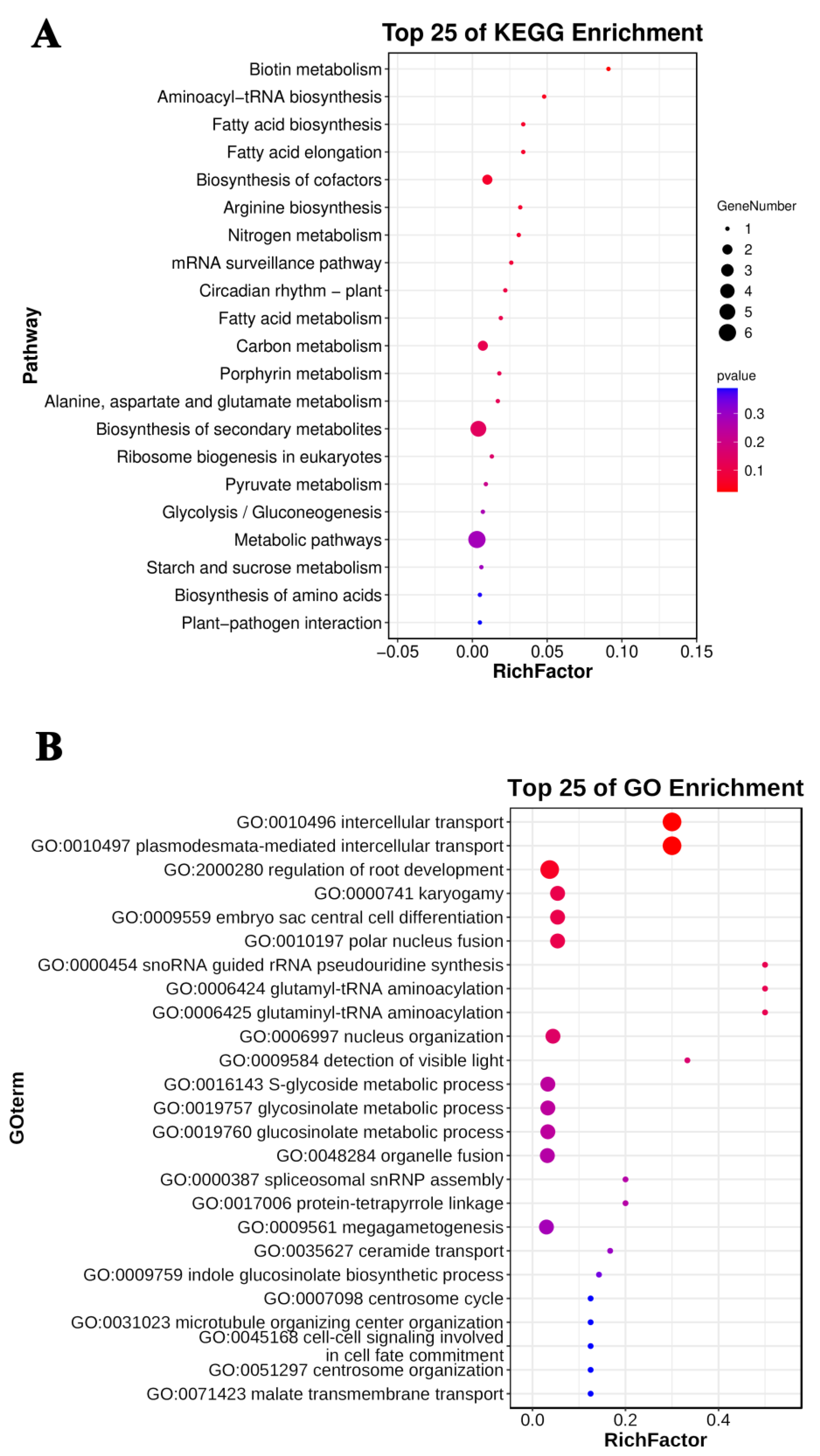
Genes involved in regulating soybean leaf shape were further identified through enrichment analysis of the candidate gene set. The 200 kb genomic region, encompassing 100 kb on either side of each significant SNP locus identified in the GWAS results, was designated as a candidate gene [27]. A total of 130 candidate genes were identified through the screening conducted in three test environments (Table S4). To gain a deeper insight into the potential functions of the candidate genes, we conducted KEGG enrichment analysis on these genes. The candidate genes identified above exhibited significant enrichment in several biological processes, including arginine biosynthesis (ko00220), nitrogen metabolism (ko00910), carbon metabolism (ko01200), pyruvate metabolism (ko00620), glycolysis/glycogenolysis (ko00010), starch and sucrose metabolism (ko00500), plant–pathogen interaction (ko04626), and Amino acid biosynthesis (ko01230). Among the identified candidate genes, Glyma.13G062700 is located near Chr.13:16045151. Functioning as a key regulator in soybean leaf development, this gene is a member of the starch synthase family. Glyma.16G041200 (located near Chr.16:3861426) belongs to glutamate dehydrogenase. The activity of glutamate dehydrogenase increases initially and then decreases as the leaves develop. Glyma.20G115500 belongs to the KCS gene family (located near the 35,732,476 position on chromosome 20), and it can utilize substrates such as oleic acid, which can extend single-chain unsaturated fatty acids. Glyma.10G141600 (located near Chr.1037426751) is a pyruvate kinase. Pyruvate kinase (PK) is an enzyme that catalyzes the final step of glycolysis. PK catalyzes the synthesis of pyruvic acid and ATP from PEP and ADP. It plays a crucial role in the growth and development of plants and is also involved in energy metabolism. That play an important role in the glycolysis pathway of plant (Figure 3).

3.5. Screening of Superior Haplotypes Related to Soybean Leaf Shape

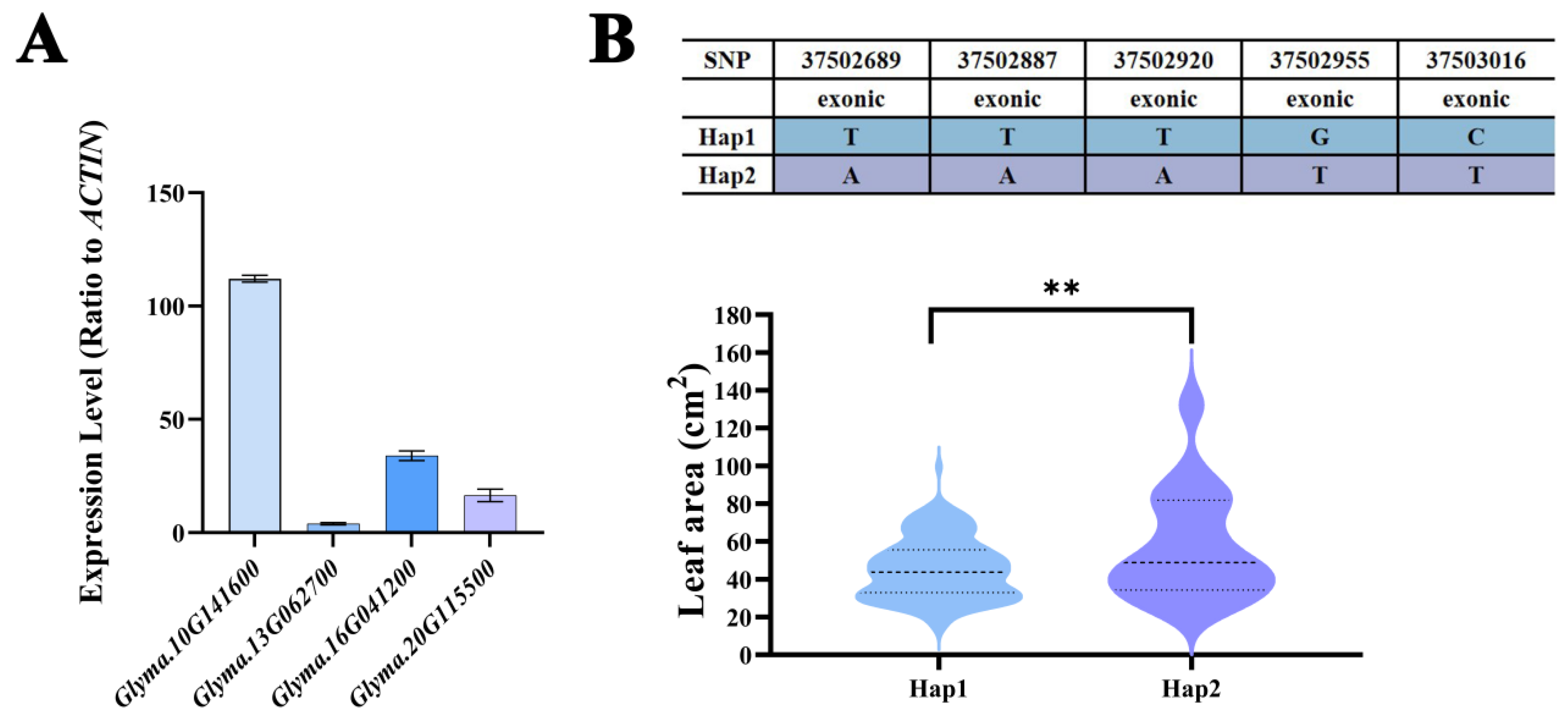
In order to further determine the association between the candidate genes and the shape of soybean leaves, the generalized linear model (GLM) method was employed to calculate the gene-based association as well as haplotype analysis. A total of four single nucleotide polymorphisms (SNPs) were identified within Glyma.13G062700. The association analysis revealed that none of these SNPs exceeded the significance threshold (−log(p) ≥ 2) for association with leaf shape. And the SNPs extracted from the Glyma.16G041200 and Glyma.20G115500 genes were 8 and 3, respectively, and there was also no significant correlation with leaf shape (−log(p) < 2). The Glyma.10G141600 gene has variations in the exon region. The five SNP sites in the exon region have non-synonymous mutations, which have effect on the protein. Among the studied genetic resources, Glyma.10G141600 has two haplotypes. Comparative analysis of leaf area phenotypes showed that Hap1 had a significantly smaller leaf area than Hap2. The above results indicate that the variation in the exon region of Glyma.10G141600 plays a crucial role in affecting the leaf area of soybeans, and the Hap-2 haplotype is an excellent allele that influences leaf shape (Figure 4).

3.6. Development of the CAPS Marker for the Related Genes of Soybean Leaf Shape

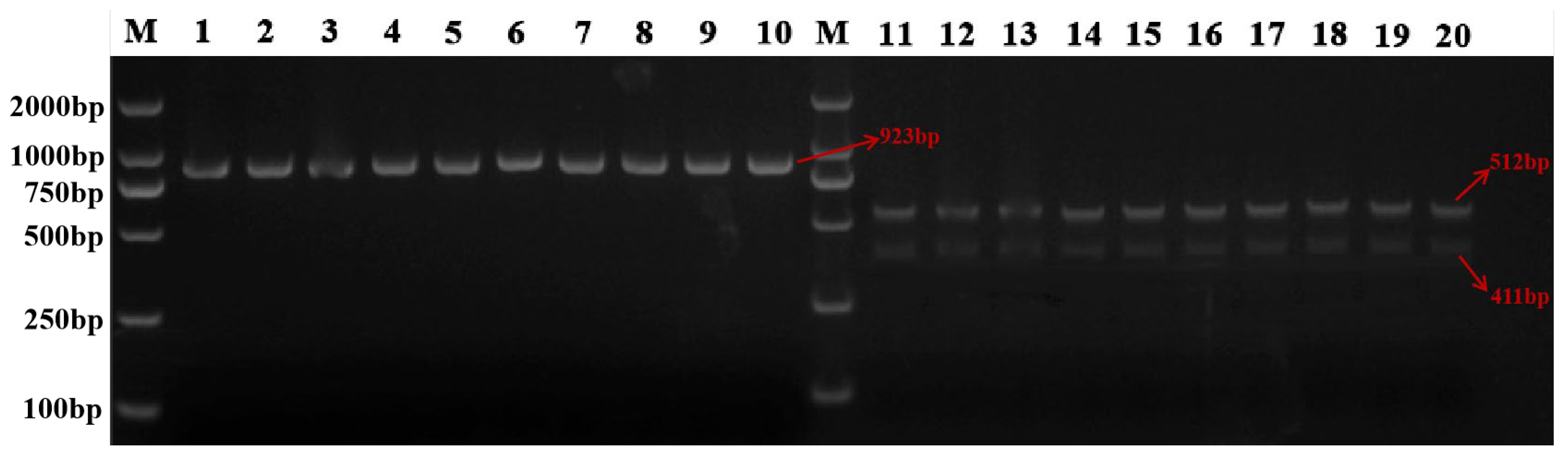
Based on the results of the association analysis of the Glyma.10G141600 gene, the Chr.10:37502955 (G/T) locus, which was significantly correlated with soybean leaf shape (−log(p) > 2), was selected and CAPS markers were developed. Utilizing the online website Snap Gene, we analyzed the optimal restriction enzyme sites and selected the appropriate restriction endonucleases for the development of functional markers. Chr.10:37502955 (G/T), The full-length PCR amplification is 923 bp. The 411 base is the mutation site. In materials with large leaf area, this site is designated as G and is not susceptible to cleavage by the AcsI restriction endonuclease. While in materials with a small leaf area, this site is designated as T and can be cleaved by the AcsI restriction endonuclease into two fragments of 411 bp and 512 bp. This study demonstrates that the CAPS marker can be used to efficiently and accurately screen soybean leaf shape materials. In practical applications, CAPS markers can be selected based on phenotypic traits for molecular marker-assisted selection breeding (Figure 5).

4. Discussion

Soybean is a crucial oil crop. The leaves serve as the primary organ for photosynthesis in soybeans. Leaf morphology, as a fundamental structural characteristic of leaves, plays a significant role in facilitating various aspects such as photosynthetic efficiency, resource allocation, and responses to environmental stress [28]. Different leaf shapes can enhance a plant’s ability to absorb sunlight, retain water, and withstand wind and rain. Leaf length, leaf width, and leaf area are fundamental measurement parameters that characterize the morphology and functionality of leaves; these parameters represent the essential biometric features of foliage [29].
GWAS (Genome-Wide Association Study) is extensively employed to identify genetic markers associated with significant traits, including yield, disease resistance, stress tolerance, and quality [30,31,32]. To identify genetic factors underlying leaf morphology, we conducted a genome-wide association analysis on 216 soybean accessions. This study, through multiple environments and five shapes, using GWAS analysis, identified a total of 824 single nucleotide polymorphisms (SNPs) that were significantly associated with leaf shape. SNPs were deemed significant at a threshold of −log10(p) > 4 [27]. Based on the KEGG enrichment and expression pattern analysis, four candidate genes associated with leaf shape. Genes associated with leaf shape principally encompassed several functional categories: plant hormone-related genes, ubiquitin ligases, serine/threonine-protein kinases, transcription factors, and genes involved in cell wall metabolism [33]. A GWAS was conducted utilizing multi-parental doubled haploid (DH) populations in maize. A total of 19, 49, and 37 SNP loci were identified as being significantly associated with leaf length, leaf width, and leaf area, respectively [34]. Through a GWAS of leaf length and leaf width across 301 lotus varieties, eight key candidate genes were identified, which are mainly involved in the remodeling of plant cell walls [35]. Researchers conducted a genome-wide association study (GWAS) on barley leaf area and identified a significant locus encoding the VRS1 transcription factor. Mutations in VRS1 are associated with broader leaves and an increased number of longitudinal veins, suggesting its functional role in regulating leaf morphogenesis [36]. Glyma.13G062700 gene belongs to the starch synthase family. Research has shown that by increasing the light intensity, the starch synthase gene can be upregulated, significantly improving photosynthesis. It is vital for soybean leaf development, thereby influencing overall plant architecture and potential photosynthetic efficiency [5]. Glyma.16G041200 is an aspartate dehydrogenase. At normal temperature, the activity of this enzyme increases initially and then decreases as the leaves develop. However, in high temperatures, the situation is reversed [37]. Glyma.20G115500 belongs to the KCS gene family. Research has confirmed that PotriKCS1 can prolong monounsaturated fatty acids and is responsible for recruiting unsaturated substrates to the cuticle wax [38]. Glyma.10G141600 encodes a plastid pyruvate kinase 2, which exhibits homology to At5G52920 in Arabidopsis thaliana and is significantly expressed in mature seeds [39]. Further, through candidate gene association analysis, it was determined that the Glyma.10G141600 gene has two haplotypes in the exon region, namely Hap1 and Hap2. The leaf area of Hap 2 was found to significantly larger than that of Hap 1. Subsequently, cleavage amplification polymorphic sequence (CAPS) molecular markers were developed based on these loci. The CAPS marker (Chr.10:37502955) can effectively distinguish the leaf shape size through enzymatic digestion. Through multi-environment GWAS, we systematically analyzed the genetic architecture controlling the leaf morphology of soybeans, discovered significant G × E interactions, and precisely located the key candidate genes. The G × E interaction analysis was conducted in multiple environments, elucidating the effects of genotypes, environments, and their interactions on leaf shape characteristics. These findings suggest that the Glyma.10G141600 gene may provide a theoretical basis for molecular-assisted selection (MAS) of soybean leaf morphology. In the future, by conducting functional validation on Glyma.10G141600 through genetic transformation and exploring its expression regulatory network under different environmental conditions, it will help us gain a deeper understanding of the plasticity mechanism of soybean morphological development and lay the foundation for the breeding of new soybean varieties with strong adaptability. Through traditional breeding and molecular breeding (such as molecular marker-assisted selection, gene editing, etc.), higher-yielding and more adaptable soybean varieties have been cultivated. This study is mainly based on a single genotype. This provides a clear genetic background for in-depth analysis, but it also implies significant limitations. Therefore, when applying the conclusions of this study to a broader range of soybean germplasm resources, caution should be exercised. Future research is necessary to verify these findings in diverse genetic populations to assess their universality and their potential applications in breeding.

5. Conclusions

In summary, this study conducted a GWAS analysis on the leaf morphology of 216 soybean germplasm resources, and identified 824 SNPs that were significantly associated with leaf shape and a total of 130 candidate genes were screened out near the significant SNP loci. By integrating GWAS and KEGG enrichment analysis, four candidate genes associated with leaf shape were identified (Glyma.10G141600, Glyma.13G062700, Glyma.16G041200 and Glyma.20G115500). Further analysis confirmed that the Glyma.10G141600 gene exists in two haplotypes, and that haplotype 2 confers a significantly larger leaf area than haplotype 1. Cleavage amplification polymorphic sequence (CAPS) molecular markers were developed based on these loci. This locus can effectively distinguish leaf shape and size through enzyme digestion. Therefore, the Glyma.10G141600 gene may provide a basis for molecular-assisted selection (MAS) of soybean leaf morphology.

Supplementary Materials

The following supporting information can be downloaded at https://www.mdpi.com/article/10.3390/agriculture16020150/s1. Figure S1. The Manhattan plot of the correlation map of soybean leaf length. Figure S2. The Manhattan plot of the correlation map of soybean leaf width. Figure S3. The Manhattan plot of the correlation map of soybean leaf widest distance. Figure S4. The Manhattan plot of the correlation map of soybean leaf apex opening angle. Figure S5. The Manhattan plot of the correlation map of soybean leaf area. Table S1. Location information of 216 soybean germplasm resources. Table S2. Phenotypic characteristics of 216 accessions used for GWAS. Table S3. Comprehensive analysis of significant loci in leaf shape GWAS for 2019, 2020, and 2021. Table S4. Genes flanking peak SNPs (100 kb windows) associated with leaf morphology in soybean. Table S5. Number of significant SNPs identified by GWAS on 216 accessions. Table S6. Candidate genes surrounding peak SNPs. Table S7. Candidate gene qRT-PCR primers.

Author Contributions

Conceptualization, X.Z. (Xunchao Zhao) and X.Z. (Xue Zhao); methodology, Y.Z. (Yan Zhang); software, Y.L. (Yuan Li) and X.R.; formal analysis, Y.L. (Yuan Li) and Y.Z. (Yan Zhang); investigation, Y.Z. (Yan Zhang) and J.W.; data curation, Y.Z. (Yina Zhu) and Y.Z. (Yan Zhang); writing—original, Y.Z. (Yan Zhang); writing—review and editing, X.Z. (Xunchao Zhao) and X.Z. (Xue Zhao); supervision, X.Z. (Xunchao Zhao) and X.Z. (Xue Zhao); funding acquisition, X.Z. (Xunchao Zhao) and X.Z. (Xue Zhao). All authors have read and agreed to the published version of the manuscript.

Funding

This study was conducted in the Key Laboratory of Soybean Biology of the Chinese Education Ministry, Soybean Research & Development Center (CARS) and the Key Laboratory of Northeastern Soybean Biology and Breeding/Genetics of the Chinese Agriculture Ministry, and was financially supported by Heilongjiang Provincial ‘Outstanding Young Teachers’ Basic Research Support Program (YQJH2023187,YQJH2024006), The Talent Introduction Project of Northeast Agricultural University (24YJQA01), The Chinese National Natural Science Foundation (32472196, U22A20473), The National Key Research and Development Project of China (2021YFD1201103), The Youth Leading Talent Project, The Ministry of Science and Technology in China (2015RA228), The national project (CARS-04-PS07), and Young leading talents of Northeast Agricultural University (NEAU2023QNLJ-003).

Institutional Review Board Statement

Not applicable.

Informed Consent Statement

Not applicable.

Data Availability Statement

The raw data based on the conclusions of this paper will be provided by the authors upon request.

Conflicts of Interest

All authors have no conflicts of interest.

References

  1. John, G.P.; Garnica-Díaz, C.J. Embracing the Complexity of Leaf Shape: A Commentary on “Anatomical Determinants of Gas Exchange and Hydraulics Vary with Leaf Shape in Soybean”. Ann. Bot. 2023, 131, i–iii. [Google Scholar] [CrossRef] [PubMed]
  2. Zhao, W.; Ren, T.-H.; Huang, X.-Y.; Xu, Z.; Zhou, Y.-Z.; Yin, C.-L.; Zhao, R.; Liu, S.-B.; Ning, T.-Y.; Li, G. Leaf Shape, Planting Density, and Nitrogen Application Affect Soybean Yield by Changing Direct and Diffuse Light Distribution in the Canopy. Plant Physiol. Biochem. 2023, 204, 108071. [Google Scholar] [CrossRef]
  3. Tamang, B.G.; Zhang, Y.; Zambrano, M.A.; Ainsworth, E.A. Anatomical Determinants of Gas Exchange and Hydraulics Vary with Leaf Shape in Soybean. Ann. Bot. 2023, 131, 909–920. [Google Scholar] [CrossRef]
  4. Burroughs, C.H.; Montes, C.M.; Moller, C.A.; Mitchell, N.G.; Michael, A.M.; Peng, B.; Kimm, H.; Pederson, T.L.; Lipka, A.E.; Bernacchi, C.J.; et al. Reductions in Leaf Area Index, Pod Production, Seed Size, and Harvest Index Drive Yield Loss to High Temperatures in Soybean. J. Exp. Bot. 2023, 74, 1629–1641. [Google Scholar] [CrossRef] [PubMed]
  5. Feng, L.; Raza, M.A.; Li, Z.; Chen, Y.; Khalid, M.H.B.; Du, J.; Liu, W.; Wu, X.; Song, C.; Yu, L.; et al. The Influence of Light Intensity and Leaf Movement on Photosynthesis Characteristics and Carbon Balance of Soybean. Front. Plant Sci. 2019, 9, 1952. [Google Scholar] [CrossRef]
  6. Lin, L.; Zhao, Y.; Liu, F.; Chen, Q.; Qi, J. Narrow Leaf 1 (NAL1) Regulates Leaf Shape by Affecting Cell Expansion in Rice (Oryza sativa L.). Biochem. Biophys. Res. Commun. 2019, 516, 957–962. [Google Scholar] [CrossRef]
  7. Wang, F.; Tang, Z.; Wang, Y.; Fu, J.; Yang, W.; Wang, S.; Wang, Y.; Bai, T.; Huang, Z.; Yin, H.; et al. Leaf Mutant 7 Encoding Heat Shock Protein OsHSP40 Regulates Leaf Size in Rice. Int. J. Mol. Sci. 2022, 23, 4446. [Google Scholar] [CrossRef]
  8. Cho, S.-H.; Kang, K.; Lee, S.-H.; Lee, I.-J.; Paek, N.-C. OsWOX3A Is Involved in Negative Feedback Regulation of the Gibberellic Acid Biosynthetic Pathway in Rice (Oryza sativa). J. Exp. Bot. 2016, 67, 1677–1687. [Google Scholar] [CrossRef]
  9. Zheng, M.; Wang, Y.; Liu, X.; Sun, J.; Wang, Y.; Xu, Y.; Lv, J.; Long, W.; Zhu, X.; Guo, X.; et al. The RICE MINUTE-LIKE1 (RML1) Gene, Encoding a Ribosomal Large Subunit Protein L3B, Regulates Leaf Morphology and Plant Architecture in Rice. J. Exp. Bot. 2016, 67, 3457–3469. [Google Scholar] [CrossRef]
  10. Sarkar, A.K.; Luijten, M.; Miyashima, S.; Lenhard, M.; Hashimoto, T.; Nakajima, K.; Scheres, B.; Heidstra, R.; Laux, T. Conserved Factors Regulate Signalling in Arabidopsis Thaliana Shoot and Root Stem Cell Organizers. Nature 2007, 446, 811–814. [Google Scholar] [CrossRef] [PubMed]
  11. Li, Y.; Hou, Z.; Li, W.; Li, H.; Lu, S.; Gan, Z.; Du, H.; Li, T.; Zhang, Y.; Kong, F.; et al. The Legume-Specific Transcription Factor E1 Controls Leaf Morphology in Soybean. BMC Plant Biol. 2021, 21, 531. [Google Scholar] [CrossRef]
  12. Yang, H.; Shi, G.; Li, X.; Hu, D.; Cui, Y.; Hou, J.; Yu, D.; Huang, F. Overexpression of a Soybean YABBY Gene, GmFILa, Causes Leaf Curling in Arabidopsis Thaliana. BMC Plant Biol. 2019, 19, 234. [Google Scholar] [CrossRef] [PubMed]
  13. Shook, J.M.; Zhang, J.; Jones, S.E.; Singh, A.; Diers, B.W.; Singh, A.K. Meta-GWAS for Quantitative Trait Loci Identification in Soybean. G3 (Bethesda) 2021, 11, jkab117. [Google Scholar] [CrossRef]
  14. He, J.; Gai, J. Genome-Wide Association Studies (GWAS). Methods Mol. Biol. 2023, 2638, 123–146. [Google Scholar] [PubMed]
  15. Wang, L.; Cheng, Y.; Ma, Q.; Mu, Y.; Huang, Z.; Xia, Q.; Zhang, G.; Nian, H. QTL Fine-Mapping of Soybean (Glycine max L.) Leaf Type Associated Traits in Two RILs Populations. BMC Genom. 2019, 20, 260. [Google Scholar] [CrossRef]
  16. Wang, L.; Conteh, B.; Fang, L.; Xia, Q.; Nian, H. QTL Mapping for Soybean (Glycine max L.) Leaf Chlorophyll-Content Traits in a Genotyped RIL Population by Using RAD-Seq Based High-Density Linkage Map. BMC Genom. 2020, 21, 739. [Google Scholar] [CrossRef]
  17. Li, K.; Guo, N.; Zhang, M.; Du, Y.; Xu, J.; Li, S.; Wang, J.; Wang, R.; Liu, X.; Qin, M.; et al. Identification of Genetic Loci and Candidate Genes Regulating Photosynthesis and Leaf Morphology through Genome-Wide Association Study in Brassica napus L. Front. Plant Sci. 2024, 15, 1467927. [Google Scholar] [CrossRef] [PubMed]
  18. Yu, K.; Wang, J.; Sun, C.; Liu, X.; Xu, H.; Yang, Y.; Dong, L.; Zhang, D. High-Density QTL Mapping of Leaf-Related Traits and Chlorophyll Content in Three Soybean RIL Populations. BMC Plant Biol. 2020, 20, 470. [Google Scholar] [CrossRef]
  19. Shu, Y.; Li, Y.; Zhu, Z.; Bai, X.; Cai, H.; Ji, W.; Guo, D.; Zhu, Y. SNPs Discovery and CAPS Marker Conversion in Soybean. Mol. Biol. Rep. 2011, 38, 1841–1846. [Google Scholar] [CrossRef]
  20. Prasad, A.; Hari-Gowthem, G.; Muthamilarasan, M.; Hussain, Z.; Yadav, P.K.; Tripathi, S.; Prasad, M. Molecular Characterization of SlATG18f in Response to Tomato Leaf Curl New Delhi Virus Infection in Tomato and Development of a CAPS Marker for Leaf Curl Disease Tolerance. Theor. Appl. Genet. 2021, 134, 1463–1474. [Google Scholar] [CrossRef]
  21. Jayabalan, S.; Pulipati, S.; Ramasamy, K.; Jaganathan, D.; Venkatesan, S.D.; Vijay, G.; Kumari, K.; Raju, K.; Hariharan, G.N.; Venkataraman, G. Analysis of Genetic Diversity and Population Structure Using SSR Markers and Validation of a Cleavage Amplified Polymorphic Sequences (CAPS) Marker Involving the Sodium Transporter OsHKT1;5 in Saline Tolerant Rice (Oryza sativa L.) Landraces. Gene 2019, 713, 143976. [Google Scholar] [CrossRef] [PubMed]
  22. Li, Y.; Liu, X.; Deng, W.; Liu, J.; Fang, Y.; Liu, Y.; Ma, T.; Zhang, Y.; Xue, Y.; Tang, X.; et al. Fine Mapping the Soybean Mosaic Virus Resistance Gene in Soybean Cultivar Heinong 84 and Development of CAPS Markers for Rapid Identification. Viruses 2022, 14, 2533. [Google Scholar] [CrossRef]
  23. Zafer, M.Z.; Tahir, M.H.N.; Khan, Z.; Sajjad, M.; Gao, X.; Bakhtavar, M.A.; Waheed, U.; Siddique, M.; Geng, Z.; Ur Rehman, S. Genome-Wide Characterization and Sequence Polymorphism Analyses of Glycine max Fibrillin (FBN) Revealed Its Role in Response to Drought Condition. Genes 2023, 14, 1188. [Google Scholar] [CrossRef]
  24. Guan, R.; Yu, L.; Liu, X.; Li, M.; Chang, R.; Gilliham, M.; Qiu, L. Selection of the Salt Tolerance Gene GmSALT3 During Six Decades of Soybean Breeding in China. Front. Plant Sci. 2021, 12, 794241. [Google Scholar] [CrossRef]
  25. Wang, Y.; Han, J.; Meng, X.; Sun, M.; Qu, S.; Liu, Y.; Li, Y.; Zhan, Y.; Teng, W.; Li, H.; et al. Genome-Wide Association Study and Marker Development for Fusarium Oxysporum Root Rot Resistance in Soybean. Int. J. Mol. Sci. 2024, 25, 12573. [Google Scholar] [CrossRef]
  26. Usovsky, M.; Bilyeu, K.; Bent, A.; Scaboo, A.M. Allele-Tagged TaqMan® PCR Genotyping Assays for High-Throughput Detection of Soybean Cyst Nematode Resistance. Mol. Biol. Rep. 2024, 52, 33. [Google Scholar] [CrossRef]
  27. Zhao, X.; Zhang, Y.; Wang, J.; Zhao, X.; Li, Y.; Teng, W.; Han, Y.; Zhan, Y. GWAS and WGCNA Analysis Uncover Candidate Genes Associated with Oil Content in Soybean. Plants 2024, 13, 1351. [Google Scholar] [CrossRef] [PubMed]
  28. Zhou, X.; Wang, D.; Mao, Y.; Zhou, Y.; Zhao, L.; Zhang, C.; Liu, Y.; Chen, J. The Organ Size and Morphological Change During the Domestication Process of Soybean. Front. Plant Sci. 2022, 13, 913238. [Google Scholar] [CrossRef]
  29. Kurumayya, V. Cutting-Edge Computational Approaches to Plant Phenotyping. Plant Mol. Biol. 2025, 115, 56. [Google Scholar] [CrossRef]
  30. Bhat, J.A.; Adeboye, K.A.; Ganie, S.A.; Barmukh, R.; Hu, D.; Varshney, R.K.; Yu, D. Genome-Wide Association Study, Haplotype Analysis, and Genomic Prediction Reveal the Genetic Basis of Yield-Related Traits in Soybean (Glycine max L.). Front. Genet. 2022, 13, 953833. [Google Scholar] [CrossRef] [PubMed]
  31. Ferreira, E.G.C.; Marcelino-Guimarães, F.C. Mapping Major Disease Resistance Genes in Soybean by Genome-Wide Association Studies. Methods Mol. Biol. 2022, 2481, 313–340. [Google Scholar]
  32. Aleem, M.; Razzaq, M.K.; Aleem, M.; Yan, W.; Sharif, I.; Siddiqui, M.H.; Aleem, S.; Iftikhar, M.S.; Karikari, B.; Ali, Z.; et al. Genome-Wide Association Study Provides New Insight into the Underlying Mechanism of Drought Tolerance during Seed Germination Stage in Soybean. Sci. Rep. 2024, 14, 20765. [Google Scholar] [CrossRef] [PubMed]
  33. Zhang, C.; Yadav, V.; Cui, L. Mining of Candidate Genes Associated with Leaf Shape Traits in Grapes. Int. J. Mol. Sci. 2024, 25, 12101. [Google Scholar] [CrossRef]
  34. Zeng, Y.; Xu, X.; Jiang, J.; Lin, S.; Fan, Z.; Meng, Y.; Maimaiti, A.; Wu, P.; Ren, J. Genome-Wide Association Analysis and Genomic Selection for Leaf-Related Traits of Maize. PLoS ONE 2025, 20, e0323140. [Google Scholar] [CrossRef] [PubMed]
  35. Hu, H.; Zhang, R.; Zhao, Y.; Yang, J.; Zhao, H.; Zhao, L.; Wang, L.; Cheng, Z.; Zhao, W.; Wang, B.; et al. Cell Wall Remodeling Confers Plant Architecture with Distinct Wall Structure in Nelumbo Nucifera. Plant J. 2024, 120, 1392–1409. [Google Scholar] [CrossRef]
  36. Thirulogachandar, V.; Alqudah, A.M.; Koppolu, R.; Rutten, T.; Graner, A.; Hensel, G.; Kumlehn, J.; Bräutigam, A.; Sreenivasulu, N.; Schnurbusch, T.; et al. Leaf Primordium Size Specifies Leaf Width and Vein Number among Row-Type Classes in Barley. Plant J. 2017, 91, 601–612. [Google Scholar] [CrossRef]
  37. Magalhães, A.C.; Peters, D.B.; Hageman, R.H. Influence of Temperature on Nitrate Metabolism and Leaf Expansion in Soybean (Glycine max L. Merr.) Seedlings. Plant Physiol. 1976, 58, 12–16. [Google Scholar] [CrossRef] [PubMed]
  38. Gonzales-Vigil, E.; Hefer, C.A.; von Loessl, M.E.; La Mantia, J.; Mansfield, S.D. Exploiting Natural Variation to Uncover an Alkene Biosynthetic Enzyme in Poplar. Plant Cell 2017, 29, 2000–2015. [Google Scholar] [CrossRef]
  39. Baud, S.; Wuillème, S.; Dubreucq, B.; de Almeida, A.; Vuagnat, C.; Lepiniec, L.; Miquel, M.; Rochat, C. Function of Plastidial Pyruvate Kinases in Seeds of Arabidopsis Thaliana. Plant J. 2007, 52, 405–419. [Google Scholar] [CrossRef]
Figure 1. The frequency distribution of leaf shapes in three different environments.
Agriculture 16 00150 g001
Figure 2. Genetic characteristics of the clonal map population. (A) SNP density map on 20 chromosomes; (B) the first three principal components of SNPs; (C) population structure of soybean germplasm resources; (D) heatmap of the genetic relationship matrix of 216 soybean samples.
Agriculture 16 00150 g002
Figure 3. (A) Candidate gene KEGG enrichment analysis. (B) Candidate gene GO enrichment analysis.
Agriculture 16 00150 g003
Figure 4. (A) Candidate gene expression pattern in soybean leaves. (B) Conduct a statistical analysis of the site variations in the two haplotypes of the Glyma.10G141600 gene. Leaf area was compared between the two haplotypes across 20 soybean accessions. Double asterisks (**) represent statistical significance at p < 0.01.
Agriculture 16 00150 g004
Figure 5. Chr.10:37502955 extreme material enzymatic reaction. The first to the tenth lanes represent materials with large leaf area, and the eleventh to the twentieth lanes represent materials with small leaf area. M.DL2000 Marker.
Agriculture 16 00150 g005
Disclaimer/Publisher’s Note: The statements, opinions and data contained in all publications are solely those of the individual author(s) and contributor(s) and not of MDPI and/or the editor(s). MDPI and/or the editor(s) disclaim responsibility for any injury to people or property resulting from any ideas, methods, instructions or products referred to in the content.