
Next Article in Journal
Assessing the Potential for Modifying Certain Eradication Measures for Xylella fastidiosa subsp. pauca in Olive Groves of Apulia (Italy)
Previous Article in Journal
Dynamics of Key Meteorological Variables and Their Impacts on Staple Crop Yields Across Large-Scale Farms in Heilongjiang, China
error_outline You can access the new MDPI.com website here. Explore and share your feedback with us.
 
 
Article

Research on the Coupling Coordination Degree and Obstacle Factors of Digital Inclusive Finance and Digital Agriculture in Rural China


College of Agriculture, Guangxi University, Nanning 530004, China
*
Author to whom correspondence should be addressed.
Agriculture 2026, 16(2), 144; https://doi.org/10.3390/agriculture16020144
Submission received: 2 December 2025 / Revised: 26 December 2025 / Accepted: 4 January 2026 / Published: 6 January 2026
(This article belongs to the Section Agricultural Economics, Policies and Rural Management)

Abstract

In the context of advancing agricultural and rural modernization in China, digital agriculture has gained significant governmental attention. However, existing research has predominantly focused on examining the relationship from digital inclusive finance to digital agriculture, while in-depth investigations into their bidirectional coupled coordination, spatiotemporal evolution, and underlying obstacle factors remain limited. To address this research gap, this study aims to construct innovative evaluation index systems for both domains and to establish a coupling coordination degree model alongside an obstacle degree model. This methodological framework is designed to examine the bidirectional coupled coordination, reveal its spatiotemporal evolution patterns, and identify key obstacle factors across 30 Chinese provinces. Results indicate a consistent annual improvement in the coupling coordination level across provinces. Many regions have progressed from moderate or mild dysfunction to marginal or primary coordination, with coordination degrees ranging between 0.5 and 0.6 by 2022. Specifically, the eastern region recorded 0.586, the central region 0.562, and the western region 0.531. Regional disparities are identified as the primary source of variation. Key obstacles include insufficient support from digital finance to agriculture, the east–west development gap, low actual usage of digital financial services, volatility in agricultural production price indices, and high agricultural carbon emissions. Recommendations focus on bridging regional gaps, strengthening financial support, and addressing these impediments, which are crucial for promoting sustainable development.

1. Introduction

Economy and agriculture are highly interdependent and often develop in tandem. As an innovation integrating finance and technology, digital inclusive finance contributes to common prosperity [1] and, together with the digital economy and digital agriculture, serves as a vital force for rural revitalization [2]. Traditional financial services, characterized by high thresholds and costs, often lead to financing difficulties in agriculture [3], an issue that digital inclusive finance has the potential to alleviate. Concurrently, artificial intelligence is transforming conventional agriculture, positioning digital agriculture as a key driver of agricultural modernization [4], with its digital and intelligent trends becoming increasingly pronounced [5]. However, digital agriculture in China is still in its early stages, facing challenges such as hesitant private capital and limited financing channels [6]. Studies suggest that digital inclusive finance is associated with farmers’ income growth and is considered a source of financial backing for digital agriculture [7], but the development of digital agriculture also furnishes valuable data for financial institutions, helping mitigate information asymmetry [8]. Thus, sharing congruent developmental logics, the synergistic growth of both is considered integral to the process of advancing rural revitalization and agricultural modernization.
Significant disparities in economic foundations, resource endowments, and policy support across different regions of China have led to varying levels of integrated development between digital inclusive finance (DIF) and digital agriculture. Although the interaction between DIF and digital agriculture is well-recognized, a clear research gap remains regarding their bidirectionalcoupling coordination mechanism. Existing studies lack a theoretical framework to explain this bidirectional synergy, its spatiotemporal evolution, and the underlying obstacle factors. Consequently, the spatial heterogeneity and regional differentiation of their coupling coordination degree are underexplored. To address these gaps, this study formulates three core research questions: (1) What is the nature of the bidirectional coupling between DIF and digital agriculture? (2) How does this relationship evolve spatiotemporally, and what are its regional disparities? (3) What factors primarily obstruct their coordinated development? Utilizing panel data from 30 Chinese provinces (2012–2022), this research constructs evaluation index systems, applies the entropy method for weighting, and employs a coupling coordination degree model to assess synergistic development. Spatial agglomeration and regional disparities are examined using Moran’s I and the Dagum Gini coefficient, while an obstacle degree model pinpoints hindering factors. By answering these questions, the study aims to provide a basis for targeted policy recommendations to promote integrated development.

2. Literature Review

2.1. Research on Digital Inclusive Finance

A clear understanding of digital inclusive finance (DIF) is essential for discerning its differences from traditional finance, its agricultural applications, and subsequent coordination measurements. Wang Cuilin [9] defines DIF as a new financial paradigm enabled by digital technologies like big data and cloud computing. Guo Lianqiang [10] highlights it as an innovative model integrating digital technology with inclusive finance, offering new solutions to agricultural financing challenges. Qi Wei [11] further notes that DIF facilitates agricultural industrial upgrading through its low-cost and wide-coverage advantages. These works collectively outline the core concept of DIF. Research on DIF’s role in agriculture is multi-faceted. Han Tao [12] emphasizes its capacity to alleviate financing difficulties and improve efficiency, calling it a key engine for agricultural economic growth. Qu Lingkun [13] indicates that by reducing costs and expanding reach, DIF stimulates latent financial demand in rural areas. Regarding rural employment, Guo Xia [14] and Si Mengna [15] suggest it optimizes labor allocation and broadens employment channels, while Lin Qinle [16] finds it increases income for flexible workers. From an international perspective, Armand Frejuis Akpa [17] and Charles Yédéhou Faton [18] demonstrate DIF’s positive impact on job creation and reducing gender inequality in employment in African contexts. Promoting DIF requires coordinated policy and technological efforts. Albert Agyei [19] advises policymakers to foster a favorable business environment and sound regulation. Le Quoc Dinh [20] stresses implementing pro-DIF policies under low inflation to counter economic instability exacerbated by climate change. Technologically, Mohamed [21] suggests that digital finance can still advance inclusive financial ecosystems via low-cost, transparent products post-pandemic. Mukaidaisi Nuermaimaiti [22] also argues that the current focus should shift from traditional microfinance to optimizing digital financial resource allocation.
The literature consistently acknowledges digital inclusive finance’s (DIF) role in alleviating rural financing constraints and stimulating economic activity. However, a clear contradiction exists regarding its impact on agricultural employment, with studies reporting both broad positive effects and limited efficacy in skill-intensive sectors. This divergence suggests that DIF’s benefits are likely context-dependent. Yet, the specific nature of this dependency remains unexplored, necessitating the empirical investigation conducted in this study to clarify the contextual factors influencing DIF’s effectiveness.

2.2. Research on Digital Agriculture

In recent years, China’s No. 1 Central Document has consistently emphasized enhancing agricultural digitalization and promoting smart agriculture, establishing it as a key agricultural priority. Understanding its concept is fundamental. Sun Jingshui [23] defines digital agriculture as a production and management technology integrating digital earth and intelligent machinery, enabling information sharing. Chen Jiang et al. [24] view it as a process of informatization within the digital earth framework, while Han Xudong [25] sees it as a new mode of production optimizing resource allocation through digital technology. Georgios Tsagdis [26] describes it as embedding advanced digital technologies into agroecology, creating novel farming practices. The development of digital agriculture plays a critical role. Yasa Sirilakshmi [27] notes that advancements like AI and robotics are reshaping traditional practices, enhancing precision and resource efficiency. Robert Finger [28] highlights its potential to optimize or even replace pesticide use, promoting green development. Alexander McBratney [29] states that technologies like IoT improve decision-making, boosting productivity and ecological restoration. Furthermore, Danielle Furuya [30] illustrates how protective measures informed by digital agriculture reduce losses from natural disasters, safeguarding farmers’ incomes. Digitally enabled agriculture also addresses socio-economic issues. Derick Quintino [31] shows it can mitigate food inflation by boosting supply chain efficiency, while Jorge Freddy Milian Gómez [32] argues it tackles environmental challenges from intensive farming and can reduce rural income disparities. Effective development requires robust policy and technical support. Wang Lin [33] advocates for guided industrial policies to secure modern agriculture’s development path. Fei Guoqiang [34] suggests improving the policy support system by learning from international best practices to cultivate skilled personnel. Technologically, Wang Hui [35] emphasizes leveraging “Internet+” technologies for predictive analytics across the production chain. Amanat Husain [36] stresses improving digital connectivity for market access and knowledge sharing, and Bianca Silva [37] recommends integrating ICT with geospatial technologies for natural resource management.
In summary, given the conceptual inconsistencies in the literature regarding digital agriculture, this study draws upon Sun Jingshui’s research to define it as a systemic process of integrating digital technologies into agricultural production and management to enable information sharing and connectivity [23], thereby optimizing resource allocation and enhancing value-chain efficiency. Based on this definition, an evaluation indicator system is constructed to measure its technological inputs, economic outcomes, and ecological performance.

2.3. Research on the Relationship Between Digital Agriculture and Digital Inclusive Finance

Jia Liming [38] observes that the advancement of digital agriculture creates new opportunities for digital inclusive finance (DIF) by mitigating information asymmetry, while DIF, in turn, provides essential funding, enhances financial service efficiency, and lowers costs in the agricultural sector. Hu Chenglin [39] further notes that DIF alleviates financing constraints imposed by traditional finance on agribusinesses and rural development, thereby supporting digital agriculture. This indicates a mutually reinforcing relationship where the two systems tend to develop synergistically. To investigate this coordination, Chen Boqiang [40] established indicator systems using data from the Peking University Digital Financial Inclusion Index and agricultural digitalization metrics. Similarly, Azam [41] quantified DIF’s development and identified its significant positive effect on digital agriculture and high-quality rural economic growth in China (Liu Yue et al. [3]).
Building upon the literature confirming a positive correlation between DIF and digital agriculture, prior studies have primarily described outcomes rather than elucidating the underlying synergistic mechanism. To address this, Section 2.4 presents a theoretical framework to visualize this synergy. Consequently, we propose three hypotheses:
H1. 
The coupling coordination degree exhibits significant east–west spatial heterogeneity.
H2. 
DIF usage depth constrains development in central and western regions.
H3. 
Overall coordination increases regionally at divergent growth rates.

2.4. Theoretical Framework

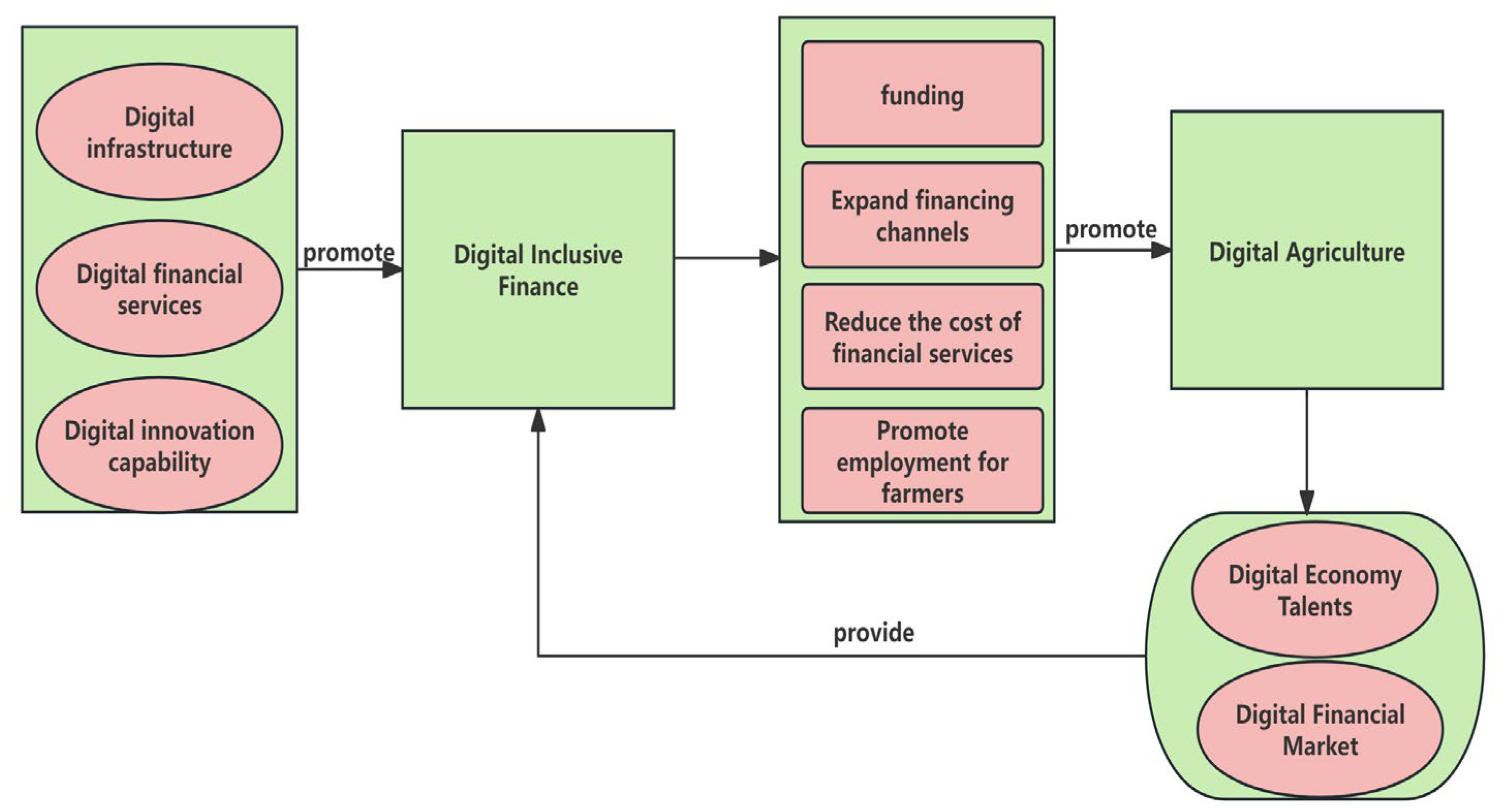
Based on the literature analysis above, this study constructs a theoretical framework illustrating the synergistic mechanism between digital inclusive finance (DIF) and digital agriculture, as depicted in Figure 1. Digital inclusive finance empowers digital agriculture through four primary pathways: capital provision, channel expansion, cost reduction, and employment promotion. Specifically, it addresses financing difficulties for agricultural digitalization through capital provision; expands the accessibility of financial services to meet the financial demands of digital agriculture via channel expansion; mitigates transaction risks in digital agriculture by reducing the cost of financial services; and supplies a larger talent pool for digital agriculture by promoting farmer employment. Concurrently, digital agriculture supports the development of digital inclusive finance by cultivating a digitally skilled workforce for the financial sector and creating new demand for financial services through market expansion driven by agricultural digitalization. This interplay forms a positive feedback loop. However, regional contexts and policy disparities influence the development of this synergistic mechanism. Therefore, the subsequent empirical analysis will be conducted based on this theoretical framework. The theoretical framework is depicted in Figure 1:

3. Methods and Data

3.1. Research Object and Data Source

This study utilizes panel data from 30 Chinese provinces from 2012 to 2022. This period is significant as it encompasses key national initiatives: the “Internet Plus” strategy in 2015 accelerated digital infrastructure, and the Rural Revitalization Strategy in 2018 emphasized agricultural digitization, making it crucial for observing digital synergy. Data for Hong Kong, Tibet, Macao, and Taiwan are excluded due to general unavailability. The primary data sources include the Peking University Digital Financial Inclusion Index, the China Statistical Yearbook, national/provincial statistical bulletins, and official government websites.

3.2. Construction of Evaluation Indicator System

This study draws on the research of Shen Yan and the Peking University Digital Financial Inclusion Index to establish the first-level indicators for Digital Inclusive Finance (DIF) as Coverage breadth, Using Depth, and Digitization level [42]. These three indicators reflect the scope, usage intensity, and digital capabilities of DIF, largely capturing its development level, and are therefore selected as the measurement metrics for DIF. Simultaneously, based on the research findings of Liu Yue et al., the first-level indicators for digital agriculture are set as the level of technological progress in digital agriculture, Construction of Digital Agriculture Infrastructure, Cultivation of digital agriculture talents, Benefit situation of digital agriculture industry, and Digital Agriculture Ecological Green Development [3]. The selection of secondary indicators for digital agriculture was based on their representativeness, data availability, and direct relevance to the first-level indicators. For the level of technological progress in digital agriculture, indicators such as the Total power of agricultural machinery and Rural power consumption directly measure the energy foundation required for applying digital and smart technologies in agriculture. For the construction of Digital Agriculture Infrastructure, indicators like the Number of Internet access users and the total number of mobile phone users are prerequisites for data transmission and the operation of digital agricultural platforms, and also serve as core metrics for assessing the penetration of digital infrastructure. Regarding the cultivation of digital agriculture talents, the Per capita expenditure on education, culture, and entertainment in rural areas and the Proportion of higher education population indirectly reflect the talent reserve, which is crucial for adopting and managing digital agricultural technologies. Pertaining to the Benefit situation of the digital agriculture industry, indicators such as the Total output value of agriculture, forestry, animal husbandry and fishery and Total grain output were chosen to reflect the final economic output and market performance. Finally, for Digital Agriculture Ecological Green Development, Agricultural carbon dioxide emissions and the Application rate of agricultural fertilizers are typical negative indicators that effectively measure the environmental pressure and sustainability of agricultural practices, aligning with the goals of agricultural green development. Furthermore, digital technologies can reduce carbon emissions by optimizing resource use.
Both target-level indices passed multicollinearity (VIF = 1.905) and Pearson correlation tests, confirming no severe multicollinearity and demonstrating strong inter-system correlation. These results validate the indicator system’s rational design. Complete test results are provided in Appendix A.
Based on this, the constructed evaluation indicator system is shown in Table 1 below:
In Table 1, the symbol “+” denotes a positive indicator, meaning a larger value reflects better system development, and vice versa; whereas “−” signifies a negative indicator, where a larger value corresponds to poorer system performance. The table reveals that within the Digital Inclusive Finance evaluation indicator system, Usage Depth carries the highest weight of 0.424, indicating it exerts the most significant influence on the system. In the Digital Agriculture evaluation indicator system, the indicators for Application Amount of Agricultural Fertilizers and Agricultural Carbon Dioxide Emissions hold the greatest weights 0.113 and 0.107, respectively, being the only two indicators exceeding the 10% threshold. This underscores their predominant impact on the development level of digital agriculture.

3.3. Research Methodology

On the basis of previous research, this article uses the entropy method to calculate the weights of various indicators. Secondly, a coupling coordination degree model of digital agriculture and digital inclusive finance is constructed to understand the coordinated development of digital agriculture and digital inclusive finance through coupling coordination degree. Further analysis is conducted through the Moran index and Dagum Gini coefficient. Finally, an obstacle degree model is constructed to locate the obstacles to the coordinated development of digital agriculture and digital inclusive finance. While the entropy method is superior to subjective weighting methods as it minimizes subjectivity, its limitation lies in not accounting for intercorrelations among indicators. Similarly, the coupling coordination model is apt for capturing bidirectional interactions but cannot infer causality. Therefore, the conclusions of this study are complemented by field surveys and supplementary methods.

3.3.1. Entropy Method

Entropy is a thermodynamic concept first introduced by Clausius in 1854. Hammed notes that entropy generation, a key concept in thermodynamics, is primarily used to measure the irreversibility of a process and is essential for optimizing thermal management and improving the efficiency of thermal systems [43]. Xie Congying points out that the entropy method is an objective weighting approach that determines indicator weights based on their degree of variation, thereby enabling the calculation of comprehensive scores to assess the overall development level of the indicators [44]. The entropy method is superior to subjective weighting methods such as the Analytic Hierarchy Process, as the weights are derived from the inherent variability of the data themselves. To avoid subjective arbitrariness and ensure the objectivity and reproducibility of the results [45], we adopted the entropy method to quantify indicator weights and evaluate the importance of indicators for digital agriculture and digital inclusive finance from 2012 to 2022. The calculation steps are as follows.
  • Data standardization
To address dimensional inconsistencies, indicators were standardized using the range method, building upon Sun Hongwei’s approach [45]. A minimal constant of 0.01 was added to each value. This technical adjustment prevents mathematical invalidity during entropy weighting, specifically avoiding undefined logarithmic calculations when a standardized value equals zero. Although introducing minor distortion, the exceedingly small constant ensures computational feasibility without substantially influencing the final weight allocation or overall results. The calculation formulas are provided below:
Positive indicator calculation formula:
X i j = X i M a x ( X ) M a x ( X ) M i n ( X )   + 0.01
Negative indicator calculation formula:
X i j = M a x ( X ) X i M a x ( X ) M i n ( X )   + 0.01
where X = X i j , where X i j represents the jth indicator of the i-th year.
2.
Entropy calculation
Building on the procedural steps outlined by Deng Feng et al. [46], this study calculated the proportion ( P i j ) accounted for by the nth indicator in the ith year following data standardization. The subsequent formula was applied:
P i j = y i j i = 1 m y i j
Next, calculate the information entropy e j , where k = −1/ln, e j > 0, and k > 0. The calculation formula is as follows:
e j = k i = 1 n ( P i j ln P i j )
Once again, calculate the information redundancy di and indicator weight wi using the following formula:
d i = 1 e j
w i = d i i = 1 n d i
Finally, the comprehensive score U for each region’s indicators was calculated, with U1 denoting the score for digital inclusive finance and U2 representing the score for digital agriculture. These scores, which range from 0 to 1, reflect the respective comprehensive development levels of digital agriculture and digital inclusive finance across different regions. The calculation formula is presented below:
U = W i X i j

3.3.2. Coupling Coordination Degree Model

Building upon Yang Kexin’s framework [47], the Coupling Coordination Degree (CCD) model integrates both coupling and coordination to assess inter-system linkages. While valuable for capturing the synchronicity and state of coordination, it is an inherently descriptive tool that does not establish causality. The contribution of this study, therefore, lies in its systematic spatiotemporal mapping of the coordination between the two systems, rather than in causal attribution. Following established scholarly practice, we employ the CCD model to examine their synergistic development.
The specific calculation method is as follows:
First, calculate the coupling degree based on the comprehensive score U of each indicator. The calculation formula is as follows:
C = U 1 U 2 U 1 + U 2
Here, C represents the coupling degree between digital inclusive finance and digital agriculture, where 0 < C < 1. U1 denotes the comprehensive score of digital inclusive finance, and U2 denotes the comprehensive score of digital agriculture.
Subsequently, the coordination index T between digital inclusive finance and digital agriculture is calculated, where 0 < T < 1. This index primarily reflects the level of coordinated development within the two systems. The calculation formula is as follows:
T = α U 1 + β U 2 ,   α + β = 1
The parameters α and β represent the relative importance of the digital financial inclusion system and the digital agriculture system, respectively, in their coordinated development. Since both systems are deemed equally crucial for China’s agricultural and rural modernization, and no prior theoretical or empirical evidence suggests prioritizing one over the other, we assign them equal weights that α = β = 0.5 with α + β = 1. This equal-weight assignment is a standard and neutral assumption commonly adopted in coupling coordination studies [47,48].
Finally, calculate the coupling coordination degree D between digital inclusive finance and digital agriculture, where 0 < D < 1, using the following formula:
D = C × T
The coupling coordination degree (D) is utilized to represent the integrated relationship and endogenous dynamics between the two systems. With reference to the classification established by domestic scholars such as Niu Fang [48,49], this study categorizes the coupling coordination degree into ten intervals, as detailed in Table 2:
Drawing on Liao Chongbin’s framework [49], the levels of coupling coordination describe the quality of interaction between two systems as follows: (0, 0.1) signifies Extreme imbalance, indicating severe conflict and low development; [0.1, 0.2) Serious imbalance, marked by prominent contradictions and mutual restriction; [0.2, 0.3) Moderate imbalance, reflecting a clear mismatch; [0.3, 0.4) Mild disorder, involving localized discordance; [0.4, 0.5) On the brink of imbalance, a transitional state near coordination; [0.5, 0.6) Barely coordination, an initial yet unstable synergy; [0.6, 0.7) Junior coordination, where basic positive interaction is established; [0.7, 0.8) Intermediate coordination, featuring a stable and mutually reinforcing mechanism; [0.8, 0.9) Good coordination, achieving efficient synergy; and [0.9, 1.0) Highly coordinated, representing an ideal state of deep integration and sustainable synergy. Currently, the prevailing status in China predominantly falls between the brink of imbalance and Forced coordination.

3.3.3. Moran’s I

Moran’s I is commonly employed to examine spatial autocorrelation. As Xu Xin [50] indicates, the purpose of spatial autocorrelation testing is to determine whether a variable or indicator exhibits autocorrelation across geographical space and in what form. Commonly used methods include the Global Moran’s I and Local Moran’s I. The Global Moran’s I reveals the overall spatial correlation across the entire area, while the Local Moran’s I focuses on the spatial agglomeration characteristics around specific sample locations. To fully understand the spatial agglomeration characteristics of the coupling coordination degree between digital inclusive finance and digital agriculture across Chinese provinces, this study adopts both the Global and Local Moran’s I for spatial measurement. The Local Moran’s I is calculated for the beginning and ending years of the study period 2012 and 2022. Comparing the results from these two benchmark years allows for a more effective analysis of the evolution of spatial agglomeration in the coupling coordination degree between the two systems. The calculation formulas are presented below:
M o r a n s   I = s = 1 n t = 1 n W s t ( X s X ¯ ) ( X t X ¯ ) S 2 s = 1 n t = 1 n W s t
In the formula, sand represents observation points within the spatial domain, nis the sample size, Xs and Xt denote the observed values of the s-th and t-th spatial units, respectively. X ¯ is the mean of the observations, S 2 is the sample variance, and Wst is the spatial weight matrix. A value of I > 0 indicates a positive spatial autocorrelation in the coupling coordination degree between digital agriculture and digital inclusive finance, meaning similar values tend to cluster spatially. Conversely, I < 0 signifies negative spatial autocorrelation, suggesting a spatial dispersion of similar values. When I = 0, it implies no spatial autocorrelation, indicating a random spatial distribution.

3.3.4. Dagum Gini Coefficient and Decomposition

Li Haiyan et al. point out that the Dagum Gini coefficient and its decomposition method can more comprehensively account for sample distribution and data overlap compared to traditional Gini coefficients and Theil indices [51]. To gain an in-depth understanding of the regional disparities in the coupling coordination degree between digital inclusive finance and digital agriculture, this study utilizes the Dagum Gini coefficient via Python 3.8 32-bit to measure the overall disparity. Furthermore, the overall disparity is decomposed into contributions from intra-regional differences and inter-regional differences for detailed analysis.

3.3.5. Obstacle Level Model

In order to understand the obstacles that hinder the coordinated development of digital inclusive finance and digital agriculture, based on the established evaluation index system, the obstacle degree of each index is calculated through an obstacle degree model. The calculation formula is as follows:
L i j = 1 X i j
O i j = F j L i j j = 1 n F j L i j
Among them, X i j is a standardized value, L i j is the deviation degree of the indicator, Fj is the factor contribution degree, and Oij is the obstacle degree of each indicator.

4. Empirical Result Analysis

4.1. Analysis of the Comprehensive Development Level of Digital Inclusive Finance

A comprehensive evaluation index system for digital inclusive finance (DIF) was constructed, and the entropy method was applied to determine indicator weights and comprehensive scores, thereby assessing the development level of DIF across Chinese provinces. The provinces were categorized into eastern, central, and western regions for a comparative analysis.
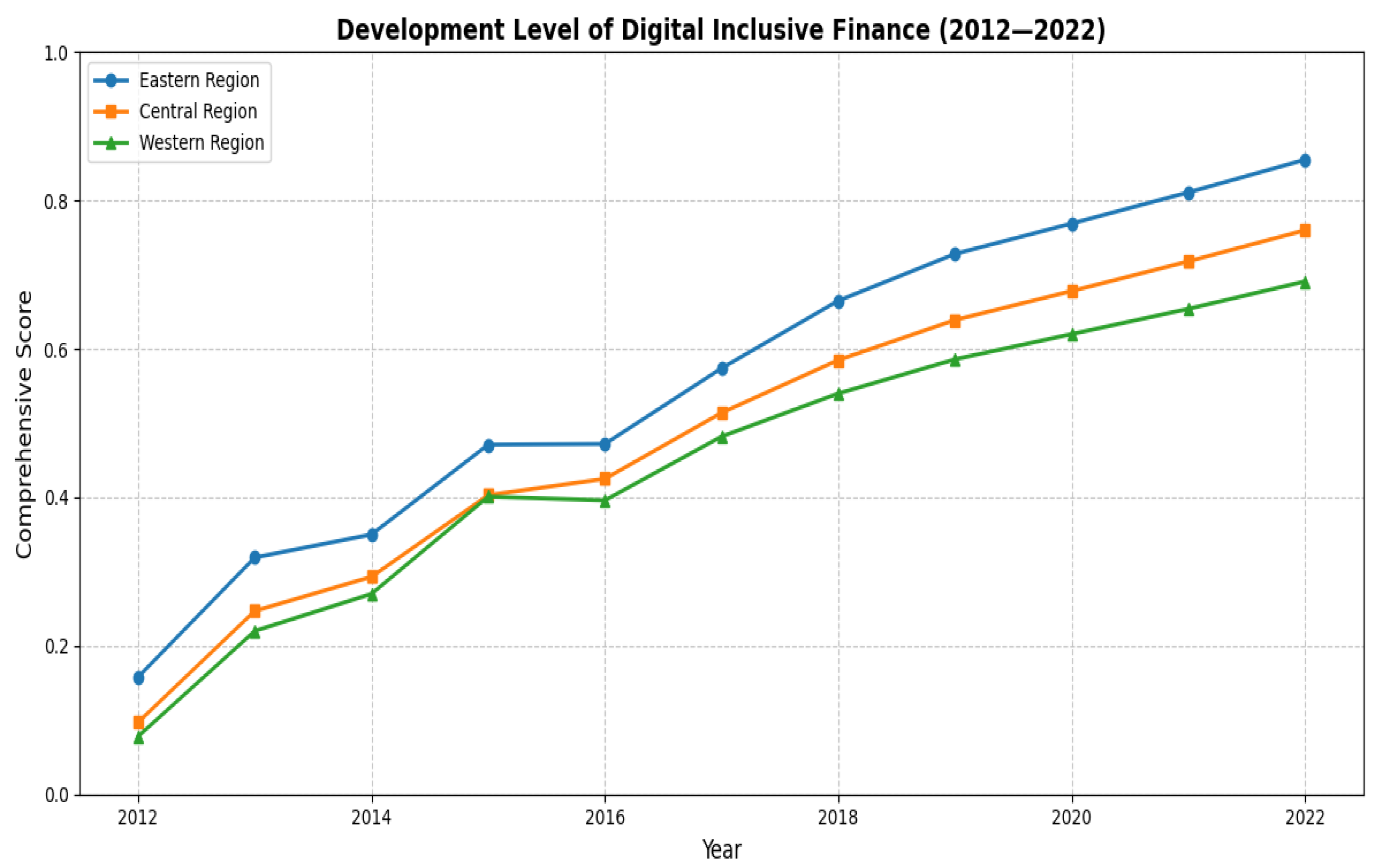
As depicted in Figure 2, the DIF development index in the eastern, central, and western regions demonstrated a steady upward trajectory from 2012 to 2022. The eastern region increased from 0.158 in 2012 to 0.855 in 2022, while the central and western regions grew from 0.097 to 0.760 and from 0.078 to 0.691, respectively. The results indicate that the western region, constrained by a relatively weaker economic foundation, lower financial capacity, and geographical remoteness, experienced slower growth in DIF development. In contrast, the eastern region, which includes major cities such as Beijing, Shanghai, and Tianjin, benefited from a stronger economic base and more robust policy support, leading to more rapid and pronounced progress in DIF.

4.2. Analysis of the Comprehensive Development Level of Digital Agriculture

By constructing a comprehensive evaluation indicator system for digital agriculture and applying the entropy method to calculate indicator weights and comprehensive scores, this study assesses the overall development level of digital agriculture across Chinese provinces. The provinces are categorized into eastern, central, and western regions for comparative analysis.
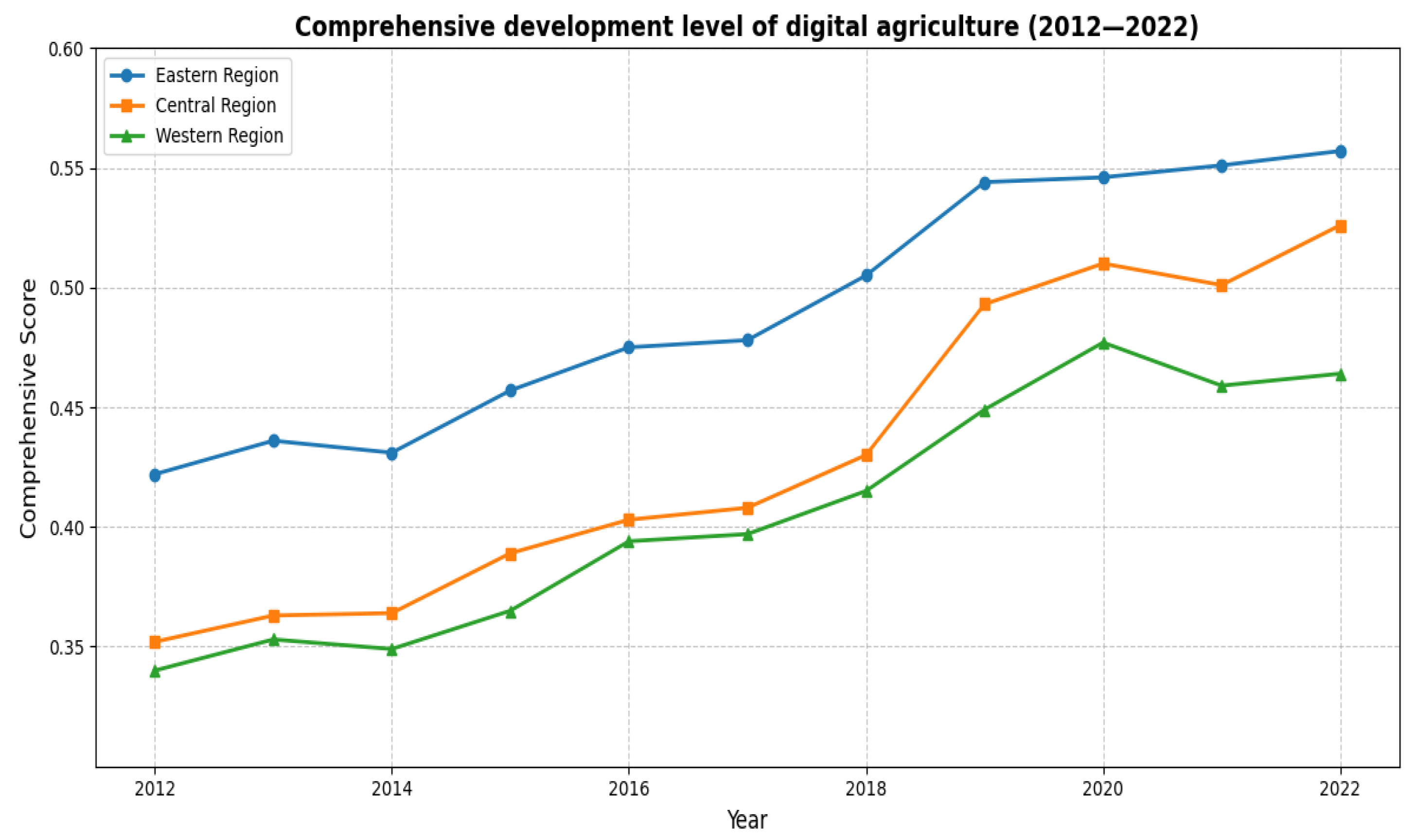
As shown in Figure 3, during the 2012–2022 period, the eastern region demonstrated relatively higher growth momentum and capacity in digital agriculture development. Starting from 0.422 in 2012, it increased to 0.557 by 2022, reflecting its advanced technological foundation and faster development pace. In contrast, the western region, constrained by limited technical talent and weaker technological capabilities, experienced slower progress, rising from 0.340 to 0.464. The central region showed moderate growth, advancing from 0.352 to 0.526 over the same period.

4.3. Coupling Coordination Analysis

In order to fully understand the coordinated development of digital agriculture and digital inclusive finance nationwide, based on the comprehensive scores of digital agriculture and digital inclusive finance, the coupling coordination is calculated. Through the analysis of the coupling coordination degree, the coordinated development of the two is analyzed. The coupling coordination degree results are presented in Table 3 and Table 4:
As indicated in Table 3, from a temporal perspective, the coupling coordination degree across Chinese provinces has shown a gradual increase, transitioning from a state of mild disorder to marginal coordination. This trend reflects, to a certain extent, the enhanced synergistic development capability between digital agriculture and digital inclusive finance in China, signifying notable progress. According to Table 4, regional disparities in the coupling coordination degree are evident. In 2022, most provinces, including northern cities such as Beijing, Tianjin, and Shanghai, as well as western regions like Guangxi and Guizhou, achieved only a barely coordinated level. In contrast, the coastal provinces of Jiangsu, Zhejiang, and Guangdong reached a primary coordination level, which can likely be attributed to their advanced technological infrastructure, supportive policies, and high-quality industrial development.

4.4. Temporal and Spatial Analysis of Digital Agriculture and Digital Inclusive Finance

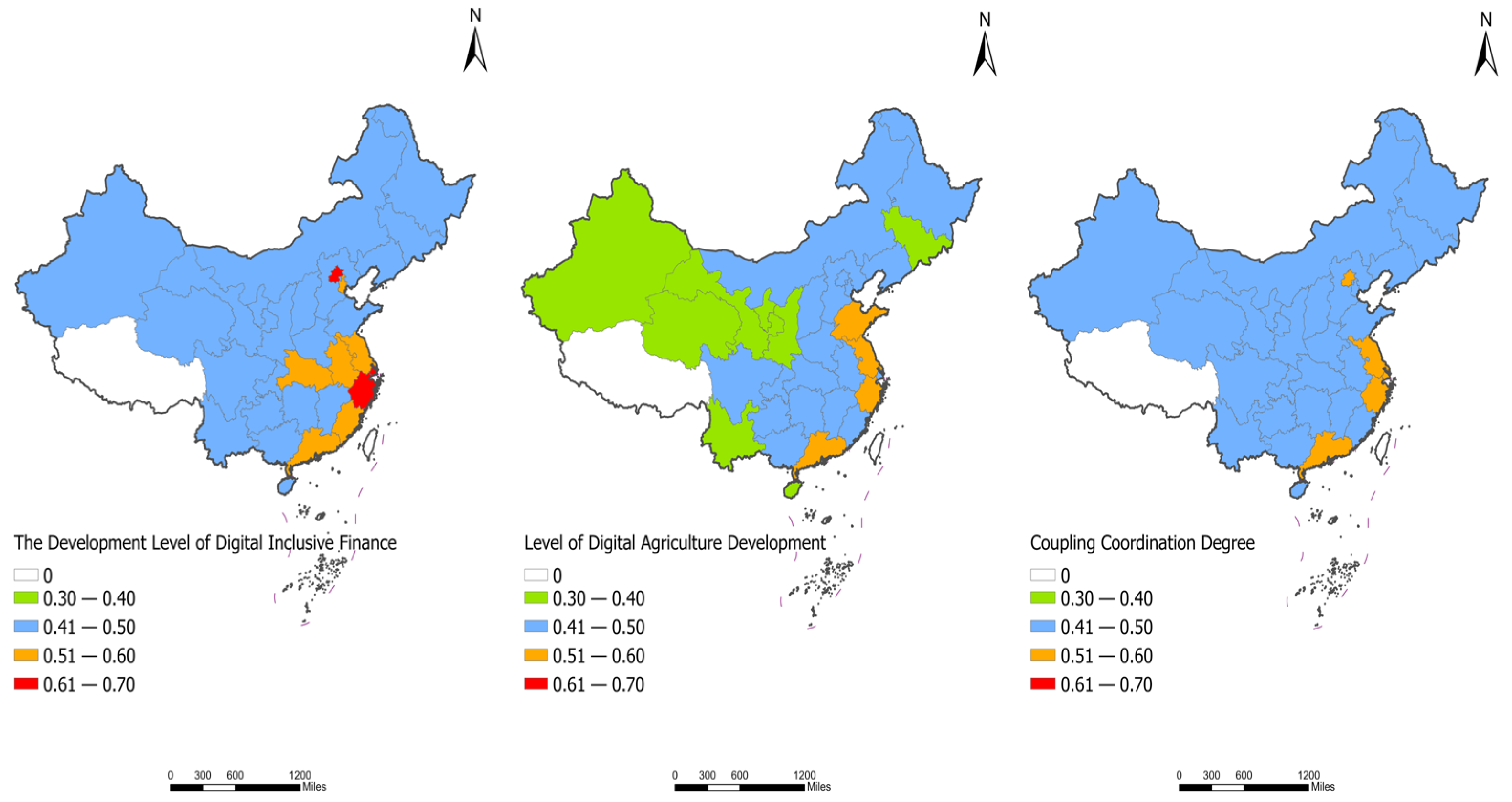
To fully understand the regional disparities in the comprehensive development levels and coupling coordination degree between digital inclusive finance (DIF) and digital agriculture, we visualized the data using ArcGIS Pro 3.5.4. As illustrated in Figure 4, a characteristic pattern of uneven regional development is evident across Chinese provinces. The graphics are as follows:
Figure 4 reveals a characteristic pattern of uneven regional development in the comprehensive development levels of digital inclusive finance (DIF) and digital agriculture across Chinese provinces. Eastern coastal regions demonstrate higher levels of DIF, with Beijing, Shanghai, and Zhejiang as frontrunners, their comprehensive scores concentrated between 0.6 and 0.7. In contrast, western provinces such as Gansu, Qinghai, and Guizhou exhibit relatively weaker development, highlighting a significant east–west disparity. A similar pattern is observed for digital agriculture, where eastern provinces like Guangdong, Shandong, and Jiangsu cluster in the 0.5–0.6 range, while western regions like Xinjiang and Ningxia fall below 0.4, underscoring the close linkage between digital agriculture development and regional economic and technological foundations.
Cross-referencing with Table 3, the national average coupling coordination degree progressed from mild dissonance to marginal coordination between 2012 and 2022, indicating that an overall coordinated state has been achieved. Specifically, eastern coastal provinces like Zhejiang, Jiangsu, and Shanghai show higher coupling coordination degrees between 0.5 and 0.6, signifying a positive interaction between DIF and digital agriculture. Western provinces such as Qinghai and Gansu remain in the 0.4–0.5 range, indicating insufficient integrated development. The primary reason for this regional divergence lies in the comprehensive technological and economic advantages of the eastern coastal areas. Although central and western regions have seen improvements driven by rural revitalization strategies, enhancing the supportive role of DIF for digital agriculture remains crucial to narrow regional gaps and promote integrated urban-rural development.

4.5. Spatial Autocorrelation Analysis of Coupling Coordination Degree

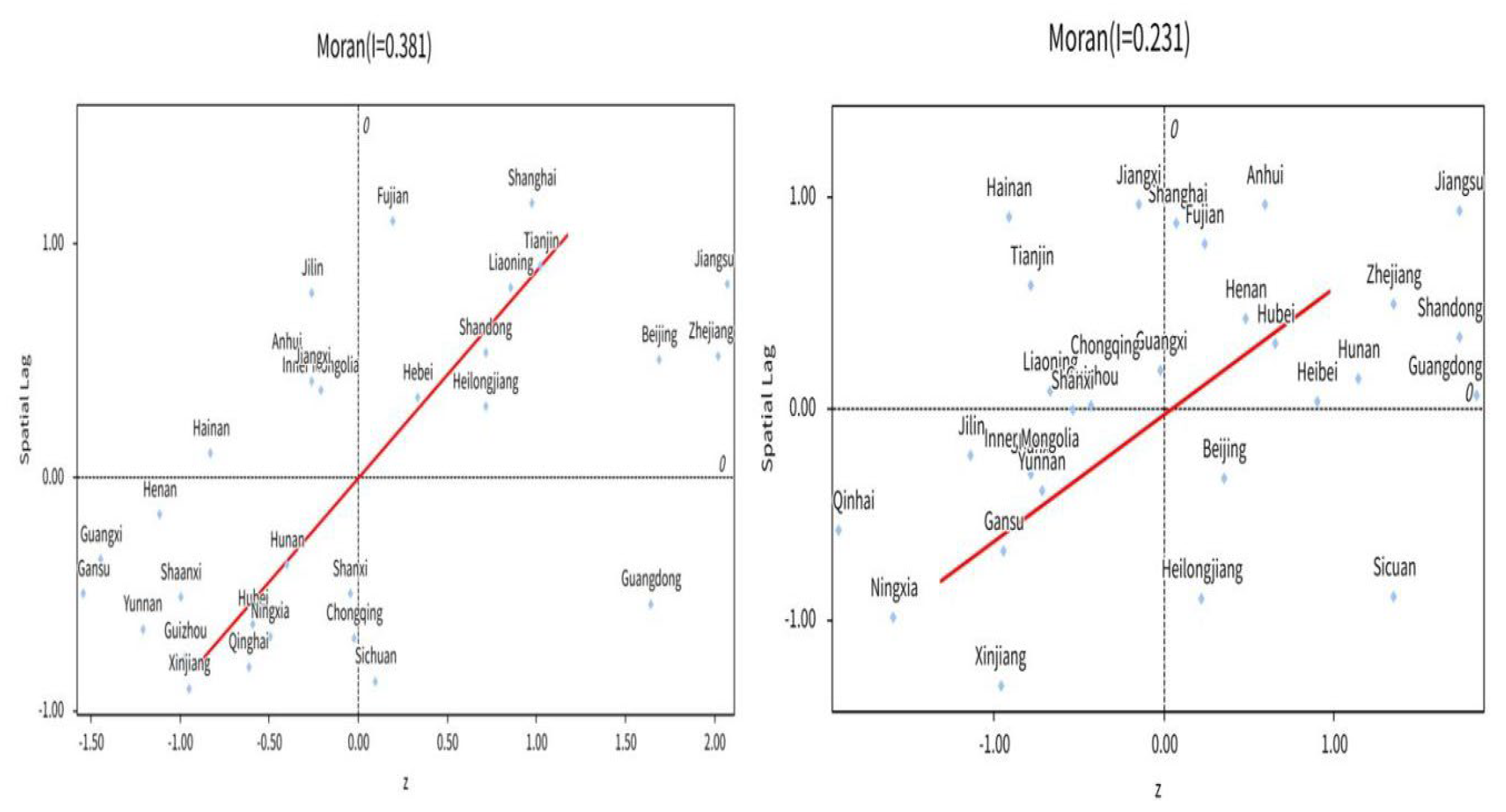
To further investigate the spatial clustering characteristics of the coupling coordination degree, Moran’s I was employed for spatial autocorrelation analysis. As summarized in Table 5, the global Moran’s I results indicate a consistent spatial pattern across the study period. The global Moran’s index results are as follows:
As indicated in Table 5, and based on two-tailed tests, the Global Moran’s I values for the coupling coordination degree were statistically significant at the 5% level with all p-values < 0.05, and corresponding Z-scores exceeding 1.96. These results confirm the presence of statistically significant positive spatial autocorrelation, indicating a consistent pattern of spatial clustering in the coordination level between digital inclusive finance and digital agriculture across the study period. The index value decreased from 0.381 in 2012 to 0.231 in 2022, signaling a weakening of positive spatial autocorrelation. While the notable decline in 2020 coincided with the COVID-19 pandemic—a potential disruptive factor—the overarching downward trend is more credibly attributed to catch-up growth in less-developed regions, which reduced the development gap with leading areas and thus diminished overall spatial clustering.
The Local Indicators of Spatial Association (LISA) results, presented in Figure 5 and Table 6, reveal distinct provincial trajectories. A significant shift occurred in coastal and central regions. For instance, Guangdong progressed from a Low-Low to a High-High cluster, and central provinces like Henan, Hubei, and Hunan also transitioned to higher coordination clusters, reflecting accelerated development and positive spillover effects, particularly from the Guangdong-Hong Kong-Macao Greater Bay Area. Conversely, western provinces (e.g., Xinjiang, Gansu, Qinghai) persistently remained in Low-Low clusters, constrained by geographic remoteness and weaker foundational conditions, which hindered positive spillovers from neighboring areas.
In summary, the spatial pattern of DIF-DA coordination is evolving from a state of fragmented, “point-based” clustering toward more integrated, “plate-based” synergy. This transition indicates a strengthening of regional coordination, providing preliminary evidence for the effectiveness of China’s national strategies aimed at fostering regionally balanced development.
The results of the Local Moran’s I and the statistical significance of spatial autocorrelation for all provinces in 2012 and 2022 are presented in Figure 5 and Table 6, respectively:

4.6. Differences in Coupling Coordination Degree Space and Source Decomposition

From the above figure, it can be seen that the level of coupling coordination in the country shows regional differences. In order to further understand the differences in coupling coordination among different regions and their underlying reasons, this article adopted the Dagum Gini coefficient to analyze the coupling coordination index. The analysis results are shown in Table 7 below:
As indicated in Table 7, the overall disparity in coupling coordination degree across China exhibited a fluctuating trend, initially decreasing before rising gradually. The calculated standard deviation of 0.012 suggests that, despite the presence of spatial disparities, the overall development remained relatively stable. In terms of the decomposition of the Gini coefficient, the mean contribution value of Inter-regional Differences was 0.014, with a standard deviation of 0.005, indicating relatively stable fluctuation in disparities between regions. Furthermore, the contribution of transvariation density showed a dynamic downward trend, implying a reduction in cross-regional overlap. Notably, in 2020, stringent COVID-19 lockdowns significantly restricted population mobility, material flow, and technological exchange between regions, nearly eliminating inter-regional interaction and overlap. Consequently, the contribution value and rate of transvariation density approached zero in that year. Finally, the mean contribution value of Intra-regional Differences was 0.020, with a standard deviation of 0.008, reflecting stable fluctuation. However, in terms of contribution rate, Intra-regional Differences accounted for as high as 55.309%, compared to the average contribution rate of Inter-regional Differences 40.102%, this higher value indicates that intra-regional disparity serves as the primary source of spatial variation in the coupling coordination degree.

4.7. Obstacle Factor Analysis

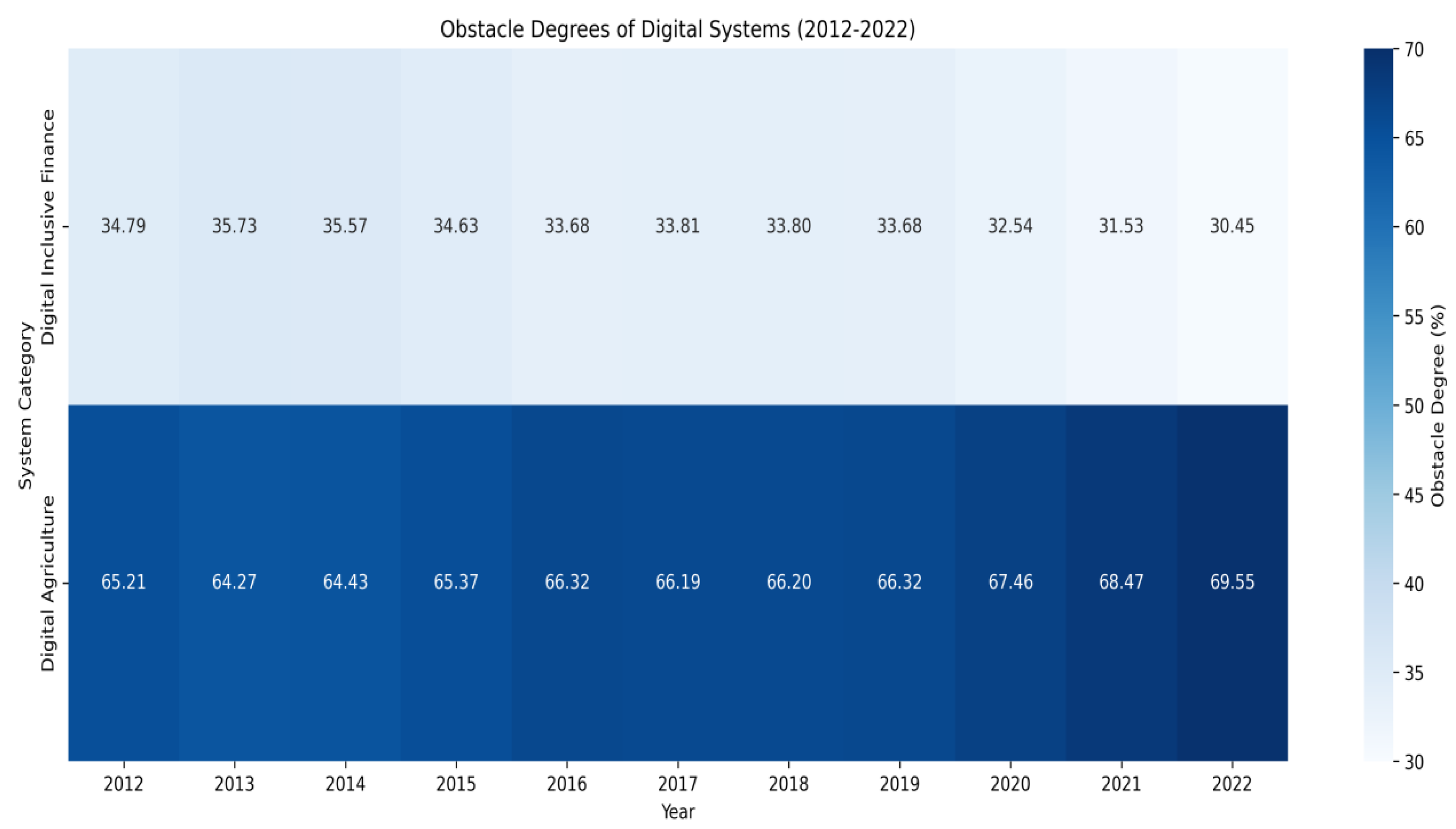
In order to further explore the main influencing factors that hinder the coupling and coordination of the development of digital agriculture and digital inclusive finance in China, this paper constructs an obstacle degree model based on the weights calculated by the entropy method, calculates the obstacle factors, and studies the obstacle factors of the target layer of the digital inclusive finance system and the digital agriculture system, as well as the top five obstacle factors ranked in the indicator layer in 2012 and 2022. The results are detailed in Table 8 and Table 9, with a corresponding heatmap of the obstacle factors provided in Figure 6:
As shown in Table 8, during the period of 2012–2022, the average obstacle degree of digital agriculture was 66.34%, significantly higher than that of digital inclusive finance, which stood at 33.66%. This indicates that digital agriculture served as the primary constraining factor in the coordinated development of the two systems. From the dynamic changes illustrated in Figure 6, the obstacle degree of digital inclusive finance exhibited a declining trend, decreasing from 34.79% to 30.45%, a drop of 4.34 percentage points, suggesting a gradual weakening of its limiting effect. In contrast, the obstacle degree of digital agriculture increased from 65.21% to 69.55%, a rise of 4.34 percentage points, indicating that its constraining effect has been intensifying. Therefore, enhancing the development level of digital agriculture should be regarded as the key to promoting the coordinated development of digital agriculture and digital inclusive finance in the future.
As indicated in Table 9, the primary factors constraining the coordinated development of DIF and digital agriculture are the Usage Depth of DIF (A2) and the Agricultural Producer Price Index (E3). The obstacle degree of A2 increased significantly from 41.24% in 2012 to 59.46% in 2022, a trend observed across eastern, central, and western regions. This points to a core demand-side bottleneck: a persistent digital literacy gap, particularly among the elderly rural population, coupled with entrenched trust in traditional financial channels, severely limits the effective adoption of digital financial tools. Meanwhile, the obstacle ranking of E3 rose sharply, entering the top five nationally by 2022, highlighting it as a key constraint on industrial efficiency. The rising prominence of Agricultural Carbon Emissions (F2) concurrently reflects growing pressures for sustainable agricultural development.
Conceptually, these factors impede coordination through defined pathways. Price volatility (E3) increases operational risk and uncertainty, directly dampening farmers’ willingness and capacity for long-term investment in digital technologies, thereby slowing DA adoption. This, in turn, hampers the advancement of technology-driven green agriculture, potentially exacerbating environmental pressures (F2). Concurrently, the low usage depth of DIF (A2) breaks a potential virtuous cycle: inadequate digital skills prevent agricultural data from effectively informing financial services, while underutilized financial tools fail to sufficiently support agricultural modernization.
Therefore, targeted interventions should prioritize enhancing the practical usability of DIF, stabilizing agricultural markets to mitigate price risks, and accelerating the transition to green production. Addressing these interconnected obstacles is crucial for fostering deeper integration between digital agriculture and inclusive finance.

5. Discussion

This study empirically validates the proposed hypotheses, confirming significant spatial heterogeneity (H1), identifying key obstacles (H2), and demonstrating a positive developmental trajectory (H3) in the DIF-DA synergy. Our confirmation of H1 aligns with regional disparity patterns observed by Liu et al. [3], yet the persistent spatial autocorrelation challenges assumptions of rapid convergence through policy diffusion alone [2,33]. The finding that intra-regional differences are the primary source of overall variation (55.31%) extends the work of Shen Yan [49], underscoring that provincial-level institutional and economic factors are more critical than macro-regional policies in shaping outcomes. This suggests that the self-reinforcing advantages of eastern regions—such as agglomeration economies and advanced infrastructure—create a development gradient that is not easily mitigated by blanket national strategies, supporting a more nuanced view of regional coordination.
Furthermore, the validation of H2 and H3 contextualizes prior findings on the DIF-DA relationship. The identification of DIF Usage Depth (A2) as the foremost obstacle substantiates concerns about demand-side barriers [14,15], moving the focus beyond the common emphasis on supply-side infrastructure [35]. This suggests that the positive correlation reported by Azam [41] may be stronger in contexts where usage bottlenecks are overcome, particularly in central and western China. The upward trend in coordination (H3) corroborates the positive assessment of Chen Boqiang [40], but the divergent regional growth rates underlying it reveal a pattern of conditional synergy, challenging narratives of uniform benefit. Thus, the synergy is not automatic but depends heavily on localized capacities to transform financial and digital inputs into tangible outcomes, a critical boundary condition highlighted by this study.

6. Conclusions and Suggestions

6.1. Research Findings

With the advancement of digital inclusive finance (DIF), its coordinated development with digital agriculture has become increasingly interconnected. To thoroughly investigate their coordination status and identify constraining factors, this study employs raw indicator data from 2012 to 2022, constructs an evaluation system using the entropy method to determine weights, and establishes coupling coordination degree and obstacle degree models. Moran’s I and the Dagum Gini coefficient are further applied to analyze spatial characteristics and regional disparities. The main findings are as follows:
First, the average comprehensive development levels of both DIF and digital agriculture in the eastern, central, and western regions showed steady growth from 2012 to 2022. In terms of DIF, the eastern region increased from 0.158 in 2012 to 0.855 in 2022, the central region rose from 0.097 to 0.760, and the western region grew from 0.078 to 0.691. Eastern coastal provinces such as Beijing, Shanghai, and Zhejiang led the way, while western provinces lagged, revealing a significant east–west gap. Similarly, in digital agriculture, the eastern region advanced from 0.422 to 0.557, the central region from 0.352 to 0.526, and the western region from 0.340 to 0.464. Eastern provinces like Guangdong and Jiangsu scored between 0.5 and 0.6, whereas western provinces remained below 0.4. This disparity is attributed to the western region’s relatively weaker economic foundation, remote location, and shortage of technical talent and infrastructure, contrasting with the eastern region’s robust economy, advanced technology, and well-developed infrastructure.
Second, temporally, the coupling coordination degree across provinces consistently increased from 2012 to 2022, progressing from mild dissonance to marginal coordination, reflecting notable improvement in the synergistic development of DIF and digital agriculture. Despite overall progress, regional disparities persist. Eastern coastal provinces such as Zhejiang, Jiangsu, and Shanghai achieved higher coordination degrees (0.5–0.6), indicating marginal coordination and positive interaction between the two systems. In contrast, western provinces like Qinghai and Gansu remained in the 0.4–0.5 range, nearing dissonance. Intra-regional differences are identified as the primary cause of these disparities. While central and western regions have benefited from rural revitalization strategies, enhancing DIF’s supportive role in digital agriculture remains essential for integrated development. Overall, national regional coordination strategies have begun to yield results, with the coupling coordination degree strengthening and the development pattern transitioning from “point-based agglomeration” to “regional block linkage,” indicating continuous improvement in integrated development capacity.
Finally, despite initial achievements, several obstacles hinder the integrated development of DIF and digital agriculture. Key constraints include the actual usage efficiency of DIF, the agricultural producer price index, and agricultural CO2 emissions. Regionally, the degree of DIF’s usage depth has risen across eastern, central, and western regions, with the most significant impact in central and western China. In 2022, the agricultural producer price index and agricultural CO2 emissions also ranked among the top obstacles. Therefore, improving the practical usage rate of DIF, stabilizing agricultural markets, and promoting green transformation in agricultural production remain critical priorities for future development.

6.2. Suggestion

First, Implement Differentiated Regional Strategies to Precisely Address Coordination Bottlenecks. Findings from obstacle degree and regional disparity analyses reveal that effective coordination requires region-specific policies. For central and western regions, where the obstacle presented by the Usage Depth of Digital Inclusive Finance (DIF) is primary and rising, the focus must shift from hardware investment to tackling demand-side bottlenecks. This involves establishing provincial funds for tailored digital literacy programs targeting farmers and the elderly, and incentivizing local financial institutions to develop products linked to agricultural IoT data. For the eastern region, which has reached a barely coordinated level, policy should leverage its advanced position by supporting pilots that deeply integrate finance with smart agriculture and establishing technology transfer platforms to diffuse innovations westward.
Second, Deepen Systemic Integration to Build a Virtuous Cycle. Spatiotemporal analysis of the coupling coordination degree shows a progression towards marginal coordination, yet deeper integration is needed. Data should serve as the critical link for bidirectional empowerment. Financial institutions should be encouraged to develop credit models based on agricultural data flows, while digital agriculture projects should standardize and feed data on yields and emissions back to finance. This builds a closed loop where agricultural data empowers financial services, and financial resources nurture agricultural modernization.
Third, Execute Targeted Policies to Mitigate Key Obstacles. Actions must align with identified constraints. To improve DIF Usage Depth, prioritize user-friendly design and blended training. To stabilize the Agricultural Producer Price Index, enhance market information and develop price insurance. To reduce Agricultural Carbon Dioxide Emissions, promote smart irrigation and explore carbon sink markets. These targeted measures are crucial for synergistic development.

6.3. Limitations and Future Research

This study investigates the coupled and coordinated development between digital inclusive finance and digital agriculture in rural China from 2012 to 2022. It innovatively constructs evaluation index systems for both domains, employs a suite of analytical tools and multidimensional visualization techniques to establish a coupling coordination degree model and an obstacle degree model, and reveals the bidirectional coupling relationship, spatiotemporal evolution patterns, regional heterogeneity, and underlying obstacle factors. The study provides a clear macro-regional analytical framework for understanding the synergistic development and dynamics of digital agriculture and digital inclusive finance. While offering theoretical depth and practical relevance, this research has certain limitations. Due to data availability constraints, the constructed evaluation index systems do not fully encompass all relevant dimensions. For instance, micro-level aspects such as the quality of digital services and subjective perceptions of farmers are not captured. Furthermore, while the provincial-level analysis uncovers macro patterns, it cannot elucidate the micro-level mechanisms at the household or enterprise level, making it difficult to capture granular dynamics.
Future studies could therefore employ methods such as field surveys or in-depth case study analysis to gain more profound insights. Extending the temporal scope of the research would also help verify the persistence of the observed trends. Thus enabling longitudinal and micro-level research.

Author Contributions

Writing—original draft manuscript, L.H.; data curation, L.H.; Writing—review and editing, J.W., J.L. and D.H.; Visualization, J.L.; Funding acquisition, J.W. All authors have read and agreed to the published version of the manuscript.

Funding

This research was supported by the project “Guangxi People’s Congress Theoretical Research Association” (Grant Number: 25RDA004). Project Title: Research on Local People’s Congresses in Supporting the Safeguarding and Improvement of People’s Livelihood. Project Level: Provincial/Ministerial-Level Key. Project Program Type: Guangxi Philosophy and Social Science Planning Project.

Data Availability Statement

The raw data supporting the conclusions of this article will be made available by the authors on request.

Acknowledgments

The authors would like to extend their sincere gratitude to all teachers, editors, and classmates for their invaluable support and assistance throughout this research.

Conflicts of Interest

The authors declare that the research was conducted in the absence of any commercial or financial relationships that could be construed as a potential conflict of interest.

Appendix A

Table A1. Model fitting effect.
RR SideAdjusted R-SquareDW
0.9520.9060.9060.703
Note: the adjusted R-squared is 0.906, indicating a good model fit where approximately 90.6% of the variation in the provincial-level Digital Inclusive Finance index (U1) is jointly explained by the Digital Agriculture index (U2) and the year fixed effects. This result confirms the rationale for including year as a fixed effect, as the temporal trend plays a significant role in driving changes in U1.
Table A2. Multicollinearity Test.
ProjectVIFTolerance
Digital Agriculture U21.9050.525
Fixed effect year1.9050.525
Table A3. Pearson correlation test.
Relevance
DIF U1Digital Agriculture U2
DIF U1Pearson correlation10.775 **
Significance (dual tailed) 0.000
Sum of squares and cross product14.2353.780
covariance0.0430.011
Number of cases330330
Digital Agriculture U2Pearson correlation0.775 **1
Significance (dual tailed)0.000
Sum of squares and cross product3.7801.673
covariance0.0110.005
Number of cases330330
** At the 0.01 level (double tailed), the correlation is significant.

References

  1. Tuo, F. The Mechanism, Challenges, and Suggestions of Digital Inclusive Finance Promoting the Development of Common Prosperity. Bus. Obs. 2025, 11, 95–98. [Google Scholar]
  2. Wu, Z.; Ye, Q. Inclusive Finance, Digital Economy, and Rural Revitalization: Innovative Research on Rural Financial System under Three Dimensional Interaction. Shanxi Agric. Econ. 2025, 21, 221–223. [Google Scholar] [CrossRef]
  3. Liu, Y.; Ma, C. Research on the Coordinated Development and Impact of Digital Inclusive Finance and Digital Agriculture Coupling. J. Shanxi Agric. Univ. (Soc. Sci. Ed.) 2024, 23, 48–62. [Google Scholar] [CrossRef]
  4. Huang, S.; Wang, T.; Liu, Y.; Zheng, P.; Yu, Z.; Guo, Y.; Feng, Y. Research on Countermeasures for the Development of Digital Agriculture Economy in Jilin Province in the Era of Artificial Intelligence. Northeast Agric. Sci. 2021, 1–10. [Google Scholar]
  5. Liu, H. Strategic thinking and work measures to accelerate the transformation of China from an agricultural power to an agricultural powerhouse. China Agric. Resour. Zoning 2020, 41, 7–11. [Google Scholar]
  6. Zhang, C.; Ma, Y.; Zhong, L.; Tian, Y. The Development Challenges and Enhancement Strategies of Digital Agriculture under the Background of Rural Revitalization. New Farmers 2025, 26, 4–6. [Google Scholar]
  7. Gong, Y.; Xiao, Y.; Pang, H. Land transfer, digital inclusive finance, and urban-rural income gap. J. Shanxi Agric. Univ. (Soc. Sci. Ed.) 2024, 23, 71–81. [Google Scholar] [CrossRef]
  8. Wen, Z. Research on the Integrated Development of Digital Inclusive Finance and Digital Agriculture. Qinghai Financ. 2024, 09, 11–18. [Google Scholar] [CrossRef]
  9. Wang, C. Research on digital inclusive finance to alleviate financing constraints for small and medium-sized enterprises. Knowl. Econ. 2025, 32, 57–61. [Google Scholar] [CrossRef]
  10. Guo, L.; Cao, N.; Cai, Q. The Impact and Mechanism of Digital Inclusive Finance on Agricultural Investment and Financing. Econ. Issues 2025, 11, 71–82. [Google Scholar] [CrossRef]
  11. Qi, W.; Sui, Y. Research on the Impact of Digital Inclusive Finance Empowering High Quality Agricultural Development: Based on the Mediating Effect of Agricultural Industry Structure Upgrading. Res. World 2025, 10, 74–85. [Google Scholar] [CrossRef]
  12. Han, T.; Xi, D. Research on Digital Inclusive Finance Promoting Agricultural Economic Development. Agric. Econ. 2025, 7, 101–103. [Google Scholar] [CrossRef]
  13. Qu, L. Research on the Impact of Digital Inclusive Finance on Rural Residents’ Income. Master’s Thesis, Party School of the Heilongjiang Provincial Committee of the Communist Party of China, Harbin, China, 2025. [Google Scholar] [CrossRef]
  14. Guo, X. The Impact of Digital Inclusive Finance on Labor Market Integration. China Collect. Econ. 2025, 32, 121–124. [Google Scholar] [CrossRef]
  15. Si, M.; Tang, J.; Gu, T. Research on the Impact of Digital Inclusive Finance on Rural Youth Employment under the Background of Common Prosperity: Micro evidence Based on China Household Finance Survey. Shanxi Agric. Econ. 2025, 20, 221–223. [Google Scholar] [CrossRef]
  16. Lin, Q. Research on the Impact of Digital Inclusive Finance on Income Growth of Flexible Employers: An Analysis of the Mediating Effect Based on Working Hours. Bus. Dev. Econ. 2025, 20, 125–129. [Google Scholar] [CrossRef]
  17. Akpa, F.A. Addressing jobs generation in a post-crisis context: The effect of digital financial inclusion on agricultural jobs in Sub-Saharan Africa. SN Soc. Sci. 2025, 5, 95. [Google Scholar] [CrossRef]
  18. Faton, Y.C.; Nonvide, A.M.G.; Chabossou, F.A. Digital financial inclusion and the reduction of gender inequalities in Africa. Discov. Glob. Soc. 2025, 3, 25. [Google Scholar] [CrossRef]
  19. Agyei, A.; Baah, G.; Anowuo, I.; Yeboah, E.O.; Peparah, W.K. Policy strategies for balancing digital financial inclusion with environmental sustainability and economic growth: Lessons for sustainable development in Sub-Saharan African economies. Sustain. Futures 2025, 10, 101503. [Google Scholar] [CrossRef]
  20. Dinh, Q.L. The optimal inflation threshold in digital financial inclusion: A key to sustainable development. SN Bus. Econ. 2025, 5, 40. [Google Scholar] [CrossRef]
  21. Amin, H.M.; Toshitsugu, O. The role of Islamic FinTech in digital financial inclusion and sustainable development post covid-19: Cross-country analysis. Int. J. Islam. Middle East. Financ. Manag. 2025, 18, 649–671. [Google Scholar] [CrossRef]
  22. Nuermaimaiti, M. Fintech Enabled Development of Digital Financial Inclusion: Evidence from Agricultural Bank of China. Sci. J. Econ. Manag. Res. 2025, 7, 83–89. [Google Scholar] [CrossRef]
  23. Sun, J. Digital Agriculture—A New Agricultural Model for the 21st Century. Rural. Econ. 2002, 5, 1–3. [Google Scholar]
  24. Chen, J.; Shi, S.; Hou, J.; Xu, J. The Development of Digital Agriculture and Agricultural Machinery in China. Mech. Res. 2005, 3, 21–23. [Google Scholar] [CrossRef]
  25. Han, X.; Liu, C.; Liu, H. Theoretical logic and practical path of promoting rural industrial transformation through digitalization of the entire agricultural chain. Reform 2023, 3, 121–132. [Google Scholar]
  26. Tsagdis, G. Digital Agroecology and the Inhuman: Paradigm Crossroads. J. Agric. Environ. Ethics 2025, 38, 21. [Google Scholar] [CrossRef]
  27. Sirilakshmi, Y.; Gogoi, P.B.; Ashwini, T.; Khongsai, V. Transforming Indian Agriculture: The Emerging Era and Benefits of Digital Agriculture. J. Exp. Agric. Int. 2025, 47, 51–61. [Google Scholar] [CrossRef]
  28. Finger, R. Sustainable crop protection and the role of digital agriculture. Agric. Syst. 2026, 231, 104516. [Google Scholar] [CrossRef]
  29. McBratney, A.; Park, M. Agriculture over the Horizon: A Synthesis for the Mid-21st Century. Sustainability 2025, 17, 9424. [Google Scholar] [CrossRef]
  30. Furuya, D.E.G.; Bolfe, É.L.; da Silveira, F.; Barbedo, J.G.A.; da Silva, T.L.; Romani, L.A.S.; Castanheiro, L.F.; Gebler, L. Hail Netting in Apple Orchards: Current Knowledge, Research Gaps, and Perspectives for Digital Agriculture. Climate 2025, 13, 203. [Google Scholar] [CrossRef]
  31. Quintino, D.D.; Costa, D.S.J.; Leme, V.M.H.P. Digital Agriculture and Food Inflation in Brazil: A Critical Assessment. World 2025, 6, 116. [Google Scholar] [CrossRef]
  32. Milian Gómez, J.F.; Byttebier, K. Agroecological sustainability: Exploring the intersection of digital agriculture, ethics and the right to food. Discov. Agric. 2025, 3, 91. [Google Scholar] [CrossRef]
  33. Wang, L.; Zhang, Z. Coordinated Development of Digital Agriculture; Economic Daily: Beijing, China, 2025; p. 5. [Google Scholar] [CrossRef]
  34. Fei, G.; Zhou, Y. The Development Status and Reflection of Digital Agriculture in China from an International Perspective. Village Comm. Dir. 2024, 18, 106–108. [Google Scholar]
  35. Wang, H.; Huang, M.; Wu, H. Research Progress and Prospects of Digital Agriculture in China. J. China Agric. Univ. 2025, 30, 364–380. [Google Scholar]
  36. Husain, A.; Rehmat, A. Digital Agriculture and Information and Communication Technology for Ensuring Sustainable Development in India: A Review. Asian J. Agric. Ext. Econ. Sociol. 2025, 43, 249–258. [Google Scholar] [CrossRef]
  37. Silva, B.C.d.; Prado, R.d.M.; Campos, C.N.S.; Baio, F.H.R.; Teodoro, L.P.R.; Teodoro, P.E.; Santana, D.C. Applicability of Technological Tools for Digital Agriculture with a Focus on Estimating the Nutritional Status of Plants. AgriEngineering 2025, 7, 161. [Google Scholar] [CrossRef]
  38. Jia, L. Research on the Impact of Digital Agriculture on Rural Inclusive Finance from the Perspective of Asymmetric Information. Master’s Thesis, Henan Agricultural University, Zhengzhou, China, 2024. [Google Scholar] [CrossRef]
  39. Hu, C. The Mechanism and Empirical Study of the Impact of Digital Inclusive Finance on the Development of Digital Agriculture. Master’s Thesis, Jiangxi University of Finance and Economics, Nanchang, China, 2023. [Google Scholar] [CrossRef]
  40. Chen, B. Research on the Impact of Digital Inclusive Finance on Agricultural Digital Transformation. Master’s Thesis, Hunan Agricultural University, Changsha, China, 2024. [Google Scholar] [CrossRef]
  41. Sun, L.; Zhu, C. Impact of Digital Inclusive Finance on Rural High-Quality Development: Evidence from China. Discret. Dyn. Nat. Soc. 2022, 2022, 7939103. [Google Scholar] [CrossRef]
  42. Shen, Y. Research on the Impact of Digital Inclusive Finance on Economic Growth. Ph.D. Thesis, Xi’an University of Technology, Xi’an, China, 2021. [Google Scholar] [CrossRef]
  43. Ogunseye, A.H.; Tijani, O.Y.; Oloniiju, D.S.; Otegbeye, O.; Agbaje, T.M. Entropy generation in Casson-Williamson-Powell-Eyring hybrid ferrofluid flow in a microchannel: Adomian decomposition and deep neural networks approaches. Colloid Polym. Sci. 2025, 303, 813–830. [Google Scholar] [CrossRef]
  44. Xie, C.; Hu, W.; Huang, K. Research on the Comprehensive Evaluation of Tourism Competitiveness of Island Counties in China. Ocean. Dev. Manag. 2023, 40, 78–86. [Google Scholar] [CrossRef]
  45. Sun, H. Research on Empowering Rural Revitalization with Digital Economy. Master’s Thesis, Nanchang University, Nanchang, China, 2024. [Google Scholar] [CrossRef]
  46. Deng, F.; Wang, Z. Construction and Measurement of Evaluation Index System for High Quality Development of Sports Goods Manufacturing Industry: A Case Study of Henan Province. Sci. Ind. 2025, 25, 176–182. [Google Scholar]
  47. Yang, K. Research on the Degree of Coupling and Coordination Between Digital Finance and High-Quality Economic Development, and Its Influencing Factors: From the Perspective of Government Intervention. Master’s Thesis, Qufu Normal University, Qufu, China, 2025. [Google Scholar] [CrossRef]
  48. Niu, F. Research on the Driving Mechanism and Path of Collaborative Development of Digital Economy and New Quality Productivity: Coupling Coordination and Correlation Analysis Based on Shaanxi Province. China Bus. Rev. 2025, 34, 132–136. [Google Scholar] [CrossRef]
  49. Liao, C. Quantitative Evaluation and Classification System for the Coordinated Development of Environment and Economy—A Case Study of the Pearl River Delta Urban Agglomeration. Trop. Geogr. 1999, 2, 76–82. [Google Scholar] [CrossRef]
  50. Xu, X.; Chen, Y. The Impact of Financial Regulation on Regional Economic Resilience: An Empirical Analysis Based on the Spatial Durbin Model. New Econ. 2025, 10, 99–117. [Google Scholar]
  51. Huangfu, H.; Li, H.; Hao, M.; Li, C. Regional disparities and dynamic evolution analysis of primary healthcare resource allocation in China under the background of high-quality development: Based on Dagum Gini coefficient decomposition and kernel density estimation. China Health Policy Res. 2025, 18, 57–66. [Google Scholar]
Figure 1. Relationship diagram between digital inclusive finance and digital agriculture.
Agriculture 16 00144 g001
Figure 2. Comprehensive score of digital inclusive finance.
Agriculture 16 00144 g002
Figure 3. Comprehensive score of digital agriculture.
Agriculture 16 00144 g003
Figure 4. Comprehensive score and coupling coordination of digital agriculture and digital inclusive finance.
Agriculture 16 00144 g004
Figure 5. Local Moran’s index scatter plot.
Agriculture 16 00144 g005
Figure 6. Obstacle factor heatmap.
Agriculture 16 00144 g006
Table 1. Indicator System for Digital Agriculture and Digital Inclusive Finance.
Target LayerFirst-Level IndicatorSecondary IndicatorProperty IndicatorsWeight
Development level of digital inclusive financeCoverage breadth A1 +0.347
Using Depth A2 +0.424
Digitization level A3 +0.229
Development level of digital agricultureThe level of technological progress in digital agricultureTotal power of agricultural machinery B1+0.058
Rural power consumption B2+0.054
Effective irrigated area B3+0.050
Construction of Digital Agriculture InfrastructureNumber of Internet access users C1+0.085
Proportion of administrative villages opening Internet broadband services C2+0.054
Total number of mobile phone users C3+0.059
Cultivation of digital agriculture talentsPer capita expenditure on education, culture, and entertainment in rural areas D1+0.072
Proportion of higher education population D2 +0.077
Average salary level of employees in agriculture, forestry, animal husbandry and fishery D3+0.070
Benefit situation of digital agriculture industryTotal output value of agriculture, forestry, animal husbandry and fishery E1+0.072
Total grain output E2 +0.038
Agricultural Product Production Price Index E3+0.090
Digital Agriculture Ecological Green DevelopmentApplication rate of agricultural fertilizers F10.113
Agricultural carbon dioxide emissions F20.107
Table 2. Distribution of Coupling Coordination Levels.
Coupling Coordination DegreeLevelCoupling Coordination DegreeLevel
(0, 0.1)Extreme imbalance[0.5, 0.6)Barely coordination
[0.1, 0.2)Serious imbalance[0.6, 0.7)Junior coordination
[0.2, 0.3)Moderate imbalance[0.7, 0.8)Intermediate coordination
[0.3, 0.4)Mild disorder[0.8, 0.9)Good coordination
[0.4, 0.5)On the brink of imbalance[0.9, 1.0)Highly coordinated
Table 3. Coupling Coordination Degree.
Region20122013201420152016201720182019202020212022
Beijing0.3860.4550.4600.4960.5010.5230.5510.5800.5790.5820.593
Tianjin0.3560.4180.4220.4730.4770.4960.5180.5330.5430.5540.551
Hebei0.3040.3940.4010.4430.4490.4770.5020.5210.5370.5540.563
Shanxi0.3090.3880.3980.4390.4480.4690.4900.5110.5160.5240.533
Inner Mongolia0.3010.3830.3990.4430.4510.4650.4790.4990.5100.5210.524
Liaoning0.3260.4030.4210.4650.4610.4750.4950.5100.5170.5310.536
Jilin0.2920.3720.3910.4400.4360.4570.4840.4970.5120.5230.521
Heilongjiang0.3040.3900.4130.4570.4590.4830.5000.5190.5300.5380.540
Shanghai0.3800.4580.4640.4990.5040.5320.5550.5720.5840.5880.596
Jiangsu0.3610.4370.4510.4950.5010.5260.5560.5810.5900.5910.602
Zhejiang0.3890.4530.4610.5010.5040.5320.5600.5850.5890.5930.605
Anhui0.3110.3890.4110.4460.4570.4820.5070.5330.5500.5590.572
Fujian0.3470.4180.4280.4680.4730.4970.5230.5440.5500.5670.577
Jiangxi0.3050.3840.4060.4440.4530.4750.4980.5260.5380.5430.557
Shandong0.3220.4100.4250.4710.4760.5020.5250.5510.5620.5760.589
Henan0.2790.3710.3900.4330.4440.4660.4920.5300.5420.5490.564
Hubei0.3120.3970.4130.4530.4640.4900.5120.5390.5510.5570.571
Hunan0.3060.3910.4060.4540.4610.4880.5040.5390.5550.5520.575
Guangdong0.3670.4360.4450.4850.4890.5180.5470.5720.5800.5900.601
Guangxi0.2880.3700.3870.4360.4470.4690.4890.5180.5300.5310.546
Hainan0.3170.3860.4030.4480.4480.4720.4940.5120.5210.5300.537
Chongqing0.3130.3970.4130.4510.4640.4810.5000.5240.5350.5410.553
Sichuan0.3210.3970.4080.4610.4710.4970.5210.5460.5580.5590.575
Guizhou0.2670.3530.3900.4380.4510.4710.4820.5090.5250.5120.528
Yunnan0.2860.3680.3810.4270.4420.4630.4850.5060.5240.5200.531
Shaanxi0.3050.3800.4010.4410.4460.4690.4920.5150.5280.5310.548
Gansu0.2660.3550.3780.4230.4260.4570.4690.4970.5050.5130.520
Qinghai0.2100.3530.3730.4270.4290.4530.4690.4870.5040.4990.500
Ningxia0.2830.3660.3890.4380.4340.4580.4770.4840.5010.5070.510
Xinjiang0.2810.3860.3890.4280.4350.4580.4810.4850.5090.5250.519
Mean0.3130.3950.4110.4540.4600.4830.5050.5270.5390.5450.555
Table 4. Coupling and coordination degree of each province in 2022.
NumberD ValueCoordination LevelProvince
1(0, 0.1)Extreme imbalance
2[0.1, 0.2)Serious imbalance
3[0.2, 0.3)Moderate imbalance
4[0.3, 0.4)Mild disorder
5[0.4, 0.5)On the brink of imbalance
6[0.5, 0.6)Barely coordinationBeijing, Tianjin, Hebei, Shanxi, Inner Mongolia, Liaoning, Jilin, Heilongjiang, Shanghai, Anhui, Fujian, Jiangxi, Shandong, Henan, Hubei, Hunan, Guangxi, Hainan, Chongqing, Sichuan, Guizhou, Yunnan, Shaanxi, Gansu, Qinghai, Ningxia, Xinjiang
7[0.6, 0.7)Junior coordinationJiangsu, Zhejiang, Guangdong
8[0.7, 0.8)Intermediate coordination
9[0.8, 0.9)Good coordination
10[0.9, 1.0)Highly coordinated
Table 5. Global Moran Index.
YearI Valuep ValueZ Value
20120.3810.00363.698
20130.3050.0013.022
20140.2680.0042.692
20150.3410.00283.346
20160.2630.0042.652
20170.2070 0.0162.151
20180.1930.0212.025
20190.1810.0271.923
20200.1320.00011.481
20210.2080 0.0152.160
20220.2310.0092.363
Table 6. Statistical significance of spatial autocorrelation in each province of China in 2012 and 2022.
Quadrant20122022
First QuadrantBeijing, Tianjin, Hebei, Liaoning, Heilongjiang, Shanghai
Jiangsu, Zhejiang, Fujian, Shandong
Hebei, Shanghai, Jiangsu, Zhejiang, Fujian, Shandong, Henan, Hubei, Hunan, Guangdong
Beta Quadrant Jilin, Anhui, Jiangxi, HainanTianjin, Liaoning, Jiangxi, Guangxi, Hainan, Chongqing, Guizhou
The third QuadrantInner Mongolia, Henan, Hubei, Hunan, Guangxi, Chongqing
Guizhou, Yunnan, Shaanxi, Gansu, Qinghai
Ningxia, Xinjiang
Shanxi, Inner Mongolia, Jilin, Yunnan, Shaanxi, Gansu, Qinghai, Ningxia, Xinjiang
Delta Quadrant Guangdong and SichuanBeijing, Heilongjiang, Sichuan
Table 7. Overall Differences and Decomposition of Coupling Coordination Degree from 2012 to 2022.
YearOverall DifferencesIntra-Regional DifferencesInter-Regional DifferencesHypervariable Density
Contribution ValueContribution RateContribution ValueContribution RateContribution ValueContribution Rate
20120.070.041556.08%0.029539.86%0.0034.05%
20130.04390.027751.71%0.017840.55%0.00337.52%
20140.03570.019554.62%0.014440.34%0.00195.32%
20150.02990.015752.51%0.012140.47%0.00217.02%
20160.02890.016557.09%0.011540%0.00093.11%
20170.02830.015855.83%0.011339.93%0.00113.89%
20180.03060.016252.94%0.012440.52%0.00206.54%
20190.0320.018557.99%0.012739.81%0.00082.51%
20200.02810.01760.50%0.011039.15%0.00000.00%
20210.02910.014951.20%0.011940.89%0.00237.90%
20220.0310.017958%0.012339.81%0.00072.27%
Mean0.0350.02055.309%0.01440.102%0.0024.557%
Table 8. Research on Obstacle Factors in the Target Layer.
YearDevelopment Level of Digital Inclusive FinanceDevelopment Level of Digital Agriculture
201234.79%65.21%
201335.73%64.27%
201435.57%64.43%
201534.63%65.37%
201633.68%66.32%
201733.81%66.19%
201833.80%66.20%
201933.68%66.32%
202032.54%67.46%
202131.53%68.47%
202230.45%69.55%
Mean33.66%66.34%
Table 9. Obstacle factors at the indicator level for 2012 and 2022.
RegionYear12345
East2012A2 (41.04%)A1 (33.02%)A3 (25.94%)E1 (8.28%)C1 (8.20%)
2022A2 (56.85%)A1 (17.26%)A3 (25.89%)E3 (10.28%)F2 (7.18%)
Central2012A2 (40.78%)A1 (35.95%)A3 (23.28%)D1 (9.00%)D2 (10.11%)
2022A2 (60.21%)A1 (23.76%)A3 (16.03%)E3 (10.24%)F2 (7.91%)
West2012A2 (41.89%)A1 (35.38%)A3 (22.73%)C1 (11.53%)D1 (9.49%)
2022A2 (61.33%)A1 (22.51%)A3 (16.16%)E3 (9.73%)D1 (7.10%)
Mean2012A2 (41.24%)A1 (34.78%)A3 (23.98%)C1 (9.75%)D1 (8.83%)
2022A2 (59.46%)A1 (21.18%)A3 (19.36%)E3 (10.08%)F2 (7.40%)
Disclaimer/Publisher’s Note: The statements, opinions and data contained in all publications are solely those of the individual author(s) and contributor(s) and not of MDPI and/or the editor(s). MDPI and/or the editor(s) disclaim responsibility for any injury to people or property resulting from any ideas, methods, instructions or products referred to in the content.