Next Article in Journal
Research on the Coupling Coordination Degree and Obstacle Factors of Digital Inclusive Finance and Digital Agriculture in Rural China
Previous Article in Journal
YOLOv11n-DSU: A Study on Grading and Detection of Multiple Cucumber Diseases in Complex Field Backgrounds
error_outline You can access the new MDPI.com website here. Explore and share your feedback with us.
 
 
Article

Dynamics of Key Meteorological Variables and Their Impacts on Staple Crop Yields Across Large-Scale Farms in Heilongjiang, China

1
Heilongjiang Academy of Black Soil Conservation and Utilization, Harbin 150086, China
2
Heilongjiang Academy of Agricultural Sciences, Harbin 150086, China
3
Department of Hydraulic Engineering, Hebei University of Water Resources and Electric Engineering, Cangzhou 061001, China
4
Hebei Technology Innovation Center for Coastal Wetland Water Resources Allocation and Ecological Protection, Cangzhou 061001, China
5
Heilongjiang Province Raohe County Farm 859, Raohe 155700, China
6
Heilongjiang Province Baoqing County Farm 852, Baoqing 155600, China
*
Author to whom correspondence should be addressed.
Agriculture 2026, 16(2), 143; https://doi.org/10.3390/agriculture16020143

Submission received: 25 September 2025 / Revised: 1 December 2025 / Accepted: 18 December 2025 / Published: 6 January 2026
(This article belongs to the Section Ecosystem, Environment and Climate Change in Agriculture)

Abstract

Against the backdrop of global warming and a reshaped hydrothermal regime, the albic soil belt of the Sanjiang Plain, a major grain base, requires farm-scale evidence of how meteorological variability couples with staple-crop yields. Using meteorological and yield records from 2000 to 2023 at three large farms (859, 850, and 852), this study applied the Mann–Kendall test, wavelet and cross-wavelet coherence, Pearson correlation, gray relational analysis, and principal component analysis to track the evolution of air temperature, precipitation, evaporation, sunshine duration, relative humidity, and surface temperature, and to assess their multi-scale impacts on rice, corn, and soybean yields. The region warmed and became wetter overall, with dominant periodicities near 21a and 8a. Across the three farms, yields were significantly and positively associated with precipitation and air temperature (R > 0.60). Rice yield correlated strongly and negatively with evaporation at Farm 850 (R = −0.61) and at Farm 852 (R = −0.503). At Farm 859, gray relational analysis ranked precipitation highest for rice, corn, and soybean (γ = 0.853, 0.844, and 0.826), followed by air temperature. The first two principal components explained 67.66% of the variance; PC1 (41.80%) loaded positively for air temperature, and PC2 (25.86%) for precipitation and relative humidity. Cross-wavelet coherence indicated stable coupling between yields and hydrothermal variables, with the strongest coupling for rice with precipitation and air temperature, prominent coupling for corn with air temperature and sunshine duration, and stage-dependent responses of soybean to precipitation and evaporation. These results show that long-term trends together with phase-specific oscillations jointly shape yield variability. The findings support translating phase identification and sensitive windows into crop-specific rules for sowing or transplanting arrangements, irrigation timing, and early warning, providing a quantitative basis for climate-adaptive management on the study farms and, where soils, management, and microclimate are comparable, for the wider Sanjiang Plain.

1. Introduction

Northeast China, the country’s largest commercial grain base, is undergoing a new climatic regime characterized by sustained warming, evolving precipitation patterns, and stronger variability in hydrothermal coupling. These shifts directly affect the yield level and risk profile of staple crops such as rice, corn, and soybean [1,2,3]. Existing evidence indicates that moderate warming and an extended thermal season have, during certain periods, supported yield increases for rice and wheat, whereas intensifying extreme heat and compound hydrometeorological anomalies are eroding yield stability and placing pressure on groundwater sustainability, particularly in regions where expansion of rice irrigation has been adopted as an adaptation strategy [4,5,6]. Recent studies further show that the northward expansion of rice cultivation on the Sanjiang Plain yields short-term production benefits while increasing the risk of groundwater overextraction, sharpening the policy tradeoff between higher output and resource security [7].
In recent years, the research paradigm for understanding how staple-crop yields respond to meteorological variability has shifted from single-factor, single-crop, interannual correlations to compound extremes, multi-crop analyses, multi-scale coupling, and translation into decision support services [8,9,10,11]. In the cold region of Northeast China, compound hot and dry events (CHDE) have been repeatedly identified as the key background climate scenario driving yield losses in corn, with warm and dry years occurring more frequently and exerting pronounced impacts from jointing through maturity [12]. Using a coupling of climate-year typology and yield statistics, Yan et al. quantified the adverse effects of the rising frequency of warm and dry years on maize yields in Northeast China and proposed compound hot and dry extremes (CHDE) as a priority risk class for breeding and agronomic scheduling, providing a quantitative basis for stage-specific and climate-type operational guidance [13]. However, this evidence is single-crop and province-scale, without synchronized multi-farm observations or joint evaluation of the broader set of meteorological drivers that co-vary with heat and moisture stress. Koimbori et al., using the CERES-Maize model within the Decision Support System for Agrotechnology Transfer (DSSAT) across the spring corn belt of Northeast China, evaluated the mitigation potential of adaptation measures such as varietal replacement and sowing-date adjustment under multiple scenarios, found that combined adaptations outperform single interventions, that historical warming gains in heat accumulation are being rapidly offset by extreme heat, and that cool rice zones are highly sensitive to exceedance of heat injury thresholds [14]. These conclusions are supported by evidence from multi-site statistical models and crop physiology studies [15,16,17]. In cool rice regions, Dong et al. used extreme-heat exposure thresholds and yield models to show that warming benefits are being offset by heat events, highlighting the need to manage heat stress from booting to grain filling and to develop heat-tolerant varieties [18]. Yet this analysis also focuses on a single crop and temperature-centric metrics. In contrast, our study examines three staple crops across multiple large farms and concurrently evaluates six meteorological variables, linking their time–frequency coupling to stage-relevant management windows. Methodologically, nonstationary and multi-scale diagnostics using continuous wavelet analysis and cross-wavelet coherence have been applied to reveal coherence and phase structures between drivers and yields in the time and frequency domains, and have been extended to track drought propagation along meteorological, hydrological, and agricultural pathways [19]. Gray relational analysis and principal component analysis, when combined with machine learning and crop models such as DSSAT, improve variable selection and scenario robustness, and they are advancing seasonal forecasting toward earlier and more stable release windows [20,21]. Lu et al. developed an in-season forecasting framework for the three northeastern provinces that assimilates seasonal climate forecasts and satellite gross primary production using random forests. The framework brings forward the release window and reduces systematic bias, providing a replicable pathway for early warning signals at the provincial scale, rolling midterm updates, and near-term advisory services. Meanwhile, multi-source integration of remote sensing, meteorological observations, and statistical yield data is reducing uncertainty in regional yield estimation, and new deep learning frameworks have achieved high-accuracy yield mapping and estimation in key production areas such as the black soil region [22]. Using multi-source data and machine learning, Miao et al. developed a regional corn yield prediction system that attains robust accuracy under variable heterogeneity and cross-scale data fusion, providing a methodological baseline for operational agro-services and policy evaluation [23]. Despite these advances, systematic evidence at the farm scale for major grain crops remains scarce, particularly in areas such as Heilongjiang’s large state-owned farms, where soils and landforms are similar, but management regimes differ. Much of the existing literature focuses on a single crop or a single metric, making it difficult to characterize the trajectories of key meteorological variables (air temperature, precipitation, evaporation, sunlight, relative humidity, and surface temperature) and their coordinated variations across multiple time scales. Consequently, a coherent understanding of how the dynamic features of these variables couple with grain yields is still lacking.
The Sanjiang Plain lies in the cool main production zone of Northeast China, where albic soil is widespread. Its irrigation and drainage systems, together with the wetland mosaic, shape a characteristic agro-hydrothermal environment in which the expansion of rice has long coexisted with corn and soybean [24]. Although related studies are increasing, most work remains at provincial or prefecture–county scales and tends to focus on a single crop or a single meteorological variable. This makes it difficult, at the farm scale, to characterize the coordinated evolution of air temperature, precipitation, evaporation, sunlight, relative humidity, and surface temperature and to assess their differentiated impacts on the three staple crops [25]. Located in the core belt of albic soil, Farm 859, Farm 850, and Farm 852 are comparable in a natural setting but differ in management regimes and cropping structures, making them ideal cases for identifying how management modulates the relationship between meteorological drivers and yield. However, systematic comparisons that draw on long time series and multi-scale diagnostics are still lacking, and the sensitive windows during key phenological stages, as well as coupling and phase relationships between meteorology and yield in the time and frequency domains, remain insufficiently defined [26].
Against this backdrop, this study examines three large state farms in the albic soil belt of the Sanjiang Plain: Farms 859, 850, and 852. Using meteorological and crop yield records from 2000 to 2023, the analysis delineates the spatiotemporal evolution of key meteorological variables and their impacts on the yields of rice, corn, and soybean. To address the nonlinear, cross-scale, and multivariate coupling between climate and crops, the analysis adopts a unified time and frequency diagnostic and multivariate-dependence perspective. Within this analytical perspective, long-term changes and multi-scale periodic structures are documented for air temperature, precipitation, evaporation, sunshine duration, relative humidity, and surface temperature; crop-specific yield evolution and sensitive stages are identified; and coupling and phase relationships between meteorological variables and yields are quantified across time and frequency domains. Yield variability on large state farms in the Sanjiang Plain is expected to reflect the joint action of temperature and moisture across interannual to decadal time scales, with rice being moisture-dominant and sensitive to evaporative demand, corn being primarily heat and radiation dominant, and soybean being jointly constrained by temperature and moisture. Positive temperatures together with adequate moisture are expected to favor yield formation, whereas high temperatures accompanied by moisture deficits are expected to be detrimental. Findings provide farm-ready evidence for climate-adaptive management on the study farms and, where soils, management, and microclimate are comparable, offer transferable guidance for the wider Sanjiang Plain, supporting regional food security and efficient water use.

2. Materials and Methods

2.1. Study Area

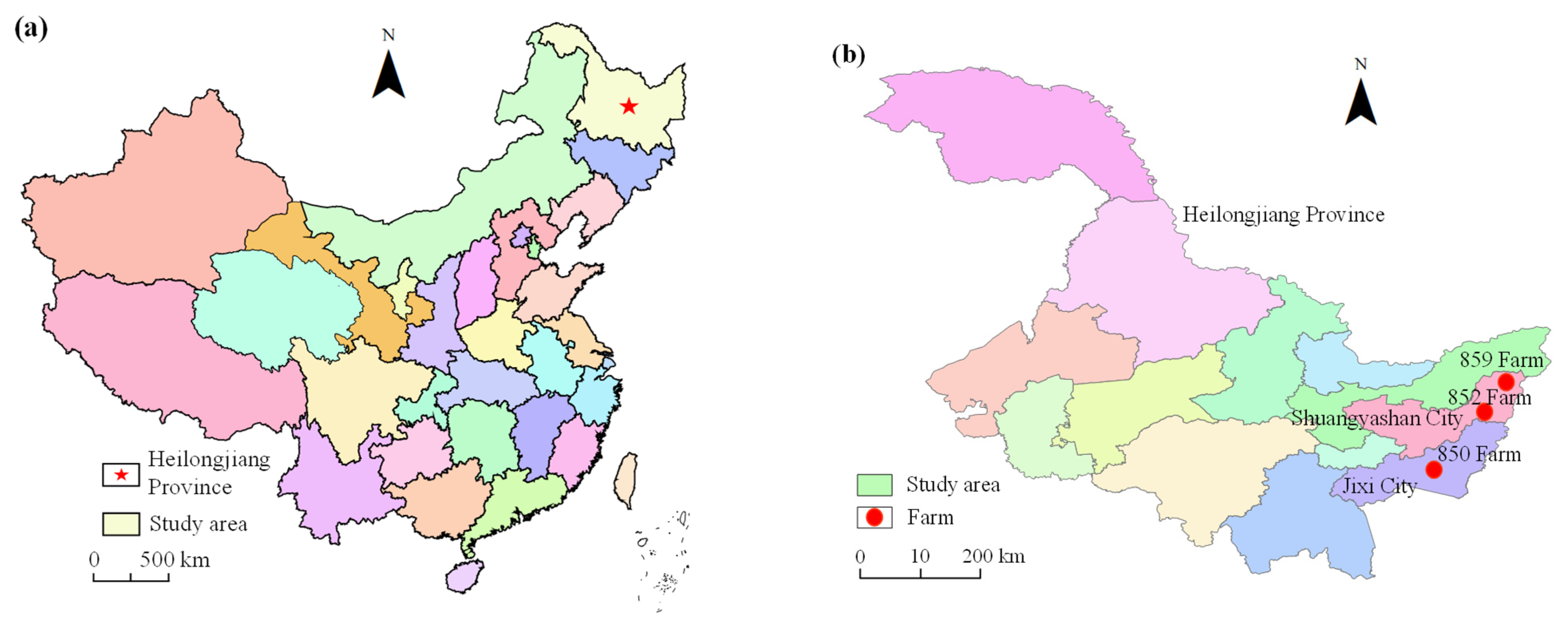
The study area comprises three large state farms in the albic soil belt of the Sanjiang Plain in eastern Heilongjiang Province (Figure 1): Farm 859 is located on a low-lying plain east of Shuangyashan with well-developed irrigation and drainage and contiguous paddy rice that is highly sensitive to regional hydrothermal anomalies; Farm 852 is situated farther west on a similar alluvial plain where rice remains dominant but is interspersed with rainfed fields; and Farm 850 is positioned around Jixi in a transition from plain to low hills where rainfed conditions are comparatively favorable and corn and soybean account for a larger share of planting [27].
The broader landscape was shaped by long-term alluviation from the Songhua, Amur, and Ussuri Rivers and by peat deposition. Relief is low with subtle microtopography, and rivers, lakes, and irrigation–drainage canals form an interlaced network that drives pronounced seasonal surface-water processes [28]. Soils are dominated by albic soil, with associated black soil, meadow soil, and marsh soil; profiles are clearly differentiated with well-developed bleached horizons, textures range from loam to clay loam, and water retention and aeration are strongly influenced by tillage regimes and moisture status [29]. The climate is temperate monsoonal, with long, cold winters and warm, wet summers; the growing season is concentrated in May to September, accumulated thermal time is relatively low, the frost-free period is short, precipitation is unevenly distributed within the year with interannual variability, and the match between sunlight and precipitation during critical phenological stages directly constrains water–heat use efficiency and yield formation [30]. Overall, the cool climate, diagnostic albic soil profile, and wetland-like plain microtopography jointly shape crop sensitivity to meteorological variables and their extremes, providing a clear natural and production context for multi-farm comparisons and for studying crop–climate response mechanisms [31].

2.2. Data Source

Long-term daily data of meteorological factors, including air temperature, precipitation, evaporation, sunlight, relative humidity, and surface temperature, along with yield and cultivated area data for various grain crops (rice, soybean, and corn), were primarily provided by the Heilongjiang 859, 850, and 852 farm Co., Ltd., Harbin, China, affiliated with the Bei-dahuang Group. The data exhibited good completeness and strong continuity. Annual averages of meteorological factors were derived from daily data, while crop yield per unit area was calculated as the ratio of annual crop production to the total cultivated area each year.

2.3. Research Methods

2.3.1. Experimental Design

This study adopts an observational design that combines multi-farm comparison with in-depth analysis of a focal farm. The basic observational unit is farm × year × crop, and it compiles an annual database spanning 2000 to 2023 and restricts variables to key meteorological factors and yield per unit area of the major grain crops (rice, corn, and soybean). The study organization has two tiers. First, a parallel comparison across Farms 859, 850, and 852 under harmonized data definitions establishes the regional context of meteorological and yield changes and the differences among farms. Second, an in-depth analysis centered on Farm 859 examines periodic evolution and climate responses, with Farms 850 and 852 used for lateral reference and consistency checks. To ensure consistency and traceability across farms and crops, variable definitions, measurement units, and significance thresholds were standardized. All computations follow the same annual aggregation.

2.3.2. Measurement Items and Methods

This study proceeded through trend detection, periodic characterization, indicator selection, and time and frequency coupling diagnostics to ensure comparability across farms and crops. First, at the annual scale, linear trends are estimated on the annual time series of meteorological variables and crop yield per unit area, and the Mann–Kendall test is to determine the direction and significance of monotonic change [32]. A positive Z indicates an upward trend, and a negative Z indicates a downward trend; statistical significance was set at α = 0.05, and results were considered not significant when p ≥ 0.05. All statistics were computed under a common annual aggregation protocol and a unified significance threshold. Then, this study applied the complex Morlet continuous wavelet transform to characterize local structures of nonstationary time series across time and scale, identify dominant periodicities and phase-specific oscillations, and quantify the contribution of each scale to total variance via wavelet variance. Based on these diagnostics, this study delineated the primary and secondary dominant periods and their corresponding critical epochs [33,34]. To select meteorological factors most closely related to yields, a complementary triad was constructed on standardized annual series: Pearson correlation to evaluate the direction and strength of linear association [35], gray relational grade to measure similarity in series morphology under unified normalization and a fixed resolution coefficient and to derive an integrated ranking [36], and principal component analysis to reduce dimensionality while interpreting major climatic driving axes from loadings and mitigate multicollinearity in inference [37]. After identifying the dominant factors, this study used cross-wavelet analysis to depict co-oscillations and phase relationships between meteorological drivers and crop yields in the time and frequency domains, and it focused on coupling scales with temporal persistence and on the sign of association, as well as potential lead or lag features, thereby providing evidentiary support for response mechanisms during key phenological stages [38].

2.3.3. Wavelet Analysis

Wavelet analysis is a key technique for signal characterization and scale detection, widely used in image processing, condition diagnosis, and hydrometeorological time series analysis. Unlike Fourier methods, wavelets capture both temporal and spectral features of nonstationary data through multiresolution analysis, revealing local high-frequency variations and low-frequency trends [33]. To avoid spurious oscillations from real-valued wavelets and obtain stable amplitude–phase information, the complex Morlet continuous wavelet is used. Its coefficients, Wf(a,b), quantify the correlation between the signal f(t) and the wavelet function ψ(t) at scale a and translation b:
W f a , b = a 1 / 2 Δ t k 1 N f k Δ t ψ ¯ k Δ t b a + ψ t d t = 0
The real part of the coefficients illustrates phase changes: positive values indicate in-phase behavior, near-zero values mark transitions, and negative values show out-of-phase behavior. The squared modulus (wavelet power) quantifies energy distribution across scales and time. Integrating the global wavelet spectrum over time yields, highlighting dominant periodicities, and reducing nonstationary effects [34]:
V a r ( a ) = W f ( a , b ) 2 d b
The peak in the global spectrum identifies the strongest periodic oscillation and its corresponding main period.

2.3.4. Cross-Wavelet Transform

The cross-wavelet transform (CWT) and wavelet coherence (WTC) jointly analyze two time series in time–frequency space, identifying regions of shared power, local correlation, and phase relationships. CWT detects high-power coupling events and their timing, while WTC, through normalization, captures localized correlation even in low-power areas, revealing stable associations. Phase arrows indicate lead–lag relationships: right for in-phase, left for anti-phase, and up/down for which series leads [38]. Using the complex Morlet wavelet, the cross-wavelet spectrum is defined as follows:
W n x y s = W n x s W n y s
where W n y s is W* complex conjugate; W n x y s is the complex number, and W n x y s is the cross-wavelet power spectrum; the cross-power spectrum Wxy reflects common energy, and its phase angle indicates the time–frequency phase relationship between series.
Significant co-oscillation bands are identified where cross power exceeds a red noise AR(1) background. Wavelet coherence quantifies local correlation, with significance tested via Monte Carlo methods, and it is defined as follows:
R n 2 S = S s 1 w n x y s 2 S s 1 W n x s 2 × S s 1 W n y s 2
where R n 2 S is the local correlation coefficient; S is the smoothing operator.
Wavelet configuration and testing. The complex Morlet wavelet (central frequency ω0 = 6) was used for the monthly series (Δt = 1 month). The smallest scale was fixed at s0 = 2Δt, and the scale resolution was at dj = 1/12 (twelve voices per octave). Zero padding to the next power of two was applied, and the cone of influence delineated edge-affected regions. Statistical significance of wavelet power and wavelet coherence was assessed against an AR(1) red noise background at α = 0.05 using 1000 Monte Carlo surrogates. A compact sensitivity grid over ω0 ∈ [5, 8], dj ∈ {1/8, 1/12, 1/16}, and s0 ∈ [Δt, 3Δt] indicated stable locations and persistence of dominant bands; therefore, ω0 = 6 and dj = 1/12 were retained. The scale bands emphasized in the results were set a priori for agronomic relevance, notably 4 to 10 weeks and 0.5 to 4 years.

3. Results

3.1. Multi-Scale Dynamics of Meteorological Variables

3.1.1. Variability Across Time Scales of Meteorological Variables

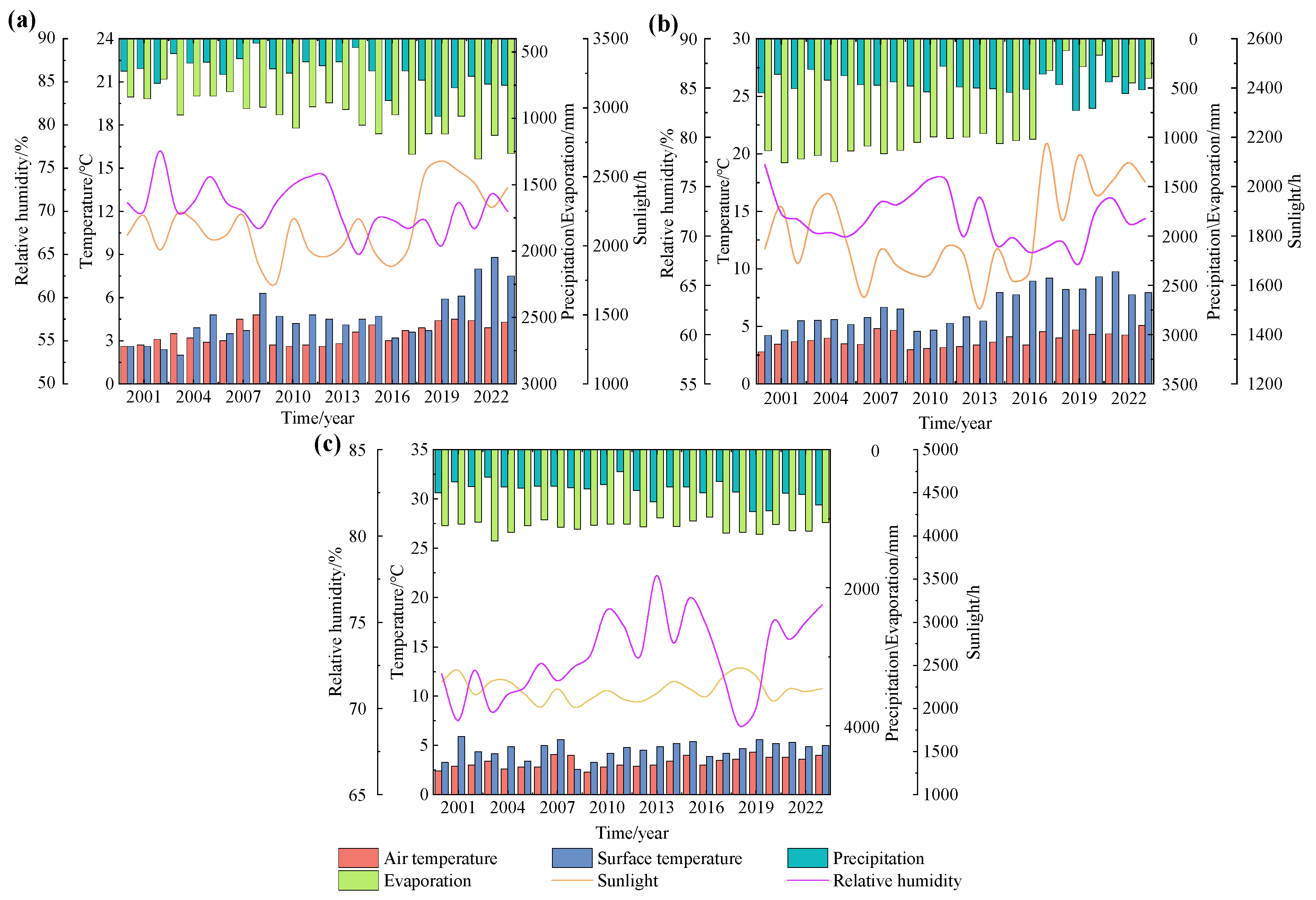
This study compiled and plotted the 2000 to 2023 time series of six meteorological variables: air temperature, precipitation, evaporation, sunlight, relative humidity, and surface temperature, for Farms 859, 850, and 852, and used the Mann–Kendall (MK) test to identify their trends and statistical significance. Synthesizing Figure 2 and Table 1, the interannual trends of key meteorological variables are broadly consistent across the three farms during 2000 to 2024, collectively indicating a regional warming and wetting pattern characterized by warmer conditions and greater precipitation. For air temperature, all three farms show upward trends: at Farm 859, air temperature rose from 2.6 °C to 4.3 °C (Z = 1.013, p = 0.032); at Farm 850, air temperature rose from 2.8 °C to 5.1 °C (Z = 1.120, p = 0.038), both significant; at Farm 852, it increased from 2.4 °C to 4.0 °C, but did not reach significance (Z = 1.256, p = 0.051), suggesting a comparatively slower warming rate. Precipitation increased significantly at all three farms: Farm 859 from 642.8 mm to 750.1 mm (Z = 0.352, p = 0.001), Farm 850 from 618.7 mm to 795.4 mm (Z = 0.482, p = 0.001), and Farm 852 from 626.9 mm to 801.6 mm (Z = 0.571, p = 0.001). Interannual fluctuations were more pronounced at Farms 850 and 852, indicating greater exposure to extreme precipitation events. Evaporation displayed divergent behavior: at Farm 859 it increased significantly (838.8 mm to 1264 mm, Z = 0.426, and p = 0.043); at Farm 850 it declined but not significantly (1137.1 mm to 402.1 mm, Z = −1.017, and p = 0.064); and at Farm 852 it also declined without significance (1100.2 mm to 1053.3 mm), reflecting combined influences of regional hydrothermal conditions, surface characteristics, and cropping structure. For sunlight, significant increases were observed at Farm 859 (2076.9 h to 2421 h, Z = 0.853, and p = 0.024) and at Farm 850 (1748.2 h to 2019.2 h, Z = 0.664, and p = 0.035), whereas Farm 852 showed a slight but nonsignificant decrease (2306.4 h to 2229.5 h), possibly reflecting the effects of cloudiness or atmospheric aerosols. Relative humidity increased at all three sites, with the strongest rise at Farm 850 (Z = 0.409, p = 0.035). Farm 859 (Z = 0.384, p = 0.065) and 852 (Z = 0.422, p = 0.055) also exhibited positive but nonsignificant trends accompanied by marked interannual variability. Surface temperature generally increased: Farm 859 from 2.6 °C to 7.5 °C (Z = 2.548, p = 0.087), Farm 850 from 4.2 °C to 7.9 °C (Z = 2.458, p = 0.069), and Farm 852 from 3.28 °C to 5.0 °C (Z = 2.307, p = 0.100). Although these were not statistically significant, the magnitudes indicate notable heat accumulation.
Overall, air temperature and precipitation emerge as the dominant meteorological drivers of yield enhancement across the three farms. The warming trend is statistically significant and has substantial implications for the stability of rice and corn yields, while increased precipitation provides significant support for the yield potential of soybean and rice. Evaporation and sunlight exhibit farm-specific responses, indicating the need for integrated management analyses that incorporate local agronomic practices, water infrastructure, and cropping structure.

3.1.2. Evolutionary Patterns of Meteorological Elements Across Periodic Scales

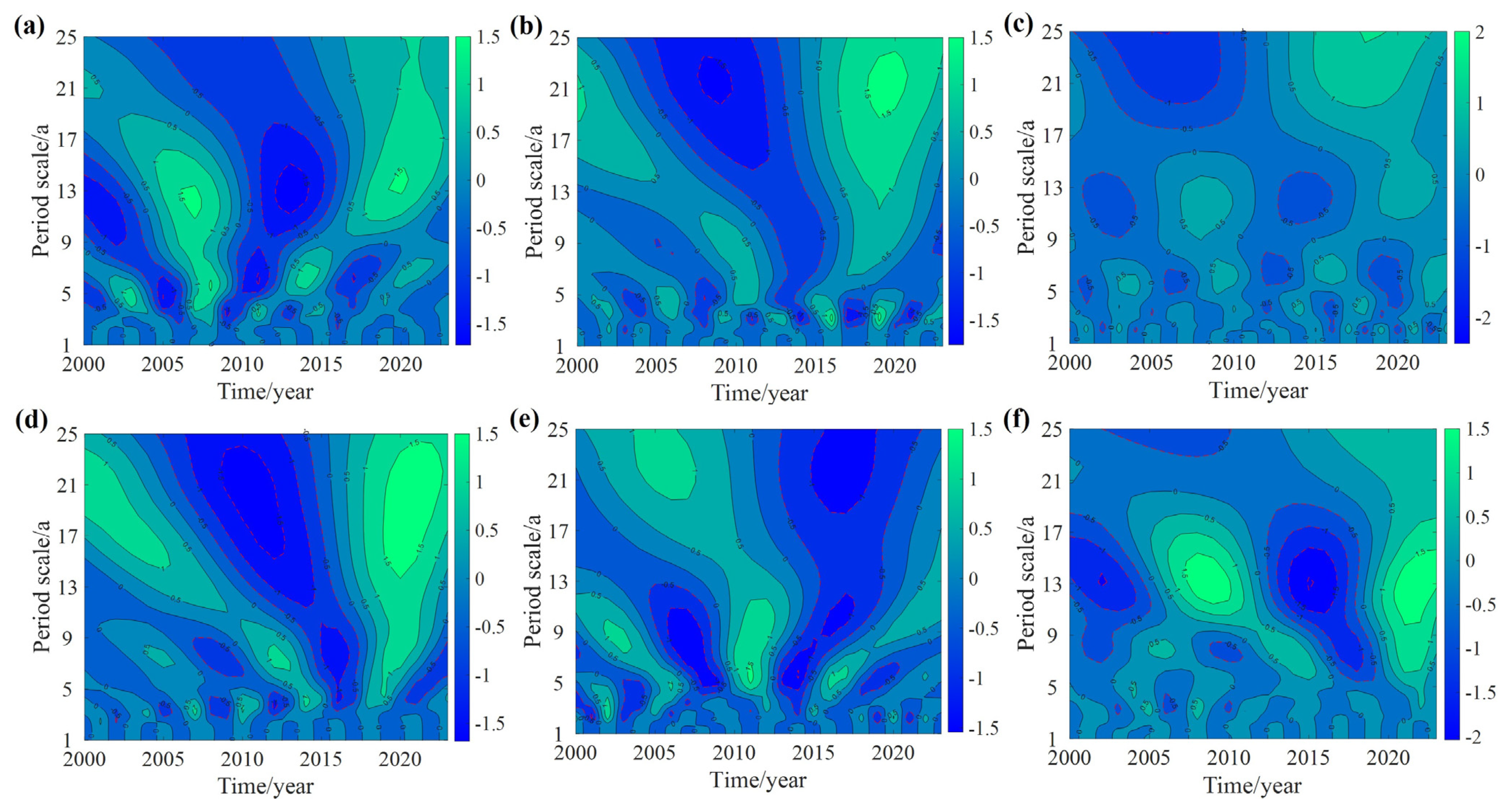
Analyzing the real-part contour maps of the complex Morlet wavelet transform for six meteorological variables at Farms 859, 850, and 852 during 2000 to 2023 (Figure 3), together with the summary of dominant periods (Table 2), shows clear periodic behavior with fluctuations across multiple time scales. Air temperature exhibits a similar dominant-period structure at all three farms, with a primary period of 21a and 22a and a secondary period of 12a, indicating stable interannual oscillations modulated by decadal climate backgrounds. Precipitation has a primary period near 21a and a secondary period of 8a and 9a, consistent at the decadal scale with periodic climate systems such as ENSO. Evaporation and sunlight display primary periods in the range of 21a and 24a, with minor differences in the secondary period; notably, evaporation at Farm 850 shows a pronounced 24a primary cycle, suggesting long-term regulation by local topography or land use change. Relative humidity and surface temperature share broadly consistent primary periods of 22a, 21a, and 12a, with secondary periods clustered at 8a and 9a. Their cycles are clear and exhibit concentrated power, implying a synchronous periodic mode in regional atmospheric stratification and the land–atmosphere coupling system. Overall, the three farms show high consistency, with well-defined periodic laws and a characteristic multi-scale resonance of climate factors under the temperate monsoon climate of Northeast China.
Despite the strong agreement in dominant periods across the six variables, some regional differences remain among farms, reflecting distinct local climate drivers and modulation by surface conditions. Evaporation at Farm 850 presents a longer primary period of 24a, slightly exceeding the roughly 23a cycle at Farms 859 and 852, which may relate to irrigation practices, surface water distribution, and vegetation cover. Sunlight at Farm 850 shows a relatively stable 8a fluctuation, suggesting a more balanced mechanism of radiation control. The cycle lengths of relative humidity are essentially consistent across farms, and surface temperature displays stable 12a, 9a, and 8a cycles at all sites, indicating highly synchronized regional exchanges of surface–atmosphere heat flux. In sum, while periodic variability in farm meteorology is broadly consistent across Heilongjiang, minor differences in dominant periods highlight the need to incorporate region-specific periodic climate evolution into agro-meteorological management and adaptive planting strategies.

3.2. Dynamics of Yield per Unit Area for Different Crops

3.2.1. Comparison of Cropping Structure

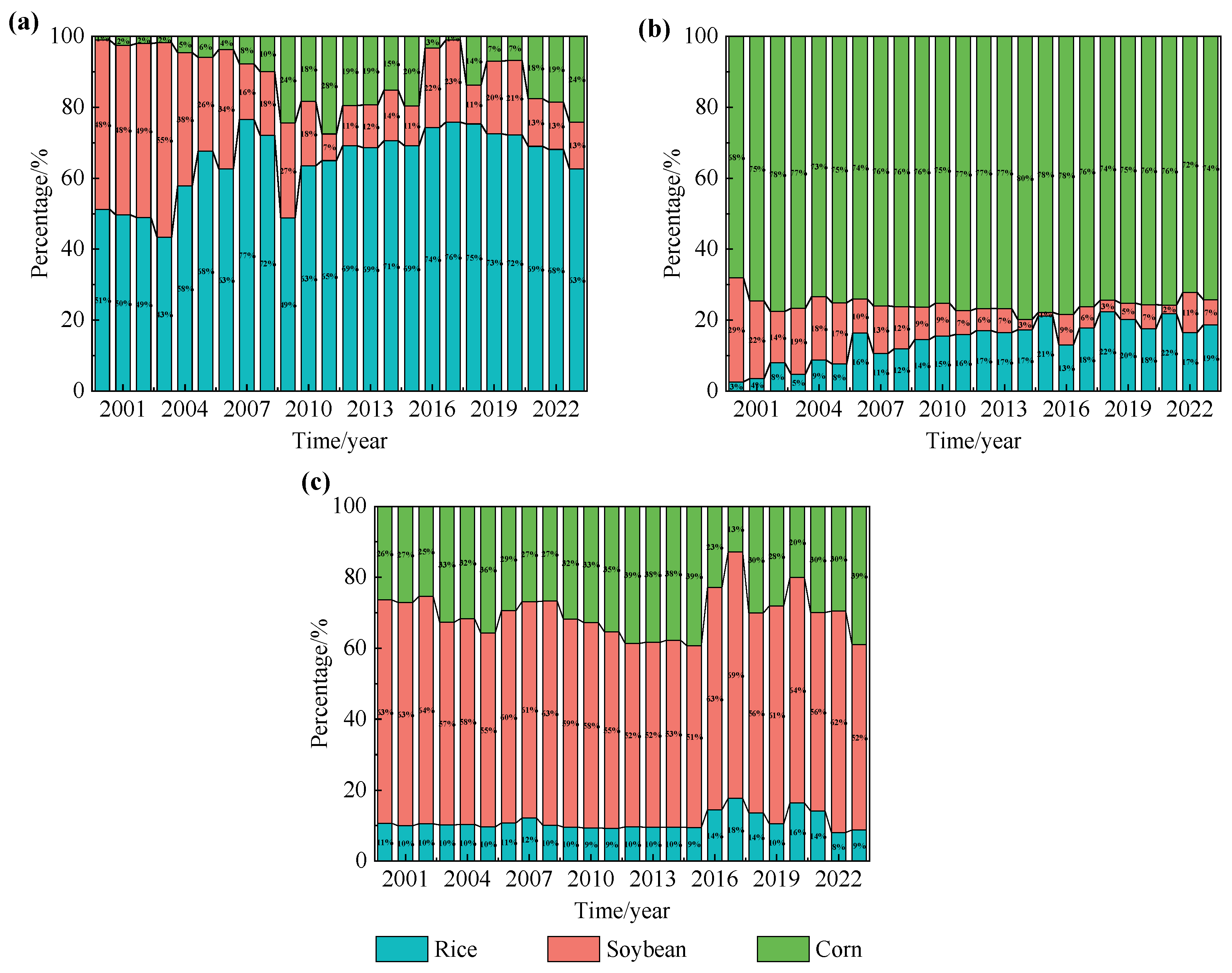
Based on the bar charts of crop shares for 2000 to 2023 (Figure 4), the three farms exhibit marked differences in cropping structure. At Farm 859, rice is dominant: its planting share rose from about 45% at the beginning of the study period to nearly 55% in 2023. The share of corn increased concurrently from roughly 5% to close to 30%, whereas soybean declined from 35% to below 15%, with brief fluctuations in 2008 and 2014. At Farm 850, corn consistently accounted for 65 to 70% and showed a slight upward trend, rice increased steadily from under 10% to about 20%, and soybean decreased from 25% to nearly 10%. At Farm 852, soybean remained the primary crop, declining from about 60% to 50% but retaining its advantage; over the same period, corn rose from 25% to 35%, and rice remained stable at around 10%. Overall, the three farms share a common trajectory of decreasing soybean and increasing rice and corn from 2000 to 2023, though the leading crop and the magnitude of adjustment differ substantially across sites.

3.2.2. Temporal Dynamic Characteristics of Different Crops

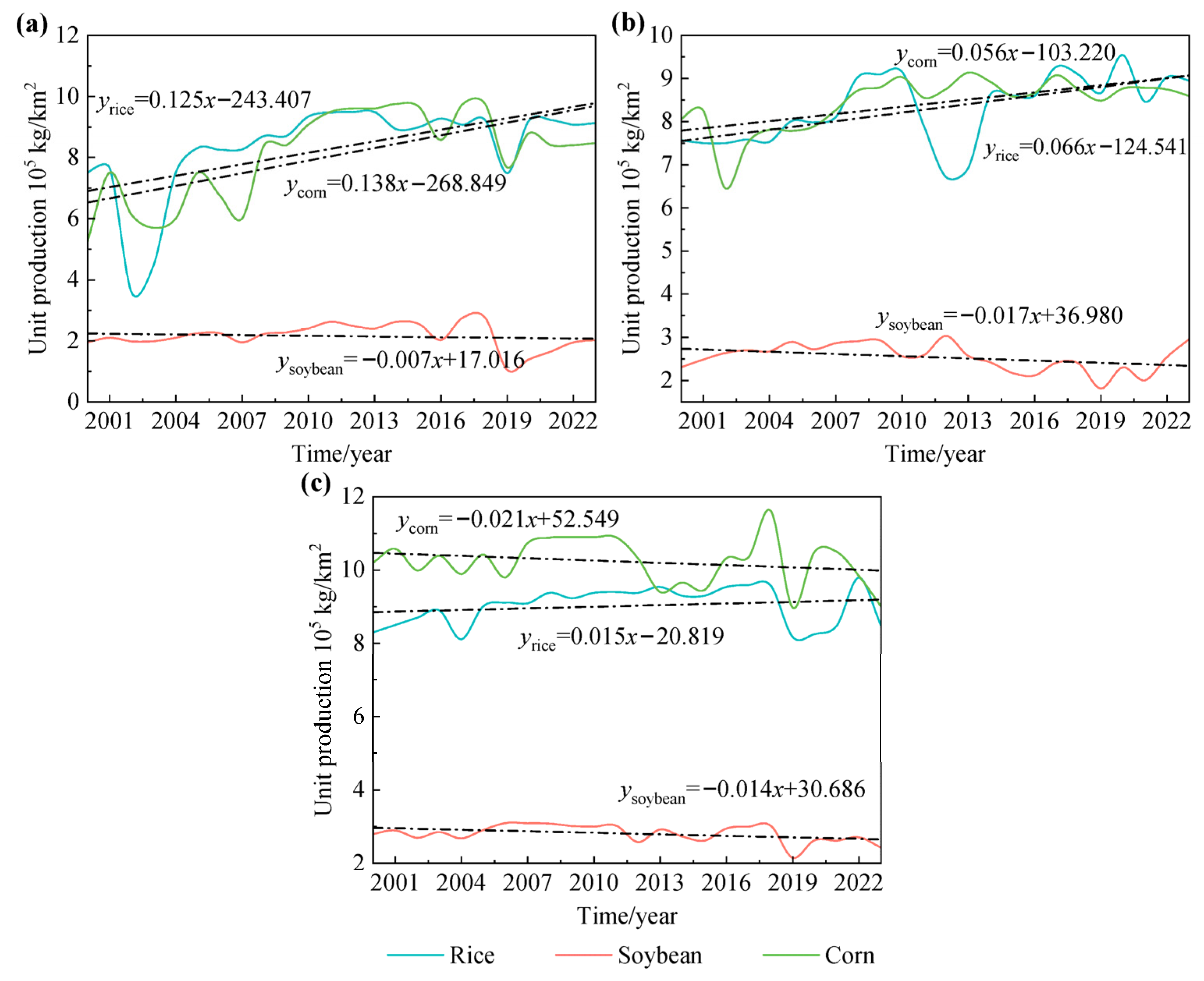
Based on the interannual yield curves in Figure 5 and the Mann–Kendall (MK) statistics in Table 3, the three staple crops exhibit pronounced crop-specific differences and regional heterogeneity across farms. At Farm 859, both rice and corn show significant upward trends, with Z = 3.051 (p = 0.002) for rice and Z = 3.200 (p < 0.001) for corn, indicating sustained yield increases over the past two decades. Soybean shows a nonsignificant fluctuating pattern, Z = 0.918 (p = 0.557). Farm 850 displays a similar pattern: rice Z = 2.902 (p = 0.002) and corn Z = 2.952 (p = 0.001), both increasing significantly, whereas soybean exhibits a notable decline, Z = −1.612 (p = 0.067). At Farm 852, yield dynamics are more complex. Rice has an upward trend, Z = 2.257 (p = 0.335), but it does not reach significance; corn shows no significant change, Z = −0.739 (p = 0.277); soybean declines significantly, Z = −1.796 (p = 0.044). Overall, growth in rice and corn yields is the prevailing trend, while soybean generally shows declining or dampened variability, most prominently at Farm 852.

3.2.3. Evolutionary Patterns of Crop Cycles Across Different Crops

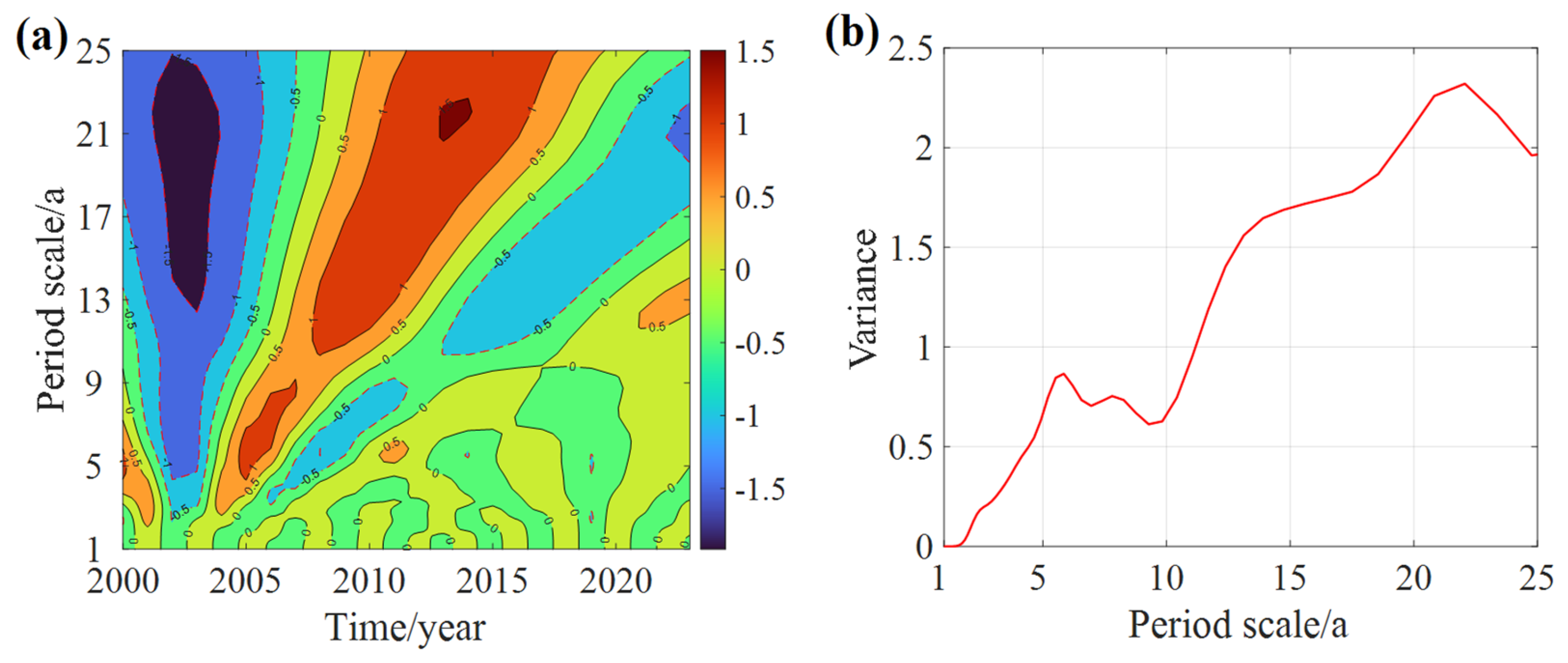
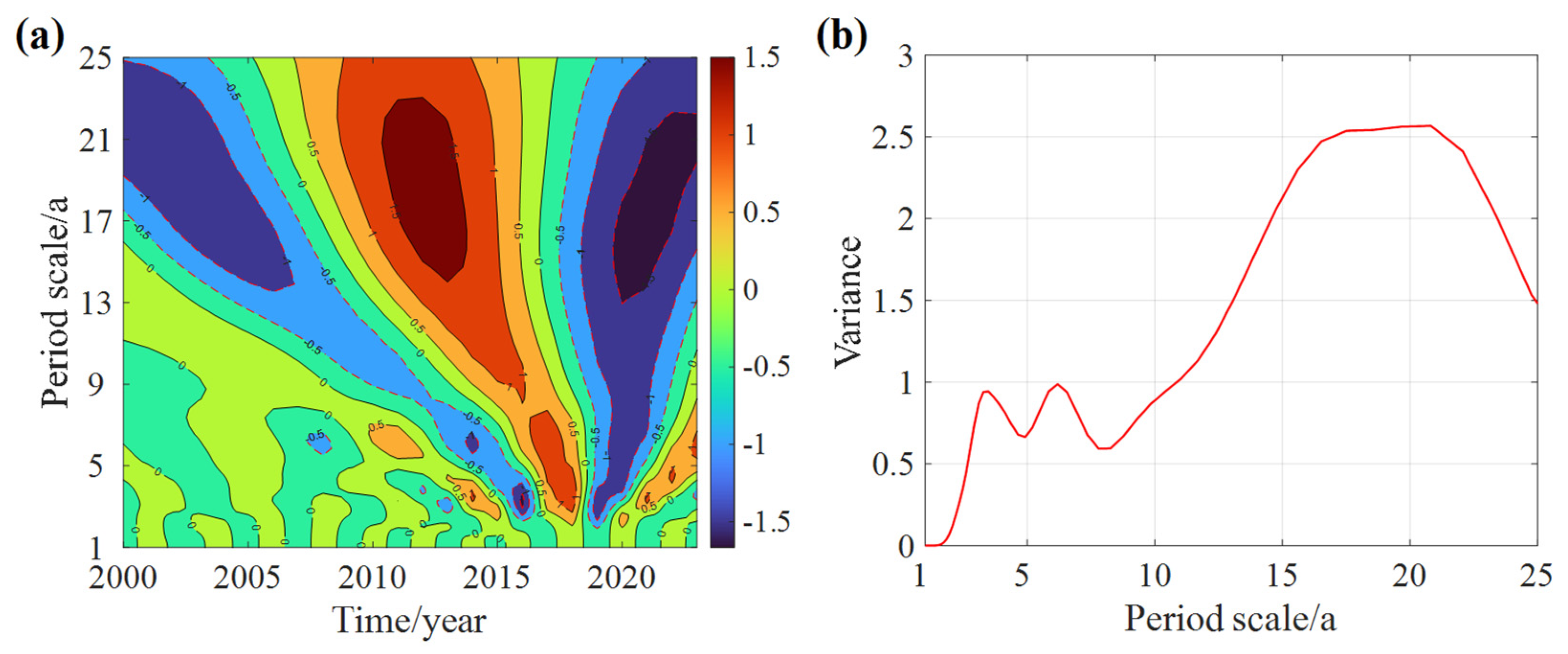
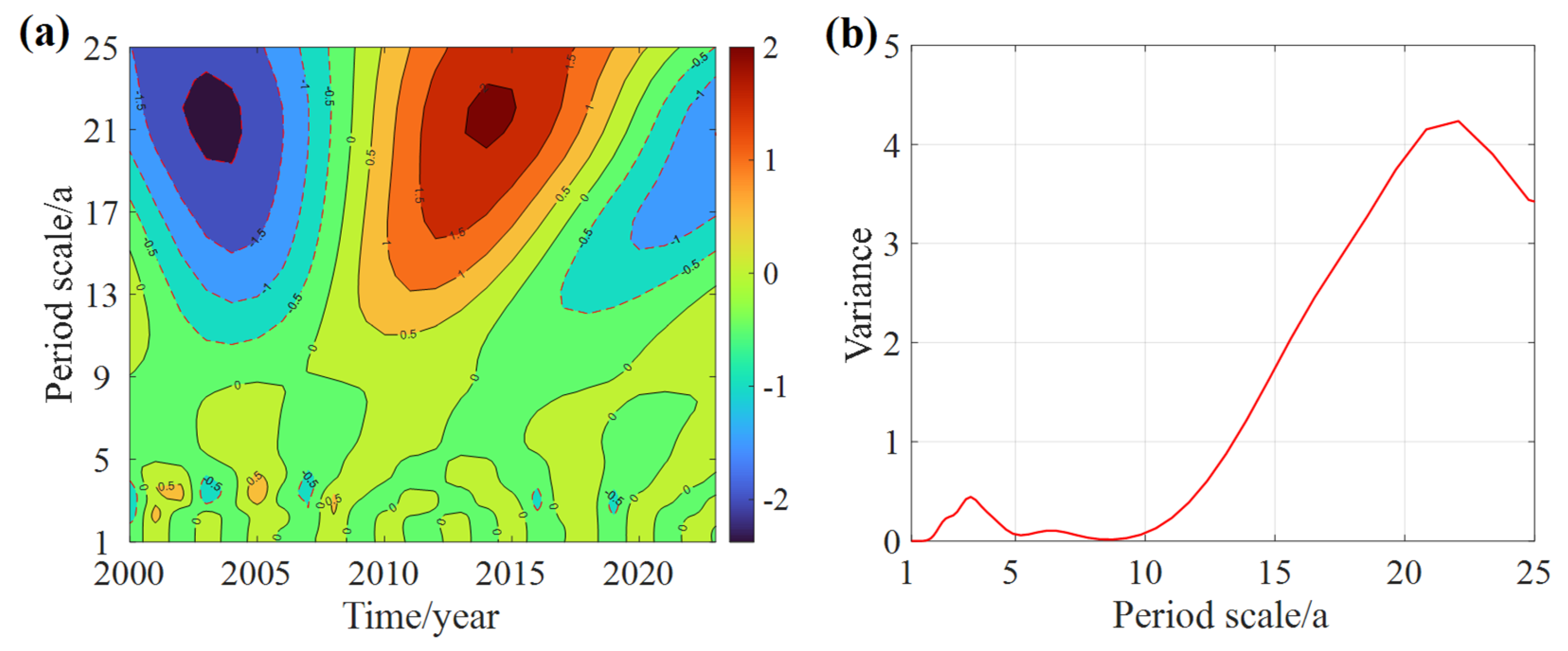
Take Farm 859 as an example to study the periodic evolution patterns of the three crops. The real-part contour maps of the complex Morlet wavelet transform and the wavelet variance spectra for rice, soybean, and corn yields indicate the following. For rice, the first dominant period is 22a, and the second dominant period is 6a as shown in Figure 6. The 22a band persists throughout 2000 to 2023 as a stable low-frequency, high-power feature, revealing a clear decadal-scale oscillation. The 6a band is concentrated from 2010 to 2020 and appears as a high-frequency oscillatory belt, indicating a pronounced response of rice yield to midterm climate variability. For soybean, the first dominant period is 21a and the second dominant period is 6a. The 21a band shows a stable long-term leading mode, whereas the 6a band strengthens markedly during 2008 to 2016 and appears as alternating positive and negative lobes in the contour maps. This pattern suggests sensitivity to episodic cold damage or precipitation fluctuations, producing characteristic alternating cycles (Figure 7). For corn, the first dominant period is 22a and the second dominant period is 3a in Figure 8. The 22a low-frequency power ribbon spans the entire record, reflecting control by long-term climate variability and periodic iterations in agricultural inputs. The 3a band recurs frequently during 2005 to 2015, forming narrow, densely spaced high-frequency stripes in the contour maps. This indicates a rapid yield response to interannual meteorological fluctuations, such as summer heat stress or shifts in sowing dates, with a short and unstable cycle.

3.3. Association Analysis Between Crop Yields and Meteorological Variables

3.3.1. Correlation Analysis

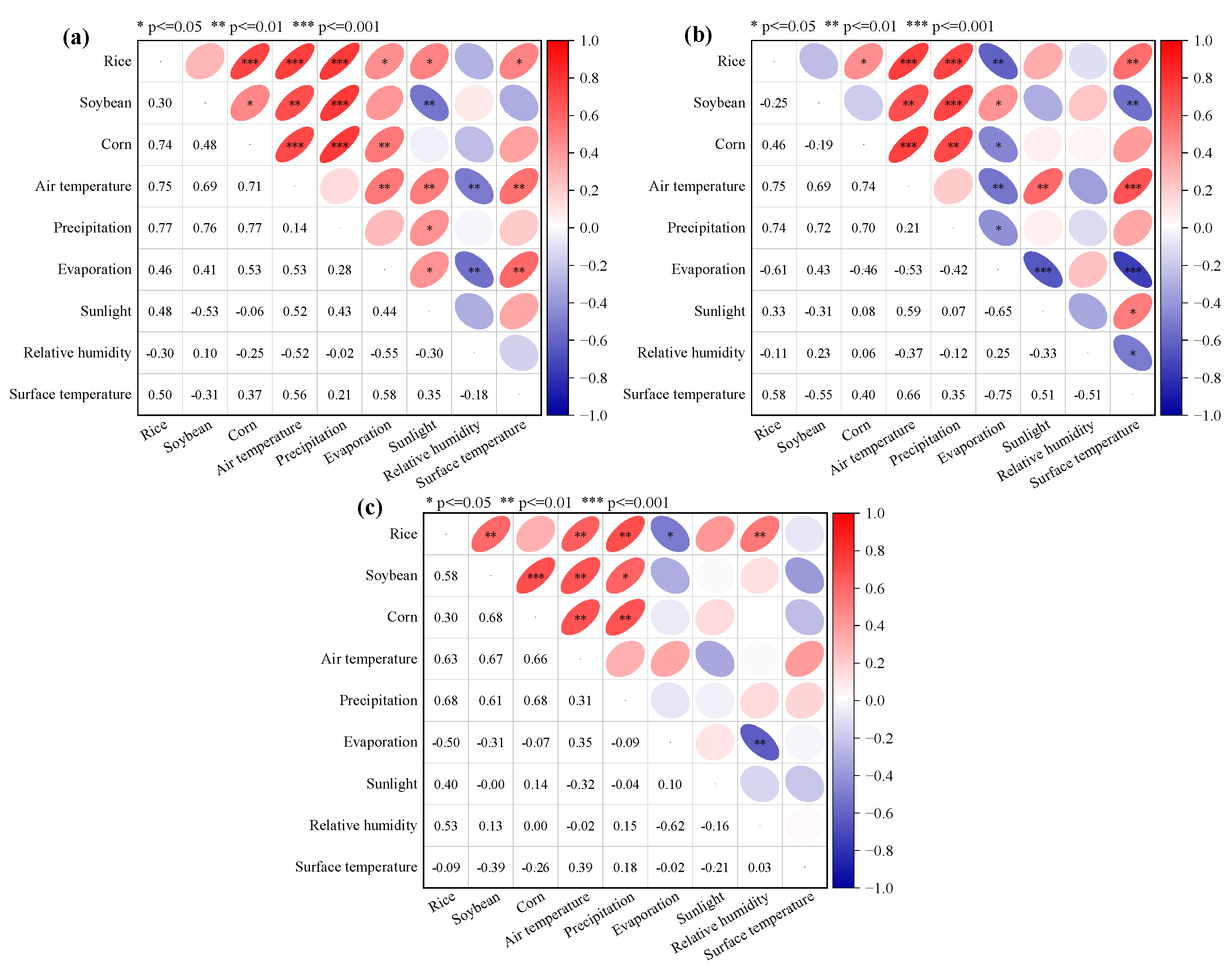
Pearson correlation heatmaps between yields of rice, soybean, and corn and six meteorological variables (air temperature, precipitation, evaporation, sunlight, relative humidity, and surface temperature) for Farms 859, 850, and 852 (Figure 9) reveal significant crop–climate association structures, with variability in strength and sign across farms.
At Farm 859, yields of rice, soybean, and corn are all strongly and positively correlated with precipitation and air temperature (R > 0.65), indicating dual control by water and heat. Soybean shows a principal negative correlation with sunlight (R = −0.53), suggesting that excessive radiation may suppress pod setting and grain filling. Evaporation is a secondary positive correlate for corn yield (R = 0.53). At Farm 850, a stronger moisture constraint is evident. All three crops retain significant positive correlations with air temperature and precipitation, while rice is strongly and negatively correlated with evaporation (R = −0.61). Corn is moderately and negatively correlated with evaporation (R = −0.46), highlighting the need to manage hot and dry compound conditions. Soybean exhibits a relatively strong negative correlation with surface temperature (R = −0.55), reflecting sensitivity to near-surface warming. At Farm 852, overall correlation strengths are slightly weaker, but moisture variables are most critical. The three crops show the strongest positive correlations with air temperature and precipitation (R > 0.60), a significant positive correlation with relative humidity (R = 0.53), and a significant negative correlation with evaporation (R = −0.50). Soybean maintains a consistent negative correlation with surface temperature (R = −0.39). In summary, Farm 859 is chiefly co-driven by air temperature and precipitation; Farm 850 requires explicit consideration of the suppressive effect of evaporation; and Farm 852 emphasizes the yield benefits of water conservation and reducing evaporative losses.

3.3.2. Gray Relational Analysis

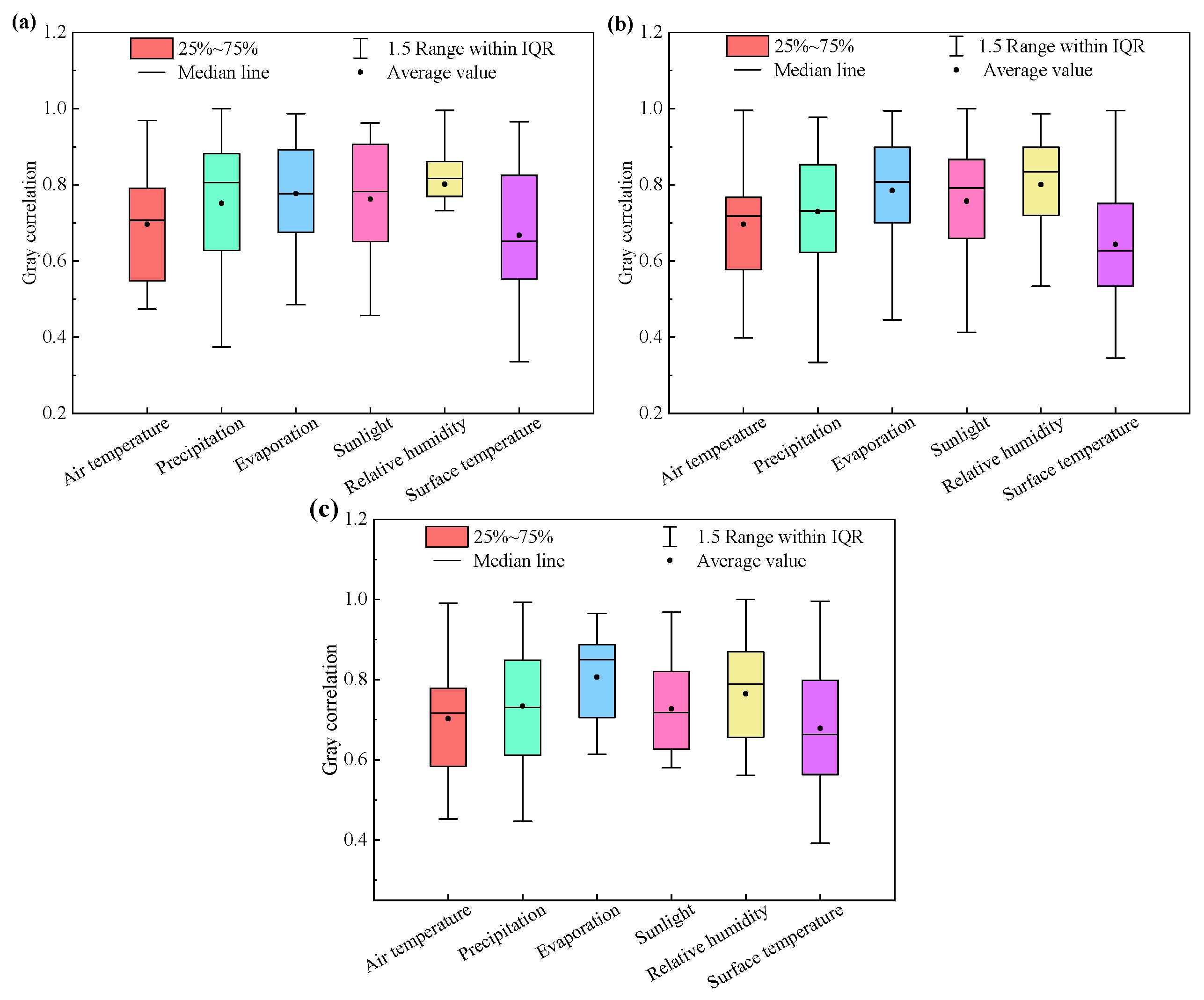
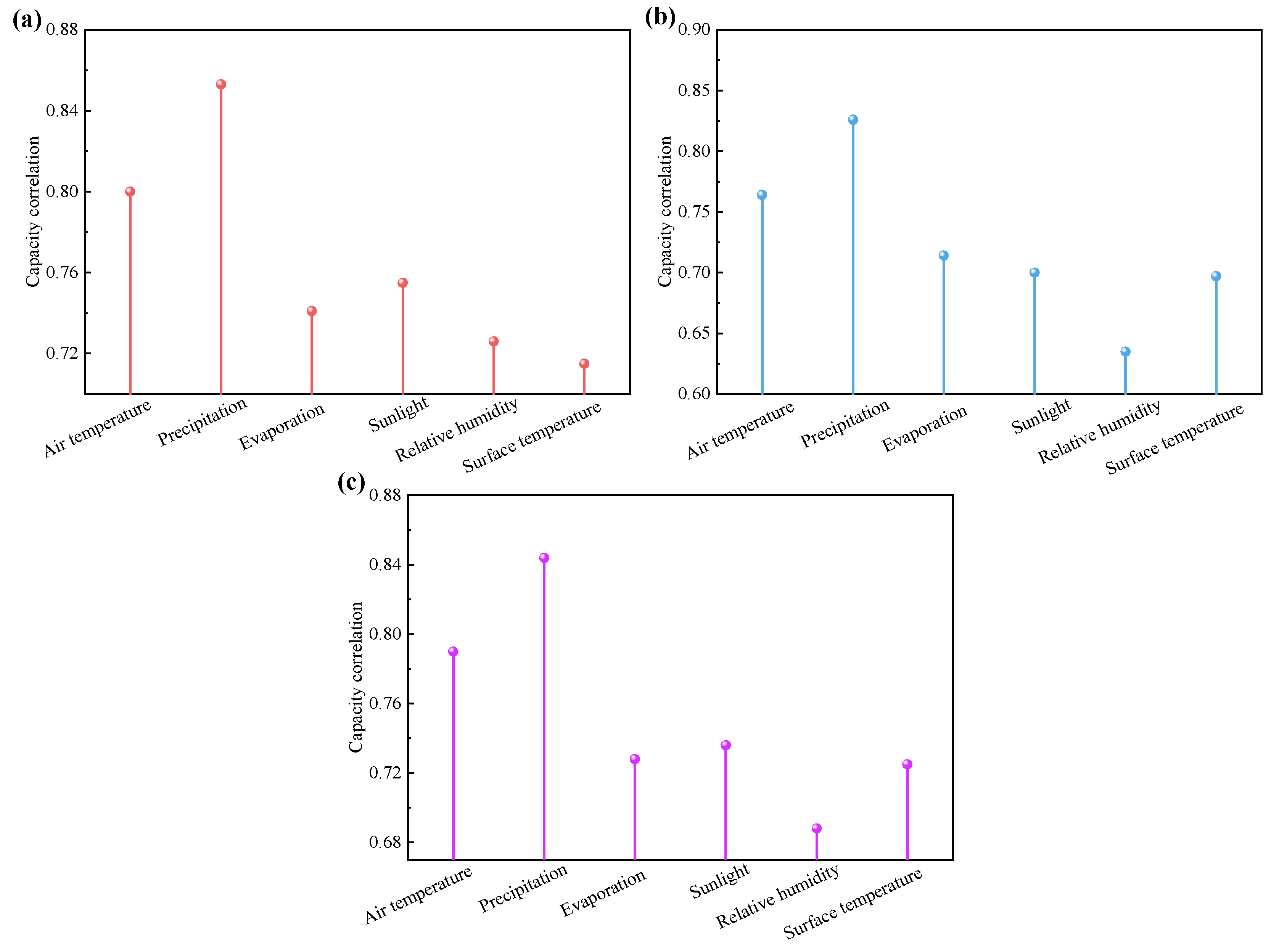
Drawing on the Figures and gray relational analysis, this study selected the representative case of Farm 859 to examine the gray relational grade between yields of the three crops and the six meteorological variables. The results are shown in Figure 10 and Figure 11 and Table 4. In the overall ranking, precipitation is first for rice, soybean, and corn, with γ = 0.853, 0.826, and 0.844, respectively, indicating that water supply is the primary limiting factor for high and stable yields at Farm 859, with the strongest effect on rice. Next, air temperature shows comparatively high association, with γ = 0.800 for rice, 0.764 for soybean, and 0.790 for corn, reflecting a general sensitivity of crop yields to thermal resources. Evaporation and sunlight exert medium effects: rice and corn respond more strongly to sunlight (γ = 0.755 and 0.736), which is consistent with their dependence on adequate radiative conditions, while the response of rice to evaporation (γ = 0.741) suggests that excessive evaporative demand can disrupt field water balance. Relative humidity and surface temperature have lower grades, with rice and surface temperature at γ = 0.715, and soybean and corn with relative humidity at γ = 0.635 and 0.688. These two variables likely influence yields more indirectly, for example, through effects on pest and disease pressure and on soil hydrothermal status.

3.3.3. Coordinated Response Between Crop Yield and Meteorological Variability

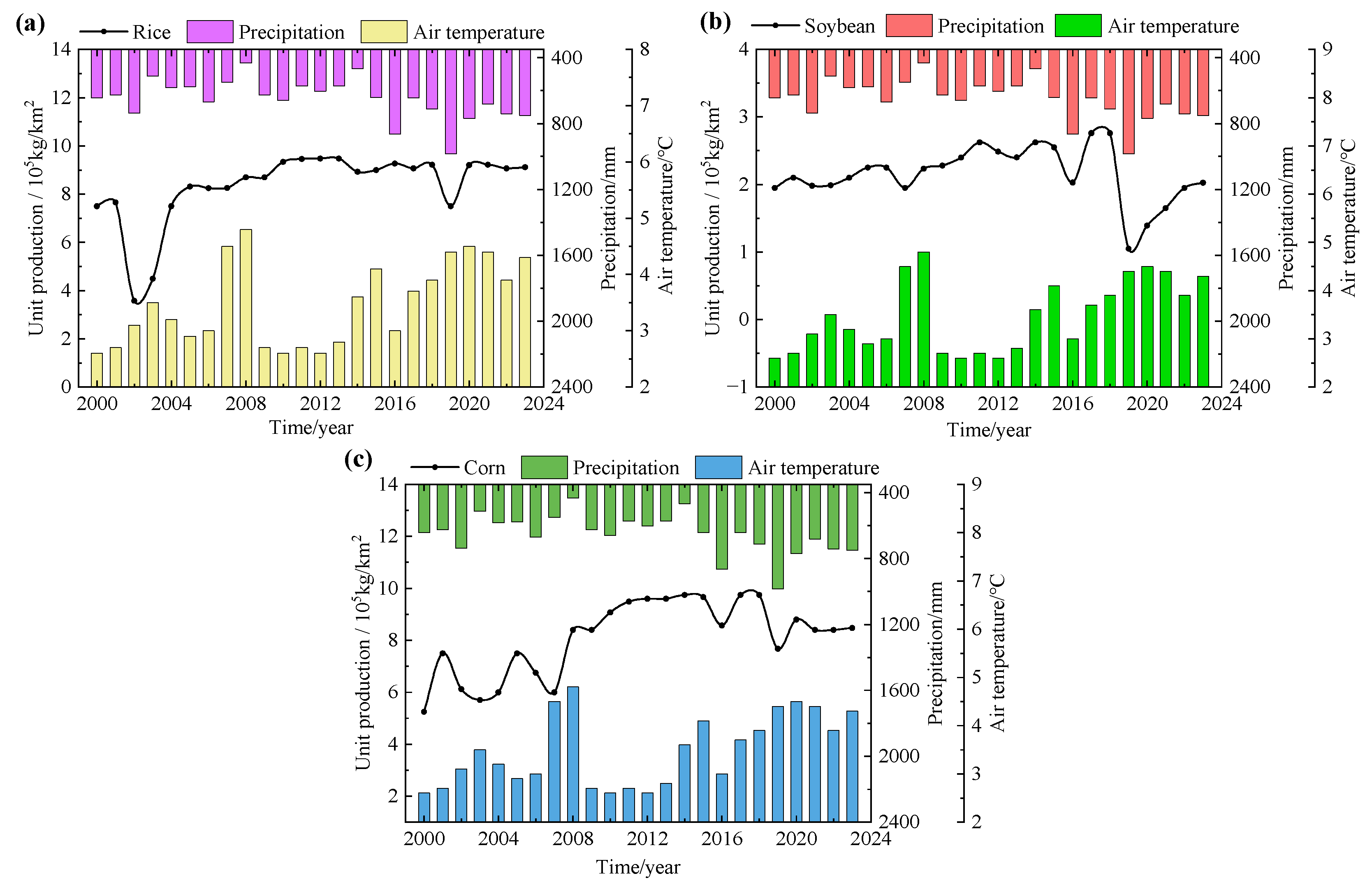
Taking the representative Farm 859 as an example, this study investigates the coordinated response between the yields of different crops and key meteorological changes. Figure 12 shows the trends in yield per unit area of rice, soybean, and corn alongside two key meteorological factors, air temperature and precipitation, from 2000 to 2023. Rice yield rose slowly from 2000 to 2010, and then leveled into a steadier growth trajectory after 2011, reaching a local maximum in 2013, with relatively small interannual variability. Precipitation fluctuated markedly, with notably low values in 2003, 2008, and 2014; rice yield dipped slightly in those same years, indicating sensitivity to precipitation variability. Air temperature increased gradually overall, remaining relatively stable from 2000 to 2006 and easing slightly after 2008; the overall trajectory was positively aligned with rice yield. Soybean yield fluctuated strongly. From 2000 to 2008, it stayed low with frequent swings; after 2009, it increased gradually but showed pronounced declines in 2016 and 2019. This pattern closely tracked precipitation, with yield drops in years of reduced rainfall. The relationship with air temperature was more complex, exhibiting episodic coupling: some years showed concurrent increases in temperature and yield, but overall synchronicity was weak. Corn yield increased continuously from 2000, with a clear acceleration after 2007 and peaks in 2014 and 2017. Variability was lower than for soybean. The trajectory of air temperature closely matched corn yield, especially during 2009 to 2018, when both rose in tandem. Precipitation varied substantially from year to year but aligned less consistently with corn yield, indicating that corn is more dependent on air temperature than on precipitation.

3.4. Mechanisms Underlying Crop Yield Responses to Climate Change

3.4.1. Quantification of Key Meteorological Factors

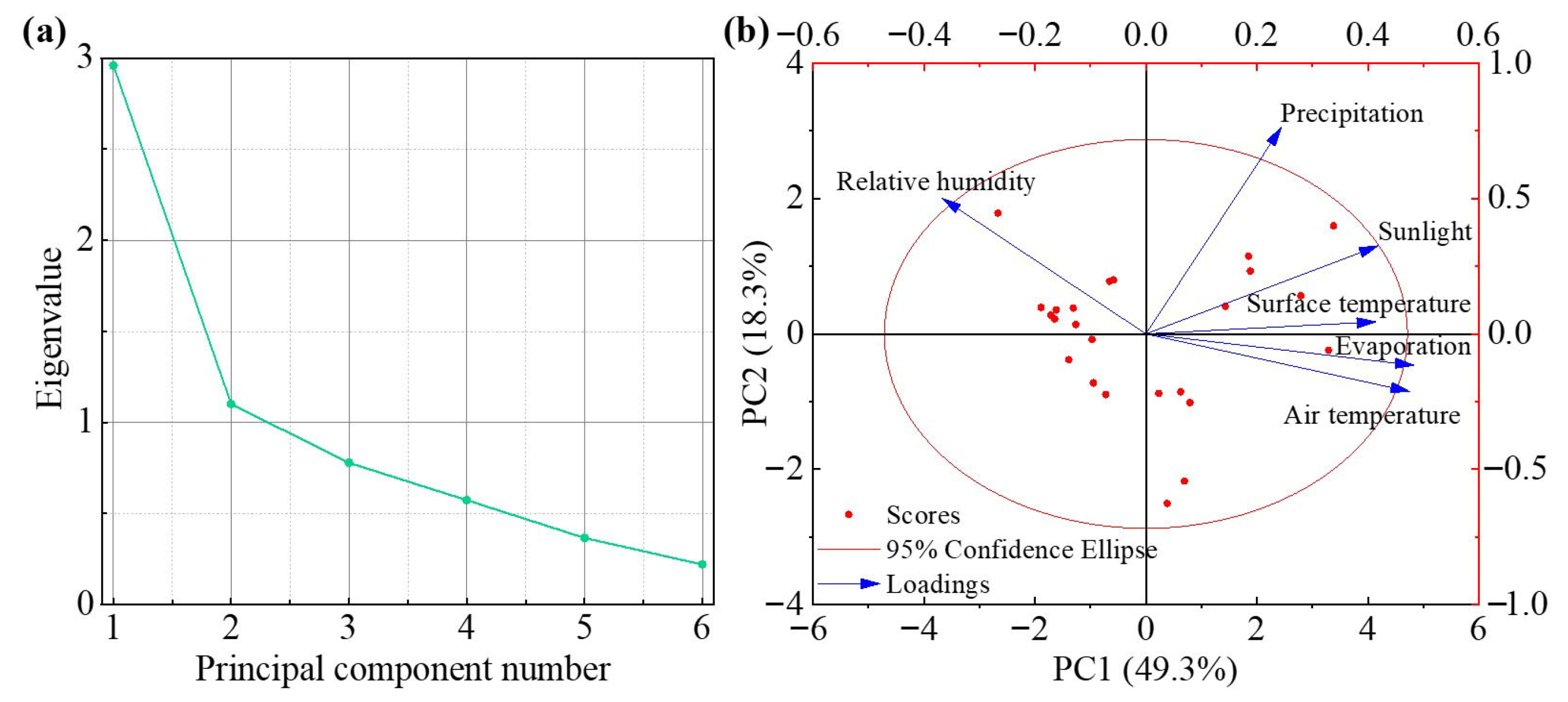
Based on the principal component analysis (PCA) summarized in Figure 13 and Table 5 and Table 6, the multivariate relationships between meteorological factors and crop yields at Farm 859 were effectively reduced in dimensionality, and the main drivers were extracted. The eigenvalue summary shows that the first two principal components together explain 67.657% of the total variance, with PC1 accounting for 41.798% and PC2 for 25.859%. These two components capture the dominant influence patterns of the key meteorological variables on yield at Farm 859. From the loading matrix, PC1 is chiefly characterized by air temperature (0.703), surface temperature (0.188), and relative humidity (−0.340), with mixed positive and negative loadings that indicate a competitive structure between thermal conditions and humidity. PC2 is mainly associated with precipitation (0.421) and relative humidity (0.311), emphasizing the moisture dimension. Air temperature has the largest combined contribution across the two components (0.703 in PC1 and 0.390 in PC2), indicating a primary role of thermal resources in driving yields. Evaporation and sunlight have lower coefficients, suggesting more indirect effects. In the two-dimensional projection of the principal components, variables cluster tightly along the air temperature and surface temperature direction, implying a high internal coherence of thermal factors. Precipitation and relative humidity form an orthogonal axis that represents the moisture regime, reinforcing the differentiated roles of water and heat in shaping yield responses.
Considering the spatial placement of the three crops relative to the meteorological variables, clear differences in response structures emerge. Rice aligns with precipitation and relative humidity, indicating strong moisture control, with rainfall variability exerting a pronounced effect on rice yield. Corn aligns with air temperature and surface temperature, reflecting stronger thermal control; sufficient accumulated temperature supports phenological completion and enhances photosynthesis and yield. Soybean responds to both thermal conditions and moisture status, and unlike rice or corn, does not exhibit a single dominant driver, which suggests broader ecological adaptability but greater vulnerability to extreme events. In the principal component space, PC1 (temperature) and PC2 (moisture) act jointly: positive PC1 together with positive PC2 is synergistic for yield formation by sustaining photosynthesis and grain filling, whereas positive PC1 with negative PC2 is antagonistic because elevated leaf-to-air vapor pressure deficit constrains stomatal conductance and increases heat injury risk; conversely, negative PC1 with positive PC2 may delay development and raise disease pressure, moderating yield gains.

3.4.2. Time–Frequency Coupling Relationship Between Crop Yield and Meteorological Factors

Cross-wavelet analysis between yields of rice, soybean, and corn and the six meteorological variables at Farm 859 shows both clear commonalities and crop-specific adaptation mechanisms in the time–frequency domain, as shown in Figure 14, Figure 15 and Figure 16. Air temperature exerts the strongest control across all three crops, with high-power co-oscillations with yield. This indicates that thermal resources are a pervasive and foundational driver of crop development, especially at mid-to-high latitudes, where improved temperature conditions promote stable and higher yields. Rice yield is co-driven by air temperature, precipitation, and sunlight. The mid-to-long-period responses to air temperature and precipitation are the most prominent, while sunlight, as a supplementary radiative factor, supports development at medium-to-short periods. The effects of evaporation, relative humidity, and surface temperature are comparatively weaker and tend to appear as background or episodic perturbations. Soybean yield is strongly influenced by the combined regulation of air temperature, precipitation, and evaporation, forming a characteristic synergy of thermal and moisture controls with an evaporative component. Its periodic response structure is more volatile than that of rice, and it is more sensitive to extreme meteorological conditions. Corn exhibits a clear dual control by light and temperature. Air temperature is the dominant driver at longer periods, whereas sunlight induces high-frequency yield variations through short-period resonance. Water-related variables, including precipitation and evaporation, impose only weak influences confined to specific intervals.

4. Discussion

We identified a regional warming and wetting background and dominant oscillation bands near 8a to 12a and 21a to 22a across the three large farms. This indicates that yield formation is jointly shaped by slow baseline climate shifts and phase-specific oscillations, which is consistent with the regional evidence reported by Yue et al. on the spatiotemporal variability of precipitation and drought in Northeast China [5] and with the findings of Yu et al. that increasing extreme climate events are reshaping interannual contrasts in the region [6]. From a time and frequency diagnostic perspective, continuous wavelet analysis and cross-wavelet coherence stably characterize scale-dependent dependence and lead and lag relationships in nonstationary systems, in line with the methodological validation by Ghaderpour et al. in climate–runoff coupling studies [7]. Synthesizing recent hydroclimatic assessments for the area, year types that combine heavy precipitation with wet–dry transitions under a humidifying background should be incorporated proactively into management decisions, which accords with the conclusions of Meng et al. [39].
Agronomic considerations for surface temperature-based heat accumulation. In the farm by year panel for 2000 to 2023, the surface temperature-based heat accumulation metric shows a positive point estimate, whereas the linear trend is not statistically significant at α = 0.05 after adjustment for serial correlation. Statistical nonsignificance does not imply negligible agronomic importance. Because crop responses to thermal load are nonlinear and stage-specific, a modest increase in background heat can raise the probability that hot spells coincide with sensitive stages in rice, maize, and soybean, increase evaporative demand and vapor pressure deficit, compress irrigation decision windows, and elevate the likelihood of curtailed grain filling or reproductive injury when moisture shortfalls occur. This pattern indicates limited statistical support for monotonic change, together with a material operational risk under interannual variability and compound heat and moisture conditions. Low regret management options include modest advancement of sowing within recommended windows where frost risk permits, selection of heat-tolerant or earlier-maturing cultivars, maintenance of surface residues to temper canopy temperature, and contingency irrigation during sensitive stages.
Interpreting attenuated effects for fertilizer use, spring temperature, and rainfall. Several expected drivers exhibit limited or nonsignificant associations at the farm-year scale. Farm-level fertilizer use is relatively stable over time and close to response plateaus, so marginal yield gains are small in aggregated statistics and can be obscured by stronger hydrothermal signals. Spring temperature effects are buffered by management practices. Rice relies on nursery raising and transplanting, and maize and soybean adjust sowing dates within recommended windows, which shifts thermal sensitivity toward later phenophases where accumulated temperature and hot-spell timing dominate. In paddy systems, rainfall constraints are moderated by irrigation supply and drainage capacity, so atmospheric demand indicators, such as evaporation and relative humidity, track stress conditions more directly than rainfall totals. Collinearity among rainfall, humidity, and cloudiness further dilutes standalone rainfall effects, and farm-year aggregation attenuates plot-level timing and dose responses. These region-specific buffers help explain why some variables that are agronomically important at the field scale show weak effects in the farm-year diagnostics.
Crop responses display a stable pattern of differentiation. Rice shows a stronger joint dependence on water and heat: moderate warming combined with a secure water supply favors yield formation, but thermal exposure during key phenological stages can quickly offset earlier gains in accumulated temperature, which is consistent with the findings of Dong et al. for cool rice regions [18]. At Farms 850 and 852, the strong negative correlation between rice yield and evaporation is consistent with two complementary pathways. Physiologically, elevated evaporation signals higher atmospheric demand and larger vapor pressure deficit at the canopy, which constrains stomatal conductance, reduces net assimilation, accelerates senescence, and, when hot spells intersect booting to flowering, increases the probability of spikelet sterility and can shorten effective grain filling. From a management perspective, periods of intense evaporation are more likely to coincide with shallow ponded depth under rotational supply or alternate wetting and drying, and with larger conveyance and percolation losses in fields with higher hydraulic conductivity or greater wind exposure, thereby tightening irrigation scheduling and increasing the risk of transient water stress. These processes provide a parsimonious explanation for the observed pattern at Farms 850 and 852 and underscore the need to coordinate canopy cooling with water-level control during sensitive stages.
Corn is jointly controlled by light and temperature, with substantial potential during favorable phases, yet it is more sensitive to wet–dry regime shifts and compound hot–dry events, aligning with the global assessment by He et al. of intensifying exposure to compound hot–dry conditions in corn regions [17]. Regarding cross-crop sensitivity ranking and parameter uncertainty, our integrated interpretation agrees with the multi-model comparison by Müller et al., namely that response strength to climate exposure differs markedly among crops and regions [11]. Under a shared natural background, differences in management and cropping structure modulate how meteorological signals translate into yield. Contiguous rice blocks coupled with well-developed irrigation and drainage can convert warming and wetting into realizable yield gains, while simultaneously increasing dependence on water resources. This tradeoff is consistent with the scenario-based evaluation by Huang et al. for reference crop evapotranspiration and rice expansion on the Sanjiang Plain under future climate [3]. Accordingly, the identified trends, periodic structures, and crop-specific sensitive windows can be translated into operational guidance. For rice, water and temperature thresholds should be managed concurrently during heading and grain filling. Priority should be given to canopy cooling via field water-level control and irrigation drainage scheduling, with threshold-based indicators embedded in routine monitoring and early warning [40]. For corn, sowing should be timed to phases with favorable light and temperature, and cultivar heat threshold parameters should be carefully matched to local light and temperature resources. Particular attention is required during transitions from wetter to drier year types, when risks at flowering and grain filling amplify [41,42]. For soybean, management should emphasize water regulation and rapid response to short-duration extreme events. Precipitation and soil moisture thresholds during the reproductive period provide actionable levers to stabilize yield components that are more sensitive to meteorological variability, thereby improving interannual stability [43]. Because the interdecadal dominant period approximates the sample length, future work should reassess robustness using longer observation windows and higher temporal resolution, and should explicitly characterize the short-duration impacts of extreme precipitation and wet–dry transitions to improve interpretation for anomalous years. Without changing the variable system, subsequent analyses can be refined to monthly and ten-day scales, coupled with small-scale management intervention trials to test the realized gains from phase-guided sowing adjustments and irrigation drainage rhythms. Under continued intensification of rice cultivation, synchronous recording of irrigation and drainage water will enable evaluation of the joint effects of yield stabilization and water resource constraints.
The estimates reported here derive from three large state farms, and generalization to the wider Sanjiang Plain has inherent limitations. Local heterogeneity in soils, including texture, drainage class, organic matter, and groundwater depth, can alter both the magnitude and the direction of yield responses to meteorological drivers. Differences in management, such as cultivar choice, sowing date, plant density, fertilization regime, irrigation technology and scheduling, and water allocation, also modulate outcomes. Microclimatic variation involving wind exposure, the radiation environment, and boundary layer coupling further shapes crop responses. Generalization is, therefore, conditional on agroecological and management similarity. Station representativeness and spatial averaging may attenuate local extremes, and field-level variation in water control or soil properties is only partially observed. The 24-year observation window limits the power to detect low-frequency trends. Future scaling should include replication across additional counties and years, explicit measurements of irrigation and drainage, and hierarchical models with cross-farm random effects and heterogeneous slopes for temperature and moisture indices.

5. Conclusions

This study takes three representative large farms in Heilongjiang Province (Farms 859, 850, and 852) as case sites and systematically analyzes the multi-scale variability of six key meteorological variables during 2000 to 2023 and their effects on yields of the three major grain crops: rice, soybean, and corn. The main conclusions are as follows:
(1)
Regional climate change exhibits a clear warming and wetting trend with stable multi-timescale periodicity. During the study period, air temperature increased at all three farms, for example, at Farm 859 from 2.6 °C to 4.3 °C (Z = 1.013, p = 0.032), and precipitation generally increased (for example, at Farm 859 from 642.8 mm to 750.1 mm, p < 0.01), indicating concurrent enhancement of thermal and water resources. Morlet wavelet analysis shows dominant periods clustered at around 22a for air temperature and precipitation, reflecting interdecadal resonance in regional climate change. This evolution not only affects the stability of the crop-growing environment but also provides a long-term climatic backdrop for adjustments in cropping structure and yield improvement.
(2)
Yield trajectories of the three major grain crops diverge markedly, revealing distinct climate-response mechanisms and periodic drivers. At Farms 859 and 850, rice and corn yields increased significantly and persistently (for example, at Farm 859, rice Z = 3.051 and corn Z = 3.200, both p < 0.01), indicating strong stability and adaptability. At Farm 852, soybean shows a clear declining trend (Z = −1.796, p = 0.044), exposing high sensitivity to climate and weaker risk tolerance. At Farm 859, wavelet variance indicates that rice and corn yields are dominated by a 22a-long period, whereas soybean is governed by oscillations within about 6 years, with larger variability and lower stability. Differences in cropping structure among farms also act as important modulators of yield fluctuations.
(3)
Pearson correlation confirms that air temperature and precipitation are the core meteorological drivers of yield variability, yet response structures differ by crop. Gray relational analysis and cross-wavelet diagnostics show that rice is most sensitive to precipitation (γ = 0.853). Corn is strongly influenced by the dual control of light and temperature, with pronounced dependence on air temperature and sunlight (temperature γ = 0.790, sunlight γ = 0.736), forming a light- and heat-dominated pattern. Soybean is jointly affected by precipitation, air temperature, and evaporation, but exhibits lower stability and higher susceptibility to extreme weather.
(4)
Principal component analysis clarified the overall multi-factor hierarchy. The first two principal components had a cumulative explained variance of 67.66%. PC1 explained 41.80% and was dominated by positive loadings on air temperature with a secondary negative loading on relative humidity. PC2 explained 25.86% and was dominated jointly by precipitation and relative humidity. Yields and meteorological variables exhibited pronounced coupling in the time and frequency domains, underscoring the lagged effects of climate change and the phase-dependent driving mechanisms in crop production.
Under a warming and humidifying background with multi-year oscillations, crops show differentiated controls. Rice depends on coordinated moisture and heat, and the negative yield to evaporation pattern at Farms 850 and 852 indicates the need to manage canopy demand during heading to grain filling. Corn is driven by light and temperature and is sensitive to wet-to-dry transitions. Soybean responds to both heat and moisture and is more exposed to short extreme events. Temperature and moisture act jointly in the principal component results: both being positive is favorable, and positive temperature with negative moisture raises vapor pressure deficit and risk. Two pilots are proposed. Rice canopy cooling irrigation triggered by midday vapor pressure deficit or canopy surface temperature during heading to grain filling at Farms 850 and 852, with spikelet fertility, yield, and water productivity as outcomes. Maize sowing window and cultivar matching with a 7–10-day advancement within the recommended window and comparison of heat-tolerant and earlier maturing hybrids, evaluated by grain filling duration, degree day use efficiency, and interannual yield stability.

Author Contributions

Conceptualization, J.L. and H.L.; methodology, Q.W. and X.L.; software, H.L.; validation, L.T. and X.L.; formal analysis, H.L. and Y.L.; investigation, X.L.; resources, J.L. and Q.W.; data curation, H.L.; writing—original draft, J.L., S.W. and Q.M.; writing—review and editing, H.L.; visualization, Q.M. and J.Z.; supervision, Q.W.; project administration, Q.W. and Y.L.; funding acquisition, J.L., H.L. and Q.W. All authors have read and agreed to the published version of the manuscript.

Funding

This study was supported by the Key Technologies and Demonstration for Synergistic Enhancement of Soil Fertility and Cold and Drought Resistance in Dryland of Sanjiang Plain (2023YFD150070201), the Agricultural Science and Technology Innovation Project of Heilongjiang Province-Outstanding Youth Project (CX23YQ32), the Science Research Project of Hebei Education Department (QN2026122), Natural Science Foundation of Cangzhou (23241002015N), and the Doctoral Fund Project of Hebei University of Water Resources and Electric Engineering (SYBJ2402).

Data Availability Statement

No new data were created or analyzed in this study.

Acknowledgments

The authors gratefully acknowledge Heilongjiang Province Raohe County Farm 859 and Heilongjiang Province Baoqing County Farm 852 for their strong support in the crop yield and related research.

Conflicts of Interest

The authors declare no conflicts of interest.

References

  1. Liang, S.; Liu, W.; Lu, M.; Xia, L.; You, L.; Liu, Y.; Liu, Z.; Zha, Y.; Tang, H.; Yang, P. Climate adaptation through rice northward expansion aggravated groundwater overexploitation in Northeast China. Commun. Earth Environ. 2025, 6, 516. [Google Scholar] [CrossRef]
  2. Xu, Q.; Liang, H.; Wei, Z.; Zhang, Y.; Lu, X.; Li, F.; Wei, N.; Zhang, S.; Yuan, H.; Liu, S.; et al. Assessing climate change impacts on crop yields and exploring adaptation strategies in Northeast China. Earths Future 2024, 12, e2023EF004063. [Google Scholar] [CrossRef]
  3. Huang, P.; Xie, H.; Li, D.; Hu, X.; Liu, C.; Kurshid, B.; Xu, Y.; Song, C.; Dai, C.; Khan, S.; et al. Projected high-resolution ETo spatiotemporal variation under future climate change and paddy area expansion in the Sanjiang Plain. J. Hydrol. Reg. Stud. 2023, 50, 101574. [Google Scholar] [CrossRef]
  4. Liu, D.; Chen, W.; Li, L. Disentangling climate and human impacts on paddy expansion in the northern Sanjiang Plain. Ecol. Indic. 2023, 154, 110543. [Google Scholar] [CrossRef]
  5. Yue, Y.; Liu, H.; Mu, X.; Qin, M.; Wang, T.; Wang, Q.; Yan, Y. Spatial and temporal characteristics of drought and its correlation with climate indices in Northeast China. PLoS ONE 2021, 16, e0259774. [Google Scholar] [CrossRef]
  6. Yu, X.; Ma, Y. Spatial and temporal analysis of extreme climate events over Northeast China. Atmosphere 2022, 13, 1197. [Google Scholar] [CrossRef]
  7. Ghaderpour, E.; Zaghloul, M.S.; Dastour, H.; Gupta, A.; Achari, G.; Hassan, Q.K. Least-squares triple cross-wavelet and multivariate regression analyses of climate and river flow. J. Hydromet. 2023, 24, 1883–1900. [Google Scholar] [CrossRef]
  8. Xiao, D.; Yang, X.; Bai, H.; Tang, J.; Tao, F. Trends and climate response in the yield of staple crops across Northeast China. Front. Sustain. Food Syst. 2024, 7, 1246347. [Google Scholar] [CrossRef]
  9. Lu, M.; Grafton, R.Q.; Yu, D.; Zuo, J.; Sun, Z.; Gao, C.; Li, Y.; Ding, H.; Zhang, J.; Liu, Z.; et al. Spatial and temporal variations in rainfall seasonality and underlying climatic causes in the eastern China monsoon region (1981–2022). Water 2025, 17, 522. [Google Scholar]
  10. Zhou, W.; Song, C.; Liu, C.; Fu, Q.; An, T.; Wang, Y.; Sun, X.; Wen, N.; Tang, H.; Wang, Q. A prediction model of maize field yield based on the fusion of multitemporal and multimodal UAV data: A case study in Northeast China. Remote Sens. 2023, 15, 3483. [Google Scholar] [CrossRef]
  11. Müller, C.; Jägermeyr, J.; Franke, J.A.; Ruane, A.C.; Balkovic, J.; Ciais, P.; Dury, M.; Falloon, P.; Folberth, C.; Hank, T.; et al. Substantial differences in crop yield sensitivities between models call for functionality-based model evaluation. Earths Future 2024, 12, e2023EF003773. [Google Scholar] [CrossRef]
  12. Wang, X.; Peng, H. On the optimal design of field significance tests for precipitation trends. Geophys. Res. Lett. 2021, 48, e2021GL092831. [Google Scholar] [CrossRef]
  13. Yan, S.; Chen, H.; He, S. Increasing frequency of warm-dry climate-year type in Northeast China: A major contributor to maize yield shocks. Atmos. Res. 2025, 321, 108084. [Google Scholar] [CrossRef]
  14. Koimbori, J.K.; Wang, S.; Pan, J.; Guo, L.; Li, K. Yield response of spring maize under future climate and the effects of adaptation measures in Northeast China. Plants 2022, 11, 1634. [Google Scholar] [CrossRef]
  15. Iizumi, T.; Takaya, Y.; Kim, W.-S.; Nakaegawa, T.; Maeda, S. Global within-season yield anomaly prediction for major crops derived using seasonal forecasts of large-scale climate indices and regional temperature and precipitation. Weather Forecast. 2021, 36, 285–299. [Google Scholar] [CrossRef]
  16. Wei, Y.; Huang, W.; Zhu, S. Characterization of the propagation of two types of meteorological drought events into hydrology and agriculture. J. Hydrol. 2025, 650, 132555. [Google Scholar] [CrossRef]
  17. He, Y.; Zhao, Y.; Duan, Y.; Hu, X.; Fang, J. Projected increase in compound drought and hot days within the maize-growing season. Water 2024, 16, 621. [Google Scholar] [CrossRef]
  18. Dong, X.; Zhang, T.; Yang, X.; Li, T.; Li, X. Rice yield benefits from historical climate warming to be negated by extreme heat in Northeast China. Int. J. Biometeorol. 2023, 67, 835–846. [Google Scholar] [CrossRef]
  19. Dong, M.; Zhao, J.; Li, E.; Liu, Z.; Guo, S.; Zhang, Z.; Cui, W.; Yang, X. Effects of changing climate extremes on maize grain yield in Northeast China. Agronomy 2023, 13, 1050. [Google Scholar] [CrossRef]
  20. Li, X.; Lyu, Y.; Zhu, B.; Liu, L.; Song, K. Maize yield estimation in Northeast China’s black soil region using a deep learning model with attention mechanism and remote sensing. Sci. Rep. 2025, 15, 12927. [Google Scholar] [CrossRef] [PubMed]
  21. Knight, C.; Khouakhi, A.; Waine, T.W. The impact of weather patterns on inter-annual crop yield variability. Sci. Total Environ. 2024, 955, 177181. [Google Scholar] [CrossRef]
  22. Lu, C.; Leng, G.; Liao, X.; Tu, H.; Qiu, J.; Li, J.; Huang, S.; Peng, J. In-season maize yield prediction in Northeast China: The phase-dependent benefits of assimilating climate forecast and satellite observations. Agric. For. Meteorol. 2024, 358, 110242. [Google Scholar] [CrossRef]
  23. Miao, L.; Zou, Y.; Cui, X.; Kattel, G.R.; Shang, Y.; Zhu, J. Predicting China’s maize yield using multi-source data and machine learning. Remote Sens. 2024, 16, 2417. [Google Scholar] [CrossRef]
  24. Shi, J.; Deng, Y.; Shao, Z.; Li, K.; Zhang, Y.; Wang, Z.; Sun, B.; Zhang, H.; Wang, Y. Study on spatiotemporal changes of wetlands based on PLS-SEM and PLUS model: The case of the Sanjiang Plain. Ecol. Indic. 2024, 169, 111269. [Google Scholar] [CrossRef]
  25. Zhang, Q.; Sun, J.; Dai, C.; Zhang, G.; Wu, Y. Sustainable development of groundwater resources under the large-scale conversion of dry land into rice fields. Agric. Water Manag. 2024, 298, 108851. [Google Scholar] [CrossRef]
  26. Ling, Z.; Shu, L.; Wang, D.; Liu, B. Characteristics of groundwater drought and its propagation dynamics with meteorological drought in the Sanjiang Plain, China: Irrigated versus nonirrigated areas. J. Hydrol. Reg. Stud. 2024, 54, 101911. [Google Scholar] [CrossRef]
  27. Li, J.; Li, H.; Wang, Q.; Meng, Q.; Zou, J.; Jiang, Y.; Zhou, C. Dynamic characteristics of key meteorological elements and their impacts on major crop yields in albic soil region of Sanjiang Plain in China. Atmosphere 2025, 16, 984. [Google Scholar] [CrossRef]
  28. Zhao, H.J.; Luo, C.; Kong, D.P.; Yu, Y.F.; Zang, D.Q.; Wang, F. Spatial and temporal variations in soil organic matter and their influencing factors in the Songnen and Sanjiang Plains of China (1984–2021). Land 2024, 13, 1447. [Google Scholar] [CrossRef]
  29. Liu, H.W.; Wang, J.J.; Sun, X.; McLaughlin, N.B.; Jia, S.X.; Liang, A.Z.; Zhang, S.X. The driving mechanism of soil organic carbonbiodegradability in the black soil region of Northeast China. Sci. Total Environ. 2023, 884, 163835. [Google Scholar] [CrossRef]
  30. Ning, X.; Li, H.; Liu, R. Characterizing changes in paddy rice flooding time over the Sanjiang Plain using Moderate-Resolution Imaging Spectroradiometer time series. Remote Sens. 2024, 16, 4683. [Google Scholar] [CrossRef]
  31. Wang, S.Z.; Wang, M.Y.; Gao, X.; Zhao, W.Q.; Miao, P.W.; Liu, Y.N.; Zhang, R.T.; Wang, X.; Sui, X.; Li, M.H. The diversity and composition of soil microbial communities differ in three land use types of the Sanjiang Plain, Northeastern China. Microorganisms 2024, 12, 780. [Google Scholar] [CrossRef] [PubMed]
  32. Wu, J.H.; Deng, H.B.; Sun, R. Analysis of spatiotemporal variation in precipitation on the Loess Plateau from 1961 to 2016. Sustainability 2025, 16, 11119. [Google Scholar] [CrossRef]
  33. Zhang, J.; Sun, H.; Gao, D.; Chen, X. Detection of canopy chlorophyll content of corn based on continuous wavelet transform analysis. Remote Sens. 2020, 12, 2741. [Google Scholar] [CrossRef]
  34. Gu, X.F.; Jamshidi, S.; Gu, L.L.; Li, Y.Y. Drought dynamics in California and Mississippi: A wavelet analysis of meteorological to agricultural drought transition. J. Environ. Manag. 2024, 370, 122883. [Google Scholar] [CrossRef] [PubMed]
  35. Zhou, Y.; Zhang, Q.L.; Bai, G.Y.; Liu, H.X. Groundwater dynamics clustering and prediction based on grey relational analysis and LSTM model: A case study in Beijing Plain, China. J. Hydrol. Reg. Stud. 2024, 56, 102011. [Google Scholar] [CrossRef]
  36. Sun, C.; Feng, L.; Guo, M.; Ju, X. Using the Taguchi method and grey relational analysis to optimize ventilation systems for rural outdoor toilets in the post-pandemic era. Buildings 2024, 14, 2692. [Google Scholar] [CrossRef]
  37. Parding, K.M.; Benestad, R.E.; Dyrrdal, A.V.; Haugen, J.E. A principal-component-based strategy for regionalisation of precipitation intensity–duration–frequency (IDF) statistics. Hydrol. Earth Syst. Sci. 2023, 27, 719–3732. [Google Scholar] [CrossRef]
  38. Song, S.H.; Li, H.H.; Yang, M.; Zhang, T.X. Study on response process and time delay effect of groundwater dynamic in northeastern margin of Tibetan Plateau. Water 2023, 15, 2838. [Google Scholar] [CrossRef]
  39. Meng, F.; Xie, K.; Liu, P.; Chen, H.; Wang, Y.; Shi, H. Extreme precipitation trends in Northeast China based on a non-stationary generalized extreme value model. Geosci. Lett. 2024, 11, 8. [Google Scholar] [CrossRef]
  40. Sun, Y.; Wu, Y.; Sun, Y.; Luo, Y.; Guo, C.; Li, B.; Li, F.; Xing, M.; Yang, Z.; Ma, J. Effects of water and nitrogen on grain filling characteristics, canopy microclimate with chalkiness of directly seeded rice. Agriculture 2022, 12, 122. [Google Scholar] [CrossRef]
  41. Zhai, L.; Zhang, L.; Yao, H.; Zheng, M.; Ming, B.; Xie, R.; Zhang, J.; Jia, X.; Ji, J. The optimal cultivar × sowing date × plant density for grain yield and resource use efficiency of summer maize in the Northern Huang–Huai–Hai Plain of China. Agriculture 2022, 12, 7. [Google Scholar] [CrossRef]
  42. Qiao, S.; Liu, Z.; Zhang, Z.; Su, Z.; Yang, X. The heat stress during anthesis and the grain-filling period of spring maize in Northeast China is projected to increase toward the mid-21st century. J. Sci. Food Agric. 2023, 103, 7612–7620. [Google Scholar] [CrossRef] [PubMed]
  43. Zhao, J.; Wang, Y.; Zhao, M.; Rodriguez, D.; de Voil, P.; Tan, Z.; Chu, Q. Anticipated changes in soybean drought stress and yield stability under future climates in Northeast China. npj Sustain. Agric. 2025, 3, 14. [Google Scholar] [CrossRef]
Figure 1. Location of the study area in the albic soil belt of the Sanjiang Plain. (a) Location map of Heilongjiang Province, China. (b) Study areas of Farms 859, 850, and 852 in Heilongjiang.
Agriculture 16 00143 g001
Figure 2. Evolution of meteorological elements over time: (a) Farm 859; (b) Farm 850; and (c) Farm 852.
Agriculture 16 00143 g002
Figure 3. Real-part contour maps of the wavelet transform for meteorological variables: (a) air temperature; (b) precipitation; (c) evaporation; (d) sunlight; (e) relative humidity; and (f) surface temperature.
Agriculture 16 00143 g003
Figure 4. Changes in cropping structure for different farms: (a) Farm 859; (b) Farm 850; and (c) Farm 852.
Agriculture 16 00143 g004
Figure 5. Annual yield variation trends for different crops: (a) Farm 859; (b) Farm 850; and (c) Farm 852.
Agriculture 16 00143 g005
Figure 6. Wavelet periodicity of rice yields: (a) contour lines of the real part; and (b) wavelet variance.
Agriculture 16 00143 g006
Figure 7. Wavelet periodicity of soybean yields: (a) contour lines of the real part; and (b) wavelet variance.
Agriculture 16 00143 g007
Figure 8. Wavelet periodicity of corn yields: (a) contour lines of the real part; and (b) wavelet variance.
Agriculture 16 00143 g008
Figure 9. Heatmaps of correlation between meteorological elements and crops: (a) Farm 859; (b) Farm 850; and (c) Farm 852.
Agriculture 16 00143 g009
Figure 10. Boxplot of gray relational degree for different crops: (a) rice; (b) soybean; and (c) corn.
Agriculture 16 00143 g010
Figure 11. Bar chart of correlation degree for different crops: (a) rice; (b) soybean; and (c) corn.
Agriculture 16 00143 g011
Figure 12. Trends of crop yield, temperature, and precipitation at Farm 859: (a) rice; (b) soybean; and (c) corn.
Agriculture 16 00143 g012
Figure 13. PCA of meteorological elements: (a) scree plot of the number of principal components; and (b) principal component loading scores.
Agriculture 16 00143 g013
Figure 14. Cross-wavelet coherence between rice and meteorological elements: (a) air temperature; (b) precipitation; (c) evaporation; (d) sunlight; (e) relative humidity; and (f) surface temperature.
Agriculture 16 00143 g014
Figure 15. Cross-wavelet coherence between soybean and meteorological elements: (a) air temperature; (b) precipitation; (c) evaporation; (d) sunlight; (e) relative humidity; and (f) surface temperature.
Agriculture 16 00143 g015
Figure 16. Cross-wavelet coherence between corn and meteorological elements: (a) air temperature; (b) precipitation; (c) evaporation; (d) sunlight; (e) relative humidity; and (f) surface temperature.
Agriculture 16 00143 g016
Table 1. Results of the Mann–Kendall (MK) test for meteorological elements.
Meteorological Elements859850852
Z-Valuep-ValueZ-Valuep-ValueZ-Valuep-Value
Air temperature1.0130.0321.1200.0381.2560.051
Precipitation0.3520.0010.4820.0010.5710.001
Evaporation0.4260.043−1.0170.064−0.9670.053
Sunlight0.8530.0240.6640.035−0.9060.060
Relative humidity0.3840.0650.4090.0350.4220.055
Surface temperature2.5480.0872.4580.0692.3070.100
Table 2. Dominant periodic scales of meteorological variables.
Meteorological ElementsMain Period/a
859850852
Air temperature21,1221,1222,12
Precipitation21,821,921,8
Evaporation23,1224,1223,11
Sunlight21,822,821,9
Relative humidity22,821,822,8
Surface temperature12,812,912,8
Table 3. Results of Mann–Kendall (MK) test for yield of different crops.
CropTesting Statistic859850852
RiceZ-value3.0512.9022.257
p-value0.0020.0020.335
SoybeanZ-value0.918−1.612−1.796
p-value0.5570.0670.044
CornZ-value3.2002.952−0.739
p-value0.0000.0010.277
Table 4. Ranking of multi-year gray relational degree between meteorological elements and different crops.
Meteorological ElementsRiceRankingSoybeanRankingCornRanking
Air temperature0.80020.76420.7902
Precipitation0.85310.82610.8441
Evaporation0.74140.71430.7284
Sunlight0.75530.70040.7363
Relative humidity0.72650.63560.6886
Surface temperature0.71560.69750.7255
Table 5. Statistical table of PCA eigenvalues and variance contribution ratios for meteorological elements.
FactorEigenvalueExtraction of Principal Components After Rotation
EigenvalueVariance Explanation Ratio %Cumulative %EigenvalueVariance Explanation Ratio %Cumulative %
12.95949.31549.3152.50841.79841.798
21.10118.34267.6571.55225.85967.657
30.77912.97980.636
40.5749.57590.21
50.3666.10696.317
60.2213.683100
Table 6. Matrix of principal component scores for meteorological elements.
FactorFactor 1Factor 2
Air temperature0.7030.390
Precipitation0.2350.421
Evaporation−0.299−0.042
Sunlight0.059−0.040
Relative humidity−0.3400.311
Surface temperature0.1880.156
Disclaimer/Publisher’s Note: The statements, opinions and data contained in all publications are solely those of the individual author(s) and contributor(s) and not of MDPI and/or the editor(s). MDPI and/or the editor(s) disclaim responsibility for any injury to people or property resulting from any ideas, methods, instructions or products referred to in the content.