Article

Smart Irrigation Adoption Intentions in a Post-Communist Transition Economy: The Role of Social Influence, Self-Efficacy and Task–Technology Fit

1
Agribusiness Department, Faculty of Agriculture, University of “San S. Noli” Korça, Shetitorja Rilindasit, 7000 Korça, Albania
2
Department of Physics and Applied Sciences, Faculty of Forestry Science, Agricultural University of Tirana, Paisi Vodica Street, 1029 Tirana, Albania
3
Marketing Department, Faculty of Economics, University of Tirana, Arben Broci Street, 1010 Tirana, Albania
4
Department of Finance and Accounting, Faculty of Economics and Agribusiness, Agricultural University of Tirana, Paisi Vodica Street, 1029 Tirana, Albania
5
Faculty of Life and Environmental Sciences, University “Ukshin Hoti” Prizren, 1 Shkronjat, 20000 Prizren, Kosovo
*
Author to whom correspondence should be addressed.
Agriculture 2026, 16(15), 1592; https://doi.org/10.3390/agriculture16151592
Submission received: 31 May 2026 / Revised: 2 July 2026 / Accepted: 25 July 2026 / Published: 26 July 2026

Abstract

Economic and technical barriers to agricultural technology adoption are widely documented, but less is known about how social and psychological factors shape farmers’ intention to adopt smart irrigation systems in post-communist transition economies. This study examines smart irrigation adoption intentions among 368 farmers in Albania, an EU-candidate country characterised by smallholder farming, land fragmentation and uneven technological diffusion. Drawing on the Technology Acceptance Model (TAM), the Unified Theory of Acceptance and Use of Technology (UTAUT), and motivation perspectives, we analyse how social influence, self-efficacy and task-technology fit shape adoption intentions. Partial Least Squares Structural Equation Modelling (PLS-SEM) shows that social influence is the strongest direct predictor of intention to use smart irrigation systems, while self-efficacy and task-technology fit also contribute to farmers’ perceptions and intentions. Perceived usefulness has a stronger role than perceived ease of use, suggesting that farmers prioritise practical benefits such as water efficiency, productivity and farm-level utility over usability alone. The findings show how social embeddedness, farmer confidence and task compatibility shape smart irrigation intentions in a post-communist agricultural context, and suggest that policy should strengthen peer learning, farmer champions and community-based diffusion mechanisms.

1. Introduction

The agricultural sector has undergone a marked transformation in recent years, with technological advances playing an important role in enhancing farm productivity and sustainability [1,2,3]. Technologies such as precision farming, agricultural drones and data analytics provide farmers with tools to optimise operations, increase efficiency, reduce costs and improve yields [4,5]. However, the adoption of such technologies remains uneven and is shaped by technological, economic, social and institutional factors, particularly in developing and transition economies where traditional farming practices remain deeply rooted [6,7]. Understanding the drivers of farmers’ intentions to use agricultural technology is therefore important for supporting innovation and sustainable transformation in farming systems.
Agriculture also faces significant challenges in the 21st century, including climate change, population growth and resource scarcity, which increase the need for technological adaptation to maintain and improve productivity [8,9,10,11]. Although previous research has documented technical and economic barriers to agricultural technology adoption, less is known about the psychological and social determinants that influence farmers’ adoption decisions in post-communist transition economies [12,13,14]. This gap is important because adoption decisions in such contexts may be shaped not only by individual evaluations of usefulness and ease of use, but also by institutional uncertainty, community-based knowledge exchange and the social legitimacy of new technologies.
Post-communist transition economies such as Albania provide a particularly relevant context for examining these issues. Despite decades of institutional reform following the collapse of centralised planning systems [15], agricultural productivity in EU candidate countries remains constrained by fragmented landholdings, underdeveloped infrastructure and persistent gaps in innovation adoption [16,17]. While digital transformation in agriculture has been widely studied in stable EU economies [4], less is known about adoption mechanisms in transition contexts marked by evolving market institutions, uneven support structures and socially embedded rural decision-making [18,19,20,21,22]. Albania is therefore not simply a new geographical setting, but a theoretically informative case for examining agricultural technology adoption under post-communist transition conditions.
Building on this context, the present study examines how task-technology fit (TTF), self-efficacy (SE) and social influence (SI) shape farmers’ intentions to adopt smart irrigation systems. The study argues that, in rural economies characterised by smallholder dominance, low technological penetration and reliance on community-based knowledge networks, farmers’ adoption intentions may not be driven only by perceived usefulness and ease of use, as assumed in conventional TAM-based approaches [14]. These intentions may also depend on whether the technology fits everyday farming practices, whether farmers feel confident in their ability to use it, and whether trusted peers and local networks legitimise its adoption. In this way, the study examines whether established technology adoption models require contextual refinement when applied to post-communist agricultural settings.
Albania’s agrarian transition since the 1990s has created a complex duality: market liberalisation coexists with legacies of collective farming, while EU integration pressures require rapid technological modernisation [15,18]. Recent analyses of EU candidate countries show that Albania’s innovation index score lags significantly behind the EU average, reaching 42.3% of EU-27 levels in 2023, while agricultural technology adoption remains low despite substantial subsidy programmes [16,17]. Contemporary research on technology adoption predominantly focuses on stable market economies and often relies on frameworks such as TAM and UTAUT [4,23]. However, these models do not adequately account for the institutional voids, path dependencies and social network dynamics that are common in transition economies [18,24,25]. Preliminary evidence from Albanian dairy farms suggests that subsidies may increase herd sizes but do not necessarily stimulate yield-enhancing technological investments [21], highlighting the need for deeper analysis of the psychological and social barriers to adoption.
The theoretical contribution of this study lies in explaining how post-communist transition conditions may reshape the mechanisms of agricultural technology adoption. Existing TAM-, UTAUT- and TTF-based studies have provided important insights into technology adoption across agricultural contexts, but they often assume relatively stable institutional environments and individualised decision-making. In contrast, Albania’s rural economy allows us to examine how institutional voids, path dependencies from agrarian transition, limited formal support systems and socially embedded farming communities modify these relationships. The study argues that, in such contexts, SI is not merely an external pressure, but a mechanism through which trust, legitimacy and uncertainty are negotiated within farming communities. Similarly, SE reflects more than individual confidence; it captures farmers’ perceived ability to engage with unfamiliar technologies in a setting where formal advisory and technical support remain uneven. TTF is also theoretically important because smart irrigation systems must align with smallholder routines, resource constraints and local water-management practices. The study therefore contributes by offering a context-sensitive refinement of agricultural technology adoption theory, showing how social embeddedness, capability constraints and task compatibility interact in post-communist transition economies. Accordingly, the novelty of this study is not limited to extending existing models to Albania but lies in showing how transition-economy conditions can alter the relative importance and interpretation of established adoption constructs.

2. Literature Review

2.1. Theoretical Grounds

Several theoretical models have been developed to explain factors that influence information technology acceptance. The conceptual foundation of the present study is informed by three theoretical perspectives: the TAM [26], EIM (extrinsic and intrinsic motivations), which include the extrinsic construct of TTF [27] and the intrinsic construct of SE [28] and the SI component of the UTAUT [29].
The TAM, introduced by Davis [26] and rooted in the Theory of Reasoned Action [30], is the most widely used framework for explaining technology acceptance [31,32]. TAM explains how perceived ease of use and perceived usefulness shape users’ attitudes, intentions and actual technology use [33]. Building on TAM, the Unified Theory of Acceptance and Use of Technology (UTAUT), developed by Venkatesh et al. [34], synthesises key constructs from eight foundational theories to explain technology adoption through factors such as performance expectancy, effort expectancy, social influence and facilitating conditions. UTAUT [29] extends its applicability by incorporating additional constructs such as hedonic motivation, price value and habit, with particular emphasis on social influence as a determinant of behavioural intention. Given the collectivist and community-oriented nature of Albanian rural society, the inclusion of social influence in this study is important because social norms and peer influence may strongly shape farmers’ willingness to adopt new technologies.
The TTF model introduced by Goodhue and Thomson [27] suggests that technology adoption and use are determined by the degree of alignment between task requirements and technological capabilities. Greater alignment increases the likelihood of adoption, which is particularly relevant in agriculture given the diverse and complex nature of farming tasks. Complementing this, SE, a motivational factor rooted in Bandura’s [35] social cognitive theory, refers to an individual’s belief in their ability to carry out the actions needed to achieve specific outcomes. Shaped by experience, motivation and emotion [35], SE significantly influences motivation and behaviour. In agriculture, it plays an important role in shaping farmers’ confidence, perceived ease of use and willingness to adopt technological innovations.

2.2. Hypothesis Development and Conceptual Framework

The fit between farming tasks and technological capabilities represents a core requirement for technology adoption in agricultural settings. Since the introduction of TTF by Goodhue and Thomson [27], many studies have examined its critical role in technology acceptance and use [36,37,38,39,40]. Studies integrating TAM and TTF have demonstrated greater explanatory power than either model individually [41].
Keil et al. [36] emphasised the importance of TTF in designing for ease of use, as PEOU encompasses more than user interface factors and may be influenced by broader, macro-level considerations of TTF. A later study also showed that TTF affects perceived ease of use regardless of the system’s interface design [39]. Existing findings indicate that strong TTF enhances perceived ease of use (PEOU) by making tools appear easier to use for their intended tasks [37,40,41,42]. This is consistent with evidence from agriculture; for example, Aparo et al. [43], showed that when farming tools align well with specific tasks, they are perceived as easier to use, highlighting the role of TTF. In contrast, Li et al. [44] found that system characteristics, a key component of the TTF model, did not have a significant positive influence on perceived ease of use in the context of participation in vegetable traceability systems. Therefore, the following hypothesis is proposed:
H1. 
Task-technology fit (TTF) has a positive direct effect on Farmers’ Perceived Ease of Use (PEOU).
Farmers’ confidence in their ability to implement and use new technologies effectively represents a key psychological factor influencing adoption intentions. SE has been widely studied in relation to PEOU [37,45,46,47], including agriculture [48,49,50,51]. Research in agriculture shows that farmers with high SE are more likely to perceive sustainable farming technologies [50,52,53] and e-learning platforms [49,51] as easy to use.
Contradictory findings were reported in the study of Amin and Li [48], who found that, in the Chinese context, SE, regarded as an intrinsic motivational factor that could encourage local farmers to adopt information technology solutions, did not directly influence perceived ease of use.
Extensive research highlights the pivotal role of SE in shaping individuals’ intention to use technology (ITU) [28,37,52,54,55,56,57,58,59,60]. Moreover, this relationship is often mediated by key adoption factors, including PEOU, Perceived Usefulness (PU) and Attitude Toward Use (ATT). These mediators reinforce the idea that when farmers perceive technology as both accessible and useful, their sense of SE further solidifies the intent to adopt it [37,47,61]. Performance and effort expectancies were also identified as mediating variables between SE and farmers’ intention to adopt digital payment in the study by Lihn et al. [56].
While most studies within and outside the agricultural sector show a positive effect of SE on PEOU and ATT [37,47,51,52], its impact on PU is not always significant [53] or may be indirect, influencing PU through PEOU [46]. Furthermore, Venkatesh et al. [34] found no direct effect of SE on ITU beyond the influence of PEOU. Considering the distinct socio-economic and cultural factors in Albania that could influence farmers’ perceptions, the following hypothesis is formulated:
H2. 
Self-Efficacy (SE) has a positive direct effect on (a) Farmers’ Perceived Ease of Use (PEOU), and (b) Farmers’ intention to use smart irrigation systems (ITU).
The importance of PEOU has been widely recognised in prior studies, which consistently show significant relationships between PEOU and PU [33,37,59,62,63,64]. The relationship between the two constructs is well established in TAM literature, where PEOU is often viewed as a direct antecedent of PU [26,59]. This underscores the importance of user-centred design, ensuring that both usability and functional benefits are tailored to support technology acceptance [65]. These findings align with evidence from the agricultural sector [31,66,67,68], emphasising the importance of ease of use in this field of study. However, contrary findings were observed by Chau and Hu [69] and Gefen and Straub [70], who found that PEOU was not a significant predictor of PU. Factors such as experience [71] or intellectual capacity [69] can moderate the impact of PEOU on PU.
A substantial body of research in technology adoption contexts, across both agricultural and non-agricultural domains, consistently highlights the significant positive influence of PEOU on users’ attitudes towards adoption [31,37,52,63,67,72]. These findings suggest that when users perceive a technology as easy to use, they are more likely to develop favourable attitudes towards adopting it.
However, inconsistent findings in the literature indicate that certain factors may moderate the relationship between PEOU and ATT [69,73]. For instance, Taylor and Todd [73] found that PEOU is a stronger predictor of ATT for inexperienced users, whereas for experienced users, the impact of ease of use diminishes. With growing familiarity, users tend to place greater emphasis on PU relative to PEOU, as usability concerns become less relevant with experience. Given these dynamics, and to examine these relationships in an agricultural context, the following hypothesis is proposed:
H3. 
Perceived Ease of Use (PEOU) has a positive direct effect on (a) Farmers’ Perceived Usefulness (PU) and (b) Attitude toward Technology (ATT).
PU has consistently been identified as a key determinant of users’ acceptance of technology. Its influence on attitude towards technology (ATT) has been extensively examined, with numerous empirical findings demonstrating that PU exerts a positive and direct effect on users’ attitudes towards adopting technology [37,52,67,71,73,74,75].
Notably, several studies have emphasised that the effect of PU on ATT is stronger than that of PEOU, suggesting that the perceived benefits and performance enhancements offered by a technology often override usability concerns in shaping users’ attitudes [36,37,71,75,76]. Nevertheless, Kanchanatanee et al. [77] found no direct effect of PU on Attitudes toward using E-Marketing, indicating that contextual or domain-specific factors may moderate this relationship. Davis’s foundational work [26] emphasised the central role of PU as a motivational driver influencing both ITU and actual system use. Building on this, numerous empirical studies have consistently identified PU as a key predictor of intention to use technology within the TAM framework [33,37,59,71,78].
In the agricultural domain, similar patterns have emerged. Studies indicate that farmers’ perceptions of a technology’s usefulness play a crucial role in their intention to adopt agricultural innovations [31,52,67,68,74]. This reinforces the importance of PU across different sectors. However, this relationship is not universally consistent. For instance, Hua and Wang [79] found that PU did not significantly affect purchasing intentions for energy-efficient appliances, likely due to uncertain or unclear benefits, which may weaken users’ motivation.
Similarly, Van et al. [80] identified PU as a crucial determinant of farmers’ intention to use e-commerce exchanges (ECEs), but noted that limited knowledge and access to information may inhibit this intention. This suggests that for PU to meaningfully drive intention, users must clearly perceive the tangible benefits of technology. It also highlights the importance of effectively communicating the advantages of adopting agricultural technologies, while addressing potential costs, risks and effort. In light of this evidence, the following hypothesis is proposed:
H4. 
Perceived Usefulness (PU) has a positive direct effect on (a) Farmer’s Attitude toward Technology (ATT), and (b) Intention to Use (ITU) smart irrigation systems.
One of the most consistently supported relationships in the technology adoption literature is the positive influence of users’ attitudes towards technology (ATT) on their behavioural intentions (ITU). Drawing on the Theory of Reasoned Action (TRA), Fishbein and Ajzen [30] established that positive attitudes significantly influence behavioural intentions. Similarly, Davis [26] emphasised in TAM that a favourable attitude towards a technology leads to a greater intention to use it. This relationship has been empirically supported across diverse contexts [31,37,81].
In agricultural settings, attitude similarly plays a pivotal role in shaping adoption behaviour. For instance, Zeweld et al. [52] highlighted the impact of positive attitudes on farmers’ intentions to embrace sustainable agricultural practices. Likewise, research by Rezaei-Moghaddam and Salehi [67] and Tohidyan Far and Rezaei-Moghaddam [68] found that attitude was a key determinant of Iranian agricultural specialists’ intentions to adopt precision farming technologies. Similarly, Verma and Sinha [31] demonstrated that attitude significantly predicted the intention to adopt mobile-based agricultural extension services.
Despite this well-established relationship, the TAM framework has faced some criticisms. Specifically, Bagozzi [82] argued that positive attitudes alone may not always lead to actual intention or behaviour, as they may lack the motivational force necessary to prompt action. This critique underscores the importance of considering additional mediating or moderating factors that may influence whether attitudes translate into intention. Considering the unique socio-economic and cultural factors in Albania that may shape farmers’ intentions, the following hypothesis is proposed:
H5. 
Attitude toward use (ATT) has a positive direct effect on Farmers’ intention to Use (ITU) smart irrigation systems.
The social environment in which farmers operate represents a significant contextual factor that shapes and informs their decisions regarding the adoption of new technologies. Previous research indicates that attitude towards technology (ATT) functions as a mediating variable between SI and ITU technology [83,84]. Multiple studies have shown that SI positively affects users’ attitudes towards technology adoption [85,86,87], sometimes exerting a stronger influence than PEOU [88].
This relationship is also supported by findings within the agricultural field [31,52]. However, Rezaei and Ghofranfarid [89] found no significant relationship between social norms (SI), attitude towards use (ATT) and ITU for renewable energy sources (RES), either directly or when mediated through ATT. This divergence may arise because the use of renewable energy sources is not recognised as a prevalent social norm among rural individuals in Iran. Consequently, they do not experience social pressure from family, friends or other villagers to adopt RES [89]. Building on the broader influence of social dynamics, SI has been identified as a key driver in shaping individuals’ behavioural intention (ITU).
In agricultural settings, SI has been widely studied and has consistently demonstrated its critical role in determining farmers’ intention to use technology [48,49,52,90,91,92,93,94]. In contrast, Verma and Sinha [31] identified SI as an important factor influencing PEOU and PU, but not ITU mobile-based agricultural extension services. Venkatesh et al. [34] further highlighted that SI was most pronounced in mandatory settings, especially among older women and during the early stages of technology adoption. Building on these findings, the following hypothesis is proposed to examine the relationship between SI and ITU in the Albanian cultural setting, where farming is primarily dominated by men:
H6. 
Social Influence (SI) has a positive direct effect on (a) Farmer’s attitude towards technology, and (b) Intention to use (ITU) smart irrigation systems.
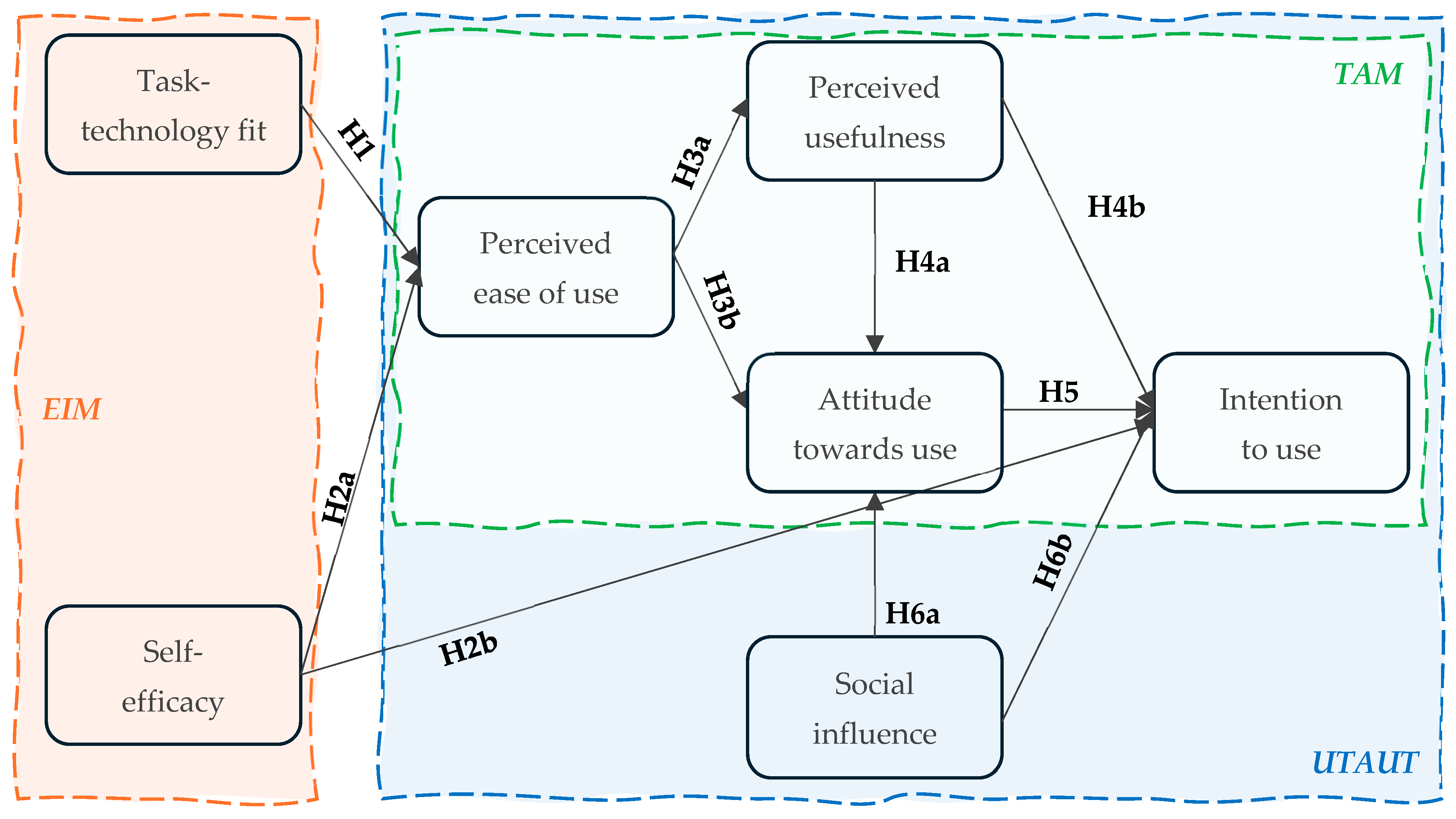
The literature reviewed above supports the multidimensional theoretical framework used in this study, which examines TTF, SE and SI in relation to Albanian farmers’ intentions to adopt smart irrigation systems. The proposed theoretical framework is presented in Figure 1, which combines TAM with EIM and the social influence component of UTAUT.

3. Materials and Methods

3.1. Data

The empirical object of this study is farmers’ intention to adopt smart irrigation systems, rather than agricultural technology adoption in general. A structured questionnaire was developed by adapting validated measurement items from prior studies and contextualising them for smart irrigation systems, including sensor-based drip irrigation. The questionnaire was prepared in the local language, Albanian, to ensure that respondents could understand the items clearly. Before the main data collection, the questionnaire was pilot tested with 12 farmers from the target population. Based on feedback from the pilot participants, minor adjustments were made to simplify wording, improve the description of smart irrigation systems, clarify technical terms and ensure that the items reflected farmers’ everyday irrigation and water-management practices. These pilot questionnaires were removed from the final dataset. The questionnaires were administered face-to-face using paper-based forms.
The study was conducted in two Albanian regions: Berat and Fier. These regions were purposively selected as study sites because, together, they capture much of the structural diversity that characterises Albanian smallholder agriculture, while also representing the country’s most productive and water-stressed farming regions. Fier is one of Albania’s largest and most agriculturally productive districts, where intensive vegetable, fruit, and field-crop production depends heavily on irrigation due to seasonal water scarcity and, in many areas, non-operational or degraded irrigation infrastructure inherited from the socialist period [95]. Berat, by contrast, is representative of Albania’s hillier, more fragmented smallholder terrain, characterised by mixed orcharding, viticulture and vegetable production on small, fragmented plots [96].
Data collection was conducted between December 2024 and February 2025. The study used a list-based purposive sampling approach. The sampling frame consisted of lists of farmers provided by local authorities. Farmers were eligible to participate if they were included in these local authority lists, were actively engaged in farming, were involved in farm-level decision-making, and carried out agricultural activities for which irrigation and water management were relevant. A total of 938 farmers were selected from these lists and invited to complete the questionnaire. The invitation explained the purpose of the study, the voluntary nature of participation, and the anonymity of responses. After excluding incomplete or unusable questionnaires, the final sample included 368 farmers (response rate = 39.2%). The profile of the final sample is presented in Table 1.

3.2. Variable Measurement

Several variables were measured to evaluate the research model proposed in the conceptual framework. These variables are central to understanding the factors that influence the adoption of smart irrigation systems, such as IoT soil moisture sensors, automated drip irrigation controllers and water-management mobile applications, in Albania. The scales used to measure these variables were adapted from established research [34,37,79], supporting the reliability and validity of the measures. All items were measured on a 5-point Likert scale, ranging from strongly disagree to strongly agree.
Attitude towards technology was measured using four items assessing farmers’ overall perceptions of adopting smart irrigation systems, including whether they considered adoption to be a good idea, advisable and satisfactory. For example, the statement “All things considered, using a smart irrigation system is a good idea” captures a general positive evaluation of technology adoption. Perceived usefulness was measured using four items evaluating the extent to which farmers believed that smart irrigation systems would enhance their farm management performance, productivity and efficiency. Statements such as “Using a smart irrigation system would improve my performance in managing water on my farm” reflect the practical benefits that farmers expect from adopting new technologies. Perceived ease of use was measured using three items, including “I would find the smart irrigation control application easy to use”. Intention to use technology was measured using three items capturing farmers’ willingness and likelihood to use smart irrigation systems in their work. Items such as “I intend to regularly use a smart irrigation system on my farm” indicate farmers’ commitment to integrating technology into their farming practices. These variables were adapted from Kim et al. [37] and Turner et al. [78].
Four items were used to measure TTF. Items such as “A smart irrigation system fits the way I manage water and crops in the field” evaluate farmers’ perceptions of the fit between farming tasks and smart irrigation systems. SE was measured using three items. Items such as “I feel comfortable operating the smart irrigation sensors and scheduling app on my own” capture farmers’ confidence in their ability to carry out the actions required to achieve specific outcomes. These variables were adapted from Kim et al. [37].
SI, adapted from Venkatesh et al. [34], refers to the mechanism through which an individual’s attitudes, beliefs or behaviours are influenced by the presence or actions of others. It was measured using three items, including “People who influence my behaviour suggest using smart irrigation systems on the farm”.

3.3. Method and Its Assumptions

For the analysis of the proposed relationships, this study employed PLS-SEM [97]. The choice of PLS-SEM was based on both methodological and analytical considerations. First, the aim of the study is explanatory-predictive, as it seeks to assess the relative influence of task-technology fit, self-efficacy, social influence and TAM-related constructs on farmers’ intention to adopt smart irrigation systems. Second, the study integrates constructs from different theoretical perspectives, namely TAM, UTAUT, TTF and self-efficacy, making PLS-SEM suitable for estimating a relatively complex model focused on prediction and variance explanation. Third, distributional diagnostics indicated that the construct scores departed from normality [98]. As shown in Table 2, all Cramér-von Mises tests were statistically significant at p < 0.001, while the skewness and excess kurtosis values also indicated deviations from a normal distribution. These results provide further support for the use of PLS-SEM rather than covariance-based SEM. The latent variables in this study were derived from reflective indicators. The PLS-SEM analysis was conducted using SmartPLS 4.0 software [99] and included a bootstrap procedure with 5000 resampling iterations.
Common method bias was assessed using Harman’s single-factor test approach [100]. Harman’s single-factor test was conducted by loading all measurement items into a single unrotated factor. The first factor explained 28.7% of the total variance, which is below the 50% threshold, suggesting that common method bias is unlikely to substantially affect the results.
Table 2 and Table 3 summarise the key checks conducted to assess the suitability of the chosen analytical approach. Table 2 presents the measurement model and normality assessment for the study’s constructs.
The outer loadings for all indicator variables exceed the generally accepted threshold of 0.70, indicating that the indicators effectively reflect their respective latent constructs [98]. The VIF values for all indicators are below 5.0, suggesting that multicollinearity is not a significant concern within the measurement model. This indicates that the indicator variables are sufficiently distinct and do not exhibit problematic levels of overlap. All constructs have CA and CR values above the recommended threshold of 0.70. These results confirm the reliability and internal consistency of the measures used for each construct. Moreover, all constructs have AVE values exceeding the minimum acceptable level of 0.50 [98], indicating that more than 50% of the variance in the indicators is explained by their respective constructs. This supports the convergent validity of the measurement model.
Table 3 presents the heterotrait–monotrait (HTMT) ratio matrix, which was used to assess discriminant validity among the constructs in the model. Discriminant validity is established when HTMT values fall below the recommended threshold, typically 0.85, indicating that the constructs are empirically distinct from one another [98]. As shown in Table 3, all HTMT values are below the 0.85 threshold. The highest HTMT value is between PU and ATT at 0.848, suggesting a strong relationship between these two constructs but still remaining within the acceptable limit for establishing discriminant validity. The HTMT ratio between TTF and PU is 0.832, while the ratio between TTF and ATT is also 0.832, indicating that these constructs are related but distinct. Similarly, the HTMT value between PEOU and ITU is 0.712, and the value between SE and PEOU is 0.755, further supporting discriminant validity. The remaining HTMT values are also below the 0.85 threshold, providing evidence that each construct in the model captures a distinct phenomenon.
Hypotheses were evaluated using both statistical and practical significance. Statistical significance was assessed using bootstrapped t-statistics, with paths considered statistically significant when the coefficient was in the expected direction, and the t-value exceeded the conventional threshold for p < 0.05. Practical significance was assessed using Cohen’s f2 effect size, where values of approximately 0.02, 0.15 and 0.35 indicate small, medium and large effects, respectively. Effects below 0.02 were interpreted as negligible. Therefore, statistically significant paths with f2 values below 0.02 were treated as statistically supported but of limited practical significance, rather than as substantively strong effects.

4. Results

Once the assumption checks had been completed, hypothesis testing was conducted. The evaluation of the structural model, presented in Table 4, provides insights into the relationships among the constructs in the research model. The tested hypotheses are grouped according to their respective theoretical perspectives. Each path coefficient (β) represents the strength and direction of the relationship between the predictor and outcome variables, while the associated t-statistics indicate statistical significance. The effect size (f2) indicates the substantive contribution of each predictor to the dependent variable, and VIF values are used to assess potential multicollinearity among predictors. The practical significance column provides a qualitative interpretation of each effect based on its effect size.
The results show that the variables grouped under EIM have positive and statistically significant effects. Specifically, H1, which examines the effect of TTF on PEOU, is supported, showing a positive effect with a small effect size (β = 0.175, t = 4.124, f2 = 0.026). This indicates that when a technology fits the task, users are more likely to perceive it as easy to use. H2a is also supported, as SE has a positive effect on PEOU with a medium effect size (β = 0.545, t = 13.76, f2 = 0.253), underscoring the importance of users’ confidence in using the technology. Similarly, H2b shows a small but statistically significant positive effect of SE on ITU (β = 0.150, t = 4.896, f2 = 0.027), indicating that higher self-efficacy modestly increases farmers’ intention to use smart irrigation systems.
Turning to the hypotheses grouped under TAM, H3a, which examines the effect of PEOU on PU, is supported. The path shows a strong positive relationship with a large effect size (β = 0.596, t = 24.03, f2 = 0.550), confirming that ease of use substantially enhances perceived usefulness. H3b, which examines the effect of PEOU on ATT, shows a positive and statistically significant effect (β = 0.089, t = 2.942). However, the effect size is below the threshold for a small effect (f2 = 0.017), indicating negligible practical significance. Therefore, H3b is statistically supported, but the substantive influence of perceived ease of use on attitude is very limited. Consistent with expectations, H4a, which examines the effect of PU on ATT, is supported (β = 0.713, t = 22.14, f2 = 1.053), showing a large effect of perceived usefulness on the formation of positive attitudes. The data also support H4b, which examines the effect of PU on ITU, as the path shows a small but statistically significant effect (β = 0.268, t = 5.366, f2 = 0.050). By contrast, H5, which examines the effect of ATT on ITU, is not statistically significant and has a negligible effect size (β = 0.099, t = 1.690, f2 = 0.006). Therefore, H5 is not supported.
Regarding the two hypotheses grouped under UTAUT, the results support both hypotheses. H6a, which examines the effect of SI on ATT, shows a small positive effect (β = 0.134, t = 4.397, f2 = 0.042). H6b, which examines the effect of SI on ITU, shows a medium effect (β = 0.411, t = 9.099, f2 = 0.290). These findings suggest that SI plays an important role in shaping both farmers’ attitudes towards smart irrigation systems and their intentions to use them.
Table 5 reports the explained variance in the dependent variables of the research model. The R2 values range from 0.355 for PU to 0.725 for ATT. The model explains 61.5% of the variance in ITU, indicating substantial explanatory power. In addition, the model fit statistics, including the Normed Fit Index (NFI = 0.905) and Standardised Root Mean Square Residual (SRMR = 0.037), indicate an acceptable-to-good model fit.
To complement the assessment of explanatory power, the model’s predictive relevance was examined using PLSpredict. The results are presented in Table 6. All Q2_predict values were above zero, ranging from 0.362 to 0.490, indicating that the model has predictive relevance for all endogenous construct indicators. The comparison of PLS-SEM RMSE values with the linear model benchmark further shows that the PLS-SEM model produced lower prediction errors for 9 of the 14 indicators. Specifically, the model outperformed the linear benchmark for most indicators of ATT, ITU and PEOU, while the results for PU were more mixed. These findings suggest that the model has moderate out-of-sample predictive power. Therefore, the model demonstrates not only substantial explanatory power, as reflected in the R2 values, but also acceptable predictive relevance. However, its predictive performance should not be interpreted as uniformly high across all indicators.

5. Discussion, Limitations, and Future Research

5.1. Discussion

The empirical results show that both TTF and SE play significant roles in shaping farmers’ intentions to adopt smart irrigation systems. The positive effect of TTF on PEOU aligns with previous research on smart irrigation and agricultural technology adoption, confirming that technologies perceived as compatible with farming tasks are more likely to be considered user-friendly [43,101]. This finding highlights the importance of designing agricultural technologies that respond directly to farmers’ operational needs and workflow patterns.
SE had a strong influence on PEOU, with a medium effect size. This relationship indicates that farmers’ confidence in their technological capabilities shapes how accessible they perceive smart irrigation systems to be [50,51]. SE also had a direct effect on ITU, although with a smaller effect size, suggesting that farmers’ technological self-confidence serves as both a direct and indirect determinant of adoption intentions. Similar findings have been reported in studies of farmers’ intention to adopt digital payment systems [56] and in Agriculture 5.0 adoption [50], where SE significantly influenced ease of use and intention to adopt agricultural technologies among farmers in developing regions.
The study validates several core TAM relationships in the context of smart irrigation adoption. The strong positive relationship between PEOU and PU confirms that user-friendly agricultural technologies are more likely to be perceived as beneficial for farming operations. This finding reinforces the central TAM proposition that ease of use contributes significantly to perceived utility [31,66,102].
PU had a much stronger role than PEOU in shaping farmers’ responses to smart irrigation systems. PU had a large effect on ATT and a significant direct effect on ITU, whereas PEOU had only a negligible practical effect on ATT, a pattern also reported in recent studies [103,104]. This asymmetry can be interpreted through the utilitarian and resource-sensitive nature of smart irrigation adoption. For farmers in this research context, smart irrigation systems are not discretionary digital tools; they are technologies expected to address practical farming problems such as water management, labour efficiency and yield stability. Under such conditions, farmers are likely to prioritise whether the technology can deliver clear functional benefits rather than whether it is simply easy to operate [50].
This finding is particularly relevant in smallholder farming contexts, where investment decisions are closely linked to productivity, resource constraints and risk exposure [102]. If farmers perceive smart irrigation systems as capable of improving water efficiency and supporting farm performance, they may tolerate a degree of operational complexity. In contrast, ease of use alone may not be sufficient to generate favourable attitudes unless the technology is also seen as economically and practically useful. This helps explain why PEOU strongly contributes to PU but has only a limited direct effect on ATT. Ease of use matters because it helps farmers recognise the usefulness of the system, but perceived usefulness appears to be the more decisive evaluative criterion. Therefore, in this context, extension services and technology providers should not promote smart irrigation systems mainly as easy-to-use tools; they should demonstrate concrete benefits in terms of water saving, productivity, labour reduction and farm-level decision-making.
SI emerged as the strongest direct predictor of farmers’ intention to use smart irrigation systems. This finding can be interpreted through three complementary mechanisms. First, smart irrigation systems involve a degree of outcome uncertainty because their water-saving, labour-saving and yield-related benefits may not be fully verified before use. Under such uncertainty, farmers may rely on observation, peer communication and the experiences of early adopters rather than on individual experimentation alone. This is consistent with social learning arguments in agricultural adoption research, where farmers use the experiences of others to reduce uncertainty around new technologies [14,105].
Second, Albania’s limited and unevenly distributed extension infrastructure [96] means that informal peer networks may substitute, at least partly, for the technical information that formal extension services would otherwise provide. This increases the importance of community validation in shaping farmers’ evaluations of smart irrigation systems.
Third, four decades of cooperative farming institutionalised group-based decision norms that may persist in modified form through the transition to smallholding. This is consistent with Hofstede’s argument that collectivist cultures can generate stronger subjective-norm effects on intention relative to individually formed attitudes [106,107]. Together, these mechanisms suggest that adoption intentions are shaped not only by individual cognitive evaluation, but also by social validation and peer-based learning.
The non-significant ATT → ITU path suggests an attitude–intention gap in the adoption of smart irrigation systems among Albanian farmers. Although farmers may view smart irrigation positively, favourable attitudes may not be sufficient to generate concrete adoption intentions when farmers face uncertainty about financing, technical support, input availability and implementation feasibility. In post-communist transition contexts, where agricultural support systems, credit access and advisory infrastructure may be uneven, farmers may struggle to translate general approval of a technology into a realistic intention to adopt it [108]. This means that attitude is not necessarily irrelevant; rather, its effect may be constrained by structural and practical barriers that lie outside the attitude construct itself [105].
Albanian farmers may find smart irrigation systems conceptually attractive but still hesitate to form adoption intentions if they are unsure whether they can finance, install, maintain or effectively use the technology on their own farms. This helps explain why SI and PU exert stronger direct effects on intention: they provide farmers with practical validation and clearer evidence that the technology is feasible and worthwhile. The finding therefore suggests that, in transition-economy agricultural contexts, technology adoption models should be extended beyond individual cognitive evaluation to include structural enabling conditions and perceived implementation feasibility [50,80].

5.2. Limitations and Future Research Directions

While this study provides useful insights, several limitations should be acknowledged. Because the study focuses specifically on smart irrigation systems, the findings should not be automatically generalised to all forms of agricultural technology. Other technologies, such as drones, farm management software, digital marketplaces and precision machinery, may involve different cost structures, skill requirements, risk perceptions and adoption mechanisms. Future research could compare different categories of agricultural technology to examine whether the relationships identified in this study remain stable across technology types.
The cross-sectional design cannot capture the dynamic nature of technology adoption processes over time. Future research could employ longitudinal approaches to examine how relationships between variables evolve throughout the adoption journey. In addition, the study focuses on behavioural intentions rather than actual adoption behaviour [109]. Future research should investigate the intention–behaviour gap in agricultural technology adoption and identify the factors that facilitate or hinder the translation of intentions into action.
Finally, while the integrated model is comprehensive, it may still omit important contextual factors specific to agricultural settings, such as risk perceptions, environmental concerns and resource constraints. Future research could expand the model to include these contextual variables and examine their moderating effects on the relationships identified in this study.

6. Conclusions

This study makes several theoretical contributions. First, it demonstrates the value of integrating multiple theoretical perspectives, namely EIM, TAM and UTAUT, to understand farmers’ intentions to adopt smart irrigation systems as a specific form of digital agricultural technology. The significant effects of TTF and SE underscore the importance of including capability-related constructs alongside traditional TAM variables. The divergence from classic TAM relationships, particularly the non-significant path from attitude to intention, suggests that technology adoption models may require contextual adaptation when applied to smallholder and transition-economy farming settings.
Second, the strong influence of social factors supports a social embeddedness perspective on smart irrigation adoption. Unlike many consumer technologies, agricultural technologies are adopted within local farming communities where peer observation, trusted advice and community norms can strongly shape individual decision-making. This finding suggests that models of agricultural technology adoption should treat social dynamics as central rather than peripheral, especially in rural contexts where formal advisory systems and institutional support may be uneven.
Finally, the results point to a potential reconceptualisation of the attitude–intention relationship in utilitarian agricultural contexts. A favourable attitude towards smart irrigation may not be sufficient to generate adoption intention when farmers face practical constraints such as cost, technical uncertainty, limited support or doubts about implementation. This suggests that future adoption models should include contextual and enabling conditions that account for the practical realities of farming operations.
The practical implications of this study should be interpreted in light of the finding that social influence was the strongest direct determinant of farmers’ intentions to adopt smart irrigation systems. This suggests that adoption in rural Albania is not only an individual decision based on perceived usefulness or ease of use, but also a socially mediated process shaped by trusted peers, local networks and community validation. Agricultural authorities, municipalities and development organisations could therefore establish digital farmer champions: early-adopting or technically confident farmers who demonstrate smart irrigation systems under local farming conditions. These champions could host demonstration plots, share practical experiences, explain costs and benefits, and provide reassurance to neighbouring farmers. Small incentives, such as discounted equipment, technical support or priority access to subsidy schemes, could help sustain their role.
Extension services should also be strengthened through peer-to-peer learning networks. Farmer field schools, mentoring pairs, rotating farm visits and adopter–non-adopter discussion groups would allow farmers to learn from trusted peers rather than relying only on expert-led instruction. Extension agents could act as facilitators of farmer-to-farmer exchange, helping to structure and verify the knowledge shared within these networks. Policymakers could further develop farmer influencer networks by identifying respected farmers, irrigation group representatives, producer association members, local agribusiness actors or cooperative leaders where such structures exist. Engaging these actors in the promotion of smart irrigation would be more targeted than broad awareness campaigns because it would use existing social trust to reduce uncertainty around adoption.
Finally, community-based social learning platforms, local demonstration days and short farmer-led videos could help circulate credible evidence of water savings, labour reduction and productivity benefits. Overall, these recommendations imply a shift in policy logic: smart irrigation adoption in rural Albania should be supported through locally trusted social networks, with extension and subsidy programmes designed to structure and incentivise peer learning rather than bypass it.

Author Contributions

Conceptualization, I.S. and E.M.; methodology, G.Ç. and I.V.; software, G.Ç.; validation, I.S., I.L. and E.M.; formal analysis, G.Ç.; investigation, I.S. and I.L.; resources, I.V.; data curation, G.Ç.; writing—original draft preparation, I.S. and E.M.; writing—review and editing, E.M. and I.V.; visualization, I.V.; supervision, I.L.; project administration, I.L.; funding acquisition, I.S. and G.Ç. All authors have read and agreed to the published version of the manuscript.

Funding

This research received no external funding.

Institutional Review Board Statement

Ethical review and approval were not available for this study as the authors’ institutions do not have a formal board for non-interventional social science research. However, the study was conducted in accordance with the Declaration of Helsinki, ensuring participant anonymity and safety. Informed consent was obtained from all subjects involved in the study. Participants were fully informed about the purpose of the research and the absolute anonymity of their responses prior to the data collection.

Data Availability Statement

Due to privacy and ethical restrictions, the raw survey data are not publicly available because they contain participant-level responses. An anonymised version of the data may be made available from the corresponding author upon reasonable request.

Acknowledgments

During the preparation of this study, the authors used ChatGPT-5.5 for the purposes of language editing. The authors have reviewed and edited the output and take full responsibility for the content of this publication.

Conflicts of Interest

The authors declare no conflicts of interest.

Abbreviations

The following abbreviations are used in this manuscript:
ATTAttitude Towards Technology
AVEAverage Variance Extracted
CACronbach’s Alpha
CRComposite Reliability
CVMSCramér-von Mises Statistic
EIMExtrinsic and Intrinsic Motivations
ITUIntention To Use
PEOUPerceived Ease of Use
PLS-SEMPartial Least Squares Structural Equation Modeling
PUPerceived Usefulness
SESelf-Efficacy
SISocial Influence
TAMTechnology Acceptance Model
TTFTask-Technology Fit
UTAUTUnified Theory of Acceptance and Use of Technology
VIFVariance Inflation Factor

References

  1. Khan, N.; Ray, R.L.; Sargani, G.R.; Ihtisham, M.; Khayyam, M.; Ismail, S. Current Progress and Future Prospects of Agriculture Technology: Gateway to Sustainable Agriculture. Sustainability 2021, 13, 4883. [Google Scholar] [CrossRef] [Scilit]
  2. Qayyum, M.; Zhang, Y.; Wang, M.; Yu, Y.; Li, S.; Ahmad, W.; Maodaa, S.N.; Sayed, S.R.; Gan, J. Advancements in Technology and Innovation for Sustainable Agriculture: Understanding and Mitigating Greenhouse Gas Emissions from Agricultural Soils. J. Environ. Manag. 2023, 347, 119147. [Google Scholar] [CrossRef] [Scilit]
  3. Sharma, V.; Tripathi, A.K.; Mittal, H. Technological Revolutions in Smart Farming: Current Trends, Challenges & Future Directions. Comput. Electron. Agric. 2022, 201, 107217. [Google Scholar] [CrossRef] [Scilit]
  4. Bocean, C.G. A Cross-Sectional Analysis of the Relationship between Digital Technology Use and Agricultural Productivity in EU Countries. Agriculture 2024, 14, 519. [Google Scholar] [CrossRef] [Scilit]
  5. Rizzo, G.; Migliore, G.; Schifani, G.; Vecchio, R. Key Factors Influencing Farmers’ Adoption of Sustainable Innovations: A Systematic Literature Review and Research Agenda. Org. Agric. 2024, 14, 57–84. [Google Scholar] [CrossRef] [Scilit]
  6. Çera, G.; Breckova, P.; Çera, E.; Rozsa, Z. The Effect of Business Enabling Policies, Tax Treatment, Corruption and Political Connections on Business Climate. Acta Polytech. Hung. 2019, 16, 113–132. [Google Scholar] [CrossRef] [Scilit]
  7. Dai, Q.; Cheng, K. What Drives the Adoption of Agricultural Green Production Technologies? An Extension of TAM in Agriculture. Sustainability 2022, 14, 14457. [Google Scholar] [CrossRef] [Scilit]
  8. Saleem, A.; Anwar, S.; Nawaz, T.; Fahad, S.; Saud, S.; Ur Rahman, T.; Khan, M.N.R.; Nawaz, T. Securing a Sustainable Future: The Climate Change Threat to Agriculture, Food Security, and Sustainable Development Goals. J. Umm Al-Qura Univ. Appl. Sci. 2024, 11, 595–611. [Google Scholar] [CrossRef] [Scilit]
  9. Sargani, G.R.; Wang, B.; Leghari, S.J.; Ruan, J. Is Digital Transformation the Key to Agricultural Strength? A Novel Approach to Productivity and Supply Chain Resilience. Smart Agric. Technol. 2025, 10, 100838. [Google Scholar] [CrossRef] [Scilit]
  10. Strong, R.; Ganpat, W.; Harder, A.; Irby, T.L.; Lindner, J.R. Exploring the Use of Information Communication Technologies by Selected Caribbean Extension Officers. J. Agric. Educ. Ext. 2014, 20, 485–495. [Google Scholar] [CrossRef] [Scilit]
  11. Wang, J.; Azam, W. Natural Resource Scarcity, Fossil Fuel Energy Consumption, and Total Greenhouse Gas Emissions in Top Emitting Countries. Geosci. Front. 2024, 15, 101757. [Google Scholar] [CrossRef] [Scilit]
  12. Imami, D.; Valentinov, V.; Skreli, E. Food Safety and Value Chain Coordination in the Context of a Transition Economy: The Role of Agricultural Cooperatives. Int. J. Commons 2021, 15, 21–34. [Google Scholar] [CrossRef] [Scilit]
  13. Skreli, E.; Imami, D.; Attila, J.; Zvyagintsev, D.; Cera, G. The Impact of Government Subsidies on the Olive and Vineyard Sectors of Albanian Agriculture. Stud. Agric. Econ. 2015, 117, 119–125. [Google Scholar] [CrossRef] [Scilit]
  14. Skrteli, E.; Boshnjaku, A.; Xhoxhi, O.; Skreli, E. Technology Adoption for Sustainable Agriculture in a Transition Country: An UTAUT Analysis of the Albanian Horticulture Sector. Stud. Agric. Econ. 2026, 128, 45–58. [Google Scholar] [CrossRef] [Scilit]
  15. Buchenrieder, G.; Hanf, J.H.; Pieniadz, A. 20 Years of Transition in the Agri-Food Sector. Ger. J. Agric. Econ. 2009, 58, 285–293. [Google Scholar] [CrossRef] [Scilit]
  16. Dworak, E. The Innovativeness of the Economies of European Union Candidate Countries—An Assessment of Their Innovation Gap in Relation to the EU Average. Comp. Econ. Res. Cent. East. Eur. 2024, 27, 7–21. [Google Scholar] [CrossRef] [Scilit]
  17. Dworak, E. Assessment of Innovativeness of the EU Candidate Countries Based on the European Innovation Scoreboard. Ekon. Międzynarodowa 2024, 41, 22–37. [Google Scholar] [CrossRef] [Scilit]
  18. Cherkashyna, T. An Examination of the Impact of Institutional Environment on Socio-Economic Development in Candidate Countries for EU Membership Using Canonical Correlation Analysis. In Proceedings of the 2024 14th International Conference on Advanced Computer Information Technologies (ACIT), Ceske Budejovice, Czech Republic, 19–21 September 2024; pp. 414–418. [Google Scholar] [CrossRef] [Scilit]
  19. Maloku, S.; Çera, G.; Metzker, Z.; Lushi, I.; Poleshi, B. The Role of Access to Information in Trading Relationship and Plans for Future Activities. J. Int. Stud. 2021, 14, 113–127. [Google Scholar] [CrossRef] [Scilit]
  20. Murrja, A.; Cera, G. Exploring the Role of Five Key Risks for Apple Farmers: An Explanatory and Inferential Analysis. South East Eur. J. Econ. Bus. 2025, 20, 53–67. [Google Scholar] [CrossRef] [Scilit]
  21. Skreli, E.; Xhoxhi, O.; Zhllima, E.; Imami, D. Do Agriculture Subsidies Make Farmers Better-off? A Case Study from an EU Candidate Country. Stud. Agric. Econ. 2024, 126, 140–146. [Google Scholar]
  22. Murrja, A.; Vejsiu, I.; Çera, G.; Shumeli, A. Who Sees What Risk? Demographic Patterns in Risk Perception among Apple Farmers. J. Agribus. Dev. Emerg. Econ. 2026. ahead-of-print. [Google Scholar] [CrossRef] [Scilit]
  23. Hedlund, H. Mapping the Evolving Intellectual Structure of Digital Innovation Research on the Public Sector: A Document Co-Citation Analysis. In Proceedings of the 53rd Hawaii International Conference on System Sciences (HICSS 2020), Maui, HI, USA, 7–10 January 2020; pp. 2042–2051. [Google Scholar]
  24. Çera, G.; Çera, E.; Ribeiro, H.N.R.; Maloku, S. The Role of Trust in Government and Institutional Environment in Future Business Climate. Int. J. Entrep. Ventur. 2021, 13, 425. [Google Scholar] [CrossRef] [Scilit]
  25. Qorri, D.; Pergéné Szabó, E.; Felföldi, J.; Kovács, K. The Role of Human Resource Management in Agricultural Labor-Saving Technologies: An Integrative Review and Science Mapping. Agriculture 2024, 14, 1144. [Google Scholar] [CrossRef] [Scilit]
  26. Davis, F.D. Perceived Usefulness, Perceived Ease of Use, and User Acceptance of Information Technology. MIS Q. 1989, 13, 319–340. [Google Scholar] [CrossRef] [Scilit] [PubMed]
  27. Goodhue, D.L.; Thompson, R.L. Task-Technology Fit and Individual Performance. MIS Q. 1995, 19, 213. [Google Scholar] [CrossRef] [Scilit] [PubMed]
  28. Compeau, D.R.; Higgins, C.A. Computer Self-Efficacy: Development of a Measure and Initial Test. MIS Q. 1995, 19, 189–211. [Google Scholar] [CrossRef] [Scilit]
  29. Venkatesh, V.; Thong, J.Y.L.; Xu, X. Consumer Acceptance and Use of Information Technology: Extending the Unified Theory of Acceptance and Use of Technology. MIS Q. 2012, 36, 157–178. [Google Scholar] [CrossRef] [Scilit]
  30. Fishbein, M.; Ajzen, I. Belief, Attitude, Intention, and Behavior: An Introduction to Theory and Research. Philos. Rhetor. 1977, 10, 130–132. [Google Scholar]
  31. Verma, P.; Sinha, N. Integrating Perceived Economic Wellbeing to Technology Acceptance Model: The Case of Mobile Based Agricultural Extension Service. Technol. Forecast. Soc. Change 2018, 126, 207–216. [Google Scholar] [CrossRef] [Scilit]
  32. Yi, Y.; Wu, Z.; Tung, L.L. How Individual Differences Influence Technology Usage Behavior? Toward an Integrated Framework. J. Comput. Inf. Syst. 2005, 46, 52–63. [Google Scholar] [CrossRef] [Scilit]
  33. Agarwal, R.; Prasad, J. Are Individual Differences Germane to the Acceptance of New Information Technologies? Decis. Sci. 1999, 30, 361–391. [Google Scholar] [CrossRef] [Scilit]
  34. Venkatesh, V.; Morris, M.G.; Davis, G.B.; Davis, F.D. User Acceptance of Information Technology: Toward a Unified View. MIS Q. 2003, 27, 425–478. [Google Scholar] [CrossRef] [Scilit]
  35. Bandura, A. Self-Efficacy: Toward a Unifying Theory of Behavioral Change. Psychol. Rev. 1977, 84, 191. [Google Scholar] [CrossRef] [PubMed]
  36. Keil, M.; Beranek, P.M.; Konsynski, B.R. Usefulness and Ease of Use: Field Study Evidence Regarding Task Considerations. Decis. Support Syst. 1995, 13, 75–91. [Google Scholar] [CrossRef] [Scilit]
  37. Kim, T.T.; Suh, Y.; Lee, G.; Choi, B. Modelling Roles of Task-technology Fit and Self-efficacy in Hotel Employees’ Usage Behaviours of Hotel Information Systems. Int. J. Tour. Res. 2010, 12, 709–725. [Google Scholar] [CrossRef] [Scilit]
  38. Larsen, T.J.; Sørebø, A.M.; Sørebø, Ø. The Role of Task-Technology Fit as Users’ Motivation to Continue Information System Use. Comput. Hum. Behav. 2009, 25, 778–784. [Google Scholar] [CrossRef] [Scilit]
  39. Mathieson, K.; Keil, M. Beyond the Interface: Ease of Use and Task/Technology Fit. Inf. Manag. 1998, 34, 221–230. [Google Scholar] [CrossRef] [Scilit]
  40. Wu, B.; Chen, X. Continuance Intention to Use MOOCs: Integrating the Technology Acceptance Model (TAM) and Task Technology Fit (TTF) Model. Comput. Hum. Behav. 2017, 67, 221–232. [Google Scholar] [CrossRef] [Scilit]
  41. Dishaw, M.T.; Strong, D.M. Extending the Technology Acceptance Model with Task–Technology Fit Constructs. Inf. Manag. 1999, 36, 9–21. [Google Scholar] [CrossRef] [Scilit]
  42. McDonald, R.; Heanue, K.; Pierce, K.; Horan, B. Factors Influencing New Entrant Dairy Farmer’s Decision-Making Process around Technology Adoption. J. Agric. Educ. Ext. 2016, 22, 163–177. [Google Scholar] [CrossRef] [Scilit]
  43. Aparo, N.O.; Atimango, A.O.; Odongo, W.; De Steur, H. Understanding Perceived Performance Impacts of Mobile Phone Use among Smallholders in Uganda: The Influence of Task-Technology Fit and Current Use. Cogent Food Agric. 2024, 10, 2333319. [Google Scholar] [CrossRef] [Scilit]
  44. Li, L.; Paudel, K.P.; Guo, J. Understanding Chinese Farmers’ Participation Behavior Regarding Vegetable Traceability Systems. Food Control 2021, 130, 108325. [Google Scholar] [CrossRef] [Scilit]
  45. Agarwal, R.; Sambamurthy, V.; Stair, R.M. Research Report: The Evolving Relationship Between General and Specific Computer Self-Efficacy—An Empirical Assessment. Inf. Syst. Res. 2000, 11, 418–430. [Google Scholar] [CrossRef] [Scilit]
  46. Igbaria, M. The Effects of Self-Efficacy on Computer Usage. Omega 1995, 23, 587–605. [Google Scholar] [CrossRef] [Scilit]
  47. Luarn, P.; Lin, H.-H. Toward an Understanding of the Behavioral Intention to Use Mobile Banking. Comput. Hum. Behav. 2005, 21, 873–891. [Google Scholar] [CrossRef] [Scilit]
  48. Amin, K.; Li, J. Applying Farmer Technology Acceptance Model to Understand Farmer’s Behavior Intention to Use ICT Based Microfinance Platform: A Comparative Analysis Between Bangladesh and China. In Proceedings of the 13th Wuhan International Conference on E-Business—IT/IS Technology for E-Business, Wuhan, China, 31 May–1 June 2014. [Google Scholar]
  49. Castiblanco Jimenez, I.A.; Cepeda García, L.C.; Violante, M.G.; Marcolin, F.; Vezzetti, E. Commonly Used External TAM Variables in E-Learning, Agriculture and Virtual Reality Applications. Future Internet 2020, 13, 7. [Google Scholar] [CrossRef] [Scilit]
  50. Mishra, N.; Bhandari, N.; Maraseni, T.; Devkota, N.; Khanal, G.; Bhusal, B.; Basyal, D.K.; Paudel, U.R.; Danuwar, R.K. Technology in Farming: Unleashing Farmers’ Behavioral Intention for the Adoption of Agriculture 5.0. PLoS ONE 2024, 19, e0308883. [Google Scholar] [CrossRef] [Scilit] [PubMed]
  51. Soodan, V.; Jamwal, M.; Rana, N.P.; Sharma, D.; Chakraborty, S. Modelling the Adoption of Agro-Advisory Mobile Applications: A Theoretical Extension and Analysis Using Result Demonstrability, Trust, Self-Efficacy and Mobile Usage Proficiency. J. Agribus. Dev. Emerg. Econ. 2023, 14, 749–768. [Google Scholar] [CrossRef] [Scilit]
  52. Zeweld, W.; Van Huylenbroeck, G.; Tesfay, G.; Speelman, S. Smallholder Farmers’ Behavioural Intentions towards Sustainable Agricultural Practices. J. Environ. Manag. 2017, 187, 71–81. [Google Scholar] [CrossRef] [Scilit]
  53. Rezaei, R.; Safa, L.; Ganjkhanloo, M.M. Understanding Farmers’ Ecological Conservation Behavior Regarding the Use of Integrated Pest Management-an Application of the Technology Acceptance Model. Glob. Ecol. Conserv. 2020, 22, e00941. [Google Scholar] [CrossRef] [Scilit]
  54. Joo, Y.J.; Park, S.; Lim, E. Factors Influencing Preservice Teachers’ Intention to Use Technology: TPACK, Teacher Self-Efficacy, and Technology Acceptance Model. J. Educ. Technol. Soc. 2018, 21, 48–59. [Google Scholar]
  55. Kumar, J.A.; Bervell, B.; Annamalai, N.; Osman, S. Behavioral Intention to Use Mobile Learning: Evaluating the Role of Self-Efficacy, Subjective Norm, and WhatsApp Use Habit. IEEE Access 2020, 8, 208058–208074. [Google Scholar] [CrossRef] [Scilit]
  56. Linh, T.T.; Huyen, N.T.T.; Quynh, N.N.; Doanh, N.K. Impacts of Self-Efficacy and Herd Behavior on Farmers’ Intention to Adopt Digital Payment in the Mountainous Regions of Northern Vietnam. J. Agribus. Dev. Emerg. Econ. 2025. ahead-of-print. [Google Scholar] [CrossRef] [Scilit]
  57. Maddux, J.; Norton, L.; Stoltenberg, C. Self-Efficacy Expectancy, Outcome Expectancy, and Outcome Value. Relative Effects on Behavioral Intentions. J. Pers. Soc. Psychol. 1986, 51, 783–789. [Google Scholar] [CrossRef]
  58. Ramadania, S.; Braridwan, Z. The Influence of Perceived Usefulness, Ease of Use, Attitude, Self-Efficacy, and Subjective Norms toward Intention to Use Online Shopping. Int. Bus. Account. Res. J. 2019, 3, 1–14. [Google Scholar]
  59. Venkatesh, V.; Davis, F.D. A Theoretical Extension of the Technology Acceptance Model: Four Longitudinal Field Studies. Manag. Sci. 2000, 46, 186–204. [Google Scholar] [CrossRef] [Scilit]
  60. Wangpipatwong, S.; Chutimaskul, W.; Papasratorn, B. Understanding Citizen’s Continuance Intention to Use e-Government Website: A Composite View of Technology Acceptance Model and Computer Self-Efficacy. Electron. J. E-Gov. 2008, 6, 55–64. [Google Scholar]
  61. Hernandez, B.; Jimenez, J.; Jose Martin, M. The Impact of Self-Efficacy, Ease of Use and Usefulness on e-Purchasing: An Analysis of Experienced e-Shoppers. Interact. Comput. 2009, 21, 146–156. [Google Scholar] [CrossRef] [Scilit]
  62. Davis, F.D. Technology Acceptance Model: TAM. Al-Suqri MN Al-Aufi Inf. Seek. Behav. Technol. Adopt. 1989, 205, 219. [Google Scholar]
  63. Adams, D.A.; Nelson, R.R.; Todd, P.A. Perceived Usefulness, Ease of Use, and Usage of Information Technology: A Replication. MIS Q. 1992, 16, 227–247. [Google Scholar] [CrossRef] [Scilit]
  64. Wu, J.-H.; Wang, S.-C. What Drives Mobile Commerce?: An Empirical Evaluation of the Revised Technology Acceptance Model. Inf. Manag. 2005, 42, 719–729. [Google Scholar] [CrossRef] [Scilit]
  65. Venkatesh, V.; Bala, H. Technology Acceptance Model 3 and a Research Agenda on Interventions. Decis. Sci. 2008, 39, 273–315. [Google Scholar] [CrossRef] [Scilit]
  66. Dong, H.; Wang, H.; Han, J. Understanding Ecological Agricultural Technology Adoption in China Using an Integrated Technology Acceptance Model—Theory of Planned Behavior Model. Front. Environ. Sci. 2022, 10, 927668. [Google Scholar] [CrossRef] [Scilit]
  67. Rezaei-Moghaddam, K.; Salehi, S. Agricultural Specialists’ Intention toward Precision Agriculture Technologies: Integrating Innovation Characteristics to Technology Acceptance Model. Afr. J. Agric. Res. 2010, 5, 1191–1199. [Google Scholar]
  68. Tohidyan Far, S.; Rezaei-Moghaddam, K. Determinants of Iranian Agricultural Consultants’ Intentions toward Precision Agriculture: Integrating Innovativeness to the Technology Acceptance Model. J. Saudi Soc. Agric. Sci. 2017, 16, 280–286. [Google Scholar] [CrossRef] [Scilit]
  69. Chau, P.Y.K.; Hu, P.J.-H. Investigating Healthcare Professionals’ Decisions to Accept Telemedicine Technology: An Empirical Test of Competing Theories. Inf. Manag. 2002, 39, 297–311. [Google Scholar] [CrossRef] [Scilit]
  70. Gefen, D.; Straub, D.W. Gender Differences in the Perception and Use of E-Mail: An Extension to the Technology Acceptance Model. MIS Q. 1997, 21, 389–400. [Google Scholar] [CrossRef] [Scilit]
  71. Szajna, B. Software Evaluation and Choice: Predictive Validation of the Technology Acceptance Instrument. MIS Q. 1994, 18, 319–324. [Google Scholar] [CrossRef] [Scilit]
  72. Moon, J.-W.; Kim, Y.-G. Extending the TAM for a World-Wide-Web Context. Inf. Manag. 2001, 38, 217–230. [Google Scholar] [CrossRef] [Scilit]
  73. Taylor, S.; Todd, P. Assessing IT Usage: The Role of Prior Experience. MIS Q. 1995, 19, 561. [Google Scholar] [CrossRef] [Scilit] [PubMed]
  74. Caffaro, F.; Micheletti Cremasco, M.; Roccato, M.; Cavallo, E. Drivers of Farmers’ Intention to Adopt Technological Innovations in Italy: The Role of Information Sources, Perceived Usefulness, and Perceived Ease of Use. J. Rural Stud. 2020, 76, 264–271. [Google Scholar] [CrossRef] [Scilit]
  75. Flett, R.; Alpass, F.; Humphries, S.; Massey, C.; Morriss, S.; Long, N. The Technology Acceptance Model and Use of Technology in New Zealand Dairy Farming. Agric. Syst. 2004, 80, 199–211. [Google Scholar] [CrossRef] [Scilit]
  76. Sun, H.; Zhang, P. The Role of Moderating Factors in User Technology Acceptance. Int. J. Hum.-Comput. Stud. 2006, 64, 53–78. [Google Scholar] [CrossRef] [Scilit]
  77. Kanchanatanee, K.; Suwanno, N.; Jarernvongrayab, A. Effects of Attitude toward Using, Perceived Usefulness, Perceived Ease of Use and Perceived Compatibility on Intention to Use E-Marketing. J. Manag. Res. 2014, 6, 1. [Google Scholar] [CrossRef] [Scilit]
  78. Turner, M.; Kitchenham, B.; Brereton, P.; Charters, S.; Budgen, D. Does the Technology Acceptance Model Predict Actual Use? A Systematic Literature Review. Inf. Softw. Technol. 2010, 52, 463–479. [Google Scholar] [CrossRef] [Scilit]
  79. Hua, L.; Wang, S. Antecedents of Consumers’ Intention to Purchase Energy-Efficient Appliances: An Empirical Study Based on the Technology Acceptance Model and Theory of Planned Behavior. Sustainability 2019, 11, 2994. [Google Scholar] [CrossRef] [Scilit]
  80. Van, V.H.; Quynh, N.N.; Doanh, N.K. Factors Affecting Farmers’ Intention to Use ECEs in Covid-19 Pandemic: Combining the Technology Acceptance Model (TAM) and Barrier Factors. J. Agribus. Dev. Emerg. Econ. 2022, 14, 129–145. [Google Scholar] [CrossRef] [Scilit]
  81. Cheung, R.; Vogel, D. Predicting User Acceptance of Collaborative Technologies: An Extension of the Technology Acceptance Model for e-Learning. Comput. Educ. 2013, 63, 160–175. [Google Scholar] [CrossRef] [Scilit]
  82. Bagozzi, R. The Legacy of the Technology Acceptance Model and a Proposal for a Paradigm Shift. J. Assoc. Inf. Syst. 2007, 8, 244–254. [Google Scholar] [CrossRef] [Scilit]
  83. Kelman, H.C. Compliance, Identification, and Internalization Three Processes of Attitude Change. J. Confl. Resolut. 1958, 2, 51–60. [Google Scholar] [CrossRef] [Scilit]
  84. Kulviwat, S.; Bruner, G.C.; Al-Shuridah, O. The Role of Social Influence on Adoption of High Tech Innovations: The Moderating Effect of Public/Private Consumption. J. Bus. Res. 2009, 62, 706–712. [Google Scholar] [CrossRef] [Scilit]
  85. Morosan, C.; DeFranco, A. When Tradition Meets the New Technology: An Examination of the Antecedents of Attitudes and Intentions to Use Mobile Devices in Private Clubs. Int. J. Hosp. Manag. 2014, 42, 126–136. [Google Scholar] [CrossRef] [Scilit]
  86. Prastiawan, D.I.; Aisjah, S.; Rofiaty, R. The Effect of Perceived Usefulness, Perceived Ease of Use, and Social Influence on the Use of Mobile Banking through the Mediation of Attitude toward Use. APMBA Asia Pac. Manag. Bus. Appl. 2021, 9, 243–260. [Google Scholar] [CrossRef] [Scilit]
  87. Robinson, L. Moving beyond Adoption: Exploring the Determinants of Student Intention to Use Technology. Mark. Educ. Rev. 2006, 16, 79–88. [Google Scholar] [CrossRef] [Scilit]
  88. Choi, J.; Lee, H.J.; Sajjad, F.; Lee, H. The Influence of National Culture on the Attitude towards Mobile Recommender Systems. Technol. Forecast. Soc. Change 2014, 86, 65–79. [Google Scholar] [CrossRef] [Scilit]
  89. Rezaei, R.; Ghofranfarid, M. Rural Households’ Renewable Energy Usage Intention in Iran: Extending the Unified Theory of Acceptance and Use of Technology. Renew. Energy 2018, 122, 382–391. [Google Scholar] [CrossRef] [Scilit]
  90. Giua, C.; Materia, V.C.; Camanzi, L. Smart Farming Technologies Adoption: Which Factors Play a Role in the Digital Transition? Technol. Soc. 2022, 68, 101869. [Google Scholar] [CrossRef] [Scilit]
  91. Khoza, S.; De Beer, L.T.; Van Niekerk, D.; Nemakonde, L. A Gender-Differentiated Analysis of Climate-Smart Agriculture Adoption by Smallholder Farmers: Application of the Extended Technology Acceptance Model. Gend. Technol. Dev. 2021, 25, 1–21. [Google Scholar] [CrossRef] [Scilit]
  92. McDonald, N.; Fogarty, E.S.; Cosby, A.; McIlveen, P. Technology Acceptance, Adoption and Workforce on Australian Cotton Farms. Agriculture 2022, 12, 1180. [Google Scholar] [CrossRef] [Scilit]
  93. Ronaghi, M.H.; Forouharfar, A. A Contextualized Study of the Usage of the Internet of Things (IoTs) in Smart Farming in a Typical Middle Eastern Country within the Context of Unified Theory of Acceptance and Use of Technology Model (UTAUT). Technol. Soc. 2020, 63, 101415. [Google Scholar] [CrossRef] [Scilit]
  94. Zheng, H.; Ma, J.; Yao, Z.; Hu, F. How Does Social Embeddedness Affect Farmers’ Adoption behaviour of Low-Carbon Agricultural Technology? Evidence from Jiangsu Province, China. Front. Environ. Sci. 2022, 10, 909803. [Google Scholar] [CrossRef] [Scilit]
  95. Meço, M.; Murrja, A.; Mehmeti, G.; Tomorri, I.; Pagria, I. Assessing Farm’s Performance by Farm Typology in Albania. Acad. J. Interdiscip. Stud. 2016, 5, 288–294. [Google Scholar] [CrossRef] [Scilit]
  96. Sikor, T.; Müller, D.; Stahl, J. Land Fragmentation and Cropland Abandonment in Albania: Implications for the Roles of State and Community in Post-Socialist Land Consolidation. World Dev. 2009, 37, 1411–1423. [Google Scholar] [CrossRef] [Scilit]
  97. Hair, J.F.; Hult, G.T.M.; Ringle, C.M.; Sarstedt, M. A Primer on Partial Least Squares Structural Equation Modeling (PLS-SEM), 3rd ed.; SAGE: Los Angeles, CA, USA, 2022. [Google Scholar]
  98. Hair, J.F.; Risher, J.J.; Sarstedt, M.; Ringle, C.M. When to Use and How to Report the Results of PLS-SEM. Eur. Bus. Rev. 2019, 31, 2–24. [Google Scholar] [CrossRef] [Scilit]
  99. Ringle, C.M.; Wende, S.; Becker, J.-M. SmartPLS 4; SmartPLS: Monheim am Rhein, Germany, 2022. [Google Scholar]
  100. Podsakoff, P.M.; MacKenzie, S.B.; Lee, J.-Y.; Podsakoff, N.P. Common Method Biases in Behavioral Research: A Critical Review of the Literature and Recommended Remedies. J. Appl. Psychol. 2003, 88, 879–903. [Google Scholar] [CrossRef] [Scilit] [PubMed]
  101. Makinde, A.; Islam, M.M.; Wood, K.M.; Conlin, E.; Williams, M.; Scott, S.D. Investigating Perceptions, Adoption, and Use of Digital Technologies in the Canadian Beef Industry. Comput. Electron. Agric. 2022, 198, 107095. [Google Scholar] [CrossRef] [Scilit]
  102. Kobusiingye, F.; Ssembatya, R.; Kaggwa, F.; Ejiri, A.H.A.H. Bridging the Agricultural Extension Gap: Insights from the Teaching-Learning Theories and Models. Open Access Res. J. Sci. Technol. 2024, 12, 027–039. [Google Scholar] [CrossRef]
  103. Cao, A.; Guo, L.; Li, H. Understanding Farmer Cooperatives’ Intention to Adopt Digital Technology: Mediating Effect of Perceived Ease of Use and Moderating Effects of Internet Usage and Training. Int. J. Agric. Sustain. 2025, 23, 2464523. [Google Scholar] [CrossRef] [Scilit]
  104. Muromba, P.; Keeni, M.; Fuyuki, K. A Systematic Review of Mobile Agricultural Service Applications for Smallholder Farmers in Sub-Saharan Africa: Perspectives from the Technology Acceptance Model. Agric. Food Secur. 2025, 14, 34. [Google Scholar] [CrossRef] [Scilit]
  105. Conley, T.G.; Udry, C.R. Learning about a New Technology: Pineapple in Ghana. Am. Econ. Rev. 2010, 100, 35–69. [Google Scholar] [CrossRef] [Scilit]
  106. Trongmateerut, P.; Sweeney, J.T. The Influence of Subjective Norms on Whistle-Blowing: A Cross-Cultural Investigation. J. Bus. Ethics 2013, 112, 437–451. [Google Scholar] [CrossRef] [Scilit]
  107. Hofstede, G. Dimensionalizing Cultures: The Hofstede Model in Context. Online Read. Psychol. Cult. 2011, 2, 8. [Google Scholar] [CrossRef] [Scilit]
  108. Gouroubera, M.W.W.; Gouthon, M.; Segnon, A.C.C.; Dosso, F.; Togbévi, Q.F.; Moumouni-Moussa, I.; Zougmoré, R.B. Understanding Farmers’ Acceptance of Digital Technologies: A Meta-Analytic Structural Equation Modeling Approach Based on the Technology Acceptance Model. Front. Sustain. Food Syst. 2026, 10, 1723715. [Google Scholar] [CrossRef] [Scilit]
  109. Li, L.; Zhang, M.; Chandio, A.A.; Liu, Y. Investigating the Intention and Behavior of Vegetable Farmers to Adopt IoT Technology: Survey—Based Evidence from China. Front. Sustain. Food Syst. 2024, 8, 1340874. [Google Scholar] [CrossRef] [Scilit]
Figure 1. Conceptual framework. Source: Authors’ own work. Note: EIM, extrinsic and intrinsic motivations; TAM, technology acceptance model; UTAUT, unified theory of acceptance and use of technology. H1 = TTF → PEOU; H2a = SE → PEOU; H2b = SE → ITU; H3a = PEOU → PU; H3b = PEOU → ATT; H4a = PU → ATT; H4b = PU → ITU; H5 = ATT → ITU; H6a = SI → ATT; H6b = SI → ITU.
Agriculture 16 01592 g001
Table 1. Sample profile.
VariableRegionTotal
BeratFier
Male household head193154347
Female household head61521
Age of the household head586159
Number of days working on the farm248170212
Number of respondents199169368
Source: Authors’ own work.
Table 2. Measurement model and normality assessment of construct scores.
ItemOuter
Loadings
VIFCACRAVEExcess
Kurtosis
SkewnessCVMS
ATT 0.9220.9230.8112.468−1.2055.144
att10.9013.517
att20.9224.078
att30.9324.210
att40.8452.203
ITU 0.9260.9260.8711.536−0.9484.165
itu10.9263.272
itu20.9434.064
itu30.9303.574
PEOU 0.8940.8950.8260.084−0.5092.016
peou10.9032.976
peou30.9363.648
peou40.8862.273
PU 0.9450.9450.8591.639−0.9954.801
pu10.9233.957
pu20.9374.708
pu30.9304.260
pu40.9163.620
SE 0.8880.8940.8160.779−0.6013.270
se10.9072.673
se20.9273.053
se30.8752.266
SI 0.9170.9180.8581.706−1.0935.277
si10.9163.028
si20.9403.891
si30.9233.188
TTF 0.9350.9390.8381.287−0.9893.773
ttf10.9163.574
ttf20.9063.345
ttf30.9414.706
ttf40.8983.253
Source: Authors’ own work. Note: VIF, variance inflation factor; CA, Cronbach’s alpha; CR, composite reliability; AVE, Average Variance Extracted; CVMS, Cramér-von Mises Statistic; ATT, attitude towards technology; ITU, intention to use; PEOU, perceived ease of use; PU, perceived usefulness; SE, self-efficacy; SI, social influence; TTF, task-technology fit. All Cramér-von Mises statistics are statistically significant, p < 0.001.
Table 3. Discriminant validity using Heterotrait-monotrait ratio (HTMT) matrix.
ATTITUPEOUPUSESI
ITU0.720
PEOU0.6410.712
PU0.8480.7290.647
SE0.7860.6430.7550.765
SI0.6200.7360.5770.5870.474
TTF0.8320.6790.6300.8320.8110.575
Source: Authors’ own work. Note: ATT, attitude towards technology; ITU, intention to use; PEOU, perceived ease of use; PU, perceived usefulness; SE, self-efficacy; SI, social influence; TTF, task-technology fit.
Table 4. Hypotheses testing.
Group of
Hypothesis
PathPath
Coefficient (β)
T Statistics
(t)
VIFEffect
Size (f2)
Practical
Significance
EIMH1TTF → PEOU0.1754.1242.2120.026Small
H2aSE → PEOU0.54513.762.2120.253Medium
H2bSE → ITU0.1504.8962.1910.027Small
TAMH3aPEOU → PU0.59624.031.0000.550Large
H3bPEOU → ATT0.0892.9421.6980.017Negligible
H4aPU → ATT0.71322.141.7551.053Large
H4bPU → ITU0.2685.3663.7260.050Small
H5ATT → ITU0.0991.6903.9590.006Negligible
UTAUTH6aSI → ATT0.1344.3971.5620.042Small
H6bSI → ITU0.4119.0991.5160.290Medium
Source: Authors’ own work. Note: EIM, extrinsic and intrinsic motivations; TAM, technology acceptance model; UTAUT, unified theory of acceptance and use of technology; ATT, attitude towards technology; ITU, intention to use; PEOU, perceived ease of use; PU, perceived usefulness; SE, self-efficacy; SI, social influence; TTF, task-technology fit.
Table 5. R-squares and model fit.
ConstructR-SquareR-Square Adjusted
ATT0.7250.724
ITU0.6150.614
PEOU0.4690.468
PU0.3550.354
Note: Normed Fit Index = 0.905, Standardised Root Mean Square Residual = 0.037. Source: Authors’ own work.
Table 6. Predictive relevance assessment using PLSpredict.
IndicatorQ2_predictPLS-SEM
RMSE (a)
LM
RMSE (b)
(a) < (b)Assessment
att10.3870.6000.688YesModerate
predictive
power
att20.4150.5610.645Yes
att30.4230.5570.652Yes
att40.4080.6390.534No
itu10.4890.6320.655YesModerate
predictive
power
itu20.4900.6350.608No
itu30.4520.6410.662Yes
peou10.3770.7840.803YesModerate
predictive
power
peou30.4080.7430.772Yes
peou40.3680.7610.693No
pu10.3920.5800.690YesMixed/
limited-to-moderate
predictive
power
pu20.3990.5820.709Yes
pu30.3940.6980.568No
pu40.3620.7060.610No
Source: Authors’ own work. Note: ATT, attitude towards technology; ITU, intention to use; PEOU, perceived ease of use; PU, perceived usefulness; Q2_predict, predictive relevance value; RMSE, root mean square error; LM, linear model.
Disclaimer/Publisher’s Note: The statements, opinions and data contained in all publications are solely those of the individual author(s) and contributor(s) and not of MDPI and/or the editor(s). MDPI and/or the editor(s) disclaim responsibility for any injury to people or property resulting from any ideas, methods, instructions or products referred to in the content.