Review

Re-Engineering Soybean Protein Quality: Toward Low Trypsin Inhibitor Soybean Using Classical Breeding and Genome Editing to Target KTI and BBI


Céréla, 1133 4e Rang, Saint-Hugues, QC J0H 1N0, Canada
*
Author to whom correspondence should be addressed.
Agriculture 2026, 16(13), 1409; https://doi.org/10.3390/agriculture16131409
Submission received: 22 April 2026 / Revised: 29 May 2026 / Accepted: 26 June 2026 / Published: 28 June 2026
(This article belongs to the Section Crop Genetics, Genomics and Breeding)

Abstract

Soybean seeds have long been regarded as “storehouses of high-quality proteins”. The breakdown of dietary proteins by digestive proteases is essential for achieving adequate protein digestibility in animals and humans. However, plants have evolved a diverse array of protease inhibitors that regulate or restrict protease activity. In soybean, these inhibitors are concentrated primarily within the 2S protein fraction. Trypsin inhibitors (TIs) of Kunitz trypsin inhibitor (KTI) and Bowman–Birk inhibitor (BBI) are the most impactful due to their strong anti-tryptic activity, which interferes with digestive proteases in humans and animals. Elevated TI levels render raw soybeans unsuitable for direct food or feed use unless thermal or processing inactivation treatments are applied. Elimination or reduction in KTI and BBI using classical and biotechnology-based breeding efforts is a promising strategy. Soybean germplasm harboring BBI null alleles has not been reported. Breeding only for low or null KTI content in soybean would not be sufficient for practical applications. Hybridizing IT105782 × PI 547656 and using the reported Kompetitive Allele-Specific PCR (KASP) markers represents an effective classical breeding strategy. Simultaneous CRISPR/Cas9-mediated knockout of key KTI and BBI genes is expected to enable the development of soybean lines with substantially reduced TI levels, an outcome that cannot be readily achieved through classical introgression of null alleles, as naturally occurring null BBI alleles have not yet been identified. Moreover, this approach avoids the linkage drag associated with donor-derived null KTI alleles. However, this approach remains challenging due to functional redundancy and compensatory effects among KTI and BBI family members, extensive sequence homology among KTI and BBI genes that complicates the minimization of off-target effects, and the genotype dependency of Agrobacterium-mediated soybean transformation. Microtiter plate AACCI/AOCS could be one practical option for measuring TIA in breeding programs in terms of precision. Potential trade-offs associated with reduced trypsin inhibitor levels, including possible effects on plant defense and stress resistance, should be investigated in future studies, as these aspects have received little attention in previous research.

1. Introduction

Soybean contributes significantly to both human and animal nutrition because its protein contains all essential amino acids in adequate amounts to support growth and maintenance. By-products such as soybean oil, soy meal, and various soy-based foods, including soy milk, tofu, edamame, and tempeh, remain significant dietary staples for many populations [1]. A comprehensive list of fermented and non-fermented soy foods was provided in a recent review by Singer et al. [2]. Soybean meal, the major co-product of soybean oil extraction, plays a critical role in the global food supply as a protein-rich ingredient, accounting for approximately 97% of its use in the animal feed industry and 3% in human consumption [3,4]. In human nutrition, soy protein is chiefly provided as isolated soy protein (ISP), which is the highest-purity commercial soy protein product, with a minimum dry-matter protein content of 90% [5]. Not only nutritional roles but also health benefits have been reported for soybeans, as they are a concentrated source of bioactive compounds such as isoflavones, saponins, and phenolic compounds with antioxidant, anti-pathogen, anti-inflammatory, and anticancer effects [6]. Among these, soybean isoflavones, as bioactive non-nutritive compounds, have been associated with a reduced risk of breast and prostate cancer [7]. The FDA permits health claims indicating that consuming approximately 3–4 oz of tofu, 8 oz of soymilk, or comparable amounts of soy protein may help lower the risk of coronary heart disease and breast cancer [8]. Moradi et al. [9] conducted a systematic review and meta-analysis of forty-six randomized controlled trials evaluating the effects of isolated soy protein, isolated soy isoflavones, and soy protein containing isoflavones on serum lipid profiles in postmenopausal women. The authors reported significant reductions in serum triglycerides (TG), total cholesterol (TC), low-density lipoprotein cholesterol (LDL-C), high-density lipoprotein cholesterol (HDL-C), and apolipoprotein B (Apo-B) among participants consuming soy products. They further concluded that ISP exerted greater effects on lowering LDL-C, TG, and HDL-C compared with isolated isoflavones or soy protein containing isoflavones.
Because of the limited digestibility of soybean in its whole or flour form, approximately 85% of globally produced soybean protein is used in animal feed [10]. Soybean accounts for the greatest proportion of cultivated land among plant protein sources used for animal production [10]. Owing to its optimal amino acid composition and high bioavailability, soybean is the major high-quality vegetable protein for the animal feed industry and is the predominant protein ingredient in pig and poultry diets because of its high nutrient digestibility [11]. In addition to animal feed, soybean has a major impact on the nutrition of aquatic animals. The distinct nutritional requirements of aquafeeds, characterized by higher protein and lower carbohydrate levels compared with other animal feeds, position soybean as a sustainable protein source in aquaculture and especially a viable, economical alternative to fishmeal [12,13,14].
Despite its numerous benefits, soybeans contain several antinutritional compounds, including saponins, tannins, oligosaccharides, allergens, phytate, trypsin inhibitors (TIs), lectins, ureases, and lipoxygenases, which can limit its consumption. Among these, TI and lectins are considered the most significant [15]. Although TIs are among the most important antinutritional factors in soybean seeds, and numerous studies have addressed their reduction through diverse breeding strategies, a comprehensive resource that serves as a complete, end-to-end guide for breeding program design, encompassing both classical and modern molecular approaches, remains lacking. This review fills that gap by providing an integrated and breeding-oriented framework for soybean TI improvement. Its novelty lies in the consolidation of KTI/BBI genetic knowledge with marker-assisted selection, genome editing technologies, and phenotyping methodologies into a single, cohesive reference to support strategic breeding planning. We present (i) a comprehensive compilation of low-KTI plant introductions (PIs) that can be used as donor parents, along with their genetic backgrounds and available molecular markers to facilitate their integration into conventional breeding programs; (ii) a curated list of major KTI and BBI candidate genes that can be targeted to reduce TI activity using molecular approaches, particularly CRISPR/Cas-based genome editing; and (iii) a detailed overview of methods for measuring trypsin inhibitor activity (TIA), enabling breeders to select the most appropriate phenotyping approach based on the scale of their program, laboratory facilities, and budget. The compiled information on PI sources and TI measurement methods is both comprehensive and novel, as such an integrated resource is not currently available in the literature. We also critically evaluate the reported molecular markers and propose effective options for different KTI genes.

2. Literature Search Strategy

This review includes studies retrieved from multiple databases, including Google Scholar, Scopus, ScienceDirect, SpringerLink, PubMed, and Web of Science, without restriction on publication date. Literature selection focused on studies related to soybean trypsin inhibitors and breeding approaches for their reduction. The search strategy was based on the following keywords: “soybean protein”, “trypsin”, “trypsin inhibitor”, “trypsin inhibitor measurement”, “molecular marker”, and “protease inhibitors”. Only full-text articles published in English and in peer-reviewed journals were considered. Conference abstracts, non-peer-reviewed reports, and unpublished data were excluded unless sufficient methodological details and validated experimental results were available. Studies were further evaluated based on their relevance, methodological quality, and contribution to understanding breeding and biotechnological approaches targeting trypsin inhibitors in soybean.

3. Serine Proteases

Proteases, which catalyze the hydrolysis of peptide bonds in protein substrates, are essential for cellular metabolism and contribute to numerous biochemical processes by regulating the size, structure, and composition of critical proteins [16]. Uncontrolled protease activity (protein breakdown) is harmful for plant growth. Regulation of this protease activity by intracellular protease inhibitors is, therefore, of utmost importance [17]. Proteases are commonly categorized into five major families, including serine, cysteine, metallo, aspartic, and threonine proteases [8]. Cysteine proteases, serine proteases and aspartic proteases are the most abundant and investigated proteases, which are involved in the entire life cycle of plants [16].
Plant serine proteases participate in a wide range of physiological processes, including microsporogenesis, responses to pathogen attack, and tissue differentiation. These enzymes typically range from 20 to 120 kDa in molecular mass, with most falling within the 60–80 kDa range. They exhibit maximal activity under alkaline conditions (pH 7–11) and at temperatures up to approximately 50 °C. Representative serine proteases include trypsin, chymotrypsin, elastase, chymase, cathepsin G, plasmin, thrombin, and subtilisin [16].
Plant serine proteases utilize a catalytic serine residue (Ser195) as the nucleophile. Their catalytic mechanisms typically involve an additional proton-donor residue [16].
The catalytic serine residue (Ser195) constitutes the primary target of serine protease inhibitors. Compounds such as diisopropyl fluorophosphate and phenylmethylsulfonyl fluoride are well-established inhibitors of serine peptidases [16]. Classical inhibitor families include the Kunitz-type inhibitors (e.g., bovine pancreatic and soybean trypsin inhibitors), Bowman–Birk inhibitors, potato type I and II inhibitors, and Kazal-type inhibitors such as pancreatic secretory trypsin inhibitors [8].

4. Soybean Protein and Trypsin Inhibitors

Soybean seed proteins are commonly described using two complementary classification systems: (i) the classic Osborne solubility scheme that groups soybean proteins into four fractions including albumins (water-soluble), globulins (salt-soluble), prolamins (alcohol-soluble), and glutelins (dilute acid/alkali-soluble) [6], and (ii) the sedimentation-coefficient classification that categorizes proteins into 2S, 7S, 11S, and 15S fractions [18]. Globulins constitute the predominant fraction of soybean proteins (90%) and are classified into 11S globulin (glycinin) and 7S globulin (β-conglycinin, β-CG) according to their sedimentation coefficients. β-CG is a 7S trimeric glycoprotein with an approximate molecular weight of 180 kDa. It is composed of three glycosylated subunits (α′, α, and β), which assemble into various homo- and heterotrimers through hydrophobic and electrostatic interactions. The 11S protein fraction is dominated by glycinin, a storage protein with a molecular weight of 300–380 kDa that constitutes more than 30% of the total soybean protein content. Glycinin is organized as a hexamer formed from five major subunit types [19]. The 15S material represents higher-order aggregates or polymeric forms of 11S glycinin observed under particular ionic/processing conditions [20].
During gastrointestinal digestion, soybean proteins can be hydrolyzed into a range of small bioactive peptides. Trypsin, a pancreatic serine protease, is a critical enzyme that breaks down proteins. Enzyme inhibitors, including trypsin and chymotrypsin inhibitors, lectins, and α-amylase inhibitors, constitute a minor fraction of soybean proteins and are predominantly associated with the albumin-rich 2S protein component, which accounts for 20% of soybean protein [15,19,21]. Compared with the 11S fraction, the 7S protein exhibits greater resistance to trypsin and chymotrypsin digestion in the intestine, largely due to its propensity to form amyloid-like aggregates [22,23]. Soybeans with high levels of trypsin inhibitor (TI) tend to have low consumer acceptance, as this inhibits the utilization of fresh soybeans in food and feed applications.
Reported TI activity in soybean ranges from 18,600 to 74,800 µg inhibited trypsin g−1 soybean meal. Soybean genotypes are classified as high-TI when values exceed 12,000 µg/g flour, whereas low-TI genotypes exhibit TI contents below 6000 µg/g flour [24]. Recently, soybean varieties with low or TI-free traits have gained renewed interest among livestock producers and grain processors due to increases in feed prices and shipping costs [25]. There are two types of antinutrient trypsin/serine protease inhibitors in soybean: 1—Kunitz trypsin inhibitors (KTIs); 2—Bowman–Birk inhibitors (BBIs) trypsin–chymotrypsin inhibitors [6]. KTIs and the much smaller BBIs can act as antinutrients in humans and animals by forming complexes with trypsin/serine proteases and severely reducing the digestibility of a legume meal [6]. Binding of KTI and BBI to trypsin is primarily mediated by a salt bridge formed between the inhibitor’s key Lys or Arg residue and the Asp residue within the trypsin active site. This specific interaction stabilizes the STI–trypsin complex and effectively inhibits enzymatic activity [6]. Comprehensive details on these inhibitors and their mechanisms of trypsin inhibition are presented in the following sections.

5. Kunitz Trypsin Inhibitors (KTIs)

As above mentioned, KTI plays a more prominent antinutrient role than BBI. The KTI is localized in cell walls, protein bodies, the cytoplasm between the lipid-containing spherosomes, and the nucleus of the cotyledon and embryonic axis [26,27]. It is a non-glycosylated, monomeric globulin with an approximate molecular mass of 21.5 kDa and an isoelectric point near pH 4.5. The polypeptide comprises roughly 170–200 amino acid residues and contains two conserved disulfide bonds (Cys138–Cys145 and Cys39–Cys86). Structurally, KTI is characterized by 12 interwoven antiparallel β-strands stabilized by extensive hydrogen bonding [26,27].
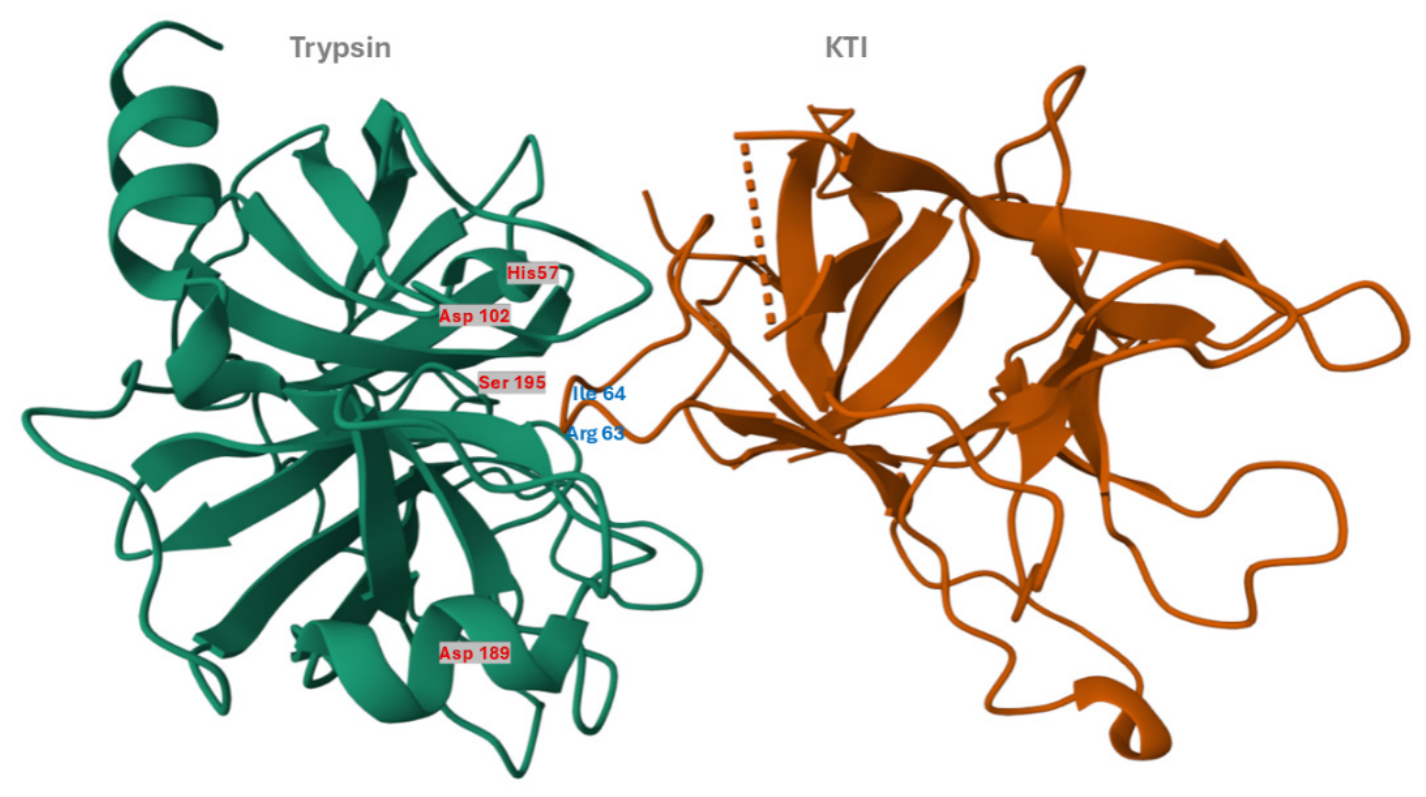
The interaction between KTI and trypsin is governed by the insertion of KTI’s reactive loop into the enzyme’s active site. Its reactive site is defined by Arg63 and Ile64, which interact with trypsin in a 1:1 stoichiometric ratio, resulting in enzyme inhibition [6] (Figure 1).

6. Bowman–Birk Inhibitors (BBIs)

As indicated above, it was previously believed that TIA in soybean was predominantly attributable to KTI, whereas BBI contributed to a lesser extent and was also reported to exhibit positive nutritional attributes [24]. However, recent studies have shown that BBI contributes more to total protease inhibition than KTI, accounting for approximately 80% of the total inhibitory activity against chymotrypsin and about 45% of the total inhibitory activity against trypsin in soybean [28]. BBI may be found in PSVs (protein storage vacuoles), in the nucleus and in the cytosol to a minor extent. BBI protects the plant against herbivores and can function as storage proteins to be used during seed germination [24].
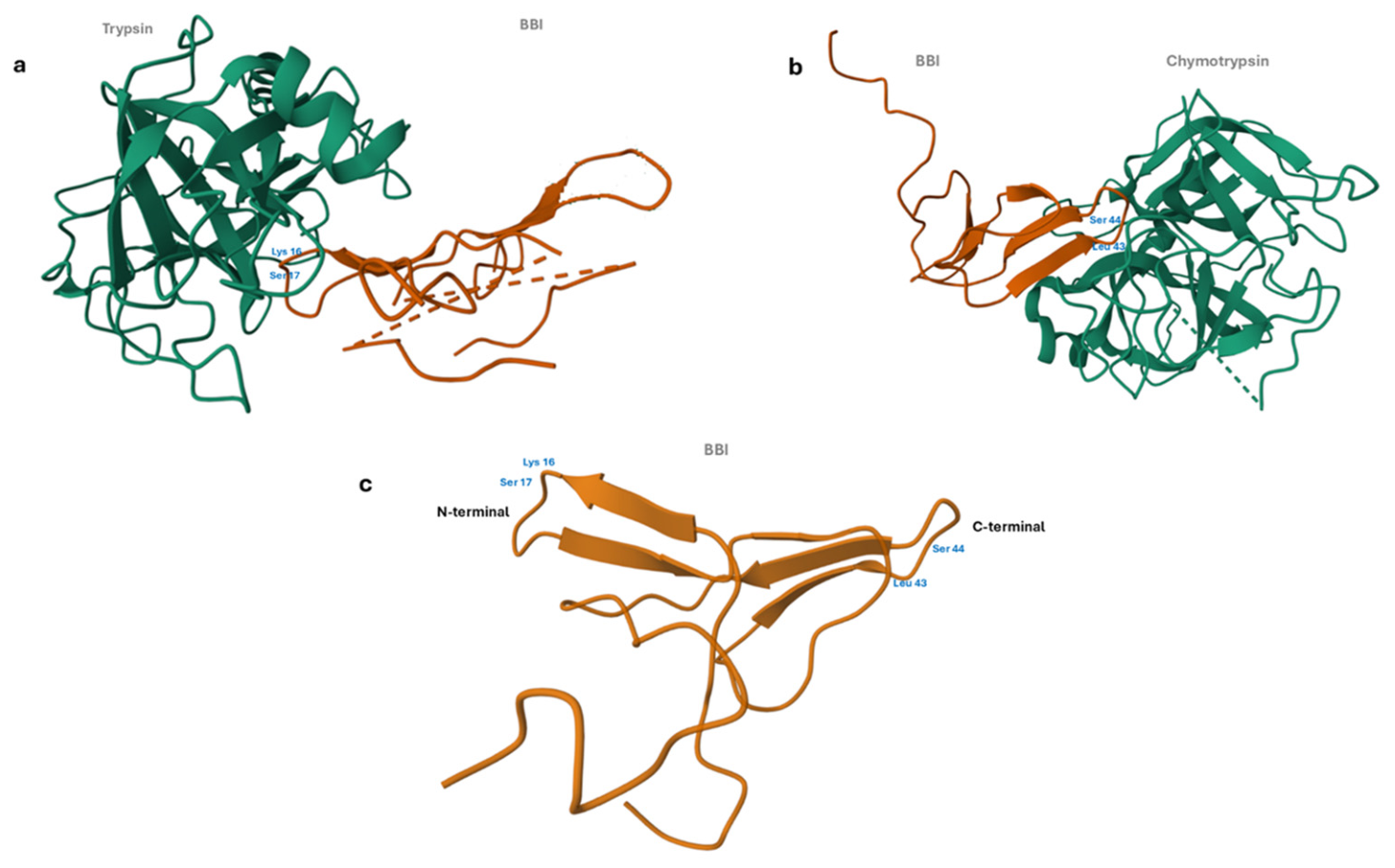
BBI is a 71-amino-acid protein stabilized by seven disulfide bonds. BBI forms a non-covalent complex with chymotrypsin and trypsin to inactivate it. Specifically, the exposed hydrophobic and polar regions in BBI’s structure form complementary interactions with the active site of chymotrypsin and trypsin, leading to the inhibition effect [6,8]. It contains two distinct inhibitory domains: one spanning Lys16–Ser17 that targets trypsin and a second located at Leu43–Ser44 that inhibits chymotrypsin [8]. BBI exerts its dual inhibitory activity through two structurally distinct domains [8]. The N-terminal inhibitory site, centered on Lys16, interacts with Asp189 of trypsin via hydrogen bonding, thereby blocking access to the catalytic pocket. The C-terminal site, characterized by the hydrophobic Leu43 residue, engages the hydrophobic binding pocket of chymotrypsin, resulting in the inhibition of both chymotrypsin and elastase [8]. Each inhibitory region is composed of two symmetrically arranged β-sheet lamellae formed by antiparallel β-strands. BBI can form a 1:1 binary complex with either trypsin or chymotrypsin, as well as a ternary complex involving both enzymes [29] (Figure 2).

7. Inactivation of Soybean Trypsin Inhibitors

Among the antinutritional factors in legumes, trypsin inhibitors represent the most significant concern [30]. Soybean trypsin inhibitors strongly suppress trypsin activity in monogastric animals, leading to compensatory pancreatic hypertrophy and hyperplasia, liver damage and reductions in growth performance [31]. Inactivating these inhibitors before consumption is critical to restoring protein digestibility and preventing these adverse effects [31]. Three classes of treatments, including physical processes (thermal, extrusion, ultrasound, ultrafiltration, radiation, soaking, high hydrostatic pressure, instant controlled pressure drop), chemical processes (reducing agents, acids and bases, functionalized copolymers) and biological processes (germination, fermentation) have been reported for the inactivation of Tis in legume seeds [30]. Radio-frequency heating, electric-field–based methods (ohmic heating and pulsed electric fields), infrared heating, and high-pressure processing are the novel physical techniques that have been reported recently [6]. The combination of physical strategies with chemical and biological treatments has also been explored for TI inactivation in soybeans. Each TI inactivation technique presents distinct advantages and limitations. Comprehensive details of these treatments have been reviewed by Luo et al. [6].
Trypsin inhibitors, together with lectins and goitrogens, are heat-labile anti-nutritional factors. Both serine PIs exhibit appreciable heat stability; however, BBIs demonstrate greater thermal stability than KTIs [6]. In both traditional household and industry levels, thermal-based methods (cooking, boiling, autoclaving, microwaving and roasting) remain the most widely used approach for inactivating Tis [30].
Nutrient loss, altered functional properties, and high energy consumption are notable disadvantages of thermal-based methods [30]. Heating deactivation of TI in soybean meal, at 90.5–100 °C with the presence of 1% NaOH, not only has a negative effect on the nutritional value of meal (due to thermal destruction of amino acids) but also increases the energy cost of meal production by 25% [25]. In addition, residual TI activity can be detected in several types of soy-derived products, highlighting the inefficiency of heat treatment [32].
As mentioned above, current treatments are time-consuming, harmful, costly and not completely efficient. The genetic improvement could be a sustainable and environmentally friendly solution to eliminate TIs. To this end, the genetic regulation of KTIs and BBIs, along with breeding efforts aimed at reducing TIA in soybean, are summarized below.

8. Genes Controlling KTI and Naturally Occurring Null Alleles

Kunitz trypsin inhibitor 1 (KTI1, Gm01g095000) and KTI3 (Gm08g341500) are recognized as two seed-specific trypsin inhibitor (TI) genes in soybean with about 80% sequence homology [25,33]. Different electrophoretic variants, including Tia, Tiaa1, Tiaa2, Tiab1, Tib, Tibi5, Tic, Tid, Tie, Tif, and Tig, have been identified for KTi, which is controlled by co-dominant multiple alleles at a single locus [34,35]. The last identified electrophoretic form of soybean KTI is kti (null allele) that leads to lacking the Kunitz trypsin inhibitor and is inherited as a recessive allele [36]. A recent study identified fifty members of the GmKTI gene family in the soybean genome, suggesting functional redundancy and compensatory effects among family members. The authors also reported a significant role of the KTI gene family in biotic stress responses and plant growth and development [21].
More than 80% of total KTI expression is attributed to the KTI3 gene [33]. Soybean germplasm lines carrying a null Kunitz allele (ti) have been identified and can be used for gene introgression in breeding programs. To the best of our knowledge, five soybean accessions harboring a null KTI3 gene have been reported to date. In an earlier report, two PIs, PI 157440 and PI 196168, were reported as null lines lacking the Kunitz trypsin inhibitor, as the soybean trypsin inhibitor protein band (SBTI-A2) was completely absent in their protein profiles, leading to a 30 to 50% reduction in TI activity of the protein extracts of their seeds [36]. The authors reported that the presence or absence of TI is controlled by a single locus but provided no further information on the genetic background of these mutants [36].
Later, Jofuku et al. [37] analyzed the genetic background of a soybean accession with low TIA (PI 157740) and reported that a frameshift mutation in the KTI3 gene (KTi3−) leads to dramatically reduced (∼40%) TIA in PI 157740 [37]. The frameshift mutation was because of the alteration of three nucleotides located at positions +481, +482, and +486, which led to premature termination during translation of KTI3. In the literature, it has been reported that PI 157440 and PI 157740 represent the same accession [33,38,39]. Consultation of the original plant inventory data in the USDA–ARS National Plant Germplasm System (https://npgsweb.ars-grin.gov/gringlobal/search (accessed on 5 December 2025)) confirmed that PI 157440 is the correct number for this accession.
Krishnan [39] examined the molecular basis of reduced TI activity in the PI 196168 accession and reported that the same mutation that was found in PI 157740 was also found in PI 196168 (one G-to-T transversion and two base-pair deletions).
There are three low-KTI accessions derived from PI 157440, including PI 542044, PI 547656, and PI 547816. All three accessions were developed in 1986 by the USDA-ARS in collaboration with the Illinois Agricultural Experiment Station [40]. PI 542044 (L81-4590, Kunitz cultivar) was developed through a cross between Williams 82 and PI 157440, followed by five backcrosses to Williams 82. PI 547656 (L81-4871) was derived from the cross Clark 630 × PI 157440 (‘Kin-du’) followed by five backcrosses to Clark 630. PI 547816 (L83-4387) was developed by crossing Amsoy 716 and PI 157440 [40].
Park et al. [33] investigated the molecular basis of low TI activity in PI 542044 and identified two causative mutations including the 436G→T missense mutation and the 440GAG→G frameshift mutation, responsible for the null KTI3 allele in PI 542044.
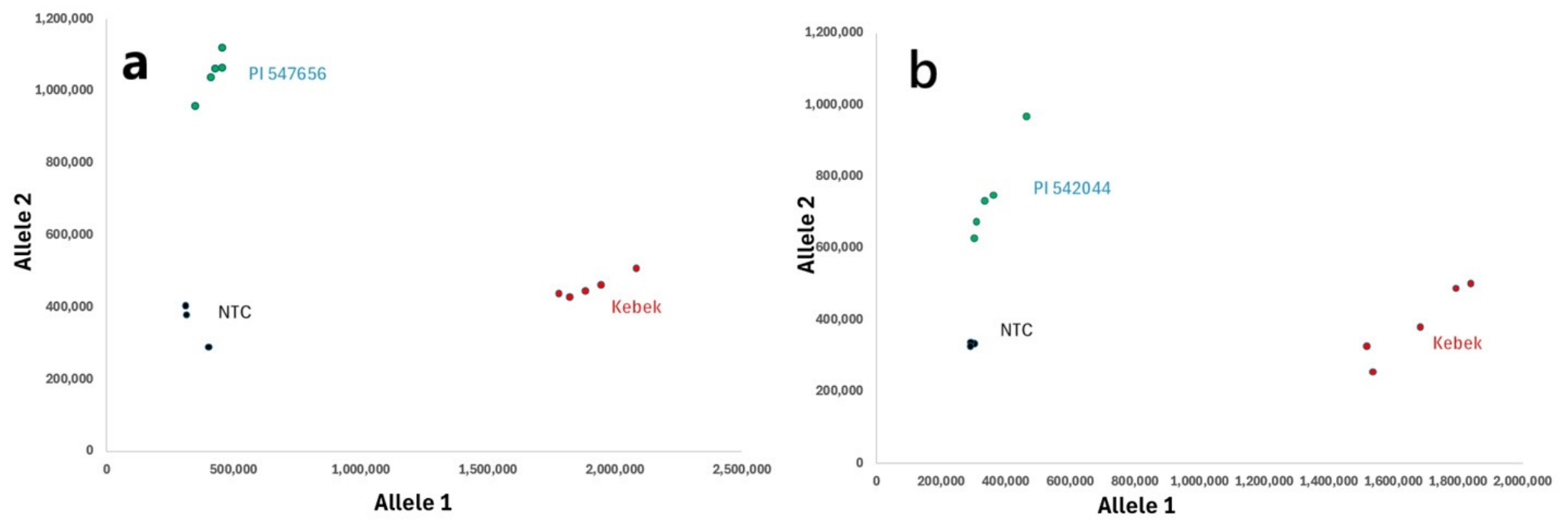
Unlike PI 542044, the genetic basis of PI 547656 is not investigated. It was initially hypothesized that the low KTI content in PI 542044 and PI 547656 is governed by the same genetic mechanism, given that both lines share the donor parent PI 157440, which carries mutations in the KTI3 gene. However, this hypothesis was later challenged, as an SNP genotyping assay developed to detect the low-KTI trait in an F2 population derived from SP6A-206 × PI 542044 [41] failed when applied to a Glenn (high KTI) × PI 547656 (low KTI) population [38]. This discrepancy is plausible, as multiple KTI genes, beyond KTI3, are present within the chromosome 8 QTL region (qKTI08) associated with low KTI concentration in PI 547656 [38]. In contrast, our results support the initial hypothesis, as the KASP marker developed for PI 542044 [33] successfully distinguished PI 547656 from the high-KTI control cultivar Kebek (Figure 3a) and functioned as expected for PI 542044 (Figure 3b).
PI 547816 (L83-4387) has only recently been reported in the literature, without addressing the genetic basis of its low KTI content [42,43].
The KTI1 and KTI3 genes were shown to act synergistically in regulating TI content in soybean seeds [25,44]. Regarding the KTI1 gene, only two germplasm accessions have been identified to date. Gillman et al. [44] identified a soybean germplasm accession (PI 68679), carrying a nonfunctional mutation on the KTI1 gene, with a significant reduction in KTi protein level. A single base deletion in the start codon (GGG356→358GG) is responsible for a frameshift mutation in the KTI1 gene of the PI 68679 accession.
Park et al. [33] screened 999 Korean soybean accessions and identified accession IT105782, which carries an in-frame insertion (CTA at position 461) and five missense mutations (154G→A, 392A→C, 484C→G, 529G→A, and 580C→G) in the coding sequence of the KTi-1 gene, resulting in a significant decrease of 63% in KTi-1 expression. The authors reported low TIA levels (below 60%) for IT105782, comparable to those of the KTI-free accession PI 542044.
In addition to the accessions mentioned above, six other accessions, PI 547891, PI 547892, PI 547861, PI 547893, PI 547660 and PI 591539, have been reported in the literature as KTI-null phenotypes carrying the kti allele [42,43]. However, it is not clear which KTI gene or exact genetic variation or mutation underlies the low KTI phenotype in these accessions.
The complete list of identified soybean accessions with low TI activity and the molecular basis of their phenotype has been reported in Table 1. Among the identified sources, the genetic backgrounds of PI 542044, PI 68679, and IT105782 are well documented (Table 1).

9. Genes Controlling BBI and Naturally Occurring Null Alleles

BBI can ligate and inhibit trypsin, chymotrypsin and elastase (limits the proteolytic activity).
11 potential BBI genes have been identified in the soybean genome [45]. The BBI members have been grouped in three classes: A, C and D. BBI-A, -C and -D inhibit trypsin/chymotrypsin, elastase/trypsin, and trypsin/trypsin, respectively. RT-PCR analysis showed that BBI-A, BBI-CII and BBI-DII are expressed specifically in the seed, and the BBI-DII transcripts are the most abundant ones followed by those of BBI-A and BBI-CII [45]. GmBBI1 and GmBBI2 are expressed in soybean roots upon interaction with cyst nematodes.
Type A BBI genes have been divided into two groups, A1 and A2. Glyma09g28700 and Glyma09g28730 encode BBI-A1, and Glyma14g26410 encodes BBI-A2. Two genes, Glyma09g28720 and Glyma14g26410, are encoding BBI-CII. Glyma16g33400 is the potential gene that encodes type D-II inhibitor. The promoter region of the gene Glyma16g33400 (BBI-DII) possesses three copies of the RY cis-element, which is very important for seed-specific expression.
As BBi proteins contribute more to total protease inhibition than KTI proteins and exhibit greater heat stability than KTi proteins due to their multiple cysteine residues, which cause structural changes that enhance stability during heating [46], it is expected that mutations in BBi could lead to soybean lines requiring minimal heat treatment. However, to date, no naturally occurring G. max mutant or germplasm accession has been documented to show substantially reduced BBi accumulation or activity. For this reason, together with the previous misconception that KTI contributes more than BBI to total trypsin inhibition, most previous studies have disproportionately focused on KTI genes [28]. The contribution of the BBI gene family to plant abiotic stress responses has been reported [47].

10. Classical Breeding and Marker-Assisted Selection (MAS)

As noted above, no soybean accessions carrying null BBi alleles have yet been identified. Consequently, neither molecular marker development nor conventional breeding efforts have been directed toward this class of trypsin inhibitors, and previous studies have therefore focused primarily on markers targeting the KTI genes. In the absence of information regarding the molecular basis of null KTI alleles in the identified accessions, it remains impossible to design molecular markers that could facilitate breeding programs aimed at reducing TI content in soybean germplasm of interest. As a result, most efforts have centered on the KTI3 gene, which is well characterized and represents a major, though not exclusive, genetic determinant of KTI content in soybean seeds.
Using the genetic background information of the PI 157740 accession reported by Jofuku et al. [37], Alves de Moraes et al. [32] described the sequences of the forward and reverse primers they designed to detect the presence or absence of the null kti allele in the F2 progeny derived from a cross between cv. Monarca and an unidentified line lacking SKTI. Kumar et al. [48] reported that the null kti allele-specific primer designed by Alves de Moraes et al. [32] amplified a 420 bp product in PI 542044 and therefore, this marker appears to be associated with the KTI-3 allele. Authors also successfully applied this diagnostic marker to monitor the transfer of the null KTI allele from the donor PI 542044 to two Indian genotypes (Samarat and LSb1). These primers have since been employed by other researchers as allele-specific markers to monitor the introgression of the null KTI allele from donor parents into recipient genotypes of interest [49,50,51,52,53,54,55,56,57].
Although gene-specific diagnostic markers that directly amplify a null KTI allele offer high precision by targeting the causal mutation itself, their utility is inherently constrained to the specific mutation for which they were designed. As above mentioned, null KTI alleles, in the different accessions that carry them, may result from diverse genetic alterations, including deletions, insertions, transversions, and frameshifts, such that an assay tailored to one mutation could fail to detect alternative or newly arising null variants. For this reason, researchers have also pursued flanking or linked molecular markers capable of reliably tracking the genomic region surrounding the KTI locus, irrespective of the underlying mutation and the genetic background of the carrier accession. Linked markers are particularly valuable for confirming locus inheritance, detecting recombination events, and facilitating marker-assisted selection (MAS) across diverse genetic backgrounds, thereby enhancing selection efficiency and reliability in breeding programs.
Plant breeders can employ molecular markers to indirectly identify individuals within segregating populations that carry alleles for desirable traits, and the use of such markers in MAS has been shown to accelerate breeding and efficiently introgress recessive alleles into crops. However, the effectiveness of this approach depends on the availability of a tightly linked marker locus near the genetic locus governing the target trait [38,58].
DNA markers have become fundamental tools in soybean improvement programs, enabling the construction of numerous molecular maps and the mapping of morphological traits using restriction fragment length polymorphism (RFLP), amplified restriction fragment length polymorphism (AFLP) and random amplified polymorphic DNA (RAPD) markers [59,60,61]. Microsatellite or simple sequence repeat (SSR) markers, which are highly polymorphic, abundant, and genome-wide, further advanced linkage mapping and marker development in soybean [62,63]. The first report of molecular markers linked to the Ti locus was provided by Kim et al. [64], who identified two flanking RAPD markers (OPO12 and OPC08) located 16.0 cM from the Ti locus. Subsequently, Kim et al. [58] evaluated 100 RAPD, 342 AFLP, and 35 SSR primers to map the Ti locus using two F2 populations derived from the crosses Jinpumkong2 (TiTi) × C242 (titi) and ‘Clark’ (TiTi) × C242. Among the markers screened, four RAPD, four AFLP, and three SSR markers were found to be genetically linked to the Ti locus. The SSR markers Satt409, Satt228, and Satt429 were closely linked (0–10 cM) to ktiti, with Satt228 showing the tightest linkage at 0–3.7 cM from the Ti locus. These SSR markers, and especially Satt228, have been broadly used to introgress the KTi-3 null allele in soybean breeding programs [48,49,50,51,52,53,54,55,65,66,67,68,69,70,71].
Other SSR markers, including Satt416, Satt496, Satt281, Sat_043, Sat_331, Sat_298, Satt375, Sat_218, Satt278, Satt539 [50], Satt538 [56], and Satt333 [54], have also been introduced or evaluated as markers tightly linked to the Ti locus. In a recent study, Patil et al. [71] evaluated 318 SSR markers, including Satt228, to facilitate the development of soybean lines deficient in KTI. The F1 population derived from the cross between NRC-127 (a KTI-null donor parent) and AMS-100-39 (a high-protein, high-yield recipient parent) was analyzed for the presence of the null KTI allele using SSR markers. The authors reported a low level of polymorphism (29.55%) and noted an uneven distribution of polymorphic SSR loci across the genome. Among the markers assessed, Sat_070, Satt556, and Satt228 were identified as informative and applicable for selecting the null KTI allele in F1 hybrids.
Single nucleotide polymorphism (SNP) markers are increasingly replacing SSRs in population genetics studies and across a broad range of other applications and are widely used in modern plant breeding to identify genomic regions associated with important agronomic traits [70,72]. A recent review summarizes how these molecular markers (now integrated with GWAS, genomic selection and other genomic tools) remain central to soybean genetics and breeding [2].
A single nucleotide amplified polymorphism (SNAP) marker was developed by Kim et al. [73] to identify soybean mutant lines harboring single nucleotide polymorphisms in the predominant Tia and Tib types. Although this SNP marker was successfully applied, it is not suitable for marker-assisted elimination of Kunitz trypsin inhibitor (KTI) in target genetic backgrounds.
Gillman et al. [44] crossed PI 68679 (KTi1−) with PI 542044 (KTi3−) and used SimpleProbe assay to track the KTi3− allele in progenies. Using SimpleProbe genotyping, authors developed a KTi1/3− double mutant, whose F3 progeny (E16) exhibited TIA approximately 50% lower than that of the wild-type Williams 82. Authors also reported a significant reduction in chymotrypsin inhibitor activity of E16 genotype in comparison with wild-type seeds.
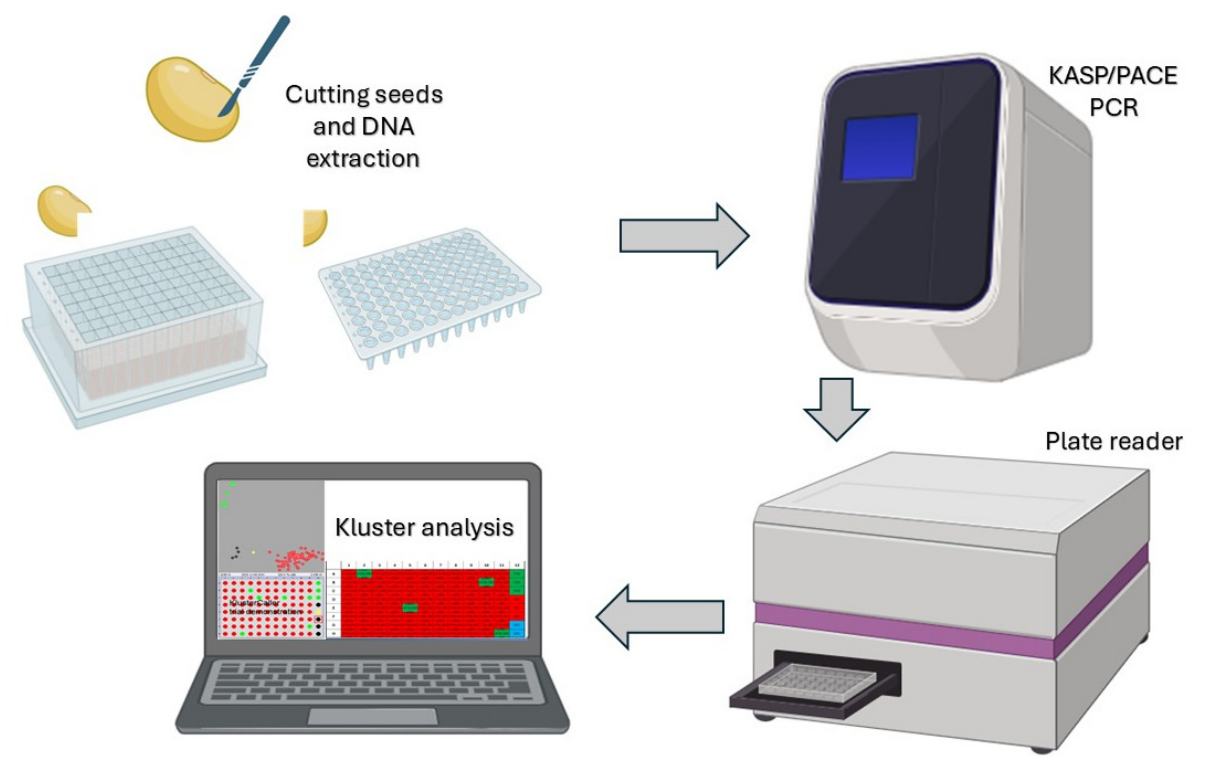
Two PCR-based systems have been developed from the original allele-specific PCR (AS-PCR) approach for high-throughput SNP genotyping, including Kompetitive Allele-Specific PCR (KASP) [74] and PCR Allele Competitive Extension (PACE) [75]. Both systems use two target-specific primers, each with a unique tail sequence that allows fluorescent reporting through complementary oligonucleotides in the mastermix. During PCR, the primers bind and elongate on the target sequence, incorporating the tail sequences, which unquench fluorophores (FAM or HEX) and generate a detectable signal. This fluorescence increases with amplification, enabling SNP genotyping [76]. Labeling of target-specific primers or probes is not required for KASP/PACE, making these assays more flexible than other PCR-based detection methods and especially suitable for high-volume screening plant breeding projects [77]. Throughput, robustness, and cost-effectiveness along with minimal requirements for DNA quality and quantity, streamlined sample preparation, and simplified PCR workflow are the advantages of KASP over other genotyping assays [41]. SNPs in KASP and PACE assays can be detected using a qPCR machine or a fluorescent plate reader. Non-destructive DNA extraction from seed tissues, followed by KASP/PACE PCR and plate-reader-based genotyping without the need for gel electrophoresis, enables rapid and efficient large-scale screening of soybean segregating progenies while substantially reducing the time required for selection (Figure 4).
The KASP technique has been widely applied in various soybean breeding programs [78,79,80,81,82]. However, to the best of our knowledge, there are no published reports on the use of PACE in soybean. The KASP marker has also been applied to help the introgression of null KTI alleles. Patil et al. [41] designed a KASP marker for the genotyping of an F2 population of SP6A-209 × PI 542044. Authors reported the efficiency of the developed KASP assay as clusters of wild-type alleles with normal trypsin (GG), mutant alleles with reduced trypsin content (TT) and heterozygous (GT) were easily distinguishable in the endpoint fluorescence scatter plot.
Using three SNPs tightly linked to the major QTL associated with low KTI, Rosso et al. [38] developed a breeder-friendly KASP assay to genotype an F3:5 population derived from a cross between PI 547656 (low KTI) and ‘Glenn’ (normal KTI). The output of KlusterCallerTM software showed distinguishable clusters for homozygous lines for the low KTI allele (FAM dye), homozygous lines for the normal KTI allele (HEX dye), and heterozygous lines. The authors reported an 86% selection efficiency for KASP SNP Gm08_44814503_C_T in identifying low-KTI accessions. Later, Bukan et al. [70] evaluated the efficiency of previously developed SNP–KASP markers by Rosso et al. [38], including Gm08_45317135_T_G and Gm08_45541906_A_C, for genotyping low KTI content in two European F3:5 soybean populations. These mapping populations were derived from the crosses Ascasubi (low KTI) × DH_5170 (high KTI) and Bahia (low KTI) × ES_Mentor (high KTI). The authors reported significant discrimination between progeny with high and low KTI content.
Park et al. [33] developed a SNP–KASP marker based on the missense mutation at position 392 of the mutated KTi-1 gene (392A→C) identified in the IT105782 accession. The resulting KASP assay successfully distinguished the KTi-1 mutant allele from the non-variant allele.
It is important to note that the selection efficiency of KASP–SNP markers for KTI content can vary depending on the genetic background of the germplasm being evaluated. For example, the selection efficiency of marker Gm08_44814503_C_T, reported as 86% in the F3:5 population of PI 547656 × ‘Glenn’ [38], decreased to 80% in the F3:5 populations of ‘Ascasubi’ × DH_5170 and ‘Bahia’ × ES_Mentor [70]. Similarly, the KASP–SNP assay developed for low-KTI discrimination in the F2 population of SP6A-209 × PI 542044 [41] did not perform efficiently in the F3:5 population of PI 547656 × ‘Glenn’ [38]. In addition to genetic background, other factors may contribute to this discrepancy: (i) the identified markers are tightly, but not perfectly, linked to the KTI genes, and (ii) multiple genes, beyond KTI3, associated with Kunitz trypsin inhibitors are located on chromosome 8 of soybean [70].
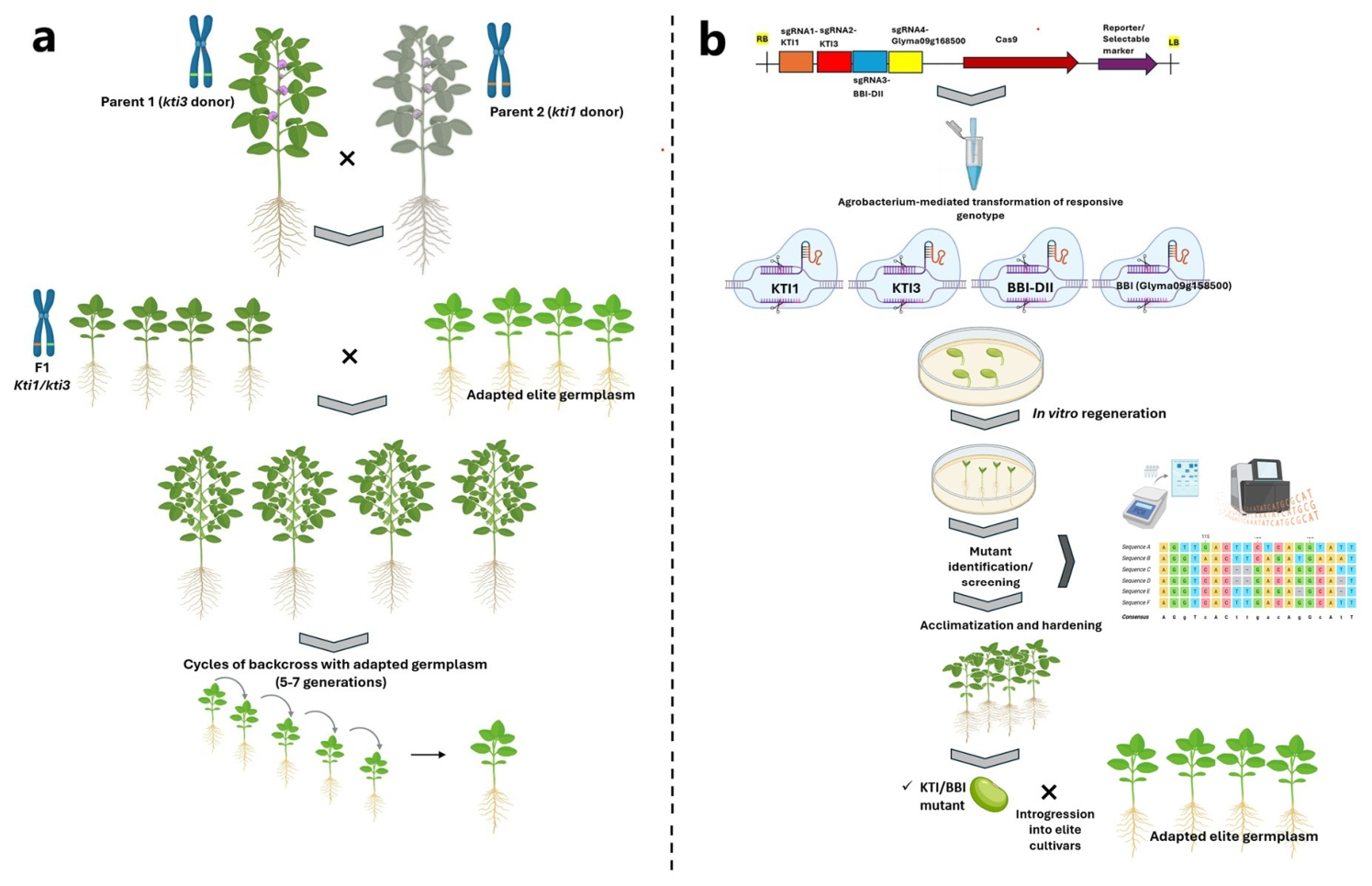
Crossing PI 68679 with accessions carrying the kti3 null allele (such as PI 547656 or PI 542044) to generate double kti1–kti3 mutants through classical breeding and MAS is limited, as no molecular marker is available for the null kti1 allele in PI 68679. As mentioned above, Gillman et al. [44] only tracked the KTI3− allele to develop KTI1/3− double mutants using a SimpleProbe assay, which is not entirely reliable. However, crossing IT105782 × PI 547656 and utilizing the reported KASP markers for kti1 [33] and kti3 [38] alleles offers a feasible approach.
A comprehensive summary of breeding efforts aimed at reducing TIA in soybean, along with the molecular markers used to monitor the introgression of the null KTI allele from donor parents into recipient genotypes of interest, is provided in Table 2. As shown in the table, all previous efforts have focused on the KTI3 gene. PI 542044 is the most widely used donor parent source of the null kti3 allele with different types of developed molecular markers to track progenies, followed by the NRC101 accession. Depending on the recipient parent, reductions in TI activity ranging from 50% to 83.52% and from 67.74% to 80.14% have been reported using PI 542044 and NRC101, respectively (Table 2).
Although linked molecular markers have been widely applied in breeding efforts to reduce TI content in soybean germplasm, genetic background dependency and the possibility of recombination limit the effectiveness of MAS and necessitate accompanying phenotyping and direct measurement of the trait to avoid losing the desirable phenotype [85].

11. Biotechnology-Based Breeding of KTI and BBIs

Biotechnology-based breeding methods (BBBMs) have considerable potential to accelerate crop improvement programs. Among these approaches, sequence-specific nucleases enable the precise and efficient development of user-designed plant genotypes using genome editing technologies [86]. Zinc finger nucleases (ZFNs) and transcription activator-like effector nucleases (TALENs) were the first genome-editing tools applied in soybean. However, the emergence of clustered regularly interspaced short palindromic repeats-associated Cas (CRISPR–Cas) systems quickly established them as the preferred platform for genome modification and the development of soybean varieties due to their superior precision, ease of use, and cost-effectiveness [87]. Here, we do not go into the details of the CRISPR technique, as numerous reports have already described its mechanisms and applications in plant breeding [88,89,90,91,92].
Both transient hairy root transformation and stable transformation approaches have been employed in soybean using CRISPR/Cas9 constructs for a range of functional and breeding applications [87]. Transient hairy root transformation using Agrobacterium rhizogenes provides an efficient platform for delivery of the CRISPR constructs into soybean germline cells and rapid functional analysis of root-associated genes, particularly when combined with visible reporter systems such as RUBY [93,94,95]. Despite its simplicity and efficiency, several hairy root induction protocols have recently been developed to improve the efficiency of CRISPR construct delivery in soybean [96,97,98]. In contrast, stable transformation remains more challenging because soybean is generally recalcitrant to Agrobacterium tumefaciens-mediated transformation [99].
Multiplex CRISPR/Cas9 gRNA strategies have great potential for simultaneously targeting and knocking out multiple genes involved in the nutritional and chemical profiles of soybean. This approach has been successfully applied to produce soybean lines with ultra-low levels of anti-nutritive oligosaccharides [100].
This technique has also been effectively employed to reduce antinutritional TI content in soybean. Using a tandem array of three sgRNAs, Wang et al. [25] were able to simultaneously target the KTI1 and KTI3 genes in the soybean cultivar Williams 82, generating CRISPR/Cas9-mediated double homozygous kti1/kti3 mutants with induced indels in both genes. The KTI content and TIA were markedly reduced in the mutant lines compared with PI 547656 and the Williams 82 wild type. The authors also reported a set of primers, ZW3(F)-ZW1(R) and ZW6(F)-ZW4(R), to distinguish the kti1 and kti3 alleles, respectively.
Using a multiplex gRNA CRISPR/Cas9 approach, the KTI3 (Glyma.08G341500), LE (Glyma.02G012600), and P34 (Glyma.08G116300) genes were simultaneously targeted in the Bert cultivar. The authors reported homozygous frameshift mutations for all three genes in two T2 lines (WPT673-7-8-8 and WPT673-7-12-5) with significant reduction in TIA and KTI3 content compared with the Bert control [83].
Because BBi genes share extensive sequence homology, specifically targeting BBi genes using CRISPR/Cas9 is challenging [101]. There are two reports of CRISPR-Cas9 knock-outing of BBi genes. Kim et al. [101] designed two CRISPR/Cas9 expression cassettes that enabled simultaneous knockout of Glyma.09G158500, Glyma.14G117700, Glyma.09G158600, Glyma.09G158700, and Glyma.16G202800 genes in the Maveric soybean genotype. Several mutations were identified in the most abundantly expressed BBi genes (Glyma16g208900 and Glyma14G117700). Authors reported a drastic reduction in chymotrypsin and trypsin inhibitor activity (25.3 to 41.9%) in CRISPR/Cas9 BBi mutants, in comparison with wild type (Maverick) and KTi-3 mutants. In another study, CRISPR/Cas9-mediated knockout of eight seed-specific BBI genes resulted in a 69.4–73.7% reduction in trypsin inhibitor activity and a 76.4–79.4% reduction in chymotrypsin inhibitor activity in mutant plants of the Williams 82 soybean cultivar compared with the wild type [102]. Subsequent evaluations showed that knockout of the BBI genes had no adverse effects on the agronomic traits of homozygous mutant plants across the T1–T3 generations [28].
In terms of BBBMs for reducing STIs, one study targeted a BBI gene using RNA interference (RNAi) technology. The authors reported that RNAi-mediated knockdown of the abundantly seed-expressed BBI gene Glyma.16G208900 resulted in a significant reduction in both trypsin and chymotrypsin inhibitor activities in transgenic soybean lines of the Maverick cultivar. They also reported reductions in both KTI and BBI activities in the BBI knockdown lines [103]. Unfortunately, in all lines where KTi levels were reduced using CRISPR/Cas9, we observed an unexpected increase in TIA, attributable to excessive accumulation of BBi proteins in the seeds of each mutant background (KTi1, KTi3, and KTi1/KTi3) [88]. Therefore, elimination or reduction in the expression of both KTi and BBi genes in seeds is an efficient breeding strategy to avoid possible compensatory expression of BBI after KTI knockout and develop soybean lines that require extremely low or no heat-inactivation processing [101].
Although the CRISPR/Cas9 technique has been successfully used to knock out KTI and BBI genes and shows strong potential for reducing soybean trypsin inhibitors, several challenges remain, including genotype-dependent transformation efficiency, regeneration limitations, extensive sequence homology among KTI and BBI genes that complicates the minimizing of off-target effects, and regulatory uncertainties that limit field validation and digestibility evaluation of genome-edited crops [4,101]. One potential approach to overcoming genotype dependency is to generate CRISPR/Cas9-mediated mutant alleles in transformable cultivars (such as Williams 82, Jack, or Thorne) and subsequently introgress these alleles into elite cultivars of interest using specifically designed markers that distinguish the mutated alleles [25].

12. Environmental and Agronomic Influences

Appropriate agronomic management can contribute to reducing TI levels in soybeans; for example, organic cultivation led to a significant reduction in TIA in BRS258 soybeans compared with conventionally grown soybeans [104].
There are other examples of agronomic practices that affect soybean TIA. Nitrogen fertilization at rates of 30, 60, and 90 kg N ha−1 has been reported to decrease TI levels in both high- and low-KTI soybean genotype groups [105]. In another experiment, nitrogen application resulted in a 15% reduction in TIA compared with the control [106]. Another agronomic practice reported to affect soybean TI content is sowing date. Late sowing resulted in lower TIA across ten soybean genotypes belonging to three different maturity groups (000, 00, and 0) compared with the optimal sowing date [107]. Other agronomic practices, such as planting density, harvest timing, and soil conditions, may also influence soybean seed composition traits; however, direct evidence regarding their effect on TI content remains limited.
Although agronomic practices can affect the TIA level of soybean, it is difficult to take advantage of these practices because different environmental conditions may lead to variable results. The heat treatment is the mainstream tool to reduce TIA. However, increased energy consumption, protein denaturation, and loss of nutritional quality are the negative consequences of high-intensity heat treatments. The development and use of low-TI soybean cultivars represent the gold standard approach and represent a more sustainable and long-term strategy. Xiao et al. [108] compared the protein digestibility of two soybean cultivars differing in TI content: a high-TI cultivar (Glenn) and a low-TI cultivar (VT Barrack). They reported that a protein digestibility of 81.4% (600 µg/g TIs) was achieved for VT Barrack at 100 °C, whereas the same level of digestibility in Glenn required processing at 121 °C. These findings indicate that low-TI cultivars require milder heat treatment to achieve comparable protein digestibility, thereby highlighting the potential energy-saving advantages (e.g., fuel, electricity) and preserving other nutrients of low-TI cultivars relative to high-TI cultivars.
From an agronomic perspective, a low-TI soybean cultivar exhibiting stable performance across environments, no yield penalty, and no increased susceptibility to diseases or pests would represent an ideal genotype. Such a cultivar could contribute to expanding soybean acreage, strengthening soybeans’ role in integrated crop–livestock systems, and enhancing the regional economic value of soybean production.

13. Measuring Trypsin Inhibition

The combination of both classical (molecular marker–based selection) and modern (CRISPR) breeding techniques with an efficient phenotypic selection provides a perfect strategy for advancing breeding lines with desirable traits while concurrently eliminating undesirable ones, thereby accelerating genetic improvement. Characterization of the trypsin inhibition is a key step in identifying the mutation that led to a reduced amount of TI in the soybean. Phenotyping for trypsin inhibitor levels is an essential component of developing an effective breeding platform aimed at reducing TI content in soybean.
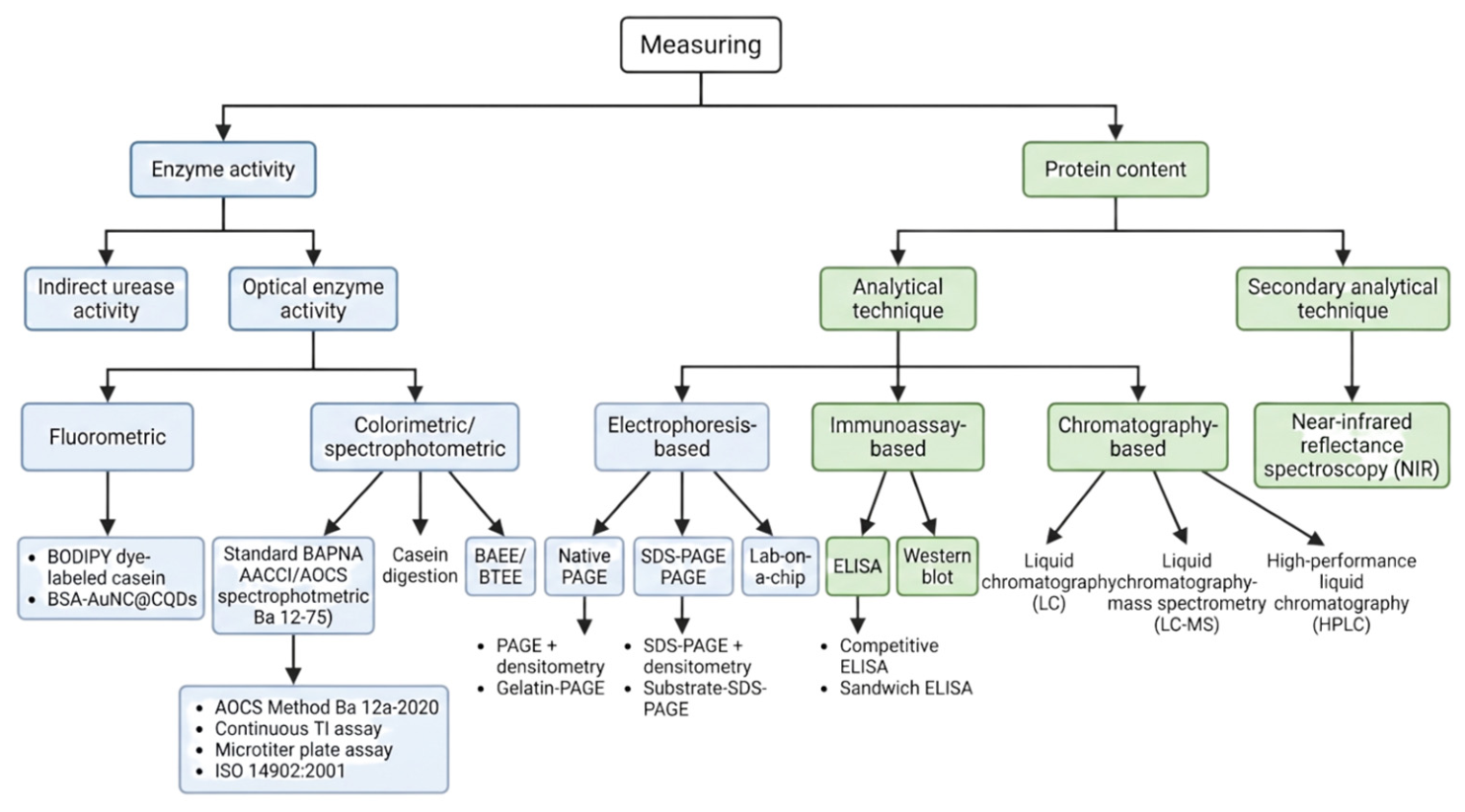
A review of the literature indicates that there is no clear classification of methods specifically for measuring TIA in soybeans, except for one report that grouped these approaches together with methods used to quantify KTI and BBI proteins [24]. In this review, the methods used to measure TIA in soybean are comprehensively classified (Figure 5), and the details of each approach are discussed in the following sections. According to the presented chart, one may choose to measure either enzyme activity or protein content, with different options available for each approach (Figure 5).
Using urease activity is a method that was previously applied to measure the TIA in soybean products indirectly, as there is a positive correlation between urease activity and TI. This indirect approach lacks reliability, as recent evidence indicates no significant correlation between TI content and urease activity [109]. In addition, considerable variability has been reported in urease activity measurements [110].
Optical enzyme activity–based assays, including colorimetric/spectrophotometric and fluorometric methods, are widely used for the quantification of protease activity.
Spectrophotometric methods are widely used to indirectly quantify TIs by measuring the inhibition of a standard trypsin solution. These methods rely on measuring the absorbance of chromogenic reaction products. Different versions of the spectrophotometric methods have been developed to measure TIA in soybean. The first report of TIA measurement using an optical assay was provided by Kunitz [111]. In this method, casein is used as the substrate for trypsin, and TIA is determined based on the inhibition of casein digestion by trypsin. The extent of proteolysis is quantified spectrophotometrically by measuring the absorbance of soluble digestion products at 280 nm. TIA is then expressed as the amount of trypsin inhibited by the inhibitor present in the sample, commonly referred to as the casein digestion method. Later, the Erlanger method [112] employs synthetic N-α-benzoyl-DL-arginine-p-nitroanilide hydrochloride (BAPNA) as the substrate and measures absorbance at 410 nm [24,100]. Kakade [113] first developed the Erlanger method using BAPNA as a substrate and subsequently introduced a modified procedure that was adopted as Official Method 71-10 by the American Association of Cereal Chemists International (AACCI) in 1974 [114] and reapproved in 1999 as Method 22-40.01 [115] and later approved by the American Oil Chemists’ Society (AOCS) in 1975 as Method Ba 12-75 [116]. This assay determines TIA based on the difference in absorbance at 410 nm associated with bovine trypsin hydrolysis of the synthetic substrate BAPNA, measured in the absence and presence of an inhibitor [117]. Currently, TIA is routinely determined using this method, which is widely accepted as the standard reference procedure for TIA analysis in breeding programs [118,119]. This method is commonly referred to as a standard colorimetric enzymatic assay, in which trypsin hydrolyzes the synthetic substrate BAPNA, releasing the yellow chromophore p-nitroaniline that is quantified spectrophotometrically at 410 nm [118].
An improved version of the standard method was reported by Hamerstrand [120], who used a single inhibitor concentration to minimize errors associated with data interpretation in the standard procedure. Further improvements and a major revision of the standard method were done later. The original full-volume assay (10 mL) was subsequently reduced to a half-volume format (5 mL), along with the last enzyme sequence and single inhibitor level in duplicate, providing a more cost-effective procedure that was also approved by AACCI and AOCS as the AOCS Method Ba 12a-2020 [117,121].
Coscueta et al. [122] proposed a faster and more cost-effective modification of the standard method by eliminating two steps: termination of the reaction with acetic acid and the centrifugation/filtration step used to reduce turbidity. Using this continuous TI assay, they were able to determine the TIA of different soybean flour samples rapidly and in real time. More recently, Kim and Krishnan [119] developed a faster and more economical version of the standard spectrophotometric AACCI/AOCS method by eliminating several time-consuming steps and substantially reducing the assay volume to 1 mL. Using a side-by-side comparison of 12 soybean meal samples, the authors reported results comparable to those obtained with the original AACCI/AOCS-approved standard procedure. In addition, a microtiter plate assay (190 μL) was developed to successfully quantify TIA in four soybean cultivars (W82, Kti-3, E-16, and CS), with absorbance measured at 385 or 410 nm [119].
Another improved spectrophotometric procedure was adopted by the Geneva-based International Organization for Standardization (ISO) in 2001 as ISO 14902 and subsequently reapproved in 2012 [123]. This method also measures the difference in absorbance at 410 nm (ΔA410) between the absence and the presence of an inhibitor, with synthetic trypsin substrate of L-BAPA. Using enantiomerically pure L-BAPA instead of DL-BAPA makes it more expensive and time-consuming than the standard AACCI/AOCS method [117]. In addition, there is a dependency on trypsin purity and sample dilution levels in the ISO method, which makes it poor reproducibility to measure TIA [124]. The AOCS Ba 12a-2020 and ISO 14902:2001 methods were directly compared for the determination of TIA in various soybean-, pulse-, and grain-based protein products, as well as in soybean boiled for different durations and soy white flakes subjected to varying toasting times. The authors reported significant differences between the two methods, with TIA values obtained using the ISO method consistently lower than those measured by the AOCS Ba 12a-2020 method. The author ultimately concluded that an accurate and direct comparison between the two methods was not feasible [125]. In another study, the effects of assay volume (5 mL for AOCS vs. 10 mL for ISO), substrate type (DL-BAPA for AOCS vs. L-BAPA for ISO), and the substrate-to-enzyme ratio (50 for AOCS vs. 222 for ISO) on TIA determination in raw and heat-treated soybean were investigated using the AOCS Ba 12a-2020 and ISO 14902:2001 methods. Among these factors, the substrate-to-enzyme ratio was identified as the primary contributor to the observed differences, as the higher ratio (222) used in the ISO method resulted in lower calculated TIA values compared with the AOCS Ba 12a-2020 method [126].
Several spectrophotometric studies have used N-α-benzoyl-L-arginine ethyl ester (BAEE) as a substrate instead of BAPNA to determine TIA in soybean [39,44,127]. In this approach, BAEE hydrolysis is monitored at 253 nm in the ultraviolet region because BAEE does not generate a colored reaction product. N-benzoyl-L-tyrosine ethyl ester (BTEE) has also been used in a similar manner as a chymotrypsin substrate to measure chymotrypsin inhibitor activity at approximately 256 nm [44,127]. However, BAEE-based assays may underestimate inhibitor activity and reduce TIA accuracy because BAEE hydrolysis is less sensitive to inhibition than that of BAPN [128].
A similar procedure for determining chymotrypsin inhibitor activity was described by Kakade et al. [129]. In this method, casein is used as the substrate, and inhibitor activity is quantified based on the ability of an aqueous extract to inhibit the digestion of casein by chymotrypsin, with absorbance measured at 275 nm. Unlike the standard methods used to determine TIA, this approach has not been widely adopted and has seen limited use in subsequent studies evaluating soybean chymotrypsin inhibitor activity.
In contrast to colorimetric/spectrophotometric enzymatic assays, which measure the absorbance of chromogenic reaction products, TIA can also be quantified using fluorometric procedures that detect emitted fluorescence. These methods typically employ fluorogenic quenched substrates that become highly fluorescent upon protease-mediated cleavage, with fluorescence intensity proportional to enzyme activity. Jones et al. [130] introduced a fluorometric assay that successfully quantified trypsin and chymotrypsin inhibitor concentrations using highly fluorescent BODIPY dye-labeled casein as a substrate. The authors reported that this approach provides efficient enzyme activity quantification with a broad dynamic range and is suitable for real-time detection of various proteases [130]. A ratiometric fluorescence nanosensor–trypsin system was developed for the ultrasensitive detection of TI in soybean flour. In this method, decomposition of bovine serum albumin–protected gold nanocluster@carbon nitride quantum dot nanocomposites (BSA-AuNC@CNQDs) during trypsin-mediated hydrolysis of BSA results in fluorescence quenching. The inhibition of trypsin activity prevents this fluorescence quenching at 650 nm; thus, the preservation of fluorescence intensity serves as an indicator of TIA [131]. Despite its high sensitivity for TI detection (limit of detection (LOD) = 0.089 ng/mL), this method has not been widely reported for measuring TIA in soybean breeding programs.
All optical enzyme activity–based procedures described above are indirect methods that measure any factor capable of inhibiting trypsin/chymotrypsin activity and are therefore influenced by various non-target molecules and are subject to multiple sources of interference [132]. Heat treatment, for instance, can reduce or eliminate inhibitory activity while the inhibitor protein itself may still be present and detectable by direct methods. Consequently, activity-based assays may underestimate inhibitor presence. In addition, these methods have practical limitations, including the requirement for freshly prepared reagents and the limited stability of sample extracts, which often necessitate re-extraction if analysis is not completed promptly [132]. Instead of assessing the enzymatic activity of TIs, one may choose to directly examine and quantify the KTI and BBI proteins themselves. This can be achieved using electrophoresis-based semi-quantitative methods, immunoassay-based methods and chromatography-based accurate protein quantification.
Here, we present several electrophoresis-based approaches for the semi-quantification of KTI and BBI proteins, including polyacrylamide gel electrophoresis (PAGE), sodium dodecyl sulfate-polyacrylamide gel electrophoresis (SDS-PAGE), and lab-on-a-chip technology. Native PAGE is the simplest method in this category that is used to separate intact proteins based on charge, size, and shape. This method was first applied to investigate the inheritance of the absence of KTI (SBTI-A2) in progenies derived from reciprocal crosses of Amsoy 71 × PI 157440, PI 196172 × PI 157440, and PI 157440 × Jefferson [36]. Peric et al. [133] applied PAGE to verify the presence or absence of KTI in individual plants across several segregating generations derived from a cross between the Kunitz and Novka varieties.
SDS-PAGE involves the initial denaturation of proteins using an anionic detergent, which imparts a uniform negative charge proportional to their molecular mass, followed by electrophoretic separation through a porous polyacrylamide gel matrix. This allows proteins to be resolved primarily according to their molecular mass. SDS-PAGE is a widely used method for high-resolution separation of complex proteins [134]. A review of the literature indicates that the first reported application of SDS-PAGE for the quantification of trypsin inhibitors (KTIs) in soybean was described by Sato et al. [135]. As noted earlier, the soybean 7S storage protein, composed of the glycosylated α′, α, and β subunits, shows relatively high resistance to digestion by trypsin and chymotrypsin. In general, lower accumulation of these subunits is associated with higher trypsin/chymotrypsin activity and, consequently, reduced levels of TIs. Kim et al. [101] used SDS-PAGE analysis to assess the efficiency of a CRISPR/Cas9 protocol targeting BBI genes and reported significantly lower accumulation of the β-subunit in transgenic plants compared with wild-type plants.
Densitometry, following native PAGE and SDS-PAGE, allows the quantification of specific KTI and/or BBI polypeptides by comparison with known amounts of a corresponding standard of KTI and BBI [24]. Pesic et al. [136] applied scanning densitometry following native PAGE to determine trypsin inhibitors in 12 soybean genotypes, using KTI and BBI as standards. The authors reported no correlation between KTI, BBI, or total trypsin inhibitor content and TIA. Densitometric analysis of SDS-PAGE slab gels enabled the quantitative assessment of soybean globulins, including the KTI [136].
Several modifications of the native PAGE and SDS-PAGE methods have been developed to enable the activity detection of STI within complex protein profiles. Garcia-Carreño et al. [137] described a substrate–SDS-PAGE (zymographic) technique for the detection of SBTI activity. In this method, casein (0.05%) was co-polymerized directly into the polyacrylamide gel matrix. Following SDS-PAGE of the inhibitor samples under non-reducing conditions, the gel was incubated in a solution containing porcine trypsin (0.1 mg mL−1). Areas containing trypsin inhibitors prevented proteolytic digestion of the embedded casein, resulting in visible inhibitory bands after staining. This approach enabled the identification and semi-quantitative analysis of SBTI based on its inhibitory activity within the gel. A native PAGE–based inhibitory activity staining method was reported by Felicioli et al. [138] using gelatin-embedded gels (Gelatin-PAGE). In this approach, gelatin (1%) is copolymerized within the polyacrylamide matrix, and inhibitor samples are separated under non-denaturing conditions. After electrophoresis, the gels are incubated in a solution containing trypsin and chymotrypsin. During this step, active proteases hydrolyze the embedded gelatin except in regions where inhibitors are present. Following incubation, the gels are stained and destained; non-hydrolyzed gelatin forms a dark blue complex with the dye, allowing inhibitor activity to be visualized as distinct blue bands against a clear background. Densitometric scanning of the gels can then be performed to estimate the relative quantities of trypsin and chymotrypsin inhibitors. This technique enables the simultaneous visualization of both inhibitory activities in a single gel.
Microfluidic or lab-on-a-chip technology is another method that has been reported for accurately quantifying the KTI content in soybean seeds. It is an alternative to traditional SDS-PAGE that integrates electrophoretic separation, staining, destaining, and fluorescence detection into a single process. This method uses a linear polymer gel, which provides higher resolution than the cross-linked gel used in conventional SDS-PAGE, enabling improved detection of low-molecular-weight proteins such as KTI. The superiority of lab-on-a-chip technology over SDS-PAGE and total trypsin inhibitor enzymatic assays for quantifying KTI content in soybean experimental lines and varieties has been reported [139]. The requirement for specialized equipment represents a limitation of the lab-on-a-chip method [110].
Immunoassay-based methods, relies on specific antigen–antibody interactions to detect proteins, are the second category of methods able to estimate and quantify KTI and BBI in soybean. Enzyme-linked immunosorbent assay (ELISA) is a direct method that measures KTI or BBI by immunological detection of the inhibitor protein itself, rather than its enzymatic activity. This method has been widely used to estimate KTI and BBI in soybean. Specific antibodies bind to KTI or BBI, and the amount of bound antigen is quantified through an enzyme-linked color reaction proportional to inhibitor concentration [140]. An antibody-based sandwich ELISA method was later developed, allowing quantification of KTI and BBI in soybean seeds using polyclonal and monoclonal antibodies, respectively. The sensitivity of this method to detect KTI is 5 times greater than the competitive ELISA and even capable of detecting BBI in soybean germplasm with unusually low BBI levels [141]. Using spectrophotometric, densitometric, and monoclonal sandwich ELISA approaches, Kumar et al. [142] evaluated TIA in 180 soybean genotypes and found that the spectrophotometric method overestimated TIA. Antibody availability, high variability, and a limited range of specificity are the limitations of immunoassays that make them most useful for screening and semi quantification of TIA [110].
Immunoblot analysis using KTI- or BBI-specific peptide antibodies, following PAGE or SDS-PAGE separation, is an effective strategy for examining the accumulation of KTI or BBI in soybean seeds derived from breeding programs. Western blot analysis with BBI-specific peptide antibodies has been successfully applied to evaluate BBI accumulation during soybean germination [143] and in CRISPR/Cas9 genome-edited soybean seeds [101].
Chromatography-based methods have also been applied for the precise quantification of trypsin inhibitors in soybean, particularly KTI. Here, we present some of these approaches.
Two-dimensional liquid chromatography is one such method that has been applied for the precise quantification of KTI in soybean and soybean products. It is a quantitative analysis method for protein quantification using liquid chromatography (LC). This method employs two-dimensional chromatographic separations to accurately quantify KTI in soybean samples by separating it from co-eluting interferents. The first step involves ion-exchange chromatography to collect fractions of the soybean extract containing KTI, followed by further separation using size-exclusion chromatography. The purity and molecular mass of the intact purified KTI are then determined by SDS-PAGE and high-resolution electrospray ionization mass spectrometry (ESI-MS), respectively. Quantitative analysis of KTI detected by diode array detection (DAD) with a LOD of 120 µg/g [110]. This method cannot be considered a high-throughput option to meet breeding requirements, as it is expensive and time-consuming with an unnecessary KTI purification step through a weak anion exchange chromatography [118]. Later, Prandi et al. [132] developed a direct, label-free liquid chromatography–mass spectrometry (LC–MS) method for the identification and quantification of KTI3 in soybean and derived products, with a LOD of 0.75 µg/g. In this approach, proteins are first subjected to enzymatic digestion using trypsin to generate shorter peptides, after which a proteotypic marker peptide is monitored by UHPLC/ESI-MS/MS for KTI3 quantification. The authors reported that the LC–MS results were comparable to those obtained using the spectrophotometric TI assay (ISO 14902:2001), indicating that this method can serve as a complementary alternative to conventional spectrophotometric approaches.
High-performance liquid chromatography (HPLC) is another chromatography-based analytical method that has been applied to detect and quantify soybean’s KTI. Rosso et al. [118] extracted the KTI of 100 soybean lines using sodium acetate buffer, separated on a Poros R2/H perfusion column and detected at 220 nm. Quantification was carried out using an external calibration curve prepared with KTI standards, achieving a detection limit of 50 µg/g. Authors reported a high correlation between the developed HPLC method and standard Method 22-40 (r = 0.82). The estimated cost of USD$1.89 per sample was reported for this method in 2025 [144]. Despite their high accuracy and sensitivity, chromatography-based methods require sophisticated procedures and expensive instrumentation and reagents, which render them time-consuming, costly and less practical for high-throughput analysis [131,144].
In addition to the aforementioned analytical methods that directly quantify TI, secondary analytical techniques have been developed to predict STI content indirectly. Near-infrared reflectance spectroscopy (NIR) is one of these secondary analytical techniques. It operates by directing radiation in the 700–2500 nm range onto a sample, where specific wavelengths are absorbed according to vibrational overtones and combination bands of C–O, C–H, and C–N bonds. The resulting spectral profile is subsequently analyzed using established calibration models to predict the composition and concentration of chemical constituents within the sample. An NIR calibration model was developed by Fletcher et al. [144] to estimate TI content in seeds and meals from 300 soybean lines. Using HPLC as the reference analytical method, the authors reported prediction accuracies of 97% for total TI in seed, 97% for KTI in seed, and 89% for total TI in meal. They concluded that this approach enables rapid and efficient estimates of TI content, making it suitable for high-throughput screening in soybean breeding programs.
Selecting a fast, accurate and economical method for measuring TIA or quantifying KTI and BBI proteins is crucial in soybean breeding programs, where large numbers of samples must be evaluated efficiently. To this end, the critical details of the measurement methods are presented to assist breeders in selecting the most appropriate approach (Table 3). In conclusion, no LOD has been reported for the applied colorimetric/spectrophotometric methods. Analytical techniques are generally more precise and capable of measuring both KTI and BBI, with the lowest LOD reported for the HPLC method among these techniques (Table 3).

14. Conclusions

Although soybean trypsin inhibitors are associated with plant defense mechanisms and are often found alongside human health-beneficial phytochemicals such as isoflavones, they are considered antinutritional factors. By inhibiting trypsin and chymotrypsin, key pancreatic enzymes required for the digestion and absorption of dietary proteins, they significantly reduce protein digestibility and limit the suitability of raw soybean for both food and feed applications. Therefore, a substantial reduction in TIs is desirable, especially for feed use. The most economical and environmentally friendly long-term solution for managing soybean TIs is their reduction or elimination through breeding efforts.
Here, we present some conclusions and suggestions for future breeding efforts, including both classical and biotechnology-based breeding methods: (1) Despite reports of human health-promoting and anticancer effects associated with KTI and BBI, their reduction or elimination is still required because of their inhibitory action on pancreatic trypsin; (2) Although BBIs play a minor role in total trypsin inhibitory activity and are associated with beneficial nutritional properties, they exhibit greater heat stability than KTI proteins. Therefore, reducing their content could lead to soybean lines that require minimal heat treatment and strategies should preferentially focus on reducing both KTI and BBI; (3) For optimal classical marker-assisted breeding, crossing IT105782 × PI 547656 and utilizing the reported KASP markers for kti1 and kti3 alleles could be a feasible approach to introgress null alleles and generate double kti1–kti3 mutants (Figure 6a); (4) In biotechnology-based breeding, transforming an A. tumefaciens–responsive soybean cultivar with multiplexed KTI–BBI gRNA CRISPR/Cas9 constructs, followed by introgression of the resulting double mutants into elite cultivars, could be considered an optimal strategy for reducing soybean TI levels (Figure 6b); (5) Although the standard colorimetric enzymatic assay approved by AACCI/AOCS (AOCS Ba 12a-2020) is the most widely accepted and applied method for measuring TIA in soybean breeding programs, the microtiter plate AACCI/AOCS method could be a practical alternative; (6) Both KTI and BBI proteins are implicated in plant defense and stress responses; therefore, potential trade-offs associated with reduced KTI and BBI levels, including possible effects on plant defense and stress resistance, should be investigated in future studies.

Author Contributions

Conceptualization, M.N. and A.G.; methodology, M.N.; software, M.N. and A.G.; validation, M.N. and A.G.; formal analysis, M.N. and A.G.; investigation, M.N., A.G. and É.G.; resources, M.N., A.G. and É.G.; data curation, M.N.; writing—original draft preparation, M.N.; writing—review and editing, M.N. and A.G.; visualization, M.N.; supervision, M.N.; project administration, M.N., A.G. and É.G.; funding acquisition, M.N., A.G. and É.G. All authors have read and agreed to the published version of the manuscript.

Funding

This research was funded by Agriculture and Agri-Food Canada (AAFC), project number #SCAP-ASP-248.

Institutional Review Board Statement

Not applicable.

Data Availability Statement

The raw data supporting the conclusions of this article will be made available by the authors upon request.

Acknowledgments

Financial support for this research was provided by Agriculture and Agri-Food Canada (AAFC).

Conflicts of Interest

The authors declare no conflicts of interest. The funders had no role in the design of the study; in the collection, analyses, or interpretation of data; in the writing of the manuscript; or in the decision to publish the results.

Abbreviations

AACCIAmerican Association of Cereal Chemists International
AFLPAmplified restriction fragment length polymorphism
AOCSAmerican Oil Chemists’ Society
BAEEN-α-benzoyl-L-arginine ethyl ester
BAPNAN-α-benzoyl-DL-arginine-p-nitroanilide hydrochloride
BBBMsBiotechnology-based breeding methods
BBIBowman–Birk inhibitor
BTEEN-benzoyl-L-tyrosine ethyl ester
CRISPR–CasClustered regularly interspaced short palindromic repeats-associated Cas
ELISAEnzyme-linked immunosorbent assay
HPLCHigh-performance liquid chromatography
ISOInternational Organization for Standardization
KASPKompetitive Allele-Specific PCR
KTIKunitz trypsin inhibitor
LCliquid chromatography
LC–MSLiquid chromatography–mass spectrometry
LODLimit of detection
MASMarker-assisted selection
NIRNear-infrared reflectance spectroscopy
PACEPCR Allele Competitive Extension
PAGEPolyacrylamide gel electrophoresis
PCRPolymerase Chain Reaction
PIPlant introductions
RAPDRandom amplified polymorphic DNA
RNAiRNA interference
SDS-PAGESodium dodecyl sulfate-polyacrylamide gel electrophoresis
SNPSingle nucleotide polymorphism
SSRSimple sequence repeat
TITrypsin inhibitor
TIATrypsin inhibitor activity
SBTISoybean trypsin inhibitor

References

  1. Belobrajdic, D.P.; James-Martin, G.; Jones, D.; Tran, C.D. Soy and Gastrointestinal Health: A Review. Nutrients 2023, 15, 1959. [Google Scholar] [CrossRef] [Scilit] [PubMed]
  2. Singer, W.M.; Lee, Y.; Shea, Z.; Vieira, C.C.; Lee, D.; Li, X.; Cunicelli, M.; Kadam, S.S.; Khan, M.A.W.; Shannon, G.; et al. Soybean Genetics, Genomics, and Breeding for Improving Nutritional Value and Reducing Antinutritional Traits in Food and Feed. Plant Genome 2023, 16, e20415. [Google Scholar] [CrossRef] [Scilit] [PubMed]
  3. Deng, Z.; Kim, S.W. Opportunities and Challenges of Soy Proteins with Different Processing Applications. Antioxidants 2024, 13, 569. [Google Scholar] [CrossRef] [Scilit] [PubMed]
  4. Kim, C.Y.; Karthik, S.; Kim, H. Soybean Molecular Breeding Through Genome Editing Tools: Recent Advances and Future Perspectives. Agronomy 2025, 15, 1983. [Google Scholar] [CrossRef] [Scilit]
  5. Petruccelli, S.; Anon, M.C. Soy Protein Isolate Components and Their Interactions. J. Agric. Food Chem. 1995, 43, 1762–1767. [Google Scholar] [CrossRef] [Scilit]
  6. Luo, Z.; Zhu, Y.; Xiang, H.; Wang, Z.; Jiang, Z.; Zhao, X.; Sun, X.; Guo, Z. Advancements in Inactivation of Soybean Trypsin Inhibitors. Foods 2025, 14, 975. [Google Scholar] [CrossRef] [Scilit] [PubMed]
  7. Messina, M.J. Legumes and Soybeans: Overview of Their Nutritional Profiles and Health Effects. Am. J. Clin. Nutr. 1999, 70, 439S–450S. [Google Scholar] [CrossRef] [Scilit] [PubMed]
  8. Losso, J.N. The Biochemical and Functional Food Properties of the Bowman-Birk Inhibitor. Crit. Rev. Food Sci. Nutr. 2008, 48, 94–118. [Google Scholar] [CrossRef] [Scilit] [PubMed]
  9. Moradi, M.; Daneshzad, E.; Azadbakht, L. The Effects of Isolated Soy Protein, Isolated Soy Isoflavones and Soy Protein Containing Isoflavones on Serum Lipids in Postmenopausal Women: A Systematic Review and Meta-Analysis. Crit. Rev. Food Sci. Nutr. 2020, 60, 3414–3428. [Google Scholar] [CrossRef] [Scilit] [PubMed]
  10. Dei, H.K. Soybean as a Feed Ingredient for Livestock and Poultry. In Recent Trends for Enhancing the Diversity and Quality of Soybean Products; Krezhova, D., Ed.; InTechOpen: London, UK, 2011; pp. 215–226. [Google Scholar]
  11. Yin, Y.; Fatufe, A.A.; Blachier, F.; Blachier, F. Soya Bean Meal and Its Extensive Use in Livestock Feeding and Nutrition; Yin, Y., Fatufe, A.A., Blachier, F., Blachier, F., El-Shemy, H., Eds.; IntechOpen: London, UK, 2011; pp. 369–384. [Google Scholar]
  12. Zhou, Z.; Ringø, E.; Olsen, R.E.; Song, S.K. Dietary Effects of Soybean Products on Gut Microbiota and Immunity of Aquatic Animals: A Review. Aquac. Nutr. 2018, 24, 644–665. [Google Scholar] [CrossRef] [Scilit]
  13. Li, Z.; Xie, K.; Gu, J.; Li, X.; Shi, Y.; Zhang, J.; Hu, Y.; Zhu, X. An Evaluation of Soybean Protein Concentrate as a Replacement for Fish Meal with Methionine Supplementation in Diets for Hybrid Sturgeon (Acipenser baerii ♀ × A. schrenckii ♂). Animals 2025, 15, 787. [Google Scholar] [CrossRef] [Scilit] [PubMed]
  14. Paladines-Parrales, A.R.; Nguyen, K.Q.; Tabbara, M.; Padeniya, U.; Adeyemi, A.; Lee, Y.; Bruce, T.J.; Davis, D.A. Assessment of Different Dietary Soybean Meals and Corn Fermented Protein in Practical Diets for Fingerling Channel Catfish. Anim. Feed Sci. Technol. 2025, 321, 116239. [Google Scholar] [CrossRef] [Scilit]
  15. Kafer, J.M.; da Silva, J.V.; Polizeli, S.R.d.A.; Hoshino, R.T.; da Rosa, J.; Filho, E.L.R.; Nepomuceno, A.L.; Mertz-Henning, L.M. Metabolic Engineering of Soybean for Improving Grain Quality for Animal Consumption. Front. Plant Sci. 2026, 17, 1738805. [Google Scholar] [CrossRef] [Scilit] [PubMed]
  16. David Troncoso, F.; Alberto Sánchez, D.; Luján Ferreira, M. Production of Plant Proteases and New Biotechnological Applications: An Updated Review. ChemistryOpen 2022, 11, e202200017. [Google Scholar] [CrossRef] [Scilit] [PubMed]
  17. Vorster, J.; van der Westhuizen, W.; du Plessis, G.; Marais, D.; Sparvoli, F.; Cominelli, E.; Camilli, E.; Ferrari, M.; Le Donne, C.; Marconi, S.; et al. In Order to Lower the Antinutritional Activity of Serine Protease Inhibitors, We Need to Understand Their Role in Seed Development. Front. Plant Sci. 2023, 14, 1252223. [Google Scholar] [CrossRef] [Scilit] [PubMed]
  18. Hou, Y.; Huang, L.; Xing, G.; Yuan, X.; Zhang, X.; Dai, D.; Yuan, X.; Chen, X.; Xue, C. Structure and Functional Properties of Proteins from Different Soybean Varieties as Affected by the 11S/7S Globulin Ratio. Foods 2025, 14, 755. [Google Scholar] [CrossRef] [Scilit] [PubMed]
  19. Kohli, V.; Singha, S. Protein Digestibility of Soybean: How Processing Affects Seed Structure, Protein and Non-Protein Components. Discov. Food 2024, 4, 7. [Google Scholar] [CrossRef] [Scilit]
  20. Shi, H.; Ye, X. Effects of Storage Time and Hydrogen Peroxide on the Formation of Soy Globulin 15S in 11S Dilute Solutions Investigated by Analytical Ultracentrifugation. Chin. J. Chem. Phys. 2024, 37, 563–570. [Google Scholar] [CrossRef] [Scilit]
  21. Tian, H.; Zhang, Z.; Feng, S.; Song, J.; Han, X.; Chen, X.; Li, C.; Liu, E.; Xu, L.; Yang, M.; et al. Genome-Wide Characterization and Haplotype Module Stacking Analysis of the KTI Gene Family in Soybean (Glycine max L. Merr.). Agronomy 2025, 15, 1210. [Google Scholar] [CrossRef] [Scilit]
  22. Han, K.; Feng, G.; Li, T.; Deng, Z.; Zhang, Z.; Wang, J.; Yang, X. Digestion Resistance of Soybean 7S Protein and Its Implications for Reinforcing the Gastric Mucus Barrier. J. Agric. Food Chem. 2022, 70, 8776–8787. [Google Scholar] [CrossRef] [Scilit] [PubMed]
  23. Rivera del Rio, A.; Boom, R.M.; Janssen, A.E.M. Effect of Fractionation and Processing Conditions on the Digestibility of Plant Proteins as Food Ingredients. Foods 2022, 11, 870. [Google Scholar] [CrossRef] [Scilit] [PubMed]
  24. Andrei, V.; Urda, C.; Galben, R.D.; Varban, D.; Muntean, S.; Moldovan, C.; Balas, S.; Duda, M. Soybean Trypsin Inhibitor Activity—A Review. Hop. Med. Plants 2023, 31, 151–160. [Google Scholar] [CrossRef] [Scilit]
  25. Wang, Z.; Shea, Z.; Rosso, L.; Shang, C.; Li, J.; Bewick, P.; Li, Q.; Zhao, B.; Zhang, B. Development of New Mutant Alleles and Markers for KTI1 and KTI3 via CRISPR/Cas9-Mediated Mutagenesis to Reduce Trypsin Inhibitor Content and Activity in Soybean Seeds. Front. Plant Sci. 2023, 14, 1111680. [Google Scholar] [CrossRef] [Scilit] [PubMed]
  26. Koide, T.; IKENAKA, T. Studies on Soybean Trypsin Inhibitors. Eur. J. Biochem. 1973, 32, 417–431. [Google Scholar] [CrossRef] [Scilit] [PubMed]
  27. Song, H.K.; Suh, S.W. Kunitz-Type Soybean Trypsin Inhibitor Revisited: Refined Structure of Its Complex with Porcine Trypsin Reveals an Insight into the Interaction between a Homologous Inhibitor from Erythrina Caffra and Tissue-Type Plasminogen Activator. J. Mol. Biol. 1998, 275, 347–363. [Google Scholar] [CrossRef] [Scilit] [PubMed]
  28. Liu, K.; Wang, Z.; An, Y.Q. Developing and evaluating CRISPR-Cas9 edited transgene-free soybeans with dramatic reduction in trypsin and chymotrypsin inhibition based on selfing and phenotyping T1 to T3 seeds. J. Agric. Food Res. 2025, 22, 101811. [Google Scholar] [CrossRef] [Scilit]
  29. Birk, Y. The Bowman-Birk Inhibitor. Trypsin- and Chymotrypsin-inhibitor from Soybeans. Int. J. Pept. Protein Res. 1985, 25, 113–131. [Google Scholar] [CrossRef] [Scilit] [PubMed]
  30. Avilés-Gaxiola, S.; Chuck-Hernández, C.; Serna Saldívar, S.O. Inactivation Methods of Trypsin Inhibitor in Legumes: A Review. J. Food Sci. 2018, 83, 17–29. [Google Scholar] [CrossRef] [Scilit] [PubMed]
  31. Wedekind, K.J.; Chen, J.; Yan, F.; Escobar, J.; Vazquez-Anon, M. Efficacy of a Mono-Component Protease Is Affected by Trypsin Inhibitor Concentration in Soybean Meal. Anim. Feed Sci. Technol. 2020, 265, 114502. [Google Scholar] [CrossRef] [Scilit]
  32. Alves de Moraes, R.M.; Bastos Soares, T.C.; Colombo, L.R.; Spegiorin Salla, M.F.; Gomes de Almeida Barros, J.; Deniz Piovesan, N.; Gonçalves de Barros, E.; Alves Moreira, M. Assisted Selection by Specific DNA Markers for Genetic Elimination of the Kunitz Trypsin Inhibitor and Lectin in Soybean Seeds. Euphytica 2006, 149, 221–226. [Google Scholar] [CrossRef] [Scilit]
  33. Park, A.; Kang, S.-H.; Kang, B.-H.; Chowdhury, S.; Shin, S.-Y.; Lee, W.-H.; Lee, J.-D.; Lee, S.; Choi, Y.-M.; Ha, B.-K. Identification of a Novel KTi-1 Allele Associated with Reduced Trypsin Inhibitor Activity in Soybean Accessions. Agriculture 2023, 13, 2070. [Google Scholar] [CrossRef] [Scilit]
  34. Wang, K.J.; Takahata, Y.; Kono, Y.; Kaizuma, N. Allelic Differentiation of Kunitz Trypsin Inhibitor in Wild Soybean (Glycine soja). Theor. Appl. Genet. 2008, 117, 565–573. [Google Scholar] [CrossRef] [Scilit] [PubMed]
  35. Krishnamurthy, P.; Singh, R.J.; Tsukamoto, C.; Park, J.H.; Lee, J.D.; Chung, G. Kunitz Trypsin Inhibitor Polymorphism in the Korean Wild Soybean (Glycine soja S Ieb. & Z Ucc.). Plant Breed. 2013, 132, 311–316. [Google Scholar] [CrossRef] [Scilit]
  36. Orf, J.H.; Hymowitz, T. Inheritance of the Absence of the Kunitz Trypsin Inhibitor in Seed Protein of Soybeans 1. Crop Sci. 1979, 19, 107–109. [Google Scholar] [CrossRef] [Scilit]
  37. Jofuku, K.D.; Schipper, R.D.; Goldberg, R.B. A Frameshift Mutation Prevents Kunitz Trypsin Inhibitor MRNA Accumulation in Soybean Embryos. Plant Cell 1989, 1, 427–435. [Google Scholar] [CrossRef] [Scilit] [PubMed]
  38. Rosso, M.L.; Shang, C.; Song, Q.; Escamilla, D.; Gillenwater, J.; Zhang, B. Development of Breeder-Friendly KASP Markers for Low Concentration of Kunitz Trypsin Inhibitor in Soybean Seeds. Int. J. Mol. Sci. 2021, 22, 2675. [Google Scholar] [CrossRef] [Scilit] [PubMed]
  39. Krishnan, H.B. Characterization of a Soybean [Glycine max (L.) Merr.] Mutant with Reduced Levels of Kunitz Trypsin Inhibitor. Plant Sci. 2001, 160, 979–986. [Google Scholar] [CrossRef] [Scilit] [PubMed]
  40. Bernard, R.L.; Hymowitz, T. Registration of L81-4590, L81-4871, and L83-4387 Soybean Germplasm Lines Lacking the Kunitz Trypsin Inhibitor. Crop Sci. 1986, 26, 650–651. [Google Scholar] [CrossRef] [Scilit]
  41. Patil, G.; Chaudhary, J.; Vuong, T.D.; Jenkins, B.; Qiu, D.; Kadam, S.; Shannon, G.J.; Nguyen, H.T. Development of SNP Genotyping Assays for Seed Composition Traits in Soybean. Int. J. Plant Genom. 2017, 2017, 6572969. [Google Scholar] [CrossRef] [Scilit] [PubMed]
  42. Takács, K.; Szabó, E.E.; Nagy, A.; Cserhalmi, Z.; Falusi, J.; Gelencsér, É. The Effect of Radiofrequency Heat Treatment on Trypsin Inhibitor Activity and in Vitro Digestibility of Soybean Varieties (Glycine max. (L.) Merr.). J. Food Sci. Technol. 2022, 59, 4436–4445. [Google Scholar] [CrossRef] [Scilit] [PubMed]
  43. Gilbert, E. A Genomewide Analysis of the USDA Soybean Isoline Collection; University of Minnesota Twin Cities: Minnesota, MN, USA, 2017. [Google Scholar]
  44. Gillman, J.D.; Kim, W.-S.; Krishnan, H.B. Identification of a New Soybean Kunitz Trypsin Inhibitor Mutation and Its Effect on Bowman−Birk Protease Inhibitor Content in Soybean Seed. J. Agric. Food Chem. 2015, 63, 1352–1359. [Google Scholar] [CrossRef] [Scilit] [PubMed]
  45. de Almeida Barros, B.; da Silva, W.G.; Moreira, M.A.; de Barros, E.G. In Silico Characterization and Expression Analysis of the Multigene Family Encoding the Bowman–Birk Protease Inhibitor in Soybean. Mol. Biol. Rep. 2012, 39, 327–334. [Google Scholar] [CrossRef] [Scilit] [PubMed]
  46. He, H.; Li, X.; Kong, X.; Hua, Y.; Chen, Y. Heat-Induced Inactivation Mechanism of Soybean Bowman-Birk Inhibitors. Food Chem. 2017, 232, 712–720. [Google Scholar] [CrossRef] [Scilit] [PubMed]
  47. Moradi, A. Enhancing salt tolerance in soybeans through co-overexpression of bioactive peptides “Lunasin and Bowman-Birk Protease Inhibitor” and evaluating their antioxidant activity in vitro. J. Crop Sci. Biotechnol. 2025, 28, 107–120. [Google Scholar] [CrossRef] [Scilit]
  48. Kumar, V.; Rani, A.; Rawal, R. Deployment of Gene Specific Marker in Development of Kunitz Trypsin Inhibitor Free Soybean Genotypes. Indian J. Exp. Biol. 2013, 51, 1125–1129. [Google Scholar] [PubMed]
  49. Kumar, V.; Rani, A.; Rawal, R.; Mourya, V. Marker Assisted Accelerated Introgression of Null Allele of Kunitz Trypsin Inhibitor in Soybean. Breed. Sci. 2015, 65, 447–452. [Google Scholar] [CrossRef] [Scilit] [PubMed]
  50. Kumar, V.; Rani, A.; Mourya, V.; Rawal, R. NRC 127: First Kunitz Trypsin Inhibitor Free Indian Soybean Variety Developed through Marker Assisted Backcrossing. Soybean Res. 2020, 18, 98–103. [Google Scholar]
  51. Bulatova, K.; Mazkirat, S.; Didorenko, S.; Babissekova, D.; Kudaibergenov, M.; Alchinbayeva, P.; Khalbayeva, S.; Shavrukov, Y. Trypsin Inhibitor Assessment with Biochemical and Molecular Markers in a Soybean Germplasm Collection and Hybrid Populations for Seed Quality Improvement. Agronomy 2019, 9, 76. [Google Scholar] [CrossRef] [Scilit]
  52. Pawale, S.T.; Bhise, R.S.; Chimote, V.P.; Deshmukh, M.P.; Kale, A.A.; Naik, R.M. Incorporation of a Null Allele of Kunitz Trypsin Inhibitor through Molecular Backcross Breeding in Soybean [Glycine max (L.) Merrill]. Indian J. Genet. Plant Breed. 2021, 81, 594–597. [Google Scholar]
  53. Pawale, S.T.; Chimote, V.P.; Deshmukh, M.P. Accelerated Development of Kunitz Trypsin Inhibitor Free Soybean Genotype with Charcoal Rot Resistance through Marker Assisted Selection. J. Pharmacogn. Phytochem. 2019, 8, 1250–1253. [Google Scholar]
  54. da Silva, D.A.; Carpentieri-Pipolo, V.; Barreto, T.; Abdelnoor, R.V.; Marin, S.R.R.; Carrão-Panizzi, M.C. Genetic Removal of Trypsin Inhibitor and Lipoxygenase Isozymes Form Soybean Seeds (Glycine max) by Simple Sequence Repeat Marker Assisted Selection. Genet. Mol. Res. 2023, 22, gmr19145. [Google Scholar] [CrossRef] [Scilit]
  55. Rani, A.; Kumar, V.; Shukla, S.; Jha, P.; Tayalkar, T.; Mittal, P. Changes in Storage Protein Composition on Genetic Removal of Kunitz Trypsin Inhibitor Maintain Protein Content in Soybean (Glycine max). J. Agric. Food Res. 2020, 2, 100065. [Google Scholar] [CrossRef] [Scilit]
  56. Kumar, V.; Rani, A.; Shukla, S.; Jha, P. Development of Kunitz Trypsin Inhibitor Free Vegetable Soybean Genotypes through Marker-Assisted Selection. Int. J. Veg. Sci. 2021, 27, 364–377. [Google Scholar] [CrossRef] [Scilit]
  57. Panzade, S.A.; Chimote, V.P.; Shinde, C.S.; Aher, A.R. Identification of Soybean (Glycine max L.) Segregants for Kunitz Trypsin Inhibitor and Lipoxygenase Free Gene Using Linked Molecular Markers. Plant Cell Biotechnol. Mol. Biol. 2025, 26, 33–44. [Google Scholar] [CrossRef] [Scilit]
  58. Kim, M.S.; Park, M.J.; Jeong, W.H.; Nam, K.C.; Chung, J.I. SSR Marker Tightly Linked to the Ti Locus in Soybean [Glycine max (L.) Merr.]. Euphytica 2006, 152, 361–366. [Google Scholar] [CrossRef] [Scilit]
  59. Apuya, N.R.; Frazier, B.L.; Keim, P.; Jill Roth, E.; Lark, K.G. Restriction Fragment Length Polymorphisms as Genetic Markers in Soybean, Glycine max (L.) Merrill. Theor. Appl. Genet. 1988, 75, 889–901. [Google Scholar] [CrossRef] [Scilit]
  60. Shoemaker, R.C.; Specht, J.E. Integration of the Soybean Molecular and Classical Genetic Linkage Groups. Crop Sci. 1995, 35, 436–446. [Google Scholar] [CrossRef] [Scilit]
  61. Keim, P.; Schupp, J.M.; Travis, S.E.; Clayton, K.; Zhu, T.; Shi, L.; Ferreira, A.; Webb, D.M. A High-Density Soybean Genetic Map Based on AFLP Markers. Crop Sci. 1997, 37, 537–543. [Google Scholar] [CrossRef] [Scilit]
  62. Akkaya, M.S.; Bhagwat, A.A.; Cregan, P.B. Length Polymorphisms of Simple Sequence Repeat DNA in Soybean. Genetics 1992, 132, 1131–1139. [Google Scholar] [CrossRef] [Scilit] [PubMed]
  63. Cregan, P.B.; Jarvik, T.; Bush, A.L.; Shoemaker, R.C.; Lark, K.G.; Kahler, A.L.; Kaya, N.; VanToai, T.T.; Lohnes, D.G.; Chung, J.; et al. An Integrated Genetic Linkage Map of the Soybean Genome. Crop Sci. 1999, 39, 1464–1490. [Google Scholar] [CrossRef] [Scilit]
  64. Kim, M.; Park, M.; Hwang, J.; Jo, S.; Ko, M.; Chung, J. Identification of Molecular Markers Linked to Ti Locus in Soybean. Korean J. Crop Sci. 2004, 49, 419–422. [Google Scholar]
  65. Chung, J. Identification and Confirmation of SSR Marker Tightly Linked to the Ti Locus in Soybean [Glycine max (L.) Merr.]. In Soybean: Genetics and Novel Techniques for Yield Enhancement; Krezhova, D., Ed.; IntechOpen: London, UK, 2011; pp. 201–212. [Google Scholar]
  66. Rani, A.; Kumar, V.; Mourya, V.; Singh, R.K.; Husain, S.M. Validation of SSR Markers Linked to Null Kunitz Tryspin Inhibitor Allele in Indian Soybean [Glycine max (L.) Merr.] Population. J. Plant Biochem. Biotechnol. 2011, 20, 258–261. [Google Scholar] [CrossRef] [Scilit]
  67. Talukdar, A.; Shivakumar, M.; Verma, K.; Kumar, A.; Mukherjee, K.; Lal, S.K. Genetic Elimination of Kunitz Trypsin Inhibitors (KTI) from DS9712, an Indian Soybean Variety. Indian J. Genet. Plant Breed. 2014, 74, 608. [Google Scholar] [CrossRef] [Scilit]
  68. Maranna, S.; Verma, K.; Talukdar, A.; Lal, S.K.; Kumar, A.; Mukherjee, K. Introgression of Null Allele of Kunitz Trypsin Inhibitor through Marker-Assisted Backcross Breeding in Soybean (Glycine max L. Merr.). BMC Genet. 2016, 17, 106. [Google Scholar] [CrossRef] [Scilit] [PubMed]
  69. Dhaliwal, S.K.; Dhillon, S.K.; Gill, B.S.; Sirari, A.; Rani, A.; Dhillon, R. Combining the Null Kunitz Trypsin Inhibitor and Yellow Mosaic Disease Resistance in Soybean (Glycine max (L.) Merrill). Czech. J. Genet. Plant Breed. 2021, 57, 19–25. [Google Scholar] [CrossRef] [Scilit]
  70. Bukan, M.; Andrijanić, Z.; Pejić, I.; Ključarić, M.; Čižmek, L.; Tomaz, I.; Buljević, N.; Šarčević, H. Validation of Molecular Markers for Low Kunitz Trypsin Inhibitor Content in European Soybean (Glycine max L. Merr.). Germplasm. Genes 2024, 15, 1028. [Google Scholar] [CrossRef] [Scilit] [PubMed]
  71. Patil, S.; Jadhav, P.; Nichal, S.; Jadhav, B.; Shinde, U.; Ghorade, R.; Kumar, V.; Walke, R.D.; Sakhare, S.; Rathod, T.; et al. Strategic Marker-Assisted Selection for Elite Soybean Development: I. Parental Polymorphism Survey Using Core SSR Markers for Null KTI and LOX2 Alleles. J. Adv. Biol. Biotechnol. 2025, 28, 1366–1379. [Google Scholar] [CrossRef]
  72. Kumar, R.; Das, S.P.; Choudhury, B.U.; Kumar, A.; Prakash, N.R.; Verma, R.; Chakraborti, M.; Devi, A.G.; Bhattacharjee, B.; Das, R.; et al. Advances in Genomic Tools for Plant Breeding: Harnessing DNA Molecular Markers, Genomic Selection, and Genome Editing. Biol. Res. 2024, 57, 80. [Google Scholar] [CrossRef] [Scilit] [PubMed]
  73. Kim, D.S.; Lee, K.J.; Kim, J.-B.; Kim, S.H.; Song, J.Y.; Seo, Y.W.; Lee, B.-M.; Kang, S.-Y. Identification of Kunitz Trypsin Inhibitor Mutations Using SNAP Markers in Soybean Mutant Lines. Theor. Appl. Genet. 2010, 121, 751–760. [Google Scholar] [CrossRef] [Scilit] [PubMed]
  74. He, C.; Holme, J.; Anthony, J. SNP Genotyping: The KASP Assay. In Crop Breeding: Methods and Protocols; Springer: New York, NY, USA, 2014; pp. 75–86. [Google Scholar]
  75. von Maydell, D. PCR Allele Competitive Extension (PACE). In Plant Genotyping: Methods and Protocols; Springer: New York, NY, USA, 2023; pp. 263–271. [Google Scholar]
  76. DeSalvio, S.M.; Cheek, B.L.; Vaughn, R.N.; Alabi, O.J.; Holme, J.E.; Jain, N.; Stelly, D.M. A Novel and Efficient Method for Identifying Cotton Leafroll Dwarf Virus Infection in Upland Cotton (Gossypium hirsutum). Plant Breed. 2023, 142, 238–246. [Google Scholar] [CrossRef] [Scilit]
  77. Kalendar, R.; Shustov, A.V.; Akhmetollayev, I.; Kairov, U. Designing Allele-Specific Competitive-Extension PCR-Based Assays for High-Throughput Genotyping and Gene Characterization. Front. Mol. Biosci. 2022, 9, 773956. [Google Scholar] [CrossRef] [Scilit] [PubMed]
  78. Wilkes, J.E.; Fallen, B.; Saski, C.; Agudelo, P. Development of SNP Molecular Markers Associated with Resistance to Reniform Nematode in Soybean Using KASP Genotyping. Euphytica 2023, 219, 27. [Google Scholar] [CrossRef] [Scilit]
  79. Jia, Q.; Zhou, M.; Xiong, Y.; Wang, J.; Xu, D.; Zhang, H.; Liu, X.; Zhang, W.; Wang, Q.; Sun, X.; et al. Development of KASP Markers Assisted with Soybean Drought Tolerance in the Germination Stage Based on GWAS. Front. Plant Sci. 2024, 15, 1352379. [Google Scholar] [CrossRef] [Scilit] [PubMed]
  80. Li, S.; Guo, C.; Feng, X.; Wang, J.; Pan, W.; Xu, C.; Wei, S.; Han, X.; Yang, M.; Chen, Q.; et al. Development and Validation of Kompetitive Allele-Specific Polymerase Chain Reaction Markers for Seed Protein Content in Soybean. Plants 2024, 13, 3485. [Google Scholar] [CrossRef] [Scilit] [PubMed]
  81. Kang, H.; Song, J.; Ko, H.-R.; Jo, J.E.; Hwang, J.-H.; Kim, Y.-K.; Park, S.-K.; Park, G.T.; Jun, T.-H.; Ha, B.-K.; et al. Identification of Candidate Genes Associated with Resistance to Heterodera Sojae in Soybean. Theor. Appl. Genet. 2025, 138, 278. [Google Scholar] [CrossRef] [Scilit] [PubMed]
  82. Liang, Z.; Qi, N.; Li, R.; Gao, R.; Guo, R.; Li, J.; Han, Y.; Xie, N.; Zhao, W.; Yao, X.; et al. Identification of Candidate Genes and Development of KASP Markers for Soybean Pod-Related Traits Using GWAS. Front. Plant Sci. 2025, 16, 1680918. [Google Scholar] [CrossRef] [Scilit] [PubMed]
  83. Liu, J.; Kumar, R.; Gunapati, S.; Mulkey, S.; Qiu, Y.; Xiong, Y.; Ramasubramanian, V.; Michno, J.; Awasthi, P.; Gallaher, D.D.; et al. Genomic and Biochemical Comparison of Allelic Triple-mutant Lines Derived from Conventional Breeding and Multiplex Gene Editing. Plant Genome 2025, 18, e70056. [Google Scholar] [CrossRef] [Scilit] [PubMed]
  84. Ristic, D.; Kostadinovic, M.; Mladenovic-Drinic, S.; Gosic-Dondo, S.; Peric, V. Validation of Molecular Markers for the Kunitz Trypsin Inhibitor Protein in Soybean (Glycine max L. Merr.). Genetika 2025, 57, 289–297. [Google Scholar] [CrossRef] [Scilit]
  85. Perez-de-Castro, A.M.; Vilanova, S.; Cañizares, J.; Pascual, L.; Blanca, J.J.M.; Diez, M.; Prohens, J.; Picó, B. Application of genomic tools in plant breeding. Curr. Genom. 2012, 13, 179–195. [Google Scholar] [CrossRef] [Scilit] [PubMed]
  86. Niazian, M. Application of Genetics and Biotechnology for Improving Medicinal Plants. Planta 2019, 249, 953–973. [Google Scholar] [CrossRef] [Scilit] [PubMed]
  87. Freitas-Alves, N.S.; Moreira-Pinto, C.E.; Távora, F.T.P.K.; Paes-de-Melo, B.; Arraes, F.B.M.; Lourenço-Tessutti, I.T.; Moura, S.M.; Oliveira, A.C.; Morgante, C.V.; Qi, Y.; et al. CRISPR/Cas Genome Editing in Soybean: Challenges and New Insights to Overcome Existing Bottlenecks. J. Adv. Res. 2025, 73, 53–72. [Google Scholar] [CrossRef] [Scilit] [PubMed]
  88. Wang, Y.; Phelps, A.; Godbehere, A.; Evans, B.; Takizawa, C.; Chinen, G.; Singh, H.; Fang, Z.; Du, Z. Revolutionizing Agriculture With CRISPR Technology: Applications, Challenges, and Future Perspectives. Biotechnol. J. 2025, 20, e70113. [Google Scholar] [CrossRef] [Scilit] [PubMed]
  89. Lal, S.K.; Khatoon, G.; Kumar, A.; Kumar, K.; Kumar, R.; Pan, X.; Kumar, S.; Bhadana, V.P.; Pandey, A.; Kumar, M.; et al. Genome Editing Enhanced Abiotic Stress Tolerance in Cereal Crops. Funct. Integr. Genom. 2026, 26, 13. [Google Scholar] [CrossRef] [Scilit] [PubMed]
  90. Tuncel, A.; Pan, C.; Clem, J.S.; Liu, D.; Qi, Y. CRISPR–Cas Applications in Agriculture and Plant Research. Nat. Rev. Mol. Cell Biol. 2025, 26, 419–441. [Google Scholar] [CrossRef] [Scilit] [PubMed]
  91. Mukhtiar, A.; Ullah, S.; Yang, B.; Jiang, Y.-Q. Unlocking Genetic Potential: A Review of the Role of CRISPR/Cas Technologies in Rapeseed Improvement. Stress Biol. 2025, 5, 31. [Google Scholar] [CrossRef] [Scilit] [PubMed]
  92. Ikram, M.; Rauf, A.; Rao, M.J.; Maqsood, M.F.K.; Bakhsh, M.Z.M.; Ullah, M.; Batool, M.; Mehran, M.; Tahira, M. CRISPR-Cas9 Based Molecular Breeding in Crop Plants: A Review. Mol. Biol. Rep. 2024, 51, 227. [Google Scholar] [CrossRef] [Scilit] [PubMed]
  93. Niazian, M.; de Ronne, M.; Beauchamp, C.J.; Belzile, F.; Torkamaneh, D. CRISPR-induced Knockouts Reveal a Dual Role for the Soybean NFR5α Gene in Symbiotic Nitrogen Fixation and Root Hair Development. Plant Genome 2026, 19, e70143. [Google Scholar] [CrossRef] [Scilit] [PubMed]
  94. Niazian, M.; Belzile, F.; Curtin, S.J.; de Ronne, M.; Torkamaneh, D. Optimization of in Vitro and Ex Vitro Agrobacterium Rhizogenes-Mediated Hairy Root Transformation of Soybean for Visual Screening of Transformants Using RUBY. Front. Plant Sci. 2023, 14, 1207762. [Google Scholar] [CrossRef] [Scilit] [PubMed]
  95. Kong, Q.; Li, J.; Wang, S.; Feng, X.; Shou, H. Combination of hairy root and whole-plant transformation protocols to achieve efficient CRISPR/Cas9 genome editing in soybean. Plants 2023, 12, 1017. [Google Scholar] [CrossRef] [Scilit] [PubMed]
  96. Cheng, Y.; Wang, X.; Cao, L.; Ji, J.; Liu, T.; Duan, K. Highly efficient Agrobacterium rhizogenes-mediated hairy root transformation for gene functional and gene editing analysis in soybean. Plant Methods 2021, 17, 73. [Google Scholar] [CrossRef] [Scilit] [PubMed]
  97. Huang, P.; Lu, M.; Li, X.; Sun, H.; Cheng, Z.; Miao, Y.; Fu, Y.; Zhang, X. An efficient Agrobacterium rhizogenes-mediated hairy root transformation method in a soybean root biology study. Int. J. Mol. Sci. 2022, 23, 12261. [Google Scholar] [CrossRef] [Scilit] [PubMed]
  98. Freitas-Alves, N.S.; Moreira-Pinto, C.E.; Arraes, F.B.; Costa, L.S.D.L.; De Abreu, R.A.; Moreira, V.J.; Lourenço-Tessutti, I.T.; Pinheiro, D.H.; Lisei-de-Sa, M.E.; Paes-de-Melo, B.; et al. An ex vitro hairy root system from petioles of detached soybean leaves for in planta screening of target genes and CRISPR strategies associated with nematode bioassays. Planta 2024, 259, 23. [Google Scholar] [CrossRef] [Scilit] [PubMed]
  99. Niazian, M.; Belzile, F.; Torkamaneh, D. CRISPR/Cas9 in Planta Hairy Root Transformation: A Powerful Platform for Functional Analysis of Root Traits in Soybean. Plants 2022, 11, 1044. [Google Scholar] [CrossRef] [Scilit] [PubMed]
  100. Lin, W.; Kuang, H.; Bai, M.; Jiang, X.; Zhou, P.; Li, Y.; Chen, B.; Li, H.; Guan, Y. Multiplex Genome Editing Targeting Soybean with Ultra-Low Anti-Nutritive Oligosaccharides. Crop J. 2023, 11, 825–831. [Google Scholar] [CrossRef] [Scilit]
  101. Kim, W.-S.; Gillman, J.D.; Kim, S.; Liu, J.; Janga, M.R.; Stupar, R.M.; Krishnan, H.B. Bowman–Birk Inhibitor Mutants of Soybean Generated by CRISPR-Cas9 Reveal Drastic Reductions in Trypsin and Chymotrypsin Inhibitor Activities. Int. J. Mol. Sci. 2024, 25, 5578. [Google Scholar] [CrossRef] [Scilit] [PubMed]
  102. Wang, Z.; Jiang, H.; Liu, K.; Lohani, N.; Misra, S.; Shen, W.; Gomez-Luciano, L.; Pokhrel, S.; Collier, R.; Kaeppler, S.M.; et al. Divergence of Bowman-Birk Protease Inhibitor Family into seed-specific and environmentally responsive subfamilies in Legume and Soybean: Implication for Legume Seed Composition Improvement. bioRxiv 2025. [Google Scholar] [CrossRef] [Scilit]
  103. Kim, W.; Kim, S.; Krishnan, H.B. Seed-Specific Silencing of Abundantly Expressed Soybean Bowman–Birk Protease Inhibitor Genes by RNAi Lowers Trypsin and Chymotrypsin Inhibitor Activities and Enhances Protein Digestibility. Int. J. Mol. Sci. 2025, 26, 6943. [Google Scholar] [CrossRef] [Scilit] [PubMed]
  104. Balisteiro, D.M.; Rombaldi, C.V.; Genovese, M.I. Protein, isoflavones, trypsin inhibitory and in vitro antioxidant capacities: Comparison among conventionally and organically grown soybeans. Food Res. Int. 2013, 51, 8–14. [Google Scholar] [CrossRef] [Scilit]
  105. Peric, V.; Srebric, M.; Jankuloski, L.; Jankulovska, M.; Zilic, S.; Kandic, V.; Mladenovic-Drinic, S. The Effects of Nitrogen on Protein, Oil and Trypsin Inhibitor Content of Soybean. Genetika 2009, 41, 137–144. [Google Scholar] [CrossRef] [Scilit]
  106. Vollmann, J.; Grausgruber, H.; Wagentristl, H.; Wohleser, H.; Michele, P. Trypsin inhibitor activity of soybean as affected by genotype and fertilisation. J. Sci. Food Agric. 2003, 83, 1581–1586. [Google Scholar] [CrossRef] [Scilit]
  107. Urdă, C.; Rezi, R.; Varga, A.G.; Negrea, A.; Muntean, E.; Sopterean, L.; Duda, M. Exploring the Impact of Sowing Dates on Soybean Yield, Seed Quality and Trypsin Inhibitor Activity. AgroLife Sci. J. 2024, 13, 223–230. [Google Scholar] [CrossRef] [Scilit]
  108. Xiao, R.; Rosso, L.; Walker, T.; Reilly, P.; Zhang, B.; Huang, H. Reducing Heat Without Impacting Quality: Optimizing Trypsin Inhibitor Inactivation Process in Low-TI Soybean. Foods 2025, 14, 3039. [Google Scholar] [CrossRef] [Scilit] [PubMed]
  109. Chen, J.; Wedekind, K.; Escobar, J.; Vazquez-Añón, M. Trypsin Inhibitor and Urease Activity of Soybean Meal Products from Different Countries and Impact of Trypsin Inhibitor on Ileal Amino Acid Digestibility in Pig. J. Am. Oil Chem. Soc. 2020, 97, 1151–1163. [Google Scholar] [CrossRef] [Scilit]
  110. Zhou, T.; Han, S.; Li, Z.; He, P. Purification and Quantification of Kunitz Trypsin Inhibitor in Soybean Using Two-Dimensional Liquid Chromatography. Food Anal. Methods 2017, 10, 3350–3360. [Google Scholar] [CrossRef] [Scilit]
  111. Kunitz, M. Crystalline Soybean Trypsin Inhibitor. J. Gen. Physiol. 1947, 30, 291–310. [Google Scholar] [CrossRef] [Scilit] [PubMed]
  112. Erlanger, B.F.; Kokowsky, N.; Cohen, W. The Preparation and Properties of Two New Chromogenic Substrates of Trypsin. Arch. Biochem. Biophys. 1961, 95, 271–278. [Google Scholar] [CrossRef] [Scilit] [PubMed]
  113. Kakade, M.L. An Evaluation of Natural vs. Synthetic Substrates for Measuring the Antitryptic Activity of Soybean Samples. Cereal Chem. 1969, 46, 518–526. [Google Scholar]
  114. Kakade, M.L.; Rackis, J.J.; McGhee, J.E.; Puski, G. Determination of Trypsin Inhibitor Activity of Soy Products: A Collaborative Analysis of an Improved Procedure. Cereal Chem. 1974, 51, 376–382. [Google Scholar]
  115. American Association of Cereal Chemists International (AACC International). Approved Methods of Analysis, 11th ed.; Method 22-40.01: Measurement of Trypsin Inhibitor Activity of Soy Products—Spectrophotometric Method; AACC International: St. Paul, MN, USA, 2009. [Google Scholar]
  116. American Oil Chemists’ Society (AOCS). Official Methods and Recommended Practices of the AOCS, 7th ed.; Method Ba 12-75: Trypsin Inhibitor Activity; AOCS Press: Champaign, IL, USA, 2017. [Google Scholar]
  117. Liu, K.; Seegers, S.; Cao, W.; Wanasundara, J.; Chen, J.; da Silva, A.E.; Ross, K.; Franco, A.L.; Vrijenhoek, T.; Bhowmik, P.; et al. An International Collaborative Study on Trypsin Inhibitor Assay for Legumes, Cereals, and Related Products. J. Am. Oil Chem. Soc. 2021, 98, 375–390. [Google Scholar] [CrossRef] [Scilit]
  118. Rosso, M.L.; Shang, C.; Correa, E.; Zhang, B. An Efficient HPLC Approach to Quantify Kunitz Trypsin Inhibitor in Soybean Seeds. Crop Sci. 2018, 58, 1616–1623. [Google Scholar] [CrossRef] [Scilit]
  119. Kim, S.; Krishnan, H.B. A Fast and Cost-Effective Procedure for Reliable Measurement of Trypsin Inhibitor Activity in Soy and Soy Products. In Methods in Enzymology; Jez, J., Ed.; Academic Press: San Diego, CA, USA, 2023; Volume 680, pp. 195–213. [Google Scholar]
  120. Hamerstrand, G.E. Trypsin Inhibitors in Soy Products: Modification of the Standard Analytical Procedure. Cereal Chem. 1981, 58, 42–45. [Google Scholar]
  121. Liu, K. Soybean Trypsin Inhibitor Assay: Further Improvement of the Standard Method Approved and Reapproved by American Oil Chemists’ Society and American Association of Cereal Chemists International. J. Am. Oil Chem. Soc. 2019, 96, 635–645. [Google Scholar] [CrossRef] [Scilit]
  122. Coscueta, E.R.; Pintado, M.E.; Picó, G.A.; Knobel, G.; Boschetti, C.E.; Malpiedi, L.P.; Nerli, B.B. Continuous Method to Determine the Trypsin Inhibitor Activity in Soybean Flour. Food Chem. 2017, 214, 156–161. [Google Scholar] [CrossRef] [Scilit] [PubMed]
  123. Standard 14902:2001; Animal Feedingstuffs—Determination of Trypsin Inhibitor Activity of Soya Products. ISO International Organization for Standardization: Geneve, Switzerland, 2001.
  124. Liu, K. Trypsin Inhibitor Assay: Expressing, Calculating, and Standardizing Inhibitor Activity in Absolute Amounts of Trypsin Inhibited or Trypsin Inhibitors. J. Am. Oil Chem. Soc. 2021, 98, 355–373. [Google Scholar] [CrossRef] [Scilit]
  125. Liu, K. Comparison of ISO 14902:2001 with AOCS Ba 12a-2020 for Determining Trypsin Inhibitor Activity in Protein Products. J. Am. Oil Chem. Soc. 2021, 98, 1115–1129. [Google Scholar] [CrossRef] [Scilit]
  126. Liu, K.; Woolman, M. Differences Between the AOCS and ISO Assay Systems for Measuring Trypsin Inhibitor Activity and Effects of Substrate Inhibition. Sustain. Food Proteins 2025, 3, e70020. [Google Scholar] [CrossRef] [Scilit]
  127. Palavalli, M.H.; Natarajan, S.S.; Wang, T.T.Y.; Krishnan, H.B. Imbibition of Soybean Seeds in Warm Water Results in the Release of Copious Amounts of Bowman–Birk Protease Inhibitor, a Putative Anticarcinogenic Agent. J. Agric. Food Chem. 2012, 60, 3135–3143. [Google Scholar] [CrossRef] [Scilit] [PubMed]
  128. Novillo, C.; Castañera, P.; Ortego, F. Inhibition of Digestive Trypsin-like Proteases from Larvae of Several Lepidopteran Species by the Diagnostic Cysteine Protease Inhibitor E-64. Insect Biochem. Mol. Biol. 1997, 27, 247–254. [Google Scholar] [CrossRef] [Scilit]
  129. Kakade, M.L.; Swenson, D.H.; Liener, I.E. Note on the Determination of Chymotrypsin and Chymotrypsin Inhibitor Activity Using Casein. Anal. Biochem. 1970, 33, 255–258. [Google Scholar] [CrossRef] [Scilit] [PubMed]
  130. Jones, L.J.; Upson, R.H.; Haugland, R.P.; Panchuk-Voloshina, N.; Zhou, M.; Haugland, R.P. Quenched BODIPY Dye-Labeled Casein Substrates for the Assay of Protease Activity by Direct Fluorescence Measurement. Anal. Biochem. 1997, 251, 144–152. [Google Scholar] [CrossRef] [Scilit] [PubMed]
  131. Hu, X.; Shi, J.; Shi, Y.; Li, W.; Arslan, M.; Zhang, W.; Huang, X.; Li, Z.; Xu, Y.; Li, Y.; et al. A Ratiometric Fluorescence Sensor for Ultra-Sensitive Detection of Trypsin Inhibitor in Soybean Flour Using Gold Nanocluster@carbon Nitride Quantum Dots. Anal. Bioanal. Chem. 2019, 411, 3341–3351. [Google Scholar] [CrossRef] [Scilit] [PubMed]
  132. Prandi, B.; Vacca, C.; Sforza, S.; Tedeschi, T. Label-Free Quantification by Liquid Chromatography–Tandem Mass Spectrometry of the Kunitz Inhibitor of Trypsin KTI3 in Soy Products. J. Agric. Food Chem. 2023, 71, 8648–8655. [Google Scholar] [CrossRef] [Scilit] [PubMed]
  133. Peric, V.; Srebric, M.; Dragicevic, V.; Nikolic, A.; Mikic, A.; Drinic, S.M. Development of Soybean Varieties with Specific Nutritional Composition of Grain. J. Hyg. Eng. Des. 2014, 8, 174–177. [Google Scholar]
  134. Nowakowski, A.B.; Wobig, W.J.; Petering, D.H. Native SDS-PAGE: High Resolution Electrophoretic Separation of Proteins with Retention of Native Properties Including Bound Metal Ions. Metallomics 2014, 6, 1068–1078. [Google Scholar] [CrossRef] [Scilit] [PubMed]
  135. Sato, K.; Yamagishi, T.; Yamauchi, F. Quantitative Analysis of Soybean Proteins by Densitometry on Gel Electrophoresis. Cereal Chem. 1986, 63, 493–496. [Google Scholar]
  136. Pesic, M.B.; Vucelic-Radovic, B.V.; Barac, M.B.; Stanojevic, S.P.; Nedovic, V.A. Influence of Different Genotypes on Trypsin Inhibitor Levels and Activity in Soybeans. Sensors 2007, 7, 67–74. [Google Scholar] [CrossRef] [Scilit]
  137. Garcia-Carreño, F.L.; Dimes, L.E.; Haard, N.F. Substrate-Gel Electrophoresis for Composition and Molecular Weight of Proteinases or Proteinaceous Proteinase Inhibitors. Anal. Biochem. 1993, 214, 65–69. [Google Scholar] [CrossRef] [Scilit] [PubMed]
  138. Felicioli, R.; Garzelli, B.; Vaccari, L.; Melfi, D.; Balestreri, E. Activity Staining of Protein Inhibitors of Proteases on Gelatin-Containing Polyacrylamide Gel Electrophoresis. Anal. Biochem. 1997, 244, 176–179. [Google Scholar] [CrossRef] [Scilit] [PubMed]
  139. Torbica, A.M.; Živančev, D.R.; Nikolić, Z.T.; Đorđević, V.B.; Nikolovski, B.G. Advantages of the Lab-on-a-Chip Method in the Determination of the Kunitz Trypsin Inhibitor in Soybean Varieties. J. Agric. Food Chem. 2010, 58, 7980–7985. [Google Scholar] [CrossRef] [Scilit] [PubMed]
  140. Brandon, D.L.; Bates, A.H.; Friedman, M. ELISA Analysis of Soybean Trypsin Inhibitors in Processed Foods. In Nutritional and Toxicological Consequences of Food Processing; Friedman, M., Ed.; Advances in Experimental Medicine and Biology; Springer: Boston, MA, USA, 1991; Volume 289, pp. 321–337. [Google Scholar]
  141. Brandon, D.L.; Bates, A.H.; Friedman, M. Immunoassays for Bowman-Birk and Kunitz Soybean Trypsin Inhibitors in Infant Formula. J. Food Sci. 2004, 69, FCT11–FCT15. [Google Scholar] [CrossRef] [Scilit]
  142. Kumar, V.; Rani, A.; Shuaib, M.; Mittal, P. Comparative Assessment of Trypsin Inhibitor Vis-à-Vis Kunitz Trypsin Inhibitor and Bowman-Birk Inhibitor Activities in Soybean. Food Anal. Methods 2018, 11, 2431–2437. [Google Scholar] [CrossRef] [Scilit]
  143. McGrain, A.K.; Chen, J.C.; Wilson, K.A.; Tan-Wilson, A.L. Degradation of Trypsin Inhibitors during Soybean Germination. Phytochemistry 1989, 28, 1013–1017. [Google Scholar] [CrossRef] [Scilit]
  144. Fletcher, E.B.; Rosso, M.L.; Walker, T.; Huang, H.; Morota, G.; Zhang, B. Near-Infrared Reflectance Spectroscopy Calibration for Trypsin Inhibitor in Soybean Seed and Meal. Agriculture 2025, 15, 1062. [Google Scholar] [CrossRef] [Scilit]
  145. Kumar, V.; Rani, A.; Mittal, P.; Shuaib, M. Kunitz Trypsin Inhibitor in Soybean: Contribution to Total Trypsin Inhibitor Activity as a Function of Genotype and Fate during Processing. J. Food Meas. Charact. 2019, 13, 1583–1590. [Google Scholar] [CrossRef] [Scilit]
Figure 1. Schematic representation of the interaction between the KTI reactive loop (Arg63 and Ile64) and the catalytic triad (His57, Asp102, and Ser195) and binding site (Asp189) of trypsin. The three-dimensional structure of the trypsin–KTI complex (PDB ID: pdb_00001avw) was retrieved from the RCSB PDB and used to analyze interactions between Arg63 and the catalytic triad residues (His57, Asp102, and Ser195).
Agriculture 16 01409 g001
Figure 2. Schematic representation of the trypsin and chymotrypsin inactivation of BBI. (a) interaction between the N-terminal site of BBI (Lys16) with Asp189 of trypsin. (b) interaction between the C-terminal inhibitory site of BBI (Leu43) with the hydrophobic binding pocket of chymotrypsin. (c) Ternary complex of BBI with both trypsin and chymotrypsin enzymes. The three-dimensional structure of the trypsin–BBI complex (PDB ID: pdb_00002bbi) was retrieved from the RCSB PDB and used to analyze interactions between BBI-chymotrypsin and BBI-trypsin.
Agriculture 16 01409 g002
Figure 3. (a) PCR Allele Competitive Extension (PACE) assay screening for KTI gene in PI 547656 using SNP marker 436G→T missense mutation. (b) PCR Allele Competitive Extension (PACE) assay screening for KTI gene in PI 542044 using SNP marker 436G→T missense mutation. Shown in green are the replications (r = 4.0) of soybean line PI 547656 with kti-3 mutation presented by FAM fluorescence, and in red are the replications (r = 4.0) of soybean line with normal KTi-3 allele (Kebek) presented by FAM fluorescence. NTC: Non-template control (r = 3.0). (This figure is based on original experimental data generated by the authors and has not been reproduced or adapted from previously published sources).
Agriculture 16 01409 g003
Figure 4. Schematic overview of the application of KASP/PACE systems for rapid, high-throughput SNP detection.
Agriculture 16 01409 g004
Figure 5. Comprehensive classification of applied methods to measure trypsin inhibitor activity in soybean.
Agriculture 16 01409 g005
Figure 6. Summary of breeding strategies for reducing soybean trypsin inhibitors. (a) Schematic presentation of the proposed classical breeding model for the simultaneous introgression of kti1 and kti3 null alleles into the desired soybean germplasm. (b) Schematic presentation of the proposed CRISPR/Cas9-based strategy for the simultaneous knockout of key genes from the KTI and BBI families.
Agriculture 16 01409 g006
Table 1. List of the reported soybean accessions carrying the null KTI allele.
Accession NameType of Null AlleleIdentified Molecular BasesReference
PI 157440 (PI 157740)KTI-3A frameshift mutation[36,37]
PI 196168KTI-3Transversion + base-pair deletions[36,39]
PI 542044
(Williams 82 × PI 157440)
KTI-3Missense mutation + frameshift mutation[33,40]
PI 547656
(Clark 630 × PI 157440)
KTI-3-[38,40]
PI 547816 (Amsoy 716 × PI 157440)- (KTI-3)-[40]
PI 68679KTI-1Single base deletion[44]
IT105782KTI-1In-frame insertion + missense mutations[33]
PI 547891--[43]
PI 547892--[43]
PI 547861--[43]
PI 547893--[43]
PI 547660--[42]
PI 591539--[42]
-: Data not reported by author(s).
Table 2. Classical breeding efforts to reduce the TI level of soybean.
Null-TI (Low KTI) Donor ParentRecipient ParentOrigin of Null KTI AlleleApplied Molecular MarkerReduced TI Activity (%)Reference
-Monarca-Null kti allele-specific marker-[32]
C242Jinpumkong2, Clark-RAPD, AFLP, SSR-[58]
PI 542044LSb1KTI-3SSR (Satt409, Satt228, Satt294, Satt _347, Satt538, Satt429, Satt378)-[66]
PI 542044Samarat, LSb1KTI-3Null kti allele-specific marker, SSR (Satt409, Satt228)-[48]
PI 542044DS9712KTI-3SSR (Satt409, Satt228, Satt429)-[67]
PI 542044PI68679KTI-3SimpleProbe-SNP50[44]
PI 542044JS97-52KTI-3Null kti allele-specific marker, SSR (Satt228)68.76–83.52[49]
PI 542044DS9712, DS9814KTI-3SSR (Satt228, Satt409, Satt429)-[68]
PI 542044SP6A-209KTI-3KASP-SNP (MU-KTI-1)-[41]
Ascasubi, HilarioLastochkaKTI-3SSR (Satt228)-[51]
PI 542044JS 97-52KTI-3Null kti allele-specific marker, SSR (Satt228, Satt416, Satt496, Satt281, Sat_043, Sat_331, Sat_298, Satt375, Sat_218, Satt278, Satt539) [50]
NRC101SL525KTI-3Null kti allele-specific marker, SSR (Satt228)-[55]
NRC101SL525KTI-3SSR (Satt409)-[69]
NRC101Dadachamame, NRC105KTI-3Null kti allele-specific marker, SSR (Satt538)-[56]
NRC101, NRC102Phule Agrani, P. Sangam, P. KimyaKTI-3Null kti allele-specific marker, SSR (Satt409)67.74–80.14[52]
BRS 155BRS 213KTI-3Null kti allele-specific marker, SSR (Satt228, Satt333, Satt409, Satt429)-[54]
PI 547656Glenn KASP-SNP (Gm08_44265646_C_T, Gm08_44814503_C_T, Gm08_45270892_A_G, Gm08_45317135_T_G, Gm08_45541906_A_C)-[38]
Ascasubi, BahiaDH_5170, ES_Mentor-SSR (Satt228), KASP-SNP (Gm08_45317135_T/G, Gm08_45541906_A/C)-[70]
-MN0811CN, M07-292111---[83]
NRC 142,
KDS 1201
MACS 1520,
NRC 153,
TGX 709-50E
KTI-3Null kti allele-specific marker-[57]
NRC-127AMS-100-39-SSR-[71]
LauraL584-SSR (Satt228, Satt409)-[84]
AFLP: amplified restriction fragment length polymorphism; KASP: Kompetitive Allele-Specific PCR; RAPD: random amplified polymorphic DNA; SNP: Single nucleotide polymorphism; SSR: simple sequence repeat. -: Data not reported by author(s).
Table 3. Overview of applied methods used to measure trypsin inhibitor activity and content in soybean.
Principal CategorySub-MethodMeasures
(Activity
/Content)
BBIKTIDetection Range/SensitivityPrimary Reference(s)
Casein digestionActivityTotal TI-[111]
Colorimetric/spectrophotometricStandard Method Ba 12-75ActivityTotal TI-[114]
AOCS Method Ba 12a-2020ActivityTotal TI-[121]
Continuous spectrophotometric rate determinationActivityTotal TI-[122]
Microtiter plate assayActivityTotal TI-[119]
ISO 14902:2001ActivityTotal TI-[123]
BAEE/BTEEActivityYesYes-[39,127]
FluorometricBODIPY dye-labeled caseinActivityTotal TI-[130]
Ratiometric fluorescence nanosensor–trypsinActivity--0.089 ng/mL[131]
Electrophoresis-basedNative PAGEContent (protein amount)No
(total protein)
-[36]
PAGE + densitometryContent (protein amount)YesYes-[136,145]
Gelatin-PAGEActivity–Content---[138]
SDS-PAGE + densitometryContent (protein amountNoYes
(distinct band)
-[135]
Substrate–SDS-PAGEActivity–ContentNoYes-[137]
Lab-on-a-chipContent---[139]
Immunoassay-based Sandwich ELISAContent (protein)Yes
(specific)
Yes
(specific)
-[141]
Western blotContent (protein)Yes
(if probed)
Yes
(if probed)
-[143]
Chromatography-basedLiquid chromatography (LC)Content (protein)YesYes120 µg/g[110]
Liquid chromatography–mass spectrometry (LC–MS)Content (protein)Yes
(targeted)
Yes
(targeted)
0.75 µg/g[132]
High-performance liquid chromatography (HPLC)Content (protein amount)Yes
(separate peak)
Yes
(separate peak)
50 µg/g[118]
secondary analytical technique Near-infrared reflectance spectroscopy (NIR)Content (predicted)YesYes-[144]
AOCS: American Oil Chemists’ Society; BBI: Bowman–Birk inhibitor; BAEE: N-α-benzoyl-L-arginine ethyl ester; BTEE: N-benzoyl-L-tyrosine ethyl ester; ELISA: Enzyme-linked immunosorbent assay; ISO: International Organization for Standardization; KTI: Kunitz trypsin inhibitor; PAGE: Polyacrylamide gel electrophoresis; SDS-PAGE: Sodium dodecyl sulfate-polyacrylamide gel electrophoresis. -: Data not reported by author(s).
Disclaimer/Publisher’s Note: The statements, opinions and data contained in all publications are solely those of the individual author(s) and contributor(s) and not of MDPI and/or the editor(s). MDPI and/or the editor(s) disclaim responsibility for any injury to people or property resulting from any ideas, methods, instructions or products referred to in the content.