Article

Regional Genetic Signatures in Underrepresented Mediterranean Grapevine Germplasm: Comparative SSR Analysis Reveals Distinct Diversity Patterns in Greek, Moroccan, and Slovenian Landraces


1
Crop Science Department, Agricultural Institute of Slovenia, Hacquetova Ulica 17, SI-1000 Ljubljana, Slovenia
2
Faculty of Sciences of Gafsa, Department of Life Sciences, University of Gafsa, Campus Sidi Ahmed Zarouk, Gafsa 2112, Tunisia
3
Department of Grapevine Sciences, Institute of Olive Tree, Subtropical Crops and Viticulture (IOSV), Hellenic Agricultural Organization-DIMITRA (ELGO-DIMITRA), Sofokli Venizelou 1, 14123 Athens, Greece
4
Bio-Agrodiversity Team, Biology, Ecology, and Health Laboratory, Sciences Faculty, Abdelmalek Essaâdi University, Tetouan 93030, Morocco
5
TEDAEEP Research Team, Polydisciplinary Faculty, Abdelmalek Essaadi University, Larache 92000, Morocco
*
Author to whom correspondence should be addressed.
Agriculture 2026, 16(13), 1380; https://doi.org/10.3390/agriculture16131380 (registering DOI)
Submission received: 5 May 2026 / Revised: 9 June 2026 / Accepted: 17 June 2026 / Published: 24 June 2026
(This article belongs to the Special Issue Genetic Diversity in Vitis sp.)

Abstract

Traditional Mediterranean grapevine landraces represent irreplaceable reservoirs of adaptive diversity, yet many regional germplasm pools remain poorly characterized, limiting conservation strategies and climate-resilient breeding. This study presents the first comparative genetic assessment of 154 local Vitis accessions from three historically interconnected but genomically underrepresented Mediterranean regions: Greece, Morocco, and Slovenia. Using 12 highly polymorphic nuclear SSR markers, we detected substantial genetic diversity (168 alleles; mean heterozygosity He = 0.881) with distinct regional signatures. Moroccan accessions exhibited the highest allelic richness and 11 private alleles, reflecting diverse agroecological adaptation. Slovenian germplasm formed a cohesive, genetically stable cluster with high effective allele numbers. Greek accessions exhibited the highest observed heterozygosity and 14 private alleles, consistent with the Aegean’s role as a major diversification hotspot. Despite >90% of variance occurring within individuals, AMOVA and pairwise FST (0.050–0.061) revealed low to moderate but significant geographic differentiation. Multivariate analyses (PCA, UPGMA) and Bayesian clustering (sNMF, K = 3) consistently resolved three regional genetic groups with varying admixture levels, consistent with a mosaic domestication model, as previously proposed for the Mediterranean basin, shaped by recurrent introductions, wild introgression, and region-specific selection. Our results show that peripheral Mediterranean germplasm harbors meaningful, regionally distinctive, substantial, non-redundant diversity not fully represented in surveys focused on climate adaptation, disease resistance breeding, and long-term genetic resource conservation. These findings challenge simplistic diffusion models and emphasize the strategic importance of geographically comprehensive sampling in grapevine conservation programs.

1. Introduction

Grapevine (Vitis) is both a lasting symbol of agricultural heritage and a cornerstone of the global agroeconomy, supporting a viticulture and winemaking sector valued at over USD 300 billion annually, with the global wine market estimated at approximately USD 549 billion in 2025 [1,2,3]. Domesticated about 8000 years ago from its wild ancestor V. vinifera subsp. sylvestris, the species has spread along ancient trade routes and maritime networks, creating a geographically structured genetic mosaic shaped by centuries of human selection, ecological adaptation, and cultural exchange [4]. However, this rich genetic legacy is increasingly at risk. Modern viticulture depends on a limited set of commercial cultivars propagated clonally, while traditional varieties, often adapted to specific terroirs and environmental conditions, are being marginalized, especially under the combined pressures of climate change and industrial agriculture [5,6,7,8].
The Mediterranean basin, recognized as the birthplace of grape cultivation [9,10], remains a key center of grapevine diversification. Its traditional landraces contain a rich array of allelic combinations and adaptive traits, including tolerance to drought, pathogens, and regional stressors [5,11,12]. These valuable traits are often lacking in widely cultivated commercial cultivars. For example, ‘Pinot Noir’ is considered highly susceptible to several economically important diseases, including gray mold and downy mildew caused by Botrytis cinerea and Plasmopara viticola, respectively. However, much of grapevine diversity remains poorly documented, scattered across smallholder vineyards [13,14,15], or threatened by demographic bottlenecks and modernization [16,17]. These challenges mentioned above highlight the urgent need for comprehensive molecular surveys as well as phenotypical evaluations to map and preserve this undercharacterized diversity before further erosion limits its value for breeding and conservation [5,18].
Although advances in genomic tools such as SNP arrays and whole-genome sequencing have improved our ability to explore grapevine diversity at high resolution, nuclear simple sequence repeats (SSRs) continue to play a central role in cultivar identification, parentage studies, germplasm management, and diversity assessments [19,20,21,22,23,24]. Their high polymorphism, reproducibility, and long-term interlaboratory comparability make SSRs uniquely suited for cross-study integration and for sampling broad germplasm collections with robust analytical power [19,20,21]. Extensive SSR-based inventories have reshaped our understanding of grapevine diversity by revealing intricate patterns of parentage, clonal lineage propagation, and fine-scale geographic structure within Western European germplasm collections [22,23,24]. These efforts have significantly advanced understanding of varietal synonymy, genetic bottlenecks, and historical dispersal routes, particularly in well-curated repositories in Italy, France, Spain, and Portugal. However, the genetic signature of Vitis vinifera populations from major Mediterranean regions outside this core, especially in North Africa and the Balkans, remains underexplored [25,26,27]. Various studies in Morocco [24,28] and Tunisia [29,30,31] have identified unique SSR alleles and potential ancestry components absent from Western germplasm, indicating an underappreciated reservoir of diversity shaped by centuries of cultivation under semi-arid conditions and Arab-Andalusian cultural influence [32]. Likewise, recent efforts in Slovenia and the former Yugoslav regions have documented high levels of genetic distinctiveness among local landraces, many of which are not represented in global collections and may be at risk of disappearance [33,34,35,36,37,38,39]. This uneven sampling not only limits the ability to reconstruct the full phylogeographic history of grapevine domestication and diffusion but also obscures valuable adaptive variation that could enhance climate resilience and disease tolerance in future breeding efforts. Therefore, a more comprehensive genetic characterization of geographically peripheral or neglected Mediterranean germplasm is essential to develop a truly representative and evolutionarily informed understanding of grapevine diversity. In this study, we focus on three historically interconnected but genetically underrepresented Mediterranean regions: Greece, Morocco, and Slovenia, to explore patterns of diversity, structure, and evolutionary distinctiveness in traditional grapevine germplasm. These regions form a geographically and culturally meaningful gradient within the Mediterranean basin, from Greece, the early heartland of Vitis domestication, through Morocco, a crossroads between Europe and North Africa shaped by Arab-Andalusian viticulture; to Slovenia, a genetic and ecological bridge between the Balkans and Central Europe [32,35,37].
We hypothesize that traditional grapevine germplasm from these regions retains distinct, historically shaped genetic signatures that reflect the combined influence of local selection pressures, centuries of cultural isolation, and region-specific agroecological adaptation. To address this hypothesis, this study aims to comprehensively characterize and compare the genetic diversity within these regional gene pools, determine the extent of genetic structuring and admixture among them, and provide a broader evolutionary context for their differentiation. In doing so, we aim to offer valuable genetic insights to support future grapevine breeding, guide germplasm conservation priorities, and contribute to the resilience and sustainability of Mediterranean viticulture in the face of global change.

2. Materials and Methods

2.1. Plant Material and DNA Extraction

A total of 154 Vitis accessions were sampled from three Mediterranean countries: Greece (n = 31 accessions), Morocco (n = 86 accessions), and Slovenia (n = 37 accessions), where n denotes the number of sampled individuals (Table S1, Figure S1). Detailed information on collection locations, ecological zones, and cultivar usage (table grape vs. wine grape) for each accession is provided in Supplementary Table S1 and Figure S1. Young, healthy leaf tissues were collected and stored at −20 °C until DNA extraction. Genomic DNA was isolated using the DNeasy Plant Pro Kit (Qiagen, Hilden, Germany) according to the manufacturer’s protocol, with the modification of omitting the PS buffer during homogenization, as described by Pipan et al. [40]. DNA quality and concentration were initially assessed with a NanoDrop spectrophotometer, and DNA integrity was confirmed by 1% agarose gel electrophoresis. Final DNA quantification was performed with a Qubit 3.0 fluorometer (Thermo Fisher Scientific, Waltham, MA, USA), and samples were diluted to a working concentration of 12.6 ng/μL for downstream applications. Concerning the Greek genetic material sampled from cultivation centers, names of genotypes were assigned as designated by grapevine growers. For certain genotypes, upon subsequent analysis, the empirical names given by vine growers were found to be misnomers (denoted as “Unknown”). Additionally, “Unidentified” denotes varieties maintained in the national collection (ELGO-DIMITRA, Lykovrysi, Athens, Greece) whose true-to-type identity has not yet been clarified. Among the 31 Greek accessions, four were designated “Unknown” (grower-assigned names found to be misnomers) and three were designated “Unidentified” (accessions from the ELGO-DIMITRA collection with unconfirmed identity); exact counts are also listed in Supplementary Table S1. All 31 accessions, regardless of nomenclature status, were included in all downstream genetic analyses, as molecular profiling does not require prior verified nomenclature.

2.2. Marker Selection and Genotyping

A total of 12 nuclear simple sequence repeat (SSR) markers were selected for genotyping based on their high polymorphism and frequent use in grapevine diversity studies. These loci are part of the internationally standardized reference SSR panel endorsed by the International Organisation of Vine and Wine (OIV) and have been consistently applied across major Mediterranean germplasm surveys [20,21,23,41]. These included markers from the VVMD, VVS, VrZAG, and VMC series: VVMD5, VVMD7, VVS2, VVMD25, VVMD27, VVMD28, VrZAG62, VrZAG67, VVMD32, VMC3C9, VMC5G6, and VrZAG79 (Table 1). These loci have been widely validated across international Vitis germplasm collections, ensuring comparability and robustness in population structure assessments [26,40]. PCR amplifications were performed in 15 µL reactions containing 20 ng genomic DNA, 1× PCR buffer (Promega, Madison, WI, USA), 2 mM MgCl2, 0.2 mM each dNTP, 0.5 U GoTaq® DNA Polymerase (Promega), and a three-primer system following Schuelke’s M13-tailed approach [42]. The M13-tailing approach was employed as a cost-effective fluorescent labeling strategy: a universal M13(-21) fluorescently labeled primer is incorporated into PCR amplicons during amplification, enabling multiplex capillary electrophoresis genotyping without the need for individually dye-labeled locus-specific primers. For each locus, 2 pmol each of forward and reverse primers was used, along with 2.5 pmol of M13(-21) fluorescently labeled tail primer tagged with 6-FAM, VIC, PET, or NED dyes to enable multiplex fragment analysis. The fluorescent dye assigned to each SSR marker is specified in Table 1. Thermal cycling was carried out using a touchdown PCR protocol to enhance amplification specificity: initial denaturation at 95 °C for 2 min; 5 cycles of denaturation at 94 °C for 30 s, annealing from 60 °C to 55 °C (decreasing 1 °C per cycle) for 45 s, and extension at 72 °C for 90 s; followed by 30 cycles at 94 °C for 30 s, 55 °C for 45 s, and 72 °C for 90 s; with a final elongation at 72 °C for 8 min. Amplified products were pooled based on fluorophore compatibility, mixed with Hi-Di formamide and ROX 500 size standard, and separated by capillary electrophoresis using an ABI 3130xl Genetic Analyzer (Applied Biosystems, Waltham, MA, USA). Allele sizes were determined using GeneMapper® v6.0 software [43], with manual inspection of peak profiles to ensure scoring accuracy.

2.3. Data Analysis

All analyses were conducted in R v4.3.2 [44]. Raw microsatellite (SSR) genotypes were formatted as a genind object using the df2genind function in adegenet v2.1.10 [45]. Loci displaying more than 10% missing data or monomorphism were removed; following quality filtering, no loci were excluded from the final dataset, as all 12 SSR loci exhibited missing data rates below 10% and were polymorphic across all 154 accessions. Per-locus missing data rates are reported in Supplementary Table S2. Null alleles were detected and corrected using the nullAlleles function from PopGenReport v3.0.4 [46]. which implements the Chakraborty et al. (1992) [47] frequency-based correction algorithm. Estimated null allele frequencies ranged from 0.00 to 0.07 across loci, with no locus exceeding the critical threshold of 0.10 [48]. Allele frequency changes before and after correction were minor (≦2% at any locus) and are reported in Supplementary Table S2. Genetic diversity, metrics including number of alleles (Na), effective alleles (Ne), observed heterozygosity (Ho), expected heterozygosity (He), allelic richness (Ar), and Shannon’s diversity index (I) were calculated using the poppr package v2.9.3 [49]. The polymorphic information content (PIC) was calculated following [50] to assess marker informativeness. Fixation indices (Fis) were estimated with the basic.stats function in hierfstat [51], and private alleles per population were identified using private_alleles in Poppr (v2.9.3).
Population differentiation was quantified using Weir and Cockerham’s FST, computed with StAMPP v1.6.3 [52] with 1000 permutations to assess significance. Gene flow (Nm) was inferred using Slatkin’s private alleles approach [53], which accounts for allele frequency variation and is robust to sample size effects. Overall Nm was estimated as:
N m = ( k 1 ) ( 1 p ) 4 p
where k is the number of populations and p is the mean frequency of private alleles. Pairwise Nm was computed for all population pairs using a custom R function based on allele frequency stratification (Supplementary Code S1).
Population bottlenecks were investigated with the M-ratio test [54], which compares the number of alleles at each SSR locus to the allele size range. M-ratios were calculated per locus and averaged per population using the mRatio function in strataG v2.4.908 [55]. Lower mean M-ratio values indicate recent reductions in effective population size. Linkage disequilibrium (LD) was quantified as the standardized index of association ( r ¯ _D) using poppr, with significance evaluated by random permutation of alleles among individuals (n = 1000). Hierarchical partitioning of variance was performed with AMOVA in pegas, decomposing genetic variance among populations, among individuals within populations, and within individuals, and significance tested using 1000 permutations.
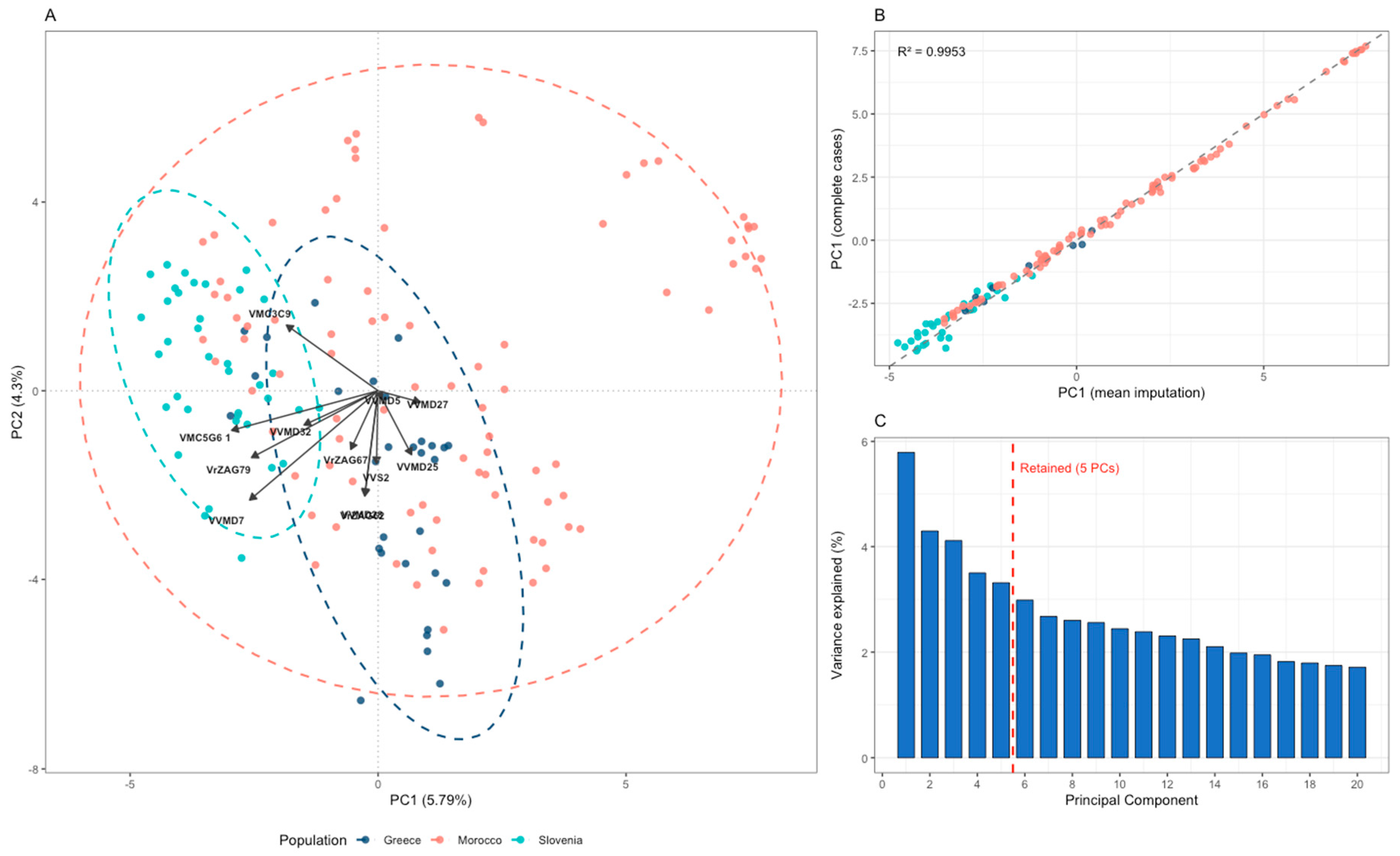
To investigate genetic structure and visualize relationships among the 154 grapevine accessions, we performed Principal Component Analysis (PCA) on allele dosage data that were centered and standardized using the scaleGen function from the adegenet package (v2.1.10) [45]. Missing genotypes were imputed using locus-wise mean allele frequencies [56]. We validated the robustness of this approach by comparing PCA results from mean-imputed data with those from complete-case exclusion, in which individuals with any missing data were removed. PC1 scores from the two methods were highly correlated (R2 > 0.99) confirming that the imputation method did not materially affect the PCA configuration. Accessions with more than 50% missing alleles were excluded from the analysis. PCA was conducted using the dudi.pca function in the ade4 package [57], retaining the first five principal components based on the scree plot criterion. These five principal components cumulatively explained 21.04% of the total genetic variance (PC1: 5.79%, PC2: 4.31%, PC3: 4.12%, PC4: 3.50%, PC5: 3.32%).
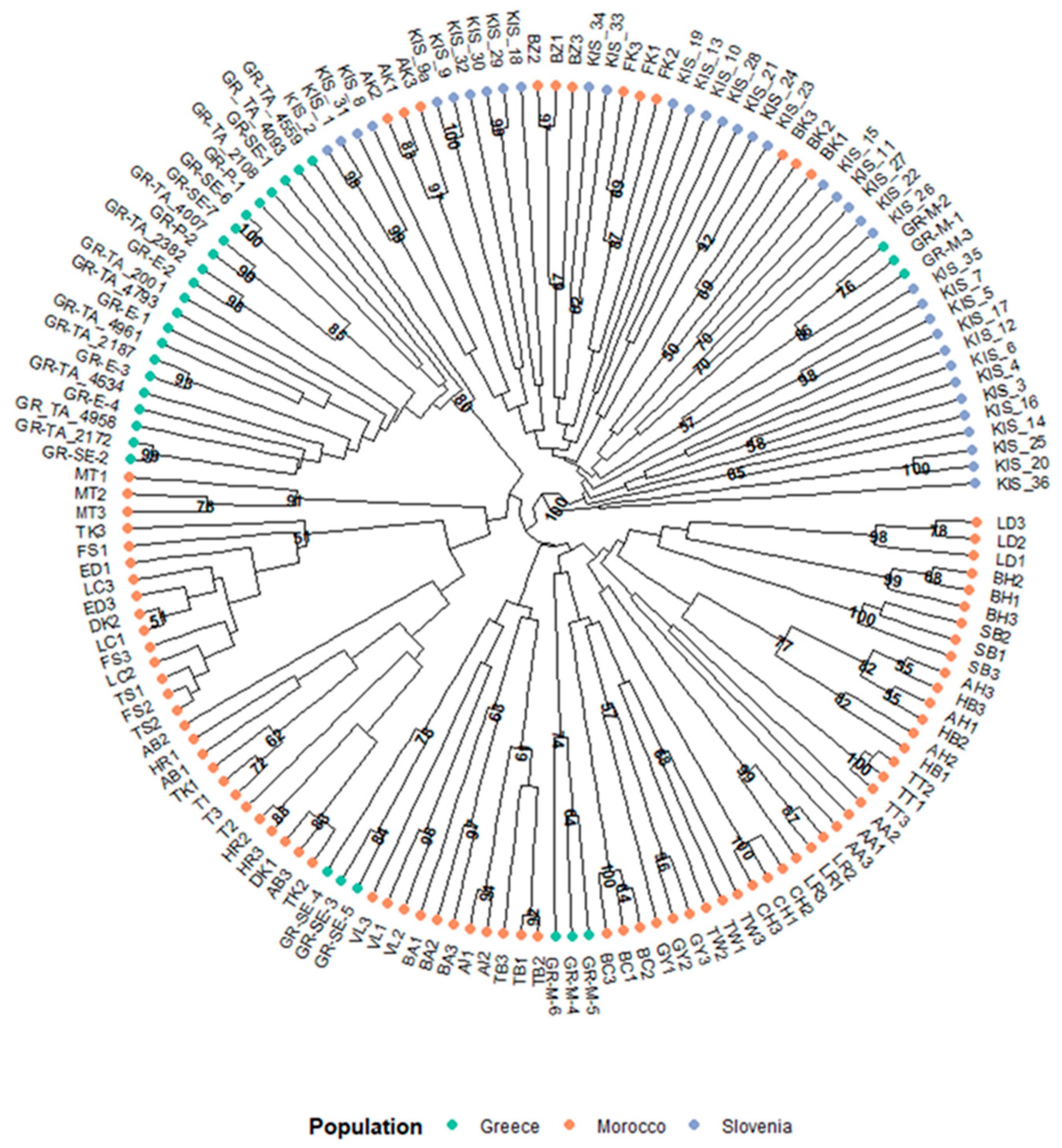
To complement the ordination-based approach, we performed hierarchical clustering using Prevosti’s genetic distance matrix [58] and the Unweighted Pair Group Method with Arithmetic Mean (UPGMA). Node support was evaluated with 1000 bootstrap replicates, implemented via the bruvo.boot function with type = “PA” to ensure that bootstrap support values corresponded to the Prevosti distance topology rather than Bruvo’s default distance. The resulting node support values were mapped onto the dendrogram using the phytools package (2.5-2) [59].
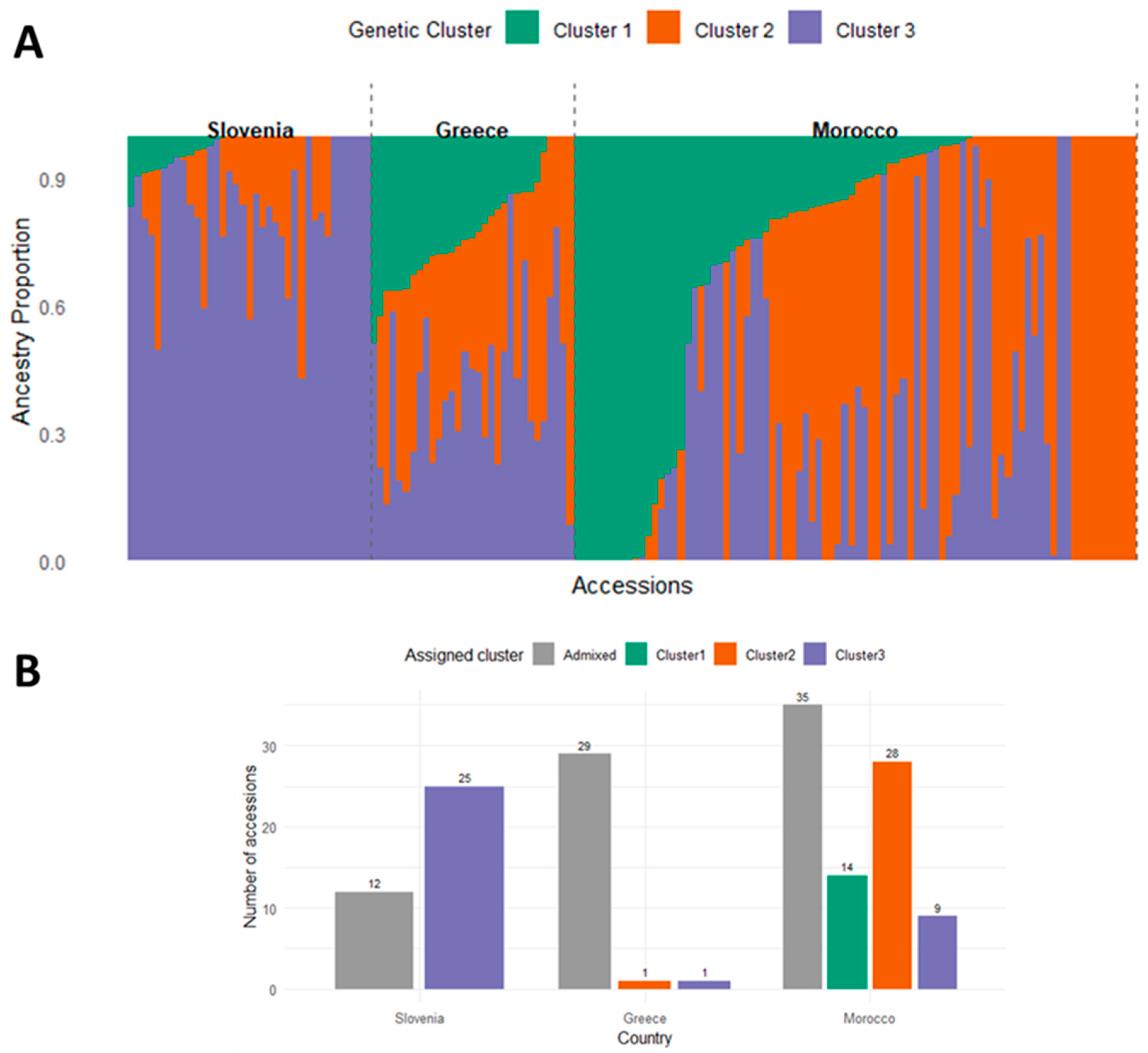
Finally, Bayesian clustering analysis using model-based ancestry inference was performed using sNMF (sparse Non-negative Matrix Factorization) in the LEA package (v3.25.0) [60], an efficient STRUCTURE-like approach to infer the genetic structure of the Vitis germplasm and assess the proportion of shared ancestry among individual accessions. Genotypes were converted to LEA’s.geno format using struct2geno, and a range of K values (1–10) was tested with 30 independent runs per K to ensure convergence. The optimal K was selected by minimizing the cross-entropy criterion, and the Q-matrix from the best run (lowest cross-entropy) was used to calculate individual ancestry coefficients. Accessions were classified as “assigned” when their maximum ancestry coefficient exceeded 0.80 and as “admixed” otherwise (Supplementary Table S3).

3. Results

3.1. SSR Marker Polymorphism and Genetic Diversity Across Loci

A total of 154 diploid Vitis accessions from three Mediterranean regions were genotyped using 12 highly polymorphic SSR loci, resulting in the detection of 168 alleles, with 11 to 19 alleles per locus and a mean of 14 alleles per locus (Table 1). The number of alleles per locus (Na) ranged from 11 at loci VVMD5 and VrZAG79 to 19 at VVMD28 and VrZAG67. Locus VVMD28 showed the highest allelic richness (Na = 19; Ne = 13.587), as well as the highest expected heterozygosity (He = 0.926) and polymorphic information content (PIC = 0.859), reinforcing its effectiveness for distinguishing individual genotypes. Conversely, VrZAG62 had the lowest effective number of alleles (Ne = 6.184) and PIC (0.710), though both values remained above 0.7, sufficient informativeness for population-level comparisons.
Standardized allelic richness (Ar), corrected for sample size disparities, ranged from 6.585 (VVMD7) to 9.254 (VrZAG67), with a mean of 7.665 across loci. These results, together with consistently high Shannon’s diversity indices (I = 2.047–2.734), highlighted the genetic variation captured. Observed heterozygosity (Ho) ranged from 0.697 (VMC5G6) to 0.974 (VVMD27), while expected heterozygosity (He) ranged from 0.838 (VrZAG62) to 0.926 (VVMD28), indicating high levels of genetic variation across all loci examined. Among the 12 studied loci, four loci (VVMD5, VVMD27, VrZAG62, and VVMD32) showed negative fixation index (Fis) values, suggesting an excess of heterozygotes, which may be attributed to clonal propagation, cross-pollination, or selection favoring heterozygosity in grapevine. In contrast, loci VVS2 and VVMD25 showed positive Fis values (0.125 and 0.164, respectively), reflecting a deficit in heterozygosity that could be explained by non-random mating, inbreeding, or substructuring within the sampled populations.

3.2. Population-Specific Genetic Diversity Patterns

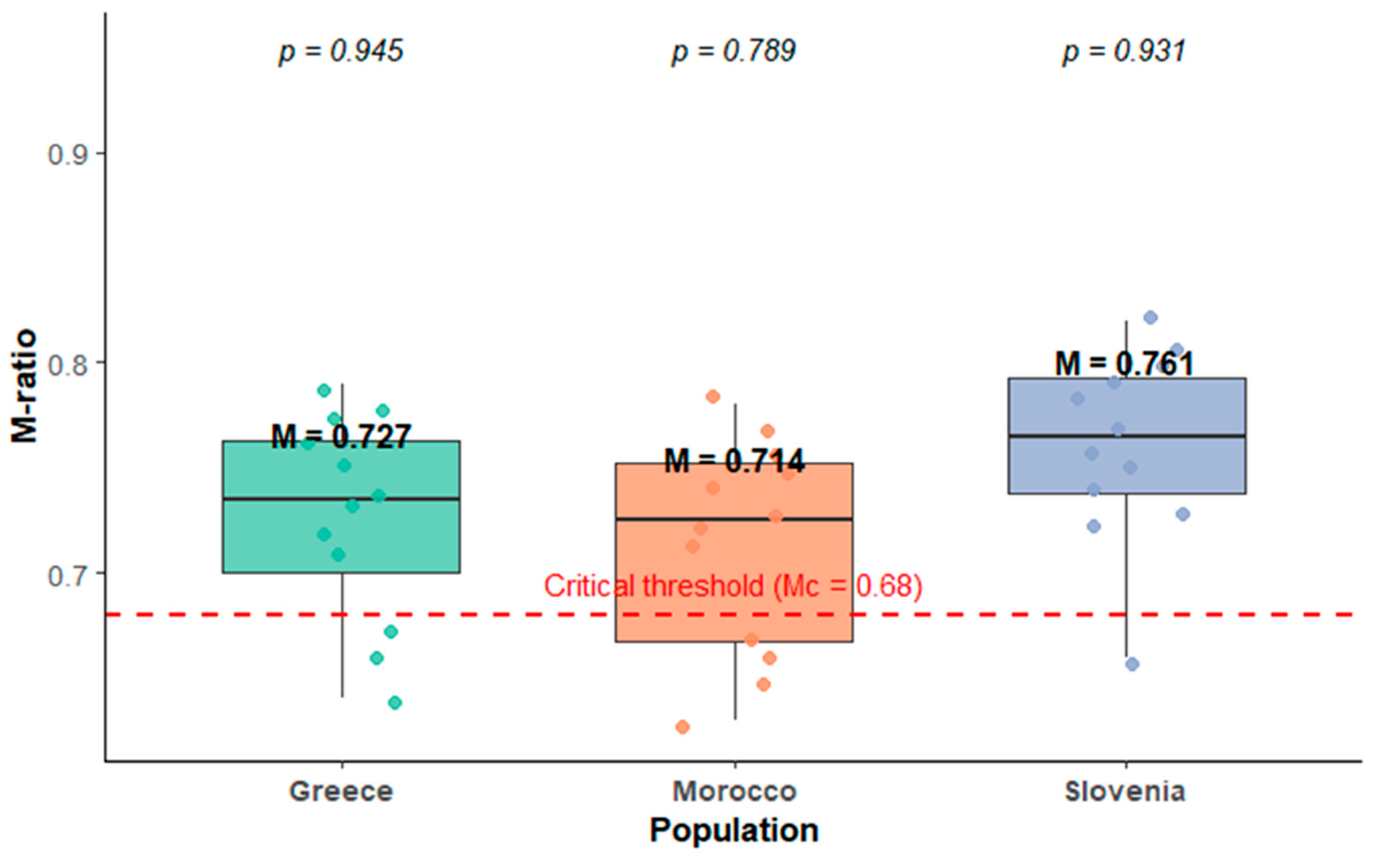
A comprehensive assessment of genetic diversity across grapevine accessions from Greece, Morocco, and Slovenia (Table 2) revealed marked variation in diversity metrics, suggestive of different evolutionary histories and cultivation contexts. The Moroccan collection, with the largest sample size (n = 86), exhibited the broadest genetic base, showing the highest mean number of alleles per locus (Na = 11.75) and substantial allelic richness (Ar = 7.684). Moroccan accessions also displayed high expected heterozygosity (He = 0.846) and a high Shannon information index (I = 2.113), indicating considerable allelic diversity and evenness. Importantly, the presence of 11 private alleles is consistent with a distinctive genetic composition, likely reflecting Morocco’s long-standing viticultural tradition and diverse agroecological settings. We note that the larger sample size for Morocco (n = 86) compared to Greece (n = 31) and Slovenia (n = 37) may partially inflate private allele counts, and comparisons should be interpreted with this caveat in mind. The population showed a moderate positive inbreeding coefficient (Fis = 0.055) and significant linkage disequilibrium (LD) (Ia = 1.657; r ¯ D = 0.152; p < 0.001), indicating partial deviation from random mating. The M-ratio analysis yielded a population mean M of 0.714, with 4 of 12 loci below the critical threshold (Mc = 0.68), suggesting a recent bottleneck at specific loci, though the overall mean remained consistent with equilibrium expectations (p = 0.789) (Figure 1).
In Slovenia (n = 37), the highest effective number of alleles (Ne = 6.92) and expected heterozygosity (He = 0.856) were observed, along with the highest Shannon index (I = 2.137), highlighting both the richness and balanced distribution of genetic diversity (Table 2). The relatively lower number of private alleles (PA = 7) may suggest shared ancestry or historical gene flow from Central European germplasm pools. Low positive Fis (0.037) indicated near-random mating, while modest LD (Ia = 0.861; r ¯ D = 0.079; p < 0.001) reflects some historical linkage. The M-ratio mean of 0.761, with only one locus below Mc, is suggestive of relative genetic stability with little evidence of severe recent bottlenecks (p = 0.931).
Greek germplasm (n = 31) showed remarkably high observed heterozygosity (Ho = 0.853), exceeding expected heterozygosity (He = 0.833) and resulting in a negative Fis (−0.024), indicating an excess of heterozygotes. Such patterns may result from historical intercrossing, balanced selection, or sampling of divergent landraces. Greek accessions harbored the largest number of private alleles (PA = 14), reflecting longstanding preservation of distinct genetic variants. The highest LD (Ia = 2.137; r ¯ D = 0.203; p < 0.001) may point to historical bottlenecks or clonal propagation. The M-ratio mean of 0.727, with 3 of 12 loci below Mc, indicates localized reductions in allelic diversity; however, the overall signature was not statistically significant (p = 0.945) (Figure 1).

3.3. Hierarchical Genetic Structure and Population Differentiation

Notably, AMOVA revealed that the vast majority of total genetic variation (90.84%) resided within individual accessions, consistent with the biology of grapevine as an outcrossing, clonally propagated species exhibiting high intra-individual heterozygosity. Despite this high internal diversity, AMOVA detected statistically significant genetic structuring at both inter- and intra-population levels. Specifically, 4.63% of total variation was attributed to differences among populations (ΦCT = 0.046; p = 0.001), and 4.53% to differences among individuals within populations (ΦSC = 0.048; p = 0.001) (Table 3). All pairwise FST comparisons indicated low to moderate but statistically significant genetic differentiation: Greece–Morocco (FST = 0.050), Greece–Slovenia (FST = 0.058), and Morocco–Slovenia (FST = 0.061). While statistically robust, these FST values are modest in absolute terms and characteristic of historically connected cultivated populations in which extensive trade and clonal propagation have historically attenuated drift-driven divergence. Gene flow estimates suggested moderate historical connectivity: Nm = 8.125 (Greece–Morocco), 7.75 (Greece–Slovenia), and 3.625 (Morocco–Slovenia); overall mean Nm = 4.83 (Table 4).

3.4. Multivariate and Model-Based Resolution of Population Structure

To refine the hierarchical differentiation patterns revealed by AMOVA and Fst analyses, we applied a complementary suite of multivariate, phylogenetic, and Bayesian clustering approaches, which together provided a high-resolution reconstruction of the genetic structure underlying the three Vitis populations. Principal component analysis (PCA) of the 12 SSR loci revealed a geographically coherent yet partially overlapping population structure (Figure 2). PC1 and PC2 accounted for 5.79% and 4.31% of the total variance, respectively. Slovenian accessions clustered tightly on the negative side of PC1, while Moroccan accessions shifted toward positive PC1 with substantially greater spread. Greek accessions occupied an intermediate position, overlapping with both Slovenian and Moroccan clusters. This overlap reflects genuine admixture rather than limited discriminatory power of the marker set, and geographic clustering becomes clearer when all five retained PCs are considered together. The clustering pattern was statistically supported by PERMANOVA: df = 2; SS = 34.21; MS = 17.11; F = 9.43; R2 = 0.0592; p = 0.001 (full PERMANOVA output in Supplementary Table S4).
Among the 12 SSR loci, VVMD27, VVMD28, VVS2, VVMD7, and VVMD25 contributed most of the discriminating power. VVMD28 (11.75%) and VVMD27 (11.67%) were consistently the most influential (Table 5). UPGMA analysis validated the population structure, recovering three main clusters corresponding to Slovenia, Greece, and Morocco, with bootstrap support exceeding 70% across major nodes (Figure 3). Nodes with bootstrap support below 70% are not interpreted in terms of specific biological relationships; only branches with ≥70% support are considered robust. Slovenian accessions formed the most homogeneous cluster; Moroccan accessions displayed deeper branching and greater intra-population distances; Greek accessions showed intermediate topology.
Bayesian clustering using sNMF confirmed three genetically distinct clusters (optimal K = 3; Figure 4). Run 27 at K = 3 yielded the lowest masked cross-entropy value (0.313). Slovenian accessions showed high ancestry proportions (>0.80) within a single cluster. While K = 3 was supported by the cross-entropy criterion, substantial admixture remains visible in many accessions, particularly Greek and Moroccan, indicating that the three inferred clusters represent predominant ancestry contributions rather than discrete, isolated gene pools. This is biologically expected given the documented history of Mediterranean grapevine trade and cultivation. The asymmetric distribution of admixed individuals (12 in Slovenia, 29 in Greece, 35 in Morocco) reflects regional differences in germplasm mobility and historical gene flow.

4. Discussion

This study presents one of the most comprehensive SSR-based assessments of Vitis germplasm from three historically interconnected but genetically underrepresented Mediterranean regions. The twelve SSR loci used here showed strong discriminatory power, generating 168 alleles with a mean of 14 alleles per marker and a mean PIC of 0.782. This places our panel among the most informative SSR sets used in recent Mediterranean surveys [23] and confirms that this internationally standardized marker set captures meaningful genetic differentiation across the sampled regions. The outstanding performance of VVMD28 and VVMD27 as the top discriminatory loci aligns with their established role in cultivar fingerprinting and pedigree reconstruction [17,61,62], identifying them as priority candidates for integration into international grapevine databases such as the VitisDiversityPortal. The consistently high heterozygosity levels (mean Ho = 0.812; He = 0.881) confirm the biological signature of Vitis as a predominantly outcrossing species in which millennia of clonal propagation have preserved extensive within-genotype variability [63,64,65] and validate the capacity of our marker panel to reflect this variability accurately at the population level.
We acknowledge that 12 SSR loci provide substantially lower resolution than SNP arrays or whole-genome sequencing approaches, and this limitation shapes our interpretation throughout. The geographic structure and admixture patterns we document are robust, reproducible features of the dataset, confirmed independently by three analytical frameworks and supported by PERMANOVA (F = 9.43; R2 = 0.059; p = 0.001), but attribution to specific domestication events, colonization routes, or fine-scale historical dispersal trajectories requires genomic-scale evidence. All interpretations are therefore explicitly framed as hypotheses consistent with existing genomic evidence rather than independent conclusions, and we call for follow-up studies incorporating whole-genome approaches with broader geographic sampling. The negative Fis values observed at several loci (VVMD5, VVMD27, VrZAG62, VVMD32) indicate heterozygote excess, a pattern frequently reported in grapevine and attributed to long-term clonal propagation, balancing selection in heterogeneous Mediterranean environments, or introgression from regional V. sylvestris populations [25,66,67]. Positive Fis values at VVS2 and VVMD25 likely reflect cryptic substructure, Wahlund effects, or residual null allele frequency following correction [22]; these loci should be interpreted with additional caution in fine-scale population comparisons.
Population-specific analysis revealed distinct, though cautiously interpreted, evolutionary and demographic contexts for each of the three regional germplasm pools. Moroccan accessions exhibited the highest total allelic richness and the greatest number of private alleles, consistent with the composite history of North African viticulture shaped by Phoenician, Roman, and Arab-Andalusian introductions across ecologically diverse agroecological zones [32,68]. The presence of private alleles beyond what historical introductions alone would predict may indicate additional in situ processes, including introgression from North African V. sylvestris populations [28] or de novo mutations favored under semi-arid conditions. Relatively high linkage disequilibrium ( r ¯ D = 0.152) and moderate Fis (0.055) are consistent with past demographic contractions associated with the post-colonial decline of viticulture and subsequent re-establishment from a restricted genetic base [24]. However, Morocco’s larger sample size (n = 86) may partially inflate private allele counts relative to the smaller Greek and Slovenian samples, so comparisons should be interpreted accordingly. Slovenian accessions formed a relatively homogeneous, allelically rich cluster with the highest effective allele number (Ne = 6.92), near-panmictic Fis (0.037), and the highest population-level M-ratio (0.761), collectively consistent with a demographic history of relative stability and limited bottleneck pressure. This pattern aligns with diversity assembled through extensive historical gene flow along Central European trade networks rather than prolonged in situ differentiation [33,38], and is reflected in the comparatively lower private allele count (PA = 7). Greek accessions occupied an intermediate but evolutionarily distinctive position, combining the highest observed heterozygosity (Ho = 0.853), the most negative Fis (−0.024), and the largest private allele pool (PA = 14) of the three populations. This profile reinforces the role of the Aegean basin as both an early center of grapevine domestication and a persistent corridor for trans-Mediterranean gene flow, through which successive historical periods repeatedly introduced and blended diverse germplasm into a background of longstanding landrace cultivation [4,69,70]. The high linkage disequilibrium observed in Greek accessions ( r ¯ D = 0.203) may also indicate historical bottleneck episodes associated with rural depopulation and viticultural contraction during the twentieth century.
The private alleles identified in each regional germplasm pool may have adaptive significance for locally relevant traits, though direct functional linkage cannot be established from SSR data alone, and phenotypic validation is essential before targeted deployment in breeding programs. Greek private alleles, found in accessions from environments historically exposed to prolonged Aegean summer drought, high irradiance, and thermal stress, are of particular interest for drought tolerance, stomatal regulation, and phenological plasticity—traits that are increasingly critical under projected Mediterranean climate trajectories [5,8,39]. Moroccan private alleles, shaped by semi-arid agroecological conditions across diverse elevational and edaphic gradients, may encode tolerance to heat, sustained water deficit, and soil salinity—adaptive attributes largely absent from the narrow genetic base of commercially dominant cultivars [11,15]. Slovenian private alleles likely reflect adaptations to cooler, continental-influenced conditions, including frost tolerance, late-season phenological adjustment, and resistance to fungal pathogens characteristic of Central European viticultural systems, particularly downy mildew (Plasmopara viticola) and Botrytis cinerea [33,37]. Collectively, these private allele pools represent non-redundant adaptive variation that is underrepresented or absent in major Western European germplasm repositories, reinforcing the conservation value of geographically inclusive sampling strategies [71]. Future functional genomics, association mapping, and QTL studies targeting private allele-bearing accessions from all three regions are therefore warranted, with priority traits including drought resistance, pathogen response, phenological plasticity, and berry quality parameters directly relevant to climate-adaptive viticulture.
Hierarchical analyses of population structure confirmed genuine genetic discontinuities among the three regional pools. The global FST, although low to moderate in absolute terms, was statistically significant and consistent with the level of differentiation expected among historically connected cultivated populations where extensive germplasm exchange has attenuated, but not eliminated, drift-driven divergence—a pattern documented in other Mediterranean SSR surveys of comparable scope [22,23]. Importantly, the gradient of pairwise differentiation—lowest between Greece and Morocco, highest between Morocco and Slovenia—is geographically and historically coherent rather than arbitrary, and is independently corroborated by multivariate ordination, distance-based clustering, and Bayesian ancestry inference. High historical gene flow between Greece and Morocco aligns with well-documented Arab-Andalusian viticultural exchanges and subsequent Ottoman-period interregional trade networks [33,72], while comparatively lower connectivity between Morocco and Slovenia reflects weaker historical, geographic, and cultural links across this axis of the Mediterranean—an asymmetry consistent with the broader phylogeographic structure of Mediterranean grapevine diversity [4,25]. Arguably, the most consequential finding of AMOVA—that the vast majority of total genetic variation resided within individuals rather than among populations—is characteristic of outcrossing species maintained through clonal propagation [22,63] and carries a direct conservation implication: preserving individual accession diversity, not only population-level structure, is essential for capturing the full adaptive breadth of Mediterranean grapevine germplasm. This argues against focusing conservation efforts on a small number of representative accessions per region and instead supports broad, accession-level ex situ and in situ strategies.
Combined PCA, UPGMA, and sNMF analyses revealed a consistent tripartite genetic structure, and the concordance across these three independent analytical frameworks, each operating under different assumptions and distance metrics, strengthens confidence in the biological reality of this structure beyond what any single method could support [44,59]. Although the first two PCA axes together explained only a modest proportion of total variance, this is expected for SSR-based ordination in highly heterozygous outcrossing species, where individual-level genotypic variation dominates the eigenvalue spectrum and geographic signal is distributed across multiple components [22,27]. The biological interpretability of the ordination is confirmed by the statistically significant PERMANOVA result and its agreement with both UPGMA topology and sNMF ancestry assignments.
Slovenian accessions formed the most internally homogeneous cluster, consistent with a demographically stable Central European viticultural trajectory characterized by clonal propagation within a geographically bounded vineyard network, near-panmictic mating, and restricted long-range introgression [25,38,73]. The absence of significant bottleneck signatures and the high population-level M-ratio further support a continuous demographic history with limited large-scale disruption. Greek and Moroccan accessions showed substantially higher admixture, consistent with their historical roles as major hubs of grapevine diffusion and reciprocal germplasm exchange. In Greece, successive historical periods—Classical, Byzantine, and Ottoman—repeatedly introduced diverse planting material into a background of longstanding Aegean landrace cultivation, producing the layered genetic signature observed here [4,9,69]. In Morocco, Phoenician, Roman, and Arab-Andalusian introductions, combined with probable introgression from North African V. sylvestris populations and demographic contractions during the post-colonial period, generated the broad allelic dispersion and elevated admixture characteristic of the Moroccan cluster [24,28,68]. The pronounced admixture observed in accessions from both regions confirms that the three inferred clusters represent predominant ancestry contributions rather than discrete, isolated gene pools—a biologically expected outcome given the documented continuity of Mediterranean viticultural exchange networks across millennia [2,72].
The persistence of geographically structured allelic signatures despite this history of circulation is compatible with a model involving multiple introduction events, recurrent admixture with regional V. sylvestris lineages, and sustained human-mediated selection across ecologically and culturally heterogeneous landscapes [4,5] Our SSR data are broadly consistent with, but do not independently confirm, the mosaic domestication model proposed by large-scale genomic studies [4,25] we present this explicitly as a working hypothesis consistent with existing genomic evidence, one that requires rigorous testing with whole-genome sequencing data and geographically broader sampling before it can be considered an independent conclusion. The distinct genetic architectures documented here—cohesive in Slovenia, layered in Greece, and dispersed in Morocco—nonetheless carry a clear and actionable conservation message: traditional landraces from these peripheral Mediterranean regions harbor meaningful, regionally distinctive genetic diversity that is substantially underrepresented in surveys focused on Western European core collections and constitutes a critical, currently underutilized resource for conservation planning, pre-breeding research, and the development of climate-adaptive viticulture systems suited to the environmental challenges of the coming decades.

5. Conclusions

This study offers a comprehensive SSR-based characterization of grapevine germplasm from three historically interconnected yet genetically underrepresented Mediterranean regions. Our results indicate that regionally structured, historically shaped genetic diversity persists in peripheral Mediterranean grapevine germplasm and highlight the importance of geographically inclusive sampling strategies in grapevine conservation programs. The contrasting genetic architectures of Slovenian (cohesive), Greek (layered), and Moroccan (dispersed) germplasm demonstrate the value of incorporating geographically diverse sampling in genetic resource programs, as each region contributes distinct components to the species’ overall genetic diversity.
Our findings support a mosaic model of grapevine dispersal and diversification, presented here as a working hypothesis that requires further genomic investigation. The private alleles and unique genotypic combinations identified may be valuable for future climate-adaptive breeding programs, although phenotypic validation of specific accessions will be necessary before targeted deployment.
Differentiated conservation recommendations based on our findings are as follows. For Morocco: establish a dedicated ex situ core collection of at least 30 representative accessions, prioritizing those with private alleles. For Greece: prioritize in situ conservation of traditional landrace vineyards, complemented by molecular-assisted identity verification of the “Unknown” and “Unidentified” accessions in the ELGO-DIMITRA reference collection. For Slovenia: implement targeted clonal selection within existing collections and continue monitoring wild V. vinifera subsp. sylvestris populations.
Unlocking the potential of this genetic heritage will require sustained investment in genetic resource conservation, pre-breeding research, and participatory selection programs that engage traditional grape growers as partners in safeguarding this evolutionary legacy.

Supplementary Materials

The following supporting information can be downloaded at https://www.mdpi.com/article/10.3390/agriculture16131380/s1, Figure S1: Map illustrating the geographical location of the sampling sites in the three countries, Morocco, Slovenia, and Greece. Table S1: Grapevine Genetic Resources; Table S2: Per-locus missing data rates and null allele frequencies before and after correction in 154 Vitis accessions genotyped with 12 SSR markers; Table S3: Sensitivity analysis of ancestry assignment across three Q-threshold values (Q > 0.70, Q > 0.80, Q > 0.90) for K = 3 genetic clusters inferred by sNMF in 154 Mediterranean Vitis accessions; Table S4: Full PERMANOVA results for pairwise genetic distance matrices among three Mediterranean Vitis populations (Greece, Morocco, Slovenia) based on 12 SSR loci. Supplementary code: Script for genetic diversity analyses, population structure inference, and figure generation for 154 Vitis accessions genotyped at 12 SSR loci.

Author Contributions

Conceptualization, B.P. and A.K.; methodology, B.P., G.M., M.N., D.T., T.P., L.S., S.E.F., N.D., V.M. and Y.H.; software, B.P. and M.N.; formal analysis, B.P. and M.N.; investigation, G.M., L.S., D.T., T.P., S.E.F., N.D., M.A., V.M., Y.H. and A.K.; resources, A.K., B.P., G.M., L.S., D.T., T.P., S.E.F., V.M., Y.H. and M.A.; writing—original draft preparation, B.P. and M.N.; writing—review and editing, all authors; supervision, A.K., B.P., M.A., V.M., S.E.F. and Y.H.; funding acquisition, A.K. and B.P. All authors have read and agreed to the published version of the manuscript.

Funding

This research was supported by the project “MedVitis”, within the framework of the ARIMNET 2 (ERA-NET) joint call (2017) funded by the EU’s 7th Framework Programme for Research, Technological Development and Demonstration under Grant Agreement No. 618127. Funding bodies: Hellenic Agricultural Organization—DIMITRA (ELGO-DIMITRA) (Greece), Ministry of Agriculture, Forestry and Food (Slovenia), Ministry of Higher Education, Scientific Research and Innovation (Morocco). In addition, it was funded by the Agrobiodiversity research program (P4-0072, Slovenian Research and Innovation Agency).

Data Availability Statement

The datasets presented in this article are not readily available because the data are part of an ongoing study. Requests to access the datasets should be directed to barbara.pipan@kis.si and kapazoglou@elgo.gr.

Acknowledgments

The authors would like to sincerely thank the farmers and winemakers in Greece, Slovenia and Morocco for making their material and knowledge available to the researchers as well as the technical staff who supported the laboratory work at the Agricultural Institute of Slovenia.

Conflicts of Interest

The authors declare no conflicts of interest.

References

  1. Brito, C.; Pereira, S.; Martins, S.; Monteiro, A.; Moutinho-Pereira, J.M.; Dinis, L. Strategies for Achieving the Sustainable Development Goals across the Wine Chain: A Review. Front. Sustain. Food Syst. 2024, 8, 1437872. [Google Scholar] [CrossRef]
  2. Lopes, P.F.M. Grapevine: From Origin to the Vineyard; Elsevier: Amsterdam, The Netherlands, 2024; Volume 110. [Google Scholar]
  3. Skiba, R. Wine Growing Essentials for Small Scale Sustainable Viniculture; After Midnight Publishing: Melbourne, Australia, 2025. [Google Scholar]
  4. Dong, Y.; Duan, S.; Xia, Q.; Liang, Z.; Dong, X.; Margaryan, K.; Musayev, M.; Goryslavets, S.; Zdunić, G.; Bert, P.-F.; et al. Dual Domestications and Origin of Traits in Grapevine Evolution. Science 2023, 379, 892–901. [Google Scholar] [CrossRef] [PubMed]
  5. Delrot, S.; Grimplet, J.; Carbonell-Bejerano, P.; Schwandner, A.; Bert, P.-F.; Bavaresco, L.; Costa, L.D.; Di Gaspero, G.; Duchêne, E.; Hausmann, L.; et al. Genetic and Genomic Approaches for Adaptation of Grapevine to Climate Change. In Genomic Designing of Climate-Smart Fruit Crops; Kole, C., Ed.; Springer International Publishing: Cham, Switzerland, 2020; pp. 157–270. [Google Scholar] [CrossRef]
  6. Marín, D.; Armengol, J.; Carbonell-Bejerano, P.; Escalona, J.M.; Gramaje, D.; Hernández-Montes, E.; Intrigliolo, D.S.; Martínez-Zapater, J.M.; Medrano, H.; Mirás-Avalos, J.M.; et al. Challenges of Viticulture Adaptation to Global Change: Tackling the Issue from the Roots. Aust. J. Grape Wine Res. 2021, 27, 8–25. [Google Scholar] [CrossRef]
  7. Santos, J.A.; Fraga, H.; Malheiro, A.C.; Moutinho-Pereira, J.; Dinis, L.-T.; Correia, C.; Moriondo, M.; Leolini, L.; Dibari, C.; Costafreda-Aumedes, S. A Review of the Potential Climate Change Impacts and Adaptation Options for European Viticulture. Appl. Sci. 2020, 10, 3092. [Google Scholar] [CrossRef]
  8. Van Leeuwen, C.; Destrac-Irvine, A.; Dubernet, M.; Duchêne, E.; Gowdy, M.; Marguerit, E.; Pieri, P.; Parker, A.; De Resseguier, L.; Ollat, N. An Update on the Impact of Climate Change in Viticulture and Potential Adaptations. Agronomy 2019, 9, 514. [Google Scholar] [CrossRef]
  9. Grassi, F.; De Lorenzis, G. Back to the Origins: Background and Perspectives of Grapevine Domestication. Int. J. Mol. Sci. 2021, 22, 4518. [Google Scholar] [CrossRef] [PubMed]
  10. Savo, V.; Kumbaric, A.; Caneva, G. Grapevine (Vitis vinifera L.) Symbolism in the Ancient Euro-Mediterranean Cultures. Econ. Bot. 2016, 70, 190–197. [Google Scholar] [CrossRef]
  11. Bassi, D.; Cirilli, M.; Rossini, L. Most Important Fruit Crops in Mediterranean Basin (Mb); Milano University Press: Milan, Italy, 2024; Available online: https://air.unimi.it/bitstream/2434/1105059/2/Most%2BImportant%2BFruit%2BCrops%2Bin%2BThe%2BMediterranean%2BBasin.pdf (accessed on 26 March 2026).
  12. Vezzulli, S.; Gramaje, D.; Tello, J.; Gambino, G.; Bettinelli, P.; Pirrello, C.; Schwandner, A.; Barba, P.; Angelini, E.; Anfora, G.; et al. Genomic Designing for Biotic Stress Resistant Grapevine. In Genomic Designing for Biotic Stress Resistant Fruit Crops; Kole, C., Ed.; Springer International Publishing: Cham, Switzerland, 2022; pp. 87–255. [Google Scholar] [CrossRef]
  13. De Michele, R.; La Bella, F.; Gristina, A.S.; Fontana, I.; Pacifico, D.; Garfi, G.; Motisi, A.; Crucitti, D.; Abbate, L.; Carimi, F. Phylogenetic Relationship among Wild and Cultivated Grapevine in Sicily: A Hotspot in the Middle of the Mediterranean Basin. Front. Plant Sci. 2019, 10, 1506. [Google Scholar] [CrossRef] [PubMed]
  14. Doncieux, A.; Demongeot, M.; MacDonald, K.I.; Renard, D.; Caillon, S. Unpacking Farmers’ Multiple Values in Grapevine Variety Choice. Agric. Hum. Values 2025, 42, 1225–1245. [Google Scholar] [CrossRef]
  15. Gisbert, C.; Soler, J.X.; Fos, M.; Intrigliolo, D.S.; Yuste, A.; Picó, B.; Torrent, D.; Peiró, R. Characterization of Local Mediterranean Grapevine Varieties for Their Resilience to Semi-Arid Conditions under a Rain-Fed Regime. Agronomy 2022, 12, 2234. [Google Scholar]
  16. García, R.A.A.; Revilla, E. The Current Status of Wild Grapevine Populations (Vitis vinifera ssp sylvestris) in the Mediterranean Basin. In The Mediterranean Genetic-Code-Grapevine and Olive; IntechOpen: London, UK, 2013; pp. 51–72. [Google Scholar]
  17. Riaz, S.; De Lorenzis, G.; Velasco, D.; Koehmstedt, A.; Maghradze, D.; Bobokashvili, Z.; Musayev, M.; Zdunic, G.; Laucou, V.; Andrew Walker, M.; et al. Genetic Diversity Analysis of Cultivated and Wild Grapevine (Vitis vinifera L.) Accessions around the Mediterranean Basin and Central Asia. BMC Plant Biol. 2018, 18, 137. [Google Scholar] [CrossRef] [PubMed]
  18. Magon, G.; De Rosa, V.; Martina, M.; Falchi, R.; Acquadro, A.; Barcaccia, G.; Portis, E.; Vannozzi, A.; De Paoli, E. Boosting Grapevine Breeding for Climate-Smart Viticulture: From Genetic Resources to Predictive Genomics. Front. Plant Sci. 2023, 14, 1293186. [Google Scholar] [CrossRef] [PubMed]
  19. Bowers, J.E.; Dangl, G.S.; Vignani, R.; Meredith, C.P. Isolation and Characterization of New Polymorphic Microsatellite Loci in Grapevine (Vitis vinifera L.). Theor. Appl. Genet. 1996, 92, 322–330. [Google Scholar]
  20. This, P.; Lacombe, T.; Thomas, M.R. Historical Origins and Genetic Diversity of Wine Grapes. Trends Plant Sci. 2004, 9, 387–395. [Google Scholar] [CrossRef] [PubMed]
  21. Laucou, V.; Launay, A.; Bacilieri, R.; This, P. Extended Diversity Analysis of Cultivated Grapevine Vitis vinifera with 10K Genome-Wide SNPs. PLoS ONE 2018, 13, e0192540. [Google Scholar] [CrossRef] [PubMed]
  22. Cipriani, G.; Spadotto, A.; Jurman, I.; Di Gaspero, G.; Crespan, M.; Meneghetti, S.; Frare, E.; Vignani, R.; Cresti, M.; Morgante, M.; et al. The SSR-Based Molecular Profile of 1005 Grapevine (Vitis vinifera L.) Accessions Uncovers New Synonymy and Parentages, and Reveals a Large Admixture amongst Varieties of Different Geographic Origin. Theor. Appl. Genet. 2010, 121, 1569–1585. [Google Scholar] [CrossRef] [PubMed]
  23. Cretazzo, E.; Moreno Sanz, P.; Lorenzi, S.; Benítez, M.L.; Velasco, L.; Emanuelli, F. Genetic Characterization by SSR Markers of a Comprehensive Wine Grape Collection Conserved at Rancho de la Merced (Andalusia, Spain). Plants 2022, 11, 1088. [Google Scholar] [CrossRef] [PubMed]
  24. Ghrissi, H.; De Andrés, M.T.; Andreu, L.J.; Gogorcena, Y. Genetic Diversity and Structure in a Spanish Grape Germplasm Collection Assessed by SSR Markers. Aust. J. Grape Wine Res. 2022, 8028224. [Google Scholar] [CrossRef]
  25. Magris, G.; Jurman, I.; Fornasiero, A.; Paparelli, E.; Schwope, R.; Marroni, F.; Di Gaspero, G.; Morgante, M. The Genomes of 204 Vitis vinifera Accessions Reveal the Origin of European Wine Grapes. Nat. Commun. 2021, 12, 7240. [Google Scholar] [CrossRef] [PubMed]
  26. Schuelke, C.; Vargas, A.M.; de Andrés, M.T.; Lamy, F.; Boukhdoud, L.; Kahale, R.; Robert, T.; Azzi, R.; Abinader, N.; Bou Dagher Kharrat, M. Unearthing Genetic Treasures: Exploring Lost Autochthonous Vitis vinifera Varieties in Lebanon. Genes 2024, 15, 1617. [Google Scholar] [CrossRef]
  27. Tello, J.; Todić, S.; Ferradás, Y.; Nikolic, M.; Sabovljević, A.; Ivanišević, D.; Tomanović, Ž.; Grbić, M.; Martínez-Zapater, J.M.; Ibáñez, J. The Genetic Characterization of Grapevines Prospected in Old Serbian Vineyards Reveals Multiple Relationships between Traditional Varieties of the Balkans. Front. Plant Sci. 2024, 15, 1391679. [Google Scholar] [CrossRef] [PubMed]
  28. Hbyaj, K.; Diria, G.; Mouniane, Y.; Chriqui, A.; Lebkiri, N.; Hmouni, D.; El Oualkadi, A. Identifying Grapevine (Vitis vinifera L.): A Comprehensive Approach Using Morphology, Sugar Analysis, and ISSR Markers, Illustrated with Taferialte Cultivars. Genet. Resour. Crop Evol. 2024, 71, 3181–3191. [Google Scholar] [CrossRef]
  29. Ghaffari, S.; Hasnaoui, N.; Zinelabidine, L.H.; Ferchichi, A.; Martínez-Zapater, J.M.; Ibáñez, J. Genetic Diversity and Parentage of Tunisian Wild and Cultivated Grapevines (Vitis vinifera L.) as Revealed by Single Nucleotide Polymorphism (SNP) Markers. Tree Genet. Genomes 2014, 10, 1103–1112. [Google Scholar] [CrossRef]
  30. Riahi, L.; Laucou, V.; Le Cunff, L.; Zoghlami, N.; Boursiquot, J.-M.; Lacombe, T.; El-Heit, K.; Mliki, A.; This, P. Highly Polymorphic nSSR Markers: A Useful Tool to Assess Origin of North African Cultivars and to Provide Additional Proofs of Secondary Grapevine Domestication Events. Sci. Hortic. 2012, 141, 53–60. [Google Scholar] [CrossRef]
  31. Zoghlami, N.; Riahi, L.; Laucou, V.; Mliki, A.; Ghorbel, A.; This, P. Genetic Structure of Endangered Wild Grapevine Vitis vinifera ssp. sylvestris Populations from Tunisia: Implications for Conservation and Management. For. Ecol. Manag. 2013, 310, 896–902. [Google Scholar] [CrossRef]
  32. Zinelabidine, L.H.; Charafi, J.; Haddioui, A.; Martínez-Zapater, J.M.; Ibáñez, J.; Tello, J. Genetic Characterization and Identification of the Table Grape Accessions Preserved in the Living Collection of Ain Taoujdate (Morocco). Vitis 2024, 63, Art.5. [Google Scholar]
  33. Maraš, V.; Tello, J.; Gazivoda, A.; Mugoša, M.; Perišić, M.; Raičević, J.; Štajner, N.; Ocete, R.; Božović, V.; Popović, T. Population Genetic Analysis in Old Montenegrin Vineyards Reveals Ancient Ways Currently Active to Generate Diversity in Vitis vinifera. Sci. Rep. 2020, 10, 15000. [Google Scholar] [CrossRef] [PubMed]
  34. Merkouropoulos, G.; Doupis, G. Autochthonous Grapevine Cultivars from Various Cultivation Centers Enrich the Reference Collection of Greece. Acta Hortic. 2024, 1439, 513–520. Available online: https://www.actahort.org/books/1439/1439_68.htm (accessed on 15 April 2026).
  35. Perko, A.; Trapp, O.; Maul, E.; Röckel, F.; Piltaver, A.; Vršič, S. Monitoring and Genotyping of Wild Grapevine (Vitis vinifera L. subsp. Sylvestris) in Slovenia. Plants 2024, 13, 1234. [Google Scholar] [CrossRef] [PubMed]
  36. Štajner, N.; Tomić, L.; Ivanišević, D.; Korać, N.; Cvetković-Jovanović, T.; Beleski, K.; Angelova, E.; Maraš, V.; Javornik, B. Microsatellite Inferred Genetic Diversity and Structure of Western Balkan Grapevines (Vitis vinifera L.). Tree Genet. Genomes 2014, 10, 127–140. [Google Scholar] [CrossRef]
  37. Vršič, S.; Trapp, O.; Maul, E.; Röckel, F.; Perko, A. Monitoring and Genetic Characterization of Historical Grapevine Varieties (V. vinifera ssp.) from Styria in Slovenia. Agriculture 2024, 14, 640. [Google Scholar] [CrossRef]
  38. Zdunić, G.; Lukšić, K.; Nagy, Z.A.; Mucalo, A.; Hančević, K.; Radić, T.; Butorac, L.; Jahnke, G.G.; Kiss, E.; Ledesma-Krist, G. Genetic Structure and Relationships among Wild and Cultivated Grapevines from Central Europe and Part of the Western Balkan Peninsula. Genes 2020, 11, 962. [Google Scholar] [CrossRef] [PubMed]
  39. Hmimsa, Y.; El Fatehi, S.; Ater, M.; Dihaz, N.; Moudni, Z.; Benziane, W.; Sinkovič, L.; Pipan, B.; Meglič, V.; Mužina, Š.; et al. MEDVITIS: Diversity of Mediterranean Vitis spp. Genetic Resources; Hmimsa, E.F., Ed.; Le Printer: Larache, Morocco, 2023; ISBN 978-9920-42-612-1. [Google Scholar]
  40. Pipan, B.; Zupančič, M.; Blatnik, E.; Dolničar, P.; Meglič, V. Comparison of six genomic DNA extraction methods for molecular downstream applications of apple tree (Malus X domestica). Cogent Food Agric. 2018, 4, 1540094. [Google Scholar] [CrossRef]
  41. Karatas, H.; Değirmenci, D.; Velasco, R.; Vezzulli, S.; Bodur, C.; Ağaoğlu, Y.S. Microsatellite Fingerprinting of Homonymous Grapevine (Vitis vinifera L.) Varieties in Neighboring Regions of South-East Turkey. Sci. Hortic. 2007, 114, 164–169. [Google Scholar] [CrossRef]
  42. Schuelke, M. An Economic Method for the Fluorescent Labeling of PCR Fragments. Nat. Biotechnol. 2000, 18, 233–234. [Google Scholar] [CrossRef] [PubMed]
  43. Applied Biosystems. GeneMapper Software, v6.0; Thermo Fisher Scientific: Waltham, MI, USA, 2019.
  44. Team, R.C. R: A Language and Environment for Statistical Computing; R Foundation for Statistical Computing: Vienna, Austria, 2016; Available online: https://www.R-project.org/ (accessed on 26 March 2026).
  45. Jombart, T. Adegenet: A R Package for the Multivariate Analysis of Genetic Markers. Bioinformatics 2008, 24, 1403–1405. [Google Scholar] [CrossRef] [PubMed]
  46. Chakraborty, R.; Andrade, M.D.; Daiger, S.P.; Budowle, B. Apparent heterozygote deficiencies observed in DNA typing data and their implications in forensic applications. Ann. Hum. Genet. 1992, 56, 45–57. [Google Scholar] [CrossRef] [PubMed]
  47. Adamack, A.; Gruber, B.; Gruber, M.B.; LazyData, T. Package ‘PopGenReport. 2014.
  48. Dakin, E.E.; Avise, J.C. Microsatellite Null Alleles in Parentage Analysis. Heredity 2004, 93, 504–515. [Google Scholar] [CrossRef] [PubMed]
  49. Kamvar, Z.N.; Tabima, J.F.; Grünwald, N.J. Poppr: An R Package for Genetic Analysis of Populations with Clonal, Partially Clonal, and/or Sexual Reproduction. PeerJ 2014, 2, e281. [Google Scholar] [CrossRef] [PubMed]
  50. Botstein, D.; White, R.L.; Skolnick, M.; Davis, R.W. Construction of a genetic linkage map in man using restriction fragment length polymorphisms. Am. J. Hum. Genet. 1980, 32, 314. [Google Scholar] [PubMed]
  51. Goudet, J. Hierfstat, a Package for R to Compute and Test Hierarchical F-Statistics. Mol. Ecol. Notes 2005, 5, 184–186. [Google Scholar] [CrossRef]
  52. Pembleton, L.W.; Pembleton, M.L. Package ‘StAMPP. 2015. Available online: http://download.nust.na/pub3/cran/web/packages/StAMPP/StAMPP.pdf (accessed on 26 March 2026).
  53. Slatkin, M. Gene Flow in Natural Populations. Annu. Rev. Ecol. Syst. 1985, 16, 393–430. [Google Scholar] [CrossRef]
  54. Garza, J.C.; Williamson, E.G. Detection of Reduction in Population Size Using Data from Microsatellite Loci. Mol. Ecol. 2001, 10, 305–318. [Google Scholar] [CrossRef] [PubMed]
  55. Archer, F.I.; Adams, P.E.; Schneiders, B.B. Stratag: An R Package for Manipulating, Summarizing and Analysing Population Genetic Data. Mol. Ecol. Resour. 2017, 17, 5–11. [Google Scholar] [CrossRef] [PubMed]
  56. Zhang, Z. Multiple imputation with multivariate imputation by chained equation (MICE) package. Ann. Transl. Med. 2016, 4, 30. [Google Scholar] [CrossRef] [PubMed]
  57. Dray, S.; Dufour, A.-B. The Ade4 Package: Implementing the Duality Diagram for Ecologists. J. Stat. Softw. 2007, 22, 1–20. [Google Scholar]
  58. Prevosti, A.; Ocana, J.; Alonso, G. Distances between Populations of Drosophila subobscura, Based on Chromosome Arrangement Frequencies. Theor. Appl. Genet. 1975, 45, 231–241. [Google Scholar] [CrossRef] [PubMed]
  59. Revell, L.J. Phytools: An R Package for Phylogenetic Comparative Biology (and Other Things). Methods Ecol. Evol. 2012, 2, 217–223. [Google Scholar]
  60. Frichot, E.; François, O. LEA: An R Package for Landscape and Ecological Association Studies. Methods Ecol. Evol. 2015, 6, 925–929. [Google Scholar] [CrossRef]
  61. Barrias, S.; Ibanez, J.; Martins-Lopes, P. High Resolution Melting Analysis of Microsatellite Markers Applied to Grapevine Varietal Fingerprinting throughout the Wine Production Chain. Food Control 2024, 160, 110368. [Google Scholar] [CrossRef]
  62. Jiménez, C.; Peiró Barber, R.M.; Yuste Del Carmen, A.; García, J.; Martínez-Gil, F.; Gisbert Domenech, M.C. Looking for Old Grapevine Varieties. Vitis 2019, 58, 59–60. [Google Scholar]
  63. Callipo, P.; Schmidt, M.; Strack, T.; Robinson, H.; Vasudevan, A.; Voss-Fels, K.P. Harnessing Clonal Diversity in Grapevine: From Genomic Insights to Modern Breeding Applications. Theor. Appl. Genet. 2025, 138, 196. [Google Scholar] [CrossRef] [PubMed]
  64. Cunha, J.; Ibáñez, J.; Teixeira-Santos, M.; Brazão, J.; Fevereiro, P.; Martínez-Zapater, J.M.; Eiras-Dias, J.E. Genetic Relationships among Portuguese Cultivated and Wild Vitis vinifera L. Germplasm. Front. Plant Sci. 2020, 11, 127. [Google Scholar] [CrossRef] [PubMed]
  65. Foria, S.; Magris, G.; Jurman, I.; Schwope, R.; De Candido, M.; De Luca, E.; Ivanišević, D.; Morgante, M.; Di Gaspero, G. Extent of Wild–to–Crop Interspecific Introgression in Grapevine (Vitis vinifera) as a Consequence of Resistance Breeding and Implications for the Crop Species Definition. Hortic. Res. 2022, 9, uhab010. [Google Scholar] [PubMed]
  66. Robinson, H.; Strack, T.; Schmidt, M.; Callipo, P.; Nsibi, M.; Schmid, J.; Rühl, E.; Piepho, H.-P.; Voss-Fels, K.P. Exploring Intra-Varietal Variation for Complex Traits in Grapevine (Vitis vinifera L.). Theor. Appl. Genet. 2025, 138, 305. [Google Scholar] [CrossRef] [PubMed]
  67. Vondras, A.M.; Minio, A.; Blanco-Ulate, B.; Figueroa-Balderas, R.; Penn, M.A.; Zhou, Y.; Seymour, D.; Ye, Z.; Liang, D.; Espinoza, L.K.; et al. The Genomic Diversification of Grapevine Clones. BMC Genom. 2019, 20, 972. [Google Scholar] [CrossRef] [PubMed]
  68. Ater, M.; el Fatehi, S.; El Oualkadi, A.; Younes, H. La Cultura Tradicional de la Vid en la Región Norte de Marruecos: Existencia de Posibles Influencias Andaluzas 2020; Comares: Granada, Spain, 2020; pp. 279–294. [Google Scholar]
  69. Srivastava, R.; Bazakos, C.; Tsachaki, M.; Žanko, D.; Kalantidis, K.; Tsiantis, M.; Laurent, S. Genealogical Analyses of 3 Cultivated and 1 Wild Specimen of Vitis vinifera from Greece. Genome Biol. Evol. 2023, 15, evad226. [Google Scholar] [CrossRef] [PubMed]
  70. Tsivelikas, A.L.; Avramidou, E.V.; Ralli, P.E.; Ganopoulos, I.V.; Moysiadis, T.; Kapazoglou, A.; Aravanopoulos, F.A.; Doulis, A.G. Genetic Diversity of Greek Grapevine (Vitis vinifera L.) Cultivars Using Ampelographic and Microsatellite Markers. Plant Genet. Resour. 2022, 20, 124–136. [Google Scholar] [CrossRef]
  71. Lazaridi, E.; Kapazoglou, A.; Gerakari, M.; Kleftogianni, K.; Passa, K.; Sarri, E.; Papasotiropoulos, V.; Tani, E.; Bebeli, P.J. Crop Landraces and Indigenous Varieties: A Valuable Source of Genes for Plant Breeding. Plants 2024, 13, 758. [Google Scholar] [CrossRef] [PubMed]
  72. Balta, E. Evidence for Viniculture from the Ottoman Tax Registers: 15th to 17th Century. Türk Kültürü İNcelemeleri Derg. 2001, 5, 1–16. [Google Scholar]
  73. Marinov, L.; Magris, G.; Di Gaspero, G.; Morgante, M.; Maletić, E.; Bubola, M.; Pejić, I.; Zdunić, G. Single Nucleotide Polymorphism (SNP) Analysis Reveals Ancestry and Genetic Diversity of Cultivated and Wild Grapevines in Croatia. BMC Plant Biol. 2024, 24, 975. [Google Scholar] [CrossRef] [PubMed]
Figure 1. Population-level M-ratio and bottleneck signals across SSR loci. Horizontal dashed line indicates critical Mc threshold (0.68).
Agriculture 16 01380 g001
Figure 2. Principal Component Analysis of SSR-Based Genetic Variation in 154 accessions of Vitis. (A) PCA biplot of the first two principal components. Points represent individual accessions colored by country of origin (Greece: dark blue, Morocco: salmon, Slovenia: teal). Arrows indicate the contribution of each SSR locus (averaged over all alleles of that locus) to the PC axes; dashed ellipses show 95% confidence regions for each population. (B) Sensitivity analysis comparing PC1 scores from mean-imputed data versus complete-case exclusion (individuals with no missing data). Each point represents one accession; the dashed diagonal line indicates perfect agreement. (C) Scree plot of the first 20 principal components. The red dashed line marks the retention of five PCs.
Agriculture 16 01380 g002
Figure 3. UPGMA clustering of the 154 Vitis accessions. Bootstrap support values (>50%) from 1000 replicates are shown at major nodes.
Agriculture 16 01380 g003
Figure 4. Bayesian model-based clustering of the 154 Vitis accessions inferred from sNMF (K = 3). (A) Ancestry proportions of individual accessions across three inferred genetic clusters. (B) Distribution of assigned and admixed accessions per country based on ancestry coefficients. Assigned: maximum ancestry coefficient Q > 0.80 for a single cluster. Admixed: maximum Q ≤ 0.80, indicating mixed ancestry across ≥2 clusters.
Agriculture 16 01380 g004
Table 1. Summary of genetic diversity parameters across twelve microsatellite loci in Vitis accessions. Na, number of alleles; Ne, effective number of alleles; Ar, allelic richness; I, Shannon’s information index; Ho, observed heterozygosity; He, expected heterozygosity; Fis, fixation index; PIC, polymorphic information content. Mean ± SE: mean value ± standard error across 12 loci.
LocusDyeNaNeArHoHeFisPICI
VVMD56-FAM119.1498.0280.9190.891−0.0050.7962.306
VVMD7VIC127.4916.5850.6970.8670.0580.7552.175
VVS2NED148.9697.7660.7920.8890.1250.7922.340
VVMD25PET128.6517.1610.7470.8840.1640.7842.262
VVMD276-FAM1610.4608.0610.9740.904−0.1090.8202.479
VVMD28VIC1913.5878.5140.8690.9260.0330.8592.734
VrZAG62NED136.1847.1610.8500.838−0.0100.7102.047
VrZAG67PET1911.6699.2540.8040.9140.0830.8392.657
VVMD326-FAM138.5328.2840.8790.883−0.0250.7832.315
VMC3C9VIC126.6537.9900.7580.8500.0070.7332.169
VMC5G6NED167.0427.3120.6970.8580.1200.7472.303
VrZAG79PET117.7226.8770.7580.8710.0290.7612.162
Mean ± SE14.00 ± 0.828.842 ± 0.6257.749 ± 0.2200.812 ± 0.0250.881 ± 0.0080.039 ± 0.0220.782 ± 0.0132.329 ± 0.059
Table 2. Genetic diversity and linkage disequilibrium in Vitis accessions from Greece, Morocco, and Slovenia based on 12 SSR markers. Genetic diversity measures include Ne, effective number of alleles; Na, mean number of alleles; Ar, allelic richness; PA, number of private alleles; Ho, observed heterozygosity; He, expected heterozygosity; I, Shannon’s information index; Fis, fixation index. Linkage disequilibrium measures are Index of Association (Ia) and standardized index of association ( r ¯ D ). p-values were obtained from 999 Monte Carlo permutations.
CountryNeNaArPAHoHeIFisIap (Ia) r ¯ D p ( r ¯ D )
Greece5.9999.57.583140.8530.8331.992−0.0242.1370.0010.2030.001
Morocco6.47211.757.684110.7990.8462.1130.0551.6570.0010.1520.001
Slovenia6.9211.3337.98170.8240.8562.1370.0370.8610.0010.0790.001
Mean ± SE6.464 ± 0.26610.861 ± 0.6917.749 ± 0.11910.667 ± 2.0280.825 ± 0.0160.845 ± 0.0072.081 ± 0.0450.023 ± 0.0241.552 ± 0.3720.001 ± 0.0000.145 ± 0.0360.001 ± 0.000
Table 3. Hierarchical analysis of molecular variance (AMOVA) partitioning genetic variation among and within Mediterranean Vitis populations across three countries (999 permutations).
Source of VariationDfSum SqMean SqVar Comp% VarΦp-Value
Among Countries285.7242.860.3814.630.0460.001
Among Accessions Within Countries1511241.5418.2220.3734.530.0480.001
Within Accessions1541151.3487.4767.47690.840.0920.001
Total3072478.609NA8.23100NANA
Table 4. Pairwise genetic differentiation (Fst) and estimated gene flow (Nm) among Vitis populations from Greece, Morocco, and Slovenia. Fst values are shown below the diagonal. Gene flow (Nm) is shown above the diagonal.
GreeceMoroccoSlovenia
Greece08.1257.750
Morocco0.05003.625
Slovenia0.0580.0610
Table 5. Principal Component Analysis (PCA) loadings and explained variance for the first five principal components (PCs) across 12 SSR loci analyzed in Vitis accessions.
LocusPC1PC2PC3PC4PC5
Eigen value9.7307.2346.9185.8825.569
% Variance Explained5.7904.3104.1203.5003.320
VVMD289.53712.91415.5297.05115.731
VVMD2714.62112.40312.9556.09111.361
VVS26.8108.43311.89311.70511.416
VVMD79.7688.8789.61613.7306.445
VrZAG674.53010.1477.1577.7037.803
VMC5G68.8894.8272.3468.0065.596
VVMD256.40012.51710.5757.3557.748
VMC3C99.6414.4104.02711.4359.349
VVMD3210.6135.1932.9405.3769.236
VrZAG798.9217.4785.68710.2818.491
VrZAG622.9458.56512.4063.7572.766
VVMD57.3254.2354.8697.5104.057
Disclaimer/Publisher’s Note: The statements, opinions and data contained in all publications are solely those of the individual author(s) and contributor(s) and not of MDPI and/or the editor(s). MDPI and/or the editor(s) disclaim responsibility for any injury to people or property resulting from any ideas, methods, instructions or products referred to in the content.