1. Introduction
Mitigating climate change in the agri-food sector has become a global strategic priority, given agriculture’s dual role: it is simultaneously one of the sectors most vulnerable to climate hazards and a major contributor to greenhouse gas emissions through land-use change and intensive production practices [
1,
2]. In this context, recent European strategies, such as the “Green Deal” and “Farm to Fork,” emphasize the need for a transition toward sustainable food systems, where the consumer plays a central role through their purchasing decisions [
3]. However, mere awareness of agriculture’s impact on the environment does not automatically translate into sustainable consumption behaviour, a phenomenon known in the literature as the “awareness–action gap” [
4].
A critical barrier to this financial support from consumers is the information asymmetry in the food market. Consumers are often faced with an overwhelming amount of inconsistent information, which undermines trust in producers’ voluntary sustainability claims [
5]. In this fragmented landscape, mandatory carbon footprint labelling emerges as an essential institutional solution, designed to standardize information and provide a credible signal of trust. This research starts from the premise that support for such regulation is not merely a political preference, but a mediating psychological mechanism that transforms environmental concern into actual economic willingness to pay (WTP) for low-emission products.
Voluntary environmental labelling refers to third-party or self-declared schemes that firms choose to adopt to highlight ecological benefits, whereas mandatory labelling comprises state-regulated, compulsory disclosures legally required for all market products within a category [
6]. Mandatory schemes are perceived as inherently more credible because they are governed by uniform institutional standards, public oversight, and strict legal sanctions for non-compliance. This institutional backing minimizes information asymmetry and mitigates ‘greenwashing’—the practice of making unsubstantiated or misleading environmental claims—thereby elevating consumer trust far above voluntary corporate signals [
7].
Furthermore, the dynamics between information and economic behaviour are profoundly influenced by the consumer’s socio-spatial context. Differences between urban and rural environments regarding access to information, lifestyle, and proximity to production systems can modulate the effectiveness of labelling instruments [
8]. While urban areas may show greater sensitivity to institutional labels due to their disconnect from food sources, rural environments may exhibit different patterns of trust based on local knowledge [
9].
Building on this complex framework, this study aims to explore the mechanisms through which perceptions of agriculture’s impact on the climate influence willingness to pay for sustainability, as reflected in support for mandatory labelling. The central objective is to determine whether and how community type (rural vs. urban) moderates this mediation process. Using representative European-level data from the Eurobarometer 93.2 survey (ZA7739) and applying a moderated mediation model (Hayes’ PROCESS Model 14) [
10], the study makes valuable contributions to the literature by elucidating the conditions under which farm-level transparency can accelerate the transition toward a circular and sustainable bioeconomy.
2. Literature Review and Hypotheses Development
Building on the conceptual foundations outlined above, the present study develops a structured analytical framework that links environmental awareness, institutional trust mechanisms, and consumer economic behaviour in the context of sustainable agriculture. While prior research has examined these dimensions independently, there remains a need to integrate them into a coherent model that captures both direct and indirect pathways influencing consumer decision-making.
In particular, the transition from environmental concern to actual market behaviour is neither automatic nor uniform. Instead, it unfolds through a series of cognitive and institutional filters that shape how individuals interpret information and translate values into economic choices. To address this complexity, the following subsections develop specific hypotheses that reflect the sequential logic of the proposed model. First, we examine the direct relationship between climate change awareness and willingness to pay for low-carbon agricultural products. Subsequently, we explore the mediating role of mandatory environmental labelling and the moderating influence of residential context, thereby advancing a more nuanced understanding of sustainable consumption dynamics.
2.1. Signalling Theory in Sustainable Consumption
Signalling theory [
11] is essential for understanding sustainable consumption under conditions of information asymmetry. In food markets, eco-friendly production practices are ‘credence attributes’—qualities that consumers cannot easily verify before or after purchase. To resolve this, producers emit ‘signals’ (such as labels) [
12]. However, for a signal to successfully alter consumer intent, it must possess high signal honesty and perceived cost. Mandatory environmental labelling transforms vague corporate environmental claims into standardized, institutional signals, reducing cognitive load and giving consumers reliable cues to justify financial premium choices [
13].
Under such conditions, consumers rely on external cues capable of reducing uncertainty and increasing confidence in environmental claims. Eco-labels, carbon footprint certifications, and sustainability-related product disclosures therefore function as market signals that communicate otherwise invisible production characteristics [
12]. However, signalling theory emphasizes that not all signals possess equal credibility or behavioural influence. For a signal to effectively shape consumer intentions, it must exhibit both perceived honesty and sufficient signalling cost. Signals perceived as voluntary, weakly regulated, or easily manipulated are more vulnerable to scepticism and accusations of greenwashing, thereby reducing their behavioural effectiveness [
14].
Mandatory environmental labelling represents a particularly important form of institutionalized signalling because it transforms fragmented and potentially ambiguous sustainability claims into standardized, externally regulated information systems [
15]. By imposing common disclosure requirements across market actors, mandatory labels reduce informational ambiguity and increase comparability between products. This standardization may lower cognitive processing costs for consumers while simultaneously increasing confidence that environmental claims are subject to formal verification and regulatory oversight [
16].
Within the context of low-carbon agriculture, currently voluntary, and soon to be mandatory, carbon footprint labels (different schemes depending on the country, such as Label Bas-Carbone in France, which generally inform consumers regarding the greenhouse-gas reducing or carbon-removal or sequestration projects of the agricultural producers [
17]) may therefore function as high-credibility sustainability signals capable of influencing purchasing intentions and willingness to pay. Consumers who are already environmentally concerned may use these institutional signals to justify economic trade-offs associated with higher prices for sustainable products [
13]. Consequently, signalling theory provides a strong conceptual basis for understanding why support for mandatory environmental labelling may mediate the relationship between climate awareness and willingness to financially support low-carbon agricultural production [
18].
The effectiveness of sustainability signals may vary across socio-spatial contexts. In highly urbanized environments, consumers are often more detached from direct agricultural production processes and may therefore rely more heavily on formal informational cues when evaluating product sustainability. Under such conditions, institutional signals such as mandatory environmental labels become particularly relevant mechanisms for reducing uncertainty and facilitating environmentally responsible purchasing decisions [
19].
2.2. Institutional Trust as a Behavioural Catalyst
Institutional trust refers to the consumer’s confidence in formal regulatory bodies, monitoring agencies, and legal frameworks that govern market information [
20]. In eco-behaviour research, high environmental awareness creates a latent moral obligation, but this motivation remains dormant if consumers distrust market claims. Institutional validation via mandatory frameworks provides systemic guarantees, assuring consumers that their premium expenditure genuinely funds carbon reduction. Trust in institutional signals thus serves as the operational bridge converting internal values into active market behaviour [
21,
22].
In sustainability-oriented markets, trust becomes particularly important because consumers frequently lack the technical expertise necessary to independently evaluate environmental claims. As a result, purchasing decisions often depend on confidence that institutional actors effectively regulate, monitor, and verify sustainability-related information. When consumers distrust environmental claims or perceive sustainability communication as primarily symbolic or marketing-driven, willingness to pay price premiums for environmentally friendly products may decline substantially [
23].
Institutional trust therefore functions as a behavioural catalyst that enables consumers to transform abstract environmental concern into economically meaningful action. Mandatory environmental labelling may strengthen this process by providing systemic guarantees regarding the reliability, comparability, and legitimacy of sustainability information [
24]. Through institutional validation, environmental labels become more than informational devices; they evolve into formal mechanisms that reassure consumers that their financial contributions genuinely support carbon reduction and sustainable agricultural practices [
25].
This perspective is particularly relevant in the context of climate-related agri-food transitions, where consumers are increasingly confronted with complex and often competing sustainability claims. The institutionalization of environmental transparency through mandatory labelling frameworks may therefore reduce perceived market uncertainty and facilitate stronger alignment between environmental values and purchasing behaviour [
26].
Importantly, institutional trust is unlikely to operate uniformly across all socio-spatial environments. Urban consumers, who generally depend more heavily on formalized market systems and standardized information channels, may exhibit stronger behavioural responses to institutionally validated sustainability signals [
27]. Conversely, rural consumers may rely more extensively on experiential knowledge, local production familiarity, or direct producer–consumer relationships when evaluating environmental performance. These contextual differences suggest that residential environment may condition the effectiveness of institutional trust mechanisms within sustainable consumption processes [
28].
Taken together, signalling theory and institutional trust perspectives provide the conceptual foundation for the present study’s moderated mediation framework. Climate awareness is expected to increase support for mandatory environmental labelling, while institutionalized sustainability signals are expected to strengthen willingness to financially support low-carbon agricultural production [
29]. At the same time, the behavioural effectiveness of these institutional mechanisms is expected to vary across residential contexts characterized by different informational environments and consumer-market relationships.
2.3. Climate Change Awareness and Willingness to Pay for Low-Carbon Agriculture
Previous research in the field of sustainable consumption consistently demonstrates that environmental awareness is a key predictor of pro-environmental purchasing behaviour [
30]. Consumers who perceive climate change as a serious problem caused by human factors are more likely to internalize the external costs of production and support products and practices that mitigate environmental damage [
31]. In the agri-food sector, this awareness is particularly important, as food production is increasingly viewed as both a contributor to and a victim of climate change [
32].
When consumers recognize agriculture as a significant source of greenhouse gas emissions, this perception can trigger moral and normative motivations, such as the attribution of responsibility and climate-related guilt [
33]. These motivations, in turn, increase consumers’ willingness to accept price premiums associated with low-carbon production methods [
34]. Empirical evidence suggests that such intrinsic motivations can directly influence willingness to pay for environmentally differentiated food products, even in the absence of detailed informational cues [
35].
Based on this reasoning, the present study posits a direct positive association between awareness of agriculture-related climate change and consumers’ willingness to pay for reducing the carbon footprint at the farm level.
H1: Consumers’ perception of agriculture as a cause of climate change has a direct positive effect on their willingness to pay to limit the carbon footprint of agricultural production.
2.4. Mandatory Environmental Labelling as a Mediating Mechanism
Although environmental awareness is a necessary condition for sustainable consumption, it is often insufficient to trigger actual behaviour in the marketplace. One of the most frequently cited barriers is information asymmetry: consumers may be motivated to act sustainably but lack reliable signals to help them identify environmentally superior products [
36]. This challenge is particularly pronounced in the agri-food sector, where production processes are largely invisible at the point of sale [
37].
Environmental labelling broadly spans Type I (third-party certified eco-labels, such as the EU Ecolabel), Type II (self-declared environmental claims), and Type III (environmental product declarations based on life-cycle assessments). In the agri-food context, prominent examples include carbon footprint indicators (e.g., Eco-Score, Planet-Score, or traffic-light carbon emission grids) which provide direct, standardized metrics regarding a product’s greenhouse gas emissions [
38,
39,
40].
Mandatory environmental labelling addresses this gap by institutionalizing transparency and reducing uncertainty. Unlike voluntary labels, mandatory schemes are perceived as more credible and less susceptible to greenwashing, thereby increasing consumer trust [
41]. From a behavioural perspective, support for mandatory labelling reflects a preference for structured information environments where sustainability attributes are clearly communicated and verified [
42].
In this study, support for mandatory labelling is conceptualized as a mediating mechanism linking climate awareness to willingness to pay. Consumers who perceive agriculture as harmful to the environment are expected to call for stronger regulatory oversight and standardized disclosure [
43]. This demand for transparency, in turn, facilitates the translation of abstract environmental concerns into concrete economic behaviour, namely a greater willingness to pay for low-carbon agricultural products [
44].
While other socio-psychological or cognitive factors (e.g., green perceived value, personal norms, or eco-altruism) can act as potential mediators between climate awareness and behavior, this study intentionally focuses on support for mandatory labelling as the primary institutional mediator. In macro-level public policy and cross-national contexts, formal informational signals represent the strongest institutional tool capable of scaling individual moral awareness into structured market demand by institutionalizing accountability across diverse market segments [
25].
Therefore, we propose the following hypothesis:
H2: Support for mandatory environmental labelling mediates the relationship between consumers’ perceptions of agriculture’s climate impact and their willingness to pay to reduce the carbon footprint.
2.5. Residential Context as a Moderator of the Mediation Process
Contemporary theories of consumption emphasize that individual preferences and behaviours are embedded in broader socio-spatial contexts. The residential environment—particularly the distinction between urban and rural settings—influences access to information, exposure to environmental discourse, and proximity to food production systems [
45]. These contextual differences can shape how consumers interpret and respond to environmental labels.
Urban consumers are typically more detached from agricultural production and, therefore, rely more on institutional signals, such as labels and certifications, to assess the quality and sustainability of products [
46]. In contrast, rural consumers may possess direct or experiential knowledge of agricultural practices, which could reduce their reliance on formal labelling schemes. Furthermore, rural residents may be more sensitive to the economic implications of regulatory costs imposed on farmers, which could diminish the effect of labelling on willingness to pay [
47].
These considerations suggest that the mediating role of mandatory labelling is unlikely to be uniform across all residential contexts. Instead, the strength of the indirect effect linking climate awareness to willingness to pay through support for labelling may vary systematically depending on the type of community in which consumers live.
H3: The indirect effect of climate change awareness on willingness to pay through the support of mandatory eco-labelling is moderated by community type, such that the mediating effect is stronger in urban areas than in rural areas.
3. Materials and Methods
The study uses microdata from Eurobarometer 93.2 (ZA7739, Version 1.1.0) [
48], conducted between August and September 2020 across the 27 Member States of the European Union. The individual-level dataset archived at GESIS integrates three thematic modules corresponding to three Special Eurobarometer reports fielded simultaneously within the same wave: Special Eurobarometer 504 (‘Europeans, Agriculture and the CAP’), Special Eurobarometer 505 (‘Making our food fit for the future—Citizens’ expectations’), and Special Eurobarometer 506 (‘Attitudes of Europeans towards tobacco and electronic cigarettes’). The variables used in the present study are drawn from two of these modules: the independent variable (QA22_1) and the dependent variable (QA22_4) belong to the Special Eurobarometer 504 module on agriculture and the CAP, while the mediator variable (QB8_12) belongs to the Special Eurobarometer 505 module on food and sustainability. The moderator variable (community type, SD7) is a standard sociodemographic item present across the entire wave.
The choice of Eurobarometer 93.2 (ZA7739) is justified by the need to combine all model variables from the same survey wave, administered to the same respondents during the same fieldwork period. More recent Eurobarometer waves on ‘Europeans, Agriculture and the CAP’ exist for 2022 and 2025, but these update the Special Eurobarometer 504 module only and do not include the ‘Making our food fit for the future’ module (Special Eurobarometer 505), from which the mandatory labelling variable (QB8_12) is drawn. Consequently, no alternative wave provides simultaneous coverage of all variables required for the present moderated mediation model. Readers wishing to access or replicate the analysis should retrieve the integrated ZA7739 dataset directly from the GESIS Data Archive (
https://doi.org/10.4232/1.14394), rather than searching separately for the individual Special Eurobarometer reports.
The analytical sample includes adult respondents from diverse socio-demographic backgrounds and residential contexts. Given the study’s focus on attitudinal mechanisms rather than country-specific effects, the analysis pools respondents from different countries, following common practice in transnational consumer research using Eurobarometer data. This approach increases statistical power and allows for the identification of generalizable behavioural patterns related to climate awareness, information preferences, and willingness to pay.
Eurobarometer surveys employ a complex multi-stage sampling design and provide post-stratification weights to correct for unequal selection probabilities and non-response. In the present study, analyses were conducted on unweighted data. This approach is consistent with common practice in moderated mediation analyses implemented via the PROCESS macro, which does not natively support weighted regression estimation. The implications of this analytical choice are acknowledged as a limitation of the study.
The total number of initial interviews conducted in the Eurobarometer 93.2 survey across the target populations was 28,300. To construct a rigorous analytical sample, a data-cleaning procedure was executed. Respondents who selected ‘Don’t know’ (DK) or refused to answer (NA) for any of the core study variables (specifically climate awareness, support for mandatory labelling, willingness to pay, and community type) were systematically excluded from the analysis (listwise deletion). This filtering process removed 4107 incomplete responses, resulting in a final analytical sample of 24,193 valid observations utilized in the PROCESS regression models.
To justify the pooling of data across the 27 Member States, a preliminary unconditional random-intercept model was examined. The Intraclass Correlation Coefficient (ICC) at the country level for the primary outcome variable (WTP) was found to be below the conventional threshold of 0.05 (ICC = 0.032), indicating that country-level clustering accounts for a negligible share of the total variance, thereby supporting the pooled ordinary least squares (OLS) regression approach implemented within the PROCESS macro. It should be noted that the PROCESS macro does not natively support country fixed effects or country-clustered standard errors. As a result, additional robustness checks of this kind could not be implemented within the current analytical framework. The low ICC value nevertheless provides empirical justification for the pooling strategy, and the implications of this limitation are further discussed in
Section 5.4.
3.1. Measures and Variable Operationalization
All core constructs were operationalized using single-item measures available in the Eurobarometer questionnaire. Although multi-item scales are often preferred, single-item indicators are widely used in large-scale policy surveys and are considered appropriate when the construct is concrete and unidimensional, as is the case with the variables examined in this study.
Awareness of agriculture-related climate change (X) is the independent variable and captures respondents’ perception of agriculture as a causal factor of climate change. Higher levels of this variable indicate a stronger belief in the significant contribution of agricultural activities to greenhouse gas emissions, reflecting a heightened degree of climate awareness in the agri-food context.
Support for mandatory environmental labelling (M) is conceptualized as a mediating variable and measures respondents’ agreement with the introduction of standardized information regarding environmental impact or carbon footprint on food product labels. This variable reflects a preference for institutionalized transparency and for regulatory interventions aimed at reducing information asymmetry in the food market.
Willingness to pay for carbon footprint reduction (Y), the dependent variable, is operationalized using item QA22_4, which assesses respondents’ preparedness to pay 10% more for agricultural products produced in a way that limits their carbon footprint. This constitutes an indicator of behavioural intention with direct economic relevance, capturing consumers’ willingness to financially support low-carbon agricultural practices.
Community type (W) is introduced as a moderating variable and reflects respondents’ residential context. Three categories are used: (1) rural areas or villages, (2) small or medium-sized towns, and (3) large cities. Higher values correspond to higher levels of urbanization, allowing for an ordered interpretation of contextual differences.
Climate awareness (ACI) was measured using item QA22_1: ‘Agriculture is one of the major causes of climate change.’ Mandatory environmental labelling (ML) was operationalized using item QB8_12: ‘Information on food sustainability should be compulsory on food labels.’ Willingness to pay (WTPCL) was measured using item QA22_4: ‘You are prepared to pay 10% more for agricultural products that are produced in a way that limits their carbon footprint.’
The main study variables were measured using single-item indicators derived from the Eurobarometer survey. Climate awareness, willingness to pay, and support for mandatory environmental labelling were operationalized using four-point Likert-type scales ranging from “Totally disagree” (1) to “Totally agree” (4). The moderator variable, community type, was measured categorically and distinguished between rural areas/villages, small or medium-sized towns, and large urban areas. The exact wording of the survey questions and the distribution of responses are presented in
Appendix A. Responses such as “I don’t know” or refusals were treated as missing values and excluded from the analysis using list deletion.
Although the constructs were operationalized using single-item indicators, this approach is common in Eurobarometer-based attitudinal research where questionnaire length constraints limit the use of multi-item scales. Prior studies have shown that single-item measures can provide acceptable validity for concrete attitudinal constructs and policy preferences.
The exact wording of the survey items used in this study is as follows. Climate awareness (X) was measured using item QA22_1: ‘Agriculture is one of the major causes of climate change.’ Willingness to pay (Y) was measured using item QA22_4: ‘You are prepared to pay 10% more for agricultural products that are produced in a way that limits their carbon footprint.’ Support for mandatory environmental labelling (M) was measured using item QB8_12: ‘Information on food sustainability should be compulsory on food labels.’ Community type (W) was measured using item SD7: ‘Would you say you live in a…?’ All attitudinal items used a four-point response scale ranging from 1 (Totally disagree) to 4 (Totally agree). Responses coded as ‘Don’t know’ (code 99) were treated as missing values and excluded from the analysis via listwise deletion.
3.2. Analytical Strategy
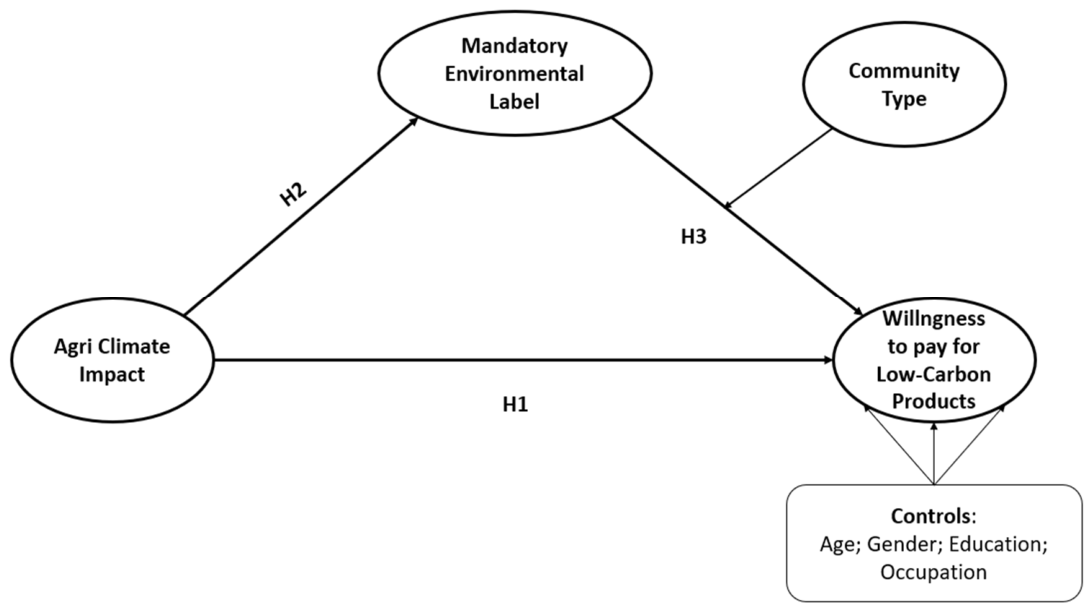
The hypotheses were tested using regression-based conditional process analysis, implemented using the PROCESS Macro (Version 5.0; Andrew F. Hayes) for IBM SPSS Statistics (IBM Corp., Armonk, NY, USA). Specifically, Hayes’ PROCESS Model 14 [
10] was used, which allows for the simultaneous estimation of (a) a mediating effect of climate change awareness on willingness to pay through support for mandatory labelling and (b) a moderation of the mediator-outcome relationship depending on the type of community.
Residential context was treated as a multicategorical moderator using indicator (dummy) coding in Hayes’ PROCESS Model 14. Rural areas and villages served as the reference category, while two dummy variables were estimated representing small/medium-sized towns and large towns/cities respectively.
The analyses additionally controlled for age, gender, education, and occupational status, as these socio-demographic factors are commonly associated with environmental attitudes and sustainable consumption behaviour.
In this model (
Figure 1), climate change awareness serves as the independent variable (X), support for mandatory labelling as the mediator (M), willingness to pay as the outcome variable (Y), and community type as the moderator (W) of the M → Y path. This specification captures a moderated mediation process, in which the strength of the indirect effect varies depending on residential contexts.
The significance of indirect and conditional effects was assessed using a nonparametric bootstrapping procedure with 5000 resamples. Bias-corrected 95% confidence intervals were generated for all indirect effects. An indirect effect was considered statistically significant when the corresponding confidence interval did not include zero. The presence of moderated mediation was assessed using the moderated mediation index, a formal test that indicates whether the differences between conditional indirect effects across levels of the moderator are statistically significant.
All analyses were conducted using unstandardized coefficients, in accordance with the recommendations for reporting results in PROCESS. Statistical significance was assessed at conventional alpha levels.
Hayes’ PROCESS Model 14 was selected because it allows the estimation of moderated mediation effects in which the indirect effect of climate awareness on willingness to pay through mandatory labelling varies according to residential context. This approach is appropriate for testing conditional process mechanisms in consumer behaviour research.
4. Results
This section presents the empirical findings of the study, structured in line with the proposed analytical framework. The results are reported in a sequential manner, beginning with descriptive statistics and preliminary observations, followed by the estimation of direct, mediating, and moderating effects. This stepwise approach allows for a clear evaluation of the hypothesized relationships and provides a comprehensive understanding of the mechanisms linking climate change awareness, support for mandatory labelling, and willingness to pay for low-carbon agricultural practices.
4.1. Descriptive Statistics and Preliminary Analysis
Table 1 summarizes the socio-demographic characteristics of the respondents included in the analysis.
Table 1 presents the socio-demographic characteristics of the respondents included in the analysis. The final analytical sample consisted of 24,193 valid observations after listwise deletion of missing data. Women represented 53.9% of the sample, while the average respondent age was 50.55 years. Respondents were relatively evenly distributed across rural areas (33.3%), small and medium-sized towns (36.2%), and large urban areas (30.5%), supporting the examination of contextual differences in sustainable consumption behaviour. The sample also reflected substantial socio-economic heterogeneity, including employed individuals, retirees, students, and unemployed respondents.
In terms of labour market status, the largest group consists of employed individuals, followed by retirees, while students and the unemployed round out the sample. The study’s comprehensive geographic coverage of all 27 European Union Member States gives it a pan-European dimension that is essential for understanding how European citizens view the new regulations governing the agri-food market.
The sociodemographic profile confirms that the dataset constitutes a representative and reliable foundation. The diversity of the sample allows for an in-depth exploration of how individual variables interact with labelling mechanisms and current social pressures.
Table 2 reports the descriptive statistics for the key variables included in the empirical model. Overall, the distribution of responses indicates substantial variation in respondents’ climate-related perceptions and preferences, providing a suitable basis for multivariate analysis.
Table 2 presents the descriptive statistics and bivariate correlations among the study variables. Climate awareness was positively correlated with both willingness to pay for low-carbon agricultural products (r = 0.205,
p < 0.001) and support for mandatory environmental labelling (r = 0.088,
p < 0.001). In turn, support for mandatory environmental labelling was also positively associated with willingness to pay (r = 0.196,
p < 0.001), providing preliminary empirical support for the proposed mediation mechanism. These findings suggest that respondents who perceive agriculture as contributing to climate change are more likely to support institutional sustainability instruments and express stronger intentions to financially support environmentally responsible food production.
An analysis of the response distribution reveals important differences between climate awareness, willingness to financially support sustainable agriculture, and support for regulatory transparency mechanisms. Regarding the perception of agriculture as a contributor to climate change, the European sample appears relatively divided: 45.3% of respondents agreed that agriculture contributes to climate change, while 48.6% disagreed either partially or totally. The average score for climate awareness (M = 2.46, SD = 0.92) indicates that, although the environmental impact of agriculture is increasingly present in public discourse, it has not yet become a universally internalized belief among European consumers.
In contrast, willingness to pay for carbon reduction in agriculture received stronger support. Approximately 62.3% of respondents expressed support for financially supporting farms that adopt emission-reduction technologies. The average score (M = 2.75, SD = 0.94) suggests a moderate but clearly positive orientation toward participating in the economic costs of the green transition. The strongest consensus, however, emerged in relation to mandatory environmental labelling. Nearly 88.9% of respondents supported compulsory sustainability labels, with the highest mean score among all study variables (M = 3.40, SD = 0.70). This asymmetrical distribution toward agreement suggests that, regardless of variations in climate awareness or economic willingness, European consumers strongly support institutionalized transparency and standardized environmental information.
Community type exhibited small but statistically significant positive correlations with climate awareness (r = 0.081, p < 0.001) and willingness to pay (r = 0.036, p < 0.001), suggesting that respondents living in more urbanized environments tend to report slightly stronger pro-environmental attitudes and behavioural intentions. Nevertheless, the relatively modest size of the correlations indicates that sustainable purchasing intentions are likely influenced by multiple psychological, institutional, and socio-economic factors beyond residential context alone. Overall, the descriptive patterns reveal a clear hierarchy in public attitudes: demand for sustainability-related information and regulatory transparency exceeds both the level of climate awareness and the willingness to directly bear additional economic costs. This configuration provides empirical support for the proposed theoretical framework, suggesting that mandatory environmental labelling may function as an institutional trust mechanism through which diffuse environmental concerns are translated into concrete purchasing intentions.
4.2. Direct Effects and Mediation Analysis
Before testing the hypotheses, all variables were examined for coding accuracy, missing values, and distributional properties. Likert-type items were coded so that higher values consistently reflected a stronger agreement with the underlying construct. No anomalies were detected that would compromise the regression-based analyses. Diagnosis of multicollinearity indicated acceptable variance inflation factors (VIF), well below conventional thresholds, suggesting that multicollinearity was not an issue.
Table 3 presents the results of the moderated mediation analysis estimated using Hayes’ PROCESS Model 14. The analyses included age, gender, education, and occupation as control variables, while residential context was treated as a multicategorical moderator using indicator coding.
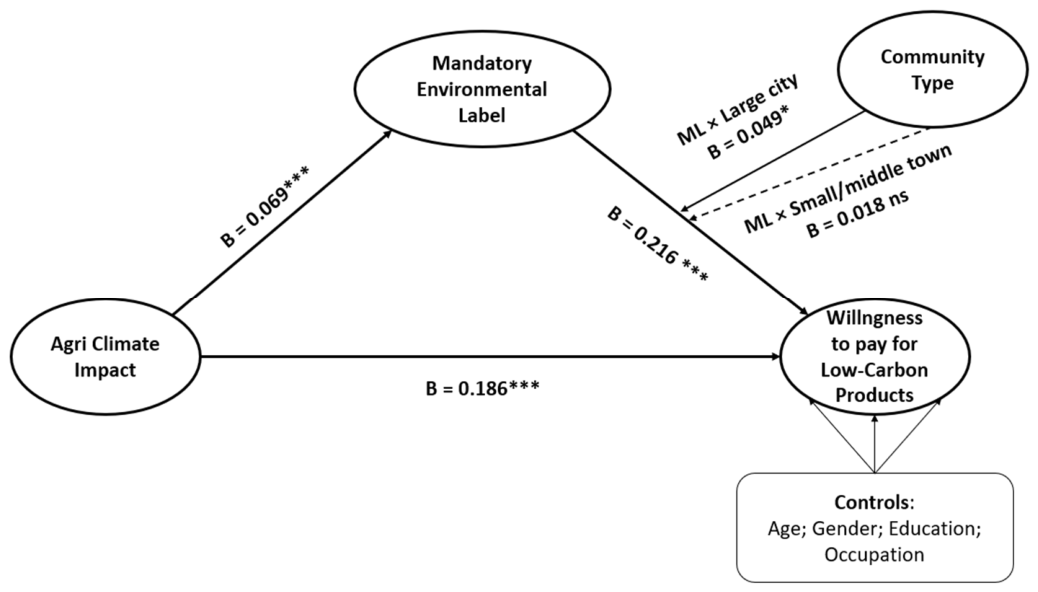
The mediator model was statistically significant, explaining 1.28% of the variance in support for mandatory environmental labelling (R2 = 0.0128). Climate awareness was positively and significantly associated with support for mandatory labelling (B = 0.069, p < 0.001), suggesting that respondents who perceive agriculture as contributing to climate change are more likely to support compulsory environmental labelling policies.
The outcome model predicting willingness to pay for low-carbon agricultural products was also statistically significant and explained 7.81% of the variance in willingness to pay (R2 = 0.0781). Climate awareness was strongly and positively associated with willingness to pay (B = 0.186, p < 0.001), while support for mandatory environmental labelling was also positively associated with willingness to pay (B = 0.216, p < 0.001).
The interaction effects revealed important differences across residential contexts. The interaction between mandatory labelling and small/middle towns compared with rural areas was not statistically significant (B = 0.018, p = 0.362). However, the interaction between mandatory labelling and large urban areas was positive and statistically significant (B = 0.049, p = 0.016), suggesting that mandatory environmental labelling is more strongly associated with willingness to pay among respondents living in large cities.
Although the explained variance is modest, this is common in large-scale consumer behaviour research where willingness to pay is influenced by multiple psychological, economic, and contextual determinants.
4.3. Moderation and Moderated Mediation Effects
Hypothesis H3 proposed that the indirect effect of climate awareness on willingness to pay through support for mandatory environmental labelling would vary depending on residential context. To test this assumption, community type was introduced as a multicategorical moderator of the relationship between mandatory labelling and willingness to pay, using rural areas and villages as the reference category.
Conditional effects analysis revealed a clear gradient based on urbanization levels (
Table 4).
Table 4 presents the conditional indirect effects of climate awareness on willingness to pay through support for mandatory environmental labelling across different residential contexts. The indirect effects were positive and statistically significant in all cases, as none of the bootstrap confidence intervals included zero.
The magnitude of the indirect effect increased progressively across levels of urbanization, from rural areas (Effect = 0.0150) to small and middle-sized towns (Effect = 0.0162) and large cities (Effect = 0.0184). These findings suggest that mandatory environmental labelling represents an important institutional mechanism translating climate awareness into sustainable purchasing intentions, particularly within more urbanized contexts.
Climate awareness alone does not appear to be directly sufficient to generate sustainable purchasing intentions. Instead, the findings are consistent with the notion that institutional sustainability signals, such as compulsory environmental labelling, partially mediate this relationship.
Table 5 reports the index of moderated mediation across residential contexts. The moderated mediation effect was statistically significant only for respondents living in large urban areas compared with rural areas, as the bootstrap confidence interval did not include zero (Index = 0.0034, 95% CI [0.0005; 0.0066]).
By contrast, the difference between small and middle-sized towns and rural areas was not statistically significant. These findings indicate that the indirect effect of climate awareness on willingness to pay through mandatory environmental labelling becomes significantly stronger only in large metropolitan environments. Accordingly, Hypothesis 3 is only partially supported.
This result demonstrates that the magnitude of the indirect effect varies significantly depending on residential contexts, providing formal statistical support for the hypothesis of moderate mediation. The largest indirect effect was observed among urban respondents, indicating that the mechanism linking climate awareness to willingness to pay through mandatory labelling is most pronounced in large cities.
Final validation of the model was performed by analysing indirect effects at different levels of the moderator (
Figure 2).
The findings are consistent with the proposed conditional process framework. Climate awareness is associated with willingness to pay both directly and indirectly through support for mandatory environmental labelling. However, the strength of this indirect mechanism varies across residential contexts and becomes significantly stronger only in large urban environments.
Robustness diagnostics indicated the presence of heteroskedasticity in the residuals. Although bootstrap confidence intervals for the indirect effects provide robust inference under non-normality and heteroskedasticity, it should be acknowledged that heteroskedasticity-robust standard errors (e.g., HC3) were not applied to the direct effects and interaction terms, as the PROCESS macro does not natively support this option. The very large sample size (N = 24,193) partially mitigates this concern, as regression estimates tend to be stable under heteroskedasticity in large samples. Nevertheless, future replications should consider applying robust standard errors using alternative software environments such as R or Stata.
5. Discussion
This study aimed to examine the psychological and contextual mechanisms through which consumer awareness of agriculture’s contribution to climate change translates into financial support for low-carbon agricultural practices. By integrating mediation and multicategorical moderation within a conditional process framework, the findings provide new insights into how institutional transparency mechanisms and residential contexts jointly shape sustainable consumption behaviour across the European Union.
5.1. Theoretical Implications
From a theoretical perspective, the results contribute to the literature on eco-friendly consumer behaviour in several important ways. First, the positive association between climate change awareness and willingness to pay is consistent with previous evidence that environmental concern may act as a moral and normative factor in economic behaviour [
49]. This finding supports value-based consumption models, according to which individuals internalize environmental externalities and translate them into market preferences when they perceive a clear link between production practices and environmental damage [
50].
Second, identifying support for mandatory environmental labelling as a partial mediator advances our understanding of how abstract environmental awareness translates into action. Rather than assuming a direct link between awareness and behaviour, the study highlights the role of institutionalized transparency as a key psychological mechanism. Mandatory labelling functions as a signal of increased credibility, which reduces information asymmetry and allows consumers to act in accordance with their environmental values with greater confidence. In this regard, the findings align with signalling theory and perspectives on institutional trust, emphasizing that consumers’ willingness to pay is shaped not only by values but also by the perceived reliability of market information [
51]. Third, the results of the moderated mediation provide an innovative contribution by integrating consumers’ decision-making into a socio-spatial framework. Findings that the indirect effect of climate awareness through support for labelling is stronger in more urbanized contexts suggest that the effectiveness of informational policy instruments depends on consumers’ living environments [
52]. This perspective refines existing theories of sustainable consumption, demonstrating that context not only influences average levels of pro-environmental behaviour but also shapes the mechanisms through which such behaviour emerges.
5.2. Interpretation of Urban–Rural Differences
The trend observed in residential settings provides a nuanced understanding of consumer heterogeneity. While the indirect effect of climate awareness through mandatory labelling was positive across all community types, the moderated mediation analysis demonstrated that this mechanism becomes significantly stronger only in large urban areas. By contrast, differences between rural areas and small or medium-sized towns were not statistically significant.
In contrast, the weaker—though still significant—effects observed in rural settings should not be interpreted as indifference toward sustainability. Rather, rural consumers may possess experiential knowledge about agricultural realities or be more attentive to the cost implications of regulatory interventions for producers [
53]. This awareness could temper the extent to which labelling alone translates into a greater willingness to pay. It is important to note that the persistence of a significant indirect effect even in rural areas suggests that mandatory labelling remains relevant in all contexts, albeit with varying degrees of influence.
5.3. Policy and Managerial Implications
The findings have several implications for policymakers and stakeholders in the agri-food sector. First, the mediating role of mandatory labelling underscores the importance of regulatory approaches to farm-level carbon footprint transparency. The strong public support for mandatory environmental labelling suggests that European consumers increasingly expect institutional guarantees regarding the environmental impact of food products. Voluntary schemes may be insufficient to unlock consumers’ willingness to pay, particularly when trust and comparability are at stake. Therefore, mandatory labelling may be seen as a policy lever associated with the translation of latent environmental concern into tangible market support for low-carbon agriculture. Consequently, such schemes represent an effective regulatory instrument for strengthening public trust in green policy initiatives such as the Farm to Fork Strategy and emerging carbon farming frameworks.
Second, the moderate nature of the mediation suggests that a one-size-fits-all approach to labelling policy may be suboptimal. In highly urbanized markets, comprehensive and standardized carbon footprint labels are likely particularly effective in justifying price premiums and stimulating demand for sustainable products. In contrast, in rural or semi-rural markets, complementary communication strategies—such as highlighting local benefits, farmers’ livelihoods, or community resilience—may be necessary to enhance the impact of labelling initiatives.
From a managerial perspective, producers and retailers in the agri-food sector can capitalize on these insights by tailoring their sustainability communication strategies to different consumer segments. For urban consumers, clear and credible labelling can serve as a key differentiator, while for rural consumers, combining labelling with narratives that acknowledge production constraints and local impacts may prove more persuasive.
5.4. Limitations and Directions for Future Research
Despite its contributions, the study is subject to several limitations that open avenues for future research. Additionally, the analyses were conducted on unweighted data, which may not fully account for the complex sampling design of the Eurobarometer survey. Although the large sample size and broad geographic coverage partially mitigate this concern, future studies should consider applying appropriate survey weights to improve the representativeness of cross-national estimates. Moreover, although heteroskedasticity was detected in the residuals, heteroskedasticity-robust standard errors could not be applied to all regression coefficients within the PROCESS macro framework. While bootstrap confidence intervals were used for indirect effects and the large sample size provides some protection against bias, the direct effects and interaction terms may be subject to inflated or deflated standard errors. Future studies should address this limitation by employing HC-robust estimation procedures. Furthermore, although the low ICC value (0.032) supports the pooling of respondents across countries, the analytical framework did not incorporate country fixed effects or country-clustered standard errors, as these options are not available within the PROCESS macro. Future research should consider multilevel modelling approaches or clustered standard errors to more rigorously account for potential cross-national heterogeneity in attitudes toward agriculture, environmental labelling, and willingness to pay. The use of cross-sectional survey data precludes strong causal inferences, although the conditional process framework and bootstrap estimation procedures provide robust evidence regarding the proposed relationships. Furthermore, reliance on single-item measures, while suitable for large-scale policy surveys (such as Eurobarometer surveys), limits the ability to capture more nuanced dimensions of the constructs.
Additionally, although the explained variance of the models is relatively modest, this is consistent with the broader consumer behaviour literature, where willingness to pay is influenced by multiple psychological, economic, cultural, and contextual determinants beyond those included in the present analysis.
Future research could explore whether similar patterns of moderated mediation emerge in specific product categories or under alternative labelling formats, such as digital or dynamic labels. Furthermore, extending the analysis to other contextual moderators, such as political ideology or trust in institutions, could further enrich our understanding of how and when environmental awareness translates into willingness to pay.
Furthermore, although pooling data provides a robust pan-European estimation, future research should account for regional macroeconomic and climatic heterogeneities. Specifically, comparing Mediterranean regions—which face acute, immediate climate disruptions such as severe droughts and desertification directly impacting agriculture—with Continental or Nordic regions could reveal distinct behavioral shifts. Consumers in hyper-vulnerable Mediterranean territories may demonstrate heightened baseline climate awareness and a stronger propensity to support mandatory market guarantees compared to regions experiencing less direct ecological pressures.
This study demonstrates that consumer support for low-carbon agriculture is shaped by a complex interplay between awareness, institutional transparency, and the socio-spatial context. By elucidating these mechanisms, the findings contribute to both theory and practice in the pursuit of more sustainable agri-food systems and for accelerating the green transition within European agri-food systems.
Although multi-item scales are generally preferred, literature in marketing and consumer research demonstrates that single-item measures can be predictive and valid, particularly for homogenous, concrete attitudinal constructs and large-scale public opinion surveys [
54,
55].
While the magnitude of the indirect effects (0.015–0.018) is small, such values are common and theoretically meaningful in large-scale behavioral models predicting willingness to pay. Given the massive scale of the European agri-food market, even small structural shifts in consumer preferences mediated by institutional tools can translate into substantial market demand for sustainable products.
6. Conclusions
This study investigated how consumers’ awareness of agriculture’s contribution to climate change translates into willingness to financially support low-carbon agricultural products. By applying a moderated mediation framework to Eurobarometer data across European Union Member States, the findings suggest that climate awareness is associated with willingness to pay both directly and indirectly through support for mandatory environmental labelling.
The findings highlight the central role of institutional transparency mechanisms in sustainable food markets. Mandatory environmental labelling emerges as a significant mechanism through which environmental concern may be translated into concrete purchasing intentions, reinforcing the importance of credible, standardized, and policy-supported sustainability information. In this regard, the study contributes to the literature on sustainable consumption by integrating signalling theory and institutional trust perspectives into the analysis of low-carbon agri-food transitions.
The results also reveal that the effectiveness of environmental labelling is context-dependent. Although the indirect effect remains significant across all residential categories, it becomes significantly stronger in large urban environments. This finding suggests that consumers living in highly urbanized areas rely more heavily on formal sustainability signals when evaluating environmentally responsible products. Consequently, the study demonstrates that socio-spatial context plays an important role in shaping the behavioural effectiveness of sustainability-oriented policy instruments.
From a practical perspective, the findings support current European policy efforts aimed at increasing transparency and sustainability within agri-food systems, including the Farm to Fork Strategy and emerging carbon farming initiatives. Mandatory carbon footprint labelling may represent an effective policy instrument for strengthening consumer trust and encouraging market support for climate-friendly agricultural practices. However, the results also suggest that communication strategies should be adapted to different socio-spatial contexts rather than implemented uniformly across all consumer groups.
This study contributes to a better understanding of the behavioural mechanisms underlying consumer support for low-carbon agriculture. By clarifying the relationships between climate awareness, institutional trust, and residential context, the findings provide relevant implications for policymakers, sustainability regulators, and agri-food stakeholders seeking to accelerate the transition toward more sustainable and climate-resilient food systems.




 ,
,