Article

A Qualitative, Descriptive Pathway Analysis to Explore Routes of African Swine Fever Virus Entry into and Spread from Two Pork Harvest Facilities in the United States


by
Sylvia Martin
,
Catherine Alexander
,
Michelle Leonard
,
Carol Cardona
,
Timothy Goldsmith
and
Marie Culhane
*
Secure Food Systems Team, College of Veterinary Medicine, University of Minnesota, Saint Paul, MN 55108, USA
*
Author to whom correspondence should be addressed.
Agriculture 2026, 16(12), 1341; https://doi.org/10.3390/agriculture16121341
Submission received: 30 March 2026 / Revised: 9 June 2026 / Accepted: 15 June 2026 / Published: 18 June 2026
(This article belongs to the Special Issue Biosecurity for Animal Premises in Action)

Abstract

Proactive disease transmission pathway analyses break complex transmission routes into simpler steps, making risks and uncertainties easier to identify. This approach is especially valuable for African Swine Fever (ASF), a difficult-to-control disease in low-biosecurity settings or when biosecurity practices are inconsistently applied. To support targeted biosecurity planning, a pathway analysis was conducted that is specific to pork harvest facilities in the United States. The analysis focused on two federally inspected plants that slaughter market hogs and produce primal cuts. Inputs, outputs, and potential transmission pathways were identified through a literature review, site visits, and facility personnel interviews. Because ASF virus remains stable at low temperatures and in many pork products, particular attention was given to pathways involving storage conditions, waste materials, and processing steps such as heating or pH modification. Processing steps were evaluated against existing process control plans and ASF inactivation thresholds to determine mitigation status. Of 42 identified pathways, 39 were classified as unmitigated or of unknown mitigation status. These unmitigated or unknown pathways—broadly involving pigs, people, vehicles, and waste—represent the highest priorities for further risk assessment work and for exploring ways to develop or strengthen biosecurity protocols that reduce ASF transmission.

1. Introduction

To prevent the introduction and/or mitigate the spread of a foreign animal disease (FAD), all potential pathways of disease transmission must be understood and evaluated. If conducted prior to the occurrence of an outbreak, the disease transmission pathway analysis can serve as a preliminary source of information for state authorities, federal regulators, and other stakeholders when performing their ad hoc or proactive risk assessments to determine the potential risk of specific animal industry activities during an outbreak [1] and to design response plans [2]. The pathway analysis can also provide the framework for a more extensive risk assessment, which would thoroughly evaluate the risks associated with each step of the pathway. In the context of a risk assessment per the framework recommended by the World Organisation for Animal Health (WOAH), detailed risk pathways are developed that separately outline the steps to agent entry and exposure [3]. Wieland et al. 2011 describe this as a “system analysis where a complex problem is divided into simpler ones which are easier to assess” [4]. This, in turn, facilitates the identification of risks and uncertainties [4]. A disease transmission pathway analysis is essential to the design of an effective biosecurity plan, with priority given to mitigation of steps or pathways most likely to result in pathogen transmission [3], since mitigating the transmission of ASF, in particular, is especially difficult in low-biosecurity settings [5]. Ideally, targeted biosecurity practices can be developed in a systematic, thoughtful way by using information and findings from both pathway analyses and risk assessments.
If the FAD, African Swine Fever (ASF), were introduced into the United States (US) pork industry, all components of the industry life cycle, from boar semen to pigs to market, would be impacted by state and federal disease response and control measures [2,6]. Such an event would necessitate the declaration by the US Department of Agriculture (USDA) of an extraordinary emergency, followed by the implementation of a 72 h National Movement Standstill for intrastate and interstate movement of swine [6]. Additionally, a designated zone around the infected premises would be established to control disease, and movements within, into, and from the disease Control Area (CA) would be prohibited, restricted, limited, monitored or permitted only by animal agriculture authorities [2]. To continue operating, a pork harvest facility located within or receiving animals from a CA would likely need to be alerted to and understand the risks associated with furthering the spread of ASF to make informed decisions. A full risk assessment of potential high-risk pathways would address this need. Yet one cannot even begin to proactively evaluate the risk of ASF virus transmission from a pork processing facility without first conducting a pathway analysis relevant to pork harvest facilities. To that end, this descriptive, exploratory, qualitative pathway analysis was conducted as a first step in the dynamic, proactive risk assessment process. The following descriptions and characterizations of the pathways are presented as preliminary information for regulatory agencies, harvest facilities, veterinarians, and farmers. Collectively, these stakeholders can work together with researchers to eventually complete a quantitative risk assessment and use the comprehensive risk evaluation results to develop targeted, enhanced biosecurity measures effective against ASF.

2. Methods

2.1. Scope

The scope of the pathway analysis was limited to US pork harvest facilities that conduct on-site slaughter of market hogs and include primal cuts among their products. A pork harvest facility or official establishment is, as defined in Title 9 Chapter III, Subchapter A, Part 301, Subpart 2 of the US Code of Federal Regulations (9 CFR §301.2), a USDA Food Safety Inspection Services (FSIS)-inspected establishment where slaughtering, cutting, boning, meat canning, curing, smoking, salting, packing, and rendering of livestock (pigs) take place and the products of which are intended for use as human food [7]. For this work, we focused on federally inspected facilities that transport meat across state lines or internationally and must have federal inspectors to ensure compliance with USDA standards [8]. In addition, we limited our focus to USDA FSIS pork harvest facilities classified as large facilities, having >500 employees, per the definitions within the Pathogen Reduction/Hazard Analysis and Critical Control Points (HACCP) Systems final rule (FR), titled and dated, 61 FR 38806, 25 July 1996 [9].

2.2. Data Sources

An initial literature scan was conducted to outline a pork harvest facility’s major inputs and outputs. The information gathered from these literature sources [10,11,12] served as a basis for our consultation and collaboration with large (>500 employees), FSIS-inspected, pork-only harvest facilities in the US states between May 2021 and May 2024. Of the 28 establishments meeting that criteria in the US [13], two market swine, livestock harvest facilities in Midwestern US agreed to collaborate with us. These two pork harvest facilities engage in practices that are representative of much of the industry within the scope of the project and operate as federally regulated pork slaughter facilities [13]. One facility represents an integrated company, with producers owning the facility, while the other obtains its slaughter pigs from external suppliers/non-affiliated farms. Through several separate meetings conducted both remotely and on site with process experts from both facilities from May 2021 to May 2024, we identified and evaluated inputs and outputs—and, thus, potential disease transmission pathways—for presumably standard US pork harvest facilities for market hogs in the US [14,15]. Together, we gathered empirical data regarding the complexity of the pork harvest processes, which allowed us to identify and define pathways for each individual input or output. Processes occurring as part of normal day-to-day operations were identified, discussed, and researched as potential ASF mitigations.

2.3. Assumptions Regarding ASF Virus Inactivation, Exclusion, or Reduction During Meat Processing

The ASF virus is very resistant to inactivation at low temperatures; it can survive for long periods of time in chilled/refrigerated blood, feces, and, most importantly, uncooked or undercooked pork products [16]. Since both waste materials (blood, feces, etc.) and products (pork, serum, etc.) are inherently present at pork harvest facilities, pathways involving the storage time and temperature of pork products and waste/byproducts were especially scrutinized. The survivability of ASF virus decreases as temperature increases. For example, ASFV is heat-inactivated at 133 °F (56 °C) for 70 min or 140 °F (60 °C) for 20 min [16]. The ASF virus remains stable not only in a range of thermal conditions but also survives within a pH range of 3.9–11.5 in serum-free medium and up to a pH of 13.4 in serum for 7 days [16]. All pathways involving the processing of pork or pork products using heat, acidification, or neutralization were also studied.
Meat processing requirements were reviewed to determine if ASF virus exclusion or inactivation would occur under USDA FSIS regulations and guidelines for processed end-products. More specifically, pathways involving processed end-products were analyzed using the 9CRF §417.2 regulations [17]. The 9CRF §417.2 regulations state that harvest facilities must implement a written Hazard Analysis and Critical Control Point (HACCP) plan for all processed products in the following categories: thermally processed—commercially sterile; not heat treated—shelf stable; heat treated—shelf stable; fully cooked—not shelf stable; heat treated but not fully cooked—not shelf stable; and product with secondary inhibitors—not shelf stable [17,18]. For this pathway analysis, products produced under an HACCP plan and labeled thermally processed—commercially sterile were considered fully mitigated. However, the extent of mitigation for other products was determined only if the processing steps met or exceeded the conditions for ASF inactivation, i.e., heated to 133 °F (56 °C) for 70 min or 140 °F (60 °C) for 20 min, treated to result in a product pH of <3.9 or >11.5 in the absence of sera, or when serum is present to a pH >13.4 for a time period longer than 7 days.

2.4. Determination of Extent of Mitigation and Compilation of Pathways for Further Risk Assessment

Assuming the existing day-to-day processes already implemented at the facility would remain in place during an ASF disease outbreak, all identified pathways were then labeled as fully mitigated, partially mitigated, unmitigated, or unknown, according to the definitions, criteria, explanations, examples, and references in Table 1. Finally, a summary of the mitigated, partially mitigated, unmitigated, or unknown to be mitigated pathways was compiled for all the examined inputs and outputs. These pathways can be prioritized for more detailed, quantitative analyses based on their potential spread of ASF virus from the facility and the potential consequence of that spread.

3. Results

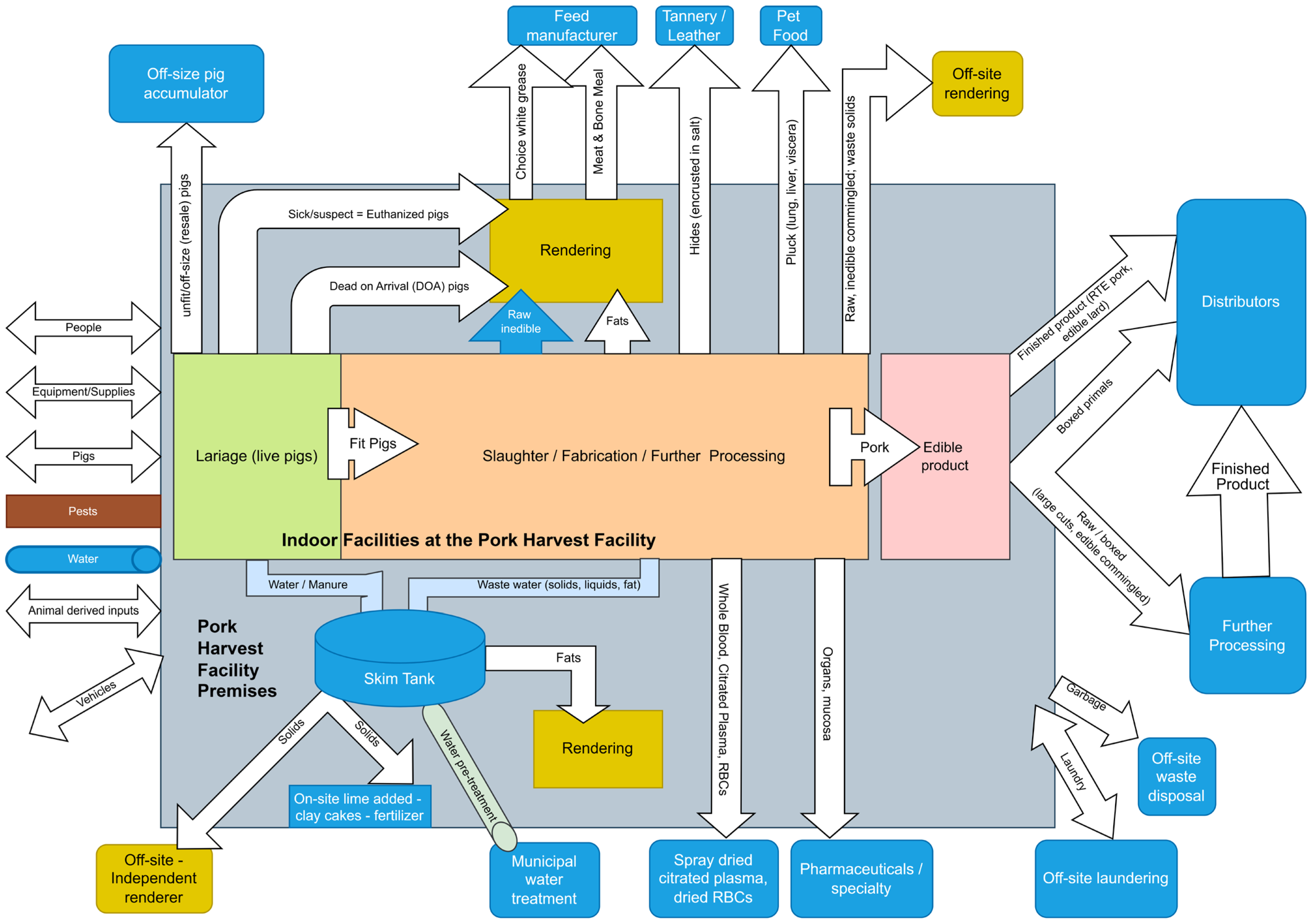
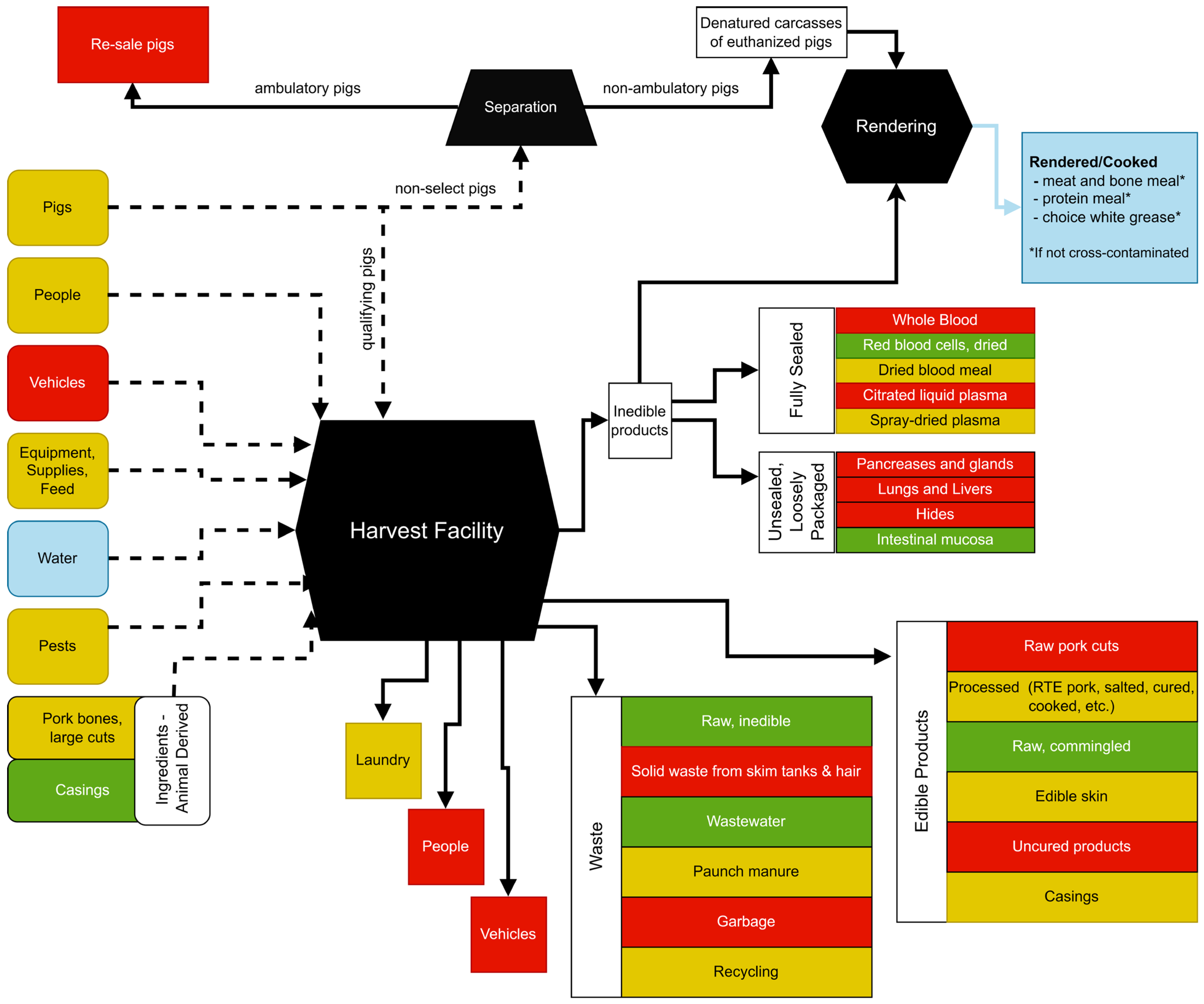
The data, information, and personal communications from two in-person meetings, two site visits, and eleven virtual meetings conducted between May 2021 and May 2024 with the two collaborating pork harvest facilities led to the completion of the US pork harvest facilities pathway analysis. Continuous sharing of information via email ensured that any needed clarifications regarding processes were made and harmonized. As a result of these meetings, seven broad categories of inputs and 19 major outputs were identified through this pathway analysis. Schematic diagrams of the inputs and outputs at a harvest facility show the general processes and flows (Figure 1) and the resulting mitigation classifications assigned to the inputs and outputs (Figure 2). The detailed results of each input and output analyzed are provided and further discussed.

3.1. Inputs

The mitigations determined for each input pathway are provided in Table 2. Although practices may vary between slaughter facilities, the following seven major inputs are made into US hog slaughter facilities: people; live pigs for slaughter; equipment/supplies/feed; vehicles; water; pests; and ingredients that are animal derived.

3.1.1. People

People as an input pathway have been categorized as employees, FSIS Inspection Program Personnel (IPP), or visitors. We defined employees as personnel employed by the harvest facilities, FSIS IPP as inspectors assigned by FSIS to that particular harvest facility for a particular shift or day, and visitors who enter and leave the facilities for various reasons as deemed necessary or allowable by the harvest facility management or owners. For the three general categories of people that enter and leave the harvest facilities, the mitigation levels were determined based on the following information.
Employees. All employees working with products, food contact surfaces, and packaging material for products must wear clean clothes that are changed during the day as needed, and they are also required to follow the routine hygiene practices highlighted in 9 CFR § 416.5 [22]. In addition, people entering the harvest facility are required to follow biosecurity guidelines per federal regulations, which include wearing clean clothing, using personal protective equipment (PPE), and following good hygiene practices and protocols while working at the facility. This is the mitigated aspect of the people input pathway.
The unmitigated aspects of the people input pathway are that employees may not always have dedicated footwear and might wear their own shoes on the kill floor. In addition, employees in one of the facilities wear street clothes underneath their frocks or wear their uniforms home and return with them to work the next day. This means that inadvertent contamination of an employee’s personal clothing and footwear with ASF virus while away from the harvest premises may present an opportunity for virus introduction into the harvest facility. In addition, it is unclear what happens when employees leave the facility, since there are no restrictions regarding their contact with pigs outside of the harvest facility or having their own pigs. However, the results of our interviews and meetings suggest that a limited number of employees raise their own pigs. Typically, pigs are harvested within 24 h of arrival, with a maximum stay of 72 h, which decreases the amount of time a pig could be exposed due to contact with an employee wearing ASF virus-contaminated footwear or clothing. Nevertheless, if an employee gets contaminated outside of the harvest facility, the employee’s contaminated footwear and clothing can be a potential source of ASF virus infection to the live pigs that leave the facility as re-sale pigs when the employee has contact with pigs diverted to temporary holding pens for individual ante-mortem inspection or re-sale.
Food Safety and Inspection Service Inspection Program Personnel (FSIS IPP). Federal regulations require all FSIS IPP to follow hygiene requirements in place for facility employees [23]. They must also change their outer clothing after performing ante-mortem inspection before entering a production area [23]. When entering areas of the harvest facility where raw or ready-to-eat (RTE) pork products are processed, FSIS IPP must use the provided boot dip, boot wash, or don the provided footwear designated for the raw or RTE areas of production [23]. The work assignments of FSIS IPP can require them to travel between harvest facilities, yet there are no known mitigation steps between facilities, such as mandatory showers and change of clothes. Given this variation in how different FSIS IPP personnel carry out their inspections, this part of the people pathway is unknown to be mitigated across the harvest facilities.
Visitors. Visitors are people who enter and leave the harvest facilities and do not fall into the first two categories of employee or FSIS IPP. These include visitors having contact with animals, e.g., live-haul personnel, and visitors having no contact with animals, e.g., service providers, delivery drivers, etc. There are currently no ASF virus mitigations in place for visitors who have had contact with animals (e.g., live-haul personnel) to ensure ASF virus inactivation before they leave the facility (Personal Communication, Harvest facility personnel—October 2023). It is also unknown what mitigation measures are in place for visitors who do not have contact with animals, such as service providers, delivery providers, etc. Some harvest facilities use the same entrances and parking lots for both employees and visitors. This presents a potential route of ASF virus contamination in the event of an ASF outbreak and, thus, is an unmitigated aspect of the people pathway. In general, the only mitigation for visitors is a required, pre-entry downtime of 14 days if they have been in a country with active ASF or foot and mouth disease (Personal Communication, Harvest facility personnel—October 2023).
The mitigations, or lack thereof, that occur for the people input pathway may not be the case for all harvest facilities. Thus, the level of mitigation for the people input pathway is partially mitigated.

3.1.2. Live Pigs for Slaughter

When live pigs are brought to the harvest facilities for slaughter, there is the potential for the pigs to be ASF virus-infected but undetected. This period of undetected (asymptomatic) infection occurs during the incubation period for ASF, which is reported to be 4–19 days, though this varies by viral strain [24]. Early infection or less virulent strains may cause mild clinical signs that may be clinically indistinguishable from other diseases [24,25,26]. Both the live pigs that are selected for harvest and off-size pigs, i.e., those pigs that do not meet the specifications for slaughter, could be infected but undetected and become a source of ASF virus spread at the harvest facility. Off-size pigs from different deliveries are removed and set aside in a separate pen. These pigs exit the harvest facility alive as re-sale pigs, and the specific re-sale pigs output pathway analysis results are discussed further in the outputs section. When the same bedding is reused in the holding pens between loads of pigs, this reused bedding may result in ASF virus spread via the bedding or via fomites if an infected but undetected pig is brought to the harvest facility. However, most large-scale harvest facilities do not use bedding in their holding pens. Since there is no evidence of ASF virus inactivation or exclusion measures in place for this pathway, live pigs are an unmitigated input pathway.

3.1.3. Equipment/Supplies/Feed

The handling of equipment, supplies and feed varies widely across different harvest facilities.
Equipment. Separate and distinct delivery locations for equipment are often used for the kill and cut side in some harvest facilities, though pallets or vats used for the deliveries or carrying the equipment are often cleaned between uses (Personal Communication, Harvest facility personnel—September 2022); these practices may vary between harvest facilities. However, all incoming equipment for the handling of edible product to the harvest facility is required to follow the 9 CFR § 416.3 [27] requirements for processing and handling edible product, in the following ways:
  • Incoming equipment and utensils used for processing and handling edible product or ingredients must be made of material that enables thorough cleaning and ensures that there is no adulteration of the final product during processing, handling or storage [27,28];
  • Unloading, lairage, and moving facilities must be cleaned and maintained, according to 9 CFR and WOAH [27,28].
Since there is a requirement for the unloading facilities to be cleaned and maintained, it is assumed that all equipment that enters the harvest facility must follow the CFR regulations for sanitation and use EPA-approved disinfectants, many of which may be effective against ASF virus [29]. Equipment at the harvest facility is also department-specific. For example, there is equipment used in the raw departments for handling raw products, and that equipment is separate from the equipment used in the RTE departments for handling RTE products. This equipment does not cross departments. Additionally, equipment like fork trucks that may be moving in and out of the finished product area travel through sanitizing foam when moving (Personal Communication, Harvest facility personnel—May 2024).
Equipment that comes into the harvest facility either directly touches the products or does not. Equipment that directly touches the products may be required to be sanitized or rinsed off with water. If the equipment is required to be sanitized, it is because this equipment directly touched the product and is subsequently cleaned and disinfected with hot water (180 °F or 83 °C), disinfectants, and organic acids (Personal Communication, Harvest facility personnel—October 2023). Such equipment goes through required food sanitation standards (according to the Food Safety Modernization Act (FSMA) from the Food and Drug Administration (FDA) [30] and FSIS [31]). This ensures that the necessary and critical sanitary dressing procedures are followed to prevent the spread of microbes from one carcass to another. However, if the equipment is to be rinsed off with water, it may be rinsed or lightly washed before reuse. Rinsed and reused equipment may pose a potential cross-contamination pathway for ASF if the carcass of an infected but undetected pig is processed at the harvest facility.
ASF virus has been shown to be very resistant to inactivation in a variety of environmental conditions and can be transmitted on fomites, including metal, rubber, glass, boards, and equipment [32,33,34]. If incoming equipment to the harvest facility is inadvertently contaminated with ASF virus, this may be a pathway for ASF virus spread to the harvest facility. Cleaning the equipment with food-safe products before use, according to the 9 CFR regulations, is critical for the harvest facilities [27]; however, it is not clear if the disinfectants and cleaning reagents routinely used in the harvest facilities are those that inactivate ASF virus. According to the Department of Homeland Security (DHS) Science and Technology Directorate, pork packing plants should, as part of the pre-washing procedures, conduct decontamination with acid-based disinfectants (e.g., liquid, acid-based sanitizers containing multiple quaternary ammonium compounds) according to the manufacturer’s instructions [32,35]. If new equipment that enters the harvest facility follows the Title 9 CFR regulations and DHS Science and Technology Directorate recommendations, this input pathway would be fully mitigated. However, it is uncertain if this is done across all harvest facilities, so this equipment aspect of the pathway is conservatively labeled partially mitigated.
Supplies. Supplies such as food packaging products are obtained from known, verified, and consistent suppliers and are assumed to be clean and ready for food use. There are supplier evaluations for all suppliers via the food safety programs [30] in the pork processing plants to ensure that the products they are producing are safe to use when in contact with food (Personal Communication, Harvest facility personnel—November 2023). The suppliers themselves have quality management systems that comply with International Organization for Standardization (ISO) and HACCP programs. In addition, supplies used in pork processing are food safety certified with a Certificate of Analysis [30]. There is also traceability of all supplies via lot numbers, and supplies are all under guarantee. Thus, the supplies themselves, at the point of delivery to the harvest facility, can be considered fully mitigated.
The major concern is how supplies are handled once they are at the plant, so each plant needs to determine if there is any step in their process (and directionality of flow of the supplies) where the supplies could be inadvertently contaminated with virus shed from an ASF virus-infected but undetected pig brought into the harvest facility or virus deposited by an ASF virus-contaminated fomite. The potential for contamination varies by harvest facility, and the means to present contamination will also vary. Therefore, the supply aspect of the pathway is partially mitigated.
Feed. Some harvest facilities store large quantities of pig feed (five to six tons in some places) to feed the pigs held overnight in the lairage and the re-sale pigs. Other harvest facilities harvest their pigs within 24 h of arrival, and those have limited feed stored on site. Feed can act as a fomite and has been demonstrated as a potential source of disease introduction into US pigs—this was evident with diseases like porcine epidemic virus (PEDV) and porcine deltacoronavirus (PDCoV) in 2013 [36] and 2014 [37], respectively. Epidemiological analyses linked feed and feed ingredients to the introduction and rapid spread of PEDV into the US [38]; the strains were found to possess 99% nucleotide similarity with the PEDV strain that has recently circulated in the Anhui Province of China [39].
Large quantities of feed ingredients had been imported into the US from China and the researchers concluded that the country of origin of the US PEDV strains was likely China [39]. Feed as a potential source of ASF virus is concerning, given that ASF introductions in other regions of the world (the introduction in Eastern European countries, then the steady spread to other parts of the European Union (EU)) have been associated with contaminated feed or infectious food waste containing pork [40]. Feed biosecurity is, thus, a critical aspect to be considered in mitigating ASF introduction [40]. The pathway to mitigate ASF virus-contaminated feed making its way into a harvest facility is partially mitigated.

3.1.4. Vehicles

Vehicles going to the harvest facilities include both live-haul vehicles and vehicles belonging to personnel, FSIS IPP, visitors, and/or deliveries of equipment and supplies. If there is an ASF response in the US, the guidance from the North American Meat Institute (NAMI) includes a recommendation that harvest facilities create maps of all traffic entering and leaving the harvest facilities to identify and delineate movement of animals, products, and employees [41]. Ideally, only one-way flow of all traffic should occur to eliminate cross-contamination of products and vehicles. One-way traffic flow is not always the case for all harvest facilities; furthermore, incoming and outgoing traffic flow is not regulated or enforced (Personal Communication, Harvest facility personnel—November 2022). More specifically, the different types of vehicles that come onto the harvest facility premises have several possible ways of contaminating the traffic areas or becoming cross-contaminated at the harvest facility.
Live-haul vehicles. Live-haul vehicles lack requirements for cleaning of the undercarriage and tires prior to or at the time of arrival at the facility. These vehicles may have come from different locations with live pigs and may be a source of ASF virus introduction if they were contaminated with the virus. There are currently no dedicated driveways for trucks hauling livestock and the vehicles of employees working with livestock.
Rendering trucks. Some products are not rendered on site and are taken off the harvest facility with trucks from external renderers. In the state of Minnesota, for example, vehicles and containers that transport carcasses and animal parts must be leak-proof and covered [42]. It is unknown if there are cleaning and disinfection (C&D) requirements for these trucks when they enter and leave the harvest facilities.
Other vehicles at the harvest facility. There are no restrictions for vehicles coming from locations that house live pigs. Even FSIS IPP vehicles may come to the harvest facility from other facilities without any C&D occurring between harvest facilities. Furthermore, the same parking lot is used by employees, visitors, and FSIS IPP personnel. There are no dedicated entrances for vehicles carrying live pigs, raw materials, inedible products, edible products, employee vehicles, or vehicles belonging to visitors/other personnel that are consistently in place at all harvest facilities.
Due to the lack of mitigations and regulations, vehicles present an unmitigated input pathway due to the possibility of cross-contamination.

3.1.5. Water

The 9 CFR has several requirements for harvest facilities: the water supply must comply with the National Primary Drinking Water regulations; any source of water used must have proof of being potable; water, ice, and solutions used to chill or wash raw products may be re-used for the same purpose only if mitigations are in place to reduce contamination; and harvest facilities use municipal sources of water that meet all the requirements for clean water [27,43]. Our collaborators stated that municipal sources are potable water sources for their harvest facilities. For these reasons, the water input pathway is considered fully mitigated.

3.1.6. Pests

If a harvest facility has feed on site for off-size pigs in their temporary holding pens, the feed may attract pests. Pigs are typically harvested within 24 h of arrival at the harvest facility; thus, there is limited feed on site. Limiting the amount of feed on site, in addition to routine hygiene practices, such as ensuring there is no stockpile of manure to attract flies to the lairage, keeps flies and other pests at a minimum. On the other hand, the presence of flies, e.g., the housefly (Musca domestica) and stable fly (Stomoxys calcitrans), and other pests at a harvest facility are a pathway for ASF virus transmission if these flies have been contaminated with or fed on infected pigs from a premises close to, i.e., within the flying range of, the harvest facility. For example, houseflies can thrive and breed in manure piles, spilled feed, rotting hay, or grain and can fly for distances of 2 to 3 km (longer with strong winds) [44,45]. They have been shown to transmit porcine reproductive and respiratory syndrome (PRRS) virus [46]. Thus, good hygiene and sanitation in the lairage are critical to minimize these pests. It has also been demonstrated that stable flies are efficient mechanical transmitters of ASF virus [47,48,49]. Thus, stringent hygiene and sanitation practices have been recommended for pig farms [47], and these biosecurity practices should likely be implemented at harvest facilities to prevent flies as a potential pathway for mechanical ASF virus transmission.
Birds, especially in the summer, are attracted to and have contact with the dried waste, aka “clay cakes,” in waste dumpsters that are on site at the harvest facility and destined for waste landfills. These “clay cakes” are outputs that come from pre-treatment waste flows and may include manure scraped from the lairage and any non-rendered waste products (e.g., hair, stomach contents). Mechanical transmission of ASF virus by birds is not well researched [50], but scavenger birds (corvids [crows, ravens]) and raptors (eagles, vultures) were the most commonly found species on wild boar and pig carcasses in a study in Germany by Probst et al. 2019 [51]. In a similar study in South Korea, birds of prey (hawks, golden eagles, crows) and thrushes were suggested ASF virus spreaders [52] and noted as important. Birds that live in close proximity to or in association with humans, i.e., synanthropic birds like sparrows, pigeons, doves, corvids, and gulls, are usually common around areas with pigs, and they have also been implicated as potential mechanical vectors of disease [50]. Birds may, therefore, act as potential mechanical transmitters of ASF virus; however, mechanical transmission, though important, “is not the major contributor to the overall spread of the disease” according to a scientific opinion by the European Food Safety Authority (EFSA) panel of experts [50]. On the contrary, Probst et al. 2019 assert that scavengers may contribute to reducing the risk of virus persistence in the environment through removal of decaying animal parts [51].
There are instances where some independent renderers may have leaky trucks oozing liquids from the products they are transporting. These renderers haul raw inedible or cooked inedible byproducts from the harvest facilities and, if leaky, may attract flies and insects contaminated with ASF virus to the harvest facility. It is not known what the mitigation measures are for leaky trucks present at a harvest facility. The CFR Title 9 § 354.245 states that, “…every practicable precaution needs to be taken to exclude flies, rats, mice, and other vermin” [53]. Therefore, since pests are attracted to several materials found at harvest facilities, harvest facilities have required management programs that detail how to prevent pest entry and propagation in the facilities [53]. From the 9 CFR and corroborated by our collaborators, harvest facilities must have pest management programs in place, and any openings into the buildings (e.g., doors and windows) must be, “…constructed in such a manner as to prevent vermin from entering the facility” [43]. All harvest facilities visited during the completion of this pathway analysis used an external professional pest control company. The pest pathway is considered fully mitigated if the harvest facilities enforce all measures regarding pest management per the CFR. However, the mitigations in place across all harvest facilities for leaky external renderers’ trucks are unknown. Overall, the pest input pathway across all harvest facilities is partially mitigated because it has both mitigated and unknown aspects, and/or the mitigations may not entirely support the inactivation or exclusion of ASF virus.

3.1.7. Ingredients: Animal-Derived Inputs (Bones and Casings)

Incoming ingredients include animal-derived products derived from animals processed within the harvest facility itself and/or received from other external facilities. The reasons for a harvest facility to use externally sourced vs. internally sourced animal-derived inputs are variable. While many of the bones and casings used in their processes may be internally sourced (Personal Communication, Harvest facility personnel—October 2023), there are occasions when a harvest facility may send out animal-derived products to an external facility for further processing, and later have those products returned for rendering or another step in the process. When making pork products exclusively, DNA tests are conducted on all incoming meat and bones to ensure it is solely pork-based, in compliance with FSMA [30], suggesting there is an opportunity for the pork industry to include a testing or pathogen exclusion step on incoming meat and bones that could detect a pathogen such as ASF virus.
Bones. Bones from large cuts of pork may be separated by an external facility and returned to the harvest facility for rendering. There is sparse information regarding the handling of these bones from large cuts at the external facility before their return to the harvest facility for rendering; thus, this represents an unknown aspect of the animal-derived inputs pathway. In contrast, there is ample information regarding the process of handling and processing bones for bone meal. Bone meal comprises ground-up turkey, beef, chicken, and pig bones. Since the harvest facilities included in our project scope only process pigs, some need to receive turkey, chicken, and beef bones from other facilities as input ingredients to make bone meal. The bones are typically heated at 260 °F (121 °C) for ~20 min, a time and temperature combination that inactivates ASF virus, then ground up and placed in sacks weighing one US ton (2000 pounds~907 kg). The bone meal is used as fertilizer or animal feed. This is a federally enforced procedure in the US [30,54] with 100% compliance before the product leaves the harvest facilities. The bones for the bone meal input pathway is a fully mitigated aspect of the animal-derived inputs pathway.
Casings Ready for Inclusion in Meat Processing. At one collaborating harvest facility, casings from animals processed on site are shipped to Asia for further processing, then returned to the facility of origin where they later exit again as part of a completed product. It is unknown if this is the only product that exits twice from the harvest facility or if there are others. Furthermore, it is unknown if the processing in Asia includes an ASF virus kill step; thus, the re-entry of casings into the facility of origin represents an unknown pathway due to the uncertainty regarding ASF virus survival or presence in the casings and insufficient information available about the entire process. The CFR regarding imports of casings states that casings from pigs are prohibited from entry into the US if they originated in or were processed from a region where ASF exists, but there are exceptions to this rule [55]. Exceptions include casings that are shipped in a sealed container securely closed with serially numbered seals applied by an official of the national government of the region of origin or if the casings are pork products that are delivered directly from the port of entry in the US to a meat processing facility operating under Federal meat inspection for further processing of the pork product by heat, after approval by the APHIS Administrator [55,56]. According to the FSIS directive 9000.2 revision 2, products labeled as “(species) intestines” are meat byproducts from livestock intestines and are under FSIS jurisdiction, while products labelled as “(species) casings” are derived from the intestines of livestock and are used to make sausage and other meat products; therefore, they fall under the Food and Drug Administration’s (FDA) jurisdiction [57]. This means that imported casings are regulated by the FDA. Therefore, FSIS IPP does not inspect imported casings or permit the application of the USDA mark of inspection to them. However, FSIS IPP can certify imported casings for export [57]. The regulations regarding US pork harvest facilities’ use of animal products (casings) that are shipped to and returned from countries with ASF detections lack clarity and need regular review since the regulations vary by each country’s animal health status [58]. For example, the 9 CFR part 96 [55] and part 94.8 [56] are not clear about a product that is exported from and then imported back into the US. This, however, may be facility-specific and may not be the case across all harvest facilities. Casings are, thus, an unknown aspect of the ingredients input pathway across harvest facilities.
Overall, the animal-derived inputs pathway is considered partially mitigated because some of the inputs have mitigated aspects, while others are unknown.

3.2. Outputs

Harvest facilities generate many outputs, which we grouped into seven categories: people, vehicles, laundry, re-sale pigs, edible products, inedible products, and waste (Table 3). Outputs from a harvest facility are numerous, and we were able to define numerous outputs from our collaborating harvest facilities and grouped them into the following seven categories: people, vehicles, laundry, re-sale pigs, edible products, inedible products, and waste (Table 3).

3.2.1. People—Employees, FSIS IPP, Visitors

This output pathway includes people leaving the facility at the end of the day/shift/visit. While these are the same people that entered the facility (as inputs), the paths taken and procedures for exiting the facility were considered as follows to determine the mitigation level.
Employees. Personnel working in different parts of the harvest facility can interact with each other; for instance, lairage and kill floor personnel may share break rooms and locker rooms, and they all leave the facility floor from the same area, which is a potential way for ASF virus cross-contamination to occur. In addition, some harvest facility employees wear their work clothes home and return with them to work the next day. Furthermore, employees on the kill floor may wear their street clothes under their frocks and wear their own shoes. Both of these scenarios are unmitigated components of the personnel pathway. Similarly, management is not completely separated from the floor employees, opening the possibility of inadvertent ASF virus transmission from floor personnel to management. Thus, this aspect of the people output pathway is unmitigated, as there is no evidence of ASF virus inactivation or exclusion measures taken.
FSIS IPP. The work of FSIS IPP can require them to travel between harvest facilities, yet there are no required mitigation steps between facilities, such as mandatory showers and change of clothes. Therefore, although FSIS IPP are required to change clothes before and after ante-mortem inspection, overall, the FSIS IPP aspect of the people output pathway is unmitigated across harvest facilities.
Visitors. Visitors to a harvest facility include those who have contact with animals, e.g., live-haul personnel, and those who have no contact with animals. The mitigations for visitors are not known across all harvest facilities. One harvest facility, for instance, had several access points through various gates, and there was no clear designation of who/what should pass through which gate, which represents the possibility of a high degree of cross-contamination in the event of ASF virus contamination. At another harvest facility, field technicians who conduct preventative maintenance of blood room equipment are not always accompanied by harvest facility staff. These field technicians also move from plant to plant with the same equipment, and travel time is the only downtime between the plants (Personal Communication, Harvest facility personnel—April 2024). There are no required mitigations for these technicians between plants. The visitor pathway is unmitigated across harvest facilities.
The people output pathway, overall, is unmitigated across harvest facilities.

3.2.2. Vehicles

Vehicles leaving the harvest facilities fall in the following four categories: live-haul vehicles, rendering trucks, trucks hauling products, and other vehicles.
Live-haul vehicles. Live-haul vehicles do not have C&D requirements as they leave processing facilities, and there are typically no truck washes at the facilities. There is also a high chance for cross-contamination at loading docks, since these are not cleaned and disinfected between shipments. Cross-traffic occurs at those harvest facilities that do not have dedicated entrances and exits for these vehicles, which creates a high probability of contamination in the case of an ASF virus outbreak. Given these gaps in biosecurity, the trucks could be contaminated with ASF virus and may go on to different locations with live pigs after visiting the harvest facility, increasing the likelihood of ASF virus introduction to these locations. Live-haul vehicles, thus, present an unmitigated pathway for ASF.
Rendering trucks. External renderers may move certain products off site that are not typically rendered at the harvest facilities (Personal Communication, Harvest facility personnel—November 2022). This includes any product that falls on the food processing floor, such as raw inedible, commingled product, or any non-pork. Although rendering trucks are required to be leak-proof, this is not always the case, and given the fact that there is cross traffic of vehicles at rendering facilities, these trucks can be a source of ASF virus infection if they transport animal byproducts that are contaminated with ASF virus from the harvest facility. Rendering trucks in certain states, as mentioned in inputs, are required to transport carcasses and animal parts in leak-proof vehicles or covered containers [42]. Furthermore, there are no C&D requirements for these trucks when they enter and leave the harvest facilities. Rendering trucks, thus, present an unmitigated pathway across harvest facilities.
Trucks hauling products. Some products are hauled in sealed transport tankers from harvest facilities for further processing off site while other harvest facilities process the liquid blood on site into dry, solid blood product and haul it off site in hopper-bottom trailers. These trucks haul products like liquid plasma. Although the products are sealed within the transport tankers while being transported to off-site facilities, we cannot be certain that the truck hauling the tanker is not contaminated in the event of an ASF virus outbreak, implying that this portion of the vehicles pathway is unmitigated across harvest facilities [11].
Other vehicles at the harvest facility. All other vehicles, e.g., for visitors, employees, and deliveries, also lack any C&D requirements on leaving the harvest facility, yet they share common driveways and parking lots with all vehicle traffic entering and leaving the premises. There is, thus, the possibility of cross-contamination with ASF virus. Many vehicles use the same entrance/exit used by trucks carrying raw inedible products, and these include the following: livestock (carrying inbound live pigs) trucks, all finished rendering products, edible animal fats, inedible skins, edible bones for soup stock, edible soup stock, trash haulers, mechanical storeroom deliveries (parts, equipment, oils, and chemicals), wastewater sludge, salt (for edible and inedible use), carbon dioxide gas deliveries, contractor vehicles, employee vehicles, contractor equipment, visitor vehicles, couriers, and other deliveries. This aspect of the vehicles pathway is unmitigated across harvest facilities.
Creating traffic maps displaying the flow of traffic is recommended to facilitate the development of mitigations for cross-traffic, and cross-contamination is an activity mentioned by NAMI to identify the movements of employees, animals, and products [41]. Our collaborating harvest facilities did not have a one-way flow of traffic, and there is no enforcement of dedicated entrances and exits. However, one of these harvest facilities mentioned that they have a single driveway for livestock that could be dedicated to livestock-only to reduce cross-contamination (Personal Communication, Harvest facility personnel—October 2023). This lack of dedicated entrances and exits for vehicles carrying live, inbound pigs, raw, inedible products, edible products, and employee vehicles, as well as vehicles belonging to visitors and other personnel, makes cross-contamination a possibility during an ASF virus outbreak. The vehicle pathway is unmitigated across harvest facilities.

3.2.3. Laundry

Laundry at the harvest facilities is taken to an off-site private launderer; it is not known what the washing and drying temperatures are for the laundry and whether they can inactivate ASF virus, and, thus, this aspect of the laundry pathway is unknown. Overall, the laundry pathway has unknown mitigations across harvest facilities.

3.2.4. Re-Sale Pigs

Off-size pigs from different batches are separated from the rest of the pigs for slaughter and placed into one pen as re-sale pigs. These off-size pigs may have nose-to-nose contact with other off-size pigs from different loads. This commingling of the off-size pigs from different loads represents an unmitigated pathway for the spread of ASF virus if an infected and undetected pig were among them before they are shipped from the harvest facility. Overall, the re-sale of live pigs is an unmitigated pathway for the spread of ASF virus across all harvest facilities.

3.2.5. Edible Products (For Human Consumption)

The edible products for human consumption have been categorized into two main groups: raw and processed. Raw, edible products refer to any type of uncooked tissue or flesh of an animal used for food [59]. Within the raw edible products are the subgroups of raw pork cuts, raw edible commingled products, and edible skin.
Raw pork cuts. Typically, fresh pork products from pigs slaughtered at pork harvest facilities are distributed to retail stores three to five days after arrival of live pigs at the harvest facility (Personal Communication, Harvest facility personnel—November 2023). Any resulting trim must be used within seven days, usually within the harvest facility but sometimes off site. Some examples of the raw pork cuts include large cuts with bones, cheek meat, and head meat, though these cuts may not be products of all facilities. The large cuts with bones leave the harvest facility in several ways. If they are whole muscle/large cuts, these go to further processing off site into various final products. It is unknown if any ASF virus mitigation measures are carried out on large cuts with bones before they leave the harvest facility. If the cuts of pork are not large, these are shipped to different clients. Although pork and pork products that leave the harvest facility are marked with an official stamp to certify that they have been inspected and passed the inspection [60], the inspection process does not require an ASF virus kill step/inactivation before the raw pork cuts leave the harvest facility. Studies have shown that ASF virus persists in the meat of infected pigs for several months at 4 °C (39 °F) and in salted and dried meat for up to 120 days [61]. The virus can also survive for several months in boneless meat and a few years in frozen carcasses and contaminated meat, and meat products have been shown to significantly contribute to the spread of the ASF virus [47,61]. It is unknown if there are mitigation measures carried out on raw pork cuts during the packaging and distribution to retailers. The raw pork cuts pathway overall is unmitigated across harvest facilities.
Raw edible commingled. Raw, edible commingled products are pieces of meat that have all the bone removed, cut into trimmings or pieces, and then used in the manufacturing of meat food products [62]. One example of raw, edible commingled products is cheek and head meat, which is a fresh product packed loosely before it is used. It can either be used within five hours of slaughter at the harvest facility or frozen immediately. When thawed, it must be utilized immediately as a component of other meat food products for human consumption [63]. For all raw, edible commingled products that are frozen and moved off site to another facility, it is not known whether any mitigations are in place, so this pathway has unknown mitigations across harvest facilities.
Edible skin. Edible skins for gelatin or pork rinds are derived from pig skin and other pork primal cuts, like pork butt, ham, loin, etc., and are handled similarly to raw, edible pork. They are a high-value product for the harvest facility and are stored in racks, then shipped to clients in polypropylene-lined cardboard totes. The polypropylene lining prevents leakage, though it may not be 100% effective. The pathway for edible skins is unknown due to uncertainty regarding ASF virus survival or presence in edible skin that leaves the harvest facility, in addition to insufficient pathway information. The edible skins pathway, therefore, has unknown mitigations across harvest facilities.
Processed edible products are numerous and refer to animal products that have been modified to improve taste and extend shelf life. This modification includes salting, curing, cooking, fermentation, smoking, and/or the addition of chemical preservatives. There are proprietary protections in place for some of the processes for edible pork products, so it is unknown if any of the protected processes have mitigations for ASF virus. However, for the non-proprietarily protected processes, the level of mitigation was determined after reviewing the process for the presence of an ASF virus kill step.
Ready-to-eat (RTE) products. RTE products are a category of processed edible product with many proprietary protections. The RTE products are finished products going directly to distribution from the processing facility. Determining the mitigation status of RTE products was complex and challenging. By definition, RTE products may receive antimicrobial agents, lethality treatment, or post-lethality treatment [7]; however, we did not obtain that information, nor any information on the frequency and specifics of these treatments and agents due to the proprietary protections. While RTE, as an output pathway, has unknown mitigations, there are likely specific RTE products that are fully mitigated. Additional pathway analyses, or even a complete risk assessment, would need to be carried out by individual facilities based on proprietary processes to determine, and perhaps document, the presence of a known ASF virus kill step within the process and reduce the uncertainty about the risk of ASF transmission via the production and movement of RTE products.
Casings. There is also uncertainty about the mitigations in place at US pork harvest facilities to prevent ASF virus in casings, despite having available stipulations for casings. For the inactivation of ASF virus in casings of pigs, WOAH stipulates that the following procedures need to be used: treating for at least 30 days with dry salt, such as sodium chloride, or saturated brine having a water availability of <0.80, or with phosphate-supplemented dry salt at a temperature of 12 °C/53.6 °F or higher [16,28]. Research by Jelsma et al. 2019 showed that sodium chloride (NaCl) and phosphate salt (P-salt) solutions resulted in no ASF virus being detected after 2 days at 20 °C (68 °F) and 7 days at 4 °C (39 °F) in NaCl, and after 4 days at 4 °C (39 °F) in P-salt [64]. The International Journal of Food Microbiology recommends the international casing industry salt the casings with NaCl for at least 30 days [65]. This 30-day period has been adopted as standard practice because it is considered sufficient to reduce any contamination with bacterial agents and specific viruses to levels that do not pose a public or animal health risk [64,65,66].
Although they are following the standard practice for casings, one of our collaborating harvest facilities informed us that, due to costs and lack of specialized personnel for a specific step in the casings treatment process, their casings are shipped to Asia for that specific step and then returned to the facility for the final steps of the treatment process. We did not obtain information from the harvest facility regarding the duration the casings spent in the salt solutions at the harvest facility and the details of the steps completed in Asia. Although the literature indicates that virus inactivation takes place through routine casings treatment, we cannot say for certain if this process is fully mitigated at the particular harvest facilities we visited or at others that similarly ship casings to Asia for casings processing. Given the WOAH requirements for ASF inactivation in casings [28], stakeholders can use this pathway analysis and decide where they would require more details from their particular suppliers. For instance, they may make it a requirement to only receive natural casings from their suppliers that, for example, have met three criteria: (i) kept in salt solution for a minimum of 30 days, (ii) inspected by the relevant government agency, and (iii) follow the necessary internal hygiene requirements. The casings pathway has unknown mitigations across harvest facilities due to proprietary protocols.
Edible lard. Edible lard is a processed edible product that is produced using a process that has an ASF virus kill step. Specifically, the lard is heated for a minimum of 35 s at 195 °F (91 °C) and then shipped hot, between 140 and 160 °F (60–72 °C), in tankers. Since ASF virus is inactivated at 133 °F (56 °C) for 70 min and 140 °F (60 °C) for 20 min, if the transit time for edible lard is at least 20 min, this is a fully mitigated pathway.
Uncured pork products. Uncured bacon, and other uncured products like ham, frankfurters, bologna, and salami, are just a few of many examples of processed edible delicatessen products that do not have an ASF virus kill step during processing and present potential pathways for ASF virus spread if an infected but undetected pig is processed [67,68]. Processed meats like ham, bacon, and frankfurters are typically cured with the addition of sodium nitrite, sodium nitrate, potassium nitrite, or potassium nitrate; however, for meats to be labeled as natural or organic, nitrite or nitrates are not permitted to be added [69]. Products that are labeled as uncured use any of the following ingredients in their process: sea salt, evaporated cane juice, raw sugar or turbinado sugar, lactic acid starter culture, natural spices or natural flavorings, and celery juice or celery juice concentrate [69]. Products in the uncured category do not have an ASF virus kill step before leaving the harvest facility, and this pathway is unmitigated across harvest facilities.

3.2.6. Inedible Products (Not for Human Consumption)

Inedible refers to a product that is adulterated, uninspected, or not intended for use as human food [7,8,70]. These byproducts have been classified into raw/uncooked, rendered/cooked, fully sealed, and unsealed/loosely packaged. There are several levels of uncertainty regarding ASF virus presence in the inedible raw/uncooked pork, as well as insufficient handling and pathway information. For example, offal, e.g., kidneys, livers, hearts, etc., is packed and shipped to customers [63]. Depending on the item, some are washed or rinsed and/or may have dry ice added to the containers holding the offal. Offal in containers is then frozen and shipped to the customer. There is no treatment done to the offal, so this pathway is unmitigated. Overall, the raw, uncooked inedible byproducts pathway is unmitigated across harvest facilities.
Unlike the raw inedible byproducts, many of the rendered, cooked inedible byproducts have an ASF virus kill step in their processing and handling. Inedibles, such as the hides, skin, hair, teeth, fats, bones, ligaments, cartilage, feet, glands, blood, lungs, and the denatured carcasses of pigs that were either dead on arrival or euthanized at the harvest facility [71], are not for human consumption. Instead, the inedible products can be rendered into meat and bone meal, protein meal, and choice white grease, which have value as animal feeds or fertilizers [72]. The inedible products can also serve as the raw materials required for the further production of pork byproducts that become pharmaceuticals, lubricants, plastics, and soaps [71] of value to medical, industrial, household, and cosmetic manufacturers. During the rendering process, the inedible input materials are mechanically broken down into particles of consistent size and then typically heated to 240–290 °F (115–143 °C) for 40–90 min, which far exceeds the time and temperature to inactivate ASF virus, which is 133 °F (56 °C) for 70 min or 140 °F (60 °C) for 20 min [11,16,19,20,21,73]. The above inedible byproducts leave the harvest facility in sealed containers that remain sealed until they reach the destination of feed, fertilizer, medical, industrial, household, or cosmetic manufacturers. Thus, the rendered, cooked, inedible products pathway can be considered fully mitigated.
Since ASF virus has a tropism for red blood cells, particular scrutiny has been placed on the pathways for ASF virus entry and spread in whole blood, dried blood meal, citrated plasma, and red blood cells, all of which are inedible byproducts of the pork harvesting process.
Whole blood. When whole blood is sold or moved, it is also in a sealed container, which mitigates the risk of spillage. However, whole blood does not undergo an ASF virus kill step or exclusion process before it leaves the harvest facility; thus, whole blood from a pork harvest facility is an unmitigated output pathway.
Red blood cells. The red blood cell (RBC) component of whole blood can be dried on site and sold as dried blood by some harvest facilities. The RBC goes through the dryer and heater: drying is performed at low temperatures to prevent heat coagulation [74]. The dried blood is sold on a bulk basis and shipped in hopper-bottom trailers and can be used as animal feed. Research by Wen et al. 2019 demonstrated the presence of ASF virus in dried pig feed in China, where pig blood collected from slaughterhouses was used as a protein source in feed for pigs and other animals [75]. It is not known if there are any ASF virus kill steps taken for dried pig blood in the US before it leaves the harvest facilities; therefore, it is unknown if the bulk, minimally processed, dried blood pathway is mitigated.
Dried blood meal. Fully processed, dried blood meal, however, is a partially mitigated pathway because the typical methods used to process dried blood meal include spray and ring drying at temperatures above 212 °F (100 °C) for a minimum of one hour [74,76] in a continuous flow processor (Personal Communication, Harvest facility personnel—April 2024). Although dried blood meal processed at 212 °F (100 °C) for one hour is fully mitigated against ASF, it must be stored properly to prevent contamination.
Citrated liquid plasma. To fully prevent contamination, closed systems are required [77]. The investment and resources for fully closed systems are used for valuable byproducts such as citrated plasma. To produce citrated plasma, whole blood is treated with an anticoagulant, typically sodium citrate or sodium tripolyphosphate [78], leaving about 55% liquid plasma and 45% liquid red blood cells. The plasma can be concentrated on site at a harvest facility. The concentrated, liquid plasma is then transported off site in sealed tankers by the customer, who spray-dries it at their facility. Although the liquid plasma is sealed inside the transport tanker while it is being transported to the spray-drying facility, since there is no ASF virus kill step done to it before it leaves the harvest facility, liquid plasma may at first be considered an unmitigated pathway. However, from the point of blood collection to production of the final packaged plasma product, the entire process is performed in a closed system in many processing plants, and this ensures no cross-contamination [78,79]. In addition, when the customer’s sealed tankers arrive at the harvest facility to pick up the blood products, the tankers undergo inspection by slaughter plant personnel before the loading process starts. Some harvest facilities may also require the driver of the tanker not to leave their vehicle when loading the blood products (Personal Communication, Harvest facility personnel—April 2024). At one of the harvest facilities, all blood and plasma holding tanks are emptied and cleaned in place (CIP) after all pigs have been slaughtered. The CIP is conducted daily but not inside the tank to prevent deterioration of the plasma quality due to the presence or addition of water (Personal Communication, Harvest facility personnel—April 2024). If the blood tank contains carry-over blood from the previous day, the daily CIP may not always be possible. However, during an ASF outbreak, the collaborating harvest facilities providing data and expertise for this pathway analysis suggested that the CIP process can be modified as needed (Personal Communication—Harvest facility personnel—May 2024). Overall, the citrated liquid plasma output pathway is considered unmitigated.
Spray-dried plasma. Modification of the CIP process may be necessary during an ASF outbreak since contamination of dried blood products with ASF virus has been suggested as contributing to the spread of ASF in China [40,75]. Contamination was suspected as the source of ASF virus since, during the spray-drying process, ASF virus is inactivated because the plasma is spray-dried at high pressure (typically in a continuous flow process) and at a minimum temperature of 176 °F (80 °C) for 60 s throughout its substance [78,79]. Although this temperature treatment preserves the biological properties of the proteins in the plasma and exceeds the 133 °F (56 °C) ASF virus inactivation temperatures [11,16,19,20,21,73], the treatment time is short. However, the outlet temperature of 176 °F (80 °C) is the critical control point (CCP) for spray-drying, and this CCP has been established as the good manufacturing process standard for microbial inactivation by the North American Spray Dried Blood and Plasma Producers [79]. The process for spray-dried citrated plasma manufacturing involves an initial pooling of blood from thousands of clinically healthy animals, which brings an important dilution factor to the process in the event of any potential virus from an infected but undetected animal [79,80,81]. After drying, there is a storage period of 14 days at 68 °F (20°C), which has been demonstrated to inactivate ASF virus [81,82]. A study by Fischer et al. 2021 [83] demonstrated that spray-dried porcine plasma, if externally contaminated after leaving the facility, remained infectious for at least 5 weeks, if stored at 39 °F (4 °C). Storing the spray-dried plasma at room temperature (68–77 °F [20–21 °C]) for at least 2 weeks was shown to inactivate ASF virus [83]. Overall, the sealed, inedible pathway is partially mitigated across harvest facilities. The partially mitigated classification is applied since it is unlikely that an ASF virus kill step could be put in place, since the integrity of whole blood, plasma, and RBCs must be maintained to assure value. However, because the materials are moved in a sealed container, ASF virus spread along the route is mitigated due to the unlikely release of materials from the sealed conveyances and containers. Finally, storage at the final destination for more than two weeks at room temperature could further mitigate ASF virus spread from the final destination.
The unmitigated risk of release/spillage of materials from unsealed, loosely packaged, inedible products leaving the harvest facility exists for several pork byproducts. Examples of loosely packaged, inedible products include organs, such as the skin (hides), pancreases, glands, lungs, and liver, and tissues, such as the intestinal mucosa.
Hides. Pig hides are caked in salt/salt-cured and sold as wet, salted skin. Hides are placed in open crates at the harvest facility and shipped out in new wooden crates or pallets onto which the skins are laid. It is not known how long they are stored in salt before shipping. This pathway is unknown to be mitigated for ASF virus, because it is not known if storing and shipping the pig hides in salt are sufficient to inactivate ASF virus [19,20].
Pancreas and glands. Pancreases and glands are destined for the pharmaceutical industry. The glands have limited on-site processing, which includes washing, trimming, and freezing. The pancreases are boxed frozen and sent to customers, with no other prior treatment at the harvest facility. The pathway of pancreases and glands is unmitigated for ASF virus across harvest facilities.
Lungs and livers. Likewise, the lungs and livers are chilled at the harvest facility, then shipped off site to a customer for pet food in leak-proof, plastic poly totes. The totes are water-washed, sanitized, and then returned to the harvest facility. Although lungs and livers are transported in containers that are leak-proof, they leave the harvest facility without having undergone an ASF virus kill step or exclusion. It is also unknown how the lungs and livers are shipped and how they are treated at their destination. Thus, the lung and liver, collectively referred to as the pluck, pathway is unmitigated across harvest facilities.
Intestinal mucosa. Similarly, the intestinal mucosa, required for heparin production, is shipped unprocessed to the customer, with sodium bisulfite as a preservative. Since the effect of sodium bisulfite on ASF virus is not known, this pathway is unknown to be mitigated across harvest facilities. Overall, the loosely packaged inedible products pathway is unmitigated across harvest facilities.
Inedible Products Rendered On-Site. As mentioned above, meat and bone meal, protein meal, and choice white grease are outputs of rendering that may be incorporated into animal feed or used as fertilizers. Meat and bone meal, protein meal, and choice white grease are processed at temperatures exceeding 245 °F (118 °C) for a minimum of 40 min, which is far above the temperature that destroys ASF virus [11,16,19,20,21,73]. The items from pork processing that become inedible rendered products originated from waste, excess, or rejected meat from the plant floor or food processing areas and are used to make fertilizer and animal feed. If any meat and bone meal or protein meal fully processed and produced in the on-site rendering facility is subsequently rejected by metal detection, it is classified as contaminated and cannot be reprocessed. As a contaminated product, it is taken to a landfill. The contaminated product may be moved by trailers engaging in backhauling. Backhauling is the practice of using the same trailer to bring products to the harvest facility to also take away rendered/cooked products from the facility. If backhauling is used to move rendered meat and bone meal or protein meal from the facility in a trailer that previously delivered inedible products to the same facility, there is the potential for cross-contamination.
Ensuring that rendered products do not contact any potentially contaminated products after the rendering process is an important mitigation step. For harvest facilities that eliminate or prohibit backhauling, the meat and bone meal, protein meal, and choice white grease output pathway can be considered fully mitigated due to their rendering time and temperatures above the requirements for ASF virus kill and their shipment in sealed containers. In addition, if the harvest facilities have rendering facilities on site, this is a further mitigation step against the spread of ASF virus since there is reportedly no cross-over between incoming materials required for the rendering process and outgoing rendered materials produced. The overall pathway for rendered products that are fully cooked to high temperatures is fully mitigated across harvest facilities.

3.2.7. Inedible Products for Off-Site Rendering or Off-Site Disposal

Some facilities do not have the capacity to render everything on site, and others do not conduct any rendering on site; these facilities send their products to off-site renderers. For harvest facilities that do not have sufficient capacity, the products that may be taken to off-site renderers include raw, inedible, commingled products and solid waste.
Raw, inedible, commingled products. The raw, inedible, commingled products that cannot be processed on site are shipped to an external facility for rendering. These products include any non-pork items that fall on the food processing floor. It is unknown how these products are handled by the external renderers and if any ASF virus mitigation steps are taken before they are rendered. The raw inedible commingled products pathway, therefore, has unknown mitigations across harvest facilities.
Solid waste. Solid waste, or solids, comes from the skim tank and includes meat fragments, bone chips, blood, shavings, and sometimes hair that all go down the drain at the harvest facility. These solids settle out in skim tanks, and no chemical is added or any treatment done to them. The solids are removed and sent in trailers to independent renderers and are, thus, unmitigated when they leave the harvest facility. For the solids that are precipitated by flocculants, the lime and pre-treatment products added to produce clay-like solid “cakes” are put into containers for storage and eventually land-applied as fertilizer on farms. The ratio of lime added depends on the amount of slurry, and no further sampling or treatment is performed on the clay cakes. Thus, precipitated solid wastes from the skim tank are also an unmitigated pathway for ASF virus. It is unknown if mitigation measures are in place during the transportation of waste to external facilities. For hair, for example, the mitigation measures vary by harvest facility. Even though a small portion of the hair (about 10% at one of the facilities) from the de-hairing process falls on the floor and goes to disposal at a landfill, there is more hair that is disposed of from on-site rendering. In on-site rendering at our collaborating harvest facilities, the metal detectors also reject and remove hair. The rejected hair piles are put into a roll-up dumpster that goes to a landfill. This means that unprocessed hair does go to the landfill and represents an unmitigated aspect of the solids from the skim tank pathway. This hair is an example of an untreated product that goes through rendering but lacks a lethality step for ASF. Products rendered off site or disposed of off site leave the harvest facility without any treatment to inactivate or kill ASF virus; thus, this output pathway overall is unmitigated across harvest facilities.
Waste from harvest facilities is categorized into three main groups: wastewater, paunch manure, and garbage.
Wastewater. Wastewater includes liquid and small solids, i.e., blood, hair, pieces of pig meat, and rinsing water, which are collected in the drains of the floors of the processing areas. The wastewater, with all its various components, flows into the skim tank or biodigester and is allowed to settle into three layers: a top layer of fat, a middle liquid layer, and solids (“sludge”) on the bottom. After settling, it goes through a rotary screener that separates the solids from the liquids. The untreated solids are removed and sent to or picked up by an off-site independent renderer. The liquids are separated into fat and water. The fat separated from waste is rendered, at 245 °F (118 °C) for a minimum of 40 min, into brown grease that is shipped out of the facility to become lubricants or biofuels [19,20,21]. The liquid component goes to pre-treatment where the pH is adjusted to a neutral pH of 6–7, and flocculants are added to improve the sedimentation or filterability of small particles. There is uncertainty about the wastewater output from pork harvest facilities that is subjected to municipal wastewater treatment, due to the lack of research on ASF virus inactivation through standard US municipal wastewater treatment. According to the US Environmental Protection Agency, several steps in the wastewater treatment process achieve some level of viral inactivation [84]. A study conducted by Kim et al. 2021 [85]) and a review paper by Chen et al. 2021 [86]) support the inactivation of other enveloped viruses during wastewater treatment. These findings may be applicable to ASF virus, though not with certainty, since viral traits other than being enveloped may impact environmental persistence [85,86]. The solid sludge layer resulting from the flocculent treatment of the wastewater goes into the clay cakes (a mixture of sludge and lime), which are taken by farmers who spread them on their farms untreated. The goal is to convert all solid sludge into cake, but in most instances, there is excess sludge. The process of making the clay cakes does not have an ASF virus inactivation or kill step before the waste sludge leaves the harvest facility. When there is excess sludge, it is pH-balanced to a pH of 6.5 and then sent in tankers for further processing off site, e.g., to a nearby city, where it can run through municipal digesters. It is not known if any ASF virus inactivation or exclusion mitigations are done to the excess sludge before it leaves the harvest facility. Overall, the wastewater pathway has unknown mitigations due to the differences in treatment, handling, and shipping of the liquid, fat, and solid components.
Paunch manure. Paunch manure refers to digestive tract contents, i.e., from the rectum, intestines, etc., and is separated into solids, liquids, and fats. The liquid (water and fat) part goes to pre-treatment and undergoes the same process as described in wastewater above. The solids in some harvest facilities go to land application; most, about 90% of the paunch manure, after de-watering over a raw screener, goes untreated to land application for farmers. A small quantity, about 10%, of the paunch manure goes down the drain into the floor drain waste. The paunch manure can also go directly to wastewater pre-treatment for processing without the separation steps. The paunch manure pathway overall is partially mitigated across harvest facilities.
Garbage. Garbage includes bedding (wood chips, straw, hay) scraped out of live-haul pig trailers, dried manure, and non-recyclable, non-biodegradable, inorganic waste. Garbage receives no pre-treatment. If the garbage contains non-degradable, inorganic waste, it may be sent to the landfill. Bedding comprising mainly wood shavings with manure from the trucks is garbage that is swept up, placed in solid waste dumpster containers, and land-applied, untreated and, thus, unmitigated. The ways garbage is handled, however, are facility dependent. There are no ASF virus mitigations for garbage as it leaves the harvest facilities; it is an unmitigated pathway for ASF virus.
Recycling. Some harvest facilities recycle materials like cardboard boxes and plastics. Other recyclables include glass bottles and aluminum cans for beverages that are also sent to recycling. It is not clear if materials destined for recycling undergo any mitigation steps before leaving the harvest facility, and, thus, this pathway has unknown mitigations for ASF virus.

4. Discussion

This pathway analysis was completed with data and information from two major pork harvest facilities in the Midwestern US, assumed to be representative of most industry practices, while also considering the US federal regulation of pork slaughter facilities. One of the facilities receives its slaughter pigs from external suppliers/non-affiliated farms, while the other represents an integrated company. Our goal was to determine, proactively, the various potential pathways for ASF virus into and out of the pork harvest facilities and to determine which steps the slaughter facilities currently have in place that may mitigate ASF entry or spread via that pathway, thus allowing for the identification of mitigation needs and knowledge gaps to be addressed so operations could potentially continue at a facility located within or receiving animals from an ASF virus outbreak Control Area. Overall, the many inputs and outputs of the harvest facility were described, and 42 pathways were evaluated (Table 4). This ASF virus pathway analysis for pork harvest facilities determined that <10% (3/42) of the pathways were fully mitigated, 7 pathways were partially mitigated, almost half (19/42) of the pathways were unmitigated, and the remaining 13 pathways were unknown to be mitigated.
A pathway tended to be classified as unmitigated or unknown primarily due to a lack of evidence that the pathway’s procedures or protocols eliminated ASF virus transmission via inactivation or exclusion. This is arguably a conservative approach. However, a conservative approach regarding ASF is necessary and precautionary, since ASF is considered a high-consequence disease, with losses/costs estimated to range from USD 1M to USD 100B [87], with far-reaching effects globally due to decreased pork supply [88] as a result of the high mortality rate (>40%) of ASF-infected pigs [24]. These pathways represent ways in which ASF can be introduced to and leave from the harvest facility if ASF virus-infected but undetected pigs are received and processed. Unmitigated, partially mitigated, and unknown pathways represent key areas for full risk assessments for most products moving from pork harvest facilities via the various pathways to more accurately estimate ASF risk.
Throughout this pathway analysis, we encountered the same challenge as described by Wieland et al. 2011 [4]. That is, it was challenging to elucidate the number of pathway steps to accommodate adequate detail while not making the analysis overly complicated [4]. We often needed more information to fully evaluate certain pathways, which required individual facilities to thoroughly review their proprietary processes. We also focused on only two harvest facilities located in the Midwestern US. We conducted this work under the assumption that these two pork harvest facilities were representative of other US pork harvest facilities since, as is well described by the Padilla et al. 2023 publication [15], just 5% of all FSIS-inspected US pork harvest facilities harvest over 90% of the market hogs. These few but highly productive pork harvest facilities are in the US Midwestern states of Missouri, Illinois, Iowa, Minnesota, and Indiana, and the US Eastern state of North Carolina [15]. Future work with harvest facilities located in other parts of the US would provide important insights. This work was also exploratory, and the majority of the data obtained from the two collaborators were collected via unstructured interviews conducted virtually or on site while walking through the facilities as escorted visitors during operational hours. Collection of data via unstructured interviews has been shown to introduce bias in observational research studies [89]. While attempts were made to collect data consistently across meetings and during visits, we acknowledge that bias may have been introduced as collaborators were allowed to freely answer our open-ended questions yet were likely safeguarding proprietary information about their wholesale and retail product processes. Additionally, while we compared and generally shared answers with both collaborating facilities, this does not constitute expert consensus [90], since we collaborated with experts from two harvest facilities and not a broad panel. Overcoming these limitations would allow for further elucidation of the various pathways we have identified and provide a more robust, validated pathway analysis.
It is important to recognize that this pathway assessment focused on the harvest facility and the inputs and outputs from the facility and stopped there. The outputs and destinations are many. Some outputs are unmitigated or unknown and should be labeled after further examination of the processes and handling procedures at the destinations after considering if, when, and where mitigations could be put in place.
Where products move to and how they are potentially handled or processed after they leave the facility are important when fully evaluating the risk of disease spread. Risk of disease spread can only be evaluated if the entire pathway of a product, including its associated movement from the origin to the destination, is evaluated. This pathway analysis is a first step in defining the pathways and existing mitigations. As completed, it can be used to focus further efforts on product movements of high priority due to perceived risk or assumed consequence of the movement in terms of disease spread.
Fully understanding all the potential routes of ASF virus transmission is an important first step when attempting to implement biosecurity protocols to eliminate or reduce pathways for ASF virus entry into and spread from harvest facilities. Identification of unmitigated ASF virus entry or spread pathways may also help harvest facilities to strengthen any existing biosecurity protocols. In the event of an ASF disease outbreak, individual harvest facilities should critically assess their individual risks, especially regarding the pathways that are unmitigated, partially mitigated, and unknown. Although unknowns may continue to cause uncertainty, it is important for discussions to take place amongst harvest facilities, either individually or collaboratively, to determine the products and processes that need to be temporarily stopped in the event of an outbreak. For example, halting the reverse shipments of animal casings from ASF-affected regions or provisionally suspending all animal-derived ingredient imports into the US from ASF-affected countries seems to be prudent, since the pathways for these inputs are partially mitigated or unknown to be mitigated. However, due to supply limitations, socioeconomic concerns, or even political ramifications, not all products are amenable to additional mitigations.
The pork processing and rendering industries may find it helpful to use the findings of this pathway analysis to assess the risk of moving pigs to slaughter during an ASF outbreak in the US. The unknown and unmitigated pathways identified would be the presumed priorities for risk assessments, specifically, the movement of people (employees, FSIS Inspection Program Personnel, visitors [with or without animal contact]), vehicles (live-haul, delivery, rendering trucks, service providers, personnel), live pigs for slaughter, re-sale pigs, and garbage/waste. For example, during a full risk assessment of ASF introduction into and spread from a pork harvest facility via people, the risk assessors may wish to explore the feasibility of preventing any pork-derived food products from being brought onto facility premises as part of the person’s snack or meal and instead providing on-site food catering. Furthermore, providing work-specific garments that all employees must wear while inside the facility, and also having on-site, laundering/disinfection of said garments, could be explored during both the quantitative and qualitative assessments of the risk of people becoming contaminated with and transmitting ASF to susceptible pigs by evaluating the survival of ASF on clothing and the effectiveness of laundering with and without disinfectants on removing ASF from clothing, but only if providing work-specific garments is a mitigation that those participating in the risk assessment process are willing to explore. The participants completing a full risk assessment may also wish to assess the effectiveness of having people working with re-sale pigs adhere to biosecurity measures similar to those for workers on pig farms (dedicated footwear, clothing changes, and restricted movement between barns). In addition, all biosecurity measures aimed at decreasing transmission via the people pathways would likely benefit from implementing structured training programs that would increase people’s understanding of risks associated with ASF and the importance of their compliance with any ASF-specific operational procedures. Such training, which includes increasing the person’s knowledge by first ascertaining their attitudes and perceptions and then encouraging people to engage in participatory training, has been conducted in Uganda, an ASF-endemic country [91].
Upon completing the feasibility evaluations of additional mitigations and biosecurity measures, efforts must be made to support business continuity as part of a full risk assessment. As such, it would be important to be able to understand the risk of ASF spread due to the movement of pork products and byproducts such as raw—inedible uncooked products, processed—edible products without an ASF virus kill step, sealed inedible products, and loose inedible products. Understanding the risk of ASF spread due to the movement of pork products from a harvest facility in an ASF Control Area must be ensured by completing a full risk assessment. The results of a full risk assessment can then support or refute the need for pork harvest facilities to change processing procedures so that all pork products are subjected to an ASF kill step or recommending that any pork from a pork harvest facility in a Control Area must be diverted to waste rather than food. Disrupting the food supply is a negative consequence of disease control; therefore, attempting to ensure that there is a means for business continuity is a necessary part of all proactive risk assessments [92].
We reiterate here that we have presented the results of a preliminary, exploratory, and descriptive pathway analysis. It is, thus, important to note that full risk assessments can help fill the gaps identified in the pathways examined herein and overcome the limitations of this pathway analysis. Full risk assessments can also include targeted surveillance recommendations to implement during an ASF outbreak for the specific animal or product movement along the identified risk pathways [93]. The targeted surveillance is carried out to provide an acceptable level of confidence that the movement of infected but undetected pigs is unlikely to occur during an ASF outbreak [2,94]. However, prior to an outbreak, preparedness efforts focus on exclusion biosecurity to keep ASF out of the US and ASF surveillance (both passive and active) at several points in the pork value chain to detect an ASF incursion [2,95]. According to The Swine Hemorrhagic Fevers: African and Classical Swine Fevers Integrated Surveillance Plan—2022, prior ASF surveillance was passive [95]. Since 2020, APHIS has integrated ASF surveillance with Classical Swine Fever (CSF) active surveillance into a single active surveillance plan, which should increase the probability of detecting ASF virus [95] in the US pig population. To that end, pork harvest facilities are included in the surveillance and, in particular, the collection of specimens from case-compatible slaughter condemnations. Along with harvest facility sampling, aggregation point sampling of sick or dead pigs is included and will be conducted at locations such as buying stations for market pigs, commercial pigs, and cull sows/boars that do not fit the target requirements for industry markets, e.g., roaster pigs. Pre-harvest sampling on farm of higher-risk swine, e.g., swine from farms with less-than-optimum biosecurity and waste feeders, is another part of the monitoring and surveillance [95]. If there is any incursion of ASF virus into the US, these surveillance approaches attempt to detect and mitigate ASF at the source and halt the spread rapidly. Brown et al. 2020 emphasize that epidemic behavior is strongly dependent on the introduction site of the pathogen, and ensuring that all potential sources for ASF are mitigated is critical in ensuring a secure supply of pork in the United States [87].
In the interest of ensuring pork production in the US in the face of many looming threats, the US Swine Health Improvement Plan (US-SHIP), a pilot project, was formally started in 2020 [96]. Modeled after the successful National Poultry Improvement Plan (NPIP), US-SHIP is focused on developing and implementing an ASF-CSF Monitored Certification of US pork production operations (farms and slaughter facilities) to establish “…consistent standards for biosecurity, traceability, sampling, and testing proven to mitigate impacts from disease.” [96]. This monitoring and certification are intended to support continuity of business across states and internationally in the event of a trade-impacting disease response and recovery period [96]. This is tremendous progress in attempting to stipulate several measures to detect potential infection and to mitigate any infection before it can spread and cause devastation. Furthermore, the USDA has, as of May 2023, provided technical guidance (with input from the North American Renderers Association (NARA) and the North American Spray Dried Blood & Plasma Producers (NASDBPP)) on the most appropriate response in the event of an ASF outbreak in the US [79,97,98,99,100]. The USDA has, thus, stipulated ASF emergency response designations for meat harvest and spray-dried blood/plasma facilities during an ASF outbreak, i.e., Free Premises (FP), Contact Premises (CP), Non-Infected Premises in a Control Area (PCA), Suspect Premises (SP) and Infected Premises (IP) [79,97,98,99,100]. These various ASF response plans’ effects on harvest facilities will depend on the ASF zone and area designation of the harvest and spray-dried blood/plasma facilities, during an ASF outbreak [79,97,98,99,100]. Furthermore, the 2023 ASF virus Biosecurity Plan: Packer Site and Spray Drying Facility for harvest facilities and spray-drying facilities stipulates necessary measures for plants to follow in the event of an ASF outbreak in the United States [79]. This enhanced biosecurity plan has guidelines for harvest facilities and spray-drying facilities to follow and prevent the lateral spread of ASF, ensure continuity of business, and minimize or eradicate potential ASF contamination [79]. Brown et al. 2018 [101] remind all that despite laudable, stringent biosecurity protocols and a well-integrated industry, pathogens can still be a challenge to control [101]. US-SHIP program standards and USDA guidance documents offer broadly applicable biosecurity and surveillance plans. However, there is still a need for detailed pathway analyses and subsequent full risk assessments for the highest priority movements to more completely fill the arsenal of resources to mitigate as many potential ASF transmission routes as possible.

5. Conclusions

Effective biosecurity practices are those that prevent the introduction (bioexclusion) and/or mitigate the spread (biocontainment) of high-consequence animal diseases. To develop biosecurity practices for pork harvest facilities in the Midwestern US that would be effective against African Swine Fever (ASF) virus, systematic, thoughtful methods can be used; however, they must be initiated with a disease transmission pathway analysis, wherein all potential routes of disease transmission are understood and evaluated. The results of the disease transmission pathway analysis are essential to the design of an effective biosecurity plan and enhance existing biosecurity, especially when the design is informed by a completed risk analysis that focuses on mitigation of steps or pathways most likely to result in ASF transmission.
Across Europe and Asia, a pathway that has been shown to result in ASF transmission is the importation of pig products (pork products). The ASF outbreaks in Poland, Hungary, and the Czech Republic were attributed to pork or pig products discarded by humans and fed to or consumed by pigs [61], which highlights the role that pork products play in ASF transmission. Therefore, many countries have restrictions regarding the importation and legal trade of pork and pig products from ASF-affected countries and/or regions, as recommended by WOAH [102]. The legal trade and importation of pig products were determined to be of negligible ASF risk to the Republic of Korea [103] and of very low risk for several Eastern European countries [104], supporting the importance of these trade restrictions. Unfortunately, the impact of placing restrictions on domestic trade or state-to-state movement of pork products and byproducts from pork harvest facilities remains largely unexplored in the US, despite the implications that pork harvest facilities and abattoirs played substantial roles in the large-scale ASF outbreak in China in 2018/2019 and subsequent spread to Hong Kong in 2021 [105]. The transmission pathways of ASF are many, and the processes used to harvest pork are numerous. Therefore, it is necessary to use a systematic, science-based, proactive approach to not only understand ASF transmission via pork harvest facility processes but also to develop feasible, effective, targeted biosecurity measures to mitigate the detrimental impacts of ASF and protect the global pork supply.

Author Contributions

Conceptualization—C.C., T.G. and M.C.; data curation—S.M., C.A., T.G. and M.C.; formal analysis—S.M., C.A., M.L., T.G. and M.C.; funding acquisition—C.C., T.G. and M.C.; investigation—S.M., C.A., T.G. and M.C.; methodology—T.G., C.C., S.M. and C.A.; project administration—C.C. and M.C.; resources—C.C. and T.G.; supervision—T.G. and C.C.; validation—T.G. and C.A.; visualization—S.M., C.A., M.L., M.C. and T.G.; writing—original draft—S.M., M.L., C.A. and T.G.; writing—review and editing—S.M., M.C. and M.L. All authors have read and agreed to the published version of the manuscript.

Funding

This work was funded by the USDA National Institute of Food and Agriculture (NIFA) grant 2020-68014-30974, “The Secure Food System: a cross-commodity risk-based approach for preserving agricultural business continuity during disease emergencies.” The authors contributed to this article in their personal capacities. The views expressed are their own and do not necessarily represent the views of their funders nor the views of the University of Minnesota.

Institutional Review Board Statement

The study plan was submitted to the University of Minnesota Institutional Review Board (IRB) and determined to be exempt from review due to the IRB determination that the study was “not human research”. Additionally, no animals, animal tissues, animal products, hazardous agents, nor infectious agents were used in this study.

Data Availability Statement

Data created are unavailable due to privacy restrictions in place to protect proprietary information shared with the research team by the harvest facility collaborators.

Conflicts of Interest

The authors declare no conflict of interest.

References

  1. Evanson, J.; Sampedro, F.; VanderWaal, K.; Goldsmith, T. Pathway Analysis of the Movement of Recovered Cattle From a FMD-Infected Feedlot to Slaughter. University Digital Conservancy. 2015. Available online: https://hdl.handle.net/11299/192049 (accessed on 14 June 2026).
  2. United States Department of Agriculture, Animal Plant Health Inspection Service, Veterinary Services. FAD PReP: African Swine Fever Response Plan—The Red Book. July 2023. Available online: https://www.aphis.usda.gov/animal_health/emergency_management/downloads/asf-responseplan.pdf (accessed on 14 June 2026).
  3. World Organisation for Animal Health (WOAH). Terrestrial Manual: Section 2, Risk Analysis. WOAH. 2018. Available online: https://www.woah.org/en/what-we-do/standards/codes-and-manuals/ (accessed on 14 June 2026).
  4. Wieland, B.; Dhollander, S.; Salman, M.; Koenen, F. Qualitative risk assessment in a data-scarce environment: A model to assess the impact of control measures on spread of African Swine Fever. Prev. Vet. Med. 2011, 99, 4–14. [Google Scholar] [CrossRef]
  5. Chenais, E.; Depner, K.; Ebata, A.; Penrith, M.L.; Pfeiffer, D.U.; Price, C.; Ståhl, K.; Fischer, K. Exploring the hurdles that remain for control of African swine fever in smallholder farming settings. Transbound. Emerg. Dis. 2022, 69, e3370–e3378. [Google Scholar] [CrossRef] [PubMed]
  6. United States Department of Agriculture, Animal Plant Health Inspection Service, Veterinary Services. ASF Response: Declaration of Extraordinary Emergency & 72-Hour National Movement Standstill. 10 July 2023. Available online: https://www.aphis.usda.gov/sites/default/files/asf-extraordinary-emer-72hour.pdf (accessed on 14 June 2026).
  7. Code of Federal Regulations. Title 9 CFR Part 301.2—Definitions. Available online: https://www.ecfr.gov/current/title-9/part-301/section-301.2 (accessed on 14 June 2026).
  8. Goldsmith, T.; Patterson, G.; Sampedro, F.; Snider, T.; Soininen, R.; VanderWaal, K.; Vesterinen, H.; Walz, E.; Culhane, M. Risk Assessment of Ready-to-Eat Pork Products from Premises Previous to the Establishment of a Control Area as a Source of Infection of Susceptible Livestock During a Foot-and-Mouth Disease Outbreak in the United States. 2018. Available online: https://hdl.handle.net/11299/200854 (accessed on 14 June 2026).
  9. Available online: https://www.federalregister.gov/d/96-17837 (accessed on 14 June 2026).
  10. Johnson, A.S. Packing House Byproducts. February 2003. Available online: https://www.agmrc.org/media/cms/packinghousebyproducts_2DDB7A96C5100.pdf (accessed on 14 June 2026).
  11. Meeker, D. Essential Rendering. All About The Animal By-Products Industry. Available online: https://nara.org/wp-content/uploads/2019/10/essential_rendering_book3.pdf (accessed on 14 June 2026).
  12. Meekhof, R.L.; Muth, M.K.; Zhen, C.; Beach, R.H.; Karns, S.A.; Taylor, J.L.; Viator, C.L. Pork Slaughter and Processing Sector Facility-Level Model; RTI International: Research Triangle Park, NC, USA, 2007; Available online: https://www.rti.org/publication/pork-slaughter-processing-sector-facility-level-model-final-report-contract-53-3a94-03-12-delivery-o/fulltext.pdf (accessed on 14 June 2026).
  13. National Agricultural Statistics Service. Livestock Slaughter. 19 May 2022. Available online: https://www.nass.usda.gov/Publications/Todays_Reports/reports/lstk0522.pdf (accessed on 14 June 2026).
  14. McBride, W.D.; Key, N.; McBride, W.D.; Key, N. U.S. Hog Production From 1992 to 2009: Technology, Restructuring, and Productivity Growth; U.S. Department of Agriculture, Economic Research Service: Kansas City, MO, USA, 2013.
  15. Padilla, S.L.; MacLachlan, M.J.; Vaiknoras, K.; Schulz, L.L. Disasters, Population Trends, and Their Impact on the U.S. Pork Packing Sector. Food Policy 2023, 118, 102458. [Google Scholar] [CrossRef]
  16. World Organisation for Animal Health. African Swine Fever. 2019. Available online: https://www.woah.org/fileadmin/Home/eng/Animal_Health_in_the_World/docs/pdf/Disease_cards/AFRICAN_SWINE_FEVER.pdf (accessed on 14 June 2026).
  17. Code of Federal Regulations. Title 9 CFR Part 417.2—Hazard Analysis and HACCP Plan. 2023. Available online: https://www.ecfr.gov/current/title-9/chapter-III/subchapter-E/part-417/section-417.2 (accessed on 7 June 2023).
  18. United States Department of Agriculture, Food Safety and Inspection Service. Pathogen Reduction; Hazard Analysis and Critical Control Point (HACCP) Systems; Final Rule, Federal Register. 1996. Available online: https://www.fsis.usda.gov/sites/default/files/media_file/2021-03/Docket_No.93%E2%80%93016F.pdf (accessed on 14 June 2026).
  19. North American Renderers Association. Rendering-Cooking-Safety White Paper Prepared by NARA, Alexandria, VA; Undated. Available online: https://nara.org/wp-content/uploads/2020/03/Rendering-Cooking-Safety-PDF.pdf (accessed on 14 June 2026).
  20. National Renderers Association. Thermal Validation Data For Rendering White Papers Prepared for NRA, Alexandria, VA; Research Funded by Fats and Proteins Research Foundation. 2022. Available online: https://nara.org/wp-content/uploads/2023/05/Rendering-Industry-Thermal-Validation-White-Papers-updated-6.22.2022.pdf (accessed on 14 June 2026).
  21. Pandey, P.; Vidyarthi, S.K.; Vaddella, V.; Venkitasamy, C.; Pitesky, M.; Weimer, B.; Pires, A.F.A. Improving Biosecurity Procedures to Minimize the Risk of Spreading Pathogenic Infections Agents After Carcass Recycling. Front. Microbiol. 2020, 11, 623. [Google Scholar] [CrossRef] [PubMed]
  22. Code of Federal Regulations. Title 9 CFR Part 416.5 Employee Hygiene. 1999. Available online: https://www.ecfr.gov/current/title-9/chapter-III/subchapter-E/part-416/section-416.5 (accessed on 14 June 2026).
  23. United States Department of Agriculture Food Safety and Inspection Service. FSIS Directive 5060.1: Hygiene and Biosecurity Practices|Food Safety and Inspection Service. 2016. Available online: http://www.fsis.usda.gov/policy/fsis-directives/5060.1 (accessed on 14 June 2026).
  24. Malladi, S.; Ssematimba, A.; Bonney, P.J.; Charles, K.M.S.; Boyer, T.; Goldsmith, T.; Walz, E.; Cardona, C.J.; Culhane, M.R. Predicting the Time to Detect Moderately Virulent African Swine Fever Virus in Finisher Swine Herds Using a Stochastic Disease Transmission Model. BMC Vet. Res. 2022, 18, 84. [Google Scholar] [CrossRef] [PubMed]
  25. Salguero, F.J. Comparative Pathology and Pathogenesis of African Swine Fever Infection in Swine. Front. Vet. Sci. 2020, 7, 282. [Google Scholar] [CrossRef] [PubMed]
  26. Sánchez-Vizcaíno, J.M.; Mur, L.; Gomez-Villamandos, J.C.; Carrasco, L. An Update on the Epidemiology and Pathology of African Swine Fever. J. Comp. Pathol. 2015, 152, 9–21. [Google Scholar] [CrossRef] [PubMed]
  27. Code of Federal Regulations. Title 9 CFR Part 416.3—Sanitation. 2023. Available online: https://www.ecfr.gov/current/title-9/chapter-III/subchapter-E/part-416 (accessed on 14 June 2026).
  28. World Organisation for Animal Health. Article 15.1.24. Procedures for the Inactivation of ASFV in Casings of Pigs. Terrestrial Manual. 2022. Available online: https://www.woah.org/en/what-we-do/standards/codes-and-manuals/terrestrial-manual-online-access/ (accessed on 14 June 2026).
  29. United States Department of Agriculture, Animal Plant Health Inspection Service. Disinfectants Approved for Use Against African Swine Fever Virus in Farm Settings. 2023. Available online: https://www.aphis.usda.gov/sites/default/files/asf-virus-disinfectants.pdf (accessed on 14 June 2026).
  30. Center for Food Safety and Applied Nutrition. Food and Drug Administration (FDA). Food Safety Modernization Act (FSMA). 2023. Available online: https://www.fda.gov/food/guidance-regulation-food-and-dietary-supplements/food-safety-modernization-act-fsma (accessed on 14 June 2026).
  31. USDA FSIS. FSIS Directive 5000.1 Verifying an Establishment’s Food Safety System-Revision 8. 2025. Available online: https://www.fsis.usda.gov/policy/fsis-directives/5000.1 (accessed on 14 June 2026).
  32. United States Department of Homeland Security—Science and Technology. DHS Science and Technology Master Question List for African Swine Fever Virus. 2022. Available online: https://www.dhs.gov/publication/st-master-question-list-african-swine-fever (accessed on 14 June 2026).
  33. Nuanualsuwan, S.; Songkasupa, T.; Boonpornprasert, P.; Suwankitwat, N.; Lohlamoh, W.; Nuengjamnong, C. Persistence of African swine fever virus on porous and non-porous fomites at environmental temperatures. Porc. Health Manag. 2022, 8, 34. [Google Scholar] [CrossRef] [PubMed]
  34. Wales, A.D.; Davies, R.H. Disinfection to control African swine fever virus: A UK perspective. J. Med. Microbiol. 2021, 70, 001410. [Google Scholar] [CrossRef] [PubMed]
  35. Rodrıguez, L. Disinfection of Foreign Animal Disease Viruses on Surfaces Relevant to the Pork Packing Industry—NPB Report Number 12-204. 2015. Available online: https://www.porkcheckoff.org/wp-content/uploads/2021/02/12-204-RODRIGUEZ-USDA-revised1.pdf (accessed on 14 June 2026).
  36. Stevenson, G.W.; Hoang, H.; Schwartz, K.J.; Burrough, E.R.; Sun, D.; Madson, D.; Cooper, V.L.; Pillatzki, A.; Gauger, P.; Schmitt, B.J.; et al. Emergence of Porcine epidemic diarrhea virus in the United States: Clinical signs, lesions, and viral genomic sequences. J. Vet. Diagn. Investig. 2013, 25, 649–654. [Google Scholar] [CrossRef] [PubMed]
  37. Wang, L.; Byrum, B.; Zhang, Y. Detection and Genetic Characterization of Deltacoronavirus in Pigs, Ohio, USA, 2014. Emerg. Infect. Dis. 2014, 20, 1227–1230. [Google Scholar] [CrossRef] [PubMed]
  38. Niederwerder, M.C.; Hesse, R.A. Swine enteric coronavirus disease: A review of 4 years with porcine epidemic diarrhoea virus and porcine deltacoronavirus in the United States and Canada. Transbound. Emerg. Dis. 2018, 65, 660–675. [Google Scholar] [CrossRef] [PubMed]
  39. Huang, Y.W.; Dickerman, A.W.; Piñeyro, P.; Li, L.; Fang, L.; Kiehne, R.; Opriessnig, T.; Meng, X.-J. Origin, evolution, and genotyping of emergent porcine epidemic diarrhea virus strains in the United States. mBio 2013, 4, e00737-13. [Google Scholar] [CrossRef] [PubMed]
  40. Niederwerder, M.C. Risk and Mitigation of African Swine Fever Virus in Feed. Animals 2021, 11, 792. [Google Scholar] [CrossRef] [PubMed]
  41. North American Meat Institute. Industry Guidance: Pork Packer African Swine Fever Response Strategy. 2021, p. 27. Available online: https://www.meatinstitute.org/sites/default/files/documents/Pork%20Packer%20African%20Swine%20Fever%20Response%20Strategy.pdf (accessed on 14 June 2026).
  42. Minnesota Board of Animal Health. Carcass Disposal|Minnesota Board of Animal Health. 2023. Available online: https://www.bah.state.mn.us/emergency-carcass-resources (accessed on 14 June 2026).
  43. Code of Federal Regulations. Title 9 CFR 3.25. Facilities, General. Available online: https://www.ecfr.gov/current/title-9/section-3.25 (accessed on 14 June 2026).
  44. Foster, S. Ohio State University Extension—Ohio Dairy Industry Resources Center. Controlling Flies on Farms|Ohio Dairy Industry Resources Center. Available online: https://dairy.osu.edu/newsletter/buckeye-dairy-news/volume-10-issue-3/controlling-flies-farms (accessed on 14 June 2026).
  45. University of Minnesota Extension. Managing Flies on Cattle Farms. 2021. Available online: https://extension.umn.edu/dairy-milking-cows/managing-flies-cattle-farms (accessed on 14 June 2026).
  46. Pitkin, A.; Deen, J.; Otake, S.; Moon, R.; Dee, S. Further assessment of houseflies (Musca domestica) as vectors for the mechanical transport and transmission of porcine reproductive and respiratory syndrome virus under field conditions. Can. J. Vet. Res. 2009, 73, 91–96. Available online: https://www.ncbi.nlm.nih.gov/pmc/articles/PMC2666325/ (accessed on 14 June 2026). [PubMed]
  47. Fila, M.; Woźniakowski, G. African Swine Fever Virus—The Possible Role of Flies and Other Insects in Virus Transmission. J. Vet. Res. 2020, 64, 1–7. [Google Scholar] [CrossRef] [PubMed]
  48. Mellor, P.S.; Kitching, R.P.; Wilkinson, P.J. Mechanical transmission of capripox virus and African swine fever virus by Stomoxys calcitrans. Res. Vet. Sci. 1987, 43, 109–112. [Google Scholar] [CrossRef]
  49. Olesen, A.S.; Lohse, L.; Hansen, M.F.; Boklund, A.; Halasa, T.; Belsham, G.J.; Rasmussen, T.B.; Bøtner, A.; Bødker, R. Infection of pigs with African swine fever virus via ingestion of stable flies (Stomoxys calcitrans). Transbound. Emerg. Dis. 2018, 65, 1152–1157. [Google Scholar] [CrossRef] [PubMed]
  50. Nielsen, S.S.; Alvarez, J.; Bicout, D.J.; Calistri, P.; Depner, K.; Drewe, J.A.; Garin-Bastuji, B.; Rojas, J.L.G.; Schmidt, C.; Herskin, M.; et al. Research priorities to fill knowledge gaps in the control of African swine fever: Possible transmission of African swine fever virus by vectors. Eur. Food Saf. Auth. EFSA J. 2021, 19, e06676. [Google Scholar] [CrossRef] [PubMed]
  51. Probst, C.; Gethmann, J.; Amler, S.; Globig, A.; Knoll, B.; Conraths, F.J. The potential role of scavengers in spreading African swine fever among wild boar. Sci. Rep. 2019, 9, 11450. [Google Scholar] [CrossRef] [PubMed]
  52. Lim, S.J.; Han, S.H.; Park, J.Y.; Kim, N.H.; Namgung, H.; Oh, Y.; Park, Y.C. Wildlife as Potential Vectors of African Swine Fever Virus. J. For. Environ. Sci. 2022, 38, 55–63. [Google Scholar] [CrossRef]
  53. Code of Federal Regulations. Title 9 CFR part 354.245. Vermin. Available online: https://www.ecfr.gov/current/title-9/section-354.245 (accessed on 14 June 2026).
  54. Code of Federal Regulations. Title 9 CFR part 95.24 Bone Meal for Use as Fertilizer or as Feed for Domestic Animals; Requirements for Entry. Available online: https://www.ecfr.gov/current/title-9/section-95.24 (accessed on 14 June 2026).
  55. Code of Federal Regulations. Title 9 CFR Part 96—Restriction of Importations of Foreign Animal Casings Offered for Entry into the United States. Available online: https://www.ecfr.gov/current/title-9/chapter-I/subchapter-D/part-96 (accessed on 14 June 2026).
  56. Code of Federal Regulations. Title 9 CFR Part 94.8—Pork and Pork Products from Regions Where African Swine Fever Exists or Is Reasonably Believed to Exist. Available online: https://www.ecfr.gov/current/title-9/chapter-I/subchapter-D/part-94/section-94.8 (accessed on 14 June 2026).
  57. USDA FSIS, FSIS Directive 9000.2: Inspection and Export Certification of Livestock Intestines or Casings—Revision 2|Food Safety and Inspection Service 2025. Available online: https://www.fsis.usda.gov/policy/fsis-directives/9000.2 (accessed on 14 June 2026).
  58. United States Department of Agriculture. Animal Plant Health Inspection Service. Animal Health Status of Regions. Available online: https://www.aphis.usda.gov/aphis/ourfocus/animalhealth/animal-and-animal-product-import-information/animal-health-status-of-regions (accessed on 14 June 2026).
  59. United States Department of Agriculture, Food Safety and Inspection Service. FSIS Product Categorization (Guideline ID: FSIS-GD-2019-0010). 2019. Available online: https://www.fsis.usda.gov/guidelines/2019-0010 (accessed on 14 June 2026).
  60. Code of Federal Regulations. Title 9 CFR Part 312.2—Official Marks and Devices to Identify Inspected and Passed Products of Cattle, Sheep, Swine, or Goats. 2023. Available online: https://www.ecfr.gov/current/title-9/chapter-III/subchapter-A/part-312/section-312.2 (accessed on 14 June 2026).
  61. Chenais, E.; Depner, K.; Guberti, V.; Dietze, K.; Viltrop, A.; Ståhl, K. Epidemiological considerations on African swine fever in Europe 2014–2018. Porc. Health Manag. 2019, 5, 6. [Google Scholar] [CrossRef] [PubMed]
  62. Code of Federal Regulations. 2023 Title 9 CFR Part 327.21—Inspection Procedures for Chilled Fresh and Frozen Boneless Manufacturing Meat. Available online: https://www.ecfr.gov/current/title-9/chapter-III/subchapter-A/part-327/section-327.21 (accessed on 14 June 2026).
  63. The BC Cook Articulation Committee. Offal (Variety Meats). In Meat Cutting and Processing in the Food Service Industry; BCcampus: Victoria, BC, Canada, 2015; Available online: https://opentextbc.ca/meatcutting/chapter/offal-variety-meats/ (accessed on 14 June 2026).
  64. Jelsma, T.; Wijnker, J.J.; Smid, B.; Verheij, E.; van der Poel, W.H.M.; Wisselink, H.J. Salt inactivation of classical swine fever virus and African swine fever virus in porcine intestines confirms the existing in vitro casings model. Vet. Microbiol. 2019, 238, 108424. [Google Scholar] [CrossRef] [PubMed]
  65. Wieringa-Jelsma, T.; Wijnker, J.J.; Zijlstra-Willems, E.M.; Dekker, A.; Stockhofe-Zurwieden, N.; Maas, R.; Wisselink, H.J. Virus inactivation by salt (NaCl) and phosphate supplemented salt in a 3D collagen matrix model for natural sausage casings. Int. J. Food Microbiol. 2011, 148, 128–134. [Google Scholar] [CrossRef] [PubMed]
  66. Rust, R.E.; Knipe, C.L. Sausage Casings. In Encyclopedia of Meat Sciences; Elsevier: Amsterdam, The Netherlands, 2014; Available online: https://app-knovel-com.ezp3.lib.umn.edu/web/view/khtml/show.v/rcid:kpEMSE0003/cid:kt00U6H0Q3/viewerType:khtml//root_slug:sausage-casings-itoi-sustainable-muscle-foods-industry/url_slug:sausage-casings-sustainable?b-toc-cid=kpEMSE0003&b-toc-title=Encyclopedia%20of%20Meat%20Sciences%20%282nd%20Edition%29&b-toc-url-slug=sausage-casings-sustainable&page=1&view=collapsed&zoom=1 (accessed on 14 June 2026).
  67. Mebus, C.; Arias, M.; Pineda, J.M.; Tapiador, J.; House, C.; Sánchez-Vizcaíno, J.M. Survival of several porcine viruses in different Spanish dry-cured meat products. Food Chem. 1997, 59, 555–559. [Google Scholar] [CrossRef]
  68. Petrini, S.; Feliziani, F.; Casciari, C.; Giammarioli, M.; Torresi, C.; De Mia, G.M. Survival of African swine fever virus (ASFV) in various traditional Italian dry-cured meat products. Prev. Vet. Med. 2019, 162, 126–130. [Google Scholar] [CrossRef] [PubMed]
  69. Sebranek, J.G.; Bacus, J.N. Cured meat products without direct addition of nitrate or nitrite: What are the issues? Meat Sci. 2007, 77, 136–147. [Google Scholar] [CrossRef] [PubMed]
  70. USDA FSIS. FSIS Directive 6300.1: Manufacture of Animal Food or Uninspected Articles at Official Establishments-Revision 2. 2019. Available online: https://www.fsis.usda.gov/policy/fsis-directives/6300.1 (accessed on 14 June 2026).
  71. Marti, D.L.; Johnson, R.; Mathews, K.H. Where’s the (Not) Meat? Byproducts From Beef and Pork Production USDA Economic Research Service. 2011. Available online: https://www.ers.usda.gov/publications/37428 (accessed on 14 June 2026).
  72. Ockerman, H.W.; Basu, L. BYPRODUCTS|Inedible. In Encyclopedia of Meat Sciences, 2nd ed.; Elsevier: Amsterdam, The Netherlands, 2014; Available online: https://app-knovel-com.ezp1.lib.umn.edu/web/view/khtml/show.v/rcid:kpEMSE0003/cid:kt00U6FO3N/viewerType:khtml//rid:pdf?page=73&view=collapsed&zoom=1 (accessed on 7 June 2023).
  73. Meeker, D.L. North American Rendering: Processing high quality protein and fats for feed. Rev. Bras. Zootec. 2009, 38, 432–440. [Google Scholar] [CrossRef]
  74. Damba, C. Effects of Drying Conditions on Protein Properties of Blood Meal. Doctoral Dissertation, The University of Waikato, Hamilton, New Zealand, 2017. Available online: https://researchcommons.waikato.ac.nz/handle/10289/11345 (accessed on 14 June 2026).
  75. Wen, X.; He, X.; Zhang, X.; Zhang, X.; Liu, L.; Guan, Y.; Zhang, Y.; Bu, Z. Genome sequences derived from pig and dried blood pig feed samples provide important insights into the transmission of African swine fever virus in China in 2018. Emerg. Microbes Infect. 2019, 8, 303–306. [Google Scholar] [CrossRef] [PubMed]
  76. West Coast Reduction Ltd. WCRL. Animal Blood Meal Products. Available online: https://www.wcrl.com/animal-blood-meal (accessed on 6 December 2023).
  77. Joseph, J. Chapter 45—Facility Design and Process Utilities. In Biopharmaceutical Processing; Jagschies, G., Lindskog, E., Łącki, K., Galliher, P., Eds.; Elsevier: Amsterdam, The Netherlands, 2018; pp. 933–986. [Google Scholar] [CrossRef]
  78. Blázquez, E.; Rodríguez, C.; Ródenas, J.; Segalés, J.; Pujols, J.; Polo, J. Biosafety steps in the manufacturing process of spray-dried plasma: A review with emphasis on the use of ultraviolet irradiation as a redundant biosafety procedure. Porc. Health Manag. 2020, 6, 16. [Google Scholar] [CrossRef] [PubMed]
  79. United States Department of Agriculture. Animal Plant Health Inspection Service and North American Spray Dried Blood and Plasma Producers. ASF Response Plan: Spray Dried Blood/Plasma Facility. 2023. Available online: https://www.aphis.usda.gov/sites/default/files/asf-mhf-spray-dried-blood-plasma.pdf (accessed on 14 June 2026).
  80. Pérez-Bosque, A.; Polo, J.; Torrallardona, D. Spray dried plasma as an alternative to antibiotics in piglet feeds, mode of action and biosafety. Porc. Health Manag. 2016, 2, 16. [Google Scholar] [CrossRef] [PubMed]
  81. Blázquez, E.; Rodríguez, C.; Ródenas, J.; Rosell, R.; Segalés, J.; Pujols, J.; Polo, J. Effect of spray-drying and ultraviolet C radiation as biosafety steps for CSFV and ASFV inactivation in porcine plasma. PLoS ONE 2021, 16, e0249935. [Google Scholar] [CrossRef] [PubMed]
  82. Blázquez, E.; Pujols, J.; Segalés, J.; Rodríguez, C.; Ródenas, J. Effect of Commercial Spray-Drying Process on Inactivation of African Swine Fever Virus Inoculated in Concentrated Porcine Plasma. Undated. Available online: https://www.eapa.biz/sites/eapa/files/inline-files/Effect%20on%20Spray%20on%20ASFV-Abtsract%20for%20Leman%20China%20Conference-Final-2.pdf (accessed on 14 June 2026).
  83. Fischer, M.; Pikalo, J.; Beer, M.; Blome, S. Stability of African swine fever virus on spiked spray-dried porcine plasma. Transbound. Emerg. Dis. 2021, 68, 2806–2811. [Google Scholar] [CrossRef] [PubMed]
  84. US Environmental Protection Agency (EPA). Primer for Municipal Wastewater Treatment Systems. 2004. Available online: https://www.epa.gov/sites/default/files/2015-09/documents/primer.pdf (accessed on 14 June 2026).
  85. Kim, K.; Jothikumar, N.; Sen, A.; Murphy, J.L.; Chellam, S. Removal and Inactivation of an Enveloped Virus Surrogate by Iron Conventional Coagulation and Electrocoagulation. Environ. Sci. Technol. 2021, 55, 2674–2683. [Google Scholar] [CrossRef] [PubMed]
  86. Chen, C.; Hayward, K.; Khan, S.J.; Örmeci, B.; Pillay, S.; Rose, J.B.; Thanikal, J.V.; Zhang, T. Role of wastewater treatment in COVID-19 control. Water Qual. Res. J. 2021, 56, 68–82. [Google Scholar] [CrossRef]
  87. Brown, V.R.; Miller, R.S.; McKee, S.C.; Ernst, K.H.; Didero, N.M.; Maison, R.M.; Grady, M.J.; Shwiff, S.A. Risks of introduction and economic consequences associated with African swine fever, classical swine fever and foot-and-mouth disease: A review of the literature. Transbound. Emerg. Dis. 2020, 68, 1910–1965. [Google Scholar] [CrossRef] [PubMed]
  88. Acosta, A.; Lloyd, T.; McCorriston, S.; Lan, H. The ripple effect of animal disease outbreaks on food systems: The case of African Swine Fever on the Chinese pork market. Prev. Vet. Med. 2023, 215, 105912. [Google Scholar] [CrossRef] [PubMed]
  89. Grimes, D.A.; Schulz, K.F. Bias and causal associations in observational research. Lancet 2002, 359, 248–252. [Google Scholar] [CrossRef] [PubMed]
  90. Jorm, A. Expert Consensus to Guide Practice and Policy. In Expert Consensus in Science; Palgrave Macmillan: Singapore, 2025; pp. 82–86. [Google Scholar] [CrossRef]
  91. Dione, M.M.; Dohoo, I.; Ndiwa, N.; Poole, J.; Ouma, E.; Amia, W.C.; Wieland, B. Impact of participatory training of smallholder pig farmers on knowledge, attitudes and practices regarding biosecurity for the control of African swine fever in Uganda. Transbound. Emerg. Dis. 2020, 67, 2482–2493. [Google Scholar] [CrossRef] [PubMed]
  92. Hennessey, M.; Lee, B.; Goldsmith, T.; Halvorson, D.; Hueston, W.; McElroy, K.; Waters, K. Supporting business continuity during a highly pathogenic avian influenza outbreak: A collaboration of industry, academia, and government. Avian Dis. 2010, 54, 387–389. [Google Scholar] [CrossRef] [PubMed]
  93. World Organisation for Animal Health. Chapter 2.1: Import Risk Analysis. 2022. Available online: https://www.woah.org/fileadmin/Home/eng/Health_standards/tahc/current/chapitre_import_risk_analysis.pdf (accessed on 14 June 2026).
  94. Food and Agricultural Organization. Manual on the Preparation of African Swine Fever Contingency Plans. 2001. Available online: https://www.fao.org/3/Y0510E/Y0510E03.htm (accessed on 14 June 2026).
  95. USDAAPHIS Swine Hemorrhagic Fevers: African and Classical Swine Fevers Integrated Surveillance Plan. 2022; p. 28. Available online: https://www.aphis.usda.gov/animal_health/downloads/animal_diseases/swine/hemorrhagic-fevers-integrated-surveillance-plan.pdf (accessed on 14 June 2026).
  96. US Swine Health Improvement Plan (US SHIP). 2025. Available online: https://www.aphis.usda.gov/livestock-poultry-disease/swine/us-ship (accessed on 14 June 2026).
  97. USDAAPHIS ASF Response Plan: Procedures for a Non-Infected Meat Harvest Facility. 2023. Available online: https://www.aphis.usda.gov/animal_health/downloads/animal_diseases/swine/asf-mhf-noninfected-meat-harvest-facility-control-area.pdf (accessed on 14 June 2026).
  98. USDAAPHIS ASF Response Plan: Infected/Positive Meat Harvest Facility—Euthanasia/Depopulation, Disposal, & Decontamination Procedures. 2023. Available online: https://www.aphis.usda.gov/animal_health/downloads/animal_diseases/swine/asf-mhf-infected-premises-plan.pdf (accessed on 14 June 2026).
  99. USDAAPHIS ASF Response Plan: Procedures for a Contact Meat Harvest Facility (Contact Premises) in a Free Area. 2023. Available online: https://www.aphis.usda.gov/animal_health/downloads/animal_diseases/swine/asf-mhf-contact-premises.pdf (accessed on 14 June 2026).
  100. USDAAPHISNARA ASF Response Plan: Off-Site Rendering Facility. 2023. Available online: https://www.aphis.usda.gov/animal_health/downloads/animal_diseases/swine/asf-mhf-off-site-rendering.pdf (accessed on 14 June 2026).
  101. Brown, V.R.; Bevins, S.N. A Review of African Swine Fever and the Potential for Introduction into the United States and the Possibility of Subsequent Establishment in Feral Swine and Native Ticks. Front. Vet. Sci. 2018, 5, 11. [Google Scholar] [CrossRef] [PubMed]
  102. World Organization for Animal Health (OIE). Chapter 15.1.1. of Terrestrial Animal Health Code. 2018. Available online: https://www.woah.org/fileadmin/Home/eng/Health_standards/tahc/2018/en_chapitre_asf.htm (accessed on 14 June 2026).
  103. Cho, K.H.; Kim, H.J.; Kim, Y.J.; Kang, H.E.; Martínez-López, B.; Lee, J.B. Quantitative risk assessment of the African swine fever introduction into the Republic of Korea via legal import of live pigs and pig products. Transbound. Emerg. Dis. 2021, 68, 385–396. [Google Scholar] [CrossRef] [PubMed]
  104. Taylor, R.A.; Condoleo, R.; Simons, R.R.L.; Gale, P.; Kelly, L.A.; Snary, E.L. The Risk of Infection by African Swine Fever Virus in European Swine Through Boar Movement and Legal Trade of Pigs and Pig Meat. Front. Vet. Sci. 2020, 6, 486. [Google Scholar] [CrossRef] [PubMed]
  105. Go, Y.Y.; Ho, J.H.P.; Tam, K.W.S.; Kamali, M.; Zhang, Y.; Lau, C.C.Y.; Li, S.H.; Wilson, M.T.; Guo, Z.; Li, R.; et al. Investigation of the First African Swine Fever Outbreak in a Domestic Pig Farm in Hong Kong. Transbound. Emerg. Dis. 2023, 2023, 1720474. [Google Scholar] [CrossRef] [PubMed]
Figure 1. Pork processing facility inputs and outputs by general location, contributing supplier/origin, and associated vendor/destination. Blue boxes indicate major outputs; gold boxes indicate rendering; and directionality of arrows indicates the movement of an item from one area to another. Bi-directional arrows indicate movement in both directions. Potable water is indicated by the cylinder and is an input to the facility. Pests are indicated by a brown rectangle and are an input to the facility.
Agriculture 16 01341 g001
Figure 2. Schematic of pork processing facility inputs and outputs by mitigation levels as determined by the pathway analysis. Dashed-lined arrows are inputs; solid-lined arrows are outputs; blue-shaded shapes are fully mitigated; orange-shaded shapes are partially mitigated, green-shaded shapes are unknown to be mitigated, red-shaded shapes are unmitigated; and black-shaded shapes indicate a location at the harvest facility. The asterisk indicates that there is a caveat to the fully mitigated label applied to the rendered/cooked products to indicate that all rendered/cooked products are considered fully mitigated only if there is no cross-contamination of the rendered/cooked product post-processing.
Agriculture 16 01341 g002
Table 1. Definitions of mitigation labels applied to pathways of African Swine Fever virus transmission at pork harvest facilities in the United States.
LabelDefinitionAdditional CriteriaExplanation and/or Example [References]
Fully
mitigated
There exists within the pathway a procedure or protocol that eliminates African Swine Fever (ASF) virus transmission via inactivation or exclusion.A product going through this pathway has an ASF virus kill (inactivation) or exclusion step before it leaves the premises.

There is 100% compliance for this enforced and routine protocol or procedure.
Rendered products are typically heated to 240–290 °F for 40–90 min [19,20], which greatly exceeds the ASF virus inactivation time and temperature of 133 °F (56 °C) for 70 min or 140 °F (60 °C) for 20 min [16,21].
Unmitigated There is no evidence of a procedure or protocol that eliminates ASF virus transmission via inactivation or exclusion. Live-haul vehicles that come to the harvest facility are not currently mandated to undergo cleaning and disinfection before they leave the premises.
Partially mitigated There is either a mixture of mitigated and unmitigated components, or the mitigations may not entirely support the elimination of ASF virus transmission via inactivation or exclusion.
There may be some mitigations in place, but they do not fully inactivate or exclude ASF virus, i.e., the entire pathway is not fully mitigated.

A lack of uniformity amongst harvest facilities has shown variability in the practice of certain mitigation steps
For the people input pathway, some facilities provide dedicated clothing and footwear for employees working on the kill floor. In other facilities, employees may take their protective clothing home and return it to the facility the next workday. Since mitigations are not enforced across harvest facilities, the people input pathway is considered partially mitigated.
Unknown
to be mitigated
There is uncertainty regarding the elimination of ASF transmission as a result of virus inactivation or exclusion of the virus from the pigs, pork, or byproducts at the harvest facility. There may be insufficient information available regarding the pathway.


There is inherent uncertainty in the process.
For the proprietary products, such as smoked edible pork products, the details regarding the processes or pathways involved in the manufacturing of said product are not available for review.

The manner in which people don and doff their own clothing/items is personal, private, and variable.
Table 2. Summary of the determined level of mitigations for ASF virus input pathways at pork harvest facilities. For the unmitigated inputs, * indicates that the classification was assigned due to lack of data and ^ due to inherent uncertainty in the process.
INPUTMITIGATION LEVEL
People
EmployeesPartially mitigated
FSIS IPPUnknown to be mitigated ^
Visitors
with (e.g., live-haul personnel) and
without contact with animals
Unknown to be mitigated ^
Live pigs for slaughterUnmitigated
Equipment/supplies/feedPartially mitigated
Vehicles
Live-haul vehiclesUnmitigated
Rendering trucksUnmitigated
Other vehicles at the harvest facilityUnmitigated
WaterFully mitigated
PestsPartially mitigated
Ingredients—Animal-derived
Bones from large cuts of porkPartially mitigated
CasingsUnknown to be mitigated *
Table 3. Summary of the determined level of mitigations for ASF virus output pathways at pork harvest facilities. For the Unmitigated outputs, * indicates that the classification was assigned due to lack of data and ^ due to inherent uncertainty in the process.
OUTPUTMITIGATION LEVEL
People
Employees, FSIS IPP, visitors in contact with and having no contact with animalsUnmitigated
Vehicles
Live-haul trailers, rendering trucks, trucks hauling product, people vehicles, delivery vehiclesUnmitigated
LaundryUnknown to be mitigated *
Live pigs for re-sale (“re-sale pigs”)Unmitigated
Edible products (for human consumption)
Raw pork cutsUnmitigated
Raw commingledUnknown to be mitigated *
Edible skinUnknown to be mitigated *
Processed edible products (salted, cured, cooked, fermented, smoked, chemically preserved)Unknown to be mitigated *
CasingsUnknown to be mitigated *
Uncured productsUnmitigated
Inedible products (not for human consumption)
Raw/uncookedUnmitigated
Rendered/cookedFully mitigated
Fully sealed
Whole bloodUnmitigated
Red blood cells, driedUnknown to be mitigated *
Dried blood mealPartially mitigated
Citrated liquid plasmaUnmitigated
Spray-dried plasmaPartially mitigated
Unsealed, loosely packaged
Hides Unmitigated
Pancreases and glandsUnmitigated
Lungs and liversUnmitigated
Intestinal mucosaUnknown to be mitigated *
Meat and bone meal, protein meal, choice white grease
rendered on-site
Fully mitigated (if not cross-contaminated)
Waste rendered off-site or for off-site disposal
Raw, inedible, commingled productsUnknown to be mitigated *
Solid waste from skim tanks and hairUnmitigated
WastewaterUnknown to be mitigated ^
Paunch manurePartially mitigated
GarbageUnmitigated
RecyclingUnknown to be mitigated ^
Table 4. Summary of All Mitigation Labels Determined through the ASF Pathway Analysis. The asterisk indicates that there is a caveat to the fully mitigated label applied to the inedible rendered on-site to indicate that all rendered/cooked products are considered fully mitigated only if there is no cross-contamination of the rendered/cooked product post-processing.
FULLY MITIGATEDPARTIALLY MITIGATEDUNKNOWN UNMITIGATED
INPUTOUTPUTINPUTOUTPUTINPUTOUTPUTINPUTOUTPUT
WaterInedible rendered/cooked products

Inedible rendered on-site (meat and bone meal, protein meal, and choice white
grease) *
People (employees)

Equipment/
supplies/
feed

Pests

Ingredient (bones from large cuts of pork)
Inedible fully sealed (dried blood meal and
spray-dried plasma)

Paunch manure

People (FSIS IPP, visitors with pig contact, and
visitors without pig contact)

Ingredient (casings)
Laundry

Edible
(raw
commingled
products, skin, processed products, casings,
and
uncured products)

Inedible (fully sealed dried red blood cells

Inedible (unsealed loosely packaged intestinal mucosa)

Waste
(raw, inedible commingled products)

Wastewater

Recycling
Live
pigs
for
slaughter

Live haul vehicles

Rendering
trucks

Other
vehicles
People
(employees,
FSIS IPP,
and
visitors)

Vehicles
(for live haul, rendering, products, people, &
deliveries)

Live pigs
for re-sale
(aka “re-sale pigs”)

Edible
(raw pork cuts)

Inedible
(raw uncooked products)

Inedible—fully sealed (whole blood
and
citrated liquid plasma)

Inedible—unsealed loosely packaged (hides,
pancreases and glands,
and
lungs and livers)

Solid Waste from skim tanks and hair

Garbage
Disclaimer/Publisher’s Note: The statements, opinions and data contained in all publications are solely those of the individual author(s) and contributor(s) and not of MDPI and/or the editor(s). MDPI and/or the editor(s) disclaim responsibility for any injury to people or property resulting from any ideas, methods, instructions or products referred to in the content.