Land Use Intensity-Specific Characterization Factors to Assess the Biodiversity Impact of Different Livestock Systems Using Dung Beetles as a Bioindicator

 , , , and
Abstract
1. Introduction
2. Materials and Methods
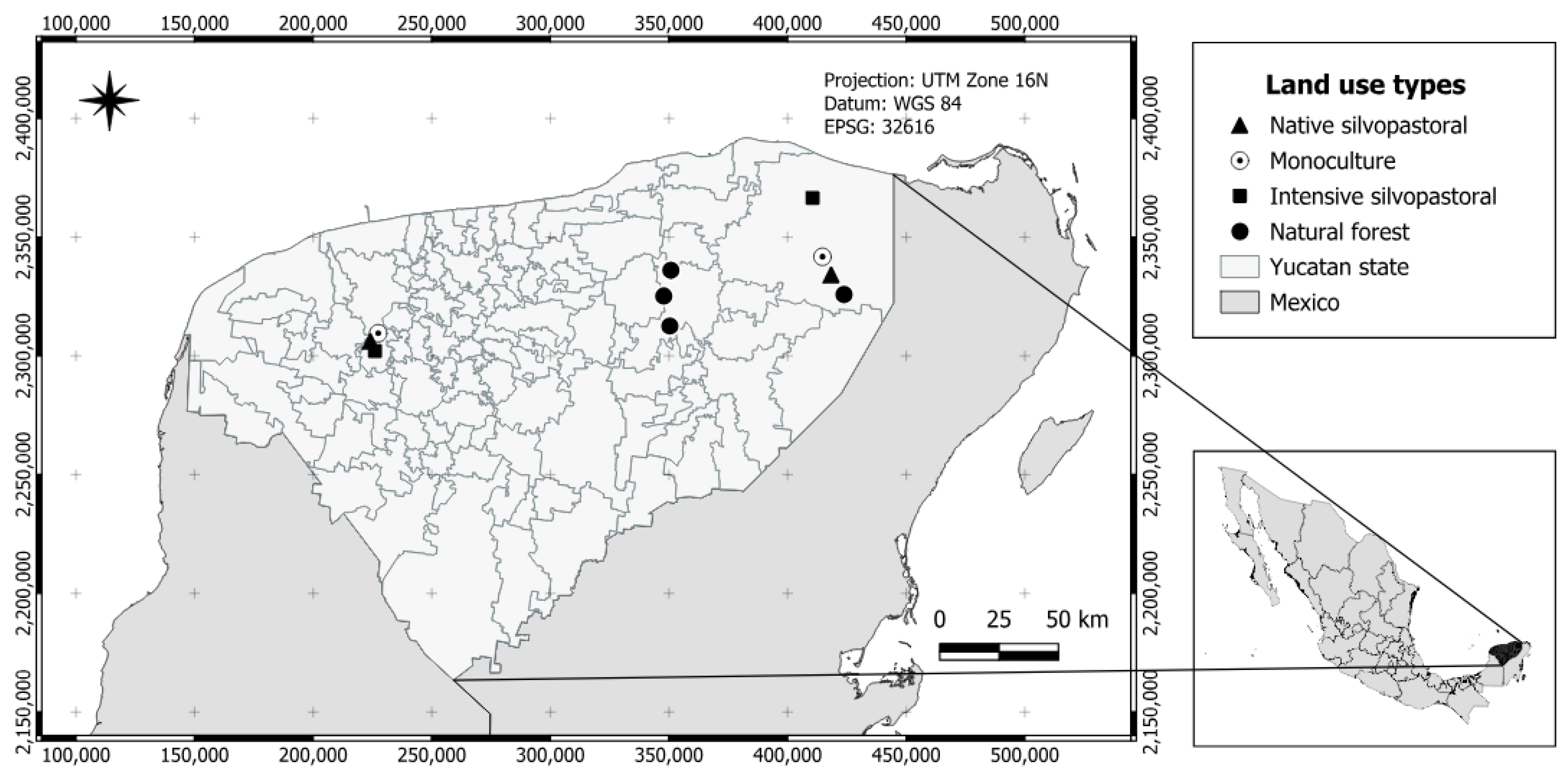
2.1. Study Area and Field Design
2.2. Dung Beetles Survey, Autocorrelation, and Sampled Coverage
2.3. Farm Surveys and Cattle Management
2.4. Countryside SAR Model
2.5. Taxon Affinity Calculation
2.6. Taxon Affinity to Broad Land-Use Type
2.7. Taxon Affinity to Land-Use Intensity
2.8. Model Parametrization
2.9. Calculation of Characterization Factors for Regional Species Loss
2.10. Application of Regional Characterization Factors
3. Results
3.1. Dunge Beetle Species Richness
3.2. Affinity of the Dung Beetles to Pastures
3.3. Characterization Factors
3.4. Application of the Land-Use Intensity-Specific CFs
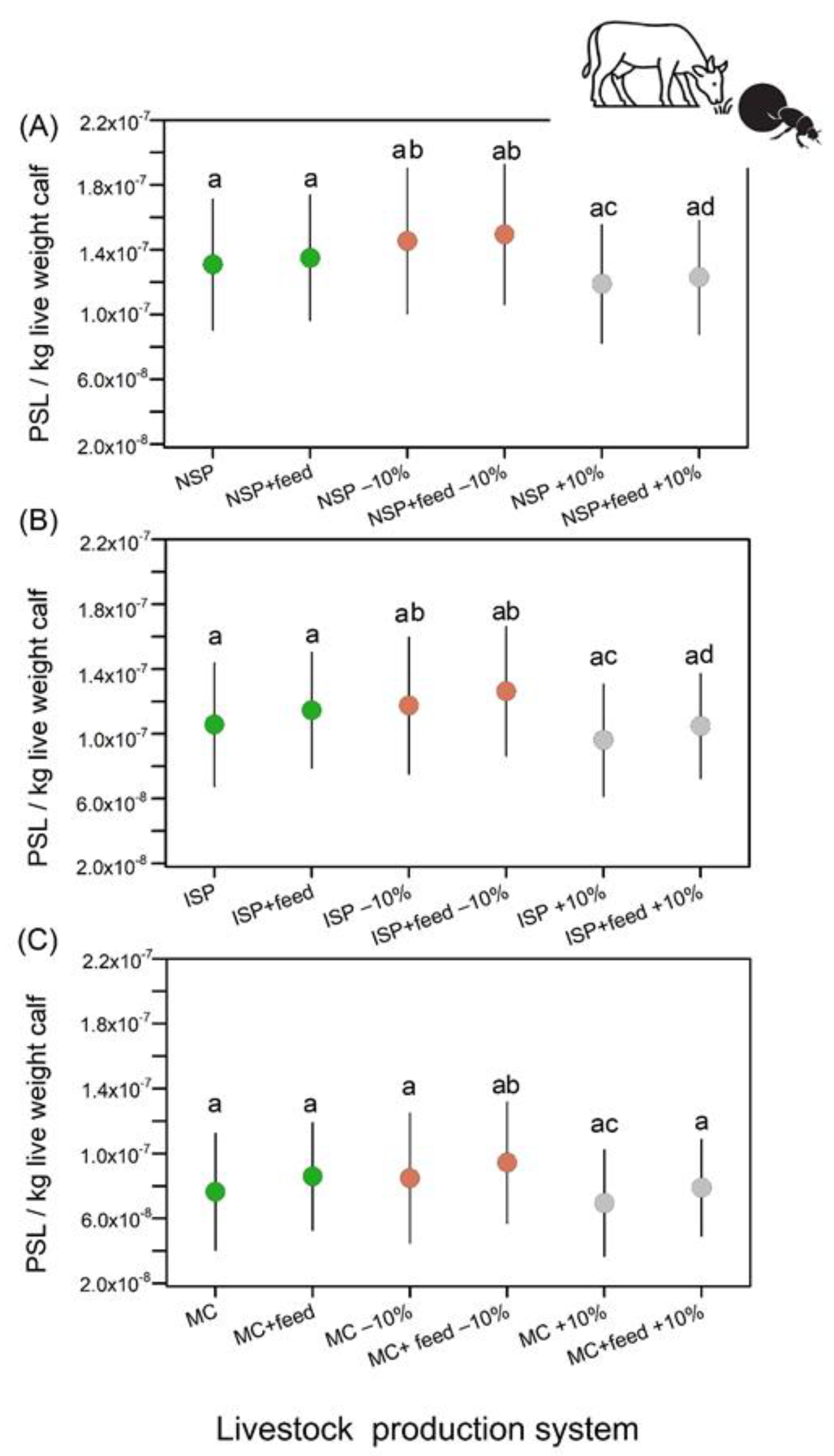
3.5. Yield Analysis, Sensitivity, and Potential Species Loss
4. Discussion
4.1. Land-Use Intensity and Characterization Factors
4.2. Unit Area-Based vs. Unit of Product-Based Assessment
4.3. Biodiversity Impact of Croplands
4.4. Species Richness as a Biodiversity Indicator
5. Conclusions
6. Caveats and Perspectives
Supplementary Materials
Author Contributions
Funding
Data Availability Statement
Acknowledgments
Conflicts of Interest
Abbreviations
| ai,j | Allocation factor |
| Aorg,j | Total ecoregion area |
| Anew,j | Remaining natural habitat area |
| Aij | Current area of land use type i |
| Area of broad land use type in the ecoregion | |
| fRR g, i | Fractional relative richness |
| g | Species group |
| i | Land use type |
| j | Ecoregion |
| H g,i,j | Affinity of the taxon g to the land use type i in ecoregion j. |
| Affinity of taxonomic group g to the broad land use type i | |
| Proportion of total broad land use area | |
| rg,i,j | Fractional species richness |
| Sorg,g,j | Species richness per ecoregion |
| Sloss,g,j | Projected species loss |
| zj | z-values |
| CFs | Characterization factor |
| INECOL | Institute of Ecology, A.C. |
| LCA | Life Cycle Assessment |
| SAR | Species Area Relationship |
| SEMARNAT | Secretaría de Medio Ambiente y Recursos Naturales, México |
References
- WWF. Living Planet Report 2024: A System in Peril; WWF: Gland, Switzerland, 2024; Available online: https://livingplanet.panda.org/living-planet-report-2024-key-messages/ (accessed on 10 March 2026).
- Deinet, S.; Marconi, V.; Freeman, R.; Puleston, H.; McRae, L. Living Planet Report 2024. Technical Supplement; 2024. [Google Scholar] [CrossRef]
- De Weert, L.; Van Oorschot, M.; Marques, A.; Batlle, L.; Westhoek, H.; Maaoui, M.; Blonk, H. Linking a biodiversity abundance metric to life cycle assessment for quantifying the biodiversity footprint of Dutch diets. J. Clean. Prod. 2025, 520, 146081. [Google Scholar] [CrossRef]
- Tilman, D.; May, R.M.; Lehman, C.L.; Nowak, M.A. Habitat destruction and the extinction debt. Nature 1994, 371, 65–66. [Google Scholar] [CrossRef]
- Waters, C.N.; Zalasiewicz, J.; Summerhayes, C.; Barnosky, A.D.; Poirier, C.; Gałuszka, A.; Cearreta, A.; Edgeworth, M.; Ellis, E.C.; Ellis, M.; et al. The Anthropocene is functionally and stratigraphically distinct from the Holocene. Science 2016, 351, aad2622. [Google Scholar] [CrossRef] [PubMed]
- MEA. Volume 1: Chapter 4—Biodiversity. 2005. Available online: http://www.millenniumassessment.org/documents/document.273.aspx.pdf (accessed on 12 March 2026).
- FAO. Biodiversity and the Livestock Sector. Guidelines for Quantitative Assessment; Livestock Environmental Assessment and Performance (LEAP) Partnership: Rome, Italy, 2019. [Google Scholar]
- Zhou, G.; Zhou, X.; He, Y.; Shao, J.; Hu, Z.; Liu, R.; Zhou, H.; Hosseinibai, S. Grazing intensity significantly affects belowground carbon and nitrogen cycling in grassland ecosystems: A meta-analysis. Glob. Change Biol. 2017, 23, 1167–1179. [Google Scholar] [CrossRef]
- Kleijn, D.; Kohler, F.; Baldi, A.; Batary, P.; Concepcion, E.; Clough, Y.; Diaz, M.; Gabriel, D.; Holzschuh, A.; Knop, E.; et al. On the relationship between farmland biodiversity and land-use intensity in Europe. Proc. R. Soc. B Biol. Sci. 2009, 276, 903–909. [Google Scholar] [CrossRef]
- Pacini, A.; Pelleri, F.; Marini, F.; Maltoni, A.; Mariotti, B.; Mazza, G.; Manetti, M.C. Impact of cattle density on the structure and natural regeneration of a turkey oak stand on an agrosilvopastoral farm in central Italy. J. For. Res. 2024, 35, 22. [Google Scholar] [CrossRef]
- Morales, G.C.H.; Freire, M.F.M. Productive and Economic Assessment of Agroecosystems in Chimborazo, Ecuador: Integrating Geographic Information Systems and Biodiversity Management for Sustainable Rural Development. J. Glob. Innov. Agric. Sci. 2026, 14, 653–659. [Google Scholar] [CrossRef]
- Jiménez-Ballesta, R.; Mongil-Manso, J.; Jiménez-Sánchez, A. Application of Regenerative Agriculture: A Review and Case Study in an Agrosilvopastoral Region. Sustainability 2025, 17, 9066. [Google Scholar] [CrossRef]
- Vega-Hernández, S.; González-Esquivel, C.E.; Olmos-Silva, M.; Real-Santillán, R.O.; Díaz-Guerrero, T. Effects of silvopastoral management intensity on honeybee production, health, and pollen diversity. Int. J. Trop. Insect Sci. 2026. [Google Scholar] [CrossRef]
- O’Grady, A.P.; Mendham, D.S.; Mokany, K.; Smith, G.S.; Stewart, S.B.; Harrison, M.T. Grazing systems and natural capital: Influence of grazing management on natural capital in extensive livestock production systems. Nat.-Based Solut. 2024, 6, 100181. [Google Scholar] [CrossRef]
- Burns, E.A. Research Needed: Business Opportunities in the Farmer-led Regenerative Agriculture Movement in New Zealand. N. Z. J. Appl. Bus. Res. 2022, 18, 1–14. [Google Scholar] [CrossRef]
- CBF. Regenerative Agriculture • Chesapeake Bay Foundation. Chesapeake Bay Foundation. Available online: https://www.cbf.org/issues/agriculture/regenerative-agriculture/ (accessed on 18 March 2026).
- ISO 14040:2006; Environmental Management—Life Cycle Assessment—Principles and Framework. ISO: Geneva, Switzerland, 2006.
- Thornton, P.K. Livestock production: Recent trends, future prospects. Philos. Trans. R. Soc. B Biol. Sci. 2010, 365, 2853–2867. [Google Scholar] [CrossRef] [PubMed]
- Souza, D.M.; Teixeira, R.F.M.; Ostermann, O.P. Assessing biodiversity loss due to land use with Life Cycle Assessment: Are we there yet? Glob. Change Biol. 2015, 21, 32–47. [Google Scholar] [CrossRef]
- Lindqvist, M.; Palme, U.; Lindner, J.P. A comparison of two different biodiversity assessment methods in LCA—A case study of Swedish spruce forest. Int. J. Life Cycle Assess. 2016, 21, 190–201. [Google Scholar] [CrossRef]
- Winter, L.; Lehmann, A.; Finogenova, N.; Finkbeiner, M. Including biodiversity in life cycle assessment—State of the art, gaps and research needs. Environ. Impact Assess. Rev. 2017, 67, 88–100. [Google Scholar] [CrossRef]
- de Baan, L.; Alkemade, R.; Koellner, T. Land use impacts on biodiversity in LCA: A global approach. Int. J. Life Cycle Assess. 2013, 18, 1216–1230. [Google Scholar] [CrossRef]
- de Baan, L.; Curran, M.; Rondinini, C.; Visconti, P.; Hellweg, S.; Koellner, T. High-resolution assessment of land use impacts on biodiversity in life cycle assessment using species habitat suitability models. Environ. Sci. Technol. 2015, 4, 2237–2244. [Google Scholar] [CrossRef] [PubMed]
- De Schryver, A.M.; Goedkoop, M.J.; Leuven, R.S.E.W.; Huijbregts, M.A.J. Uncertainties in the application of the species area relationship for characterisation factors of land occupation in life cycle assessment. Int. J. Life Cycle Assess. 2010, 15, 682–691. [Google Scholar] [CrossRef]
- Koellner, T.; Scholz, R.W. Assessment of land use impacts on the natural environment. Part 1: An analytical framework for pure land occupation and land use change. Int. J. Life Cycle Assess. 2007, 12, 16–23. [Google Scholar] [CrossRef]
- Lindeijer, E. Biodiversity and life support impacts of land use in LCA. J. Clean. Prod. 2000, 8, 313–319. [Google Scholar] [CrossRef]
- Geyer, R.; Lindner, J.P.; Stoms, D.M.; Davis, F.W.; Wittstock, B. Coupling GIS and LCA for biodiversity assessments of land use. Int. J. Life Cycle Assess. 2010, 15, 692–703. [Google Scholar] [CrossRef]
- de Souza, D.M.; Flynn, D.F.B.; DeClerck, F.; Rosenbaum, R.K.; de Melo Lisboa, H.; Koellner, T. Land use impacts on biodiversity in LCA: Proposal of characterization factors based on functional diversity. Int. J. Life Cycle Assess. 2013, 18, 1231–1242. [Google Scholar] [CrossRef]
- Lindeijer, E. Review of land use impact methodologies. J. Clean. Prod. 2000, 8, 273–281. [Google Scholar] [CrossRef]
- Michelsen, O. Assessment of land use impact on biodiversity: Proposal of a new methodology exemplified with forestry operations in Norway. Int. J. Life Cycle Assess. 2008, 13, 22–31. [Google Scholar] [CrossRef]
- Chaudhary, A.; Verones, F.; De Baan, L.; Hellweg, S. Quantifying Land Use Impacts on Biodiversity: Combining Species-Area Models and Vulnerability Indicators. Environ. Sci. Technol. 2015, 49, 9987–9995. [Google Scholar] [CrossRef] [PubMed]
- Chaudhary, A.; Brooks, T.M. Land Use Intensity-Specific Global Characterization Factors to Assess Product Biodiversity Footprints. Environ. Sci. Technol. 2018, 52, 5094–5104. [Google Scholar] [CrossRef] [PubMed]
- Pereira, H.M.; Daily, G.C. Modeling biodiversity dynamics in countryside landscapes. Ecology 2006, 87, 1877–1885. [Google Scholar] [CrossRef]
- Pereira, H.M.; Ziv, G.; Miranda, M. Countryside species-area relationship as a valid alternative to the matrix-calibrated species-area model. Conserv. Biol. 2014, 28, 874–876. [Google Scholar] [CrossRef] [PubMed]
- Pereira, H.M.; Borda-de-Agua, L.; Santos Martins, I. Geometry and scale in species—Area relationships. Nature 2012, 482, E3–E4. [Google Scholar] [CrossRef] [PubMed]
- Lucas, K.R.G.; Kebreab, E. Food environmental footprint: Evolution of the countryside species−area relationship (SAR) with new methodologies. Sci. Total Environ. 2025, 959, 178214. [Google Scholar] [CrossRef] [PubMed]
- Jeanneret, P.; Baumgartner, D.U.; Freiermuth Knuchel, R.; Koch, B.; Gaillard, G. An expert system for integrating biodiversity into agricultural life-cycle assessment. Ecol. Indic. 2014, 46, 224–231. [Google Scholar] [CrossRef]
- Noss, R.F. Indicators for monitoring biodiversity: A hierarchical approach. Conserv. Biol. 1990, 4, 355–364. [Google Scholar] [CrossRef]
- Barlow, J.; Louzada, J.; Parry, L.; Hernández, M.I.M.; Hawes, J.; Peres, C.A.; Vaz-de-Mello, F.Z.; Gardner, T.A. Improving the design and management of forest strips in human-dominated tropical landscapes: A field test on Amazonian dung beetles. J. Appl. Ecol. 2010, 47, 779–788. [Google Scholar] [CrossRef]
- Favila, M.E. Los Escarabajos y la fragmentación. In Los Tuxtlas el Paisaje la Sierra; Instituto de Ecología, A.C.: Heroica Veracruz, Mexico, 2004; pp. 135–157. [Google Scholar]
- Bicknell, J.E.; Phelps, S.P.; Davies, R.G.; Mann, D.J.; Struebig, M.J.; Davies, Z.G. Dung beetles as indicators for rapid impact assessments: Evaluating best practice forestry in the neotropics. Ecol. Indic. 2014, 43, 154–161. [Google Scholar] [CrossRef]
- Nichols, E.; Gardner, T.A.; Peres, C.A.; Spector, S.; The Scarabaeinae Research Network. Co-declining mammals and dung beetles: An impending ecological cascade. Oikos 2009, 118, 481–487. [Google Scholar] [CrossRef]
- Hernández-Rivera, Á.; Escobar, F.; Guevara, R.; Von Thaden-Ugalde, J.; Arellano, L.; Alvarado, F. Upwards and downwards: 25 years of global change in the elevational distribution of dung beetles on a mountain of the Mexican Transition Zone. J. Biogeogr. 2026, 53, e70187. [Google Scholar] [CrossRef]
- Gonzalez, D.; García, J.H.; Gonzalez, L.; Escobar, F. Effect of ivermectin and dung beetle communities on dung removal rate in cattle pastures. Appl. Soil Ecol. 2025, 206, 105865. [Google Scholar] [CrossRef]
- Slade, E.M.; Riutta, T.; Roslin, T.; Tuomisto, H.L. The role of dung beetles in reducing greenhouse gas emissions from cattle farming. Sci. Rep. 2016, 6, 18140. [Google Scholar] [CrossRef] [PubMed]
- Lopez-Collado, J.; Cruz-Rosales, M.; Vilaboa-Arroniz, J.; Martínez-Morales, I.; Gonzalez-Hernandez, H. Contribution of dung beetles to cattle productivity in the tropics: A stochastic-dynamic modeling approach. Agric. Syst. 2017, 155, 78–87. [Google Scholar] [CrossRef]
- Mueller, A.D.; Islebe, G.A.; Anselmetti, F.S.; Ariztegui, D.; Brenner, M.; Hodell, D.A.; Hajdas, I.; Hamann, Y.; Haug, G.H.; Kennett, D.J. Recovery of the forest ecosystem in the tropical lowlands of northern Guatemala after disintegration of classic Maya polities. Geology 2010, 38, 523–526. [Google Scholar] [CrossRef]
- Olson, D.M.; Dinerstein, E.; Wikramanayake, E.D.; Burgess, N.D.; Powell, G.V.N.; Underwood, E.C.; D’Amico, J.A.; Itoua, I.; Strand, H.E.; Morrison, J.C.; et al. Terrestrial ecoregions of the world: A new map of life on Earth. Bioscience 2001, 51, 933–938. [Google Scholar]
- INEGI. Anuario Estadístico y Geográfico por Entidad Federativa 2024; Instituo Nacional de Estadistica y Geografía: Aguascalientes, México, 2024. [Google Scholar]
- Bautista, F.; Palacio-Aponte, G.; Quintana, P.; Zinck, J.A. Spatial distribution and development of soils in tropical karst areas from the Peninsula of Yucatan, Mexico. Geomorphology 2011, 135, 308–321. [Google Scholar] [CrossRef]
- Busch, C.B. Deforestation in the Southern Yucatan: Recent Trends, Their Causes, and Policy Implications. Ph.D. Thesis, University of California, Berkeley, Berkeley, CA, USA, 2006. Available online: http://search.proquest.com.ezproxy.library.wisc.edu/docview/305364448?accountid=465%5Cnhttp://sfx.wisconsin.edu/wisc?url_ver=Z39.88-2004&rft_val_fmt=info:ofi/fmt:kev:mtx:dissertation&genre=dissertations+%26+theses&sid=ProQ:ABI%2FINFORM+Global&atitle=&titl (accessed on 20 February 2026).
- Alvarado, F.; Dáttilo, W.; Escobar, F. Linking dung beetle diversity and its ecological function in a gradient of livestock intensification management in the Neotropical region. Appl. Soil Ecol. 2019, 143, 173–180. [Google Scholar] [CrossRef]
- Mora-Aguilar, E.F.; Arriaga-Jiménez, A.; Correa, C.M.A.; da Silva, P.G.; Korasaki, V.; López-Bedoya, P.A.; Hernández, M.I.M.; Pablo-Cea, J.D.; Salomão, R.P.; Valencia, G.; et al. Toward a standardized methodology for sampling dung beetles (Coleoptera: Scarabaeinae) in the Neotropics: A critical review. Front. Ecol. Evol. 2023, 11, 1096208. [Google Scholar] [CrossRef]
- Larsen, T.H.; Forsyth, A. Trap Spacing and Transect Design for Dung Beetle Biodiversity Studies 1. Biotropica 2005, 37, 322–325. [Google Scholar]
- Silva, P.G.; Hernández, M.I.M. Spatial patterns of movement of dung beetle species in a tropical forest suggest a new trap spacing for dung beetle biodiversity studies. PLoS ONE 2015, 10, e0126112. [Google Scholar] [CrossRef] [PubMed]
- Oksanen, J.; Simpson, L.G.; Blanchet, F.G.; Kindt, K.R.; Legendre, P.; Minchin, P.R.; O’Hara, R.B.; Solymos, P.; Stevens, M.H.H.; Szoecs, E.; et al. Vegan: Community Ecology Package, R package version 2.8-0; CRAN: Vienna, Austria, 2025. Available online: https://vegandevs.github.io/vegan/ (accessed on 2 June 2026).
- MacGregor-Fors, I.; Payton, M.E. Contrasting Diversity Values: Statistical Inferences Based on Overlapping Confidence Intervals. PLoS ONE 2013, 8, 8–11. [Google Scholar] [CrossRef] [PubMed]
- Hsieh, T.C.; Ma, K.H.; Chao, A. iNEXT: An R package for rarefaction and extrapolation of species diversity (Hill numbers). Methods Ecol. Evol. 2016, 7, 1451–1456. [Google Scholar] [CrossRef]
- Alvarado, F.; Escobar, F.; Williams, D.R.; Arroyo-Rodríguez, V.; Escobar-Hernández, F. The role of livestock intensification and landscape structure in maintaining tropical biodiversity. J. Appl. Ecol. 2018, 55, 185–194. [Google Scholar] [CrossRef]
- SNIARN. Sistema Nacional de Información Ambiental y de Recursos Naturales|Secretaría de Medio Ambiente y Recursos Naturales. Available online: https://www.gob.mx/semarnat/acciones-y-programas/sistema-nacional-de-informacion-ambiental-y-de-recursos-naturales (accessed on 23 March 2026).
- SIAP. Anuario Estadístico de la Producción Agrícola. Available online: https://nube.agricultura.gob.mx/cierre_agricola/ (accessed on 23 March 2026).
- Preston, F.W. The Canonical Distribution of Commonness and Rarity: Part II. Ecology 1962, 43, 410–432. [Google Scholar] [CrossRef]
- Ramírez-Cancino, L.; Rivera-Lorca, A. La ganadería en el contexto de la biodiversidad. In Biodiversidad y Desarrollo Humano en Yucatán; Centro de Investigación Científica de Yucatán, A.C.: Mérida, Mexico, 2004; pp. 106–108. [Google Scholar]
- Bacab, H.M.; Madera, N.B.; Solorio, F.J.; Vera, F.; Marrufo, D.F. Los sistemas silvopastoriles intensivos con Leucaena leucocephala: Una opción para la ganadería tropical (The intensive silvopastoril systems with Leucaena leucocephala: Tropical livestock option). Av. Investig. Agropecu. 2013, 17, 67–81. [Google Scholar]
- León, J.; González-Tokman, D.; Castillo-Burguete, T.; Vidal-Martínz, V.M.; Hernández -Stefanoni, J.L.; Ibarra-Cerdeña, C.N. Dung beetle assemblage changes along a chronosequence in a recovering tropical dry. PLoS ONE 2025, 20, e0337635. [Google Scholar] [CrossRef] [PubMed]
- Williams, D.R.; Alvarado, F.; Green, R.E.; Manica, A.; Phalan, B.; Balmford, A. Land-use strategies to balance livestock production, biodiversity conservation and carbon storage in Yucatán, Mexico. Glob. Change Biol. 2017, 23, 5260–5272. [Google Scholar] [CrossRef]
- Basto-estrella, G.; Rodríguez-Vivas, R.I.; Delfín-González, H.; Reyes-Novelo, E. Dung beetles (Coleoptera: Scarabaeidae: Scarabaeinae) from cattle ranches of Yucatán, Mexico. Rev. Mex. Biodivers. 2012, 83, 380–386. [Google Scholar]
- Bennett, S.; Lumactud, R.; Manafiazar, G.; Manning, P. Supplementing beef cattle diets with brown seaweed affects coprophagous beetles’ dung use. Agric. For. Entomol. 2025, 1–13. [Google Scholar] [CrossRef]
- Comisión Nacional para el Conocimiento y Uso de la Biodiversidad. SNIB MX. CONABIO. Available online: https://www.snib.mx/ (accessed on 18 March 2026).
- IUCN. IUCN Red List of Threatened Species. Available online: https://www.iucnredlist.org/about/searching (accessed on 18 March 2026).
- Horak, J.; Vodka, S.; Kout, J.; Halda, J.P.; Bogusch, P.; Pech, P. Biodiversity of most dead wood-dependent organisms in thermophilic temperate oak woodlands thrives on diversity of open landscape structures. For. Ecol. Manag. 2014, 315, 80–85. [Google Scholar] [CrossRef]
- Horak, J. Fragmented habitats of traditional fruit orchards are important for dead wood-dependent beetles associated with open canopy deciduous woodlands. Naturwissenschaften 2014, 101, 499–504. [Google Scholar] [CrossRef] [PubMed]
- Wall, R.; Beynon, S. Area-wide impact of macrocyclic lactone parasiticides in cattle dung. Med. Vet. Entomol. 2012, 26, 1–8. [Google Scholar] [CrossRef] [PubMed]
- Lewis, M.J.; Didham, R.K.; Evans, T.A.; Berson, J.D. Experimental evidence that dung beetles benefit from reduced ivermectin in targeted treatment of livestock parasites. Sci. Total Environ. 2024, 945, 174050. [Google Scholar] [CrossRef] [PubMed]
- Esquivel-Román, A.; Baena-Díaz, F.; Bustos-Segura, C.; De Gasperin, O.; González-Tokman, D. Synergistic effects of elevated temperature with pesticides on reproduction, development and survival of dung beetles. Ecotoxicology 2025, 34, 207–218. [Google Scholar] [CrossRef] [PubMed]
- Verdú, J.R.; Lobo, J.M.; Sánchez-piñero, F.; Gallego, B.; Numa, C.; Lumaret, J.-P.; Cortez, V.; Ortiz, A.J.; Tonelli, M.; García-teba, J.P.; et al. Ivermectin residues disrupt dung beetle diversity, soil properties and ecosystem functioning: An interdisciplinary field study. Sci. Total Environ. 2018, 618, 219–228. [Google Scholar] [CrossRef] [PubMed]
- Montoya-molina, S.; Giraldo-echeverri, C.; Montoya-lerma, J.; Chará, J.; Escobar, F.; Calle, Z. Land sharing vs. land sparing in the dry Caribbean lowlands: A dung beetles’ perspective. Appl. Soil Ecol. 2016, 98, 204–212. [Google Scholar] [CrossRef]
- Alves, V.M.; Hernández, M.I.M. Morphometric modifications in Canthon quinquemaculatus castelnau 1840 (coleoptera: Scarabaeinae): Sublethal effects of transgenic maize? Insects 2017, 8, 115. [Google Scholar] [CrossRef] [PubMed]
- Alves, V.M.; Hettwer Giehl, E.L.; Lovato, P.E.; Vaz-de-Mello, F.Z.; Agudelo, M.B.; Medina Hernández, M.I. Dung beetles and the conservation of diversity in an agricultural landscape with maize fields and Atlantic Forest remnants. Acta Oecol. 2020, 107, 103598. [Google Scholar] [CrossRef]
- Poore, J.; Nemecek, T. Reducing food’s environmental impacts through producers and consumers. Science 2018, 360, 987–992. [Google Scholar] [CrossRef] [PubMed]
- Birch, B.D.J.; Mills, S.C.; Socolar, J.B.; Martínez-Revelo, D.E.; Haugaasen, T.; Edwards, D.P. Land sparing outperforms land sharing for Amazonian bird communities regardless of surrounding landscape context. J. Appl. Ecol. 2024, 61, 940–950. [Google Scholar] [CrossRef]
- Lerner, A.M.; Zuluaga, A.F.; Chará, J.; Etter, A.; Searchinger, T. Sustainable Cattle Ranching in Practice: Moving from Theory to Planning in Colombia’s Livestock Sector. Environ. Manag. 2017, 60, 176–184. [Google Scholar] [CrossRef] [PubMed]
- Edwards, D.P.; Gilroy, J.J.; Thomas, G.H.; Uribe, C.A.M.; Haugaasen, T. Land-Sparing Agriculture Best Protects Avian Phylogenetic Diversity. Curr. Biol. 2015, 25, 2384–2391. [Google Scholar] [CrossRef] [PubMed]
- Gilroy, J.J.; Edwards, F.A.; Medina Uribe, C.A.; Haugaasen, T.; Edwards, D.P. Surrounding habitats mediate the trade-off between land-sharing and land-sparing agriculture in the tropics. J. Appl. Ecol. 2014, 51, 1337–1346. [Google Scholar] [CrossRef]
- Phalan, B.; Onial, M.; Balmford, A.; Green, R.E. Reconciling food production and biodiversity conservation: Land sharing and land sparing compared. Science 2011, 333, 1289–1291. [Google Scholar] [CrossRef] [PubMed]
- Teixeira, R.F.M.; Morais, T.G.; Domingos, T. A practical comparison of regionalized land use and biodiversity life cycle impact assessment models using livestock production as a case study. Sustainability 2018, 10, 4089. [Google Scholar] [CrossRef]
- FAO. Ecosystem Services Assessment in Livestock Agroecosystems; Food and Agriculture Organization of the United Nations: Rome, Italy, 2025. [Google Scholar] [CrossRef]
- Nichols, E.; Spector, S.; Louzada, J.; Larsen, T.; Amezquita, S.; Favila, M.E. Ecological functions and ecosystem services provided by Scarabaeinae dung beetles. Biol. Conserv. 2008, 141, 1461–1474. [Google Scholar] [CrossRef]
- Callesen, I. Biodiversity and ecosystem services in life cycle impact assessment—Inventory objects or impact categories? Ecosyst. Serv. 2016, 22, 94–103. [Google Scholar] [CrossRef]
- Crenna, E.; Sinkko, T.; Sala, S. Biodiversity impacts due to food consumption in Europe. J. Clean. Prod. 2019, 227, 378–391. [Google Scholar] [CrossRef] [PubMed]
- Koellner, T.; Scholz, R.W. Assessment of land use impacts on the natural environment: Part 2: Generic characterization factors for local species diversity in Central Europe. Int. J. Life Cycle Assess. 2008, 13, 32–48. [Google Scholar] [CrossRef]
- Koellner, T.; De Baan, L.; Beck, T.; Brandão, M.; Civit, B.; Margni, M.; I Canals, L.M.; Saad, R.; De Souza, D.M.; Müller-Wenk, R. UNEP-SETAC guideline on global land use impact assessment on biodiversity and ecosystem services in LCA. Int. J. Life Cycle Assess. 2013, 18, 1188–1202. [Google Scholar] [CrossRef]
- Curran, M.; De Souza, D.M.; Antón, A.; Teixeira, R.F.M.; Michelsen, O.; Vidal-Legaz, B.; Sala, S.; Milà I Canals, L. How Well Does LCA Model Land Use Impacts on Biodiversity?—A Comparison with Approaches from Ecology and Conservation. Environ. Sci. Technol. 2016, 50, 2782–2795. [Google Scholar] [CrossRef] [PubMed]



| Model Parameters | Definition | Value for This Study | Data Source |
|---|---|---|---|
| Sorg,g,j | Species richness per ecoregion: Total number of species occurring in an ecoregion’s area (Aorg,j) before any human intervention | 30 | Alvarado et al. [59] |
| Aorg,j | Total ecoregion area (Yucatan sub-region of the Yucatan Peninsula) | 39,120.00 km2 | Value obtained through a geographic information system |
| Anew,j | Remaining natural habitat area | 1383.34 km2 | Value obtained through a geographic information system |
| Area of broad land-use type in the ecoregion. Pastureland use | 13,212.67 km2 | SNIARN [60] | |
| Area of broad land-use type in the ecoregion. Cropland use | 1594.81 km2 | SIAP [61] | |
| zj | z value | 0.25 | De Baan et al. [22], Preston [62] |
| Proportion of total broad land use area (pastureland use) under a particular intensity level (minimal, light, or intense use) | minimal use = 0.089 (1187 km2) light use = 0.0002 (2.0 km2) intense use = 0.91 (12,024 km2) | Ramirez and Rivera [63]; Bacab et al. [64] | |
| Proportion of total broad land-use area (cropland use) under a particular intensity level (light or intense use) | light use = 0.21 (338 km2) intense use = 0.79 (1257 km2) | SIAP [61] |
| Broad Land-Use Type | Livestock Production System (Land-Use Intensity type) | fRR,g,i | Taxon Affinity (hg,i,j) | Area of Broad Land-Use (%) |
|---|---|---|---|---|
| Pasture | NSP (minimal use) | 0.90 | 0.564 | 0.0898 |
| ISP (light use) | 0.86 | 0.482 | 0.0002 | |
| MC (intense use) | 0.83 | 0.410 | 0.9100 | |
| Cropland | Light use (other crops) | 0.36 | 0.014 | 0.200 |
| Intense use (grains) | 0.55 | 0.081 | 0.800 |
| Broad Land-Use Type | Livestock Production System (Land-Use Intensity) | ai,j | Sloss g,i,j | Characterization Factors PSLreg/m2 |
|---|---|---|---|---|
| Pasture | NSP (minimal use) | 0.0568 | 0.593 | 4.99 × 10⁻¹⁰ |
| ISP (light use) | 0.0001 | 0.001 | 5.93 × 10⁻¹⁰ | |
| MC (intense use) | 0.7796 | 8.131 | 6.76 × 10⁻¹⁰ | |
| Cropland | Other crops (light use) | 0.0366 | 0.381 | 1.13 × 10⁻¹⁰ |
| Maize (intense use) | 0.1269 | 1.323 | 1.05 × 10⁻¹⁰ |
| Broad Land-Use | Livestock Production System (Land-Use Intensity) | Yields (kg LWC/m2) | Inventory Flows for Land Occupation (m2 Year per kg LWC) | Potential Species Loss per kg LWC |
|---|---|---|---|---|
| Pasture | NSP (minimal use) | 0.0045 | 262.05 | 1.31 × 10⁻⁷ |
| ISP (light use) | 0.0090 | 178.20 | 1.06 × 10⁻⁷ | |
| MC (intense use) | 0.0159 | 112.91 | 7.64 × 10⁻⁸ | |
| Broad land-use | Management type | Yields (kg crop/m2) | Inventory flows for land occupation (m2 year per kg crop) | Potential species loss per kg of crop |
| Cropland | Other crops (light use) | 81.07 | 0.012 | 7.11 × 10⁻¹⁰ |
| Grains (intense use) | 0.21 | 4.84 | 5.09 × 10⁻⁹ |
| Livestock Production System (Land-Use Intensification) | Yield kg Calf Production/m2 | ||
|---|---|---|---|
| Base Scenario | Scenario 1 (−10%) | Scenario 2 (+10%) | |
| NSP (minimal use) | 0.0045 ± 0.0020 | 0.0040 ± 0.0018 | 0.0049 ± 0.0021 |
| ISP (light use) | 0.0090 ± 0.0082 | 0.0081 ± 0.0074 | 0.0098 ± 0.0090 |
| MC (intense use) | 0.0159 ± 0.0146 | 0.0143 ± 0.0131 | 0.0174 ± 0.0160 |
Disclaimer/Publisher’s Note: The statements, opinions and data contained in all publications are solely those of the individual author(s) and contributor(s) and not of MDPI and/or the editor(s). MDPI and/or the editor(s) disclaim responsibility for any injury to people or property resulting from any ideas, methods, instructions or products referred to in the content. |
© 2026 by the authors. Licensee MDPI, Basel, Switzerland. This article is an open access article distributed under the terms and conditions of the Creative Commons Attribution (CC BY) license.
Share and Cite
Rivera-Huerta, A.; Rubio Lozano, M.S.; Galindo, F.; Escobar, F.; Güereca, L.P. Land Use Intensity-Specific Characterization Factors to Assess the Biodiversity Impact of Different Livestock Systems Using Dung Beetles as a Bioindicator. Agriculture 2026, 16, 1338. https://doi.org/10.3390/agriculture16121338
Rivera-Huerta A, Rubio Lozano MS, Galindo F, Escobar F, Güereca LP. Land Use Intensity-Specific Characterization Factors to Assess the Biodiversity Impact of Different Livestock Systems Using Dung Beetles as a Bioindicator. Agriculture. 2026; 16(12):1338. https://doi.org/10.3390/agriculture16121338
Chicago/Turabian StyleRivera-Huerta, Adriana, María Salud Rubio Lozano, Francisco Galindo, Federico Escobar, and Leonor Patricia Güereca. 2026. "Land Use Intensity-Specific Characterization Factors to Assess the Biodiversity Impact of Different Livestock Systems Using Dung Beetles as a Bioindicator" Agriculture 16, no. 12: 1338. https://doi.org/10.3390/agriculture16121338
APA StyleRivera-Huerta, A., Rubio Lozano, M. S., Galindo, F., Escobar, F., & Güereca, L. P. (2026). Land Use Intensity-Specific Characterization Factors to Assess the Biodiversity Impact of Different Livestock Systems Using Dung Beetles as a Bioindicator. Agriculture, 16(12), 1338. https://doi.org/10.3390/agriculture16121338