Review

OsMADS27 Transcription Factor in Rice: Structure, Functional Significance, and Emerging Role in Abiotic Stress Tolerance


Zhejiang Key Laboratory of Crop Germplasm, Department of Agronomy, College of Agriculture and Biotechnology, Zhejiang University, Hangzhou 310058, China
*
Author to whom correspondence should be addressed.
Agriculture 2026, 16(12), 1296; https://doi.org/10.3390/agriculture16121296
Submission received: 22 April 2026 / Revised: 8 June 2026 / Accepted: 8 June 2026 / Published: 12 June 2026
(This article belongs to the Special Issue Feature Papers in Crop Genetics, Genomics and Breeding)

Abstract

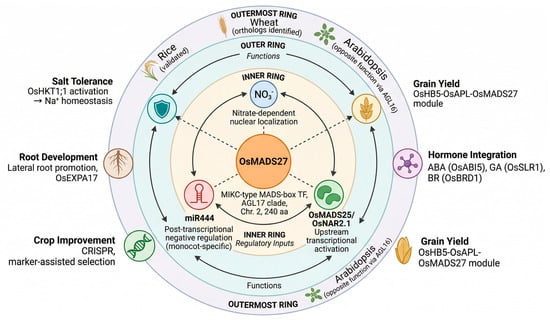
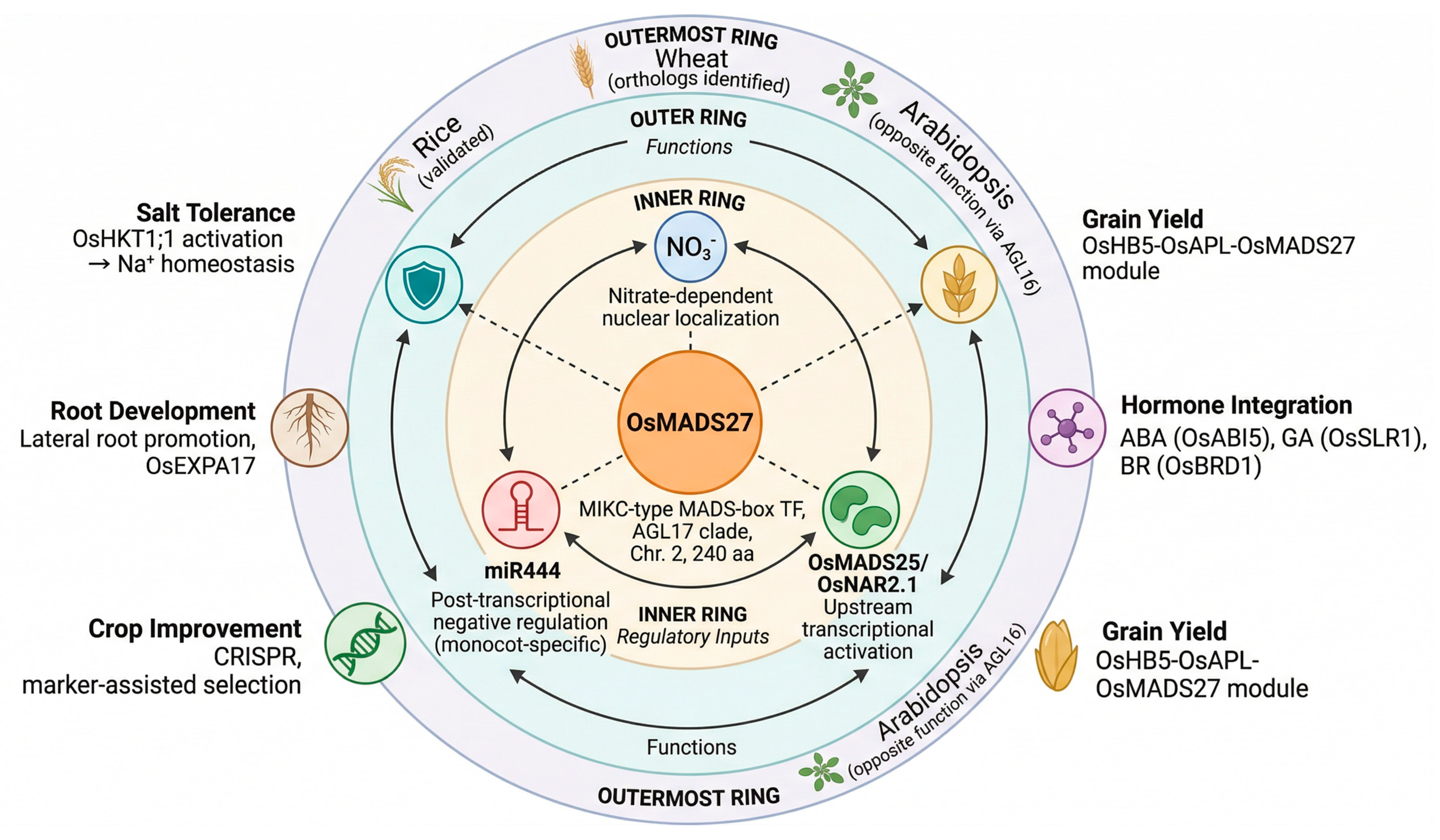
This narrative review synthesizes current knowledge on MADS-Box 27 (OsMADS27), a member of the AGL17 clade in rice that has emerged as a regulatory node linking nitrate signaling, root development, and abiotic stress tolerance. Because most functional and mechanistic studies on OsMADS27 to date have been conducted in rice, this review is centered on Oryza sativa, with cross-species comparisons used for evolutionary and comparative context. Specifically, we summarize the gene and protein structure, phylogenetic position, expression profile, upstream and downstream regulation, and emerging functional significance of OsMADS27. OsMADS27 is a typical MIKC-type MADS-box protein with root-preferential expression, and its activity is strongly influenced by nitrate availability and miR444-mediated regulation. Evidence from functional genomics, transcriptomics, ChIP-based studies, and transgenic analyses suggests that OsMADS27 contributes to the regulation of root architecture, nitrate uptake, hormonal crosstalk, and stress-responsive pathways. Notably, OsMADS27 enhances salt tolerance through nitrate-dependent activation of downstream targets such as OsHKT1;1 and OsSPL7, contributing to ion homeostasis and salinity tolerance. Recent findings also suggest roles in grain size regulation and yield improvement, expanding its significance beyond root biology. This review compares OsMADS27 with AGL17-clade genes and highlights its value for crop improvement aimed at salinity tolerance and nitrogen use efficiency. However, important research gaps remain, particularly the limited field-level validation, the absence of integrated multi-omics analyses, and the lack of functional studies of OsMADS27 orthologs in non-rice crops. Overall, OsMADS27 represents promising rice-centered target for future biotechnology applications, while its translational relevance to other cereals remains to be established through orthology analysis and field-level evaluation.

Graphical Abstract

1. Introduction

Plants, being sessile organisms, are continuously exposed to diverse environmental fluctuations that impose severe constraints on their growth, development, and productivity. To survive and adapt under such challenging conditions, plants have evolved intricate regulatory networks at the molecular level, in which transcription factors (TFs) serve as central components [1,2]. Transcription factors are regulatory proteins that bind to specific DNA sequences in the promoter regions of target genes, thereby controlling their transcription and coordinating cellular responses to both developmental and environmental signals [3]. Among the numerous transcription factor families identified in plants, the MADS-box gene family represents one of the largest and most functionally diverse groups, playing pivotal roles in a wide range of developmental and physiological processes.
The MADS-box family is named for its four founding members MCM1 (yeast), AGAMOUS (Arabidopsis), DEFICIENS (Antirrhinum), and Serum Response Factor (human) and is defined by a conserved ~56–60 amino acid DNA-binding domain that recognizes CArG-box motifs [CC(A/T)6GG] in target promoters. In plants, the family is greatly expanded compared with animals and fungi and is classified into Type I (M-type) and Type II (MIKC-type) lineages, with MIKC-type proteins being the principal regulators of floral development and increasingly recognized as participants in stress responses. A more detailed treatment of family classification, structure, and evolution is provided in Section 3.
Among the diverse members of the MADS-box family, MADS-Box 27, OsMADS27 has attracted considerable attention in recent years due to its multifaceted roles in plant development and stress responses. OsMADS27 belongs to the AGL17 clade of MIKC-type MADS-box transcription factors, a group that also includes OsMADS23, OsMADS25, OsMADS57, and OsMADS61 in rice [4,5]. The AGL17 clade is homologous to the Arabidopsis ANR1 gene, which was one of the first MADS-box genes identified as a regulator of nutrient-responsive root architecture [4,5]. In rice, OsMADS27 has been shown to be preferentially expressed in roots, with particularly strong expression in the root stele, and its transcript levels are specifically induced by nitrate availability [6]. Functional studies have demonstrated that OsMADS27 acts as a major target of the microRNA miR444 and regulates the expression of nitrate transporters, expansions, and auxin signaling-associated genes to promote root growth. Furthermore, OsMADS27 has emerged as a mediator of salt tolerance in rice, functioning through a nitrate-dependent mechanism that involves the direct regulation of ion homeostasis via binding to promoters of OsHKT1;1 and OsSPL7 [7].
Despite increasing evidence demonstrating the important roles of MADS-Box 27 in plant development and stress adaptation, a comprehensive review integrating its structural organization, phylogenetic classification, expression patterns, developmental functions, and molecular regulatory mechanisms remains lacking, although several reviews have summarized the broader MADS-box transcription factor family [8,9]. Although previous reviews on the MADS-box family have focused predominantly on floral development and reproductive biology, with limited integration of nitrate signaling and salinity tolerance, comprehensive review has so far specifically focused on OsMADS27. Furthermore, comparative discussion of OsMADS27 within the broader AGL17 clade has been notably lacking. In recent years, the involvement of MADS-box transcription factors in abiotic stress responses has emerged as an important and rapidly expanding research area, complementing their well-established developmental roles [10]. Genome-wide studies in multiple crop species, including wild emmer wheat and common bean, have further revealed that MADS-box genes contain diverse stress-responsive cis-acting elements and exhibit differential expression patterns under drought and temperature-related stresses [11,12]. Given its nitrate-responsive regulatory functions and its involvement in salt tolerance pathways, MADS-Box 27 represents a promising target for molecular breeding strategies aimed at improving crop resilience under environmental stress conditions, pending agronomic validation across genotypes and environments.
This review aims to provide a comprehensive and up-to-date synthesis of current knowledge on the MADS-Box 27 transcription factor in OsMADS27 in rice, with cross-species context where relevant. Specifically, it summarizes the structural organization, phylogenetic classification, tissue-specific expression patterns, developmental importance, and molecular regulatory networks associated with OsMADS27. Furthermore, the review examines its emerging roles in abiotic stress responses, with particular emphasis on salt tolerance mechanisms in rice and related crop species. By consolidating recent findings from functional genomics, transcriptomics, and protein interaction studies, this review highlights the significance of OsMADS27 as both a developmental regulator and a stress-responsive transcription factor, and identifies promising avenues for future research and crop improvement.

2. Literature Search Strategy and Review Methodology

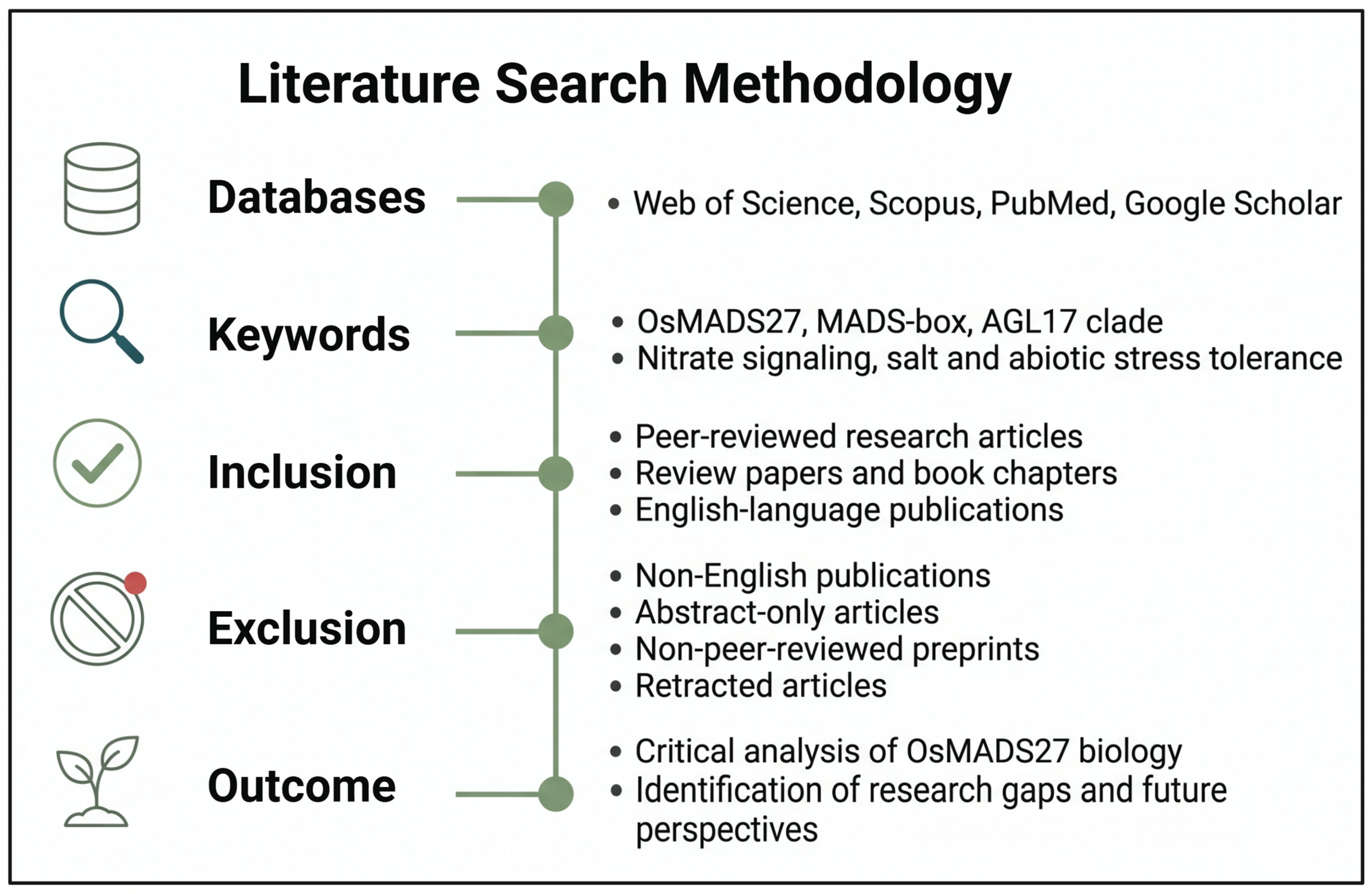
This review is based on a comprehensive literature survey conducted using the scientific databases Web of Science, Scopus, PubMed, and Google Scholar. The search focused on publications relevant to OsMADS27 and the AGL17 clade of MADS-box transcription factors, with foundational MADS-box studies also included when they provided significant mechanistic or evolutionary insights. Keywords used during the search included “OsMADS27,” “MADS-box,” “AGL17 clade,” “nitrate signaling,” “rice root development,” “salt tolerance,” “abiotic stress,” “miR444,” “OsHKT1;1,” and the names of related rice AGL17-clade genes (OsMADS23, OsMADS25, OsMADS57, OsMADS61). The selection covered a wide range of sources, including peer-reviewed primary research articles, review papers, and book chapters published in English. However, non-English publications, conference abstracts and posters lacking peer review, non-peer-reviewed preprints, and retracted articles, were excluded to maintain scientific rigor. The collected studies were critically analyzed to synthesize current knowledge on OsMADS27, with emphasis on its gene and protein structure, regulatory network, downstream targets, and emerging roles in nitrate signaling, root development, and abiotic stress tolerance, (Figure 1).

3. Overview of MADS-Box Transcription Factors

3.1. Discovery and General Features

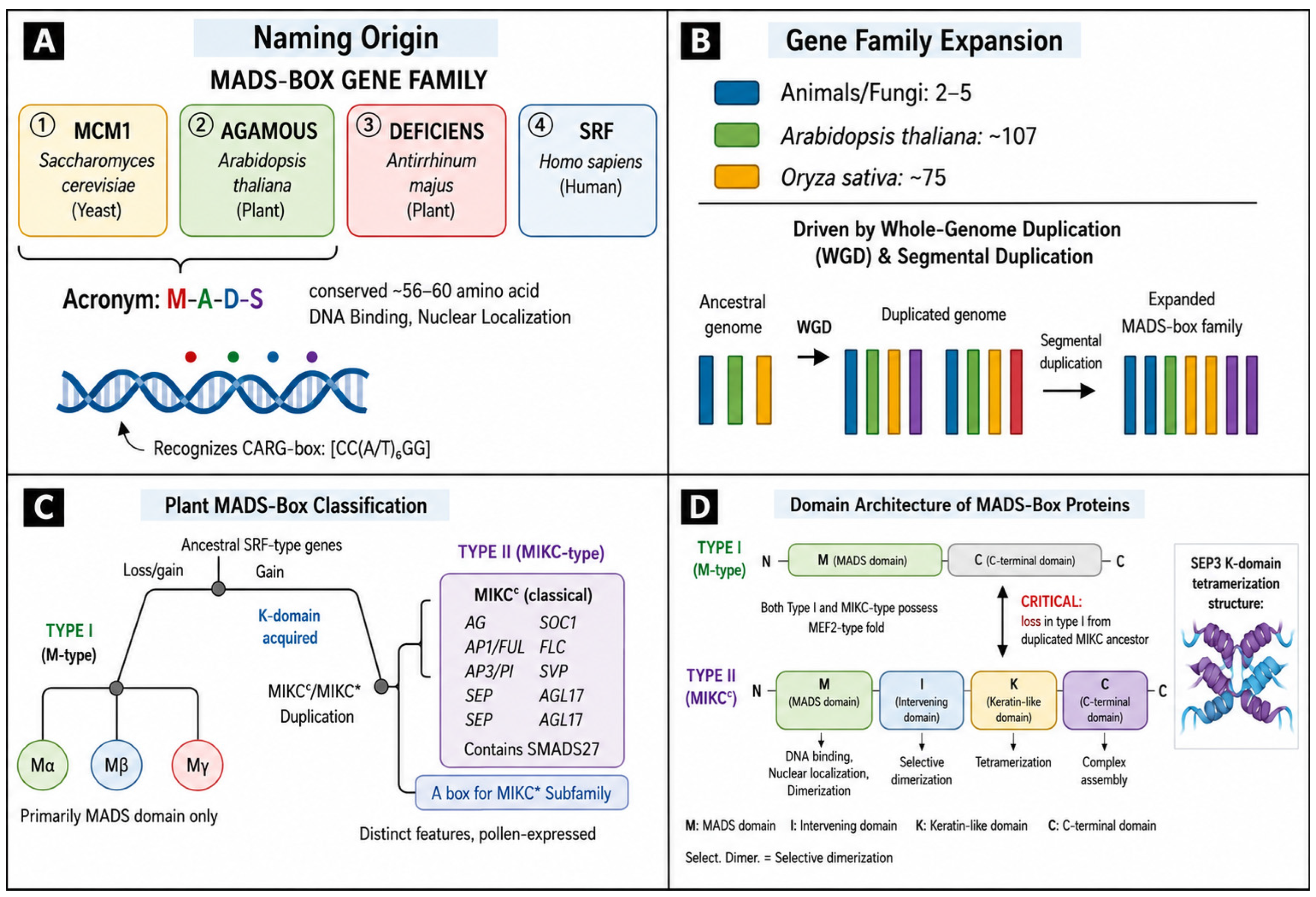
MADS-box genes encode one of the most ancient and functionally significant families of transcription factors in eukaryotes. The acronym “MADS” is derived from four founding members-MCM1 from yeast, AGAMOUS from Arabidopsis, DEFICIENS from Antirrhinum, and serum response factor from humans, as first described in early molecular studies of floral homeotic genes [13,14] (Figure 2A). The recognition that these four proteins share a highly conserved DNA-binding domain established the MADS-box gene family as a paradigm for understanding transcription factor evolution across eukaryotic lineages [15]. The hallmark of all MADS-box proteins is the MADS domain, a conserved region of approximately 56–60 amino acids responsible for DNA binding, nuclear localization, and dimerization. MADS-domain proteins function as dimers that recognize a short DNA consensus motif known as the CArG box [CC(A/T)6GG], where they contact the minor groove and induce DNA bending [16,17]. Although all family members share this core recognition element, individual MADS proteins achieve remarkable target-gene specificity through differences in flanking sequences, cooperative binding in higher-order complexes, and the contribution of accessory domains [18,19].
A striking feature of the MADS-box family is its differential expansion across kingdoms. Whereas animals and fungi typically harbor only 2–5 MADS-box genes per genome, flowering plant genomes may contain 100 or more members. For example, Arabidopsis thaliana contains 107 MADS-box genes [20], whereas Oryza sativa contains approximately 75 [4] (Figure 2B) [20,21]. This massive expansion, driven primarily by whole-genome and segmental duplications, has been closely linked to the increasing complexity of the plant body plan and reproductive innovations [22]. Recent structural breakthroughs have deepened our understanding of MADS protein function. Puranik et al. [23] resolved the crystal structure of the K-domain of SEP3 at 2.5 angstrom resolution, revealing that the K-domain forms a coiled-coil tetramerization interface essential for floral quartet complex assembly. Complementing crystallographic data, AlphaFold2-based protein structure predictions supported the model that each plant MADS protein types resemble the MEF2-type fold rather than SRF, (AlphaFold2 method: Jumper et al. [24]; MADS-box application: Qiu et al. [22], consistent with a revised evolutionary model for the family that is still being integrated into the field.

3.2. Classification of MADS-Box Genes

Plant MADS-box genes are classified into two major types based on domain architecture and phylogenetic relationships. Type I genes (M-type) encode relatively short proteins containing primarily the MADS domain, typically lack introns, and are subdivided into three phylogenetic clades–Mα, Mβ, and Mγ (Figure 2C)–based on sequence divergence in C-terminal regions [20]. In Arabidopsis, Type I MADS-box genes constitute a substantial proportion of the family and are characterized by low and spatially restricted expression patterns, predominantly in female gametophytes and developing endosperm. These genes have undergone rapid birth-and-death evolution, with frequent lineage-specific duplications, pseudogenization, and gene loss [25]. Type II genes (MIKC-type named for the four characteristic domains, MADS (M), Intervening (I), Keratin-like (K), and C-terminal (C), arranged from the N- to C-terminus) encode larger, modular proteins with four defined domains: the M (MADS) domain for DNA binding, the I (Intervening) domain contributing to selective dimerization, the K (Keratin-like) domain mediating protein–protein interactions and tetramerization, and the C (C-terminal) domain involved in transcriptional activation and higher-order complex stabilization [26] (Figure 2D). Type II genes typically contain 5–8 exons and are further divided into two subtypes: MIKCc (“classic”) and MIKC* (“star”), which are distinguished by differences in K-domain length and intron–exon structure. MIKCc genes represent the extensively studied “classic” MADS-box genes encompassing all floral organ identity regulators and can be grouped into 12–13 conserved subfamilies including AG, AP1/FUL, AP3/PI, SEP, SOC1, FLC, and SVP [27]. MIKC* genes possess distinct structural features and are predominantly expressed in pollen, where they function as obligate heterodimers between P- and S-clade members to regulate male gametophyte development [28,29].
Recent phylogenomic studies have proposed substantial revisions to the evolutionary framework for MADS-box gene classification. Qiu et al. [22] demonstrated that both Type I and Type II genes are land-plant-specific MEF2 orthologs, proposing a revision of the long-held view that Type I genes were orthologous to animal SRF genes. Their analyses showed that ancestral SRF-type genes were lost in Archaeplastida, while the retained MEF2-type precursor acquired the K domain before streptophyte divergence; Type I genes subsequently arose through K-domain loss from a duplicated MIKC-type ancestor. Han et al. [30], analyzing 551 eukaryotic genomes, further proposed a polyphyletic origin for plant Type I genes and placed the MIKCc/MIKC* duplication in the stem group of streptophytes rather than in land plants, while also demonstrating that ancestral MIKCc proteins possessed sphere-like architectures that constrained tetramerization until C-terminal shortening in land plants enabled functional tetramer formation. These findings have been further supported by studies in ferns and non-seed plants [31], confirming that MIKC-type diversification preceded the origin of seeds, and represent recent proposals that, while strongly supported by phylogenomic sampling and structural predictions, are still being evaluated by the broader community. Where appropriate, we distinguish below between evidence-based inferences (sequence and phylogenomic analyses, AlphaFold2 predictions) and the evolutionary interpretations built upon them.

3.3. General Functions of MADS-Box Genes

MADS-box transcription factors play central roles in plant developmental transitions, particularly in floral organ identity. Their functions are best described by the ABC model and its extension, the ABCDE model, in which A-class (AP1), B-class (AP3/PI), C-class (AG), D-class (STK, SHP1/2), and E-class (SEP1—4) genes act combinatorially across floral whorls to specify sepals, petals, stamens, carpels, and ovules, with AP2 being the only non-MADS-box component [32]. The floral quartet model explains how these proteins assemble into tetrameric complexes that bind pairs of CArG-box motifs while looping intervening DNA, thereby achieving the combinatorial specificity required for organ identity determination [33,34]. Beyond flowers, MADS-box genes govern fruit development and ripening. In tomato, RIPENING INHIBITOR (RIN) acts as a master regulator of ethylene-dependent ripening by directly activating numerous ripening-related promoters [35,36], while FRUITFULL homologs (FUL1/FUL2) control valve development and cell-wall modification through formation of tetrameric complexes with RIN and TAGL1 [37].
MADS-box regulators also exert critical control over flowering time. SOC1 integrates photoperiod, vernalization, gibberellin, and thermosensory signals to promote the floral transition [38], whereas FLC and SVP form repressive complexes that maintain vegetative growth until environmental cues, particularly prolonged cold during vernalization, silence FLC through Polycomb-mediated H3K27me3 deposition [38,39]. Temperature-dependent regulation involves FLM alternative splicing, producing competing FLM-β and FLM-δ variants that modulate SVP-repressor activity [40,41]. In root systems, the AGL17-clade members ANR1, AGL21, and AGL17 regulate lateral root architecture in response to nitrogen availability; ANR1 promotes lateral root elongation under localized nitrate supply [42,43], and other root-expressed MADS-box genes including AGL12/XAL1 regulate root meristem cell proliferation and flowering transition [44]. Emerging evidence now extends MADS-box functions to abiotic stress tolerance, with genome-wide analyses across diverse crops consistently identifying stress-responsive members induced by drought, salinity, cold, and heat [45,46,47]. These observations on AGL17-clade root regulators provide the immediate evolutionary and functional context for the present review’s focus on OsMADS27 in rice, which is taken up in Section 4.

4. Gene Structure and Characteristics of MADS-Box 27

4.1. Gene Organization

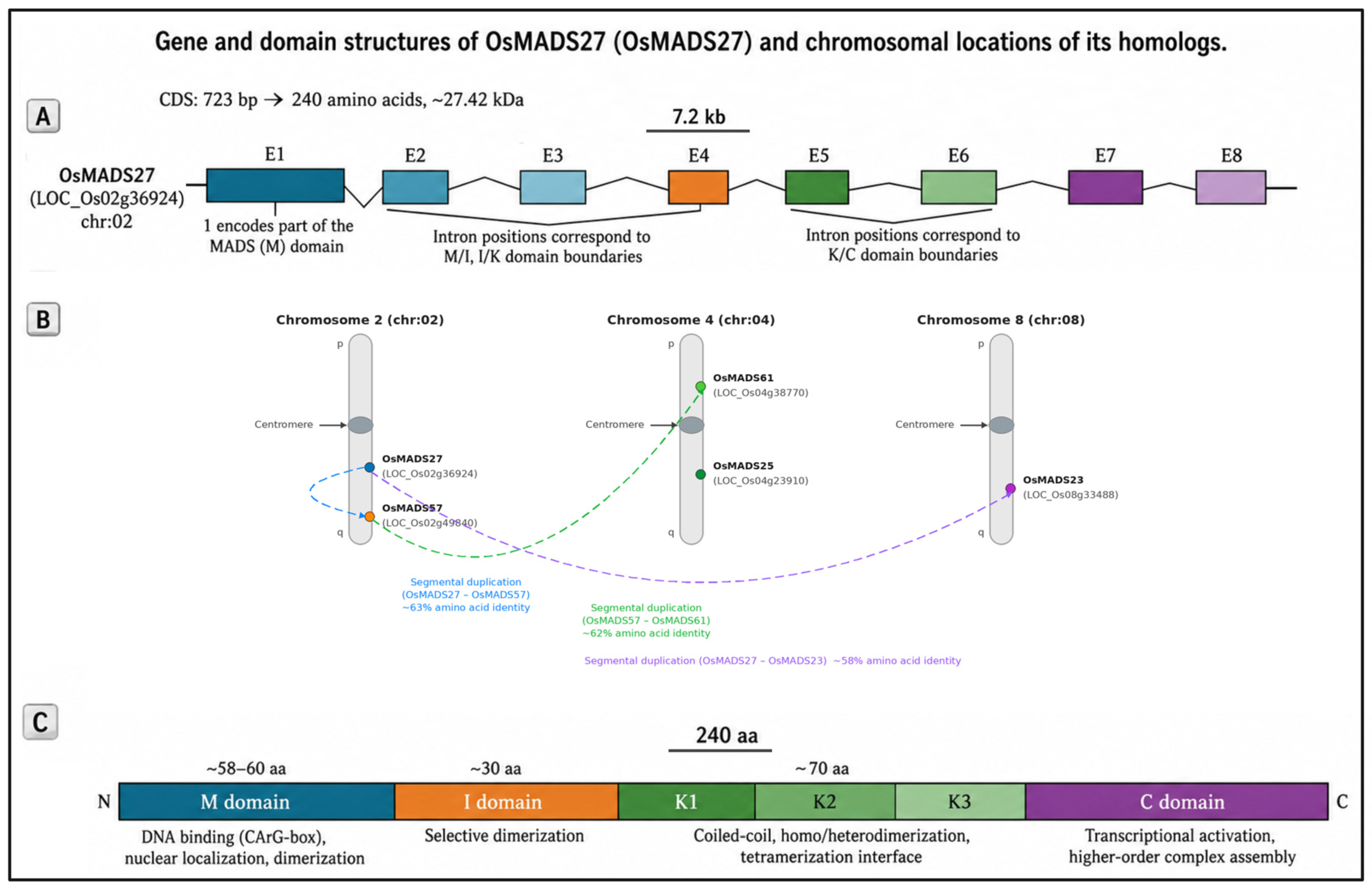
OsMADS27 (MSU locus LOC_Os02g36924; RAP-DB locus Os02g0579600; MSU Rice Genome Annotation Project release 7; RAP-DB Build 5) is located on the long arm of rice chromosome 2, spanning approximately 7.2 kb of genomic DNA (http://rice.uga.edu, accessed on 10 March 2026). The gene comprises eight exons and seven introns (Figure 3A,B). This eight-exon architecture is shared among three AGL17-clade members in rice OsMADS25, OsMADS27, and OsMADS57 each of which contains seven introns, whereas OsMADS23 has four introns and OsMADS61 has only two [4]. A comparative functional summary of these five AGL17-clade members is provided in Table 1. In MIKC-type genes, introns separate the coding sequences of the MADS, I, K, and C domains, with introns within the K-domain roughly corresponding to the borders of the K1, K2, and K3 subdomains [26]. Comparative analyses in wild emmer wheat have confirmed a mean of approximately 6.47 exons for MIKC-type genes in Triticum dicoccoides, underscoring the deep evolutionary conservation of this gene architecture across monocots [12]. The OsMADS27 coding sequence encodes a 240-amino-acid MADS-box transcription factor with a predicted molecular mass of ~27.4 kDa and a basic isoelectric point (~9.48) based on the protein sequence (UniProt Q6EP49), consistent with the full-length OsMADS27 cDNA used in functional studies of the miR444-OsMADS27 regulatory module in rice [6]. Three distinct lines of evidence, assessed at distinct regulatory levels, have characterized OsMADS27 expression. First, at the transcriptional level, qRT-PCR analyses have demonstrated nitrate-induced upregulation of OsMADS27 transcript abundance, with no induction by KCl, NaCl, or NH4Cl alone. Second, at the cis-regulatory level, promoter::GUS reporter analyses [5] have demonstrated promoter activity preferentially in the root central cylinder. Third, at the subcellular level, OsMADS27pro:OsMADS27-GFP transgenic plants [7] have shown that OsMADS27 protein accumulates in nuclei only in the presence of KNO3. These three lines of evidence, transcript abundance, cis-regulatory promoter activity, and protein nuclear accumulation, together establish that OsMADS27 is regulated at multiple, distinct levels by nitrate.

4.2. Protein Structure

MIKC-type MADS-box proteins possess a conserved domain architecture consisting of MADS, intervening (I), K, and C-terminal domains arranged from the N- to C-terminus (Figure 3C). The MADS domain, located at the N-terminus, is approximately 58 amino acids long, and represents the most highly conserved DNA-binding region of the MADS-box family [55]. This domain mediates DNA binding to CArG-box motifs and contributes to protein dimerization [26], and contains a nuclear localization signal [55]. The adjacent Intervening (I) domain (~30 amino acids) contributes to selective dimerization and modulates DNA-binding activity [56].
The keratin-like (K) domain (~70 amino acids) consists of two amphipathic α-helices separated by a rigid kink, forming coiled-coil structures essential for homo- and heterodimerization as well as tetramerization, as demonstrated by the crystal structure of SEP3 [23]. The K domain comprises three heptad-repeat subdomains (K1, K2, K3) [26]. Puig et al. [5] showed that OsMADS27 contains both MADS-box and K-box domains, which are characteristic features of MADS-box transcription factors. A particularly distinctive feature of the OsMADS27 protein is its nitrate-dependent nuclear localization. Using OsMADS27pro: OsMADS27-GFP transgenic plants, Alfatih et al. [7] demonstrated that green fluorescent protein signal accumulated in nuclei only in the presence of KNO3, and was absent under KCl, NH4Cl, or NaCl conditions alone. Nuclear localization was restored when NaCl was co-supplied with nitrate, creating a molecular switch that links salt tolerance activation to nitrogen nutritional status. OsMADS27 targets can be classified into three categories of evidence. (i) Direct functionally validated targets, bound by ChIP-qPCR/EMSA and independently validated by transactivation or genetic complementation, currently include OsHKT1;1 and OsSPL7 in the salt-tolerance context [7], OsMADS57 in the root-development context [48]. (ii) ChIP-bound targets, for which protein–DNA association is documented but functional regulation has not been independently confirmed, include the expansion gene OsEXPA17, OsJAZ10, OsNRT2.3, and OsNAR2.1 [6]. Differentially expressed genes in OsMADS27 overexpression lines, which may include indirect targets, include OsHKT2;3, OsKAT3, and OsCAM1-1 [7], as well as the nitrogen-responsive genes OsNAR2.1 and OsNRT2.3b [6]. Yeast two-hybrid and bimolecular fluorescence complementation assays demonstrated that OsMADS27 physically interacts with OsSLR1 (a DELLA protein), which in turn forms complexes with OsABI5, thereby linking nitrate signaling with the ABA pathway [57].

5. Expression Pattern of OsMADS27

5.1. Tissue-Specific Expression

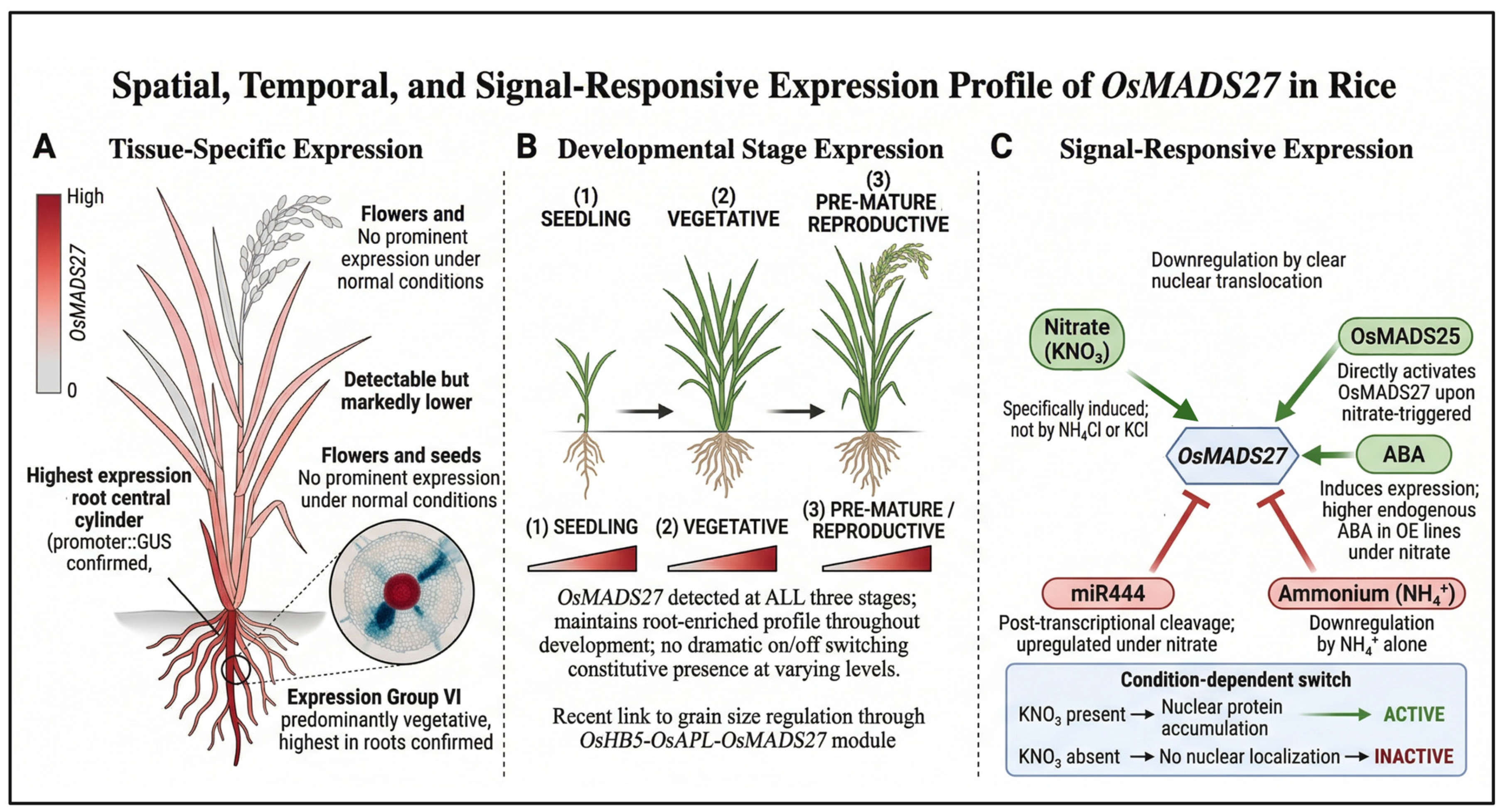
OsMADS27 exhibits a root-enriched expression pattern, with particularly strong transcript accumulation in the root central cylinder, and detectable expression in leaves and leaf sheaths; expression in flowers and developing seeds is minimal under normal conditions. Quantitative RT-PCR and promoter::GUS reporter analyses [5,7] showed that OsMADS27 transcript levels are highest in roots, with the strongest GUS signal in the root stele. We therefore describe the expression pattern as root-enriched, rather than root-specific, throughout this review. Puig et al. (2013) [5] first demonstrated this through promoter: GUS reporter fusions for all five AGL17-clade members in rice, revealing that four of five promoters, OsMADS23, OsMADS25, OsMADS27, and OsMADS57, were active in the root central cylinder, though only three showed root-specific expression, with OsMADS57 also active in leaves; OsMADS61 was expressed in leaf tips and the stem base. Subsequent qRT-PCR analyses confirmed OsMADS27 expression at much higher levels in roots, leaves, and sheaths compared with other tissues, while GUS staining showed a particularly strong signal in the root stele (Figure 4A) [7]. This root-enriched pattern is broadly consistent with the expression of AGL17-clade members in Arabidopsis, where AGL17 and AGL21 are expressed in distinct root spatial domains: AGL17 in the lateral root cap and epidermis, and AGL21 in lateral root primordia and the central cylinder of differentiated roots [58]. AGL12, which belongs to the AG clade rather than the AGL17 clade, is similarly expressed in root tissues, including the primary root meristem and the central cylinder [44,58]. No prominent OsMADS27 expression has been reported in flowers or seeds under normal conditions, as Arora et al. [4] classified OsMADS27 into expression Group VI, genes expressed predominantly in vegetative tissues. However, Zhang et al. [59] detected OsMADS27 expression in young developing spikelets and immature panicles at heading and early grain-filling stages, where it operates within the OsHB5, OsAPL, OsMADS27/OsWRKY102 regulatory module. The apparent absence of expression in mature seeds, therefore, does not preclude a transient regulatory role during early grain development.

5.2. Developmental Stage-Specific Expression

Systematic examination of OsMADS27 expression across three developmental stages, seedling, vegetative, and pre-reproductive, using both qRT-PCR and GUS reporter assays, revealed that OsMADS27 was detected at all three stages, maintaining its root-enriched profile throughout development [7] (Figure 4B). Specifically, Alfatih et al. [7] evaluated OsMADS27 expression at: (i) the seedling stage (14 days after germination, whole roots), (ii) the vegetative stage (30 days, primary and lateral roots), and (iii) the pre-reproductive stage (60 days, crown roots and young leaves), all grown under nitrate-sufficient conditions (5 mM KNO3). Expression is markedly reduced under nitrogen starvation; the “detected at all three stages” finding therefore refers specifically to nitrate-sufficient conditions. The miR444-OsMADS27 signaling cascade was further characterized in seedling roots by Pachamuthu et al. [6], who demonstrated through degradome sequencing that OsMADS27 is the major miR444 target in this tissue. Chen et al. [57] independently established OsMADS27’s functional significance during seedling development by uncovering the OsMADS27-OsSLR1 OsABI5-signaling bridge-linking nitrate perception to ABA-mediated responses. No study has reported dramatic on/off switching between developmental stages; rather, OsMADS27 appears constitutively expressed at varying levels throughout the plant life cycle, with higher expression in roots compared with other vegetative tissues [4].

5.3. Induced Expression Under Internal and External Signals

Among the upstream transcriptional regulators of OsMADS27, there is a nitrate-responsive transcription factor that directly binds nitrate-responsive elements (NREs) in the OsMADS27 promoter, providing a direct transcriptional link between nitrate sensing and OsMADS27 activation [7]. OsMADS27 expression is tightly controlled by nitrogen form. The gene is specifically induced by KNO3 but not by ammonium (NH4Cl), KCl, or NaCl, establishing its specific nitrate responsiveness [7]. Yu et al. [54] similarly showed upregulation upon NO3, and NH4NO3 resupply, with downregulation by NH4+ alone. At the post-transcriptional level, the monocot-specific miR444 [60] negatively regulates OsMADS27 by targeting its mRNA for cleavage, as confirmed by degradome sequencing [6,48]. Under nitrogen starvation, miR444 accumulation increases slightly, contributing to decreased OsMADS27 transcript levels [61], while under nitrate-limited conditions, this suppression is more pronounced [6]. Upstream, OsMADS25 directly activates OsMADS27 transcription upon OsNAR2.1-facilitated nuclear translocation in response to nitrate [49]. Considered together, nitrate regulates OsMADS27 at three distinct levels: (i) transcriptionally, via direct binding to NREs in the OsMADS27 promoter and via OsMADS25-mediated activation; (ii) post-transcriptionally, via miR444-mediated cleavage, which is relieved under nitrate sufficiency; and (iii) post-translationally, via nitrate-dependent nuclear accumulation of OsMADS27 protein. Whether nitrate also affects OsMADS27 protein stability per se has not been directly tested and remains an open question. Overexpression of OsMADS27 leads to higher endogenous ABA accumulation under nitrate conditions, and the protein links nitrate signaling to the ABA pathway through physical interaction with the DELLA protein OsSLR1, which bridges the connection to OsABI5 [57]. Arabidopsis Achard et al. [62] showed that DELLA proteins integrate responses to environmentally activated phytohormonal signals, providing a broader framework for understanding how OsMADS27 may similarly bridge nitrate sensing and stress adaptation in rice (Figure 4C).

6. Biological Functions of OsMADS27 in Plants

6.1. Role in Plant Growth and Root Architecture

OsMADS27 functions primarily as a root-expressed regulator of vegetative growth in rice. Its expression is regulated by a hierarchical nitrate-signaling cascade: nitrate triggers OsNAR2.1-mediated nuclear translocation of OsMADS25, which then directly activates OsMADS27 transcription [49]. Constitutive overexpression (35S:OsMADS27) significantly inhibited primary root elongation while enhancing lateral root formation, both in a strictly nitrate-dependent manner [57]. Overexpression also promoted nitrate accumulation and upregulated nitrate transporter genes. Pachamuthu et al. [6] extended these findings, showing that miR444 target mimic plants exhibit longer primary roots, more lateral roots, and longer root hairs. Silencing OsMADS27 suppressed root growth, while overexpression of miR444-resistant OsMADS27 improved root development. These observations across systems appear divergent at first glance, primary root inhibition in one report [57] versus primary root elongation in another [6]. Several experimental differences likely account for the apparent divergence: (i) promoter strength and cleavage sensitivity, [57] used a 35S promoter driving wild-type cleavage-sensitive OsMADS27, whereas [6] used a Ubi1 promoter-driving miR444-resistant OsMADS27, likely yielding higher steady-state OsMADS27 protein in the latter; (ii) genetic background, japonica Nipponbare and ZH11 versus indica PB1; (iii) nitrate concentration, 1–5 mM KNO3 across published studies; (iv) plant age at phenotyping, 5–21 days after germination; and (v) measured root parameters, primary root length versus lateral root density, lateral root length, and root hair length. These findings parallel the role of ANR1 in Arabidopsis, where overexpression similarly increases lateral root number in a nitrate-dependent manner [63], and are consistent with the broader emerging role of MADS-box genes in root developmental programs [3,64].

6.2. Role in Flowering and Reproduction

No direct evidence currently links OsMADS27 to flowering in rice, consistent with its root-enriched expression. Any inference for a role in flowering can only be drawn from related AGL17-clade members in other species: Arabidopsis AGL17 promotes flowering in the photoperiod pathway via an FT-independent mechanism [65]; in soybean, GmAGL1 regulates floral organ identity and fruit dehiscence [66]; in maize, ZMM4 promotes the floral transition during inflorescence development [67]. Whether OsMADS27 has latent or indirect roles in rice flowering therefore remains an open question, and we list this as a research gap in Section 10.

6.3. Role in Fruit and Seed Development

A recent study reported that OsMADS27 positively regulates grain size in rice through the OsHB5-OsAPL-OsMADS27/OsWRKY102 regulatory module [59]. OsAPL, a MYB-family transcription factor, directly binds the OsMADS27 promoter as confirmed by ChIP-seq, EMSA, and ChIP-qPCR. The interaction between OsAPL and homeodomain protein OsHB5 enhances OsAPL’s regulatory effect on OsMADS27. Additional recent studies have expanded the repertoire of MADS-box gene functions in grain development: natural variation in OsMADS1 transcript splicing affects rice grain thickness by influencing monosaccharide loading to the endosperm [68], while a novel OsMPK6-OsMADS47-PPKL1/3 module controls grain shape and yield [69]. Separately, and in an experimentally distinct context, OsMADS27 overexpression increased grain yield under saline conditions when sufficient nitrate was supplied, in controlled-environment and small-scale outdoor saline-pot experiments. These yield gains were observed under salt stress and are mechanistically linked to ion homeostasis rather than to the grain-size pathway described above [7].

7. Experimental Evidence Supporting OsMADS27 Functions

A range of complementary experimental approaches has established the functions of OsMADS27; the study-by-study details are consolidated in Table 2, and only a concise overview is given here. Multiple gene-expression platforms have been employed to characterize OsMADS27. Quantitative RT-PCR has been used across all major studies, with Yu et al. [54] employing OsActin (Os03g0718100) as the normalization reference gene. Alfatih et al. [7] provided the most comprehensive experimental framework, including time-course qRT-PCR (0, 0.5, 3, 12, and 24 h) comparing KNO3, NH4Cl, NaCl, and KCl treatments; genome-wide DEG analysis comparing knockout versus wild-type and overexpression versus wild-type lines under both control and salt conditions; OsACTIN1-driven overexpression in the ZH11 background; CRISPR/Cas9-generated knockout mutants osmads27-1 and osmads27-2, both containing premature stop codons; ChIP-qPCR confirming direct binding to OsHKT1;1 and OsSPL7 promoters; and nitrate-dependent nuclear localization demonstrated via OsMADS27pro: OsMADS27-GFP confocal laser-scanning microscopy. Pachamuthu et al. [6] performed RNA-seq on miR444-resistant OsMADS27 overexpression (OE-OsM27R) root tissues in the indica cultivar PB1, and conducted genome-wide ChIP-seq using a separate 3×Myc-OsMADS27 construct driven by the Ubi1 promoter. Promoter::GUS fusions were generated by [5] for all five AGL17-clade members, providing spatial resolution of expression patterns.
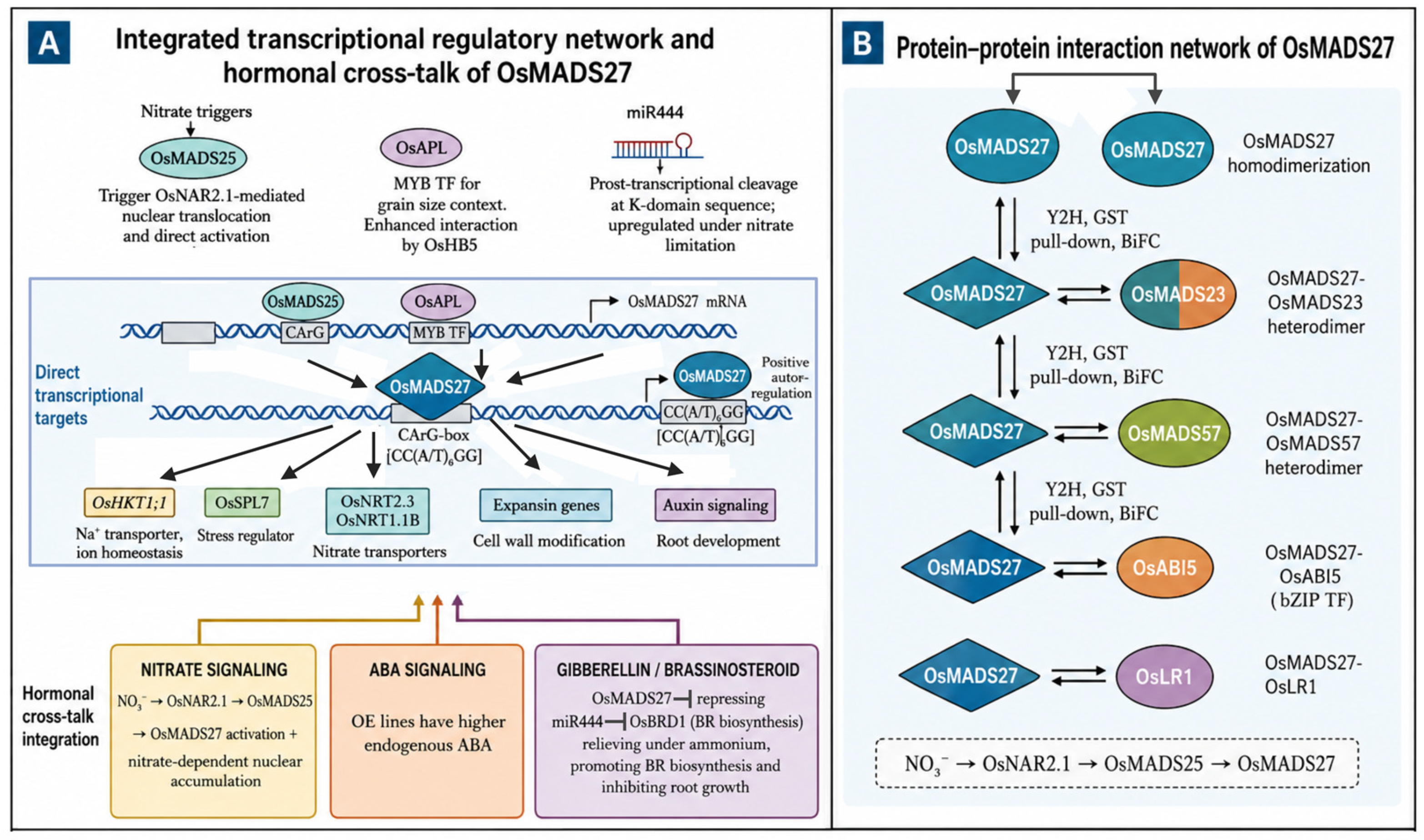
Three independent overexpression systems have been developed: 35S:OsMADS27 in Nipponbare [57], OsACTIN1::OsMADS27 in ZH11 [7], and Ubi1::Myc-OsMADS27 in indica rice PB1 [6]. Loss-of-function approaches include CRISPR/Cas9-generated knockout mutants [7] and OsMADS27-RNAi lines generated by Wu et al. [49] to confirm the OsMADS25, OsMADS27 genetic relationship. Protein interactions have been mapped through yeast two-hybrid assays confirming the OsMADS27, OsSLR1 interaction [57] and homodimer/heterodimer formation of OsMADS27 (referred to as OsMADS27a in that study) with OsMADS23 and OsMADS57, validated by GST pull-down and BiFC in planta [70] (Figure 5A,B). In the grain size regulatory context, EMSA demonstrated that the MYB-family transcription factor OsAPL directly binds to the OsMADS27 promoter, an interaction further confirmed by ChIP-seq and ChIP-qPCR [59]. CRISPR/Cas9 gene editing has also been successfully applied to other MADS-box genes in polyploid crops, including TM6 in octoploid strawberry [71], demonstrating the broader applicability of these functional genomic tools.
Table 2. Summary of key experimental studies on OsMADS27 functions and regulatory mechanisms. The table highlights the experimental approaches, major findings, and identified regulatory targets or signaling pathways.
StudyKey Experimental ApproachesMajor FindingsTargets/Pathways IdentifiedStudy Type
[7]CRISPR/Cas9 KO; OE lines; ChIP-qPCR; EMSA; RNA-seq; saline-soil pot and lysimeter trialsOsMADS27 expression requires nitrate; KO mutants are salt-hypersensitive; OE enhances salt tolerance and grain yield under saline-soil pot and lysimeter trialsOsNLP4 → OsMADS27 → OsHKT1;1/OsSPL7 (ion homeostasis); ABA pathway genesPrimary research (saline-soil pot)
[6]miR444 target mimic; miR444-resistant OsMADS27 OE; ChIP-seq; RNA-seq; degradome seq (cv. PB1)OsMADS27 is the predominant miR444 target in roots; genome-wide binding sites identified; OE improves root growth and stress tolerancemiR444 → OsMADS27; targets: OsEXPA17, OsJAZ10, NRT2.3b, NAR2.1Primary research
[49]ChIP-seq; Y1H; luciferase assay; OsMADS25-RNAi; OsNAR2.1 mutantsOsNAR2.1 facilitates OsMADS25 nuclear translocation under nitrate; OsMADS25 directly activates OsMADS27 transcriptionOsNAR2.1 → OsMADS25 → OsMADS27/OsARF7 signaling cascadePrimary research
[59]ChIP-seq; ChIP-qPCR; EMSA; protein interaction assays; grain phenotypingOsMADS27 positively regulates grain size; OsAPL directly binds and represses OsMADS27 promoter; OsHB5 enhances this repressionOsHB5–OsAPL → OsMADS27/OsWRKY102 grain size modulePrimary research
[48]Nuclear localization assays; OsMADS27 OE and KD; nitrate and salt treatments; qRT-PCROsNAR2.1 promotes nuclear accumulation of OsMADS27 in response to nitrate; OsMADS27 directly targets OsMADS57OsNAR2.1 → OsMADS27 nuclear import → OsMADS57 (root growth)Primary research
[57]35S::OsMADS27 OE; Y2H; BiFC; qRT-PCR (cv. Nipponbare)OE inhibits primary root elongation, promotes lateral roots (nitrate-dependent); enhances ABA sensitivity and salt toleranceOsMADS27–OsSLR1–OsABI5 protein complex (ABA cross-talk)Primary research
[72]EMSA; Y1H; ChIP-PCR; ammonium treatment experimentsAll five ANR1-types MADS proteins (incl. OsMADS27) repress OsBRD1; miR444 derepresses OsBRD1 under ammoniummiR444 → ANR1-type MADS → OsBRD1 (brassinosteroids pathway)Primary research

8. Applications of OsMADS27 in Plant Biotechnology and Crop Improvement

OsMADS27 represents a compelling candidate for molecular breeding programs targeting salt tolerance and nitrogen use efficiency (NUE) in rice. Its position within the OsNAR2.1→OsMADS25→OsMADS27→OsHKT1;1 regulatory module provides a clear genetic target for marker-assisted selection. The HKT transporter family has long been recognized as central to salinity resistance in both Arabidopsis and monocot crops [73,74], with the identification of SKC1 (OsHKT1;5) as a major quantitative trait locus for salt tolerance in rice establishing an early precedent [75]. The discovery that OsMADS27 directly activates OsHKT1;1 transcription provides a novel upstream regulatory handle for modulating this pathway. OsHKT1;1 itself reduces Na+ accumulation in shoots under salt stress through phloem-mediated Na+ recirculation [76]. Overexpression of OsMADS27 promotes nitrate accumulation and upregulates nitrate transporter gene expression [48], suggesting a role in NUE improvement.
The most direct evidence for agronomic utility comes from the demonstration that OsMADS27 overexpression increased grain yield under salt stress in the presence of sufficient nitrate [7]. CRISPR/Cas9 technology has already been successfully applied to generate osmads27-1 and osmads27-2 knockout mutants, confirming the gene’s essential role in salt tolerance [7]. As a future direction, promoter engineering, such as editing regulatory motifs in the OsMADS27 promoter, may help fine-tune expression levels and could reduce pleiotropic effects relative to constitutive overexpression, although this hypothesis requires empirical validation in independent transgenic lines and across genotypes. The contrasting roles of AGL17-clade members, OsMADS27 positive for salt [7], OsMADS26 negative for drought [77], OsMADS57 positive for cold [51], suggest that combinatorial breeding strategies could achieve multi-stress tolerance [68]. The OsHB5-OsAPL-OsMADS27/OsWRKY102 grain size module further expands OsMADS27’s relevance to yield improvement independent of stress [59]. Genome-wide analyses in barley and common bean have identified MADS-box members as stress-responsive targets for crop improvement [11,45].

9. Role of OsMADS27 in Abiotic Stress

MADS-box transcription factors, once considered primarily developmental regulators, are now recognized as key nodes in abiotic stress signaling networks. Castelán-Muñoz et al. [78] systematically reviewed the involvement of multiple MADS-box genes in drought, salt, cold, heat, and oxidative stress across plant species. Recent comprehensive analyses have confirmed that MADS-box TFs mediate plant adaptation through regulation of proline accumulation, ROS scavenging, ABA biosynthesis, and ion homeostasis across both monocots and dicots [79]. The AGL17 clade, to which OsMADS27 belongs, is particularly associated with nutrient–stress integration, making OsMADS27 a compelling focal point for understanding how transcriptional regulators bridge developmental programming and environmental adaptation (Figure 5).
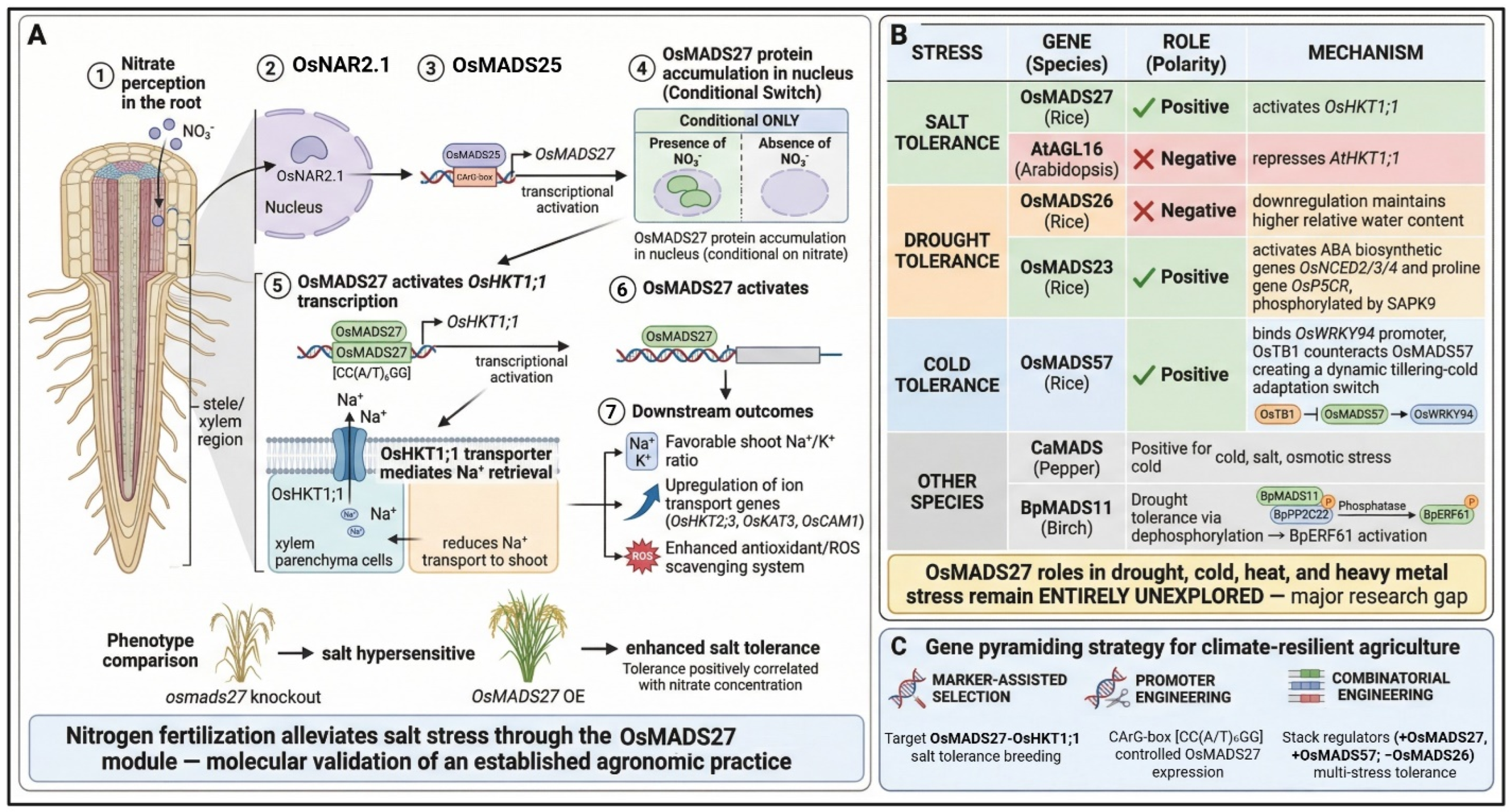
Salinity represents OsMADS27’s best-characterized stress function. Reference [7] established that OsMADS27 confers nitrate-dependent salt tolerance through a multi-layered mechanism. Knockout mutants exhibit salt hypersensitivity, while overexpression lines show enhanced tolerance positively correlated with nitrate concentration. Mechanistically, OsMADS27 directly activates OsHKT1;1 transcription. To clarify paralog-specific roles: OsHKT1;5 (encoded by SKC1) is a root-stele Na+ transporter that retrieves Na+ from the xylem stream, reducing Na+ delivery to shoots; OsHKT1;1 is expressed in the phloem of mature leaves and roots, and mediates Na+ recirculation from shoots back to roots, reducing shoot Na+ accumulation; and OsHKT2;3 is a K+-selective transporter. OsMADS27 directly activates OsHKT1;1 to facilitate Na+ recirculation, while no direct regulation of OsHKT1;5 by OsMADS27 has been reported. Transcriptomic analyses revealed that key ion transport genes, including OsHKT2;3, OsKAT3, and OsCAM1, were significantly downregulated in knockout mutants but upregulated in overexpression lines under salt stress [7]. The OsNAR2.1→OsMADS25→OsMADS27→OsHKT1;1 cascade integrates nitrate perception with ion homeostasis [49] (Figure 6A). Chen et al. [57] had shown earlier that OsMADS27 overexpression enhanced salt tolerance through the ABA pathway, with the OsMADS27, OsSLR1, OsABI5 complex linking nitrate signaling to ABA-mediated stress responses (Figure 6B). In Arabidopsis, the AGL17-clade member AGL16 functions as a negative regulator of salt tolerance by repressing AtHKT1;1, suggesting possible lineage-specific divergence in AGL17–HKT regulatory relationships between monocots and dicots; however, broader cross-species comparison, including in wheat, barley, and maize, will be required to evaluate the generality of this divergence [80].
OsMADS26, a stress-responsive MADS-box gene outside the AGL17 clade, serves as a negative regulator in rice, with OsMADS26-downregulated plants maintaining higher relative water content after water deprivation [77]. In contrast, OsMADS23 positively regulates drought tolerance by directly activating ABA biosynthetic genes OsNCED2, OsNCED3, OsNCED4 and the proline biosynthesis gene OsP5CR, with the SnRK2-type kinase SAPK9 phosphorylating OsMADS23 in an ABA-dependent manner [53]. A recent study in birch demonstrated that dephosphorylation of BpMADS11 by the PP2C phosphatase BpPP2C22 enhances its DNA-binding ability to activate BpERF61, conferring drought tolerance and establishing that post-translational modification of MADS-box proteins is a conserved mechanism in woody and herbaceous species alike [81]. While OsMADS27 has not been directly tested under drought conditions, its heterodimeric relationship with OsMADS23 and its role in ABA signaling suggest potential involvement that warrants investigation.
OsMADS57, closely related to OsMADS27 within the AGL17 clade, directly regulates cold tolerance in rice. L. Chen et al. [51] demonstrated that OsMADS57 binds the OsWRKY94 promoter, activating its transcription under chilling while suppressing it at normal temperatures. The osmads57-1 gain-of-function mutant showed enhanced cold tolerance. OsTB1 counteracts OsMADS57 by suppressing OsWRKY94, creating a dynamic regulatory switch between tillering and cold adaptation [51], building on the foundational OsMADS57, OsTB1, D14 tillering module characterized earlier [52]. Direct evidence for OsMADS27 in heat tolerance is currently absent. However, other MADS-box members participate in thermotolerance: in pepper, CaMADS has been identified as a positive regulator of cold, salt, and osmotic stress tolerance [82]. OsMADS27’s role in cold and heat stress remains unexplored and represents a significant research gap.
Transcriptomic analysis revealed that OsMADS27 overexpression upregulates antioxidant and stress-responsive genes under salt stress, contributing to enhanced ROS scavenging capacity [7]. The related OsMADS25 directly activates OsGST4, a key ROS detoxification enzyme, as confirmed by ChIP-seq, EMSA, Y1H, and luciferase assays [50]. DELLA proteins, which physically interact with OsMADS27, are themselves established modulators of ROS homeostasis under stress conditions [83]. The upregulation of calmodulin genes such as OsCAM1 in OsMADS27 overexpression lines [7] suggests a possible role for calcium signaling in mediating downstream stress responses, though this remains to be directly tested. In other species, Hui et al. [10] characterized MADS-box gene responses to combined drought and nickel stresses in dragon fruit, Mou et al. [46] identified peanut MADS-box genes responsive to multiple abiotic stresses, and Okay et al. [11] characterized MADS-box genes in common bean under drought. Collectively, these studies reveal that AGL17-clade members employ several conserved molecular mechanisms in stress responses: direct promoter binding to CArG-box motifs activates or represses stress-responsive targets, and ABA crosstalk is a recurring theme through phosphorylation-dependent stabilization and DELLA-mediated signaling. From a biotechnological perspective, the contrasting regulatory roles of AGL17-clade members suggest that breeding strategies integrating multiple MADS-box gene variants could achieve multi-stress resilience [68,84] (Figure 6C). Whether these themes apply specifically to OsMADS27 remains to be experimentally tested in rice, and the inferences should be treated as hypotheses guiding future work rather than as demonstrated OsMADS27 functions.

10. Research Gaps and Future Perspectives

Despite significant progress, several critical knowledge gaps remain in OsMADS27 research. First, functional characterization is limited almost exclusively to rice: while orthologs exist in wheat, barley, maize, and other cereals, no direct functional studies of OsMADS27 orthologs under salt stress have been conducted in any non-rice species. Extending these studies to wheat, maize, and sorghum is essential for translational impact, particularly given the significant expansion of AGL17-clade members in wheat.
Second, all existing OsMADS27 studies have been conducted under controlled laboratory or greenhouse conditions. Field-level validation of overexpression and knockout lines under natural saline environments with variable nitrogen supply is urgently needed. One study demonstrated successful field validation of OsMADS26-downregulated lines under both controlled and field conditions, providing a methodological template for OsMADS27 field trials.
Third, the upstream regulatory network remains incompletely characterized. While OsMADS25, miR444, and OsAPL-OsHB5 have been identified as direct regulators, other transcription factors, chromatin remodelers, and epigenetic modifiers influencing OsMADS27 expression remain unknown. The mechanistic basis of nitrate-dependent nuclear localization also requires elucidation. Fourth, multi-omics integration is conspicuously absent. No comprehensive study combining transcriptomics, proteomics, metabolomics, and epigenomics has been conducted on OsMADS27. Such approaches would reveal the complete set of direct versus indirect targets, post-translational modifications, and metabolic consequences beyond ion homeostasis. Single-cell RNA-seq could resolve cell-type-specific roles within root tissues. To effectively operationalize these multi-omic approaches, future studies should evaluate wild-type, osmads27 knockout, and overexpression lines under contrasting conditions of nitrate availability combined with salinity stress. This comparative experimental framework would clarify how OsMADS27 dynamically coordinates gene expression, protein modifications, and metabolic shifts under combined nutritional and environmental constraints.
Fifth, the downstream target repertoire is incomplete. Only OsHKT1;1 and OsSPL7 have been confirmed as direct targets specifically validated for salt tolerance, although genome-wide ChIP-seq has identified additional binding sites in the context of root development. Whether natural allelic variation in OsMADS27 contributes to differential salt tolerance among cultivars remains a promising but unexplored avenue for breeding applications. Finally, OsMADS27’s roles in drought, cold, heat, and heavy-metal stress remain entirely unexplored, despite evidence that closely related AGL17-clade members such as OsMADS23 and OsMADS57 function in these pathways.

11. Conclusions

OsMADS27 has emerged as a multifunctional MIKC-type MADS-box transcription factor in rice that integrates nitrate signaling with root development and salinity tolerance. Through direct regulation of OsHKT1;1 supported by ChIP-qPCR, EMSA, and transactivation reporter assays, and corroborated by differential expression in CRISPR/Cas9 knockout and overexpression lines, OsMADS27 contributes to root architecture, nitrate-responsive growth, ion homeostasis, and nitrate-dependent salt tolerance. Its activity is controlled by an elaborate regulatory network operating at transcriptional (OsMADS25), post-transcriptional (miR444), and post-translational (nitrate-dependent nuclear localization) levels, and is integrated with ABA signaling through the OsMADS27-OsSLR1-OsABI5 module. OsMADS27 is a promising target in rice for improving nitrogen-use efficiency, salinity tolerance, and yield stability; its translational relevance to other cereals remains to be validated through orthology analysis, functional characterization, and field-level evaluation in wheat, barley, maize, and other species. Future work integrating the operational multi-omic framework outlined above with rigorous open-field validation will be essential to determine whether the mechanistic promise of OsMADS27 in rice can be realized as a deployable breeding target.

Author Contributions

M.R., Writing—original draft, Investigation, Formal analysis, Conceptualization. A.S., Formal analysis, Conceptualization. B.A., Writing—review and editing, I.A., Visualization, Conceptualization. Y.G., Supervision, Investigation. All authors have read and agreed to the published version of the manuscript.

Funding

This research was funded by the National Natural Science Foundation of China (NSFC), grant number W2442012.

Data Availability Statement

No new data were created or analyzed in this study.

Conflicts of Interest

The authors declare no conflicts of interest.

References

  1. Baillo, E.H.; Kimotho, R.N.; Zhang, Z.; Xu, P. Transcription factors associated with abiotic and biotic stress tolerance and their potential for crops improvement. Genes 2019, 10, 771. [Google Scholar] [CrossRef]
  2. Feng, Y.; Xia, P. Heat Shock Transcription Factors as Integrative Hubs for Plant Stress Adaptation: Decoding Regulatory Networks Toward Climate-Resilient Crop Design. Plant Cell Environ. 2025, 48, 8985–9001. [Google Scholar] [CrossRef]
  3. Shah, L.; Sohail, A.; Ahmad, R.; Cheng, S.; Cao, L.; Wu, W. The roles of MADS-Box genes from root growth to maturity in Arabidopsis and rice. Agronomy 2022, 12, 582. [Google Scholar] [CrossRef]
  4. Arora, R.; Agarwal, P.; Ray, S.; Singh, A.K.; Singh, V.P.; Tyagi, A.K.; Kapoor, S. MADS-box gene family in rice: Genome-wide identification, organization and expression profiling during reproductive development and stress. BMC Genom. 2007, 8, 242. [Google Scholar] [CrossRef]
  5. Puig, J.; Meynard, D.; Khong, G.N.; Pauluzzi, G.; Guiderdoni, E.; Gantet, P. Analysis of the expression of the AGL17-like clade of MADS-box transcription factors in rice. Gene Expr. Patterns 2013, 13, 160–170. [Google Scholar] [CrossRef]
  6. Pachamuthu, K.; Hari Sundar, V.; Narjala, A.; Singh, R.R.; Das, S.; Avik Pal, H.C.; Shivaprasad, P.V. Nitrate-dependent regulation of miR444-OsMADS27 signalling cascade controls root development in rice. J. Exp. Bot. 2022, 73, 3511–3530. [Google Scholar] [CrossRef] [PubMed]
  7. Alfatih, A.; Zhang, J.; Song, Y.; Jan, S.U.; Zhang, Z.-S.; Xia, J.-Q.; Zhang, Z.-Y.; Nazish, T.; Wu, J.; Zhao, P.-X. Nitrate-responsive OsMADS27 promotes salt tolerance in rice. Plant Commun. 2023, 4, 100458. [Google Scholar] [CrossRef]
  8. Zhang, Z.; Zou, W.; Lin, P.; Wang, Z.; Chen, Y.; Yang, X.; Zhao, W.; Zhang, Y.; Wang, D.; Que, Y. Evolution and function of MADS-box transcription factors in plants. Int. J. Mol. Sci. 2024, 25, 13278. [Google Scholar] [CrossRef] [PubMed]
  9. Adhikari, P.B.; Kasahara, R.D. An overview on MADS box members in plants: A meta-review. Int. J. Mol. Sci. 2024, 25, 8233. [Google Scholar] [CrossRef] [PubMed]
  10. Hui, L.; Khan, D.; Khokhar, A.A.; You, Z.; Lv, W.; Usman, B.; Zaman, Q.U.; Wang, H.-F. Characterization of MADS-box gene family and its unique response to drought and nickel stresses with melatonin-mediated tolerance in dragon fruit (Selenicereus undatus L.). Plant Stress 2024, 12, 100492. [Google Scholar]
  11. Okay, A.; Kırlıoğlu, T.; Durdu, Y.Ş.; Akdeniz, S.Ş.; Büyük, İ.; Aras, E.S. Omics approaches to understand the MADS-box gene family in common bean (Phaseolus vulgaris L.) against drought stress. Protoplasma 2024, 261, 709–724. [Google Scholar] [CrossRef]
  12. Mirzaghaderi, G. Genome-wide analysis of MADS-box transcription factor gene family in wild emmer wheat (Triticum turgidum subsp. dicoccoides). PLoS ONE 2024, 19, e0300159. [Google Scholar] [CrossRef]
  13. Schwarz-Sommer, Z.; Huijser, P.; Nacken, W.; Saedler, H.; Sommer, H. Genetic control of flower development by homeotic genes in Antirrhinum majus. Science 1990, 250, 931–936. [Google Scholar] [CrossRef]
  14. Sommer, H.; Beltran, J.-P.; Huijser, P.; Pape, H.; Lönnig, W.-E.; Saedler, H.; Schwarz-Sommer, Z. Deficiens, a homeotic gene involved in the control of flower morphogenesis in Antirrhinum majus: The protein shows homology to transcription factors. EMBO J. 1990, 9, 605–613. [Google Scholar] [CrossRef] [PubMed]
  15. Gramzow, L.; Ritz, M.S.; Theißen, G. On the origin of MADS-domain transcription factors. Trends Genet. 2010, 26, 149–153. [Google Scholar] [CrossRef] [PubMed]
  16. Fatima, M.; Ma, X.; Zhang, J.; Ming, R. Genome-wide analysis of MADS-box genes and their expression patterns in unisexual flower development in dioecious spinach. Sci. Rep. 2024, 14, 18635. [Google Scholar]
  17. Käppel, S.; Rümpler, F.; Theißen, G. Cracking the floral quartet code: How do multimers of MIKCC-type MADS-domain transcription factors recognize their target genes? Int. J. Mol. Sci. 2023, 24, 8253. [Google Scholar] [CrossRef]
  18. Aerts, N.; de Bruijn, S.; van Mourik, H.; Angenent, G.C.; van Dijk, A.D. Comparative analysis of binding patterns of MADS-domain proteins in Arabidopsis thaliana. BMC Plant Biol. 2018, 18, 131. [Google Scholar] [CrossRef]
  19. Rümpler, F.; Tessari, C.; Gramzow, L.; Gafert, C.; Blohs, M.; Theißen, G. The origin of floral quartet formation—Ancient exon duplications shaped the evolution of MIKC-type MADS-domain transcription factor interactions. Mol. Biol. Evol. 2023, 40, msad088. [Google Scholar] [CrossRef]
  20. Parenicová, L.; De Folter, S.; Kieffer, M.; Horner, D.S.; Favalli, C.; Busscher, J.; Cook, H.E.; Ingram, R.M.; Kater, M.M.; Davies, B. Molecular and phylogenetic analyses of the complete MADS-box transcription factor family in Arabidopsis: New openings to the MADS world. Plant Cell 2003, 15, 1538–1551. [Google Scholar] [CrossRef]
  21. Tahmasebi, S.; Jonoubi, P.; Majdi, M.; Majd, A.; Heidari, P. Genome-wide characterization and expression profiling of MADS-box family genes during organ development and drought stress in Camelina sativa L. Sci. Rep. 2025, 15, 9327. [Google Scholar]
  22. Qiu, Y.; Li, Z.; Walther, D.; Köhler, C. Updated phylogeny and protein structure predictions revise the hypothesis on the origin of MADS-box transcription factors in land plants. Mol. Biol. Evol. 2023, 40, msad194. [Google Scholar] [CrossRef]
  23. Puranik, S.; Acajjaoui, S.; Conn, S.; Costa, L.; Conn, V.; Vial, A.; Marcellin, R.; Melzer, R.; Brown, E.; Hart, D. Structural basis for the oligomerization of the MADS domain transcription factor SEPALLATA3 in Arabidopsis. Plant Cell 2014, 26, 3603–3615. [Google Scholar] [CrossRef]
  24. Jumper, J.; Evans, R.; Pritzel, A.; Green, T.; Figurnov, M.; Ronneberger, O.; Tunyasuvunakool, K.; Bates, R.; Žídek, A.; Potapenko, A. Highly accurate protein structure prediction with AlphaFold. Nature 2021, 596, 583–589. [Google Scholar] [CrossRef]
  25. Qiu, Y.; Köhler, C. Endosperm evolution by duplicated and neofunctionalized type I MADS-box transcription factors. Mol. Biol. Evol. 2022, 39, msab355. [Google Scholar]
  26. Kaufmann, K.; Melzer, R.; Theißen, G. MIKC-type MADS-domain proteins: Structural modularity, protein interactions and network evolution in land plants. Gene 2005, 347, 183–198. [Google Scholar]
  27. Becker, A.; Theißen, G. The major clades of MADS-box genes and their role in the development and evolution of flowering plants. Mol. Phylogenet. Evol. 2003, 29, 464–489. [Google Scholar] [PubMed]
  28. Kwantes, M.; Liebsch, D.; Verelst, W. How MIKC* MADS-Box Genes Originated and Evidence for Their Conserved Function Throughout the Evolution of Vascular Plant Gametophytes. Mol. Biol. Evol. 2011, 29, 293–302. [Google Scholar] [CrossRef]
  29. Verelst, W.; Twell, D.; de Folter, S.; Immink, R.; Saedler, H.; Münster, T. MADS-complexes regulate transcriptome dynamics during pollen maturation. Genome Biol. 2007, 8, R249. [Google Scholar] [CrossRef] [PubMed]
  30. Han, J.-P.; Wan, J.-N.; Guan, Z.-L.; Xu, H.; Wang, Q.-F.; Wan, T. The origin, evolution, and diversification of MADS-box transcription factors in green plants. Plant Commun. 2025, 6, 101462. [Google Scholar] [CrossRef] [PubMed]
  31. Zhang, R.; Zhang, J.; Xu, Y.-X.; Sun, J.-M.; Dai, S.-J.; Shen, H.; Yan, Y.-H. Dynamic evolution of MADS-box genes in extant ferns via large-scale phylogenomic analysis. Front. Plant Sci. 2024, 15, 1410554. [Google Scholar]
  32. Bowman, J.L.; Moyroud, E. Reflections on the ABC model of flower development. Plant Cell 2024, 36, 1334–1357. [Google Scholar] [CrossRef]
  33. Theißen, G.; Melzer, R.; Rümpler, F. MADS-domain transcription factors and the floral quartet model of flower development: Linking plant development and evolution. Development 2016, 143, 3259–3271. [Google Scholar] [CrossRef] [PubMed]
  34. Smaczniak, C.; Immink, R.G.; Muiño, J.M.; Blanvillain, R.; Busscher, M.; Busscher-Lange, J.; Dinh, Q.; Liu, S.; Westphal, A.H.; Boeren, S. Characterization of MADS-domain transcription factor complexes in Arabidopsis flower development. Proc. Natl. Acad. Sci. USA 2012, 109, 1560–1565. [Google Scholar] [CrossRef]
  35. Vrebalov, J.; Ruezinsky, D.; Padmanabhan, V.; White, R.; Medrano, D.; Drake, R.; Schuch, W.; Giovannoni, J. A MADS-box gene necessary for fruit ripening at the tomato ripening-inhibitor (rin) locus. Science 2002, 296, 343–346. [Google Scholar]
  36. Fujisawa, M.; Nakano, T.; Shima, Y.; Ito, Y. A large-scale identification of direct targets of the tomato MADS box transcription factor RIPENING INHIBITOR reveals the regulation of fruit ripening. Plant Cell 2013, 25, 371–386. [Google Scholar] [CrossRef] [PubMed]
  37. Fujisawa, M.; Shima, Y.; Nakagawa, H.; Kitagawa, M.; Kimbara, J.; Nakano, T.; Kasumi, T.; Ito, Y. Transcriptional regulation of fruit ripening by tomato FRUITFULL homologs and associated MADS box proteins. Plant Cell 2014, 26, 89–101. [Google Scholar] [CrossRef] [PubMed]
  38. Hepworth, S.R.; Valverde, F.; Ravenscroft, D.; Mouradov, A.; Coupland, G. Antagonistic regulation of flowering-time gene SOC1 by CONSTANS and FLC via separate promoter motifs. EMBO J. 2002, 21, 4327–4337. [Google Scholar] [CrossRef]
  39. Deng, W.; Ying, H.; Helliwell, C.A.; Taylor, J.M.; Peacock, W.J.; Dennis, E.S. FLOWERING LOCUS C (FLC) regulates development pathways throughout the life cycle of Arabidopsis. Proc. Natl. Acad. Sci. USA 2011, 108, 6680–6685. [Google Scholar]
  40. Posé, D.; Verhage, L.; Ott, F.; Yant, L.; Mathieu, J.; Angenent, G.C.; Immink, R.G.; Schmid, M. Temperature-dependent regulation of flowering by antagonistic FLM variants. Nature 2013, 503, 414–417. [Google Scholar] [CrossRef]
  41. Lee, J.H.; Yoo, S.J.; Park, S.H.; Hwang, I.; Lee, J.S.; Ahn, J.H. Role of SVP in the control of flowering time by ambient temperature in Arabidopsis. Genes Dev. 2007, 21, 397–402. [Google Scholar] [CrossRef]
  42. Zhang, H.; Jennings, A.; Barlow, P.W.; Forde, B.G. Dual pathways for regulation of root branching by nitrate. Proc. Natl. Acad. Sci. USA 1999, 96, 6529–6534. [Google Scholar] [PubMed]
  43. Zhang, H.; Forde, B.G. An Arabidopsis MADS box gene that controls nutrient-induced changes in root architecture. Science 1998, 279, 407–409. [Google Scholar] [CrossRef]
  44. Tapia-López, R.; García-Ponce, B.; Dubrovsky, J.G.; Garay-Arroyo, A.; Pérez-Ruíz, R.V.; Kim, S.-H.; Acevedo, F.; Pelaz, S.; Alvarez-Buylla, E.R. An AGAMOUS-related MADS-box gene, XAL1 (AGL12), regulates root meristem cell proliferation and flowering transition in Arabidopsis. Plant Physiol. 2008, 146, 1182–1192. [Google Scholar]
  45. Wang, F.; Zhou, Z.; Zhu, L.; Gu, Y.; Guo, B.; Lv, C.; Zhu, J.; Xu, R. Genome-wide analysis of the MADS-box gene family involved in salt and waterlogging tolerance in barley (Hordeum vulgare L.). Front. Plant Sci. 2023, 14, 1178065. [Google Scholar]
  46. Mou, Y.; Yuan, C.; Sun, Q.; Yan, C.; Zhao, X.; Wang, J.; Wang, Q.; Shan, S.; Li, C. MIKC-type MADS-box transcription factor gene family in peanut: Genome-wide characterization and expression analysis under abiotic stress. Front. Plant Sci. 2022, 13, 980933. [Google Scholar] [CrossRef] [PubMed]
  47. Fan, C.-M.; Wang, X.; Wang, Y.-W.; Hu, R.-B.; Zhang, X.-M.; Chen, J.-X.; Fu, Y.-F. Genome-wide expression analysis of soybean MADS genes showing potential function in the seed development. PLoS ONE 2013, 8, e62288. [Google Scholar]
  48. Wu, J.; Yang, S.; Rehman, M.; Chen, N.; Liu, B.; Xu, G.; Fan, X.; Gan, Y. Nuclear Accumulation of OsMADS27 Was Promoted by OsNAR2. 1 in Response to Nitrate to Control Root Growth by Directly Targeting OsMADS57 in Rice. Physiol. Plant. 2025, 177, e70553. [Google Scholar] [CrossRef] [PubMed]
  49. Wu, J.; Yang, S.; Chen, N.; Jiang, Q.; Huang, L.; Qi, J.; Xu, G.; Shen, L.; Yu, H.; Fan, X. Nuclear translocation of OsMADS25 facilitated by OsNAR2. 1 in reponse to nitrate signals promotes rice root growth by targeting OsMADS27 and OsARF7. Plant Commun. 2023, 4, 100642. [Google Scholar]
  50. Xu, N.; Chu, Y.; Chen, H.; Li, X.; Wu, Q.; Jin, L.; Wang, G.; Huang, J. Rice transcription factor OsMADS25 modulates root growth and confers salinity tolerance via the ABA–mediated regulatory pathway and ROS scavenging. PLoS Genet. 2018, 14, e1007662. [Google Scholar]
  51. Chen, L.; Zhao, Y.; Xu, S.; Zhang, Z.; Xu, Y.; Zhang, J.; Chong, K. Os MADS 57 together with Os TB 1 coordinates transcription of its target Os WRKY 94 and D14 to switch its organogenesis to defense for cold adaptation in rice. New Phytol. 2018, 218, 219–231. [Google Scholar] [CrossRef] [PubMed]
  52. Guo, S.; Xu, Y.; Liu, H.; Mao, Z.; Zhang, C.; Ma, Y.; Zhang, Q.; Meng, Z.; Chong, K. The interaction between OsMADS57 and OsTB1 modulates rice tillering via DWARF14. Nat. Commun. 2013, 4, 1566. [Google Scholar] [CrossRef]
  53. Li, X.; Yu, B.; Wu, Q.; Min, Q.; Zeng, R.; Xie, Z.; Huang, J. OsMADS23 phosphorylated by SAPK9 confers drought and salt tolerance by regulating ABA biosynthesis in rice. PLoS Genet. 2021, 17, e1009699. [Google Scholar] [CrossRef] [PubMed]
  54. Yu, C.; Su, S.; Xu, Y.; Zhao, Y.; Yan, A.; Huang, L.; Ali, I.; Gan, Y. The effects of fluctuations in the nutrient supply on the expression of five members of the AGL17 clade of MADS-box genes in rice. PLoS ONE 2014, 9, e105597. [Google Scholar] [CrossRef]
  55. Gramzow, L.; Theissen, G. A hitchhiker’s guide to the MADS world of plants. Genome Biol. 2010, 11, 214. [Google Scholar] [CrossRef]
  56. Lai, X.; Vega-Léon, R.; Hugouvieux, V.; Blanc-Mathieu, R.; van Der Wal, F.; Lucas, J.; Silva, C.S.; Jourdain, A.; Muino, J.M.; Nanao, M.H. The intervening domain is required for DNA-binding and functional identity of plant MADS transcription factors. Nat. Commun. 2021, 12, 4760. [Google Scholar] [CrossRef]
  57. Chen, H.; Xu, N.; Wu, Q.; Yu, B.; Chu, Y.; Li, X.; Huang, J.; Jin, L. OsMADS27 regulates the root development in a NO3—Dependent manner and modulates the salt tolerance in rice (Oryza sativa L.). Plant Sci. 2018, 277, 20–32. [Google Scholar] [CrossRef]
  58. Burgeff, C.; Liljegren, S.J.; Tapia-López, R.; Yanofsky, M.F.; Alvarez-Buylla, E.R. MADS-box gene expression in lateral primordia, meristems and differentiated tissues of Arabidopsis thaliana roots. Planta 2002, 214, 365–372. [Google Scholar] [CrossRef] [PubMed]
  59. Zhang, H.; Liu, M.; Yin, K.; Liu, H.; Liu, J.; Yan, Z. A novel OsHB5-OsAPL-OsMADS27/OsWRKY102 regulatory module regulates grain size in rice. J. Plant Physiol. 2024, 295, 154210. [Google Scholar] [CrossRef]
  60. Sunkar, R.; Girke, T.; Jain, P.K.; Zhu, J.-K. Cloning and characterization of microRNAs from rice. Plant Cell 2005, 17, 1397–1411. [Google Scholar] [CrossRef]
  61. Yan, Y.; Wang, H.; Hamera, S.; Chen, X.; Fang, R. miR444a has multiple functions in the rice nitrate-signaling pathway. Plant J. 2014, 78, 44–55. [Google Scholar] [CrossRef] [PubMed]
  62. Achard, P.; Cheng, H.; De Grauwe, L.; Decat, J.; Schoutteten, H.; Moritz, T.; Van Der Straeten, D.; Peng, J.; Harberd, N.P. Integration of plant responses to environmentally activated phytohormonal signals. Science 2006, 311, 91–94. [Google Scholar] [CrossRef]
  63. Gan, Y.; Bernreiter, A.; Filleur, S.; Abram, B.; Forde, B.G. Overexpressing the ANR1 MADS-box gene in transgenic plants provides new insights into its role in the nitrate regulation of root development. Plant Cell Physiol. 2012, 53, 1003–1016. [Google Scholar] [CrossRef]
  64. Alvarez-Buylla, E.R.; García-Ponce, B.; Sánchez, M.d.l.P.; Espinosa-Soto, C.; García-Gómez, M.L.; Piñeyro-Nelson, A.; Garay-Arroyo, A. MADS-box genes underground becoming mainstream: Plant root developmental mechanisms. New Phytol. 2019, 223, 1143–1158. [Google Scholar] [CrossRef]
  65. Han, P.; García-Ponce, B.; Fonseca-Salazar, G.; Alvarez-Buylla, E.R.; Yu, H. AGAMOUS-LIKE 17, a novel flowering promoter, acts in a FT-independent photoperiod pathway. Plant J. 2008, 55, 253–265. [Google Scholar]
  66. Chi, Y.; Wang, T.; Xu, G.; Yang, H.; Zeng, X.; Shen, Y.; Yu, D.; Huang, F. GmAGL1, a MADS-box gene from soybean, is involved in floral organ identity and fruit dehiscence. Front. Plant Sci. 2017, 8, 175. [Google Scholar] [CrossRef] [PubMed]
  67. Danilevskaya, O.N.; Meng, X.; Selinger, D.A.; Deschamps, S.; Hermon, P.; Vansant, G.; Gupta, R.; Ananiev, E.V.; Muszynski, M.G. Involvement of the MADS-box gene ZMM4 in floral induction and inflorescence development in maize. Plant Physiol. 2008, 147, 2054–2069. [Google Scholar]
  68. Liu, R.; Zhao, D.; Li, P.; Xia, D.; Feng, Q.; Wang, L.; Wang, Y.; Shi, H.; Zhou, Y.; Chen, F. Natural variation in OsMADS1 transcript splicing affects rice grain thickness and quality by influencing monosaccharide loading to the endosperm. Plant Commun. 2025, 6, 101178. [Google Scholar]
  69. Fang, J.; Chun, Y.; Zhang, F.; Guo, T.; Ren, M.; Zhao, J.; Yuan, S.; Wang, W.; Li, Y.; Li, X. A Novel OsMPK6-OsMADS47-PPKL1/3 Module Controls Grain Shape and Yield in Rice. Adv. Sci. 2025, 12, e01946. [Google Scholar] [CrossRef]
  70. Wang, H.; Jiao, X.; Kong, X.; Hamera, S.; Wu, Y.; Chen, X.; Fang, R.; Yan, Y. A signaling cascade from miR444 to RDR1 in rice antiviral RNA silencing pathway. Plant Physiol. 2016, 170, 2365–2377. [Google Scholar] [CrossRef] [PubMed]
  71. Martín-Pizarro, C.; Triviño, J.C.; Posé, D. Functional analysis of the TM6 MADS-box gene in the octoploid strawberry by CRISPR/Cas9-directed mutagenesis. J. Exp. Bot. 2019, 70, 885–895. [Google Scholar] [CrossRef] [PubMed]
  72. Jiao, X.; Wang, H.; Yan, J.; Kong, X.; Liu, Y.; Chu, J.; Chen, X.; Fang, R.; Yan, Y. Promotion of BR biosynthesis by miR444 is required for ammonium-triggered inhibition of root growth. Plant Physiol. 2020, 182, 1454–1466. [Google Scholar] [CrossRef]
  73. Horie, T.; Hauser, F.; Schroeder, J.I. HKT transporter-mediated salinity resistance mechanisms in Arabidopsis and monocot crop plants. Trends Plant Sci. 2009, 14, 660–668. [Google Scholar] [CrossRef]
  74. Hamamoto, S.; Horie, T.; Hauser, F.; Deinlein, U.; Schroeder, J.I.; Uozumi, N. HKT transporters mediate salt stress resistance in plants: From structure and function to the field. Curr. Opin. Biotechnol. 2015, 32, 113–120. [Google Scholar] [CrossRef]
  75. Ren, Z.-H.; Gao, J.-P.; Li, L.-G.; Cai, X.-L.; Huang, W.; Chao, D.-Y.; Zhu, M.-Z.; Wang, Z.-Y.; Luan, S.; Lin, H.-X. A rice quantitative trait locus for salt tolerance encodes a sodium transporter. Nat. Genet. 2005, 37, 1141–1146. [Google Scholar] [CrossRef]
  76. Wang, R.; Jing, W.; Xiao, L.; Jin, Y.; Shen, L.; Zhang, W. The rice high-affinity potassium transporter1; 1 is involved in salt tolerance and regulated by an MYB-type transcription factor. Plant Physiol. 2015, 168, 1076–1090. [Google Scholar]
  77. Khong, G.N.; Pati, P.K.; Richaud, F.; Parizot, B.; Bidzinski, P.; Mai, C.D.; Bès, M.; Bourrié, I.; Meynard, D.; Beeckman, T. OsMADS26 negatively regulates resistance to pathogens and drought tolerance in rice. Plant Physiol. 2015, 169, 2935–2949. [Google Scholar] [CrossRef]
  78. Castelán-Muñoz, N.; Herrera, J.; Cajero-Sánchez, W.; Arrizubieta, M.; Trejo, C.; García-Ponce, B.; Sánchez, M.d.l.P.; Álvarez-Buylla, E.R.; Garay-Arroyo, A. MADS-box genes are key components of genetic regulatory networks involved in abiotic stress and plastic developmental responses in plants. Front. Plant Sci. 2019, 10, 853. [Google Scholar] [CrossRef]
  79. Liu, N.; Liu, Z.; Tian, G.; Zhao, S.; Chu, H.; Hu, Y.; Zhao, Y.; Zhang, Y.; Cheng, K.; Wang, D. Roles of MADS-box transcription factors in plant responses to abiotic and biotic stresses. Plant Commun. 2026, 7, 101778. [Google Scholar] [CrossRef] [PubMed]
  80. Zhao, P.X.; Zhang, J.; Chen, S.Y.; Wu, J.; Xia, J.Q.; Sun, L.Q.; Ma, S.S.; Xiang, C.B. Arabidopsis MADS-box factor AGL16 is a negative regulator of plant response to salt stress by downregulating salt-responsive genes. New Phytol. 2021, 232, 2418–2439. [Google Scholar]
  81. Zhao, H.; Jia, Y.; Niu, Y.; Wang, Y. The B p PP 2 C-B p MADS 11-B p ERF 61 signaling confers drought tolerance in Betula platyphylla. New Phytol. 2024, 244, 2364–2381. [Google Scholar] [CrossRef] [PubMed]
  82. Chen, R.; Ma, J.; Luo, D.; Hou, X.; Ma, F.; Zhang, Y.; Meng, Y.; Zhang, H.; Guo, W. CaMADS, a MADS-box transcription factor from pepper, plays an important role in the response to cold, salt, and osmotic stress. Plant Sci. 2019, 280, 164–174. [Google Scholar] [PubMed]
  83. Achard, P.; Renou, J.-P.; Berthomé, R.; Harberd, N.P.; Genschik, P. Plant DELLAs restrain growth and promote survival of adversity by reducing the levels of reactive oxygen species. Curr. Biol. 2008, 18, 656–660. [Google Scholar] [CrossRef] [PubMed]
  84. Wang, A.; Ding, C.; Hu, Y.; Qian, Q.; Ren, D. Regulatory mechanisms of MADS-box transcription factors in growth, development, and environmental stress-targeting increased rice yield. Curr. Plant Biol. 2025, 41, 100426. [Google Scholar] [CrossRef]
Figure 1. Flowchart of the literature search and selection process.
Agriculture 16 01296 g001
Figure 2. Overview of MADS-box transcription factors. (A) Origin of the MADS acronym from four founding members. (B) Differential gene family expansion across eukaryotic kingdoms. (C) Phylogenetic classification into Type I (M-type) and Type II (MIKC-type) lineages, showing the Mα, Mβ, and Mγ subclades of Type I, and the MIKCc (classic) and MIKC* subtypes of Type II. (D) Domain architecture of Type I and MIKC-type proteins, with MADS (M), Intervening (I), Keratin-like (K), and C-terminal (C) domains; the K-domain region shown in Type II represents the SEP3 K-domain tetramerization structure.
Agriculture 16 01296 g002
Figure 3. Gene and domain structures of OsMADS27 and chromosomal locations of its AGL17-clade homologs in rice. (A) Exon–intron structure of OsMADS27, comprising 8 exons spanning approximately 7.2 kb on chromosome 2. (B) Chromosomal locations and segmental duplication relationships among the five AGL17-clade members in the rice genome. (C) MIKC protein domain architecture showing the M, I, K (K1–K3), and C domains with their respective functions.
Agriculture 16 01296 g003
Figure 4. Spatial-, temporal-, and signal-responsive expression profile of OsMADS27. (A) Tissue-specific expression showing root-preferential pattern with highest levels in the root central cylinder. (B) Expression detected across seedling, vegetative, and pre-reproductive stages. (C) Signal-responsive regulation by nitrate (KNO3), OsMADS25, miR444, and ABA, illustrating the nitrate-dependent nuclear localization switch.
Agriculture 16 01296 g004
Figure 5. Regulatory network of OsMADS27. (A) Transcriptional regulatory network showing upstream regulators (OsMADS25, OsAPL, miR444) and downstream target categories. (B) Protein–protein interactions and hormonal cross-talk, including the OsMADS27–OsSLR1–OsABI5 complex and integration with nitrate, ABA, and gibberellin signaling.
Agriculture 16 01296 g005
Figure 6. Role of OsMADS27 and its orthologs/homologs in abiotic stress tolerance and crop improvement. (A) Nitrate-dependent salt tolerance mechanism mediated by the OsNAR2.1 OsMADS25-OsMADS27-OsHKT1;1 signaling cascade, showing phenotypic comparison between knockout and overexpression lines. (B) Comparative roles and mechanisms of AGL17-clade MADS-box genes across salt, drought, and cold stress in rice and other species. (C) Proposed gene pyramiding strategies for breeding climate-resilient crops using marker-assisted selection, promoter engineering, and combinatorial stacking of stress-tolerance genes. Panel (C) represents a future hypothesis and proposed application, not a validated conclusion.
Agriculture 16 01296 g006
Table 1. Functional comparisons of OsMADS27 and its closest homologs (AGL17-clade members) in rice (Oryza sativa).
GenePrimary Function and Stress RoleKey Regulatory Mechanism and TargetsEvidence TypeReference(s)
OsMADS27Root development; positive regulator of nitrate-dependent salt toleranceUpstream: miR444 (neg.), Targets: OsHKT1;1, OsSPL7, OsEXPA17OE + KO + ChIP-qPCR + EMSA[6,7,48]
OsMADS25Root growth promotion; salinity tolerance via ROS scavenging and ABA-mediated pathwaysNuclear translocation facilitated by OsNAR2.1 under nitrate. Directly activates OsMADS27, OsARF7, and OsGST4OE/RNAi + ChIP-seq + Y1H[49,50]
OsMADS57Tillering control; cold toleranceRepresses D14 (tillering); activates OsWRKY94 under cold. miR444-targeted. OsTB1 counteracts OsMADS57OE + Mutant + Binding Assays[51,52]
OsMADS23Drought and salt tolerance through ABA biosynthesis and proline accumulationSAPK9 phosphorylates and stabilizes OsMADS23. Targets: OsNCED2/3/4, OsP5CRPhosphorylation + Binding Assays[53]
OsMADS61Nitrogen starvation response; expressed in leaf tips and stem base (non-root)Regulated by nitrogen status; no experimentally verified targets or stress functionExpression data[5,54]
Disclaimer/Publisher’s Note: The statements, opinions and data contained in all publications are solely those of the individual author(s) and contributor(s) and not of MDPI and/or the editor(s). MDPI and/or the editor(s) disclaim responsibility for any injury to people or property resulting from any ideas, methods, instructions or products referred to in the content.