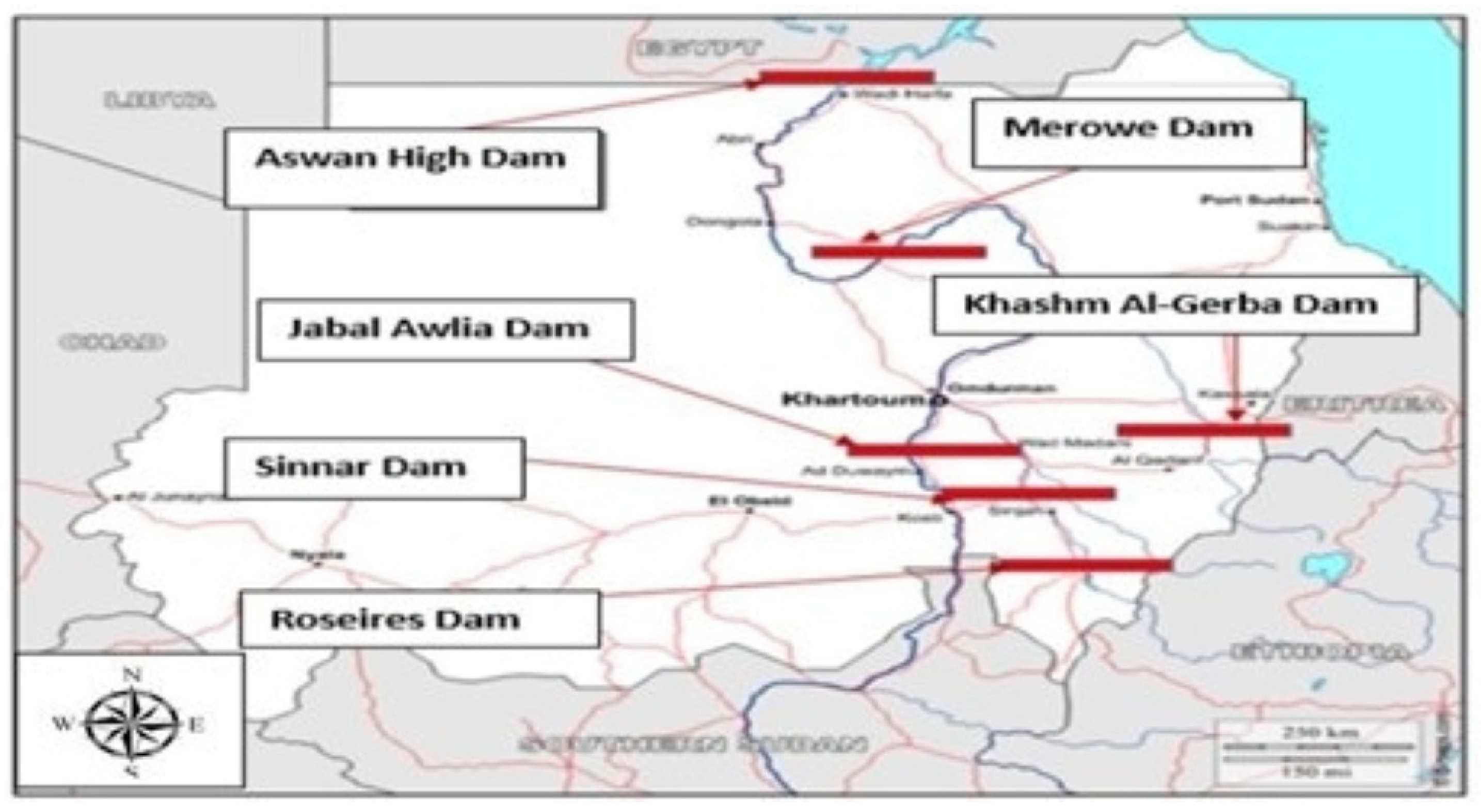
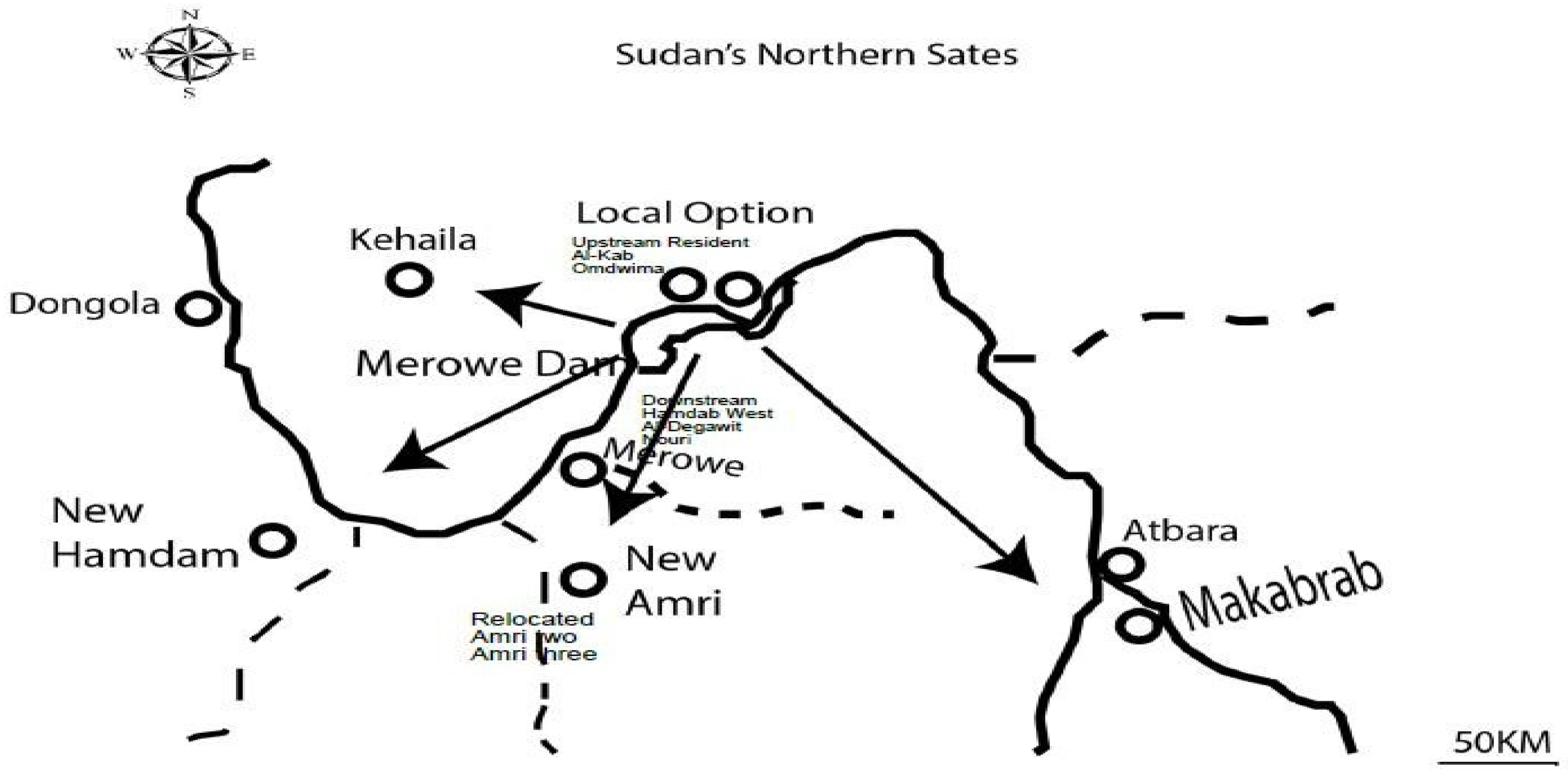
The Debate on Mega-Dam Impacts: A Stakeholder-Based Exploration of Merowe Dam, Sudan



Abstract
1. Introduction
2. Renewable Energy and Mega-Dam
2.1. Hydropower and the Debate
2.2. The Geopolitics of Mega-Dams
2.3. The Context—Merowe Mega-Dam, Sudan
2.3.1. The Merowe Dam in Sudan, Its Impact & the Research Gap
2.3.2. Temporal Gap: An Explanation
3. Methodology
3.1. Data Collection
Reflexivity and Positionality
3.2. Data Analysis
4. Findings
4.1. Famers and Communities in the Catchment Areas
4.1.1. (A) Support Motivations and Outcome
“The new settlement agriculture projects system is completely different; we use modern scientific methods in all agricultural stages. From choosing the crops and seeds to the dates of agriculture, irrigation and the amount of compost to be used, everything is prepared by the Agriculture Research Authority. Of course, in these agriculture projects, such a method is a qualitative transformation in the way of conducting agriculture, not a custom by the displaced communities. We introduced new crops which previously unknown to the farmers”.
“The dam is a big blessing from God. If used efficiently Sudan will develop economically through agriculture. This might support an increase of production of wheat per hectare and increase of land size per family an overall land size”
“Merowe Dam support energy production by injecting extra MW into Sudan’s main network, leading to stability and wide coverage in the country, especially rural areas. The development of agriculture is delivering huge benefits for the displaced. Another aim is supporting socioeconomic development through infrastructure development, such as educational facilities, roads, bridges, health facilities, other services, etc.” (E-2)
“The Merowe Dam is a failure, and the government should review its policies toward displaced people, or it will not be able to conduct any future projects”. (V-1)
4.1.2. (D) Support Motivations but Oppose Processes
“During the construction phase, we were consulted on resettlement location and the value of date trees, but they didn’t take our opinions into account… We are not opposing the project, but we requested it to be conducted on mutual terms with enough time to prepare. However, we realize that DIU only cares about building the dam at any cost. To expel us from our homes and lands, they closed the dam and submerged 2800 families without warning… At the start, everyone in the region welcomed the dam, and there was no resistance or opposition to the process until later when the citizens, especially Manasir communities, realized how the DIU treated them with no respect and as subjects not involved in any decision making, and forced to accept modernity kicking and screaming”. (V-2)
4.1.3. Concerns
“The goals of Merowe Dam are acceptable and reasonable, but it causes massive displacement for local communities and the way people were relocated is very bad, wasting public funds. The project did not meet the aspirations of local and regional people”. (V 2)
4.2. Non-Government Stakeholders
4.2.1. (A) Support Motivations and Outcomes—Non-Government
“There’s no replacement for a dam except a dam; it is an important project providing stable economic development for Sudan. The dam has brought investment to the region. It can be used efficiently by building irrigation canals on both sides of the dam”. (E 1)
4.2.2. (C) Support Motivations but Oppose Outcome
“Yes, Merowe Dam construction and operation generated some jobs and new skills and provided electricity for schools and hospitals, which enhanced the living conditions for some communities in Sudan. However, there is no openness or full engagement with local communities and experts, except those who are loyal to the government. The dam was politicized and used as an election campaign to enable the Islamist Government of Ingaz to continue in power. This is misleading because politicians are not telling the whole truth about the dam to the public, especially local communities”. (A-2)
“The authoritarian approach of Dams Implementation Unit (DIU) on dam construction has led to artificial consultation, neglect of suitable feasibility and impact studies, and a high degree of secrecy and poor transparency. These issues were translated into clear social, cultural, and environmental damage. This was worsened by the subjective and special recruitment of technocratic and loyal engineers and academics, disregarding other experts’ input and opinions, such as ecologists and anthropologists”. (A-1)
4.2.3. (D) Support Motivations and Oppose Processes
“In terms of electricity, infrastructure and services, the dam was successful. However, in agriculture and environmental protection there are some deficiencies especially agriculture schemes of Manasir, Hamdab and Amri have many problems, in water supply for irrigation and agriculture has not flourished as it should”. Additionally, every aspect of this project was politicized and utilized as a tool to support the government and its allies, including the processes of settlement and compensation”. (A-2)
“The Merowe Dam has been used as a means of election campaigning by politicians supporting the current government to win the election in 2010…the dam was politicized and used as an election campaign tool to enable the Islamist Government of Ingaz to continue in power”. (A-13)
4.3. The Legislature and the Executive
4.3.1. (A) Support Motivations and Outcome
“The idea of the dam is founded on economic viability. As the government, we acknowledge the need for ample energy to drive socioeconomic development. Prior to the dam’s construction, extensive consultations were conducted with experts, academics, and citizens from various communities. Indeed, the concept of the Merowe Dam was already ingrained in the region’s collective consciousness, and residents welcomed it despite the potential for displacement…. The dam has brought investment to the region. It can be used efficiently by building irrigation canals on both sides of the dam. There’s no replacement for a dam except a dam; it is an important project providing stable economic development for Sudan” (G-1)
“The Merowe Dam has been used as a means of election campaigning by politicians supporting the current government to win the election in 2010. The government does not believe in following the process and adhering to the Western ideas of democracy and consultation. Many officials said, ‘let it be like China, develop our economy, democracy and consultations can come later”. (O-1)
4.3.2. Concerns
“Sanctions harmed the project, but it was still completed successfully. We had trouble transferring funds from Arab donors to contractors, but the turbine generators supplied by a French company were modern. The main issue came later, when sourcing spare parts from the U.S. and Europe became very difficult.” (G 2)
4.3.3. (D) Support Motivations but Oppose Processes
“The government not only accepted high interest rates against its Islamic principles, it also gave up land sovereignty by leasing massive lands to Arab investors for 90 years. In addition to corruption, they wasted money on expensive media campaigning promoting the dam instead of using this money to better the condition of resettlements and displaced communities”.
5. Discussion
6. Conclusions and Policy Implications
7. Limitations
Author Contributions
Funding
Institutional Review Board Statement
Informed Consent Statement
Data Availability Statement
Acknowledgments
Conflicts of Interest
References
- Yah, N.F.; Oumer, A.N.; Idris, M.S. Small scale hydro-power as a source of renewable energy in Malaysia: A review. Renew. Sustain. Energy Rev. 2017, 72, 228–239. [Google Scholar] [CrossRef]
- Power, M.E.; Dietrich, W.E.; Jacques, C.; Petinrin, J.O.; Shaaban, M. Renewable energy for continuous energy sustainability in Malaysia. Renew. Sustain. Energy Rev. 2015, 50, 967–981. [Google Scholar] [CrossRef]
- Agrawala, S.; Raksakulthai, V.; Van Aalst, M.; Larsen, P.; Smith, J.; Reynolds, J. Development and Climate Change in Nepal: Focus on Water Resources and Hydropower; Organization for Economic Cooperation and Development: Paris, France, 2003; p. 64. [Google Scholar]
- Pearce, F. The Dammed: Rivers, Dams, and the Coming World Water Crisis; The Bodley Head: London, UK, 1992. [Google Scholar]
- Askouri, A. China’s investment in Sudan: Displacing villages and destroying communities. In African Perspectives on China in Africa; Fahamu: Oxford, UK, 2007; pp. 71–86. [Google Scholar]
- Sukhan, J.; Sleigh, A. Resettlement for China’s Three Gorges Dam: Socioeconomic impact and institutional tensions. Communist Post-Communist Stud. 2000, 33, 223–241. [Google Scholar]
- Alexander, N. ‘The Age of Megaprojects’. Economic Governance at the Heinrich Boell Foundation. 2015. Available online: https://www.project-syndicate.org/commentary/g20-infrastructure-investment-by-nancy-alexander-2015-07 (accessed on 23 May 2017).
- Kristen, M.; Bosshard, P.; Brewer, N. Exporting dams: China’s hydropower industry goes global. J. Environ. Manag. 2009, 90, S294–S302. [Google Scholar]
- Marsh, R.M. Getting Ahead and Falling Behind: A Sociological Elaboration of Sen’s Theory of Human Development. Soc. Sci. Q. 2014, 95, 1001–1021. [Google Scholar] [CrossRef]
- Moran, E.F.; Lopez, M.C.; Moore, N.; Müller, N.; Hyndman, D.W. Sustainable hydropower in the 21st century. Proc. Natl. Acad. Sci. USA 2018, 115, 11891–11898. [Google Scholar] [CrossRef]
- Abdullah, A.N.; Rahman, S.; Essex, S.; Benhin, J. The economic contributions of mega-dam infrastructure as perceived by local and displaced communities: A Merowe dam, Sudan case study. Agriculture 2020, 10, 227. [Google Scholar] [CrossRef]
- Abdullah, A.N.; Rahman, S. Social impacts of a mega-dam project as perceived by local, resettled and displaced communities: A case study of Merowe dam, Sudan. Economies 2021, 9, 140. [Google Scholar] [CrossRef]
- Welzel, C.; Inglehart, R.; Kligemann, H.D. The theory of human development: A cross- cultural analysis. Eur. J. Political Res. 2003, 42, 341–379. [Google Scholar] [CrossRef]
- Nautiyal, H.; Singal, S.K.; Sharma, A. Small hydropower for sustainable energy development in India. Renew. Sustain. Energy Rev. 2011, 15, 2021–2027. [Google Scholar] [CrossRef]
- IEA. Global Energy Review 2021; International Energy Agency (IEA): Paris, France, 2021. [Google Scholar]
- Ang, T.Z.; Salem, M.; Kamarol, M.; Das, H.S.; Nazari, M.A.; Prabaharan, N. A comprehensive study of renewable energy sources: Classifications, challenges and suggestions. Energy Strategy Rev. 2022, 43, 100939. [Google Scholar] [CrossRef]
- Damania, R.; Desbureaux, S.; Rodella, A.S.; Russ, J.; Zaveri, E. Quality Unknown: The Invisible Water Crisis; World Bank Publications: Washington, DC, USA, 2019. [Google Scholar]
- Damania, R.; Desbureaux, S.; Hyland, M.; Islam, A.; Moore, S.; Rodella, A.S.; Russ, J.; Zaveri, E. Uncharted Waters: The New Economics of Water Scarcity and Variability; World Bank Publications: Washington, DC, USA, 2017. [Google Scholar]
- Wheeler, K.G.; Jeuland, M.; Hall, J.W.; Zagona, E.; Whittington, D. Understanding and managing new risks on the Nile with the Grand Ethiopian Renaissance Dam. Nat. Commun. 2020, 11, 5222. [Google Scholar] [CrossRef] [PubMed]
- Grafton, R.Q.; Williams, J.; Jiang, Q. Possible pathways and tensions in the food and water nexus. Earth’s Future 2017, 5, 449–462. [Google Scholar] [CrossRef]
- Rosa, L.; Rulli, M.C.; Davis, K.F.; Chiarelli, D.D.; Passera, C.; D’Odorico, P. Closing the yield gap while ensuring water sustainability. Environ. Res. Lett. 2018, 13, 104002. [Google Scholar] [CrossRef]
- Akhter, N. Globalizing Rural Development: Competing Paradigms and Emerging Realities; Behera, M.C., Ed.; SAGE Publications: New Delhi, India, 2006. [Google Scholar]
- Varma, C.V.J. Meeting Environmental Impact Requirements of Dams. 2003. Available online: http://www.icoldcigb.net/Envussd.html (accessed on 20 May 2018).
- Strobl, E.; Strobl, R.O. The distributional impact of large dams: Evidence from cropland productivity in Africa. J. Dev. Econ. 2011, 96, 432–450. [Google Scholar] [CrossRef]
- Atif, A.; Flyvbjerg, B.; Budzier, A.; Lunn, D. Should we build more large dams? The actual costs of hydropower megaproject development. Energy Policy 2014, 69, 43–56. [Google Scholar] [CrossRef]
- Everard, M. The Hydropolitics of Dams: Engineering or Ecosystems? Zed Books Ltd.: London, UK, 2013. [Google Scholar]
- Blakeslee, D.; Dar, A.; Fishman, R.; Malik, S.; Pellegrina, H.S.; Bagavathinathan, K.S. Irrigation and the spatial pattern of local economic development in India. J. Dev. Econ. 2023, 161, 102997. [Google Scholar] [CrossRef]
- Verhoeven, H. Climate Change, Conflict and Development in Sudan: Global Neo-Malthusian Narratives and Local Power Struggles. Dev. Change 2011, 42, 679–707. [Google Scholar] [CrossRef]
- Verhoeven, H. Water, Civilisation and Power in Sudan. In Water, Civilisation and Power in Sudan: The Political Economy of Military-Islamist State Building (African Studies); Cambridge University Press: Cambridge, UK, 2015; pp. I–II. [Google Scholar]
- Zeitoun, M.; Cascão, A.E.; Warner, J.; Mirumachi, N.; Matthews, N.; Menga, F.; Farnum, R. Transboundary water interaction III: Contest and compliance. Int. Environ. Agreem. Politics Law Econ. 2017, 17, 271–294. [Google Scholar] [CrossRef]
- Flyvbjerg, B. Survival of the unfittest: Why the worst infrastructure gets built—And what we can do about it. Oxf. Rev. Econ. Policy 2009, 25, 344–367. [Google Scholar] [CrossRef]
- Barbour, K. Population shifts and changes in Sudan since 1898. Middle East. Stud. 1996, 2, 98–122. [Google Scholar] [CrossRef]
- Ascensão, F.; Fahrig, L.; Clevenger, A.P.; Corlett, R.T.; Jaeger, J.A.; Laurance, W.F.; Pereira, H.M. Environmental challenges for the Belt and Road Initiative. Nat. Sustain. 2018, 1, 206–209. [Google Scholar] [CrossRef]
- Kleinitz, C.; Näser, C. The loss of innocence: Political and ethical dimensions of the Merowe Dam Archaeological Salvage Project at the Fourth Nile Cataract (Sudan). Conserv. Manag. Archaeol. Sites 2011, 13, 253–280. [Google Scholar] [CrossRef]
- Mettetal, E. Irrigation dams, water and infant mortality: Evidence from South Africa. J. Dev. Econ. 2019, 138, 17–40. [Google Scholar] [CrossRef]
- Altshuler, A. Mega-Projects: The Changing Politics of Urban Public Investment; The Brookings Institution and Lincoln Institute of Land Policy: Washington, DC, USA, 2004. [Google Scholar]
- Bryant, R.L.; Bailey, S. The International Handbook of Political Ecology; Edward Elgar: Cheltenham, UK, 2015. [Google Scholar]
- Flyvbjerg, B.; Garbuio, M.; Lovallo, D. Delusion and deception in large infrastructure projects: Two models for explaining and preventing executive disaster. Calif. Manag. Rev. 2009, 51, 170–194. [Google Scholar] [CrossRef]
- Baviskar, A. In the Belly of the River: Tribal Conflicts over Development in the Narmada Valley; Oxford University Press: Delhi, India, 1999. [Google Scholar]
- Isaacman, A.F.; Isaacman, B.S. Dams, Displacement, and the Delusion of Development: Cahora Bassa and Its Legacies in Mozambique, 1965–2007; Ohio University Press: Athens, OH, USA, 2013. [Google Scholar]
- Sneddon, C.; Howarth, R.B.; Norgaard, R.B. Sustainable development in a post-Brundtland world. Ecol. Econ. 2006, 57, 253–268. [Google Scholar] [CrossRef]
- Sovacool, B.K.; Hess, D.J.; Cantoni, R. Energy transitions from the cradle to the grave: A meta-theoretical framework integrating responsible innovation, social practices, and energy justice. Energy Res. Soc. Sci. 2021, 75, 102027. [Google Scholar] [CrossRef]
- Cascão, A.E.; Nicol, A. GERD: New norms of cooperation in the Nile Basin? Water Int. 2016, 41, 550–573. [Google Scholar] [CrossRef]
- Sovacool, B.K.; Dworkin, M.H. Energy justice: Conceptual insights and practical applications. Appl. Energy 2015, 142, 435–444. [Google Scholar] [CrossRef]
- Pieterse, J.N. Development Theory; Sage: Thousand Oaks, CA, USA, 2010. [Google Scholar]
- Jaffee, D. Levels of Socioeconomic Development Theory; Greenwood Publishing Group: Westport, CT, USA, 1998. [Google Scholar]
- Flyvbjerg, B.; Bruzelius, N.; Rothengatter, W. Megaprojects and Risk: An Anatomy of Ambition; Cambridge University Press: Cambridge, UK, 2003. [Google Scholar]
- Kim, B. Infrastructure Development for the Economic Development in Developing Countries: Lessons from Korea and Japan; GSICS Working Paper Series; Kobe University: Kobe, Japan, 2006; p. 11. [Google Scholar]
- International River. Sudanese Government Forcibly Displaces More Than 6000 Families Affected By Merowe Dam. 2008. Available online: https://riverresourcehub.org/resources/sudanese-government-forcibly-displaces-more-than-6000-families-affected-by-merowe-dam-4311/ (accessed on 16 April 2026).
- Haberlah, D. Cultural landscape of Dar al-Manasir. In Nihna Nâs Al-Bahar–We Are the People of the River; Ethnographic Research in the Fourth Nile Cataract Region, Sudan Social Geographical Survey; Klenitz, C., Nässer, C., Eds.; Harrassowitz Verlag: Weisbaden, Germany, 2012. [Google Scholar]
- Rigg, J.; Salamanca, A.; Parnwell, M. Joining the dots of agrarian change in Asia: A 25-Year view from Thailand. World Dev. 2012, 40, 1469–1481. [Google Scholar] [CrossRef]
- McCully, P. Silenced Rivers: The Ecology and Politics of Large Dams Development, 2nd ed.; Zed Books: London, UK, 2001. [Google Scholar]
- Bosshard, P. China’s role in financing African infrastructure. Int. Rivers Netw. 2007, 14, 1–2. [Google Scholar]
- Sharaf El Din, S. Effect of the Aswan High Dam on the Nile flood and on the estuarine and coastal circulation pattern along the Mediterranean Egyptian coast. Limnol. Oceanogr. 1997, 22, 194–207. [Google Scholar] [CrossRef]
- Yin, R.K. Case Study Research Design and Methods, 3rd ed.; Applied Social Research Methods Series; Sage: Ventura, CA, USA, 2003. [Google Scholar]
- Campbell, S.; Greenwood, M.; Prior, S.; Shearer, T.; Walkem, K.; Young, S.; Bywaters, D.; Walker, K. Purposive sampling: Complex or simple? Research case examples. J. Res. Nurs. 2020, 25, 652–661. [Google Scholar] [CrossRef] [PubMed]
- David, M.; Sutton, C.D. Social Research: The Basics; Sage: London, UK, 2004. [Google Scholar]
- Corbin, J.; Strauss, A. Basics of Qualitative Research: Techniques and Procedures for Developing Grounded Theory, 3rd ed.; SAGE: Thousand Oaks, CA, USA, 2008. [Google Scholar]
- Brinkmann, S.; Kvale, S. Doing Interviews; SAGE: Thousand Oaks, CA, USA, 2018. [Google Scholar]
- Goyal, R.; Kakabadse, N.; Kakabadse, A. Improving corporate governance with functional diversity on FTSE 350 boards: Directors’ perspective. J. Cap. Mark. Stud. 2019, 3, 113–136. [Google Scholar] [CrossRef]
- Palinkas, L.A.; Horwitz, S.M.; Green, C.A.; Wisdom, J.P.; Duan, N.; Hoagwood, K. Purposeful sampling for qualitative data collection and analysis in mixed method implementation research. Adm. Policy Ment. Health Ment. Health Serv. Res. 2015, 42, 533–544. [Google Scholar] [CrossRef] [PubMed]
- Patton, M.Q. Qualitative Research and Evaluation Methods; SAGE: Thousand Oaks, CA, USA, 2002. [Google Scholar]
- Guest, G.; Namey, E.; McKenna, K. How many focus groups are enough? Building an evidence base for nonprobability sample sizes. Field Methods 2017, 29, 3–22. [Google Scholar] [CrossRef]
- Malterud, K.; Siersma, V.D.; Guassora, A.D. Sample size in qualitative interview studies: Guided by information power. Qual. Health Res. 2016, 26, 1753–1760. [Google Scholar] [CrossRef]
- Guest, G.; Bunce, A.; Johnson, L. How many interviews are enough? An experiment with data saturation and variability. Field Methods 2006, 18, 59–82. [Google Scholar] [CrossRef]
- Fujii, L.A. Shades of truth and lies: Interpreting testimonies of war and violence. J. Peace Res. 2010, 47, 231–241. [Google Scholar] [CrossRef]
- Tourangeau, R.; Yan, T. Sensitive questions in surveys. Psychol. Bull. 2007, 133, 859. [Google Scholar] [CrossRef]
- Braun, V.; Clarke, V. Using thematic analysis in psychology. Qual. Res. Psychol. 2006, 3, 77–101. [Google Scholar] [CrossRef]
- Braun, V.; Clarke, V. Reflecting on reflexive thematic analysis. Qual. Res. Sport Exerc. Health 2019, 11, 589–597. [Google Scholar] [CrossRef]
- Enworo, O.C. Application of Guba and Lincoln’s parallel criteria to assess trustworthiness of qualitative research on indigenous social protection systems. Qual. Res. J. 2023, 23, 372–384. [Google Scholar] [CrossRef]
- African Development Bank Group. Bumper Harvests and Record Wheat Production Propelling Sudan Towards Wheat Self-sufficiency. 2020. Available online: https://www.afdb.org/sites/default/files/2020/10/08/icarda_sudans_bumper_harvest_final.pdf (accessed on 15 April 2026).
- Scudder, T.T. The Future of Large Dams: Dealing with Social, Environmental, Institutional and Political Costs; Routledge: Abingdon, UK, 2012. [Google Scholar]
- Eisenhardt, K.M.; Graebner, M.E. Theory building from cases: Opportunities and challenges. Acad. Manag. J. 2007, 50, 25–32. [Google Scholar] [CrossRef]
- Yin, R.K. Case Study Research and Applications; Sage: Thousand Oaks, CA, USA, 2018; Volume 6. [Google Scholar]
- Creswell, J.W.; Poth, C.N. Qualitative Inquiry and Research Design: Choosing Among Five Approaches; Sage publications: Thousand Oaks, CA, USA, 2016. [Google Scholar]
- Tilt, B.; Braun, Y.; He, D. Social impacts of large dam projects: A comparison of international case studies and implications for best practice. J. Environ. Manag. 2009, 90, S249–S257. [Google Scholar] [CrossRef]
- Lincoln, Y.S. Naturalistic Inquiry; Sage: Thousand Oaks, CA, USA, 1985; Volume 75. [Google Scholar]
- Mizyed, A. Sustainable water footprint management in agriculture: A review of linear programming-based models and future directions. Integr. Environ. Assess. Manag. 2025, 22, 352–361. [Google Scholar] [CrossRef]
- Córdoba Hernández, R.; Pemán Gavín, I.; Morán Uriel, J.; Camerin, F. Participation and Urban Resilience in Post-Disaster Recovery: Lessons from the 2021 Volcanic Eruption in La Palma (Spain). Built Environ. 2026, 52, 29. [Google Scholar] [CrossRef]
- Córdoba Hernández, R.; Carmona Mateos, F.; Morán Uriel, J.; Camerin, F. Reconstrucción y resiliencia tras catástrofes naturales: Oportunidades perdidas tras la erupción del volcán de Tajogaite en La Palma. Rev. Urban. 2025, 52, 1–24. [Google Scholar] [CrossRef]
- Bris, P.; Bendito, F.; Martínez, D. Learning from Unsustainable Post-Disaster Temporary Housing Programs in Spain: Lessons from the 2011 Lorca Earthquake and the 2021 La Palma Volcano Eruption. Sustainability 2026, 18, 963. [Google Scholar] [CrossRef]
- Lee, G.; Scurrah, N. Power and Responsibility: The Mekong River Commission and Lower Mekong Mainstream Dams; Australian Mekong Resource Centre, University of Sydney and Oxfam Australia: Sydney, Australia, 2009. [Google Scholar]
- Kabeer, N. Resources, agency, achievements: Reflections on the measurement of women’s empowerment. Dev. Change 1999, 30, 435–464. [Google Scholar] [CrossRef]
- Clark, T. Gaining and maintaining access: Exploring the mechanisms that support and challenge the relationship between gatekeepers and researchers. Qual. Soc. Work. 2011, 10, 485–502. [Google Scholar] [CrossRef]
- Cornwall, A. Whose voices? Whose choices? Reflections on gender and participatory development. World Dev. 2003, 31, 1325–1342. [Google Scholar] [CrossRef]



| Participants (Interviews/Focus Group) | Number | The Rationale for Selecting the Participant |
|---|---|---|
| Farmers (Merowe regions)—Focus group (10 Males) | F 10 | Selecting this group is based on the fact they are the most impacted group, as the dam is meant to help them by improving their livelihood. They also have had to confront situations with the government/politicians regarding compensation, resettlement and displacement issues. Also one of the aims of the dam was to help stablish agribusiness industry in the region. |
| Academics (13 Males and 2 Females) | A (15) | Academics provided an expert opinion that was well-informed and supported by research and data analysis. Also, they may contrast to the government’s/politicians’ claims on the dynamic of the decision-making on economic, social, and environmental impacts. |
| NGO (3 Males and 1 Female) | N (4) | NGOs were expected to provide neutral opinions that may support or oppose the government’s/politicians’ narrative on the economic, social, and environmental impacts. NGOs’ opinion is based on their long involvement and experience with such environmental and displacement assessment of mega-dams’ impact globally. |
| Government elites (ministers, policymakers, and Merowe Dam authorities (6 Males and 1 Female) | G (7) | Given the complex debate on mega-dams’ role in development, interviewing key ministers and policymakers was important. Due to their knowledge and experiences of specific actors involved in the project, they have direct access to vital information about the Merowe Dam. |
| Opposition parties’ representatives (2 Males) | O (2) | To get an objective and non-partisan view on research themes, participants were chosen from the opposition parties as well. |
| Entrepreneurs/Businesspersons (2 Males) | E (2) | Entrepreneurs are important players in determining the dam’s impact, especially economically. They are based in the region and can observe changes in day-to-day business. They do not depend on the dam directly; however, it has become a source of overall improvement in the region, including growth in local businesses. |
| Settlement village heads (2 Males) | V (2) | Community leaders provided insight into their communities’ perspectives on the dam, which was difficult to obtain through a questionnaire survey. |
| Participants | Findings | |
|---|---|---|
| Impacted communities | Village heads (Interviews) | (d) Support motivations but oppose processes— Socioeconomic impact—Participants suggested some development in the region; infrastructure improvement, market expansion, agriculture and industry development, increased fishing, Concerns—Stakeholders not included in pre-dam consultation process; lack of information asymmetry on the project; the role of the Dams Implementation Unit (DIU), broken/delayed promises of benefits; unfair evaluation of properties in compensations; region-based discrimination in representation in decision-making entities |
| Local communities (Focus groups) | (d) Support motivations but oppose processes: Socioeconomic impact—better living conditions, social inclusion, and economic opportunities especially in lad size increase for many of the farmers and introducing new business crops in the region with better agricultural infrastructure. Concerns—Loss of properties, memories; the role of the DIU, social conflict on land, exacerbating communal and tribal divisions, flawed and superficial processes especially when it comes to irrigation, land and date tree compensation. | |
| Non-government stakeholders, Academics & NGOs | Academics (Interviews) Post-dam commissioning benefits—Ecological, Social & Economic | (a) Support motivations and outcomes— Ecological benefits—Some participants perceived the dam to cause less erosion of soil; improved biodiversity in a previously arid region; limiting desertification; improved cultivation with a higher water table; Social benefits—participants reported increase inward migration, reduced outward migration; improved life expectancy & living conditions; integration of women into commercial/economic activities; improved access to educational and health facilities Economic benefits—Interviewees perceived to observe a higher energy production [half of the grid used in Sudan is produced at Merowe (DIU, 2017), improved intra-national and international commercial activities, increase in the cultivated land, Increased GDP with higher availability and access to other commercial activities, improved infrastructure—improved market/commercial activities (b) Question motivations and oppose outcomes— Concerns with a higher water table; Concerns about increased seismic activity; adverse impact on date-cultivation; a lower water table downstream; diluted focus on alternative sources of energy (e.g., Solar) (c) Support motivations but oppose outcome— Economic benefits—Many participants considered the construction of the Merowe Dam as a package with many supporting infrastructure projects that has been a hope of the people in the region which may opened relatively a new paradigm of economic development in the region. This idea might have played a big role in driving support from the region and actors in many areas (e.g., services, small manufacturing and businesses, metal workshops, construction, and tourism sectors). Negative Social Impact and Discontent—Other participants perceived Merowe Dam to have imposed significant social costs, including unequal benefit distribution, limited community participation, forced displacement, and disputes over compensation. Many participants expressed dissatisfaction with the process and outcomes. Inadequate irrigation in upstream-relocated communities has reinforced negative perceptions, especially regarding agricultural economic indicators. (d) Support motivations but oppose processes— Academics who do not support the agenda are ignored; motivation for dam commissioning is political; consultation & resettlement are not managed well; alternative solutions of the social issues are ignored; misrepresentation of the academics and their views. |
| Entrepreneurs (Interviews) | (a) Support motivations and outcomes— The participants suggested increased opportunities for business and regional market growth; improved transportation and infrastructure; tourism; improved opportunities for education and training; inward migration and increased consumer activities | |
| NGOs (Interviews) | (a) Support motivations and outcomes— Social and Economic impact—The impact on the individual’s mental health; (d) Support motivations but oppose processes—Flawed processes of compensation determination and disbursal; the role of the Dam Implementation Unit (DIU), | |
| The legislature and the executive | Government ministers/officials (Interviews) | (a) Support motivations and outcomes— Geopolitical & economic advantages—Political relationship between Sudan, Egypt and Ethiopia; the relationship/conflict between the government and the communities; Sufficient electricity; Reflection—Acknowledge discrepancies in consultation—A committee has been formed to investigate complaints. ‘Vendetta’ & ‘Aberrations’ ‘WIP’- Role of DIU—refused the allegations against the DIU and appreciated their contribution and effectiveness; disagree with the concerns on social impact (displacement, compensation)—as aberrations mentioning that the future expansion of the dam area would address that. |
| Opposition parties (Interviews) | (d) Support motivations but oppose processes Support the project in principle. Concerns—The role of the DIU; excessive and unscrutinized funding; concessions to international partners; poor terms of borrowing for the dam; non-integration of stakeholders; regional disparities |
Disclaimer/Publisher’s Note: The statements, opinions and data contained in all publications are solely those of the individual author(s) and contributor(s) and not of MDPI and/or the editor(s). MDPI and/or the editor(s) disclaim responsibility for any injury to people or property resulting from any ideas, methods, instructions or products referred to in the content. |
© 2026 by the authors. Licensee MDPI, Basel, Switzerland. This article is an open access article distributed under the terms and conditions of the Creative Commons Attribution (CC BY) license.
Share and Cite
Abdullah, A.-N.; Rahman, S.; Goyal, R. The Debate on Mega-Dam Impacts: A Stakeholder-Based Exploration of Merowe Dam, Sudan. Agriculture 2026, 16, 1121. https://doi.org/10.3390/agriculture16101121
Abdullah A-N, Rahman S, Goyal R. The Debate on Mega-Dam Impacts: A Stakeholder-Based Exploration of Merowe Dam, Sudan. Agriculture. 2026; 16(10):1121. https://doi.org/10.3390/agriculture16101121
Chicago/Turabian StyleAbdullah, Al-Noor, Sanzidur Rahman, and Rita Goyal. 2026. "The Debate on Mega-Dam Impacts: A Stakeholder-Based Exploration of Merowe Dam, Sudan" Agriculture 16, no. 10: 1121. https://doi.org/10.3390/agriculture16101121
APA StyleAbdullah, A.-N., Rahman, S., & Goyal, R. (2026). The Debate on Mega-Dam Impacts: A Stakeholder-Based Exploration of Merowe Dam, Sudan. Agriculture, 16(10), 1121. https://doi.org/10.3390/agriculture16101121