Article

Role of Intercropping, Herbicides and Fungicides in Compensating for the Lack of Crop Rotation in Long-Term Continuous Cropping of Two Potato Cultivars


1
Department of Agroecosystems and Horticulture, Faculty of Agriculture and Forestry, University of Warmia and Mazury in Olsztyn, Plac Łodzki 3, 10-719 Olsztyn, Poland
2
Plant Breeding and Acclimatization Institute—National Research Institute in Radzików, Department of Root Crop Cultivation and Breeding Fundamentals, Bydgoszcz Division, Powstańców Wlkp. 10 Str., 85-090 Bydgoszcz, Poland
3
Department of Psychology and Sociology of Health and Public Health, School of Health Sciences, Collegium Medicum, University of Warmia and Mazury in Olsztyn, Żołnierska 14, Str. 10-561 Olsztyn, Poland
*
Author to whom correspondence should be addressed.
Agriculture 2026, 16(10), 1065; https://doi.org/10.3390/agriculture16101065
Submission received: 12 February 2026 / Revised: 28 April 2026 / Accepted: 8 May 2026 / Published: 13 May 2026

Abstract

Continuous potato cropping is usually associated with a reduction in tuber yield and deterioration in crop structure, resulting in a decrease in the proportion of marketable produce. The effect of crop rotation, cultivar selection, the range of chemical plant protection, and the periodic introduction of an intercrop on potato (Solanum tuberosum L.) yield was studied in a field experiment at the Production–Experimental Station in Bałcyny near Ostróda, belonging to the University of Warmia and Mazury in Olsztyn, where potatoes have been continuously cultivated since 1973. Results from 2015 to 2023, corresponding to the 43rd–51st year of continuous potato cropping, were compared to a six-course crop rotation (potato—oat—flax—winter rye—faba bean—winter triticale). The study discusses the yield of two potato cultivars (Catania and Red Sonia) across two periods: 2015–2018 and 2019–2023. In the first period, potatoes were grown according to the general experimental design, whereas in 2019–2023, the cultivation included an additional intercrop of oil radish (Raphanus sativus L.) cv. Rolterra In both series of studies, the experimental factors included potato cultivation without the use of plant protection products (object O) and objects with the application of herbicides (H) and herbicides and fungicides (H + F). The introduction of intercropping into continuous potato cropping was more effective than the application of pesticides and limited the scale of yield decline in relation to crop rotation. In the case of the Catania cultivar, the mean difference in yield between crop rotation and continuous cropping in the first series of tests (without intercropping) was 50.4%, and in the second series (after introducing intercropping), it decreased to 22.3%. The corresponding mean differences for the Red Sonia cultivar were 45.5% in the first series and 12.9% in the second series. Furthermore, in the second series of studies (thanks to the introduction of intercropping), the mean share of marketable yield in continuous cropping increased from 35.1% to 51.9% (for the Catania cultivar) and from 23.6% to 35.8% (for the Red Sonia cultivar). In summary, the introduction of oil radish as an intercrop was the most effective factor (more effective than the choice of potato cultivar and use of chemical crop protection products) to limit the negative aspects of long-term continuous potato cropping, improving yield, yield stability, and the share of marketable tubers.

1. Introduction

Specialization in potato production involves shortening the intervals between crops on the same field, leading in extreme cases to continuous cropping. This cultivation system causes so-called ‘soil sickness’, including an imbalance among groups of soil microorganisms, which can lead to the accumulation of harmful biologically active compounds, root secretions, or substances resulting from the decomposition of crop residues in the soil. As a consequence, ‘soil self-poisoning’ occurs, creating unfavorable conditions for plant growth and development. There may also be an imbalance in nutrient concentrations in the soil and an increase in the occurrence of certain diseases, pests, and weeds. The consequences of this situation are evident in the form of insufficient development of the root system and the above-ground part of the crop, increased susceptibility to diseases and pests, and weaker competitiveness of the potato crop in relation to weeds, which ultimately leads to lower yields. Yield differences can reach up to 76%, and the scale of these differences and the assessment of the factors causing them are well documented [1,2,3,4,5,6,7,8,9].
In Poland, the share of potatoes in the cropping structure, intensity, and cultivation methods is determined by natural conditions, and therefore, there are significant differences between regions of the country [10,11]. The largest percentage of land in Poland consists of light soils [12], for which the selection of crop species is limited, and potato cultivation is the most profitable, since potatoes have low soil requirements [13]. Although crop yields decrease as crop rotation becomes simpler and the share of potatoes in it increases, the productivity of entire crop rotations may still increase. There are economic reasons behind the specific type of crop rotation used [14,15]. The share of root crops in crop rotation is a measure of farming intensity and determines the productivity of entire crop rotations [16].
For many farmers, growing potatoes in shortened rotations, or even in short-term continuous cropping, is essential to maintain the profitability of their production [17,18]. Obtaining a direct surplus from the cultivation of a given plant species encourages farmers to decide to grow it again on the same field. Gastoł and Lutomirska [1] pointed to an increase in yield measured in grain units for crop rotations with a higher proportion of potatoes, but the introduction of potato continuous cropping did not increase grain unit yields, unlike crop rotations with a 60 and 75% share of potatoes. The Code of Good Agricultural Practice states that rational crop rotation should consist of 4–5 plant species, depending on the soil. For many years, however, the choice of crop rotation has been determined by economic factors, and therefore, the choice is limited to plants of one species or one technological group [8,19,20,21,22,23,24,25,26].
In agricultural practice, potatoes are most often grown after cereals, which allows for better utilization of soil structure and nutrients and reduces the risk of potato-specific diseases and pests, contributing to higher and more stable yields. After cereal harvest, fields may be sown with intercrops such as blue phacelia (Phacelia tanacetifolia), white mustard (Sinapis alba L.), oil radish (Raphanus sativus), or mixtures containing these species, which leave plant residues in the soil, improve its structure and organic matter content, reduce erosion and weed pressure, and prepare the site for the next crop [27].
The use of intercrops in the cultivation of root crops in Poland is still limited, despite numerous benefits. Intercrops improve the soil phytosanitary status, enhance microbial activity and biogenic potential, and increase nutrient availability for subsequent crops [28,29,30,31]. In recent years, breeding of oil radish has produced new-generation cultivars with greater root biomass, faster growth, deeper soil penetration, and improved tolerance to environmental stresses, enhancing their effectiveness as intercrops [28,31,32].
Oil radish supports the regeneration of degraded, intensively used sites and stabilizes the yield of root crops. In Poland, it is increasingly used as an intercrop before potato cultivation. The plant develops a strong taproot with numerous lateral roots reaching up to 1.5 m and stems up to 120 cm in height. Its substantial root biomass loosens and aerates the soil, recycles nutrients, and increases organic matter content. Leaving oil radish in the field over winter allows water storage in the shallower soil layers, which, under changing climate conditions, improves the soil’s nutrient, structural, and phytosanitary properties [33,34].
Despite the growing interest in intercrops, the effect of oil radish on potato cultivation has not yet been sufficiently explored. Most studies focus on the general effects of intercrops, while detailed analyses of the impact of new generation oilseed radish on total and marketable potato yield remain limited. Therefore, there is a need for research specifically aimed at assessing the influence of oil radish on the quantitative and structural characteristics of potato yield, ideally under continuous cropping conditions, where the negative effects of simplified crop succession are most pronounced. This study investigated whether intercropping with oil radish, the choice of potato cultivars, and the use of herbicides and fungicides could reduce losses in potato yield (both total and marketable) under continuous cropping. It was hypothesized that these practices could also mitigate the negative effects associated with the absence of crop rotation.

2. Materials and Methods

2.1. Place of Research

The research was conducted as part of a long-term field experiment involving the continuous cultivation of 12 crop species, carried out since 1973 at the Production and Experimental Station of the University of Warmia and Mazury in Bałcyny near Ostróda, Poland (53°60′ N, 19°85′ E). The village of Bałcyny is located in the Central European Lowlands [35]. The experiment is located on soil formed from light silty clays, belonging to the wheat complex (good) and rye complex (very good). Soil fertility is assessed regularly using composite soil samples collected from multiple points across the experimental field. In the period 2015–2023, the soil on the experimental field was characterised by an acidic reaction, high phosphorus and potassium content and average magnesium content in both cultivation systems (continuous cropping: pH in KCl—5.55 mg·kg−1, P2O5—178 mg·kg−1, K2O—236 mg·kg−1, Mg—46 mg·kg−1; crop rotation: pH in KCl—5.42 mg·kg−1, P2O5—196 mg·kg−1, K2O—241 mg·kg−1, Mg—44 mg·kg−1).
The research area is dominated by a continental-maritime climate with transitional climate features, characterized by high weather variability. There are irregular, short periods of drought, as well as short-term heavy rainfall. In the experiment, potatoes are usually planted in mid-April and harvested by the end of August. The weather data recorded by the meteorological station in Bałcyny are presented in tabular form (Table 1).

2.2. Field Experiment Methodology

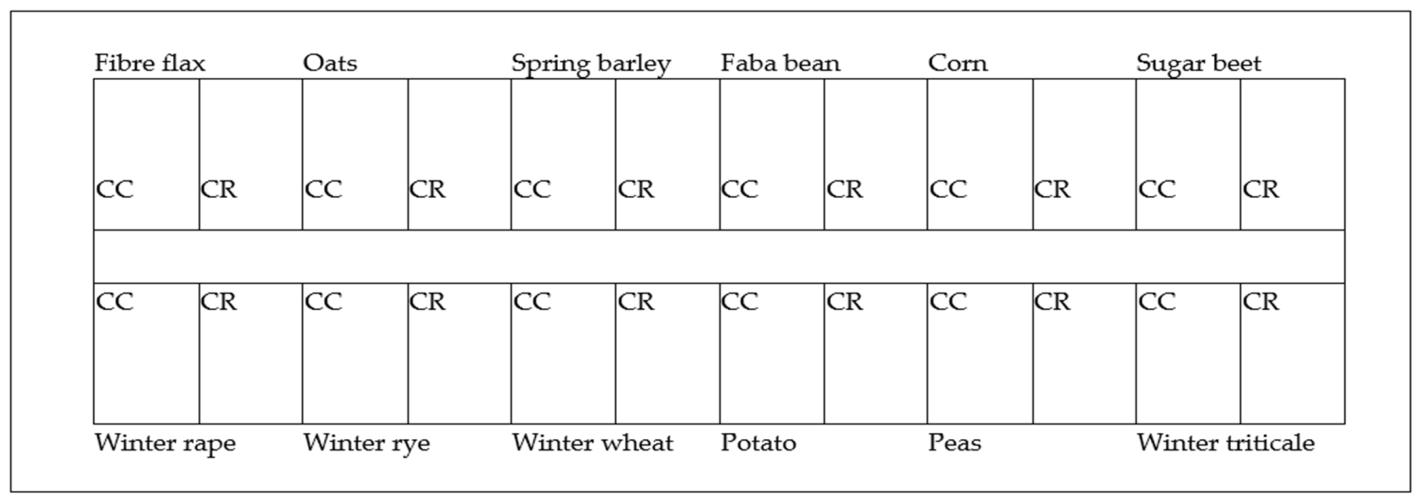
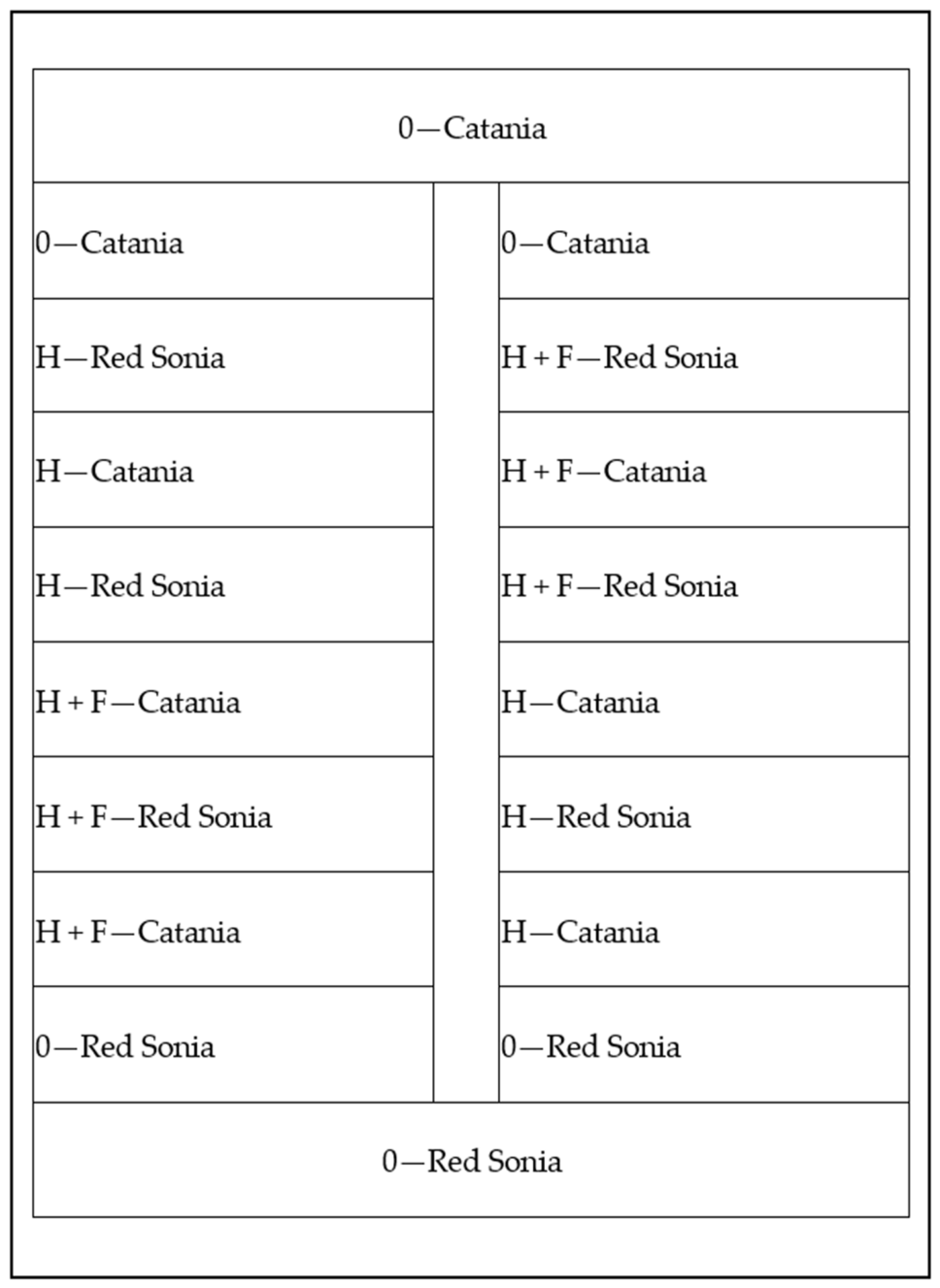
The experiment was established in 1967, and potatoes were introduced into the study in 1973. Currently, the entire experiment includes 12 crop species grown on 24 plots: 12 plots under crop rotation and 12 under continuous cultivation (Figure 1). Two six-course crop rotations (A and B) were designed, each consisting of the same plant species grown in continuous cropping. The rotations were arranged so that rotation A included species with higher soil requirements (sugar beet—maize—spring barley—field pea—winter oilseed rape—winter wheat), while rotation B comprised species with lower habitat demands (including potatoes: potato—oat—flax—winter rye—faba bean—winter triticale). Crops grown in the rotations “move” to successive plots according to the overall experimental design. Every six years, the cultivation of a species in the rotation occurs adjacent to its continuous cropping plot. During the period discussed, this occurred in 2016 and 2022. The single plot layout for the years in which plots of both cultivation systems for each species were adjacent during the study period is shown in Figure 2.
The layout of each of the 24 plots is identical and follows a split-plot design, considering three factors:
I
Crop rotation: cultivation of the species in a six-course crop rotation (for potato, there is A crop rotation: potato—oat—flax—winter rye—faba bean—winter triticale) and in continuous cropping since 1973;
II
Range of chemical protection: 0—without protection, H—plots weeded with herbicides, H + F—plots treated with herbicides and fungicides;
III
Potato cultivars: Catania and Red Sonia.
Both cultivars were introduced into the experiment in 2015 and were selected based on their resistance traits (particularly against potato cyst nematode Globodera rostochiensis, late blight Phytophthora infestans, and skin diseases), as well as their yield potential and culinary qualities. The entire experiment covers an area of approximately 1 hectare, with individual plots measuring 27 m2. Each combination of cultivation system, protection range, and cultivar was evaluated on the basis of three /replications. In August, after harvesting potatoes in continuous cropping and winter triticale in crop rotation, the soil was tilled, and oil radish was sown. The plants remained undisturbed in the field over the winter until the end of March of the following year. In April, field FYM was applied in the years indicated in Table 2. The soil was tilled, and potatoes were planted. Oil radish was cultivated in subsequent years, in the seasons from 2018/2019 to 2022/2023. It should be noted that the results presented in this article refer exclusively to potato cultivation. In Table 2, a detailed description of the crop rotation sequences for the respective years of the study is provided. The results obtained were divided into two periods: the first series of studies from 2015 to 2018 (potato cultivation without intercropping in crop rotation and 43rd–46th continuous cropping counted from the start of the experiment established in 1973) and the second series of studies from 2019 to 2023 (potato cultivation preceded by intercropping with oil radish (Raphanus sativus L.) of the Rolterra cultivar in crop rotation and 47th–51st year of continuous cropping).
The chemical plant protection was applied in accordance with the methodological assumptions of the experiment and the principles of Integrated Plant Protection as recommended by the Plant Protection Institute—National Research Institute in Poznań. In crop rotation, the preceding crop for potatoes is winter triticale, and in continuous cropping, potatoes have been grown continuously since 1973. In April, before potato cultivation in the six-field crop rotation, FYM was applied at a rate of 30 t·ha−1 on fields previously used for winter triticale. Since potatoes are grown on each plot once every six years, this corresponds to an average of 5 t·ha−1 per year. In continuous cropping, manure was applied at a rate of 15 t·ha−1 once every three years—in the period under study, this occurred in 2017, 2020, and 2023, which also corresponds to an average of 5 t·ha−1 per year. Thus, the total FYM input was equivalent in both systems. In addition, mineral NPK fertilizers were applied at the following rates: N 80 kgꞏha−1, P 30 kgꞏha−1, K 100 kgꞏha−1. Chemical plant protection treatments were carried out in accordance with the recommendations of the Plant Protection Institute—National Research Institute, and with the experiment scheme (Table 3). From 2018 (second series of tests), after the harvest of winter triticlein crop rotation and potatoes in continuous cropping, an intercrop—oil radish (cultivar Rolterra)—was introduced into the experiment. The intercrop was sown in August and remained in the field until April of the following year. The oil radish cultivar Rolterra was introduced into cultivation during the experimental phase and was officially registered in 2022 by the Central Research Centre for Cultivar Testing (COBORU). It is recommended for use as a forage crop and as a post-harvest intercrop. The Rolterra oil radish is a new generation cultivar with a long taproot. Throughout the entire study period, potatoes were planted in the third decade of April and harvested at full tuber maturity at the turn of July and August. In the first study period (2015–2018), after cereal harvest, the fields were prepared for potato cultivation in the standard way: post-harvest and pre-winter tillage were performed, manure was applied (plowing, cultivation), weeds were controlled, and potatoes were planted in spring, in April, in the prepared soil. In the second study period, from August 2018 to 2023, after the potato harvest in August, the soil was tilled, and an intercrop was sown, and manure was applied in March along with the spring field preparations for potato cultivation.

2.3. Data Collection

Assessment of tuber yield. Harvesting was carried out after the tubers reached physiological maturity. The tubers were collected from the entire plot, weighed, and, on this basis, the values were converted into yield expressed in tonnes per hectare. Based on an average sample of 50 tubers collected on the day of harvesting, the tubers were divided into two fractions in order to determine their share in the yield [36]. For each fraction, the tubers were weighed and counted. To separate the small tuber fraction, a diameter of up to 45 mm was used. After calibration, both fractions, marketable tubers (>45 mm in diameter) and non-marketable tubers, were counted and weighed For large (commercial) tubers, the number of those that did not meet specific quality requirements was also determined: greening—more than 20% of the surface, deformations, damage by wireworms, grubs and rodents, overgrown with couch grass runners, infected with common scab over 20% of the tuber surface, infected with bacterial and fungal diseases, mechanically damaged, with rusty spots on the flesh, with hollows [37,38].

2.4. Statistical Evaluation

Statistical analysis was performed using Graph Pad Prism 11 (Pad Prism 11.0.0, software, La Jolla, CA, USA) at a significance level of p < 0.05. For this purpose, descriptive statistics were calculated from the obtained measurement results: mean, standard deviation, and standard error of the mean. The Shapiro–Wilk normality test and the Brown–Forsythe test of equality of variances were performed. Subsequently, an ordinary three-way ANOVA test with Tukey post hoc test was performed, when analyzing factors: plant protection, intercropping, and crop rotation (the effect of intercropping, connected with different numbers of measurements). In the case of factor analysis: plant protection, crop rotation/continuous cropping, three-way analysis of variance ANOVA with repeated measures was used. Statistical analysis of tuber fractions and tuber yield was performed using the one-way ANOVA test with Bonferroni post hoc analysis. Statistical interactions and differences are marked in the graphs and tables (Supplementary Material).

3. Results

3.1. Results of the First Series of Studies—Period Without Intercropping 2015–2018 (43rd–46th Year of Continuous Cropping)

In this phase of the experiment, there was a large variation in yield depending on crop succession, cultivar selection, and the extent of plant protection, as well as on the conditions in subsequent years of research (Table 4 and Table 5).
The trend in potato yield changes in the Bałcyny experiment between 2015 and 2023 was consistent with changes in average yields obtained nationwide. Our own study indicates that potato yield depends on weather conditions, particularly rainfall during the growing season. The most favorable year for potato cultivation was 2016, when tuber yield was the highest, exceeding 50 t·ha−1 in the crop rotation for the Catania cultivar (Table 4). In contrast, the least favorable conditions for potato yield occurred in 2015 and 2023, when the lowest tuber yield in crop rotation was recorded. In the first evaluation period, when no intercrops were grown, potatoes in Bałcyny yielded at a very high level.
The Catania potato cultivar produced very high yields, especially in the first study period (2015–2018), averaging 45.4 tꞏha−1 in crop rotation and 22.5 tꞏha−1 in continuous cropping (Table 4). Lower yields were observed in 2018 for both cultivation cropping systems. In addition to a strong reaction to the lack of crop rotation, a large difference in yield between cultivars was also observed. Although the Catania and Red Sonia cultivars belong to the same group of very early cultivars, in the first series of studies, the Catania cultivar yielded higher than the Red Sonia, on average by about 10 tꞏha−1, yielding an average of 45.4 tꞏha−1 in crop rotation over a four-year period (Table 4 and Table 5). In the case of the Red Sonia cultivar, although its yield was higher than the average yields obtained in Poland, it was much lower than that achieved by the Catania cultivar and averaged 36.5 tꞏha−1 in crop rotation (Table 5).
The yield of tubers in the first series of tests was most strongly influenced by crop rotation (Table 4 and Table 5). Both cultivars were characterized by high yields in a 6-course crop rotation and significantly lower yields in continuous cropping. The differences in yield were very large and varied for each series of the study. The much lower tuber yield in continuous cropping persisted throughout the entire period of the first series of studies in 2015–2018 (from 43rd till 46th potato continuous cropping). The yield in continuous cropping was on average 50% lower than that obtained in crop rotation for the Catania cultivar and 46% lower for the Red Sonia cultivar. The decline in potato yield in response to the lack of crop rotation varied between individual years of the study: for the Catania cultivar, it was 54% in 2016 and 47% in 2015, 2017, and 2018, while for the Red Sonia cultivar, it was 54% in 2015, 58% in 2016, and 32% and 38% in 2017 and 2018, respectively.
In response to the range of crop protection, the lowest mean yield was obtained from plots without chemical protection, which in continuous cropping averaged 13.6 to 24.7 tꞏha−1 for the Catania cultivar and 14.7 to 22.4 tꞏha−1 for the Red Sonia cultivar (Table 4 and Table 5). The introduction of chemical protection with herbicides did not have a positive effect on potato yield in all plots. The use of herbicides in crop rotation did not result in any increase in yield for either cultivar. This indicates that crop rotation sufficiently protects potatoes from excessive weed infestation. The introduction of a wider range of protection (fungicides) had a positive effect on yield increase in both crop rotation and continuous cropping. However, this relationship does not apply to the Red Sonia cultivar in crop rotation. The fungicide protection used against late blight did not result in a significant increase in tuber yield for this cultivar (Table 5).
It is worth emphasizing the greater importance of fungicide protection for the yield of potatoes grown continuously. Chemical protection compensated to the greatest extent for the lack of crop rotation in the continuous cropping of the Red Sonia cultivar in 2017—the yield of tubers in the protected plots was 10 tonnes higher than in the control plots, i.e., over 30% higher. The results obtained indicate that the cultivation system (crop rotation, continuous cropping) is a key factor shaping the commercial yield of potato tubers, while the extent of protection plays a supporting role, depending on habitat and agrotechnical conditions.
In addition to the size of the yield, the share of marketable yield, which is the main source of income, is extremely important, especially in economic terms (Table 6 and Table 7). In the first period of assessment, the marketable yield of potatoes varied significantly depending on the cultivation system and cultivar, while at the same time accounting for a very high share of the total yield, reaching an average of 29.1 tꞏha−1 for the Catania cultivar and 19.8 tꞏha−1 for the Red Sonia cultivar, while in continuous cropping the commercial yield was much lower, amounting to 7.9 and 4.7 tꞏha−1 for the same cultivars, respectively. The average share of commercial yield in the total yield for the Catania cultivar was 64% in crop rotation, while under continuous cropping, it was significantly lower, averaging about 34%. For the Red Sonia cultivar in the same series of studies, the share of marketable yield in the total yield in crop rotation was approximately 54%, and in continuous cropping, it was higher than for Catania, averaging approximately 40%. For both cultivars and the range of crop protection, there was an increase in the share of marketable yield in the total yield as the protection range increased, i.e., in treatments from O → H → H + F. In practice, this means that increasing the protection range improves the quality of tubers and increases the share of marketable yield in the total yield.
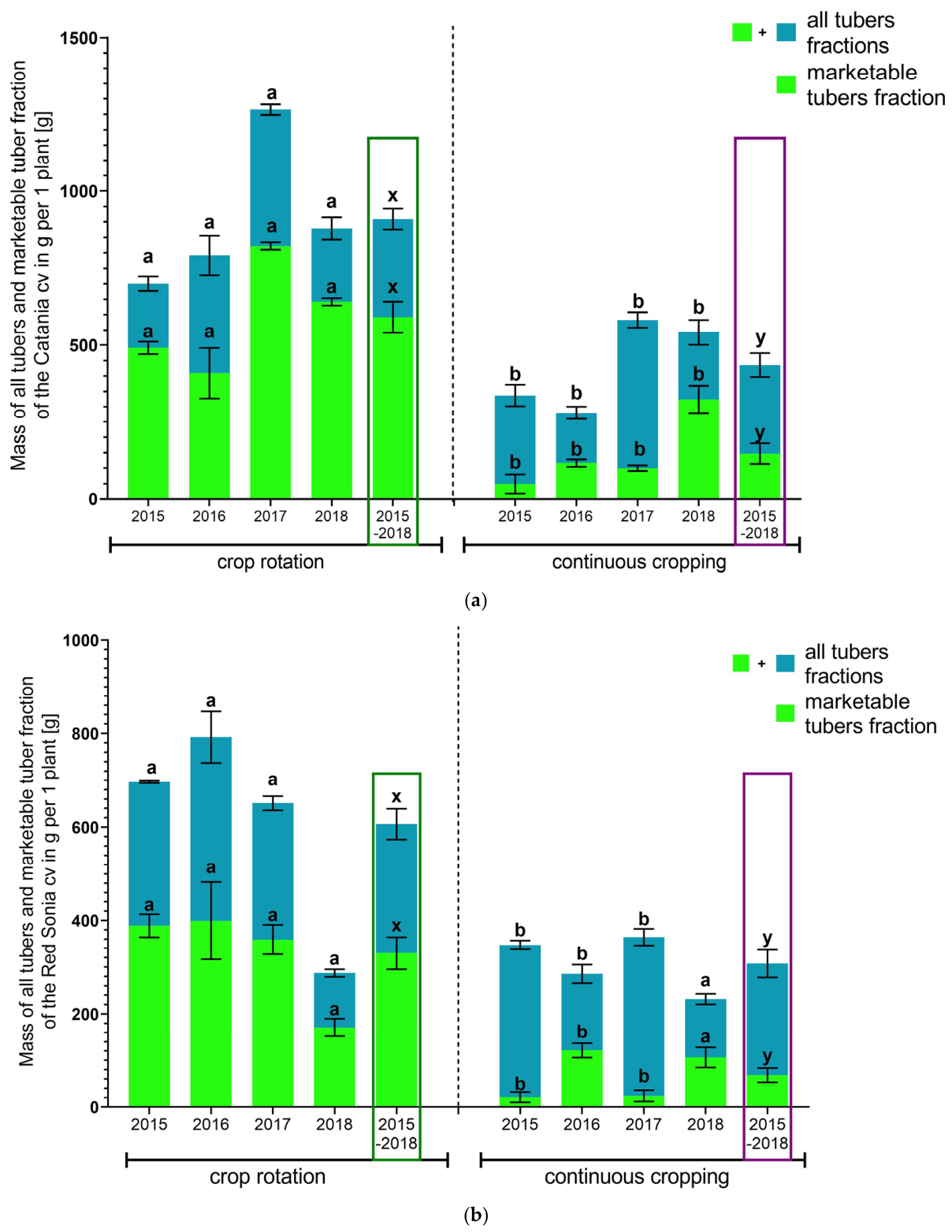
The average mass of tubers from one plant was evaluated for large and small tubers (constituting waste) (Figure 3a,b). For the Catania cultivar in crop rotation, the average mass of large tubers was 536 g, and that of small tubers was 318 g, which together determined the average yield per plant to be 854 g. In continuous cropping, the mass for both large and small tubers was lower, at 410 and 288 g, respectively, and the average total yield was 698 g. The highest yields in crop rotation were obtained in 2017—large tubers reached a mass of 822 g, and small tubers 443 g (total 1265 g), and these values were significantly higher than those obtained in the continuous cropping system, where large tubers reached 100 g and small tubers 483 g (total 583 g). In other years, fluctuations in these values were observed, but in continuous cropping, the mass of large tubers was significantly lower than in crop rotation. For the Red Sonia cultivar, the average yield per plant in crop rotation was 607 g, with 329 g of large tubers and 277 g of small tubers. In continuous cropping, the yield per plant was lower and consisted of 68 g of large (marketable) tubers and 239 g of small (waste) tubers, giving a total of 307 g per plant (Figure 3a,b). In both cultivars, cultivation in crop rotation favored higher yields of both large and small tubers. The Catania cultivar was characterized by a higher proportion of large tubers than the Red Sonia cultivar.
The number of tubers per plant in the Catania cultivar in crop rotation averaged 6 large and 10 small tubers, for a total of 16 tubers per plant. In continuous cropping, the number of tubers was lower, averaging 2 large and 12 small tubers, for a total of 14 tubers. During this period, the greatest differences between crop rotation and continuous cropping were observed in 2016 and 2018, when the number of tubers in crop rotation was significantly higher than under continuous cropping. In general, continuous cropping was characterized by a smaller number of large tubers, which were almost non-existent in the first years of the first series of studies (no marketable yield), but the total number of tubers was similar to that obtained in crop rotation. During this period, the Red Sonia cultivar in crop rotation produced an average of 16 tubers per plant, with large tubers accounting for a smaller part of the yield. Continuous cropping during the same period was characterized by a lower number of tubers—an average of almost 14, with a low number of large tubers or their absence in some years. Small tubers predominated, and the total number of tubers was similar or slightly lower than in the crop rotation system (except for 2018, when the number of tubers in continuous cropping increased). In summary, the Red Sonia cultivar in crop rotation produced more large tubers than under continuous cropping.
Based on the data obtained, the average mass of one commercial tuber was determined. In the case of the Catania cultivar, an increase in the average mass of 1 tuber was observed with an increase in the range of crop protection. In crop rotation, the average weight of 1 commercial tuber was approximately 89 g. Tubers from crop rotation were larger and more uniform compared to tubers from continuous cropping. In the large tuber category, the largest tubers were obtained in treatments with full chemical protection (H + F). In continuous cropping, the average weight of one commercial tuber was lower than in crop rotation and amounted to approximately 84 g. In some years, especially in plots with no crop protection (O), large tubers were very few in number or absent altogether.

3.2. Results of the Second Series of Studies—Intercropping Period 2019–2023 (47th–51st Year of Continuous Cropping)

In the second series of studies, average yields in crop rotation amounted to 41.2 tꞏha1 (Table 4). The highest yields were recorded in 2019 (46.8 tꞏha−1), when spring rainfall was favorable, and the summer was moderately wet. The lowest yields were obtained in 2022–2023 (38–39 tꞏha−1) as a result of uneven rainfall distribution in the summer. The introduction of catch crops partially stabilized yields in years with variable moisture, but extreme weather conditions still determined the yield level. Springs were both dry (e.g., April 2020 with almost no rainfall) and moderately wet (2021, 2023). During the summer, there was both moderate and very heavy rainfall in July–August (e.g., in 2021), which reduced the quality of the tubers and caused their uneven growth. As a result of the introduction of an intercrop, the difference in yields between crop rotation and continuous cropping was reduced. Intercropping significantly increased potato yields in continuous cropping for both cultivars. In continuous cropping, the average yield increase was approximately 9–10 t·ha−1 compared to the first series of the study, when no intercropping was practiced. A slight decrease in potato yield was observed in crop rotation. During periods important for potato vegetation, there were variable weather conditions, such as frequent droughts and heat waves with periodic, short-term, heavy rainfall [39].
Also in the second series of studies, the Catania potato cultivar yielded higher in crop rotation (41.2 tꞏha−1) than in continuous cropping (32.0 tꞏha−1). For the Red Sonia cultivar, the yields were 33.3 tꞏha−1 and 29.0 tꞏha−1, respectively (Table 4 and Table 6). This means that the average difference in yield between the cultivars decreased significantly. The difference in yield decreased compared to the first series of studies, especially for the Red Sonia cultivar. The yield in continuous cropping was, on average, 22% lower than that obtained in crop rotation for the Catania cultivar and approximately 13% lower for the Red Sonia cultivar. The difference in potato yield, as a reaction to the lack of crop rotation, varied between individual years of the study: for the Catania cultivar, it ranged from 18.6% in the first year after the introduction of the intercrop to 32.7% in the fourth year of the study. For the Red Sonia cultivar, the difference in yield was smaller in the first three years of the study, ranging from 5.7% to 6.7%, while in the fourth year it was 29.4% and in the fifth year 14.9%.
Extending the range of chemical crop protection resulted in improved yields compared to the control treatment (O—no protective measures) in both crop rotation and continuous cropping. The yield obtained from the control plots in the continuous cropping system averaged 31.1 tꞏha−1 and 24.5 tꞏha−1 for the Catania and Red Sonia cultivars, respectively, and the extension of crop protection led to an increase in yield to 35.5 tꞏha−1 for the Catania cultivar and 33.5 tꞏha−1 for the Red Sonia cultivar. It should be noted that not every year of the study showed an increase in yield following the extension of plant protection (introduction of herbicides and fungicides), and the differences varied between subsequent growing seasons.
The commercial yield of potatoes was higher in crop rotation than in continuous cropping, but the scale of these differences was smaller than in the first series of studies (without intercropping). The average commercial yield for the Catania cultivar in crop rotation was 25.4 t·ha−1, while in continuous cropping it was 16.6 t·ha−1 (Table 6). The introduction of intercropping improved the quality of tubers in continuous cropping, where the commercial yield was previously very low, averaging 7.8 t·ha−1. For the Red Sonia cultivar, the average commercial yield in crop rotation was similar to that of the Catania cultivar and averaged 23 t·ha−1, while in continuous cropping, the average yield was significantly lower, at around 10.4 t·ha−1, but still higher than the commercial yield in period I (without intercropping), which was 4.7 t·ha−1 at that time. In both cultivars, a positive effect of increased chemical plant protection was also observed—commercial yields increased with increasing protection intensity (from treatment O to treatment H + F) (Table 6 and Table 7). Based on the results obtained, we conclude that intercropping stabilized the commercial yield, especially in continuous cropping, improving the quantity and quality of tubers. The average share of marketable yield in the total yield for the Catania cultivar grown in crop rotation was approximately 59–64%, while in continuous cropping it was significantly lower (45–56%). In the case of the Red Sonia cultivar, the share of marketable yield was also higher in crop rotation, averaging around 69%, while in continuous cropping it was 36–37%.
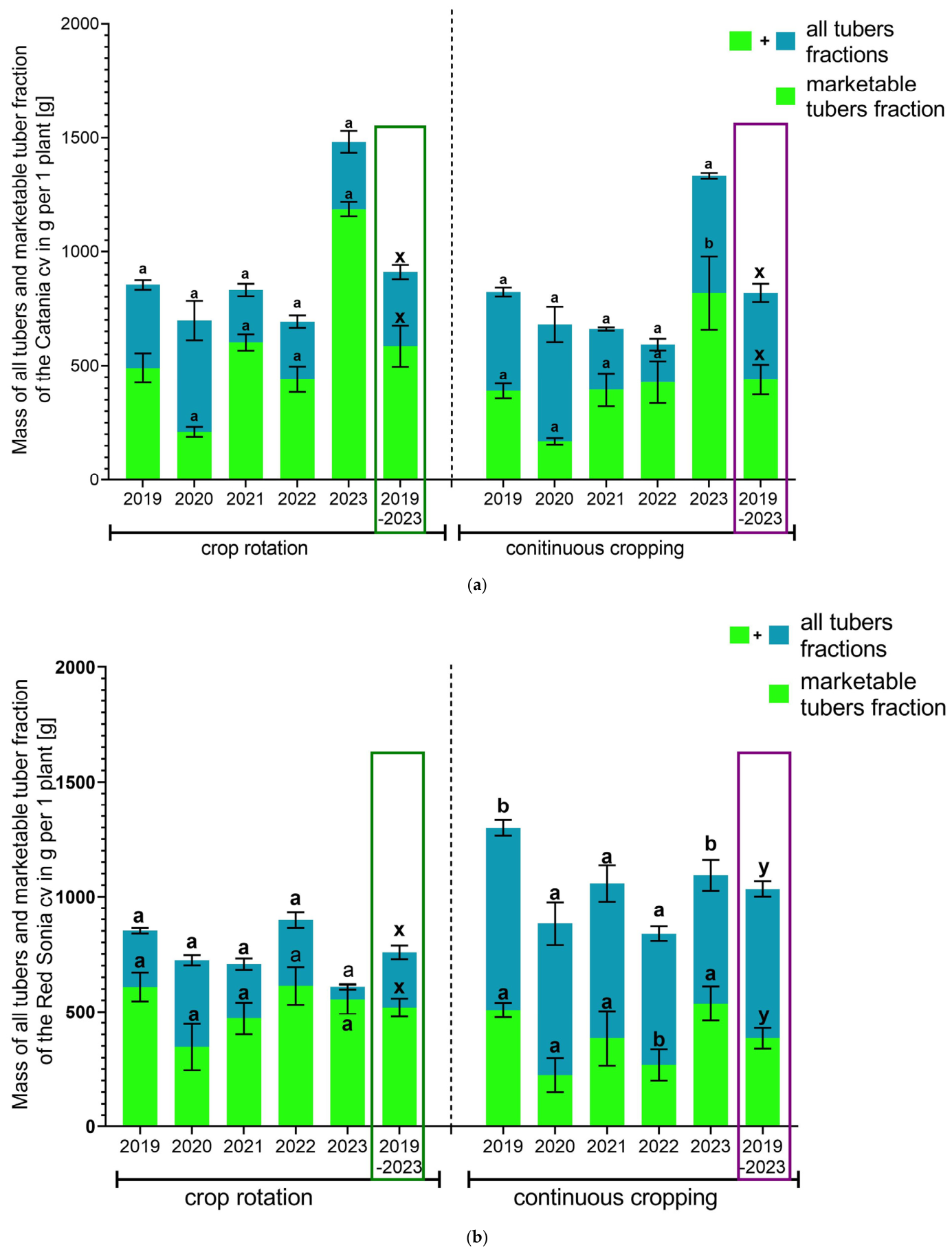
In the Catania cultivar, the average mass of large tubers in crop rotation was 585 g, small tubers were 372 g, and the total yield per plant was 957 g. In continuous cropping, the average values were lower, 451 g for large tubers, 442 g for small tubers, and 893 g in total. The highest yields in crop rotation were recorded in 2023, and the lowest in 2022. For the Red Sonia cultivar, in crop rotation, the average mass of large tubers was 518 g, small tubers 239 g, and the average total yield from one plant was 757 g, while in continuous cropping it was 384 g, 650 g, and 1034 g, respectively (Figure 4a,b). The introduction of intercropping increased the yield compared to the first series of studies. Intercropping stabilized yields and mitigated declines in years with less favorable weather conditions. In continuous cropping, an increase in tuber weight was noticeable, especially in the Red Sonia cultivar.
The introduction of intercropping affected the number of tubers per plant in both cultivation systems. In the Catania cultivar, the number of tubers was more varied than in the Red Sonaia cultivar—there were years with a decrease in tuber number, but in subsequent years the number of both large and small tubers increased. The introduction of intercropping in continuous cropping resulted in an increase in the number of tubers compared to the first series of studies (without intercropping). The introduction of intercropping also had a positive effect on the yield of the Red Sonia cultivar, increasing both the number of large tubers and the total number of tubers. In crop rotation, this effect was more pronounced and stable than in continuous cropping, where the yield was more variable, but here too the potato responded favorably to intercropping.
In crop rotation, the average weight of large tubers was approximately 97 g for the Catania cultivar and 86 g for the Red Soniacultivar. Intercropping kept tuber mass stable and evened out its size during the study years. The positive effect of increasing the range of chemical plant protection (O → H → H + F) was still visible—a higher range increased the weight of large tubers. Intercropping also improved the stability of the mass of large tubers and increased the proportion of marketable tubers in the yield in continuous cropping, but this effect was not as significant as in crop rotation.
In summary, the results indicate that the total yield of potatoes in continuous cropping is lower than in crop rotation, and this is even more evident in commercial terms, where crop rotation produces more large tubers than continuous cropping. The introduction of intercropping reduced the difference in tuber yield between crop rotation and continuous cropping.
In the conducted statistical analysis using three-way analysis of variance (ANOVA), the obtained results are presented in the Supplementary Materials. In the analysis of total and marketable yield of the Catania and Red Sonia cultivars, considering factors such as plant protection, cultivar, and crop rotation, their varying effects on yield were observed.
The greatest influence on yield was exerted by the applied crop rotation—accounting for 68.39% of the variability (Table S6, Supplementary Material) in total yield (p < 0.0001) and 65.16% (Table S8, Supplementary Material) in marketable yield (p < 0.0001) when no intercrop was used. When an intercrop was included in the cultivation cycle, the influence of crop rotation decreased to 20.20% (p < 0.0001, Table S7, Supplementary Material) for total yield and 20.04% for marketable yield (p < 0.0001, Table S9, Supplementary Material).
In the analysis of the effect of intercrops (presented in Tables S10–S13, Supplementary Material) on total and marketable yield of individual cultivars, the effect for the Catania cultivar was 2.499% (p < 0.0001, Table S10, Supplementary Material) and 1.462% (p = 0.0166, Table S12, Supplementary Material), respectively. Also in this case, crop rotation had the greatest impact, accounting for 65.01% (p < 0.0001, Table S10, Supplementary Material) and 53.25% (p < 0.0001, Table S12, Supplementary Material) of the variability in total and marketable yield of the Catania cultivar, respectively.
A similar situation was observed for the Red Sonia cultivar: 33.23% (p < 0.0001, Table S11, Supplementary Material) for total yield and 29.55% (p < 0.0001, Table S13, Supplementary Material) for marketable yield. When analyzing the effect of intercrops while accounting for cultivar-related differences, their overall impact on total and marketable yield was generally lower than that of crop rotation. For the Red Sonia cultivar, it was 4.955% (p < 0.0001) and 17.93% (p < 0.0001) for total and marketable yield, respectively (Tables S11 and S13, Supplementary Material).
The effect of chemical plant protection was analyzed both for individual cultivars (Tables S10–S13, Supplementary Material) and for analyses combining Catania and Red Sonia (Tables S6–S9, Supplementary Material). For Catania, plant protection influenced total yield by 6.036% (p < 0.0001, Table S10, Supplementary Material) and marketable yield by 2.238% (p < 0.0127, Table S12, Supplementary Material). Higher values were recorded for Red Sonia—10.74% (p < 0.0001, Table S11, Supplementary Material) for total yield and 5.88% (p < 0.0001, Table S13, Supplementary Material) for marketable yield.
In general, when cultivars were not analyzed separately, plant protection treatments had an effect ranging from 2.783% (p < 0.0001, Table S6, Supplementary Material) to 11.88% (p < 0.0001, Table S7, Supplementary Material) for total yield, and from 0.5096% (p = 0.3861, Table S8, Supplementary Material) to 12.94% (p < 0.0001, Table S9, Supplementary Material) for marketable yield.
Changes in yield levels are also illustrated in Figures S1 and S2 along with the described factors (Supplementary Material).

4. Discussion

4.1. Impact of Continuous Cropping on Tuber Yield

The conditions for obtaining high potato yields include high-quality seed potatoes, appropriate crop rotation, cultivar selection, fertilization, careful soil preparation, and protection against pests. Neglecting or poor implementation of any of these factors reduces plant condition, which leads to lower potato yields [8,40,41,42,43,44]. Therefore, continuous potato cropping usually leads to lower yields compared to crop rotation. This phenomenon is well described in the literature and is primarily associated with the accumulation of soil pathogens such as Rhizoctonia solani, Verticillium dahliae, and nematodes of the genus Globodera, which tend to grow rapidly when there is no break in potato cultivation [45,46]. In addition, continuous cropping contributes to the deterioration of the physical and biological properties of the soil, resulting in poorer root development of potato plants and limited nutrient utilization [18]. Under continuous cropping, deterioration of soil parameters such as organic matter content and enzymatic activity is also more frequently observed, which significantly reduces its production capacity [47]. The deterioration of these properties leads to weaker plant growth and a reduction in the number and mass of tubers compared to cultivation under crop rotation. As a result, continuous cropping can lead to a significant reduction in yield, as demonstrated, among others, in meta-analyses covering different climate zones [46]. Statistical analysis using three-way ANOVA confirmed the significant influence of the cropping system, intercrop treatment, and chemical protection on potato yield and yield structure. The effect of intercropping depended on whether potatoes were grown in crop rotation or under continuous cropping. In contrast, interactions involving chemical crop protection were not significant, suggesting that its effect was relatively stable across the cropping systems and intercrop treatments.
For the Red Sonia cultivar, total tuber yield was mainly determined by the cropping system, while the effects of chemical crop protection and intercropping were not statistically significant. This indicates that for this cultivar, the difference between crop rotation and continuous cropping played a dominant role in shaping yield levels.
A similar pattern was observed for the yield of marketable tubers. In the case of Catania, significant effects of chemical protection and cropping system were detected, together with significant interactions between chemical protection and intercrop treatment as well as between chemical protection and cropping system. In addition, a significant three-way interaction was observed, which indicates that the effect of protection treatments depended on both the cropping system and the presence of intercrops. These results demonstrate that yield formation in potato is influenced by a complex interaction of agronomic factors, particularly under continuous cropping conditions.
In the context of several decades of crop rotation research conducted at the Bałcyny Agricultural Research Station (a fragment of which from 2015 to 2023 is the subject of this article), it should be noted that the range of differences in potato yield varied over the years due to periodic changes in the severity of diseases and pests, as well as variable weather conditions. The major drop in yield recorded during the first five years of the study was caused by the rapid increase in the potato cyst nematode population [18]. In the Bałcyny experiment, potato cultivars were changed every few years, taking into account their resistance to pathogens and pests, the differences in yield, and the extent of losses in continuous cropping varied over the years [47]. The results obtained in the present study also confirm these observations. In the first series of experiments (2015–2018), potato tuber yield under continuous cropping was approximately 50% lower compared to crop rotation. During the same period, a deterioration in yield structure was observed, manifested by a lower proportion of marketable tubers and a higher proportion of small tubers. However, the situation changed in the second series of experiments (2019–2023), when an intercrop in the form of oilseed radish was introduced. During this period, the differences in yield between crop rotation and continuous cropping were clearly reduced. For the Catania cultivar, this difference decreased from 50.4% in the first series to 22.3% in the second series, while for the Red Sonia cultivar, it decreased from 45.5% to 12.9%. Simultaneously, the share of marketable yield increased under continuous cropping, indicating that the introduction of the intercrop partially mitigated the negative effects of potato continuous cropping. This result confirms the general relationship between the frequency of cultivation of a given crop and its yield, as described in the literature. The principle of rational crop rotation states that there is an inverse relationship between crop yield and the frequency of cultivation of a given species on the same field [48]. This is confirmed by the results of research conducted by Larkin et al. [41], who obtained the most stable tuber yield in crop rotation with the longest rotation period. In contrast, in the studies by Wojciechowski et al. [8], shortening the rotation period resulted in a 5.3% reduction in potato yield in a three-field rotation and a 9.3% reduction in a two-field rotation, compared to the Norfolk crop rotation. The decrease in yield in response to the increasing saturation of the potato crop in rotation saturation was noted by Rzeszutek [49], Zawiślak et al. [50], and Wojciechowski et al. [8]. These authors found significantly lower potato yields when the share of potatoes in crop rotation exceeded 40%. In the experiments conducted by Starczewski and Turska [21], Gonet and Płoszyńska [51], and Rzeszutek and Zawiślak [52], a significant decrease in potato yield was observed only when the share of potatoes in crop rotation was 50%, while in the studies by Reszel and Reszel [53], a decrease in yield occurred only when the crop rotation was saturated with potatoes at 75%. Numerous crop rotation studies have shown that the scale of potato response to continuous cropping varies greatly. The range of differences in tuber yields varied from a dozen or so to about 50%, and in the case of cultivars susceptible to potato cyst nematodes, reached up to 83% [5,46,54,55,56,57,58,59,60,61,62]. Based on many years of research, Majewski [20] emphasizes the positive impact of crop rotation in potato cultivation on plant yield. In a similar context, the study by Lalewicz et al. [31] showed that the introduction of intercrops, such as phacelia and buckwheat, improves soil quality, increases microbial activity, and consequently contributes to the stabilization of crop yields, which may also be significant for potato cultivation. Continuous cropping not only results in lower yields but also has a negative impact on the natural environment. However, from an economic point of view, continuous potato cropping leads to a financial result that is slightly better than the average direct surplus for 4- and 5-year crop rotations. It is precisely this favorable financial result that encourages farmers to disregard the principles of proper crop rotation [15,20].
In another long-term crop rotation experiment also conducted in Poland (specifically in Brody near Poznan), potato yields have been assessed in various crop rotation systems and under the influence of different mineral and organic fertilization since 1958. In the first series of study, potatoes in continuous cropping responded with a 17.8% reduction in yield, and in subsequent series, the differences increased to 43, 61, and 58%, respectively, compared to crop rotation. The greatest losses were caused by potato cyst nematodes. The introduction of resistant cultivars into the experiment limited the yield decline to less than 32% for a certain period, after which the difference in yield increased again to approximately 44%. Significant variation in yield was also noted during the evaluation carried out in the 42nd to 49th year of continuous cropping (counting from the start of the experiment). The difference was 33% in the 42nd year of the study, increasing to 63.5% in the 44th year [7,9].
The results of many years of research conducted in the United States and Canada indicate that the use of appropriate crop rotation can reduce the incidence of soilborne diseases by as much as 30–70%, resulting in increased tuber yields [41]. Furthermore, the inclusion of crops such as oats or field beans in crop rotation significantly reduces the incidence of blackleg, fusarium wilt, and common scab in tubers [60]. The mechanism behind this phenomenon is explained, among other things, by beneficial changes in the structure of soil microbial communities and an increase in the proportion of antagonistic microorganisms [63], which is also confirmed by more recent analyses in the field of soil biology [49,62].
Importantly, the results obtained in this study are consistent with the observations of other authors, who have shown that the longer the period of potato cultivation on the same field, the greater the decline in yields. The literature describes cases of yield declines of 20–40% after only a few years of continuous cropping [45], and over 50% under strong disease pressure [18,41]. A yield decline of approximately 50% was also obtained in our own studies, in the first series, when continuous cropping was practiced without intercropping. Recent reports also indicate that the introduction of crop rotation not only reduces pathogens but also improves the utilization of nutrients, including nitrogen, and improves water retention in the soil. As a result, this improves the economic efficiency of environmental resource management by potato plants, which has been confirmed in both traditional agricultural systems and low-emission and organic systems [63].
Many authors explain the significant reduction in tuber yield in continuous cultivation by a decrease in the number of tubers per plant [7,21,56,64]. The presented results concern the yield and structure of potato crops in crop rotation and continuous cropping in the first series of studies (2015–2018) and in the second series (2019–2023). However, in the earlier period of research in the same experiment, according to Rychcik and Zawiślak [56], the average number of tubers per potato plant grown in crop rotation was 11.2, and in continuous cropping, only 8.5. In addition, a downward trend in tuber size was observed, with an average weight of 71.6 g in crop rotation and 59.8 g in continuous cropping. In a crop rotation experiment with varying proportions of potatoes (16.7%, 33.3%, and 50%), Rzeszutek and Zawiślak [52] also found a negative reaction in tuber yield to an increase in the frequency of potato cropping. These authors noted a reduction in tuber size, an increase in the proportion of medium-sized tubers, and a decrease in the proportion of the largest tubers in the yield. In a long-term crop rotation experiment, Blecharczyk et al. [7] evaluated the yield of potatoes grown in a seven-year crop rotation and in continuous cropping under conditions of varied fertilization. These authors explain the decrease in tuber yield in continuous cropping by a 39.1% reduction in the number of tubers per plant and a 21.4% reduction in the average tuber weight. The highest values for the number of tubers and the average weight of a single tuber were obtained when potatoes were grown in crop rotation and fertilized with a combination of FYM and mineral fertilizers.
In a field experiment, similar to our own, Jabłoński and Hołyński [58] compared the yield of potatoes grown in two-, three-, and four-field crop rotation and in continuous cropping. In assessing the share of different fractions in the yield, they found a decrease in the number of the largest tubers and, at the same time, a several-fold increase in the proportion of the smallest tubers.
Zimny and co-authors [65] compared the growth and yield of potatoes grown in Norfolk crop rotation, two-field crop rotation with oats, and continuous cropping. They found that the increased concentration of potatoes in crop rotation resulted in an increase in the proportion of small tubers and a decrease in the number of large tubers in the total yield. Similarly, Blecharczyk and Małecka [63] found a higher number of tubers per plant in rotation, by 2.3–3.9 pieces, compared to the number of tubers from continuous cropping. The average weight of one tuber for crop rotation was also 7.2–15.9 g higher. Similarly, Jankowska and Szymankiewicz [5] compared the impact of potato cropping under a four-field crop rotation; however, these authors did not find a significant impact of crop succession and tillage method on the number and weight of tubers.

4.2. Role of Intercrops in Mitigating the Effects of Long-Term Potato Continuous Cropping

In continuous potato cropping, soil fatigue and declining yields are major challenges. Our study demonstrates that intercrops, particularly oilseed radish, play a key role in mitigating these negative effects.
Statistical analysis (SSP ANOVA) showed significant main effects of cropping system and intercropping treatments, as well as significant interactions between year × system × intercrop for both total yield and the proportion of marketable tubers (p < 0.05). These results indicate that the benefits of inter-crops depend on both the year and the specific cropping system applied.
Mean comparisons revealed that in the first series of studies (2015–2018), total potato yields in continuous cropping were approximately 50% lower than in crop rotation. In the second series of studies (2019–2023), after introducing oilseed radish as an intercrop, this difference decreased markedly. For the Catania cultivar, yield differences between crop rotation and continuous cropping decreased from 50.4% to 22.3%, while for the Red Sonia cultivar, the reduction was from 45.5% to 12.9%. Similarly, the share of marketable yield in continuous cropping increased from 35.1% to 51.9% for the Catania cultivar and from 23.6% to 35.8% for the Red Sonia cultivar. These results confirm that intercrops improve both the quantity and quality of potato yields under continuous cropping systems. According to Tsytsiura [66], radish cultivation results in the introduction of 9.5–24.8 tꞏha−1 of above-ground biomass and 1.4–8.3 tꞏha−1 of root biomass into the soil, with these values varying significantly over the years. The high fertilizer value of catch crops is reported in the results of research by Nowakowski et al. [67]. The latter showed that oil radish was equivalent to FYM in terms of fertilizer value. Płaza et al. [68] also determined the dry matter and macroelement content in intercrops (red clover and perennial ryegrass) and stubble intercrops, as well as FYM applied before potato cultivation. Oil radish was characterized by a dry matter yield of 4.3–4.4 tꞏha−1, red clover provided 5.2 tꞏha−1, and perennial ryegrass 6.1 tꞏha−1 of dry matter, while for FYM this value was 7.2 tꞏha−1. With the radish intercrop, 96 kg of nitrogen, 30.6 kg of phosphorus, 86.3 kg of potassium, 38 kg of calcium, and 16 kg of magnesium per hectare were introduced into the soil. The authors found that intercrops had a beneficial effect on the structure of the tuber yield. As the total yield increased, the proportion of seed potatoes and large tubers increased, while the proportion of small tubers decreased. Of the intercrops evaluated, oilseed radish had the most beneficial effect.
In the study by Little et al. [69], the effects of intercrops applied before potato cultivation on tuber yield were evaluated. The authors found that the introduction of intercrops such as oats, fodder rape, and white lupin had a beneficial effect on soil structure and plant health. Although an increase in phosphorus availability in the soil was observed, this did not always translate into an immediate increase in tuber mass. The average weight of a single tuber was higher following intercrops—176.3 g after rapeseed and 179.3 g after buckwheat, whereas in cultivation without intercrops, the tuber weight was 160.5 g. In contrast, in potatoes grown after potatoes, the average tuber weight was even lower (146.1 g). These results indicate that the use of intercrops can improve tuber yield both quantitatively (average tuber weight) and qualitatively. Our own studies also showed significant differences in tuber yield depending on the cropping system and the introduction of catch crops. In the first series of experiments (2015–2018), the average tuber mass per plant was higher in crop rotation than in continuous cropping. For the Catania cultivar, the average mass of large tubers was 536 g, small tubers 318 g (total 854 g), while in continuous cropping it was 410 g and 288 g (total 698 g). The highest yields in crop rotation were recorded in 2017—large tubers reached 822 g, small tubers 443 g (total 1265 g), whereas in continuous cropping they were 100 g and 483 g (total 583 g). For the Red Sonia cultivar, the average yield per plant in crop rotation was 607 g, compared to 307 g in continuous cropping.
In the second series of experiments (2019–2023), after introducing oilseed radish as a catch crop, an improvement in yield and stabilization of yield structure was observed. For the Catania cultivar, the average mass of large tubers in crop rotation was 585 g, small tubers 372 g (total 957 g), and in continuous cropping 451 g and 442 g (total 893 g). For the Red Sonia cultivar, in crop rotation, large tubers averaged 518 g, small 239 g (total 757 g), while in continuous cropping, 384 g and 650 g (total 1034 g). The introduction of a catch crop increased yield compared to the first series of studies, stabilized yields, and mitigated declines in years with less favorable weather conditions.
These results confirm the observations of Little et al. [69] that the use of intercrops can improve both the quantity and quality of potato tuber yield, with the benefits being particularly evident in continuous cropping systems.
Wiggins and Kinkel [70] evaluated the effect of green manure (buckwheat, rapeseed) in various combinations on the average weight of one tuber in a field experiment. The use of green manure increased the average weight of one tuber: the lowest weight was obtained for potatoes grown without green manure (160.5 g), and the highest weight was obtained after rapeseed (176.3 g) and buckwheat (179.3 g) intercrops. On plots where potatoes were grown after potatoes, the average weight of one tuber was even lower (146.1 g). Similar conclusions were drawn by Jankowska and Szymankiewicz based on the results of research conducted in Poland. The introduction of intercropping increased the number of marketable tubers and improved soil structure [9].
The results of our own research indicate that intercrops provide greater benefits under continuous cropping than in crop rotation, which is consistent with the literature. Research [50] has shown that the use of catch crops, including oil radish, increases soil microbial activity, improves tuber quality, and reduces diseases such as Rhizoctonia solani and common scab. In turn, research by Płaza et al. [68] suggests the possibility of increased tuber yields as a result of intercropping, especially on farms practicing continuous potato cropping.
Although the direct yield effect may be limited, intercropping in continuous potato cropping systems contributes to the stabilization of the yield structure, reducing the fluctuations in the proportion of individual tuber fractions typical of these systems.
In our study, the effects of crop rotation, the use of intercrops, and plant protection products on the yield of two potato cultivars, Catania and Red Sonia, were analyzed. All of the aforementioned factors influence the final level of both total and marketable yield. Crop rotation has the greatest impact on both types of yield, which is also evident in Figures S1 and S2 (Supplementary Material).
The remaining factors are of lesser importance, although still statistically significant, which is particularly noticeable in the case of intercrops. From a plant-growing perspective, intercropping may be as important as crop rotation. The introduction of an intercropping improved both total and marketable yield under continuous cropping compared to cultivation with crop rotation.
The application of plant protection products in our experiment also affected yield; however, this effect was limited across all analyzed cropping systems. Based on the obtained results, the particularly important role of proper crop rotation should be emphasized, as it has the greatest influence on both total and marketable yield, in contrast to plant protection products. Thus, in plant production, the importance of chemical inputs tends to be overestimated.
Properly applied crop rotation can reduce the use of plant protection products, as shown in Figure 4. Moreover, it should be noted that plant protection products can only slightly compensate for improper cultivation practices. In the case of continuous cropping, gradual soil depletion and unfavorable changes in yield structure are observed, including a reduction in marketable yield.

5. Conclusions

The introduction of intercropping into continuous potato cropping significantly reduced the scale of yield decline compared to crop rotation. In the case of the Catania cultivar, the difference in yield between crop rotation and continuous cropping in the first series of studies (without intercropping) was 50.4%, and in the second series (after introducing intercropping), it decreased to 22.3%. The corresponding differences for the Red Sonia cultivar were 45.5% in the first series and 12.9% in the second series of studies. Furthermore, thanks to the introduction of intercropping, the share of marketable yield increased in continuous cropping from 35.1% to 51.9% for the Catania cultivar and from 23.6% to 35.8% for the Red Sonia cultivar.
The selection of potato cultivar (Catania or Red Sonia) was less effective in compensating for the lack of crop rotation than intercropping. The yield in continuous cropping was on average 22.2% lower than that obtained in crop rotation for the Catania cultivar, and 12.8% lower for the Red Sonia cultivar.
The positive effect of increasing the range of chemical plant protection (O → H → H+F) was the lowest among the factors mitigating the negative effects associated with the absence of crop rotation, and the yield loss was reduced by 6.6%.
The introduction of intercrops into continuous potato cropping, acting as a substitute for crop rotation, was much more effective in compensating for the lack of crop rotation than potato cultivar selection and chemical plant protection treatments. From a practical point of view, farmers can use oilseed radish as an effective measure to improve total potato yield, and especially marketable yield, in continuous cropping systems, while simultaneously reducing the need for chemical plant protection products.
The reaction of potatoes to a prolonged period of continuous cultivation is difficult to predict. In the past, in this field experiment, the factors with the greatest impact on potato yield in continuous cropping changed: in the first 5 years, there was a rapid increase in the golden cyst nematode population (PCN), up to values that reduced potato yield by approximately 90%. In later periods of the study, there was high susceptibility of some cultivars to verticillium wilt and heavy weed infestation. Therefore, the direction of future research on continuous potato cropping will depend on which factors prove to be most significant in limiting potato yield and quality, and on the possibilities for counteracting these factors. This stems from the fact that the primary goal of our research is to enable the continuation of continuous potato cropping at the highest possible production level in this system.

Supplementary Materials

The following supporting information can be downloaded at https://www.mdpi.com/article/10.3390/agriculture16101065/s1. Table S1. Total tuber yield [tꞏha−1] in crop rotation and continuous cultivation, the Catania cultivar, Bałcyny 2015-2023, statistical significance table (one-way analysis of variance with Tukey’s post hoc test, statistical significance values are attached to the letter designations). Table S2. Yield of marketable tubers [tꞏha−1] in crop rotation and continuous cropping, the Catania cultivar, Bałcyny 2015–2023, statistical significance table (one-way analysis of variance with Tukey’s post hoc test, statistical significance values are attached to the letter designations). Table S3. Total tuber yield [tꞏha−1] in crop rotation and continuous cultivation, the Red Sonia cultivar, Bałcyny 2015–2023, statistical significance table (one-way analysis of variance with Tukey’s post hoc test, statistical significance values are attached to the letter designations). Table S4. Yield of marketable tubers [tꞏha−1] in crop rotation and continuous cropping, the Red Sonia cultivar, Bałcyny 2015–2023, statistical significance table (one-way analysis of variance with Tukey’s post hoc test, statistical significance values are attached to the letter designations). Table S5. Additional information on the comparison of yields of the Catania and the Red Sonia cultivars under optimal conditions, i.e., when using crop rotation (data in the text and tables). Table S6. The total yield of the Catania and the Red Sonia cultivars in cultivation with plant protection, crop rotation/continuous cropping without intercropping [tꞏha−1], with Tukey post hoc test—interactions connected with statistical analysis three-way repeated measures ANOVA, statistical significance p < 0.05. Table S7. The total yield of the Catania and the Red Sonia cultivars in cultivation with plant protection, crop rotation, and with intercropping [tꞏha−1] with Tukey post hoc test interactions connected with statistical analysis three-way repeated measures ANOVA, statistical significance p < 0.05. Table S8. The marketable yield of the Catania and the Red Sonia cultivars in cultivation with plant protection, crop rotation/continuous cropping, and without intercropping [tꞏha−1] interactions connected with statistical analysis three-way repeated measures ANOVA with Tukey post hoc test, statistical significance p < 0.05. Table S9. The marketable yield of the Catania and the Red Sonia cultivars in cultivation with plant protection, crop rotation/continuous cropping, and with intercropping [tꞏha−1] interactions connected with statistical analysis three-way repeated measures ANOVA with Tukey post hoc test, statistical significance p < 0.05. Table S10. The total yield of the Catania cultivar in cultivation with or without intercropping – ordinary three-way ANOVA [tꞏha−1] with Tukey post hoc test, statistical significance p < 0.05. Table S11. The total yield of the Red Sonia cultivar in cultivation with or without intercropping—ordinary three-way ANOVA [tꞏha−1] with Tukey post hoc test, statistical significance p < 0.05. Table S12. The marketable yield of the Catania cultivar in cultivation with or without intercropping—ordinary three-way ANOVA [tꞏha−1] with Tukey post hoc test, statistical significance p < 0.05. Table S13. The marketable yield of the Red Sonia cultivar in cultivation with or without intercropping—ordinary three-way ANOVA [tꞏha−1] with Tukey post hoc test, statistical significance p < 0.05. Figure S1. Total tuber yield (Figures A and B) and marketable yield (Figures C and D): A—total tuber yield for the Catania and the Red Sonia cultivars grown without intercropping, B – total tuber yield for the Catania and the Red Sonia cultivars with intercropping, C—marketable tuber yield for the Catania and the Red Sonia cultivars grown without intercropping, D—marketable tuber yield for the Catania and the Red Sonia cultivars grown with intercropping. Figure S2. Effect of the intercroping used on the total tuber yield and marketable yield of the Catania and the Red Sonia cultivar: A—total tuber yield of the Catania cultivar as a function of the intercrop used, B—total tuber yield of the Red Sonia cultivar as a function of the intercrop used, C—marketable tuber yield of the Catania cultivar depending on the intercrop used, D—marketable tuber yield of the Red Sonia cultivar depending on the intercrop used. Description of letter codes: O—no plant protection products applied, H—use of herbicides, H + F—use of herbicides and fungicides. Values in lines followed by the same letter are not statistically different at p ≤ 0.05.

Author Contributions

Conceptualization, J.T. and B.R.; methodology, J.T., K.F. and M.N.; validation, K.F., P.W. and M.N.; investigation, J.T., K.F. and B.R.; data handling, J.T., K.F. and P.W.; writing—original draft, J.T. and K.F.; writing—review and editing, J.T., K.F. and P.W.; visualization, K.F. and P.W.; statistical analyses and results interpretation, P.W. and M.N.; supervision, J.T. and K.F.; project administration, J.T.; funding acquisition, J.T. All authors have read and agreed to the published version of the manuscript.

Funding

This research was financially supported by the Ministry of Science and Higher Education within the framework of the “Regional Initiative of Excellence” program for the years 2019–2022, Project No. 010/RID/2018/19, amount of funding 12.000.000 PLN. This research was funded by the Plant Breeding and Acclimatization Institute—National Research Institute from the research capacity maintenance fund.

Institutional Review Board Statement

Not applicable.

Data Availability Statement

The original contributions presented in this study are included in the article. Further inquiries can be directed to the corresponding author.

Conflicts of Interest

The authors declare no conflicts of interest.

References

  1. Gastoł, J.; Lutomirska, B. Potato yield depending on its concentration in crop rotation. Zesz. Probl. Post. Nauk Roln. 1988, 331, 171–186. [Google Scholar]
  2. Umaerus, V.R.; Scholte, K.; Turkensteen, L.J. Crop rotation and the occurrence of fungal diseases in potatoes. In Effects of Crop Rotation on Potato Production in the Temperate Zones; Springer: Berlin/Heidelberg, Germany, 1989; pp. 171–189. [Google Scholar]
  3. Zawiślak, K.; Rzeszutek, I. The effect of crop rotation with increasing potato share on weed development. Argricultura 1990, 51, 25–32. [Google Scholar]
  4. Gebremedhin, B.; Schwab, G. The economic Importance of Crop Rotation Systems: Evidence from the Literature; Staff Paper Series 11690; Michigan State University, Department of Agricultural, Food, and Resource Economics: East Lansing, MI, USA, 1998. [Google Scholar]
  5. Jankowska, D.; Szymankiewicz, K. Potato yield in crop rotation and monoculture under conditions of different tillage systems. Agron. Sci. 2004, 59, 989–994. [Google Scholar]
  6. Rychcik, B. Effect of herbicides and crop sequence on weed infestation of maize (Zea mays L.). Prog. Plant Prot. 2006, 46, 170–173. [Google Scholar]
  7. Blecharczyk, A.; Małecka, I.; Piechota, T.; Sawińska, Z. Effect of crop sequence and fertilization on yield and chemical composition of tubers of the potato cultivar Sante. Acta Sci. Pol. Agric. 2008, 7, 13–19. [Google Scholar]
  8. Wojciechowski, W.; Lehmann, A.; Wacławowicz, R. Potato response to simplifications in crop rotation. Fragm. Agron. 2013, 30, 181–188. [Google Scholar]
  9. Blecharczyk, A.; Małecka–Jankowiak Sawinska, Z.; Piechota, T.; Waniorek, W. 60-Year Fertilization Experiment in Brody with Crop Cultivation in Crop Rotation Monoculture; Marks, M., Jastrzębska, M., Kostrzewska, M.K., Eds.; Long-Term Experiments in Agricultural Research in Poland; Wydawnictwo UWM-Olsztyn: Olsztyn, Poland, 2018. [Google Scholar]
  10. Wesołowski, M. Sowing structure and its natural and organizational-economic determinants in Poland. Ann. Univ. Mariae Curie-Skłodowska Sect. E Agric. 2007, 62, 1–12. [Google Scholar]
  11. Pszczółkowski, P.; Sawicka, B.; Niazi, P.; Barbaś, P.; Krochmal-Marczak, B. Agroecological Determinants of Yield Performance in Mid-Early Potato Varieties: Evidence from Multi-Location Trials in Poland. Land 2025, 14, 1777. [Google Scholar] [CrossRef]
  12. Jabłońska-Urbaniak, T. Agriculture and Food Economy in Poland; Ministry of Agriculture and Rural Development: Hanoi, Vietnam, 2009. [Google Scholar]
  13. Lutomirska, B. The role of potatoes in crop rotation. Ziem. Pol. 1994, 1, 13–15. [Google Scholar]
  14. Przybysz, T.; Malicki, M. Field experiment as an element of addressing research problems in the science of crop rotations. Fragm. Agron. 1996, 13, 102–117. [Google Scholar]
  15. Sieczka, J.B. Some negative aspects of crop rotations. In Effect of Crop Rotation on Potato Production in Temperate Zones; Vos, J., Van Loon, C.D., Bollen, G.J., Eds.; Springer: Berlin/Heidelberg, Germany, 1989; pp. 259–273. [Google Scholar]
  16. Gruczek, T. Natural and agronomic aspects of potato cultivation. Zesz. Probl. Post. Nauk Roln. 2004, 500, 31–44. [Google Scholar]
  17. Nowicki, Z.; Szwejkowski, Z.; Buczyński, G.; Nożyński, A.; Wanic, M. Comparison of specialized forage crop rotations on light soil. Zesz. Prob. Post. Nauk Roln. 1990, 376, 121–132. [Google Scholar]
  18. Marks, M.; Rychcik, B.; Treder, K.; Tyburski, J. 50 Years of Research on Crop Cultivation in Rotation Monoculture—A Source of Knowledge a Monument of Agricultural Culture; Marks, M., Jastrzębska, M., Kostrzewska, M.K., Eds.; Long-Term Experiments in Agricultural Research in Poland; UWM Publishing: Olsztyn, Poland, 2018; pp. 41–56. [Google Scholar]
  19. Niewiadomski, W. The impact of crop rotation simplification on crop yields. Probl. Issues Agric. Sci. Prog. 1972, 137, 101–109. [Google Scholar]
  20. Majewski, E. Production, economic, and environmental aspects of simplifying the sowing structure. Ann. Agric. Sci. Ser. G. 2010, 97, 159–168. [Google Scholar]
  21. Starczewski, J.; Turska, E. The effect of preceding crop and organic fertilization on potato tuber yield grown in crop rotations with varying levels of this crop. Ann. Agric. Sci. Ser. A Crop Prod. 1998, 113, 121–132. [Google Scholar]
  22. Ahmed-Mushfiq, Z.K.; Kostrzewska, I.M.; Lastname, V.V. Utilizing different crop rotation systems for agricultural and environmental sustainability: A review. Agronomy 2025, 15, 1966. [Google Scholar] [CrossRef]
  23. Jatoe, J.B.D.; Edwards, M.; Simmons, P.; MacLeod, K. Economic and environmental impacts of introducing land use policies and rotations on Prince Edward Island potato farms. Land Use Policy 2008, 25, 309–319. [Google Scholar] [CrossRef]
  24. Chen, Z.-B.; Huang, D.-C.; Liu, Z.-Z. Crop rotation enhances agricultural sustainability: From an empirical evaluation of eco-economic benefits in rice production. Agriculture 2021, 11, 91. [Google Scholar] [CrossRef]
  25. Moldavan, L.; Pimenova, O.; Wasilewski, M.; Wasilewska, N. Crop rotation management in the context of sustainable development of agriculture in Ukraine. Agriculture 2024, 14, 934. [Google Scholar] [CrossRef]
  26. Xie, H.; Li, Q.; Wang, Y.; Zhang, S.; Chen, J. Rotation reshapes sustainable potato production in dryland by reducing environmental footprints synergistically enhancing soil health. Resour. Environ. Sustain. 2025, 21, 100247. [Google Scholar] [CrossRef]
  27. Thorup-Kristensen, K.; Magid, J.; Jensen, L.S. Catch crops and green manures as biological tools in nitrogen management in temperate zones. Adv. Agron. 2003, 79, 227–302. [Google Scholar] [CrossRef]
  28. Stroud, J.L.; Irons, D.E.; Watts, C.W.; Storkey, J.; Morris, N.L.; Stobart, R.M.; Fielding, H.A.; Whitmore, A.P. Cover cropping with oilseed radish (Raphanus sativus) alone does not enhance deep burrowing earthworm (Lumbricus terrestris) midden counts. Soil Tillage Res. 2017, 165, 11–15. [Google Scholar] [CrossRef]
  29. Hamidi, N.; Hajihassani, A. Differences in parasitism of root-knot nematodes (Meloydogyne spp.) on oilseed radish and oat. J. Nematol. 2020, 52, e2020-43. [Google Scholar] [CrossRef] [PubMed]
  30. Quintarelli, V.; Radicetti, E.; Allevato, E.; Stazi, S.R.; Haider, G.; Abideen, Z.; Mancinelli, R. Cover Crops for Sustainable Cropping Systems: A Review. Agriculture 2022, 12, 2076. [Google Scholar] [CrossRef]
  31. Lalewicz, P.; Domagała-Świątkiewicz, I.; Siwek, P. Phacelia and Buckwheat Cover Crops’ Effects on Soil Quality in Organic Vegetable Production in a High Tunnel System. Agronomy 2024, 14, 1614. [Google Scholar] [CrossRef]
  32. Hauggaard-Nielsen, H.; Jensen, E.S. Facilitative root interactions in intercrops. Plant Soil 2005, 274, 237–250. [Google Scholar] [CrossRef]
  33. Płaza, A.; Gąsiorowska, B.; Rzążewska, E.; Cybulska, A.; Górski, R. The effect of manuring with undersown catch crop, and production system on the potato tuber content of microelements. Ital. J. Agron. 2019, 14, 176–182. [Google Scholar] [CrossRef]
  34. Szatkowski, A.; Antoszkiewicz, Z.; Purwin, C.; Jankowski, K.J. Oilseed radish: Nitrogen and sulfur management strategies for seed yield and quality—A case study in Poland. Agriculture 2024, 14, 755. [Google Scholar] [CrossRef]
  35. Kondracki, L. Geografia Regionalna Polski; Wydawnictwo Naukowe PWN: Warszawa, Poland, 2000. [Google Scholar]
  36. Roztropowicz, S. (Ed.) Methodology of Observations, Measurements, and Sampling in Agronomic Potato Experiments; IHAR O/Jadwisin: Jadwisin, Poland, 1999; 50p. [Google Scholar]
  37. Act of 27 August 2003 on Specific Principles of Preparing and Marketing Certain Agricultural Products. 2003. Available online: http://isap.sejm.gov.pl/isap.nsf/DocDetails.xsp?id=WDU20031941899 (accessed on 7 May 2026).
  38. United Nations Economic Commission for Europe. UNECE Standard FFV-52: Early and Ware Potatoes; United Nations: Geneva, Switzerland, 2011; Available online: https://unece.org/trade/documents/2022/03/working-documents/standard-ffv-52-early-and-ware-potatoes (accessed on 21 January 2026).
  39. Central Statistical Office (GUS); Central Research Centre for Cultivar Testing (COBORU). Weather Conditions in Poland During Potato Growing Seasons in 2015–2020; GUS/COBORU: Warsaw, Poland, 2021. Available online: https://bdl.stat.gov.pl/ (accessed on 18 January 2026).
  40. Trojanowska, M.; Turska, E.; Czarnecki, S.Z. Potato yield depending on its position in crop rotation. Fragm. Agron. 2005, XXII, 222–228. [Google Scholar]
  41. Larkin, R.P.; Honeycutt, C.W.; Gryffin, T.S.; Olanya, M.; Halloran, J.M.; He, Z. Effects of different potato system approaches and water management on soilborne diseases and soil microbal communities. Phytopathology 2011, 101, 58–67. [Google Scholar] [CrossRef]
  42. Głuska, A. The effect of agronomic practices on shaping potato yield quality [Wpływ agrotechniki na kształtowanie jakości plonu ziemniaka]. IHAR Bull. 2000, 213, 173–178. [Google Scholar]
  43. Rykaczewska, K. Physiological determinants of the yield potential of traditional seed potatoes mini-tubers. In Potato Production and Market; Chotkowski, J., Ed.; Wieś Jutra: Warsaw, Poland, 2012; pp. 67–76. [Google Scholar]
  44. Sawicka, B.; Pszczółkowski, P. Phenotypic variability of yield structure of potato varieties in central-eastern Poland. IHAR Bull. 2004, 232, 53–66. [Google Scholar] [CrossRef]
  45. Larkin, R.P.; Lynch, R.P. Use and Effects of Different Brassica and Other Rotation Crops on Soilborne Diseases and Yield of Potato. Horticulturae 2018, 4, 37. [Google Scholar] [CrossRef]
  46. Qin, J.; Bian, C.; Duan, S.; Wang, W.; Li, G.; Jin, L. Effects of different rotation cropping systems on potato yield, rhizosphere microbial community and soil biochemical properties. Front. Plant Sci. 2022, 13, 999730. [Google Scholar] [CrossRef] [PubMed]
  47. Zawiślak, K.; Tyburski, J.; Rychcik, B.B. Significance of crop rotation and cultivar resistant to potato cyst nematode on potato production. Developments in Plant and Soil Sciences. In Effect of Crop Rotation on Potato Production in the Temperate Zones; Springer: Berlin/Heidelberg, Germany, 1988; Volume 40, pp. 111–119. [Google Scholar]
  48. Kuś, J. Farming Systems in Agriculture: Integrated Agriculture; Training Materials; IUNG Puławy Publishing: Puławy, Poland, 1995; Volume 42. [Google Scholar]
  49. Rzeszutek, I. Ecological and productive effects of the increasing share of potatoes in crop rotation. I. The first crop rotation. Acta Univ. Warmia Mazury Olsztyn 1991, 53, 115–128. [Google Scholar]
  50. Zawiślak, K.; Rzeszutek, I.; Tyburski, J. The Upper Limit for the Frequency of Potato Growing in Rotations in Northern Poland. In Effects of Crop Rotation on Potato Production in the Temperate Zones; Vos, J., Van Loon, C.D., Bollen, G.J., Eds.; Springer: Dordrecht, The Netherlands, 1989; Volume 40, pp. 67–75. [Google Scholar] [CrossRef]
  51. Gonet, Z.; Płoszyńska, W. Potato yields in crop rotation and monoculture on light soil, and the effectiveness of using wart-resistant varieties and nematicides. Problematic Issues of Agricultural Science Progress. Zesz. Probl. Postępów Nauk Roln. 1990, 376, 133–141. [Google Scholar]
  52. Rzeszutek, I.; Zawiślak, K. Variability of potato yields depending on its share in crop rotation, choice of varieties, and preceding crops. Problematic Issues of Agricultural Science Progress. Zesz. Probl. Postępów Nauk Roln. 1997, 439, 195–200. [Google Scholar]
  53. Reszel, R.S.; Reszel, H. Potato yield in crop rotation and 16-year continuous growing. Rostl. Výr. 1999, 45, 279–281. [Google Scholar]
  54. Mercik, S.; Stępień, W. Yields of rye, wheat, and potatoes depending on long-term diversified fertilization and crop rotation. Part III. Potatoes. In Symposium Materials: The Role of Fertilization in Increasing Soil Productivity and Fertility; Part III; Proceedings of a Symposium: Olsztyn, Poland, 1988; pp. 165–176. [Google Scholar]
  55. Zawiślak, K.; Tyburski, J. The tolerance of root, industrial and fodder crops to continuous cultivation. Acta Acad. Agric. Tech. Olsztyn 1992, 55, 149–160. [Google Scholar]
  56. Rychcik, B.; Zawiślak, K. Potato productivity in crop rotation and long-term monoculture. Ann. Agric. Acad. Poznań Agric. 1998, 52, 183–189. [Google Scholar]
  57. Zimny, L.; Oliwa, T. The effect of long-term potato cultivation in specific two-field rotations and monoculture on soil wartying and tuber yields. Fragm. Agron. 2000, 17, 58–70. [Google Scholar]
  58. Jabłoński, B.; Hołyński, E. The relationship between potato yields and the frequency of their return to the same field. Probl. Issues Agric. Sci. Prog. 1988, 331, 163–170. [Google Scholar]
  59. Larkin, R.P. Soil health paradigms and implications for disease management. Annu. Rev. Phytopathol. 2015, 53, 199–221. [Google Scholar] [CrossRef]
  60. Larkin, R.P.; Honeycutt, C.W. Effects of different 3-year cropping systems on soil microbial communities and Rhizoctonia diseases of potato. Phytopathology 2006, 96, 68–79. [Google Scholar] [CrossRef]
  61. Barel, J.M.; Kuyper, T.W.; de Boer, W.; Bouwmeester, H. Crop rotation enhances soil microbial diversity and disease suppressiveness. Soil Biol. Biochem. 2023, 182, 109123. [Google Scholar] [CrossRef]
  62. Larkin, R.P.; Griffin, T.S. Control of soilborne potato diseases using Brassica green manures. Crop Prot. 2007, 26, 1067–1077. [Google Scholar] [CrossRef]
  63. Blecharczyk, A.; Małecka, I. Response of potatoes to organic and mineral fertilization in a long-term experiment. Folia Univ. Agric. Stetin. Agric. 2000, 211, 41–46. [Google Scholar]
  64. Krzysztofik, B. The effect of soil cultivation on the uniformity of potato tuber size and starch yield. Acta Agrophysica 2009, 14, 355–365. [Google Scholar]
  65. Zimny, L.; Wacławowicz, R.; Oliwa, T. Growth and yield of potatoes depending on their share in crop rotation. Probl. Issues Agric. Sci. Prog. 2006, 511, 268–277. [Google Scholar]
  66. Tsytsiura, Y. Evaluation of ecological adaptability of oilseed radish (Raphanus sativus L. var. oleiformis Pers.) biopotential realization in the system of criteria for multi-service cover crop. J. Ecol. Eng. 2024, 25, 265–285. [Google Scholar] [CrossRef]
  67. Nowakowski, J.; Kowalczyk, R.; Zieliński, M. Rzodkiew oleista jako międzyplon dla ziemniaka. Pr. Nauk. Inst. Uprawy Roślin 1997, 45, 33–46. [Google Scholar]
  68. Płaza, A.; Kowalski, T.; Nowak, M. The effect of catch crops and manure on the yield of table potatoes and tuber structure. Ann. Agric. Sci. 2009, 36, 45–60. [Google Scholar]
  69. Little, C.R.; White, P.; Green, T. Value of cover crops as preceding crops for potato. Soil. Use Manag. 2004, 20, 175–182. [Google Scholar]
  70. Wiggins, B.E.; Kinkel, L.L. Effects of green manures and previous crops on potato tuber weight. Field Crops Res. 2005, 93, 110–123. [Google Scholar]
Figure 1. Layout of continuous cropping (CC) and crop rotation (CR) plots in the field experiment in Bałcyny in 2016 and 2022.
Agriculture 16 01065 g001
Figure 2. Layout of potato subplots in crop rotation and continuous cropping in the Bałcyny experiment (2015–2023), showing cultivar.
Agriculture 16 01065 g002
Figure 3. (a) Proportion of marketable and small tuber mass per single potato plant cv. Catania grew in crop rotation and continuous cropping (2015–2018), without intercropping. Values in lines followed by the same letter are not statistically different at p ≤ 0.05. (b) Proportion of marketable and small tuber mass per single potato plant cv. Red Sonia grown in crop rotation and continuous cropping (2015–2018), without intercropping. Values in lines followed by the same letter are not statistically different at p ≤ 0.05.
Agriculture 16 01065 g003
Figure 4. (a) Proportion of marketable and small tuber mass per single potato plant cv. Catania grown in crop rotation and continuous cropping (2019–2023), with intercrop. Values in lines followed by the same letter are not statistically different at p ≤ 0.05. (b) Proportion of marketable and small tuber mass per single potato plant cv. Red Sonia grown in crop rotation and continuous cropping (2019–2023), with intercrop. Values in lines followed by the same letter are not statistically different at p ≤ 0.05.
Agriculture 16 01065 g004
Table 1. Atmospheric precipitation and daily air temperature during 2015–2023 recorded in Bałcyny Meteorological Station.
YearMonth
IIIIIIIVVVIVIIVIIIIXXXIXIII-XII
Atmospheric precipitation (mm)
201528.58.846.023.425.443.071.013.056.251.246.142.6455.2
201628.750.520.533.170.866.3138.673.917.196.387.277.8749.0
201715.840.553.052.134.0109.9106.154.8240.1160.349.053.8940.4
201837.62.025.028.141.064.7140.731.225.946.924.557.2528.0
Mean 2018–201827.725.536.134.142.870.1114.143.284.888.751.757.9668.2
201943.033.820.20.097.892.085.8 64.884.438.120.117.6607.6
202028.644.925.41.164.099.339.7107.232.181.210.925.1559.5
202134.713.623.636.4109.031.3128.4147.423.527.947.122.1645.0
202240.757.60.220.047.789.663.3134.261.628.311.447.7602.3
202338.452.938.436.910.078.758.066.821.950.157.254.6563.9
Mean 2019–202337.140.621.618.965.778.275.0104.144.745.129.333.4595.7
Daily air temperature (°C)
20150.60.34.67.212.115.718.021.38.12.8−1.0−2.47.2
2016−3.82.73.68.814.818.018.517.514.86.92.51.08.7
2017−3.2−1.25.16.713.316.717.218.813.59.44.31.98.7
20180.0−1.4−0.511.916.517.919.920.515.39.84.11.19.4
Mean 2015–2018−1.60.13.28.714.217.118.419.512.97.32.50.48.5
2019−2.52.0 4.98.612.221.417.619.513.79.95.62.89.6
20202.33.13.36.910.117.917.719.214.710.15.61.59.4
2021−2.5−4.52.45.711.619.421.116.712.98.94.7−2.27.9
20220.62.31.96.212.117.918.120.811.210.63.7−0.48.8
20232.10.43.37.512.617.718.719.917.49.23.01.29.4
Mean 2016–20230.00.73.27.011.718.918.619.214.09.74.50.69.0
Table 2. Crop sequence during 2015–2023, crop rotations, and long-term cereal growing.
YearCrop Rotation FieldsContinuous Cropping Fields
123456
2015TriticalePotato *OatsFlaxRyeBean43rd year of potato cropping
2016Potato *OatsFlaxRyeBeanTriticale44th year of potato cropping
2017OatsFlaxRyeBeanTriticalePotato *45th year of potato cropping *
2018FlaxRyeBeanTriticale/
oil radish
Potato *Oats46th year of potato cropping +
oil radish intercropping
2019RyeBeanTriticale/
oil radish
Potato *OatsFlax47th year of potato cropping +
oil radish intercropping
2020BeanTriticale/
oil radish
Potato *OatsFlaxRye48th year of potato cropping * +
oil radish intercropping
2021Triticale/
oil radish
Potato *OatsFlaxRyeBean49th year of potato cropping +
oil radish intercropping
2022Potato *OatsFlaxRyeBeanTriticale/
oil radish
50th year of potato cropping +
oil radish intercropping
2023OatsFlaxRyeBeanTriticalePotato *51st year of potato cropping * +
oil radish intercropping
* Fertilization with FYM: Under crop rotation, once during a rotation; 30 t ha −1 in April before potato growing; in potato continuous cropping, every 3 years; 15 ha −1 in autumn 2017, 2020, and 2023 before growing season in 2018, 2021, and 2024.
Table 3. Basic agricultural data for potato growing, Bałcyny, 2015–2023.
ItemPotato Cultivation
Fertilization
Mineral fertilizationNPK
80 (50 + 30) kg·ha−1 *30 kg·ha−1100 kg·ha−1
Organic
fertilization
Farmyard manure: 30 t·ha−1 annually (in crop rotation) and: 15 t·ha−1 every 3 years * (in continuous potato)
Chemical potato protection
HerbicidesInsecticidesFungocides
2015–2018Afalon 450 SC (1.5 L·ha−1)Karate Zeon 050 SC (0.1 L·ha−1) **
Apacz 50 WG (40 g·ha−1) **
Mospilan 20 SP (0.08 kg·ha−1) **
Ridomil Gold MZ Pepite 67.8 WG
(2.5 kg·ha−1) **
Curzate CU 49.5 WP (2.0 kg·ha−1) **
Dithane NeoTec 75 WG (2.0 kg·ha−1) **
Infinito 687.5 SC (1.0 L·ha−1) **
Gwarant 500 SC (2.0 L·ha−1) **
2019–2023Afalon 450 SC (1.5 L·ha−1)Karate Zeon 050 SC (0.1 L·ha−1) **
Apacz 50 WG (40 g·ha−1) **
Mospilan 20 SP (0.08 kg·ha−1) **
SpintorTM 240 SC (0.5 L·ha−1) **
Ridomil Gold MZ Pepite 67.8 WG
(2.5 kg·ha−1) **
Curzate CU 49.5 WP (2.0 kg·ha−1) **
Dithane NeoTec 75 WG (2.0 kg·ha−1) **
Infinito 687.5 SC (1.0 L·ha−1) **
Gwarant 500 SC (2.0 L·ha−1) **
* The first application of nitrogen (urea) was applied in spring during pre-sowing cultivation, and the second application (ammonium nitrate) was applied as a top-dressing after plant emergence. ** Herbicides, fungicides, and insecticides were applied alternately within each group of products throughout the study period (2015–2023).
Table 4. Total tuber yield [tꞏha−1] in crop rotation and continuous cropping, Catania cultivar, Bałcyny 2015–2023.
Catania
Year
Crop RotationContinuous Cropping
OHH + FMean OHH + FMean
Without Intercropping
201530.7 a35.6 a38.8 b35.0 x13.6 a17.4 b18.9 b16.6 y
201648.8 a47.6 a54.5 b50.3 x20.3 a22.6 a26.3 a23.1 y
201747.8 a47.7 a54.3 b49.9 x24.7 a25.0 a30.0 b26.6 y
201844.1 a45.7 a49.3 b46.4 x22.8 a25.1 a25.0 a24.3 y
2015–201842.9 a44.1 a49.2 b45.4 x20.3 a22.3 a24.8 a22.5 y
With intercropping
201944.1 a47.5 a48.8 b46.8 x34.1 a38.3 b41.8 c38.1 y
202038.4 a41.7 a43.1 b41.1 x28.4 a30.7 b35.6 c31.6 y
202140.5 a43.0 a45.9 b43.1 x29.8 a31.9 b38.2 c33.3 y
202235.7 a38.6 a43.9 b39.4 x24.4 a26.7 a28.4 b26.5 y
202335.9 a37.5 b43.4 c38.9 x25.6 a32.1 b33.6 c30.4 y
2019–202438.9 a41.7 a45.0 b41.2 x31.1 a31.9 b35.5 c32.0 y
Letter codes for plant protection: O—no plant protection, H—herbicide, H + F—herbicide + fungicides; Letter codes following to plant protection values; (O, H, H + F)—a,b,c; codes for mean values—x,y—refer to the statistical significance between the values given values in lines followed by the same letter are not statistically different at p ≤ 0.05.
Table 5. Total tuber yield [tꞏha−1] in crop rotation and continuous cropping, Red Sonia cultivar, Bałcyny 2015–2023.
Red Sonia
Year
Crop RotationContinuous Cropping
OHH + FMean OHH + FMean
Without intercropping
201529.0 a29.3 a32.9 a30.4 x15.5 a16.2 a17.2 a16.3 y
201643.0 a44.0 a44.8 a43.9 x14.7 a20.3 b20.5 b18.5 y
201740.6 a40.5 a44.1 a41.7 x22.4 a30.0 b32.4 c28.3 y
201828.1 a29.2a30.4 a29.3 x15.2 a19.4 b19.7 b18.1 y
2015–201835.2 a36.2 a38.2 a36.5 x16.5 a21.1 a22.2 a19.9 y
With intercropping
201933.6 a38.8 b43.0 a38.5 x32.8 a35.4 b40.8 c36.3 x
202023.7 a33.9 b36.7 c31.4 x21.0 a28.5 b38.3 c29.3 x
202123.0 a34.0 b34.7 b30.6 x23.0 a30.9 b32.1 c28.7 x
202232.8 a36.2 b38.1 b35.7 x19.7 a25.8 b30.0 c25.2 y
202327.1 a31.8 b31.4 b30.1 x26.2 a24.3 a26.2 a25.6 y
2019–202328.0 a34.9 b36.8 b33.3 x24.5 a29.0 a33.5 b29.0 y
Letter codes for plant protection: O—no plant protection, H—herbicide, H + F—herbicide + fungicides; Letter codes following to plant protection values; (O, H, H + F)—a,b,c; codes for mean values—x,y—refer to the statistical significance between the values given values in lines followed by the same letter are not statistically different at p ≤ 0.05.
Table 6. Yield of marketable tubers [tꞏha−1] in crop rotation and continuous cropping, Catania cultivar, Bałcyny 2015–2023.
Catania
Year
Crop RotationContinuous Cropping
OHH + FMeanOHH + FMean
Without intercropping
201522.3 a26.3 a24.8 a24.6 x0.0 a2.2 a5.9 b2.4 y
201629.2 a28.1 a19.4 a26.0 x8.2 a9.5 a11.2 a9.6 y
201730.6 a32.0 a34.7 a32.4 x3.6 a3.9 a6.4 a4.6 y
201833.6 a34.5 a33.7 a33.9 x11.7 a14.5 a17.7 a14.5 y
2015–201828.9 a30.2 a28.2 a29.2 x5.9 a7.5 a10.3 a7.8 y
Witch intercropping
201922.8 a25.7 a31.9 a26.9 x15.2 a19.6 a19.2 a18.0 x
202015.3 a9.7 a13.0 a12.4 x7.8 a7.7 a8.2 a7.8 x
202129.4 a32.5 a32.0 a31.3 x15.8 a18.0 a25.5 a19.9 x
202220.2 a22.9 a32.3 b25.1 x17.9 a15.5 a23 a19.1 x
202327.0 a31.0 a35.8 a31.1 x13.5 a18.9 a23.2 a18.6 y
2019–202422.9 a24.4 a29.0 a25.4 x14.0 a15.9 a19.8 a16.7 y
Letter codes for plant protection: O—no plant protection, H—herbicide, H + F—herbicide + fungicides; Letter codes following to plant protection values; (O, H, H + F)—a,b; codes for mean values—x,y—refer to the statistical significance between the values given values in lines followed by the same letter are not statistically different at p ≤ 0.05.
Table 7. Yield of marketable tubers [tꞏha−1] in crop rotation and continuous cropping, Red Sonia cultivar, Bałcyny 2015–2023.
Red Sonia
Year
Crop RotationContinuous Cropping
OHH + FMeanOHH + FMean
Without intercropping
201515.3 a16.6 a19.0 a17.0 x0.0 a1.2 a1.7 a1.0 y
201623.6 a26.0 a16.0 a22.1 x6.3 a8.5 a8.7 a7.9 y
201720.4 a21.5 a27.1 a23.0 x0.0 a2.6 a3.1 a1.9 y
201816.8 a15.1 a20.1 a17.5 x7.7 a8.1 a8.5 a8.3 y
2015–201825.4 a26.4 a27.4 a26.5 x4.7 a6.8 a7.3 a6.4 y
With intercropping
201921.8 a28.8 a31.8 b27.5 x12.4 a14.1 a16.1 a14.2 y
20206.9 a16.0 b22.2 c15.0 x4.7 a5.5 a11.9 b7.4 y
202114.7 a22.7 a23.3 b20.4 x4.8 a13.6 b12.0 c10.4 y
202219.1 a25.4 a28.624.4 x4.3 a10.2 a9.4 a8.1 y
202323 a29.9 a29.227.4 x12.5 a12.1 a12.9 a12.5 y
2019–202317.1 a24.7 a27 b22.9 x7.7 a11.1 b12.5 c10.5 y
Letter codes for plant protection: O—no plant protection, H—herbicide, H + F—herbicide + fungicides; Letter codes following to plant protection values; (O, H, H + F)—a,b,c; codes for mean values—x,y—refer to the statistical significance between the values given values in lines followed by the same letter are not statistically different at p ≤ 0.05.
Disclaimer/Publisher’s Note: The statements, opinions and data contained in all publications are solely those of the individual author(s) and contributor(s) and not of MDPI and/or the editor(s). MDPI and/or the editor(s) disclaim responsibility for any injury to people or property resulting from any ideas, methods, instructions or products referred to in the content.