Article

Comparison of Genomic Variation and Population Structure of Latvian Dark-Head with Other Breeds in Latvia Using Single-Nucleotide Polymorphisms


1
Genomics and Bioinformatics, Department of Pharmaceutical Sciences, Faculty of Medicine and Life Sciences, The University of Latvia, Jelgava str. 3, LV-1004 Riga, Latvia
2
Institute of Agrobiotechnology, Faculty of Agriculture, Latvian University of Life Sciences and Technologies, Liela Street 2, LV-3001 Jelgava, Latvia
*
Author to whom correspondence should be addressed.
Agriculture 2026, 16(1), 86; https://doi.org/10.3390/agriculture16010086 (registering DOI)
Submission received: 8 November 2025 / Revised: 22 December 2025 / Accepted: 26 December 2025 / Published: 30 December 2025

Abstract

The Latvian Dark-head (Latvijas tumšgalve; LT) is the only sheep breed developed in Latvia. It is fully adapted to the country’s climatic conditions. As the sole national breed, it holds notable cultural importance by supporting traditional husbandry practices, landscape preservation, and regional identity. However, the dominance of commercial breeds threatens local genetic resources. Small-scale farms, where the LT population is concentrated, are especially vulnerable to population decline and possible extinction. This study assesses the genetic diversity within the LT breed and compares it with that of other major sheep breeds in Latvia. For the first time, lambs from sire rams of major breeds in Latvia underwent genotyping using the Illumina Ovine SNP50 BeadChip® (San Diego, CA, USA). Genetic diversity was assessed with minor allele frequency (MAF) analysis. Breed-specific markers were identified by detecting fixed SNPs (MAF = 0) unique to each breed. In total, 27,561 highly polymorphic SNPs (MAF 0.3–0.5) were identified in the LT breed. This indicates substantial genetic differentiation from other sheep breeds raised in Latvia. Among the analyzed SNPs, 2668 (5.45%) were fixed in the LT breed. Of these, 55–131 were unique compared with other breeds. The OvineSNP50 panel is an effective tool for characterizing the genetic structure of the LT breed. It enables the detection of distinct genetic traits and interbreed differences. These results establish a genomic basis for targeted conservation and selective breeding strategies. Such strategies maintain the genetic integrity and competitiveness of the Latvian Dark-head.

1. Introduction

Small ruminants remain integral to sustainable food systems because they utilize fibrous, low-nutrient feed [1,2]. The global sheep population surpassed 1.285 billion in 2023 and includes roughly 1400 breeds [3,4,5]. In contrast, Latvia’s sheep numbers are shrinking. The national sheep population has declined since 2018, falling to 69.5 thousand animals by January 2025 [6].
As of early 2025, data were available for 22 breeds in Latvia: 12 classified as a meat type (15.14% of purebred sheep), 14 as a combined wool/meat type (84.36%), and three as a milk type (0.50%) [6].
Currently, ten sheep breeding programs are active in the country [7]. The Latvian Sheep Breeders Association (LAAA) categorizes these breeds by maternal and paternal lines based on performance. Maternal breeds, such as the Latvian Dark-head (Latvijas tumšgalve; LT), Merinolandschaf (MLS, or Württemberger), and Romanov (ROM), are selected for fertility and maternal ability. Paternal (terminal sire) breeds include Île de France (IF), Charollais (CH), Dorper (DOR), Suffolk, Oxford Down, and Texel (TEX), chosen for growth, feed conversion efficiency, and carcass quality [7]. Paternal breeds are widely used in crossbreeding to improve offspring meat quality [8].
However, pursuing commercial performance without careful management can erode national or local genetic resources [9], thereby threatening the long-term sustainability of agricultural systems. Beyond production, indigenous breeds are vital to cultural heritage, regional identity, and the preservation of rural landscapes [2]. As a result, crossbreeding strategies should include both phenotypic assessment and genomic analysis to avoid significant deviation from the breed’s genetic roots [10].
The Latvian Dark-head (LT) is the only sheep breed originating from Latvia. The first herd book dates to 1939, and by 2014, eight breeding lines had been identified within the population [2,11], which numbered around 14,000 animals in early 2025 [6]. Initially, the LT breed was developed by crossing local coarse-wool sheep with imported Shropshire and Oxfordshire breeds to enhance wool quality. Breeding goals evolved over time, including crosses with Finnish Landrace for prolificacy, Île de France for meat quality, and German and Estonian Blackhead breeds to address undesirable traits [2,12]. Today, LT sheep are medium to large, polled, and exhibit strong muscular development. Mature ewes weigh 55–65 kg, while rams weigh 95–120 kg. The breed is also noted for lambing ease, lactation capability, and an average fertility rate of 150–160% [2,13].
Current selection goals for the LT breed aim to enhance meat productivity and maintain high reproductive efficiency [14]. Molecular genetic studies have been initiated to characterize the LT breed and determine its relationship with other breeds. To date, the OvineSNP50 BeadChip, which assays over 50K SNP loci, has not previously been used in genetic studies of the LT breed. There have been no SNP-array-based multi-breed comparisons including LT, and the breed’s fixed SNPs and population structure are uncharacterized. SNP arrays are effective for identifying markers associated with quantitative traits and for clarifying breed structure [15,16,17].
Previous studies have analyzed associations with fattening indicators [18,19,20,21] and performed whole-genome sequencing on a small group [2]. This study now uses the widely used OvineSNP50 BeadChip. Our goal is to determine the genetic diversity and population structure of the Latvian national sheep breed, in comparison to other breeds raised in Latvia. These results will support the use of genomic tools in future mating decisions, helping preserve breed characteristics and genetic diversity.

2. Materials and Methods

2.1. Research Animals

Data on 261 animals (Table 1) from eight sheep breeds were analyzed. All animals were purebred lambs from sire rams, collected between 2022 and 2024. The lambs were raised at the ram breeding control station “Klimpas” in collaboration with the Latvian Sheep Breeders Association. The lambs originated from various purebred sheep farms across Latvia. All samples represented unrelated individuals, though their parents were involved in the breeding process.
The sample proportions used in this study correspond to the distribution of purebred sheep breeds raised in Latvia.

2.2. DNA Extraction and Genotyping

Blood samples were collected from the lamb’s jugular vein during a veterinary examination. Genomic DNA was extracted using a DNA extraction kit from Fermentas (part of Thermo Fisher Scientific, Waltham, MA, USA). DNA quality and quantity were assessed using standard techniques: agarose gel electrophoresis and spectrophotometry.
Genotyping was performed at Neogen Europe (Ayr, Scotland, UK) using the Illumina OvineSNP50® BeadChip (Illumina, San Diego, CA, USA).

2.3. Genomic Variation Analysis

Quality control (QC) used stringent criteria. Individuals with a call rate over 95% and SNPs with a call rate over 95% were included. The Hardy–Weinberg equilibrium was tested to exclude loci with bias in any breed, using a confidence level of p < 1.0 × 10⁻⁵.
The following basic indices of genetic diversity were calculated for each breed and for breed-type groups (maternal, excluding LT, and paternal/meat only): percentage of polymorphic markers, observed heterozygosity (Ho), expected heterozygosity (He), and minor allele frequency (MAF).
Allele frequencies were calculated for each breed/breed type to assess the performance of the Ovine SNP50 chip. SNP markers were classified based on their MAF values, with rare alleles defined with MAF < 0.01, fixed alleles with MAF = 0, and highly polymorphic (H-poly) alleles with MAF between 0.3 and 0.5.
Because the LT group had a larger sample size, we used a resampling (bootstrapping) approach. We selected 20 random samples 10,000 times. Mean values and 95% confidence intervals were calculated from the resulting data.
A comparative analysis identified SNPs fixed in the LT breed and/or its related breed types. Only the bootstrapping approach was used for the LT population: 20 random samples for individual breeds, and 40 or 80 for maternal and paternal breeds, respectively.

2.4. Genetic Population Structure Analysis

Principal component analysis (PCA) and structure analysis (Genetic admixture) were conducted to characterize the genetic background and population structure of the studied sheep breeds.
To minimize the confounding effect of correlated variants, SNPs in high linkage disequilibrium (LD, r2 > 0.8) were excluded. LD pruning was performed in PLINK [21] using a 100 kb sliding window with a step size of 0.8. The resulting pruned SNP dataset was used for all subsequent analyses of population structure.
PCA was performed in PLINK using LD-pruned SNPs to identify the major components reflecting population stratification based on genetic relationships among individuals. Genotypes were centered but not scaled. The PCA plots were generated in R using the ggplot2 package to detect clustering patterns and identify informative molecular markers for each breed.
Genetic admixture analysis was performed using a maximum-likelihood approach implemented in ADMIXTURE v1.3 [22]. The number of ancestral clusters (K) was tested from 2 to 8, and the optimal K was determined as the value with the lowest cross-validation error using the default five-fold cross-validation (fold = 5).
Genetic differentiation between breeds was quantified using Wright’s FST [23], computed in PLINK. FST values indicate the reduction in heterozygosity due to population subdivision, ranging from 0 (no differentiation) to 1 (complete genetic isolation). According to commonly used thresholds, FST values of 0.05–0.15 indicate moderate differentiation, 0.15–0.25 indicate great differentiation, and values ≥0.25 indicate very strong genetic differentiation.

3. Results

3.1. SNP Statistics and Genetic Diversity

Out of the 54,241 SNPs on the Illumina OvineSNP50 BeadChip, 48,981 SNPs were retained for the genetic diversity analysis following qualitative and quantitative quality control, with the exclusion of one duplicate SNP.
A minimal discrepancy was observed between the expected heterozygosity (He) and observed heterozygosity (Ho) when analyzing each breed separately, suggesting no widespread deviation from the Hardy–Weinberg equilibrium across the population. Across all samples analyzed, the average minor allele frequency (avMAF) was 0.32. Specifically, the LT breed exhibited an avMAF of 0.30, which was slightly higher than the average for maternal-type breeds (avMAF = 0.29) but lower than that for paternal-type breeds (avMAF = 0.31).
The distribution and background information for the 48,981 analyzed SNPs across all samples and by breed/breed type are detailed in Table 2.
Overall, 63.49% of the SNPs in the combined samples exhibited high polymorphism (H-poly), with an MAF ranging from 0.3 to 0.5 (Table 2). For the Latvian Dark-head breed, the proportion of H-poly SNPs was 56.27% (27,561 SNPs), representing a reduction of 7.22% compared to the overall sample set. The Romanov (ROM) breed had the lowest proportion of H-poly SNPs (36.86%), a finding that may have been influenced by its relatively small sample size.
A total of 27,771 rare SNPs (MAF < 0.01) were identified across all samples. The highest frequency of rare SNPs (10.62% or 5203 SNPs) was found in the Charollais (CH) breed, whereas the LT breed exhibited a proportion of 6.47% (3169 SNPs).
In the total sample set, 2391 SNPs were identified as fixed (MAF = 0.01), accounting for 4.82% of all analyzed SNPs (Table 2). When examined by individual breed, the number of fixed SNPs varied considerably, ranging from 2668 in LT to a maximum of 5203 in CH. Notably, the collective number of fixed SNPs found in the maternal-type breeds (excluding LT: 3198) and paternal-type breeds (2710) was substantially lower than the sum of fixed SNPs found within the respective individual breeds.
  • Comparative fixed SNP analysis
To determine the genetic uniqueness of the LT breed, a comparative analysis was conducted to identify common and unique fixed SNPs between LT and other breeds/breed types (Table 3).
In the analysis, the number of fixed SNPs obtained via the bootstrapping approach was used for the LT breed. In the bootstrapping approach for the comparative analysis with individual breeds, 20 randomly selected samples yielded 3709 fixed SNPs. For the maternal variety, with 40 randomly selected samples, 3175 fixed SNPs were obtained, and for the paternal varieties, there were 80 samples and 2769 fixed SNPs.
Among the combined maternal-type breeds (MLS and ROM), the LT breed was differentiated by 502 unique fixed SNPs, accounting for 15.81% of all fixed SNPs detected in LT samples (Figure 1). In this comparison, the maternal group contained 525 unique fixed SNPs. The LT breed shared more common fixed SNPs with ROM than with MLS.
When comparing LT to the maternal breeds individually, LT had an average of 812 unique fixed SNPs (21.89% of its total fixed SNPs) compared to MLS and an average of 612 unique fixed SNPs (16.50% of its total fixed SNPs) compared with ROM, indicating greater genetic similarity.
Compared to the combined paternal-type breeds, the LT breed exhibited 289 unique fixed SNPs (10.44% of all fixed SNPs in LT), a higher count than identified in the maternal breed comparison (Figure 1). The lowest number of unique fixed SNPs in LT, which showed higher genetic similarity, was observed compared with the CH breed (505 SNPs, 13.62%). The highest number of unique fixed SNPs in LT (720 SNPs or 19.41%) was found in the comparison with the Île de France (IF) breed. The CH breed also displayed the highest proportion of breed-specific SNPs among its fixed markers (28.79%).

3.2. Genetic Population Structure

A total of 46,315 SNPs that were not in linkage disequilibrium (r2 < 0.8) were used to determine the population structure.
  • Principal component analysis (PCA)
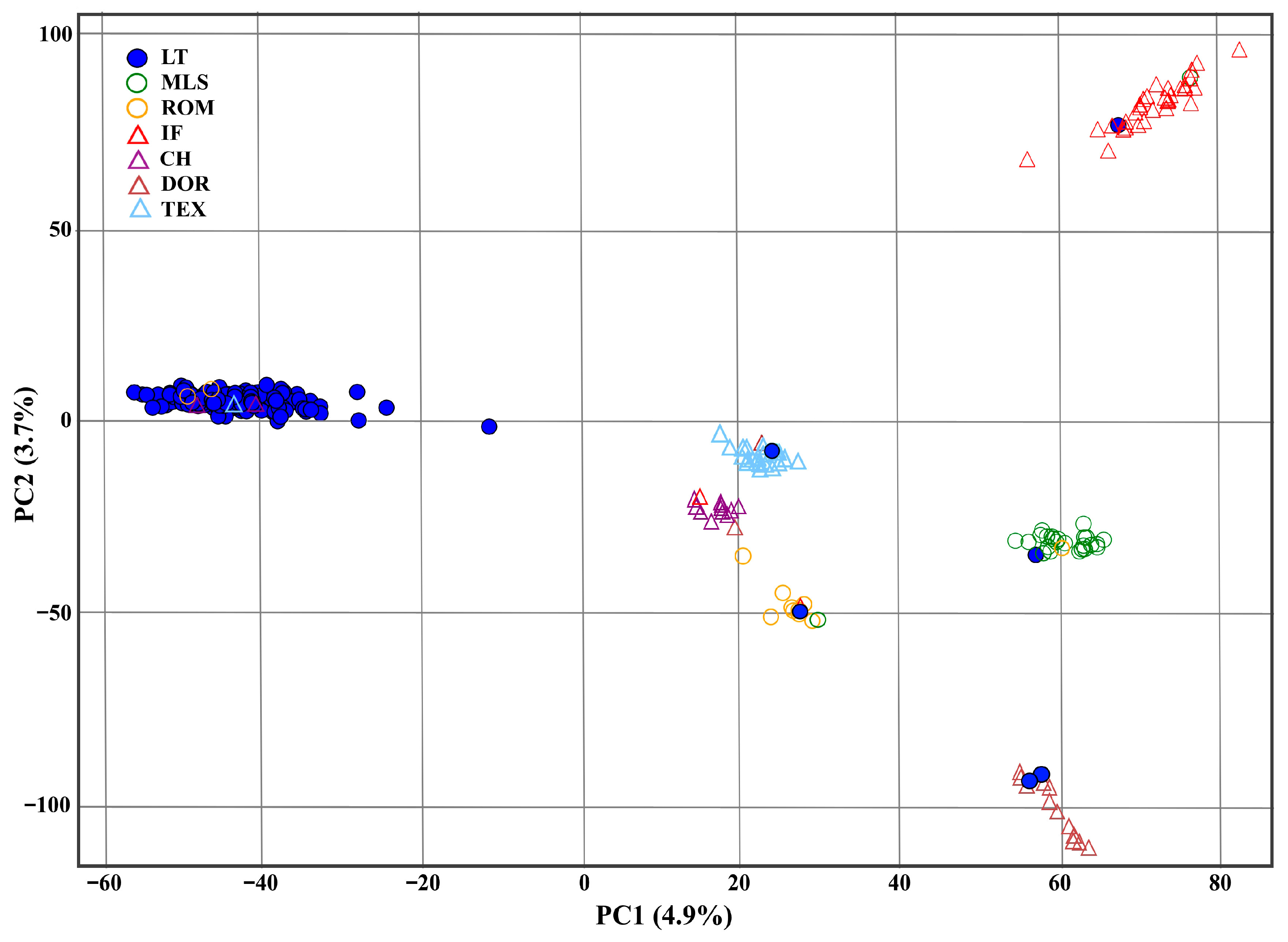
The PCA results demonstrate that the LT breed forms a distinct cluster separate from all other breeds along the first two principal components (Figure 2). These two components, PC1 (4.9%) and PC2 (3.7%), cumulatively accounted for 8.6% of the total genetic variance. While the LT breed is clearly segregated by PC1, it is positioned relatively close to the TEX, CH, and ROM breeds on the PC2 axis, all of which are frequently utilized worldwide for breed improvement programs [24,25].
  • Genetic differentiation (FST)
Despite the spatial proximity of the LT breed to TEX, CH, and ROM in the PCA plot, theFST index indicated a “great difference”. The FST values calculated between LT and other breeds were as follows: LT vs. TEX: 0.24; LT vs. MLS, ROM, and CH: 0.23; LT vs. IF: 0.22 (the lowest value); and LT vs. DOR: 0.33 (signifying a “very great difference”).
These high values suggest low genetic migration between the breeds, consistent with the presence of individual, segregated breeding programs in Latvia for each breed and with strict oversight by the supervising organization.
  • Admixture analysis
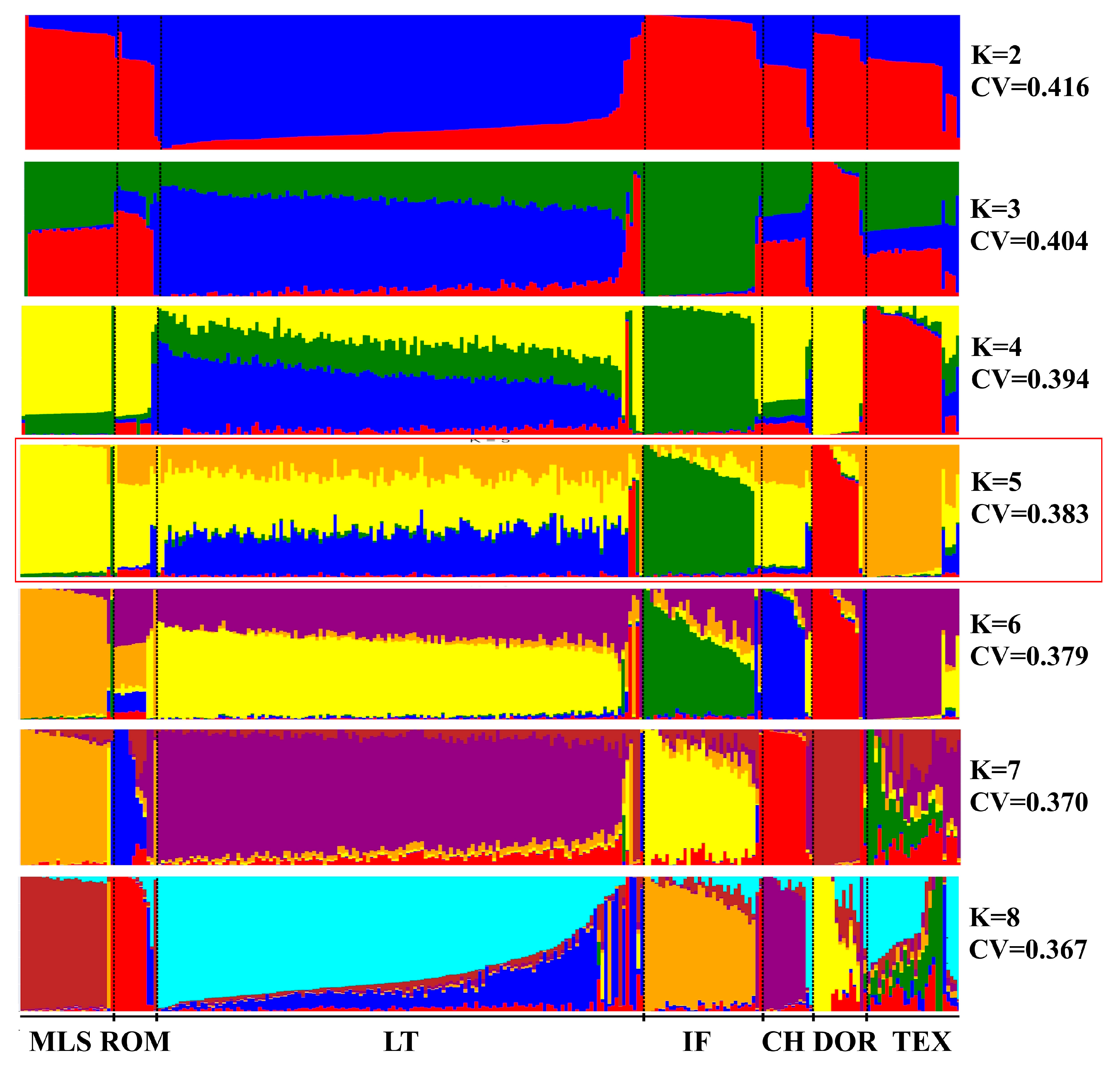
The cross-validation error decreased sharply from K = 2 to K = 5, with only marginal improvement for higher K values. Therefore, K = 5 was selected as the optimal number of ancestral populations, balancing model fit and biological interpretability.
The Admixture analysis further confirmed the distinct genetic structure of the LT breed (Figure 3). At the initial level of analysis (K = 2), a clear difference in the distribution of genetic components was already apparent between LT and the other breeds raised in Latvia. At K = 3, the LT breed exhibits a unique principal component (Figure 3, blue color), which is also minimally present in ROM (another maternal breed), CH, and TEX.
When the cluster number was increased to K = 5, the LT breed was characterized by three principal components, with one of these components being present at very low levels in other breeds. An elbow in the cross-validation curve was observed at K = 5; beyond this point, adding additional ancestral components yielded only minor improvements in the cross-validation error. In analyses with K = 6 to K = 8, a distinct component for the LT breed was clearly preserved, occurring only minimally in the other breeds, underscoring the LT breed’s independent nature within the national selection process.

4. Discussion

Local livestock breeds play a fundamental role in sustainable animal production due to their adaptation to regional environments, resilience to climatic fluctuations, and contributions to animal biodiversity. Effective management of breeding and restoration programs requires a comprehensive understanding of breed characteristics, including diversity within a breed and between breeds within a region [26]. The Latvian Dark-head is the only sheep breed developed in Latvia and, as such, represents both a valuable agricultural resource and an element of cultural heritage [14]. Its conservation and genetic evaluation, therefore, are not only relevant to breeders but also of strategic national interest.
Previous genetic studies on LT have primarily focused on associations between specific genetic loci and indicators of intensive fattening [18,19,20,21]. Moreover, whole-genome sequencing of 40 LT animals has provided additional comparative data against existing genomic databases [2]. This study expands the characterization of LT by providing the first SNP-array-based assessment of genetic diversity and population structure in Latvia using the OvineSNP50 BeadChip. Analyzing LT alongside other breeds raised in the country provides a comparative genomic framework that clarifies the distinct genetic features of the national breed relative to its regional counterparts.
The observed and expected heterozygosity values for the LT breed were similar, indicating no substantial deviation from the Hardy–Weinberg equilibrium. While the expected heterozygosity was comparable to that of the other breeds analyzed, the observed heterozygosity (Ho = 0.36) was slightly higher than in the remaining Latvian breeds. This estimate also exceeded the value reported previously for a smaller LT cohort (Ho = 0.267; n = 40) [2]. When compared with local breeds from neighboring countries, the LT heterozygosity level appears consistent: Polish breeds show Ho values ranging from 0.378 to 0.398 [27], while Lithuanian breeds show Ho values ranging from 0.32 to 0.34 [28]. Both studies included phenotypically related breeds suitable for crossbreeding with the LT type, such as Lithuanian Blackface (Ho = 0.41) [28] and Polish Black-headed sheep (Ho = 0.396) [27]. These findings indicate that the LT breed has not undergone substantial erosion of genetic diversity despite its restricted distribution within Latvia.
The average minor allele frequency of LT (avMAF = 0.30) is consistent with expectations for geographically constrained local breeds with limited population sizes [29,30]. Similar patterns have been reported for Polish and Lithuanian breeds [27,28]. Restriction of LT to a single national gene pool and the presence of only eight established breeding lines [2,11] likely contribute to this moderate differentiation. Historically, population structure assessments for LT were based only on pedigree information rather than genomic data [12]; therefore, the SNP array results presented here provide a more accurate genetic inventory.
The SNP information available in the Ensembl database is largely derived from the Sheep HapMap Project, which includes 2536 animals representing 68 breeds and is regarded as one of the most comprehensive surveys of global sheep diversity [31]. This project employed the OvineSNP50 BeadChip. However, many breeds in the dataset had relatively small sample sizes, which should be taken into account when interpreting allele frequency estimates. Across all breeds, the mean observed heterozygosity (Ho) was 0.382, exceeding the value obtained for LT in the present study. For Northern European breeds specifically, Ho averaged 0.378, and the average MAF value was 0.287 across all breeds and 0.284 for Northern European breeds.
In the Latvian LT breed, 2668 SNPs were identified as fixed (i.e., monomorphic), a number substantially lower than that observed in the other breeds analyzed. Pairwise comparisons revealed between 55 and 131 SNPs uniquely fixed in LT relative to each comparator breed. These markers may help define the genetic signature of LT and could be incorporated into future applications for breed identification or genomic characterization [16].
When comparing LT, a breed characterized by high maternal performance, particularly fertility (1.5–1.6 lambs per ewe) [2,13], with paternal or meat-type breeds, 230 SNPs were found to be unique to LT, and 272 SNPs were specific to the meat-type breeds. These latter markers may have the potential to improve carcass-related traits in LT through targeted breeding strategies.
Using three complementary analytical approaches—PCA, admixture analysis, andthe FST index—we consistently observed a clear genetic separation of the LT breed from all other sheep breeds maintained in Latvia.
The degree of genetic differentiation between LT and comparator breeds was high, with an average FST value of 0.248 (range 0.22–0.33). Such values indicate minimal gene flow among breeds, reflecting long-standing, independent breeding programs, the absence of crossbreeding, and strict oversight by the national breeding organization. This isolation is further supported by the fact that LT is the only sheep breed developed in Latvia and has not been imported [14].
The PCA results reinforced these findings, with 99% of LT samples forming a distinct cluster, confirming substantial divergence from other maternal and paternal breeds. Along PC1, LT animals were fully separated, while the positioning of TEX, CH, and ROM along PC2 suggests a degree of functional convergence among these breeds. TEX and CH are globally used as sire breeds for improving meat traits, whereas ROM is widely recognized for its prolificacy [24,25]. Thus, their proximity on PC2 likely reflects similarities in selection pressures rather than shared ancestry.
The admixture analysis further substantiated the genetic independence of LT. Across all tested K values, LT consistently retained unique ancestral components that were either absent or present only in minimal proportions in other breeds. This pattern aligns with the historical absence of crossbreeding between LT and foreign breeds, thereby maintaining its genetic uniqueness. Notably, at intermediate clustering levels (K ≤ 5), partial similarity in ancestry components was observed between LT and the Charollais (CH) breed, although the proportions differed markedly. Charollais is a widely distributed meat breed [32] and has never been used in LT breeding programs, according to breeder records. This resemblance may therefore reflect convergent selection for meat traits rather than historical introgression and may indicate latent potential for meat trait enhancement within LT, a priority in the current breeding strategy.
Earlier whole-genome sequencing of a smaller LT cohort [2] similarly reported genetic separation of LT from other breeds, although no close relationship with CH was detected. In the present study, however, the relationship between LT and CH was also supported by the fixed SNP analysis, where the highest number of shared fixed markers was observed between these breeds. Their proximity in the PCA, despite high FST values, is therefore more likely explained by functional convergence than by close genetic relatedness.
Empirical studies consistently show that understanding the genetic structure and diversity of local sheep breeds is essential for mitigating the risks of inbreeding and genetic drift. Preserving genetic variation supports resilience, disease resistance, and population adaptation to changing environmental conditions [17]. In this context, molecular approaches, including microsatellite analysis and high-density SNP genotyping, enable detailed characterization of relationships among sheep populations and support informed genetic management of local breeds such as the Latvian Dark-head.
Future studies should aim to increase sample sizes to further validate the present findings. Building on the current results, comparative analyses of breed-specific genomic regions may help identify loci associated with distinct production traits. Particular attention should be given to fixed SNPs unique to the LT breed and to breed-specific markers identified through comparisons with commercial meat breeds, especially in association studies targeting carcass quality and productivity. Such efforts would not only refine our understanding of the genetic basis of the Latvian Dark-head but also support its targeted improvement.
In summary, the Latvian Dark-head sheep combines notable genetic diversity with adaptations that support its sustainability under changing environmental conditions. Continued genomic research will be essential for safeguarding this national breed while enabling informed breeding strategies that balance conservation goals with economic competitiveness.

5. Conclusions

This study presents the first genome-wide SNP array analysis of the Latvian Dark-head sheep, extending previous gene-focused and small-scale sequencing studies by providing a population-level view of genetic diversity and structure. The results confirm that LT is genetically distinct from other breeds raised in Latvia while maintaining moderate within-breed diversity.
A set of 2668 fixed SNPs was identified in pairwise breed comparisons, including 55–131 markers unique to LT, helping to clarify breed-specific genomic characteristics. These markers should be regarded as candidate indicators of genetic distinctiveness rather than as immediately applicable breeding tools and should be validated in independent populations.
This work establishes a genomic baseline for the Latvian Dark-head breed and lays the groundwork for future studies supporting its conservation and targeted improvement, particularly in balancing meat productivity and maternal traits.

Author Contributions

Conceptualization, I.T. and N.P.; Methodology, S.P. and M.M.; Software, M.M.; Validation, I.T. and N.P.; Formal analysis, I.T. and M.M.; Investigation, S.P., D.M. and N.K.; Resources, N.P. and D.K.; Data curation, I.T., M.M. and D.K.; Writing—original draft, I.T.; Writing—review & editing, I.T. and N.P.; Visualization, M.M. and J.P.; Project Administration, I.T. and N.P.; Funding acquisition, N.P. and D.K. All authors have read and agreed to the published version of the manuscript.

Funding

Supported by the Latvian Council of Science, Latvia, Project LZP-2021/1-0489 “Development of an innovative approach to identify biological determinants involved in the between-animal variation in feed efficiency in sheep farming” and Project LZP-2024/1-0092 “Genetic tools for feed efficient and sustainable meat production in Latvian sheep breeds”.

Institutional Review Board Statement

This research did not require ethical approval, as animal sample collections and related ethics in Latvia are regulated by following laws in the Republic of Latvia: “Animal Protection Law”, “Veterinary Medicine Law”, and Cabinet of Ministers Regulations No. 5 “General Animal welfare requirements for livestock” and No. 52 “Rules for the protection of animals for scientific use”. In addition, in accordance with Directive 2010/63/EU of the European Parliament and of the Council of 22 September 2010 on protecting animals used for scientific purposes, the procedures for the selected animals can be considered light.

Data Availability Statement

The data presented in this study are available on request from the corresponding author. The ongoing data processing within the project limits the availability of data. Datasets will be published during the project.

Acknowledgments

We thank the employees of the Latvian Sheep Breeders Association and the Ram control fattening farm “Klimpa” for their valuable help in sheep breeding and data acquisition.

Conflicts of Interest

The authors declare that they have no conflicts of interest.

References

  1. Mazinani, M.; Rude, B. Population, world production and quality of sheep and goat products. Am. J. Anim. Vet. Sci. 2020, 15, 291–299. [Google Scholar] [CrossRef]
  2. Gudra, D.; Valdovska, A.; Kairisa, D.; Galina, D.; Jonkus, D.; Ustinova, M.; Viksne, K.; Kalnina, I.; Fridmanis, D. Genomic diversity of the locally developed Latvian Darkheaded sheep breed. Heliyon 2024, 10, e31455. [Google Scholar] [CrossRef] [PubMed]
  3. IWTO. About Sheep. 2022. Available online: https://iwto.org/sheep-wool/ (accessed on 18 September 2025).
  4. Kawęcka, A.; Gurgul, A.; Miksza-Cybulska, A. The Use of SNP Microarrays for Biodiversity Studies of Sheep—A Review. Ann. Anim. Sci. 2016, 16, 975–987. [Google Scholar] [CrossRef]
  5. LAAA (Latvian Sheep Breeders Association). Sheep Breeds. [Description of form in Latvian]. 2025. Available online: https://www.laaa.lv/lv/skirnes-saimniecibas/aitu-skirnes/ (accessed on 8 November 2025).
  6. LRSS. Data from the Latvian Rural Support Service (Latvijas Lauku Atbalsta Dienesta Dati). 2025. Available online: https://registri.ldc.gov.lv (accessed on 12 September 2025).
  7. LAAA (Latvian Sheep Breeders Association). Genealogy Programs. [Description of form in Latvian]. 2025. Available online: https://www.laaa.lv/lv/skirnes-saimniecibas/ciltsdarbaprogrammas/ (accessed on 8 November 2025).
  8. Justice, S.M.; Jesch, E.; Duckett, S.K. Effects of Dam and Sire Breeds on Lamb Carcass Quality and Composition in Pasture-Based Systems. Animals 2023, 13, 3560. [Google Scholar] [CrossRef]
  9. Tampaki, M.; Koutouzidou, G.; Melfou, K.; Ragkos, A.; Giantsis, I.A. The Importance of Indigenous Ruminant Breeds for Preserving Genetic Diversity and the Risk of Extinction Due to Crossbreeding—A Case Study in an Intensified Livestock Area in Western Macedonia, Greece. Agriculture 2025, 15, 1813. [Google Scholar] [CrossRef]
  10. Vanvanhossou, S.F.U.; Yin, T.; Gorjanc, G.; König, S. Evaluation of crossbreeding strategies for improved adaptation and productivity in African smallholder cattle farms. Genet. Sel. Evol. 2025, 57, 6. [Google Scholar] [CrossRef]
  11. Vecvagars, J.; Kairiša, D. Sheep population structure of Latvia darkhead breed. In Proceedings of the Scientific and Practical Conference “Līdzsvarotā Lauksaimniecība”, Jelgava, Latvia, 22 February 2018; pp. 64–68. (In Latvian). [Google Scholar]
  12. Jonkus, D.; Paura, L. Analysis of genetic diversity in Latvian Darkheaded sheep population. Small Rumin. Res. 2025, 242, 107403. [Google Scholar] [CrossRef]
  13. LAAA. Latvian Dark-Head Breed. [Description of form in Latvian]. 2025. Available online: https://www.laaa.lv/data/uploads/skirnu_apraksti/Latvijas_tumsgalve.pdf (accessed on 8 November 2025).
  14. Bārzdiņa, D.; Kairiša, D. The production and quality analysis of Latvian darkhead breed lambs. Nordic View to Sustainable Rural Revelopment. In Proceedings of the 25th NIF Congress, Riga, Latvia, 16–18 June 2015; pp. 361–366. [Google Scholar]
  15. Ciani, E.; Crepaldi, P.; Nicoloso, L.; Lasagna, E.; Sarti, F.M.; Moioli, B.; Napolitano, F.; Carta, A.; Usai, G.; D’Andrea, M.; et al. Genome-wide analysis of Italian sheep diversity reveals a strong geographic pattern and cryptic relationships between breeds. Anim. Genet. 2013, 45, 256–266. [Google Scholar] [CrossRef]
  16. Grasso, A.; Goldberg, V.; Navajas, E.; Iriarte, W.; Gimeno, D.; Aguilar, I.; Medrano, J.F.; Rincon, G.; Ciappesoni, G. Genomic variation and population structure detected by single nucleotide polymorphism arrays in Corriedale, Merino and Creole sheep. Genet. Mol. Biol. 2014, 37, 389–395. [Google Scholar] [CrossRef]
  17. Zhang, J.; Zhang, C.; Tuersuntuohe, M.; Liu, S. Population structure and selective signature of sheep around Tarim Basin. Front. Ecol. Evol. 2023, 11, 28133. [Google Scholar] [CrossRef]
  18. Trapina, I.; Plavina, S.; Krasņevska, N.; Paramonovs, J.; Kairisa, D.; Paramonova, N. MSTN gene polymorphisms are associated with the feed efficiency of fattened lambs in Latvian sheep breeds. Agron. Res. 2024, 22, 1324–1338. [Google Scholar] [CrossRef]
  19. Trapina, I.; Plavina, S.; Krasņevska, N.; Paramonovs, J.; Kairisa, D.; Paramonova, N. IGF1 and IGF2 gene polymorphisms are associated with the feed efficiency of fattened lambs in Latvian sheep breeds. Agron. Res. 2024, 22, 1001–1015. [Google Scholar] [CrossRef]
  20. Trapina, I.; Kairisa, D.; Plavina, S.; Krasnevska, N.; Paramonovs, J.; Senfelde, L.; Paramonova, N. The Multi-Loci Genotypes of the Myostatin Gene Associated with Growth Indicators of Intensively Fattened Lambs of Latvian Sheep. Animals 2024, 14, 3143. [Google Scholar] [CrossRef]
  21. Purcell, S.; Purcell, S.; Neale, B.; Todd-Brown, K.; Thomas, L.; Ferreira, M.A.R.; Bender, D.; Maller, J.; Sklar, P.; de Bakker, P.I.W.; et al. Plink: A tool set for whole-genome association and population-based linkage analyses. Am. J. Hum. Genet. 2007, 81, 559–575. [Google Scholar] [CrossRef]
  22. Alexander, D.H.; Novembre, J.; Lange, K. Fast model-based estimation of ancestry in unrelated individuals. Genome Res 2009, 19, 1655–1664. [Google Scholar] [CrossRef] [PubMed]
  23. Weir, B.S.; Cockerham, C.C. Estimating F-Statistics for the Analysis of Population Structure. Evolution 1984, 38, 1358–1370. [Google Scholar] [CrossRef]
  24. Freking, B.; Leymaster, K. Evaluation of Dorset, Finnsheep, Romanov, Texel, and Montadale breeds of sheep: IV. survival, growth, and carcass traits of F1 lambs. J. Anim. Sci. 2004, 82, 3144–3153. [Google Scholar] [CrossRef]
  25. Vlahek, I.; Sušić, V.; Maurić, M.; Piplica, A.; Šavorić, J.; Faraguna, S.; Kabalin, H. Non-genetic factors affecting litter size, age at first lambing and lambing interval of romanov sheep in Croatia. Vet. Stanica 2022, 54, 311–320. [Google Scholar] [CrossRef]
  26. Chessari, G.; Criscione, A.; Tolone, M.; Bordonaro, S.; Rizzuto, I.; Riggio, S.; Macaluso, V.; Moscarelli, A.; Portolano, B.; Sardina, M.T.; et al. High-density SNP markers elucidate the genetic divergence and population structure of Noticiana sheep breed in the Mediterranean context. Front. Vet. Sci. 2023, 10, 1127354. [Google Scholar] [CrossRef]
  27. Gurgul, A.; Jasielczuk, I.; Miksza-Cybulska, A.; Kawęcka, A.; Szmatoła, T.; Krupiński, J. Evaluation of genetic differentiation and genome-wide selection signatures in Polish local sheep breeds. Livest. Sci. 2021, 251, 104635. [Google Scholar] [CrossRef]
  28. Sveistiene, R.; Tapio, M. SNPs in Sheep: Characterization of Lithuanian Sheep Populations. Animals 2021, 11, 2651. [Google Scholar] [CrossRef] [PubMed]
  29. Wang, D.; Salehian-Dehkordi, H.; Suo, L.; Lv, F. Impacts of Population Size and Domestication Process on Genetic Diversity and Genetic Load in Genus Ovis. Genes 2023, 14, 1977. [Google Scholar] [CrossRef] [PubMed]
  30. McKenzie, G.W.; Abbott, J.; Zhou, H.; Fang, Q.; Merrick, N.; Forrest, R.H.; Sedcole, J.R.; Hickford, J.G. Genetic diversity of selected genes that are potentially economically important in feral sheep of New Zealand. Genet. Sel. Evol. 2010, 42, 43. [Google Scholar] [CrossRef]
  31. Nosrati, M.; Asadollahpour Nanaei, H.; Javanmard, A.; Esmailizadeh, A. The pattern of runs of homozygosity and genomic inbreeding in world-wide sheep populations. Genomics 2021, 113, 1407–1415. [Google Scholar] [CrossRef]
  32. Purfield, D.C.; McParland, S.; Wall, E.; Berry, D.P. The distribution of runs of homozygosity and selection signatures in six commercial meat sheep breeds. PLoS ONE 2017, 12, e0176780. [Google Scholar] [CrossRef] [PubMed]
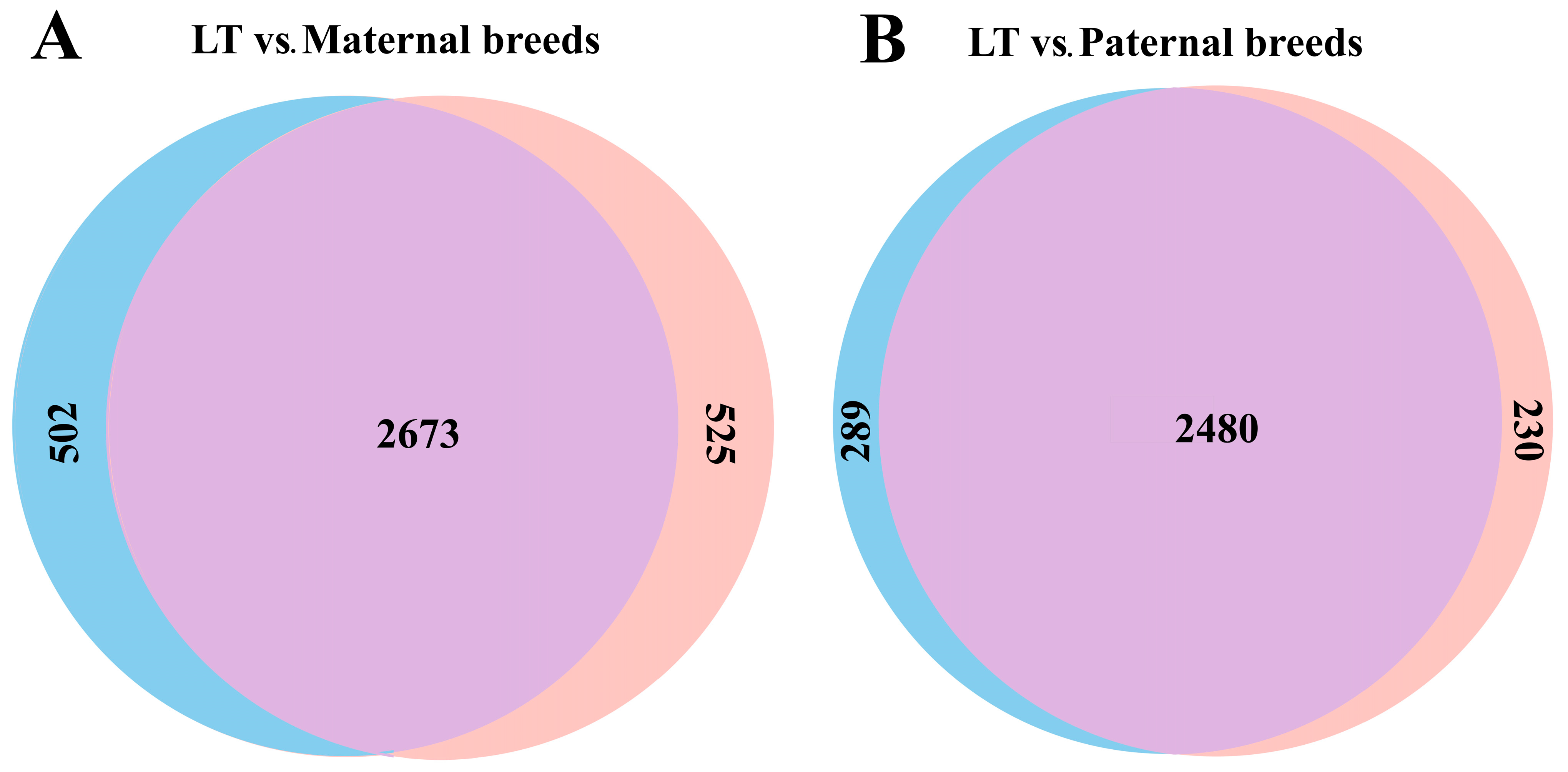
Figure 1. Venn diagram showing fixed SNPs (MAF = 0) in LT (Latvian Dark-head; light blue) vs. maternal breeds (A) and paternal breeds (B). Unique, fixed SNPs in groups are shown as the numbers in circles.
Agriculture 16 00086 g001
Figure 2. Principal component analysis (PCA) of sheep breeds raised in Latvia on LD-pruned SNPs. The X-axis represents PC1 (4.9%) and the Y-axis is PC2 (3.7%). Round markers—maternal-type breeds; triangle markers—paternal-type breeds. Breed abbreviations: LT—Latvian Dark-head; MLS—Merinolandschaf; ROM—Romanov; IF—Île de France; CH—Charollais; DOR—Dorper; TEX—Texel.
Agriculture 16 00086 g002
Figure 3. Admixture analysis with cross-validation (CV) errors of sheep breeds reared in Latvia. The breeds analyzed include LT—Latvian Dark-head; MLS—Merinolandschaf; ROM—Romanov; IF—Île de France; CH—Charollais; DOR—Dorper; and TEX—Texel raised in Latvia. The optimal number of clusters for this dataset is shown in red frame.
Agriculture 16 00086 g003
Table 1. Selected animals for research.
BreedAbbreviationBreed TypeSampleSample in Breed Type
LTLatvian Dark-headMaternal135135
MLSMerinolandschafMaternal2638
ROMRomanova12
IFÎle-de-FrancePaternal3388
CHCharollais14
DORDorper15
TEXTexel22
OX *Oxford Down4
* Oxford Down (OX) samples were not included in separate breed comparisons/analysis due to the small sample size but were included as part of the paternal breed group.
Table 2. Genetic diversity and distribution statistics for the 48,981 genotyped SNPs, showing observed heterozygosity (Ho), expected heterozygosity (He), and average minor allele frequency (avMAF) for the entire sample set, stratified by breed/breed type.
Breed/GroupHoHeavMAFSNP (n (%))
Not MinorH-PolyFixedRare
All samples0.350.390.3224,875 (50.78)31,098 (63.49)2361 (4.82)2771 (5.66)
LTAll0.360.370.3024,830 (50.69)27,561 (56.27)2668 (5.45)3169 (6.47)
Resampling *0.36
[0.36–0.37]
0.37
[0.36–0.37]
0.29
[0.28–0.29]
24,002 (49.00)
[23,497–24,292]
27,723 (56.60)
[26,911–28,714]
3709 (7.57)
[3404–3965]
3709 (7.57)
[3404–3965]
Maternal-type breed0.350.370.2924,527 (50.07)26,677 (54.46)3198 (6.53)3198 (6.53)
MLS0.350.350.2724,535 (50.09)23,581 (48.14)3936 (8.04)3936 (8.04)
ROM0.350.330.2523,221 (47.41)18,052 (36.86)4696 (9.59)4696 (9.59)
Paternal-type breed0.340.390.3124,653 (50.33)29,717 (60.67)2710 (5.53)2945 (6.01)
IF0.340.340.2624,407 (49.83)23,004 (46.97)4075 (8.32)4075 (8.32)
CH0.330.320.2423,962 (48.92)18,859 (38.50)5203 (10.62)5203 (10.62)
DOR0.310.320.2424,020 (49.04)20,066 (40.97)4902 (10.01)4902 (10.01)
TEX0.330.330.2524,120 (49.24)20,206 (41.25)4755 (9.71)4755 (9.71)
SNP classifications are based on the MAF: not minor—SNP with minor allele, by database, frequency (MAF) > 0.5; H-poly or highly polymorphic—SNP with an MAF from 0.3 to 0.5; rare and fixed—SNP with an MAF < 0.01 and equal to 0. Breed abbreviations are as follows: LT all— all samples of Latvian Dark-head; LT *—resampling (bootstrapping) approach 10,000 times with random 20 LT samples; MLS—Merinolandschaf; ROM—Romanov; IF—Île de France; CH—Charollais; DOR—Dorper; TEX—Texel.
Table 3. Comparative analysis of fixed SNPs (MAF = 0), identifying shared and unique fixed markers in the LT breed relative to other individual breeds and combined breed types.
Breed/GroupFixed SNP (n)Comparing LT vs.
Unique in LT
(n (% from LT SNP))
Common (n)Unique in Breed
(n (% from Breed SNP))
LT *3709
[3404–3965]
---
Maternal-type breed:3198 502 (15.81 ^)
[349–679]
2673
[2622–2722]
525 (16.42)
[476–576]
MLS3936812 (21.89)
[555–1030]
2893
[2821–2948]
1043 (26.50)
[988–1115]
ROM4696612 (16.50)
[384–805]
3093
[2989–3174]
1603 (34.14)
[1522–1707]
Paternal-type breed:2710 289 (10.44)
[287–296]
2480
[2473–2489]
230 (8.49)
[221–237]
IF4075720 (19.41)
[489–924]
2986
[2898–3056]
1089 (26.72)
[1019–1177]
CH5203505 (13.62)
[337–661]
3200
[3057–3314]
2003 (38.50)
[1889–2146]
DOR4902706 (19.03)
[445–916]
2999
[2919–3065]
1903 (38.82)
[1837–1983]
TEX4755589 (15.88)
[387–768]
3117
[2990–3209]
1638 (34.45)
[1546–1765]
LT—Latvian Dark-head; MLS—Merinolandschaf; ROM—Romanov; IF—Île de France; CH—Charollais; DOR—Dorper; TEX—Texel. * In comparative analysis used bootstrapping approach; ^ LT fixed SNP (using a bootstrapping approach with 40 and 80 random samples) in analysis with maternal-type (3175 SNPs) and paternal type (2769 SNPs) breeds.
Disclaimer/Publisher’s Note: The statements, opinions and data contained in all publications are solely those of the individual author(s) and contributor(s) and not of MDPI and/or the editor(s). MDPI and/or the editor(s) disclaim responsibility for any injury to people or property resulting from any ideas, methods, instructions or products referred to in the content.