Article

Research on Water and Fertilizer Diagnosis of Maize Using Visible–Near-Infrared Hyperspectral Technology

1
College of Agronomy, Inner Mongolia Agricultural University, Hohhot 010019, China
2
Key Laboratory of High Yield and Efficient Cultivation and Cultivation of Crops in Northern Cold and Arid Regions, Ministry of Agriculture and Rural Affairs, Hohhot 010019, China
3
Key Laboratory of Crop Cultivation and Genetic Improvement of Inner Mongolia Autonomous Region, Hohhot 010019, China
*
Authors to whom correspondence should be addressed.
Agriculture 2026, 16(1), 84; https://doi.org/10.3390/agriculture16010084 (registering DOI)
Submission received: 2 November 2025 / Revised: 15 December 2025 / Accepted: 27 December 2025 / Published: 30 December 2025
(This article belongs to the Section Artificial Intelligence and Digital Agriculture)

Abstract

This study focuses on maize to explore spectral estimation methods for agricultural traits in maize leaves under water-saving and fertilizer-reduction strategies. A factorial experiment was conducted with different nitrogen application rates (N0–N4) and irrigation levels (W1–W4). Hyperspectral data were collected at V12, R1, and R3 stages, alongside measurements of agricultural traits ((relative chlorophyll content) SPAD values, leaf water content (LWC), and leaf nitrogen content (LNC)). Results indicated that reducing nitrogen by 10% (N3) had no significant effect on physiological indicators, whereas reducing irrigation by 10% (W3) led to significant differences. First- and second-derivative transformations of spectral data enhanced the correlation with agricultural traits. Support vector regression (SVR) and random forest (RF) models were developed for estimation. RF outperformed SVR in predicting agricultural traits (SPAD, LWC, and LNC), with estimation accuracy R2 values reaching 0.92, 0.94, and 0.95, respectively. The RF model demonstrated higher accuracy, providing technical support for growth monitoring and precise water and nutrient management in maize.

1. Introduction

China’s maize planting area spans 663 million mu, accounting for 37.1% of the total grain planting area; its yield reaches 290 million tons, representing 41.5% of the total grain production [1]. As China’s most extensively cultivated staple grain crop, maize holds significant importance for agricultural development and national food security [2]. Maize growth directly impacts yield and quality, making effective growth monitoring essential for field management and yield estimation [3].
Hyperspectral technology, based on spectral characteristics, plays a vital role in studying crop growth, nutrition, and predicting crop yields. Crop plants exhibit specific spectral reflectance characteristics, meaning their absorption, transmission, and reflection of light change with alterations in internal structure and physiological traits [4]. Hyperspectral technology acquires spectral characteristics of targets, analyzes spectral data, and through model inversion, reveals changes in agricultural traits during crop growth [5]. This enables non-destructive, precise, and real-time monitoring of crop development. Scholars have conducted in-depth research on hyperspectral technology theories and applications related to crops, establishing numerous corresponding models [6]. However, factors such as varying nutritional conditions, external climatic influences, and crop varieties can reduce the accuracy of growth estimation models. Therefore, developing high-precision crop growth estimation models for different developmental stages holds significant importance for guiding agricultural production.
Chlorophyll, moisture, and nitrogen content—key indicators of plant physiological and biochemical processes—can be non-destructively monitored through spectral reflectance characteristics [7,8]. SPAD values serve as an indicator for assessing chlorophyll content in plant leaves. These values are significantly influenced by nitrogen levels within the leaves, as nitrogen is a key constituent element of chlorophyll. Chlorophyll content directly impacts photosynthetic efficiency in plants, making SPAD values an indirect indicator of crop nitrogen nutrition status [9]. For example, leaf SPAD values increased with rising nitrogen supply levels, peaking at the heading stage before gradually declining. This indicates that nitrogen supply directly promotes chlorophyll synthesis and SPAD values. Different crops exhibit specific SPAD value trends across their growth stages. The SPAD readings in rice exhibit a unimodal pattern through the jointing, heading, and milk ripening stages. They rise initially, reach a maximum at heading, and subsequently decline [10]. This correlates with physiological demands during plant development. The heading stage marks a critical transition from vegetative to reproductive growth in rice, characterized by high nitrogen requirements and peak chlorophyll content. SPAD values are widely applied in agricultural practices for nitrogen management, crop growth assessment, and quality regulation. For instance, in maize research, linear regression models linking SPAD values at different growth stages and leaf positions to leaf nitrogen content reached highly significant levels, enabling precision fertilization guidance [11].
Leaf water content, as a core agronomic trait parameter, plays a crucial indicative role in crop physiology research and agricultural production. It serves not only as the most direct “barometer” of plant water status, sensitively reflecting the severity of water stress and guiding precision irrigation, but also tightly couples with key physiological processes such as photosynthesis and transpiration, collectively determining crop water use efficiency. Plant water content exhibits distinct absorption features in the near-infrared and shortwave infrared regions, with pronounced absorption troughs near 1450 nm and 1940 nm [12]. He et al., (2023) found that absorption depth at 1450 nm positively correlates with wheat leaf water content [8]. Leaf water status does not exist in isolation but is synergistically regulated alongside numerous traits such as specific leaf area, nitrogen content, and stomatal characteristics, collectively forming comprehensive strategy for plants to respond to environmental changes [13]. Ultimately, this synergistic interaction directly influences crop biomass accumulation, economic yield, and quality formation by affecting leaf growth, development, and function. Therefore, whether in field water management, drought-resistant variety breeding, or applications of high-throughput phenotyping and smart agriculture, monitoring and understanding leaf water content has become a critical basis for optimizing water resource allocation, enhancing crop stress tolerance, and achieving sustainable agricultural development.
Leaf nitrogen content serves as a core agronomic parameter characterizing maize nitrogen metabolism and nutritional status, acting as a crucial bridge between nitrogen fertilizer application and photosynthetic products. As a central constituent element of chlorophyll, proteins, and enzymes, nitrogen content exhibits significant positive correlation with photosynthetic rate [14]. By monitoring leaf nitrogen status, real-time diagnosis of plant nitrogen nutrition deficits or surpluses enables precision fertilization tailored to actual needs. Leaf nitrogen content serves as an ideal target for high-throughput remote sensing monitoring, providing critical technical parameters for smart agriculture. Leaf nitrogen exhibits distinctive spectral response characteristics in the visible–near-infrared (VIS-NIR) wavelength range [15]. Such as, the reflectance spectrum of electromagnetic waves can be affected by the chlorophyl pigment especially in blue (450 nm) and red (670 nm) bands in wheat plants which is related to leaf nitrogen content [16]; it measured spectral reflectance from wheat canopy in the red (671 nm) and NIR (780 nm) bands [17]. By mounting hyperspectral sensors on drone or satellite platforms, large-scale, non-destructive acquisition of canopy spectral information can be achieved. Utilizing nitrogen-sensitive spectral indices such as NDRE, quantitative inversion models for leaf nitrogen content can be constructed [18]. This technology transforms traditional point-based destructive sampling into real-time diagnostic mapping, achieving a leap from “post-event analysis” to “process monitoring.” It provides unprecedented data support for managing nitrogen spatial variability across large-scale fields.
Therefore, this study focused on spring corn in Inner Mongolia, employing different fertilization rates and irrigation levels as treatments. Using the FieldSpec4 portable hyperspectral sensor produced by ASD Inc. (USA), spectral reflectance data from maize leaves at various growth stages were collected. Combined with field measurements and experimental analysis, this study investigated the correlation between agricultural traits (SPAD, LWC, and LNC) of maize leaves and their reflectance spectra during different growth stages. Hyperspectral technology was employed to derive vegetation indices correlated with maize leaf growth. Various vegetation indices served as independent variables, while dependent variables included SPAD, LWC, and LNC at different growth stages. Optimal fitting models (RF and SVR) for maize leaves growth at each stage were established and validated using verification data to enhance estimation accuracy. The research findings can provide timely corn growth information for the study area and offer relevant references for fertilization and irrigation practices in farmland.

2. Materials and Methods

2.1. Experimental Site Overview

The experiment was conducted at the China Chilechuan Modern Agricultural Expo Park (40°33′ N, 110°31′ E) in Tumed Right Banner, Baotou City, Inner Mongolia, China (Figure 1). The climate of Tumed Right Banner is characterized by a typical continental semi-arid monsoon climate. The soil type is sandy loam, and the previous crop was maize. Rainfall during the corn growing season (May–September 2023) in the experimental area totaled 267.7 mm. Soil basic fertility data are presented in Table 1.

2.2. Experimental Design

This experiment employed a split-plot design, with nitrogen application rate and irrigation volume as two interacting factors. The main plots were assigned to nitrogen application rates, while the subplots were assigned to irrigation volumes. N0 (no nitrogen application), N1 (pure nitrogen application at 210 kg/ha, 30% nitrogen reduction), N2 (240 kg/ha, 20% nitrogen reduction), N3 (270 kg/ha, 10% nitrogen reduction), N4 (300 kg/ha), and irrigation rate as the subplot. The irrigation rate had four gradients: W1 (2160 m3/a, 40% water saving), W2 (2880 m3/ha, 20% water saving), W3 (3240 m3/ha, saving 10%), and W4 (3600 m3/ha, conventional irrigation). Urea was used as the nitrogen fertilizer. Irrigation commenced when soil relative moisture content fell below 70%, with approximately 6–7 irrigations throughout the entire growth period after seedling emergence. The variety used was Xianyu 696. Plowing depth was 35 cm. Fertilizer contained P2O5 and K2O at rates of 150 kg/ha and 75 kg/ha, respectively. Planting density was 82,500 plants/ha. Weed control and pest/disease management were strictly implemented throughout the growing season. SPAD values, LWC, and LNC were measured on maize leaves at key growth stages—the bell-mouth stage (V12), silking stage (R1), and milk stage (R3)—under different water–nitrogen combinations. The experiment employed shallow-buried drip irrigation with integrated water–fertilizer management without plastic mulch. Plants were grown in equal row spacing, with one lateral pipe per row positioned 20 cm from the seedling belt.

2.3. Measurement Indicators and Methods

2.3.1. Measurement Indicators

SPAD value: The relative chlorophyll content was measured at the bell-mouth stage (V12), silking stage (R1), and milk stage (R3). Using a handheld chlorophyll meter (SPAD-502, Minolta Osaka Company Ltd., Tokyo, Japan), select three leaf layers (upper, middle, and lower) from the ear leaves of the tested maize plants. For each leaf, take three measurements, avoiding the leaf veins, and calculate the average as the relative chlorophyll content (SPAD) value for that leaf.
Leaf Water Content (LWC): LWC was measured at the bell-mouth stage (V12), silking stage (R1), and milk stage (R3). Three plants meeting density standards were selected. Leaves were blanched at 105 °C for 30 min, dried at 80 °C to constant weight, and then weighed.
Leaf Nitrogen Content (LNC): LNC was measured at the bell-mouth stage (V12), silking stage (R1), and milk stage (R3). From each experimental plot, three plants with identical markers were selected, and leaf samples were collected. The samples were blanched in a 105 °C oven for 30 min, after which the temperature was reduced to 80 °C for drying until a constant weight was achieved. The dried leaves were ground in a pulverizer, and the resulting powder was thoroughly mixed and then digested using the H2SO4-H2O2 digestion method. Finally, the leaf nitrogen content was determined via the semi-micro Kjeldahl method.

2.3.2. Hyperspectral Data Acquisition

Data acquisition was performed using the FieldSpec4, Pro FR portable spectroradiometer (ASD Inc., Analytical Spectral Devices Boulder, Boulder, CO, USA). The instrument’s basic parameters are as follows: wavelength range: 350–2500 nm; spectral resolution: 3 nm@700 nm, 6 nm@1400/2100 nm; sampling interval: 1.4 nm@350–1000 nm, 1.1 nm@1001–2500 nm.
At each plot, two sampling points were selected for hyperspectral data acquisition of maize leaves. At each point, hyperspectral data were collected from two maize plants. For each plant, leaves from the upper, middle, and lower sections of the ear-positioned leaves were selected, avoiding leaf veins. Five spectra were acquired per measurement. The total number of spectral data points per period was 5 × 2 × 3 × 56 (plots) = 1680. Measurement periods and agronomic parameters were synchronized and acquired concurrently.
When measuring corn leaves’ spectral information, ensure measurements occur on clear, windless, and cloudless days between 10:00 AM and 2:00 PM. Position the sensor probe vertically downward during observation. Calibrate promptly using standard a whiteboard throughout the measurement process. Calibrate against the standard reference board before and after observing each target group. After data collection, raw data undergoes various preprocessing steps using the ASD ViewSpecPro 6.2 software. The measured data from all sampling areas are averaged to obtain the final measurement value for each region.

2.3.3. Spectral Preprocessing

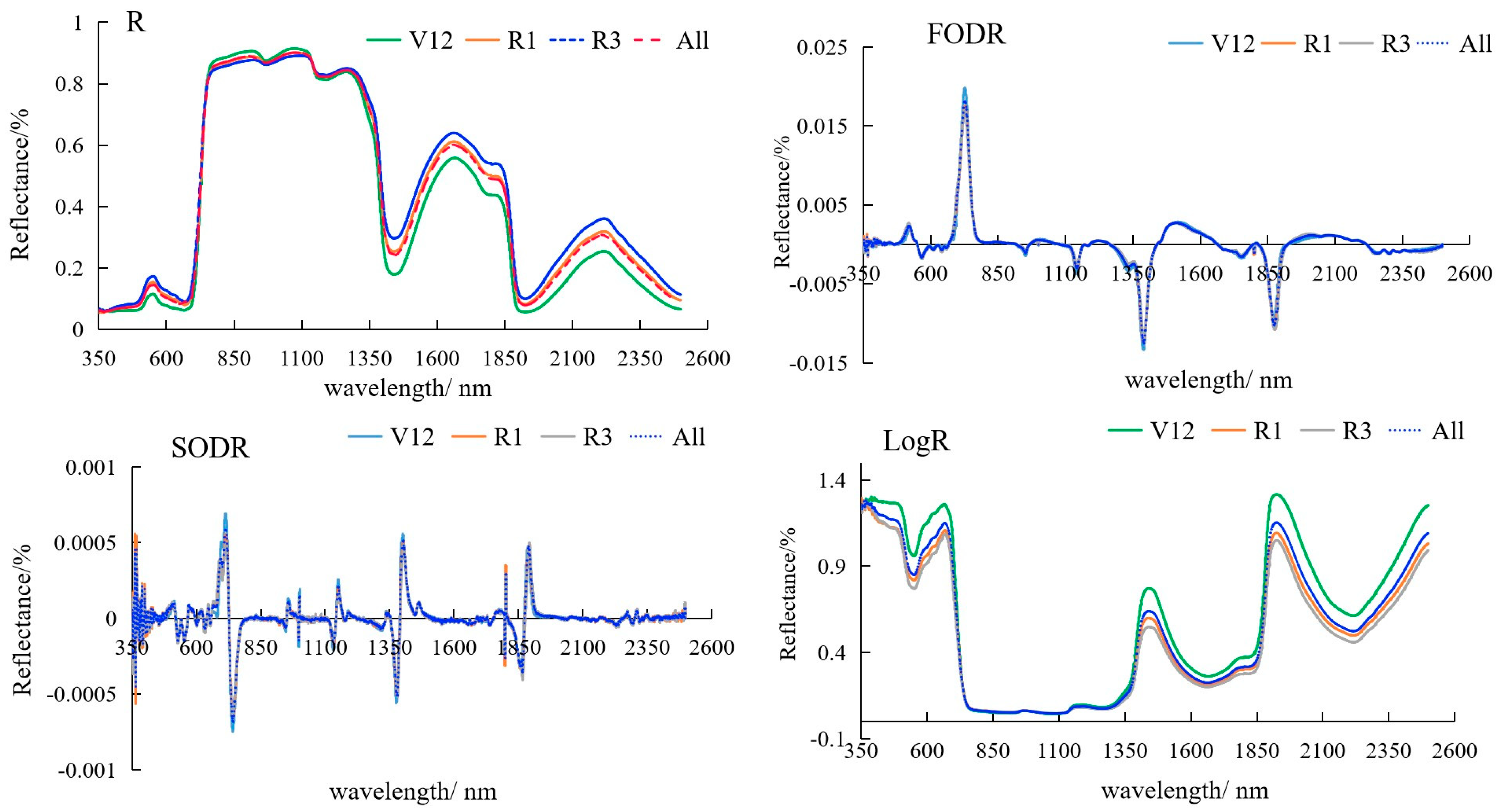
To eliminate background and noise interference in raw spectra and enhance the accuracy and adaptability of spectral information for parameter inversion models, raw spectra (R) of maize leaves at different growth stages require transformations such as logarithmic (logR), first-order derivative (FOD), and second-order derivative (SOD) processing.

2.3.4. Spectral Index Extraction

Spectral indices are combinations of spectral bands obtained through mathematical operations on two or more characteristic bands, representing specific information about the measured material. This study employs the 33 spectral indices listed in Table 2.

2.3.5. Model Construction and Validation

RF and SVR models were employed to construct estimation models for SPAD, LNC, and LWC in maize leaves. Decisions were made based on the expression of agronomic phenotypic traits during critical growth stages of maize, and machine learning models were trained accordingly. The scikit-learn library [41,42] was used to establish models for the estimation of SPAD, LNC, and LWC using common machine learning methods: RF and SVR regression models. In this study, mtry was set to 1/3 of the number of independent variables, and ntree was set to 500, for the RF model, and timized within [10−2, 10−1, 1, 10, 100] and [10−4, 10−3, 10−2, 10−1, 1, 10], respectively, for the SVR model. Ten-fold cross-verification and grid searching were used to identify the optimal parameters during model development. Maize leaves’ spectral data were collected and then randomly divided into a calibration dataset (2/3) and a validation dataset (1/3). Model accuracy was then evaluated using the coefficient of determination (R2) and root mean square error (RMSE).
Coefficient of Determination (R2): A statistical measure indicating the closeness of the relationship between dependent and independent variables. The name of this statistical indicator varies based on the characteristics of the correlation phenomenon. The calculation formula is as follows:
R 2 = y ^ i y ¯ 2 y i y ¯ 2
Root Mean Square Error (RMSE): The RMSE is the square root of the ratio of the sum of squares of the differences between predicted and actual values to the number of observations. It measures the deviation between predicted and actual values and is sensitive to outliers in the data. In the formula, y i represents the actual value, y ^ i represents the predicted value, n represents the number of samples, and y ¯ represents the mean of the sample values. The calculation formula is as follows:
R M S E = i = 1 n ( y i y ^ i ) 2 / n

2.3.6. Data Analysis

Data processing was performed using Microsoft Excel 2021, and split-plot analysis of variance was conducted using SAS 9.4. Multiple factor analysis of variance was performed using the LSD (least-significant difference) method. Origin 2021 was used for graphing. Spectral data underwent preprocessing using the ASD data post-processing software ViewSpecPro and ENVI 5.3.

3. Results

3.1. Spectral Characteristics Analysis of Maize Leaves

3.1.1. Spectral Characteristics of Maize Leaves at the Different Spectral Transformations

The application of a suite of transformations—logarithmic, first-order derivatives, and second-order derivatives—to the raw spectral data of maize leaves elucidates subtle features in reflectance profiles, thereby enhancing spectral detail resolution throughout key phenological phases. This effect is particularly pronounced in the first- and second-order derivative spectra, which amplify spectral details more significantly (Figure 2).

3.1.2. Spectral Characteristics of Maize Leaves Under Water–Nitrogen Coupling Conditions

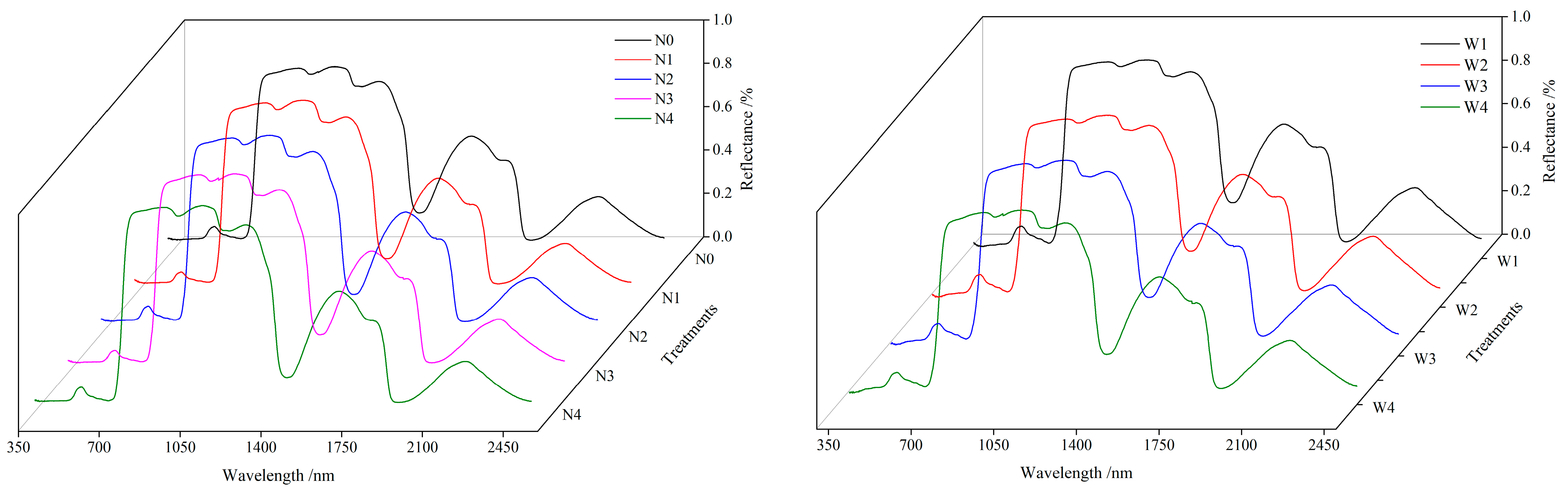
The spectral reflectance curves of maize leaves under different nitrogen application rates and irrigation conditions reveal a gradual increase in spectral reflectance with increasing nitrogen application, exhibiting the pattern N0 < N1 < N2 < N3 < N4. As irrigation rates decreased, maize leaf spectral reflectance showed a gradually increasing trend, exhibiting the pattern W1 > W2 > W3 > W4 (Figure 3).

3.1.3. Spectral Characteristics of SPAD Value in Different Spectral Transformations

Spectral transformations such as logarithmic (logR), first-order derivative (FODR), and second-order derivative (SODR) were applied to the raw spectral data (R). First-order derivative and second-order derivative spectral transformations effectively eliminate linear noise during processing while highlighting variations in spectral reflectance. When SPAD values of maize leaves change, spectral shifts occur across the entire wavelength range. However, since chlorophyll primarily absorbs and utilizes light energy in the visible spectrum, spectral data in this region exhibits heightened sensitivity to SPAD value fluctuations. Figure 4 demonstrates that within the 350–700 nm range, spectral patterns exhibit consistent, regular variations corresponding to SPAD changes. Although significant spectral shifts occur across 700–2500 nm with SPAD variations, these lack pronounced regularity or consistency.
Within the visible spectrum, corn leaves exhibit high chlorophyll content, resulting in spectral reflectance curves that increase as SPAD values decrease. Due to chlorophyll’s strong reflection in the near-infrared range, spectral reflectance gradually rises in the near-infrared band. Enhanced red edge bands are observable in the reflectance curves derived from first-derivative and second-derivative spectral transformations.

3.1.4. Spectral Characteristics of Maize Leaves at Different Moisture Contents

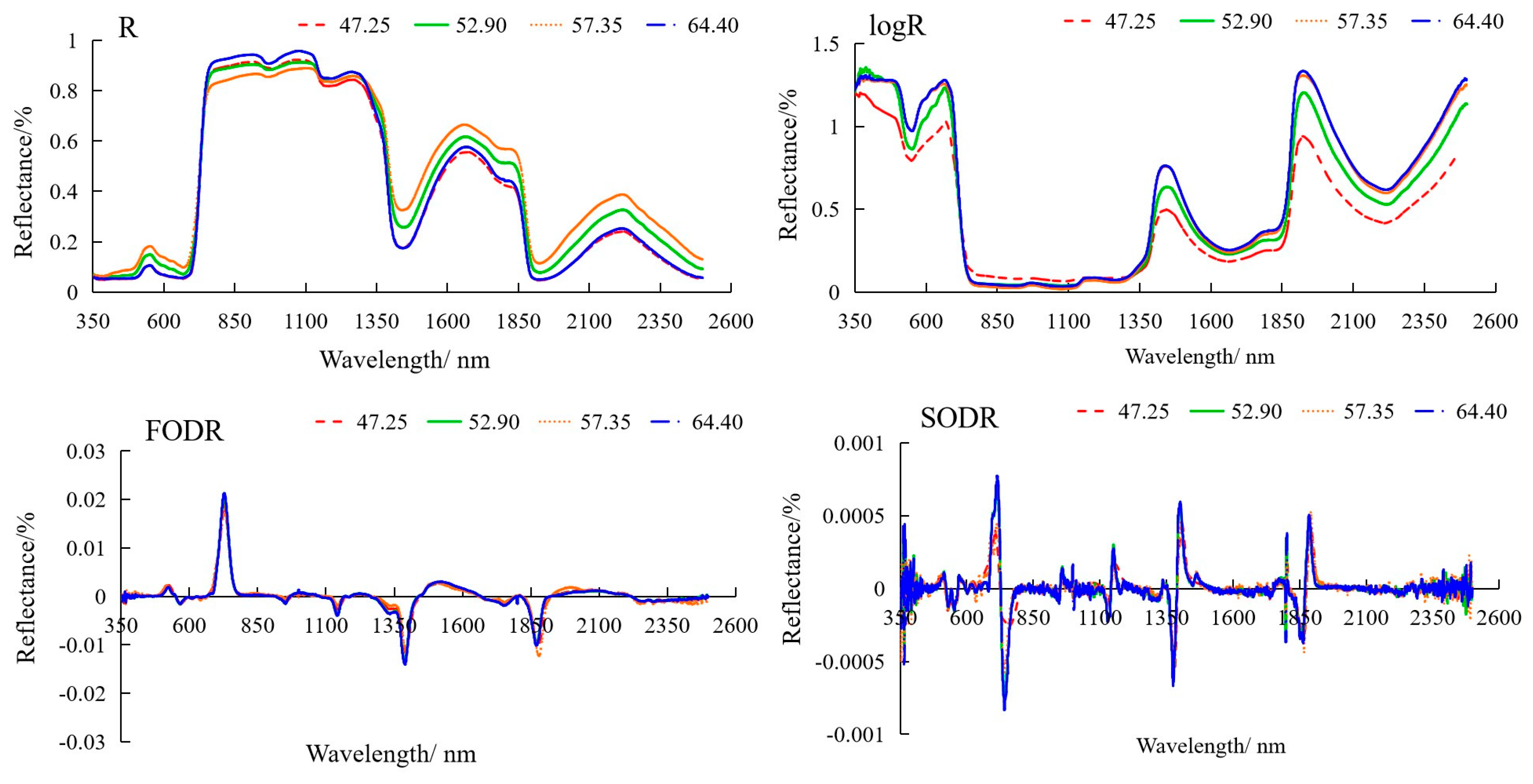
Figure 5 shows the spectral curve characteristics of maize leaves at different moisture contents. As shown in Figure 5, the spectral reflectance of maize leaves exhibits a decreasing trend with increasing leaf water content. This decrease is most pronounced in the 350–1350 nm wavelength range, while no significant changes occur between 1350 and 2500 nm. Two water absorption troughs are observed at 1450 nm and 1960 nm. The reflectance at these absorption troughs gradually increases as leaf water content decreases.

3.1.5. Spectral Characteristics of Maize Leaves with Varying Nitrogen Content

Figure 6 shows the spectral characteristics of maize leaves with different nitrogen contents after various spectral transformations. As shown in Figure 5, the spectral reflectance of maize leaves increases with rising nitrogen content across the 760–1150 nm range. In the first-order derivative spectral transformation of the red edge region, the red edge amplitude increases with higher nitrogen content, and a “red shift” phenomenon occurs at the red edge position. In the second-derivative spectral transformation, nitrogen content variations exert a significant influence on the visible light band.

3.2. Variation Patterns in Phenotypic Parameters of Maize Leaf Agronomic Traits

Nitrogen application and irrigation volume each exerted a highly significant effect on SPAD values at all growth stages (P < 0.01); however, their interaction did not reach statistical significance (P > 0.05). At the bell-mouth stage, no significant differences were detected among treatments. The SPAD value under N4W4 was 64.45, which was statistically comparable to that under N1W4, N2W3, and N2W4. By the silking stage, the value in the N4W4 treatment reached 71.1, showing no significant differences from N3W4, N2W3, and N4W3. At the milking stage, the highest chlorophyll content (66.1) occurred under N3W4 and did not differ significantly from that under N2W4, N4W3, or N4W4. Overall, SPAD value exhibited a unimodal trend across the three growth stages, increasing initially and then declining. Under the no-nitrogen condition (N0), low irrigation levels (W1 and W2) resulted in a gradual decline, whereas moderate and high irrigation (W3 and W4) led to an initial increase followed by a decrease. In contrast, under nitrogen application (N1–N4), all treatments consistently showed an increase–decrease pattern.
Nitrogen application significantly influenced leaf water content at the bell-mouth, silking, and milking stages (P < 0.01). Irrigation volume also had a highly significant effect on water content at the silking and milking stages, but not at the bell-mouth stage. Their interaction significantly affected water content at the bell-mouth and milking stages, but not at the silking stage. Leaf water content increased with advancing growth stages, peaking at the silking stage before declining during the milking stage.
Nitrogen, irrigation, and their interaction all significantly affected leaf nitrogen content at each growth stage (P < 0.01). At the bell-mouth stage, the nitrogen content under N1W4 was 1.477%, which did not differ significantly from that under N2W4, N3W4, or N4W4. At the silking stage, the value measured in N4W3 was 1.44% and was statistically similar to that in N4W4. At the milking stage, the nitrogen content in N2W3 was 1.19%, showing no significant differences compared to N2W2, N2W4, or N3W4. Leaf nitrogen content consistently followed a pattern of initial increase followed by a decrease across growth stages, with the maximum value occurring at the silking stage (Table 3).

3.3. Screening Optimal Spectral Indices

3.3.1. Correlation Analysis Between Spectral Indices and SPAD Values of Maize Leaves

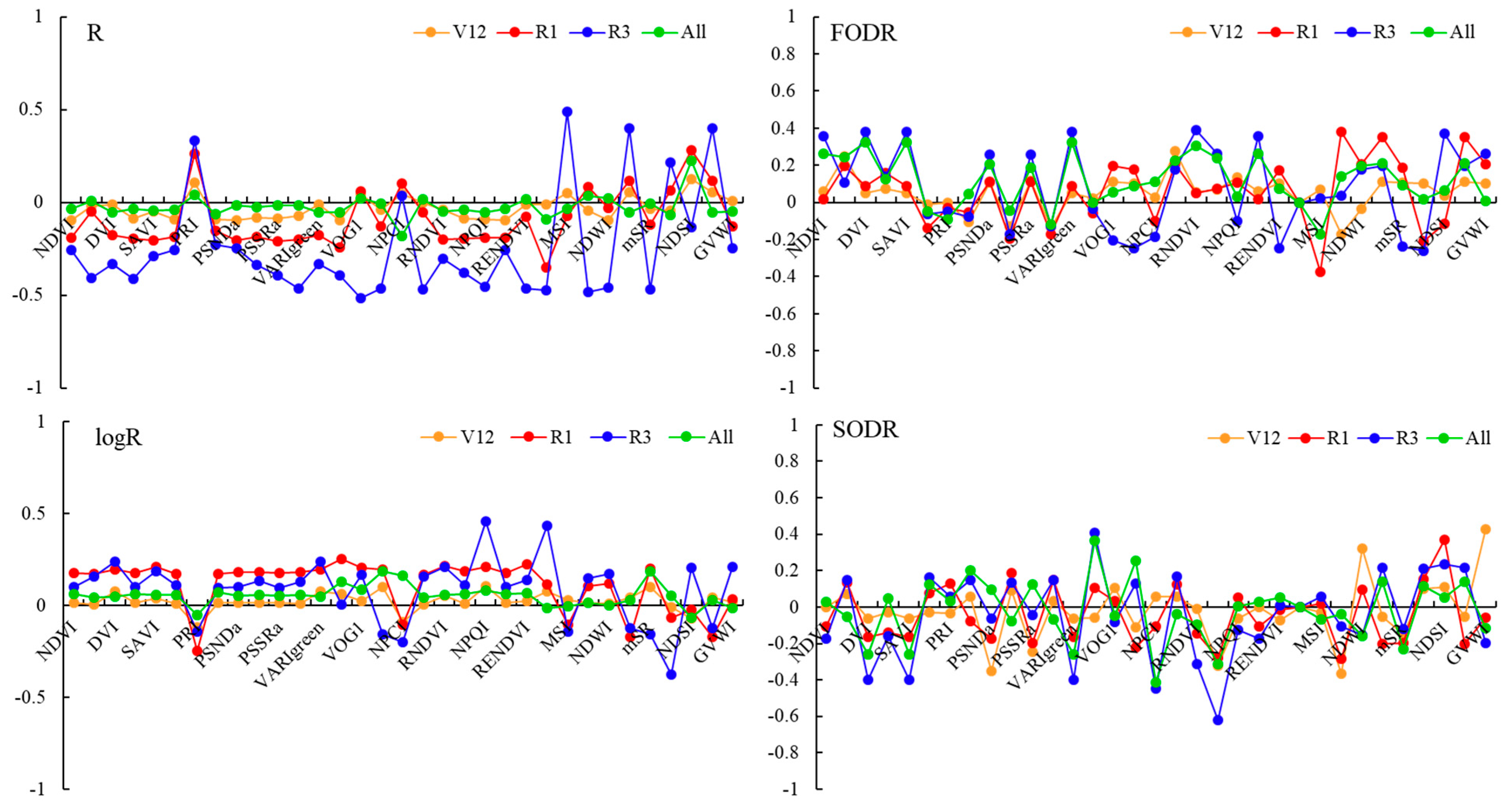
Correlation analysis was conducted between various spectral indices from different spectral processing methods and SPAD values of maize leaves at different growth stages. The correlation coefficients (r) obtained from analyzing the spectral indices of the raw spectrum (R) with SPAD values at the V12, R1, R3, and All growth stages ranged from −0.10 to 0.12, −0.35 to 0.28, −0.51 to 0.48, and −0.18 to 0.22, respectively. Correlation analysis between logarithmic spectra (logR) and SPAD values at V12, R1, R3, and All growth stages yielded correlation coefficients (r) ranging from −0.12 to 0.10, −0.25 to 0.25, −0.38 to 0.46, and −0.07 to 0.19, respectively; correlation analysis between the first-order derivative spectrum (FODR) and SPAD values at V12, R1, R3, and All growth stages yielded correlation coefficients (r) ranging from −0.17 to 0.28, −0.37 to 0.38, −0.26 to 0.39, and −0.17 to 0.32, respectively; correlation analysis between second-order derivative spectra (SODR) and SPAD values at V12, R1, R3, and All growth stages yielded correlation coefficients (r) ranging from −0.36 to 0.43, −0.28 to 0.37, −0.62 to 0.41, and −0.41 to 0.36, respectively (Figure 7). The spectral indices showing significant correlations with SPAD values for each spectral treatment are listed in Table 4. In summary, applying second-order derivative transformation to raw spectra significantly enhances the correlation between spectral indices and SPAD values.

3.3.2. Correlation Analysis Between LWC and Spectral Index

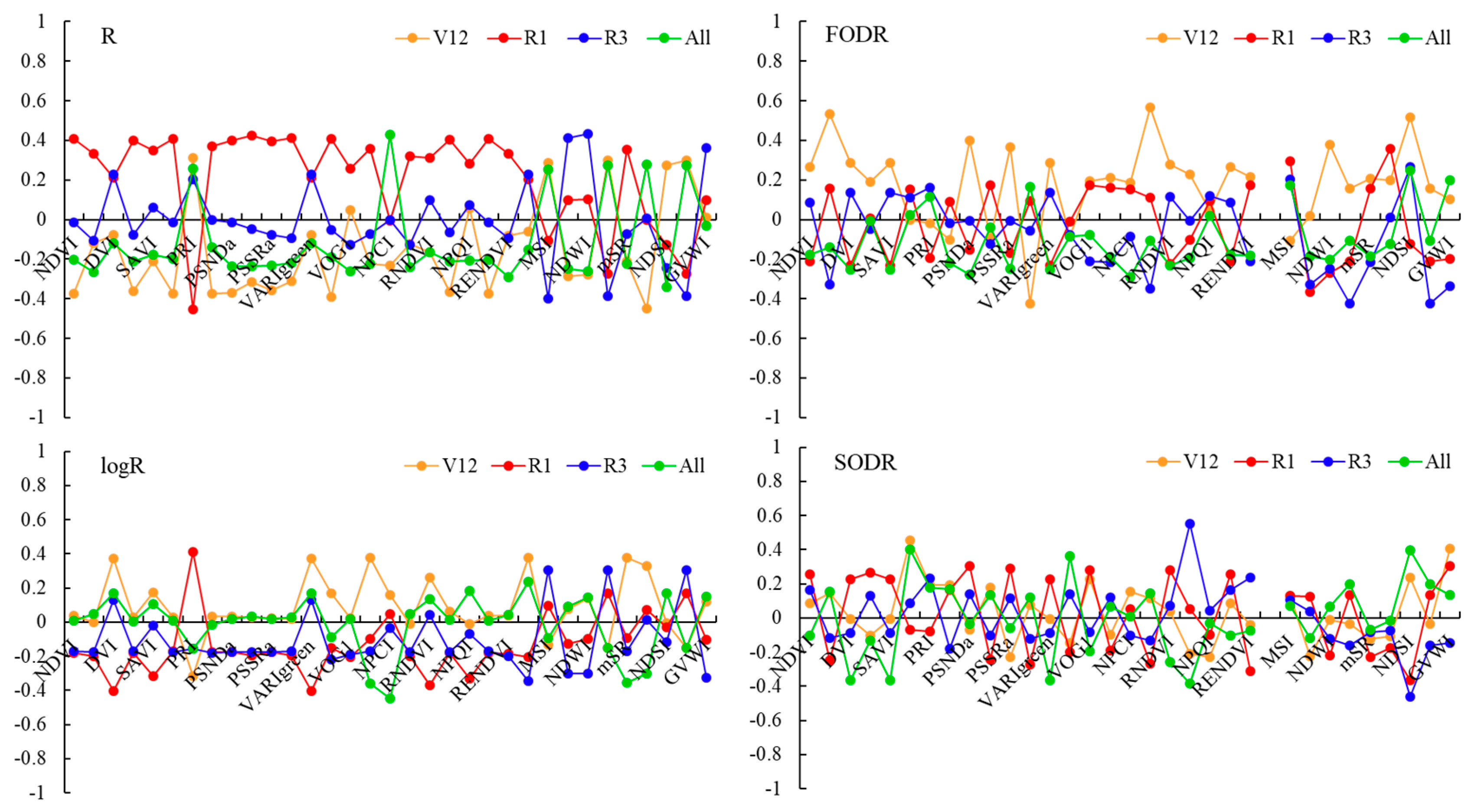
Figure 8 shows that the correlation analysis between various spectral indices from different spectral processing methods and LWC at different growth stages yielded correlation coefficients (r) ranging from −0.45 to 0.31 for the raw spectral index (R) with LWC at the V12 stage, from −0.45 to 0.42 for R1 and R3 indices, and from −0.40 to 0.43 for R3 and all growth stages, −0.40 to 0.43, and −0.34 to 0.43, respectively. Correlation analysis between logR spectra and LWC at V12, R1, R3, and All growth stages yielded correlation coefficients (r) ranging from −0.32 to 0.38, −0.40 to 0.41, −0.34 to 0.30, and −0.45 to 0.23, respectively; correlation analysis between the first-order derivative spectrum (FODR) and LWC at V12, R1, R3, and All growth stages yielded correlation coefficients (r) ranging from −0.42 to 0.57, −0.37 to 0.36, −0.43 to 0.26, and −0.29 to 0.25, respectively. The correlation analysis between the second-order derivative optical spectrum (SODR) and corn leaf moisture content at V12, R1, R3, and All growth stages yielded correlation coefficients (r) ranging from −0.23 to 0.45, −0.36 to 0.30, −0.46 to 0.55, and −0.38 to 0.40, respectively.
Spectral indices showing significant correlations with corn leaf moisture content for each spectral treatment are listed in Table 5. In summary, applying first-order derivative spectral transformation to raw spectra significantly enhances the correlation between spectral indices and corn leaf moisture content.

3.3.3. Correlation Analysis of LNC and Spectral Indices

Correlation analysis was conducted between multiple spectral indices processed through different spectral methods and LNC at various growth stages. The correlation coefficients (r) obtained from analyzing the spectral indices of the raw spectrum (R) with LNC at the V12, R1, R3, and All growth stages ranged from −0.22 to 0.33, −0.37 to 0.30, 0.46 to 0.34, and −0.49 to 0.45, respectively. Correlation analysis between logR spectra and LNC at V12, R1, R3, and All growth stages yielded correlation coefficients (r) ranging from −0.33 to 0.22, −0.26 to 0.34, −0.35 to 0.39, and −0.42 to 0.52, respectively. Correlation analysis between first-order derivative spectra (FODR) and LNC at V12, R1, R3, and All growth stages yielded correlation coefficients (r) ranging from −0.31 to 0.26, −0.19 to 0.24, −0.45 to 0.35, and −0.42 to 0.48, respectively. Correlation analysis between second-order derivative spectra (SODR) and LNC at V12, R1, R3, and All growth stages yielded correlation coefficients (r) ranging from −0.35 to 0.44, −0.37 to −0.26, −0.47 to −0.49, and −0.27 to −0.23, respectively (Figure 9). The spectral indices showing significant correlations with corn leaf nitrogen content for each spectral transformation are listed in Table 6. In summary, applying first-derivative and second-derivative spectral transformations to the raw spectral data (R) significantly enhances the correlation between spectral indices and maize leaf nitrogen content.

3.4. Development of Hyperspectral Estimation Model

Using the optimized spectral indices as multivariate variables, RF and SVR machine learning models were employed to estimate agronomic phenotypic traits of maize leaves (SPAD, LWC, and LNC). During model construction, the optimized spectral indices were first standardized to eliminate the impact of dimensional and magnitude differences among them on the models. For the RF model, key parameters such as the number of trees and maximum depth were adjusted to identify the optimal model architecture, thereby enhancing prediction accuracy and generalization capability. For the SVR model, optimization focused on kernel type, penalty coefficient, and insensitivity loss parameters to ensure the model accurately captured the complex nonlinear relationships between spectral indices and SPAD, LWC, and LNC. After multiple training and validation iterations, the final RF and SVR models were obtained for estimating SPAD, LWC, and LNC during the critical growth stages of maize leaves.
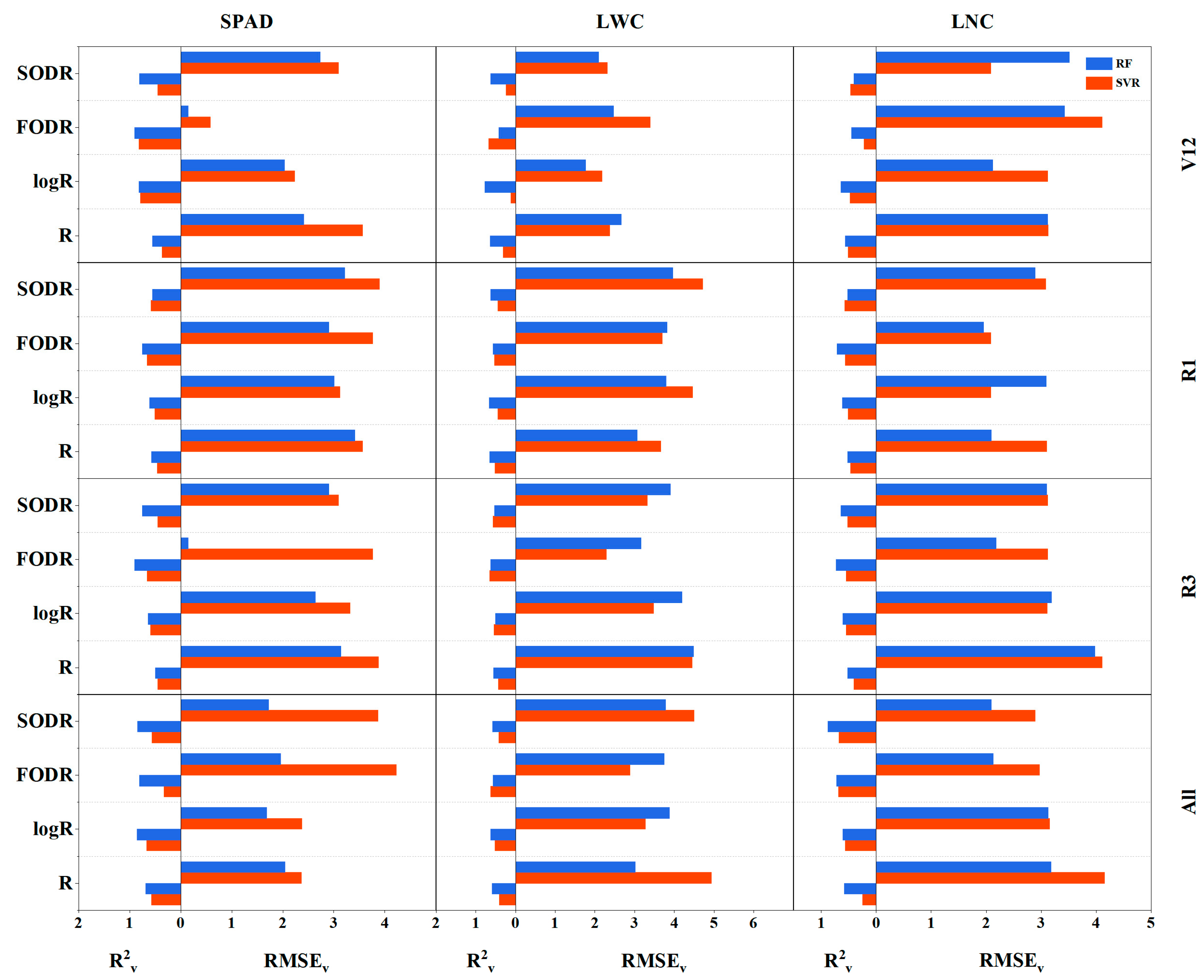
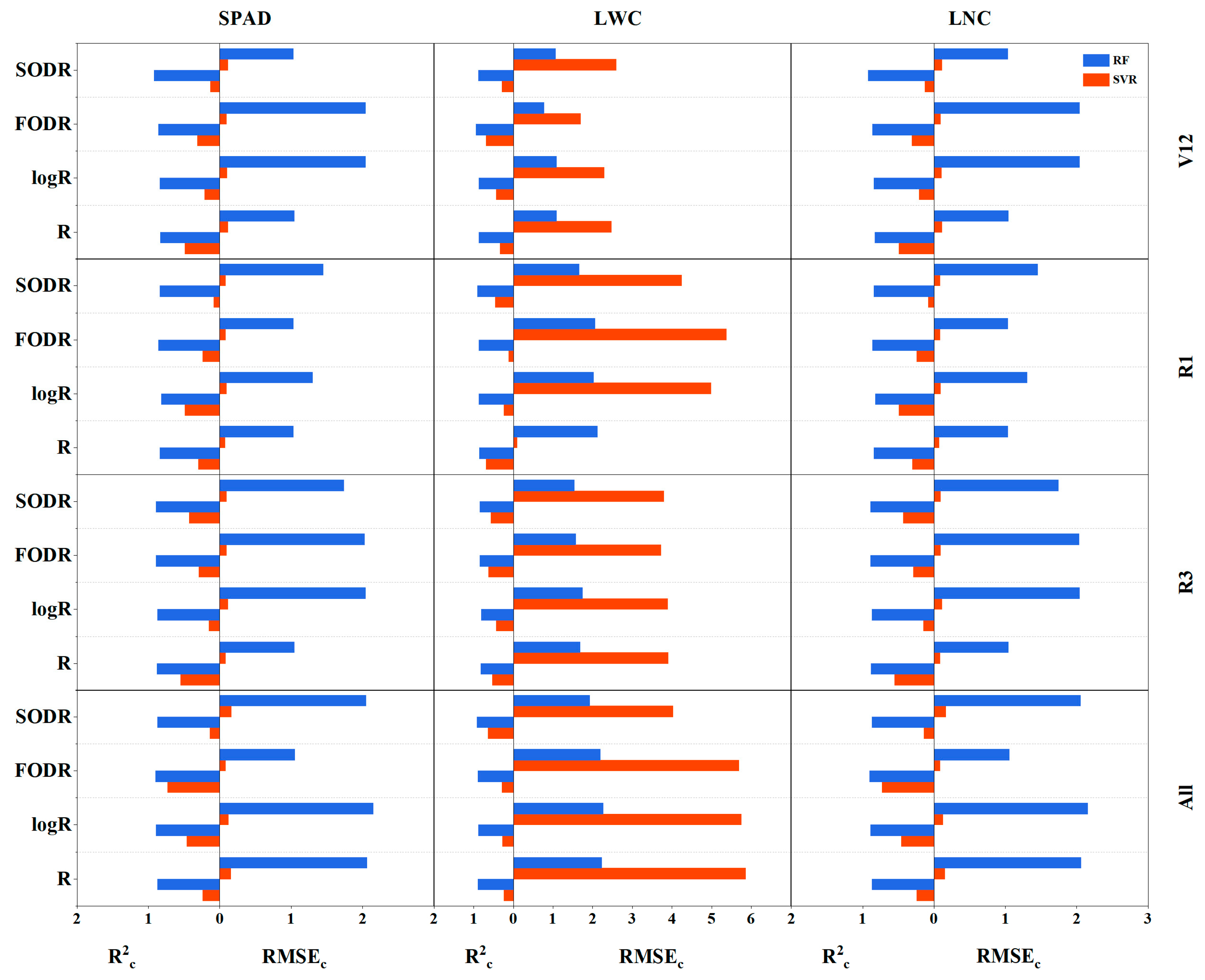
In the training datasets, the optimal R c 2 and RMSEc values for SPAD in the RF model were achieved during the V12 stage with SODR spectral processing, at 0.92 and 1.03, respectively, while the SVR model’s optimal values were obtained during All stage with FODR processing, at 0.73 and 0.08, respectively. For LWC, the optimal R c 2 and RMSEc values for the RF model were achieved during the V12 stage with FODR spectral processing, at 0.94 and 0.77, respectively, while the SVR model’s optimal values were obtained during the R1 stage with raw spectral (R) processing, at 0.69 and 0.09, respectively. For LNC, the R c 2 and RMSEc values under the optimal RF model with FODR spectral processing at the V12 stage were 0.95 and 1.02, respectively, while the optimal SVR model with FODR processing of raw spectral (R) across All stages yielded values of 0.73 and 0.08 (Figure 10).
In the validation datasets, the optimal values for SPAD’s R v 2 and RMSEv were 0.90 and 0.15, respectively, for the RF model with FODR spectral processing during the R3 period. For LWC, the optimal values of R v 2 and RMSEv were 0.77 and 1.77, respectively, for the RF model with logR spectral processing during the V12 period. For LNC, the optimal values of R v 2 and RMSEv were 0.88 and 1.95, respectively, for the RF model with SODR spectral processing during the All period (Figure 11).
In summary, for the agronomic phenotypic traits of maize leaves (SPAD, LWC, and LNC), the RF model proved to be the optimal estimation model in both the training and validation datasets during the critical growth stages.

4. Discussion

4.1. Effects of Water–Nitrogen Coupling Reduction on Agronomic Trait Parameters of Maize Leaves

This study systematically investigated the effects of nitrogen fertilizer application rates and irrigation water volumes on key physiological indicators of maize growth. Results indicate that water–nitrogen management exerts significant and systematic regulatory effects on leaf chlorophyll relative content (SPAD values), water content, and nitrogen content.
First, regarding leaf photosynthetic potential, both nitrogen (N) fertilization and irrigation volume independently exerted significant effects (P < 0.01) on SPAD values across all growth stages. This is consistent with established knowledge that nitrogen is fundamental for chlorophyll synthesis, while water stress impairs chloroplast integrity and nitrogen assimilation [43]. The absence of a significant interaction suggests that their effects on SPAD values were additive rather than synergistic under the experimental conditions. A characteristic unimodal trend in SPAD values was observed throughout the developmental cycle, increasing from the bell-bottom stage, peaking at silking, and subsequently declining during the milking stage, reflecting the natural progression of chlorophyll degradation during senescence [44]. Notably, under zero-N conditions, low irrigation levels led to a continual decline in SPAD, whereas medium to high irrigation supported an initial increase followed by a decrease. This indicates that sufficient water availability can partially alleviate the early-stage stress induced by severe nitrogen deprivation.
Second, concerning leaf water status, N application significantly enhanced leaf water content from the heading to the grain-filling stages, likely by fostering root development and canopy architecture, thereby improving plant water uptake and retention capacity [45]. The effect of irrigation was most pronounced during the mid-to-late stages (silking and grain-filling), which coincide with peak crop water demand. A significant interaction between water and N was detected at the heading and grain-filling stages, underscoring the critical role of water–nitrogen synergy in maintaining leaf hydration during specific phonological windows. The temporal pattern of leaf water content, peaking at tasseling and declining thereafter, aligns with the shift from vegetative to reproductive growth and the ensuing senescence process.
Finally, for leaf nitrogen status, N fertilizer, irrigation, and their interaction all significantly influenced leaf N content at all stages (p < 0.01), strongly affirming the central role of water–nitrogen co-regulation in optimizing N uptake and utilization [46]. Water mediates N use efficiency by affecting its soil mobility, root absorption, and in planta translocation. Leaf N content also exhibited a unimodal dynamic, reaching its maximum at the tasseling stage—a period critical for ensuring pollen viability, grain set, and ultimate yield formation [47].
In summary, optimized water–nitrogen management (e.g., treatments N3W4 and N4W4) effectively synergized to enhance chlorophyll content, water status, and nitrogen nutrition in maize leaves, maintaining them at high levels during the critical reproductive phase (silking to tasseling). These findings provide a theoretical foundation for high-yielding, efficient maize cultivation through precise irrigation and fertilization strategies.

4.2. The Impact of Spectral Processing on Machine Learning Model Estimation of Corn Leaf Agronomic Parameters

Hyperspectral technology provides a key method for non-destructive, efficient monitoring of crop physiological parameters. This study systematically investigated the application and effectiveness of different spectral processing methods and machine learning models in estimating corn leaf chlorophyll content (SPAD), leaf water content (LWC), and leaf nitrogen content (LNC).
The visible and near-infrared (VIS–NIR) spectral regions are highly sensitive to variations in leaf chlorophyll content, and estimation models based on spectral indices in these regions are well established. To further improve model performance, spectral transformation techniques are often applied to preprocess raw spectral data. Studies have shown that derivative transformations can enhance inter-band discriminability and suppress instrumental noise, thereby significantly strengthening the correlation between spectral reflectance features and chlorophyll content [4,48]. In terms of model selection, the random forest (RF) algorithm demonstrated excellent performance in chlorophyll estimation, achieving a maximum R2 of 0.96, substantially surpassing that of the support vector regression (SVR) model (R2 = 0.82). As an ensemble method, RF mitigates data redundancy through multi-variable collaboration, thereby improving model stability and generalization ability [49].
For monitoring leaf water content (LWC), the near-infrared and shortwave infrared regions contain prominent water absorption bands, making them critical for detecting plant moisture status. This study confirms that raw spectral indices are already significantly correlated with LWC, while first- and second-order derivative transformations further minimize background effects and accentuate moisture-related spectral features, leading to improved correlation and estimation accuracy. In comparative analyses, the RF model consistently exceeded the SVR model in both calibration and validation accuracy. This advantage is largely attributable to RF’s ability to integrate multiple decision trees and optimize feature usage, resulting in more robust and accurate inversion models [50].
Leaf nitrogen content (LNC) also displays distinct spectral responses within the VIS–NIR range. Spectral transformations help reveal subtle spectral information otherwise obscured in raw data. By emphasizing spectral variability and reducing noise, these preprocessing methods enhance the relationship between spectral indices and LNC, leading to more reliable inversion models [51]. Feature selection remains a crucial step in developing machine learning models, as it alleviates data redundancy and directly elevates model performance [52,53,54,55,56,57]. Under multi-variable input scenarios, RF consistently achieved higher calibration and validation accuracy than SVR, underscoring the superiority of the ensemble RF approach in handling high-dimensional spectral data and enabling precise retrieval of crop nitrogen status.
In summary, preprocessing through spectral transformations—particularly derivative transformations—combined with advanced machine learning algorithms such as RF, can significantly enhance the accuracy and robustness of hyperspectral estimation models for key physiological parameters in maize leaves, including chlorophyll, moisture, and nitrogen content. This research approach provides reliable technical support for precise crop growth monitoring and nitrogen–water management.

5. Conclusions

Hyperspectral remote sensing serves not only as the foundation for precision agriculture but also as a key to overcoming bottlenecks in modern agricultural development. The experiments yielded the following conclusions:
As nitrogen application rates increase, maize leaf spectral reflectance exhibits a gradually increasing trend, showing the pattern N0 < N1 < N2 < N3 < N4. Conversely, as irrigation water volumes decrease, maize leaf spectral reflectance also shows a gradually increasing trend, exhibiting the pattern W1 > W2 > W3 > W4. Agricultural traits (SPAD, LWC, and LNC) of maize leaves changed regularly across growth stages. SPAD and LNC increased then decreased, peaking at tasseling, while LWC declined continuously. Under nitrogen treatments, all parameters showed N4 > N3 > N2 > N1 > N0. Under irrigation treatments, chlorophyll and nitrogen followed W1 > W2 > W3 > W4, opposite to water content. Reflectance between 350 and 1350 nm negatively correlated with water content, showing absorption features at 1450 nm and 1960 nm. First- and second-derivative spectral transformations enhanced correlations with water and nitrogen content while reducing noise. The random forest (RF) model using second-derivative (SODR) spectra outperformed support vector regression (SVR) in estimating chlorophyll.
This study provides theoretical foundations and technical support for hyperspectral inversion of agronomic parameters in maize leaves within the experimental area through simple spectral transformations. Due to constraints in manpower, resources, and specific weather/time conditions during the experiment, the application of non-imaging spectral data was limited to certain growth stages of maize leaves, focusing on the relationship between non-imaging spectral data and maize physiological parameters. Future work requires gradual refinement and in-depth exploration of novel modeling approaches. Concurrently, further investigations into the relationship between non-imaging spectral data and maize physiological parameters, alongside comprehensive studies using imaging spectral data across all growth stages, will provide robust theoretical and technical foundations for large-scale real-time maize monitoring.

Author Contributions

Conceptualization, N.T. and Y.L.; methodology, N.T.; software, Y.L.; validation, J.C., X.Y. and J.G.; formal analysis, N.T. and Y.L.; investigation, J.C.; resources, D.M.; data curation, X.D.; writing—original draft preparation, N.T.; writing—review and editing, N.T. and Y.L.; project administration, X.Y. and J.G.; funding acquisition, J.G. All authors have read and agreed to the published version of the manuscript.

Funding

This study was supported by the Scientific Research Foundation for Talented Scholars, Inner Mongolia Agricultural University (NDYB2022-9), the National Key R&D Program Project (2023YFD230330103, 2023YFD2301800), the National Natural Science Foundation of China (NSFC, 32560436), and the Inner Mongolia Natural Science Foundation (IMNSF, 2025QN03145).

Data Availability Statement

The data presented in this study are available on request from the corresponding author. The data are not publicly available due to privacy.

Acknowledgments

We greatly appreciate the editors and reviewers for their very constructive and helpful comments, which led to significant improvements to this paper.

Conflicts of Interest

The authors declare no conflicts of interest.

References

  1. National Bureau of Statistics Announcement on 2023 Grain Production Data. China Information Daily. 12 December 2023.
  2. Li, S.; Zhao, J.; Gao, J.; Dong, S.; Zhao, M.; Li, C.; Cui, Y.; Liu, Y.; Xue, J.; Wang, L.; et al. Progress and Prospects in Maize Cultivation Research in China. Chin. J. Agric. Sci. 2017, 50, 1941–1959. [Google Scholar]
  3. Wang, X.; Yang, H.; Li, X.; Zheng, Y.; Yan, H.; Li, N. Monitoring Maize Growth Using UAV-Based Visible Spectral Remote Sensing. Spectrosc. Spectr. Anal. 2021, 41, 265–270. [Google Scholar]
  4. Liu, J.; Xue, Z.C.; Wang, X.R.; Dai, H.L. Monitoring the Effect of Cadmium on the Photosynthetic Apparatus of Ulmus pumila Leaves by Spectral Reflection Technology. J. Anhui Agric. Sci. 2024, 52, 110–114. [Google Scholar]
  5. Lei, H.; Fan, Y.; Xiao, Z.; Jin, C.; Chen, Y.; Pan, H. Comprehensive Evaluation of Tomato Growth Status under Aerated Drip Irrigation Based on Critical Nitrogen Concentration and Nitrogen Nutrient Diagnosis. Plants 2024, 13, 270. [Google Scholar] [CrossRef]
  6. Li, L.; Li, F.; Liu, A.; Wang, X. The prediction model of nitrogen nutrition in cotton canopy leaves based on hyperspectral visible-near infrared band feature fusion. Biotechnol. J. 2023, 18, e2200623. [Google Scholar] [CrossRef]
  7. Aldwairi, M.; Gafoor, F.A.; Alcibahy, M.; Alsaleh, A.R.; AlMahdouri, A.; Alyounis, S.; AlMomani, D.E.; Zhang, T.; AlShehhi, M.R. Hyperspectral spectroscopy and machine learning for non-destructive monitoring of leaf water and chlorophyll content under greenhouse lighting conditions. Environ. Technol. Innov. 2025, 40, 104432. [Google Scholar] [CrossRef]
  8. He, L.; Liu, M.R.; Zhang, S.H.; Guan, H.-W.; Wang, C.-Y.; Feng, W.; Guo, T.-C. Remote estimation of leaf water concentration in winter wheat under different nitrogen treatments and plant growth stages. Precis. Agric. 2023, 24, 986–1013. [Google Scholar] [CrossRef]
  9. Zhuang, W.; Li, D.; Kou, W.; Lu, N.; Wu, F.; Sun, S.; Liu, Z. A Multi-Feature Estimation Model for Olive Canopy Chlorophyll Combining XGBoost with UAV Imagery. Agronomy 2025, 15, 2718. [Google Scholar] [CrossRef]
  10. Lei, Q.; Tao, W.; Lin, S.; Su, L.; Deng, M.; Wang, Q.; Yang, F.; Zhu, T.; Ma, L. The Synergistic Production Effect of Water and Nitrogen on Winter Wheat in Southern Xinjiang. Plants 2024, 13, 1391. [Google Scholar] [CrossRef]
  11. Chen, M.; Liu, X.D. Estimating insect pest density using the physiological index of crop leaf. Front. Plant Sci. 2023, 14, 1152698. [Google Scholar] [CrossRef]
  12. Zhang, S.; Zhao, H.; Xiao, W.; Liu, J.; Zhang, Y. Effects of Different Nitrogen Application Rates and Planting Densities on Chlorophyll Fluorescence Properties in Maize. Mol. Plant Breed. 2024, 22, 6411–6419. [Google Scholar]
  13. Boisseaux, M.; Nemetschek, D.; Baraloto, C.; Burban, B.; Casado-Garcia, A.; Cazal, J.; Clément, J.; Derroire, G.; Fortunel, C.; Goret, J.; et al. Shifting trait coordination along a soil-moisture-nutrient gradient in tropical forests. Funct. Ecol. 2025, 39, 21–37. [Google Scholar] [CrossRef]
  14. Xu, Y.; Zhang, Z.; Guo, Q.; Feng, H.; Qin, F.; Zhang, G.; Ding, H. Effects of nitrogen allocation and photosynthetic proteins response in peanut leaves on photosynthesis under conditions of water scarcity and nitrogen deficiency. BMC Plant Biol. 2025, 25, 1366. [Google Scholar] [CrossRef]
  15. Li, H.Y.; Gao, Z.W.; Wang, Z.J. Prediction of Leaf Nitrogen Content of Rice in Cold Region Based on Spectral Reflectance. Spectrosc. Spectr. Anal. 2024, 44, 2582–2593. [Google Scholar]
  16. Rouse, J.W.; Haas, R.H.; Schell, J.A.; Deering, D.W. Monitoring vegetation systems in the Great Plains with ERTS. Third ERTS Symp. 1974, 1, 309–317. [Google Scholar]
  17. Gitelson, A.A.; Kaufman, Y.J.; Merzlyak, M.N. Use of a green channel in remote sensing of global vegetation from EOS-MODIS. Remote Sens. Environ. 1996, 58, 289–298. [Google Scholar] [CrossRef]
  18. Richardson, A.J.; Wiegand, C.L. Distinguishing vegetation from soil background information. Photogramm. Eng. Remote Sens. 1977, 43, 1541–1552. [Google Scholar]
  19. Jordan, C.F. Derivation of Leaf-Area Index from Quality of Light on the Forest Floor. Ecology 1969, 50, 663–666. [Google Scholar] [CrossRef]
  20. Huete, A.R. A soil-adjusted vegetation index (SAVI). Remote Sens. Environ. 1988, 25, 295–309. [Google Scholar] [CrossRef]
  21. Oppelt, N.; Mauser, W. Hyperspectral monitoring of physiological parameters of wheat during a vegetation period using AVIS data. Int. J. Remote Sens. 2004, 25, 145–159. [Google Scholar] [CrossRef]
  22. Penuelas, J.; Amaro, T.; Araus, J.L.; Filella, I. Relationship between photosynthetic radiation-use efficiency of barley canopies and the photochemical reflectance index (PRI). Physiol. Plant. 2010, 96, 211–216. [Google Scholar]
  23. Blackburn, G.A. Spectral indices for estimating photosynthetic pigment concentrations: A test using senescent tree leaves. Int. J. Remote Sens. 1998, 19, 657–675. [Google Scholar] [CrossRef]
  24. Gitelson, A.A.; Gritz, Y.; Merzlyak, M.N. Relationships between leaf chlorophyll content and spectral reflectance and algorithms for non-destructive chlorophyll assessment in higher plant leaves. J. Plant Physiol. 2003, 160, 271–282. [Google Scholar] [CrossRef]
  25. Vogelmann, J.E.; Rock, B.N.; Moss, D.M. Red edge spectral measurements from sugar maple leaves. Int. J. Remote Sens. 1993, 14, 1563–1575. [Google Scholar] [CrossRef]
  26. Datt, B. A New Reflectance Index for Remote Sensing of Chlorophyll Content in Higher Plants: Tests using Eucalyptus Leaves. J. Plant Physiol. 1999, 154, 30–36. [Google Scholar] [CrossRef]
  27. Peuelas, J.; Gamon, J.A.; Griffin, K.L.; Field, C.B. Assessing community type, plant biomass, pigment composition, and photosynthetic efficiency of aquatic vegetation from spectral reflectance. Remote Sens. Environ. 1993, 46, 110–118. [Google Scholar] [CrossRef]
  28. Gitelson, A.A.; Kaufman, Y.J.; Stark, R.; Rundquist, D. Novel algorithms for remote estimation of vegetation fraction. Remote Sens. Environ. Interdiscip. J. 2002, 80, 76–87. [Google Scholar] [CrossRef]
  29. Wang, F.M.; Huang, J.F.; Tang, Y.L.; Wang, X.Z. New Vegetation Index and Its Application in Estimating Leaf Area Index of Rice. Rice Sci. Engl. Ed. 2007, 14, 9. [Google Scholar] [CrossRef]
  30. Haboudane, D.; Miller, J.R.; Pattey, E.; Zarco-Tejada, P.J.; Strachan, I.B. Hyperspectral vegetation indices and novel algorithms for predicting green LAI of crop canopies: Modeling and validation in the context of precision agriculture. Remote Sens. Environ. 2004, 90, 337–352. [Google Scholar] [CrossRef]
  31. Barnes, J.D.; Balaguer, L.; Manrique, E.; Elvira, S.; Davison, A.W. A reappraisal of the use of DMSO for the extraction and determination of chlorophylls a and b in lichens and higher plants. Environ. Exp. Bot. 1992, 32, 85–100. [Google Scholar] [CrossRef]
  32. Kooistra, L.; Leuven, R.S.E.W.; Wehrens, R.; Nienhuis, P.H.; Buydens, L.M.C. A comparison of methods to relate grass reflectance to soil metal contamination. Int. J. Remote Sens. 2003, 24, 4995–5010. [Google Scholar] [CrossRef]
  33. Gitelson, A.; Merzlyak, M.N. Quantitative estimation of chlorophyll-a using reflectance spectra: Experiments with autumn chestnut and maple leaves. J. Photochem. Photobiol. B Biol. 1994, 22, 247–252. [Google Scholar] [CrossRef]
  34. Serrano, L.; Ustin, L.S.; Roberts, A.D.; Gamon, J.A.; Penuelas, J. Deriving Water Content of Chaparral Vegetation from AVIRIS Data. Remote Sens. Environ. 2000, 74, 570–581. [Google Scholar] [CrossRef]
  35. Hunt, R.E.; Ustin, L.S.; Riaño, D. Estimating canopy water content from spectroscopy. Isr. J. Plant Sci. 2012, 60, 9–23. [Google Scholar] [CrossRef]
  36. Gao, B.-C. NDWI—A normalized difference water index for remote sensing of vegetation liquid water from space. Remote Sens. Environ. Imaging 1995, 58, 257–266. [Google Scholar] [CrossRef]
  37. Peuelas, J.; Gamon, J.A.; Fredeen, A.L.; Merino, J.; Field, C. Reflectance indices associated with physiological changes in nitrogen- and water-limited sunflower leaves. Remote Sens. Environ. 1994, 48, 135–146. [Google Scholar] [CrossRef]
  38. Sims, D.A.; Gamon, J.A. Relationships between leaf pigment content and spectral reflectance across a wide range of species, leaf structures and developmental stages. Remote Sens. Environ. 2002, 81, 337–354. [Google Scholar] [CrossRef]
  39. Richardson, D.A.; Duigan, P.S.; Berlyn, P.G. An Evaluation of Noninvasive Methods to Estimate Foliar Chlorophyll Content. New Phytol. 2002, 153, 185–194. [Google Scholar] [CrossRef]
  40. Ceccato, P.; Gobron, N.; Flasse, S.; Pinty, B.; Tarantola, S. Designing a spectral index to estimate vegetation water content from remote sensing data: Part 1: Theoretical approach. Remote Sens. Environ. 2002, 82, 188–197. [Google Scholar] [CrossRef]
  41. Abraham, A.; Pedregosa, F.; Eickenberg, M.; Gervais, P.; Mueller, A.; Kossaifi, J.; Gramfort, A.; Thirion, B.; Varoquaux, G. Machine learning for neuroimaging with scikit-learn. Front. Aging Neurosci. 2014, 8, 14. [Google Scholar] [CrossRef]
  42. Pedregosa, F.; Varoquax, G.; Gramfort, A.; Michel, V.; Thirion, B.; Grisel, O.; Blondel, M.; Prettenhofer, P.; Weiss, R.; Dubourg, V.; et al. Scikit-learn machine learning in python. J. Mach. Learn. Res. 2011, 12, 2825–2830. [Google Scholar]
  43. Pasqualotto, N.; Delegido, J.; Van Wittenberghe, S.; Verrelst, J.; Rivera, J.P.; Moreno, J. Retrieval of canopy water content of different crop types with two new hyperspectral indices: Water Absorption Area Index and Depth Water Index. Int. J. Appl. Earth Obs. Geoinf 2018, 67, 69–78. [Google Scholar] [CrossRef]
  44. Fiorio, P.R.; Silva, C.A.A.C.; Rizzo, R.; Demattê, J.A.M.; Luciano, A.C.D.S.; Silva, M.A.D. Prediction of leaf nitrogen in sugarcane (Saccharum spp.) by Vis-NIR-SWIR spectroradiometry. Heliyon 2024, 10, e26819. [Google Scholar] [CrossRef]
  45. Safdar, L.B.; Dugina, K.; Saeidan, A.; Yoshicawa, G.V.; Caporaso, N.; Gapare, B.; Umer, M.J.; Bhosale, R.A.; Searle, I.R.; Foulkes, M.J.; et al. Reviving grain quality in wheat through non-destructive phenotyping techniques like hyperspectral imaging. Food Energy Secur. 2023, 12, e498. [Google Scholar] [CrossRef]
  46. Singh, B.; Ali, A.M. Using Hand-Held Chlorophyll Meters and Canopy Reflectance Sensors for Fertilizer Nitrogen Management in Cereals in Small Farms in Developing Countries. Sensors 2020, 20, 1127. [Google Scholar] [CrossRef]
  47. Pandey, P.; Singh, S.; Khan, M.S.; Semwal, M. Non-invasive Estimation of Foliar Nitrogen Concentration Using Spectral Characteristics of Menthol Mint (Mentha arvensis L.). Front. Plant Sci. 2022, 13, 680282. [Google Scholar] [CrossRef]
  48. Havlin, J.L.; Tisdale, S.L.; Nelson, W.L.; Beaton, J.D. Soil Fertility and Fertilizers; Pearson Education India: Delhi, India, 2016. [Google Scholar]
  49. Gitelson, A.A.; Merzlyak, M.N. Remote estimation of chlorophyll content in higher plant leaves. Int. J. Remote Sens. 1997, 18, 2691–2697. [Google Scholar] [CrossRef]
  50. Marschner, H. Marschner’s Mineral Nutrition of Higher Plants; Academic Press: Cambridge, MA, USA, 2012. [Google Scholar]
  51. Di Paolo, E.; Rinaldi, M. Yield response of corn to irrigation and nitrogen fertilization in a Mediterranean environment. Field Crops Res. 2008, 105, 202–210. [Google Scholar] [CrossRef]
  52. Below, F.E. Nitrogen metabolism and crop productivity. In Handbook of Plant and Crop Physiology; Marcel Dekker: New York, NY, USA, 2002; Volume 2, pp. 385–406. [Google Scholar]
  53. Abdulridha, J.; Min, A.; Rouse, M.N.; Kianian, S.; Isler, V.; Yang, C. Evaluation of Stem Rust Disease in Wheat Fields by Drone Hyperspectral Imaging. Sensors 2023, 23, 4154. [Google Scholar] [CrossRef]
  54. Shah, H.S.; Angel, Y.; Houborg, R.; Ali, S.; McCabe, M.F. A Random Forest Machine Learning Approach for the Retrieval of Leaf Chlorophyll Content in Wheat. Remote Sens. 2019, 11, 920. [Google Scholar] [CrossRef]
  55. Tian, M.L.; Ge, X.Y.; Ding, J.L.; Wang, J.Z.; Zhang, Z.H. Estimation of soil moisture content by coupling machine learning with airborne hyperspectral data. Adv. Lasers Optoelectron. 2020, 57, 232–241. [Google Scholar]
  56. Zhang, H.; Zhang, F.; Zhang, X.; Li, Z.; Song, J. Inversion of Vegetation Leaf Water Content Using Spectral Indices. Spectrosc. Spectr. Anal. 2018, 38, 1540–1546. [Google Scholar] [CrossRef]
  57. Osco, L.P.; Junior, J.M.; Ramos, A.P.M.; Furuya, D.E.G.; Santana, D.C.; Teodoro, L.P.R.; Gonçalves, W.N.; Baio, F.H.R.; Pistori, H.; Junior, C.A.d.S.; et al. Leaf Nitrogen Concentration and Plant Height Prediction for Maize Using UAV-Based Multispectral Imagery and Machine Learning Techniques. Remote Sens. 2020, 12, 3237. [Google Scholar] [CrossRef]
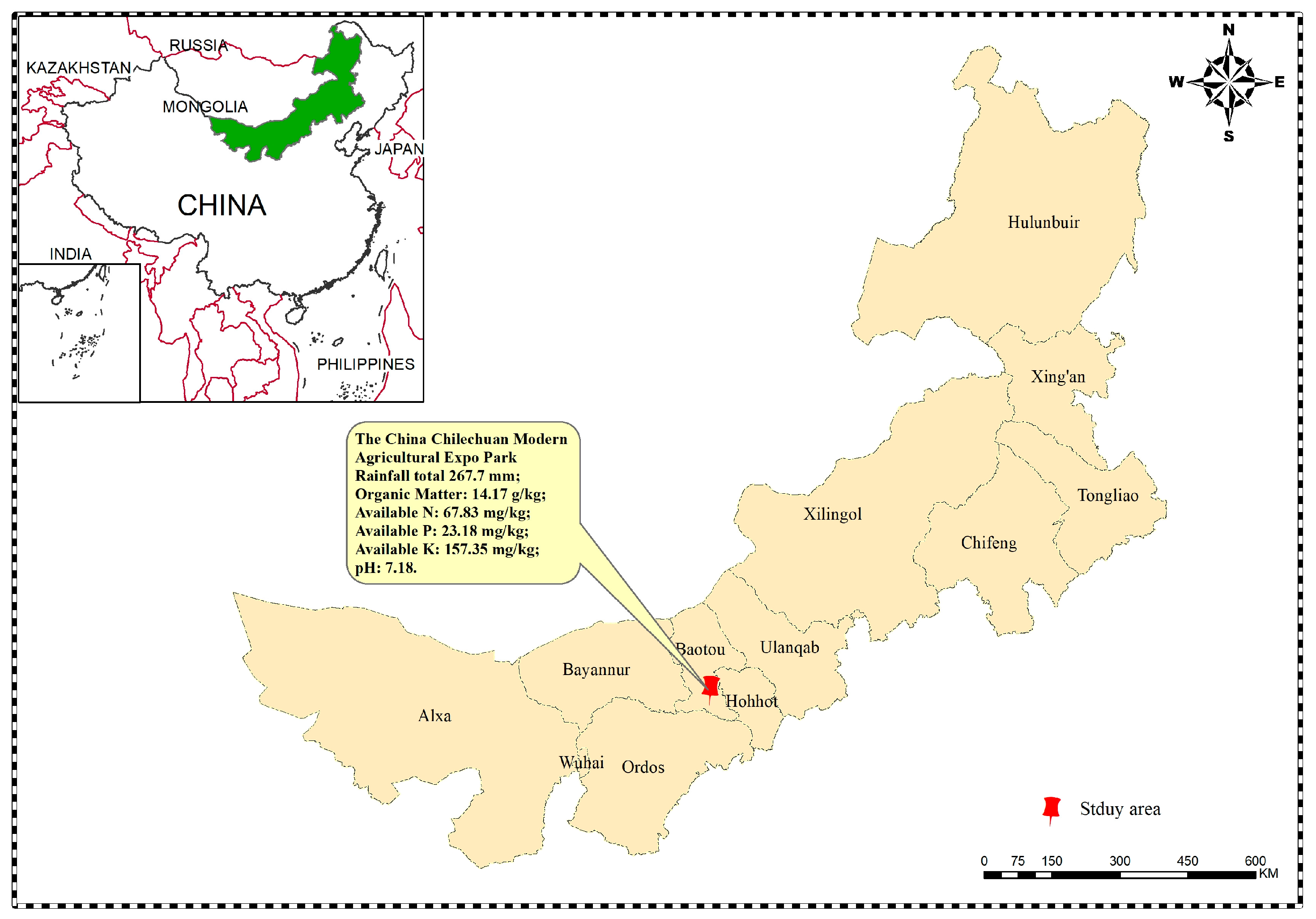
Figure 1. Study area in this article.
Agriculture 16 00084 g001
Figure 2. Spectral characteristics of different spectral transformation treatments. Note: R: original spectrum; FODR: first-order derivative transformation; SODR: second-order derivative transformation; LogR: logarithmic transformation.
Agriculture 16 00084 g002
Figure 3. Spectral reflectance of maize leaves with different nitrogen and irrigation application rates.
Agriculture 16 00084 g003
Figure 4. Spectral characteristics of different SPAD values. Note: (R) the raw spectral reflectance curve, (logR) the spectral reflectance curve after applying a logarithmic transformation to the raw spectrum, (FODR) the spectral reflectance curve after applying a first-order differential transformation to the raw spectrum, and (SODR) the spectral reflectance curve after applying a second-order differential transformation to the raw spectrum.
Agriculture 16 00084 g004
Figure 5. Spectral characteristics of water content in different maize leaves. Note: (R) the raw spectral reflectance curve, (logR) the spectral reflectance curve after applying a logarithmic transformation to the raw spectrum, (FODR) the spectral reflectance curve after applying a first-order differential transformation to the raw spectrum, and (SODR) the spectral reflectance curve after applying a second-order differential transformation to the raw spectrum.
Agriculture 16 00084 g005
Figure 6. Spectral characteristics of nitrogen content in maize leaves. Note: (R) the raw spectral reflectance curve, (logR) the spectral reflectance curve after applying a logarithmic transformation to the raw spectrum, (FODR) the spectral reflectance curve after applying a first-order differential transformation to the raw spectrum, and (SODR) the spectral reflectance curve after applying a second-order differential transformation to the raw spectrum.
Agriculture 16 00084 g006
Figure 7. The correlation coefficient between the spectral index of different spectral treatments and the SPAD value of maize leaves at different growth stages. Note: V12: the bell-mouth stage; R1: the silking stage; R3: the milk stage; All: full growth period; R: raw spectral data; logR: logarithmic spectral data; FODR: first-order derivative spectral data; SODR: second-order derivative spectral data.
Agriculture 16 00084 g007
Figure 8. The correlation coefficient between the spectral index of different spectral treatments and LWC at different growth stages. Note: V12: the bell-mouth stage; R1: the silking stage; R3: the milk stage; All: full growth period; R: raw spectral data; logR: logarithmic spectral data; FODR: first-order derivative spectral data; SODR: second-order derivative spectral data.
Agriculture 16 00084 g008
Figure 9. Correlation coefficient between spectral indices of different spectral treatments and nitrogen content in maize leaves at different growth stages. Note: V12: the bell-mouth stage; R1: the silking stage; R3: the milk stage; All: full growth period; R: raw spectral data; logR: logarithmic spectral data; FODR: first-order derivative spectral data; SODR: second-order derivative spectral data.
Agriculture 16 00084 g009
Figure 10. Calibration datasets for estimating SPAD, LWC, and LNC. Note: V12: the bell-mouth stage; R1: the silking stage; R3: the milk stage; All: full growth period; R: raw spectral data; logR: logarithmic spectral data; FODR: first-order derivative spectral data; SODR: second-order derivative spectral data; RF: random forest regression model; SVR: support vector regression model.
Agriculture 16 00084 g010
Figure 11. Validation datasets for estimating SPAD, LWC, and LNC. Note: V12: Large-mouth stage; R1: Silk-laying stage; R3: Grain-filling stage; All: Full growth period; R: Raw spectral data; logR: Logarithmic spectral data; FODR: First-order derivative spectral data; SODR: Second-order derivative spectral data; RF: Random forest regression model; SVR: Support vector regression model.
Agriculture 16 00084 g011
Table 1. Soil basic fertility of test site in 2023.
Organic Matter (g/kg)Available N (mg/kg)Available P (mg/kg)Available K (mg/kg)pH
14.1767.8323.18157.357.18
Table 2. Normal spectral indices and calculation formula.
Vegetation IndexCalculation FormulaCitation
NDVI(Rλ1 − R670)/(Rλ1 + R670)Rouse [16]
GNDVI(Rλ1 − R550)/(Rλ1+ R550)Gitelson et al. [17]
DVIRλ1 − R670Richardson and Wiegand [18]
RVIRλ1/R720Jordan [19]
SAVI1.5 × (Rλ1 − R670)/(Rλ1 + R670 + 0.5)Huete [20]
HNDVI(Rλ1 − R668)/(Rλ1 + R668)Oppelt and Mauser [21]
PRI(Rλ1 − R531)/(Rλ1 + R531)Penuelas et al. [22]
SIPI(Rλ1 − R450)/(Rλ1 +R450)Penuelas et al. [22]
PSNDaRλ1 − R680)/(Rλ1 + R680)Blackburn [23]
PSNDb(Rλ1 − R635)/(Rλ1 + R635)Blackburn [23]
PSSRaRλ1/R680Blackburn [23]
PSSRbRλ1/Rλ2Blackburn [23]
CIred_edgeRλ1/Rλ2-1Gitelson et al. [24]
SRRλ1/Rλ2Jordan [19]
VOG1Rλ1/Rλ2Vogelmann et al. [25]
MRESR(Rλ1 − R445)/(Rλ1 + R445)Datt [26]
NPCI(Rλ1 − Rλ2)/(Rλ1 + Rλ2)Penuelas et al. [27]
GRVIRλ1/Rλ2Gitelson et al. [28]
RNDVI(Rλ1 − Rλ2)/sqrt(Rλ1 + Rλ2)Wang et al. [29]
MSR(Rλ1/Rλ2 − 1)/(sqrt(Rλ1/Rλ2) + 1)Haboudane et al. [30]
NPQI(Rλ1 − Rλ2)/(Rλ1 + Rλ2)Barnes et al. [31]
IPVIRλ1/(Rλ1 + Rλ2)Kooistra et al. [32]
RENDVI(Rλ1 − Rλ2)/(Rλ1 + Rλ2)Gitelson and Merzlyak [33]
NDNI(log(1/Rλ1) − log(1/Rλ2))/(log(1/Rλ1) + log(1/Rλ2))Serrano et al. [34]
MSIRλ1/Rλ2Hunt et al. [35]
NDII(Rλ1 − Rλ2)/(Rλ1 +Rλ2)Serrano et al. [34]
NDWI(Rλ1 − Rλ2li)/(Rλ1 + Rλ2)Gao [36]
WBIRλ1/Rλ2Penuelas et al. [37]
mSR(Rλ1 − Rλ2)/(Rλ1 + Rλ2)Sims and Gamom [38]
PPR(Rλ1 − Rλ2)/(Rλ1 + Rλ2)Kooistra et al. [32]
NDSI(Rλ1 − Rλ2)/(Rλ1+ Rλ2)Richardson et al. [39]
WIRλ1/Rλ2Penuelas et al. [37]
GVWI[(Rλ1 + 0.1) − (Rλ2 + 0.02)]/[(Rλ1 + 0.1) + (Rλ2 + 0.02)]Ceccato et al. [40]
Note: In the formula, Rλ1 denotes the spectral reflectance at wavelength λ1, Rλ2 denotes the spectral reflectance at wavelength λ2, and so on.
Table 3. Analysis of variance of SPAD, LWC, and LNC in maize leaves.
Agronomic Trait ParametersSource of VariationV12R1R3
SPAD
Nitrogen application rate(N)9.48 **17.96 **38.27 **
Main zone error1.995.471.71
Irrigation amount(W)18.32 **17.59 **8.86 **
Secondary zone error3.537.925.38
Nitrogen application rate × Irrigation amount (N × W)1.01 ns0.49 ns0.2 ns
LWC
Nitrogen application rate(N)47.12 **5.8 **18.11 **
Main zone error0.000.000.00
Irrigation amount(W)2.62 ns24.97 **181.59 **
Nitrogen application rate × Irrigation amount (N × W)6.63 **1.04 ns9.66 **
Secondary zone error0.000.000.00
LNC
Nitrogen application rate(N)282.17 **45.92 **50.20 **
Main zone error0.000.000.00
Irrigation amount(W)79.75 **153.57 **177.55 **
Nitrogen application rate × Irrigation amount (N × W)15.83 **17.12 **7.54 **
Secondary zone error0.000.000.00
Note: ** represents 0.01 significant level; ns stands for not significant V12: the bell-mouth stage; R1: the silking stage; R3: the milk stage.
Table 4. Spectral indices sensitive to SPAD values extracted from maize leaves at different growth stages using different spectral treatments.
RlogRFODRSODR
V12NDSIPRI, NPQI, mSRGNDVI, PSNDb, GRVI, NPQIPSNDa, PSSRa, NDII, NDWI, GVWI
R1SAVI, PRI, PSNDa, SR, NDSISAVI, PRI, SR, VOG1, RNDVI, NPQI, RENDVI, mSRMSI, NDII, WBI, WIMRESR, NDII, WBI, NDSI, WI
R3GNDVI, RVI, PSSRb, VOG1, MRESR, GRVI,
NPQI, RENDVI, NDNI, MSI, NDWI, mSR
NPQI, NDNI, PPRNDVI, DVI, SAVI, VARIgreen, RNDVI, IPVI, NDSIDVI, SAVI, VARIgreen, SR, NPCI
AllNPCI, NDSISR, MRESR, NPCI, mSRDVI, SAVI, VARIgreen, RNDVIDVI, SAVI, VARIgreen, SR, NPCI
Note: V12: the bell-mouth stage; R1: the silking stage; R3: the milk stage; All: full growth period; R: raw spectral data; logR: logarithmic spectral data; FODR: first-order derivative spectral data; SODR: second-order derivative spectral data.
Table 5. Different spectral treatments used to extract spectral indices sensitive to water content of maize leaves at different growth stages.
RlogRFODRSODR
V12NDVI, RVI, HNDVI, PRI, SIPI, PSNDa, PSNDb, PSSRa, SR, MSR, IPVI, PPRDVI, PRI, VARIgreen, MRESR, NDNI, mSR, PPRGNDVI, PSSRb, GRVI, NDSIHNDVI, VOG1, NDSI, GVWI
R1NDVI, RVI, HNDVI, PRI, PSNDa, PSSRb, SR MSR, IPVIDVI, PRI, VARIgreenMSI, NDII, NDWI, PPRNDSI, GVWI, RENDVI, PSNDa,
R3MSI, NDII, NDWI, WBI, WI, GVWINDNI, MSI, NDII, NDWI, WBI, WI, GVWIGNDVI, GRVI, NDII, WBI, WI, GVWINDSI, RENDVI, PRI
AllNPCI, RENDVI, WBI, PPR, NDSI, WI, GVWIMRESR, NPCI, Msr, PPRDVI, SAVI, PSNDa, VARgreen, NPCI, NDSINDSI, SR, VARIgreen, HNDVI, SAVI, DVI
Note: V12: the bell-mouth stage; R1: the silking stage; R3: the milk stage; All: full growth period; R: raw spectral data; logR: logarithmic spectral data; FODR: first-order derivative spectral data; SODR: second-order derivative spectral data.
Table 6. Different spectral treatments were used to extract the sensitive spectral indices of nitrogen content in maize leaves at different growth stages.
RlogRFODRSODR
V12NDSI, NPQI, NPCIPRI, NPCI, NPQIRVI, PSNDa, PSSRa, NDSI,GVWI, PPR, HNDVI
R1NDNI, IPVI, MSR, SR, PSSRb, PSSRa, PSNDb, PSNDa, SIPI, HNDVI, SAVI, RVI, NDVIDVI, SAVI, VARIgreen, RNDVIGRVI, NDII, WI, GVWIGVWI, WI, NDSI, PPR, WBI, HNDVI
R3PPR, mSR, RENDVI, NPQI, GRVI, MRESR, VOG1, PSSRb, PRI, GNDVIMRESR, NPQI, mSR, PPRDVI, SAVI, VARIgreen, VOG1, MRESR, RNDVI, RENDVI, mSRGVWI, RENDVI, NPCI, SR
AllWI, WBI, NDWI, NDII, MSI, NPCIMRESR, NPCI, NDNI, mSR, PPR, GVWIDVI, SAVI, PSNDa, PSSRa, PSSRb, VARIgreen, NPCIGVWI, PPR, NPCI, SR, SIPI
Note: V12: the bell-mouth stage; R1: the silking stage; R3: the milk stage; All: full growth period; R: raw spectral data; logR: logarithmic spectral data; FODR: first-order derivative spectral data; SODR: second-order derivative spectral data.
Disclaimer/Publisher’s Note: The statements, opinions and data contained in all publications are solely those of the individual author(s) and contributor(s) and not of MDPI and/or the editor(s). MDPI and/or the editor(s) disclaim responsibility for any injury to people or property resulting from any ideas, methods, instructions or products referred to in the content.