Article

How Do Livelihood Assets Affect Subjective Well-Being Under Different Livelihood Strategies? Evidence from Tibetan Rural Households in China
1
State Key Laboratory of Earth Surface Processes and Disaster Risk Reduction, Beijing Normal University, Beijing 100875, China
2
School of Natural Resources, Faculty of Geographical Science, Beijing Normal University, Beijing 100875, China
3
School of Economics, Xi’an University of Finance and Economics, Xi’an 710100, China
*
Author to whom correspondence should be addressed.
Agriculture 2026, 16(1), 55; https://doi.org/10.3390/agriculture16010055
Submission received: 19 November 2025 / Revised: 24 December 2025 / Accepted: 24 December 2025 / Published: 26 December 2025
(This article belongs to the Section Agricultural Economics, Policies and Rural Management)

Abstract

Evaluating rural households’ subjective well-being (SWB) and identifying its determinants is crucial for rural sustainable development. This study takes Diqing Prefecture in the Tibetan region of China as a case, aiming to address two key research questions: (1) How do livelihood assets affect subjective well-being (SWB)—directly or indirectly—through the mediating role of the agricultural-income proportion? (2) Do these effects vary across different livelihood strategies? A questionnaire survey was administered to 489 randomly selected rural households in mid-2022. Two index systems were constructed: one for livelihood assets based on the Sustainable Livelihood Framework and another for SWB based on the Millennium Ecosystem Assessment. A subgroup Tobit regression model was utilized to analyze the heterogeneous effects. The results revealed deficiencies in SWB regarding basic material for a good life and health. Human, financial, and social assets are positively associated with SWB. However, natural assets directly negatively impact SWB across dimensions of basic material, security, and freedom, although the negative effect is masked by the mediating effect of farming livelihood strategies. Notably, human assets’ positive influence significantly strengthens with the agricultural income proportion rising. Whether physical, financial, and social assets positively affect SWB depends on farm work participation. These evidence-based findings contribute to a better understanding of the heterogeneous role of sustainable livelihoods in affecting rural households’ subjective well-being and highlight the need for policymakers to design diverse, targeted policies to support rural development.

1. Introduction

Maintaining and enhancing human well-being is the key benchmark and ultimate goal of sustainability [1,2]. In the context of global urbanization and industrialization, the well-being of rural households has become a critical research focus, particularly as the income gap between the agricultural and non-agricultural sectors continues to widen [3]. Well-being is typically divided into two perspectives: subjective well-being (SWB) and objective well-being (OWB). While OWB is defined by observed external indicators, SWB reflects individuals’ emotional and cognitive assessments of their life satisfaction. SWB captures the heterogeneity of rural households, whose well-being levels vary based on factors such as age, gender, education, and occupation, and who may prioritize different values and expectations [4]. For example, some rural households may place greater value on traditional culture or lifestyle than on income. Furthermore, SWB provides insights into individuals’ inner perception and more accurately reflects their needs, preferences and aspirations [4], making it essential for the development, implementation, and evaluation of policies. Early studies on SWB primarily focused on abstract emotions and perceptions of happiness. To better capture the specific needs of rural households, some studies have developed comprehensive, multi-dimensional indexes of SWB and integrated them with sustainability [2,4,5].
The determinants of rural SWB are multifaceted, typically categorized into external environmental factors and internal household characteristics. External factors, such as ecosystem services [6], land transfer policies [7], and the level of economic development and infrastructure availability [8], influence SWB indirectly by affecting the resources accessible and perceptible to farmers. At the household level, classical research has focused on demographic characteristics, such as gender [9], age [9], education [10], and income [11], which can be categorized as financial and human assets. More recently, social assets, encompassing individuals’ social traits and external network characteristics, have also gained attention. Empirical studies have demonstrated a positive relationship between social assets and SWB across various contexts, including Europe [12], the USA [13], and East Asia, particularly China [14,15].
However, as outlined above, the determinants of SWB are complex and cannot be fully explained by isolated economic factors [7]. Existing research on SWB often focuses on isolated types of assets and lacks a systematic framework to integrate the joint influence of personal traits, household conditions, and social relations. The Sustainable Livelihood Framework (SLF) provides such a framework, which can offer a more comprehensive understanding of how various factors collectively impact SWB.
Most studies focus on how livelihood strategies impact well-being, yet they often overlook how the underlying assets affect well-being. Empirical studies have shown that high-return livelihood strategy diversification can improve rural households’ well-being [5,16]. However, these studies primarily emphasize the effects of strategy, instead of analyzing livelihood assets as foundational determinants. Rural households’ strategy choices are shaped by the composition and quantity of available assets [17], while strategies also influence how assets are utilized and integrated [18]. This complex interaction underscores the need to explore how asset endowments directly influence well-being, whether strategies mediate this relationship, and how these effects vary across different strategies. These aspects remain largely unexplored in existing research.
Moreover, most studies tend to focus on livelihood outcomes measured by OWB, such as economic income and poverty risk, often neglecting SWB. This omission can lead to inaccurate policy recommendations. To fill this gap, this study aims to systematically analyze the heterogeneous effects of livelihood assets on SWB across different livelihood strategies, offering a more comprehensive understanding of the relationship between sustainable livelihoods and SWB in rural China.
The Diqing Tibetan Autonomous Prefecture, located on the southeastern edge of the Qinghai–Tibet Plateau, faces unique sustainable livelihood and well-being situations because of its complex context of multi-ethnic settlements and distinctive industries. The region’s remote geographical location, rugged topography, and fragile ecological environment have historically restricted livelihoods to subsistence agriculture. In recent years, however, natural and cultural eco-tourism has developed rapidly due to its unique, magnificent landscapes and multi-ethnic cultural features. Thus, rural households increasingly seek off-farm livelihoods, especially in the tourism sector. However, ethnic language barriers and limited educational levels may constrain their non-farm livelihood options. Meanwhile, the fragmented farmland and limited transportation infrastructure hinder smallholders from improving agricultural efficiency. This results in the coexistence of traditional and modern livelihoods. Furthermore, the region’s ethnic culture and religious background may affect the local people’s perceptions of SWB. Given Diqing’s unique combination of geographical, cultural, and economic factors, the study of the relationship between livelihood assets and SWB is especially urgent. Understanding how rural households’ assets influence their SWB under these diverse strategies can offer valuable insights into livelihood transformation and well-being challenges in similar underdeveloped rural areas.
The anticipated contributions of the study are as follows. First, it evaluates rural households’ livelihood outcomes through a sustainable and multi-dimensional SWB framework, which more accurately reflects farmers’ actual needs in the context of sustainability and addresses the limitations of existing studies that focus too much on objective indicators. Second, this study fills the gap in existing research, which typically focuses on isolated types of assets in relation to SWB, by integrating various factors through the systematic framework of SLF and addressing the overlooked role of underlying assets in influencing well-being. Third, our findings provide insights that can help governments design effective policies to promote sustainable livelihoods and SWB, addressing the practical needs of smallholder farmers, particularly in China and other developing countries.

2. Theoretical Framework

With sustainable development as an international consensus, some studies have integrated SWB with sustainability, focusing on meeting human needs of current and future generations, based on the Millennium Ecosystem Assessment (MEA) framework [2]. In this framework, human well-being is assessed across five dimensions: basic material for a good life, health, security, good social relations, and freedom for choice and action. Empirical research has shown that SWB, as evaluated by this method, supports Maslow’s hierarchy of needs and varies with farmers’ socio-demographic characteristics [2].
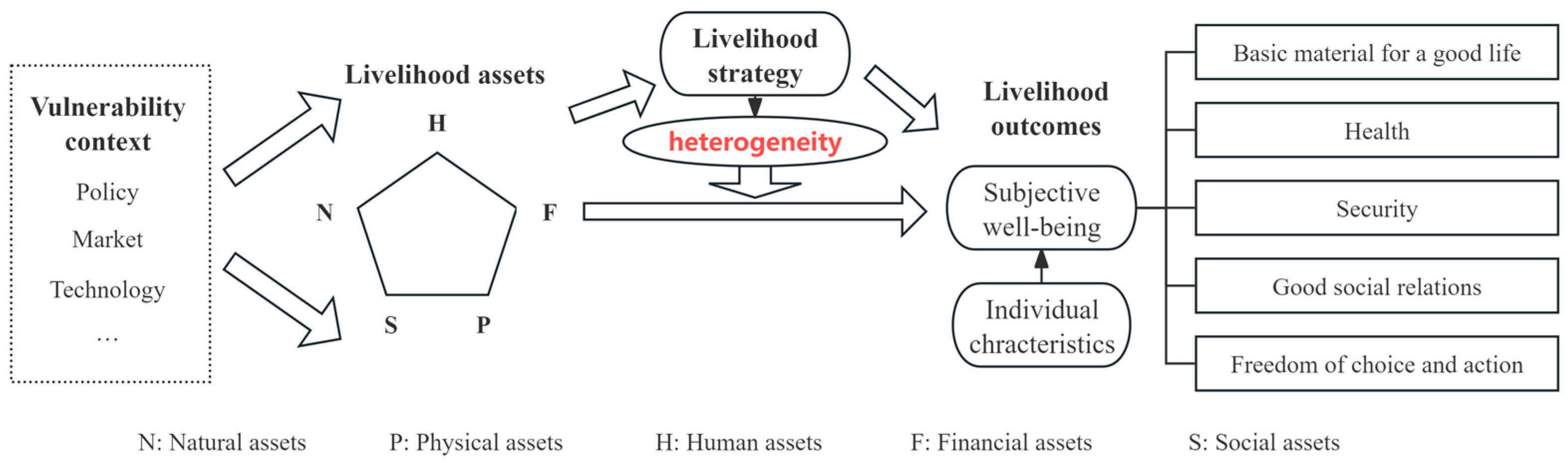
This study applied the SLF developed by the UK Department for International Development [19,20] to integrate various influencing factors of SWB, as depicted in Figure 1. In this framework, rural households are put in a vulnerable context where factors such as policy changes, market fluctuations, and environmental pressures affect their access to diverse livelihood assets [20,21]. Rural households possess five types of assets: natural assets, physical assets, human assets, financial assets, and social assets. They assess their asset endowments and adjust the combination of assets to make decisions on new livelihood strategies, like shifting from agriculture to non-farm activities [20,22], ultimately achieving livelihood outcomes including SWB [23]. Each type of livelihood assets is hypothesized to directly affect SWB, and these effects may be mediated by or show heterogeneity due to variations in livelihood strategies.
In the context of rural China, this study operationalizes livelihood strategies by the agricultural income proportion (AIP), which reflects the degree of dependence on agricultural livelihoods. Recently, China’s Rural Revitalization Strategy and targeted policies have promoted land transfer, allowing rural households to transfer their natural assets (farmland) and engage in non-farm work. However, shortages in human assets (such as labor and education) limit their ability to pursue non-agricultural activities, especially among elderly rural residents [24,25].
To examine these relationships, this study employs a Tobit regression model to explore the effects of livelihood assets on SWB across the five dimensions. Second, AIP is used as a mediating variable in a stepwise causal analysis to investigate the indirect effects. Third, heterogeneity is tested through subgroup regression models stratified by AIP levels. Individual characteristics, such as age and gender, are included as control variables based on previous studies. Notably, other indicators such as income, education, and social relationships are inherently part of the livelihood assets framework, so separate controls are not necessary in the regression specifications.

3. Materials and Methods

3.1. Study Area

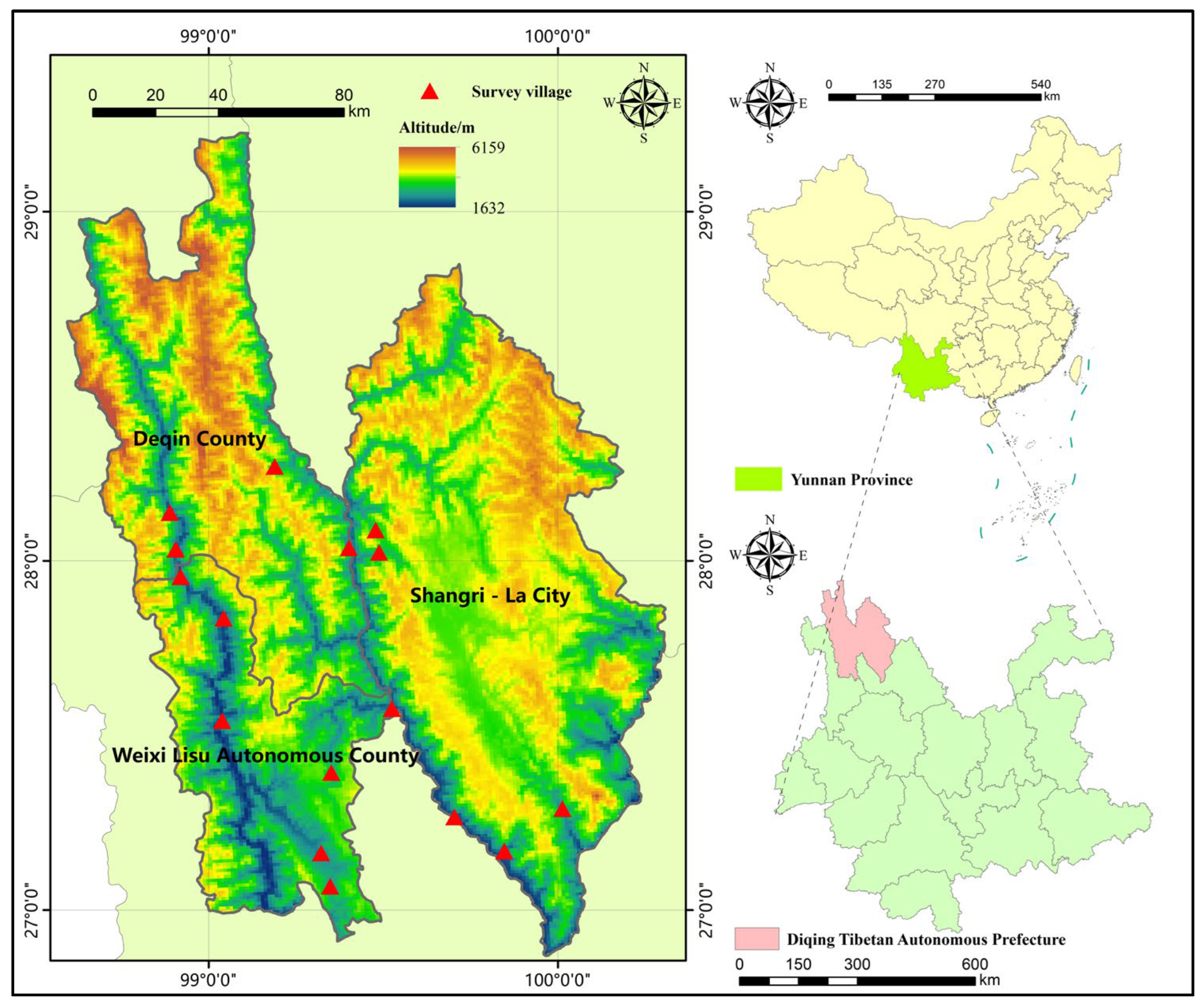
The Diqing Tibetan Autonomous Prefecture, located in the northwest of Yunnan Province of China, is contiguous to Sichuan and Tibet, as shown in Figure 2. The unique geographical location has fostered a blend of diverse ethnic customs and rich cultural exchanges. Diqing Prefecture administers Deqin County, Shangri-La City, and Weixi Lisu Autonomous County. By the end of 2023, the permanent resident population was 395,000, with nearly 90% from ethnic minorities [26]. Situated within the Three Parallel Rivers area, an extension of the Qinghai–Tibet Plateau, Diqing features high mountains and deep valleys, with the lowest point at 1486 m and the highest at 6740 m. While its complex terrain has created stunning landscapes, it has also led to fragmented farmland and limited transportation, hindering smallholders’ ability to improve agricultural efficiency and access non-agricultural employment opportunities. In 2023, the rural population made up 66.08% of the total, and the primary industry accounted for just 8.7% of the regional GDP, compared to 58.7% from the tertiary sector. Eco-tourism is the region’s pillar industry, with total tourism revenue reaching 41.58 billion USD in 2023 [26].

3.2. Survey Design and Data Collection

A questionnaire survey was conducted to collect the data for this study, with the survey instrument designed based on a literature review. The first draft was improved immensely by three focus group discussions involving local government officials, householders, experts, and research team members. A pretest was conducted in June 2022, during which investigators recorded valuable feedback and suggestions to revise and finalize the questionnaire.
The final questionnaire consisted of three sections. The first section assessed respondents’ satisfaction with the various indicators of SWB using a Likert scale, where a higher score indicated a higher level of well-being. The second section gathered information on the five categories of livelihood assets for rural households in 2021. The final section collected data on personal and family characteristics.
To ensure both the reliability of the survey and the representativeness of the data, this study calculated the required total sample size using the method with a 95% confidence level [27]. The calculation formula is as follows:
n = N 1 + N e 2
where n is the required sample size, N is the number of farmers in the population, and e is the allowable error (%). As the rural population of Diqing Tibetan Autonomous Prefecture was 262,000 [28], the required sample size for this study was calculated as 400.
The formal survey was carried out from 21 July to 3 August 2022, using the multi-stage random sampling method. Face-to-face interviews were carried out, with participants informed of their voluntary participation and encouraged to share their honest opinions. Considering the population size, rural land area, and economic development level, 2–3 townships were randomly selected from each county or city. Then, two administrative villages were randomly chosen from each selected township, and rural households were proportionally sampled from each village based on population size. Finally, a total of 489 questionnaires were distributed and collected, and 472 valid samples were obtained, with an effective rate of 96.52%.

3.3. Subjective Well-Being Index System

This study quantified rural households’ SWB across the five dimensions, based on the principles of MEA. According to Costanza et al. [29], subjective satisfaction is a key measure of the quality of human life, reflecting how well individuals or groups meet the objective needs they consider valuable. As most SWB assessments use self-rating scales to measure happiness or satisfaction, this study adopted a satisfaction-with-life scoring method. Respondents were asked to rate their satisfaction with each indicator on a Likert scale, where higher scores indicated stronger perceptions of well-being regarding each indicator. The selected indicators for each dimension, based on previous literature [1,2,4,30], are presented in Table 1.
The definition of well-being goes beyond material circumstances to include individual preferences and social contexts, while being inherently ecologically embedded [5,31]. For the dimension of basic materials for a good life, employment and income meet basic needs such as adequate food for survival and foster optimistic expectations for the future [7]. Housing, transportation, and communication facilities are crucial for daily convenience and comfort. These indicators, accumulated over time, may better reflect well-being than financial indicators, which fluctuate in the short term [5].
For the health dimension, physical health directly influences life quality and happiness, while public healthcare serves as an important guarantee for residents’ health. Access to clean air and water is a critical indicator of ecosystem services fundamental to health, aligning with the MEA framework. Therefore, “quality of air/drinking water” was included.
The security dimension covers public security and ecological soil security, corresponding to the “personal safety” and “secure access to resources” in the MEA framework. For the dimension of good social relations, strong bonds with family members, friends, neighbors, and others provide essential emotional and spiritual support from social connections, which is key for fulfilling Maslow’s higher-level need for “love and belonging” [2,32] and aligns with both Amartya Sen’s notion of “life one has reason to value” [33], directly impacting SWB.
Finally, the freedom dimension includes freedom of career choice, which reflects equal opportunities for self-fulfillment. Given the region’s diverse ethnic and religious makeup, freedom of religious belief was also included. Both indicators correspond to the highest needs in Maslow’s hierarchy—namely, “esteem, self-actualization, and self-transcendence” [2,32].

3.4. Livelihood Assets Index System

Drawing on previous studies, this study constructed an index system for livelihood assets based on SLF (Table 2). Natural assets refer to tangible natural resources and ecosystem services accessible for rural households, which directly support their agricultural production and livelihood activities. As one of the most important assets of rural households [34], the area and quality of the cultivated land determine the potential crop yield. Therefore, indicators “the area of cultivated land”, “the level of soil fertility”, and “irrigation condition” were included into the index system. In Diqing, an ecological barrier in the Upper Yangtze River region, the Grain for Green Program has converted steep-sloping farmland into forest to reduce soil erosion. Given the distinct productivity of forest land compared to cultivated land, “the area of forest land” was also included.
Physical assets refer to tangible assets used for production and daily life to maintain and improve well-being. The importance of various assets, such as livestock or vehicles, was determined using conversion rules outlined in Table 2, based on a relevant study [35].
Human assets are primarily measured by the quantity and quality of household labor [36]. Health status and educational attainment are widely recognized as crucial factors in adopting high-return livelihood strategies and achieving better outcomes. Additionally, respondents’ physical condition and educational level [1,10] influence their cognitive perception of SWB.
Financial assets are operationalized in two dimensions: household disposable income and access to formal/informal credit. Previous studies have empirically confirmed a strong link between income and SWB [1,15], aligning with the role of financial assets in strengthening material security and expanding choice autonomy.
Social assets refer to social resources or networks used to achieve livelihood goals, including social connections, trust, participation, and cooperation. In Chinese society, particularly in rural areas, social assets are seen as a key type of assets, often referred to as the “assets for the poor.” Social assets play an essential role in SWB, especially in accessing informal support systems [14,15].

3.5. Determination of the Index Weight

To evaluate SWB and livelihood assets, the data were normalized using the min-max normalization method. The weighting method proposed by Cheli and Lemmi [37] was used to determine the weights of the SWB indicators, automatically assigning higher weights to indicators where most rural households perform poorly. This addresses a key limitation of traditional methods (e.g., Principal Components Analysis), which assign low weights to “bottlenecks” that deserve focused attention. The CRITIC objective weighting method was used to assign weights to the livelihood assets indexes, as it considers both the standard deviation and inter-indicator conflict potential as key factors [38]. A higher standard deviation and greater conflict potential mean the indicator contains more valid system information, thus receiving a higher weight. This method accounts for both the variability in each indicator’s values and the influence of inter-indicator correlations on weights, making it more suitable than the ordinary entropy method.
Z i j = ( X i j X j m i n ) / ( X j m a x X j m i n )
where i is the ith sample, j is the jth indicator, Zij represents standardized data, Xij is the original input, X j m i n represents the minimum value of the jth indicator in original data, and X j m a x represents the maximum value of the jth indicator in the original data.
w j = ln ( 1 / ( 1 m i = 1 m Z i j ) ) j = 1 n ln ( 1 / ( 1 m i = 1 m Z i j ) )
S W B = j = 1 n ( w j × Z i j )
where wj is the weight of the evaluation indicator of SWB, i is the ith respondent, j is the jth evaluation indicator of SWB, m is the total number of respondents, n represents the total number of indicators evaluating a certain dimension of SWB, and SWB is the output value of a certain dimension of SWB.
S j = i = 1 m Z i j Z j ¯ 2 n 1
R j = 1 r j k
w j = S j × R j ( S j × R j )
G = j = 1 n ( w i × Z i j )
where Sj is the standard deviation of the jth evaluation indicator of livelihood assets, Z j ¯ is the mean value of the jth evaluation indicator of livelihood assets, m is the total number of respondents, Rj represents the degree to which the information of the jth indicator does not overlap with that of other indicators, rjk is the correlation coefficient between the jth indicator and the kth indicator, wi is the weight of the evaluation indicator of livelihood assets, n represents the total number of indicators evaluating a certain type of livelihood assets, and G is the comprehensive score of a certain type of livelihood assets.

3.6. Model Selection

The value of all 5 dimensions was assigned equal weights to calculate the overall SWB, and the non-parametric Kruskal–Wallis test was used to compare the SWB across different respondent groups. As the explained variable, the value of SWB in each dimension was a weighted composite score, restricted within the range of [0, 1]. Given that this explained variable is censored with truncation at both ends, the OLS regression model may produce biased estimates. Therefore, the Tobit regression model was chosen to analyze the impact of livelihood assets on SWB, and the maximum likelihood estimation method was implemented using Stata (v17.0) to estimate the regression parameters. The model construction is as follows:
Y * = α + i = 1 n β i x i + ε
Y = Y * , Y * > 0 0 , Y * 0   and   Y * ~ N 0 , σ 2
where Y * is the latent variable of the explained variable, xi is the explanatory variable, β i is the parameter to be estimated, ε is the random disturbance term, ε~N(0, σ2), and α is the intercept term.
Additionally, the mediating effect of livelihood assets on SWB through livelihood strategies was tested. The mediating effect was examined using the stepwise causal regression method, and its robustness was verified through the Bootstrap resampling method with 1000 replications. Specifically, the ordered logit model was employed to analyze the impact of livelihood assets on livelihood strategies, as AIP is an ordinal discrete variable ranging from 1 to 5.

4. Results

4.1. Respondents’ Demographic Characteristics

The demographic characteristics of the respondents are presented in Table 3. The sample was nearly equally divided between males and females. On average, respondents were approximately 50 years old, with over 30 years of experience in agricultural production, reflecting the aging trend in rural China. Younger generations tend to migrate to larger cities such as Shangri-La or Dali for work, while older individuals remain at home to care for children and continue farming. The average educational level ranged from primary to middle school and was generally low. Approximately, each household had four permanent residents on average, which aligns with official statistics. The per capita income was about 1721.3 USD, close to the official figure of 1567.05 USD for per capita disposable income. Nearly 94% of households engaged in farming, though it was not their primary income source. Over 66% of households reported that agricultural income accounted for less than 40% of their total annual income. On average, each household had 2.7 sources of income, including odd jobs, collecting matsutake, harvesting cordyceps sinensis, and making black pottery. Based on AIP, households were categorized into five livelihood strategy types. Given the area’s ethnic diversity, the respondents included seven ethnic groups, primarily Tibetan, Han, and others.

4.2. Characteristics and Variations in Subjective Well-Being

The calculation results of the indicator system revealed differences in respondents’ satisfaction across the five dimensions of SWB. The mean values were ranked as follows: freedom of choice and action (0.786) > security (0.759) > good social relations (0.749) > basic material for a good life (0.710) > health (0.699). According to the paired samples t-test results, SWB in the dimension of freedom of choice and action was significantly higher than in the other dimensions (p < 0.01), while SWB in the dimensions of basic material for a good life and health was significantly lower (p < 0.01). Regarding the specific indicators of basic material for a good life, respondents showed the least satisfaction with employment status and income level, both of which were significantly lower than other indicators (p < 0.01) in this dimension. In the health dimension, respondents’ satisfaction with medical conditions was significantly lower (p < 0.05).
The results of the non-parametric Kruskal–Wallis H test, presented in Table 4, showed that SWB varied among groups divided by gender, age, or livelihood strategy (indicated by AIP). For gender disparities, significant differences (p < 0.05) were found in the dimensions of basic material for a good life and health. Overall, males reported higher well-being than females, except in the dimension of freedom of choice and action. Older respondents demonstrated significantly lower satisfaction in the health dimension, while there was an upward trend in freedom of choice and action with increasing age. Respondents who tend to non-farm livelihood strategies were significantly less satisfied with health, security, and freedom of choice and action.

4.3. Characteristics and Variations in Livelihood Assets

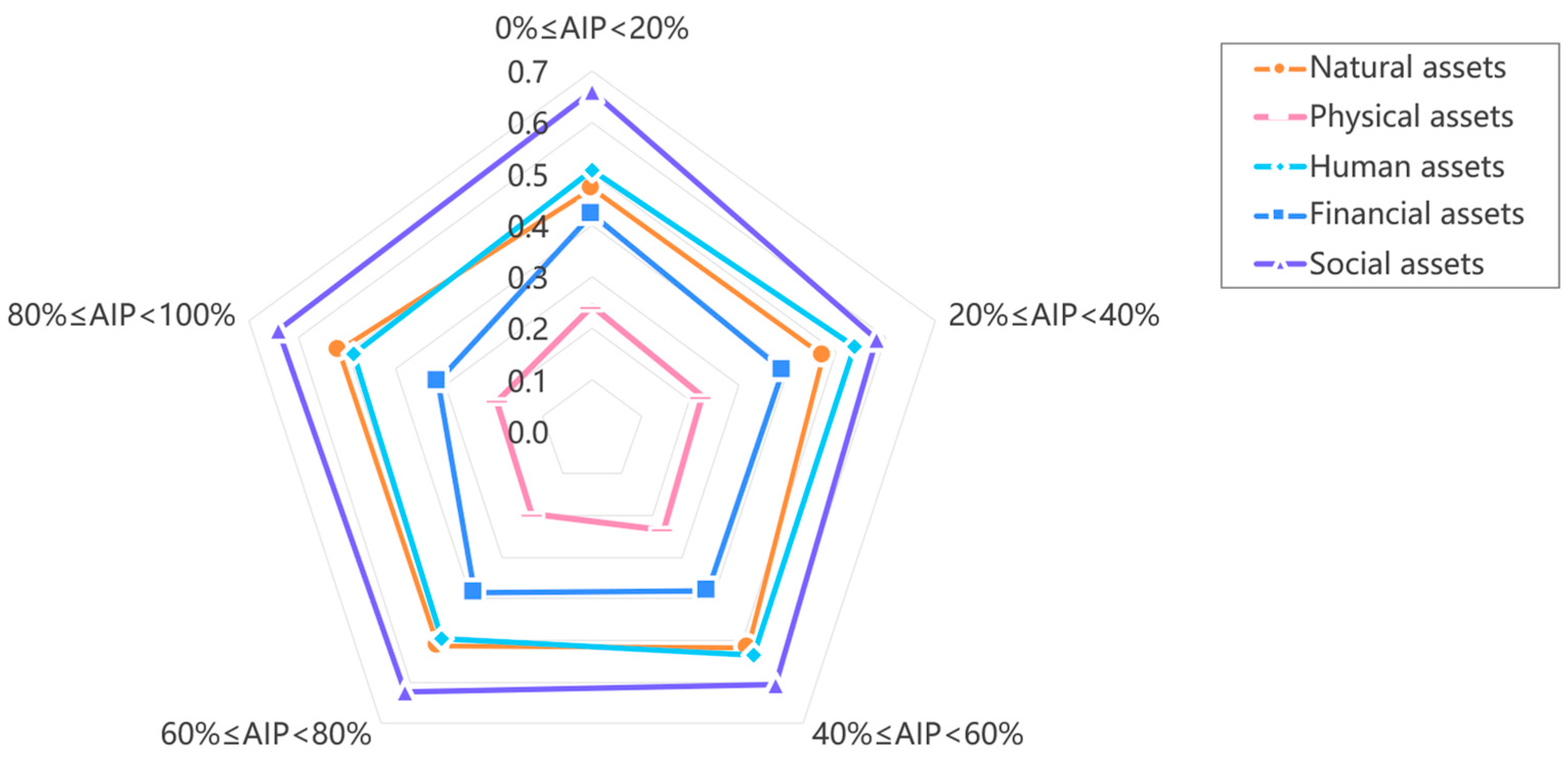
Based on the questionnaire data from all respondents, the mean values for each type of livelihood assets are ranked as follows: social assets (0.53) > human assets (0.51) > natural assets (0.49) > financial assets (0.40) > physical assets (0.23). For respondent groups divided by AIP, the distributional differences in the five types of livelihood assets are shown in Figure 3.
Rural households with the highest AIP (80–100%) had the highest natural assets (0.52) but the lowest physical (0.19) and financial (0.31) assets, as they relied largely on farming for their livelihood. In contrast, households with the lowest AIP (0–20%) had relatively higher physical (0.24) and financial (0.42) assets, but lower natural assets (0.47) compared to the other groups. Overall, engagement in non-farm activities tended to increase physical and financial assets while reducing natural assets.

4.4. The Effects of Livelihood Assets on Subjective Well-Being

The multicollinearity test results showed that all variables have a Variance Inflation Factor (VIF) of less than 10, with the tolerance values (the reciprocal of VIF) exceeding 0.1, indicating no severe multicollinearity in the model. Table 5 presents the direct and indirect influence of livelihood assets on SWB. The Chi-square test results revealed that the likelihood ratio statistics for the eight regression models were all significant at the 1% level, demonstrating strong explanatory power and reasonable goodness-of-fit.
Human assets were the main factor affecting overall SWB and all five dimensions. The greater human assets rural households possessed, the more satisfied they were likely to be with various aspects of their own lives, from fundamental material conditions to their sense of freedom. Conversely, natural assets were directly associated with lower satisfaction in basic material conditions, security, and freedom of choice and action. However, natural assets were also found to have an indirect positive association with SWB through AIP, with the mediating effect verified to be significant, which served to mask the direct negative effect of natural assets. Financial and social assets had a direct positive effect on rural households’ satisfaction with basic materials and social relations. Additionally, AIP exerted a negative mediating effect on the role of financial assets in improving SWB.
The regression results also showed that AIP was a key influencing factor for SWB, suggesting it is essential to conduct heterogeneity analysis for rural households adopting diverse livelihood strategies. Table 6 shows the analysis results, where the data fitting all models except the last one.
For rural households with different livelihood strategies, the direction and degree of the effect of each type of livelihood assets on overall SWB varied. Natural assets only exerted a significantly negative impact on the well-being of households with an AIP below 20%. The coefficients of human assets were positive and significant at the 1% level in all models. Furthermore, as AIP increased, the strength of the positive association increased correspondingly. Physical and financial assets had a significantly positive impact only for households with an AIP between 60% and 80%. Social assets had a significant positive effect only for households with AIP between 40% and 60%.

5. Discussion

5.1. Subjective Well-Being and Its Heterogeneity Across Different Groups

Guided by MEA, this study established a five-dimensional evaluation system with 18 indicators to assess rural households’ sustainable SWB in Diqing Prefecture. This bottom-up approach, rooted in the perception of stakeholders, is essential to formulate public policies that effectively improve rural households’ living standards and well-being [1,30].
Our results show that, among the five dimensions of SWB, satisfaction with freedom of choice and action is the highest, consistent with the study’s result in Duolun County, Inner Mongolia, China [1]. This can be attributed to China’s system of regional ethnic autonomy, where local governments fully uphold the rights to religious freedom and respect traditional cultural customs in ethnic minority regions like Diqing Prefecture. The relatively low score of basic material for life is inconsistent with the findings of relevant studies in plains areas of China [2,30,39]. This discrepancy is likely attributable to Diqing Prefecture’s remote location with mountainous terrain, which limits the productivity of fragmented cultivable land and the development of infrastructure. Moreover, eco-tourism, which serves as a pillar industry, was severely disrupted by the COVID-19 pandemic [40]. These factors collectively contribute to rural households’ low satisfaction with basic material conditions, particularly employment and income. Regarding healthcare dissatisfaction, inequality in medical resources between rural and urban areas is a widespread issue in China [41]. In Diqing, the rugged terrain further complicates access to medical services for mountain residents.
This study also highlights the heterogeneity of SWB across different groups. Rural households with a minimal share of agricultural income reported significantly lower satisfaction in the dimensions of health, security, and freedom. The thriving eco-tourism industry offers a wide range of non-farm employment opportunities, but lower education levels and an older age profile prevent many from competing for better jobs, limiting their employment options and impacting their SWB [25,42]. Additionally, the unpredictability of non-farm work, lack of professional skills, and extended time away from home negatively impact self-assessments of health and security, further lowering SWB [7]. Furthermore, males reported higher well-being than females, consistent with Inglehart’s findings [9], which show that elderly women tend to have lower happiness than their male counterparts. This may be attributed to rural women often performing lower-paying work, such as childcare or matsutake picking, while enjoying more freedom in terms of time and mobility. For older individuals, advancing age, accumulated life experience, and reduced family burdens contribute to positive emotional experiences and higher SWB, except for declining health.

5.2. Direct and Indirect Effects of Livelihood Assets on Subjective Well-Being

Our findings reveal that rural households’ livelihood assets play an important role in their SWB. Specifically, households with better natural assets tend to report lower SWB. Diminishing returns from land mean that agriculture is insufficient as a source of income to improve material living standards in China [7], Afghanistan [43], and other developing countries, thereby negatively influencing their SWB. Additionally, the demanding nature of land cultivation ties up labor, limiting their freedom to get other high-return employment opportunities, which aligns with the “resource curse” theory from a micro perspective, as discussed by Zhang et al. [44]. Furthermore, an abundance of natural assets increases exposure to livelihood risks, thus fostering a sense of insecurity [34], particularly given that the fragile ecological environment of Diqing makes its cultivated land vulnerable to soil erosion and rocky desertification [45]. Interestingly, the direct negative effect of natural assets on SWB is mitigated by the mediating effect of AIP. This can be attributed to the inherent instability of the tourism sector. Particularly during crises such as the COVID-19 pandemic, basic income sources like agriculture serve as a critical safety net—this phenomenon has also been observed in rural tourism destinations in Africa [46]. However, as emphasized by well-being ecology, over-reliance on traditional agriculture is not conducive to the sustainable development of rural areas, a cornerstone of holistic well-being [47]. A reduced reliance on agriculture brings about favorable ecological impacts such as decreased regional nitrogen and phosphorus export [48].
Among the 5 types of livelihood assets, human assets have the most profound positive impact on SWB across all dimensions. The quantity and quality of household labor force are critical factors influencing total disposable income and expenditure [1], which, in turn, satisfy various life needs. Additionally, higher education levels and better health are associated with greater happiness and satisfaction [10,15,49]. Both financial and social assets positively influence SWB, particularly in dimensions of basic material for a good life and good social relations. These results correspond with the findings of a German study [50], which identified economic conditions and social networks as key drivers of life satisfaction improvement. Financial assets support both the material foundation of production activities and daily lives, while also facilitating the maintenance of essential social connections, thus influencing SWB. Abundant social assets provide access to more information and resources, promote cooperation, and foster mutual assistance among households, such as agricultural technology sharing and production cooperation; this is especially evident in specialized agricultural contexts, such as cocoa cultivation in Colombia [18] and plateau-specific agriculture in Diqing. This, in turn, improves production efficiency, increases income, and enhances material living standards, ultimately positively affecting their SWB [14,15,18,25].

5.3. Heterogeneity in Livelihood Assets’ Effects on Subjective Well-Being Across Livelihood Strategies

With the acceleration of urbanization, many rural laborers are driven by economic incentives to engage in non-agricultural activities, either locally or by migrating [51]. The migration of the labor force and the resulting shift in household income structures lead to adjustments in livelihood asset compositions and strategies [51,52]. According to a large-scale empirical study by Xu et al. [17], off-farm work has become the primary livelihood strategy in rural China, with the lowest reliance on natural assets, while human assets are the most important for sustainable livelihood. This regional study in Diqing Prefecture aligns with the national-level empirical results. Notably, the results suggest that the influence of livelihood assets on SWB varies both in direction and degree across different livelihood strategies.
In Diqing Prefecture, only a minority of rural households rely primarily on farming. However, even among those for whom agricultural income constitutes less than 20% of total income, nearly 90% still receive agricultural income. This indicates that most rural households have not completely abandoned farming, despite its negative impact on their well-being. The measurement of livelihood assets across different strategies in this study aligns with findings by Yang et al. [24], who observed that farmers focused on non-farm work tend to reallocate natural assets toward other forms of assets. However, the reduction in natural assets is minimal, suggesting that land transfer is not widespread in Diqing. In fact, very few respondents reported income from land rental, which can be attributed to the steep terrain, poor-quality, and highly fragmented cultivated land in southeastern China. Land transfers cannot facilitate large-scale, intensive, or mechanized agriculture, and the rent for land transfers is low while the associated costs are high [7]. On one hand, rural households are reluctant to rent out land at low prices, which confines their labor and impacts SWB. On the other hand, the low returns and high risks associated with farming further diminish SWB.
Human assets exhibit a positive and progressive effect on SWB, with this impact intensifying as rural households rely more on agriculture. In Diqing Prefecture, smallholder farming depends more on the quantity of family labor than on its quality. Low-skilled odd jobs are the primary form of non-farm employment. In contrast, wage employment or small businesses requiring higher qualifications and offering better returns are less common. This is consistent with the situation in rural areas of many developing countries, such as Nepal [5], where households with lower educational attainment have limited access to high-return employment. Therefore, the positive effect of human assets on SWB is partially offset by rural households’ lack of vocational education and professional skills, which limits their ability to take advantage of non-farm opportunities, particularly those driven by tourism in Diqing [16]. In contrast, for farming-dependent smallholders, additional labor input generally leads to higher output and better well-being.
Physical, financial, and social assets positively impact the SWB of households attempting to reduce their reliance on farming. For rural households with limited non-farm engagement, the financial and physical assets accumulated through non-farm work help offset insufficient agricultural income, addressing basic material needs and correlating with higher levels of SWB [53]. For households more deeply involved in non-farm activities, social assets play a crucial role by expanding access to high-value information, resources, and networks, thus fulfilling higher-level needs and improving SWB [15,54].

5.4. Policy Implications

The findings of this study suggest the following policy implications. First, surplus natural assets negatively affect SWB, particularly in the freedom dimension. Liberating labor from the land may help address this issue [7]. However, due to constraints imposed by environmental conditions, large-scale land transfer and mechanized agricultural production remain challenging. Therefore, the government should assist rural households in cultivating higher-return crops suited to local conditions, developing distinctive local agriculture, and exploring markets for agricultural products by leveraging tourism advantages. Additionally, the government should provide agricultural technology training to enhance farmers’ production and management skills, achieving higher land productivity with less labor input.
Second, human assets play a key role in improving SWB, with this impact intensifying as rural households rely more on agriculture. This situation needs to be changed, which may reflect that the positive role of human assets on SWB is limited by the restricted non-farm work options available to low-quality labor. Therefore, instead of focusing solely on creating more non-farm jobs, the government’s more urgent task is to offer relevant vocational training to rural households willing to join the non-farm sector, ultimately achieving the goal of SWB improvement [55].
Third, the impact of financial, physical, and social assets on SWB depends on the level of rural households’ participation in non-farm activities. Therefore, policies should be tailored to meet differential livelihood needs. For households newly liberated from land, immediate tangible assets such as microloans and production tools should be provided. For households seeking to deepen their engagement in the non-farm sector, the government may establish a diversified network and enhance trust to improve livelihoods and SWB [56].

5.5. Limitations and Future Perspectives

Although some valuable findings were obtained, there are several limitations, and further studies are needed. First, the COVID-19 pandemic influenced respondents’ perception of SWB and their livelihood, especially those relying on off-farm activities like tourism services for their living. It was considered in the result analysis but not in the questionnaire interviews, which may have caused a bias affecting the accuracy of regression results, and further research should focus on the local economic recovery situation after the epidemic. Second, the relationship among livelihood assets, livelihood strategies, and livelihood outcomes is dynamic with complicated feedback. Although this study mainly focuses on how livelihood assets influence rural households’ well-being based on subjective evaluation across different livelihood strategies, the potential interaction among livelihood assets, livelihood strategies, and SWB may lead to endogeneity problems, which makes it difficult to identify the direction and path of causal relationships. This may introduce bias into our models and limit the strength of our findings, but there are still quite clear trends in the data, which are adequate to reveal the significant influencing relationships and support policy suggestions. Prospective longitudinal surveys can capture the temporal dynamic relationships that cross-sectional data cannot. Finally, building on the multiple reality nature of SWB, a multi-method approach of both quantitative and qualitative analysis can provide a more comprehensive understanding. However, due to time and resource constraints, we were unable to include qualitative data, such as in-depth interviews or focus groups. While several non-material, individual-centered dimensions were explicitly integrated to capture the full richness of participants’ perspectives on their lives and experiences, further research could integrate qualitative approaches to capture contextual complexity and individual narratives.

6. Conclusions

This study provides an empirical case for understanding how rural households’ livelihood assets affect their SWB, considering various livelihood strategies in Diqing Autonomous Prefecture, China. The descriptive results show that rural households’ SWB is highest in the freedom dimension and lowest in the basic material and health dimensions, with notable heterogeneity across different groups. The regression results indicate that human assets demonstrate the strongest positive effects on SWB across all dimensions. Conversely, natural assets are negatively associated with SWB in the dimensions of basic material, security, and freedom. However, this negative effect is fully masked by the mediating effect of AIP due to the inherent instability of tourism. The subgroup regression results reveal the heterogeneity in the effects of livelihood assets on SWB across different livelihood strategies. The positive effect of human assets diminishes as rural households rely more on non-farm activities, likely due to the specialized skill requirements beyond basic human assets. During the initial phase of transitioning to non-farm work, physical and financial assets serve as key contributors to SWB, but their influence diminishes, while social assets become more significant in later stages. However, for rural households that have largely disengaged from farming, the negative effect of natural assets on SWB is significant, suggesting that natural assets may become a burden. While this study relies primarily on quantitative methods, future research could benefit from a multi-method approach, integrating both qualitative and quantitative data to capture the contextual complexity of SWB and provide richer individual narratives. This could further enhance our understanding of the diverse factors influencing SWB across different livelihoods.

Author Contributions

Conceptualization, D.L. (Di Lei) and X.Q.; methodology, D.L. (Di Lei); software, D.L. (Di Lei); validation, X.Q. and D.L. (Dan Liu); investigation, X.Q., D.L. (Dan Liu) and C.Z.; data curation, X.Q. and D.L. (Dan Liu); writing—original draft preparation, D.L. (Di Lei); writing—review and editing, J.J.; supervision, J.J.; funding acquisition, J.J. All authors have read and agreed to the published version of the manuscript.

Funding

This research was funded by the National Natural Science Foundation of China (42271203).

Institutional Review Board Statement

Institutional Review Board Statement: The study (Project No. 42271203) was conducted according to the guidelines of the Declaration of Helsinki and approved by the Institutional Review Board of Faculty of Geographical Science, Beijing Normal University on 21 Novermber 2025.

Data Availability Statement

The survey data are available on request from the corresponding author, due to privacy protection and ethical constraints. Although anonymized to remove identifiable information, the raw data are not publicly shared as required by the ethical approval. Researchers interested in accessing the data may contact the corresponding author for data access in compliance with relevant regulations.

Conflicts of Interest

The authors declare no conflicts of interest. The funders had no role in the design of the study; in the collection, analyses, or interpretation of data; in the writing of the manuscript; or in the decision to publish the results.

Abbreviations

The following abbreviations are used in this manuscript:
SWBSubjective well-being
AIPAgricultural income proportion
MEAThe Millennium Ecosystem Assessment
SLFThe Sustainable Livelihood Framework

References

  1. Wu, R.J.; Tang, H.P.; Lu, Y.J. Exploring subjective well-being and ecosystem services perception in the agro-pastoral ecotone of northern China. J. Environ. Manag. 2022, 318, 115591. [Google Scholar] [CrossRef] [PubMed]
  2. Wang, B.J.; Tang, H.P.; Xu, Y. Perceptions of human well-being across diverse respondents and landscapes in a mountain-basin system, China. Appl. Geogr. 2017, 85, 176–183. [Google Scholar] [CrossRef]
  3. Ding, J.W.; Salinas-Jiménez, J.; Salinas-Jiménez, M.D. The Impact of Income Inequality on Subjective Well-Being: The Case of China. J. Happiness Stud. 2021, 22, 845–866. [Google Scholar] [CrossRef]
  4. Zhang, Q.; Gong, J.; Wang, Y. How resilience capacity and multiple shocks affect rural households’ subjective well-being: A comparative study of the Yangtze and Yellow River Basins in China. Land Use Policy 2024, 142, 107192. [Google Scholar] [CrossRef]
  5. Gautam, Y.; Andersen, P. Rural livelihood diversification and household well-being: Insights from Humla, Nepal. J. Rural Stud. 2016, 44, 239–249. [Google Scholar] [CrossRef]
  6. Huang, Q.; Yin, D.; He, C.; Yan, J.; Liu, Z.; Meng, S.; Ren, Q.; Zhao, R.; Inostroza, L. Linking ecosystem services and subjective well-being in rapidly urbanizing watersheds: Insights from a multilevel linear model. Ecosyst. Serv. 2020, 43, 101106. [Google Scholar] [CrossRef]
  7. Hu, G.Y.; Wang, J.; Fahad, S.; Li, J.X. Influencing factors of farmers’ land transfer, subjective well-being, and participation in agri-environment schemes in environmentally fragile areas of China. Environ. Sci. Pollut. Res. 2023, 30, 4448–4461. [Google Scholar] [CrossRef]
  8. Huang, Y.Q.; Yi, D.C.; Clark, W.A.V. Subjective wellbeing in 21st century China: A multi-level multi-dimensional perspective on urban-rural disparities. Appl. Geogr. 2023, 159, 103071. [Google Scholar] [CrossRef]
  9. Inglehart, R. Gender, aging, and subjective well-being. Int. J. Comp. Sociol. 2002, 43, 391–408. [Google Scholar] [CrossRef]
  10. Jin, Y.C.; Li, Z.A.; An, J.X. Impact of education on Chinese urban and rural subjective well-being. Child. Youth Serv. Rev. 2020, 119, 105505. [Google Scholar] [CrossRef]
  11. Reyes-García, V.; Babigumira, R.; Pyhälä, A.; Wunder, S.; Zorondo-Rodríguez, F.; Angelsen, A. Subjective Wellbeing and Income: Empirical Patterns in the Rural Developing World. J. Happiness Stud. 2016, 17, 773–791. [Google Scholar] [CrossRef] [PubMed]
  12. Rodríguez-Pose, A.; Berlepsch, V. Social capital and individual happiness in Europe. J. Happiness Stud. 2014, 15, 357–386. [Google Scholar] [CrossRef]
  13. Bjørnskov, C. Social capital and happiness in the United States. Appl. Res. Qual. Life 2008, 3, 43–62. [Google Scholar] [CrossRef]
  14. Xu, H.P.; Zhang, C.Q.; Huang, Y.W. Social trust, social capital, and subjective well-being of rural residents: Micro-empirical evidence based on the Chinese General Social Survey (CGSS). Humanit. Soc. Sci. Commun. 2023, 10, 49. [Google Scholar] [CrossRef]
  15. Zhang, W.W. Social capital, income and subjective well-being: Evidence in rural China. Heliyon 2022, 8, e08705. [Google Scholar] [CrossRef]
  16. Peng, W.J.; Robinson, B.E.; Zheng, H.; Li, C.; Wang, F.C.; Li, R.N. The limits of livelihood diversification and sustainable household well-being, evidence from China. Environ. Dev. 2022, 43, 100736. [Google Scholar] [CrossRef]
  17. Xu, D.D.; Deng, X.; Guo, S.L.; Liu, S.Q. Sensitivity of Livelihood Strategy to Livelihood Capital: An Empirical Investigation Using Nationally Representative Survey Data from Rural China. Soc. Indic. Res. 2019, 144, 113–131. [Google Scholar] [CrossRef]
  18. Núñez, H.E.H.; Montes, I.G.; Núñez, A.P.B.; García, G.A.G.; Suárez, J.C.; Casanoves, F.; Flora, C.B. Cacao cultivation as a livelihood strategy: Contributions to the well-being of Colombian rural households. Agric. Hum. Values 2021, 39, 201–216. [Google Scholar] [CrossRef]
  19. Chambers, R.; Conway, G. Sustainable Rural Livelihoods: Practical Concepts for the 21st Century; Institute of Development Studies: Brighton, UK, 1992. [Google Scholar]
  20. Scoones, I. Sustainable Rural Livelihoods: A Framework for Analysis; IDS Working Paper No. 72; Institute of Development Studies: Brighton, UK, 1998. [Google Scholar]
  21. Chambers, R. Sustainable Livelihoods, Environment and Development: Putting Poor Rural People First; IDS Discussion Paper No. 240; Institute of Development Studies: Brighton, UK, 1987. [Google Scholar]
  22. Scoones, I. Livelihoods perspectives and rural development. In Critical Perspectives in Rural Development Studies; Routledge: Abingdon, UK, 2013; pp. 159–184. [Google Scholar]
  23. Chowdhury, T.A. Applying and extending the sustainable livelihoods approach: Identifying the livelihood capitals and well-being achievements of indigenous people in Bangladesh. J. Soc. Econ. Dev. 2021, 23, 302–320. [Google Scholar] [CrossRef]
  24. Yang, H.; Huang, K.; Deng, X.; Xu, D. Livelihood capital and land transfer of different types of farmers: Evidence from panel data in Sichuan province, China. Land 2021, 10, 532. [Google Scholar] [CrossRef]
  25. Li, M.; Feng, X.; Tian, C.; Li, Y.; Zhao, W.; Guo, B.; Yao, Y. Do large-scale agricultural entities achieve higher livelihood levels and better environmental outcomes than small households? Evidence from rural China. Environ. Sci. Pollut. Res. 2024, 31, 21341–21355. [Google Scholar] [CrossRef]
  26. Yunnan Provincial Bureau of Statistics. Yunnan Statistical Yearbook—2024; China Statistics Press: Beijing, China, 2024. [Google Scholar]
  27. Yamane, T. Statistics: An Introductory Analysis; Harper and Row: New York, NY, USA, 1973. [Google Scholar]
  28. Yunnan Provincial Bureau of Statistics. Yunnan Statistical Yearbook—2023; China Statistics Press: Beijing, China, 2023. [Google Scholar]
  29. Costanza, R.; Fisher, B.; Ali, S.; Beer, C.; Bond, L.; Boumans, R.; Danigelis, N.L.; Dickinson, J.; Elliott, C.; Farley, J. Quality of life: An approach integrating opportunities, human needs, and subjective well-being. Ecol. Econ. 2007, 61, 267–276. [Google Scholar] [CrossRef]
  30. Wang, B.J.; Tang, H.P.; Xu, Y. Integrating ecosystem services and human well-being into management practices: Insights from a mountain-basin area, China. Ecosyst. Serv. 2017, 27, 58–69. [Google Scholar] [CrossRef]
  31. King, M.F.; Renó, V.F.; Novo, E.M. The concept, dimensions and methods of assessment of human well-being within a socioecological context: A literature review. Soc. Indic. Res. 2014, 116, 681–698. [Google Scholar] [CrossRef]
  32. Koltko-Rivera, M.E. Rediscovering the later version of Maslow’s hierarchy of needs: Self-transcendence and opportunities for theory, research, and unification. Rev. Gen. Psychol. 2006, 10, 302–317. [Google Scholar] [CrossRef]
  33. Sen, A. Development as Freedom; Alfred A. Knopf: New York, NY, USA, 1999. [Google Scholar]
  34. Kuang, F.Y.; Jin, J.J.; He, R.; Ning, J.; Wan, X.Y. Farmers’ livelihood risks, livelihood assets and adaptation strategies in Rugao City, China. J. Environ. Manag. 2020, 264, 110463. [Google Scholar] [CrossRef] [PubMed]
  35. Hua, X.B.; Yan, J.Z.; Zhang, Y.L. Evaluating the role of livelihood assets in suitable livelihood strategies: Protocol for anti-poverty policy in the Eastern Tibetan Plateau, China. Ecol. Indic. 2017, 78, 62–74. [Google Scholar] [CrossRef]
  36. Fang, Y.P.; Fan, J.; Shen, M.Y.; Song, M.Q. Sensitivity of livelihood strategy to livelihood capital in mountain areas: Empirical analysis based on different settlements in the upper reaches of the Minjiang River, China. Ecol. Indic. 2014, 38, 225–235. [Google Scholar] [CrossRef]
  37. Cheli, B.; Lemmi, A. A ‘Totally’ Fuzzy and Relative Approach to the Multidimensional Analysis of Poverty. Econ. Notes 1995, 24, 115–134. [Google Scholar]
  38. Li, X.; Luo, Y.; Wang, H. Effects of targeted poverty alleviation on the sustainable livelihood of poor farmers. Sustainability 2023, 15, 6217. [Google Scholar] [CrossRef]
  39. Tang, Z.Y.; Xie, M.M.; Chen, B.; Xu, M.; Ji, Y.H. Do social and ecological indicators have the same effect on the subjective well-being of residents? Appl. Geogr. 2023, 157, 102994. [Google Scholar] [CrossRef]
  40. Wang, C.; Meng, X.M.; Siriwardana, M.; Pham, T. The impact of COVID-19 on the Chinese tourism industry. Tour. Econ. 2022, 28, 131–152. [Google Scholar] [CrossRef]
  41. Huang, X.; Wu, B.X. Impact of urban-rural health insurance integration on health care: Evidence from rural China. China Econ. Rev. 2020, 64, 101543. [Google Scholar] [CrossRef]
  42. Hui, Y.; Zeng, H.; Fu, Z.; Dai, J.; Yang, Y.; Wang, W. Does land transfer enhance the sustainable livelihood of rural households? evidence from China. Agriculture 2023, 13, 1687. [Google Scholar] [CrossRef]
  43. Miani, A.M.; Dehkordi, M.K.; Siamian, N.; Lassois, L.; Tan, R.; Azadi, H. Toward sustainable rural livelihoods approach: Application of grounded theory in Ghazni province, Afghanistan. Appl. Geogr. 2023, 154, 102915. [Google Scholar] [CrossRef]
  44. Zhang, J.; Mishra, A.K.; Zhu, P. Identifying livelihood strategies and transitions in rural China: Is land holding an obstacle? Land Use Policy 2019, 80, 107–117. [Google Scholar] [CrossRef]
  45. Zhang, C.; Fang, Y. Application of capital-based approach in the measurement of livelihood sustainability: A case study from the Koshi River basin community in Nepal. Ecol. Indic. 2020, 116, 106474. [Google Scholar] [CrossRef]
  46. Chebby, F.; Mmbaga, N.; Ngongolo, K. Impact of COVID-19 pandemic on tourism, income of local communities and biodiversity conservation: Evidence from Burunge wildlife management area, Tanzania. Heliyon 2024, 10, e24327. [Google Scholar] [CrossRef]
  47. Al Abbasi, A.A.; Alam, M.J.; Saha, S.; Begum, I.A.; Rola-Rubzen, M.F. Impact of rural transformation on rural income and poverty for sustainable development in Bangladesh: A moments-quantile regression with fixed-effects models Approach. Sustain. Dev. 2025, 33, 2951–2974. [Google Scholar]
  48. Li, C.; Li, S.Z.; Feldman, M.W.; Li, J.; Zheng, H.; Daily, G.C. The impact on rural livelihoods and ecosystem services of a major relocation and settlement program: A case in Shaanxi, China. Ambio 2018, 47, 245–259. [Google Scholar] [CrossRef]
  49. Clark, W.A.V.; Yi, D.C.; Huang, Y.Q. Subjective well-being in China’s changing society. Proc. Natl. Acad. Sci. USA 2019, 116, 16799–16804. [Google Scholar] [CrossRef] [PubMed]
  50. Moro-Egido, A.L.; Navarro, M.; Sánchez, A. Changes in Subjective Well-Being Over Time: Economic and Social Resources do Matter. J. Happiness Stud. 2022, 23, 2009–2038. [Google Scholar] [CrossRef]
  51. Huang, J.; Ding, J. Institutional innovation and policy support to facilitate small-scale farming transformation in China. Agric. Econ. 2016, 47, 227–237. [Google Scholar] [CrossRef]
  52. Chen, R.; Ye, C.; Cai, Y.; Xing, X.; Chen, Q. The impact of rural out-migration on land use transition in China: Past, present and trend. Land Use Policy 2014, 40, 101–110. [Google Scholar] [CrossRef]
  53. Akosikumah, E.A.; Alhassan, H.; Kwakwa, P.A. Improving farm households’ economic status to address food security in Ghana: The role of participation in nonfarm activities. Heliyon 2025, 11, e42496. [Google Scholar] [CrossRef]
  54. Yang, C.; Zhou, D.; Zou, M.; Yang, X.; Lai, Q.; Liu, F. The impact of social capital on rural residents’ income and its mechanism analysis—Based on the intermediary effect test of non-agricultural employment. Heliyon 2024, 10, e34228. [Google Scholar] [CrossRef] [PubMed]
  55. Chun, N.; Watanabe, M. Can skill diversification improve welfare in rural areas? Evidence from Bhutan. J. Dev. Eff. 2012, 4, 214–234. [Google Scholar] [CrossRef]
  56. US Department of Health Human Services. How Human Services Programs Can Use Social Capital to Improve Participant Well-Being and Economic Mobility; Office of the Assistant Secretary for Planning and Evaluation (ASPE): Washington, DC, USA, 2020. Available online: https://aspe.hhs.gov/topics/human-services/how-human-services-programs-can-use-social-capital-improve-participant-well-being-economic-mobility (accessed on 23 December 2025).
Figure 1. The theoretical framework of this study.
Agriculture 16 00055 g001
Figure 2. Location of the study area.
Agriculture 16 00055 g002
Figure 3. The distribution of 5 types of livelihood assets under different livelihood strategies.
Agriculture 16 00055 g003
Table 1. The index system for subjective well-being.
Dimension of SWBItem StatementWeight Value
Basic material for a good lifeEmployment status0.2706
Income level0.2505
Satisfaction with housing0.1695
Convenience of traffic0.1352
Affordability of communication facilities0.1743
HealthPhysical health0.2486
Public healthcare0.2382
Air quality0.2434
Drinking water quality0.2698
SecurityPublic security0.4557
Soil security0.5443
Good social relationsGood relations among family members0.1867
Good relationship with the spouse0.2146
Good relations among the relatives0.2091
Good relations among the friends0.1944
Good relations among the neighbors0.1953
Freedom of choice and actionFreedom of religious belief0.5038
Freedom of career choice0.4962
Table 2. The index system for livelihood assets.
CategoriesEvaluation IndicatorsDefinitionWeight Value
Natural assetsThe area of cultivated land≤1 = 1; 1–5 = 2; 5–10 = 3; ≥10 = 4 (mu)0.3355
The area of forest land≤1 = 1; 1–5 = 2; 5–10 = 3; ≥10 = 4 (mu)0.2169
The level of soil fertilityVery poor = 1; relatively poor = 2; average = 3; relatively good = 4; very good = 50.1938
Irrigation conditionVery poor = 1; relatively poor = 2; average = 3; relatively good = 4; very good = 50.2538
Physical assetsTotal livestock owned1 sheep = 1; 1 pig = 1 horse = 1 cattle = 3; 1 poultry = 0.020.1744
Number of household electrical appliancesActual value0.3130
Total household vehicles owned1 car = 1 van = 1; 1 truck = 1.25; 1 motorcycle = 0.2; 1 three-wheeled vehicle = 0.15; 1 bicycle = 0.10.5126
Human assetsNumber of the labor forceActual value0.2345
Personal physical conditionVery bad = 1; relatively bad = 2; average = 3; relatively good = 4; very good = 50.2925
Household physical conditionVery bad = 1; relatively bad = 2; average = 3; relatively good = 4; very good = 50.2215
Personal educational levelIlliteracy = 1, primary school = 2, middle school = 3, between middle school and junior college = 4, junior college = 5, college = 6, above college = 70.2514
Financial assetsHousehold income≤2 = 1; 2–4 = 2; 4–6 = 3; 6–8 = 4; 8–10 = 5;
10–12 = 6; >12 = 7 (ten thousand CNY)
0.4546
Difficulty of borrowing 1000 yuanVery hard = 1; relatively hard = 2; neutral = 3; relatively easy = 4; very easy = 50.5454
Social assetsFrequency of your contact with family members, relatives and friendsNo contact = 1; contact at least once a year = 2; contact at least once a month = 3; contact at least once a week = 4; contact at least once a day = 50.1499
Frequency of obtaining helpnever = 1; hardly ever = 2; seldom = 3; relatively frequent = 4; very frequent = 50.3830
Whether belongs to a social organizationno = 0; yes = 10.1509
Degree of trust in the administrative departmentStrongly distrust = 1; distrust = 2; neutral = 3; trust = 4; strongly trust = 50.1667
Degree of trust in neighborsStrongly distrust = 1; distrust = 2; neutral = 3; trust = 4; strongly trust = 50.1495
Table 3. Respondents’ demographic characteristics.
VariableDescriptionMeanStd. Dev
GenderFemale = 0 male = 10.500.50
AgeActual age (age)49.8113.39
Farm yearsYears engaged in farming production34.4315.57
Educational levelIlliteracy = 1, primary school = 2, middle school = 3, between middle school and junior college = 4, junior college = 5, college = 6, above college = 72.451.13
The number of permanent residentsActual value (people)3.851.70
The per capita incomeActual value (USD)1721.3272.86
Livelihood diversityNumber of income sources (number)2.721.12
Agricultural income proportion0~20% = 1, 20%~40% = 2, 40%~60% = 3, 60%~80% = 4, 80%~100% = 52.451.13
Table 4. Differences in the subjective well-being among different respondent groups.
Basic Material for a Good LifeHealthSecurityGood Social RelationsFreedom of Choice and Action
GenderMale0.7220.7150.7680.7550.773
Female0.6970.6830.7500.7430.800
χ24.734 **4.686 **1.4360.5592.888 *
Age<300.6920.7620.7780.7710.756
30~490.7100.6970.7380.7580.771
≥500.7710.6940.7740.7390.803
χ20.4404.677 *5.157 *2.1305.317 *
Agricultural income proportion0~20%0.7100.6760.7280.7490.759
20~40%0.7090.7180.7750.7390.810
40~60%0.7210.7320.7900.7630.817
60~80%0.6920.7060.7880.7400.792
80~100%0.7140.7140.7930.7630.813
χ21.87910.544 **13.675 ***1.35114.673 ***
Note: (i) “***”, “**” and “*” indicate significance at the statistical level of 1%, 5% and 10%, respectively. (ii) A larger Chi-square (χ2) statistic indicates greater heterogeneity in SWB across different groups.
Table 5. Regression results of the effect of each type of livelihood assets on subjective well-being.
Agricultural
Income
Proportion
Subjective Well-BeingSubjective Well-BeingBasic Material for a Good LifeHealthSecurityGood Social RelationsFreedom of Choice and Action
Natural
assets
2.7885 ***
(0.7571)
−0.0570
(0.0429)
−0.0840 *
(0.0439)
−0.0911 *
(0.0542)
−0.0678
(0.0592)
−0.1783 *
(0.0952)
0.00059
(0.0536)
−0.2199 **
(0.0922)
Physical
assets
−1.3725 *
(0.8079)
0.0385
(0.0468)
0.0525
(0.0461)
0.0195
(0.0539)
0.0443
(0.0593)
−0.0009
(0.0978)
0.0155
(0.0578)
0.2639 ***
(0.1002)
Human
assets
0.8229
(0.9473)
0.3312 ***
(0.0562)
0.3260 ***
(0.0548)
0.3590 ***
(0.0670)
0.5477 ***
(0.0728)
0.4196 ***
(0.1117)
0.2974 ***
(0.0788)
0.3235 ***
(0.1162)
Financial assets−1.1940 **
(0.5131)
0.0565 *
(0.0312)
0.0677 **
(0.0309)
0.1441 ***
(0.0370)
0.0158
(0.0425)
0.0740
(0.0652)
0.1260 ***
(0.0404)
0.0572
(0.0635)
Social
assets
−0.6147
(0.3982)
0.0523 **
(0.0229)
0.0563 **
(0.0226)
0.1313 ***
(0.0276)
0.0611 *
(0.0312)
−0.0245
(0.0491)
0.1440 ***
(0.0296)
−0.0344
(0.0494)
Gender0.2126
(0.1746)
0.0154
(0.0105)
0.0141
(0.0104)
0.0174
(0.0125)
0.0212
(0.0138)
0.0108
(0.0220)
0.0085
(0.0139)
0.0255
(0.0219)
Age−0.0026
(0.0075)
0.0014 **
(0.0004)
0.0014 ***
(0.0004)
0.0011 **
(0.0005)
0.0012 **
(0.0006)
0.0033 ***
(0.0009)
0.0000
(0.0005)
0.0037 ***
(0.0009)
Agricultural income
proportion
0.0135 ***
(0.0041)
0.0066
(0.0051)
0.0157 ***
(0.0052)
0.0311 ***
(0.0088)
0.0090
(0.0055)
0.0292 ***
(0.0084)
cons 0.4591 ***
(0.0465)
0.4364 ***
(0.0465)
0.3473 ***
(0.0583)
0.2932 ***
(0.0610)
0.4176 ***
(0.0938)
0.4308 ***
(0.0644)
0.4532 ***
(0.1007)
Prob > chi20.00000.00000.00000.00000.00000.00110.00000.0000
Pseudo R20.0236−0.1272−0.1474−0.2695−0.32870.1396−0.33150.1667
Number472472472472472472472472
Note: (i) The robust standard error is indicated by the content in parentheses below the coefficient. “***”, “**” and “*” indicate significance at the statistical level of 1%, 5% and 10%, respectively. (ii) Prob > chi2 is the probability value calculated under the Chi-square distribution. If this probability value is less than the preset significance level (such as 1%), the null hypothesis is rejected, meaning that the model as a whole is significant.
Table 6. Regression results of the heterogeneous effect of each type of livelihood assets on subjective well-being under different livelihood strategies.
AIP ≤ 20%20% < AIP ≤ 40%40% < AIP ≤ 60%60% < AIP ≤ 80%AIP > 80%
Natural assets−0.1816 ***
(0.0569)
−0.0434
(0.1023)
0.0855
(0.1132)
0.0362
(0.1221)
−0.1004
(0.1478)
Physical assets0.0412
(0.0623)
0.1606
(0.0984)
0.0073
(0.1278)
0.2517 *
(0.1407)
−0.0393
(0.1751)
Human assets0.2410 ***
(0.0829)
0.2877 **
(0.1113)
0.5129 ***
(0.1455)
0.5692 ***
(0.1441)
0.2631
(0.1812)
Financial assets0.0733
(0.0450)
0.0302
(0.0695)
0.0201
(0.0843)
0.1774 **
(0.0715)
0.1332
(0.1063)
Social assets0.0346
(0.0328)
0.0747
(0.0484)
0.1133 *
(0.0580)
0.0657
(0.0643)
−0.0172
(0.0931)
Gender0.0128
(0.0142)
0.0115
(0.0225)
0.0195
(0.0344)
−0.0018
(0.0306)
−0.0193
(0.0412)
Age0.0011 *
(0.0006)
0.0016 *
(0.0009)
0.0026 *
(0.0014)
0.0042 ***
(0.0015)
−0.0001
(0.0014)
_cons0.5624 ***
(0.0674)
0.4392 ***
(0.0925)
0.2394 **
(0.1120)
0.0851
(0.1071)
0.6775 ***
(0.1829)
Prob > chi20.00010.00090.00080.00000.2344
Pseudo R2−0.1164−0.1173−0.3437−0.5124−0.1242
Number212100624949
Note: (i) The robust standard error is indicated by the content in parentheses below the coefficient. “***”, “**” and “*” indicate significance at the statistical level of 1%, 5% and 10%, respectively. (ii) Prob > chi2 is the probability value calculated under the Chi-square distribution. If this probability value is less than the preset significance level (such as 1%), the null hypothesis is rejected, meaning that the model as a whole is significant.
Disclaimer/Publisher’s Note: The statements, opinions and data contained in all publications are solely those of the individual author(s) and contributor(s) and not of MDPI and/or the editor(s). MDPI and/or the editor(s) disclaim responsibility for any injury to people or property resulting from any ideas, methods, instructions or products referred to in the content.