Article

Functional Diversity in Trichoderma from Low-Anthropogenic Peruvian Soils Reveals Distinct Antagonistic Strategies Enhancing the Biocontrol of Botrytis cinerea


by
Naysha Rojas-Villa
1,2,*,
Phillip Ormeño-Vásquez
2,3,4,
Paula Pedrozo
5,6,
Betza Oré-Asto
7,
Jherimy Moriano-Camposano
8 and
Luis A. Álvarez
2,8
1
Laboratorio de Control Microbiológico de Plagas Agrícolas, Centro Internacional de Investigación para la Sustentabilidad (CIIS), Universidad Nacional de Cañete, San Vicente de Cañete 15700, Peru
2
Grupo Agrobiotecnológico de la Costa Peruana, Piura 20001, Peru
3
Facultad de Agronomía y Sistemas Naturales, Pontificia Universidad Católica de Chile, Santiago 7820436, Chile
4
Facultad de Ciencias Biológicas, Pontificia Universidad Católica de Chile, Santiago 7820436, Chile
5
Instituto de Biotecnología, Facultad de Ingeniería, Universidad Nacional de San Juan, San Juan J5402, Argentina
6
CONICET—Consejo Nacional de Investigaciones Científicas y Técnicas, Buenos Aires C1425, Argentina
7
Departamento de Ingeniería Hidráulica y Ambiental, Facultad de Ingeniería, Pontificia Universidad Católica de Chile, Santiago 7820436, Chile
8
Facultad de Ciencias Agrarias, Universidad Nacional de Cañete, Lima 15047, Peru
*
Author to whom correspondence should be addressed.
Agriculture 2026, 16(1), 112; https://doi.org/10.3390/agriculture16010112 (registering DOI)
Submission received: 19 October 2025 / Revised: 6 December 2025 / Accepted: 10 December 2025 / Published: 1 January 2026
(This article belongs to the Section Crop Protection, Diseases, Pests and Weeds)

Abstract

This study aimed to isolate and characterize native Trichoderma species from soils with low anthropogenic activity in the central Peruvian rainforest and evaluate their antagonistic mechanisms against Botrytis cinerea, the causal agent of gray mold and a model polyphagous pathogen. Twenty Trichoderma isolates were evaluated using inhibition assays, a quantitative assessment of mycoparasitism, and endophytic colonization tests in Capsicum baccatum. Ten isolates with promising antifungal activity were identified at the molecular level, revealing T. azadirachtae and T. anisohamatum as the first reports for Peru. Several strains showed a remarkable capacity for root colonization, and in vitro antagonistic activity reached maximum values of approximately 65%. These findings highlight the functional and phylogenetic diversity of Trichoderma strains from Peruvian rainforest soils and support their potential as sustainable biocontrol agents against B. cinerea.

1. Introduction

Botrytis cinerea Pers. ex Fr. (anamorph of Botryotinia fuckeliania (de Bary) Whetzel), a cosmopolitan necrotrophic ascomycete, exhibits a wide host spectrum encompassing over 1400 plant species, causing gray mold in crops like strawberries, grapes, blueberries, avocado and tomatoes in Peru. Losses can exceed 40% pre- and postharvest worldwide [1,2]. Chemical fungicides face key limitations related to environmental and safety concerns [3]. Moreover, B. cinerea presents a high genetic variability and short generation time, enabling rapid resistance to multiple fungicide classes [4]. This context creates an urgent need for sustainable alternatives and supports the use of B. cinerea isolates as a model organism for studying pathogen–antagonist dynamics [5].
Biocontrol using Trichoderma species (Hypocreales, Ascomycota) offers a multimodal action that can significantly reduce the likelihood of resistance development compared to single-mode chemical fungicides to control B. cinerea. Recent global assessments demonstrate that Trichoderma species comprise approximately 50–60% of commercially available fungal biocontrol agents, with the genus showing remarkable cosmopolitan distribution across all climatic zones [6,7]. Studies tracking scientific production reveal continuous growth since 2006, with over 3000 citations by 2023, demonstrating the sustained international interest in Trichoderma biocontrol applications [8]. Trichoderma species employ diverse antagonistic mechanisms, including mycoparasitism, competition for ecological niches, volatile and soluble antifungal secondary metabolites, induction of plant defense responses and endophytic colonization [7,9,10]. Within this context of diverse interaction mechanisms, Capsicum species such as Capsicum annuum and Capsicum baccatum have been widely used to study Trichoderma endophytes [11,12] because of their susceptibility to soilborne pathogens of major economic importance [13,14]. These species have been recurrently used as model hosts especially considering their agricultural relevance, genetic diversity, and distribution in South America [15]. Thus, C. baccatum constitutes a promising model to further investigate Trichoderma endophytism, applying protocols already developed in other species of the genus, but in a host that remains underexplored.
Despite commercial Trichoderma strain availability, efficacy is often compromised by poor adaptation to local environmental conditions, including soil pH, temperature regimes, and microbial community interactions [16]. Recent population structure analyses suggest that locally adapted strains may exhibit enhanced performance compared to commercial strains in their native environments [17,18].
Consequently, scientific interest in bioprospecting native Trichoderma strains naturally adapted to specific agroecological zones has increased [19,20]. Studies in various biodiversity hotspots have demonstrated considerable Trichoderma diversity; for example, the Western Ghats of India yielded 260 isolates, with a subset showing biocontrol potential [21], while surveys in southern Rajasthan identified 11 species with varying degrees of genetic diversity [18].
Low-anthropization ecosystems host functional Trichoderma biodiversity vital for nutrient cycling, plant health, and disease resistance. Recent studies emphasize the significant biodiversity of soil-borne Trichoderma species across ecosystems, underlining their ecological functions and biocontrol potential [22,23]. However, comprehensive studies evaluating native Trichoderma diversity specifically against B. cinerea remain limited in Peru [24]. The Peruvian central jungle represents an exceptional microbial biodiversity reservoir, characterized by pristine ecosystems with minimal anthropogenic disturbance and rich, humid soils harboring diverse fungal communities [25]. Chanchamayo province exemplifies this ecological richness with a temperate rainforest climate and well-preserved forest fragments providing ideal conditions for diverse Trichoderma populations with potentially unique biocontrol properties. No comprehensive surveys have characterized Trichoderma diversity from these pristine central jungle ecosystems or evaluated their biocontrol potential against B. cinerea.
This study aimed to: (i) isolate and characterize native Trichoderma spp. from low-anthropogenic soils of the Peruvian central jungle; (ii) evaluate their in vitro antagonistic activity against B. cinerea through dual culture assays, volatile organic compound inhibition tests, and mycoparasitism assessment; (iii) identify the most effective isolates through multilocus molecular sequencing (ITS, TEF1α, RPB2); and (iv) assess their endophytic colonization capacity in Capsicum baccatum as an indicator of plant-microbe interaction potential.

2. Materials and Methods

2.1. Biological Material

Botrytis cinerea was isolated from diseased strawberry fruits (Fragaria × ananassa) and belongs to the fungal collection of the Laboratory for Microbiological Control of Agricultural Pests, National University of Cañete, Peru. Pathogen identity was confirmed morphologically using taxonomic criteria at both the genus and species levels, based on macroscopic features (such as colony color, density, and morphology) as well as microscopic characteristics (including conidiophores, conidia, and fruiting structures) [26]. For bioassays, spore suspensions were prepared from 7-day-old Potato Dextrose Agar (PDA) cultures using 0.1% Tween 80, filtered, and adjusted to 1 × 10⁶ spores mL−1.
Native Trichoderma spp. were isolated from soil samples collected from low-anthropogenic sites in Chanchamayo province, Peru (detailed in Section 2.3). Native isolates were obtained through selective isolation and morphological screening, plus one coastal isolate (Lunahuaná) and one commercial strain. All isolates were maintained on PDA at 25 °C and preserved in 20% glycerol at −80 °C.
Capsicum baccatum seeds were surface-sterilized with 1% sodium hypochlorite for 2 min, rinsed with sterile water, and germinated on sterile filter paper at 25 °C under a 12:12 h photoperiod. Two-week-old seedlings were used for experiments.

2.2. Soil Sample Collection and Site Characterization

Soil samples were collected from five low-anthropogenic sites in Chanchamayo Province, Peru: Fundo Génova, Monte Kimiri, El Tirol waterfall complex, Quirca, and the Botanical Garden (Figure 1). Sites were selected based on minimal human disturbance and the absence of agrochemical applications. At each location, three altitudinal zones were defined to capture microenvironmental variation. Within each altitudinal zone, sampling points were established using a stratified random design with a minimum spacing of 50 m to avoid spatial autocorrelation. At each sampling point, five soil subsamples were collected from the top 0–15 cm layer in a cross pattern (center plus four cardinal points at 2 m distance) after removing surface litter. Subsamples were pooled and homogenized by the quartering method to obtain a composite sample of approximately 1000 g per zone, of which 500 g were retained for microbiological analyses, resulting in 60 soil samples that yielded 18 Trichoderma isolates. This stratified design across altitudes (low: <900 m, medium: 900–1000 m, high: >1000 m a.s.l.) was chosen to capture within-zone heterogeneity while maintaining sample independence, and is consistent with reported altitude effects on soil fungal communities in tropical ecosystems.

2.3. Trichoderma Isolation and Morphological Identification

Ten grams of soil were suspended in 90 mL of sterile 0.85% NaCl solution and agitated for 10 min. Trichoderma spp. were isolated by serial dilution plating onto PDA medium supplemented with chloramphenicol (50 mg L−1). Plates were incubated at 25 °C for 5 days under ambient light conditions.
Putative Trichoderma colonies were initially recognized on PDA by their rapid growth, abundant aerial mycelium, and the development of compact, green conidial tufts forming concentric rings. Selected colonies were purified through single-spore isolation. For microscopic confirmation of genus identity, microculture slide preparations were established on sterile PDA blocks, incubated at 26 °C for 3 days, and then stained with lactophenol cotton blue. Cultures were examined at 400× magnification, and Trichoderma was confirmed based on the presence of hyaline, repeatedly branched conidiophores bearing lageniform to ampulliform phialides arranged in verticillate whorls and smooth-walled, subglobose to ovoid conidia, following standard taxonomic keys for the genus [27].

2.4. Dual Culture Confrontation Assays

Direct antagonistic activity was evaluated using dual-culture assays on PDA. Mycelial discs (1 mm) from B. cinerea and each Trichoderma isolate were placed at opposite ends of plates containing 20 mL of medium. Four replicates per isolate were incubated at 26 °C for 7 days. Radial growth was measured every 24 h, and the percentage inhibition of radial growth (PIRG) was calculated as: PIRG = [(R1 − R2)/R1] × 100, where R1 and R2 represent B. cinerea growth in control and dual-culture plates, respectively [28].

2.5. Mycoparasitism Assessment Using the Adapted Bell Scale

Mycoparasitic interactions were evaluated in dual-culture plates after 7 days based on macroscopic observations of the interaction zone. The degree of mycoparasitism was assessed using the qualitative visual scale proposed by Bell et al. [29] with modifications, classifying interactions into five types (I–V) according to the extent of Trichoderma overgrowth. For integration into multivariate statistical analyses, numerical values were assigned to each Bell scale category: Level I = 100% (complete overgrowth), Level II = 80% (2/3 overgrowth), Level III = 60% (1/2 overgrowth), Level IV = 40% (1/3 overgrowth), and Level V = 20% (minimal overgrowth). This quantitative adaptation preserves the biological interpretation of the original classification while allowing its incorporation into PCA and hierarchical-clustering analyses.

2.6. Volatile Organic Compound (VOC) Inhibition Test

The inhibitory activity of VOCs was evaluated using a double-plate assay with Petri dishes containing 20 mL of PDA. A plate containing B. cinerea inoculum was inverted over another plate inoculated with Trichoderma spp. Four replicates per isolate were incubated at 26 °C under 12:12 h light/dark cycle for 7 days. The percentage inhibition of radial growth (PIRG) was calculated as: PIRG = [(R1 − R2)/R1] × 100, where R1 and R2 represent pathogen radius in control and confrontation plates, respectively [30].

2.7. Endophytic Colonization Capacity

Endophytic colonization capacity of selected Trichoderma isolates was evaluated using Capsicum baccatum seedlings. Two-week-old seedlings with well-developed roots and cotyledons were inoculated by immersing roots in spore suspensions (1 × 10⁶ spores mL−1) prepared in sterile water containing 0.01% Tween 80 for 30 min. Control seedlings were treated with sterile water. Inoculated seedlings were transplanted into a sterile potting mix and maintained at 25 ± 2 °C under a 12:12 h photoperiod and 80% relative humidity for 40 days.
Plants were harvested, and leaves, stems, and roots were cut into 5-mm fragments. From each individual plant, two independent fragments per tissue type were taken, and both fragments from the same plant/tissue were placed on a single Petri dish with potato dextrose agar (PDA) supplemented with chloramphenicol (50 mg L−1). Fragments were surface-sterilized by immersion in 70% ethanol (1 min), 2% sodium hypochlorite (2 min), and three rinses in sterile distilled water (1 min each) prior to plating. After incubation at 25 °C for 7 days, plates were inspected and the presence of Trichoderma growth originating from each fragment was recorded; a fragment was considered colonized when fungal growth consistent with genus Trichoderma was observed and confirmed by colony morphology and microscopy. Identification as Trichoderma was confirmed by colony morphology and microscopic observation. For each plant and tissue, the endophytic colonization percentage (ECP) was calculated as (number of colonized fragments/2) × 100, giving per-plant values of 0, 50, or 100%. The reported global ECP for each tissue (or treatment group) is the arithmetic mean of the five individual plant ECP values (n = 5 plants) [31].

2.8. DNA Extraction and PCR Amplification of Trichoderma Isolates

Molecular identification was performed on the isolates showing the greatest biocontrol potential in the evaluated mechanisms. Genomic DNA was extracted from fresh mycelial mass (20–50 mg) harvested from 4-day-old PDA cultures using the NucleoSpin® Microbial DNA Kit (Macherey-Nagel, Düren, Germany). DNA concentration and purity were assessed using NanoDrop 2000 (Thermo Fisher Scientific, Waltham, MA, USA).
Three molecular markers were amplified by PCR for multilocus sequence analysis: ITS region using primers ITS1/ITS4 hite [32], TEF1α gene using primers EF1-728F/TEF1LLErev [33], and RPB2 gene using primers fRPB2-5f/fRPB2-7cr [34]. PCR reactions (25 μL) contained 2× PCR Master Mix (Qiagen, Hilden, Germany), primers (10 μM), and template DNA (50 ng/μL). Thermal cycling conditions were 98 °C for 30 s; 35 cycles of 98 °C for 10 s, 55 °C for 30 s, and 72 °C for 60 s; final extension at 72 °C for 5 min. PCR products were visualized on 1.5% agarose gels and successfully amplified products were sequenced by Umbrella Genomics (Lima, Peru) using MinION Mk1C device (Oxford Nanopore Technologies, Oxford, UK).

2.9. Sequence Analysis and Phylogenetic Identification

Raw sequencing data were processed using nanoGalaxy web platform with quality control including adapter trimming (Porechop v0.2.4), length and quality filtering (Filtlong v0.2.0), and consensus sequence generation (Medaka v1.4.3). Consensus sequences were subjected to BLASTn searches against the NCBI GenBank database, and sequences with ≥97% identity to Trichoderma species were selected. Sequences were manually edited using BioEdit v7.1.9 to ensure consistent boundaries.
For taxonomic identification, ITS sequences were first used to confirm genus Trichoderma affiliation according to established protocols [35]. Subsequently, reference sequences of closely related Trichoderma species were retrieved from GenBank, and multiple sequence alignments were performed using the MAFFT algorithm in Geneious Prime v2025.2.2. Poorly aligned regions were removed using Gblocks v0.91b [36].
Species-level identification was conducted through multilocus phylogenetic analysis using concatenated TEF1α and RPB2 sequences, following the standard protocol for Trichoderma species identification [35]. Bayesian inference was performed using MrBayes v3.2.6 [37] with GTR+Γ substitution model and unlinked parameters between gene partitions. MCMC analysis ran for 1,000,000 generations with four chains, sampling every 1000 generations and 50% burn-in. Nectria aurantiaca CBS 101863 served as the outgroup. Posterior probabilities ≥ 0.95 indicated strong nodal support.

2.10. Experimental Design and Statistical Analysis

All bioassays used a completely randomized design with four replicates per treatment. Treatments consisted of 18 native Trichoderma isolates from Chanchamayo, one coastal isolate (TCP01), one commercial strain (THCC03), and absolute control with only B. cinerea to establish baseline pathogen growth.
After assessing data normality and variance homogeneity for parametric datasets (VOC inhibition), ANOVA was performed, followed by Fisher’s LSD test. For non-parametric data (dual culture antagonism, mycoparasitism), the Kruskal-Wallis test followed by Dunn’s multiple comparisons was applied (p < 0.05).
For the endophytism assay, the endophytic colonization percentage (ECP) was calculated per plant and tissue as (number of colonized fragments/2) × 100 (possible per-plant values: 0, 50 or 100%). A global ECP for each tissue or treatment was obtained as the arithmetic mean of the five individual plant ECP values (n = 5) and is reported as a percentage. No inferential parametric tests (ANOVA) were performed on the endophytism data because observations per plant are discrete (derived from only two fragments per plant) and the replication structure (two fragments per plant, five plants) was insufficient to meet ANOVA assumptions; therefore endophytism results are presented descriptively as global ECP (%) per tissue/treatment (mean of five plants).
Multivariate analyses were performed using combined PIRG, PIRG-VOC, and mycoparasitism data. Principal component analysis (PCA) identified the main sources of variation and variable contributions to strain differentiation. Hierarchical cluster analysis using Euclidean distance and Ward’s linkage identified functional groups with similar antagonistic profiles. Orthogonal contrasts compared the commercial control (THCC03) with high-performing native isolates. Endophytic colonization data were arcsine-transformed prior to analysis.
Statistical analyses were performed using GraphPad Prism 9.0 for univariate analyses and R software (v4.3.0) with packages ‘FactoMineR’, ‘factoextra’, and ‘corrplot’ for multivariate analyses. Statistical significance was set at α = 0.05.

3. Results

3.1. Isolation and Preliminary Characterization of Trichoderma Strains

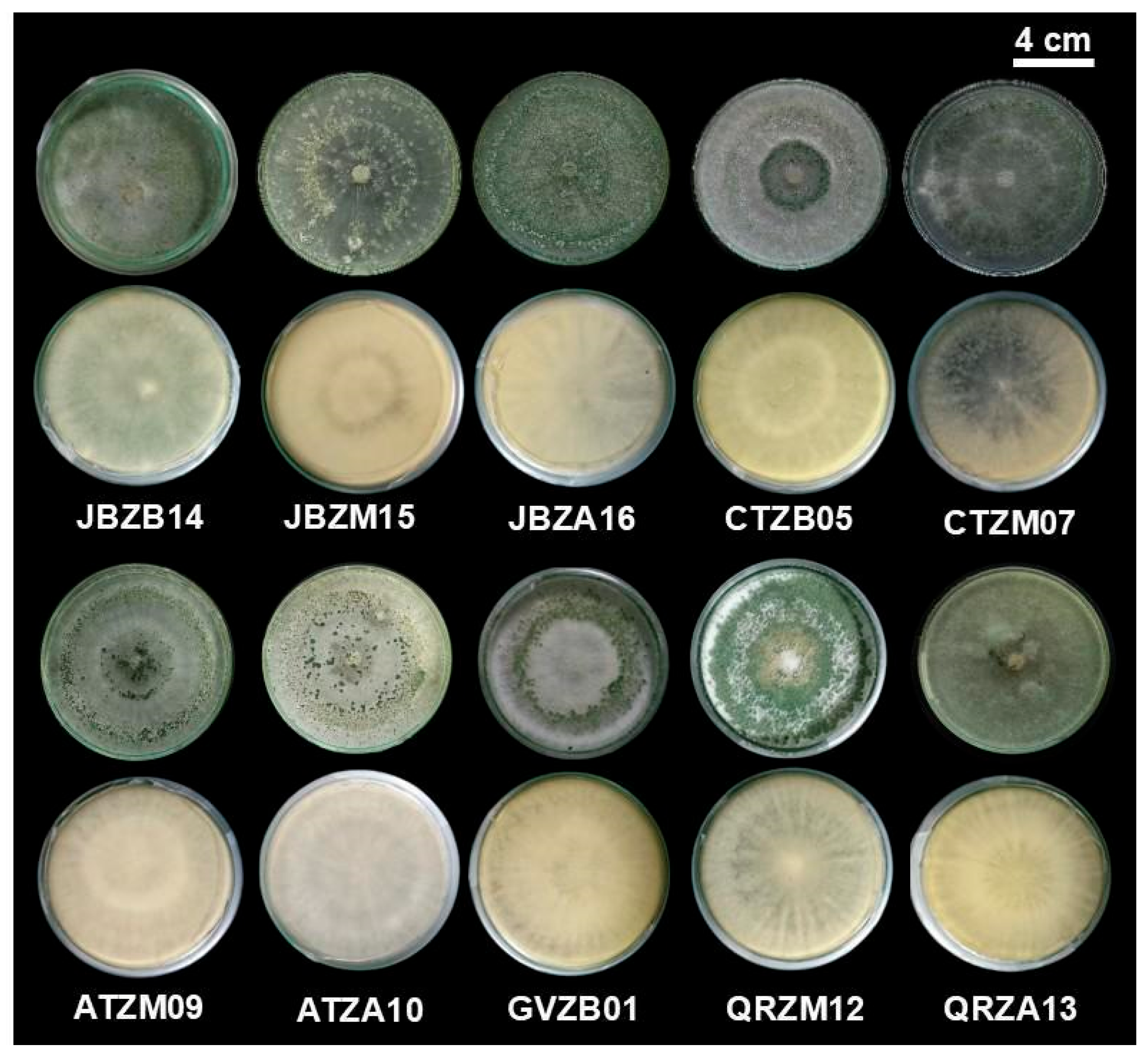
Eighteen native Trichoderma isolates were successfully obtained from five low-anthropogenic sites in Chanchamayo province, Perú, with the highest recovery from Botanical Garden and El Tirol waterfall complex (4 isolates each), followed by Quirca, Fundo Génova, and Monte Kimiri (3 isolates each). Including one coastal isolate (TCP01) and one commercial strain (THCC03) as controls, 20 total strains were evaluated. All isolates exhibited typical Trichoderma morphology (Figure 2) (rapid growth, green conidiation, characteristic conidiophores) and were coded by collection site and altitude (Table 1). Microscopic examination revealed conidia dimensions ranging approximately from 3.0–4.5 μm in length and 2.5–3.5 μm in width, with phialides typically flask-shaped to lageniform, consistent with Trichoderma diagnostic keys described by Barnett and Hunter [27]. Species-level identification was deferred to molecular analysis of top-performing isolates.

3.2. Dual Assay Analysis

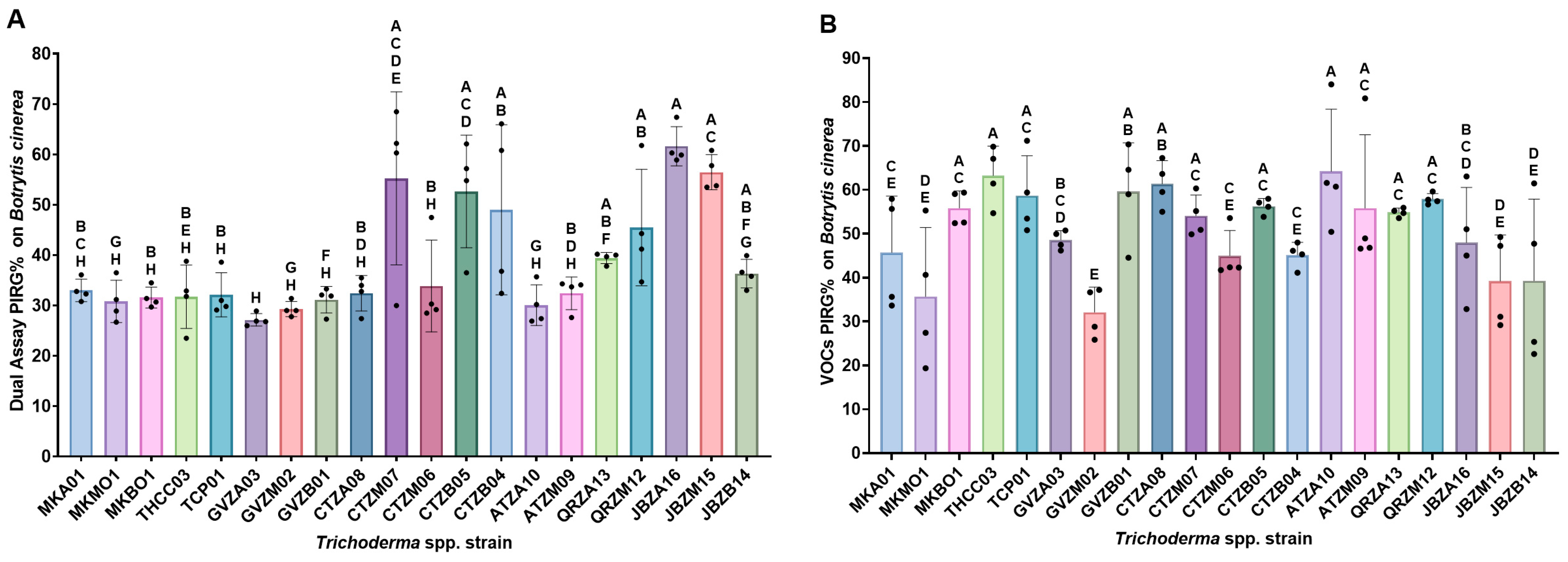
All Trichoderma isolates demonstrated antagonistic activity against B. cinerea (PIRG: 27.15–61.63%). Top performers were JBZA16 (61.63%), JBZM15 (56.45%), and CTZM07 (55.23%), significantly outperforming the commercial control THCC03 (31.77%). Kruskal-Wallis analysis confirmed significant differences among isolates (H = 45.23, p < 0.001), with six native isolates significantly superior to the commercial strain (Dunn’s test, p < 0.05). Orthogonal contrasts revealed that all top-performing native strains achieved statistically higher inhibition than THCC03 (Figure 3A and Figure S1, Table 2).

3.3. Mycoparasitism Evaluation

Adapted Bell scale assessment revealed distinct mycoparasitic behaviors with 50% of isolates (n = 10) achieving Type I mycoparasitism (complete overgrowth), including JBZA16, JBZM15; CTZB05; QRZM12; and QRZA13. Type II (partial overgrowth) occurred in 15% (n = 3), Type III (balanced competition) in 35% (n = 7), with no B. cinerea dominance observed. The quantitative adaptation (Level I = 100%, II = 80%, III = 60%) enabled statistical integration, revealing mycoparasitism as a key differentiating factor in subsequent multivariate analyses (Table 2 and Figure S3).

3.4. Fungal Growth Response to Volatile Organic Compounds

All isolates demonstrated VOC-mediated inhibition (Table 2 and Figure S2) (PIRG-VOC: 32.13–64.22%). The isolate ATZA10 achieved the highest inhibition (64.22%), followed by commercial control THCC03 (63.27%) and CTZA08 (61.36%). ANOVA revealed significant differences among isolates (F = 8.92, p < 0.001). Eleven native isolates achieved statistically equivalent inhibition to the commercial control (Fisher’s LSD test), with GVZB01 (59.63%) and TCP01 (58.73%) among the most effective. Notably, VOC-mediated patterns differed substantially from dual culture results, indicating independent antagonistic mechanisms (Figure 3B and Figure S2, Table 2).

3.5. Molecular Identification and Phylogenetic Diversity

Ten isolates with superior biocontrol performance (JBZA16, JBZM15, CTZB05, QRZM12, QRZA13, JBZB14, ATZM09, GVZB01, ATZA10, and CTZM07) were selected for multilocus sequencing (ITS, TEF1α, RPB2) from ecologically distinct zones spanning 689–1036 m altitude across Chanchamayo’s pristine ecosystem. PCR amplification yielded expected fragment sizes with high sequencing quality (>Q20, >1000 bp reads). BLASTn searches showed 98.5–100% similarity to GenBank references (Figure 3).
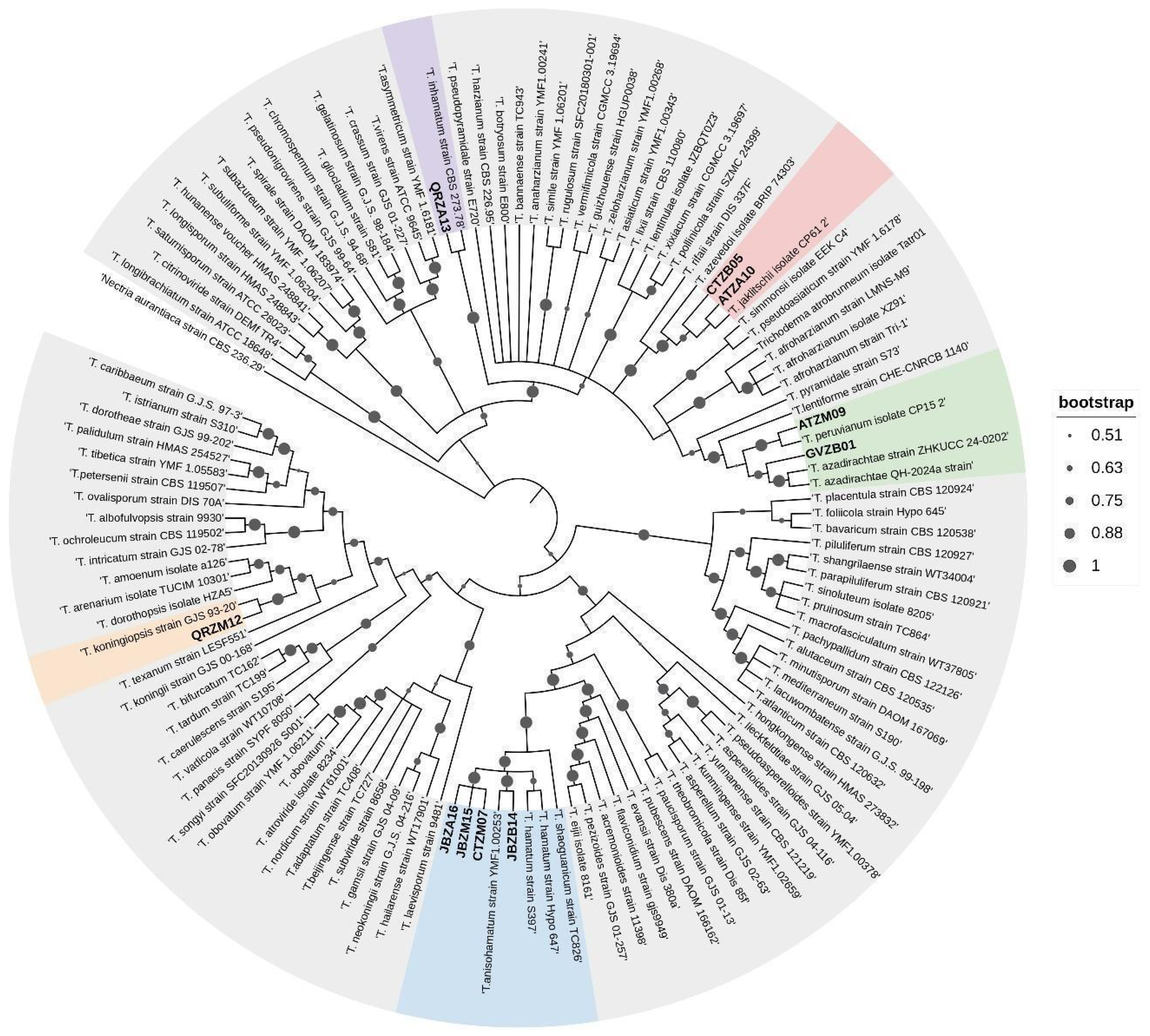
Molecular identification revealed outstanding taxonomic diversity: seven species across four major complexes (Table S1). Phylogenetic analysis (1456 bp concatenated TEF1α-RPB2) resolved all isolates with strong support (PP 0.91–1.00), confirming distribution across Viride clade (4 isolates, 40%), Virens complex (4 isolates, 40%), harzianum complex (1 isolate, 10%), and koningiopsis complex (1 isolate, 10%) (Figure S4).
Bayesian inference of the concatenated RPB2+TEF dataset produced a well-resolved phylogeny in which the Peruvian isolates partition into several distinct, well-supported lineages (Figure 3, Figure 4 and Figure S4). In particular, QRZA13 clusters with Trichoderma inhamatum accessions with maximal support (posterior probability, PP = 1.00). CTZB05 and ATZA10 form a compact sister subclade within a larger supported assemblage (internal node PP ≈ 0.74; parent clade PP = 1.00). ATZM09 and GVZB01 group together adjacent to T. peruvianum-like accessions (PP = 0.99–1.00). A separate strongly supported clade comprises JBZM14, CTZM07, F03 JBZM15, and JBZA16, which sit near T. hamatum-related taxa (PP = 0.97–1.00). By contrast, QRZM12 is placed in a distinct lineage (PP= 0.98), distant from the other F clusters. Overall, most nodes that define the subclades show high posterior probabilities (>0.9), providing confidence in their relative placements. Notably, isolates that group within the same subclade tend to exhibit similar in vitro antagonistic profiles, suggesting a partial concordance between phylogenetic affinity and functional phenotype. Given the limited marker set used here, these taxonomic placements are treated as provisional pending additional loci or genome-scale data for definitive species delimitation.
T. hamatum dominated with three isolates (JBZA16, JBZM15, CTZM07) from different sites and altitudes, suggesting broad ecological adaptation. T. jaklitschii was represented by two isolates (CTZB05, ATZA10) within the Virens complex. Single representatives included T. anisohamatum (JBZB14), T. inhamatum (QRZA13), T. koningiopsis (QRZM12), T. azadirachtae (GVZB01), and T. peruvianum (ATZM09).
Notably, T. azadirachtae (GVZB01) and T. anisohamatum (JBZB14) represent the first reports for Peru, extending known geographic ranges from Asia and Central America, respectively. The observed 70% diversity ratio across a 50 km2 ecologically diverse area reveals significant taxonomic richness. The phylogenetic structure showed no clear correlation between species identity and collection site/altitude, suggesting that multiple lineages coexist within microhabitats, maintained by microenvironmental heterogeneity rather than geographic isolation. These findings underscore tropical rainforest ecosystems as critical reservoirs of undocumented fungal diversity, with considerable potential for the discovery of additional novel taxa.

3.6. Endophytic Colonization Levels in Capsicum baccatum

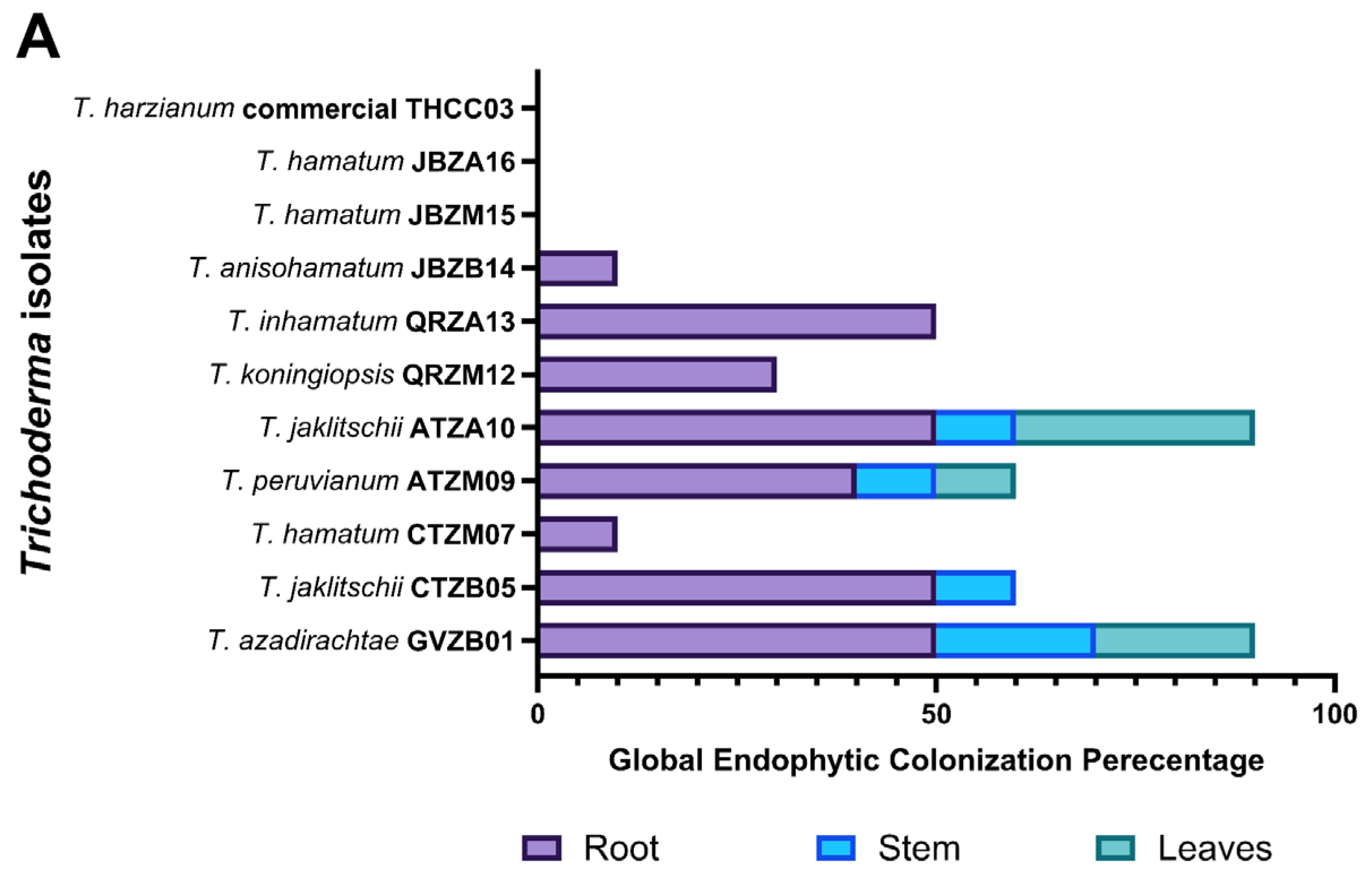
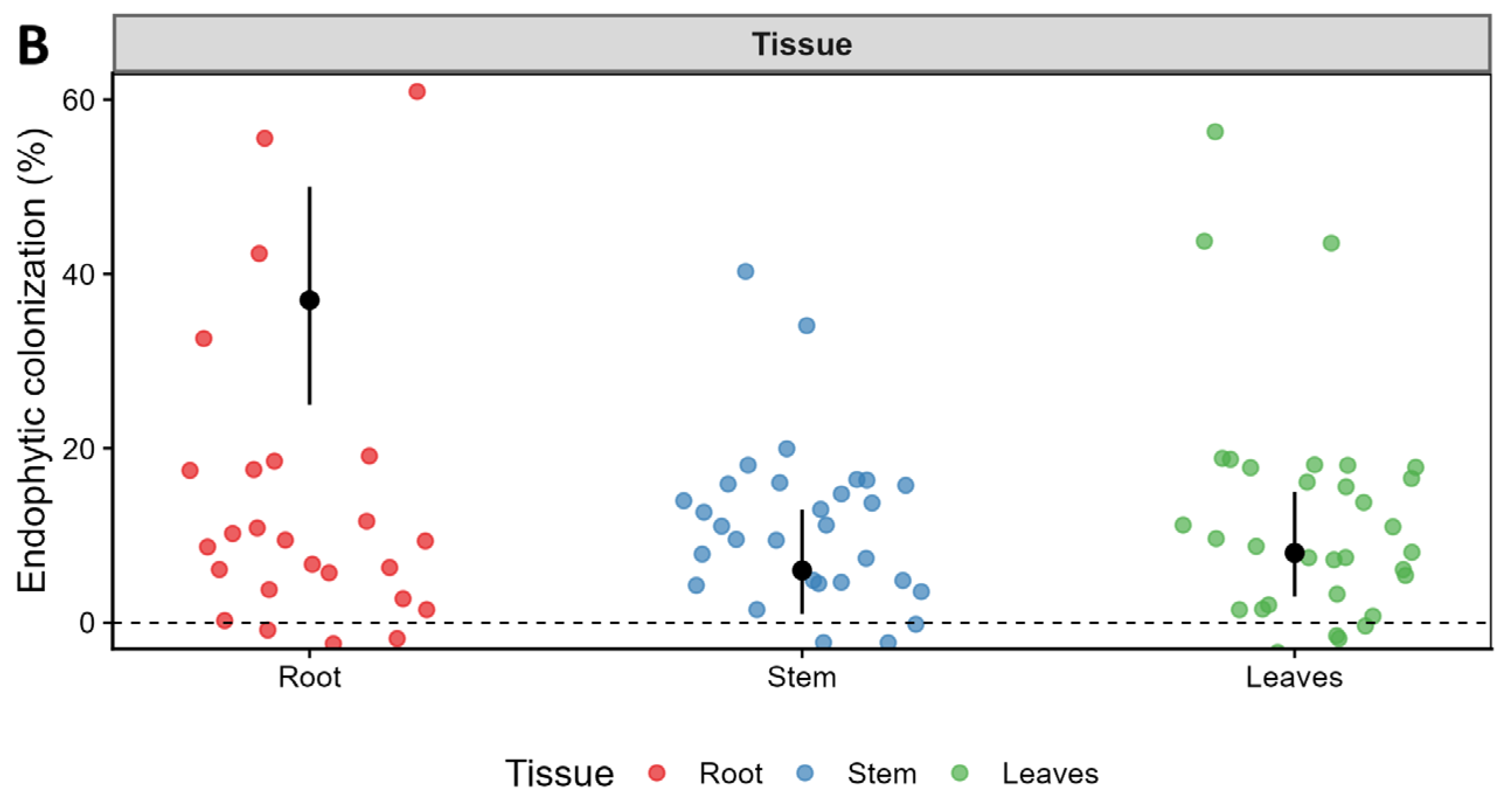
T. peruvianum (ATZM09), T. azadirachtae (GVZB01), and T. jaklitschii (ATZA10) were able to colonize all three types of plant tissue, with root colonization observed in 40–50% of the total sections cultured (Figure 5A). T. azadirachtae colonized 20% of leaf samples, and T. jaklitschii colonized 30% of leaves and 10% of stems. The remaining isolates were recovered exclusively from the root zone, where T. peruvianum, T. azadirachtae, and T. jaklitschii CTZB05, along with T. inhamatum, were detected in 50% of the samples. Notably, the commercial Trichoderma strain did not colonize any of the evaluated plant tissues (Figure 4). Bootstrap analysis yielded 95% confidence intervals of 35–65% for root colonization, 5–25% for stem, and 10–30% for leaf colonization across isolates. While these intervals are wide due to sample constraints, they suggest genuine tissue-specific colonization patterns (Figure 5B).

3.7. Multivariate Analysis of Antagonistic Activity of Trichoderma spp. Against Botrytis cinerea

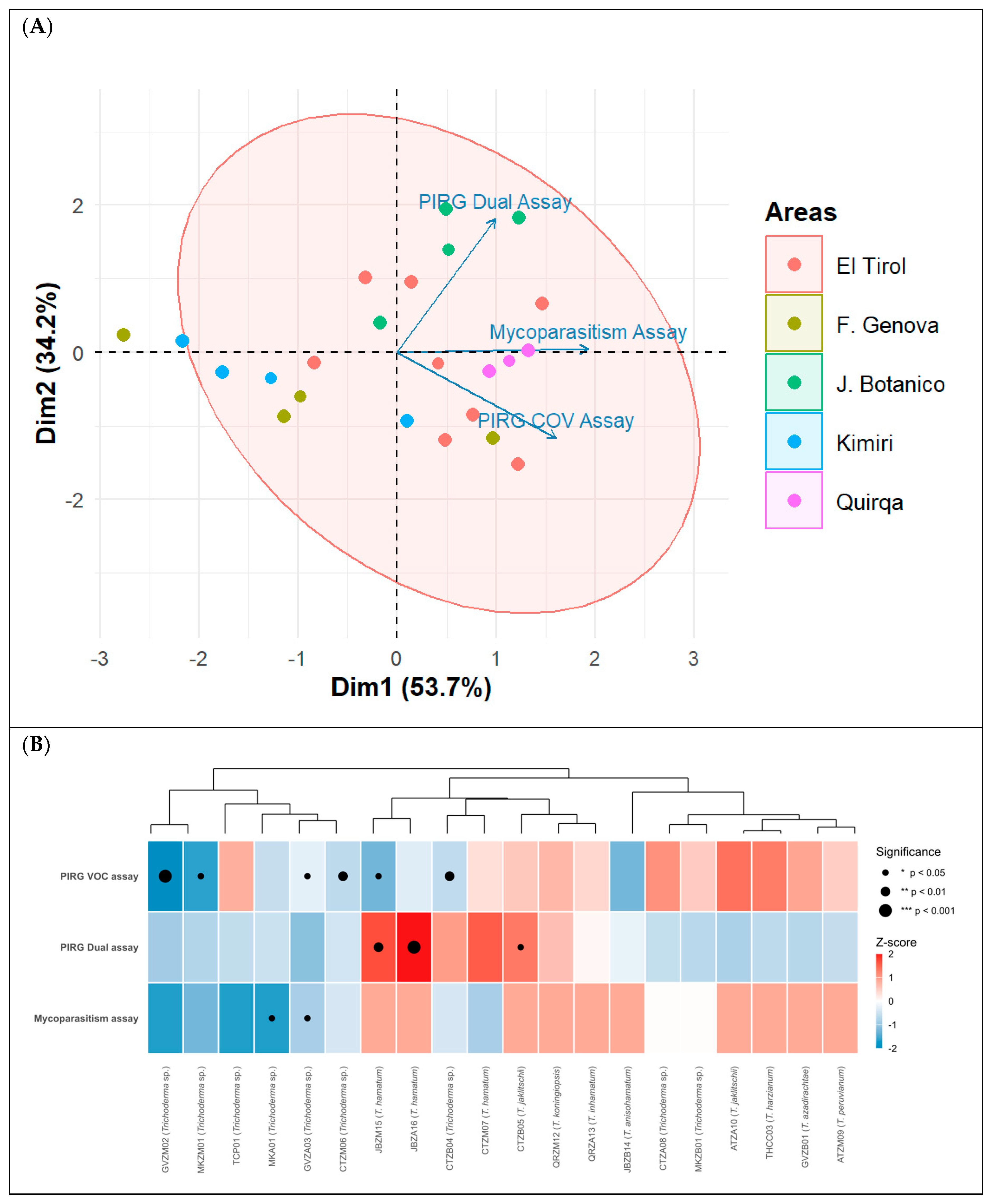
Principal component analysis across all 20 strains captured 72.9% of total variance (PC1: 38.4%, PC2: 34.5%), revealing that the three antagonistic mechanisms represent largely independent biocontrol strategies (Figure 6 and Figure S3). PC1 was primarily driven by VOC-mediated inhibition, identifying volatile production as the most important differentiating factor, while PC2 was strongly associated with direct dual culture antagonism. Mycoparasitism contributed moderately to PC1 with a negative correlation to PC2, suggesting trade-offs between direct interaction mechanisms.
Distinct clustering patterns emerged: high-VOC producers, including ATZA10 (T. jaklitschii), GVZB01 (T. azadirachtae), and commercial control THCC03 clustered in positive PC1, while dual-culture specialists like JBZA16 and CTZM07 (T. hamatum) scored high on PC2. Hierarchical clustering identified three functional groups: mycoparasitism specialists (n = 7), balanced performers (n = 8), and VOC-specialized strains (n = 5). The heat map showed three native strains T. hamatum (JVZM15, JBZA16) and T. jaklitschii (CTZB05) exhibited significant differences and superior performance compared to the commercial strain, according to p-values and z-score (Figure 6B). T. hamatum JBZM15, in particular, stood out for its inhibition capacity in dual culture and its production of volatile compounds. These results indicate more robust biocontrol profiles than the commercial strain.
This functional independence suggests opportunities for complementary multi-strain formulations, combining specialized mechanisms to enhance efficacy and reduce resistance development likelihood. The divergent strategies reflect ecological adaptation to specific niches within the central jungle ecosystem.

4. Discussion

The successful isolation of highly active strains from low-anthropogenic soils highlights the value of relatively pristine ecosystems as reservoirs of biotechnologically relevant microorganisms [38]. The ecological heterogeneity of Chanchamayo province (altitudinal range 689–1036 m; multiple microhabitats) likely promotes microevolutionary divergence and niche specialization among soil microbes, contributing to the observed functional and taxonomic diversity [39]. In contrast to many intensively managed agricultural soils—where anthropogenic disturbance often reduces microbial network complexity and selects for a simplified community—these undisturbed forest soils maintain more complex microbial assemblages that can support diverse Trichoderma populations with varied biocontrol capabilities [40,41].
In this study, based on eighteen native isolates, we molecularly identified ten isolates, of which seven Trichoderma species were distributed across four major species complexes (mean species per isolate = 0.7; n = 10) (Figure 3 and Figure S4). Although the sample size is limited, the observed taxonomic diversity is similar to values commonly reported for temperate or agricultural systems [38,42]. Our findings are consistent with prior reports of elevated Trichoderma diversity in Neotropical rainforests [42,43,44]; in contrast, surveys from agricultural and temperate regions report lower Trichoderma species richness per sample, with communities often dominated by few taxa [45,46]. Expanded sampling and quantitative analyses are required to confirm and generalize this pattern.
The phylogenetic structure recovered here—multiple, well-supported Peruvian subclades with provisional affinities to T. inhamatum-, T. peruvianum- and T. hamatum-like taxa—suggests local diversification within the Trichoderma assemblage from Chanchamayo and provides a plausible phylogenetic basis for the consistent antagonistic phenotypes observed among isolates from the same subclade. This pattern is in line with the recognized evolutionary and ecological plasticity of Trichoderma, where closely related lineages often share functional traits (e.g., mycoparasitism, plant-growth promotion) while different lineages evolve alternative strategies. The occurrence of multiple, closely related Peruvian clusters also accords with the role of heterogeneous tropical microhabitats in promoting microevolutionary divergence and niche specialization among soil microbes [38]. From an applied perspective, the concordance between phylogenetic affinity and bioassay performance supports the utility of phylogeny-guided prospecting for native biocontrol strains, an approach previously advocated given the varied mechanisms and ecological specificities displayed by Trichoderma isolates [47,48,49].
The identification of T. azadirachtae and T. anisohamatum as first records for Peru significantly extends their known ranges beyond Asia [50] and Central America. These findings align with emerging patterns of Trichoderma cosmopolitanism and suggest broader global distributions than previously recognized. The presence of these first records in Peruvian Amazon soils suggests a reservoir of functional diversity that remains underexplored, with potential applications in biological control. The co-occurrence of T. peruvianum with newly described species is particularly noteworthy, as this taxon was recently described from northern Peruvian cacao plantations [51], suggesting broader ecological adaptation within Peru.
The high functional and taxonomic diversity recovered from low-anthropogenic sites in Chanchamayo can be explained by fundamental ecological principles governing soil microbial communities. In ecosystems with reduced anthropogenic disturbance and high plant biodiversity, such as those sampled in this study, the increased heterogeneity of ecological niches and root-derived resources supports more complex and structured microbial assemblages [38,40]. This ecological context is particularly relevant when considering the long-term performance of Trichoderma in agricultural applications. In monoculture systems, where plant diversity is artificially restricted, the functional microbial community tends to be simplified, potentially limiting the establishment and persistence of introduced biocontrol agents due to reduced complementary interactions with resident microbiota [40,45]. In contrast, the native Trichoderma strains isolated from Chanchamayo have co-evolved within diverse microbial networks where multiple plant species create a mosaic of exudate profiles and microhabitats [7,19]. This evolutionary background may confer superior adaptability and competitive fitness when these strains are applied in agricultural settings, particularly in diversified cropping systems or when incorporated into practices that promote soil microbiome complexity [16,17]. The observed differences in antagonistic mechanisms among our isolates—spanning direct competition, volatile-mediated inhibition, and mycoparasitism—further reflect the selective pressures operating in heterogeneous natural environments, where multiple antagonistic strategies may be maintained through niche partitioning. These findings underscore the value of bioprospecting in pristine ecosystems not merely as a source of novel species, but as reservoirs of strains with enhanced ecological adaptability resulting from their co-evolutionary history with complex microbial communities.
Peruvian native Trichoderma strains demonstrated multiple antagonistic mechanisms against B. cinerea, consistent with established biocontrol strategies [6,7]. In some cases, the superior performance of several native isolates compared to the commercial control could suggest that locally adapted strains may offer advantages over generic commercial products, likely reflecting adaptation to local environmental conditions and pathogen populations [52,53,54].
Antagonistic activity ranges (27.15–61.63% dual culture, 32.13–64.22% VOCs) were comparable with or superior to similar studies, including Korkom and Yildiz [55] who reported up to 65% inhibition by T. harzianum against Macrophomina phaseolina. A limitation of this study is that mycoparasitism was inferred solely from macroscopic overgrowth patterns in dual cultures, using the semi-quantitative Bell scale, without microscopic visualization of hyphal interactions. This type of plate-based scoring is widely used as a first screening approach in Trichoderma biocontrol studies and underlies much of the literature on mycoparasitism and dual-culture antagonism [29,56,57,58]. However, it does not capture finer traits such as hyphal coiling, penetration, or lysis of the host fungus. Future work should therefore complement Bell-scale evaluations with light and/or confocal microscopy, and ideally quantitative imaging analyses, to directly document hyphal contact, coiling, and penetration during mycoparasitic interaction.
Our top VOC performer, ATZA10 (T. jaklitschii, 64.22%) parallels the 63.77% inhibition reported by Hu et al. [59] for T. hamatum against Neocosmopora solani, confirming consistent volatile production capabilities across species. Among the identified species, T. hamatum (three isolates) is known to produce volatile compounds, including 6-pentyl-α-pyrone (6-PP), with demonstrated antifungal properties, while T. koningiopsis has been documented as an effective biocontrol agent with mycoparasitic capabilities and as a producer of koningiopisins, polyketides with antifungal activity [60,61,62]. T. jaklitschii isolate ATZA10 also suggests a relevant volatile production capacity, although its metabolite profile remains unexplored. Although the individual VOCs responsible for inhibition were not identified by GC–MS in this preliminary screening, numerous studies have shown that Trichoderma volatilomes are typically dominated by antifungal compounds such as 6-PP, low-molecular-weight alcohols and ketones, and diverse mono- and sesquiterpenes, many of which suppress mycelial growth and sporulation of Botrytis cinerea and other plant pathogens [63,64,65,66,67]. In particular, 6-PP is considered a signature volatile of several Trichoderma species and has repeatedly been shown to inhibit B. cinerea, Fusarium oxysporum and Rhizoctonia solani, while also modulating toxin production and activating plant defence responses [63,65,68].
Recent studies emphasize that fungistatic activity mediated by VOCs is isolate-dependent in Trichoderma, with significant direct correlation between VOC number/quantity and bioactivity against pathogens [69]. In addition, volatilome analyses further indicate that T. harzianum, T. virens and related species emit complex blends of short-chain alcohols (e.g., 1-octen-3-ol, 3-octanone), aldehydes, lactones, and terpenoids, and that these VOC mixtures are sufficient to reduce B. cinerea growth and grey mould severity in sealed-plate or biofumigation-type assays [64,66,67,70]. In this context, the inhibition values recorded here (32.13–64.22% reduction in radial growth) fall within the range reported for VOC-mediated antagonism by Trichoderma spp., such as the 74% inhibition of B. cinerea and 44% inhibition of F. oxysporum observed for VOCs of T. koningiopsis T-51 in a double-dish system [67,70]. Our principal component analysis further revealed that VOC production and mycoparasitism represent largely independent traits [71,72], suggesting that distinct evolutionary pressures have shaped these mechanisms. The identification of complementary, antagonistic mechanisms and their functional independence opens up opportunities for developing synergistic, multi-strain biocontrol products [15,62,73]. Such formulations can be designed strategically by combining isolates from the three functional clusters detected here—mycoparasitism specialists, balanced performers, and VOC-specialized strains [16,66,74]—to maximize robustness and spectrum of action against B. cinerea and other co-occurring pathogens.
The observed endophytic colonization (10–60%) suggests a potential for promoting plant growth, in addition to pathogen antagonism. Furthermore, endophytic Trichoderma penetrate the first or second layers of plant roots, colonizing the epidermis and cortex without entering the vascular system, inducing systemic resistance through jasmonic acid and salicylic acid pathways [75]. These dual roles support their use in sustainable agriculture for disease control and biostimulant capacity. Recent studies have demonstrated that endophytic Trichoderma isolates from tropical environments delay disease onset and induce resistance against Phytophthora capsici in Capsicum annuum using multiple mechanisms, including the induction of lipid transferase proteins [76]. Moreover, consortium studies with Trichoderma simmonsii in bell pepper showed average root colonization of 55–56%, promoting both plant growth and resistance to P. capsici [77]. Root colonization was notably higher than in stems and leaves, consistent with previous studies showing Trichoderma forms beneficial associations in roots that may reflect species-level adaptations favoring the root niche [78,79]. The distinct patterns of tissue colonization observed in the endophytic assays may indicate that Trichoderma species from contrasting environmental origins exhibit differential interactions with plant tissues, supporting niche specialization and enabling diverse ecological functions [18,80,81]. The metabolic capabilities of T. anisohamatum, T. inhamatum, T. azadirachtae, and T. peruvianum remain largely unexplored, highlighting the need for comprehensive metabolomic studies to elucidate their distinct antagonistic strategies.
Multivariate analysis proved to be a useful tool for grouping the main antagonistic activity of the Trichoderma isolates studied. However, several considerations should be taken into account when interpreting the results. First, all assays were conducted under in vitro conditions, which may not fully reflect field performance. Second, the absence of field validation trials limits conclusions about practical biocontrol efficacy. Third, importantly, although our concatenated RPB2+TEF tree provides strong topological support for these groupings, integrative, multilocus, or genome-scale data are required for definitive species delimitation and to link gene content with functional traits [82]. In consequence, future work should prioritize: (i) field trials on different Botrytis hosts and other necrotrophic fungi (ii) formulation development for commercial application according to the antagonistic behavior of the Trichoderma strains, (iii) compatibility testing with agricultural practices, and (iv) detailed metabolomic profiling of bioactive compounds.
Expanding bioprospecting efforts across Peruvian heterogeneous ecosystems could reveal additional biocontrol species with strong agroecological potential. However, accelerating habitat destruction in Neotropical regions threatens irreversible loss of this functional diversity before characterization, demanding urgent integration of microbial prospecting with conservation policies [83].

5. Conclusions

Native Trichoderma strains from pristine Peruvian rainforest soils demonstrated remarkable biocontrol potential against B. cinerea. Seven species across four phylogenetic complexes inhibited up to 61.63% in dual culture and 64.22% via VOCs, outperforming commercial controls. Multivariate analysis revealed mechanistic independence among antagonistic traits, providing opportunities for synergistic multi-strain biocontrol formulations. The first reports of T. azadirachtae and T. anisohamatum for Peru highlight tropical rainforests as key reservoirs of microbial biodiversity. Combined with demonstrated endophytic capacity, these locally adapted strains represent promising candidates for sustainable agricultural applications. These findings emphasize the urgent need to preserve pristine habitats to safeguard biotechnologically valuable microbial resources before irreversible losses occur due to habitat destruction.

Supplementary Materials

The following supporting information can be downloaded at: https://www.mdpi.com/article/10.3390/agriculture16010112/s1, Figure S1: Dual culture confrontation assays showing antagonistic activity of native Trichoderma spp. against Botrytis cinerea. Eighteen native isolates from Chanchamayo, one coastal isolate (TCP01), and a commercial control (THCC03) were evaluated on PDA medium after 7 days at 26 °C. Scale bar = 4 cm; Figure S2: Volatile organic compound (VOC) inhibition of Botrytis cinerea by native Trichoderma spp. Double-plate assays showing VOC-mediated antagonistic activity of Trichoderma isolates against B. cinerea after 7 days at 28 °C. Scale bar = 4 cm; Figure S3: Variable correlation circle from principal component analysis (PCA) of antagonistic traits in Trichoderma spp.; Figure S4: Bayesian phylogram of ten native Trichoderma isolates from the Peruvian Central Jungle based on concatenated TEF1-α and RPB2 gene sequences. Nectria aurantiaca CBS 101863 was used as the outgroup. Posterior probability values are represented by node sizes, ranging from 0.51 to 1.00. Table S1: Molecular characterization and sequence analysis of selected Trichoderma isolates based on multilocus markers.

Author Contributions

Conceptualization, N.R.-V. and P.O.-V.; Methodology, N.R.-V., P.O.-V. and J.M.-C.; Software, B.O.-A.; Validation, B.O.-A.; Formal analysis, L.A.Á.; Investigation, P.P. and J.M.-C.; Data curation, B.O.-A.; Writing—original draft, N.R.-V.; Writing—review & editing, P.O.-V., P.P. and L.A.Á.; Visualization, P.P. and L.A.Á.; Supervision, N.R.-V.; Project administration, N.R.-V.; Funding acquisition, N.R.-V. All authors have read and agreed to the published version of the manuscript.

Funding

This research was supported by the National University of Cañete (Universidad Nacional de Cañete) through the Agricultural Microbiological Control Research Seedbed (Semillero de Control Microbiológico Agrícola), approved under Presidential Resolution No. 170-2021-UNDC. In addition, the financial contribution of some authors is acknowledged, which helped to broaden the scope of the research studies.

Institutional Review Board Statement

Ethical review and approval were waived for this study due to the research involving only environmental soil samples, fungal microorganisms, and plant seedlings. No human subjects or vertebrate animals were used in this investigation. All soil sampling was conducted in accordance with local environmental regulations and with appropriate permissions from site authorities.

Informed Consent Statement

Not applicable.

Data Availability Statement

The datasets generated and analyzed during the current study are available from the corresponding author upon reasonable request. Raw sequencing data supporting the molecular identification results have been deposited in GenBank under accession numbers PV888651 to PV888651 for ITS, PX400434 to PX400443 for TEF1α, and PX400444 to PX400453 for RPB2. Soil sampling coordinates and site descriptions are provided in the Supplementary Materials to enable replication while protecting sensitive ecosystem locations. Due to the biodiversity conservation value of the pristine collection sites, exact GPS coordinates are available to researchers upon request with appropriate research permits.

Acknowledgments

The authors thank Pedro Juan García Quinchua and Jorge Bartolome Gracias Quinchua in Chanchamayo Province for their support and traditional knowledge regarding local ecosystems. We acknowledge the Botanical Garden staff, the El Tirol waterfall complex management, and private landowners for granting access to collection sites. Technical assistance from Carlos Rojas Manrique, Aldair Espinoza Aguilar, and Luz Melissa Laura Lucas in laboratory procedures is gratefully acknowledged.

Conflicts of Interest

The authors declare no conflicts of interest. The funders had no role in the design of the study; in the collection, analyses, or interpretation of data; in the writing of the manuscript; or in the decision to publish the results.

Abbreviations

The following abbreviations are used in this manuscript:
PIRGPercentage Inhibition of Radial Growth
VOCVolatile Organic Compound
PCAPrincipal Component Analysis
ITSInternal Transcribed Spacer
TEF1αTranslation Elongation Factor 1-alpha
RPB2-RNAPolymerase II second-largest subunit
PDAPotato Dextrose Agar
PCRPolymerase Chain Reaction
ANOVAAnalysis of Variance
SEStandard Error
DNADeoxyribonucleic Acid

References

  1. Elad, Y.; Pertot, I.; Cotes Prado, A.M.; Stewart, A. Plant Hosts of Botrytis spp. In Botrytis—The Fungus, the Pathogen and its Management in Agricultural Systems; Springer: Cham, Switzerland, 2015; pp. 413–486. [Google Scholar] [CrossRef]
  2. Roca-Couso, R.; Flores-Félix, J.D.; Rivas, R. Mechanisms of Action of Microbial Biocontrol Agents against Botrytis cinerea. J. Fungi 2021, 7, 1045. [Google Scholar] [CrossRef] [PubMed]
  3. Abbey, J.A.; Percival, D.; Abbey, L.; Asiedu, S.K.; Prithiviraj, B.; Schilder, A. Biofungicides as Alternative to Synthetic Fungicide Control of Grey Mould (Botrytis cinerea)—Prospects and Challenges. Biocontrol. Sci. Technol. 2019, 29, 241–262. [Google Scholar] [CrossRef]
  4. Rahmani, A.; Hakimi, Y. Integrated Management of Grape Gray Mold Disease Agent Botrytis cinerea In Vitro and Post-Harvest. Erwerbs-Obstbau 2023, 65, 1955–1964. [Google Scholar] [CrossRef]
  5. Mercier, A.; Carpentier, F.; Duplaix, C.; Auger, A.; Pradier, J.M.; Viaud, M.; Gladieux, P.; Walker, A.S. The Polyphagous Plant Pathogenic Fungus Botrytis cinerea Encompasses Host-Specialized and Generalist Populations. Environ. Microbiol. 2019, 21, 4808–4821. [Google Scholar] [CrossRef]
  6. Tyśkiewicz, R.; Nowak, A.; Ozimek, E.; Jaroszuk-ściseł, J. Trichoderma: The Current Status of Its Application in Agriculture for the Biocontrol of Fungal Phytopathogens and Stimulation of Plant Growth. Int. J. Mol. Sci. 2022, 23, 2329. [Google Scholar] [CrossRef]
  7. Woo, S.L.; Hermosa, R.; Lorito, M.; Monte, E. Trichoderma: A Multipurpose, Plant-Beneficial Microorganism for Eco-Sustainable Agriculture. Nat. Rev. Microbiol. 2023, 21, 312–326. [Google Scholar] [CrossRef] [PubMed]
  8. Cortez-Lázaro, A.A.; Vázquez-Medina, P.J.; Caro-Degollar, E.M.; García Evangelista, J.V.; Cortez-Lázaro, R.A.; Rojas-Paz, J.L.; Legua-Cardenas, J.A.; Fernandez-Herrera, F.; Pesantes-Rojas, C.R.; Ocrospoma-Dueñas, R.W.; et al. Global Trends in Trichoderma Secondary Metabolites in Sustainable Agricultural Bioprotection. Front. Microbiol. 2025, 16, 1595946. [Google Scholar] [CrossRef]
  9. Nascimento Brito, V.; Lana Alves, J.; Sírio Araújo, K.; de Souza Leite, T.; Borges de Queiroz, C.; Liparini Pereira, O.; de Queiroz, M.V. Endophytic Trichoderma Species from Rubber Trees Native to the Brazilian Amazon, Including Four New Species. Front. Microbiol. 2023, 14, 1095199. [Google Scholar] [CrossRef] [PubMed]
  10. Vos, C.M.F.; De Cremer, K.; Cammue, B.P.A.; De Coninck, B. The toolbox of Trichoderma spp. in the biocontrol of Botrytis cinerea disease. Mol. Plant Pathol. 2015, 16, 400–412. [Google Scholar] [CrossRef]
  11. Irawati, A.F.C.; Mutaqin, K.H.; Suhartono, M.T.; Widodo, W. The Effect of Application of Endophytic Fungus Trichoderma spp. and Fusarium spp. to Control Bacterial Wilt in Chilli Pepper. Walailak J. Sci. Technol. (WJST) 2020, 17, 559–569. [Google Scholar] [CrossRef]
  12. Ali, A.M. The Competitive Potential of Different Trichoderma spp. to Control Rhizoctonia Root Rot Disease of Pepper (Capsicum annuum L.). Egypt. J. Phytopathol. 2021, 49, 136–150. [Google Scholar] [CrossRef]
  13. Iqbal, S.; Ashfaq, M.; Rao, M.J.; Khan, K.S.; Malik, A.H.; Mehmood, M.A.; Fawaz, M.S.; Abbas, A.; Shakeel, M.T.; Naqvi, S.A.H.; et al. Trichoderma viride: An Eco-Friendly Biocontrol Solution Against Soil-Borne Pathogens in Vegetables Under Different Soil Conditions. Horticulturae 2024, 10, 1277. [Google Scholar] [CrossRef]
  14. Toledo, A.; Aragón, L.; Casas, A. Space-Time Analysis, Severity of the Wilt Disease in Escabeche Pepper (Capsicum baccatum var. pendulum) and Identification of the Causal Agent (Phytophthora capsici L.) under Subtropical Climate Conditions in Peru. Sci. Agropecu. 2024, 15, 557–567. [Google Scholar] [CrossRef]
  15. van Zijll de Jong, E.; Kandula, J.; Rostás, M.; Kandula, D.; Hampton, J.; Mendoza-Mendoza, A. Fungistatic Activity Mediated by Volatile Organic Compounds Is Isolate-Dependent in Trichoderma sp. “Atroviride B”. J. Fungi 2023, 9, 238. [Google Scholar] [CrossRef] [PubMed]
  16. Cavalcante, A.L.A.; Negreiros, A.M.P.; Melo, N.J.d.A.; Santos, F.J.Q.; Soares Silva, C.S.A.; Pinto, P.S.L.; Khan, S.; Sales, I.M.M.; Sales Júnior, R. Adaptability and Sensitivity of Trichoderma spp. Isolates to Environmental Factors and Fungicides. Microorganisms 2025, 13, 1689. [Google Scholar] [CrossRef] [PubMed]
  17. Ismaiel, A.; Lakshman, D.K.; Jambhulkar, P.P.; Roberts, D.P. Trichoderma: Population Structure and Genetic Diversity of Species with High Potential for Biocontrol and Biofertilizer Applications. Appl. Microbiol. 2024, 4, 875–893. [Google Scholar] [CrossRef]
  18. Jambhulkar, P.P.; Singh, B.; Raja, M.; Ismaiel, A.; Lakshman, D.K.; Tomar, M.; Sharma, P. Genetic Diversity and Antagonistic Properties of Trichoderma Strains from the Crop Rhizospheres in Southern Rajasthan, India. Sci. Rep. 2024, 14, 8610. [Google Scholar] [CrossRef]
  19. Singh, R.; Tomer, A.; Prasad, D.; Viswanath, H.S.; Singh, R.; Tomer, A.; Prasad, D. Biodiversity of Trichoderma Species in Different Agro-Ecological Habitats. In Trichoderma: Agricultural Applications and Beyond; Springer: Cham, Switzerland, 2020; pp. 21–40. [Google Scholar] [CrossRef]
  20. Cabral-Miramontes, J.P.; Olmedo-Monfil, V.; Lara-Banda, M.; Zúñiga-Romo, E.R.; Aréchiga-Carvajal, E.T. Promotion of Plant Growth in Arid Zones by Selected Trichoderma spp. Strains with Adaptation Plasticity to Alkaline PH. Biology 2022, 11, 1206. [Google Scholar] [CrossRef]
  21. Manzar, N.; Kashyap, A.S.; Roy, M.; Sharma, P.K.; Srivastava, A.K. Exploring Trichoderma Diversity in the Western Ghats of India: Phylogenetic Analysis, Metabolomics Insights and Biocontrol Efficacy against Maydis Leaf Blight Disease. Front. Microbiol. 2024, 15, 1493272. [Google Scholar] [CrossRef] [PubMed]
  22. Chinnaswami, K.; Mishra, D.; Miriyala, A.; Vellaichamy, P.; Kurubar, B.; Gompa, J.; Madamsetty, S.P.; Raman, M.S. Native Isolates of Trichoderma as Bio-Suppressants against Sheath Blight and Stem Rot Pathogens of Rice. Egypt. J. Biol. Pest Control 2021, 31, 12. [Google Scholar] [CrossRef]
  23. Correa-Delgado, R.; Brito-López, P.; Jaizme Vega, M.C.; Laich, F. Biodiversity of Trichoderma Species of Healthy and Fusarium Wilt-Infected Banana Rhizosphere Soils in Tenerife (Canary Islands, Spain). Front. Microbiol. 2024, 15, 1376602. [Google Scholar] [CrossRef]
  24. Moreyra, G.; Judith, N. Antagonismo In Vitro de Trichoderma spp. Frente a Botrytis sp. y Fusarium sp., Aislados de Fragaria ananassa “Fresa”. Ayacucho—2022. Bachelor’s Thesis, Universidad Nacional San Cristobal de Huamanga, Ayacucho, Peru, 2024. [Google Scholar]
  25. Ventura Grandez, R. Respuesta de Trichoderma harzianum Rafai. en la Prevención de Botrytis cinerea Pers. en el Cultivo de Fresa (Fragaria sp.), Cuelcho, Chachapoyas—2018. Bachelor’s Thesis, Universidad Nacional Toribio Rodriguez de Mendoza de Amazonas, Chachapoyas, Peru, 2019. [Google Scholar]
  26. Pitt, J.I.; Hocking, A.D. Fungi and Food Spoilage; Springer: Cham, Switzerland, 2009; pp. 1–519. [Google Scholar] [CrossRef]
  27. Barnett, H.L.; Hunter, B.B. Illustrated Genera of Imperfect Fungi; Burgess Publishing Company: Minneapolis, MN, USA, 1972. [Google Scholar]
  28. Ricaldi Guadalupe, R. Acción Antagónica In Vitro de Trichoderma harzianum Rifai. Sobre el Crecimiento de Botrytis cinerea Pers F. en Cultivo de Fragaria vesca L. “Fresa” Procedente del Caserío de Quirihuac—Distrito de Laredo, Provincia de Trujillo. Bachelor’s Thesis, National University of Trujillo, Trujillo, Peru, 2013. [Google Scholar]
  29. Bell, D.K.; Wells, H.D.; Markham, C.R. In Vitro Antagonism of Trichoderma Species against Six Fungal Plant Pathogens. Phytopathology 1982, 72, 379–382. [Google Scholar] [CrossRef]
  30. Intana, W.; Kheawleng, S.; Sunpapao, A. Trichoderma asperellum T76-14 Released Volatile Organic Compounds against Postharvest Fruit Rot in Muskmelons (Cucumis melo) Caused by Fusarium incarnatum. J. Fungi 2021, 7, 46. [Google Scholar] [CrossRef]
  31. Barra-Bucarei, L.; Iglesias, A.F.; González, M.G.; Aguayo, G.S.; Carrasco-Fernández, J.; Castro, J.F.; Campos, J.O. Antifungal Activity of Beauveria bassiana Endophyte against Botrytis cinerea in Two Solanaceae Crops. Microorganisms 2020, 8, 65. [Google Scholar] [CrossRef]
  32. White, T.J.; Bruns, T.; Lee, S.; Taylor, J. Amplification and Direct Sequencing of Fungal Ribosomal RNA Genes for Phylogenetics. PCR Protoc. A Guide Methods Appl. 1990, 18, 315–322. [Google Scholar]
  33. Carbone, I.; Kohn, L.M. A Method for Designing Primer Sets for Speciation Studies in Filamentous Ascomycetes. Mycologia 1999, 91, 553–556. [Google Scholar] [CrossRef]
  34. Liu, Y.J.; Whelen, S.; Hall, B.D. Phylogenetic Relationships among Ascomycetes: Evidence from an RNA Polymerse II Subunit. Mol. Biol. Evol. 1999, 16, 1799–1808. [Google Scholar] [CrossRef] [PubMed]
  35. Druzhinina, I.S.; Seidl-Seiboth, V.; Herrera-Estrella, A.; Horwitz, B.A.; Kenerley, C.M.; Monte, E.; Mukherjee, P.K.; Zeilinger, S.; Grigoriev, I.V.; Kubicek, C.P. Trichoderma: The Genomics of Opportunistic Success. Nat. Rev. Microbiol. 2011, 9, 749–759. [Google Scholar] [CrossRef] [PubMed]
  36. Castresana, J. Selection of Conserved Blocks from Multiple Alignments for Their Use in Phylogenetic Analysis. Mol. Biol. Evol. 2000, 17, 540–552. [Google Scholar] [CrossRef] [PubMed]
  37. Ronquist, F.; Teslenko, M.; van der Mark, P.; Ayres, D.L.; Darling, A.; Höhna, S.; Larget, B.; Liu, L.; Suchard, M.A.; Huelsenbeck, J.P. MrBayes 3.2: Efficient Bayesian Phylogenetic Inference and Model Choice Across a Large Model Space. Syst. Biol. 2012, 61, 539–542. [Google Scholar] [CrossRef]
  38. Tedersoo, L.; Bahram, M.; Põlme, S.; Kõljalg, U.; Yorou, N.S.; Wijesundera, R.; Ruiz, L.V.; Vasco-Palacios, A.M.; Thu, P.Q.; Suija, A.; et al. Global Diversity and Geography of Soil Fungi. Science 2014, 346, 1256688. [Google Scholar] [CrossRef]
  39. Carbajal, C.; Moya-Ambrosio, F.; Barja, A.; Ottos-Diaz, E.; Aguilar-Tito, C.; Advíncula-Zeballos, O.; Cruz-Luis, J.; Solórzano-Acosta, R. Soil Quality Variation Associated with Land Cover in the Peruvian Jungle of the Junín Region. Soil Secur. 2025, 19, 100188. [Google Scholar] [CrossRef]
  40. Yang, T.; Lupwayi, N.; Marc, S.A.; Siddique, K.H.M.; Bainard, L.D. Anthropogenic Drivers of Soil Microbial Communities and Impacts on Soil Biological Functions in Agroecosystems. Glob. Ecol. Conserv. 2021, 27, e01521. [Google Scholar] [CrossRef]
  41. Leiva, S.; Rubio, K.; Díaz-Valderrama, J.R.; Granda-Santos, M.; Mattos, L. Phylogenetic Affinity in the Potential Antagonism of Trichoderma spp. against Moniliophthora roreri. Agronomy 2022, 12, 2052. [Google Scholar] [CrossRef]
  42. Hoyos-Carvajal, L.; Orduz, S.; Bissett, J. Genetic and Metabolic Biodiversity of Trichoderma from Colombia and Adjacent Neotropic Regions. Fungal Genet. Biol. 2009, 46, 615–631. [Google Scholar] [CrossRef] [PubMed]
  43. Peixoto, G.H.S.; da Silva, R.A.F.; Zacaroni, A.B.; Silva, T.F.; Chaverri, P.; Pinho, D.B.; de Mello, S.C.M. Trichoderma Collection from Brazilian Soil Reveals a New Species: T. cerradensis sp. nov. Front. Microbiol. 2025, 16, 1279142. [Google Scholar] [CrossRef]
  44. López-Quintero, C.A.; Atanasova, L.; Franco-Molano, A.E.; Gams, W.; Komon-Zelazowska, M.; Theelen, B.; Müller, W.H.; Boekhout, T.; Druzhinina, I. DNA Barcoding Survey of Trichoderma Diversity in Soil and Litter of the Colombian Lowland Amazonian Rainforest Reveals Trichoderma strigosellum sp. nov. and Other Species. Antonie Leeuwenhoek 2013, 104, 657–674. [Google Scholar] [CrossRef]
  45. Jiang, Y.; Wang, J.L.; Chen, J.; Mao, L.J.; Feng, X.X.; Zhang, C.L.; Lin, F.C. Trichoderma Biodiversity of Agricultural Fields in East China Reveals a Gradient Distribution of Species. PLoS ONE 2016, 11, e0160613. [Google Scholar] [CrossRef]
  46. Błaszczyk, L.; Popiel, D.; Chełkowski, J.; Koczyk, G.; Samuels, G.J.; Sobieralski, K.; Siwulski, M. Species Diversity of Trichoderma in Poland. J. Appl. Genet. 2011, 52, 233–243. [Google Scholar] [CrossRef]
  47. Leung, K.; Ras, E.; Ferguson, K.B.; Ariëns, S.; Babendreier, D.; Bijma, P.; Bourtzis, K.; Brodeur, J.; Bruins, M.A.; Centurión, A.; et al. Next-Generation Biological Control: The Need for Integrating Genetics and Genomics. Biol. Rev. 2020, 95, 1838–1854. [Google Scholar] [CrossRef]
  48. Leiva, S.; Oliva, M.; Hernández, E.; Chuquibala, B.; Rubio, K.; García, F.; de la Cruz, M.T. Assessment of the Potential of Trichoderma spp. Strains Native to Bagua (Amazonas, Peru) in the Biocontrol of Frosty Pod Rot (Moniliophthora roreri). Agronomy 2020, 10, 1376. [Google Scholar] [CrossRef]
  49. Rush, T.A.; Shrestha, H.K.; Gopalakrishnan Meena, M.; Spangler, M.K.; Ellis, J.C.; Labbé, J.L.; Abraham, P.E. Bioprospecting Trichoderma: A Systematic Roadmap to Screen Genomes and Natural Products for Biocontrol Applications. Front. Fungal Biol. 2021, 2, 716511. [Google Scholar] [CrossRef] [PubMed]
  50. Huang, Q.-R.; Senanayake, I.C.; Liu, J.-W.; Chen, W.-J.; Dong, Z.-Y.; Luo, M. Trichoderma azadirachtae sp. nov. from Rhizosphere Soil of Azadirachta indica from Guangdong Province, China. Phytotaxa 2024, 670, 148–160. [Google Scholar] [CrossRef]
  51. Bustamante, D.E.; Calderon, M.S.; Leiva, S.; Mendoza, J.E.; Arce, M.; Oliva, M. Three New Species of Trichoderma in the Harzianum and Longibrachiatum Lineages from Peruvian Cacao Crop Soils Based on an Integrative Approach. Mycologia 2021, 113, 1056–1072. [Google Scholar] [CrossRef]
  52. Langa-Lomba, N.; González-García, V.; Venturini-Crespo, M.E.; Casanova-Gascón, J.; Barriuso-Vargas, J.J.; Martín-Ramos, P. Comparison of the Efficacy of Trichoderma and Bacillus Strains and Commercial Biocontrol Products against Grapevine Botryosphaeria Dieback Pathogens. Agronomy 2023, 13, 533. [Google Scholar] [CrossRef]
  53. Wang, Z.; Fu, X.; Kuramae, E.E. Insight into Farming Native Microbiome by Bioinoculant in Soil-Plant System. Microbiol. Res. 2024, 285, 127776. [Google Scholar] [CrossRef]
  54. Onufrak, A.J.; Gazis, R.; Gwinn, K.; Klingeman, W.; Khodaei, S.; Perez Oñate, L.I.; Finnell, A.; Givens, S.; Chen, C.; Holdridge, D.R.; et al. Potential Biological Control Agents of Geosmithia morbida Restrict Fungal Pathogen Growth via Mycoparasitism and Antibiosis. BioControl 2024, 69, 661–674. [Google Scholar] [CrossRef]
  55. Korkom, Y.; Yildiz, A. Evaluation of Biocontrol Potential of Native Trichoderma Isolates against Charcoal Rot of Strawberry. J. Plant Pathol. 2022, 104, 671–682. [Google Scholar] [CrossRef]
  56. Amin, F.; Razdan, V.K. Potential of Trichoderma Species as Biocontrol Agents of Soil Borne Fungal Propagules. J. Phytol. 2010, 2, 38–41. [Google Scholar]
  57. Lee, J.; Huh, N.; Hong, J.H.; Kim, B.S.; Kim, G.-H.; Kim, J.-J. The Antagonistic Properties of Trichoderma spp. Inhabiting Woods for Potential Biological Control of Wood-Damaging Fungi. Holzforsch. Int. J. Biol. Chem. Phys. Technol. Wood 2012, 66, 883–887. [Google Scholar] [CrossRef]
  58. Chen, S.; Daly, P.; Anjago, W.M.; Wang, R.; Zhao, Y.; Wen, X.; Zhou, D.; Deng, S.; Lin, X.; Voglmeir, J.; et al. Genus-Wide Analysis of Trichoderma Antagonism toward Pythium and Globisporangium Plant Pathogens and the Contribution of Cellulases to the Antagonism. Appl. Environ. Microbiol. 2024, 90, e0068124. [Google Scholar] [CrossRef] [PubMed]
  59. Hu, X.; Shi, H.; Zhang, Z.; Bai, C. Antifungal Effects of Volatile Organic Compounds Produced by Trichoderma hamatum against Neocosmospora solani. Lett. Appl. Microbiol. 2024, 77, ovae063. [Google Scholar] [CrossRef]
  60. Vinale, F.; Sivasithamparam, K. Beneficial effects of Trichoderma secondary metabolites on crops. Phytother. Res. 2020, 34, 2835–2842. [Google Scholar] [CrossRef]
  61. Samuels, G.J.; Dodd, S.; Lu, B.S.; Petrini, O.; Schroers, H.J.; Druzhinina, I.S. The Trichoderma koningii Aggregate Species. Stud. Mycol. 2006, 56, 67–133. [Google Scholar] [CrossRef]
  62. Hao, D.; Lang, B.; Wang, Y.; Wang, X.; Liu, T.; Chen, J. Designing Synthetic Consortia of Trichoderma Strains That Improve Antagonistic Activities against Pathogens and Cucumber Seedling Growth. Microb. Cell Fact. 2022, 21, 234. [Google Scholar] [CrossRef] [PubMed]
  63. Yao, X.; Guo, H.; Zhang, K.; Zhao, M.; Ruan, J.; Chen, J. Trichoderma and Its Role in Biological Control of Plant Fungal and Nematode Disease. Front. Microbiol. 2023, 14, 1160551. [Google Scholar] [CrossRef]
  64. Contreras-Cornejo, H.A.; Macías-Rodríguez, L.; Herrera-Estrella, A.; López-Bucio, J. The 4-Phosphopantetheinyl Transferase of Trichoderma virens Plays a Role in Plant Protection against Botrytis cinerea through Volatile Organic Compound Emission. Plant Soil 2014, 379, 261–274. [Google Scholar] [CrossRef]
  65. Guzmán-Guzmán, P.; Kumar, A.; de los Santos-Villalobos, S.; Parra-Cota, F.I.; Orozco-Mosqueda, M.d.C.; Fadiji, A.E.; Hyder, S.; Babalola, O.O.; Santoyo, G. Trichoderma Species: Our Best Fungal Allies in the Biocontrol of Plant Diseases—A Review. Plants 2023, 12, 432. [Google Scholar] [CrossRef]
  66. Chávez-Avilés, M.N.; García-Álvarez, M.; Ávila-Oviedo, J.L.; Hernández-Hernández, I.; Bautista-Ortega, P.I.; Macías-Rodríguez, L.I. Volatile Organic Compounds Produced by Trichoderma asperellum with Antifungal Properties against Colletotrichum acutatum. Microorganisms 2024, 12, 2007. [Google Scholar] [CrossRef] [PubMed]
  67. Zhang, Y.; Wu, L.; Lu, Y.; Li, B.; Jin, Z.; Wang, J.; Bai, R.; Wu, Q.; Fan, Q.; Tang, J.-H.; et al. Biocontrol Activity and Antifungal Mechanisms of Volatile Organic Compounds Produced by Trichoderma asperellum XY101 against Pear Valsa Canker. Pest Manag. Sci. 2025, 81, 4742–4757. [Google Scholar] [CrossRef]
  68. Mendoza-Mendoza, A.; Esquivel-Naranjo, E.U.; Soth, S.; Whelan, H.; Alizadeh, H.; Echaide-Aquino, J.F.; Kandula, D.; Hampton, J.G. Uncovering the Multifaceted Properties of 6-Pentyl-Alpha-Pyrone for Control of Plant Pathogens. Front. Plant Sci. 2024, 15, 1420068. [Google Scholar] [CrossRef]
  69. Joo, J.H.; Hussein, K.A. Biological Control and Plant Growth Promotion Properties of Volatile Organic Compound-Producing Antagonistic Trichoderma spp. Front. Plant Sci. 2022, 13, 897668. [Google Scholar] [CrossRef]
  70. You, J.; Li, G.; Li, C.; Zhu, L.; Yang, H.; Song, R.; Gu, W. Biological Control and Plant Growth Promotion by Volatile Organic Compounds of Trichoderma koningiopsis T-51. J. Fungi 2022, 8, 131. [Google Scholar] [CrossRef]
  71. Guo, Y.; Jud, W.; Weikl, F.; Ghirardo, A.; Junker, R.R.; Polle, A.; Benz, J.P.; Pritsch, K.; Schnitzler, J.P.; Rosenkranz, M. Volatile Organic Compound Patterns Predict Fungal Trophic Mode and Lifestyle. Commun. Biol. 2021, 4, 673. [Google Scholar] [CrossRef] [PubMed]
  72. Stange, P.; Kersting, J.; Sivaprakasam Padmanaban, P.B.; Schnitzler, J.P.; Rosenkranz, M.; Karl, T.; Benz, J.P. The Decision for or against Mycoparasitic Attack by Trichoderma spp. Is Taken Already at a Distance in a Prey-Specific Manner and Benefits Plant-Beneficial Interactions. Fungal Biol. Biotechnol. 2024, 11, 14. [Google Scholar] [CrossRef]
  73. Niu, B.; Wang, W.; Yuan, Z.; Sederoff, R.R.; Sederoff, H.; Chiang, V.L.; Borriss, R. Microbial Interactions Within Multiple-Strain Biological Control Agents Impact Soil-Borne Plant Disease. Front. Microbiol. 2020, 11, 585404. [Google Scholar] [CrossRef]
  74. Kredics, L.; Büchner, R.; Balázs, D.; Allaga, H.; Kedves, O.; Racić, G.; Varga, A.; Nagy, V.D.; Vágvölgyi, C.; Sipos, G. Recent Advances in the Use of Trichoderma-Containing Multicomponent Microbial Inoculants for Pathogen Control and Plant Growth Promotion. World J. Microbiol. Biotechnol. 2024, 40, 162. [Google Scholar] [CrossRef] [PubMed]
  75. Sarrocco, S.; Esteban, P.; Vicente, I.; Bernardi, R.; Plainchamp, T.; Domenichini, S.; Puntoni, G.; Baroncelli, R.; Vannacci, G.; Dufresne, M. Straw Competition and Wheat Root Endophytism of Trichoderma gamsii T6085 as Useful Traits in the Biological Control of Fusarium Head Blight. Phytopathology 2021, 111, 1129–1136. [Google Scholar] [CrossRef] [PubMed]
  76. Bae, H.; Roberts, D.P.; Lim, H.-S.; Strem, M.D.; Park, S.-C.; Ryu, C.-M.; Melnick, R.L.; Bailey, B.A. Endophytic Trichoderma Isolates from Tropical Environments Delay Disease Onset and Induce Resistance Against Phytophthora capsici in Hot Pepper Using Multiple Mechanisms. Mol. Plant-Microbe Interact. 2011, 24, 336–351. [Google Scholar] [CrossRef]
  77. Rokni, N.; Shams Alizadeh, H.; Bazgir, E.; Darvishnia, M.; Mirzaei Najaofghli, H. The Tripartite Consortium of Serendipita indica, Trichoderma simmonsii, and Bell Pepper (Capsicum annum). Biol. Control 2021, 158, 104608. [Google Scholar] [CrossRef]
  78. Liu, P.; Yang, R.; Wang, Z.; Ma, Y.; Ren, W.; Wei, D.; Ye, W. Biocontrol Potential of Trichoderma asperellum CMT10 against Strawberry Root Rot Disease. Horticulturae 2024, 10, 246. [Google Scholar] [CrossRef]
  79. Harman, G.E. Integrated Benefits to Agriculture with Trichoderma and Other Endophytic or Root-Associated Microbes. Microorganisms 2024, 12, 1409. [Google Scholar] [CrossRef] [PubMed]
  80. Khan, R.A.A.; Najeeb, S.; Hussain, S.; Xie, B.; Li, Y. Bioactive Secondary Metabolites from Trichoderma spp. against Phytopathogenic Fungi. Microorganisms 2020, 8, 817. [Google Scholar] [CrossRef] [PubMed]
  81. Tseng, Y.H.; Rouina, H.; Groten, K.; Rajani, P.; Furch, A.C.U.; Reichelt, M.; Baldwin, I.T.; Nataraja, K.N.; Uma Shaanker, R.; Oelmüller, R. An Endophytic Trichoderma Strain Promotes Growth of Its Hosts and Defends Against Pathogen Attack. Front. Plant Sci. 2020, 11, 573670. [Google Scholar] [CrossRef] [PubMed]
  82. Lücking, R.; Aime, M.C.; Robbertse, B.; Miller, A.N.; Aoki, T.; Ariyawansa, H.A.; Cardinali, G.; Crous, P.W.; Druzhinina, I.S.; Geiser, D.M.; et al. Fungal taxonomy and sequence-based nomenclature. Nat. Microbiol. 2021, 6, 540–548. [Google Scholar] [CrossRef]
  83. Islam, M.M.; Hossain, D.M.; Rahman, M.M.E.; Suzuki, K.; Narisawa, T.; Hossain, I.; Meah, M.B.; Nonaka, M.; Harada, N. Native Trichoderma Strains Isolated from Bangladesh with Broad Spectrum Antifungal Action against Fungal Phytopathogens. Arch. Phytopathol. Plant Prot. 2016, 49, 75–93. [Google Scholar] [CrossRef]
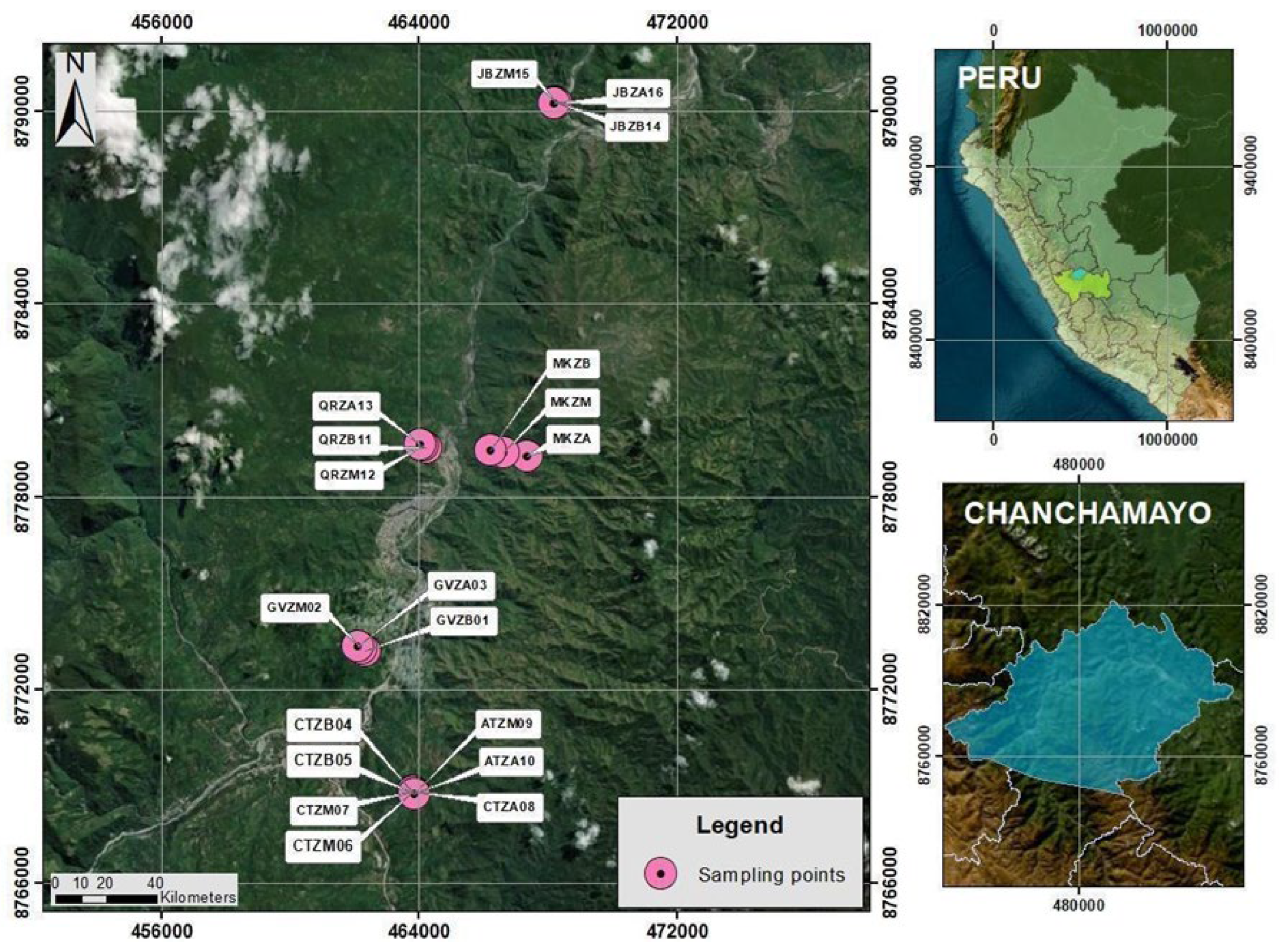
Figure 1. Map of Chanchamayo Province, Perú, showing different locations of Trichoderma isolate collection. ArcGIS 10.1 platform (ESRI Inc., Redlands, CA, USA) was used for preparing the map for the study area and sample location sites.
Agriculture 16 00112 g001
Figure 2. Morphological characterization of Trichoderma strains colonies. Macroscopic and microscopic features of the ten molecularly identified strains grown on PDA medium and incubated at 26 °C for 7 days. Each column corresponds to a single strain, showing (from (top) to (bottom)): colony morphology from the upper view (obverse), reverse colony view.
Agriculture 16 00112 g002
Figure 3. In vitro antagonistic activity of native Trichoderma spp. isolates against Botrytis cinerea, expressed as percentage inhibition of radial growth (PIRG). Bars show colony growth inhibition in (A) the dual culture assay and (B) the double-plate volatile assay. Values correspond to the mean ± standard error of four biological replicates. Within each assay, bars sharing the same letter are not significantly different according to Fisher’s least significant difference (LSD) test (p ≤ 0.05).
Agriculture 16 00112 g003
Figure 4. Bayesian phylogenetic tree of native Trichoderma isolates from Peruvian Central Jungle based on concatenated TEF1-α and RPB2 sequences. Posterior probabilities indicated by node size (0.51–1.00). Branch lengths are proportional to genetic distances. Nectria aurantiaca was used as an outgroup. Native isolates in bold.
Agriculture 16 00112 g004
Figure 5. Endophytic colonization of Capsicum baccatum tissues by native Trichoderma isolates. Ten native isolates were evaluated (n = 5 plants per isolate–tissue combination). (A) Stacked bar plot showing, for each isolate, the percentage of colonized root, stem and leaf tissues. (B) Plant-level endophytic colonization percentage (ECP) in roots, stems and leaves; coloured points represent individual plants, while black dots and vertical bars indicate the mean and 95% bootstrap confidence intervals (1000 resamples).
Agriculture 16 00112 g005aAgriculture 16 00112 g005b
Figure 6. Multivariate analysis of Trichoderma spp. antagonistic activity against Botrytis cinerea. (A) Principal component analysis (PCA) biplot showing the distribution of Trichoderma isolates according to three antagonistic mechanisms: dual culture inhibition (PIRG Dual), volatile compound inhibition (PIRG VOC), and mycoparasitism (Bell scale). Colored points represent isolates from different sampling areas. (B) Heat map of biocontrol mechanisms of native Trichoderma isolates compared with the commercial strain THCC03. Columns represent isolates and rows mycoparasitism and percentage of inhibition of radial growth (PIRG) in dual and VOC assays; colors denote z-scores and black circles indicate significant differences relative to THCC03 (* p < 0.05, ** p < 0.01, *** p < 0.001). The top dendrogram shows hierarchical clustering of isolates based on their combined biocontrol profiles.
Agriculture 16 00112 g006
Table 1. Collection sites and geographic characteristics of native Trichoderma spp. strains isolated from low-anthropogenic soils in Chanchamayo Province, Central Jungle of Peru.
Strain CodeCollection SiteElevation ZoneAltitude (m a.s.l.)Geographic Coordinates
GVZB01Fundo GénovaLow89511°05′50.8″ S 75°20′43.0″ W
GVZM02Fundo GénovaMedium95011°05′48.5″ S 75°20′45.9″ W
GVZA03Fundo GénovaHigh100011°05′46.0″ S 75°20′49.3″ W
CTZB04Catarata El TirolLow101111°08′15.0″ S 75°19′54.0″ W
CTZB05Catarata El TirolLow101311°08′15.0″ S 75°19′54.0″ W
CTZM06Catarata El TirolMedium102111°08′14.0″ S 75°19′54.0″ W
CTZM07Catarata El TirolMedium102311°08′14.0″ S 75°19′54.0″ W
CTZA08Catarata El TirolHigh103211°08′13.0″ S 75°19′54.0″ W
ATZM09El TirolMedium103411°08′16.0″ S 75°19′52.0″ W
ATZA10El TirolHigh103611°08′16.0″ S 75°19′52.0″ W
QRZM12QuircaMedium95211°02′23.9″ S 75°19′43.0″ W
QRZA13QuircaHigh83911°02′22.5″ S 75°19′46.0″ W
JBZB14Botanical GardenLow68910°56′35.7″ S 75°17′27.5″ W
JBZM15Botanical GardenMedium69210°56′37.0″ S 75°17′25.9″ W
JBZA16Botanical GardenHigh69810°56′37.0″ S 75°17′28.8″ W
MKA01Monte KimiriHigh115011°02′34.5″ S 75°17′56.2″ W
MKM01Monte KimiriMedium100311°02′30.2″ S 75°18′20.9″ W
MKB01Monte KimiriLow98011°02′27.8″ S 75°18′33.3″ W
TCP01LunahuanáLow48512°55′05.7″ S 76°06′03.5″ W
THCC03Commercial strainControlN/AN/A
Note. Collection sites represent pristine ecosystems with minimal anthropogenic intervention in the Central Jungle of Peru (Junín Department, La Merced-Chanchamayo Province). Elevation zones refer to relative positions within each collection site (Low: <700 m; Medium: 700–1000 m; High: >1000 m a.s.l.). TCP01 represents a comparative strain from the Peruvian coast, and THCC03 is a commercial T. harzianum control strain. N/A = Not applicable.
Table 2. Antagonistic activity against Botrytis cinerea and molecular identification of native Trichoderma spp. isolates from low-anthropogenic soils in Chanchamayo Province, Peru.
Strain CodeTaxonomic IdentificationDual Assay PIRGMycoparasitism AssayVOCs Assay PIRG
Mean ± SDStrain vs. THCCC03Mean ± SDStrain vs. THCCC03Mean ± SDStrain vs. THCCC03
GVZB01Trichoderma azadirachtae31.2 ± 2.6 fhns (p > 0.9999)100 ± 0 ans (p > 0.9999)59.6 ± 11.1 abns (p > 0.9999)
GVZM02Trichoderma sp.29.3 ± 1.5 ghns (p > 0.9999)70 ± 35 ans (p > 0.9999)32.1 ± 5.7 e*** (p = 0.0005)
GVZA03Trichoderma sp.27.1 ± 1.3 hns (p = 0.9958)80 ± 0 ans (p = 0.1576)48.6 ± 2.1 bcdns (p = 0.3215)
CTZB04Trichoderma sp.49.0 ± 16.9 ab* (p = 0.022)85 ± 30 ans (p > 0.9999)45.1 ± 2.9 cens (p = 0.1188)
CTZB05Trichoderma jaklitschii52.7 ± 11.2 acd** (p = 0.0028)100 ± 0 ans (p > 0.9999)56.3 ± 1.8 acns (p = 0.9829)
CTZM06Trichoderma sp.33.9 ± 9.1 bhns (p > 0.9999)85 ± 30 ans (p > 0.9999)45.0 ± 5.7 cens (p = 0.1134)
CTZM07Trichoderma hamatum55.2 ± 17.2 acde*** (p = 0.0005)80 ± 28 ans (p > 0.9999)54.1 ± 4.8 acns (p = 0.8714)
CTZA08Trichoderma sp.32.5 ± 3.5 bdhns (p > 0.9999)90 ± 20 ans (p > 0.9999)61.4 ± 5.3 abns (p > 0.9999)
ATZM09Trichoderma peruvianum32.4 ± 3.2 bdhns (p > 0.9999)100 ± 0 ans (p > 0.9999)55.8 ± 16.7 acns (p = 0.9702)
ATZA10Trichoderma jaklitschii30.1 ± 4.0 ghns (p > 0.9999)100 ± 0 ans (p > 0.9999)64.2 ± 14.2 ans (p > 0.9999)
QRZM12Trichoderma koningiopsis45.5 ± 11.6 abns (p = 0.996)100 ± 0 ans (p > 0.9999)57.9 ± 1.3 acns (p = 0.9989)
QRZA13Trichoderma inhamatum39.4 ± 1.1 abfns (p = 0.7857)100 ± 0 ans (p > 0.9999)54.9 ± 1.0 acns (p = 0.9261)
JBZB14Trichoderma anisohamatum36.3 ± 2.8 abfgns (p = 0.996)100 ± 0 ans (p > 0.9999)39.3 ± 18.6 de* (p > 0.0136)
JBZM15Trichoderma hamatum56.4 ± 3.5 ac*** (p = 0.0002)100 ± 0 ans (p > 0.9999)39.2 ± 10.5 de* (p > 0.0131)
JBZA16Trichoderma hamatum61.6 ± 3.9 a**** (p < 0.0001)100 ± 0 ans (p > 0.9999)48.0 ± 12.6 bcdns (p > 0.2755)
MKA01Trichoderma sp.33.0 ± 2.2 bchns (p > 0.9999)70 ± 12 ans (p = 0.0584)45.7 ± 12.9 cens (p = 0.1425)
MKZM01Trichoderma sp.30.8 ± 4.2 ghns (p > 0.9999)75 ± 25 ans (p = 0.4836)35.7 ± 15.7 de** (p = 0.0028)
MKZB01Trichoderma sp.31.6 ± 2.1 bhns (p > 0.9999)90 ± 12 ans (p > 0.9999)55.9 ± 3.9 acns (p = 0.9718)
TCP01Trichoderma sp.32.1 ± 4.4 bhns (p > 0.9999)70 ± 20 ans (p = 0.0722)58.7 ± 9.1 acns (p = 0.9999)
THCC03Trichoderma harzianum31.8 ± 6.3 beh_100 ± 0 a_63.3 ± 6. 7 a_
Note. PIRG = Percentage Inhibition of Radial Growth (%). Mycoparasitism expressed as adapted Bell scale percentage (100% = Level I, 80–90% = Level II, 70–75% = Level III), Statistical analysis: Dual culture and mycoparasitism (Kruskal-Wallis + Dunn’s test); VOCs (ANOVA + Fisher’s LSD), Superscript letters indicate statistical groups; strains sharing letters are not significantly different (p > 0.05) vs. Control: Orthogonal contrasts comparing each strain with THCC03; * p < 0.05, ** p < 0.01, *** p < 0.001, **** p < 0.0001; ns = not significant, Species identification based on multilocus sequencing (ITS, TEF1α, RPB2) for the 10 best-performing strains, Data represent mean ± standard deviation of four biological replicates conducted independently Experimental design: Completely randomized design with four replicates per treatment.
Disclaimer/Publisher’s Note: The statements, opinions and data contained in all publications are solely those of the individual author(s) and contributor(s) and not of MDPI and/or the editor(s). MDPI and/or the editor(s) disclaim responsibility for any injury to people or property resulting from any ideas, methods, instructions or products referred to in the content.