Article

Identification of Novel QTLs for Iron Content and Development of KASP Marker in Wheat Grain

College of Agriculture, Henan University of Science and Technology, Luoyang 471000, China
*
Author to whom correspondence should be addressed.
Agriculture 2026, 16(1), 105; https://doi.org/10.3390/agriculture16010105
Submission received: 24 November 2025 / Revised: 24 December 2025 / Accepted: 24 December 2025 / Published: 31 December 2025
(This article belongs to the Section Crop Genetics, Genomics and Breeding)

Abstract

Wheat (Triticum aestivum L.) is one of the most important staple crops in the world. Iron (Fe) plays a vital role in the growth and development of wheat as an essential nutrient. Meanwhile, Fe is closely associated with human health, as Fe deficiency anemia can cause fatigue, weakness, heart problems, and so on. In this study, quantitative trait loci (QTLs) for grain Fe content (GFeC) were detected in two populations: a recombinant inbred line (RIL) population with 175 lines derived from a cross between Avocet and Huites (AH population) genotyped with diversity array technology (DArT) and a natural population of 243 varieties (CH population) genotyped by using the 660K single-nucleotide polymorphism (SNP). Three stable QTLs (QGFe.haust-AH-5B, QGFe.haust-AH-6A, and QGFe.haust-AH-7A.2) were identified through QTL mapping with phenotypic variations of 11.55–13.63%, 3.58–9.89%, and 4.81–11.12% in the AH population in four environments. Genetic effects of QGFe.haust-AH-5B, QGFe.haust-AH-6A, and QGFe.haust-AH-7A.2 were shown to significantly increase GFeC by 8.11%, 14.05%, and 5.25%, respectively. One hundred and thirty-three significant SNPs were identified (p < 0.001) through a genome-wide association study (GWAS) for GFeC on chromosomes 1B, 2B, 3A, 3B, 5D, and 7A with phenotypic variations of 5.26–9.88% in the CH population. A novel locus was co-located within the physical interval 689.86 Mb-690.01 Mb in five environments through QTL mapping and GWAS, with one high-confidence gene, TraesCS7A02G499500, which was temporarily designated as TaqFe-7A, involved in GFeC regulation. A Kompetitive allele-specific PCR, KAFe-7A-2, was developed, which was validated in 181 natural populations. Genetic effect analysis revealed that favorable haplotype AA significantly increased GFeC by 4.64% compared to an unfavorable haplotype (p < 0.05). Therefore, this study provides the theoretical basis for cloning the GFeC gene and nutritional fortification breeding.

1. Introduction

Wheat (Triticum aestivum L.) is one of the most important cereal crops globally, providing approximately 20% of global daily caloric intake and protein requirements while supplying essential elements [1]. Despite significant increases in wheat production over recent decades, micronutrient accumulation in grains has been largely neglected. Modern wheat cultivars often lack sufficient micronutrient contents to meet human nutritional requirements, contributing to hidden hunger in wheat-dependent populations [2,3,4]. Hidden hunger disrupts cellular respiration and leads to metabolic disorders, which are characterized by deficiencies in vitamins and minerals (such as Fe) [5]. Fe deficiency leads to anemia, immune dysfunction, and related health complications for over 3 billion people worldwide [6,7,8]. Therefore, biofortification of Fe content in wheat grains offers a sustainable strategy in order to mitigate hidden hunger, particularly in developing countries where wheat serves as a dietary staple.
Grain Fe content (GFeC) is a quantitative trait controlled by multiple genes in wheat. Recently, quantitative trait loci (QTLs) related to GFeC has been reported on 21 chromosomes in wheat by using QTL mapping and genome-wide association studies (GWAS) [9]. QGFe.sar-1B (210.8–215.8 Mb), QGFe.sar-3A/3B (279.2–284.2 Mb), QGFe.sar-5BTKM (27.5–40.2 cM), and QGFe.sar-5BMCO (94.1–108.6 cM) were mapped on chromosomes 1B, 3A, and 5B in tetraploid and QGFe.ada-1B (6.1 cM), QGFe.ada-2A (14.7–23.1 cM) QGFe.ada-2Btkm (50.3–53.6 cM), QGFe.ada-3A (75.4 cM), QGFe.ada-6B (62.0–66.1 cM), and QGFe.ada-7B (35.7 cM) on chromosomes 1B, 2B, 3A, 6B, and 7B in hexaploid wheat [10]. QFe.bhu-2B (6.5 cM) was identified on chromosome 2B through QTL mapping in a 138-line doubled haploid (DH) population [11]. Twenty-three QTLs of GFeC were detected on chromosomes 1A, 2A, 3B 4A, 4D, 5A, 7A, 7B, and 7D through QTL mapping using various RIL populations, which explains the phenotypic variation range of 2.3–30.4% [11,12,13,14,15]. QTL-Fe.nwafu-1D (14.48–15.32 Mb) was identified on chromosome 1D, explaining 16.99% of phenotypic variation in 241 colored wheat accessions [16]. QGFeCzc.caas-4BS (32.3–46.6 Mb) and QGFeCzc.caas-4DS (9.3–54.4 Mb) were detected on chromosomes 4B-S and 4D-S through QTL mapping, accounting for 3.9–9.7% of phenotypic variation [17]. Meanwhile, nine significant marker–trait associations (MTAs) were reported on chromosomes 2A, 2B, and 5D through GWAS in different wheat materials [18,19]. Six significant MTAs were detected on chromosomes 3B, 4A, 4B, 5A, and 7B through GWAS in wild emmer wheat [20]. Four hundred and thirty-nine MTAs were revealed on 21 chromosomes, explaining phenotypic variation from 4.23% to 17.90% through GWAS using 272 wheat accessions [21]. Therefore, gene mining of Fe content provides a good method and gene resource. Meanwhile, some molecular markers have been developed and effectively used in molecular-marker-assisted breeding (MAS). Kasp_5D_QGZnFe was developed by the QTL discovered on chromosome 5DL, which could be effectively used for MAS of GFeC [22]. Eight grain Zn content (GZnC)-related Kompetitive allele-specific PCR (KASP) markers have been successfully applied for MAS of GZnC [17,23]. Moreover, the genetic effect and haplotype analysis of loci controlling GFeC in wheat have been reported. Hong et al. found that TaZn-2DS increased GZnC by 15.44% [23]. Three haplotypes were detected at the qSe-3B.1/qFe-3B.6, including two high-frequency haplotypes (Hap1, 64.4%; Hap2, 35.3%) and one rare haplotype (Hap3, frequency < 1%). There were significant differences in the GFeC between the Hap1 group and the Hap2 group. The iron content of Hap2 was higher than that of Hap1 [24]. However, research on genetic effects and marker development for GFeC is limited.
With the rapid development of molecular biology and sequencing technology, gene discovery has entered the fast lane. Currently, although QTLs and markers for GFeC have been identified through QTL analysis and GWAS, the genes and markers have not been widely popularized and applied in molecular breeding. Therefore, it is important to identify new major and stable loci and develop markers for molecular-marker-assisted breeding. In this study, we used an F6 RIL population derived from the cross Avocet × Huites (AH population) and a natural population of 243 varieties (CH population) to perform QTL mapping and GWAS for GFeC in multiple environments. Novel QTLs of GFeC will be identified, and the genetic effects of these QTLs on GFeC will be evaluated. Molecular markers will be developed and validated in the natural population of 181 wheat varieties (ZD population). Our findings provide theoretical foundations and technical support for genetic improvement and molecular-marker-assisted breeding of GFeC.

2. Materials and Methods

2.1. Plant Materials

In this study, 175 F6 RIL population (AH population) cross Avocet × Huites was provided by Dr. Ravi P. Singh’s team at the International Maize and Wheat Improvement Center (CIMMYT) [23]. A natural population (CH population) of 243 common wheat cultivars and elite breeding lines from the Huanghuai Valley was provided by Professor Chen Feng’s research group at Henan Agricultural University.
Another natural population (ZD population) of 181 varieties was provided by Professor Wang Chunping’s research group at Henan University of Science and Technology, which was used to validate the KASP markers.

2.2. Field Experimental Design

The AH population was planted on the farm of Henan University of Science and Technology during the 2019–2024 (E1, E2, E3, E4, 34°62′ N, 112°45′ E) cropping seasons. The CH population was planted on the farm of Henan University of Science and Technology (E5, 34°62′ N, 112°45′ E) during the 2020–2021 cropping season, at two sites on the farm of Henan University of Science and Technology during the 2021–2022 cropping season (E6, E7, 34°62′ N, 112°45′ E), and in Mengjin county, Luoyang city (E8, 112°59′ E, 34°82′ N) during the 2020–2021 cropping season. The ZD population was planted on the farm of Henan University of Science and Technology (34°62′ N, 112°45′ E) and in Yanshi county, Luoyang city (112°45′ N, 34°44′ E) during the 2023–2024 and 2024–2025 cropping seasons, respectively.
All field trials were conducted using a completely randomized block design with three replications, featuring a 2 m row length, 20 cm row spacing, and 8 cm plant spacing. Field management practices followed local agronomic protocols for wheat cultivation without using fertilizers to avoid the effect of additional fertilizers on the actual Fe content. There were no serious pests or diseases, and lodging was provided throughout the entire growth period. In 2019–2025, the mean contents of alkaline hydrolyzable nitrogen, available zinc, and available Fe in the experimental field of Henan University of Science and Technology were 66.25 mg/kg, 1.52 mg/kg, and 4.35 mg/kg, respectively. All of the experiments were conducted under irrigation conditions.

2.3. Phenotypic Evaluation

The determination of GFeC in this experiment was described by Hong et al. [23], with identical procedures for steps 1–3 and a modified step 4, which required setting the detection wavelength for iron at 238.204 nm. The detailed steps are as follows.
Step 1: After wheat maturation, grains were manually harvested and threshed. Approximately 5 g of disease-free, plump grains was randomly selected, placed in sealed kraft paper bags, and dried in an oven at 80 °C until a constant weight was achieved.
Step 2: The dried samples were transferred to tungsten carbide grinding jars (Retsch MM400, Haan, Germany). Grinding parameters were set to a frequency of 20 Hz for a duration of 30 s until a homogeneous whole wheat flour powder was obtained.
Step 3: Precisely 0.20 g of whole wheat flour was weighed into an HVE56 digestion tube using an analytical balance. Subsequently, 5.00 mL of high-purity nitric acid (analytical grade) was added. The digestion tube was placed in an Anton-Paar Multiwave 4000 microwave digestion system (Anton Paar GmbH, Austria), and digestion was performed according to the program outlined until the solution became clear and transparent with no residue. After cooling naturally to room temperature, the digestate was diluted to a final volume of 25.00 mL with ultrapure water and mixed thoroughly for subsequent analysis.
Step 4: Fe content was determined using an Agilent 5110 inductively coupled plasma optical emission spectrometer (ICP-OES, Agilent Technologies, Santa Clara, CA, USA). The detection wavelength for iron was set at 238.204 nm.

2.4. QTL Mapping

A genetic linkage map for the RIL population was constructed using DArT (Diversity Arrays Technology, Triticarte Co. Ltd., Canberra, Australia) markers to perform genetic mapping of Fe content [25]. QTL mapping for GFeC was conducted using the inclusive composite interval mapping (ICIM) method in IciMapping v4.2 software [23]. The confidence interval for QTL was determined through a logarithm of odds (LOD) > 2.5 (http://www.isbreeding.net, accessed on 10 March 2025). The LOD threshold to identify significant QTL at p < 0.05 for GFeC was based on 1000 permutation tests. Stepwise regression was used to estimate both the genetic effects and percentages of phenotypic variance explained (PVE) by individual QTL (at LOD peaks). QTLs with spacing less than 10 cM or sharing flank markers were considered as the same locus, and the QTL with percentages of PVE more than 10.0% was considered the major QTL [26]. QTL nomenclature followed the guidelines described by McCouch et al. [27].

2.5. Genotyping and Genome-Wide Association Study (GWAS)

Genotyping of the natural population was performed using the 660K SNP array at the Beijing CapitalBio Technology Company (Beijing, China) (https://www.capitalbiotech.com/, accessed on 10 March 2025), and the molecular data were provided by Prof. Chen Feng’s research group at Henan Agricultural University. The genotyping data of quality control and Principal Component Analysis (PCA) procedures were performed according to the standardized methodology described by Li et al. [28].
Association analysis for GFeC was performed using Tassel v5.0 software. A Mixed Linear Model (MLM) was employed as the association model [29], with PCA as the fixed effect and the K matrix as the random effect. Phenotypic data for association analysis combined GFeC across four environments. The threshold of the p value was estimated using a modified Bonferroni correction, with a recommended threshold p value = 1 × 10⁻³ (p = 1/n, n = the total number of SNPs) to declare the putative QTL [30]. The significant SNP markers detected in a pairwise linkage disequilibrium (LD) block (±3 Mb, ±10 Mb, ±3 Mb) were considered to belong to the same single QTL for the A genome, the B genome, and the D genome, respectively [30,31]. Manhattan plots and quantile–quantile (Q-Q) plots were generated using the CMplot package in R (https://github.com/YinLiLin/CMplot, accessed on 1 March 2025).

2.6. Statistical Analysis

Statistics analysis was carried out using SPSS 17.0 software. Graphs were plotted using Origin 2021b software and R v4.2.2. Analysis of variance (ANOVA) was used to estimate genotype (G), environment (E), and G × E interaction effects in QTL IciMapping v4.2 software and R, respectively. The formula for calculating broad-sense heritability (H2) is as follows:
H 2 = σ g 2 σ g 2 + σ g e 2 + σ ε 2 n
σ g 2 σ g e 2 , σ ε 2 , and n , respectively, represent the genotype variance, the variance of the interaction between the genotype and the environment, the environmental variance, and the number of environments, respectively.

2.7. Candidate Gene Identification

Based on stable loci identified through GWAS and linkage analysis, physical intervals were obtained by referencing the Chinese Spring reference genome (Ref v1.1) from the International Wheat Genome Sequencing Consortium (IWGSC, http://plants.ensembl.org/index.html, accessed on 10 March 2025). High-confidence genes predicted within these regions were retrieved from the WheatOmics 1.0 database (http://202.194.139.32/, accessed on 10 March 2025).

2.8. KASP Marker Design and Validation

KASP markers were designed based on the variant locus of TraesCS7A02G499500, with primer design performed via PolyMarker (http://www.polymarker.info/, accessed on 10 March 2025). The reaction volume for KASP was 10.1125 μL, of which 2 contained 5 μL of ddH O, dried DNA (65 °C, 0.5 h) (DNA concentration approximately 30 ng/mL), 5 μL of 2 × KASP master Mix (HiGeno 2 × Probe Mix A, JasonGen), and 0.1125 μL of primer mix (primer A: primer B: primer C = 12:12:30).
The ZD population was genotyped using the CFX TM384 real-time fluorescent quantitative PCR detection system of BIO-RAD. Bio-Rad CFX Manager software collected and analyzed the fluorescence signals of each reaction (BIO-RAD, C1000 Touch, Singapore). To verify the function of TraesCS7A02G499500, the ZD population was detected using KASP markers. Finally, the significant differences between the phenotypic differences and the KASP marker genotypes were calculated using the t-test.

3. Results

3.1. Phenotypic Variation of GFeC

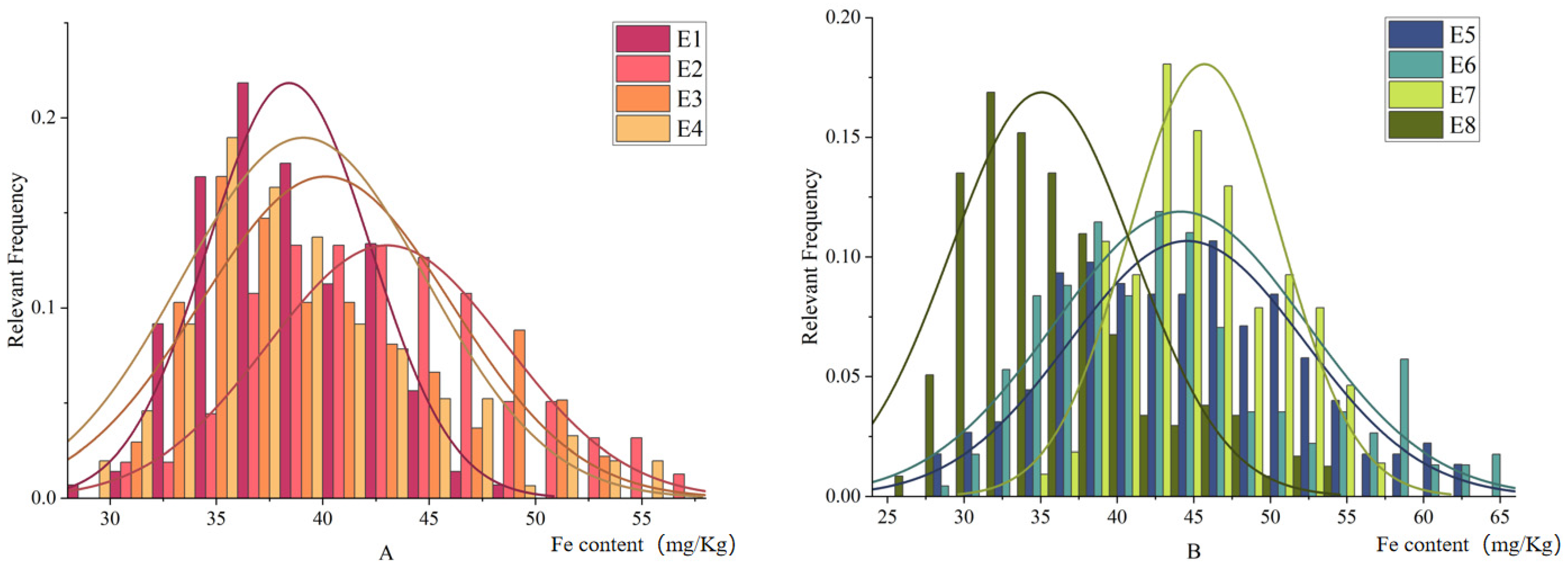
In the AH population, the GFeC of Huites was significantly higher than Avocet across all environments (E1-E4) (p < 0.01). The coefficient of variation was between 9.96% and 14.74%, and the GFeC range was 28.29 mg/kg to 67.55 mg/kg across four environments. For the CH population, GFeC exhibited a variation range of 25.60–64.91 mg/kg across four environments (E5–E8). In AH and CH populations, broad-sense heritability (h2) was 0.57 and 0.51, respectively (Table 1, Figure 1). The absolute values of skewness and kurtosis of the phenotypic distribution indicated that GFeC conformed to normal distribution (Table 1, Figure 1).

3.2. QTL Mapping for GFeC in AH Population

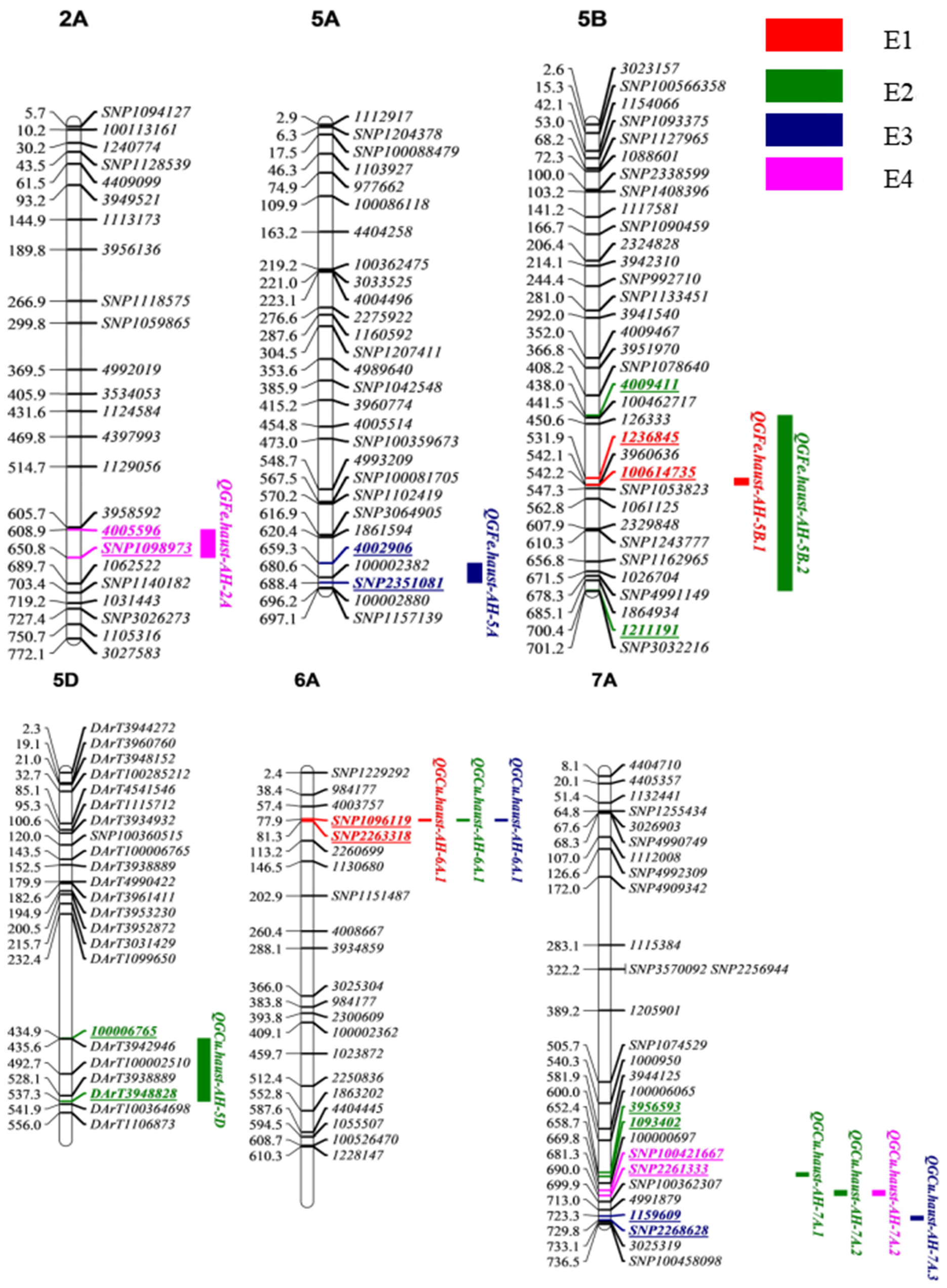
A total of nine QTLs of GFeC were identified on chromosomes 2A, 5A, 5B, 5D, 6A, 6B, and 7A, with phenotypic variation explained (PVE) ranging from 2.28% to 13.63% and LOD values ranging from 2.85 to 16.11.
QGFe.haust-AH-5B, QGFe.haust-AH-6A, and QGFe.haust-AH-7A.2 were stable QTLs, which were detected in at least two environments. QGFe.haust-AH-5B was identified in two environments (E1, E2), flanked by 1236845 and 100614735 (531.86 Mb-542.23 Mb), with PVE ranging from 11.15% to 13.63%. QGFe.haust-AH-6A was mapped in three environments (E1, E3, E4), and it was tightly linked to SNP1096119 and SNP2263318, with a physical position between 77.89 Mb and 81.30 Mb, explaining 3.58% to 9.89% of the phenotypic variation. QGFe.haust-AH-7A.2 was flanked by SNP100421667 and SNP2261333, identified in two environments (E2, E3), and it had a physical position between 681.26 Mb and 690.01 Mb, with PVE ranging from 4.82% to 11.12% (Table 2, Figure 2).

3.3. Genetic Effects of QGFe.haust-AH-5B, QGFe.haust-AH-6A, and QGFe.haust-AH-7A.2 for GFeC in the RIL Population

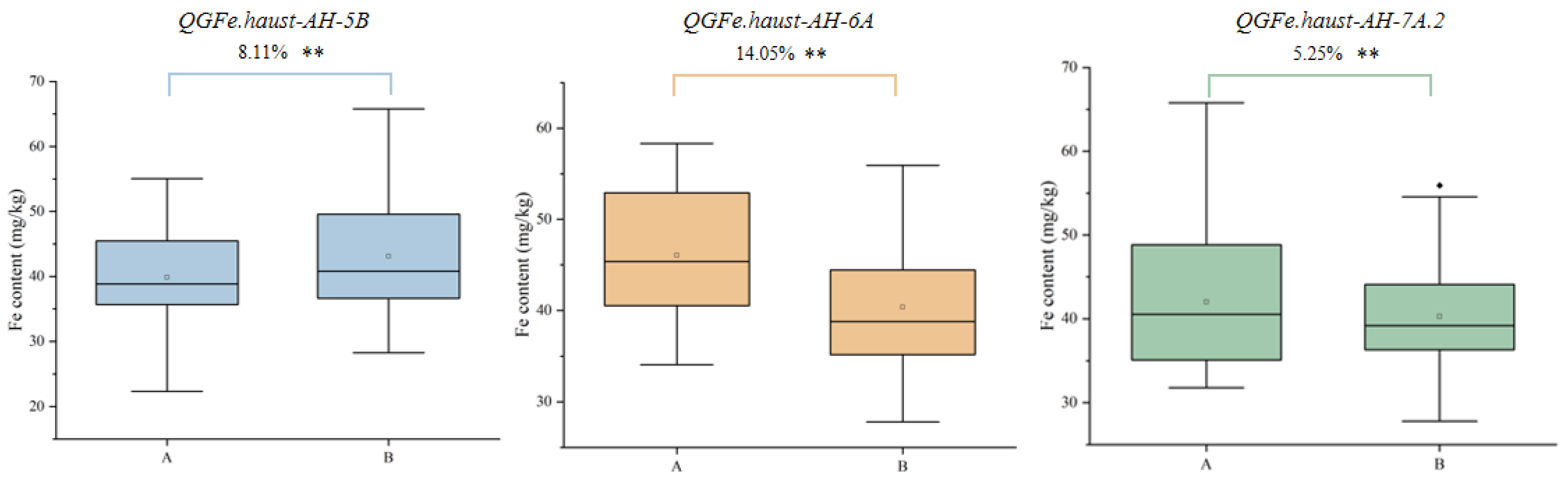
For QGFe.haust-AH-5B, QGFe.haust-AH-6A, and QGFe.haust-AH-7A.2, lines with favorable alleles showed significantly higher values for GFeC in all environments than those with the unfavorable alleles (p < 0.01).
The favorable allele of QGFe.haust-AH-5B was from Huites, which significantly increased GFeC by 8.11% relative to lines with an unfavorable allele from the Avocet allele (p < 0.01). Meanwhile, the favorable alleles of QGFe.haust-AH-6A and QGFe.haust-AH-7A.2 were derived from Avocet and lines with the favorable Avocet allele significantly increased GFeC by 14.05% and 5.05% relative to lines with the unfavorable allele from the Huites allele, respectively (p < 0.01) (Figure 3).

3.4. GWAS for GFeC Content in CH Population

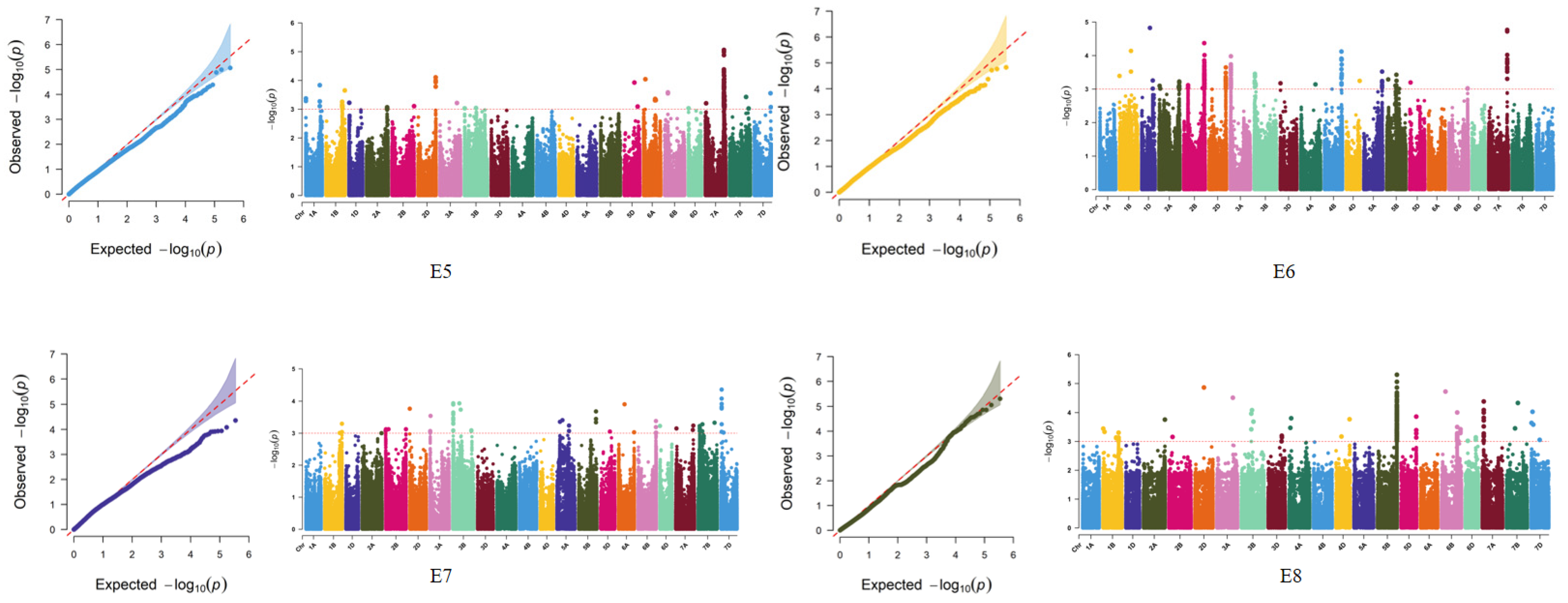
A total of 133 markers were associated with GFeC. These markers were grouped into nine loci through a linkage disequilibrium (LD) analysis, and they were located on chromosomes 1B, 2B, 3A, 3B, 5D, and 7A. Among these, qFe-1B.2 and qFe-7A.2 were detected in three environments, explaining 5.30% to 8.50% of the phenotypic variation with a physical position of 674.93 Mb-681.20 Mb and 689.86 Mb-692.76 Mb, respectively. QFe-1B.1, qFe-2B, qFe-3A.1, qFe-3A.2, qFe-3B, qFe-5D, and qFe-7A.1 were detected in two environments (Table 3, Figure 4).
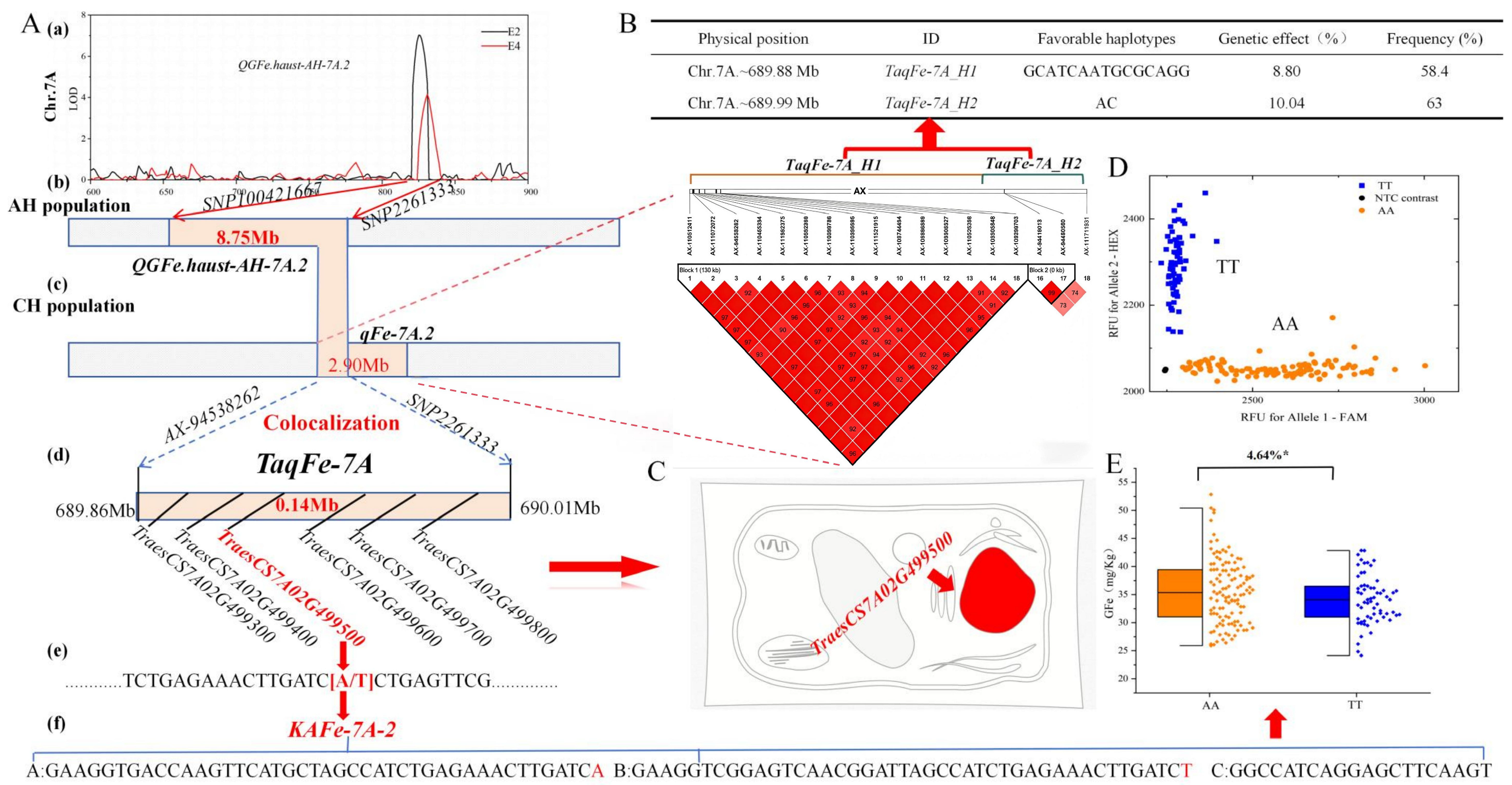
The haplotype analysis of qFe-7A.2 detected two favorable haplotypes, which contained 17 SNPs significantly related to GFeC (Figure 5B).

3.5. Co-Localization Analysis of TaqFe-7A

QGFe.haust-AH-7A.2 was identified through QTL mapping in the physical interval of 681.26 Mb to 690.01 Mb (E2, E4) (Figure 5A(a)), while qFe-7A.2 was identified in the physical interval of 689.86 Mb to 692.76 Mb through GWAS (E5, E6, E7) (Figure 5A(b)). The partially overlapping region of QGFe.haust-AH-7A.2 and qFe-7A.2 was co-localized, with the physical interval of 689.86 Mb to 690.01 Mb, which was temporarily named TaqFe-7A (E2, E4, E5, E6, E7) (Figure 5A(d)).
Six high-confidence genes were identified in the interval of TaqFe-7A. Among them, TraesCS7A02G499500 was identified as the candidate gene for GFeC, which is a part of the B3 domain-containing protein. Meanwhile, TraesCS7A02G499500 had the highest expression level in grains. TraesCS7A02G499500 had seven exons, which were exclusively expressed in the nucleus (Figure 5A(e,f)).

3.6. Development and Validation of KASP Markers

The KASP markers named KAFe-7A-1 and KAFe-7A-2 were designed based on the SNP mutation in the exon of TraesCS7A02G499500. KAFe-7A-2 was significantly genotyped in ZD population of 181 wheat varieties, which contained favorable haplotype AA (63.54%) and unfavorable haplotype TT (36.46%). The variety with the AA allele was significantly higher than that with the TT allele by 4.64% combined with the GFeC phenotype (Table 4, Figure 5A(f)). One hundred and eighty-one germplasm resources have been identified, which include Kezi 6 hao, Kezi 8 hao, Kelan 5 hao, Kezi 19, Keda 14, Xinong Heidasui, Cunheimai 1, Jiaohei 2, Huiyuan Heimai 1, and Jiaohei 1 with favorable haplotypes in the ZD population. These varieties can be used as excellent parents for wheat nutritional enhancement breeding.

4. Discussion

Fe plays indispensable physiological roles in hemoglobin synthesis and immune regulation, making it an essential micronutrient for humans. Deciphering the genetic regulatory mechanisms of GFeC is crucial for agricultural biofortification to address the global issue of Fe-deficiency anemia [6,7,8]. Previous studies have identified multiple GFeC-related QTLs by using bi-parental populations, but studies integrating GWAS with QTL analysis to identify major-effect loci across multiple environments remain limited.
In this study, we identified three novel QTLs in the AH population and nine stable loci in the CH population. TaqFe-7A was co-localized on chromosome 7A. Furthermore, we predicted candidate genes to characterize these QTLs and developed KASP markers tightly related to QTLs. These findings provide a theoretical foundation and technical support for the genetic improvement of GFeC and MAS.

4.1. Comparative Analysis of Significant Loci of GFeC

A total of nine loci were identified through QTL mapping, of which three loci were detected across multiple environments in this study. Meanwhile, many QTLs related to GFeC have been reported to be found on 21 chromosomes in wheat by using QTL mapping and GWAS in previous studies.
QGFe.haust-AH-5B was detected on chromosome 5B (531.86–542.23 Mb) in two environments, which was far from QFe.Y13-14_5BL (87.1–110 Mb) and QFe.Y13-14_5BS (23.1–23.7 Mb) [13]. Therefore, QGFe.haust-AH-5B is considered a novel locus related to GFeC. QGFe.haust-AH-6A was mapped in three environments located on the physical interval of 77.89–81.30 Mb on chromosome 6A, which overlaps with QGFezx.caas-6A (AX-111624010-AX-111051197, 73.4–445.4 Mb), QFe.caas-6AS (77.1–106.9 Mb), and a locus on chromosome 6A (44.4–89.4 Mb) identified by Zvi P et al. [15,32,33]. These results suggest that the overlap of these QTLs had great potential to control GFeC. Meanwhile, QGFe.haust-AH-6A was adjacent to QFe.Across-6AL (86.9–89.5 Mb) and QFeC-6A (110.5–112.5 Mb), which was possibly the same locus [13,34].
One hundred and thirty-three significant SNPs were identified (p < 0.001) through a genome-wide association study (GWAS) for GFeC in the CH population, primarily located on chromosomes 1B, 2B, 3A, 3B, 5D, and 7A. These SNPs were grouped into nine QTLs based on linkage disequilibrium (LD) analysis. The loci on 1B (674.93–681.20 Mb) and 7A (689.86–692.76 Mb) were detected in three environments. Among these, qFe-1B.1 (582.50–591.67 Mb) overlaps with QGFe.haust-1BL (554.7–635.1 Mb) [22]. qFe-1B.2 (674.93–681.20 Mb) was far away from QGFe.haust-1BL (554.7–635.1 Mb) and QGFe.sar_1B (210.8–215.8 Mb), which was considered a novel locus regulating GFeC in wheat [10,22]. qFe-2B (793.33–798.32 Mb) was far away from QGFe.haust-2BL (593.6–690.7 Mb), QFe.bhu-2B (148.1–154.6 Mb), and QFe.Across_2BL (103.5–106.5 Mb) [11,13,22], which was possibly a new QTL. qFe-3A.1 (8.87–10.95 Mb) and qFe-3A.2 (22.82–24.47 Mb) were adjacent to QTL-Fe.nwafu-3A.1 (13.80–13.85 Mb), QTL-Fe.nwafu-3A.2 (19.09 Mb), QGFeCzc.caas-3AS (54.9–61.3 Mb), and QTL.fe.2 (12.86 Mb) [1,16,17]. qFe-3B (16.98–25.62 Mb) was far away from QGFe.sar_3B (279.2–284.2 Mb), QFe.caas-3BL (764.7–822.9 Mb), and QFe.bhu-3B (1015.23–1022.28 Mb) [10,12,15], which were regarded as a new locus. qFe-5D (369.39 Mb–370.14 Mb) with QGFe.haust-5DL (432.8–554.8 Mb) was far away [22], which was considered new loci related to GFeC.
Complex quantitative traits can be studied through QTL mapping or genome-wide association study (GWAS). Co-localization analysis that integrates these two methods can significantly improve the detection power of true loci [35]. This integrated research approach has been widely applied in the field of wheat, including aspects such as agronomic trait improvement, abiotic stress resistance, and disease resistance genes [26,35,36,37]. In this study, TaqFe-7A (689.86–690.01 Mb) was co-localized on chromosome 7A with QGFe.haust-AH-7A.2 and qFe-7A.1 through QTL mapping and GWAS. QGFe.haust-AH-7A.2 (681.26–690.01 Mb) was far away from QGFe.iari-7A (7.80–29.4 Mb) [14]. Thus, QGFe.haust-AH-7A.2 was regarded as a novel locus related to GFeC. At the same time, lines carrying the QGFe.haust-AH-6A allele (Avocet allele) exhibit a 14.05% higher GFeC than those carrying the Huites allele. Lines carrying the QGFe.haust-AH-7A.2 allele (Avocet allele) show a 5.25% higher GFeC compared to lines with the Huites allele. qFe-7A.1 (669.64–671.77 Mb) and qFe-7A.2 (689.86–692.76 Mb) with QGFe.iari-7A (7.8–29.4 Mb) had the furthest distance [14].

4.2. Candidate Gene Analysis of TaqFe-7A

Six high-confidence genes (TraesCS7A02G499300, TraesCS7A02G499400, TraesCS7A02G499500, TraesCS7A02G499600, TraesCS7A02G499700, TraesCS7A02G499800) were identified, which were co-localized within the physical interval of 689.86–690.01 Mb on chromosome 7A. Gene annotation of TraesCS7A02G499300, TraesCS7A02G499400, TraesCS7A02G499500, TraesCS7A02G499600, TraesCS7A02G499700, and TraesCS7A02G499800 represented sesquiterpene synthase, protein transport protein Sec61 subunit gamma, B3 domain-containing protein, disease resistance protein RPM1, pentatricopeptide repeat-containing protein, and protein FAR1-RELATED SEQUENCE 5, respectively. TaqFe-7A (B3 domain-containing protein) was expressed in all tissues, with the highest expression level in grains. Relevant studies have shown that ABI3, LEC2, FUS3, and SOD7, as important B3 domain protein transcription factors, have been verified to coordinate Fe distribution and uptake in Arabidopsis thaliana [38,39,40]. Meanwhile, the KAFe-7A-2 marker was developed based on the different exon regions of TraesCS7A02G499500, which was validated in the ZD population and showed that the efficient allelic variation had a 4.64% significant increase on GFeC (p < 0.05). Therefore, we presume that TraesCS7A02G499500 could possibly regulate Fe transport. However, the function of TraesCS7A02G499500 requires further validation.

4.3. KASP Markers for Marker-Assisted Breeding

The KAFe-7A-2 marker was developed based on TraesCS7A02G499500 and validated in the ZD population. The genetic effect analysis of KAFe-7A-2 showed that the efficient allelic variation could significantly increase GFeC by 4.64% (p < 0.05). In previous research, Kasp_5D_QGZnFe was developed by transforming the flanking SNP markers of the QTL discovered on chromosome 5DL, which could be effectively used for molecular-marker-assisted breeding (MAS) of GFeC [22]. Eight GZnC-related KASP markers located in the 2DS, 3BL, 5AL, 5BL, and 5DL regions have been identified, all of which have been successfully applied for MAS of GZnC [17,23]. The KAFe-7A-2 marker can be utilized for marker-assisted selection in wheat nutritional fortification, enabling breeders to efficiently and accurately screen Fe-containing germplasm resources. Therefore, it is most important that the KAFe-7A-2 marker for GFeC is developed for use in marker-assisted breeding and biofortification of wheat grain in breeding programs.

5. Conclusions

In this study, we identified three stable QTLs (QGFe.haust-AH-5B, QGFe.haust-AH-6A, and QGFe.haust-AH-7A.2) through QTL mapping in an RIL population (Avocet × Huites) across four environments. One hundred and thirty-three significant SNPs were identified through GWAS in a natural population of 243 varieties (CH population) across four environments, which were grouped into nine QTLs, including qFe-1B.2 and qFe-7A.2 (detected in three environments) and six novel loci on chromosomes 1B, 2B, 3B, 5D, and 7A (detected in two environments). TaqFe-7A was co-localized to the interval of 689.86–690.01 Mb on chromosome 7A, which contains six high-confidence genes, but only TraesCS7A02G499500 is relevant to grain’s iron content. The KAFe-7A-2 marker was developed from TraesCS7A02G499500 and validated in the natural population, including 181 wheat varieties (ZD population), showing that the favorable allelic variation significantly increased GFeC by 4.64% (p < 0.05). This study provided genetic loci and a KASP marker of grain iron content for molecular-marker-assisted breeding.

Author Contributions

C.W.: data curation, formal analysis, investigation, methodology, project administration, resources, software, supervision, validation, and writing—review and editing. C.L. performed the experiment and wrote the paper, including data curation, formal analysis, methodology, software, writing—original draft, writing—review and editing. Z.Z. and X.J. participated in field experiments, data analysis, and manuscript revision. Y.Z., J.B. and Q.Y. supported the methodology, validation, and data curation. All authors have read and agreed to the published version of the manuscript.

Funding

The authors wish to thank the wheat molecular breeding group of Henan University of Science and Technology for providing wheat seeds. This work was supported by the Henan Province Major Science and Technology Project (251100110200) and the National Natural Science Foundation of China (32401870).

Institutional Review Board Statement

Not applicable.

Data Availability Statement

The data that support the findings of this study are available upon request from the corresponding author. The data are not publicly available due to privacy or ethical restrictions.

Conflicts of Interest

The authors declare that they have no conflicts of interest.

Abbreviations

The following abbreviations are used in this manuscript:
QTLQuantitative trait loci
GFeCGrain Fe content
GZnCGrain Zn content
KASPKompetitive allele-specific PCR
DArTDiversity array technology
SNPSingle-nucleotide polymorphism
GWASGenome-wide association study
MTAMarker–trait association
MASMolecular-marker-assisted breeding
CIMMYTInternational Maize and Wheat Improvement Center
MLMMixed Linear Model

References

  1. Chen, J.Y. QTL Analysis and Utilization of Microelement in RIL Population of Wheat. Master’s Thesis, Shandong Agricultural University, Tai’an, China, 2023. [Google Scholar]
  2. Palmgren, M.G.; Clemens, S.; Williams, L.E.; Krämer, U.; Borg, S.; Schjørring, J.K.; Sanders, D. Zinc Biofortification of Cereals: Problems and Solutions. Trends Plant Sci. 2008, 13, 464–473. [Google Scholar] [CrossRef] [PubMed]
  3. Poletti, S.; Gruissem, W.; Sautter, C. The Nutritional Fortification of Cereals. Curr. Opin. Biotechnol. 2004, 15, 162–165. [Google Scholar] [CrossRef]
  4. White, P.J.; Broadley, M.R. Biofortifying crops with essential mineral elements. Trends Plant Sci. 2005, 10, 586–593. [Google Scholar] [CrossRef]
  5. Shukla, A.K.; Behera, S.K.; Pakhre, A.; Chaudhari, S.K. Micronutrients in Soils, Plants, Animals and Humans. Indian J. Fertil. 2018, 14, 30–54. [Google Scholar]
  6. Bouis, H.E. The potential of genetically modified food crops to improve human nutrition in developingcountries. J. Dev. Stud. 2007, 43, 79–96. [Google Scholar] [CrossRef]
  7. White, P.J.; Broadley, M.R. Biofortification of Crops with Seven Mineral Elements Often Lacking in Human Diets-Iron, Zinc, Copper, Calcium, Magnesium, Selenium and Iodine. New Phytol. 2009, 182, 49–84. [Google Scholar] [CrossRef]
  8. Pan, Y.B. Genetic and Locational Analysis of Zinc, Iron and Copper Contents in Common Wheat Grains. Master’s Thesis, Henan Agricultural University, Zhengzhou, China, 2020. [Google Scholar]
  9. Fang, Z. QTL Analysis of Controlling Iron and Zinc Content of Tissue in Polish Wheat. Master’s Thesis, Sichuan Agricultural University, Ya’an, China, 2022. [Google Scholar]
  10. Velu, G.; Tutus, Y.; Gomez-Becerra, H.F.; Hao, Y.; Demir, L.; Kara, R.; Crespo-Herrera, L.A.; Orhan, S.; Yazici, A.; Singh, R.P.; et al. QTL Mapping for Grain Zinc and Iron Concentrations and Zinc Efficiency in a Tetraploid and Hexaploid Wheat Mapping Populations. Plant Soil. 2017, 411, 81–99. [Google Scholar] [CrossRef]
  11. Tiwari, C.; Wallwork, H.; Arun, B.; Mishra, V.K.; Velu, G.; Stangoulis, J.; Kumar, U.K.; Joshi, A.K. Molecular Mapping of Quantitative Trait Loci for Zinc, Iron and Protein Content in the Grains of Hexaploid Wheat. Euphytica 2016, 207, 563–570. [Google Scholar] [CrossRef]
  12. Srinivasa, J.; Arun, B.; Mishra, V.K.; Singh, G.P.; Velu, G.; Babu, R.; Vasistha, N.; Joshi, A.K. Zinc and Iron Concentration QTL Mapped in a Triticum spelta × T. aestivum Cross. Theor. Appl. Genet. 2014, 127, 1643–1651. [Google Scholar] [CrossRef]
  13. Crespo-Herrera, L.A.; Velu, G.; Singh, R.P. Quantitative trait loci mapping reveals pleiotropic effect for grain iron and zinc concentrations in wheat. Ann. Appl. Biol. 2016, 169, 27–35. [Google Scholar] [CrossRef]
  14. Krishnappa, G.; Singh, A.M.; Chaudhary, S.; Ahlawat, A.K.; Singh, S.K. Molecular Mapping of the Grain Iron and Zinc Concentration, Protein Content and Thousand Kernel Weight in Wheat (Triticum aestivum L.). PLoS ONE 2017, 12, e0174972. [Google Scholar] [CrossRef]
  15. Wang, Y.; Xu, X.; Hao, Y.; Zhang, Y.; Liu, Y.; Pu, Z.; Tian, Y.; Xu, D.; Xia, X.; He, Z.; et al. QTL Mapping for Grain Zinc and Iron Concentrations in Bread Wheat. Front. Nutr. 2021, 8, 680391. [Google Scholar] [CrossRef]
  16. Wu, C.F. Screening the High Nutrition Color Wheat Germplasm Resources and Genome-Wide Association Analysis of Zinc and Iron in Wheat. Master’s Thesis, Northwest A&F University, Yangling, China, 2023. [Google Scholar]
  17. Sun, M.; Tong, J.; Dong, Y.; Pu, Z.; Zheng, J.; Zhang, Y.; Zhang, X.; Hao, C.; Xu, X.; Cao, Q.; et al. Molecular Characterization of QTL for Grain Zinc and Iron Concentrations in Wheat Landrace Chinese Spring. Theor. Appl. Genet. 2024, 137, 148. [Google Scholar] [CrossRef] [PubMed]
  18. Leonova, I.N.; Kiseleva, A.A.; Salina, E.A. Identification of Genomic Regions Conferring Enhanced Zn and Fe Concentration in Wheat Varieties and Introgression Lines Derived from Wild Relative. Int. J. Mol. Sci. 2024, 25, 10556. [Google Scholar] [CrossRef] [PubMed]
  19. Chen, H.B. Genome-Wide Association Study of Grain Shape, Quality and Agronomic Related Traits in Wheat. Master’s Thesis, Zhejiang University, Hangzhou, China, 2021. [Google Scholar]
  20. Liu, J.; Huang, L.; Li, T.; Liu, Y.; Yan, Z.; Tang, G.; Zheng, Y.; Liu, D.; Wu, B. Genome-Wide Association Study for Grain Micronutrient Concentrations in Wheat Advanced Lines Derived from Wild Emmer. Front. Plant Sci. 2021, 12, 651283. [Google Scholar] [CrossRef] [PubMed]
  21. Du, Y. Genome-Wide Association Study of Microelement in Grain of Wheat Variety Population and Screening of Excellent Germplasm. Master’s Thesis, Shandong Agricultural University, Tai’an, China, 2023. [Google Scholar]
  22. Ren, P.X. QTL Analysis and Related Gene Mining of Microelements Contents in Wheat Grain. Master’s Thesis, Henan University of Science and Technology, Luoyang, China, 2022. [Google Scholar]
  23. Hong, Z.; Zeng, Z.; Li, J.; Yan, X.; Song, J.; Yan, Q.; Li, Q.; Zhao, Y.; Liu, C.; Jing, X.; et al. Gene Mining and Genetic Effect Analysis Reveal Novel Loci, TaZn-2DS Associated with Zinc Content in Wheat Grain. Agriculture 2025, 15, 124. [Google Scholar] [CrossRef]
  24. Hao, Y.C.; Kong, F.M.; Wang, L.L.; Zhao, Y.; Li, M.Y.; Che, N.X.; Li, S.; Wang, M.; Hao, M.; Zhang, X.C.; et al. Genome-Wide Association Study of Grain Micronutrient Concentrations in Bread Wheat. J. Integr. Agric. 2024, 23, 1468–1480. [Google Scholar] [CrossRef]
  25. Wang, Y.; Zeng, Z.; Li, J.; Zhao, D.; Zhao, Y.; Peng, C.; Lan, C.; Wang, C. Identification and Validation of New Quantitative Trait Loci for Spike-Related Traits in Two RIL Populations. Mol. Breed. 2023, 43, 64. [Google Scholar] [CrossRef]
  26. Zeng, Z.; Zhao, D.; Wang, C.; Yan, X.; Song, J.; Chen, P.; Lan, C.; Singh, R.P. QTL cluster analysis and marker development for kernel traits based on DArT markers in spring bread wheat (Triticum aestivum L.). Front. Plant Sci. 2023, 14, 1072233. [Google Scholar] [CrossRef]
  27. McCouch, S.R.; Chen, X.; Panaud, O.; Temnykh, S.; Xu, Y.; Cho, Y.G.; Huang, N.; Ishii, T.; Blair, M. Microsatellite Marker Development, Mapping and Applications in Rice Genetics and Breeding. Plant Mol. Biol. 1997, 35, 89–99. [Google Scholar] [CrossRef]
  28. Li, Q.; Zeng, Z.K.; Zhao, Y.; Li, J.C.; Chen, F.; Wang, C.P. Genome-Wide Association Study and Linkage Mapping Reveal TaqW-6B Associated with Water-Extractable Arabinoxylan Content in Wheat Grain. Theor. Appl. Genet. 2024, 137, 166. [Google Scholar] [CrossRef]
  29. Zhang, Z.W.; Ersoz, E.; Lai, C.Q.; Todhunter, R.J.; Tiwari, H.K.; Gore, M.A.; Bradbury, P.J.; Yu, J.M.; Arnett, D.K.; Ordovas, J.M.; et al. Mixed Linear Model Approach Adapted for Genome-Wide Association Studies. Nat. Genet. 2010, 42, 355–360. [Google Scholar] [CrossRef]
  30. Xia, Y.; Pan, Y.; Singh, P.K.; He, X.; Ren, Y.; Zhao, L.; Zhang, N.; Cheng, S.; Chen, F. Investigation and genome-wide association study for Fusarium crown rot resistance in Chinese common wheat. BMC Plant Biol. 2019, 19, 153. [Google Scholar] [CrossRef]
  31. Lovegrove, A.; Wingen, L.U.; Plummer, A.; Wood, A.; Passmore, D.; Kosik, O.; Freeman, J.; Mitchell, R.A.C.; Hassall, K.; Ulker, M.; et al. Identification of a major QTL and associated molecular marker for high arabinoxylan fibre in white wheat flour. PLoS ONE 2020, 15, e0227826. [Google Scholar] [CrossRef] [PubMed]
  32. Sun, M.; Luo, Q.; Zheng, Q.; Tong, J.; Wang, Y.; Song, J.; Zhang, Y.; Pu, Z.; Zheng, J.; Liu, L.; et al. Molecular Characterization of Stable QTL and Putative Candidate Genes for Grain Zinc and Iron Concentrations in Two Related Wheat Populations. Theor. Appl. Genet. 2023, 136, 217. [Google Scholar] [CrossRef] [PubMed]
  33. Peleg, Z.; Cakmak, I.; Ozturk, L.; Yazici, A.; Jun, Y.; Budak, H.; Korol, A.B.; Fahima, T.; Saranga, Y. Quantitative Trait Loci Conferring Grain Mineral Nutrient Contents in Durum Wheat × Wild Emmer Wheat RIL Population. Theor. Appl. Genet. 2009, 119, 353–369. [Google Scholar] [CrossRef] [PubMed]
  34. Rathan, N.D.; Sehgal, D.; Thiyagarajan, K.; Singh, R.; Singh, A.M.; Govindan, V. Identification of Genetic Loci and Candidate Genes Related to Grain Zinc and Iron Concentration Using a Zinc-Enriched Wheat ‘Zinc-Shakti’. Front. Genet. 2021, 12, 652653. [Google Scholar] [CrossRef]
  35. Song, P.; Li, Y.; Wang, X.; Zhou, F.; Zhang, A.; Zhao, W.; Zhang, H.; Zhang, Z.; Li, H.; Zhao, H.; et al. Linkage and Association Analysis to Identify Wheat Pre-Harvest Sprouting Resistance Genetic Regions and Develop KASP Markers. Mol. Breed. 2025, 45, 11. [Google Scholar] [CrossRef]
  36. Zhuang, L.; Du, L.F.; Liu, H.X.; Liu, H.X.; Li, H.F.; Zhang, Y.H.; Liu, Y.C.; Hou, J.; Li, T.; Yang, D.L.; et al. Joint Linkage and Association Analysis Identifies Genomic Regions and Candidate Genes for Yield-Related Traits in Wheat. Theor. Appl. Genet. 2025, 138, 107. [Google Scholar] [CrossRef]
  37. Guo, J.; Guo, J.; Li, L.; Bai, X.; Huo, X.; Shi, W.; Gao, L.; Dai, K.; Jing, R.; Hao, C. Combined Linkage Analysis and Association Mapping Identifies Genomic Regions Associated with Yield-Related and Drought-Tolerance Traits in Wheat (Triticum aestivum L.). Theor. Appl. Genet. 2023, 136, 250. [Google Scholar] [CrossRef]
  38. Grant-Grant, S.; Schaffhauser, M.; Baeza-Gonzalez, P.; Gao, F.; Conéjéro, G.; Vidal, E.A.; Gaymard, F.; Dubos, C.; Curie, C.; Roschzttardtz, H. B3 Transcription Factors Determine Iron Distribution and FERRITIN Gene Expression in Embryo but Do Not Control Total Seed Iron Content. Front. Plant Sci. 2022, 13, 870078. [Google Scholar] [CrossRef] [PubMed]
  39. Zheng, L.Y.; Wu, H.L.; Wang, A.B.; Zhang, Y.Y.; Liu, Z.P.; Ling, H.-Q.; Song, X.-J.; Li, Y. The SOD7/DPA4-GIF1 Module Coordinates Organ Growth and Iron Uptake in Arabidopsis. Nat. Plants 2023, 9, 1318–1332. [Google Scholar] [CrossRef] [PubMed]
  40. Wang, L.Z.; Xiang, L.J.; Li, J.K.; Wang, Y.; Zhou, S.; Li, B.B. Cloning and Expression Analysis of B3 Group Transcription Factor REM-1 Gene in Wheat. Mol. Plant Breed. 2019, 17, 4853–4858. [Google Scholar] [CrossRef]
Figure 1. Distributions analysis of GFeC of the AH and CH populations. Notes: (A): the normal distribution diagram of GFeC in the AH population; (B): the normal distribution diagram of GFeC in the CH population.
Agriculture 16 00105 g001
Figure 2. Distribution of QTL related to GFeC on chromosomes.
Agriculture 16 00105 g002
Figure 3. Genetic effects of QGFe.haust-AH-5B, QGFe.haust-AH-6A, and QGFe.haust-AH-7A.2 on GFeC in RIL population. Note: In the box plot, the “□” represents the mean value and the horizontal line represents the median. ** indicates that the significance level of the difference compared with Huites is p < 0.01. The abscissas A and B represent the allelic variations derived from Avocet and Huites, respectively. Analyses of genetic effect were significant differences by paired samples t-test.
Agriculture 16 00105 g003
Figure 4. Manhattan and Q-Q plots of GFeC based on the MLM. Note: The horizontal dotted line represents the effective threshold of −log10(p) = 4.0. The SNPs above the red dotted line are significantly correlated with the GFeC.
Agriculture 16 00105 g004
Figure 5. Fine mapping of TaqFe-7A and development of KAFe-7A-2. Notes: (A): Co-localization analysis of TaqFe-7A. Note: (a) Distribution of LOD values for chromosome 7A. (b) Location of QGFe.haust-AH-7A.2 in the RIL population. (c) Location of qFe-7A.2 in the CH population. (d) High-confidence genes in the interval of TaqFe-7A. (e) Exon mutation of the sequence of TaqFe-7A. (f) Development of KASP marker and primer sequence. (B): Haplotype analysis of qFe-7A.2. (C): Prediction of subcellular localization for TraesCS7A02G499500. (D): The genotyped KAFe-7A-2 marker in the ZD population. (E): The genetic effect of KAFe-7A-2 on GFeC in the ZD population, * indicates that the significance level of the phenotype difference for lines carrying AA and TT is p < 0.05.
Agriculture 16 00105 g005
Table 1. Phenotypic variation of GFeC in AH and CH populations.
PopulationEnvironmentParentsRILs
Avocet
(mg/kg)
Huites
(mg/kg)
X ¯ ± S X ¯ Range (mg/kg)CV (%) aKurtosisSkewnessH2 bF-Value
G cE dG × E
AH populationE140.6145.92 **38.42 ± 0.3228.32–49.729.96 −0.11 0.310.577.80 **118.71 **5.08 **
E240.0345.39 **43.02 ± 0.4530.09–56.9813.02−0.23 0.29
E337.1444.85 **40.12 ± 0.5131.09–52.9114.67 −0.870.51
E444.5950.70 **39.10 ± 0.4728.29–55.4414.740.310.80
CH
population
E5 44.57 ± 0.5128.05–63.2217.20 −0.400.170.514.48 **395.76 **3.29 **
E6 44.14 ± 0.5529.12–64.9118.64−0.250.68
E7 45.70 ± 0.3434.94–56.7910.82−0.690.25
E8 35.09 ± 0.3925.60–53.7817.030.781.04
Note: X ¯ , mean value; S X ¯ , standard error; a coefficient of variation; b broad-sense heritability; c genotype; d environment; ** p < 0.01. The methods of analysis were descriptive statistics, analysis of variance, and t-test.
Table 2. QTL mapping for GFeC in AH population (LOD ≥ 2.5).
QTLEnvironmentPhysical Interval (Mb)Flanking MarkerLOD ValuePVE (%)Add
QGFe.haust-AH-2AE4608.87–650.794005596-SNP10989732.857.25−2.01
QGFe.haust-AH-5AE3659.34–688.36SNP2351081-40029063.307.082.21
QGFe.haust-AH-5BE1531.86–542.231236845-1006147354.7111.55−2.09
E2438.01–700.374009411-121119116.1113.63−3.93
QGFe.haust-AH-5DE2434.93–528.12100006765-39388893.552.28−1.70
QGFe.haust-AH-6AE177.89–81.30SNP1096119-SNP22633184.109.892.19
E277.89–81.30SNP1096119-SNP22633185.533.582.22
E377.89–81.30SNP1096119-SNP22633183.959.022.81
QGFe.haust-AH-6BE3168.48–184.80SNP100417411-1000029853.537.60−2.30
QGFe.haust-AH-7A.1E2652.36–658.723956593-10934029.446.74−2.77
QGFe.haust-AH-7A.2E2681.26–690.01SNP100421667-SNP22613337.044.822.41
E4681.26–690.01SNP100421667-SNP22613334.1511.122.64
QGFe.haust-AH-7A.3E3723.30–729.831159609-SNP22686284.309.262.56
Notes: PVE, the phenotypic variation explained by the QTL; Add, the additive effect value of the QTL, where positive values indicate that the allelic effect originates from Avocet and negative values indicate that it originates from Huites.
Table 3. Loci detected in at least two environments using MLM model.
LociChromosomePhysical Position (Mb)Num. of SNPsEnvironmentPeak SNPPosition (bp)p ValueR2 (%)
qFe-1B.11B582.50–591.678E5AX-1112050005825488505.53 × 10−45.67
E7AX-1106049445884749709.82 × 10−45.26
qFe-1B.21B674.93–681.204E5AX-1111023276769900892.23 × 10−46.35
E7AX-1094450636749285835.07 × 10−46.24
E8AX-1094911506812052606.22 × 10−45.30
qFe-2B2B793.33–798.322E5AX-1115621925546047587.18 × 10−55.85
E7AX-1087731625545640717.17 × 10−58.06
qFe-3A.13A8.87–10.953E7AX-11115929288662708.58 × 10−45.31
E8AX-111710620109549334.18 × 10−45.92
qFe-3A.23A22.82–24.4722E6AX-109309141238631911.05 × 10−47.17
E7AX-109371566228197332.88 × 10−46.52
qFe-3B3B16.98–25.6216E6AX-111464045255346833.51 × 10−46.14
E7AX-109970449190057081.16 × 10−47.99
qFe-5D5D369.39–370.142E5AX-1114964943701355561.19 × 10−46.94
E7AX-951733503693896588.89 × 10−45.70
qFe-7A.17A669.64–671.7755E5AX-1098930066713376288.69 × 10−69.88
E7AX-1095309586717711257.93 × 10−45.39
qFe-7A.27A689.86–692.7621E5AX-945382626898760333.51 × 10−46.46
E6AX-1103997866899005521.72 × 10−58.50
E7AX-1117119316915300935.80 × 10−45.70
Note: Peak SNP, most significant SNP; p value. The p values were calculated using the MLM model; R2, percentage of phenotypic variance explained by the SNP from the results of the MLM model.
Table 4. The sequences of KASP markers.
KASP MarkerPrimerAllelesSequence (5′-3′)
KAFe-7A-1KAFe-7A-1AC/TGAAGGTGACCAAGTTCATGCTTGGCACGACTTTGTCAAGGC
KAFe-7A-1BGAAGGTCGGAGTCAACGGATTTGGCACGACTTTGTCAAGGT
KAFe-7A-1CCTGGAGTTCCCACGGTACAC
KAFe-7A-2KAFe-7A-2AA/TGAAGGTGACCAAGTTCATGCTAGCCATCTGAGAAACTTGATCA
KAFe-7A-2BGAAGGTCGGAGTCAACGGATTAGCCATCTGAGAAACTTGATCT
KAFe-7A-2CGGCCATCAGGAGCTTCAAGT
Disclaimer/Publisher’s Note: The statements, opinions and data contained in all publications are solely those of the individual author(s) and contributor(s) and not of MDPI and/or the editor(s). MDPI and/or the editor(s) disclaim responsibility for any injury to people or property resulting from any ideas, methods, instructions or products referred to in the content.