Article

Agricultural Drought Early Warning in Hunan Province Based on VPD Spatiotemporal Characteristics and BEAST Detection


1
School of Earth Sciences and Spatial Information Engineering, Hunan University of Science and Technology, Xiangtan 411201, China
2
Hunan Yueyang Ecological Environment Monitoring Center, Yueyang 414000, China
3
Hunan Meteorological Research Institute, Changsha 410118, China
4
Hunan Urban Geological Survey and Monitoring Institute, Yiyang 413000, China
*
Author to whom correspondence should be addressed.
Agriculture 2025, 15(24), 2581; https://doi.org/10.3390/agriculture15242581 (registering DOI)
Submission received: 31 October 2025 / Revised: 10 December 2025 / Accepted: 11 December 2025 / Published: 13 December 2025
(This article belongs to the Section Agricultural Water Management)

Abstract

In the context of global warming, agricultural drought risks are exacerbated by increasing atmospheric aridity. This study pioneers the application of the Bayesian Estimator of Abrupt Change, Seasonality, and Trend (BEAST) algorithm at a provincial scale to detect change points in vapor pressure deficit (VPD), leveraging high-density meteorological station data from Hunan Province to delineate the nuanced evolution of VPD and its implications for early drought warning. Key findings reveal the following: (1) The VPD in Hunan exhibits a spatial pattern of “higher in the south than north, higher in the east than west” and a seasonal variation of “summer > autumn > spring > winter”. (2) BEAST identified abrupt changes in VPD coinciding with critical phenological periods, such as the early rice transplanting period in early April, with spatial and temporal gradient differences (up to 25 days) that can guide irrigation resource scheduling; moreover, the months of change points have been consistently advancing during the study period. (3) The dominant factors of VPD exhibit regional and seasonal differentiation. Annually, the maximum temperature (contribution rate 57.1–60.6%) is the primary factor. (4) Extreme events with VPD > 1.5 kPa for three consecutive days covered 92 stations in 2022. Combining this with the critical growth periods of double-cropping rice, it is recommended to set VPD = 1 kPa as the drought early warning threshold for the northern and southern regions. This study provides a scientific basis for the prevention and control of agricultural drought by integrating climate diagnostics and crop physiological needs.

1. Introduction

In the context of global warming, drought events are increasing in frequency and intensity [1], posing severe threats to agricultural productivity and ecosystem stability [2]. From a land-atmosphere perspective, a close relationship exists between atmospheric and agricultural drought, with atmospheric drought often serving as a precursor to agricultural drought and typically occurring earlier. Among drought indicators, vapor pressure deficit (VPD) integrates temperature and humidity effects on water stress, directly reflecting atmospheric drought severity [3,4]. Compared to indices such as the Standardized Precipitation Index (SPI) and the Standardized Evapotranspiration Index (SPEI), which depend on cumulative precipitation effects, VPD responds more rapidly to changing conditions. It also directly relates to physiological processes like transpiration and stomatal conductance, enabling precise matching of crop water demand during critical growth stages.
In plant physiology, a moderate increase in VPD can promote stomatal opening, thereby enhancing transpiration and photosynthesis. However, excessively high VPD can lead to stomatal closure, reducing photosynthetic efficiency and impairing plant growth [5]. Additionally, as the primary driving force of evapotranspiration, elevated VPD accelerates soil moisture evaporation [6], inducing vegetation water stress [7]. Extreme events of high VPD can even increase forest mortality rates [8] and significantly influence the interannual variation in fire-affected areas [9]. In agricultural production, excessively high VPD typically reduces crop yields, though impacts vary by crop and region [10,11]. Recent studies show widespread increase in VPD across global and regional scales, driven primarily by rising temperatures and declining relative humidity [12,13]. For instance, in China, VPD has increased significantly over the past six decades, especially in transitional climate zones and coastal regions [13]. Regional studies, such as those in Yunnan and the Haihe River Basin, further highlight the seasonality and altitude dependence of VPD trends [14,15]. New research continues to highlight VPD’s role in drought monitoring. Wen et al. [16] identified VPD as a key hub in drought networks using meteorological-soil information entropy. Deng et al. [17] proposed a comprehensive drought index integrating VPD for the Yellow River Basin, improving agricultural drought warnings.
However, most existing approaches rely on long-term linear trends or coarse-resolution data, consequently failing to resolve the abrupt transitions and intricate spatiotemporal dynamics of VPD during extreme drought. It is noteworthy that our study marks the first application of the Bayesian Estimator of Abrupt Change, Seasonality, and Trend (BEAST) algorithm for detecting change points in VPD associated with agricultural drought at a provincial scale. This novel methodological integration allows us to move beyond conventional averaged or smoothed representations prevalent in previous studies, thereby introducing a refined technical pathway for elucidating the underlying mechanisms of flash droughts. Such advances are crucial for Hunan Province, a subtropical monsoon region facing recurrent droughts. As China’s core double-cropped rice production area and a major agricultural base, Hunan suffers significant seasonal water deficits. For example, the drought in 2022 resulted in a 1.8% decline in grain output [18]. Based on these observations, this study utilizes high-resolution daily meteorological data from 97 stations in Hunan Province from 2020 to 2022, combined with the BEAST algorithm, to: (1) characterize the spatiotemporal patterns of VPD at multiple scales; (2) detect abrupt changes in VPD time series and identify their drivers; (3) assess the implications of extreme VPD events for agricultural drought; (4) provide warning indicators based on VPD dynamics for water management during the critical growth periods of major crops in Hunan, such as double-crop rice. By integrating advanced statistical detection with high-resolution data, this research aims to provide a mechanistic understanding of VPD dynamics during extreme droughts, supporting adaptive management in vulnerable agricultural systems.

2. Materials and Methods

2.1. Study Area

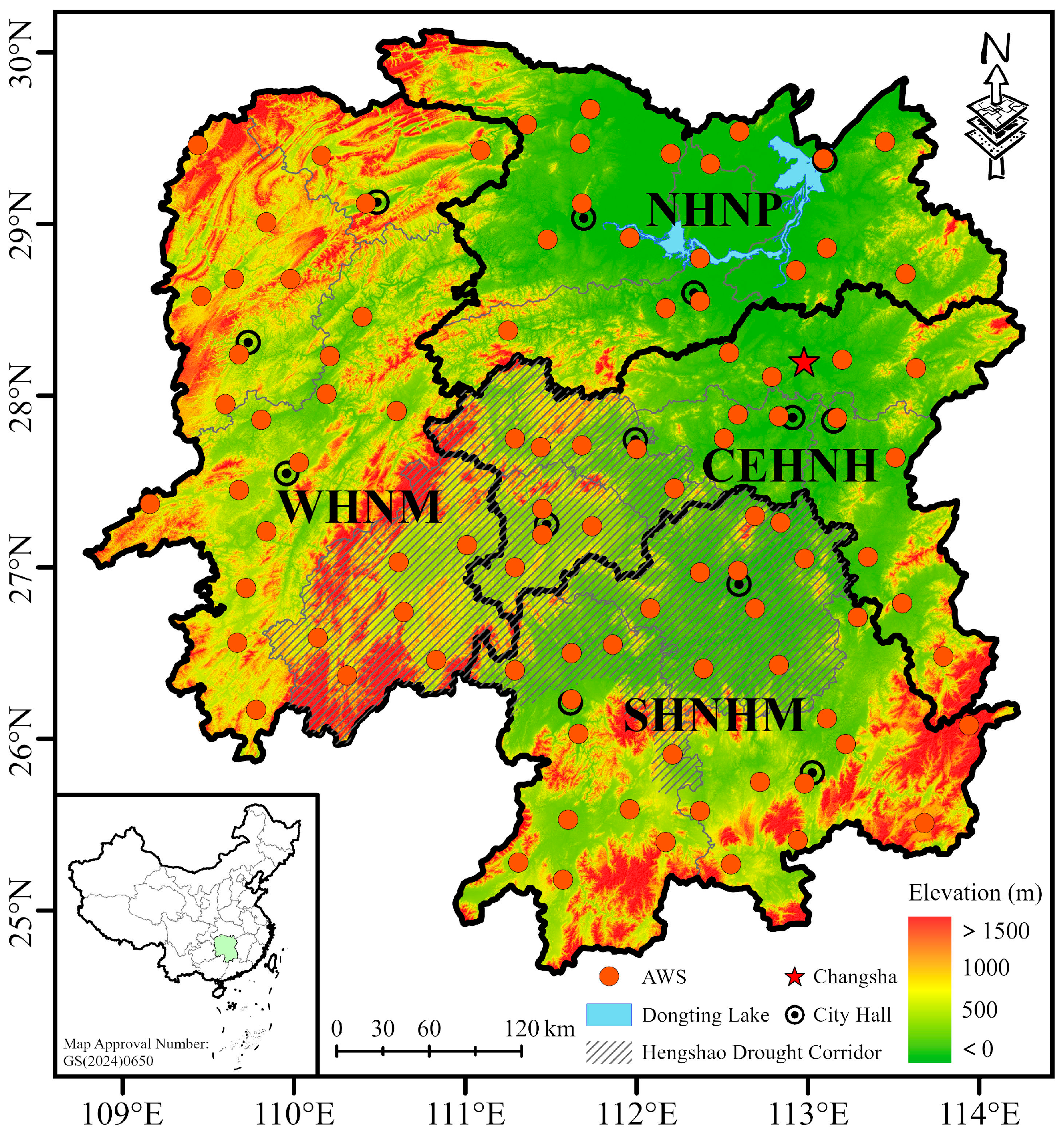
Hunan Province (24°38’–30°08’ N, 108°47’–114°15’ E) is located in the central-southern region of China, along the southern bank of the middle Yangtze River. The province is bordered by mountains on three sides, exhibiting complex topography and landforms that primarily consist of mountainous and hilly terrain. This terrain gradually transitions to hills and flat land in the central and northern regions, forming an asymmetrical horseshoe shape that opens to the northeast from the southeast, south, and west (Figure 1). Hunan Province experiences a typical subtropical monsoon humid climate, characterized by abundant precipitation that is unevenly distributed in both time and space. The combined effects of irregular rainfall and high temperatures lead to the occurrence of drought almost annually.
To analyze the differences in VPD across different geographical regions of Hunan Province, this study divides the entire province into four regions based on topography, landforms, and climatic conditions, referencing the work of Long [19]: the Northern Hunan Plain Region (NHNP), the Central and Eastern Hunan Hilly Region (CEHNH), the Southern Hunan Hilly and Mountainous Region (SHNHM), and the Western Hunan Mountainous Region (WHNM).

2.2. Data Source

The Auto Weather Station (AWS) data for daily maximum temperature ( T m a x ), minimum temperature ( T m i n ), average daily temperature ( T a v g ), relative humidity (RH), and precipitation (PRE) from 97 ground meteorological stations in Hunan Province from 2020 to 2022 were collected from the China Meteorological Data Network (http://data.cma.cn (accessed on 10 December 2025)). The data from these stations have undergone quality control by the China Meteorological Administration (CMA), which included: (1) spatial interpolation from three adjacent stations for days with >5% missing values in any single variable; (2) exclusion of data segments with consecutive missing values exceeding 7 days; and (3) outlier detection using the boxplot method with validation against synchronous neighboring station records and weather system logs. Furthermore, to analyze the seasonal variation in VPD, the meteorological seasonal classification standard was employed, categorizing the year into four seasons: March to May as spring, June to August as summer, September to November as autumn, and December to February of the following year as winter.

2.3. Method

The 2020–2022 study period, though shorter than the traditional 10–20 year trend analysis, is justified by its research objectives. Despite being only three years in duration, the data collected from 97 stations at a daily resolution provides a sufficient basis for analysis. This timeframe captures Hunan’s extreme 2022 drought, which is the most severe meteorological drought since 1961 [20]. This allows the study to analyze the dynamic characteristics of VPD under extreme conditions. Furthermore, the BEAST algorithm specializes in abrupt change rather than long-term trends, and this study focuses on recent extreme events, aligning with the core objective of improving real-time agricultural drought early warning.

2.3.1. VPD Calculation

VPD is defined as the difference between the saturated vapor pressure ( e s ) and the actual vapor pressure ( e a ) at a specific air temperature. The VPD was calculated at daily, ten-day, and monthly scales for each of the 97 stations using the following standard meteorological formulae, with distinct roles for each scale. Daily VPD data are input for BEAST change point detection to capture high-frequency abrupt changes, while ten-day and monthly VPD scales are used for spatiotemporal pattern analysis and agricultural drought risk assessment across crop growth stages.
The monthly average VPD (kPa) was calculated using Equation (1):
V P D = e s e a
In Equation (1), e s represents the saturated vapor pressure (kPa), calculated as the mean of the saturation vapor pressures at the daily T m a x and T m i n over the month. This approach accounts for the diurnal temperature cycle, providing a more representative value than using a single mean temperature; e a represents the actual vapor pressure (kPa), which is the partial pressure of water vapor in the atmosphere. It can be derived from RH (%) and the saturation vapor pressure:
e a = e s R H 100
The e s at a specific temperature T (°C) was calculated using the widely adopted Tetens formula [21], which provides a highly accurate empirical relation. The saturation vapor pressure for daily T m a x and T m i n was calculated separately using Equation (3):
e s T = 0.6108 exp 17.27 T T + 237.3
In Equation (3), e s ( T ) is the saturation vapor pressure (kPa) at temperature T ; T is the air temperature (°C), which can be the daily T m a x or the daily T m i n for the purposes of this calculation; exp is the exponential function.

2.3.2. Bayesian Estimator of Abrupt Change, Seasonality, and Trend

The BEAST is an algorithm developed for the decomposition of time series and the detection of change points, grounded in the principles of Bayesian model averaging [22]. Its fundamental objective is to achieve a joint inference of the trend ( T t ), seasonality ( S t ), and abrupt change points within a time series, while simultaneously quantifying the uncertainty associated with each estimated component. This approach offers several key advantages over traditional decomposition and change-point detection methods: First, it does not require the user to pre-specify the number or location of change points, as they are treated as random variables to be inferred from the data. Second, it provides a full posterior distribution for all model parameters, including the occurrence probability of change points, thereby offering a probabilistic measure of detection certainty. Furthermore, it robustly handles missing data and irregular sampling intervals. Finally, it effectively models complex, non-stationary time series featuring nonlinear trends and time-varying seasonality. Mathematically, BEAST decomposes the time series y t into Equation (4):
y t = T t + S t + ϵ t
T t represents the piecewise polynomial trend of the segmented regression, which reflects the nonlinear trend of the piecewise polynomial fitting. The positions of the change points τ j , the number of change points m t , the order k t , and the jump magnitude Δ j are all treated as random variables that follow a predefined prior distribution. S ( t ) denotes the seasonal periodic component, which can be characterized by harmonic models, non-parametric basis functions, or singular value decomposition basis functions. ϵ ( t ) ~ N ( 0 , σ 2 ) represents the Gaussian noise term, which is independent of the sudden disturbances in the trend and seasonality.
The inference in BEAST is conducted within a Bayesian framework. This study adopts the following priors and settings, which align with the recommendations of the algorithm developers and have been adjusted to meet the analytical needs of daily-scale VPD data. A prior probability of 5% is selected to regulate the global change point density, a value suitable for daily-scale data that mitigates excessive false positive change points resulting from frequent data fluctuations; the number of change points is limited to 1–10 to prevent overfitting, a range determined based on the climatic characteristics of Hunan Province, where VPD variations throughout the year are primarily related to seasonal transitions and extreme weather events, typically featuring 2 to 3 key change points annually. Additionally, a sensitivity analysis was conducted to confirm the robustness of the results. When parameters were adjusted to permit 1–20 change points and prior probabilities ranging from 3% to 7%, the posterior probability changes for core change points remained below 5%, indicating that the final results are not significantly influenced by minor parameter adjustments. Given the strong annual cycle in meteorological data, a harmonic function with a fundamental period of 365 days was chosen to represent the seasonal component, with an identical 1–10 change-point range. The temporal resolution was explicitly specified as a daily scale, while the trend polynomial order was automatically detected by the algorithm. Markov Chain Monte Carlo (MCMC) sampling was configured with 20,000 iterations, including a 2000-iteration burn-in period, and a fixed random seed to ensure reproducibility.
All computations were performed by calling the R package Rbeast via its R interface within the Python 3.12 software environment. This approach leveraged Python for data preprocessing and result visualization, while the core change point detection algorithm relied on the R implementation of Rbeast. All detected mutation points are retained for subsequent analysis, and the posterior probability associated with each change point serves solely as an indicator of the confidence level for that specific event.

3. Results

3.1. VPD Spatiotemporal Distribution

3.1.1. Spatial Distribution

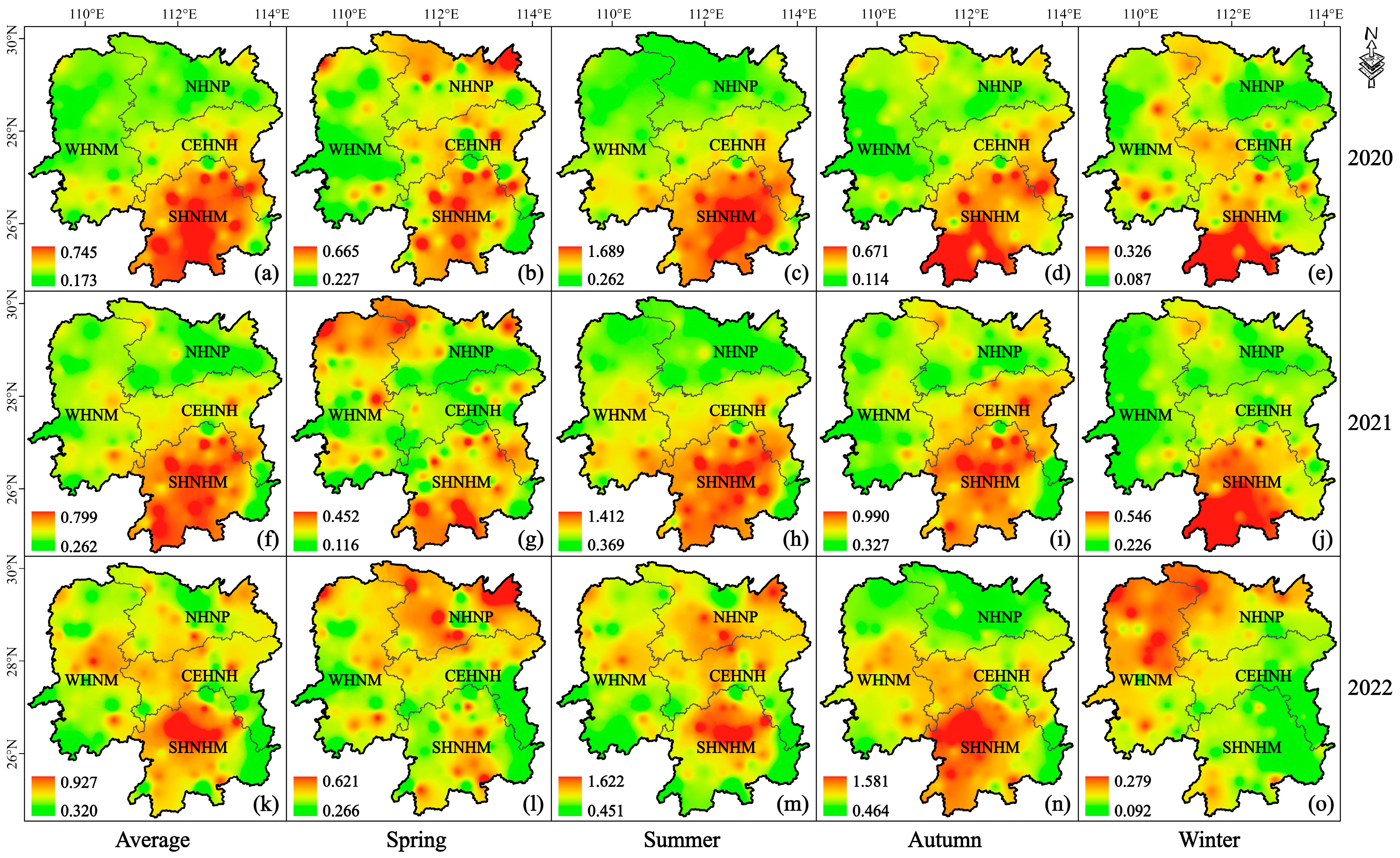
This study first employs the global Moran’s I index to determine whether the VPD in Hunan Province exhibits spatial clustering. The calculated Moran’s I values for the study area in 2020, 2021, and 2022 are 0.56, 0.48, and 0.24, respectively, all of which pass the significance test at the p < 0.01 level, indicating a stable positive spatial autocorrelation of VPD among the various stations in Hunan Province. Based on the high spatial dependence characteristics of VPD similarity among neighboring stations, the inverse distance weighting interpolation method can be used for spatial analysis (Figure 2).
Figure 2a,f,k illustrates that the annual average VPD in Hunan Province has increased annually, exhibiting an overall spatial distribution pattern of “higher in the south and lower in the north, higher in the east and lower in the west.” Notably, the spatial distribution of VPD during the summer and autumn seasons closely resembles the annual average pattern, particularly in summer. Although temperatures decline in autumn, the air remains relatively dry as it transitions from summer to winter, leading to VPD values that are second only to those in summer. In spring, low-value areas are predominantly distributed in the NHNP Luoxiao Mountains and the Wuling Mountains within the WHNM, which is associated with the increase in local precipitation caused by topographic uplift [23]. Precipitation influences changes in RH [24], which subsequently affects VPD. The high-value areas are relatively dispersed, primarily concentrated along the edges of the Dongting Lake Plain in the NHNP and in the hilly region of the SHNHM. The overall VPD values in winter across the province are relatively low, reflecting the climatic characteristics of regions with high atmospheric humidity and weak vapor pressure deficit during the winter season.
Notably, the spatial pattern intensified dramatically in 2022 (Figure 2k–o). This anomalous expansion of the high-VPD area is a direct spatial signature of the compound drought-heatwave event that occurred in 2022 [25]. The extreme values clustered in the SHNHM align with the known “Hengshao Drought Corridor” (see Figure 1)—a characteristic drought hotspot in central-southern Hunan, geographically covering the entire Hengyang, Shaoyang and Loudi cities, along with the northern hilly areas of Yongzhou. Situated on the leeward side of the Nanling Mountains, this region is long-controlled by the Western Pacific Subtropical High (WPSH) in summer, resulting in low precipitation and high evaporation, forming a climatic background of frequent droughts [26]. The convergence of high temperature and reduced moisture advection, exacerbated by the anomalous westward extension of the WPSH, transformed this region into a core area of agricultural drought risk [27].

3.1.2. Temporal Distribution

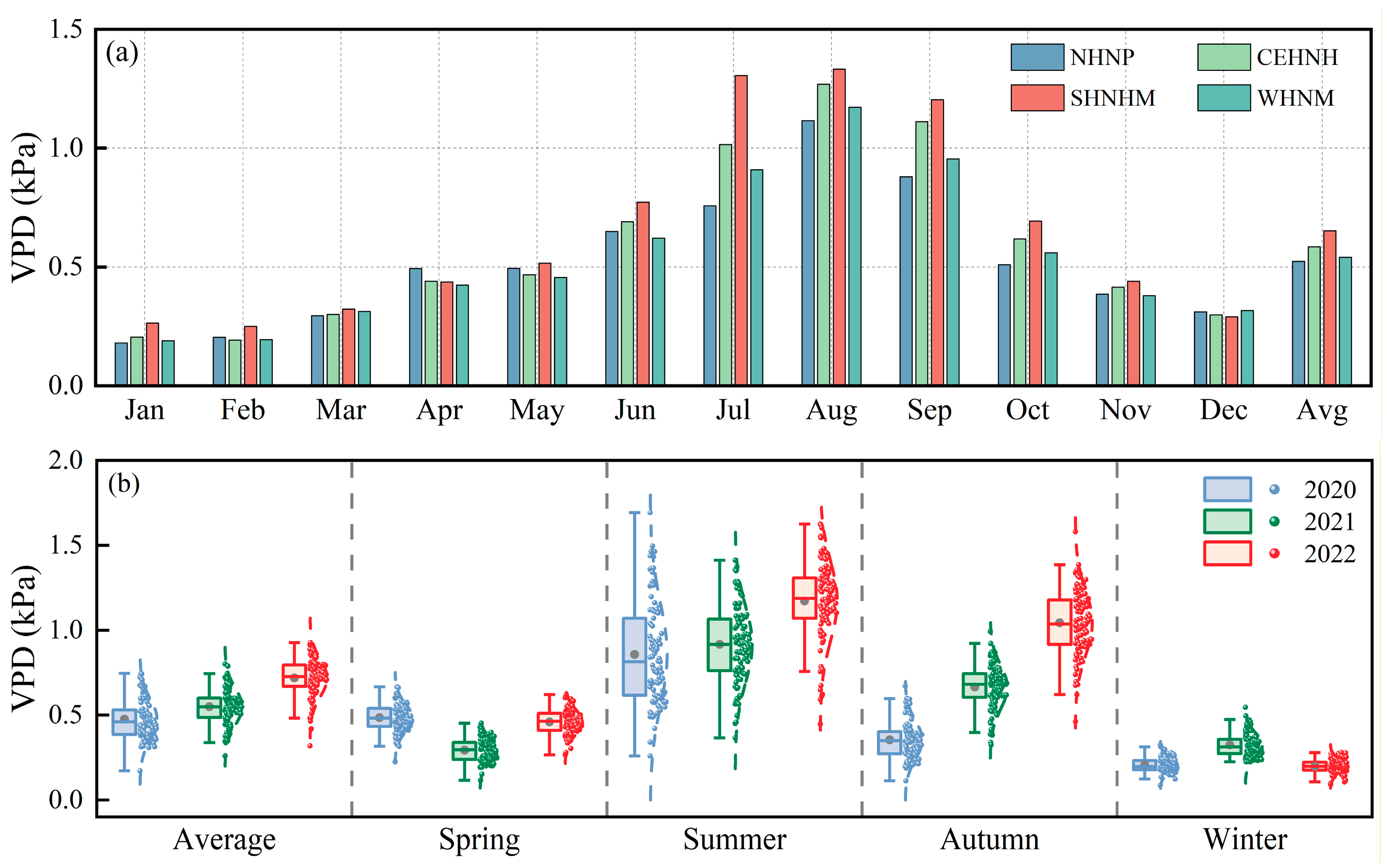
The temporal evolution of VPD across the four regions (Figure 3a) exhibits expected seasonal synchrony. The unanimous peak in August across all regions underscores the dominance of the summer monsoon retreat and the zenith of WPSH influence, which simultaneously elevates temperature and suppresses precipitation.
The amplitude of annual variation reveals more complex spatial dynamics. The SHNHM, exhibiting the largest range (1.082 kPa), is located on the leeward side of the Nanling Mountains, predisposing it to foehn-like effects during persistent southerly winds, whereby adiabatic warming further depresses relative humidity [28]. In contrast, the NHNP demonstrates the most moderate annual range (0.934 kPa). The Dongting Lake’s high thermal inertia and continuous evapotranspiration modulate near-surface humidity, effectively buffering the amplifying effect of temperature increases on VPD [29]. This temporal stability suggests that the NHNP may exhibit inherent resilience to short-term drought, though it remains vulnerable to hydrological drought due to its dependence on lake water resources.
Overall, the annual average VPD exhibits a sharp increase during the 2020–2022 period, particularly in 2022, specifically increasing from 0.48 ± 0.12 kPa in 2020 to 0.55 ± 0.11 kPa in 2021 (+14.6%), and subsequently rising to 0.72 ± 0.11 kPa in 2022 (+30.9%) (Figure 3b), this upward trend within the three-year period reflects rapid VPD intensification during recent extreme climate conditions. It is consistent with findings at global [30], national [31], and regional scales [32], indicating that the intensification of drought has a universal characteristic across different scales. And from a seasonal perspective, there is a decreasing trend of “summer > autumn > spring > winter.” The summer and autumn of 2022 were exceptionally dry, with high temperatures lasting longer than historical records [33]. The boxplot for Autumn 2022 is particularly alarming, showing a near-complete separation from the 2020 distribution, with the median VPD at monitoring sites in 2022 (1.04 kPa) reaching 2.97 times that of 2020 (0.35 kPa). The delayed retreat of the subtropical high in 2022 extended the duration of high temperatures, resulting in the continuation of extremely high VPD characteristics across seasons [34]. This suggests that the seasonal climate characteristics do not follow a simple linear trend.

3.2. Detection of Abrupt Changes in Time Series

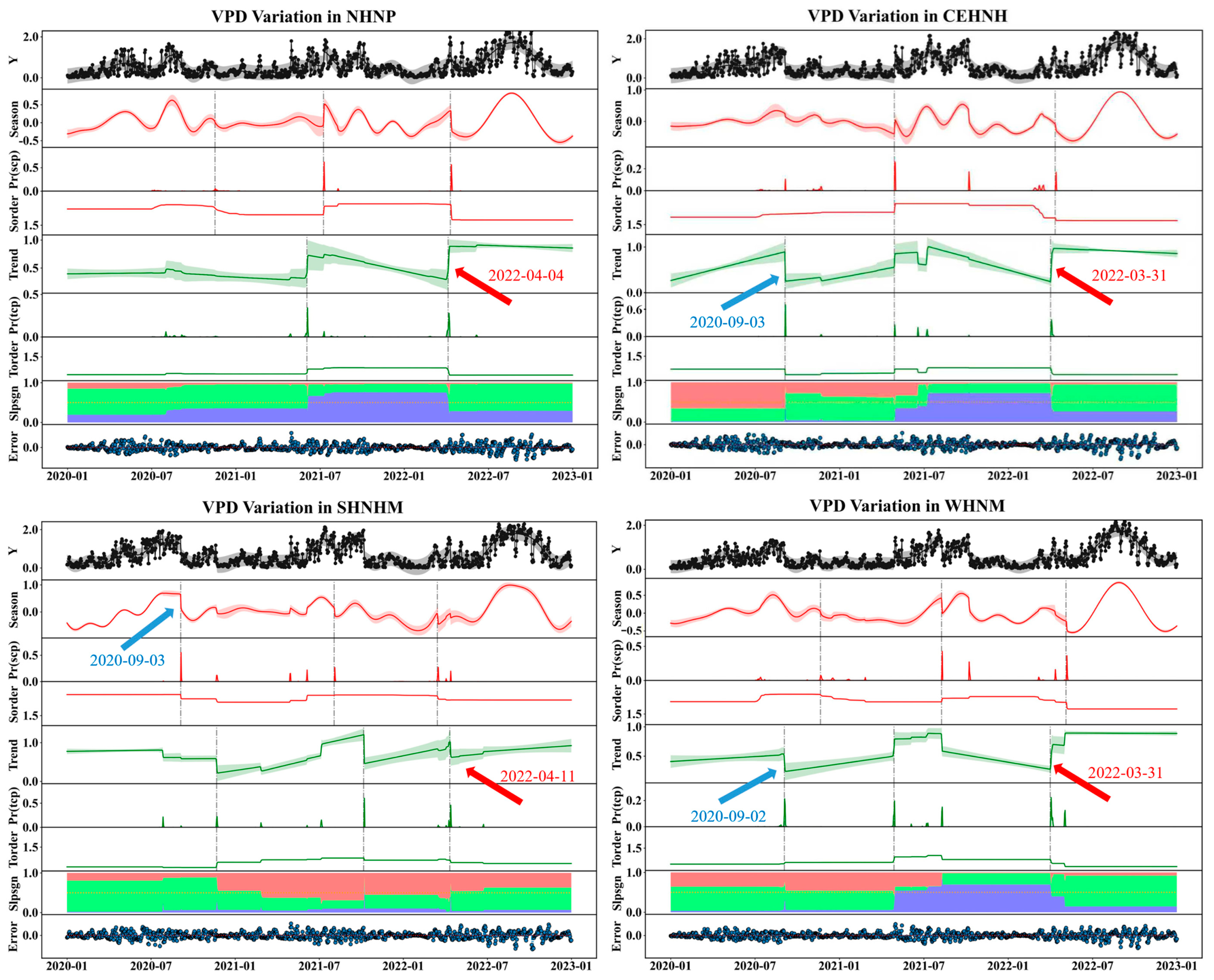
The results of the BEAST decomposition (Figure 4 and Table 1) have a core advantage over traditional trend analysis in that they can accurately pinpoint the specific time of ecological change and quantify its statistical credibility (Pr value), providing a unique perspective for revealing the mechanisms of sudden drought. For instance, high-confidence (Pr > 0.95) climate trend change points were detected on 4 April 2022 (NHNP region) and 11 April 2022 (SHNHM region), which coincide significantly with the critical period for early rice transplanting in Hunan Province (early April). Meteorological observations indicate that within seven days after the change points, up to 92% of meteorological stations in the province reported no effective precipitation; focusing on the NHNP and SHNHM regions, 39% of stations recorded a VPD exceeding 1.5 kPa during the same period. This coincided with the early rice transplanting and initial growth stage, where crops relied on pre-monsoon precipitation and suitable VPD conditions but faced exacerbated atmospheric drought due to a combination of insufficient rainfall and high VPD. According to the “Statistical Bulletin of National Economic and Social Development of Hunan Province in 2022” [18], the early rice yield that year decreased by 0.3% (approximately 25,000 tons) compared to the previous year. This shift event is mechanistically linked to the anomalous early strengthening of the WPSH [35]. Further exacerbating the drought conditions, the average temperature from April to August 2022 was significantly higher than the historical average, and Dongting Lake entered the dry season 3–4 months earlier than usual [36], leading to increased irrigation demand for early-season crops and heightened risk of drought stress. While the absolute yield decline appears small, its occurrence precisely within the period of detected atmospheric extremes demonstrates the tangible coupling between meteorological and agricultural drought. Though the modest economic impact reflects effective mitigation measures and underscores that statistical significance in VPD changes does not always equate to large agricultural losses, given regional adaptive capacity.
Similarly, the abrupt changes in VPD in the CEHNH region (3 September 2020) and the WHNM region (2 September 2020) coincide with the heading stage of late rice, and the SHNHM region detected a unique high-probability seasonal abrupt change point in the autumn (3 September 2020). Only the NHNP region did not exhibit significant trends or seasonal changes during this period. In-depth analysis revealed a declining trend in VPD at the point of change, and meteorological observation data indicated that the precipitation in the CEHNH and WHNM regions was less than 1 mm before the change point, but significant rainfall replenishment occurred after 2 September, alleviating water stress on crops during the heading stage.
Further analysis of the temporal characteristics of abrupt changes in the east and west shows that the spring change point in the WHNM region (4 May 2022) is significantly later than in other regions. This anomaly may be closely related to the topographic blocking effect, where the Xuefeng Mountains obstruct the southeast monsoon, causing a delay in the arrival of moist airflow to the western Hunan region [37]. In summary, there are differences in the timing of abrupt changes among the four regions (with a maximum difference of 25 days), and these changes generally present a gradient from east to west and from south to north, reflecting the spatial propagation path of drought risk, which can facilitate the advance scheduling of irrigation resources based on the time differences. Notably, change points advanced consistently across regions from 2020 to 2022, but this trend requires validation with longer-term data.

4. Discussion

4.1. The Impact Factor of VPD Changes

According to the calculation principle of VPD, its variation is determined by the difference between saturated vapor pressure (dominated by air temperature) and actual vapor pressure (influenced by RH). Therefore, in analyzing the key meteorological factors affecting VPD changes in Hunan Province, only T a v g , T m a x , T m i n , RH, and PRE are considered.
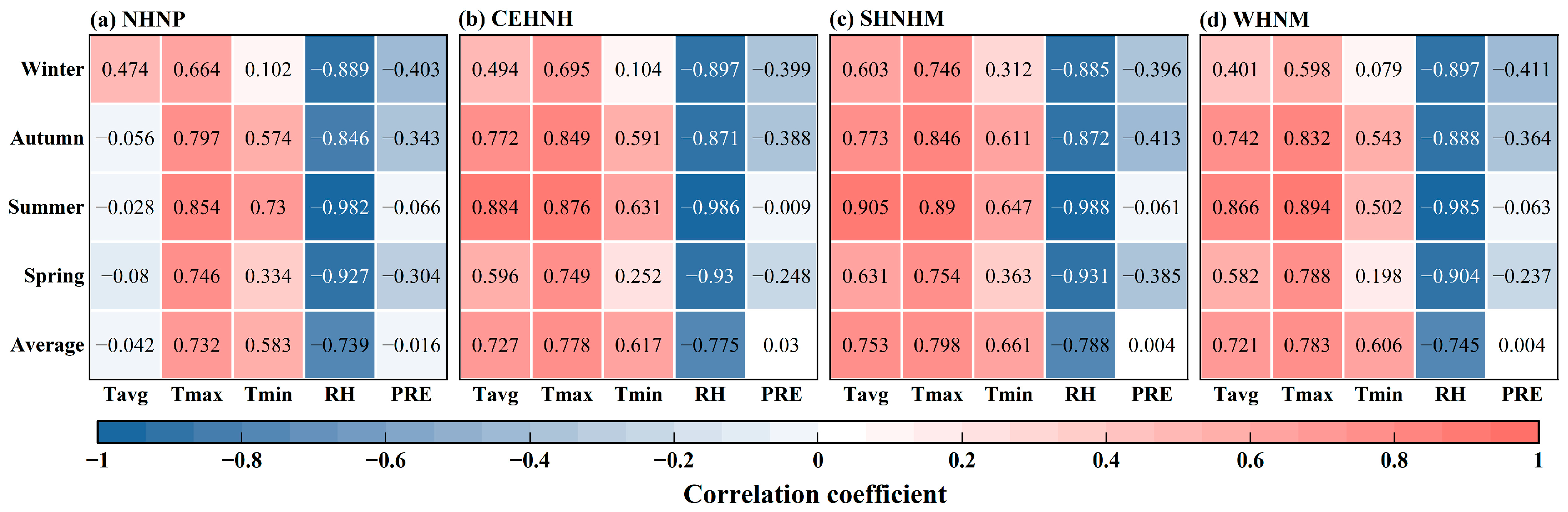
Pearson correlation analysis (Figure 5) reveals that across Hunan’s four regions, VPD is predominantly positively correlated with temperature factors on both annual and seasonal scales, with the strongest positive correlation observed with T m a x . VPD exhibits a significant negative correlation with RH, while the association with PRE is relatively weak (|r| < 0.42). Notably, T a v g and T m i n are only strongly correlated with VPD during the summer and autumn seasons (with the exception of the NHNP), particularly in summer. This phenomenon is mainly due to the small diurnal temperature range in summer, which fosters a strong coupling among temperature factors. In the NHNP, this characteristic is comparatively weaker due to the moderating influence of Dongting Lake.
These robust correlations highlight T m a x ’s dominant role in VPD intensification. However, it should be noted that the predictive capability of these relationships is constrained by the study’s observation period and regional specificity of station data. While the high-density network (97 stations) ensures spatial representation, inherent uncertainties in meteorological measurements and localized microclimate effects may influence absolute correlation values.
To further explore the extent to which key meteorological factors influence VPD changes, the temperature factor and relative humidity with the highest correlation coefficients to VPD in each region were selected as the main independent variables. Multiple linear regression was used to calculate the relative contribution rates, with results shown in Table 2 (all regression models passed the significance test at p < 0.01, R2 ≥ 0.86). The dominance of T m a x as the primary annual-scale driver (57.1–60.6% contribution) demonstrates that the rising VPD in Hunan essentially reflects warming-induced atmospheric demand. This is a crucial distinction from regions where declining humidity may be the primary driver. On a seasonal scale, RH was the dominant factor in all regions during spring; its control is likely a legacy of winter precipitation and cloud cover. The subsequent takeover by T m a x in autumn and winter indicates that in the absence of the summer monsoon, temperature becomes the active controller of aridity. This has profound implications for irrigation scheduling: water management in autumn should be more responsive to temperature forecasts than to rainfall predictions. However, the summer regional dichotomy is particularly revealing. The dominance of RH in the lake-adjacent NHNP and mountainous WHNM points to the localized moderating role of water bodies and complex terrain on moisture availability. In contrast, the dominance of T a v g (rather than T m a x ) in the CEHNH and SHNHM highlights these inland hilly regions as thermodynamically sensitive zones. This dichotomy necessitates a dual-threshold early warning system: one trigger based on RH forecasts for the north and west, and another based on extreme temperature forecasts for the south and east.

4.2. Agricultural Risk Assessment of Extreme VPD Events

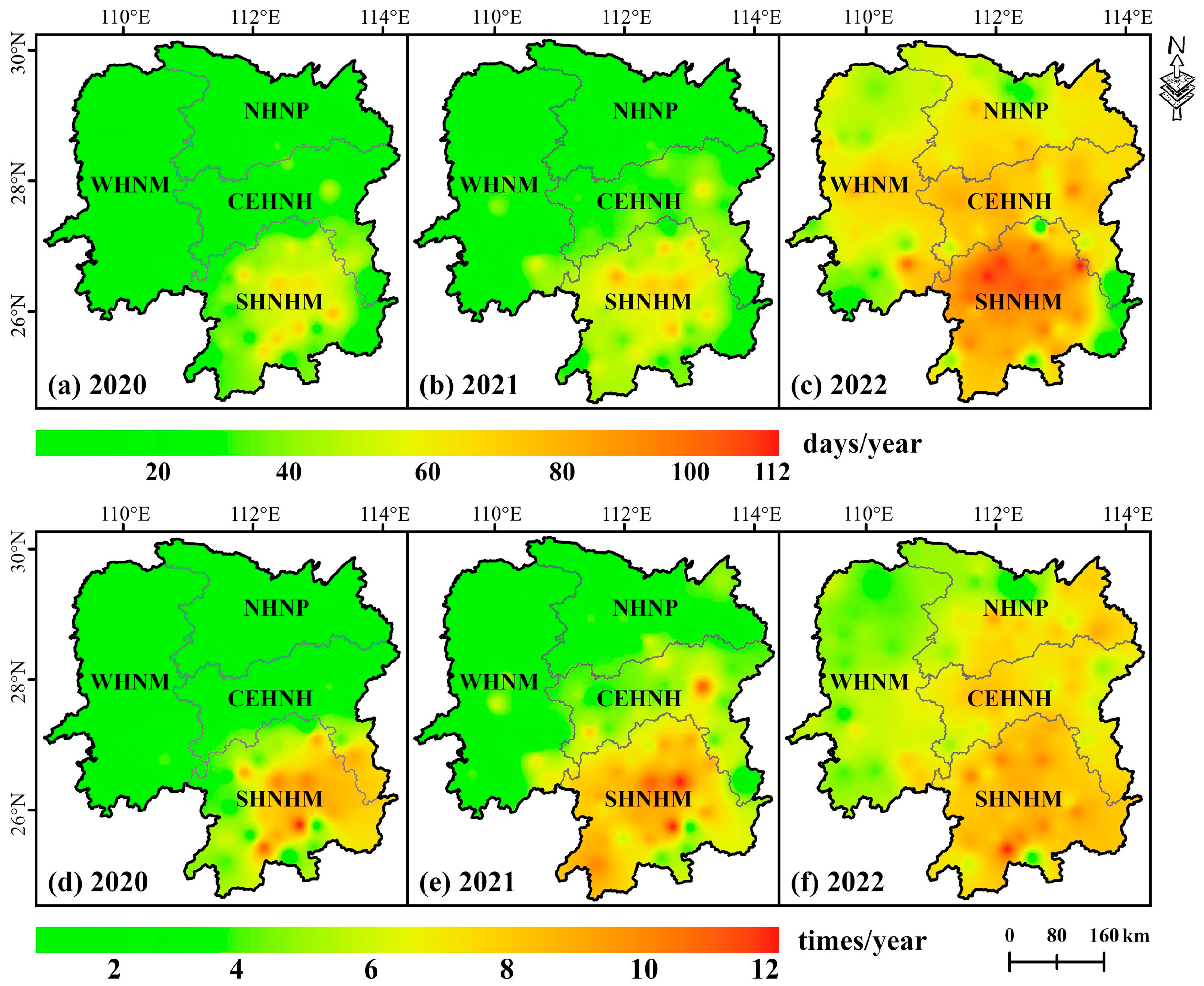
Research has shown that the optimal VPD range for the Earth is 0.45 to 1.24 kPa, while the suitable VPD range for plant growth is 0.80 to 0.95 kPa [38]. The transpiration rate of leaves tends to stabilize at a VPD of approximately 1.5 kPa [39]. Therefore, this study sets the extreme value of VPD at 1.5 kPa. The number of days each year with VPD > 1.5 kPa was statistically analyzed for 97 sites, and the results were plotted as a spatial distribution map (Figure 6a–c). Over three years, the number of days with VPD > 1.5 kPa has significantly increased year by year, with the pattern in 2021 being similar to that of 2020, while 2022 saw a dramatic increase, covering the widest area of drought.
During the growth and development of crops, a single day of extreme VPD may not directly impact crop growth. However, if extreme VPD persists for several consecutive days, it can cause the crop transpiration rate to continuously exceed the root water uptake capacity, resulting in cumulative harm to agricultural production and forest ecosystems that far exceeds that of a single day of high VPD. Research has shown that extreme VPD conditions lasting three days or longer can significantly affect crop growth [40]. Based on this, this study defines an extreme VPD event as “VPD > 1.5 kPa lasting for more than 3 consecutive days”. Analysis of the annual frequency of extreme events at various AWS (Figure 6d–f) reveals a clear increasing trend in recent years: in 2020, 237 extreme events occurred at 59 stations; this increased to 407 events at 81 stations in 2021, and further rose to 618 events at 92 stations in 2022.
The escalation in the spatial extent and frequency of extreme VPD events (Figure 6) quantifies the transitioning of Hunan’s climate into a regime characterized by more frequent and intense agricultural drought stress. More critically, the near-universal coverage in 2022 (92 out of 97 stations) indicates that the 2022 drought was a spatially coherent province-wide event, leaving virtually no room for within-province climate refuge. This represents a systemic risk to the entire agricultural sector of Hunan.
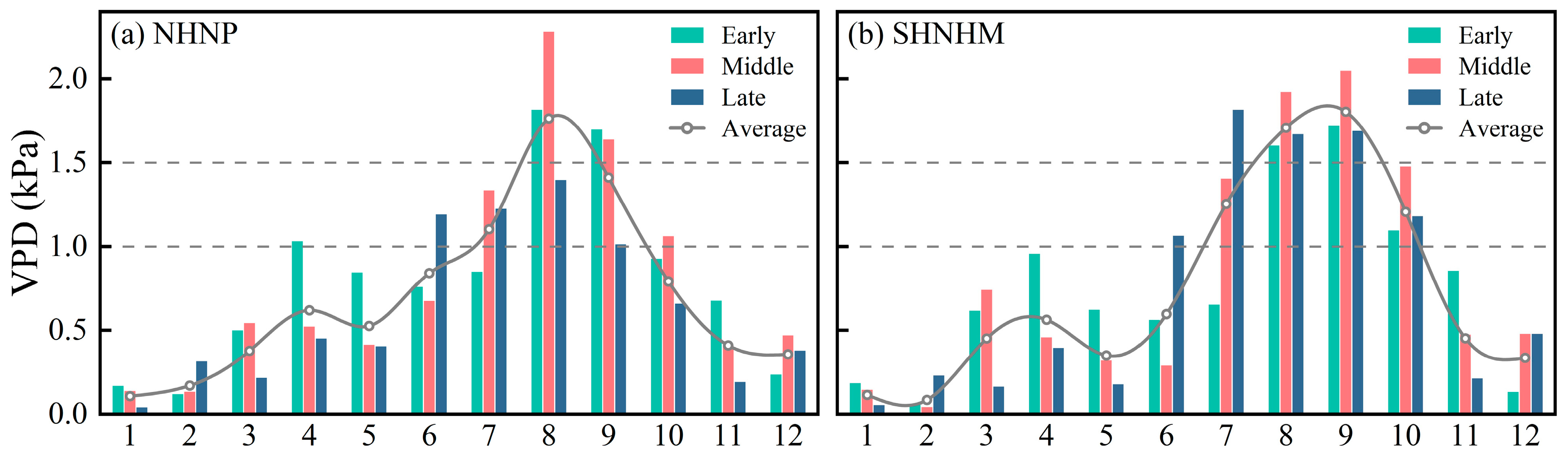
As an agricultural province, the research on agricultural production in Hunan needs to closely align with the growth rhythms of crops and agricultural cycles. Given the unique hydrological control characteristics of the Dongting Lake Plain in the NHNP and the topographical sensitivity of the SHNHM, this study further focuses on the statistical analysis of the distribution of VPD on a ten-day scale in the northern and southern regions of Hunan (Figure 7). Special attention should be paid to the peak periods when VPD reaches 2.28 ± 0.17 kPa in mid-August for NHNP and 2.05 ± 0.15 kPa in mid-September for SHNHM, the latter coinciding with the late growth stage of double-cropping rice (heading and flowering stage), necessitating the assurance of water supply to extend the growth period. From the perspective of critical growth stages of double-cropping rice, NHNP should be cautious of the increase in VPD during the early rice booting stage (late June), while SHNHM should focus on the VPD peak during the late rice heading stage (mid-September). In conjunction with the results of the BEAST change point test, considering that the VPD experiences an upward shift at the beginning of April with a value of approximately 1 kPa, it is recommended to set 1 kPa as the VPD early warning threshold for critical agricultural periods in the northern and southern regions of Hunan. This threshold is near the upper limit of the optimal VPD range for crop growth (0.8–0.95 kPa) [38], balancing early warning sensitivity with operational practicality in agricultural management.

4.3. Mechanisms of the Occurrence of Abnormally High VPD in 2022

The analysis indicates that the average VPD in Hunan Province exhibited a pronounced upward trend from 2020 to 2022, with the VPD in 2022 significantly surpassing that of previous years. This anomaly is primarily attributed to an exceptionally rare and intense heatwave event that occurred in the Yangtze River Basin in 2022, representing the most severe meteorological and hydrological drought since comprehensive measurement data became available in 1951. Hunan Province, as a severely affected region, experienced particularly pronounced impacts due to its geographic location and climatic sensitivity.
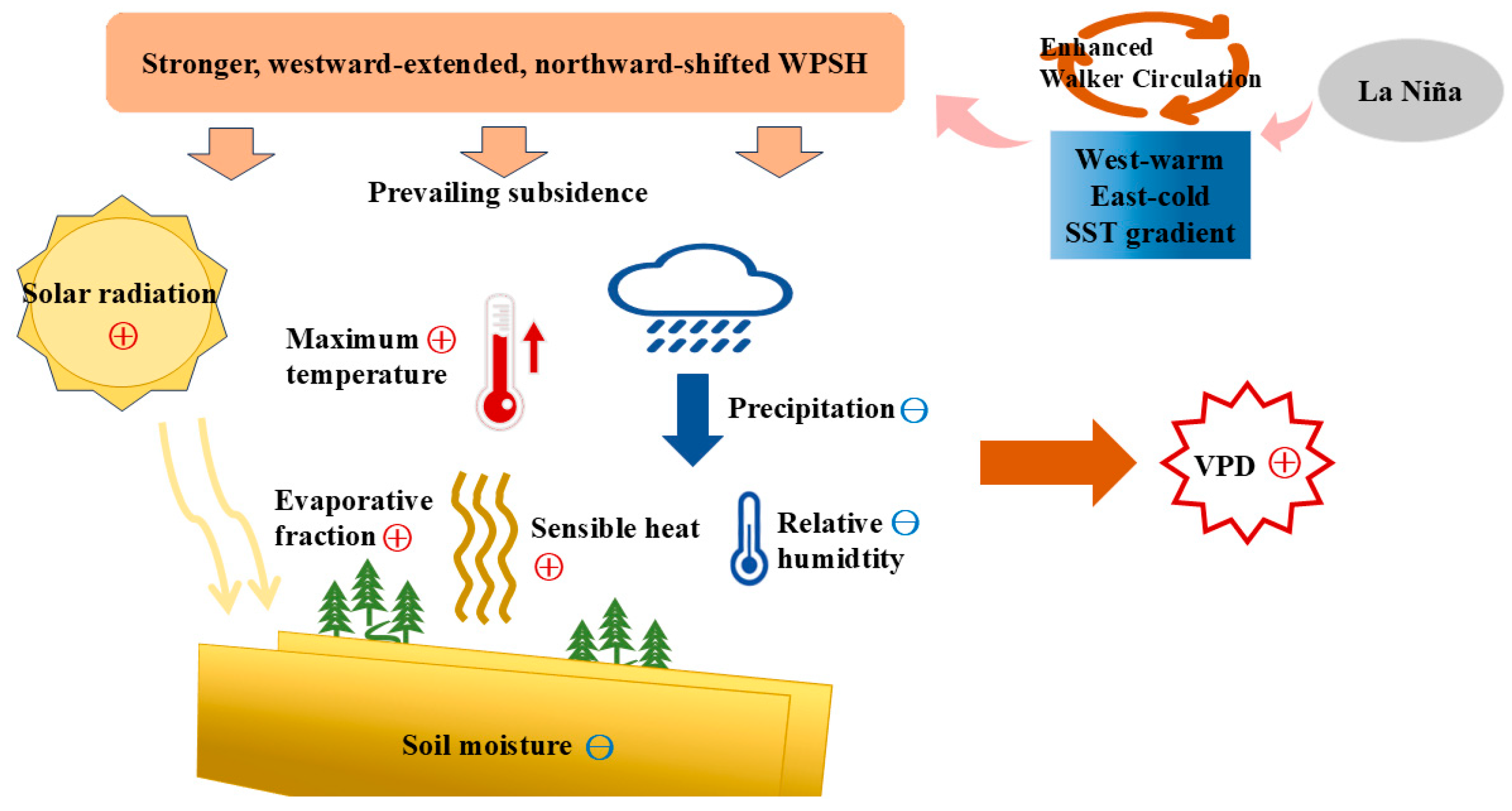
The three-year period consistently occurred under La Niña conditions, but only 2022 witnessed record-breaking extreme high temperatures. The fundamental reason lies in the exceptional extremity of the WPSH anomaly [41]. Compared to typical high-temperature years, the subsidence motion in 2022 was significantly intensified, with the average vertical subsidence velocity at 500 hPa over the middle and lower reaches of the Yangtze River reaching 3.2 × 10⁻² Pa/s, whereas it was only 0.7 × 10⁻² Pa/s in typical high-temperature years [42]. Under these conditions, the enhanced East Asian summer monsoon transported warm and moist air toward North China [43], leaving Hunan Province entirely under the control of the WPSH. The prevailing subsidence suppressed convective activity, resulting in a sharp reduction in precipitation, which was approximately 5% below the climatological mean [44]. Under clear sky conditions, the solar shortwave radiation reaching the surface was higher, leading to significant sensible heat heating and a marked increase in temperature. Elevated temperatures accelerated the exponential increase in saturated vapor pressure, while precipitation deficits and reduced relative humidity limited the replenishment of actual vapor pressure, leading to abnormally high VPD.
Additionally, it is essential to focus on the physiological responses of plants to increased VPD and the associated soil-atmosphere feedback [45]. As VPD rises, vegetation transpiration intensifies [46], leading to a decrease in soil moisture [47], which results in more net solar radiation energy being converted into sensible heat (rather than latent heat) [48], further warming the air and exacerbating local temperature increases, creating a self-reinforcing positive feedback loop with the rise in VPD (Figure 8).

4.4. Drought Early Warning Based on VPD

Constrained by the 3-year data period, the advancing trend of VPD change points requires validation with longer-term observations; however, this study provides a novel perspective for short-term agricultural drought response. The spatiotemporal patterns and abrupt change characteristics of VPD identified in this study provide a scientific basis for improving agricultural drought early warning systems in Hunan Province. The earlier shift in abrupt change points—particularly in the NHNP and CEHNH regions—implies a potential advance in the timing of seasonal drought onset, which could affect crop phenology and water demand schedules. For instance, the detection of abrupt VPD increases in April—a key period for rice transplanting and early growth [49], suggests that farmers may need to adjust irrigation strategies to avoid peak water stress periods. The high VPD values observed in the SHNHM region, especially in Qiyang and Hengyang, highlight areas where adaptive measures such as drought-resistant crop varieties, mulching, and optimized irrigation schedules are urgently needed [50].
Furthermore, the dominance of daily T m a x as the primary driver of VPD increase underscores the importance of temperature monitoring and prediction in drought early warning.

5. Conclusions

This study systematically investigated the spatiotemporal dynamics of VPD and its implications for agricultural drought early warning in Hunan Province by integrating high-resolution meteorological data (2020–2022) with the BEAST. Key findings demonstrate that:
(1)
The VPD in Hunan Province exhibits a spatial distribution characteristic of “higher in the south/east and lower in the north/west.” In 2022, influenced by a compound high-temperature drought event, the annual average VPD rose to 0.72 ± 0.11 kPa. And summer and autumn are identified as high-risk periods for drought.
(2)
The BEAST algorithm accurately identified the change timing of VPD, such as the key change point during the early rice transplanting period in April 2022. The change points exhibit a spatiotemporal gradient characteristic of “from east to west and from south to north,” revealing the transmission path of drought risk and providing an important early warning window for irrigation scheduling by region and time period.
(3)
The changes in VPD are jointly regulated by temperature and humidity, with the T m a x being the dominant factor at the annual scale (contribution rate > 57%). At the seasonal scale, RH dominates in spring across the province, while summer shows regional differentiation—NHNP and WHNM are dominated by RH, whereas CEHNH and SHNHM are dominated by T a v g
(4)
In 2022, 92 meteorological stations in the province experienced extreme drought events (VPD > 1.5 kPa for 3 days). Considering the change characteristics of VPD in Hunan Province and the critical growth periods of double-crop rice, it is recommended to set VPD = 1 kPa as the agricultural drought warning threshold for the northern and southern regions to enhance drought risk prevention and control capabilities.
Critically, this research pioneers the application of the BEAST algorithm for detecting VPD abruptions at a provincial scale in the context of agricultural drought, leveraging dense station networks to overcome limitations of traditional linear-trend analyses in resolving abrupt transitions during extreme droughts. By translating climatic diagnostics into actionable agronomic practices, this study enhances preparedness for intensifying drought risks under climate change. It is important to acknowledge the limitations inherent in our dataset’s three-year timeframe. While sufficient for capturing rapid VPD escalations during recent extreme droughts, this limited duration constrains robust inferences regarding long-term climatic tendencies. Short-term data inherently struggle to encapsulate signals from decadal variability and low-frequency oscillations. Future work will focus on extending the temporal scope, incorporating multi-source model data such as CMIP projections to investigate VPD trajectories under diverse emission scenarios, specifically the Shared Socioeconomic Pathways (SSP) SSP1-2.6, SSP2-4.5, and SSP5-8.5, ultimately facilitating the development of a more proactive drought risk management framework.

Author Contributions

Conceptualization, J.L. and W.F.; methodology, W.F. and J.L.; software, W.F., S.M., W.G. and T.Z.; validation, W.F., L.Y. and B.Z.; formal analysis, W.F.; investigation, W.F.; resources, B.Z.; data Curation, W.F.; writing—Original Draft, W.F.; writing—Review and Editing, J.L., W.F., L.Y. and B.Z.; visualization, W.F., S.M., W.G. and T.Z.; supervision, J.L.; project administration, J.L.; funding acquisition, J.L. All authors have read and agreed to the published version of the manuscript.

Funding

This research was financially supported by the Research Foundation of the Department of Natural Resources of Hunan Province (No. 20230127DZ); and College Students’ Innovative Entrepreneurial Training Plan Program (No. 202510534027).

Data Availability Statement

The data presented in this study are available on request from the corresponding author.

Conflicts of Interest

The authors declare no conflicts of interest.

References

  1. Han, L.; Zhang, Q.; Zhang, Z.; Jia, J.; Wang, Y.; Huang, T.; Cheng, Y. Drought Area, Intensity and Frequency Changes in China under Climate Warming, 1961–2014. J. Arid Environ. 2021, 193, 104596. [Google Scholar] [CrossRef]
  2. Shukla, P.R.; Skeg, J.; Buendia, E.C.; Masson-Delmotte, V.; Pörtner, H.-O.; Roberts, D.C.; Zhai, P.; Slade, R.; Connors, S.; Diemen, S.; et al. (Eds.) Climate Change and Land: An IPCC Special Report on Climate Change, Desertification, Land Degradation, Sustainable Land Management, Food Security, and Greenhouse Gas Fluxes in Terrestrial Ecosystems; Cambridge University Press: Cambridge, UK, 2019. [Google Scholar]
  3. Ficklin, D.L.; Novick, K.A. Historic and Projected Changes in Vapor Pressure Deficit Suggest a Continental-Scale Drying of the United States Atmosphere. J. Geophys. Res. Atmos. 2017, 122, 2061–2079. [Google Scholar] [CrossRef]
  4. Cheng, M.; Zuo, Z.; Lin, Z.; You, Q.; Wang, H. The Decadal Abrupt Change in the Global Land Vapor Pressure Deficit. Sci. China Earth Sci. 2023, 66, 1521–1534. [Google Scholar] [CrossRef]
  5. López, J.; Way, D.A.; Sadok, W. Systemic Effects of Rising Atmospheric Vapor Pressure Deficit on Plant Physiology and Productivity. Glob. Change Biol. 2021, 27, 1704–1720. [Google Scholar] [CrossRef]
  6. Li, S.; Wang, G.; Chai, Y.; Miao, L.; Fiifi Tawia Hagan, D.; Sun, S.; Huang, J.; Su, B.; Jiang, T.; Chen, T.; et al. Increasing Vapor Pressure Deficit Accelerates Land Drying. J. Hydrol. 2023, 625, 130062. [Google Scholar] [CrossRef]
  7. Fletcher, A.L.; Sinclair, T.R.; Allen, L.H. Transpiration Responses to Vapor Pressure Deficit in Well Watered ‘Slow-Wilting’ and Commercial Soybean. Environ. Exp. Bot. 2007, 61, 145–151. [Google Scholar] [CrossRef]
  8. Mirabel, A.; Girardin, M.P.; Metsaranta, J.; Way, D.; Reich, P.B. Increasing Atmospheric Dryness Reduces Boreal Forest Tree Growth. Nat. Commun. 2023, 14, 6901. [Google Scholar] [CrossRef]
  9. Seager, R.; Hooks, A.; Williams, A.P.; Cook, B.; Nakamura, J.; Henderson, N. Climatology, Variability, and Trends in the U.S. Vapor Pressure Deficit, an Important Fire-Related Meteorological Quantity. J. Appl. Meteorol. Climatol. 2015, 54, 1121–1141. [Google Scholar] [CrossRef]
  10. Hsiao, J.; Swann, A.L.S.; Kim, S.-H. Maize Yield under a Changing Climate: The Hidden Role of Vapor Pressure Deficit. Agric. For. Meteorol. 2019, 279, 107692. [Google Scholar] [CrossRef]
  11. Zhao, F.; Wang, G.; Li, S.; Hagan, D.F.T.; Ullah, W. The Combined Effects of VPD and Soil Moisture on Historical Maize Yield and Prediction in China. Front. Environ. Sci. 2023, 11, 1117184. [Google Scholar] [CrossRef]
  12. Fang, Z.; Zhang, W.; Brandt, M.; Abdi, A.M.; Fensholt, R. Globally Increasing Atmospheric Aridity Over the 21st Century. Earths Future 2022, 10, e2022EF003019. [Google Scholar] [CrossRef]
  13. Dong, J.; Wu, L.; Zeng, W.; Xiao, X.; He, J. Analysis of Spatial-Temporal Trends and Causes of Vapor Pressure Deficit in China from 1961 to 2020. Atmos. Res. 2024, 299, 107199. [Google Scholar] [CrossRef]
  14. Zhao, A.; Li, Z.; Cheng, D. Temporal and Spatial Variation and Influencing Factors of Saturated Water Vapor Pressure Difference in the Hai River Basin. Acta Ecol. Sin. 2025, 45, 385–394. [Google Scholar] [CrossRef]
  15. Qin, H.; Tan, Y.; Shen, T.; Schaefer, D.A.; Chen, H.; Zhou, S.; Xu, Q.; Zhu, Y.; Cheng, J.; Zhao, G.; et al. Spatiotemporal Trends of Atmospheric Dryness during 1980–2021 in Yunnan, China. Front. For. Glob. Change 2024, 7, 1397028. [Google Scholar] [CrossRef]
  16. Wen, Q.; Tu, X.; Zhou, L.; Singh, V.P.; Chen, X.; Lin, K. Mutual-Information of Meteorological-Soil and Spatial Propagation: Agricultural Drought Assessment Based on Network Science. Ecol. Indic. 2025, 170, 113004. [Google Scholar] [CrossRef]
  17. Deng, C.; Zhang, L.; Xu, T.; Yang, S.; Guo, J.; Si, L.; Kang, R.; Kaufmann, H.J. An Integrated Drought Index (Vapor Pressure Deficit–Soil Moisture–Sun-Induced Chlorophyll Fluorescence Dryness Index, VMFDI) Based on Multisource Data and Its Applications in Agricultural Drought Management. Remote Sens. 2024, 16, 4666. [Google Scholar] [CrossRef]
  18. Hunan Provincial Bureau Statistics Statistical Bulletin on National Economic and Social Development of Hunan Province in 2022. Available online: https://tjj.hunan.gov.cn/hntj/m/tjgb_1/202303/t20230323_29289710.html (accessed on 29 October 2025).
  19. Long, Z.; Sun, G.; Huang, J.; Jiang, F.; Feng, Q.; Wu, Y. Characteristics and variations of soil fertility in cultivated land across different regions of Hunan Province in the past 40 years. Chin. J. Soil Fertil. 2024, 37–48. [Google Scholar] [CrossRef]
  20. Li, W.; Jiang, Z.; Li, L. Anthropogenic Influence on the Record-Breaking Compound Hot and Dry Event in Summer 2022 in the Yangtze River Basin in China. Bull. Am. Meteorol. Soc. 2023, 104, E1928–E1934. [Google Scholar] [CrossRef]
  21. Allen, R.G.; Pereira, L.S.; Raes, D.; Smith, M. (Eds.) Crop Evapotranspiration: Guidelines for Computing Crop Water Requirements; FAO irrigation and drainage paper; Food and Agriculture Organization of the United Nations: Rome, Italy, 1998; ISBN 978-92-5-104219-9.
  22. Zhao, K.; Wulder, M.A.; Hu, T.; Bright, R.; Wu, Q.; Qin, H.; Li, Y.; Toman, E.; Mallick, B.; Zhang, X.; et al. Detecting Change-Point, Trend, and Seasonality in Satellite Time Series Data to Track Abrupt Changes and Nonlinear Dynamics: A Bayesian Ensemble Algorithm. Remote Sens. Environ. 2019, 232, 111181. [Google Scholar] [CrossRef]
  23. Roe, G.H.; Montgomery, D.R.; Hallet, B. Orographic Precipitation and the Relief of Mountain Ranges. J. Geophys. Res. Solid Earth 2003, 108, 2315. [Google Scholar] [CrossRef]
  24. Auler, A.C.; Cássaro, F.A.M.; da Silva, V.O.; Pires, L.F. Evidence That High Temperatures and Intermediate Relative Humidity Might Favor the Spread of COVID-19 in Tropical Climate: A Case Study for the Most Affected Brazilian Cities. Sci. Total Environ. 2020, 729, 139090. [Google Scholar] [CrossRef] [PubMed]
  25. Ni, Y.; Qiu, B.; Miao, X.; Li, L.; Chen, J.; Tian, X.; Zhao, S.; Guo, W. Shift of Soil Moisture-Temperature Coupling Exacerbated 2022 Compound Hot-Dry Event in Eastern China. Environ. Res. Lett. 2024, 19, 014059. [Google Scholar] [CrossRef]
  26. Zhang, Z.; Fu, J.; Tang, W.; Liu, Y.; Zhang, H.; Fang, X. Spatiotemporal Variations of Drought and the Related Mitigation Effects of Artificial Precipitation Enhancement in Hengyang-Shaoyang Drought Corridor, Hunan Province, China. Atmosphere 2022, 13, 1307. [Google Scholar] [CrossRef]
  27. Zhou, T.; Yu, R.; Zhang, J.; Drange, H.; Cassou, C.; Deser, C.; Hodson, D.L.R.; Sanchez-Gomez, E.; Li, J.; Keenlyside, N.; et al. Why the Western Pacific Subtropical High Has Extended Westward since the Late 1970s. J. Clim. 2009, 22, 2199–2215. [Google Scholar] [CrossRef]
  28. Tang, J.; Xu, X.; Zhang, S.; Xu, H.; Cai, W. Response of Remote Water Vapor Transport to Large Topographic Effects and the Multi-Scale System during the “7.20” Rainstorm Event in Henan Province, China. Front. Earth Sci. 2023, 11, 1106990. [Google Scholar] [CrossRef]
  29. Yang, Z.; Han, L.; Liu, Q.; Li, C.; Pan, Z.; Xu, K. Spatial and Temporal Changes in Wetland in Dongting Lake Basin of China under Long Time Series from 1990 to 2020. Sustainability 2022, 14, 3620. [Google Scholar] [CrossRef]
  30. Liu, X.; Sun, G.; Fu, Z.; Ciais, P.; Feng, X.; Li, J.; Fu, B. Compound Droughts Slow down the Greening of the Earth. Glob. Change Biol. 2023, 29, 3072–3084. [Google Scholar] [CrossRef]
  31. Chen, S.; Zhang, S.; Wu, S. Diverse Spatiotemporal Patterns of Vapor Pressure Deficit and Soil Moisture across China. J. Hydrol. Reg. Stud. 2024, 52, 101712. [Google Scholar] [CrossRef]
  32. Shi, F.; Zhao, C.; Zhou, X.; Li, X. Spatial Variations of Climate-Driven Trends of Water Vapor Pressure and Relative Humidity in Northwest China. Asia-Pac. J. Atmos. Sci. 2019, 55, 221–231. [Google Scholar] [CrossRef]
  33. Ma, Y.-Y.; Chen, Y.-T.; Hu, X.-X.; Ma, Q.-R.; Feng, T.-C.; Feng, G.-L.; Ma, D. The 2022 Record-Breaking High Temperature in China: Sub-Seasonal Stepwise Enhanced Characteristics, Possible Causes and Its Predictability. Adv. Clim. Change Res. 2023, 14, 651–659. [Google Scholar] [CrossRef]
  34. Lyu, Z.-Z.; Gao, H.; Gao, R.; Ding, T. Extreme Characteristics and Causes of the Drought Event in the Whole Yangtze River Basin in the Midsummer of 2022. Adv. Clim. Change Res. 2023, 14, 642–650. [Google Scholar] [CrossRef]
  35. Hu, S.; Zhou, T.; Wu, B.; Chen, X. Seasonal Prediction of the Record-Breaking Northward Shift of the Western Pacific Subtropical High in July 2021. Adv. Atmos. Sci. 2023, 40, 410–427. [Google Scholar] [CrossRef]
  36. Xia, J.; Chen, J.; She, D. Impacts and countermeasures of extreme drought in the Yangtze River Basin in 2022. J. Hydraul. Eng. 2022, 53, 1143–1153. [Google Scholar] [CrossRef]
  37. Ding, Y.; Chan, J.C.L. The East Asian Summer Monsoon: An Overview. Meteorol. Atmos. Phys. 2005, 89, 117–142. [Google Scholar] [CrossRef]
  38. Li, J. Response of Stomatal Conductance and Phytohormones of Leaves to Vapor Pressure Deficit in Some Species of Plants. Ph.D. Thesis, Shan Dong University, Jinan, China, 2014. [Google Scholar]
  39. Sadok, W.; Lopez, J.R.; Zhang, Y.; Tamang, B.G.; Muehlbauer, G.J. Sheathing the Blade: Significant Contribution of Sheaths to Daytime and Nighttime Gas Exchange in a Grass Crop. Plant Cell Environ. 2020, 43, 1844–1861. [Google Scholar] [CrossRef]
  40. Engler, N.; Krarti, M. Review of Energy Efficiency in Controlled Environment Agriculture. Renew. Sustain. Energy Rev. 2021, 141, 110786. [Google Scholar] [CrossRef]
  41. Geng, T.; Jia, F.; Cai, W.; Wu, L.; Gan, B.; Jing, Z.; Li, S.; McPhaden, M.J. Increased Occurrences of Consecutive La Niña Events under Global Warming. Nature 2023, 619, 774–781. [Google Scholar] [CrossRef]
  42. Chen, W.; Guan, Z.; Yang, H.; Wang, L. The Anomalously Strong and Persistent Western Pacific Subtropical High in Summer 2022 in Association with the Extreme Heatwaves in the Middle and Lower Reaches of the Yangtze River. Acta Meteorol. Sin. 2025, 83, 33–45. [Google Scholar] [CrossRef]
  43. Yang, K.; Cai, W.; Huang, G.; Hu, K.; Ng, B.; Wang, G. Increased Variability of the Western Pacific Subtropical High under Greenhouse Warming. Proc. Natl. Acad. Sci. USA 2022, 119, e2120335119. [Google Scholar] [CrossRef]
  44. National Climate Center China Climate Bulletin 2022. China Meteorological Administration, Beijing. Available online: https://www.cma.gov.cn/zfxxgk/gknr/qxbg/202303/t20230324_5396394.html (accessed on 13 September 2025).
  45. Berg, A.; Findell, K.; Lintner, B.; Giannini, A.; Seneviratne, S.I.; van den Hurk, B.; Lorenz, R.; Pitman, A.; Hagemann, S.; Meier, A.; et al. Land–Atmosphere Feedbacks Amplify Aridity Increase over Land under Global Warming. Nat. Clim. Change 2016, 6, 869–874. [Google Scholar] [CrossRef]
  46. Cai, G.; König, M.; Carminati, A.; Abdalla, M.; Javaux, M.; Wankmüller, F.; Ahmed, M.A. Transpiration Response to Soil Drying and Vapor Pressure Deficit Is Soil Texture Specific. Plant Soil 2024, 500, 129–145. [Google Scholar] [CrossRef]
  47. Liu, L.; Gudmundsson, L.; Hauser, M.; Qin, D.; Li, S.; Seneviratne, S.I. Soil Moisture Dominates Dryness Stress on Ecosystem Production Globally. Nat. Commun. 2020, 11, 4892. [Google Scholar] [CrossRef] [PubMed]
  48. Wang, P.; Li, X.; Tong, Y.; Huang, Y.; Yang, X.; Wu, X. Vegetation Dynamics Dominate the Energy Flux Partitioning across Typical Ecosystem in the Heihe River Basin: Observation with Numerical Modeling. J. Geogr. Sci. 2019, 29, 1565–1577. [Google Scholar] [CrossRef]
  49. Inoue, T.; Sunaga, M.; Ito, M.; Yuchen, Q.; Matsushima, Y.; Sakoda, K.; Yamori, W. Minimizing VPD Fluctuations Maintains Higher Stomatal Conductance and Photosynthesis, Resulting in Improvement of Plant Growth in Lettuce. Front. Plant Sci. 2021, 12, 646144. [Google Scholar] [CrossRef] [PubMed]
  50. Geng, S.; Gao, W.; Li, S.; Chen, Q.; Jiao, Y.; Zhao, J.; Wang, Y.; Wang, T.; Qu, Y.; Chen, Q. Rapidly Mining Candidate Cotton Drought Resistance Genes Based on Key Indicators of Drought Resistance. BMC Plant Biol. 2024, 24, 129. [Google Scholar] [CrossRef] [PubMed]
Figure 1. The AWS and geographical divisions of Hunan Province. (The distribution of AWS across four regions is as follows: 18 in the NHNP, 21 in the CEHNH, 30 in the SHNHM, and 28 in the WHNM).
Agriculture 15 02581 g001
Figure 2. Spatial distribution of annual average and seasonal average VPD in Hunan Province from 2020 to 2022 (unit: kPa): (ae) represent results for 2020, (fj) for 2021, and (ko) for 2022. Within each row, subfigures from left to right correspond to annual average (Average), Spring, Summer, Autumn, and Winter, respectively. Color gradients indicate VPD values. Regional labels (NHNP, WHNM, CEHNH, SHNHM) correspond to specific geographical divisions within Hunan Province.
Agriculture 15 02581 g002
Figure 3. Temporal variation in vapor pressure deficit (VPD) in Hunan Province, 2020–2022 (unit: kPa): (a) Monthly/annual average VPD across four regions (NHNP: blue, CEHNH: green, SHNHM: red, WHNM: teal); (b) Boxplots and scatter distribution of seasonal/annual VPD at 97 stations (2020: light blue, 2021: green, 2022: red).
Agriculture 15 02581 g003
Figure 4. BEAST decomposition and abrupt change detection of VPD across four regions in Hunan Province. Each subplot contains 9 vertical panels with key components: Y—Raw observations and 95% fitting CI; Season—Seasonal component with 95% CI; Pr(scp)—Seasonal change-point probability; Sorder—Seasonal model order; Trend—Trend component with 95% CI; Pr(tcp)—Trend change-point probability; Torder—Trend model order; Slpagn—Slope sign probability (red = increasing, green = stable, blue = decreasing); Error—Model residuals.
Agriculture 15 02581 g004
Figure 5. Seasonal and annual average correlation coefficients between VPD and meteorological factors across different regions of Hunan Province: (a) NHNP; (b) CEHNH; (c) SHNHM; (d) WHNM. Rows represent seasons (top to bottom: Winter, Autumn, Summer, Spring, Annual average), columns represent meteorological factors ( T a v g , T m a x , T m i n , RH, PRE), and colors indicate correlation coefficient magnitude.
Agriculture 15 02581 g005
Figure 6. Spatial distribution of days and persistent events with VPD > 1.5 kPa in Hunan Province, 2020–2022: (ac) Days with VPD > 1.5 kPa (2020–2022); (df) Frequency of events with VPD > 1.5 kPa lasting ≥3 days (2020–2022). Regional labels: NHNP, WHNM, CEHNH, SHNHM.
Agriculture 15 02581 g006
Figure 7. Ten-day scale intermonthly distribution of vapor pressure deficit (VPD) in NHNP (a) and SHNHM (b) regions in 2022 (Early: first ten days, Middle: middle ten days, Late: last ten days; Average: mean value).
Agriculture 15 02581 g007
Figure 8. Mechanism of anomalous WPSH driving increased VPD under La Niña conditions. Arrows denote causal relationships between factors. La Niña’s west-warm/east-cold SST gradient enhances the Walker Circulation, leading to stronger, westward-extended, northward-shifted WPSH and subsidence. These drive elevated radiation, reduced precipitation, higher temperature, lower humidity/soil moisture, and altered evaporative fraction/sensible heat—collectively raising VPD.
Agriculture 15 02581 g008
Table 1. Seasonal and trend change points of VPD in the four regions of Hunan Province and their posterior probability distribution.
RegionTrend ChangeSeason Change
TimeProbabilityTimeProbability
NHNP2020-11-150.87887
2021-06-020.944182021-07-080.98530
2022-04-040.989602022-04-091.00000
CEHNH2020-09-030.94763
2021-04-270.998432021-04-271.00000
2022-03-310.995252022-04-111.00000
SHNHM2020-11-200.822822020-09-031.00000
2021-10-060.998482021-08-021.00000
2022-04-110.985072022-03-150.99565
WHNM2020-09-020.999782020-11-191.00000
2021-04-270.999282021-08-081.00000
2022-03-310.710022022-05-040.91597
Table 2. Relative contribution rates between VPD and meteorological factors (unit: %). T m a x represents the Daily Maximum Temperature; RH represents the Relative Humidity; T a v g represents the Daily Average Temperature.
RegionAnnualSpringSummerAutumnWinter
NHNP T m a x (57.1) > RH (42.9)RH (53.4) > T m a x (46.6)RH (64.8) > T m a x (35.2) T m a x (60.8) > RH (39.2) T m a x (60.4) > RH (39.6)
CEHNH T m a x (58.2) > RH (41.8)RH (55.1) > T m a x (44.9) T a v g (52.3) > RH (47.7) T m a x (64.9) > RH (35.1) T m a x (59.2) > RH (40.8)
SHNHM T m a x (60.6) > RH (39.4)RH (53.7) > T m a x (46.3) T a v g (56.2) > RH (43.8) T m a x (66.4) > RH (33.6) T m a x (61.4) > RH (38.6)
WHNM T m a x (57.5) > RH (42.5)RH (50.4) > T m a x (49.6)RH (62.1) > T m a x (37.9) T m a x (58.7) > RH (41.3) T m a x (56.7) > RH (43.3)
Disclaimer/Publisher’s Note: The statements, opinions and data contained in all publications are solely those of the individual author(s) and contributor(s) and not of MDPI and/or the editor(s). MDPI and/or the editor(s) disclaim responsibility for any injury to people or property resulting from any ideas, methods, instructions or products referred to in the content.