Article

Biochar Addition Effects on Rice Yield and Climate Change from Rice in the Rice–Wheat System: A Meta-Analysis

1
Jiangsu Key Laboratory of Crop Genetics and Physiology/Jiangsu Key Laboratory of Crop Cultivation and Physiology, Agricultural College of Yangzhou University, Yangzhou 225009, China
2
Jiangsu Co-Innovation Center for Modern Production Technology of Grain Crops, Yangzhou University, Yangzhou 225009, China
3
Research Institute of Rice Industrial Engineering Technology, Yangzhou University, Yangzhou 225009, China
4
State Key Laboratory of Herbage Improvement and Grassland Agro-Ecosystems, College of Ecology, Lanzhou University, Lanzhou 730000, China
5
School of Remote Sensing and Information Engineering, Wuhan University, Wuhan 430079, China
6
Institute for Interdisciplinary and Innovation Research, Xi’an University of Architecture and Technology, Xi’an 710055, China
*
Author to whom correspondence should be addressed.
Agriculture 2025, 15(24), 2537; https://doi.org/10.3390/agriculture15242537

Submission received: 14 October 2025 / Revised: 5 December 2025 / Accepted: 5 December 2025 / Published: 7 December 2025
(This article belongs to the Section Crop Production)

Abstract

Biochar application has been recognized as a promising strategy to improve crop productivity while mitigating climate change. However, comprehensive studies examining its effects on rice production and agro-environmental benefits in rice–wheat rotation systems are still limited. To address this gap, we evaluated the impact of biochar addition on rice yield, soil organic carbon (SOC), CH4 emissions, N2O emissions, global warming potential (GWP), and greenhouse gas emissions intensity (GHGI) in rice–wheat rotation system in China using 630 pairwise observations from 56 publications. The results showed that biochar addition increased rice yield by 10.70% (0.1 t ha−1), with the improvements ranging from 9.42% (0.07 t ha−1) to 14.11% (0.13 t ha−1) across different application rates. Biochar addition also enhanced SOC by 30.45%, reduced N2O emissions by 19.88%, and consequently lowered GWP and GHGI by 11.07% and 19.03%, respectively. We further examined the impact of biochar properties (raw materials, initial pH, total nitrogen (TN), and ash fraction) on yield improvement and climate change mitigation. The results indicated that raw materials, TN, and pH of biochar significantly increased rice yield and SOC by 8.19–10.79% and 30.51–34.53%, respectively, as well as reduced N2O emissions, GWP, and GHGI by 20.33–25.60%, 10.76–13.14%, and 19.41–21.60%, respectively. Correlation analysis showed that rice yield initially increased but declined at higher biochar application rates, whereas SOC increased and GWP decreased with rising biochar rates. These findings highlight the potential of biochar to simultaneously enhance yield while mitigating greenhouse gas emissions under high addition rates, providing a practical strategy for promoting green, low-carbon, and sustainable agricultural ecosystems.

1. Introduction

Rice is a staple crop cultivated across approximately 9% of the world’s arable land, covering a global cultivation area of about 1.7 million km2, and plays a crucial role in ensuring food security and promoting economic development [1,2,3]. Meanwhile, rice cultivation is also a major source of greenhouse gas (GHG) emissions, contributing approximately 1.7% of global GHG emissions and 25% of global anthropogenic CH4 emissions [4]. These substantial emissions, coupled with excessive irrigation and low nitrogen use efficiency, present challenges to sustaining rice production for a growing global population [5,6,7]. The ‘4 per mil’ initiative further highlights that even small increases in soil organic carbon (SOC) can substantially offset carbon emissions [8]. These challenges underscore the critical need to identify key agronomic management practices that can simultaneously increase yields, enhance soil carbon sequestration, and reduce adverse environmental impacts. Biochar, a carbon-rich material produced via biomass pyrolysis, has been recognized as a long-term carbon sink due to its capacity to stabilize carbon in soils [9,10]. Therefore, incorporating biochar into rice production offers a promising strategy to reconcile high yield targets with climate change mitigation, advance the sustainable development of agriculture.
Regarding the effects of biochar addition on crop yields and GHG emissions, the results of different studies remain inconsistent. The findings of meta-analysis showed that biochar application increases rice yield by 10.73% and the result of the field experiment also showed that this practice significantly increased rice yield by 8.80–14% [11,12]. However, Sun et al. (2024) [13] found that biochar amendment had no significant impact on rice yield across a 10-year field observation, which was similar to the results of Liu et al. (2019) [14] and Wang et al. (2023) [15]. As for climate change mitigation, different studies have yielded completely contradictory results. The results of field experiments showed that biochar addition has a negative effect on cumulative CH4 and N2O emissions [16,17,18], and therefore reduced annual global warming potential (GWP), greenhouse gas emissions intensity (GHGI) [19,20,21]. On the contrary, He et al. (2024) [22] showed that biochar application increased cumulative N2O emissions by 1.2–5.8%, Zhang (2010) [12] suggested the total CH4 emissions increased by 34–41% in the soil amended with 40 t ha−1 of biochar, and He et al. (2017) [23] indicated that this measure had no effect on CH4 fluxes. Regarding SOC, the findings from different studies are relatively consistent. Gui et al. (2025) [24] showed that biochar addition significantly improved soil carbon storage, and Zhang et al. (2024) [25] also indicated that this management measure enhanced SOC sequestration by 46–47%. In summary, existing studies have predominantly relied on point-scale field experiments and produced inconsistent results. However, large-scale comprehensive research on this topic remains limited.
To ensure food security and environmental sustainability of rice production within China’s rice–wheat rotation system, it is essential to comprehensively assess the impacts of biochar addition. However, integrated analyses of how biochar affects rice yield, carbon sequestration, and GHG emissions across the national rice–wheat system remain limited. The objectives of this study were therefore to: (1) evaluate the effects of biochar addition on rice yield, SOC, CH4 emissions, N2O emissions, GWP, and GHGI in the rice–wheat system; (2) clarify the effects of biochar properties on these indicators; and (3) investigate the relationship between biochar addition rate and rice yield as well as climate change mitigation. Our study provides valuable insights for promoting stable rice production, enhancing soil carbon sequestration, and supporting the development of low–carbon agriculture.

2. Materials and Methods

2.1. Data Collection

This study investigated the impact of biochar addition on rice yield, SOC, and GHG emissions in the rice–wheat rotation system. Therefore, we collected peer-reviewed articles published before July 2025. The retrieval databases include China National Knowledge Integrated Database (CNKI; https://www.cnki.net/ accessed on 6 December 2025), China Wanfang Database (https://www.wanfangdata.com.cn/ accessed on 6 December 2025), Web of Science (https://www.webofscience.com/wos/ accessed on 6 December 2025), and Google Scholar (https://www.scholar.google.com accessed on 6 December 2025)The search terms included “biochar”, “rice or paddy field”, “rice yield or production”, “SOC or soil organic carbon”, “CH4 or methane”, “N2O or nitrous oxide”, “GHG emissions or greenhouse gas emissions”, “GWP or global warming potential” in the title, abstract, and keywords. To be included in our study, the published literature had to meet the specific criteria: (a) the study was based on in situ field trials of rice–wheat rotation system, excluding pot cultivation and laboratory experiments; (b) the treatment should include three or more replicates, and the mean values were reported with standard deviation (SD) or standard error (SE); (c) at least one indicator included in both the treatment group (with biochar addition) and the control group (without biochar addition); (d) the GHG emissions during the rice growing season were collected using static chamber method and analyzed using a gas chromatograph in the lab, and included at least one rice growing season; (e) the study provided the site location of the field experiment. In total, we collected 630 pairwise observations from 56 peer-reviewed publications, including 263 for yield, 91 for SOC, 139 for CH4 emissions, 137 for N2O emissions, 134 for GWP, and 126 for GHGI (Figure S1). A list of datasets included in the study is provided in the Supplemental Information. The flowchart of the study is shown in Figure S2.

2.2. Data Extraction

We extracted the mean values, sample sizes, and SD or SE of rice yield, SOC, CH4 emissions, and N2O emissions from peer-reviewed journal articles. he data in the figures were extracted using the software of GetData Graph Digitizer version 2.26 (http://www.getdata-graph-digitizer.com/ accessed on 6 December, 2025).For the studies that do not provide SD and SE in the main text and Supplemental Materials, the SD was recognized as 1/10 of the mean value [26,27,28]. If only SE was reported, and the SD was calculated based on the number of repetitions n as follows:
S D = S E × n
We also collected the first author, publication year, site geographic location, and biochar properties. The location information included the province, municipality, latitude, longitude, and location name. The biochar properties consisted of the type of raw materials, addition rate, initial pH, total nitrogen (TN), and ash fraction. Furthermore, we categorized biochar properties into multiple types. We divided the biochar addition rate into four groups, <10, 10–20, 20–30, and >40 t ha−1, for the following reasons: (1) to ensure each group had sufficient observational data; (2) to comprehensively cover the commonly observed application ranges in the collected articles.

2.3. Introduction of GWP and GHGI

We used the following equation to calculate SOC in the peer-reviewed articles only providing the SOM [29].
S O C = S O M × 0.58
We used the concepts of GWP and GHGI to clarify the comprehensive environmental effects of biochar application on rice yield and GHG emissions. The GWP and GHGI were recalculated according to the collected cumulative CH4 and N2O emissions from the published articles via the following equations:
G W P = C H 4 × 27.9 + N 2 O × 273
G H G I = G W P / Y i e l d
where CH4 and N2O refer to the cumulative emissions of CH4 and N2O during the rice growing season. GWP (kg CO2 eq ha−1) is the global warming potential; 27.9 and 273 are the global warming potentials of CH4 and N2O relative to CO2 over a 100-year time horizon, respectively [4]. GHGI (kg CO2 eq kg−1) represents the greenhouse gas emissions intensity.

2.4. Meta-Analysis

We used the natural logarithm of the response ratio (lnRR) to characterize the effects of biochar addition on rice yield, SOC, and GHG emissions compared to treatments without biochar addition. The calculation formula is shown as follows [5].
ln R R = l n ( X t / X c ) = l n X t l n X c
Here, Xt and Xc were the mean values of the treatment group and the control group, respectively. The positive lnRR indicates that biochar addition increased the response relative to the control, while a negative lnRR indicates a decrease.
We also calculated the variance of lnRR as follows [30].
V i = S D t 2 n t X t 2 + S D t 2 n c X c 2
where nt and nc were the sample sizes of the treatment group and the control group, and SDt and SDc were the SD of the treatment group and the control group, respectively.
For ease of explanation, we used the relative change (%) to characterize the changes in variables after biochar addition, which was calculated as follows. If the 95% confidence interval (CI) of lnRR did not include zero, it demonstrated that it was significant due to biochar addition; otherwise, it was indicated as meaningless.
R a l a t i v e   c h a n g e = ( e l n R R 1 ) × 100

2.5. Publication Bias

We tested the publication bias using the method of Egger’s regression [31,32], and p < 0.05 indicates that there exists publication bias. Our findings showed that there was no publication bias, and the study variables were robust (Table S1).

2.6. Statistical Analysis

We adopt Microsoft Excel 2016 to collect and organize raw data. The map creation and statistical analyses were conducted in R version 4.3.2, and the “ggplot2” and “metafor” packages were used for data visualization.

3. Results

3.1. Response of Rice Yield and SOC to Using Biochar

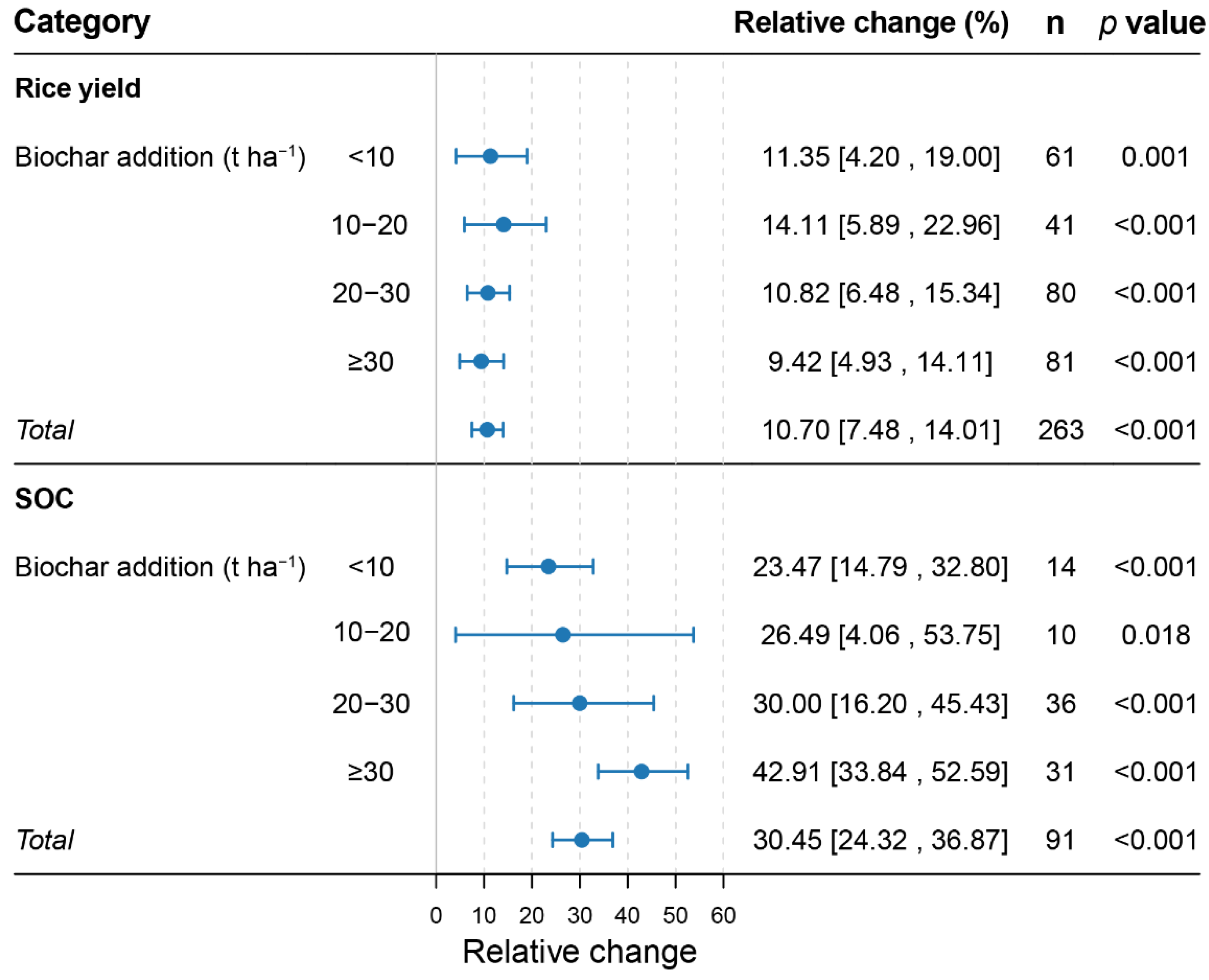
Biochar addition significantly increased rice yield and SOC by 10.70% (7.48% to 14.01%) and 30.45% (24.32% to 36.87%), respectively (Figure 1). Specifically, the biochar application of 10–20 t ha−1 showed the greatest improvement of yield by 14.11% (5.89% to 22.96%). This increase was higher than the biochar application rates of less than 10 t ha−1, 20–30 t ha−1, and >30 t ha−1, exceeding them by 24.24%, 30.37%, and 49.7%, respectively. The SOC gradually increased with rising biochar application rates, rising from 23.47% (14.79% to 32.80%) at less than 10 t ha−1 to 26.49% (4.06% to 53.75%) at 10–20 t ha−1, 30% (16.20% to 45.43%) at 20–30 t ha−1, and 42.91% (33.84% to 52.59%) at greater than 30 t ha−1.

3.2. Response of GHG Emissions to Using Biochar

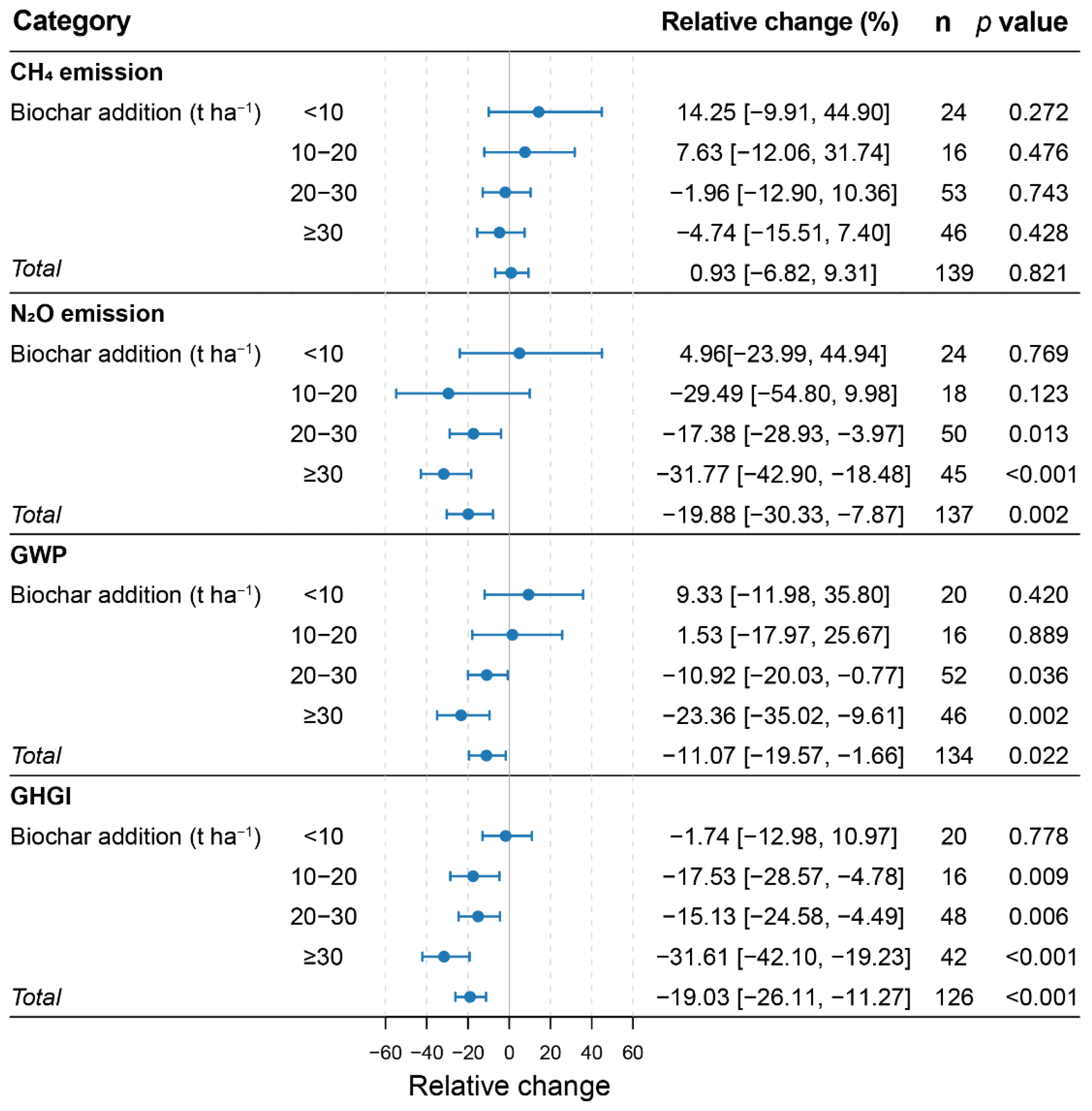
Biochar addition significantly decreased N2O emissions, GWP, and GHGI by 19.88% (−30.33% to −7.87%), 11.07% (−19.57% to −1.66%), and 19.03% (−26.11% to −11.27%), respectively (Figure 2). Regarding N2O emissions and GWP, biochar application rates of less than 10 t ha−1 and 10–20 t ha−1 had no significant effect. At biochar application rates of 20–30 t ha−1, N2O and GWP were significantly reduced by 17.38% (−28.93% to −3.97%) and 10.92% (−20.03% to −0.77%), respectively. When the biochar addition rate is greater than or equal to 30 t ha−1, N2O and GWP were significantly reduced by 31.77% (−42.90% to −18.48%) and 23.36% (−35.02% to −9.61%), respectively. Biochar addition also reduced GHGI, decreasing it by 17.53% (−28.57% to −4.78%) at 10–20 t ha−1, by 15.13% (−24.58% to −4.49%) at 20–30 t ha−1, and by 31.61% (−42.10% to −19.23%) at rates ≥30 t ha−1, respectively. Additionally, biochar addition had no significant effect on CH4 emissions.

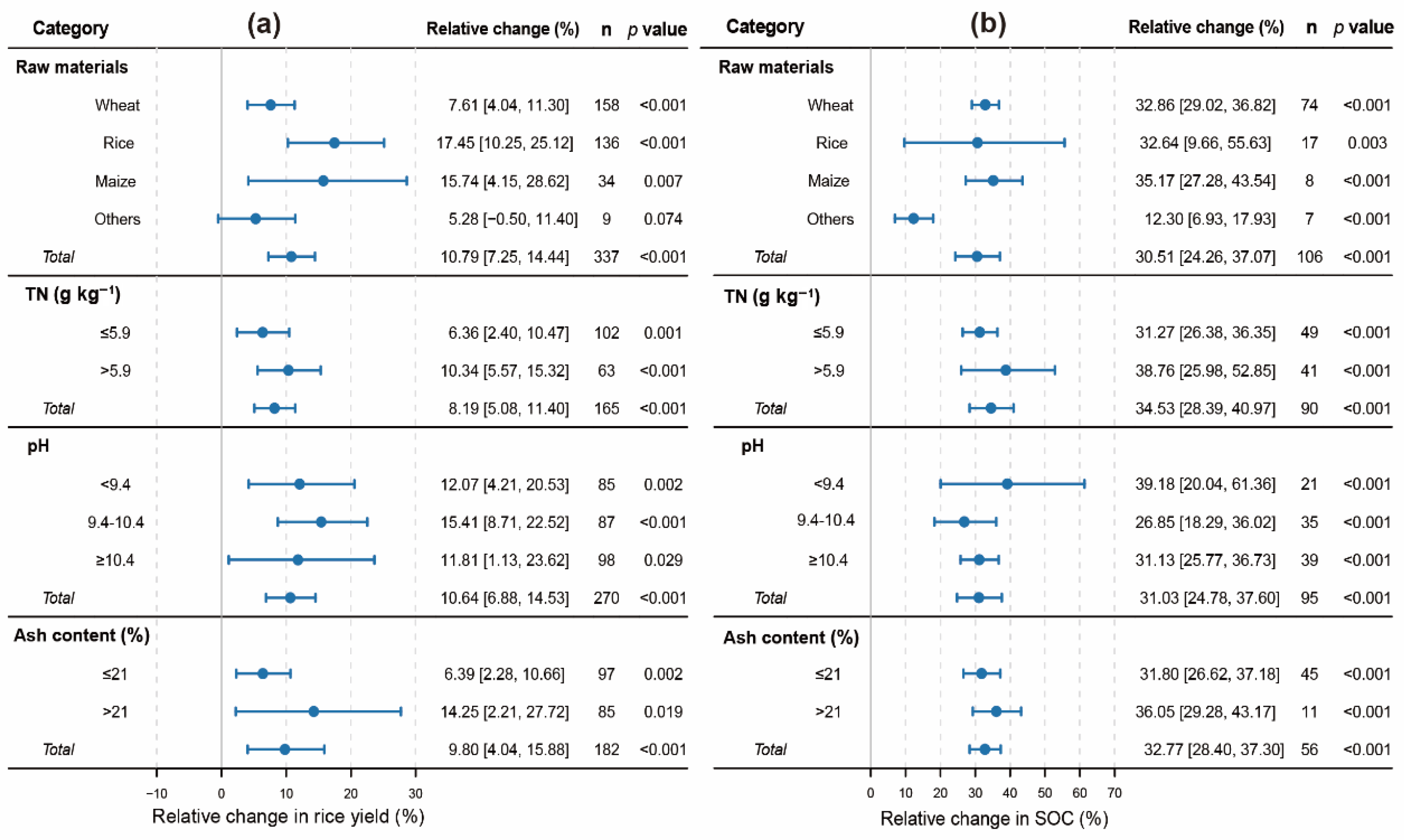
3.3. Effect of Biochar Properties on Yield and SOC

Figure 3 revealed that biochar properties significantly increased rice yield and SOC. The raw materials of biochar increased yield and SOC by 10.79% (7.25% to 14.44%) and 30.51% (24.26% to 37.07%), respectively. Among these, wheat straw-derived biochar accounted for the largest quantity, increasing yield and SOC by 7.61% (4.04% to 11.30%) and 32.86% (29.02% to 36.82%), respectively. Biochar derived from rice straw and maize straw improved yields by 15.74–17.45% and enhanced SOC by 32.64–35.17%, respectively. The TN and pH also increased rice yield by 8.19% (5.08% to 11.40%) and 10.64% (6.88% to 14.53%), and improved SOC by 34.53% (28.39% to 40.97%) and 31.03% (24.78% to 37.60%), respectively. As for ash content, it increased rice yield by 9.80% (4.04% to 15.88%). When ash content was below 21%, yield increased by 6.39%, and when exceeding 21%, yield growth reached 14.25%. Additionally, ash content increased SOC by 32.77%, rising from 31.80% (26.62% to 37.18%) (≤21%) to 36.05% (29.28% to 43.17%) (>21%).

3.4. Effect of Biochar Properties on GHG Emissions

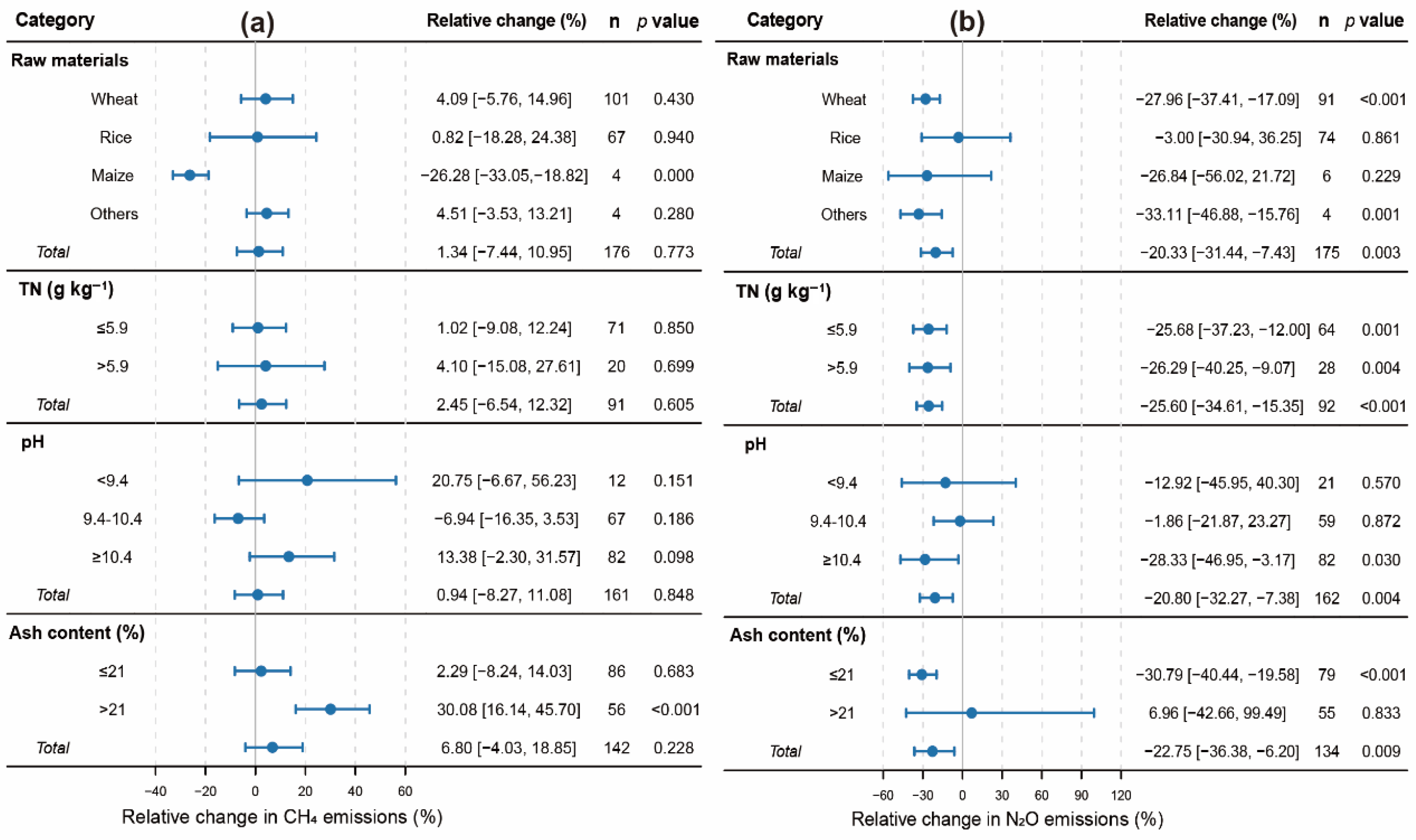
The biochar properties exhibited divergent effects on CH4 and N2O emissions (Figure 4). Raw materials significantly decreased N2O emissions by 20.33% (−31.44% to −7.43%), with wheat straw-derived biochar decreasing emissions by 27.96% (−37.41% to −17.09%) and other types of biochar reducing emissions by 33.11% (−46.88% to −15.76%). However, there was no significant effect on CH4 emissions. The TN also significantly decreased N2O emissions by 25.60% (−34.61% to −15.35%), rising from 25.68% (−37.23% to −12%) at less than or equal to 5.9 g kg−1 to 26.29% (−40.25% to −9.07%) at above 5.9 g kg−1. The pH and ash content of biochar also significantly decreased N2O emissions by 20.80% (−32.27% to −7.38%), and 22.75% (−36.38% to −6.20%), but did not affect CH4 emissions.
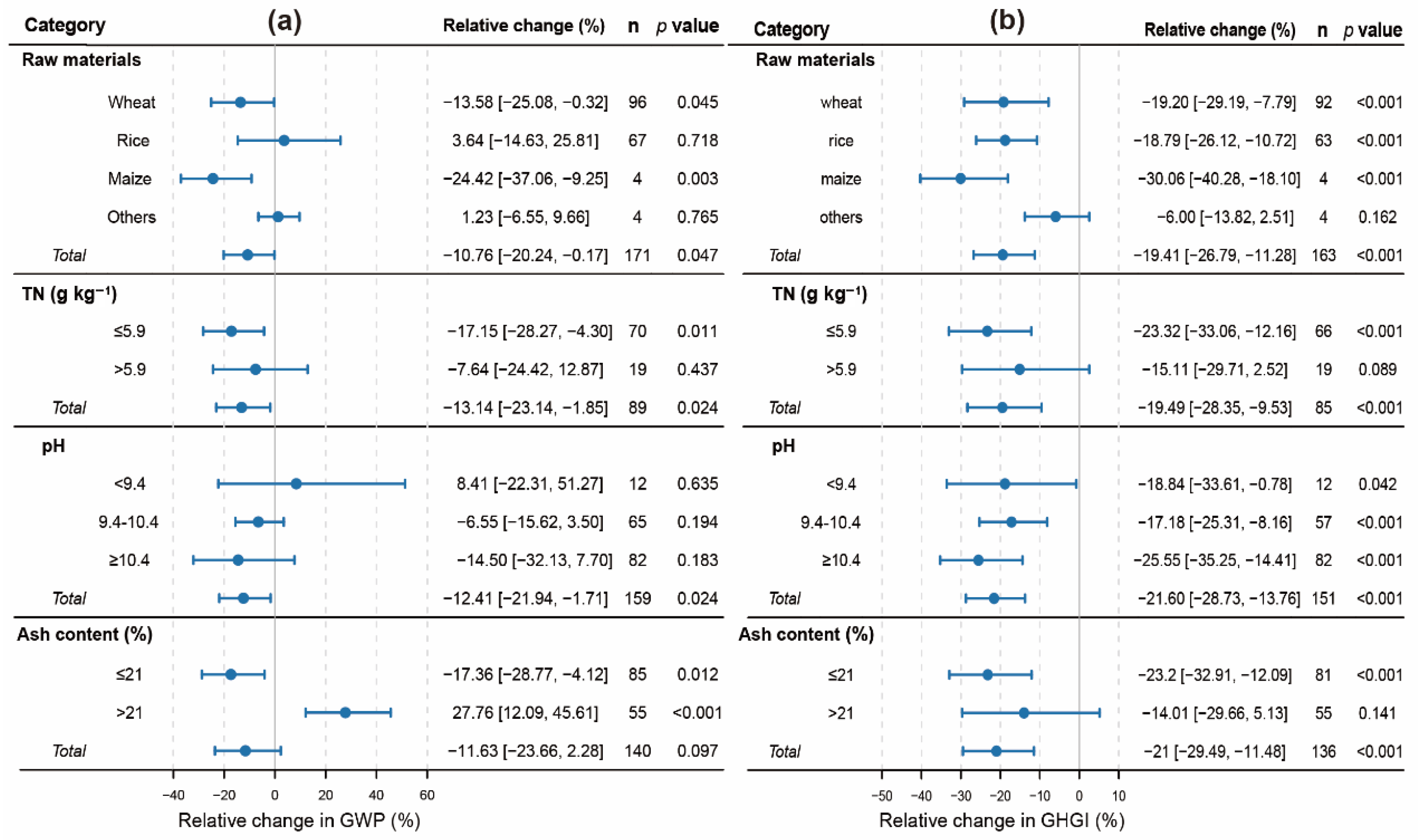
Figure 5 showed that the raw materials, TN and pH of biochar significantly decreased GWP by 10.76%, 13.14% and 12.41%, while also lowering GHGI by 19.41%, 19.49% and 21.60%, respectively. For raw materials, biochar from wheat straw decreased GWP and GHGI by 13.58% (−25.08% to −0.32%) and 19.20% (−29.19% to −7.79%), respectively. The maize straw-derived biochar also reduced GWP by 24.42% (−37.06% to −9.25%) and lowered GHGI by 30.06% (−40.28% to −18.10%). The rice straw-derived biochar significantly decreased GHGI by 18.79% (−26.12% to −10.72%), but did not affect GWP. Additionally, TN content ≤5.9 g kg−1 and ash content ≤21% of biochar significantly reduced GWP by 17.15% (−28.27% to −4.30%) and 17.36% (−28.77% to −4.12%), respectively. In contrast, the ash content of biochar >21% significantly increased GWP by 27.76% (12.09% to 45.61%). Moreover, biochar with TN content ≤5.9 g kg−1, pH ≥9.4, and ash content ≤21% significantly reduced GHGI.

3.5. The Relationship Between Biochar Addition Rate and Yield and Climate Change

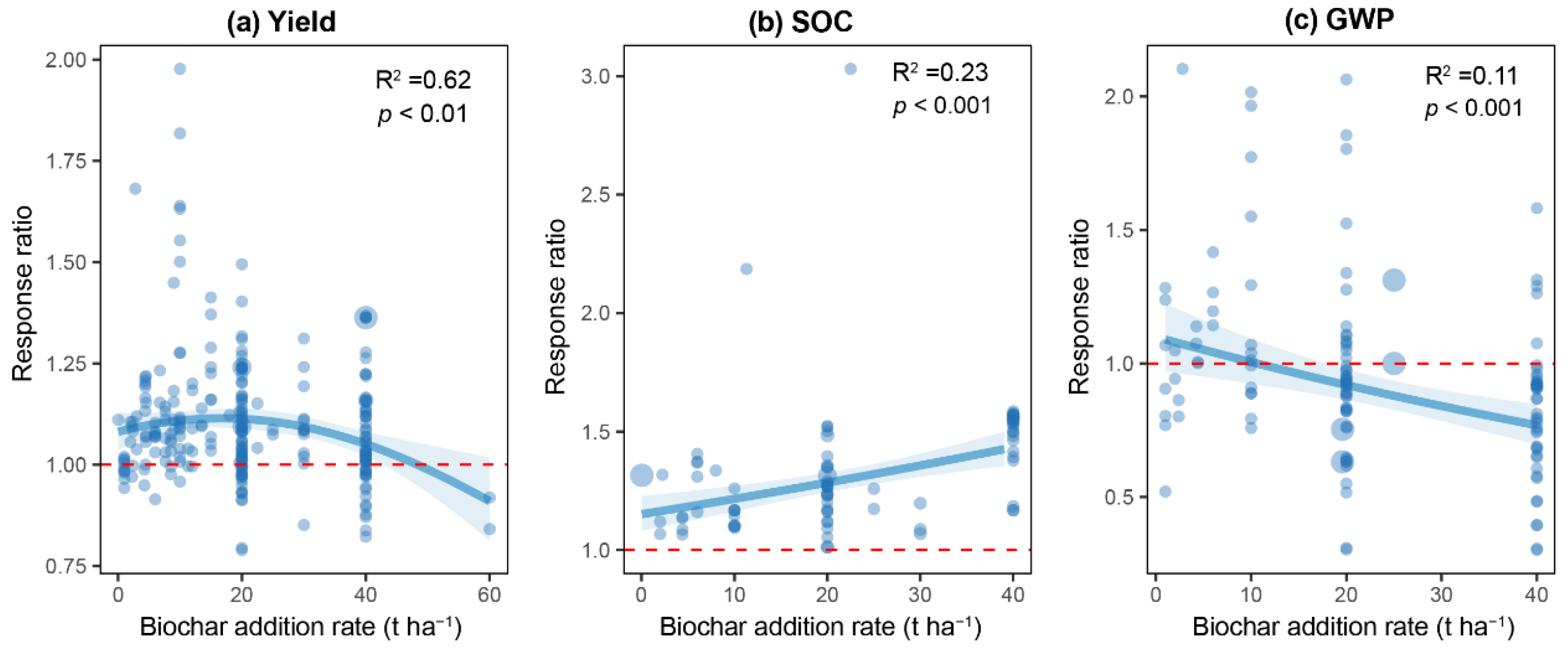
We examined the relationship between biochar addition rate and rice yield, SOC, and GWP (Figure 6). As shown in Figure 6a, the relationship between biochar addition and yield follows a quadratic pattern, indicating that biochar addition first boosts and then reduces yield (R2 = 0.62). Rice yield reaches its maximum when the biochar application rate is 18 t ha−1. There was a positive relationship between biochar addition and SOC, and the results suggest that SOC shows an upward trend with increasing biochar application rate, demonstrating that biochar holds potential for enhancing soil carbon storage (Figure 6b). Furthermore, there exists a negative correlation between GWP and biochar addition, with higher application rates resulting in a gradual reduction in GWP, highlighting the crucial role of biochar in mitigating GHG emissions (Figure 6c). N2O emissions also negatively correlated with biochar application rates (Figure S3).

4. Discussion

4.1. Mechanism of Rice Yield Increase

In the present study, the addition of biochar significantly increased rice yield by 10.70% (7.48% to 14.01%) compared with untreated fields, and even the lowest biochar application rate led to a notable yield improvement (Figure 1). This indicates that biochar not only supplied substantial amounts of available nutrients but also enhanced nutrient retention capacity, thereby promoting rice growth and enhancing yield [32,33,34]. In addition, biochar application improved the physical and biochemical properties of the soil, particularly by increasing SOC and total nitrogen (TN) by 60–250% and 22.9–75.3%, respectively [35,36]. The resulting improvements in soil aggregate structure and stability further contributed to increases in both panicle number and grains per panicle during rice production [37]. Moreover, biochar addition enhanced soil nutrient availability and crop nitrogen use efficiency, while the elevated SOC levels further improved nitrogen utilization, collectively promoting rice growth [12].
In the context of rice paddy fields, the study revealed that rice yields declined at higher biochar application rates (Figure 6a). This can be explained by several factors, primarily due to an imbalance between nutrient supply and nutrient demand. Zhang et al. (2012) [38] reported that, in the absence of N fertilizer, the application of large amounts of biochar—introducing substantial organic matter—could disrupt the balance of soil nutrients and thereby reduce yields. Therefore, biochar should be applied together with N fertilizer to maintain nutrient balance, improve soil fertility, and ultimately enhance yield performance in the paddy fields. Second, the changes in the soil’s physicochemical properties also play an important role. The finding of Nan et al. (2023) [39] indicated that rice yield under the high single-dose biochar treatment was unexpectedly lower than that under the annual low-dose application. This result was attributed to the increases in soil total carbon, pH, and available calcium content, which may have altered nutrient availability and affected plant growth.

4.2. Improvement of Soil Organic Carbon Sequestration by Biochar

Biochar incorporation significantly increased SOC by 30.45% compared with the soil without biochar addition (Figure 1), suggesting its huge potential to enhance soil fertility and health in rice cultivation. This effect can be explained by several mechanisms. First, the carbon structure of biochar—dominated by condensed aromatic and graphitic components—improves the soil’s water retention and nutrient-holding capacity [40]. Second, due to its high carbon content, structural stability, and resistance to decomposition, biochar contributes to the formation and stabilization of soil aggregates [41,42]. As a result, biochar can persist in the soil over long periods, thereby enhancing SOC storage. Furthermore, Ding et al. (2023) [43] reported that biochar application significantly increased the proportion of native recalcitrant SOC, promoting long-term soil carbon accumulation based on an 11-year field experiment. Meanwhile, SOC content increased with rising biochar application rates, suggesting that high-dose biochar has substantial and rapid carbon sequestration potential. Numerous studies have confirmed that biochar application significantly increases both aboveground and root biomass [44]. Similarly, Chen et al. (2024) [45] reported that root biomass increased by 4.10–27.40% following biochar addition. The development of extensive root systems, together with the incorporation of rice straw residues, provides an abundant carbon source in paddy soils, further contributing to SOC accumulation.
The long-term effectiveness of SOC sequestration induced by biochar addition is a critical consideration for climate mitigation [10]. Because SOC accumulation is a gradual process, long-term observations are essential to accurately assess its carbon sequestration potential. The result of the 10-year biochar addition experiment reported an absolute SOC increase of 25.5 Mg ha−1, corresponding to a 48% relative increase [46]. However, whether these SOC gains can be maintained over time remains uncertain. The stability of SOC is influenced by multiple factors, including climatic conditions, soil properties, field management practices, and soil microbial activity. Temporal variations in these factors may result in partial SOC loss, creating uncertainty in evaluating the durability of biochar-induced SOC increases. Therefore, future research should combine long-term field experiments with process-based modeling to more robustly quantify the stability, longevity, and associated uncertainties of SOC sequestration following biochar addition.

4.3. Mitigation of GHG Emissions by Biochar

Our results showed that biochar addition had no significant effect on CH4 emissions (Figure 2). Similarly, Sun (2024) [13] reported that biochar had no impact on CH4 emissions when averaged over ten years, although emissions initially increased during the first four years and subsequently declined over the following six years. In contrast, Zhao et al. (2023) [47] found that biochar application reduced CH4 emissions, primarily due to an increased ratio of methanotrophs to methanogens. This aligns with evidence that biochar can enhance soil aeration and stimulate CH4 oxidation, thereby suppressing CH4 emissions [23]. Conversely, increases in CH4 emissions may occur when biochar compounds inhibit the activity of methane-oxidizing bacteria, as suggested by Zhang (2010) [12]. Additionally, readily degradable components within biochar can serve as substrates for methanogenesis, particularly during the early stages of rice growth, thereby promoting CH4 production [48].
In contrast to CH4, our results showed that biochar addition significantly reduced N2O emissions by 19.88% (Figure 2), consistent with results from several previous studies [22]. This reduction can be attributed to multiple mechanisms. First, the porous structure of biochar enhances soil porosity, improving soil aeration and thereby affecting the activity and community composition of denitrifying bacteria [12]. Jiang et al. (2021) [49] reported that biochar addition increased bacterial phyla Proteobacteria and reduced genus Nitrospira, thereby inhibiting denitrification and ultimately reducing N2O emissions. Second, the biochar possesses a high C/N ratio and strong adsorption capacity, leading to a portion of N being stored or immobilized on its surface. This makes it difficult for microorganisms to decompose and utilize these nitrogen elements, thereby slowing down the nitrification and denitrification processes [50].
According to the findings, biochar addition significantly reduced N2O emissions by 19.88% while having no significant effect on CH4 emissions. Consequently, this led to a decrease in both GWP and GHGI by 11.07% and 19.03%, respectively, compared with the control treatment. These results suggested that the reduction in N2O emissions was the primary driver of the overall decrease in GHG emissions during rice cultivation. Concurrently, biochar application increased rice yield by 10.70%, which further contributed to the reduction in GHGI.

4.4. Biochar Benefits Sustainable Agriculture and Limitations

The processes and mechanisms by which biochar addition contributes to increased rice yield and enhanced soil carbon stocks, and reduced GHG emissions can be explained as follows. By improving soil aggregation and porosity, biochar addition enhances soil structure and root growth conditions. Its high surface area increases the soil’s cation exchange capacity (CEC) and nutrient retention [51]. In addition, biochar addition improves soil water retention and nutrient availability by increasing the soil’s ability to hold moisture and adsorb essential nutrients, while its porous structure also creates microhabitats that support the growth and activity of beneficial microorganisms [52]. Collectively, these effects enhance soil fertility, strengthen carbon sequestration, and reduce GHG emissions, with these benefits being particularly pronounced at high application rates, thereby supporting the sustainable development of agricultural ecosystems.
In this study, we examined the effects of biochar addition on rice yield and climate-related benefits; however, there are some limitations. The interactions between biochar and soil are strongly influenced by soil texture and mineralogical characteristics, yet our analysis did not consider specific soil properties, particularly soil orders and pH categories. Future research should therefore investigate more comprehensively how biochar addition affects the key physical and chemical properties of the soil. The biochar production method (e.g., hydrochar versus pyrolysis char) can significantly influence its stability and functional properties. It is well established that hydrothermal carbonization generally produces less stable biochar compared to pyrolysis. Future research will investigate the impacts of different biochar production processes on its effectiveness and performance. In addition, although 18 t ha−1 has been identified as an agronomically optimal application rate, its practical feasibility under current biomass availability, pyrolysis capacity, and available biomass for biochar production requires further evaluation. Therefore, not only should the total biochar addition rate be assessed, but different dosing strategies to achieve the same total input should also be critically examined. Finally, as the present study is based on research station experiments, extrapolation of the findings should be guided by results from farmer-scale field trials.
In the rice–wheat rotation system, this study focused only on yield, SOC, and GHG emissions of rice, without analyzing the wheat growing season. This introduces uncertainties when evaluating the overall GHG effect at the system scale. Although biochar addition reduced GHG emissions in paddy rice, these benefits might be partially or fully offset if N2O or CO2 emissions increase during the wheat season. Therefore, subsequent studies will incorporate the wheat season, including yield, carbon sequestration, and carbon emissions, to comprehensively evaluate the impact of biochar addition on the sustainability of the entire rice–wheat rotation system.

5. Conclusions

This study explored the effect of biochar addition and its properties on rice yield, SOC, and GHG emissions in the rice–wheat rotation system. The results indicated that biochar application increased yield and SOC, while reducing N2O emissions, GWP, and GHGI, with these effects being particularly pronounced at high addition rates. Biochar properties had a positive effect on yield enhancement and SOC sequestration, and the raw materials, TN, and pH of biochar significantly reduced N2O and GWP. The fitted relationship indicated that rice yield initially increased but declined at higher biochar addition, reaching a maximum at 18 t ha−1, while SOC and GWP showed positive and negative correlations with biochar addition, respectively. Overall, these findings demonstrate that applying biochar at appropriate rates can deliver a triple benefit—improving rice yield, enhancing SOC, and reducing GHG emissions—thereby achieving threefold benefits: agronomic, environmental, and climate mitigation.

Supplementary Materials

The following supporting information can be downloaded at https://www.mdpi.com/article/10.3390/agriculture15242537/s1: Figure S1: The spatial distribution of the sample point in the study; Figure S2: The flowchart of the study; Figure S3: Effects of biochar addition rate on the response of (a) CH4 emissions and (b) N2O emissions; Table S1: Summary of the Egger’s test for yield, soil organic carbon, and greenhouse gas emissions dataset; Table S2 in the excel file: The information collected on rice yield, soil organic carbon, CH4 emissions, N2O emissions, global warming potential, and greenhouse gas emissions intensity.

Author Contributions

L.Z., conceptualization, methodology, writing—original draft, resources, funding acquisition; F.Z., conceptualization, methodology, resources, software; K.Z., methodology, software, visualization; H.W., methodology, software, visualization. All authors have read and agreed to the published version of the manuscript.

Funding

This study was supported by the National Natural Science Foundation of China (32401338), the Natural Science Foundation of Jiangsu Province (BK20240920), the Natural Science Foundation of Yangzhou Municipality (YZ2024169). A Project Funded by the Priority Academic Program Development of Jiangsu Higher Education Institutions (PAPD), and the Lv Yang Jin Feng Talent Plan of Yangzhou City, China and Supercomputing Center of Lanzhou University.

Data Availability Statement

The original contributions presented in this study are included in the article/Supplementary Materials. Further inquiries can be directed to the corresponding author.

Conflicts of Interest

The authors declare no conflicts of interest.

References

  1. Tao, W.; Li, J.; Li, W.; Wen, C.; Gao, S.; Wang, Y.; Liu, D.; Xu, L.; Jiang, Y.; Liu, Z.; et al. Higher rice productivity and lower paddy nitrogen loss with optimized irrigation and fertilization practices in a rice-upland system. Agric. Ecosyst. Environ. 2024, 374, 109176. [Google Scholar] [CrossRef]
  2. Liu, Y.; Ge, T.; van Groenigen, K.J.; Yang, Y.; Wang, P.; Cheng, K.; Zhu, Z.; Wang, J.; Li, Y.; Guggenberger, G.; et al. Rice paddy soils are a quantitatively important carbon store according to a global synthesis. Commun. Earth Environ. 2021, 2, 154. [Google Scholar] [CrossRef]
  3. Liu, T.; Hu, Q.; Tang, J.; Li, C.; Jiang, Y.; Liu, J.; Cao, M. Key influencing factors and technical system of carbon sequestration and emission reduction in rice production in the middle and lower reaches of the Yangtze River. Chin. J. Eco-Agric. 2022, 30, 603–615. [Google Scholar] [CrossRef]
  4. IPCC. Climate Change 2021-The Physical Science Basis; Cambridge University Press: Cambridge, UK, 2021. [Google Scholar]
  5. Liu, B.; Guo, C.; Xu, J.; Zhao, Q.; Chadwick, D.; Gao, X.; Zhou, F.; Lakshmanan, P.; Wang, X.; Guan, X.; et al. Co-benefits for net carbon emissions and rice yields through improved management of organic nitrogen and water. Nat. Food 2024, 5, 241–250. [Google Scholar] [CrossRef]
  6. Qian, H.; Zhu, X.; Huang, S.; Linquist, B.; Kuzyakov, Y.; Wassmann, R.; Minamikawa, K.; Martinez-Eixarch, M.; Yan, X.; Zhou, F.; et al. Greenhouse gas emissions and mitigation in rice agriculture. Nat. Rev. Earth Environ. 2023, 4, 716–732. [Google Scholar] [CrossRef]
  7. Liu, L.; Lian, Z.; Ouyang, W.; Yan, L.; Liu, H.; Hao, F. Potential of optimizing irrigation and fertilization management for sustainable rice production in China. J. Clean. Prod. 2023, 432, 139738. [Google Scholar] [CrossRef]
  8. Rumpel, C.; Lehmann, J.; Chabbi, A. ‘4 per 1000’initiative will boost soil carbon for climate and food security. Nature 2018, 553, 7686. [Google Scholar] [CrossRef] [PubMed]
  9. Xia, L.; Chen, W.; Lu, B.; Wang, S.; Xiao, L.; Liu, B.; Yang, H.; Huang, C.-L.; Wang, H.; Yang, Y.; et al. Climate mitigation potential of sustainable biochar production in China. Renew. Sustain. Energy Rev. 2023, 175, 113145. [Google Scholar] [CrossRef]
  10. Woolf, D.; Amonette, J.E.; Street-Perrott, F.A.; Lehmann, J.; Joseph, S. Sustainable biochar to mitigate global climate change. Nat. Commun. 2010, 1, 56. [Google Scholar] [CrossRef]
  11. Liu, Y.; Li, H.; Hu, T.; Mahmoud, A.; Li, J.; Zhu, R.; Jiao, X.; Jing, P. A quantitative review of the effects of biochar application on rice yield and nitrogen use efficiency in paddy fields: A meta-analysis. Sci. Total Environ. 2022, 830, 154792. [Google Scholar] [CrossRef]
  12. Zhang, A.; Cui, L.; Pan, G.; Li, L.; Hussain, Q.; Zhang, X.; Zheng, J.; Crowley, D. Effect of biochar amendment on yield and methane and nitrous oxide emissions from a rice paddy from Tai Lake plain, China. Agric. Ecosyst. Environ. 2010, 139, 469–475. [Google Scholar] [CrossRef]
  13. Sun, H.; Zhang, X.; Zhang, J.; Wang, C.; Zhou, S. Long term comparison of GHG emissions and crop yields in response to direct straw or biochar incorporation in rice-wheat rotation systems: A 10-year field observation. Agric. Ecosyst. Environ. 2024, 374, 109188. [Google Scholar] [CrossRef]
  14. Liu, X.; Zhou, J.; Chi, Z.; Zheng, J.; Li, L.; Zhang, X.; Zheng, J.; Cheng, K.; Bian, R.; Pan, G. Biochar provided limited benefits for rice yield and greenhouse gas mitigation six years following an amendment in a fertile rice paddy. Catena 2019, 179, 20–28. [Google Scholar] [CrossRef]
  15. Wang, C.; Sun, H.; Zhang, X.; Zhang, J.; Zhou, S. Optimal Straw Retention Strategies for Low-Carbon Rice Production: 5 Year Results of an In Situ Trial in Eastern China. Agronomy 2023, 13, 1456. [Google Scholar] [CrossRef]
  16. Zhao, Y.; Jiang, H.; Gao, J.; Wan, X.; Yan, B.; Liu, Y.; Cheng, G.; Chen, L.; Zhang, W. Effects of biochar application methods on greenhouse gas emission and nitrogen use efficiency in paddy fields. Sci. Total Environ. 2024, 915, 169809. [Google Scholar] [CrossRef]
  17. Xia, X.; Zhao, Z.; Ding, Y.; Feng, X.; Chen, S.; Shao, Q.; Liu, X.; Cheng, K.; Bian, R.; Zheng, J.; et al. Crop Residue Biochar Rather Than Manure and Straw Return Provided Short Term Synergism Among Grain Production, Carbon Sequestration, and Greenhouse Gas Emission Reduction in a Paddy Under Rice-Wheat Rotation. Food Energy Secur. 2024, 13, e70009. [Google Scholar] [CrossRef]
  18. Zhang, F.; Chen, T.; Zhu, H.; Wang, Z.; Zhang, W.; Dai, W.; Chi, D.; Xia, G. Biochar decreased N loss from paddy ecosystem under alternate wetting and drying in the Lower Liaohe River Plain, China. Agric. Water Manag. 2024, 305, 109108. [Google Scholar] [CrossRef]
  19. Zhang, S.; Ren, T.; Yang, X.; Zhou, X.; Li, X.; Cong, R.; Lu, J. Biochar return in the rice season and straw mulching in the oilseed rape season achieve high nitrogen fertilizer use efficiency and low greenhouse gas emissions in paddy-upland rotations. Eur. J. Agron. 2023, 148, 126869. [Google Scholar] [CrossRef]
  20. Xia, L.; Cao, L.; Yang, Y.; Ti, C.; Liu, Y.; Smith, P.; van Groenigen, K.J.; Lehmann, J.; Lal, R.; Butterbach-Bahl, K.; et al. Integrated biochar solutions can achieve carbon-neutral staple crop production. Nat. Food 2023, 4, 236–246. [Google Scholar] [CrossRef]
  21. Wu, Z.; Zhang, X.; Dong, Y.; Li, B.; Xiong, Z. Biochar amendment reduced greenhouse gas intensities in the rice-wheat rotation system: Six-year field observation and meta-analysis. Agric. For. Meteorol. 2019, 278, 107625. [Google Scholar] [CrossRef]
  22. He, H.; Li, D.; Wu, Z.; Wu, Z.; Hu, Z.; Yang, S. Assessment of the straw and biochar application on greenhouse gas emissions and yield in paddy fields under intermittent and controlled irrigation patterns. Agric. Ecosyst. Environ. 2024, 359, 108745. [Google Scholar] [CrossRef]
  23. He, Y.; Zhou, X.; Jiang, L.; Li, M.; Du, Z.; Zhou, G.; Shao, J.; Wang, X.; Xu, Z.; Hosseini Bai, S.; et al. Effects of biochar application on soil greenhouse gas fluxes: A meta-analysis. Glob. Change Biol. Bioenergy 2017, 9, 743–755. [Google Scholar] [CrossRef]
  24. Gui, X.; Xu, X.; Zhang, Z.; Hu, L.; Huang, W.; Zhao, L.; Cao, X. Biochar-amended soil can further sorb atmospheric CO2 for more carbon sequestration. Commun. Earth. Environ. 2025, 6, 5. [Google Scholar] [CrossRef]
  25. Zhang, S.; Xue, L.; Liu, J.; Xia, L.; Jia, P.; Feng, Y.; Hao, X.; Zhao, X. Biochar application reduced carbon footprint of maize production in the saline−alkali soils. Agric. Ecosyst. Environ. 2024, 368, 109001. [Google Scholar] [CrossRef]
  26. Gattinger, A.; Muller, A.; Haeni, M.; Skinner, C.; Fliessbach, A.; Buchmann, N.; Mader, P.; Stolze, M.; Smith, P.; Scialabba Nel, H.; et al. Enhanced top soil carbon stocks under organic farming. Proc. Natl. Acad. Sci. USA 2012, 109, 18226–18231. [Google Scholar] [CrossRef]
  27. Zhang, K.; Li, Y.; Wei, H.; Zhang, L.; Li, F.; Zhang, F. Conservation tillage or plastic film mulching? A comprehensive global meta-analysis based on maize yield and nitrogen use efficiency. Sci. Total Environ. 2022, 831, 154869. [Google Scholar] [CrossRef]
  28. Zhang, L.; Zhang, F.; Zhang, K.; Wang, Y.; Agathokleous, E.; Fang, C.; Zhang, Z.; Wei, H.; Huo, Z. Nitrogen and organic matter managements improve rice yield and affect greenhouse gas emissions in China’s rice-wheat system. Field Crops Res. 2025, 326, 109838. [Google Scholar] [CrossRef]
  29. He, Z.; Cao, H.; Qi, C.; Hu, Q.; Liang, J.; Li, Z. Straw management in paddy fields can reduce greenhouse gas emissions: A global meta-analysis. Field Crops Res. 2024, 306, 109218. [Google Scholar] [CrossRef]
  30. Wang, C.; Luo, N.; Liu, J.; Fang, Y.; Qi, Z.; Li, S.; Gao, Z.; Feng, Y.; Chu, Q.; Dai, H. Data-driven strategies to mitigate greenhouse gas emissions intensity while sustaining global rice production. Resour. Conserv. Recycl. 2026, 224, 108547. [Google Scholar] [CrossRef]
  31. Han, L.; Tian, F.; Li, X.; Zhu, J.; Zhou, Z.; Zhao, W.; Yang, Y.; Zhang, F. Fertilization enhances microbial-driven N2O emissions while film mulching mitigates fertilization-driven emissions. Eur. J. Agron. 2025, 171, 127804. [Google Scholar] [CrossRef]
  32. Zhang, L.; Zhang, F.; Zhang, K.; Liao, P.; Xu, Q. Effect of agricultural management practices on rice yield and greenhouse gas emissions in the rice–wheat rotation system in China. Sci. Total Environ. 2024, 916, 170307. [Google Scholar] [CrossRef]
  33. Kuzyakov, Y.; Subbotina, I.; Chen, H.; Bogomolova, I.; Xu, X. Black carbon decomposition and incorporation into soil microbial biomass estimated by 14C labeling. Soil Biol. Biochem. 2009, 41, 210–219. [Google Scholar] [CrossRef]
  34. Zhang, X.; Feng, X.; Chai, N.; Kuzyakov, Y.; Zhang, F.; Li, F.-M. Biochar effects on crop yield variability. Field Crops Res. 2024, 316, 109518. [Google Scholar] [CrossRef]
  35. Kong, F.; Jiu, A.; Kan, Z.; Zhou, J.; Yang, H.; Li, F.-M. Deep tillage combined with straw biochar return increases rice yield by improving nitrogen availability and root distribution in the subsoil. Field Crops Res. 2024, 315, 109481. [Google Scholar] [CrossRef]
  36. Zhang, J.; Zhou, S.; Sun, H.; Lu, F.; He, P. Three-year rice grain yield responses to coastal mudflat soil properties amended with straw biochar. J. Environ. Manag. 2019, 239, 23–29. [Google Scholar] [CrossRef]
  37. Zhang, Q.; Song, Y.; Wu, Z.; Yan, X.; Gunina, A.; Kuzyakov, Y.; Xiong, Z. Effects of six-year biochar amendment on soil aggregation, crop growth, and nitrogen and phosphorus use efficiencies in a rice-wheat rotation. J. Clean. Prod. 2020, 242, 118435. [Google Scholar] [CrossRef]
  38. Zhang, B.; Liu, X.; Pan, G.; Zheng, J.; Chi, Z.; Li, L.; Zhang, X.; Zheng, J. Changes in soil properties, yield and trace gas emission from a paddy after biochar amendment in two consecutive rice growing cycles. Sci. Agric. Sin. 2012, 45, 4844–4853. [Google Scholar] [CrossRef]
  39. Nan, Q.; Tang, L.; Chi, W.; Waqas, M.; Wu, W. The implication from six years of field experiment: The aging process induced lower rice production even with a high amount of biochar application. Biochar 2023, 5, 27. [Google Scholar] [CrossRef]
  40. Liu, J.; Jiang, B.; Shen, J.; Zhu, X.; Yi, W.; Li, Y.; Wu, J. Contrasting effects of straw and straw-derived biochar applications on soil carbon accumulation and nitrogen use efficiency in double-rice cropping systems. Agric. Ecosyst. Environ. 2021, 311, 107286. [Google Scholar] [CrossRef]
  41. Sriphirom, P.; Rossopa, B. Assessment of greenhouse gas mitigation from rice cultivation using alternate wetting and drying and rice straw biochar in Thailand. Agric. Water Manag. 2023, 290, 108586. [Google Scholar] [CrossRef]
  42. Lu, H.; Bian, R.; Xia, X.; Cheng, K.; Liu, X.; Liu, Y.; Wang, P.; Li, Z.; Zheng, J.; Zhang, X.; et al. Legacy of soil health improvement with carbon increase following one time amendment of biochar in a paddy soil–A rice farm trial. Geoderma 2020, 376, 114567. [Google Scholar] [CrossRef]
  43. Ding, X.; Li, G.; Zhao, X.; Lin, Q.; Wang, X. Biochar application significantly increases soil organic carbon under conservation tillage: An 11-year field experiment. Biochar 2023, 5, 28. [Google Scholar] [CrossRef]
  44. Khan, K.S.; Mack, R.; Castillo, X.; Kaiser, M.; Joergensen, R.G. Microbial biomass, fungal and bacterial residues, and their relationships to the soil organic matter C/N/P/S ratios. Geoderma 2016, 271, 115–123. [Google Scholar] [CrossRef]
  45. Chen, Z.; He, L.; Ma, J.; Ma, J.; Ye, J.; Yu, Q.; Zou, P.; Sun, W.; Lin, H.; Wang, F.; et al. Long-term successive biochar application increases plant lignin and microbial necromass accumulation but decreases their contributions to soil organic carbon in rice–wheat cropping system. Glob. Change Biol. Bioenergy 2024, 16, e13137. [Google Scholar] [CrossRef]
  46. Gross, A.; Bromm, T.; Glaser, B. Soil organic carbon sequestration after biochar application: A global meta-analysis. Agronomy 2021, 11, 2474. [Google Scholar] [CrossRef]
  47. Zhao, Y.; Jiang, H.; Gao, J.; Feng, Y.; Yan, B.; Li, K.; Lan, Y.; Zhang, W. Effects of nitrogen co-application by different biochar materials on rice production potential and greenhouse gas emissions in paddy fields in northern China. Environ. Technol. Innov. 2023, 32, 103242. [Google Scholar] [CrossRef]
  48. Wang, S.; Ma, S.; Shan, J.; Xia, Y.; Lin, J.; Yan, X. A 2-year study on the effect of biochar on methane and nitrous oxide emissions in an intensive rice–wheat cropping system. Biochar 2019, 1, 177–186. [Google Scholar] [CrossRef]
  49. Jiang, Z.; Yang, S.; Pang, Q.; Xu, Y.; Chen, X.; Sun, X.; Qi, S.; Yu, W. Biochar improved soil health and mitigated greenhouse gas emission from controlled irrigation paddy field: Insights into microbial diversity. J. Clean. Prod. 2021, 318, 128595. [Google Scholar] [CrossRef]
  50. Zheng, J.; Han, J.; Liu, Z.; Xia, W.; Zhang, X.; Li, L.; Liu, X.; Bian, R.; Cheng, K.; Zheng, J.; et al. Biochar compound fertilizer increases nitrogen productivity and economic benefits but decreases carbon emission of maize production. Agric. Ecosyst. Environ. 2017, 241, 70–78. [Google Scholar] [CrossRef]
  51. Enebe, M.C.; Ray, R.L.; Griffin, R.W. The impacts of biochar on carbon sequestration, soil processes, and microbial communities: A review. Biochar 2025, 7, 107. [Google Scholar] [CrossRef]
  52. Gong, Y.; Hou, R.; Fu, Q.; Li, T.; Wang, J.; Su, Z.; Shen, W.; Zhou, W.; Wang, Y.; Li, M. Modified biochar reduces the greenhouse gas emission intensity and enhances the net ecosystem economic budget in black soil soybean fields. Soil Tillage Res. 2024, 237, 105978. [Google Scholar] [CrossRef]
Figure 1. Effects of biochar addition on the response of rice yield and soil organic carbon (SOC). The dots represent the average relative change in biochar addition, and the error bars represent the 95% confidence interval.
Agriculture 15 02537 g001
Figure 2. Effects of biochar addition on the response of CH4 emissions, N2O emissions, global warming potential (GWP), and greenhouse gas emissions intensity (GHGI). The dots represent the average relative change in biochar addition, and the error bars represent the 95% confidence interval.
Agriculture 15 02537 g002
Figure 3. Effects of biochar properties on the response of (a) rice yield and (b) soil organic carbon (SOC) to biochar addition. The dots represent the average relative change in biochar addition, and the error bars represent the 95% confidence interval.
Agriculture 15 02537 g003
Figure 4. Effects of biochar properties on the response of (a) CH4 emissions and (b) N2O emissions to biochar addition. The dots represent the average relative change in biochar addition, and the error bars represent the 95% confidence interval.
Agriculture 15 02537 g004
Figure 5. Effects of biochar properties on the response of (a) global warming potential (GWP) and (b) greenhouse gas emissions intensity (GHGI) to biochar addition. The dots represent the average relative change in biochar addition, and the error bars represent the 95% confidence interval.
Agriculture 15 02537 g005
Figure 6. Effects of biochar addition rate on the response of (a) rice yield, (b) soil organic carbon (SOC), and (c) global warming potential (GWP). Dots represent the estimated response ratio. The red dashed line indicates non-effect line.
Agriculture 15 02537 g006
Disclaimer/Publisher’s Note: The statements, opinions and data contained in all publications are solely those of the individual author(s) and contributor(s) and not of MDPI and/or the editor(s). MDPI and/or the editor(s) disclaim responsibility for any injury to people or property resulting from any ideas, methods, instructions or products referred to in the content.