Article

Effect of Airflow Settings of an Orchard Sprayer with Two Individually Controlled Fans on Spray Deposition in Apple Trees and Off-Target Drift


by
Grzegorz Doruchowski
*,
Waldemar Świechowski
,
Ryszard Hołownicki
,
Artur Godyń
and
Andrzej Bartosik
The National Institute of Horticultural Research, Konstytucji 3 Maja 1/3, 96-100 Skierniewice, Poland
*
Author to whom correspondence should be addressed.
Agriculture 2025, 15(23), 2520; https://doi.org/10.3390/agriculture15232520
Submission received: 31 October 2025 / Revised: 1 December 2025 / Accepted: 2 December 2025 / Published: 4 December 2025
(This article belongs to the Section Agricultural Technology)

Abstract

Air-assisted sprayers are widely used in orchards to ensure deep canopy penetration and effective pesticide coverage, yet excessive or misdirected airflow often causes spray drift and ground losses. This study evaluated spray deposition efficiency, drift, and environmental performance of a novel double-tower orchard sprayer (DIVENT) equipped with two independently driven axial fans allowing separate airflow adjustment on each side. Field experiments were conducted in apple orchards under crosswind conditions using the following three airflow emission scenarios (air volume to the LEFT/RIGHT side of sprayer): symmetrical (100%/100%), compensating crosswind (30%/100%), and one-sided (0%/100%). Measurements of spray deposition within the canopy, ground losses, and off-target deposition drift were performed using fluorescent tracer, and power consumption was recorded to estimate fuel use and CO2 emissions. The compensating airflow setting significantly improved spray targeting, reducing both in-orchard ground losses and off-target drift by up to 60%, while maintaining uniform canopy coverage comparable to the conventional symmetrical mode. The one-sided emission scenario achieved the highest drift reduction (67.8%) and the lowest power and CO2 emissions, though at the cost of reduced canopy deposition. Overall, the study demonstrates that independent fan control allows effective adaptation of spraying to weather and canopy conditions, providing substantial environmental and energy benefits without compromising spray efficiency.

1. Introduction

Air-assisted sprayers are the conventional equipment for pesticide applications in orchards and vineyards because they generate strong airflows that transport droplets deep into dense canopies, enhancing coverage and biological efficacy. The airflow produced by the fan determines droplet penetration, distribution, and the extent of off-target drift [1]. Conventional sprayers commonly employ one or two axial fans that deliver a constant air volume throughout the operation, regardless of canopy characteristics interacting with the airflow and meteorological conditions, specifically wind that modifies this interaction [2]. However, orchard canopies are inherently heterogeneous in shape, height, and leaf area density. Applying uniform airflow across such variability often leads to over-ventilation in sparse zones—causing excessive drift and ground losses—or under-ventilation in dense zones, resulting in poor deposition and insufficient pest control [3,4].
An excessive speed and uneven distribution of airflow produced by the axial fans of commonly used orchard sprayers are responsible for poor spray deposition on the target, ground losses, and drift [5,6,7,8,9]. Studies have shown that an optimal range of air velocity exists for every canopy density: too little airflow results in poor penetration, while too much airflow increases losses through drift and bounce-back [10,11,12]. To avoid this problem, the airflow should be adequately adjusted to the situation, i.e., canopy development, weather conditions (wind speed and direction), and proximity to the edge of the orchard or to sensitive areas (e.g., surface water, residential zones). Proper adjustment of airflow—specifically its direction, speed, and volume—significantly influences spray deposition on the target, ground losses, and off-target drift [13,14,15].
Different on-the-go controlled airflow adjustment systems have been tested, including an adjustable louver and a movable U-shaped deflector plate on the air outlet to change the air output [16,17]; adjustable side louvers on the axial fan outlets to regulate the portion of airflow discharged toward the target [18,19]; and a leaf shutter at the radial fan inlet limiting the air intake, combined with an adjustable air guide at the fan outlet to vary the airflow independently on both sides of the sprayer [20]. The last of the mentioned solutions, known as EDAS (Environmentally Dependent Application System), is part of the CASA (Crop-Adapted Spray Application) concept, which adjusts application parameters—such as droplet size, liquid flow rate, and airflow intensity—in response to crop morphology and environmental conditions [21,22]. More advanced airflow adjustment systems developed in recent years are able to continuously and in real time vary the airflow characteristics, either by combined control of fan rotation speed and adjustable fan air outlet area (e.g., sliding vanes or iris) [23,24] or by adjusting the blade pitch/angle [25,26]. Some modern designs decouple air volume from air speed by varying outlet area (iris-like flaps) while holding fan speed constant [23]. This enables maintaining a target outlet velocity while changing total flow to suit wider or denser canopies and counteract the effect of wind that disrupts the process of depositing spray drops in the crop canopies. Such decoupling helps tune penetration while avoiding excessive turbulence and possible spray loss [24].
Spray drift remains one of the most significant challenges in orchard spraying, with fine droplets carried away by wind and turbulence beyond the target zone [27,28]. Field studies have demonstrated that excessive and misdirected airflow is a primary driver of drift in air-assisted applications [29]. By adjusting air volume according to canopy density and wind direction, independently controlled fan systems can substantially reduce drift while maintaining canopy coverage [30]. A particularly effective strategy involves one-sided airflow reduction or shutdown, applied when spraying the upwind side of the sprayer or when one side lacks vegetation—such as at orchard borders or within canopy gaps. By deactivating or reducing airflow on the unneeded side, the sprayer prevents droplets from being blown outside the orchard, achieving drift reductions of up to 70–90% compared with conventional symmetric airflow operation [31]. Simultaneously, airflow can be intensified on the denser or downwind side to ensure penetration and uniform deposition. This adaptive airflow management improves spray targeting, reduces drift and liquid losses, and complies with increasingly stringent environmental protection and drift-reduction standards [32,33].
Ground losses—droplets that settle below the canopy without interception—represent another major pathway of pesticide waste and environmental risk. These losses typically result from excessive air momentum or droplet rebound, causing spray to be deflected downward rather than retained by foliage [6]. Overly strong air jets in sparse canopy zones or open areas exacerbate this effect, leading to pesticide accumulation in soil and potential runoff contamination.
Weather conditions are a significant factor influencing quality and thus the effectiveness of plant protection treatments, as well as their safety for humans and the environment. Wind disrupts the process of depositing spray droplets on plants, resulting in a considerable increase in the variability of distribution across the target objects [34]. On the other hand, it impairs the process by preventing a significant fraction of fine droplets from settling on plants and, as a result, causes them to drift away from the target object [32]. Crosswinds prevent proper penetration of trees on the windward side of the sprayer while simultaneously increasing the amount of liquid blown through trees on the leeward side [35]. The result of treatment under these conditions is a highly uneven application of spray liquid to the trees, which can reduce treatment effectiveness and lead to high losses due to spray drift [4]. A method to compensate for this phenomenon is independent regulation of the airflow directed to the right and left sides of the sprayer, which can be performed during operation.
A new approach has been proposed on a sprayer which uses two axial fans independently driven by hydraulic motors. In this solution, the airflow outputs are adjusted at the source, allowing for an expanded control range. Unlike the solutions described above, which involve adjusting the airflow by throttling the fan inlet or changing the outlet geometry, this approach allows for optimizing energy consumption and thereby reducing fuel consumption and CO2 emissions [36].
In this study, a double-tower sprayer equipped with two independent, hydraulically driven axial fans were tested under different air discharge scenarios to evaluate the influence of airflow settings on spray deposition in apple tree canopies, spray losses on the ground, and off-target drift under crosswind conditions, as well as on fuel consumption and carbon emissions.

2. Materials and Methods

2.1. Sprayer

2.1.1. Design and Construction

The prototype of DIVENT sprayer was designed and constructed by the AGROLA company (Płatkownica, Poland). It was equipped with two independent, hydraulically driven axial fans integrated with single-sided, oppositely directed airflow deflectors in the form of towers reaching a height of 2.5 m (Figure 1). Both fans were identical in terms of impeller diameter and the design (size and shape) of the deflectors. Their impellers rotated in opposite directions so that, at the same rotational speed, a symmetrical distribution of airflow on both sides of the sprayer was ensured.
The liquid system of the sprayer included all components typical of an orchard sprayer: 1500 L spray-mix tank; a PTO-driven diaphragm pump (flow rate 142.6 L min−1, maximum pressure 5 MPa); an electric remote controller for operating valves; and two spray sections, each equipped with eight double-nozzle bodies located in the outlet slots of the air deflectors.
The hydraulic system driving the fans consisted of a hydraulic oil tank, an oil cooler with a fan, two PTO-driven hydraulic pumps M4PV34 (Bondioli & Pavesi, Suzzara Italy), a 1:4 ratio gear transmission BIMA M7 (Bondioli & Pavesi, Italy), two hydraulic motors M4MF37 (Bondioli & Pavesi, Italy), and a control unit equipped with two independent potentiometer knobs enabling stepless adjustment of hydraulic oil flow and, consequently, the rotational speed of the hydraulic motors driving the fans. The control unit display indicated the oil flow supplied to each motor as a percentage (0–100%), where 0% (no oil flow) corresponded to the fan being switched off and 100% (full oil flow) to operation at maximum rotational speed and maximum airflow output. As such, it served as an operator interface for rapid and reliable adjustment of airflow as a function of fan rotational speed. It also enabled rapid inversion of the left- and right-side airflow settings, allowing a mirrored airflow configuration to be applied when spraying adjacent orchard rows and when changing the travel direction of the sprayer.

2.1.2. Fan Speed and Airflow Settings

The air velocity and the ratio of air volume directed to the right and left sides of the sprayer were adjusted steplessly by varying the rotational speed of the hydraulic motors driving the fans, from 0 up to the maximum propeller speed of 1455 rpm. This maximum was achieved at a tractor PTO rotational speed of 385 rpm and remained constant despite an increase in PTO speed to the nominal value of 540 rpm. At maximum fan speed, the average air velocity measured stationary at the center of the air deflector outlet was 31.6 m s−1; hence, the estimated airflow volume generated by each fan was 26,000 m3 h−1 (100% airflow volume).
The aim of this study was to evaluate the effects of various spray application scenarios with different sprayer fan settings, resulting in different airflow emission modes best suited to actual operating conditions, primarily weather parameters. The fan settings for the experiment were determined based on observations of the sprayer’s performance during preliminary orchard trials conducted under the assumed experimental conditions, i.e., with a crosswind speed of 2.5–4.0 m s−1. The desired airflow effect under these conditions was achieved when visually satisfactory penetration of spray droplets into the tree canopy was observed, with minimal or no overspray through the treated canopy into the adjacent tree row. The fan blowing air against the wind met this requirement at full speed (100% oil flow rate for hydraulic motor of the fan = maximum airflow volume), whereas the downwind-facing fan achieved it when the oil flow rate was reduced to 30%, as displayed on the fans’ control unit. This particular setting of the fans represented an arrangement of independent airflow outputs optimally matched to the specific environmental conditions, i.e., the crosswind velocity during the experiments and the characteristics of the trees at the experimental site. Its purpose was to verify the hypothesis that adjusting airflow output to the operating conditions can reduce spray losses without compromising treatment quality. Obviously, under different conditions, i.e., in another orchard or at a different wind speed, optimal adjustment of the airflow system may require different fan settings.
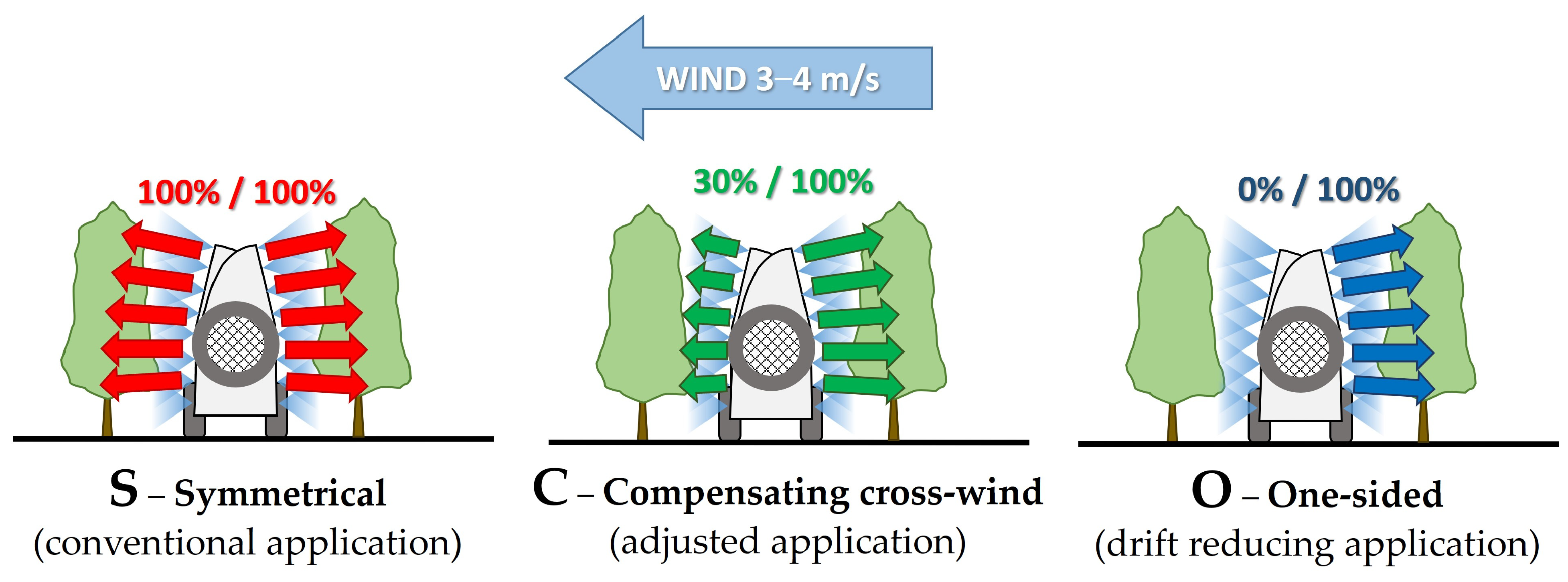
Based on these findings, the following three pairs of airflow settings for the left and right (L/R) fans were selected for the spray application scenarios (Figure 2):
  • S—Symmetrical emission: L/R = 100%/100%
    (representing the conventional, reference technique);
  • C—Compensating crosswind: L/R = 30%/100%
    (compensating for the effects of crosswinds and reducing spray loss);
  • O—One-sided emission: L/R = 0%/100%
    (representing spray drift-reducing scenario).
At the 30% airflow setting, the average air velocity produced by the fan, measured at rest at the center of the air deflector outlet, was 14.8 m s−1, and the estimated air volume flow rate was 12,200 m3 h−1.

2.2. Site and Conditions

The preliminary tests of the airflow settings, as well as the subsequent trials, were conducted in the experimental orchard of the National Institute of Horticultural Research in Skierniewice, central Poland (51°57′37″ N, 20°09′38″ E). The study was carried out in a five-year-old apple orchard of cv. Gala/M9, where trees, 2.9 m tall and 1.4 m wide, were planted at a spacing of 3.5 × 1.0 m. The tree rows were oriented north–south, and the spray applications were performed under a westerly crosswind. Detailed weather conditions, including wind direction azimuths during the applications, are provided in Table 1.

2.3. Conduct of Experiments

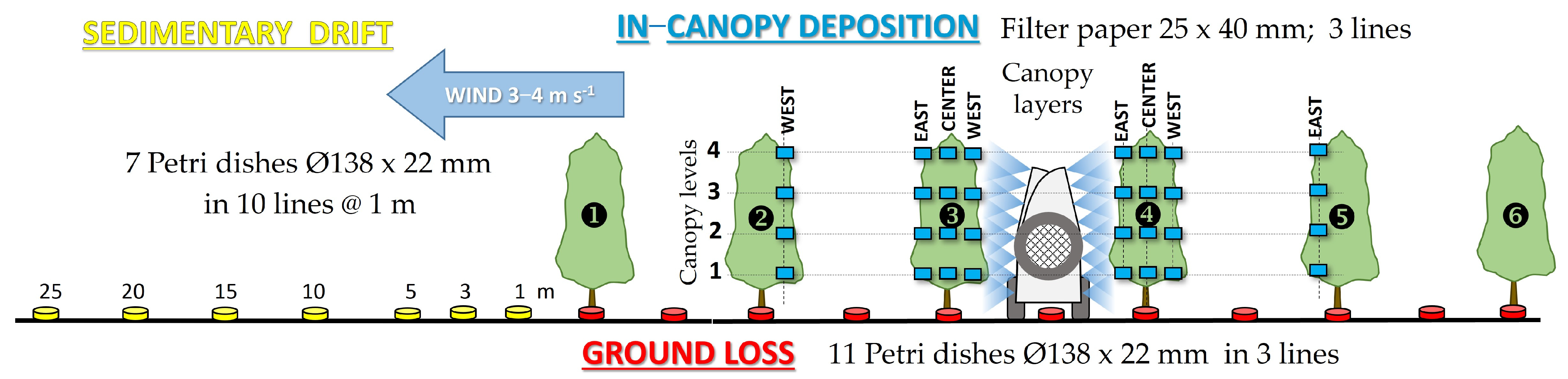
The assessment of the environmental impact of the airflow setting scenarios S, C, and O, applied during spray applications with the DIVENT sprayer, involved measuring spray deposition on the ground within the orchard (spray loss to the soil) and outside the orchard (deposition drift). Since environmental benefits should not be achieved at the expense of treatment quality, measurements of spray deposition within the apple tree canopies were also performed for selected scenarios. Artificial collectors were used for these measurements: Petri dishes for ground deposits and filter paper samples for in-canopy deposits (Figure 3).
The spray liquid consisted of a 0.25% solution of the fluorescent tracer BF-7G (Waldeck GmbH & Co. KG, Münster, Germany). All spray applications were performed using a sprayer equipped with 2 × 8 hollow-cone nozzles TR 80-02 (LECHLER, Metzingen, Germany), operating at a pressure of 0.6 MPa to produce fine spray droplets, representing a worst-case scenario for drift risk. The driving speed of the sprayer was 7.5 km h−1. The applied spray volume was 400 L ha−1, determined based on the tree row volume (TRV) per hectare of orchard, calculated according to the TRV formula (Equation (1)) [37]:
Q = C H × C D × k × 10,000 R
where
  • Q—spray volume rate [L ha−1];
  • CH—canopy height [m];
  • CD—mid-height canopy diameter across row [m];
  • R—row spacing [m];
  • k (here: 0.033)—efficacious unit volume rate [L m−3TRV].
Each treatment performed according to the selected scenario was repeated three times.

2.3.1. In-Canopy Deposit—Treatment Quality

The experiment included the six outermost rows of trees in the orchard (Figure 3). The spray was discharged from both sides of the sprayer, driving once from north to south between rows 3 and 4. Twelve filter paper samples (25 × 40 mm), serving as in-canopy spray deposit collectors, were attached with crocodile clips to thin masts at four heights and in three vertical layers of the tree canopies in the treated rows (rows 3 and 4). Additionally, in the next downwind row (row 2), collectors were placed at four heights only in the outer west canopy layer, and in the subsequent downwind row (row 5), at four heights only in the outer east layer (Figure 3). The collectors were oriented vertically and faced toward the sprayer. This layout of in-canopy collectors was replicated three times.
After application, the filter paper samples were collected and individually placed in sealed 40 mL plastic containers. In the laboratory, each container was filled with 20 mL of deionized water and shaken for 5 min to wash off the tracer. The tracer concentration in the washing solution was then determined using a fluorescence spectrometer LS-55 (PerkinElmer, Inc., Shelton, CT, USA). The obtained data were used to calculate in-canopy deposition D (%), expressed as the percentage recovery of the applied dose according to Equation (2):
D = C w × V w C s × V a × A c
where
  • Cw—concentration of tracer in wash solution (fluorimeter reading) [ng mL−1];
  • Vw—volume of wash water used [mL];
  • Cs—concentration of tracer in spray liquid [%(w/v)];
  • Va—spray application rate [L ha−1];
  • Ac—collector surface area [cm2].

2.3.2. Ground Deposit in Orchard—Spray Loss to Soil

Petri dishes (Ø 138 × 22 mm) were placed on the ground under and between six rows of trees, with five dishes located on the leeward side and five on the windward side of the sprayer, which applied the spray to the trees in rows 3 and 4 as described in Section 2.3.1 (Figure 3). This layout was replicated three times.
In the laboratory, the fluorescent tracer was washed from each dish with 40 mL of deionized water. The tracer concentration in the washing solution was then measured using a fluorescence spectrometer and recalculated to express spray loss to the soil within the orchard as a percentage of applied dose according to Equation (2).

2.3.3. Off-Target Deposition Drift

Deposition drift was measured in accordance with ISO 22866:2005 [38]. Petri dishes (Ø 138 × 22 mm) were placed on the ground in ten lines at seven distances (1, 3, 5, 10, 15, 20, and 25 m) downwind of the orchard where the spray was applied (Figure 3). After completing the sprayer pass, as described in Section 2.3.1, and collecting the filter paper samples from the tree canopies and the Petri dishes from within the orchard, four additional passes of the sprayer were performed to meet the requirements of the drift measurement methodology. During these passes, the five outermost tree rows were sprayed to ensure sufficient accumulation of spray drift on the ground deposit collectors outside the orchard. Laboratory analysis of the drift deposits was carried out as described in Section 2.3.2. The obtained tracer concentration data was recalculated to express off-target deposition drift as a percentage of the applied dose according to Equation (2).

2.3.4. Power Consumption—CO2 Emission

To estimate CO2 emissions during the tested treatments, the power consumption of the sprayer operating at the selected airflow settings was determined based on measurements conducted in the laboratory under stationary conditions.
The power consumed by the DIVENT sprayer operating under the tested airflow setting scenarios was determined by measuring the PTO rotational speed (ω, rpm) and torque (τ, Nm) acting on the sprayer’s drive shaft. The measurements were performed using an SENSOR-AT1000 (NCTE AG, Oberhaching, Germany) torque meter (measuring range up to 1000 Nm), which was mounted between the tractor’s PTO shaft and the PTO shaft transmitting power to the sprayer.
Three series of measurements were conducted at the following driveline loads:
  • Scenario S: Pump (0.6 MPa) + LEFT fan 100% + RIGHT fan 100%;
  • Scenario C: Pump (0.6 MPa) + LEFT fan 30% + RIGHT fan 100%;
  • Scenario O: Pump (0.6 MPa) + LEFT fan 0% + RIGHT fan 100%.
In each series, measurements were taken at six PTO rotational speeds: 300, 350, 400, 450, 500, and 540 rpm. Each measurement was conducted for the duration required to obtain 35 recorded data points of torque and rotational speed in the data file. From this dataset, 20 stabilized records for each measurement pair were selected to calculate the instantaneous and mean values of power consumption P (kW) according to Equation (3):
P = τ × ω × 2 π 60 × 1000
The calculated power consumption was used to estimate fuel consumption and CO2 emissions for the analyzed spray application scenarios.

2.4. Statistical Analysis

The in-canopy and in-orchard ground deposition data were statistically analyzed using analysis of variance (ANOVA), performed with the software STATISTICA 12 (StatSoft Polska, Poland) to identify significant differences between treatment means. To normalize the data distribution for statistical analysis, the raw data were subjected to a Box–Cox transformation (Equation (4)):
y ( λ ) ( x ) = x λ 1 λ
with λ = 0.264257.
The transformed data were analyzed using ANOVA, followed by Duncan’s multiple range test at a significance level of p < 0.05 to separate means and detect significant differences. The uniformity of in-canopy spray deposition, considered one of the indicators of spray application quality, was assessed by comparing the degree of variation between datasets using the coefficient of variation (CV%).

3. Results

3.1. In-Canopy Spray Deposition

Data on in-canopy depositions are presented in this article using box-and-whisker plots, showing for each dataset the mean value (X inside the box), the median value (line inside the box), the middle 50% of the data within the box, and the range of the remaining data indicated by the whiskers.
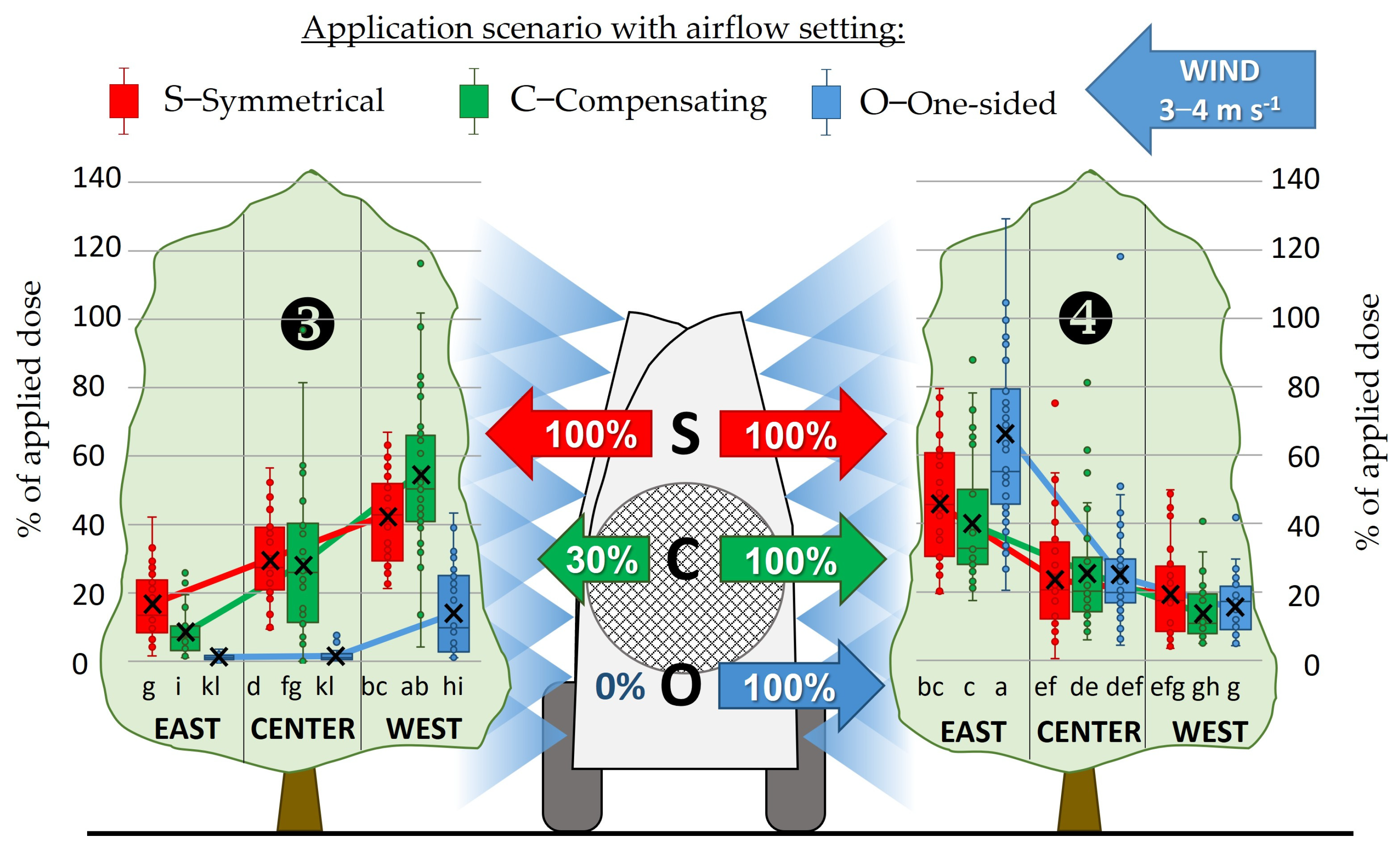
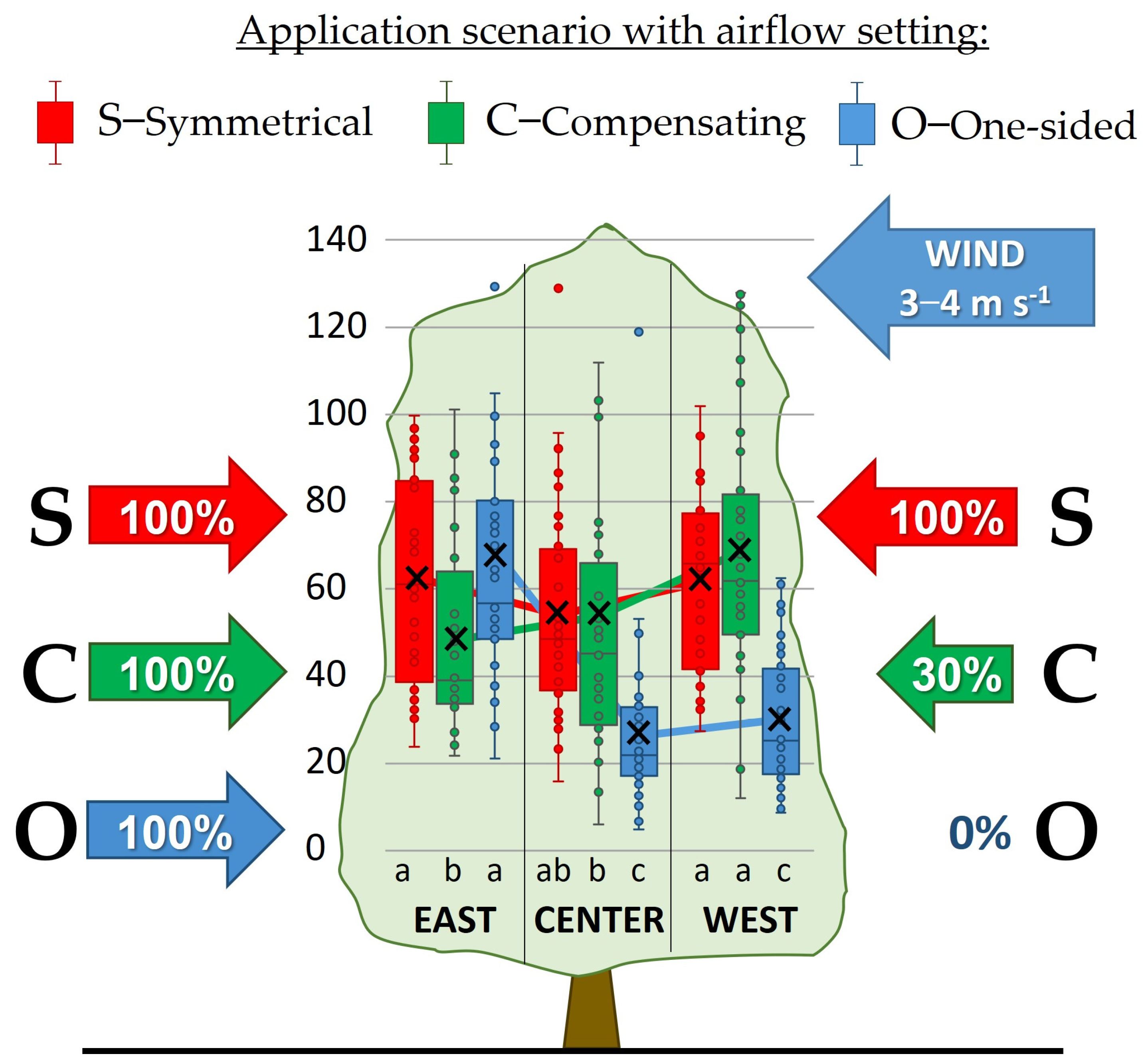
Figure 4 shows the distribution of spray deposition within the tree canopies of rows 3 and 4 (see experimental layout in Figure 3), which were sprayed from one side as the sprayer passed between them according to the tested airflow emission scenarios:
  • S—Symmetrical (100%/100%);
  • C—Compensatory (30%/100%);
  • O—One-sided (0%/100%).
This illustrates canopy penetration of the spray liquid, expressed as the gradient of deposition within the tree canopies with increasing distance from the source of the spray and airflow. The obtained distribution of spray deposition within the trees under these conditions best demonstrates the effect of airflow action with one-sided spray application: on the windward side, a full airflow directed against the wind (intended to compensate for its disturbing influence), and on the leeward side, an airflow of reduced intensity or no airflow at all.
In the S scenario, the distribution of spray deposition in the individual horizontal canopy layers on the windward side of the sprayer mirrored that on the leeward side. On both sides, deposition decreased noticeably with increasing distance from the sprayer, so that in the outermost canopy layers, spray deposition amounted to about 40% of that in the layers closest to the nozzles.
For the C scenario, spray deposition on the windward side of the trees was similar to that observed in the S scenario. On the leeward side, where the airflow was reduced, the general distribution pattern remained similar, but the gradient of deposition was significantly steeper. As a result, deposition in the outermost canopy layer reached only 15% of that near the sprayer.
After treatment according to the O scenario, on the leeward side of the sprayer (row 3), where the airflow was switched off, the expected very low deposition was observed in all canopy layers. On the opposite, windward side, deposition in the layer closest to the sprayer was unexpectedly high—significantly higher than in the other scenarios—while deposition in the remaining layers was similar to that observed under the other airflow settings.
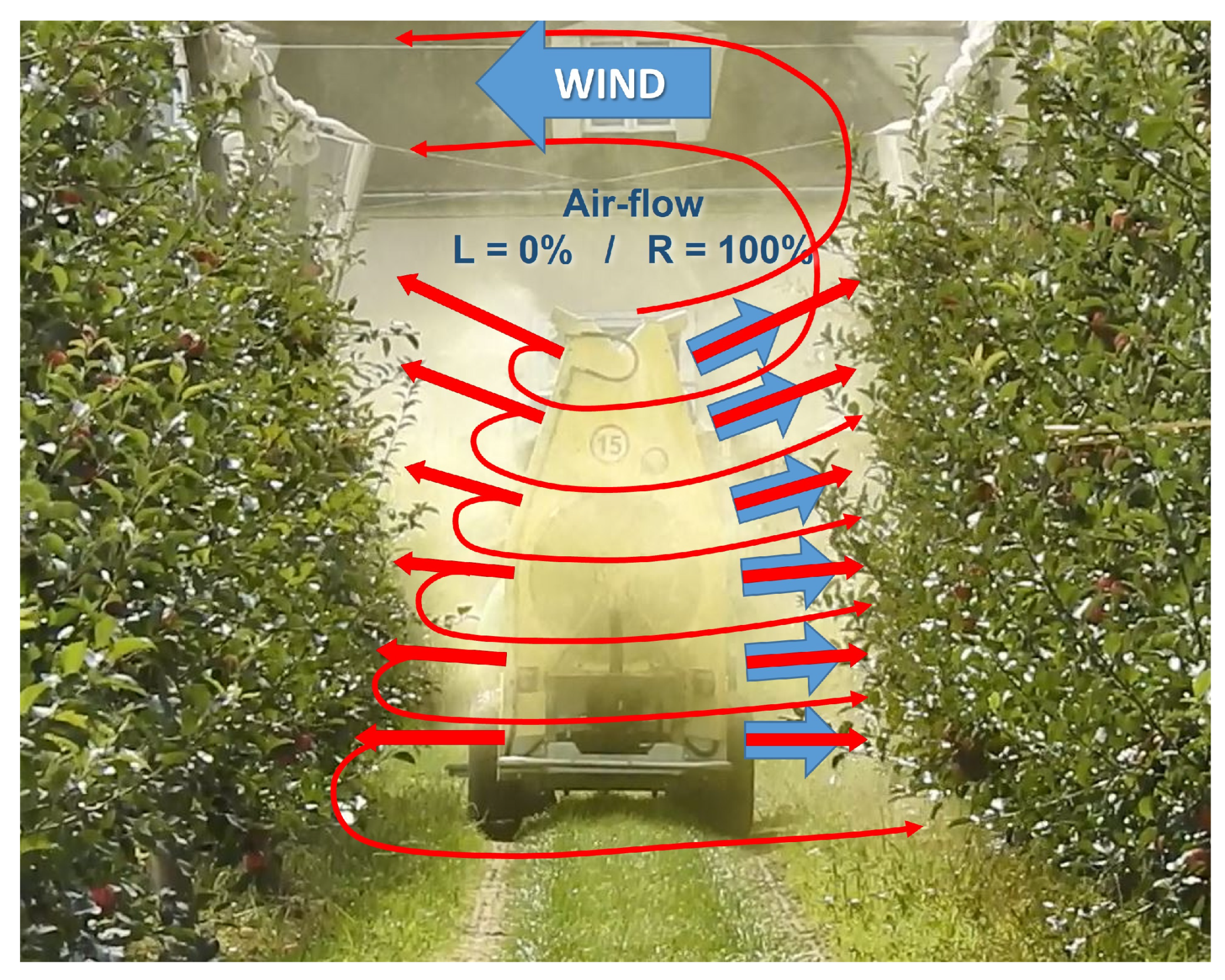
This effect resulted from a phenomenon observed in the video recording made during the sprayer’s pass (Figure 5). It showed that spray droplets generated by the nozzles on the leeward side, lacking air assistance, were drawn into the low-pressure zone forming behind the moving sprayer. Due to the principle of energy conservation, these droplets were then entrained toward the opposite (windward) side into the area of reduced pressure caused by the strong airflow from the right fan—effectively acting as an injector effect. Consequently, for the O airflow setting, the eastern canopy layer of trees on the windward side received an additional amount of spray, significantly increasing deposition in that location. This phenomenon also influenced the patterns of spray losses to the ground and deposition drift results, discussed later. The observed fine droplets trajectory also posed the risk of increased fan contamination, which is another issue related to the one-sided airflow setting.
During the experiment, spray deposition was also measured in the outer canopy layers of trees in the farther, unsprayed rows 2 and 5 on both sides of the sprayer. In the eastern canopy layer of trees in row 5, located on the windward side, deposition was barely detectable, amounting to 1.11%, 1.00%, and 1.02% of the applied dose for the S, C, and O scenarios, respectively. In contrast, in the western canopy layer of trees in row 2 on the leeward side, deposition reached 9.17%, 4.12%, and 2.31% of the applied dose for the same scenarios. These results, when compared with deposition in the eastern canopy layer of the sprayed leeward row (16.43%, 8.21%, and 1.24% for S, C, and O scenarios, respectively), indicate both the intensity of spray movement through the trees in the wind direction and the level of secondary deposition on trees not directly treated.
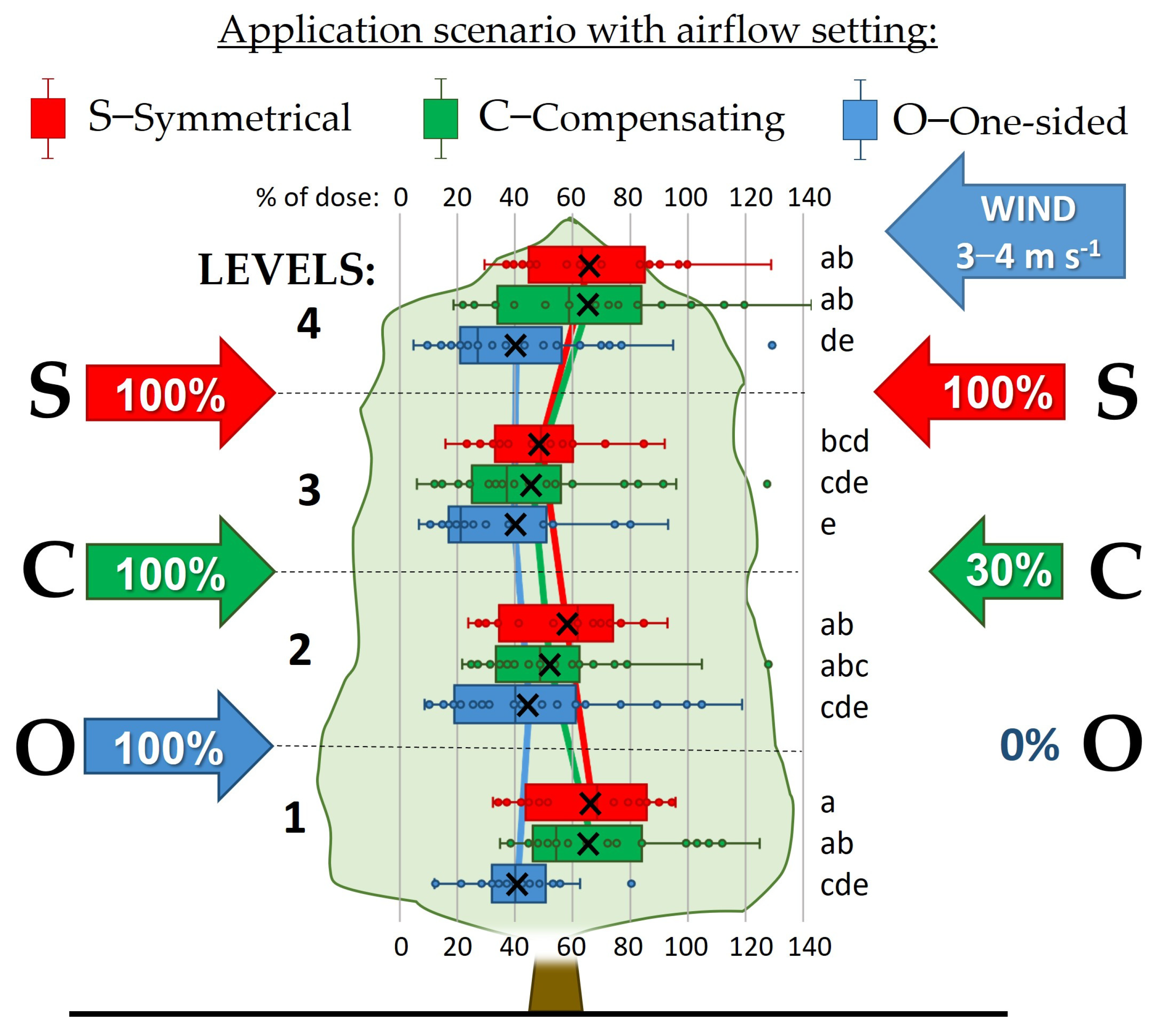
A proper assessment of the effects of spraying fruit trees under crosswind conditions, using the tested airflow settings, can be achieved by simulating a real, two-sided spray application. This simulation involved summing the deposits obtained in the corresponding layers of the sprayed trees in rows 3 and 4—effectively adding the results of deposition for windward and leeward trees shown in Figure 4. In this way, a comprehensive picture of the total final deposit in a tree sprayed from both sides was obtained, representing a situation where canopy penetration is affected by a lateral wind and the airflow produced by the sprayer’s fan is intended to compensate for its influence. The results of this simulation, based on empirical data, are presented graphically in Figure 6.
For application scenarios S and C, the liquid deposit obtained in all vertical layers of the trees was similar—slightly lower for C only in the leeward layer—and remained high, ranging from 48.6% to 68.5% of the applied dose. For scenario O, the deposit in the middle and windward layers was about half that of the other airflow settings, reaching 27.1% and 30.3%, respectively. Such a result was expected; however, it remains an open question whether this relatively low deposit level is sufficient to ensure adequate treatment efficacy when operating with one-sided airflow disabled. Therefore, this practically important issue is addressed further in Section 4—Discussion.
In addition to penetration analysis—which enables the evaluation of deposit variability within the vertical layers of the tree canopy—a full understanding of spray performance also requires assessing the vertical distribution of liquid within the trees, i.e., how deposition varies at different canopy heights. This aspect is illustrated in Figure 7. Thanks to the use of air deflectors on the sprayer and the cross-flow spray delivery system, a uniform vertical distribution of liquid was achieved for all airflow settings. For the scenarios S and C, deposition patterns were statistically identical (no significant differences between canopy levels), ranging from 45.5% to 66.3% of the applied dose, with a statistically insignificant decrease in the middle canopy zone. In contrast, for scenario O, deposition at the highest and lowest canopy levels was significantly lower than in the other airflow settings, while the overall variation among canopy levels was exceptionally small, within a narrow range of 40.3% to 44.9% of the applied dose.
The overall variability of liquid deposition within the trees is expressed by the coefficient of variation (CV) for the studied airflow settings (Table 2). The lowest variability, and therefore the highest uniformity of liquid distribution in the canopy, was achieved in scenario S (CV = 38.0%). For the C scenario, CV reached 54.2%, while for scenario O it increased to 71.8%. The weak zones of low deposition observed on the windward side of the trees—where the air stream was disabled in scenario O (Figure 6)—were responsible for the lowest overall mean deposit for this configuration (41.7%), significantly different from the other two scenarios, S and C (59.7% and 57.1%, respectively) (Table 2).

3.2. Ground Deposit in Orchard—Spray Loss to Soil

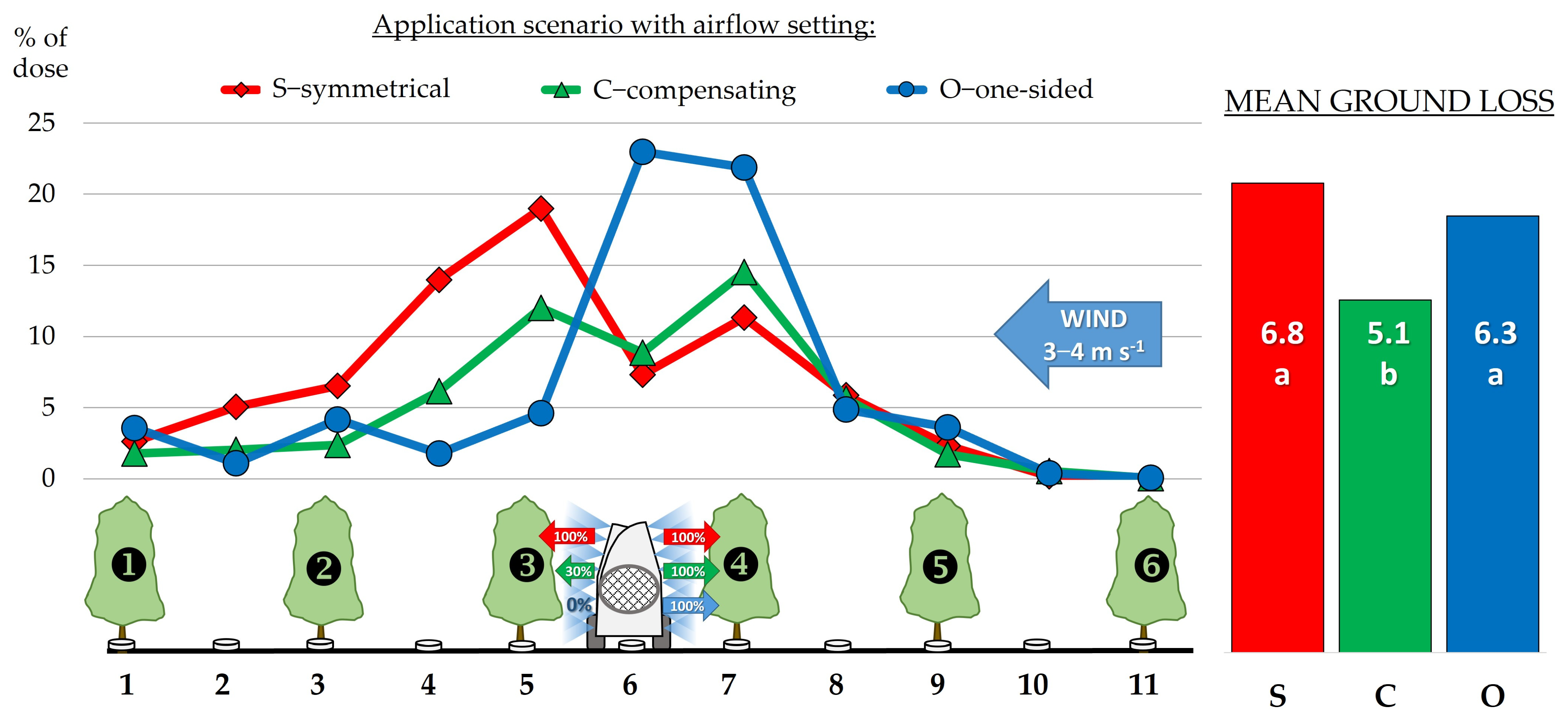
The results of spray losses to the ground in the orchard are presented in Figure 8. The distribution of liquid deposited on the soil reflects the fate of the sprayed droplets that fail to reach the target and are instead carried by air movements resulting from the combined action of the wind and the airflow generated by the sprayer and their interaction with the trees.
The shift in the maximum ground deposit in the downwind direction observed for the symmetrical air discharge configuration (scenario S) is natural and easily explained. The high ground losses—and consequently the considerable soil contamination beneath and on the leeward side of the sprayed trees—result from the strong through-canopy transport of droplets caused by the concurrent action of the wind and the full airflow from the sprayer. When the airflow directed downwind was reduced to 30%, according to scenario C, the droplet transfer across the canopy and consequently the ground deposition on the leeward side were markedly reduced.
The highest local soil contamination was observed for scenario O, occurring along the sprayer’s travel path and in the adjacent soil strip beneath the trees on the windward side. This effect can be explained by the phenomenon captured in the video recording (see Figure 5, which showed a reversal of droplet trajectories toward the upwind side when the air stream on the leeward side of the sprayer was turned off. In the lower, near-ground zone of the fan—where wind speed is the lowest—the fine droplets, deprived of air assistance, were entrained by turbulent air movement behind the moving sprayer. Subsequently, they were drawn toward the opposite (windward) side by the suction effect of the full airflow, producing not only the highest deposition in the eastern layer of the tree canopy on that side (Figure 4) but also the greatest soil contamination beneath that tree.
On average, spray losses to the ground in the orchard were highest for scenarios S and O (respectively: 6.8% and 6.3% of applied dose), both significantly different from the reduced loss values recorded under scenario C (5.1%) (Figure 8).

3.3. Off-Target Deposition Drift and Drift-Reduction Rate

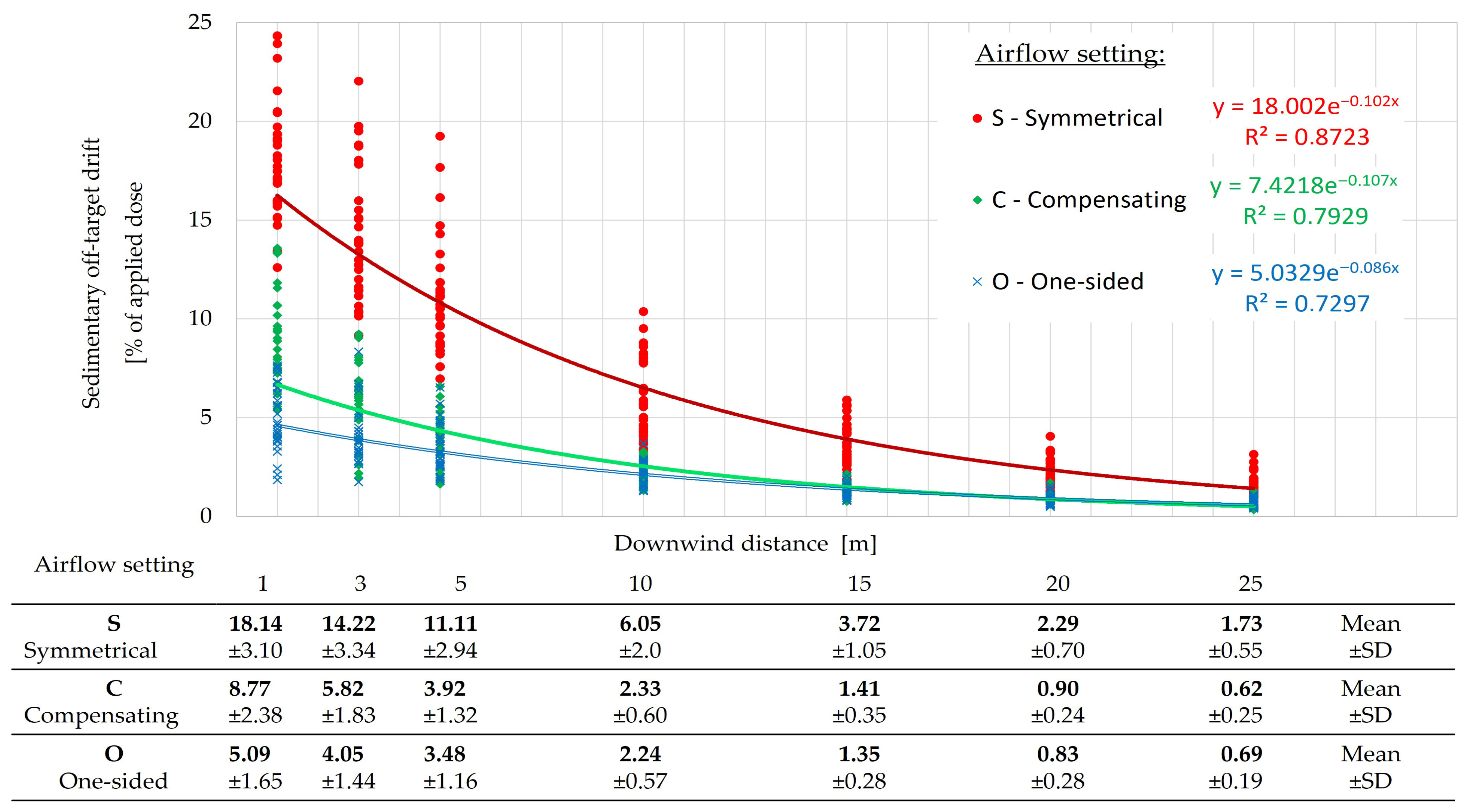
The data on ground deposits of off-target drift, measured within the range of 1 to 25 m from the sprayed orchard, were used to determine the best-fit regressions describing deposition drift curves for spray applications with the tested airflow settings (Figure 9). These regressions take the form of an exponential model represented by Equation (5):
y = a e b x ,         b < 0
where a and b are the parameters of the model, including Euler’s number e (≈2.71828).
The regression equations, as presented in the legend of Figure 9, were used to calculate the drift potential indices DP [39] within the measuring range (1–25 m) for the respective application scenarios. The DP indices are dimensionless, relative values expressed as %, which are calculated to determine the drift-reduction potential DRP. For the tested scenarios, the DP values geometrically represent the areas under the corresponding deposition drift curves within the integration limits, and mathematically they correspond to definite integrals of their regression functions calculated over the interval [1, 25], according to Equation (6):
D P = 1 25 a e b x d x
The antiderivative of the function y = aebx is F(x), as given by Equation (7):
F x = a b e b x + C
Thus, the total drift was calculated using Equation (8):
D P =   F 25 F ( 1 ) = [ 1,25 ] a b ( e 25 b e b )
The parameters a and b of the exponential models representing deposition drift curves for the respective airflow settings are given in Table 3.
The drift-reduction potential DRP for scenarios C and O, relative to the conventional reference scenario S, was calculated using Equation (9):
D R P ( C , O ) = D P S     D P ( C , O ) D P S × 100 %
where
  • DRP(C,O)—drift-reduction potential for the evaluated scenario C or O [%],
  • DPS—drift potential within the measurement range for the reference scenario S [%],
  • DP(C,O)—drift potential within the measurement range for the evaluated scenario C or O [% of applied dose].
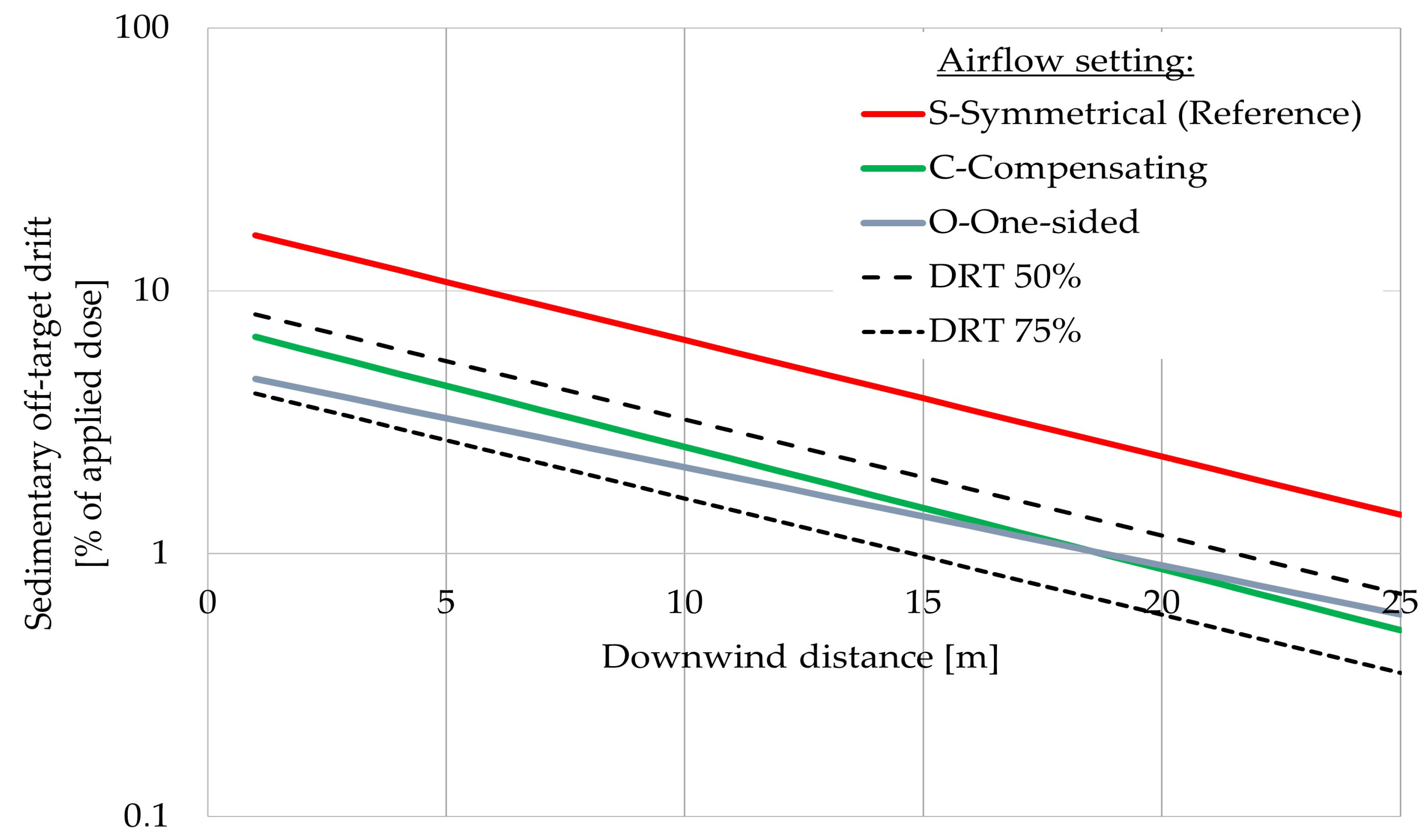
The DP values calculated according to Equation (8) and the DRP values calculated using Equation (9) are presented in Table 4. The obtained results indicate that a unilateral reduction in the airflow output on the leeward side of the sprayer reduced spray drift by 60.5% compared with the conventional mode of operation, which involved symmetrical air emission (S). This result is very close to the drift-reduction level (67.8%) achieved by completely switching off the air stream on one side (O), a practice recommended as an effective drift-reducing technique.
The exponential models y = aebx, presented in Figure 9, can be transformed into linear models by taking the base-10 logarithm of both sides of Equation (5), which results in Equation (10):
l o g y =   l o g a +   b x   l o g e
and by substituting: v = log(y), α = log(a), and β = b log(e).
As a result, Equation (11), which is linear with respect to x, is obtained and is often used to fit an exponential relationship to data in a linear form:
v = α + β x
Having plotted log(y) vs. x, we obtained straight lines with intercepts α equal to log(a) and slopes β equal to b log(e) (≈0.4343 b), representing the deposition drift data (Figure 10). This transformation allowed the exponential models to be fitted using linear regression of drift for the studied spray application scenarios in logarithmic coordinates. This, in turn, enabled the visual determination of the drift-reduction potential of the tested application scenarios C and O by comparing the positions of the drift regression lines for these scenarios with those of the reference scenario and with those calculated for theoretical drift-reducing techniques (DRTs) achieving 50% and 75% drift reduction relative to the reference scenario S (Figure 10). Regression lines for the compensating (C) and one-sided (O) airflow emission scenarios are located below the 50% DRT line and above the 75% DRT line. This indicates that both tested application techniques can be classified as 50% DRT.
Furthermore, the regression line for the one-sided scenario (O) is noteworthy, as its slope deviates significantly from the slopes of the lines for the other two scenarios, S and C. The smaller slope means that, despite generally lower drift, the predicted drift at the end of the measurement range (25 m from the application site) is higher for scenario O than for C. This unexpectedly elevated level of drift at a large distance from the orchard indicates a substantial contribution of high-altitude drift above the tree canopies, relative to low-level drift caused by spray droplets passing through the tree canopies. The results obtained confirm the effects of the phenomenon associated with treatments involving a one-sided airflow (O), illustrated in Figure 5, which consists of the suction of fine droplets from the leeward side to the windward side and lifting them above the tree canopy, where they are carried by wind at high altitude.

3.4. Power Consumption, Fuel Consumption, and CO2 Emission

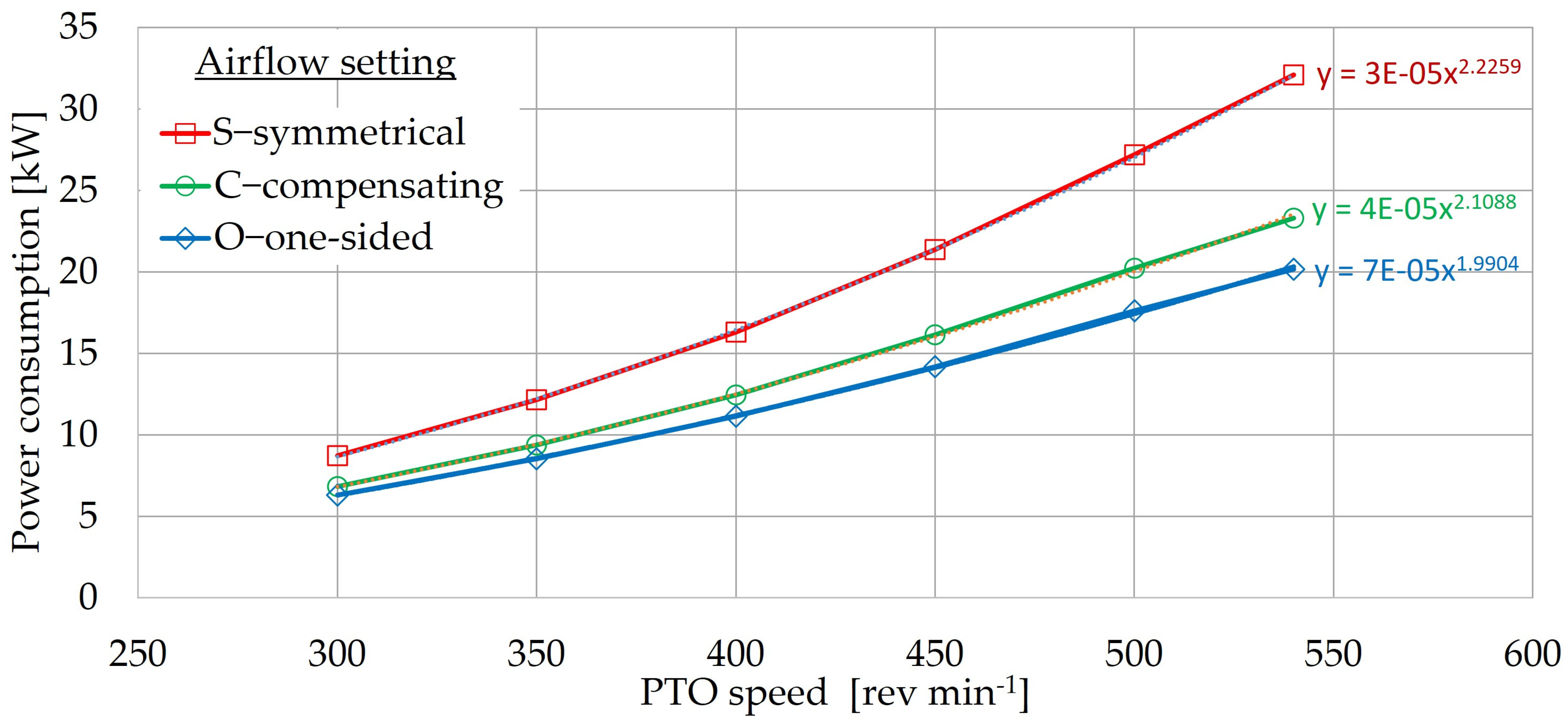
Power consumption as a function of PTO speed, calculated based on the torque measurements taken during operation of the DIVENT sprayer under the tested airflow settings, is presented in Figure 11. The results indicate significant differences in power consumption between the airflow scenarios, with the highest values observed for the symmetric air emission (S) and the lowest for the one-sided emission (O).
Since the maximum fan speed and full airflow (100%) were achieved when the hydraulic motors driving the fans operated at a PTO speed of 385 rpm, the fuel consumption and CO2 emissions for the tested airflow setting scenarios were estimated for this PTO speed. To determine the predicted values of power consumption P [kW] at a PTO speed of 385 rpm, regression equations describing the relationship between power consumption and PTO speed were derived for the applied torque measurement range (Figure 11). The calculated power consumption for the tested airflow settings is given in Table 5.
To estimate CO2 emissions for the tested airflow setting scenarios, the fuel consumption F (L h−1) was calculated based on the sprayer’s power consumption P, taking into account the following assumptions:
  • Volumetric energy density of diesel (heating value, i.e., the amount of thermal energy in one liter of diesel): W = 10.55 kWh L−1 [40];
  • Efficiency of a heavy-duty diesel tractor engine (i.e., the ratio of effective mechanical energy produced by the engine to the thermal energy of the diesel fuel): η = 35% [41];
  • Amount of CO2 produced from diesel combustion: G = 3.15 kg CO2 kg−1 fuel [42];
  • Density of diesel: ρ = 0.838 g cm−3.
The hourly fuel consumption of the sprayer, F (L h−1), was then calculated according to Equation (12):
F =   P × 100 W × η  
The emission of CO2 per hour of sprayer operation E [kg h−1] was calculated according to Equation (13):
E = F × G × ρ
The results of the calculations of fuel consumption and CO2 emissions for the tested airflow setting scenarios are presented in Table 5.
Adjusting airflow not only influenced spray performance but also the sprayer’s energetic footprint. Power consumption measurements showed that reducing fan output from 100%/100% (S) to 30%/100% (C) and 0%/100% (O) decreased total PTO power demand from 15.2 kW to 11.6 kW and 10.4 kW, respectively. The corresponding estimated fuel consumption dropped from 4.1 L h−1 (S) to 2.8 L h−1 (O), translating into CO2 emissions of 10.8 kg h−1, 8.3 kg h−1, and 7.5 kg h−1, respectively.

4. Discussion

The experiments with the DIVENT sprayer demonstrated that selective adjustment of air-jet emission can substantially modify spray deposition patterns, ground losses, and off-target drift under crosswind conditions, while simultaneously affecting power demand and potential CO2 emissions. The results confirm that flexible air management on both sides of an axial fan sprayer is an efficient way to reconcile environmental safety with adequate treatment quality, as emphasized in earlier work on adaptive airflow systems [18,20,24,26].

4.1. Methodological Considerations

In-canopy deposition was assessed using artificial collectors (filter papers) rather than real leaves. Although such samples cannot perfectly reproduce droplet adhesion, retention, or bounce on living foliage, they provide a highly repeatable and spatially traceable reference for comparing treatments. When the layout of collectors adequately represents canopy geometry and sufficient replication in time (to capture meteorological variability) and space (to include canopy density gradients) is achieved, artificial collectors allow objective mapping of spray distribution within tree canopies. Similar approaches are widely used in canopy penetration studies [3,32,35] because they yield reproducible spatial deposition profiles independent of transient leaf movement or variable surface wettability. Such standardized collectors thus serve primarily to evaluate the relative distribution and penetration of spray among canopy zones, rather than absolute retention on foliage. This methodological distinction is crucial when results are compared across studies or interpreted in terms of potential biological efficacy.

4.2. Penetration and Vertical Distribution of Spray Within the Canopy

Analysis of the penetration and vertical distribution of spray liquid provided a comprehensive picture of deposition behavior. The data showed that the symmetrical airflow (S) and the compensating crosswind configuration (C) both ensured high and relatively uniform deposition across canopy heights (≈45–66% of the applied dose), while the one-sided emission (O) produced lower average deposits (≈42%) and higher variability. Similar patterns have been reported by Cross et al. [3] and Duga et al. [35], who demonstrated that airflow intensity is the main determinant of within-canopy uniformity. Under-ventilated zones in particular can remain insufficiently covered even when mean deposition appears satisfactory.
Evaluating the vertical gradient of deposition proved essential for identifying weak points of application. In the O scenario, the lowest and highest canopy levels received markedly less spray, revealing potential risk zones for incomplete coverage and reduced biological efficacy. Such layer-specific assessment, rarely possible when only mean canopy deposits are reported, enables the detection of spatially localized inefficiencies that would otherwise remain masked. The importance of resolving vertical and horizontal deposition profiles for reliable interpretation of treatment performance is well recognized [13,43]. Restricting the evaluation to overall canopy means may lead to false conclusions regarding efficacy, since pests or pathogens often inhabit specific canopy strata.

4.3. In-Canopy Deposition Levels in Context of Literature Thresholds

Summed two-sided deposition values for the S and C configurations averaged ≈57–60% of the applied dose, whereas the O scenario yielded ≈42%. According to the synthesis of literature values, on-canopy recovery in orchard spraying typically spans ≈ 20–80%, with most conventional axial sprayers achieving ≈30–50%, and optimized or intelligent systems exceeding ≈50%. Within that framework, the DIVENT sprayer operating in S and C modes achieved deposition levels that qualify as good-to-very good, while the O configuration—though environmentally advantageous—fell into the moderate category.
Comparable magnitudes were reported by Cross et al. [3], who observed 39–57% on-canopy recovery for conventional fans, and by Duga et al. [35], who documented 51–61% for optimized air-assisted sprayers. Recent studies with adaptive or PWM-controlled air systems [33,44] confirm that 50–65% canopy capture represents efficient delivery. Thus, the deposition achieved by DIVENT under symmetric and compensating operation is well within the range recognized as biologically effective in the literature, whereas the 42% mean obtained under the one-sided mode remains likely adequate for control provided that active ingredients possess sufficient potency and redistribution potential.
Importantly, even when total deposits are moderate, high uniformity within the canopy can maintain efficacy, as spray reaching inner zones contributes disproportionately to pest control. Conversely, low-uniformity configurations (high CV values) may result in over-treated outer foliage and under-treated inner zones, reducing both efficiency and selectivity.
The CV values obtained in this study are in line with those reported in the literature for in-canopy spray deposits in orchard systems, where variability is known to be substantial under field conditions. Previous research has shown that CV values commonly range from approximately 20–70% at the canopy compartment scale and may exceed 80% at the individual leaf level, depending on airflow, sprayer design, and meteorological conditions [3,29,32,45,46]. Against this background, the CVs observed in the present study remain within the expected range for air-assisted orchard spraying.
The higher CV values obtained for the one-sided (O) and compensating (C) airflow configurations were influenced by a limited number of outliers. However, the box-and-whisker plots (Figure 4, Figure 6 and Figure 7) show that most measurements were concentrated within relatively narrow interquartile ranges, indicating consistent deposition for the majority of data points. This suggests that the apparent increase in CV reflects isolated extreme events rather than systematic instability of the airflow settings. Such outliers are consistent with localized turbulence, canopy heterogeneity, and wind fluctuations, which are widely recognized as unavoidable sources of variability in orchard spray application. Therefore, interpretation of CV values should consider the full data distribution rather than relying solely on summary statistics, as the boxplot analysis demonstrates that airflow regulation improved overall deposition consistency despite occasional extremes.

4.4. Spray Losses to Soil and Implications for Environmental Risk

Ground losses within the orchard ranged from ≈5% (C) to ≈7% (S) of the applied dose, values consistent with earlier findings that typically report soil deposits of 5–15% depending on airflow strength and canopy density [6,32]. The compensating configuration reduced leeward soil contamination by mitigating through-canopy droplet transport. However, the one-sided airflow (O) produced elevated local deposits beneath the windward trees due to the suction effect of the opposite fan. This pattern highlights a trade-off: while overall drift decreases, localized ground contamination can rise near the sprayer path. Similar counter-intuitive redistributions were observed in controlled fan experiments by Wenneker et al. [31] and Duga et al. [35], emphasizing that airflow asymmetry requires careful calibration to prevent re-entrainment of droplets at low altitudes.

4.5. Off-Target Drift and Drift-Reduction Potential

Deposition drift analysis revealed total drift reductions of 60.5% (C) and 67.8% (O) relative to the symmetric reference. These values are within the 50–75% drift-reduction class (DRT 50%) recognized in ISO and EU classification systems and comparable to reductions reported for one-sided- or crosswind-compensating airflow control in other studies [31,32,33]. The shape of the drift decay curves also reflected distinct physical mechanisms: the shallower slope for scenario O suggests persistence of a small but significant fraction of fine droplets transported at high altitude. As observed in video recordings, suction of droplets from the leeward to the windward side created a secondary upward jet, which can explain the elevated drift detected beyond 20 m. This phenomenon parallels findings of Duga et al. [35] and Gu et al. [44], who attributed long-range drift tails to vortices forming above the canopy in crosswind conditions.
From a regulatory standpoint, achieving ≥50% DRP while maintaining acceptable canopy coverage fulfills the criteria for low-drift technology, aligning with the principles of Drift-Reducing Technologies (DRTs) and Good Plant Protection Practice [47]. These results therefore substantiate the environmental benefit of selective airflow shutdown at orchard edges or when spraying upwind borders, practices already recommended in national guidelines but rarely quantified with respect to their potential effect on coverage.

4.6. Balancing Drift Reduction and Biological Efficacy

The practical relevance of drift-reducing configurations depends on whether the resulting deposition ensures biological efficacy. In the present study, disabling airflow on one side reduced mean in-canopy deposits by roughly 30% compared with the symmetric mode, yet this level (~42%) still exceeds the lower efficacy threshold (~30%) summarized in recent reviews [35,48]. Field evidence suggests that pest control remains satisfactory when on-canopy retention exceeds ≈40% of the applied volume, provided the spray spectrum and formulation are appropriate [43,49]. Therefore, the one-sided airflow can be considered biologically acceptable under favorable conditions, especially for border rows or low-pressure pest situations. Nevertheless, for dense canopies or high pest pressure, the compensating configuration (C) may represent the optimal compromise, sustaining deposition close to the symmetric reference while halving drift.
These findings underscore the need for integrated evaluation combining environmental and efficacy metrics. Overemphasis on drift reduction alone may discourage adoption if users perceive efficacy risks. Presenting quantified data—such as deposition percentages relative to efficacy thresholds—helps strengthen confidence in low-drift practices among practitioners.

4.7. Energy Use, Fuel Consumption, and CO2 Emissions

The obtained reductions in energy and fuel consumptions, as well as CO2 emissions align with trends reported for variable speed and hydraulically driven fan systems [25,36], where partial airflow control can lower energy demand by 20–40% without compromising deposition. Because fan power constitutes the dominant share of total sprayer energy use (often >60%; [36]), even modest reductions in fan speed or active fan count yield substantial fuel savings. Over a spraying season, the one-sided configuration could therefore cut CO2 emissions by roughly one-third compared with conventional symmetric operation. Such environmental co-benefits reinforce the value of intelligent airflow management not only for drift mitigation but also for climate impact reduction in orchard operations.

5. Conclusions

This study demonstrates that independent control of airflow in a dual-fan orchard sprayer is an effective strategy for adapting spray application to crosswind conditions, achieving an improved balance between deposition quality, environmental protection, and energy efficiency. Asymmetric airflow adjustment (C) significantly enhanced spray targeting and reduced drift compared with conventional symmetric operation, confirming the value of airflow management as a core component of precision spraying.
Among the tested configurations, the compensating airflow setting (30%/100%) provided the best compromise between drift reduction and deposition performance, reducing off-target drift by more than 60% while maintaining canopy coverage comparable to symmetric operation. The one-sided configuration (0%/100%) achieved the greatest drift reduction (67.8%) and the lowest fuel consumption and CO2 emissions, but resulted in reduced and less uniform deposition. This mode is therefore most suitable for border rows or situations where drift mitigation is the primary concern.
Reducing fan airflow directly lowered power demand and fuel use, demonstrating that variable airflow control contributes not only to environmental protection but also to improved operational efficiency. The use of independent hydraulic drives offers greater flexibility than mechanical throttling systems, enabling real-time adaptation to wind direction and canopy structure. This approach is consistent with the Crop-Adapted Spray Application concept and provides a foundation for further development of intelligent spray systems.
Future research should focus on identifying optimal downwind airflow ratios across a wider range of meteorological conditions and canopy structures. Extending validation to different phenological stages and canopy densities, including bioassay-based assessments, and improving correlation between artificial collectors and actual leaf retention will further strengthen predictive accuracy. Additional studies should also explore airflow optimization with coarse-spray nozzles to better understand interactions between droplet size and airflow asymmetry.
Finally, integrating real-time control strategies based on wind speed sensing, airflow resistance, or ultrasonic canopy detection would enable dynamic adjustment of fan output. The incorporation of drone-based LiDAR canopy mapping could further enhance site-specific airflow management, paving the way toward fully adaptive, data-driven orchard spraying systems that maximize efficacy while minimizing drift, energy use, and environmental impact.

Author Contributions

Conceptualization, G.D.; methodology, G.D.; investigation, G.D., W.Ś., A.G. and A.B.; data curation, G.D., W.Ś. and A.B.; writing—original draft preparation, G.D.; writing—review and editing, G.D., R.H. and A.G. All authors have read and agreed to the published version of the manuscript.

Funding

This research was funded by the Smart Growth Operational Programme 2014–2020; grant number POIR.01.01.01-00-0006/17-00 (Innovative dual-fan sprayer with asymmetric air adjustment DIVENT).

Institutional Review Board Statement

Not applicable.

Data Availability Statement

The original contributions presented in this study are included in the article. Further inquiries can be directed to the corresponding author.

Acknowledgments

We acknowledge the AGROLA company for the delivery of the sprayer prototype used in the trials, as well as technicians from the Dept. of Agroengineering for their professional commitment in the field and laboratory experimental activities.

Conflicts of Interest

The authors declare no conflicts of interest.

References

  1. Wang, G.; Li, Z.; Jia, W.; Ou, M.; Dong, X.; Zhang, Z. A Review on the Evolution of Air-Assisted Spraying in Orchards and the Associated Leaf Motion During Spraying. Agriculture 2025, 15, 964. [Google Scholar] [CrossRef]
  2. Al-Jumaili, A.; Salyani, M. Variation in Deposition of an Air-Assisted Sprayer in Open Field Due to Wind Conditions. Trans. ASABE 2014, 57, 1297–1305. [Google Scholar] [CrossRef]
  3. Cross, J.V.; Walklate, P.J.; Murray, R.A.; Richardson, G.M. Spray deposits and losses in different sized apple trees from an axial fan orchard sprayer: 1. Effects of spray liquid flow rate. Crop Prot. 2001, 20, 13–30. [Google Scholar] [CrossRef]
  4. Endalew, A.M.; Debaer, C.; Rutten, N.; Vercammen, J.; Delele, M.A.; Ramon, H.; Nicolaï, B.M.; Verboven, P. Modelling pesticide flow and deposition from air-assisted orchard spraying in orchards: A new integrated CFD approach. Agric. For. Meteorol. 2010, 150, 1383–1392. [Google Scholar] [CrossRef]
  5. Qiu, W.; Zhao, S.Q.; Ding, W.M.; Sun, C.D.; Lu, J.; Li, Y.N.; Gu, J. Effects of fan speed on spray deposition and drift for targeting air-assisted sprayer in pear orchard. Int. J. Agric. Biol. Eng. 2016, 9, 53–62. [Google Scholar]
  6. Hong, S.W.; Zhao, L.; Zhu, H. CFD simulation of pesticide spray from air-assisted sprayers in an apple orchard: Tree deposition and off-target losses. Atmos. Environ. 2018, 175, 109–119. [Google Scholar] [CrossRef]
  7. Garcera, C.; Moltó, E.; Izquierdo, H.; Balsari, P.; Marucco, P.; Grella, M.; Gioelli, F.; Chueca, P. Effect of the Airblast Settings on the Vertical Spray Profile: Imple-mentation on an On-Line Decision Aid for Citrus Treatments. Agronomy 2022, 12, 1462. [Google Scholar] [CrossRef]
  8. Grella, M.; Gioelli, F.; Marucco, P.; Mozzanini, E.; Caffini, A.; Nuyttens, D.; Zwertvaegher, I.; Fountas, S.; Athanasakos, L.; Mylonas, N.; et al. Exploring variable air flow rate as a function of leaf area index for optimal spray deposition in trellised vineyards. International Advances in Pesticide Application. Asp. Appl. Biol. 2022, 147, 251–260. [Google Scholar]
  9. Sun, W.; Guo, Y.; Wang, H.; Sun, Y.; Xu, J.; Zhang, K.; Jin, H. Impact of airflow-assisted spraying technology on droplet drift: A solution for reducing pesticide drift under multidirectional strong wind conditions. Pest. Manag. Sci. 2025, 81, 3312–3327. [Google Scholar] [CrossRef] [PubMed]
  10. Li, J.; He, M.; Cui, H.; Lin, P.; Chen, Y.; Ling, G.; Huang, G.; Fu, H. Characterizing Droplet Retention in Fruit Tree Canopies for Air-Assisted Spraying. Agriculture 2022, 12, 1093. [Google Scholar] [CrossRef]
  11. Wei, Z.; Li, R.; Xue, X.; Sun, Y.; Zhang, S.; Li, Q.; Chang, C.; Zhang, Z.; Sun, Y.; Dou, Q. Research Status, Methods and Prospects of Air-Assisted Spray Technology. Agronomy 2023, 13, 1407. [Google Scholar] [CrossRef]
  12. Gu, C.; Sun, J.; Li, S.; Yang, S.; Zou, W.; Zhai, C. Deposition Characteristics of Air-Assisted Sprayer Based on Canopy Volume and Leaf Area of Orchard Trees. Plants 2025, 14, 220. [Google Scholar] [CrossRef]
  13. Derksen, R.C.; Krause, C.R.; Fox, R.D.; Brazee, R.D.; Zondag, R. Effect of Application Variables on Spray Deposition, Coverage, and Ground Losses in Nursery Tree Applications. J. Environ. Hortic. 2006, 24, 45–52. [Google Scholar] [CrossRef]
  14. Zhang, F.; Sun, H.; Qiu, W.; Lv, X.; Chen, Y.; Zhao, G. Model construction and validation of airflow velocity attenuation through pear tree canopies. Front. Plant Sci. 2022, 13, 1026503. [Google Scholar] [CrossRef] [PubMed]
  15. Xu, S.; Wang, X.; Li, C.; Ran, X.; Zhong, Y.; Jin, Y.; Song, J. Effect of airflow angle on abaxial surface deposition in air-assisted spraying. Front. Plant Sci. 2023, 4, 1211104. [Google Scholar] [CrossRef]
  16. Salyani, M.; Pai, N.; Sweeb, R.D. On-the-go changing of sprayer airflow based on tree foliage density. In Proceedings of the A: 9th Workshop on Sustainable Plant Protection Techniques in Fruit Growing (SuProFruit), Alnarp, Sweden, 12–14 September 2007; pp. 63–64. [Google Scholar]
  17. Pai, N.; Salyani, M.; Sweeb, R.D. Regulating Airflow of Orchard Airblast Sprayer Based on Tree Foliage Density. Trans. ASABE 2009, 52, 1423–1428. [Google Scholar] [CrossRef]
  18. Landers, A.J. The Development of a Precision Canopy Sprayer for Orchards and Vineyards. In Proceedings of the 8th Fruit, Nut and Vegetable Production Engineering Symposium, Concepcion, Chile, 5–9 January 2009; pp. 485–493. [Google Scholar]
  19. Landers, A.J. Developments towards an automatic precision sprayer for fruit crop canopies. In Proceedings of the 2010 ASABE Annual International Meeting, Pittsburgh, PA, USA, 20–23 June 2010; American Society of Agricultural and Biological Engineers: St. Joseph, MI, USA, 2010; p. 1. [Google Scholar] [CrossRef]
  20. Doruchowski, G.; Świechowski, W.; Hołownicki, R.; Godyń, A. Environmentally-Dependent Application System (EDAS) for safer spray application in fruit growing. J. Hortic. Sci. Biotech. 2009, 84, 107–112. [Google Scholar] [CrossRef]
  21. Balsari, P.; Marucco, P.; Tamagnone, M. A crop identification system (CIS) to optimise pesticide applications in orchards. J. Hortic. Sci. Biotech. 2009, 84, 113–116. [Google Scholar] [CrossRef]
  22. Doruchowski, G.; Balsari, P.; Van de Zande, J. Development of a crop adapted spray application system for sustainable plant protection in fruit growing. Acta Hortic. 2009, 824, 251–260. [Google Scholar] [CrossRef]
  23. Dou, H.; Zhai, C.; Zhang, Y.; Chen, L.; Gu, C.; Yang, S. Research on decoupled air speed and air volume adjustment methods for air-assisted spraying in orchards. Front. Plant Sci. 2023, 14, 1250773. [Google Scholar] [CrossRef]
  24. Feng, F.; Dou, H.; Zhai, C.; Zhang, Y.; Zou, W.; Hao, J. Design and Experiment of Orchard Air-Assisted Sprayer with Airflow Graded Control. Agronomy 2025, 15, 95. [Google Scholar] [CrossRef]
  25. Hołownicki, R.; Doruchowski, G.; Świechowski, W.; Godyń, A.; Konopacki, P. Variable air assistance system for orchard sprayers: Concept, design and preliminary testing. Biosyst. Eng. 2017, 163, 134–149. [Google Scholar] [CrossRef]
  26. Salcedo, R.; Fonte, A.; Grella, M.; Garcera, C.; Chueca, P. Blade pitch and air-outlet width effects on the airflow generated by an airblast sprayer with wireless remote-controlled axial fan. Comput. Electron. Agric. 2021, 190, 106428. [Google Scholar] [CrossRef]
  27. Wenneker, M.; Nieuwenhuizen, A.T.; Zande, V.D.J.C.; Balsari, P.; Doruchowski, G.; Marucco, P. Advanced drift reduction in orchard spraying. International Advances in Pesticide Application. Asp. Appl. Biol. 2012, 114, 421–427. [Google Scholar]
  28. Li, S.; Li, J.; Yu, S.; Wang, P.; Liu, H.; Yang, X. Anti-Drift Technology Progress of Plant Protection Applied to Orchards: A Review. Agronomy 2023, 13, 2679. [Google Scholar] [CrossRef]
  29. Cross, J.; Walklate, P.; Murray, R.; Richardson, G. Spray deposits and losses in different sized apple trees from an axial fan orchard sprayer: 3. Effects of air volumetric flow rate. Crop Prot. 2003, 22, 381–394. [Google Scholar] [CrossRef]
  30. Xun, L.; Campos, J.; Salas, B.; Fabregas, F.X.; Zhu, H.; Gil, E. Advanced spraying systems to improve pesticide saving and reduce spray drift for apple orchards. Precis. Agric. 2023, 24, 1526–1546. [Google Scholar] [CrossRef]
  31. Wenneker, M.; Van de Zande, J.C. Spray drift reducing effects of natural windbreaks in orchard spraying. International Advances in Pesticide Application. Asp. Appl. Biol. 2008, 84, 1–8. [Google Scholar]
  32. Grella, M.; Gallart, M.; Marucco, P.; Balsari, P.; Gil, E. Ground Deposition and Airborne Spray Drift Assessment in Vineyard and Orchard: The Influence of Environmental Variables and Sprayer Settings. Sustainability 2017, 9, 728. [Google Scholar] [CrossRef]
  33. Salcedo, R.; Zhu, H.; Ozkan, E.; Falchieri, D.; Zhang, Z.; Wei, Z. Reducing ground and airborne drift losses in young apple orchards with PWM-controlled spray system. Comput. Electron. Agric. 2021, 189, 106389. [Google Scholar] [CrossRef]
  34. Wang, G.; Dong, X.; Jia, W.; Ou, M.; Yu, P.; Wu, M.; Zhang, Z.; Hu, X.; Huang, Y.; Lu, F. Influence of Wind Speed on the Motion Characteristics of Peach Leaves (Prunus persica). Agriculture 2024, 14, 2307. [Google Scholar] [CrossRef]
  35. Duga, A.T.; Dekeyser, D.; Ruysen, K.; Bylemans, D.; Nuyttens, D.; Nicolai, B.M.; Verboven, P. Numerical Analysis of the Effects of Wind and Sprayer Type on Spray Distribution in Different Orchard Training Systems. Bound.-Layer Meteorol. 2015, 157, 517–535. [Google Scholar] [CrossRef]
  36. Failla, S.; Bisaglia, C.; Schillaci, G.; Longo, D.; Romano, E. Sprayer Axial Fan Layout Affecting Energy Consumption and Carbon Emissions. Resources 2020, 9, 136. [Google Scholar] [CrossRef]
  37. Garcera, C.; Doruchowski, G.; Chueca, P. Harmonization of plant protection products dose expression and dose adjustment for high growing 3D crops: A review. Crop Prot. 2021, 140, 105417. [Google Scholar] [CrossRef]
  38. ISO 22866:2005; Equipment for Crop Protection—Methods for Field Measurement of Spray Drift. International Organization for Standardization: London, UK, 2005.
  39. Nuyttens, D. Drift from Field Crop Sprayers: The Influence of Spray Application Technology Determined Using Indirect and Direct Drift Assessment Means. Ph.D. Thesis, Katholieke Universiteit Leuven-Faculteit Bio-ingenieurswetenschappen, Leuven, Belgium, 2007; p. 772, ISBN 978-90-8826-039-1. [Google Scholar]
  40. Speight, J.G. 2-Production, properties and environmental impact of hydrocarbon fuel conversion. In Advances in Clean Hydrocarbon Fuel Processing; Woodhead Publishing Series in Energy; Khan, M.R., Ed.; Woodhead Publishing: Sawston, UK, 2011; pp. 54–82. [Google Scholar] [CrossRef]
  41. Thiruvengadam, A.; Pradhan, S.; Thiruvengadam, P.; Besch, M.; Carder, D.; Delgado, O. Heavy-Duty Vehicle Diesel Engine Efficiency Evaluation and Energy Audit; Final Report; Center for Alternative Fuels, Engines & Emissions-West Virginia University: Morgantown, WV, USA, 2014; p. 61. Available online: https://theicct.org/wp-content/uploads/2021/06/HDV_engine-efficiency-eval_WVU-rpt_oct2014.pdf (accessed on 30 October 2025).
  42. Baráth, B.; Jagicza, M.; Sütheö, G.; Tóth, G.L. Examination of the Load’s Effect on Fuel Consumption and CO2 Emissions, in the Case of a Diesel and LNG Powered Tractor. Eng. Proc. 2024, 79, 17. [Google Scholar] [CrossRef]
  43. Chen, Y.; Ozkan, H.E.; Zhu, H.; Derksen, R.C.; Krause, C.R. Spray Deposition inside Tree Canopies from a Newly Developed Variable-Rate Air-Assisted Sprayer. Trans. ASABE 2013, 56, 1263–1272. [Google Scholar] [CrossRef]
  44. Gu, C.; Zou, W.; Wang, X.; Chen, L.; Zhai, C. Wind loss model for the thick canopies of orchard trees based on accurate variable spraying. Front. Plant Sci. 2022, 13, 1010540. [Google Scholar] [CrossRef] [PubMed]
  45. Koch, H.; Weisser, P. Spray deposits of crop protection products on plants—The potential exposure of non-target arthropods. Chemosphere 2001, 44, 307–312. [Google Scholar] [CrossRef]
  46. Ranjan, R.; Sinha, R.; Khot, L.R.; Hoheisel, G.-A.; Grieshop, M.J.; Ledebuhr, M. Effect of Emitter Modifications on Spray Performance of a Solid Set Canopy Delivery System in a High-Density Apple Orchard. Sustainability 2021, 13, 13248. [Google Scholar] [CrossRef]
  47. Doruchowski, G.; Roettele, M.; Herbst, A.; Balsari, P. Drift evaluation tool to raise awareness and support training on the sustainable use of pesticides by drift mitigation. Comput. Electron. Agric. 2013, 97, 27–34. [Google Scholar] [CrossRef]
  48. Fessler, L.; Nackley, L.; Warneke, B.; Pscheidt, J.; Lockwood, D.; Wright, W.C.; Sun, X.; Fulcher, A. Refining spray application rate with a laser-guided variable-rate sprayer. HortScience 2020, 55, 1522–1530. [Google Scholar] [CrossRef]
  49. Zhu, H.; Derksen, R.C.; Krause, C.R.; Brazee, R.D.; Reding, M.E.; Zondag, R.H.; Fox, R.D. Spray deposition and off-target loss in nursery tree crops with conventional nozzle, air induction nozzle and drift retardant. In Proceedings of the 2005 ASAE Annual Meeting, Tampa, FL, USA, 17–20 July, 2005; Paper No. 051007. American Society of Agricultural and Biological Engineers: St. Joseph, MI, USA, 2005. [Google Scholar]
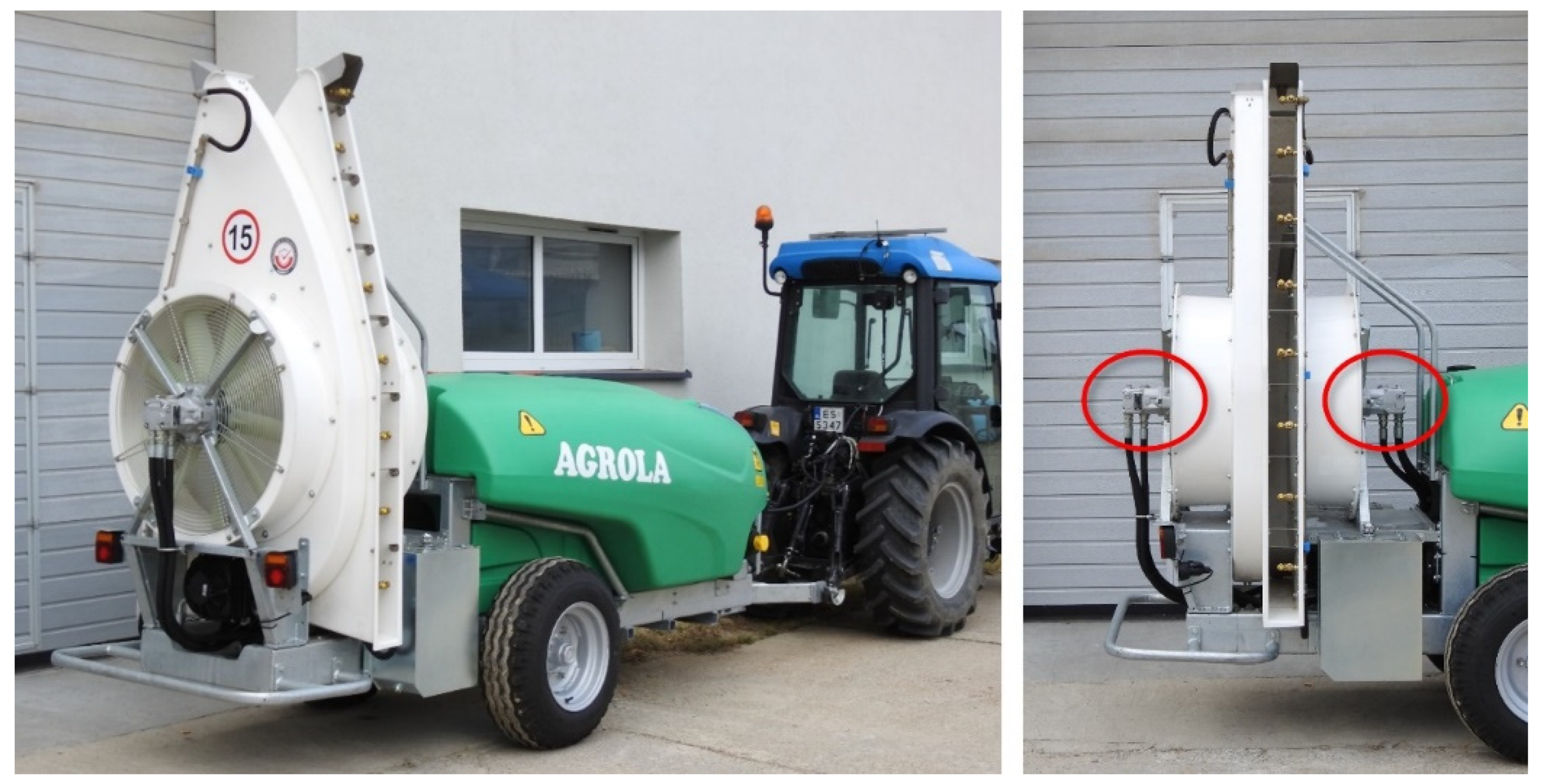
Figure 1. DIVENT (AGROLA—Płatkownica, Poland)—a prototype double-tower orchard sprayer with built-in axial fans independently driven by hydraulic motors indicated by red circles.
Agriculture 15 02520 g001
Figure 2. Spray application scenarios with different airflow settings performed by a double-tower sprayer DIVENT in an apple orchard.
Agriculture 15 02520 g002
Figure 3. Experimental layout of collectors for in-canopy deposition, ground loss, and off-target deposition drift measurements.
Agriculture 15 02520 g003
Figure 4. Spray penetration in tree canopies on both sides of double-tower sprayer having applied spray with three airflow setting scenarios: S—Symmetrical; C—Compensating; and O—One-sided. Means marked with “×” accompanied by the same letter do not differ significantly (Duncan’s test, p < 0.05). The numbers on the trees refer to tree numbers in Figure 3.
Agriculture 15 02520 g004
Figure 5. Fate of fine droplets during spray application with one-sided airflow setting. Blue arrows show the airflow and the red ones droplet trajectories.
Agriculture 15 02520 g005
Figure 6. Spray deposit in apple tree canopies after simulated application from both sides performed by double-tower sprayer operating at three airflow setting scenarios: S—Symmetrical; C—Compensating; and O—One-sided. Means marked with “×” accompanied by the same letter do not differ significantly (Duncan’s test, p < 0.05).
Agriculture 15 02520 g006
Figure 7. Vertical spray distribution in apple tree canopies after simulated application from both sides performed by double-tower sprayer operating at three airflow setting scenarios: S—Symmetrical; C—Compensating; and O—One-sided. Means marked with “×” accompanied by the same letter do not differ significantly (Duncan’s test, p < 0.05).
Agriculture 15 02520 g007
Figure 8. Ground loss of spray applied during a single pass of double-tower sprayer operating at three airflow settings: S—Symmetrical; C—Compensating; and O—One-sided. Bars with the same letter do not differ significantly (Duncan’s test, p < 0.05). The numbers on the trees refer to tree numbers in Figure 3.
Agriculture 15 02520 g008
Figure 9. Best-fit deposition drift curves and corresponding regression equations derived from ground deposit data of off-target drift for spray applications with three airflow settings. The table below the chart presents the respective mean values and standard deviations (SDs) of drift deposits measured at downwind distances.
Agriculture 15 02520 g009
Figure 10. Linear regressions of deposition drift for tested airflow settings and regression lines for drift-reduction techniques: 50% DRT and 75% DRT. Drift for symmetrical airflow setting was used as reference to calculate 50% DRT and 75% DRT values.
Agriculture 15 02520 g010
Figure 11. Power consumption [kW] as a function of PTO speed during operation of DIVENT sprayer under different airflow setting scenarios and respective regression equations to calculate power consumption for PTO speed = 385 rev min−1.
Agriculture 15 02520 g011
Table 1. Weather conditions during field experiments on evaluation of effects of spray applications with different airflow setting scenarios (RH = relative humidity).
Application ScenarioReplicateWind
Azimuth
[°]
Wind
Velocity
[m s−1]
Mean Wind Velocity
[m s−1]
Air
Temp
[°C]
Mean
Air Temp
[°C]
Air
RH
[%]
Mean Air RH
[%]
S
Symmetrical
I310 (NW)4.593.9618.118.264.060.2
II293 (W/NW)4.6017.972.5
III299 (W/NW)2.6918.644.0
C
Compensating
I288 (W/NW)4.593.3019.118.459.960.4
II270 (W)2.6617.279.5
III282 (W/NW)2.6419.041.9
O
One-sided
I305 (NW)5.784.0918.618.267.661.6
II306 (NW)3.4116.479.8
III237 (W/SW)3.0819.537.3
Table 2. Mean liquid deposit [% of applied dose] and coefficient of variation CV [%] in apple trees sprayed under three airflow scenarios with different left/right airflow settings [L%/R%], based on two-sided spray simulation using empirical data under crosswind conditions (mean wind speed: 3.8 m·s−1). Means followed by the same letter do not differ significantly (Duncan’s test, p < 0.05).
Application Scenario with Airflow SettingMean Deposit
[% of Applied Dose]
Coefficient of Variation
CV [%]
S—Symmetrical emission: L/R = 100%/100%59.69 a38.0
C—Compensating emission: L/R = 30%/100%57.09 a 54.2
O—One-sided emission: L/R = 0%/100%41.70 b71.8
Table 3. Parameters of the exponential models y = a xᵇ describing deposition drift for the spray application scenarios in the apple orchard using the DIVENT sprayer. A graphical representation of the models is shown in Figure 9.
Application Scenario with Airflow SettingParameters:
ab
S—Symmetrical emission: L/R = 100%/100%18.002−0.102
C—Compensating emission: L/R = 30%/100%7.4218−0.107
O—One-sided emission: L/R = 0%/100%5.0329−0.086
Table 4. Deposition drift potential DP [%] in measuring range from 1 to 25 m downwind and drift-reduction potential DRP [%] for the tested airflow scenarios.
Application Scenario with Airflow SettingDP [%]DRP [%]
S—Symmetrical emission: L/R = 100%/100%145.60-
C—Compensating emission: L/R = 30%/100%57.5460.5
O—One-sided emission: L/R = 0%/100%46.8867.8
Table 5. Power consumption, diesel fuel consumption, and CO2 emissions for the tested airflow setting scenarios (PTO speed = 385 rev min−1).
Airflow Setting ScenarioPower Consumption P
[kW]
Fuel Consumption F
F [L h−1]
CO2 Emission E
[kg h−1]
S—Symmetrical15.174.1110.84
C—Compensating crosswind11.603.148.29
O—One-sided10.442.837.46
Disclaimer/Publisher’s Note: The statements, opinions and data contained in all publications are solely those of the individual author(s) and contributor(s) and not of MDPI and/or the editor(s). MDPI and/or the editor(s) disclaim responsibility for any injury to people or property resulting from any ideas, methods, instructions or products referred to in the content.