Article

Eco-Efficiency Indicators in Traditional Iberian Pig Farms in the Dehesa Ecosystem: Integrated Economic and Environmental Performance


by
Javier García-Gudiño
1,*,
José Perea
2,
Maria Font-i-Furnols
3,
Elena Angón
2 and
Isabel Blanco-Penedo
4,5
1
Animal Production, Centre of Scientific and Technological Research of Extremadura (CICYTEX), 06187 Guadajira, Spain
2
Animal Production, University of Córdoba (UCO), 14071 Córdoba, Spain
3
Food Quality and Technology Program, Institute for Food and Agricultural Research and Technology (IRTA), 17121 Monells, Spain
4
Department of Animal Sciences, University of Lleida (Udl), 25918 Lleida, Spain
5
Department of Clinical Sciences, Swedish University of Agricultural Sciences (SLU), 750 07 Uppsala, Sweden
*
Author to whom correspondence should be addressed.
Agriculture 2025, 15(23), 2515; https://doi.org/10.3390/agriculture15232515
Submission received: 8 October 2025 / Revised: 20 November 2025 / Accepted: 2 December 2025 / Published: 4 December 2025
(This article belongs to the Section Farm Animal Production)

Abstract

The traditional Iberian pig production system in the dehesa ecosystem of southwestern Spain and Portugal represents a significant cultural and ecological model of extensive livestock farming currently facing sustainability challenges. This study aimed to identify eco-efficiency indicators by integrating economic and environmental dimensions across traditional Iberian pig farms. Structured surveys were conducted across 68 farms, complemented by life cycle assessment (LCA) to evaluate environmental impacts including climate change, acidification, eutrophication, energy demand and land occupation. Multivariate statistical analysis identified two distinct farm types: Mixed-orientation Farms (MF, 45.59% of farms), characterised by diversified production phases and greater reliance on external inputs, and Acorn-Fed Farms (AF, 54.41% of farms), specialised in acorn-based fattening with greater dehesa ecosystem integration. AF demonstrated significantly lower environmental impacts across all categories except land occupation, with reductions ranging from 9% to 18% compared to MF. Furthermore, AF achieved superior eco-efficiency with gross margins 15% higher than MF and economic returns per unit of environmental impact 32% to 59% higher across all indicators. These findings demonstrate that farrow-to-finish farms specialised in montanera systems can simultaneously achieve greater profitability and reduced environmental impacts, providing a replicable model for sustainable livestock production in Mediterranean agroecosystems.

1. Introduction

The traditional production system for Iberian pigs is deeply embedded in the cultural, ecological and economic heritage of southwestern Spain and Portugal [1,2]. It relies on extensive husbandry practices that utilise the dehesa ecosystem, a Mediterranean agrosilvopastoral system characterised by the interaction of four fundamental components: soil, pasture, trees (primarily Quercus ilex and Q. suber) and animals, which together constitute a highly complex ecosystem [3]. This system exhibits substantial heterogeneity at multiple scales. At the farm level, operations range from traditional multifunctional low-intensity management to more intensified production models, resulting in diverse farm types that differ in structural characteristics, productive orientations and resource utilisation strategies [4].
Iberian pig production accounts for around 10% of the total Spanish pig census [5]. Within this sector, the Quality Standard [6] defines production systems according to feeding regime during the fattening phase in the dehesa: montanera, where pigs are exclusively fed on natural resources (acorns and pasture); and cebo de campo, where pigs receive compound feed supplemented with natural resources in outdoor conditions. These extensive systems play a critical role in the utilisation of natural resources and the production of high-value meat products [7,8]. Despite its importance, this system faces increasing challenges related to environmental sustainability and market viability, particularly the intensification of practices that risk the overexploitation of dehesa resources [9] while also facing policy demands for demonstrable sustainability outcomes [10]. These challenges require integrated assessment approaches that can guide both, individual farm management decisions and broader policy interventions to ensure the long-term sustainability of this traditional production system.
Previous research has addressed specific aspects of Iberian pig farming, yet the literature remains fragmented across disciplinary boundaries. Economic studies have examined production performance and market value [11], whilst environmental assessments have focused on isolated impacts such as carbon footprint [12,13] or resource use efficiency. However, these studies have examined dimensions in isolation. While integrated sustainability assessment frameworks have been developed for livestock systems [14], comparative analyses combining environmental and economic performance remain scarce in the Iberian pig sector. This gap is particularly relevant for policymaking and farm-level decision support, as it hinders the identification of production strategies that are both economically viable and environmentally efficient. Therefore, there is a pressing need for robust methodological approaches that can characterise these dimensions together under the operational complexity of real farms.
In this context, eco-efficiency analysis emerges as a valuable tool to assess the capacity of farms to generate economic value from a given set of inputs while minimising associated environmental impacts [15], typically expressed as a ratio between economic performance and environmental impacts. Integrating farm-level economic indicators with life cycle assessment (LCA) provides a comprehensive evaluation of performance [16,17] within ecosystems such as the dehesa. Despite its potential, the application of this integrated approach to Iberian pig systems remains incipient and underexplored. Furthermore, the structural diversity of Iberian pig farms is reflected by the coexistence of production systems defined by the Quality Standard [6], which necessitates robust analytical frameworks to address this heterogeneity. Multivariate methods offer the opportunity to synthesise high-dimensional datasets and classify farms according to their technical, economic and environmental variables [18,19,20,21,22].
The aim of this study was to: (1) characterise the structural diversity of traditional Iberian pig farms using multivariate analysis; (2) compare the environmental performance of different farm types using life cycle assessment; and (3) develop and apply eco-efficiency indicators integrating economic and environmental performance to evaluate synergies and trade-offs between profitability and environmental impacts.

2. Materials and Methods

2.1. Study Area and Iberian Pig Production System

The study was conducted in the dehesa ecosystem, a traditional agrosilvopastoral system covering approximately 6.7 million hectares in the south-west of the Iberian Peninsula [23]. These systems are characterised by woodlands of holm and cork oaks (Quercus spp.), pastures and shrubs, where extensive livestock farming coexists with other land uses [24].
Iberian pigs are a medium-sized native breed, traditionally raised under extensive or semi-extensive conditions [25]. Their feeding regime is based on a combination of compound feed and natural resources, depending on the season [26]. The main productive categories are piglets (up to 23 kg of live weight), growers (between 60 and 100 kg) and fatteners (165 kg on average). According to the fattening management, Iberian pigs can be classified as montanera fatteners, which are fed only natural resources (acorns and grass), or cebo de campo fatteners, which are fed a combination of available natural resources (mainly pasture) and compound feed [6]. The greater physical activity in extensive systems, together with the pigs’ age at slaughter (12 to 14 months), contributes to the high quality of Iberian pork [25].

2.2. Data Acquisition

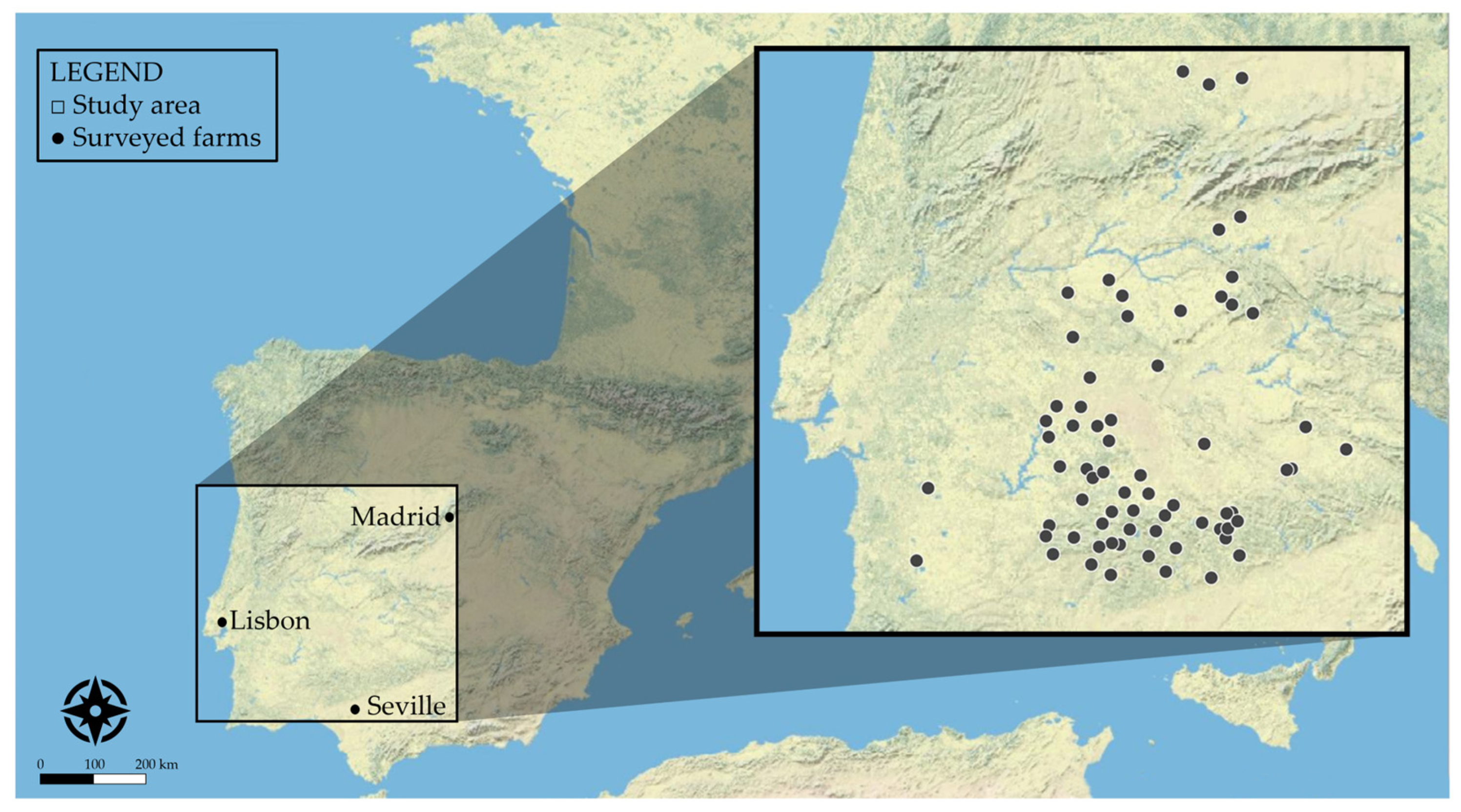
Data were collected from 68 Iberian pig farms through face-to-face interviews using structured questionnaires during 2016–2018, covering two consecutive production cycles. The surveys were conducted in traditional Iberian pig farming areas within the dehesa ecosystem (Figure 1). The number of farms selected in each region was proportional to the regional production of montanera fatteners to ensure a representative sample [27]. The questionnaire was designed to capture the main structural, productive, economic and social aspects of Iberian pig farms within the dehesa ecosystem. Farm structure (area, facilities, machinery) and livestock inventory (pigs and other species) were considered as key indicators of farm-level productive potential [28]. Management practices (reproductive, feeding and health) were assessed due to their impact on animal performance and welfare [29], while work organisation and economic variables (labour and commercialisation) provided information to evaluate farm viability [28,30]. Social aspects, reflecting the role of farms in rural communities [28], were assessed as social sustainability indicators. Integration with other agricultural activities was also considered to reflect the multifunctional role [31] of extensive farms in the dehesa ecosystem. Additionally, derived variables were calculated from the questionnaire data to facilitate the multivariate analysis.

2.3. Statistical Analysis

Multivariate statistical tools were used to identify different farm types among traditional Iberian pig farms in the dehesa, based on technical, economic and management data. The identification of farm types followed the methodology used by Giorgis et al. [18], Gaspar et al. [19], Toro-Mújica et al. [20], Rivas et al. [21] and Díaz-Gaona et al. [22], which consists of three stages: variable selection, factor analysis and cluster analysis.
From the initial 34 variables in the survey data, 26 variables with a coefficient of variation (CV) > 50%) were selected. Data suitability was assessed by comparing Pearson (rPEAR) and partial (rPAR) correlations between the variables [32] to eliminate uncorrelated variables and retain the variable with the highest CV from each correlated pair. This selection process yielded 13 variables described in Table 1, including their measurement units and descriptions.
Factor analysis was then applied to reduce dimensionality and summarise variance. Variables were standardised using z-score transformation (mean-centred and scaled by standard deviation) to avoid scale effects and ensure equal contribution to the multivariate analysis. Principal components analysis was used as the extraction method to calculate factor scores for each farm [21], with varimax rotation to ensure orthogonality of extracted factors [33]. The Bartlett sphericity test and the Kaiser–Meyer–Olkin index verified sample adequacy [34,35].
Finally, farms were classified into groups using cluster analysis based on individual factor scores. Hierarchical clustering was performed using Ward’s method with Euclidean, squared Euclidean and Manhattan distances [36]. The optimal number of clusters was determined using the Elbow method [21] and validated through discriminant analysis and analysis of variance [20].

2.4. Statistical Comparison Between Farm Types

Cluster groups were characterised and compared using Student’s t-test for structural, productive, economic and environmental variables [37]. To facilitate comparison between clusters, normalised indices (group mean/global mean) were calculated and presented graphically. Statistical significance was considered at p < 0.05. All statistical analyses were performed using IBM SPSS Statistics version 27.0 (IBM Corporation, Armonk, NY, USA, 2020).

2.5. Environmental Assessment

Following farm type identification and characterisation, environmental impacts were assessed for 36 of the 68 surveyed farms, representatively distributed across the study area, using life cycle assessment (LCA). The remaining 32 farms were excluded due to insufficient environmental inventory data required for LCA. The 32 excluded farms showed no significant differences from the LCA subsample in key structural variables based on t-test comparisons (p > 0.05). Selection for the LCA subsample was based solely on data availability, maintaining geographical representation across study regions. The environmental results can therefore be considered representative of the overall sample. The functional unit was defined as one kilogram (kg) of live weight (LW) at the farm gate, following the system boundaries established by García-Gudiño et al. [38], where a comprehensive inventory diagram and detailed input-output flows are provided. The LCA inventory included all inputs (feed, energy, water, veterinary products) and outputs (live weight, manure, emissions) across the production cycle.
The environmental impact categories assessed were: climate change (CC, kg CO2 eq), acidification (AC, molc H+ eq), eutrophication (EU, kg PO43− eq), cumulative energy demand (CED, MJ) and land occupation (LO, m2·year). Characterisation was performed using the International Reference Life Cycle Data System (ILCD) and Centre of Environmental Science (CML) methods from the University of Leiden, implemented in SimaPro software (version 8.5.2.0, PRé Consultants, Amersfoort, The Netherlands).
Gross margin was estimated as the difference between incomes from Iberian pig production and variable costs, mainly feed expenses [39,40]. Eco-efficiency indicators were calculated as the ratio of gross margin (€/kg LW) to each environmental impact category (e.g., kg CO2 eq) and expressed in €/unit of impact (e.g., €/kg CO2 eq for climate change eco-efficiency). Higher eco-efficiency values indicate greater economic return per unit of environmental impact.

3. Results

3.1. Characteristics of the Iberian Farms in the Dehesa Ecosystem

In the agrosilvopastoral system known as the dehesa, traditional Iberian pig farms showed high structural and productive variability (see Table 2), reflecting the diversity of management approaches coexisting within this agroecosystem. These systems were typically large in terms of land area and multiple livestock species (cattle and small ruminants), with Iberian pigs representing a significant proportion of the total livestock units. The stocking rates reflected the extensive nature of the livestock system.
Most farms followed a farrow-to-finish model, although approximately one-fifth specialised in rearing and fattening pigs purchased from other farms. Reproductive management was characterised by two farrowing cycles per year. While some piglets were sold before fattening, most completed the production cycle on the farm. Pig production served as the main source of farm income in these dehesa-based systems. This farm-level heterogeneity in structural characteristics, productive orientation and management strategies provides the basis for identifying distinct production models within the traditional Iberian pig–dehesa system. Given this structural and productive variability, a multivariate analysis was conducted to identify the main factors characterising these farming systems.

3.2. Factors Characterising the Iberian Farms

Bartlett’s test of sphericity was significant (p < 0.05), and the Kaiser–Meyer–Olkin (KMO) measure of sampling adequacy was 0.77, confirming the suitability of the data for factor analysis. The first three extracted factors explained a cumulative 73.14% of the total variance (Table 3). This is considered a satisfactory percentage in the context of farm typification studies [18,20,21,37,41].
The first factor, denominated “Production system”, reflects the balance between intensive management and use of natural resources. Farms with high scores are more integrated with the dehesa ecosystem, relying extensively on montanera finishing and natural resources. Conversely, farms with lower scores exhibit more intensive management and higher stocking rates. Negative loadings on Factor 1 for pig stocking rate, pig production and sows per 100 kg reflect this inverse relationship.
The second factor, termed “Profitability”, reflects aspects of scalability and labour productivity. It refers to a farm’s ability to increase the number of reproductive sows without proportionally increasing labour input, thereby achieving a higher production output. Therefore, the second factor reflects how an increased number of Iberian sows can generate additional commercial opportunities (such as piglet, grower and fattener sales) while also improving labour productivity.
The third factor, referred to as “Land efficiency”, emphasises variables related to farm size and land-to-labour ratios. Farms with larger surface areas exhibit higher area per worker and lower montanera production per hectare. The negative loading of montanera production on Factor 3 reflects that larger farms tend to have lower production intensity per hectare of dehesa.
Based on these three factors, farms were classified into distinct management types to better understand the diversity within the Iberian pig production system in the dehesa.

3.3. Iberian Farm Types in the Dehesa Ecosystem

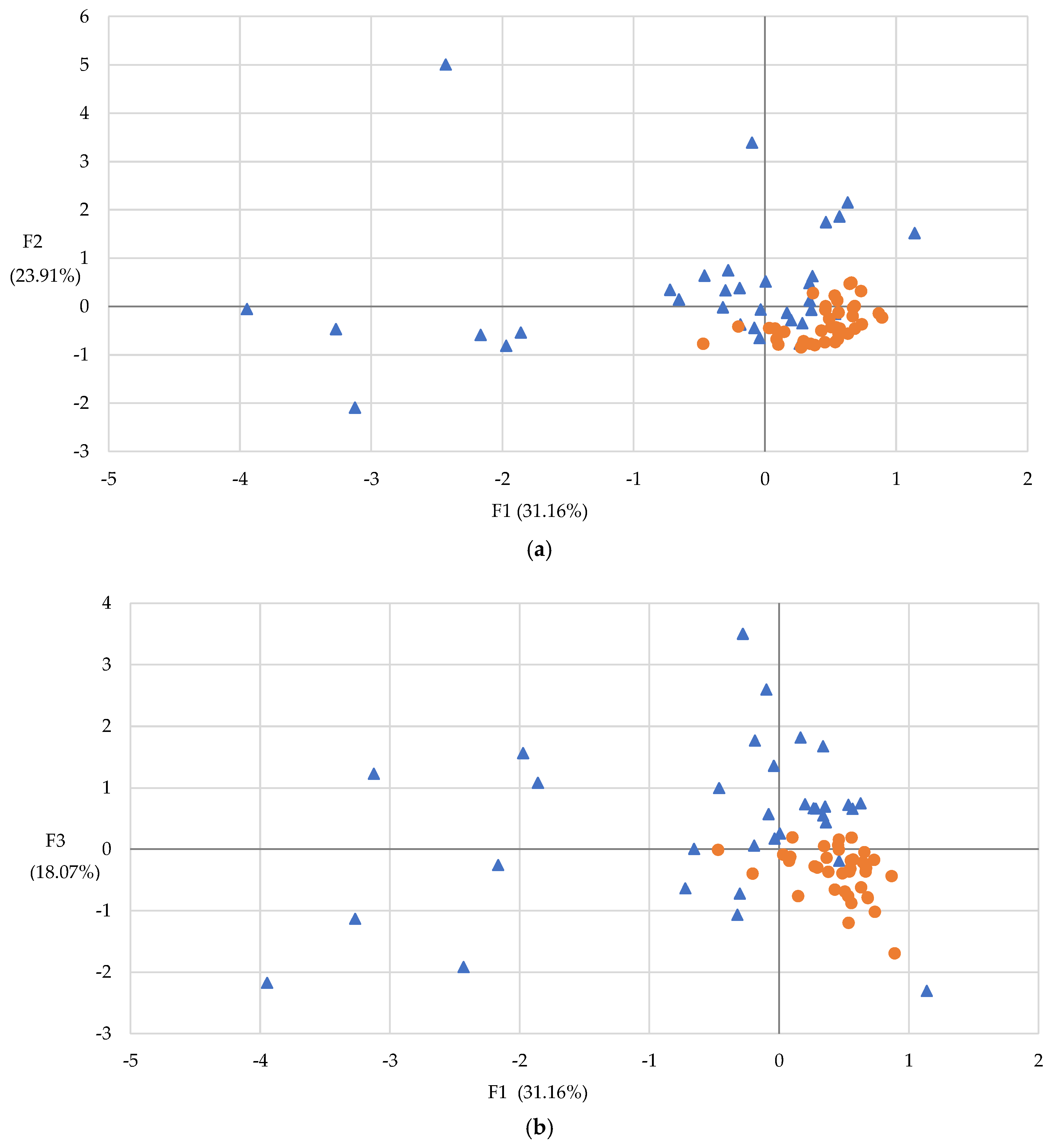
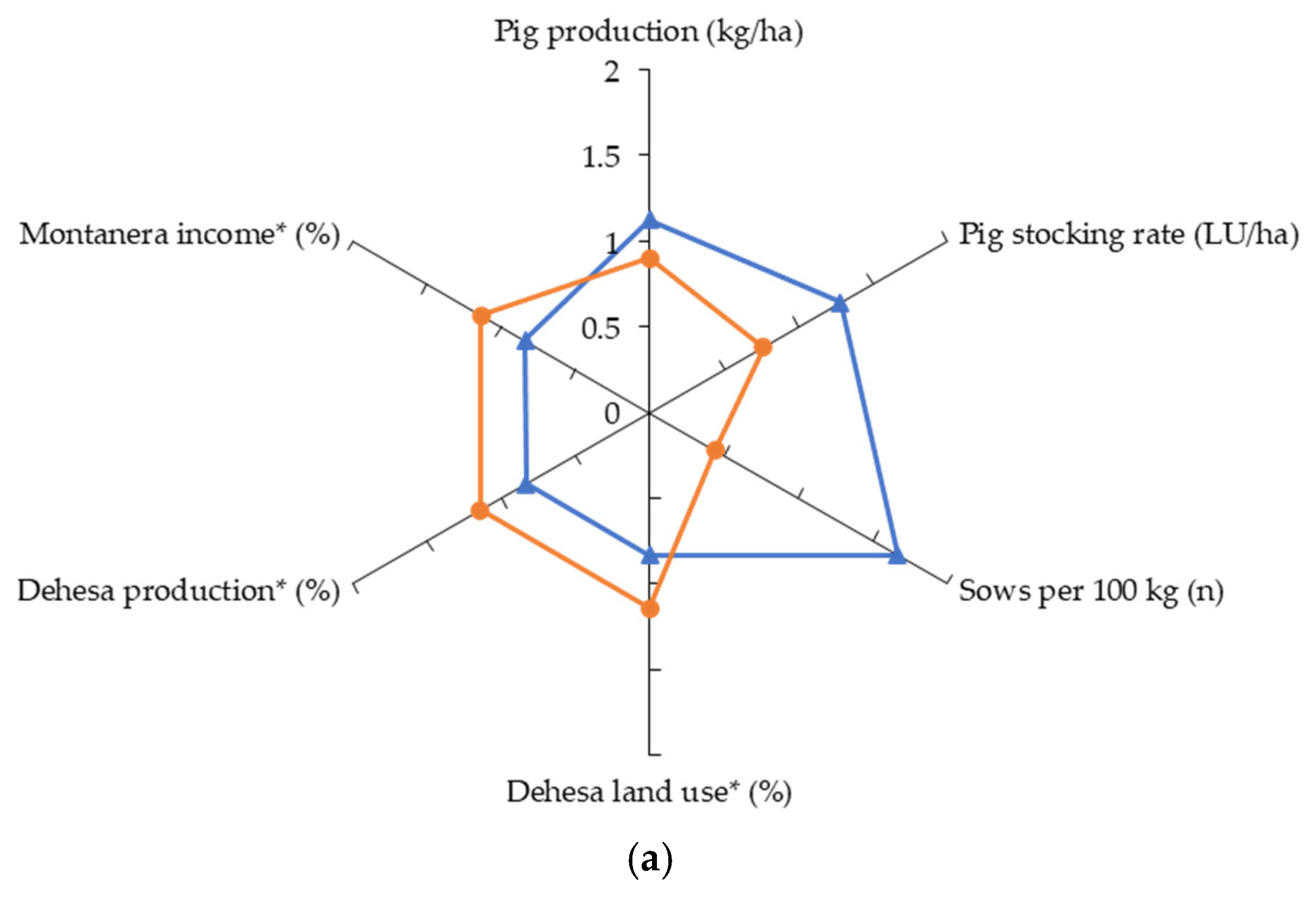
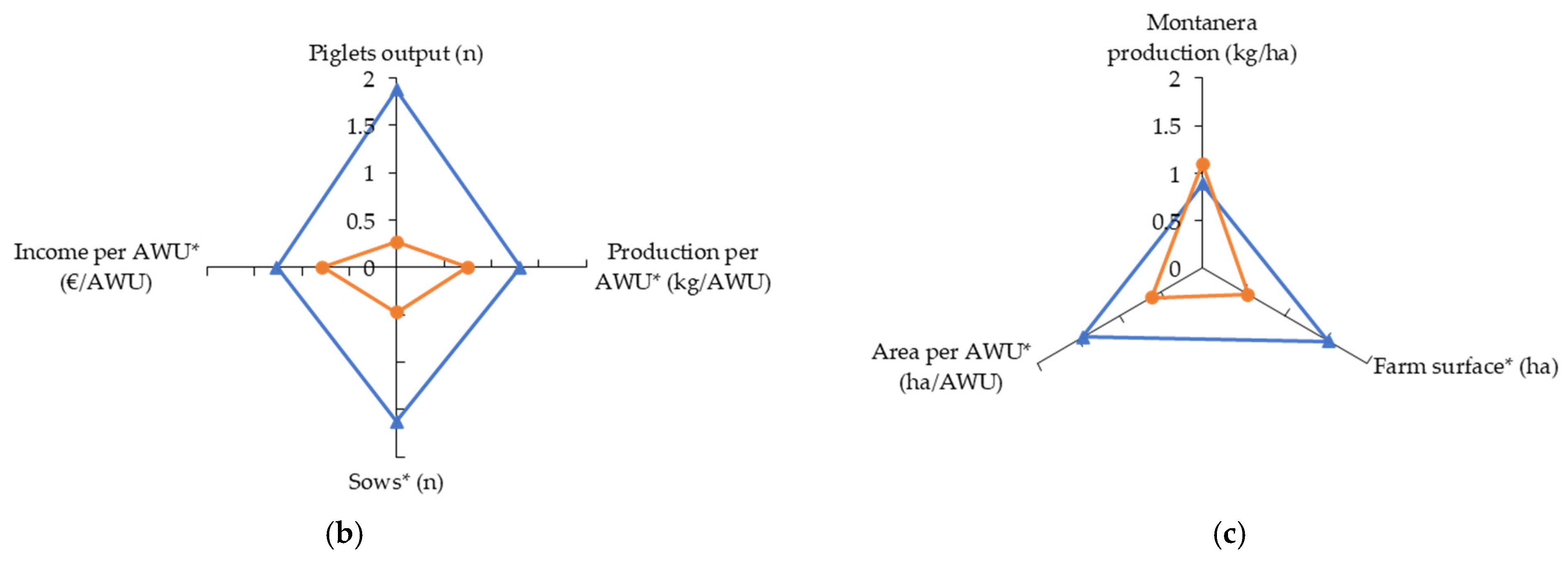
Cluster analysis using Ward’s method identified two distinct groups. Group I included 45.59% of farms (n = 31) and was defined as Iberian pig farms with multiple production phases, denominated Mixed-orientation Farms (MF). Group II included 54.41% of farms (n = 37) and was defined as Farrow-to-finish farms specialised in acorn-based fattening, denominated Acorn-Fed Farms (AF). The scores for the three factors differentiated significantly between the two groups of farms, defining the main characteristics of each farm type (Table 4). AF showed greater homogeneity in values, while MF presented higher dispersion across the three factors (Figure 2). Figure 3 provides visual synthesis of these differences using normalised indices to facilitate multidimensional comparison.

3.4. Environmental Performance by Farm Type

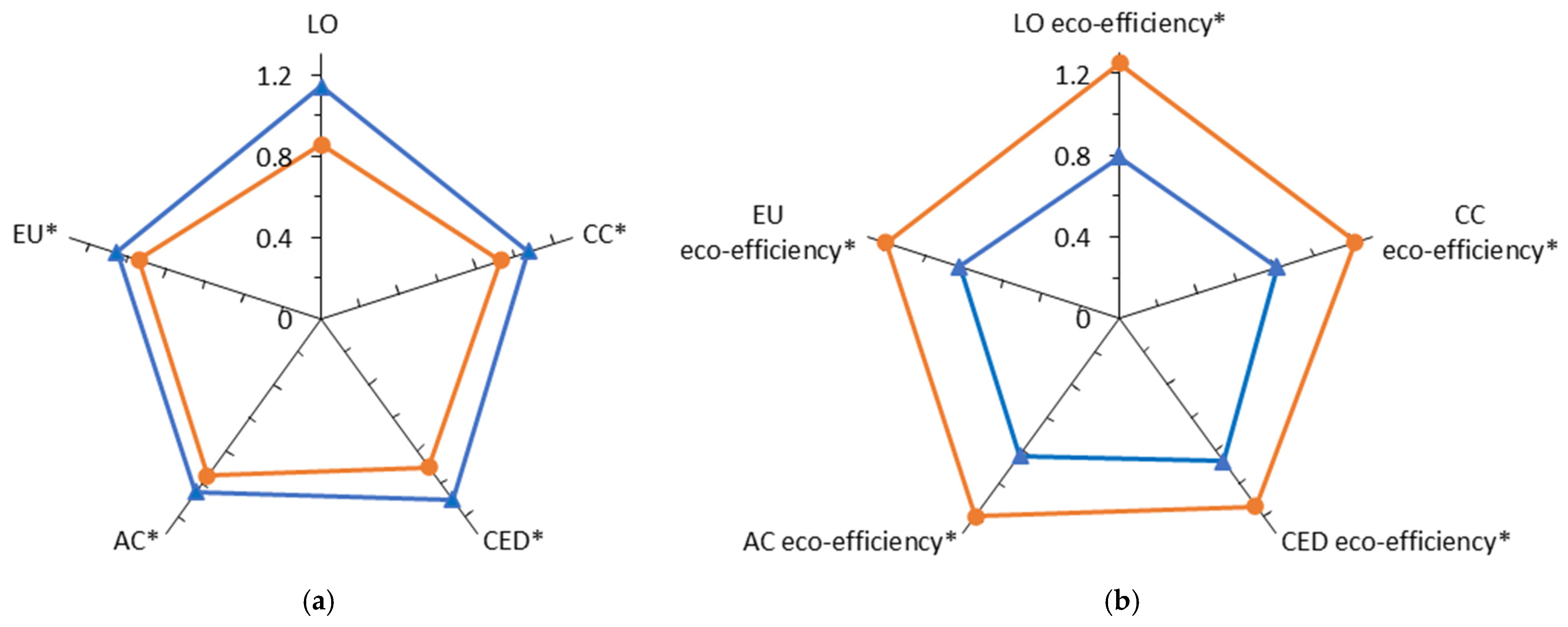
Having identified these two farm types, their environmental performance was compared to assess the sustainability implications of each management approach. Environmental impacts were assessed for a balanced subsample of 18 AFs and 18 MFs. Environmental impacts differed significantly between Iberian farm types in terms of CC, AC, EU and CED, with AFs showing lower impacts per kilogram of live weight produced compared to MFs. No differences were found in LO impact among Iberian farm types. The gross margin per kilogram of live weight averaged 2.41 ± 0.08 €/kg LW. AFs showed significantly higher gross margins (2.58 ± 0.11 €/kg LW) compared to MFs (2.23 ± 0.10 €/kg LW), representing a 16% difference (p < 0.05). Eco-efficiency indicators, expressed as the ratio between gross margin and environmental impact, showed significantly better values in AFs (Table 5). Figure 4 visualises these differences using normalised indices, facilitating comparison across multiple impact categories and eco-efficiency indicators.

4. Discussion

4.1. Structural Diversity of Iberian Pig Farms in the Dehesa Ecosystem

The traditional Iberian pig production system is a distinctive form of extensive livestock farming that is closely associated with a particular territory and agrosilvopastoral knowledge [6,42]. A wide range of production models coexist within this framework, differing in terms of farm structure, herd composition, management of natural resources and degree of integration with the dehesa ecosystem [43]. This heterogeneity poses significant challenges for designing and implementing uniform sustainability policies and highlights the need for integrative indicators that can capture economic and environmental performance in diverse farming contexts.
This structural heterogeneity is confirmed by the data obtained in the present study, which reveal high variability consistent with previous typological analyses of dehesa livestock farming systems [41,42,44,45]. Most farms operate as multi-species livestock systems, combining Iberian pigs with beef cattle and/or sheep, a pattern characteristic of the dehesa ecosystem [43]. The average farm surface area was comparable to values reported in other studies [43,46], and the mean stocking rate of 0.49 LU/ha reflects the low-density management typical of this ecosystem. This figure is consistent with other estimates for similar multi-species systems in the dehesa ecosystem [42,43].
Despite the extensive nature of these systems, the Iberian pig breed accounted for a significant proportion of the productive structure, representing over one-third of the total livestock units and generating almost 60% of the total farm revenue. This confirms the central economic role of the Iberian pig within these multi-species farms and supports previous findings on the high added value of montanera fatteners [43,45]. In many cases, pigs are fattened only on local natural resources, which enhances the environmental and cultural value of the final product, while providing economic incentives for the conservation of the dehesa and the continuation of traditional extensive management practices.
In summary, the present study supports the view that Iberian pig farming in the dehesa is structurally diverse, economically significant and deeply rooted in the use of natural resources [11,47]. This complexity requires tailored policy tools that account for the diversity of farm types, their territorial embeddedness and their capacity and ability to provide economic benefits and ecosystem services.

4.2. Key Differentiation Factors and Implications for Eco-Efficiency

The three-factor structure provides a comprehensive framework for understanding farm differentiation and evaluating eco-efficiency in traditional Iberian pig systems.
The “Production system” factor captures the tension between traditional practices and intensification, as documented in previous dehesa studies [41,44]. The negative loadings for intensive management variables indicate that more intensive and efficient farms are less aligned with traditional dehesa management practices, reflecting a fundamental trade-off in this production system.
The ‘Profitability’ factor highlights the economic dimension of farm differentiation, particularly scalability and labour productivity, which are closely interrelated [48]. These improvements contribute to higher economic returns. However, these economic benefits must be balanced against environmental impacts and the rising costs of external inputs (such as compound feed), which can reduce profitability [49].
Regarding “Land efficiency”, rather than indicating inefficiency, this pattern corresponds to a land-based production model characteristic of extensive dehesa systems [41], in which eco-efficiency plays a central role: farms that manage land resources prudently, in accordance with ecological constraints, tend to minimise environmental impacts per unit of product [38]. In contrast to other studies where farm area was included in the first factor [20,22], in this case it emerged as the third factor, possibly due to the analytical focus of this study, which prioritised efficiency-related criteria over the structural characterisation of the farms.
Together, these three factors lay the groundwork for eco-efficiency assessment, enabling evaluation of how different Iberian farm types balance productivity, economic performance and environmental sustainability within the dehesa ecosystem. This differentiation has important policy implications: support schemes should recognise the complementary roles of both production models, supporting AFs for their efficient use of natural resources and low input dependence, while supporting MFs in balancing productivity with environmental sustainability.

4.3. Production Models of Iberian Pig Farms in the Dehesa Ecosystem

The classification of Iberian pig farms into two types, MF and AF, reveals the structural and strategic diversity that characterises production systems in the dehesa ecosystem. The identification of two distinct farm types—one more traditional and ecosystem-integrated (AF) and one more diversified and scalable (MF)—could be interpreted as evidence of a modernization gradient. Rather than indicating a linear transition from traditional to modern systems, this typology reflects different coexisting strategies of adaptation to market conditions within the dehesa ecosystem.
AF represent a production model that is aligned with the dehesa ecosystem. Their consistent factor scores suggest a homogeneous system, based on farrow-to-finish farms specialised in acorn-based fattening. This strong dependence on natural resources, particularly acorns, limits intensification but enhances product differentiation and integration with the ecosystem [6]. Their economic performance is sustained by the production of montanera fatteners, supporting a model centred on quality, tradition and low external input use, which is consistent with other extensive livestock systems [50].
In contrast, MFs adopt a more diversified approach. These farms manage a significantly higher number of sows, achieve higher labour productivity and produce multiple pig categories for the market. The greater variability observed within this group reflects a wide range of management strategies, degrees of intensification and levels of dependency on external inputs [51]. This model increases the capacity to adapt to market fluctuations but also implies higher external resource demands [11]. Thus, MFs achieve higher economic efficiency through diversification [52]. Factor analysis confirmed the distinct strategic orientations of both farm types: AFs scored highest on Factor 1 (Production System), reflecting their alignment with natural resource use, while MFs excelled in Factor 2 (Profitability) due to their scalability and labour efficiency. Both farm types showed similar levels in Factor 3 (Land Efficiency), constrained by regulatory stocking limits [6].
This two-type classification aligns with patterns in previous typological studies of Mediterranean extensive livestock systems. Gaspar et al. [41] identified six types in dehesa sheep farms, Toro-Mujica et al. [20] identified three types in organic dairy sheep and Perea et al. [37] identified four types in organic beef, all differentiated primarily by intensification level and market orientation. Despite variations in the number of types identified, these studies consistently reveal a fundamental tension between traditional practices based on natural resources and market-oriented strategies with higher external input use. Our two-type classification captures this essential dichotomy in Iberian pig production, where AF represents the traditional-extensive pole and MF the diversified-scalable pole.
These two types of farms illustrate complementary roles within Iberian pig production systems. AFs contribute to preserving the environmental and cultural functions of the dehesa ecosystem, offering a production system that adds value through tradition and sustainability [53]. On the other hand, MFs provide adaptability and volume to the market, ensuring competitiveness and employment [11]. Rather than being in competition, these models respond to different market needs and reinforce the multifunctionality of the dehesa ecosystem.
While some technical variables (piglet output, sows per 100 kg LW, pig stocking rate) showed numerical differences between farm types without reaching statistical significance, these trends reflect the distinct production strategies described above. MFs diversify income through multiple commercial categories and higher piglet production, while AFs maintain a more integrated farrow-to-finish system adjusted to their fattening capacity. High within-group variability in MFs, due to diverse commercialisation strategies, likely explains the lack of statistical significance.
Figure 3 clearly illustrates this complementarity, showing how the relative positioning of MFs and AFs across the three main factors reflects their contrasting yet complementary contributions to sustainable Iberian pig production. This approach balances economic viability with the conservation of the dehesa ecosystem through natural resources use.

4.4. Environmental Performance and Sustainability Implications

The superior environmental performance of AFs in multiple impact categories (Figure 4a) reflects a greater integration of the dehesa ecosystem through optimised natural resources use and reduced dependency on external feed inputs [13,38,54]. Because eco-efficiency integrates both economic and envrironmental performance, it constitutes a central contribution of the present study, as it reveals not only which systems generate lower impacts, but also how effectively they convert natural resource use into economic value.
The environmental impact values obtained fall within the intermediate range reported for Iberian pig production in dehesa systems (2.94–4.55 kg CO2 eq/kg LW) [12,13], confirming that the balance between natural resource use and supplementary feeding is a key determinant of environmental performance across different farm types and management strategies [38,55,56].
Beyond environmental performance, AFs also demonstrate markedly higher eco-efficiency indicators across all categories (Figure 4b), revealing a combined effect of lower impact intensities and higher economic returns. The magnitude of these differences sheds light on the behavioural mechanisms underlying each system. In climate change (CC), AFs produced around 15% fewer emissions per kg LW, yielding an almost 50% increase in CC eco-efficiency relative to MFs. Similar patterns were observed for acidification (AC) and eutrophication (EU), where moderate reductions in impact (≈10–11%) amplify into 44–46% higher eco-efficiency once economic value is incorporated. This indicates that AFs do not simply reduce environmental pressures; they also derive more economic value per unit of impact, approaching an efficient frontier in which ecological integration enhances, rather than limits, profitability. Their reliance on acorn-based fattening, lower dependence on external inputs and the high market value of montanera fatteners together help explain this superior performance.
Although differences in LO were not statistically significant, the eco-efficiency analysis revealed that AFs showed 59% higher LO eco-efficiency than MFs. This suggests that AFs can generate greater economic value from a similar territorial footprint, an interpretation that is not evident when analysing impacts alone. Despite exhibiting similar LO values per kilogram of live weight, AFs obtained higher economic returns associated with land use due to the high market price of montanera fatteners [51], which supports more sustainable land use practices.
In contrast, the difference in CED eco-efficiency was smaller (32%) between farm types, probably due to similar reliance on compound feeds during the growing phase [57]. This shared dependence on external energy-intensive inputs continues to limit the overall sustainability potential of traditional Iberian farms.
In summary, AFs stand out not only for their lower environmental impacts, but also for their higher returns per unit of environmental impact. The considerable variability observed within MFs indicates that this group encompasses diverse management strategies and degrees of dependency on external inputs, which explains their wider eco-efficiency range and suggests a margin for improvement through more efficient feeding strategies, reproductive management and market positioning.
Finally, these results suggest that AFs can represent a viable model of ecologically self-regulating and economically sustainable livestock systems, supporting the conservation of the dehesa ecosystem while ensuring farm profitability. Overall, the inclusion of eco-efficiency indicators enhances the interpretation of these systems by linking economic value generation with environmental performance. This integrated perspective reinforces the contribution of the study to the assessment of sustainability in extensive Mediterranean livestock systems.

4.5. Implications for Agricultural Policy and Sustainable Development

Several authors have emphasised the significant potential of European policies, particularly the Common Agricultural Policy (CAP), to promote sustainable livestock farming by providing economic support for environmentally friendly and low-input systems [58]. The findings of this study provide empirical evidence in support of CAP measures that prioritise eco-efficient models, such as farrow-to-finish farms that specialise in acorn-based fattening. Compared to intensive production systems, these farms demonstrate superior environmental performance and ecosystem preservation, along with reduced external input. However, despite aligning with these CAP objectives, Iberian pig production in the dehesa ecosystem is largely excluded from current subsidy schemes [59], revealing a policy inconsistency that overlooks their environmental contributions. Given that eco-efficiency integrates both economic and environmental performance, the indicators analysed in this study are particularly informative for policy design. They allow the identification of farm types that not only reduce environmental pressures but also create higher value per unit of impact, thereby offering a robust metric for policy instruments aimed at promoting sustainable and competitive extensive livestock systems.
Building on these insights, the results reinforce the importance of integrating eco-efficiency metrics into CAP sustainability assessments and subsidy allocation criteria.
This approach would support extensive livestock systems within Mediterranean agroecosystems. These findings challenge the common assumption that sustainability necessarily entails productivity losses [60] and highlight the need for policy instruments that explicitly reward practices that enhance eco-efficiency. Incorporating these metrics into CAP design could provide a more holistic framework for promoting resilient, sustainable and economically viable livestock systems across Europe.

4.6. Limitations and Future Research Perspectives

The study design limits its ability to capture temporal dynamics, particularly the interannual variability in acorn production [61], which has a strong influence on montanera fattening. AFs are particularly vulnerable to years of low acorn production, which can result in economic uncertainty and impact their long-term viability despite their superior eco-efficiency. Future research should assess the resilience of both farm types to variability in acorn production and market fluctuations, as well as their associated economic impacts.
Furthermore, the considerable variability observed within MFs suggests the presence of distinct subtypes, highlighting the necessity for further investigation to better characterise this heterogeneity.
Additionally, adapting LCA methodologies to evaluate dehesa ecosystems, including all livestock species integrated within these farms, could enhance eco-efficiency estimates by providing a more holistic understanding of natural resource use, environmental impacts and economic returns. This approach would be particularly relevant given that multi-species livestock systems have been documented as more sustainable than single-species farms [31,62,63,64], making it essential to capture these synergistic effects in LCA studies. Extending this framework to other extensive Mediterranean livestock systems would improve its generalisability and inform sustainable agricultural policies in comparable agroecosystems.

5. Conclusions

This study demonstrates substantial structural diversity among traditional Iberian pig farms, identifying three dimensions (system orientation, profitability, land use) that distinguish ecosystem-integrated farms (AFs) from diversified Mixed-orientation Farms (MFs). This heterogeneity demonstrates that sustainability requires differentiated approaches.
Challenging widespread assumptions of trade-offs between environmental impacts and gross margins, AF simultaneously achieve superior environmental performance and higher profitability. This win-win outcome fundamentally challenges conventional livestock paradigms, demonstrating that ecosystem integration is not a constraint but a competitive advantage for traditional production systems.
Farm heterogeneity reflects complementary adaptive strategies. Whilst AFs demonstrate superior eco-efficiency, MFs contribute essentially to market adaptability and production stability, indicating that both models serve strategic functions within the Iberian pig sector.
Eco-efficiency indicators prove effective in identifying and quantifying economic-environmental synergies, providing practical metrics for evidence-based policymaking. Their integration into agricultural support frameworks would enable performance-based approaches recognising multifunctional contributions of extensive livestock systems.
This integrated framework offers a replicable methodology for sustainability assessments in extensive livestock systems, combining multivariate analysis, life cycle assessment and eco-efficiency metrics. Demonstrating that traditional practices can achieve contemporary sustainability criteria with appropriate support, this study contributes to advancing economically resilient and environmentally efficient production systems.

Author Contributions

Conceptualization, J.P. and I.B.-P.; methodology, J.G.-G., J.P. and I.B.-P.; formal analysis, J.G.-G. and J.P.; investigation, J.G.-G.; resources, J.P.; data curation, J.G.-G.; writing—original draft preparation, J.G.-G.; writing—review and editing, J.P., M.F.-i.-F., E.A. and I.B.-P.; supervision, J.P. and I.B.-P.; project administration, I.B.-P.; funding acquisition, I.B.-P. All authors have read and agreed to the published version of the manuscript.

Funding

This research was funded by National Institute for Agricultural and Food Research and Technology, grant number RTA2013-00063-C03-02.

Data Availability Statement

The data are not publicly available due to. The data presented in this study are available on request from the corresponding author due to project IP rules.

Acknowledgments

The authors would like to thank POD Dehesa de Extremadura, AECERIBER, ACPA and farmers for their support. CERCA from Generalitat de Catalunya and Consolidated Research Groups (2021 SGR 00461) are acknowledged.

Conflicts of Interest

The authors declare no conflicts of interest.

References

  1. Lopez-Bote, C.J. Sustained utilization of the Iberian pig breed. Meat Sci. 1998, 49, 17–27. [Google Scholar] [CrossRef]
  2. Goracci, J.; Camilli, F. Agroforestry and Animal Husbandry. In Animal Husbandry—Beliefs, Facts and Reality; Kukovics, S., Ed.; IntechOpen: Rijeka, Croatia, 2024; pp. 1–24. [Google Scholar] [CrossRef]
  3. Carreira, E.; Serrano, J.; Lopes, J.; Shahidian, S.; Pereira, A.F. Montado Mediterranean Ecosystem (Soil—Pasture—Tree and Animals): A Review of Monitoring Technologies and Grazing Systems. Appl. Sci. 2023, 13, 6242. [Google Scholar] [CrossRef]
  4. Torralba, T.; Oteros-Rozas, E.; Moreno, G.; Plieninger, T. Exploring the Role of Management in the Coproduction of Ecosystem Services from Spanish Wooded Rangelands. Rangel. Ecol. Manag. 2017, 71, 549–559. [Google Scholar] [CrossRef]
  5. Ministerio de Agricultura, Pesca y Alimentación. Available online: https://www.mapa.gob.es/es (accessed on 24 August 2025).
  6. Real Decreto 4/2014, de 10 de Enero, Por el Que se Aprueba la Norma de Calidad Para la Carne, el Jamón, la Paleta y la Caña de Lomo Ibérico. Available online: http://www.boe.es/boe/dias/2014/01/11/pdfs/BOE-A-2014-318.pdf (accessed on 2 September 2025).
  7. Lorido, L.; Estévez, M.; Ventanas, J.; Ventanas, S. Comparative study between Serrano and Iberian dry-cured hams in relation to the application of high hydrostatic pressure and temporal sensory perceptions. LWT Food Sci. Technol. 2015, 64, 1234–1242. [Google Scholar] [CrossRef]
  8. García-Gudiño, J.; Blanco-Penedo, I.; Gispert, M.; Brun, A.; Perea, J.; Font-i-Furnols, M. Understanding consumers’ perceptions towards Iberian pig production and animal welfare. Meat Sci. 2020, 172, 108317. [Google Scholar] [CrossRef]
  9. Ibáñez, J.; Contador, J.F.L.; Schnabel, S.; Fernández, M.P.; Valderrama, J.M. A model-based integrated assessment of land degradation by water erosion in a valuable Spanish rangeland. Environ. Model. Softw. 2014, 55, 201–213. [Google Scholar] [CrossRef]
  10. European Commission. The European Green Deal, COM (2019) 640 Final, Brussels. 2019. Available online: https://ec.europa.eu/info/strategy/priorities-2019-2024/european-green-deal_en (accessed on 4 September 2025).
  11. Horrillo, A.; Gaspar, P.; Muñoz, Á.; Escribano, M.; González, E. Fattening Iberian Pigs Indoors vs. Outdoors: Production Performance and Market Value. Animals 2023, 13, 506. [Google Scholar] [CrossRef] [PubMed]
  12. Horrillo, A.; Gaspar, A.; Escribano, M. Organic farming as a strategy to reduce carbon footprint in dehesa agroecosystems: A case study comparing different livestock products. Animals 2020, 10, 162. [Google Scholar] [CrossRef] [PubMed]
  13. Reyes-Palomo, C.; Aguilera, E.; Llorente, M.; Díaz-Gaona, C.; Moreno, G.; Rodríguez-Estévez, V. Free-range acorn feeding results in negative carbon footprint of Iberian pig production in the dehesa agro-forestry system. J. Clean. Prod. 2023, 418, 138170. [Google Scholar] [CrossRef]
  14. Van der Linden, A.; de Olde, E.M.; Mostert, P.F.; de Boer, I.J.M. A review of European models to assess the sustainability performance of livestock production systems. Agric. Syst. 2020, 182, 102842. [Google Scholar] [CrossRef]
  15. Stępień, S.; Czyżewski, B.; Sapa, A.; Borychowski, M.; Poczta, W.; Poczta-Wajda, A. Eco-efficiency of small-scale farming in Poland and its institutional drivers. J. Clean. Prod. 2021, 279, 123721. [Google Scholar] [CrossRef]
  16. Lozano, S.; Iribarren, D.; Moreira, M.T.; Feijoo, G. The link between operational efficiency and environmental impacts. A joint application of Life Cycle Assessment and Data Envelopment Analysis. Sci. Total Environ. 2009, 407, 1744–1754. [Google Scholar] [CrossRef]
  17. Iribarren, D.; Hospido, A.; Moreira, M.T.; Feijoo, G. Benchmarking environmental and operational parameters through eco-efficiency criteria for dairy farms. Sci. Total Environ. 2011, 409, 1786–1798. [Google Scholar] [CrossRef]
  18. Giorgis, A.; Perea, J.; García, A.; Gómez-Castro, A.G.; Angón, E.; Larrea, A. Technical and economical characterization and typology of dairy farms in La Pampa (Argentine). Rev. Científica FCV-LUZ 2011, XXI, 340–352. [Google Scholar]
  19. Gaspar, P.; Escribano, A.J.; Mesías, F.J.; Escribano, M.; Pulido, F. Goat systems of Villuercas-Ibores area in SW Spain: Problems and perspectives of traditional farming systems. Small Rumin. Res. 2011, 97, 1–11. [Google Scholar] [CrossRef]
  20. Toro-Mujica, P.; García, A.; Gómez-Castro, A.; Perea, J.; Rodríguez-Estévez, V.; Angón, E.; Barba, C. Organic dairy sheep farms in south-central Spain: Typologies according to livestock management and economic variables. Small Rumin. Res. 2012, 104, 28–36. [Google Scholar] [CrossRef]
  21. Rivas, J.; Perea, J.; Angón, E.; Barba, C.; Morantes, M.; Dios-Palomares, R.; García, A. Diversity in the dry land mixed system and viability of dairy sheep farming. Ital. J. Anim. Sci. 2015, 14, 179–186. [Google Scholar] [CrossRef]
  22. Díaz-Gaona, C.; Sánchez-Rodríguez, M.; Rucabado-Palomar, T.; Rodríguez-Estévez, V. A typological characterization of organic livestock farms in the Natural Park Sierra de Grazalema based on technical and economic variables. Sustainability 2019, 11, 6002. [Google Scholar] [CrossRef]
  23. Horrillo, A.; Gaspar, P.; Mesiás, F.J.; Elghannam, A.; Escribano, M. Understanding the barriers and exploring the possibilities of the organic livestock sector in dehesa agroforestry systems: A multi-actor approach for effective diagnosis. Renew. Agric. Food Syst. 2019, 35, 663–677. [Google Scholar] [CrossRef]
  24. Escribano, M.; Díaz-Caro, C.; Mesias, F.J. A participative approach to develop sustainability indicators for dehesa agroforestry farms. Sci. Total Environ. 2018, 640–641, 89–97. [Google Scholar] [CrossRef] [PubMed]
  25. Nieto, R.; García-Casco, J.; Lara, L.; Palma-Granados, P.; Izquierdo, M.; Hernández, F.; Dieguez, E.; Duarte, J.L.; Batorek-Lukac, N. Ibérico (Iberian) Pig. In European Local Pig Breeds—Diversity and Performance A Study of Project Treasure; Candek-Potokar, M., Nieto, R., Eds.; IntechOpen: Rijeka, Croatia, 2019; pp. 1–25. [Google Scholar] [CrossRef]
  26. Benito, J.; Albarrán, A.; García-Casco, J.M. Extensive Iberian pig production grazing systems. In Proceedings of the 21st General Meeting of the European Grassland Federation, Badajoz, Spain, 3–6 April 2006; pp. 635–645. [Google Scholar]
  27. Registro Informativo de Organismos Independientes de Control del Ibérico (RIBER). Available online: https://www.mapa.gob.es/es/alimentacion/temas/control-calidad/mesa-iberico/riber-publico/ (accessed on 20 September 2025).
  28. Lebacq, T.; Baret, P.V.; Stilmant, D. Sustainability indicators for livestock farming. A review. Agron. Sustain. Dev. 2013, 33, 311–327. [Google Scholar] [CrossRef]
  29. Orihuela, A. Review: Management of livestock behavior to improve welfare and production. Animal 2021, 15, 100290. [Google Scholar] [CrossRef]
  30. Cournut, S.; Chauvat, S.; Correa, P.; Dos Santos Filho, J.C.; Diéguez, F.; Hostiou, N.; Pham, D.K.; Servière, G.; Sraïri, M.T.; Turlot, A.; et al. Analyzing work organization on livestock farm by the Work Assessment Method. Agron. Sustain. Dev. 2018, 38, 58. [Google Scholar] [CrossRef]
  31. Martin, G.; Barth, K.; Benoit, M.; Brock, C.; Destruel, M.; Dumont, B.; Grillot, M.; Hübner, S.; Magne, M.A.; Moerman, M.; et al. Potential of multi-species livestock farming to improve the sustainability of livestock farms: A review. Agric. Syst. 2020, 181, 102821. [Google Scholar] [CrossRef]
  32. Manca, M.G.; Serdino, J.; Gaspa, G.; Urgeghe, P.; Ibba, I.; Contu, M.; Fresi, P.; Macciotta, N.P.P. Derivation of multivariate indices of milk composition, coagulation properties, and individual cheese yield in dairy sheep. J. Dairy Sci. 2016, 99, 4547–4557. [Google Scholar] [CrossRef]
  33. Kaiser, H.F. The application of electronic computers to factor analysis. Educ. Psychol. Meas. 1960, 20, 141–151. [Google Scholar] [CrossRef]
  34. Cerny, B.A.; Kaiser, H.F. A study of a measure of sampling adequacy for factor-analytic correlation matrices. Multivariate Behav. Res. 1977, 12, 43–47. [Google Scholar] [CrossRef]
  35. Köbrich, C.; Rehman, T.; Khan, M. Typification of farming systems for constructing representative farm models: Two illustrations of the application of multi-variate analyses in Chile and Pakistan. Agric. Syst. 2003, 76, 141–157. [Google Scholar] [CrossRef]
  36. Rangel, J.; Perea, J.; De-Pablos-Heredero, C.; Espinosa-García, J.A.; Toro-Mújica, P.; Feijoo, M.; Barba, C.; García, A. Structural and technological characterization of tropical smallholder farms of dual-purpose cattle in Mexico. Animals 2020, 10, 86. [Google Scholar] [CrossRef]
  37. Perea-Muñoz, J.; Blanco-Penedo, I.; Barba, C.; Angón, E.; García-Martínez, A. Organic beef farming in Spain: Typology according to livestock management and economic variables. Rev. Científica 2014, 24, 347–354. [Google Scholar]
  38. García-Gudiño, J.; Monteiro, A.N.T.R.; Espagnol, S.; Blanco-Penedo, I.; Garcia-Launay, F. Life cycle assessment of Iberian traditional pig production system in Spain. Sustainability 2020, 12, 627. [Google Scholar] [CrossRef]
  39. Angón, E.; García, A.; Perea, J.; Acero, R.; Toro-Mújica, P.; Pacheco, H.; González, A. Techincal efficiency and viability of grazing dairy cattle systems in la Pampa, Argentine. Agrociencia 2013, 47, 443–456. [Google Scholar]
  40. Morantes, M.; Dios-Palomares, R.; Peña, M.E.; Rivas, J.; Perea, J.; García-Martínez, A. Management and productivity of dairy sheep production systems in Castilla-La Mancha, Spain. Small Rumin. Res. 2017, 149, 62–72. [Google Scholar] [CrossRef]
  41. Gaspar, P.; Escribano, M.; Mesías, F.J.; De Ledesma, A.R.; Pulido, F. Sheep farms in the Spanish rangelands (dehesas): Typologies according to livestock management and economic indicators. Small Rumin. Res. 2008, 74, 52–63. [Google Scholar] [CrossRef]
  42. Franco, J.A.; Gaspar, P.; Mesias, F.J. Economic analysis of scenarios for the sustainability of extensive livestock farming in Spain under the CAP. Ecol. Econ. 2012, 74, 120–129. [Google Scholar] [CrossRef]
  43. Gaspar, P.; Mesías, F.J.; Escribano, M.; Rodriguez-Ledesma, A.; Pulido, F. Economic and management characterization of dehesa farms: Implications for their sustainability. Agrofor. Syst. 2007, 71, 151–162. [Google Scholar] [CrossRef]
  44. García, A.; Perea, J.; Acero, R.; Angón, E.; Toro, P.; Rodríguez, V.; Gómez-Castro, A.G. Structural characterization of extensive farms in andalusian dehesas. Arch. Zootec. 2010, 59, 577–588. [Google Scholar] [CrossRef]
  45. Maroto-Molina, F.; Gómez-Cabrera, A.; Guerrero-Ginel, J.E.; Garrido-Varo, A.; Adame-Siles, J.A.; Pérez-Marín, D.C. Caracterización y tipificación de explotaciones de dehesa asociadas a cooperativas: Un caso de estudio en España. Rev. Mex. Cienc. Pecu. 2018, 9, 812–832. [Google Scholar] [CrossRef]
  46. Milán, M.J.; Bartolomé, J.; Quintanilla, R.; García-Cachán, M.D.; Espejo, M.; Herráiz, P.L.; Sánchez-Recio, J.M.; Piedrafita, J. Structural characterisation and typology of beef cattle farms of Spanish wooded rangelands (dehesas). Livest. Sci. 2006, 99, 197–209. [Google Scholar] [CrossRef]
  47. Rodriguez-Estevez, V.; Sanchez-Rodriguez, M.; Arce, C.; García, A.R.; Perea, J.M.; Gustavo, A. Consumption of Acorns by Finishing Iberian Pigs and Their Function in the Conservation of the Dehesa Agroecosystem. In Agroforestry for Biodiversity and Ecosystem Services—Science and Practice; Kaonga, M., Ed.; InTech: Rijeka, Croatia, 2012; pp. 1–22. [Google Scholar] [CrossRef]
  48. Van Wagenberg, C.P.A.; de Haas, Y.; Hogeveen, H.; van Krimpen, M.M.; Meuwissen, M.P.M.; van Middelaar, C.E.; Rodenburg, T.B. Animal Board Invited Review: Comparing conventional and organic livestock production systems on different aspects of sustainability. Animal 2017, 11, 1839–1851. [Google Scholar] [CrossRef]
  49. Moran, D.; Blair, K.J. Review: Sustainable livestock systems: Anticipating demand-side challenges. Animal 2021, 15, 100288. [Google Scholar] [CrossRef]
  50. Bernués, A.; Ruiz, R.; Olaizola, A.; Villalba, D.; Casasús, I. Sustainability of pasture-based livestock farming systems in the European Mediterranean context: Synergies and trade-offs. Livest. Sci. 2011, 139, 44–57. [Google Scholar] [CrossRef]
  51. Gaspar, P.; Mesías, F.J.; Escribano, M.; Pulido, F. Sustainability in Spanish extensive farms (Dehesas): An economic and management indicator-based evaluation. Rangel. Ecol. Manag. 2009, 62, 153–162. [Google Scholar] [CrossRef]
  52. Herrero, M.; Grace, D.; Njuki, J.; Johnson, N.; Enahoro, D.; Silvestri, S.; Rufino, M.C. The roles of livestock in developing countries. Animal 2013, 7, 3–18. [Google Scholar] [CrossRef]
  53. Villanueva, A.J.; Salazar-Ordoñez, M.; Granado-Díaz, R.; Rodríguez-Entrena, M. Consumers’ preferences for traditional meat products: Production system and objective quality cues in Iberian ham. Ital. J. Anim. Sci. 2021, 20, 1987–2001. [Google Scholar] [CrossRef]
  54. Espagnol, S.; Demartini, J. Environmental impacts of extensive outdoor pig production systems in Corsica. In Proceedings of the 9th International Conference Life Cycle Assessment Agri-Food Sector (LCA Food 2014), San Francisco, CA, USA, 8–10 October 2014; pp. 364–371. [Google Scholar]
  55. Dourmad, J.Y.; Ryschawy, J.; Trousson, T.; Bonneau, M.; González, J.; Houwers, H.W.; Hviid, M.; Zimmer, C.; Nguyen, T.L.; Morgensen, L. Evaluating environmental impacts of contrasting pig farming systems with life cycle assessment. Animal 2014, 8, 2027–2037. [Google Scholar] [CrossRef] [PubMed]
  56. Monteiro, A.N.T.R.; Wilfart, A.; Utzeri, V.; Batorek, N.; Tomazin, U.; Nanni, L.; Čandek-Potokar, M.; Fontanesi, L.; Garcia-Launay, F. Environmental impacts of pig production systems using European local breeds: The contribution of carbon sequestration and emissions from grazing. J. Clean. Prod. 2019, 237, 117843. [Google Scholar] [CrossRef]
  57. Rodríguez-Estévez, V.; Sánchez-Rodríguez, M.; García, A.; Gómez-Castro, A.G. Feed conversion rate and estimated energy balance of free grazing Iberian pigs. Livest. Sci. 2010, 132, 152–156, Erratum in Livest. Sci. 2011, 139, 285. [Google Scholar] [CrossRef]
  58. Scown, M.W.; Brady, M.V.; Nicholas, K.A. Billions in Misspent EU Agricultural Subsidies Could Support the Sustainable Development Goals. One Earth 2020, 3, 237–250. [Google Scholar] [CrossRef]
  59. Escribano, M.; Horrillo, A.; Mesías, F.J. Greenhouse gas emissions and carbon sequestration in organic dehesa livestock farms. Does technical-economic management matters? J. Clean. Prod. 2022, 372, 133779. [Google Scholar] [CrossRef]
  60. Giglio, L.; Zotte, A.D.; Piccini, I.; Bondesan, V.; Vitaliano, G.; Piazzon, C.; Manca, E.; Rigo, E.; Berton, M.; Gallo, L. Economic Resilience in Intensive and Extensive Pig Farming Systems. Sustainability 2025, 17, 7026. [Google Scholar] [CrossRef]
  61. Tejerina, D.; García-Torres, S.; Cabeza de Vaca, M.; Cava, R.; Vázquez, F.M. Interannual variability and evolution during the montanera period of Holm oak (Quercus rotundifolia Lam.) acorns. Span. J. Agric. Res. 2010, 8, 634–641. [Google Scholar] [CrossRef]
  62. Mugnier, S.; Husson, C.; Cournut, S. Why and how farmers manage mixed cattle-sheep farming systems and cope with economic, climatic and workforce-related hazards. Renew. Agric. Food Syst. 2020, 36, 344–352. [Google Scholar] [CrossRef]
  63. Rowntree, J.E.; Stanley, P.L.; Maciel, I.C.F.; Thorbecke, M.; Rosenzweig, S.T.; Hancock, D.W.; Guzman, A.; Raven, M.R. Ecosystem Impacts and Productive Capacity of a Multi-Species Pastured Livestock System. Front. Sustain. Food Syst. 2020, 4, 544984. [Google Scholar] [CrossRef]
  64. Dumont, B.; Puillet, L.; Martin, G.; Savietto, D.; Aubin, J.; Ingrand, S.; Niderkorn, V.; Steinmetz, L.; Thomas, M. Incorporating Diversity Into Animal Production Systems Can Increase Their Performance and Strengthen Their Resilience. Front. Sustain. Food Syst. 2020, 4, 109. [Google Scholar] [CrossRef]
Figure 1. Geographic distribution of traditional Iberian pig farms surveyed (n = 68) within the dehesa ecosystem of the southwestern Iberian Peninsula. The study area encompasses the main Iberian pig production regions: Extremadura, western Andalucía, southwestern Castilla y León (Spain) and Alentejo (Portugal). Black circles represent surveyed farms, distributed proportionally according to regional montanera pig production.
Agriculture 15 02515 g001
Figure 2. Traditional Iberian pig farms in the dehesa ecosystem plotted by factor scores: (a) Factor 1 and Factor 2, (b) Factor 1 and Factor 3. Blue triangles (▲) = Mixed-orientation Farms; orange circles (●) = Acorn-Fed Farms.
Agriculture 15 02515 g002
Figure 3. Cluster comparison using indices (group mean/global mean) derived from technical-economic variables for (a) Factor 1, (b) Factor 2 and (c) Factor 3 (blue triangle—Mixed-orientation Farms, orange spot—Acorn-Fed Farms). Blue triangles (▲) = Mixed-orientation Farms; orange circles (●) = Acorn-Fed Farms. Variables marked with an asterisk indicate significant differences between clusters. AWU: Annual Work Unit.
Agriculture 15 02515 g003aAgriculture 15 02515 g003b
Figure 4. Cluster comparison using indices (group mean/global mean) derived from (a) environmental impact variables and (b) eco-efficiency indicators. Blue triangles (▲) = Mixed-orientation Farms; orange circles (●) = Acorn-Fed Farms. Variables marked with an asterisk indicate significant differences between clusters. CC: climate change; AC: acidification; EU: eutrophication; CED: cumulative energy demand; LO: land occupation. Eco-efficiency indicators represent the ratio of economic value per unit of environmental impact.
Agriculture 15 02515 g004
Table 1. Structural variables included in factor analysis for traditional Iberian pig farms in the dehesa ecosystem.
VariableDescription (Units)
Montanera incomeMontanera income as a percentage of total pig production income (%)
Dehesa productionDehesa production as a percentage of total farm live weight production (%)
Dehesa land useUtilised dehesa area as a percentage of total dehesa area (%)
Pig stocking ratePig livestock units per hectare (LU/ha)
Pig productionLive weight from pig production per total surface area (kg/ha)
Sows per 100 kgNumber of sows per 100 kg of pig live weight produced (n/100 kg LW)
Production per AWULive weight from pig production per annual work unit (kg/AWU)
Income per AWUIncome from pig production per annual work unit (€/AWU)
SowsTotal number of sows (n)
Piglets outputPiglets produced per fattened pig (n)
Area per AWUTotal surface area per annual work unit (ha/AWU)
Farm surfaceTotal surface area (ha)
Montanera productionLive weight from montanera fatteners per dehesa area (kg/ha)
AWU: Annual Work Unit. LU: Livestock Unit. LW: Live Weight. Data were obtained from surveys conducted on traditional Iberian pig farms in the dehesa ecosystem.
Table 2. Descriptive characteristics and productive parameters of traditional Iberian pig farms in the dehesa ecosystem (n = 68).
VariableDescription (Units)MeanSD
Farm surfaceTotal surface area (ha)517.8533.5
Quercus densityNumber of Quercus spp. per ha (n/ha)45.2314.12
Livestock unitsTotal number of livestock units (LU)206.8181.8
Stocking rateLivestock units per hectare (LU/ha)0.490.30
Pig stocking ratePig livestock units per hectare (LU/ha)0.170.25
SowsTotal number of sows (n)37.9332.64
Total born pigletsNumber of piglets born per litter (n) 7.980.93
Liveborn pigletsNumber of liveborn piglets per litter (n)7.270.74
Weaned pigletsNumber of piglets weaned per litter (n)6.260.66
Weaning ageAge at weaning (days)39.9612.51
Annual pigletsTotal number of piglets produced per year (n)494.15625.81
Annual fattenersTotal number of fattening pigs produced per year (n)251.79282.81
Values are expressed as mean and standard deviation (SD).
Table 3. Factors loadings and communalities of structural variables after varimax rotation in an exploratory factor analysis of traditional Iberian pig farms in the dehesa ecosystem (n = 68).
VariableFactor 1
Production System
Factor 2
Profitability
Factor 3
Land Efficiency
Communality
Montanera income0.938−0.0770.0510.888
Dehesa production0.925−0.0890.0370.864
Dehesa land use0.848−0.003−0.0370.721
Pig stocking rate−0.6900.173−0.4330.693
Pig production−0.6530.243−0.5040.739
Sows per 100 kg−0.551−0.2590.1010.381
Production per AWU0.0950.9300.1540.898
Income per AWU0.1870.9110.1520.888
Sows−0.2030.7580.2350.671
Piglets output−0.3010.616−0.2280.522
Area per AWU0.0920.2450.8750.834
Farm surface0.1000.3500.8150.796
Montanera production0.4450.326−0.5570.614
Variance (%)31.1623.9118.07-
Eigenvalue4.243.281.99-
AWU: Annual work unit. Bold values indicate the main factor of extraction for each variable.
Table 4. Differences between Iberian pig farm types in technical and economic variables (Mean ± SEM; p-value indicates significance of differences).
VariableMF (Mean ± SEM)
n = 31
AF (Mean ± SEM)
n = 37
p-Value
Montanera income (%)70.08 ± 4.5094.58 ± 4.11<0.001
Dehesa production (%)68.19 ± 4.6593.44 ± 4.26<0.001
Dehesa land use (%)67.74 ± 4.6992.78 ± 4.30<0.001
Pig stocking rate (LU/ha)0.22 ± 0.040.13 ± 0.04ns
Pig production (kg/ha)153.7 ± 27.58122.8 ± 25.24ns
Sows per 100 kg (n/100 kg LW)0.21 ± 0.080.06 ± 0.07ns
Production per AWU (kg/AWU)33,775 ± 369019,503 ± 3378<0.01
Income per AWU (€/AWU)94,459 ± 974558,444 ± 8920<0.01
Sows (n)50.68 ± 5.0114.95 ± 4.58<0.001
Piglets output (n)8.38 ± 3.801.19 ± 3.47ns
Area per AWU (ha/AWU)418.6 ± 37.41178.6 ± 34.25<0.001
Farm surface (ha)793.5 ± 84.88288.7 ± 77.69<0.001
Montanera production (kg/ha)100.7 ± 16.09124.4 ± 14.73ns
AWU: Annual Work Unit; LW: Live Weight; MF: Mixed-orientation Farms; AF: Acorn-Fed Farms. Values are expressed as mean ± standard error of the mean (SEM). ns: not significant (p ≥ 0.05).
Table 5. Environmental impacts and eco-efficiency indicators by Iberian pig farm type (Mean ± SEM; p-value indicates significance of differences).
VariableMF (Mean ± SEM)
n = 18
AF (Mean ± SEM)
n = 18
p-Value
Environmental impacts (per kg LW)
CC (kg CO2 eq/kg LW)4.03 ± 0.203.49 ± 0.12<0.05
AC (molc H+ eq)0.10 ± 0.0040.09 ± 0.002<0.05
EU (kg PO43− eq)0.053 ± 0.0020.047 ± 0.001<0.05
CED (MJ)25.92 ± 1.6821.26 ± 0.98<0.05
LO (m2·year)44.25 ± 6.6433.19 ± 2.39ns
Eco-efficiency indicators
CC eco-efficiency (€/kg CO2 eq)0.51 ± 0.040.77 ± 0.03<0.01
AC eco-efficiency (€/molc H+ eq)19.72 ± 1.4528.44 ± 0.87<0.01
EU eco-efficiency (€/kg PO43− eq)38.94 ± 3.0456.79 ± 1.87<0.01
CED eco-efficiency (€/MJ)0.09 ± 0.010.12 ± 0.01<0.05
LO eco-efficiency (€/m2·year)0.05 ± 0.010.09 ± 0.01<0.01
CC: climate change; AC: acidification; EU: eutrophication; CED: cumulative energy demand; LO: land occupation; LW: Live Weight; MF: Mixed-orientation Farms; AF: Acorn-Fed Farms. Eco-efficiency indicators were calculated as the ratio between gross margin and environmental impact. Values are expressed as mean ± standard error of the mean (SEM). p-Value indicates significance of differences; ns: not significant (p ≥ 0.05).
Disclaimer/Publisher’s Note: The statements, opinions and data contained in all publications are solely those of the individual author(s) and contributor(s) and not of MDPI and/or the editor(s). MDPI and/or the editor(s) disclaim responsibility for any injury to people or property resulting from any ideas, methods, instructions or products referred to in the content.