Article

Simulation for Transversely Isotropic Citrus Tree Vibration Characteristics Based on the Frenet Frame


1
Chongqing Academy of Agricultural Sciences, Chongqing 401329, China
2
Chongqing–Sichuan Key Laboratory of Mountain Digital and Intelligent Agriculture, Chongqing 400714, China
3
Key Laboratory of Smart Agriculture in Southwest Mountainous Areas, Ministry of Agriculture and Rural Affairs, Chongqing 400714, China
4
College of Engineering and Technology, Southwest University, Chongqing 400715, China
5
Sichuan Academy of Agricultural Sciences, Chengdu 610029, China
*
Authors to whom correspondence should be addressed.
Agriculture 2025, 15(23), 2498; https://doi.org/10.3390/agriculture15232498
Submission received: 27 October 2025 / Revised: 24 November 2025 / Accepted: 26 November 2025 / Published: 30 November 2025
(This article belongs to the Topic Digital Agriculture, Smart Farming and Crop Monitoring)

Abstract

Vibration technology is a commonly used method for detaching citrus fruits, and studying the vibrational properties of citrus trees can helpfully improve the effectiveness of vibrating harvesters. The existing mechanical properties of wood have shown that tree materials in nature have transversely isotropic characteristics instead of isotropic ones. However, in the study of the vibrational characteristics of fruit trees, the material of fruit trees is still defined as isotropic. This paper presents a vibration simulation approach for transversely isotropic citrus trees using the Frenet frame to reveal the true physical characteristics of fruit trees. A comparison was carried between the vibration spectrum obtained from experiments on citrus branches and the simulated spectra from transversely isotropic and isotropic material models. The findings reveal that the simulated vibration spectra for the transversely isotropic citrus branch can closely match the experimentally measured spectra. This supports the effectiveness of simulation method for transversely isotropic citrus trees. Furthermore, simulations of the vibration frequency response characteristics for citrus trees with both transversely isotropic and isotropic materials showed notable differences in their spectra. The proposed simulation method for transversely isotropic citrus trees offers a more precise depiction of their actual vibrational properties. This simulation technique is crucial for optimizing the parameters of citrus harvesting equipment, leading to enhanced machine performance.

1. Introduction

Fruits are vital sources of essential nutrients necessary for daily sustenance, and the process of fruit harvesting is a fundamental aspect of overall fruit production [1,2,3]. Among the various harvesting techniques, shaking harvesting has emerged as the predominant method, particularly for the collection of citrus, walnuts, jujube, coffee, and other fruit varieties [4,5,6]. Vibration harvesting technologies can be categorized into two main types: trunk vibration harvesting and crown vibration harvesting. In trunk vibration harvesting, the excitation force is applied directly to the trunk of the tree, whereas in crown vibration harvesting, the force is exerted on the secondary branches [7,8,9]. When the inertial force produced by the fruit exceeds the adhesion force of the fruit peduncle, fruit falls. The magnitude of the inertial force generated by fruit vibration is contingent upon the vibrational characteristics of the fruit tree.
The vibration characteristics of fruit trees, which are critical to the most prevalent trunk-based vibration harvesting technology, are affected by both the excitation force and the spatial configuration of the fruit tree [10,11,12]. The influence of the excitation force on the vibrational properties of fruit trees is primarily determined by several factors, including the location of the applied excitation force on the trunk, the frequency of the excitation, and the amplitude of the force exerted [13,14]. Notably, the vibrational response of fruit trees exhibits an increase in intensity when the excitation force is applied nearer to the upper section of the trunk. Additionally, a greater amplitude of the excitation force correlates with a more pronounced vibrational response in the trees. Among these factors, the excitation frequency emerges as the most critical determinant of the vibration response of fruit trees [13]. The appropriate selection of excitation frequency is reliant on the vibrational spectrum of the trees. Optimizing this frequency can enhance the efficiency of vibrational harvesting equipment while minimizing potential damage to the fruit trees [3,15]. Consequently, the accurately obtaining the vibration response spectrum of fruit trees is of paramount importance.
In the natural environment, it is rare to find fruit trees that possess identical spatial structures. Each year, the spatial configuration of individual fruit trees is altered through the process of pruning, which subsequently affects their vibration response spectrum [2]. Recent advancements in binocular vision-based three-dimensional reconstruction and laser scanning technologies have enabled numerous researchers to create three-dimensional models of fruit trees [16,17,18]. Furthermore, the finite element method can be utilized to compute the vibration spectrum of these reconstructed three-dimensional models, thereby facilitating the identification of the optimal excitation frequency for the purpose of fruit harvesting [18,19].
In the application of the finite element method to determine the vibration spectrum of fruit trees, researchers typically assume that the material properties of these trees are isotropic [20,21]. However, investigations into the microstructural characteristics of fruit tree materials reveal that they are, in fact, transversely isotropic. This indicates that there are notable discrepancies between the mechanical properties of the materials in the longitudinal direction (aligned with the growth of the branches) and the transverse direction (perpendicular to the branch cross-section) [22,23,24,25,26]. How to simulate the vibration of transversely isotropic fruit trees has become the main focus of this study.
This paper takes citrus trees as an example, and proposes the computer simulation method for transversely isotropic citrus tree vibration characteristics based on the Frenet frame. This method can improve the accuracy of calculating the vibration spectrum of three-dimensional models of fruit tree using the finite element method. The constitutive relationship of transversely isotropic citrus trees was constructed by the frenet frame. The material parameters of citrus trees were tested. The 3D digital model of transversely isotropic citrus trees was built by COMSOL multiphysics 6.2 software. The spectrum of the three-dimensional citrus tree model with transversely isotropic properties was calculated, respectively, by the finite element method. This method lays the foundation for accurately calculating the vibration frequency spectrums of reconstructed three-dimensional models of fruit trees by binocular vision-based 3D reconstruction or laser scanning technologies.
This study utilizes citrus trees as a case study to introduce a computer simulation approach for analyzing the vibration characteristics of transversely isotropic citrus trees, employing the Frenet frame. This methodology enhances the precision of vibration spectrum calculations for three-dimensional fruit tree models through the finite element method. The constitutive relationship for transversely isotropic citrus trees was established using the Frenet frame, and the material parameters of the citrus trees were empirically determined. A three-dimensional digital model of the transversely isotropic citrus trees was developed using COMSOL Multiphysics software. The vibration spectrum of the three-dimensional model, characterized by its transversely isotropic properties, was computed using the finite element method. This approach provides a foundational framework for the accurate calculation of vibration frequency spectrums for reconstructed three-dimensional models of fruit trees, utilizing binocular vision-based 3D reconstruction or laser scanning technologies.

2. Materials and Methods

2.1. Testing of Mechanical Parameters of Transversely Isotropic Citrus Tree Branch Materials

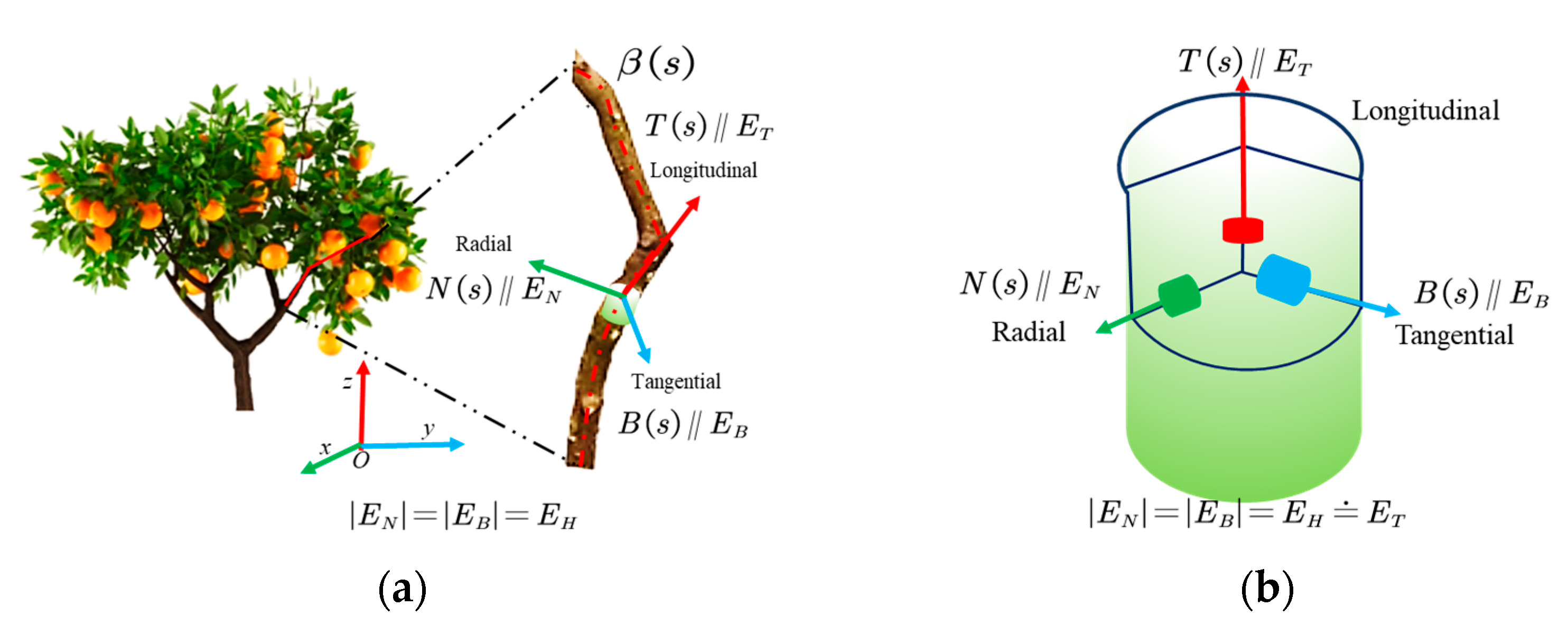
The material properties of fruit trees exhibit transversely isotropic behavior, characterized by notable variations in mechanical properties between the growth direction and the cross-sectional plane [27]. Within the cross-section of citrus branches, the mechanical properties of the wood material are consistent in both the radial and tangential directions [28]. The elastic modulus, Poisson’s ratio, and density of citrus trees are intrinsically linked to their vibrational characteristics. Therefore, the elastic modulus of citrus trees is classified into three directions: longitudinal, tangential, and radial elastic moduli, which are oriented perpendicularly to one another. For branches with a curved spatial shape, the longitudinal elastic modulus at any given point is consistent with the tangential direction of the trajectory of the branch’s central line, while the radial and tangential elastic moduli are perpendicular to each other within the cross-section of the branch, as shown in Figure 1a. The longitudinal modulus of elasticity is denoted as ET, whereas the radial and tangential moduli, which are equivalent, are denoted as EH. The tangential modulus of elasticity is translated such that the three elastic moduli converge at the centroid of the branch cross-section, as depicted in Figure 1b.
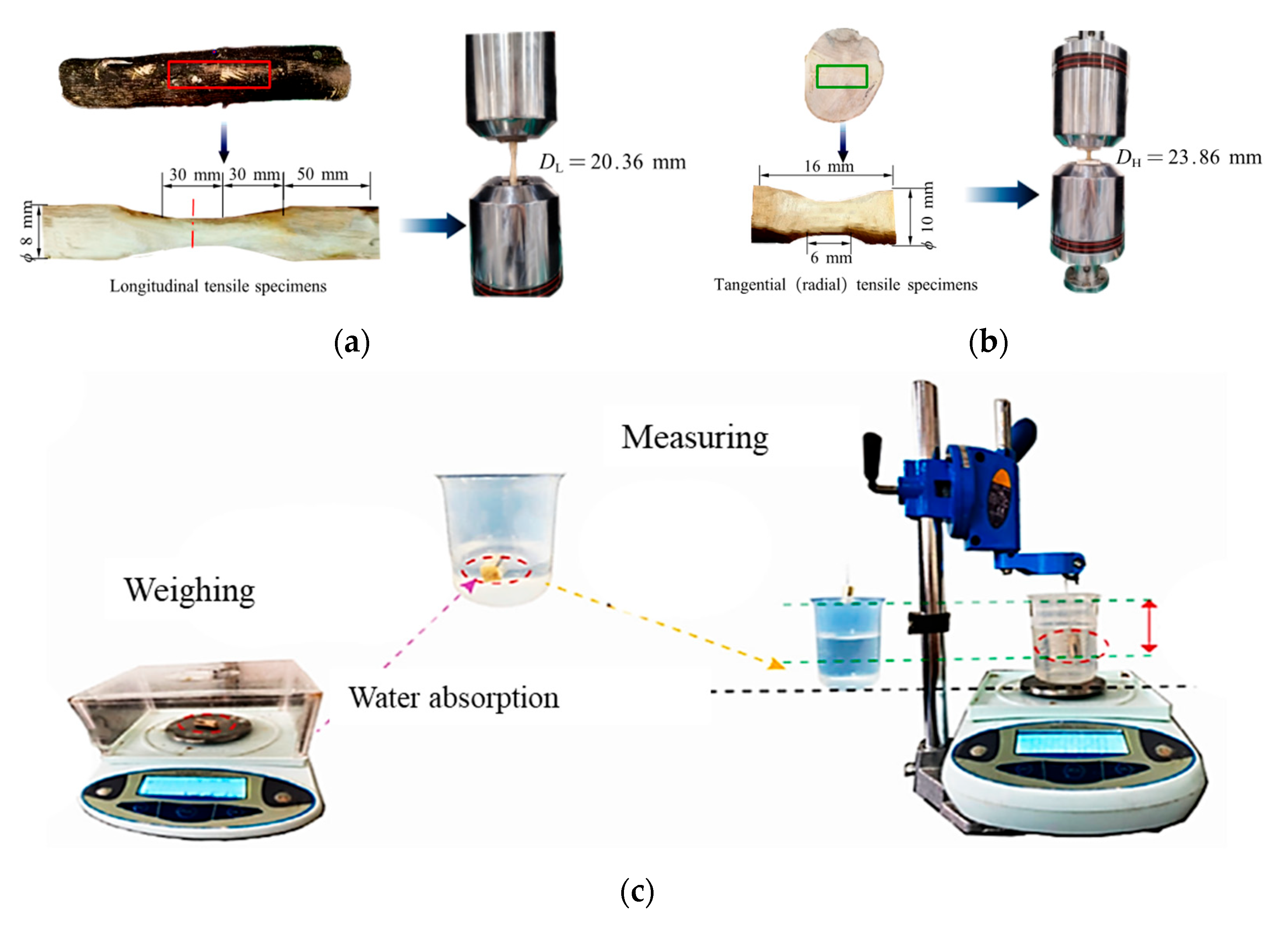
In the present study, a universal material testing machine (Model: MTS E43.50, MTS, Shenzhen, China) was utilized to assess the elastic moduli and Poisson’s ratios of citrus tree branches, as depicted in Figure 2. The tensile speed of the universal testing machine ranges from 5 to 20 mm/min, with a force sensing accuracy of 0.001 N and a displacement sensing accuracy of 0.001 mm. The correlation between longitudinal force and strain in the citrus branch materials is illustrated in Figure 2a, while Figure 2b presents the relationship between lateral force and strain in these materials. The cross-sectional diameters of both longitudinal and transverse samples were measured before and after stretching using a vernier caliper (manufacturer: Umlo, accuracy 0.01 mm, Shandong, China), which facilitated the calculation of the Poisson’s ratios μH and μT for the citrus branches. The methodology for calculating the shear modulus of the citrus branches is outlined in Equation (1), where GL represents the longitudinal shear modulus and GH denotes the transverse shear modulus.
G T = E T 2 ( 1   +   μ T ) G H = E H 2 ( 1   +   μ H )
where ET is the longitudinal modulus of elasticity; μT is longitudinal Poisson’s ratios; EH is the transverse modulus of elasticity; μH is transverse Poisson’s ratios.
The mass of the sample, denoted as Ma, was measured using an electronic balance with a precision of 0.01 g. An appropriate volume of distilled water was added to a graduated cylinder, which was subsequently placed on the electronic balance to obtain the total mass, recorded as Mw. The branch sample was then fully immersed in the graduated cylinder. An iron needle was submerged to a depth of 5 mm below the surface of the liquid, and the corresponding mass reading was noted as Mf on the electronic balance. Subsequently, the sample was pressed into the water using the iron needle, ensuring that it remained suspended 5 mm beneath the liquid surface, and the mass reading was recorded as Mef from the electronic balance. The density of the sample can be determined using Formula (2), where ρw represents the density of water. The mechanical properties of the citrus branch are presented in Table 1, where every parameter was tested 10 times. These data were collected in February 2025. These citrus trees were grown at Chongqing Beibei, China. The calculation methods of these parameters are the same as those for other material parameters [27].
ρ c = M a V = M a M e f M f M w ρ w
where Ma is mass of the sample; Mw is water mass; Mf is mass of iron needle; Mef is Final mass of testing; ρw is the density of water.

2.2. Definition of the Direction of Mechanical Parameters of Transversely Isotropic Citrus Branch

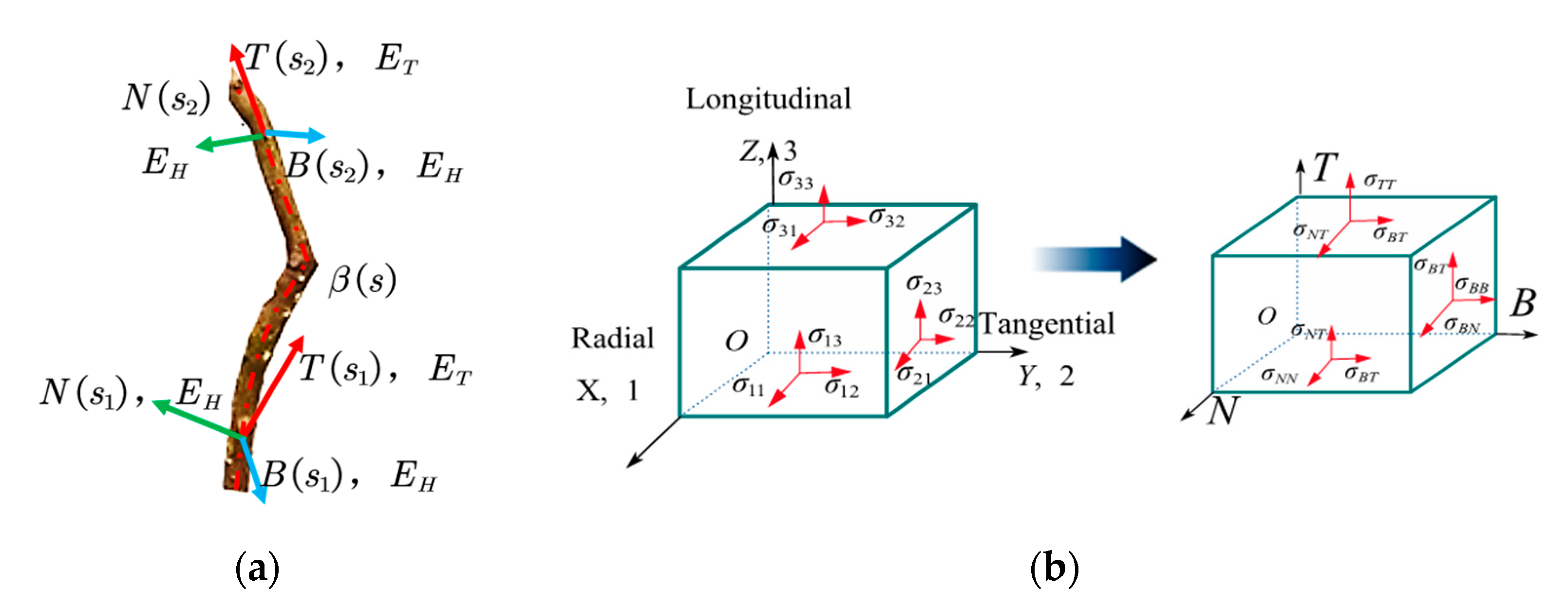
It is important to note that the elastic modulus varies directionally at different locations along the branches, as shown in Figure 3a. This study employs the Frenet frame from differential geometry to characterize the geometric center curve of citrus branches. In this framework, the tangent vector T corresponds to the longitudinal elastic modulus, the normal vector N aligns with the radial elastic modulus, and the binormal vector B is associated with the tangential elastic modulus of citrus trees. The radial and tangential elastic moduli of citrus branches are collectively referred to as the transverse elastic modulus ET.
In the context of differential geometry, the branch trajectory curve β(s) of a citrus tree is defined as a function where the arc length s serves as the independent variable. The derivative of the branch trajectory β(s) with respect to the arc length parameter s produces the tangent vector T(s) of the trajectory, as articulated in Equation (3).
T s = d β s d s
where the branch trajectory β(s), s is the arc length parameter.
The vector N(s) represents the normal vector of the geometric center curve of citrus branches, denoted as β(s), and is orthogonal to the tangent vector T(s). The curvature k(s) of the geometric center curve β(s) is defined by Equation (4). Furthermore, the principal normal vector N(s) of β(s) can be articulated through Equation (5).
k s = d T s d s
N s = κ s T s
The curvature k(s) and the tangent vector T(s) are perpendicular to each other, because T(s) and T′(s) are perpendicular to each other. Therefore, T′(s) and k(s) are parallel. In a unit arc length s, k(s) = T′(s).
The binormal vector B(s) is orthogonal to both the principal normal vector N(s) and the tangent vector T(s) in three-dimensional space. These three vectors adhere to the cross-product relationship found in algebraic geometry, thereby establishing a right-handed coordinate system. The Frenet frame is capable of not only characterizing the central curve of the branch but also delineating the orientations of the three elastic moduli associated with the branch material. The mathematical representation of the Frenet frame for the branch is provided in Formula (6).
T s = d β s d s N s = 1 κ s T s B s = T s × N s k s = T s
The stress components of branches, originally defined within the Cartesian coordinate system, are converted to the Frenet frame, as illustrated in Figure 3b. The relationship between stress and strain for the branches is articulated through Equation (7), where C signifies the stiffness matrix associated with the branch material.
σ N N σ B B σ T T σ B T σ N T σ N B = C ε N N ε B B ε T T ε B T ε N T ε N B = 1 μ H   μ T E T E H Δ μ T   +   μ H   μ H E H E T Δ μ T H   +   μ T   μ H E T E H Δ 0 0 0 1 μ H   μ T E H E H Δ μ T   +   μ H   μ T E H E T Δ 0 0 0 1 μ T   μ T E T E T Δ 0 0 0 E H 2 1   +   μ T 0 0 sym E H 2 1   +   μ T 0 E T 2 1   +   μ H ε N N ε B B ε T T ε B T ε N T ε N B
where Δ = 1 μ H μ H μ T μ H μ H μ H 2 μ H μ T μ H E H E H E T , the principal stresses of the branches are denoted as σTT, σNN, and σBB, while the shear stresses are represented by σNB, σTB, and σTN. The principal strains are indicated by εTT, εNN, and εBB, with the shear strains of the branches represented as εNB, εTB, and εTN; ET is the longitudinal modulus of elasticity; μT is longitudinal Poisson’s ratios; EH is the transverse modulus of elasticity; μH is transverse Poisson’s ratios.
In the fruit tree vibration harvesting process, the vibrations of the fruit trees all belong to linear elastic deformation. The stiffness matrix C defines the relationship between stress and strain, and is the basis for finite element calculations of the vibration responses of fruit trees. When a deformation occurs in one direction, the strain that occurs in other directions can be calculated based on the stiffness matrix C.

2.3. Research Framework

The physical experiment of tree branch vibration and the numerical simulation experiment of transverse anisotropic tree branch vibration were carried out to verify the rationality of the established simulation model method. On this basis, a three-dimensional geometric model of the fruit tree was constructed, and vibration simulation of the transverse anisotropic fruit tree was carried out. Subsequently, the simulation results were systematically compared with the vibration responses of the isotropic fruit tree model, further revealing the influence of material anisotropy on the vibration characteristics of the fruit tree, and providing a theoretical basis for the precise prediction of the dynamic behavior of the fruit tree.

3. Results

3.1. Comparison of Branch Simulated Vibration Spectrums and Vibration Test Spectrums

In order to verify the feasibility of the transversely isotropic tree modeling by Frenet Fame, the three-dimensional model of a tree branch is obtained by a three-dimensional scan method. The vibration simulation of the three-dimensional model was carried out using the COMSOL Multiphysics software. At the same time, a physical vibration test was performed on the above branch, and the results were compared with the simulation results to determine the correctness of the transversely isotropic citrus tree branch modeling method.
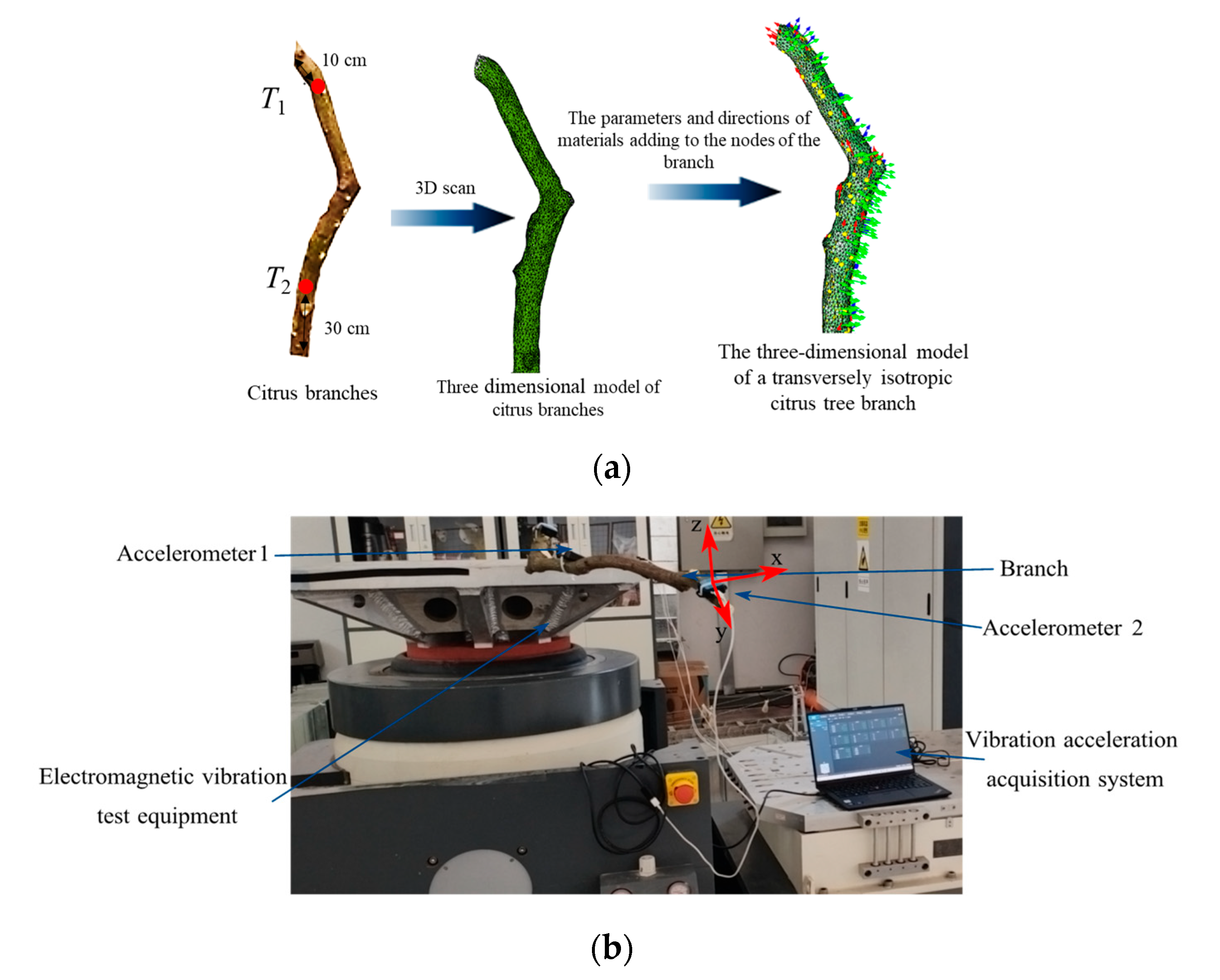
The three-dimensional model of transversely isotropic branches was built. The construction process is depicted in Figure 3a. The citrus branch measures 1 m in length, and its surface profile was captured by 3D scanner (Sermoon, Shenzhen, China). The material parameters outlined in Table 1 were employed to characterize the citrus branches within the COMSOL Multiphysics software. The interface located at the base of the branch serves as the entry point for material generation, while the apex of the branch functions as the outlet for material flow. The material is distributed according to the contour of the citrus tree, thereby creating a three-dimensional model of the transversely anisotropic citrus branch. Material mechanics property parameter at each point along the transversely isotropic citrus branch were determined using the Frenet frame. Ultimately, a transversely isotropic citrus branch model was established. the vibration spectrum of the transversely isotropic branch was computed by the frequency domain analysis module within COMSOL Multiphysics.
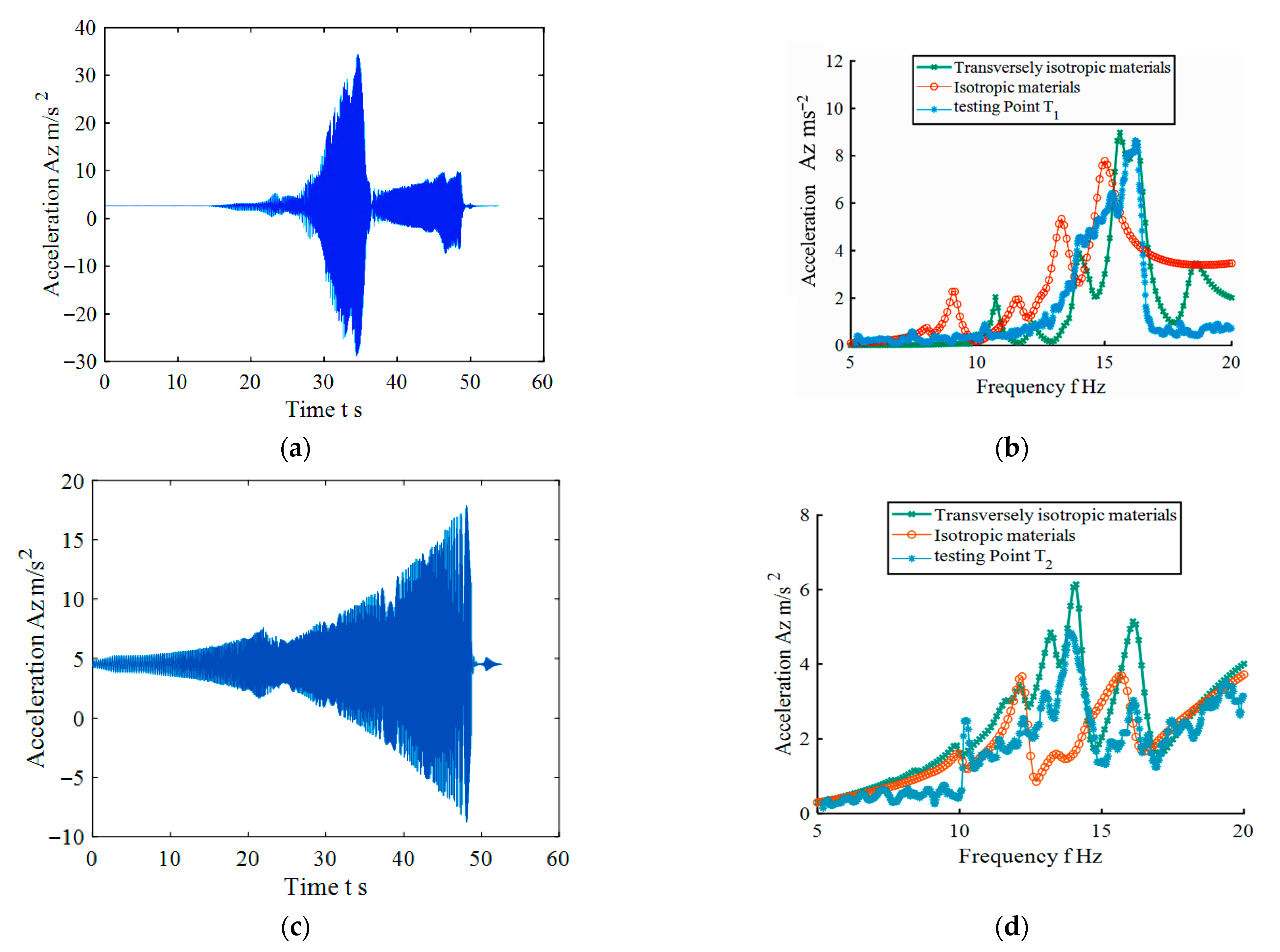
The citrus branch is secured to an electric vibration test bench (model DC-3200-36, Chinese vibration, Shenzhen, China), which operates within a sweep frequency range of 5 to 2500 Hz. Specifically, the sweep frequency range for the citrus branch is set between 5 and 25 Hz, with a vibration displacement amplitude of 1 mm, directed along the z-axis, and a sweep frequency rate of 5 octaves per minute in Figure 4b. The acceleration signals from the branch are captured using an acceleration sensor (WT901 SDCL, Witte intelligent, Guangzhou, China). The sensor operates at a communication rate of 1 Mbps, with a sampling frequency of 200 Hz and a baud rate of 115,200. The measurement points, designated as T1 and T2 in Figure 4a, are utilized to assess the acceleration signals in the z direction at these two locations.
The vibration spectra of the three-dimensional model of the branch, characterized by varying material parameters as outlined in Table 2, were computed using COMSOL Multiphysics. A comparative analysis was conducted between the vibration spectra of the transversely isotropic citrus branch and the isotropic citrus branch, alongside the empirical vibration spectrum obtained from testing the citrus branch. The discrepancies in spectral characteristics among the citrus branches with differing material properties were examined.
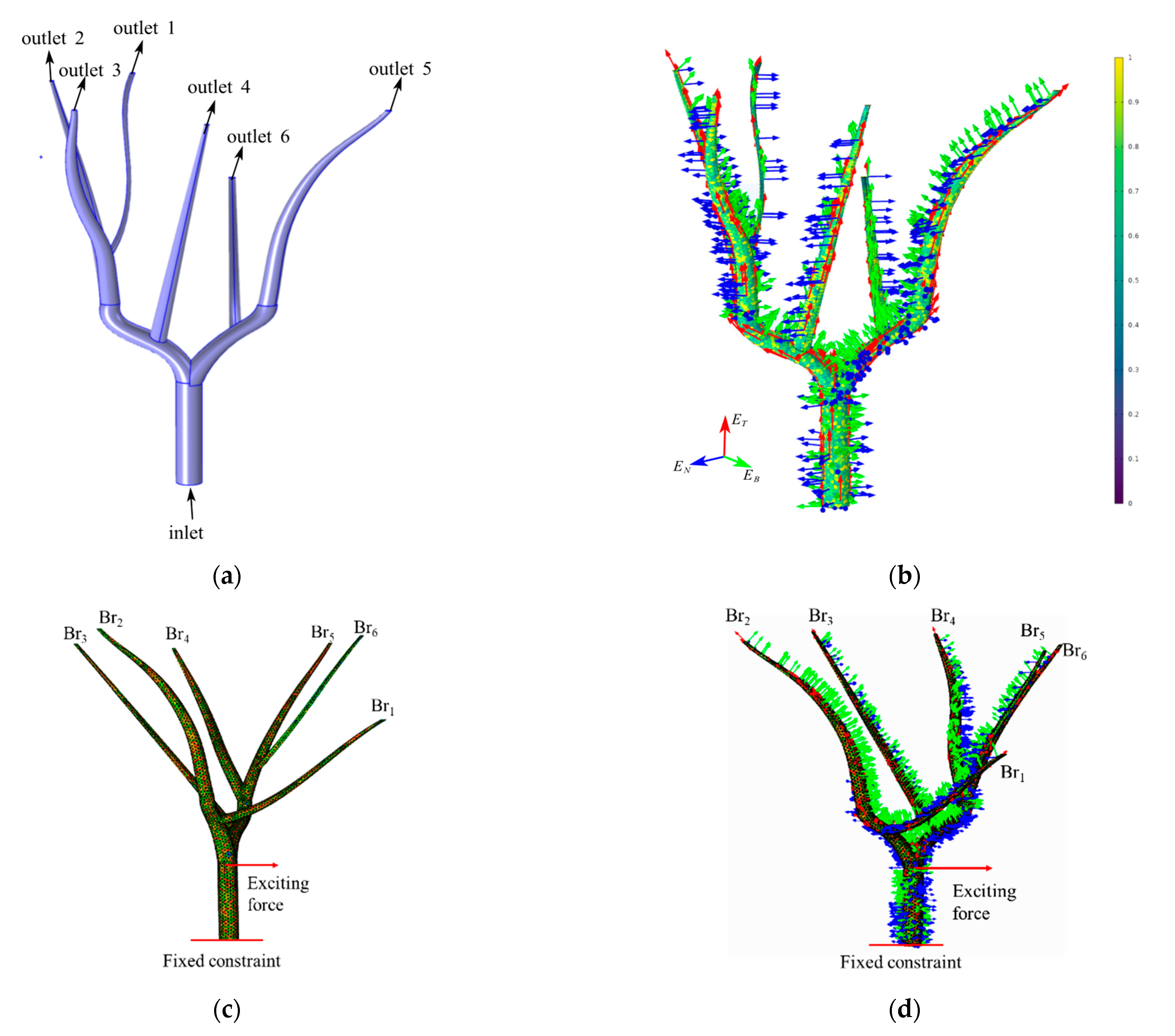
In order to investigate the vibrational differences in the citrus trees between transversely isotropic materials and isotropic materials, an open-center citrus tree model was developed, as illustrated in Figure 5. The material composition of the citrus tree is initiated at the base of the trunk, with the trunk, first-order branches, and second-order branches being sequentially filled to construct the complete entity of the citrus tree, in Figure 5a. The geometry of the citrus tree was discretized using the finite element method. The directional parameters of the material at each point on the citrus tree was defined by using the Frenet frame in Figure 5b. The two material parameters listed in Table 2 were utilized to characterize the material properties of the open-center citrus tree. Finally, three-dimensional models of citrus trees were created, employing a tetrahedral mesh for grid division.
The frequency domain approach was employed to examine the vibration response of both transversely isotropic and isotropic citrus trees. Fixed constraints were implemented at the base of the citrus trunk, while a constant amplitude displacement of 5 mm was applied to the top of the trunk, in Figure 5c,d. The analysis focused on a frequency range of 0–25 Hz, allowing for a comprehensive frequency domain response evaluation.
The vibration acceleration signals recorded at the branch vibration detection points T1 and T2 in the z-direction are illustrated in Figure 6a,c. The response spectra of the vibration acceleration were derived through the application of Fourier transform on the branch vibration acceleration signals. The vibration response spectra for both the transversely isotropic branch and the isotropic branch were simulated using Comsol Multiphysics. Consequently, the simulated vibration spectra for Points T1 and T2 on the branches composed of these two materials were obtained. The three vibration spectra corresponding to Points T1 and T2 on the branches are presented in Figure 6b,d. The simulated acceleration spectra for the transversely isotropic citrus branch exhibit a high degree of consistency with the experimentally obtained vibration acceleration spectra, with similar trends observed in both peak positions and peak heights. In contrast, a notable discrepancy is evident in the peak positions of the isotropic branch spectra compared to the physical test spectra of the branch. This evidence supports the classification of the citrus branch as a transversely isotropic material, indicating that the simulation results for the vibration characteristics of the citrus branch align more closely with its actual vibration behavior. Furthermore, Figure 6b,d substantiate the assertion that the material of the citrus tree is transversely isotropic rather than isotropic.

3.2. Comparative Analysis of Simulation Outcomes for Isotropic and Anisotropic Citrus Trees

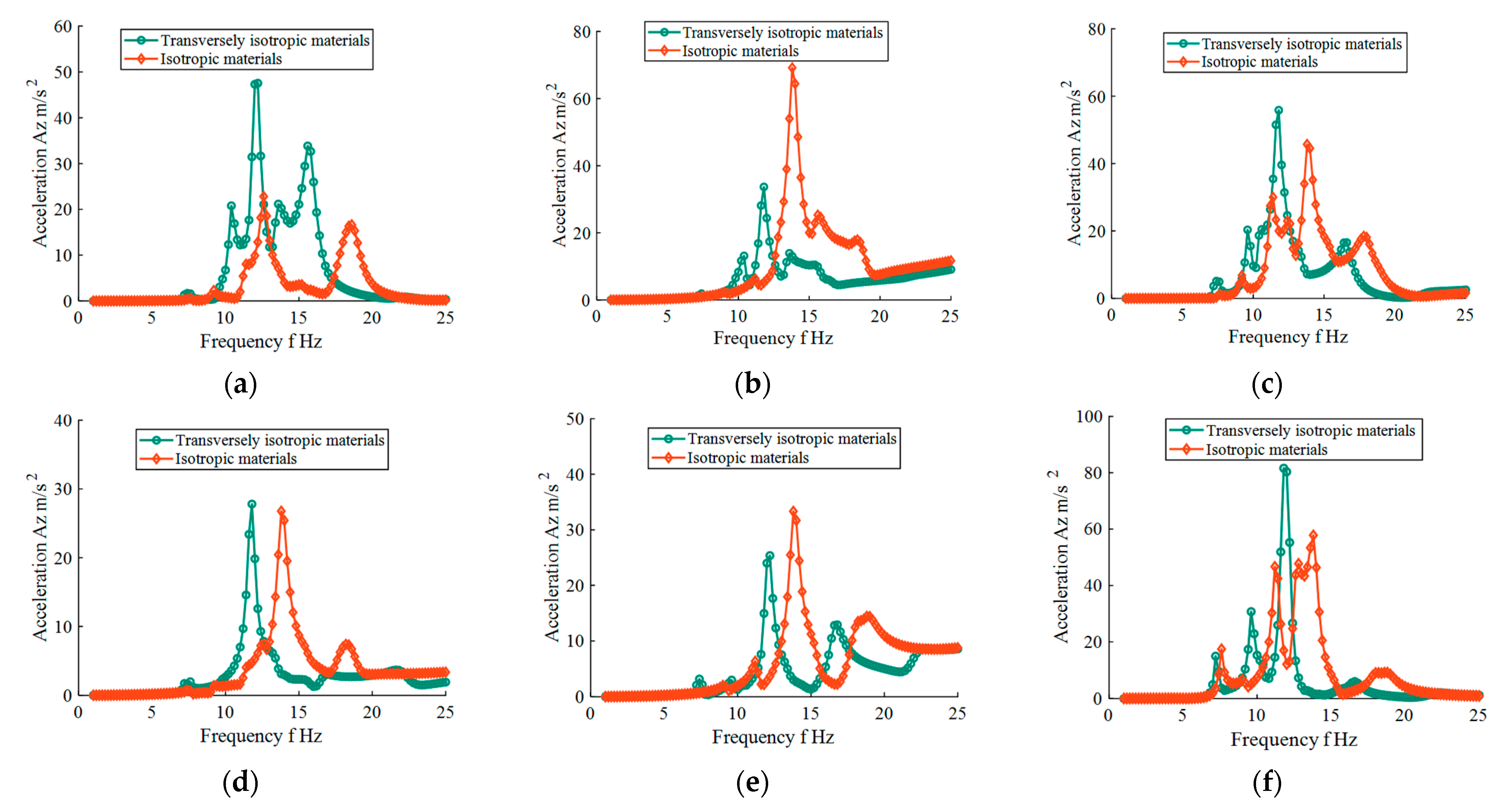
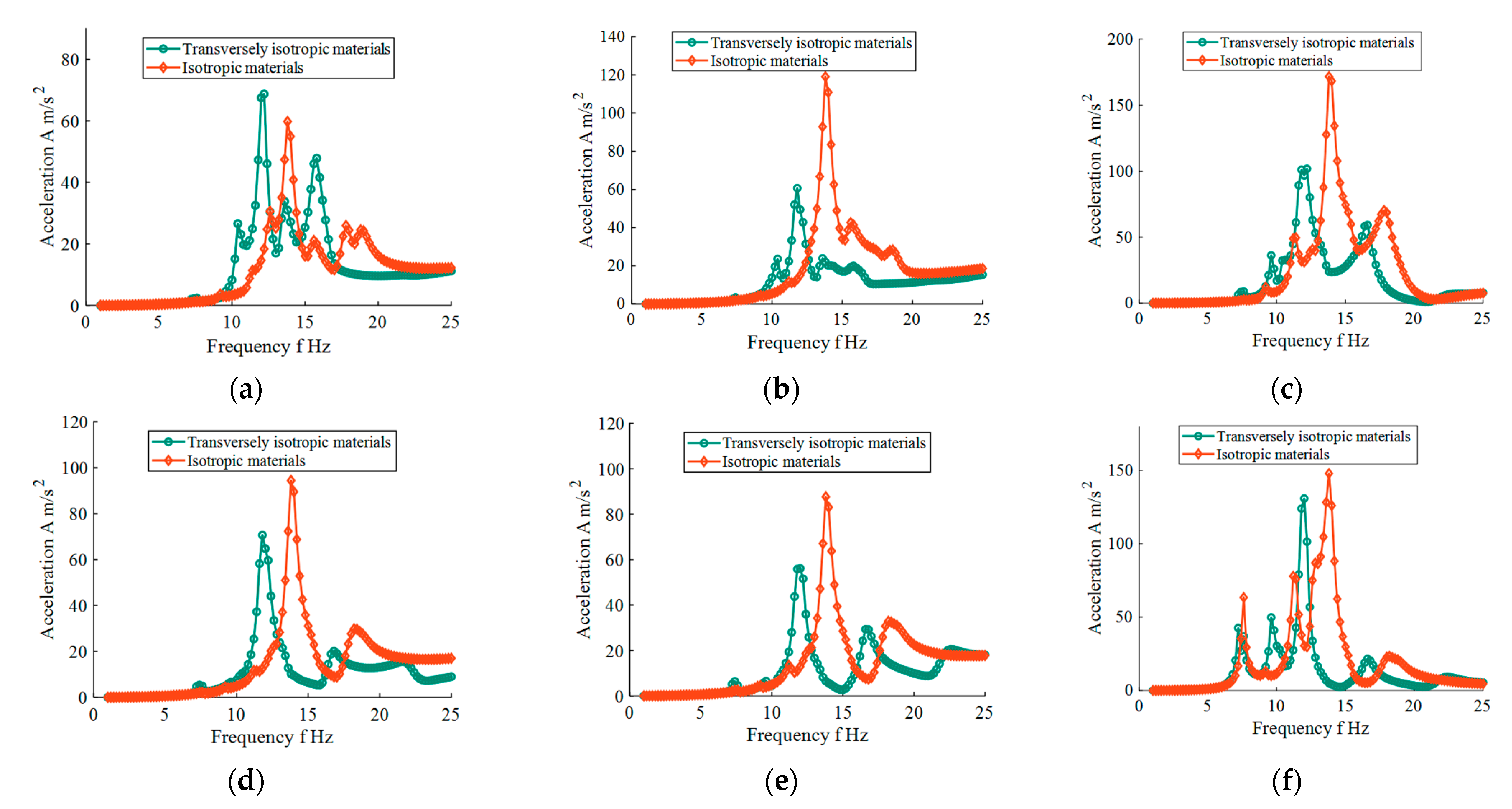
To examine the variations in vibration characteristics between transversely isotropic and isotropic citrus trees, a comparative analysis was conducted on the acceleration spectra of the terminal branches of both types of trees. This analysis was performed in the x, y, and z directions.
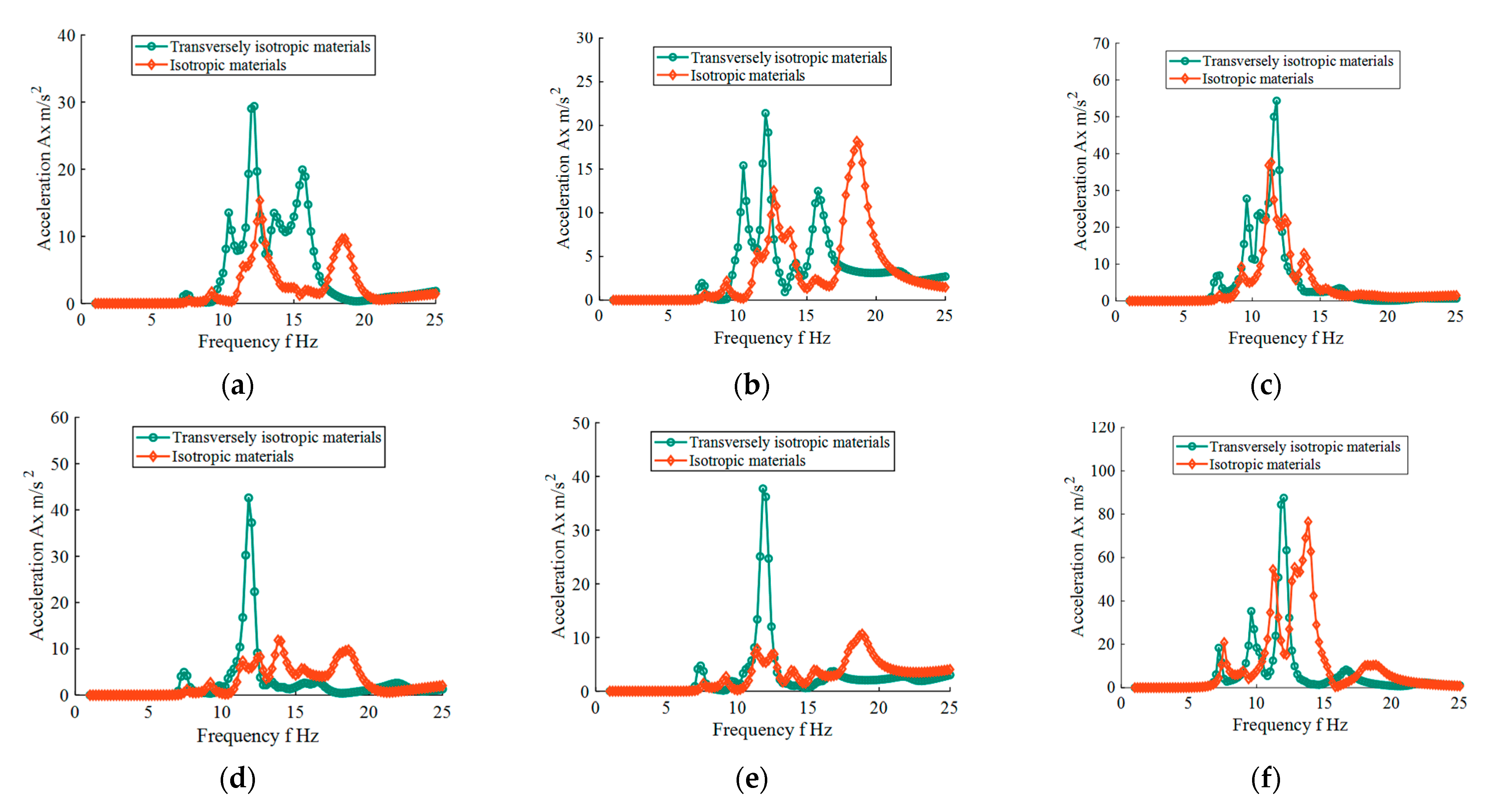
The vibrational spectra for all branches oriented in the x-direction are presented in Figure 7. The maximum peak frequency observed for all branches of the transversely isotropic citrus tree is 11.8 Hz. In contrast, the maximum peak frequencies of the isotropic citrus branches in the x-direction exhibit variability. Specifically, branch 1 has a maximum peak frequency of 12.6 Hz, branch 2 has a frequency of 18.6 Hz, branch 3 registers at 11.4 Hz, branch 4 at 13.8 Hz, branch 5 at 18.8 Hz, and branch 6 at 13.8 Hz. Furthermore, the maximum peak acceleration of the vibrational spectrum for the transversely isotropic citrus branches surpasses that of the isotropic branches.
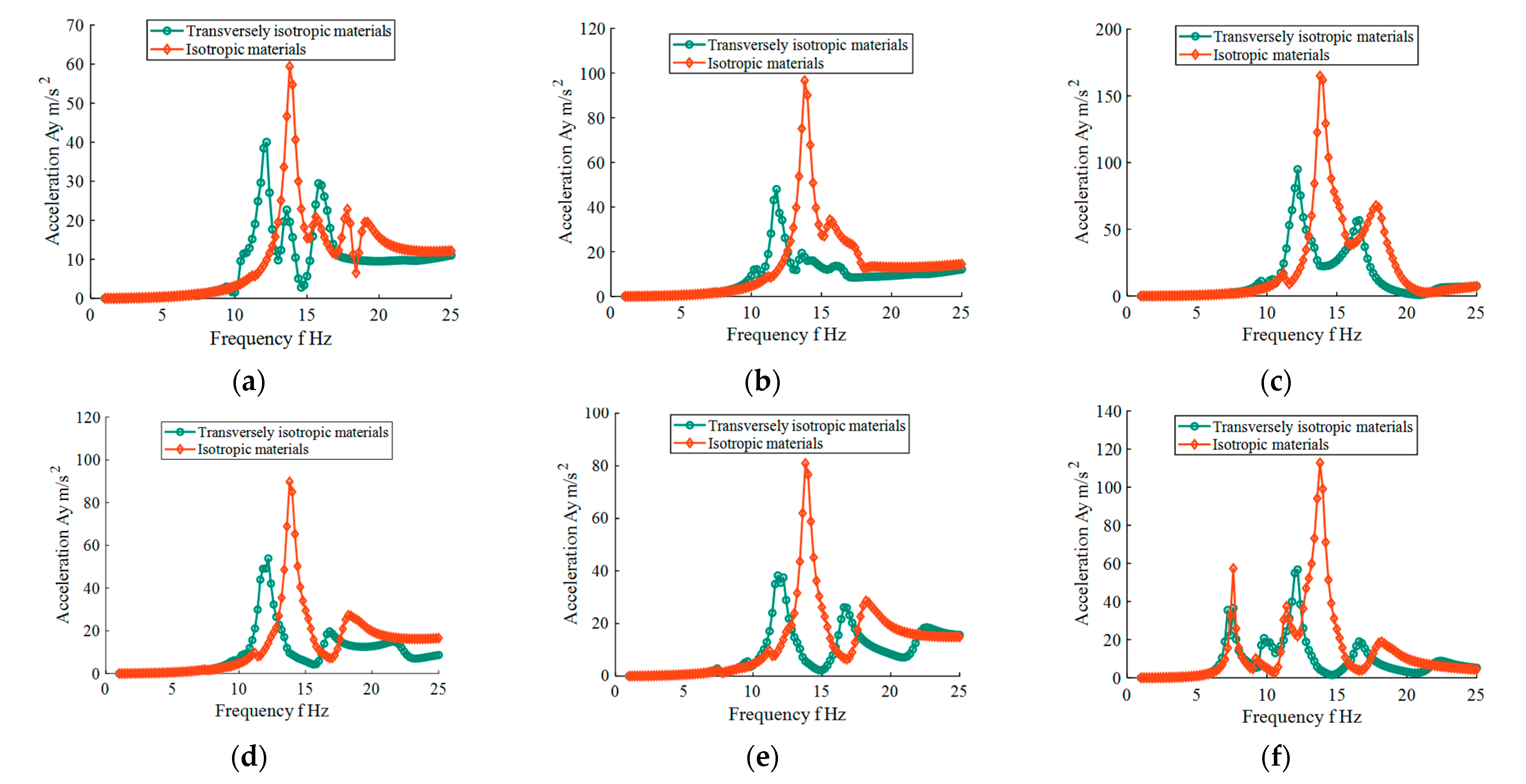
Figure 8 illustrates the vibration spectra of all branches oriented in the y direction. The maximum peak frequency observed for transversely isotropic citrus tree branches is approximately 11.8 Hz, while the maximum peak frequency for all branches of isotropic citrus trees is recorded at 13.8 Hz. Furthermore, the maximum peak acceleration within the vibration spectrum of isotropic branches exceeds that of the transversely isotropic branches.
The vibrational spectra for all branches oriented in the z direction are presented in Figure 9. The maximum peak frequency observed for transversely isotropic citrus branches is 11.8 Hz, while the maximum peak frequency for all branches of isotropic citrus trees in the same direction is 13.8 Hz. Furthermore, the maximum peak acceleration recorded in the spectra of transversely isotropic citrus tree branches 1, 3, 4, and 6 exceeds that of their isotropic counterparts. Conversely, the maximum peak acceleration in the spectra of transversely isotropic citrus tree branches 2 and 5 is lower than that observed in the spectra of isotropic citrus tree branches 2 and 5.
The root mean square (RMS) value of acceleration along the x-axis, y-axis, and z-axis has been identified as a key evaluation metric for assessing the vibration frequency of citrus trees in the context of vibration harvesting. Notably, there is a significant difference in the root mean square spectrum of vibration acceleration between branches composed of transversely isotropic materials and those made of isotropic materials, as illustrated in Figure 10. The maximum peak frequency observed in the RMS spectrum of vibration acceleration for transversely isotropic citrus branches is 11.8 Hz, whereas the isotropic citrus branches exhibit a maximum peak frequency of 13.8 Hz. Furthermore, the peak value of the RMS spectrum for the vibration acceleration of isotropic citrus branches surpasses that of the transversely isotropic branches. Consequently, the prevailing approach in citrus tree vibration simulation research, which characterizes the material of citrus trees as isotropic, may not yield accurate results regarding the optimal vibration frequency for harvesting citrus fruits.
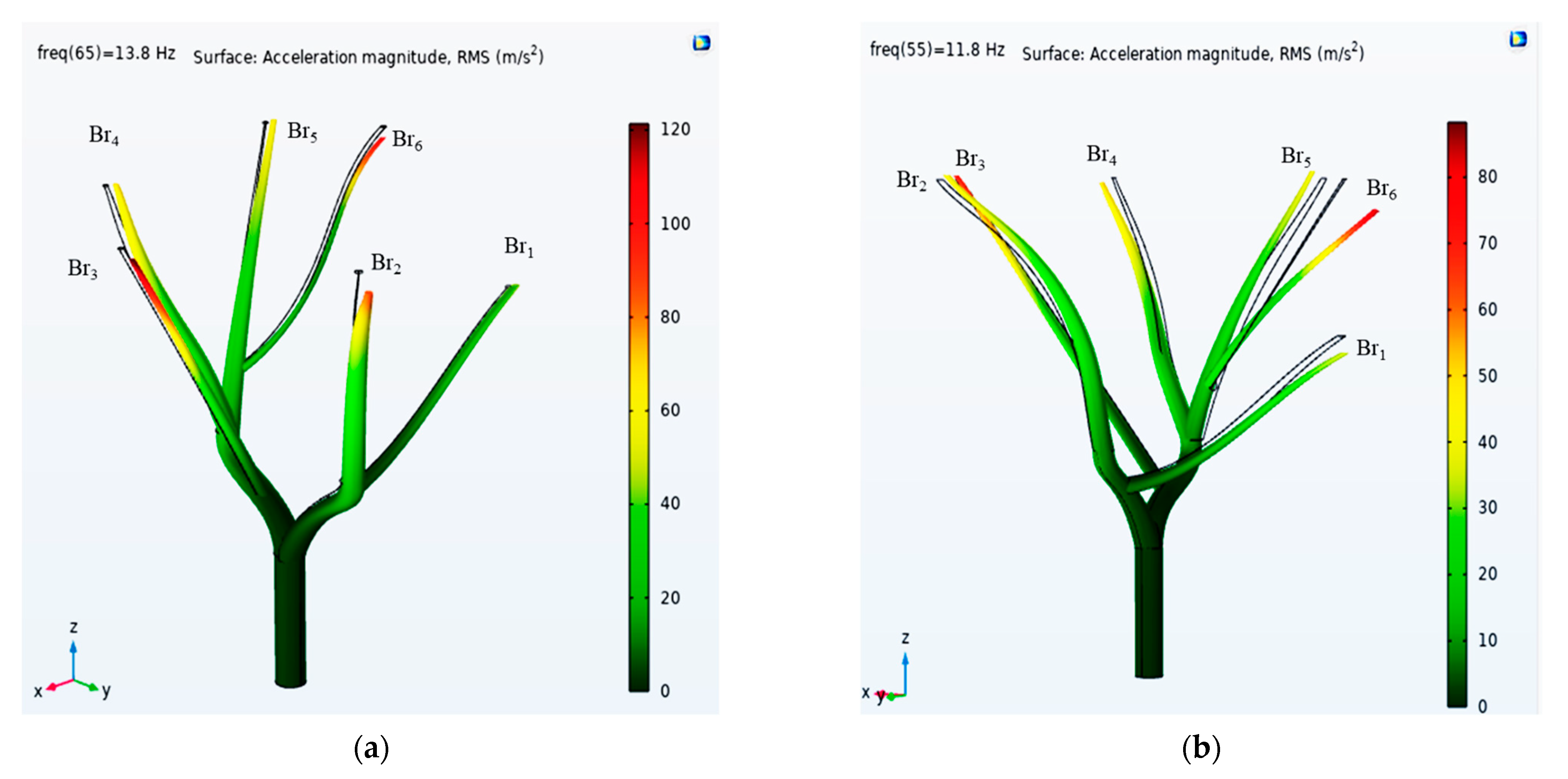
When the maximum peak frequency of isotropic citrus trees is 13.8 Hz, the distribution of the root mean square of branch acceleration is shown in Figure 11a. When the maximum peak frequency of the transversely isotropic citrus tree is 11.8 Hz, the distribution of the root mean square of the branch acceleration is shown in Figure 11b. By observing the change trend of vibration acceleration from the trunk to the end of each branch, it can be found that the closer to the end of the branch, the greater the vibration acceleration.

4. Discussion

The advancement of three-dimensional reconstruction technology has enabled the generation of three-dimensional models of fruit trees, facilitating finite element analysis to derive the vibration spectrum of these trees and identify the optimal harvesting frequency [15,16]. Such investigations provide a theoretical framework for the vibration harvesting of forest fruits. Notably, the material properties of fruit trees significantly influence the outcomes of vibration simulations conducted via the finite element method. In the context of vibration harvesting, fruit tree materials are often assumed to be isotropic [8,14]; however, existing studies indicate that the mechanical properties of fruit tree wood exhibit transverse isotropy [22,26]. This paper utilizes citrus trees as a case study, demonstrating through stress–strain experiments that citrus trees also possess transversely isotropic characteristics, as illustrated in Figure 2. Furthermore, the vibration simulation results for the transversely isotropic citrus branches align closely with empirical vibration testing outcomes, as depicted in Figure 6. This alignment supports the classification of fruit trees as transversely isotropic materials, thereby enhancing the validity of the calculated vibration spectra.
In the development of fruit vibration harvesting equipment, the structural and operational parameters are informed by the vibration simulation analysis of fruit trees. For instance, the excitation frequency and amplitude of the eccentric block exciter are established through these simulations, which subsequently guide the determination of the speed, mass, and eccentricity of the eccentric block based on centrifugal force calculations [29,30]. The transversely isotropic vibration simulation method for citrus trees, as proposed in this study, can be applied to the finite element vibration simulation of other fruit tree species, thereby improving the accuracy of such simulations, compared with concentrated mass model and elastic beam model. Ultimately, this methodology contributes to the rationalization of the structural parameters and operational design of fruit harvesting equipment, thereby advancing the field of fruit harvesting technology.
In addition, isotropic vibration simulation result is larger than the transversely isotropic vibration simulation result. This is because the elasticity modulus EH transverse area of branches decreases, the strain energy also will decrease according to the relationship between stress and strain for the branches in Equation (7). Meanwhile, for different fruit trees, there are differences in material parameters, so the material parameters of the constitutive model need to be modified to establish vibration models for different types of fruit trees.
Future research will focus on the online simulation of coupled vibration models of fruit harvesting equipment and transversely isotropic fruit trees in COMSOL Multiphysics. Meanwhile, we will consider that impact of material parameter changes in actual picking environments, such as branch moisture content and fruit load, on simulation results. This will involve importing three-dimensional models of both fruit trees and harvesting equipment into a finite element simulation platform, where a virtual reality model of forest fruit vibration harvesting will be constructed by incorporating constraint relationships. This approach aims to simulate the real-world dynamics of fruit vibration harvesting, thereby establishing a theoretical basis for the determination and control of excitation parameters in fruit vibration harvesting applications.

5. Conclusions

This study presents a methodology for the development of a novelty three-dimensional model of transversely isotropic citrus trees utilizing the Frenet frame. The stress–strain constitutive model for the material of citrus trees was established by quantifying the material parameters specific to this species. The parameter orientations of the citrus trees were defined in relation to the central curve of the branches, employing the Frenet frame as a framework. Subsequently, a three-dimensional model of transversely isotropic citrus trees was constructed. The validity of this modeling approach was corroborated through experimental verification, leading to several key findings.
Testing of the citrus tree material revealed significant discrepancies in mechanical parameters across two distinct directions. Specifically, the elastic modulus of the material in the longitudinal direction (growth direction) was determined to be 9.80 GPa, with a Poisson’s ratio of 0.348. In contrast, the elastic modulus in the transverse direction (branch cross-section) was measured at 1.76 GPa, accompanied by a Poisson’s ratio of 0.339.
The three-dimensional model of the transversely isotropic citrus tree was successfully constructed using the Frenet frame. Notably, the vibration simulation spectrum of the transversely isotropic citrus tree branches closely aligned with the empirical vibration test spectrum obtained from the actual citrus tree branches, particularly in terms of peak frequencies and their respective trends.
Further analysis involved conducting vibration simulations for both transversely isotropic and isotropic citrus trees. The spectral characteristics of vibration acceleration at the branch tips indicated that the acceleration response intensity of transversely isotropic citrus branches was lower than that of their isotropic counterparts. This finding suggests that the actual vibration response intensity of citrus trees is less pronounced than the results derived from existing isotropic citrus tree vibration simulations.

Author Contributions

Conceptualization, H.J. and C.L.; methodology, H.J.; software, H.J.; validation, H.J. and L.W.; formal analysis, L.P., J.D. and C.M.; investigation, H.J.; resources, G.R., J.D., B.Z., X.G. and Y.W.; data curation, H.J.; writing—original draft preparation, H.J.; writing—review and editing, H.J.; visualization, W.L.; supervision, H.J.; project administration, J.D.; funding acquisition, J.D. All authors have read and agreed to the published version of the manuscript.

Funding

This research was funded by Chongqing Municipal Science and Technology Bureau, grant number CSTB2024JXJL-YFX0004.

Data Availability Statement

The original contributions presented in this study are included in the article. Further inquiries can be directed to the corresponding authors.

Conflicts of Interest

The authors declare no conflicts of interest.

References

  1. Cao, J.; An, J.; Xu, D.; Bai, X.; Li, W.; Chen, C. Test and analysis of walnut (Juglans regia L.) tree vibration transfer based on a low-frequency shaking table. Ind. Crop Prod. 2024, 216, 118797. [Google Scholar] [CrossRef]
  2. Jiao, H.; Tang, A.; Ma, C.; Li, Y.; Wang, L.; Li, C. Modelling and numerical simulation of a concentrated mass-based branch vibration. Sci. Hortic-Amst. 2024, 330, 113028. [Google Scholar] [CrossRef]
  3. Wang, R.; Fang, D.; Wu, C.; Wang, B.; Zhu, H.; Hu, T.; Wu, D. Dynamic response of Camellia oleifera fruit-branch based on mathematical model and high-speed photography. Biosyst. Eng. 2024, 237, 232–241. [Google Scholar] [CrossRef]
  4. Wang, Y.-T.; Bailey, B.N.; Fu, K.; Shackel, K. Topological and spatial analysis of within-tree fruiting characteristics for walnut trees. Sci. Hortic. 2023, 318, 112127. [Google Scholar] [CrossRef]
  5. Villibor, G.P.; Santos, F.L.; de Queiroz, D.M.; Khoury Junior, J.K.; de Carvalho Pinto, F.D.A. Dynamic behavior of coffee fruit-stem system using modeling of flexible bodies. Comput. Electron. Agric. 2019, 166, 105009. [Google Scholar] [CrossRef]
  6. Zheng, Z.; Hu, Y.; Dong, J.; Zhao, P.; Liu, Y.; Jiang, X.; Qiao, Y.; Sun, S.; Huang, Y. Characterising vibration patterns of winter jujube trees to optimise automated fruit harvesting. Biosyst. Eng. 2024, 248, 255–268. [Google Scholar] [CrossRef]
  7. Wang, Y.; Xu, L.; Zhang, Y.; Zhu, Y.; Zhou, H.; Cui, W.; Zhang, A. Study of vibration patterns and response transfer relationships in walnut tree trunks. Sci. Hortic-Amst. 2024, 337, 113567. [Google Scholar] [CrossRef]
  8. Xuan, Y.; Xu, L.Y.; Liu, G.H.; Zhou, J. The Potential Influence of Tree Crown Structure on the Ginkgo Harvest. Forests 2021, 12, 366. [Google Scholar] [CrossRef]
  9. Sola-Guirado, R.R.; Castro-Garcia, S.; Blanco-Roldan, G.L.; Gil-Ribes, J.A.; Gonzaez-Sachez, E.J. Performance evaluation of lateral canopy shakers with catch frame for continuous harvesting of oranges for juice industry. Int. J. Agric. Biol. Eng. 2020, 13, 88–93. [Google Scholar] [CrossRef]
  10. Niu, Z.; Xu, Z.; Deng, J.; Zhang, J.; Pan, S.; Mu, H. Optimal vibration parameters for olive harvesting from finite element analysis and vibration tests. Biosyst. Eng. 2022, 215, 228–238. [Google Scholar] [CrossRef]
  11. He, L.; Liu, X.; Du, X.; Wu, C. In-situ identification of shaking frequency for adaptive vibratory fruit harvesting. Comput. Electron. Agric. 2020, 170, 105245. [Google Scholar] [CrossRef]
  12. Wei, J.; Yang, G.Y.; Yan, H.; Jing, B.B.; Yu, Y. Rigid-flexible coupling simulation and experimental vibration analysis of pistachio tree for optimal mechanized harvesting efficiency. Mech. Adv. Mater. Struct. 2021, 28, 2360–2369. [Google Scholar] [CrossRef]
  13. Castro-Garcia, S.; Blanco-Roldan, G.L.; Ferguson, L.; Gonzalez-Sanchez, E.J.; Gil-Ribes, J.A. Frequency response of late-season ‘Valencia’ orange to selective harvesting by vibration for juice industry. Biosyst. Eng. 2017, 155, 77–83. [Google Scholar] [CrossRef]
  14. Souza, V.H.S.; Santos, A.A.R.; Costa, A.L.G.; Santos, F.L.; Magalhaes, R.R. Evaluation of the interaction between a harvester rod and a coffee branch based on finite element analysis. Comput. Electron. Agric. 2018, 150, 476–483. [Google Scholar] [CrossRef]
  15. Hu, Y.; Zheng, Z.; Yu, C.; Feng, J.; Qiao, Y. Vibration response characteristics of Jujube trees based on finite element method and structure-from-motion. Sci. Hortic-Amst. 2024, 331, 113125. [Google Scholar] [CrossRef]
  16. Wu, C.; He, L.; Du, X.; Chen, S.; Ni, K.n. 3D reconstruction of Chinese hickory tree for dynamics analysis. Biosyst. Eng. 2014, 119, 69–79. [Google Scholar] [CrossRef]
  17. Zeng, X.; Wan, H.; Fan, Z.; Yu, X.; Guo, H. MT-MVSNet: A lightweight and highly accurate convolutional neural network based on mobile transformer for 3D reconstruction of orchard fruit tree branches. Expert Syst. Appl. 2025, 268, 126220. [Google Scholar] [CrossRef]
  18. Loong, C.N.; Chau, W.Y.; Wang, Y.-H.; Chiu, S.-W. Reconstruction methods for the mechanical energy of a tree under free vibration. Agric. For. Meteorol. 2023, 339, 109541. [Google Scholar] [CrossRef]
  19. Sola-Guirado, R.R.; Luque-Mohedano, R.; Tombesi, S.; Blanco-Roldan, G. Effect of leaves in the dynamic response of olive tree branches and their computational model. Comput. Electron. Agric. 2022, 203, 107490. [Google Scholar] [CrossRef]
  20. Sola-Guirado, R.R.; Aragon-Rodriguez, F.; Castro-Garcia, S.; Gil-Ribes, J. The vibration behaviour of hedgerow olive trees in response to mechanical harvesting with straddle harvester. Biosyst. Eng. 2019, 184, 81–89. [Google Scholar] [CrossRef]
  21. Hoshyarmanesh, H.; Dastgerdi, H.R.; Ghodsi, M.; Khandan, R.; Zareinia, K. Numerical and experimental vibration analysis of olive tree for optimal mechanized harvesting efficiency and productivity. Comput. Electron. Agric. 2017, 132, 34–48. [Google Scholar] [CrossRef]
  22. Lu, Y.; Zheng, B.; Zhang, C.; Yu, C.; Luo, J. Wood formation in trees responding to nitrogen availability. Ind. Crops Prod. 2024, 218, 118978. [Google Scholar] [CrossRef]
  23. Wen, L.; Su, H.; Wang, X.; Zhang, Y.; Sun, S.; Cai, L. Enhancement of corrosion resistance of structural timber by injecting boron preservatives labeled with fluorescent carbon dots into living trees. Ind. Crops Prod. 2025, 228, 120889. [Google Scholar] [CrossRef]
  24. Yin, F.; Zhou, Y.; Zhou, F.; Huang, S.; Gao, X.; Fang, X. Moisture sorption and its induced deformation of juvenile wood at different radial positions in poplar wood at the tissue scale. Ind. Crops Prod. 2024, 220, 119435. [Google Scholar] [CrossRef]
  25. Yu, Z.; Hu, J.; Liu, G.; Liu, Y.; Chang, S.; Rodrigue, D.; Wang, X. Micronleaf-shape graphene interfaces on wood transverse sections as advanced photothermal evaporators for water purification. J. Mater. Sci. Technol. 2024, 193, 81–89. [Google Scholar] [CrossRef]
  26. Zhao, X.; Chen, Z.; Zhuo, H.; Hu, Y.; Shi, G.; Wang, B.; Lai, H.; Araby, S.; Han, W.; Peng, X.; et al. Thermoelectric generator based on anisotropic wood aerogel for low-grade heat energy harvesting. J. Mater. Sci. Technol. 2022, 120, 150–158. [Google Scholar] [CrossRef]
  27. Wang, B.S.; He, M.; Li, C.S.; Wang, L.H.; Meng, H.W. Microstructure and biomechanical characterisation of jujube branches. Biosyst. Eng. 2020, 194, 165–176. [Google Scholar] [CrossRef]
  28. Wang, B.S.; Zhao, X.Y.; Peng, H.J.; Meng, H.W.; Wang, L.H.; Li, C.S. Evaluation of biomechanical properties of jujube branches and analysis of prediction accuracy based on multi-scale artificially simplified model. Aip Adv. 2021, 11, 045212. [Google Scholar] [CrossRef]
  29. Du, X.Q.; Jiang, F.; Li, S.T.; Xu, N.N.; Li, D.W.; Wu, C.Y. Design and experiment of vibratory harvesting mechanism for Chinese hickory nuts based on orthogonal eccentric masses. Comput. Electron. Agric. 2019, 156, 178–186. [Google Scholar] [CrossRef]
  30. Cetinkaya, C.; Polat, R.; Ozalp, A.F. Investigation of the vibration effect of using single or double eccentric mass in the trunk shakers used in fruit harvesting. Eng. Sci. Technol. 2022, 35, 101228. [Google Scholar] [CrossRef]
Figure 1. The relationship between the geometric structure of the citrus tree and its constitutive parameters. (a) Material parameter direction of citrus tree branches; (b) Equivalent transformation of material parameters.
Agriculture 15 02498 g001
Figure 2. Illustrates the assessment of material properties of transversely isotropic citrus tree wood as observed in a transverse orientation. (a) depicts the evaluation of longitudinal mechanical properties of the branches; (b) presents the analysis of transverse mechanical properties; (c) shows the measurement of branch density.
Agriculture 15 02498 g002
Figure 3. (a) The relationship between material parameters and branch geometry under the Frenet frame; (b) Representation of the stress distribution of infinitesimal segments of branches in Cartesian coordinates under the Frenet frame.
Agriculture 15 02498 g003
Figure 4. Illustrates the verification methodology employed for the vibration model of transversely isotropic citrus tree branches: (a) depicts the development of the transversely isotropic model for citrus tree branches; (b) presents the evaluation of the branch’s vibration spectrum.
Agriculture 15 02498 g004
Figure 5. The method and process for constructing a computer 3D model of transversely isotropic citrus trees. (a) Modeling method for citrus trees; (b) Directional Definition of Mechanical Parameters of Citrus Trees; (c) Isotropic citrus tree model; (d) Transversely isotropic citrus tree model.
Agriculture 15 02498 g005
Figure 6. Comparison of calculated frequency spectra of citrus tree branches made of different materials with their physical frequency spectra: (a) Vibration acceleration signal in the z-direction at test point T1 on the branch; (b) Acceleration frequency spectrum of the vibration signal at point T1 compared with the vibration acceleration spectra of different materials; (c) Vibration acceleration signal in the z-direction at test point T2 on the branch; (d) Acceleration frequency spectrum of the vibration signal at point T2 compared with the vibration acceleration spectra of different materials.
Agriculture 15 02498 g006
Figure 7. Acceleration spectrum of citrus tree branches with different materials in the x direction: (a) Vibration acceleration spectrums of branch 1; (b) Vibration acceleration spectrums of branch 2; (c) Vibration acceleration spectrums of branch 3; (d) Vibration acceleration spectrums of branch 4; (e) Vibration acceleration spectrums of branch 5; (f) Vibration acceleration spectrums of branch 6.
Agriculture 15 02498 g007
Figure 8. Acceleration spectrum of citrus tree branches with different materials in the y direction: (a) Vibration acceleration spectrums of branch 1; (b) Vibration acceleration spectrums of branch 2; (c) Vibration acceleration spectrums of branch 3; (d) Vibration acceleration spectrums of branch 4; (e) Vibration acceleration spectrums of branch 5; (f) Vibration acceleration spectrums of branch 6.
Agriculture 15 02498 g008
Figure 9. Acceleration spectrum of citrus tree branches with different materials in the z direction: (a) Vibration acceleration spectrums of branch 1; (b) Vibration acceleration spectrums of branch 2; (c) Vibration acceleration spectrums of branch 3; (d) Vibration acceleration spectrums of branch 4; (e) Vibration acceleration spectrums of branch 5; (f) Vibration acceleration spectrums of branch 6.
Agriculture 15 02498 g009
Figure 10. Acceleration spectrum of citrus tree branches: (a) Vibration acceleration spectrums of branch 1 with different materials; (b) Vibration acceleration spectrums of branch 2 with different materials; (c) Vibration acceleration spectrums of branch 3 with different materials; (d) Vibration acceleration spectrums of branch 4 with different materials; (e) Vibration acceleration spectrums of branch 5 with different materials; (f) Vibration acceleration spectrums of branch 6 with different materials.
Agriculture 15 02498 g010
Figure 11. Distribution of root mean square values of vibration acceleration for citrus tree branches of different materials: (a) isotropic citrus tree vibration acceleration distribution; (b) transversely isotropic citrus tree vibration acceleration distribution.
Agriculture 15 02498 g011
Table 1. Material Parameters of 8-Year-Old Citrus Tree.
ParameterEH/GPaET/GPaμTGT/GPaGH/GPaμHρc/g.cm−3
Value1.76 ± 0.169.80 ± 0.580.339 ± 0.063.64 ± 0.230.66 ± 0.050.348 ± 0.030.98 ± 0.08
Table 2. Material Properties of an Eight-Year-Old Citrus Tree Utilized for Vibration Simulation.
ParameterET/GPaEL/GPaμLGL/GPaGH/GPaμHρc/g.cm−3
transversely isotropic material1.769.800.3393.640.660.3480.98
isotropic material9.809.800.3393.643.640.3390.98
Disclaimer/Publisher’s Note: The statements, opinions and data contained in all publications are solely those of the individual author(s) and contributor(s) and not of MDPI and/or the editor(s). MDPI and/or the editor(s) disclaim responsibility for any injury to people or property resulting from any ideas, methods, instructions or products referred to in the content.