Article

Adsorption Performance and Mechanisms of Copper by Soil Glycoprotein-Modified Straw Biochar

State Key Laboratory of Herbage Improvement and Grassland Agro-Ecosystems, College of Pastoral Agriculture Science and Technology, Lanzhou University, Lanzhou 730020, China
*
Author to whom correspondence should be addressed.
Agriculture 2025, 15(23), 2495; https://doi.org/10.3390/agriculture15232495 (registering DOI)
Submission received: 8 October 2025 / Revised: 15 November 2025 / Accepted: 26 November 2025 / Published: 30 November 2025
(This article belongs to the Section Agricultural Technology)

Abstract

Biochar is one of the most promising crop straw utilization pathways. However, its capacity for adsorbing heavy metals is limited, and there is a potential risk of secondary pollution, highlighting the importance of developing efficient and environmentally friendly bio-modification methods. Here, we utilized glomalin-related soil protein (GRSP), a byproduct from arbuscular mycorrhizal fungi, to modify straw biochar, developing a novel composite material and systematically evaluating its performance in removing copper ion (Cu2+) from aqueous solutions. Biochar samples derived from maize, wheat, and rice straw were prepared at three pyrolysis temperatures (300 °C, 500 °C, and 700 °C), followed by surface functionalization with GRSP to produce GRSP-modified straw biochar for Cu2+ adsorption experiments. The results demonstrated that the abundant functional groups (e.g., amino and carboxyl groups) in GRSP and the porous structure of the straw biochar exhibited a significant synergistic effect, enhancing the adsorption capacity for Cu2+. Notably, the GRSP-modified wheat straw biochar prepared at 700 °C achieved an adsorption capacity of 193.2 mg g−1 for Cu2+, representing a 76% improvement over the unmodified material. Fourier transform infrared spectroscopy and scanning electron microscopy with energy-dispersive X-ray spectroscopy revealed that hydroxyl, carboxyl, and ether groups served as key adsorption sites for Cu2+, while the hydrophobic-acid precipitation characteristics of GRSP further enhanced the material’s recoverability. By systematically characterizing the material’s microstructure and its adsorption behavior toward Cu2+, this study elucidated the role of critical functional groups in the adsorption mechanism. This work not only offers a low-carbon and efficient strategy for agricultural waste valorization and heavy metal pollution control, but also advances the mechanistic understanding of “bio-abiotic” synergy in environmental remediation.

1. Introduction

Heavy metal pollution represents a global environmental challenge, posing a severe threat to plant growth, human health, and food security. Globally, approximately 14–17% of farmland and ~40% of aquatic ecosystems are contaminated by heavy metals [1,2,3,4]. Owing to their persistence, bioaccumulation, and ecotoxicity, heavy metals can undergo biomagnification along food webs, posing a critical threat to water security and ecosystem health. Thus, the development of biosorbents that combine high efficiency in removing/immobilizing heavy metals with economic viability and ecological compatibility has become a pivotal breakthrough for advancing pollution remediation.
Copper (Cu), a metal that is both biologically essential and environmentally toxic, presents unique remediation challenges. Although Cu2+ participates in cytochrome oxidase activity regulation at 0.5–1.5 µM, concentrations > 0.02 mg L−1 (~32 µM) in water induce developmental toxicity in zebrafish embryos [5]. Globally, ~1.5 million tons of Cu are discharged annually from mining, electronics, and other industries, of which ~0.45 million tons enter water bodies via surface runoff and undergo speciation transformation at the sediment-water interface, posing long-term ecological risks [6]. Generally, the U.S. EPA stipulates a drinking-water Cu limit of 1.3 mg L−1 and China’s sets 1.0 mg L−1 for Class III water bodies. However, conventional remediation technologies such as chemical precipitation and ion exchange are limited by economics and sustainability and generate Cu-laden sludge with >95% water content [7], highlighting the urgent need for novel, efficient, and easily recoverable adsorbents.
Biochar, an emerging environmental material, is produced via oxygen-limited pyrolysis of agricultural wastes such as crop straws. Crop straw, a key feedstock for biochar production, offer both environmental and resource-cycling benefits when valorized [8]. In China, annual production of rice, wheat, and maize straws is approximately 180, 120, and 250 million tons, respectively, accounting for >65% of total straw resources. After oxygen-limited pyrolysis (300–700 °C), straw biochar develop well-developed hierarchical porosity (e.g., maize straw biochar surface area up to 512 m2 g−1, pore sizes mainly 2–50 nm [9]) and retain abundant oxygen-containing functional groups. Differences in C/N ratios and ash composition (alkaline elements K, Ca, Mg) among crop straws can modulate biochar surface-charge characteristics [10], providing an interfacial–chemical basis for optimizing metal element electrostatic adsorption and surface complexation. Current biochar-modification research mainly focuses on physicochemical methods (e.g., sulfide doping, zero-valent iron loading) and biological intensification (e.g., nitrifying bacteria, poly-P accumulating organisms) [11]. However, conventional modification approaches suffer from complex processes, potential environmental risks, and high costs, limiting their large-scale application.
Among various pollution remediation strategies, the approach utilizing arbuscular mycorrhizal (AM) fungi to assist phytoremediation demonstrates significant advantages. Notably, glomalin-related soil proteins (GRSP) secreted by AM fungi act as a “super glue,” effectively promoting the adsorption and immobilization of heavy metals [12,13]. This bio-cementation mechanism not only helps immobilize pollutants but also offers new insights into the bioremediation of heavy metal contamination. GRSP is a class of thermostable glycoprotein synthesized by AM fungi and is ubiquitous in terrestrial ecosystems. Benefiting from its thermal stability and chemical resistance, GRSP facilitates particle cementation and flocculation formation through hydrophobic interactions and metal-ion bridging [14]. Moreover, the accumulation of GRSP contributes to soil organic carbon sequestration and enhances water retention in farmland by regulating pore structure. In contaminated environments, GRSP can bind with heavy metals (particularly arsenic, Cu, and chromium), exhibiting a strong metal immobilization capacity [15], while also alleviating osmotic imbalance in plants caused by salt stress [16]. For example, per unit of GRSP can chelate up to 4.3 mg of Cu in heavy metal-contaminated soil [17]. Further analysis using synchrotron radiation-based X-ray absorption fine structure spectroscopy and Fourier-transform infrared spectroscopy (FTIR) has revealed that GRSP surfaces are rich in functional groups such as amino (–NH2), hydroxyl (–OH), and carboxyl (–COOH) [18], providing a molecular-level theoretical basis for developing heavy metal remediation materials based on natural coordination. In addition, the combined application of biochar and AM fungi shows a synergistic effect in improving soil quality and promoting plant growth, while reducing the bioavailability of heavy metals [19,20]. However, the adsorption and immobilization effects of GRSP-modified straw biochar on heavy metals remain unclear.
Accordingly, this study proposes a GRSP-biochar composite modification strategy that employs the AM fungi byproduct-GRSP to biologically modify straw biochar. GRSP has the following characteristics: (1) GRSP’s hydrophobicity and acid-induced precipitation (flocculation efficiency 92% at pH < 5.0) [21] can effectively resolve the recovery challenge of powdered biochar; (2) GRSP’s degradation timescale of 6–42 years complements the millennial persistence of straw biochar [22]; (3) the porous framework of straw biochar (surface area > 300 m2 g−1) and GRSP’s reactive functional groups (e.g., amino, carboxyl) [23] can synergistically construct multiple adsorption interfaces. This strategy not only leverages GRSP’s colloidal properties to enhance adsorption but also exploits its acid-induced precipitation to optimize material recovery [24]. Compared with conventional modifiers, the system offers superior environmental compatibility—its matrix originates from nature and can return to soil, achieving a closed material loop. Such a bio–abiotic synergy may enhance the efficiency of heavy metal fixation, providing dual technical guarantees for metal pollution remediation and resource recovery.
The specific objectives are as follows: (1) To prepare GRSP-modified straw biochar composites and characterize their morphology and chemical structure; (2) To elucidate the adsorption performance and mechanisms of GRSP-modified straw biochar for copper; (3) To quantitatively evaluate the Cu2+ removal efficiency of straw biochar, GRSP, and their composites, and assess their environmental applicability. The findings aim to provide theoretical support for green, low-carbon heavy metal remediation technologies and to furnish technical reserves for high-value utilization of agricultural waste.

2. Materials and Methods

2.1. GRSP Preparation

In the grassland ecosystem of Gannan in the eastern Qinghai–Tibet Plateau (33°06′ N, 100°46′ E), topsoil samples (0–10 cm) were collected. The soil samples were thoroughly mixed to simulate the complexity of GRSP composition within the ecosystem, thereby reducing the influence of plant species and microbial community differences on GRSP structure and components.
GRSP extraction was performed with minor modifications according to the method of Wright and Upadhyaya [18]. The specific procedure was as follows: First, the soil was passed through a 0.25 mm sieve. Then, 2.0 g of the sieved soil sample was used for extracting total GRSP. This involved adding 16 mL of citrate-sodium buffer (50 mM, pH 8.0) and autoclaving the mixture at 121 °C for 60 min. Subsequently, the supernatant was collected after centrifugation at 8000 r/min for 10 min; this extraction step was repeated until the reddish-brown color of the supernatant disappeared. The collected supernatants were combined and centrifuged at 8000 r/min for 10 min to remove residual soil particles. Next, 1 mol L−1 hydrochloric acid was added dropwise slowly to adjust the solution pH to 2.0, causing the acid precipitation of GRSP. The precipitate was collected by another centrifugation step at 8000 r/min for 10 min. The pellet was dissolved in 0.1 mol L−1 NaOH and purified by dialysis against deionized water for 48 h. Finally, the purified GRSP solution was freeze-dried to obtain a flocculent GRSP.
For the purification and quantification of GRSP, 2 mol L−1 HCl was first added dropwise to the solution to adjust the pH to 2.0–2.5. This was followed by centrifugation at 4000 r/min for 10 min. The supernatant was discarded, and the precipitate was dissolved in 5–10 mL of 0.5 mol L−1 NaOH or sodium borate solution to obtain the sample solution. The dialysis bags were pre-treated by boiling in a solution containing 2% Na2CO3 and 1 mmol L−1 EDTA (pH 8.0), followed by rinsing three times with pure water. The sample solution was loaded into the pre-treated dialysis bags and dialyzed against deionized water for 24 h, with the water changed every 8 h. After dialysis, the samples were freeze-dried to obtain the purified GRSP [5].

2.2. Preparation of Straw Biochar

Biochar was prepared from maize, wheat, and rice straw under three pyrolysis temperature gradients-300 °C, 500 °C, and 700 °C-yielding nine distinct biochar materials. The three types of straw were first pre-treated, which included removing impurities, cutting into appropriate lengths, and air-drying naturally, followed by grinding and sieving through a 0.83 mm mesh to ensure uniform pyrolysis. The pre-treated straw was placed in a muffle furnace and pyrolyzed for 4 h at the set temperature (300 °C, 500 °C, and 700 °C) under a nitrogen-rich atmosphere [6,25]. After pyrolysis, the resulting straw biochar was repeatedly washed with deionized water until the pH reached approximately 6.0, then dried at 60 °C, ground, and passed through a 0.2 mm sieve for storage.

2.3. Preparation of GRSP Modified Straw Biochar

We use pre-purified GRSP to biologically modify straw biochar. The selected straw biochar samples were prepared from maize straw, wheat straw, and rice straw pyrolyzed at 300 °C, 500 °C, and 700 °C, respectively, yielding a total of nine types of straw biochar.
The GRSP modification process was conducted as follows: The modification was carried out at three mass ratios of 1:20, 1:50 and 1:100 (GRSP: biochar). We found that the ratio of 1:50 (w/w) reduced the inactive aliphatic groups by optimizing the composition of functional groups on the surface of biochar, and increased the key active sites such as aromatic structure and aldehyde group, thus significantly improving its adsorption performance for heavy metals (Figure S1; details in Supporting Information). Therefore, our analysis only uses the ratio of 1:50. Taking the 1:50 ratio as an example, 1 g of straw biochar was mixed with 0.02 g of GRSP, and 10 mL of citrate-sodium buffer was added. The pH was adjusted to ensure complete dissolution of GRSP. The mixture was shaken for 30 min to achieve homogeneous mixing. Dilute hydrochloric acid was then added dropwise to adjust the pH to 2.0–2.5, promoting the precipitation of GRSP. The system was left to stand at 4 °C overnight, during which reddish-brown precipitation and distinct stratification were observed. The supernatant was subsequently removed by filtration, and the resulting solid was freeze-dried to obtain GRSP-modified straw biochar. The modification procedures for the 1:20 and 1:100 ratios were similar, corresponding to 0.05 g GRSP/g straw biochar and 0.01 g GRSP/g straw biochar, respectively. The modified straw biochar exhibited an irregular granular morphology, with particle size significantly larger than that of the original straw biochar powder (Figures S2–S4).

2.4. Copper Adsorption Experiment and Determination of Copper Content

To conduct heavy metal adsorption studies, a standard solution of Cu was prepared: 2.9516 g of copper nitrate (Cu(NO3)2) was accurately weighed, dissolved in deionized water, and transferred to a 1 L volumetric flask for dilution to volume [26]. Additionally, 0.2 mol L−1 NaOH solution and 0.2 mol L−1 HCl solution (20 mL concentrated hydrochloric acid diluted to 1 L) were prepared separately. The pH of the copper nitrate solution was precisely adjusted to 5.0 using a pH meter.
Straw biochar, modified straw biochar, and GRSP samples (15 mg) were weighed, with three replicates set up for each. The samples were placed in 15 mL centrifuge tubes, and 15 mL of pH 5.0 Cu(NO3)2 solution was added to each tube [27]. The tubes were shaken for 3 h for the reaction to proceed. After the reaction, centrifugation was carried out at 2500 r/min for 10 min, the supernatant was removed, and the sample after adsorption of copper was obtained by freeze-drying.
The copper-adsorbed samples (0.01 g, accurately weighed using an analytical balance) were subjected to digestion: The sample was transferred into a polytetrafluoroethylene tank, 3 mL of nitric acid was added, the cover was slightly left in the gap, and the fume hood was allowed to stand overnight. Then 2 mL of hydrogen peroxide was added, the outer wall acid was wiped dry, sealed and placed in a stainless-steel shell, heated at 80 °C for 2 h, and then heated at 140 °C for 4 h. After cooling, the digestion solution was taken out and transferred to the electric heating plate (80 °C) in the fume hood to drive the acid, concentrated to about 1 mL, and diluted to 10 mL by ultrapure water weight method. 1 mL of liquid was filtered by 0.45 μm filter membrane, and ultrapure water was diluted to 5 mL. The copper content was determined by atomic absorption spectrophotometer (AAS, Shimadzu AA-7000, USA).
The content of the elements to be measured in the sample w (mg g−1):
w = ( ρ × f ρ 0 ) × V m × w dm × 1000
In the formula: w—sample element content to be measured, mg g−1;
ρ —The mass concentration of the elements to be tested in the sample, μg L−1;
ρ 0 —The mass concentration of the corresponding element to be tested in the blank sample, μg L−1;
V—The constant volume of the sample after digestion, mL;
f —Dilution multiple of sample;
m—Weigh the quality of the sample, g;
W dm —Dry matter content of sample, %.

2.5. Characterization by FTIR and SEM-EDS

Fourier transform infrared spectroscopy (FTIR, Shimadzu IR Prestige-21, USA) was used to analyze the functional groups of different materials in the wavelength range of 400–4000 cm−1. The surface morphology and elemental composition were observed by scanning electron microscopy and energy dispersive spectrometer (SEM-EDS, Tescan Mira 3, Czech). Through the above characterization methods, the morphology, chemical properties and potential adsorption properties of GRSP and different straw biochar materials before and after modification were systematically evaluated.

2.6. Statistical Analyses

Prior to statistical analyses, we performed the Shapiro–Wilk test to examine data normality and conducted logarithmic transformation when necessary. One-way ANOVA was used to test the difference in the content of copper adsorbed by different types of biochar. The above statistical analyses were performed with R (version 4.5.1, New Zealand) using the ggplot2, and agricolae packages. Visualization of FTIR results was performed using Origin 2025b(USA).

3. Results

3.1. GRSP Characterization

The SEM analysis demonstrated that GRSP has a loose, porous structure manifesting as debris and flakes with an uneven topography (Figure S2). It is precisely because of its unique porous structure that the adsorption of GRSP is significant. The proportion of carbon in GRSP was the highest, accounting for 45.7%, followed by oxygen accounting for 38.9% and nitrogen accounting for 1.6%.
FTIR and EDS characterization results of GRSP showed distinct absorption peaks in its infrared spectrum (Figure 1). The peak observed at 2900–3000 cm−1 was attributed to C-H stretching vibrations, primarily originating from alkyl chains and aromatic ring structures within the molecule. The characteristic peak in the range of 1650–1700 cm−1 corresponded to the amide I band, resulting from C=O stretching vibrations, which is a typical signal for proteins and polypeptides. Furthermore, absorption peaks for the amide II and III bands were observed in the ranges of 1500–1600 cm−1 and 1200–1350 cm−1, corresponding to C-N stretching vibrations and N-H bending vibrations, respectively, further confirming the presence of amide bonds. The broad absorption peak in the 3300–3500 cm−1 range indicated N-H stretching vibrations, originating from the N-H functional groups within the amide bonds.

3.2. Characterization of Straw Biochar

SEM images showed that the surface of biochar was composed of unevenly dis-tributed massive particles with a particle size of about 60 μm (Figure S3). At high magnification, the particles were observed to be rough and porous, with a pore size of 0.1–2.5 μm. The particle size of rice straw biochar was larger than that of the other two, and there were massive debris on the surface. Maize straw biochar can be seen as a compact paste with cracks inside the particles.
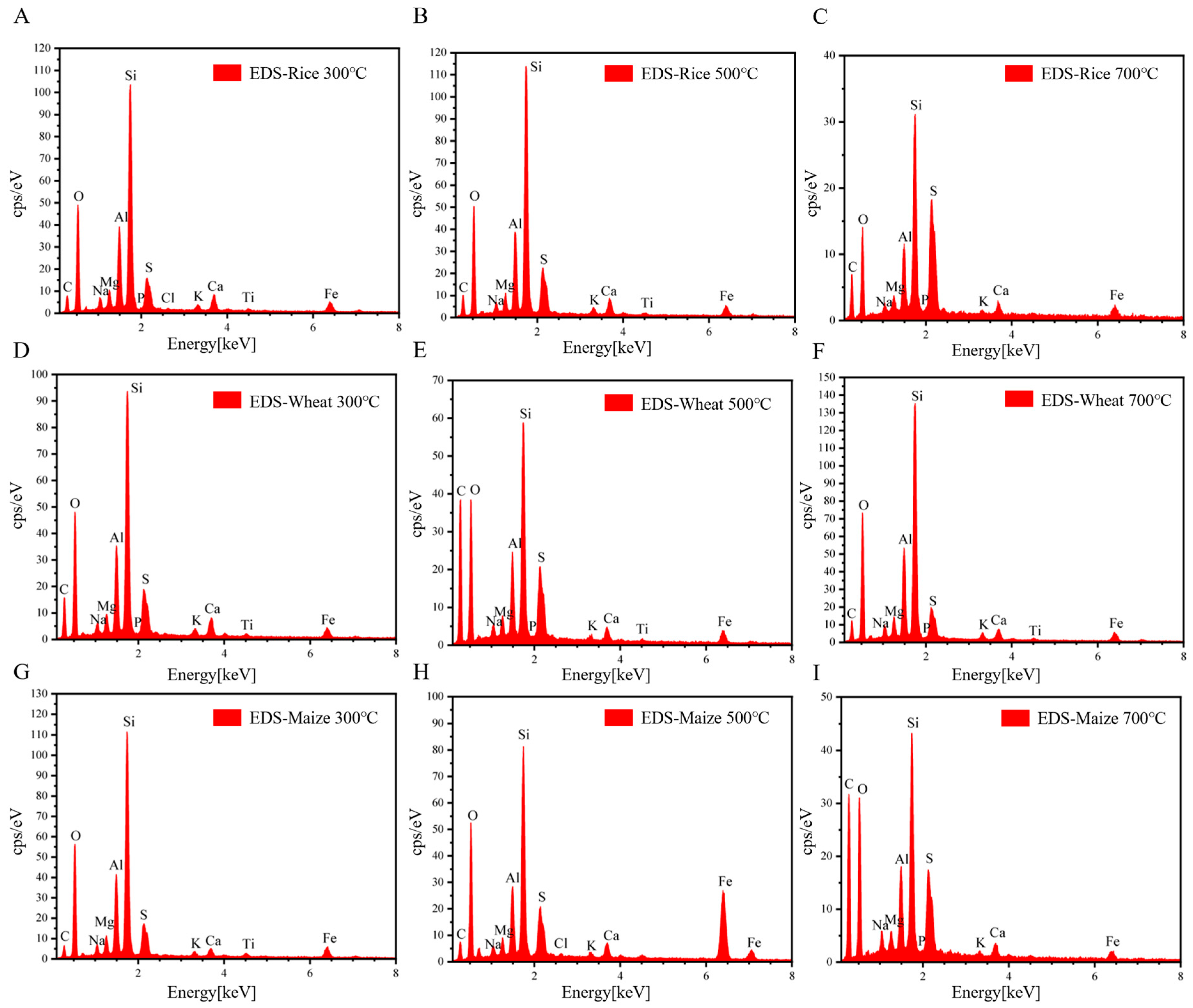
EDS analysis indicated that straw biochar primarily consisted of elements such as C, O, Na, Mg, Al, Si, K, Ca, and Fe, with some samples containing trace amounts of Ti, P, and Cl (Figure 2). Both the feedstock type and pyrolysis temperature significantly influenced the elemental composition. In rice straw biochar, the content of Si was the highest at 500 °C; in wheat straw biochar, Si was the highest at 700 °C; in maize straw biochar, Si content was the highest at 300 °C.
From the relative content of C and O elements, the proportion of O elements in the same straw biochar at 500 °C is generally low (Figure S5). For rice straw biochar, O content was lowest at 500 °C, and higher and comparable at 300 °C and 700 °C; for maize straw biochar, O content was highest at 700 °C and lowest at 300 °C; for wheat straw biochar, O content was higher and similar at 300 °C and 700 °C, and lowest at 500 °C. In terms of C content: in rice straw biochar, it was highest at 700 °C and lowest at 500 °C; in maize straw biochar, it was highest at 300 °C and lowest at 700 °C; in wheat straw biochar, it was highest at 700 °C and lowest at 500 °C.
Calculation of the relative content of each functional group revealed significant variations in the intensity of characteristic peaks for different types of straw biochar across the pyrolysis temperatures (Figure S6). In rice straw biochar, the proportion of functional groups VI and VII was the highest at 500 °C and the lowest at 700 °C. The proportion of functional group I was the highest at 300 °C, followed by 700 °C. In wheat straw biochar, the proportion of functional group IV was the highest at 500 °C, and the other characteristic peaks did not change significantly at other temperatures. In maize straw biochar, the proportion of functional group VI was the lowest at 500 °C, while the proportion of functional group IV was the highest (Table S2).

3.3. Characterization of GRSP Modified Straw Biochar

SEM images showed that the surface of the modified biochar was covered with a layer of membrane (Figure S4). Different from the original rough surface of the particles, it is more closely related to the surrounding structure, which indicates that the adhesive properties of GRSP play a role here. It can be clearly seen that the surface of 700 °C rice modified biochar is coated with a layer of membrane, making the side surface look smoother, which helps to enhance the ion adsorption of modified biochar. The characteristics of the adhesive make it easier for the modified straw biochar to separate from the water body rather than suspend in the water to cause secondary pollution.
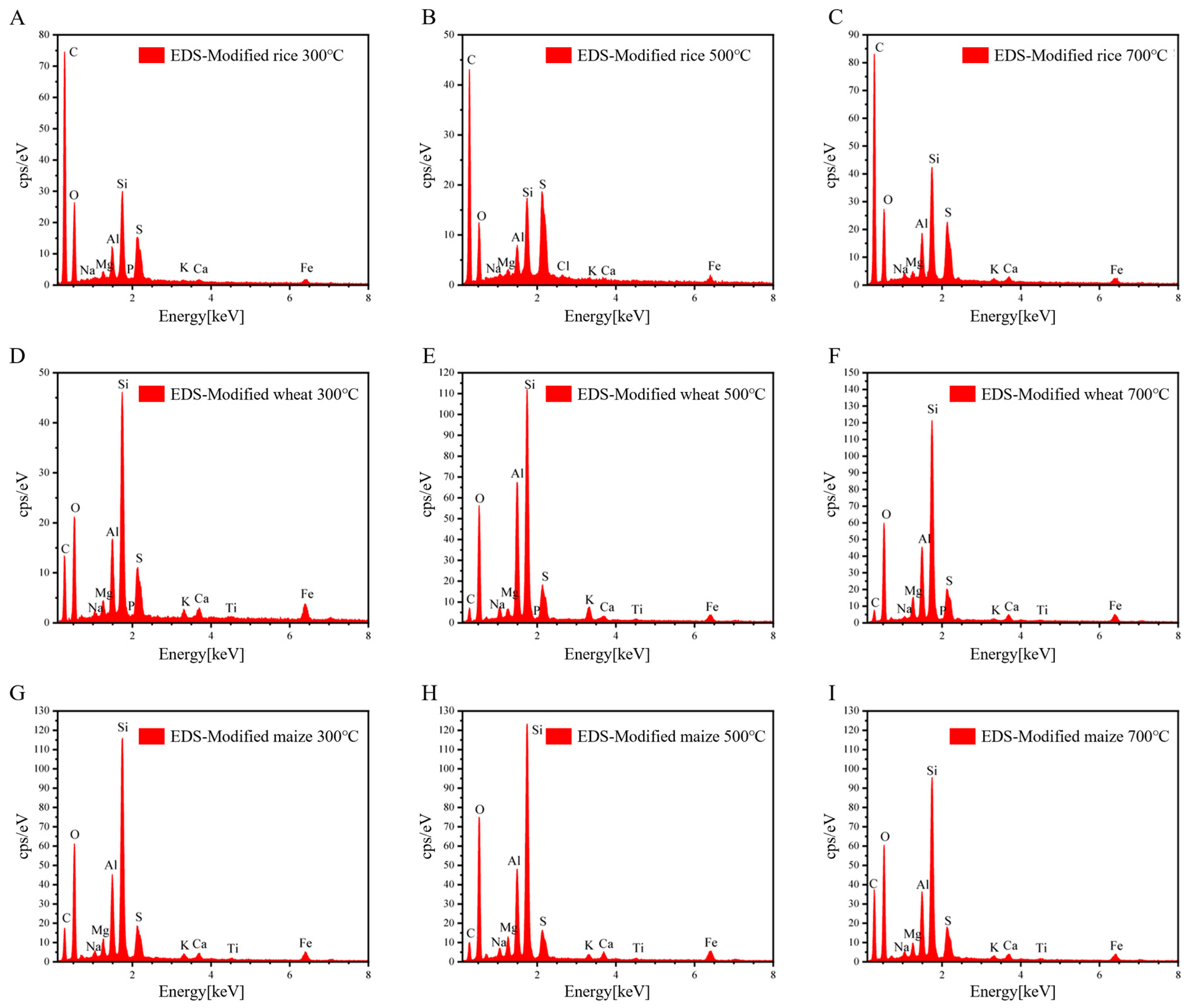
EDS analysis showed that the overall elemental composition of the modified straw biochar did not change significantly, but the relative content of each element was adjusted (Figure 3). Compared with wheat and maize straw biochar, the relative content of C and O in rice straw biochar was always higher. After GRSP modification, the relative content of C and O in rice straw biochar changed most significantly. At 300 °C, the relative content of C increased from 15.8% to 58.7%, and the relative content of O decreased from 41.7% to 32.4%. At 500 °C, C increased from 11.5% to 47.1%, and O decreased from 34.0% to 17.5%. At 700 °C, C increased from 30.8% to 59.1% and O decreased from 35.9% to 29.1% (Figure S7).
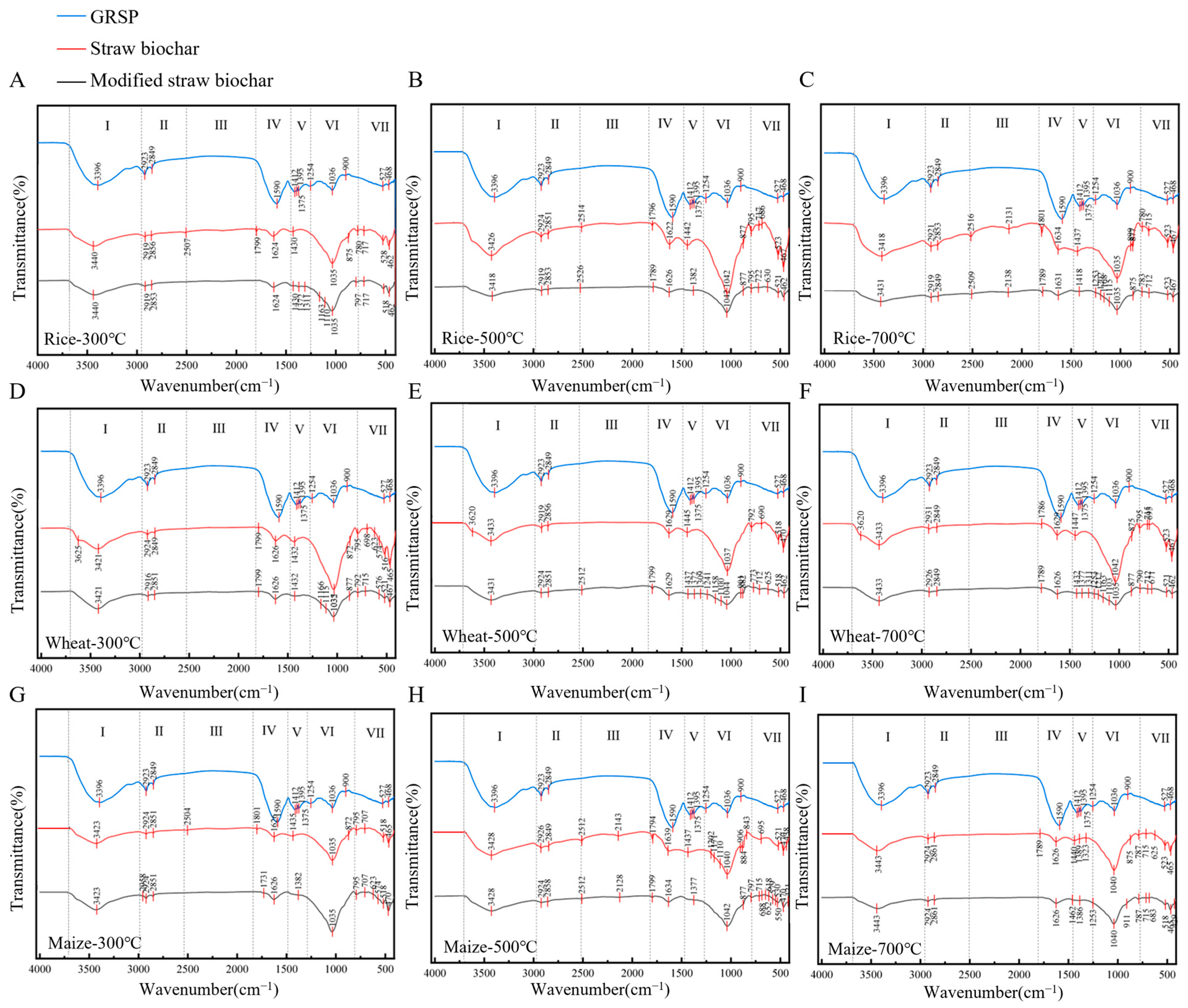
The FTIR results showed that the absorption peak intensity of the modified straw biochar in the seven characteristic wavenumber intervals showed different responses due to different raw materials and pyrolysis temperatures (Figure 4). Rice straw biochar: After biochar modification at 300 °C, the proportion of functional groups IV, V and VI increased; after biochar modification at 500 °C, the proportion of functional groups V, VI and VII decreased. After biochar modification at 700 °C, the proportion of functional groups IV, V and VI decreased. Wheat straw biochar: after 300 °C biochar modification, the proportion of functional groups V, VI and VII decreased; after biochar modification at 500 °C and 700 °C, the proportion of functional groups VI and VII decreased. Maize straw biochar: After 300 °C biochar modification, the proportion of functional groups I, VI and VII increased; after biochar modification at 500 °C, the proportion of functional groups I and VI increased. After biochar modification at 700 °C, the proportion of functional groups I, IV, VI and VII increased.

3.4. Adsorption of Copper by Different Types of Straw Biochar

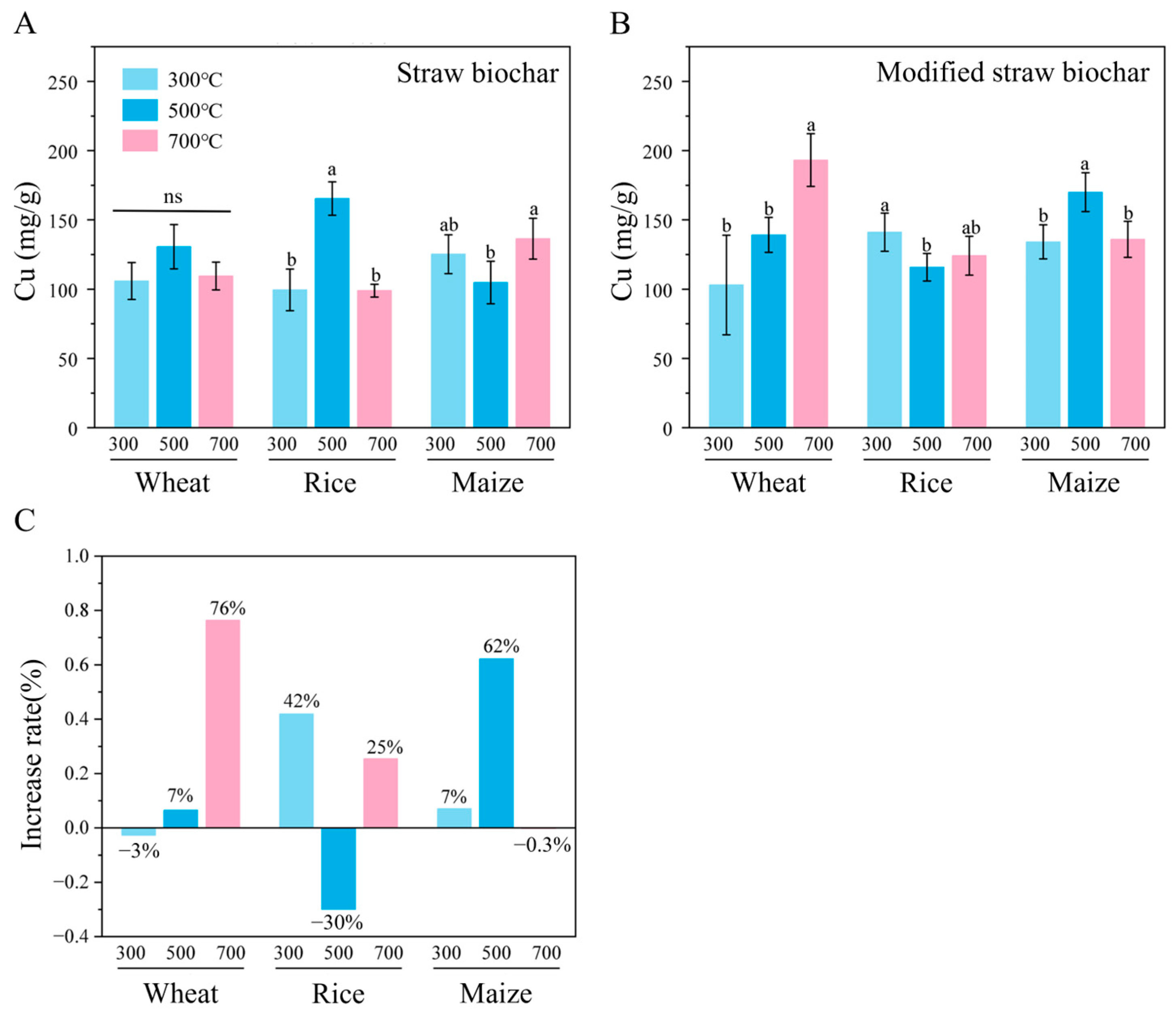
According to the adsorption experiment results, the adsorption performance of unmodified and modified straw biochar for Cu2+ showed significant differences depending on the feedstock type and pyrolysis temperature (Figure 5; Table S4), as detailed below:
Unmodified straw biochar: There was no significant difference in the adsorption capacity of wheat straw biochar at different temperatures. The adsorption capacity of wheat straw at 500 °C was the highest (130.65 mg g−1), which was lower than that of GRSP (133.12 mg g−1). At 500 °C, the adsorption capacity of rice straw biochar was the highest, reaching 165.40 mg g−1, which was significantly higher than that at 300 °C (99.44 mg g−1) and 700 °C (98.97 mg g−1). At 700 °C, the adsorption capacity of maize straw biochar was the highest, which was 136.39 mg g−1, which was significantly higher than that at 500 °C (104.79 mg g−1), and there was no significant difference with that at 300 °C (125.28 mg g−1).
Modified straw biochar: wheat straw biochar had the best adsorption performance at 700 °C, and the adsorption capacity was 193.20 mg g−1, which was significantly higher than that at 300 °C (103.03 mg g−1) and 500 °C (139.16 mg g−1). The adsorption capacity of rice straw biochar was the highest at 300 °C, which was 141.15 mg g−1, which was significantly higher than that at 500 °C (115.83 mg g−1), and there was no significant difference with that at 700 °C (124.17 mg g−1). Maize straw biochar showed the best performance at 500 °C, and the adsorption capacity was 170.0 mg g−1, which was significantly higher than that at 300 °C (134.15 mg g−1) and 700 °C (135.97 mg g−1).
The improvement of adsorption performance by modification treatment was significantly different due to the different combinations of materials and temperature (Figure 5): the adsorption capacity of wheat straw biochar increased the most at 700 °C (76%); the adsorption capacity of rice straw biochar increased by 42% at 300 °C, and the modification effect was the best. The adsorption capacity decreased by 30% at 500 °C. The adsorption capacity of maize straw biochar increased by 62% at 500 °C, and the modification effect was the best. At 700 °C, the adsorption capacity was almost unchanged.
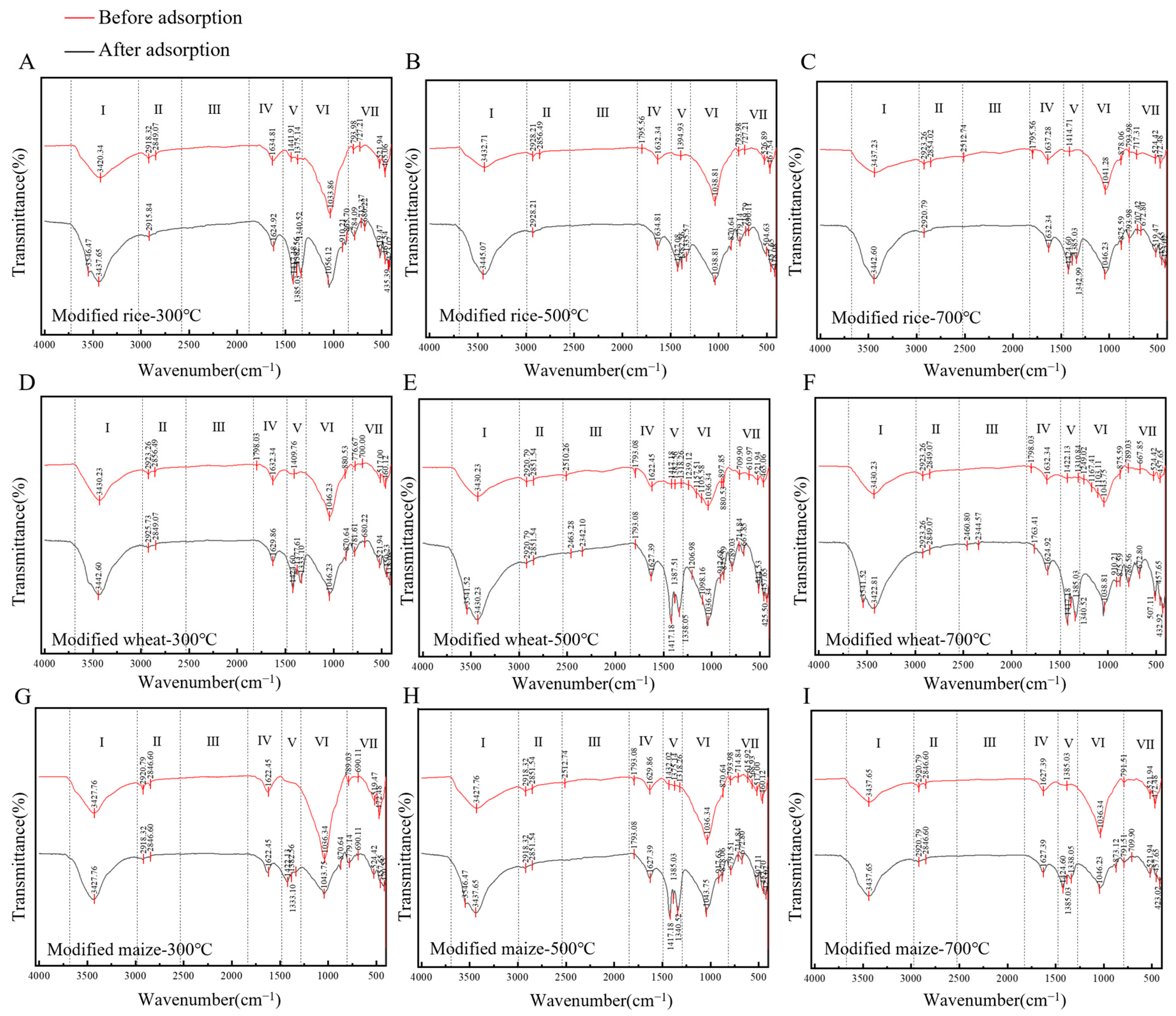
FTIR results showed that the absorption peak intensity of different types of biochar in the seven characteristic wave number ranges before and after adsorption of Cu2+ showed different responses due to different raw materials and pyrolysis temperatures (Figure 6; Figure S8). After the adsorption of copper by unmodified biochar, for rice straw biochar, the main functional groups II, III, IV and VI play an adsorption role; for wheat, functional groups IV and VI play a major role in adsorption; for maize, the main adsorption is the functional groups IV, V, VI. The modified rice and wheat straw biochar mainly plays the adsorption role of functional groups II, III, IV and VI, and the maize straw biochar mainly plays the adsorption role of functional groups II and VI.

4. Discussion

4.1. GRSP Modified Straw Biochar

GRSP is a natural glycoprotein secreted by AM fungi, exhibiting significant potential for environmental applications. It is widely present in soil environments, possesses stable properties, and is easily extractable [28,29,30]. The molecular structure of GRSP contains abundant active functional groups such as carboxyl, hydroxyl, and amino groups [31], which endow it with a high affinity for heavy metals. Numerous studies have demonstrated that GRSP can effectively adsorb various heavy metals through mechanisms such as complexation and ion exchange, showing promising application prospects in soil remediation and water purification [32,33,34].
In this study, straw biochar is prepared from maize, wheat, and rice straw at three pyrolysis temperatures (300, 500, and 700 °C), followed by surface functionalization using GRSP. Systematic analysis of the physicochemical properties before and after modification revealed that the introduction of GRSP significantly enriched the active sites on the biochar surface. FTIR analysis indicated that the newly introduced oxygen- and nitrogen-containing functional groups provided additional binding sites for heavy metal adsorption (Table S3).
Notably, the modification effects of GRSP exhibited distinct specificity depending on the biochar. For rice and wheat straw biochar, the proportions of functional groups I–V generally increased after modification, whereas maize straw biochar primarily showed a significant enhancement in groups I, VI, and VII. This difference suggests that the modification effect of GRSP is significantly influenced by the properties of the biochar, enabling regulation of the surface chemistry of different straw biochar through selective loading. This provides new insights for designing targeted adsorbents for specific heavy metals.
Compared to traditional chemical modification methods that involve acids, alkalis, or metal salts, GRSP modification demonstrates superior environmental compatibility [35]. The entire modification process requires no strong corrosive reagents, avoiding the risk of secondary pollution. Furthermore, as a naturally sourced soil protein, GRSP exhibits good biodegradability and renewability. This biological modification strategy leverages both the strong adsorption characteristics of GRSP for heavy metals and its environmentally friendly advantages, offering a sustainable technical pathway for developing highly efficient adsorbent materials.

4.2. Adsorption Performance of GRSP Modified Straw Biochar for Cu2+

Straw biochar typically possess limited active sites and a scarcity of functional groups, resulting in suboptimal adsorption performance that necessitates modification [36,37]. For example, methods such as physical modification (e.g., ball milling, gas activation), chemical modification (e.g., with acids, alkalis, or polymers), and metal impregnation (e.g., with iron or manganese) can improve the specific surface area, pore volume, and pore size distribution of biochar, while introducing more active sites such as oxygen-containing functional groups. Studies have shown that various modification strategies can significantly improve the adsorption capacity of biochar for Cu [38]. Na2S2O3 modified biochar, and found that the adsorption capacity of modified biochar to Cu2+ could reach 185.0 mg g−1 [39]; the CO2-activated Spartina alterniflora-derived biochar achieved a maximum Cu2+ adsorption capacity of 89.12 mg g−1 [40]; the NaOH-activated cactus biochar exhibited more developed porosity and higher acidic functional group content, leading to a Cu2+ adsorption capacity of 49.36 mg g−1 [41]. In addition, a biochar/MnAl-layered double hydroxide composite that showed a Cu2+ adsorption capacity of 74.07 mg g−1 [42], while loaded siderite (FeCO3) on the surface of crab shell biochar by coprecipitation method to prepare SID@BC composites, achieved a maximum Cu2+ adsorption capacity of 142.50 mg g−1 [43].
Notably, in this study, GRSP-modified wheat straw biochar pyrolyzed at 700 °C demonstrated the most pronounced improvement, with its adsorption capacity increasing from 109.5 mg g−1 to 193.2 mg g−1—a 76% enhancement. Importantly, the adsorption performance of this modified material surpassed not only that of its unmodified counterpart but also that of pure GRSP (133.12 mg g−1), unequivocally confirming a synergistic enhancement effect between GRSP and biochar beyond simple physical mixing. Different modified biochars have different effects on the removal of different heavy metals. The main reason is that biochar raw materials, biochar pyrolysis temperature, modification methods and adsorbed metal ions are different, and the characteristics of important binding sites in the adsorption process are different due to their different adsorption mechanisms for metal ions. The present study reveals that GRSP modification significantly enhances the Cu2+ adsorption performance of straw biochar, with efficacy being highly dependent on both pyrolysis temperature and feedstock type (Table S4).

4.3. Adsorption Mechanism of GRSP Modified Straw Biochar for Cu2+

The synergistic effect of GRSP and straw biochar is mainly due to the coupling of two aspects: the porous structure formed through high-temperature pyrolysis provides an extensive substrate for GRSP immobilization, while the abundant carboxyl and amide functional groups in GRSP integrate with the biochar matrix to create a multifunctional adsorption interface. FTIR analysis provides direct evidence that the enhancement of characteristic peaks at 1650–1700 cm−1 (amide I band, C=O stretching vibration) and 3000–3500 cm−1 (O-H/N-H stretching vibrations) confirms the successful introduction of oxygen- and nitrogen-containing functional groups (Figure 4). EDS analysis also showed that the proportion of C elements in all biochar increased after modification (Figures S5 and S7), and the corresponding carbon-containing functional groups also increased, indicating that the modification process may promote the formation of more stable carbon structure through the interaction between GRSP and organic components in biochar, thereby enhancing the carbon fixation effect. These change helps to improve the surface properties of biochar, such as improving hydrophobicity, thereby inhibiting oxidation and reducing C loss. The content of metal elements such as Na, Mg, and Al decreased to varying degrees (Figure 2 and Figure 3), which may be due to the fact that these elements were encapsulated by the glycoprotein-GRSP during the modification process.
However, straw biochar pyrolyzed at different temperatures exhibited significant differences in Cu adsorption behavior after GRSP modification. For instance, GRSP modification resulted in a 30.0% reduction in the adsorption performance of rice straw biochar prepared at 500 °C, compared to its unmodified sample (Figure 5). FTIR analysis indicated that compared to biochar pyrolyzed at 300 °C and 700 °C, the 500 °C sample showed a reduction in the abundance of O–H stretching (hydroxyl), C–H stretching (aldehyde), S–H stretching (sulfhydryl), and C≡C stretching (alkyne) vibrations after GRSP modification. These functional groups have been confirmed as key active sites for heavy metal adsorption. EDS analysis revealed that after GRSP modification of the 500 °C rice straw biochar, the oxygen content decreased from 34.0% to 17.5%, suggesting that GRSP modification may lead to a reduction in oxygen-containing functional groups. Together, the effectiveness of GRSP modification strongly depends on the pyrolysis temperature of the biochar and the characteristics of the raw material matrix.

5. Conclusions

In summary, this study developed a novel bio-modification strategy utilizing glomalin-related soil protein (GRSP) to modify straw biochar, systematically elucidating its adsorption performance and mechanism for Cu2+. The results demonstrate that the effectiveness of GRSP modification is dependent on pyrolysis temperature and straw types. In particular, GRSP-modified wheat straw biochar pyrolyzed at 700 °C showed the most significant enhancement in adsorption performance, achieving a Cu2+ adsorption capacity of 193.2 mg g−1, which represents a 76% increase compared to the unmodified material. Characterization analyses confirmed that GRSP enhances the active sites on the biochar surface through the introduction of oxygen- and nitrogen-containing functional groups. This study not only provides new insights into the bio-modification of crop straw biochar but also offers an environmentally friendly strategy for heavy metal contamination remediation.

Supplementary Materials

The following supporting information can be downloaded at: https://www.mdpi.com/article/10.3390/agriculture15232495/s1, Text S1: The optimal ratio of GRSP to straw biochar.; Table S1: Corresponding Wavelengths of Functional Groups.; Table S2: Percentage of functional groups of modified straw biochar.; Table S3: Percentage of functional groups of modified straw biochar.; Table S4: Adsorption capacity of glomalin-related soil protein (GRSP), un- and modified straw biochar for copper.; Figure S1: Infrared spectra of biochar modified by different proportions of glomalin-related soil protein and straw biochar.; Figure S2: Elemental occupancy of GRSP and its electron micrographs.; Figure S3: Scanning electron microscopy of different types of straw biochar.; Figure S4: Scanning electron microscopy of different types of modified straw biochar.; Figure S5: The proportion of O(A) and C(B) elements in different types of straw biochar.; Figure S6: Infrared spectra of biochar modified by different proportions of GRSP and straw biochar.; Figure S7: The proportion of O(A) and C(B) elements in different types of modified straw biochar.; Figure S8: Infrared spectroscopy characterization of different types of straw biochar before and after adsorption of Cu2+.

Author Contributions

Conceptualization, Q.W.; methodology, Z.C. and Z.G.; software, Z.C. and X.Y.; Validation: Z.C., Y.X. and H.S.; Formal analysis: Z.C. and X.Y.; investigation, Z.C. and Y.X.; resources, Q.W.; Data curation: Z.C., Y.X. and H.S.; Writing—original draft: Z.C. and Z.G.; writing—review and editing, Q.W.; visualization, Z.C. and Z.G.; supervision, Q.W.; project administration, Q.W.; funding acquisition, Q.W. All authors have read and agreed to the published version of the manuscript.

Funding

This research was funded by Qiang Wang, grant number 23JRRA1052 and The APC was funded by the Natural Science Foundation of Gansu Province; grant number 2022JSCX0003 and The APC was funded by the Science and Technology Plan Projects in Chengguan District of Lanzhou City.

Institutional Review Board Statement

Not applicable.

Data Availability Statement

All data from this study are included in the article and Supplementary Materials.

Conflicts of Interest

The authors declare no conflicts of interest.

Abbreviations

The following abbreviations are used in this manuscript:
GRSPGlomalin-related soil Protein
FTIRFourier Transform Infrared Spectroscopy
SEM-EDSScanning Electron Microscopy with Energy Dispersive X-ray Spectroscopy
CuCopper

References

  1. Wang, J.; Chen, C. Biosorbents for heavy metals removal and their future. Biotechnol. Adv. 2009, 27, 195–226. [Google Scholar] [CrossRef]
  2. Xiang, L.; Harindintwali, J.D.; Wang, F.; Redmile-Gordon, M.; Chang, S.X.; Fu, Y.; He, C.; Muhoza, B.; Brahushi, F.; Bolan, N.; et al. Integrating Biochar, Bacteria, and Plants for Sustainable Remediation of Soils Contaminated with Organic Pollutants. Environ. Sci. Technol. 2022, 56, 16546–16566. [Google Scholar] [CrossRef]
  3. Ashraf, M.A. Persistent organic pollutants (POPs): A global issue, a global challenge. Environ. Sci. Pollut. Res. 2017, 24, 4223–4227. [Google Scholar] [CrossRef]
  4. Hou, D.; Jia, X.; Wang, L.; McGrath, S.P.; Zhu, Y.-G.; Hu, Q.; Zhao, F.-J.; Bank, M.S.; O’Connor, D.; Nriagu, J. Global soil pollution by toxic metals threatens agriculture and human health. Science 2025, 388, 316–321. [Google Scholar] [CrossRef] [PubMed]
  5. Li, H.; Yuan, B.; Yan, C.; Lin, Q.; Wu, J.; Wang, Q.; Liu, J.; Lu, H.; Zhu, H.; Hong, H. Extraction and purification of glomalin-related soil protein (GRSP) to determine the associated trace metal(loid)s. Methodsx 2022, 9, 101670. [Google Scholar] [CrossRef]
  6. Li, S.; Harris, S.; Anandhi, A.; Chen, G. Predicting biochar properties and functions based on feedstock and pyrolysis temperature: A review and data syntheses. J. Clean. Prod. 2019, 215, 890–902. [Google Scholar] [CrossRef]
  7. Qasem, N.A.A.; Mohammed, R.H.; Lawal, D.U. Removal of heavy metal ions from wastewater: A comprehensive and critical review (vol 4, 36, 2021). npj Clean Water 2021, 4, 52. [Google Scholar] [CrossRef]
  8. Benis, K.Z.; Soltan, J.; McPhedran, K.N. A novel method for fabrication of a binary oxide biochar composite for oxidative adsorption of arsenite: Characterization, adsorption mechanism and mass transfer modeling. J. Clean. Prod. 2022, 356, 131832. [Google Scholar] [CrossRef]
  9. Xie, R.; Zhu, Y.; Zhang, H.; Zhang, P.; Han, L. Effects and mechanism of pyrolysis temperature on physicochemical properties of corn stalk pellet biochar based on combined characterization approach of microcomputed tomography and chemical analysis. Bioresour. Technol. 2021, 329, 124907. [Google Scholar] [CrossRef]
  10. Campos, P.; Miller, A.Z.; Knicker, H.; Costa-Pereira, M.F.; Merino, A.; Maria De la Rosa, J. Chemical, physical and morphological properties of biochars produced from agricultural residues: Implications for their use as soil amendment. Waste Manag. 2020, 105, 256–267. [Google Scholar] [CrossRef]
  11. Serhane, Y.; Belkessa, N.; Bouzaza, A.; Wolbert, D.; Assadi, A.A. Continuous air purification by front flow photocatalytic reactor: Modelling of the influence of mass transfer step under simulated real conditions. Chemosphere 2022, 295, 133809. [Google Scholar] [CrossRef]
  12. Rajtor, M.; Piotrowska-Seget, Z. Prospects for arbuscular mycorrhizal fungi (AMF) to assist in phytoremediation of soil hydrocarbon contaminants. Chemosphere 2016, 162, 105–116. [Google Scholar] [CrossRef] [PubMed]
  13. Zhang, Y.; Xu, N.; Liu, J.; Guo, Z.; Guan, H.; Bai, Y. A multisource mass transfer model for simulating VOC emissions from paints. Sci. Total Environ. 2023, 902, 165945. [Google Scholar] [CrossRef]
  14. Queiroz, V.; de Almeida, D.S.; de Oliveira Miglioranza, G.H.; Steffani, E.; Barbosa-Coutinho, E.; Schwaab, M. Analysis of commonly used batch adsorption kinetic models derived from mass transfer-based modelling. Environ. Sci. Pollut. Res. 2022, 29, 79875–79889. [Google Scholar] [CrossRef] [PubMed]
  15. Wang, Q.; Hong, H.; Yang, D.; Li, J.; Chen, S.; Pan, C.; Lu, H.; Liu, J.; Yan, C. Health risk assessment of heavy metal and its mitigation by glomalin-related soil protein in sediments along the South China coast. Environ. Pollut. 2020, 263, 114565. [Google Scholar] [CrossRef]
  16. Ruiz, M.; Masson, V.; Bonhomme, M.; Ginestet, S. Numerical method for solving coupled heat and mass transfer through walls for future integration into an urban climate model. Build. Environ. 2023, 231, 110028. [Google Scholar] [CrossRef]
  17. González-Chávez, M.C.; Carrillo-González, R.; Wright, S.F.; Nichols, K.A. The role of glomalin, a protein produced by arbuscular mycorrhizal fungi, in sequestering potentially toxic elements. Environ. Pollut. 2004, 130, 317–323. [Google Scholar] [CrossRef] [PubMed]
  18. Salim, N.A.A.; Fulazzaky, M.A.; Puteh, M.H.; Khamidun, M.H.; Yusoff, A.R.M.; Abdullah, N.H.; Fulazzaky, M.; Zaini, M.A.A. Mass Transfer Kinetics and Mechanisms of Phosphate Adsorbed on Waste Mussel Shell. Water Air Soil Pollut. 2022, 233, 223. [Google Scholar] [CrossRef]
  19. Fang, J.; Zhan, L.; Ok, Y.S.; Gao, B. Minireview of potential applications of hydrochar derived from hydrothermal carbonization of biomass. J. Ind. Eng. Chem. 2018, 57, 15–21. [Google Scholar] [CrossRef]
  20. Sun, H.; Zheng, Y.-l.; Lin, Y.-L.; Chen, C.; Yang, F.-Y. Effects of biochar, phosphorus addition and AMF inoculation on switchgrass growth and soil properties under Cd stress. Acta Pratacult. Sin. 2021, 30, 71–80. [Google Scholar]
  21. Yan, X.; Guo, Q.; Zhao, Y.; Zhao, Y.; Lin, J. Evaluation of Five Gas Diffusion Models Used in the Gradient Method for Estimating CO2 Flux with Changing Soil Properties. Sustainability 2021, 13, 874. [Google Scholar] [CrossRef]
  22. Liu, B.; Finkel, M.; Grathwohl, P. First order approximation for coupled film and intraparticle pore diffusion to model sorption/desorption batch experiments. J. Hazard. Mater. 2022, 429, 128314. [Google Scholar] [CrossRef]
  23. Maeda, C.H.; Moretti, A.L.; Diorio, A.; Braga, M.U.C.; Scheufele, F.B.; Barros, M.A.S.D.; Arroyo, P.A. The influence of electrolytes in the adsorption kinetics of reactive BF-5G blue dye on bone char: A mass transfer model. Environ. Technol. 2024, 45, 794–810. [Google Scholar] [CrossRef] [PubMed]
  24. Georgin, J.; Franco, D.S.P.; Netto, M.S.; de Salomon, Y.L.O.; Piccilli, D.G.A.; Foletto, E.L.; Dotto, G.L. Adsorption and mass transfer studies of methylene blue onto comminuted seedpods from Luehea divaricata and Inga laurina. Environ. Sci. Pollut. Res. 2021, 28, 20854–20868. [Google Scholar] [CrossRef] [PubMed]
  25. Peng, H.; Gao, P.; Chu, G.; Pan, B.; Peng, J.; Xing, B. Enhanced adsorption of Cu(II) and Cd(II) by phosphoric acid-modified biochars. Environ. Pollut. 2017, 229, 846–853. [Google Scholar] [CrossRef]
  26. Zhou, Q.; Liao, B.; Lin, L.; Qiu, W.; Song, Z. Adsorption of Cu(II) and Cd(II) from aqueous solutions by ferromanganese binary oxide-biochar composites. Sci. Total Environ. 2018, 615, 115–122. [Google Scholar] [CrossRef]
  27. Yang, G.-X.; Jiang, H. Amino modification of biochar for enhanced adsorption of copper ions from synthetic wastewater. Water Res. 2014, 48, 396–405. [Google Scholar] [CrossRef]
  28. Peng, W.; Yin, W.; Bo, S.; Jin-Fa, L.; Ren-Xue, X.J.P. Relationships between arbuscular mycorrhizal symbiosis and soil fertility factors in citrus orchards along an altitudinal gradient. Pedosphere 2015, 25, 160–168. [Google Scholar]
  29. Stockinger, H.; Walker, C.; Schuessler, A. ‘Glomus intraradices DAOM197198′, a model fungus in arbuscular mycorrhiza research, is not Glomus intraradices. New Phytol. 2009, 183, 1176–1187. [Google Scholar] [CrossRef]
  30. Rillig, M.C. Arbuscular mycorrhizae, glomalin, and soil aggregation. Can. J. Soil Sci. 2004, 84, 355–363. [Google Scholar] [CrossRef]
  31. Wang, Q.; Lu, H.; Chen, J.; Jiang, Y.; Williams, M.A.; Wu, S.; Li, J.; Liu, J.; Yang, G.; Yan, C. Interactions of soil metals with glomalin-related soil protein as soil pollution bioindicators in mangrove wetland ecosystems. Sci. Total Environ. 2020, 709, 136051. [Google Scholar] [CrossRef]
  32. Zhang, X.; Wang, Z.; Lu, Y.; Wei, J.; Qi, S.; Wu, B.; Cheng, S. Sustainable Remediation of Soil and Water Utilizing Arbuscular Mycorrhizal Fungi: A Review. Microorganisms 2024, 12, 1255. [Google Scholar] [CrossRef] [PubMed]
  33. Chen, H.; Xiong, J.; Fang, L.; Han, F.; Zhao, X.; Fan, Q.; Tan, W. Sequestration of heavy metals in soil aggregates induced by glomalin-related soil protein: A five-year phytoremediation field study. J. Hazard. Mater. 2022, 437, 129445. [Google Scholar] [CrossRef] [PubMed]
  34. Wang, Q.; Mei, D.; Chen, J.; Lin, Y.; Liu, J.; Lu, H.; Yan, C. Sequestration of heavy metal by glomalin-related soil protein: Implication for water quality improvement in mangrove wetlands. Water Res. 2019, 148, 142–152. [Google Scholar] [CrossRef]
  35. Zamora-Ledezma, C.; Negrete-Bolagay, D.; Figueroa, F.; Zamora-Ledezma, E.; Ni, M.; Alexis, F.; Guerrero, V.H. Heavy metal water pollution: A fresh look about hazards, novel and conventional remediation methods. Environ. Technol. Innov. 2021, 22, 101504. [Google Scholar] [CrossRef]
  36. Qiu, M.; Liu, L.; Ling, Q.; Cai, Y.; Yu, S.; Wang, S.; Fu, D.; Hu, B.; Wang, X. Biochar for the removal of contaminants from soil and water: A review. Biochar 2022, 4, 1–25. [Google Scholar] [CrossRef]
  37. Cheng, N.; Wang, B.; Wu, P.; Lee, X.; Xing, Y.; Chen, M.; Gao, B. Adsorption of emerging contaminants from water and wastewater by modified biochar: A review. Environ. Pollut. 2021, 273, 116448. [Google Scholar] [CrossRef]
  38. Rajapaksha, A.U.; Chen, S.S.; Tsang, D.C.W.; Zhang, M.; Vithanage, M.; Mandal, S.; Gao, B.; Bolan, N.S.; Ok, Y.S. Engineered/designer biochar for contaminant removal/immobilization from soil and water: Potential and implication of biochar modification. Chemosphere 2016, 148, 276–291. [Google Scholar] [CrossRef]
  39. Yin, M.; Bai, X.; Wu, D.; Li, F.; Jiang, K.; Ma, N.; Chen, Z.; Zhang, X.; Fang, L. Sulfur-functional group tunning on biochar through sodium thiosulfate modified molten salt process for efficient heavy metal adsorption. Chem. Eng. J. 2022, 433, 134441. [Google Scholar] [CrossRef]
  40. Wen, R.; Yuan, B.; Wang, Y.; Cao, W.; Liu, Y.; Jia, Y.; Liu, Q. Improving Cu(II) sorption by biochar via pyrolyzation under CO2: The importance of inherent inorganic species. Environ. Sci. Pollut. Res. 2018, 25, 5105–5114. [Google Scholar] [CrossRef]
  41. Choudhary, M.; Kumar, R.; Neogi, S. Activated biochar derived from Opuntia ficus-indica for the efficient adsorption of malachite green dye, Cu+2 and Ni+2 from water. J. Hazard. Mater. 2020, 392, 122441. [Google Scholar] [CrossRef]
  42. Wang, T.; Li, C.; Wang, C.; Wang, H. Biochar/MnAl-LDH composites for Cu (II) removal from aqueous solution. Colloids Surf. A-Physicochem. Eng. Asp. 2018, 538, 443–450. [Google Scholar] [CrossRef]
  43. Lou, K.; Yin, H.; Cai, Y.; Yan, C.; Yuan, Y.; Ouyang, X. Simultaneous removal of As (III) and Cu (II) by biochar modified siderite: The key roles of ROS and mineral conversion. J. Environ. Sci. 2025. [Google Scholar] [CrossRef]
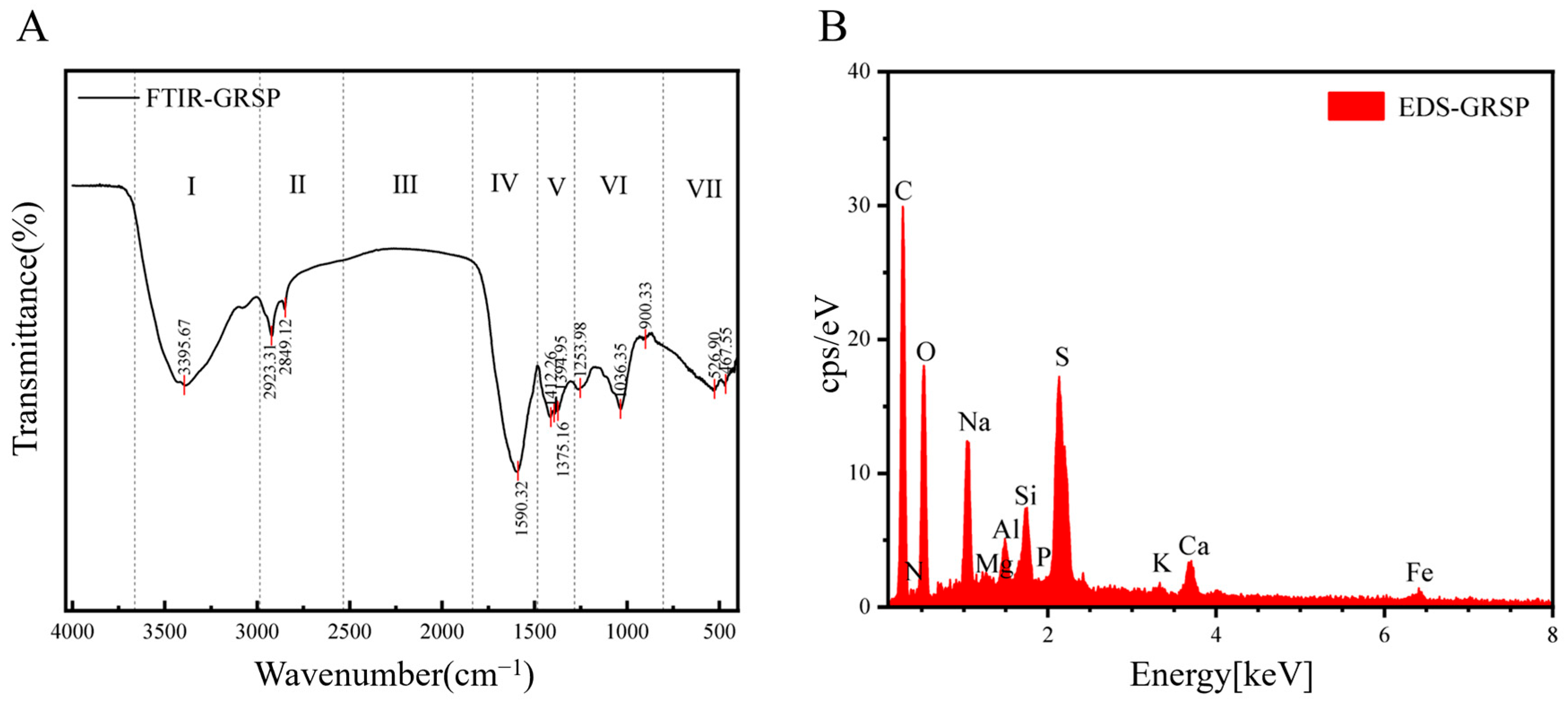
Figure 1. Characterization of glomalin-related soil protein by infrared spectroscopy (A) and elemental distribution (B). I–VII represent different types of functional groups (Table S1). GRSP, glomalin-related soil protein.
Agriculture 15 02495 g001
Figure 2. Characterization of element distribution of different straw biochar under different temperature treatments. (A) EDS Characterization of rice straw biochar at 300 °C; (B) EDS Characterization of rice straw biochar at 500 °C; (C) EDS Characterization of rice straw biochar at 700 °C; (D) EDS Characterization of wheat straw biochar at 300 °C; (E) EDS Characterization of wheat straw biochar at 500 °C; (F) EDS Characterization of wheat straw biochar at 700 °C; (G) EDS Characterization of maize straw biochar at 300 °C; (H) EDS Characterization of maize straw biochar at 500 °C; (I) EDS Characterization of maize straw biochar at 700 °C.
Agriculture 15 02495 g002
Figure 3. Characterization of element distribution after modification of different types of straw biochar. (A) EDS Characterization of modified rice straw biochar at 300 °C; (B) EDS Characterization of modified rice straw biochar at 500 °C; (C) EDS Characterization of modified rice straw biochar at 700 °C; (D) EDS Characterization of modified wheat straw biochar at 300 °C; (E) EDS Characterization of modified wheat straw biochar at 500 °C; (F) EDS Characterization of modified wheat straw biochar at 700 °C; (G) EDS Characterization of modified maize straw biochar at 300 °C; (H) EDS Characterization of modified maize straw biochar at 500 °C; (I) EDS Characterization of modified maize straw biochar at 700 °C.
Agriculture 15 02495 g003
Figure 4. Comparative Characterization of FTIR Spectra for GRSP and Different Types of Straw Biochar Before and After Modification. (A) Rice straw biochar prepared at 300 °C; (B) rice straw biochar prepared at 500 °C; (C) rice straw biochar prepared at 700 °C; (D) wheat straw biochar prepared at 300 °C; (E) wheat straw biochar prepared at 500 °C; (F) wheat straw biochar prepared at 700 °C; (G) maize straw biochar prepared at 300 °C; (H) maize straw biochar prepared at 500 °C; (I) maize straw biochar prepared at 700 °C. Different colors represent different types of materials, among which blue represents glomalin-related soil protein, blue represents straw biochar, and black represents modified straw biochar. I–VII represent different types of functional groups (Table S1). GRSP, glomalin-related soil protein.
Agriculture 15 02495 g004
Figure 5. The content of copper adsorbed by different types of straw biochar and the improvement rate of adsorbed copper after modification. (A) the content of Cu2+ adsorbed by different types of straw biochar; (B) the content of Cu2+ adsorbed by different types of modified straw biochar; (C) the increase rate of Cu2+ adsorption after modification of different types of straw biochar. Different letters indicate that there are significant differences between straw biochar at different temperatures (p < 0.05). ns, p > 0.05.
Agriculture 15 02495 g005
Figure 6. Infrared spectroscopy characterization of different types of modified straw biochar before and after adsorption of Cu2+. (A) modified rice straw biochar prepared at 300 °C; (B) modified rice straw biochar prepared at 500 °C; (C) modified rice straw biochar prepared at 700 °C; (D) modified wheat straw biochar prepared at 300 °C; (E) modified wheat straw biochar prepared at 500 °C; (F) modified wheat straw biochar prepared at 700 °C; (G) modified maize straw biochar prepared at 300 °C; (H) modified maize straw biochar prepared at 500 °C; (I) modified maize straw biochar prepared at 700 °C. Different colors represent different types of materials, among which red represents before adsorption and black represents after adsorption. I–VII represent different types of functional groups (Table S1).
Agriculture 15 02495 g006
Disclaimer/Publisher’s Note: The statements, opinions and data contained in all publications are solely those of the individual author(s) and contributor(s) and not of MDPI and/or the editor(s). MDPI and/or the editor(s) disclaim responsibility for any injury to people or property resulting from any ideas, methods, instructions or products referred to in the content.