Integrating Grain–Carbon Synergy and Ecological Risk Assessment for Sustainable Land Use in Mountainous High-Risk Areas


Abstract
1. Introduction
2. Theoretical Frameworks
2.1. Theoretical Foundations of Geographic Similarity
2.2. Ecological Restoration and Grain–Carbon Synergy Potential in Ecologically High-Risk Areas
3. Materials and Methods
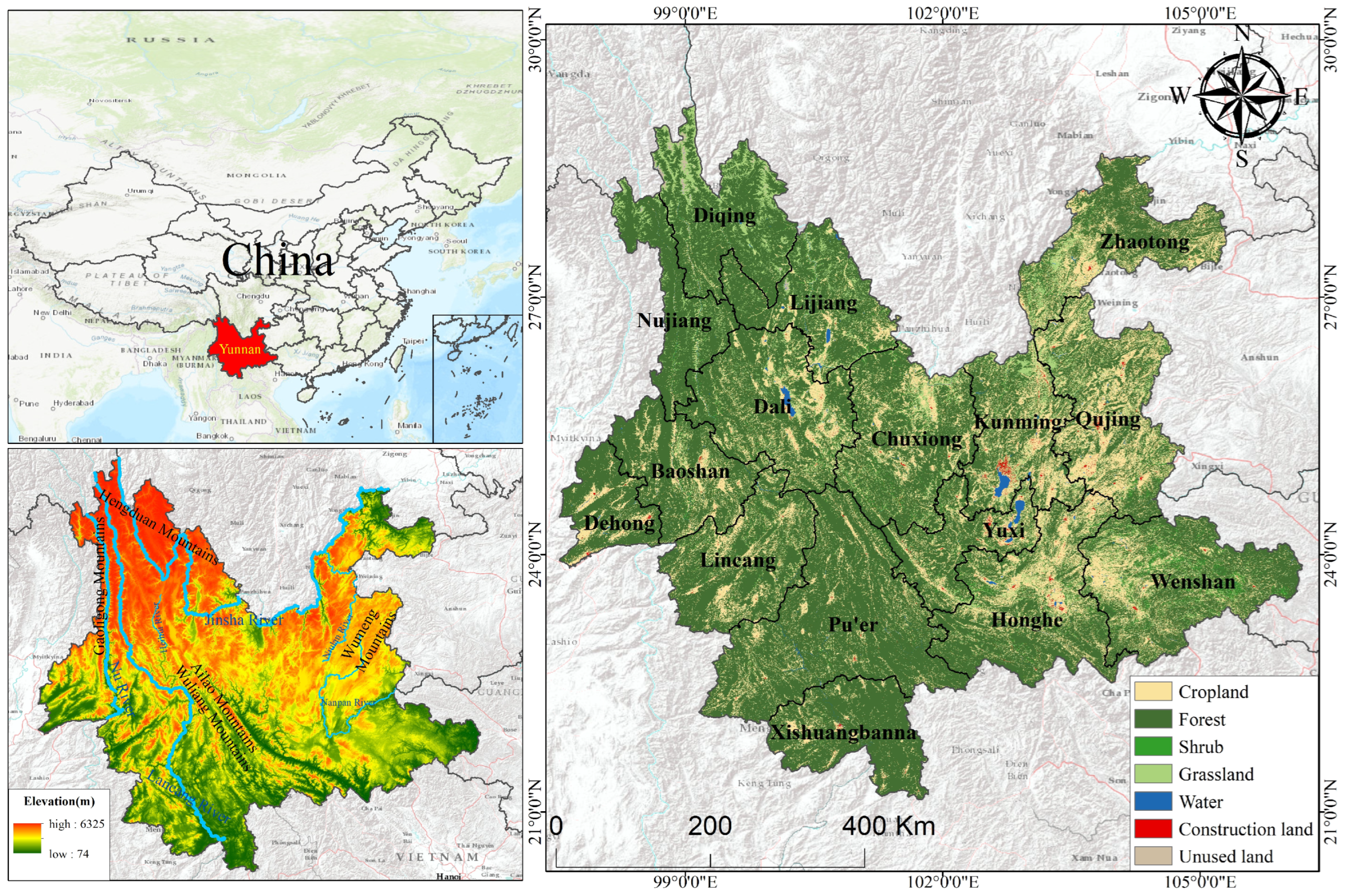
3.1. Overview of the Study Area
3.2. Data Sources and Processing
3.2.1. Land Use and Fundamental Geographic Data
3.2.2. Construction of Carbon Density Database
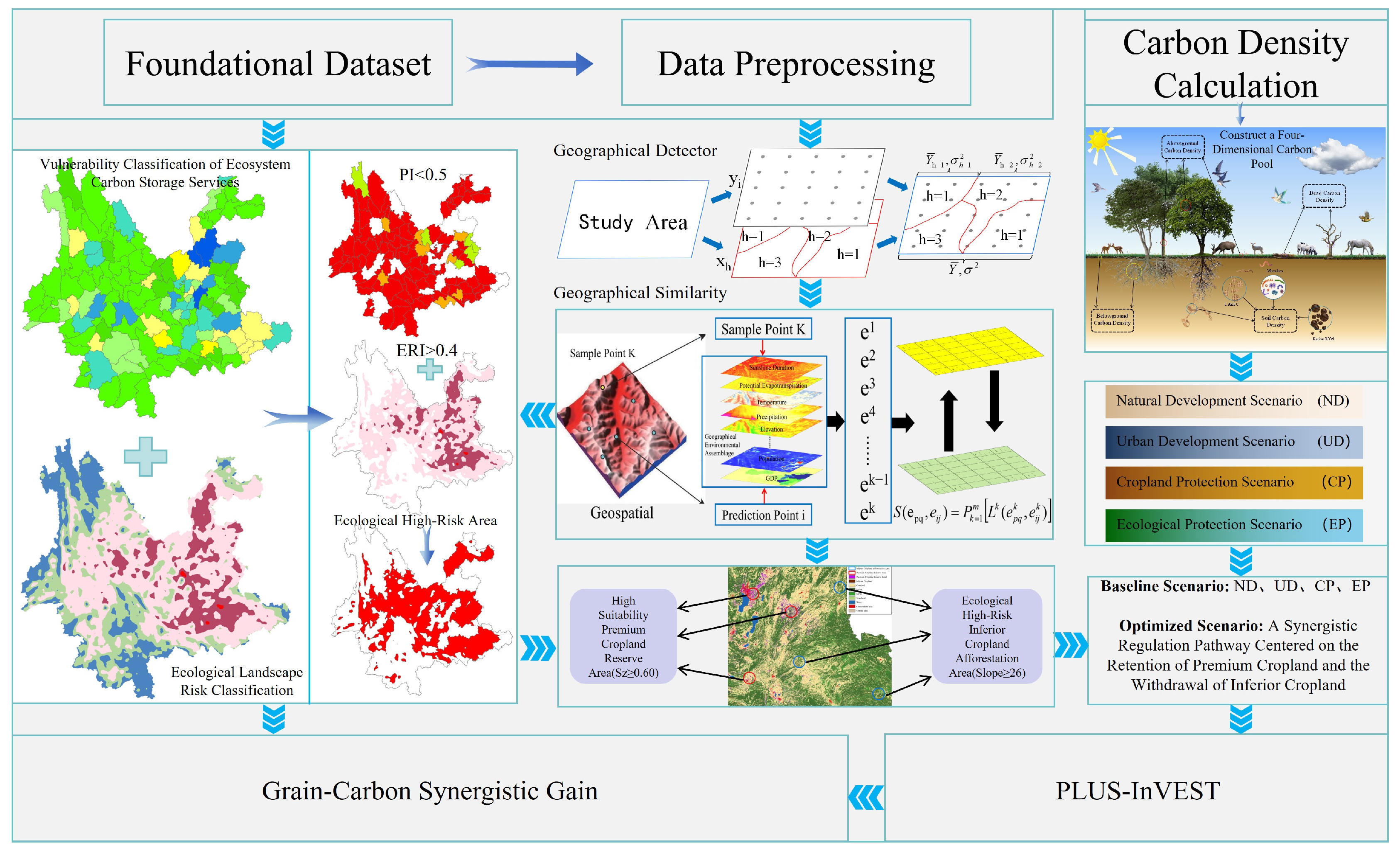
3.3. Research Methodology
3.3.1. Spatiotemporal Dynamic Assessment of Ecological Carbon Storage Driven by Multi-Carbon Pool Synergy
3.3.2. Policy-Driven Land Use Spatial Evolution Simulation
3.3.3. Method for Identifying High-Quality Cropland Based on Geographical Similarity
- (1)
- Selection and Standardization of Key Geographic Environmental Variables
- (2)
- Quantification of Factor Weights Driven by Geographic Detector
- (3)
- A Novel GS Framework for Multidimensional Similarity Modeling
- (4)
- Credibility Grading Mapping of Potential Farmland for Sustainable Agriculture
3.3.4. Three-Dimensional Diagnosis of Ecosystem Vulnerability Under Land Use Intensity Gradients
3.3.5. Construction of a Multi-Dimensional Landscape Ecological Risk Index and Identification of Spatial Differentiation Characteristics
3.3.6. Ecological Risk–Carbon Sink Synergy-Oriented Bidirectional Optimization Strategy
- (1)
- Spatial Delineation of Ecological High-Risk Areas
- (2)
- Identification of High-Quality Reserve Farmland
- (3)
- Diagnosis of Low-Quality Farmland and Prioritization of Farmland Conversion
- (4)
- Quantification of Carbon Sequestration Gains from Farmland-to-Forest Conversion
4. Results
4.1. Multi-Scenario Land Use and Carbon Storage Evolution Process and Prediction Results
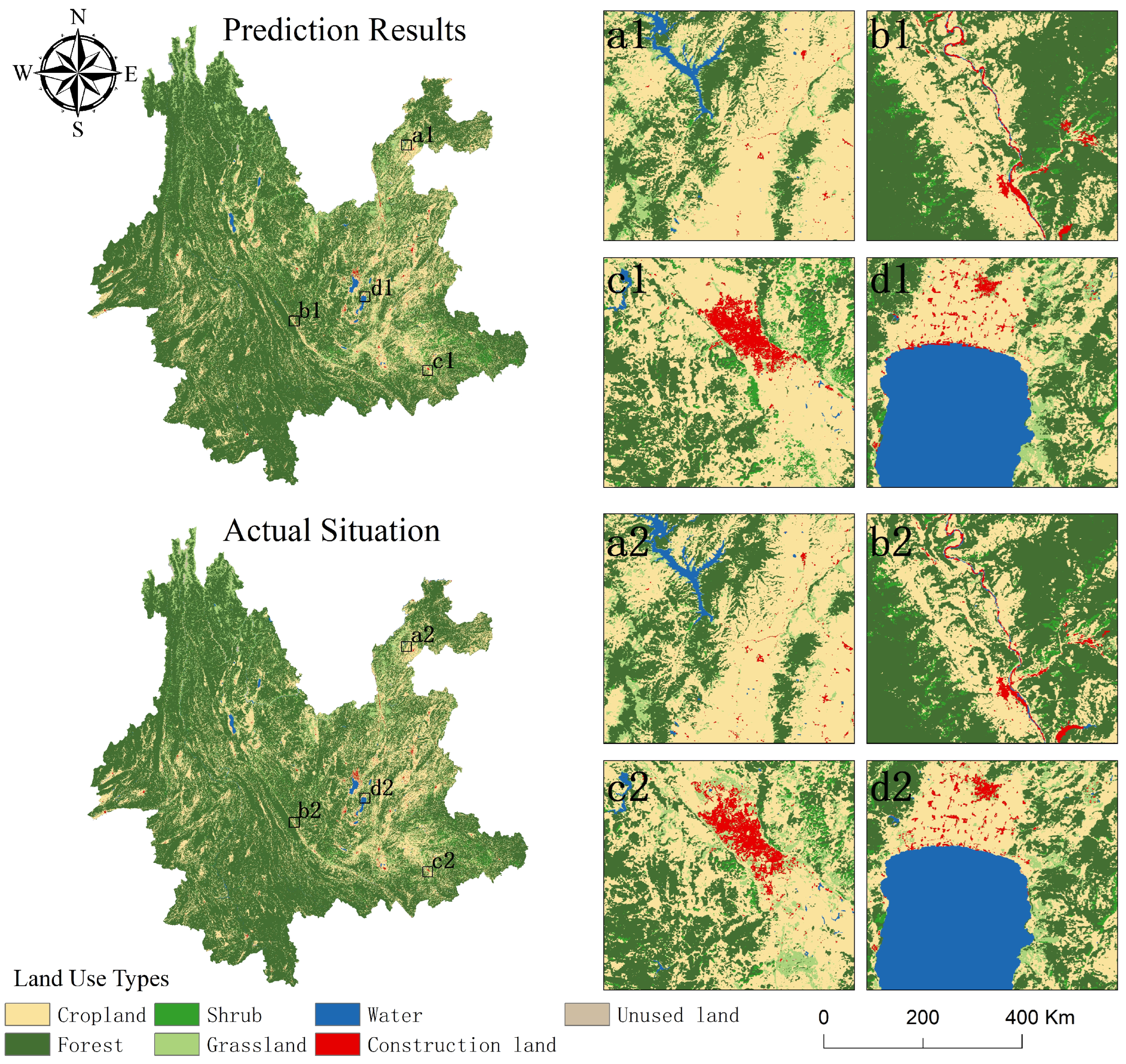
4.1.1. Land Use Prediction Accuracy Validation
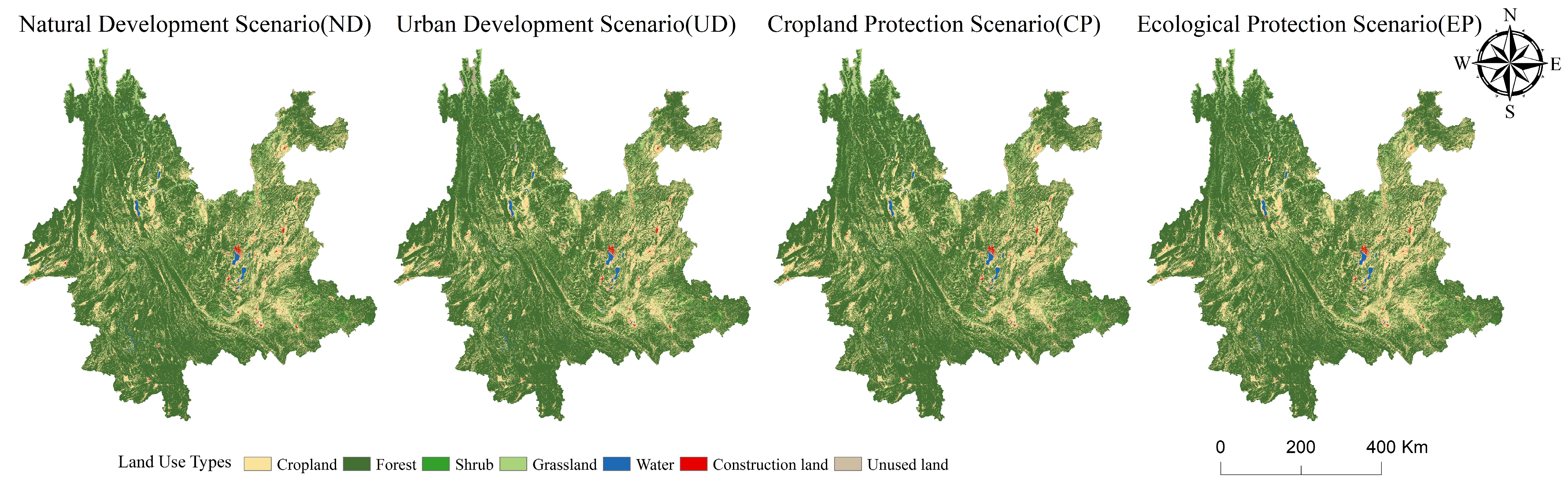
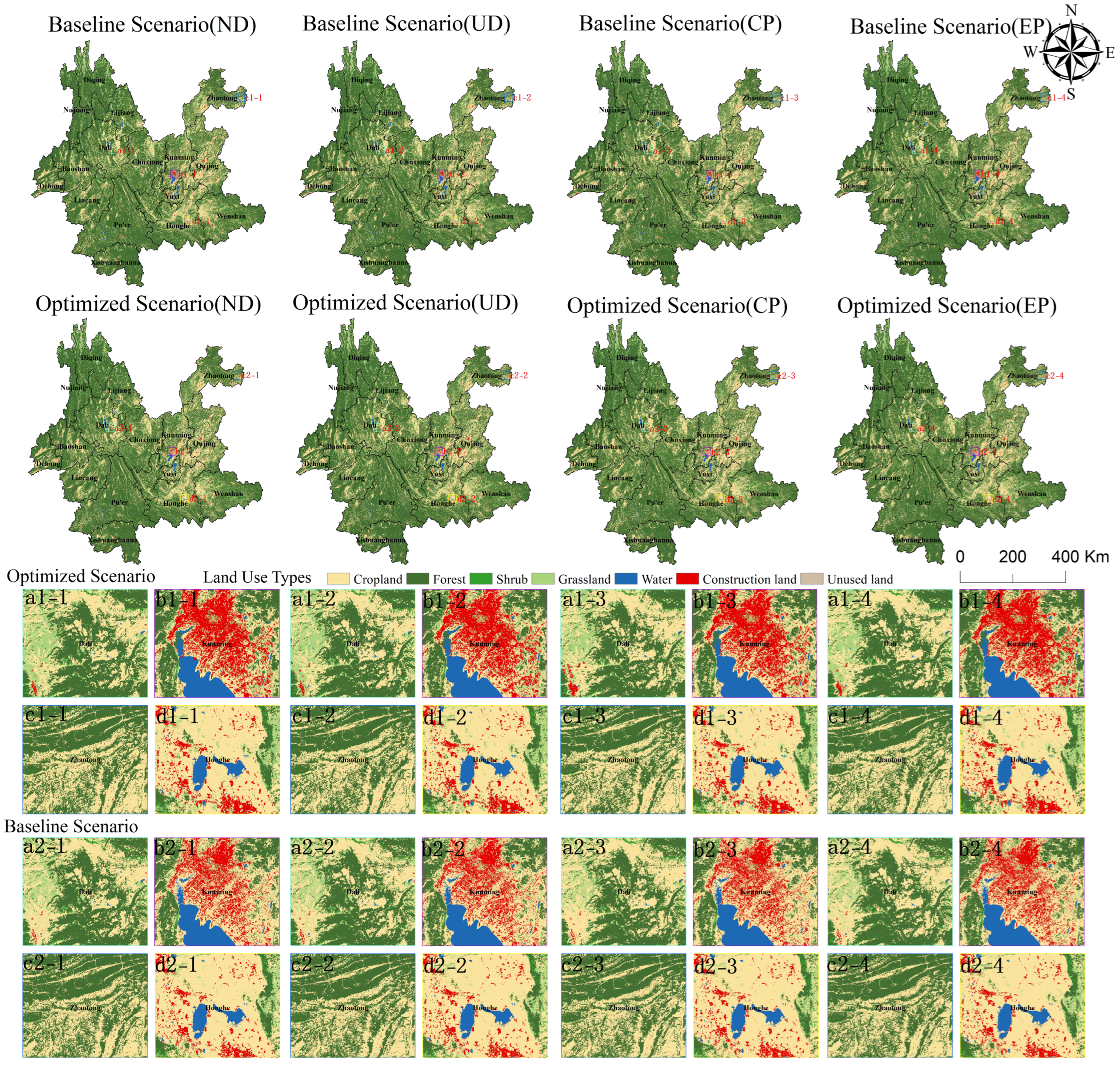
4.1.2. Land Use Long-Term Evolution and Prediction Results
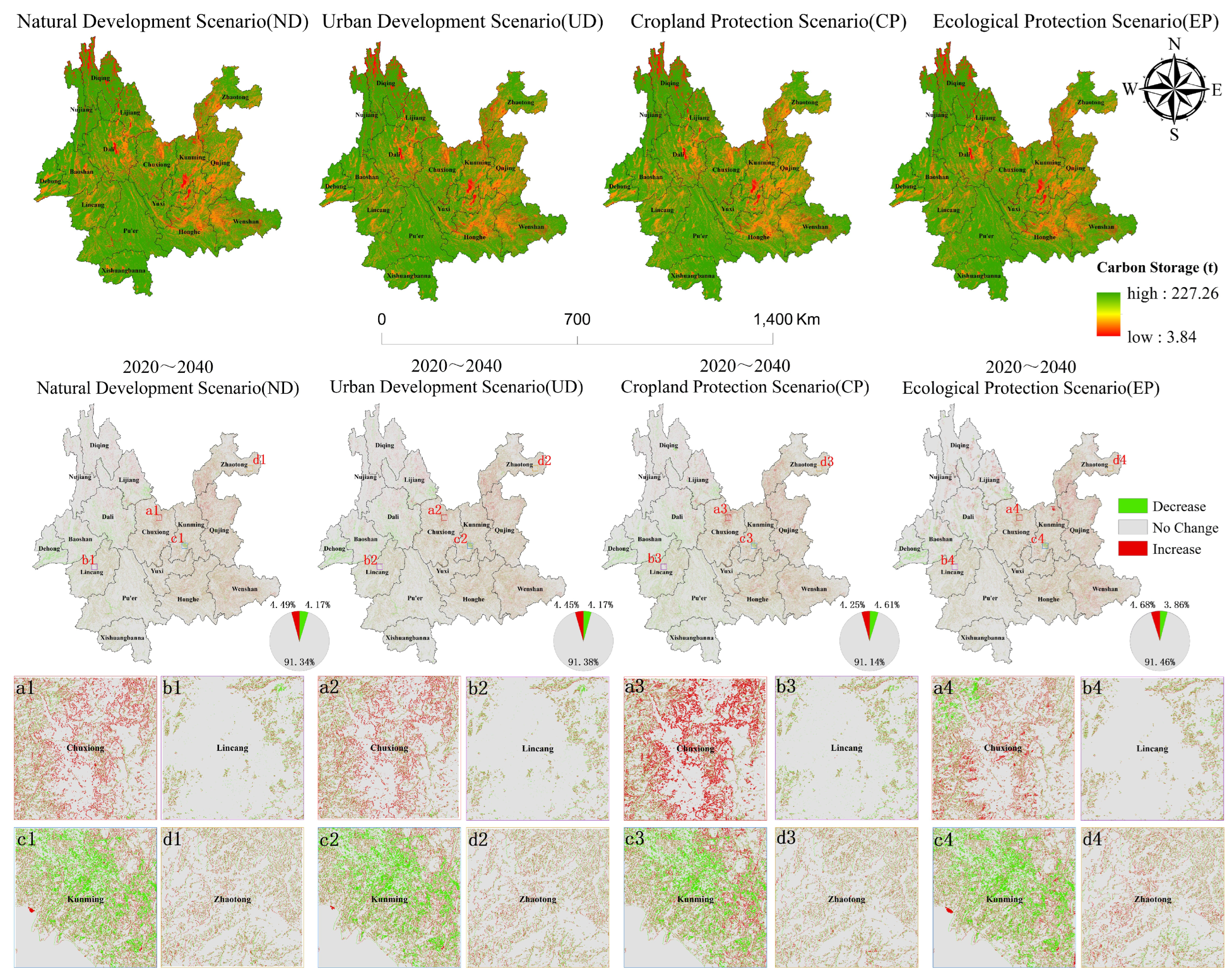
4.1.3. Long-Term Evolution and Prediction of Carbon Storage
4.2. Geographic Similarity-Based Identification Results of High-Quality Farmland
4.2.1. Contribution of Geographic Environmental Variable Weights and Dominant Mechanisms
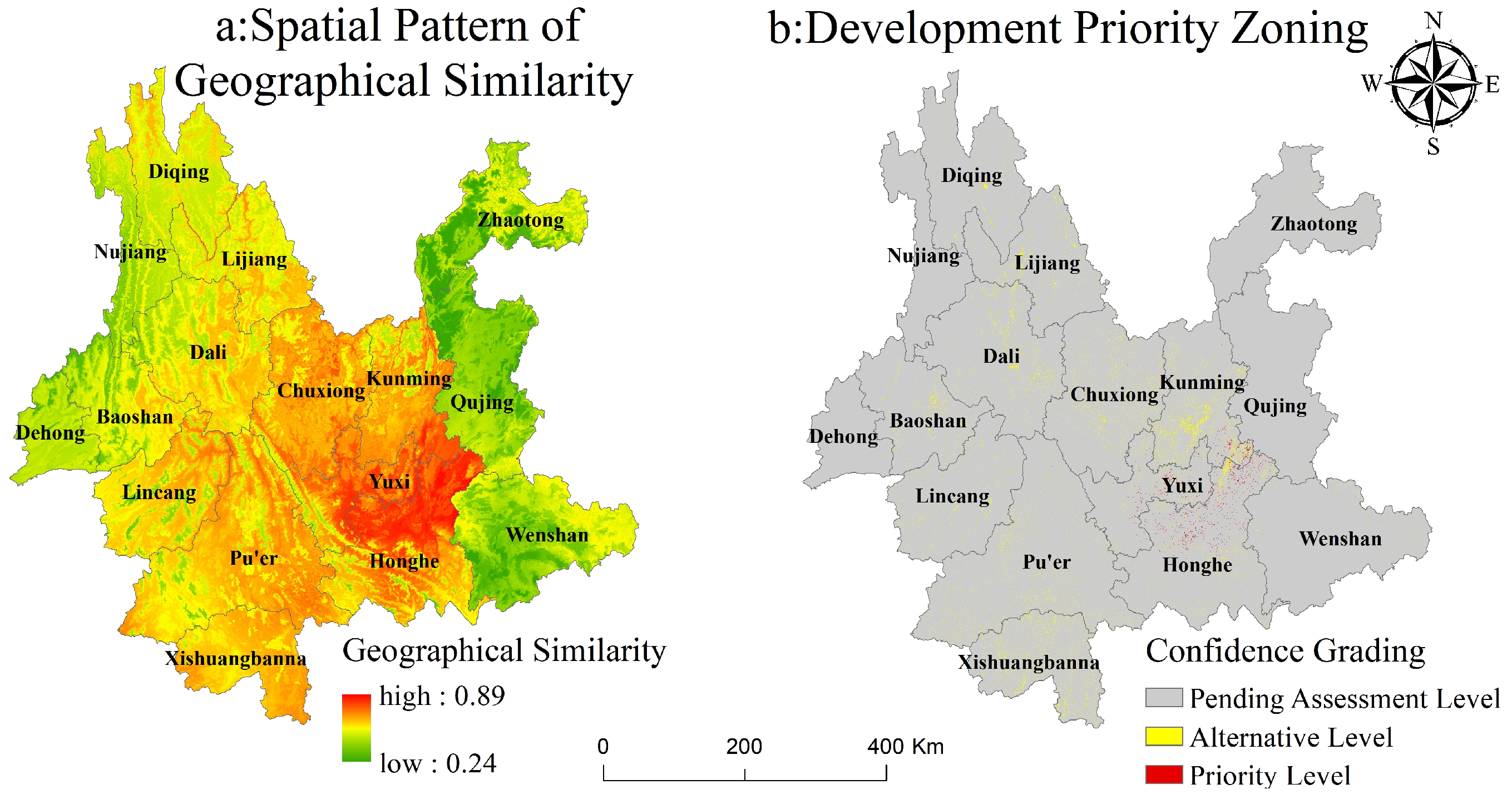
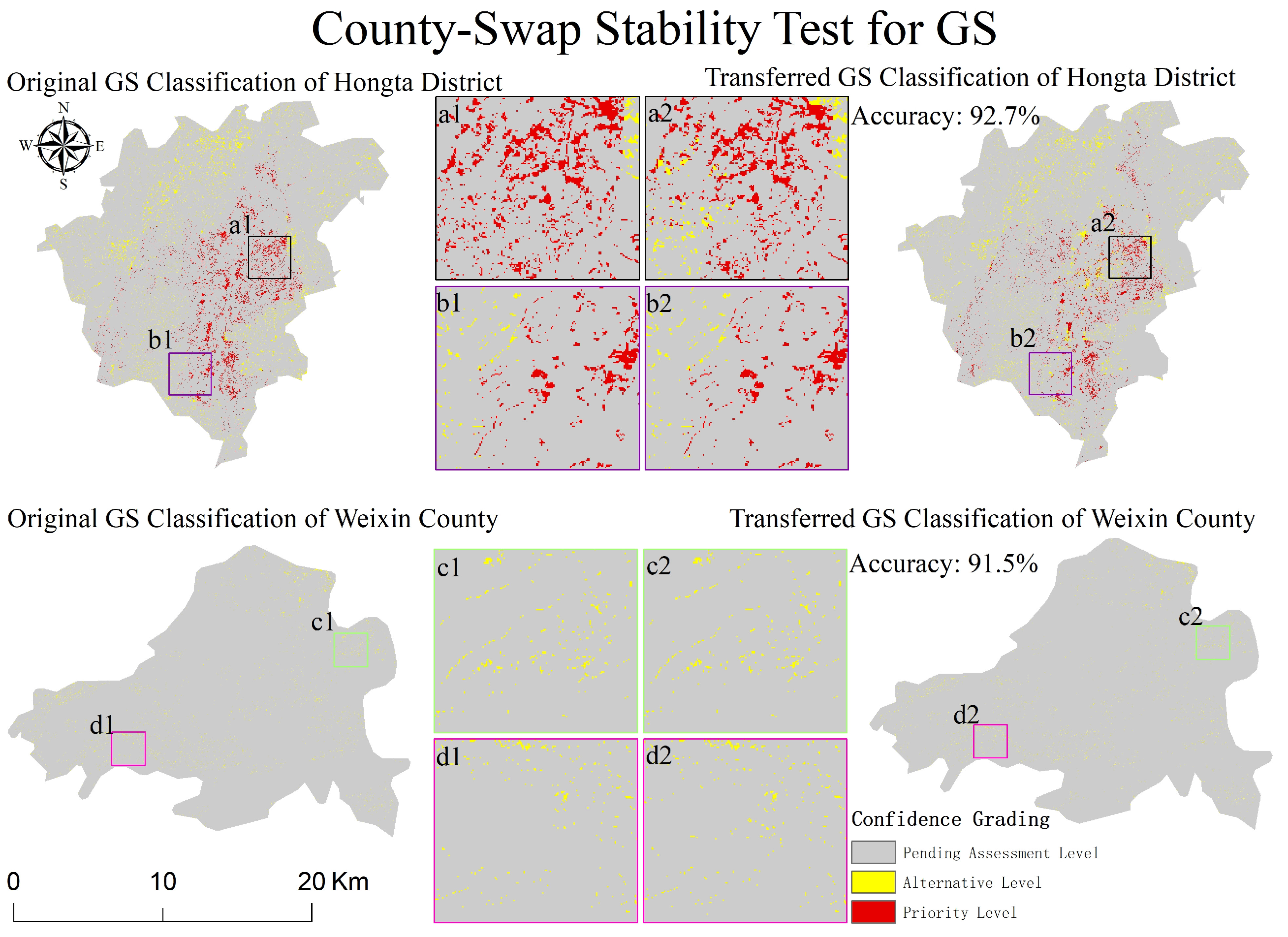
4.2.2. High-Quality Farmland Spatial Pattern and Credibility Grading Assessment
- (1)
- High Similarity Core Areas: The Yuxi–Honghe and central–southern Yunnan region constitute the core high-similarity zone (similarity 0.89), dominated by mountain valleys and gentle sloping terraces at 1000–2000 m elevation. The soil, mainly red soil and lateritic red soil, features balanced organic matter and good water retention and fertility. The climate is monsoon-controlled, with an average annual temperature of 18–22 °C and precipitation of 800–1200 mm, distinct dry and wet seasons, and well-matched temperature and precipitation. Irrigation water sources are evenly distributed, forming the most geographically synergistic core for high-quality farmland reserves in the province.
- (2)
- Transition Zone: The buffer zone surrounding the high-similarity core area exhibits a gradient decrease (yellow to yellow-green), encompassing regions such as Dali, Kunming, and Pu’er. Farmland in Kunming is more fragmented than in the Yuxi core area due to differences in terrace reclamation and irrigation. Dali and Lijiang, located further north, have slightly lower accumulated temperatures and delayed precipitation periods, with soils transitioning from red soil to purple soil and arid red soil. This buffer zone reflects the moderating effect of geographic factors on farmland similarity.
- (3)
- Low Similarity Edge Zone: The northeastern Yunnan (Zhaotong), southeastern Yunnan (Wenshan), and western Yunnan (Dehong–Nujiang–Diqing) constitute low-similarity zones (0.24, green), characterized by highly fragmented farmland, complex terrain, severe soil erosion, and a wide climatic spectrum. Zhaotong lies in the Yunnan–Guizhou Plateau–Sichuan Basin transition belt, with widespread sloped farmland and soil erosion 1.3–4.6 times higher than the core area; Wenshan features prominent karst land forms and marked vertical precipitation differentiation; Dehong–Nujiang comprises deep valleys of the Hengduan Mountains with farmland elevation differences exceeding 3000 m; Diqing has high-cold alpine meadow and dark brown soil farmland. Extreme geographic differentiation results in low connectivity between edge-area high-quality farmland and the core area, making them typical low-similarity zones.
4.3. Bi-Directional Optimization Strategy for High-Risk Areas Driven by Ecological Risk and Carbon Storage Vulnerability
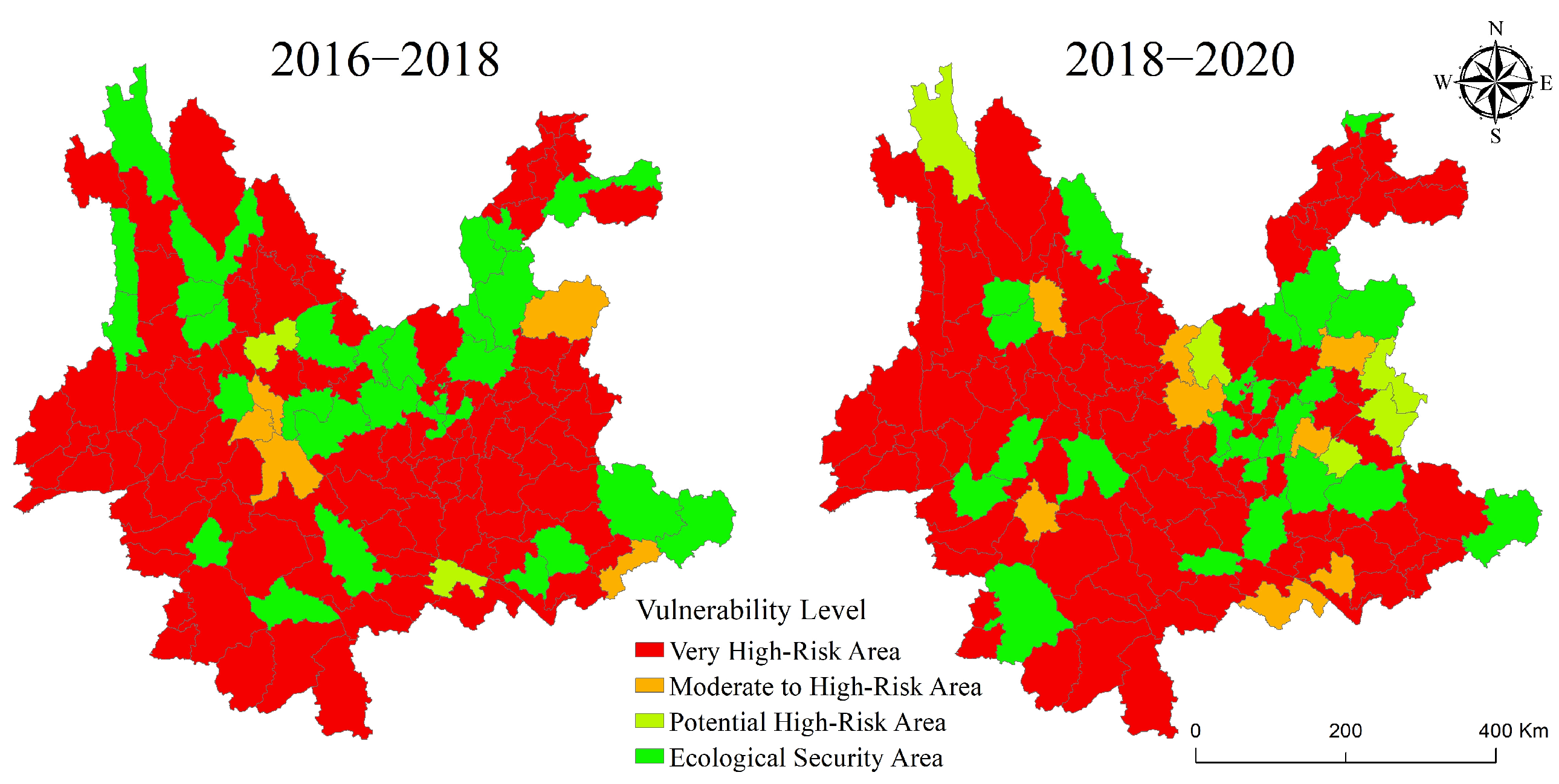
4.3.1. Vulnerability Assessment and Spatial Response of Ecosystem Carbon Storage Services
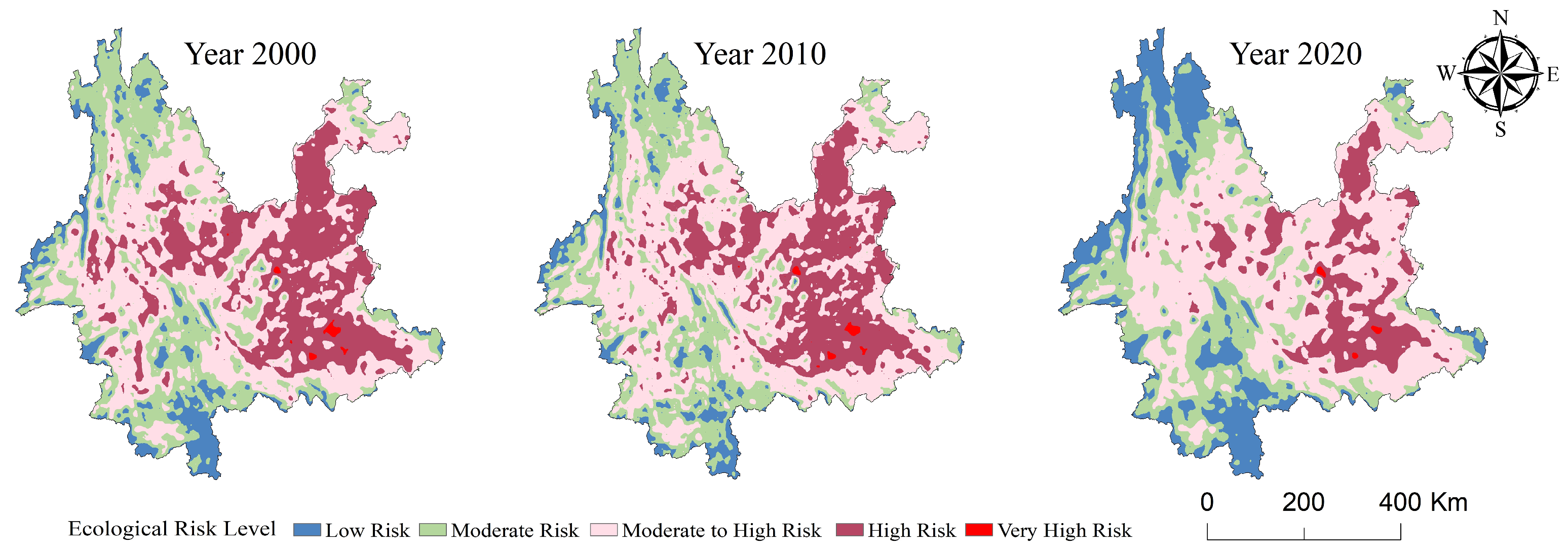
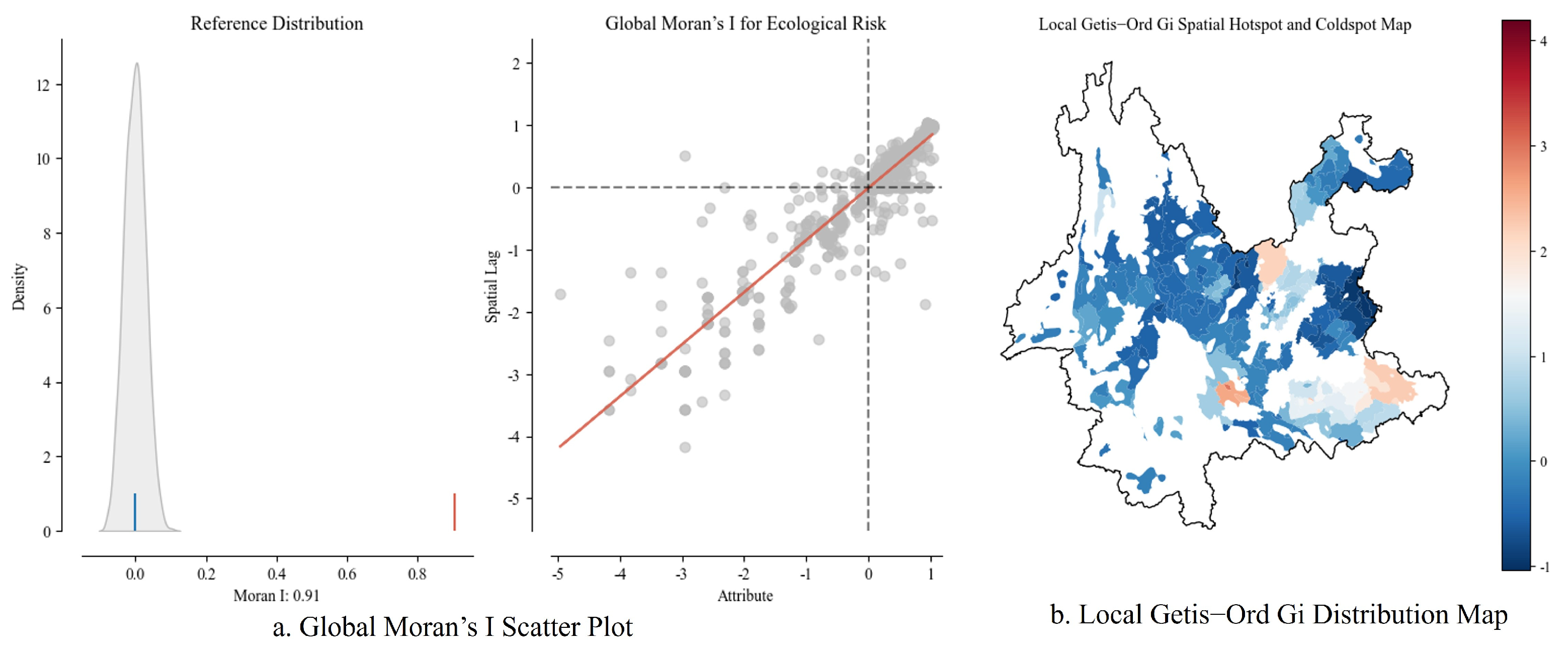
4.3.2. Ecological Landscape Risk Evolution and Its Spatiotemporal Response Analysis
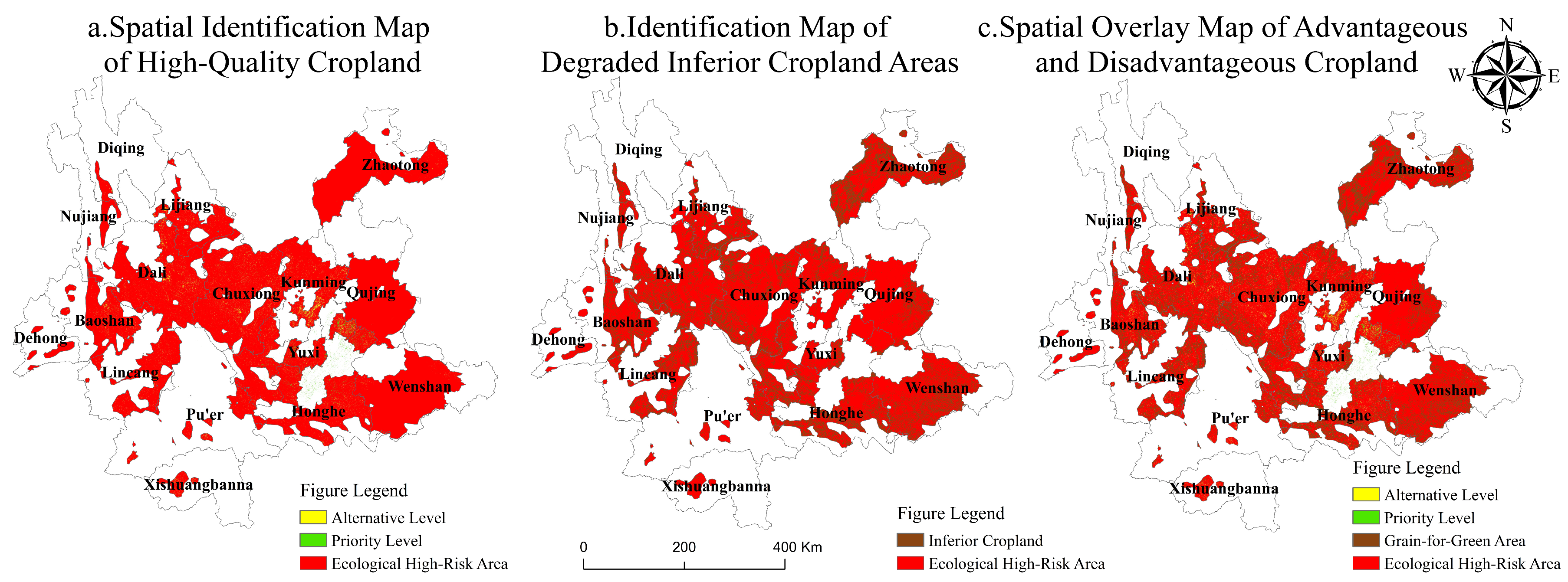
4.3.3. Ecological High-Risk Area Bidirectional Optimization in the Grain–Carbon Synergy Mechanism
- (1)
- Spatial Distribution Characteristics of High-Ecological-Risk Areas
- (2)
- Identification of High-Quality Farmland Reserves
- (3)
- Identification of Low-Quality Farmland and Zoning for Cropland-to-Forest Conversion
- (4)
- Carbon Sink Simulation and the Effectiveness of the “Bidirectional Optimization” Strategy
5. Discussion
5.1. Applicability and Advantages of the Spatial Distance-Weighted Carbon Density Correction Method
5.2. Contributions, Limitations, and Future Directions
6. Conclusions
Author Contributions
Funding
Data Availability Statement
Acknowledgments
Conflicts of Interest
Appendix A

| ND | UD | ||||||||||||||
| Land types | A | B | C | D | E | F | G | Land types | A | B | C | D | E | F | G |
| A | 1 | 1 | 1 | 1 | 1 | 1 | 1 | A | 1 | 1 | 1 | 1 | 1 | 1 | 1 |
| B | 1 | 1 | 1 | 1 | 1 | 1 | 0 | B | 1 | 1 | 1 | 1 | 1 | 1 | 0 |
| C | 1 | 1 | 1 | 1 | 1 | 0 | 0 | C | 1 | 1 | 1 | 1 | 1 | 1 | 0 |
| D | 1 | 1 | 1 | 1 | 1 | 1 | 1 | D | 1 | 1 | 1 | 1 | 1 | 1 | 1 |
| E | 1 | 1 | 0 | 1 | 1 | 1 | 1 | E | 0 | 0 | 0 | 0 | 1 | 1 | 1 |
| F | 1 | 0 | 0 | 1 | 1 | 1 | 0 | F | 0 | 0 | 0 | 0 | 0 | 1 | 0 |
| G | 1 | 1 | 0 | 1 | 1 | 1 | 1 | G | 1 | 1 | 1 | 1 | 1 | 1 | 1 |
| CP | EP | ||||||||||||||
| Land types | A | B | C | D | E | F | G | Land types | A | B | C | D | E | F | G |
| A | 1 | 0 | 0 | 0 | 0 | 0 | 0 | A | 1 | 1 | 1 | 1 | 0 | 0 | 1 |
| B | 1 | 1 | 1 | 1 | 1 | 1 | 1 | B | 1 | 1 | 1 | 1 | 0 | 1 | 1 |
| C | 1 | 1 | 1 | 1 | 1 | 1 | 1 | C | 1 | 1 | 1 | 1 | 1 | 1 | 1 |
| D | 1 | 1 | 1 | 1 | 1 | 1 | 1 | D | 1 | 1 | 1 | 1 | 1 | 1 | 1 |
| E | 1 | 1 | 0 | 1 | 1 | 1 | 0 | E | 1 | 0 | 1 | 1 | 1 | 1 | 0 |
| F | 0 | 0 | 0 | 0 | 0 | 1 | 0 | F | 0 | 0 | 1 | 1 | 1 | 1 | 1 |
| G | 1 | 1 | 0 | 1 | 1 | 1 | 1 | G | 1 | 1 | 1 | 1 | 1 | 1 | 1 |
| Multiple Scenarios | A | B | C | D | E | F | G | |
|---|---|---|---|---|---|---|---|---|
| ND | S | 100,001,735 | 298,949,558 | 10,468,210 | 19,648,109 | 3,487,951 | 2,402,507 | 780,209 |
| W | 0.52 | 0.92 | 1.00 | 0.00 | 0.65 | 0.75 | 0.63 | |
| UD | S | 101,096,227 | 298,274,644 | 10,473,577 | 19,126,404 | 3,376,359 | 2,616,491 | 775,777 |
| W | 0.494 | 0.916 | 1.000 | 0.000 | 0.657 | 0.772 | 0.634 | |
| CP | S | 107,427,932 | 293,549,834 | 10,589,011 | 18,136,352 | 3,207,221 | 2,051,484 | 776,444 |
| W | 1.000 | 0.366 | 0.771 | 0.000 | 0.543 | 0.581 | 0.538 | |
| EP | S | 97,868,162 | 301,092,975 | 10,436,607 | 20,141,494 | 3,497,637 | 1,979,882 | 721,520 |
| W | 0.169 | 1.000 | 0.855 | 0.000 | 0.535 | 0.577 | 0.506 | |
| Land Use Types | 2020 | 2040 ND | 2040 UD | 2040 CP | 2040 EP | ||||
|---|---|---|---|---|---|---|---|---|---|
| Area | Area | Change | Area | Change | Area | Change | Area | Change | |
| Cropland | 85,670.70 | 89,997.06 | 4326.36 | 89,806.43 | 4135.73 | 96,680.58 | 11,009.88 | 88,076.84 | 2406.14 |
| Forest | 269,329.21 | 269,296.53 | −32.68 | 269,331.01 | 1.80 | 264,235.54 | −5093.67 | 271,492.98 | 2163.77 |
| Shrub | 9941.99 | 9420.58 | −521.41 | 9414.85 | −527.14 | 9529.30 | −412.69 | 9392.14 | −549.85 |
| Grassland | 22,741.09 | 18,092.99 | −4648.10 | 18,130.75 | −4610.34 | 16,537.78 | −6203.31 | 18,344.84 | −4396.25 |
| Water | 2530.42 | 2918.08 | 387.66 | 2940.59 | 410.17 | 2749.97 | 219.55 | 2511.64 | −18.78 |
| Construction land | 1397.83 | 1765.83 | 368.00 | 1868.66 | 470.83 | 1761.30 | 363.47 | 1725.46 | 327.63 |
| Unused land | 581.40 | 701.41 | 120.01 | 700.19 | 118.79 | 698.02 | 116.62 | 648.59 | 67.19 |
| Classification Attribute | Similarity Threshold(Sz) | Actual Area (km2) | Area Proportion |
|---|---|---|---|
| Priority Level | Sz ≥ 0.80 | 510.14 | 0.13% |
| Alternative Level | 0.60 ≤ Sz < 0.80 | 6665.59 | 1.70% |
| Pending Assessment Level | Sz < 0.60 | 385,016.91 | 98.17% |
| Variable | Weight (W) | Geodetector q-Value | Significance Level |
|---|---|---|---|
| Elevation | 0.0840 | 0.08889 | p < 0.01 |
| Silt Content | 0.0916 | 0.0969 | p < 0.01 |
| Aspect | 0.0034 | 0.0036 | p < 0.01 |
| Sunshine Duration | 0.0983 | 0.1040 | p < 0.01 |
| Solar Radiation | 0.0898 | 0.0950 | p < 0.01 |
| Surface Moisture | 0.0713 | 0.0755 | p < 0.01 |
| Precipitation | 0.2137 | 0.2262 | p < 0.01 |
| Temperature | 0.0733 | 0.0776 | p < 0.01 |
| Potential Evapotranspiration | 0.1106 | 0.1170 | p < 0.01 |
| Distance to Water Systems | 0.0716 | 0.0758 | p < 0.01 |
| Soil type | 0.0924 | 0.0978 | p < 0.01 |


References
- Anderegg, W.R.; Trugman, A.T.; Badgley, G.; Anderson, C.M.; Bartuska, A.; Ciais, P.; Cullenward, D.; Field, C.B.; Freeman, J.; Randerson, J.T. Climate-driven risks to the climate mitigation potential of forests. Science 2020, 368, eaaz7005. [Google Scholar] [CrossRef]
- Mo, L.; Zohner, C.M.; Reich, P.B.; Liang, J.; De Miguel, S.; Nabuurs, G.J.; Renner, S.S.; Hoogen, J.v.D.; Araza, A.; Ortiz-Malavasi, E. Integrated global assessment of the natural forest carbon potential. Nature 2023, 624, 92–101. [Google Scholar] [CrossRef]
- Ke, P.; Ciais, P.; Sitch, S.; Li, W.; Bastos, A.; Liu, Z.; Xu, Y.; Gui, X.; Bian, J.; Goll, D.S.; et al. Low latency carbon budget analysis reveals a large decline of the land carbon sink in 2023. Natl. Sci. Rev. 2024, 11, nwae367. [Google Scholar] [CrossRef] [PubMed]
- Friedlingstein, P.; O’sullivan, M.; Jones, M.W.; Andrew, R.M.; Hauck, J.; Landschützer, P.; Le Quéré, C.; Li, H.; Luijkx, I.T.; Olsen, A.; et al. Global carbon budget 2024. Earth Syst. Sci. Data Discuss. 2024, 2024, 965–1039. [Google Scholar] [CrossRef]
- Foley, J.A.; DeFries, R.; Asner, G.P.; Barford, C.; Bonan, G.; Carpenter, S.R.; Chapin, F.S.; Coe, M.T.; Daily, G.C.; Gibbs, H.K.; et al. Global consequences of land use. Science 2005, 309, 570–574. [Google Scholar] [CrossRef]
- Wang, Z.Y.; Meng, L.; Li, L.; Xu, F.; Lin, J. Multi-scenario simulation of land use and ecosystem services in Beijing under the background of low-carbon development. Acta Ecol. Sin 2023, 43, 3571–3581. [Google Scholar]
- Hu, G.; Li, X.; Liu, X.; Wang, S.; Zhang, X.; Shi, X.; Bai, X.; Hubacek, K. Mitigating the ripple effects of urbanization on farmland productivity and ecological security through inclusive urbanization strategies. NPJ Urban Sustain. 2025, 5, 12. [Google Scholar] [CrossRef]
- Jiang, Y.; Pu, L.J.; Zhu, M.; Huang, S.H.; Liu, R.J. Research progress and review on the balance of Cropland occupation and compensation in China. Resour. Sci. 2019, 41, 2342–2355. [Google Scholar]
- Obermeier, W.A.; Schwingshackl, C.; Bastos, A.; Conchedda, G.; Gasser, T.; Grassi, G.; Houghton, R.A.; Tubiello, F.N.; Sitch, S.; Pongratz, J. Country-level estimates of gross and net carbon fluxes from land use, land-use change and forestry. Earth Syst. Sci. Data 2024, 16, 605–645. [Google Scholar] [CrossRef]
- Huang, X.; Ibrahim, M.M.; Luo, Y.; Jiang, L.; Chen, J.; Hou, E. Land use change alters soil organic carbon: Constrained global patterns and predictors. Earths Future 2024, 12, e2023EF004254. [Google Scholar] [CrossRef]
- Giardina, C.P.; Ryan, M.G. Evidence that decomposition rates of organic carbon in mineral soil do not vary with temperature. Nature 2000, 404, 858–861. [Google Scholar] [CrossRef]
- Turup, A.; Zhang, J.; Ma, W.; Ma, B.; Zhang, Y.; Akhter, Z.H.; Li, L. China’s Well-Facilitated Farmland distribution dataset. Sci. Data 2025, 12, 631. [Google Scholar] [CrossRef] [PubMed]
- Akıncı, H.; Özalp, A.Y.; Turgut, B. Agricultural land use suitability analysis using GIS and AHP technique. Comput. Electron. Agric. 2013, 97, 71–82. [Google Scholar] [CrossRef]
- Tashayo, B.; Honarbakhsh, A.; Azma, A.; Akbari, M. Combined fuzzy AHP–GIS for agricultural land suitability modeling for a watershed in southern Iran. Environ. Manag. 2020, 66, 364–376. [Google Scholar] [CrossRef] [PubMed]
- Yalew, S.G.; Van Griensven, A.; van der Zaag, P. AgriSuit: A web-based GIS-MCDA framework for agricultural land suitability assessment. Comput. Electron. Agric. 2016, 128, 1–8. [Google Scholar] [CrossRef]
- Evans, F.H.; Recalde Salas, A.; Rakshit, S.; Scanlan, C.A.; Cook, S.E. Assessment ofthe use of geographically weighted regression for analysis of large on-farm experiments and implications for practical application. Agronomy 2020, 10, 1720. [Google Scholar] [CrossRef]
- Ming, F.; Gong, W.; Wang, L.; Jin, Y. Constrained multi-objective optimization with deep reinforcement learning assisted operator selection. IEEE/CAA J. Autom. Sin. 2024, 11, 919–931. [Google Scholar] [CrossRef]
- Liang, X.; Guan, Q.; Clarke, K.C.; Liu, S.; Wang, B.; Yao, Y. Understanding the drivers of sustainable land expansion using a patch-generating land use simulation(PLUS) model: A case study in Wuhan, China. Comput. Environ. Urban Syst. 2021, 85, 101569. [Google Scholar] [CrossRef]
- Taghizadeh-Mehrjardi, R.; Nabiollahi, K.; Rasoli, L.; Kerry, R.; Scholten, T. Land suitability assessment and agricultural production sustainability using machine learning models. Agronomy 2020, 10, 573. [Google Scholar] [CrossRef]
- Pan, Y.X.; Yang, R.; Lin, Y.C. Evolution and coupling mechanism of resource and environmental carrying capacity and suitability of agricultural production space in China. China Land Sci. 2023, 37, 20–31. [Google Scholar]
- Wang, S.; Xiao, L.; Smith, P.; Luo, Z.; Zhuang, J.; Yu, L.; Qin, Y.; Wang, E.; Fan, Y.; Guo, Y.; et al. Improving soil quality enables reductions in nitrogen application rate in China’s rice production systems. Agric. Syst. 2026, 231, 104544. [Google Scholar] [CrossRef]
- Seddon, N.; Chausson, A.; Berry, P.; Girardin, C.A.; Smith, A.; Turner, B. Understanding the value and limits of nature-based solutions to climate change and other global challenGS. Philos. R. Soc. B 2020, 375, 20190120. [Google Scholar] [CrossRef] [PubMed]
- Schneider, J.M.; Zabel, F.; Mauser, W. Global inventory of suitable, cultivable and available cropland under different scenarios and policies. Sci. Data 2022, 9, 527. [Google Scholar] [CrossRef] [PubMed]
- Xie, N.; Sun, L.; Lu, T.; Zhang, X.; Duan, N.; Wang, W.; Liang, X.; Fan, Y.; Liu, H. Effects of Adding Different Corn Residue Components on Soil and Aggregate Organic Carbon. Agriculture 2025, 15, 1050. [Google Scholar] [CrossRef]
- Sun, W.; Liu, X. Review on carbon storage estimation of forest ecosystem and applications in China. For. Ecosyst. 2020, 7, 4. [Google Scholar] [CrossRef]
- Cook-Patton, S.C.; Leavitt, S.M.; Gibbs, D.; Harris, N.L.; Lister, K.; Anderson-Teixeira, K.J.; Briggs, R.D.; Chazdon, R.L.; Crowther, T.W.; Ellis, P.W.; et al. Mapping carbon accumulation potential from global natural forest regrowth. Nature 2020, 585, 545–550. [Google Scholar] [CrossRef]
- Zhu, A.X.; Lu, G.; Liu, J.; Qin, C.Z.; Zhou, C. Spatial prediction based on third Law of Geography. Ann. GIS 2018, 24, 225–240. [Google Scholar] [CrossRef]
- Zhu, A.X.; Lü, G.N.; Zhou, C.H.; Qin, C.Z. Geographical similarity: The third law of geography? J. Geo-Inf. Sci. 2020, 22, 673–679. [Google Scholar]
- Zhu, A.X.; Liu, J.; Du, F.; Zhang, S.J.; Qin, C.Z.; Burt, J.; Behrens, T.; Scholten, T. Predictive soil mapping with limited sample data: PSM using limited samples. Eur. J. Soil Sci. 2015, 66, 535–547. [Google Scholar] [CrossRef]
- Zhu, A.X.; Miao, Y.; Liu, J.; Bai, S.; Zeng, C.; Ma, T.; Hong, H. A similarity-based approach to sampling absence data for landslide susceptibility mapping using data-driven methods. CATENA 2019, 183, 104188. [Google Scholar] [CrossRef]
- Zhang, G.; Zhu, A.-X. A representativeness-directed approach to mitigate spatial bias in VGI for the predictive mapping of geographic phenomena. Int. Geogr. Inf. Sci. 2019, 33, 1873–1893. [Google Scholar] [CrossRef]
- Rockström, J.; Steffen, W.; Noone, K.; Persson, Å.; Chapin, F.S.; Lambin, E.F.; Lenton, T.M.; Scheffer, M.; Folke, C.; Schellnhuber, H.J.; et al. A safe operating space for humanity. Nature 2009, 461, 472–475. [Google Scholar] [CrossRef] [PubMed]
- Garnett, T.; Appleby, M.C.; Balmford, A.; Bateman, I.J.; Benton, T.G.; Bloomer, P.; Burlingame, B.; Dawkins, M.; Dolan, L.; Fraser, D.; et al. Sustainable intensification in agriculture: Premises and policies. Science 2013, 341, 33–34. [Google Scholar] [CrossRef]
- Cumming, G.S.; Buerkert, A.; Hoffmann, E.M.; Schlecht, E.; von Cramon-Taubadel, S.; Tscharntke, T. Implications of agricultural transitions and urbanization for ecosystem services. Nature 2014, 515, 50–57. [Google Scholar] [CrossRef] [PubMed]
- Kennedy, C.M.; Miteva, D.A.; Baumgarten, L.; Hawthorne, P.L.; Sochi, K.; Polasky, S.; Oakleaf, J.R.; Uhlhorn, E.M.; Kiesecker, J. Bigger is better: Improved nature conservation and economic returns from landscape-level mitigation. Sci. Adv. 2016, 2, e1501021. [Google Scholar] [CrossRef]
- Atumane, A.; Cabral, P. Integration of ecosystem services into land use planning in Mozambique. Ecosyst. People 2021, 17, 165–177. [Google Scholar] [CrossRef]
- Ke, N.; Zhang, X.; Lu, X.; Kuang, B.; Jiang, B. Regional disparities and influencing factors of eco-efficiency of arable land utilization in China. Land 2022, 11, 257. [Google Scholar] [CrossRef]
- Ke, Y.; Li, H.; Luo, T.; Chen, B.; Wang, Q.; Jiang, X.; Liu, W. Reforestation Increases the Aggregate Organic Carbon Concentration Induced by Soil Microorganisms in a Degraded Red Soil, Subtropical China. Microorganisms 2023, 11, 2008. [Google Scholar] [CrossRef]
- Zhang, X.M.; Brandt, M.; Yue, Y.M.; Tong, X.W.; Wang, K.L.; Fensholt, R. the carbon sink potential of southern China after two decades of afforestation. Earths Future 2022, 10, e2022EF002674. [Google Scholar] [CrossRef]
- Xu, H.; Yue, C.; Zhang, Y.; Liu, D.; Piao, S. Forestation at the right time with the right species can generate persistent carbon benefits in China. Proc. Natl. Acad. Sci. USA 2023, 120, e2304988120. [Google Scholar] [CrossRef]
- Pipins, S.; Baillie, J.E.; Bowmer, A.; Pollock, L.J.; Owen, N.; Gumbs, R. Advancing EDGE Zones to identify spatial conservation priorities of tetrapod evolutionary history. Nat. Commun. 2024, 15, 7672. [Google Scholar] [CrossRef] [PubMed]
- Yang, J.; Huang, X. The 30 m annual land cover dataset and its dynamics in China from 1990 to 2019. Earth Syst. Sci. Data 2021, 13, 3907–3925. [Google Scholar] [CrossRef]
- Wang, H.; Wu, L.; Yue, Y.; Jin, Y.; Zhang, B. Impacts of climate and land use change on terrestrial carbon storage: A multi-scenario case study in the Yellow River Basin (1992–2050). Sci. Total Environ. 2024, 930, 172557. [Google Scholar] [CrossRef]
- Green, J.K.; Seneviratne, S.I.; Berg, A.M.; Findell, K.L.; Hagemann, S.; Lawrence, D.M.; Gentine, P. Large influence of soil moisture on long-term terrestrial carbon uptake. Nature 2019, 565, 476–479. [Google Scholar] [CrossRef]
- Chen, L.J.; Liu, G.H.; Li, H.G. Remote sensing dynamic monitoring of net primary productivity of vegetation in China. J. Remote Sens. 2021, 2, 129–135. [Google Scholar]
- Mo, J.X. Research on Land Use Strategies of the Central Yunnan Urban Agglomeration Based on Carbon Sequestration Effect Evaluation and Prediction Under the Background of Carbon Neutrality. Master’s Thesis, Yunnan University of Finance and Economics, Kunming, China, 2023. [Google Scholar]
- Piao, S.; Fang, J.; Ciais, P.; Peylin, P.; Huang, Y.; Sitch, S.; Wang, T. the carbon balance of terrestrial ecosystems in China. Nature 2009, 458, 1009–1013. [Google Scholar] [CrossRef]
- Xu, L.; Yu, G.R.; He, N.P. Changes in soil carbon storage of terrestrial ecosystems in China from the 1980s to the 2010s. Acta Geogr. Sin. 2018, 73, 2150–2167. [Google Scholar]
- Li, K.R.; Wang, S.Q.; Cao, M.K. Vegetation and soil carbon storage in China. Sci. China Ser. D Earth Sci. 2003, 33, 72–80. [Google Scholar] [CrossRef]
- Paruke, W.S.M.J.; Ai, D.; Fang, Y.S.; Zhang, Y.B. Spatiotemporal evolution and prediction of carbon storage in Kunming based on the InVEST and CA-Markov models. Environ. Sci. 2024, 45, 287–299. [Google Scholar]
- Wei, X.; Li, Q.; Deng, A.; Liu, J.; Qiao, L. Spatiotemporal evolution, prediction, and driving factors analysis of carbon storage in Sichuan Province based on land use change. Res. Soil Water Conserv. 2025, 32, 373–383. [Google Scholar]
- Chen, D.R.; Zhou, X.; Yang, S.T.; Pei, Y.; Hu, Y.X.; Hu, F. Carbon storage evolution and its vulnerability characteristics based on land use change in Guizhou Province. Bull. Soil Water Conserv. 2023, 43, 301–309. [Google Scholar]
- Ke, X.L.; Tang, L.P. Impact of the coupling between urban expansion and Cropland protection on carbon storage interrestrial ecosystems: A case study of Hubei Province. Acta Ecol. Sin. 2019, 39, 672–683. [Google Scholar]
- Tang, X.; Zhao, X.; Bai, Y.; Tang, Z.; Wang, W.; Zhao, Y.; Wan, H.; Xie, Z.; Shi, X.; Wu, B.; et al. Carbon pools in China’s terrestrial ecosystems: New estimates based on an intensive field survey. Proc. Natl. Acad. Sci. USA 2018, 115, 4021–4026. [Google Scholar] [CrossRef]
- Wang, Z.; Zhong, A.; Wei, E.; Hu, C. Carbon Storage Simulation and Land Use Optimization for High-Water-Table Resource-Based Cities Based on the Coupled GMOP-PLUS-InVEST Model. Remote Sens. 2024, 16, 4480. [Google Scholar] [CrossRef]
- Tian, L.; Tao, Y.; Fu, W.; Li, T.; Ren, F.; Li, M. Dynamic simulation of land use/cover change and assessment of forest ecosystem carbon storage under climate change scenarios in Guangdong Province, China. Remote Sens. 2022, 14, 2330. [Google Scholar] [CrossRef]
- Strîmbu, V.F.; Naesset, E.; Ørka, H.O.; Liski, J.; Petersson, H.; Gobakken, T. Estimating biomass and soil carbon change at the level of forest stands using repeated forest surveys assisted by airborne laser scanner data. Carbon Balance Manag. 2023, 18, 10. [Google Scholar] [CrossRef]
- Luan, C.; Liu, R.; Zhang, Q.; Sun, J.; Liu, J. Multi-objective land use optimization based on integrated NSGA–II–PLUS model: Comprehensive consideration of economic development and ecosystem services value enhancement. J. Clean. Prod. 2024, 434, 140306. [Google Scholar] [CrossRef]
- Wang, R.; Zhao, J.; Chen, G.; Lin, Y.; Yang, A.; Cheng, J. Coupling PLUS–InVEST model for ecosystem service research in Yunnan Province, China. Sustainability 2022, 15, 271. [Google Scholar] [CrossRef]
- Verburg, P.H.; Neumann, K.; Nol, L. ChallenGS in using land use and land cover data for global change studies. Glob. Change Biol. 2011, 17, 974–989. [Google Scholar] [CrossRef]
- Hurtt, G.C.; Chini, L.P.; Frolking, S.; Betts, R.A.; Feddema, J.; Fischer, G.; Fisk, J.P.; Hibbard, K.; Houghton, R.A.; Janetos, A.; et al. Harmonization of land-use scenarios for the period 1500–2100: 600 years of global gridded annual land-use transitions, wood harvest, and resulting secondary lands. Clim. Change 2011, 109, 117–161. [Google Scholar] [CrossRef]
- Zhu, A.X.; Turner, M. How is the third law of geography different? Ann. GIS 2022, 28, 57–67. [Google Scholar] [CrossRef]
- Wang, J.F.; Xu, C.D. Geodetector: Principle and prospect. Acta Geogr. Sin. 2017, 72, 116–134. [Google Scholar]
- Wang, J.F.; Zhang, T.L.; Fu, B.J. A measure of spatial stratified heterogeneity. Ecol. Indic. 2016, 67, 250–256. [Google Scholar] [CrossRef]
- Shrestha, A.; Luo, W. An assessment of groundwater contamination in Central Valley aquifer, California using geodetector method. Ann. GIS 2017, 23, 149–166. [Google Scholar] [CrossRef]
- Hu, Y.; Wang, J.; Li, X.; Ren, D.; Zhu, J. Geographical detector-based risk assessment of the under-five mortality in the 2008 Wenchuan earthquake, China. PLoS ONE 2011, 6, e21427. [Google Scholar] [CrossRef]
- Adegboye, O.A.; Gayawan, E.; Hanna, F. Spatial modelling of contribution of individual level risk factors for mortality from Middle East respiratory syndrome coronavirus in the Arabian Peninsula. PLoS ONE 2017, 12, e0181215. [Google Scholar] [CrossRef]
- McCarthy, J.J. (Ed.) Climate Change 2001: Impacts, Adaptation, and Vulnerability: Contribution of Working Group II to the Third Assessment Report of the Intergovernmental Panel on Climate Change; Cambridge University Press: Cambridge, UK, 2001. [Google Scholar]
- Smit, B.; Wandel, J. Adaptation, adaptive capacity and vulnerability. Glob. Environ. Change 2006, 16, 282–292. [Google Scholar] [CrossRef]
- Schröter, D.; Cramer, W.; Leemans, R.; Prentice, I.C.; Araújo, M.B.; Arnell, N.W.; Bondeau, A.; Bugmann, H.; Carter, T.R.; Gracia, C.A.; et al. Ecosystem service supply and vulnerability to global change in Europe. Science 2005, 310, 1333–1337. [Google Scholar] [CrossRef] [PubMed]
- Metzger, M.J.; Leemans, R.; Schröter, D. A multidisciplinary multi-scale framework for assessing vulnerabilities to global change. Int. J. Appl. Earth Obs. Geoinf. 2005, 7, 253–267. [Google Scholar] [CrossRef]
- Metzger, M.J.; Rounsevell, M.D.; Acosta-Michlik, L.; Leemans, R.; Schröter, D. the vulnerability of ecosystem services to land use change. Agric. Ecosyst. Environ. 2006, 114, 69–85. [Google Scholar] [CrossRef]
- Zhuang, D.F.; Liu, J.Y. A regional differentiation model of land use degree in China. J. Nat. Resour. 1997, 12, 105–111. [Google Scholar]
- Wang, G.; Ran, G.; Chen, Y.; Zhang, Z. Landscape ecological risk assessment for the tarim River Basin on the basis of land-use change. Remote Sens. 2023, 15, 4173. [Google Scholar] [CrossRef]
- Llausàs, A.; Nogué, J. Indicators of landscape fragmentation: The case for combining ecological indices and the perceptive approach. Ecol. Indic. 2012, 15, 85–91. [Google Scholar] [CrossRef]
- Jaeger, J.A.G. Landscape division, splitting index, and effective mesh size: New measures of landscape fragmentation. Landsc. Ecol. 2000, 15, 115–130. [Google Scholar] [CrossRef]
- Feng, Y.; Liu, Y. Fractal dimension as an indicator for quantifying the effects of changing spatial scales on landscape metrics. Ecol. Indic. 2015, 53, 18–27. [Google Scholar] [CrossRef]
- Wang, S.; Liu, F.L.; Du, W.J.; Wang, Q.H. Spatiotemporal evolution and driving force identification of landscape ecological risk in lake basins on the northwest Yunnan Plateau. Environ. Sci. 2025, 46, 3114–3126. [Google Scholar]
- Yang, F.; Jin, X.; Liu, J.; Zhang, X.; Song, J.; Li, Q.; Zhou, Y. Assessing landscape ecological risk in rapidly urbanized areas from the perspective of spatiotemporal dynamics. Trans. Chin. Soc. Agric. Eng. 2023, 39, 253–261. [Google Scholar]
- GB/T 33469-2016; Cultivated Land Quality Grade. China Standard Press: Beijing, China, 2016.
- Wan, T.A.N.G.; Jun, H.U.; Pan, W.U.; Hua, H.E. Kappa coefficient: A popular measure of rater agreement. Shanghai Arch. Psychiatry 2015, 27, 62. [Google Scholar]
- Liu, J.; Liu, B.; Wu, L.; Miao, H.; Liu, J.; Jiang, K.; Ding, H.; Gao, W.; Liu, T. Prediction of land use for the next 30 years using the PLUS model’s multi-scenario simulation in Guizhou Province, China. Sci. Rep. 2024, 14, 13143. [Google Scholar] [CrossRef]
- Xu, L.; Saatchi, S.S.; Yang, Y.; Yu, Y.; Pongratz, J.; Bloom, A.A.; Bowman, K.; Worden, J.; Liu, J.; Yin, Y.; et al. Changes in global terrestrial live biomass over the 21st century. Sci. Adv. 2021, 7, eabe9829. [Google Scholar] [CrossRef] [PubMed]
- Chini, L.; Hurtt, G.; Sahajpal, R.; Frolking, S.; Klein Goldewijk, K.; Sitch, S.; Ganzenmüller, R.; Ma, L.; Ott, L.; Pongratz, J.; et al. Land-use harmonization datasets for annual global carbon budgets. Earth Syst. Sci. Data 2021, 13, 4175–4189. [Google Scholar] [CrossRef]
- Wang, Y.; Wang, M.; Zhang, J.; Wu, Y.; Zhou, Y. Assessment of carbon stocks and influencing factors in terrestrial ecosystems based on surface area. iScience 2024, 27, 111431. [Google Scholar] [CrossRef]
- Fu, H.; Zhao, H.; Liu, G.; Zhang, Y.; Huangfu, X.; Jiang, J. Forest aboveground carbon storage estimation and uncertainty analysis by coupled multi-source remote sensing data in Liaoning Province. Ecol. Indic. 2025, 176, 113729. [Google Scholar] [CrossRef]
- Zhou, Y.; Wei, G.; Wang, Y.; Wang, B.; Quan, Y.; Wu, Z.; Liu, J.; Bian, S.; Li, M.; Fan, W.; et al. Estimating Regional Forest Carbon Density Using Remote Sensing and Geographically Weighted Random Forest Models: A Case Study of Mid-to High-Latitude Forests in China. Forests 2025, 16, 96. [Google Scholar] [CrossRef]
- Uddin, M.S.; Czajkowski, K.P. Performance assessment of spatial interpolation methods for the estimation of atmospheric carbon dioxide in the wider geographic extent. J. Geovis. Spat. Anal. 2022, 6, 10. [Google Scholar] [CrossRef]
- Munyati, C.; Sinthumule, N.I. Comparative suitability of ordinary kriging and Inverse Distance Weighted interpolation for indicating intactness gradients on threatened savannah woodland and forest stands. Environ. Sustain. Indic. 2021, 12, 100151. [Google Scholar] [CrossRef]


| Datatype | Data Name | Data Source |
|---|---|---|
| Land use data | 2000, 2010, 2020 | Wuhan University (https://zenodo.org/records/4417810 (accessed on 11 November 2025)) |
| Socioeconomic data | Population | Resource and Environmental Science Data Plat from (https://www.resdc.cn) |
| GDP | ||
| Distance to tertiary Roads | National Catalogue Service For Geographic Information (https://www.webmap.cn/main.do?method=index (accessed on 11 November 2025)) | |
| Distance to Railways | ||
| Distance to Highways | ||
| Distance to Settlements | ||
| Distance to Water | ||
| Distance to Water Systems | ||
| Natural environmental factors | Temperature | Eco-Meteorological Cloud Service Platform (https://em.cams.cma.cn/#/dashhome (accessed on 11 November 2025)) |
| Potential Evapotranspiration | ||
| Sunshine Duration | ||
| Surface Moisture | ||
| Precipitation | ||
| Soil type | Resource and Environmental Science Data Plat from (https://www.resdc.cn) | |
| Silt Content | ||
| Elevation | Geospatial Data Cloud (https://www.gscloud.cn) | |
| Slope | Extracted using ArcGIS 10.8 | |
| Aspect |
| Land Usetypes | C_Above | C_Below | C_Soil | C_Dead |
|---|---|---|---|---|
| Cropland | 19.24 | 12.26 | 127.24 | 2.11 |
| Forest | 38.57 | 18.13 | 167.78 | 2.78 |
| Shrub | 9.54 | 4.46 | 80.11 | 0.92 |
| Grassland | 4.79 | 14.83 | 125.39 | 4.71 |
| Water | 1.00 | 0.20 | 0.00 | 2.80 |
| Construction land | 1.80 | 0.36 | 73.00 | 0.00 |
| Unused land | 2.21 | 0.67 | 0.00 | 0.96 |
| Land Use Types | 2000 | 2010 | 2020 | 2040 | |||
|---|---|---|---|---|---|---|---|
| ND | UD | CP | EP | ||||
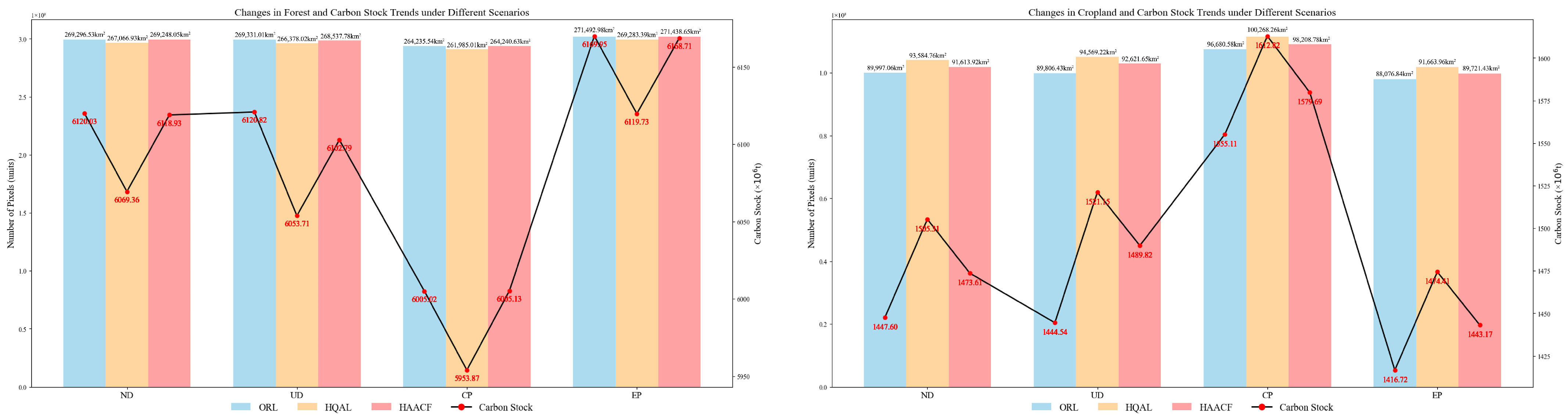
| Cropland | 1318.26 | 1310.59 | 1378.01 | 1447.60 | 1444.54 | 1555.11 | 1416.72 |
| Forest | 6089.92 | 6114.86 | 6120.78 | 6120.03 | 6120.82 | 6005.02 | 6169.95 |
| Shrub | 84.91 | 98.39 | 94.48 | 89.52 | 89.47 | 90.56 | 89.25 |
| Grassland | 451.58 | 414.02 | 340.48 | 270.89 | 271.45 | 247.60 | 274.66 |
| Water | 0.85 | 0.88 | 1.01 | 1.17 | 1.18 | 1.10 | 1.00 |
| Construction land | 3.97 | 7.28 | 10.51 | 13.27 | 14.04 | 13.24 | 12.97 |
| Unused land | 0.19 | 0.18 | 0.22 | 0.27 | 0.27 | 0.27 | 0.25 |
| Sum | 7949.68 | 7946.20 | 7945.49 | 7942.75 | 7941.77 | 7912.90 | 7964.80 |
| Risk Level | 2000 | 2010 | 2020 | |||
|---|---|---|---|---|---|---|
| Area | Proportion | Area | Proportion | Area | Proportion | |
| Low Risk | 31,052.50 | 7.92 | 24,820.67 | 6.33 | 68,391.91 | 17.44 |
| Moderate Risk | 96,244.05 | 24.54 | 96,618.70 | 24.64 | 94,874.75 | 24.19 |
| Moderate to High Risk | 163,217.64 | 41.62 | 178,146.07 | 45.42 | 176,410.02 | 44.98 |
| High Risk | 100,532.08 | 25.63 | 91,430.81 | 23.31 | 51,855.06 | 13.22 |
| Very High Risk | 1146.60 | 0.29 | 1176.62 | 0.30 | 661.13 | 0.17 |
| Scenarios | Baseline Scenario in 2040 | Optimized Scenario in 2040 | Net Carbon Gain (ΔC) |
|---|---|---|---|
| ND | 7942.75 | 7946.95 | 4.2 |
| UD | 7941.77 | 7942.27 | 0.5 |
| CP | 7912.9 | 7918.08 | 5.18 |
| EP | 7964.8 | 7969.03 | 4.23 |
| Land Use Types | Based on Hubei Baseline Adjustment | Based on Sichuan Adjustment | ||||||
| C_Above | C_Below | C_Soil | C_Dead | C_Above | C_Below | C_Soil | C_Dead | |
| Cropland | 16.31 | 10.77 | 83.06 | 2.11 | 4.42 | 0.83 | 98.49 | 2.11 |
| Forest | 29.81 | 18.09 | 109.71 | 2.78 | 24.89 | 19.84 | 127.21 | 2.78 |
| Shrub | 0.00 | 0.00 | 0.00 | 0.00 | 9.54 | 4.46 | 83.20 | 0.92 |
| Grassland | 14.13 | 16.96 | 95.36 | 2.42 | 3.96 | 12.87 | 90.76 | 2.42 |
| Water | 1.57 | 0.00 | 70.15 | 1.78 | 1.75 | 0.00 | 64.26 | 1.78 |
| Construction land | 7.53 | 1.50 | 37.61 | 0.00 | 0.91 | 0.09 | 43.87 | 0.00 |
| Unused land | 10.25 | 2.05 | 37.71 | 0.96 | 0.65 | 0.70 | 56.38 | 0.96 |
| Land Use Types | Based on Guizhou Adjustment | Based on Spatially Weighted Adjustment | ||||||
| C_Above | C_Below | C_Soil | C_Dead | C_Above | C_Below | C_Soil | C_Dead | |
| Cropland | 35.05 | 6.66 | 100.44 | 2.11 | 19.24 | 12.26 | 127.24 | 2.11 |
| Forest | 55.98 | 18.79 | 188.29 | 2.78 | 38.57 | 18.13 | 167.78 | 2.78 |
| Shrub | 0.00 | 0.00 | 0.00 | 0.00 | 9.54 | 4.46 | 80.11 | 0.92 |
| Grassland | 1.27 | 1.34 | 146.59 | 7.28 | 4.79 | 14.83 | 125.39 | 4.71 |
| Water | 0.00 | 0.00 | 0.00 | 3.98 | 1.00 | 0.20 | 0.00 | 2.80 |
| Construction land | 0.00 | 0.00 | 117.82 | 0.00 | 1.80 | 0.36 | 73.00 | 0.00 |
| Unused land | 0.00 | 0.00 | 117.82 | 0.96 | 2.21 | 0.67 | 0.00 | 0.96 |
Disclaimer/Publisher’s Note: The statements, opinions and data contained in all publications are solely those of the individual author(s) and contributor(s) and not of MDPI and/or the editor(s). MDPI and/or the editor(s) disclaim responsibility for any injury to people or property resulting from any ideas, methods, instructions or products referred to in the content. |
© 2025 by the authors. Licensee MDPI, Basel, Switzerland. This article is an open access article distributed under the terms and conditions of the Creative Commons Attribution (CC BY) license (https://creativecommons.org/licenses/by/4.0/).
Share and Cite
Ren, Q.; Wang, S.; Xu, Q.; Gao, Z. Integrating Grain–Carbon Synergy and Ecological Risk Assessment for Sustainable Land Use in Mountainous High-Risk Areas. Agriculture 2025, 15, 2496. https://doi.org/10.3390/agriculture15232496
Ren Q, Wang S, Xu Q, Gao Z. Integrating Grain–Carbon Synergy and Ecological Risk Assessment for Sustainable Land Use in Mountainous High-Risk Areas. Agriculture. 2025; 15(23):2496. https://doi.org/10.3390/agriculture15232496
Chicago/Turabian StyleRen, Qihong, Shu Wang, Quanli Xu, and Zhenheng Gao. 2025. "Integrating Grain–Carbon Synergy and Ecological Risk Assessment for Sustainable Land Use in Mountainous High-Risk Areas" Agriculture 15, no. 23: 2496. https://doi.org/10.3390/agriculture15232496
APA StyleRen, Q., Wang, S., Xu, Q., & Gao, Z. (2025). Integrating Grain–Carbon Synergy and Ecological Risk Assessment for Sustainable Land Use in Mountainous High-Risk Areas. Agriculture, 15(23), 2496. https://doi.org/10.3390/agriculture15232496