Article

Integrated Morphological, Physicochemical, Metabolomic, and Transcriptomic Analyses Elucidate the Mechanism Underlying Melon (Cucumis melo L.) Peel Cracking

1
Key Laboratory of Vegetable Biology of Hainan Province, Hainan Vegetable Breeding Engineering Technology Research Center, The Institute of Vegetables, Hainan Academy of Agricultural Sciences, Haikou 571199, China
2
Key Laboratory for Quality Regulation of Tropical Horticultural Crops of Hainan Province, School of Tropical Agriculture and Forestry (School of Agricultural and Rural Affairs, School of Rural Revitalization), Hainan University, Haikou 570228, China
3
Sanya Institute, Hainan Academy of Agricultural Sciences, Sanya 572025, China
4
Xiangyang Academy of Agricultural Sciences, Xiangyang 441057, China
5
Sanya Institute of Breeding and Multiplication, Hainan University, Sanya 572025, China
*
Authors to whom correspondence should be addressed.
Agriculture 2025, 15(23), 2475; https://doi.org/10.3390/agriculture15232475
Submission received: 29 September 2025 / Revised: 26 November 2025 / Accepted: 26 November 2025 / Published: 28 November 2025
(This article belongs to the Section Crop Production)

Abstract

Fruit peel cracking significantly reduces the commercial value of melons (Cucumis melo). To elucidate the underlying mechanisms of peel cracking, we conducted integrated investigations including morphological, physiological, metabolomic and transcriptomic analyses of cracked and non-cracked peels from the crack-resistant ‘Xizhoumi 17’ and crack-susceptible ‘Xizhoumi 25’ cultivars. The parenchyma cells in ‘Xizhoumi 17’ exhibited a compact and well-organized arrangement, whereas those in ‘Xizhoumi 25’ displayed a loosely packed and disordered structure. Notably, cracked peels exhibited significantly higher levels of water-soluble pectin and lignin, along with increased cellulase, polygalacturonase, catalase, superoxide dismutase, and peroxidase activities. In contrast, protopectin, cellulose, and hemicellulose contents, as well as polyphenol oxidase activity, were markedly reduced compared to non-cracked peels. Metabolomic analysis revealed that the phenylpropanoid biosynthesis pathway is positively correlated with the progression of peel cracking. RNA-seq analysis revealed 119 and 82 differentially expressed genes associated with cell wall metabolism and lignin biosynthesis pathways, respectively. Collectively, these findings underscore the involvement of genes related to cell wall synthesis and degradation, as well as lignin synthesis, in modulating peel cracking through alterations in cell wall composition and structural stability, thereby offering practical implications for reducing melon peel cracking incidence via targeted molecular breeding of key genes regulating cell wall composition and the phenylpropanoid pathway.

1. Introduction

Fruit cracking is a prevalent physiological disorder during fruit development. This phenomenon is commonly reported in horticultural crops, including pomegranate [1], litchi [2], sweet cherry [3], and jujube [4]. The incidence of fruit cracking is affected by factors encompassing fruit size, shape, growth rate, peel properties, and the expression of cracking-associated genes. Research indicates that in cracking-susceptible tomato cultivars, the absolute growth rate of the transverse diameter exceeds that of the longitudinal diameter, whereas in resistant cultivars, these growth rates remain nearly identical [5]. In grapes, a positive link exists between the cracking rate and the shape index, defined as the ratio of longitudinal to transverse diameter [6]. Substantial variations in peel structure have been identified among cultivars with differing levels of cracking resistance. Generally, epidermal cells are densely packed in resistant and moderately resistant cultivars but loosely arranged in susceptible ones, and the cuticle—an extracellular lipidic layer secreted by epidermal cells—contributes to the physical barrier against stress [7]. During tomato ripening, the thickness of epidermal cell walls stabilizes, whereas the cuticle continues to thicken, reaching its maximum thickness at the red-ripe stage [7]. Crack-resistant genotypes have significantly thicker cuticles and higher mechanical strength than susceptible varieties. Both the cuticle and the subepidermal layer are notably thicker in crack-resistant tomatoes than in crack-susceptible counterparts [5]. Exogenous hormones can modify epidermal and cuticular morphology, thereby enhancing the physical properties of the exocarp and reducing the incidence of fruit cracking [8]. Research indicates that exogenous application of abscisic acid (ABA) prior to harvest can elevate levels of cell wall and cuticle wax components in sweet cherries during ripening, thereby improving their crack resistance [9]. Furthermore, fruit cracking closely relates to peel strength and elasticity. Studies on sweet cherry [10], tomato [5], and litchi [11] have shown that crack-resistant cultivars exhibit markedly higher peel-breaking strength and elasticity than their susceptible counterparts.
Fruit cracking is governed by multiple genes and involves the regulation of various metabolic pathways and gene expression. The cell wall, primarily composed of cellulose, hemicellulose, and pectin, plays a vital role in maintaining cell wall integrity and influencing both fruit ripening and cracking [12,13]. The biochemical modifications and metabolism of cell wall components are driven by numerous enzymes, including Endo-1,4-β-glucanase (EGases), polygalacturonase (PG), pectinesterase (PE), xyloglucan endotransglucosylase/hydrolase (XTH), and expansin (EXP) [14,15]. In poplar, RNAi-induced downregulation of the EGases family gene KORRIGAN-like resulted in decreased lignin content in treated plants compared with controls [16]. Chen et al. [17] demonstrated that PE and PG contribute to pectin degradation in fruit peel, markedly impacting fruit ripening and susceptibility to cracking. Transcriptome sequencing of litchi peel revealed that genes implicated in cell wall metabolism, encompassing LcPG, LcPE, LcEXP, Lcβ-Gal, and LcXET, exhibited differential expression between cracked and non-cracked fruits, suggesting their potential regulatory role in litchi fruit cracking [18]. Through transcriptome and proteome analyses, Wang et al. [19] identified genes associated with peel photosynthesis, unsaturated fatty acid metabolism, and hormone synthesis and signaling pathways as being closely linked to fruit cracking. These findings suggest that litchi fruit cracking is influenced by cuticle composition and peel hormone balance. Ethylene has been shown to promote atemoya fruit cracking, likely by stimulating starch degradation and influencing cell wall polysaccharide metabolism [17]. Cracking induction experiments on tomato varieties with differing cracking resistance identified several key genes associated with cracking traits, including those involved in cell wall metabolism (XTH and PG), redox regulation (POD and GST), and hormone signal transduction (ethylene response factor ERF). Additionally, lncRNA was found to control tomato fruit cracking by orchestrating the hormone–redox–cell wall metabolism network [13]. In watermelon, transcriptome sequencing revealed that peroxidase (POD) and xyloglucan endotransglucosylase (XET) genes may enhance cracking resistance [20].
Melon (Cucumis melo L.) belongs to the genus of Cucumis in the Cucurbitaceae family, and represents an exceptional cultivar characterized by superior quality, abundant nutritional content, and a distinctive flavor. China is the world’s largest melon producer, with an annual output value exceeding CNY 80 billion. However, the primary commercial melon varieties exhibit relatively low resistance to fruit cracking. The average cracking rate in production ranges from 15% to 20%, and in severe cases, it can reach up to 30%. Under extreme weather conditions, such as heavy rainfall and high temperatures, the risk of fruit cracking is further intensified [21]. Such cracking is predominantly observed in the late fruit expansion phase. Cracked fruits not only exhibit reduced shelf life but also incur higher transportation and storage costs, leading to substantial economic losses for producers [22]. To address fruit cracking in the current melon industry, this study proposes a multidimensional analysis to identify key differences between crack-resistant and crack-susceptible varieties. Subsequently, this study aims to identify the core genes regulating fruit cracking in order to elucidate its intrinsic regulatory mechanisms. Based on this, the crack-susceptible cultivar ‘Xizhoumi 25’ and the crack-resistant cultivar ‘Xizhoumi 17’ [15] were selected in this study. Histological and physiological analyses were performed to examine changes in melon fruit peel structure and enzymatic activities during the melon fruit development phase. Metabolomic and RNA-seq technologies were used to identify significantly different metabolites (SDMs) and differentially expressed genes (DEGs) between cracked and non-cracked fruit peels, aiming to pinpoint key regulatory genes influencing fruit cracking. These findings lay the groundwork for further exploration of the molecular pathways linked to melon peel cracking and provide a theoretical basis for devising strategies to mitigate fruit cracking in this crop.

2. Materials and Methods

2.1. Plant Materials and Growth Conditions

This study targeted the crack-susceptible melon cultivar ‘Xizhoumi 25’ and the crack-resistant cultivar ‘Xizhoumi 17’ [15]. The experimental materials were sourced from the plastic greenhouses of the Ledong Fuluo Planting Base, affiliated with the Institute of Vegetables, Hainan Academy of Agricultural Sciences. To minimize systematic bias caused by microenvironmental heterogeneity, the experimental layout adopted a randomized complete block design (RCBD). These materials were cultivated from March 2023 to February 2024, with a new crop planted every three months, resulting in a total of three crops. During the day, the temperature in the greenhouses ranged from 32 to 35 °C, while at night it ranged from 20 to 25 °C. The soil moisture level was maintained at 60-80%. Plants were trained to maintain three vines, retaining two fruits per plant following fruit set. Peel samples were collected for structural examination at distinct developmental stages: fruiting period [FP, 14 days after pollination (DAP)], before fruit expansin period (BFE, 22 DAP), after fruit expansin period (AFE, 31 DAP), and the mature period (MP, 45 DAP) according to our laboratory’s unpublished data. Cracking in ‘Xizhoumi 25’ became apparent during the AFE phase. During this period, cracked (C25) and non-cracked (N25) peels from ‘Xizhoumi 25,’ as well as non-cracked peels from ‘Xizhoumi 17,’ were harvested, prompting flash-freezing in liquid nitrogen and preservation at −80 °C for subsequent experiments.

2.2. Fruit Peel Structure Observation

For histological analysis of peel structure, 6 fruit peel sections (1 section per fruit) were prepared for each biological replicate (3 replicates total per treatment group: N17, N25, and C25). Each section (1.5 cm × 1.0 cm × 0.5 cm, including epidermis and middle flesh layers) was excised using a sterile dissecting knife and subsequently fixed in formalin acetic acid alcohol (FAA) solution (composed of 90 mL of 50% ethanol, 5 mL of 38% formaldehyde, and 5 mL of glacial acetic acid) at 4 °C for 24 h. After fixation, samples were washed 3 times with 50% ethanol (10 min per wash) to remove residual FAA. The processed specimens underwent dehydration through a graded ethanol series with strictly controlled incubation times for each gradient: 50% ethanol (30 min), 70% ethanol (30 min), 80% ethanol (30 min), 90% ethanol (30 min), 95% ethanol (30 min), and 100% ethanol (2 rounds, 30 min per round). Following dehydration, samples were transferred to a paraffin infiltration system for wax embedding. Embedded paraffin blocks were sectioned using a Leica rotary microtome (RM2235, Leica, Wetzlar, Germany) at a thickness of 8 μm; sections were floated on warm distilled water (40 °C) to flatten wrinkles, then mounted on poly-L-lysine-coated glass slides (to prevent section detachment during staining) and dried overnight at 37 °C. The staining was performed according to the standard hematoxylin–eosin (HE) protocol. Stained sections were dehydrated again through a graded ethanol series (50% → 70% → 80% → 90% → 95% → 100% ethanol, 3 min per gradient) and cleared in xylene (2 rounds, 10 min per round), then mounted with neutral balsam (Sigma-Aldrich (Shanghai) Trading Co., Ltd., 09051, Shanghai, China) and coverslipped. These sections were observed and imaged utilizing a fluorescence microscope (ECHO RVL-100, Echo Laboratories, San Diego, CA, USA).

2.3. Determination of Cell Wall Components and Cell Wall-Related Enzyme Activities

Numerous studies have demonstrated that cell walls play a pivotal role in fruit cracking, with the polysaccharide content of fruit peel cell walls closely associated with this phenomenon [23,24]. The levels of total pectin, water-soluble pectin (WSP), protopectin, cellulose, hemicellulose, and lignin in the melon exocarp were quantified using kits supplied by Yunzhi (Hainan) Biomedical Technology Co., Ltd. (Haikou, China). (Product codes: total pectin: UPLC-W-A517, WSP: UPLC-MS-4127, protopectin: UPLC-MS-4125, cellulose: UPLC-MS-4117, hemicellulose: UPLC-W-B633, and lignin: UPLC-MS-4123).
The enzymatic activities of polygalacturonase (PG), cellulase (Cx), polyphenol oxidase (PPO), catalase (CAT), superoxide dismutase (SOD), and peroxidase (POD) in the exocarp were evaluated using kits supplied by Suzhou Grace Biotechnology Co., Ltd. (Suzhou, China). (Product codes: PG: G0701W, Cx: G0533W, PPO: G0113W, CAT: G0105W, SOD: G0101W, and POD: G0107W). Negative controls, consisting of substrate-free reaction mixtures, were included to account for background activity. All experiments were performed in triplicate and in accordance with the manufacturer’s protocols.

2.4. Metabolome Analysis

Metabolite profiling of plant samples was conducted via a widely used targeted metabolomics approach from BestMS Technologies Co., Ltd. (Qingdao, China) using a UPLC-ESI-MS/MS system (Waters Acquity I-Class PLUS; Applied Biosystems QTRAP 6500+, Applied Biosystems, Waltham, MA, USA). The analytical conditions were as follows: UPLC-column, Waters HSS-T3 (1.8 µm, 2.1 × 100 mm). The mobile phase consisted of solvent A, pure water with 0.1% formic acid and 5 mM Ammonium acetate, and solvent B, acetonitrile with 0.1% formic acid. Sample measurements were performed with a gradient program that employed the starting conditions of 98% A + 2% B and kept for 1.5 min. Within 5.0 min, a linear gradient to 50% A + 50% B was programmed. Within 9.0 min, a linear gradient to 2% A + 98% B was programmed, and a composition of 2% A + 98% B was kept for 1 min. Subsequently, a composition of 98% A + 2% B was adjusted within 1 min and kept for 3 min. The flow velocity was set as 0.35 mL/min. The column oven was set to 50 °C, and the injection volume was 4 μL. The effluent was alternatively connected to an ESI-triple quadrupole-linear ion trap (QTRAP)-MS (Applied Biosystems, Waltham, MA, USA). The ESI source operation parameters were as follows: source temperature: 550 °C; ion spray voltage (IS): 5500 V; (positive ion mode)/−4500 V (negative ion mode); ion source gas I (GSI), gas II (GSII), and curtain gas were set at 50, 55, and 35 psi, respectively; the collision-activated dissociation was medium. Blank controls (methanol) were used to subtract background noise, and QC samples validated the reliability of metabolite detection. Instrument tuning and mass calibration were performed with 10 and 100 μmol/L polypropylene glycol solutions in QQQ and LIT modes, respectively. QQQ scans were acquired as MRM experiments with collision gas (nitrogen) set to medium. DP (declustering potential) and CE (collision energy) for individual MRM transitions were determined, followed by further DP and CE optimization. A specific set of MRM transitions was monitored for each period, based on the metabolites eluted during that period.
After normalizing the original peak areas to the total peak area, the follow-up analysis was performed. Principal component analysis (PCA) and Spearman correlation analysis were used to judge the repeatability of the samples within groups and the quality control samples. Utilizing the group data, the difference multiples were calculated and compared, and t-tests were used to calculate the significance of the p-value differences for each compound. The R language package (version 3.5.1) was used to perform OPLS-DA modeling, and 200 permutations were performed to verify the model’s reliability. The VIP value of the model was calculated using multiple cross-validation. The method of combining multiple p-values and VIP values from the OPLS-DA model was used to screen for significantly different metabolites (SDMs). The screening criteria are |Fold change| > 1, p value < 0.05, and VIP > 1. The K-means clustering technique was employed to normalize the relative abundances of SDMs, and the results were displayed using Metware Cloud, a free online data analysis platform (https://cloud.metware.cn, accessed on 1 April 2025). The R software (Rfmsb, ver. 0.7.1) was used to generate the radar chart of SDMs.

2.5. RNA Extraction and cDNA Library Construction

Total RNA was extracted from the cracked and non-cracked peels of melon during the AFE stage. RNA concentration was determined using a Nanodrop ND-1000 spectrophotometer (Nanodrop Technologies, Inc., Rockland, DE, USA), and RNA integrity was evaluated using an Agilent 2100 Bioanalyzer (Agilent Technologies, Santa Clara, CA, USA). First-strand cDNA synthesis was performed with random hexamers, followed by second-strand cDNA synthesis with DNA polymerase I. The resulting double-stranded cDNA was purified with AMPure XP beads (Beckman, Brea, CA, USA). Subsequent processing included end repair, A-tailing, and adaptor ligation, with fragment size selection performed using AMPure XP beads. The final cDNA library was generated through polymerase chain reaction (PCR) enrichment.

2.6. RNA-seq Analysis

Initial quantification was conducted using Qubit 2.0, and the library insert size was assessed with an Agilent 2100 Bioanalyzer (Agilent Technologies, Santa Clara, CA, USA). Following successful quality inspection, sequencing was executed on the Illumina HiSeq platform (San Diego, CA, USA). The processes of library construction, quality control, and sequencing were completed by Wuhan Metware Biotechnology Co., Ltd. (Wuhan, China). The raw sequence data were submitted to the NCBI BioProject database under project number SRP466450.
To ensure the reliability of subsequent analyses, raw data were filtered based on the following criteria: (1) reads containing adapter sequences were discarded; (2) paired reads were removed if the proportion of N bases in either read exceeded 10% of the total bases; and (3) paired reads were eliminated when low-quality bases (Q ≤ 20) constituted more than 50% of the total bases in either read. After evaluating sequencing error rates and the distribution of guanine–cytosine (GC) content, clean reads were generated for further analysis. Clean reads were aligned to the melon reference genome (http://cucurbitgenomics.org/v2/ftp/genome/melon/DHL92/v4.0/, accessed on 10 May 2023) utilizing HISAT2 (version 2.1.0). PCA and Pearson correlation coefficients (PCCs) were computed using R software (version 3.5.1) on the Metware Cloud online platform (https://cloud.metware.cn, accessed on 25 July 2024).

2.7. Screening and Functional Annotation of DEGs

To accurately represent transcript expression levels, read counts across samples were normalized by transcript length. Fragments per kilobase of transcript per million fragments mapped (FPKM) were employed as a metric to quantify transcript or gene expression levels. Differential expression analysis between samples was conducted utilizing DESeq (version 1.22.2). The Benjamini–Hochberg procedure was applied to adjust p-values for multiple testing corrections, yielding the false discovery rate (FDR). Genes meeting the criteria of FDR < 0.05 and |log2Fold change| ≥ 1 were designated as DEGs. Subsequently, Kyoto Encyclopedia of Genes and Genomes (KEGG) pathway and Gene Ontology (GO) analyses were performed using the clusterProfiler R package. GO terms with corrected p-values below 0.05 were identified as markedly enriched by DEGs. Venn diagrams and hierarchical clustering heatmaps were created utilizing the Metware Cloud online platform.

2.8. Determination of Lignin Monomer Content in Fruit Peels

CAD is an essential enzyme in lignin biosynthesis, and its activity influences lignin content [25]. Using NADPH, CAD catalyzes the reduction in p-coumaraldehyde, coniferaldehyde, and sinapaldehyde into their corresponding hydroxycinnamyl alcohols: p-coumaryl alcohol, coniferyl alcohol, and sinapyl alcohol. These alcohols are subsequently converted into three lignin monomers: H-monolignol (p-hydroxy-phenyl lignin), G-monolignol (guaiacyl lignin), and S-monolignol (syringyl lignin) [26,27]. The lignin monomer content in fruit peel was analyzed using gas chromatography. A powdered sample (0.5 g) was placed in a test tube, followed by the addition of 10 mL of 4 M NaOH and 0.25 mL of nitrobenzene. The sealed mixture underwent hydrolysis at 95 °C for 24 h. After cooling, 8 mL of 6 M HCl was added to the mixture, which was then thoroughly mixed to achieve complete neutralization. The mixture was centrifuged at 13,000 rpm for 5 min, and the supernatant was transferred to a microtube using a pipette. The solution underwent dual extraction with 30 mL of ethyl acetate, and the organic phase was collected and evaporated under nitrogen. The resultant residue was reconstituted in 1 mL of methanol and filtered through a 0.45 µm membrane, producing the sample for analysis.
Chromatographic conditions: An Agilent DB-5MS column (30 m × 0.25 mm) was utilized. High-purity helium was utilized as the carrier gas. The injector temperature was maintained at 250 °C. A split injection approach was employed with a 1:10 ratio, and 10 μL was selected as the injection volume. For the column temperature program. the starting temperature was held at 70 °C for 4 min, then elevated to 240 °C at 20 °C/min and maintained for 7.5 min.
Mass spectrometry conditions: An electron ionization (EI) ion source was maintained at 200 °C, operating with an electron energy of 70 eV. The interface temperature was set to 250 °C. A solvent delay of 3 min was applied. The mass scan range was configured to 20–200 amu.
Preparation of standard solutions: A 0.05 g sample of each standard—4-hydroxybenzaldehyde (Shanghai Yuanye Biotechnology Co., Ltd., Shanghai, China; CAS: 123-08-0), vanillin (Shanghai Yuanye Biotechnology Co., Ltd., CAS: 121-33-5), and syringaldehyde (Shanghai Yuanye Biotechnology Co., Ltd., CAS: 134-96-3)—was individually weighed and dissolved in methanol to prepare a 50 mL solution. These solutions were subsequently diluted with methanol to generate standard solutions at concentrations of 6.25 μg/mL, 12.5 μg/mL, 25 μg/mL, 50 μg/mL, and 100 μg/mL. All experiments encompassed three technical replicates and three biological replicates.

2.9. Quantitative Real-Time PCR Analysis (RT-qPCR)

To confirm the accuracy of RNA-seq findings, 20 DEGs were randomly selected for verification by RT-qPCR. The melon Actin gene functioned as the internal control [15,28] and no-template controls (NTC) were included to detect contamination. The primer sequences for both target genes and reference genes are provided in Table S1. RT-qPCR amplification was conducted using ChamQTM Universal SYBR qPCR Master Mix (Vazyme Q711, Nanjing, China). The PCR system and program were used according to the method described by Hu et al. [15]. Each sample was analyzed in three biological replicates, and each biological replicate was tested in three technical replicates. The comparative expression levels of genes were determined using the 2−△△CT method [29].

2.10. Statistical Analysis

All experiments were performed with 3 biological replicates (corresponding to the 3 blocks in the RCBD) and 3 technical replicates per biological sample. Statistical analysis was performed in Excel 2019, and statistical differences were assessed using one-way analysis of variance (ANOVA). Data are expressed as means ± standard error (SE), and p < 0.05 was regarded as statistically significant.

3. Results

3.1. Changes in Fruit Peel Structure

The peel structure was analyzed by examining the epidermis and middle flesh layers of the melon fruit. The results indicated that the epicarp consisted of 1–2 epidermal cell layers arranged in an orderly manner. These cells exhibited a dense, rectangular arrangement, suggesting that anticlinal division predominantly occurred relative to periclinal division to facilitate fruit volume expansion. In mature fruits, intercellular spaces within the epidermal cells were filled with lignin-containing substances, and a thick cuticle layer was observed on the epidermal surface (Figure S1A). Beneath the epidermal cells, several layers of irregularly shaped parenchyma cells were present, which primarily underwent periclinal division. During fruit enlargement, the parenchyma layer progressively thickened compared with the early developmental stage, accompanied by rapid cell volume increase and transverse elongation to adapt to the expanding external surface area. At this stage, noticeable intercellular spaces emerged (in contrast to the dense cell arrangement in young fruits), indicating the formation of spongy mesophyll (Figure S1A,B). The mesocarp of the melon was composed of parenchyma cells and transversely elongated cells (Figure S1A,B). Additionally, stomata were identified on the epicarp, differentiated directly from epidermal cells (Figure S1B). As the fruit developed, parenchyma cells underwent active division—a contrast to the mild cell proliferation in young fruits—leading to increased cell numbers and volume that pressed against the stomatal cells, ultimately causing the rupture of stomatal structures. Subsequently, phellogen formed, covering smaller stomatal cracks to create lenticels (Figure S1C). Larger cracks developed into loosely arranged groups of exposed cells with substantial intercellular spaces (in contrast to the initial narrow, compact cracks). These exposed cells became coated with suberin-like substances, and as suberin continued to accumulate, netting patterns were ultimately formed (Figure S1D).

3.2. Comparison of Fruit Peel Structure Between Cracking and Non-Cracking Fruits

At 14 days after pollination (FP), vascular bundle tissues and stone cell clusters were already present (Figure 1A,E). During the fruit expansion stage (BFE), the volume of parenchyma cells expanded rapidly (Figure 1B,F). From the late fruit expansion phase (AFE) to the maturity stage (MP), netting patterns progressively developed on the melon peel (marked by asterisks (*) in Figure 1D,H). In the crack-susceptible cultivar, severe depressions formed at the netting sites (Figure 1I), and during the MP, cell deformation combined with large cracks resulted in fruit cracking (indicated by asterisks (*) in Figure 1I,J). A comparison of peel structures between crack-susceptible and crack-resistant cultivars revealed that the crack-resistant cultivar exhibited tightly arranged epidermal cells with increased cuticle filling in the intercellular spaces, a thicker cuticle layer, and densely and orderly arranged parenchyma cells (Figure 1C,D). In contrast, the crack-susceptible cultivar displayed loosely and irregularly arranged peel cells (Figure 1G–J).

3.3. Determination of Cell Wall Components in Fruit Peels

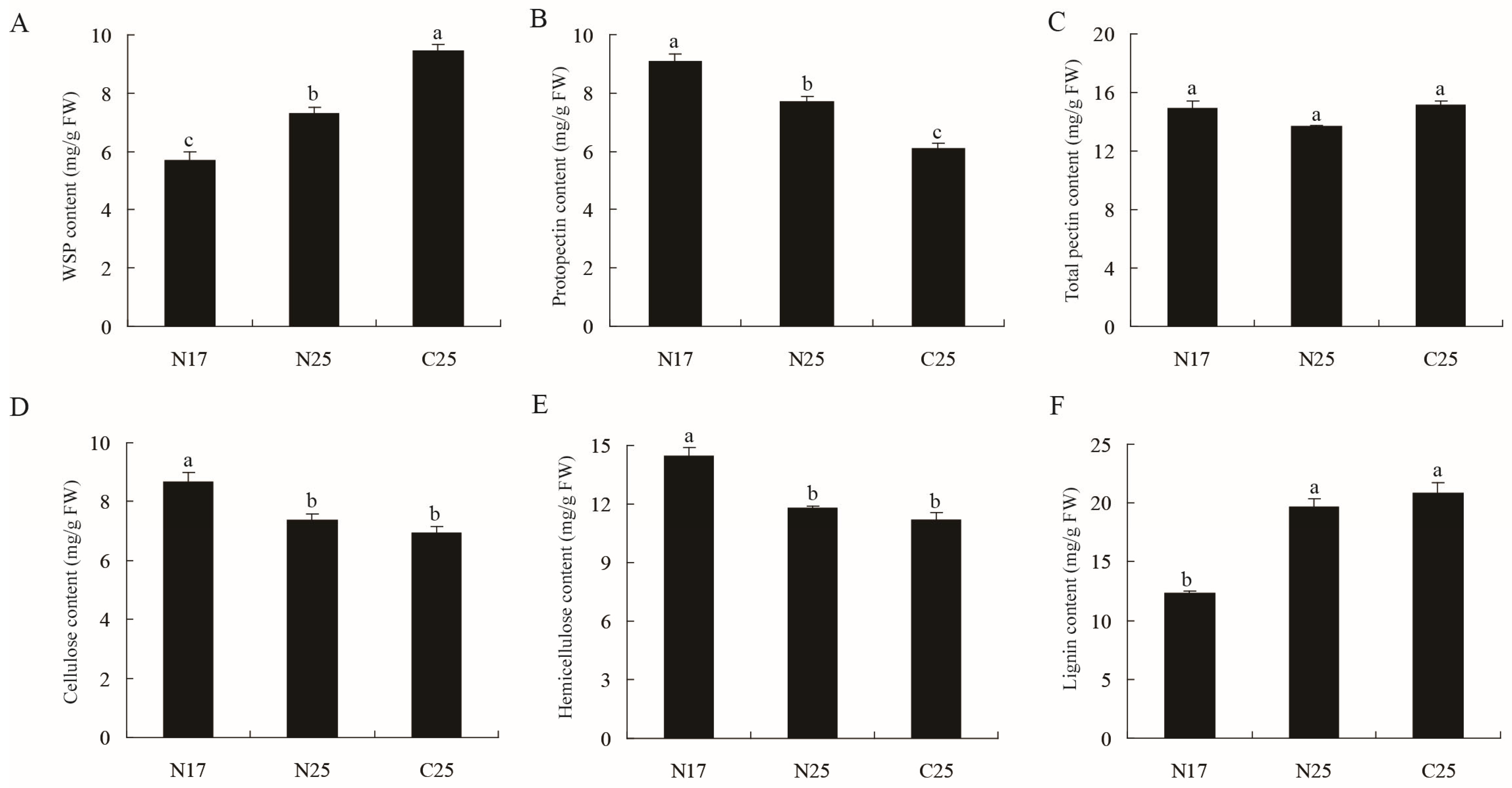
Cell wall components were analyzed in the non-cracked peel of the crack-resistant cultivar (N17) and the non-cracked (N25) and cracked peels (C25) of the crack-susceptible cultivar during the AFE stage. The WSP content was increased progressively in N17, N25, and C25 (Figure 2A), and C25 had 66% and 29% higher WSP content than N17 and N25, respectively. Conversely, protopectin content decreased progressively across N17, N25, and C25 (Figure 2B), with N17 containing 15% and 33% lower protopectin compared to N25 and C25, respectively. However, no notable variations in total pectin content were identified among the three types of peels (Figure 2C), which may be attributed to the complementary changes in WSP and protopectin contents (i.e., the increase in WSP was offset by the decrease in protopectin). Additionally, the cellulose and hemicellulose contents in the peel of the crack-resistant cultivar were markedly higher than those in the crack-susceptible cultivar, while no significant differences were detected between cracked and non-cracked peels in the crack-susceptible cultivar for these components (Figure 2D,E). The lignin content exhibited statistically significant variation among the three peel types (N17, N25, and C25), with the peel of the crack-resistant cultivar (N17) displaying statistically significantly lower lignin content compared to both the non-cracked (N25) and cracked (C25) peels of the crack-susceptible cultivar. Similarly, no notable variations in lignin content were observed between cracked and non-cracked peels of the crack-susceptible cultivar (Figure 2F).

3.4. Analysis of Enzyme Activities in Fruit Peels

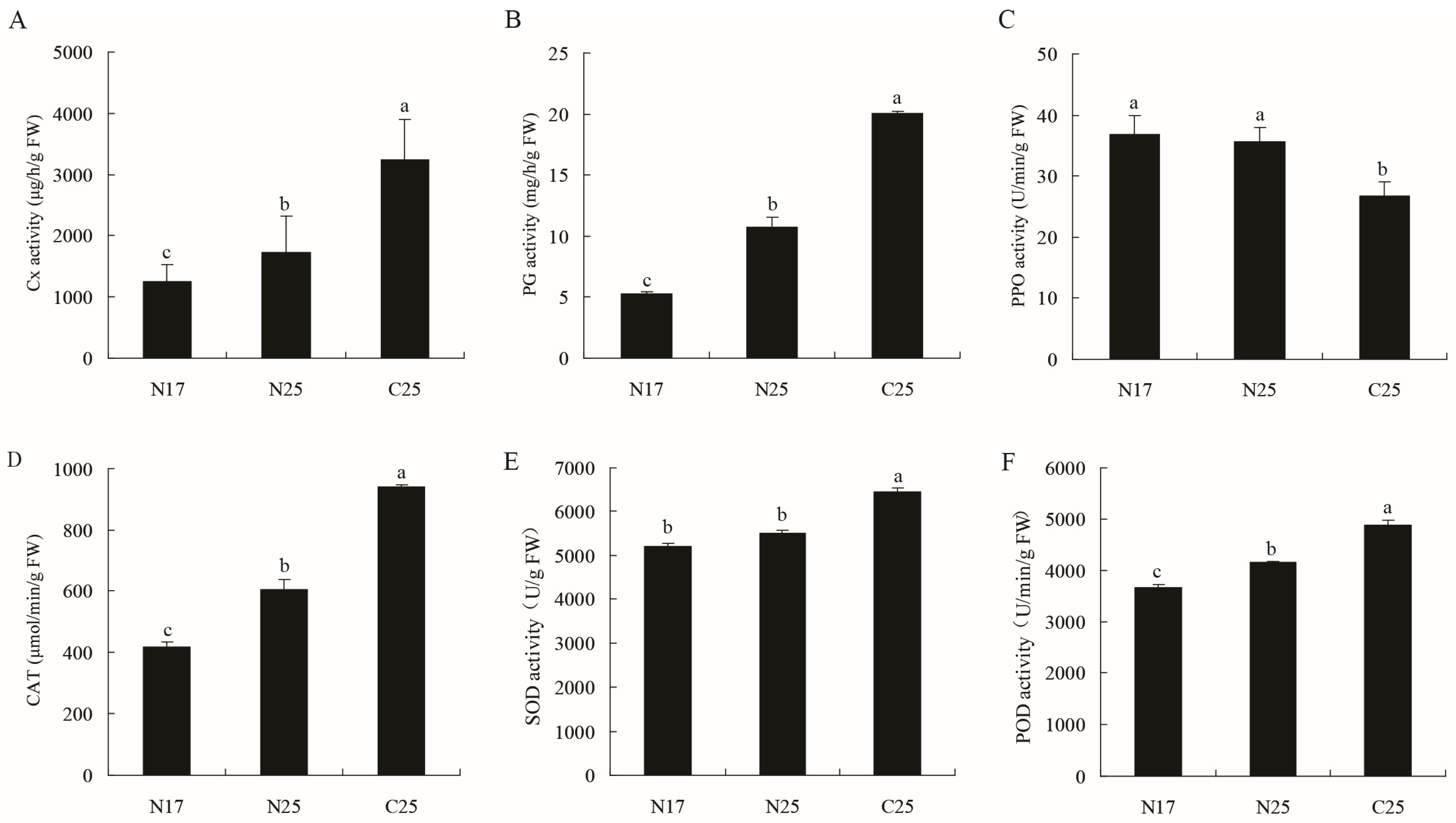
All enzyme activities were higher in cracked peels than in non-cracked peels, except for PPO activity (Figure 3). Specifically, Cx activity in C25 was 160% greater than N17 and 88% higher than N25, and N25 had 38% higher Cx activity than N17 (Figure 3A). Similarly, PG activity in C25 was 279% greater than N17 and 87% higher than N25, with N25 exhibiting 103% greater PG activity than N17 (Figure 3B). Additionally, no significant difference in PPO activity was detected between N17 and N25. However, both were markedly greater than that observed in C25 (Figure 3C). The CAT activity in C25 was 126% greater than that in N17 and 56% higher than that in N25. In comparison, N25 exhibited 45% greater CAT activity compared to N17 (Figure 3D). Similarly, no notable variations in SOD activity were identified between N17 and N25. Still, both were markedly lower than that in C25, with C25 showing 24% and 17% greater SOD activity compared to N17 and N25, respectively (Figure 3E). The POD activity in C25 was 33% higher than that in N17 and 18% greater than that in N25, whereas N25 exhibited 14% higher POD activity than N17 (Figure 3F).

3.5. Metabolomic Analysis of Various Types of Fruit Peels

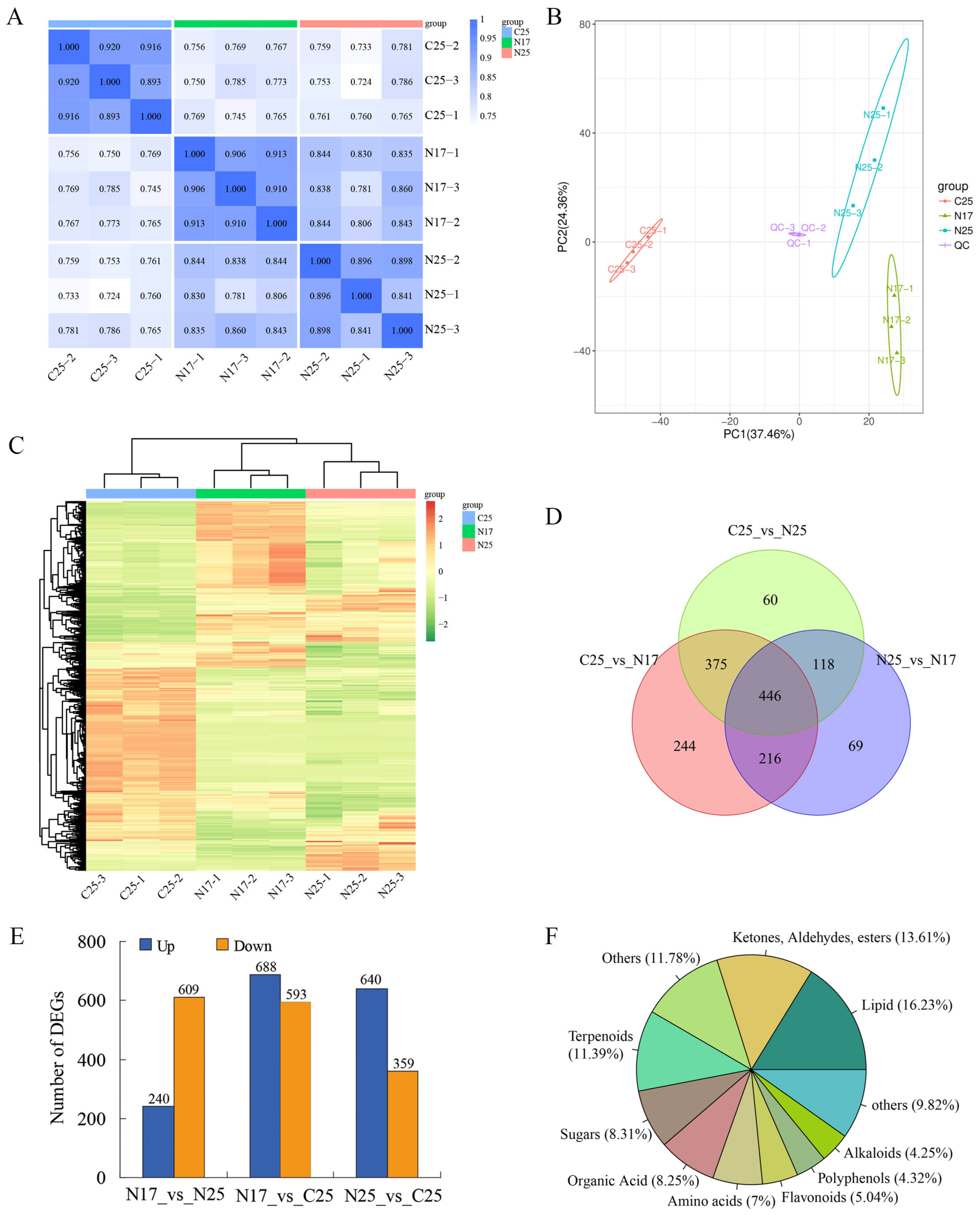
To investigate the differences in secondary metabolites present in the peels of various melon varieties, a widely targeted metabolomic analysis was performed on the peels of N17, N25, and C25. The results demonstrated that the Spearman Rank Correlation coefficients among samples within each of the three experimental groups (N17, N25, and C25) were consistently higher than those between different groups (Figure 4A). This pattern indicates that samples within the same group have highly consistent metabolic profiles. At the same time, distinct differences exist between groups—supporting the reliability of the identified differential metabolites. Moreover, the correlation coefficients within each group approached 1, indicating strong reproducibility of the experimental samples (i.e., minimal technical variation between biological/technical replicates). Principal component analysis (PCA) revealed that PC1 accounted for 37.46% of the variance and PC2 explained 24.36%, highlighting substantial overall metabolic variation among the samples while showing minimal variation within groups (Figure 4B). A total of 2469 metabolites were detected across all samples (Figure S2), and 1528 significantly differential metabolites (SDMs) were identified (Figure 4C) using screening criteria: |fold change| ≥ 1, p < 0.05, VIP ≥ 1. Among these, 849, 1281, and 999 SDMs were found in the comparisons of N17_vs_N25, N17_vs_C25, and N25_vs_C25, respectively (Figure 4D). Specifically, when comparing N25 to N17, 240 SDMs were upregulated and 609 were downregulated; when comparing C25 to N17, 688 SDMs were upregulated and 593 were downregulated; and when comparing C25 to N25, 640 SDMs were upregulated and 359 were downregulated (Figure 4E). These SDMs primarily comprised 248 lipids (16.23%), 208 ketones/aldehydes/esters (13.61%), 174 terpenoids (11.39%), 127 sugars (8.31%), 126 organic acids (8.25%), and 107 amino acids (7%) (Figure 4F).
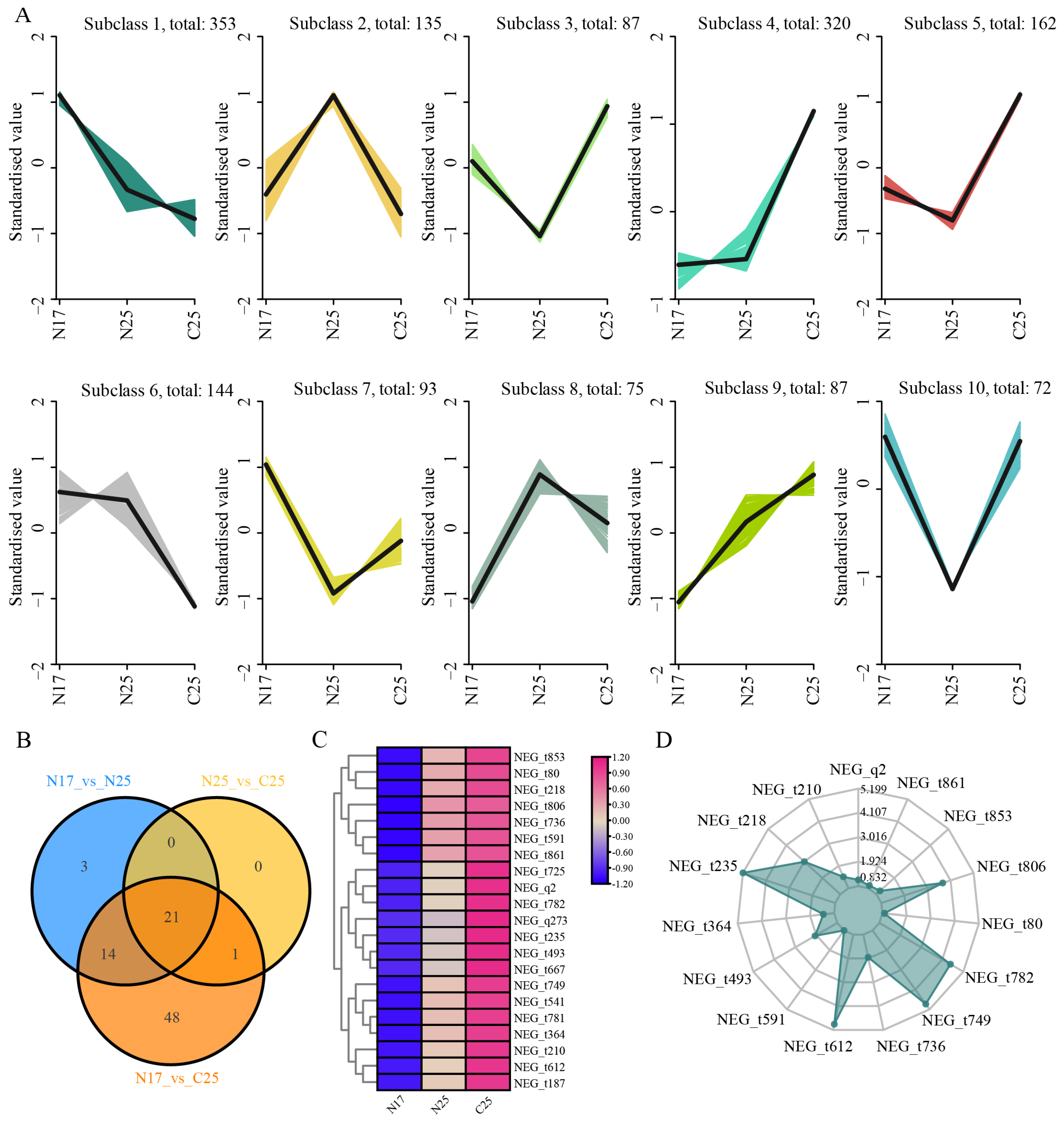
K-means clustering analysis was performed on the SDMs, which were categorized into 10 distinct subclasses (1–10) based on their variation patterns (Figure 5A). Notably, Subclass 9 contained a total of 87 SDMs that exhibited a consistent increasing trend in N17, N25, and C25, with enhanced accumulation observed in cracked peels. Furthermore, 38, 84, and 22 SDMs were identified in Subclass 9 in the N17_vs_N25, N17_vs_C25, and N25_vs_C25 comparisons, respectively (Table S2), among which 21 SDMs were common to all three groups (Figure 5B), showing significantly higher accumulation levels in C25 compared to N17 and N25 (Figure 5C). A detailed analysis of these 21 SDMs revealed that the top five upregulated metabolites in the N17_vs_C25 group were NEG_t235 [Methyl 1,4-bisglucosyloxy-3-prenyl-2-naphthoate, a naphthoate derivative; increased by 36.73-fold in C25], NEG_t612 [Rubia akane RA-XIV, an anthraquinone glycoside; increased by 30.59-fold in C25], NEG_t749 [taxagifine III, a taxane diterpenoid; increased by 29.97-fold in C25], NEG_t782 [Clemomandshuricoside B, a triterpenoid glycoside; increased by 23.11-fold in C25], and NEG_t806 [5-Demethylsimmondsin 2′-trans-ferulate, a ferulic acid derivative; increased by 13.32-fold in C25] (Table S2 and Figure 5D). These 21 SDMs also displayed significant differential expression in both the N17_vs_C25 and N25_vs_C25 comparisons (Figure S3A,B). Functional classification indicated that these SDMs were primarily assigned to lipids (23.81%), ketones, aldehydes, and esters (14.29%), terpenoids (14.29%), organic acids (9.52%), amino acids (9.52%), and phenylpropanoids (9.52%) (Figure S3C). Collectively, these findings suggest that the biosynthesis of phenylpropanoids may be associated with melon peel cracking.

3.6. Transcriptome Sequencing and Differentially Expressed Genes Analysis

To achieve a comprehensive understanding of gene expression levels in cracked and non-cracked peels, the Illumina HiSeq high-throughput sequencing platform was utilized to sequence peel samples collected during the AFE stage. Following cDNA sequencing of the nine samples, 42,264,438–56,098,604 raw reads were obtained per sample (Table S3). After filtering out poor-quality reads, the clean read counts ranged from 40,409,976 to 53,444,276, with each sample yielding at least 6.06 Gb of effective data. The Q20 base percentage (bases with a Phred quality score > 20) ranged from 98.42% to 98.56%, and the Q30 base percentage (bases with a Phred quality score > 30) varied from 95.15% to 95.52%. The GC content ranged from 43.73% to 44.42%, with an overall sequencing error rate of 0.02%. These results demonstrated that the constructed cDNA libraries for transcriptome sequencing were of high quality and met the criteria for downstream analysis. Clean reads from N17, N25, and C25 peels were mapped to the melon genome, with mapping rates ranging from 94.82% to 96.04% (Table S3), confirming the reliability of the transcriptome sequencing data.
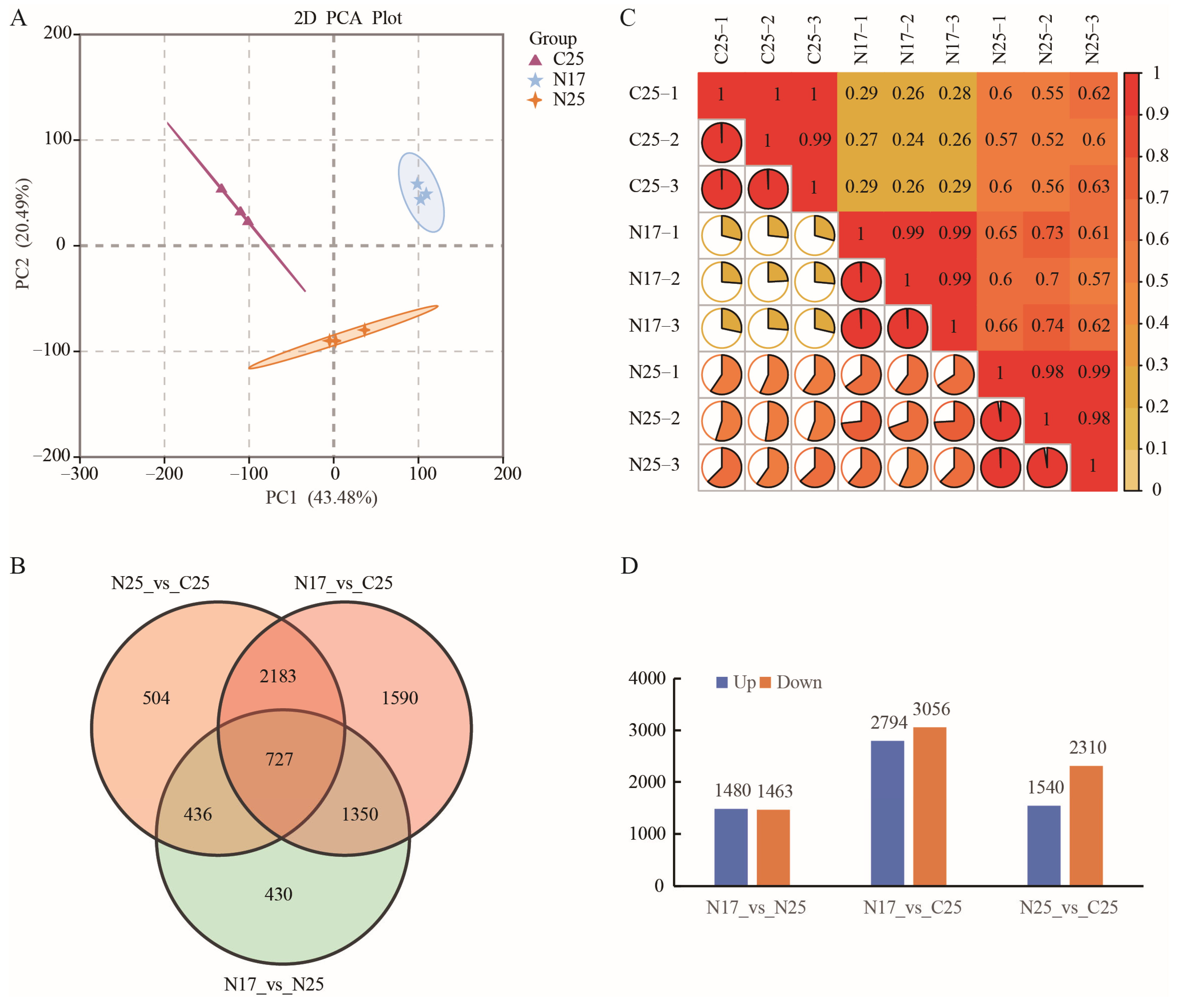
PCA revealed significant differences between groups, with high reproducibility among samples (Figure 6A). Correlation analysis of DEGs showed that intra-group R2 values ranged from 0.98 to 1.00 (Figure 6B), indicating strong correlations among replicate samples. The Venn diagram identified 727 common DEGs (genes) that were enriched across the three groups (Figure 6C). In the N17_vs_N25 group, 2943 DEGs (genes) were identified, including 1480 upregulated differentially expressed genes (UDEGs, genes) and 1463 downregulated differentially expressed genes (DDEGs, genes) in N17. In the N17_vs_C25 group, 5850 DEGs (genes) were identified, comprising 2794 UDEGs (genes) and 3056 DDEGs (genes) in N17. In the N25_vs_C25 group, 3850 DEGs (genes) were identified, including 1540 UDEGs (genes) and 2310 DDEGs (genes) in N25 (Figure 6D). These results indicated that DEG counts in the N17_vs_C25 group were substantially greater than in the other two groups.

3.7. GO and KEGG Enrichment Analysis of DEGs

To comprehensively investigate the biological functions and enrichment patterns of DEGs, annotations were performed using the GO and KEGG databases. GO functional enrichment was categorized into three domains: biological process (BP), cellular component (CC), and molecular function (MF) (Figures S4–S6). After conducting GO enrichment analysis on DEGs, the top 50 GO terms with the lowest q-values (indicating the highest enrichment significance) were chosen for detailed analysis. The results revealed that a greater number of DEGs were associated with cell wall synthesis-related terms. In BP, phenylpropanoid-associated processes, including the phenylpropanoid biosynthetic process and phenylpropanoid metabolic process, were enriched across all groups. Additionally, the term “response to chitin” was enriched in the N17_vs_N25 comparison group (Figure S4), while the terms “cell wall organization”, “lignin biosynthetic process”, “lignin metabolic process”, and “pectin catabolic process” were enriched in N17_vs_C25 (Figure S5). In N25_vs_C25, enrichment was observed for the terms “cell wall macromolecule catabolic process”, “cell wall organization”, “lignin biosynthetic process”, “lignin metabolic process”, and “response to chitin” (Figure S6). In CC, the term “plant-type cell wall” was enriched in both N17_vs_N25 and N25_vs_C25 comparison groups (Figures S4 and S6). For MF, the terms “glucosyltransferase activity”, “quercetin 3-O-glucosyltransferase activity”, “quercetin 7-O-glucosyltransferase activity”, and “UDP-glucosyltransferase activity” were enriched in N17_vs_N25 (Figure S4). In N17_vs_C25, enrichment was found for “glucosyltransferase activity”, “glutathione transferase activity”, “quercetin 3-O-glucosyltransferase activity”, and “xyloglucan: xyloglucosyl transferase activity” (Figure S5). The term “glutathione transferase activity” was specifically enriched in N25_vs_C25 (Figure S6).
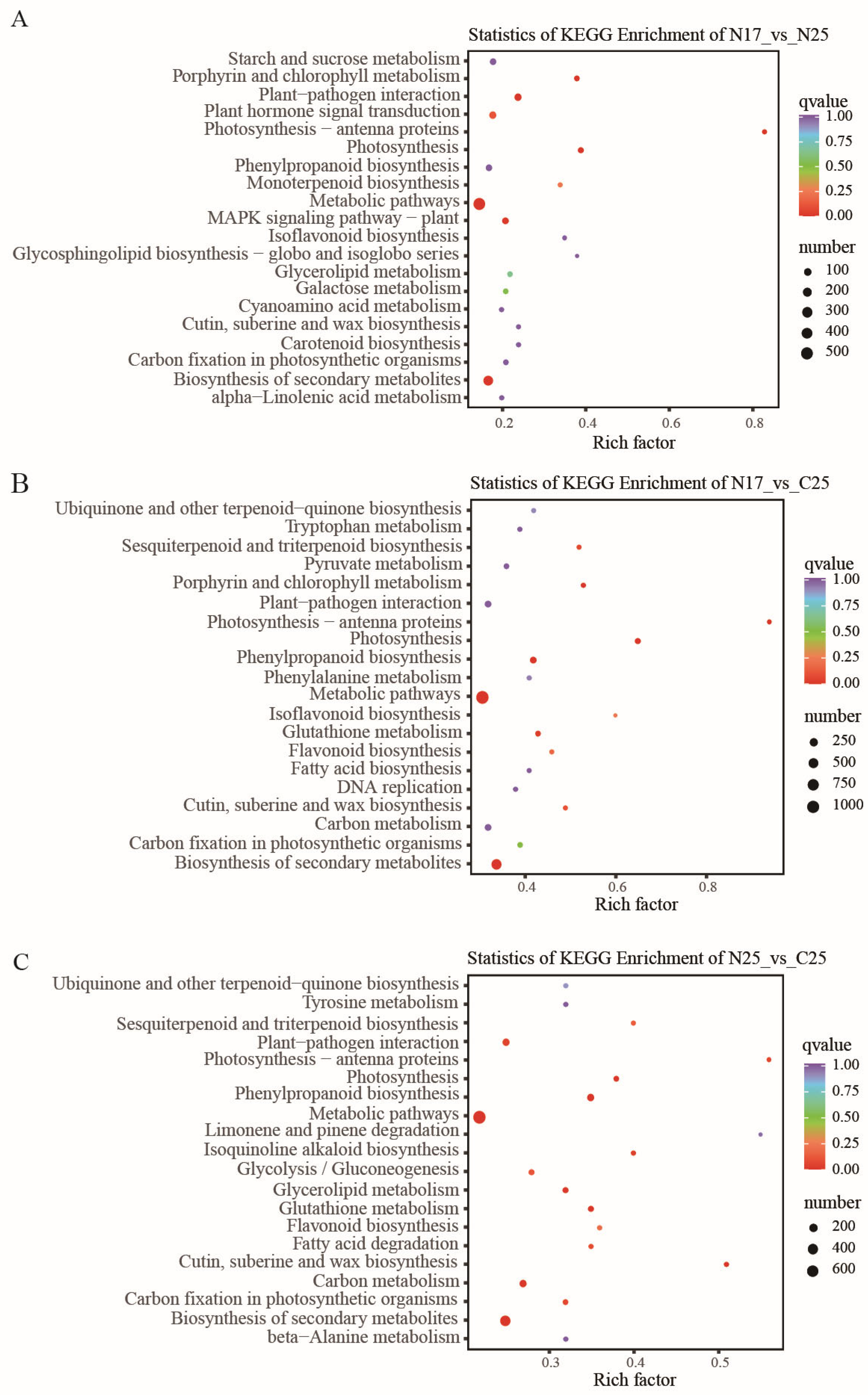
KEGG functional enrichment analysis was conducted on the DEGs to identify associated pathways. Among the top 20 KEGG pathways enriched in DEGs of the N17_vs_N25 group, the most prominent included metabolic pathways, biosynthesis of secondary metabolites, porphyrin and chlorophyll metabolism, plant–pathogen interaction, plant hormone signal transduction, and Photosynthesis (Figure 7A). In the N17_vs_C25 group, DEGs were markedly enriched in KEGG pathways such as metabolic pathways, biosynthesis of secondary metabolites, photosynthesis, phenylpropanoid biosynthesis, cutin, suberin and wax biosynthesis, glutathione metabolism (Figure 7B). Similarly, DEGs in the N25_vs_C25 group exhibited significant enrichment in metabolic pathways, biosynthesis of secondary metabolites, plant–pathogen interaction, photosynthesis, phenylpropanoid biosynthesis, cutin, suberine and wax biosynthesis, carbon metabolism, and carbon fixation in photosynthetic organisms pathways (Figure 7C). Across all three comparisons—N17_vs_N25, N17_vs_C25, and N25_vs_C25—the DEGs were consistently enriched in metabolic pathways, biosynthesis of secondary metabolites, photosynthesis, phenylpropanoid biosynthesis, and cutin, suberine and wax biosynthesis pathways. These findings suggest that genes involved in these pathways may play a crucial role in the cracking of melon peel.

3.8. Expression Analysis of Cell Wall-Related Genes

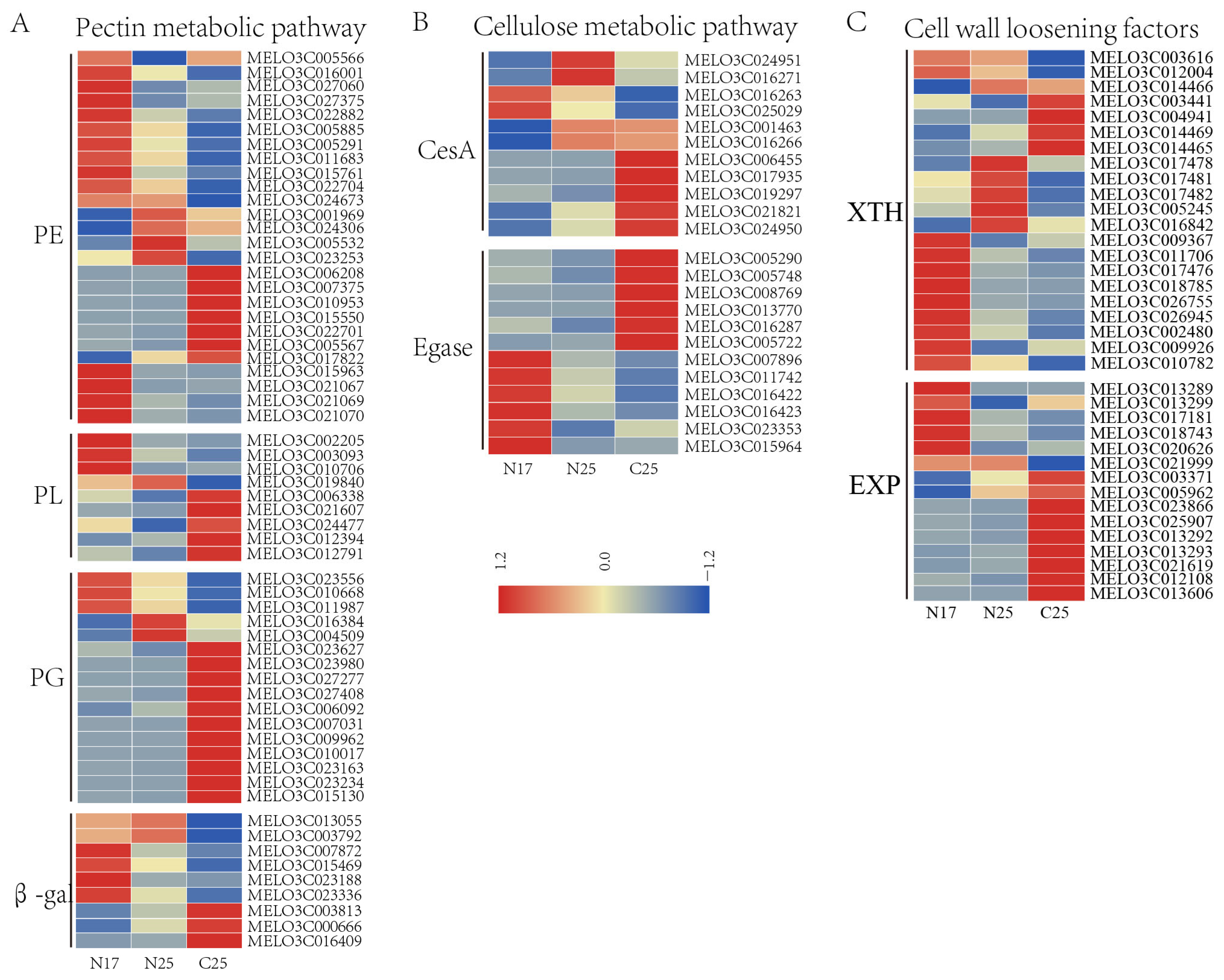
As major components of cell walls, cellulose, hemicellulose, and pectin exhibit significant variation in content across melon peels with differing cracking resistance (Figure 2A,B,D,E). To investigate the underlying causes of these differences, RNA-seq data were used to identify DEGs implicated in these pathways. A total of 119 genes linked to cellulose and pectin metabolism, as well as cell wall loosening factors, were identified (Figure 8). Four categories of genes were associated with pectin metabolism: pectin esterase (PE) genes (n = 26), pectin lyase (PL) genes (n = 9), polygalacturonase (PG) genes (n = 16), and β-galactosidase (β-gal) genes (n = 9). Among these, 15 PE, 3 PL, 3 PG, and 4 β-gal genes showed significantly higher expression in N17 peel than in N25 and C25 peel. Conversely, 7 PE, 5 PL, 11 PG, and 3 β-gal genes showed markedly higher expression levels in C25 peel than in N17 and N25 (Figure 8A and Table S4). These results suggest that pectin degradation may be closely related to melon peel cracking. In the cellulose metabolism pathway, 11 cellulose synthase (CesA) genes and 12 endoglucanase (Egase) genes were enriched. Among them, two CesA genes (MELO3C016263 and MELO3C025029) exhibited markedly higher expression in N17 compared to C25, while six Egase genes (MELO3C005290, MELO3C005748, MELO3C008769, MELO3C013770, MELO3C016287, and MELO3C005722) showed markedly higher expression in C25 compared to both N17 and N25 (Figure 8B and Table S4). Additionally, two types of cell wall loosening factors were identified: EXP and XTH genes. These genes encode enzymes involved in cell wall hydrolysis or modification, with 36 exhibiting differential expression across the various types of peels (Figure 8C and Table S4). These observations indicate that genes associated with cell wall metabolism may play a pivotal role in regulating melon fruit cracking.

3.9. Expression Analysis of DEGs Implicated in Lignin Biosynthesis

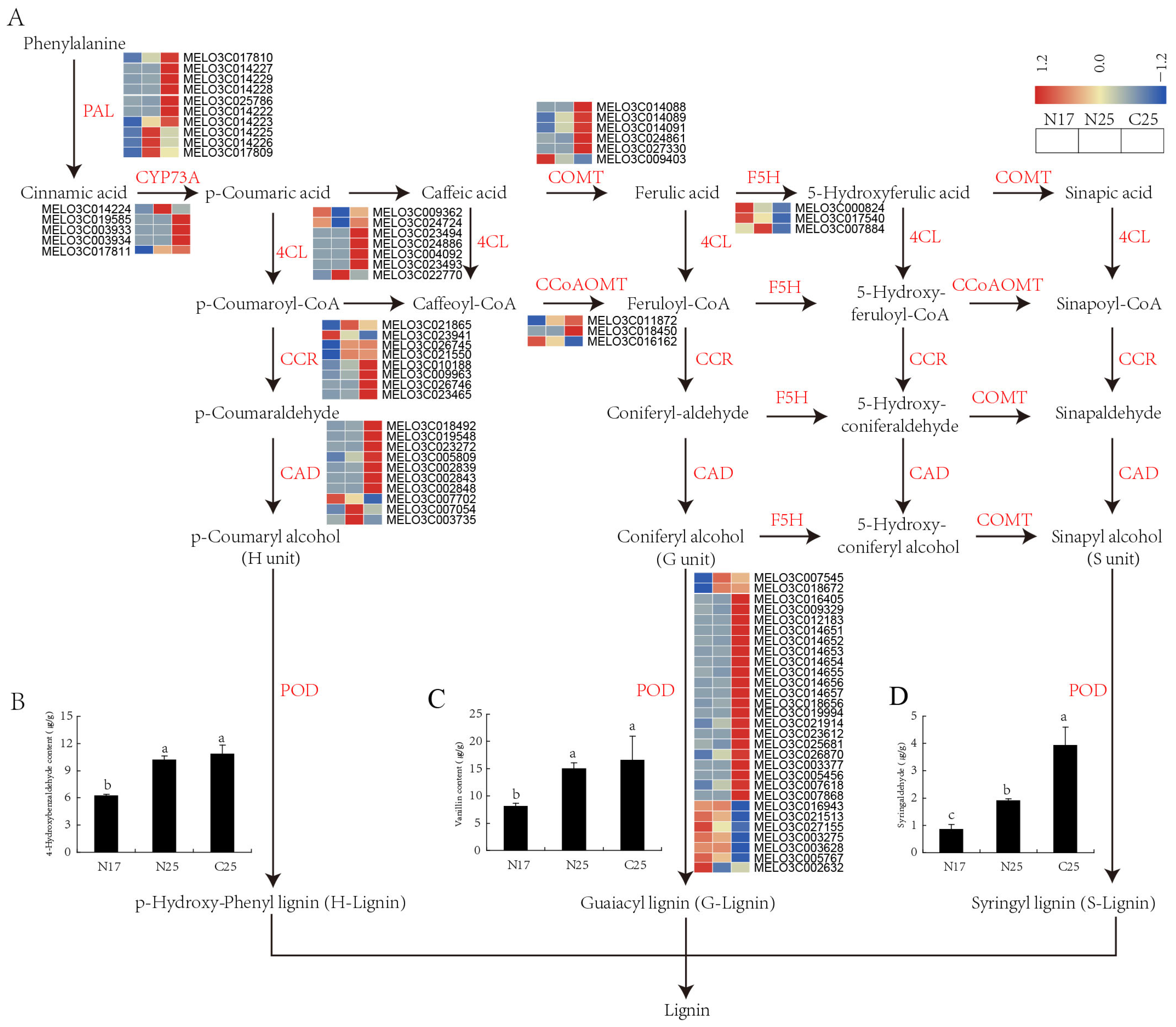
GO and KEGG enrichment analyses demonstrated that DEGs in all three groups were enriched in the phenylpropanoid biosynthesis pathway (Figure 6, Figure 7, Figure S4 and Figure S5). Analysis of cell wall components revealed significant variations in lignin content between the peels of crack-susceptible and crack-resistant cultivars (Figure 2). Metabolomics analysis also revealed that the phenylpropanoid biosynthesis pathway is involved in fruit peel cracking (Figure 5). Subsequently, a detailed analysis of the potential involvement of the lignin biosynthesis pathway in melon peel cracking was conducted. Transcriptome data analysis identified 82 DEGs enriched in the lignin biosynthesis pathway (Table S5), including 10 phenylalanine ammonia-lyase (PAL) genes, 5 trans-cinnamate 4-monooxygenase (CYP73A) genes, 7 4-coumarate CoA ligase (4CL) genes, 8 cinnamoyl CoA reductase (CCR) genes, 6 caffeate 3-O-methyltransferase (COMT) genes, 3 caffeoyl-CoA O-methyltransferase (CCoAOMT) genes, 3 ferulate 5-hydroxylase (F5H) genes, 10 cinnamyl alcohol dehydrogenase (CAD) genes, and 30 POD genes (Figure 9A). Among these, 56 genes (68%) displayed markedly higher expression levels in C25 compared to N17 and N25, including 7 PAL, 4 CYP73A, 4 4CL, 5 COMT, 2 CCoAOMT, 4 CCR, 7 CAD, and 23 POD genes.
In this study, the levels of 4-hydroxybenzaldehyde, vanillin, and syringaldehyde were quantified as surrogate markers for their corresponding lignin monomers (p-coumaryl alcohol, coniferyl alcohol, and sinapyl alcohol), as these aldehydes are well documented as the characteristic oxidative degradation products of the respective lignin monomers. The findings revealed that the 4-hydroxybenzaldehyde content increased by 64% in N25 and 74% in C25 compared to N17 (Figure 9B). Similarly, vanillin levels rose by 85% in N25 and 105% in C25 relative to N17 (Figure 9C). Syringaldehyde levels showed a more pronounced increase, rising by 125% in N25 and 366% in C25 compared to N17 (Figure 9D). These observations suggest that there is a correlation between lignin content and the cracking resistance observed in melon.

3.10. RT-qPCR Validation of RNA-seq Data

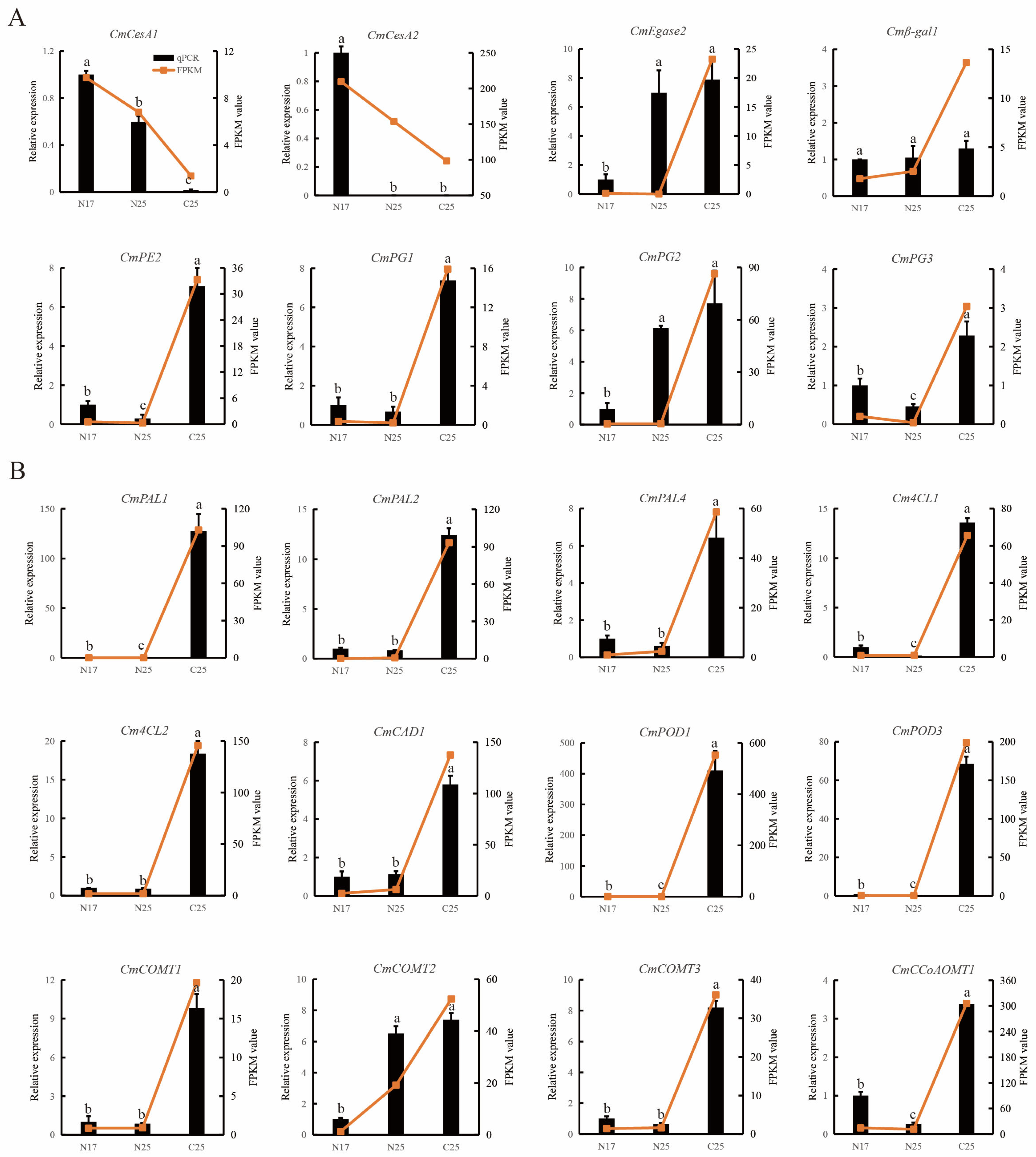
To validate the accuracy of the transcriptomic findings, eight cell wall metabolism-related genes and 12 lignin biosynthesis pathway-related genes were selected for RT-qPCR analysis (Figure 10A,B; detailed gene information is provided in the figure legend). The RT-qPCR results indicated that the expression patterns of these genes were largely consistent with the transcriptome data (Figure 10), validating the reliability of the transcriptome analysis.

4. Discussion

The developmental state of the fruit peel is directly linked to the occurrence of fruit cracking. During cell expansion, partial cell wall degradation occurs, while new cell wall components are synthesized simultaneously to accommodate the expanding wall area. The mechanical properties of cell walls are critical in regulating cell growth and growth rate [30]. Numerous studies have demonstrated the involvement of cell wall structure and cuticles in fruit cracking [31,32,33]. As an essential component of the fruit peel, the cuticle serves a pivotal function in the mechanism of fruit cracking due to its structure and function [34,35]. Research has indicated that fruit cracking in susceptible pepper varieties results from cuticle stretching [36]. Similarly, in the crack-susceptible litchi cultivar ‘Baitangying’, changes in cuticle structure caused by unsaturated fatty acid oxidation have been identified as the primary cause of peel cracking [19]. Cracking resistance in resistant and susceptible sweet cherry cultivars has been associated with cuticle deposition during early fruit development [37]. Observations of peel structure in crack-resistant and crack-susceptible tomato cultivars have revealed that resistant cultivars possess thicker cuticle and subcutaneous layers [5]. In this study, crack-resistant melon cultivars exhibited thicker cuticles and densely and orderly arranged parenchyma cells, whereas susceptible cultivars displayed loosely and irregularly arranged peel cells (Figure 1). These findings suggest that differences in peel cell structure are associated with the cracking resistance of melon peel.
Pectin, recognized as the most complex polysaccharide in plant cell walls, primarily exists as protopectin, which contributes to cell wall strength [38]. Research indicates that crack-resistant tomato fruits typically exhibit higher protopectin levels, whereas crack-susceptible fruits contain more WSP. During tomato fruit ripening and softening, protopectin is degraded, accompanied by an increase in WSP levels [23]. Analysis of pectin content in melon peels revealed markedly higher WSP levels in crack-susceptible varieties (Figure 2A) and lower protopectin levels (Figure 2B) compared to crack-resistant varieties. PG hydrolyzes polygalacturonic acid chains in pectin, thereby facilitating the conversion of protopectin to WSP. Both this hydrolysis and subsequent protopectin-to-WSP conversion contribute to primary cell wall relaxation and promote flower and fruit abscission in fruit trees [39]. Pectin enzymes, including ADPG and ADPG2, have been identified as critical factors in pod dehiscence in Arabidopsis [40]. In apples, ZMdPG1 levels markedly increase during fruit ripening, accelerating cell wall degradation, reducing intercellular adhesion, and leading to cell separation, softening, and eventual fruit cracking [41]. RNA-seq and RT-qPCR analysis indicated that most PG genes were markedly upregulated in C25 compared to N17 (Figure 8A and Figure 10A). This heightened PG gene expression may enhance PG enzyme activity (Figure 3B); as PG hydrolyzes protopectin to generate WSP, this in turn increases WSP content in C25 (Figure 2A). The elevated WSP content reduces the mechanical strength of the peel cell wall, thereby contributing to C25’s higher susceptibility to cracking.
Cx and PG are recognized as two key degrading enzymes in plant cell walls [42]. Huang et al. [43] observed that during fruit development, the cracking-susceptible ‘Nuomici’ litchi exhibited higher Cx activity and reduced cellulose content in the cell wall compared to the cracking-resistant ‘Huaizhi’. This difference was considered a primary factor contributing to the low mechanical strength of ‘Nuomici’ peel. Yang et al. [5] reported lower activities of cell wall-degrading enzymes, encompassing PG and Cx, in cracking-resistant tomatoes compared to their cracking-susceptible counterparts. These reduced enzyme activities were suggested to help preserve cell wall integrity. In Arabidopsis pods, Cx CEL6 and hemicellulose MAN7 were found to influence cell differentiation and promote pod dehiscence [44]. In severely cracked pepper fruits, higher WSP content was detected compared to non-cracked fruits, with Cx and PG activities increasing progressively during fruit cracking [36]. In this study, markedly elevated activities of Cx and PG were detected in the cracked peel of susceptible cultivars compared to both the non-cracked peel of susceptible cultivars and resistant cultivars (Figure 3A,B), resulting in higher cellulose and hemicellulose contents in the peel of resistant cultivars (Figure 2D,E). Liu et al. [36] further investigated gene expression at different stages of pepper fruit cracking, revealing that cellulose synthase genes were markedly downregulated during the transition from non-cracked to cracked peel. Genes related to pectin degradation, such as pectin methylesterase (PME), pectatelyase (PEL), and PG, were upregulated, suggesting these genes collectively regulate pectin degradation, accelerating cell wall breakdown and promoting fruit cracking. Transcriptome analysis of cracked and non-cracked melon peel identified differential expression in CesA and Egase genes (cellulose metabolism pathway) as well as PE, PL, PG, and β-Gal genes (pectin metabolism pathway) (Figure 8A,B and Figure 10A). These findings suggest that genes involved in these two cell wall metabolism pathways collectively regulate the cracking resistance of melon.
EXP and XET are recognized as key regulators of cell wall stress relaxation. EXP influences fruit softening and cracking by modulating hydrogen bonds between cell wall polymers, encompassing hemicellulose and cellulose microfibrils [45,46,47]. XTH exhibits both XET and xyloglucan endohydrolase activities [48], with XET catalyzing xyloglucan transglycosylation, thereby contributing to cell wall relaxation [49]. Suppression of LeExp1 expression extended tomato shelf life from 17 to 21 days, as demonstrated by Brummell et al. [50], highlighting its role in fruit softening. Differential accumulation of LcXET1 in peel and flesh tissues of cracking-susceptible ‘Nuomici’ and cracking-resistant ‘Huaizhi’ varieties was closely linked to fruit cracking, as reported by Lu et al. [51]. Similarly, MdEXPA3 was identified as a factor influencing apple fruit cracking [52]. Moreover, the expression of LcExp1 and LcExp2 genes in litchi peel was found to correlate with fruit growth and cracking [53]. Recent studies have indicated that CmEXPB1 in melon may serve a pivotal function in fruit cracking resistance [13]. In the present study, XTH and EXP genes with markedly varying expression levels across different peel types were identified (Figure 8C), suggesting their potential as key targets for investigating melon cracking resistance.
In higher plants, lignin content ranks second only to cellulose, and its deposition in cell walls results in lignification, which inhibits cell elongation and restricts wall extensibility, thereby influencing fruit cracking [54]. By occupying spaces between cell wall polysaccharides, lignin enhances plant rigidity, protecting against pathogen attacks and mechanical stress [55]. Consistent with this, a study on pepper showed that lignin content increases in the cracking-susceptible cultivar ‘L92’ during fruit cracking, with severely cracked fruits having markedly higher lignin levels than non-cracked ones [24]. This suggests a potential link between elevated lignin content and pepper fruit cracking. In this study, metabolic profiling analysis revealed that metabolites involved in the phenylpropanoid biosynthesis pathway exhibited higher accumulation levels in cracked peels compared to those in uncracked peels (Figure 5). Moreover, markedly higher lignin content was observed in the peel of cracking-susceptible cultivars compared to cracking-resistant ones (Figure 2F). Analysis of DEGs in the lignin synthesis pathway revealed that most genes involved in lignin biosynthesis were markedly upregulated in C25 compared to N25 and N17 (Figure 9 and Table S4). Notable, key genes such as CmPAL1, CmPOD1, and CmPOD3 showed elevated expression (Figure 10B). This upregulation led to increased levels of lignin monomers (4-hydroxybenzaldehyde, vanillin, and syringaldehyde) in C25 (Figure 9), ultimately resulting in significantly higher lignin content in the cracked fruit peel of susceptible cultivars (C25) than in the resistant one (N17) (Figure 2F). These findings suggest that the upregulation of lignin biosynthesis genes contributes to lignin deposition in cell walls, thereby reducing cell wall extensibility and regulating peel cracking in melon [24].
Excessive accumulation of harmful substances has been associated with fruit cracking, and antioxidants play a pivotal role in mitigating these effects [56]. As a cell wall oxidoreductase, POD eliminates reactive oxygen species (ROS) and catalyzes the formation of phenolic crosslinks between cell wall structural components, leading to cell wall hardening and reduced elongation [57]. Previous studies have reported markedly higher POD activity in cracking-susceptible litchi cultivars than in resistant ones [58], whereas in pepper, higher POD activity was observed in non-cracked fruits than in cracked ones [36]. In this study, markedly elevated POD activity was detected in C25 compared to N25 and N17 (Figure 3F). This result corroborates earlier findings that POD activity is closely associated with lignin biosynthesis and fruit cracking susceptibility. Moreover, POD is implicated in the final step of lignin monomer synthesis, and RNA-seq analysis revealed significant upregulation of most POD genes in C25 relative to N25 and N17 (Figure 9), consistent with its higher enzyme activity in C25. These results suggest that POD may inhibit cell wall elongation through phenolic crosslinking, thereby reducing peel extensibility and mechanical properties [59]. SOD serves a pivotal function in eliminating ROS generated during the aging processes of cells, tissues, or organs, thereby protecting cell membranes, maintaining cellular metabolic balance, and ensuring normal physiological functions of cells [60]. CAT partially mitigates H2O2-induced oxidative tissue damage [61]. In this study, activities of both SOD and CAT were found to be higher in the cracked peel of susceptible cultivars compared to the non-cracked peel of resistant cultivars (Figure 3D,E), suggesting that cellular CAT and SOD activities increase during fruit cracking to counteract ROS-induced oxidative damage [62]. Conversely, PPO activity was markedly lower in the cracked peel of susceptible cultivars than in the non-cracked peel (Figure 3F), in agreement with previous research [63]. However, additional studies are required to explore the link between fruit peel cracking and PPO activity.
While this study elucidates the mechanisms of melon peel cracking through integrated morphological, physiological, metabolomic, and transcriptomic analyses, it also presents several limitations. The research is confined to two cultivars of netted melon, which restricts the generalizability of the conclusions to other horticultural groups of melons that exhibit distinct peel characteristics. Furthermore, the findings are based on correlative links between genes/metabolites and phenotypes, lacking functional validation (e.g., through CRISPR/Cas9 or VIGS) to confirm the causal roles of key candidates.

5. Conclusions

In this study, the peel structure was identified as a critical factor influencing melon cracking resistance. In crack-resistant cultivars, epidermal cells had thicker cuticles, and parenchyma cells were densely and orderly arranged. The expression of genes encoding pectin-degrading enzymes facilitated the synthesis of pectinases, resulting in diminished protopectin content and elevated WSP levels. Simultaneously, downregulation of cellulose synthesis genes, coupled with upregulation of cellulase genes, enhanced Cx activity, leading to decreased cellulose and hemicellulose content in the peel. Additionally, the upregulation of genes implicated in lignin biosynthesis elevated lignin production, contributing to its deposition in the cell wall and thereby restricting cell wall extensibility. The combined impact of these factors was determined to contribute to melon cracking. These findings offer valuable genetic resources for breeders seeking to enhance cracking resistance through molecular breeding and provide novel insights to advance the melon industry.

Supplementary Materials

The following supporting information can be downloaded at: https://www.mdpi.com/article/10.3390/agriculture15232475/s1. Figure S1: Fruit peel structure of melon. (A) Structure of exocarp and mesocarp, (B) stomatal structure in exocarp, (C) lenticel structure, (D) netting structure in fruit peel, scale bars = 50 μm. Figure S2: Heatmap analysis of all the metabolites in the tested groups. Figure S3: Information on the commonly identified significantly differential metabolites (SDMs). (A) Radar chart of the common SDMs in the N17_vs_N25 group (A), (B) radar chart of the common SDMs in the N25_vs_C25 group, (C) statistics of the common SDMs. Figure S4: GO enrichment analysis of the differentially expressed genes (DEGs) in the N17_vs_N25 group. Figure S5: GO enrichment analysis of the differentially expressed genes (DEGs) in the N17_vs_C25 group. Figure S6: GO enrichment analysis of the differentially expressed genes (DEGs) in the N25_vs_C25 group. Table S1: Primers used in this study. Table S2: The information of significantly differential metabolites (SDMs) in Subclass 9. Table S3: Transcriptome sequencing data quality and genome alignment. Table S4: The information of differentially expressed genes (DEGs) involved in cell wall metabolism. Table S5: The information of differentially expressed genes (DEGs) involved in lignin biosynthesis.

Author Contributions

Conceptualization, M.W. and Y.Z.; methodology, Y.H., Y.L. and Y.Z.; formal analysis, Y.H., Y.L., T.Z., C.W., B.Z., L.T. and Y.Z.; investigation, Y.H., Y.L. and Y.Z.; writing—original draft preparation, Y.H., Y.L. and Y.Z.; writing—review and editing, Y.Z.; supervision, M.W. and Y.Z.; project administration, Y.H., M.W. and Y.Z.; funding acquisition, Y.H., L.T., M.W. and Y.Z. All authors have read and agreed to the published version of the manuscript.

Funding

This research was funded by the project of Vegetable Research Institute of Hainan Academy of Agricultural Sciences (HAAS2024SJTCSCS21), the Guiding Fund of Watermelon and Melon Innovation Team, the Innovation Platform of Academicians of Hainan Province, the Opening Project Fund of Key Laboratory for Quality Regulation of Tropical Horticultural Crops of Hainan Province (HNZDSYS(24)-01), the National Watermelon and Melon Industry Technology System (CCARS-25-2024-Z22), the Project of Sanya Yazhou Bay Science and Technology City (SCKJ-JYRC-2023-12), and the Opening Project Fund of Key Laboratory of Vegetable Biology of Hainan Province (HAAS2022PT0105).

Data Availability Statement

The original contributions presented in this study are included in the Supplementary Materials. Further inquiries can be directed to the corresponding authors.

Conflicts of Interest

The authors declare no conflicts of interest.

References

  1. Davarpanah, S.; Tehranifar, A.; Davarynejad, G.; Abadia, J.; Khorasani, R. Effects of foliar applications of zinc and boron nano-fertilizers on pomegranate (Punica granatum cv. Ardestani) fruit yield and quality. Sci. Hortic. 2016, 210, 57–64. [Google Scholar] [CrossRef]
  2. Wang, J.G.; Gao, X.M.; Ma, Z.L.; Chen, J.; Liu, Y.N.; Shi, W.Q. Metabolomic and transcriptomic proffling of three types of litchi pericarps reveals that changes in the hormone balance constitute the molecular basis of the fruit cracking susceptibility of Litchi chinensis cv. Baitangying. Mol. Biol. Rep. 2019, 46, 5295–5308. [Google Scholar] [CrossRef] [PubMed]
  3. Schumann, C.; Knoche, M. Swelling of cell walls in mature sweet cherry fruit: Factors and mechanisms. Planta 2020, 251, 65. [Google Scholar] [CrossRef]
  4. Liu, N.W.; Zhao, H.Q.; Hou, L.; Zhang, C.X.; Bo, W.H.; Pang, X.M.; Li, Y.Y. HPLC-MS/MS-based and transcriptome analysis reveal the effects of ABA and MeJA on jujube (Ziziphus jujuba Mill.) cracking. Food Chem. 2023, 421, 136155. [Google Scholar] [CrossRef]
  5. Yang, Z.E.; Wu, Z.; Zhang, C.; Hu, E.M.; Zhou, R.; Jiang, F.L. The composition of pericarp, cell aging, and changes in water absorption in two tomato genotypes: Mechanism, factors, and potential role in fruit cracking. Acta Physiol. Plant. 2016, 38, 215. [Google Scholar] [CrossRef]
  6. Zhang, C.; Guan, L.; Fan, X.C.; Zhang, T.; Dong, T.; Liu, C.; Fang, J. Anatomical characteristics associated with different degrees of berry cracking in grapes. Sci. Hortic. 2020, 261, 108992. [Google Scholar] [CrossRef]
  7. Bargel, H.; Neinhuis, C. Tomato (Lycopersicon esculentum Mill.) fruit growth and ripening as related to the biomechanical properties of fruit skin and isolated cuticle. J. Exp. Bot. 2005, 56, 1049–1060. [Google Scholar] [CrossRef]
  8. Hadjipieri, M.; Georgiadou, E.C.; Drogoudi, P.; Fotopoulos, V.; Manganaris, G.A. The efficacy of acetylsalicylic acid, spermidine and calcium preharvest foliar spray applications on yield efficiency, incidence of physiological disorders and shelflife performance of loquat fruit. Sci. Hortic. 2021, 289, 110439. [Google Scholar] [CrossRef]
  9. Gutierrez, C.; Figueroa, C.R.; Turner, A.; Munne-Bosch, S.; Munoz, P.; Schreiber, L.; Zeisler, V.; Marin, J.C.; Balbontin, C. Abscisic acid applied to sweet cherry at fruit set increases amounts of cell wall and cuticular wax components at the ripe stage. Sci. Hortic. 2021, 283, 110097. [Google Scholar] [CrossRef]
  10. Bruggenwirth, M.; Knoche, M. Mechanical properties of skins of sweet cherry fruit of differing susceptibilities to cracking. J. Am. Soc. Hortic. Sci. 2016, 141, 162–168. [Google Scholar] [CrossRef]
  11. Huang, X.M.; Yuan, W.Q.; Wang, H.C.; Li, J.G.; Huang, H.B.; Shi, L.; Yin, J. Linking cracking resistance and fruit desiccation rate to pericarp structure in litchi (Litchi chinensis Sonn.). J. Hortic. Sci. Biotechnol. 2004, 79, 897–905. [Google Scholar] [CrossRef]
  12. Abu-Goukh, A.B.A.; Bashir, H.A. Changes in pectic enzymes and cellulase activity during guava fruit ripening. Food Chem. 2003, 83, 213–218. [Google Scholar] [CrossRef]
  13. Xue, L.Z.; Sun, M.T.; Wu, Z.; Yu, L.; Yu, Q.H.; Tang, Y.P.; Jiang, F.L. LncRNA regulates tomato fruit cracking by coordinating gene expression via a hormone-redox-cell wall network. BMC Plant Biol. 2020, 20, 162. [Google Scholar] [CrossRef]
  14. Zhang, S.; Ma, M.; Zhang, H.; Zhang, S.; Qian, M.; Zhang, Z.; Luo, W.; Fan, J.; Liu, Z.; Wang, L. Genome-wide analysis of polygalacturonase gene family from pear genome and identification of the member involved in pear softening. BMC Plant Biol. 2019, 19, 587. [Google Scholar] [CrossRef] [PubMed]
  15. Hu, Y.; Li, Y.; Zhu, B.; Huang, W.; Chen, J.; Wang, F.; Chen, Y.; Wang, M.; Lai, H.; Zhou, Y. Genome-wide identification of the expansin gene family in netted melon and their transcriptional responses to fruit peel cracking. Front. Plant Sci. 2024, 15, 1332240. [Google Scholar] [CrossRef] [PubMed]
  16. Kalluri, U.C.; Payyavula, R.S.; Labbé, J.L.; Engle, N.; Bali, G.; Jawdy, S.S.; Sykes, R.W.; Davis, M.; Ragauskas, A.; Tuskan, G.A. Down-regulation of KORRIGAN-like endo-β-1, 4-glucanase genes impacts carbon partitioning, mycorrhizal colonization and biomass production in Populus. Front. Plant Sci. 2016, 7, 1455. [Google Scholar] [CrossRef]
  17. Chen, J.; Duan, Y.; Hu, Y.; Li, W.; Sun, D.; Hu, H.; Xie, J. Transcriptome analysis of atemoya pericarp elucidates the role of polysaccharide metabolism in fruit ripening and cracking after harvest. BMC Plant Biol. 2019, 19, 219. [Google Scholar] [CrossRef]
  18. Li, W.C.; Wu, J.Y.; Zhang, H.N.; Shi, S.Y.; Liu, L.Q.; Shu, B.; Liang, Q.Z.; Xie, J.H.; Wei, Y.Z. De novo assembly and characterization of pericarp transcriptome and identification of candidate genes mediating fruit cracking in Litchi chinensis Sonn. Int. J. Mol. Sci. 2014, 15, 17667–17685. [Google Scholar] [CrossRef]
  19. Wang, J.G.; Gao, X.M.; Ma, Z.L.; Chen, J.; Liu, Y.N. Analysis of the molecular basis of fruit cracking susceptibility in Litchi chinensis cv. Baitangying by transcriptome and quantitative proteome profiling. J. Plant Physiol. 2019, 234, 106–116. [Google Scholar] [CrossRef]
  20. Jiang, H.; Tian, H.; Yan, C.; Jia, L.; Wang, Y.; Wang, M.; Jiang, C.; Li, Y.; Jiang, J.; Fang, L.; et al. RNA-seq analysis of watermelon (Citrullus lanatus) to identify genes involved in fruit cracking. Sci. Hortic. 2019, 248, 248–255. [Google Scholar] [CrossRef]
  21. Lopez-Zaplana, A.; Garzana, G.; Ding, L.; Chaumount, F.; Carvajal, M. Aquaporins involvement in the regulation of melon (Cucumis melo L.) fruit cracking under different nutrient (Ca, B and Zn) treatments. Environ. Exp. Bot. 2022, 201, 104981. [Google Scholar] [CrossRef]
  22. Qi, Z.Y.; Li, J.X.; Raza, M.A.; Zou, X.; Cao, L.; Rao, L.; Chen, L. Inheritance of fruit cracking resistance of melon (Cucumis melo L.) fitting E-0 genetic model using major gene plus polygene inheritance analysis. Sci. Hortic. 2015, 189, 168–174. [Google Scholar] [CrossRef]
  23. Jiang, F.L.; Lopez, A.; Jeon, S.; de Freitas, S.T.; Yu, Q.H.; Wu, Z.; Labavitch, J.M.; Tian, S.K.; Powell, A.L.T.; Mitcham, E. Disassembly of the fruit cell wall by the ripening-associated polygalacturonase and expansin influences tomato cracking. Hortic. Res. 2019, 6, 17. [Google Scholar] [CrossRef]
  24. Schumann, C.; Sitzenstock, S.; Erz, L.; Knoche, M. Decreased deposition and increased swelling of cell walls contribute to increased cracking susceptibility of developing sweet cherry fruit. Planta 2020, 252, 96. [Google Scholar] [CrossRef]
  25. Chabannes, M.; Barakate, A.; Lapierre, C.; Marita, J.M.; Ralph, J.; Pean, M.; Danoun, S.; Halpin, C.; Grima-Pettenati, J.; Boudet, A.M. Strong decrease in lignin content without significant alteration of plant development is induced by simultaneous downregulation of cinnamoyl CoA reductase (CCR) and cinnamyl alcohol dehydrogenase (CAD) in tobacco plants. Plant J. 2001, 28, 257–270. [Google Scholar] [CrossRef]
  26. Kaur, H.; Shaker, K.; Heinzel, N.; Ralph, J.; Gális, I.; Baldwin, I.T. Environmental stresses of field growth allow cinnamyl alcohol dehydrogenase-deficient Nicotiana attenuata plants to compensate for their structural deficiencies. Plant Physiol. 2012, 159, 1545–1570. [Google Scholar] [CrossRef]
  27. van Acker, R.; Dejardin, A.; Desmet, S.; Hoengenaert, L.; Vanholme, R.; Morreel, K.; Laurans, F.; Kim, H.; Santoro, N.; Foster, C.; et al. Different routes for conifer- and sinapaldehyde and higher saccharification upon deficiency in the dehydrogenase CAD1. Plant Physiol. 2017, 175, 1018–1039. [Google Scholar] [CrossRef]
  28. Cong, H.; Yu, X.; Wang, X.; Shi, Q. Cloning and expression analyzing of one BADH gene CmBADH of muskmelon under abiotic stress. Acta Hortic. Sin. 2013, 40, 905–912. (In Chinese) [Google Scholar]
  29. Hu, Y.; Zhang, T.; Wang, P.; Li, Y.; Wang, M.; Zhu, B.; Liao, D.; Yun, T.; Huang, W.; Chen, Y.; et al. Genome-wide characterization of HSP90 gene family in Chinese pumpkin (Cucurbita moschata Duch.) and their expression patterns in response to heat and cold stresses. Agronomy 2023, 13, 430. [Google Scholar] [CrossRef]
  30. Cosgrove, D.J. Wall extensibility: Its nature, measurement and relationship to plant growth. New Phytol. 1993, 124, 1–23. [Google Scholar] [CrossRef] [PubMed]
  31. Kaur, R.; Kaur, N.; Singh, H. Pericarp and pedicel anatomy in relation to fruit cracking in lemon (Citrus limon L. Burm.). Sci. Hortic. 2019, 246, 462–468. [Google Scholar] [CrossRef]
  32. Khadivi-Khub, A. Physiological and genetic factors influencing fruit cracking. Acta Physiol. Plant. 2015, 37, 1718. [Google Scholar] [CrossRef]
  33. Zhang, C.; Zhao, Y.; Jiang, F.; Wu, Z.; Cui, S.; Lv, H.; Yu, L. Differences of reactive oxygen species metabolism in top, middle and bottom part of epicarp and mesocarp influence tomato fruit cracking. J. Hortic. Sci. Biotechnol. 2020, 95, 746–756. [Google Scholar] [CrossRef]
  34. Dominguez, E.; Fernandez, M.D.; Hernandez, J.C.; Parra, J.P.; Espana, L.; Heredia, A.; Cuartero, J. Tomato fruit continues growing while ripening, affecting cuticle properties and cracking. Physiol. Plant. 2012, 146, 473–486. [Google Scholar] [CrossRef]
  35. Petit, J.; Bres, C.; Just, D.; Garcia, V.; Mauxion, J.P.; Marion, D.; Bakan, B.; Joubès, J.; Domergue, F.; Rothan, C. Analyses of tomato fruit brightness mutants uncover both cutin-deficient and cutin-abundant mutants and a new hypomorphic allele of GDSL lipase. Plant Physiol. 2014, 164, 888–906. [Google Scholar] [CrossRef]
  36. Liu, Y.L.; Chen, S.Y.; Liu, G.T.; Jia, X.Y.; Haq, S.; Deng, Z.J.; Luo, D.X.; Li, R.; Gong, Z.H. Morphological, physiochemical, and transcriptome analysis and CaEXP4 identification during pepper (Capsicum annuum L.) fruit cracking. Sci. Hortic. 2022, 297, 110982. [Google Scholar] [CrossRef]
  37. Balbontín, C.; Ayala, H.; Rubilar, J.; Cote, J.; Figueroa, C.R. Transcriptional analysis of cell wall and cuticle related genes during fruit development of two sweet cherry cultivars with contrasting levels of cracking tolerance. Chil. J. Agric. Res. 2014, 74, 162–169. [Google Scholar] [CrossRef]
  38. Yang, W.; Zeng, H.; Zou, M.; Lu, C. An overview of the roles of cell wall modification in fruit pericarp cracking. Chin. J. Trop. Crop. 2011, 32, 1995–1999. (In Chinese) [Google Scholar]
  39. Dautt-Castro, M.; Lopez-Virgen, A.G.; Ochoa-Leyva, A.; Contreras-Vergara, C.A.; Sortillon-Sortillon, A.P.; Martinez-Tellez, M.A.; Gonzalez-Aguilar, G.A.; Casas-Flores, J.S.; Sanudo-Barajas, A.; Kuhn, D.N.; et al. Genome-wide identification of mango (Mangifera indica L.) polygalacturonases, expression analysis of family members and total enzyme activity during fruit ripening. Front. Plant Sci. 2019, 10, 969. [Google Scholar] [CrossRef]
  40. Ogawa, M.; Kay, P.; Wilson, S.; Swain, S.M. Arabidopsis dehiscence zone polygalacturonase1 (ADPG1), ADPG2, and QUARTET2 are polygalacturonases required for cell separation during reproductive development in Arabidopsis. Plant Cell 2009, 21, 216–233. [Google Scholar] [CrossRef]
  41. Li, M.; Zhang, Y.; Zhang, Z.; Ji, X.; Zhang, R.; Liu, D.; Gao, L.; Zhang, J.; Wang, B.; Wu, Y.; et al. Hypersensitive ethylene signaling and ZMdPG1 expression lead to fruit softening and dehiscence. PLoS ONE 2013, 8, e58745. [Google Scholar] [CrossRef] [PubMed]
  42. Zhang, S.; Zhang, G.; Zeng, X.I. Advances in research on the effects of polygalacturonase and cellulase on fruit ripening. J. Fruit Sci. 2005, 22, 532–536. (In Chinese) [Google Scholar]
  43. Huang, X.M.; Wang, H.C.; Gao, F.; Huang, H.B. A comparative study of the pericarp of litchi cultivars susceptible and resistant to fruit cracking. J. Hortic. Sci. Biotechnol. 1999, 4, 351–354. [Google Scholar] [CrossRef]
  44. He, H.; Bai, M.; Tong, P.; Hu, Y.; Yang, M.; Wu, H. CELLULASE6 and MANNANASE7 affect cell differentiation and silique dehiscence. Plant Physiol. 2018, 176, 2186–2201. [Google Scholar] [CrossRef]
  45. Cosgrove, D.J. Cell wall loosening by expansins. Plant Physiol. 1998, 118, 333–339. [Google Scholar] [CrossRef] [PubMed]
  46. Cosgrove, D.J. Loosening of plant cell walls by expansins. Nature 2000, 407, 321–326. [Google Scholar] [CrossRef]
  47. Li, Y.; Jones, L.; McQueen-Mason, S. Expansins and cell growth. Curr. Opin. Plant Biol. 2003, 6, 603–610. [Google Scholar] [CrossRef]
  48. Rose, J.K.C.; Braam, J.; Fry, S.C.; Nishitani, K. The XTH family of enzymes involved in xyloglucan endotransglucosylation and endohydrolysis: Current perspectives and a new unifying nomenclature. Plant Cell Physiol. 2002, 43, 1421–1435. [Google Scholar] [CrossRef]
  49. Miedes, E.; Zarra, I.; Hoson, T.; Herbers, K.; Sonnewald, U.; Lorences, E.P. Xyloglucan endotransglucosylase and cell wall extensibility. J. Plant Physiol. 2011, 168, 196–203. [Google Scholar] [CrossRef]
  50. Brummell, D.A.; Howie, W.J.; Ma, C.; Dunsmuir, P. Postharvest fruit quality of transgenic tomatoes suppressed in expression of a ripening-related expansin. Postharvest Biol. Tec. 2002, 25, 209–220. [Google Scholar] [CrossRef]
  51. Lu, W.; Wang, Y.; Jiang, Y.; Li, J.; Liu, H.; Duan, X.; Song, L. Differential expression of litchi XET genes in relation to fruit growth. Plant Physiol. Biochem. 2006, 44, 707–713. [Google Scholar] [CrossRef]
  52. Kasai, S.; Hayama, H.; Kashimura, Y.; Kudo, S.; Osanai, Y. Relationship between fruit cracking and expression of the expansin gene MdEXPA3 in ‘Fuji’ apples (Malus domestica Borkh.). Sci. Hortic. 2008, 116, 194–198. [Google Scholar] [CrossRef]
  53. Wang, Y.; Lu, W.; Li, J.; Jiang, Y. Differential expression of two expansin genes in developing fruit of cracking-susceptible and –resistant litchi cultivars. J. Am. Soc. Hortic. Sci. 2006, 131, 118–121. [Google Scholar] [CrossRef]
  54. Musel, G.; Schindler, T.; Bergfeld, R.; Ruel, K.; Jacquet, G.; Lapierre, C.; Speth, V.; Schopfer, P. Structure and distribution of lignin in primary and secondary cell walls of maize coleoptiles analyzed by chemical and immunological probes. Planta 1997, 201, 146–159. [Google Scholar] [CrossRef]
  55. del Río, J.C.; Rencoret, J.; Gutíerrez, A.; Elder, T.; Kim, H.; Ralph, J. Lignin monomers from beyond the canonical monolignol biosynthetic pathway: Another brick in the wall. ACS Sustain. Chem. Eng. 2020, 8, 4997–5012. [Google Scholar] [CrossRef]
  56. Liu, J.; Liang, L.; Jiang, Y.M.; Chen, J.J. Changes in metabolisms of antioxidant and cell wall in three pummelo cultivars during postharvest storage. Biomolecules 2019, 9, 319. [Google Scholar] [CrossRef] [PubMed]
  57. Wang, Y.; Chantreau, M.; Sibout, R.; Hawkins, S. Plant cell wall lignification and monolignol metabolism. Front. Plant Sci. 2013, 4, 220. [Google Scholar] [CrossRef] [PubMed]
  58. Li, J.G.; Huang, X.M.; Huang, H.B. Comparison of the activity of enzymes related to cell wall metabolism in pericarp between litchi cultivars susceptible and resistant to fruit cracking. J. Plant Physiol. Mol. Biol. 2003, 2, 141–146. (In Chinese) [Google Scholar]
  59. Zhu, M.T.; Yu, J.; Zhao, M.; Wang, M.J.; Yang, G.S. Transcriptome analysis of metabolisms related to fruit cracking during ripening of a cracking-susceptible grape berry cv. Xiangfei (Vitis vinifera L.). Genes Genom. 2020, 42, 639–650. [Google Scholar] [CrossRef]
  60. Wang, B.; Ding, G.; Wang, X.; Fu, C.; Qin, G.; Yang, J.; Cang, G.; Wen, P. Changes of histological structure and water potential of huping jujube fruit cracking. Sci. Agric. Sin. 2013, 46, 4558–4568. (In Chinese) [Google Scholar]
  61. Karkonen, A.; Kuchitsu, K. Reactive oxygen species in cell wall metabolism and development in plants. Phytochemistry 2015, 112, 22–32. [Google Scholar] [CrossRef] [PubMed]
  62. Zahedi, S.M.; Hosseini, M.S.; Meybodi, N.D.H.; Abadia, J.; Germ, M.; Gholami, R.; Abdelrahman, M. Evaluation of drought tolerance in three commercial pomegranate cultivars using photosynthetic pigments, yield parameters and biochemical traits as biomarkers. Agric. Water. Manag. 2022, 261, 107357. [Google Scholar] [CrossRef]
  63. Fan, R.; Yang, Y.; Li, M.; Zhang, Y.; Yi, H.; Hu, G. Analysis of cracking resistance and physiological characteristics on Xinjiang muskmelon. Acta Bot. Boreali-Occident. Sin. 2023, 43, 1146–1157. (In Chinese) [Google Scholar]
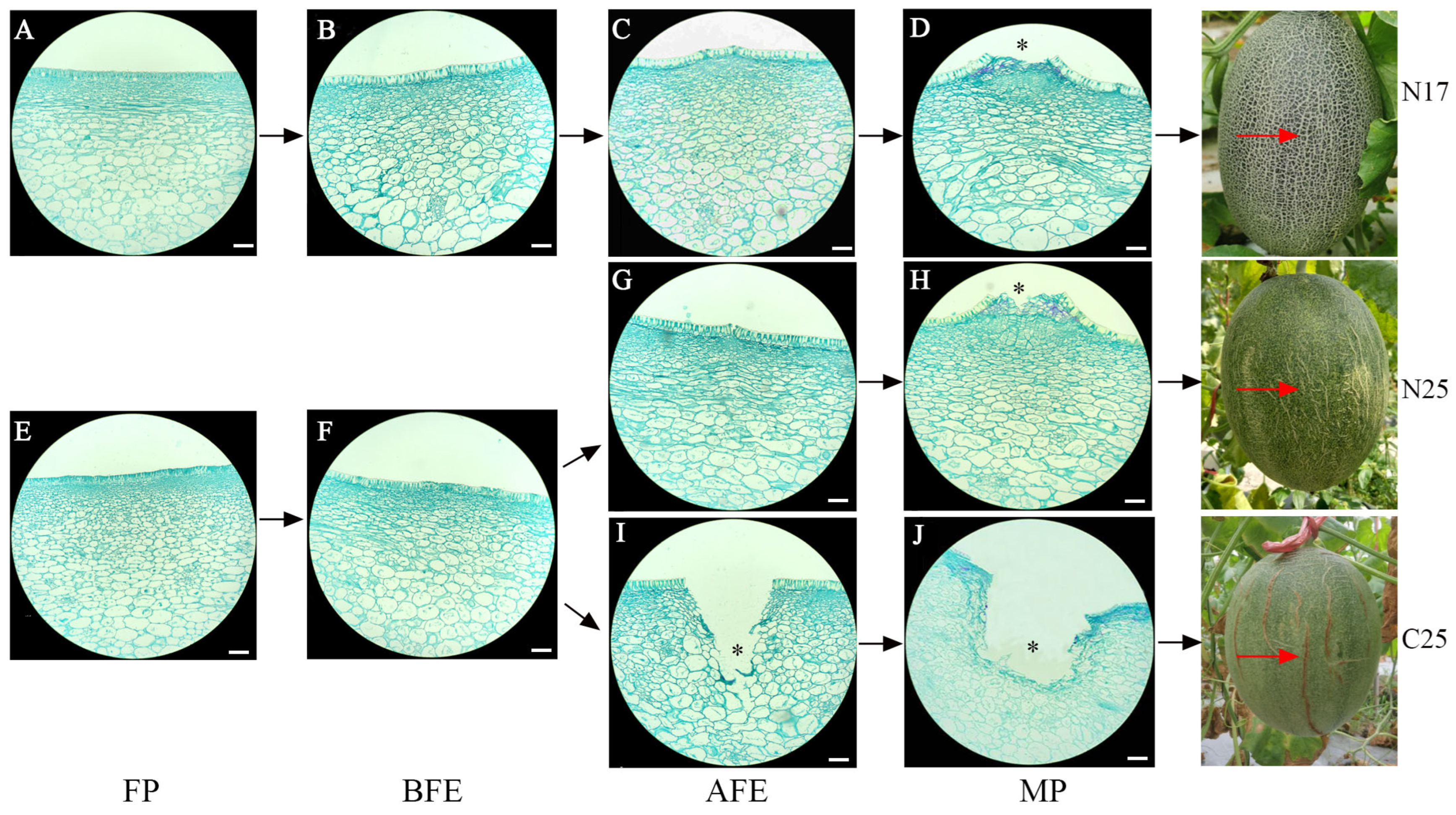
Figure 1. Cracking symptoms and anatomical structure at different stages in different melon varieties. FP: Fruiting period; BFE: before fruit expansin period; AFE: after fruit expansin period; MP: mature period. (AD): Fruit peel structures at different stages in the cracking-resistant variety ‘Xizhoumi 17’. (EJ): Fruit peel structures at different stages in the cracking-susceptible variety ‘Xizhoumi 25’. Asterisks (*) indicate the locations of netting and cracking. The Red arrow indicates the location where the sample was collected. N17: non-cracked fruit peel of ‘Xizhoumi 17’; N25: non-cracked fruit peel of ‘Xizhoumi 25’; C25: cracked fruit peel of ‘Xizhoumi 25’. Scale bars = 50 μm.
Agriculture 15 02475 g001
Figure 2. Comparison of cell wall compositions between cracked and non-cracked fruit peels at the mature stage. (A) Contents of water-soluble pectin (WSP), (B) contents of protopectin, (C) contents of total pectin, (D) cellulose content levels, (E) hemicellulose content levels, and (F) contents of lignin. N17: non-cracked fruit peel of ‘Xizhoumi 17’; N25: non-cracked fruit peel of ‘Xizhoumi 25’; C25: cracked fruit peel of ‘Xizhoumi 25’. Error bars indicated the standard deviation of three independent replicates. Different lowercase letters indicate a significant difference at p < 0.05.
Agriculture 15 02475 g002
Figure 3. Cell wall enzyme activity levels in cracked and non-cracked fruit peels at the mature stage. (A) Determination of cellulase activity, (B) determination of polygalacturonase (PG) activity, (C) determination of polyphenol oxidase (PPO) activity, (D) determination of catalase (CAT) activity, (E) determination of superoxide dismutase (SOD) activity, and (F) determination of peroxidase (POD) activity. N17: non-cracked fruit peel of ‘Xizhoumi 17’; N25: non-cracked fruit peel of ‘Xizhoumi 25’; C25: cracked fruit peel of ‘Xizhoumi 25’. Error bars indicated the standard deviation of three independent replicates. Different lowercase letters indicate a significant difference at p < 0.05.
Agriculture 15 02475 g003
Figure 4. Metabolomic analysis of cracked and non-cracked fruit peels. (A) Spearman’s rank correlation analysis of the samples. (B) Principal component analysis (PCA) of the metabolites of the samples. (C) Heatmap analysis of all the metabolites of the samples. (D) Venn diagram illustrating the significantly differential metabolites (SDMs) among the N17_vs_N25, N17_vs_C25, and N25_vs_C25 comparison groups. (E) Number of SDMs in different comparison groups. (F) Statistics of the SDMs. N17: non-cracked fruit peel of ‘Xizhoumi 17’; N25: non-cracked fruit peel of ‘Xizhoumi 25’; C25: cracked fruit peel of ‘Xizhoumi 25’.
Agriculture 15 02475 g004
Figure 5. Comparative analysis of significantly differential metabolites (SDMs) among the tested experimental groups. (A) Line charts are plotted for K-means clustering analysis of differential metabolites and visualized in a clustering heatmap. (B) Venn diagram of SDMs in the Subclass 9 shown in (A). (C) Heatmap analysis of the commonly identified SDMs among N17_vs_N25, N17_vs_C25, and N25_vs_C25 groups. Pink and blue represent high and low expression levels, respectively. (D) Radar chart of the common SDMs in the N17_vs_C25 group. Grid lines indicate the difference multiples of SDMs (log2FC). Pale teal shading indicates log2FC connections for each metabolite. N17: non-cracked fruit peel of ‘Xizhoumi 17’; N25: non-cracked fruit peel of ‘Xizhoumi 25’; C25: cracked fruit peel of ‘Xizhoumi 25’.
Agriculture 15 02475 g005
Figure 6. Sample correlation and differential expression gene analysis. (A) Principal component analysis (PCA) among samples; (B) heatmap showing Pearson correlation coefficients (PCCs) of gene expression between each pair of samples; (C) Venn diagram of differentially expressed genes (DEGs) among different comparison groups; (D) number of DEGs in different comparison groups. N17: non-cracked fruit peel of ‘Xizhoumi 17’; N25: non-cracked fruit peel of ‘Xizhoumi 25’; C25: cracked fruit peel of ‘Xizhoumi 25’.
Agriculture 15 02475 g006
Figure 7. KEGG enrichment analyses of the differentially expressed genes (DEGs) in the N17_vs_N25 (A), N17_vs_C25 (B), and N25_vs_C25 (C) groups.
Agriculture 15 02475 g007
Figure 8. Heatmap analysis of differentially expressed genes (DEGs) involved in cell wall metabolism pathways. (A) Pectin metabolism pathway-related DEGs. (B) Cellulose metabolism pathway-related DEGs. (C) DEGs related to cell wall loosening factors. PE: pectinesterase; PL: pectinlyase; PG: polygalacturonase; β-gal: β-galactosidase; CesA: cellulose synthase; Egase: endoglucanase; XTH: xyloglucan endotransglucosylase/hydrolase; EXP: expansin. N17: non-cracked fruit peel of ‘Xizhoumi 17’; N25: non-cracked fruit peel of ‘Xizhoumi 25’; C25: cracked fruit peel of ‘Xizhoumi 25’. Red and blue indicate up- and downregulation, respectively.
Agriculture 15 02475 g008
Figure 9. Analysis of differentially expressed genes (DEGs) in the lignin biosynthesis pathway and determination of lignin monomer content. (A) Heatmap analysis of DEGs in the lignin biosynthesis pathway. PAL: phenylalanine ammonia-lyase; CYP73A: trans-cinnamate 4-monooxygenase; 4CL: 4-coumarate CoA ligase; CCR: cinnamoyl CoA reductase; COMT: caffeate 3-O-methyltransferase; CCoAOMT: caffeoyl-CoA O-methyltransferase; F5H: ferulate 5-hydroxylase; CAD: cinnamyl alcohol dehydrogenase; POD: peroxidase. Red and blue indicate up- and downregulation. (B) Contents of 4-Hydroxybenzaldehyde. (C) Contents of vanillin. (D) Contents of syringaldehyde. N17: non-cracked fruit peel of ‘Xizhoumi 17’; N25: non-cracked fruit peel of ‘Xizhoumi 25’; C25: cracked fruit peel of ‘Xizhoumi 25’. Error bars indicated the standard deviation of three independent replicates. Different lowercase letters indicate a significant difference at p < 0.05.
Agriculture 15 02475 g009
Figure 10. Quantitative real-time PCR (RT-qPCR) validation of transcriptomic data. (A) Validation of cell wall metabolism-related genes: CmCesA1 (MELO3C016263), CmCesA2 (MELO3C025029), CmEgase2 (MELO3C013770), Cmβ-gal1 (MELO3C016409), CmPE2 (MELO3C007375), CmPG1 (MELO3C007031), CmPG2 (MELO3C009962), and CmPG3 (MELO3C027408). (B) Validation of lignin biosynthesis-related genes: CmPAL1 (MELO3C014222), CmPAL2 (MELO3C014227), CmPAL4 (MELO3C014228), Cm4CL1 (MELO3C023493), Cm4CL2 (MELO3C024886), CmCAD1 (MELO3C019548), CmPOD1 (MELO3C019994), CmPOD3 (MELO3C007868), CmCOMT1 (MELO3C014088), CmCOMT2 (MELO3C014091), CmCOMT3 (MELO3C027330), and CmCCoAOMT1 (MELO3C018450). Error bars indicated the standard deviation of three independent replicates. Different lowercase letters indicate a significant difference at p < 0.05.
Agriculture 15 02475 g010
Disclaimer/Publisher’s Note: The statements, opinions and data contained in all publications are solely those of the individual author(s) and contributor(s) and not of MDPI and/or the editor(s). MDPI and/or the editor(s) disclaim responsibility for any injury to people or property resulting from any ideas, methods, instructions or products referred to in the content.