Integrating Geodetector and GTWR to Unveil Spatiotemporal Heterogeneity in China’s Agricultural Carbon Emissions Under the Dual Carbon Goals

 ,
,
Abstract
1. Introduction
2. Literature Review
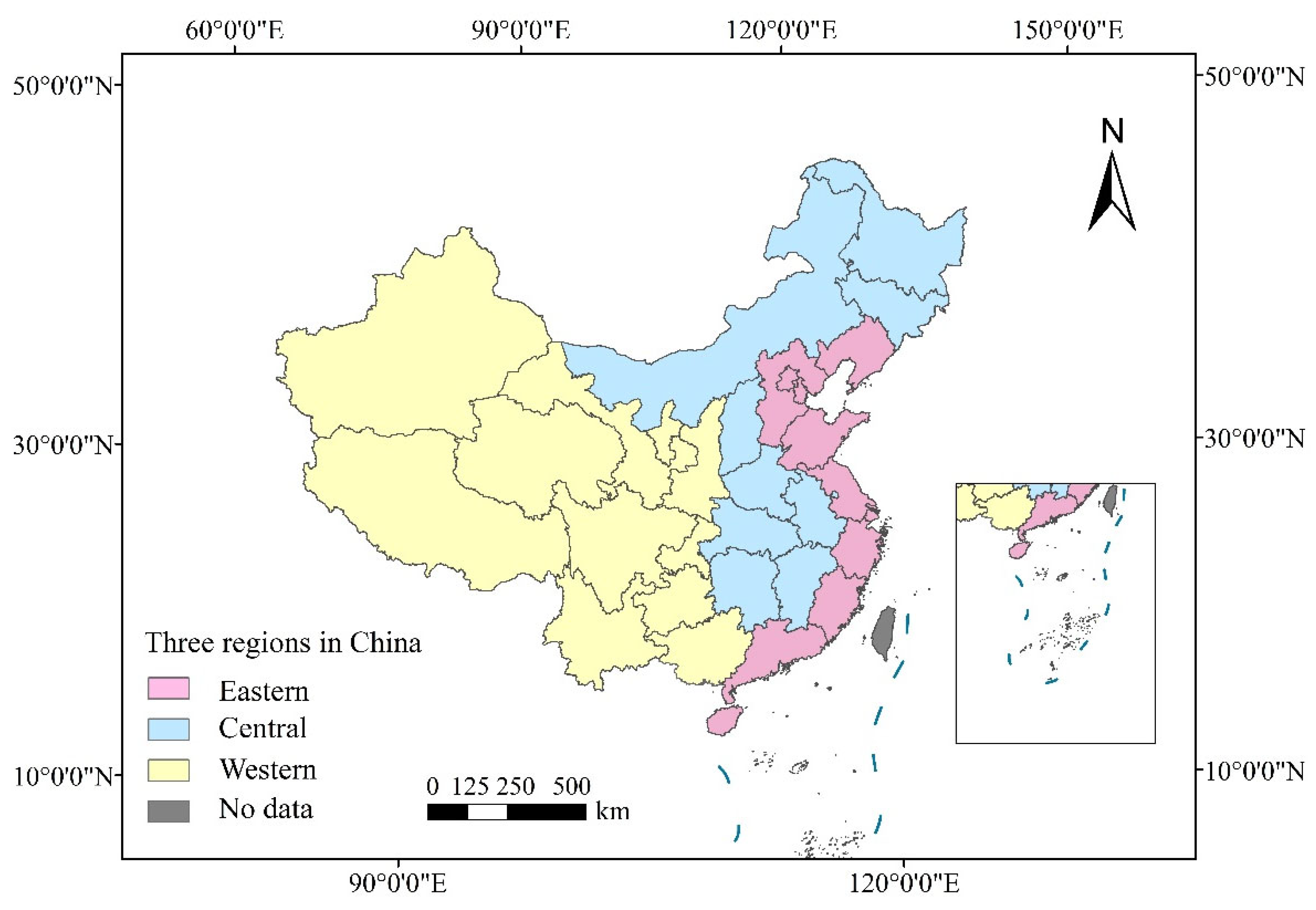
3. Overview of the Study Area
4. Research Methods and Data Sources
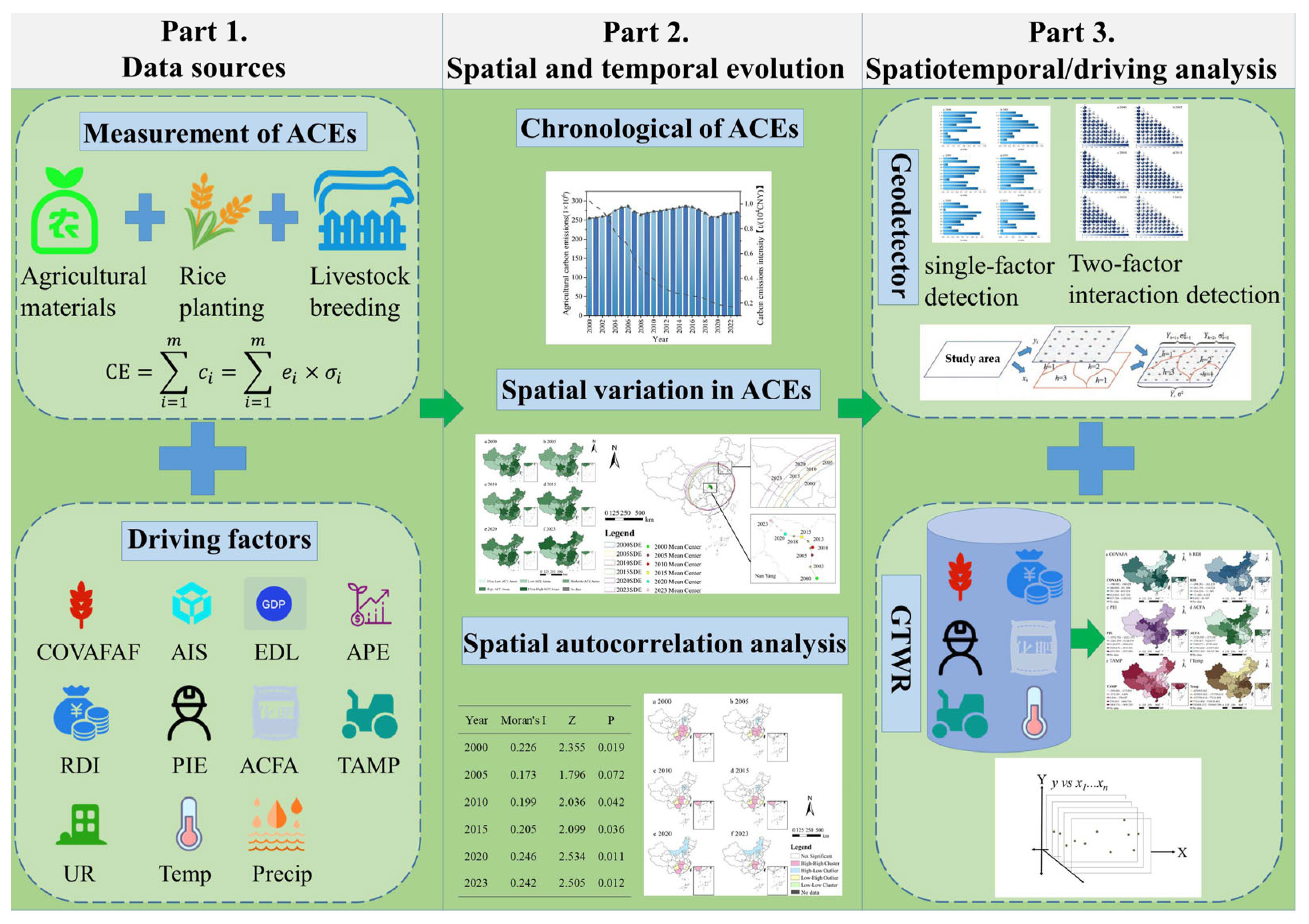
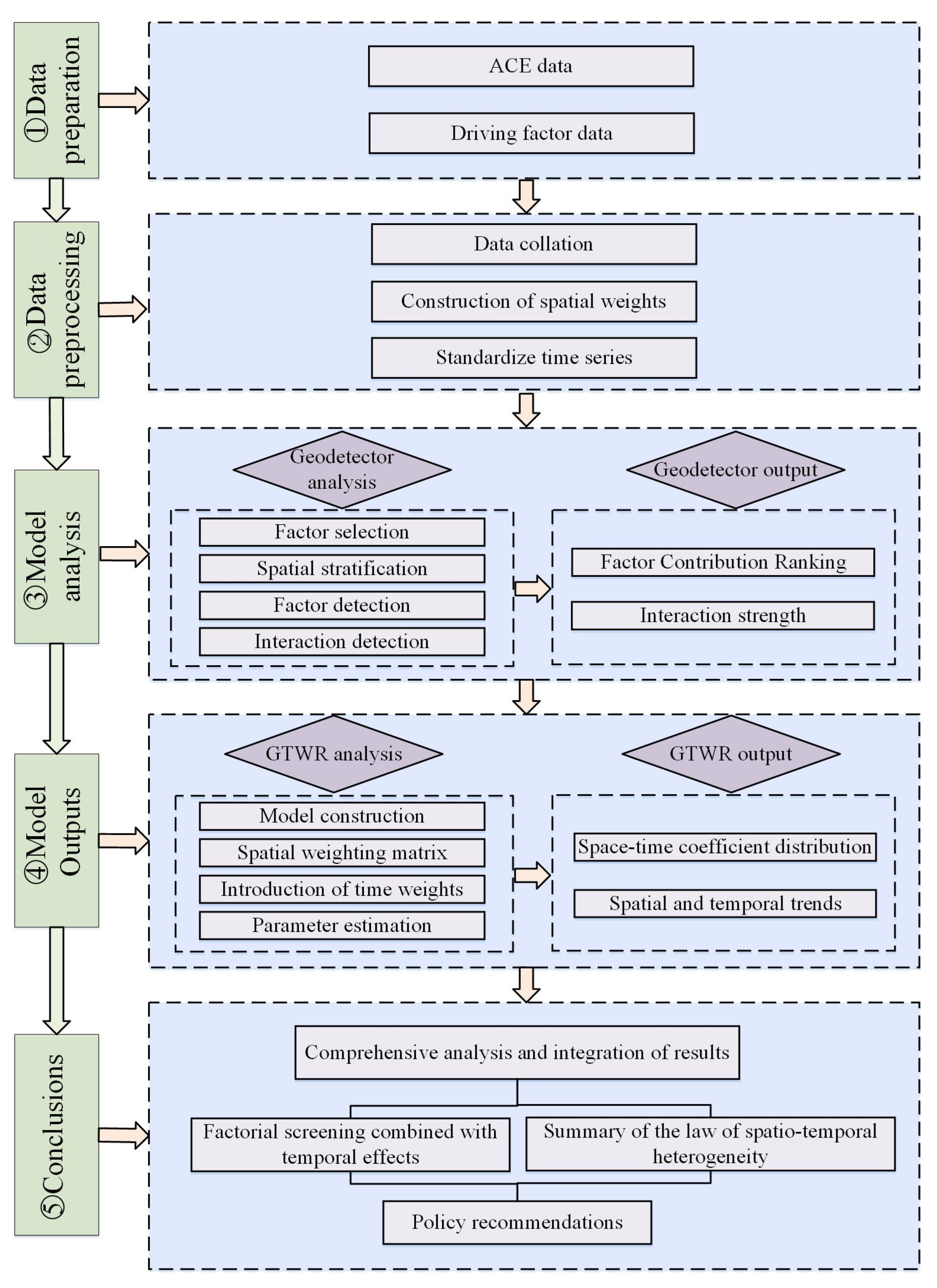
4.1. Research Framework
4.2. ACE Accounting
4.3. Spatial and Temporal Evolution Analysis
4.3.1. SDE and Center of Gravity Shift
4.3.2. Spatial Correlation Analysis
- (1)
- GSA
- (2)
- LSA
4.4. Analysis of Driving Mechanisms
4.4.1. Principles of Model Operation
- (1)
- Complementarity: Revealing both the contributions and spatiotemporal dynamics of driving factors. Geodetector provides the overall explanatory power of driving factors and their interactive relationships, offering a basis for variable selection and analysis in the GTWR model. Meanwhile, GTWR delves into the spatiotemporal heterogeneity of these factors’ impacts, achieving a comprehensive analysis from “static contributions” to “dynamic variations.”
- (2)
- Overcoming limitations of traditional models. Traditional econometric models often assume uniform factor impacts across space and time, neglecting the spatiotemporal heterogeneity of agricultural carbon emissions influenced by regional natural conditions, production practices, and policy environments. These models fail to fully capture the spatiotemporal dynamic changes of driving factors. The integration of Geodetector and GTWR overcomes this limitation. Geodetector quantifies the explanatory power of each factor on spatial differentiation through q-values, revealing the relative importance and interactive effects of driving factors. GTWR, through localized regression, dynamically estimates the regression coefficients of factors across different times and spaces, capturing the spatiotemporal variations in their impact intensity.
- (3)
- Support for differentiated policy formulation. The integration of these models provides a more refined scientific basis for policy formulation. Geodetector identifies key driving factors and their interactions, offering a basis for prioritizing policy measures. GTWR further reveals the differentiated impacts of these factors across regions and time periods, supporting the development of region-specific and time-sensitive emission reduction strategies.
4.4.2. Geodetector
4.4.3. GTWR
4.4.4. Selection of Geodetector and GTWR Indicators
4.5. Data Sources
- (1)
- Spatial data: Province-level agricultural carbon emission vector data were obtained from the National Geographic Information Resource Catalog Service Platform (https://www.webmap.cn/) (3 February 2025).
- (2)
- Meteorological data: Temperature and precipitation datasets with 1 km spatial resolution, including monthly mean temperature and precipitation records across China, were acquired from the National Tibetan Plateau Data Center (https://data.tpdc.ac.cn/home) (3 February 2025).
- (3)
- Socioeconomic data: Statistical data on chemical fertilizers, pesticides, plastic mulching, diesel, irrigation, rice cultivation scale, and the 11 driving factor indicators were sourced from the China Statistical Yearbook and the China Rural Statistical Yearbook.
5. Results of the Study
5.1. Characteristics of Temporal Changes
5.2. Spatial Distribution Characteristics
5.2.1. Spatial Variation Characteristics
5.2.2. SDE and Center of Gravity Shift Analysis
5.3. Spatially Correlated Features
5.3.1. GSA Analysis
5.3.2. LSA Analysis
6. Analysis of the Results of the Impact Factors
6.1. Geodetector Analysis
6.1.1. Single-Factor Identification
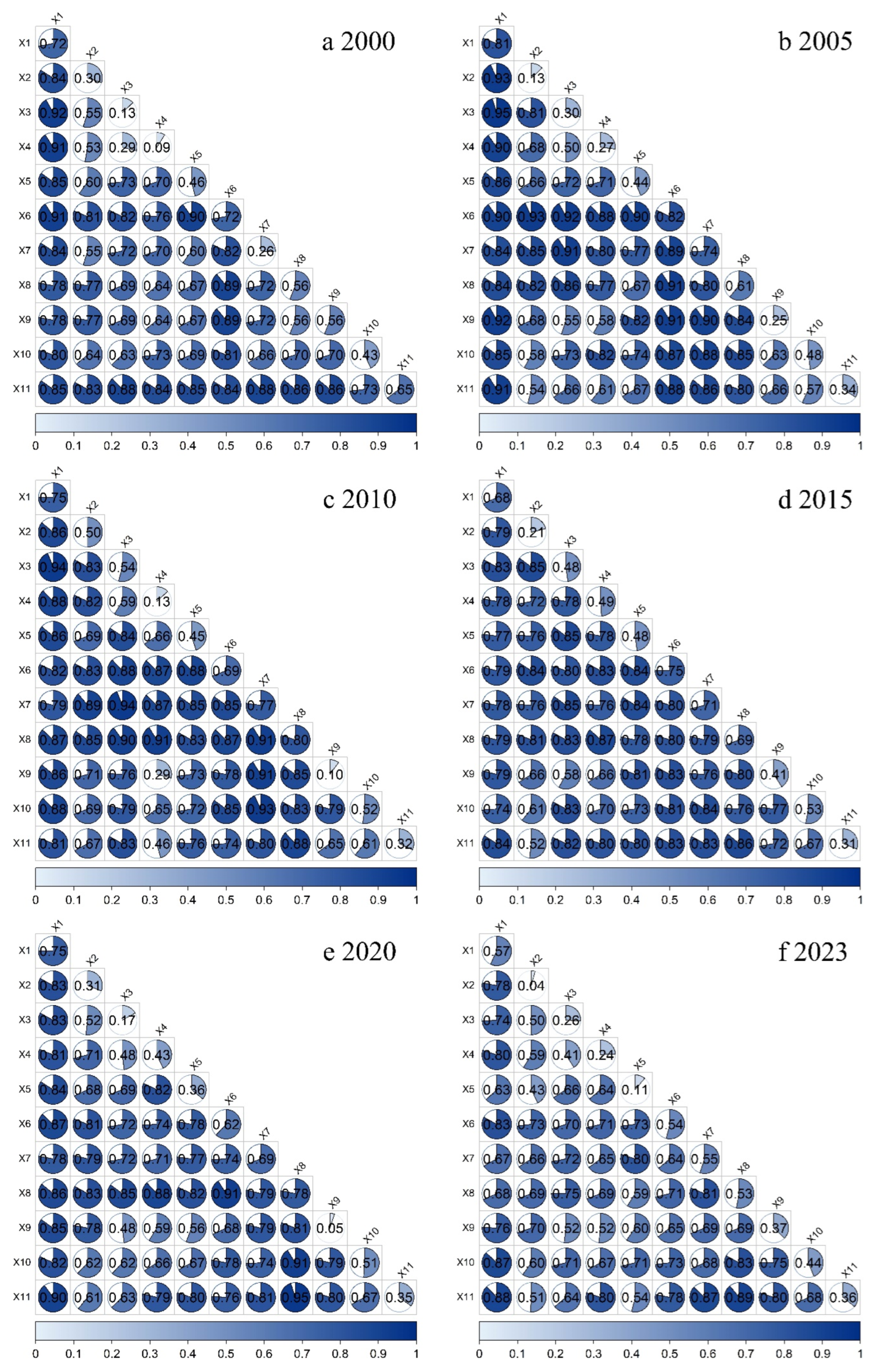
6.1.2. Factor Interaction Identification
6.2. GTWR Analysis
7. Discussion
7.1. Spatiotemporal Evolution of ACEs in China
- (1)
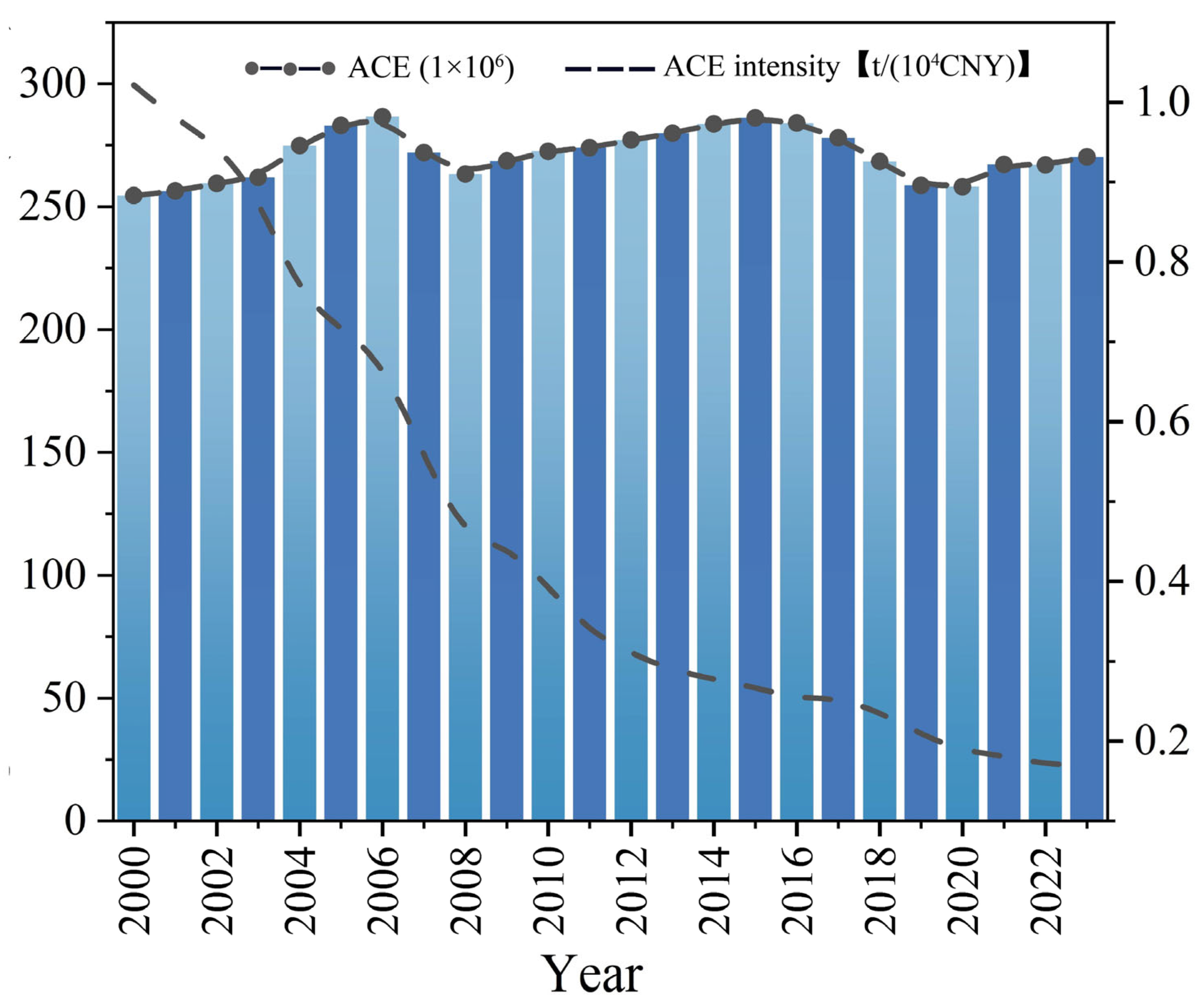
- From a temporal perspective, China’s ACEs exhibit an overall trend of fluctuating growth, while carbon emission intensity has gradually declined, consistent with findings from Peng et al. [82]. The emission flux variability reflects synergistic policy–technology interactions, particularly post-2015 fertilizer/pesticide reduction initiatives. In contrast to previous studies, this research identifies a more substantial decline in emission intensity (83.33%), with the apparent paradox of decreasing intensity alongside increasing total emissions attributable to (1) the expansion of agricultural output value (COVAFAF growing at an average annual rate of 6.5%), which drives increased inputs and elevates total emissions; and (2) technological advancements such as precision fertilization and energy-efficient machinery, which reduce emissions per unit of output, significantly lowering intensity. This is closely linked to the effectiveness of policy regulation, indicating that technological improvements and policy support have a significant combined impact on reducing carbon emissions.
- (2)
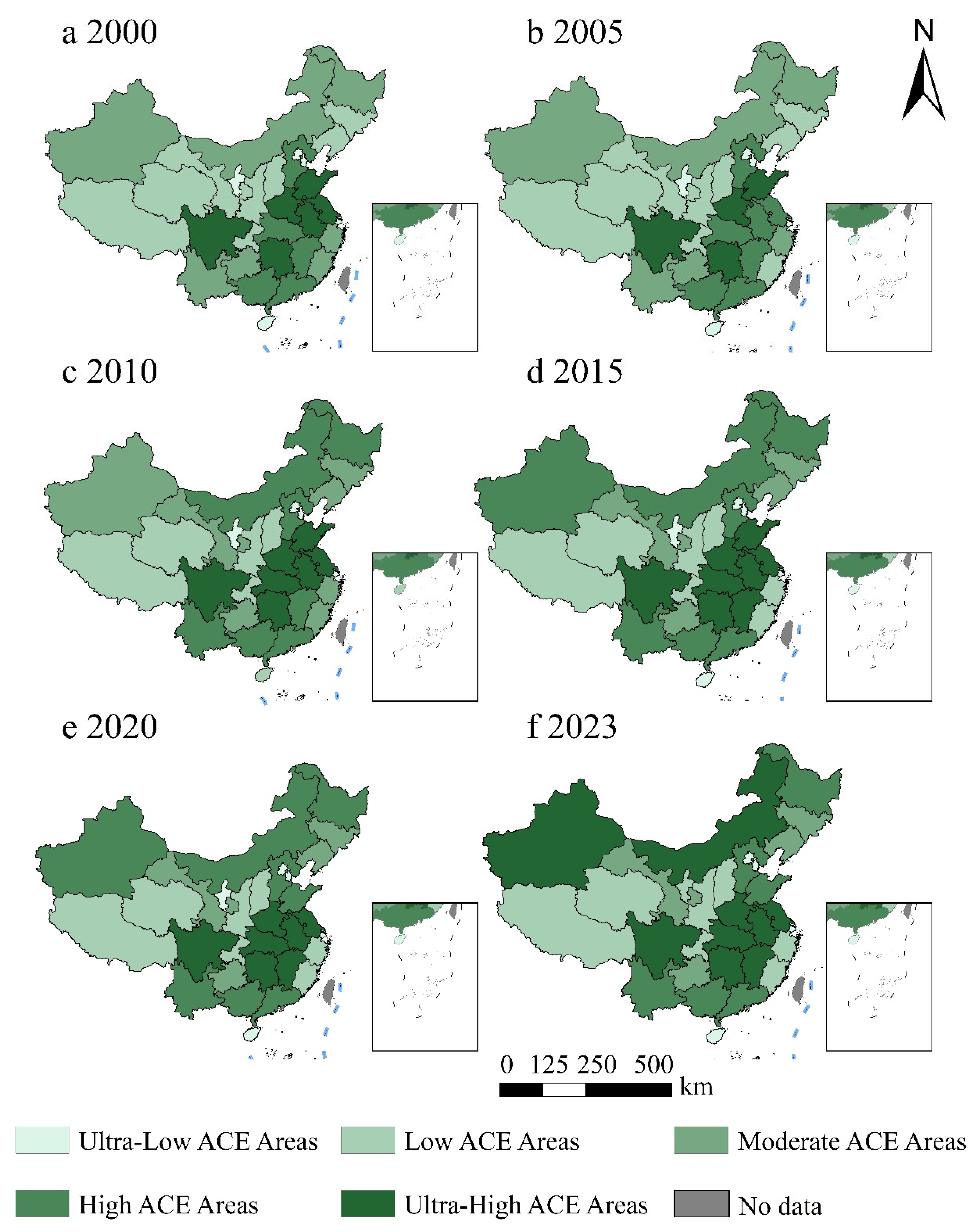
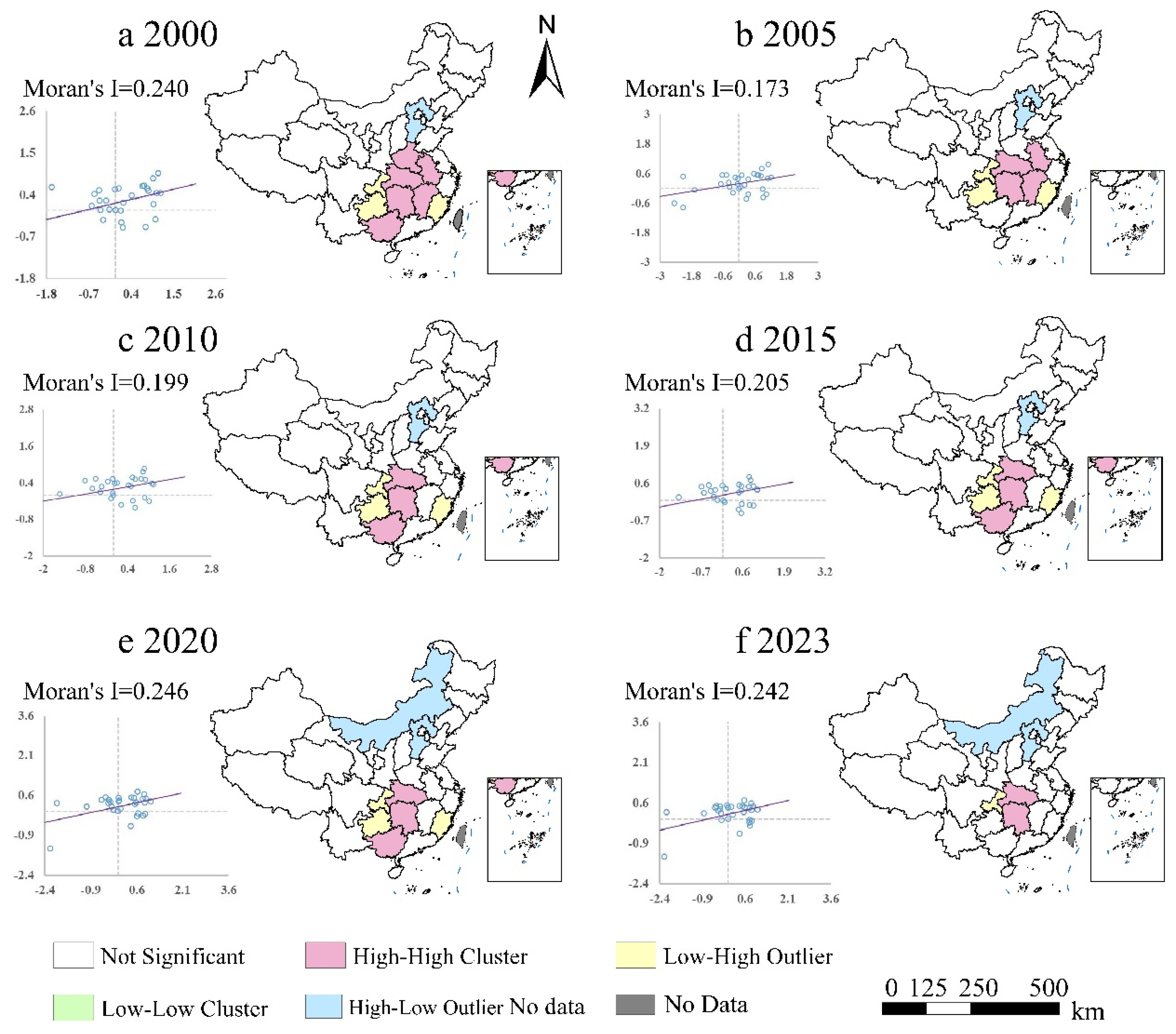
- Significant variations in agricultural carbon emissions are observed across provinces, aligning closely with the spatial differentiation characteristics identified by Liu et al. [81,83]. Concurrently, the spatial pattern of agricultural carbon emissions exhibits high-value clustering in the southeastern region, consistent with the findings of Wen et al. [84]. The gradual eastward and westward expansion of agricultural carbon emissions reflects differences in agricultural production modes across regions. The spatial clustering effect of agricultural carbon emissions has weakened over time, corroborating Xia’s conclusions [85]; however, this study covers a longer historical period, suggesting that the spatial distribution of agricultural carbon emissions is influenced by multiple factors over an extended timescale, potentially leading to gradual weakening of the spatial clustering effect. Compared to India [86], where high emissions are concentrated in irrigation-intensive areas, China’s eastern high-emission zones are centered in economically developed regions. This highlights the need for developing countries to optimize emission reduction strategies tailored to regional characteristics.
7.2. Determinants of ACEs in Chinese Provinces
- (1)
- Economic factors are the primary drivers of increased agricultural carbon emissions, with the COVAFAF exerting the greatest influence on agricultural carbon emissions. Moreover, as economic scale expands and agricultural modernization progresses, this influence exhibits periodic fluctuations, consistent with the findings of Li et al. regarding the driving role of economic scale in carbon emissions [87,88]. Furthermore, spatiotemporal differentiation in rural disposable income underscores policy coordination complexity. Coastal eastern regions demonstrate negative income–emission correlations, reflecting green consumption awareness enhancement in emission reduction. Conversely, western regions exhibit positive correlations, indicating persistent dependence on carbon-intensive agricultural production modes. This paradox reveals regional disparities in achieving income-growth–emission-reduction synergy, necessitating decoupling through non-agricultural industry support and green subsidy policies.
- (2)
- Agricultural input factors are key determinants of agricultural carbon emissions. The positive influence of total agricultural machinery power, employment in the primary sector, and fertilizer application on agricultural carbon emissions aligns with the findings of Guo et al. High-tech machinery in the eastern regions reduces emissions [89,90], while traditional machinery in the western regions exacerbates emissions, going beyond the single-input analysis of Tang et al. [91] and providing a reference for machinery optimization in Brazil. For instance, agricultural mechanization proliferation typically coincides with intensified fertilizer, pesticide, and plastic film applications. While collectively enhancing productivity, these practices elevate emission levels [92]. Concurrently, primary sector employment growth often drives land reclamation expansion and resource utilization intensification, subsequently amplifying demands for machinery, chemicals, and irrigation—thereby escalating emission scales. Effective agricultural decarbonization thus requires comprehensive consideration of input factor synergies.
- (3)
- Climatic variables, particularly Temp and Precip, significantly shape emission spatial distributions. Although Gołasa et al. [3] rarely directly address the role of climatic factors, both the existing literature and this study indicate that the impact of climate change on agricultural carbon emissions is increasingly significant. Temp elevation may prolong growing seasons and enhance photosynthesis, boosting agricultural yields, yet simultaneously drives increased agrochemical inputs that elevate emissions. Precip patterns directly determine irrigation requirements and production methods, with water-stressed regions exhibiting energy-intensive irrigation dependencies. Furthermore, Precip variability and extreme weather events intensify spatiotemporal emission heterogeneity [56]. Compared to the single climate variable analysis by Panchasara et al. [15], this study quantifies interactive effects, providing climate adaptation strategies for rice cultivation areas in Vietnam.
7.3. Spatiotemporal Heterogeneity of Influencing Factors
7.4. Research Limitations and Future Directions
7.4.1. Research Limitations
7.4.2. Future Research Directions
8. Conclusions and Policy Recommendations
8.1. Conclusions
- (1)
- Temporally, China’s total ACEs exhibited “fluctuating growth”, with an average annual rate of 0.26%, while emission intensity demonstrated a remarkable cumulative reduction of 83.33%. This indicates significant declines in carbon emissions per unit output alongside maintained production growth, reflecting synergistic effects of policy interventions and technological advancements.
- (2)
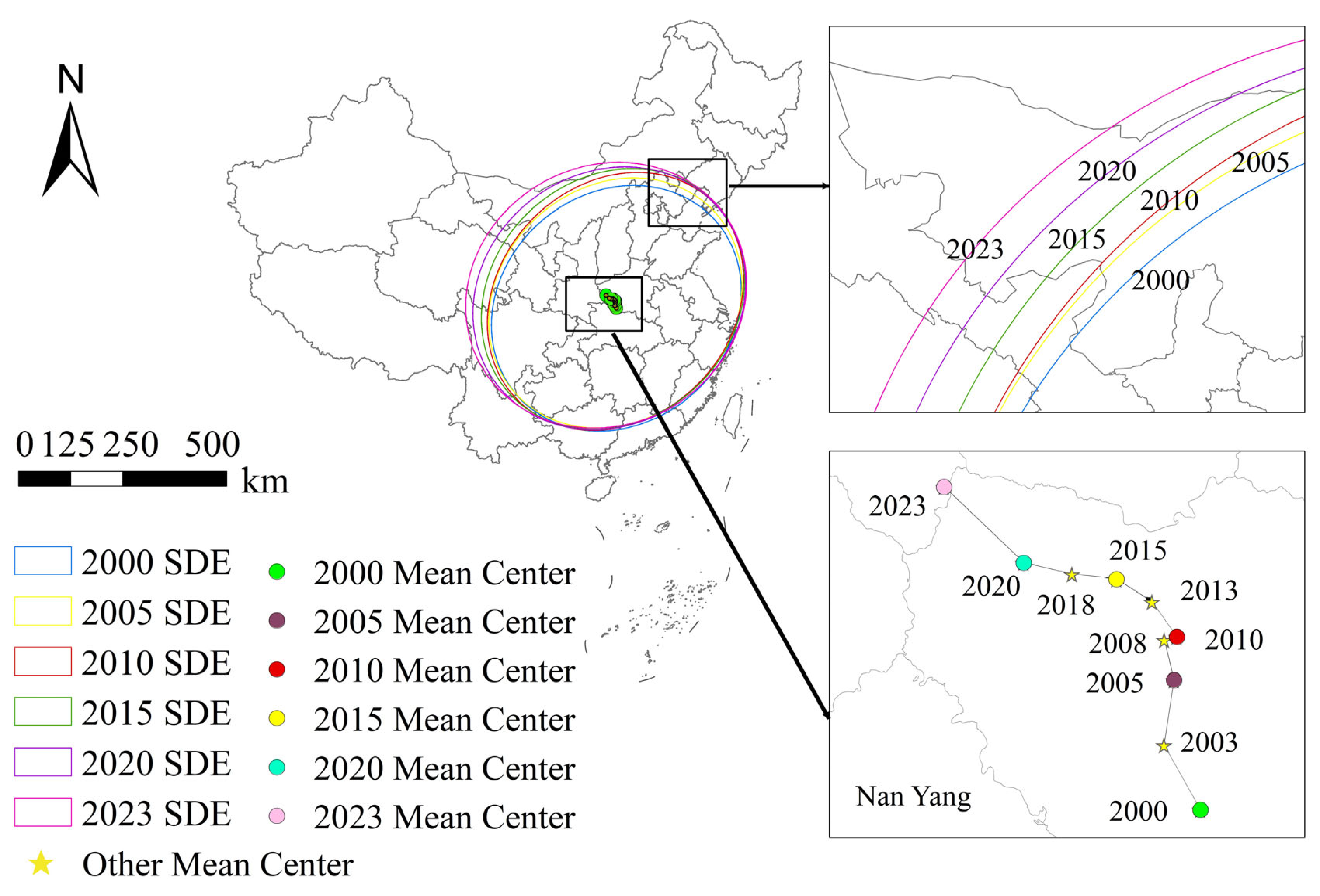
- Spatially, ACEs exhibited a pronounced “higher in the southeast, lower in the northwest” imbalance, with a dynamic evolution characterized by expanding high-emission zones and a westward shift of hotspots. SDE and centroid migration analyses revealed a “northeast-southwest” belt-shaped distribution, with the emission centroid consistently located in Nanyang, Henan Province, while gradually shifting northwestward, suggesting an emerging emission growth potential in western regions. Spatial autocorrelation results confirmed strengthening agglomeration patterns, particularly in the traditional agricultural regions of central-eastern China.
- (3)
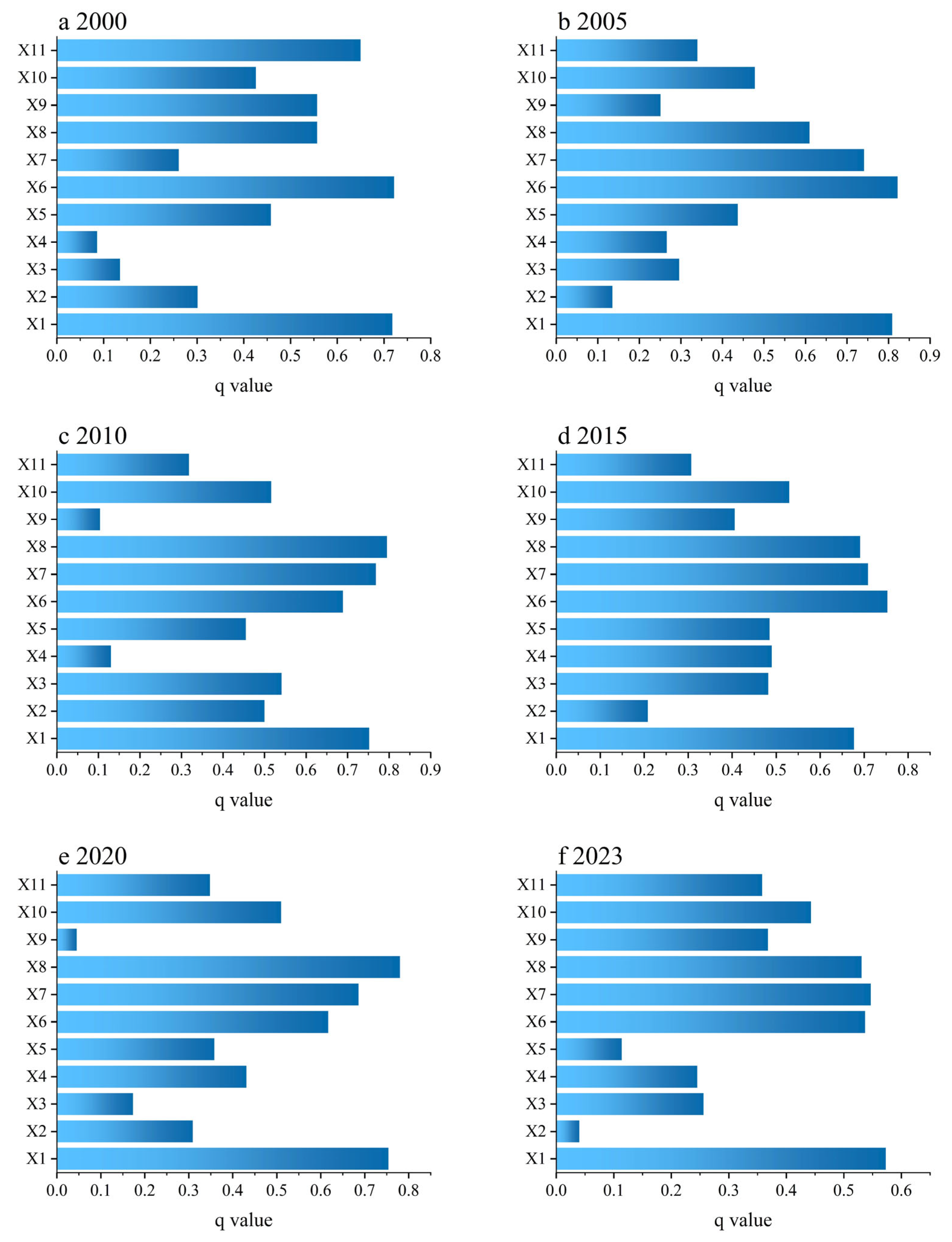
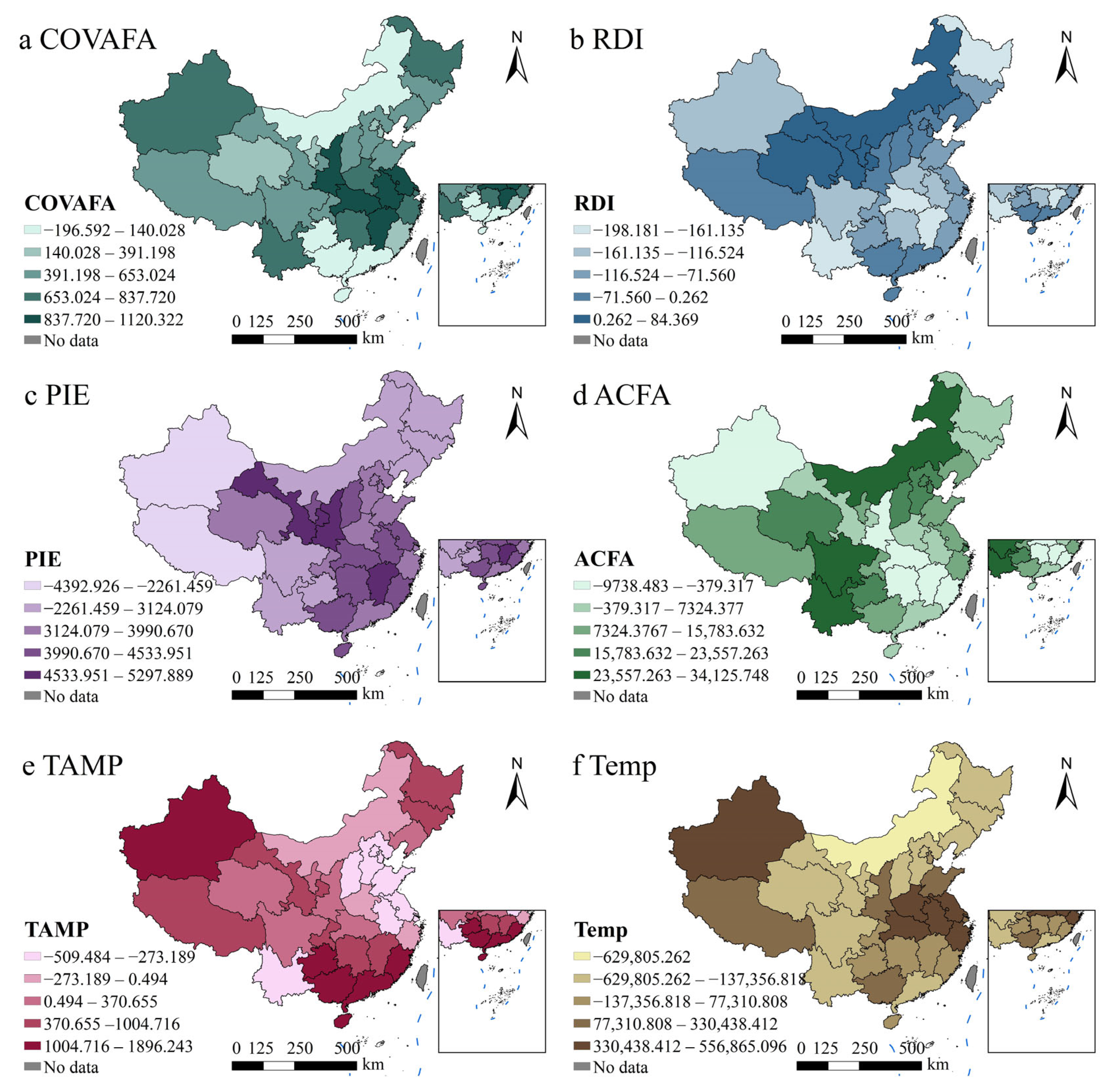
- The driving mechanisms of ACEs exhibited pronounced spatiotemporal heterogeneity. The Geodetector results identified gross agricultural output value as the primary single-factor driver, displaying cyclical fluctuations characterized by phases of economic dominance, technological advancement, and structural adjustment. Factor interaction analysis revealed synergistic effects between agricultural economic scale and key factors such as regional economic development, industrial structure, and climatic conditions. GTWR modeling further disclosed that rural disposable income contributed to emission reductions in eastern regions, whereas variables such as gross agricultural output value, primary industry employment, fertilizer application, and total agricultural machinery power primarily drove emission increases across most regions, with notable variations in direction and intensity across spatiotemporal contexts.
8.2. Policy Recommendations
- (1)
- Promoting precision fertilization to mitigate high carbon emission risks from excessive fertilizer use
- (2)
- Advancing the clean transition of agricultural machinery to reduce emissions from traditional operations
- (3)
- Optimizing industrial structure to decouple economic growth from agricultural carbon emissions
Author Contributions
Funding
Institutional Review Board Statement
Data Availability Statement
Conflicts of Interest
References
- Bhatti, U.A.; Bhatti, M.A.; Tang, H.; Syam, M.S.; Awwad, E.M.; Sharaf, M.; Ghadi, Y.Y. Global Production Patterns: Understanding the Relationship between Greenhouse Gas Emissions, Agriculture Greening and Climate Variability. Environ. Res. 2024, 245, 118049. [Google Scholar] [CrossRef] [PubMed]
- Wang, J.; Xu, Y. Internet Usage, Human Capital and CO2 Emissions: A Global Perspective. Sustainability 2021, 13, 8268. [Google Scholar] [CrossRef]
- Gołasa, P.; Wysokiński, M.; Bieńkowska-Gołasa, W.; Gradziuk, P.; Golonko, M.; Gradziuk, B.; Siedlecka, A.; Gromada, A. Sources of Greenhouse Gas Emissions in Agriculture, with Particular Emphasis on Emissions from Energy Used. Energies 2021, 14, 3784. [Google Scholar] [CrossRef]
- Wang, Y.; Guo, C.; Chen, X.; Jia, L.; Guo, X.; Chen, R.; Zhang, M.; Chen, Z.; Wang, H. Carbon Peak and Carbon Neutrality in China: Goals, Implementation Path and Prospects. China Geol. 2021, 4, 720–746. [Google Scholar] [CrossRef]
- Laborde, D.; Mamun, A.; Martin, W.; Piñeiro, V.; Vos, R. Agricultural Subsidies and Global Greenhouse Gas Emissions. Nat. Commun. 2021, 12, 2601. [Google Scholar] [CrossRef] [PubMed]
- Wijerathna-Yapa, A.; Pathirana, R. Sustainable Agro-Food Systems for Addressing Climate Change and Food Security. Agriculture 2022, 12, 1554. [Google Scholar] [CrossRef]
- West, T.O.; Marland, G. A Synthesis of Carbon Sequestration, Carbon Emissions, and Net Carbon Flux in Agriculture: Comparing Tillage Practices in the United States. Agric. Ecosyst. Environ. 2002, 91, 217–232. [Google Scholar] [CrossRef]
- Zhao, R.-Q.; Qin, M.-Z. Temporospatial Variation of Partial Carbon Source/Sink of Farmland Ecosystem in Coastal China. J. Ecol. Rural. Environ. 2007, 23, 1–6. [Google Scholar]
- Cui, Y.; Khan, S.U.; Deng, Y.; Zhao, M.; Hou, M. Environmental Improvement Value of Agricultural Carbon Reduction and Its Spatiotemporal Dynamic Evolution: Evidence from China. Sci. Total Environ. 2021, 754, 142170. [Google Scholar] [CrossRef]
- Li, H.; Jin, X.; Zhao, R.; Han, B.; Zhou, Y.; Tittonell, P. Assessing Uncertainties and Discrepancies in Agricultural Greenhouse Gas Emissions Estimation in China: A Comprehensive Review. Environ. Impact Assess. Rev. 2024, 106, 107498. [Google Scholar] [CrossRef]
- Ning, J.; Zhang, C.; Hu, M.; Sun, T. Accounting for Greenhouse Gas Emissions in the Agricultural System of China Based on the Life Cycle Assessment Method. Sustainability 2024, 16, 2594. [Google Scholar] [CrossRef]
- Zhang, C.; Zhao, L.; Zhang, H.; Chen, M.; Fang, R.; Yao, Y.; Zhang, Q.; Wang, Q. Spatial-Temporal Characteristics of Carbon Emissions from Land Use Change in Yellow River Delta Region, China. Ecol. Indic. 2022, 136, 108623. [Google Scholar] [CrossRef]
- Tian, Y.; Zhang, J.; He, Y. Research on Spatial-Temporal Characteristics and Driving Factor of Agricultural Carbon Emissions in China. J. Integr. Agric. 2014, 13, 1393–1403. [Google Scholar] [CrossRef]
- Luo, Y.; Long, X.; Wu, C.; Zhang, J. Decoupling CO2 Emissions from Economic Growth in Agricultural Sector across 30 Chinese Provinces from 1997 to 2014. J. Clean. Prod. 2017, 159, 220–228. [Google Scholar] [CrossRef]
- Panchasara, H.; Samrat, N.H.; Islam, N. Greenhouse Gas Emissions Trends and Mitigation Measures in Australian Agriculture Sector—A Review. Agriculture 2021, 11, 85. [Google Scholar] [CrossRef]
- Lin, B.; Xu, B. Factors Affecting CO2 Emissions in China’s Agriculture Sector: A Quantile Regression. Renew. Sustain. Energy Rev. 2018, 94, 15–27. [Google Scholar] [CrossRef]
- Xiong, C.; Yang, D.; Xia, F.; Huo, J. Changes in Agricultural Carbon Emissions and Factors That Influence Agricultural Carbon Emissions Based on Different Stages in Xinjiang, China. Sci. Rep. 2016, 6, 36912. [Google Scholar] [CrossRef]
- Shan, T.; Xia, Y.; Hu, C.; Zhang, S.; Zhang, J.; Xiao, Y.; Dan, F. Analysis of Regional Agricultural Carbon Emission Efficiency and Influencing Factors: Case Study of Hubei Province in China. PLoS ONE 2022, 17, e0266172. [Google Scholar] [CrossRef]
- Han, G.; Xu, J.; Zhang, X.; Pan, X. Efficiency and Driving Factors of Agricultural Carbon Emissions: A Study in Chinese State Farms. Agriculture 2024, 14, 1454. [Google Scholar] [CrossRef]
- Yizhang, P.; Ping, L. Study on the Relationship between Agricultural Mechanization, Fiscal Expenditure and Agricultural Carbon Emission: Empirical Analysis Based on VAR Model. J. Chin. Agric. Mech. 2025, 46, 313. [Google Scholar] [CrossRef]
- Guan, N.; Liu, L.; Dong, K.; Xie, M.; Du, Y. Agricultural Mechanization, Large-Scale Operation and Agricultural Carbon Emissions. Cogent Food Agric. 2023, 9, 2238430. [Google Scholar] [CrossRef]
- Lesschen, J.P.; van den Berg, M.; Westhoek, H.J.; Witzke, H.P.; Oenema, O. Greenhouse Gas Emission Profiles of European Livestock Sectors. Anim. Feed. Sci. Technol. 2011, 166–167, 16–28. [Google Scholar] [CrossRef]
- Xiong, C.; Yang, D.; Huo, J. Spatial-Temporal Characteristics and LMDI-Based Impact Factor Decomposition of Agricultural Carbon Emissions in Hotan Prefecture, China. Sustainability 2016, 8, 262. [Google Scholar] [CrossRef]
- Raihan, A.; Muhtasim, D.A.; Farhana, S.; Hasan, M.A.U.; Pavel, M.I.; Faruk, O.; Rahman, M.; Mahmood, A. An Econometric Analysis of Greenhouse Gas Emissions from Different Agricultural Factors in Bangladesh. Energy Nexus 2023, 9, 100179. [Google Scholar] [CrossRef]
- Yang, X.; Jia, Z.; Yang, Z.; Yuan, X. The Effects of Technological Factors on Carbon Emissions from Various Sectors in China—A Spatial Perspective. J. Clean. Prod. 2021, 301, 126949. [Google Scholar] [CrossRef]
- Kheyruri, Y.; Sharafati, A.; Neshat, A.; Hameed, A.S.; Rahman, A. Analyzing the Impact of Socio-Environmental Parameters on Wheat and Barley Cultivation Areas Using the Geographical Detector Model. Phys. Chem. Earth Parts A/B/C 2024, 135, 103630. [Google Scholar] [CrossRef]
- Feng, L.; Wang, Y.; Zhang, Z.; Du, Q. Geographically and Temporally Weighted Neural Network for Winter Wheat Yield Prediction. Remote Sens. Environ. 2021, 262, 112514. [Google Scholar] [CrossRef]
- Yin, Z.; Ding, J.; Liu, Y.; Wang, R.; Wang, Y.; Chen, Y.; Qi, J.; Wu, S.; Du, Z. GNNWR: An Open-Source Package of Spatiotemporal Intelligent Regression Methods for Modeling Spatial and Temporal Nonstationarity. Geosci. Model Dev. 2024, 17, 8455–8468. [Google Scholar] [CrossRef]
- Liu, J.; Wang, J.; Zhai, T.; Li, Z.; Huang, L.; Yuan, S. Gradient Characteristics of China’s Land Use Patterns and Identification of the East-West Natural-Socio-Economic Transitional Zone for National Spatial Planning. Land Use Policy 2021, 109, 105671. [Google Scholar] [CrossRef]
- Guo, A.; Yue, W.; Yang, J.; Xue, B.; Xiao, W.; Li, M.; He, T.; Zhang, M.; Jin, X.; Zhou, Q. Cropland Abandonment in China: Patterns, Drivers, and Implications for Food Security. J. Clean. Prod. 2023, 418, 138154. [Google Scholar] [CrossRef]
- Du, Y.; Liu, H.; Huang, H.; Li, X. The Carbon Emission Reduction Effect of Agricultural Policy—Evidence from China. J. Clean. Prod. 2023, 406, 137005. [Google Scholar] [CrossRef]
- Nsabiyeze, A.; Ma, R.; Li, J.; Luo, H.; Zhao, Q.; Tomka, J.; Zhang, M. Tackling Climate Change in Agriculture: A Global Evaluation of the Effectiveness of Carbon Emission Reduction Policies. J. Clean. Prod. 2024, 468, 142973. [Google Scholar] [CrossRef]
- Tian, Y.; Zhang, J.; Chen, Q. Distributional Dynamic and Trend Evolution of China’s Agricultural Carbon Emissions—An Analysis on Panel Data of 31 Provinces from 2002 to 2011. Chin. J. Popul. Resour. Environ. 2015, 13, 206–214. [Google Scholar] [CrossRef]
- Tian, Y.; Li, B.; Zhang, J. Stage Characteristics and Factor Decomposition of Carbon Emissions from Agricultural Land Use in China. J. China Univ. Geosci. (Soc. Sci. Ed.) 2011, 11, 59–63. [Google Scholar] [CrossRef]
- Intergovernmental Panel on Climate Change (IPCC). IPCC Secretariat, C/O World Meteorological Organization, 7bis Avenue de La Paix, C.P. 2300, CH—1211 Geneva 2, Switzerland. Gov. Inf. Q. 2009, 26, 428–429. Available online: http://Www.Ipcc.Ch/ (accessed on 18 December 2007).
- Meyer-Aurich, A.; Weersink, A.; Janovicek, K.; Deen, B. Cost Efficient Rotation and Tillage Options to Sequester Carbon and Mitigate GHG Emissions from Agriculture in Eastern Canada. Agric. Ecosyst. Environ. 2006, 117, 119–127. [Google Scholar] [CrossRef]
- Huang, X.; Xu, X.; Wang, Q.; Zhang, L.; Gao, X.; Chen, L. Assessment of Agricultural Carbon Emissions and Their Spatiotemporal Changes in China, 1997–2016. Int. J. Environ. Res. Public Health 2019, 16, 3105. [Google Scholar] [CrossRef]
- Qian, H.; Zhu, X.; Huang, S.; Linquist, B.; Kuzyakov, Y.; Wassmann, R.; Minamikawa, K.; Martinez-Eixarch, M.; Yan, X.; Zhou, F.; et al. Greenhouse Gas Emissions and Mitigation in Rice Agriculture. Nat. Rev. Earth Environ. 2023, 4, 716–732. [Google Scholar] [CrossRef]
- Zhang, Y.; Jiang, P.; Cui, L.; Yang, Y.; Ma, Z.; Wang, Y.; Miao, D. Study on the Spatial Variation of China’s Territorial Ecological Space Based on the Standard Deviation Ellipse. Front. Environ. Sci. 2022, 10, 982734. [Google Scholar] [CrossRef]
- Deng, Y.; Luo, J.; Wang, Y.; Jiao, C.; Yi, X.; Su, X.; Li, H.; Yao, S. Eco-Efficiency Evaluation of Sloping Land Conversion Program and Its Spatial and Temporal Evolution: Evidence from 314 Counties in the Loess Plateau of China. Forests 2023, 14, 681. [Google Scholar] [CrossRef]
- Anselin, L. Local Indicators of Spatial Association—LISA. Geogr. Anal. 1995, 27, 93–115. [Google Scholar] [CrossRef]
- Liang, Y.; Xu, C. Knowledge Diffusion of Geodetector: A Perspective of the Literature Review and Geotree. Heliyon 2023, 9, e19651. [Google Scholar] [CrossRef]
- He, J.; Yang, J. Spatial–Temporal Characteristics and Influencing Factors of Land-Use Carbon Emissions: An Empirical Analysis Based on the GTWR Model. Land 2023, 12, 1506. [Google Scholar] [CrossRef]
- Flammini, A.; Pan, X.; Tubiello, F.N.; Qiu, S.Y.; Rocha Souza, L.; Quadrelli, R.; Bracco, S.; Benoit, P.; Sims, R. Emissions of Greenhouse Gases from Energy Use in Agriculture, Forestry and Fisheries: 1970–2019. Earth Syst. Sci. Data 2022, 14, 811–821. [Google Scholar] [CrossRef]
- Pant, K.P. Effects of Agriculture on Climate Change: A Cross Country Study of Factors Affecting Carbon Emissions. J. Agric. Environ. 2009, 10, 84–102. [Google Scholar] [CrossRef]
- Yang, H.; Wang, X.; Bin, P. Agriculture Carbon-Emission Reduction and Changing Factors behind Agricultural Eco-Efficiency Growth in China. J. Clean. Prod. 2022, 334, 130193. [Google Scholar] [CrossRef]
- Zang, D.; Hu, Z.; Yang, Y.; He, S. Research on the Relationship between Agricultural Carbon Emission Intensity, Agricultural Economic Development and Agricultural Trade in China. Sustainability 2022, 14, 11694. [Google Scholar] [CrossRef]
- Zheng, Y.; Tang, J.; Huang, F. The Impact of Industrial Structure Adjustment on the Spatial Industrial Linkage of Carbon Emission: From the Perspective of Climate Change Mitigation. J. Environ. Manag. 2023, 345, 118620. [Google Scholar] [CrossRef]
- Zhu, Y.; Huo, C. The Impact of Agricultural Production Efficiency on Agricultural Carbon Emissions in China. Energies 2022, 15, 4464. [Google Scholar] [CrossRef]
- Zhou, Q.; Liu, Y.; Qu, S. Emission Effects of China’s Rural Revitalization: The Nexus of Infrastructure Investment, Household Income, and Direct Residential CO2 Emissions. Renew. Sustain. Energy Rev. 2022, 167, 112829. [Google Scholar] [CrossRef]
- Wang, R.; Zhang, Y.; Zou, C. How Does Agricultural Specialization Affect Carbon Emissions in China? J. Clean. Prod. 2022, 370, 133463. [Google Scholar] [CrossRef]
- Wu, H.; MacDonald, G.K.; Galloway, J.N.; Zhang, L.; Gao, L.; Yang, L.; Yang, J.; Li, X.; Li, H.; Yang, T. The Influence of Crop and Chemical Fertilizer Combinations on Greenhouse Gas Emissions: A Partial Life-Cycle Assessment of Fertilizer Production and Use in China. Resour. Conserv. Recycl. 2021, 168, 105303. [Google Scholar] [CrossRef]
- Gao, D.; Zhi, Y.; Yang, X. Assessing Carbon Emission Reduction Benefits of the Electrification Transition of Agricultural Machinery for Sustainable Development: A Case Study in China. Sustain. Energy Technol. Assess. 2024, 63, 103634. [Google Scholar] [CrossRef]
- Liu, G.; Cui, F.; Wang, Y. Spatial Effects of Urbanization, Ecological Construction and Their Interaction on Land Use Carbon Emissions/Absorption: Evidence from China. Ecol. Indic. 2024, 160, 111817. [Google Scholar] [CrossRef]
- Yuan, X.; Li, S.; Chen, J.; Yu, H.; Yang, T.; Wang, C.; Huang, S.; Chen, H.; Ao, X. Impacts of Global Climate Change on Agricultural Production: A Comprehensive Review. Agronomy 2024, 14, 1360. [Google Scholar] [CrossRef]
- Tang, Y.; Luan, X.; Sun, J.; Zhao, J.; Yin, Y.; Wang, Y.; Sun, S. Impact Assessment of Climate Change and Human Activities on GHG Emissions and Agricultural Water Use. Agric. For. Meteorol. 2021, 296, 108218. [Google Scholar] [CrossRef]
- Yu, H. Generalized Geographically and Temporally Weighted Regression. Comput. Environ. Urban Syst. 2025, 117, 102244. [Google Scholar] [CrossRef]
- Yuan, D.; Guo, J.; Zhu, C. Spatial Characteristics and Influencing Factors of the Coupling and Coordination of High-Quality Development in Eastern Coastal Areas of China. Sustainability 2023, 15, 7217. [Google Scholar] [CrossRef]
- Jiang, C.; Wang, Y.; Yang, Z.; Zhao, Y. Do Adaptive Policy Adjustments Deliver Ecosystem-Agriculture-Economy Co-Benefits in Land Degradation Neutrality Efforts? Evidence from Southeast Coast of China. Environ. Monit. Assess. 2023, 195, 1215. [Google Scholar] [CrossRef]
- Chen, F.; Qiao, G.; Wang, N.; Zhang, D. Study on the Influence of Population Urbanization on Agricultural Eco-Efficiency and on Agricultural Eco-Efficiency Remeasuring in China. Sustainability 2022, 14, 12996. [Google Scholar] [CrossRef]
- Zhang, Q.; Qu, Y.; Zhan, L. Great Transition and New Pattern: Agriculture and Rural Area Green Development and Its Coordinated Relationship with Economic Growth in China. J. Environ. Manag. 2023, 344, 118563. [Google Scholar] [CrossRef]
- Zhang, J.; Yong, H.; Lv, N. Balancing Productivity and Sustainability: Insights into Cultivated Land Use Efficiency in Arid Region of Northwest China. J. Knowl. Econ. 2024, 15, 13828–13856. [Google Scholar] [CrossRef]
- Wang, J.; Dai, C. Identifying the Spatial–Temporal Pattern of Cropland’s Non-Grain Production and Its Effects on Food Security in China. Foods 2022, 11, 3494. [Google Scholar] [CrossRef]
- Wu, Y.; Tang, Y.; Sun, X. Rural Industrial Integration and New Urbanization in China: Coupling Coordination, Spatial–Temporal Differentiation, and Driving Factors. Sustainability 2024, 16, 3235. [Google Scholar] [CrossRef]
- Zhang, H.; Chen, M.; Liang, C. Urbanization of County in China: Spatial Patterns and Influencing Factors. J. Geogr. Sci. 2022, 32, 1241–1260. [Google Scholar] [CrossRef]
- Fang, F.; Zhao, J.; Di, J.; Zhang, L. Spatial Correlations and Driving Mechanisms of Low-Carbon Agricultural Development in China. Front. Environ. Sci. 2022, 10, 1014652. [Google Scholar] [CrossRef]
- Li, C.; Li, X.; Jia, W. Non-Farm Employment Experience, Risk Preferences, and Low-Carbon Agricultural Technology Adoption: Evidence from 1843 Grain Farmers in 14 Provinces in China. Agriculture 2023, 13, 24. [Google Scholar] [CrossRef]
- Yang, Z.; Zhu, Y.; Zhang, J.; Li, X.; Ma, P.; Sun, J.; Sun, Y.; Ma, J.; Li, N. Comparison of Energy Use between Fully Mechanized and Semi-Mechanized Rice Production in Southwest China. Energy 2022, 245, 123270. [Google Scholar] [CrossRef]
- Lu, Y.; Sun, Z.; Yao, G.; Xu, J. Assessing Eco-Efficiency with Emphasis on Carbon Emissions from Fertilizers and Plastic Film Inputs. Agronomy 2023, 13, 2720. [Google Scholar] [CrossRef]
- Lyu, X.; Peng, W.; Niu, S.; Qu, Y.; Xin, Z. Evaluation of Sustainable Intensification of Cultivated Land Use According to Farming Households’ Livelihood Types. Ecol. Indic. 2022, 138, 108848. [Google Scholar] [CrossRef]
- Xi, S.; Wang, X.; Lin, K. The Impact of Carbon Emissions Trading Pilot Policies on High-Quality Agricultural Development: An Empirical Assessment Using Double Machine Learning. Sustainability 2025, 17, 1912. [Google Scholar] [CrossRef]
- Han, F.; Kasimu, A.; Wei, B.; Zhang, X.; Aizizi, Y.; Chen, J. Spatial and Temporal Patterns and Risk Assessment of Carbon Source and Sink Balance of Land Use in Watersheds of Arid Zones in China—A Case Study of Bosten Lake Basin. Ecol. Indic. 2023, 157, 111308. [Google Scholar] [CrossRef]
- Liu, X.; Li, S.; Wang, S.; Bian, Z.; Zhou, W.; Wang, C. Effects of Farmland Landscape Pattern on Spatial Distribution of Soil Organic Carbon in Lower Liaohe Plain of Northeastern China. Ecol. Indic. 2022, 145, 109652. [Google Scholar] [CrossRef]
- Wen, H.; Wang, T.; Zhang, T.; Xue, Q. Footprint of Soil Erosion Effects on Pedodiversity at Different Hierarchical Levels: A Study across China’s Water Erosion-Prone Areas. J. Environ. Manag. 2024, 372, 123152. [Google Scholar] [CrossRef]
- Niu, J.; Mao, C. Research on Coordination Mechanism between Agricultural Green and Land Ecosystem in Yellow River Basin. Sci. Rep. 2025, 15, 1934. [Google Scholar] [CrossRef]
- Feng, Y.; Zhang, W.; Yu, J.; Zhuo, R. Optimization of Land-Use Pattern Based on Suitability and Trade-Offs between Land Development and Protection: A Case Study of the Hohhot-Baotou-Ordos (HBO) Area in Inner Mongolia, China. J. Clean. Prod. 2024, 466, 142796. [Google Scholar] [CrossRef]
- Ma, Q.; Wu, J.; He, C.; Fang, X. The Speed, Scale, and Environmental and Economic Impacts of Surface Coal Mining in the Mongolian Plateau. Resour. Conserv. Recycl. 2021, 173, 105730. [Google Scholar] [CrossRef]
- Croce, R.; Carmo-Silva, E.; Cho, Y.B.; Ermakova, M.; Harbinson, J.; Lawson, T.; McCormick, A.J.; Niyogi, K.K.; Ort, D.R.; Patel-Tupper, D.; et al. Perspectives on Improving Photosynthesis to Increase Crop Yield. Plant Cell 2024, 36, 3944–3973. [Google Scholar] [CrossRef]
- Xiao, D.; Zhang, Y.; Bai, H.; Tang, J. Trends and Climate Response in the Phenology of Crops in Northeast China. Front. Earth Sci. 2021, 9, 811621. [Google Scholar] [CrossRef]
- Luo, K.; Wang, H.; Ma, C.; Wu, C.; Zheng, X.; Xie, L. Carbon Sinks and Carbon Emissions Balance of Land Use Transition in Xinjiang, China: Differences and Compensation. Sci. Rep. 2022, 12, 22456. [Google Scholar] [CrossRef]
- Liu, M.; Yang, L. Spatial Pattern of China’s Agricultural Carbon Emission Performance. Ecol. Indic. 2021, 133, 108345. [Google Scholar] [CrossRef]
- Peng, C.; Jia, J.; Yu, Q.; Zhu, C. Spatio-Temporal Evolution and Influencing Factors Analysis of Heterogeneity in Chinese Agricultural Carbon Emissions. Res. Environ. Sci. 2024, 1–19. [Google Scholar] [CrossRef]
- Pang, J.; Li, H.; Lu, C.; Lu, C.; Chen, X. Regional Differences and Dynamic Evolution of Carbon Emission Intensity of Agriculture Production in China. Int. J. Environ. Res. Public Health 2020, 17, 7541. [Google Scholar] [CrossRef]
- Wen, T.; Sun, P.; Zhang, L. Dynamic Evolution and Regional Patterns of Agricultural Carbon Emissions in China: An Empirical Analysis. Sustainability 2024, 16, 1987. [Google Scholar] [CrossRef]
- Xia, S.; Zhao, Y. Spatiotemporal Dynamics and Driving Factors of Agricultural Carbon. Emission Intensity in China: 1997–2016. Environ. Sci. Pollut. Res. 2022, 29, 68123–68135. [Google Scholar] [CrossRef]
- Hussain, S.; Hussain, E.; Saxena, P.; Sharma, A.; Thathola, P.; Sonwani, S. Navigating the Impact of Climate Change in India: A Perspective on Climate Action (SDG13) and Sustainable Cities and Communities (SDG11). Front. Sustain. Cities 2024, 5, 1308684. [Google Scholar] [CrossRef]
- Li, S.; Liu, S. Decoupling Analysis and Driving Factors of Agricultural Carbon Emissions in Hunan Province, China: A Tapio and LMDI Approach. J. Environ. Manag. 2023, 344, 118567. [Google Scholar] [CrossRef]
- Tian, Y.; Zhang, H. Spatiotemporal Patterns and Spatial Differentiation Mechanisms of Agricultural Carbon Emission Efficiency in China. Ecol. Indic. 2024, 158, 111456. [Google Scholar]
- Guo, L.; Zhao, S.; Song, Y.; Tang, M.; Li, H. Green Finance, Chemical Fertilizer Use and Carbon Emissions from Agricultural Production. Agriculture 2022, 12, 313. [Google Scholar] [CrossRef]
- Chang, Q.; Cai, W.; Gu, X.; Wu, Y.; Zhang, B. Spatiotemporal Differentiation, Influencing Factors, and Trend Prediction of Agricultural Carbon Emissions in Henan Province, China. Front. Environ. Sci. 2023, 11, 1289345. [Google Scholar] [CrossRef]
- Tang, K.; He, C.; Ma, C.; Wang, D. Does Carbon Farming Provide a Cost-Effective Option to Mitigate GHG Emissions? Evidence from China. Aust. J. Agric. Resour. Econ. 2019, 63, 575–592. [Google Scholar] [CrossRef]
- Wang, R.; Chen, J.; Li, Z.; Bai, W.; Deng, X. Factors Analysis for the Decoupling of Grain Production and Carbon Emissions from Crop Planting in China: A Discussion on the Regulating Effects of Planting Scale and Technological Progress. Environ. Impact Assess. Rev. 2023, 103, 107249. [Google Scholar] [CrossRef]
- Zhang, J.; Han, Q. Spatiotemporal Evolution and Influencing Factors of Agricultural Carbon Emissions in the Yellow River Basin, China. Sci. Total Environ. 2024, 912, 169123. [Google Scholar] [CrossRef]
- Wang, Z.; Wang, Z.; Song, L.; Li, T. Characterization of Spatial and Temporal Distribution of Evapotranspiration in the Dawen River Basin and Analysis of Driving Factors. Environ. Earth Sci. 2025, 84, 81. [Google Scholar] [CrossRef]
- Yang, B.; Wu, S.; Yan, Z. Effects of Climate Change on Corn Yields: Spatiotemporal Evidence from Geographically and Temporally Weighted Regression Model. ISPRS Int. J. Geo-Inf. 2022, 11, 433. [Google Scholar] [CrossRef]
- Wang, X.; Zhang, S.; Tang, X.; Gao, C. Spatiotemporal Heterogeneity and Driving Mechanisms of Water Resources Carrying Capacity for Sustainable Development of Guangdong Province in China. J. Clean. Prod. 2023, 412, 137398. [Google Scholar] [CrossRef]
- Miao, Z.; Zhao, Z.; Long, T.; Chen, X. Carbon Footprint in Agriculture Sector: A Literature Review. Carbon Footpr. 2023, 2, 13. [Google Scholar] [CrossRef]
- Tyagi, J.; Ahmad, S.; Malik, M. Nitrogenous Fertilizers: Impact on Environment Sustainability, Mitigation Strategies, and Challenges. Int. J. Environ. Sci. Technol. 2022, 19, 11649–11672. [Google Scholar] [CrossRef]
- Hu, X.; Xiao, B.; Tong, Z. Technological Integration and Obstacles in China’s Agricultural Extension Systems: A Study on Disembeddedness and Adaptation. Sustainability 2024, 16, 859. [Google Scholar] [CrossRef]
- Wang, W.; Jin, S.; Zhang, C.; Qin, X.; Lu, N.; Zhu, G. Social Capital and Rural Residential Rooftop Solar Energy Diffusion—Evidence from Jiangsu Province, China. Energy Res. Soc. Sci. 2023, 98, 103011. [Google Scholar] [CrossRef]
- Ma, L.; Xin, M.; Wang, Y.-J.; Zhang, Y. Dynamic Scheduling Strategy for Shared Agricultural Machinery for On-Demand Farming Services. Mathematics 2022, 10, 3933. [Google Scholar] [CrossRef]
- Denisov, V.A.; Kataev, Y.V.; Gerasimov, V.S.; Mishina, Z.N.; Ilmukhametov, A.F. Problems of the Formation of Resource-Saving and Environmentally Oriented System “Agricultural Recycling” in the Agro-Industrial Complex. IOP Conf. Ser. Earth Environ. Sci. 2022, 981, 032003. [Google Scholar] [CrossRef]
- Li, E.; Ren, S.; Yang, Y. Green Transformation Mechanisms and Implementation Path for Agricultural Clusters: A Case Study of the Vegetable Cluster in Shouguang City, Shandong Province, China. J. Geogr. Sci. 2024, 34, 2393–2420. [Google Scholar] [CrossRef]


| Carbon Sources | Carbon Emission Coefficient | Reference Source |
|---|---|---|
| Fertilizers | 0.8956 kg C kg−1 | [33] |
| Pesticides | 4.9341 kg C kg−1 | [33] |
| Plastic sheeting | 5.18 kg C kg−1 | [13] |
| Diesel oil | 0.5927 kg C kg−1 | IPCC [35] |
| Plough | 312.6kg·km−2 | [36] |
| Irrigation | 266.48 kg C kg−1 | [33] |
| Region | Early Rice | Late Rice | In-Season Rice | Region | Early Rice | Late Rice | In-Season Rice |
|---|---|---|---|---|---|---|---|
| Beijing | 0 | 0 | 13.23 | Hubei | 17.51 | 39.00 | 58.17 |
| Tianjin | 0 | 0 | 11.34 | Hunan | 14.71 | 34.10 | 56.28 |
| Hebei | 0 | 0 | 15.33 | Guangdong | 15.05 | 51.60 | 57.02 |
| Shanxi | 0 | 0 | 6.62 | Guangxi | 12.41 | 49.10 | 47.78 |
| Inner Mongolia | 0 | 0 | 8.93 | Hainan | 13.43 | 49.40 | 52.29 |
| Liaoning | 0 | 0 | 9.24 | Chongqing | 6.55 | 18.50 | 25.73 |
| Jilin | 0 | 0 | 5.57 | Sichuan | 6.55 | 18.5 | 25.73 |
| Heilongjiang | 0 | 0 | 8.31 | Guizhou | 5.10 | 21.00 | 22.05 |
| Shanghai | 12.41 | 27.50 | 53.87 | Yunnan | 2.38 | 7.60 | 7.25 |
| Jiangsu | 16.07 | 27.60 | 53.55 | Tibet | 0 | 0 | 6.83 |
| Zhejiang | 14.37 | 34.50 | 57.96 | Shaanxi | 0 | 0 | 12.51 |
| Anhui | 16.75 | 27.60 | 51.24 | Gansu | 0 | 0 | 6.83 |
| Fujian | 7.74 | 52.60 | 43.47 | Qinghai | 0 | 0 | 0 |
| Jiangxi | 15.47 | 45.80 | 65.42 | Ningxia | 0 | 0 | 7.35 |
| Shandong | 0 | 0 | 21.00 | Xinjiang | 0 | 0 | 10.50 |
| Henan | 0 | 0 | 17.85 |
| Intestinal Fermentation | Fecal Waste Management | |||
|---|---|---|---|---|
| Carbon Sources | CH4 | CH4 | N2O | Reference Source |
| Cattle | 61 kg/head⋅year | 18 kg/head⋅year | 1 kg/head⋅year | IPCC [35] |
| Horse | 18 kg/head⋅year | 1.64 kg/head⋅year | 1.39 kg/head⋅year | IPCC [35] |
| Donkey | 10 kg/head⋅year | 0.9 kg/head⋅year | 1.39 kg/head⋅year | IPCC [35] |
| Mule | 10 kg/head⋅year | 0.9 kg/head⋅year | 1.39 kg/head⋅year | IPCC [35] |
| Pig | 1 kg/head⋅year | 3.5 kg/head⋅year | 0.53 kg/head⋅year | IPCC [35] |
| Camel | 46 kg/head⋅year | 1.92 kg/head⋅year | 1.39 kg/head⋅year | IPCC [35] |
| Sheep | 5 kg/head⋅year | 0.16 kg/head⋅year | 0.33 kg/head⋅year | IPCC [35] |
| Parameter | Definition | Unit | Explanation |
|---|---|---|---|
| Major Axis | The length of the major axis (usually in the east-west direction), indicating the extent of the spatial distribution of agricultural carbon emissions | km | The longer the major axis, the more the emissions tend to be distributed in the east-west direction |
| Minor Axis | The length of the minor axis (usually in the north-south direction), indicating the extent of the spatial distribution of agricultural carbon emissions, opposite to the major axis | km | The longer the minor axis, the more the emissions tend to be distributed in the north-south direction, forming a contrast with the east-west distribution |
| Oblateness | The ratio of the difference between the major and minor axes to the major axis, calculated as (major axis − minor axis)/major axis, reflecting the oblateness of the spatial distribution of agricultural carbon emissions | - | The smaller the oblateness, the more circular the distribution; the larger the oblateness, the more elongated the distribution |
| Variant | Define | Description | Selection of Significance |
|---|---|---|---|
| X1 | Gross Output Value of Agriculture, Forestry, Animal Husbandry, and Fishery (COVAFAF) | CNY 100 million | Agricultural economic scale is reflected in total output value growth, which typically accompanies increased energy consumption and carbon emissions [47] |
| X2 | Agricultural Industrial Structure (AIS) | - | Differential carbon emission intensities across sectors mean structural adjustments directly determine total ACEs [48] |
| X3 | Economic Development Level (EDL) | - | Economic development drives agricultural modernization, potentially increasing energy use and emissions while also facilitating low-carbon technology adoption [19] |
| X4 | Agricultural Production Efficiency (APE) | - | Efficiency improvements may reduce emissions per output unit, but scale expansion could lead to aggregate emission growth [49] |
| X5 | Rural Disposable Income (RDI) | CNY | Rising incomes may promote carbon-intensive consumption patterns while also stimulating green agricultural investments [50] |
| X6 | Primary Industry Employment (PIE) | CNY 10 thousand | Labor intensity influences agricultural production modes, thereby affecting emission intensity [51] |
| X7 | Agricultural Chemical Fertilizer Application (ACFA) | t | Fertilizer production and application constitute major emission sources, with usage levels directly determining emission magnitudes [52] |
| X8 | Total Agricultural Machinery Power (TAMP) | 10,000 kW·h | Mechanization intensification generally increases fossil energy consumption, elevating carbon emissions [53] |
| X9 | Urbanization Rate (UR) | - | Urbanization may reduce agricultural land and labor while promoting intensification and emission growth [54] |
| X10 | Temperature (Temp) | °C | Temperature variations affect crop growth cycles and energy demand, indirectly influencing agricultural emissions [55] |
| X11 | Precipitation (Precip) | mm | Precipitation patterns shape agricultural practices and irrigation needs, consequently impacting energy use and emissions [56] |
| Year | Major Axis/km | Short Axis/km | Oblateness |
|---|---|---|---|
| 2000 | 1111.909 | 966.306 | 0.131 |
| 2005 | 1133.391 | 977.855 | 0.137 |
| 2010 | 1169.980 | 982.920 | 0.160 |
| 2015 | 1180.032 | 1017.942 | 0.137 |
| 2020 | 1192.313 | 1055.615 | 0.115 |
| 2023 | 1208.217 | 1088.359 | 0.100 |
| Model | AICc | R2 | Adjusted R2 |
|---|---|---|---|
| OLS | 1156.0 | 0.4563 | 0.3334 |
| GWR | 1154.6 | 0.4546 | 0.3078 |
| GTWR | 23,098.5 | 0.9513 | 0.9509 |
Disclaimer/Publisher’s Note: The statements, opinions and data contained in all publications are solely those of the individual author(s) and contributor(s) and not of MDPI and/or the editor(s). MDPI and/or the editor(s) disclaim responsibility for any injury to people or property resulting from any ideas, methods, instructions or products referred to in the content. |
© 2025 by the authors. Licensee MDPI, Basel, Switzerland. This article is an open access article distributed under the terms and conditions of the Creative Commons Attribution (CC BY) license (https://creativecommons.org/licenses/by/4.0/).
Share and Cite
Dang, H.; Deng, Y.; Hai, Y.; Chen, H.; Wang, W.; Zhang, M.; Liu, X.; Yang, C.; Peng, M.; Jize, D.; et al. Integrating Geodetector and GTWR to Unveil Spatiotemporal Heterogeneity in China’s Agricultural Carbon Emissions Under the Dual Carbon Goals. Agriculture 2025, 15, 1302. https://doi.org/10.3390/agriculture15121302
Dang H, Deng Y, Hai Y, Chen H, Wang W, Zhang M, Liu X, Yang C, Peng M, Jize D, et al. Integrating Geodetector and GTWR to Unveil Spatiotemporal Heterogeneity in China’s Agricultural Carbon Emissions Under the Dual Carbon Goals. Agriculture. 2025; 15(12):1302. https://doi.org/10.3390/agriculture15121302
Chicago/Turabian StyleDang, Huae, Yuanjie Deng, Yifeng Hai, Hang Chen, Wenjing Wang, Miao Zhang, Xingyang Liu, Can Yang, Minghong Peng, Dingdi Jize, and et al. 2025. "Integrating Geodetector and GTWR to Unveil Spatiotemporal Heterogeneity in China’s Agricultural Carbon Emissions Under the Dual Carbon Goals" Agriculture 15, no. 12: 1302. https://doi.org/10.3390/agriculture15121302
APA StyleDang, H., Deng, Y., Hai, Y., Chen, H., Wang, W., Zhang, M., Liu, X., Yang, C., Peng, M., Jize, D., Zhang, M., & He, L. (2025). Integrating Geodetector and GTWR to Unveil Spatiotemporal Heterogeneity in China’s Agricultural Carbon Emissions Under the Dual Carbon Goals. Agriculture, 15(12), 1302. https://doi.org/10.3390/agriculture15121302