Article

Can Rural Industrial Integration Alleviate Agricultural Non-Point Source Pollution? Evidence from Rural China

1
College of Economics, Sichuan Agricultural University, Chengdu 611130, China
2
Western Rural Revitalization Research Center, Sichuan Agricultural University, Chengdu 611130, China
3
College of Management, Sichuan Agricultural University, Chengdu 611130, China
*
Author to whom correspondence should be addressed.
Agriculture 2023, 13(7), 1389; https://doi.org/10.3390/agriculture13071389

Submission received: 8 June 2023 / Revised: 6 July 2023 / Accepted: 10 July 2023 / Published: 12 July 2023
(This article belongs to the Section Agricultural Economics, Policies and Rural Management)

Abstract

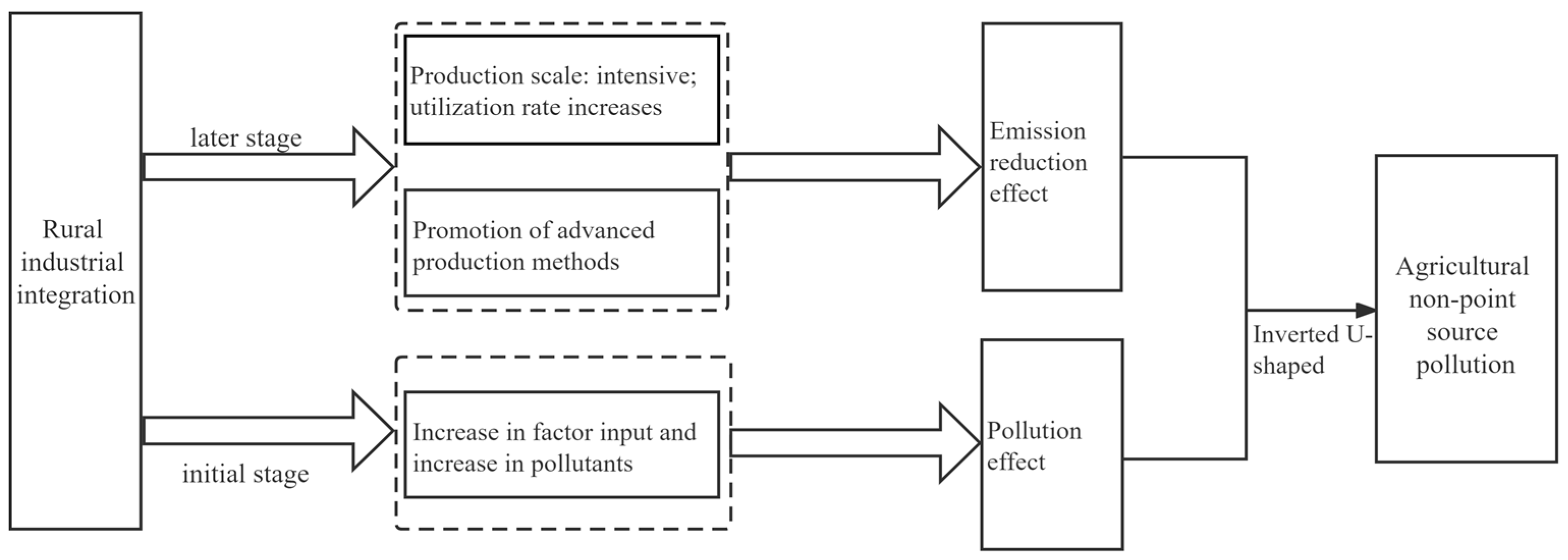
Agricultural non-point pollution has become a hot topic of social concern, and the three major industries in modern rural areas gradually tend to integrate. An in-depth study of the impact of rural industrial integration on agricultural non-point pollution has important guiding significance for the realization of sustainable agricultural development. Based on the panel data of 30 provinces and municipalities in China from 2011 to 2019, this paper explores the impact of rural industrial integration on agricultural non-point source pollution and further examines the moderating effect of urbanization. The main findings are as follows. First, there is a significant inverted U-shaped relationship between rural industrial integration and agricultural non-point source pollution. At present, rural industrial integration has a tendency of alleviating agricultural non-point source pollution. Second, urbanization has a moderating effect on the impact of rural industrial integration on agricultural non-point source pollution, moving the turning point of the curve to the left, which can accelerate the arrival of the emission reduction effect of rural industrial integration. Finally, the heterogeneity test shows that compared to areas with developed economies and weak financial support, the inverted U-shaped relationship between rural industrial integration and agricultural non-point source pollution is more significant in regions with underdeveloped economies and strong financial support. The above studies enrich the relevant literature on rural industrial integration and agricultural non-point source pollution and provide a theoretical basis for the government to formulate relevant policies for promoting the development of rural industrial integration and alleviating agricultural non-point source pollution.
Keywords: industrial integration; agriculturalpollution; urbanization; nonlinear; fixed effect model industrial integration; agriculturalpollution; urbanization; nonlinear; fixed effect model