



Description of Meteorological Indices Presented Based on Long-Term Yields of Winter Wheat in Southern Germany


Abstract
1. Introduction
1.1. Background
1.2. Objectives of This Study
2. Materials and Methods
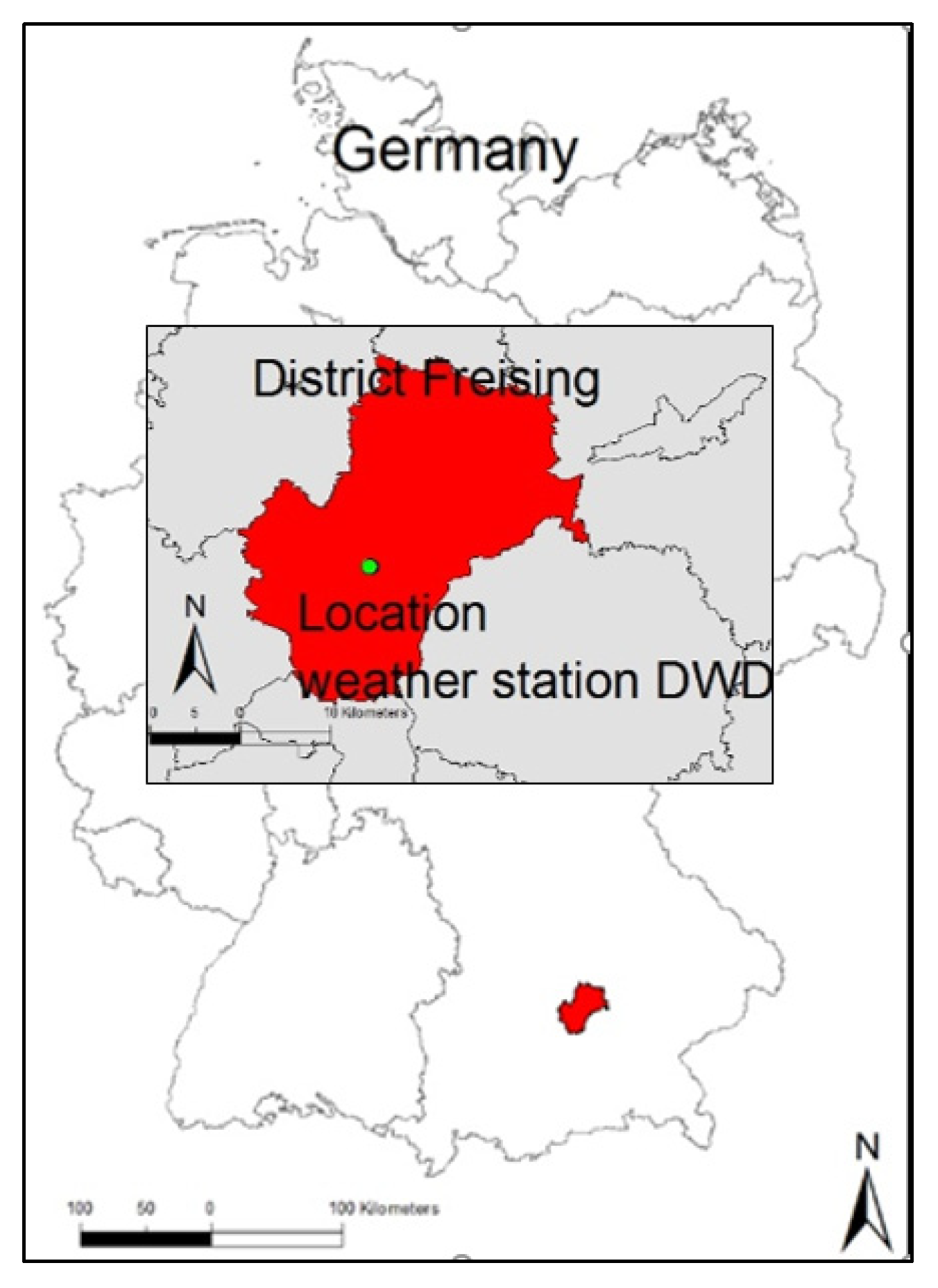
2.1. General Description, Soil, and Physiography of the Freising District
2.2. Description and Classification of the Weather Indices
- -
- Maximum temperature (°C);
- -
- Minimum temperature (°C);
- -
- Temperature amplitude;
- -
- Average air temperature (°C);
- -
- Precipitation (mm);
- -
- Relative humidity (%);
- -
- Sunshine duration (h);
- -
- Global radiation (Wh/m2).
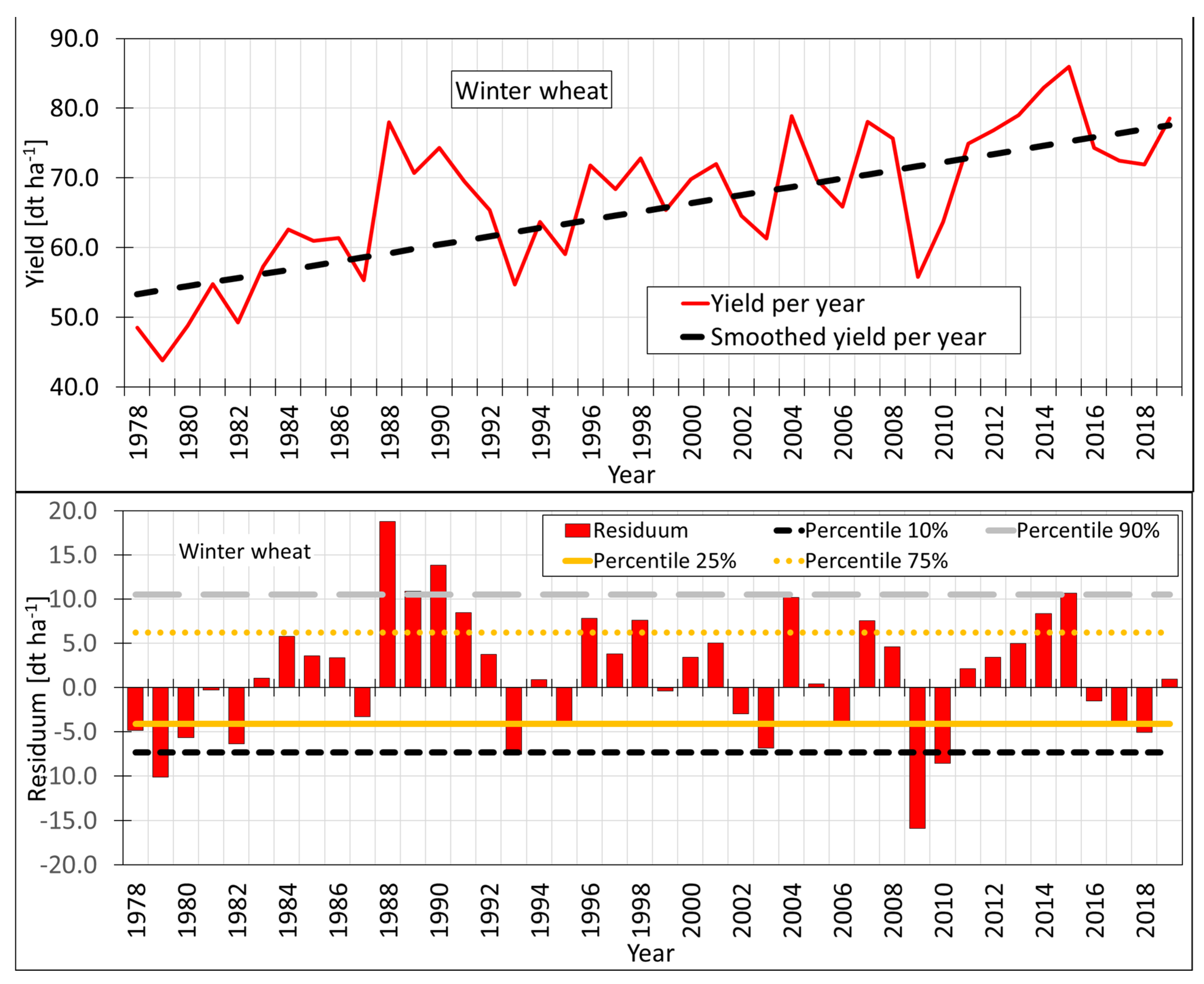
2.3. Yield Data and Extreme Value Analysis
3. Results
3.1. Temporal Course of the Yields
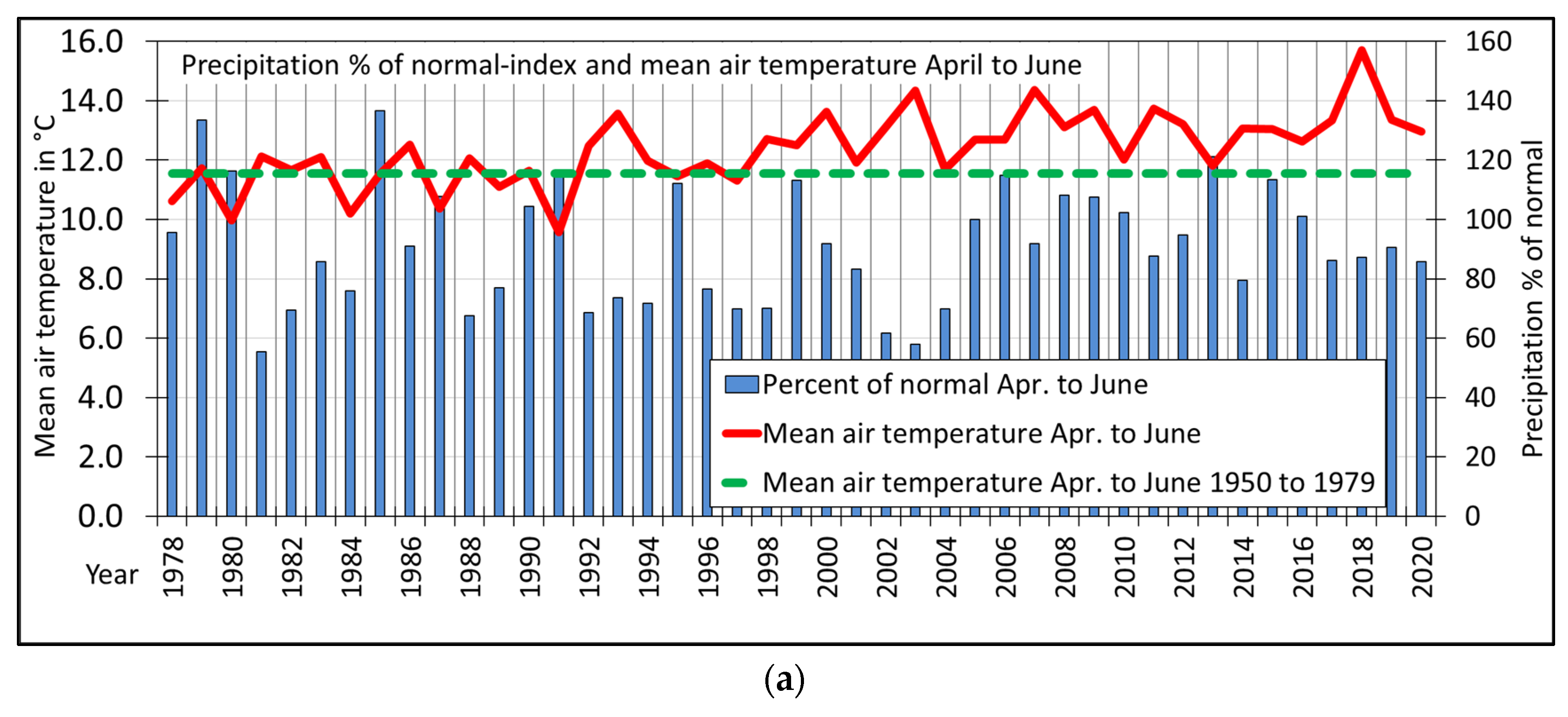
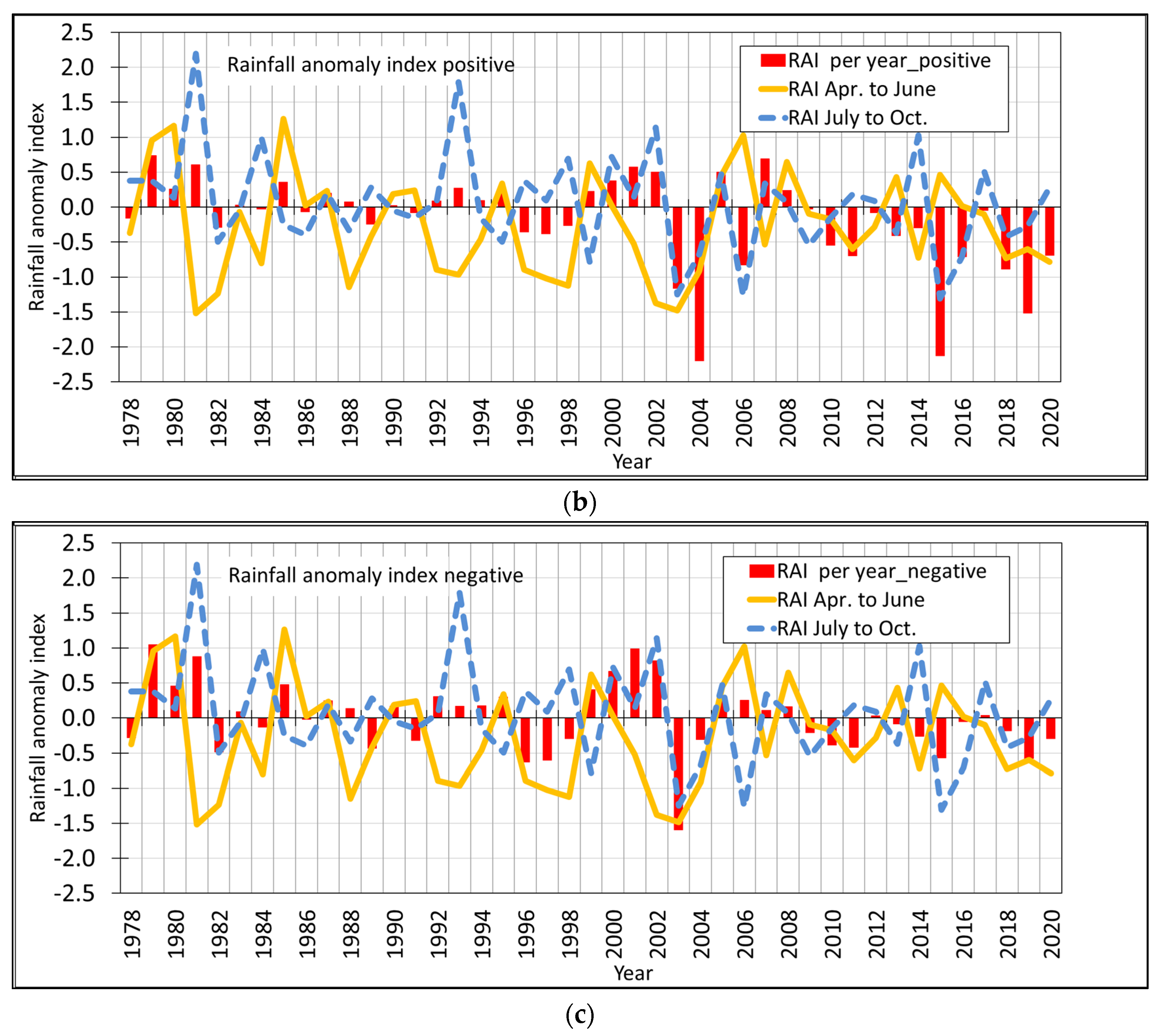
3.2. Comparison of the Annual Variation of Yields with Weather Patterns
3.3. Summary Evaluation of the Meteorological Indices
- -
- Agreement of the indices with yield data;
- -
- Sensitivity of the indices to changes in the input values;
- -
- Efforts to determine the indices.
4. Discussion
5. Conclusions
Supplementary Materials
Author Contributions
Funding
Informed Consent Statement
Data Availability Statement
Conflicts of Interest
References
- Gömann, H.; Bender, A.; Bolte, A.; Dirksmeyer, W.; Englert, H.; Feil, J.H.; Frühauf, C.; Hauschild, M.; Krengel, S.; Lilienthal, H.; et al. Thünen Report 30—Agrarrelevante Extremwetterlagen und Möglichkeiten von Risikomanagementsystemen. Studie im Auftrag des Bundesministeriums für Ernährung und Landwirtschaft (BMEL); Thünen: Braunschweig, Germany, 2015. [Google Scholar]
- Wittchen, U.; Schwarz, J.; Pallutt, B. Versuchsfeld Dahnsdorf—15 Jahre agrarmeteorologische Messungen. Teil 3: Niederschlagshöhe. J. Für Kult. 2015, 67, 175–183. [Google Scholar]
- Bernhofer, C.; Hänsel, S.; Schaller, A.; Pluntke, T. Charakterisierung von meteorologischer Trockenheit. Schriftenreihe LfULG 2015, 7, 1–208. [Google Scholar]
- Weigand, S.; Tischner, H. Auswirkungen und Strategien für Landwirtschaft und Umwelt—Aus der Sicht des Pflanzenschutzes. In Klimaänderung und Landwirtschaft—Bestandsaufnahme und Handlungsstrategien für Bayern. 6. Kulturlandschaftstag 19.11; Bayerische Landesanstalt für Landwirtschaft (LfL) (Hrsg.): München, Germany, 2007; pp. 57–70. [Google Scholar]
- Barlow, K.M.; Christy, B.P.; O’Leary, G.J.; Riffkin, P.A.; Nuttall, J.G. Simulating the impact of extreme heat and frost events on wheat crop production: A review. Field Crops Res. 2014, 171, 109–119. [Google Scholar] [CrossRef] [Scilit]
- Kristensen, K.; Schelde, K.; Olesen, J.E. Winter wheat yield response to climate variability in Denmark. J. Agric. Sci. 2011, 149, 33–47. [Google Scholar] [CrossRef] [Scilit]
- Gobin, A. Impact of heat and drought stress on arable crop production in Belgium. Nat. Hazards Earth Syst. Sci. 2012, 12, 1911–1922. [Google Scholar] [CrossRef] [Scilit]
- Ontel, I.; Vladut, A. Impact of drought on the productivity of agricultural crops within the Oltenia Plain, Romania. Geogr. Pannonica 2014, 19, 9–19. [Google Scholar] [CrossRef] [Scilit]
- Wu, Y.F.; Zhong, X.L.; Hu, X.; Ren, D.C.; Lv, G.H.; Wei, C.Y.; Song, J.Q. Frost affects grain yield components in winter wheat. N. Z. J. Crop Hortic. Sci. 2014, 42, 194–204. [Google Scholar] [CrossRef] [Scilit]
- Seidel, P. Extremwetterereignisse und ihre Auswirkungen auf Schaderreger in Weizen, Gerste und Mais. J. Für Kult. 2016, 68, 313–327. [Google Scholar]
- Ren, B.; Zhang, J.; Li, X.; Fan, X.; Dong, S.; Liu, P.; Zhao, B. Effects of waterlogging on the yield and growth of summer maize under field conditions. Can. J. Plant 2013, 94, 23–31. [Google Scholar] [CrossRef] [Scilit]
- Wollmer, A.-C.; Pitmann, K.; Mühling, K.-H. Einfluss von temporärer Überstauung auf Wachstum, Nährstoffkonzentration und Ertrag von Weizen. In Kongressband 2016 Rostock. Vorträge zum Generalthema: Anforderungen an die Verwertung von Reststoffen in der Landwirtschaft. Darmstadt; VDLUFA-Verlag VDLUFA-Schriftenreihe; Ebertseder: Darmstadt, Germany, 2016; Volume 73, pp. 138–142. [Google Scholar]
- Heil, K.; Gerl, S.; Schmidhalter, U. Sensitivity of Winter Barley Yield to Climate Variability in a Pleistocene Loess Area. Climate 2021, 9, 112. [Google Scholar] [CrossRef] [Scilit]
- Heil, K.; Lehner, A.; Schmidhalter, U. Influence of Climate Conditions on the Temporal Development of Wheat Yields in a Long-Term Experiment in an Area with Pleistocene Loess. Climate 2020, 8, 100. [Google Scholar] [CrossRef] [Scilit]
- Barnabas, B.; Jäger, K.; Feher, A. The effect of drought and heat stress on reproductive processes in cereal. Plant Cell Environ. 2008, 31, 11–38. [Google Scholar] [CrossRef] [Scilit] [PubMed]
- Sivakumar, M.V.K.; Das, H.P.; Brunini, O. Impacts of Present and Future Climate Variability and Change on Agriculture and Forestry in the Arid and Semi-Arid Tropics. Clim. Change 2005, 70, 31–72. [Google Scholar] [CrossRef] [Scilit]
- Rippel, R. Klimaänderung. Landwirtschaft 2014, 143–150. [Google Scholar]
- Frühauf, C. Welche Herausforderungen bringt der Klimawandel für die Kulturpflanzen. J. Für Kult. 2017, 69, 35–38. [Google Scholar]
- Weigel, H.J. Klimawandel—Auswirkungen und Anpassungsmöglichkeiten. In Neues aus dem Ökologischen Landbau; Rahmann, G., Schumacher, U., Eds.; Thünen-Institut: Braunschweig, Germany, 2011. [Google Scholar]
- Osborne, T.; Wheeler, T. Evidence for a climate signal in trends of global crop yield variability over the past 50 years. Environ. Res. Lett. 2013, 8, 9. [Google Scholar] [CrossRef] [Scilit]
- Deutscher Wetterdienst. Available online: https://opendata.dwd.de/climate_environment/CDC/observations_germany/climate/daily/kl/historical/ (accessed on 17 December 2021).
- IUSS Working Group WRB. World Reference Base for Soil Resources 2014, update 2015. International soil classification system for naming soils and creating legends for soil maps. In World Soil Resources Reports No. 106; FAO: Rome, Italy, 2015. [Google Scholar]
- Auerswald, K.; Eicher, A.; Filser, J.; Kämmerer, A.; Kainz, M.; Rackwitz, R.; Schülein, J.; Sommer, H.; Weigand, H.; Weinfurtner, K. Development and implementation of soil conservation strategies for sustainable land use. In Proceedings of the 2nd International Congress, European Society for Soil Conservation, Tour Guide, Munich, Germany, 2–6 July 1996; Stanjek, H., Ed.; pp. 25–67. [Google Scholar]
- Wilhite, D.A. Drought as a natural hazard. In Drought: A Global Assessment; Wilhite, D.A., Ed.; Routledge: London, UK, 2000; Chapter 1; pp. 3–18. [Google Scholar]
- Deutscher Wetterdienst. Available online: https://www.dwd.de/DE/service/lexikon/Functions/glossar (accessed on 15 December 2021).
- Leser, H.; Egner, H.; Meier, S.; Mosimann, T.; Neumair, S.; Paesler, R.; Schlesinger, D. Wörterbuch Geographie, 15th ed.; Leser, H., Ed.; Westermann Schulbuchverlag: Braunschwaig, Germany, 2011. [Google Scholar]
- Sterzel, T. Correlation Analysis of Climate Variables and Wheat Yield Data on Various Aggregation Levels in Germany and the EU-15 Using GIS and Statistical Methods, with a Focus on Wave Years. In PIK Report PIK-108; Potsdam-Institut für Klimaforschung e.V.: Potsdam, Germany, 2007; 122p. [Google Scholar]
- Enquéte-Kommission “Schutz der Erdatmosphäre” des Deutschen Bundestages. In Schutz der Grünen Erde, Klimaschutz durch umweltgerechte Landwirtschaft und Erhalt der Wälder; Economica Verlag: Bonn, Germany, 1994; p. 702.
- Marti, J.; Savin, R.; Slafer, G.A. Wheat Yield as Affected by Length of Exposure to Waterlogging During Stem Elongation. J. Agron. Crop Sci. 2015, 201, 473–486. [Google Scholar] [CrossRef] [Scilit]
- Dietz, T.; Weigelt, H. Böden unter Landwirtschaftlicher Nutzung: 48 Bodenprofile in Farbe, 2nd ed.; BLV Verlag: München, Germany, 1991. [Google Scholar]
- Schaller, M.; Weigel, H.J. Analyse des Sachstands zu Auswirkungen von Klimaveränderungen auf die deutsche Landwirtschaft und Maßnahmen zur Anpassung. In Sonderheft 316. Landbauforschung Völkenrode—FAL Agricultural Research Bundesforschungsanstalt für Landwirtschaft (FAL); KLIMZUG-Nordhessen: Braunschweig, Germany, 2007. [Google Scholar]
- Nickl, U.; Gehring, K.; Weigand, S. Getreide-und Maisbau—Produktionstechnische Grundlagen. In Landwirtschaftlicher Pflanzenbau, 13th ed.; Ulmer Verlag: München, Germany, 2014; pp. 373–404. [Google Scholar]
- Herz, M.; Nickl, U. Getreide-und Maisbau—Gerste. In Landwirtschaflticher Pflanzenbau, 13th ed.; Ulmer Verlag: München, Germany, 2014; pp. 464–485. [Google Scholar]
- NCDC 1965. U.S. Palmer Drought Indices. National Climatic Data Center. Available online: https://www.ncdc.noaa.gov/temp-and-precip/drought/docs/palmer.pdf (accessed on 10 October 2021).
- Münchner Merkur (Hrsg.). Regen und Kälte setzten Getreide zu. 2010. Available online: https://www.merkur.de/lokales/freising/regen-kaelte-setzen-getreide-772756.html (accessed on 13 April 2021).
- Hatfield, J.L.; Prueger, J.H. Implications for plant response to climate change. In Crop Adaption to Climate Change; Yadav, S.S., Redden, R.J., Hatfield, J.L., Lotze-Campen, H., Hall, A.E., Eds.; Wiley-Blackwell: West Sussex, UK, 2001; pp. 27–43. [Google Scholar]
- Jahn, M.; Wagner, C.; Sellmann, J. Ertragsverluste durch wichtige Pilzkrankheiten in Winterweizen im Zeitraum 2003 bis 2008—Versuchsergebnisse aus 12 deutschen Bundesländern. J. Für Kult. 2012, 64, 273–285. [Google Scholar]
- West, J.S.; Holdgate, S.; Townsend, J.A.; Halder, J.; Edwards, S.G.; Jennings, P.; Fitt, B.D.L. Impacts of changing climate and agronomic factors on fusarium ear blight of wheat in the UK. Fungal Ecol. 2012, 5, 53–61. [Google Scholar] [CrossRef] [Scilit]
- Döring, S.; Döring, J.; Borg, H.; Böttcher, F. Vergleich von Trockenheitsindizes zur Nutzung in der Landwirtschaft unter den klimatischen Bedingungen Mitteldeutschlands. Hercynia N. F. 2011, 44, 145–168. [Google Scholar]
- Semenov, M.A.; Shewry, P.R. Modelling predicts that heat stress, not drought, will increase vulnerability of wheat in Europe. Sci. Rep. 2011, 1, 66. [Google Scholar] [CrossRef] [Scilit] [PubMed]
- Kornhuber, K.; Coumou, D.; Vogel, E.; Lesk, C.; Donges, J.F.; Lehmann, J.; Horton, R.M. Amplified Rossby waves enhance risk of concurrent heatwaves in major breadbasket regions. Nat. Clim. Change 2020, 10, 48–53. [Google Scholar] [CrossRef] [Scilit]
- Templer, S.E.; Ammon, A.; Pscheidt, O.; Ciobotea, C.S.; McCollum, C.; Sonnewald, U.; Förster, J.; Ordon, F.; von Kroff, M.; Voll, L.M. Metabolite profiling of barley flag leaves under drought and combined heat and drought stress reveals metabolic QTLs for metabolites associated with antioxidant defense. J. Exp. Bot. 2017, 68, 1697–1713. [Google Scholar] [CrossRef] [Scilit] [PubMed]

| Author | Year | Location | Crop | Factors and Effects |
|---|---|---|---|---|
| Weigand [4] | 2014 | Agricultural meteorology and the significance of certain weather anomalies for arable farming | ||
| Gömann et al. [1] | 2015 | Thresholds for agrometeorological extreme weather events and impacts on different agricultural crops | ||
| Barlow et al. [5] | 2015 | Germany | Wheat | Effects of extreme heat and frost events on wheat |
| Kristensen et al. [6] | 2011 | Denmark | Wheat | Summer temperature has the strongest effect, resulting in lower yields with increasing temperature, while yields increase with increasing radiation in summer and spring |
| Gobin [7] | 2012 | Cereals | Effects of heat stress and drought on cereal development | |
| Ontel, Vladut [8] | 2014 | Maize | Correlation between drought indices and yield in maize | |
| Wu et al. [9] | 2014 | Wheat | Influence of late frosts on the development of wheat | |
| Seidel [10] | 2016 | Wheat, barley, maize | Extreme weather events and their role in the development of pests in wheat, barley, and maize | |
| Ren et al. [11] | 2014 | Maize | Effects of heavy precipitation and waterlogging on maize cultivation | |
| Wollmer [12] | 2016 | Germany | Wheat | Temporary waterlogging causes reduced growth, nutrient concentration, and yield of wheat |
| Heil et al. [13], Heil et al. [14] | 2020, 2021 | Germany | Wheat | In more fertile locations, the yield is determined, to a considerable extent, by climatic conditions in winter and the transition periods from winter to the warmer season and vice versa, and less by climatic conditions during the main growing season |
| Variable | Definition/Time Range | The Formula for the Derivation of Indices | ||
|---|---|---|---|---|
| Precipitation-related indices | Precipitation sum (Pm) | The sum of precipitation (yearly, April–October, monthly, and daily) | where Pd is the precipitation per day | |
| Precipitation intensity (PI) | Sum of days on which a certain amount of precipitation occurred | PI1: >0–1 mm per day | ||
| PI2: >1–10 mm per day | ||||
| PI3: ≥10 mm per day | ||||
| Heavy precipitation, number of days | ||||
| Vegetation-favorable precipitation, number of days with 2–4.9 mm | ||||
| Daily, where P is the precipitation (mm) and n denotes the number of days | ||||
| Rain-free days (P0) | Sum of days without precipitation (P0); monthly | where N is the height of the precipitation | ||
| Number of precipitation-free pentads (P0_5 days) | The sum of the number of pentads (moving 5-day period) without precipitation | where N is the height of the precipitation | ||
| Meteorological dry periods (PD) | At least 11 consecutive days with daily precipitation less than or equal to 1 mm during the growing season | where N is the height of the precipitation | ||
| Percent-from-normal ) | Current annual/monthly precipitation in relation to the 30-year mean from 1950 to 1979 | where Py, Pm: precipitation per year, per month, respectively | ||
| Cumulative precipitation deficits/surpluses (CPD) | Summation of precipitation anomalies annually/over the growing season/monthly | |||
| Precipitation (rainfall) anomaly index (RAIpositive/negative) | Relation of precipitation to extreme precipitation events from 1950 to 1979 | Pactual: current precipitation per month; P1950–1979: mean per month; E1950–1979: mean of the 10% most extreme precipitation sums (10% percentile for positive/negative anomalies) of the validation period 1950 to 1979 for the observed month (e.g., January, then E is the mean of the 10% most extreme January precipitation sums of the years 1950 to 1979) | ||
| Temperature- and precipitation-related indices | de Martonne aridity/humidity index (M-AI) | Evaluates the effect of precipitation and temperature on plant physiology per year | where Py is the annual precipitation and Ty is the average annual temperature | |
| de Martonne–Reichel dryness index (MR-DI) | Evaluates the effect of precipitation and temperature on plant physiology and precipitation distribution per year | where Py is the precipitation, Ty is the temperature, K is the number of days with precipitation in the observed period with ≥1 mm; 120 is the annual average number of days with precipitation ≥1 mm in Germany; 10 indicates that negative values in the denominator should be avoided | ||
| Hydrothermal Selyaninov coefficient (HTC) | The ratio of the sum of precipitation and the sum of temperature (mean of the day) for all days above 10 °C per year | Py is the precipitation per observed period and Td is the mean temperature per day | ||
| Rain factor (RF) after Lang | Relationship between precipitation and temperature per year (calculated for every year) | where Py is the annual precipitation and Ty is the average annual temperature | ||
| Temperature-related indices | Mean temperature | Mean temperature per year, vegetation period (April to October), month (Ty, Tveg, Tm, respectively) | where Td is the diurnal mean air temperature of the day and n is the number of days | |
| Temperature threshold (TT) | Sum of the days on which the threshold values of 5 or 10 °C are exceeded; monthly values | where n is the number of days and Tmax is the daily maximum temperature | ||
| Frost-alternating days (FAD(Oct–Jul)) | Sum of days (October to July) with a change in temperatures above and below 0 °C within a day, between consecutive days | where n is the number of days, Tmax is the daily maximum temperature, and Tmin is the daily minimum temperature | ||
| Frost index per Liu (FI_Liu) | Sum of the days on which the minimum air temperature is below −3 °C and the temperature difference is at least 8 °C from the mean value of the last 20 days; from September to May | where n is the number of days, Tmin is the daily minimum temperature, and Td is the daily mean temperature | ||
| Summer cold per Liu (SC_Liu) | Sum of the days on which the minimum air temperature is below −3 °C and the temperature difference is at least 8 °C from the mean value of the last 20 days; from April to August | where n is the number of days, Tmin is the daily minimum temperature, and Td is the daily mean temperature | ||
| Late frost index 1 (LFI 1) | Sum of the days on which the minimum air temperature falls below 0 °C; from April to June | where n is the number of days and Tmin is the daily minimum temperature | ||
| Late frost index 2 (LFI 2) | Sum of days on which the temperature is <0 °C; from April to June | where n is the number of days with a temperature <0 °C and Tmin is the daily minimum temperature <0 °C | ||
| Early frost index 1 (EFI 1) | Sum of days on which the minimum air temperature falls below 0 °C; from July to October | where n is the number of days with a temperature <0 °C and Tmin is the daily minimum temperature <0 °C | ||
| Early frost index 2 (EFI 2) | Sum of days on which the minimum air temperature falls below 0 °C; from July to October | where n is the number of days and Tmin is the daily minimum temperature | ||
| Frost days (FT) | Sum of days on which the air temperature falls below 0 °C; monthly values; from October to July | where Tmin is the daily minimum temperature (°C) | ||
| Ice days (ID) | Sum of days with a maximum temperature of <0 °C over the entire year | where Tmin is the daily minimum temperature | ||
| Frost severity (FSev) | Annual minimum temperature | FSev , where Tmin is the daily minimum temperature | ||
| Frost shock (FSh) | Sum of days on which the air temperature drops by 15 °C within 24 h and the minimum air temperature falls below −3 °C; annual values | |||
| Summer days (SD) | Sum of days on which the air temperature exceeds 25 °C; monthly values per year | |||
| Hot days (HD) | Sum of days on which the air temperature exceeds 30 °C; monthly values per year | |||
| Maximum values (MVa) | Absolute maxima per year in °C | |||
| Summer index (SIy) | Sum of days with a daily maximum air temperature above 5 °C; yearly | |||
| Summer index (SIveg) | Sum of days with a daily maximum air temperature above 5 °C; from April to October | |||
| Winter index (WI) | Sum of days with a daily maximum air temperature below 5 °C; from November to April | where n is the number of days | ||
| Sum of the active temperatures (SAT) | Sum of temperatures above 5 °C during the growing season | where n is the number of days | ||
| Growing-period-related indices | Beginning/end of the main vegetation period | The first week of the year on which the threshold value of 5 °C is permanently exceeded (at least 5 days) | ||
| Climatic vegetation time duration 1 (CD1) | Number of 5-day periods with a mean daily air temperature above 5 °C; values per year | |||
| Climatic main vegetation time duration 2 (CD2) | Number of days with the diurnal mean daily air temperature above 5 °C; values per year | |||
| Grassland temperature sum (GT-1) | Sum of the mean daily temperature until the value of 200 °C | |||
| Grassland temperature sum (GT-2) | Sum of the mean daily temperature until day 105 | |||
| Radiation-related index | Global radiation GR(Oct–Jul) | Sum of radiation | where n refers to the months | |
| Effects | Effects Eliminated by Residuals | Effects Remaining in Residuals |
|---|---|---|
| Biological and chemical | New varieties | Diseases and pest infestation |
| Herbicides | ||
| Insecticides | ||
| Fertilizer and fertilization level | ||
| Mechanical management | Technical equipment processing | |
| Management advancement | Crop rotation | |
| Atmospheric | Climate change | Weather deviations and extreme weather events |
Disclaimer/Publisher’s Note: The statements, opinions and data contained in all publications are solely those of the individual author(s) and contributor(s) and not of MDPI and/or the editor(s). MDPI and/or the editor(s) disclaim responsibility for any injury to people or property resulting from any ideas, methods, instructions or products referred to in the content. |
© 2023 by the authors. Licensee MDPI, Basel, Switzerland. This article is an open access article distributed under the terms and conditions of the Creative Commons Attribution (CC BY) license (https://creativecommons.org/licenses/by/4.0/).
Share and Cite
Heil, K.; Klöpfer, C.; Hülsbergen, K.-J.; Schmidhalter, U. Description of Meteorological Indices Presented Based on Long-Term Yields of Winter Wheat in Southern Germany. Agriculture 2023, 13, 1904. https://doi.org/10.3390/agriculture13101904
Heil K, Klöpfer C, Hülsbergen K-J, Schmidhalter U. Description of Meteorological Indices Presented Based on Long-Term Yields of Winter Wheat in Southern Germany. Agriculture. 2023; 13(10):1904. https://doi.org/10.3390/agriculture13101904
Chicago/Turabian StyleHeil, Kurt, Christian Klöpfer, Kurt-Jürgen Hülsbergen, and Urs Schmidhalter. 2023. "Description of Meteorological Indices Presented Based on Long-Term Yields of Winter Wheat in Southern Germany" Agriculture 13, no. 10: 1904. https://doi.org/10.3390/agriculture13101904
APA StyleHeil, K., Klöpfer, C., Hülsbergen, K.-J., & Schmidhalter, U. (2023). Description of Meteorological Indices Presented Based on Long-Term Yields of Winter Wheat in Southern Germany. Agriculture, 13(10), 1904. https://doi.org/10.3390/agriculture13101904

