


Abstract
Background: Rotator cuff tendinopathy (RCT), subacromial impingement (SAIS), and medial (MEP) and lateral (LEP) epicondylitis are the most common causes of upper limb pain caused by microtrauma and degeneration. There are several therapeutic choices to manage these disorders: extracorporeal shockwave therapy (ESWT) has become a valuable option. Methods: A systematic review of two electronic medical databases was performed by two independent authors, using the following inclusion criteria: RCT, SAIS, MEP, and LEP, ESWT therapy without surgical treatment, with symptoms duration more than 2 months, and at least 6 months of follow-up. Studies of any level of evidence, reporting clinical results, and dealing with ESWT therapy and RCT, SAIS, MEP, and LEP were included. Results: A total of 822 articles were found. At the end of the first screening, following the previously described selection criteria, we selected 186 articles eligible for full-text reading. Ultimately, after full-text reading, and reference list check, we selected 26 articles following previously written criteria. Conclusions: ESWT is a safe and effective treatment of soft tissue diseases of the upper limbs. Even in the minority cases when unsatisfied results were recorded, high energy shockwaves were nevertheless suggested in prevision of surgical treatment.
1. Introduction
Rotator cuff tendinopathy (RCT), subacromial impingement (SAIS), and medial (MEP) and lateral (LEP) epicondylitis are the most common causes of upper limb pain [1]. Calcific tendinitis is a painful disorder characterized by either single or multiple presences of calcium deposits in the tendon or subacromial bursa [2], while the term noncalcific tendinitis refers to tendinitis without calcium deposits [1]. Both conditions are common in the shoulder and elbow and affect both sedentary people and athletes [3].
RCT is the most common source of shoulder pain, and its prevalence is estimated to be 2%–3.8% in the general population [4]. Subacromial impingement syndrome (SAIS) is a pathological state of the rotator cuff tendons [5], resulting from mechanical impingement causing 50%–70% of shoulder pain cases [6]. MEP, or “golfer’s elbow”, is the result of common flexor tendon (CFT) microtrauma and degeneration, and might affect <1% of the general population and as many as 3.8% to 8.2% of patients in occupational settings, and typically occurs from the fourth decade of life [7]. Lateral epicondylitis (LEP) is a common chronic inflammatory degeneration of the wrist extensor tendons at their insertion to the lateral epicondyle of the humerus, affecting 1%–3% of the general population, especially between the ages of 30 and 70, without gender predisposition [8]. Inflammation and chronic degeneration are the key conditions in these pathogeneses, and their natural history is influenced by the quality of the tendon tissue, along with mechanical overuse or misuse [3]. The risk of recurrence is very high, and no definite therapy is available [9]. Numerous therapeutic choices (surgical and conservative) can be used to manage these kinds of disorders. However, the goals remain similar: to relieve acute symptomatology, rehabilitate the pathologic tendon, and prevent future recurrence. As with many chronic tendinopathies, nonsurgical therapy is the first choice for treatment [9]. Standard management regimens of these diseases include rest, cryotherapy, activity modification, stretching exercises, nonsteroidal anti-inflammatory drugs (NSAIDs), and eccentric loading [10].
Extracorporeal shockwave therapy (ESWT), initially introduced for the treatment of nephrolithiasis, has become a viable option for the treatment of various soft-tissue disorders [11], especially the chronic Achilles tendinopathy [12,13] and plantar fasciitis [14], as well as bone defects [15]. Although the mechanism by which ESWT produces a therapeutic effect is not completely understood [16], Wang and colleagues supposed that the repeated microtrauma could stimulate the ingrowth of neovascularization associated with the up-regulation of angiogenic and osteogenic growth factors [17]. Similarly, the calcium reabsorption is not clear, the principal hypothesis is mechanical, suggesting the fragmentation of the calcium deposit is caused by the pressure wave directly on the site [18]; on the other hand, some authors have speculated a cavitation effect, due to the ESWT: in fact, the highly intensive shockwaves should first affect the integrity of the calcifications and, subsequently, destroy the deposit [19]. The molecular hypothesis advances the active role of the inflammatory response and leukocyte chemotaxis to generate the phagocytosis of the calcium deposit [16]. Moreover, ESWT may reduce pain through hyperstimulation of nociceptors/gate-control theory of pain transmission, altered pain receptor neurotransmission, and by increasing local pain inhibiting substances [20]. Stimulation of nociceptive C-fibers may not only play a role in analgesia, but also in tendon remodeling, as it may increase the release of neuropeptides, causing fibroblast stimulation and vasodilation [20]. According to energy levels the ESWT can be distinguished in: (1) low-energy (flux density (FD) of up to 0.08 mJ/mm2); (2) moderate (FD of between 0.09 and 0.28 mJ/mm2,); and (3) high energy (0.6 mJ/mm2) shock waves [21].
Many studies have attempted to investigate the efficacy of ESWT on the acute and chronic tendinopathy of the upper limb, but orthopedic surgeons have yet to reach consensus on this. The purpose of this systematic review is to analyze the available literature, providing an update on the evidence related to the upper limb tendinopathy and subacromial impingement syndrome patients treated with ESWT.
2. Experimental Section
2.1. Study Selection
According to the guidelines of the Preferred Reporting Items for Systematic Reviews and Meta-Analyses (PRISMA) [22], PubMed and Science Direct databases were systematically reviewed by two independent authors (AV and SP). The research string used was “(Cuff rotator tendinopathy OR Lateral Epicondylitis tendinopathy OR Tennis Elbow OR Lateral Epicondylitis tendinopathy OR Golfer’s Elbow OR Subacromial impingement syndrome) NOT (Cuff Rotator rupture OR Cuff Rotator lesion OR Fracture) AND (ESWT OR Extracorporeal Shockwave Therapy)”. From each included original article, a standard data entry form was utilized to extract the number of patients, mean age at treatment, sex, type of treatment, minimum time of symptoms, duration of treatment, complication rate and complication type, follow-up, and year of the study.
Study quality assessment was performed in duplicate by two independent reviewers (AV and GT). Discussing conflicts about data were resolved by consultation with a senior surgeon (VP).
2.2. Inclusion and Exclusion Criteria
Eligible studies for the present systematic review included extracorporeal shockwave therapy treatment in the upper limb. The initial titles and abstracts screening was made using the following inclusion criteria: Rotator cuff tendinopathy (RCT), subacromial impingement (SAIS), and medial (MEP) and lateral (LEP) epicondylitis, ESWT therapy without operative treatment, with more of 2 months symptoms and a minimum average of 6-months follow-up.
The exclusion criteria were groups of patients with primary or secondary surgical treatment, symptoms for less of 6 months, and animal trials. All remaining duplicates, articles focused on other topics or with poor scientific methodology and accessible abstract were excluded.
2.3. Risk of Bias Assessment
In this systematic review, risk of bias assessment was performed according to the ROBINS-I tool for non-randomized studies [23], consisting of three-stage assessment of the studies included. The first stage regards the planning of the systematic review, the second stage is the assessment of the common bias possibly found in these studies, and the latter is about the overall risk of bias.
Three authors (AV, AC, and GT) performed the evaluation independently. Any discrepancy was discussed with the senior investigator (VP) for the final decision. All the raters agreed on the final result of every stage of the assessment (Table 1 and Table 2).
Table 1.
The main findings of shoulder tendinopathies included case-control and cohort studies.
Table 2.
The main findings of elbow tendinopathies included case-control and cohort studies.
3. Results
3.1. Included Studies
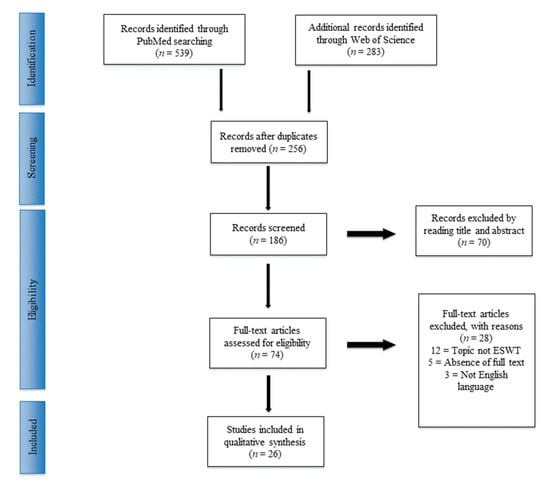
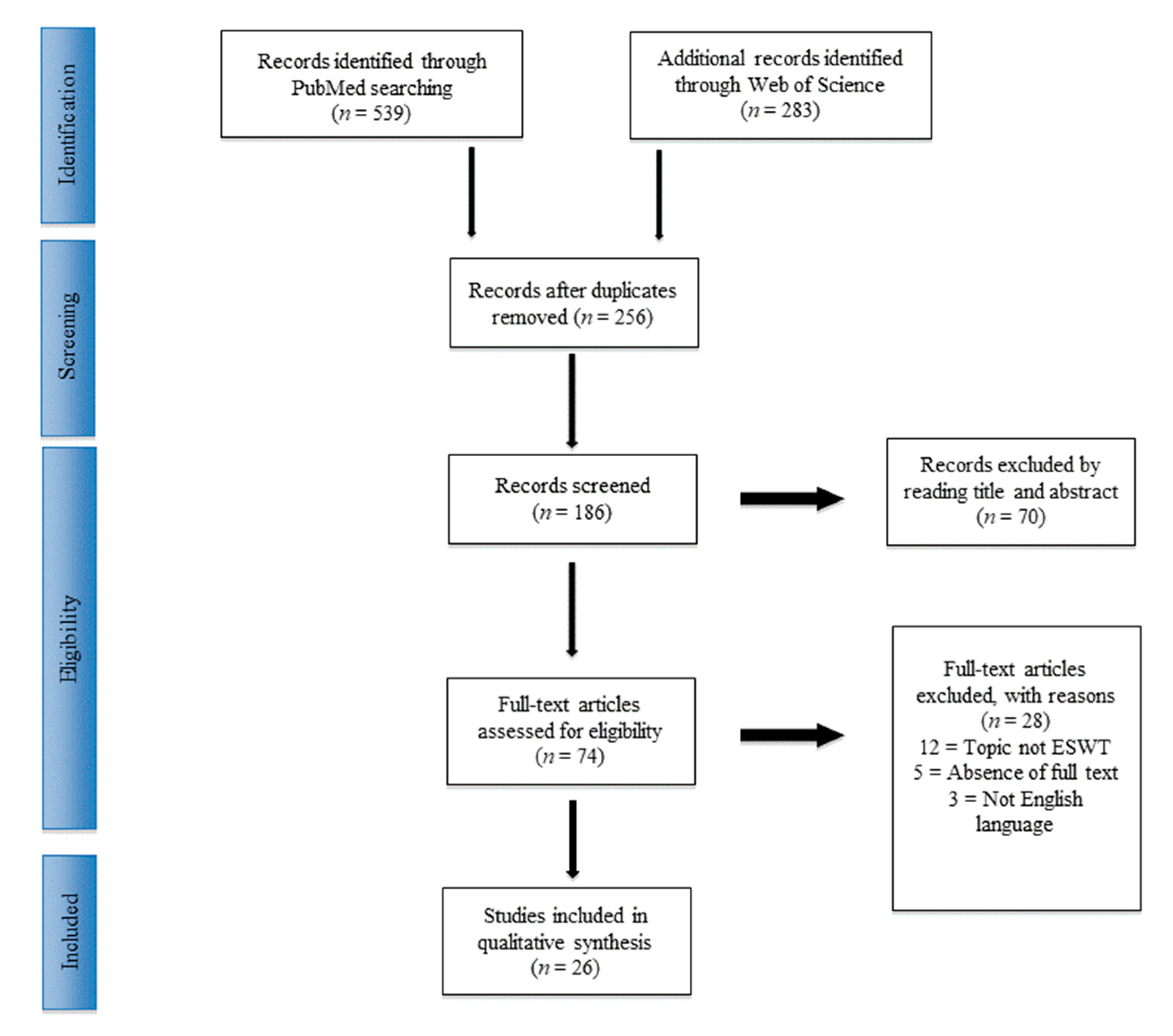
A total of 822 articles were found. After the exclusion of duplicates, 186 articles were selected. At the end of the first screening, following the previously described selection criteria, we selected 74 articles eligible for full-text reading. Metanalysis or systematic reviews were excluded from the study. Ultimately, after full-text reading, and checking of the reference list, we selected 26 articles, composed of randomized controlled human trials (hRCT) and prospective and retrospective cohort or series studies, following previously written criteria. A PRISMA [21] flowchart of the method of selection and screening is provided (Figure 1). The main findings of the included articles were summarized (Table 1 and Table 2).
Figure 1.
PRISMA (Preferred Reporting Items for Systematic Reviews and Meta-Analysis) flowchart of the systematic literature review.
3.2. Shoulder
All of the articles [11,24,25,26,27,28,29,30,31,32,33,34,35,36,37,38] included in the study focus on calcific tendinopathy of the shoulder, non-calcific tendinopathy of the shoulder, and subacromial impingement syndrome (SAIS).
3.2.1. Calcific Tendinopathy of the Rotator Cuff (CTRC)
Many articles [24,25] demonstrated a decrease of the pain and the amount of calcification [26,27,28] in patients treated with ESWT in calcific tendinopathy of the shoulder. Also, ESWT and ESWT associated with kinesio taping (KT) groups, Frassanito et al. [29] reported better outcome and a faster recovery in patients treated with functional taping. The combination of ESWT and dietary supplement (DS) containing methylsulfonylmethane, hydrolyzed swine collagen (Type I and Type II), l-arginine and l-lysine, vitamin C, condroitin sulfate, glucosamine, and curcuma longa has been shown to provide a greater and faster pain relief, with a significant reduction of NSAIDs consumption [11]. Chou et al. [30] emphasized that patients with Gartner and Heyer type I calcification, calcification >15 mm, and the duration of symptoms >11 months had poorer outcome after ESWT.
3.2.2. Non-Calcific Tendinopathy of the Rotator Cuff (NTRC)
Regarding the treatment of non-calcific tendinopathy of the rotator cuff, the evidence supporting the ESWT treatment in short- and long-term is controversial. Li et al. [31] found that, considering a total of 84 patients, pain symptomatology was improved in the high dose ESWT group. Galasso et al. [32] detected a remarkable short-term efficacy in functional recovery in ESWT patients relative to a placebo group. Wu et al. indicated that the high-dose ESWT posed superior clinical efficacy in type II/III calcification tendinosis compared to type I calcification and noncalcific shoulder tendinosis [33]. In non-calcific supraspinatus tendinopathy patients treated with ESWT, Efe et al. [34] did not record any effect on function or pain improvement after 10 years. Speed et al. [35] reported a significant and sustained placebo effect after moderate doses of ESWT, but no evidence of added benefit when compared with the sham treatment.
3.2.3. Subacromial Impingement Syndrome (SAIS)
As reported by Circi et al. [36], ESWT has been considered effective in the treatment of impingement syndrome in the early period, both for pain and functional outcome, regardless of acromion morphology. The study of Kvalvaag et al. [37], which included 143 subjects, reported no differences between the ESWT group and the control. In SAIS patients, superior functional recovery, muscle endurance, and decrease of pain in the short to medium term were recorded when ESWT was associated with isokinetic exercises [38].
3.3. Elbow
Thirteen studies assessed the outcome of patients treated with ESWT compared to a control group, tenotomy, acupuncture, local infiltration of corticosteroids, or cryoultrasound in medial and lateral epicondylitis.
3.3.1. Lateral Epicondylitis (LEP)
The results of the studies investing ESWT treatment of lateral epicondylitis affected patients are controversial. Similar to other authors [39,40,41], Pettrone et al. [42], in a study involving 114 patients, obtained satisfying results in the management of epicondylitis with ESWT (vs. a placebo group). When an ultrasonography-guided [43] approach was used, the authors reported a positive response in 75.7% of the patients after the first treatment. On the contrary, other authors [35,44] reported a similar outcome relative to the placebo group. Compared to surgical treatment, such as tenotomy, ESWT represented a valid alternative after long-term follow up [45], as well as compared to the local infiltration of corticosteroids [46]. Vulpiani et al. [47] highlighted an improvement of functional recovery in chronic epicondylitis in patients treated with ESWT relative to the cryoultrasound group after 12 months.
3.3.2. Medial Epicondylitis (MEP)
Lee et al. [46] compared the ESWT treatment of medial epicondylitis in the acute phase with local infiltration of corticosteroids. Although the corticosteroids injections had more satisfying results in the short term (after 1 year), the ESWT patients had a better functional outcome. Similar short-term values were achieved in ESWT patients compared to acupuncture treatment [48].
4. Discussion
4.1. General Consideration
The findings addressing the treatment with ESWT in the chronic tendinopathies and diseases of the upper limbs are somewhat heterogeneous; many controversies remain unresolved. There is no consensus about the number of sessions of ESWT required. Generally, the protocols provide between one and six sessions per week, increasing the number of sessions does not seem to improve outcomes. There is no consensus regarding the energy setting that should be used [25]. The shock wave generator, the number of impulses, the focusing of the shockwave concerning the tendon insertion, the number and the interval between each treatment session, different stages of the disease, and types of calcification all are important factors that must be carefully considered [25,27,49].
ESWT requires expensive shockwave delivery apparatus and several clinical sessions [30].
Contraindications for ESWT included pregnancy, acute infection, malignant tumor and coagulopathy, fracture or calcific tendinitis coexisting with a rotator cuff tear [30].
Common complications and advised effects after ESWT include transient pain, skin erythema, pain, and local swelling [20].
At the best knowledge of the authors, this is the first article analyzing and summarizing the main literature evidences of the functional outcomes in patients affected by shoulder and elbow soft tissue diseases and treated with ESW.
4.2. Shoulder
Several [25,26,27,28,29,30,31,32,33,34] studies reported satisfying results for functional outcome and decrease of pain after ESWT treatment in CTRC, NTRC, and SAIS affected patients. Some authors even reported the use of ESWT to be more effective than the use of transcutaneous electric nerve stimulation (TENS) [26] in patients with chronic calcific tendinitis of the shoulder, especially of the rotator cuff with arc-type calcific plaque [28]. Galasso [32] and Li et al. [31], despite Speed et al. [35] showed the contrary, reporting encouraging effect for treated patients with CTRC and NTRC in the short-term follow-up, unconfirming improvement in long-term compared to the placebo group [34]. Several causes could influence the outcome at 10 years: (1) other treatment interventions, in particular, physical therapy with or without a focus on scapular kinematics; (2) change in occupation and workload; (3) changes in lifestyle; and (4) changes in sports activity.
Chou et al. [30] aimed to predict the outcome in these subjects, identifying Gartner and Heyer type I classification (calcification >15 mm, and duration of symptoms >11 months) as negative prognostic parameters [33]. The timing could be considered as an additional predictor factor; in fact, Malliaropoulos et al. [24] found a correlation between pre-treatment and post-treatment pain duration, suggesting to start the management as soon as possible.
The application of taping as adjuvant therapy is interesting; in fact, KT seems to reinforce the analgesic and regenerative action of ESWT in the short term and promoted a faster therapeutic response at the mid-long term. Some authors [29] have speculated that KT performs its therapeutic functions mainly by proprioceptive feedback, through an immediate and constant stimulation of the mechanoreceptors in the skin, protecting the joint and reducing wrong movements. KT is advantageous because it is non-invasive, non-pharmacological, localized, and relatively cheap. On the other hand, further research is necessary to define the therapeutic indications, identify the best application methods, and clarify which factors determine the clinical result. Similarly, nutraceutical supplementation seems to improve the function and pain symptomatology in CTRC and NTRC patients [11].
Regarding ESWT treatment of SAIS, Circi et al. [36] reported successful results in a manner that is independent of acromion morphology in recovering the pain and functional outcome. Santamato et al. [38] encouraged the association between the ESWT and isokinetic exercise, explaining how the pathogenesis of this syndrome is multifactorial, resulting by the combination of several factors, including degenerative process, the alerted kinematics, postural aberrations, muscle deficit of performance [38]. Nonetheless, in a randomized, double-blind trial based on a large sample, Kvalvaag et al. [37], contradicted the efficiency of ESWT in subacromial impingement relative to patients treated with physical therapy.
4.3. Elbow
More than 40 different modalities of treatment of medial and lateral epicondylitis, used either alone or in combination, have been reported [50]. Numerous studies have reported good results of ESWT in decreasing of pain, improving the functional outcome and grip strength, in calcific and non-calcific tendinopathies [39] with a chronic presentation. Moreover, Köksa et al. [41] described an improvement of symptomatology and functionality, suggesting not only the absence of exacerbation or increase of the inflammation, but recommending ESWT for acute symptoms, thereby avoiding progression to the chronic phase or suffering from long-term pain.
Nevertheless, the efficacy of ESWT was not superior to other treatments. In fact, Lee et al. [46] reported that local steroid injection was more effective at the beginning, and similar results were reported after the first 2 weeks of therapy when the shockwaves were compared to acupuncture [47].
Some authors, who have described unsatisfied results in the use of low energy ESWT, have nevertheless suggested applying a method involving alternative doses and/or different dosage intervals [30] or before surgical treatment in refractory or relapsing cases [43,44].
Several adjuvants therapies or methods have been described to improve the effectiveness of ESWT. The use of focal ultrasonography improved the functionality of shockwaves [43], as well as the use of DS, because of their advantage to be not pharmacologic and to contain compounds with modulatory effects on inflammation [3]. The combination of ESWT and DS produce an increased bioavailability of the supplement to the tendon tissue, due to the neo-angiogenic properties [51,52], which results in a decrease in the use of NSAIDs [11].
4.4. Limits of the Study
The heterogenous of the scores considered to assess the patient functional outcome and the absence of ESWT standard protocol are the main limits in the comparison of studies results. We extensively searched and identified all relevant ESWT in upper limb soft tissue diseases articles. Therefore, risk of bias assessment showed moderate overall risk which could influence our analysis.
5. Conclusions
Extracorporeal shock wave therapy is a safe and effective treatment of upper limbs soft tissue diseases. Despite similar result to other therapies in short and middle terms, numerous studies have suggested the use of high energy shockwaves in chronic tendinopathies. In the minority of cases when unsatisfied results were recorded, high energy shockwaves were nevertheless suggested in prevision of surgical treatment. Adjuvant therapies, as the kinesio taping and dietary supplementation, seems to be useful in the treatment of upper limb soft tissues diseases but further findings are mandatory, we encourage high-profile clinical studies to investigate adjuvant therapy or other methods able to improve the effectiveness of ESWT. The literature available on the ESWT treatment in upper limb soft tissue diseases presents major limitations in terms of great heterogeneity and lack of high-profile studies. Further randomized control trials are strongly encouraged.
Author Contributions
Conceptualization, G.T. and A.V.; Methodology, A.V.; Validation, G.T.; Formal Analysis, G.T.; Investigation, S.P., A.C.; Resources, A.C..; Data Curation, G.T., A.V.; Writing – Original Draft Preparation, G.T.; Writing – Review & Editing, G.S.; Supervision, L.C., G.S., V.P.; Project Administration, V.P. All authors have read and agreed to the published version of the manuscript.
Funding
This research received no external funding.
Conflicts of Interest
The authors declare no conflict of interest.
References
- Bannuru, R.R.; Flavin, N.E.; Vaysbrot, E.; Harvey, W.; McAlindon, T. High-energy extracorporeal shock-wave therapy for treating chronic calcific tendinitis of the shoulder: A systematic review. Ann. Intern. Med. 2014, 160, 542–549. [Google Scholar] [CrossRef] [Scilit] [PubMed]
- Merolla, G.; Singh, S.; Paladini, P.; Porcellini, G. Calcific tendinitis of the rotator cuff: State of the art in diagnosis and treatment. J. Orthop. Traumatol. 2016, 17, 7–14. [Google Scholar] [CrossRef] [Scilit] [PubMed]
- Fusini, F.; Bisicchia, S.; Bottegoni, C.; Gigante, A.; Zanchini, F.; Busilacchi, A. Nutraceutical supplement in the management of tendinopathies: A systematic review. Muscles Ligaments Tendons J. 2016, 6, 48–57. [Google Scholar] [CrossRef] [PubMed]
- Hopkins, C.; Fu, S.C.; Chua, E.; Hu, X.; Rolf, C.; Mattila, V.M.; Qin, L.; Yung, P.S.; Chan, K.M. Critical review on the socio-economic impact of tendinopathy. Asia Pac. J. Sports Med. Arthrosc. Rehabil. Technol. 2016, 4, 9–20. [Google Scholar] [CrossRef] [Scilit] [PubMed]
- Lewis, J.S. Subacromial impingement syndrome: A musculoskeletal condition or a clinical illusion? Phys. Ther. Rev. 2011, 16, 388–398. [Google Scholar] [CrossRef] [Scilit]
- Shire, A.R.; Stæhr, T.A.B.; Overby, J.B.; Bastholm Dahl, M.; Sandell Jacobsen, J.; Høyrup Christiansen, D. Specific or general exercise strategy for subacromial impingement syndrome–does it matter? A systematic literature review and meta analysis. BMC Musculoskelet. Disord. 2017, 18, 158. [Google Scholar] [CrossRef] [Scilit]
- Amin, N.H.; Kumar, N.S.; Schickendantz, M.S. Medial epicondylitis: Evaluation and management. J. Am. Acad. Orthop. Surg. 2015, 23, 348–355. [Google Scholar] [CrossRef] [Scilit]
- Vaquero-Picado, A.; Barco, R.; Antuna, R.B.S. Lateral epicondylitis of the elbow. EFORT Open Rev. 2016, 1, 391–397. [Google Scholar] [CrossRef] [Scilit]
- Cardoso, T.B.; Pizzari, T.; Kinsella, R.; Hope, D.; Cook, J.L. Current trends in tendinopathy management. Best Pract. Res. Clin. Rheumatol. 2019. [Google Scholar] [CrossRef] [Scilit]
- Notarnicola, A.; Pesce, V.; Vicenti, G.; Tafuri, S.; Forcignanò, M.; Moretti, B. SWAAT study: Extracorporeal shock wave therapy and arginine supplementation and other nutraceuticals for insertional achilles tendinopathy. Adv. Ther. 2012, 29, 799–814. [Google Scholar] [CrossRef] [Scilit]
- Vitali, M.; Peretti, G.; Mangiavini, L.; Fraschini, G. The treatment with extracorpereal shock wave therapy in some of most frequently musculoskeletal pathologies. Orthop. Proc. 2006, 88-B, 423. [Google Scholar]
- Pavone, V.; Cannavò, L.; Di Stefano, A.; Testa, G.; Costarella, L.; Sessa, G. Low-Energy Extracorporeal Shock-Wave Therapy in the Treatment of Chronic Insertional Achilles Tendinopathy: A Case Series. Biomed. Res. Int. 2016, 2016, 7123769. [Google Scholar] [CrossRef] [Scilit] [PubMed]
- Pavone, V.; Vescio, A.; Mobilia, G.; Dimartino, S.; Di Stefano, G.; Culmone, A.; Testa, G. Conservative Treatment of Chronic Achilles Tendinopathy: A Systematic Review. J. Funct. Morphol. Kinesiol. 2019, 4, 46. [Google Scholar] [CrossRef] [Scilit]
- Yin, M.; Ma, J.; Xu, J.; Li, L.; Chen, G.; Sun, Z.; Liu, Y.; He, S.; Ye, J.; Mo, W. Use of artificial neural networks to identify the predictive factors of extracorporeal shock wave therapy treating patients with chronic plantar fasciitis. Sci. Rep. 2019, 9, 4207. [Google Scholar] [CrossRef] [Scilit] [PubMed]
- Saggini, R.; Di Stefano, A.; Saggini, A.; Bellomo, R.G. Clinical application of shock wave therapy in musculoskeletal disorders: Part II related to myofascial and nerve apparatus. J. Biol. Regul. Homeost. Agents 2015, 29, 771–885. [Google Scholar] [PubMed]
- Visco, V.; Vulpiani, M.C.; Torrisi, M.R.; Ferretti, A.; Pavan, A.; Vetrano, M. Experimental studies on the biological effects of extracorporeal shock wave therapy on tendon models. A review of the literature. Muscles Ligaments Tendons J. 2014, 4, 357–361. [Google Scholar] [CrossRef]
- Wang, C.J.; Cheng, J.H.; Chou, W.Y.; Hsu, S.L.; Chen, J.H.; Huang, C.Y. Changes of articular cartilage and subchondral bone after extracorporeal shockwave therapy in osteoarthritis of the knee. Int. J. Med. Sci. 2017, 14, 213–223. [Google Scholar] [CrossRef] [Scilit]
- Albert, J.D.; Meadeb, J.; Guggenbuhl, P.; Marin, F.; Benkalfate, T.; Thomazeau, H.; Chalès, G. High-energy extracorporeal shockwave therapy for calcifying tendinitis of the rotator cuff: A randomised trial. J. Bone Joint Surg. Br. 2007, 89-B, 335–341. [Google Scholar] [CrossRef] [Scilit]
- Krasny, C.; Enenkel, M.; Aigner, N.; Wlk, M.; Landsiedl, F. Ultrasound-guided needling combined with shock-wave therapy for the treatment of calcifying tendonitis of the shoulder. J. Bone Joint Surg. Br. 2005, 87-B, 501–507. [Google Scholar] [CrossRef] [Scilit]
- Reilly, J.M.; Bluman, E.; Tenforde, A.S. Effect of shockwave treatment for management of upper and lower extremity musculoskeletal conditions: A narrative review. PM&R 2018, 10, 1385–1403. [Google Scholar]
- Fritze, J. Extracorporeal shock wave treatment (ESWT) in orthopaedic indications: A selective review. Versicherungsmedizin 1998, 50, 180–185. [Google Scholar] [PubMed]
- Moher, D.; Liberati, A.; Tetzlaff, J.; Altman, D.G.; PRISMA Group. Preferred reporting items for systematic reviews and meta-analyses: The PRISMA statement. PLoS Med. 2009, 6, e1000097. [Google Scholar] [CrossRef] [Scilit] [PubMed]
- Sterne, J.A.; Hernán, M.A.; Reeves, B.C.; Savović, J.; Berkman, N.D.; Viswanathan, M.; Henry, D.; Altman, D.G.; Ansari, M.T.; Boutron, I.; et al. ROBINS-I: A tool for assessing risk of bias in non-randomised studies of interventions. BMJ 2016, 355, 4919. [Google Scholar] [CrossRef] [Scilit] [PubMed]
- Malliaropoulos, N.; Thompson, D.; Meke, M.; Pyne, D.; Alaseirlis, D.; Atkinson, H.; Korakakis, V.; Lohrer, H. Individualised radial extracorporeal shock wave therapy (rESWT) for symptomatic calcific shoulder tendinopathy: A retrospective clinical study. BMC Musculoskelet. Disord. 2017, 18, 513. [Google Scholar] [CrossRef] [Scilit] [PubMed]
- Cosentino, R.; De Stefano, R.; Selvi, E.; Frati, E.; Manca, S.; Frediani, B.; Marcolongo, R. Extracorporeal shock wave therapy for chronic calcific tendinitis of the shoulder: Single blind study. Ann. Rheum. Dis. 2003, 62, 248–250. [Google Scholar] [CrossRef] [Scilit] [PubMed]
- Del Castillo-González, F.; Ramos-Alvarez, J.J.; Rodríguez-Fabián, G.; González-Pérez, J.; Jiménez-Herranz, E.; Varela, E. Extracorporeal shockwaves versus ultrasound-guided percutaneous lavage for the treatment of rotator cuff calcific tendinopathy: A randomized controlled trial. Eur. J. Phys. Rehabil. Med. 2016, 52, 145–151. [Google Scholar]
- Gerdesmeyer, L.; Wagenpfeil, S.; Haake, M.; Maier, M.; Loew, M.; Wörtler, K.; Lampe, R.; Seil, R.; Handle, G.; Gassel, S.; et al. Extracorporeal shock wave therapy for the treatment of chronic calcifying tendonitis of the rotator cuff: A randomized controlled trial. JAMA 2003, 290, 2573–2580. [Google Scholar] [CrossRef] [Scilit]
- Pan, P.J.; Chou, C.L.; Chiou, H.J.; Ma, H.L.; Lee, H.C.; Chan, R.C. Extracorporeal shock wave therapy for chronic calcific tendinitis of the shoulders: A functional and sonographic study. Arch. Phys. Med. Rehabil. 2003, 84, 988–993. [Google Scholar] [CrossRef] [Scilit]
- Frassanito, P.; Cavalieri, C.; Maestri, R.; Felicetti, G. Effectiveness of Extracorporeal Shock Wave Therapy and kinesio taping in calcific tendinopathy of the shoulder: A randomized controlled trial. Eur. J. Phys. Rehabil. Med. 2018, 54, 333–340. [Google Scholar]
- Chou, W.Y.; Wang, C.J.; Wu, K.T.; Yang, Y.J.; Ko, J.Y.; Siu, K.K. Prognostic factors for the outcome of extracorporeal shockwave therapy for calcific tendinitis of the shoulder. Bone Joint J. 2017, 99-B, 1643–1650. [Google Scholar] [CrossRef] [Scilit]
- Li, W.; Zhang, S.X.; Yang, Q.; Li, B.L.; Meng, Q.G.; Guo, Z.G. Effect of extracorporeal shock-wave therapy for treating patients with chronic rotator cuff tendonitis. Medicine (Baltimore) 2017, 96, e7940. [Google Scholar] [CrossRef] [Scilit] [PubMed]
- Galasso, O.; Amelio, E.; Riccelli, D.A.; Gasparini, G. Short-term outcomes of extracorporeal shock wave therapy for the treatment of chronic non-calcific tendinopathy of the supraspinatus: A double-blind, randomized, placebo-controlled trial. BMC Musculoskelet. Disord. 2012, 13, 86. [Google Scholar] [CrossRef] [Scilit] [PubMed]
- Wu, K.T.; Chou, W.Y.; Wang, C.J.; Chen, C.Y.; Ko, J.Y.; Chen, P.C.; Cheng, J.H.; Yang, Y.J. Efficacy of Extracorporeal Shockwave Therapy on Calcified and Noncalcified Shoulder Tendinosis: A Propensity Score Matched Analysis. Biomed. Res. Int. 2019, 2019, 2958251. [Google Scholar] [CrossRef] [Scilit] [PubMed]
- Efe, T.; Felgentreff, M.; Heyse, T.J.; Stein, T.; Timmesfeld, N.; Schmitt, J.; Roessler, P.P. Extracorporeal shock wave therapy for non-calcific supraspinatus tendinitis—10-year follow-up of a randomized placebo-controlled trial. Biomed. Tech. (Berlin) 2014, 59, 431–437. [Google Scholar] [CrossRef] [Scilit] [PubMed]
- Speed, C.A.; Nichols, D.; Richards, C.; Humphreys, H.; Wies, J.T.; Burnet, S.; Hazleman, B.L. Extracorporeal shock wave therapy for lateral epicondylitis—A double blind randomised controlled trial. J. Orthop. Res. 2002, 20, 895–898. [Google Scholar] [CrossRef] [Scilit]
- Circi, E.; Okur, S.C.; Aksu, O.; Mumcuoglu, E.; Tuzuner, T.; Caglar, N. The effectiveness of extracorporeal shockwave treatment in subacromial impingement syndrome and its relation with acromion morphology. Acta Orthop. Traumatol. Turc. 2018, 52, 17–21. [Google Scholar] [CrossRef] [Scilit] [PubMed]
- Kvalvaag, E.; Roe, C.; Engebretsen, K.B. One year results of a randomized controlled trial on radial Extracorporeal Shock Wave Treatment, with predictors of pain, disability and return to work in patients with subacromial pain syndrome. Eur. J. Phys. Rehabil. Med. 2018, 54, 341–350. [Google Scholar]
- Santamato, A.; Panza, F.; Notarnicola, A.; Cassatella, G.; Fortunato, F.; de Sanctis, J.L.; Valeno, G.; Kehoe, P.G.; Seripa, D.; Logroscino, G.; et al. Is Extracorporeal Shockwave Therapy Combined With Isokinetic Exercise More Effective Than Extracorporeal Shockwave Therapy Alone for Subacromial Impingement Syndrome? A Randomized Clinical Trial. J. Orthop. Sports Phys. Ther. 2016, 46, 714–725. [Google Scholar] [CrossRef] [Scilit]
- Park, J.W.; Hwang, J.H.; Choi, Y.S.; Kim, S.J. Comparison of Therapeutic Effect of Extracorporeal Shock Wave in Calcific Versus Noncalcific Lateral Epicondylopathy. Ann. Rehabil. Med. 2016, 40, 294–300. [Google Scholar] [CrossRef] [Scilit]
- Bayram, K.; Yesil, H.; Dogan, E. Efficacy of extracorporeal shock wave therapy in the treatment of lateral epicondylitis. North Clin. Istanb. 2014, 1, 33–38. [Google Scholar] [CrossRef] [Scilit]
- Köksa, İ.; Güler, O.; Mahiroğulları, M.; Mutlu, S.; Çakmak, S.; Akşahin, E. Comparison of extracorporeal shock wave therapy in acute and chronic lateral epicondylitis. Acta Orthop. Traumatol. Turc. 2015, 49, 465–470. [Google Scholar]
- Pettrone, F.A.; McCall, B.R. Extracorporeal shock wave therapy without local anesthesia for chronic lateral epicondylitis. J. Bone Joint Surg. Am. 2005, 87, 1297–1304. [Google Scholar]
- Trentini, R.; Mangano, T.; Repetto, I.; Cerruti, P.; Kuqi, E.; Trompetto, C.; Franchin, F. Short- to mid-term follow-up effectiveness of US-guided focal extracorporeal shock wave therapy in the treatment of elbow lateral epicondylitis. Musculoskelet. Surg. 2015, 99 (Suppl. 1), S91–S97. [Google Scholar] [CrossRef] [Scilit]
- Guler, N.S.; Sargin, S.; Sahin, N. Efficacy of extracorporeal shockwave therapy in patients with lateral epicondylitis: A randomized, placebo-controlled, double-blind clinical trial. North Clin. Istanb. 2018, 5, 314–318. [Google Scholar] [PubMed]
- Radwan, Y.A.; ElSobhi, G.; Badawy, W.S.; Reda, A.; Khalid, S. Resistant tennis elbow: Shock-wave therapy versus percutaneous tenotomy. Int. Orthop. 2008, 32, 671–677. [Google Scholar] [CrossRef] [Scilit] [PubMed]
- Lee, S.S.; Kang, S.; Park, N.K.; Lee, C.W.; Song, H.S.; Sohn, M.K.; Cho, K.H.; Kim, J.H. Effectiveness of initial extracorporeal shock wave therapy on the newly diagnosed lateral or medial epicondylitis. Ann. Rehabil. Med. 2012, 36, 681–687. [Google Scholar] [CrossRef] [Scilit] [PubMed]
- Vulpiani, M.C.; Nusca, S.M.; Vetrano, M.; Ovidi, S.; Baldini, R.; Piermattei, C.; Ferretti, A.; Saraceni, V.M. Extracorporeal shock wave therapy vs cryoultrasound therapy in the treatment of chronic lateral epicondylitis. One year follow up study. Muscles Ligaments Tendons J. 2015, 5, 167–174. [Google Scholar] [CrossRef]
- Wong, C.W.; Ng, E.Y.; Fung, P.W.; Mok, K.M.; Yung, P.S.; Chan, K.M. Comparison of treatment effects on lateral epicondylitis between acupuncture and extracorporeal shockwave therapy. Asia Pac. J. Sports Med. Arthrosc. Rehabil. Technol. 2016, 7, 21–26. [Google Scholar] [CrossRef] [Scilit]
- Sems, A.; Dimeff, R.; Iannotti, J.P. Extracorporeal shock wave therapy in the treatment of chronic tendinopathies. J. Am. Acad. Orthop. Surg. 2006, 14, 195–204. [Google Scholar] [CrossRef] [Scilit]
- Labelle, H.; Guibert, R.; Joncas, J.; Newman, N.; Fallaha, M.; Rivard, C.H. Lack of scientific evidence for the treatment of lateral epicondylitis of the elbow. An attempted meta-analysis. J. Bone Joint Surg. Br. 1992, 74, 646–651. [Google Scholar] [CrossRef] [Scilit]
- Kisch, T.; Wuerfel, W.; Forstmeier, V.; Liodaki, E.; Stang, F.H.; Knobloch, K.; Mailaender, P.; Kraemer, R. Repetitive shock wave therapy improves muscular microcirculation. J. Surg. Res. 2016, 201, 440–445. [Google Scholar] [CrossRef] [Scilit] [PubMed]
- Hatanaka, K.; Ito, K.; Shindo, T.; Kagaya, Y.; Ogata, T.; Eguchi, K.; Kurosawa, R.; Shimokawa, H. Molecular mechanisms of the angiogenic effects of low-energy shock wave therapy: Roles of mechanotransduction. Am. J. Physiol. Cell Physiol. 2016, 311, C378–C385. [Google Scholar] [CrossRef] [Scilit] [PubMed]

© 2020 by the authors. Licensee MDPI, Basel, Switzerland. This article is an open access article distributed under the terms and conditions of the Creative Commons Attribution (CC BY) license (http://creativecommons.org/licenses/by/4.0/).