


Abstract
The purpose of this population-based case–control study was to clarify the impact of cumulative dosage of nonsteroidal anti-inflammatory drugs (NSAIDs) on recurrent peptic ulcers among chronic users after Helicobacter pylori (H. pylori) eradication. We analyzed data of 203,407 adult peptic ulcer disease (PUD) patients from the National Health Insurance Research Database in Taiwan entered between 1997 and 2013. After matching for age/gender frequencies and the length of follow-up time in a ratio of 1:1, the matched case–control groups comprised 1150 patients with recurrent PUD and 1150 patients without recurrent PUD within 3 years of follow-up. More recurrent PUDs occurred in NSAID users than in the control group (75.30% versus 69.74%; p = 0.0028). Independent risk factors for recurrent PUD included patients using NSAIDs (adjusted OR (aOR): 1.34, p = 0.0040), H. pylori eradication (aOR: 2.73; p < 0.0001), concomitant H2 receptor antagonist (aOR: 1.85; p < 0.0001) and anti-coagulant (aOR: 4.21; p = 0.0242) use. Importantly, in the initial subgroup analysis, the risk ratio of recurrent PUD did not increase in NSAID users after H. pylori eradication compared with that in non-users (p = 0.8490) but a higher risk for recurrent PUD with the increased doses of NSAIDs without H. pylori eradication therapy (aOR: 1.24, p = 0.0424; aOR: 1.47, p = 0.0074; and aOR: 1.64, p = 0.0152 in the groups of ≤28, 29–83, and ≥84 cumulative defined daily doses, respectively). The current study suggested that H. pylori eradication therapy could decrease the risk of recurrent PUD among patients with high cumulative doses of NSAIDs.
1. Introduction
Nonsteroidal anti-inflammatory drug (NSAID)-induced ulcers are common in old patients, patients on multiple medications, patients with comorbidities, Helicobacter pylori (H. pylori) infection, and history of peptic ulcer [1,2]. A study has reported that 6.4%–11.8% of patients who were prescribed NSAIDs developed peptic ulcer disease (PUD), particularly NSAID-naïve patients (odds ratio (OR) = 0.26, 95% Confidence interval (CI): 0.14–0.49) compared with long term users of NSAIDs (OR = 0.74, 95% CI: 0.46–1.20) [3]. Vergara et al. added that H. pylori eradication therapy alone had no significant clinical benefit in chronic users in their study (OR = 0.95, 95%CI: 0.53–1.72) [4].
Both Asia-Pacific and American College of Gastroenterology Clinical guidelines state that patients with H. pylori infection who have used NSAIDs are at an increased risk for developing PUD [5,6]. Hence, patients with PUD who have used NSAIDs for primary prevention should be tested and treated for H. pylori infection. Regarding H. pylori eradication as a secondary preventive measure for PUD in NSAID users, Chan et al. observed that treatment with proton pump inhibitors (PPIs) was more beneficial in reducing recurrent bleeding over 6 months than H. pylori eradication alone. In clinical practice, it is important to prescribe concomitant PPIs for all NSAID users who have a medical record of PUD with complications [7].
It is well understood that by eliminating H. pylori for both primary and secondary prophylaxis effectively decrease ulcer risk among naïve NSAID users. However, it is not evidenced whether the success in killing of these bacteria can help in reducing the recurrence of peptic ulcers in long-term users of NSAIDs, particularly those with a medical record of PUD [8,9]. Importantly, very few studies have examined whether the eradication therapy affects the recurrence of PUD in patients receiving a high cumulative defined daily dose (cDDDs) of NSAIDs. Therefore, we used the Taiwan National Health Insurance Research database (NHIRD) in an attempt to clarify the impact of cumulative dosage of NSAIDs on recurrent peptic ulcers among chronic users after H. pylori eradication.
2. Methods
2.1. Study Population
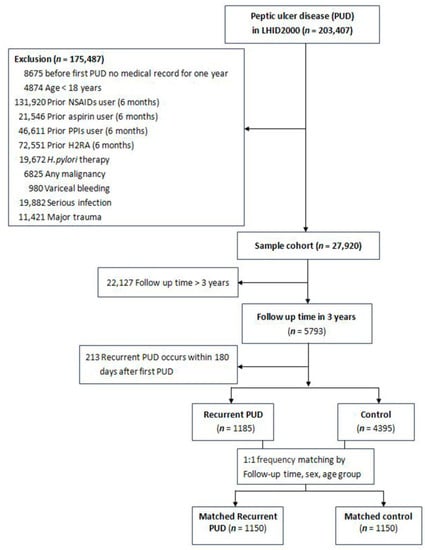
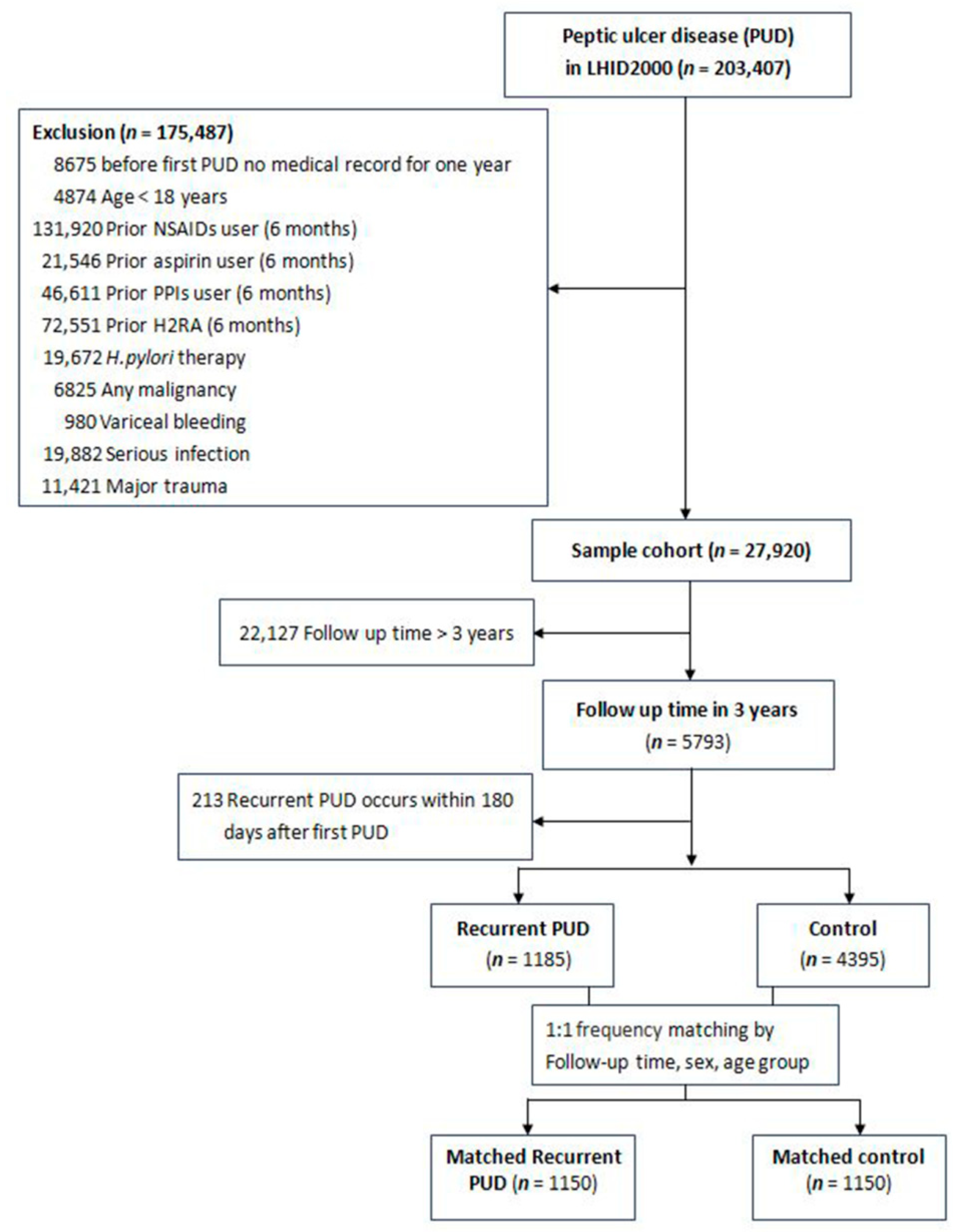
This study was reviewed and permitted by the Ethics Committee of Chang Gung Memorial Hospital in Taiwan (Institutional review board 201800321B0). Data required for the study were collected from the claims data recorded in Taiwan’s NHIRD, an anonymized dataset of one million randomly selected individuals from 1997 to 2013. Patients with original admission record of a major diagnosis of PUD or two outpatient visit PUD diagnoses >28 days apart (International Classification of Diseases, 9th Revision codes: 531x, 532x, 533x, and 534x) were selected. Patients with PUD (n = 203,407) were enrolled as shown in Figure 1. Eventually, 27,920 patients were enrolled for analysis after excluding 175,487 patients aged <18 years or patients who met PUD diagnostic criteria within 365 days before the index date; those who received NSAIDs, aspirin, PPIs, or H2 blockers within 180 days before the index date; those who received H. pylori eradication therapy before the index date; those who had bleeding varices; those with any malignancy who developed the disease before and after the index date; and those who developed serious infections [10,11] and suffered major traumas [12,13] after PUD diagnosis.
Figure 1.
Flowchart depicting participant selection.
A case-control study design of NSAID exposure and recurrent PUD was used in the PUD cohort. Recurrent PUD was defined as endoscopically proven PUD occurring 180 days’ post-index date (the first date of PUD diagnosis). The incident recurrent PUD risk was evaluated during 3 years of follow-up. Patients who developed recurrent PUD during the follow-up period were classified into the case group; patients without recurrent PUD (controls) were randomly selected by matching age/gender frequencies with patients in the case group in a 1:1 ratio. To avoid immortal time bias, the follow-up duration for patients in the case group was applied to the randomly selected matched controls. Immortal time refers to a span of time in the observation of the control group of patients during which they could not have developed recurrent PUD or could not have died. Following the follow-up time-matched controls, the misclassification of NSAIDs and relevant risk factor exposure between case and control groups could be avoided. Finally, two groups of patients were analyzed: recurrent PUD (n = 1185) and non-recurrent PUD (controls, n = 4395).
2.2. NSAIDs Exposure
A specific term known as the defined daily dose (DDD) has been suggested by the World Health Organization as a unit for quantifying a prescribed dose of medication anticipating the average prescription dose per day in adult population [14]. This allowed us to compare any class of NSAIDs on similar reference line: (sum of drug used)/(amount of drug in a DDD) = number of DDDs. cDDD refers to the total bare dose, assessed as the total of the allocated DDD of any NSAIDs, to equate the risk of PUD among a cohort. To further recognize the possible influence of the dose effect, we classified the NSAID dose into four sets in each group (0, ≤28, 29–83, and ≥84 cDDDs). Patients were considered as not taking any NSAIDs if the cDDD was zero.
2.3. Other Ulcerogenic Agents and Potential Confounders
We obtained the complete data from the database, which included the first and last prescription dates of all the ulcerogenic medications in between the follow-up dates during the follow-up period after the index hospitalization. These medications were aspirin, clopidogrel, dipyridamole, warfarin, ticlopidine, cilostazol, and Ginkgo biloba (cerenin®). Recorded comorbidities were simultaneously analyzed among those with a history of coronary artery disease, cerebrovascular accidents, hypertensive disease, diabetes mellitus, chronic obstructive lung disease, advanced chronic liver disease which included liver cirrhosis, and hyperlipidemia. Charlson comorbidity index was calculated as a potential confounding risk [15].
2.4. Helicobacter Pylori Therapy and Eradication
In the present study, we defined H. pylori-associated PUD as the use of any recorded H. pylori eradication therapy medications, such as a combination medication prescription of 7–14 days of any of the following antibiotics in the same medication order such as clarithromycin or metronidazole and amoxicillin or tetracycline, in addition to a PPIs or H2 blockers (H2RAs) [16,17,18]. Summary of H. pylori treatment regimens used in this study were summarized in Table S1.
2.5. Statistical Analysis
All statistical analyses were completed by using software package SAS version 9.3 (SAS Institute Inc., Cary, NC, USA, 2013) with descriptive measurements for all variables. Continuous statistics were expressed as mean (standard deviation) and median (interquartile range). Categorical statistics were expressed as actual frequencies and percentages. Unpaired Student’s t-test and chi-square analysis of contingency tables for continuous and insignificant variables were applied to compare baseline characteristics. Logistic regression modeling was used to fix the potentially relevant issues influencing the outcome with modifications in the multivariate analysis. A p-value < 0.05 was considered significant.
3. Results
Among the study patients, there were 1185 patients with recurrent PUD (case group) and 4395 patients without recurrent PUD (control group). After matching for age/gender frequencies and the length of follow-up time in a 1:1 ratio, the matched case-control groups comprised 1150 patients with recurrent PUD and 1150 patients without recurrent PUD within 3 years of follow-up (mean follow-up time: 20.65 (8.77) months).
Table 1 presents a comparison of patient characteristics between the case and control groups. The proportion of NSAID users was higher in the case (recurrent PUD) group than in the control group in both primary (74.85% versus 63.32%; p < 0.0001) and matched (75.30% versus 69.74%; p = 0.0028) cohorts. In the matched case–control group, H. pylori eradication therapy (8.61% versus 3.48%; p < 0.0001), concomitant PPI users (22.43% versus 17.22%; p = 0.0017); and H2RA users (26.87% versus 17.57%; p < 0.0001) were significantly higher in the case (recurrent PUD) group than in the control group.
Table 1.
Characteristics between patients with and without recurrent peptic ulcer disease.
Multivariate analysis (Table 2) showed that the independent risk factors for recurrent PUD were patients using NSAIDs (aOR: 1.34; p = 0.0040), those with H. pylori eradication (aOR: 2.73; p < 0.0001), and those with concomitant H2RA (aOR: 1.85; p < 0.0001) and anti-coagulant (aOR: 4.21, p = 0.0242) use, but not with PPI use (aOR: 1.13; p = 0.3022). The risk for recurrent PUD increased with the increasing NSAID dosage (aOR: 1.24, p = 0.0430; aOR: 1.52, p = 0.0043; and aOR: 1.67, p = 0.0179 in the groups of ≤28, 29–83, and ≥84 cDDDs, respectively). The use of diclofenac, piroxicam, and sulindac was a significant risk factor for recurrent PUD (aOR: 1.33, p = 0.0042; aOR: 1.59, p = 0.0346; and aOR: 1.59, p = 0.0367, respectively).
Table 2.
Factors associated with recurrent PUD occurrence in matched case-control group.
In the subgroup analysis, the risk ratio of recurrent PUD did not increase in NSAID users after H. pylori eradication compared with that in non-users (p = 0.8490). However, there was a progressively higher risk for recurrent PUD with the increasing doses of NSAIDs without H. pylori eradication therapy (aOR: 1.24, p = 0.0424; aOR: 1.47, p = 0.0074; and aOR: 1.64, p = 0.0152 in the groups of ≤28, 29–83, and ≥84 cDDDs, respectively) (Table 3).
Table 3.
Factors associated with recurrent PUD occurrence between with and without H pylori therapy groups in the matched case-control groups.
4. Discussion
According to published guidelines, H. pylori eradication therapy alone is suboptimal for the secondary prophylaxis of ulcers or PUD bleeding in patients who have continuously been prescribed NSAIDs [5,6]. Instead, concomitant use of PPIs or switching to cyclooxygenase-2 (COX-2) inhibitors or a combination of COX-2 inhibitors and PPIs is still recommended [19,20]. Furthermore, it was found that the optimal gastrointestinal protection could be achieved by using selective COX-2 inhibitors with PPIs [21]. In this study, the risk of recurrent PUD was high in patients using concomitant H2RAs (aOR: 1.85; p < 0.0001) but not in those using PPIs (aOR: 1.13; p = 0.3022). Therefore, the protective efficacy of concomitant PPIs for recurrent PUD is better than that of H2RAs. This result is similar to another database systematic review study [22], but a double-dose H2RA may have considerably more beneficial outcome than PPIs in reducing the risk of duodenal and gastric ulcers (relative risk (RR) = 0.44 and 0.40, respectively).
At the first glance of the initial analysis, H. pylori eradication was found to be a factor for recurrent PUD (aOR: 2.73; p < 0.0001). However, in the subgroup analysis, the risk ratio of recurrent PUD did not increase after H. pylori eradication in NSAID users compared with that in non-users (p = 0.8490). In patients without H. pylori eradication therapy as shown in Table 3, there was a progressively higher risk for recurrent PUD with the increasing doses of NSAIDs (aOR: 1.24, p = 0.0424; aOR: 1.47, p = 0.0074; and aOR: 1.64, p = 0.0152 in the groups of ≤28, 29–83, ≥84 cDDDs, respectively). This implied that H. pylori eradication therapy decreased the risk of recurrent ulcers during the prolonged NSAID use. Although the eradication alone was suboptimal in reducing recurrent PUD, it was still needed in NSAID users who required prolonged medications. According to some studies in Taiwan [23,24], approximately 53.9% (95% CI, 36.6–71.2) patients with H. pylori infection were not evaluated for H. pylori status. In other words, in H. pylori-positive patients without the eradication therapy, the risk of recurrent PUD may increase with the increase in the dosage of NSAIDs used. Our study was similar to the previous population-based studies from Spain [25,26,27], taking into consideration the daily dosage, the RR was 2.79 (95% CI, 2.17–3.58) for the NSAIDs users at low or medium doses compared to 5.36 (95% CI, 4.57–6.29) among those receiving high doses of medications [28]. In real-world clinical practice, poor adherence to guideline recommendations on the issue of the risk of PUD bleeding without prophylactic PPI prescription is common among NSAID users. Even in this national population study, the rate of concomitant PPI use was only 22.45% before matching. In a Turkish population, Dincer et al. reported that only 25% of NSAID users with a previous history of peptic ulcer bleeding received a PPI prophylaxis [29].
The strength of this study was that it was a large sample size population-based case controlled study and quantify the level of drug exposure to the association of recurrent PUD among chronic users after H. pylori eradication by the concept of cDDD. Similarly, it still came across some limitations. First, the number of cases with H. pylori infection was low, owing to strict exclusion criteria, and, consequently, not enough to analyze the NSAID dose effect in H. pylori eradication group. Another major limitation of our study data retrieved from NHIRD was the lack of anthropometric data and individual status, such as atrophic grades of gastric mucosa, drug compliance, H. pylori eradication rate, and antibiotic resistance. This limitation is due to the inherent shortcomings of the administrative database. Drug compliance is an important factor in the assessment of NSAIDs use with gastric bleeding, but compliance to any medications is not available in the database of health insurance system. This was overcome by using the concept of cDDD, which designated the total exposed dosage assessed as the total of allotted DDD of any NSAIDs to compare the risk of PUD among them. Eventually, we were able to analyze cDDD by using the Taiwan NHI program. This was because it was a compulsory, third party payer insurance program, and provides comprehensive health services such as procedures, medications in inpatient, outpatient and emergency department for almost 100% of the Taiwanese. Third, Bytzer et al. reported that low socioeconomic class was a risk factor for peptic ulcer disease [30]. However, urbanization or income levels were not assessed in the present study. Finally, this was a retrospective study rather than a prospective intervention trial, limiting the ability to show cause and effect.
5. Conclusions
The risk of recurrent PUD increases progressively in patients with high cumulative doses of NSAIDs. H. pylori eradication therapy could reduce the risk of recurrent PUD among NSAID users who needed prolonged treatment durations. H. pylori eradication alone is suboptimal for NSAID users with a medical record of PUD and concomitant PPI treatment is required in such patients.
Supplementary Materials
The following are available online at https://www.mdpi.com/2077-0383/8/10/1722/s1, Table S1: Summary of Helicobacter pylori treatment regimens.
Author Contributions
S.-K.C. and C.-N.H.: conceptualization, data curation, formal analysis, funding acquisition, investigation, methodology, supervision, writing, review, and editing; C.-M.L.: writing, review, and editing; S.-C.Y., C.-K.W., W.-C.T., Y.-C.L., W.-S.Y., C.-H.L., Y.-H.Y., and T.-H.T.: data curation, formal analysis, investigation, and methodology.
Funding
This work was funded by the Kaohsiung Chang Gung Memorial Hospital (CFRPG8H0051) at Kaohsiung and Chia-Yi Chang Gung Memorial Hospital (CLRPG6G0041) at Chia-Yi in Taiwan.
Acknowledgments
The authors appreciate Miss Yi-Hsuan Tsai in the Division of Gastroenterology, Kaohsiung Chang Gung Memorial Hospital for the assistance with programming and analyses. The authors would like to thank the Health Information and Epidemiology Laboratory of Chang Gung Memorial Hospital, Chia-Yi Branch.
Conflicts of Interest
The authors declare no conflict of interest.
References
- Sostres, C.; Gargallo, C.J.; Lanas, A. Interaction between Helicobacter pylori infection, nonsteroidal anti-inflammatory drugs and/or low-dose aspirin use: Old question new insights. World J. Gastroenterol. 2014, 20, 9439–9450. [Google Scholar] [PubMed]
- Nagata, N.; Niikura, R.; Sekine, K.; Sakurai, T.; Shimbo, T.; Kishida, Y.; Tanaka, S.; Aoki, T.; Okubo, H.; Watanabe, K.; et al. Risk of peptic ulcer bleeding associated with Helicobacter pylori infection, nonsteroidal anti-inflammatory drugs, low-dose aspirin, and antihypertensive drugs: A case-control study. J. Gastroenterol. Hepatol. 2015, 30, 292–298. [Google Scholar] [CrossRef] [Scilit] [PubMed]
- Tang, C.L.; Ye, F.; Liu, W.; Pan, X.L.; Qian, J.; Zhang, G.X. Eradication of Helicobacter pylori infection reduces the incidence of peptic ulcer disease in patients using nonsteroidal anti-inflammatory drugs: A meta-analysis. Helicobacter 2012, 17, 286–296. [Google Scholar] [CrossRef] [Scilit] [PubMed]
- Vergara, M.; Catalán, M.; Gisbert, J.P.; Calvet, X. Meta-analysis: Role of Helicobacter pylori eradication in the prevention of peptic ulcer in NSAID users. Aliment. Pharmacol. Ther. 2005, 21, 1411–1418. [Google Scholar] [CrossRef] [Scilit]
- Fock, K.M.; Katelaris, P.; Sugano, K.; Ang, T.L.; Hunt, R.; Talley, N.J.; Lam, S.K.; Xiao, S.D.; Tan, H.J.; Wu, C.Y.; et al. Second AsiaPacific Consensus Guidelines for Helicobacter pylori infection. J. Gastroenterol. Hepatol. 2009, 24, 1587–1600. [Google Scholar] [CrossRef] [Scilit]
- Chey, W.D.; Leontiadis, G.I.; Howden, C.W.; Moss, S.F. ACG Clinical Guideline: Treatment of Helicobacter pylori Infection. Am. J. Gastroenterol. 2017, 112, 212–239. [Google Scholar] [CrossRef] [Scilit]
- Chan, F.K.; Chung, S.C.; Suen, B.Y.; Lee, Y.T.; Leung, W.K.; Leung, V.K.; Wu, J.C.; Lau, J.Y.; Hui, Y.; Lai, M.S.; et al. Preventing recurrent upper gastrointestinal bleeding in patients with Helicobacter pylori infection who are taking low-dose aspirin or naproxen. N. Engl. J. Med. 2001, 344, 967–973. [Google Scholar] [CrossRef] [Scilit]
- Lai, K.C.; Lau, C.S.; Ip, W.Y.; Wong, B.C.; Hui, W.M.; Hu, W.H.; Wong, R.W.; Lam, S.K. Effect of treatment of Helicobacter pylori on the prevention of gastroduodenal ulcers in patients receiving long-term NSAIDs: A double-blind, placebo-controlled trial. Aliment. Pharmacol. Ther. 2003, 17, 799–805. [Google Scholar] [CrossRef] [Scilit]
- De Leest, H.T.; Steen, K.S.; Lems, W.F.; Bijlsma, J.W.; Van de Laar, M.A.; Huisman, A.M.; Vonkeman, H.E.; Houben, H.H.; Kadir, S.W.; Kostense, P.J.; et al. Eradication of Helicobacter pylori does not reduce the incidence of gastroduodenal ulcers in patients on long-term NSAID treatment: Double-blind, randomized, placebo-controlled trial. Helicobacter 2007, 12, 477–485. [Google Scholar] [CrossRef] [Scilit]
- Barber, C.; Lacaille, D.; Fortin, P.R. Systematic review of validation studies of the use of administrative data to identify serious infections. Arthritis Care Res. 2013, 65, 1343–1357. [Google Scholar] [CrossRef] [Scilit]
- Osler, T.; Rutledge, R.; Deis, J.; Bedrick, E. ICISS: An international classification of disease-9 based injury severity score. J. Trauma 1996, 41, 380–386. [Google Scholar] [CrossRef] [Scilit] [PubMed]
- Wiese, A.D.; Griffin, M.R.; Stein, C.M.; Schaffner, W.; Greevy, R.A.; Mitchel, E.F., Jr.; Grijalva, C.G. Validation of discharge diagnosis codes to identify serious infections among middle age and older adults. BMJ Open. 2018, 8, e020857. [Google Scholar] [CrossRef] [Scilit] [PubMed]
- Abajas-Bustillo, R.; Amo-Setién, F.J.; Leal-Costa, C.; Ortego-Mate, M.d.C.; Seguí-Gómez, M.; Durá-Ros, M.J. Comparison of injury severity scores (ISS) obtained by manual coding versus “Two-step conversion” from ICD-9-CM. PLoS ONE 2019, 14, e0216206. [Google Scholar] [CrossRef] [Scilit] [PubMed]
- WHO Collaborating Center for Drugs Statistics Methodology: ATC/DDD Index 2013. Available online: http://www.whocc.no/atc_ddd_index/ (accessed on 1 January 2013).
- Kieszak, S.M.; Flanders, W.D.; Kosinski, A.S.; Shipp, C.C.; Karp, H. A comparison of the Charlson comorbidity index derived from medical record data and administrative billing data. J. Clin. Epidemiol. 1999, 52, 137–142. [Google Scholar] [CrossRef] [Scilit]
- Wu, C.Y.; Kuo, K.N.; Wu, M.S.; Chen, Y.J.; Wang, C.B.; Lin, J.T. Early Helicobacter pylori eradication decreases risk of gastric cancer in patients with peptic ulcer disease. Gastroenterology 2009, 137, 1641–1648. [Google Scholar] [CrossRef] [Scilit] [PubMed]
- Wang, J.W.; Tseng, K.L.; Hsu, C.N.; Liang, C.M.; Tai, W.C.; Ku, M.K.; Hung, T.H.; Yuan, L.T.; Nguang, S.H.; Yang, S.C.; et al. Association between Helicobacter pylori eradication and the risk of coronary heart diseases. PLoS ONE 2018, 13, e0190219. [Google Scholar] [CrossRef] [Scilit]
- Liang, C.M.; Hsu, C.N.; Tai, W.C.; Yang, S.C.; Wu, C.K.; Shih, C.W.; Ku, M.K.; Yuan, L.T.; Wang, J.W.; Tseng, K.L.; et al. Taiwan Acid-Related Disease (TARD) Study Group. Risk factors influencing the outcome of peptic ulcer bleeding in chronic kidney disease after initial endoscopic hemostasis: A nationwide cohort study. Medicine 2016, 95, e4795. [Google Scholar] [CrossRef] [Scilit]
- Laine, L.; Jensen, D.M. Management of patients with ulcer bleeding. Am. J. Gastroenterol. 2012, 107, 345–360. [Google Scholar] [CrossRef] [Scilit]
- Chan, F.K.; Wong, V.W.; Suen, B.Y.; Wu, J.C.; Ching, J.Y.; Hung, L.C.; Hui, A.J.; Leung, V.K.; Lee, V.W.; Lai, L.H.; et al. Combination of a cyclo-oxygenase-2 inhibitor and a proton-pump inhibitor for prevention of recurrent ulcer bleeding in patients at very high risk: A double-blind, randomised trial. Lancet 2007, 369, 1621–1626. [Google Scholar] [CrossRef] [Scilit]
- Yuan, J.Q.; Tsoi, K.K.; Yang, M.; Wang, J.Y.; Threapleton, D.E.; Yang, Z.Y. Systematic review with network meta-analysis: Comparative effectiveness and safety of strategies for preventing NSAID-associated gastrointestinal toxicity. Aliment. Pharmacol. Ther. 2016, 43, 1262–1275. [Google Scholar] [CrossRef] [Scilit]
- Rostom, A.; Dube, C.; Wells, G.; Tugwell, P.; Welch, V.; Jolicoeur, E.; McGowan, J. Prevention of NSAID-induced gastroduodenal ulcers. Cochrane Database Syst. Rev. 2002, 4, CD002296. [Google Scholar] [CrossRef] [Scilit] [PubMed]
- Lu, C.L.; Chang, F.Y.; Chen, T.S.; Chen, C.Y.; Jiun, K.L.; Lee, S.D. Helicobacter pylori colonization does not influence the symptomatic response to prokinetic agents in patients with functional dyspepsia. J. Gastroenterol. Hepatol. 1998, 13, 500–504. [Google Scholar] [CrossRef] [Scilit] [PubMed]
- Hooi, J.K.Y.; Lai, W.Y.; Ng, W.K.; Suen, M.M.Y.; Underwood, F.E.; Tanyingoh, D.; Malfertheiner, P.; Graham, D.Y.; Wong, V.W.S.; Wu, J.C.Y.; et al. Global Prevalence of Helicobacter pylori Infection: Systematic Review and Meta-Analysis. Gastroenterology 2017, 153, 420–429. [Google Scholar] [CrossRef] [Scilit] [PubMed]
- Garcia Rodriguez, L.A.; Hernandez-Diaz, S. Relative risk of upper gastrointestinal complications among users of acetaminophen and nonsteroidal anti-inflammatory drugs. Epidemiology 2001, 57, 570–576. [Google Scholar] [CrossRef] [Scilit]
- Garcia Rodriguez, L.A.; Barreales Tolosa, L. Risk of upper gastrointestinal complications among users of traditional NSAIDs and COXIBs in the general population. Gastroenterology 2007, 132, 498–506. [Google Scholar] [CrossRef] [Scilit]
- Lanas, A.; Garcia-Rodriguez, L.A.; Arroyo, M.T.; Gomollon, F.; Feu, F.; Gonzalez-Perez, A. Risk of upper gastrointestinal ulcer bleeding associated with selective cyclo-oxygenase-2 inhibitors, traditional non-aspirin non-steroidal anti-inflammatory drugs, aspirin and combinations. Gut 2006, 55, 1731–1738. [Google Scholar] [CrossRef] [Scilit]
- Massó González, E.L.; Patrignani, P.; Tacconelli, S.; García Rodríguez, L.A. Variability among nonsteroidal antiinflammatory drugs in risk of upper gastrointestinal bleeding. Arthritis Rheumatol. 2010, 62, 1592–1601. [Google Scholar] [CrossRef] [Scilit]
- Dinçer, D.; Ulukal Karancı, E.; Akın, M.; Adanır, H. NSAID, antiaggregant, and/or anticoagulant-related upper gastrointestinal bleeding: Is there any change in prophylaxis rate after a 10-year period? Turk. J. Gastroenterol. 2019, 30, 505–510. [Google Scholar]
- Bytzer, P.; Howell, S.; Leemon, M.; Young, L.J.; Jones, M.P.; Talley, N.J. Low socioeconomic class is a risk factor for upper and lower gastrointestinal symptoms: A population-based study in 15,000 Australian adults. Gut 2001, 49, 66–72. [Google Scholar] [CrossRef] [Scilit]

© 2019 by the authors. Licensee MDPI, Basel, Switzerland. This article is an open access article distributed under the terms and conditions of the Creative Commons Attribution (CC BY) license (http://creativecommons.org/licenses/by/4.0/).