Motor Outcomes of Robot-Assisted Versus Conventional Occupational Therapy for Upper-Limb Recovery in Subacute Stroke: A Retrospective Cohort Study with Exploratory Neurocognitive Outcomes
 , and
, and
Abstract
1. Introduction
2. Materials and Methods
2.1. Study Design and Participants
2.2. Interventions
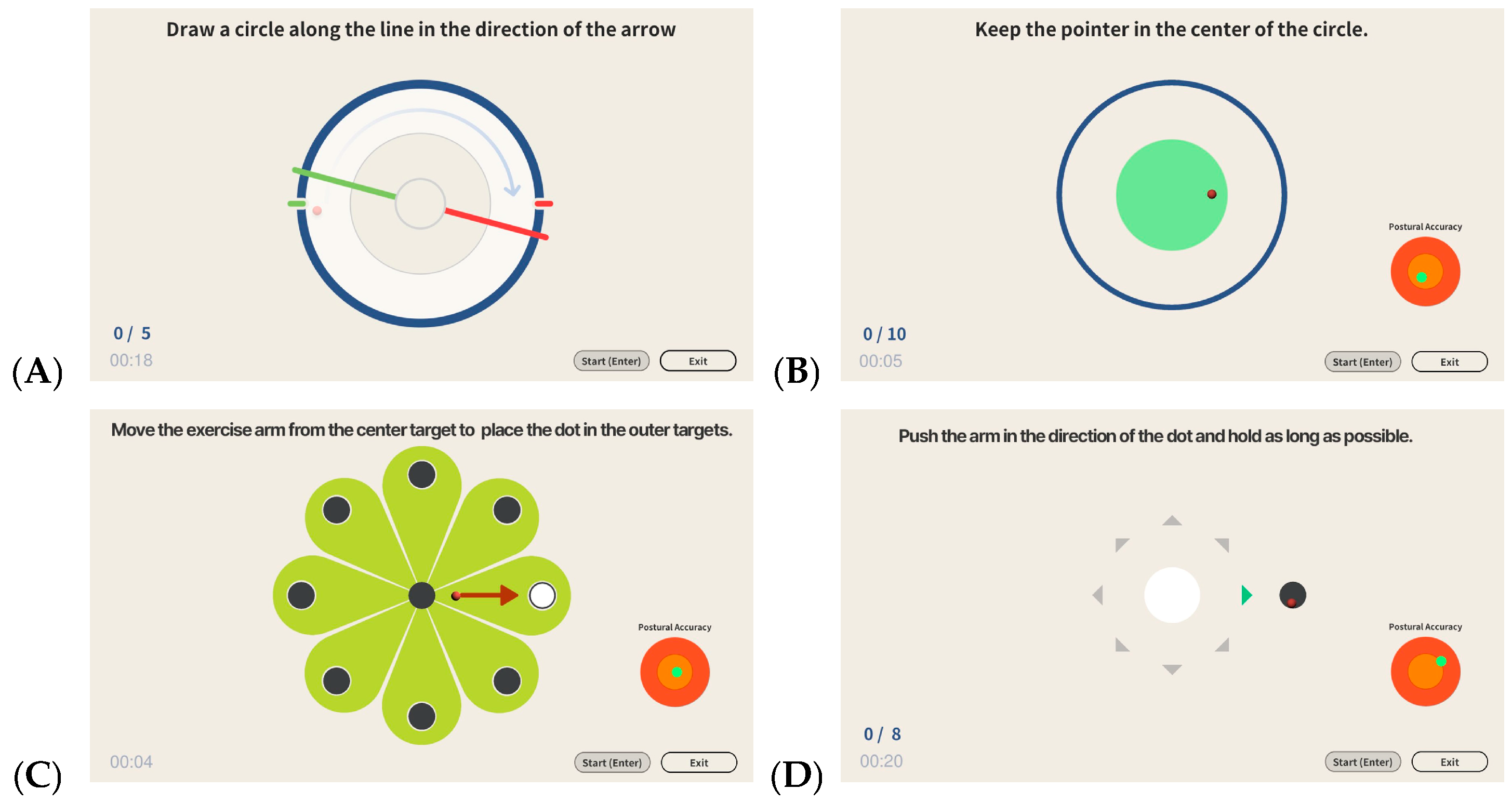
2.2.1. Robot-Assisted Training Group
2.2.2. Conventional Occupational Therapy Group
2.2.3. Standardization and Fidelity of Conventional Occupational Therapy
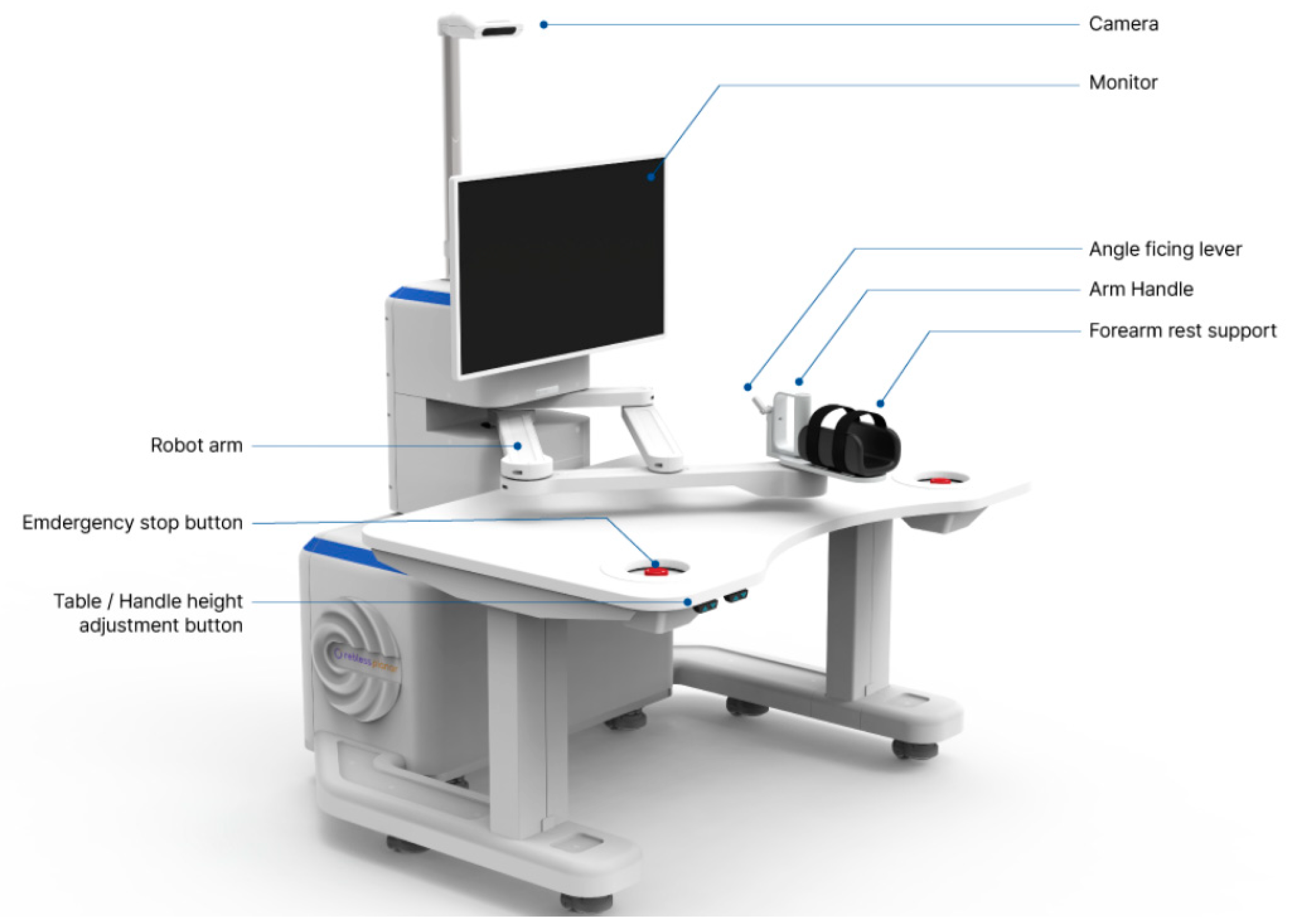
2.3. Robotic Device
2.4. Outcome Measures
2.4.1. Upper-Limb Motor and Manual Function
2.4.2. Global Function and Activities of Daily Living
2.4.3. Neurocognitive Assessment
2.5. Statistical Analysis
3. Results
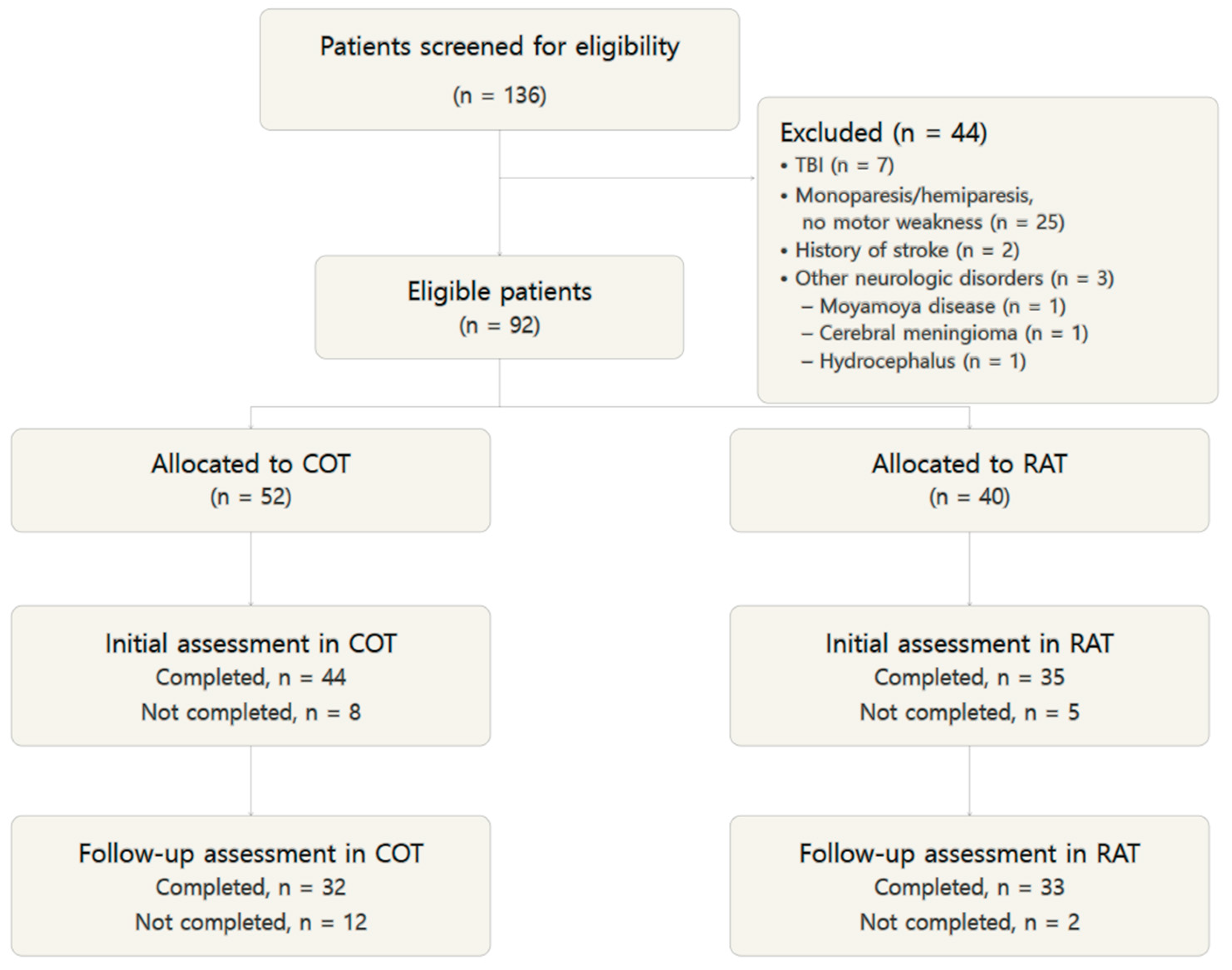
3.1. Study Population
3.2. Baseline Characteristics
3.3. Motor and Functional Outcomes
3.4. Neurocognitive Outcomes
3.5. Prespecified Propensity Score-Based Sensitivity Analysis for the Primary Outcome
3.6. Responder Analyses According to MCID or Benchmark Thresholds
4. Discussion
5. Conclusions
Supplementary Materials
Author Contributions
Funding
Institutional Review Board Statement
Informed Consent Statement
Data Availability Statement
Acknowledgments
Conflicts of Interest
Abbreviations
| ADL | Activities of daily living |
| AI | Artificial intelligence |
| ANCOVA | Analysis of covariance |
| ATE | Average treatment effect |
| BNT | Boston Naming Test |
| CI | Confidence interval |
| COT | Conventional occupational therapy |
| FDR | False discovery rate |
| FIM | Functional independence measure |
| FMA | Fugl-Meyer Assessment |
| FMA-UE | Fugl–Meyer Assessment—Upper Extremity |
| IPTW | Inverse probability of treatment weighting |
| K-MBI | Korean Modified Barthel Index |
| MCID | minimal clinically important difference |
| MFT | Manual Function Test |
| MMSE | Mini-Mental State Examination |
| OR | Odds ratio |
| PS | Propensity score |
| RAT | Robot-assisted therapy |
| R2 | Coefficient of determination |
| SD | Standard deviation |
| SE | Standard error |
| SMD | Standardized mean difference |
| STROBE | Strengthening the Reporting of Observational Studies in Epidemiology |
| TBI | Traumatic brain injury |
References
- Feigin, V.L.; Abate, M.D.; Abate, Y.H.; Abd ElHafeez, S.; Abd-Allah, F.; Abdelalim, A.; Abdelkader, A.; Abdelmasseh, M.; Abd-Elsalam, S.; Abdi, P. Global, regional, and national burden of stroke and its risk factors, 1990–2021: A systematic analysis for the Global Burden of Disease Study 2021. Lancet Neurol. 2024, 23, 973–1003. [Google Scholar] [CrossRef]
- Langhorne, P.; Bernhardt, J.; Kwakkel, G. Stroke rehabilitation. Lancet 2011, 377, 1693–1702. [Google Scholar] [CrossRef]
- Kwakkel, G.; Kollen, B.J.; Van Der Grond, J.; Prevo, A.J. Probability of regaining dexterity in the flaccid upper limb: Impact of severity of paresis and time since onset in acute stroke. Stroke 2003, 34, 2181–2186. [Google Scholar] [CrossRef]
- El Husseini, N.; Katzan, I.L.; Rost, N.S.; Blake, M.L.; Byun, E.; Pendlebury, S.T.; Aparicio, H.J.; Marquine, M.J.; Gottesman, R.F.; Smith, E.E. Cognitive impairment after ischemic and hemorrhagic stroke: A scientific statement from the American Heart Association/American Stroke Association. Stroke 2023, 54, e272–e291. [Google Scholar] [CrossRef]
- Mullick, A.A.; Subramanian, S.K.; Levin, M.F. Emerging evidence of the association between cognitive deficits and arm motor recovery after stroke: A meta-analysis. Restor. Neurol. Neurosci. 2015, 33, 389–403. [Google Scholar] [CrossRef] [PubMed]
- Lowder, R.J.; Jaywant, A.; Fridman, C.B.; Toglia, J.; O’Dell, M.W. Cognitive impairment predicts engagement in inpatient stroke rehabilitation. Int. J. Rehabil. Res. 2022, 45, 359–365. [Google Scholar] [CrossRef]
- Kleim, J.A.; Jones, T.A. Principles of experience-dependent neural plasticity: Implications for rehabilitation after brain damage. J. Speech Lang. Hear. Res. 2008, 51, S225–S239. [Google Scholar] [CrossRef] [PubMed]
- Maier, M.; Ballester, B.R.; Verschure, P.F. Principles of neurorehabilitation after stroke based on motor learning and brain plasticity mechanisms. Front. Syst. Neurosci. 2019, 13, 74. [Google Scholar] [CrossRef]
- Lee, S.H.; Park, G.; Cho, D.Y.; Kim, H.Y.; Lee, J.-Y.; Kim, S.; Park, S.-B.; Shin, J.-H. Comparisons between end-effector and exoskeleton rehabilitation robots regarding upper extremity function among chronic stroke patients with moderate-to-severe upper limb impairment. Sci. Rep. 2020, 10, 1806. [Google Scholar] [CrossRef]
- Ranzani, R.; Lambercy, O.; Metzger, J.-C.; Califfi, A.; Regazzi, S.; Dinacci, D.; Petrillo, C.; Rossi, P.; Conti, F.M.; Gassert, R. Neurocognitive robot-assisted rehabilitation of hand function: A randomized control trial on motor recovery in subacute stroke. J. Neuroeng. Rehabil. 2020, 17, 115. [Google Scholar] [CrossRef] [PubMed]
- Mehrholz, J.; Pohl, M.; Platz, T.; Kugler, J.; Elsner, B. Electromechanical and robot-assisted arm training for improving activities of daily living, arm function, and arm muscle strength after stroke. Cochrane Database Syst. Rev. 2015, 11, CD006876. [Google Scholar] [CrossRef]
- Yang, X.; Shi, X.; Xue, X.; Deng, Z. Efficacy of robot-assisted training on rehabilitation of upper limb function in patients with stroke: A systematic review and meta-analysis. Arch. Phys. Med. Rehabil. 2023, 104, 1498–1513. [Google Scholar] [CrossRef]
- Boardsworth, K.; Rashid, U.; Olsen, S.; Rodriguez-Ramirez, E.; Browne, W.; Alder, G.; Signal, N. Upper limb robotic rehabilitation following stroke: A systematic review and meta-analysis investigating efficacy and the influence of device features and program parameters. J. Neuroeng. Rehabil. 2025, 22, 164. [Google Scholar] [CrossRef] [PubMed]
- Rodgers, H.; Bosomworth, H.; Krebs, H.I.; Van Wijck, F.; Howel, D.; Wilson, N.; Aird, L.; Alvarado, N.; Andole, S.; Cohen, D.L. Robot assisted training for the upper limb after stroke (RATULS): A multicentre randomised controlled trial. Lancet 2019, 394, 51–62. [Google Scholar] [CrossRef] [PubMed]
- Narayan Arya, K.; Verma, R.; Garg, R. Estimating the minimal clinically important difference of an upper extremity recovery measure in subacute stroke patients. Top. Stroke Rehabil. 2011, 18, 599–610. [Google Scholar] [CrossRef]
- Bressi, F.; Cricenti, L.; Campagnola, B.; Bravi, M.; Miccinilli, S.; Santacaterina, F.; Sterzi, S.; Straudi, S.; Agostini, M.; Paci, M. Effects of robotic upper limb treatment after stroke on cognitive patterns: A systematic review. NeuroRehabilitation 2022, 51, 541–558. [Google Scholar] [CrossRef]
- Nelson, M.L.; Singh, H.; Nie, J.; MacDonald, S.; Bayley, M.; Fortin, C.; Upshur, R. Comparing stroke rehabilitation inpatients and clinical trials eligibility criteria: A secondary chart review analysis revealing that most patients could have been excluded from rehabilitation trials based on comorbidity status. J. Multimorb. Comorbidity 2023, 13, 26335565231211668. [Google Scholar] [CrossRef] [PubMed]
- Bertoni, D.; Bruni, S.; Saviola, D.; De Tanti, A.; Costantino, C. The role of cognitive reserve in post-stroke rehabilitation outcomes: A systematic review. Brain Sci. 2024, 14, 1144. [Google Scholar] [CrossRef]
- Li, J.; Wan, J.; Wang, H. Role of frailty in predicting outcomes after stroke: A systematic review and meta-analysis. Front. Psychiatry 2024, 15, 1347476. [Google Scholar] [CrossRef]
- Cho, T.; Hanger, H.C.; Wilkinson, T.J. The association between frailty and stroke rehabilitation outcomes: A cohort study. Clin. Rehabil. 2025, 39, 830–841. [Google Scholar] [CrossRef]
- Ahn, S.Y.; Bok, S.-K.; Lee, J.Y.; Ryoo, H.W.; Lee, H.Y.; Park, H.J.; Oh, H.M.; Kim, T.-W. Benefits of robot-assisted upper-limb rehabilitation from the subacute stage after a stroke of varying severity: A multicenter randomized controlled trial. J. Clin. Med. 2024, 13, 808. [Google Scholar] [CrossRef]
- Bhattacharjee, S.; Barman, A.; Patel, S.; Sahoo, J. The combined effect of robot-assisted therapy and activities of daily living training on upper limb recovery in persons with subacute stroke: A randomized controlled trial. Arch. Phys. Med. Rehabil. 2024, 105, 1041–1049. [Google Scholar] [CrossRef]
- Joo, M.C.; Park, H.I.; Noh, S.E.; Kim, J.H.; Kim, H.J.; Jang, C.H. Effects of robot-assisted arm training in patients with subacute stroke. Brain Neurorehabilit. 2014, 7, 111–117. [Google Scholar] [CrossRef][Green Version]
- Winstein, C.J.; Stein, J.; Arena, R.; Bates, B.; Cherney, L.R.; Cramer, S.C.; Deruyter, F.; Eng, J.J.; Fisher, B.; Harvey, R.L. Guidelines for adult stroke rehabilitation and recovery: A guideline for healthcare professionals from the American Heart Association/American Stroke Association. Stroke 2016, 47, e98–e169. [Google Scholar] [CrossRef]
- Hiragami, S.; Inoue, Y.; Harada, K. Minimal clinically important difference for the Fugl-Meyer assessment of the upper extremity in convalescent stroke patients with moderate to severe hemiparesis. J. Phys. Ther. Sci. 2019, 31, 917–921. [Google Scholar] [CrossRef] [PubMed]
- Benjamini, Y.; Hochberg, Y. Controlling the false discovery rate: A practical and powerful approach to multiple testing. J. R. Stat. Soc. Ser. B (Methodol.) 1995, 57, 289–300. [Google Scholar] [CrossRef]
- Sterne, J.A.; White, I.R.; Carlin, J.B.; Spratt, M.; Royston, P.; Kenward, M.G.; Wood, A.M.; Carpenter, J.R. Multiple imputation for missing data in epidemiological and clinical research: Potential and pitfalls. Bmj 2009, 338, b2393. [Google Scholar] [CrossRef] [PubMed]
- Jakobsen, J.C.; Gluud, C.; Wetterslev, J.; Winkel, P. When and how should multiple imputation be used for handling missing data in randomised clinical trials–a practical guide with flowcharts. BMC Med. Res. Methodol. 2017, 17, 162. [Google Scholar] [CrossRef]
- Kim, J.; Park, S.-W.; Lee, Y.; Seo, H. Clinical outcomes of robot-assisted arm rehabilitation in stroke patients. Brain Neurorehabilit. 2015, 8, 46–52. [Google Scholar] [CrossRef]
- Hsieh, Y.-w.; Lin, K.-c.; Wu, C.-y.; Shih, T.-y.; Li, M.-w.; Chen, C.-l. Comparison of proximal versus distal upper-limb robotic rehabilitation on motor performance after stroke: A cluster controlled trial. Sci. Rep. 2018, 8, 2091. [Google Scholar] [CrossRef]
- Chang, J.Y.; Chun, M.H.; Lee, A.; Lee, A.; Lee, C.M. Effects of training with a rehabilitation device (Rebless®) on upper limb function in patients with chronic stroke: A randomized controlled trial. Medicine 2024, 103, e38753. [Google Scholar] [CrossRef]
- Gladstone, D.J.; Danells, C.J.; Black, S.E. The Fugl-Meyer assessment of motor recovery after stroke: A critical review of its measurement properties. Neurorehabilit. Neural Repair 2002, 16, 232–240. [Google Scholar] [CrossRef]
- Lang, C.E.; Edwards, D.F.; Birkenmeier, R.L.; Dromerick, A.W. Estimating minimal clinically important differences of upper-extremity measures early after stroke. Arch. Phys. Med. Rehabil. 2008, 89, 1693–1700. [Google Scholar] [CrossRef]
- Maciejasz, P.; Eschweiler, J.; Gerlach-Hahn, K.; Jansen-Troy, A.; Leonhardt, S. A survey on robotic devices for upper limb rehabilitation. J. Neuroeng. Rehabil. 2014, 11, 3. [Google Scholar] [CrossRef]
- Chen, C.-L.; Tang, F.-T.; Chen, H.-C.; Chung, C.-Y.; Wong, M.-K. Brain lesion size and location: Effects on motor recovery and functional outcome in stroke patients. Arch. Phys. Med. Rehabil. 2000, 81, 447–452. [Google Scholar] [CrossRef] [PubMed]
- Beninato, M.; Gill-Body, K.M.; Salles, S.; Stark, P.C.; Black-Schaffer, R.M.; Stein, J. Determination of the minimal clinically important difference in the FIM instrument in patients with stroke. Arch. Phys. Med. Rehabil. 2006, 87, 32–39. [Google Scholar] [CrossRef] [PubMed]
- Hsieh, Y.-W.; Wang, C.-H.; Wu, S.-C.; Chen, P.-C.; Sheu, C.-F.; Hsieh, C.-L. Establishing the minimal clinically important difference of the Barthel Index in stroke patients. Neurorehabilit. Neural Repair 2007, 21, 233–238. [Google Scholar] [CrossRef] [PubMed]
- Bohannon, R.W. Minimal clinically important difference for grip strength: A systematic review. J. Phys. Ther. Sci. 2019, 31, 75–78. [Google Scholar] [CrossRef]
- Bae, J.H.; Kang, S.H.; Seo, K.M.; Kim, D.-K.; Shin, H.I.; Shin, H.E. Relationship between grip and pinch strength and activities of daily living in stroke patients. Ann. Rehabil. Med. 2015, 39, 752–762. [Google Scholar] [CrossRef]
- Hmaied Assadi, S.; Barel, H.; Dudkiewicz, I.; Gross-Nevo, R.F.; Rand, D. Less-affected hand function is associated with independence in daily living: A longitudinal study poststroke. Stroke 2022, 53, 939–946. [Google Scholar] [CrossRef]
- Ko, M.-J.; Chuang, Y.-C.; Ou-Yang, L.-J.; Cheng, Y.-Y.; Tsai, Y.-L.; Lee, Y.-C. The application of soft robotic gloves in stroke patients: A systematic review and meta-analysis of randomized controlled trials. Brain Sci. 2023, 13, 900. [Google Scholar] [CrossRef]
- Murakami, Y.; Honaga, K.; Kono, H.; Haruyama, K.; Yamaguchi, T.; Tani, M.; Isayama, R.; Takakura, T.; Tanuma, A.; Hatori, K. New artificial intelligence-integrated electromyography-driven robot hand for upper extremity rehabilitation of patients with stroke: A randomized, controlled trial. Neurorehabilit. Neural Repair 2023, 37, 298–306. [Google Scholar] [CrossRef]
- Shi, X.-Q.; Ti, C.-H.E.; Lu, H.-Y.; Hu, C.-P.; Xie, D.-S.; Yuan, K.; Heung, H.-L.; Leung, T.W.-H.; Li, Z.; Tong, R.K.-Y. Task-oriented training by a personalized electromyography-driven soft robotic hand in chronic stroke: A randomized controlled trial. Neurorehabilit. Neural Repair 2024, 38, 595–606. [Google Scholar] [CrossRef]



| Category | Total | COT | RAT | Notes |
|---|---|---|---|---|
| Eligible after clinical screening | 92 | 52 | 40 | After exclusion of 44 patients for predefined clinical criteria |
| No baseline assessment for any prespecified outcome | 13 | 8 | 5 | Excluded before outcome-specific complete-case analyses |
| Baseline data available for at least one prespecified outcome | 79 | 44 | 35 | Used for missing-data pattern assessment |
| No 4-week follow-up for any prespecified outcome | 14 | 12 | 2 | Predominantly early discharge or early treatment termination |
| Analytic complete-case cohort | 65 | 32 | 33 | Included in the main outcome analyses |
| Variable | RAT (n = 33) | COT (n = 32) | p-Value |
|---|---|---|---|
| Age, years | 60.15 ± 18.07 | 67.66 ± 15.15 | 0.074 |
| Height, cm | 163.82 ± 8.92 | 163.50 ± 9.48 | 0.890 |
| Weight, kg | 70.24 ± 26.00 | 62.59 ± 11.96 | 0.133 |
| Onset-to-baseline duration, days | 44.06 ± 77.44 | 27.31 ± 24.19 | 0.244 |
| Sex | 1.000 | ||
| Male, n (%) | 18 (54.5) | 17 (53.1) | |
| Female, n (%) | 15 (45.5) | 15 (46.9) | |
| Stroke type | 0.450 | ||
| Hemorrhagic, n (%) | 15 (45.5) | 11 (34.4) | |
| Ischemic, n (%) | 18 (54.5) | 21 (65.6) | |
| Hemiplegic side | 0.460 | ||
| Right, n (%) | 19 (57.6) | 15 (46.9) | |
| Left, n (%) | 14 (42.4) | 17 (53.1) | |
| MMSE | 19.52 ± 9.78 | 18.59 ± 9.19 | 0.697 |
| FMA-UE motor | 18.18 ± 20.45 | 36.06 ± 27.14 | 0.004 |
| FMA total | 64.03 ± 27.55 | 85.25 ± 34.50 | 0.008 |
| Hand grip strength, lb | 1.58 ± 4.83 | 19.78 ± 24.34 | <0.001 |
| MFT | 6.94 ± 8.30 | 14.62 ± 12.17 | 0.004 |
| K-MBI | 29.27 ± 22.72 | 30.75 ± 25.97 | 0.808 |
| FIM | 59.03 ± 23.49 | 60.25 ± 23.67 | 0.836 |
| Boston Naming Test | 8.58 ± 5.01 | 8.31 ± 4.79 | 0.829 |
| Language Comprehension and Repetition Test | 15.48 ± 5.72 | 15.00 ± 5.81 | 0.736 |
| Right–Left Orientation Test | 2.24 ± 1.17 | 2.22 ± 1.07 | 0.932 |
| Stick Construction and Visual Recognition Test | 21.03 ± 7.29 | 18.92 ± 8.82 | 0.299 |
| Fist-Edge-Palm Test | 1.73 ± 1.26 | 1.75 ± 1.30 | 0.943 |
| Construction Test | 7.33 ± 3.54 | 7.25 ± 3.84 | 0.928 |
| Stroop Test: Word | 41.97 ± 29.28 | 36.53 ± 28.24 | 0.449 |
| Stroop Test: Color | 30.85 ± 26.19 | 24.47 ± 24.82 | 0.317 |
| Stroop Test: Color–Word | 18.70 ± 20.21 | 15.50 ± 18.45 | 0.508 |
| Clock Drawing Test | 1.58 ± 1.06 | 1.50 ± 1.30 | 0.798 |
| (A) | ||||||
|---|---|---|---|---|---|---|
| Outcome | RAT Baseline | RAT 4 Weeks | RAT Δ (p) | COT Baseline | COT 4 Weeks | COT Δ (p) |
| FMA-UE motor | 18.18 ± 20.45 | 32.88 ± 22.55 | 14.70 ± 15.53 (<0.001) | 36.06 ± 27.14 | 43.97 ± 24.78 | 7.91 ± 9.42 (<0.001) |
| FMA total | 64.03 ± 27.55 | 81.82 ± 27.50 | 17.79 ± 21.26 (<0.001) | 85.25 ± 34.50 | 95.50 ± 32.66 | 10.25 ± 10.00 (<0.001) |
| Hand grip strength, lb | 1.58 ± 4.83 | 9.61 ± 13.38 | 8.03 ± 12.62 (<0.001) | 19.78 ± 24.34 | 23.12 ± 25.82 | 3.34 ± 7.32 (0.015) |
| MFT | 6.94 ± 8.30 | 13.24 ± 9.60 | 6.30 ± 7.18 (<0.001) | 14.62 ± 12.17 | 19.41 ± 10.65 | 4.78 ± 5.53 (<0.001) |
| K-MBI | 29.27 ± 22.72 | 52.36 ± 25.22 | 23.09 ± 17.81 (<0.001) | 30.75 ± 25.97 | 47.91 ± 29.86 | 17.16 ± 12.92 (<0.001) |
| FIM | 59.03 ± 23.49 | 78.45 ± 21.63 | 19.42 ± 11.39 (<0.001) | 60.25 ± 23.67 | 74.03 ± 30.79 | 13.78 ± 13.38 (<0.001) |
| (B) | ||||||
| Outcome | Unadjusted mean difference (95% CI; p ᵃ) | Adjusted mean difference (95% CI; p ᵇ) | ||||
| FMA-UE motor | 6.79 (0.42, 13.16) (0.037) | 4.39 (−2.43, 11.21) (0.203) | ||||
| FMA total | 7.54 (−0.72, 15.79) (0.073) | 4.34 (−4.24, 12.91) (0.315) | ||||
| Hand grip strength, lb | 4.69 (−0.43, 9.80) (0.072) | 4.12 (−2.04, 10.28) (0.186) | ||||
| MFT | 1.52 (−1.65, 4.70) (0.342) | −0.11 (−3.52, 3.30) (0.948) | ||||
| K-MBI | 5.93 (−1.77, 13.64) (0.129) | 4.04 (−3.22, 11.30) (0.270) | ||||
| FIM | 5.64 (−0.53, 11.82) (0.072) | 4.45 (−1.21, 10.10) (0.121) | ||||
| (A) | ||||||
|---|---|---|---|---|---|---|
| Outcome | RAT Baseline | RAT 4 Weeks | RAT Δ (p) | COT Baseline | COT 4 Weeks | COT Δ (p) |
| Language | ||||||
| Boston Naming Test | 8.58 ± 5.01 | 10.85 ± 3.85 | 2.27 ± 2.85 (<0.001) | 8.31 ± 4.79 | 9.78 ± 4.43 | 1.47 ± 2.87 (0.007) |
| Language Comp. and Rep. Test | 15.48 ± 5.72 | 16.42 ± 4.82 | 0.94 ± 2.60 (0.046) | 15.00 ± 5.81 | 16.69 ± 4.75 | 1.69 ± 2.64 (0.001) |
| Visuospatial and Construction | ||||||
| Right–Left Orientation Test | 2.24 ± 1.17 | 2.55 ± 0.83 | 0.30 ± 0.95 (0.077) | 2.22 ± 1.07 | 2.47 ± 0.95 | 0.25 ± 0.72 (0.058) |
| Stick Const. and Visual Rec. Test | 21.03 ± 7.29 | 23.95 ± 5.15 | 2.92 ± 4.46 (<0.001) | 18.92 ± 8.82 | 20.80 ± 7.75 | 1.88 ± 4.55 (0.026) |
| Executive Function | ||||||
| Stroop Test: Word | 41.97 ± 29.28 | 55.36 ± 30.87 | 13.39 ± 15.36 (<0.001) | 36.53 ± 28.24 | 47.62 ± 31.14 | 11.09 ± 13.17 (<0.001) |
| Stroop Test: Color | 30.85 ± 26.19 | 39.58 ± 26.66 | 8.73 ± 11.12 (<0.001) | 24.47 ± 24.82 | 33.78 ± 28.91 | 9.31 ± 11.60 (<0.001) |
| Stroop Test: Color–Word | 18.70 ± 20.21 | 26.73 ± 22.04 | 8.03 ± 10.99 (<0.001) | 15.50 ± 18.45 | 22.09 ± 23.15 | 6.59 ± 9.99 (<0.001) |
| Multidomain | ||||||
| Clock Drawing Test | 1.58 ± 1.06 | 2.21 ± 0.93 | 0.64 ± 0.93 (<0.001) | 1.50 ± 1.30 | 1.81 ± 1.26 | 0.31 ± 1.15 (0.134) |
| (B) | ||||||
| Outcome | Unadjusted mean difference (95% CI; p ᵃ) | Adjusted mean difference (95% CI; p ᵇ) | ||||
| Language | ||||||
| Boston Naming Test | 0.80 (−0.62, 2.22) (0.262) | 0.72 (−0.32, 1.77) (0.169) | ||||
| Language Comp. and Rep. Test | −0.75 (−2.05, 0.55) (0.254) | −0.53 (−1.62, 0.55) (0.330) | ||||
| Visuospatial and Construction | ||||||
| Right–Left Orientation Test | 0.05 (−0.36, 0.47) (0.800) | 0.09 (−0.21, 0.39) (0.544) | ||||
| Stick Const. and Visual Rec. Test | 1.05 (−1.18, 3.28) (0.351) | 1.98 (0.04, 3.91) (0.045) | ||||
| Executive Function | ||||||
| Stroop Test: Word | 2.30 (−4.79, 9.39) (0.519) | 2.04 (−4.13, 8.20) (0.511) | ||||
| Stroop Test: Color | −0.59 (−6.22, 5.05) (0.836) | −0.33 (−5.73, 5.07) (0.904) | ||||
| Stroop Test: Color–Word | 1.44 (−3.77, 6.64) (0.583) | 0.32 (−4.35, 4.99) (0.890) | ||||
| Multidomain | ||||||
| Clock Drawing Test | 0.32 (−0.20, 0.84) (0.217) | 0.25 (−0.12, 0.62) (0.179) | ||||
| Outcome | Threshold | COT Responders | RAT Responders | p-Value | Adjusted OR (95% CI) | Adj. OR p |
|---|---|---|---|---|---|---|
| FMA-UE motor (complete-case) | ≥12.4 | 8/32 (25.0) | 14/33 (42.4) | 0.191 | 1.52 (0.45, 5.14) | 0.505 |
| FMA-UE motor (stabilized IPTW ATE-weighted) | ≥12.4 | 31.6% | 32.1% | — | — | — |
| Hand grip strength, lb | 11.02 | 4/32 (12.5) | 9/33 (27.3) | 0.215 | 2.60 (0.46, 14.55) | 0.278 |
| K-MBI | 9.25 | 23/32 (71.9) | 26/33 (78.8) | 0.574 | 0.86 (0.21, 3.55) | 0.835 |
| FIM | 22 | 10/32 (31.2) | 14/33 (42.4) | 0.443 | 1.59 (0.48, 5.25) | 0.448 |
| Boston Naming Test | 3.3 | 6/32 (18.8) | 6/33 (18.2) | 1.000 | 1.71 (0.18, 16.33) | 0.643 |
Disclaimer/Publisher’s Note: The statements, opinions and data contained in all publications are solely those of the individual author(s) and contributor(s) and not of MDPI and/or the editor(s). MDPI and/or the editor(s) disclaim responsibility for any injury to people or property resulting from any ideas, methods, instructions or products referred to in the content. |
© 2026 by the authors. Licensee MDPI, Basel, Switzerland. This article is an open access article distributed under the terms and conditions of the Creative Commons Attribution (CC BY) license.
Share and Cite
Na, E.; Lee, S.; Seo, J.W.; Nam, S.O.; Kang, E.; Kim, D.-H.; Lee, S.; Soh, S.-H.; Na, H.-J.; Cho, Y. Motor Outcomes of Robot-Assisted Versus Conventional Occupational Therapy for Upper-Limb Recovery in Subacute Stroke: A Retrospective Cohort Study with Exploratory Neurocognitive Outcomes. J. Clin. Med. 2026, 15, 3512. https://doi.org/10.3390/jcm15093512
Na E, Lee S, Seo JW, Nam SO, Kang E, Kim D-H, Lee S, Soh S-H, Na H-J, Cho Y. Motor Outcomes of Robot-Assisted Versus Conventional Occupational Therapy for Upper-Limb Recovery in Subacute Stroke: A Retrospective Cohort Study with Exploratory Neurocognitive Outcomes. Journal of Clinical Medicine. 2026; 15(9):3512. https://doi.org/10.3390/jcm15093512
Chicago/Turabian StyleNa, Eunju, Sumin Lee, Joon Won Seo, Seung Ok Nam, Eunyoung Kang, Dong-Hyuk Kim, Sunghoon Lee, Soo-Hyun Soh, Hyung-Ju Na, and Younkyung Cho. 2026. "Motor Outcomes of Robot-Assisted Versus Conventional Occupational Therapy for Upper-Limb Recovery in Subacute Stroke: A Retrospective Cohort Study with Exploratory Neurocognitive Outcomes" Journal of Clinical Medicine 15, no. 9: 3512. https://doi.org/10.3390/jcm15093512
APA StyleNa, E., Lee, S., Seo, J. W., Nam, S. O., Kang, E., Kim, D.-H., Lee, S., Soh, S.-H., Na, H.-J., & Cho, Y. (2026). Motor Outcomes of Robot-Assisted Versus Conventional Occupational Therapy for Upper-Limb Recovery in Subacute Stroke: A Retrospective Cohort Study with Exploratory Neurocognitive Outcomes. Journal of Clinical Medicine, 15(9), 3512. https://doi.org/10.3390/jcm15093512