Artificial Intelligence to Facilitate SEP-1 Measure Compliance and Fluid Management in Sepsis

Abstract
1. Introduction
2. Review Methodology
3. Current State of SEP-1 Sepsis Measure Compliance and Implementation Barriers
4. Ongoing Fluid Resuscitation Controversies in Septic Shock
5. AI Potential for Clinical Decision Support in Critical Care
6. AI for Improving Sepsis Bundle Performance and SEP-1 Compliance
7. AI-Assisted Fluid Resuscitation for Septic Shock
8. Strategies for AI Implementation in Sepsis Management
9. Future Directions of AI in Sepsis Management
10. Summary and Conclusions
Author Contributions
Funding
Institutional Review Board Statement
Data Availability Statement
Acknowledgments
Conflicts of Interest
Abbreviations
| Abbreviation | Meaning |
| AI | Artificial Intelligence |
| AKI | Acute Kidney Injury |
| AUROC | Area Under the Receiver Operating Characteristics Curve |
| BPA | Best Practice Alert |
| CART | Classification and Regression Tree |
| CDS | Clinical Decision Support |
| CDSS | Clinical Decision Support System |
| CMS | Centers for Medicare & Medicaid Services |
| COMPOSER | COnformal Multidimensional Prediction Of SEpsis Risk |
| CONSORT-AI | Consolidated Standards of Reporting Trials–Artificial Intelligence |
| DL | Deep Learning |
| ED | Emergency Department |
| EHR | Electronic Health Record |
| eICU | Electronic Intensive Care Unit Collaborative Research Database |
| ETL | Extract, Transform, Load |
| FDA | Food and Drug Administration |
| ICD-10 | International Classification of Diseases, 10th Revision |
| ICU | Intensive Care Unit |
| LDA | Linear Discriminant Analysis |
| LOS | Length of Stay |
| MAP | Mean Arterial Pressure |
| MGP | Multitask Gaussian Processes |
| MIMIC | Medical Information Mart for Intensive Care database |
| ML | Machine Learning |
| MLASA | Machine Learning-Assisted Sepsis Alert |
| MPC | Model Predictive Control |
| NLP | Natural Language Processing |
| NNET | Neural Network |
| PICMISD | Peking Union Medical College Hospital Intensive Care Medical Information System and Database |
| PLR | Passive Leg Raise |
| PLS | Partial Least-Squares Regression |
| QI | Quality Improvement |
| qSOFA | Quick Sequential Organ Failure Assessment |
| RL | Reinforcement Learning |
| RNN | Recurrent Neural Network |
| SEP-1 | Severe Sepsis and Septic Shock Early Management Bundle |
| SERA | Sepsis Early Risk Assessment |
| SGLM | Switching Generalized Linear Model |
| SIRS | Systemic Inflammatory Response Syndrome |
| SOFA | Sequential Organ Failure Assessment |
| SSC | Surviving Sepsis Campaign |
| TREWS | Targeted Real-Time Early Warning System |
| TRIPOD-AI | Transparent Reporting of a Multivariable Prediction Model for Individual Prognosis or Diagnosis–Artificial Intelligence |
| UO | Urine Output |
| VAE | Variational Autoencoder |
References
- Singer, M.; Deutschman, C.S.; Seymour, C.W.; Shankar-Hari, M.; Annane, D.; Bauer, M.; Bellomo, R.; Bernard, G.R.; Chiche, J.D.; Coopersmith, C.M.; et al. The Third International Consensus Definitions for Sepsis and Septic Shock (Sepsis-3). JAMA 2016, 315, 801–810. [Google Scholar] [CrossRef]
- Prescott, H.C.; Antonelli, M.; Alhazzani, W.; Moller, M.H.; Alshamsi, F.; Azevedo, L.C.P.; Belley-Cote, E.; De Waele, J.; Derde, L.; Dionne, J.C.; et al. Surviving Sepsis Campaign: International Guidelines for Management of Sepsis and Septic Shock 2026. Crit. Care Med. 2026, 54, 725–812. [Google Scholar] [CrossRef] [PubMed]
- Dellinger, R.P.; Rhodes, A.; Evans, L.; Alhazzani, W.; Beale, R.; Jaeschke, R.; Machado, F.R.; Masur, H.; Osborn, T.; Parker, M.M.; et al. Surviving Sepsis Campaign. Crit. Care Med. 2023, 51, 431–444. [Google Scholar] [CrossRef] [PubMed]
- Rivers, E.; Nguyen, B.; Havstad, S.; Ressler, J.; Muzzin, A.; Knoblich, B.; Peterson, E.; Tomlanovich, M.; Early Goal-Directed Therapy Collaborative Group. Early goal-directed therapy in the treatment of severe sepsis and septic shock. N. Engl. J. Med. 2001, 345, 1368–1377. [Google Scholar] [CrossRef] [PubMed]
- Dellinger, R.P.; Carlet, J.M.; Masur, H.; Gerlach, H.; Calandra, T.; Cohen, J.; Gea-Banacloche, J.; Keh, D.; Marshall, J.C.; Parker, M.M.; et al. Surviving Sepsis Campaign guidelines for management of severe sepsis and septic shock. Crit. Care Med. 2004, 32, 858–873. [Google Scholar] [CrossRef]
- Levy, M.M.; Dellinger, R.P.; Townsend, S.R.; Linde-Zwirble, W.T.; Marshall, J.C.; Bion, J.; Schorr, C.; Artigas, A.; Ramsay, G.; Beale, R.; et al. The Surviving Sepsis Campaign: Results of an international guideline-based performance improvement program targeting severe sepsis. Intensive Care Med. 2010, 36, 222–231. [Google Scholar] [CrossRef]
- Wang, J.; Strich, J.R.; Applefeld, W.N.; Sun, J.; Cui, X.; Natanson, C.; Eichacker, P.Q. Driving blind: Instituting SEP-1 without high quality outcomes data. J. Thorac. Dis. 2020, 12, S22–S36. [Google Scholar] [CrossRef]
- Rhee, C.; Brown, S.R.; Jones, T.M.; O’Brien, C.; Pande, A.; Hamad, Y.; Bulger, A.L.; Tobin, K.A.; Massaro, A.F.; Anderson, D.J.; et al. Variability in determining sepsis time zero and bundle compliance rates for the centers for medicare and medicaid services SEP-1 measure. Infect. Control Hosp. Epidemiol. 2018, 39, 994–996. [Google Scholar] [CrossRef]
- Martin-Loeches, I.; Singer, M.; Leone, M. Sepsis: Key insights, future directions, and immediate goals. A review and expert opinion. Intensive Care Med. 2024, 50, 2043–2049. [Google Scholar] [CrossRef]
- Sendak, M.P.; Ratliff, W.; Sarro, D.; Alderton, E.; Futoma, J.; Gao, M.; Nichols, M.; Revoir, M.; Yashar, F.; Miller, C.; et al. Real-World Integration of a Sepsis Deep Learning Technology Into Routine Clinical Care: Implementation Study. JMIR Med. Inform. 2020, 8, e15182. [Google Scholar] [CrossRef]
- Tang, R.; Zhang, S.; Ding, C.; Zhu, M.; Gao, Y. Artificial Intelligence in Intensive Care Medicine: Bibliometric Analysis. J. Med. Internet Res. 2022, 24, e42185. [Google Scholar] [CrossRef]
- Bignami, E.G.; Berdini, M.; Panizzi, M.; Domenichetti, T.; Bezzi, F.; Allai, S.; Damiano, T.; Bellini, V. Artificial Intelligence in Sepsis Management: An Overview for Clinicians. J. Clin. Med. 2025, 14, 286. [Google Scholar] [CrossRef]
- Wu, M.; Du, X.; Gu, R.; Wei, J. Artificial Intelligence for Clinical Decision Support in Sepsis. Front. Med. 2021, 8, 665464. [Google Scholar] [CrossRef]
- Yang, J.; Hao, S.; Huang, J.; Chen, T.; Liu, R.; Zhang, P.; Feng, M.; He, Y.; Xiao, W.; Hong, Y.; et al. The application of artificial intelligence in the management of sepsis. Med. Rev. 2023, 3, 369–380. [Google Scholar] [CrossRef]
- Barbash, I.J.; Davis, B.; Kahn, J.M. National Performance on the Medicare SEP-1 Sepsis Quality Measure. Crit. Care Med. 2019, 47, 1026–1032. [Google Scholar] [CrossRef]
- Venkatesh, A.K.; Slesinger, T.; Whittle, J.; Osborn, T.; Aaronson, E.; Rothenberg, C.; Tarrant, N.; Goyal, P.; Yealy, D.M.; Schuur, J.D. Preliminary Performance on the New CMS Sepsis-1 National Quality Measure: Early Insights From the Emergency Quality Network (E-QUAL). Ann. Emerg. Med. 2018, 71, 10–15.e11. [Google Scholar] [CrossRef] [PubMed]
- Peach, B.C.; Ng, B.P. Organizational Factors Associated with Sepsis Bundle Compliance: A Nationwide Study. Health Serv. Res. 2020, 55, 82–83. [Google Scholar] [CrossRef]
- Aaronson, E.L.; Filbin, M.R.; Brown, D.F.; Tobin, K.; Mort, E.A. New Mandated Centers for Medicare and Medicaid Services Requirements for Sepsis Reporting: Caution from the Field. J. Emerg. Med. 2017, 52, 109–116. [Google Scholar] [CrossRef] [PubMed]
- Townsend, S.R.; Phillips, G.S.; Duseja, R.; Tefera, L.; Cruikshank, D.; Dickerson, R.; Nguyen, H.B.; Schorr, C.A.; Levy, M.M.; Dellinger, R.P.; et al. Effects of Compliance With the Early Management Bundle (SEP-1) on Mortality Changes Among Medicare Beneficiaries With Sepsis: A Propensity Score Matched Cohort Study. Chest 2022, 161, 392–406. [Google Scholar] [CrossRef]
- Marik, P.E.; Byrne, L.; van Haren, F. Fluid resuscitation in sepsis: The great 30 mL per kg hoax. J. Thorac. Dis. 2020, 12, S37–S47. [Google Scholar] [CrossRef] [PubMed]
- Macdonald, S.; Peake, S.L.; Corfield, A.R.; Delaney, A. Fluids or vasopressors for the initial resuscitation of septic shock. Front. Med. 2022, 9, 1069782. [Google Scholar] [CrossRef]
- Meyhoff, T.S.; Hjortrup, P.B.; Wetterslev, J.; Sivapalan, P.; Laake, J.H.; Cronhjort, M.; Jakob, S.M.; Cecconi, M.; Nalos, M.; Ostermann, M.; et al. Restriction of Intravenous Fluid in ICU Patients with Septic Shock. N. Engl. J. Med. 2022, 386, 2459–2470. [Google Scholar] [CrossRef]
- Shapiro, N.I.; Douglas, I.S.; Brower, R.G.; Brown, S.M.; Exline, M.C.; Ginde, A.A.; Gong, M.N.; Grissom, C.K.; Hayden, D.; Hough, C.L.; et al. Early Restrictive or Liberal Fluid Management for Sepsis-Induced Hypotension. N. Engl. J. Med. 2023, 388, 499–510. [Google Scholar] [CrossRef] [PubMed]
- Messmer, A.S.; Dill, T.; Muller, M.; Pfortmueller, C.A. Active fluid de-resuscitation in critically ill patients with septic shock: A systematic review and meta-analysis. Eur. J. Intern. Med. 2023, 109, 89–96. [Google Scholar] [CrossRef]
- Sivapalan, P.; Ellekjaer, K.L.; Jessen, M.K.; Meyhoff, T.S.; Cronhjort, M.; Hjortrup, P.B.; Wetterslev, J.; Granholm, A.; Moller, M.H.; Perner, A. Lower vs Higher Fluid Volumes in Adult Patients with Sepsis: An Updated Systematic Review with Meta-Analysis and Trial Sequential Analysis. Chest 2023, 164, 892–912. [Google Scholar] [CrossRef] [PubMed]
- Reynolds, P.M.; Stefanos, S.; MacLaren, R. Restrictive resuscitation in patients with sepsis and mortality: A systematic review and meta-analysis with trial sequential analysis. Pharmacotherapy 2023, 43, 104–114. [Google Scholar] [CrossRef] [PubMed]
- Zampieri, F.G.; Bagshaw, S.M.; Semler, M.W. Fluid Therapy for Critically Ill Adults With Sepsis: A Review. JAMA 2023, 329, 1967–1980. [Google Scholar] [CrossRef]
- Munroe, E.S.; Hyzy, R.C.; Semler, M.W.; Shankar-Hari, M.; Young, P.J.; Zampieri, F.G.; Prescott, H.C. Evolving Management Practices for Early Sepsis-induced Hypoperfusion: A Narrative Review. Am. J. Respir. Crit. Care Med. 2023, 207, 1283–1299. [Google Scholar] [CrossRef]
- ANDROMEDA-SHOCK-2 Investigators for the ANDROMEDA Research Network, Spanish Society of Anesthesiology, Reanimation and Pain Therapy (SEDAR), and Latin American Intensive Care Network (LIVEN); Hernandez, G.; Ospina-Tascon, G.A.; Kattan, E.; Ibarra-Estrada, M.; Ramasco, F.; Orozco, N.; Ramos, K.; Aldana, J.L.; Ferri, G.; et al. Personalized Hemodynamic Resuscitation Targeting Capillary Refill Time in Early Septic Shock: The ANDROMEDA-SHOCK-2 Randomized Clinical Trial. JAMA 2025, 334, 1988–1999. [Google Scholar] [CrossRef]
- Cui, X.; Chang, Y.; Yang, C.; Cong, Z.; Wang, B.; Leng, Y. Development and Trends in Artificial Intelligence in Critical Care Medicine: A Bibliometric Analysis of Related Research over the Period of 20102021. J. Pers. Med. 2022, 13, 50. [Google Scholar] [CrossRef]
- Hong, N.; Liu, C.; Gao, J.; Han, L.; Chang, F.; Gong, M.; Su, L. State of the Art of Machine Learning-Enabled Clinical Decision Support in Intensive Care Units: Literature Review. JMIR Med. Inform. 2022, 10, e28781. [Google Scholar] [CrossRef]
- Moazemi, S.; Vahdati, S.; Li, J.; Kalkhoff, S.; Castano, L.J.V.; Dewitz, B.; Bibo, R.; Sabouniaghdam, P.; Tootooni, M.S.; Bundschuh, R.A.; et al. Artificial intelligence for clinical decision support for monitoring patients in cardiovascular ICUs: A systematic review. Front. Med. 2023, 10, 1109411. [Google Scholar] [CrossRef]
- O’Reilly, D.; McGrath, J.; Martin-Loeches, I. Optimizing artificial intelligence in sepsis management: Opportunities in the present and looking closely to the future. J. Intensive Med. 2024, 4, 34–45. [Google Scholar] [CrossRef]
- Nair, M.; Svedberg, P.; Larsson, I.; Nygren, J.M. A comprehensive overview of barriers and strategies for AI implementation in healthcare: Mixed-method design. PLoS ONE 2024, 19, e0305949. [Google Scholar] [CrossRef]
- van de Sande, D.; van Genderen, M.E.; Huiskens, J.; Gommers, D.; van Bommel, J. Moving from bytes to bedside: A systematic review on the use of artificial intelligence in the intensive care unit. Intensive Care Med. 2021, 47, 750–760. [Google Scholar] [CrossRef] [PubMed]
- Gallifant, J.; Zhang, J.; Del Pilar Arias Lopez, M.; Zhu, T.; Camporota, L.; Celi, L.A.; Formenti, F. Artificial intelligence for mechanical ventilation: Systematic review of design, reporting standards, and bias. Br. J. Anaesth. 2022, 128, 343–351. [Google Scholar] [CrossRef] [PubMed]
- Abdelbaky, A.M.; Elmasry, W.G.; Awad, A.H.; Khan, S. Role of Artificial Intelligence in Critical Care Medicine: A Literature Review. Cureus 2025, 17, e90149. [Google Scholar] [CrossRef]
- Pinsky, M.R.; Bedoya, A.; Bihorac, A.; Celi, L.; Churpek, M.; Economou-Zavlanos, N.J.; Elbers, P.; Saria, S.; Liu, V.; Lyons, P.G.; et al. Use of artificial intelligence in critical care: Opportunities and obstacles. Crit. Care 2024, 28, 113. [Google Scholar] [CrossRef] [PubMed]
- Biesheuvel, L.A.; Dongelmans, D.A.; Elbers, P.W.G. Artificial intelligence to advance acute and intensive care medicine. Curr. Opin. Crit. Care 2024, 30, 246–250. [Google Scholar] [CrossRef]
- Kalimouttou, A.; Stevens, R.D.; Pirracchio, R. Harnessing AI in critical care: Opportunities, challenges and key steps for success. Thorax 2025, 81, 183–192. [Google Scholar] [CrossRef]
- Montomoli, J.; Bitondo, M.M.; Cascella, M.; Rezoagli, E.; Romeo, L.; Bellini, V.; Semeraro, F.; Gamberini, E.; Frontoni, E.; Agnoletti, V.; et al. Algor-ethics: Charting the ethical path for AI in critical care. J. Clin. Monit. Comput. 2024, 38, 931–939. [Google Scholar] [CrossRef]
- Li, F.; Wang, S.; Gao, Z.; Qing, M.; Pan, S.; Liu, Y.; Hu, C. Harnessing artificial intelligence in sepsis care: Advances in early detection, personalized treatment, and real-time monitoring. Front. Med. 2024, 11, 1510792. [Google Scholar] [CrossRef]
- Saqib, M.; Iftikhar, M.; Neha, F.; Karishma, F.; Mumtaz, H. Artificial intelligence in critical illness and its impact on patient care: A comprehensive review. Front. Med. 2023, 10, 1176192. [Google Scholar] [CrossRef]
- Park, Y.; Chang, S.J.; Kim, E. Artificial intelligence in critical care nursing: A scoping review. Aust. Crit. Care 2025, 38, 101225. [Google Scholar] [CrossRef]
- Cooper, P.B.; Hughes, B.J.; Verghese, G.M.; Just, J.S.; Markham, A.J. Implementation of an Automated Sepsis Screening Tool in a Community Hospital Setting. J. Nurs. Care Qual. 2021, 36, 132–136. [Google Scholar] [CrossRef] [PubMed]
- van der Vegt, A.H.; Scott, I.A.; Dermawan, K.; Schnetler, R.J.; Kalke, V.R.; Lane, P.J. Deployment of machine learning algorithms to predict sepsis: Systematic review and application of the SALIENT clinical AI implementation framework. J. Am. Med. Inform. Assoc. 2023, 30, 1349–1361. [Google Scholar] [CrossRef] [PubMed]
- Goh, K.H.; Wang, L.; Yeow, A.Y.K.; Poh, H.; Li, K.; Yeow, J.J.L.; Tan, G.Y.H. Artificial intelligence in sepsis early prediction and diagnosis using unstructured data in healthcare. Nat. Commun. 2021, 12, 711. [Google Scholar] [CrossRef]
- Sandhu, S.; Lin, A.L.; Brajer, N.; Sperling, J.; Ratliff, W.; Bedoya, A.D.; Balu, S.; O’Brien, C.; Sendak, M.P. Integrating a Machine Learning System Into Clinical Workflows: Qualitative Study. J. Med. Internet Res. 2020, 22, e22421. [Google Scholar] [CrossRef] [PubMed]
- Gaieski, D.F.; Carr, B.; Toolan, M.; Ciotti, K.; Kidane, A.; Flaada, D.; Christina, J.; Aggarwal, R. Can an End-to-End Telesepsis Solution Improve the Severe Sepsis and Septic Shock Management Bundle-1 Metrics for Sepsis Patients Admitted From the Emergency Department to the Hospital? Crit. Care Explor. 2022, 4, e0767. [Google Scholar] [CrossRef]
- Nemati, S.; Holder, A.; Razmi, F.; Stanley, M.D.; Clifford, G.D.; Buchman, T.G. An Interpretable Machine Learning Model for Accurate Prediction of Sepsis in the ICU. Crit. Care Med. 2018, 46, 547–553. [Google Scholar] [CrossRef]
- Warstadt, N.M.; Caldwell, J.R.; Tang, N.; Mandola, S.; Jamin, C.; Dahn, C. Quality initiative to improve emergency department sepsis bundle compliance through utilisation of an electronic health record tool. BMJ Open Qual. 2022, 11, e001624. [Google Scholar] [CrossRef]
- Fixler, A.; Oliaro, B.; Frieden, M.; Girardo, C.; Winterbottom, F.A.; Fort, L.B.; Hill, J. Alert to Action: Implementing Artificial Intelligence-Driven Clinical Decision Support Tools for Sepsis. Ochsner J. 2023, 23, 222–231. [Google Scholar] [CrossRef]
- Ocampo-Quintero, N.; Vidal-Cortes, P.; Del Rio Carbajo, L.; Fdez-Riverola, F.; Reboiro-Jato, M.; Glez-Pena, D. Enhancing sepsis management through machine learning techniques: A review. Med. Intensive 2022, 46, 140–156. [Google Scholar] [CrossRef]
- Wells, A.J.; Sapp, A.; Walker, D.K.; Baker, K.A. Exploring the Extent and Depth of Clinical Education on Sepsis SEP-1 Core Measure and the Reported Impact on Outcomes and Compliance rate: A Scoping Review. Crit. Care Explor. 2025, 7, e1215. [Google Scholar] [CrossRef]
- Adams, R.; Henry, K.E.; Sridharan, A.; Soleimani, H.; Zhan, A.; Rawat, N.; Johnson, L.; Hager, D.N.; Cosgrove, S.E.; Markowski, A.; et al. Prospective, multi-site study of patient outcomes after implementation of the TREWS machine learning-based early warning system for sepsis. Nat. Med. 2022, 28, 1455–1460. [Google Scholar] [CrossRef] [PubMed]
- Boussina, A.; Shashikumar, S.P.; Malhotra, A.; Owens, R.L.; El-Kareh, R.; Longhurst, C.A.; Quintero, K.; Donahue, A.; Chan, T.C.; Nemati, S.; et al. Impact of a deep learning sepsis prediction model on quality of care and survival. npj Digit. Med. 2024, 7, 14. [Google Scholar] [CrossRef] [PubMed]
- Grooms, E.; Biesack, K.; Abban, B.; Kramer, J. Rule-Based Artificial Intelligence and Workflow to Prompt Early Sepsis Management: A Quality Improvement Project. J. Healthc. Qual. 2025, 47, e0493. [Google Scholar] [CrossRef]
- Kijpaisalratana, N.; Saoraya, J.; Nhuboonkaew, P.; Vongkulbhisan, K.; Musikatavorn, K. Real-time machine learning-assisted sepsis alert enhances the timeliness of antibiotic administration and diagnostic accuracy in emergency department patients with sepsis: A cluster-randomized trial. Intern. Emerg. Med. 2024, 19, 1415–1424. [Google Scholar] [CrossRef]
- Bhargava, A. FDA-Authorized AI/ML Tool for Sepsis Prediction: Development and Validation. NEJM AI 2024, 1, AIoa2400867. [Google Scholar] [CrossRef]
- Valan, B.; Prakash, A.; Ratliff, W.; Gao, M.; Muthya, S.; Thomas, A.; Eaton, J.L.; Gardner, M.; Nichols, M.; Revoir, M.; et al. Evaluating sepsis watch generalizability through multisite external validation of a sepsis machine learning model. npj Digit. Med. 2025, 8, 350. [Google Scholar] [CrossRef] [PubMed]
- Celi, L.A.; Hinske, L.C.; Alterovitz, G.; Szolovits, P. An artificial intelligence tool to predict fluid requirement in the intensive care unit: A proof-of-concept study. Crit. Care 2008, 12, R151. [Google Scholar] [CrossRef]
- Komorowski, M.; Celi, L.A.; Badawi, O.; Gordon, A.C.; Faisal, A.A. The Artificial Intelligence Clinician learns optimal treatment strategies for sepsis in intensive care. Nat. Med. 2018, 24, 1716–1720. [Google Scholar] [CrossRef]
- Gupta, A.; Lash, M.T.; Nachimuthu, S.K. Optimal Sepsis Patient Treatment using Human-in-the-loop Artificial Intelligence. Expert Syst. Appl. 2021, 169, 114476. [Google Scholar] [CrossRef]
- Jeter, R.; Lehman, L.W.; Josef, C.; Shashikumar, S.; Nemati, S. Learning to Treat Hypotensive Episodes in Sepsis Patients Using a Counterfactual Reasoning Framework. medRxiv 2021. [Google Scholar] [CrossRef]
- Su, L.; Li, Y.; Liu, S.; Zhang, S.; Zhou, X.; Weng, L.; Su, M.; Du, B.; Zhu, W.; Long, Y. Establishment and Implementation of Potential Fluid Therapy Balance Strategies for ICU Sepsis Patients Based on Reinforcement Learning. Front. Med. 2022, 9, 766447. [Google Scholar] [CrossRef]
- Liang, W.; Jia, J. Reinforcement learning using neural networks in estimating an optimal dynamic treatment regime in patients with sepsis. Comput. Methods Programs Biomed. 2025, 266, 108754. [Google Scholar] [CrossRef] [PubMed]
- Oh, W.; Takkavatakarn, K.; Kittrell, H.; Shawwa, K.; Gomez, H.; Sawant, A.S.; Tandon, P.; Kumar, G.; Sterling, M.; Hofer, I.; et al. Personalized Fluid Management in Patients with Sepsis and AKI: A Policy Tree Approach. medRxiv 2025. [Google Scholar] [CrossRef]
- Lin, P.C.; Huang, H.C.; Komorowski, M.; Lin, W.K.; Chang, C.M.; Chen, K.T.; Li, Y.C.; Lin, M.C. A machine learning approach for predicting urine output after fluid administration. Comput. Methods Programs Biomed. 2019, 177, 155–159. [Google Scholar] [CrossRef]
- Bataille, B.; de Selle, J.; Moussot, P.E.; Marty, P.; Silva, S.; Cocquet, P. Machine learning methods to improve bedside fluid responsiveness prediction in severe sepsis or septic shock: An observational study. Br. J. Anaesth. 2021, 126, 826–834. [Google Scholar] [CrossRef]
- Kamaleswaran, R.; Lian, J.; Lin, D.L.; Molakapuri, H.; Nunna, S.; Shah, P.; Dua, S.; Padman, R. Predicting Volume Responsiveness Among Sepsis Patients Using Clinical Data and Continuous Physiological Waveforms. AMIA Annu. Symp. Proc. 2020, 2020, 619–628. [Google Scholar] [PubMed]
- Catling, F.J.R.; Nagendran, M.; Festor, P.; Bien, Z.; Harris, S.; Faisal, A.A.; Gordon, A.C. Data-driven decision support for individualised cardiovascular resuscitation in sepsis: A scoping review and primer for clinicians. medRxiv 2023. [Google Scholar] [CrossRef]
- Papathanakos, G.; Andrianopoulos, I.; Xenikakis, M.; Papathanasiou, A.; Koulenti, D.; Blot, S.; Koulouras, V. Clinical Sepsis Phenotypes in Critically Ill Patients. Microorganisms 2023, 11, 2165. [Google Scholar] [CrossRef]
- Estiri, E.; Mirinejad, H. Bayesian Variational Autoencoders for Out-of-Distribution Detection in Physiological Modeling: A Case Study in Fluid Therapy. In Proceedings of the 2024 46th Annual International Conference of the IEEE Engineering in Medicine and Biology Society (EMBC), Orlando, FL, USA, 15–19 July 2024; pp. 1–4. [Google Scholar] [CrossRef]
- Schinkel, M.; Paranjape, K.; Nannan Panday, R.S.; Skyttberg, N.; Nanayakkara, P.W.B. Clinical applications of artificial intelligence in sepsis: A narrative review. Comput. Biol. Med. 2019, 115, 103488. [Google Scholar] [CrossRef]
- Mollura, M.; Drudi, C.; Lehman, L.W.; Barbieri, R. A Reinforcement Learning Application for Optimal Fluid and Vasopressor Interventions in Septic ICU Patients. In Proceedings of the 2022 44th Annual International Conference of the IEEE Engineering in Medicine & Biology Society (EMBC), Glasgow, UK, 11–15 July 2022; pp. 321–324. [Google Scholar] [CrossRef]
- Meyhoff, T.S.; Moller, M.H.; Hjortrup, P.B.; Cronhjort, M.; Perner, A.; Wetterslev, J. Lower vs Higher Fluid Volumes During Initial Management of Sepsis: A Systematic Review With Meta-Analysis and Trial Sequential Analysis. Chest 2020, 157, 1478–1496. [Google Scholar] [CrossRef] [PubMed]
- Joshi, M.; Mecklai, K.; Rozenblum, R.; Samal, L. Implementation approaches and barriers for rule-based and machine learning-based sepsis risk prediction tools: A qualitative study. JAMIA Open 2022, 5, ooac022. [Google Scholar] [CrossRef]
- Ahmed, M.I.; Spooner, B.; Isherwood, J.; Lane, M.; Orrock, E.; Dennison, A. A Systematic Review of the Barriers to the Implementation of Artificial Intelligence in Healthcare. Cureus 2023, 15, e46454. [Google Scholar] [CrossRef]
- Knop, M.; Weber, S.; Mueller, M.; Niehaves, B. Human Factors and Technological Characteristics Influencing the Interaction of Medical Professionals With Artificial Intelligence-Enabled Clinical Decision Support Systems: Literature Review. JMIR Hum. Factors 2022, 9, e28639. [Google Scholar] [CrossRef]
- Sujan, M.; Furniss, D.; Grundy, K.; Grundy, H.; Nelson, D.; Elliott, M.; White, S.; Habli, I.; Reynolds, N. Human factors challenges for the safe use of artificial intelligence in patient care. BMJ Health Care Inform. 2019, 26, e100081. [Google Scholar] [CrossRef] [PubMed]
- Jabbour, S.; Fouhey, D.; Shepard, S.; Valley, T.S.; Kazerooni, E.A.; Banovic, N.; Wiens, J.; Sjoding, M.W. Measuring the Impact of AI in the Diagnosis of Hospitalized Patients: A Randomized Clinical Vignette Survey Study. JAMA 2023, 330, 2275–2284. [Google Scholar] [CrossRef] [PubMed]
- Khera, R.; Simon, M.A.; Ross, J.S. Automation Bias and Assistive AI: Risk of Harm From AI-Driven Clinical Decision Support. JAMA 2023, 330, 2255–2257. [Google Scholar] [CrossRef] [PubMed]
- World Health Organization. Ethics and Governance of Artificial Intelligence for Health: Guidance on Large Multi-Modal Models. 25 March 2025. Available online: https://www.who.int/publications/i/item/9789240084759 (accessed on 8 April 2026).



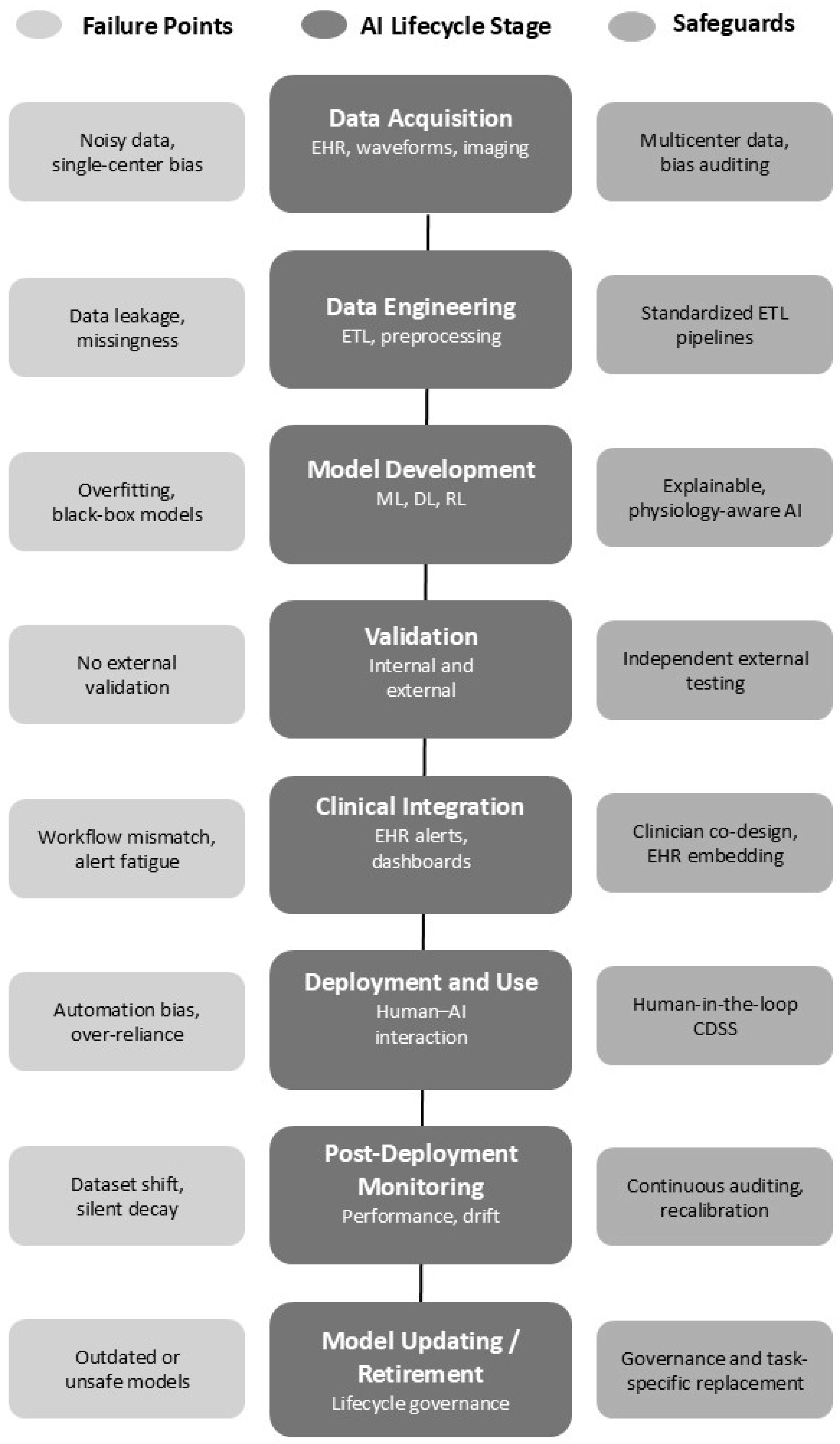
| Domain | Key Issue | Evidence/Description | Proposed Solutions |
|---|---|---|---|
| Evidence Quality | Retrospective, biased study designs | >95% of studies retrospective; 80–90% high risk of bias; limited outcome evaluation | Prospective, multicenter pragmatic trials; TRIPOD+AI 2024/CONSORT-AI Extension 2020 adherence; outcome-based endpoints [35,36,37,38] |
| Generalizability and Data | Single-center data, drift, poor data quality | Heavy reliance on MIMIC III and IV, and eICU v2.0 datasets; temporal drift and noisy ICU data degrade performance | Multicenter and federated learning; continuous auditing and recalibration; standardized ETL pipelines [35,39,40,41] |
| Model Transparency | Limited validation, interpretability, reproducibility | Few models externally validated; “black box” DL/RL models; limited code/data sharing | Mandatory external validation; explainable AI; open-science practices [36,37,38,42,43] |
| Clinical Integration | Workflow mismatch, automation bias | Poor EHR integration; alert fatigue; over-reliance on AI outputs | Clinician co-design; EHR-embedded tools; human-in-the-loop decision support [38,40,41] |
| Ethical and Legal | Accountability, bias, privacy concerns | Unclear liability; demographic bias in training data; data-sharing constraints | Governance frameworks; bias auditing and subgroup reporting; privacy-preserving ML [35,39,41] |
| Sustainability | Poor post-deployment oversight; overly broad tools | Limited monitoring after deployment; broad models underperform | Lifecycle performance monitoring; task-specific AI systems [37,41,44] |
| Author | Setting | AI Methods | Data Inputs | Purpose | Results |
|---|---|---|---|---|---|
| Cooper (2020) [45] | Community hospital, inpatient-wide screening | Logistic regression (automated screening model) | Six routinely collected sepsis-related variables | Early sepsis identification to facilitate timely bundle initiation | AUROC 0.857; screened 100% of inpatients and delivered alerts without manual nursing intervention (process capability to support bundle initiation) |
| Sendak (2020) [10] | Health-system deployment (ED/inpatient workflows), Sepsis Watch | Deep learning (sepsis detection + management platform) | EHR data streams (structured clinical data; model-driven risk) | Improve sepsis detection and support management workflows | Described as a platform used to improve compliance with recommended sepsis treatment guidelines |
| Goh (2021) [47] | Multicenter EHR + clinical notes | Hybrid ML + NLP (SERA) | Structured EHR data + unstructured clinical notes | Early prediction/diagnosis of sepsis (e.g., 12 h prediction) | Developed AI algorithm using structured + notes for sepsis prediction/diagnosis; reported high predictive performance |
| Nemati (2018) [50] | ICU real-time prediction | Interpretable ML model (“AI Sepsis Expert”) | Real-time ICU data | Predict sepsis onset ahead of clinical recognition | Predicts sepsis 4–12 h prior to clinical recognition with AUROC values in the range of 0.83–0.85 |
| Adams (2022) [55] | Multi-site deployed sepsis alert (TREWS) | Machine learning early warning system | EHR-derived clinical data used by deployed alert | Earlier recognition and prioritization of sepsis care | Prospective multi-site cohort showing clinician response to an alert within 3 h resulted in reduced in-hospital mortality by 18.7% |
| Warstadt (2022) [51] | Emergency department (quality initiative with EHR tool + education) | EHR-based CDS tool (rules/ordering pathway; not “black box” ML) | EHR tool prompts for bundle elements (lactate, cultures, antibiotics, fluids, reassessment) | Improve ED sepsis identification and management; improve bundle compliance | Tool utilization rose 23.3% → 87.2% and 6 h bundle compliance was 62.2% with tool vs. 37.8% without |
| Fixler (2023) [52] | Multi-hospital EHR deployment | “Predictive learning algorithm” driving CDS tools | EHR-driven risk categories feeding best practice alerts (BPAs) | Increase actionable sepsis CDS engagement and multidisciplinary sepsis management | Higher alert engagement: alert-to-action ratio 16.5% with algorithm vs. 8.4–12.1% for standard BPAs |
| Kijpaisalratana (2024) [58] | Emergency department; cluster-randomized trial | Machine-learning-assisted sepsis alert (MLASA) | Real-time ED clinical/EHR data feeding alert | Enhance timely antibiotics and diagnostic accuracy in ED sepsis | Improved timeliness of antibiotic administration within 1 and 3 h with diagnostic accuracy |
| Bhargava (2024) [59] | 5 U.S. institutions; suspected infection (blood culture ordered) | FDA-authorized AI/ML risk score (“Sepsis ImmunoScore”) | Multidomain inputs (demographics, vitals, labs) plus sepsis biomarkers; intended EMR integration | Identify patients at risk of sepsis within 24 h and predict adverse outcomes | Diagnostic AUROC 0.85 derivation, 0.80 internal validation, 0.81 external validation cohort |
| Boussina (2024) [56] | Two EDs (before–after quasi-experimental) | Deep learning (COMPOSER) | EHR-derived features; designed to reduce false alarms | Early sepsis prediction to improve outcomes and care delivery | Deployment associated with 5.0% absolute increased sepsis bundle compliance and 1.9% absolute mortality reduction |
| Grooms (2025) [57] | ED QI project, community hospital | Rule-based “AI” + workflow | Rule logic using ED clinical criteria feeding workflow prompts | Prompt early sepsis management and improve compliance | Implementation resulted in 89.5% compliance to combined antibiotic given, blood culture drawn, and lactate measurement at 3 h. Hospital LOS decreased by 2.3 days and mortality decreased by 22.3% |
| Valan (2025) [60] | External validation across community EDs | Sepsis Watch ML model (deep learning) | Static + dynamic EHR data | Validate model performance/clinical utility in new setting | Multisite external validation of Sepsis Watch showing AUROC 0.91 to 0.96 for sepsis prediction |
| Author | Setting | AI Methods | Data Inputs | Purpose | Results |
|---|---|---|---|---|---|
| Celi (2008) [61] | MIMIC-II (single ICU database); vasopressor pts | Bayesian network | Demographic + physiologic variables from first 24 h | Predict fluid requirement (total fluid on 2nd ICU day) | Accuracy 77.8% |
| Komorowski (2018) [62] | MIMIC-III (train) + eICU (test) | Reinforcement learning policy | Forty-eight variables incl. demographics, vitals, labs, fluids/pressors | Joint fluids + vasopressors over time | Higher estimated policy value than observed clinician policy; lowest mortality when clinician dosing most closely matched AI policy |
| Gupta (2021) [63] | MIMIC-III; 1122 sepsis ICU pts | Human-in-the-loop + inverse classification (classifier + optimization) | EHR covariates used to predict mortality | Personalized intravenous fluid quantity | Estimated ~22% average mortality reduction under model-recommended dosing |
| Jeter (2021) [64] | MIMIC-III; 5366 sepsis pts; hourly data | RL (continuous action) + switching SGLM states | Time-varying clinical variables (hourly) | Fluids + vasopressors for hypotensive episodes (timing/dose) | Agent resuscitated earlier (≈1 h vs. 4 h after diagnosis) with ~3% expected survival improvement |
| Su (2022) [65] | PICMISD; 2705 sepsis pts | RL + Deep Q-learning | 27 features (25 state + action fluid balance + outcome) | Direction of fluid therapy and fluid balance over time | Higher learned Q-values associated with lower mortality; identified U-shaped harm at extremes of fluid balance |
| Liang (2024) [66] | MIMIC-III; 412 sepsis patients | RL + neural network | Longitudinal EHR trajectory (vitals/labs + treatment history) | Multi-stage fluid resuscitation dosage | Expected mean SOFA reduction of 23.71% with recommended adequate fluid resuscitation |
| Oh (2025) [67] | MIMIC-IV (dev) + SICdb database (external) | Causal ML | EHR features to estimate individualized treatment effects | Restrictive vs. liberal fluids in sepsis + AKI | Restrictive fluids associated with higher AKI reversal (53.9% vs. 33.2%) and lower 30-day major adverse kidney events (17.1% vs. 34.6%) |
| Lin (2019) [68] | MIMIC-III Sepsis-3; 19,275 pts; 232,929 events | Gradient tree boosting ML | Physiologic parameters around fluid event | Predict urine output response/oliguria after fluids | Oliguria prediction AUROC > 0.86 |
| Bataille (2020) [69] | Prospective observational; severe sepsis/septic shock; 100 pts (50 train/50 test) | ML (CART, PLS, NNET, LDA) models on TTE features | Transthoracic echocardiography + physiologic changes | Fluid responsiveness (ΔSV ≥ 15%) | AUROCs: PLR 0.77; CART 0.68; PLS 0.83; NNET 0.83; LDA 0.85 |
| Kamaleswaran (2021) [70] | MIMIC-III + matched physiologic data | ML with waveform features (logistic regression) | Clinical data + continuous physiologic waveforms | Predict volume responsiveness in sepsis | With waveform features, AUROC 0.89, compared to AUROC 0.84 for clinical factors without waveform information |
| Catling (2023) [71] | Scoping review of seventy-three studies | Supervised + RL systems | N/A | Cardiovascular resuscitation decision support | RL systems increasingly used for fluids/pressors, but most remain proof-of-concept |
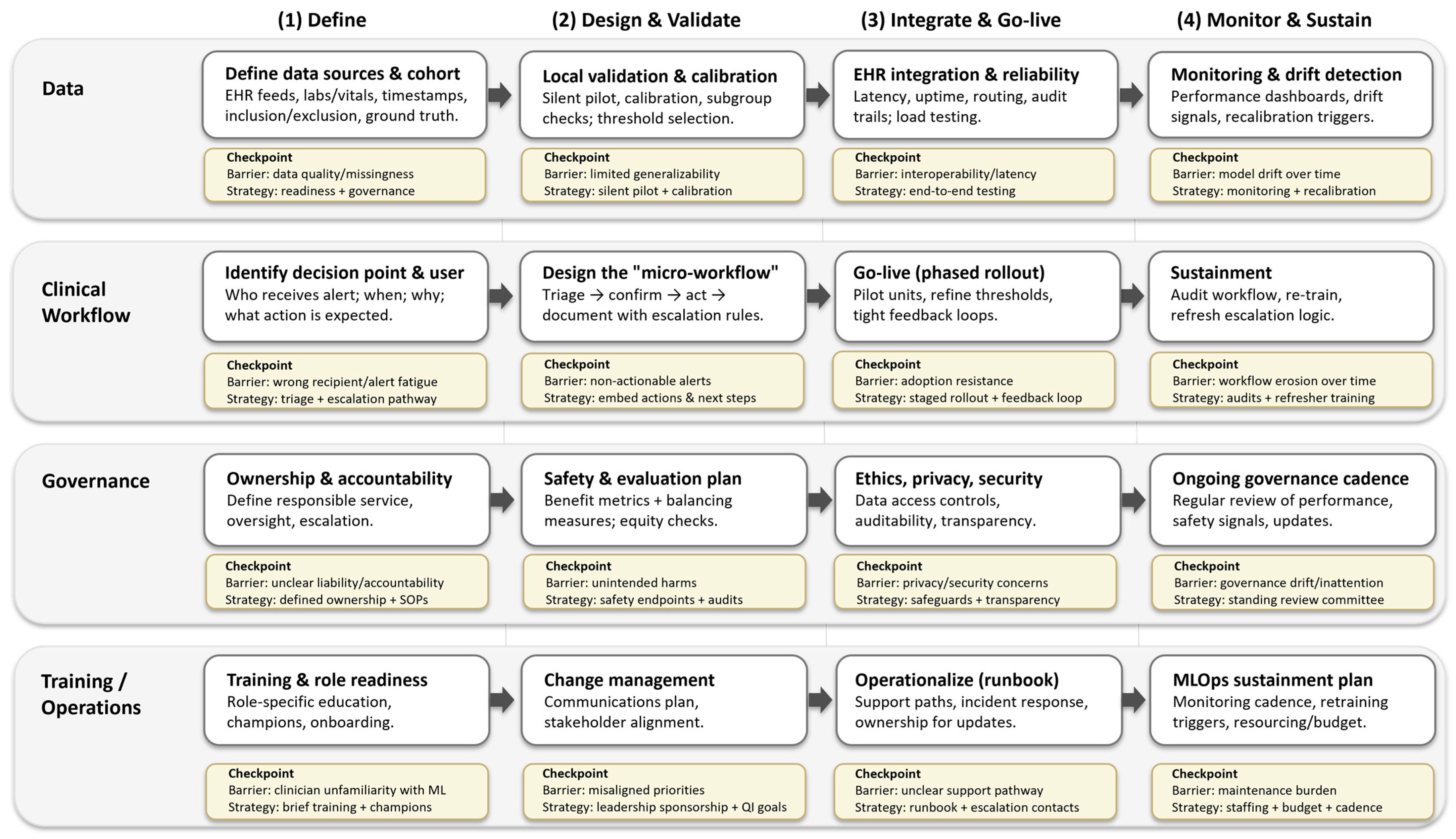
| Domain | Implementation Barrier(s) | Mitigation Strategy | Practical Sepsis AI Example |
|---|---|---|---|
| Clinician acceptance, trust, interpretability [10,33,48,77,78] | Distrust/confusion for ML models vs. rule-based tools; perceived “black box”; low perceived usefulness | Early and continuous clinician engagement; transparent model communication (what it does/does not do); just-in-time education; feedback loops; identify local champions; align tool purpose to clinical priorities | Brief, role-specific training on how to interpret risk scores/alerts + structured feedback mechanism to iteratively refine alert content and thresholds |
| Workflow integration and alert burden [10,46,48,77] | Alert fatigue; wrong recipient; unclear escalation pathway; misfit with existing sepsis workflows and staffing patterns | Co-design the “micro-workflow” around the AI output; define who receives alerts, triage steps, and escalation rules; minimize interruptions; ensure alerts are actionable and time-appropriate | Route alerts to a designated triage staff (e.g., rapid response team or charge nurse) who performs rapid chart review, then escalates to the treating team when indicated |
| Data quality, generalizability, and technical readiness [10,33,78] | Limited/diverse datasets; missingness; drift; poor calibration in local populations; interoperability constraints | Pre-implementation data readiness assessment; local validation (including calibration); “silent” pilot before go-live; ongoing drift monitoring; periodic recalibration; bias checks and mitigation | Run silent predictions for several weeks to compare alert performance vs. clinician recognition, then calibrate the model before activating workflow triggers |
| Governance, liability/regulatory, and patient safety [10,33,34,46,78] | Unclear accountability and liability; privacy/security concerns; risk of unintended harms (e.g., overtreatment, antibiotic overuse) | Establish governance (ownership, oversight, escalation for safety issues); define accountability; document decision support role; audit trails; safety monitoring plan with balancing measures | Monitor both “benefit” metrics (time-to-antibiotics, bundle completion) and balancing metrics (broad-spectrum antibiotic exposure, false-positive escalations) |
| Change management, leadership alignment, and stakeholder buy-in [10,16,34,77] | Misaligned priorities; inadequate leadership support; insufficient change management; resistance to new roles/processes | Executive sponsorship; stakeholder mapping; communication plan; staged rollout; clarify role changes; align with QI goals (i.e., SEP-1 measure compliance) | Implementation steering group (ICU/ED leaders, nursing, informatics, patient safety) sets adoption goals and manages iterative workflow changes |
| Workforce capacity, training, and sustainment [10,34,46,48] | High training burden; staffing limitations and turnover; ongoing maintenance needs; implementation fatigue | Dedicated implementation team; recurring training and onboarding; clear maintenance plan (monitoring cadence, retraining triggers); resource budgeting for sustainment | Monthly model performance and workflow review huddles; refresh training for new clinicians; defined triggers for recalibration |
Disclaimer/Publisher’s Note: The statements, opinions and data contained in all publications are solely those of the individual author(s) and contributor(s) and not of MDPI and/or the editor(s). MDPI and/or the editor(s) disclaim responsibility for any injury to people or property resulting from any ideas, methods, instructions or products referred to in the content. |
© 2026 by the authors. Licensee MDPI, Basel, Switzerland. This article is an open access article distributed under the terms and conditions of the Creative Commons Attribution (CC BY) license.
Share and Cite
Nguyen, H.B.; Krishtopaytis, E.; Lopez, E.; Farnoudi, N.; Van, T.; Kharalampova, V.; Coz Yataco, A. Artificial Intelligence to Facilitate SEP-1 Measure Compliance and Fluid Management in Sepsis. J. Clin. Med. 2026, 15, 3477. https://doi.org/10.3390/jcm15093477
Nguyen HB, Krishtopaytis E, Lopez E, Farnoudi N, Van T, Kharalampova V, Coz Yataco A. Artificial Intelligence to Facilitate SEP-1 Measure Compliance and Fluid Management in Sepsis. Journal of Clinical Medicine. 2026; 15(9):3477. https://doi.org/10.3390/jcm15093477
Chicago/Turabian StyleNguyen, H. Bryant, Eduard Krishtopaytis, Enrique Lopez, Neeka Farnoudi, Trinity Van, Viktoriia Kharalampova, and Angel Coz Yataco. 2026. "Artificial Intelligence to Facilitate SEP-1 Measure Compliance and Fluid Management in Sepsis" Journal of Clinical Medicine 15, no. 9: 3477. https://doi.org/10.3390/jcm15093477
APA StyleNguyen, H. B., Krishtopaytis, E., Lopez, E., Farnoudi, N., Van, T., Kharalampova, V., & Coz Yataco, A. (2026). Artificial Intelligence to Facilitate SEP-1 Measure Compliance and Fluid Management in Sepsis. Journal of Clinical Medicine, 15(9), 3477. https://doi.org/10.3390/jcm15093477