Article

A Comparative Analysis of Psychiatric Consultations Across Emergency, Hospital, and Community Mental Health Settings


1
Department of Mental Health and Drug Abuse, AUSL-Modena, 41121 Modena, Italy
2
School of Specialization in Psychiatry, University of Modena and Reggio Emilia, 41125 Modena, Italy
3
Department of Biomedical, Metabolic and Neural Sciences, University of Modena and Reggio Emilia, 41125 Modena, Italy
*
Author to whom correspondence should be addressed.
J. Clin. Med. 2026, 15(9), 3476; https://doi.org/10.3390/jcm15093476
Submission received: 18 March 2026 / Revised: 25 April 2026 / Accepted: 28 April 2026 / Published: 1 May 2026
(This article belongs to the Special Issue Clinical Advances in Personalized Psychiatry)

Abstract

Background/Objectives: A psychiatric consultation is a professional evaluation aimed at establishing a diagnosis, a prognosis, and developing a treatment plan. The objective was to assess psychiatric consultations (PCs) at the Community Mental Health Center (CMHC), Emergency Room (ER) and General Hospital (GH) to highlight differences across settings. Methods: With a retrospective design, we examined all PCs performed between 1 January 2024 and 31 December 2024 at the CMHC, ER and GH of Baggiovara in Modena. Descriptive statistical analysis and a multivariate logistic regression were performed. Results: We collected a total of 3174 PCs for 1801 patients, performed in the three settings: 52% in ER, 30% in CMHC and 18% in GH. In ER, PCs were most frequently requested for suicide risk (26%), psychomotor agitation (14%) and substance intoxication (14%). In CMHC, the most common diagnoses were depressive disorders (22%), acute anxiety (20%) and acute psychotic episodes (13%). In GH, consultations mainly addressed psychiatric symptoms associated with medical and eating disorders. The overall rate of psychiatric hospitalization after PCs was 16.2%, reaching 23.4% for consultations in ER. Discontinuation of pharmacological therapy was significantly associated with an increased risk of hospitalization (p < 0.001), which rose to 17% when therapy had been interrupted for more than one year. Conclusions: PCs at ER were the access point for most hospitalizations. Therapeutic discontinuation, acute psychosis and substance use represented the main predictors of hospitalization. Strengthening shared care pathways among CMHC, ER and GH represents an effective model of integration between hospital and community services, ensuring continuity of care.

1. Introduction

Psychiatric consultation is a professional evaluation aimed at establishing a diagnosis, a prognosis, and developing a treatment plan. The different contexts in which a PC is performed can be influenced by the different clinical needs of the individuals requiring counseling and, at the same time, by the different facilities available, resulting in different outcomes.

1.1. Urgent Psychiatric Consultations

The main settings in which a PC is required in urgency are the Emergency Room (ER) and the Community Mental Health Center (CMHC), with very different characteristics [1].
The emergency–urgency system represents a key link between hospital facilities and community services. It is organized to ensure patient care from the first moments of a critical event, including rescue, clinical stabilization, protected transport, and therapeutic continuity [2].
At the community level, General Practitioners (GPs), pediatricians, and the community emergency system play a crucial role in activating first aid pathways and ensuring the timely transfer of patients to hospital facilities when necessary.
In a hospital setting, the Emergency Room (ER) is the primary point of access for health emergencies, playing a fundamental role in defining the diagnosis and the treatment pathway [3].
The primary goal of managing psychiatric emergencies is to contain crisis, acute worsening, and re-establish a minimum level of stability favoring community or outpatient setting treatments if possible.
The term crisis is sometimes used synonymously with emergency, but the literature suggests distinguishing the two concepts. A psychiatric crisis represents a disruption of psychological equilibrium, which can appear suddenly or develop progressively, often in connection with stressful events. It does not necessarily imply an immediate threat to life but still requires targeted intervention to guide the patient toward a new equilibrium [4]. By contrast, a psychiatric emergency implies an immediate risk to the patient or others and requires urgent intervention. The American Psychiatric Association defines it as a condition characterized by an acute alteration in thinking, mood, or behavior that requires immediate intervention, based on the condition of the patient and family or social requirement [5]. It includes acute psychotic states, severe manic episodes, impaired reality testing, suicidality, and hetero-aggressive behavior [3,6].
Psychiatric emergencies constitute a substantial proportion of visits to emergency departments. In Italy, psychiatric visits to emergency departments accounted for approximately 3% of total visits in 2018, while in 2022 there were just over 547,000, with a stable but relatively increasing incidence [7].
Several studies conducted in North America have reported higher estimates, ranging from 6% to 25% of all visits to the emergency department [7,8]. In recent decades, a progressive increase in requests for urgent psychiatric intervention has been observed. This phenomenon is attributable, on the one hand, to the reduction in community resources dedicated to mental health and, on the other, to the growing prevalence of substance use disorders and psychiatric comorbidity [9]. The most common reasons for urgent psychiatric assessment include the following: acute anxiety, psychomotor agitation, acute confusion/delirium, acute psychotic episodes, depressive disorders, psychomotor retardation, self-harm and suicide attempts [9,10].
In particular, numerous international studies confirm that self-harm and/or self-destructive behaviors are the main predictors of hospitalization, along with the presence of aggressive behavior and a previous psychiatric history. In fact, suicidal behavior represents approximately 5% of all emergency department hospitalizations, with an estimated lifetime prevalence of around 13.5% in the general population [11].
A US study showed that the clinical conditions most frequently associated with psychiatric Emergency Room visits were substance abuse (27%), neurosis (26%), and psychosis (21%). Furthermore, a greater likelihood of access emerged among African American patients and those covered by the Medicaid health program, suggesting that socioeconomic and cultural variables significantly influence the use of emergency services [12].
A study conducted at the Gasthuisberg University Hospital in Leuven analyzed 1050 patients assessed by the psychiatric emergency team over a period of eight months, representing 3.5% of total emergency department visits. The majority were women (56%), with a prevalent age range between 30 and 39 years, and almost half of the subjects were unemployed. The most frequent diagnoses were mood disorders (19.7%), adjustment disorders (17.1%), and substance use disorders (14.9%). Gender differences were significant: men more frequently showed substance abuse and hostility, while women more frequently presented with suicidality (31%) and depressive symptoms (24%) [13].
In a large German cohort, suicidal ideation or behavior were confirmed as the strongest predictors of hospitalization, along with aggressive behavior, both of which were associated with higher hospitalization rates. Variables such as unemployment and housing poverty were also found to be significant in influencing the use of emergency services [14]. Another German study, using the ICD-10 classification, found that substance use disorders accounted for 37.5% of diagnoses, followed by psychosis (21.8%), neurotic disorders (18.5%), and affective disorders (11.6%). In this context, suicidality was present in 12.1% of hospitalizations and suicide attempts in 5.8% of cases [15].
A multicenter Belgian study also confirmed the centrality of anxiety and mood disorders, with a suicide rate higher than 20% [13]. In a study conducted by Kirchner and colleagues on 1733 general emergency patients, the most common diagnosis was substance use disorder, while anxiety disorders were more often associated with discharge. Among the main predictors of hospitalization were aggression, suicidal behavior, a previous psychiatric history, and inter-hospital transfer [16,17]. Overall, the data in the literature converge in indicating that affective disorders, psychosis and alcohol or drug abuse represent the most common diagnoses in psychiatric emergency services [10], highlighting that requests for urgent psychiatric intervention do not only concern psychotic or depressive crises but a broad spectrum of psychiatric conditions that include acute anxiety disorders, symptoms related to substance use, and suicidal risk situations, strongly influenced by social and environmental variables.
A historical moment that significantly influenced the demand for urgent psychiatric consultations was the COVID-19 pandemic. Indeed, the literature not only reported an increase in consultations (after an initial decline) but also an increase in complex situations, characterized by self-harm risk and acute psychosis [18,19,20,21,22]. Following the pandemic, starting in 2021, we recorded a growing increase in the total number of urgent psychiatric consultations at the CMCH, which reached its highest number in 2024 [23].
Frequent users, i.e., patients who repeatedly access emergency services for psychiatric problems, represent a significant issue. For this reason, the international literature has attempted to identify factors that increase the likelihood of repeat access to psychiatric emergency services. Specifically, from a clinical perspective, personality disorders and psychosis are strongly associated with recurrences of access, while affective disorders appear to be associated with a relatively lower risk [17].
Comorbidity with substance use disorders significantly impacts the pattern of use. In fact, patients with alcohol or cocaine dependence, combined with a comorbid psychiatric disorder, are three times more likely to access emergency services than those without comorbidities [10,17,24,25]. Some Italian studies have shown that subjects with three or more annual accesses frequently present with multiple comorbidities, particularly dual psychiatric–drug diagnosis, marginalization, or a lack of a social network [24]. The demographic and social variables most frequently associated with an increased use of ER for psychiatric consultations include middle age, male gender, economic disadvantage, unemployment, housing insecurity, and the absence of a support network [3,26,27]. In many cases, repeated use of services reflects not only clinical needs but also social vulnerability. A study conducted in Montreal highlighted that patients with frequent requests for psychiatric consultations in ER were, on average, younger, economically deprived, and had a higher prevalence of schizophrenia and comorbidities compared to those who had made isolated visits [28]. It was also noted that medical comorbidity constitutes a further significant factor. In fact, up to 50% of patients who requested a psychiatric consultation in ER also have an organic condition that could aggravate or simulate a psychiatric symptom [29,30,31]. Finally, the organizational characteristics of health systems also influence the frequency of access: in contexts where local resources are limited, the emergency department becomes the main gateway for crisis management [32,33].

1.2. Psychiatric Consultation in Hospital Setting

Psychiatric conditions are highly prevalent among people admitted to general medical hospitals and can affect the outcome of hospitalization [34]. The role of the Psychiatric Consultation-Liaison (C-L) is to serve as the clinical interface between general medicine and mental health, with a view towards integrating psychiatric expertise into medical care. This integrated approach to care considers the biological, psychological and social aspects of the disease, influencing its course, response to treatment and clinical outcomes [35,36].
Consultant psychiatrists contribute not only to the diagnosis and treatment of psychiatric disorders that may arise or worsen during hospitalization, but also to the recognition of psychological factors that influence the management of medical illnesses. This, in turn, promotes a person-centered culture of care [37,38].
Since their development in the 1950s and 1960s, C-L services have expanded beyond diagnostic consultation to include training, research, and interdisciplinary collaboration [39,40,41]. At present, organizational models exhibit a divergence between reactive systems predicated on on-call consultations and proactive models distinguished by regular presence in the ward and structured collaboration. The latter has been demonstrated to be associated with superior clinical outcomes, reduced length of stay, and enhanced staff satisfaction [42,43]. In recent years, a growing body of research has documented a steady increase in requests for psychiatric consultations in hospital wards, parallel to a growing awareness of the impact of mental disorders on the course of physical illnesses [44,45].
Studies conducted in several countries show that a significant percentage of patients hospitalized for medical or surgical conditions also have a psychiatric disorder, often previously undiagnosed. In fact, these disorders can affect 30% to 50% of all hospitalized patients, with significant impacts on clinical outcome, adherence to treatment, and prognosis [46,47]. However, a discrepancy remains evident between the true prevalence of psychiatric disorders in hospitalized patients and the actual frequency of consultations requested. Indeed, European data collected by the European Consultation-Liaison Workgroup (ECLW) show that only 1–1.4% of hospitalizations request a psychiatric consultation [48,49]. The causes of this underestimation of diagnoses are multiple: the lack of familiarity among non-psychiatrists with psychopathology, the tendency to interpret psychogenic symptoms from a somatic perspective, the lack of specialized resources, and the persistence of stigma surrounding mental illness [50]. This suggests that many mental health needs remain partially unexpressed or unrecognized in hospital care. Conversely, the presence of a structured liaison psychiatry service, with regular training and multidisciplinary activities, encourages an increase in requests and better management of mental health disorders [51,52].
As indicated by the extant literature, psychiatric consultations are primarily initiated by medical departments, with a notable number of such requests also originating from surgical departments and emergency departments [53].
The presence of a psychiatric disorder has been demonstrated to be associated with prolonged hospitalization, increased medical interventions and higher healthcare costs [34]. Prospective studies have demonstrated that a greater than expected proportion of patients admitted to non-psychiatric wards manifest clinically significant symptoms of anxiety, depression, cognitive dysfunction, or severe pain [46,48,49]. Individuals afflicted with such conditions have been observed to have prolonged hospitalization (40%) and elevated hospital expenses (35%) in comparison to those not afflicted with psychiatric disorders [47,54].
Among the conditions most frequently associated with a request for psychiatric consultation in medical wards are cognitive impairment, dementia and delirium [55].
Delirium constitutes a medical and psychiatric emergency, as it can represent the manifestation of potentially serious organic pathologies [56,57,58]. It is the most common psychiatric syndrome in hospitals, with a prevalence ranging from 10% to 30% in internal medicine departments and reaching 80% in intensive care units [59,60].
The extant literature also highlights that substance use disorders further complicate hospitalization, due to both the higher incidence of medical complications and the frequent co-occurrence of other psychiatric disorders, such as depression and personality disorders [61]. This is frequently associated with inadequate treatment adherence, which necessitates integrated, multidisciplinary management involving internal medicine, psychiatry and addiction services [62].
An Italian study confirms that psychiatric consultations in general hospitals frequently involve patients with affective disorders, psychosis, personality disorders and anxiety-related conditions [63].
An observational study conducted at Perugia General Hospital demonstrated that over half of the requests for psychiatric consultation originated from medical wards (53.1%), followed by specialist wards (38.1%) and surgical wards (8.8%). The primary reasons for referral PCs included anxiety disorders (18.9%), depressive symptoms (18.2%), confusion states (13.4%), somatic symptoms not explained by organic causes (11.2%), risk or attempted suicide (11.2%), and psychomotor agitation (10.9%), as well as a positive psychiatric history [64].
It is important to note that delays in referral to psychiatric services are associated with prolonged hospitalization, with each day of delay potentially extending the length of stay by approximately two days [65]. This confirms the effectiveness of proactive consultation models, which include the psychiatrist’s regular presence on the wards and participation in discharge planning.
Studies comparing psychiatric consultations in Emergency Rooms, Community Mental Health Centers, and general hospitals are scarce in the literature, with limited knowledge of context-specific demand patterns and outcomes.

1.3. The Objectives of This Study

The primary objective of this study is to evaluate the frequency, diagnoses, interventions, and outcomes of urgent psychiatric consultations performed at a Mental Health Center (CMHC) of a community service, at an Emergency Room (ER) and at medical wards of a General Hospital (GH) during a period of one year. The secondary objective of this study is to highlight the different patterns of clinical requests and therapeutic care interventions based on the three different settings.

2. Materials and Methods

2.1. Study Design/Methodology

This observational, retrospective, and single-center study was conducted in the Department of Mental Health and Drug Abuse of Modena Centre.
The organization of mental health services in the province of Modena is part of the Emilia-Romagna regional model, based on the integration of community and hospital services within a single departmental network. This network is coordinated by the Department of Mental Health and Drug Abuse (DSM-DA) of the AUSL-Modena, which is responsible for ensuring continuity of care, timely interventions, and appropriate treatment for adult and minor populations with psychiatric disorders [66]. The regional model, developed from the principles of Law 180/1978 and further defined through the Regional Guidelines, is based on the cornerstones of community psychiatry. The goal is to promote care in the community, prevent institutionalization, and ensure a continuum of care between outpatient services and residential/hospital admissions [67].
Our local Community Mental Health Center (CMHC) is divided into three main services, which are the community-based facilities responsible for adult psychiatric care and are the primary points of access for the population. The CMHC guarantees opening hours (from 8:00 a.m. to 8:00 p.m. on weekdays and until 2:00 p.m. on Saturdays) for ensuring psychiatric consultations (PCs) at the CMHC in cases of psychotic breakdown, psychomotor agitation, suicidal risk, or acute behavioral disturbances [64]. The CMHC relates to the Service for Psychiatric Diagnosis and Care (SPDC) in the General Hospital in Baggiovara (Modena), which represents the hospital’s referral center for psychiatric consultations in the ER and in the medical wards of the General Hospital where it is located, providing continuity of care 24 h a day. During nights and holidays, psychiatric consultations (PCs) are available 24 h a day in the ER of the GH in Baggiovara (Modena), where a psychiatrist is on duty as ER and GH consultant and as physician of the SPDC ward. The SPDC is a ward where voluntary and involuntary hospitalizations, according to 180/78 and 833/78 Laws, are carried out (catchment area of 700,000 people).
At the GH in Baggiovara, psychiatric service provides specialist consultations, both in the emergency department and in the internal medicine, surgical, and specialist departments. Psychiatric consultations in the emergency department are provided in cases of psychiatric emergency, such as psychomotor agitation, suicidal ideation, substance abuse, acute psychotic symptoms, or confusion states. In these situations, the on-call psychiatrist intervenes promptly to perform a clinical assessment and determine the most appropriate outcome: discharge with referral to the Mental Health Center (CMHC), temporary observation, or admission to psychiatric wards.
Psychiatric consultations in hospital wards are requested for patients hospitalized for medical conditions who present psychiatric symptoms during their stay. In these cases, the consultation supports pharmacological management, suicide risk assessment, the doctor–patient relationship, and planning for continuity of care after discharge. This activity falls within the framework of consultation and liaison psychiatry, which promotes integration between medical and mental health disciplines, reducing the gap between general medicine and psychiatry and improving the overall quality of care [68].

Sample and Variables

We collected all PCs required for patients aged older than 14 years at CMHCs, the ER and GH in Baggiovara (Modena) between 1 January 2024 and 31 December 2024. Psychiatric consultations were extracted consecutively in chronological order, including all consultations recorded in the database during the study observation period. No additional selection criteria were applied.
In the patient-level analyses, only the first psychiatric consultation for each patient during the study period was considered. In contrast, in the consultation-level analyses, all psychiatric consultations were included, and repeated consultations from the same patient were treated as independent observations.
We analyzed the following variables:
  • Patient socio-demographic data (age, sex, nationality and residence).
  • Location of consultation: CMHC, ER and GH.
  • Work shift during which consultation was performed: daytime, weekdays/holidays, nighttime.
  • Clinical reason for PCs. The categories used to describe the clinical reasons for consultation (e.g., anxiety states, agitation, suicide attempts) represent groupings of the most frequently observed clinical presentations during psychiatric consultations.
  • Referral to PCs: spontaneous, unaccompanied/accompanied, General Practitioner (GP), ER physicians, other services, law enforcement agencies, or by other specialists.
  • Previous care at CMHC or other service or specialist.
  • Previous psychopharmacological therapy.
  • Therapeutic adherence: Regular intake of therapy, therapy interruption for less than three months, for three months to one year, and for more than one year. Therapeutic adherence was assessed based on information obtained during the psychiatric consultation, including both patient self-report and review of the available medical records.
  • Interventions performed during PCs: Individual/family interview, administration/prescription of psychopharmacological therapy, request for additional tests (blood tests/urine toxicology/electrocardiogram/specialist consultation).
  • PC outcome; hospitalization, referral to CMHCs and/or other community services, referral to GP, request for psychiatric re-evaluation and/or other specialist consultation, voluntary or involuntary hospitalization.
  • Psychiatric diagnosis, presence of organic comorbidity and/or concomitant substance use according to ICD-9-CM classification system, which is routinely used in our clinical setting.
  • Number of consultations per patient during the observation period.

2.2. Statistical Analysis

Descriptive statistical analysis was performed on the demographic and clinical data:
-
For continuous variables: mean (m) ± standard deviation (SD), t-test after analyzing the normality of the distribution with the Shapiro–Wilk test (in case of non-normal distribution, the Kruskal–Wallis test was applied).
-
For categorical variables: percentage values and Pearson χ2 test.
A multivariate logistic regression was performed between the dependent variable “Hospitalization” (1 = hospitalization, 0 = no hospitalization) and the other selected variables, using the stepwise regression method, to highlight which variables influence the need for hospitalization. The statistical probability level was set at p < 0.05.
All data were analyzed using STATA Version 12 software.

2.3. Privacy and Ethical Considerations

This study was conducted in accordance with the Declaration of Helsinki and approved by the Ethics Committee of the Emilia Nord Area (Prot. AOU 0014271/25 of 19 May 2025) and authorized by the Modena Local Health Authority (Determination No. 1511 of 30 May 2025).
The study data were collected anonymously, assigning each selected patient a progressive numerical code, and analyzed using statistical methods to obtain the information required for the research. Access to the data was granted to the study manager and his/her collaborators, who were bound by the obligation of confidentiality and data processing in accordance with current regulations. Consultation data were obtained through the computerized system used in SPDC and CMHC.
This study is reported in accordance with the STROBE (Strengthening the Reporting of Observational Studies in Epidemiology) guidelines.

3. Results

The Sample of PCs in CMHC, ER and GH

The sample analyzed includes a total of 3174 PCs across the three different settings examined: 1651 (52%) in the ER, 573 (18%) in the wards of GH, and 950 (30%) at the CMHCs. The overall sample of patients requiring consultations consisted of 1801 individuals, of whom 1084 (60%) were assessed in the ER, 282 (16%) in the GH, and 435 (24%) at the CMHC. The number of PCs per patient was statistically signifcantly different across the three settings (Pearson chi2 = 32.60, p = 0.000): in the ER, 957 (88%) of patients required only one PC (SR ≥ 2, p < 0.05) vs. 127 (12%) who required more than one PC during the study period; in the GH, 211 (75%) required only one PC; whereas 71 (25%) more than one PC (SR ≥ 2, p < 0.05); and in the CMHC, 366 (84%) required only one PC and 69 (16%) more than one PC. The gender distribution of consultation subjects appears substantially balanced, 49% male and 51% female, with no statistically significant differences across the three settings. Conversely, the mean age across the three settings shows significant variations (χ2 = 164.199, p = 0.0001, Kruskal–Wallis, given that the normality test showed a p = 0.000): patients in the wards are on average older (57 years), while in the ER and CMHC the mean age is 40.5 and 44.6 years, respectively, a statistically significant difference.
In Table 1, the residence of people requesting a psychiatric consultation is shown: residence in Modena and province was high overall (90%), reaching 98% in the CMHC (p < 0.05). In the ER, a higher proportion of non-residents was observed: Italian citizens in 11% of cases (RS ≥ 2, p < 0.05) and people from non-European countries in 4% (RS ≥ 2, p < 0.05), with a statistically significant difference (Pearson χ2 = 101.96, p = 0.000).
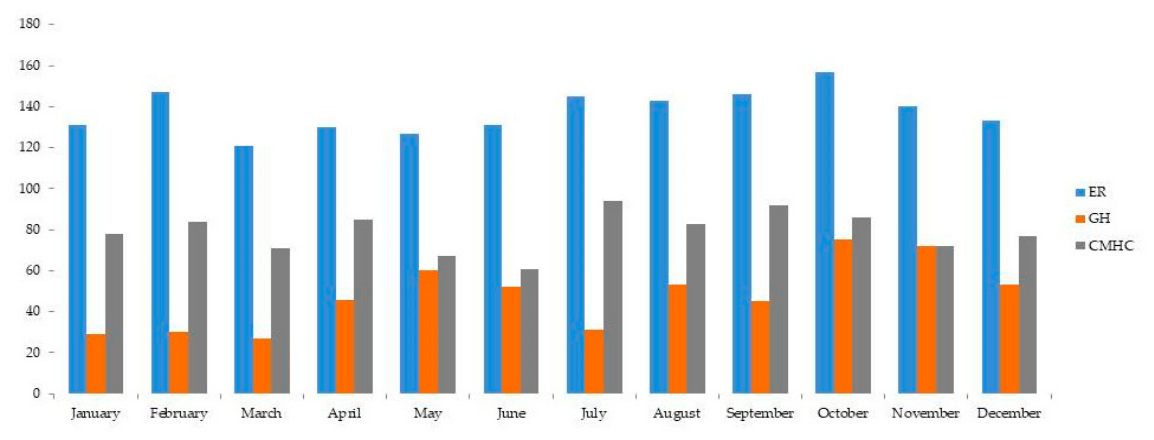
The seasonal trend in consultations, shown in Figure 1, presented a slight increase in autumn (27.8%), followed by summer (25%), winter (24%), and spring (23.2%). The only statistically significant variation was found in the PCs in the GH, where consultations increased in May, October, and November (RS ≥ 2, p < 0.05; Pearson χ2 = 56.68, p = 0.000).
Monthly trends showed a higher concentration of consultations in summer, particularly between July and September, and a slight decrease in autumn. In January and April, PCs showed statistically significant differences compared to other periods of the year (Pearson χ2 = 54.133; p = 0.012; RS ≥ 2, p < 0.05).
The distribution of PC referrals showed statistically significant differences (Pearson χ2 = 2.5 × 10³; p < 0.001) among the three settings, as shown in Table 1. In the ER, unaccompanied spontaneous referral prevailed (40%); in the GH, most PCs were requested directly by the staff medical wards (72%) or by consultant psychiatrists for clinical re-assessments (26%); in the CMHCs, consistently with their function of providing continuity of care, spontaneous requests for PCs prevailed (61%), followed by those sent by other community services (14%) and General Practitioners (5%).
The distribution of PCs by work shift (Table 1) also differed across the three settings (Pearson χ2 = 762.82; p = 0.000): in CMHCs, PCs take place exclusively during weekdays (100%); in the ER, most PCs are carried out at night (41%) and on holidays (10%); and in the GH approximately half of consultations (44%) take place at night, suggesting urgent modality in all three settings.
In CMHCs, almost all patients (91%) were already being cared for by the CMHC, whereas in the GH, the percentage drops to 63% and in the ER to 72%, with a statistically significant difference (Pearson χ2 = 181.11, p = 0.000). Therefore, patients not in care were more represented in hospital settings, with 26% in the ER and 35% in the GH wards (Table 1).
Regarding the hospital departments which requested a PC, the prevalent medical areas (44.8%) were Internal and Metabolic Medicine, Gastroenterology, Geriatrics, Cardiology, and Neurology, followed by emergency and urgent care areas (36.8%), such as Emergency Medicine, Intensive Critical Care, and Anesthesia and Resuscitation/Intensive Care; surgical areas (Gynecology and Obstetrics, Orthopedics, General Surgery) represented 10.7% of PC requests, followed by Rehabilitation areas (7.2%), and finally by Oncology (0.5%).
The clinical characteristics of PCs, reported in Table 2, highlight further differences between the contexts examined. The different ways in which patients took psychopharmacological therapy differed statistically significantly in the three settings (Pearson χ2 = 421.60, p = 0.000): in the CMHC, most patients were undergoing oral therapy (73%), with a significant proportion of long-acting (LAI) therapy combined (13%) and alone (4%); in the GH, parenteral therapies were more frequent; whereas in the ER, approximately 31% of patients were not receiving pharmacological treatment at the time of PC evaluation (Table 2).
Therapeutic adherence was generally good (89%) but differed significantly across settings (Pearson χ2 = 75.31, p = 0.000): it was higher in the GH (95%) and slightly lower in the CMHC (90%), where therapy interruptions of more than 3 months (9% of cases) were statistically significant. In the ER, short (<3 months = 7%) or prolonged (>1 year = 2%) therapy discontinuations were observed in a statistically significant way (Table 2).
The presence of medical comorbidities was also analyzed in the clinical characteristics, which are more frequent in the GH (42%), compared to 14% in the ER and 5% in the CMHC (Table 2).
The clinical reasons for consultations, reported in Table 3, statistically significantly differed across the three clinical contexts (Pearson χ2 = 951.90, p = 0.000): in the ER, PCs were most frequently requested for self-harm risk or suicide attempt (26%), followed by agitation/aggressive behavior (14%) and substance/medication intoxication or withdrawal (14%). In the GH, PCs were more frequently requested for mental disorders secondary to medical disorders, present in 16% of PCs, followed by eating disorders (8%) and monitoring psychopharmacological therapy (4%). Finally, PCs in the CMHC were primarily requested for depressive symptoms (22%), acute anxiety states (20%), and acute psychosis (13%) in a statistically significant way.
The clinical interventions performed during psychiatric consultations (Table 4) showed statistically significant differences (Pearson χ2 = 399.01, p = 0.000). Specifically, in the emergency department, individual or family interviews prevailed (34%), followed by therapy administration (22%) and combined interventions of consultation, therapy administration, and therapeutic prescription (11%). In the GH, there was a clear prevalence of consultations which modified and monitored psychopharmacological therapy prescription (54%) and requested hematological tests and non-psychiatric consultations (4%). In the CMHC, a combination of interview and prescription home therapy (39%) and the activation of compulsory health assessment (3%) were statistically significantly more frequent.
Statistically significant differences were reported in the outcomes of PCs in the three different settings (Pearson χ2 = 1.5 × 100.3, p = 0.000) (Table 5): in the ER, over half of patients (51%) were discharged and referred to community services, and unlike in other consultation settings, 18% were voluntarily admitted, 4% were admitted to a non-psychiatric setting, and 3% were discharged and sent to a private specialist or to prison; in the GH, the most frequent outcome was the reassessment of mental conditions in the continuation of hospitalization (69%); whereas in the CMHC, the most frequent outcome was referral to community services (70%), followed by scheduled hospital admission (5%) and out-of-hospital compulsory treatment, according to Laws 180/78 and 833/78 (1%). The percentage of voluntary and involuntary hospitalizations to a psychiatric ward was 13% and 2%, respectively, with a statistically significant difference between the clinical settings where a PC was performed: 18% and 3% from the ER, 7% and 1% from the GH, 6% and 2% from the CMHC.
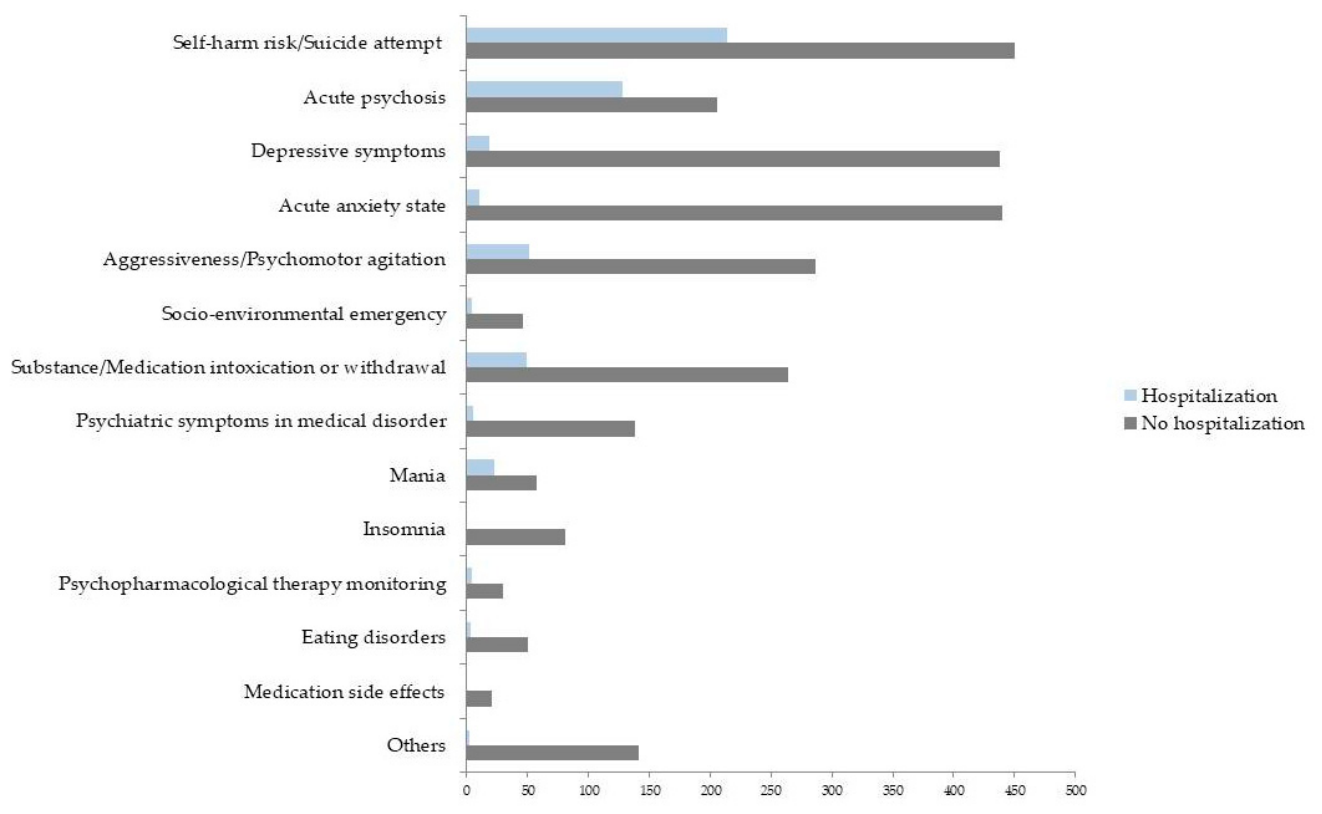
Regarding the outcome hospitalization of PCs grouped by clinical reason, as reported in Figure 2, we observed that patients at risk of self-harm (32%) and in acute psychosis (38%) had the highest hospitalization rates in a statistically significant way (Pearson χ2 = 436.77, p = 0.000).
In particular, regarding outcomes of PCs in the ER, GH, and CMHC by clinical reason, we reported that mania and aggressiveness/agitation were the PC outcomes statistically significantly related to involuntary hospitalization, whereas self-harm risk/suicide attempt was related to voluntary hospitalization and acute psychosis both to voluntary and involuntary hospitalization; conversely, other clinical reasons, such as depressive symptoms, acute anxiety state, insomnia, psycho-pharmacotherapy monitoring and medication side effects, were statistically significantly related to referral to CMHC/other community services (Pearson’s χ2 test. χ2 = 629.958, p < 0.001; Table 6).
In Table 7, the relationship between clinical reason for PCs and therapeutic adherence is reported: self-harm risk/suicide attempt (22%) and acute anxiety states (15%) prevailed among adherent patients, whereas among those who discontinued therapy for a long time, the most frequent clinical reasons were acute psychosis (32%) and substance/medication intoxication or withdrawal (22%) (Pearson χ2 = 164.19, p = 0.000).
The relationship between PC outcomes and therapeutic adherence (Table 8) highlighted statistically significant differences (Pearson χ2 = 263.97, p = 0.000): subjects with good adherence were predominantly referred to community services (50%), differing from other subjects with treatment discontinuation who were voluntary and involuntary hospitalized. Among those with therapeutic discontinuation of more than 3 months and less than 1 year, voluntary hospitalization (27%), involuntary hospitalization (6%), and out-of-hospital involuntary treatment (2%) were more frequent. Among patients who had discontinued therapy for more than 1 year, involuntary hospitalizations (17%) and requests for consultation with a non-psychiatric specialist (4%) prevailed.
Regarding substance use, we reported an increase in multiple substances and cannabinoid use among subjects with a therapeutic discontinuation of less than 3 months and more than 1 year, whereas among patients who were adherent to psychopharmacological therapy, the absence of substance use prevailed in a statistically significant way (Pearson χ2 = 68.97; p = 0.000). Moreover, we observed that 87% of patients assessed in CMCH did not use any substances, whereas 10% of those assessed in ER used alcohol, 11% used multiple substances, and 5% used cannabinoids (Pearson χ2 = 54.53, p = 0.000).
Our model of multivariate logistic regression (Table 9) between hospitalization (dependent variable) and selected variables (independent variables) highlighted that acute psychosis and socio-environmental emergencies were predictive of hospitalization, whereas depressive symptoms, acute anxiety state, eating disorders, substance/medication intoxication or withdrawal, psychiatric symptoms in medical disorder, and psychopharmacological treatment monitoring were protective for hospitalization. Furthermore, all types of interventions performed during PCs were negatively and statistically significantly associated with hospitalization, proving to be protective for hospitalization.

4. Discussion

This study analyzed the PCs carried out during 2024 in the Emergency Room and in the medical wards of the General Hospital of Baggiovara (Modena), as well as in the Community Mental Health Center of Modena (Italy) in comparison.
The large sample size and the variety of clinical settings allowed us to highlight the clinical needs of the population who required a psychiatric consultation in a real-world setting, providing a faithful report of the organization of PCs in the three settings.
Psychiatric consultation in ER is a specialized medical assessment performed by a psychiatrist for acute clinical symptoms requiring mental health expertise for evaluating a diagnosis, a prognosis, and performing a planned treatment. Psychiatric consultations in medical hospital wards are a key intervention that favors the integration of the psychological and somatic dimensions of patients, promoting continuity of care. Psychiatric consultations in the CMHC represent the first point of access in a community setting for acute psychiatric conditions as well as the continuation of community psychiatric care for people already treated at a mental health service.
Our results show that over half (52%) of PCs were performed in the ER, 30% in the CMHC, and 18% in hospital wards of the GH in the study period. This distribution confirms the central role of the emergency department as the main point of access to urgent psychiatric consultations, which indicates the ER as a key hub for intercepting mental health crises, consistently with the literature [2,8]. We confirm that the ER was the main point of access for people not yet treated at a CMHC and/or characterized by social fragility, lack of a support network, or marginalization. This finding is consistent with the literature, which describes the emergency department as a true “safety net” for the most vulnerable individuals [12,26]. At the same time, the high number of consultations performed in the CMHC highlights the ability of community services to promptly respond to emergencies, reducing and preventing hospitalizations. This result suggests the efficiency of the community model in psychiatry, which relies on the connection between community services and the hospital to provide extensive and continuous care [67].
In the CMHC, however, urgent consultations primarily concerned patients already treated by the service, who were experiencing an exacerbation or worsening of psychiatric disorders, whereas psychiatric consultations in hospital wards were focused on specialized support for patients hospitalized with medical illnesses. This distinction is consistent with the liaison psychiatry model described in the literature, which emphasizes the importance of adapting the intervention to the clinical and care context [46,52].
From a demographic perspective, significant differences emerge between clinical settings. In hospital wards, patients were older than those who required a PC in the ER and CMHC, where a population of young and/or middle-aged adults prevailed. Almost all patients came from the catchment area of the CMHC and GH, with differences between the three clinical settings: the ER welcomed a higher proportion of non-residents and/or foreign people, particularly non-Europeans, confirming its role as the first point of contact for the most vulnerable social groups or those not yet integrated into health and/or social services, confirming an essential role of the ER in filtering emerging needs and intercepting clinical conditions of distress that would otherwise risk being excluded from structured care pathways.
We also observed significant differences in the incidence of psychiatric disorders across the three settings: a higher incidence of delirium and cognitive disorders was noted in the GH, whereas in both the ER and CMHC, mood disorders, substance abuse, and self-harm risk were more frequent, in line with literature [14]. Furthermore, a high presence of medical comorbidity (42%) was observed among people hospitalized in the GH, confirming the crucial role of liaison psychiatry in the management of complex patients, in which the psychopathological component significantly impacts the clinical course and length of hospital stay [47,52]. Consistent with the literature, most psychiatric consultations were requested by medicine wards, followed by surgery areas [52].
Regarding the access to psychiatric consultations, our study underscores results consistent with those highlighted by other authors, since the majority of PCs in the ER were required by physicians of the emergency department or self-referred by patients accompanied by a family member or caregiver [13], whereas most PCs in the CMHC were self-referred by unaccompanied patients or referred from other community services; finally, PCs required for a re-evaluation were often required in the GH.
Furthermore, consistent with the literature, the data analysis revealed significant differences in the reasons for requesting consultations, based on the three different clinical settings. In particular, the risk of self-harm risk or suicide attempts (26%), psychomotor agitation (14%), and substance/medication intoxication or withdrawal (14%), i.e., acute and serious clinical conditions that may require hospitalization, were prevalent in the ER, as reported in the literature [14,16,17]. Mental disorders secondary to medical conditions and eating disorders were more frequently diagnosed in people hospitalized in a GH, whereas depressive disorders, acute anxiety states, and psychotic disorders were prevalent in the CMHC. Suicidal behaviors and acute psychotic episodes represented clinical situations that, especially in the presence of therapeutic discontinuity or social isolation, required hospitalization, confirming the literature [14,47]. Regarding therapeutic non-adherence, although our results do not establish a causal relationship, they clearly indicate that therapy discontinuation in both the short and long term is associated with an increased risk of hospitalization, whether voluntary or involuntary. This finding underscores the importance of treatment continuity in reducing hospitalization, beyond other clinical and social factors [23,69,70].
Toxicological comorbidity emerges as a significant cross-sectional finding since over a quarter of patients assessed in the ER had a substance use disorder, a finding consistent with the high percentage of dual diagnosis reported in the literature [9,28].
In our sample, we did not report the so-called “frequent users” of ER or patients with high consumption of health and social resources [32], because only 12% of patients in the ER and 16% in the CMHC required more than one PC during the study period (the higher number of patients who required more than one PC in the GH can be interpreted as the need for repetitive evaluations in case of complex comorbidities).
We reported a difference in hospitalization rate based on the setting where a PC was carried out: 23.4% of patients assessed in the ER were admitted to the hospital, compared to 8.6% of people evaluated in the GH and 8.5% in the CMHC. This confirms that the ER is not only the main point of access for psychiatric emergencies but also the setting with the highest hospitalization rate, reflecting the greater clinical severity of the cases referred to it and, at the same time, a stronger patient demand for hospitalization, which the consultant is unlikely to ignore or deny.
The differences observed across CMHC, ER, and GH settings may reflect the distinct organizational roles and clinical functions of these services within the mental health care system. The high proportion of consultations in the ER, particularly for suicide risk, psychomotor agitation, and substance intoxication, suggests that this setting primarily manages acute psychiatric crises and represents a key access point for more severe clinical presentations. In contrast, the CMHC appears to address a broader range of non-emergency conditions, including depressive and anxiety disorders, which are more consistent with ongoing outpatient care and longitudinal management. Consultations in the GH were mainly related to psychiatric symptoms associated with medical comorbidities, supporting the role of consultation-liaison psychiatry in integrated hospital care.
The multivariate analysis confirms our findings, highlighting how the risk of hospitalization increases in the event of discontinuation of pharmacological therapy as well as in the presence of serious clinical conditions such as acute psychosis and comorbidity with substance use, whereas many other clinical reasons for PCs did not represent risk of psychiatric hospitalization. In particular, the association between therapeutic discontinuation and increased risk of hospitalization highlights the potential role of treatment adherence in the clinical trajectory of patients, although causal inferences cannot be drawn due to the observational design. Similarly, the association of acute psychosis and substance use with hospitalization is consistent with their clinical severity and the need for more intensive management. Conversely, PCs performed at the CMHC, which led to subsequent referrals for follow-up consultations at community services, may represent a protective factor against hospitalization, ensuring continuity of care, as do all interventions (interview, medication prescription, prescription home therapy, request for laboratory tests and/or non-psychiatric consultation) performed during psychiatric consultations. This result underscores the protective function of both community service care and clinical activities aimed at meeting patients’ needs, reducing the risk of hospitalization.
Another point concerns the distinction between voluntary and involuntary hospitalizations: most hospitalizations were voluntary (86%), whereas involuntary hospitalizations (14%) represented PC outcomes for people with prolonged therapeutic discontinuation, acute psychosis, mania and aggressiveness/agitation, in line with the 2020 APA and 2019 Ministry of Health recommendations [5,7], which show how these clinical conditions represent risk factors for both compulsory treatments and potential for injury to patients and staff in the ER due to the escalation of aggressive and violent behavior [71]. For these reasons, the ER, boarding people with psychiatric disorders, needs careful consideration of management plans to mitigate patient safety events, such as Project BETA (Best Practices in the Evaluation and Treatment of Agitation), which consists of the compilation of the best evidence and consensus recommendations in behavioral emergencies [72].
Therapeutic adherence was high (89%) in our sample of people but significantly lower among people requiring PC in the ER instead of the GH and CMHC. The correlation between adherence and outcome is clear: patients who had suspended treatment experienced an increase in hospitalizations, especially in involuntary ones, whereas patients with good therapeutic continuity were more likely to be referred to community services. These results confirm that pharmacological discontinuity is one of the main predictors of relapse and re-hospitalization while therapeutic adherence is a key indicator of good prognostic outcome and clinical stabilization [5,17].
Patients already receiving care from community services show better levels of adherence, a lower likelihood of hospitalization, and greater clinical stability. This highlights the fundamental role of community psychiatry and integrated care in the prevention of acute conditions, implementing psycho-educational interventions, regular monitoring, and the use of long-term therapies, which represent effective strategies for promoting continuity of care according to the PERSEO survey [63] and the study by De Giorgio et al. [64]. These findings, taken together, suggest that differences across settings may be influenced not only by patient characteristics but also by the organization and accessibility of services, as well as by patterns of care continuity. Therefore, the results support the relevance of integrated care pathways linking CMHC, ER, and GH to facilitate appropriate management across different levels of care.
Overall, the results of this study confirm the validity of hospital–community integration, based on ongoing collaboration between SPDC, ER, and CMHC. Extensive psychiatric availability throughout the day, organizational flexibility, and continuity of care permit effective crisis management and reduce hospitalization, consistent with the regional recommendations [37].
The seasonal pattern, with an increase in PCs during the summer months in hospital settings but not in the other clinical contexts, also suggests the potential influence of environmental and social factors on psychopathological exacerbations in medical comorbidity, offering useful insights for seasonal resource planning [73,74,75].
In light of our results, we can conclude that, as previous studies have shown, the organization of healthcare systems significantly influences the pattern and frequency of psychiatric consultations. In Italy, territorial differences in service organization and the balance between hospital-based and community care have been associated with variations in emergency psychiatric presentations and consultation pathways [76]. In particular, Italy has one of the lowest rates of psychiatric inpatient beds in Europe (approximately 9–10 beds per 100,000 inhabitants), markedly lower than other high-income countries [77]. This reduced inpatient capacity, largely related to the community-based model introduced after the psychiatric reform, may contribute to increased pressure on emergency services and influence pathways to care [78]. Furthermore, international evidence suggests that the current availability of psychiatric beds in several countries, including Italy, remains below the estimated minimum required to adequately meet population needs [79]. Moreover, changes in healthcare delivery, such as those observed during the COVID-19 pandemic, have demonstrated how modifications in service availability can directly impact both the volume and nature of psychiatric consultations [19,20,22,80]. For instance, Italian studies have reported significant changes in consultation rates and clinical presentations in emergency settings before and after the pandemic, highlighting the role of system-level factors in shaping access to care. Similar findings have been reported internationally, where the structure and integration of mental health services within emergency and general hospital settings, such as consultation-liaison models or collaborative care, play a crucial role in influencing access, length of stay, and clinical outcomes. In particular, a recent systematic review conducted on 18 studies showed that integrated care models shorten hospital stays, enhance patient outcomes, and expand access to psychiatric treatments, particularly in remote locations [81].

Limitations and Advantages of the Study

The main limitation of this study is its retrospective, single-center design, which does not allow us to establish causal relationships between variables. Moreover, its monocentric design limits the generalizability of the findings to other regional or national contexts. A further critical issue is the lack of longitudinal post-discharge follow-up, which would have allowed us to assess treatment adherence and medium-term outcomes in terms of relapses and re-hospitalizations over time. Regarding the statistical analysis, the use of a stepwise regression model may introduce potential bias or model overfitting; however, it was employed for exploratory purposes. Furthermore, some clinical variables, such as symptom severity or duration, were not consistently documented in computerized records, and psychiatric diagnoses may have varied across clinicians, thereby limiting the level of detail in the analysis. Finally, the potential clustering effect due to repeated PCs within the same patient was not fully accounted for and may have influenced the estimates.
This study’s strengths include its large sample size, its representativeness of the three main care settings, and the numerous variables considered, which allow us to gain a comprehensive understanding of the phenomenon. The analysis of data from the ER, GH and the CMHC reports an organizational model consistent with the most recent national and regional guidelines.

5. Conclusions

This study highlights the activity and organization of psychiatric consultations in three different clinical settings and, concomitantly, underscores the clinical characteristics and needs of people requiring PC and the functioning of an integrated mental health service network.
Our findings highlight that the ER is the primary point of access for psychiatric emergencies, with a prevalence of severe conditions characterized by suicidal risk, psychomotor agitation, intoxication, and acute psychosis. In CMHC, however, most PCs concern individuals already in care with exacerbation of depressive or anxiety disorders. In hospital wards, PCs are requested for liaison for patients with medical comorbidities, confirming the importance of consultation psychiatry in the integrated management of complex patients. These observations indicate different populations of patients with diverse clinical demands and needs, requiring specific and personalized, though integrated and continuous, interventions. Hospitalization occurred in 16% of all consultations, mostly on a voluntary basis, and especially when a PC was carried out in the ER. This reflects the severity of the cases presented to the Emergency Room and/or the request for hospitalization by the patients themselves, who go to the hospital in an emergency. Our results also highlight that the outcome of most PCs is not represented by hospitalization as therapeutic resource but is differentiated and diversified based on severity and acuity of clinical conditions, favoring the continuity of care at community settings when it is possible. Our analysis highlights that therapeutic discontinuation, even for a short period, can represent a risk factor for hospitalization, along with acute psychosis.
Our results suggest several relevant implications for service organization and crisis management. First, the high proportion of psychiatric consultations in the ER prescribing hospitalizations indicates that ER services represent a key access point for acute psychiatric care. This highlights the need to strengthen emergency psychiatric resources, including staff training in the management of suicide risk, psychomotor agitation, and substance-related conditions. Second, the strong association between therapeutic discontinuation and hospitalization underscores the importance of continuity of care within community services. Enhancing follow-up strategies, adherence monitoring, and early intervention programs at the CMHC level may help prevent acute psychosis and reduce emergency service utilization. Finally, the differences observed across CMHC, ER, and General Hospital (GH) settings support the need for improved integration between hospital and community mental health services. The implementation of shared care pathways, structured referral systems, and consultation-liaison models may facilitate more timely and appropriate management of psychiatric patients, ultimately reducing avoidable hospitalizations and improving overall patient outcomes.
In light of our findings, which confirm the integration between community service and hospital ER, we emphasize that constant cooperation between the various levels of care, combined with shared protocols and multidisciplinary teams, allows us to maintain high standards of quality care, effectively responding to the needs of those accessing psychiatric consultations. Overall, our results confirm the validity of the integrated mental health model, based on timely intervention, continuity of care, and close coordination across the various levels of care.

Author Contributions

Conceptualization, R.D.L. and C.B.; methodology, R.D.L., S.R. and C.B.; software, C.B. and I.R.; validation, R.D.L., P.F. and S.R.; formal analysis, R.D.L.; investigation, C.B. and I.R.; data curation, R.D.L., C.B. and I.R.; writing—original draft preparation, R.D.L. and P.F.; writing—review and editing, R.D.L. and P.F.; supervision, S.R. All authors have read and agreed to the published version of the manuscript.

Funding

This research received no external funding.

Institutional Review Board Statement

The study was conducted in accordance with the Declaration of Helsinki and approved by the Ethics Committee of the Emilia Nord Area (Prot. AOU 0014271/25 of 19 May 2025) and authorized by the Modena Local Health Authority (Determination No. 1511 of 30 May 2025).

Informed Consent Statement

Patient consent was waived due to the impossibility of identifying them: the retrospective data were collected anonymously, assigning each selected patient a progressive numerical code, and access to the data was granted only to the study director and collaborators, who were bound by the obligation of confidentiality.

Data Availability Statement

The original contributions presented in this study are included in the article; further inquiries can be directed to the corresponding author, but due to privacy and ethical restrictions, individual data are unavailable.

Conflicts of Interest

The authors declare no conflicts of interest.

Abbreviations

The following abbreviations are used in this manuscript:
PCPsychiatric Consultation
CMHCCommunity Mental Health Center
EREmergency Room
GHGeneral Hospital
CLConsultation-Liaison
SPDCService for Psychiatric Diagnosis and Care
LAILong-Acting Injection

References

  1. World Health Organization. WHO Emergency Care System Framework. Available online: https://www.who.int/publications/i/item/who-emergency-care-system-framework (accessed on 11 March 2026).
  2. Schick, B.; Mayer, B.; Jäger, M.; Jungwirth, B.; Barth, E.; Eble, M.; Sponholz, C.; Muth, C.-M.; Schönfeldt-Lecuona, C. Emergency medical care of patients with psychiatric disorders—Challenges and opportunities: Results of a multicenter survey. BMC Emerg. Med. 2022, 22, 173. [Google Scholar] [CrossRef]
  3. Zun, L.S. Pitfalls in the care of the psychiatric patient in the emergency department. J. Emerg. Med. 2012, 43, 829–835. [Google Scholar] [CrossRef] [PubMed]
  4. Callahan, J. Emergency intervention and crisis intervention. In Behavioral Emergencies: An Evidence-Based Resource for Evaluating and Managing Risk of Suicide, Violence, and Victimization; American Psychological Association: Washington, DC, USA, 2009. [Google Scholar]
  5. APA Work Group on Psychiatric Evaluation. The American Psychiatric Association practice guidelines for the psychiatric evaluation of adults: Guideline V. Assessment of cultural factors. Focus (Am. Psychiatr. Publ.) 2020, 18, 71–74. [Google Scholar]
  6. Kim, Y.; Krause, T.M.; Lane, S.D. Trends and seasonality of emergency department visits and hospitalizations for suicidality among children and adolescents in the US from 2016 to 2021. JAMA Netw. Open 2023, 6, e2324183. [Google Scholar] [CrossRef]
  7. Ministero della Salute. Rapporto Salute Mentale: Analisi dei dati del Sistema Informativo per la Salute Mentale (SISM), Anno 2019. Available online: https://www.salute.gov.it/portale/documentazione/p6_2_2_1.jsp?lingua=italiano&id=3081 (accessed on 20 March 2024).
  8. Wheat, S.; Dschida, D.; Talen, M.R. Psychiatric emergencies. Prim. Care 2016, 43, 341–354. [Google Scholar] [CrossRef] [PubMed]
  9. Pasic, J.; Russo, J.; Roy-Byrne, P. High utilizers of psychiatric emergency services. Psychiatr. Serv. 2005, 56, 678–684. [Google Scholar] [CrossRef]
  10. Curran, G.M.; Sullivan, G.; Williams, K.; Han, X.; Allee, E.; Kotrla, K.J. The association of psychiatric comorbidity and use of the emergency department among persons with substance use disorders: An observational cohort study. BMC Emerg. Med. 2008, 8, 17. [Google Scholar] [CrossRef]
  11. Chaput, Y.J.A.; Lebel, M.J. Demographic and clinical profiles of patients who make multiple visits to psychiatric emergency services. Psychiatr. Serv. 2007, 58, 335–341. [Google Scholar] [CrossRef]
  12. Hazlett, S.B.; McCarthy, M.L.; Londner, M.S.; Onyike, C.U. Epidemiology of adult psychiatric visits to US emergency departments. Acad. Emerg. Med. 2004, 11, 193–195. [Google Scholar] [CrossRef]
  13. Bruffaerts, R.; Sabbe, M.; Demyttenaere, K. Attenders of a university hospital psychiatric emergency service in Belgium: General characteristics and gender differences. Soc. Psychiatry Psychiatr. Epidemiol. 2004, 39, 146–153. [Google Scholar] [CrossRef]
  14. Gisy, G.L.; Toto, S.; Bleich, S.; Maier, H.B.; Seifert, J. Clinical and sociodemographic predictors of inpatient admission after presentation in a psychiatric emergency room: An observational study. Int. J. Ment. Health Syst. 2023, 17, 44. [Google Scholar] [CrossRef]
  15. Kropp, S.; Andreis, C.; te Wildt, B.; Sieberer, M.; Ziegenbein, M.; Huber, T.J. Characteristics of psychiatric patients in the accident and emergency department (ED). Psychiatr. Prax. 2007, 34, 72–75. [Google Scholar] [CrossRef]
  16. Kirchner, H.; Schaefer, M.; Ullrich, H.; Hulsmans, N.; Juckel, G.; Brzoska, P.; Pajonk, F.-G.B. Factors predicting admission of psychiatric emergency contacts after presenting to the emergency department: Results of a regression analysis. Ann. Gen. Psychiatry 2022, 21, 42. [Google Scholar] [CrossRef] [PubMed]
  17. Moreno-Küstner, B.; Warnke, I.; Nordt, C.; Fernandez, G.; Ramos, J.; Paulino-Matos, P.; Rössler, W.; Cardoso, G. Predictors of repeat visits to hospital psychiatric emergency departments in Malaga (Spain) and in Lisbon (Portugal). Emerg. Med. J. 2017, 34, 665–671. [Google Scholar] [CrossRef]
  18. Bodini, L.; Bonetto, C.; Maccagnani, A.; Bonora, A.; Polati, E.; Ricci, G.; Paolillo, C.; Amaddeo, F.; Lasalvia, A. Changes in emergency psychiatric consultations in time of COVID-19: A retrospective observational study in the Verona Academic Hospital over the two pandemic years 2020–2021. BMC Emerg. Med. 2023, 23, 18. [Google Scholar] [CrossRef]
  19. Di Lorenzo, R.; Frattini, N.; Dragone, D.; Farina, R.; Luisi, F.; Ferrari, S.; Bandiera, G.; Rovesti, S.; Ferri, P. Psychiatric emergencies during the COVID-19 pandemic: A 6-month observational study. Neuropsychiatr. Dis. Treat. 2021, 17, 1763–1778. [Google Scholar] [CrossRef]
  20. Di Lorenzo, R.; Pinelli, M.; Bertani, D.; Cutino, A.; Dragone, D.; Elia, C.; Farina, R.; Fiore, G.; Luisi, F.; Panico, S.; et al. The impact of COVID-19 pandemic on psychiatric emergencies in two different settings: Emergency room and community mental health service. Front. Psychiatry 2022, 13, 894939. [Google Scholar] [CrossRef]
  21. Seifert, J.; Meissner, C.; Birkenstock, A.; Bleich, S.; Toto, S.; Ihlefeld, C.; Zindler, T. Peripandemic psychiatric emergencies: Impact of the COVID-19 pandemic on patients according to diagnostic subgroup. Eur. Arch. Psychiatry Clin. Neurosci. 2021, 271, 259–270. [Google Scholar] [CrossRef]
  22. Di Lorenzo, R.; Fiore, G.; Bruno, A.; Pinelli, M.; Bertani, D.; Falcone, P.; Marrama, D.; Starace, F.; Ferri, P. Urgent psychiatric consultations at mental health center during COVID-19 pandemic: Retrospective observational study. Psychiatr. Q. 2021, 92, 1341–1359. [Google Scholar] [CrossRef]
  23. Di Lorenzo, R.; Reami, M.; Dragone, D.; Morgante, M.; Panini, G.; Rovesti, S.; Filippini, T.; Ferrari, S.; Ferri, P. Involuntary hospitalizations in an Italian acute psychiatric ward: A 6-year retrospective analysis. Patient Prefer. Adherence 2023, 17, 3403–3420. [Google Scholar] [CrossRef]
  24. Arfken, C.L.; Zeman, L.L.; Yeager, L.; White, A.; Mischel, E.; Amirsadri, A. Case-control study of frequent visitors to an urban psychiatric emergency service. Psychiatr. Serv. 2004, 55, 295–301. [Google Scholar] [CrossRef]
  25. Di Lorenzo, R.; Galliani, A.; Guicciardi, A.; Landi, G.; Ferri, P. A retrospective analysis focusing on a group of patients with dual diagnosis treated by both mental health and substance use services. Neuropsychiatr. Dis. Treat. 2014, 10, 1479–1488. [Google Scholar] [CrossRef] [PubMed][Green Version]
  26. Bieler, G.; Paroz, S.; Faouzi, M.; Trueb, L.; Vaucher, P.; Althaus, F.; Daeppen, J.; Bodenmann, P. Social and medical vulnerability factors of emergency department frequent users in a universal health insurance system. Acad. Emerg. Med. 2012, 19, 63–68. [Google Scholar] [CrossRef]
  27. Tangherlini, N.; Pletcher, M.J.; Covec, M.A.; Brown, J.F. Frequent use of emergency medical services by the elderly: A case-control study using paramedic records. Prehospital Disaster Med. 2010, 25, 258–264. [Google Scholar] [CrossRef]
  28. Sun, B.C.; Burstin, H.R.; Brennan, T.A. Predictors and outcomes of frequent emergency department users. Acad. Emerg. Med. 2003, 10, 320–328. [Google Scholar] [CrossRef] [PubMed]
  29. Anderson, E.L.; Nordstrom, K.; Wilson, M.P.; Peltzer-Jones, J.M.; Zun, L.; Ng, A.; Allen, M.H. American Association for Emergency Psychiatry Task Force on Medical Clearance of Adults Part I: Introduction, review and evidence-based guidelines. West. J. Emerg. Med. 2017, 18, 235–242. [Google Scholar] [CrossRef]
  30. Nordstrom, K.; Zun, L.S.; Wilson, M.P.; Stiebel, V.; Ng, A.T.; Bregman, B.; Anderson, E.L. Medical evaluation and triage of the agitated patient: Consensus statement of the American Association for Emergency Psychiatry Project BETA medical evaluation workgroup. West. J. Emerg. Med. 2012, 13, 3–10. [Google Scholar] [CrossRef] [PubMed]
  31. Lukens, T.W.; Wolf, S.J.; Edlow, J.A.; Shahabuddin, S.; Allen, M.H.; Currier, G.W.; Jagoda, A.S. Clinical policy: Critical issues in the diagnosis and management of the adult psychiatric patient in the emergency department. Ann. Emerg. Med. 2006, 47, 79–99. [Google Scholar] [CrossRef]
  32. Scott, J.; Strickland, A.P.; Warner, K.; Dawson, P. Frequent callers to and users of emergency medical systems: A systematic review. Emerg. Med. J. 2014, 31, 684–691. [Google Scholar] [CrossRef]
  33. Arfken, C.; Zeman, L.L.; Yeager, L.; Mischel, E.; Amirsadri, A. Frequent visitors to psychiatric emergency services: Staff attitudes and temporal patterns. J. Behav. Health Serv. Res. 2002, 29, 490–496. [Google Scholar] [CrossRef]
  34. Triplett, P.T.; Prince, E.; Bienvenu, O.J.; Gerstenblith, A.; Carroll, C.P. An Observational Study of Proactive and On-Request Psychiatry Consultation Services: Evidence for Differing Roles and Outcomes. J. Acad. Consult. Liaison Psychiatry 2024, 65, 338–346. [Google Scholar] [CrossRef] [PubMed]
  35. Sorin, E. The role of consultation-liaison psychiatry in the general hospital. J. Med. Life 2008, 1, 429–431. [Google Scholar]
  36. Verwey, B.; van Waarde, J.A.; Huyse, F.J.; Leentjens, A.F.G. Consultation-liaison psychiatry and general hospital psychiatry in the Netherlands: On the way to psychosomatic medicine. Tijdschr. Psychiatr. 2008, 50, 139–143. [Google Scholar]
  37. Menchetti, M.; Tarricone, I.; Bortolotti, B.; Berardi, D. Integration between general practice and mental health services in Italy: Guidelines for consultation-liaison services implementation. Int. J. Integr. Care 2006, 6, e05. [Google Scholar] [CrossRef]
  38. Strain, J.J.; Blumenfield, M. Challenges for consultation-liaison psychiatry in the 21st century. Psychosomatics 2008, 49, 93–101. [Google Scholar] [CrossRef]
  39. Reddy, R.; Gerkin, J.S.; Laughon, S.L.; Nash, R.P.; Sowa, N.A.; Park, E.M.; Gala, G.J.; Rosenstein, D.L. Implementation of a psychiatry consultation-liaison service “Conseminar”. J. Acad. Consult.-Liaison Psychiatry 2021, 62, 472–477. [Google Scholar] [CrossRef]
  40. Ellen, S.; Lacey, C.; Kouzma, N.; Sauvey, N.; Carroll, R. Data collection in consultation-liaison psychiatry: An evaluation of casemix. Australas. Psychiatry 2006, 14, 43–45. [Google Scholar]
  41. Oldham, M.A.; Desan, P.H.; Lee, H.B.; Bourgeois, J.A.; Shah, S.B.; Hurley, P.J.; Sockalingam, S. Proactive consultation-liaison psychiatry: American Psychiatric Association resource document. J. Acad. Consult.-Liaison Psychiatry 2021, 62, 169–185. [Google Scholar] [CrossRef]
  42. Lindroth, H.; Khan, B.A.; Carpenter, J.S.; Gao, S.; Perkins, A.J.; Khan, S.H.; Wang, S.; Jones, R.N.; Boustani, M.A. Delirium severity trajectories and outcomes in ICU patients: Defining a dynamic symptom phenotype. Ann. Am. Thorac. Soc. 2020, 17, 1094–1103. [Google Scholar] [CrossRef]
  43. Trzepacz, P.T.; Lee, H.B. Have consultation-liaison psychiatrists abandoned delirium research? J. Acad. Consult.-Liaison Psychiatry 2022, 63, 519–520. [Google Scholar] [CrossRef]
  44. Bravo, M.; Bustos, S.; Acuña, E.; Cisternas, I.; Gutierrez, P.; de la Vega, D.P.P.; Castro, R.; Tobar, E.; Maldonado, J.; Salech, F. Epidemiology of delirium in hospitalized patients in Latin America: A systematic review. Acta Psychiatr. Scand. 2023, 147, 420–429. [Google Scholar] [CrossRef]
  45. Nawa, R.K.; Avelino-Silva, T.J.; de Castro, R.E.V.; Goldberg, M.A.; Makikado, L.D.U.; Sanhueza, F.T.; Heras-La-Calle, G.; Lindroth, H.L.; Liu, K.; von Haken, R.; et al. Enhancing delirium awareness in South America: Current insights and future perspectives for research and practice. Einstein 2024, 22, eCE1332. [Google Scholar] [CrossRef]
  46. Walker, J.; Burke, K.; Wanat, M.; Fisher, R.; Fielding, J.; Mulick, A.; Puntis, S.; Sharpe, J.; Degli Esposti, M.; Harriss, E.; et al. The prevalence of depression in general hospital inpatients: A systematic review and meta-analysis of interview-based studies. Psychol. Med. 2018, 48, 2285–2298. [Google Scholar] [CrossRef]
  47. Bourgeois, J.A.; Kremen, W.S.; Servis, M.E.; Wegelin, J.A.; Hales, R.E. The impact of psychiatric diagnosis on length of stay in a university medical center in the managed care era. Psychosomatics 2005, 46, 431–439. [Google Scholar] [CrossRef]
  48. Scott, G.; Beauchamp-Lebrón, A.M.; Rosa-Jiménez, A.A.; Hernández-Justiniano, J.G.; Ramos-Lucca, A.; Asencio-Toro, G.; Jiménez-Chávez, J. Commonly diagnosed mental disorders in a general hospital system. Int. J. Ment. Health Syst. 2021, 15, 61. [Google Scholar] [CrossRef]
  49. van Niekerk, M.; Walker, J.; Hobbs, H.; Magill, N.; Toynbee, M.; Steward, B.; Harriss, E.; Sharpe, M. The prevalence of psychiatric disorders in general hospital inpatients: A systematic umbrella review. J. Acad. Consult.-Liaison Psychiatry 2022, 63, 567–578. [Google Scholar] [CrossRef]
  50. Zolnierek, C.D. Non-psychiatric hospitalization of people with mental illness: Systematic review. J. Adv. Nurs. 2009, 65, 1570–1583. [Google Scholar] [CrossRef] [PubMed]
  51. Jansen, L.; van Schijndel, M.; van Waarde, J.; van Busschbach, J. Health-economic outcomes in hospital patients with medical-psychiatric comorbidity: A systematic review and meta-analysis. PLoS ONE 2018, 13, e0194029. [Google Scholar] [CrossRef] [PubMed]
  52. Lyne, J.; O’Donoghue, B.; Bonnar, M.; Golden, D.; Mclnerney, C.; Callanan, I.; Ryan, M. Reasons for referral and consultation liaison psychiatry diagnoses. Ir. J. Psychol. Med. 2010, 27, 123–129. [Google Scholar] [CrossRef][Green Version]
  53. Kremic, L.B.; Jaffer, A.B.; Patel, K.B.; Lee, S.B.; Xue, Y.M.; Daza, J.F.; Petricca, J.; Xiao, M.; Pivetta, B.; Ladha, K.S.M.M.; et al. Association between preoperative depression and length of stay after major surgery: A systematic review and meta-analysis. Anesthesiology 2025, 143, 929–943. [Google Scholar] [CrossRef] [PubMed]
  54. Prina, A.M.; Cosco, T.D.; Dening, T.; Beekman, A.; Brayne, C.; Huisman, M. The association between depressive symptoms in the community, non-psychiatric hospital admission and hospital outcomes: A systematic review. J. Psychosom. Res. 2015, 78, 25–33. [Google Scholar] [CrossRef]
  55. Fong, T.G.; Inouye, S.K. The inter-relationship between delirium and dementia: The importance of delirium prevention. Nat. Rev. Neurol. 2022, 18, 579–596. [Google Scholar] [CrossRef]
  56. Davis, D.H.J.; Muniz-Terrera, G.; Keage, H.A.D.; Stephan, B.C.M.; Fleming, J.; Ince, P.G.; Matthews, F.; Cunningham, C.; Ely, E.; MacLullich, A.; et al. Association of delirium with cognitive decline in late life: A neuropathologic study of three population-based cohort studies. JAMA Psychiatry 2017, 74, 244–251. [Google Scholar] [CrossRef] [PubMed]
  57. Inouye, S.K.; Marcantonio, E.R.; Kosar, C.M.; Tommet, D.; Schmitt, E.M.; Travison, T.G.; Saczynski, J.S.; Ngo, L.H.; Alsop, D.C.; Jones, R.N. The short- and long-term relationship between delirium and cognitive trajectory in older surgical patients. Alzheimers Dement. 2016, 12, 766–775. [Google Scholar]
  58. Wilson, J.E.; Mart, M.; Cunningham, C.; Shehabi, Y.; Girard, T.D.; MacLullich, A.M.J.; Slooter, A.J.C.; Ely, E.W. Delirium. Nat. Rev. Dis. Primers 2020, 6, 90. [Google Scholar] [CrossRef]
  59. Jandu, J.S.; Mohanaselvan, A.; Fang, X. Differentiating delirium versus dementia in older adults. In StatPearls; StatPearls Publishing: Treasure Island, FL, USA, 2025. [Google Scholar]
  60. Fong, T.G.; Hshieh, T.T.; Tabloski, P.A.; Metzger, E.D.; Arias, F.; Heintz, H.L.; Patrick, R.E.; Lapid, M.I.; Schmitt, E.M.; Harper, D.G.; et al. Identifying delirium in persons with moderate or severe dementia: Review of challenges and an illustrative approach. Am. J. Geriatr. Psychiatry 2022, 30, 1067–1078. [Google Scholar] [CrossRef]
  61. Bahji, A. Navigating the Complex Intersection of Substance Use and Psychiatric Disorders: A Comprehensive Review. J. Clin. Med. 2024, 13, 999. [Google Scholar] [CrossRef] [PubMed]
  62. Crockford, D. Current Challenges With Comorbid Psychiatric and Substance Use Disorders. Can. J. Addict. 2021, 12, 4. [Google Scholar] [CrossRef]
  63. Ballerini, A.; Boccalon, R.M.; Boncompagni, G.; Casacchia, M.; Margari, F.; Minervini, L.; Righi, R.; Russo, F.; Salteri, A.; Frediani, S.; et al. Clinical features and therapeutic management of patients admitted to Italian acute hospital psychiatric units: The PERSEO (psychiatric emergency study and epidemiology) survey. Ann. Gen. Psychiatry 2007, 6, 29. [Google Scholar] [CrossRef]
  64. De Giorgio, G.; Quartesan, R.; Sciarma, T.; Giulietti, M.; Piazzoli, A.; Scarponi, L.; Ferrari, S.; Ferranti, L.; Moretti, P.; Piselli, M. Consultation-liaison psychiatry—From theory to clinical practice: An observational study in a general hospital. BMC Res. Notes 2015, 8, 475. [Google Scholar] [CrossRef]
  65. Sockalingam, S.; Alzahrani, A.; Meaney, C.; Styra, R.; Tan, A.; Hawa, R.; Abbey, S.E. Time to consultation-liaison psychiatry service referral as a predictor of length of stay. Psychosomatics 2016, 57, 264–272. [Google Scholar] [CrossRef]
  66. Department of Mental Health and Drug Abuse. AUSL Modena. Available online: https://www.ausl.mo.it/azienda/dipartimenti-territoriali/dipartimento-salute-mentale-dipendenze-patologiche/ (accessed on 15 March 2026).
  67. Scarl, O. Ministero della Salute—Rapporto Sulla Salute Mentale Relativo al 2022. Biodiritto. 2023. Available online: https://www.biodiritto.org/Biolawpedia/Docs/Ministero-della-Salute-Rapporto-sulla-salute-mentale-relativo-al-2022 (accessed on 15 March 2026).
  68. Chen, K.Y.; Evans, R.; Larkins, S. Why are hospital doctors not referring to consultation-liaison psychiatry? A systematic review. BMC Psychiatry 2016, 16, 390. [Google Scholar] [CrossRef]
  69. Marcus, S.C.; Zummo, J.; Pettit, A.R.; Stoddard, J.; Doshi, J.A. Antipsychotic adherence and rehospitalization in schizophrenia patients receiving oral versus long-acting injectable antipsychotics following hospital discharge. J. Manag. Care Spec. Pharm. 2015, 21, 754–768. [Google Scholar] [CrossRef]
  70. Barliana, M.I.; Ramdini, D.A.; Afifah, N.N.; Alfian, S.D.; Sumiwi, S.A. Investigating the effect of adherence to antipsychotic therapy on the length of stay and number of hospitalizations in patients with schizophrenia—A descriptive analysis. Patient Prefer. Adherence 2023, 17, 2737–2747. [Google Scholar] [CrossRef]
  71. Ali, A.A. Pearls for caring for the boarding psychiatric patient in the emergency department. J. Emerg. Med. 2024, 67, e42–e49. [Google Scholar] [CrossRef]
  72. Roppolo, L.P.; Morris, D.W.; Khan, F.; Downs, R.; Metzger, J.; Carder, T.; Wong, A.H.; Wilson, M.P. Improving the management of acutely agitated patients in the emergency department through implementation of Project BETA (Best Practices in the Evaluation and Treatment of Agitation). J. Am. Coll. Emerg. Physicians Open 2020, 1, 898–907. [Google Scholar] [CrossRef]
  73. Melrose, S. Seasonal affective disorder: An overview of assessment and treatment approaches. Depress. Res. Treat. 2015, 2015, 178564. [Google Scholar] [CrossRef] [PubMed]
  74. Yao, Y.; Shi, S.; Li, W.; Luo, B.; Yang, Y.; Li, M.; Zhang, L.; Yuan, X.; Zhou, X.; Liu, H.; et al. Seasonality of hospitalization for schizophrenia and mood disorders: A single-center cross-sectional study in China. J. Affect. Disord. 2023, 323, 40–45. [Google Scholar] [CrossRef] [PubMed]
  75. Zhang, R.; Volkow, N.D. Seasonality of brain function: Role in psychiatric disorders. Transl. Psychiatry 2023, 13, 65. [Google Scholar] [CrossRef] [PubMed]
  76. Gambaro, E.; Gramaglia, C.M.; Ferrante, D.; Franchino, V.; Mauceri, C.; Prelati, M.; Gavelli, F.; Bellan, M.; Zeppegno, P. Psychiatric consultation for suicidal behaviour in emergency departments: A comparison between the university hospital Systems of Alessandria and Novara. Ann. Gen. Psychiatry 2026, 25, 33. [Google Scholar] [CrossRef]
  77. Eurostat. Mental Health Care—Psychiatric Hospital Beds 2020. Available online: https://ec.europa.eu/eurostat/web/products-eurostat-news/-/EDN-20201009-1?utm_source (accessed on 25 April 2026).
  78. Barbui, C.; Papola, D.; Saraceno, B. Forty years without mental hospitals in Italy. Int. J. Ment. Health Syst. 2018, 12, 43. [Google Scholar] [CrossRef]
  79. Mundt, A.P.; Rozas Serri, E.; Irarrázaval, M.; O’Reilly, R.; Allison, S.; Bastiampillai, T.; Musisi, S.; Kagee, A.; Golenkov, A.; El-Khoury, J.; et al. Minimum and optimal numbers of psychiatric beds: Expert consensus using a Delphi process. Mol. Psychiatry 2022, 27, 1873–1879. [Google Scholar] [CrossRef]
  80. Prina, E.; Marquis, A.; Tedeschi, F.; Rabbi, L.; Salazzari, D.; Ballarin, M.; Purgato, M.; Ostuzzi, G.; Donisi, V.; Perlini, C.; et al. Effects of COVID-19 pandemic on psychiatric and psychological consultation-liaison contacts in a general hospital in North-East of Italy: A retrospective study. Front. Psychiatry 2024, 15, 1414248. [Google Scholar] [CrossRef] [PubMed]
  81. Katiki, C.; Ponnapalli, V.J.S.; Desai, K.J.; Mansoor, S.; Jindal, A.; Badu, N.Y.A. Enhancing Emergency Room Mental Health Crisis Response: A Systematic Review of Integrated Models. Cureus 2024, 16, e74042. [Google Scholar] [CrossRef]
Figure 1. Monthly distribution of PCs in ER, GH and CMCH.
Jcm 15 03476 g001
Figure 2. Hospitalization as outcome of PCs by clinical reason.
Jcm 15 03476 g002
Table 1. Organizational characteristics of PCs in ER, GH and CMHC.
VariablesPCs in ER (n = 1651)PCs in GH (n = 573)PCs in CMHC (n = 950)Total PCs (n = 3174)
Residence, n (%)
Modena and Province1405 (85%)503 (88%)927 (98%) *2839 (90%)
Italy186 (11%) *50 (9%)21 (2%)257 (8%)
Europe (excluding Italy)10 (1%)5 (1%)015 (0%)
Non-European Countries44 (4%) *15 (3%)1 (0%)60 (2%)
Referring Source, n (%)
Self-referred, unaccompanied666 (40%)3 (1%)577 (61%) *1248 (39%)
Other hospital ward69 (4%)412 (72%) *14 (1%)495 (16%)
Emergency department369 (22%) *2 (0%)14 (1%)385 (12%)
General Practitioner (GP)18 (1%)048 (5%)*66 (2%)
CMHC/Substance use service/Other services96 (6%)2 (0%)134 (14%) *234 (7%)
Prison4 (0%)1 (0%)2 (0%)7 (0%)
Compulsory health assessment **156 (9%) *1 (0%)25 (3%)182 (6%)
Psychiatric re-evaluation100 (6%)151 (26%) *93 (10%)344 (11%)
Self-referred, accompanied173 (10%) *1 (0%)42 (4%)216 (7%)
Work shift, n (%)
Weekday daytime801 (49%)267 (47%)950 (100%) *2018 (64%)
Nighttime668 (41%) *253 (44%) *0923 (29%)
Holiday daytime171 (10%) *52 (9%)0225 (7%)
Under care of community services, n (%)
Not under care433 (26%) *201 (35%) *77 (8%)711 (23%)
Under care1194 (72%)362 (63%)863 (91%) *2419 (77%)
Unknown24 (1%)10 (2%)10 (1%)44 (1%)
Statistical analysis: Pearson’s χ2 test. Residence: χ2 = 101.96, p = 0.000. Referring source: χ2 = 2500.00, p < 0.001. Shift: χ2 = 762.82, p < 0.001. Under care of services: χ2 = 181.11, p < 0.001. * Standardized Residuals (SR) ≥ 2, p < 0.05. ** According to Laws 180/78 and 833/78.
Table 2. Clinical characteristics of people requiring PC in ER, GH and CMHC.
VariablesPCs in ER (n = 1651)PCs in GH (n = 573)PCs in CMHC (n = 950)Total PCs (n = 3174)
Previous Psychopharmacological Treatment, n (%)
No treatment519 (31%) *92 (16%)85 (9%)696 (22%)
Oral therapy999 (61%)399 (70%)696 (73%) *2094 (66%)
Long-acting injectable (LAI)20 (1%)9 (2%)41 (4%) *70 (2%)
Oral + LAI therapy79 (5%)25 (4%)126 (13%) *230 (7%)
Intravenous/Intramuscular (IV/IM)6 (0%)30 (5%)*036 (1%)
Oral + IV/IM therapy2 (0%)15 (3%)*017 (1%)
Unknown26 (2%)3 (1%)2 (0%)31 (1%)
Therapeutic Adherence, n (%)
Good adherence956 (85%)451 (95%) *774 (90%)2181 (89%)
Discontinuation < 3 months to 1 year74 (7%)19 (4%)74 (9%)*167 (7%)
Discontinuation < 1 year75 (7%) *5 (1%)13 (2%)93 (4%)
Discontinuation > 1 year20 (2%) *1 (0%)2 (0%)23 (1%)
Medical comorbidity, n (%)
Absent1413 (86%) *332 (58%)901 (95%)2646 (83%)
Present238 (14%)241 (42%) *49 (5%)528 (17%)
Statistical analysis: Pearson’s χ2 test. Previous psychopharmacological treatment: χ2 = 421.60, p < 0.001. Treatment adherence: χ2 = 75.31, p < 0.001. Comorbidity: χ2 = 363.18, p < 0.001. * Standardized Residuals (SR) ≥ 2, p < 0.05.
Table 3. Clinical reasons for PCs in ER, GH, and CMHC.
VariablesPCs in ER (n = 1651)PCs in GH (n = 573)PCs in CMHC (n = 950)Total PCs (n = 3174)
Clinical reason for consultation, n (%)
Self-harm/Suicide attempt 428 (26%) *104 (18%)132 (14%)665 (21%)
Acute psychosis174 (11%)32 (6%)128 (13%) *334 (11%)
Depressive symptoms152 (9%)95 (17%)211 (22%) *459 (14%)
Acute anxiety state243 (15%)15 (3%)191 (20%) *450 (14%)
Aggressiveness/psychomotor agitation237 (14%) *44 (8%)60 (6%)341 (11%)
Socio-environmental emergency31 (2%)019 (2%)50 (2%)
Substance/medication intoxication or withdrawal238 (14%) *46 (8%)28 (3%)313 (10%)
Psychiatric symptoms due to medical disorders44 (3%)93 (16%) *6 (1%)143 (5%)
Mania34 (2%)6 (1%)40 (4%)80 (3%)
Insomnia18 (1%)15 (3%)48 (5%) *81 (3%)
Psycho-pharmacotherapy monitoring8 (0%)23 (4%) *3 (0%)34 (1%)
Eating disorders9 (1%)44 (8%) *0 (0%)53 (2%)
Medication side effects6 (0%)14 (2%) *1 (0%)21 (1%)
Others21 (1%)40 (7%) *83 (9%) *144 (5%)
Statistical analysis: Pearson’s χ2 test. Reason for consultation: χ2 = 951.90, p < 0.001. * Standardized Residuals (SR) ≥ 2, p < 0.05.
Table 4. Clinical interventions performed during PCs in ER, GH and CMHC.
VariablesPCs in ER (n = 1651)PCs in GH (n = 573)PCs in CMHC (n = 950)Total PCs (n = 3174)
Interventions during consultation, n (%)
Individual/family interview556 (34%) *153 (27%)278 (29%)987 (31%)
Compulsory health assessment **12 (1%)030 (3%) *42 (1%)
Patient cannot be interviewed2 (0%)1 (0%)03 (0%)
Interview + medication administration356 (22%) *9 (2%)132 (16%)497 (16%)
Interview + prescription home therapy479 (29%)308 (54%) *456 (39%) *1243 (39%)
Interview + request for laboratory tests/non-psychiatric consultation54 (3%)25 (4%) *15 (3%)94 (3%)
Interview + medication administration + therapy prescription115 (7%) *2 (0%)25 (4%)142 (4%)
More than one intervention67 (4%)68 (12%) *14 (5%)149 (5%)
Statistical analysis: Pearson’s χ2 test. Interventions during consultation: χ2 = 399.01, p < 0.001. * Standardize Residuals (SR) ≥ 2, p < 0.05. ** According to Laws 180/78 and 833/78.
Table 5. Outcomes of PCs in ER, GH and CMHC.
VariablesPCs in ER (n = 1651)PCs in GH (n = 573)PCs in CMHC (n = 950)Total PCs (n = 3174)
PC outcomes, n (%)
Discharge home108 (7%) *15 (3%)8 (1%)131 (4%)
Referral to CMHC/other community services832 (51%)89 (16%)661 (70%) *1582 (50%)
Private specialists53 (3%) *6 (1%)5 (1%)64 (2%)
Social Services22 (1%) *4 (1%)026 (1%)
Psychiatric re-evaluation during hospitalization120 (7%)395 (69%) *96 (10%)611 (19%)
Compulsory health assessment **10 (1%)029 (3%) *39 (1%)
Voluntary hospitalization294 (18%) *42 (7%)60 (6%)396 (13%)
Involuntary hospitalization **42 (3%)4 (1%)21 (2%)67 (2%)
Transfer to non-psychiatric ward67 (4%) *4 (1%)071 (2%)
Prison/community placement53 (3%) *4 (1%)3 (0%)60 (2%)
Scheduled hospitalization31 (2%)5 (1%)50 (5%) *86 (3%)
Referral to a non-psychiatric specialist11 (1%)2 (0%)11 (1%)24 (1%)
Out-of-hospital involuntary treatment **006 (1%) *6 (0%)
Statistical analysis: Pearson’s χ2 test. PC outcomes: χ2 = 1500.00, p < 0.001. * Standardized Residuals (SR) ≥ 2, p < 0.05. ** According to Laws 180/78 and 833/78.
Table 6. Outcome of PCs in ER, GH, and CMHC by clinical reason.
VariablesDischarge Home Referral to CMHC/Other Community
Services
Voluntary
Hospitalization
Involuntary
Hospitalization **
Others
Clinical reason, n (%)
Self-harm risk/suicide attempt 27 (16%)362 (16%)178 * (45%)8 (12%)89 (36%)
Acute psychosis17 (10%)167 (7%)92 * (23%)33 * (49%)24 (10%)
Depressive symptoms23 (14%)393 * (17%)19 (5%)0 (0%)24 (10%)
Acute anxiety state35 * (21%)392 * (17%)8 (2%)1 (1%)14 (6%)
Aggressiveness/psychomotor agitation20 (12%)239 (10%)31 (8%)17 * (25%)33 (13%)
Socio-environmental emergency3 (2%)40 (2%)4 (1%)0 (0%)3 (1%)
Substance/medication intoxication or withdrawal11 (6%)235 (10%)44 (11%)1 (1%)22 (9%)
Psychiatric symptoms in medical disorders18 * (11%)104 (5%)2 (1%)0 (0%)19 * (8%)
Mania2 (1%)54 (2%)13 (3%)7 * (10%)4 (2%)
Insomnia7 (4%)129 * (6%)1 (0%)0 (0%)7 (3%)
Psycho-pharmacotherapy monitoring5 (3%)74 * (3%)0 (0%)0 (0%)2 (1%)
Eating disorders2 (1%)28 (1%)3 (1%)0 (0%)1 (0%)
Medication side effects0 (0%)49 * (2%)1 (0%)0 (0%)3 (1%)
Others0 (0%)19 (1%)0 (0%)0 (0%)2 (1%)
Statistical analysis: Pearson’s χ2 test. Clinical reason for outcome: χ2 = 629.958, p < 0.001. * Standardized Residuals (SR) ≥ 2, p < 0.05. ** According to Laws 180/78 and 833/78.
Table 7. Clinical reasons for PCs in ER, GH, CMHC by therapeutic adherence.
VariablesGood
Therapeutic Adherence
Therapeutic
Discontinuation < 3 Months to 1 Year
Therapeutic
Discontinuation < 1 Year
Therapeutic
Discontinuation > 1 Year
Total
Clinical reason for PCs, n (%)
Self-harm risk/suicide attempt 471 (22%) *26 (16%)11 (12%)4 (17%)512 (21%)
Acute psychosis189 (9%)53 (32%)22 (24%) *4 (17%)268 (11%)
Depressive symptoms308 (14%)14 (8%)17 (18%)1 (4%)340 (14%)
Acute anxiety state331 (15%) *13 (8%)10 (11%)3 (13%)357 (14%)
Aggressiveness/psychomotor agitation244 (11%)14 (8%)12 (13%)3 (13%)273 (11%)
Socio-environmental emergency26 (1%)3 (2%)1 (1%)030 (1%)
Substance/medication intoxication or withdrawal157 (7%)20 (12%) *12 (13%)5 (22%) *194 (8%)
Psychiatric symptoms in medical disorder113 (5%)3 (2%)3 (3%)0119 (5%)
Mania61 (3%)8 (5%)3 (3%)3 (13%)75 (3%)
Insomnia75 (3%)1 (1%)0076 (3%)
Psychopharmacological therapy monitoring30 (1%)1 (1%)2 (2%)033 (1%)
Eating disorders30 (1%)1 (1%)2 (2%)033 (1%)
Medication side effects20 (1%)00020 (1%)
Others118 (5%)10 (6%)00128 (5%)
Statistical analysis: Pearson’s χ2 test. Clinical reason for PCs by treatment adherence: χ2 = 164.19, p < 0.001. * Standardized Residuals (SR) ≥ 2, p < 0.05.
Table 8. Outcomes of PCS in ER, GH and CMCH by therapeutic adherence.
VariablesGood
Therapeutic
Adherence
Therapeutic
Discontinuation < 3 Months to 1 Year
Therapeutic
Discontinuation < 1 Year
Therapeutic
Discontinuation > 1 Year
Total
PC outcome, n (%)
Discharge home62 (3%) *00062 (3%)
Referral to CMHC/other community services1086 (50%)90 (54%)49 (53%)13 (57%)1238 (50%)
Private specialist36 (2%)2 (1%)0038 (2%)
Social Services10 (0%)1 (1%)1 (1%)012 (0%)
Psychiatric re-evaluation during hospitalization468 (21%) *22 (13%)7 (8%)1 (4%)498 (20%)
Compulsory health assessment **15 (1%)15 (9%) *1 (1%)031 (1%)
Voluntary hospitalization285 (13%)17 (10%)25 (27%) *4 (17%)331 (13%)
Involuntary hospitalization **25 (1%)11 (7%) *6 (6%) *4 (17%) *46 (2%)
Transfer to no-psychiatric ward47 (2%)2 (1%)0049 (2%)
Prison/community placement53 (2%)2 (1%)0055 (2%)
Scheduled hospitalization80 (4%) *1 (1%)1 (1%)082 (3%)
Referral to a non-psychiatric specialist15 (1%)01 (1%)1 (4%) *17 (1%)
Out-of-hospital involuntary treatment **04 (2%) *2 (2%) *06 (0%)
Statistical analysis: Pearson’s χ2 test. PC outcomes by treatment adherence: χ2 = 263.97, p < 0.001. * Standardized Residuals (SR) ≥ 2, p < 0.05. ** According to Laws 180/78 and 833/78.
Table 9. Multivariate Logistic Regression: variables statistically significantly associated with hospitalization (Hospitalization = 1; No Hospitalization = 0).
VariablesOdds Ratio95% CIp-Value
Clinical setting of PC
CMHC0.310.21 to 0.43<0.001
Substance use
Polysubstance use2.281.34 to 3.900.002
Therapeutic adherence
Therapeutic discontinuation < 1 year2.051.02 to 4.130.043
Therapeutic discontinuation > 1 year8.002.27 to 28.240.001
Clinical reasons for PC
Acute psychosis1.661.03 to 2.660.036
Depressive symptoms0.210.11 to 0.39<0.001
Acute anxiety state0.110.05 to 0.23<0.001
Socio-environmental emergency0.170.035 to 0.860.032
Substance/medication intoxication or withdrawal0.260.14 to 0.50<0.001
Psychiatric symptoms in medical disorder0.280.09 to 0.900.032
Psychopharmacological treatment monitoring0.130.025 to 0.690.016
Aggressive-ness/psychomotor agitation0.340.20 to 0.59<0.001
PC interventions
Interview + medication administration0.350.23 to 0.53<0.001
Interview + prescription home therapy0.0410.023 to 0.071<0.001
Interview + request for laboratory tests and/or non-psychiatric consultation0.270.11 to 0.640.003
Interview + medication administration + prescription home therapy0.180.07 to 0.42<0.001
Abbreviations: CMHC, Community Mental Health Center; CI, confidence interval. Statistical significance was set at p < 0.05.
Disclaimer/Publisher’s Note: The statements, opinions and data contained in all publications are solely those of the individual author(s) and contributor(s) and not of MDPI and/or the editor(s). MDPI and/or the editor(s) disclaim responsibility for any injury to people or property resulting from any ideas, methods, instructions or products referred to in the content.