The Impact of the Orthodontic Forces on the Internal Resorptive Process for Intact Periodontium: A Finite Element Analysis



Abstract
1. Introduction
2. Materials and Methods
3. Results
4. Discussion
5. Conclusions
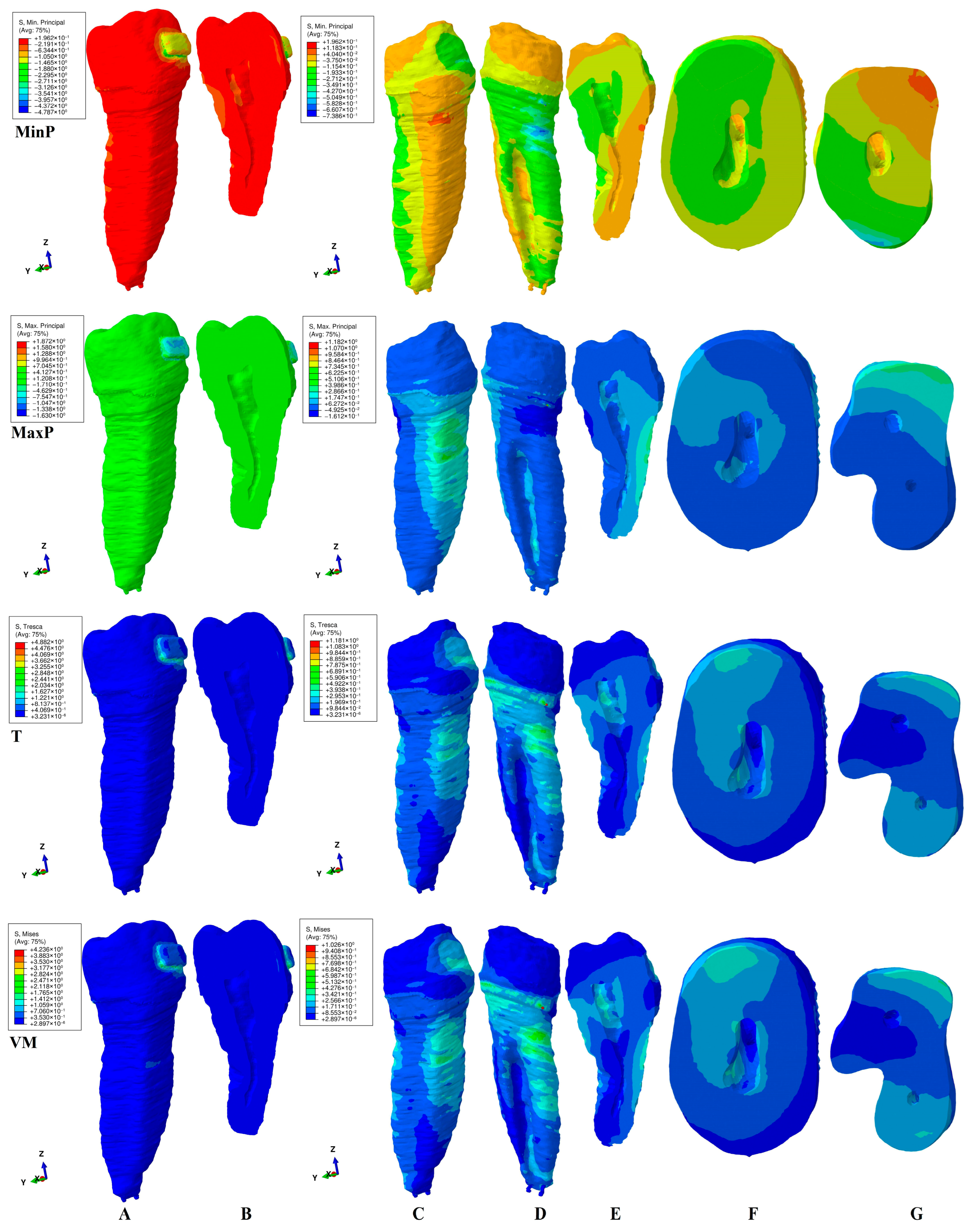
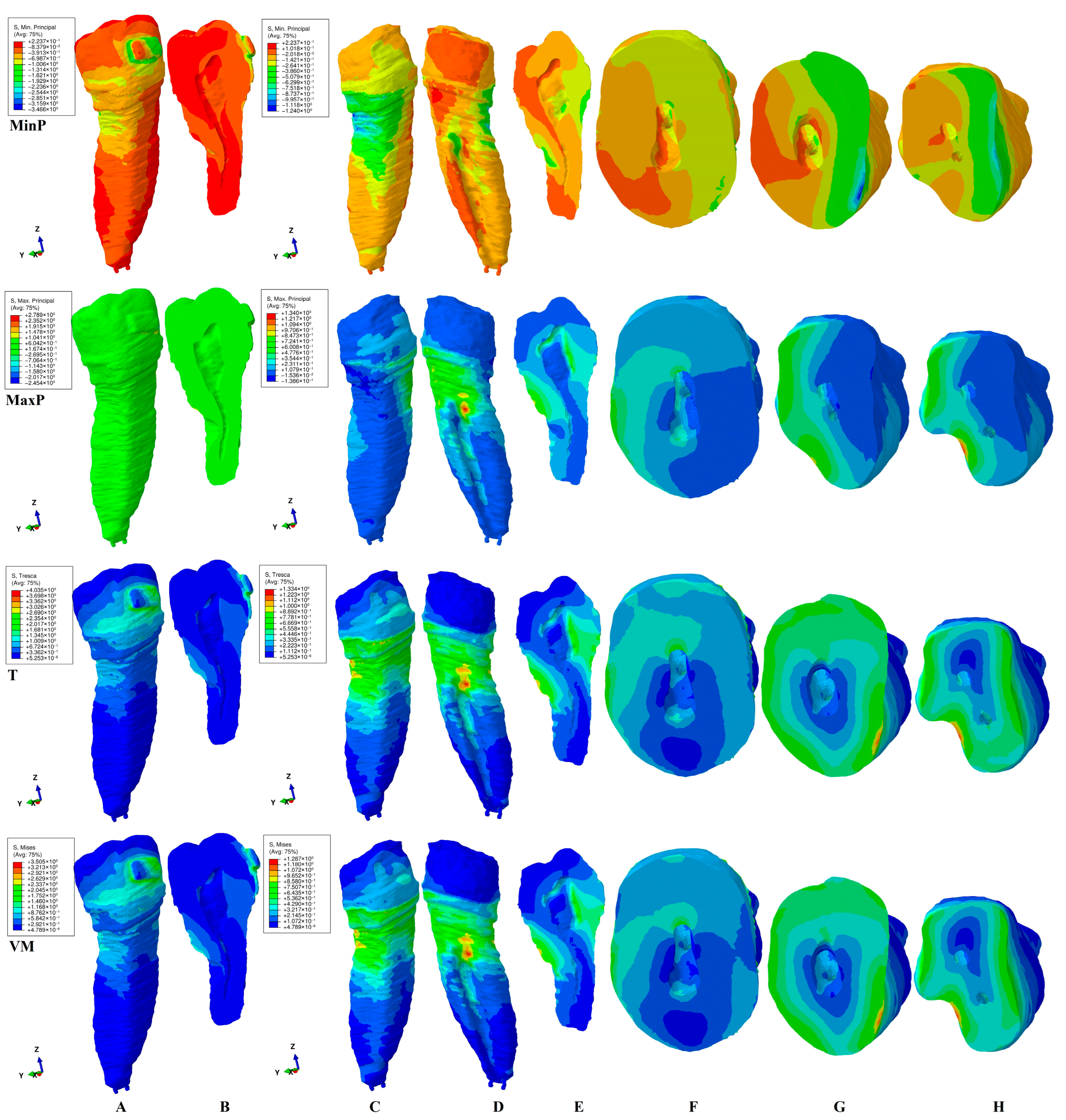
- A total of 4 N of orthodontic force could induce orthodontic internal resorption in the pulp chamber (lingual–mesial, vestibular, and occlusal walls), as well as in the middle and cervical thirds of the root canals.
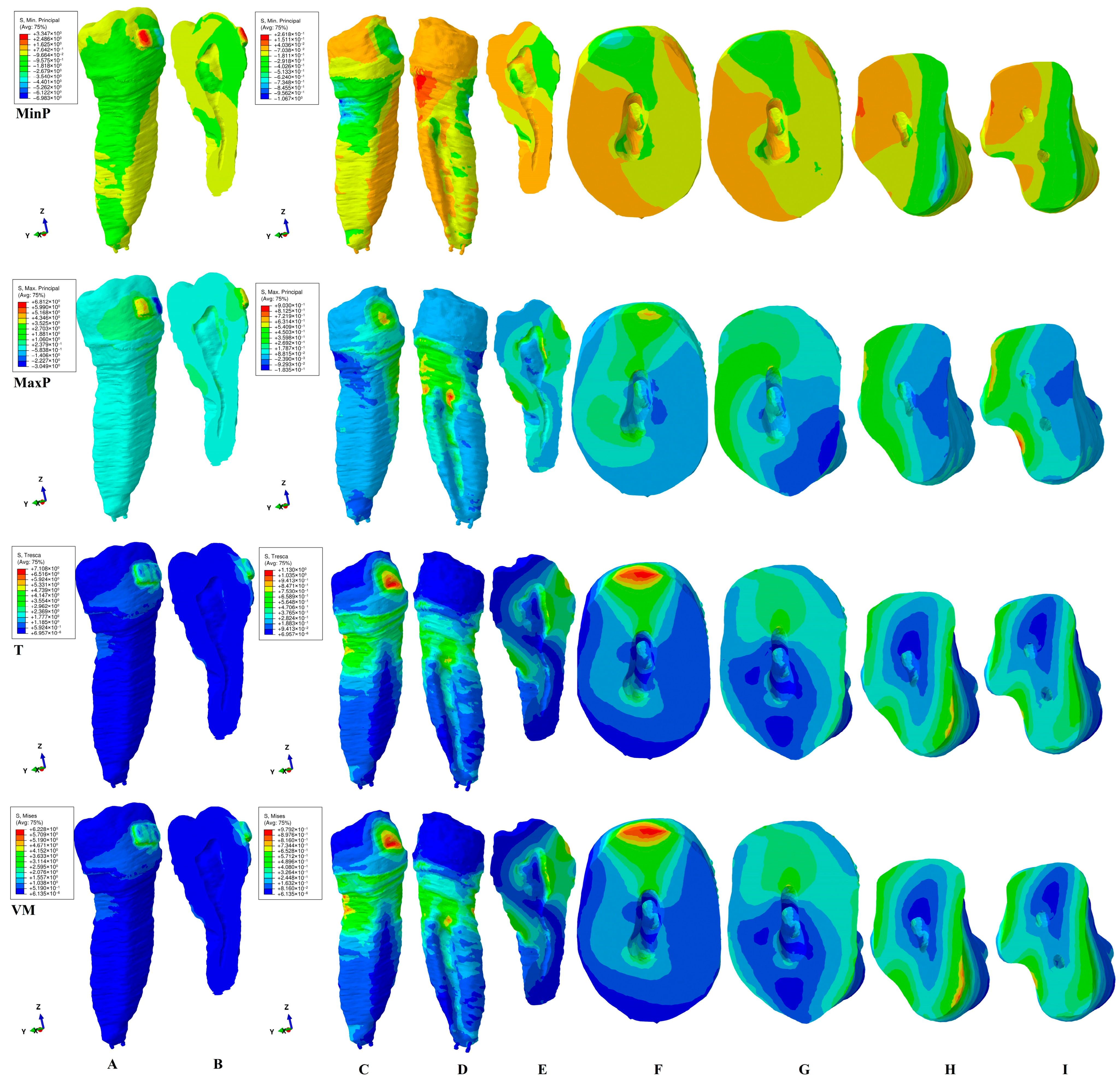
- Among the five movements, the translation and rotation are more prone to internal pulp chamber resorption (vestibular, occlusal, lingual–mesial walls). However, there is a difference between the two movements regarding the origin of the stress. In the rotation, this was directly induced by the force applied over the bracket, while in translation, the origin of the stress was from the lingual cervical third area.
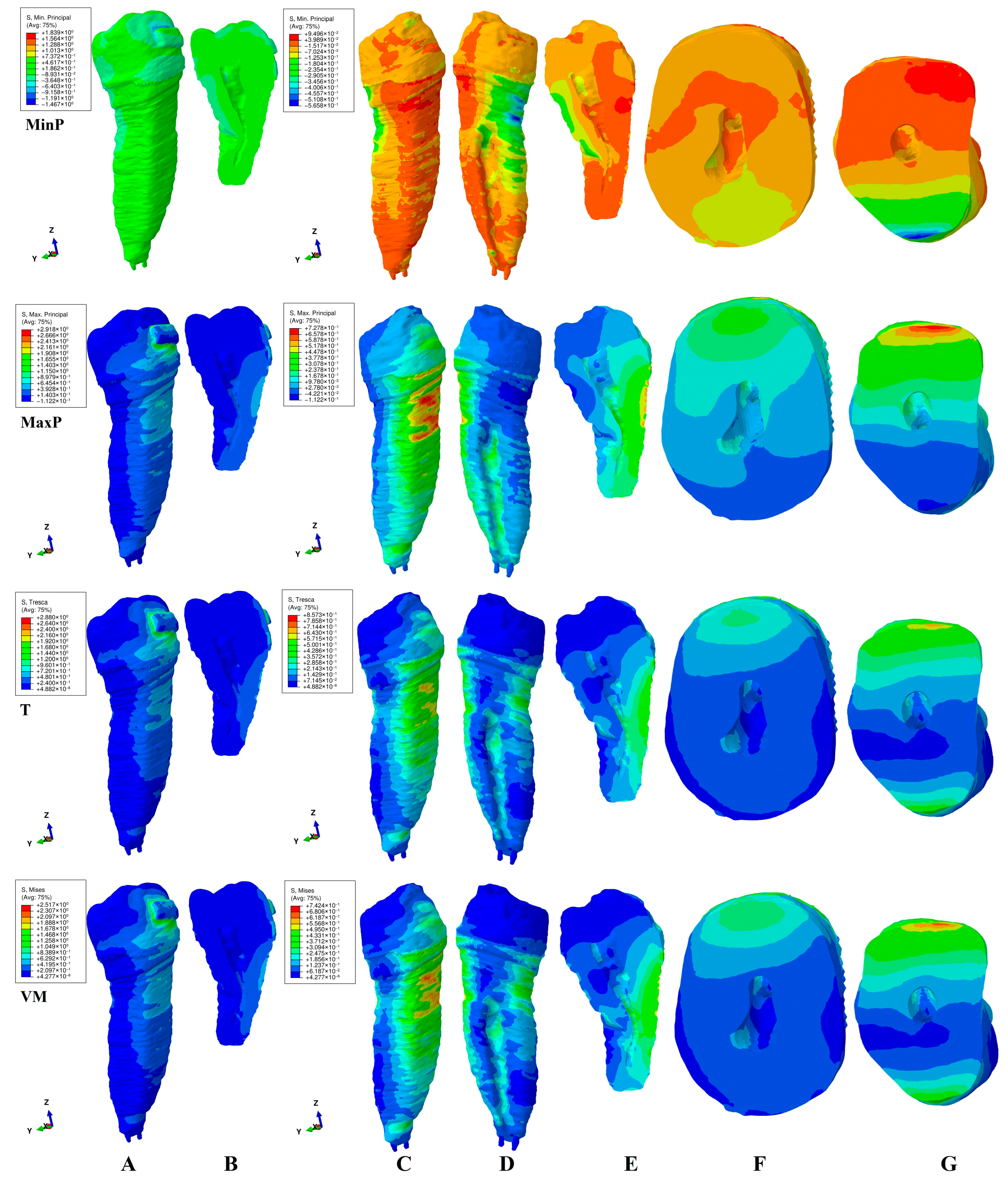
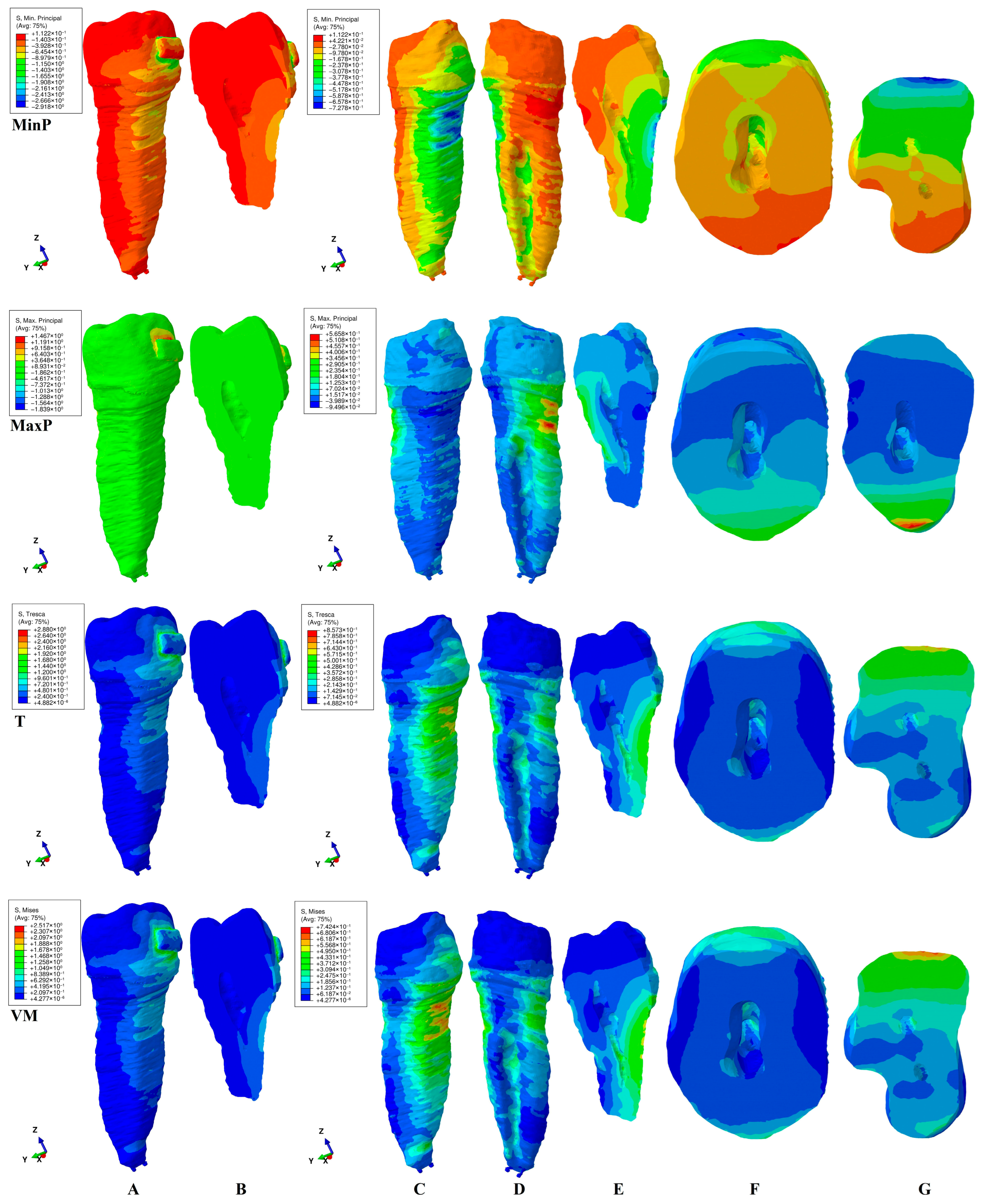
- The intrusion and extrusion movements are more prone to root canal cervical and middle thirds’ (vestibular and proximal walls) internal resorptive processes (as a direct result of the external cervical vestibular-localized high stresses induced by the movement).
- Tipping seems to be the least prone to internal resorption, with a certain pulp chamber lingual–mesial wall risk, because of the internal stress spread originating from the root external cervical third stress.
- The ductile-like failure criteria seem more accurate when used for the assessment of the internal orthodontically induced resorption than the brittle-like ones.
6. Clinical Implications
Author Contributions
Funding
Institutional Review Board Statement
Informed Consent Statement
Data Availability Statement
Conflicts of Interest
References
- Akgün, H.; Kalyoncuoğlu, E. Mechanical behavior of external root resorption cavities restored with different materials: A 3D-FEA study. BMC Oral Health 2025, 25, 91. [Google Scholar] [CrossRef]
- Aktas, T.; Kosar, T. Finite Element Analysis of Stress Distribution in Various Sizes Internal Root Resorption Cavities Filled with Different Materials. Aust. Endod. J. 2025, 51, 446–457. [Google Scholar] [CrossRef]
- Askerbeyli Örs, S.; Küçükkaya Eren, S. Effects of different treatment modalities on biomechanical behavior of maxillary incisors with external invasive cervical resorption at different progression levels. Dent. Traumatol. 2023, 39, 605–615. [Google Scholar] [CrossRef] [PubMed]
- Aslan, T.; Esim, E.; Üstün, Y. Stress distribution in restored mandibular molars with external cervical resorption: A finite element analysis. Odontology 2025, 113, 984–995. [Google Scholar] [CrossRef]
- Patel, S.; Saberi, N.; Pimental, T.; Teng, P.H. Present status and future directions: Root resorption. Int. Endod. J. 2022, 55, 892–921. [Google Scholar] [CrossRef]
- Kalra, S.; Gupta, P.; Tripathi, T.; Rai, P. External apical root resorption in orthodontic patients: Molecular and genetic basis. J. Fam. Med. Prim. Care 2020, 9, 3872–3882. [Google Scholar] [CrossRef]
- Bayir, F.; Bolat Gumus, E. External apical root resorption after orthodontic treatment: Incidence, severity and risk factors. J. Dent. Res. Dent. Clin. Dent. Prospect. 2021, 15, 100–105. [Google Scholar] [CrossRef] [PubMed]
- Zhang, X.; Zhou, H.; Liao, X.; Liu, Y. The influence of bracket torque on external apical root resorption in bimaxillary protrusion patients: A retrospective study. BMC Oral Health 2022, 22, 7. [Google Scholar] [CrossRef]
- Cheng, L.L.; Turk, T.; Elekdag-Turk, S.; Jones, A.S.; Petocz, P.; Darendeliler, M.A. Physical properties of root cementum: Part 13. Repair of root resorption 4 and 8 weeks after the application of continuous light and heavy forces for 4 weeks: A microcomputed-tomography study. Am. J. Orthod. Dentofac. Orthop. 2009, 136, 320.e1–320.e10; discussion 1. [Google Scholar] [CrossRef] [PubMed]
- Zhong, J.; Chen, J.; Weinkamer, R.; Darendeliler, M.A.; Swain, M.V.; Sue, A.; Zheng, K.; Li, Q. In vivo effects of different orthodontic loading on root resorption and correlation with mechanobiological stimulus in periodontal ligament. J. R. Soc. Interface 2019, 16, 20190108. [Google Scholar] [CrossRef]
- Zhang, X.; Li, M.Q.; Guo, J.; Yang, H.W.; Yu, J.; Li, G.J. An analysis of the optimal intrusion force of the maxillary central incisor with root horizontal resorption using the finite element method and curve fitting. Comput. Methods Biomech. Biomed. Engin. 2022, 25, 1471–1486. [Google Scholar] [CrossRef]
- Düzgün, S.; Esim, E.; Aslan, T.; Avcı, A.T.E. Finite element analysis of stress in mandibular molars repaired after fractured instrument removal. BMC Oral Health 2025, 25, 85. [Google Scholar] [CrossRef]
- Celebi, S.; Sazak Ovecoglu, H. Evaluating the Restoration of External Root Resorption Under Biomechanical Stress: A Finite Element Analysis. Cureus 2024, 16, e71238. [Google Scholar] [CrossRef]
- Manaktala, M.; Taneja, S.; Bhalla, V.K. Stress distribution in endodontically treated external cervical resorption lesions restored with MTA and biodentine—A finite element analysis. J. Oral Biol. Craniofacial Res. 2024, 14, 415–422. [Google Scholar] [CrossRef]
- Çoban Öksüzer, M.; Şanal Çıkman, A. Evaluation of Fracture Strength after Repair of Cervical External Resorption Cavities with Different Materials. J. Endod. 2024, 50, 85–95. [Google Scholar] [CrossRef]
- Sousa, J.; Azevêdo, A.B.; Santos, R.; Silva, M.; Farias, Z.; Sobral, A.P. Survival of teeth with external cervical resorption after Internal and External Repair: A Systematic Review. J. Clin. Exp. Dent. 2024, 16, e1555–e1563. [Google Scholar] [CrossRef]
- Su, R.; Li, S.; Wang, W. Effect of high trimline aligners on distalizing mandibular molars: A three-dimensional finite element study. Eur. J. Med. Res. 2024, 29, 623. [Google Scholar] [CrossRef] [PubMed]
- Su, R.; Sun, J.; Li, S.; Wang, W. Biomechanical effects of aligner trimline design and intrusion protocol on mandibular anterior teeth: A finite element study. BMC Oral Health 2025, 25, 1798. [Google Scholar] [CrossRef] [PubMed]
- Yilmaz, A.; Kabakci, A.; Helvacioglu Yigit, D. Impact of treatment modalities on stress distribution in maxillary incisors with varying levels of external cervical resorption: A finite element analysis. BMC Oral Health 2025, 25, 1544. [Google Scholar] [CrossRef] [PubMed]
- Aslan, T.; Üstün, Y.; Esim, E. Stress distributions in internal resorption cavities restored with different materials at different root levels: A finite element analysis study. Aust. Endod. J. 2019, 45, 64–71. [Google Scholar] [CrossRef]
- Javed, F.; Al-Kheraif, A.A.; Romanos, E.B.; Romanos, G.E. Influence of orthodontic forces on human dental pulp: A systematic review. Arch. Oral Biol. 2015, 60, 347–356. [Google Scholar] [CrossRef]
- Bauss, O.; Rohling, J.; Meyer, K.; Kiliaridis, S. Pulp vitality in teeth suffering trauma during orthodontic therapy. Angle Orthod. 2009, 79, 166–171. [Google Scholar] [CrossRef]
- Bauss, O.; Schäfer, W.; Sadat-Khonsari, R.; Knösel, M. Influence of orthodontic extrusion on pulpal vitality of traumatized maxillary incisors. J. Endod. 2010, 36, 203–207. [Google Scholar] [CrossRef]
- Bauss, O.; Röhling, J.; Sadat-Khonsari, R.; Kiliaridis, S. Influence of orthodontic intrusion on pulpal vitality of previously traumatized maxillary permanent incisors. Am. J. Orthod. Dentofacial Orthop. 2008, 134, 12–17. [Google Scholar] [CrossRef] [PubMed]
- Bauss, O.; Rohling, J.; Rahman, A.; Kiliaridis, S. The effect of pulp obliteration on pulpal vitality of orthodontically intruded traumatized teeth. J. Endod. 2008, 34, 417–420. [Google Scholar] [CrossRef]
- Strobl, H.; Haas, M.; Norer, B.; Gerhard, S.; Emshoff, R. Evaluation of pulpal blood flow after tooth splinting of luxated permanent maxillary incisors. Dent. Traumatol. 2004, 20, 36–41. [Google Scholar] [CrossRef]
- Emshoff, R.; Emshoff, I.; Moschen, I.; Strobl, H. Diagnostic characteristics of pulpal blood flow levels associated with adverse outcomes of luxated permanent maxillary incisors. Dent. Traumatol. 2004, 20, 270–275. [Google Scholar] [CrossRef]
- Chen, E.; Abbott, P.V. Dental pulp testing: A review. Int. J. Dent. 2009, 2009, 365785. [Google Scholar] [CrossRef]
- Farughi, A.; Rouhani, A.; Shahmohammadi, R.; Jafarzadeh, H. Clinical comparison of sensitivity and specificity between sensibility and vitality tests in determining the pulp vitality of mandibular premolars. Aust. Endod. J. 2021, 47, 474–479. [Google Scholar] [CrossRef] [PubMed]
- Balevi, B. Cold pulp testing is the simplest and most accurate of all dental pulp sensibility tests. Evid. Based Dent. 2019, 20, 22–23. [Google Scholar] [CrossRef] [PubMed]
- Mainkar, A.; Kim, S.G. Diagnostic Accuracy of 5 Dental Pulp Tests: A Systematic Review and Meta-analysis. J. Endod. 2018, 44, 694–702. [Google Scholar] [CrossRef]
- Patro, S.; Meto, A.; Mohanty, A.; Chopra, V.; Miglani, S.; Das, A.; Luke, A.M.; Hadi, D.A.; Meto, A.; Fiorillo, L.; et al. Diagnostic Accuracy of Pulp Vitality Tests and Pulp Sensibility Tests for Assessing Pulpal Health in Permanent Teeth: A Systematic Review and Meta-Analysis. Int. J. Environ. Res. Public Health 2022, 19, 9599. [Google Scholar] [CrossRef] [PubMed]
- Deng, Y.; Sun, Y.; Xu, T. Evaluation of root resorption after comprehensive orthodontic treatment using cone beam computed tomography (CBCT): A meta-analysis. BMC Oral Health 2018, 18, 116. [Google Scholar] [CrossRef]
- Moga, R.A.; Olteanu, C.D.; Botez, M.D.; Buru, S.M. Assessment of the Orthodontic External Resorption in Periodontal Breakdown-A Finite Elements Analysis (Part I). Healthcare 2023, 11, 1447. [Google Scholar] [CrossRef]
- Moga, R.A.; Delean, A.G.; Buru, S.M.; Botez, M.D.; Olteanu, C.D. Orthodontic Internal Resorption Assessment in Periodontal Breakdown-A Finite Elements Analysis (Part II). Healthcare 2023, 11, 2622. [Google Scholar] [CrossRef]
- Moga, R.-A.; Olteanu, C.D.; Delean, A.G. The Amount of Orthodontic Force Reaching the Dental Pulp and Neuro-Vascular Bundle During Orthodontic Movements in the Intact Periodontium. Medicina 2024, 60, 2045. [Google Scholar] [CrossRef] [PubMed]
- Moga, R.-A.; Olteanu, C.D.; Delean, A.G. The Importance of Boundary Conditions and Failure Criterion in Finite Element Analysis Accuracy—A Comparative Assessment of Periodontal Ligament Biomechanical Behavior. Appl. Sci. 2024, 14, 3370. [Google Scholar] [CrossRef]
- Moga, R.-A.; Olteanu, C.D.; Delean, A.G. Periodontal Breakdown, Orthodontic Movements and Pulpal Ischemia Correlations—A Comparison Between Five Study Methods. J. Clin. Med. 2024, 13, 7062. [Google Scholar] [CrossRef]
- Chan, E.; Darendeliler, M.A. Physical properties of root cementum: Part 5. Volumetric analysis of root resorption craters after application of light and heavy orthodontic forces. Am. J. Orthod. Dentofacial Orthop. 2005, 127, 186–195. [Google Scholar] [CrossRef]
- Zhao, D.; Xue, K.; Meng, J.; Hu, M.; Bi, F.; Tan, X. Orthodontically induced external apical root resorption considerations of root-filled teeth vs vital pulp teeth: A systematic review and meta-analysis. BMC Oral Health 2023, 23, 241. [Google Scholar] [CrossRef]
- Maravić, T.; Comba, A.; Mazzitelli, C.; Bartoletti, L.; Balla, I.; di Pietro, E. Finite element and in vitro study on biomechanical behavior of endodontically treated premolars restored with direct or indirect composite restorations. Sci. Rep. 2022, 12, 12671. [Google Scholar] [CrossRef]
- Chun, K.; Choi, H.; Lee, J. Comparison of mechanical property and role between enamel and dentin in the human teeth. J. Dent. Biomech. 2014, 5, 1758736014520809. [Google Scholar] [CrossRef]
- Kabakci, A.; Yilmaz, A.; Helvacioglu-Yigit, D.; Nawar, N.N.; Kim, H.C. Thermal Behaviour of Teeth with Internal Root Resorption During Obturation and Enhancing Thermal Simulations: A Finite-Element Analysis. Int. Dent. J. 2025, 75, 103903. [Google Scholar] [CrossRef] [PubMed]
- Jain, A.; Prasantha, G.S.; Mathew, S.; Sabrish, S. Analysis of stress in periodontium associated with orthodontic tooth movement: A three dimensional finite element analysis. Comput. Methods Biomech. Biomed. Eng. 2021, 24, 1841–1853. [Google Scholar] [CrossRef]
- Wu, J.; Liu, Y.; Li, B.; Wang, D.; Dong, X.; Sun, Q.; Chen, G. Numerical simulation of optimal range of rotational moment for the mandibular lateral incisor, canine and first premolar based on biomechanical responses of periodontal ligaments: A case study. Clin. Oral Investig. 2021, 25, 1569–1577. [Google Scholar] [CrossRef]
- Wu, J.; Liu, Y.; Wang, D.; Zhang, J.; Dong, X.; Jiang, X.; Xu, X. Investigation of effective intrusion and extrusion force for maxillary canine using finite element analysis. Comput. Methods Biomech. Biomed. Engin. 2019, 22, 1294–1302. [Google Scholar] [CrossRef]
- Wu, J.L.L.Y.; Peng, W.; Dong, H.Y.; Zhang, J.X. A biomechanical case study on the optimal orthodontic force on the maxillary canine tooth based on finite element analysis. J. Zhejiang Univ. Sci. B 2018, 7, 535–546. [Google Scholar] [CrossRef] [PubMed]
- Moga, R.-A.; Olteanu, C.D.; Delean, A.G. Orthodontically Induced External Root Resorption: A Finite Element Analysis. J. Clin. Med. 2026, 15, 2503. [Google Scholar] [CrossRef]
- Rodrigues Fonseca Tavares, A.; Aurelio de Carvalho, M.; Cardoso Lazari-Carvalho, P.; Rodrigues de Araújo Estrela, L.; Santos de Freitas Silva, B.; Antoninha Del Bel Cury, A.; Rodrigues Araújo Estrela, C. Teeth with external apical root resorption under orthodontic movement: An in silico analysis on stress and displacement. J. Orofac. Orthop. = Fortschritte Kieferorthopadie 2025. [Google Scholar] [CrossRef] [PubMed]
- Wu, A.T.; Turk, T.; Colak, C.; Elekdag-Turk, S.; Jones, A.S.; Petocz, P.; Darendeliler, M.A. Physical properties of root cementum: Part 18. The extent of root resorption after the application of light and heavy controlled rotational orthodontic forces for 4 weeks: A microcomputed tomography study. Am. J. Orthod. Dentofacial Orthop. 2011, 139, e495–e503. [Google Scholar] [CrossRef]
- Field, C.; Ichim, I.; Swain, M.V.; Chan, E.; Darendeliler, M.A.; Li, W.; Li, Q. Mechanical responses to orthodontic loading: A 3-dimensional finite element multi-tooth model. Am. J. Orthod. Dentofacial Orthop. 2009, 135, 174–181. [Google Scholar] [CrossRef] [PubMed]
- Hohmann, A.; Wolfram, U.; Geiger, M.; Boryor, A.; Kober, C.; Sander, C.; Sander, F.G. Correspondences of hydrostatic pressure in periodontal ligament with regions of root resorption: A clinical and a finite element study of the same human teeth. Comput. Methods Programs Biomed. 2009, 93, 155–161. [Google Scholar] [CrossRef]
- Hohmann, A.; Wolfram, U.; Geiger, M.; Boryor, A.; Sander, C.; Faltin, R.; Faltin, K.; Sander, F.G. Periodontal ligament hydrostatic pressure with areas of root resorption after application of a continuous torque moment. Angle Orthod. 2007, 77, 653–659. [Google Scholar] [CrossRef]
- Dindaroğlu, F.; Doğan, S. Root Resorption in Orthodontics. Turk. J. Orthod. 2016, 29, 103–108. [Google Scholar] [CrossRef] [PubMed]
- Minch, L.E.; Sarul, M.; Nowak, R.; Kawala, B.; Antoszewska-Smith, J. Orthodontic intrusion of periodontally-compromised maxillary incisors: 3-dimensional finite element method analysis. Adv. Clin. Exp. Med. 2017, 26, 829–833. [Google Scholar] [CrossRef]
- Flatten, J.; Gedrange, T.; Bourauel, C.; Keilig, L.; Konermann, A. The Role of Bone and Root Resorption on the Biomechanical Behavior of Mandibular Anterior Teeth Subjected to Orthodontic Forces: A Finite Element Approach. Biomedicines 2024, 12, 1959. [Google Scholar] [CrossRef]
- Jang, Y.; Hong, H.T.; Roh, B.D.; Chun, H.J. Influence of apical root resection on the biomechanical response of a single-rooted tooth: A 3-dimensional finite element analysis. J. Endod. 2014, 40, 1489–1493. [Google Scholar] [CrossRef]
- Giannini, M.; Soares, C.J.; de Carvalho, R.M. Ultimate tensile strength of tooth structures. Dent. Mater. 2004, 20, 322–329. [Google Scholar] [CrossRef]
- Kailasam, V.; Rangarajan, H.; Easwaran, H.N.; Muthu, M.S. Proximal enamel thickness of the permanent teeth: A systematic review and meta-analysis. Am. J. Orthod. Dentofac. Orthop. 2021, 160, 793–804.e3. [Google Scholar] [CrossRef]
- Konishi, N.; Watanabe, L.G.; Hilton, J.F.; Marshall, G.W.; Marshall, S.J.; Staninec, M. Dentin shear strength: Effect of distance from the pulp. Dent. Mater. 2002, 18, 516–520. [Google Scholar] [CrossRef] [PubMed]
- Ordinola-Zapata, R.; Lin, F.; Nagarkar, S.; Perdigão, J. A critical analysis of research methods and experimental models to study the load capacity and clinical behaviour of the root filled teeth. Int. Endod. J. 2022, 55, 471–494. [Google Scholar] [CrossRef] [PubMed]
- Proffit, W.R.F.H.; Sarver, D.M.; Ackerman, J.L. Contemporary Orthodontics, 5th ed.; Elsevier: St. Louis, MO, USA, 2012. [Google Scholar]



| Materials | Young’s Modulus, E (GPa) | Poisson Ratio, ʋ | Refs. |
|---|---|---|---|
| Enamel | 80 | 0.33 | [34,35,36,37,38,48] |
| Dentin/Cementum | 18.6 | 0.31 | [34,35,36,37,38,48] |
| Pulp and NVB | 0.0021 | 0.45 | [34,35,36,37,38,48] |
| PDL | 0.0667 | 0.49 | [34,35,36,37,38,48] |
| Cortical bone | 14.5 | 0.323 | [34,35,36,37,38,48] |
| Trabecular bone | 1.37 | 0.3 | [34,35,36,37,38,48] |
| Stainless-steel bracket (Cr-Co) | 218 | 0.33 | [34,35,36,37,38,48] |
| Movement | Failure Criteria | Component | Apical | Middle | Cervical | Coronal |
|---|---|---|---|---|---|---|
| extrusion | MinP/Compressive | I | −15.20 | −15.20 | −70.20 | −70.20 |
| E | −126.10 | −126.10 | −565.90 | 39.91 | ||
| MaxP/Tensile | I | 307.70 | 377.90 | 377.90 | 167.90 | |
| E | 378.00 | 518.30 | 728.10 | 448.00 | ||
| T/Shear | I | 285.30 | 285.30 | 500.20 | 214.50 | |
| E | 288.50 | 288.50 | 716.60 | 359.30 | ||
| VM/Overall | I | 244.25 | 244.25 | 433.40 | 185.80 | |
| E | 245.23 | 245.23 | 682.60 | 310.40 | ||
| intrusion | MinP/Compressive | I | −307.40 | −376.50 | −376.50 | −237.60 |
| E | −379.20 | −519.80 | −728.80 | −379.80 | ||
| MaxP/Tensile | I | 70.50 | 70.50 | 180.20 | 125.10 | |
| E | 348.60 | 348.60 | 567.80 | 127.30 | ||
| T/Shear | I | 285.30 | 285.30 | 500.20 | 214.50 | |
| E | 288.50 | 288.50 | 716.60 | 359.30 | ||
| VM/Overall | I | 244.25 | 244.25 | 433.40 | 185.80 | |
| E | 245.23 | 245.23 | 682.60 | 310.40 | ||
| rotation | MinP/Compressive | I | −40.36 | −181.20 | −624.10 | −624.10 |
| E | −182.30 | −182.30 | −1068.10 | −735.10 | ||
| MaxP/Tensile | I | 88.15 | 178.40 | 540.60 | 812.50 | |
| E | 179.30 | 270.10 | 904.00 | 904.00 | ||
| T/Shear | I | 376.70 | 376.70 | 753.10 | 914.60 | |
| E | 472.10 | 472.10 | 1131.10 | 1131.10 | ||
| VM/Overall | I | 326.70 | 326.70 | 652.20 | 816.00 | |
| E | 409.10 | 409.10 | 980.20 | 980.20 | ||
| tipping | MinP/Compressive | I | −37.50 | −37.50 | −115.70 | −193.40 |
| E | −428.10 | −428.10 | −739.10 | −428.10 | ||
| MaxP/Tensile | I | 174.70 | 174.70 | 174.70 | 174.70 | |
| E | 175.70 | 287.60 | 287.60 | 62.80 | ||
| T/Shear | I | 197.10 | 197.10 | 197.10 | 295.30 | |
| E | 394.10 | 394.10 | 788.10 | 394.10 | ||
| VM/Overall | I | 171.20 | 171.20 | 171.20 | 256.20 | |
| E | 343.10 | 343.10 | 685.10 | 343.10 | ||
| translation | MinP/Compressive | I | −20.18 | −20.18 | −264.10 | −264.10 |
| E | −143.10 | −143.10 | −1242.10 | −143.10 | ||
| MaxP/Tensile | I | 107.90 | 354.40 | 354.40 | 847.50 | |
| E | 108.90 | 725.30 | 1341.10 | 232.10 | ||
| T/Shear | I | 112.4 | 222.5 | 778.3 | 1000.2 | |
| E | 333.6 | 445.6 | 1335.1 | 445.5 | ||
| VM/Overall | I | 107.20 | 214.70 | 750.70 | 858.10 | |
| E | 214.60 | 322.60 | 1181.00 | 429.10 |
Disclaimer/Publisher’s Note: The statements, opinions and data contained in all publications are solely those of the individual author(s) and contributor(s) and not of MDPI and/or the editor(s). MDPI and/or the editor(s) disclaim responsibility for any injury to people or property resulting from any ideas, methods, instructions or products referred to in the content. |
© 2026 by the authors. Licensee MDPI, Basel, Switzerland. This article is an open access article distributed under the terms and conditions of the Creative Commons Attribution (CC BY) license.
Share and Cite
Moga, R.-A.; Olteanu, C.D.; Delean, A.G. The Impact of the Orthodontic Forces on the Internal Resorptive Process for Intact Periodontium: A Finite Element Analysis. J. Clin. Med. 2026, 15, 3335. https://doi.org/10.3390/jcm15093335
Moga R-A, Olteanu CD, Delean AG. The Impact of the Orthodontic Forces on the Internal Resorptive Process for Intact Periodontium: A Finite Element Analysis. Journal of Clinical Medicine. 2026; 15(9):3335. https://doi.org/10.3390/jcm15093335
Chicago/Turabian StyleMoga, Radu-Andrei, Cristian Doru Olteanu, and Ada Gabriela Delean. 2026. "The Impact of the Orthodontic Forces on the Internal Resorptive Process for Intact Periodontium: A Finite Element Analysis" Journal of Clinical Medicine 15, no. 9: 3335. https://doi.org/10.3390/jcm15093335
APA StyleMoga, R.-A., Olteanu, C. D., & Delean, A. G. (2026). The Impact of the Orthodontic Forces on the Internal Resorptive Process for Intact Periodontium: A Finite Element Analysis. Journal of Clinical Medicine, 15(9), 3335. https://doi.org/10.3390/jcm15093335