Article

Traumatic Spine Injury in Southern Ethiopia: Falls, Delayed Presentation, and High Early Mortality at a Tertiary Referral Center


1
Hawassa University Comprehensive Specialized Hospital, Hawassa P.O. Box 1560, Ethiopia
2
Global Spine Research Initiative, Department of Orthopaedic Surgery, University of California, Irvine, CA 92697, USA
*
Author to whom correspondence should be addressed.
J. Clin. Med. 2026, 15(9), 3276; https://doi.org/10.3390/jcm15093276
Submission received: 24 March 2026 / Revised: 20 April 2026 / Accepted: 22 April 2026 / Published: 25 April 2026

Abstract

Background/Objectives: Traumatic spine injury is a major cause of morbidity and mortality in low- and middle-income countries, yet detailed epidemiologic data from sub-Saharan Africa remain limited. We used a fracture registry to characterize injury patterns, care pathways, and short-term outcomes among patients presenting with traumatic spine injury at a tertiary referral center in Ethiopia. Methods: We performed a retrospective analysis of a prospectively maintained fracture registry at a tertiary referral hospital in Ethiopia from June 2023 to July 2025. Patients with traumatic spine injury were included. Variables included demographics, injury mechanism and context, injury region, AO morphology, neurologic status (ASIA), referral status, mode of transportation, time to presentation, treatment, and 30-day outcomes. Descriptive statistics were used to summarize the cohort. Bivariate associations were assessed using chi-square or Fisher’s exact tests, and crude odds ratios were calculated for prespecified 2 × 2 comparisons. Results: A total of 252 patients were included (mean age: 33.1 ± 13.6 years; 81.3% male). Falls (45.2%) and road traffic accidents (26.2%) were the most common mechanisms, and injuries most often occurred on farms (40.1%) and roads/streets (33.7%). The thoracolumbar (31.3%) and cervical (30.6%) regions were most frequently affected. Complete spinal cord injury (ASIA A) occurred in 36.5% of patients. Most patients were referred (88.5%), 62.7% presented >24 h after injury, and 65.5% were managed non-operatively. Referral status was strongly associated with delayed presentation (OR: 10.49, 95% CI: 3.84–28.64). Thirty-day mortality was 22.2%. Complete SCI (OR: 6.17, 95% CI: 3.23–11.90) and cervical/thoracic injuries (OR: 6.54, 95% CI: 3.12–13.70) were associated with higher mortality. Conclusions: Traumatic spine injury in this Ethiopian cohort disproportionately affected young adults and was marked by severe neurologic injury, delayed presentation, and high early mortality.

1. Introduction

Traumatic spine injury is a devastating global health issue characterized by profound health loss from premature mortality and chronic disability [1]. The Global Burden of Disease Study 2019 reports that over 20.6 million individuals are currently living with spinal cord injuries, with absolute case numbers increasing substantially over the past three decades [1]. This burden is disproportionately concentrated in low- and middle-income countries where the incidence is estimated at 13.69 per 100,000 people, significantly higher than the 8.72 per 100,000 observed in high-income countries [2,3]. Systematic reviews of low- and middle-income countries reveal a pooled traumatic spinal cord injury (SCI) incidence of 22.55 cases per million annually, with males consistently comprising more than 80% of victims [4,5].
In Sub-Saharan Africa (SSA), the epidemiology of spine trauma is defined by severe energy mechanisms and significant resource scarcity [6,7]. Systematic reviews across the continent report that acute mortality rates from traumatic spine injuries range from 18% to 25%, a stark contrast to the near-zero mortality often seen in high-income settings [2,7]. Etiological profiles in SSA are diverse; while road traffic accidents (RTAs) are a primary driver, high-energy falls and interpersonal violence are increasingly prevalent causes of catastrophic cord disruption [7,8,9]. In Ethiopia, traumatic spine injury disproportionately affects young, working-age adults and represents an important cause of disability, yet detailed longitudinal data from regions outside the capital remain limited [10,11,12].
The management of spine trauma in regions like Ethiopia is complicated by profound pre-hospital delays and fragmented referral systems [13,14,15]. Victims often lack access to specialized immobilization and rely on non-ambulance transportation, such as public transit, which can exacerbate neurological deficits during transport [15,16]. Furthermore, the financial risk of neurosurgical care is immense; out-of-pocket expenses for surgery and implants are often catastrophic for families in SSA, where social determinants of health like insurance status and geographic accessibility strongly dictate outcomes [17,18,19]. In Ethiopia, these challenges occur within a health system marked by limited prehospital resources, fragmented interfacility referral pathways, and substantial financial barriers to definitive care [13,14,15,16,17,18,19]. These systemic barriers lead to a “referral-delay” paradox, where patients are referred through multiple facilities but experience prolonged wait times that miss the optimal surgical window for decompression [20,21]. Together, these factors highlight the need for region-specific epidemiologic data to inform prevention strategies, referral system improvement, and trauma care planning. This study provides a comprehensive analysis of a spine trauma cohort, with or without SCI (n = 252), at a tertiary referral center in Hawassa, Southern Ethiopia, to characterize injury patterns, care pathways, and short-term outcomes in this setting and to address an important regional data gap.

2. Materials and Methods

We conducted a retrospective analysis of a prospectively maintained fracture registry at Hawassa University Comprehensive Specialized Hospital. This facility serves as a primary regional hub for specialized neurosurgical and orthopedic care in East Africa [10,22]. The study period spanned from June 2023 through July 2025. The Institutional Review Board of Hawassa University approved this research.
The cohort included all patients presenting with traumatic spine injuries confirmed through clinical and radiographic examination. We excluded patients with non-traumatic spine pathologies or those with incomplete records lacking essential injury data or 30-day outcome data [23,24].
Data were extracted to characterize demographics (age, sex, and residence), socioeconomic factors (occupation and insurance status), and injury-specific characteristics. Fracture morphology was classified using the AO Spine Classification System [3,25]. Neurological status at admission was graded using the American Spinal Injury Association Impairment Scale [4,5]. System-level variables included referral status, mode of transportation, and the time interval from injury to presentation [1,7].
Statistical analyses were conducted using IBM SPSS Statistics for Windows, version 31.0 (IBM Corp., Armonk, NY, USA). Continuous variables were summarized as mean ± standard deviation (SD) or median with interquartile range (IQR), as appropriate based on distribution. Categorical variables were summarized using frequencies and percentages. Bivariate associations were assessed using chi-square tests. To quantify the magnitude of these associations, effect size measures were employed [26]. For 2 × 2 tables, the Phi coefficient was utilized [27]. For larger tables, Cramér’s V was applied [28]. Both coefficients range from 0 to 1, where 0 indicates no association and 1 indicates a perfect association [29]. The strength of association was interpreted as negligible (0.00–0.10), weak (0.10–0.30), moderate (0.30–0.50), or strong (>0.50) [26,30]. Crude odds ratios with 95% confidence intervals were calculated to identify factors associated with mortality and delay [31].
Multivariable binary logistic regression analyses were performed to identify factors independently associated with 30-day mortality and delayed presentation (>24 h). Covariates were selected a priori based on clinical relevance and included age, sex, neurologic severity, injury level, AO classification, referral status, and insurance status. Neurologic severity was dichotomized as ASIA A versus non-ASIA A, and injury level was grouped as cervical/thoracic versus thoracolumbar/lumbar. Adjusted odds ratios (aORs) with 95% confidence intervals were reported. Model fit was assessed using the Hosmer–Lemeshow goodness-of-fit test and Nagelkerke R2.
Because this was a retrospective registry-based study, no a priori sample size calculation was performed. All eligible patients presenting during the predefined study period were included in the analysis.

3. Results

3.1. Cohort Characteristics and Clinical Outcomes

3.1.1. Sociodemographic Profile

A total of 252 patients were included. The cohort was predominantly young and male, with a mean age of 33.1 ± 13.6 years and 81.3% identified as male [5,8,24]. Urban residents comprised 59.1% of the cohort, while 40.9% resided in rural areas. Financial vulnerability was significant: 65.1% of patients were uninsured, and 54.0% relied on informal financial support [17,32]. Baseline demographic, socioeconomic, injury, and care-pathway characteristics are summarized in Table 1.

3.1.2. Injury Etiology and Severity

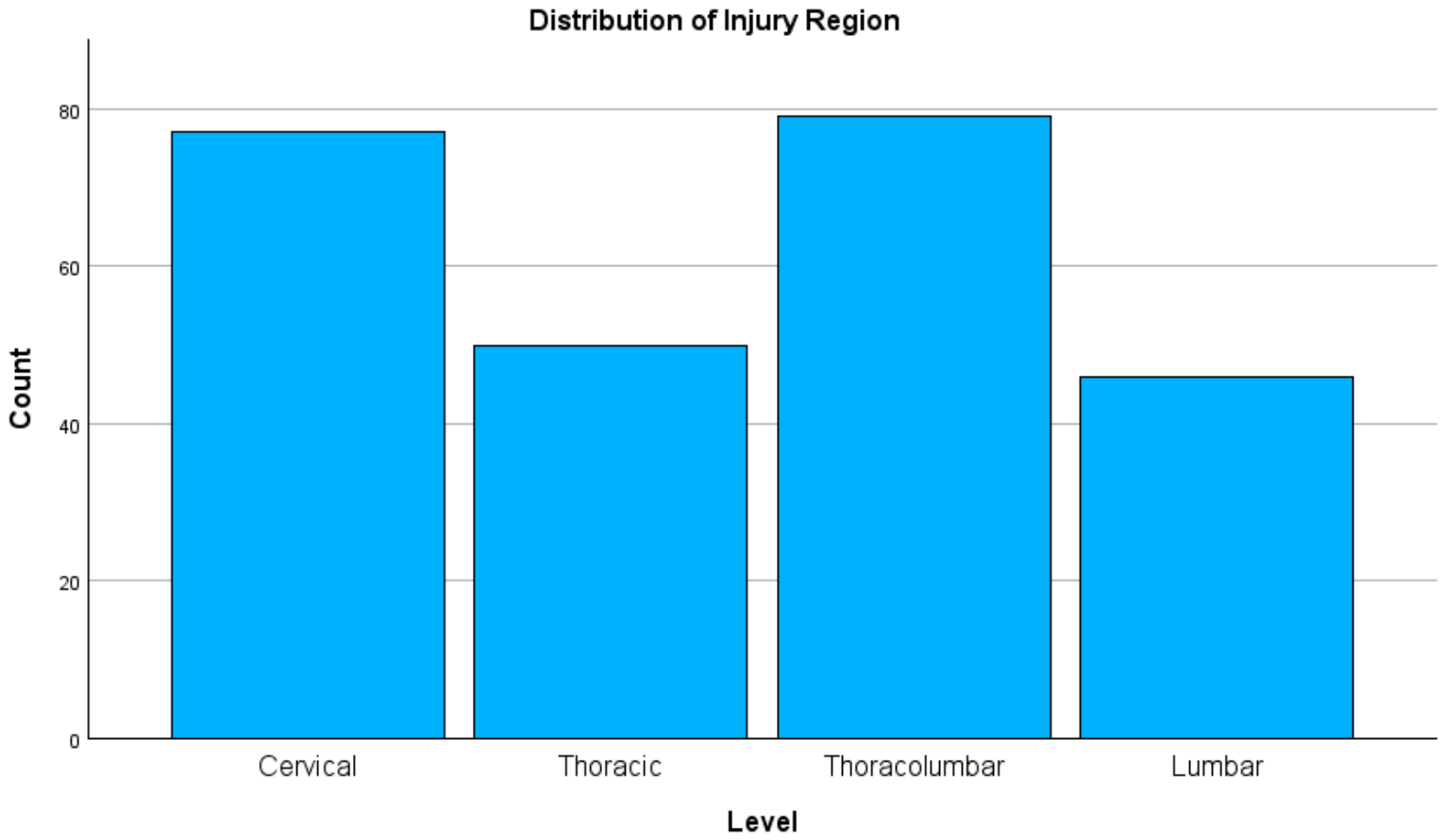
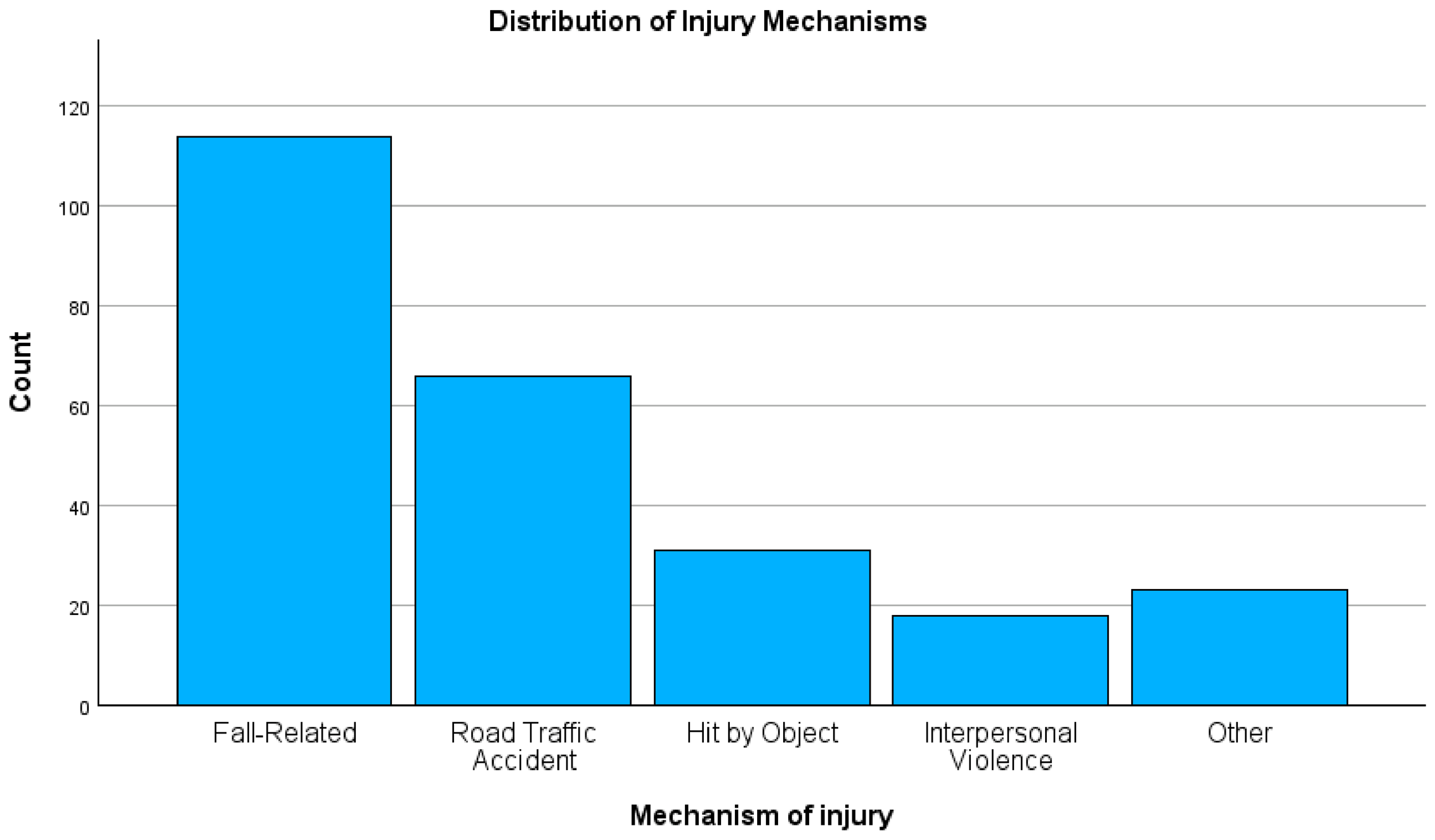
High-energy mechanisms accounted for a significant portion of all injuries. Falls were the most common mechanism of injury. RTAs were the second most common cause (26.2%) [8,25,33] (Figure 1). The thoracolumbar region (T12–L1) was most frequently affected region (31.3%), followed by the cervical spine (30.6%). According to the AO classification, Type C (translational) injuries were highly prevalent (39.3%) [34] (Figure 2).

3.1.3. Neurological Status and Delays

Neurological impairment was severe: 36.5% of patients had complete SCI, and 35.7% had incomplete deficits [4,5]. AO morphology was significantly associated with neurological severity (p < 0.001), demonstrating a moderate effect size (Cramér’s V = 0.358). Systemic barriers were profound: median time from injury to presentation was 48.0 h (IQR: 16.25–120.0 h), 88.5% of patients were referred from another facility, and 62.7% experienced a presentation delay of >24 h. Referral status was significantly associated with delayed presentation (p < 0.001; Phi = 0.339). Referred patients had over 10 times higher odds of arriving > 24 h (OR: 10.49; 95% CI: 3.84–28.64) [21,35]. Bivariate associations among injury characteristics, neurologic severity, delayed presentation, and 30-day mortality are summarized in Table 2.

3.1.4. 30-Day Mortality

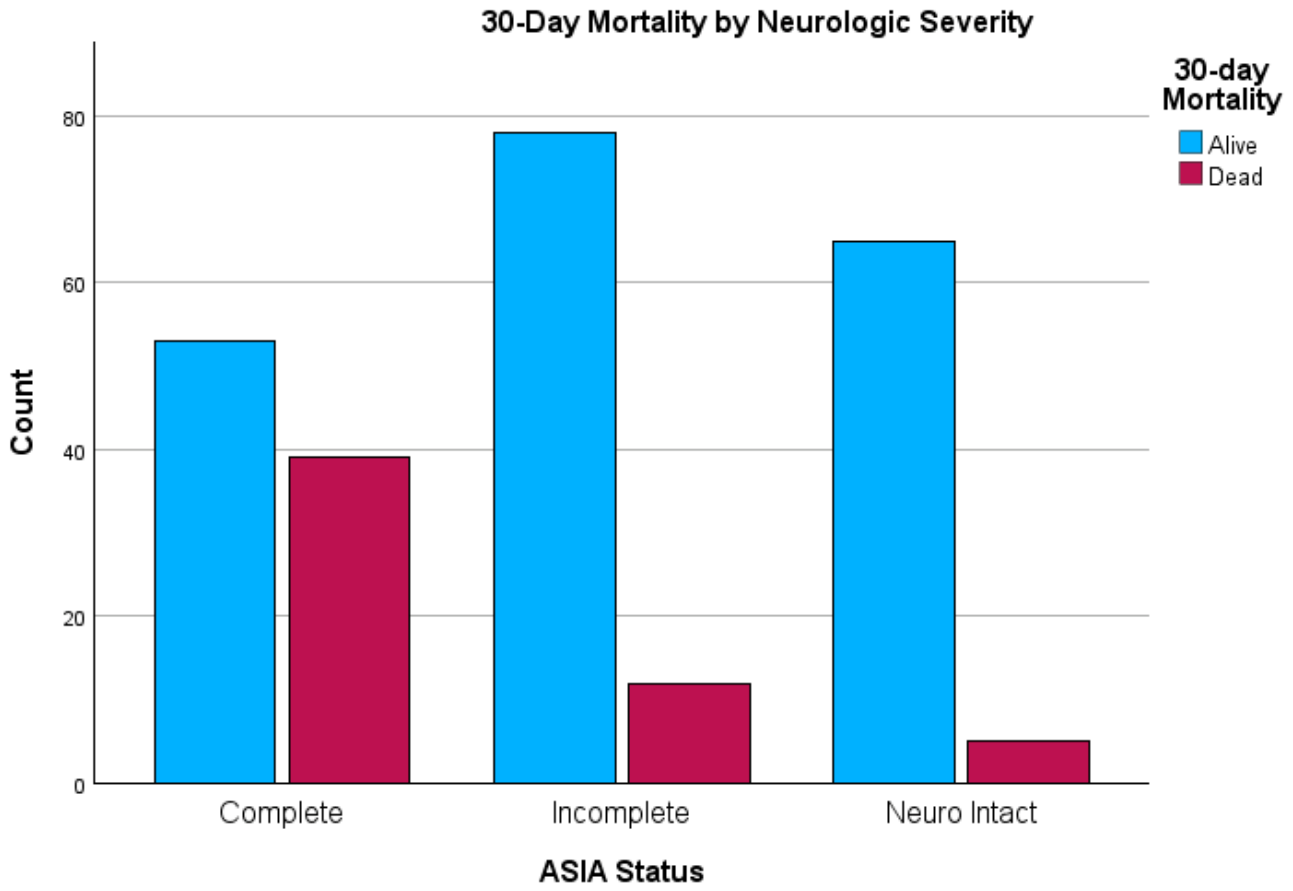
The overall 30-day mortality rate was 22.2%. Mortality was strongly associated with neurological severity (p < 0.001; Cramér’s V = 0.373) (Figure 3). Patients with complete SCI had 6.17 times higher odds of death (OR: 6.17; 95% CI: 3.23–11.90) [10,31]. Injury level (cervical/thoracic) was also a significant predictor of mortality (OR: 6.54; 95% CI: 3.12–13.70; Cramér’s V = 0.340). Mortality was significantly lower in surgically managed patients (6.9%) compared to non-operative cases (30.3%; p < 0.001; Phi = 0.268) [10,22]. Crude odds ratios for delayed presentation and 30-day mortality are summarized in Table 3.
Multivariable logistic regression was performed to identify factors independently associated with 30-day mortality. The overall model was significant (omnibus χ2 = 65.83, df = 8, p < 0.001), demonstrated acceptable calibration (Hosmer–Lemeshow p = 0.874), and explained a moderate proportion of outcome variance (Nagelkerke R2 = 0.352). After adjustment for age, sex, AO classification, referral status, and insurance status, complete SCI (ASIA A) remained independently associated with higher odds of 30-day mortality (aOR: 6.49, 95% CI: 2.95–14.27; p < 0.001), as did cervical/thoracic injury level compared with thoracolumbar/lumbar injury level (aOR: 5.84, 95% CI: 2.61–13.04; p < 0.001). Age, sex, AO classification, referral status, and insurance status were not independently associated with 30-day mortality in the adjusted model.
A second multivariable logistic regression model was performed to identify factors independently associated with delayed presentation (>24 h). The model was significant overall (omnibus χ2 = 37.89, df = 8, p < 0.001), demonstrated acceptable calibration (Hosmer–Lemeshow p = 0.830), and explained a modest proportion of the variance (Nagelkerke R2 = 0.190). After adjustment, referral status remained independently associated with delayed presentation (aOR: 9.77, 95% CI: 3.50–27.22; p < 0.001). Female sex was also independently associated with delayed presentation (aOR: 2.53, 95% CI: 1.14–5.62; p = 0.023). Age, neurologic severity, injury level, AO classification, and insurance status were not independently associated with delayed presentation in the adjusted model. The multivariable logistic regression models for 30-day mortality and delayed presentation are summarized in Table 4.
To improve readability, selected key descriptive findings were also presented graphically, including injury mechanism distribution, injury region distribution, and 30-day mortality by neurologic severity.

4. Discussion

The findings from this Ethiopian cohort highlight a public health crisis affecting the nation’s most productive demographic. Our cohort demonstrated a mean age of 33.1 years and an 81.3% male predominance, mirroring trends in other LMICs where young men are disproportionately affected due to high-risk occupational roles [4,5,36]. Multisite surveillance in Kenya has similarly identified traumatic injuries as a leading cause of death among young men [24]. The socioeconomic fallout is profound; the loss of a primary breadwinner to permanent disability often triggers multi-generational poverty [2,37,38]. Covell et al. emphasize that Social Determinants of Health (SDoH), including income and education, are critical drivers of post-injury mortality in these settings [17,19].
A critical observation is the predominance of falls (45.2%) over RTAs (26.2%). While broader African meta-analyses often cite RTAs as the primary etiology, our results align with emerging data from the Ethiopian highlands where falls from construction sites and trees are the leading mechanism [8,25,39]. This pattern likely reflects the occupational and economic structure of Southern Ethiopia, where agricultural labor and other forms of manual work are common and may increase exposure to fall-related trauma. In our cohort, nearly half of patients were engaged in agriculture/manual labor, and a substantial proportion of injuries occurred on farms, supporting the interpretation that region-specific occupational exposures contribute meaningfully to the observed etiologic profile. In addition, informal construction work and limited workplace safety protections may further increase the risk of high-energy falls in this setting. In this regional context, agricultural activities and unregulated construction are significant drivers of high-energy trauma [11,33]. Similar patterns have been observed in rural Uganda and Kenya, where falls have surpassed RTAs in specific referral cohorts [40,41]. Taken together, these findings suggest that prevention priorities in Southern Ethiopia may need to extend beyond road safety alone and include occupational injury prevention strategies tailored to agricultural and informal labor settings. This highlights an urgent need for occupational safety regulations targeted at these high-risk activities.
Our study identified a critical 62.7% rate of delayed presentation. The “referral-delay” paradox, where referred patients were 10.49 times more likely to arrive late, is a hallmark of fragmented trauma networks in SSA [20,21,24]. Furthermore, 49.2% of patients used non-ambulance transportation. This reliance on untrained bystanders is a known risk factor for neurological deterioration, as research in Malawi highlighted that a lack of formal EMS infrastructure significantly impedes acute care [15,23,35]. Addressing these systemic delays through regionalized trauma protocols is essential for improving African spine trauma outcomes [25]. Although delayed presentation was not significantly associated with 30-day mortality in our cohort, this finding should be interpreted cautiously. Survivorship bias may have influenced this result, as patients with the most severe injuries may have died before reaching the hospital, whereas those presenting after prolonged delays were, by definition, stable enough to survive the initial post-injury period and transport.
The overall mortality rate of 22.2% aligns with the upper range reported across SSA [2,7]. Bivariate analysis showed that cervical/thoracic injury level (OR: 6.54) and complete SCI (OR: 6.17) were significantly associated with 30-day mortality (both p < 0.001). These findings are consistent with studies identifying high neurological grade as a primary driver of fatal pulmonary complications and sepsis in resource-constrained settings [22,31,42]. Although operative management was associated with lower crude 30-day mortality, this result should be interpreted cautiously as the non-operative group may have disproportionately included patients who died early or were too unstable to undergo surgery. Even for survivors, the long-term prognosis in LMICs is often poor due to a lack of community-based rehabilitation and SDoH barriers [17,32].
This study is a single-center retrospective analysis, and the findings may not be fully generalizable to the broader Ethiopian population or to patients who never reached tertiary care [35,43]. Because the cohort was derived from a tertiary referral registry, selection bias is possible, with potential overrepresentation of patients with more severe injuries who survived long enough to reach specialized care. Conversely, patients who died before transfer or were never referred would not have been captured, which may have influenced estimates of injury severity, delays, and mortality. Information bias is also possible because registry-based retrospective analyses depend on the completeness and accuracy of recorded clinical, referral, transport, and treatment data, some of which were not uniformly documented across patients. The data are further restricted to 30-day outcomes, precluding assessment of long-term neurologic recovery, functional status, and post-discharge mortality [17,32]. In addition, no a priori sample size calculation was performed, and some subgroup comparisons may have been underpowered, particularly for less frequent exposure categories. Future research should include prospective multicenter studies with more granular referral and transport data, clearer documentation of treatment-selection factors, and longitudinal follow-up to better define long-term outcomes after traumatic spine injury in Ethiopia and similar settings.
Although referral status was strongly associated with delayed presentation, the registry did not consistently capture the number of prior facilities visited, transfer intervals, or the specific logistical reasons for transfer, which limits deeper causal interpretation of the observed referral-delay paradox. Likewise, although operative management was associated with lower crude 30-day mortality, treatment allocation in this setting was likely influenced by factors such as physiologic stability, neurologic severity, surgical candidacy, implant availability, transfer timing, and financial barriers. Accordingly, this association should not be interpreted as evidence of a direct protective effect of surgery.
The registry also lacked sufficiently granular referral data, including transfer sequence, referral timing, and transport-specific decision points, which limited our ability to identify the precise mechanisms underlying delayed presentation. In addition, the specific clinical and systems-level reasons for non-operative management were not consistently recorded, precluding a more definitive analysis of treatment selection and its relationship to outcomes.
In addition, no a priori sample size calculation was performed because this was a retrospective analysis of an existing registry. Although the overall cohort size was adequate for the primary descriptive aims and multivariable analyses performed, some subgroup comparisons may have been underpowered, particularly for less frequent exposure categories, and non-significant findings should therefore be interpreted cautiously.

5. Conclusions

Traumatic spine injury in this Ethiopian cohort disproportionately affected young adults, characterized by high-energy mechanisms, severe fracture morphology, and frequent complete neurological impairment [7,25]. The predominance of falls from height (45.2%) highlights a distinct occupational hazard in the Southern Ethiopian context [11,33]. Systemic barriers were profound, evidenced by a 62.7% rate of delayed presentation and a referral-delay paradox [20,21]. The high 30-day mortality rate (22.2%) was independently associated with complete SCI and cervical/thoracic injury level in adjusted analyses [7,31]. These findings underscore the need for practical, region-specific interventions rather than broad policy goals alone. Potential priorities include standardized referral and transfer pathways, improved access to prehospital immobilization and ambulance transport, and occupational injury-prevention strategies targeting agricultural and informal labor settings. Such measures may help reduce delays in care, limit secondary neurologic injury, and improve early outcomes after traumatic spine injury in Southern Ethiopia and similar resource-constrained settings [1,2].

Author Contributions

Conceptualization, M.G.M., S.B., S.H., and H.-H.W.; methodology, M.G.M., S.B., and H.D.; formal analysis, S.B., and M.G.M.; investigation, M.G.M., H.D., and H.-J.H.; data curation, M.G.M., H.D., and S.B.; writing—original draft preparation, S.B.; writing—review and editing, M.G.M., H.D., H.-J.H., R.B., A.N., S.H., and H.-H.W.; supervision, S.H., and H.-H.W. All authors have read and agreed to the published version of the manuscript.

Funding

This research received no external funding.

Institutional Review Board Statement

The study was conducted in accordance with the Declaration of Helsinki and was approved by the Institutional Review Board of Hawassa University College of Medicine and Health Science (reference number IRB/404/16, approved 17 December 2024; extension approval no. 677/26, approved 15 December 2025).

Informed Consent Statement

Patient consent was waived by the Institutional Review Board of Hawassa University College of Medicine and Health Science due to the retrospective nature of the study and the use of registry data.

Data Availability Statement

The data presented in this study are available from the corresponding author on reasonable request. The data are not publicly available due to privacy and institutional restrictions.

Acknowledgments

The authors thank the clinical and administrative staff at Hawassa University Comprehensive Specialized Hospital for their support in maintaining the spine trauma database and facilitating data collection.

Conflicts of Interest

The authors declare no conflicts of interest.

Abbreviations

The following abbreviations are used in this manuscript:
AOArbeitsgemeinschaft für Osteosynthesefragen
ASIAAmerican Spinal Injury Association
CIconfidence interval
LMICslow- and middle-income countries
ORodds ratio
RTAroad traffic accident
SCIspinal cord injury
SDstandard deviation

References

  1. Safdarian, M.; Trinka, E.; Rahimi-Movaghar, V.; Thomschewski, A.; Aali, A.; Abady, G.G.; Abate, S.M.; Abd-Allah, F.; Abedi, A.; Adane, D.E.; et al. Global, regional, and national burden of spinal cord injury, 1990–2019: A systematic analysis for the Global Burden of Disease Study 2019. Lancet Neurol. 2023, 22, 1026–1047. [Google Scholar] [CrossRef]
  2. Zuckerman, S.L.; Haghdel, A.; Lessing, N.L.; Carnevale, J.; Cheserem, B.; Lazaro, A.; Leidinger, A.; Rutabasibwa, N.; Shabani, H.K.; Mangat, H.; et al. Cervical Spine Trauma in East Africa: Presentation, Treatment, and Mortality. Int. J. Spine Surg. 2021, 15, 879–889. [Google Scholar] [CrossRef]
  3. Ikwuegbuenyi, C.A.; Waterkeyn, F.; Okembo, A.; Bureta, C.; Kassim, K.O.; Shabani, H.K.; Zuckerman, S.; Härtl, R. Presentation, Management, and Outcomes of Thoracic, Thoracolumbar, and Lumbar Spine Trauma in East Africa: A Cohort Study. Int. J. Spine Surg. 2024, 18, 186–198. [Google Scholar] [CrossRef]
  4. Pérez, M.J.Á. Current Etiological Profile of the Spinal Cord Injury. In IntechOpen eBooks; IntechOpen: London, UK, 2022. [Google Scholar] [CrossRef]
  5. Golestani, A.; Shobeiri, P.; Sadeghi-Naini, M.; Jazayeri, S.B.; Maroufi, S.F.; Ghodsi, Z.; Ohadi, M.A.D.; Mohammadi, E.; Rahimi-Movaghar, V.; Ghodsi, S.M. Epidemiology of Traumatic Spinal Cord Injury in Developing Countries from 2009 to 2020: A Systematic Review and Meta-Analysis. Neuroepidemiology 2022, 56, 219–239. [Google Scholar] [CrossRef]
  6. Doléagbénou, A.K.; Djoubairou, B.O.; Ahanogbé, M.K.H.; Egu, K.; Békéti, A.K.; Kpélao, E.; Abalo, A. Surgical management of traumatic spinal injuries in Sylvanus Olympio Teaching Hospital. Res. Sq. 2022; preprint. [CrossRef]
  7. Jesuyajolu, D.; Ayantayo, T.; Oyesiji, E.; Bakare, S.; Madeleine, O.; Adewale, O.; Zubair, A.; Ekennia-Ebeh, J.; Morgan, E. Burden of Traumatic Spinal Cord Injury in Sub-Saharan Africa: A Scoping Review. World Neurosurg. 2023, 179, 216–221.e2. [Google Scholar] [CrossRef] [PubMed]
  8. Draulans, N.; Kiekens, C.; Roels, E.H.; Peers, K. Etiology of spinal cord injuries in Sub-Saharan Africa. Spinal Cord 2011, 49, 1148–1154. [Google Scholar] [CrossRef] [PubMed]
  9. Jaja, P.T.; Iroegbu-Emeruem, L.; Kulsoom, I.; Odeku, A. Clinical epidemiology, management and outcomes of traumatic cervical spinal-cord and spine injuries: A systematic review of 1645 pooled cases. J. Neurosurg. Sci. 2025, 69, 187–199. [Google Scholar] [CrossRef]
  10. Lehre, M.A.; Eriksen, L.M.; Tirsit, A.; Bekele, S.; Petros, S.; Park, K.B.; Bøthun, M.L.; Wester, K. Outcome in patients undergoing surgery for spinal injury in an Ethiopian hospital. J. Neurosurg. Spine 2015, 23, 772–779. [Google Scholar] [CrossRef] [PubMed]
  11. Laeke, T.; Tirsit, A.; Moen, B.E.; Lund-Johansen, M.; Sundstrøm, T. Neurotrauma from fall accidents in Ethiopia. Brain Spine 2024, 4, 102792. [Google Scholar] [CrossRef]
  12. Tekle, A.B.; Dabe, N.E.; Kebede, M.A.; Tadesse, A.Z.; Zewge, B.S.; Berhanu, M.T. Patterns and Determinants of Outcomes in Cervical Spine Injury Patients: A Retrospective Study at AaBET Hospital, Addis Ababa, Ethiopia. medRxiv 2024, 12. [Google Scholar] [CrossRef]
  13. Ragasa, M.B.; Legesse, T.G.; Wudineh, B.A.; Abayneh, H.B. The role of pre-hospital ambulance care in the management of road traffic injuries in Addis Ababa (Ethiopia). Emerg. Care J. 2022, 18, 10745. [Google Scholar] [CrossRef]
  14. Debebe, F.; Woldetsadik, A.; Laytin, A.D.; Azazh, A.; Maskalyk, J. The clinical profile and acute care of patients with traumatic spinal cord injury at a tertiary care emergency centre in Addis Ababa, Ethiopia. Afr. J. Emerg. Med. 2016, 6, 180–184. [Google Scholar] [CrossRef]
  15. Ananya, T.G.; Sultan, M.; Zemede, B.; Zewdie, A. Pre-hospital Care to Trauma Patients in Addis Ababa, Ethiopia: Hospital-based Cross-sectional Study. Ethiop. J. Health Sci. 2021, 31, 1019–1024. [Google Scholar] [CrossRef]
  16. Eisner, Z.J.; Delaney, P.G.; Widder, P.; Aleem, I.S.; Tate, D.G.; Raghavendran, K.; Scott, J.W. Prehospital care for traumatic spinal cord injury by first responders in 8 sub-Saharan African countries and 6 other low- and middle-income countries: A scoping review. Afr. J. Emerg. Med. 2021, 11, 339–346. [Google Scholar] [CrossRef]
  17. Covell, M.M.; Naik, A.; Shaffer, A.; Cramer, S.W.; Alan, N.; Shabani, H.K.; Rabiel, H.; Rosseau, G.; Arnold, P.M. Social Determinants of Health Impact Spinal Cord Injury Outcomes in Low- and Middle-Income Countries: A Meta-Epidemiological Study. Neurosurgery 2023, 94, 893–902. [Google Scholar] [CrossRef] [PubMed]
  18. Ferraris, K.P.; Yap, M.E.C.; Bautista, M.C.G.; Wardhana, D.P.W.; Maliawan, S.; Wirawan, I.M.A.; Rosyidi, R.M.; Seng, K.; Navarro, J.E. Financial Risk Protection for Neurosurgical Care in Indonesia and the Philippines: A Primer on Health Financing for the Global Neurosurgeon. Front. Surg. 2021, 8, 690851. [Google Scholar] [CrossRef]
  19. Dagra, A.; Thakkar, R.; Lucke-Wold, B. Commentary: Social Determinants of Health Impact Spinal Cord Injury Outcomes in Low and Middle Income-Countries: A Meta-Epidemiological Study. Neurosurgery 2024, 94, e63–e64. [Google Scholar] [CrossRef] [PubMed]
  20. Leidinger, A.; Kim, E.E.; Navarro-Ramirez, R.; Rutabasibwa, N.; Msuya, S.R.; Askin, G.; Greving, R.; Shabani, H.K.; Härtl, R. Spinal trauma in Tanzania: Current management and outcomes. J. Neurosurg. Spine 2019, 31, 103–111. [Google Scholar] [CrossRef] [PubMed]
  21. Hameghavandi, M.H.R.; Khodadoust, E.; Tabatabaei, M.S.H.Z.; Farahbakhsh, F.; Ghodsi, Z.; Rostamkhani, S.; Ghashghaie, S.; Abbaszade, M.; Arbabi, A.; Hossieni, S.M.; et al. Challenges in traumatic spinal cord injury care in developing countries—A scoping review. Front. Public Health 2024, 12, 1377513. [Google Scholar] [CrossRef]
  22. Leidinger, A.; Zuckerman, S.L.; Feng, Y.; He, Y.; Chen, X.; Cheserem, B.; Gerber, L.M.; Lessing, N.L.; Shabani, H.K.; Härtl, R.; et al. Predictors of spinal trauma care and outcomes in a resource-constrained environment: A decision tree analysis of spinal trauma surgery and outcomes in Tanzania. J. Neurosurg. Spine 2023, 38, 503–511. [Google Scholar] [CrossRef]
  23. Schade, A.T.; Mbowuwa, F.; Chidothi, P.; MacPherson, P.; Graham, S.M.; Martin, C.; Harrison, W.J.; Chokotho, L. Epidemiology of fractures and their treatment in Malawi: Results of a multicentre prospective registry study to guide orthopaedic care planning. PLoS ONE 2021, 16, e0255052. [Google Scholar] [CrossRef]
  24. Botchey, I.M.; Hung, Y.W.; Bachani, A.M.; Paruk, F.; Mehmood, A.; Saidi, H.; Hyder, A.A. Epidemiology and outcomes of injuries in Kenya: A multisite surveillance study. Surgery 2017, 162, S45–S53. [Google Scholar] [CrossRef]
  25. Darko, K.; Shukla, I.; Hassan, T.; Eraghi, M.M.; Haider, M.A.; Guirguis, M.; Farid, M.; Odiase, P.; Barrie, U.; Aoun, S.G.; et al. Presentation, management, and outcome of traumatic spine injuries in Africa: A systematic review and meta-analysis. J. Neurosurg. Spine 2024, 42, 261–272. [Google Scholar] [CrossRef]
  26. Lee, D.K. Alternatives to P value: Confidence interval and effect size. Korean J. Anesthesiol. 2016, 69, 555–562. [Google Scholar] [CrossRef]
  27. Kim, H. Statistical notes for clinical researchers: Chi-squared test and Fisher’s exact test. Restor. Dent. Endod. 2017, 42, 152–155. [Google Scholar] [CrossRef]
  28. Sugathan, S.; Jacob, L. Use of Effect Size Measures along with p-Value in Scientific Publications. Borneo Epidemiol. J. 2021, 2, 89–97. [Google Scholar] [CrossRef]
  29. COC Alternative Methods of Solving Biasedness in Chi—Square Contingency Table. Acad. J. Appl. Math. Sci. 2019, 5, 1–6. [CrossRef]
  30. Akoğlu, H. User’s guide to correlation coefficients. Turk. J. Emerg. Med. 2018, 18, 91–93. [Google Scholar] [CrossRef]
  31. Gong, Y.; Du, J.; Hao, D.; He, B.; Cao, Y.; Gao, X.; Zhang, B.; Yan, L. A New Scale for Predicting the Risk of In-hospital Mortality in Patients with Traumatic Spinal Cord Injury. Front. Neurol. 2022, 13, 894273. [Google Scholar] [CrossRef] [PubMed]
  32. AIkwuegbuenyi, C.; Woodfield, J.; Sabas, R.R.; Inzerillo, S.; Willett, N.; Cadieux, M.; Zuckerman, S.L.; Waterkeyn, F.; Mangat, H.S.; Shabani, H.K.; et al. What drives clinic follow-up after traumatic spinal injury? An observational cohort study from Tanzania. BMJ Open 2025, 15, e101267. [Google Scholar] [CrossRef]
  33. Mammo, A.A.; Hailu, S.; Alemayehu, G.; Zeleke, H.; Getachew, F.; Zegeye, A.M. Outcome of Patients with Combined Orthopedic and Vascular Injuries in Tikur Anbessa Specialized Hospital, Ethiopia: A 5-Year Retrospective Study. SSRN, 2025; preprint. [CrossRef]
  34. Ramírez-Villaescusa, J.; Hidalgo, J.L.; Ruiz-Picazo, D.; Martín-Benlloch, A.; Torres-Lozano, P.; Portero-Martinez, E. The impact of urgent intervention on the neurologic recovery in patients with thoracolumbar fractures. J. Spine Surg. 2018, 4, 388–396. [Google Scholar] [CrossRef] [PubMed]
  35. Abayneh, H.B.; Danielsen, S.O.; Halvorsen, K.; Engebretsen, S. Injury characteristics and mortality in an emergency department in Ethiopia: A single-center observational study. BMC Emerg. Med. 2024, 24, 97. [Google Scholar] [CrossRef] [PubMed]
  36. Burns, A.S.; O’Connell, C. The challenge of spinal cord injury care in the developing world. J. Spinal Cord Med. 2011, 35, 3–8. [Google Scholar] [CrossRef]
  37. Sinha, P.; Mehta, R.S.; Parajuli, P.; Chaudhary, P.; Kushwaha, R.P. Burden of care among primary caregivers’ of spinal cord injury patients attending a tertiary care center in Eastern Nepal. Discov. Soc. Sci. Health 2022, 2, 12. [Google Scholar] [CrossRef]
  38. Rahman, E.; Bardhan, N.; Curtin, M.; Islam, M.d.S.; Patwary, M.d.F.K.; Das, S.K. An assessment of disability and quality of life in people with spinal cord injury upon discharge from a Bangladesh rehabilitation unit. Spinal Cord 2023, 61, 37–42. [Google Scholar] [CrossRef]
  39. Neyaz, O.; Kanaujia, V.; Yadav, R.K.; Sarkar, B.; Azam, M.Q.; Kandwal, P. Epidemiology of Traumatic Spinal Cord Injury in the Himalayan Range and Sub-Himalayan region: A Retrospective Hospital Data-Based Study. Ann. Rehabil. Med. 2023, 48, 86–93. [Google Scholar] [CrossRef] [PubMed]
  40. Janeway, H.; O’Reilly, G.; Schmachtenberg, F.; Kharva, N.; Wachira, B. Characterizing injury at a tertiary referral hospital in Kenya. PLoS ONE 2019, 14, e0220179. [Google Scholar] [CrossRef]
  41. Zheng, D.J.; Sur, P.J.; Ariokot, M.G.; Juillard, C.; Ajiko, M.M.; Dicker, R. Epidemiology of injured patients in rural Uganda: A prospective trauma registry’s first 1000 days. PLoS ONE 2021, 16, e0245779. [Google Scholar] [CrossRef]
  42. Lessing, N.L.; Lazaro, A.; Zuckerman, S.L.; Leidinger, A.; Rutabasibwa, N.; Shabani, H.K.; Härtl, R. Nonoperative treatment of traumatic spinal injuries in Tanzania: Who is not undergoing surgery and why? Spinal Cord 2020, 58, 1197–1205. [Google Scholar] [CrossRef] [PubMed]
  43. Sane, J.C.; Hope, J.M.V.; Souleymane, D.; Kassé, A.N.; Diouf, J.D.; Nikiema, A.N.; Thiam, B.; Diallo, M.B.; Camara, E.H.S.; Habib, S.M. Epidemiology of Traumatic Spinal Injury: A 15-Year Retrospective Study of 1092 Cases. J. Spine 2018, 7, 1000429. [Google Scholar] [CrossRef]
Figure 1. Distribution of injury mechanisms among patients with traumatic spine injury.
Jcm 15 03276 g001
Figure 2. Distribution of injury regions among patients with traumatic spine injury.
Jcm 15 03276 g002
Figure 3. Thirty-day outcome by neurologic severity at presentation.
Jcm 15 03276 g003
Table 1. Baseline Demographic, Injury, and Care-Pathway Characteristics of Patients With Traumatic Spine Injury At A Tertiary Referral Center in Ethiopia.
CharacteristicnValue
Continuous variables
Age, years25233.1 ± 13.6
Time to presentation, h25248.0 (16.25–120.0)
Length of stay, days11414.5 ± 11.7
Demographics and socioeconomic factors
Sex—Male20581.3%
Sex—Female4718.7%
Residence—Rural10340.9%
Residence—Urban14959.1%
Occupation—Agriculture/manual labor12549.6%
Occupation—Student4216.7%
Occupation—Self-employed5321.0%
Occupation—Non-labor3212.7%
Education—No formal education8634.1%
Education—Primary10541.7%
Education—Secondary or above6124.2%
Insurance—Uninsured16465.1%
Insurance—Insured8834.9%
Injury and care-pathway characteristics
Mechanism—Fall-related (height or ground-level)11445.2%
Mechanism—Road traffic accident6626.2%
Mechanism—Hit by object3112.3%
Mechanism—Interpersonal violence187.1%
Mechanism—Other239.1%
Delayed presentation (>24 h)—Early9437.3%
Delayed presentation (>24 h)—Delayed15862.7%
30-day outcome—Dead5622.2%
30-day outcome—Alive19677.8%
Definitive management—Non-operative16565.5%
Definitive management—Operative8734.5%
Pelvic injury—No23794.0%
Pelvic injury—Yes156.0%
Mode of transportation—Ambulance11846.8%
Mode of transportation—Non-ambulance12449.2%
Mode of transportation—Carried/walked104.0%
ASIA classification—Complete SCI (A)9236.5%
ASIA classification—Incomplete SCI (B–D)9035.7%
ASIA classification—Neurologically intact (E)7027.8%
Injury region—Cervical7730.6%
Injury region—Thoracic5019.8%
Injury region—Thoracolumbar (T12–L1)7931.3%
Injury region—Lumbar4618.3%
AO classification—Type A10039.7%
AO classification—Type B5321.0%
AO classification—Type C9939.3%
Nature of injury—Closed24095.2%
Nature of injury—Open124.8%
Associated injury—No14457.1%
Associated injury—Yes10842.9%
Place of injury—Farm10140.1%
Place of injury—Home3714.7%
Place of injury—Road/street8533.7%
Place of injury—Construction area104.0%
Place of injury—Community/other197.5%
TBS visit—No21986.9%
TBS visit—Yes3313.1%
Referral status—No2911.5%
Referral status—Yes22388.5%
Admission status—No15461.1%
Admission status—Yes9838.9%
Comorbidities—No24496.8%
Comorbidities—Yes83.2%
Table 2. Bivariate Associations Between Injury and System Factors and Neurologic Severity, Delayed Presentation, and 30-Day Mortality among Patients with Traumatic Spine Injury (N = 252). (A) Variables vs. neurologic severity (ASIA 3-category); (B) Mechanism of injury (5-level) vs. injury region (C/T/TL/L); (C) Variables vs. delayed presentation (>24 h); (D) Variables vs. 30-day mortality.
(A)
VariableComplete SCIIncomplete SCIIntactχ2p-ValueCramér’s V
AO type 64.471<0.0010.358
Type A23 (23.0%)32 (32.0%)45 (45.0%)
Type B7 (13.2%)27 (50.9%)19 (35.8%)
Type C62 (62.6%)31 (31.3%)6 (6.1%)
Injury region 24.399<0.0010.220
Cervical25 (32.5%)29 (37.7%)23 (29.9%)
Thoracic29 (58.0%)13 (26.0%)8 (16.0%)
Thoracolumbar32 (40.5%)29 (36.7%)18 (22.8%)
Lumbar6 (13.0%)19 (41.3%)21 (45.7%)
(B)
MechanismCervicalThoracicThoracolumbarLumbarχ2p-ValueCramér’s V
Fall-related14 (12.3%)34 (29.8%)47 (41.2%)19 (16.7%)68.4780.0010.301
Road traffic accident29 (43.9%)7 (10.6%)15 (22.7%)15 (22.7%)
Hit by object9 (29.0%)6 (19.4%)12 (38.7%)4 (12.9%)
Interpersonal violence6 (33.3%)3 (16.7%)2 (11.1%)7 (38.9%)
Other19 (82.6%)0 (0.0%)3 (13.0%)1 (4.3%)
(C)
VariableEarlyDelayedχ2p-ValuePhi
Transport mode 4.8500.0880.139
Ambulance50 (42.4%)68 (57.6%)
Non-ambulance43 (34.7%)81 (65.3%)
Carried/walked1 (10.0%)9 (90.0%)
Referral status 28.954<0.0010.339
Not referred24 (82.8%)5 (17.2%)
Referred70 (31.4%)153 (68.6%)
(D)
VariableDeadAliveχ2p-ValueCramér’s V/Phi
ASIA grade 34.976<0.0010.373
Complete SCI39 (42.4%)53 (57.6%)
Incomplete SCI12 (13.3%)78 (86.7%)
Intact5 (7.1%)65 (92.9%)
Injury region 29.121<0.0010.340
Cervical28 (36.4%)49 (63.6%)
Thoracic18 (36.0%)32 (64.0%)
Thoracolumbar7 (8.9%)72 (91.1%)
Lumbar3 (6.5%)43 (93.5%)
AO type 14.276<0.0010.238
Type A19 (19.0%)81 (81.0%)
Type B4 (7.5%)49 (92.5%)
Type C33 (33.3%)66 (66.7%)
Time to presentation 0.4380.5080.042
Early23 (24.5%)71 (75.5%)
Delayed33 (20.9%)125 (79.1%)
Definitive management 18.056<0.0010.268
Non-operative50 (30.3%)115 (69.7%)
Operative6 (6.9%)81 (93.1%)
Table 3. Crude Odds Ratios For Delayed Presentation (>24 h) and 30-Day Mortality Among Patients with Traumatic Spine Injury (N = 252).
Exposure (Reference)OutcomeCrude OR95% CI
Referred vs. not referredDelayed presentation (>24 h)10.493.84–28.64
ASIA A vs. ASIA B–E30-day mortality6.173.23–11.90
Cervical/thoracic vs. thoracolumbar/lumbar30-day mortality6.543.12–13.70
Table 4. Multivariable Logistic Regression Analyses for 30-Day Mortality and Delayed Presentation.
Predictor30-Day Mortality aOR (95% CI)p-ValueDelayed Presentation aOR (95% CI)p-Value
Age1.01 (0.99–1.04)0.3940.99 (0.97–1.01)0.419
Female sex (vs. male)1.45 (0.58–3.62)0.4252.53 (1.14–5.62)0.023
ASIA A (vs. non-ASIA A)6.49 (2.95–14.27)<0.0011.01 (0.52–1.96)0.970
Cervical/thoracic injury (vs. thoracolumbar/lumbar)5.84 (2.61–13.04)<0.0011.06 (0.59–1.88)0.854
AO Type B (vs. Type A)0.50 (0.14–1.78)0.2820.62 (0.29–1.32)0.212
AO Type C (vs. Type A)1.00 (0.46–2.20)0.9930.93 (0.47–1.85)0.830
Referred (vs. not referred)0.86 (0.29–2.50)0.7779.77 (3.50–27.22)<0.001
Insured (vs. uninsured)0.52 (0.23–1.17)0.1161.58 (0.86–2.91)0.137
Abbreviations: aOR, adjusted odds ratio; CI, confidence interval; ASIA, American Spinal Injury Association. Reference categories: male sex, non-ASIA A, thoracolumbar/lumbar injury, AO Type A, not referred, and uninsured. Model fit: 30-day mortality model, Nagelkerke R2 = 0.352, Hosmer–Lemeshow p = 0.874; delayed-presentation model, Nagelkerke R2 = 0.190, Hosmer–Lemeshow p = 0.830.
Disclaimer/Publisher’s Note: The statements, opinions and data contained in all publications are solely those of the individual author(s) and contributor(s) and not of MDPI and/or the editor(s). MDPI and/or the editor(s) disclaim responsibility for any injury to people or property resulting from any ideas, methods, instructions or products referred to in the content.