Article

Myopia Prevalence Among 6–17 Years Students in Rural Areas of Seven Provinces of China
1
National Engineering Research Center of Ophthalmology and Optometry, Eye Hospital, Wenzhou Medical University, Wenzhou 325027, China
2
Key Laboratory of Public Nutrition and Health, National Health Commission of the People’s Republic of China, National Institute for Nutrition and Health, Chinese Center for Disease Control and Prevention, Beijing 102206, China
*
Authors to whom correspondence should be addressed.
J. Clin. Med. 2026, 15(9), 3261; https://doi.org/10.3390/jcm15093261
Submission received: 9 March 2026 / Revised: 13 April 2026 / Accepted: 22 April 2026 / Published: 24 April 2026

Abstract

Background/Objectives: Estimate the prevalence of myopia among children aged 6–17 years in county and rural areas across seven geographically diverse provinces of China, and identify demographic, behavioral, and geographic factors associated with myopia, with particular focus on urban–rural and ethnic differences. Methods: A multi-stage stratified cluster sampling design was employed. Seven provinces were randomly selected, one from each of seven geographical regions of China (Southeast, North, Central, South, Southwest, Northwest, and Northeast). In each province, one rural county was randomly chosen. Within each county, one urban survey site (county town) and one rural survey site (village) were selected. From each site, one primary school and one junior high school were included. In each school, approximately 20 ± 2 students per grade (grades 1–9) were recruited. Uncorrected visual acuity and non-cycloplegic autorefraction were measured. Multivariable generalized linear mixed models (GLMM) with random intercepts at the class level were used to identify factors associated with myopia, accounting for the cluster sampling design. Results: The overall myopia prevalence was 42.9% (urban 49.6%, rural 36.0%). In the multivariable GLMM, educational stage was the strongest risk factor (grades 7–9 vs. 1–3: OR = 5.54). A significant district × ethnicity interaction was found only for Mongolian children: rural residence was strongly protective (OR = 0.19) compared to Han (OR = 0.65), and the ethnic advantage disappeared in county towns. Only 14.2% of myopic students had adequate correction. Conclusions: In conclusion, myopia is highly prevalent and severely under-corrected in rural China. Educational pressure is the main risk factor, and the rural protective effect is strongest in Mongolians but erodes with urbanization. Urgent public health actions, including vision screening, affordable spectacles, and lifestyle preservation, are needed to address this growing burden.

1. Introduction

In recent years, the global prevalence of myopia has risen alarmingly, marked by a trend toward earlier onset and higher incidence [1,2]. It is estimated that by 2050, half of the global population may have myopia, and 10% may have high myopia [1]. As the prevalence rises, visual impairment caused by myopia-related fundus pathologies such as myopic maculopathy and the associated socioeconomic burden also increase significantly [3]. The development of myopia is driven by a complex interplay of genetic predisposition and environmental factors [4]. In the Chinese context, population-based studies have further identified key environmental and socioeconomic determinants, including the level of economic development, educational pressures, seasonal variations in daylight exposure, and nutritional factors [5,6,7,8,9]. He. et al. quantified a pronounced disparity in myopia prevalence between major urban centers and rural populations, thereby anchoring the disease within the discourse on rapid socioeconomic transition and behavioral change [10,11].
However, the epidemiological understanding of myopia in China has been constrained by methodological limitations inherent in single-region or paired-comparison designs. These approaches lack the geographic granularity and demographic breadth necessary to disentangle the specific contributions of urbanization from the profound contextual heterogeneity—encompassing disparities in economic development, educational infrastructure, ethnic distributions, and cultural practices—that exists across the nation. This critical methodological gap has resulted in an incomplete and potentially biased national picture, leaving the variation of myopia’s urban–rural gradient across diverse regional and ethnic settings poorly quantified and underexplored.
To address this critical gap, the present cross-sectional study employs a multi-site, geographically diverse representative framework. By investigating county towns and rural schools across seven geographically stratified provinces, this design affords a unique opportunity to conduct a comparative analysis of myopia prevalence and visual impairment. It enables an examination of the consistency of urban–rural disparities while specifically exploring the modulating effects of regional and ethnic determinants. This investigation within the predominant county-level demographic aims to generate a nuanced, evidence-based foundation essential for formulating targeted and equitable public health strategies for myopia prevention.

2. Materials and Methods

2.1. Design and Subjects

This study adhered to the tenets of the Declaration of Helsinki and was approved by the Ethics Committee of the National Institute for Nutrition and Health (Approval No. 2021-018), and Eye Hospital, Wenzhou Medical University (Approval No. 2021-201-K-175). Written informed consent was obtained from all participating children and their parents or guardians prior to the study. The Strengthening the Reporting of Observational Studies in Epidemiology (STROBE) guidelines for cross-sectional studies were followed. A completed STROBE checklist with corresponding page numbers is available in Table S1.
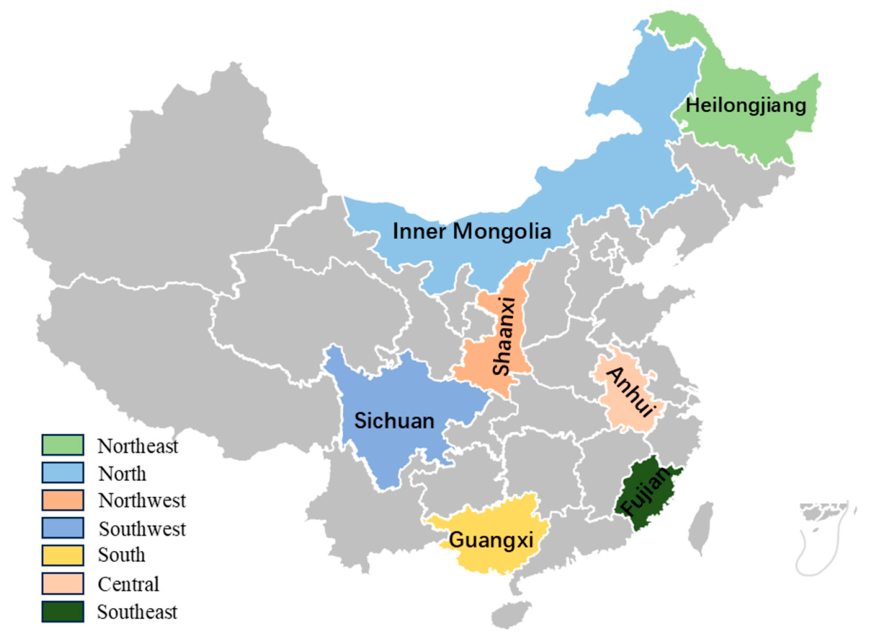
This cross-sectional study utilized a multi-stage stratified cluster sampling within the National Nutrition Improvement Program for Rural Compulsory Education Students. Seven key surveillance counties were strategically selected to ensure geographical diversity (spanning Northeast, North, Northwest, Southwest, South, Southeast, and Central China, Figure 1). The selected provinces were Heilongjiang (Northeast), Inner Mongolia (North), Shaanxi (Northwest), Sichuan (Southwest), Guangxi (South), Fujian (Southeast), and Anhui (Central). Within each province, one rural county was randomly selected as the survey site. In each county, one county town (urban) and one rural village were selected. In each of these two locations, one primary school (grades 1–6) and one junior high school (grades 7–9) were chosen. Within each school, one class per grade (grades 1–9) was randomly selected. All students in the selected class were invited to participate, with a target of approximately 20 students per class (balanced by gender when possible). This yielded a planned sample of 2520 students (7 provinces × 1 county × 2 locations × 2 schools × 9 grades × 20 students = 2520).
Participants were eligible for inclusion if they: (1) were enrolled in the selected primary or junior high schools; (2) completed both uncorrected visual acuity and non-cycloplegic autorefraction examinations; and (3) provided written informed consent from a parent or legal guardian, along with child assent. Participants were excluded if they: (1) used orthokeratology (OK) lenses; or contact lenses; (2) had any of the following ocular conditions: strabismus, nystagmus, ocular trauma, or known pathological myopia complications (e.g., myopic maculopathy, retinal detachment) that could affect refraction; or (3) had a history of ocular surgery.

2.2. Visual Acuity and Refractive Examination

Unaided visual acuity and habitual corrected visual acuity were measured using a liquid crystal digital (LED) visual chart (WSVC-1000, QDSGVision, Wenzhou, China) compliant with the Chinese national standard (GB11533). The testing distance was 5 m, left eye followed by right eye, recorded using the 5-point recording [12].
Non-cycloplegic autorefraction was performed using an autorefractor (KR-800, Topcon, Tokyo, Japan). The spherical equivalent (SE) was calculated as sphere + ½ cylinder. Five measurements were taken for each eye, and the average value was used. Measurements with poor reliability or high variability were repeated. Non-cycloplegic autorefractors can overestimate myopia, this study applies a composite definition—integrating both visual acuity and refractive error, to mitigate this potential overestimation. Specifically, per the International Myopia Institute (IMI) consensus definitions, myopia is defined as the presence of both unaided visual acuity (VA) < 5.0 and a spherical equivalent (SE) ≤ −0.50 diopters (D) in either eye [13,14,15]. Low myopia is defined as −6.00 D < SE ≤ −0.50 D with VA < 5.0; high myopia is defined as SE ≤ −6.00 D with VA < 5.0.

2.3. Behavioral Assessment

Behavioral data were collected by trained staff through face-to-face interviews with each child (or parent/guardian). Participants reported weekday and weekend hours of daytime outdoor activity and near-work (homework + screen time). Average daily time was calculated as (weekday × 5 + weekend × 2)/7.

2.4. Sample Size

Based on an expected myopia prevalence of 50%, a 3% margin of error, 95% confidence, a design effect of 2.0 (to account for cluster sampling), and a 10% non-response rate, the minimum required sample size was calculated as 2371 students.

2.5. Statistical Analysis

To analyze the effect of academic progression on myopia, the variable “educational stage” was defined as follows: 1–3 grade, 4–6 grade, and 7–9 grade. Because age and educational stage were highly correlated (Pearson’s r = 0.91), we orthogonalized age by regressing it on educational stage and saved the unstandardized residual (RES_1). This residual represents the component of age that is uncorrelated with educational stage, allowing simultaneous estimation of both variables without multicollinearity.
Statistical analysis was performed using SPSS 27.0. Measurement data with normal distribution are presented as mean ± standard deviation; categorical data are presented as frequency and percentage. Group comparisons were made using t-tests or ANOVA for normally distributed data, rank-sum tests for non-normally distributed data, and chi-square tests for proportions.
To account for the multistage cluster sampling design (students nested within classes), we used generalized linear mixed models (GLMM) with a random intercept at the class level. The binary outcome (myopia, yes/no) was modeled with a binomial distribution and a logit link function. Fixed effects included: educational stage (categorical), province, ethnicity, gender, RES_1 (continuous), district (county town vs. rural), daily outdoor time (continuous), daily near-work time (continuous), and the district × ethnicity interaction term. Odds ratios (ORs) and 95% confidence intervals (CIs) were calculated from the fixed effects. All statistical tests were two tailed, with a significance threshold set at p < 0.05.

3. Results

A total of 2532 students from the seven provinces were initially recruited and completed visual acuity and refractive examinations. Following the application of inclusion and exclusion criteria, 13 participants were subsequently excluded due to specific ocular conditions (2 strabismus, 2 nystagmus,1 ocular trauma) or the 8 use of contact lenses with unspecified correction details. Consequently, 2519 participants were included in the final analysis.
The analyzed cohort had a mean age of 10.8 ± 2.7 years (range: 6–18 years). The sample comprised 1307 males (51.9%) and 1212 females (48.1%). In terms of residence, 1271 participants (50.5%) were from county towns, and 1248 (49.5%) were from rural areas. Ethnically, the participants identified as Han (n = 1592, 63.2%), Qiang (n = 344, 13.7%), Zhuang (n = 276, 11.0%), Mongolian (n = 253, 10.0%), or from other ethnic groups (n = 54, 2.1%). The detailed demographic characteristics stratified by region are presented in Table 1.
Significant differences in mean age were observed across the seven provinces (One-way ANOVA, p < 0.001). Post hoc tests (Bonferroni) indicated that students from Heilongjiang (11.89 ± 2.63 years) and Inner Mongolia (11.45 ± 2.65 years) were significantly older than those from other provinces (all p < 0.05).

3.1. Prevalence of Myopia

The overall prevalence of myopia among the surveyed students was 42.9%, with a notable sex disparity (46.0% in females vs. 39.9% in males, Table 2). A significant urban–rural gradient was observed, with students residing in county towns exhibiting a higher prevalence compared to their rural students (49.6% vs. 36.1%; Table 2). Myopia prevalence demonstrated a strong positive association with educational stage, increasing significantly with higher grade levels (χ2 = 429.472, p < 0.001). The prevalence was 30.0% in primary school students and 68.3% in junior high school students. Marked geographical variations in myopia prevalence were identified across the seven provinces (χ2 = 62.553, p < 0.001). The prevalence ranged from 29.6% in Fujian to 56.8% in Heilongjiang Province, with the following descending order: Guangxi (49.4%), Anhui (42.2%), Shaanxi (41.5%), Inner Mongolia (41.3%), and Sichuan (39.6%). The distribution of myopia severity (low myopia vs. high myopia) across the provinces is further detailed in Table 2.

3.2. Behavioral Characteristics

Among the 2519 participants, 2450 (97.3%) had complete data on daily outdoor time and near-work time.
The mean daily outdoor time was 0.86 ± 0.82 h in non-myopic students and 0.99 ± 0.82 h in myopic students (mean difference = 0.13 h, 95% CI: 0.06–0.19; p < 0.001). The mean daily near-work time was 2.30 ± 2.00 h in non-myopic students and 3.22 ± 1.98 h in myopic students (mean difference = 0.80, 95% CI: 0.76–1.07; p < 0.001

3.3. Multivariable Analysis of Factors Associated with Myopia

The analysis revealed that educational stage was the strongest associated factor. Compared to grades 1–3, students in grades 4–6 had 3.3 times higher odds of myopia (OR = 3.32, 95% CI: 2.43–4.53, p < 0.001), and those in grades 7–9 had 5.5 times higher odds (OR = 5.54, 95% CI: 3.07–9.99, p < 0.001). Gender was also associated: female students had higher myopia odds than males (OR for male = 0.66, 95% CI: 0.55–0.79, p < 0.001), equivalent to 52% higher odds in females.
The age residual (within-grade age deviation) was a significant risk factor (OR = 1.16 per year, 95% CI: 1.03–1.30, p = 0.012), indicating that older students within the same grade have higher myopia risk. Daily near-work time showed a modest positive association (OR = 1.10 per hour increment, 95% CI: 1.03–1.17, p = 0.005). Daily outdoor time was not significantly associated (OR = 0.97, 95% CI: 0.84–1.12, p = 0.684).
Significant provincial differences were observed. Compared to Anhui province (central China), Fujian province (Southeast China) had lower myopia odds (OR = 0.47, 95% CI: 0.30–0.74, p = 0.001). No other province differed significantly from Anhui.
A significant district × ethnicity interaction was found (p = 0.004). Rural Mongolian students had 71% lower myopia odds than urban Han students (OR = 0.29, 95% CI: 0.13–0.68; interaction p = 0.004). No other ethnic group showed a significant interaction with district. Detailed results are presented in Table 3.

4. Discussion

This cross-sectional study investigated the prevalence and associated factors of myopia among students aged 6–18 from rural areas across seven provinces of China. The principal findings revealed that while the overall myopia prevalence (42.9%) was lower than the national average (which includes major cities), significant disparities were evident across geographic, and county-rural strata. Moreover, the rate of adequate optical correction was critically low at 14.2% (Table S2).
The overall myopia prevalence was 42.9% was lower than the 2018 national average of 53.6% [16]. This difference is likely attributable to our sampling strategy, which intentionally excluded major urban centers, where prevalence is typically higher [8]. A notable geographic disparity was observed that Fujian Province (Southeast China) exhibited the lowest prevalence (29.6%). Located near 25° N, this subtropical region features abundant sunshine and a mild climate, conductive to sustained outdoor activity, that is a well-established protective factor against myopia [17,18]. The mild seasonal variation in this subtropical area, characterized by shorter, less severe winters, may facilitate year-round outdoor exposure, thereby sustaining the protective effect against myopia. In contrast, students from Heilongjiang Province had a higher risk. The prolonged northern winter not only limits outdoor activity due to cold temperatures and reduced daylight hours, but also entails a marked seasonal reduction in both the duration and intensity of sunlight exposure. This likely diminishes retinal dopamine signaling, which is known to suppress axial elongation [19]. Consistent with this hypothesis, previous studies have demonstrated that myopia progression and axial elongation are significantly slower in summer than in winter [20,21]. Moreover, population-level analyses have established a negative association between sunshine duration and myopia prevalence in Chinese children and adolescents [22]. These hypotheses about climate influenced lifestyles are speculative, as we did not directly measure daylight exposure or seasonal behavioral changes. Other region-specific factors, such as dietary patterns, may also contribute to this disparity.
Consistent with national trends of a narrowing urban–rural myopia [2], our data show that rural myopia rates are rising and approaching urban levels. A significant district × ethnicity interaction was found only for Mongolian children, that rural residence was protective in all groups but much stronger in Mongolian (OR = 0.19) than in Han (OR = 0.65, Table S3). In county towns, no ethnic difference existed; while in rural areas, Mongolian children had lower odds than Han (OR = 0.22, Table S3). Previous studies in Inner Mongolia have consistently shown that Mongolian populations have lower myopia prevalence than Han populations, both in adults [23] and in school-aged children [24]. Moreover, nationwide multi-ethnic surveys have found that several minority groups (Tibetan, Uyghur, Yi, Yugur) also exhibit lower myopia rates than Han [25]. These studies also reported that rural or suburban residence is associated with lower myopia risk [23,24,25]. However, none of these studies specifically tested the interaction between ethnicity and urban–rural residence. Our study is the first to demonstrate that the protective effect of rural living is significantly stronger in Mongolian children than in Han children, and that this ethnic advantage disappears in county towns. This finding suggests that the lower myopia risk in Mongolian populations may not an intrinsic ethnic trait, but rather reflects the preservation of traditional pastoral lifestyles, which is characterized by more outdoor activities, less academic pressure, and unique dietary habits, and this characteristic gradually disappears with urbanization.
Furthermore, our findings strongly implicate educational stage as a principal factor associated with myopia. After adjusting for covariates, including age and near-work time, a pronounced dose-response relationship persisted, students in grades 4–6 had 3.3 times higher odds of myopia (OR = 3.32, 95% CI: 2.43–4.53), and those in grades 7–9 had 5.5 times higher odds (OR = 5.54, 95% CI: 3.07–9.99), compared to those in grades 1–3. respectively, compared to those in grades 1–3. In addition, each additional hour of daily near-work time was associated with a 10% increase in the odds of myopia (OR = 1.10, 95% CI: 1.03–1.17, p = 0.005). This observation is strongly supported by a nationwide study employing a regression discontinuity design, which concluded that each additional year of school education, rather than age itself, is a key independent risk factor for myopic refractive shift [26]. The IMI Risk Factors for Myopia report further confirmed that a causal link between increased years of education and more myopia by Mendelian randomization [27]. Moreover, our age residual analysis revealed that younger students within the same grade had higher myopia risk, suggesting that delayed school entry and reduced early academic pressure may be protective.
Female sex was independently associated with higher myopia odds (OR for male = 0.67, p < 0.001), with no interactions by district or grade. This consistent female predominance is supported by meta analyses [28] and may be explained by earlier pubertal development in girls [29], which triggers earlier axial elongation and myopia progression.
Among myopic students, only 14.2% had adequate optical correction (Table S2). Correction rates were significantly lower in rural areas (10.4% vs. urban 16.8%), in upper primary grades (3.9% vs. lower primary 18.0%), and in provinces such as Sichuan (6.3%) and Guangxi (7.6%). No gender difference was observed. This low correction rate is consistent with previous reports from China (e.g., 60% uncorrected in Shantou schools [30]; only 18.9% spectacle owned in rural China [31]). Uncorrected myopia impairs academic performance and quality of life, and may accelerate progression [32,33]. We recommend strengthening school-based vision screening, expanding optometry services in underserved regions, and providing subsidized spectacles for low-income families.
This study has limitations. Firstly, we defined myopia using non-cycloplegic autorefraction combined with uncorrected visual acuity (UCVA) rather than cycloplegic refraction which is the gold standard. Non-cycloplegic refraction overestimates myopia prevalence, especially in younger children, due to residual accommodation. However, combining UCVA with non-cycloplegic refraction significantly reduces this overestimation compared to refraction alone, and for school-aged children (≥6 years) this combination is considered sufficient for screening purposes [34,35]. Given the practical constraints of large-scale epidemiological surveys in resource-limited settings, our approach represents a pragmatic balance between accuracy and feasibility. Secondly, our sample was drawn from specific low-income rural areas where myopia surveillance is underdeveloped and healthcare resources are scarce. While the findings may not be generalizable to urban or high-income populations where myopia prevalence has plateaued 2, they provide valuable evidence for underserved rural regions that are often neglected in myopia research. Additionally, ethnicity and province-level factors are inherently correlated in our dataset (e.g., Han vs. other ethnic groups show different myopia risks across regions). We used generalized linear mixed models (GLMM) to partially account for clustering and collinearity, but residual multicollinearity may still affect the stability of estimates. Thirdly, this cross-sectional study precludes causal inference; all reported associations are correlational. Despite adjusting for several confounders (near work, outdoor time, age, etc.), residual confounding from unmeasured factors (e.g., diet, genetic markers, educational pressure) cannot be entirely excluded. While we followed standardized protocols to minimize this bias, residual selection bias remains possible.

5. Conclusions

In conclusion, myopia is highly prevalent and severely under-corrected in rural China. Educational pressure is the main driver, while the rural protective effect is strongest in Mongolians but erodes with urbanization. Urgent public health actions, including vision screening, affordable spectacles, and lifestyle preservation, are needed to address this growing burden.

Supplementary Materials

The following supporting information can be downloaded at: https://www.mdpi.com/article/10.3390/jcm15093261/s1, Table S1: STROBE Statement—Checklist of items that should be included in reports of cross-sectional studies; Table S2: Proportion of myopic students with adequate optical correction by subgroup (N = 1080); Table S3: Simple effect analysis of the district × ethnicity interaction on myopia.

Author Contributions

Conceptualization, J.B., H.C. and Q.Z.; methodology, X.L.; formal analysis, X.W. and X.F.; investigation, X.L., Y.H. and H.Z.; resources, Q.G.; data curation, X.L.; writing—original draft preparation, X.L.; writing—review and editing, J.B., H.C. and Q.Z.; visualization, H.Z.; supervision, Jianhua Bao; project administration, X.L. and Q.G.; funding acquisition, J.B. All authors have read and agreed to the published version of the manuscript.

Funding

This work was supported by the National Key Research and Development Program of China (No. 2022YFC3502503) and Project of Wenzhou Medical University (95022006).

Institutional Review Board Statement

This study adhered to the tenets of the Declaration of Helsinki and was approved by the Ethics Committee of the National Institute for Nutrition and Health (Approval No. 2021-018, 27 May 2021), and Eye Hospital, Wenzhou Medical University (Approval No. 2021-201-K-175, 22 October 2021).

Informed Consent Statement

Written informed consent was obtained from all participating children and their parents or guardians prior to the study.

Data Availability Statement

Dataset available on request from the authors—The raw data supporting the conclusions of this article will be made available by the authors on request.

Conflicts of Interest

The authors declare no conflicts of interest.

Abbreviations

The following abbreviations are used in this manuscript:
IMIInternational Myopia Institute
SEspherical equivalent
VAvisual acuity

References

  1. Holden, B.A.; Fricke, T.R.; Wilson, D.A.; Jong, M.; Naidoo, K.S.; Sankaridurg, P.; Wong, T.Y.; Naduvilath, T.J.; Resnikoff, S. Global Prevalence of Myopia and High Myopia and Temporal Trends from 2000 through 2050. Ophthalmology 2016, 123, 1036–1042. [Google Scholar] [CrossRef] [PubMed]
  2. Pan, Z.; Xian, H.; Li, F.; Wang, Z.; Li, Z.; Huang, Y.; Liu, W.; Li, Y.; Li, F.; Wang, J.; et al. Myopia and high myopia trends in Chinese children and adolescents over 25 years: A nationwide study with projections to 2050. Lancet Reg. Health West. Pac. 2025, 59, 101577. [Google Scholar] [CrossRef]
  3. Fricke, T.R.; Jong, M.; Naidoo, K.S.; Sankaridurg, P.; Naduvilath, T.J.; Ho, S.M.; Wong, T.Y.; Resnikoff, S. Global prevalence of visual impairment associated with myopic macular degeneration and temporal trends from 2000 through 2050: Systematic review, meta-analysis and modelling. Br. J. Ophthalmol. 2018, 102, 855–862. [Google Scholar] [CrossRef]
  4. Cumberland, P.M.; Bountziouka, V.; Hammond, C.J.; Hysi, P.G.; Rahi, J.S. Temporal trends in frequency, type and severity of myopia and associations with key environmental risk factors in the UK: Findings from the UK Biobank Study. PLoS ONE 2022, 17, e0260993. [Google Scholar] [CrossRef]
  5. Hu, Y.; Liao, L.; Morgan, I.G.; Jin, L.; He, M.; Ding, X. The Onset and Progression of Myopia Slows in Chinese 15-Year-Old Adolescents Following Vocational Rather Than Academic School Pathways. Investig. Ophthalmol. Vis. Sci. 2024, 65, 42. [Google Scholar] [CrossRef] [PubMed]
  6. Xu, L.; Ma, Y.; Yuan, J.; Zhang, Y.; Wang, H.; Zhang, G.; Tu, C.; Lu, X.; Li, J.; Xiong, Y.; et al. COVID-19 Quarantine Reveals That Behavioral Changes Have an Effect on Myopia Progression. Ophthalmology 2021, 128, 1652–1654. [Google Scholar] [CrossRef]
  7. Tang, T.; Li, Y.; Zhao, M.; Wang, K. Seasonal Variation in the Effect of Controlling Myopia Progression Using Orthokeratology. Eye Contact Lens 2025, 51, 394–399. [Google Scholar] [CrossRef]
  8. He, M.; Zheng, Y.; Xiang, F. Prevalence of myopia in urban and rural children in mainland China. Optom. Vis. Sci. 2009, 86, 40–44. [Google Scholar] [CrossRef]
  9. Li, F.F.; Zhu, M.C.; Shao, Y.L.; Lu, F.; Yi, Q.Y.; Huang, X.F. Causal Relationships Between Glycemic Traits and Myopia. Investig. Ophthalmol. Vis. Sci. 2023, 64, 7. [Google Scholar] [CrossRef]
  10. He, M.; Zeng, J.; Liu, Y.; Xu, J.J.; Pokharel, G.P.; Ellwein, L.B. Refractive error and visual impairment in urban children in southern China. Investig. Ophthalmol. Vis. Sci. 2004, 45, 793–799. [Google Scholar] [CrossRef] [PubMed]
  11. He, M.; Huang, W.; Zheng, Y.; Zheng, Y.F.; Huang, L.; Ellwein, L.B. Refractive error and visual impairment in school children in rural southern China. Ophthalmology 2007, 114, 374–382. [Google Scholar] [CrossRef]
  12. National Health Commission of the People’s Republic of China. Guidelines for Appropriate Techniques for Myopia Prevention and Control Among Children and Adolescents (Updated Edition). Available online: https://www.nhc.gov.cn/jkj/c100062/202110/a05ccaf5773a436486d2d79b59c0a5e9.shtml (accessed on 11 October 2021).
  13. Wang, N.L.; Wei, S.F. Emphasizing the standardized use of cycloplegics in the epidemiological studies of myopia. Zhonghua Yan Ke Za Zhi 2019, 55, 561–564. [Google Scholar]
  14. Flitcroft, D.I.; He, M.; Jonas, J.B.; Jong, M.; Naidoo, K.; Ohno-Matsui, K.; Rahi, J.; Resnikoff, S.; Vitale, S.; Yannuzzi, L. IMI—Defining and Classifying Myopia: A Proposed Set of Standards for Clinical and Epidemiologic Studies. Investig. Ophthalmol. Vis. Sci. 2019, 60, M20–M30. [Google Scholar] [CrossRef]
  15. Zhao, X.; Lu, X.; Yu, L.; Zhang, Y.; Li, J.; Liu, Y.; Yang, G.; Wang, Y.; Zhang, W.; Du, Z. Prevalence of myopia and associated risk factors among key schools in Xi’an, China. BMC Ophthalmol. 2022, 22, 519. [Google Scholar] [CrossRef]
  16. National Health Commission of the People’s Republic of China. Notice on the Children and Adolescent Myopia Survey, Which Is Jointly Issued by the General Office of the National Health Commission, the General Office of the Ministry of Education, and the General Office of the Ministry 2018. Available online: http://www.scio.gov.cn/gwyzclxcfh/cfh/2019n_15127/2019n05y10rsw/xgfbh_15333/202208/t20220808_302403.html (accessed on 29 April 2019).
  17. Wu, P.C.; Chen, C.T.; Chang, L.C.; Niu, Y.Z.; Chen, M.L.; Liao, L.L.; Rose, K.; Morgan, I.G. Increased Time Outdoors Is Followed by Reversal of the Long-Term Trend to Reduced Visual Acuity in Taiwan Primary School Students. Ophthalmology 2020, 127, 1462–1469. [Google Scholar] [CrossRef]
  18. Chen, J.; Wang, J.; Qi, Z.; Liu, S.; Zhao, L.; Zhang, B.; Dong, K.; Du, L.; Yang, J.; Zou, H.; et al. Smartwatch Measures of Outdoor Exposure and Myopia in Children. JAMA Netw. Open 2024, 7, e2424595. [Google Scholar] [CrossRef]
  19. Ashby, R.; Harb, E.N.; Ostrin, L.A.; Flitcroft, D.I.; Schaeffel, F.; Karouta, C.; Gawne, T.; Chakraborty, R.; Thomson, K.; Read, S.; et al. IMI: The Role of Light in Refractive Development and Myopia: Evidence from Animal and Human Studies. Investig. Ophthalmol. Vis. Sci. 2025, 66, 5. [Google Scholar] [CrossRef] [PubMed]
  20. Rusnak, S.; Salcman, V.; Hecova, L.; Kasl, Z. Myopia Progression Risk: Seasonal and Lifestyle Variations in Axial Length Growth in Czech Children. J. Ophthalmol. 2018, 2018, 5076454. [Google Scholar] [CrossRef] [PubMed]
  21. Ding, W.; Zhao, C.; Li, X.; Lu, W.; Jiang, D.; Tian, Y.; Leng, L. Seasonal variation in axial elongation in children with orthokeratology treatment. Ophthalm. Physiol. Opt. 2025, 45, 877–882. [Google Scholar] [CrossRef] [PubMed]
  22. Ma, R.; Zhou, L.; Li, W.; Li, Y.; Hu, D.; Lu, Y.; Zhang, C.; Yi, B. The Impact of Sunshine Duration on Myopia in Central China: Insights from Populational and Spatial Analysis in Hubei. Int. J. Gen. Med. 2024, 17, 2129–2142. [Google Scholar] [CrossRef]
  23. Wang, M.; Ma, J.; Pan, L.; Chen, T.; Wang, H.L.; Wang, Y.H.; Wang, W.R.; Pan, X.D.; Qian, Y.G.; Zhang, X.; et al. Prevalence of and risk factors for refractive error: A cross-sectional study in Han and Mongolian adults aged 40-80 years in Inner Mongolia, China. Eye 2019, 33, 1722–1732. [Google Scholar] [CrossRef] [PubMed]
  24. Gao, N.; Yun, L.; Xin, L.; Hu, L. Comparative study on the axial length of Mongolian and Han adolescents in Erdos City. Chin. J. Ophthalmol. Med. 2017, 7, 32–37. [Google Scholar]
  25. Wang, X.; Luo, R.; Shan, G.; He, H.; Chen, T.; Wang, X.; Gan, L.; Wang, Y.; Chou, Y.; Cui, J.; et al. Prevalence and risk factors for refractive error in older adults in eight ethnicities in China: The China national health survey. Heliyon 2024, 10, e36354. [Google Scholar] [CrossRef]
  26. Zhang, C.; Li, L.; Jan, C.; Li, X.; Qu, J. Association of School Education With Eyesight Among Children and Adolescents. JAMA Netw. Open 2022, 5, e229545. [Google Scholar] [CrossRef]
  27. Morgan, I.G.; Wu, P.C.; Ostrin, L.A.; Tideman, J.W.L.; Yam, J.C.; Lan, W.; Baraas, R.C.; He, X.; Sankaridurg, P.; Saw, S.M.; et al. IMI Risk Factors for Myopia. Investig. Ophthalmol. Vis. Sci. 2021, 62, 3. [Google Scholar] [CrossRef]
  28. Dong, L.; Kang, Y.K.; Li, Y.; Wei, W.B.; Jonas, J.B. Prevalence and Time Trends of Myopia in Children and Adolescents in China: A Systemic Review and Meta-Analysis. Retina 2020, 40, 399–411. [Google Scholar] [CrossRef]
  29. Yip, V.C.; Pan, C.W.; Lin, X.Y.; Lee, Y.S.; Gazzard, G.; Wong, T.Y.; Saw, S.M. The relationship between growth spurts and myopia in Singapore children. Investig. Ophthalmol. Vis. Sci. 2012, 53, 7961–7966. [Google Scholar] [CrossRef] [PubMed]
  30. Wang, H.; Li, Y.; Qiu, K.; Zhang, R.; Lu, X.; Luo, L.; Lin, J.W.; Lu, Y.; Zhang, D.; Guo, P.; et al. Prevalence of myopia and uncorrected myopia among 721 032 schoolchildren in a city-wide vision screening in southern China: The Shantou Myopia Study. Br. J. Ophthalmol. 2023, 107, 1798–1805. [Google Scholar] [CrossRef]
  31. Qian, D.J.; Zhong, H.; Nie, Q.; Li, J.; Yuan, Y.; Pan, C.W. Spectacles need and ownership among multiethnic students in rural China. Public Health 2018, 157, 86–93. [Google Scholar] [CrossRef] [PubMed]
  32. Ding, Y.; Chen, X.; Zhang, L.; Xue, J.; Guan, H.; Shi, Y. Corrected Myopia and Its Association with Mental Health Problems Among Rural Primary School Students in Northwest China. Ophthalm. Epidemiol. 2026, 33, 153–161. [Google Scholar] [CrossRef]
  33. Pang, X.; Wang, H.; Qian, Y.; Zhu, S.; Hu, Y.A.; Rozelle, S.; Congdon, N.; Jiang, J. The association between visual impairment, educational outcomes, and mental health: Insights from eyeglasses usage among junior high school students in rural China. Sci. Rep. 2024, 14, 24244. [Google Scholar] [CrossRef] [PubMed]
  34. Lyu, P.; Shi, J.; Wang, J.; He, X.; Shi, H. Optimizing myopia screening referral guidelines for children aged 4 to 18 based on non-cycloplegic indicators. BMC Ophthalmol. 2025, 25, 561. [Google Scholar] [CrossRef] [PubMed]
  35. Li, N.; Jiang, Y.; Zhang, X.; Huang, W.; Zhang, J.; Zhang, B.; Gao, Z.; Leng, Y. Combining visual acuity with refraction reduces overestimation of myopia prevalence in school screenings: An age-stratified analysis. Front. Med. 2026, 13, 1776604. [Google Scholar] [CrossRef] [PubMed]
Figure 1. Distribution of surveyed provinces.
Jcm 15 03261 g001
Table 1. General characteristics of the study population among seven provinces.
VariableTotalAnhuiFujianShaanxiSichuanGuangxiInner
Mongolia
Heilongjiangp
No. of students2519358358359361344380359
Age, years10.80 ± 2.7010.19 ± 2.6810.37 ± 2.6210.39 ± 2.6010.53 ± 2.6410.74 ± 2.6511.45 ± 2.6511.89 ± 2.63<0.001
Sex 0.76
Boys, n (%)1307 (51.9)191 (53.4)180 (50.3)179 (49.9)200 (55.4)180 (52.3)192 (50.5)185 (51.5)
Girls, n (%)1212 (48.1)167 (46.6)178 (49.7)180 (50.1)161 (44.6)164 (47.7)188 (49.5)174 (48.5)
Educational stage 1.00
Grade 1–3833 (33.1)119 (33.2)119 (33.2)120 (33.4)119 (33.0)114 (33.1)124 (32.6)118 (32.9)
Grade 4–6841 (33.4)119 (33.2)120 (33.5)120 (33.4)121 (33.5)115 (33.4)128 (33.7)118 (32.9)
Grade 7–9845 (33.5)120 (33.5)119 (33.2)119 (33.1)121 (33.5)115 (33.4)128 (33.7)123 (34.3)
Ethnic <0.001
Han, n (%)1592 (63.2)358 (100.0)357 (99.7)359 (100.0)10 (2.8)40 (11.6)113 (29.7)355 (98.9)
Mongolia, n (%)253 (10.0)-----253 (66.6)-
Qiang, n (%)344 (13.7)---344 (95.3)---
Zhuang, n (%)276 (11.0)----276 (80.2)--
Others, n (%)54 (2.1)-1 (0.3)-9 (1.9)28 (8.1)14 (3.7)4 (1.1)
District 1.00
County town, n (%)1271 (50.5)179 (50.0)179 (50.0)180 (50.1)182 (50.4)174 (50.6)194 (51.1)183 (51.0)
Rural area, n (%)1248 (49.5)179 (50.0)179 (50.0)179 (49.9)179 (49.6)170 (49.4)186 (48.9)176 (49.0)
Table 2. Distributional characteristics of myopia in children and adolescents in this study.
VariableNo. of StudentsMyopiaLow MyopiaHigh Myopia
Yes (1080)
n (%)
Univariate AnalysisYes (1026)
n (%)
Univariate AnalysisYes (54)
n (%)
Univariate Analysis
Sex
Males, n (%)1307522 (39.9)χ2  =  9.556, p = 0.002492 (37.6)χ2  =  10.732,
p = 0.001
30 (2.3)χ2  =  0.298,
p = 0.585
Females, n (%)1212558 (46.0)534 (44.1)24 (2.0)
Educational stage
Grade 1–3833152 (18.2)χ2  =  429.472, p < 0.001151 (18.1)χ2  =  358.671,
p < 0.001
1 (0.1)χ2  =  44.716,
p < 0.001
Grade 4–6841351 (41.7)338 (40.2)13 (1.5)
Grade 7–9845577 (68.3)537 (63.6)40 (4.7)
Ethnic
Han, n (%)1592704 (44.2)χ2  =  19.881, p < 0.001670 (42.1)χ2  =  16.510,
p = 0.002
34 (2.1)χ2  =  7.253,
p = 0.123
Mongolia, n (%)25381 (32.0)80 (31.6)1 (0.4)
Qiang, n (%)344135 (39.2)126 (36.6)9 (2.6)
Zhuang, n (%)276136 (49.3)129 (46.7)7 (2.5)
Others, n (%)5424 (44.4)21 (38.9)3 (5.6)
District
County town, n (%)1271630 (49.6)χ2  =  46.923, p < 0.001630 (49.6)χ2  =  34.402,
p < 0.001
7 (2.5)χ2  =  12.313,
p < 0.001
Rural area, n (%)1248450 (36.1)450 (36.1)3 (5.6)
Provinces
Anhui358151 (42.2)χ2  =  62.553, p < 0.001144 (40.2)χ2  =  51.905,
p < 0.001
7 (2.0)χ2  =  9.403,
p = 0.152
Fujian358106 (29.6)104 (29.1)2 (0.6)
Shaanxi359149 (41.5)141 (39.3)8 (2.2)
Sichuan361143 (39.6)133 (36.8)10 (2.8)
Guangxi344170 (49.4)162 (47.1)8 (2.3)
Inner Mongolia380157 (41.3)151 (39.7)6 (1.6)
Heilongjiang359204 (56.8)191 (53.2)13 (3.6)
Table 3. Multivariable generalized linear mixed model analysis of factors associated with myopia among students in seven provinces (N = 2450).
OR (95%CI)p-Value
Age residual (RES_1)1.16 (1.03–1.30)0.012
Daily near-work time1.10 (1.03–1.17)0.005
Daily outdoor time0.97 (0.84–1.12)0.684
Gender
FemaleRef
Male0.66 (0.55–0.79)<0.001
Educational stage
Grade 1–3 Ref
Grade 4–6 3.32 (2.43–4.52)<0.001
Grade 7–95.54 (3.07–9.99)<0.001
District
County town RefRef
Rural 0.65 (0.48–0.89)0.007
Ethnic
HanRef
Mongolian0.76 (0.38–1.52)0.438
Qiang0.65 (0.20–2.07)0.463
Zhuang0.96 (0.44–2.11)0.923
Others0.72 (0.28–1.83)0.493
Province
AnhuiRef
Shaanxi 0.86 (0.55–1.35)0.513
Fujian0.47 (0.30–0.74)0.001
Guangxi1.35 (0.63–2.92)0.444
Sichuan1.69 (0.53–5.41)0.373
Inner Mongolia1.30 (0.65–2.57)0.457
Heilongjiang1.35 (0.81–2.25)0.246
District × ethnicity
county town × HanRef
Rural × Mongolian0.29 (0.13–0.68)0.004
Other interactions->0.05
Ref: Reference group (comparator). OR = 1.00 by definition; other groups are interpreted relative to this group.
Disclaimer/Publisher’s Note: The statements, opinions and data contained in all publications are solely those of the individual author(s) and contributor(s) and not of MDPI and/or the editor(s). MDPI and/or the editor(s) disclaim responsibility for any injury to people or property resulting from any ideas, methods, instructions or products referred to in the content.