Fistulating Intraductal Papillary Mucinous Neoplasms (IPMNs): Case Series and Discussion of a Rare Complication
 and
and
Abstract
1. Introduction
2. Materials and Methods
2.1. Patient Selection
- Confirmed diagnosis of IPMN on histopathological examination.
- Definitive fistulation on diagnostic CT or MRI imaging at our institution.
- Minimum 24 months follow-up.
2.2. Imaging Protocol
- Axial and coronal T2-weighted imaging;
- In- and out-phase T1-weighted imaging;
- Diffusion weighted imaging (DWI) with b-values up to 1000;
- Dynamic contrast enhancement on fat saturated T1-weighted imaging;
- Steady-state free precession (SSFP) imaging of the biliary tree and pancreatic ducts.
2.3. Analysis
- Tumor size and location;
- Enhancement characteristics;
- Involvement of the main pancreatic duct (MPD);
- Involvement of adjacent structures.
3. Results
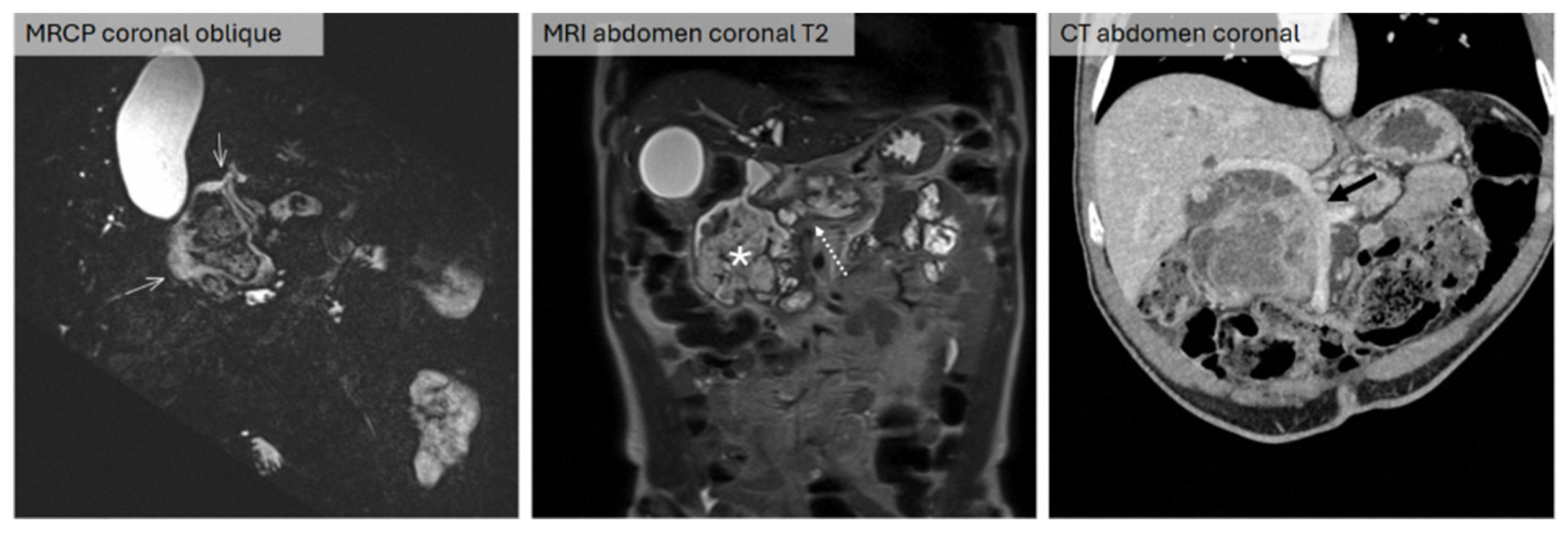
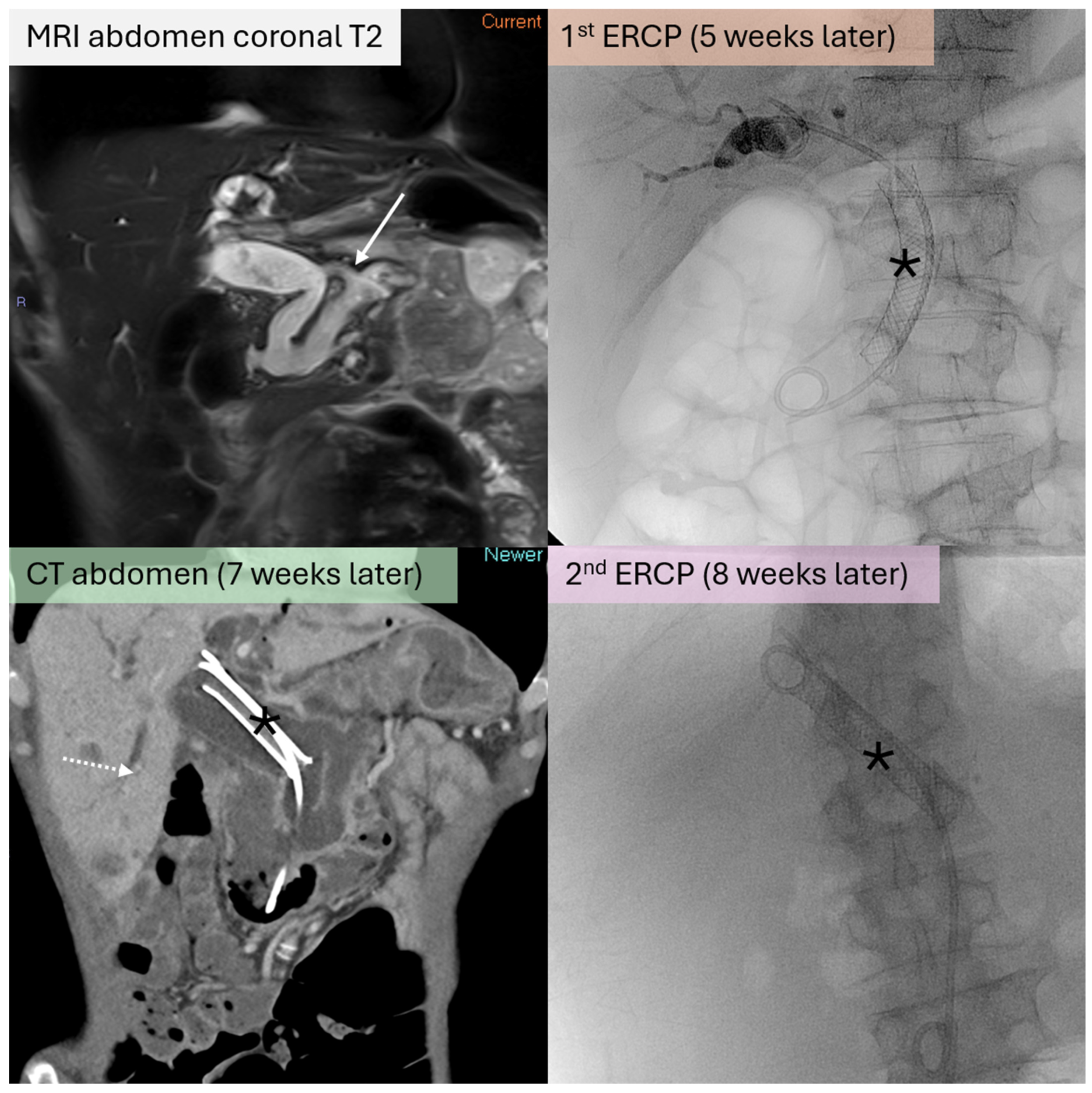
3.1. Case 1: Fistula to Common Bile Duct (CBD)
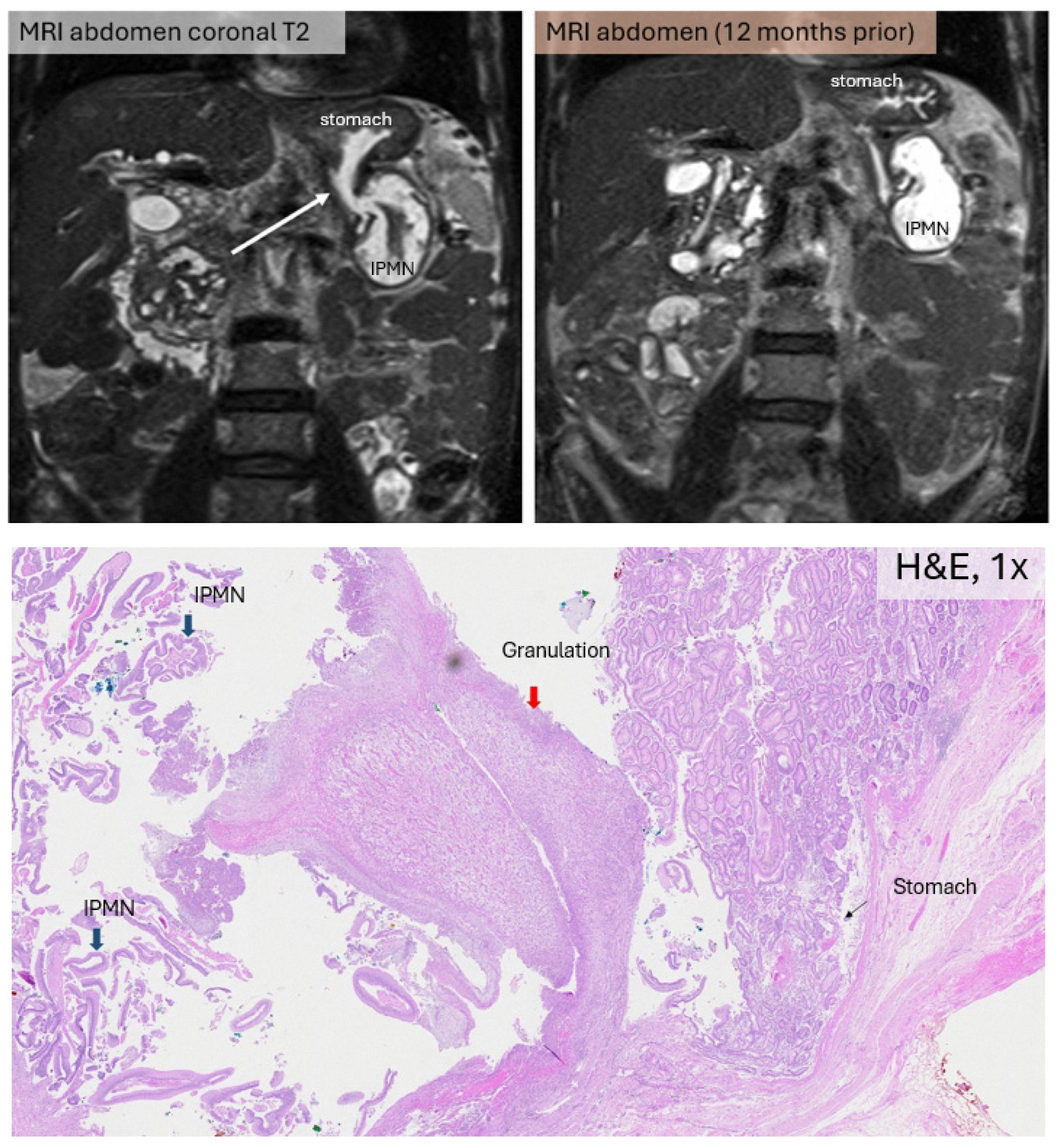
3.2. Case 2: Fistula to the Stomach
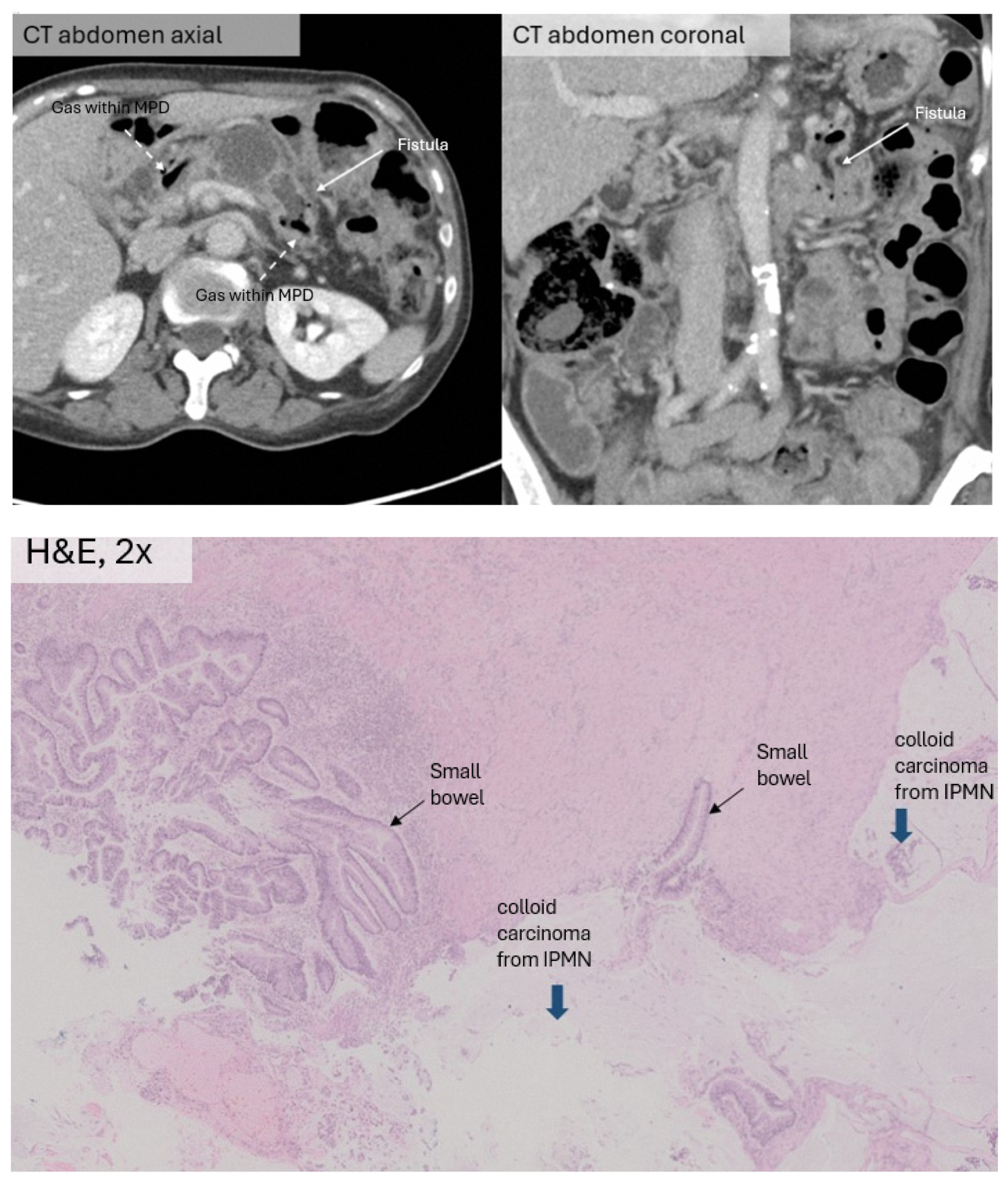
3.3. Case 3: Fistula to the Proximal Duodenum
3.4. Case 4: Fistula to Duodeno-Jejunal Junction
4. Discussion
4.1. Incidence
4.2. Pathophysiology
- (1)
- direct tumor invasion, associated with invasive carcinoma (e.g., mucinous adenocarcinoma) or high-grade dysplasia, where the neoplasm infiltrates surrounding tissue;
- (2)
- mechanical penetration driven by elevated intraductal pressure from a combination of abundant mucin production, ductal obstruction, or cystic expansion causing erosion into adjacent structures without overt malignant invasion around the fistula site;
- (3)
4.3. Diagnosis and Assessment
4.4. Management and Surveillance
4.5. Study Limitations
5. Conclusions and Future Direction
Author Contributions
Funding
Institutional Review Board Statement
Informed Consent Statement
Data Availability Statement
Acknowledgments
Conflicts of Interest
References
- Aliyev, K.; Amr, B. Pancreatico-gastric fistula: A rare complication of intraductal papillary mucinous neoplasm. J. Pancreas 2017, 18, 362–364. [Google Scholar]
- Patel, A.; Allen, A.; Kuwahara, J.; Wadsworth, T.; Loeffler, D.M.; Xie, K.L. Intraductal papillary mucinous neoplasm complicated by a gastropancreatic fistula. Radiol. Case Rep. 2019, 14, 320–323. [Google Scholar] [CrossRef] [PubMed]
- Farrell, J.J. Prevalence, Diagnosis and Management of Pancreatic Cystic Neoplasms: Current Status and Future Directions. Gut Liver 2015, 9, 571–589. [Google Scholar] [CrossRef] [PubMed]
- Gonda, T.A.; Cahen, D.L.; Farrell, J.J. Pancreatic Cysts. N. Engl. J. Med. 2024, 391, 832–843. [Google Scholar] [CrossRef]
- Tanaka, M.; Chari, S.; Adsay, V.; Castillo, F.-D.C.; Falconi, M.; Shimizu, M.; Yamaguchi, K.; Yamao, K.; Matsuno, S. International consensus guidelines for management of intraductal papillary mucinous neoplasms and mucinous cystic neoplasms of the pancreas. Pancreatology 2006, 6, 17–32. [Google Scholar] [CrossRef]
- Crippa, S.; Aleotti, F.; Longo, E.; Belfiori, G.; Partelli, S.; Tamburrino, D.; Di Salvo, F.; De Cobelli, F.; Romano, L.; Arcidiacono, P.G.; et al. Main duct thresholds for malignancy are different in intraductal papillary mucinous neoplasms of the pancreatic head and body-tail. Clin. Gastroenterol. Hepatol. 2022, 20, 390–399.e397. [Google Scholar] [CrossRef]
- Furukawa, T.; Takahashi, T.; Kobari, M.; Matsuno, S. The mucus-hypersecreting tumor of the pancreas. Development and extension visualized by three-dimensional computerized mapping. Cancer 1992, 70, 1505–1513. [Google Scholar] [CrossRef][Green Version]
- Rodriguez, J.R.; Salvia, R.; Crippa, S.; Warshaw, A.L.; Bassi, C.; Falconi, M.; Thayer, S.P.; Lauwers, G.Y.; Capelli, P.; Mino–Kenudson, M.; et al. Branch-duct intraductal papillary mucinous neoplasms: Observations in 145 patients who underwent resection. Gastroenterology 2007, 133, 72–79. [Google Scholar] [CrossRef]
- Sohn, T.A.; Yeo, C.J.; Cameron, J.L.; Hruban, R.H.; Fukushima, N.; Campbell, K.A.; Lillemoe, K.D. Intraductal papillary mucinous neoplasms of the pancreas: An updated experience. Ann. Surg. 2004, 239, 788–799. [Google Scholar] [CrossRef]
- Salvia, R.; Castillo, C.F.-D.; Bassi, C.; Thayer, S.P.; Falconi, M.; Mantovani, W.; Pederzoli, P.; Warshaw, A.L. Main-duct intraductal papillary mucinous neoplasms of the pancreas: Clinical predictors of malignancy and long-term survival following resection. Ann. Surg. 2004, 239, 678–687. [Google Scholar] [CrossRef]
- Hruban, R.; Pitman, M.B.; Klimstra, D. AFIP Atlas of Tumor Pathology: Tumors of the Pancreas Series 4; American Registry of Pathology: Arlington, VA, USA, 2007; pp. 23–50. [Google Scholar]
- Kobayashi, G.; Fujita, N.; Noda, Y.; Ito, K.; Horaguchi, J.; Obana, T.; Koshida, S.; Kanno, Y.; Yamashita, Y.; Kato, Y.; et al. Intraductal papillary mucinous neoplasms of the pancreas showing fistula formation into other organs. J. Gastroenterol. 2010, 45, 1080–1089. [Google Scholar] [CrossRef] [PubMed]
- Aronsson, L.; Bengtsson, A.; Toren, W.; Andersson, R.; Ansari, D. Intraductal papillary mucinous carcinoma versus pancreatic ductal adenocarcinoma: A systematic review and meta-analysis. Int. J. Surg. 2019, 71, 91–99. [Google Scholar] [CrossRef] [PubMed]
- Ravaud, S.; Laurent, V.; Jausset, F.; Cannard, L.; Mandry, D.; Oliver, A.; Claudon, M. CT and MR imaging features of fistulas from intraductal papillary mucinous neoplasms of the pancreas to adjacent organs: A retrospective study of 423 patients. Eur. J. Radiol. 2015, 84, 2080–2088. [Google Scholar] [CrossRef] [PubMed]
- Shishido, Y.; Mitsuoka, E.; Ito, R.; Ishii, M.; Fujimoto, K. Fistula formation into other organs secondary to intraductal papillary mucinous neoplasm of the pancreas: A case report and literature review. Medicine 2023, 102, e34288. [Google Scholar] [CrossRef]
- Harino, T.; Tomimaru, Y.; Noguchi, K.; Nagase, H.; Ogino, T.; Hirota, M.; Oshima, K.; Tanida, T.; Noura, S.; Imamura, H.; et al. A case of intraductal papillary-mucinous neoplasm of the pancreas penetrating into the stomach and spleen successfully treated by total pancreatectomy. Surg. Case Rep. 2018, 4, 117. [Google Scholar] [CrossRef]
- Yamada, Y.; Mori, H.; Hijiya, N.; Matsumoto, S.; Takaji, R.; Ohta, M.; Kitano, S.; Moriyama, M. Intraductal papillary mucinous neoplasms of the pancreas complicated with intraductal hemorrhage, perforation, and fistula formation: CT and MR imaging findings with pathologic correlation. Abdom. Imaging 2012, 37, 100–109. [Google Scholar] [CrossRef]
- Longnecker, D.S.; Suriawinata, A.A. Incidence of Pancreatic Intraepithelial Neoplasia in an Autopsy Series. Pancreas 2022, 51, 305–309. [Google Scholar] [CrossRef]
- Tanaka, M.; Fernández-del Castillo, C.; Kamisawa, T.; Jang, J.Y.; Levy, P.; Ohtsuka, T.; Salvia, R.; Shimizu, Y.; Tada, M.; Wolfgang, C.L. Revisions of international consensus Fukuoka guidelines for the management of IPMN of the pancreas. Pancreatology 2017, 17, 738–753. [Google Scholar] [CrossRef]
- Ball, C.G.; Howard, T.J. Natural history of intraductal papillary mucinous neoplasia: How much do we really know? World J. Gastrointest. Surg. 2010, 2, 368–372. [Google Scholar] [CrossRef]
- AbuDalu, M.; Munz, Y.; Ohana, G. Pancreatico-gastric fistula arising from IPMN associated with ductal adenocarcinoma of the pancreas: A case report and a literature review. Front. Surg. 2023, 10, 1171234. [Google Scholar] [CrossRef]
- Itagaki, Y.; Sato, S.; Omori, Y.; Yamamoto, H.; Kimura, K.; Kushiya, H.; Tsunetoshi, Y.; Kato, K.; Takada, M.; Ambo, Y.; et al. Pancreaticobiliary fistula associated with intraductal papillary mucinous neoplasm and the simultaneous ampullary carcinoma: A case report. Medicine 2025, 104, e43563. [Google Scholar] [CrossRef]



| # | Age/ Sex | Tumor Location | Tumor Size (cm) | Volume (cc) | MPD Involvement | Solid Enhancement | Structure Involved | Surgical Resection | Invasive Carcinoma at Fistula | Background Pancreatitis | High Bilirubin | Demise; Months from Index Scan |
|---|---|---|---|---|---|---|---|---|---|---|---|---|
| 1 | 79/M | Body | 6.7 × 3.1 × 3.9 | 42.7 | Yes | Yes | Biliary tree | No | NA | NA | Yes | Yes; 4.8 |
| 2 | 69/M | Tail | 5.9 × 2.7 × 6.7 | 55.8 | Yes | Yes | Stomach (fundus) | Yes | No | Yes | Yes | Yes; 24.8 |
| 3 | 61/M | Head, uncinate | 7.6 × 5.4 × 8.4 | 180 | Yes | Yes | Proximal duodenum | Yes | Yes | Yes | Yes | No |
| 4 | 73/F | Body | 6.5 × 3.2 × 2.7 | 29.3 | Yes | No | Duodeno-jejunal junction | Yes | Yes | No | No | No |
| Pathology | Imaging and Pathological Features | Patient Characteristics and Clinical Presentation | Similarities | Differences |
|---|---|---|---|---|
| Intraductal papillary neoplasm (IPMN) | Variable malignant potential. Branch duct 3–12%; main duct 33–85% malignant. Branch duct IPMN communicates with the MPD. Main duct IPMN cause direct dilatation of the MPD. | Equal gender distribution. 5th to 7th decade in life. May cause pancreatitis. | - | - |
| Pancreatic ductal adenocarcinoma (PDAC) | Malignant and aggressive, with 5-year survival of 10%. Invasive soft tissue mass causing upstream ductal obstruction. Typically, solid but relatively hypoenhancing relative to pancreatic parenchyma. | Slight male predominance. 50% metastatic at presentation. | Dilated upstream MPD, may present with similar clinical features (weight loss, abdominal pain). | Solid instead of cystic on CT, with higher attenuation. Less T2w hyperintense on MRI Aggressive with poor prognosis. |
| Mucinous cystadenoma/cystadenocaricnoma neoplasm (MCN) | Malignant potential 17.5%, with 5-year survival of 62%. Multilocular macrocystic pancreatic lesion, typically in the body and tail. Typically benign but may develop invasive adenocarinoma. Histology typically demonstrates ovarian-type stroma. Average size 10–12 cm. | Almost exclusively in women (90%). Occurs in 4th to 6th decade of life. Mostly asymptomatic. | High T2w signal, may be large with near cystic fluid density. | Single lesion with thick fibrous capsule, which may demonstrate calcifications. |
| Serous cystadenoma | Almost always benign (1% malignant potential). Microcystic (honeycomb) appearance; central scar (30% of cases); may be macrocystic or solid-appearing; no duct communication. | Predominantly in women (60–75%). 5th to 7th decade of life. Can present with jaundice, pancreatitis, abdominal pain, or palpable mass. | Macrocystic lesions may mimic IPMN. | Microcystic appearance (honeycomb) with central scar. No communication with main pancreatic duct. |
| Intraductal tubulopapillary neoplasm (ITPN) | Malignant potential 60–75%, but with favorable 5-year survival of 71%. Rare intraductal pancreatic lesion (3% of intraductal lesions). Isodense or mildly hypodense. Tumor cells form tubulopapillae which plug the MPD. No to little cytoplasmic mucin. | No clear sex predilection. | Dilated and irregular MPD. | Solid mass within the duct lumen, mucin poor. Higher attenuation compared to IPMN. |
| Pancreatic intraepithelial neoplasm (PanIN) | Premalignant with unknown malignant potential. Extremely common, found in 77–86% of autopsies. Precursor lesion to PDAC. | No clear sex predilection. Incidence increases with age and low-grade PanIN are ubiquitous in adults > 40 years. | Typical microcystic < 5 mm, flat, or not visible, but can cause MPD dilatation and parenchymal atrophy. | Usually smaller or entirely not visible. |
| Pancreatic pseudocyst | Benign. Post-pancreatitis cystic cavity containing autodigestive enzymes that may erode into stomach/duodenum. | Any age or gender. History of pancreatitis. | Large dilated cystic lesion, which can erode into adjacent organs. | History of recent pancreatitis or gallstones. May not communicate with MPD. |
| Walled-off necrosis (WON) | Benign. Chronic post-pancreatitis cystic cavity with thick walls containing autodigestive enzymes that may erode into stomach/duodenum. | Any age or gender. History of pancreatitis. | Can erode into stomach/duodenum. | Heterogeneous debris, pancreatic necrosis, pancreatitis history. |
| Choledochal cyst or biliary dilation | Benign. Congenital cystic dilatation of the biliary tree. | Rare, albeit more common in Asian populations. Female predominance (4:1 F:M ratio) Mostly diagnosed in children. | Communication with the biliary tree may be mistaken for fistula to the biliary tree. | Originates in the biliary tree rather than the pancreas. |
Disclaimer/Publisher’s Note: The statements, opinions and data contained in all publications are solely those of the individual author(s) and contributor(s) and not of MDPI and/or the editor(s). MDPI and/or the editor(s) disclaim responsibility for any injury to people or property resulting from any ideas, methods, instructions or products referred to in the content. |
© 2026 by the authors. Licensee MDPI, Basel, Switzerland. This article is an open access article distributed under the terms and conditions of the Creative Commons Attribution (CC BY) license.
Share and Cite
Hang, G.; M, L.; Guo, S.; Lee, E.C.H.; Lim, Y.S.E.; Lee, Z.R. Fistulating Intraductal Papillary Mucinous Neoplasms (IPMNs): Case Series and Discussion of a Rare Complication. J. Clin. Med. 2026, 15, 3255. https://doi.org/10.3390/jcm15093255
Hang G, M L, Guo S, Lee ECH, Lim YSE, Lee ZR. Fistulating Intraductal Papillary Mucinous Neoplasms (IPMNs): Case Series and Discussion of a Rare Complication. Journal of Clinical Medicine. 2026; 15(9):3255. https://doi.org/10.3390/jcm15093255
Chicago/Turabian StyleHang, Guanqi, Logaswari M, Shuyi Guo, Emma Choon Hwee Lee, Yang Shan Edmond Lim, and Zhuyi Rebekah Lee. 2026. "Fistulating Intraductal Papillary Mucinous Neoplasms (IPMNs): Case Series and Discussion of a Rare Complication" Journal of Clinical Medicine 15, no. 9: 3255. https://doi.org/10.3390/jcm15093255
APA StyleHang, G., M, L., Guo, S., Lee, E. C. H., Lim, Y. S. E., & Lee, Z. R. (2026). Fistulating Intraductal Papillary Mucinous Neoplasms (IPMNs): Case Series and Discussion of a Rare Complication. Journal of Clinical Medicine, 15(9), 3255. https://doi.org/10.3390/jcm15093255