The Role of Maternal Homocysteine Concentration in Pregnancy Complications: A Systematic Review and Meta-Analysis

 , , , , , and
Abstract
1. Introduction
2. Methods
2.1. Study Protocol and Search Strategy
2.2. Eligibility Criteria and Study Selection
2.3. Data Extraction and Quality Assessment
2.4. Statistical Analysis
3. Results
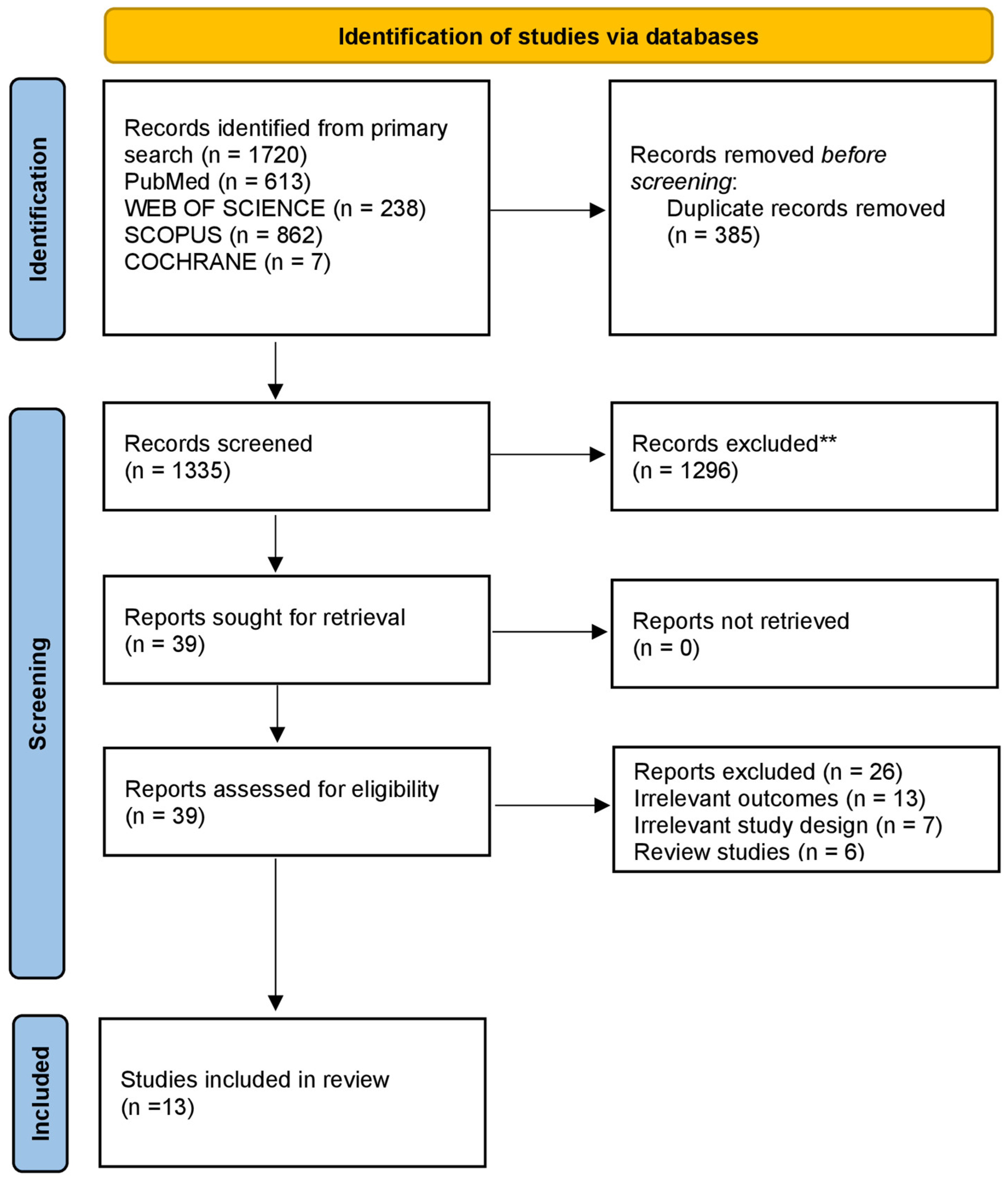
3.1. Study Selection
3.2. Main Characteristics of Included Studies
3.3. Quality Appraisal of Included Studies
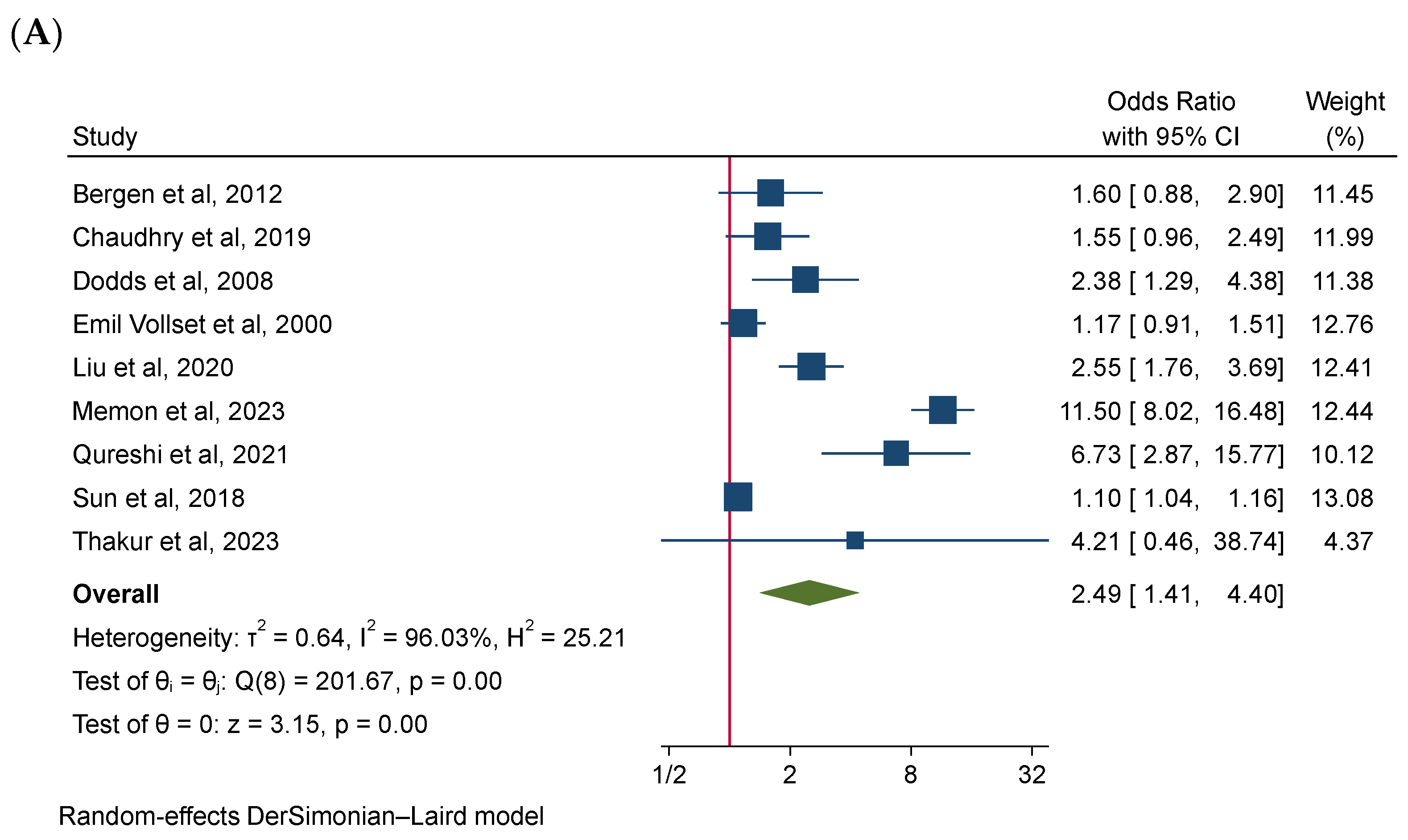
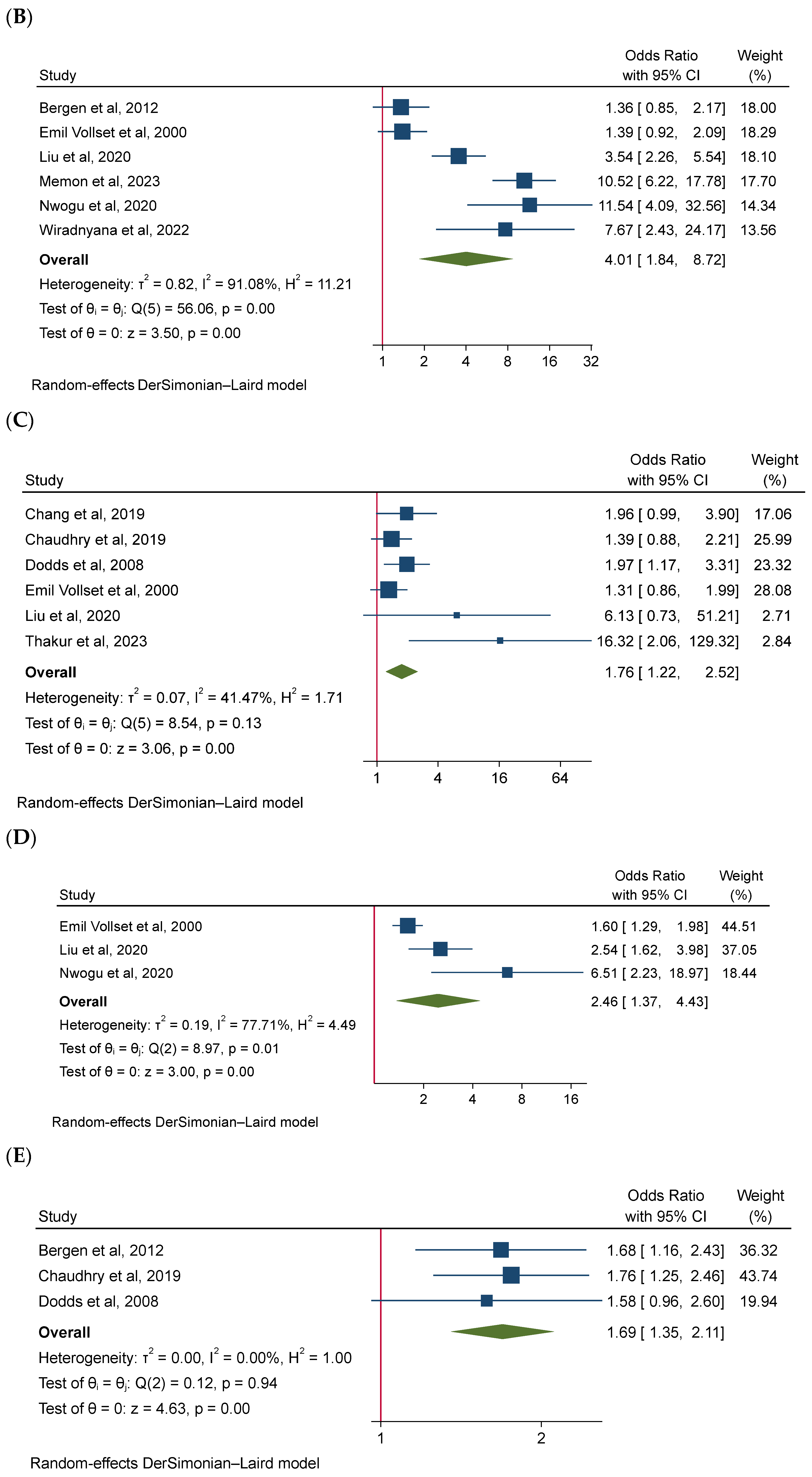
3.4. Meta-Analysis Results
3.5. Summary of Certainty of Evidence, Sensitivity Analysis, and Publication Bias
4. Discussion
5. Conclusions
Supplementary Materials
Author Contributions
Funding
Institutional Review Board Statement
Informed Consent Statement
Data Availability Statement
Conflicts of Interest
Abbreviations
| BMI | Body Mass Index |
| CI | Confidence Interval |
| GH | Gestational Hypertension |
| Hcy | Homocysteine |
| LBW | Low Birth Weight |
| MS | Metabolic Syndrome |
| NOS | Newcastle-Ottawa Scale |
| OR | Odds Ratio |
| PE | Preeclampsia |
| PPROM | Preterm Premature Rupture of Membranes |
| SGA | Small for Gestational Age |
References
- Ornoy, A.; Becker, M.; Weinstein-Fudim, L.; Ergaz, Z. Diabetes during pregnancy: A maternal disease complicating the course of pregnancy with long-term deleterious effects on the offspring. a clinical review. Int. J. Mol. Sci. 2021, 22, 2965. [Google Scholar] [CrossRef]
- Hajipour, M.; Soltani, M.; Safari-Faramani, R.; Khazaei, S.; Etemad, K.; Rahmani, S.; Valadbeigi, T.; Yaghoobi, H.; Rezaeian, S. Maternal sleep and related pregnancy outcomes: A Multicenter cross-sectional study in 11 provinces of Iran. J. Fam. Reprod. Health 2021, 15, 53. [Google Scholar] [CrossRef] [PubMed]
- Sharami, S.H.; Kabodmehri, R.; Hosseinzadeh, F.; Montazeri, S.; Ghalandari, M.; Dalil Heirati, S.F.; Ershadi, S. Effects of maternal age on the mode of delivery following induction of labor in nulliparous term pregnancies: A retrospective cohort study. Health Sci. Rep. 2022, 5, e651. [Google Scholar] [CrossRef] [PubMed]
- Muglia, L.J.; Benhalima, K.; Tong, S.; Ozanne, S. Maternal factors during pregnancy influencing maternal, fetal, and childhood outcomes. BMC Med. 2022, 20, 418. [Google Scholar] [CrossRef]
- Chang, K.-J.; Seow, K.-M.; Chen, K.-H. Preeclampsia: Recent advances in predicting, preventing, and managing the maternal and fetal life-threatening condition. Int. J. Environ. Res. Public Health 2023, 20, 2994. [Google Scholar] [CrossRef] [PubMed]
- Malha, L.; Podymow, T.; August, P. Hypertension in Pregnancy. In Hypertension; Elsevier: Amsterdam, The Netherlands, 2024; pp. 501–517. [Google Scholar]
- Ohuma, E.O.; Moller, A.-B.; Bradley, E.; Chakwera, S.; Hussain-Alkhateeb, L.; Lewin, A.; Okwaraji, Y.B.; Mahanani, W.R.; Johansson, E.W.; Lavin, T. National, regional, and global estimates of preterm birth in 2020, with trends from 2010: A systematic analysis. Lancet 2023, 402, 1261–1271. [Google Scholar] [CrossRef]
- Martín-Calvo, N.; Goni, L.; Tur, J.A.; Martínez, J.A. Low birth weight and small for gestational age are associated with complications of childhood and adolescence obesity: Systematic review and meta-analysis. Obes. Rev. 2022, 23, e13380. [Google Scholar] [CrossRef]
- Arayeshgari, M.; Najafi-Ghobadi, S.; Tarhsaz, H.; Parami, S.; Tapak, L. Machine learning-based classifiers for the prediction of low birth weight. Healthc. Inform. Res. 2023, 29, 54–63. [Google Scholar] [CrossRef]
- Cena, L.; Lazzaroni, S.; Stefana, A. The psychological effects of stillbirth on parents: A qualitative evidence synthesis of psychoanalytic literature. Z. Für Psychosom. Med. Und Psychother. 2021, 67, 329–350. [Google Scholar] [CrossRef]
- Soheili, M.; Moradi, G.; Baradaran, H.R.; Soheili, M.; Mokhtari, M.M.; Moradi, Y. Clinical manifestation and maternal complications and neonatal outcomes in pregnant women with COVID-19: A comprehensive evidence synthesis and meta-analysis. J. Matern.-Fetal Neonatal Med. 2022, 35, 5672–5685. [Google Scholar] [CrossRef]
- Dodds, L.; Fell, D.B.; Dooley, K.C.; Armson, B.A.; Allen, A.C.; Nassar, B.A.; Perkins, S.; Joseph, K. Effect of homocysteine concentration in early pregnancy on gestational hypertensive disorders and other pregnancy outcomes. Clin. Chem. 2008, 54, 326–334. [Google Scholar] [CrossRef]
- Asanidze, E.; Kristesashvili, J.; Parunashvili, N.; Urjumelashvili, M.; Tsetskhladze, Z.; Asanidze, A. Hyperhomocysteinemia and pregnancy outcomes in women with polycystic ovary syndrome: A case-control study. Int. J. Reprod. Biomed. 2023, 21, 167. [Google Scholar] [CrossRef] [PubMed]
- Kim, J.; Kim, H.; Roh, H.; Kwon, Y. Causes of hyperhomocysteinemia and its pathological significance. Arch. Pharmacal Res. 2018, 41, 372–383. [Google Scholar] [CrossRef] [PubMed]
- Yuan, D.; Chu, J.; Lin, H.; Zhu, G.; Qian, J.; Yu, Y.; Yao, T.; Ping, F.; Chen, F.; Liu, X. Mechanism of homocysteine-mediated endothelial injury and its consequences for atherosclerosis. Front. Cardiovasc. Med. 2023, 9, 1109445. [Google Scholar] [CrossRef] [PubMed]
- Bala, R.; Verma, R.; Budhwar, S.; Prakash, N.; Sachan, S. Fetal hyperhomocysteinemia is associated with placental inflammation and early breakdown of maternal-fetal tolerance in pre-term birth. Am. J. Reprod. Immunol. 2022, 88, e13589. [Google Scholar] [CrossRef]
- Hogeveen, M.; Blom, H.J.; Den Heijer, M. Maternal homocysteine and small-for-gestational-age offspring: Systematic review and meta-analysis. Am. J. Clin. Nutr. 2012, 95, 130–136. [Google Scholar] [CrossRef]
- Cawley, S.; O’Malley, E.G.; Kennedy, R.A.; Reynolds, C.M.; Molloy, A.M.; Turner, M.J. The relationship between maternal plasma homocysteine in early pregnancy and birth weight. J. Matern.-Fetal Neonatal Med. 2020, 33, 3045–3049. [Google Scholar] [CrossRef]
- Rubini, E.; Snoek, K.M.; Schoenmakers, S.; Willemsen, S.P.; Sinclair, K.D.; Rousian, M.; Steegers-Theunissen, R.P. First trimester maternal homocysteine and embryonic and fetal growth: The Rotterdam Periconception Cohort. Nutrients 2022, 14, 1129. [Google Scholar] [CrossRef]
- Chen, Y.; Li, C.; Lei, Y.; Zhang, F. Effects of glycated serum protein, homocysteine, and cystatin-C levels on pregnancy outcomes in patients with gestational diabetes mellitus. Pak. J. Med. Sci. 2024, 40, 572. [Google Scholar] [CrossRef]
- Zheng, Y.; Deng, H.-Y.; Qiao, Z.-Y.; Gong, F.-X. Homocysteine level and gestational diabetes mellitus: A systematic review and meta-analysis. Gynecol. Endocrinol. 2021, 37, 987–994. [Google Scholar] [CrossRef]
- Gong, T.; Wang, J.; Yang, M.; Shao, Y.; Liu, J.; Wu, Q.; Xu, Q.; Wang, H.; He, X.; Chen, Y. Serum homocysteine level and gestational diabetes mellitus: A meta-analysis. J. Diabetes Investig. 2016, 7, 622–628. [Google Scholar] [CrossRef] [PubMed]
- Gaiday, A.N.; Tussupkaliyev, A.B.; Bermagambetova, S.K.; Zhumagulova, S.S.; Sarsembayeva, L.K.; Dossimbetova, M.B.; Daribay, Z.Z. Effect of homocysteine on pregnancy: A systematic review. Chem. Biol. Interact. 2018, 293, 70–76. [Google Scholar] [CrossRef] [PubMed]
- Page, M.J.; McKenzie, J.E.; Bossuyt, P.M.; Boutron, I.; Hoffmann, T.C.; Mulrow, C.D.; Shamseer, L.; Tetzlaff, J.M.; Moher, D. Updating guidance for reporting systematic reviews: Development of the PRISMA 2020 statement. J. Clin. Epidemiol. 2021, 134, 103–112. [Google Scholar] [CrossRef] [PubMed]
- Brooke, B.S.; Schwartz, T.A.; Pawlik, T.M. MOOSE Reporting Guidelines for Meta-analyses of Observational Studies. JAMA Surg. 2021, 156, 787–788. [Google Scholar] [CrossRef]
- Peterson, J.; Welch, V.; Losos, M.; Tugwell, P. The Newcastle-Ottawa scale (NOS) for assessing the quality of nonrandomised studies in meta-analyses. Ott. Hosp. Res. Inst. 2011, 2, 1–12. [Google Scholar]
- Brozek, J.L.; Canelo-Aybar, C.; Akl, E.A.; Bowen, J.M.; Bucher, J.; Chiu, W.A.; Cronin, M.; Djulbegovic, B.; Falavigna, M.; Guyatt, G.H.; et al. GRADE Guidelines 30: The GRADE approach to assessing the certainty of modeled evidence-An overview in the context of health decision-making. J. Clin. Epidemiol. 2021, 129, 138–150. [Google Scholar] [CrossRef]
- Chandler, J.; Cumpston, M.; Li, T.; Page, M.J.; Welch, V. Cochrane Handbook for Systematic Reviews of Interventions; John Wiley and Sons: Hoboken, NJ, USA, 2019; Volume 4, p. 14651858. [Google Scholar]
- Egger, M.; Davey Smith, G.; Schneider, M.; Minder, C. Bias in meta-analysis detected by a simple, graphical test. Br. Med. J. 1997, 315, 629–634. [Google Scholar] [CrossRef]
- Bergen, N.; Jaddoe, V.; Timmermans, S.; Hofman, A.; Lindemans, J.; Russcher, H.; Raat, H.; Steegers-Theunissen, R.; Steegers, E. Homocysteine and folate concentrations in early pregnancy and the risk of adverse pregnancy outcomes: The Generation R Study. BJOG Int. J. Obstet. Gynaecol. 2012, 119, 739–751. [Google Scholar] [CrossRef]
- Chang, H.; Xie, L.; Ge, H.; Wu, Q.; Wen, Y.; Zhang, D.; Zhang, Y.; Ma, H.; Gao, J.; Wang, C.C. Effects of hyperhomocysteinaemia and metabolic syndrome on reproduction in women with polycystic ovary syndrome: A secondary analysis. Reprod. Biomed. Online 2019, 38, 990–998. [Google Scholar] [CrossRef]
- Chaudhry, S.H.; Taljaard, M.; MacFarlane, A.J.; Gaudet, L.M.; Smith, G.N.; Rodger, M.; Rennicks White, R.; Walker, M.C.; Wen, S.W. The role of maternal homocysteine concentration in placenta-mediated complications: Findings from the Ottawa and Kingston birth cohort. BMC Pregnancy Childbirth 2019, 19, 75. [Google Scholar] [CrossRef] [PubMed]
- Liu, C.; Luo, D.; Wang, Q.; Ma, Y.; Ping, L.; Wu, T.; Tang, J.; Peng, D.; Zhao, P. Serum homocysteine and folate concentrations in early pregnancy and subsequent events of adverse pregnancy outcome: The Sichuan Homocysteine study. BMC Pregnancy Childbirth 2020, 20, 176. [Google Scholar] [CrossRef] [PubMed]
- Memon, S.I.; Acharya, N.S.; Acharya, S.; Potdar, J.; Karnik, M.; Mohammad, S.; Acharya, N. Maternal Hyperhomocysteinemia as a Predictor of Placenta-Mediated Pregnancy Complications: A Two-Year Novel Study. Cureus 2023, 15, e37461. [Google Scholar] [CrossRef] [PubMed]
- Mishra, J.; Puri, M.; Sachdeva, M.; Kaur, L.; Saraswathy, K. Hyperhomocysteinemia and folate deficiency in preterm premature rupture of membranes: A hospital based case control study (India). J. Womens Health Issues Care 2018, 4, 2. [Google Scholar]
- Nwogu, C.M.; Okunade, K.S.; Adenekan, M.A.; Sekumade, A.I.; John-Olabode, S.; Oluwole, A.A. Association between maternal serum homocysteine concentrations in early pregnancy and adverse pregnancy outcomes. Ann. Afr. Med. 2020, 19, 113–118. [Google Scholar] [CrossRef]
- Qureshi, Z.; Chaudhry, M.A.; Imdad, S.; Farani, T.M.; Humayun, A. Association of Maternal Hyperhomocysteinemia with Preeclampsia: A Hospital Based Case-Control Study. Proceedings 2021, 35, 45–50. [Google Scholar] [CrossRef]
- Sun, F.; Qian, W.; Zhang, C.; Fan, J.-X.; Huang, H.-F. Correlation of maternal serum homocysteine in the first trimester with the development of gestational hypertension and preeclampsia. Med. Sci. Monit. Int. Med. J. Exp. Clin. Res. 2017, 23, 5396. [Google Scholar] [CrossRef]
- Thakur, P.; Bhalerao, A. Raised Maternal Homocysteine Levels in Antenatal Women at 10 to 14 Weeks of Gestation and Placenta-Mediated Complications: A Cohort Study. Cureus 2023, 15, e40423. [Google Scholar] [CrossRef]
- Vollset, S.E.; Refsum, H.; Irgens, L.M.; Emblem, B.M.; Tverdal, A.; Gjessing, H.K.; Monsen, A.L.B.; Ueland, P.M. Plasma total homocysteine, pregnancy complications, and adverse pregnancy outcomes: The Hordaland Homocysteine study. Am. J. Clin. Nutr. 2000, 71, 962–968. [Google Scholar] [CrossRef]
- Wiradnyana, A.A.G.P.; Kusuma, A.A.N.J.; Suwardewa, T.G.A.; Suardika, A.; Aryana, M.B.D.; Budiana, N.G.; Mahayasa, P.D.; Kusuardiyanto, I.P. High maternal homocysteine (Hcy) levels as a risk factor of preterm labor: A case-control study. Bali Med. J. 2022, 11, 2057–2061. [Google Scholar] [CrossRef]
- Kim, M.; Hong, S.-C.; Choi, J.; Han, J.-Y.; Oh, M.-J.; Kim, H.; Nava-Ocampo, A.; Koren, G. Homocysteine, folate and pregnancy outcomes. J. Obstet. Gynaecol. 2012, 32, 520–524. [Google Scholar] [CrossRef] [PubMed]
- Mishra, J.; Tomar, A.; Puri, M.; Jain, A.; Saraswathy, K. Trends of folate, vitamin B12, and homocysteine levels in different trimesters of pregnancy and pregnancy outcomes. Am. J. Hum. Biol. 2020, 32, e23388. [Google Scholar] [CrossRef] [PubMed]
- D’Souza, S.W.; Glazier, J.D. Homocysteine metabolism in pregnancy and developmental impacts. Front. Cell Dev. Biol. 2022, 10, 802285. [Google Scholar] [CrossRef] [PubMed]
- Bala, R.; Verma, R.; Verma, P.; Singh, V.; Yadav, N.; Rajender, S.; Agrawal, N.R.; Singh, K. Hyperhomocysteinemia and low vitamin B12 are associated with the risk of early pregnancy loss: A clinical study and meta-analyses. Nutr. Res. 2021, 91, 57–66. [Google Scholar] [CrossRef]
- Zhang, C.; Hu, J.; Wang, X.; Gu, H. High level of homocysteine is associated with pre-eclampsia risk in pregnant woman: A meta-analysis. Gynecol. Endocrinol. 2022, 38, 705–712. [Google Scholar] [CrossRef]
- Xu, Y.; Xu, Y.; Yu, Z.; He, D. Homocysteine modulates CXCL10/CXCR3 axis activity to induce endothelial dysfunction. Cell. Mol. Biol. 2024, 70, 197–204. [Google Scholar] [CrossRef]
- Dymara-Konopka, W.; Laskowska, M. The role of nitric oxide, ADMA, and homocysteine in the etiopathogenesis of preeclampsia. Int. J. Mol. Sci. 2019, 20, 2757. [Google Scholar] [CrossRef]
- Toda, N.; Okamura, T. Hyperhomocysteinemia impairs regional blood flow: Involvements of endothelial and neuronal nitric oxide. Pflügers Arch.-Eur. J. Physiol. 2016, 468, 1517–1525. [Google Scholar] [CrossRef]
- Aghayan, S.S.; Farajzadeh, A.; Bagheri-Hosseinabadi, Z.; Fadaei, H.; Yarmohammadi, M.; Jafarisani, M. Elevated homocysteine, as a biomarker of cardiac injury, in panic disorder patients due to oxidative stress. Brain Behav. 2020, 10, e01851. [Google Scholar] [CrossRef]
- Zahedi, A.S.; Daneshpour, M.S.; Akbarzadeh, M.; Hedayati, M.; Azizi, F.; Zarkesh, M. Association of baseline and changes in adiponectin, homocysteine, high-sensitivity C-reactive protein, interleukin-6, and interleukin-10 levels and metabolic syndrome incidence: Tehran lipid and glucose study. Heliyon 2023, 9, e19911. [Google Scholar] [CrossRef]
- Shademan, B.; Nourazarian, A.; Laghousi, D.; Karamad, V.; Nikanfar, M. Exploring potential serum levels of Homocysteine, interleukin-1 beta, and apolipoprotein B 48 as new biomarkers for patients with ischemic stroke. J. Clin. Lab. Anal. 2021, 35, e23996. [Google Scholar] [CrossRef]
- Thakur, P.; Bhalerao, A. High homocysteine levels during pregnancy and its Association with placenta-mediated complications: A scoping review. Cureus 2023, 15, e35244. [Google Scholar] [CrossRef]
- Leoncini, G.; Bruzzese, D.; Signorello, M. Activation of p38 MAPKinase/cPLA2 pathway in homocysteine-treated platelets. J. Thromb. Haemost. 2006, 4, 209–216. [Google Scholar] [CrossRef]
- Litvinov, R.I.; Peshkova, A.D.; Le Minh, G.; Khaertdinov, N.N.; Evtugina, N.G.; Sitdikova, G.F.; Weisel, J.W. Effects of hyperhomocysteinemia on the platelet-driven contraction of blood clots. Metabolites 2021, 11, 354. [Google Scholar] [CrossRef]
- Capatina, N.; Burton, G.J.; Yung, H.W. Elevated homocysteine activates unfolded protein responses and causes aberrant trophoblast differentiation and mouse blastocyst development. Physiol. Rep. 2022, 10, e15467. [Google Scholar] [CrossRef]
- Wan, C.; Zong, R.-Y.; Chen, X.-S. The new mechanism of cognitive decline induced by hypertension: High homocysteine-mediated aberrant DNA methylation. Front. Cardiovasc. Med. 2022, 9, 928701. [Google Scholar] [CrossRef]
- Shen, W.; Gao, C.; Cueto, R.; Liu, L.; Fu, H.; Shao, Y.; Yang, W.Y.; Fang, P.; Choi, E.T.; Wu, Q. Homocysteine-methionine cycle is a metabolic sensor system controlling methylation-regulated pathological signaling. Redox Biol. 2020, 28, 101322. [Google Scholar] [CrossRef] [PubMed]



| Study | Country | n | Hcy Cut-Off µmol/L | Age (Years) | BMI (kg/m2) | Main Outcome * | NOS Risk of Bias Assessment |
|---|---|---|---|---|---|---|---|
| Bergen et al., 2012 [30] | Netherlands | 5805 | ≥8.3 | 29.8 ± 5.0 | 23.5 ± 3.4 | High Hcy associated with lower placental weight, lower birthweight, and increased risk of SGA | 8/9 (Good quality) Selection: 4/4, Comparability: 2/2, Outcome: 2/3 |
| Chang et al., 2019 [31] | China | 936 | >12.14 | 27.9 ± 3.3 | 24.1 ± 4.2 | High Hcy associated with reduced ovulation and increased miscarriage | 5/9 (Moderate quality) Selection: 2/4, Comparability: 1/2, Outcome: 2/3 |
| Chaudhry et al., 2019 [32] | Canada | 7587 | >10.0 | 30.3 ± 5.1 | 24.9 ± 5.5 | High Hcy in early to mid-second trimester associated with increased risk of SGA | 8/9 (Good quality) Selection: 4/4, Comparability: 2/2, Outcome: 2/3 |
| Dodds et al., 2008 [12] | Canada | 2119 | >10.0 | NP | NP | High Hcy in early pregnancy associated with increased risk of pregnancy loss and PE, but not with GH or SGA infants. | 5/9 (Moderate quality) Selection: 2/4, Comparability: 1/2, Outcome: 2/3 |
| Emil Vollset et al., 2000 [40] | Norway | 14,492 | >10.7 | NP | NP | High Hcy associated with PE, prematurity, very low birth weight, stillbirth, neural tube defects. | 5/9 (Moderate quality) Selection: 2/4, Comparability: 1/2, Outcome: 2/3 |
| Liu et al., 2020 [33] | China | 1163 | >12.60 | 29.8 ± 5.9 | 22.2 ± 3.1 | Higher Hcy in early pregnancy were associated with PE, preterm birth, and LBW. | 8/9 (Good quality)—Selection: 4/4 Comparability: 2/2 Outcome: 2/3 |
| Memon et al., 2023 [34] | India | 810 | >15 | 26.5 ± 4.1 | 22.2 ± 3.1 | High Hcy levels in early pregnancy were associated with PE, fetal growth restriction, PTB, placental abruption, and IUFD. | 7/9 (Good quality)—Selection: 3/4 Comparability: 2/2 Outcome: 2/3 |
| Mishra et al., 2018 [35] | India | 280 | >15 | 24.7 ± 4.5 | NP | High Hcy levels and folate deficiency were associated with PPROM. | 7/9 (Good quality)—Selection: 3/4 Comparability: 2/2 Outcome: 2/3 |
| Nwogu et al., 2020 [36] | Nigeria | 167 | >15 | 28.7 ± 4.3 | NP | Elevated maternal Hcy was associated with PTB and LBW in term neonates. | 8/9 (Good quality) -Selection: 4/4 Comparability: 2/2 Outcome: 2/3 |
| Qureshi et al., 2021 [37] | Pakistan | 132 | ≥15 | 26.7 ± 5.8 | NP | High Hcy levels significantly associated with PE | 5/9 (Moderate quality) Selection: 2/4, Comparability: 1/2, Outcome: 2/3 |
| Sun et al., 2017 [38] | China | 9130 | NP | 31.1 ± 4.2 | 23.6 ± 3.6 | Elevated maternal Hcy in the first trimester is an independent risk factor for severe PE, but not for GH or mild PE. | 8/9 (Good quality)—Selection: 4/4 Comparability: 2/2 Outcome: 2/3 |
| Thakur et al., 2023 [39] | India | 120 | >15 | 21–25 ¥ | 18.5–24.9 ¥ | High maternal serum Hcy in the late first trimester are associated with placenta-mediated complications such as abruption, PE, fetal growth restriction, and pregnancy loss. | 8/9 (Good quality)—Selection: 4/4 Comparability: 2/2 Outcome: 2/3 |
| Wiradnyana et al., 2022 [41] | Indonesia | 60 | ≥12.85 | 26.5 (20–40) § | 22.5 (20–24) § | High maternal serum Hcy levels increase the risk of PTB by 9.118 times compared to low Hcy levels. | 8/9 (Good quality)—Selection: 4/4 Comparability: 2/2 Outcome: 2/3 |
| Study (Year) | PE | PTB | LBW | SGA | Fetal Loss | Abruption/IUGR/Other |
|---|---|---|---|---|---|---|
| Bergen et al., 2012 [30] | — | — | Reduced BW | OR: 1.70 | — | — |
| Vollset et al., 2000 [40] | OR: 1.32 (0.98–1.77) | OR: 1.38 (1.09–1.75) | OR: 2.01 (1.23–3.27) | — | — | — |
| Dodds et al., 2008 [12] | RR: 2.7 (1.4–5.0) | — | — | — | RR: 2.1 (1.2–3.6) | — |
| Chaudhry et al., 2019 [32] | — | — | — | OR: 1.76 (1.25–2.46) | — | Composite: OR 1.63 (1.23–2.16) |
| Liu et al., 2020 [33] | — | — | — | — | — | APO: aOR 5.89 (4.08–8.51) |
| Nwogu et al., 2020 [36] | — | Significant assoication | Significant assoication | — | — | — |
| Memon et al., 2023 [34] | 65.18% | 28.13% | — | — | IUFD reported | FGR: 34.38% |
| Mishra et al., 2018 [35] | — | PPROM OR: 8.46 | — | — | — | — |
| Qureshi et al., 2021 [37] | aOR: 4.72 | — | — | — | — | — |
| Thakur et al., 2023 [39] | Severe PE: 21.66% | — | — | — | Pregnancy loss reported | Abruption: 30%; IUGR: 20% |
| Wiradnyana et al., 2022 [41] | — | aOR: 9.118 (2.581–32.211) | — | — | — | — |
| Sun et al., 2017 [38] | Severe PE aOR: 1.12 (1.06–1.20) | — | — | — | — | GH null |
| Chang et al., 2019 [31] | — | — | — | — | Miscarriage ↑ | Reproductive outcomes ↑ |
Disclaimer/Publisher’s Note: The statements, opinions and data contained in all publications are solely those of the individual author(s) and contributor(s) and not of MDPI and/or the editor(s). MDPI and/or the editor(s) disclaim responsibility for any injury to people or property resulting from any ideas, methods, instructions or products referred to in the content. |
© 2026 by the authors. Licensee MDPI, Basel, Switzerland. This article is an open access article distributed under the terms and conditions of the Creative Commons Attribution (CC BY) license.
Share and Cite
Abu-Zaid, A.; Baradwan, S.; Alshahrani, M.S.; Khadawardi, K.; Awadh, N.; Albelwi, H.; Adly, H.M.; Saleh, S.A.K.; Abuzaid, M.; Tulbah, M.; et al. The Role of Maternal Homocysteine Concentration in Pregnancy Complications: A Systematic Review and Meta-Analysis. J. Clin. Med. 2026, 15, 3216. https://doi.org/10.3390/jcm15093216
Abu-Zaid A, Baradwan S, Alshahrani MS, Khadawardi K, Awadh N, Albelwi H, Adly HM, Saleh SAK, Abuzaid M, Tulbah M, et al. The Role of Maternal Homocysteine Concentration in Pregnancy Complications: A Systematic Review and Meta-Analysis. Journal of Clinical Medicine. 2026; 15(9):3216. https://doi.org/10.3390/jcm15093216
Chicago/Turabian StyleAbu-Zaid, Ahmed, Saeed Baradwan, Majed Saeed Alshahrani, Khalid Khadawardi, Neveen Awadh, Hedaya Albelwi, Heba M. Adly, Saleh A. K. Saleh, Mohammed Abuzaid, Maha Tulbah, and et al. 2026. "The Role of Maternal Homocysteine Concentration in Pregnancy Complications: A Systematic Review and Meta-Analysis" Journal of Clinical Medicine 15, no. 9: 3216. https://doi.org/10.3390/jcm15093216
APA StyleAbu-Zaid, A., Baradwan, S., Alshahrani, M. S., Khadawardi, K., Awadh, N., Albelwi, H., Adly, H. M., Saleh, S. A. K., Abuzaid, M., Tulbah, M., & Alomar, O. (2026). The Role of Maternal Homocysteine Concentration in Pregnancy Complications: A Systematic Review and Meta-Analysis. Journal of Clinical Medicine, 15(9), 3216. https://doi.org/10.3390/jcm15093216