Prolonged Post-Scabietic Pruritus: Clinical Characteristics and Unmet Management Needs in a Real-World Cohort

Abstract
1. Introduction
2. Materials and Methods
2.1. Study Design and Setting
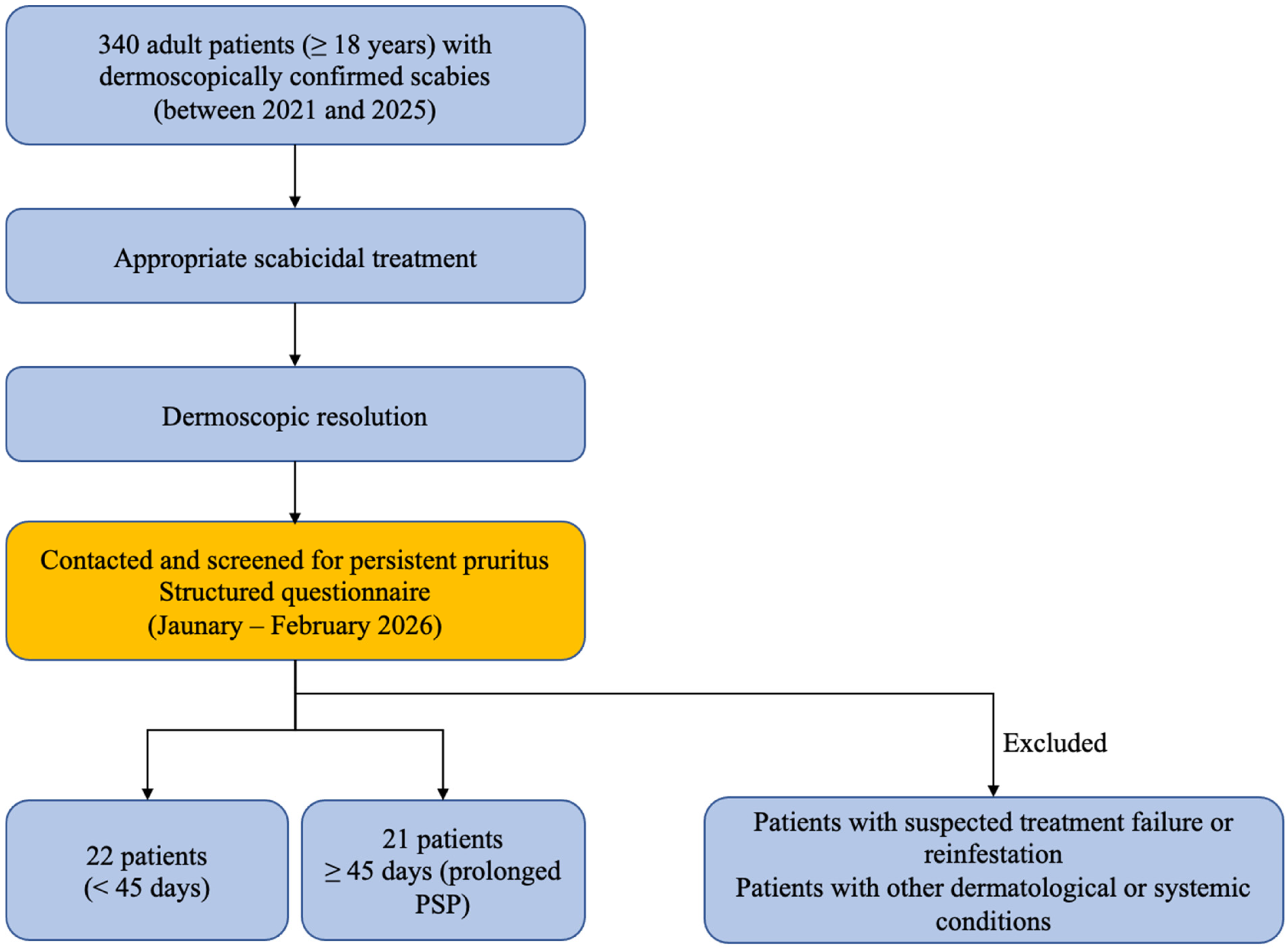
2.2. Study Population
2.3. Data Collection
2.4. Ethical Considerations
2.5. Statistical Analysis
3. Results
4. Discussion
4.1. Severity and Chronicity of Symptoms
4.2. Nodular Subtype
4.3. Environmental Aggravating Factors
4.4. Atopic Predisposition and House Dust Mite Allergy
4.5. Clinical Implications and Management Gaps
5. Conclusions
Author Contributions
Funding
Institutional Review Board Statement
Informed Consent Statement
Data Availability Statement
Conflicts of Interest
Abbreviations
| PSP | post-scabietic pruritus; |
| VAS | Visual Analogue Scale; |
| HDM | house dust mite |
References
- Uzun, S.; Durdu, M.; Yürekli, A.; Mülayim, M.K.; Akyol, M.; Velipaşaoğlu, S.; Harman, M.; Taylan-Özkan, A.; Şavk, E.; Demir-Dora, D.; et al. Clinical practice guidelines for the diagnosis and treatment of scabies. Int. J. Dermatol. 2024, 63, 1642–1656. [Google Scholar] [CrossRef]
- Karimkhani, C.; Colombara, D.V.; Drucker, A.M.; Norton, S.A.; Hay, R.; Engelman, D.; Steer, A.; Whitfeld, M.; Naghavi, M.; Dellavalle, R.P. The global burden of scabies: A cross-sectional analysis from the Global Burden of Disease Study 2015. Lancet Infect. Dis. 2017, 17, 1247–1254. [Google Scholar] [CrossRef]
- Engelman, D.; Kiang, K.; Chosidow, O.; McCarthy, J.; Fuller, C.; Lammie, P.; Hay, R.; Steer, A.; Members of the International Alliance for the Control of Scabies. Toward the global control of human scabies: Introducing the International Alliance for the Control of Scabies. PLoS Neglected Trop. Dis. 2013, 7, e2167. [Google Scholar] [CrossRef]
- Sunderkötter, C.; Aebischer, A.; Neufeld, M.; Löser, C.; Kreuter, A.; Bialek, R.; Hamm, H.; Feldmeier, H. Increase of scabies in Germany and development of resistant mites? Evidence and consequences. J. Dtsch. Dermatol. Ges. 2019, 17, 15–23. [Google Scholar] [CrossRef]
- Salavastru, C.M.; Chosidow, O.; Boffa, M.J.; Janier, M.; Tiplica, G.S. European guideline for the management of scabies. J. Eur. Acad. Dermatol. Venereol. 2017, 31, 1248–1253. [Google Scholar] [CrossRef]
- Kemperman, P.M.J.H.; Vos, M.H.E.L.; Hekker, T.A.M.; Lokin, A.S.H.J.; Vulink, N.C.C. Post-scabies itch: An overview of causes and treatment strategies. Ned. Tijdschr. Geneeskd. 2023, 167, D7812. [Google Scholar]
- Jannic, A.; Bernigaud, C.; Brenaut, E.; Chosidow, O. Scabies itch. Dermatol. Clin. 2018, 36, 301–308. [Google Scholar] [CrossRef] [PubMed]
- Chiu, L.W.; Berger, T.G.; Chang, A.Y. Management of common scabies and postscabetic itch in adults: Lessons learned from a single-center retrospective cohort study. Int. J. Womens Dermatol. 2021, 7, 716–720. [Google Scholar] [CrossRef] [PubMed]
- Ständer, S.; Ständer, S. Itch in scabies—What do we know? Front. Med. 2021, 8, 628392. [Google Scholar] [CrossRef]
- Zhao, Y.K.; Lu, J.F.; Liu, J.H.; Wu, H.-H.; Song, L.-L.; Wan, C.-L.; Luo, D.-Q. Recalcitrant nodular scabies showing excellent response to tofacitinib: Five case reports. Ther. Adv. Chronic Dis. 2023, 14, 20406223231195632. [Google Scholar] [CrossRef]
- Hashimoto, K.; Fujiwara, K.; Punwaney, J.; DiGregorio, F.; Bostrom, P.; El-Hoshy, K.; Aronson, P.J.; Schoenfeld, R.J. Post-scabetic nodules: A lymphohistiocytic reaction rich in indeterminate cells. J. Dermatol. 2000, 27, 181–194. [Google Scholar] [CrossRef] [PubMed]
- Ruby, K.N.; Loo, E.Y.; Mann, J.A.; LeBlanc, R.E. Post-scabietic nodules: Mimicker of infantile indeterminate cell histiocytosis and potential diagnostic pitfall. J. Cutan. Pathol. 2020, 47, 52–56. [Google Scholar] [CrossRef]
- Al Janahi, S.; Al Maashari, R.; Saleem, T. This “mite” surprise you: Scabies masquerading as Langerhans cell histiocytosis—A case report. Case Rep. Dermatol. 2024, 16, 35–41. [Google Scholar] [CrossRef] [PubMed]
- Veraldi, S.; Esposito, L.; Pontini, P.; Nazzaro, G. Nodular scabies versus postscabies prurigo: A critical review of the literature. Ital. J. Dermatol. Venereol. 2021, 156, 42–43. [Google Scholar] [CrossRef]
- Yosipovitch, G.; Bernhard, J.D. Clinical practice. Chronic pruritus. New Engl. J. Med. 2013, 368, 1625–1634. [Google Scholar] [CrossRef] [PubMed]
- Skayem, C.; Richard, M.A.; Aroman, M.S.; Merhand, S.; Ben Hayoun, Y.; Baissac, C.; Halioua, B.; Taieb, C.; Staumont-Sallé, D. Epidemiology of atopic dermatitis: A global worldwide study. Clin. Exp. Dermatol. 2025, 50, 2054–2056. [Google Scholar] [CrossRef]
- Kurt, E.; Metintas, S.; Basyigit, I.; Bulut, I.; Coskun, E.; Dabak, S.; Deveci, F.; Fidan, F.; Kaynar, H.; Uzaslan, E.K.; et al. Prevalence and risk factors of allergies in Turkey (PARFAIT): Results of a multicentre cross-sectional study in adults. Eur. Respir. J. 2009, 33, 724–733. [Google Scholar] [CrossRef]
- Bousquet, J.; Khaltaev, N.; Cruz, A.A.; Denburg, J.; Fokkens, W.J.; Togias, A.; Zuberbier, T.; Baena-Cagnani, C.E.; Canonica, G.W.; Van Weel, C.; et al. Allergic Rhinitis and its Impact on Asthma (ARIA) 2008. Allergy 2008, 63, 8–160. [Google Scholar] [CrossRef]
- Calderón, M.A.; Linneberg, A.; Kleine-Tebbe, J.; De Blay, F.; de Rojas, D.H.F.; Virchow, J.C.; Demoly, P. Respiratory allergy caused by house dust mites: What do we really know? J. Allergy Clin. Immunol. 2015, 136, 38–48. [Google Scholar] [CrossRef]
- Garcovich, S.; Maurelli, M.; Gisondi, P.; Peris, K.; Yosipovitch, G.; Girolomoni, G. Pruritus as a distinctive feature of type 2 inflammation. Vaccines 2021, 9, 303. [Google Scholar] [CrossRef]
- Taşkapan, O.; Doğan, B.; Harmanyeri, Y. Atopy patch test reactivity to house dust mites in patients with scabies. Int. J. Dermatol. 2003, 42, 246–248. [Google Scholar] [CrossRef] [PubMed]
- Arlian, L.G.; Vyszenski-Moher, D.L.; Ahmed, S.G.; Estes, S.A. Cross-Antigenicity Between the Scabies Mite, Sarcoptes scabiei, and the House Dust Mite, Dermatophagoides pteronyssinus. J. Investig. Dermatol. 1991, 96, 349–361. [Google Scholar] [CrossRef] [PubMed][Green Version]
- Yıldırım, S.K.; Öğüt, N.D.; Erbağcı, E.; Öğüt, Ç. Scabies affects quality of life in correlation with depression and anxiety. Dermatol. Pract. Concept. 2023, 13, e2023144. [Google Scholar] [CrossRef] [PubMed]
- Lee, J.; Suh, H.; Jung, H.; Park, M.; Ahn, J. Association between chronic pruritus, depression, and insomnia: A cross-sectional study. JAAD Int. 2021, 3, 54–60. [Google Scholar] [CrossRef]


| Variable | n (%) |
|---|---|
| Demographic characteristics | |
| Age (years), Median [IQR] | 37 (26–52) |
| Male | 25 (58.1%) |
| Married | 20 (46.5%) |
| Allergic and clinical characteristics | |
| Allergic disease/atopy | 16 (37.2%) |
| House dust mite allergy | 9 (20.9%) |
| Nodules present | 24 (55.8%) |
| ≥2 scabies episodes | 7 (16.3%) |
| Aggravating factors for pruritus | |
| ≥1 aggravating factor * | 36 (83.7%) |
| No aggravating factor reported | 7 (16.3%) |
| Systemic comorbidity | |
| None | 27 (62.8%) |
| ≥1 systemic comorbidity | 16 (37.2%) |
| Immunosuppressive disease or drug use | 5 (11.6%) |
| Systemic medication use | |
| None | 26 (60.5%) |
| One medication | 4 (9.3%) |
| Two or more medications | 13 (30.2%) |
| Variable | n (%) |
|---|---|
| History of pruritic dermatosis before scabies | 18 (41.9%) |
| Fear of contracting scabies before diagnosis | 5 (11.6%) |
| Adopted personal measures to relieve pruritus * | 31 (72.1%) |
| No treatment for persistent pruritus after mite eradication | 19 (44.2%) |
| Received treatment for persistent pruritus ** | 24 (55.8%) |
| Outcome | Median [IQR] |
|---|---|
| Pruritus severity (VAS, 0–10) | 9 (7–10) |
| Pre-diagnosis pruritus duration (days) | 30 (14–90) |
| Post-treatment pruritus duration (days) | 45 (30–90) |
| Variable | Non-Severe (VAS < 8) n (%) | Severe (VAS ≥ 8) n (%) | p-Value |
|---|---|---|---|
| Treatment received | 3 (25.0%) | 21 (67.7%) | 0.017 |
| Nodular lesions | 8 (66.6%) | 16 (51.6%) | 0.500 |
| Allergic disease/atopy | 3 (25.0%) | 13 (41.9%) | 0.484 |
| Variable | <45 Days n (%) | ≥45 Days n (%) | p-Value |
|---|---|---|---|
| Nodular lesions | 13 (59.1%) | 11 (52.4%) | 0.763 |
| Allergic disease/atopy | 9 (40.9%) | 7 (33.3%) | 0.755 |
Disclaimer/Publisher’s Note: The statements, opinions and data contained in all publications are solely those of the individual author(s) and contributor(s) and not of MDPI and/or the editor(s). MDPI and/or the editor(s) disclaim responsibility for any injury to people or property resulting from any ideas, methods, instructions or products referred to in the content. |
© 2026 by the authors. Licensee MDPI, Basel, Switzerland. This article is an open access article distributed under the terms and conditions of the Creative Commons Attribution (CC BY) license.
Share and Cite
Akın, Ö.; Taşkapan, M.O.; Tanrıöver, Ö. Prolonged Post-Scabietic Pruritus: Clinical Characteristics and Unmet Management Needs in a Real-World Cohort. J. Clin. Med. 2026, 15, 3211. https://doi.org/10.3390/jcm15093211
Akın Ö, Taşkapan MO, Tanrıöver Ö. Prolonged Post-Scabietic Pruritus: Clinical Characteristics and Unmet Management Needs in a Real-World Cohort. Journal of Clinical Medicine. 2026; 15(9):3211. https://doi.org/10.3390/jcm15093211
Chicago/Turabian StyleAkın, Özlem, Mehmet Oktay Taşkapan, and Özlem Tanrıöver. 2026. "Prolonged Post-Scabietic Pruritus: Clinical Characteristics and Unmet Management Needs in a Real-World Cohort" Journal of Clinical Medicine 15, no. 9: 3211. https://doi.org/10.3390/jcm15093211
APA StyleAkın, Ö., Taşkapan, M. O., & Tanrıöver, Ö. (2026). Prolonged Post-Scabietic Pruritus: Clinical Characteristics and Unmet Management Needs in a Real-World Cohort. Journal of Clinical Medicine, 15(9), 3211. https://doi.org/10.3390/jcm15093211