Clinical Utility of a Feedback Device in High-Quality Cardiopulmonary Resuscitation: The Guardian Angel
 ,
,
Abstract
1. Introduction
2. Methods
2.1. Outcomes
2.2. Eligibility Criteria
2.3. Variables
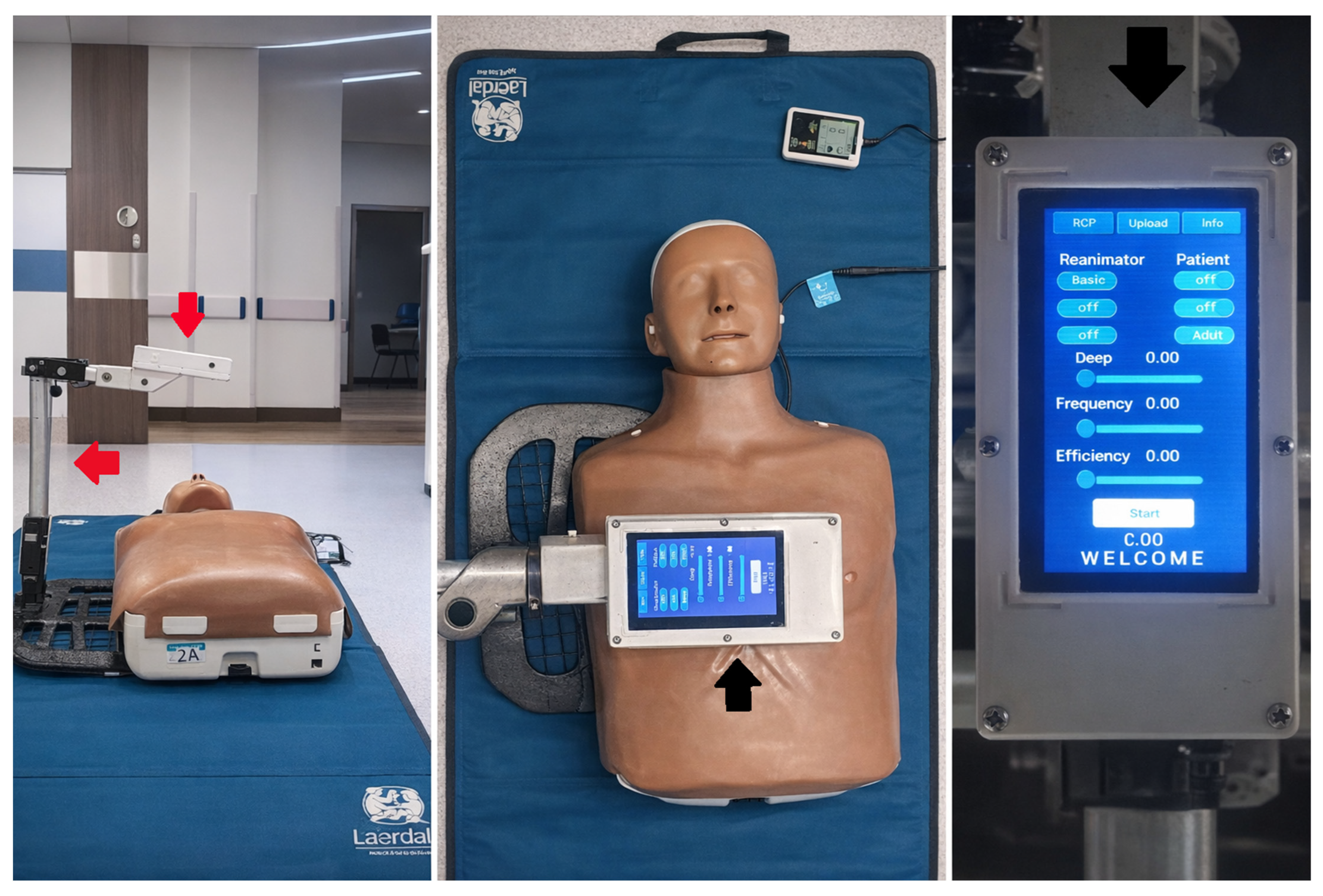
2.4. Device Design and Laboratory Testing
2.5. Study Procedure
2.6. Statistical Analysis
2.7. Ethical Considerations
3. Results
4. Discussion
Limitations
5. Conclusions
Supplementary Materials
Author Contributions
Funding
Institutional Review Board Statement
Informed Consent Statement
Data Availability Statement
Acknowledgments
Conflicts of Interest
References
- Perman, S.M.; Elmer, J.; Maciel, C.B.; Uzendu, A.; May, T.; Mumma, B.E.; Bartos, J.A.; Rodriguez, A.J.; Kurz, M.C.; Panchal, A.R.; et al. 2023 American Heart Association Focused Update on Adult Advanced Cardiovascular Life Support: An Update to the American Heart Association Guidelines for Cardiopulmonary Resuscitation and Emergency Cardiovascular Care. Circulation 2024, 149, e254–e273. [Google Scholar] [CrossRef]
- Panchal, A.R.; Berg, K.M.; Hirsch, K.G.; Kudenchuk, P.J.; Del Rios, M.; Cabañas, J.G.; Link, M.S.; Kurz, M.C.; Chan, P.S.; Morley, P.T.; et al. 2019 American Heart Association Focused Update on Advanced Cardiovascular Life Support: Use of Advanced Airways, Vasopressors, and Extracorporeal Cardiopulmonary Resuscitation During Cardiac Arrest: An Update to the American Heart Association Guidelines for Cardiopulmonary Resuscitation and Emergency Cardiovascular Care. Circulation 2019, 140, E881–E894. [Google Scholar] [CrossRef]
- Olasveengen, T.M.; Mancini, M.E.; Perkins, G.D.; Avis, S.; Brooks, S.; Castrén, M.; Chung, S.P.; Considine, J.; Couper, K.; Escalante, R.; et al. Adult Basic Life Support: 2020 International Consensus on Cardiopulmonary Resuscitation and Emergency Cardiovascular Care Science With Treatment Recommendations. Circulation 2020, 142, S41–S91. [Google Scholar] [CrossRef]
- Sood, N.; Sangari, A.; Goyal, A.; Sun, C.; Horinek, M.; Hauger, J.A.; Perry, L. Do cardiopulmonary resuscitation real-time audiovisual feedback devices improve patient outcomes? A systematic review and meta-analysis. World J. Cardiol. 2023, 15, 531–541. [Google Scholar] [CrossRef]
- Lyngby, R.M.; Händel, M.N.; Christensen, A.M.; Nikoletou, D.; Folke, F.; Christensen, H.C.; Barfod, C.; Quinn, T. Effect of real-time and post-event feedback in out-of-hospital cardiac arrest attended by EMS—A systematic review and meta-analysis. Resusc. Plus 2021, 6, 100101. [Google Scholar] [CrossRef] [PubMed]
- Vahedian-Azimi, A.; Hajiesmaeili, M.; Amirsavadkouhi, A.; Jamaati, H.; Izadi, M.; Madani, S.J.; Hashemian, S.M.R.; Miller, A.C. Effect of the Cardio First AngelTM device on CPR indices: A randomized controlled clinical trial. Crit. Care 2016, 20, 147. [Google Scholar] [CrossRef] [PubMed]
- Goharani, R.; Vahedian-Azimi, A.; Pourhoseingholi, M.A.; Amanpour, F.; Rosano, G.M.; Sahebkar, A. Survival to intensive care unit discharge among in-hospital cardiac arrest patients by applying audiovisual feedback device. ESC Hear. Fail. 2021, 8, 4652–4660. [Google Scholar] [CrossRef] [PubMed]
- Miller, A.C.; Scissum, K.; McConnell, L.; East, N.; Vahedian-Azimi, A.; Sewell, K.; Zehtabchi, S. Real-time audio-visual feedback with handheld nonautomated external defibrillator devices during cardiopulmonary resuscitation for in-hospital cardiac arrest: A meta-analysis. Int. J. Crit. Illn. Inj. Sci. 2020, 10, 109–122. [Google Scholar] [CrossRef]
- Miller, A.C.; Vahedian-Azimi, A.; Rahimibashar, F. A comparison of cardiopulmonary resuscitation with standard manual compressions versus compressions with real-time audiovisual feedback: A randomized controlled pilot study. Int. J. Crit. Illn. Inj. Sci. 2020, 10, 32–37. [Google Scholar] [CrossRef]
- Levitt, C.V.; Boone, K.; Tran, Q.K.; Pourmand, A. Application of Technology in Cardiopulmonary Resuscitation, a Narrative Review. J. Clin. Med. 2023, 12, 7383. [Google Scholar] [CrossRef]
- Harris, P.A.; Taylor, R.; Minor, B.L.; Elliott, V.; Fernandez, M.; O’Neal, L.; McLeod, L.; Delacqua, G.; Delacqua, F.; Kirby, J.; et al. The REDCap consortium: Building an international community of software platform partners. J. Biomed. Inform. 2019, 95, 103208. [Google Scholar] [CrossRef]
- Hosmer, D.W.; Lemeshow, S. Applied Logistic Regression, 3rd ed.; Hosmer, D.W., Lemeshow, S., Sturdivant, R.X., Eds.; John Wiley & Sons, Inc.: New York, NY, USA, 2013. [Google Scholar]
- Pritchard, J.; Roberge, J.; Bacani, J.; Welsford, M.; Mondoux, S. Implementation of Chest Compression Feedback Technology to Improve the Quality of Cardiopulmonary Resuscitation in the Emergency Department: A Quality Initiative Test-of-change Study. Cureus 2019, 11, e5523. [Google Scholar] [CrossRef]
- Yu, Y.; Liu, X.; Wang, L.; Gao, Y.; Ding, Y.; Ao, H. Evaluation of cardiopulmonary resuscitation quality during the pandemic of COVID-19. BMC Emerg. Med. 2022, 22, 193. [Google Scholar] [CrossRef]
- Chelladurai, G.; Azhar, A.M.N.; Isa, R.M.; Bustam, A.; Ahmad, R.; Munisamy, M. Improving cardiopulmonary resuscitation (CPR) performance using an audio-visual feedback device for healthcare providers in an emergency department setting in Malaysia: A quasi-experimental study. Med. J. Malaysia 2020, 75, 514–518. [Google Scholar]
- Wagner, M.; Gröpel, P.; Eibensteiner, F.; Kessler, L.; Bibl, K.; Gross, I.T.; Berger, A.; Cardona, F.S. Visual attention during pediatric resuscitation with feedback devices: A randomized simulation study. Pediatr. Res. 2021, 91, 1762–1768. [Google Scholar] [CrossRef]
- Kleinman, K.; Hairston, T.; Smith, B.; Billings, E.; Tackett, S.; Chopra, E.; Risko, N.; Swedien, D.; Schreurs, B.A.; Dean, J.L.; et al. Pediatric Chest Compression Improvement Via Augmented Reality Cardiopulmonary Resuscitation Feedback in Community General Emergency Departments: A Mixed-Methods Simulation-Based Pilot Study. J. Emerg. Med. 2023, 64, 696–708. [Google Scholar] [CrossRef] [PubMed]
- Picard, C.; Drew, R.; Norris, C.M.; O’dOchartaigh, D.; Burnett, C.; Keddie, C.; Douma, M.J. Cardiac Arrest Quality Improvement: A Single-Center Evaluation of Resuscitations Using Defibrillator, Feedback Device, and Survey Data. J. Emerg. Nurs. 2022, 48, 224–232.e8. [Google Scholar] [CrossRef]
- Tobase, L.; Peres, H.H.C.; Polastri, T.F.; Cardoso, S.H.; Souza, D.R.; Almeida, D.G.; Timerman, S. The Use of the Borg Rating of Perceived Exertion Scale in Cardiopulmonary Resuscitation. Arq. Bras. Cardiol. 2023, 120, e20220240. [Google Scholar] [CrossRef] [PubMed]
- Lin, S.; Scales, D.C. Cardiopulmonary resuscitation quality and beyond: The need to improve real-time feedback and physiologic monitoring. Crit. Care 2016, 20, 182. [Google Scholar] [CrossRef] [PubMed]
- Minami, K.; Kokubo, Y.; Maeda, I.; Hibino, S. A flexible pressure sensor could correctly measure the depth of chest compression on a mattress. Am. J. Emerg. Med. 2016, 34, 899–902. [Google Scholar] [CrossRef]
- Yeung, J.; Meeks, R.; Edelson, D.; Gao, F.; Soar, J.; Perkins, G.D. The use of CPR feedback/prompt devices during training and CPR performance: A systematic review. Resuscitation 2009, 80, 743–751. [Google Scholar] [CrossRef] [PubMed]
- HHostler, D.; Everson-Stewart, S.; Rea, T.D.; Stiell, I.G.; Callaway, C.W.; Kudenchuk, P.J.; Sears, G.K.; Emerson, S.S.; Nichol, G.; Resuscitation Outcomes Consortium Investigators. Effect of real-time feedback during cardiopulmonary resuscitation outside hospital: Prospective, cluster-randomised trial. BMJ 2011, 342, d512. [Google Scholar] [CrossRef] [PubMed]
- Lin, Y.; Lockey, A.; Donoghue, A.; Greif, R.; Cortegiani, A.; Farquharson, B.; Siddiqui, F.J.; Banerjee, A.; Matsuyama, T.; Cheng, A. Use of CPR feedback devices in resuscitation training: A systematic review and meta-analysis of randomized controlled trials. Resusc. Plus 2025, 23, 100939. [Google Scholar] [CrossRef]
- Jiang, J.; Yan, J.; Yao, D.; Xiao, J.; Chen, R.; Zhao, Y.; Jin, X. Comparison of the effects of using feedback devices for training or simulated cardiopulmonary arrest. J. Cardiothorac. Surg. 2024, 19, 159. [Google Scholar] [CrossRef] [PubMed]


| Total Population n = 90 | |
|---|---|
| Age years m (SD) | 31.2 (8.86) |
| Female sex n (%) | 54 (60) |
| Educational level n (%) | |
| Student | 30 (33) |
| Professional | 60(67) |
| Health student, n (%) | |
| Medicine | 18 (60) |
| Postgraduate medicine or nursing | 12 (40) |
| Health professional, n (%) | |
| Medicine | 20 (33) |
| Nursing | 27 (45) |
| Other | 13 (22) |
| CPR training, n (%) | 68 (76) |
| CPR experience, n (%) | 52 (58) |
| Without Guardian Angel n = 90 | With Guardian Angel n = 90 | p Value | |
|---|---|---|---|
| Perception of performing high-quality compressions, n (%) | 57 (63) | 87 (97) | <0.001 |
| High-quality compressions in frequency (100 to 120) in infants, n (%) | 17 (19) | 77 (85) | <0.001 |
| High-quality compressions in frequency (100 to 120) in adults/schoolchildren, n (%) | 23 (25) | 71 (79) | <0.001 |
| Without Guardian Ángel n = 90 | With Guardian Ángel n = 90 | p Value | |
|---|---|---|---|
| CPR training n = 68 (76) | |||
| High-quality compressions in depth (≥70) in the infant | 4 (6) | 61 (90) | <0.001 |
| High-quality compressions in depth (≥70) in schoolchildren/adults | 18 (26) | 65 (96) | <0.001 |
| High-quality compressions in frequency (100 to 120) in the infant | 17 (25) | 64 (94) | <0.001 |
| High-quality compressions in frequency (100 to 120) in schoolchildren/adults | 23 (34) | 62 (91) | <0.001 |
| No CPR training n = 22 (24) | |||
| High-quality compressions in depth (≥70) in the infant | 0 (0) | 8 (36) | 0.008 |
| High-quality compressions in depth (≥70) in schoolchildren/adults | 0 (0) | 10 (45) | 0.002 |
| High-quality compressions in frequency (100 to 120) in the infant | 0 (0) | 13 (59) | <0.001 |
| High-quality compressions in frequency (100 to 120) in schoolchildren/adults | 0 (0) | 9 (41) | 0.004 |
| CPR experience n = 52 (58) | |||
| High-quality compressions in depth (≥70) in the infant | 48 (8) | 48 (92) | <0.001 |
| High-quality compressions in depth (≥70) in schoolchildren/adults | 15 (29) | 50 (96) | <0.001 |
| High-quality compressions in frequency (100 to 120) in the infant | 15 (29) | 50 (96) | <0.001 |
| High-quality compressions in frequency (100 to 120) in schoolchildren/adults | 20 (38) | 50 (96) | <0.001 |
| No experience in CPR n = 38 (42) | |||
| High-quality compressions in depth (≥70) in the infant | 0 (0) | 21 (55) | <0.001 |
| High-quality compressions in depth (≥70) in schoolchildren/adults | 3 (8) | 25 (66) | <0.001 |
| High-quality compressions in frequency (100 to 120) in the infant | 0 (0) | 13 (59) | <0.001 |
| High-quality compressions in frequency (100 to 120) in schoolchildren/adults | 0 (0) | 9 (41) | <0.001 |
| Start compressions with CPR device n = 36 (40) | |||
| High-quality compressions in depth (≥70) in the infant | 3 (8) | 28 (78) | <0.001 |
| High-quality compressions in depth (≥70) in schoolchildren/adults | 10 (28) | 31 (86) | <0.001 |
| High-quality compressions in frequency (100 to 120) in the infant | 8 (22) | 32 (89) | <0.001 |
| High-quality compressions in frequency (100 to 120) in schoolchildren/adults | 12 (33) | 33 (92) | <0.001 |
| Start compressions without CPR device n = 54 (60) | |||
| High-quality compressions in depth (≥70) in the infant | 1 (2) | 41 (76) | <0.001 |
| High-quality compressions in depth (≥70) in schoolchildren/adults | 8 (15) | 44 (81) | <0.001 |
| High-quality compressions in frequency (100 to 120) in the infant | 9 (17) | 45 (83) | <0.001 |
| High-quality compressions in frequency (100 to 120) in schoolchildren/adults | 11 (20) | 38 (70) | <0.001 |
| Without reference to fatigue or mild fatigue n = 68 (75) | |||
| High-quality compressions in depth (≥70) in the infant | 3 (4) | 55 (81) | <0.001 |
| High-quality compressions in depth (≥70) in schoolchildren/adults | 15 (22) | 59 (87) | <0.001 |
| High-quality compressions in frequency (100 to 120) in the infant | 14 (21) | 61 (90) | <0.001 |
| High-quality compressions in frequency (100 to 120) in schoolchildren/adults | 18 (26) | 56 (82) | <0.001 |
| With reference to moderate or severe fatigue n = 22 (24) | |||
| High-quality compressions in depth (≥70) in the infant | 1 (4) | 14 (64) | <0.001 |
| High-quality compressions in depth (≥70) in schoolchildren/adults | 3 (14) | 16 (73) | <0.001 |
| High-quality compressions in frequency (100 to 120) in the infant | 3 (14) | 16 (73) | <0.001 |
| High-quality compressions in frequency (100 to 120) in schoolchildren/adults | 5 (23) | 15 (68) | 0.02 |
Disclaimer/Publisher’s Note: The statements, opinions and data contained in all publications are solely those of the individual author(s) and contributor(s) and not of MDPI and/or the editor(s). MDPI and/or the editor(s) disclaim responsibility for any injury to people or property resulting from any ideas, methods, instructions or products referred to in the content. |
© 2026 by the authors. Licensee MDPI, Basel, Switzerland. This article is an open access article distributed under the terms and conditions of the Creative Commons Attribution (CC BY) license.
Share and Cite
Fernández-Sarmiento, J.; Sanmiguel-Benavides, A.R.; Contreras, J.P.; Bastidas, A.; Trujillo, J.C.; Uribe, J.; Botero-Rosas, D.; Tuta-Quintero, E. Clinical Utility of a Feedback Device in High-Quality Cardiopulmonary Resuscitation: The Guardian Angel. J. Clin. Med. 2026, 15, 2839. https://doi.org/10.3390/jcm15082839
Fernández-Sarmiento J, Sanmiguel-Benavides AR, Contreras JP, Bastidas A, Trujillo JC, Uribe J, Botero-Rosas D, Tuta-Quintero E. Clinical Utility of a Feedback Device in High-Quality Cardiopulmonary Resuscitation: The Guardian Angel. Journal of Clinical Medicine. 2026; 15(8):2839. https://doi.org/10.3390/jcm15082839
Chicago/Turabian StyleFernández-Sarmiento, Jaime, Andrés Rolando Sanmiguel-Benavides, Juan Pablo Contreras, Alirio Bastidas, Juan Carlos Trujillo, Juanita Uribe, Daniel Botero-Rosas, and Eduardo Tuta-Quintero. 2026. "Clinical Utility of a Feedback Device in High-Quality Cardiopulmonary Resuscitation: The Guardian Angel" Journal of Clinical Medicine 15, no. 8: 2839. https://doi.org/10.3390/jcm15082839
APA StyleFernández-Sarmiento, J., Sanmiguel-Benavides, A. R., Contreras, J. P., Bastidas, A., Trujillo, J. C., Uribe, J., Botero-Rosas, D., & Tuta-Quintero, E. (2026). Clinical Utility of a Feedback Device in High-Quality Cardiopulmonary Resuscitation: The Guardian Angel. Journal of Clinical Medicine, 15(8), 2839. https://doi.org/10.3390/jcm15082839