Bevacizumab-Based Therapy Is Associated with Prolonged Progression-Free Survival in Patients with Peritoneal Mucinous Metastatic Colorectal Cancer
 , , , ,
Abstract
1. Introduction
2. Materials and Methods
2.1. Study Design
2.2. Patient Population
2.3. Inclusion and Exclusion Criteria
- (i)
- age ≥ 18 years,
- (ii)
- presence of metastatic disease,
- (iii)
- receipt of bevacizumab-based systemic therapy,
- (iv)
- clearly documented histological subtype in pathology reports, and
- (v)
- availability of follow-up data after treatment initiation.
2.4. Data Collection and Variables
2.5. Treatment and Response Assessment
2.6. Endpoints
2.7. Ethics Approval
2.8. Statistical Analysis
3. Results
3.1. Patient Demographic and Clinical Characteristics
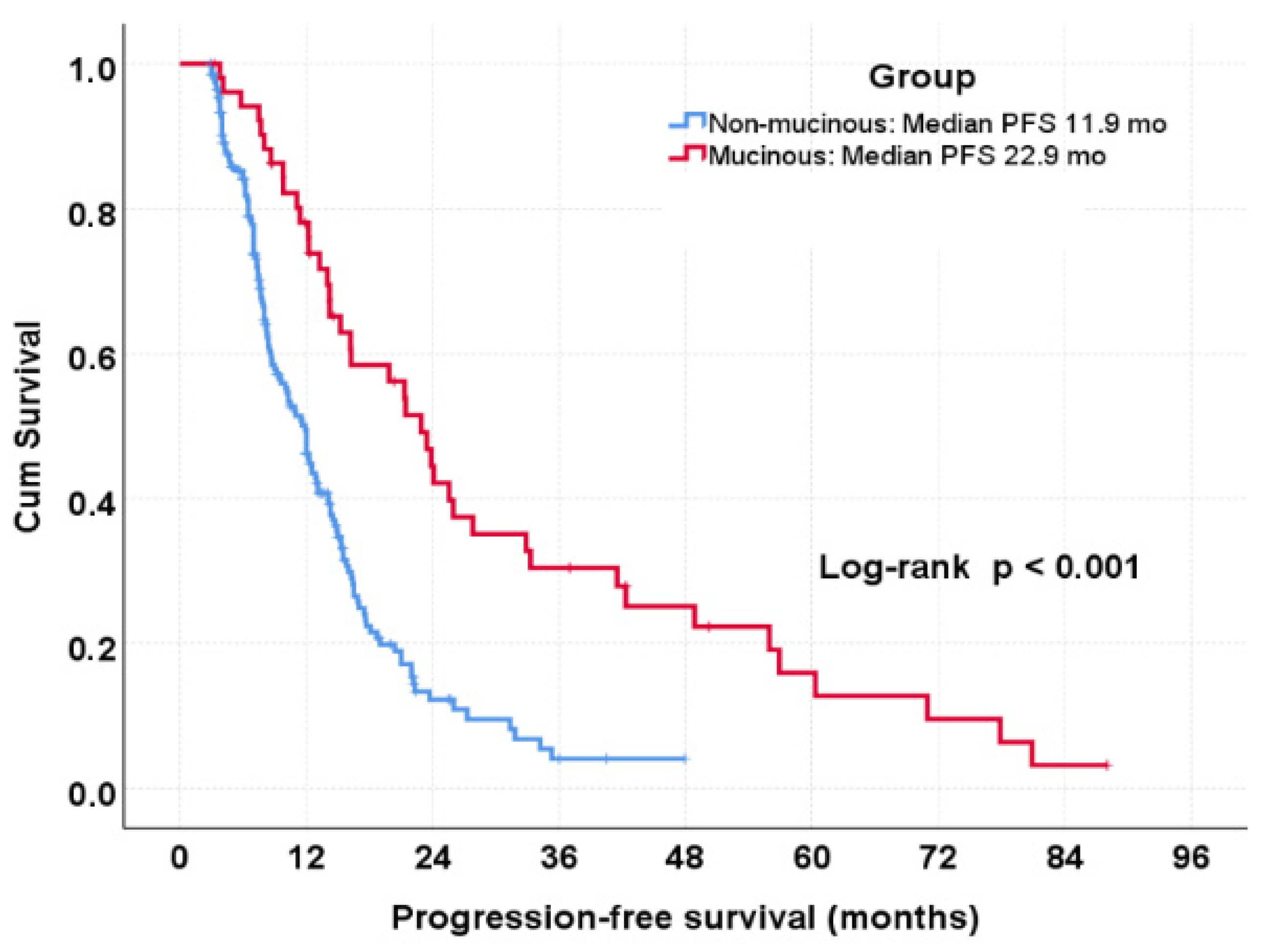
3.2. Progression-Free Survival in the Overall Cohort
3.3. Cox Regression Analysis
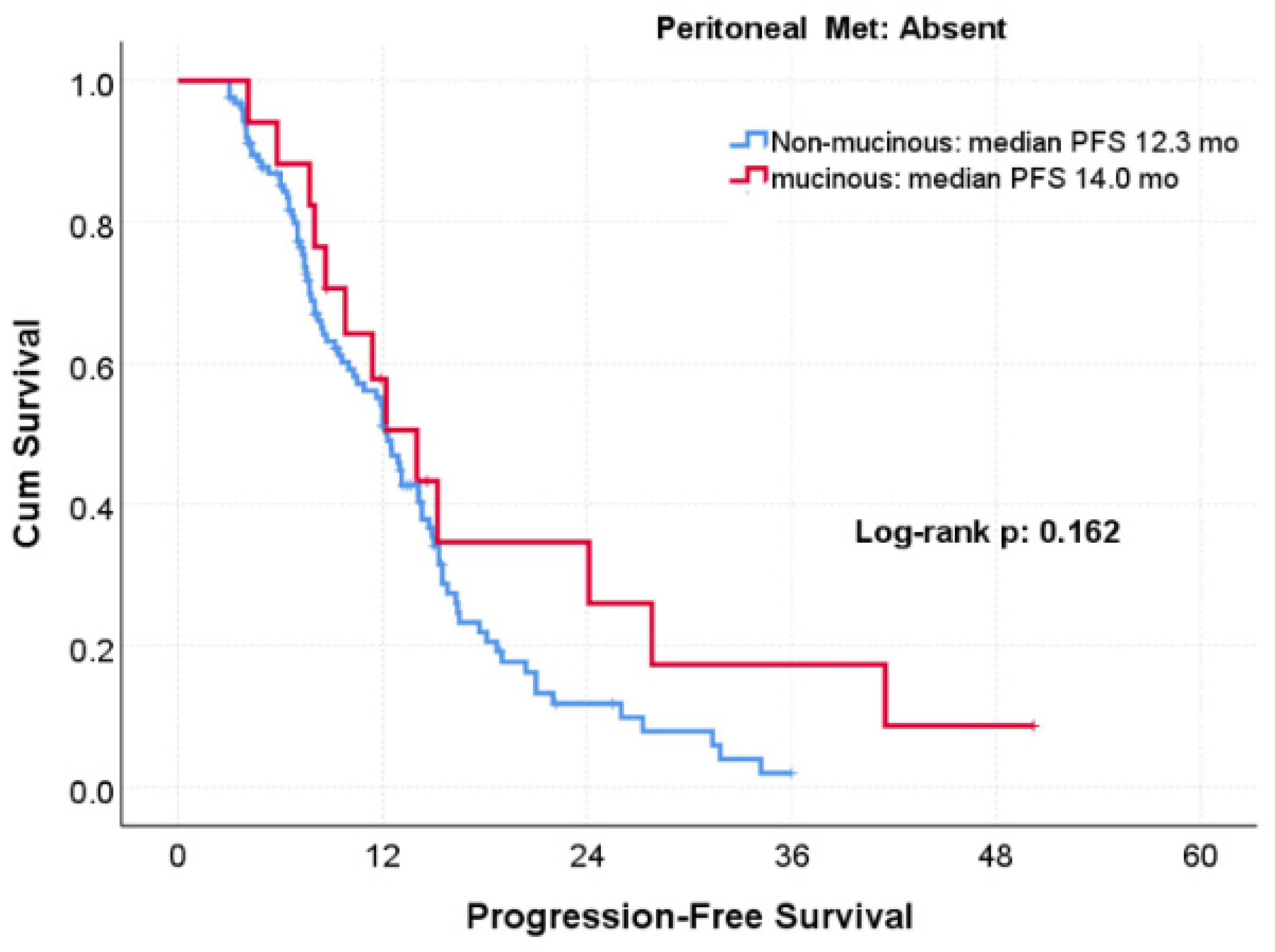
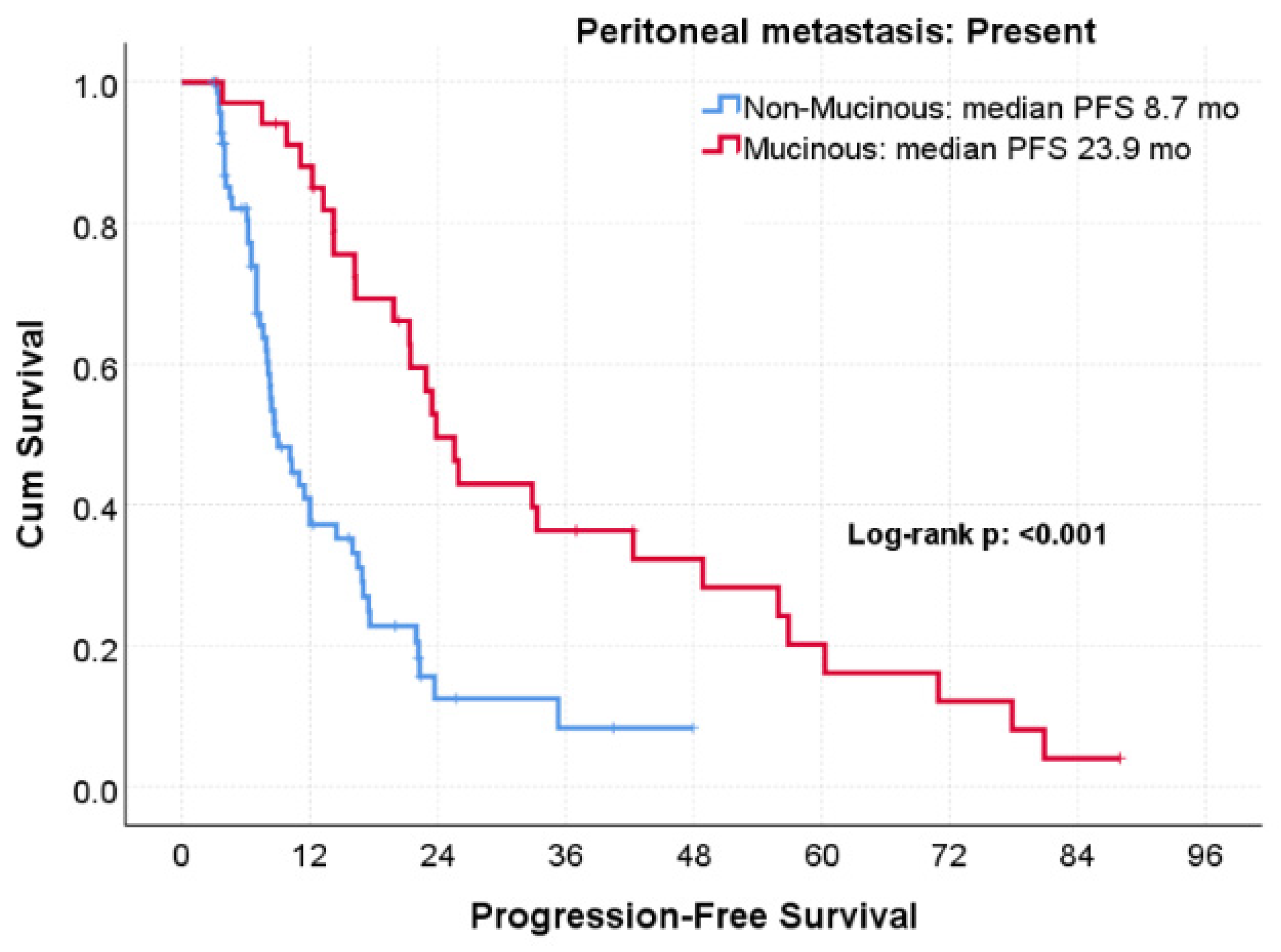
3.4. Subgroup Analysis by Peritoneal Metastasis
3.5. Subgroup Analysis by Chemotherapy Backbone
3.6. Overall Survival: Cox Regression Analysis
4. Discussion
Strengths and Limitations
5. Conclusions
Author Contributions
Funding
Institutional Review Board Statement
Informed Consent Statement
Data Availability Statement
Acknowledgments
Conflicts of Interest
References
- Morgan, E.; Arnold, M.; Gini, A.; Lorenzoni, V.; Cabasag, C.J.; Laversanne, M.; Vignat, J.; Ferlay, J.; Murphy, N.; Bray, F. Global burden of colorectal cancer in 2020 and 2040: Incidence and mortality estimates from GLOBOCAN. Gut 2023, 72, 338–344. [Google Scholar] [CrossRef]
- Eide, P.W.; Moosavi, S.H.; Eilertsen, I.A.; Brunsell, T.H.; Langerud, J.; Berg, K.C.G.; Røsok, B.I.; Bjørnbeth, B.A.; Nesbakken, A.; Lothe, R.A.; et al. Metastatic heterogeneity of the consensus molecular subtypes of colorectal cancer. npj Genom. Med. 2021, 6, 59. [Google Scholar] [CrossRef]
- Luo, C.; Cen, S.; Ding, G.; Wu, W. Mucinous colorectal adenocarcinoma: Clinical pathology and treatment options. Cancer Commun. 2019, 39, 13. [Google Scholar] [CrossRef]
- Dienstmann, R.; Vermeulen, L.; Guinney, J.; Kopetz, S.; Tejpar, S.; Tabernero, J. Consensus molecular subtypes and the evolution of precision medicine in colorectal cancer. Nat. Rev. Cancer 2017, 17, 79–92. [Google Scholar] [CrossRef]
- Winder, T.; Lenz, H.J. Mucinous adenocarcinomas with intra-abdominal dissemination: A review of current therapy. Oncologist 2010, 15, 836–844. [Google Scholar] [CrossRef]
- Catalano, V.; Bergamo, F.; Cremolini, C.; Vincenzi, B.; Negri, F.; Giordani, P.; Alessandroni, P.; Intini, R.; Stragliotto, S.; Rossini, D.; et al. Clinical impact of first-line bevacizumab plus chemotherapy in metastatic colorectal cancer of mucinous histology: A multicenter, retrospective analysis on 685 patients. J. Cancer Res. Clin. Oncol. 2020, 146, 493–501. [Google Scholar] [CrossRef]
- Mekenkamp, L.J.; Heesterbeek, K.J.; Koopman, M.; Tol, J.; Teerenstra, S.; Venderbosch, S.; Punt, C.J.; Nagtegaal, I.D. Mucinous adenocarcinomas: Poor prognosis in metastatic colorectal cancer. Eur. J. Cancer 2012, 48, 501–509. [Google Scholar] [CrossRef]
- Wang, C.; Sandhu, J.; Fakih, M. Mucinous Histology Is Associated with Resistance to Anti-EGFR Therapy in Patients with Left-Sided RAS/BRAF Wild-Type Metastatic Colorectal Cancer. Oncologist 2022, 27, 104–109. [Google Scholar] [CrossRef]
- Van Cutsem, E.; Cervantes, A.; Adam, R.; Sobrero, A.; Van Krieken, J.H.; Aderka, D.; Aranda Aguilar, E.; Bardelli, A.; Benson, A.; Bodoky, G.; et al. ESMO consensus guidelines for the management of patients with metastatic colorectal cancer. Ann. Oncol. 2016, 27, 1386–1422. [Google Scholar] [CrossRef]
- Catalano, V.; Loupakis, F.; Graziano, F.; Torresi, U.; Bisonni, R.; Mari, D.; Fornaro, L.; Baldelli, A.M.; Giordani, P.; Rossi, D.; et al. Mucinous histology predicts for poor response rate and overall survival of patients with colorectal cancer and treated with first-line oxaliplatin- and/or irinotecan-based chemotherapy. Br. J. Cancer 2009, 100, 881–887. [Google Scholar] [CrossRef]
- Nozoe, T.; Anai, H.; Nasu, S.; Sugimachi, K. Clinicopathological characteristics of mucinous carcinoma of the colon and rectum. J. Surg. Oncol. 2000, 75, 103–107. [Google Scholar] [CrossRef]
- Moretto, R.; Morano, F.; Ongaro, E.; Rossini, D.; Pietrantonio, F.; Casagrande, M.; Antoniotti, C.; Corallo, S.; Marmorino, F.; Cortiula, F.; et al. Lack of Benefit from Anti-EGFR Treatment in RAS and BRAF Wild-type Metastatic Colorectal Cancer With Mucinous Histology or Mucinous Component. Clin. Color. Cancer 2019, 18, 116–124. [Google Scholar] [CrossRef]
- Ten Hoorn, S.; de Back, T.R.; Sommeijer, D.W.; Vermeulen, L. Clinical Value of Consensus Molecular Subtypes in Colorectal Cancer: A Systematic Review and Meta-Analysis. J. Natl. Cancer Inst. 2022, 114, 503–516. [Google Scholar] [CrossRef]
- Franko, J.; Shi, Q.; Meyers, J.P.; Maughan, T.S.; Adams, R.A.; Seymour, M.T.; Saltz, L.; Punt, C.J.A.; Koopman, M.; Tournigand, C.; et al. Prognosis of patients with peritoneal metastatic colorectal cancer given systemic therapy: An analysis of individual patient data from prospective randomised trials from the Analysis and Research in Cancers of the Digestive System (ARCAD) database. Lancet Oncol. 2016, 17, 1709–1719. [Google Scholar] [CrossRef]
- Sommariva, A.; Tonello, M.; Coccolini, F.; De Manzoni, G.; Delrio, P.; Pizzolato, E.; Gelmini, R.; Serra, F.; Rreka, E.; Pasqual, E.M.; et al. Colorectal Cancer with Peritoneal Metastases: The Impact of the Results of PROPHYLOCHIP, COLOPEC, and PRODIGE 7 Trials on Peritoneal Disease Management. Cancers 2022, 15, 165. [Google Scholar] [CrossRef]
- Zucchini, V.; D’Acapito, F.; Rapposelli, I.G.; Framarini, M.; Di Pietrantonio, D.; Turrini, R.; Pozzi, E.; Ercolani, G. Impact of RAS, BRAF mutations and microsatellite status in peritoneal metastases from colorectal cancer treated with cytoreduction + HIPEC: Scoping review. Int. J. Hyperth. 2025, 42, 2479527. [Google Scholar] [CrossRef]
- Bai, L.; Wang, F.; Li, Z.-Z.; Ren, C.; Zhang, D.-S.; Zhao, Q.; Lu, Y.X.; Wang, D.S.; Ju, H.-Q.; Qiu, M.-Z.; et al. Chemotherapy plus bevacizumab versus chemotherapy plus cetuximab as first-line treatment for patients with metastatic colorectal cancer: Results of a registry-based cohort analysis. Medicine 2016, 95, e4531. [Google Scholar] [CrossRef]
- Chen, J.; Somanath, P.; Razorenova, O.; Chen, W.S.; Hay, N.; Bornstein, P.; Byzova, T.V. Akt1 regulates pathological angiogenesis, vascular maturation and permeability in vivo. Nat. Med. 2005, 11, 1188–1196. [Google Scholar] [CrossRef]
- Khan, S.; Gomes, B.; Higginson, I. End-of-life care—what do cancer patients want? Nat. Rev. Clin. Oncol. 2014, 11, 100–108. [Google Scholar] [CrossRef]
- Jain, R.K. Normalization of tumor vasculature: An emerging concept in antiangiogenic therapy. Science 2005, 307, 58–62. [Google Scholar] [CrossRef]
- Venook, A.P.; Niedzwiecki, D.; Lenz, H.J.; Innocenti, F.; Fruth, B.; Meyerhardt, J.A.; Schrag, D.; Greene, C.; O’Neil, B.H.; Atkins, J.N.; et al. Effect of First-Line Chemotherapy Combined With Cetuximab or Bevacizumab on Overall Survival in Patients With KRAS Wild-Type Advanced or Metastatic Colorectal Cancer: A Randomized Clinical Trial. JAMA 2017, 317, 2392–2401. [Google Scholar] [CrossRef]
- Guinney, J.; Dienstmann, R.; Wang, X.; de Reyniès, A.; Schlicker, A.; Soneson, C.; Marisa, L.; Roepman, P.; Nyamundanda, G.; Angelino, P.; et al. The consensus molecular subtypes of colorectal cancer. Nat. Med. 2015, 21, 1350–1356. [Google Scholar] [CrossRef]



| Variable | Total Cohort (n = 250) | Mucinous (n = 52) | Non-Mucinous (n = 198) | p Value |
|---|---|---|---|---|
| Demographic characteristics | ||||
| Age < 65 years, n | 114 | 26 (22.8%) | 88 (77.2%) | 0.474 |
| Age ≥ 65 years, n | 136 | 26 (19.1%) | 110 (80.9%) | |
| Male sex, n | 156 | 35 (22.4%) | 121 (77.6%) | 0.412 |
| Female sex, n | 94 | 17 (18.1%) | 77 (81.9%) | |
| BMI < 25 kg/m2, n | 98 | 17 (17.3%) | 81 (82.7%) | 0.491 |
| BMI 25–29.9 kg/m2, n | 99 | 24 (24.2%) | 75 (75.8%) | |
| BMI ≥ 30 kg/m2, n | 53 | 11 (20.8%) | 42 (79.2%) | |
| Clinical status | ||||
| ECOG 0–1, n | 168 | 34 (20.2%) | 134 (79.8%) | 0.754 |
| ECOG ≥ 2, n | 82 | 18 (22.0%) | 64 (78.0%) | |
| Primary tumor characteristics | ||||
| Right colon, n | 71 | 26 (36.6%) | 45 (63.4%) | <0.001 |
| Left colon, n | 87 | 11 (12.6%) | 76 (87.4%) | |
| Rectum, n | 92 | 15 (16.3%) | 77 (83.7%) | |
| Molecular characteristics | ||||
| MSI-H †, n | 8 | 3 (37.5%) | 5 (62.5%) | 0.177 |
| MSS/MSI-L †, n | 143 | 26 (18.2%) | 117 (81.8%) | |
| RAS mutation present, n | 164 | 34 (20.7%) | 130 (79.3%) | 0.873 |
| BRAF V600E mutation present †, n | 11 | 3 (27.3%) | 8 (72.7%) | 0.435 |
| Disease presentation and metastatic pattern | ||||
| De novo metastatic disease, n | 153 | 30 (19.6%) | 123 (80.4%) | 0.560 |
| Recurrent metastatic disease, n | 97 | 22 (22.7%) | 75 (77.3%) | |
| Peritoneal metastasis present, n | 107 | 35 (32.7%) | 72 (67.3%) | <0.001 |
| Liver metastasis present, n | 181 | 30 (16.6%) | 151 (83.4%) | 0.008 |
| Lung metastasis present, n | 146 | 22 (15.1%) | 124 (84.9%) | 0.008 |
| Ovarian metastasis present, n | 19 | 8 (42.1%) | 11 (57.9%) | 0.017 |
| Bone metastasis present, n | 52 | 11 (21.2%) | 41 (78.8%) | 0.944 |
| Brain metastasis present, n | 9 | 2 (22.2%) | 7 (77.8%) | 0.915 |
| Treatment characteristics | ||||
| Bevacizumab 1st-line, n | 198 | 41 (20.7%) | 157 (79.3%) | 0.869 |
| Bevacizumab ≥ 2nd-line, n | 51 | 11 (21.6%) | 40 (78.4%) | |
| Oxaliplatin-based chemotherapy, n | 135 | 24 (17.8%) | 111 (82.2%) | 0.202 |
| Irinotecan-based chemotherapy, n | 115 | 28 (24.3%) | 87 (75.7%) | |
| Bevacizumab + FOLFOX, n | 125 | 20 (16.0%) | 105 (84.0%) | 0.088 |
| Bevacizumab + FOLFIRI, n | 115 | 28 (24.3%) | 87 (75.7%) | |
| Bevacizumab + CAPOX, n | 10 | 4 (40.0%) | 6 (60.0%) | |
| Treatment response | ||||
| Complete response (CR), n | 6 | 1 (16.7%) | 5 (83.3%) | 0.088 |
| Partial response (PR), n | 132 | 19 (14.4%) | 113 (85.6%) | |
| Stable disease (SD), n | 83 | 26 (31.3%) | 57 (68.7%) | |
| Progressive disease (PD), n | 29 | 6 (20.7%) | 23 (79.3%) |
| Analysis Stratum | Treatment Group | Median PFS (Months) | 95% Confidence Interval | Log-Rank χ2 | p-Value |
|---|---|---|---|---|---|
| Overall cohort | Non-mucinous (n = 198) | 11.9 | 10.22–13.58 | ||
| Mucinous (n = 52) | 22.9 | 17.95–27.85 | 23.96 | <0.001 | |
| Patients with peritoneal metastasis | Non-mucinous (n = 72) | 8.7 | 6.29–11.12 | ||
| Mucinous (n = 35) | 23.9 | 19.81–27.89 | 18.65 | <0.001 | |
| Patients without peritoneal metastasis | Non-mucinous (n = 126) | 12.3 | 11.03–13.57 | ||
| Mucinous (n = 17) | 14.0 | 9.51–18.49 | 1.96 | 0.162 | |
| Non-mucinous subgroup | Oxaliplatin-based (n = 111) | 11.6 | 8.59–14.67 | ||
| Irinotecan-based (n = 87) | 12.0 | 9.59–14.41 | 0.03 | 0.863 | |
| Mucinous subgroup | Oxaliplatin-based (n = 24) | 16.2 | 8.18–24.22 | ||
| Irinotecan-based (n = 28) | 24.1 | 18.34–29.86 | 1.72 | 0.190 | |
| Mucinous histology with peritoneal metastasis | Oxaliplatin-based (n = 13) | 23.45 | 15.61–31.29 | ||
| Irinotecan-based (n = 22) | 23.85 | 18.48–29.22 | 0.01 | 0.912 |
| Variable | Univariate HR (95% CI) | p Value | Multivariate HR (95% CI) | p Value |
|---|---|---|---|---|
| Age ≥ 65 years | 1.30 (0.97–1.74) | 0.085 | — | — |
| Male sex | 1.01 (0.75–1.36) | 0.960 | — | — |
| BMI ≥ 30 kg/m2 | 0.78 (0.54–1.13) | 0.183 | — | — |
| ECOG performance status ≥ 2 | 1.22 (0.90–1.65) | 0.200 | — | — |
| Mucinous histology | 0.39 (0.26–0.58) | <0.001 | 0.44 (0.25–0.78) | 0.005 |
| Right-sided primary tumor | 1.28 (0.92–1.77) | 0.138 | — | — |
| De novo metastatic disease | 0.64 (0.47-0.88) | 0.005 | 0.79 (0.52–1.20) | 0.264 |
| Peritoneal metastasis present | 0.66 (0.48–0.90) | 0.008 | 0.92 (0.60–1.40) | 0.693 |
| Liver metastasis present | 2.35 (1.63–3.37) | <0.001 | 1.62 (0.95–2.78) | 0.079 |
| Lung metastasis present | 0.91 (0.68–1.23) | 0.547 | — | — |
| RAS mutation present | 0.99 (0.72–1.36) | 0.959 | — | — |
| BRAF V600E mutation present | 0.64 (0.31–1.32) | 0.233 | — | — |
| MSI-H status | 0.35 (0.13–0.96) | 0.040 | 0.39 (0.14–1.10) | 0.074 |
| Irinotecan-based chemotherapy (vs oxaliplatin-based) | 0.85 (0.64–1.14) | 0.285 | — | — |
| Bevacizumab used as ≥2nd-line therapy | 1.19 (0.84–1.69) | 0.323 | — | — |
| Interaction Term | HR (95% CI) | p for Interaction |
|---|---|---|
| Mucinous histology × Peritoneal metastasis | 0.45 (0.21–0.97) | 0.040 |
| Mucinous histology × Irinotecan-based chemotherapy | 0.73 (0.38–1.39) | 0.341 |
| Peritoneal metastasis × Irinotecan-based chemotherapy | 1.02 (0.63–1.64) | 0.935 |
| Variable | Univariate HR (95% CI) | p Value | Multivariate HR (95% CI) | p Value |
|---|---|---|---|---|
| Age ≥ 65 years | 1.44 (1.05–1.97) | 0.022 | 1.38 (1.01–1.89) | 0.041 |
| Male sex | 0.93 (0.68–1.27) | 0.644 | — | — |
| BMI ≥ 30 kg/m2 | 0.86 (0.59–1.26) | 0.449 | — | — |
| ECOG performance status ≥ 2 | 1.29 (0.94–1.76) | 0.113 | — | — |
| Mucinous histology | 0.65 (0.44–0.97) | 0.036 | 0.81 (0.54–1.23) | 0.328 |
| Right-sided primary tumor | 1.05 (0.75–1.47) | 0.779 | — | — |
| De novo metastatic disease | 0.43 (0.31–0.60) | <0.001 | 0.49 (0.35–0.69) | <0.001 |
| Peritoneal metastasis present | 0.93 (0.68–1.26) | 0.624 | — | — |
| Liver metastasis present | 2.35 (1.62–3.41) | <0.001 | 1.80 (1.21–2.67) | 0.004 |
| Lung metastasis present | 1.34 (0.98–1.84) | 0.071 | 1.41 (1.01–1.95) | 0.043 |
| RAS mutation present | 1.29 (0.92–1.80) | 0.143 | — | — |
| BRAF V600E mutation present | 0.56 (0.25–1.23) | 0.144 | — | — |
| MSI-H status | 0.57 (0.21–1.58) | 0.276 | — | — |
| Irinotecan-based chemotherapy (vs oxaliplatin-based) | 0.84 (0.62–1.14) | 0.266 | — | — |
| Bevacizumab used as ≥2nd-line therapy | 0.70 (0.48–1.02) | 0.066 | 0.69 (0.47–1.02) | 0.062 |
Disclaimer/Publisher’s Note: The statements, opinions and data contained in all publications are solely those of the individual author(s) and contributor(s) and not of MDPI and/or the editor(s). MDPI and/or the editor(s) disclaim responsibility for any injury to people or property resulting from any ideas, methods, instructions or products referred to in the content. |
© 2026 by the authors. Licensee MDPI, Basel, Switzerland. This article is an open access article distributed under the terms and conditions of the Creative Commons Attribution (CC BY) license.
Share and Cite
Can, S.; Çakıcı, V.; Kahveci, G.B.; Eroğlu, Ş.; Tok, B.; Uygun, G.; Özer, E.; Çırak, Y.; Gökmen, İ. Bevacizumab-Based Therapy Is Associated with Prolonged Progression-Free Survival in Patients with Peritoneal Mucinous Metastatic Colorectal Cancer. J. Clin. Med. 2026, 15, 2805. https://doi.org/10.3390/jcm15072805
Can S, Çakıcı V, Kahveci GB, Eroğlu Ş, Tok B, Uygun G, Özer E, Çırak Y, Gökmen İ. Bevacizumab-Based Therapy Is Associated with Prolonged Progression-Free Survival in Patients with Peritoneal Mucinous Metastatic Colorectal Cancer. Journal of Clinical Medicine. 2026; 15(7):2805. https://doi.org/10.3390/jcm15072805
Chicago/Turabian StyleCan, Süleyman, Veli Çakıcı, Gizem Bakır Kahveci, Şeyma Eroğlu, Burak Tok, Gökhan Uygun, Esra Özer, Yalçın Çırak, and İvo Gökmen. 2026. "Bevacizumab-Based Therapy Is Associated with Prolonged Progression-Free Survival in Patients with Peritoneal Mucinous Metastatic Colorectal Cancer" Journal of Clinical Medicine 15, no. 7: 2805. https://doi.org/10.3390/jcm15072805
APA StyleCan, S., Çakıcı, V., Kahveci, G. B., Eroğlu, Ş., Tok, B., Uygun, G., Özer, E., Çırak, Y., & Gökmen, İ. (2026). Bevacizumab-Based Therapy Is Associated with Prolonged Progression-Free Survival in Patients with Peritoneal Mucinous Metastatic Colorectal Cancer. Journal of Clinical Medicine, 15(7), 2805. https://doi.org/10.3390/jcm15072805