Colchicine for the Prevention of Major Adverse Cardiovascular Events After Acute Coronary Syndromes: A Systematic Review and Meta-Analysis of Large, Long-Term, Placebo-Controlled Randomized Trials

 , , , ,
  and
and 
Abstract
1. Introduction
2. Materials and Methods
2.1. Protocol and Registration
2.2. Eligibility Criteria
2.3. Information Sources
2.4. Search Strategy
2.5. Study Selection
2.6. Risk of Bias Assessment
2.7. Effect Measures and Synthesis
2.8. Small-Study Effects/Publication Bias
2.9. Certainty of Evidence
2.10. Software
3. Results
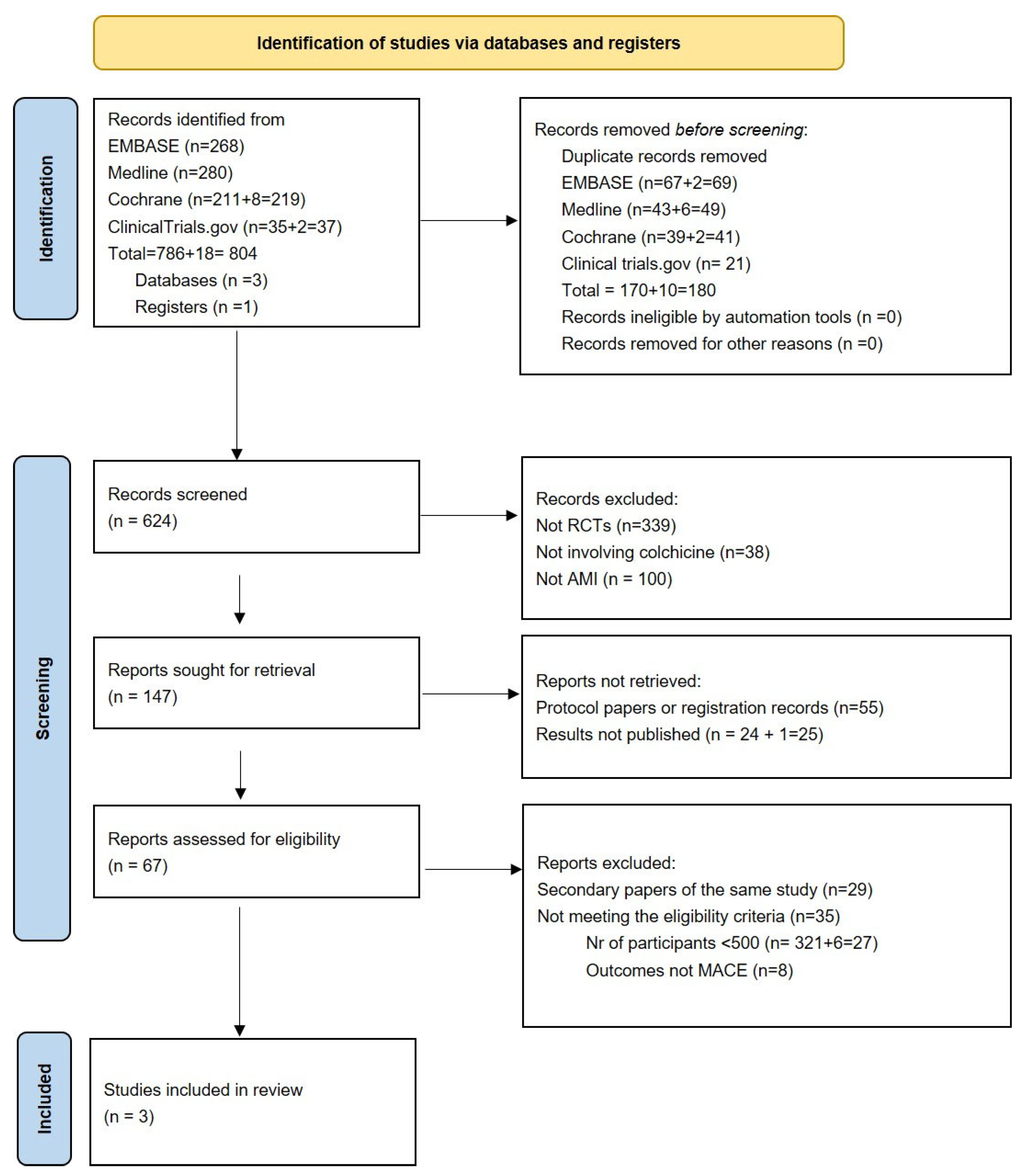
3.1. Study Selection
3.2. Characteristics of Included Studies
3.3. Risk of Bias in Included Studies
3.4. Certainty of Evidence (GRADE)
3.5. Small-Study Effects/Publication Bias
3.6. Integrated Summary Statement
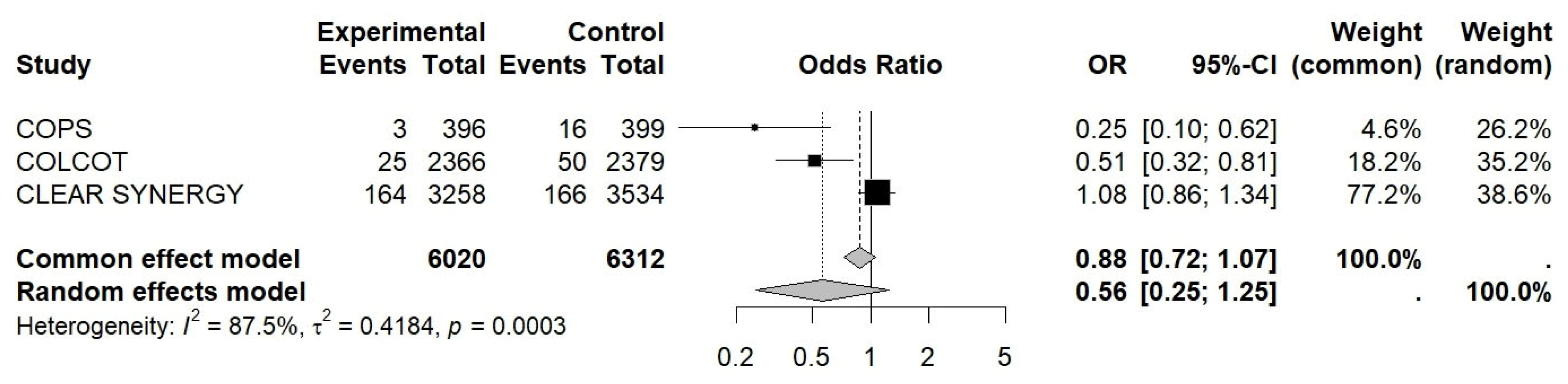
3.7. Primary Outcome Synthesis
3.8. Sensitivity and Subgroup Analyses
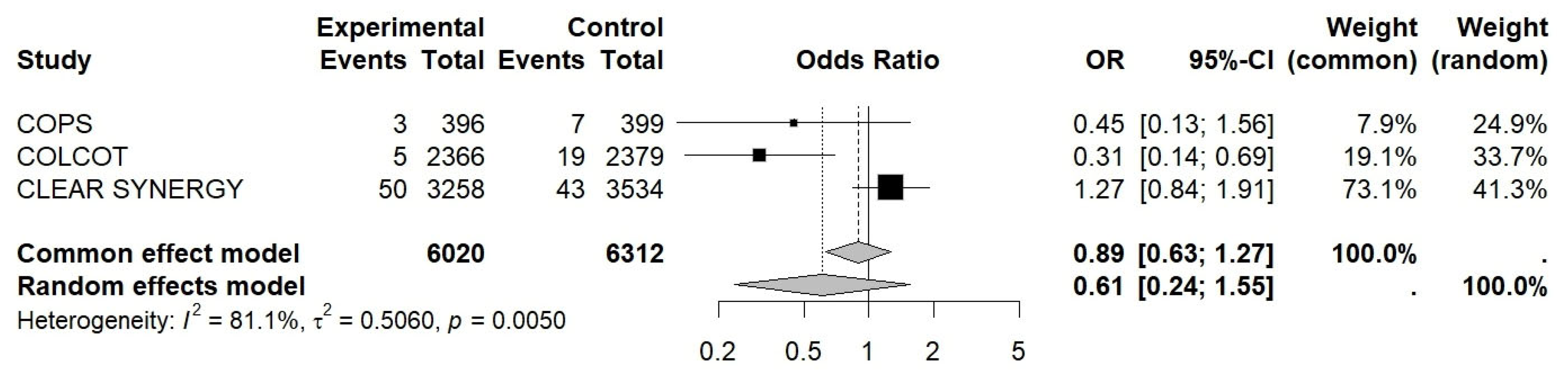
3.8.1. Secondary Outcomes
3.8.2. Subgroup Analyses
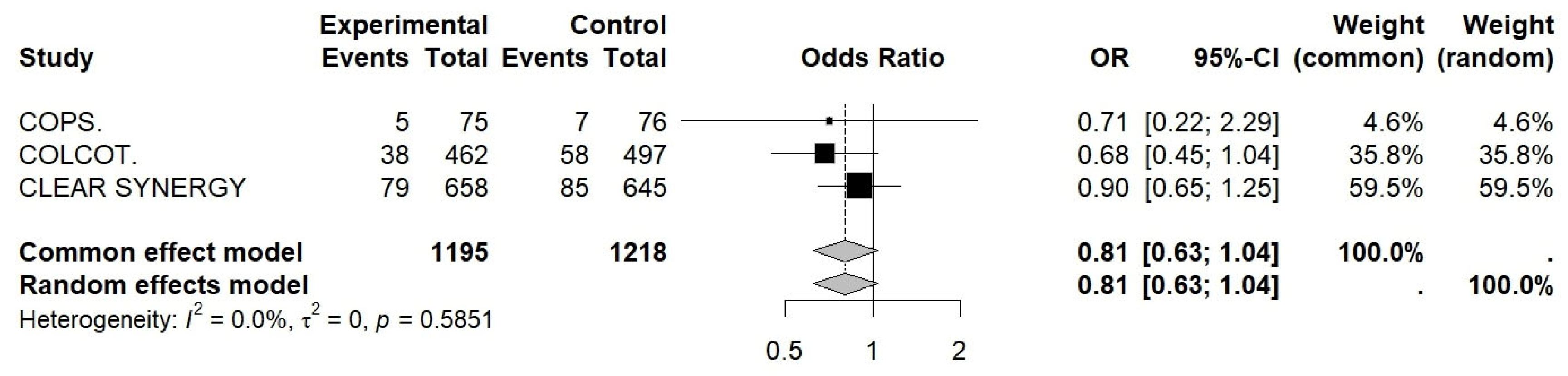
Diabetes Subgroup Analysis
Exploratory Subgroup Analysis According to Longest Available Follow-Up Duration
3.8.3. Sensitivity Analyses
4. Discussion
5. Conclusions
Author Contributions
Funding
Institutional Review Board Statement
Informed Consent Statement
Data Availability Statement
Acknowledgments
Conflicts of Interest
Abbreviations
| ACS | Acute Coronary Syndrome |
| AMI | Acute Myocardial Infarction |
| CENTRAL | Cochrane Central Register of Controlled Trials |
| CI | Confidence Interval |
| CLEAR SYNERGY (OASIS-9) | Colchicine in Acute Myocardial Infarction (OASIS-9 trial) |
| COLCOT | Colchicine Cardiovascular Outcomes Trial |
| COPS | Colchicine in Patients With Acute Coronary Syndrome |
| COVID-19 | Coronavirus Disease 2019 |
| CRediT | Contributor Roles Taxonomy |
| CV | Cardiovascular |
| EMBASE | Excerpta Medica Database |
| ESC | European Society of Cardiology |
| GRADE | Grading of Recommendations Assessment, Development and Evaluation |
| HF | Heart Failure |
| HR | Hazard Ratio |
| I2 | I-Squared (Measure of Heterogeneity) |
| MACEs | Major Adverse Cardiovascular Events |
| MEDLINE | Medical Literature Analysis and Retrieval System Online |
| MI | Myocardial Infarction |
| NLRP3 | NOD-Like Receptor Protein 3 |
| NNT | Number Needed to Treat |
| NSTEMI | Non-ST-Elevation Myocardial Infarction |
| OASIS-9 | Organization to Assess Strategies in Ischemic Syndromes-9 |
| OR | Odds Ratio |
| PCI | Percutaneous Coronary Intervention |
| PRISMA | Preferred Reporting Items for Systematic Reviews and Meta-Analyses |
| PROSPERO | International Prospective Register of Systematic Reviews |
| RCT | Randomized Controlled Trial |
| RoB 2 | Risk of Bias Tool Version 2 |
| SE | Standard Error |
| STEMI | ST-Elevation Myocardial Infarction |
| WHO | World Health Organization |
Appendix A

| Objective | To Investigate if Current Clinical Trials Answer the Question of Whether Early Colchicine Administration Reduces MACE After ACS. |
|---|---|
| Data sources | Systematic search in Medline, EMBASE, Cochrane Library, and Clinical Trials.gov registry of clinical trials from 1946 until October 2025. |
| Trial eligibility |
|
| Exclusion criteria |
|
| Results | Studies looking at the effects of low-dose colchicine after ACS on MACEs. |
| Method of analysis | Tabular meta-analysis using the Peto method for weighted average. |
| Result of meta-analysis reporting | Common effect/random effects models to estimate the OR with a 95% CI, with study heterogeneity. |
| Embase Search | |
|---|---|
| 1. | exp randomized controlled trial/ |
| 2. | Controlled clinical trial/ |
| 3. | random.ti,ab. |
| 4. | randomization/ |
| 5. | intermethod comparison/ |
| 6. | placebo.ti,ab. |
| 7. | (compare or compared or comparison).ti. |
| 8. | ((evaluated or evaluate or evaluating or assessed or assess) and (compare or compared or comparing or comparison)).ab. |
| 9. | (open adj label).ti,ab. |
| 10. | ((double or single or doubly or singly) adj (blind or blinded or blindly)).ti,ab. |
| 11. | double blind procedure/ |
| 12. | parallel group1.ti,ab. |
| 13. | (crossover or cross over).ti,ab. |
| 14. | ((assign or match or matched or allocation) adj5 (alternate or group1 or intervention1 or patient1 or subject1 or participant 1)).ti,ab. |
| 15. | (assigned or allocated).ti,ab. |
| 16. | (controlled adj7 (study or design or trial)).ti,ab. |
| 17. | (volunteer or volunteers).ti,ab. |
| 18. | human experiment/ |
| 19. | trial.ti. |
| 20. | or/1–19 |
| 21. | (random adj sampl adj7 (“cross section ” or questionnaire 1 or survey or database 1)).ti,ab. not (comparative study/or controlled study/or randomized controlled.ti,ab. or randomly assigned.ti,ab.) |
| 22. | Cross-sectional study/not (exp randomized controlled trial/or controlled clinical study/or controlled study/or randomized controlled.ti,ab. or control group 1.ti,ab.) |
| 23. | (((case adj control) and random) not randomized controlled).ti,ab. |
| 24. | Systematic review.ti,ab. not (trial or study).ti. |
| 25. | (nonrandom not random).ti,ab. |
| 26. | “random field”.ti,ab. |
| 27. | (random cluster adj3 sampl).ti,ab. |
| 28. | (review.ab. and review.pt.) not trial.ti. |
| 29. | “we searched”.ab. and (review.ti. or review.pt.) |
| 30. | “update review”.ab. |
| 31. | (databases adj4 searched).ab. |
| 32. | (rat or rats or mouse or mice or swine or porcine or murine or sheep or lambs or pigs or piglets or rabbit or rabbits or cat or cats or dog or dogs or cattle or bovine or monkey or monkeys or trout or marmoset1).ti. and animal experiment/ |
| 33. | Animal experiment/not (human experiment/or human/) |
| 34. | or/21–33 |
| 35. | 20 not 34 |
| 36. | colchicine derivative/or colchicine/or colchicine.mp. |
| 37. | acute myocardial infarction.mp. or acute heart infarction/ |
| 38. | unstable angina pectoris/or acute coronary syndrome.mp. or heart infarction/or coronary artery thrombosis/or acute coronary syndrome/or acute heart infarction/ |
| 39. | myocardial infarction.mp. or heart infarction/ |
| 40. | 37 or 38 or 39 |
| 41. | 35 and 36 and 40 |
| Medline search | |
| 1. | exp randomized controlled trial/ |
| 2. | controlled clinical trial.pt. |
| 3. | randomized.ab. |
| 4. | placebo.ab. |
| 5. | drug therapy.fs. |
| 6. | randomly.ab. |
| 7. | trial.ab. |
| 8. | groups.ab. |
| 9. | or/1–8 |
| 10. | colchicine.mp. [mp = title, abstract, heading word, drug trade name, original title, device manufacturer, drug manufacturer, device trade name, keyword heading word, floating subheading word, candidate term word] |
| 11. | acute myocardial infarction.mp. [mp = title, abstract, heading word, drug trade name, original title, device manufacturer, drug manufacturer, device trade name, keyword heading word, floating subheading word, candidate term word] |
| 12. | heart attack.mp. [mp = title, abstract, heading word, drug trade name, original title, device manufacturer, drug manufacturer, device trade name, keyword heading word, floating subheading word, candidate term word] |
| 13. | unstable angina pectoris/or acute coronary syndrome.mp. or heart infarction/or coronary artery thrombosis/or acute coronary syndrome/or acute heart infarction/ |
| Cochrane search | |
| Search Name: | “myocardial infarction” OR “acute coronary syndrome” OR “unstable angina” OR “heart attack” in Title Abstract Keyword AND colchicine in Title Abstract Keyword (Word variations have been searched) |
| Clinical trials.gov search | |
| Search Name: | Acute Myocardial Infarction OR acute coronary syndrome OR unstable angina OR Heart Attack|Colchicine |
| Section and Topic | Item # | Checklist Item | Location Where Item is Reported |
|---|---|---|---|
| TITLE | |||
| Title | 1 | Identify the report as a systematic review. | p. 1 |
| ABSTRACT | |||
| Abstract | 2 | See the PRISMA 2020 for Abstracts checklist. | pp. 1–2 |
| INTRODUCTION | |||
| Rationale | 3 | Describe the rationale for the review in the context of existing knowledge. | pp. 2–3 |
| Objectives | 4 | Provide an explicit statement of the objective(s) or question(s) the review addresses. | p. 2 |
| METHODS | |||
| Eligibility criteria | 5 | Specify the inclusion and exclusion criteria for the review and how studies were grouped for the syntheses. | p. 3; Table A1 (p. 13) |
| Information sources | 6 | Specify all databases, registers, websites, organisations, reference lists and other sources searched or consulted to identify studies. Specify the date when each source was last searched or consulted. | p. 3; Table A1 (p. 13) |
| Search strategy | 7 | Present the full search strategies for all databases, registers and websites, including any filters and limits used. | p. 3; Table A2 (pp. 14–15) |
| Selection process | 8 | Specify the methods used to decide whether a study met the inclusion criteria of the review, including how many reviewers screened each record and each report retrieved, whether they worked independently, and if applicable, details of automation tools used in the process. | p. 3; Table A3 (p. 16) |
| Data collection process | 9 | Specify the methods used to collect data from reports, including how many reviewers collected data from each report, whether they worked independently, any processes for obtaining or confirming data from study investigators, and if applicable, details of automation tools used in the process. | p. 3 |
| Data items | 10a | List and define all outcomes for which data were sought. Specify whether all results that were compatible with each outcome domain in each study were sought (e.g., for all measures, time points, analyses), and if not, the methods used to decide which results to collect. | p. 3; Table 1 (pp. 4–5) |
| 10b | List and define all other variables for which data were sought (e.g., participant and intervention characteristics, funding sources). Describe any assumptions made about any missing or unclear information. | p. 3; Table 1 (pp. 4–5) | |
| Study risk of bias assessment | 11 | Specify the methods used to assess risk of bias in the included studies, including details of the tool(s) used, how many reviewers assessed each study and whether they worked independently, and if applicable, details of automation tools used in the process. | p. 3; Table 2 (p. 5); Table A5 and Table A6 (p. 18) |
| Effect measures | 12 | Specify for each outcome the effect measure(s) (e.g., risk ratio, mean difference) used in the synthesis or presentation of results. | pp. 3–4; Table 3 (pp. 5–6); Table A10 (p. 21) |
| Synthesis methods | 13a | Describe the processes used to decide which studies were eligible for each synthesis (e.g., tabulating the study intervention characteristics and comparing against the planned groups for each synthesis (item #5)). | pp. 3–4; Table A1 (p. 13) |
| 13b | Describe any methods required to prepare the data for presentation or synthesis, such as handling of missing summary statistics, or data conversions. | No such methods were needed | |
| 13c | Describe any methods used to tabulate or visually display results of individual studies and syntheses. | pp. 3–4; Figure 1, Figure 2, Figure 3, Figure 4, Figure 5, Figure 6 and Figure 7 (pp. 6–8); Table 1 (pp. 4–5); Table 2 and Table 3 (pp. 5–7) | |
| 13d | Describe any methods used to synthesize results and provide a rationale for the choice(s). If meta-analysis was performed, describe the model(s), method(s) to identify the presence and extent of statistical heterogeneity, and software package(s) used. | pp. 3–4; Table A10 (p. 21) | |
| 13e | Describe any methods used to explore possible causes of heterogeneity among study results (e.g., subgroup analysis, meta-regression). | p. 4; p. 8; Table A11 (p. 22) | |
| 13f | Describe any sensitivity analyses conducted to assess robustness of the synthesized results. | p. 4; p. 8; Table A12 (pp. 22–23) | |
| Reporting bias assessment | 14 | Describe any methods used to assess risk of bias due to missing results in a synthesis (arising from reporting biases). | p. 4; pp. 6–7 (Figure 1) |
| Certainty assessment | 15 | Describe any methods used to assess certainty (or confidence) in the body of evidence for an outcome. | p. 4; pp. 5–6 (Table 3); Table A7, Table A8 and Table A9 (pp. 19–20) |
| RESULTS | |||
| Study selection | 16a | Describe the results of the search and selection process, from the number of records identified in the search to the number of studies included in the review, ideally using a flow diagram. | p. 4; Table A3 (p. 16) |
| 16b | Cite studies that might appear to meet the inclusion criteria, but which were excluded, and explain why they were excluded. | p. 4; Table A4 (p. 17) | |
| Study characteristics | 17 | Cite each included study and present its characteristics. | pp. 4–5 (Table 1) |
| Risk of bias in studies | 18 | Present assessments of risk of bias for each included study. | p. 5 (Table 2); Table A5 and Table A6 (p. 18) |
| Results of individual studies | 19 | For all outcomes, present, for each study: (a) summary statistics for each group (where appropriate) and (b) an effect estimate and its precision (e.g., confidence/credible interval), ideally using structured tables or plots. | pp. 4–8; Figure 2, Figure 3, Figure 4, Figure 5, Figure 6 and Figure 7 (pp. 7–8); Table A7 and Table A8 (pp. 21–23) |
| Results of syntheses | 20a | For each synthesis, briefly summarise the characteristics and risk of bias among contributing studies. | pp. 5–7 (Table 2 and Table 3) |
| 20b | Present results of all statistical syntheses conducted. If meta-analysis was done, present for each the summary estimate and its precision (e.g., confidence/credible interval) and measures of statistical heterogeneity. If comparing groups, describe the direction of the effect. | pp. 7–8; Figure 2, Figure 3, Figure 4, Figure 5, Figure 6 and Figure 7 (pp. 7–8); Table A10 (p. 21) | |
| 20c | Present results of all investigations of possible causes of heterogeneity among study results. | p. 8 (diabetes subgroup); Table A11 (p. 22) | |
| 20d | Present results of all sensitivity analyses conducted to assess the robustness of the synthesized results. | p. 8; Table A12 (pp. 22–23) | |
| Reporting biases | 21 | Present assessments of risk of bias due to missing results (arising from reporting biases) for each synthesis assessed. | pp. 6–7 (Figure 1) |
| Certainty of evidence | 22 | Present assessments of certainty (or confidence) in the body of evidence for each outcome assessed. | pp. 5–6 (Table 3); Table A7, Table A8 and Table A9 (pp. 19–20) |
| DISCUSSION | |||
| Discussion | 23a | Provide a general interpretation of the results in the context of other evidence. | pp. 8–10 |
| 23b | Discuss any limitations of the evidence included in the review. | pp. 9–10 | |
| 23c | Discuss any limitations of the review processes used. | p. 10 | |
| 23d | Discuss implications of the results for practice, policy, and future research. | pp. 10–11 | |
| OTHER INFORMATION | |||
| Registration and protocol | 24a | Provide registration information for the review, including register name and registration number, or state that the review was not registered. | pp. 2–3, 11 |
| 24b | Indicate where the review protocol can be accessed, or state that a protocol was not prepared. | pp. 2–3 (PROSPERO registration/URL in abstract); p. 11 | |
| 24c | Describe and explain any amendments to information provided at registration or in the protocol. | No substantive amendments were made after PROSPERO registration | |
| Support | 25 | Describe sources of financial or non-financial support for the review, and the role of the funders or sponsors in the review. | pp. 10–11 |
| Competing interests | 26 | Declare any competing interests of review authors. | p. 11 |
| Availability of data, code and other materials | 27 | Report which of the following are publicly available and where they can be found: template data collection forms; data extracted from included studies; data used for all analyses; analytic code; any other materials used in the review. | p. 11 |
| # | Author | Acronym | Patients | Colchicine Regimen | Type of ACS | Primary Outcome | Results |
|---|---|---|---|---|---|---|---|
| 1 | Akrami et al. 2021 [25] | NA | 249 (120/129) | 0.5 mg starting the first day after ACS, for 6 months | UA, STEMI, NSTEMI | MACE | Lower rates of MACEs in colchicine group vs placebo (8 [6.7%] vs. 28 [21.7%]). |
| 2 | Bouleti et al. 2024 [26] | COVERT-MI | 192 | Follow-up analysis of the prespecified secondary clinical endpoints at 1 year | STEMI | MACE | No difference at 1 year |
| Mewton et al. 2021 [27] | COVERT-MI | 192 | 2 mg loading, 0.5 ×2 for 5 days | STEMI | Infarct size; MACE- secondary | MACE was not the primary outcome | |
| 3 | Hosseini et al. 2022 [28] | PODCAST PCI | 451 (229/222) | 1 mg loading, 0.5 mg until discharge | STEMI | No reflow. MACE- secondary | MACE was not the primary outcome |
| 4 | Huet et al. 2024 [29] | COLD MI | 54 | 1 mg per day for 30 days, initiated within 48 h after revascularization | STEMI | Percentage of myocardial denervation measured by SPECT at 6-m follow-up. MACE- secondary, not reported | MACE was not the primary outcome |
| 5 | Shah et al. 2020 [30] Shah et al. 2023 [31] | Colchicine-PCI | 400 206/194 (50% ACS) | 1.8 mg—Preprocedural | ACS in 50% of PCI patients | PCI-related myocardial injury, MACE- secondary | Key secondary outcomes of 30-day MACE and PCI-related MI did not differ. Same at 3.3 years |
| 6 | Khiali et al. 2024 [32] | NA | 106 36/35/35 | Empagliflozin 10 mg/day, empagliflozin 10 mg/day + colchicine 0.5 mg ×2 daily, or empagliflozin 25 mg/day within 72 h after primary PCI | Recent STEMI (72 h) | Change in NYHA class, CRP MACE -tertiary/safety outcome | No change |
| 7 | Talasaz et al. 2019 [33] | NA | 196 (95/101) | Colchicine before PCI | STEMI | (TIMI) score; TIMI myocardial perfusion grade (TMPG), and TIMI frame count (TFC). MACE- secondary | MACE was not the primary outcome |
Appendix B. Risk of Bias Assessment
| Trial | Low Risk | Some Concerns | High Risk |
|---|---|---|---|
| COLCOT | █████████████████████████████ (100%) | ||
| CLEAR SYNERGY | █████████████████████████████ (100%) | ||
| COPS | ████████████░░░░░░░░░░░░░░░ (60%) | ||
| Trial/Domain | Randomization | Deviations from Interventions | Missing Outcome Data | Measurement of Outcomes | Selection of Reported Result | Overall RoB |
|---|---|---|---|---|---|---|
| COPS | Low | Low | Some concerns | Low | Some concerns | Some concerns |
| COLCOT | Low | Low | Low | Low | Low | Low |
| CLEAR SYNERGY | Low | Low | Low | Low | Low | Low |
Appendix C. Colchicine Trials on Acute Coronary Syndromes GRADE Evidence Profiles
| Outcome | Placebo | Colchicine | Relative Effect | Participants | Certainty (GRADE) | Comments |
|---|---|---|---|---|---|---|
| MACEs (CV death, MI, stroke, urgent revascularization) | 9.6% | 6.8% | HR 0.77 (0.61–0.96) | 4745 (1 RCT) | High | Significant reduction; low RoB. |
| Non-fatal MI | 4.0% | 2.7% | HR 0.66 (0.50–0.87) | 4745 | High | Clear benefit. |
| CV death | 1.0% | 1.0% | HR 0.99 (0.57–1.72) | 4745 | High | No difference. |
| Safety—GI events | 7.0% | 9.7% | p < 0.001 | 4745 | High | Increased GI adverse events. |
| Outcome | Placebo | Colchicine | Relative effect | Participants | Certainty (GRADE) | Comments |
|---|---|---|---|---|---|---|
| MACE | 9.3% | 9.1% | HR 0.99 (0.85–1.16) | 7062 | High | Neutral effect. |
| Non-fatal MI | 3.1% | 2.9% | HR 0.88 (0.66–1.17) | 7062 | High | CI crosses unity. |
| CV death | 3.2% | 3.3% | HR 1.03 (0.80–1.34) | 7062 | High | No difference. |
| Safety—Diarrhea | 6.6% | 10.2% | p < 0.001 | 7062 | High | GI adverse events increased. |
| Outcome | Placebo | Colchicine | Relative Effect /Comment | Participants | Certainty (GRADE) | Comments |
|---|---|---|---|---|---|---|
| Composite MACE | 13.5% | 8.1% | Approximate OR 0.56 (95% CI 0.35–0.89); log-rank p = 0.02 | 795 | Low-Moderate | Significant reduction at 24 months; interpret cautiously given trial size |
| All-cause mortality | 1.0% | 2.3% | HR 2.28 (95% CI 0.7–7.4); p = 0.17 | 795 | Low | Numerical imbalance, not statistically significant at 24 months |
| Non-CV death | 0.5% | 1.3% | p = 0.024 | 795 | Low | Potential harm. |
| Urgent revasc. | 1.5% | 0.37% | p = 0.037 | 795 | Low-Moderate | Interpret with caution. |
| Outcome | k | Events (e) | Model | Pooled OR (95% CI) | z | p | I2 (%) | τ2 | Heterogeneity (Q, df, p) |
|---|---|---|---|---|---|---|---|---|---|
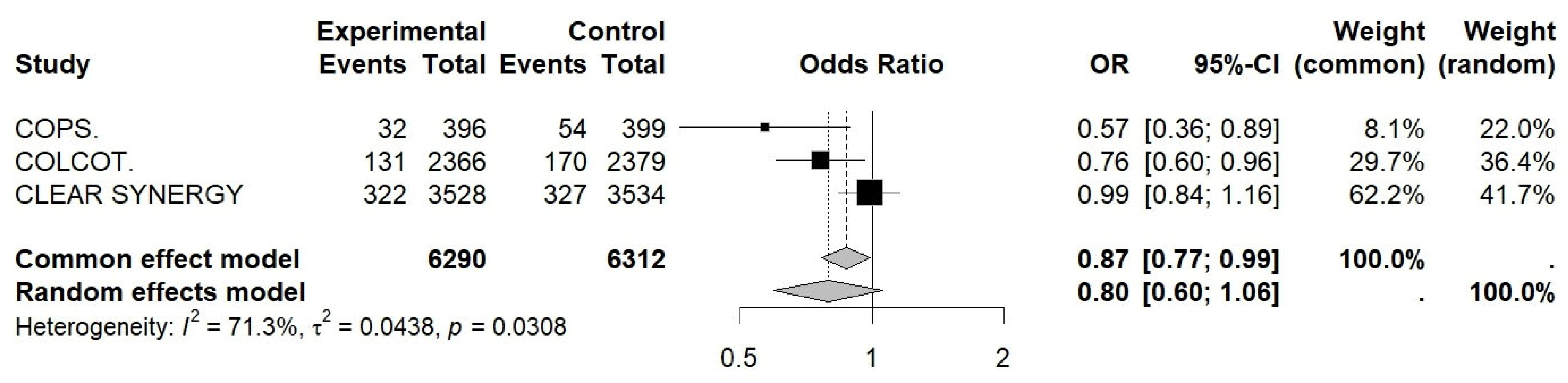
| MACE (pr. outcome) | 3 | 1036 | Common | 0.8732 [0.7688; 0.9917] | −2.09 | 0.0368 | 71.3 | 0.0438 | Q = 6.96, df = 2, p = 0.0308 |
| Random | 0.7955 [0.5985; 1.0573] | −1.58 | 0.1150 | 71.3 | 0.0438 | (same as above) | |||
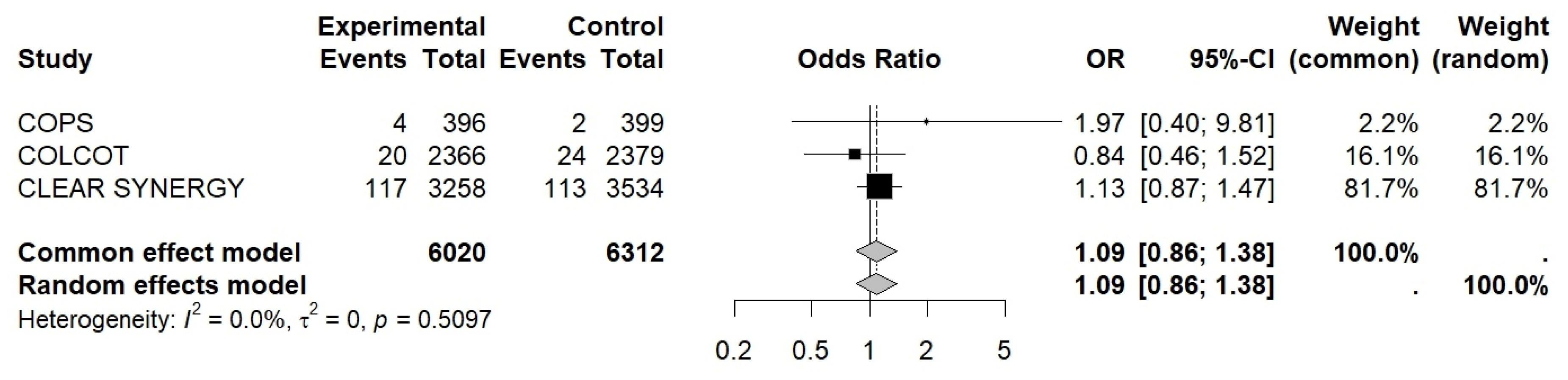
| CV death (sec. outcome) | 3 | 280 | Common | 1.0173 [0.8022; 1.2902] | 0.14 | 0.8873 | 0.0 | 0.0000 | Q = 1.09, df = 2, p = 0.5797 |
| Random | 1.0173 [0.8022; 1.2902] | 0.14 | 0.8873 | 0.0 | 0.0000 | (same as above) | |||
| Myocardial infarction (sec. outcome) | 3 | 444 | Common | 0.8809 [0.7288; 1.0646] | −1.31 | 0.1895 | 0.0 | <0.0001 | Q = 1.38, df = 2, p = 0.5017 |
| Random | 0.8809 [0.7288; 1.0646] | −1.31 | 0.1895 | 0.0 | <0.0001 | (same as above) | |||
| Revasc. (sec. outcome) | 3 | 424 | Common | 0.8238 [0.6783; 1.0005] | −1.96 | 0.0506 | 85.2 | 0.3521 | Q = 13.52, df = 2, p = 0.0012 |
| Random | 0.5521 [0.2627; 1.1604] | −1.57 | 0.1170 | 85.2 | 0.3521 | (same as above) | |||
| Stroke (sec.outcome) | 3 | 127 | Common | 0.8417 [0.5933; 1.1942] | −0.97 | 0.3343 | 78.6 | 0.4407 | Q = 9.33, df = 2, p = 0.0094 |
| Random | 0.5940 [0.2449; 1.4408] | −1.15 | 0.2493 | 78.6 | 0.4407 | (same as above) | |||
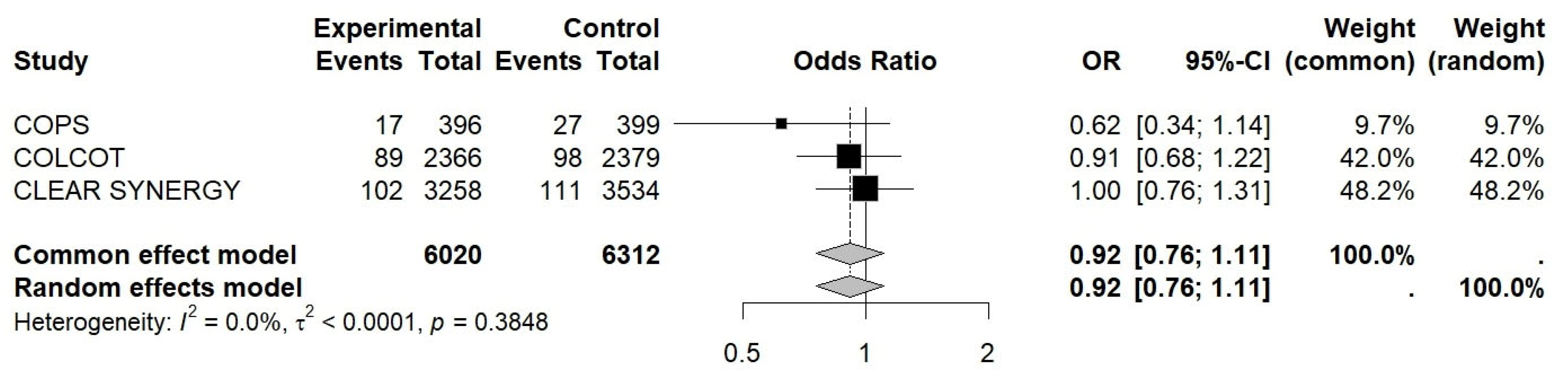
| MACE (diabetes subgroup) | 3 | 272 | Common | 0.8055 [0.6258; 1.0369] | −1.68 | 0.0933 | 0.0 | 0.0000 | Q = 1.07, df = 2, p = 0.5851 |
| Random | 0.8055 [0.6258; 1.0369] | −1.68 | 0.0933 | 0.0 | 0.0000 | (same as above) |
Appendix D. Sensitivity and Subgroup Analyses
| Trial | Measure | Colchicine Group Events | Placebo Group Events | Effect | 95% CI |
|---|---|---|---|---|---|
| COPS | OR | 5/75 | 7/76 | 0.71 | 0.22–2.29 |
| COLCOT | OR | 38/462 | 58/497 | 0.68 | 0.45–1.04 |
| CLEAR | OR | 79/658 | 85/645 | 0.90 | 0.65–1.25 |
| Outcome | Removed Trial | k (rem) | Common OR (95% CI) | Random OR (95% CI) | I2 (%) | τ2 | Significance Change (CE) | Significance Change (RE) |
|---|---|---|---|---|---|---|---|---|
| MACE (primary) | COPS et al. | 2 | 0.9068 [0.7941; 1.0355] | 0.8794 [0.6856; 1.1280] | 67.9 | 0.0222 | Yes | No |
| MACE (primary) | COLCOT et al. | 2 | 0.9246 [0.7943; 1.0762] | 0.7799 [0.4580; 1.3281] | 80.5 | 0.1215 | Yes | No |
| MACE (primary) | CLEAR et al. | 2 | 0.7163 [0.5824; 0.8810] | 0.7025 [0.5424; 0.9099] | 23.2 | 0.01 | No | Yes |
| CV DEATH | CLEAR et al. | 2 | 0.91 [0.52; 1.60] | 0.91 [0.52; 1.60] | 0.0 | 0.0 | ||
| CV DEATH | COLCOT et al. | 2 | 1.05 [0.81; 1.36] | 1.05 [0.81; 1.36] | 0.0 | 0.0 | ||
| CV DEATH | COPS et al. | 2 | 1.00 [0.78; 1.27] | 1.00 [0.78; 1.27] | 0.0 | 0.0 | ||
| MI | CLEAR et al. | 2 | 0.85 [0.65; 1.11] | 0.85 [0.65; 1.11] | 0.0 | 0.0 | ||
| MI | COLCOT et al. | 2 | 0.87 [0.68; 1.11] | 0.86 [0.65; 1.13] | 7.1 | 0.0046 | ||
| MI | COPS et al. | 2 | 0.91 [0.75; 1.12] | 0.91 [0.75; 1.12] | 0.0 | 0.0 | ||
| REVASC | CLEAR et al. | 2 | 0.44 [0.28; 0.69] | 0.37 [0.15; 0.89] | 49.9 | 0.2301 | ||
| REVASC | COLCOT et al. | 2 | 0.94 [0.75; 1.17] | 0.49 [0.10; 2.39] | 84.5 | 1.1296 | ||
| REVASC | COPS et al. | 2 | 0.88 [0.72; 1.07] | 0.73 [0.38; 1.41] | 83.8 | 0.1908 | ||
| STROKE | CLEAR et al. | 2 | 0.31 [0.14; 0.69] | 0.31 [0.14; 0.69] | 0.0 | 0.0 | ||
| STROKE | COLCOT et al. | 2 | 1.07 [0.72; 1.58] | 0.88 [0.37; 2.10] | 46.6 | 0.2293 | ||
| STROKE | COPS et al. | 2 | 0.93 [0.64; 1.36] | 0.59 [0.14; 2.52] | 86.5 | 0.949 |
| Follow-Up Category | Trial | Total Participants, n | Trial-Level Primary Outcome Summary | Interpretation |
|---|---|---|---|---|
| ~24 months | COPS (prespecified two-year follow-up) | 795 | OR 0.56 (95% CI 0.35–0.89); | Significant reduction |
| ~24 months | COLCOT | 4745 | OR 0.77 (95% CI 0.61–0.96) | Significant reduction |
| ~24 months | Exploratory pooled estimate (COPS 24 months + COLCOT) | 5540 | Approximate common-effect OR 0.71 | Consistent benefit |
| 36 months | CLEAR SYNERGY (OASIS-9) | 7062 | OR 0.99 (95% CI 0.85–1.16) | Neutral effect |
References
- WHO. Fact Sheet—Cardiovascular Diseases. 2025. Available online: https://www.who.int/news-room/fact-sheets/detail/cardiovascular-diseases-(cvds) (accessed on 15 September 2025).
- Martin, S.S.; Aday, A.W.; Almarzooq, Z.I.; Anderson, C.A.M.; Arora, P.; Avery, C.L.; Baker-Smith, C.M.; Gibbs, B.B.; Beaton, A.Z.; Boehme, A.K.; et al. 2024 Heart Disease and Stroke Statistics: A Report of US and Global Data from the American Heart Association. Circulation 2024, 149, e347–e913. [Google Scholar] [CrossRef] [PubMed]
- British Heart Foundation. Heart and Circulatory Disease Statistics 2024. 2024. Available online: https://www.bhf.org.uk/-/media/files/for-professionals/research/heart-statistics/bhf-cvd-statistics-compendium-2024-v3.pdf (accessed on 15 September 2025).
- Reed, G.W.; Rossi, J.E.; Cannon, C.P. Acute myocardial infarction. Lancet 2017, 389, 197–210. [Google Scholar] [CrossRef] [PubMed]
- Pelliccia, F.; Zimarino, M.; De Luca, G.; Viceconte, N.; Tanzilli, G.; De Caterina, R. Endothelial Progenitor Cells in Coronary Artery Disease: From Bench to Bedside. Stem Cells Transl. Med. 2022, 11, 451–460. [Google Scholar] [CrossRef] [PubMed]
- Krychtiuk, K.A.; Bräu, K.; Schauer, S.; Sator, A.; Galli, L.; Baierl, A.; Hengstenberg, C.; Gangl, C.; Lang, I.M.; Roth, C.; et al. Association of Periprocedural Inflammatory Activation with Increased Risk for Early Coronary Stent Thrombosis. J. Am. Heart Assoc. 2024, 13, e032300. [Google Scholar] [CrossRef]
- Fujisue, K.; Sugamura, K.; Kurokawa, H.; Matsubara, J.; Ishii, M.; Izumiya, Y.; Kaikita, K.; Sugiyama, S. Colchicine Improves Survival, Left Ventricular Remodeling, and Chronic Cardiac Function After Acute Myocardial Infarction. Circ. J. 2017, 81, 1174–1182. [Google Scholar] [CrossRef]
- Martinez Naya, N.; Toldo, S.; Abbate, A. Colchicine Leads the Charge in Post-percutaneous Coronary Intervention Anti-inflammatory Defense. J. Cardiovasc. Pharmacol. 2024, 83, 231–233. [Google Scholar] [CrossRef]
- Vaidya, K.; Arnott, C.; Martinez, G.J.; Ng, B.; McCormack, S.; Sullivan, D.R.; Celermajer, D.S.; Patel, S. Colchicine Therapy and Plaque Stabilization in Patients with Acute Coronary Syndrome: A CT Coronary Angiography Study. JACC Cardiovasc. Imaging 2018, 11, 305–316. [Google Scholar] [CrossRef]
- Aldana-Bitar, J.; Moore, J.; Krishnan, S.; Verghese, D.; Manubolu, V.S.; Benzing, T.; Ichikawa, K.; Hamal, S.; Kianoush, S.; Anderson, L.R.; et al. Colchicine and plaque: A focus on atherosclerosis imaging. Prog. Cardiovasc. Dis. 2024, 84, 68–75. [Google Scholar] [CrossRef]
- D’Entremont, M.-A.; Poorthuis, M.H.F.; Fiolet, A.T.L.; Amarenco, P.; Boczar, K.E.; Buysschaert, I.; Chan, N.C.; Cornel, J.H.; Jannink, J.; Jansen, S.; et al. Colchicine for secondary prevention of vascular events: A meta-analysis of trials. Eur. Heart J. 2025, 46, 2564–2575. [Google Scholar] [CrossRef]
- Samuel, M.; Berry, C.; Dubé, M.-P.; Koenig, W.; López-Sendón, J.; Maggioni, A.P.; Pinto, F.J.; Roubille, F.; Tardif, J.-C. Long-term trials of colchicine for secondary prevention of vascular events: A meta-analysis. Eur. Heart J. 2025, 46, 2552–2563. [Google Scholar] [CrossRef]
- Page, M.J.; McKenzie, J.E.; Bossuyt, P.M.; Boutron, I.; Hoffmann, T.C.; Mulrow, C.D.; Shamseer, L.; Tetzlaff, J.M.; Akl, E.; Brennan, S.E.; et al. The PRISMA 2020 statement: An updated guideline for reporting systematic reviews. BMJ 2021, 372, n71. [Google Scholar] [CrossRef] [PubMed]
- Peto, R.; Collins, R.; Gray, R. Large-scale randomized evidence: Large, simple trials and overviews of trials. J. Clin. Epidemiol. 1995, 48, 23–40. [Google Scholar] [CrossRef] [PubMed]
- Tong, D.C.; Quinn, S.; Nasis, A.; Hiew, C.; Roberts-Thomson, P.; Adams, H.; Sriamareswaran, R.; Htun, N.M.; Wilson, W.; Stub, D.; et al. Colchicine in Patients with Acute Coronary Syndrome: The Australian COPS Randomized Clinical Trial. Circulation 2020, 142, 1890–1900. [Google Scholar] [CrossRef] [PubMed]
- Tong, D.C.; Bloom, J.E.; Quinn, S.; Nasis, A.; Hiew, C.; Roberts-Thomson, P.; Adams, H.; Sriamareswaran, R.; Htun, N.M.; Wilson, W.; et al. Colchicine in Patients with Acute Coronary Syndrome: Two-Year Follow-Up of the Australian COPS Randomized Clinical Trial. Circulation 2021, 144, 1584–1586. [Google Scholar] [CrossRef]
- Tardif, J.C.; Kouz, S.; Waters, D.D.; Bertrand, O.F.; Diaz, R.; Maggioni, A.P.; Pinto, F.J.; Ibrahim, R.; Gamra, H.; Kiwan, G.S.; et al. Efficacy and Safety of Low-Dose Colchicine after Myocardial Infarction. N. Engl. J. Med. 2019, 381, 2497–2505. [Google Scholar] [CrossRef]
- Jolly, S.S.; d’Entremont, M.-A.; Lee, S.F.; Mian, R.; Tyrwhitt, J.; Kedev, S.; Montalescot, G.; Cornel, J.H.; Stanković, G.; Moreno, R.; et al. Colchicine in Acute Myocardial Infarction. N. Engl. J. Med. 2025, 392, 633–642. [Google Scholar] [CrossRef]
- Huntermann, R.; de Oliveira, J.P.; Barbosa, L.M.; Queiroz, I.; Cavalcante, D.N.; de Oliviera Fischer Bacca, C. Colchicine in acute coronary syndromes: A systematic review and meta-analysis of randomised controlled trials. Heart 2025, 112, 181–190. [Google Scholar] [CrossRef]
- Rivero-Santana, B.; Saldaña-García, J.; Jurado-Román, A.; Cantolla-Pablo, P.; Gil-Fernández, M.; López-Sendón, J.; Tardif, J.-C.; Moreno, R.; Fernández-Velasco, M. Early anti-inflammatory therapy in acute myocardial infarction: A network meta-analysis of timing-dependent effects in 23 randomized trials and 28,220 patients. Atherosclerosis 2025, 408, 120443. [Google Scholar] [CrossRef]
- Roubille, F.; Bouabdallaoui, N.; Kouz, S.; Waters, D.D.; Diaz, R.; Maggioni, A.P.; Pinto, F.J.; Grégoire, J.C.; Gamra, H.; Kiwan, G.S.; et al. Low-Dose Colchicine in Patients with Type 2 Diabetes and Recent Myocardial Infarction in the Colchicine Cardiovascular Outcomes Trial (COLCOT). Diabetes Care 2024, 47, 467–470. [Google Scholar] [CrossRef]
- Vints, C.; Andreotti, F.; Koskinas, K.C.; Rossello, X.; Adamo, M.; Ainslie, J.; Banning, A.P.; Budaj, A.; Buechel, R.R.; Chiariello, G.A.; et al. 2024 ESC Guidelines for the management of chronic coronary syndromes. Eur. Heart J. 2024, 45, 3415–3537. [Google Scholar] [CrossRef]
- Byrne, R.A.; Rossello, X.; Coughlan, J.J.; Barbato, E.; Berry, C.; Chieffo, A.; Glaeys, M.J.; Dan, G.-A.; Dweck, M.R.; Galbraith, M.; et al. 2023 ESC Guidelines for the management of acute coronary syndromes: Developed by the task force on the management of acute coronary syndromes of the European Society of Cardiology (ESC). Eur. Heart J. 2023, 44, 3720–3826. [Google Scholar] [CrossRef] [PubMed]
- Rao, S.V.; O’Donoghue, M.L.; Ruel, M.; Rab, T.; Tamis-Holland, J.E.; Alexander, J.H.; Baber, U.; Baker, H.; Cohen, M.G.; Cruz-Ruiz, M.; et al. 2025 ACC/AHA/ACEP/NAEMSP/SCAI Guideline for the Management of Patients with Acute Coronary Syndromes: A Report of the American College of Cardiology/American Heart Association Joint Committee on Clinical Practice Guidelines. Circulation 2025, 151, e771–e862. [Google Scholar] [CrossRef] [PubMed]
- Akrami, M.; Izadpanah, P.; Bazrafshan, M.; Hatamipour, U.; Nouraein, N.; Drissi, H.B.; Manafi, A. Effects of colchicine on major adverse cardiac events in next 6-month period after acute coronary syndrome occurrence; a randomized placebo-control trial. BMC Cardiovasc. Disord. 2021, 21, 583. [Google Scholar] [CrossRef] [PubMed]
- Bouleti, C.; Viscogliosi, S.; Bresson, D.; Leboube, S.; Bochaton, T.; El-Jonhy, N.; Amaz, C.; Prunier, F.; Bidaux, G.; Roubille, F.; et al. Colchicine in acute myocardial infarction: Cardiovascular events at 1-year follow up. Open Heart 2024, 11, 583. [Google Scholar] [CrossRef]
- Mewton, N.; Roubille, F.; Bresson, D.; Prieur, C.; Bouleti, C.; Bochaton, T.; Ivanes, F.; Dubreuil, O.; Biere, L.; Hayek, A.; et al. Effect of Colchicine on Myocardial Injury in Acute Myocardial Infarction. Circulation 2021, 144, 859–869. [Google Scholar] [CrossRef]
- Hosseini, S.H.; Talasaz, A.H.; Alidoosti, M.; Tajdini, M.; Van Tassell, B.W.; Etesamifard, N.; Kakavand, H.; Jalali, A.; Aghakouchakzadeh, M.; Gheymati, A.; et al. Preprocedural Colchicine in Patients with Acute ST-elevation Myocardial Infarction Undergoing Percutaneous Coronary Intervention: A Randomized Controlled Trial (PodCAST-PCI). J. Cardiovasc. Pharmacol. 2022, 80, 592–599. [Google Scholar] [CrossRef]
- Huet, F.; Mariano-Goulart, D.; Aguilhon, S.; Delbaere, Q.; Lacampagne, A.; Fauconnier, J.; Leclercq, F.; Macia, J.-C.; Akodad, M.; Jammoul, N.; et al. Colchicine to prevent sympathetic denervation after acute myocardial infarction: The COLD-MI trial. Eur. Heart J. 2024, 45, 725–727. [Google Scholar] [CrossRef]
- Shah, B.; Pillinger, M.; Zhong, H.; Cronstein, B.; Xia, Y.; Lorin, J.D.; Smilowitz, N.R.; Feit, F.; Ratnapala, N.; Keller, N.M.; et al. Effects of Acute Colchicine Administration Prior to Percutaneous Coronary Intervention: COLCHICINE-PCI Randomized Trial. Circ. Cardiovasc. Interv. 2020, 13, e008717. [Google Scholar] [CrossRef]
- Shah, B.; Smilowitz, N.R.; Xia, Y.; Feit, F.; Katz, S.D.; Zhong, J.; Cronstein, B.; Lorin, J.D.; Pillinger, M.H. Major Adverse Cardiovascular Events After Colchicine Administration Before Percutaneous Coronary Intervention: Follow-Up of the Colchicine-PCI Trial. Am. J. Cardiol. 2023, 204, 26–28. [Google Scholar] [CrossRef]
- Khiali, S.; Taban-Sadeghi, M.; Sarbakhsh, P.; Khezerlouy-Aghdam, N.; Entezari-Maleki, T. Empagliflozin and colchicine in patients with reduced left ventricular ejection fraction following ST-elevation myocardial infarction: A randomized, double-blinded, three-arm parallel-group, controlled trial. Eur. J. Clin. Pharmacol. 2024, 80, 93–104. [Google Scholar] [CrossRef]
- Talasaz, A.H.; Jenab, Y.; Hosseini, S.H. Colchicine before percutaneous coronary intervention in acute myocardial infarction. Eur. Heart J. 2019, 40, ehz745.0994. [Google Scholar] [CrossRef]




| Trial | Design | N (I/C) | Population | Intervention (Dose) | Comparator | Follow-Up (Weeks) | Outcomes Measured |
|---|---|---|---|---|---|---|---|
| COPS [15,16] | Double-blind randomized placebo-controlled trial | 795 (total) | Post-ACS managed with either PCI or medical therapy | Colchicine 0.5 mg twice daily for 1 month, then 0.5 mg once daily for 11 months | Placebo | 12 months (~52 weeks) of treatment; prespecified 24-month follow-up | Primary: Composite of all-cause death, ACS (STEMI/NSTEMI/unstable angina), ischemia-driven urgent revascularization, and non-cardioembolic ischemic stroke |
| COLCOT[17] | double-blind trial | 4745 (total) | Post-ACS | Colchicine 0.5 mg once daily (started within 30 days post-MI) | Placebo | Median 22.6 months (~98 weeks) | Primary: Composite of CV death, resuscitated cardiac arrest, MI, stroke, or urgent hospitalization for angina leading to revascularization |
| CLEAR SYNERGY (OASIS-9)[18] | Randomized placebo-controlled 2-by-2 factorial design | 7062 (total) | STEMI or high-risk NSTEMI managed with PCI | Colchicine 0.5 mg once daily (started within 72 h after PCI for MI) | Placebo | Median 36 months (~158 weeks) | Primary: Composite of CV death, recurrent myocardial infarction, stroke, or unplanned ischemia-driven coronary revascularization |
| Outcome | Participants (Studies) | Follow-Up | Common Effect | Certainty (GRADE) | Plain-Language Summary |
|---|---|---|---|---|---|
| Major adverse cardiovascular events (MACEs) | 12,602 [3] | 22.6–36 months (range across included trials) | OR = 0.87 [0.77; 0.99] | Moderate ⊕⊕⊕⊝ (downgraded once for inconsistency: substantial heterogeneity, I2 ≈ 71%, with differing effects across trials). | Little to no difference; confidence interval includes no effect. |
| Myocardial infarction | 12,602 [3] | 22.6–36 months | OR = 0.88 [0.73; 1.07] | Moderate ⊕⊕⊕⊝ (downgraded once for imprecision: confidence interval includes important benefit and no effect). | Little to no difference; confidence interval includes no effect. |
| Ischemia-driven revascularization | 12,602 [3] | 22.6–36 months | OR = 0.84 [0.69; 1.03] | Low ⊕⊕⊝⊝ (downgraded twice for inconsistency: very high heterogeneity, I2 ≈ 83%, and for imprecision: very wide confidence interval including substantial benefit and possible harm). | Little to no difference; confidence interval includes no effect. |
| Cardiovascular death | 12,602 [3] | 22.6–36 months | OR = 0.84 [0.69; 1.03] | Moderate ⊕⊕⊕⊝ (downgraded once for imprecision: confidence interval includes both small benefit and small harm). | Little to no difference; confidence interval includes no effect. |
| Stroke | 12,602 [3] | 22.6–36 months | OR = 0.88 [0.61; 1.27] | Low ⊕⊕⊝⊝ (downgraded twice for inconsistency: substantial heterogeneity, I2 ≈ 77%, and for imprecision: few events with wide confidence interval). | Little to no difference; confidence interval includes no effect. |
| Trial | Primary Outcome | Side-Effects | Certainty |
|---|---|---|---|
| COPS[15,16] | No significant benefit at 12 months, Significant reduction in the primary composite outcome at 24 months | Numerical mortality imbalance, not statistically significant at 24 months | Low-to-moderate certainty |
| COLCOT[17] | Significant MACE reduction | Increased GI adverse events | High-certainty |
| CLEAR SYNERGY[18] | Neutral MACE effect | Increased diarrhea | High-certainty |
Disclaimer/Publisher’s Note: The statements, opinions and data contained in all publications are solely those of the individual author(s) and contributor(s) and not of MDPI and/or the editor(s). MDPI and/or the editor(s) disclaim responsibility for any injury to people or property resulting from any ideas, methods, instructions or products referred to in the content. |
© 2026 by the authors. Licensee MDPI, Basel, Switzerland. This article is an open access article distributed under the terms and conditions of the Creative Commons Attribution (CC BY) license.
Share and Cite
Popescu, R.M.; Dragoi Galrinho, R.; Pareek, M.; Karthikesan, D.; Dumitrescu, G.; Balanescu, Ș.M.; Vinereanu, D. Colchicine for the Prevention of Major Adverse Cardiovascular Events After Acute Coronary Syndromes: A Systematic Review and Meta-Analysis of Large, Long-Term, Placebo-Controlled Randomized Trials. J. Clin. Med. 2026, 15, 2695. https://doi.org/10.3390/jcm15072695
Popescu RM, Dragoi Galrinho R, Pareek M, Karthikesan D, Dumitrescu G, Balanescu ȘM, Vinereanu D. Colchicine for the Prevention of Major Adverse Cardiovascular Events After Acute Coronary Syndromes: A Systematic Review and Meta-Analysis of Large, Long-Term, Placebo-Controlled Randomized Trials. Journal of Clinical Medicine. 2026; 15(7):2695. https://doi.org/10.3390/jcm15072695
Chicago/Turabian StylePopescu, Roxana Mihaela, Ruxandra Dragoi Galrinho, Manan Pareek, Dharmaraj Karthikesan, George Dumitrescu, Șerban Mihai Balanescu, and Dragoș Vinereanu. 2026. "Colchicine for the Prevention of Major Adverse Cardiovascular Events After Acute Coronary Syndromes: A Systematic Review and Meta-Analysis of Large, Long-Term, Placebo-Controlled Randomized Trials" Journal of Clinical Medicine 15, no. 7: 2695. https://doi.org/10.3390/jcm15072695
APA StylePopescu, R. M., Dragoi Galrinho, R., Pareek, M., Karthikesan, D., Dumitrescu, G., Balanescu, Ș. M., & Vinereanu, D. (2026). Colchicine for the Prevention of Major Adverse Cardiovascular Events After Acute Coronary Syndromes: A Systematic Review and Meta-Analysis of Large, Long-Term, Placebo-Controlled Randomized Trials. Journal of Clinical Medicine, 15(7), 2695. https://doi.org/10.3390/jcm15072695