Tele-Rehabilitation and Tele-Diagnostics in Shoulder Disorders: Current Evidence, Challenges, and Future Directions—A Narrative Review
 , ,
, ,  and
and
Abstract
1. Introduction
2. Methods
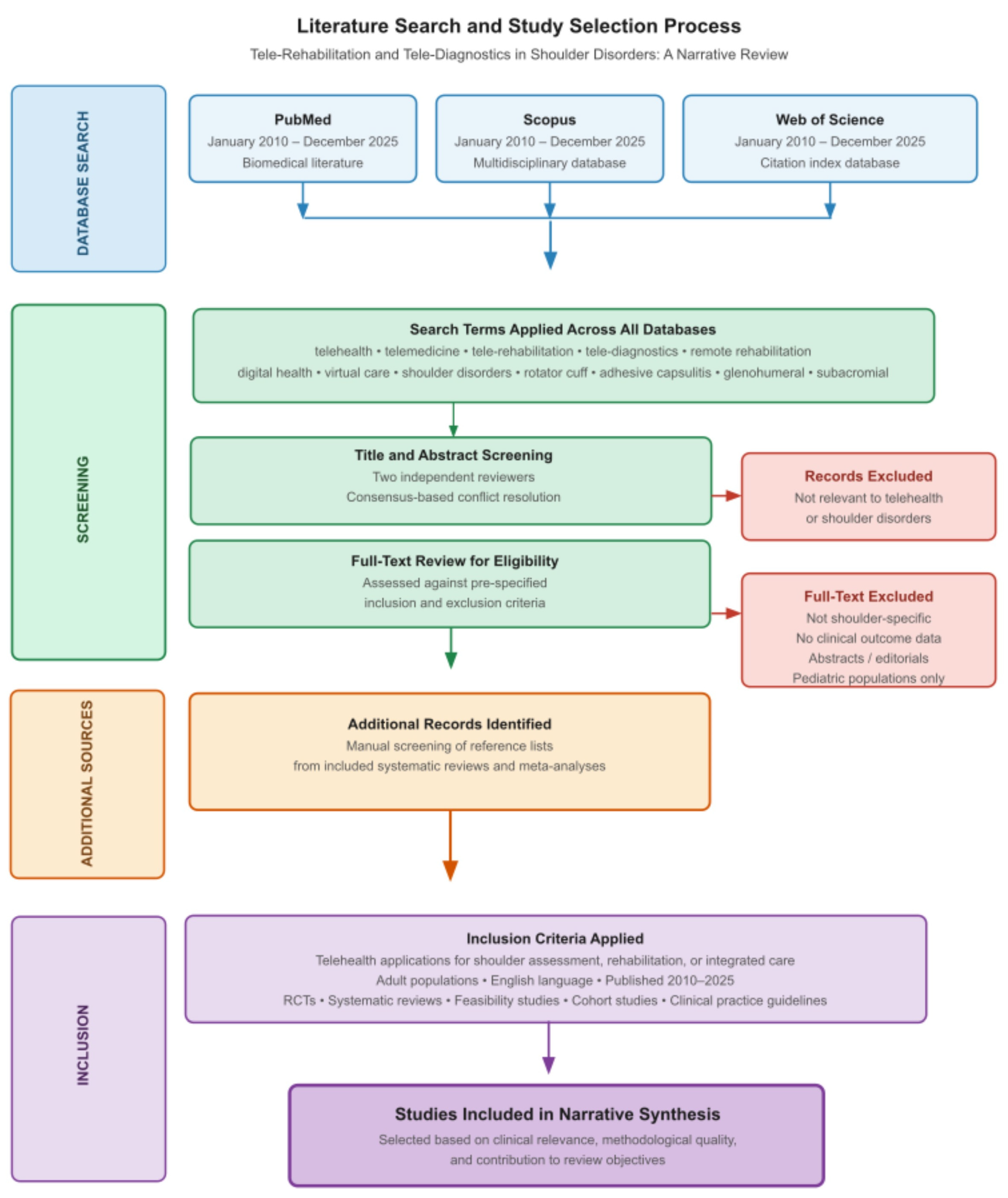
2.1. Search Strategy
2.2. Study Selection
2.3. Evidence Appraisal
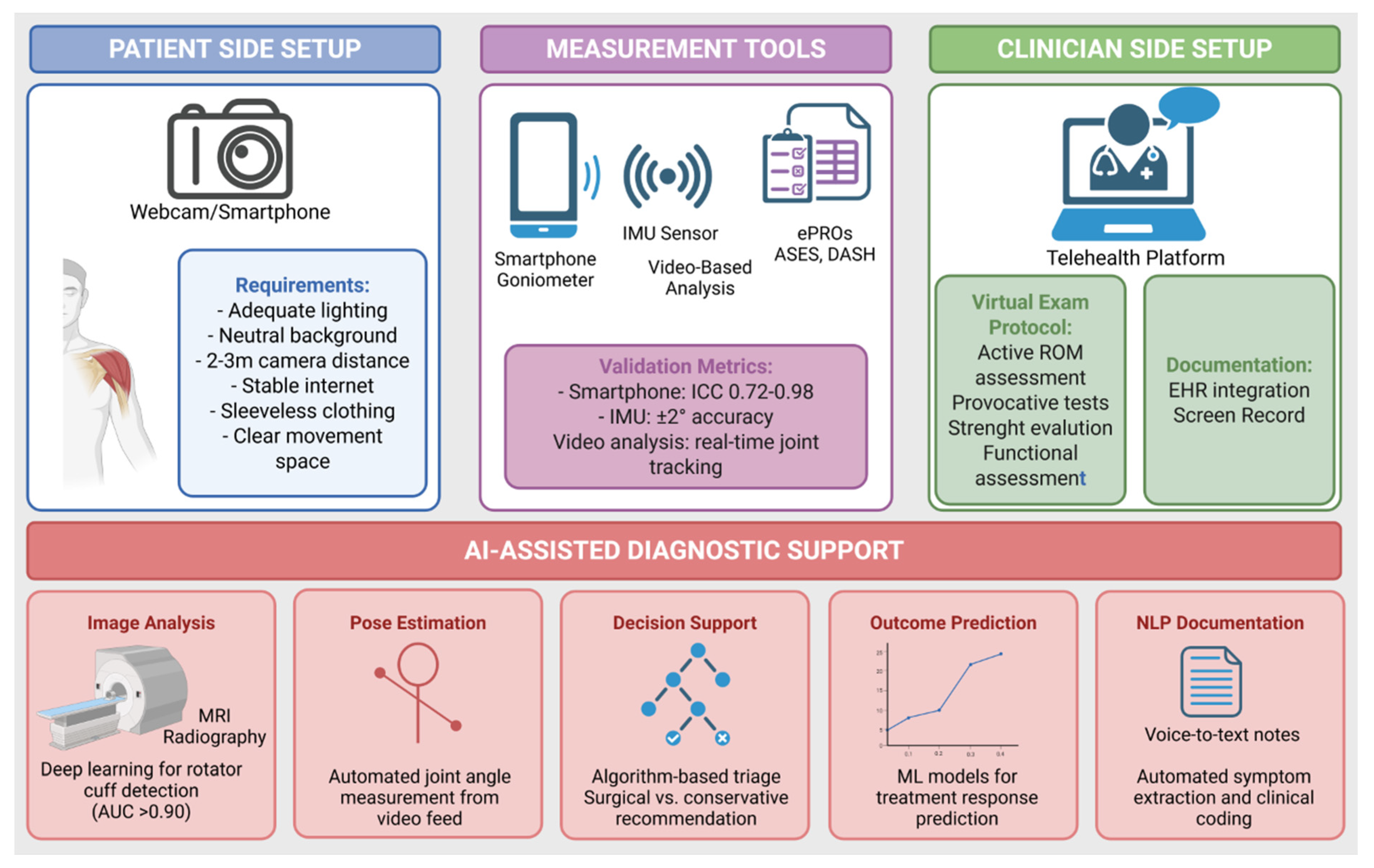
3. Tele-Diagnostics in Shoulder Disorders
4. Tele-Rehabilitation in Shoulder Disorders
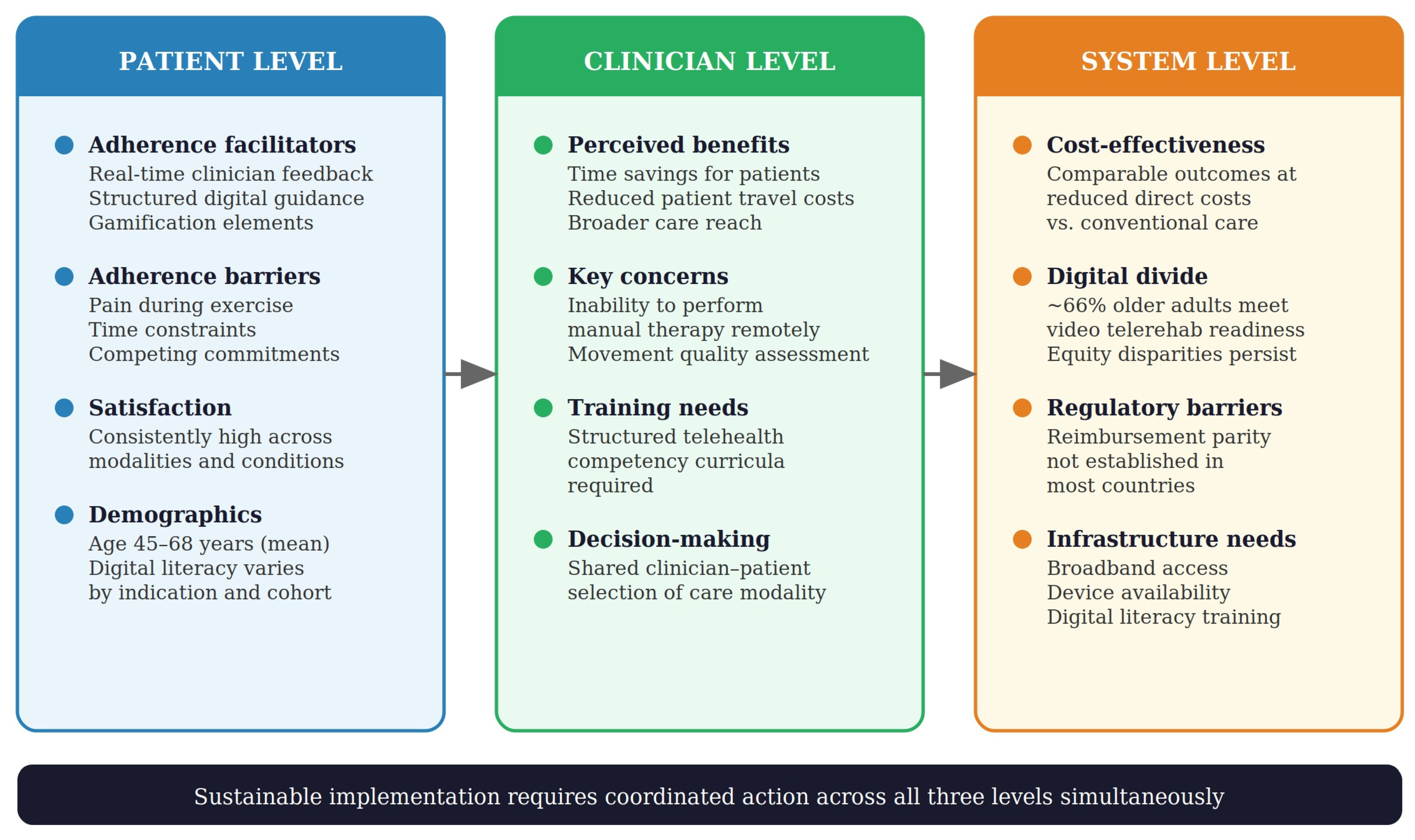
5. Patient Engagement, Adherence and Implementation Factors in Shoulder Tele-Rehabilitation
5.1. Patient Adherence and Engagement
5.2. Patient Satisfaction
5.3. Clinician Perspectives
5.4. Digital Divide and Health Equity
5.5. Cost-Effectiveness
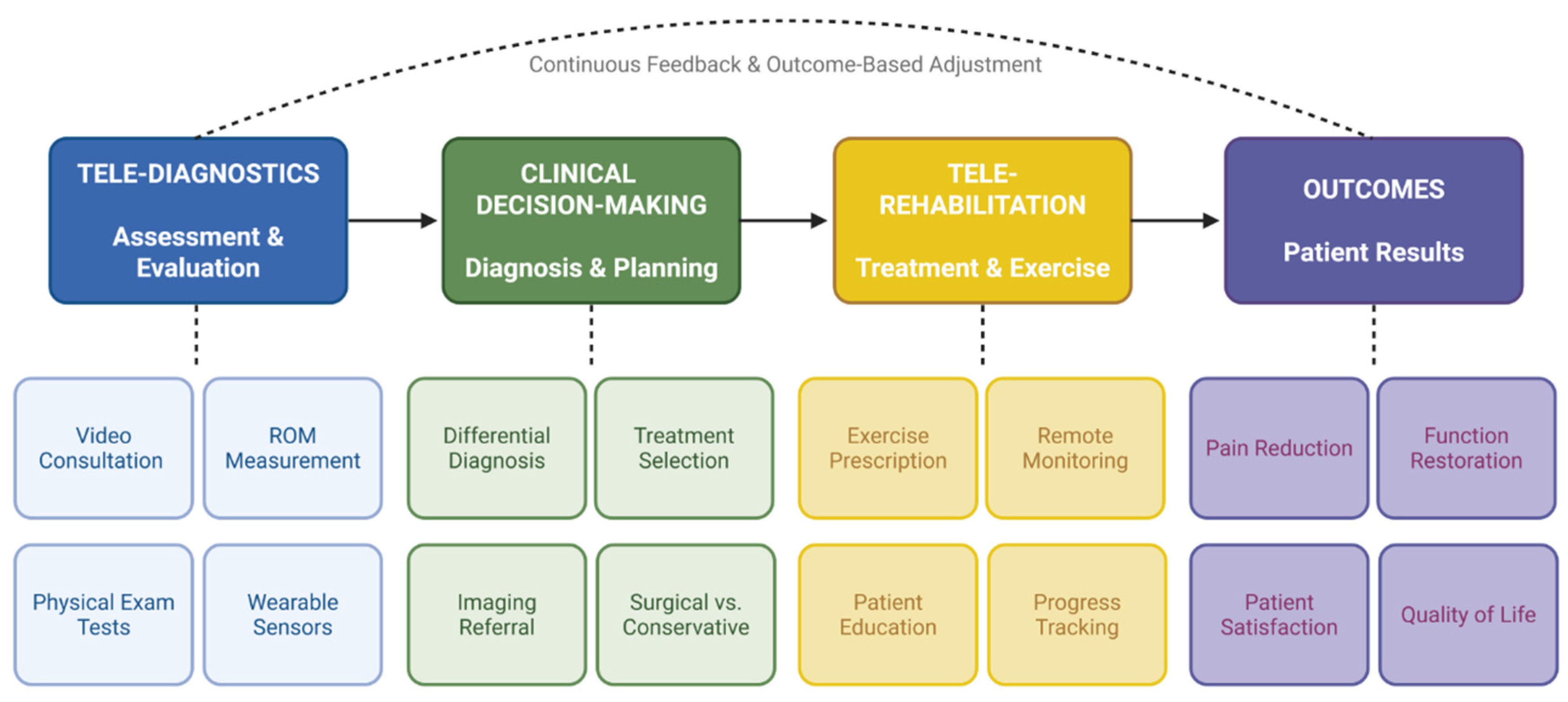
6. Integration of Tele-Diagnostics and Tele-Rehabilitation
7. Limitations and Challenges of Tele-Rehabilitation and Tele-Diagnostics
8. Future Directions
9. Conclusions
Author Contributions
Funding
Institutional Review Board Statement
Informed Consent Statement
Data Availability Statement
Acknowledgments
Conflicts of Interest
Abbreviations
| AI | Artificial Intelligence |
| APTA | American Physical Therapy Association |
| AR | Augmented Reality |
| ASES | American Shoulder and Elbow Surgeons |
| AUC | Area Under the Curve |
| B-STEP | Bari Shoulder Telemedicine Examination Protocol |
| COVID-19 | Coronavirus Disease 2019 |
| DASH | Disabilities of the Arm, Shoulder and Hand |
| ePROs | Electronic Patient-Reported Outcomes |
| GRADE | Grading of Recommendations, Assessment, Development and Evaluations |
| HSS | Hospital for Special Surgery |
| ICC | Intraclass Correlation Coefficient |
| IMU | Inertial Measurement Unit |
| KR-20 | Kuder–Richardson Formula 20 |
| ML | Machine Learning |
| MRI | Magnetic Resonance Imaging |
| P5 | Personalized, Predictive, Participatory, Precision, and Preventive |
| Quick-DASH | Quick Disabilities of the Arm, Shoulder and Hand |
| RCT | Randomized Controlled Trial |
| ROM | Range of Motion |
| SCE | Standard Clinical Examination |
| SPADI | Shoulder Pain and Disability Index |
| SSS | Shoulder Strengthening and Stabilization System |
| STE | Standardized Telehealth Examination |
| VR | Virtual Reality |
References
- Lucas, J.; van Doorn, P.; Hegedus, E.; Lewis, J.; van der Windt, D. A Systematic Review of the Global Prevalence and Incidence of Shoulder Pain. BMC Musculoskelet. Disord. 2022, 23, 1073. [Google Scholar] [CrossRef] [PubMed]
- Salamh, P.A.; Hanney, W.J.; Boles, T.; Holmes, D.; McMillan, A.; Wagner, A.; Kolber, M.J. Is It Time to Normalize Scapular Dyskinesis? The Incidence of Scapular Dyskinesis in Those with and Without Symptoms: A Systematic Review of the Literature. Int. J. Sports Phys. Ther. 2023, 18, 558. [Google Scholar] [CrossRef] [PubMed]
- Walker-Bone, K.; van der Windt, D.A. Shoulder Pain—Where Are We Now? Curr. Treatm. Opt. Rheumatol. 2021, 7, 285–306. [Google Scholar] [CrossRef]
- Hodgetts, C.J.; Leboeuf-Yde, C.; Beynon, A.; Walker, B.F. Shoulder Pain Prevalence by Age and within Occupational Groups: A Systematic Review. Arch. Physiother. 2021, 11, 24. [Google Scholar] [CrossRef]
- Vos, T.; Lim, S.S.; Abbafati, C.; Abbas, K.M.; Abbasi, M.; Abbasifard, M.; Abbasi-Kangevari, M.; Abbastabar, H.; Abd-Allah, F.; Abdelalim, A.; et al. Global Burden of 369 Diseases and Injuries in 204 Countries and Territories, 1990–2019: A Systematic Analysis for the Global Burden of Disease Study 2019. Lancet 2020, 396, 1204–1222. [Google Scholar] [CrossRef]
- Buhler, M.; Shah, T.; Perry, M.; Tennant, M.; Kruger, E.; Milosavljevic, S. Geographic Accessibility to Physiotherapy Care in Aotearoa New Zealand. Spat. Spatiotemporal Epidemiol. 2024, 49, 100656. [Google Scholar] [CrossRef]
- Shayo, M.J.; Shayo, P.; Haukila, K.F.; Norman, K.; Burke, C.; Ngowi, K.; Goode, A.P.; Allen, K.D.; Wonanji, V.T.; Mmbaga, B.T.; et al. Expanding Access to Rehabilitation Using Mobile Health to Address Musculoskeletal Pain and Disability. Front. Rehabil. Sci. 2023, 3, 982175. [Google Scholar] [CrossRef]
- Huber, G.M.; Bitzer, G.; Corazzi, C.; Fitzsimmons, S.; Melissa, H.; Shelley, J.; Hollowell, A.; Healey, W.E. Access to Physical Therapy in a Medically Underserved, Urban Community. J. Health Care Poor Underserved 2019, 30, 768–788. [Google Scholar] [CrossRef]
- Malliaras, P.; Cridland, K.; Hopmans, R.; Ashton, S.; Littlewood, C.; Page, R.; Harris, I.; Skouteris, H.; Haines, T. Internet and Telerehabilitation-Delivered Management of Rotator Cuff–Related Shoulder Pain (INTEL Trial): Randomized Controlled Pilot and Feasibility Trial. JMIR mHealth uHealth 2020, 8, e24311. [Google Scholar] [CrossRef]
- Bucki, F.M.; Clay, M.B.; Tobiczyk, H.; Green, B.N. Scoping Review of Telehealth for Musculoskeletal Disorders: Applications for the COVID-19 Pandemic. J. Manip. Physiol. Ther. 2021, 44, 558–565. [Google Scholar] [CrossRef]
- Lamplot, J.D.; Taylor, S.A. Good Comes from Evil: COVID-19 and the Advent of Telemedicine in Orthopedics. HSS J. 2021, 17, 7–13. [Google Scholar] [CrossRef] [PubMed]
- Rabin, A.; Dolkart, O.; Kazum, E.; Wengier, R.; Goldstein, Y.; Maman, E.; Chechik, O. Shoulder Assessment by Smartphone: A Valid Alternative for Times of Social Distancing. Arch. Orthop. Trauma Surg. 2022, 142, 979–985. [Google Scholar] [CrossRef] [PubMed]
- Correia, F.D.; Molinos, M.; Luís, S.; Carvalho, D.; Carvalho, C.; Costa, P.; Seabra, R.; Francisco, G.; Bento, V.; Lains, J. Digitally Assisted Versus Conventional Home-Based Rehabilitation After Arthroscopic Rotator Cuff Repair. Am. J. Phys. Med. Rehabil. 2022, 101, 237–249. [Google Scholar] [CrossRef]
- Hofmann, U.K.; Hildebrand, F.; Mederake, M.; Migliorini, F. Telemedicine in Orthopaedics and Trauma Surgery during the First Year of COVID Pandemic: A Systematic Review. BMC Musculoskelet. Disord. 2023, 24, 101. [Google Scholar] [CrossRef]
- Tanaka, M.J.; Oh, L.S.; Martin, S.D.; Berkson, E.M. Telemedicine in the Era of COVID-19. J. Bone Jt. Surg. 2020, 102, e57. [Google Scholar] [CrossRef]
- Bradley, K.E.; Cook, C.; Reinke, E.K.; Vinson, E.N.; Mather, R.C.; Riboh, J.; Lassiter, T.; Wittstein, J.R. Comparison of the Accuracy of Telehealth Examination versus Clinical Examination in the Detection of Shoulder Pathology. J. Shoulder Elb. Surg. 2021, 30, 1042–1052. [Google Scholar] [CrossRef]
- Shim, G.Y.; Kim, E.H.; Baek, Y.J.; Chang, W.K.; Kim, B.R.; Oh, J.H.; Lee, J.I.; Hwang, J.H.; Lim, J.-Y. A Randomized Controlled Trial of Postoperative Rehabilitation Using Digital Healthcare System after Rotator Cuff Repair. NPJ Digit. Med. 2023, 6, 95. [Google Scholar] [CrossRef]
- Scheer, J.; Areias, A.C.; Molinos, M.; Janela, D.; Moulder, R.; Lains, J.; Bento, V.; Yanamadala, V.; Dias Correia, F.; Costa, F. Engagement and Utilization of a Complete Remote Digital Care Program for Musculoskeletal Pain Management in Urban and Rural Areas Across the United States: Longitudinal Cohort Study. JMIR mHealth uHealth 2023, 11, e44316. [Google Scholar] [CrossRef]
- Ajrawat, P.; Young Shin, D.; Dryan, D.; Khan, M.; Ravi, B.; Veillette, C.; Leroux, T. The Use of Telehealth for Orthopedic Consultations and Assessments: A Systematic Review. Orthopedics 2021, 44, 198–206. [Google Scholar] [CrossRef]
- Baethge, C.; Goldbeck-Wood, S.; Mertens, S. SANRA—A Scale for the Quality Assessment of Narrative Review Articles. Res. Integr. Peer Rev. 2019, 4, 5. [Google Scholar] [CrossRef] [PubMed]
- Gallo, R.; Applewhite, A.I.; Silvis, M.L.; Yenior, A.L.; Ton, A.N.; Ortiguera, C.J.; Pujalte, G. Shoulder Evaluation by Telephone and Video Visit: A Narrative Review. Cureus 2022, 14, e22461. [Google Scholar] [CrossRef] [PubMed]
- Pinnamaneni, S.; Lamplot, J.D.; Rodeo, S.A.; Swensen-Buza, S.; Lawton, C.D.; Dines, J.S.; Young, W.K.; Taylor, S.A. The Virtual Shoulder Physical Exam. HSS J. 2021, 17, 59–64. [Google Scholar] [CrossRef]
- Wang, G.; Fiedler, A.K.; Warth, R.J.; Bailey, L.; Shupe, P.G.; Gregory, J.M. Reliability and Accuracy of Telemedicine-Based Shoulder Examinations. J. Shoulder Elb. Surg. 2022, 31, e369–e375. [Google Scholar] [CrossRef]
- Hwang, S.; Ardebol, J.; Ghayyad, K.; Pak, T.; Bonadiman, J.A.; Denard, P.J.; Menendez, M.E.; Amini, M.H.; Shah, A.; Hartman, A.; et al. Remote Visual Estimation of Shoulder Range of Motion Has Generally High Interobserver Reliability but Limited Accuracy. JSES Int. 2023, 7, 2528–2533. [Google Scholar] [CrossRef]
- Moretti, L.; Bizzoca, D.; Farì, G.; Caricato, A.; Angiulli, F.; Cassano, G.D.; Solarino, G.; Moretti, B. Bari Shoulder Telemedicine Examination Protocol (B-STEP): A Standard Protocol for Personalized Remote Shoulder Examination. J. Pers. Med. 2023, 13, 1159. [Google Scholar] [CrossRef]
- Lamplot, J.D.; Pinnamaneni, S.; Swensen-Buza, S.; Lawton, C.D.; Dines, J.S.; Nawabi, D.H.; Young, W.; Rodeo, S.A.; Taylor, S.A. The Virtual Shoulder and Knee Physical Examination. Orthop. J. Sports Med. 2020, 8, 2325967120962869. [Google Scholar] [CrossRef]
- Yeo, S.M.; Lim, J.Y.; Do, J.G.; Lim, J.-Y.; In Lee, J.; Hwang, J.H. Effectiveness of Interactive Augmented Reality-Based Telerehabilitation in Patients with Adhesive Capsulitis: Protocol for a Multi-Center Randomized Controlled Trial. BMC Musculoskelet. Disord. 2021, 22, 386. [Google Scholar] [CrossRef]
- Kim, B.I.; Peairs, E.; Lander, S.; Antonelli, C.; Lau, B.C. Telehealth Physical Therapy for Sports Medicine Rehabilitation: What Is Its Role in the Postpandemic Era? Orthop. J. Sports Med. 2022, 10, 23259671221127721. [Google Scholar] [CrossRef]
- Lin, D.J.; Schwier, M.; Geiger, B.; Raithel, E.; von Busch, H.; Fritz, J.; Kline, M.; Brooks, M.; Dunham, K.; Shukla, M.; et al. Deep Learning Diagnosis and Classification of Rotator Cuff Tears on Shoulder MRI. Investig. Radiol. 2023, 58, 405–412. [Google Scholar] [CrossRef] [PubMed]
- Familiari, F.; Galasso, O.; Massazza, F.; Mercurio, M.; Fox, H.; Srikumaran, U.; Gasparini, G. Artificial Intelligence in the Management of Rotator Cuff Tears. Int. J. Environ. Res. Public Health 2022, 19, 16779. [Google Scholar] [CrossRef] [PubMed]
- Fahey, E.; Elsheikh, M.F.H.; Davey, M.S.; Rowan, F.; Cassidy, J.T.; Cleary, M.S. Telemedicine in Orthopedic Surgery: A Systematic Review of Current Evidence. Telemed. e-Health 2022, 28, 613–635. [Google Scholar] [CrossRef]
- Ben-Ari, E.; Kirschenbaum, J.; Patel, R.G.; Kwon, Y.W.; Rokito, A.S.; Zuckerman, J.D.; Virk, M.S. The Future of Health Care Service in Orthopedic Practice: Telemedicine or in-Person Visits? J. Shoulder Elb. Surg. 2021, 30, e703–e712. [Google Scholar] [CrossRef]
- Sahu, D.; Shah, D.; Joshi, M.; Shaikh, S.; Gaikwad, P.; Shyam, A. Validation of an On-Screen Application-Based Measurement of Shoulder Range of Motion over Telehealth Medium. J. Shoulder Elbow Surg. 2022, 31, 201–208. [Google Scholar] [CrossRef]
- Shimizu, H.; Saito, T.; Kouno, C.; Shimoura, K.; Kawabe, R.; Shinohara, Y.; Mukaiyama, K.; Changyu, C.; Kato, M.; Nagai-Tanima, M.; et al. Validity and Reliability of a Smartphone Application for Self-Measurement of Active Shoulder Range of Motion in a Standing Position among Healthy Adults. JSES Int. 2022, 6, 655–659. [Google Scholar] [CrossRef] [PubMed]
- Chan, L.Y.T.; Chua, C.S.; Chou, S.M.; Seah, R.Y.B.; Huang, Y.; Luo, Y.; Dacy, L.; Bin Abd Razak, H.R. Assessment of Shoulder Range of Motion Using a Commercially Available Wearable Sensor—A Validation Study. mHealth 2022, 8, 30. [Google Scholar] [CrossRef] [PubMed]
- Darevsky, D.M.; Hu, D.A.; Gomez, F.A.; Davies, M.R.; Liu, X.; Feeley, B.T. Algorithmic Assessment of Shoulder Function Using Smartphone Video Capture and Machine Learning. Sci. Rep. 2023, 13, 19986. [Google Scholar] [CrossRef]
- Gupta, P.; Haeberle, H.S.; Zimmer, Z.R.; Levine, W.N.; Williams, R.J.; Ramkumar, P.N. Artificial Intelligence-Based Applications in Shoulder Surgery Leaves Much to Be Desired: A Systematic Review. JSES Rev. Rep. Tech. 2023, 3, 189–200. [Google Scholar] [CrossRef] [PubMed]
- Topol, E.J. High-Performance Medicine: The Convergence of Human and Artificial Intelligence. Nat. Med. 2019, 25, 44–56. [Google Scholar] [CrossRef]
- Sabu, D.; Rathod, V.; Phadnis, A.; Bansal, S.S. Telehealth for Consultation and Shoulder Rehabilitation: A Preliminary Study on the Perspectives of 30 Patients during the COVID-19 Lockdown. Clin. Shoulder Elb. 2021, 24, 156–165. [Google Scholar] [CrossRef]
- Huang, T.; Zhang, W.; Yan, B.; Liu, H.; Girard, O. Comparing Telerehabilitation and Home-Based Exercise for Shoulder Disorders: A Systematic Review and Meta-Analysis. Arch. Phys. Med. Rehabil. 2024, 105, 2214–2223. [Google Scholar] [CrossRef]
- Lin, T.; Yang, Y.; Hong, H.; Zhou, X.; Tung, T.-H.; Zheng, B.; Zhang, J. Effectiveness of Telerehabilitation in Non-Operatively Managed Shoulder Conditions: A Systematic Review and Meta-Analysis. BMC Musculoskelet. Disord. 2025, 26, 614. [Google Scholar] [CrossRef]
- O’Reilly, O.C.; Bozoghlian, M.; Glass, N.; Shaffer, M.; Fleming, J.; Nepola, J.V.; Patterson, B.M. Physical Therapy Following Shoulder Arthroplasty: An Assessment of Telerehabilitation vs. in-Person Physical Therapy. Semin. Arthroplast. JSES 2025, 35, 505–516. [Google Scholar] [CrossRef]
- Kane, L.T.; Thakar, O.; Jamgochian, G.; Lazarus, M.D.; Abboud, J.A.; Namdari, S.; Horneff, J.G. The Role of Telehealth as a Platform for Postoperative Visits Following Rotator Cuff Repair: A Prospective, Randomized Controlled Trial. J. Shoulder Elb. Surg. 2020, 29, 775–783. [Google Scholar] [CrossRef]
- Çelik, E.B.; Tuncer, A. Comparing the Efficacy of Manual Therapy and Exercise to Synchronized Telerehabilitation with Self-Manual Therapy and Exercise in Treating Subacromial Pain Syndrome: A Randomized Controlled Trial. Healthcare 2024, 12, 1074. [Google Scholar] [CrossRef] [PubMed]
- Pak, S.S.; Janela, D.; Freitas, N.; Costa, F.; Moulder, R.; Molinos, M.; Areias, A.C.; Bento, V.; Cohen, S.P.; Yanamadala, V.; et al. Comparing Digital to Conventional Physical Therapy for Chronic Shoulder Pain: Randomized Controlled Trial. J. Med. Internet Res. 2023, 25, e49236. [Google Scholar] [CrossRef]
- Marley, W.D.; Barratt, A.; Pigott, T.; Granat, M.; Wilson, J.D.; Roy, B. A Multicenter Randomized Controlled Trial Comparing Gamification with Remote Monitoring against Standard Rehabilitation for Patients after Arthroscopic Shoulder Surgery. J. Shoulder Elb. Surg. 2022, 31, 8–16. [Google Scholar] [CrossRef]
- Pastora-Bernal, J.M.; Martín-Valero, R.; Barón-López, F.J.; Moyano, N.G.; Estebanez-Pérez, M.-J. Telerehabilitation after Arthroscopic Subacromial Decompression Is Effective and Not Inferior to Standard Practice: Preliminary Results. J. Telemed. Telecare 2018, 24, 428–433. [Google Scholar] [CrossRef]
- Chen, Y.-P.; Lin, C.-Y.; Tsai, M.-J.; Chuang, T.-Y.; Lee, O.K.-S. Wearable Motion Sensor Device to Facilitate Rehabilitation in Patients With Shoulder Adhesive Capsulitis: Pilot Study to Assess Feasibility. J. Med. Internet Res. 2020, 22, e17032. [Google Scholar] [CrossRef]
- Picha, K.J.; Howell, D.M. A Model to Increase Rehabilitation Adherence to Home Exercise Programmes in Patients with Varying Levels of Self-efficacy. Musculoskelet. Care 2018, 16, 233–237. [Google Scholar] [CrossRef] [PubMed]
- Morri, M.; Ruisi, R.; Culcasi, A.; Peccerillo, V. The Effectiveness of Telerehabilitation for Functional Recovery After Orthopedic Surgery: A Systematic Review and Meta-Analysis. Telemed. Rep. 2024, 5, 78–88. [Google Scholar] [CrossRef] [PubMed]
- Francisco, I.M.; Tozzo, M.C.; Martins, J.; de Oliveira, A.S. Adherence of Individuals with Shoulder Pain to Home Exercise Booklets: Barriers, Facilitators, and the Impact of Disability, Self-Efficacy, and Treatment Expectations. Musculoskelet. Sci. Pract. 2024, 72, 102956. [Google Scholar] [CrossRef]
- Simmich, J.; Ross, M.H.; Russell, T. Real-Time Video Telerehabilitation Shows Comparable Satisfaction and Similar or Better Attendance and Adherence Compared with in-Person Physiotherapy: A Systematic Review. J. Physiother. 2024, 70, 181–192. [Google Scholar] [CrossRef] [PubMed]
- Janela, D.; Costa, F.; Molinos, M.; Moulder, R.G.; Lains, J.; Francisco, G.E.; Bento, V.; Cohen, S.P.; Correia, F.D. Asynchronous and Tailored Digital Rehabilitation of Chronic Shoulder Pain: A Prospective Longitudinal Cohort Study. J. Pain Res. 2022, 15, 53–66. [Google Scholar] [CrossRef]
- Martinez-Rico, S.; Lizaur-Utrilla, A.; Sebastia-Forcada, E.; Vizcaya-Moreno, M.F.; de Juan-Herrero, J. The Impact of a Phone Assistance Nursing Program on Adherence to Home Exercises and Final Outcomes in Patients Who Underwent Shoulder Instability Surgery. Orthop. Nurs. 2018, 37, 372–378. [Google Scholar] [CrossRef]
- Choi, Y.; Nam, J.; Yang, D.; Jung, W.; Lee, H.-R.; Kim, S.H. Effect of Smartphone Application-Supported Self-Rehabilitation for Frozen Shoulder: A Prospective Randomized Control Study. Clin. Rehabil. 2019, 33, 653–660. [Google Scholar] [CrossRef]
- Wörner, T.; Sirard, P.; Nero, H.; Hörder, H.; Misini Ignjatovic, M.; Eek, F. Changes in Pain and Disability in Patients with Shoulder Pain after Three Months of Digitally Delivered Exercise and Patient Education. J. Rehabil. Med. 2023, 55, jrm9415. [Google Scholar] [CrossRef]
- Markus, D.H.; Colasanti, C.A.; Kaplan, D.J.; Manjunath, A.K.; Alaia, M.J.; Strauss, E.J.; Jazrawi, L.M.; Campbell, K.A. High Rate of Patient Satisfaction with Either Telemedicine or Traditional Office-Based Follow-Up Visit After Arthroscopic Shoulder Surgery. Telemed. e-Health 2023, 30, 134–140. [Google Scholar] [CrossRef]
- O’Donnell, E.A.; Haberli, J.E.; Martinez, A.M.; Yagoda, D.; Kaplan, R.S.; Warner, J.J.P. Telehealth Visits After Shoulder Surgery: Higher Patient Satisfaction and Lower Costs. JAAOS Glob. Res. Rev. 2022, 6, e22. [Google Scholar] [CrossRef] [PubMed]
- Sabbagh, R.; Shah, N.; Jenkins, S.; Macdonald, J.; Foote, A.; Matar, R.; Steffensmeier, A.; Grawe, B. The COVID-19 Pandemic and Follow-up for Shoulder Surgery: The Impact of a Shift toward Telemedicine on Validated Patient-Reported Outcomes. J. Telemed. Telecare 2023, 29, 484–491. [Google Scholar] [CrossRef] [PubMed]
- Cha, E.D.K.; Suraci, C.; Petrosky, D.; Welsh, R.; Reynolds, G.; Scharf, M.; Brutico, J.; SantaLucia, G.; Choi, J. Patient Satisfaction in Shoulder Arthroscopy: Telemedicine vs. Clinic Follow-up Visits. Clin. Shoulder Elb. 2022, 25, 106–111. [Google Scholar] [CrossRef]
- Sia, L.L.; Sharma, S.; Kumar, S.; Ajit Singh, D.K. Exploring Physiotherapists’ Perceptions of Telerehabilitation for Musculoskeletal Disorders: Insights from Focus Groups. Digit. Health 2024, 10, 20552076241248916. [Google Scholar] [CrossRef]
- Baroni, M.P.; Jacob, M.F.A.; Rios, W.R.; Fandim, J.V.; Fernandes, L.G.; Chaves, P.I.; Fioratti, I.; Saragiotto, B.T. The State of the Art in Telerehabilitation for Musculoskeletal Conditions. Arch. Physiother. 2023, 13, 1. [Google Scholar] [CrossRef] [PubMed]
- Brady, N.; Dejaco, B.; Lewis, J.; McCreesh, K.; McVeigh, J.G. Physiotherapist Beliefs and Perspectives on Virtual Reality Supported Rehabilitation for the Management of Musculoskeletal Shoulder Pain: A Focus Group Study. PLoS ONE 2023, 18, e0284445. [Google Scholar] [CrossRef]
- Lee, A.C.; Deutsch, J.E.; Holdsworth, L.; Kaplan, S.L.; Kosakowski, H.; Latz, R.; McNeary, L.L.; O’Neil, J.; Ronzio, O.; Sanders, K.; et al. Telerehabilitation in Physical Therapist Practice: A Clinical Practice Guideline from the American Physical Therapy Association. Phys. Ther. 2024, 104, pzae045. [Google Scholar] [CrossRef]
- Falvey, J.R.; Sun, N.; Miller, M.J.; Pravdo, A.; Mullins, C.D. Demystifying the Digital Divide: Disparities in Telerehabilitation Readiness Among Older Adults in the United States. Arch. Phys. Med. Rehabil. 2024, 105, 1255–1261. [Google Scholar] [CrossRef]
- Areias, A.C.; Janela, D.; Molinos, M.; Moulder, R.G.; Bento, V.; Yanamadala, V.; Cohen, S.P.; Correia, F.D.; Costa, F. Managing Musculoskeletal Pain in Older Adults Through a Digital Care Solution: Secondary Analysis of a Prospective Clinical Study. JMIR Rehabil. Assist. Technol. 2023, 10, e49673. [Google Scholar] [CrossRef]
- Molina-Garcia, P.; Mora-Traverso, M.; Prieto-Moreno, R.; Díaz-Vásquez, A.; Antony, B.; Ariza-Vega, P. Effectiveness and Cost-Effectiveness of Telerehabilitation for Musculoskeletal Disorders: A Systematic Review and Meta-Analysis. Ann. Phys. Rehabil. Med. 2024, 67, 101791. [Google Scholar] [CrossRef]
- Türkmen, E.; Analay Akbaba, Y.; Altun, S. Effectiveness of Video-Based Rehabilitation Program on Pain, Functionality, and Quality of Life in the Treatment of Rotator Cuff Tears: A Randomized Controlled Trial. J. Hand Ther. 2020, 33, 288–295. [Google Scholar] [CrossRef] [PubMed]
- Longo, U.G.; Carnevale, A.; Massaroni, C.; Lo Presti, D.; Berton, A.; Candela, V.; Schena, E.; Denaro, V. Personalized, Predictive, Participatory, Precision, and Preventive (P5) Medicine in Rotator Cuff Tears. J. Pers. Med. 2021, 11, 255. [Google Scholar] [CrossRef]
- Sassi, M.; Villa Corta, M.; Pisani, M.G.; Nicodemi, G.; Schena, E.; Pecchia, L.; Longo, U.G. Advanced Home-Based Shoulder Rehabilitation: A Systematic Review of Remote Monitoring Devices and Their Therapeutic Efficacy. Sensors 2024, 24, 2936. [Google Scholar] [CrossRef] [PubMed]
- Carnevale, A.; Longo, U.G.; Schena, E.; Massaroni, C.; Lo Presti, D.; Berton, A.; Candela, V.; Denaro, V. Wearable Systems for Shoulder Kinematics Assessment: A Systematic Review. BMC Musculoskelet. Disord. 2019, 20, 546. [Google Scholar] [CrossRef]
- Lee, K.; Kim, J.-H.; Hong, H.; Jeong, Y.; Ryu, H.; Kim, H.; Lee, S.-U. Deep Learning Model for Classifying Shoulder Pain Rehabilitation Exercises Using IMU Sensor. J. Neuroeng. Rehabil. 2024, 21, 42. [Google Scholar] [CrossRef]
- Sassi, M.; Carnevale, A.; Mancuso, M.; Schena, E.; Pecchia, L.; Longo, U.G. Machine-learning Models for Shoulder Rehabilitation Exercises Classification Using a Wearable System. Knee Surg. Sports Traumatol. Arthrosc. 2025, 33, 1452–1458. [Google Scholar] [CrossRef] [PubMed]
- Burns, D.M.; Leung, N.; Hardisty, M.; Whyne, C.M.; Henry, P.; McLachlin, S. Shoulder Physiotherapy Exercise Recognition: Machine Learning the Inertial Signals from a Smartwatch. Physiol. Meas. 2018, 39, 075007. [Google Scholar] [CrossRef]
- Greiner, J.J.; Drain, N.P.; Lesniak, B.P.; Lin, A.; Musahl, V.; Irrgang, J.J.; Popchak, A.J. Self-Reported Outcomes in Early Postoperative Management After Shoulder Surgery Using a Home-Based Strengthening and Stabilization System with Telehealth. Sports Health A Multidiscip. Approach 2023, 15, 599–605. [Google Scholar] [CrossRef] [PubMed]
- Carnevale, A.; Mannocchi, I.; Schena, E.; Carli, M.; Sassi, M.S.H.; Marino, M.; Longo, U.G. Performance Evaluation of an Immersive Virtual Reality Application for Rehabilitation after Arthroscopic Rotator Cuff Repair. Bioengineering 2023, 10, 1305. [Google Scholar] [CrossRef] [PubMed]
- Oh, D.; To, D.; Corso, M.; Murnaghan, K.; Yu, H.; Cancelliere, C. Agreement and Concurrent Validity between Telehealth and In-Person Diagnosis of Musculoskeletal Conditions: A Systematic Review. Chiropr. Man. Therap. 2024, 32, 21. [Google Scholar] [CrossRef]
- Veras, M.; Auger, L.-P.; Sigouin, J.; Gheidari, N.; Nelson, M.L.; Miller, W.C.; Hudon, A.; Kairy, D. Ethics and Equity Challenges in Telerehabilitation for Older Adults: Rapid Review. JMIR Aging 2025, 8, e69660. [Google Scholar] [CrossRef]
- Ali, O.I.; Salem, O.M.; Mohamed, S.A.A.; Ali, S.A.H.; Embaby, E.A. Physiotherapy Professionals: A Questionnaire for the Evaluation of Telerehabilitation Services in Egypt. Int. J. Telerehabil. 2025, 16, e6654. [Google Scholar] [CrossRef]
- Gava, V.; Ribeiro, L.P.; Barreto, R.P.G.; Camargo, P.R. Effectiveness of Physical Therapy given by Telerehabilitation on Pain and Disability of Individuals with Shoulder Pain: A Systematic Review. Clin. Rehabil. 2022, 36, 715–725. [Google Scholar] [CrossRef]
- Jolin, J.R.; Richman, B.; Mehrotra, A.; Shachar, C. Reforming Physician Licensure in the United States to Improve Access to Telehealth: State, Regional, and Federal Initiatives. Milbank Q. 2024, 102, 833–852. [Google Scholar] [CrossRef] [PubMed]
- Marks, D.; Kitcher, S.; Attrazic, E.; Hing, W.; Cottrell, M. The Health Economic Impact of Musculoskeletal Physiotherapy Delivered by Telehealth: A Systematic Review. Int. J. Telerehabil. 2022, 14, e6524. [Google Scholar] [CrossRef]
- Ferorelli, D.; Moretti, L.; Benevento, M.; Mastrapasqua, M.; Telegrafo, M.; Solarino, B.; Dell’Erba, A.; Bizzoca, D.; Moretti, B. Digital Health Care, Telemedicine, and Medicolegal Issues in Orthopedics: A Review. Int. J. Environ. Res. Public Health 2022, 19, 15653. [Google Scholar] [CrossRef]
- Dimo, A.; Longo, U.G.; D’Hooghe, P.; de Sire, A.; Papalia, R.; Schena, E.; Lo Presti, D. 3D-Printed Wearable Sensors for the Identification of Shoulder Movement Planes. Sensors 2025, 25, 5853. [Google Scholar] [CrossRef]
- Yasar, M.N.; Sica, M.; O’Flynn, B.; Tedesco, S.; Menolotto, M. A Dataset for Fatigue Estimation during Shoulder Internal and External Rotation Movements Using Wearables. Sci. Data 2024, 11, 433. [Google Scholar] [CrossRef] [PubMed]
- Longo, U.G.; Carnevale, A.; Andreoli, F.; Mannocchi, I.; Bravi, M.; Sassi, M.S.H.; Santacaterina, F.; Carli, M.; Schena, E.; Papalia, R. Immersive Virtual Reality for Shoulder Rehabilitation: Evaluation of a Physical Therapy Program Executed with Oculus Quest 2. BMC Musculoskelet. Disord. 2023, 24, 859. [Google Scholar] [CrossRef] [PubMed]
- van den Hoorn, W.; Lavaill, M.; Cutbush, K.; Gupta, A.; Kerr, G. Comparison of Shoulder Range of Motion Quantified with Mobile Phone Video-Based Skeletal Tracking and 3D Motion Capture—Preliminary Study. Sensors 2024, 24, 534. [Google Scholar] [CrossRef]
- Pereira, B.; Cunha, B.; Viana, P.; Lopes, M.; Melo, A.; Sousa, A. A Machine Learning App for Monitoring Physical Therapy at Home. Sensors 2023, 24, 158. [Google Scholar] [CrossRef]
- Saxby, D.J.; Pizzolato, C.; Diamond, L.E. A Digital Twin Framework for Precision Neuromusculoskeletal Health Care: Extension Upon Industrial Standards. J. Appl. Biomech. 2023, 39, 347–354. [Google Scholar] [CrossRef]



| Author | Year | Condition | Method | Reliability/Validity |
|---|---|---|---|---|
| Group 1: Clinical Examination Validation | ||||
| Bradley et al. [16] | 2021 | Shoulder disorders (general) | Video consultation vs. in-person examination (RCT, n = 62) | Non-inferiority confirmed (p = 0.98); MRI as reference standard |
| Wang et al. [23] | 2022 | Shoulder pathology | Virtual physical examination with standardized maneuvers | Overall agreement 76.4%; KR-20 = 0.391; ROM highest reliability (KR-20 = 0.700) |
| Rabin et al. [12] | 2022 | Shoulder disorders | Smartphone-based remote assessment | Diagnosis agreement κ = 0.78; intervention agreement κ = 0.48 |
| Hwang et al. [24] | 2023 | Shoulder ROM | Telehealth ROM assessment | High interobserver reliability for active ROM measurements |
| Moretti et al. [25] | 2023 | Shoulder disorders | B-STEP protocol (Bologna Shoulder Tele-Examination Protocol) | 100% ASES completion rate; 87.5% Constant score feasibility |
| Lamplot et al. [26] | 2020 | Shoulder examination | HSS virtual shoulder physical examination protocol | Standardized protocol with demonstration images validated |
| Group 2: Digital Measurement Tools | ||||
| Yeo et al. [27] | 2021 | Shoulder ROM | Smartphone goniometer application | ICC 0.72–0.98 compared to standard goniometry |
| Kim et al. [28] | 2022 | Shoulder ROM | Wearable IMU sensor system | ±2° accuracy; 9-axis motion tracking validated |
| Group 3: AI/ML and Diagnostic Technology | ||||
| Lin et al. [29] | 2023 | Rotator cuff tears | Deep learning MRI analysis | AUC > 0.90 for tear detection |
| Familiari et al. [30] | 2022 | Rotator cuff pathology | Systematic review of AI/ML applications | 6-fold publication increase 2018–2021; high diagnostic accuracy reported |
| Group 4: Telehealth Implementation and Patient Satisfaction | ||||
| Fahey et al. [31] | 2022 | Orthopedic conditions (systematic review) | Telemedicine consultations | 11/15 studies: high patient satisfaction; 9/15: equivalent clinical outcomes |
| Ben-Ari et al. [32] | 2021 | Shoulder surgery patients | Postoperative telehealth follow-up | >76% patient satisfaction; comparable outcomes to in-person |
| Sahu et al. [33] | 2022 | Shoulder/elbow disorders | COVID-19 telehealth implementation | High patient acceptance; effective for routine follow-up |
| Study | Design | Sample | Condition | Intervention | Follow-Up | Primary Outcome | Key Finding | Limitations |
|---|---|---|---|---|---|---|---|---|
| Shim et al. [17] | RCT | n = 115 | Rotator cuff repair | AR-based digital rehabilitation vs. brochure-based home exercise | 24 weeks | SST, SPADI, DASH | Superior SST improvement in digital group at 12 weeks | Single center; no blinding possible |
| O’Reilly et al. [42] | RCT | n = 81 | Shoulder arthroplasty | Tele-rehabilitation vs. in-person PT | 12 months | PROMs, ROM | No significant difference between groups | Heterogeneous surgical procedures |
| Kane et al. [43] | RCT | n = NR | Rotator cuff repair | Telehealth postoperative visits vs. in-person | 12 weeks | ASES, VAS pain | No significant differences | Short follow-up; limited to postoperative visits only |
| Çelik & Tuncer [44] | RCT | n = 60 | Subacromial pain syndrome | Tele-rehabilitation with self-manual therapy vs. in-person manual therapy | 8 weeks | Pain, ROM, Quick-DASH | Comparable outcomes between groups | Short follow-up; self-manual therapy may not replicate in-person technique |
| Pak et al. [45] | RCT | n = NR | Chronic shoulder pain | Digital PT with wearable sensors vs. conventional PT | 12 weeks | Pain, function | Clinically meaningful improvements in both groups; no between-group difference | Industry-funded study |
| Marley et al. [46] | RCT | n = NR | Post-arthroscopic surgery | Gamified rehabilitation vs. standard physiotherapy | NR | Clinical outcomes, motivation | Equivalent outcomes; sustained motivation in gamified group | Multicenter heterogeneity |
| Malliaras et al. [9] | RCT pilot | n = NR | Rotator cuff-related pain | Tele-rehabilitation + recommended care vs. internet-only | 12 weeks | Retention, adherence | 94% retention; superior adherence in tele-rehabilitation group | Pilot study; underpowered for efficacy |
Disclaimer/Publisher’s Note: The statements, opinions and data contained in all publications are solely those of the individual author(s) and contributor(s) and not of MDPI and/or the editor(s). MDPI and/or the editor(s) disclaim responsibility for any injury to people or property resulting from any ideas, methods, instructions or products referred to in the content. |
© 2026 by the authors. Licensee MDPI, Basel, Switzerland. This article is an open access article distributed under the terms and conditions of the Creative Commons Attribution (CC BY) license.
Share and Cite
Todorović, P.; Pavlović, N.; Kopilaš, A.; Vukojević, K.; Čarić, A. Tele-Rehabilitation and Tele-Diagnostics in Shoulder Disorders: Current Evidence, Challenges, and Future Directions—A Narrative Review. J. Clin. Med. 2026, 15, 2694. https://doi.org/10.3390/jcm15072694
Todorović P, Pavlović N, Kopilaš A, Vukojević K, Čarić A. Tele-Rehabilitation and Tele-Diagnostics in Shoulder Disorders: Current Evidence, Challenges, and Future Directions—A Narrative Review. Journal of Clinical Medicine. 2026; 15(7):2694. https://doi.org/10.3390/jcm15072694
Chicago/Turabian StyleTodorović, Petar, Nikola Pavlović, Andrea Kopilaš, Katarina Vukojević, and Ana Čarić. 2026. "Tele-Rehabilitation and Tele-Diagnostics in Shoulder Disorders: Current Evidence, Challenges, and Future Directions—A Narrative Review" Journal of Clinical Medicine 15, no. 7: 2694. https://doi.org/10.3390/jcm15072694
APA StyleTodorović, P., Pavlović, N., Kopilaš, A., Vukojević, K., & Čarić, A. (2026). Tele-Rehabilitation and Tele-Diagnostics in Shoulder Disorders: Current Evidence, Challenges, and Future Directions—A Narrative Review. Journal of Clinical Medicine, 15(7), 2694. https://doi.org/10.3390/jcm15072694