Factors Associated with Reduced Clinical Response in Adult ADHD: The Role of Alcohol and Cannabis Use Disorders and Autism Spectrum Disorder
 , , ,
, , ,  ,
,  ,
,  ,
, 
Abstract
1. Introduction
2. Materials and Methods
2.1. Study Design
2.2. Sample Recruitment and Participants
- (i)
- a diagnosis of ADHD established according to DSM-5-TR criteria and confirmed through structured clinical assessment and a standardized diagnostic interview;
- (ii)
- initiation or ongoing treatment with ADHD-specific pharmacotherapy during the observation period;
- (iii)
- availability of a baseline clinical assessment and at least one follow-up evaluation allowing the assessment of clinical response.
2.3. Clinical Assessment and Diagnostic Procedures
2.4. Definition of Clinical Response
2.5. Pharmacological Treatment
2.6. Substance Use Variables
2.7. Statistical Analysis
2.8. Use of Generative AI
3. Results
3.1. Sample Characteristics
3.2. Descriptive and Exploratory Analyses
3.3. Multivariable Analyses of Factors Associated with Clinical Response
4. Discussion
4.1. Alcohol and Cannabis Use Disorders as Clinical Correlates of Reduced ADHD Treatment Response
4.2. Other Substance Use Disorders and Clinical Heterogeneity in ADHD–SUD Comorbidity
4.3. ASD and Family History of Neurodevelopmental Disorders in Relation to Treatment Response
4.4. Limitations
5. Conclusions
Author Contributions
Funding
Institutional Review Board Statement
Informed Consent Statement
Data Availability Statement
Acknowledgments
Conflicts of Interest
Abbreviations
| ADHD | Attention-Deficit/Hyperactivity Disorder |
| ASD | Autism Spectrum Disorder |
| ASRS | Adult ADHD Self-Report Scale |
| ATX | Atomoxetine |
| AUD | Alcohol Use Disorder |
| BPRS-6 | Six-item Brief Psychiatric Rating Scale |
| BRI | Behavioral Regulation Index |
| BRIEF-A | Behavior Rating Inventory of Executive Function—Adult Version |
| CAARS-O:SV | Conners’ Adult ADHD Rating Scale—Observer Report: Screening Version |
| CGI-I | Clinical Global Impression—Improvement scale |
| CI | Confidence Interval |
| CUD | Cannabis Use Disorder |
| DAT | Dopamine Transporter |
| DIVA-5 | Diagnostic Interview for ADHD in Adults, version 5 |
| DSM-5-TR | Diagnostic and Statistical Manual of Mental Disorders, Fifth Edition, Text Revision |
| DSM-5 | Diagnostic and Statistical Manual of Mental Disorders, Fifth Edition |
| DSP | Delayed Sleep Phase profile |
| HAM-D | Hamilton Depression Rating Scale |
| HED | Higher Emotional Dysregulation |
| LED | Lower Emotional Dysregulation |
| MEQ | Morningness–Eveningness Questionnaire |
| MI | Metacognition Index |
| MPH | Methylphenidate |
| OR | Odds Ratio |
| OUD | Opioid Use Disorder |
| RIPoSt-40 | Reactivity, Intensity, Polarity and Stability questionnaire |
| SCID-5 | Structured Clinical Interview for DSM-5 |
| SUD | Substance Use Disorder |
| THC | Δ9-tetrahydrocannabinol |
| YMRS | Young Mania Rating Scale |
References
- Turgay, A.; Goodman, D.W.; Asherson, P.; Lasser, R.A.; Babcock, T.F.; Pucci, M.L.; Barkley, R. Lifespan persistence of ADHD: The life transition model and its application. J. Clin. Psychiatry 2012, 73, 192–201. [Google Scholar] [CrossRef]
- Ohnishi, T.; Kobayashi, H.; Yajima, T.; Koyama, T.; Noguchi, K. Psychiatric Comorbidities in Adult Attention-deficit/Hyperactivity Disorder: Prevalence and Patterns in the Routine Clinical Setting. Innov. Clin. Neurosci. 2019, 16, 11–16. [Google Scholar]
- Lu, N.; Wang, M.; Zheng, Z.; Zhang, F.; Huang, W.; Pan, H.; Yang, Z.; Du, X.; Zhang, G.; Li, C.; et al. Comorbidity of common psychiatric disorders and attention-deficit/hyperactivity disorder in Chinese adults. Psychiatry Res. 2025, 351, 116662. [Google Scholar] [CrossRef]
- Tripodi, B.; Carbone, M.G.; Matarese, I.; Rizzato, R.; Della Rocca, F.; De Dominicis, F.; Callegari, C. Effectiveness of Pharmacological Treatments for Adult ADHD on Psychiatric Comorbidity: A Systematic Review. J. Clin. Med. 2025, 14, 8848. [Google Scholar] [CrossRef]
- Rommelse, N.N.; Franke, B.; Geurts, H.M.; Hartman, C.A.; Buitelaar, J.K. Shared heritability of attention-deficit/hyperactivity disorder and autism spectrum disorder. Eur. Child. Adolesc. Psychiatry 2010, 19, 281–295. [Google Scholar] [CrossRef]
- Leitner, Y. The co-occurrence of autism and attention deficit hyperactivity disorder in children—What do we know? Front. Hum. Neurosci. 2014, 8, 268. [Google Scholar] [CrossRef]
- Lai, M.C.; Lombardo, M.V.; Baron-Cohen, S. Autism. Lancet 2014, 383, 896–910. [Google Scholar] [CrossRef]
- Simonoff, E.; Pickles, A.; Charman, T.; Chandler, S.; Loucas, T.; Baird, G. Psychiatric disorders in children with autism spectrum disorders: Prevalence, comorbidity, and associated factors in a population-derived sample. J. Am. Acad. Child. Adolesc. Psychiatry 2008, 47, 921–929. [Google Scholar] [CrossRef]
- Antshel, K.M.; Russo, N. Autism Spectrum Disorders and ADHD: Overlapping Phenomenology, Diagnostic Issues, and Treatment Considerations. Curr. Psychiatry Rep. 2019, 21, 34. [Google Scholar] [CrossRef]
- Petruzzelli, M.G.; Matera, E.; Margari, L.; Marzulli, L.; Gabellone, A.; Cotugno, C.; Annecchini, F.; Cortese, S. An update on the comorbidity of attention deficit/hyperactivity disorder (ADHD) and autism spectrum disorder (ASD) and its clinical management. Expert. Rev. Neurother. 2026, 26, 75–89. [Google Scholar] [CrossRef]
- Zulauf, C.A.; Sprich, S.E.; Safren, S.A.; Wilens, T.E. The complicated relationship between attention deficit/hyperactivity disorder and substance use disorders. Curr. Psychiatry Rep. 2014, 16, 436. [Google Scholar] [CrossRef]
- Rohner, H.; Gaspar, N.; Philipsen, A.; Schulze, M. Prevalence of attention deficit hyperactivity disorder (ADHD) among substance use disorder (SUD) populations: Meta-analysis. Int. J. Environ. Res. Public Health 2023, 20, 1275. [Google Scholar] [CrossRef]
- Gudjonsson, G.H.; Sigurdsson, J.F.; Sigfusdottir, I.D.; Young, S. An epidemiological study of ADHD symptoms among young persons and the relationship with cigarette smoking, alcohol consumption and illicit drug use. J. Child. Psychol. Psychiatry 2012, 53, 304–312. [Google Scholar] [CrossRef]
- Maremmani, I.; Spera, V.; Maiello, M.; Maremmani, A.G.I.; Perugi, G. Adult Attention-Deficit Hyperactivity Disorder/Substance Use Disorder Dual Disorder Patients: A Dual Disorder Unit Point of View. Curr. Top. Behav. Neurosci. 2022, 57, 179–198. [Google Scholar] [CrossRef]
- Wilens, T.; Carrellas, N.; Biederman, J. ADHD and substance misuse. In Oxford Teaxtbook of ADHD; Oxford University Press: Oxford, UK, 2018; pp. 215–226. [Google Scholar]
- Bradley, W.J.; Bodalski, E.A.; de Arellano, A.; Looby, A.; Taylor, S.G.; Canu, W.; Serrano, J.W.; Flory, K. The relation between ADHD symptoms and alcohol and cannabis use outcomes in a cross-sectional study of college students: The mediating role of experiential avoidance. J. Context. Behav. Sci. 2024, 31, 100727. [Google Scholar] [CrossRef]
- Coetzee, C.; Truter, I.; Meyer, A. Differences in alcohol and cannabis use amongst substance use disorder patients with and without comorbid attention-deficit/hyperactivity disorder. S. Afr. J. Psychiatr. 2022, 28, 1786. [Google Scholar] [CrossRef]
- Froude, A.M.; Fawcett, E.J.; Coles, A.; Drakes, D.H.; Harris, N.; Fawcett, J.M. The prevalence of cannabis use disorder in attention-deficit hyperactivity disorder: A clinical epidemiological meta-analysis. J. Psychiatr. Res. 2024, 172, 391–401. [Google Scholar] [CrossRef]
- Cohen, K.; Weinstein, A. The Effects of Cannabinoids on Executive Functions: Evidence from Cannabis and Synthetic Cannabinoids—A Systematic Review. Brain Sci. 2018, 8, 40. [Google Scholar] [CrossRef]
- Crean, R.D.; Crane, N.A.; Mason, B.J. An Evidence-Based Review of Acute and Long-Term Effects of Cannabis Use on Executive Cognitive Functions. J. Addict. Med. 2011, 5, 1–8. [Google Scholar] [CrossRef]
- Pacheco-Colón, I.; Limia, J.M.; Gonzalez, R. Nonacute effects of cannabis use on motivation and reward sensitivity in humans: A systematic review. Psychol. Addict. Behav. 2018, 32, 497–507. [Google Scholar] [CrossRef]
- Bloomfield, M.A.; Ashok, A.H.; Volkow, N.D.; Howes, O.D. The effects of Δ(9)-tetrahydrocannabinol on the dopamine system. Nature 2016, 539, 369–377. [Google Scholar] [CrossRef]
- Ognibene, J.M.; Desai, R.I.; Kulkarni, P.P.; Ferris, C.F. Chronic exposure to inhaled vaporized cannabis high in Δ(9)-THC suppresses Adderall-induced brain activity. Front. Pharmacol. 2024, 15, 1413812. [Google Scholar] [CrossRef] [PubMed]
- Volkow, N.D.; Wang, G.J.; Telang, F.; Fowler, J.S.; Alexoff, D.; Logan, J.; Jayne, M.; Wong, C.; Tomasi, D. Decreased dopamine brain reactivity in marijuana abusers is associated with negative emotionality and addiction severity. Proc. Natl. Acad. Sci. USA 2014, 111, E3149–E3156. [Google Scholar] [CrossRef]
- Molina, B.S.G.; Howard, A.L.; Swanson, J.M.; Stehli, A.; Mitchell, J.T.; Kennedy, T.M.; Epstein, J.N.; Arnold, L.E.; Hechtman, L.; Vitiello, B.; et al. Substance use through adolescence into early adulthood after childhood-diagnosed ADHD: Findings from the MTA longitudinal study. J. Child. Psychol. Psychiatry 2018, 59, 692–702. [Google Scholar] [CrossRef] [PubMed]
- Belendiuk, K.A.; Pedersen, S.L.; King, K.M.; Pelham, W.E.; Molina, B.S. Change over time in adolescent and friend alcohol use: Differential associations for youth with and without childhood attention-deficit/hyperactivity disorder (ADHD). Psychol. Addict. Behav. 2016, 30, 29–38. [Google Scholar] [CrossRef] [PubMed]
- Luderer, M.; Ramos Quiroga, J.A.; Faraone, S.V.; Zhang James, Y.; Reif, A. Alcohol use disorders and ADHD. Neurosci. Biobehav. Rev. 2021, 128, 648–660. [Google Scholar] [CrossRef]
- Wippermann, L.; Schüürmann, A.; Pöchmüller, V.; Goagoses, N. Maladaptive Emotion Regulation and Alcohol Consumption During Adolescence: Examining Pathways Through Behavioral Problems and Drinking Motives. Adolescents 2026, 6, 2. [Google Scholar] [CrossRef]
- Dvorak, R.D.; Sargent, E.M.; Kilwein, T.M.; Stevenson, B.L.; Kuvaas, N.J.; Williams, T.J. Alcohol use and alcohol-related consequences: Associations with emotion regulation difficulties. Am. J. Drug Alcohol Abus. 2014, 40, 125–130. [Google Scholar] [CrossRef]
- Trantham-Davidson, H.; Chandler, L.J. Alcohol-induced alterations in dopamine modulation of prefrontal activity. Alcohol 2015, 49, 773–779. [Google Scholar] [CrossRef]
- Smith, B.H.; Molina, B.S.G.; Pelham, W.E., Jr. The Clinically Meaningful Link Between Alcohol Use and Attention Deficit Hyperactivity Disorder. Alcohol Res. Health 2002, 26, 122–129. [Google Scholar]
- Cojocaru, A.; Hogea, L.M.; Poroch, V.; Simu, M.A.; Enatescu, V.R.; Jeleriu, R.; Andreescu, N.I.; Puiu, M.; Hogea, B.G.; Grigoras, M.; et al. Effectiveness of Psychostimulant and Non-Psychostimulant Drug Therapy in the Attention Deficit Hyperactivity Disorder. Appl. Sci. 2021, 11, 502. [Google Scholar] [CrossRef]
- Bellato, A.; Perrott, N.J.; Marzulli, L.; Parlatini, V.; Coghill, D.; Cortese, S. Systematic Review and Meta-Analysis: Effects of Pharmacological Treatment for Attention-Deficit/Hyperactivity Disorder on Quality of Life. J. Am. Acad. Child Adolesc. Psychiatry 2025, 64, 346–361. [Google Scholar] [CrossRef]
- Capuzzi, E.; Caldiroli, A.; Auxilia, A.M.; Borgonovo, R.; Capellazzi, M.; Clerici, M.; Buoli, M. Biological Predictors of Treatment Response in Adult Attention Deficit Hyperactivity Disorder (ADHD): A Systematic Review. J. Pers. Med. 2022, 12, 1742. [Google Scholar] [CrossRef]
- Laatsch, J.; Stein, F.; Maier, S.; Matthies, S.; Sobanski, E.; Alm, B.; Tebartz van Elst, L.; Krug, A.; Philipsen, A. Cortical gyrification predicts initial treatment response in adults with ADHD. Transl. Psychiatry 2025, 15, 406. [Google Scholar] [CrossRef]
- Chen, M.; van der Pal, Z.; Poirot, M.G.; Schrantee, A.; Bottelier, M.; Kooij, S.J.J.; Marquering, H.A.; Reneman, L.; Caan, M.W.A. Prediction of methylphenidate treatment response for ADHD using conventional and radiomics T1 and DTI features: Secondary analysis of a randomized clinical trial. NeuroImage Clin. 2025, 45, 103707. [Google Scholar] [CrossRef]
- Humphreys, K.L.; Eng, T.; Lee, S.S. Stimulant medication and substance use outcomes: A meta-analysis. JAMA Psychiatry 2013, 70, 740–749. [Google Scholar] [CrossRef]
- Garcia-Argibay, M.; Chang, Z.; Brikell, I.; Kuja-Halkola, R.; D’Onofrio, B.M.; Lichtenstein, P.; Newcorn, J.H.; Faraone, S.V.; Larsson, H.; Cortese, S. Evaluating ADHD medication trial representativeness: A Swedish population-based study comparing hypothetically trial-eligible and trial-ineligible individuals. Lancet Psychiatry 2025, 12, 131–139. [Google Scholar] [CrossRef] [PubMed]
- Wilens, T.E.; Morrison, N.R.; Prince, J. An update on the pharmacotherapy of attention-deficit/hyperactivity disorder in adults. Expert Rev. Neurother. 2011, 11, 1443–1465. [Google Scholar] [CrossRef] [PubMed]
- Carpentier, P.J.; Levin, F.R. Pharmacological Treatment of ADHD in Addicted Patients: What Does the Literature Tell Us? Harv. Rev. Psychiatry 2017, 25, 50–64. [Google Scholar] [CrossRef] [PubMed]
- Liman, C.; Schein, J.; Wu, A.; Huang, X.; Thadani, S.; Childress, A.; Kollins, S.; Bhattacharjee, S. Real world analysis of treatment change and response in adults with attention-deficit/hyperactivity disorder (ADHD) alone and with concomitant psychiatric comorbidities: Results from an electronic health record database study in the United States. BMC Psychiatry 2024, 24, 618. [Google Scholar] [CrossRef]
- Kooij, J.; Francken, M.; Bron, T.; Wynchank, D. Diagnostic Interview for ADHD in Adults (DIVA); DIVA Foundation: Hague, The Netherlands, 2010. [Google Scholar]
- First, M.B.; Williams, J.B.W.; Karg, R.S.; Spitzer, R.L. User’s Guide for the SCID-5-CV Structured Clinical Interview for DSM-5® Disorders: Clinical Version; American Psychiatric Publishing, Inc.: Lutz, FL, USA, 2016. [Google Scholar]
- Kessler, R.C.; Adler, L.; Ames, M.; Demler, O.; Faraone, S.; Hiripi, E.; Howes, M.J.; Jin, R.; Secnik, K.; Spencer, T.; et al. The World Health Organization Adult ADHD Self-Report Scale (ASRS): A short screening scale for use in the general population. Psychol. Med. 2005, 35, 245–256. [Google Scholar] [CrossRef]
- Macey, K.D. Conners’ Adult ADHD Rating Scales (CAARS). Arch. Clin. Neuropsychol. 2003, 18, 431–437. [Google Scholar] [CrossRef]
- Overall, J.E.; Gorham, D.R. The brief psychiatric rating scale. Psychol. Rep. 1962, 10, 799–812. [Google Scholar] [CrossRef]
- Ventura, J.; Lukoff, D.; Nuechterien, K.; Liberman, R.; Green, M.; Shaner, A. Brief psychiatric rating scale (BPRS): Expanded Version. In Scales, Anchor Points, and Administration Manual West; UCLA Department of Psychiatry and Behavioral Sciences: Los Angeles, CA, USA, 1993. [Google Scholar]
- Hamilton, M. A rating scale for depression. J. Neurol. Neurosurg. Psychiatry 1960, 23, 56–62. [Google Scholar] [CrossRef] [PubMed]
- Young, R.C.; Biggs, J.T.; Ziegler, V.E.; Meyer, D.A. A rating scale for mania: Reliability, validity and sensitivity. Br. J. Psychiatry 1978, 133, 429–435. [Google Scholar] [CrossRef] [PubMed]
- Roth, R.M.; Gioia, G.A.; Isquith, P.K. BRIEF-A: Behavior Rating Inventory of Executive Function–Adult Version; Psychological Assessment Resources: Lake Magdalene, FL, USA, 2005. [Google Scholar]
- Brancati, G.E.; Barbuti, M.; Pallucchini, A.; Cotugno, B.; Schiavi, E.; Hantouche, E.G.; Perugi, G. Reactivity, Intensity, Polarity and Stability questionnaire (RIPoSt-40) assessing emotional dysregulation: Development, reliability and validity. J. Affect. Disord. 2019, 257, 187–194. [Google Scholar] [CrossRef]
- Horne, J.A.; Ostberg, O. A self-assessment questionnaire to determine morningness-eveningness in human circadian rhythms. Int. J. Chronobiol. 1976, 4, 97–110. [Google Scholar] [PubMed]
- Guy, W. Clinical Global Impressions Scale. In ECDEU Assessment Manual for Psychopharmacology; US Departemnt pf Health Education, and Welfare Public Health Service (AMD): Rockville, MD, USA, 1976; Volume 338, pp. 221–227. [Google Scholar]
- APA. DSM-5-TR Classification. In Diagnostic and Statistical Manual of Mental Disorders; APA: Washington, DC, USA, 2022. [Google Scholar]
- IBM Corp. IBM SPSS Statistics for Windows, Version 23.0; IBM Corp.: Armonk, NY, USA, 2015.
- Luo, Y.; Weibman, D.; Halperin, J.M.; Li, X. A Review of Heterogeneity in Attention Deficit/Hyperactivity Disorder (ADHD). Front. Hum. Neurosci. 2019, 13, 42. [Google Scholar] [CrossRef]
- Zhang, D.-W. Perspectives on heterogeneity-informed cognitive training for attention-deficit/hyperactivity disorder. Front. Psychiatry 2023, 13, 1100008. [Google Scholar] [CrossRef]
- van der Plas, N.E.; Noordermeer, S.D.S.; Oosterlaan, J.; Luman, M. Systematic Review and Meta-Analysis: Predictors of Adult Psychiatric Outcomes of Childhood Attention-Deficit/Hyperactivity Disorder. J. Am. Acad. Child Adolesc. Psychiatry 2026, 65, 231–249. [Google Scholar] [CrossRef]
- Choi, W.S.; Woo, Y.S.; Wang, S.M.; Lim, H.K.; Bahk, W.M. The prevalence of psychiatric comorbidities in adult ADHD compared with non-ADHD populations: A systematic literature review. PLoS ONE 2022, 17, e0277175. [Google Scholar] [CrossRef]
- Cunill, R.; Castells, X.; González-Pinto, A.; Arrojo, M.; Bernardo, M.; Sáiz, P.A.; Flórez, G.; Torrens, M.; Tirado-Muñoz, J.; Fonseca, F.; et al. Clinical practice guideline on pharmacological and psychological management of adult patients with attention deficit and hyperactivity disorder and comorbid substance use. Adicciones 2022, 34, 168–178. [Google Scholar] [CrossRef]
- Perugi, G.; Pallucchini, A.; Rizzato, S.; De Rossi, P.; Sani, G.; Maremmani, A.G.; Pinzone, V.; Maremmani, I. Pharmacotherapeutic strategies for the treatment of attention-deficit hyperactivity (ADHD) disorder with comorbid substance-use disorder (SUD). Expert. Opin. Pharmacother. 2019, 20, 343–355. [Google Scholar] [CrossRef]
- Barbuti, M.; Maiello, M.; Spera, V.; Pallucchini, A.; Brancati, G.E.; Maremmani, A.G.I.; Perugi, G.; Maremmani, I. Challenges of Treating ADHD with Comorbid Substance Use Disorder: Considerations for the Clinician. J. Clin. Med. 2023, 12, 3096. [Google Scholar] [CrossRef] [PubMed]
- Fluyau, D.; Revadigar, N.; Pierre, C.G. Systematic Review and Meta-Analysis: Treatment of Substance Use Disorder in Attention Deficit Hyperactivity Disorder. Am. J. Addict. 2021, 30, 110–121. [Google Scholar] [CrossRef]
- Castells, X.; Ramon, M.; Cunill, R.; Olivé, C.; Serrano, D. Relationship Between Treatment Duration and Efficacy of Pharmacological Treatment for ADHD: A Meta-Analysis and Meta-Regression of 87 Randomized Controlled Clinical Trials. J. Atten. Disord. 2021, 25, 1352–1361. [Google Scholar] [CrossRef] [PubMed]
- Wilens, T.E.; Morrison, N.R. Substance-use disorders in adolescents and adults with ADHD: Focus on treatment. Neuropsychiatry 2012, 2, 301–312. [Google Scholar] [CrossRef] [PubMed]
- Wilens, T.E.; Adler, L.A.; Tanaka, Y.; Xiao, F.; D’Souza, D.N.; Gutkin, S.W.; Upadhyaya, H.P. Correlates of alcohol use in adults with ADHD and comorbid alcohol use disorders: Exploratory analysis of a placebo-controlled trial of atomoxetine. Curr. Med. Res. Opin. 2011, 27, 2309–2320. [Google Scholar] [CrossRef]
- Elliott, J.; Johnston, A.; Husereau, D.; Kelly, S.E.; Eagles, C.; Charach, A.; Hsieh, S.C.; Bai, Z.; Hossain, A.; Skidmore, B.; et al. Pharmacologic treatment of attention deficit hyperactivity disorder in adults: A systematic review and network meta-analysis. PLoS ONE 2020, 15, e0240584. [Google Scholar] [CrossRef]
- Rad, F.; Buică, A.; Stancu, M.; Irimie-Ana, A.; Andrei, E.; Roşca, D.; Dobrescu, I. Adult ADHD symptoms in a group of patients with substance abuse. Riv. Psichiatr. 2020, 55, 161–167. [Google Scholar] [CrossRef]
- Young, S.; Woodhouse, E. Assessment and treatment of substance use in adults with ADHD: A psychological approach. J. Neural Transm. 2021, 128, 1099–1108. [Google Scholar] [CrossRef] [PubMed]
- Konstenius, M.; Jayaram-Lindström, N.; Guterstam, J.; Beck, O.; Philips, B.; Franck, J. Methylphenidate for attention deficit hyperactivity disorder and drug relapse in criminal offenders with substance dependence: A 24-week randomized placebo-controlled trial. Addiction 2014, 109, 440–449. [Google Scholar] [CrossRef]
- Skoglund, C.; Chen, Q.; Franck, J.; Lichtenstein, P.; Larsson, H. Attention-Deficit/Hyperactivity Disorder and Risk for Substance Use Disorders in Relatives. Biol. Psychiatry 2015, 77, 880–886. [Google Scholar] [CrossRef]
- Wilens, T. Attention-deficit/hyperactivity disorder and the substance use disorders: The nature of the relationship, who is at risk, and treatment issues. Psychiatr. Clin. N. Am. 2004, 27, 283–301. [Google Scholar] [CrossRef] [PubMed]
- Ilbegi, S.; Groenman, A.P.; Schellekens, A.; Hartman, C.A.; Hoekstra, P.J.; Franke, B.; Faraone, S.V.; Rommelse, N.N.J.; Buitelaar, J.K. Substance use and nicotine dependence in persistent, remittent, and late-onset ADHD: A 10-year longitudinal study from childhood to young adulthood. J. Neurodev. Disord. 2018, 10, 42. [Google Scholar] [CrossRef]
- Moldekleiv, C.D.; Lundervold, A.J.; Solberg, B.S.; Engeland, A.; Fadnes, L.T.; Chalabianloo, F.; Klungsøyr, K. Prevalence of substance use disorder in individuals with attention deficit/hyperactivity disorder: Associations with sex and psychiatric comorbidity. BMC Psychiatry 2025, 25, 936. [Google Scholar] [CrossRef] [PubMed]
- Franke, B.; Michelini, G.; Asherson, P.; Banaschewski, T.; Bilbow, A.; Buitelaar, J.K.; Cormand, B.; Faraone, S.V.; Ginsberg, Y.; Haavik, J.; et al. Live fast, die young? A review on the developmental trajectories of ADHD across the lifespan. Eur. Neuropsychopharmacol. 2018, 28, 1059–1088. [Google Scholar] [CrossRef]
- van Emmerik-van Oortmerssen, K.; van de Glind, G.; van den Brink, W.; Smit, F.; Crunelle, C.L.; Swets, M.; Schoevers, R.A. Prevalence of attention-deficit hyperactivity disorder in substance use disorder patients: A meta-analysis and meta-regression analysis. Drug Alcohol Depend. 2012, 122, 11–19. [Google Scholar] [CrossRef]
- Wilens, T.E.; Martelon, M.; Joshi, G.; Bateman, C.; Fried, R.; Petty, C.; Biederman, J. Does ADHD predict substance-use disorders? A 10-year follow-up study of young adults with ADHD. J. Am. Acad. Child. Adolesc. Psychiatry 2011, 50, 543–553. [Google Scholar] [CrossRef]
- Adisetiyo, V.; Gray, K.M. Neuroimaging the neural correlates of increased risk for substance use disorders in attention-deficit/hyperactivity disorder—A systematic review. Am. J. Addict. 2017, 26, 99–111. [Google Scholar] [CrossRef]
- Paraskevopoulou, M.; van Rooij, D.; Batalla, A.; Chauvin, R.; Luijten, M.; Schene, A.H.; Buitelaar, J.K.; Schellekens, A.F.A. Effects of substance misuse on reward-processing in patients with attention-deficit/hyperactivity disorder. Neuropsychopharmacology 2021, 46, 622–631. [Google Scholar] [CrossRef]
- Cavicchioli, M.; Ogliari, A.; Movalli, M.; Maffei, C. Persistent Deficits in Self-Regulation as a Mediator between Childhood Attention-Deficit/Hyperactivity Disorder Symptoms and Substance Use Disorders. Subst. Use Misuse 2022, 57, 1837–1853. [Google Scholar] [CrossRef]
- Srichawla, B.S.; Telles, C.C.; Schweitzer, M.; Darwish, B. Attention Deficit Hyperactivity Disorder and Substance Use Disorder: A Narrative Review. Cureus 2022, 14, e24068. [Google Scholar] [CrossRef] [PubMed]
- Sonuga-Barke, E.J.; Sergeant, J.A.; Nigg, J.; Willcutt, E. Executive dysfunction and delay aversion in attention deficit hyperactivity disorder: Nosologic and diagnostic implications. Child. Adolesc. Psychiatr. Clin. N. Am. 2008, 17, 367–384, ix. [Google Scholar] [CrossRef]
- Volkow, N.D.; Wang, G.J.; Newcorn, J.H.; Kollins, S.H.; Wigal, T.L.; Telang, F.; Fowler, J.S.; Goldstein, R.Z.; Klein, N.; Logan, J.; et al. Motivation deficit in ADHD is associated with dysfunction of the dopamine reward pathway. Mol. Psychiatry 2011, 16, 1147–1154. [Google Scholar] [CrossRef] [PubMed]
- Volkow, N.D.; Wang, G.J.; Newcorn, J.; Telang, F.; Solanto, M.V.; Fowler, J.S.; Logan, J.; Ma, Y.; Schulz, K.; Pradhan, K.; et al. Depressed dopamine activity in caudate and preliminary evidence of limbic involvement in adults with attention-deficit/hyperactivity disorder. Arch. Gen. Psychiatry 2007, 64, 932–940. [Google Scholar] [CrossRef] [PubMed]
- Elkins, I.J.; McGue, M.; Iacono, W.G. Prospective effects of attention-deficit/hyperactivity disorder, conduct disorder, and sex on adolescent substance use and abuse. Arch. Gen. Psychiatry 2007, 64, 1145–1152. [Google Scholar] [CrossRef]
- Koob, G.F.; Volkow, N.D. Neurobiology of addiction: A neurocircuitry analysis. Lancet Psychiatry 2016, 3, 760–773. [Google Scholar] [CrossRef]
- Derefinko, K.J.; Pelham, W.E., Jr. ADHD and substance use. In The Oxford Handbook of Substance Use and Substance Use Disorders; Oxford University Press: New York, NY, USA, 2016; Volume 2, pp. 60–87. [Google Scholar]
- Högberg, J.H.; Philips, B.; Nielsen, J.; Simsek, S.R.; Berglund, K. Executive function at baseline and follow-up in opioid maintenance patients and its relation to psychiatric comorbidity and substance use patterns. BMC Psychiatry 2025, 25, 396. [Google Scholar] [CrossRef]
- Darharaj, M.; Hekmati, I.; Mohammad Ghezel Ayagh, F.; Ahmadi, A.; Eskin, M.; Abdollahpour Ranjbar, H. Emotional Dysregulation and Craving in Patients with Substance Use Disorder: The Mediating Role of Psychological Distress. Int. J. Ment. Health Addict. 2024, 22, 2997–3012. [Google Scholar] [CrossRef]
- Siciliano, C.A.; Karkhanis, A.N.; Holleran, K.M.; Melchior, J.R.; Jones, S.R. Cross-Species Alterations in Synaptic Dopamine Regulation After Chronic Alcohol Exposure. Handb. Exp. Pharmacol. 2018, 248, 213–238. [Google Scholar] [CrossRef]
- Matsumoto, T.; Yamaguchi, A.; Asami, T.; Kamijo, A.; Iseki, E.; Hirayasu, Y.; Wada, K. Drug preferences in illicit drug abusers with a childhood tendency of attention deficit/hyperactivity disorder: A study using the Wender Utah Rating Scale in a Japanese prison. Psychiatry Clin. Neurosci. 2005, 59, 311–318. [Google Scholar] [CrossRef] [PubMed]
- Limbrick-Oldfield, E.H.; van Holst, R.J.; Clark, L. Fronto-striatal dysregulation in drug addiction and pathological gambling: Consistent inconsistencies? NeuroImage Clin. 2013, 2, 385–393. [Google Scholar] [CrossRef]
- Deserno, L.; Beck, A.; Huys, Q.J.; Lorenz, R.C.; Buchert, R.; Buchholz, H.G.; Plotkin, M.; Kumakara, Y.; Cumming, P.; Heinze, H.J.; et al. Chronic alcohol intake abolishes the relationship between dopamine synthesis capacity and learning signals in the ventral striatum. Eur. J. Neurosci. 2015, 41, 477–486. [Google Scholar] [CrossRef] [PubMed]
- Bloomfield, M.A.P.; Hindocha, C.; Green, S.F.; Wall, M.B.; Lees, R.; Petrilli, K.; Costello, H.; Ogunbiyi, M.O.; Bossong, M.G.; Freeman, T.P. The neuropsychopharmacology of cannabis: A review of human imaging studies. Pharmacol. Ther. 2019, 195, 132–161. [Google Scholar] [CrossRef]
- Blest-Hopley, G.; Giampietro, V.; Bhattacharyya, S. Regular cannabis use is associated with altered activation of central executive and default mode networks even after prolonged abstinence in adolescent users: Results from a complementary meta-analysis. Neurosci. Biobehav. Rev. 2019, 96, 45–55. [Google Scholar] [CrossRef] [PubMed]
- Prashad, S.; Paek, A.Y.; Fournier, L.R. Longer chronic cannabis use in humans is associated with impaired implicit motor learning and supranormal resting state cortical activity. PLoS ONE 2026, 21, e0338082. [Google Scholar] [CrossRef]
- Oleson, E.B.; Hamilton, L.R.; Gomez, D.M. Cannabinoid Modulation of Dopamine Release During Motivation, Periodic Reinforcement, Exploratory Behavior, Habit Formation, and Attention. Front. Synaptic Neurosci. 2021, 13, 660218. [Google Scholar] [CrossRef]
- Sami, M.B.; McCutcheon, R.A.; Ettinger, U.; Williams, S.; Lythgoe, D.; McGuire, P.; Bhattacharyya, S. Cannabis Use Linked to Altered Functional Connectivity of the Visual Attentional Connectivity in Patients With Psychosis and Controls. Schizophr. Bull. Open 2020, 1, sgaa018. [Google Scholar] [CrossRef]
- Gowin, J.L.; Ellingson, J.M.; Karoly, H.C.; Manza, P.; Ross, J.M.; Sloan, M.E.; Tanabe, J.L.; Volkow, N.D. Brain Function Outcomes of Recent and Lifetime Cannabis Use. JAMA Netw. Open 2025, 8, e2457069. [Google Scholar] [CrossRef] [PubMed]
- Raymond, D.R.; Paneto, A.; Yoder, K.K.; O’Donnell, B.F.; Brown, J.W.; Hetrick, W.P.; Newman, S.D. Does Chronic Cannabis Use Impact Risky Decision-Making: An Examination of fMRI Activation and Effective Connectivity? Front. Psychiatry 2020, 11, 599256. [Google Scholar] [CrossRef] [PubMed]
- Lorenzetti, V.; Hoch, E.; Hall, W. Adolescent cannabis use, cognition, brain health and educational outcomes: A review of the evidence. Eur. Neuropsychopharmacol. 2020, 36, 169–180. [Google Scholar] [CrossRef]
- Batalla, A.; Lorenzetti, V.; Chye, Y.; Yücel, M.; Soriano-Mas, C.; Bhattacharyya, S.; Torrens, M.; Crippa, J.A.S.; Martín-Santos, R. The Influence of DAT1, COMT, and BDNF Genetic Polymorphisms on Total and Subregional Hippocampal Volumes in Early Onset Heavy Cannabis Users. Cannabis Cannabinoid Res. 2018, 3, 1–10. [Google Scholar] [CrossRef]
- Solowij, N.; Stephens, R.S.; Roffman, R.A.; Babor, T.; Kadden, R.; Miller, M.; Christiansen, K.; McRee, B.; Vendetti, J. Cognitive functioning of long-term heavy cannabis users seeking treatment. Jama 2002, 287, 1123–1131. [Google Scholar] [CrossRef]
- Luquiens, A.; Mura, T.; Dereux, A.; Louville, P.; Donnadieu, H.; Bronnec, M.; Benyamina, A.; Perney, P.; Carré, A. ADHD and alcohol: Emotional regulation efforts pay off in quality of life points. J. Psychiatr. Res. 2025, 181, 463–469. [Google Scholar] [CrossRef] [PubMed]
- Durisin, M.; Goseberg, E.; Roy, M.; Dillo, W.; Kordon, A.; Prox-Vagedes, V. Alcohol and drug dependence in adults with attention-deficit/hyperactivity disorder: Data from Germany. Eur. J. Psychiatry 2011, 25, 150–163. [Google Scholar] [CrossRef]
- Yoshimura, A.; Matsushita, S.; Kimura, M.; Yoneda, J.-i.; Maesato, H.; Yokoyama, A.; Higuchi, S. Influence of ADHD, especially attention-deficit characteristics, on the course of alcohol-dependent individuals. BMC Psychiatry 2022, 22, 803. [Google Scholar] [CrossRef]
- Molina, B.S.; Walther, C.A.; Wang, F.L.; Kennedy, T.M.; Curran, P.J.; Gnagy, E.M.; Pedersen, S.L. Pathways to alcohol use and problems in adulthood for children with attention-deficit/hyperactivity disorder (ADHD): The role of common impairments above and beyond ADHD symptom persistence. J. Psychopathol. Clin. Sci. 2025, 134, 651–662. [Google Scholar]
- Molina, B.S.; Pelham, W.E.; Gnagy, E.M.; Thompson, A.L.; Marshal, M.P. Attention-deficit/hyperactivity disorder risk for heavy drinking and alcohol use disorder is age specific. Alcohol. Clin. Exp. Res. 2007, 31, 643–654. [Google Scholar]
- Sringeri, S.K.R.; Rajkumar, R.P.; Muralidharan, K.; Chandrashekar, C.R.; Benegal, V. The association between attention-deficit/hyperactivity disorder and early-onset alcohol dependence: A retrospective study. Indian J. Psychiatry 2008, 50, 262–265. [Google Scholar]
- Bozkurt, M.; Evren, C.; Umut, G.; Evren, B. Relationship of attention-deficit/hyperactivity disorder symptom severity with severity of alcohol-related problems in a sample of inpatients with alcohol use disorder. Neuropsychiatr. Dis. Treat. 2016, 12, 1661–1667. [Google Scholar] [CrossRef]
- Lorenzetti, V.; Chye, Y.; Silva, P.; Solowij, N.; Roberts, C.A. Does regular cannabis use affect neuroanatomy? An updated systematic review and meta-analysis of structural neuroimaging studies. Eur. Arch. Psychiatry Clin. Neurosci. 2019, 269, 59–71. [Google Scholar] [CrossRef]
- Lorenzetti, V.; Chye, Y.; Suo, C.; Walterfang, M.; Lubman, D.I.; Takagi, M.; Whittle, S.; Verdejo-Garcia, A.; Cousijn, J.; Pantelis, C.; et al. Neuroanatomical alterations in people with high and low cannabis dependence. Aust. N. Z. J. Psychiatry 2020, 54, 68–75. [Google Scholar] [CrossRef]
- Stringfield, S.J.; Torregrossa, M.M. Disentangling the lasting effects of adolescent cannabinoid exposure. Progress Neuro-Psychopharmacol. Biol. Psychiatry 2021, 104, 110067. [Google Scholar] [CrossRef]
- Figueiredo, P.R.; Tolomeo, S.; Steele, J.D.; Baldacchino, A. Neurocognitive consequences of chronic cannabis use: A systematic review and meta-analysis. Neurosci. Biobehav. Rev. 2020, 108, 358–369. [Google Scholar] [CrossRef]
- Chitty, K.M.; Lagopoulos, J.; Hickie, I.B.; Hermens, D.F. A longitudinal proton magnetic resonance spectroscopy study investigating oxidative stress as a result of alcohol and tobacco use in youth with bipolar disorder. J. Affect. Disord. 2015, 175, 481–487. [Google Scholar] [CrossRef]
- Kirsch, D.E.; Tretyak, V.; Le, V.; Huffman, A.; Fromme, K.; Strakowski, S.M.; Lippard, E.T.C. Alcohol Use and Prefrontal Cortex Volume Trajectories in Young Adults with Mood Disorders and Associated Clinical Outcomes. Behav. Sci. 2022, 12, 57. [Google Scholar] [CrossRef] [PubMed]
- Pervin, Z.; Stephen, J.M. Effect of alcohol on the central nervous system to develop neurological disorder: Pathophysiological and lifestyle modulation can be potential therapeutic options for alcohol-induced neurotoxication. AIMS Neurosci. 2021, 8, 390–413. [Google Scholar] [CrossRef] [PubMed]
- Erkan, A.; Kılıç, Ö.; Semerci, B. Sociodemographic and Clinical Factors Affecting Treatment Adherence in Adults with Attention Deficit and Hyperactivity Disorder. Psychiatry Clin. Psychopharmacol. 2022, 32, 107–117. [Google Scholar] [CrossRef] [PubMed]
- van Emmerik-van Oortmerssen, K.; Konstenius, M.; Schoevers, R.A. ADHD and addiction. In Co-Occurring Addictive and Psychiatric Disorders: A Practice-Based Handbook from a European Perspective; Springer: Berlin/Heidelberg, Germany, 2014; pp. 179–191. [Google Scholar]
- Huss, M.; Duhan, P.; Gandhi, P.; Chen, C.W.; Spannhuth, C.; Kumar, V. Methylphenidate dose optimization for ADHD treatment: Review of safety, efficacy, and clinical necessity. Neuropsychiatr. Dis. Treat. 2017, 13, 1741–1751. [Google Scholar] [CrossRef] [PubMed]
- Skoglund, C.; Brandt, L.; D’Onofrio, B.; Larsson, H.; Franck, J. Methylphenidate doses in Attention Deficit/Hyperactivity Disorder and comorbid substance use disorders. Eur. Neuropsychopharmacol. 2017, 27, 1144–1152. [Google Scholar] [CrossRef]
- Manni, C.; Cipollone, G.; Pallucchini, A.; Maremmani, A.G.I.; Perugi, G.; Maremmani, I. Remarkable Reduction of Cocaine Use in Dual Disorder (Adult Attention Deficit Hyperactive Disorder/Cocaine Use Disorder) Patients Treated with Medications for ADHD. Int. J. Environ. Res. Public Health 2019, 16, 3911. [Google Scholar] [CrossRef] [PubMed]
- Perugi, G.; Vannucchi, G. The use of stimulants and atomoxetine in adults with comorbid ADHD and bipolar disorder. Expert. Opin. Pharmacother. 2015, 16, 2193–2204. [Google Scholar] [CrossRef] [PubMed]
- Jordan, C.J.; Harvey, R.C.; Baskin, B.B.; Dwoskin, L.P.; Kantak, K.M. Cocaine-seeking behavior in a genetic model of attention-deficit/hyperactivity disorder following adolescent methylphenidate or atomoxetine treatments. Drug Alcohol. Depend. 2014, 140, 25–32. [Google Scholar] [CrossRef]
- Crunelle, C.L.; van den Brink, W.; Veltman, D.J.; van Emmerik-van Oortmerssen, K.; Dom, G.; Schoevers, R.A.; Booij, J. Low dopamine transporter occupancy by methylphenidate as a possible reason for reduced treatment effectiveness in ADHD patients with cocaine dependence. Eur. Neuropsychopharmacol. 2013, 23, 1714–1723. [Google Scholar] [CrossRef]
- Chang, Z.; Lichtenstein, P.; Larsson, H. The effects of childhood ADHD symptoms on early-onset substance use: A Swedish twin study. J. Abnorm. Child. Psychol. 2012, 40, 425–435. [Google Scholar] [CrossRef]
- Clark, D.B.; de Wit, H.; Iacono, W.G. ADHD, impulsivity and alcohol abuse: Methods, results, and implications. Exp. Clin. Psychopharmacol. 2014, 22, 141–143. [Google Scholar] [CrossRef]
- Spera, V.; Maiello, M.; Pallucchini, A.; Novi, M.; Elefante, C.; De Dominicis, F.; Palagini, L.; Biederman, J.; Perugi, G. Adult attention-deficit hyperactivity disorder and clinical correlates of delayed sleep phase disorder. Psychiatry Res. 2020, 291, 113162. [Google Scholar] [CrossRef]
- Duperrouzel, J.C.; Granja, K.; Pacheco-Colón, I.; Gonzalez, R. Adverse Effects of Cannabis Use on Neurocognitive Functioning: A Systematic Review of Meta-Analytic Studies. J. Dual Diagn. 2020, 16, 43–57. [Google Scholar] [CrossRef]
- Asherson, P.; Buitelaar, J.; Faraone, S.V.; Rohde, L.A. Adult attention-deficit hyperactivity disorder: Key conceptual issues. Lancet Psychiatry 2016, 3, 568–578. [Google Scholar] [CrossRef] [PubMed]
- Asherson, P. ADHD across the lifespan. Medicine 2024, 52, 512–517. [Google Scholar] [CrossRef]
- Spera, V.; Pallucchini, A.; Maiello, M.; Carli, M.; Maremmani, A.G.I.; Perugi, G.; Maremmani, I. Substance Use Disorder in Adult-Attention Deficit Hyperactive Disorder Patients: Patterns of Use and Related Clinical Features. Int. J. Environ. Res. Public Health 2020, 17, 3509. [Google Scholar] [CrossRef]
- Evren, C. Comorbidity of attention deficit-hyperactivity disorder and substance use disorder. Dusunen Adam J. Psychiatry Neurol. Sci. 2018, 31, 115–124. [Google Scholar] [CrossRef]
- Bidwell, L.C.; Henry, E.A.; Willcutt, E.G.; Kinnear, M.K.; Ito, T.A. Childhood and current ADHD symptom dimensions are associated with more severe cannabis outcomes in college students. Drug Alcohol Depend. 2014, 135, 88–94. [Google Scholar] [CrossRef]
- Kronenberg, L.M.; Slager-Visscher, K.; Goossens, P.J.; van den Brink, W.; van Achterberg, T. Everyday life consequences of substance use in adult patients with a substance use disorder (SUD) and co-occurring attention deficit/hyperactivity disorder (ADHD) or autism spectrum disorder (ASD): A patient’s perspective. BMC Psychiatry 2014, 14, 264. [Google Scholar] [CrossRef] [PubMed]
- Merikangas, K.R.; McClair, V.L. Epidemiology of substance use disorders. Hum. Genet. 2012, 131, 779–789. [Google Scholar] [CrossRef] [PubMed]
- Hicks, B.M.; Iacono, W.G.; McGue, M. Identifying childhood characteristics that underlie premorbid risk for substance use disorders: Socialization and boldness. Dev. Psychopathol. 2014, 26, 141–157. [Google Scholar] [CrossRef]
- Beslot, A.; Grall-Bronnec, M.; Balem, M.; Schreck, B.; Laforgue, E.-J.; Victorri-Vigneau, C.; Guillou-Landreat, M.; Leboucher, J.; Bodenez, P.; Grall-Bronnec, M.; et al. ADHD: Prevalence and effect on opioid use disorder treatment outcome in a French sample of patients receiving medication for opioid use disorder—The influence of impulsivity as a mediating factor. Harm Reduct. J. 2024, 21, 165. [Google Scholar] [CrossRef]
- Carpentier, P.J.; van Gogh, M.T.; Knapen, L.J.; Buitelaar, J.K.; De Jong, C.A. Influence of attention deficit hyperactivity disorder and conduct disorder on opioid dependence severity and psychiatric comorbidity in chronic methadone-maintained patients. Eur. Addict. Res. 2011, 17, 10–20. [Google Scholar] [CrossRef] [PubMed]
- Mariani, J.J.; Levin, F.R. Treatment strategies for co-occurring ADHD and substance use disorders. Am. J. Addict. 2007, 16, 45–54; quiz 55–46. [Google Scholar] [CrossRef]
- Biederman, J.; Monuteaux, M.C.; Spencer, T.; Wilens, T.E.; Macpherson, H.A.; Faraone, S.V. Stimulant therapy and risk for subsequent substance use disorders in male adults with ADHD: A naturalistic controlled 10-year follow-up study. Am. J. Psychiatry 2008, 165, 597–603. [Google Scholar] [CrossRef]
- Safaryazdi, Z. The Relationship Between the Main Symptoms of ADHD and Alcohol, Cannabis and Nicotine; Goldsmiths, University of London: London, UK, 2021. [Google Scholar]
- Ibáñez-Tejedor, D.; Cauli, O. Analysis of the Association Between Symptoms of Inattention and Hyperactivity–Impulsivity and Substance Abuse in University Students. Psychiatry Int. 2025, 6, 78. [Google Scholar] [CrossRef]
- Hernandez, M.; Levin, F.R. Attention-Deficit Hyperactivity Disorder and Therapeutic Cannabis Use Motives. Psychiatr. Clin. N. Am. 2022, 45, 503–514. [Google Scholar] [CrossRef]
- Kollins, S.H. ADHD, substance use disorders, and psychostimulant treatment: Current literature and treatment guidelines. J. Atten. Disord. 2008, 12, 115–125. [Google Scholar] [CrossRef] [PubMed]
- Luderer, M.; Sick, C.; Kaplan-Wickel, N.; Reinhard, I.; Richter, A.; Kiefer, F.; Weber, T. Prevalence Estimates of ADHD in a Sample of Inpatients With Alcohol Dependence. J. Atten. Disord. 2020, 24, 2072–2083. [Google Scholar] [CrossRef] [PubMed]
- National Institute for Health and Care Excellence (NICE). National Institute for Health and Care Excellence: Guidelines. In Attention Deficit Hyperactivity Disorder: Diagnosis and Management; National Institute for Health and Care Excellence (NICE): London, UK, 2019; Copyright © NICE 2018. [Google Scholar]
- Kakuszi, B.; Szuromi, B.; Bitter, I.; Czobor, P. Attention deficit hyperactivity disorder: Last in, first out—Delayed brain maturation with an accelerated decline? Eur. Neuropsychopharmacol. 2020, 34, 65–75. [Google Scholar] [CrossRef] [PubMed]
- Sordi, A.O.; Schuch-Goi, S.B.; von Diemen, L. Substance abuse and neuroprogression. In Neuroprogression in Psychiatry; Oxford University Press: Oxford, UK, 2019; pp. 191–206. [Google Scholar] [CrossRef]
- Brynte, C.; Aeschlimann, M.; Barta, C.; Begeman, A.H.A.; Bäcker, A.; Crunelle, C.L.; Daigre, C.; De Fuentes-Merillas, L.; Demetrovics, Z.; Dom, G.; et al. The clinical course of comorbid substance use disorder and attention deficit/hyperactivity disorder: Protocol and clinical characteristics of the INCAS study. BMC Psychiatry 2022, 22, 625. [Google Scholar] [CrossRef]
- Lai, M.C.; Kassee, C.; Besney, R.; Bonato, S.; Hull, L.; Mandy, W.; Szatmari, P.; Ameis, S.H. Prevalence of co-occurring mental health diagnoses in the autism population: A systematic review and meta-analysis. Lancet Psychiatry 2019, 6, 819–829. [Google Scholar] [CrossRef]
- Faraone, S.V.; Banaschewski, T.; Coghill, D.; Zheng, Y.; Biederman, J.; Bellgrove, M.A.; Newcorn, J.H.; Gignac, M.; Al Saud, N.M.; Manor, I.; et al. The World Federation of ADHD International Consensus Statement: 208 Evidence-based conclusions about the disorder. Neurosci. Biobehav. Rev. 2021, 128, 789–818. [Google Scholar] [CrossRef] [PubMed]


| Variable | n (%) or Mean ± SD |
|---|---|
| Demographics | |
| Age (years) | 29.09 ± 10.20 |
| Female sex | 21 (31.3%) |
| ADHD Presentation | |
| ADHD combined | 45 (67.2%) |
| ADHD inattentive | 17 (25.4%) |
| ADHD hyperactive/impulsive | 5 (7.5%) |
| Psychiatric Comorbidities | |
| Mood disorders | 42 (62.7%) |
| Anxiety disorders | 36 (53.7%) |
| Personality disorders | 20 (29.9%) |
| Eating disorders | 3 (4.5%) |
| Substance Use Disorders | |
| Any SUD | 37 (55.2%) |
| Cannabis use disorder | 21 (31.3%) |
| Stimulant use disorder | 9 (13.4%) |
| Alcohol use disorder | 6 (9.0%) |
| Opioid use disorder | 1 (1.5%) |
| Neurodevelopmental Profile | |
| Specific learning disorder | 16 (23.9%) |
| ASD | 7 (10.4%) |
| Tic disorder | 6 (9.0%) |
| Intellectual disability | 6 (9.0%) |
| Pharmacotherapy | |
| Methylphenidate | 45 (67.2%) |
| Atomoxetine | 17 (25.4%) |
| Bupropion | 5 (7.5%) |
| Clinical Outcomes | |
| Responders | 48 (71.6%) |
| Remission | 5 (7.5%) |
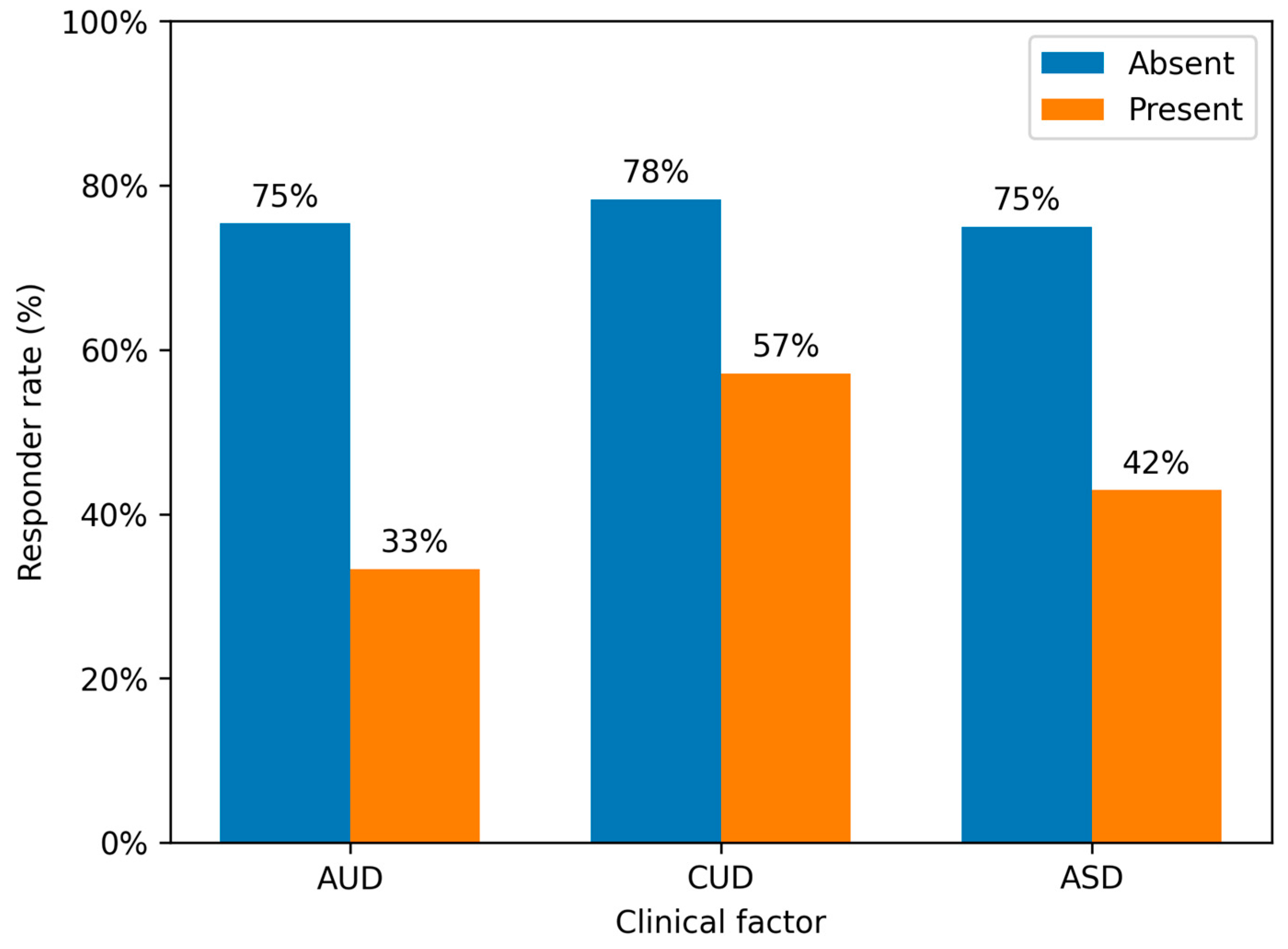
| Variable | Responders n (%) | Non-Responders n (%) | p-Value |
|---|---|---|---|
| Alcohol Use Disorder | |||
| Present | 2 (33.3%) | 4 (66.7%) | 0.050 * |
| Absent | 46 (75.4%) | 15 (24.6%) | |
| Cannabis Use Disorder | |||
| Present | 12 (57.1%) | 9 (42.9%) | 0.088 * |
| Absent | 36 (78.3%) | 10 (21.7%) | |
| Autism Spectrum Disorder | |||
| Present | 3 (42.9%) | 4 (57.1%) | 0.094 * |
| Absent | 45 (75.0%) | 15 (25.0%) |
| Variable | B | SE | Wald | p | OR | 95% CI |
|---|---|---|---|---|---|---|
| AUD | −2.543 | 1.033 | 6.065 | 0.014 | 0.079 | 0.010–0.595 |
| CUD | −1.416 | 0.646 | 4.812 | 0.028 | 0.243 | 0.068–0.860 |
| Age | −0.028 | 0.031 | 0.800 | 0.371 | 0.972 | 0.915–1.034 |
| Sex | 1.021 | 0.765 | 1.780 | 0.182 | 2.776 | 0.619–12.443 |
Disclaimer/Publisher’s Note: The statements, opinions and data contained in all publications are solely those of the individual author(s) and contributor(s) and not of MDPI and/or the editor(s). MDPI and/or the editor(s) disclaim responsibility for any injury to people or property resulting from any ideas, methods, instructions or products referred to in the content. |
© 2026 by the authors. Licensee MDPI, Basel, Switzerland. This article is an open access article distributed under the terms and conditions of the Creative Commons Attribution (CC BY) license.
Share and Cite
Carbone, M.G.; Tripodi, B.; Matarese, I.; Bellini, A.; Rizzato, R.; Tagliarini, C.; Della Rocca, F.; Dominicis, F.D.; Maremmani, I.; Perugi, G.; et al. Factors Associated with Reduced Clinical Response in Adult ADHD: The Role of Alcohol and Cannabis Use Disorders and Autism Spectrum Disorder. J. Clin. Med. 2026, 15, 2688. https://doi.org/10.3390/jcm15072688
Carbone MG, Tripodi B, Matarese I, Bellini A, Rizzato R, Tagliarini C, Della Rocca F, Dominicis FD, Maremmani I, Perugi G, et al. Factors Associated with Reduced Clinical Response in Adult ADHD: The Role of Alcohol and Cannabis Use Disorders and Autism Spectrum Disorder. Journal of Clinical Medicine. 2026; 15(7):2688. https://doi.org/10.3390/jcm15072688
Chicago/Turabian StyleCarbone, Manuel Glauco, Beniamino Tripodi, Irene Matarese, Alessandro Bellini, Roberta Rizzato, Claudia Tagliarini, Filippo Della Rocca, Francesco De Dominicis, Icro Maremmani, Giulio Perugi, and et al. 2026. "Factors Associated with Reduced Clinical Response in Adult ADHD: The Role of Alcohol and Cannabis Use Disorders and Autism Spectrum Disorder" Journal of Clinical Medicine 15, no. 7: 2688. https://doi.org/10.3390/jcm15072688
APA StyleCarbone, M. G., Tripodi, B., Matarese, I., Bellini, A., Rizzato, R., Tagliarini, C., Della Rocca, F., Dominicis, F. D., Maremmani, I., Perugi, G., & Maremmani, A. G. I. (2026). Factors Associated with Reduced Clinical Response in Adult ADHD: The Role of Alcohol and Cannabis Use Disorders and Autism Spectrum Disorder. Journal of Clinical Medicine, 15(7), 2688. https://doi.org/10.3390/jcm15072688