Nonpharmacological Interventions for Pain Relief During Peripheral Venous Cannulation: Implications for Practice

 ,
, 
 ,
,  ,
,  and
and
Abstract
1. Introduction
Aim
2. Methods
2.1. Study Design
2.2. Search Strategy
2.3. Data Extraction
2.4. Data Synthesis
2.5. Quality Assessment
2.6. Ethical Approval
3. Results
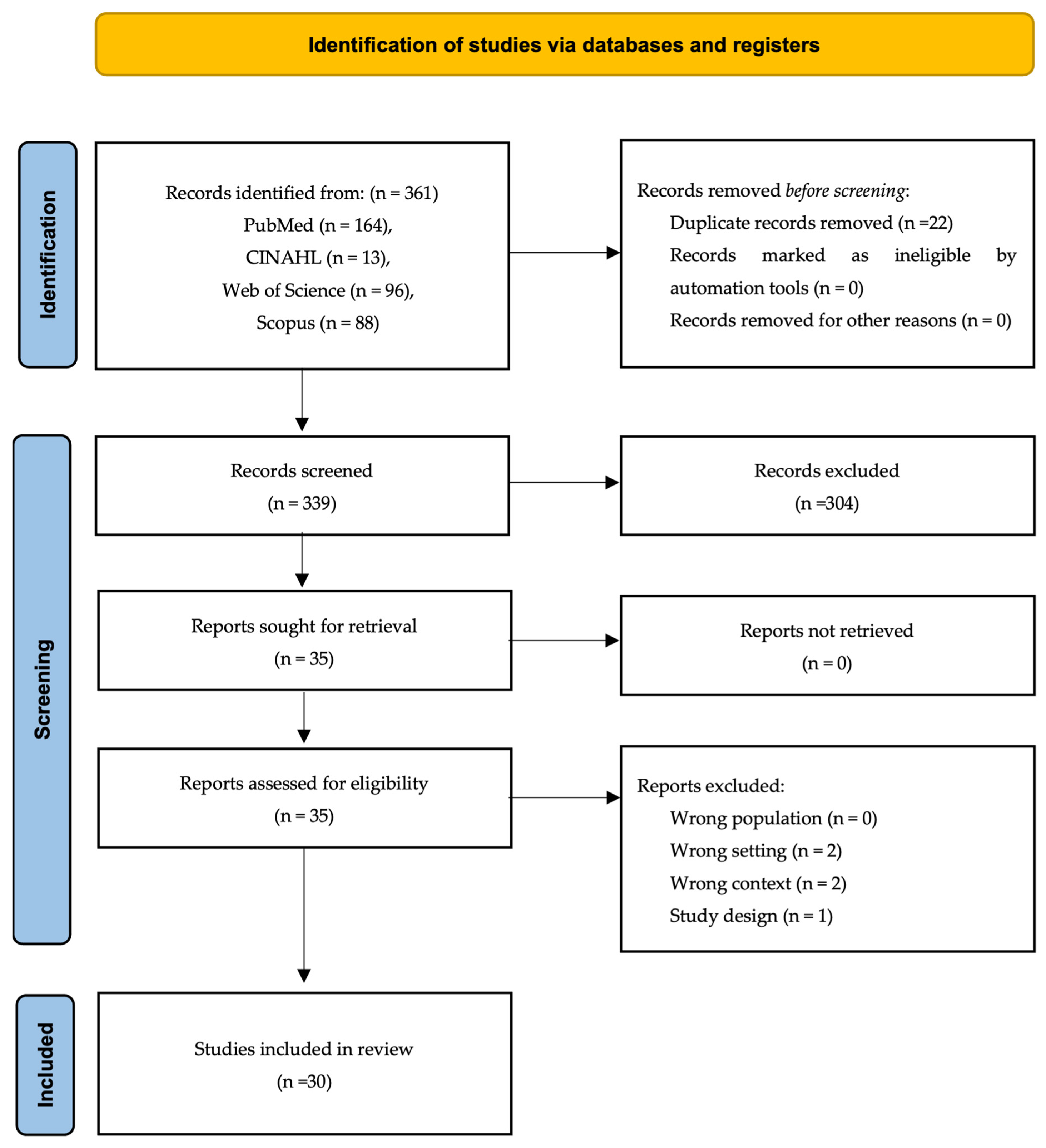
3.1. Study Selection
3.2. Characteristics of Included Studies
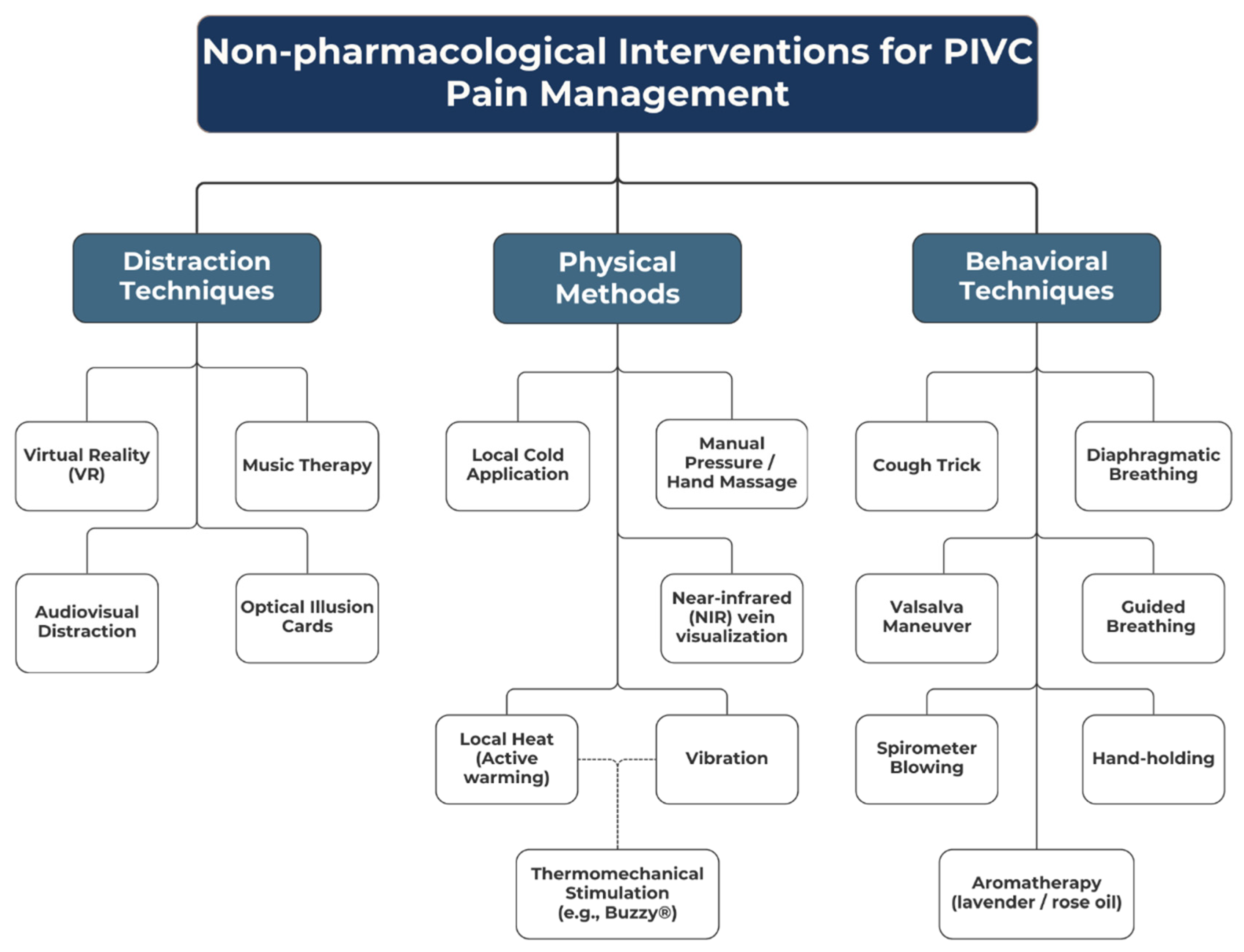
3.3. Non-Pharmacological Interventions Recommended for Adult Patients Undergoing Peripheral Vascular Cannulation
- Optical Illusion Cards: The use of visual stimuli that require cognitive focus and engagement [14].
- Vibration: Application of vibrating devices to interfere with the transmission of pain impulses [18].
- Acupressure: Application of localized pressure at the puncture site prior to the procedure [21].
3.4. Pain Intensity During Peripheral Vascular Cannulation
- Thermomechanical Stimulation (Buzzy® device): In a study by Cetin [13], the mean pain score in the Buzzy group was 1.04 ± 0.96 cm (VAS), compared to 5.32 ± 1.64 cm (VAS) in the control group. Similarly, Serin [22] reported scores of 2.66 ± 1.22 (VAS) for the intervention group versus 4.85 ± 1.71 (VAS) for the control.
- Cryotherapy: Pre-procedural application of cold packs reduced pain to 30.50 ± 16.78 mm (VAS), compared to 48.36 ± 24.02 mm (VAS) in the standard care group [18].
- Heat and Pressure: The application of high pressure (100 mmHg) combined with heat achieved a clinically significant pain reduction of at least 1 point on the VAS [21].
- Vibration: While effective when combined with cold (Buzzy®), isolated vibration did not always yield statistically significant results (e.g., 56.66 ± 14.03 mm (VAS) in the vibration group vs. 48.36 ± 24.02 mm (VAS) in the control) [18].
- Optical Illusion Cards and 3D Video: Distraction groups reported mean scores of 3.32–3.50 ± 2.81–2.84 (VAS), whereas the control group reported 4.72 ± 3.15 (VAS) [14].
- Cough Trick: This method resulted in pain scores of 19.5 mm (VAS) compared to 45.5 mm (VAS) in the control group [17].
- Breathing Exercises: Diaphragmatic breathing significantly reduced pain to 0.29 ± 0.70 (NRS), whereas the control group score was 1.30 ± 1.47 (NRS) [15].
- Stress Ball Squeezing: This intervention yielded scores of 0.85 ± 0.23 (NRS) versus 2.80 ± 0.36 (NRS) in the control group [19].
3.5. Statistical Significance and Effect Size of Non-Pharmacological Interventions
- Thermomechanical Stimulation (Buzzy®): In studies such as those by Cetin [15] and Serin [24] the intervention groups reported mean pain scores ranging from 1.04 to 2.66 (NRS/VAS), while control groups consistently reported scores between 4.85 and 5.32. This represents a reduction in pain intensity of approximately 50–70%.
- Medium Effect Size (d = 0.5–0.8): Active Warming: Studies evaluating localized heat showed a medium effect size, proving effective for both pain reduction and improved vein visibility.
- Music Therapy and Valsalva Maneuver: These interventions Tapar [39] generally yielded medium effect sizes.
- Small Effect Size (d = 0.2–0.5): * Isolated Vibration and Passive Distraction: In the study by Esra Yılmaz [18] passive methods or isolated mechanical vibration showed smaller effect sizes, suggesting they may be less effective when used as standalone treatments for patients with high procedural anxiety.
3.6. Impact of Non-Pharmacological Modalities on Psychosocial and Procedural Outcomes
4. Discussion
5. Limitations
- A significant limitation of this review is the varying level of evidence strength across the different intervention categories. While some modalities, such as thermomechanical stimulation (e.g., the Buzzy® device) [13,15,18] and virtual reality (VR) [21,24], are supported by multiple robust clinical trials, the evidence for other interventions remains preliminary. For instance, techniques such as aromatherapy [28,34], specific types of illusion cards [14], or certain behavioral maneuvers [34] are often based on a limited number of studies with small sample sizes. Consequently, findings regarding these specific modalities should be interpreted with caution, as their clinical effectiveness cannot be definitively established at this stage. Further high-quality randomized controlled trials (RCTs) are urgently needed to validate these initial findings and provide more robust data to support their routine implementation in clinical practice.
- Methodological Heterogeneity: The primary limitation arises from the significant diversity in study designs, intervention protocols (e.g., varying durations of vibration or heat application), and the diverse clinical settings (emergency vs. elective departments). Such heterogeneity complicates the direct comparison of effect sizes across all 30 studies.
- Risk of Performance Bias: Due to the physical nature of non-pharmacological interventions (e.g., VR goggles, Buzzy® devices, or breathing exercises), double blinding of participants and healthcare providers was virtually impossible in the majority of the included trials. This inherent lack of blinding may increase the risk of performance and detection bias. To mitigate this, future research should consider the use of ‘sham’ control conditions (e.g., inactive vibration devices) and incorporate objective physiological markers of stress, such as heart rate variability, to complement subjective pain reports.
- Subjectivity of Assessment: The reliance on subjective scales, such as VAS and NRS, introduces potential variability in pain reporting, which is influenced by individual pain thresholds and psychological factors.
- Generalizability and Systems Constraints: A significant proportion of the analyzed studies were conducted in diverse international healthcare settings, which may limit the direct generalizability of the findings across different clinical environments. The transferability of these results is potentially influenced by systemic variations in nursing competencies, the availability of specialized equipment, and differences in institutional organizational protocols. Consequently, the universal application of these non-pharmacological modalities requires careful consideration of local healthcare frameworks and resource availability.
- Statistical Limitations: The absence of a registered protocol in PROSPERO and the lack of a quantitative meta-analysis (including assessments of heterogeneity or publication bias through funnel plots) limit the ability to provide a singular, pooled estimate of effect for the analyzed interventions.
6. Conclusions
7. Implications for Clinical Practice
Supplementary Materials
Author Contributions
Funding
Institutional Review Board Statement
Informed Consent Statement
Data Availability Statement
Conflicts of Interest
References
- Shivashankar, A.; Nalini, K.B.; Rath, P. The Role of Nonpharmacological Methods in Attenuation of Pain Due to Peripheral Venous Cannulation: A Randomized Controlled Study. Anesth. Essays Res. 2018, 12, 7–10. [Google Scholar] [CrossRef]
- Yoshida, S.; Miyasaka, K.W.; Suzuki, R.; Fujita, N.; Abe, S. Comparison of analgesic effect of local anesthetic injection for pain relief during peripheral venous insertion in adult surgical patients: A prospective observational study. J. Perianesthesia Nurs. 2025, 40, 531–534. [Google Scholar] [CrossRef]
- Beecham, G.B.; Agarwal, A.; Tackling, G. Peripheral Line Placement. In StatPearls; StatPearls Publishing: Treasure Island, FL, USA, 2025. Available online: https://www.ncbi.nlm.nih.gov/books/NBK539795/ (accessed on 24 February 2026).
- Pedersen, J.B.; Martensen, A.; Funder, P.; Bakke, S.A.; Bhavsar, R.P.; Strøm, T. Cryospray reduces pain during venous cannulation in elective surgery patients: A randomized placebo-controlled study. BMC Anesthesiol. 2024, 24. [Google Scholar] [CrossRef]
- Sharifnia, A.M.; Chu, G.; Manias, E.; Davidson, P.M.; Fernandez, R. Comparative analysis of the effectiveness of pharmacological and non-pharmacological interventions on arteriovenous fistula cannulation-related pain in patients receiving hemodialysis: A systematic review and network meta-analysis. Int. J. Nurs. Stud. 2025, 169, 105123. [Google Scholar] [CrossRef]
- Rüsch, D.; Koch, T.; Spies, M.; Hj Eberhart, L. Pain During Venous Cannulation. Dtsch. Arztebl. Int. 2017, 114, 605–611. [Google Scholar] [CrossRef]
- Rodriguez-Calero, M.A.; de Pedro-Gomez, J.E.; Molero-Ballester, L.J.; Fernandez-Fernandez, I.; Matamalas-Massanet, C.; Moreno-Mejias, L.; Blanco-Mavillard, I.; Moya-Suarez, A.B.; Personat-Labrador, C.; Morales-Asencio, J.M. Risk Factors for Difficult Peripheral Intravenous Cannulation. The PIVV2 Multicentre Case-Control Study. J. Clin. Med. 2020, 9, 799. [Google Scholar] [CrossRef]
- Kaplan, F.; Çelik, H.; Aslan, H.; Aktura, S.Ç. Comparison of peripheral intravenous catheterization applied to different anatomical sites in terms of pain, phlebitis and infiltration. BMC Nurs. 2025, 24, 393. [Google Scholar] [CrossRef] [PubMed]
- Tufanaru, C.; Munn, Z.; Aromataris, E.; Campbell, J.; Hopp, L. Checklist for Randomized Controlled Trials; Joanna Briggs Institute: North Adelaide, Australia, 2017; pp. 1–9. [Google Scholar]
- Tufanaru, C.; Munn, Z.; Aromataris, E.; Campbell, J.; Hopp, L. Checklist for Quasi-Experimental Studies; Joanna Briggs Institute: North Adelaide, Australia, 2017; pp. 1–6. [Google Scholar]
- Page, M.J.; McKenzie, J.E.; Bossuyt, P.M.; Boutron, I.; Hoffmann, T.C.; Mulrow, C.D.; Shamseer, L.; Tetzlaff, J.M.; Akl, E.A.; Brennan, S.E.; et al. The PRISMA 2020 statement: An updated guideline for reporting systematic reviews. BMJ 2021, 372, n71. [Google Scholar] [CrossRef] [PubMed]
- Junges, M.; Hansel, L.A.; Santos, M.S.; Hirakata, V.N.; Ceratti, R.N.; Czerwinski, G.P.V.; Saffi, M.A.L.; Ferro, E.B.; Jacobsen, D.V.; Rabelo-Silva, E.R. Ultrasound-Guided Peripheral Venipuncture Decreases the Procedure’s Pain and Positively Impacts Patient’s Experience: The PRECISE Randomized Clinical Trial. J. Infus. Nurs. 2024, 47, 190–199. [Google Scholar] [CrossRef]
- Pakış Çetin, S.; Çevik, K. Effects of Vibration and Cold Application on Pain and Anxiety During Intravenous Catheterization. J. PeriAnesthesia Nurs. 2019, 34, 571–579. [Google Scholar] [CrossRef] [PubMed]
- Basak, T.; Duman, S.; Demirtas, A. Distraction-based relief of pain associated with peripheral intravenous catheterisation in adults: A randomised controlled trial. J. Clin. Nurs. 2020, 29, 770–777. [Google Scholar] [CrossRef]
- Özkan, Ö.; Korkut, S. Effect of breathing exercise during peripheral venous catheterization on pain, anxiety, and patient satisfaction: A randomized controlled trial. J. PeriAnesth Nurs. 2024, 39, 630–637. [Google Scholar] [CrossRef]
- Redfern, R.E.; Micham, J.; Sievert, D.; Chen, J.T. Effects of thermomechanical stimulation during intravenous catheter insertion in adults: A prospective randomized study. J. Infus. Nurs. 2018, 41, 294–300. [Google Scholar] [CrossRef] [PubMed]
- Yılmaz, D.; Yapucu Güneş, Ü. The effect on pain of three different nonpharmacological methods in peripheral intravenous catheterization in adults. J. Clin. Nurs. 2017, 26, 1572–1580. [Google Scholar] [CrossRef]
- Yılmaz, E.; Yılmaz, D. The effect of three different nonpharmacological methods on cannulation success during peripheral intravenous catheter placement in the emergency unit: A randomized controlled trial. BMC Anesthesiol. 2024, 24, 362. [Google Scholar] [CrossRef]
- Rişvan, M.; Su, S. The impact of two methods on pain and anxiety during short peripheral cannula placement: A randomized controlled trial. J. Vasc. Access 2024, 26, 1371–1378. [Google Scholar] [CrossRef]
- Özbay, H.; Turan, M.; Öner, U. The impact of the cough trick, spirometer blowing, and stress ball methods on older adults’ pain, anxiety, and comfort during peripheral intravenous catheter practice: A randomized controlled study. Geriatr. Nurs. 2025, 65, 103460. [Google Scholar] [CrossRef] [PubMed]
- Simón-López, L.C.; Luquero-Bueno, S.; Ovejero-Benito, M.C.; Cuesta-Lozano, D.; Goodman-Casanova, J.M.; Vargas-Castrillón, E.; Ochoa Mazarro, D.; De Miguel-Cáceres, A.; Posada-Moreno, P.; Zaragoza-García, I.; et al. Benefits of the application of heat and pressure on peripheral venous cannulation in adults: A randomized controlled trial. J. Adv. Nurs. 2020, 77, 1533–1545. [Google Scholar] [CrossRef]
- Serin, Z.S.; Kazan, E.E. The effect of using thermomechanical stimulation and virtual reality glasses during peripheral intravenous catheterization on pain and patient satisfaction: A randomized controlled trial. J. Emerg. Nurs. 2025, 51, 925–935. [Google Scholar] [CrossRef] [PubMed]
- Yılmaz, H.; Karacan, Y.; Macun, S.; Evrensel, T. The effect of using vein visualization devices to facilitate peripheral intravenous cannulation on pain, fear, and patient satisfaction in adult oncology patients: A randomized controlled trial. Support. Care Cancer 2025, 33, 1123. [Google Scholar] [CrossRef]
- Fusco, N.; Bernard, F.; Roelants, F.; Watremez, C.; Musellec, H.; Laviolle, B.; Beloeil, H.; Ahmin, M.; Barthes, S.; Boulon, N.; et al. Hypnosis and communication reduce pain and anxiety in peripheral intravenous cannulation: A multicentre randomised trial. Br. J. Anaesth. 2020, 124, 292–298. [Google Scholar] [CrossRef]
- Erzincanlı, S.; Sayın Kasar, K. Effect of hand massage on pain, anxiety, and vital signs in patients before venipuncture procedure: A randomized controlled trial. Pain. Manag. Nurs. 2021, 22, 356–360. [Google Scholar] [CrossRef]
- Kaplan, A.; Korkut, S.; Avsarogullari, O.L. Comparison of procedure-related pain and patient satisfaction according to catheter size and insertion site in peripheral intravenous catheterization. J. Vasc. Access 2024, 25, 1853–1859. [Google Scholar] [CrossRef]
- Hosseini, S.R.; Mohammadpour, A.; Mojtabavi, S.J.; Baloochi Beydokhti, T. Comparison Valsalva maneuver and auriculotherapy on pain intensity of peripheral intravenous cannulation in adults: A randomized clinical trial. J. Vasc. Access 2025, 26, 1936–1941. [Google Scholar] [CrossRef] [PubMed]
- Corbasson, A.; Fischer, E.; Vilfaillot, A.; Da Costa, A.B.; Charmettan, M.; Ferreira, M.; Barthélémy, C.; Namaoui, W.; Khimoud, D.; Beaudoin, A.; et al. Efficacy of a vein visualisation device for facilitating peripheral venous line placement in adult patients with sickle cell disease: A randomised clinical trial. Int. J. Nurs. Stud. 2025, 163, 104988. [Google Scholar] [CrossRef] [PubMed]
- Lee, T.J.; Her, J.; Hur, M.-H. Effects of a thermoelectric element tourniquet on venipuncture pain and stress relief in Korea: A randomized controlled trial. J. Korean Biol. Nurs. Sci. 2025, 27, 179–190. [Google Scholar] [CrossRef]
- Karaman, T.; Karaman, S.; Dogru, S.; Tapar, H.; Sahin, A.; Suren, M.; Arici, S.; Kaya, Z. Evaluating the efficacy of lavender aromatherapy on peripheral venous cannulation pain and anxiety: A prospective, randomized study. Complement. Ther. Clin. Pract. 2016, 23, 64–68. [Google Scholar] [CrossRef]
- Sharma, B.; Kaur, S.; Sharma, V.; Garg, R.K. Impact of Local Heat Application on Peripheral Intravenous Cannulation Among Patients. Int. Res. J. Multidiscip. Scope 2024, 5, 364–371. [Google Scholar] [CrossRef]
- Akçoban, S.; Tosun, B. Breathing Exercises, Valsalva Maneuver Reduce Pain in Peripheral Intravenous Catheterization: Randomized Trial. Pain Manag. Nurs. 2025; in press. [CrossRef]
- Hur, M.H.; Choi, H.S. Effects of a Thermoelectric Element Band on Venipuncture-associated Pain and Anxiety: A Randomized Controlled Trial. Asian Nurs. Res. 2021, 15, 337–344. [Google Scholar] [CrossRef]
- Berna, C.; Favre-Bulle, A.M.; Bonzon, A.M.; Gross, N.M.; Gonthier, A.; Gerhard-Donnet, H.; Taffé, P.; Hugli, O. Is Positive Communication Sufficient to Modulate Procedural Pain and Anxiety in the Emergency Department? A Randomized Controlled Trial. Psychosom. Med. 2023, 85, 772–777. [Google Scholar] [CrossRef]
- Hosseinabadi, R.; Biranvand, S.; Pournia, Y.; Anbari, K. The Effect of Acupressure on Pain and Anxiety Caused by Venipuncture. J. Infus. Nurs. 2015, 38, 397–405. [Google Scholar] [CrossRef]
- Basak, T.; Demirtas, A.; Duman, S. The effect of rose oil aromatherapy and hand-holding on pain due to peripheral intravenous catheter insertion. Explore 2024, 20, 62–69. [Google Scholar] [CrossRef] [PubMed]
- Jisha, K.; Latha, S.; Joseph, G. A comparative study on impact of dry versus moist heat application on feasibility of peripheral intravenous cannulation among the patients of a selected hospital at Mangalore. Nitte Univ. J. Health Sci. 2017, 7, 21–24. [Google Scholar]
- Fumagalli, S.; Torricelli, G.; Massi, M.; Calvani, S.; Boni, S.; Roberts, A.T.; Accarigi, E.; Manetti, S.; Marchionni, N. Effects of a new device to guide venous puncture in elderly critically ill patients: Results of a pilot randomized study. Aging Clin. Exp. Res. 2017, 29, 335–339. [Google Scholar] [CrossRef]
- Tapar, H.; Karaman, T.; Dogru, S.; Karaman, S.; Suren, M.; Altıparmak, F. Evaluating the efficacy of Valsalva’s maneuver and music therapy on peripheral venous cannulation: A prospective study. Anaesth. Pain. Intensive Care 2018, 22, 219–223. [Google Scholar]
- Guillon, P.; Makhloufi, M.; Baillie, S.; Roucoulet, C.; Dolimier, E.; Masquelier, A.M. Prospective evaluation of venous access difficulty and a near-infrared vein visualizer at four French haemophilia treatment centres. Haemophilia 2015, 21, 21–26. [Google Scholar] [CrossRef]
- Rodríguez-Herrera, Á.; Solaz-García, Á.; Mollá-Olmos, E.; Ferrer-Puchol, D.; Esteve-Claramunt, F.; Trujillo-Barberá, S.; García-Bermejo, P.; Casaña-Mohedo, J. Use of the Ultrasound Technique as Compared to the Standard Technique for the Improvement of Venous Cannulation in Patients with Difficult Access. Healthcare 2022, 10, 261. [Google Scholar] [CrossRef]
- Usichenko, T.I.; Janner, H.; Gagarine, M.; Pavlovic, D.; Lang, E.; Hahnenkamp, K. Mechanisms of “cough-trick” for pain relief during venipuncture: An experimental crossover investigation in healthy volunteers. Pain. Res. Manag. 2019, 2019, 9459103. [Google Scholar] [CrossRef]
- Cooke, M.; Ullman, A.J.; Ray-Barruel, G.; Wallis, M.; Corley, A.; Rickard, C.M. Not “just” an intravenous line: Consumer perspectives on peripheral intravenous cannulation (PIVC). An international cross-sectional survey of 25 countries. PLoS ONE 2018, 13, e0193436. [Google Scholar] [CrossRef] [PubMed]
- Ng, M.; Mark, L.K.F.; Fatimah, L. Management of difficult intravenous access: A qualitative review. World J. Emerg. Med. 2022, 13, 467–478. [Google Scholar] [CrossRef]
- Bond, M.; Crathorne, L.; Peters, J.; Coelho, H.; Haasova, M.; Cooper, C.; Milner, Q.; Shawyer, V.; Hyde, C.; Powell, R. First do no harm: Pain relief for the peripheral venous cannulation of adults, a systematic review and network meta-analysis. BMC Anesthesiol. 2016, 16, 81. [Google Scholar] [CrossRef]
- Jarrah, M.I.; Hweidi, I.M.; Al-Dolat, S.A.; Alhawatmeh, H.N.; Al-Obeisat, S.M.; Hweidi, L.I.; Hweidi, A.I.; Alkouri, O.A. The effect of slow deep breathing relaxation exercise on pain levels during and post chest tube removal after coronary artery bypass graft surgery. Int. J. Nurs. Sci. 2022, 9, 155–161. [Google Scholar] [CrossRef]
- Pagnucci, N.; Pagliaro, S.; Maccheroni, C.; Sichi, M.; Scateni, M.; Tolotti, A. Reducing pain during emergency arterial sampling using three anesthetic methods: A randomized controlled clinical trial. J. Emerg. Med. 2020, 58, 857–863. [Google Scholar] [CrossRef]
- Görücü, R.; Öztekin, S.D.; Filinte, G. The effect of virtual reality and music on pain, anxiety, and pain-related anxiety in burn patient care. Burns 2025, 51, 107580. [Google Scholar] [CrossRef] [PubMed]
- Amara, Y.; Frikha, I.; Ammar, M.; Zghal, K.; Elloumi, M.; Mdhaffar, M.; Ben Mahmoud, L. Patient’s satisfaction, acceptability, and feasibility of virtual reality for pain and anxiety management during bone marrow biopsy. Future Sci. OA 2025, 11, 2582444. [Google Scholar] [CrossRef]
- Maruszak, A.; Romańczuk, D.; Lange, S.; Mędrzycka-Dąbrowska, W.; Cichowlas, G.; Gąsior, A. Local pharmacological interventions for pain relief during peripheral venous cannulation: A systematic review and implications for clinical nursing practice. J. Clin. Med. 2026, 15, 1262. [Google Scholar] [CrossRef]
- Malcolm, B.J.; Tallian, K. Essential oil of lavender in anxiety disorders: Ready for prime time? Ment. Health Clin. 2018, 7, 147–155. [Google Scholar] [CrossRef] [PubMed] [PubMed Central]
- Baykan, S.; Kılıç Akça, N. The effect of music on fistula needle insertion-related pain intensity and pain distress: A single-centre, single-blind, randomised controlled trial. J. Ren. Care 2025, 51, e70001. [Google Scholar] [CrossRef] [PubMed]
- Wujtewicz, M.; Owczuk, R. Heart rate variability in anaesthesiology—Narrative review. Anaesthesiol. Intensive Ther. 2023, 55, 1–8. [Google Scholar] [CrossRef] [PubMed]



| Databases | Search Strategy |
|---|---|
| PubMed | (“Catheterization, Peripheral”[Mesh] OR “Venipuncture”[Mesh] OR “peripheral venous cannulation” OR “intravenous cannulation” OR “IV cannulation” OR “peripheral catheter *” OR “short peripheral catheter *” OR “PIVC” OR “IV insertion”) AND (“Pain”[Mesh] OR “Anxiety”[Mesh] OR “pain” OR “anxiety” OR “discomfort” OR “analgesi *”) AND (“Cryotherapy”[Mesh] OR “Aromatherapy”[Mesh] OR “non-pharmacological” OR “distraction” OR “virtual reality” OR “VR” OR “music” OR “vibration” OR “buzzy” OR “aromatherapy” OR “essential oil *” OR “breathing” OR “cough” OR “massage” OR “cutaneous stimulation” OR “audiovisual” OR “hypnosis” OR “heat” OR “warming” OR “thermal” OR “cold pack” OR “ice pack” OR “cryotherapy” OR “stress ball” OR “spirometer” OR “vein visualization” OR “near-infrared” OR “NIR” OR “ultrasound”) NOT (“Child”[Mesh] OR “Infant”[Mesh] OR “child *” OR “pediatric *” OR “paediatric *” OR “infant *” OR “neonate *” OR “newborn” OR “lidocaine” OR “EMLA” OR “tetracaine” OR “picc” OR “midline” OR “central venous” OR “dialysis” OR “fistula” OR “arterial” OR “spray” OR “vapocoolant” OR “aerosol”) Limit: years, adults, language Results: 164 |
| CINAHL | ((MH “Catheterization, Peripheral+”) OR (MH “Venipuncture+”) OR TX “peripheral venous cannulation” OR TX “intravenous cannulation” OR TX “IV cannulation” OR TX “peripheral catheter *” OR TX “short peripheral catheter *” OR TX “PIVC” OR TX “IV insertion”) AND ((MH “Pain+”) OR (MH “Anxiety+”) OR TX “pain” OR TX “anxiety” OR TX “discomfort” OR TX “analgesi *”) AND (TX “non-pharmacological” OR TX “distraction” OR TX “virtual reality” OR TX “VR” OR TX “music” OR TX “vibration” OR TX “buzzy” OR (MH “Aromatherapy+”) OR TX “aromatherapy” OR TX “essential oil *” OR TX “breathing” OR TX “cough” OR TX “massage” OR TX “cutaneous stimulation” OR TX “audiovisual” OR TX “hypnosis” OR TX “heat” OR TX “warming” OR TX “thermal” OR TX “cold pack” OR TX “ice pack” OR (MH “Cryotherapy+”) OR TX “cryotherapy” OR TX “stress ball” OR TX “spirometer” OR TX “vein visualization” OR TX “near-infrared” OR TX “NIR” OR TX “ultrasound”) NOT ((MH “Child+”) OR (MH “Infant+”) OR TI (child * OR pediatric * OR paediatric * OR infant * OR neonate * OR newborn) OR TX lidocaine OR TX EMLA OR TX tetracaine OR TX picc OR TX midline OR TX “central venous” OR TX “dialysis” OR TX “fistula” OR TX “arterial” OR TX spray OR TX vapocoolant OR TX aerosol) Limit: years, adults Results: 13 |
| Web of Science | TS = ((“peripheral venous cannulation” OR “intravenous cannulation” OR “IV cannulation” OR “peripheral catheter *” OR “short peripheral catheter *” OR “venipuncture” OR “venous access” OR “PIVC” OR “IV insertion”)AND (“pain” OR “anxiety” OR “discomfort” OR “analgesi *”)AND(“non-pharmacological” OR “distraction” OR “virtual reality” OR “VR” OR “music” OR “vibration” OR “buzzy” OR “aromatherapy” OR “essential oil *” OR “breathing” OR “cough” OR “massage” OR “cutaneous stimulation” OR “audiovisual” OR “hypnosis” OR “heat” OR “warming” OR “thermal” OR “cold pack” OR “ice pack” OR “cryotherapy” OR “stress ball” OR “spirometer” OR “vein visualization” OR “near-infrared” OR “NIR” OR “ultrasound”))NOT TI = (child * OR pediatric * OR paediatric * OR infant * OR neonate * OR newborn)NOT TS = (lidocaine OR EMLA OR tetracaine OR picc OR midline OR “central venous” OR dialysis OR fistula OR arterial OR spray OR vapocoolant OR aerosol) Limit: years Results: 96 |
| Scopus | TITLE-ABS-KEY (“peripheral venous cannulation” OR “intravenous cannulation” OR “IV cannulation” OR “peripheral catheter *” OR “short peripheral catheter *” OR “venipuncture” OR “venous access” OR “PIVC” OR “IV insertion”) AND (“pain” OR “anxiety” OR “discomfort” OR “analgesi *”) AND(“non-pharmacological” OR “distraction” OR “virtual reality” OR “VR” OR “music” OR “vibration” OR “buzzy” OR “aromatherapy” OR “essential oil *” OR “breathing” OR “cough” OR “massage” OR “cutaneous stimulation” OR “audiovisual” OR “hypnosis” OR “heat” OR “warming” OR “thermal” OR “cold pack” OR “ice pack” OR “cryotherapy” OR “stress ball” OR “spirometer” OR “vein visualization” OR “near-infrared” OR “NIR” OR “ultrasound”)) AND NOT TITLE-ABS-KEY (“child *” OR “pediatric *” OR “paediatric *” OR “infan t*” OR “neonate *” OR “newborn” OR “lidocaine” OR “EMLA” OR “tetracaine” OR “picc” OR “midline” OR “central venous” OR “dialysis” OR “fistula” OR “arterial” OR “spray” OR “vapocoolant” OR “aerosol”) Limit: years, language Results: 88 |
| Inclusion Criteria | |
|---|---|
| Population (P) | Adult patients ≥ 18 years old |
| Intervention (I) | To relief pain during cannulation |
| Comparison (C) | Standard/usual care |
| Outcome (O) | Procedural pain intensity (primary outcome), anxiety levels, patient satisfaction, first-attempt success rate, safety/adverse events. |
| Inclusion Criteria | Exclusion Criteria | |
|---|---|---|
| Patients | Adult patients (≥18 years old), Inpatient, outpatient | Pediatric patients (<18 years old), |
| Intervention | Non-pharmacological (e.g., warming, cooling, music), | Pharmacological interventions (vapocoolant spray (ethyl chloride)) |
| Type of Catheter | PIVC only, (SPC) | Midline, PICC, CVC, HDCVC, Port |
| Years considered/Time period | All evidence published in the last 10 years, period 2015–2025 | Publications prior to 2015 |
| Language | English, Polish | Other languages |
| Databases | PubMed, CINAHL, Web of Science, Scopus | Other databases, Gray literature, |
| Study Type | RCTs, Quasi-experimental Prospective/Retrospective | Quantitative studies Qualitative studies Reviews (any types) Letters to the editor Case reports |
| Author, Year | 1 | 2 | 3 | 4 | 5 | 6 | 7 | 8 | 9 | 10 | 11 | 12 | 13 | Total | |
|---|---|---|---|---|---|---|---|---|---|---|---|---|---|---|---|
| Junges et al. (2024) [12] | Y | Y | Y | N | N | Y | Y | Y | Y | Y | Y | Y | Y | 11/13 | H |
| Çetin et al. (2019) [13] | Y | U | Y | N | N | N | Y | Y | U | Y | Y | Y | Y | 8/13 | L |
| Basak et al. (2020) [14] | Y | U | Y | N | N | U | Y | Y | N | Y | Y | Y | Y | 8/13 | L |
| Özkan et al. (2024) [15] | Y | U | Y | N | N | N | Y | Y | N | Y | Y | Y | Y | 8/13 | L |
| Redfern et al. (2018) [16] | Y | U | Y | N | N | U | Y | Y | Y | Y | Y | Y | Y | 9/13 | M |
| Yılmaz et al. (2018) [17] | Y | U | Y | N | N | U | Y | Y | N | Y | Y | Y | Y | 8/13 | L |
| Yılmaz et al. (2024) [18] | Y | U | Y | N | N | Y | Y | Y | Y | Y | Y | Y | Y | 10/13 | M |
| Rişvan et al. (2025) [19] | Y | U | Y | N | N | U | Y | Y | N | Y | Y | Y | Y | 8/13 | L |
| Özbay et al. (2025) [20] | Y | U | Y | N | N | U | Y | Y | N | Y | Y | Y | Y | 8/13 | M |
| Simón-López et al. (2020) [21] | Y | Y | Y | N | N | Y | Y | Y | N | Y | Y | Y | Y | 10/13 | M |
| Serin et al. (2025) [22] | Y | U | Y | N | N | N | Y | Y | Y | Y | Y | Y | Y | 9/13 | M |
| Yılmaz et al. (2025) [23] | Y | U | Y | N | N | U | Y | Y | Y | Y | Y | Y | Y | 9/13 | M |
| Fusco et al. (2020) [24] | Y | Y | Y | N | N | Y | Y | Y | Y | Y | Y | Y | Y | 11/13 | H |
| Erzincanli et al. (2021) [25] | N | N | Y | N | N | U | Y | Y | N | Y | Y | Y | Y | 7/13 | L |
| Kaplan et al. (2024) [26] | Y | U | Y | N | N | U | Y | Y | N | Y | Y | Y | Y | 8/13 | M |
| Hosseini et al. (2025) [27] | Y | Y | Y | N | N | U | Y | Y | N | Y | Y | Y | Y | 9/13 | M |
| Corbasson et al. (2025) [28] | Y | Y | Y | N | N | N | Y | Y | Y | Y | Y | Y | Y | 10/13 | M |
| Lee, Her, & Hur (2025) [29] | Y | U | Y | N | N | Y | Y | Y | N | Y | Y | Y | Y | 9/13 | M |
| Karaman et al. (2016) [30] | Y | U | Y | U | N | Y | Y | Y | Y | Y | Y | Y | Y | 10/13 | M |
| Sharma et al. (2024) [31] | N | N | N | N | N | N | Y | Y | Y | Y | Y | Y | Y | 7/13 | L |
| Akçoban & Tosun (2025) [32] | Y | U | Y | N | N | Y | Y | Y | Y | Y | Y | Y | Y | 10/13 | M |
| Hur & Choi (2021) [33] | Y | U | Y | N | N | U | Y | Y | Y | Y | Y | Y | Y | 9/13 | M |
| Berna et al. (2024) [34] | Y | Y | Y | Y | U | Y | Y | Y | N | Y | Y | Y | Y | 11/13 | H |
| Hosseinabadi et al. (2015) [35] | Y | U | Y | Y | N | U | Y | Y | Y | Y | Y | Y | Y | 10/13 | M |
| Basak et al. (2024) [36] | Y | U | Y | N | N | Y | Y | Y | N | Y | Y | Y | Y | 9/13 | M |
| Jisha et al. (2017) [37] | Y | U | Y | N | N | U | Y | Y | Y | Y | Y | Y | Y | 9/13 | M |
| Fumagalli et al. (2017) [38] | Y | U | Y | N | N | N | Y | Y | Y | Y | Y | Y | Y | 9/13 | M |
| Tapar et al. (2018) [39] | Y | Y | Y | N | N | Y | Y | Y | N | Y | Y | Y | Y | 10/13 | M |
| Guillon et al. (2015) [40] | N | N | Y | N | N | N | Y | Y | Y | Y | Y | Y | N | 7/13 | L |
| Rodríguez-Herrera et al. (2022) [41] | N | N | Y | N | N | N | Y | Y | Y | Y | Y | Y | Y | 8/13 | L |
| Author, Year | 1 | 2 | 3 | 4 | 5 | 6 | 7 | 8 | 9 | Total |
|---|---|---|---|---|---|---|---|---|---|---|
| Usichenko et al. (2019) [42] | Y | Y | Y | Y | Y | Y | Y | Y | Y | 9/9 |
| Author (Year) | Study Design | Sample Sizes | Group Sizes | Setting | Intervention | Pain Assessment Tool | Pain Level | Results |
|---|---|---|---|---|---|---|---|---|
| Junges et al. (2024) [12] | A randomized clinical trial | N = 64 | IG n = 32 CG n = 32 | Public hospital in southern Brazil | Intervention group (IG/Experimental): US-guided peripheral venipuncture performed by specialist nurses of a Vascular Access Team (VAT) Control group (CG): Conventional peripheral venipuncture (palpation/visualization) performed by clinical practice nurses | NRS | IG (US-guided, specialist nurses): Pain NRS = 2 CG (Conventional): Pain NRS = 4 | + Patients undergoing US-guided peripheral venipuncture experienced less procedural pain than those in the conventional group (median NRS 2 vs. 4, p < 0.001). |
| Çetin et al. (2019) [13] | A randomized controlled, pretest and post-test experimental study. | N = 100 | IG n = 50 CG n = 50 | University hospital in Turkey | Application of the Buzzy® device (combined vibration and cold gel pack) during peripheral intravenous catheterization to reduce pain and anxiety. | VAS | Mean VAS score was 1.04 ± 0.96 cm in the Buzzy (intervention) group and 5.32 ± 1.64 cm in the control group (p < 0.001). | + Use of the Buzzy device was associated with a significant reduction in pain intensity during peripheral intravenous catheterization compared with standard care (p < 0.001). |
| Basak et al. (2020) [14] | A randomized controlled trial | N = 120 | IG1 n = 30: VR (3D video) IG2 n = 30: Optical illusion pictures CG n = 30: Standard procedure | Gülhane Training and Research Hospital Turkey | Use of distractive methods (cards with optical illusions and 3D videos via VR goggles) during peripheral intravenous catheter insertion to reduce pain and increase patient satisfaction. | VAS | 4.72 ± 3.15 (control) vs. 3.32–3.50 ± 2.81–2.84 (distraction groups) | + Distraction methods (cards and 3D VR videos) during PIC insertion significantly reduced pain (VAS 3.32–3.50 vs. 4.72; p = 0.02) and increased patient satisfaction (8.07 vs. 5.12; p = 0.01) compared with control. |
| Özkan et al. (2024) [15] | A randomized controlled trial | N = 130 | IG n = 65 CG n = 65 | General Surgery Clinic of a university hospital in Turkey. | Diaphragmatic breathing exercises performed during peripheral venous catheterization | NRS | Intervention group: 0.29 ± 0.70; Control group: 1.30 ± 1.47 | + Intervention significantly reduced pain and anxiety, increased patient satisfaction (Pain: 0.29 vs. 1.30; Anxiety: 3.18 vs. 4.35; Satisfaction: 7.66 vs. 4.87), and decreased pulse rate, blood pressure, and procedure time |
| Redfern et al. (2018) [16] | A Prospective Randomized Study | N = 105 | IG n = 49 CG n = 56 | hospital in Toledo, Ohio, USA | The experimental group received thermomechanical stimulation using the Buzzy device (combined cold and vibration applied approximately 5 cm above the IV insertion site), while the control group received standard IV catheter insertion without any pain-reducing intervention. | VAS | IG: Mean 2.52 CG: Mean 2.43 (No significant difference, p = 0.86) | − Thermomechanical stimulation did not significantly reduce overall procedural pain or improve patient satisfaction compared with standard care; however, patients with higher preprocedural anxiety experienced lower pain scores when the Buzzy device was used, suggesting a potential benefit in highly anxious individuals. |
| Yılmaz et al. (2018) [17] | A single blind randomized controlled study. | N = 120 | IG1 n = 30 IG2 n = 30 IG3 n = 30 CG n = 30 | The blood center of a university hospital in the Marmara region, Turkey. | Interventions included coughing, blowing into a spirometer, squeezing a stress ball, and no additional intervention in the control group. | VAS | Mean pain scores were: Coughing: 19.5 mm, Spirometer: 28.3 mm, Stress ball: 32.1 mm, Control: 45.5 mm. | + All three interventions significantly reduced pain compared to the control group (p < 0.001), with the greatest effect observed in the coughing group; no statistically significant differences were found between the experimental groups. |
| Yılmaz et al. (2024) [18] | A randomized controlled trial | N = 120 | IG1 n = 30: Local heat IG2 n = 30: Local cold IG3 n = 30: Vibration (Buzzy) CG n = 30: Standard procedure | Yellow and green area of the emergency unit of a university hospital in the Marmara region of Turkey | Heat, cold, or vibration applied before peripheral intravenous catheter insertion to reduce pain. | VAS | Cold group: 30.50 ± 16.78; Heat group: 48.66 ± 17.16; Vibration group: 56.66 ± 14.03; Control: 48.36 ± 24.02 | +/− Only cold application significantly reduced pain (p = 0.002) and shortened procedure duration (p = 0.001). Heat and vibration did not significantly reduce pain compared to the control group (p > 0.05). |
| Rişvan et al. (2025) [19] | A randomized controlled trial | N = 111 | IG1 n = 37: VR glasses IG2 n = 37: Ball squeezing CG n = 37: Standard procedure | University hospital in Turkey | VR simulation or ball-squeezing during peripheral cannula placement | NRS | VR group: 1.94 ± 0.40 Ball squeezing group: 0.85 ± 0.23 Control group: 2.80 ± 0.36 | + Both interventions reduced pain compared with control; VR NRS = 1.94, Ball-squeezing NRS = 0.85, Control NRS = 2.80 |
| Özbay et al. (2025) [20] | A randomized controlled study | N = 124 | IG1 n = 31: Cough trick IG2 n = 31: Spirometer blowing IG3 n = 31: Stress ball CG n = 31: Standard procedure | The study was conducted in the emergency department (yellow zone) of a hospital in Turkey | The interventions included the cough trick, spirometer blowing, and stress ball squeezing applied during peripheral intravenous catheterization, while the control group received standard PIVC without any nonpharmacological intervention. | NRS | IG1: Mean 1.48 ± 1.28 IG2: Mean 2.29 ± 1.63 IG3: Mean 3.16 ± 1.77 CG: Mean 4.48 ± 2.14 | + All three nonpharmacological interventions significantly reduced pain and anxiety levels and improved comfort during peripheral intravenous catheterization compared with the control group (p < 0.05). |
| Simón-López et al. (2020) [21] | A randomized controlled trial | N = 59 | Dry topical heat: n = 21 High pressure: n = 18 Combined heat and pressure: n = 20. | Clinical Trial Unit of Hospital Universitario de La Princesa in Madrid, Spain. | The interventions consisted of dry topical heat applied for 7 min, controlled high pressure at 100 mmHg using a sphygmomanometer cuff, and a combination of heat and pressure, compared with standard tourniquet application as the control. | VAS | The authors emphasize that a clinically significant reduction in pain was defined as a decrease of at least 1 point on the VAS, and this effect was achieved with the high-pressure intervention and the combined heat and pressure intervention, even though the absolute pain level remained relatively high. | + All three interventions were significantly more effective than standard practice in achieving first-attempt peripheral venous cannulation, with high pressure being the most effective and least painful, and with no increase in haemolysis. |
| Serin et al. (2025) [22] | A randomized controlled trial | N = 126 | Thermomechanical stimulation group n = 42, Virtual reality glasses group n = 42, Control group n = 42 | Emergency department of Etimesgut Şehit Sait Ertürk State Hospital, Ankara, Turkey. | Cold vibrating thermomechanical device, Virtual reality glasses showing nature video, Control (no intervention) | VAS | VR: 2.71 ± 1.45, Thermomechanical: 2.66 ± 1.22, Control: 4.85 ± 1.71 | + Both thermomechanical stimulation and VR glasses significantly reduced pain and increased satisfaction compared to control (p < 0.05); no significant difference between the two experimental groups (p > 0.05) |
| Yılmaz et al. (2025) [23] | A randomized controlled trial | N = 152 | NIR light group n = 50; transilluminator group n = 50; control group n = 52 | Oncology outpatient chemotherapy unit, tertiary hospital, Turkey | Peripheral IV cannulation using near-infrared (NIR) vein visualization or transilluminator versus standard method. | VAS | NIR group: Median 2.0 (IQR: 1.0–3.0). Transilluminator group: Median 3.0 (IQR: 2.0–4.0). Control group: Median 2.0 (IQR: 1.0–4.0) | − No significant effect of NIR or transilluminator on pain or fear; first-attempt success highest in control (96.2%) and NIR (90%); satisfaction higher in NIR and control than transilluminator; procedure time longest with transilluminator |
| Fusco et al. (2020) [24] | A multicenter randomized trial | N = 272 | Hypnosis group: n = 89 Nocebo group: n = 91 Neutral group: n = 92 | Multicenter study in hospitals in France and Belgium | The study compared three types of structured communication during peripheral intravenous cannulation: a hypnosis group using a confusion technique and positive suggestions, a neutral group using factual descriptions of the procedure, and a nocebo group using words with negative connotations like “sting” or “pain” | NRS | Hypnosis group: Mean NRS = 1.5 ± 1.9 (range 0–5) Neutral group: Mean NRS = 3.5 ± 2.3 (range 0–9) Nocebo group: Mean NRS = 3.8 ± 2.5 (range 0–10) | + Pain after PIVC was significantly lower in the hypnosis group compared with neutral and nocebo groups (hypnosis mean NRS 1.5 vs neutral 3.5 and nocebo 3.8, p < 0.0001). |
| Erzincanli et al. (2021) [25] | A Randomized Controlled Trial | N = 97 | Hand massage group n = 48 CG n = 49 | Blood collection room of a training and research hospital in the inner region of Turkey | 5–6-min hand massage applied to both hands and arms before venipuncture | VAS | No significant difference (p > 0.05); Post-procedure VAS median: Experimental 0 [0–8] vs. Control 1 [0–3] | − Hand massage significantly reduced anxiety (p < 0.05) and lowered systolic/diastolic blood pressure and heart rate (p < 0.05), but did not significantly affect pain levels (p > 0.05) |
| Kaplan et al. (2024) [26] | A prospective randomized study | N = 200 | Participants were divided into four groups: Forearm 20 Ga n = 50, Forearm 22 Ga n = 50, Dorsum of the hand 20 Ga n = 50, and Dorsum of the hand 22 Ga n = 50. | The emergency department of a university hospital in Turkey. | Peripheral intravenous catheterization was performed using 20 Ga or 22 Ga catheters in either the forearm or the dorsum of the hand. | VAS | The mean VAS score was lowest for 22 Ga in the forearm (8.92 ± 9.81 mm) and highest for 20 Ga in the dorsum of the hand (39.48 ± 8.83 mm). | + Smaller catheters (22 Ga) inserted in the forearm resulted in significantly lower pain levels and higher patient satisfaction compared to other groups. |
| Hosseini et al. (2025) [27] | A randomized clinical trial | N = 99 | VM group: n = 33; Auriculotherapy group: n = 33; Control group: n = 33 | Emergency department of Allama Bahloul Gonabadi Hospital in Gonabad, Iran | VM group: Exhaling against a closed glottis for 20 s while pressing the nose tip. Auriculotherapy group: Pressure applied to a specific earlobe point using a probe for 2 min. Control group: Standard PIVC procedure with disinfection and 20-gauge catheter. | VAS | VM group: 2.88 ± 3.81. Auriculotherapy group: 2.57 ± 3.45. Control group: 7.13 ± 2.39 | + There was a significant difference between intervention groups and control (p < 0.001). No significant difference was found between VM and auriculotherapy (p = 0.67) |
| Corbasson et al. (2025) [28] | A randomized clinical trial | N = 126 | IG n = 65 CG n = 61 | Two tertiary care reference centers in France (HEGP and Henri Mondor Hospital) | Use of the AccuVein AV400 (near-infrared visualization) for peripheral IV placement | VAS | Significantly lower in the AccuVein group: Median VAS: 2.5 (n = 65) vs. Median VAS: 4 (n = 61); p = 0.02. | + No significant difference in attempts (Median: 2 for both groups; p = 0.49). However, the device notably reduced procedural pain for the patients. |
| Lee, Her, & Hur (2025) [29] | Randomized controlled trial | N = 118 | Heat therapy group: n = 29 Cold therapy group: n = 29 TGI group (Thermal Grill Illusion—alternating thermal stimuli): n = 30 CG: n = 30 | Daejeon Eulji Medical Center, South Korea | Participants received venipuncture with a TEE tourniquet applied near the puncture site, using either heat therapy (40–45 °C), cold therapy (0–10 °C), alternating heat/cold for TGI therapy, or no thermal activation for the control group. | NRS | Perceived pain levels during venipuncture were 3.31 ± 1.65 for heat therapy, 4.24 ± 1.33 for cold therapy, 4.10 ± 1.92 for TGI therapy, and 5.00 ± 1.88 for the control group. | Heat therapy significantly reduced perceived pain (p = 0.003) and stress (p = 0.004) compared to control; no significant differences were found for SpO2 or satisfaction |
| Karaman et al. (2016) [30] | Prospective, randomized, placebo-controlled study. | N = 101 | Lavender group n = 51 CG n = 50 | Preoperative holding area of a university hospital, Turkey. | The lavender group inhaled two drops of 1% lavender essential oil from a gauze pad for 5 min before and during cannulation, while the control group inhaled pure water | VAS | The mean pain score was significantly lower in the lavender group at 1.94 compared to 2.48 in the control group (p = 0.01) | + Lavender aromatherapy significantly reduced pain (p = 0.01) and anxiety (p < 0.001) while significantly improving patient satisfaction (p = 0.003) compared to the placebo |
| Sharma et al. (2024) [31] | Experimental research with a pretest-posttest design | N = 60 | IG n = 30 CG n = 30 | General wards of Mahatma Gandhi Hospital, Jaipur, Rajasthan, India. | Local moist heat therapy applied for 10 min using a folded towel soaked in 40∘C water at the selected vein site before cannulation | NRS | The interventional group reported significantly lower pain (1.56 ± 1.79) compared to the standard group (5.13 ± 2.47) | + Local moist heat application significantly improved vein visibility and palpability (4.1 ± 0.7 vs. 2.36 ± 0.6), reduced patient pain perception (1.56 ± 1.79 vs. 5.13 ± 2.47), and increased first-attempt success rates to 96.66% while significantly decreasing the time required for cannulation |
| Akçoban & Tosun (2025) [32] | A randomized, controlled, single-blind clinical trial. | N = 138 | Valsalva group: n = 46 Breathing exercise group: n = 46 CG n = 46 | The general surgery unit of a state hospital in Turkey | 1. Valsalva Group: Patients blew into a tube connected to a manometer, maintaining 30 mmHg for 20 s before catheterization 2. Breathing Exercise Group: Rhythmic breathing (3 s inhale, 3 s hold, 3 s exhale) starting two minutes before the procedure. 3. Control Group: Received routine peripheral intravenous catheterization (PIVC) without additional intervention. | VAS | During the procedure, mean VAS scores were significantly lower in the Valsalva (28.40 ± 17.80) and Breathing (27.20 ± 16.90) groups compared to the Control (48.20 ± 18.90) group (p < 0.001). | + Both interventions significantly reduced pain compared to the control group (p < 0.001), with no statistically significant difference found between the two active intervention groups (p > 0.05). Additionally, both methods helped regulate pulse rates post-procedure. |
| Hur & Choi (2021) [33] | A randomized controlled trial | N = 120 | Heat therapy n = 30, Cold therapy n = 30, Thermal Grill Illusion (TGI) therapy n = 30, CG n = 30 | Healthcare center in South Korea | Application of a flexible Thermoelectric Element (TEE) band for 10 s during venipuncture. Interventions included: heat (40–45∘C), cold (0–10∘C), or TGI (simultaneous 40–45∘C and 0–10 ∘C). The control group wore the band without stimulation | NRS | Post-intervention means: Heat (3.30), Cold (2.71), TGI (3.96), Control (3.57) | + No significant differences were found between groups for subjective pain (p = 0.173), anxiety (p = 0.327), or physiological responses. However, there was a significant difference in satisfaction (F = 4.21, p = 0.007), with the cold therapy group reporting the highest satisfaction |
| Berna et al. (2024) [34] | A randomized controlled trial | N = 251 | Phase 1 (Audio): Control n = 56, Intervention n = 57. Phase 2 (Nurse): Control n = 54, Intervention n = 58. | Emergency Department (ED) of a tertiary teaching hospital in Lausanne, Switzerland. | Positive vs. Standard verbal suggestions regarding peripheral intravenous catheter (PIC) placement. Phase 1: Messages delivered via Bluetooth headset (audio recording). Phase 2: Messages delivered by trained nurses performing the procedure. | VAS | Patients reported relatively low procedural pain (median VAS scores ranging from 9 to 22 mm). This occurred in a context where patients already had moderate pain due to their arrival condition. | − The intervention did not significantly affect pain or anxiety reports in either phase (all p > 0.2). While nurses showed higher empathic behavior in the positive message group of Phase 2 (p < 0.001), this did not translate to clinical relief for the patients |
| Hosseinabadi et al. (2015) [35] | Double blind clinical trial | N = 187 | Acupressure group n = 60, PG n = 66, CG n = 61 | Hospital in Khorramabad, Iran | Massage of specific acupoints (LI 4, Extra 1, and Shenmen) for 6 min (two 3-min cycles) prior to and during venipuncture. Placebo group received massage on false points, and control group received routine care. | VAS | Post-intervention mean pain scores: Acupressure (2.42), Placebo (3.27), Control (3.26) | + Acupressure significantly reduced venipuncture pain compared to placebo (p = 0.01) and control (p = 0.004) groups. Anxiety scores decreased significantly within the acupressure (p = 0.002) and placebo (p = 0.029) groups after intervention, but no significant differences were found between the three groups regarding anxiety or vital signs post-intervention (p > 0.05). |
| Basak et al. (2024) [36] | Convergent parallel mixed-method design | N = 126 | Rose oil group n = 42, Hand-holding group n = 42, CG n = 42 | Endoscopy and colonoscopy units of a state hospital in Ankara, Turkey | Rose oil group: Inhalation of two drops of rose oil (Rosa Damascena Mill.) applied to a surgical mask for 2 min before PIVC insertion. Hand-holding group: A family member held the patient’s hand from the start until the end of the procedure. Control group: Standard PIVC insertion procedure with no pain-reduction intervention | NRS | Rose oil group: 2.40 ± 1.78 (Mild) Hand-holding group: 3.53 ± 1.98 (Moderate) Control group: 4.88 ± 1.56 (Moderate) | + There was a statistically significant difference in pain scores between the groups (p = 0.001). Both interventions reduced pain compared to the control group but rose oil aromatherapy was significantly more effective than handholding. Qualitative data revealed themes of “Pain and fear experiences” and “Satisfaction with the interventions”. |
| Jisha et al. (2017) [37] | True experimental post-test only with control group design | N = 60 | Dry Heat (Group I n = 20), Moist Heat (Group II n = 20), and Control Group n = 20 | A selected hospital at Mangalore, India | Dry Heat: Hot water bag (120–140 °F) for 7 min. Moist Heat: Moist towel (110–115 °F) for 7 min. | NRS | Results showed Median = 1 for Dry Heat, Median = 5 for Moist Heat, and Median = 7 for Control. | + Dry heat is more effective than moist heat, resulting in the least time for cannulation (Median = 1) and the least pain (Median = 1). |
| Fumagalli et al. (2017) [38] | Pilot randomized study | N = 103 | Standard technique: n = 56; NIR-BD: n = 47 | Intensive Care Unit (ICU), University of Florence, Italy | Venous puncture guided by a Near-Infrared (NIR) device (Easy Vein) | VAS | No significant difference; VAS score ≥ 1 in 44.6% (Standard) vs. 51.1% (NIR-BD) | NIR-BD significantly reduced hematomas and lowered anxiety/depression scores without increasing procedure time |
| Tapar et al. (2018) [39] | Prospective, randomized controlled study | N = 150 | Group M n = 50, Group V n = 50, and Group C n = 50 | Preoperative care room at Gaziosmanpasa University School of Medicine Hospital, Tokat, Turkey | Group M: Listened to self-selected music via MP3 player for 5 min during the procedure. Group V: Performed the Valsalva maneuver (deep inhale and breath-hold for up to 20 s) during cannulation. Group C: No intervention during the procedure. | VAS | Group M: 3.20 ± 0.92 Group V: 3.41 ± 0.74 Group C: 3.94 ± 1.30 | + Both music and the Valsalva maneuver significantly reduced pain compared to the control (p < 0.05). However, only music significantly reduced anxiety (p = 0.003) and increased patient satisfaction (p = 0.004) compared to the control group. |
| Guillon et al. (2015) [40] | Prospective multicenter evaluation with 1:1 alternating assignment | N = 450 | Total: 229 used the NIR visualizer; 221 did not DVA Status: 165 patients with Difficult Venous Access (DVA); 285 non-DVA patients | Four French Hemophilia Treatment Centers (HTCs) located in Caen, Paris, Lille, and Reims | Use of a near-infrared (NIR) vein visualizer (AccuVein Vein Viewing System) to map superficial veins in real-time on the skin | NRS | Measured on a scale of 0 to 10 (0 = no pain, 10 = severe pain). Pain was significantly less common in DVA patients using the device (34.0% vs. 55.4%; p = 0.019) | + DVA affected 36.7% of patients. In DVA patients, the NIR device significantly reduced difficulty in locating veins (76% vs. 92.3%) and reduced pain, though it did not affect the number of puncture attempts |
| Rodríguez-Herrera et al. (2022) [41] | Case–control study, randomized research | N = 72 | Cases (UST): 34; Control (ST): 38 | Emergency services unit of a level III hospital (Spain) | Ultrasound-guided technique (UST) vs. Standard technique (ST) | VAS | Mean VAS: 4.58 (UST) vs. 6.55 (ST) | UST decreased punctures (1.23 vs. 2.92), reduced time (126 s vs. 618 s), and lowered pain (4.58 vs. 6.55) |
| Usichenko et al. (2019) [42] | Prospective experimental study | N = 54 | Investigation 1: n = 21 Investigation 2: n = 20 Investigation 3: n = 13 | Laboratory of the University Medical Center Greifswald | Investigation 1 (IG): Cough-trick (CT)—participants coughed during venipuncture Investigation 1 (CG): Weak distraction—squeezing a rubber ball during venipuncture Investigation 2 (IG): Cough-trick (CT)—participants coughed during venipuncture Investigation 2 (CG): Strong distraction—inflating tourniquet to 200 mmHg during venipuncture Investigation 3 (IG): Cough-trick (CT) under saline—participants coughed during venipuncture Investigation 3 (CG): Cough-trick (CT) under naloxone/no intervention—venipuncture without pain-modifying effect | VAS | Inv 1: CT 27 mm vs. Weak 32 mm; Inv 2: CT 28 mm vs. Strong 25 mm; Inv 3: CT + Naloxone 26 mm vs. No intervention 23 mm | + CT is superior to weak distraction (p = 0.03) and equivalent to strong distraction (p = 0.3); its analgesic effect is abolished by naloxone |
| Intervention Category | Evidence Strength | Quality (JBI Score) | Clinical Consistency |
|---|---|---|---|
| Thermomechanical (Buzzy®) | Strong | High | High |
| Virtual Reality (VR) | Moderate/Strong | High | Moderate |
| Active Warming | Moderate | Moderate | Moderate |
| Behavioral (Cough/Breathing) | Moderate | Moderate | Moderate |
| Aromatherapy | Low/Weak | Low | Low |
| Music Therapy | Low/Weak | Low | Moderate |
| Step | Intervention Category | Specific Techniques | Best For | Implementation Priority |
|---|---|---|---|---|
| 1 | Behavioral | Cough trick [14,17], Diaphragmatic breathing [12] | All patients, especially those with high anxiety | High (First line) |
| 2 | Distraction | Music therapy, Smartphone-based distraction (video/games) | Patients with moderate procedural anxiety | High |
| 3 | Physical | Vibration/Cold therapy (e.g., Buzzy®) [10,15,19] | Patients with low pain threshold | Moderate |
| 4 | Advanced | Virtual Reality (VR) [11,16,19], NIR vein visualization | Patients with anticipated difficult access or chronic needle phobia | Low (Resource-dependent) |
Disclaimer/Publisher’s Note: The statements, opinions and data contained in all publications are solely those of the individual author(s) and contributor(s) and not of MDPI and/or the editor(s). MDPI and/or the editor(s) disclaim responsibility for any injury to people or property resulting from any ideas, methods, instructions or products referred to in the content. |
© 2026 by the authors. Licensee MDPI, Basel, Switzerland. This article is an open access article distributed under the terms and conditions of the Creative Commons Attribution (CC BY) license.
Share and Cite
Romańczuk, D.; Maruszak, A.; Lange, S.; Mędrzycka-Dąbrowska, W.; Cichowlas, G.; Gąsior, A. Nonpharmacological Interventions for Pain Relief During Peripheral Venous Cannulation: Implications for Practice. J. Clin. Med. 2026, 15, 2662. https://doi.org/10.3390/jcm15072662
Romańczuk D, Maruszak A, Lange S, Mędrzycka-Dąbrowska W, Cichowlas G, Gąsior A. Nonpharmacological Interventions for Pain Relief During Peripheral Venous Cannulation: Implications for Practice. Journal of Clinical Medicine. 2026; 15(7):2662. https://doi.org/10.3390/jcm15072662
Chicago/Turabian StyleRomańczuk, Damian, Aleksandra Maruszak, Sandra Lange, Wioletta Mędrzycka-Dąbrowska, Grzegorz Cichowlas, and Anna Gąsior. 2026. "Nonpharmacological Interventions for Pain Relief During Peripheral Venous Cannulation: Implications for Practice" Journal of Clinical Medicine 15, no. 7: 2662. https://doi.org/10.3390/jcm15072662
APA StyleRomańczuk, D., Maruszak, A., Lange, S., Mędrzycka-Dąbrowska, W., Cichowlas, G., & Gąsior, A. (2026). Nonpharmacological Interventions for Pain Relief During Peripheral Venous Cannulation: Implications for Practice. Journal of Clinical Medicine, 15(7), 2662. https://doi.org/10.3390/jcm15072662