Renal Denervation for Uncontrolled Hypertension: A Measurement-First, Program-Based Approach

 ,
, 
 , , , , ,
Abstract
1. Introduction
2. Materials and Methods
3. From “Does It Work?” to “When Does It Make Sense?”
4. Measurement-First Hypertension Care
5. Modern Pharmacotherapy and the Persistent Adherence Problem
6. Renal Denervation: Evidence and Interpretation
7. Realistic Effect Size: What to Expect and How to Communicate It
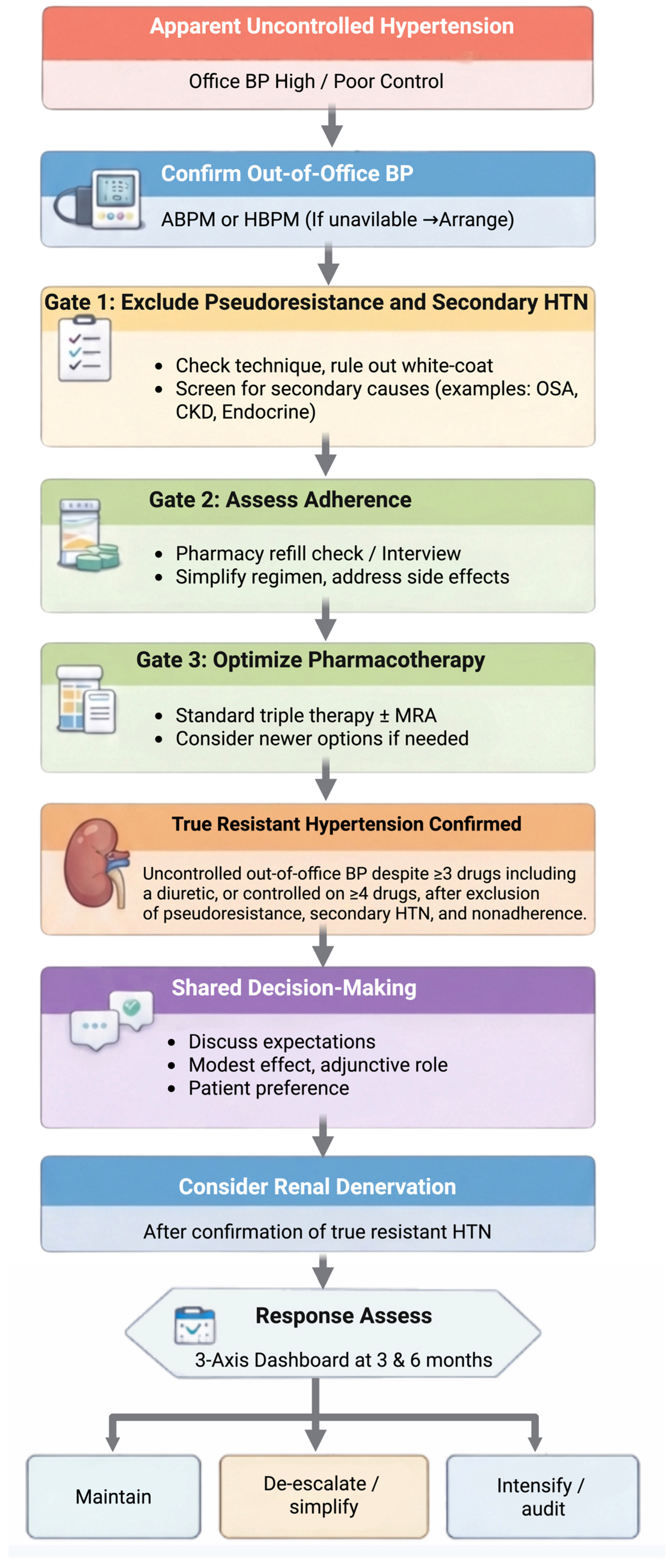
8. Patient Selection: Eligibility Gates and Clinical Phenotypes
- (1)
- (2)
- (3)
9. Practical Exclusions: Defer Renal Denervation Until These Are Addressed
- Isolated white-coat hypertension or uncontrolled office readings without confirmatory ambulatory or structured home data.
- Poor-quality out-of-office measurements (unvalidated device, incorrect cuff size, poor technique, or incomplete series).
- Unassessed or likely nonadherence (no objective medication exposure checks and frequent regimen changes without documentation).
- Reversible contributors that are not yet managed (e.g., NSAIDs/systemic steroids, sympathomimetics, excess sodium or alcohol, licorice, and stimulants).
- Suspected secondary hypertension or untreated obstructive sleep apnea when the clinical features warrant an evaluation.
- When pharmacotherapy is not optimized/simplified per the guidelines’ instruction, or there is no clear documentation of why the escalation is limited.
- The anatomic or renal-function constraints per the local protocol (e.g., unsuitable renal artery anatomy or the inability to undergo required imaging).
10. Renal Function and Anatomic Considerations: Practical Guardrails
11. Shared Decision-Making: Making Renal Denervation a Therapeutic Contract
12. Integrating Renal Denervation with Home Monitoring and Medication Optimization
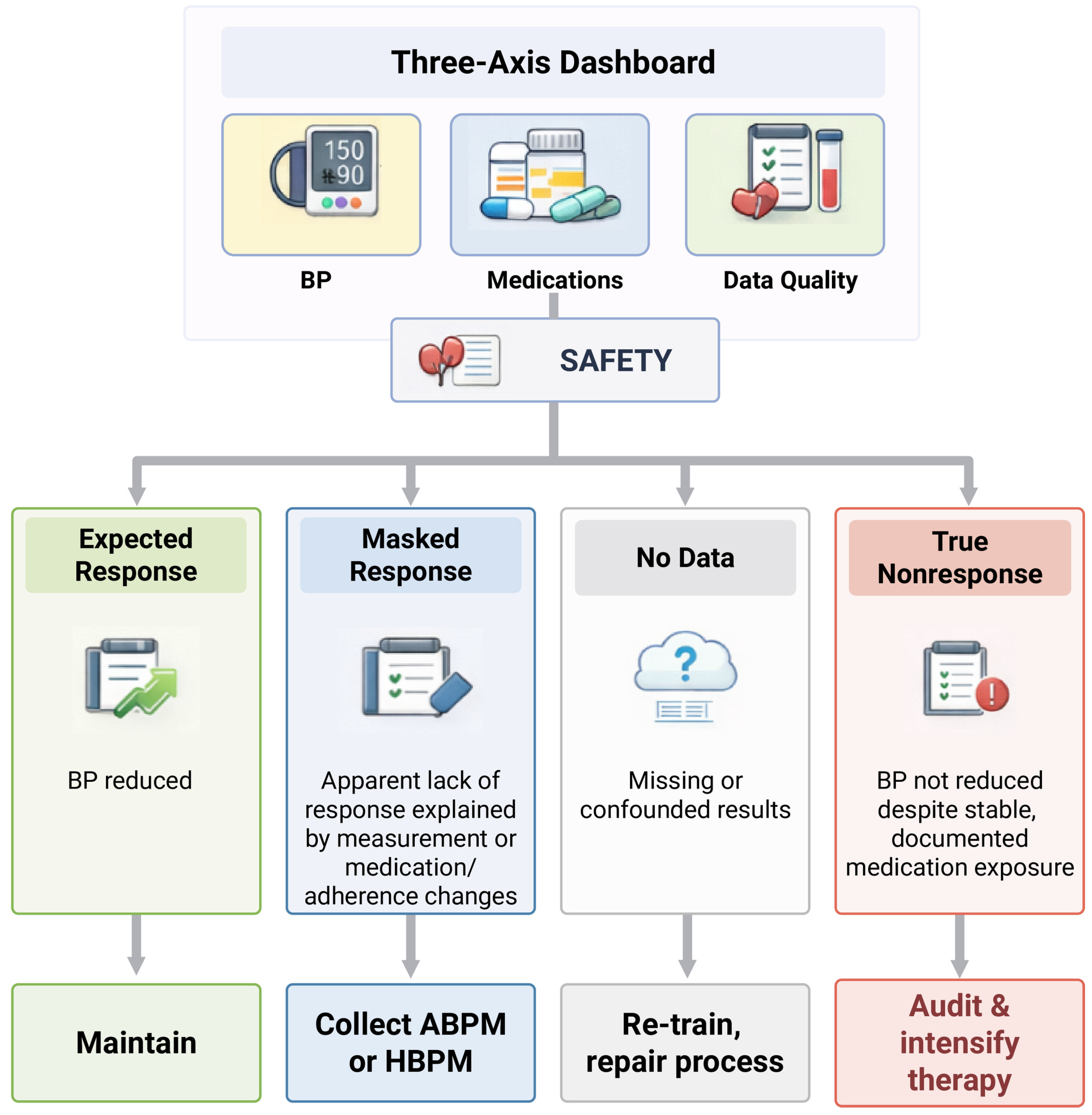
Assessing the Effect at 3–6 Months: A Practical Response Framework
- Data quality: a validated device, the correct technique, and a complete measurement series.
13. Implementation, Quality, and Equity
14. Future Directions
15. Limitations and Evidence Gaps
16. Key Take-Home Messages
- Confirm the sustained uncontrolled blood pressure with ABPM and/or structured HBPM before referral.
- Systematically exclude pseudoresistance, with particular attention to the measurement technique and nonadherence.
- Optimize and simplify pharmacotherapy and address the reversible drivers (e.g., excess sodium, drug-induced hypertension, sleep apnea); RDN is adjunctive, not a shortcut.
- Consider the structured response assessment at 3 and 6 months using predefined out-of-office targets together with a pragmatic three-axis dashboard (blood pressure, data quality, and medication trajectory) to reduce the misclassification in routine care.
- Interpret the durability against the medication trajectory and out-of-office averages; a key clinical benefit may be a reduced need for repeated intensification to maintain the target control.
17. Conclusions
Supplementary Materials
Author Contributions
Funding
Institutional Review Board Statement
Informed Consent Statement
Data Availability Statement
Conflicts of Interest
Abbreviations
| ABPM | Ambulatory blood pressure monitoring |
| AHA | American Heart Association |
| AMA | American Medical Association |
| BP | Blood pressure |
| CI | Confidence interval |
| Crl | Credible interval |
| DBP | Diastolic blood pressure |
| eGFR | Estimated glomerular filtration rate |
| ESC | European Society of Cardiology |
| ESH | European Society of Hypertension |
| FDA | Food and Drug Administration |
| HBPM | Home blood pressure monitoring |
| mmHg | Millimeters of mercury |
| MRA | Mineralocorticoid receptor antagonist |
| NSAIDs | Nonsteroidal anti-inflammatory drugs |
| OFF-med | Off medication |
| ON-med | On medication |
| RDN | Renal denervation |
| SBP | Systolic blood pressure |
References
- Cegłowska, U.; Burzyńska, M.; Prejbisz, A.; Stępińska, J.; Gellert, R.; Pinkas, J.; Jankowski, P. Incidence and prevalence of registered hypertension in Poland. Pol. Arch. Intern. Med. 2024, 134, 16746. [Google Scholar] [CrossRef] [PubMed]
- Zhu, M.; Jin, W.; He, W.; Zhang, L. The incidence, mortality and disease burden of cardiovascular diseases in China: A comparative study with the United States and Japan based on the GBD 2019 time trend analysis. Front. Cardiovasc. Med. 2024, 11, 1408487. [Google Scholar] [CrossRef] [PubMed]
- World Health Organization. Hypertension. Updated 25 September 2025. Available online: https://www.who.int/news-room/fact-sheets/detail/hypertension (accessed on 30 January 2026).
- World Health Organization. Global Report on Hypertension 2025: High Stakes: Turning Evidence into Action. 23 September 2025. Available online: https://www.who.int/publications/i/item/9789240115569 (accessed on 30 January 2026).
- Mancia, G.; Kreutz, R.; Brunström, M.; Burnier, M.; Grassi, G.; Januszewicz, A.; Muiesan, M.L.; Tsioufis, K.; Agabiti-Rosei, E.; Algharably, E.A.E.; et al. 2023 ESH Guidelines for the management of arterial hypertension. J. Hypertens. 2023, 41, 1874–2071. [Google Scholar] [CrossRef]
- McEvoy, J.W.; McCarthy, C.P.; Bruno, R.M.; Brouwers, S.; Canavan, M.D.; Ceconi, C.; Christodorescu, R.M.; Daskalopoulou, S.S.; Ferro, C.J.; Gerdts, E.; et al. 2024 ESC Guidelines for the management of elevated blood pressure and hypertension. Eur. Heart J. 2024, 45, 3912–4018. [Google Scholar] [CrossRef] [PubMed]
- Stergiou, G.S.; Palatini, P.; Parati, G.; O’Brien, E.; Januszewicz, A.; Lurbe, E.; Persu, A.; Mancia, G.; Kreutz, R.; European Society of Hypertension Council; et al. 2021 European Society of Hypertension practice guidelines for office and out-of-office blood pressure measurement. J. Hypertens. 2021, 39, 1293–1302. [Google Scholar] [CrossRef]
- Haley, S.P.; Bragg, S.; Stem, L. Resistant Hypertension in Adults: Evaluation and Treatment. Am. Fam. Physician 2026, 113, 43–50. [Google Scholar]
- Viera, A.J.; Yano, Y.; Lin, F.C.; Simel, D.L.; Yun, J.; Dave, G.; Von Holle, A.; Viera, L.A.; Shimbo, D.; Hardy, S.T.; et al. Does This Adult Patient Have Hypertension?: The Rational Clinical Examination Systematic Review. JAMA 2021, 326, 339–347. [Google Scholar] [CrossRef]
- Jones, D.W.; Ferdinand, K.C.; Taler, S.J.; Johnson, H.M.; Shimbo, D.; Abdalla, M.; Altieri, M.M.; Bansal, N.; Bello, N.A.; Bress, A.P.; et al. 2025 AHA/ACC/AANP/AAPA/ABC/ACCP/ACPM/AGS/AMA/ASPC/NMA/PCNA/SGIM Guideline for the Prevention, Detection, Evaluation, and Management of High Blood Pressure in Adults: A Report of the American College of Cardiology/American Heart Association Joint Committee on Clinical Practice Guidelines. JACC 2025, 86, 1567–1678. [Google Scholar]
- Muxfeldt, E.S.; Salles, G.F. How to use ambulatory blood pressure monitoring in resistant hypertension. Hypertens. Res. 2013, 36, 385–389. [Google Scholar] [CrossRef]
- Cluett, J.L.; Blazek, O.; Brown, A.L.; East, C.; Ferdinand, K.C.; Fisher, N.D.L.; Ford, C.D.; Griffin, K.A.; Mena-Hurtado, C.I.; Sarathy, H.; et al. Renal Denervation for the Treatment of Hypertension: A Scientific Statement from the American Heart Association. Hypertension 2024, 81, e135–e148. [Google Scholar] [CrossRef]
- Lauder, L.; Weber, T.; Böhm, M.; Brouwers, S.; Bruno, R.M.; Gerdts, E.; Kreutz, R.; Lüscher, T.F.; Mancia, G.; McEvoy, J.W.; et al. European guidelines for hypertension in 2024: A comparison of key recommendations for clinical practice. Nat. Rev. Cardiol. 2025, 22, 675–688. [Google Scholar] [CrossRef] [PubMed]
- Whelton, P.K.; Flack, J.M.; Jennings, G.; Schutte, A.; Wang, J.; Touyz, R.M. Editors’ Commentary on the 2023 ESH Management of Arterial Hypertension Guidelines. Hypertension 2023, 80, 1795–1799. [Google Scholar]
- Blood Pressure Lowering Treatment Trialists’ Collaboration. Pharmacological blood pressure lowering for primary and secondary prevention of cardiovascular disease across different levels of blood pressure: An individual participant-level data meta-analysis. Lancet 2021, 397, 1625–1636. [CrossRef] [PubMed]
- Ettehad, D.; Emdin, C.A.; Kiran, A.; Anderson, S.G.; Callender, T.; Emberson, J.; Chalmers, J.; Rodgers, A.; Rahimi, K. Blood pressure lowering for prevention of cardiovascular disease and death: A systematic review and meta-analysis. Lancet 2016, 387, 957–967. [Google Scholar] [CrossRef]
- Stolarz-Skrzypek, K.; Czarnecka, D. Resistant hypertension: Challenges in everyday practice. Pol. Arch. Intern. Med. 2023, 133, 16624. [Google Scholar] [CrossRef] [PubMed]
- Tomaszewski, M.; White, C.; Patel, P.; Masca, N.; Damani, R.; Hepworth, J.; Samani, N.J.; Gupta, P.; Madira, W.; Stanley, A.; et al. High rates of non-adherence to antihypertensive treatment revealed by urine analysis. Heart 2014, 100, 855–861. [Google Scholar] [CrossRef]
- Gupta, P.; Patel, P.; Štrauch, B.; Lai, F.Y.; Akbarov, A.; Gulsin, G.S.; Beech, A.; Marešová, V.; Topham, P.S.; Stanley, A.; et al. Biochemical screening for nonadherence is associated with blood pressure reduction and improvement in adherence. Hypertension 2017, 70, 1042–1048. [Google Scholar] [CrossRef]
- Shimbo, D.; Artinian, N.T.; Basile, J.N.; Krakoff, L.R.; Margolis, K.L.; Rakotz, M.K.; Wozniak, G.; American Heart Association; American Medical Association. Self-measured blood pressure monitoring at home: A joint policy statement from the American Heart Association and American Medical Association. Circulation 2020, 142, e42–e63. [Google Scholar] [CrossRef]
- Zhang, D.Y.; Guo, Q.H.; An, D.W.; Li, Y.; Wang, J.G. A comparative meta-analysis of prospective observational studies on masked hypertension and masked uncontrolled hypertension defined by ambulatory and home blood pressure. J. Hypertens. 2019, 37, 1775–1785. [Google Scholar] [CrossRef]
- Buelt, A.; Richards, A.; Jones, A.L. Hypertension: New Guidelines from the International Society of Hypertension. Am. Fam. Physician 2021, 103, 763–765. [Google Scholar]
- Schlaich, M.P.; Bellet, M.; Weber, M.A.; Danaietash, P.; Bakris, G.L.; Flack, J.M.; Dreier, R.F.; Sassi-Sayadi, M.; Haskell, L.P.; Narkiewicz, K.; et al. Dual endothelin antagonist aprocitentan for resistant hypertension (PRECISION): A phase 3 trial. Lancet 2022, 400, 1927–1937. [Google Scholar] [CrossRef]
- Flack, J.M.; Azizi, M.; Brown, J.M.; Dwyer, J.P.; Fronczek, J.; Jones, E.S.W.; Olsson, D.S.; Perl, S.; Shibata, H.; Wang, J.G.; et al. Efficacy and safety of baxdrostat in uncontrolled and resistant hypertension. N. Engl. J. Med. 2025, 393, 1363–1374. [Google Scholar] [CrossRef] [PubMed]
- Laffin, L.J.; Kopjar, B.; Melgaard, C.; Wolski, K.; Ibbitson, J.; Bhikam, S.; Weir, M.R.; Ofili, E.O.; Mehra, R.; Luther, J.M.; et al. Lorundrostat efficacy and safety in patients with uncontrolled hypertension. N. Engl. J. Med. 2025, 392, 1813–1823. [Google Scholar] [CrossRef] [PubMed]
- Desai, A.S.; Webb, D.J.; Taubel, J.; Casey, S.; Cheng, Y.; Robbie, G.J.; Foster, D.; Huang, S.A.; Rhyee, S.; Sweetser, M.T.; et al. Zilebesiran is an RNA interference therapeutic agent for hypertension. N. Engl. J. Med. 2023, 389, 228–238. [Google Scholar] [CrossRef] [PubMed]
- Bakris, G.L.; Saxena, M.; Gupta, A.; Chalhoub, F.; Lee, J.; Stiglitz, D.; Makarova, N.; Goyal, N.; Guo, W.; Zappe, D.; et al. RNA interference with zilebesiran for mild to moderate hypertension: The KARDIA-1 randomized clinical trial. JAMA 2024, 331, 740–749. [Google Scholar] [CrossRef]
- Heidari Nejad, S.; Azzam, O.; Schlaich, M.P. Dual Endothelin Antagonism with Aprocitentan as a Novel Therapeutic Approach for Resistant Hypertension. Curr. Hypertens. Rep. 2023, 25, 343–352. [Google Scholar] [CrossRef]
- Kiuchi, M.G.; Esler, M.D.; Fink, G.D.; Osborn, J.W.; Banek, C.T.; Böhm, M.; Denton, K.M.; DiBona, G.F.; Everett, T.H., 4th; Grassi, G.; et al. Renal Denervation Update from the International Sympathetic Nervous System Summit: JACC State-of-the-Art Review. JACC 2019, 73, 3006–3017. [Google Scholar] [CrossRef]
- Katsurada, K.; Shinohara, K.; Aoki, J.; Nanto, S.; Kario, K. Renal denervation: Basic and clinical evidence. Hypertens. Res. 2022, 45, 198–209. [Google Scholar] [CrossRef]
- Azizi, M.; Saxena, M.; Wang, Y.; Jenkins, J.S.; Devireddy, C.; Rader, F.; Fisher, N.D.L.; Schmieder, R.E.; Mahfoud, F.; Lindsey, J.; et al. Endovascular ultrasound renal denervation to treat hypertension: The RADIANCE II randomized clinical trial. JAMA 2023, 329, 651–661. [Google Scholar] [CrossRef]
- Azizi, M.; Sanghvi, K.; Saxena, M.; Gosse, P.; Reilly, J.P.; Levy, T.; Rump, L.C.; Persu, A.; Basile, J.; Bloch, M.J.; et al. Ultrasound renal denervation for hypertension resistant to a triple medication pill (RADIANCE-HTN TRIO): A sham-controlled trial. Lancet 2021, 397, 2476–2486. [Google Scholar] [CrossRef]
- Böhm, M.; Kario, K.; Kandzari, D.E.; Mahfoud, F.; Weber, M.A.; Schmieder, R.E.; Tsioufis, K.; Pocock, S.; Konstantinidis, D.; Choi, J.W.; et al. SPYRAL HTN-OFF MED Pivotal: Renal denervation vs sham without medications. Lancet 2020, 395, 1444–1451. [Google Scholar] [CrossRef]
- Kandzari, D.E.; Townsend, R.R.; Kario, K.; Mahfoud, F.; Weber, M.A.; Schmieder, R.E.; Pocock, S.; Tsioufis, K.; Konstantinidis, D.; Choi, J.; et al. Safety and efficacy of renal denervation in patients taking antihypertensive medications. JACC 2023, 82, 1809–1823. [Google Scholar] [CrossRef] [PubMed]
- Kandzari, D.E.; Mahfoud, F.; Townsend, R.R.; Kario, K.; Weber, M.A.; Schmieder, R.E.; Tsioufis, K.; Pocock, S.; Liu, M.; DeBruin, V.; et al. Long-term safety and efficacy of renal denervation: 24-month results from the SPYRAL HTN-ON MED trial. Circ. Cardiovasc. Interv. 2025, 18, e015194. [Google Scholar] [CrossRef] [PubMed]
- Vukadinović, D.; Lauder, L.; Kandzari, D.E.; Bhatt, D.L.; Kirtane, A.J.; Edelman, E.R.; Schmieder, R.E.; Azizi, M.; Böhm, M.; Mahfoud, F. Effects of catheter-based renal denervation in hypertension: A systematic review and meta-analysis. Circulation 2024, 150, 1599–1611. [Google Scholar] [CrossRef] [PubMed]
- Azizi, M.; Sharp, A.S.P.; Fisher, N.D.L.; Weber, M.A.; Lobo, M.D.; Daemen, J.; Lurz, P.; Mahfoud, F.; Schmieder, R.E.; Basile, J.; et al. Patient-level pooled analysis of endovascular ultrasound renal denervation or a sham procedure 6 months after medication escalation: The RADIANCE clinical trial program. Circulation 2024, 149, 747–759. [Google Scholar] [CrossRef]
- U.S. Food and Drug Administration. Paradise Ultrasound Renal Denervation System—P220023. Approval Date: 7 November 2023. Available online: https://www.fda.gov/medical-devices/recently-approved-devices/paradise-ultrasound-renal-denervation-system-p220023 (accessed on 30 January 2026).
- U.S. Food and Drug Administration. Symplicity Spyral™ Renal Denervation System—P220026. Decision Date: November 17, 2023. Available online: https://www.accessdata.fda.gov/scripts/cdrh/cfdocs/cfpma/pma.cfm?id=P220026 (accessed on 30 January 2026).
- Townsend, R.R.; Walton, A.; Hettrick, D.A.; Hickey, G.L.; Weil, J.; Sharp, A.S.P.; Blankestijn, P.J.; Böhm, M.; Mancia, G. Incidence of renal artery damage following percutaneous renal denervation: Review and meta-analysis. EuroIntervention 2020, 15, 1241–1247. [Google Scholar]
- Mahfoud, F.; Böhm, M.; Schmieder, R.; Narkiewicz, K.; Ewen, S.; Ruilope, L.; Schlaich, M.; Williams, B.; Fahy, M.; Mancia, G. Effects of renal denervation on kidney function and long-term outcomes: 3-year follow-up from the Global SYMPLICITY Registry. Eur. Heart J. 2019, 40, 3474–3482. [Google Scholar] [CrossRef]
- Bhatt, D.L.; Kandzari, D.E.; O’Neill, W.W.; D’Agostino, R.; Flack, J.M.; Katzen, B.T.; Leon, M.B.; Liu, M.; Mauri, L.; Negoita, M.; et al. A controlled trial of renal denervation for resistant hypertension. N. Engl. J. Med. 2014, 370, 1393–1401. [Google Scholar] [CrossRef]
- Barbato, E.; Azizi, M.; Schmieder, R.E.; Lauder, L.; Böhm, M.; Brouwers, S.; Bruno, R.M.; Dudek, D.; Kahan, T.; Kandzari, D.E.; et al. Renal denervation in the management of hypertension in adults: An ESC Council on Hypertension/EAPCI clinical consensus statement. EuroIntervention 2023, 18, 1227–1243. [Google Scholar]
- Baral, N.; Volgman, A.S.; Seri, A.; Chelikani, V.; Isa, S.; Javvadi, S.L.P.; Paul, T.K.; Mitchell, J.D. Adding pharmacist-led home blood pressure telemonitoring to usual care: A systematic review and meta-analysis. Am. J. Cardiol. 2023, 203, 161–168. [Google Scholar] [CrossRef]
- Acharya, S.; Neupane, G.; Seals, A.; Kc, M.; Giustini, D.; Sharma, S.; Taylor, Y.J.; Palakshappa, D.; Williamson, J.D.; Moore, J.B.; et al. Self-measured blood pressure-guided pharmacotherapy: A systematic review and meta-analysis of United States-based telemedicine trials. Hypertension 2024, 81, 648–657. [Google Scholar] [CrossRef]
- Schmieder, R.E. Renal denervation in patients with chronic kidney disease: Current evidence and future perspectives. Nephrol. Dial. Transplant. 2023, 38, 1089–1096. [Google Scholar] [CrossRef]
- Katz, M.E.; Mszar, R.; Grimshaw, A.A.; Gunderson, C.G.; Onuma, O.K.; Lu, Y.; Spatz, E.S. Digital health interventions for hypertension management in US populations experiencing health disparities: A systematic review and meta-analysis. JAMA Netw. Open 2024, 7, e2356070. [Google Scholar] [CrossRef]
- Sharp, A.S.P.; Fisher, N.D.L. Renal Denervation to Treat Hypertension: A Clinical State-of-the-Art Review. Am. J. Hypertens. 2025, 39, 355–364. [Google Scholar] [CrossRef]
- Iliakis, P.; Dimitriadis, K.; Tatakis, F.; Vakka, A.; Sakalidis, A.; Pyrpyris, N.; Fragoulis, C.; Konstantinidis, D.; Aznaouridis, K.; Tsioufis, K. Safety and Efficacy of Renal Denervation for the Treatment of Resistant Hypertension in Patients with Chronic Kidney Disease: A Narrative Review of the Literature. Biomedicines 2025, 13, 1951. [Google Scholar] [CrossRef]
- Schlaich, M.P.; Mahfoud, F.; Böhm, M.; Narkiewicz, K.; Ruilope, L.; Williams, B.; Mancia, G.; Sharif, F.; Ribichini, F.; Lung, T.H.; et al. Renal Denervation in Patients with Moderate to Severe Chronic Kidney Disease. Hypertension 2025, 82, 2252–2261. [Google Scholar] [CrossRef]
- King, J.B.; An, J.; Bellows, B.K.; Cohen, J.B.; Commodore-Mensah, Y.; Ghazi, L.; Langford, A.T.; Brook, R.D.; American Heart Association Council on Hypertension; Council on Cardiovascular and Stroke Nursing; et al. Single-Pill Combination Therapy for the Management of Hypertension: A Scientific Statement from the American Heart Association. Hypertension 2026, 83, e00258. [Google Scholar] [CrossRef] [PubMed]



| Trial | Technology | Population/Background Therapy | Primary SBP Endpoint (ABPM) | Primary Endpoint Time Point | Sham-Adjusted Between-Group Difference in Change in SBP |
|---|---|---|---|---|---|
| RADIANCE II | Ultrasound | Hypertension; antihypertensive medications withdrawn | Daytime ambulatory SBP (ABPM) | 2 months | −6.3 mmHg (95% CI, −9.3 to −3.2; p < 0.001) |
| RADIANCE-HTN TRIO | Ultrasound | Resistant hypertension; standardized triple single-pill combination (run-in) | Daytime ambulatory SBP (ABPM) | 2 months | −4.5 mmHg (95% CI, −8.5 to −0.3; adjusted p = 0.022) |
| SPYRAL HTN-OFF MED Pivotal | Radiofrequency | Hypertension; antihypertensive medications withdrawn | 24 h ambulatory SBP (ABPM) | 3 months | −3.9 mmHg (Bayesian 95% CrI, −6.2 to −1.6) |
| SPYRAL HTN-ON MED | Radiofrequency | Hypertension on background antihypertensive medications | 24 h ambulatory SBP (ABPM) | 6 months | −1.9 mmHg (95% CI, −4.4 to 0.5; p = 0.12) |
|
| Phenotype | When RDN May Add Value (Core Requirement) | Primary Goal | Must-Have Prerequisites Before RDN | Measurable Success at 3–6 Months (Out-of-Office) |
|---|---|---|---|---|
| True resistant hypertension | Uncontrolled out-of-office BP despite the optimized regimen and the documented medication exposure. | Close the residual gap to the target without increasing the pill burden. |
| Target achieved and/or ≥5 mmHg reduction in 24 h (or daytime) ambulatory SBP versus baseline on a stable, documented regimen. |
| Limited pharmacologic headroom | Confirmed uncontrolled out-of-office BP with intolerance, adverse effects, or polypharmacy limiting escalation. | Improve control without adding adverse effects or complexity. |
| Target achieved with unchanged or reduced medication load (dose intensity/pill burden) and without new treatment-limiting adverse effects. |
| Persistent adherence barriers (high risk) | Confirmed uncontrolled out-of-office BP plus repeated nonadherence despite support, with high baseline cardiovascular risk. | Add an adherence-independent BP-lowering component as redundancy within a monitored program. |
| Improved out-of-office BP mean (ABPM/HBPM) and reduced time above target thresholds, with documented engagement in monitoring and medication plan. |
| Domain | Preferred Metric | What to Document (Minimum Dataset) | Interpretation | Next Step If Unfavorable |
|---|---|---|---|---|
| Out-of-office BP (hemodynamic response) | ABPM (preferred) or standardized HBPM averages |
| Judge BP change only on the same measurement platform; avoid office-only interpretation. If medications changed, interpret alongside exposure documentation. | Repair measurement process (training/device) and repeat ABPM/HBPM; then treat-to-target titration. |
| Medication exposure and adherence | Current regimen + objective exposure indicators (refill/telemonitoring; biochemical testing in selected resistant cases) |
| Distinguish true nonresponse from medication drift or nonadherence. A stable, documented regimen is required to label ‘true nonresponse’. | Audit adherence and barriers; simplify regimen (single-pill combinations); protocolized titration; consider escalation (e.g., optimized diuretics/MRA when tolerated). |
| Data quality (measurement integrity) | Validated device and complete HBPM/ABPM dataset |
| Treat ‘no data’ separately from ‘no response’. Poor-quality or incomplete datasets preclude response classification. | Re-train, replace/validate device, repeat monitoring; avoid premature conclusions or medication changes driven by office readings alone. |
| Safety (parallel domain) | Renal function and vascular events |
| Provides context for medication adjustments and informs whether further titration is appropriate. | Adjust therapy per protocol; evaluate adverse events; consider imaging/nephrology/vascular review as indicated. |
Disclaimer/Publisher’s Note: The statements, opinions and data contained in all publications are solely those of the individual author(s) and contributor(s) and not of MDPI and/or the editor(s). MDPI and/or the editor(s) disclaim responsibility for any injury to people or property resulting from any ideas, methods, instructions or products referred to in the content. |
© 2026 by the authors. Licensee MDPI, Basel, Switzerland. This article is an open access article distributed under the terms and conditions of the Creative Commons Attribution (CC BY) license.
Share and Cite
Szarpak, L.; Katipoglu, B.; Jaguszewski, M.J.; Baier, A.; Kubica, J.; Maslyk, M.; Pruc, M.; Momot, K.; Cander, B.; Lin, Q. Renal Denervation for Uncontrolled Hypertension: A Measurement-First, Program-Based Approach. J. Clin. Med. 2026, 15, 2648. https://doi.org/10.3390/jcm15072648
Szarpak L, Katipoglu B, Jaguszewski MJ, Baier A, Kubica J, Maslyk M, Pruc M, Momot K, Cander B, Lin Q. Renal Denervation for Uncontrolled Hypertension: A Measurement-First, Program-Based Approach. Journal of Clinical Medicine. 2026; 15(7):2648. https://doi.org/10.3390/jcm15072648
Chicago/Turabian StyleSzarpak, Lukasz, Burak Katipoglu, Milosz J. Jaguszewski, Andrea Baier, Jacek Kubica, Maciej Maslyk, Michal Pruc, Karol Momot, Basar Cander, and Queran Lin. 2026. "Renal Denervation for Uncontrolled Hypertension: A Measurement-First, Program-Based Approach" Journal of Clinical Medicine 15, no. 7: 2648. https://doi.org/10.3390/jcm15072648
APA StyleSzarpak, L., Katipoglu, B., Jaguszewski, M. J., Baier, A., Kubica, J., Maslyk, M., Pruc, M., Momot, K., Cander, B., & Lin, Q. (2026). Renal Denervation for Uncontrolled Hypertension: A Measurement-First, Program-Based Approach. Journal of Clinical Medicine, 15(7), 2648. https://doi.org/10.3390/jcm15072648