“Echoes from the Dyad”: Relational Context of Postpartum Depression Risk


Abstract
1. Introduction
2. Materials and Methods
2.1. Research Hypotheses
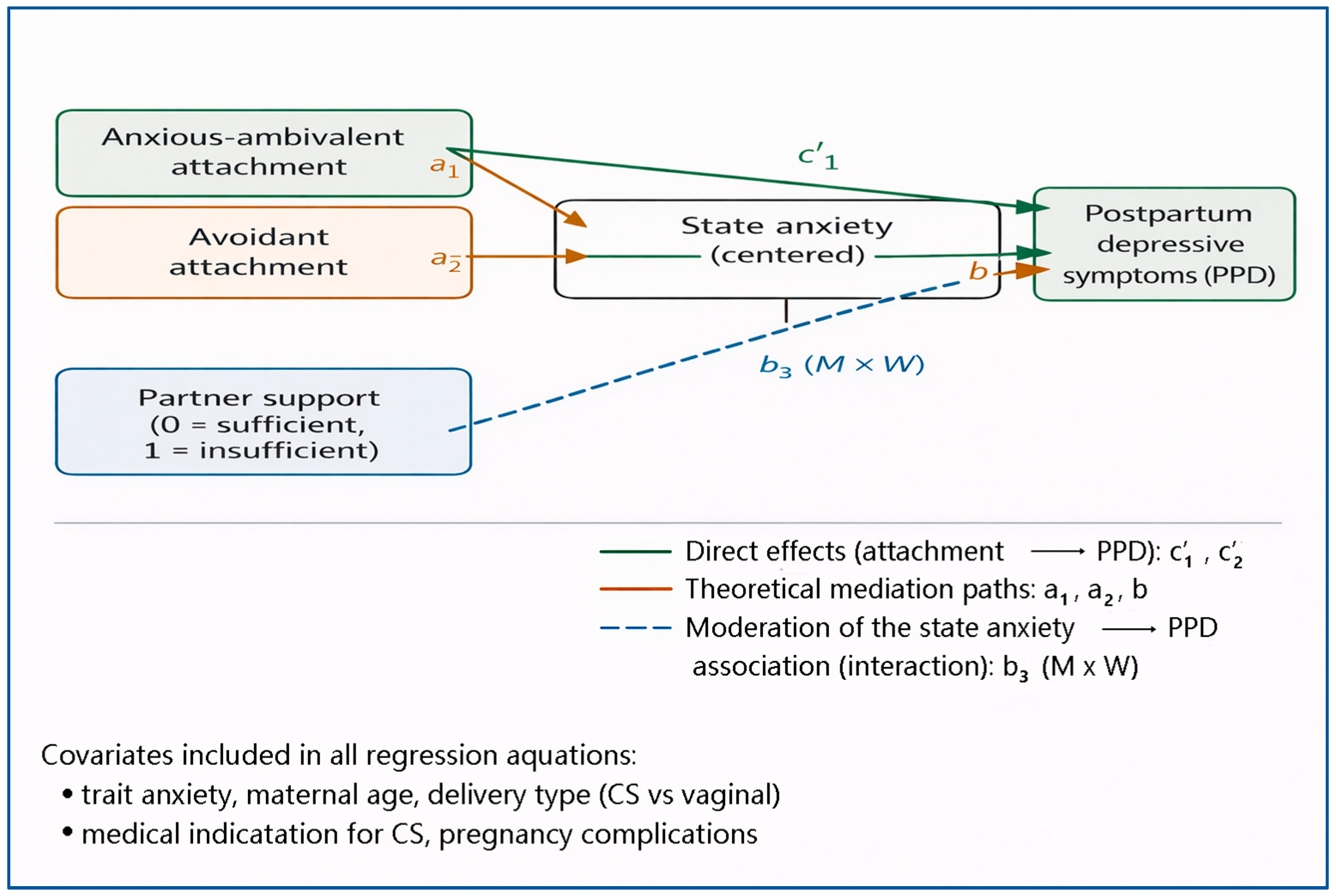
2.2. Analytical Plan
2.3. Psychological Measures
2.4. Participants and Recruitment
2.5. Summary of Descriptive Statistics and Correlations
3. Results
3.1. Main Effects and Associations Among Attachment Dimensions, State Anxiety, and Postpartum Depressive Symptoms
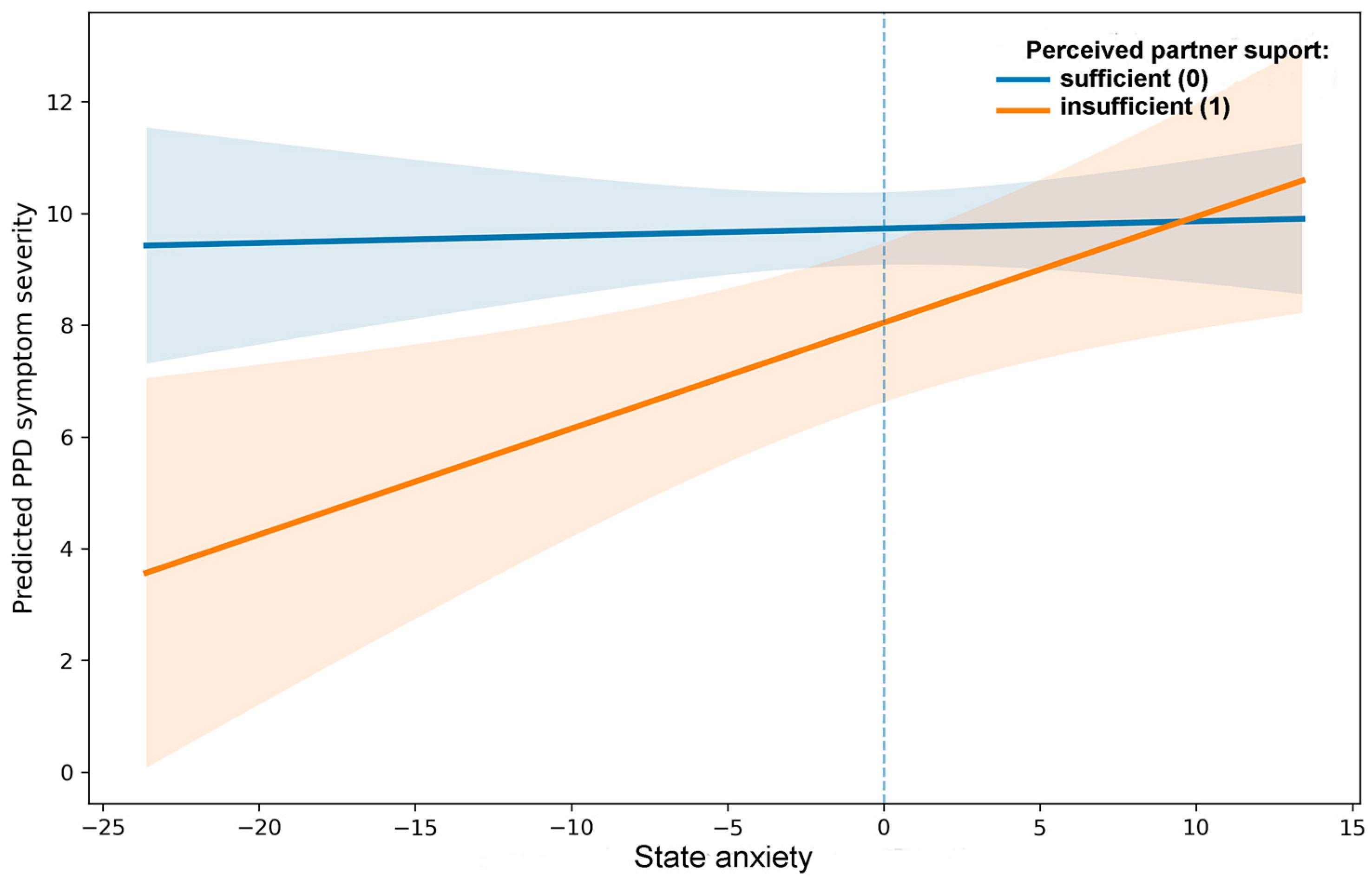
3.2. Moderation Analysis
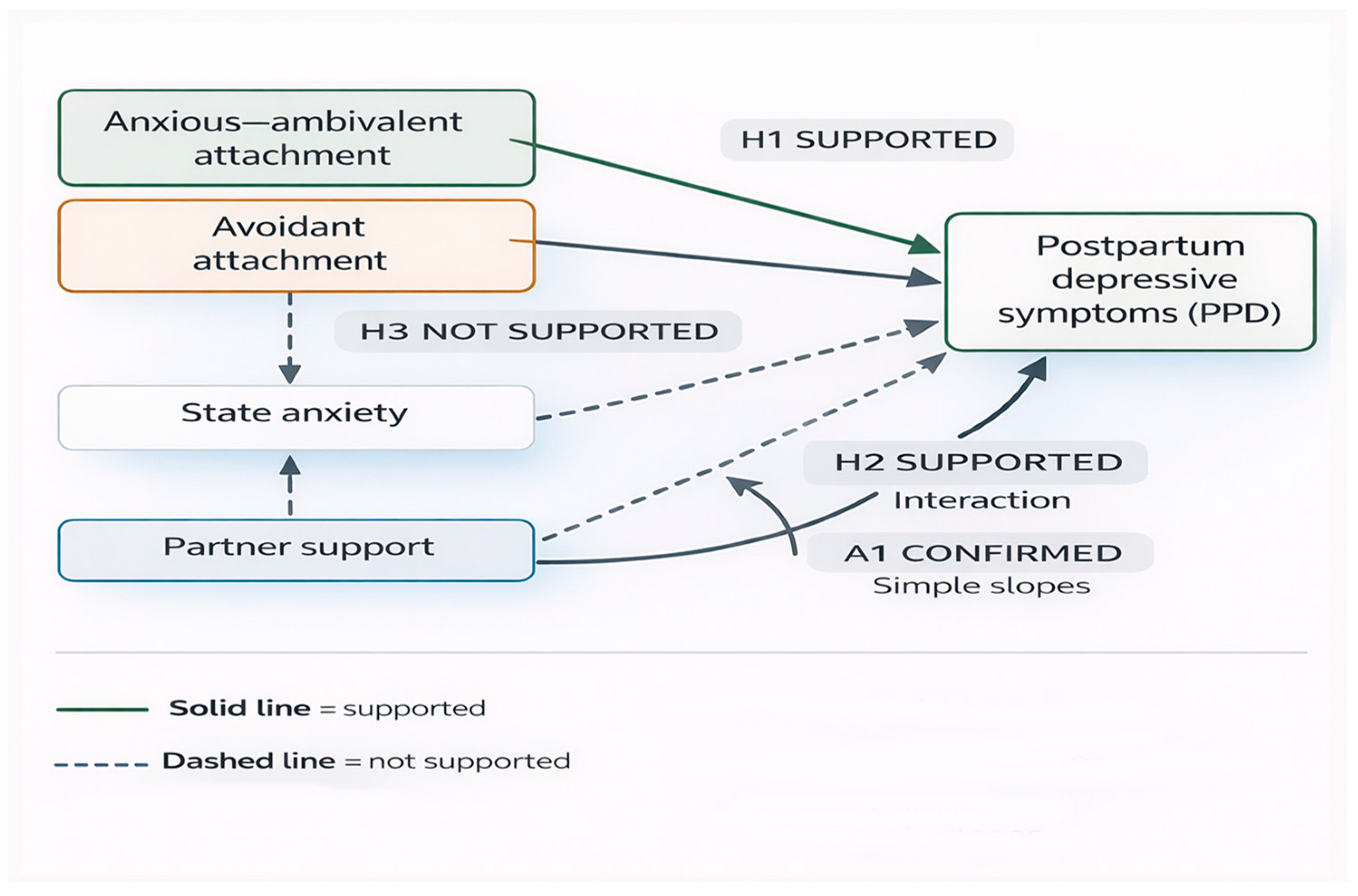
3.3. Hypothesis Testing
4. Discussion
Supplementary Materials
Author Contributions
Funding
Institutional Review Board Statement
Informed Consent Statement
Data Availability Statement
Acknowledgments
Conflicts of Interest
Abbreviations
| PPD | Postpartum Depression |
| EPDS | Edinburgh Postnatal Depression Scale |
| STAI-T | State–Trait Anxiety Inventory–Trait |
| STAI-S | State–Trait Anxiety Inventory–State |
| OLS | Ordinary Least Squares |
| HC3 | Heteroskedasticity-consistent standard errors |
| VIF | Variance Inflation Factor |
| SSA | Simple Slope Analyses |
References
- Gavin, N.I.; Gaynes, B.N.; Lohr, K.N.; Meltzer-Brody, S.; Gartlehner, G.; Swinson, T. Perinatal depression: A systematic review of prevalence and incidence. Obstet. Gynecol. 2005, 106, 1071–1083. [Google Scholar] [CrossRef] [PubMed]
- O’Hara, M.W.; McCabe, J.E. Postpartum depression: Current status and future directions. Annu. Rev. Clin. Psychol. 2013, 9, 379–407. [Google Scholar] [CrossRef] [PubMed]
- Robbins, C.L.; Ko, J.Y.; D’Angelo, D.V.; Salvesen von Essen, B.; Bish, C.L.; Kroelinger, C.D.; Tevendale, H.D.; Warner, L.; Barfield, W. Timing of postpartum depressive symptoms. Prev. Chronic Dis. 2023, 20, E103. [Google Scholar] [CrossRef] [PubMed]
- Cox, J.L.; Holden, J.M.; Sagovsky, R. Detection of postnatal depression. Development of the 10-item Edinburgh Postnatal Depression Scale. Br. J. Psychiatry 1987, 150, 782–786. [Google Scholar] [CrossRef]
- Levis, B.; Negeri, Z.; Sun, Y.; Benedetti, A.; Thombs, B.D. Accuracy of the Edinburgh Postnatal Depression Scale. BMJ 2020, 371, m4022. [Google Scholar] [CrossRef]
- Kingston, D.; Kehler, H.; Austin, M.-P.; Mughal, M.K.; Wajid, A.; Vermeyden, L.; Benzies, K.; Brown, S.; Stuart, S.; Giallo, R. Trajectories of maternal depressive symptoms during pregnancy and the first 12 months postpartum and child externalizing and internalizing behavior at three years. PLoS ONE 2018, 13, e0195365. [Google Scholar] [CrossRef]
- Pilkington, P.D.; Milne, L.C.; Cairns, K.E.; Lewis, J.; Whelan, T.A. Modifiable partner factors associated with perinatal depression and anxiety: A systematic review and meta-analysis. J. Affect. Disord. 2015, 178, 165–180. [Google Scholar] [CrossRef]
- Wei, M.; Qin, Y.; Niu, X.; Niu, S.; Mu, F.; Yang, L.; Li, Y.; Zhang, Y.; Wang, J.; Liu, Y. Marriage and postpartum major depressive disorder: A systematic review and meta-analysis of cohort studies. J. Psychiatr. Res. 2025, 182, 83–91. [Google Scholar] [CrossRef]
- Kümpfel, J.; Weise, V.; Mack, J.T.; Garthus-Niegel, S. Parental relationship satisfaction, symptoms of depression and anger/hostility, and the moderating role of perceived social support-a prospective cohort study in the light of the COVID-19 pandemic. Front. Psychol. 2025, 16, 1470241. [Google Scholar] [CrossRef]
- Overall, N.C.; Simpson, J.A. Attachment and Dyadic Regulation Processes. Curr. Opin. Psychol. 2015, 1, 61–66. [Google Scholar] [CrossRef]
- Howard, L.M.; Khalifeh, H.; Perlis, R.H. Perinatal mental health: A review of progress and challenges. World Psychiatry 2020, 19, 313–327. [Google Scholar] [CrossRef] [PubMed]
- Bowlby, J.A. Secure Base: Parent-Child Attachment and Healthy Human Development; Basic Books: New York, NY, USA, 1988. [Google Scholar]
- Mikulincer, M.; Shaver, P.R. Attachment in Adulthood: Structure, Dynamics, and Change; Guilford Press: New York, NY, USA, 2016. [Google Scholar]
- Ikeda, M.; Hayashi, M.; Kamibeppu, K. The relationship between attachment style and postpartum depression. Attach. Hum. Dev. 2014, 16, 557–572. [Google Scholar] [CrossRef]
- Warfa, N.; Harper, M.; Nicolais, G.; Bhui, K. Adult attachment style as a risk factor for maternal postnatal depression: A systematic review. BMC Psychol. 2014, 2, 56. [Google Scholar] [CrossRef] [PubMed]
- Rholes, W.S.; Simpson, J.A.; Friedman, M. Avoidant attachment and the experience of parenting. Pers. Soc. Psychol. Bull. 2006, 32, 275–285. [Google Scholar] [CrossRef]
- Simpson, J.A.; Rholes, W.S. Adult attachment orientations and well-being during the transition to parenthood. Curr. Opin. Psychol. 2019, 25, 47–52. [Google Scholar] [CrossRef]
- Biaggi, A.; Conroy, S.; Pawlby, S.; Pariante, C.M. Identifying the women at risk of antenatal anxiety and depression: A systematic review. J. Affect. Disord. 2016, 191, 62–77. [Google Scholar] [CrossRef]
- Dennis, C.L.; Falah-Hassani, K.; Shiri, R. Prevalence of antenatal and postnatal anxiety: Systematic review and meta-analysis. Br. J. Psychiatry 2017, 210, 315–323. [Google Scholar] [CrossRef]
- van der Zee-van den Berg, A.I.; Boere-Boonekamp, M.M.; Groothuis-Oudshoorn, C.G.M.; Reijneveld, S.A. Postpartum depression and anxiety: A community-based study on risk factors before, during and after pregnancy. J. Affect. Disord. 2021, 286, 158–165. [Google Scholar] [CrossRef]
- Wilkinson, R.B.; Mulcahy, R. Attachment and interpersonal relationships in postnatal depression. J. Reprod. Infant Psychol. 2010, 28, 252–265. [Google Scholar] [CrossRef]
- Gingras, A.S.; Brassard, A.; Péloquin, K.; Lafontaine, M.F.; Brault-Labbé, A.; Gosselin, P. Anxiety and depressive symptoms in first-time parents: A dyadic longitudinal study based on attachment theory. J. Affect. Disord. 2024, 355, 122–130. [Google Scholar] [CrossRef] [PubMed]
- Terzic, T.; Polona, R.P.; Oblak, A.; Makovec, M.R. Exploring the influence of personality and partner attachment on perinatal depression and anxiety. BMC Psychol. 2025, 14, 102. [Google Scholar] [CrossRef]
- Deng, J.; Chen, J.; Tan, Y.; Guo, X.; Liu, F. Exploring the role of different coping styles in mediating the relationship between dyadic adjustment status and postpartum depression among postnatal women: A single-centre, cross-sectional study. BMJ Open 2025, 15, e088699. [Google Scholar] [CrossRef] [PubMed]
- Kouri, G.; Messerli-Bürgy, N.; Meuwly, N.; Richter, M.; Schoebi, D. Perceived partner responsiveness across the transition to parenthood: The role of attachment insecurity. J. Soc. Pers. Relatsh. 2025, 42, 1728–1755. [Google Scholar] [CrossRef]
- Green, S.B. How Many Subjects Does It Take to Do A Regression Analysis. Multivar. Behav. Res. 1991, 26, 499–510. [Google Scholar] [CrossRef]
- Kossakowska, K. Psychometric properties of the Polish EPDS. Folia Psychol. 2013, 17, 39–50. [Google Scholar]
- Plopa, M. Kwestionariusz Stylów Przywiązaniowych (KSP); Pracownia Testów Psychologicznych: Warsaw, Poland, 2008. [Google Scholar]
- Wrześniewski, K.; Sosnowski, T.; Jaworowska, A.; Fecenec, D. STAI—Inwentarz Stanu i Cechy Lęku; Pracownia Testów Psychologicznych: Warsaw, Poland, 2002. [Google Scholar]
- Spielberger, C.D.; Gorsuch, R.L.; Lushene, R.; Vagg, P.R.; Jacobs, G.A. Manual for the State–Trait Anxiety Inventory; Consulting Psychologists Press: Palo Alto, CA, USA, 1983. [Google Scholar]
- Endler, N.S.; Kocovski, N.L. State and trait anxiety revisited. J. Anxiety Disord. 2002, 15, 231–245. [Google Scholar] [CrossRef]
- Bergkvist, L.; Rossiter, J.R. The predictive validity of multiple-item versus single-item measures of the same constructs. J. Mark. Res. 2007, 44, 175–184. [Google Scholar] [CrossRef]
- Diamantopoulos, A.; Sarstedt, M.; Fuchs, C.; Wilczynski, P.; Kaiser, S. Guidelines for choosing between multi-item and single-item scales for construct measurement: A predictive validity perspective. J. Acad. Mark. Sci. 2012, 40, 434–449. [Google Scholar] [CrossRef]
- Tuovinen, S.; Lahti-Pulkkinen, M.; Girchenko, P.; Lipsanen, J.; Lahti, J.; Heinonen, K.; Reynolds, R.M.; Laivuori, H.; Villa, P.; Hämäläinen, E.; et al. Maternal depressive symptoms during and after pregnancy and child developmental milestones. Depress. Anxiety 2018, 35, 732–741. [Google Scholar] [CrossRef]
- Putnick, D.L.; Sundaram, R.; Bell, E.M.; Ghassabian, A.; Goldstein, R.B.; Robinson, S.L.; Vafai, Y.; Gilman, S.E.; Yeung, E. Trajectories of maternal postpartum depressive symptoms. Pediatrics 2020, 146, e20200857. [Google Scholar] [CrossRef] [PubMed]
- Sufredini, F.; Catling, C.; Zugai, J.; Chang, S. The effects of social support on depression and anxiety in the perinatal period: A mixed-methods systematic review. J. Affect. Dis. 2022, 319, 119–141. [Google Scholar] [CrossRef]
- Wang, J.; Yao, J.; Su, Y.; Wang, D.; Guo, Z.; Wang, J.; Wang, Y.; Ren, J. Associations among mental well-being, marital quality, and maternal depressive symptoms in China: A cross-sectional study and mediated analysis. Front. Psychiatry 2025, 16, 1551588. [Google Scholar] [CrossRef]
- Ou, L.; Shen, Q.; Xiao, M.; Wang, W.; He, T.; Wang, B. Prevalence of co-morbid anxiety and depression in pregnancy and postpartum: A systematic review and meta-analysis. Psychol. Med. 2025, 55, e84. [Google Scholar] [CrossRef]
- Feldman, N.; Hibara, A.; Ye, J.; Macaranas, A.; Larkin, P.; Hendrix, E.; Aydinian, T.; Mittal, L.; Wiegartz, P.; Silbersweig, D.; et al. Postpartum anxiety: A state-of-the-art review. Lancet Psychiatry 2025, 12, 947–959. [Google Scholar] [CrossRef] [PubMed]
- Qin, Z.; Pan, Y.; Yang, H.; Luan, L.; Zhang, X.; Zhu, C. Prevalence and risk factors of postpartum depression, anxiety, and comorbidity of both disorders: A cross-sectional study. BMC Pregnancy Childbirth 2025, 25, 1352. [Google Scholar] [CrossRef]
- Xu, M.; Luo, Y.; Huang, Y.; Liu, Y.; Ding, L. Risk factors for postpartum depression: An umbrella review. Front. Public Health 2026, 13, 1714668. [Google Scholar] [CrossRef] [PubMed]
- Zelčāne, E.; Pipere, A.; Vende Kotova, K.; Mestere, A.; Mārtinsone, K. Psychosocial risk factors for depression and anxiety in European postpartum women: A scoping review. Eur. J. Midwifery 2026, 10, 1. [Google Scholar] [CrossRef]
- Kızıldemir, Y.Z.; Tammo, Ö.; Karslı, S.E.; Okuyan, I.I.; Kahveci, B.; Sak, S.; Sak, M.E.; Kalir, H.; İncebıyık, M.; Civelek, M.; et al. Beyond the blues: Marital dissatisfaction as a stronger predictor of postpartum depression than maternity blues among postpartum women: A prospective study in a Turkish cohort. Front. Med. 2026, 13, 1769387. [Google Scholar] [CrossRef] [PubMed]
- Vogel, L.; Löchner, J.; Opitz, A.; Ehring, T.; Lux, U.; Liel, C.; Henning, C.; Seiferth, C.; Wittekind, C. Shadows of the past—Hierarchical regression analyses on the role of childhood maltreatment experiences for postpartum depression. J. Affect. Disord. 2025, 371, 82–90. [Google Scholar] [CrossRef]
- Cowan, P.A.; Cowan, C.P.; Pruett, M.K.; Pruett, K. Fathers’ and mothers’ attachment styles, couple conflict, parenting quality, and children’s behavior problems: An intervention test of mediation. Attach. Hum. Dev. 2019, 21, 532–550. [Google Scholar] [CrossRef]
- Jiang, M.; Zheng, H.; Bao, Z.; Wu, Z.; Zheng, X.; Feng, Y. Joint developmental trajectories of perinatal depression and anxiety and their predictors: A longitudinal study. Healthcare 2025, 13, 1251. [Google Scholar] [CrossRef]
- Ruan, J.-M.; Wu, L.-J. Postpartum depression and partner support during the period of lactation: Correlation research and its influencing factors. World J. Psychiatry 2024, 14, 119–127. [Google Scholar] [CrossRef]
- Arnal, M.; Ngameni, E.G.; Tebeka, S.; Dubertret, C. Determinants of Immediate Postpartum Anxiety and Its Association With Postpartum Depression: A Case-Control Study Nested in a Cohort. J. Clin. Psychiatry 2025, 86, 25m15830. [Google Scholar]
- Lakey, B.; Orehek, E. Relational regulation theory: A new approach to explain the link between perceived social support and mental health. Psychol. Rev. 2011, 118, 482–495. [Google Scholar] [CrossRef] [PubMed]
- Haber, M.G.; Cohen, J.L.; Lucas, T.; Baltes, B.B. The relationship between self-reported received and perceived social support: A meta-analytic review. Am. J. Community Psychol. 2007, 39, 133–144. [Google Scholar] [CrossRef] [PubMed]
- Santini, Z.I.; Koyanagi, A.; Tyrovolas, S.; Mason, C.; Haro, J.M. The association between social relationships and depression: A systematic review. J. Affect. Disord. 2015, 175, 53–65. [Google Scholar] [CrossRef]
- Dennis, C.L.; Ross, L. Women’s perceptions of partner support and conflict in the development of postpartum depressive symptoms. J. Adv. Nurs. 2006, 56, 588–599. [Google Scholar] [CrossRef] [PubMed]
- Stapleton, L.R.; Schetter, C.D.; Westling, E.; Rini, C.; Glynn, L.M.; Hobel, C.J.; Sandman, C.A. Perceived partner support in pregnancy predicts lower maternal and infant distress. J. Fam. Psychol. 2012, 26, 453–463. [Google Scholar] [CrossRef]
- Tavares, D.; Fidalgo, D.; Sousa, M.; Morais, A.; Jongenelen, I.; Lamela, D.; Alves, S.; Costa, R.; Pinto, T.M. History of mental health problems moderates the association between partner support during childbirth and women’s mental health in the postpartum period. Midwifery 2025, 144, 104359. [Google Scholar] [CrossRef]



| Characteristic | Value |
|---|---|
| Maternal age, years—M (SD) | 32.96 (4.13) |
| Cesarean delivery—% | 53.8 |
| Medical indication among CS—% | 70.7 |
| Pregnancy complications—% | 25.7 |
| Insufficient perceived partner support—% | 16.1 |
| Trait anxiety—M (SD) | 46.61 (8.81) |
| Variable | M | SD | 1 | 2 | 3 | 4 | 5 |
|---|---|---|---|---|---|---|---|
| 1. State anxiety | 45.60 | 10.34 | - | 0.181 ** | −0.047 | −0.005 | 0.044 |
| 2. Postpartum depressive symptoms | 9.49 | 4.81 | 0.181 ** | - | 0.278 *** | 0.275 *** | 0.024 |
| 3. Anxious–ambivalent attachment | 21.30 | 10.65 | −0.047 | 0.278 *** | - | 0.520 *** | 0.254 *** |
| 4. Avoidant attachment | 18.13 | 9.41 | −0.005 | 0.275 *** | 0.520 *** | - | 0.358 *** |
| 5. Perceived partner support | – | – | 0.044 | 0.024 | 0.254 *** | 0.358 *** | - |
| Predictor | B | SE (HC3) | p |
|---|---|---|---|
| Intercept | 0.680 | 3.654 | 0.852 |
| Anxious–ambivalent attachment | 0.092 | 0.036 | 0.011 |
| Avoidant attachment | 0.115 | 0.048 | 0.017 |
| State anxiety (centered) | 0.013 | 0.044 | 0.769 |
| Perceived partner support (1 = insufficient) | −1.685 | 0.838 | 0.044 |
| State anxiety × Perceived partner support | 0.177 | 0.071 | 0.012 |
| Trait anxiety | 0.095 | 0.050 | 0.058 |
| Maternal age | 0.024 | 0.076 | 0.749 |
| Delivery type (cesarean) | −0.613 | 0.628 | 0.329 |
| Medical indication for CS | −0.022 | 0.637 | 0.972 |
| Pregnancy complications | 0.479 | 0.722 | 0.507 |
Disclaimer/Publisher’s Note: The statements, opinions and data contained in all publications are solely those of the individual author(s) and contributor(s) and not of MDPI and/or the editor(s). MDPI and/or the editor(s) disclaim responsibility for any injury to people or property resulting from any ideas, methods, instructions or products referred to in the content. |
© 2026 by the authors. Licensee MDPI, Basel, Switzerland. This article is an open access article distributed under the terms and conditions of the Creative Commons Attribution (CC BY) license.
Share and Cite
Tuszyńska-Bogucka, W.; Bosowska, K. “Echoes from the Dyad”: Relational Context of Postpartum Depression Risk. J. Clin. Med. 2026, 15, 2608. https://doi.org/10.3390/jcm15072608
Tuszyńska-Bogucka W, Bosowska K. “Echoes from the Dyad”: Relational Context of Postpartum Depression Risk. Journal of Clinical Medicine. 2026; 15(7):2608. https://doi.org/10.3390/jcm15072608
Chicago/Turabian StyleTuszyńska-Bogucka, Wioletta, and Katarzyna Bosowska. 2026. "“Echoes from the Dyad”: Relational Context of Postpartum Depression Risk" Journal of Clinical Medicine 15, no. 7: 2608. https://doi.org/10.3390/jcm15072608
APA StyleTuszyńska-Bogucka, W., & Bosowska, K. (2026). “Echoes from the Dyad”: Relational Context of Postpartum Depression Risk. Journal of Clinical Medicine, 15(7), 2608. https://doi.org/10.3390/jcm15072608